Questions as text
Q1 · Natural gas and petroleum are fossil fuels 0654/31 May/June 2017
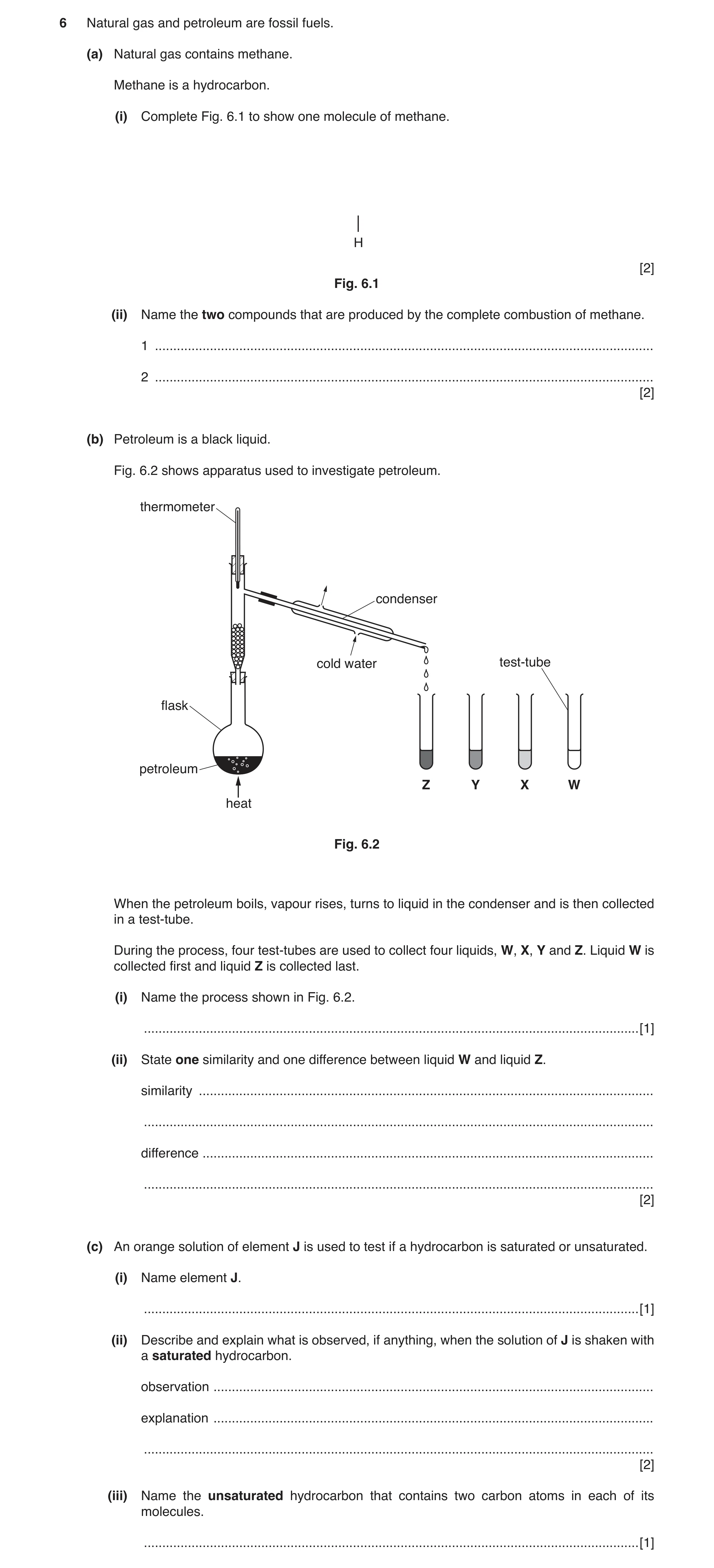
6 Natural gas and petroleum are fossil fuels. (a) Natural gas contains methane. Methane is a hydrocarbon. (i) Complete Fig. 6.1 to show one molecule of methane. H [2] Fig. 6.1 (ii) Name the two compounds that are produced by the complete combustion of methane. 1 … 2 … [2] (b) Petroleum is a black liquid. Fig. 6.2 shows apparatus used to investigate petroleum. thermometer condenser cold water test-tube flask petroleum Z Y X W heat Fig. 6.2 When the petroleum boils, vapour rises, turns to liquid in the condenser and is then collected in a test-tube. During the process, four test-tubes are used to collect four liquids, W, X, Y and Z. Liquid W is collected first and liquid Z is collected last. (i) Name the process shown in Fig. 6.2. … [1] (ii) State one similarity and one difference between liquid W and liquid Z. similarity … … difference … … [2] (c) An orange solution of element J is used to test if a hydrocarbon is saturated or unsaturated. (i) Name element J. … [1] (ii) Describe and explain what is observed, if anything, when the solution of J is shaken with a saturated hydrocarbon. observation … explanation … … [2] (iii) Name the unsaturated hydrocarbon that contains two carbon atoms in each of its molecules. … [1]
11 marks
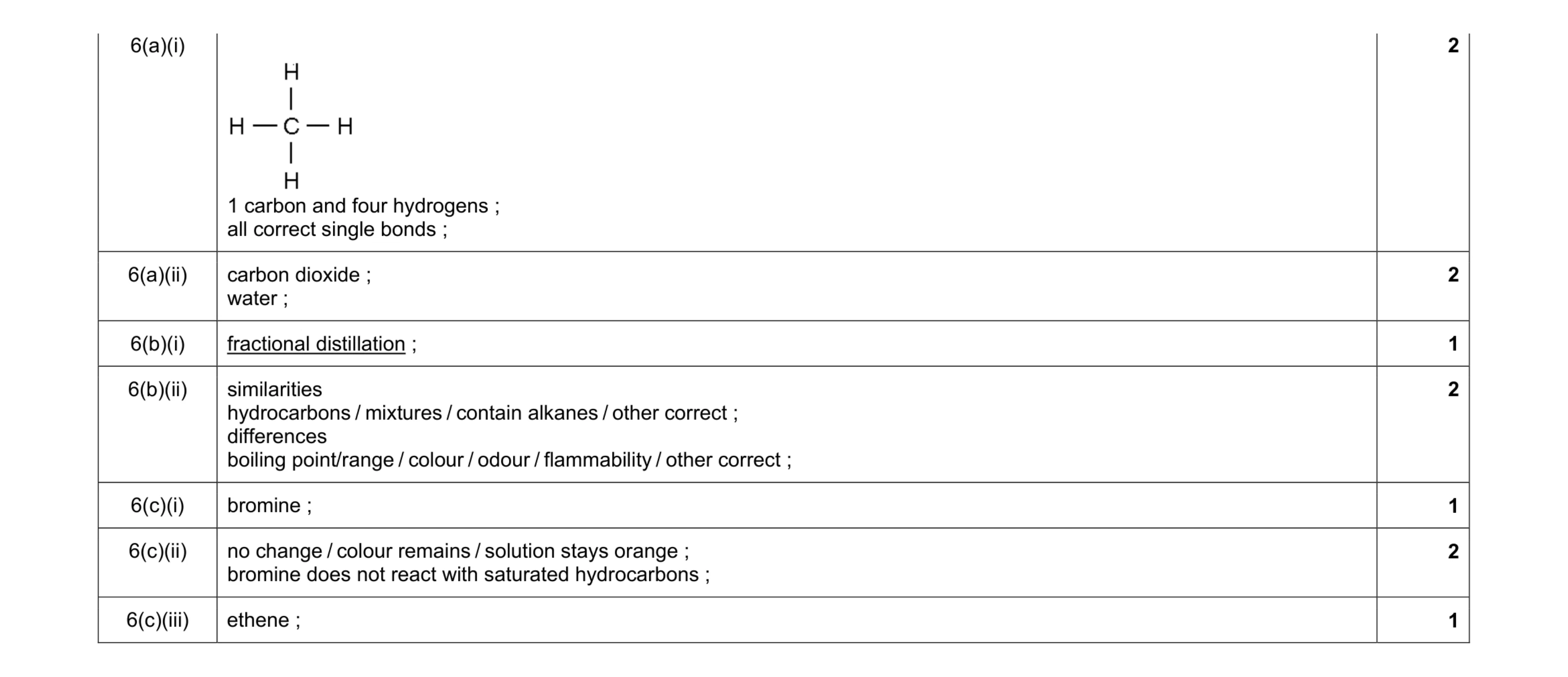
Mark scheme: 6(a)(i) 1 carbon and four hydrogens ; all correct single bonds ; 2 6(a)(ii) carbon dioxide ; water ; 2 6(b)(i) fractional distillation ; 1 6(b)(ii) similarities hydrocarbons / mixtures / contain alkanes / other correct ; differences boiling point/range / colour / odour / flammability / other correct ; 2 6(c)(i) bromine ; 1 6(c)(ii) no change / colour remains / solution stays orange ; bromine does not react with saturated hydrocarbons ; 2 6(c)(iii) ethene ; 1
This question in 0654/31 May/June 2017
Q2 · Complete the sentences about atomic structure using words chosen from the list 0654/32 Oct/Nov 2017
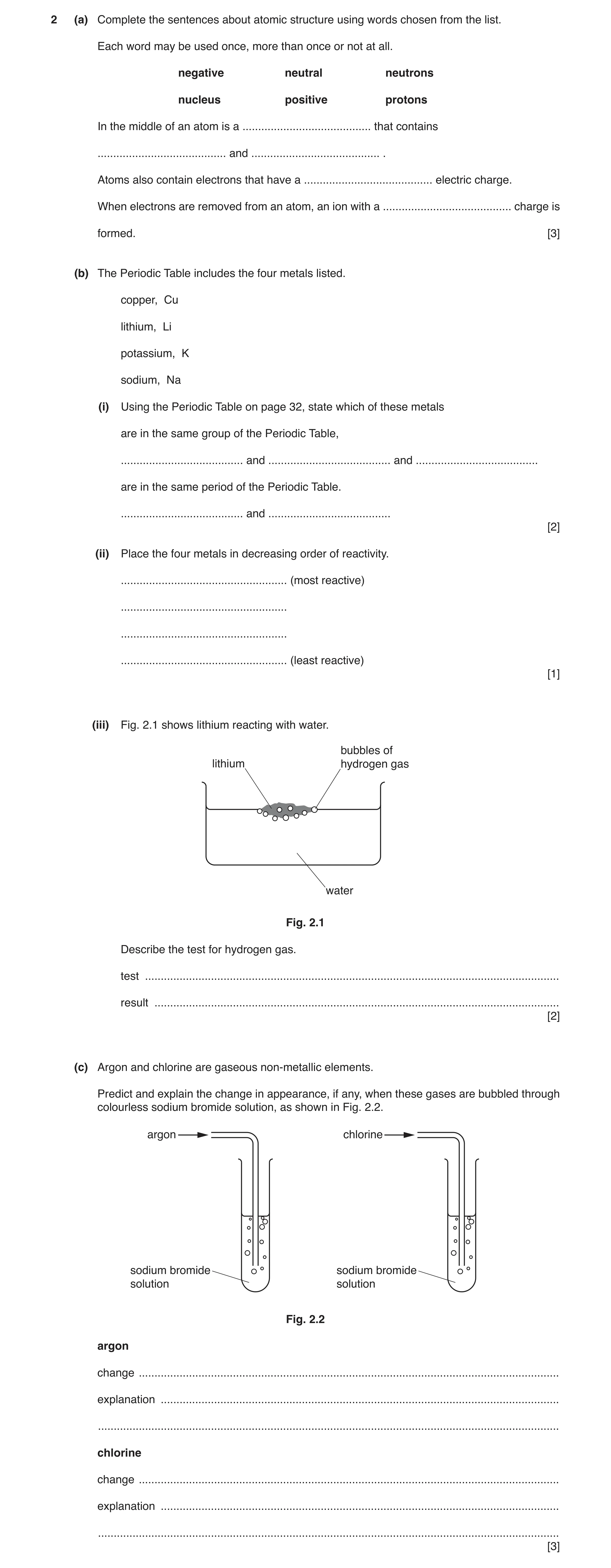
2 (a) Complete the sentences about atomic structure using words chosen from the list. Each word may be used once, more than once or not at all. negative neutral neutrons nucleus positive protons In the middle of an atom is a … that contains … and … . Atoms also contain electrons that have a … electric charge. When electrons are removed from an atom, an ion with a … charge is formed. [3] (b) The Periodic Table includes the four metals listed. copper, Cu lithium, Li potassium, K sodium, Na (i) Using the Periodic Table on page 32, state which of these metals are in the same group of the Periodic Table, … and … and … are in the same period of the Periodic Table. … and … [2] (ii) Place the four metals in decreasing order of reactivity. … (most reactive) … … … (least reactive) [1] (iii) Fig. 2.1 shows lithium reacting with water. bubbles of lithium hydrogen gas water Fig. 2.1 Describe the test for hydrogen gas. test … result … [2] (c) Argon and chlorine are gaseous non-metallic elements. Predict and explain the change in appearance, if any, when these gases are bubbled through colourless sodium bromide solution, as shown in Fig. 2.2. argon chlorine sodium bromide sodium bromide solution solution Fig. 2.2 argon change … explanation … … chlorine change … explanation … … [3]
11 marks
Mark scheme: 2(a) nucleus then protons and neutrons ; negative ; positive ; 3 2(b)(i) lithium, sodium, potassium ; copper, potassium ; 2 2(b)(ii) potassium sodium lithium copper ; 1 2(b)(iii) burning / lighted splint ; pops ; 2 Question Answer Marks 2(c) no change / no reaction AND argon is unreactive / is an inert gas ; solution becomes orange ; bromine is released / chlorine displaces bromine / chlorine more reactive than bromine ; 3
This question in 0654/32 Oct/Nov 2017
Q3 · When lithium reacts with water, a gas is produced 0654/33 Oct/Nov 2017
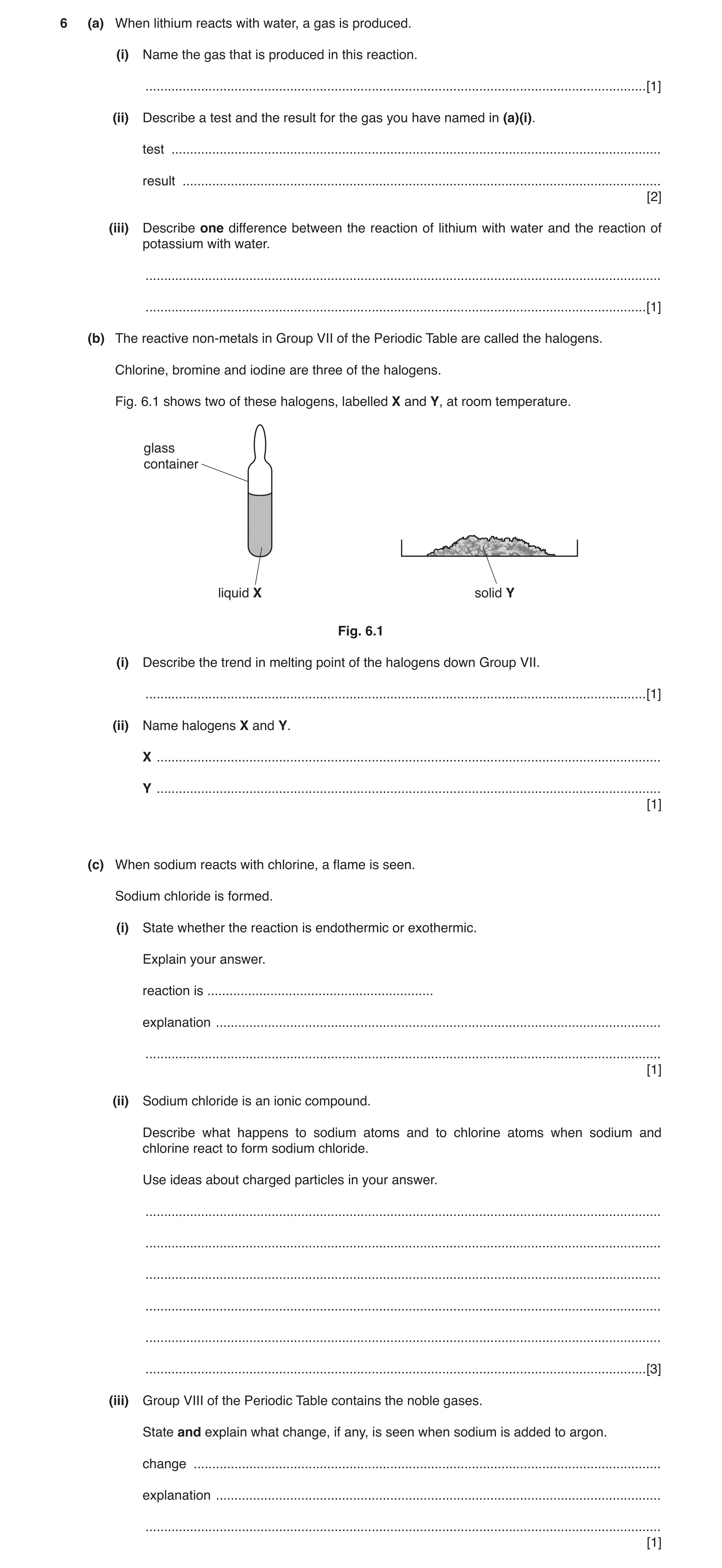
6 (a) When lithium reacts with water, a gas is produced. (i) Name the gas that is produced in this reaction. … [1] (ii) Describe a test and the result for the gas you have named in (a)(i). test … result … [2] (iii) Describe one difference between the reaction of lithium with water and the reaction of potassium with water. … … [1] (b) The reactive non-metals in Group VII of the Periodic Table are called the halogens. Chlorine, bromine and iodine are three of the halogens. Fig. 6.1 shows two of these halogens, labelled X and Y, at room temperature. glass container liquid X solid Y Fig. 6.1 (i) Describe the trend in melting point of the halogens down Group VII. … [1] (ii) Name halogens X and Y. X … Y … [1] (c) When sodium reacts with chlorine, a flame is seen. Sodium chloride is formed. (i) State whether the reaction is endothermic or exothermic. Explain your answer. reaction is … explanation … … [1] (ii) Sodium chloride is an ionic compound. Describe what happens to sodium atoms and to chlorine atoms when sodium and chlorine react to form sodium chloride. Use ideas about charged particles in your answer. … … … … … … [3] (iii) Group VIII of the Periodic Table contains the noble gases. State and explain what change, if any, is seen when sodium is added to argon. change … explanation … … [1]
11 marks
Mark scheme: 6(a)(i) hydrogen ; 1 6(a)(ii) burning lighted splint ; pops ; 2 6(a)(iii) potassium reacts more vigorously / quickly ; 1 6(b)(i) m.pt. increasing down the group ; 1 6(b)(ii) X is bromine and Y is iodine ; 1 6(c)(i) exothermic AND means heat given off / evidence is the flame ; 1 6(c)(ii) sodium atoms lose electrons and chlorine atoms gain electrons; one electron ; reference to atoms becoming charged ions ; the idea that ions of opposite charge attract ; max 3 6(c)(iii) no reaction / no change AND argon unreactive / inert / is an inert gas ; 1
This question in 0654/33 Oct/Nov 2017
Q4 · Group VII of the Periodic Table contains reactive non‑metallic elements called the… 0654/31 Oct/Nov 2018
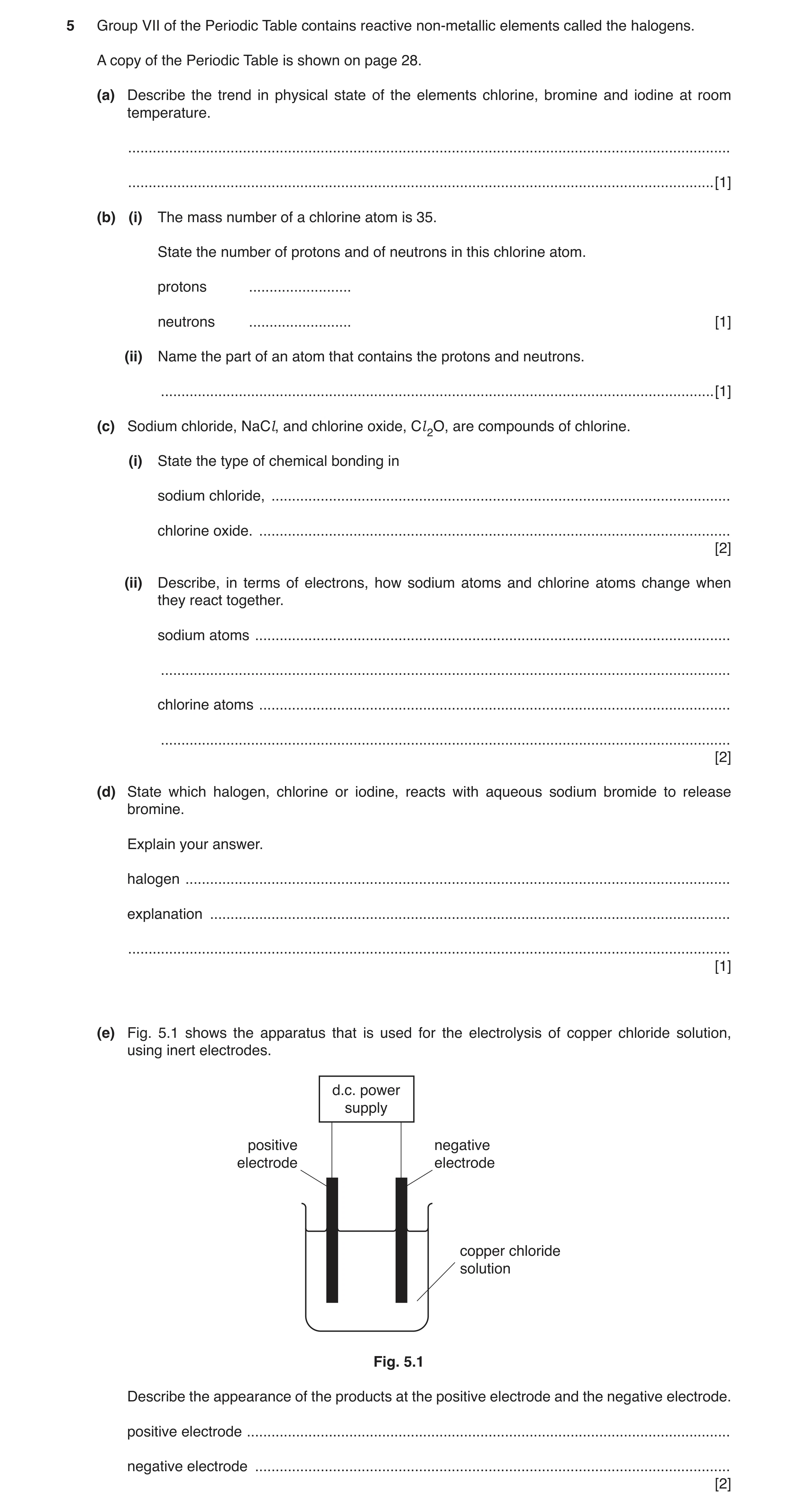
5 Group VII of the Periodic Table contains reactive non‑metallic elements called the halogens. A copy of the Periodic Table is shown on page 28. (a) Describe the trend in physical state of the elements chlorine, bromine and iodine at room temperature. … … [1] (b) (i) The mass number of a chlorine atom is 35. State the number of protons and of neutrons in this chlorine atom. protons … neutrons … [1] (ii) Name the part of an atom that contains the protons and neutrons. … [1] (c) Sodium chloride, NaCl, and chlorine oxide, Cl 2O, are compounds of chlorine. (i) State the type of chemical bonding in sodium chloride, … chlorine oxide. … [2] (ii) Describe, in terms of electrons, how sodium atoms and chlorine atoms change when they react together. sodium atoms … … chlorine atoms … … [2] (d) State which halogen, chlorine or iodine, reacts with aqueous sodium bromide to release bromine. Explain your answer. halogen … explanation … … [1] (e) Fig. 5.1 shows the apparatus that is used for the electrolysis of copper chloride solution, using inert electrodes. d.c. power supply positive negative electrode electrode copper chloride solution Fig. 5.1 Describe the appearance of the products at the positive electrode and the negative electrode. positive electrode … negative electrode … [2]
10 marks
Mark scheme: 5(a) gaseous to liquid to solid ; 1 5(b)(i) (protons) 17 (neutrons) 18 ; 1 5(b)(ii) nucleus ; 1 5(c)(i) (sodium chloride) ionic / electrovalent ; (chlorine oxide ) covalent ; 2 5(c)(ii) (sodium atoms) lose electrons ; (chlorine atoms) gain electrons ; 2 5(d) chlorine – no mark chlorine more reactive than bromine ; 1 5(e) at positive gas is released / bubbles produced ; at negative brown / copper-coloured solid (layer) ; 2
This question in 0654/31 Oct/Nov 2018
Q5 · Information about some of the elements in Group VII of the Periodic Table 0654/33 Oct/Nov 2018
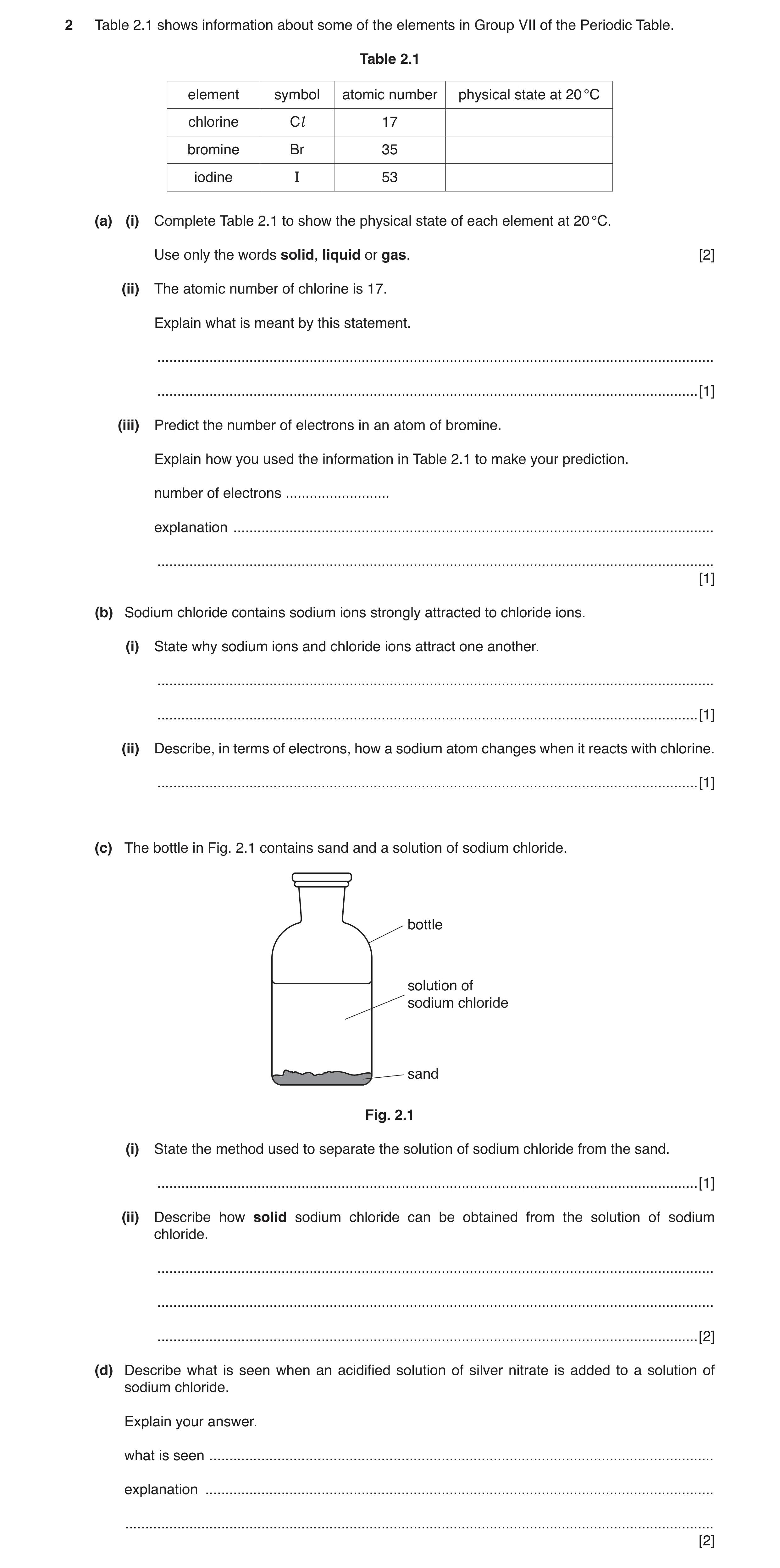
2 Table 2.1 shows information about some of the elements in Group VII of the Periodic Table. Table 2.1 element symbol atomic number physical state at 20 °C chlorine Cl 17 bromine Br 35 iodine I 53 (a) (i) Complete Table 2.1 to show the physical state of each element at 20 °C. Use only the words solid, liquid or gas. [2] (ii) The atomic number of chlorine is 17. Explain what is meant by this statement. … … [1] (iii) Predict the number of electrons in an atom of bromine. Explain how you used the information in Table 2.1 to make your prediction. number of electrons … explanation … … [1] (b) Sodium chloride contains sodium ions strongly attracted to chloride ions. (i) State why sodium ions and chloride ions attract one another. … … [1] (ii) Describe, in terms of electrons, how a sodium atom changes when it reacts with chlorine. … [1] (c) The bottle in Fig. 2.1 contains sand and a solution of sodium chloride. bottle solution of sodium chloride sand Fig. 2.1 (i) State the method used to separate the solution of sodium chloride from the sand. … [1] (ii) Describe how solid sodium chloride can be obtained from the solution of sodium chloride. … … … [2] (d) Describe what is seen when an acidified solution of silver nitrate is added to a solution of sodium chloride. Explain your answer. what is seen … explanation … … [2]
11 marks
Mark scheme: 2(a)(i) gas liquid solid 1 or 2 correct ; 3 correct ; 2 2(a)(ii) chlorine atoms contain 17 protons ; 1 2(a)(iii) (35) number of electrons equal to number of protons / atomic number ; 1 2(b)(i) they have opposite electrical charges / opposite charges attract ; 1 2(b)(ii) outer electron is lost (from sodium) / it is transferred to the chlorine atom ; 1 2(c)(i) filtration / decantation ; 1 2(c)(ii) heat (solution) ; so all water evaporates / leave to evaporate ; 2 2(d) white precipitate / goes cloudy ; solution contains chloride (anions) / this is the chloride ion test / silver chloride is insoluble ; 2
This question in 0654/33 Oct/Nov 2018
Q6 · Chlorine and argon are gaseous elements in Period 3 of the Periodic Table 0654/31 May/June 2019
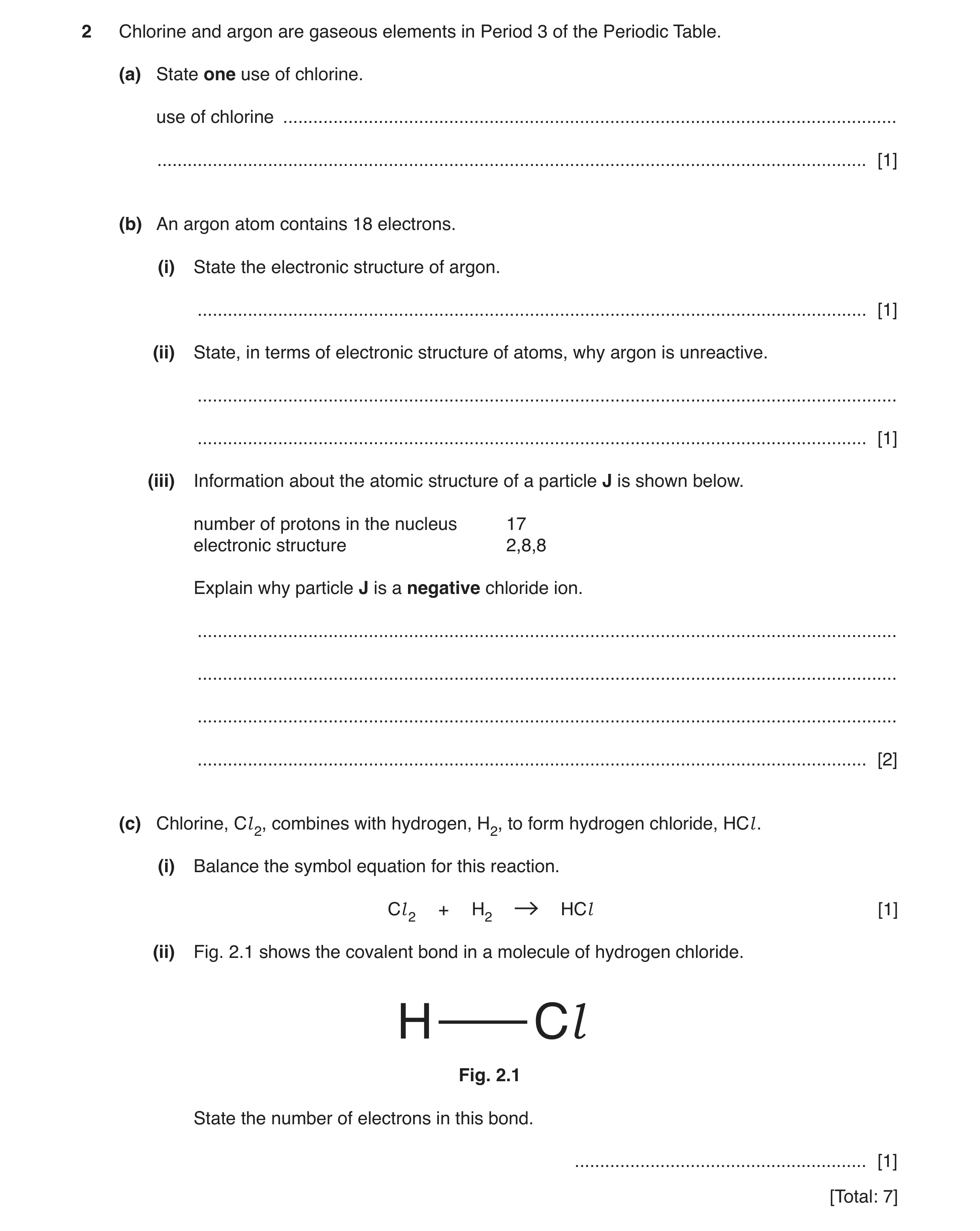
2 Chlorine and argon are gaseous elements in Period 3 of the Periodic Table. (a) State one use of chlorine. use of chlorine … … [1] (b) An argon atom contains 18 electrons. (i) State the electronic structure of argon. … [1] (ii) State, in terms of electronic structure of atoms, why argon is unreactive. … … [1] (iii) Information about the atomic structure of a particle J is shown below. number of protons in the nucleus 17 electronic structure 2,8,8 Explain why particle J is a negative chloride ion. … … … … [2] (c) Chlorine, Cl 2, combines with hydrogen, H2, to form hydrogen chloride, HCl . (i) Balance the symbol equation for this reaction. Cl 2 + H2 HCl [1] (ii) Fig. 2.1 shows the covalent bond in a molecule of hydrogen chloride. H Cl Fig. 2.1 State the number of electrons in this bond. … [1] [Total: 7]
7 marks
Mark scheme: 2(a) ref. to sterilisation of (drinking) water ; 1 2(b)(i) 2,8,8 ; 1 2(b)(ii) outer shell is full / all shells complete / the idea that electrons do not need to be lost or gained for stability ; 1 2(b)(iii) (J contains) more electrons than protons / has one extra electron/has extra electrons ; electrons are negative ; 2 2(c)(i) (Cl2 + H2 → ) 2 HCl ; 1 2(c)(ii) two / one pair ; 1
This question in 0654/31 May/June 2019
Q7 · The halogens chlorine, bromine and iodine are in Group VII of the Periodic Table 0654/32 Oct/Nov 2020
2 The halogens chlorine, bromine and iodine are in Group VII of the Periodic Table. (a) (i) Table 2.1 shows the melting points and boiling points of chlorine, bromine and iodine. Complete Table 2.1. Table 2.1 melting point boiling point solid, liquid or gas at halogen / °C / °C 20 °C –7 +59 … … –101 –34 … … +114 +184 … … [2] (ii) Describe one other trend in the properties of the Group VII elements. … … [1] (b) In a naturally occurring sample of chlorine, one of the atoms contains 17 protons and 18 neutrons. The sentences about chlorine are either correct or incorrect. For each sentence, write a tick (3) if it is correct or a cross (X) if it is incorrect. The protons are contained in the nucleus. The nucleon number (mass number) of the atom is 18. A molecule of chlorine contains 34 protons. All chlorine atoms contain 18 neutrons. All chlorine atoms contain 17 protons. [2] (c) Sodium reacts with chlorine to make sodium chloride. During the reaction, a sodium atom transfers one electron to a chlorine atom. (i) State the type of chemical bonding in sodium chloride. … [1] (ii) Explain in terms of electrical charges why sodium and chloride particles are strongly bonded in sodium chloride. … … … [2] (d) A student knows that a white solid is either sodium chloride or potassium chloride. Describe a test she can do to identify whether the solid is sodium chloride or potassium chloride. Include the results she can expect. test … result for sodium chloride … result for potassium chloride … [2] [Total: 10]
10 marks
Mark scheme: 2(a)(i) bromine and liquid chlorine and gas iodine and solid ;; 2 2(a)(ii) colour becomes darker down the group / owtte ; 1 2(b) ;; 2 2(c)(i) ionic; 1 2(c)(ii) the idea that the ions / particles of both elements have opposite electrical charges ; opposite electrical charges attract ; 2 2(d) ref to flame (test); sodium gives yellow flame / potassium gives lilac flame ;
This question in 0654/32 Oct/Nov 2020
Q8 · Information about three Group VII elements 0654/31 May/June 2021
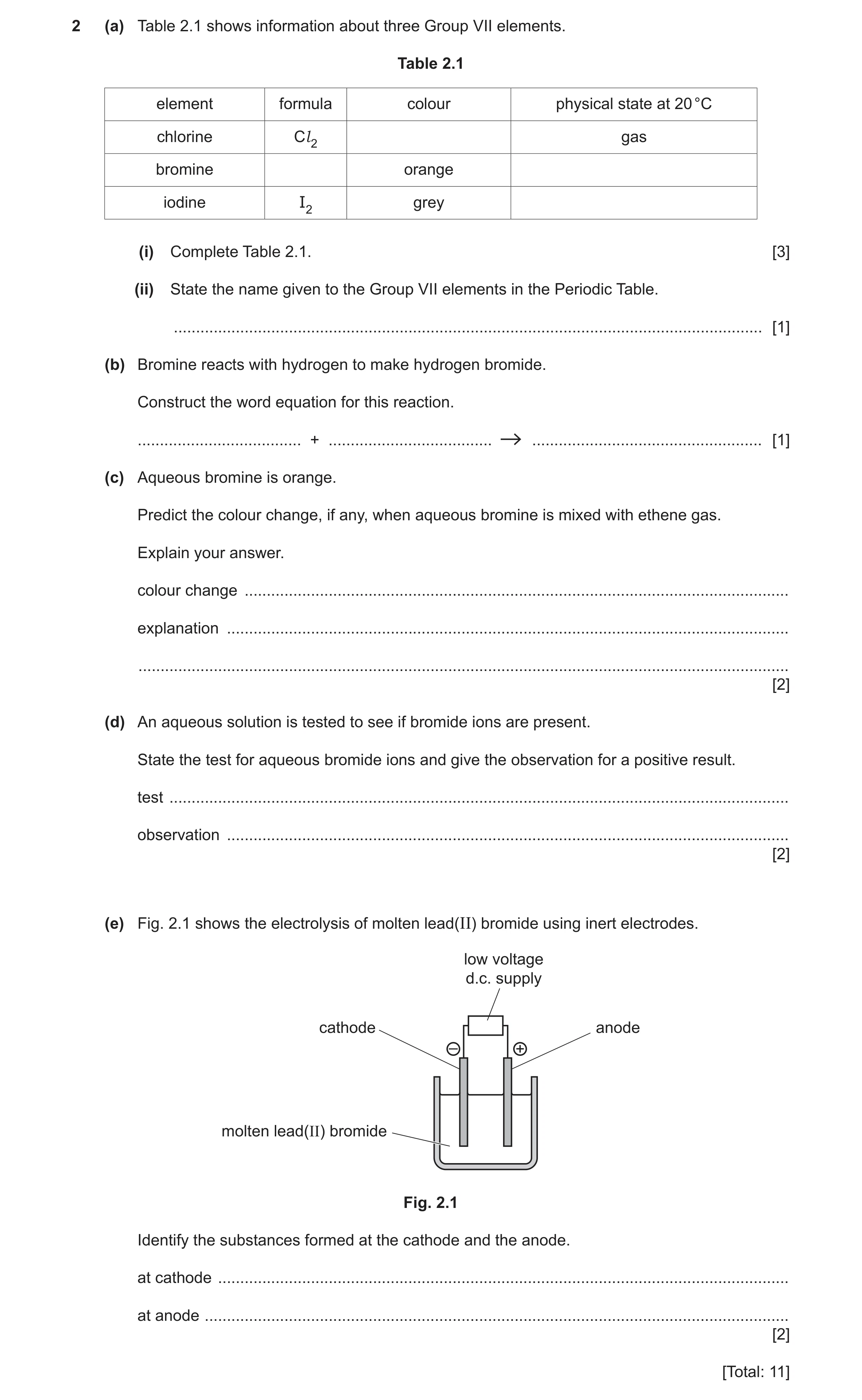
2 (a) Table 2.1 shows information about three Group VII elements. Table 2.1 element formula colour physical state at 20 °C chlorine Cl 2 gas bromine orange iodine I2 grey (i) Complete Table 2.1. [3] (ii) State the name given to the Group VII elements in the Periodic Table. … [1] (b) Bromine reacts with hydrogen to make hydrogen bromide. Construct the word equation for this reaction. … + … … [1] (c) Aqueous bromine is orange. Predict the colour change, if any, when aqueous bromine is mixed with ethene gas. Explain your answer. colour change … explanation … … [2] (d) An aqueous solution is tested to see if bromide ions are present. State the test for aqueous bromide ions and give the observation for a positive result. test … observation … [2] (e) Fig. 2.1 shows the electrolysis of molten lead(II) bromide using inert electrodes. low voltage d.c. supply cathode anode – + molten lead(II) bromide Fig. 2.1 Identify the substances formed at the cathode and the anode. at cathode … at anode … [2] [Total: 11]
11 marks
Mark scheme: 2(a)(i) formula Br2; colour (pale) green for Cl2 ; physical state liquid for Br2 and solid for I2 ; 3 2(a)(ii) halogens ; 1 2(b) hydrogen + bromine → hydrogen bromide ; 1 2(c) (orange to) colourless; ethene is unsaturated / has a double bond ; 2 Question Answer Marks 2(d) (aqueous) silver nitrate ; cream coloured precipitate ; 2 2(e) cathode – lead ; anode – bromine ; 2
This question in 0654/31 May/June 2021
Q9 · Table 11.1 contains data for some elements in Group VII of the Periodic Table 0654/33 Oct/Nov 2021
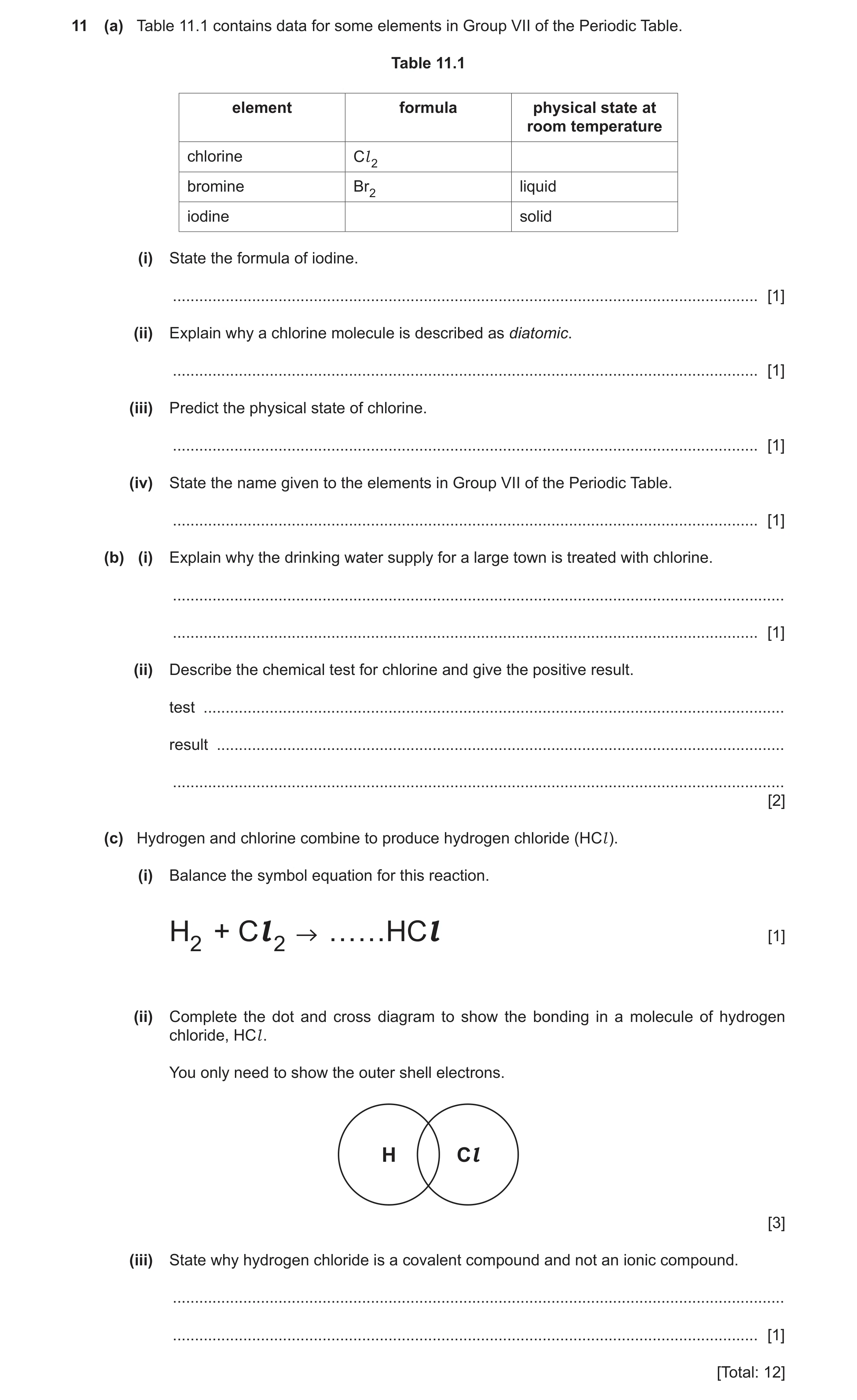
11 (a) Table 11.1 contains data for some elements in Group VII of the Periodic Table. Table 11.1 element formula physical state at room temperature chlorine Cl 2 bromine Br2 liquid iodine solid (i) State the formula of iodine. … [1] (ii) Explain why a chlorine molecule is described as diatomic. … [1] (iii) Predict the physical state of chlorine. … [1] (iv) State the name given to the elements in Group VII of the Periodic Table. … [1] (b) (i) Explain why the drinking water supply for a large town is treated with chlorine. … … [1] (ii) Describe the chemical test for chlorine and give the positive result. test … result … … [2] (c) Hydrogen and chlorine combine to produce hydrogen chloride (HCl ). (i) Balance the symbol equation for this reaction. [1] H2 + Cl 2 ……HCl (ii) Complete the dot and cross diagram to show the bonding in a molecule of hydrogen chloride, HCl . You only need to show the outer shell electrons. H Cl [3] (iii) State why hydrogen chloride is a covalent compound and not an ionic compound. … … [1] [Total: 12]
12 marks
Mark scheme: 11(a)(i) I2 ; 1 11(a)(ii) molecule contains two atoms ; 1 11(a)(iii) gas ; 1 11(a)(iv) halogens ; 1 11(b)(i) to kill microorganisms / bacteria ; 1 11(b)(ii) litmus paper etc. ; bleaches ; 2 11(c)(i) (H2 + Cl2 → ) 2 (HCl) ; 1 11(c)(ii) one bonding pair shown ; chlorine has octet ; all else correct ; 3 11(c)(iii) two non-metals bonding ; 1
This question in 0654/33 Oct/Nov 2021
Q10 · Information about some of the halogens in the Periodic Table 0654/32 May/June 2022
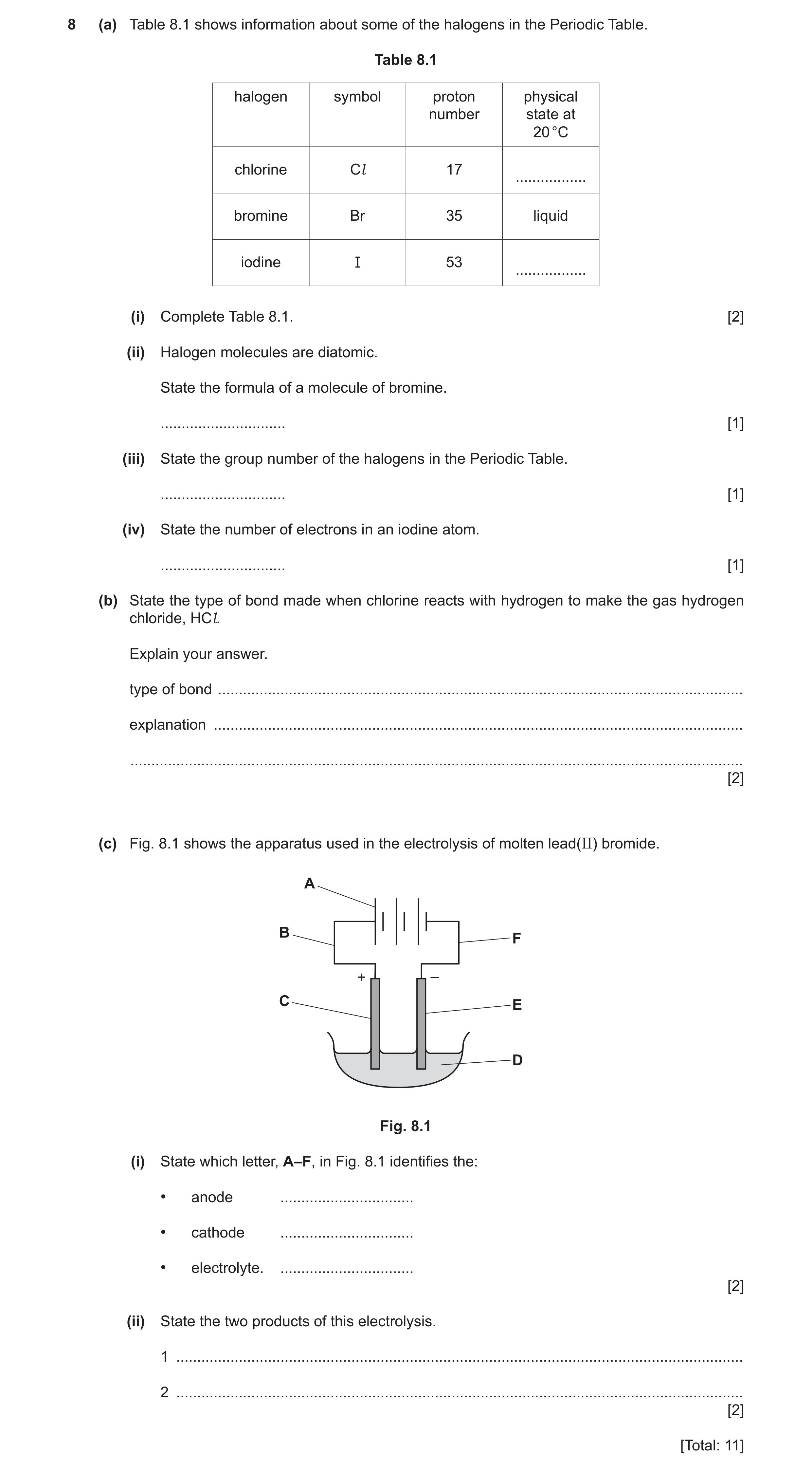
8 (a) Table 8.1 shows information about some of the halogens in the Periodic Table. Table 8.1 halogen symbol proton physical number state at 20 °C chlorine Cl 17 … bromine Br 35 liquid iodine I 53 … (i) Complete Table 8.1. [2] (ii) Halogen molecules are diatomic. State the formula of a molecule of bromine. … [1] (iii) State the group number of the halogens in the Periodic Table. … [1] (iv) State the number of electrons in an iodine atom. … [1] (b) State the type of bond made when chlorine reacts with hydrogen to make the gas hydrogen chloride, HCl. Explain your answer. type of bond … explanation … … [2] (c) Fig. 8.1 shows the apparatus used in the electrolysis of molten lead(II) bromide. A B F + – C E D Fig. 8.1 (i) State which letter, A–F, in Fig. 8.1 identifies the: • anode … • cathode … • electrolyte. … [2] (ii) State the two products of this electrolysis. 1 … 2 … [2] [Total: 11]
11 marks
Mark scheme: 8(a)(i) chlorine – gas; iodine –solid ; 2 8(a)(ii) Br2; 1 8(a)(iii) seven / VII ; 1 8(a)(iv) 53; 1 8(b) covalent ; between two non metals/electrons are shared; 2 8(c)(i) anode correctly identified (C) and cathode correctly identified (E); electrolyte correctly identified (D); 2 8(c)(ii) bromine; lead; 2
This question in 0654/32 May/June 2022
Q11 · Information about some of the halogens in the Periodic Table 0654/33 May/June 2022
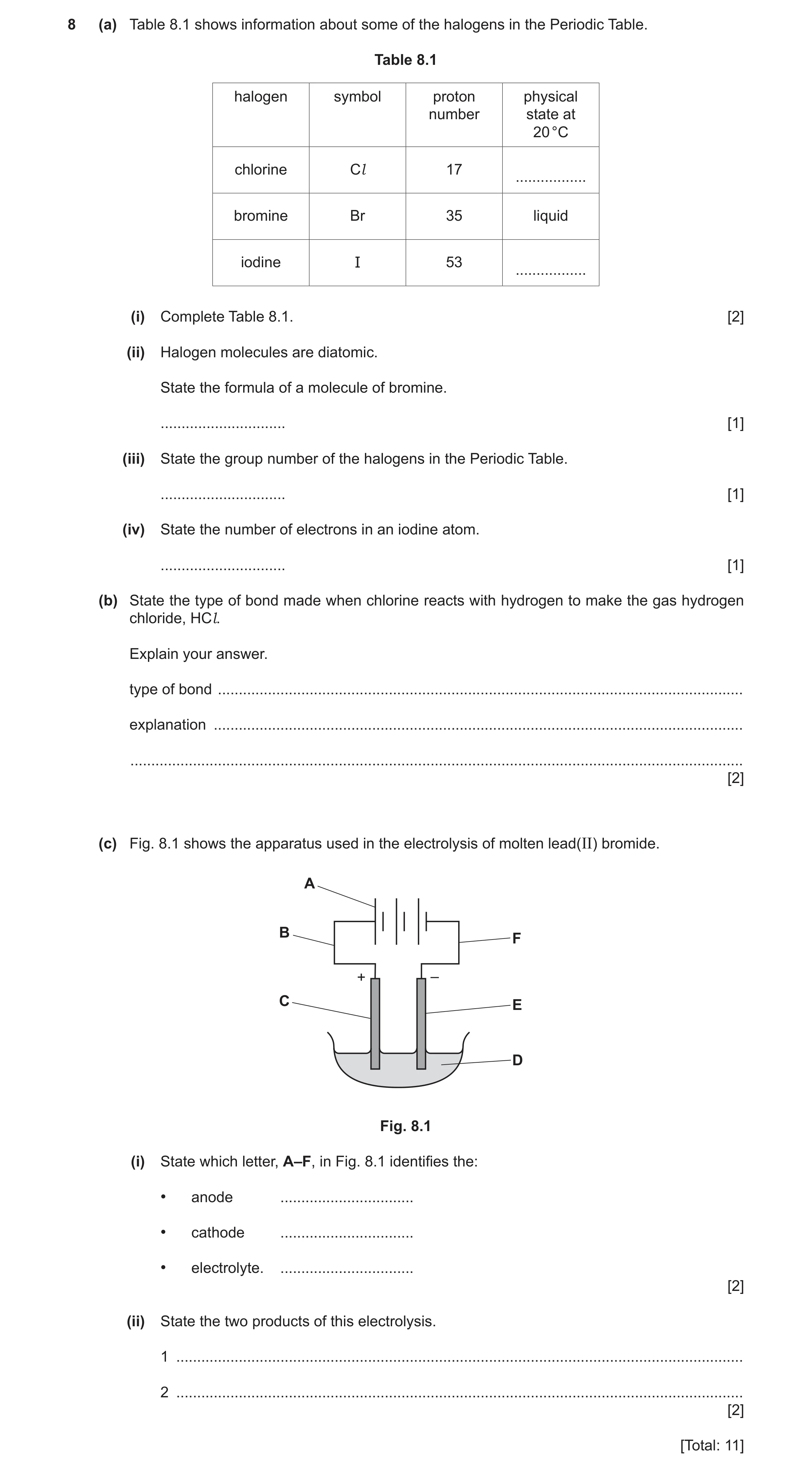
8 (a) Table 8.1 shows information about some of the halogens in the Periodic Table. Table 8.1 halogen symbol proton physical number state at 20 °C chlorine Cl 17 … bromine Br 35 liquid iodine I 53 … (i) Complete Table 8.1. [2] (ii) Halogen molecules are diatomic. State the formula of a molecule of bromine. … [1] (iii) State the group number of the halogens in the Periodic Table. … [1] (iv) State the number of electrons in an iodine atom. … [1] (b) State the type of bond made when chlorine reacts with hydrogen to make the gas hydrogen chloride, HCl. Explain your answer. type of bond … explanation … … [2] (c) Fig. 8.1 shows the apparatus used in the electrolysis of molten lead(II) bromide. A B F + – C E D Fig. 8.1 (i) State which letter, A–F, in Fig. 8.1 identifies the: • anode … • cathode … • electrolyte. … [2] (ii) State the two products of this electrolysis. 1 … 2 … [2] [Total: 11]
11 marks
Mark scheme: 8(a)(i) chlorine – gas; iodine –solid ; 2 8(a)(ii) Br2; 1 8(a)(iii) seven / VII ; 1 8(a)(iv) 53; 1 8(b) covalent ; between two non metals/electrons are shared; 2 8(c)(i) anode correctly identified (C) and cathode correctly identified (E); electrolyte correctly identified (D); 2 8(c)(ii) bromine; lead; 2
This question in 0654/33 May/June 2022
Q12 · Orange bromine gas, Br2, is put into the bottom of a gas jar which is immediately sealed 0654/32 Oct/Nov 2022
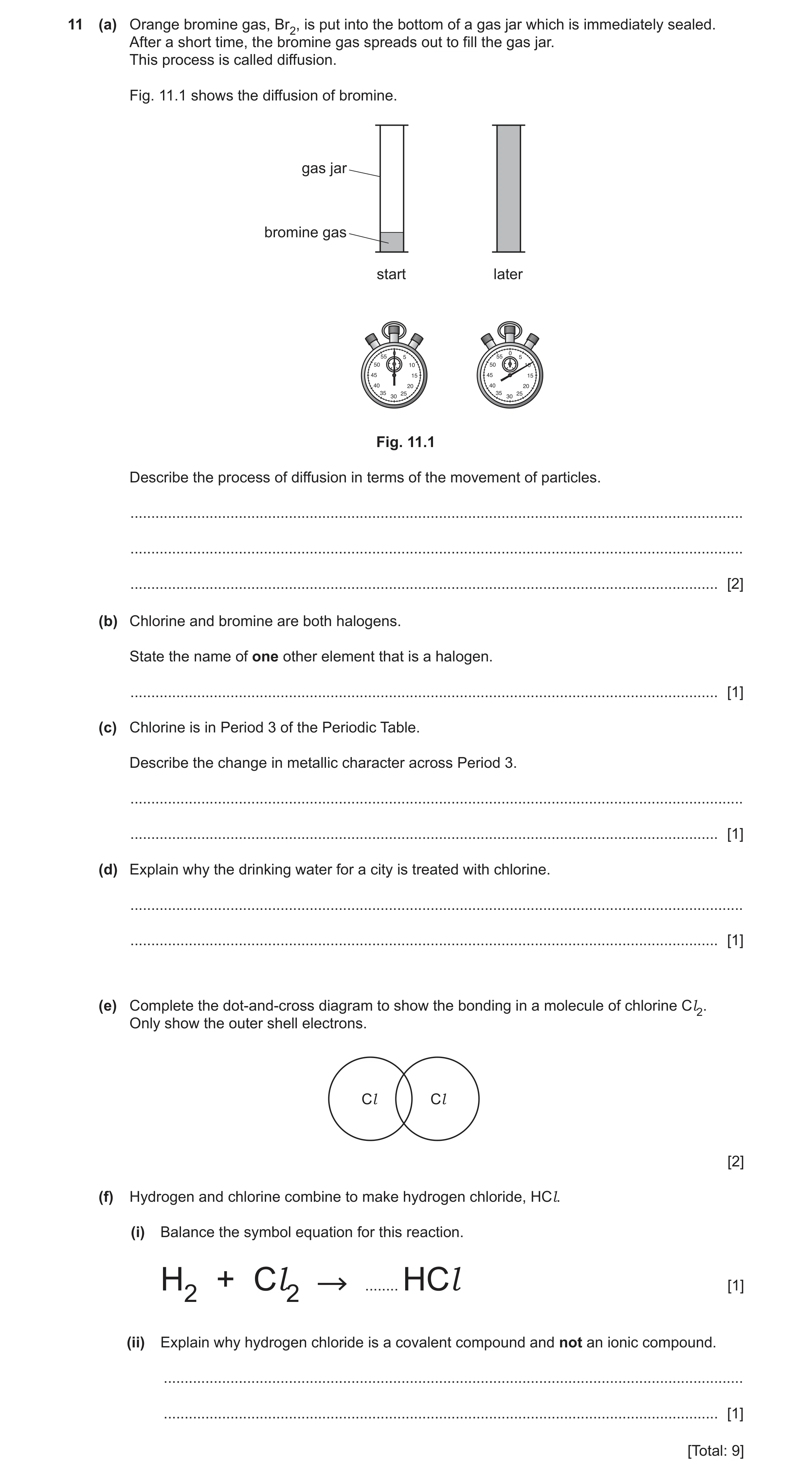
11 (a) Orange bromine gas, Br2, is put into the bottom of a gas jar which is immediately sealed. After a short time, the bromine gas spreads out to fill the gas jar. This process is called diffusion. Fig. 11.1 shows the diffusion of bromine. gas jar bromine gas start later Fig. 11.1 Describe the process of diffusion in terms of the movement of particles. … … … [2] (b) Chlorine and bromine are both halogens. State the name of one other element that is a halogen. … [1] (c) Chlorine is in Period 3 of the Periodic Table. Describe the change in metallic character across Period 3. … … [1] (d) Explain why the drinking water for a city is treated with chlorine. … … [1] (e) Complete the dot-and-cross diagram to show the bonding in a molecule of chlorine Cl2. Only show the outer shell electrons. Cl Cl [2] (f) Hydrogen and chlorine combine to make hydrogen chloride, HCl. (i) Balance the symbol equation for this reaction. … [1] H2 + Cl2 HCl (ii) Explain why hydrogen chloride is a covalent compound and not an ionic compound. … … [1] [Total: 9]
9 marks
Mark scheme: 11(a) gas particles in (constant) random motion ; 2 (particles move) from region of high concentration to region of low concentration ; 11(b) iodine / fluorine / astatine ; 1 11(c) metallic to non-metallic (from left to right) ; 1 11(d) to kill, microorganisms/bacteria/pathogens ; 1 11(e) shared pair ; 2 correct number of electrons on each atom / 14 electrons in total ; 11(f)(i) 2 HCl ; 1 11(f)(ii) two non-metals bonding / shared pair of electrons ; 1
This question in 0654/32 Oct/Nov 2022
Q13 · Chlorine, bromine and iodine are halogens in Group VII of the Periodic Table 0654/32 Oct/Nov 2023
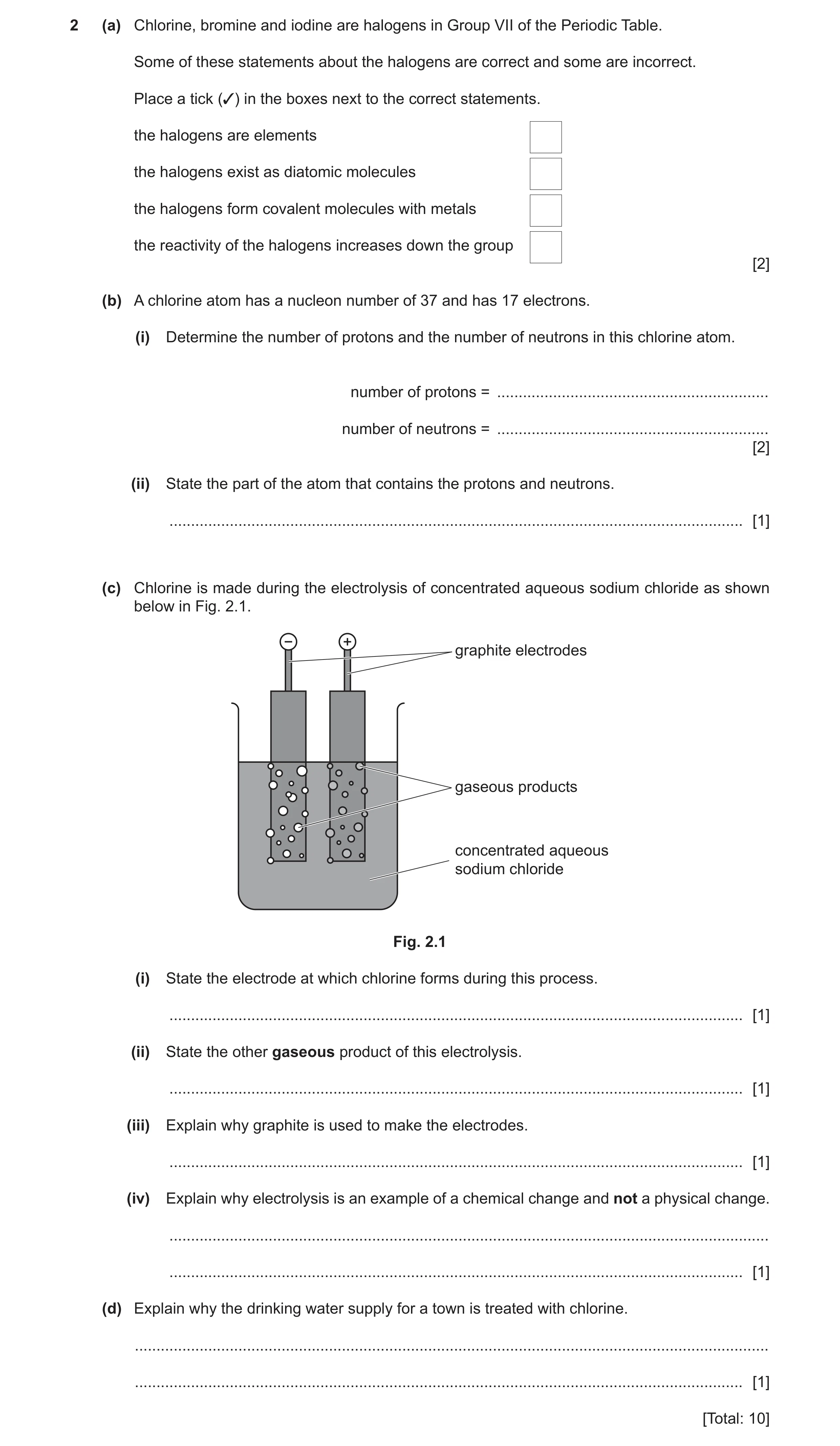
2 (a) Chlorine, bromine and iodine are halogens in Group VII of the Periodic Table. Some of these statements about the halogens are correct and some are incorrect. Place a tick (✓) in the boxes next to the correct statements. the halogens are elements the halogens exist as diatomic molecules the halogens form covalent molecules with metals the reactivity of the halogens increases down the group [2] (b) A chlorine atom has a nucleon number of 37 and has 17 electrons. (i) Determine the number of protons and the number of neutrons in this chlorine atom. number of protons = … number of neutrons = … [2] (ii) State the part of the atom that contains the protons and neutrons. … [1] (c) Chlorine is made during the electrolysis of concentrated aqueous sodium chloride as shown below in Fig. 2.1. graphite electrodes gaseous products concentrated aqueous sodium chloride Fig. 2.1 (i) State the electrode at which chlorine forms during this process. … [1] (ii) State the other gaseous product of this electrolysis. … [1] (iii) Explain why graphite is used to make the electrodes. … [1] (iv) Explain why electrolysis is an example of a chemical change and not a physical change. … … [1] (d) Explain why the drinking water supply for a town is treated with chlorine. … … [1] [Total: 10]
10 marks
Mark scheme: 2(a) 2 the halogens are elements the halogens exist as diatomic molecules ;; 2 ticks 2 correct = 2 marks 3 ticks 2 correct = 1 mark 2 ticks 1 correct = 1 mark 1 tick 1 correct = 1 mark 4 ticks 2 correct = 0 marks 2(b)(i) protons = 17 ; 2 neutrons = 20 ; 2(b)(ii) nucleus ; 1 2(c)(i) anode / positive ; 1 2(c)(ii) hydrogen ; 1 2(c)(iii) it is inert / will not react / good electrical conductor ; 1 2(c)(iv) new substances formed / cannot be reversed ; 1 2(d) kills microbes / sterilise water ; 1
This question in 0654/32 Oct/Nov 2023
Q14 · Some information about three Group VII elements 0654/33 Oct/Nov 2023
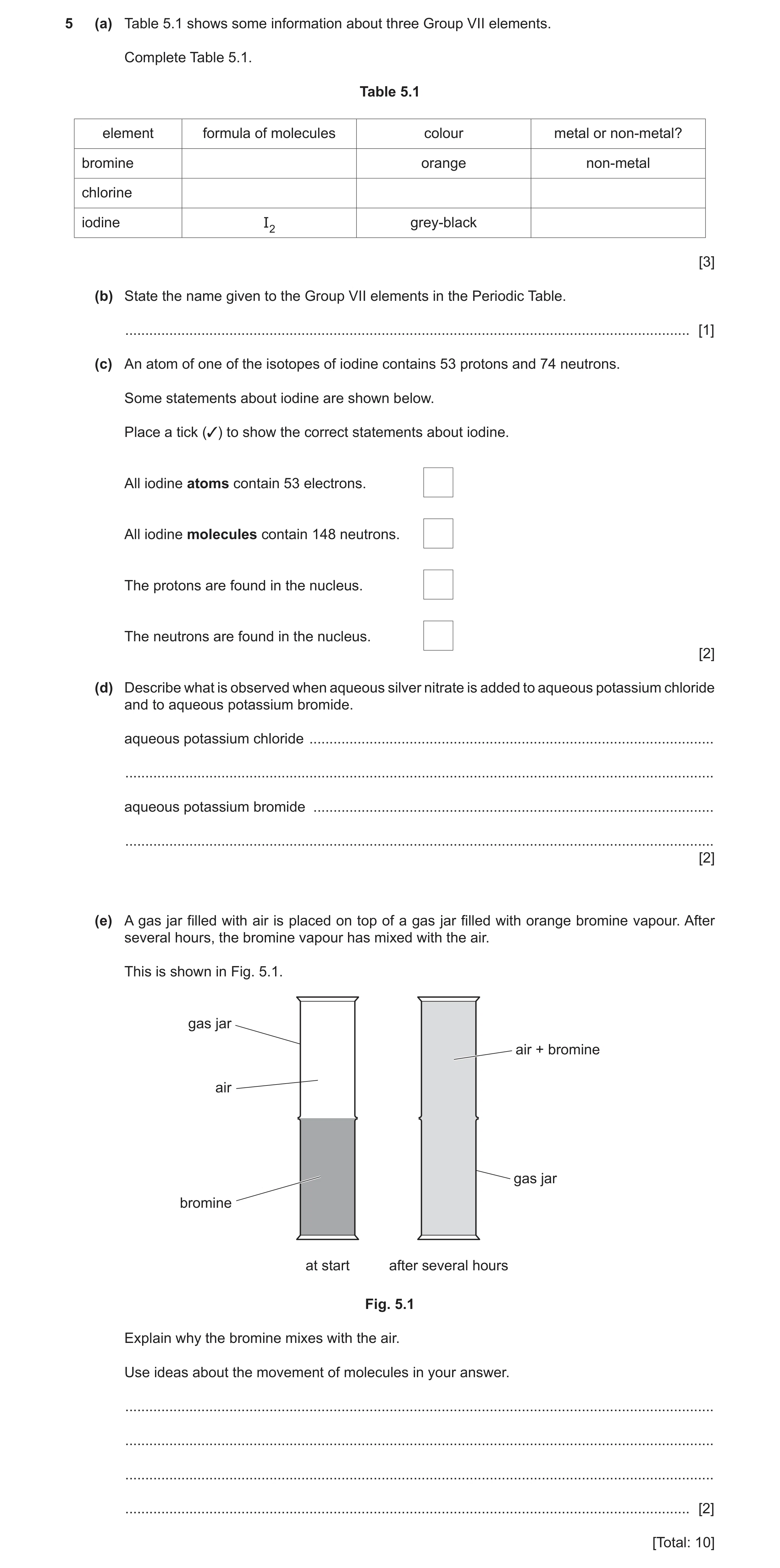
5 (a) Table 5.1 shows some information about three Group VII elements. Complete Table 5.1. Table 5.1 element formula of molecules colour metal or non-metal? bromine orange non-metal chlorine iodine I2 grey-black [3] (b) State the name given to the Group VII elements in the Periodic Table. … [1] (c) An atom of one of the isotopes of iodine contains 53 protons and 74 neutrons. Some statements about iodine are shown below. Place a tick (3) to show the correct statements about iodine. All iodine atoms contain 53 electrons. All iodine molecules contain 148 neutrons. The protons are found in the nucleus. The neutrons are found in the nucleus. [2] (d) Describe what is observed when aqueous silver nitrate is added to aqueous potassium chloride and to aqueous potassium bromide. aqueous potassium chloride … … aqueous potassium bromide … … [2] (e) A gas jar filled with air is placed on top of a gas jar filled with orange bromine vapour. After several hours, the bromine vapour has mixed with the air. This is shown in Fig. 5.1. gas jar air + bromine air gas jar bromine at start after several hours Fig. 5.1 Explain why the bromine mixes with the air. Use ideas about the movement of molecules in your answer. … … … … [2] [Total: 10]
10 marks
Mark scheme: 5(a) 3 formula of metal or non- element colour molecules metal? bromine Br2 orange non-metal chlorine Cl2 (pale) green non-metal iodine I2 grey-black non-metal one mark for each column ;;; 5(b) halogens ; 1 5(c) 2 no tick / 3 ticks and 3 correct = 2 marks 4 ticks and 3 correct = 1 mark 3 ticks and 2 correct = 1 mark 2 ticks and 2 correct = 1 mark ;; 5(d) potassium chloride – white precipitate ; 2 potassium bromide – cream/off white precipitate ; 5(e) diffusion ; 2 molecules move randomly from place to place / spread out / from high to low concentration ;
This question in 0654/33 Oct/Nov 2023
Q15 · Chlorine reacts with hydrogen to make hydrogen chloride 0654/32 Oct/Nov 2024
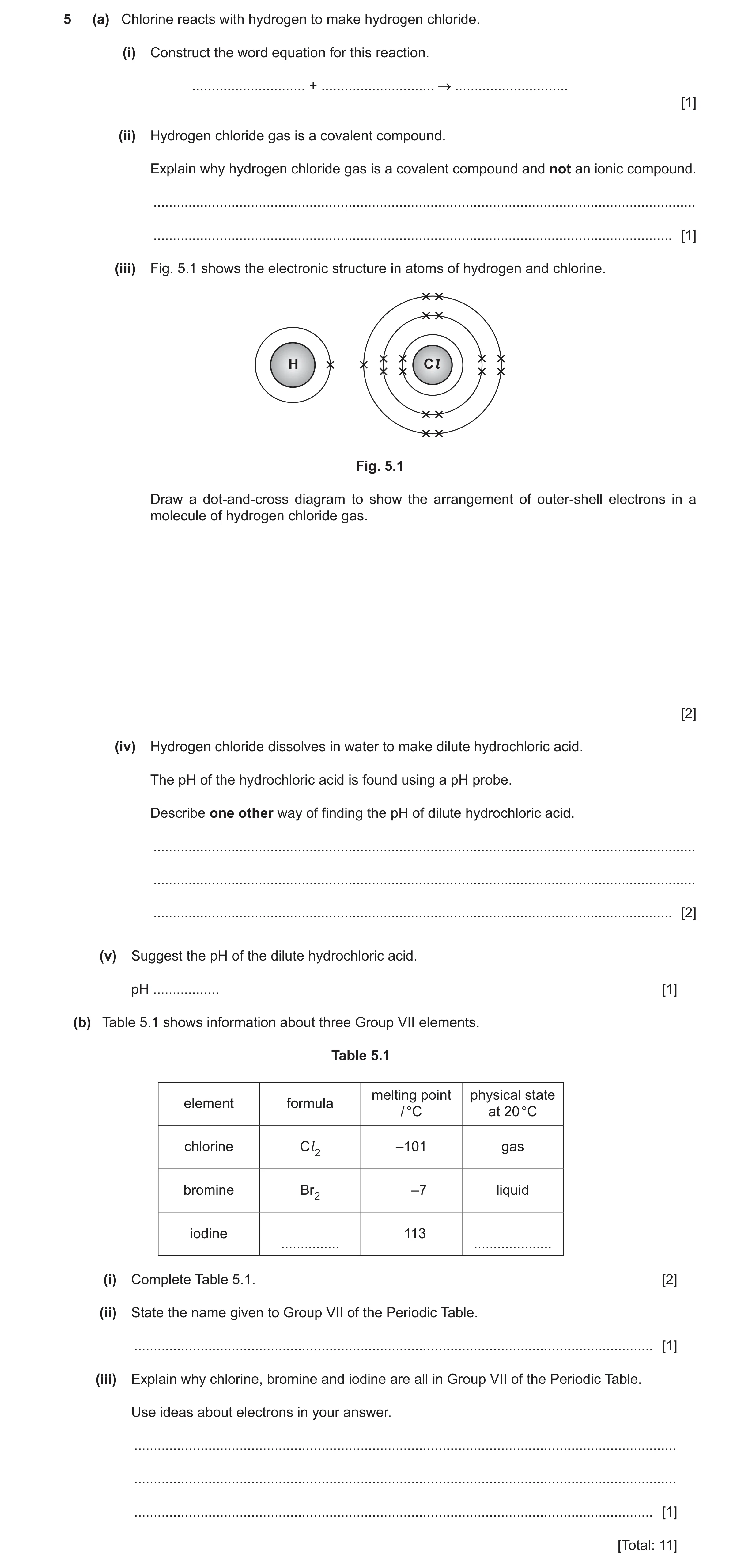
5 (a) Chlorine reacts with hydrogen to make hydrogen chloride. (i) Construct the word equation for this reaction. … + … … [1] (ii) Hydrogen chloride gas is a covalent compound. Explain why hydrogen chloride gas is a covalent compound and not an ionic compound. … … [1] (iii) Fig. 5.1 shows the electronic structure in atoms of hydrogen and chlorine. H Cl Fig. 5.1 Draw a dot-and-cross diagram to show the arrangement of outer-shell electrons in a molecule of hydrogen chloride gas. [2] (iv) Hydrogen chloride dissolves in water to make dilute hydrochloric acid. The pH of the hydrochloric acid is found using a pH probe. Describe one other way of finding the pH of dilute hydrochloric acid. … … … [2] (v) Suggest the pH of the dilute hydrochloric acid. pH … [1] (b) Table 5.1 shows information about three Group VII elements. Table 5.1 melting point physical state element formula / °C at 20 °C chlorine Cl –101 gas 2 bromine Br2 –7 liquid iodine 113 … … (i) Complete Table 5.1. [2] (ii) State the name given to Group VII of the Periodic Table. … [1] (iii) Explain why chlorine, bromine and iodine are all in Group VII of the Periodic Table. Use ideas about electrons in your answer. … … … [1] [Total: 11]
11 marks
Mark scheme: 5(a)(i) hydrogen + chlorine → hydrogen chloride ; 1 5(a)(ii) two non-metals bonding ; 1 5(a)(iii) one pair of bonding electrons ; 2 all else correct ; 5(a)(iv) use universal indicator ; 2 colour indicates the pH ; 5(a)(v) any value between 1 and 3 ; 1 5(b)(i) 2 element formula melting physical point / °C state at 20 °C chlorine Cl2 -101 gas bromine Br2 -7 liquid iodine I2 113 solid ;; 5(b)(ii) halogens ; 1 5(b)(iii) all have 7 electrons in their outer shell ; 1
This question in 0654/32 Oct/Nov 2024
Q16 · Chlorine reacts with hydrogen to make hydrogen chloride 0654/33 Oct/Nov 2024
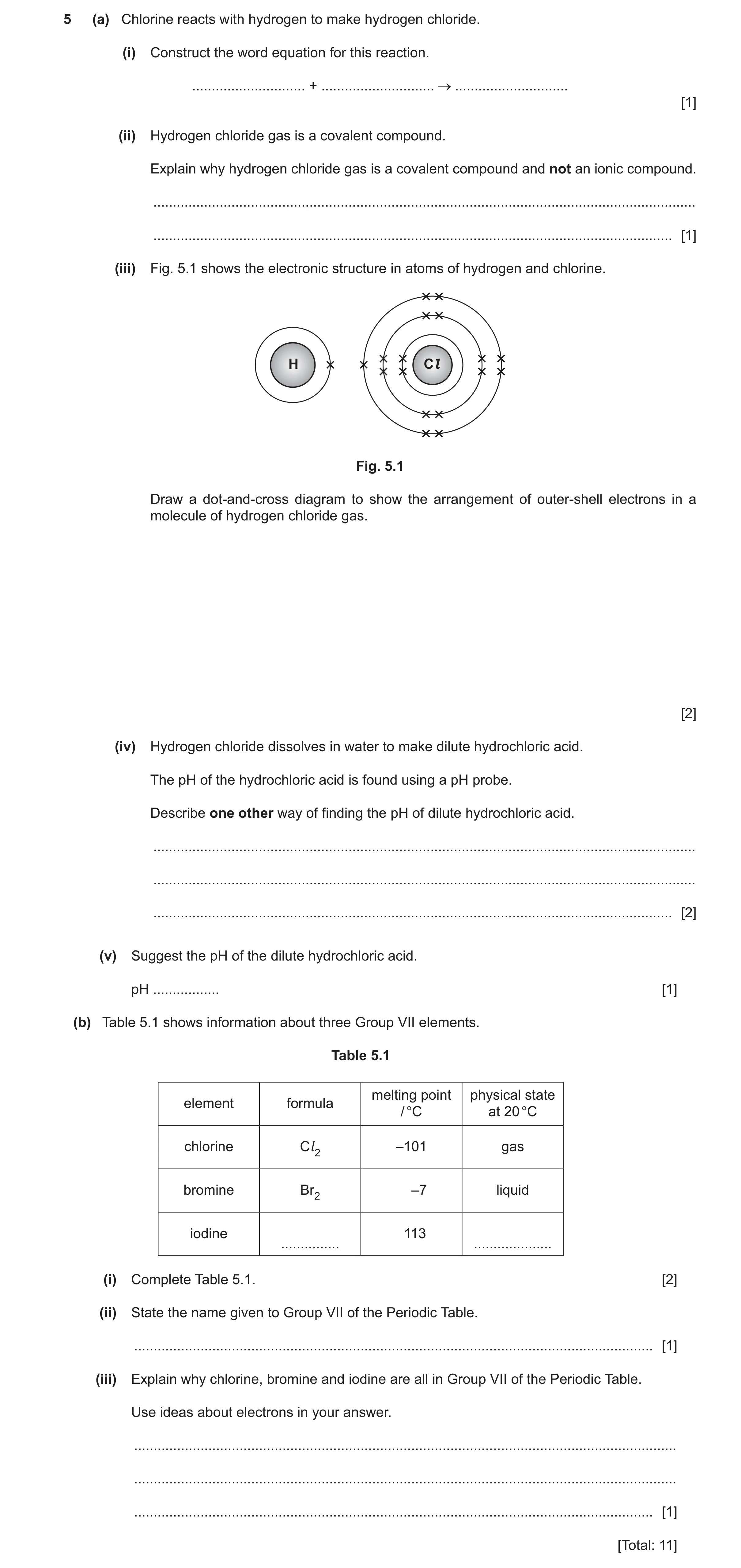
5 (a) Chlorine reacts with hydrogen to make hydrogen chloride. (i) Construct the word equation for this reaction. … + … … [1] (ii) Hydrogen chloride gas is a covalent compound. Explain why hydrogen chloride gas is a covalent compound and not an ionic compound. … … [1] (iii) Fig. 5.1 shows the electronic structure in atoms of hydrogen and chlorine. H Cl Fig. 5.1 Draw a dot-and-cross diagram to show the arrangement of outer-shell electrons in a molecule of hydrogen chloride gas. [2] (iv) Hydrogen chloride dissolves in water to make dilute hydrochloric acid. The pH of the hydrochloric acid is found using a pH probe. Describe one other way of finding the pH of dilute hydrochloric acid. … … … [2] (v) Suggest the pH of the dilute hydrochloric acid. pH … [1] (b) Table 5.1 shows information about three Group VII elements. Table 5.1 melting point physical state element formula / °C at 20 °C chlorine Cl –101 gas 2 bromine Br2 –7 liquid iodine 113 … … (i) Complete Table 5.1. [2] (ii) State the name given to Group VII of the Periodic Table. … [1] (iii) Explain why chlorine, bromine and iodine are all in Group VII of the Periodic Table. Use ideas about electrons in your answer. … … … [1] [Total: 11]
11 marks
Mark scheme: 5(a)(i) hydrogen + chlorine → hydrogen chloride ; 1 5(a)(ii) two non-metals bonding ; 1 5(a)(iii) one pair of bonding electrons ; 2 all else correct ; 5(a)(iv) use universal indicator ; 2 colour indicates the pH ; 5(a)(v) any value between 1 and 3 ; 1 5(b)(i) 2 element formula melting physical point / °C state at 20 °C chlorine Cl2 -101 gas bromine Br2 -7 liquid iodine I2 113 solid ;; 5(b)(ii) halogens ; 1 5(b)(iii) all have 7 electrons in their outer shell ; 1
This question in 0654/33 Oct/Nov 2024
Q17 · Chlorine is an element in Group VII of the Periodic Table 0654/32 Feb/March 2025
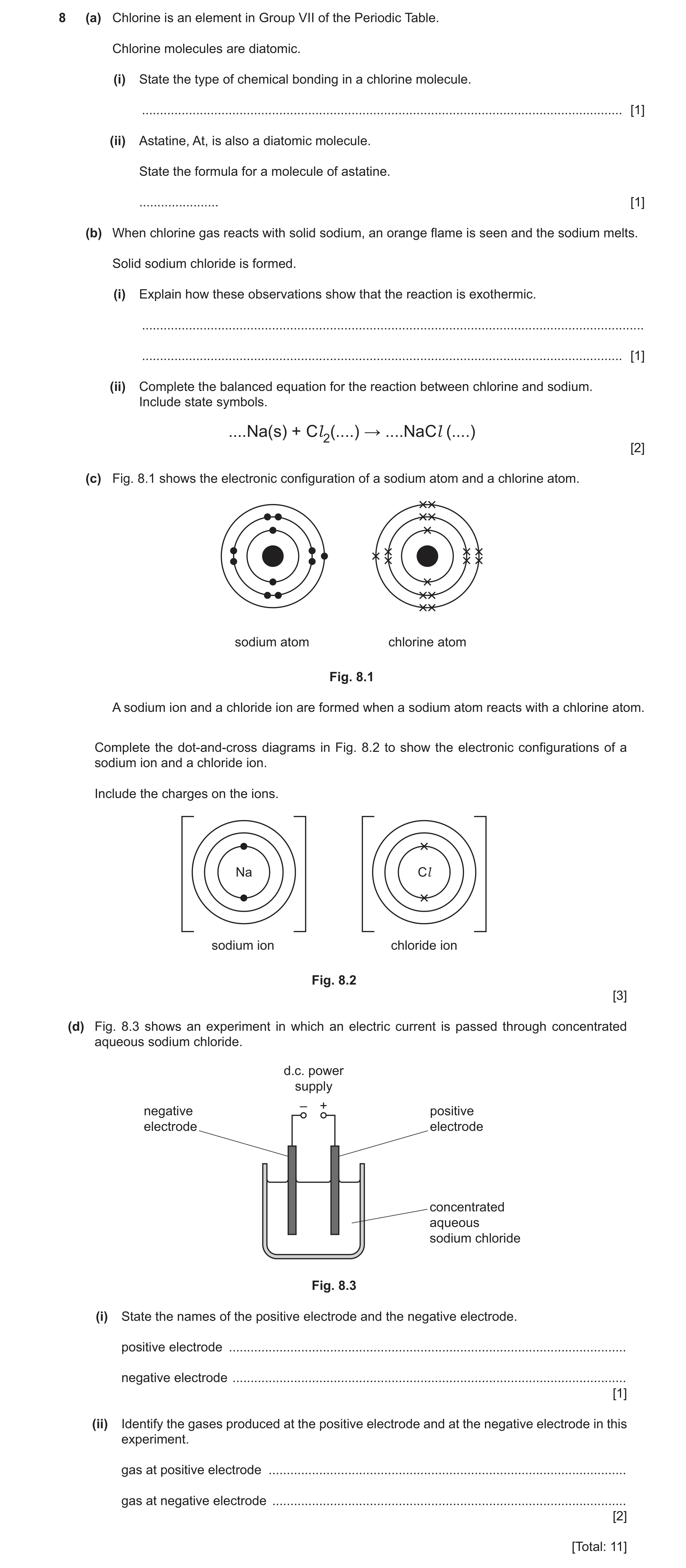
8 (a) Chlorine is an element in Group VII of the Periodic Table. Chlorine molecules are diatomic. (i) State the type of chemical bonding in a chlorine molecule. … [1] (ii) Astatine, At, is also a diatomic molecule. State the formula for a molecule of astatine. … [1] (b) When chlorine gas reacts with solid sodium, an orange flame is seen and the sodium melts. Solid sodium chloride is formed. (i) Explain how these observations show that the reaction is exothermic. … … [1] (ii) Complete the balanced equation for the reaction between chlorine and sodium. Include state symbols. … Na(s) + Cl 2( … ) → … NaCl ( … ) [2] (c) Fig. 8.1 shows the electronic configuration of a sodium atom and a chlorine atom. sodium atom chlorine atom Fig. 8.1 A sodium ion and a chloride ion are formed when a sodium atom reacts with a chlorine atom. Complete the dot-and-cross diagrams in Fig. 8.2 to show the electronic configurations of a sodium ion and a chloride ion. Include the charges on the ions. Na Cl sodium ion chloride ion Fig. 8.2 [3] (d) Fig. 8.3 shows an experiment in which an electric current is passed through concentrated aqueous sodium chloride. d.c. power supply – + negative positive electrode electrode concentrated aqueous sodium chloride Fig. 8.3 (i) State the names of the positive electrode and the negative electrode. positive electrode … negative electrode … [1] (ii) Identify the gases produced at the positive electrode and at the negative electrode in this experiment. gas at positive electrode … gas at negative electrode … [2] [Total: 11]
11 marks
Mark scheme: 8(a)(i) covalent ; 1 8(a)(ii) At2 ; 1 8(b)(i) (thermal) energy released ; 1 8(b)(ii) 2Na (s) + Cl2 ( g) → 2NaCl ( s) 2 ; ; 8(c) (the electronic configuration shown on the diagram) 3 sodium ion- 2, 8 ; chloride ion- 2, 8, 8 ; (the charge on the ions in diagram) sodium ion +1 and chloride ion -1 ; 8(d)(i) anode 1 cathode ; (in that order) 8(d)(ii) chlorine ; 2 hydrogen ; (in that order)
This question in 0654/32 Feb/March 2025
Q18 · Sodium reacts with chlorine to make sodium chloride 0654/32 Oct/Nov 2025
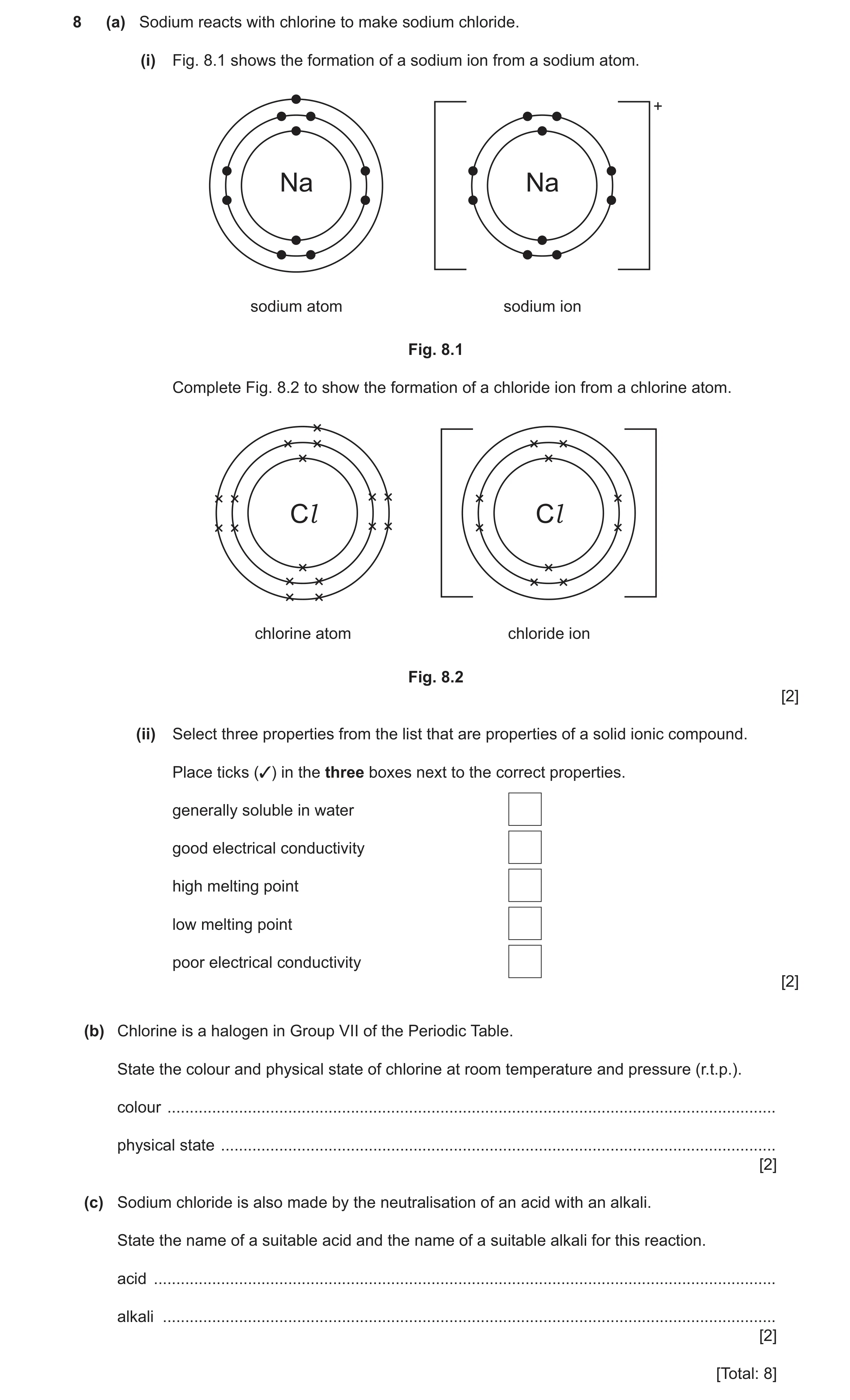
8 (a) Sodium reacts with chlorine to make sodium chloride. (i) Fig. 8.1 shows the formation of a sodium ion from a sodium atom. + Na Na sodium atom sodium ion Fig. 8.1 Complete Fig. 8.2 to show the formation of a chloride ion from a chlorine atom. Cl Cl chlorine atom chloride ion Fig. 8.2 [2] (ii) Select three properties from the list that are properties of a solid ionic compound. Place ticks (3) in the three boxes next to the correct properties. generally soluble in water good electrical conductivity high melting point low melting point poor electrical conductivity [2] (b) Chlorine is a halogen in Group VII of the Periodic Table. State the colour and physical state of chlorine at room temperature and pressure (r.t.p.). colour … physical state … [2] (c) Sodium chloride is also made by the neutralisation of an acid with an alkali. State the name of a suitable acid and the name of a suitable alkali for this reaction. acid … alkali … [2] [Total: 8]
8 marks
Mark scheme: 8(a)(i) eight electrons added to outer shell ; 2 – sign shown ; 8(a)(ii) 2 2 correct – 1 mark all 3 correct – 2 marks 8(b) (pale) yellow-green ; 2 gas ; 8(c) hydrochloric acid ; 2 sodium hydroxide ;
This question in 0654/32 Oct/Nov 2025
Q19 · Sodium reacts with chlorine to make sodium chloride 0654/33 Oct/Nov 2025
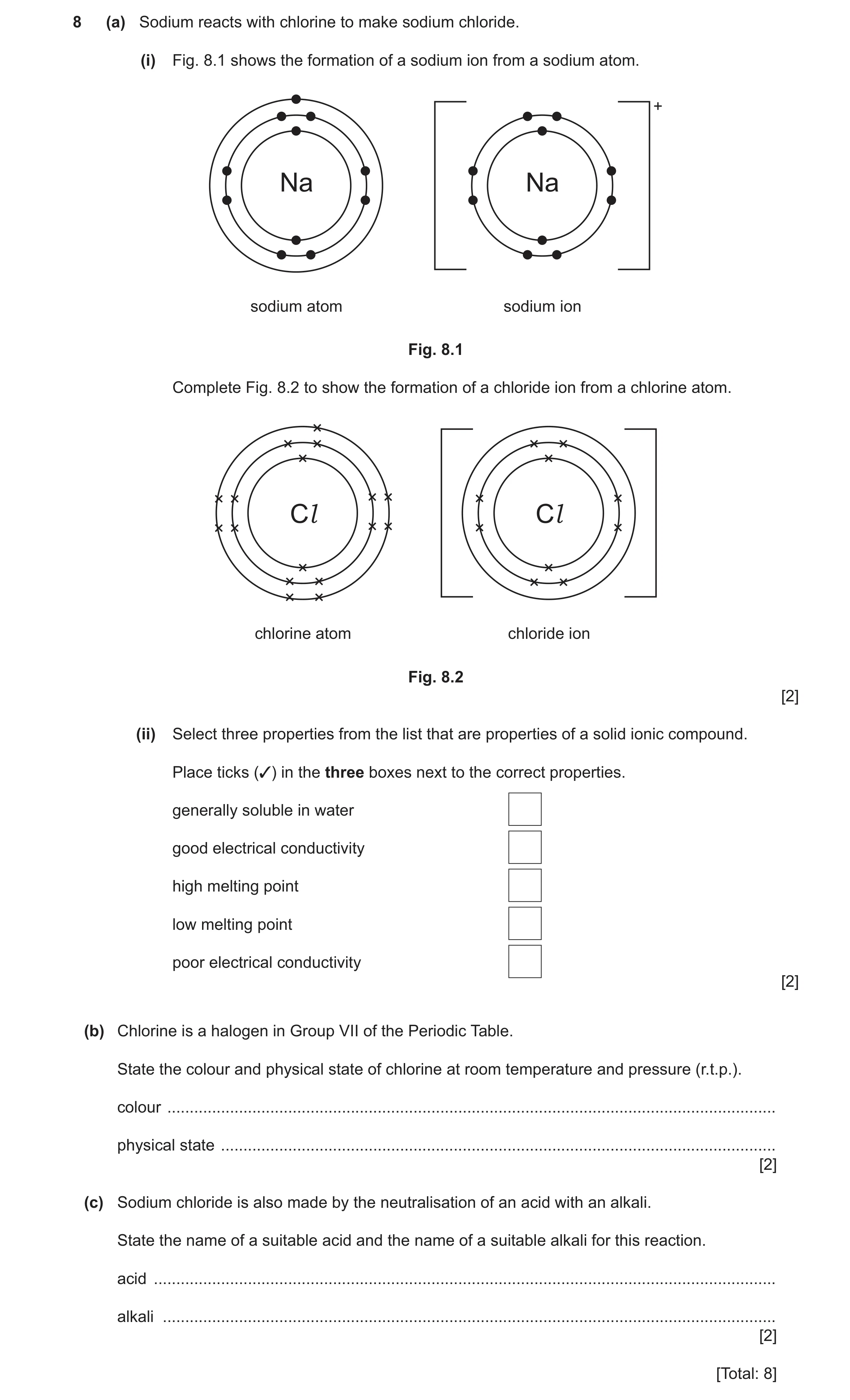
8 (a) Sodium reacts with chlorine to make sodium chloride. (i) Fig. 8.1 shows the formation of a sodium ion from a sodium atom. + Na Na sodium atom sodium ion Fig. 8.1 Complete Fig. 8.2 to show the formation of a chloride ion from a chlorine atom. Cl Cl chlorine atom chloride ion Fig. 8.2 [2] (ii) Select three properties from the list that are properties of a solid ionic compound. Place ticks (3) in the three boxes next to the correct properties. generally soluble in water good electrical conductivity high melting point low melting point poor electrical conductivity [2] (b) Chlorine is a halogen in Group VII of the Periodic Table. State the colour and physical state of chlorine at room temperature and pressure (r.t.p.). colour … physical state … [2] (c) Sodium chloride is also made by the neutralisation of an acid with an alkali. State the name of a suitable acid and the name of a suitable alkali for this reaction. acid … alkali … [2] [Total: 8]
8 marks
Mark scheme: 8(a)(i) eight electrons added to outer shell ; 2 – sign shown ; 8(a)(ii) 2 2 correct – 1 mark all 3 correct – 2 marks 8(b) (pale) yellow-green ; 2 gas ; 8(c) hydrochloric acid ; 2 sodium hydroxide ;
This question in 0654/33 Oct/Nov 2025
 9 / 27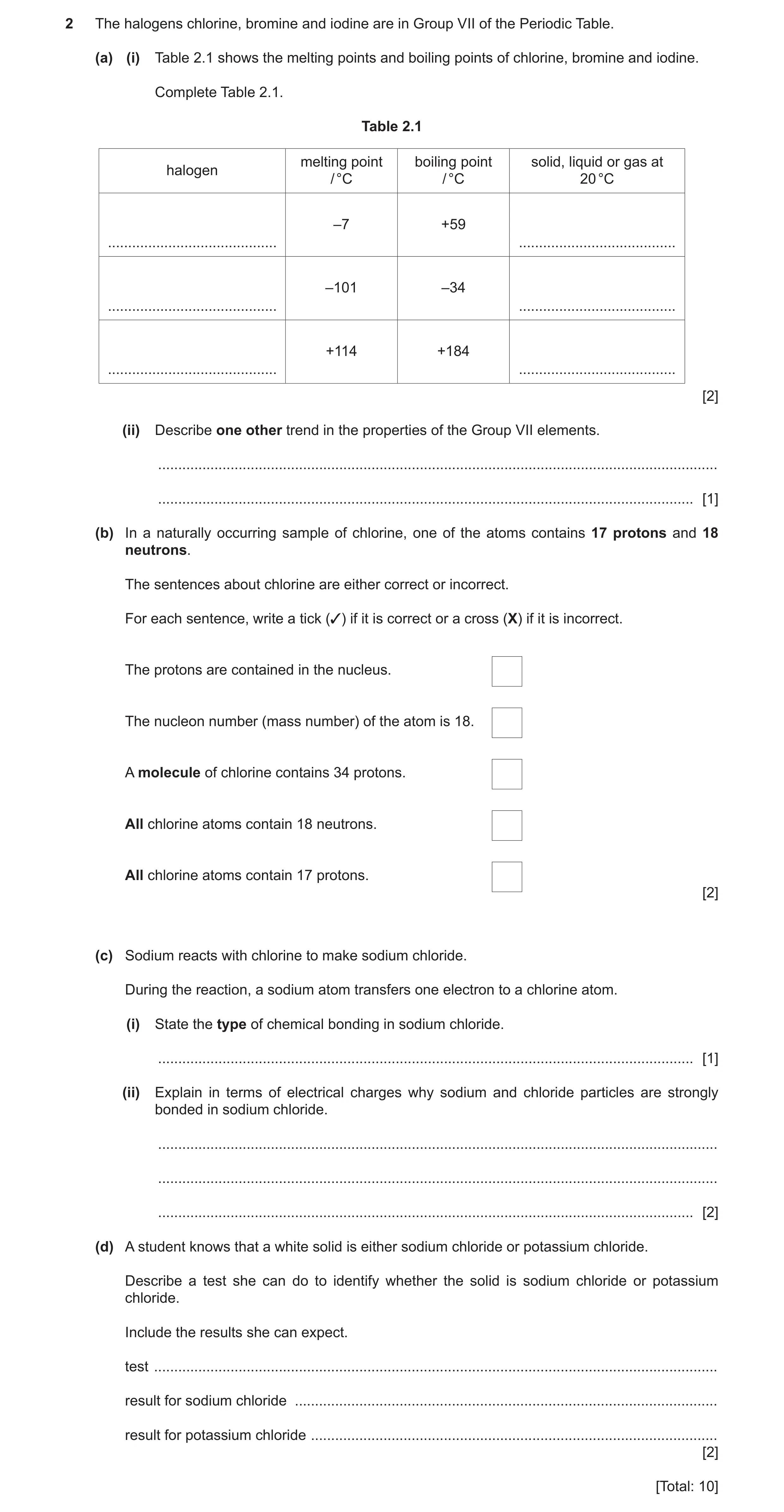
 11
11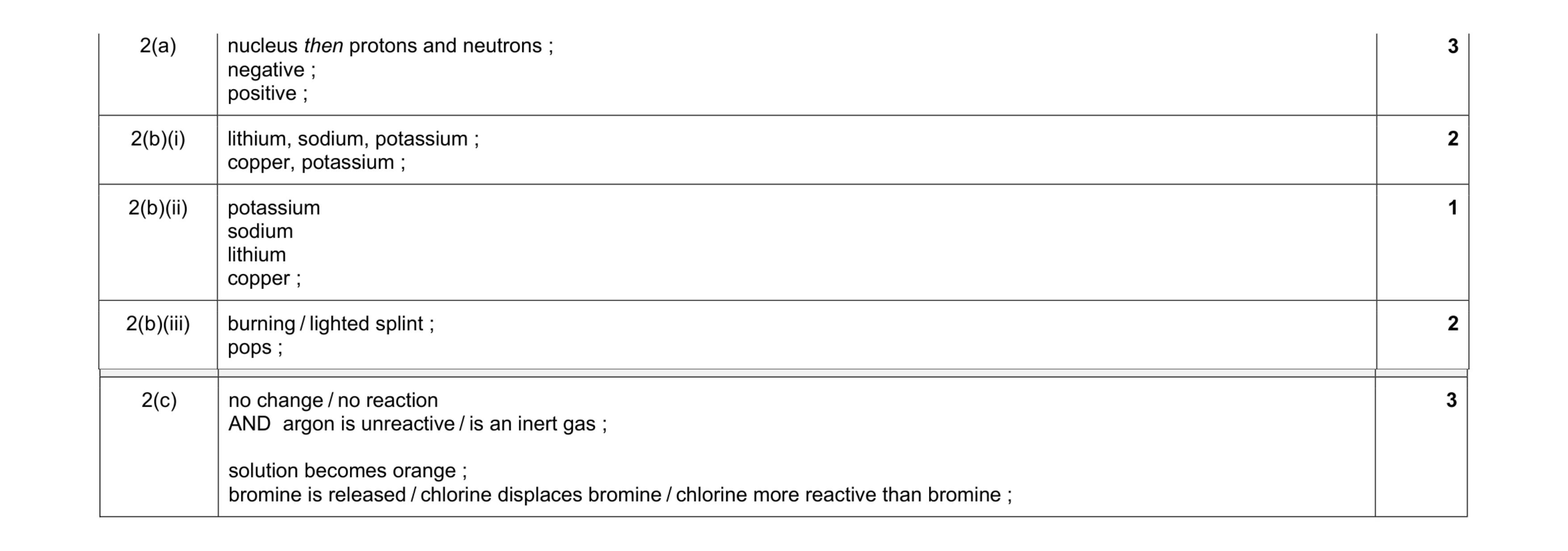 11
11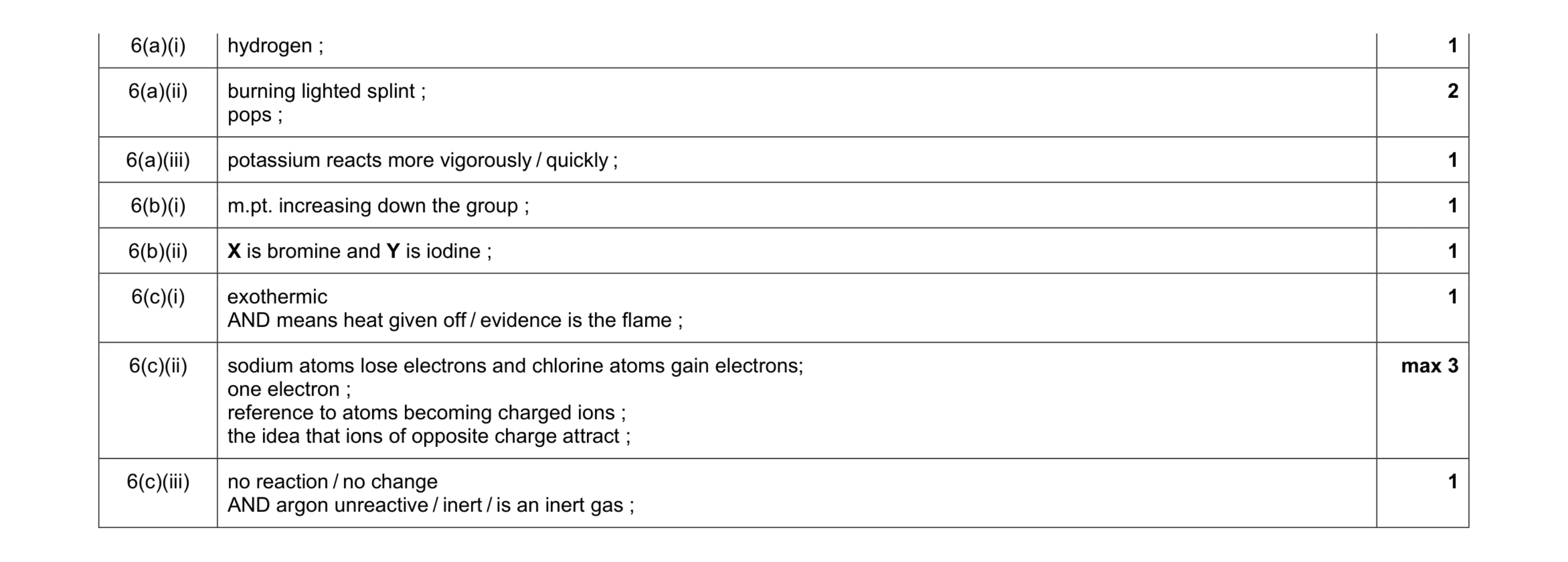 11
11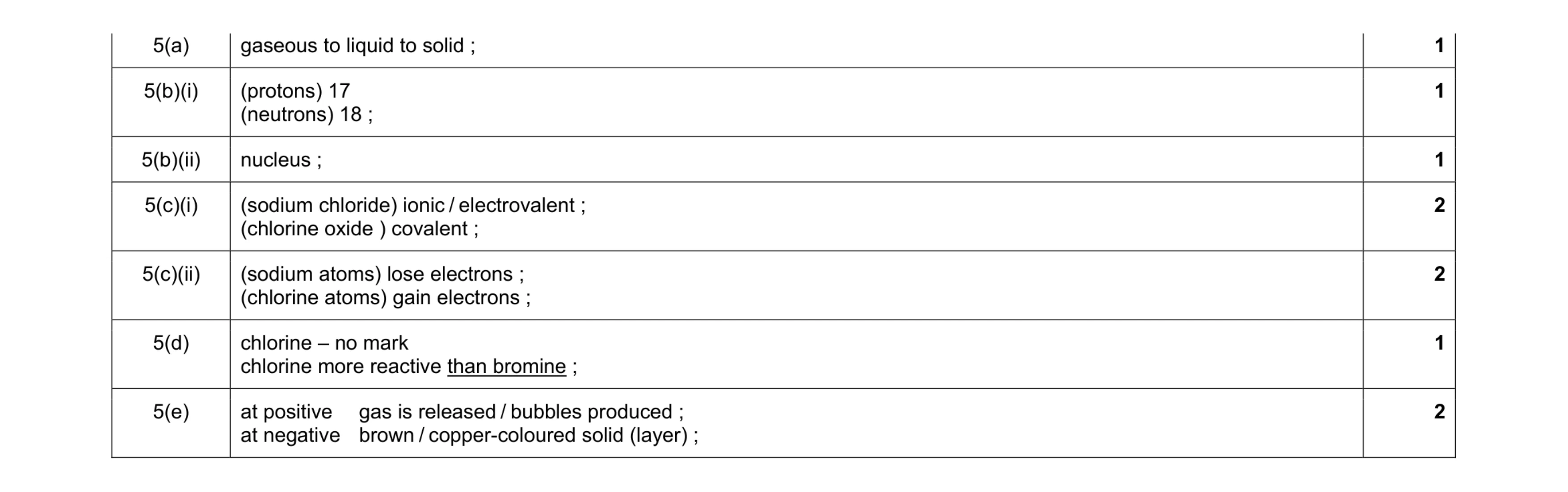 10
10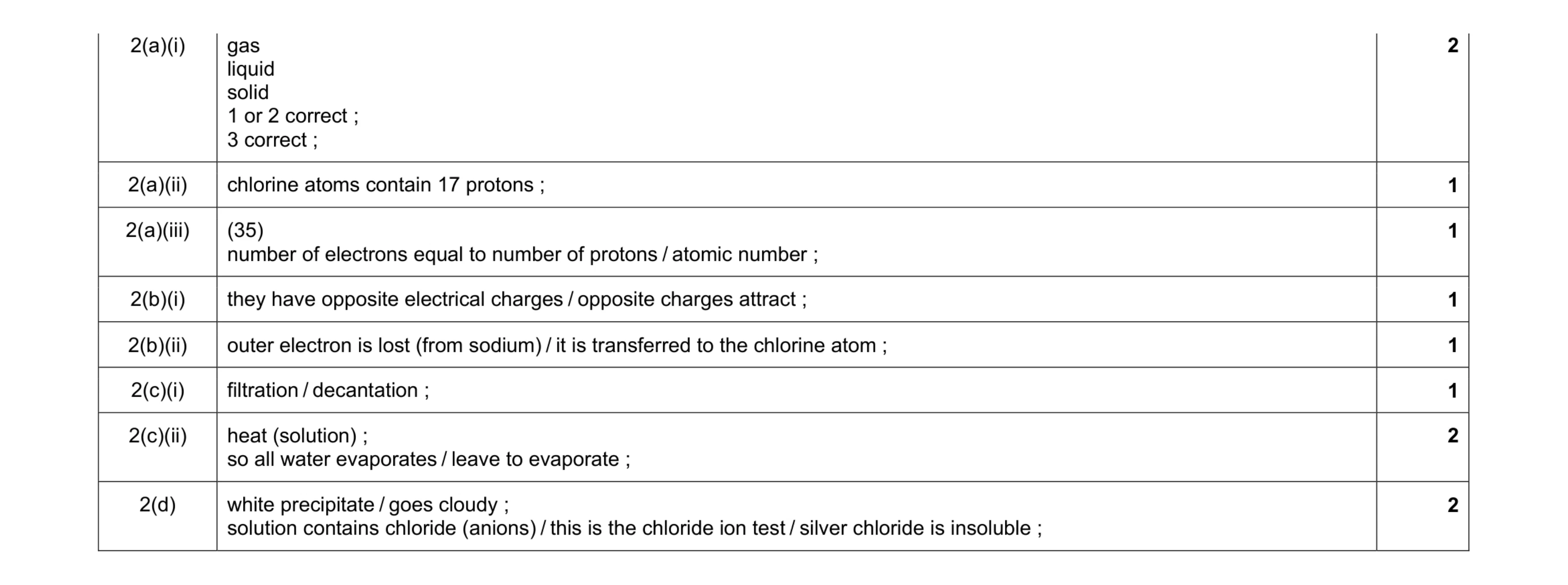 11
11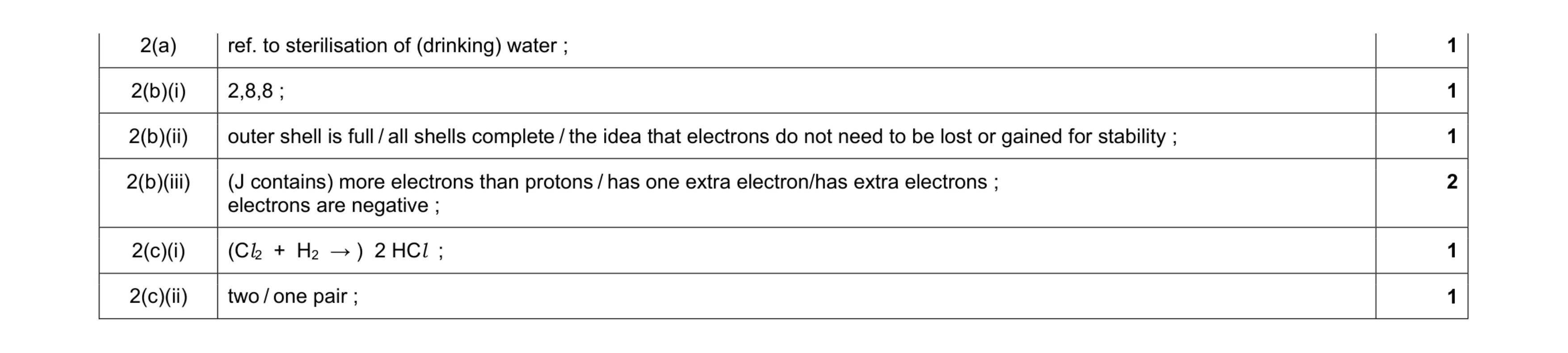 7
7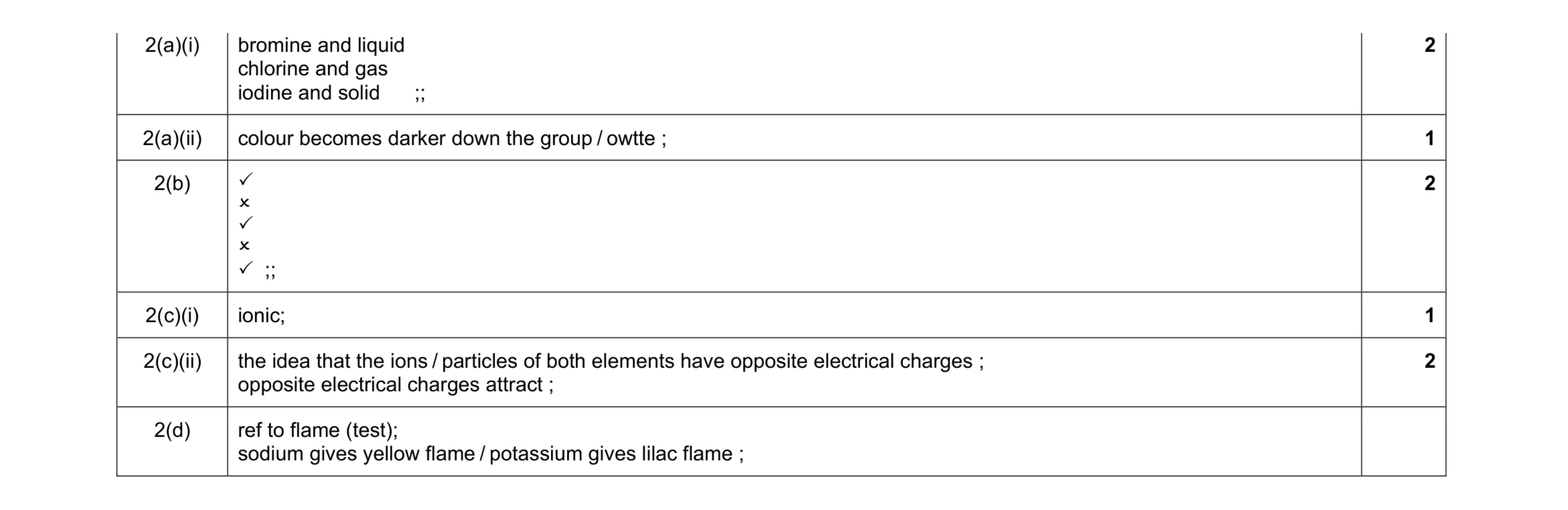 10
10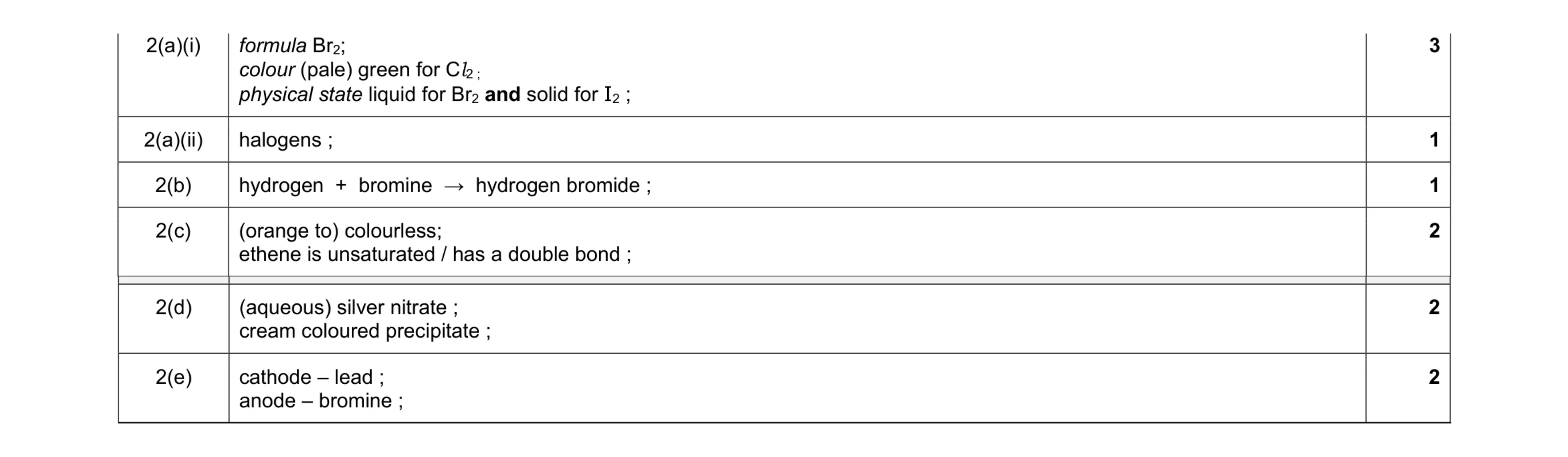 11
11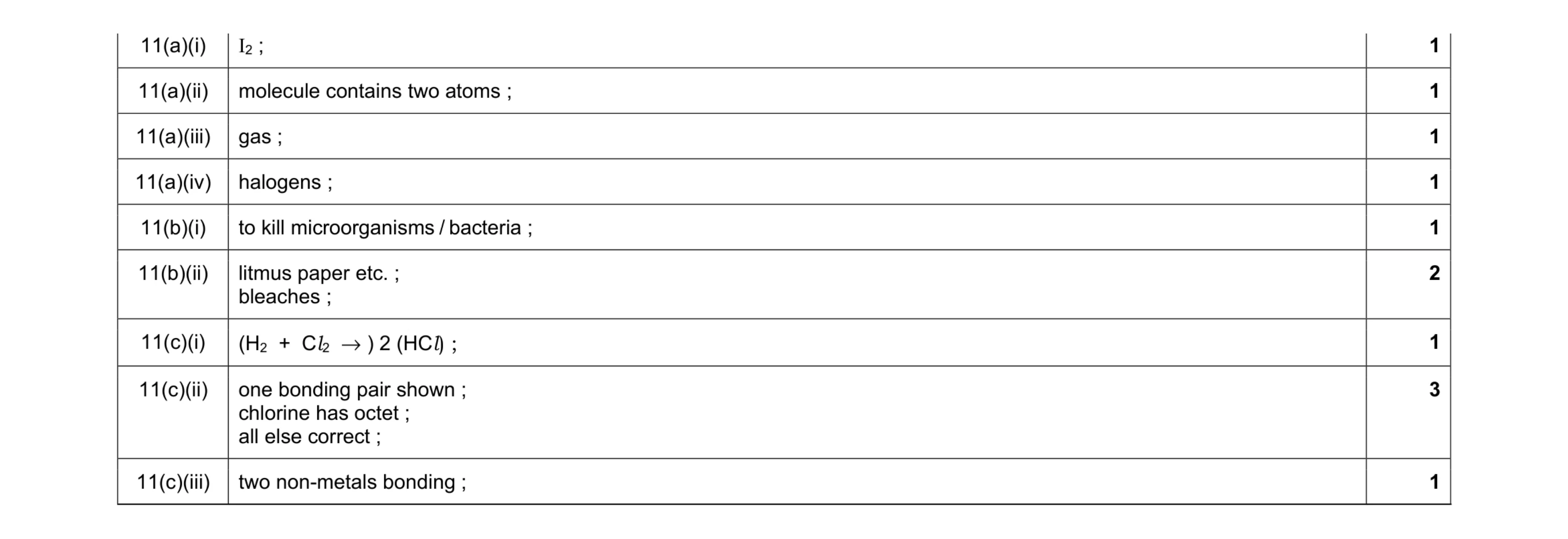 12
12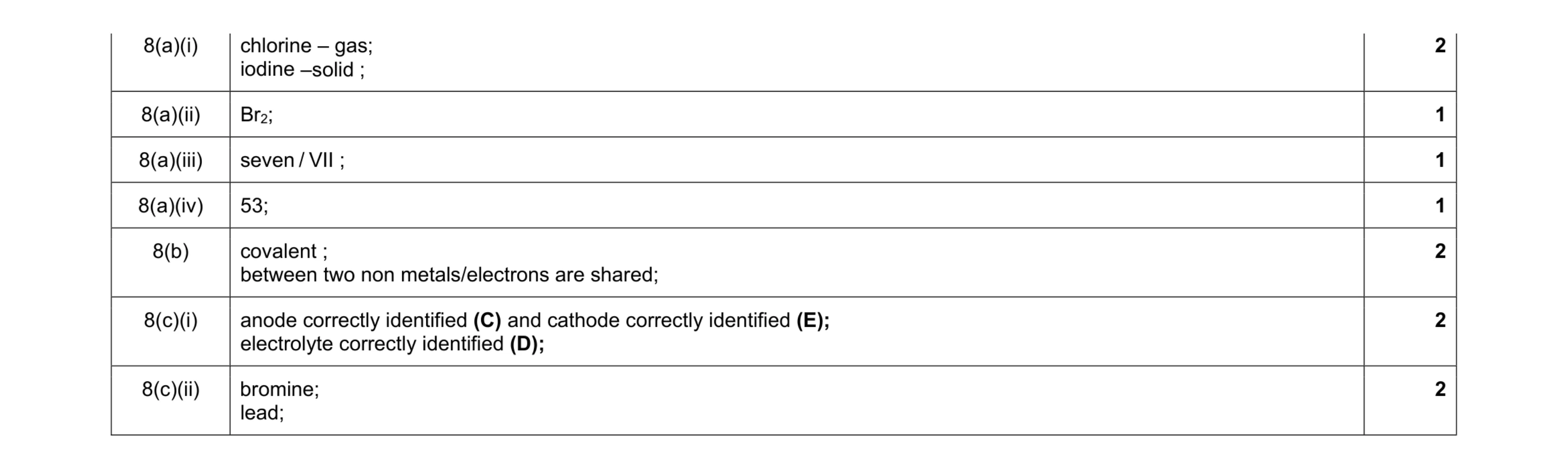 11
11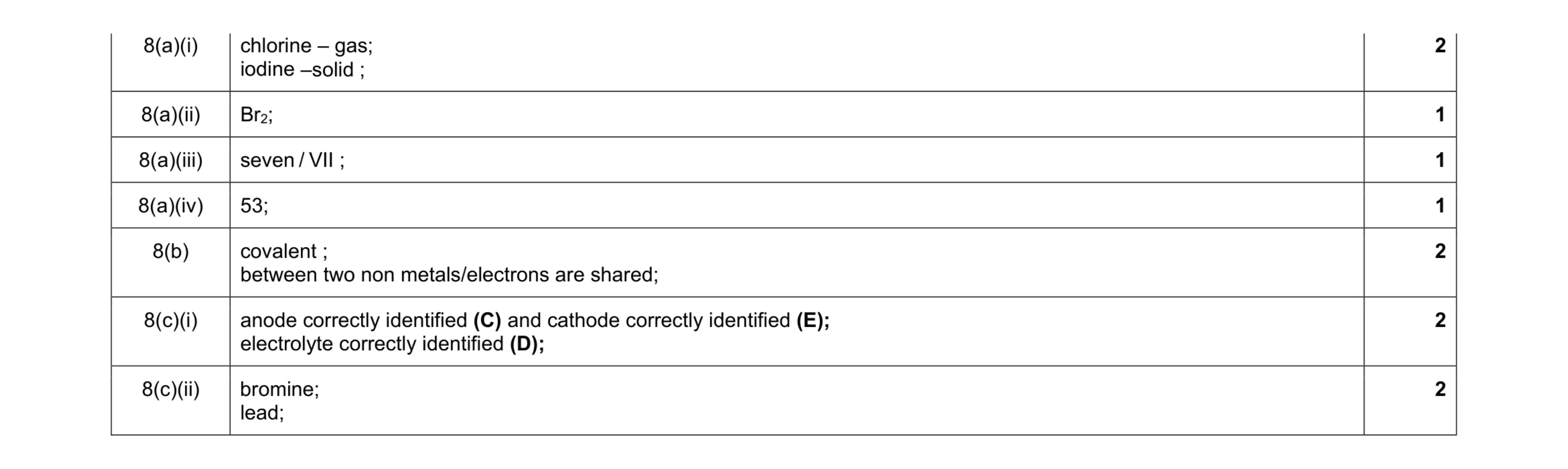 11
11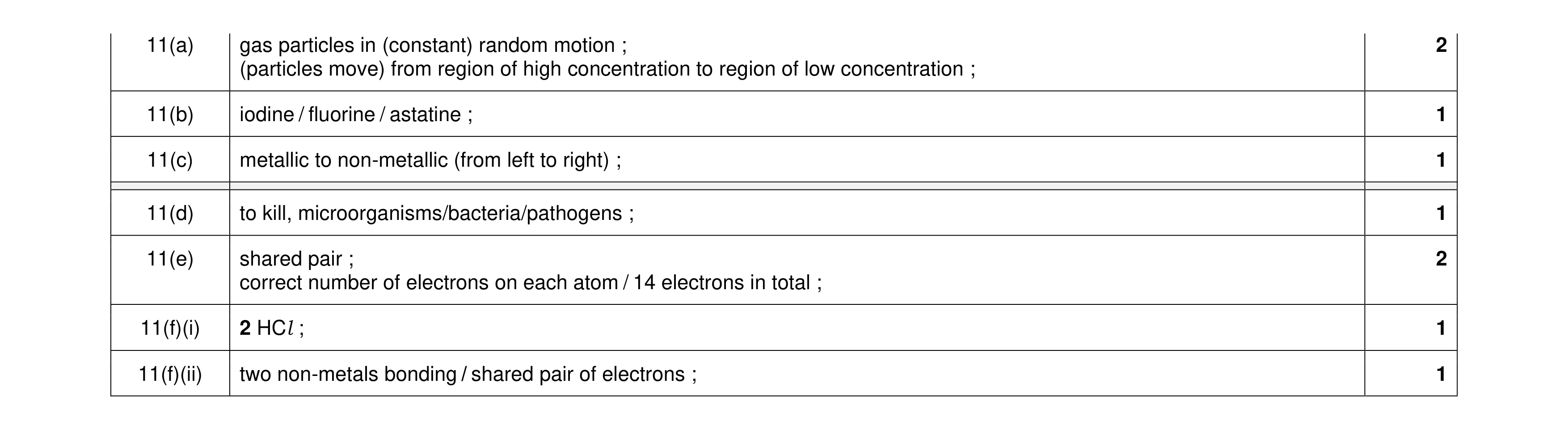 9
9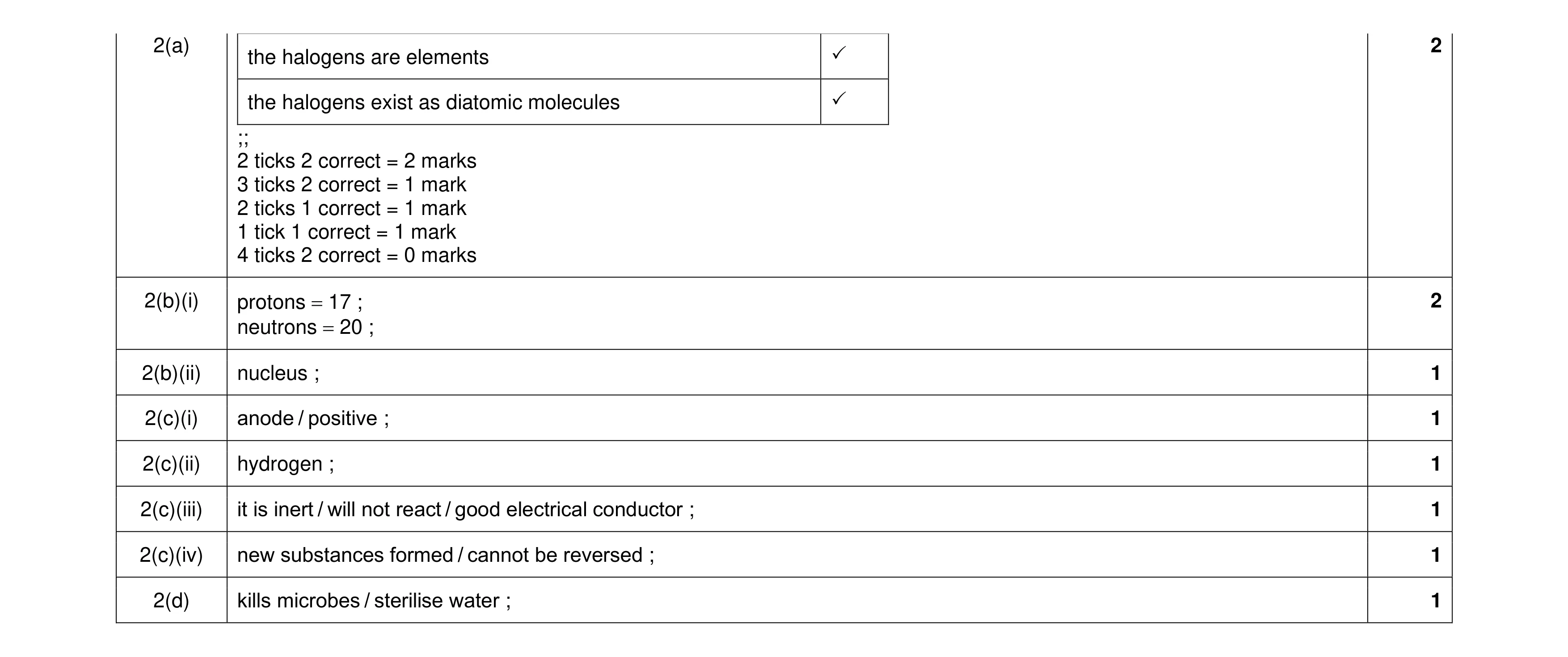 10
10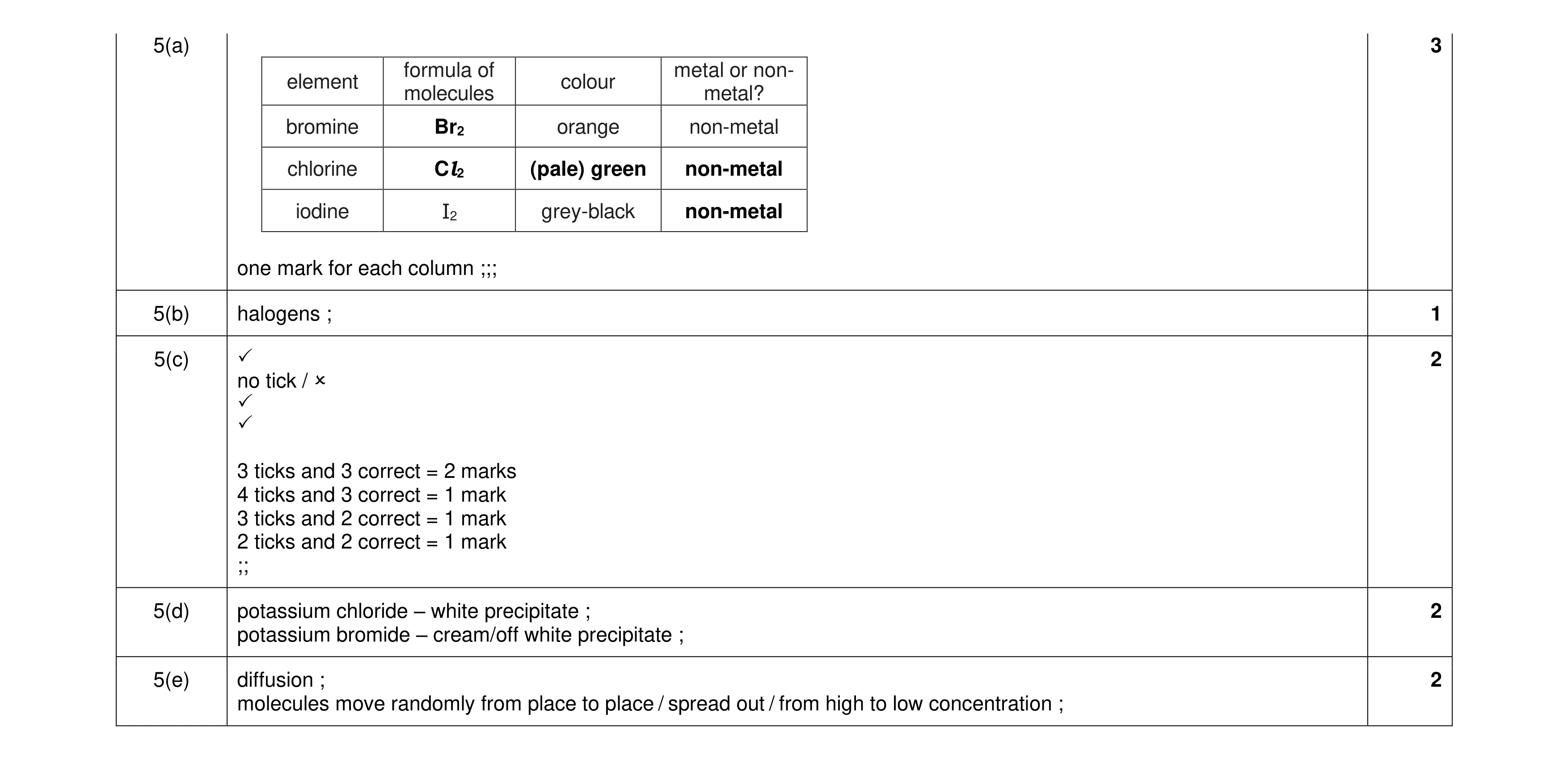 10
10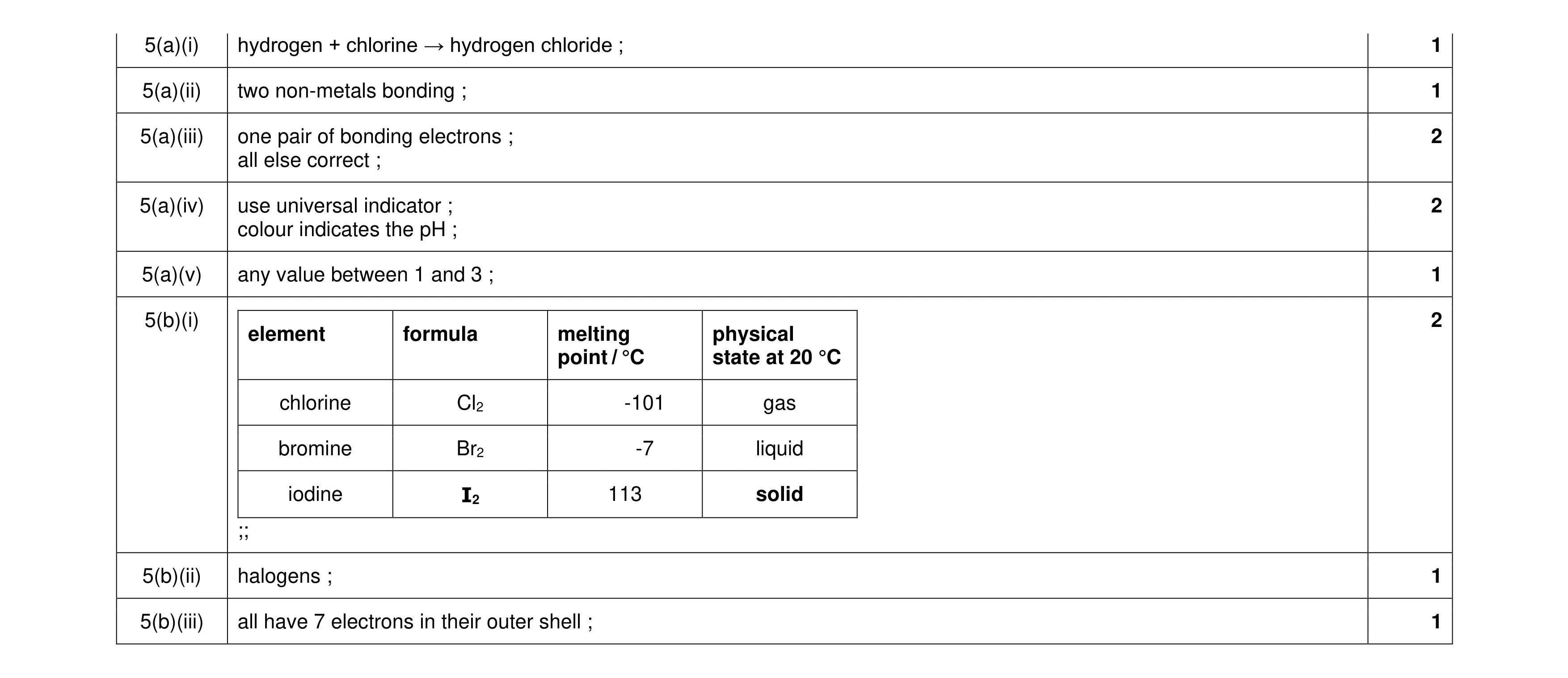 11
11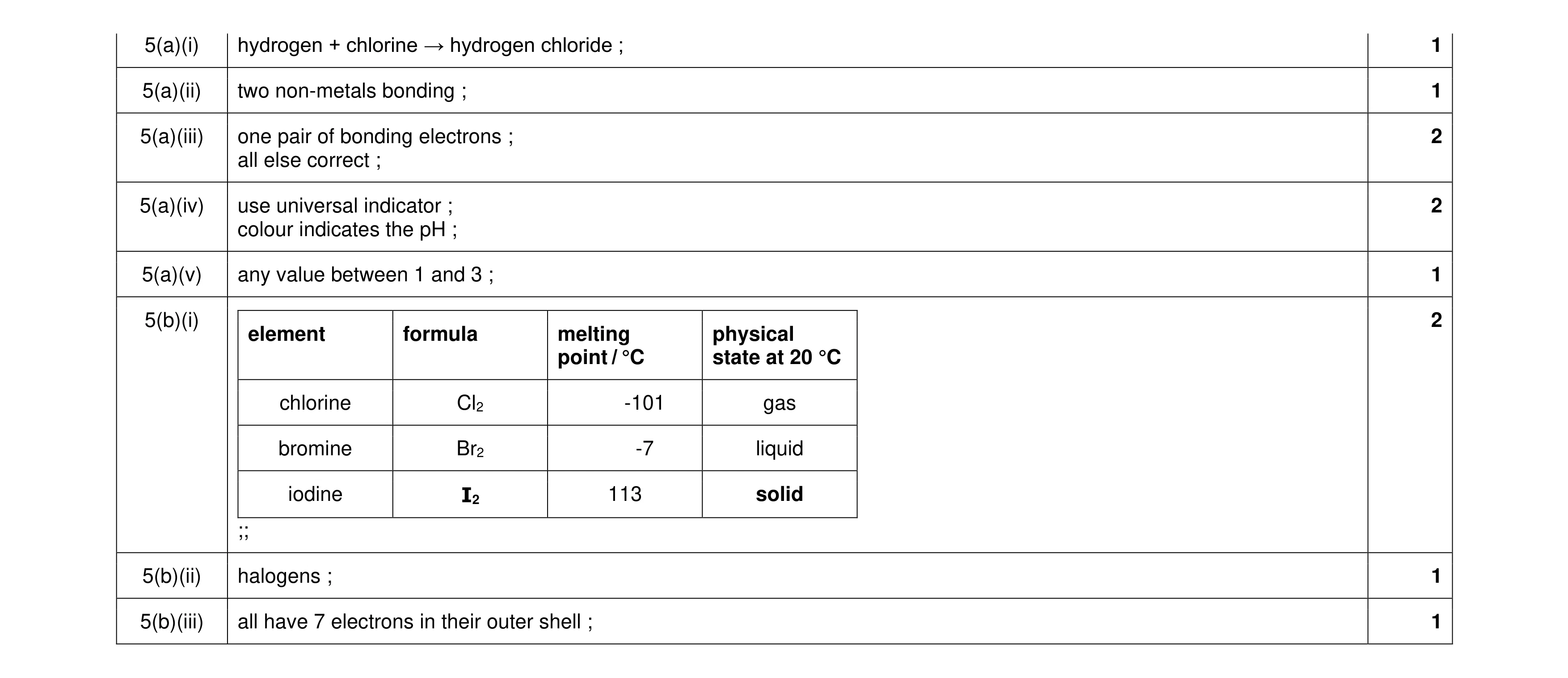 11
11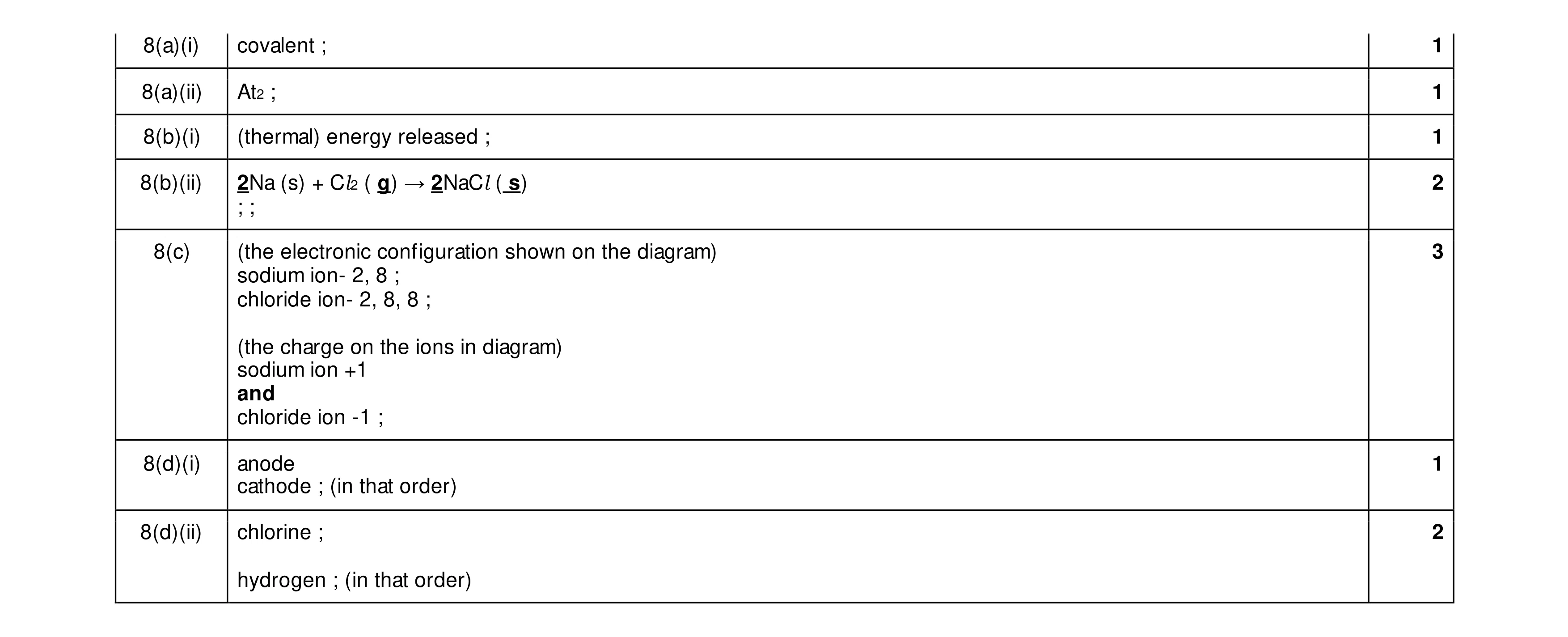 11
11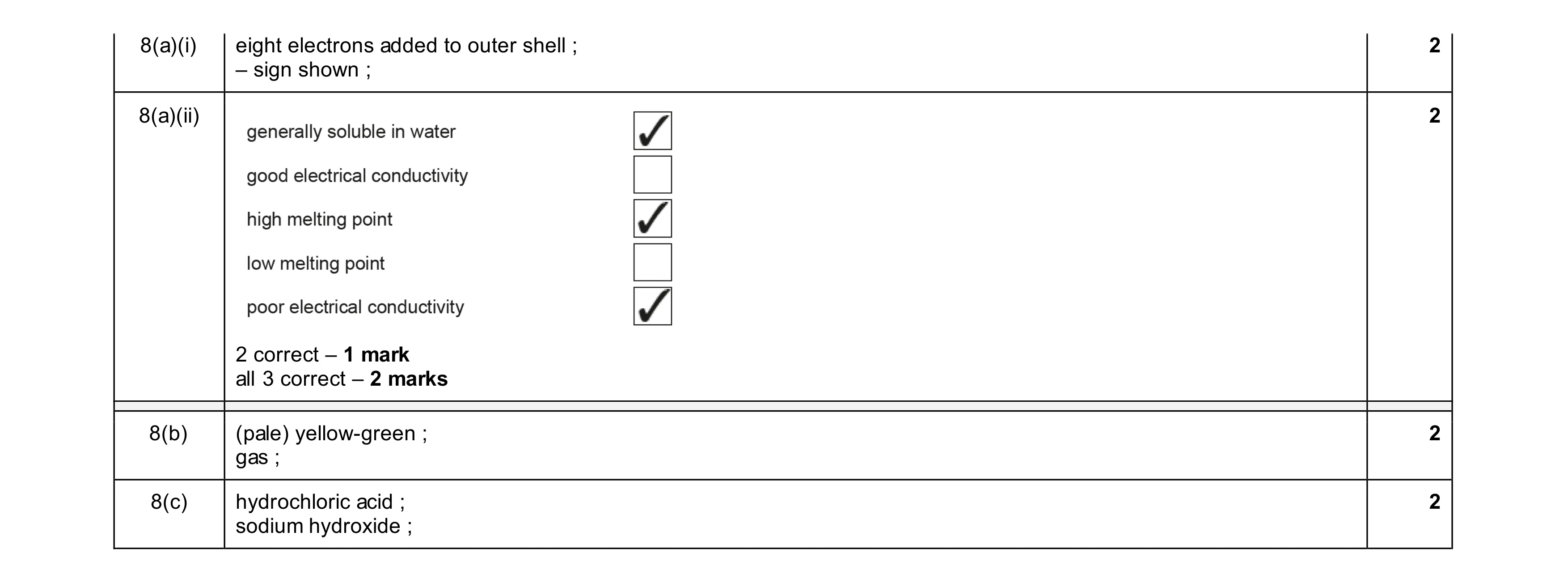 8
8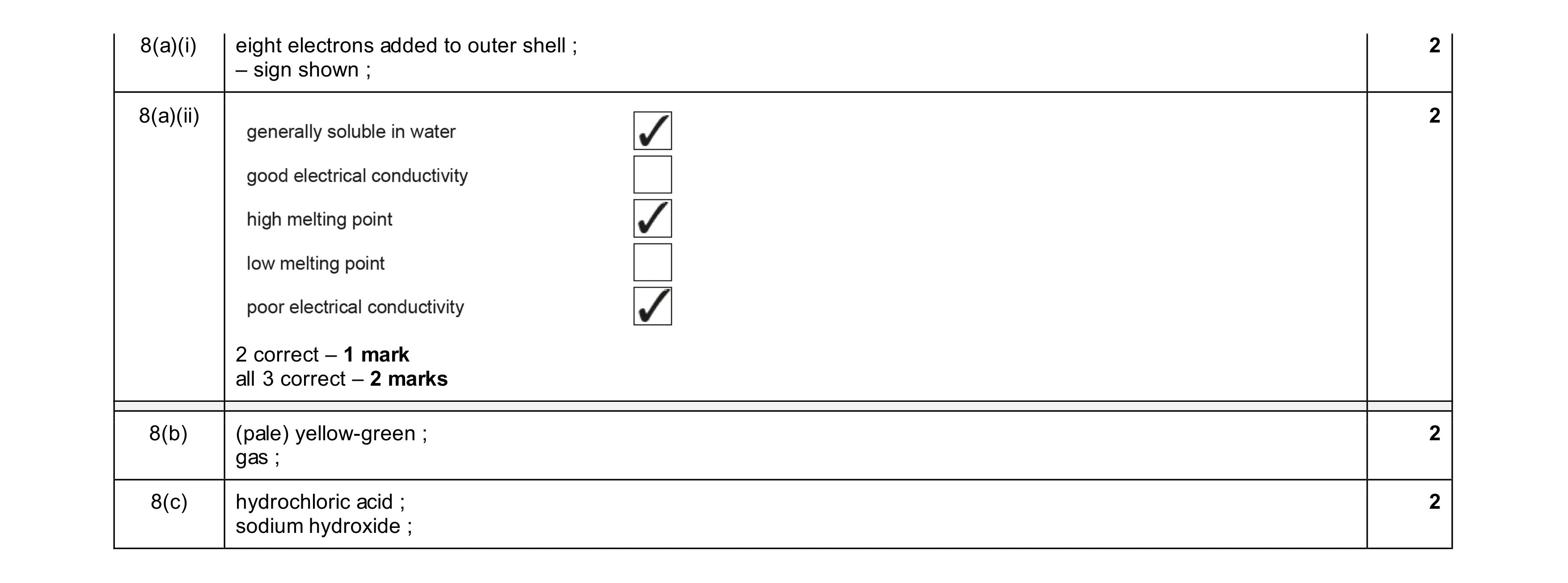 8
8