Questions as text
Q1 · Part of the Periodic Table is shown 0654/21 May/June 2017
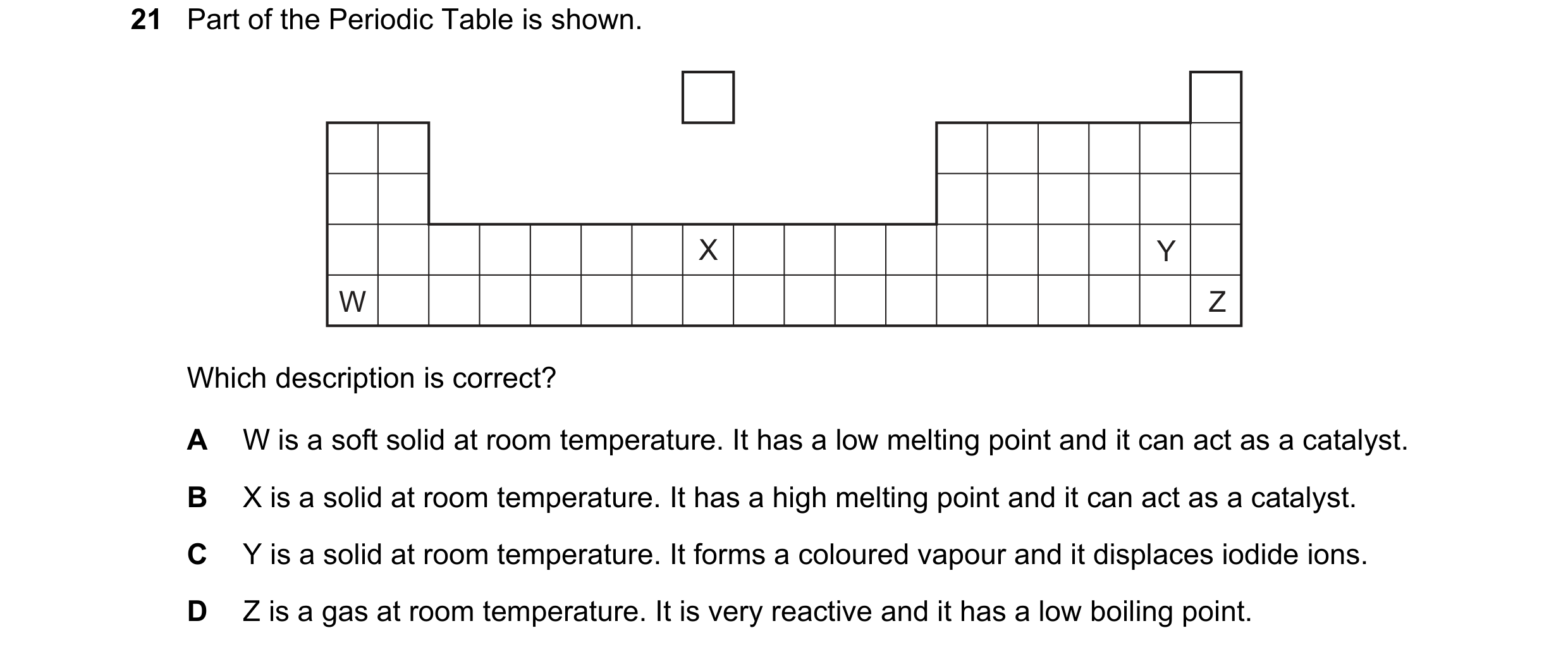
21 Part of the Periodic Table is shown. X Y W Z Which description is correct? A W is a soft solid at room temperature. It has a low melting point and it can act as a catalyst. B X is a solid at room temperature. It has a high melting point and it can act as a catalyst. C Y is a solid at room temperature. It forms a coloured vapour and it displaces iodide ions. D Z is a gas at room temperature. It is very reactive and it has a low boiling point.
1 marks
Answer: B
This question in 0654/21 May/June 2017
Q2 · Which statement about fluorine and astatine is correct? 0654/22 Oct/Nov 2018
22 Which statement about fluorine and astatine is correct? A Fluorine is a solid and astatine is a gas at room temperature. B Fluorine is darker in colour than astatine. C Fluorine is more reactive than astatine. D The formula of fluorine is F2 and the formula of astatine is At.
1 marks
Answer: C
This question in 0654/22 Oct/Nov 2018
Q3 · Chlorine gas is bubbled through two separate solutions 0654/21 May/June 2020
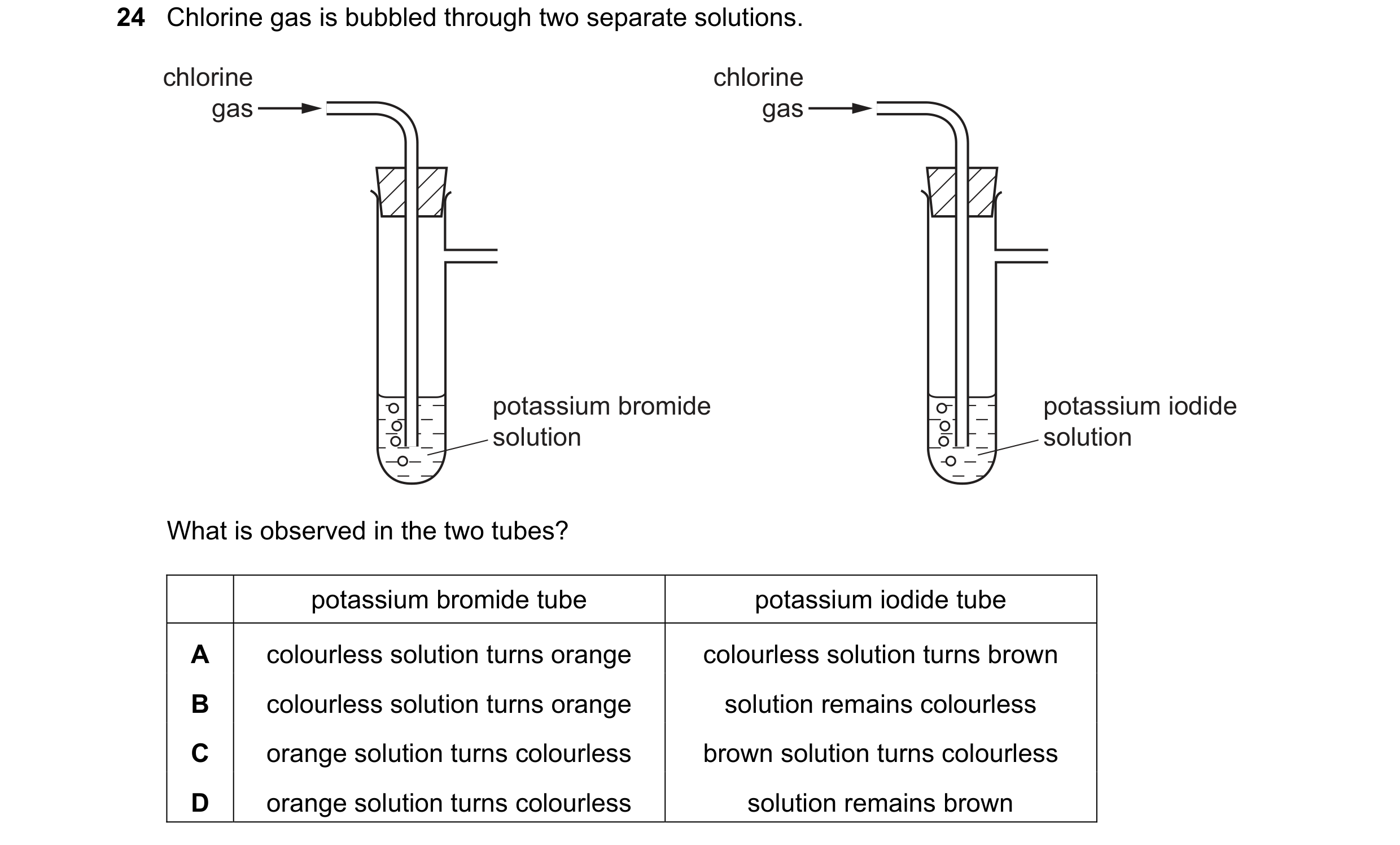
24 Chlorine gas is bubbled through two separate solutions. chlorine chlorine gas gas potassium bromide potassium iodide solution solution What is observed in the two tubes? potassium bromide tube potassium iodide tube A colourless solution turns orange colourless solution turns brown B colourless solution turns orange solution remains colourless C orange solution turns colourless brown solution turns colourless D orange solution turns colourless solution remains brown
1 marks
Answer: A
This question in 0654/21 May/June 2020
Q4 · The properties of the elements in Group VII of the Periodic Table change going down the… 0654/22 May/June 2020
21 The properties of the elements in Group VII of the Periodic Table change going down the group. Which change in properties is correct? A They become darker in colour. B They have lower atomic numbers. C They have lower boiling points. D They become more reactive.
1 marks
Answer: A
This question in 0654/22 May/June 2020
Q5 · Astatine is below iodine in Group VII of the Periodic Table 0654/22 Feb/March 2021
22 Astatine is below iodine in Group VII of the Periodic Table. Which statements about astatine are correct? 1 It is monoatomic. 2 It is a solid at room temperature. 3 It is lighter in colour than iodine. 4 It does not react with aqueous potassium iodide. A 1 and 2 B 1 and 3 C 2 and 4 D 3 and 4
1 marks
Answer: C
This question in 0654/22 Feb/March 2021
Q6 · Which element has similar chemical properties to chlorine? 0654/23 May/June 2021
21 Which element has similar chemical properties to chlorine? A argon B bromine C oxygen D sulfur
1 marks
Answer: B
This question in 0654/23 May/June 2021
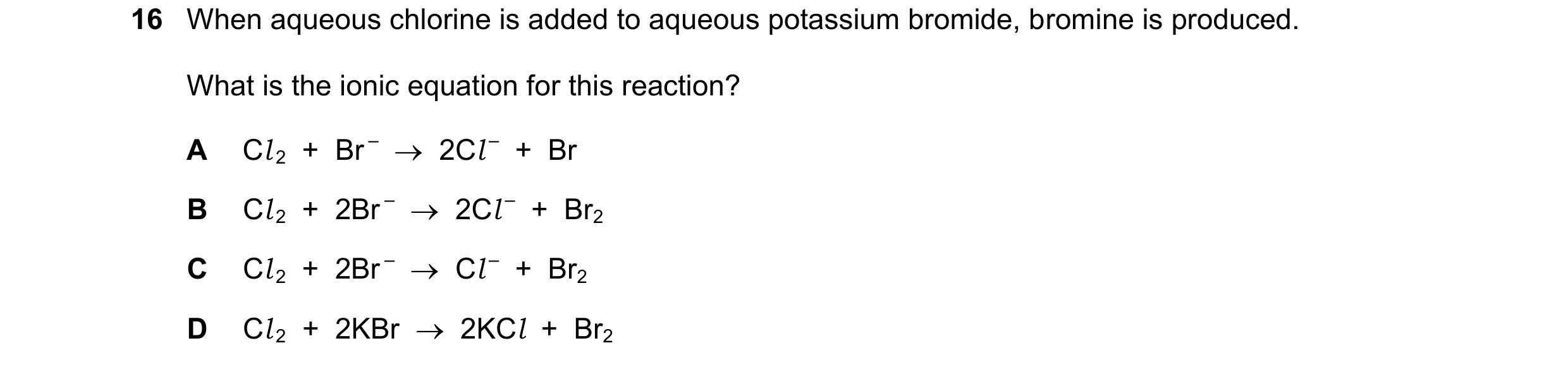
Q7 · When aqueous chlorine is added to aqueous potassium bromide, bromine is produced 0654/22 Oct/Nov 2021
16 When aqueous chlorine is added to aqueous potassium bromide, bromine is produced. What is the ionic equation for this reaction? A Cl 2 + Br – 2Cl – + Br B Cl 2 + 2Br – 2Cl – + Br2 C Cl 2 + 2Br – Cl – + Br2 D Cl 2 + 2KBr 2KCl + Br2
1 marks
Answer: B
This question in 0654/22 Oct/Nov 2021
Q8 · The diagram shows the electrolysis of a compound 0654/22 Oct/Nov 2021
17 The diagram shows the electrolysis of a compound. switch + – P Q electrolyte When the switch is closed, the solution around electrode P turns orange because a halogen is formed. The positive electrode P is called the ……1……, and the halogen is ……2…… . Which words complete gaps 1 and 2? 1 2 A anode bromine B anode chlorine C cathode bromine D cathode chlorine
1 marks
Answer: A
This question in 0654/22 Oct/Nov 2021
Q9 · Which statement about the elements in Group I and in Group VII of the Periodic Table is… 0654/23 Oct/Nov 2021
21 Which statement about the elements in Group I and in Group VII of the Periodic Table is correct? A Chlorine has a darker colour than iodine. B Each molecule of a halogen contains one atom. C Potassium reacts with cold water more vigorously than lithium. D The melting point of lithium is lower than the melting point of sodium.
1 marks
Answer: C
This question in 0654/23 Oct/Nov 2021
Q10 · Which substance changes the colour of damp red litmus? 0654/23 May/June 2022
19 Which substance changes the colour of damp red litmus? A CO2 B Cl 2 C H2 D SO2
1 marks
Answer: B
This question in 0654/23 May/June 2022
Q11 · Which statement about the halogens is not correct? 0654/21 Oct/Nov 2022
21 Which statement about the halogens is not correct? A Iodine has a darker colour than chlorine. B They all exist as diatomic molecules. C They are all gases at room temperature. D They are all non-metals.
1 marks
Answer: C
This question in 0654/21 Oct/Nov 2022
Q12 · Which statements about the elements in Group VII of the Periodic Table are correct? 0654/22 Oct/Nov 2022
21 Which statements about the elements in Group VII of the Periodic Table are correct? 1 Only one of them is a liquid at room temperature. 2 Their colours become darker down the group. 3 Their melting points and boiling points decrease down the group. 4 They are all metallic elements called halogens. A 1 and 2 B 1 and 4 C 2 and 3 D 3 and 4
1 marks
Answer: A
This question in 0654/22 Oct/Nov 2022
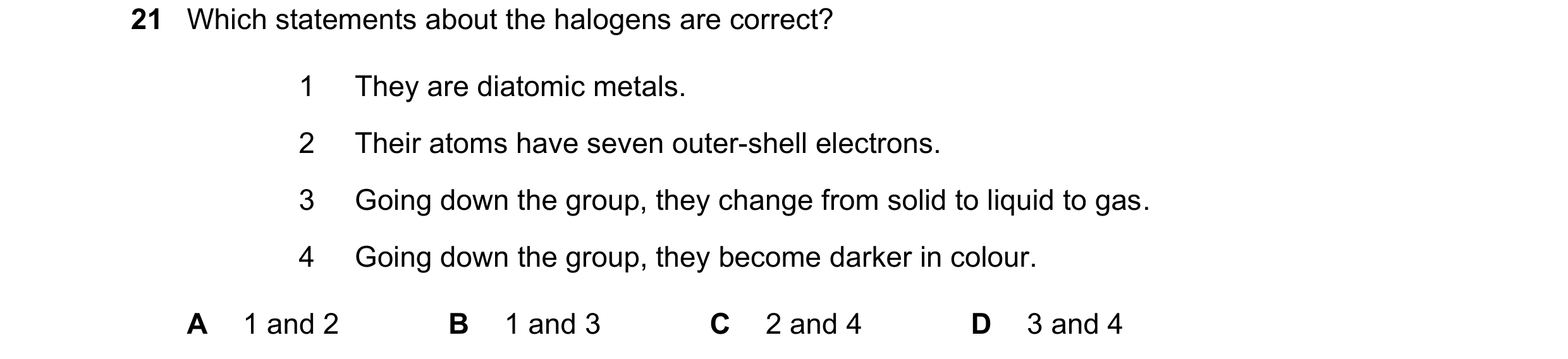
Q13 · Which statements about the halogens are correct? 0654/22 Oct/Nov 2023
21 Which statements about the halogens are correct? 1 They are diatomic metals. 2 Their atoms have seven outer-shell electrons. 3 Going down the group, they change from solid to liquid to gas. 4 Going down the group, they become darker in colour. A 1 and 2 B 1 and 3 C 2 and 4 D 3 and 4
1 marks
Answer: C
This question in 0654/22 Oct/Nov 2023
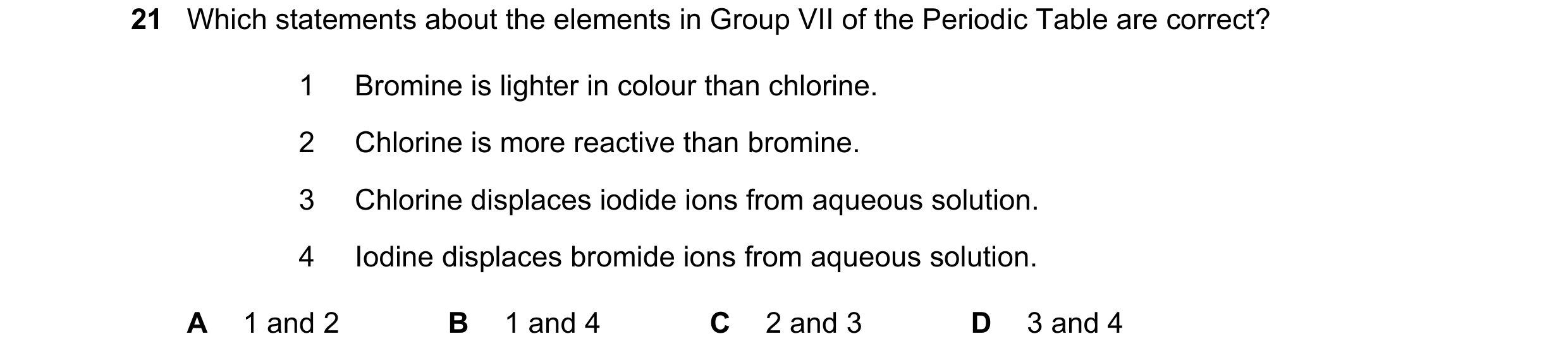
Q14 · Which statements about the elements in Group VII of the Periodic Table are correct? 0654/23 May/June 2024
21 Which statements about the elements in Group VII of the Periodic Table are correct? 1 Bromine is lighter in colour than chlorine. 2 Chlorine is more reactive than bromine. 3 Chlorine displaces iodide ions from aqueous solution. 4 Iodine displaces bromide ions from aqueous solution. A 1 and 2 B 1 and 4 C 2 and 3 D 3 and 4
1 marks
Answer: C
This question in 0654/23 May/June 2024
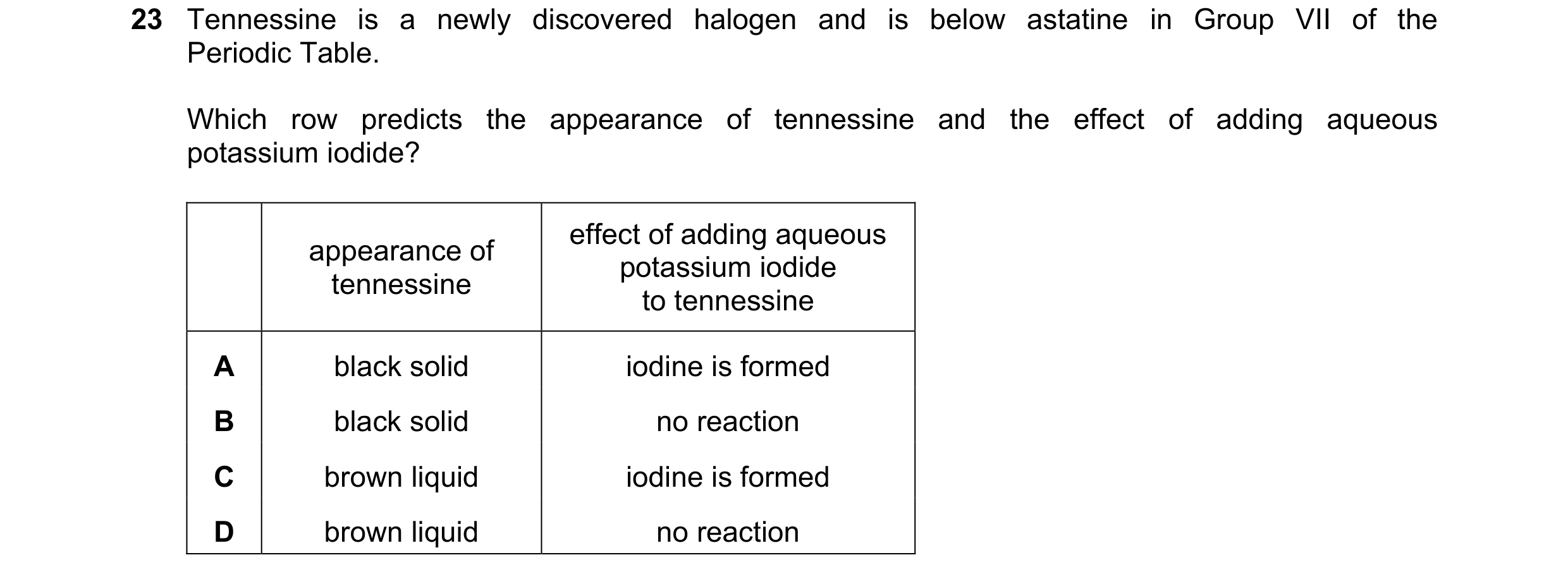
Q15 · Tennessine is a newly discovered halogen and is below astatine in Group VII of the… 0654/21 Oct/Nov 2024
23 Tennessine is a newly discovered halogen and is below astatine in Group VII of the Periodic Table. Which row predicts the appearance of tennessine and the effect of adding aqueous potassium iodide? effect of adding aqueous appearance of potassium iodide tennessine to tennessine A black solid iodine is formed B black solid no reaction C brown liquid iodine is formed D brown liquid no reaction
1 marks
Answer: B
This question in 0654/21 Oct/Nov 2024
Q16 · Which statement about the halogens is not correct? 0654/23 Oct/Nov 2024
22 Which statement about the halogens is not correct? A Bromine is darker in colour than iodine. B Iodine is solid at room temperature. C They all have seven electrons in their outer shell. D They all form diatomic molecules.
1 marks
Answer: A
This question in 0654/23 Oct/Nov 2024
Q17 · Bromine has a boiling point of 59 °C 0654/22 Feb/March 2025
21 Bromine has a boiling point of 59 °C. It reacts with hydrogen rapidly. Iodine has a boiling point of 184 °C. It reacts with hydrogen slowly. Which row about fluorine is correct? boiling point reaction with / °C hydrogen A –188 explosive B –188 very slow C 114 explosive D 114 very slow
1 marks
Answer: A
This question in 0654/22 Feb/March 2025
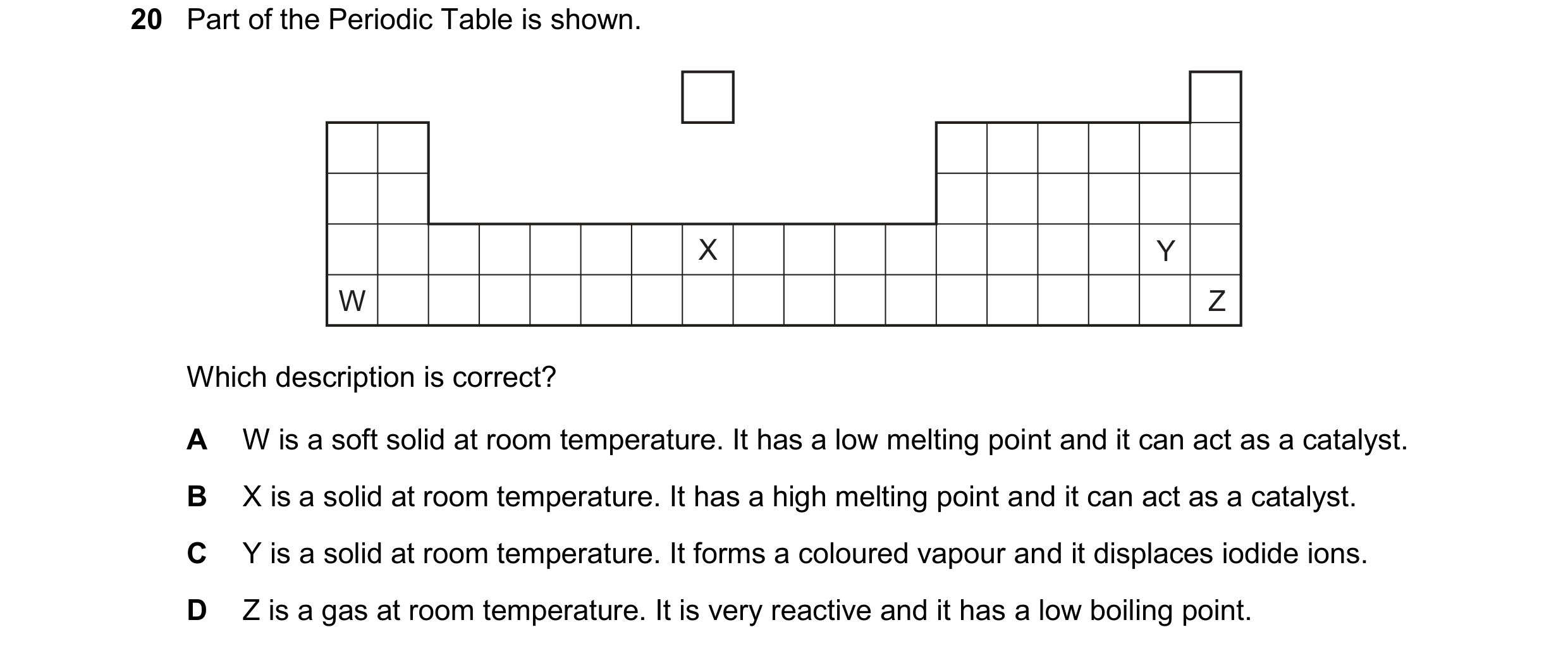
Q18 · Part of the Periodic Table is shown 0654/22 May/June 2025
20 Part of the Periodic Table is shown. X Y W Z Which description is correct? A W is a soft solid at room temperature. It has a low melting point and it can act as a catalyst. B X is a solid at room temperature. It has a high melting point and it can act as a catalyst. C Y is a solid at room temperature. It forms a coloured vapour and it displaces iodide ions. D Z is a gas at room temperature. It is very reactive and it has a low boiling point.
1 marks
Answer: B
This question in 0654/22 May/June 2025
Q19 · Which statement about the elements in Group VII of the Periodic Table is correct? 0654/21 Oct/Nov 2025
21 Which statement about the elements in Group VII of the Periodic Table is correct? A Chlorine is more reactive than bromine. B The colour of the elements becomes darker up the group. C The melting point of the elements decreases down the group. D The reactivity of the elements increases down the group.
1 marks
Answer: A
This question in 0654/21 Oct/Nov 2025

 1 / 5
1 / 5

 2 / 5
2 / 5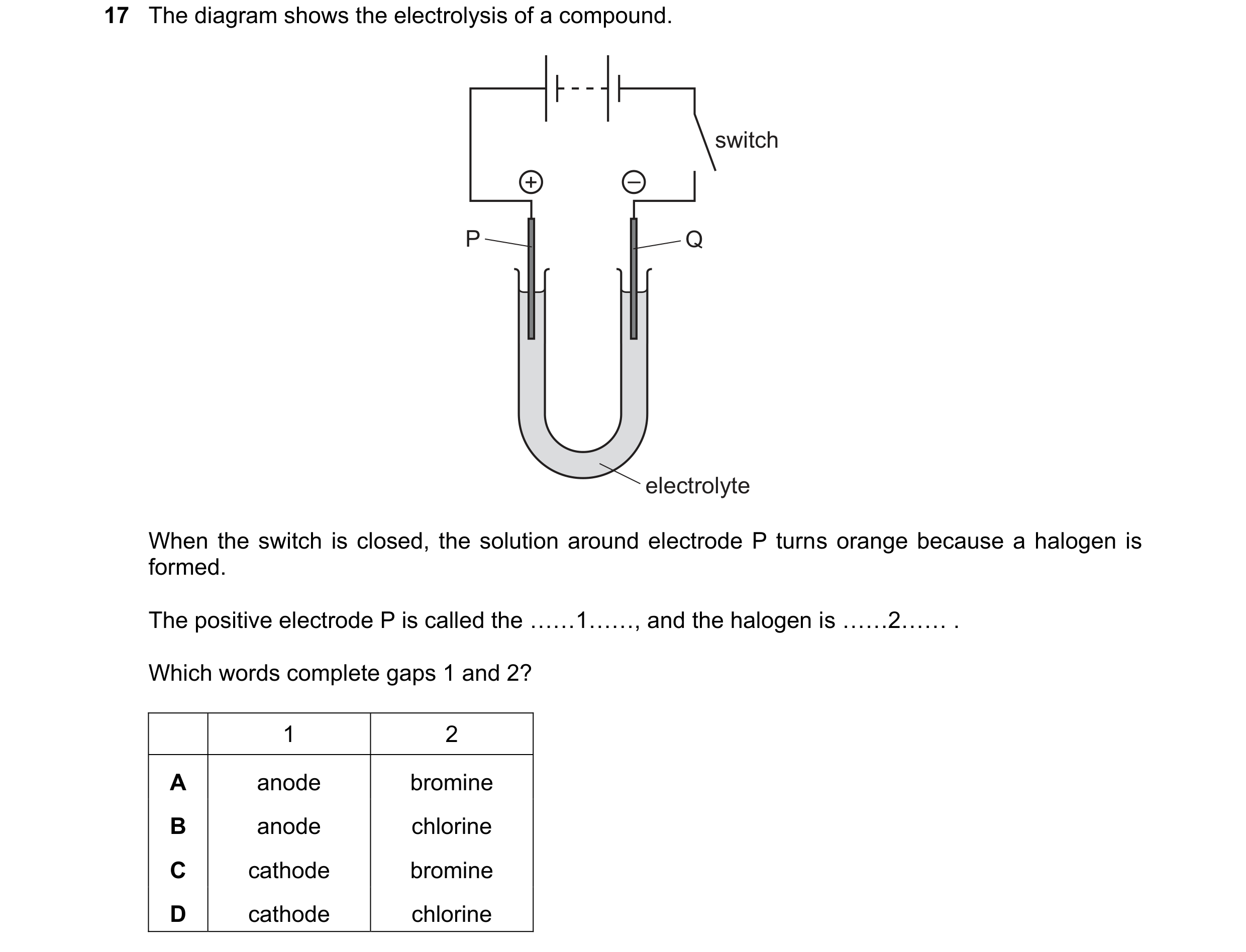


 3 / 5
3 / 5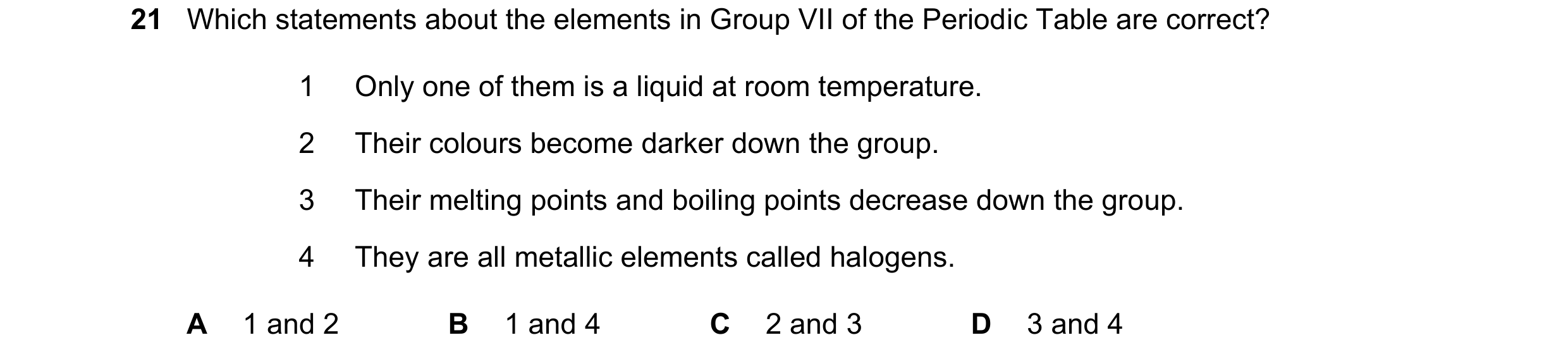
 4 / 5
4 / 5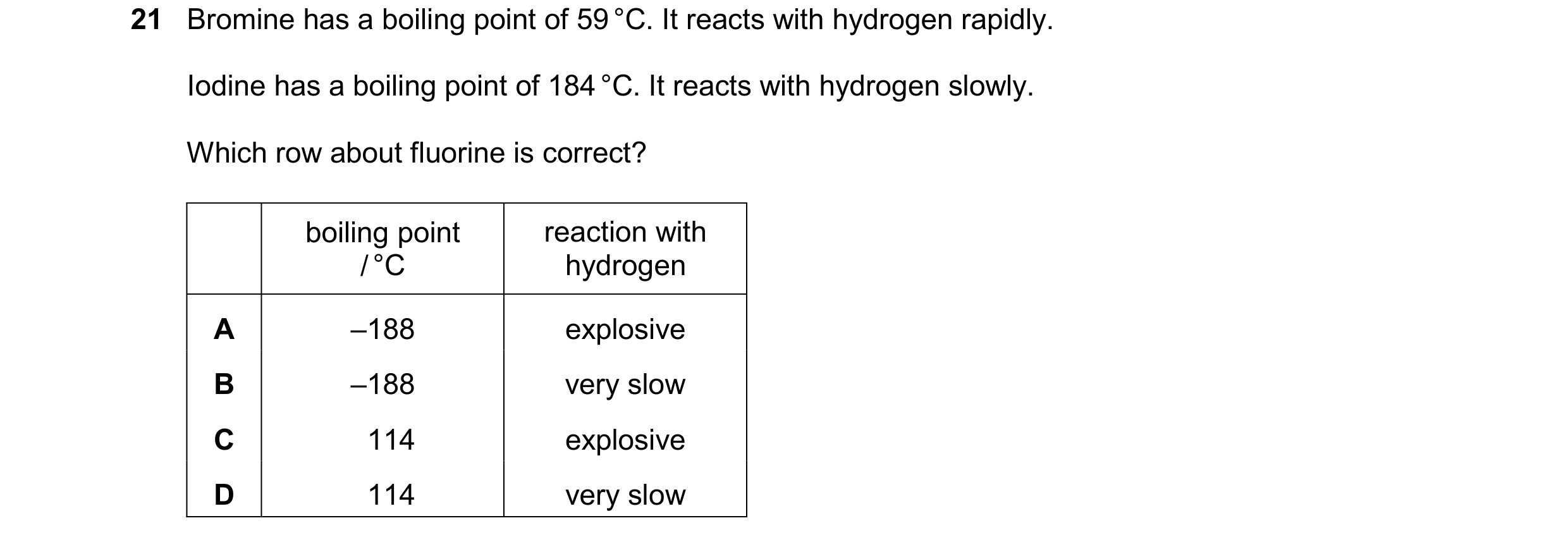
 5 / 5
5 / 5