Questions as text
Q1 · The Periodic Table includes the five metals listed 0654/42 Oct/Nov 2017
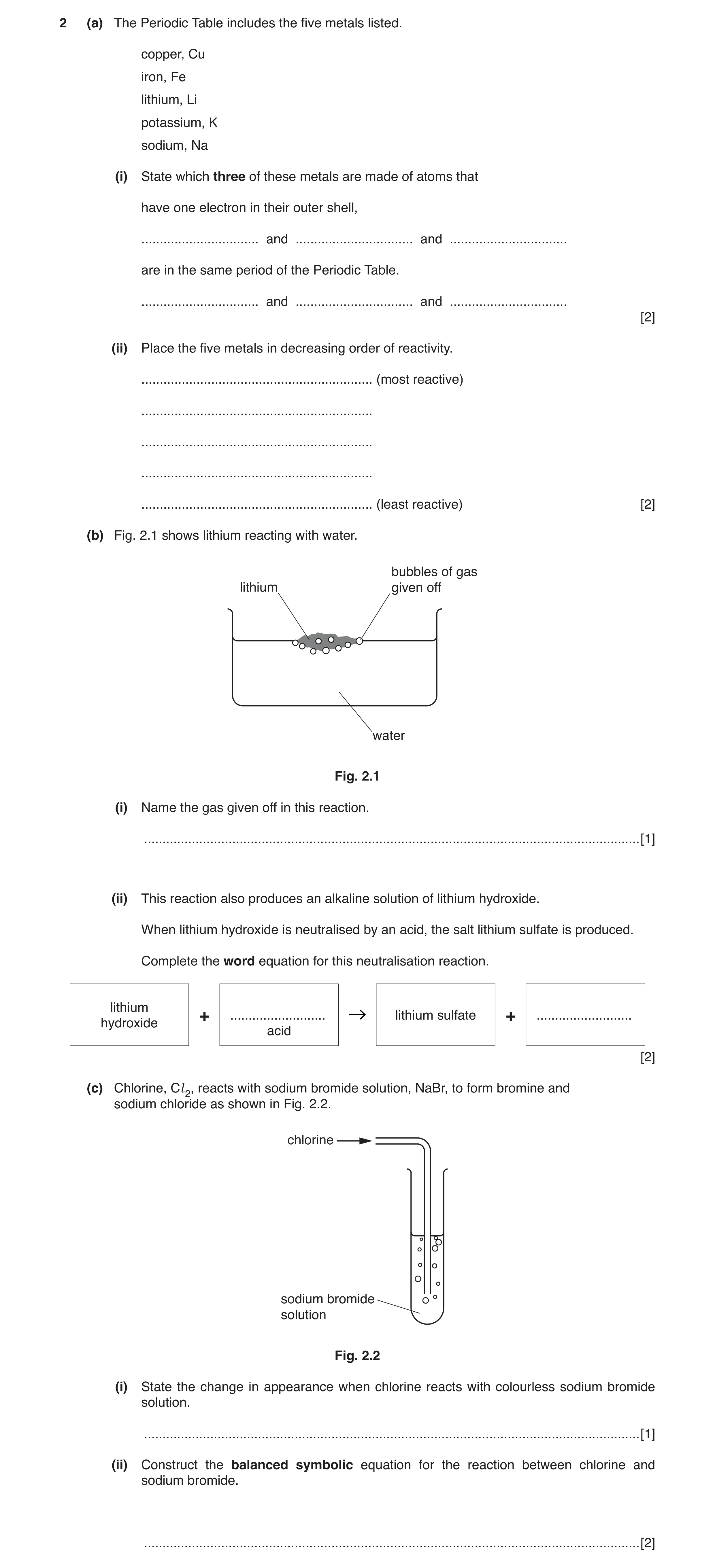
2 (a) The Periodic Table includes the five metals listed. copper, Cu iron, Fe lithium, Li potassium, K sodium, Na (i) State which three of these metals are made of atoms that have one electron in their outer shell, … and … and … are in the same period of the Periodic Table. … and … and … [2] (ii) Place the five metals in decreasing order of reactivity. … (most reactive) … … … … (least reactive) [2] (b) Fig. 2.1 shows lithium reacting with water. bubbles of gas lithium given off water Fig. 2.1 (i) Name the gas given off in this reaction. … [1] (ii) This reaction also produces an alkaline solution of lithium hydroxide. When lithium hydroxide is neutralised by an acid, the salt lithium sulfate is produced. Complete the word equation for this neutralisation reaction. lithium + … lithium sulfate + … hydroxide acid [2] (c) Chlorine, Cl 2, reacts with sodium bromide solution, NaBr, to form bromine and sodium chloride as shown in Fig. 2.2. chlorine sodium bromide solution Fig. 2.2 (i) State the change in appearance when chlorine reacts with colourless sodium bromide solution. … [1] (ii) Construct the balanced symbolic equation for the reaction between chlorine and sodium bromide. … [2]
10 marks
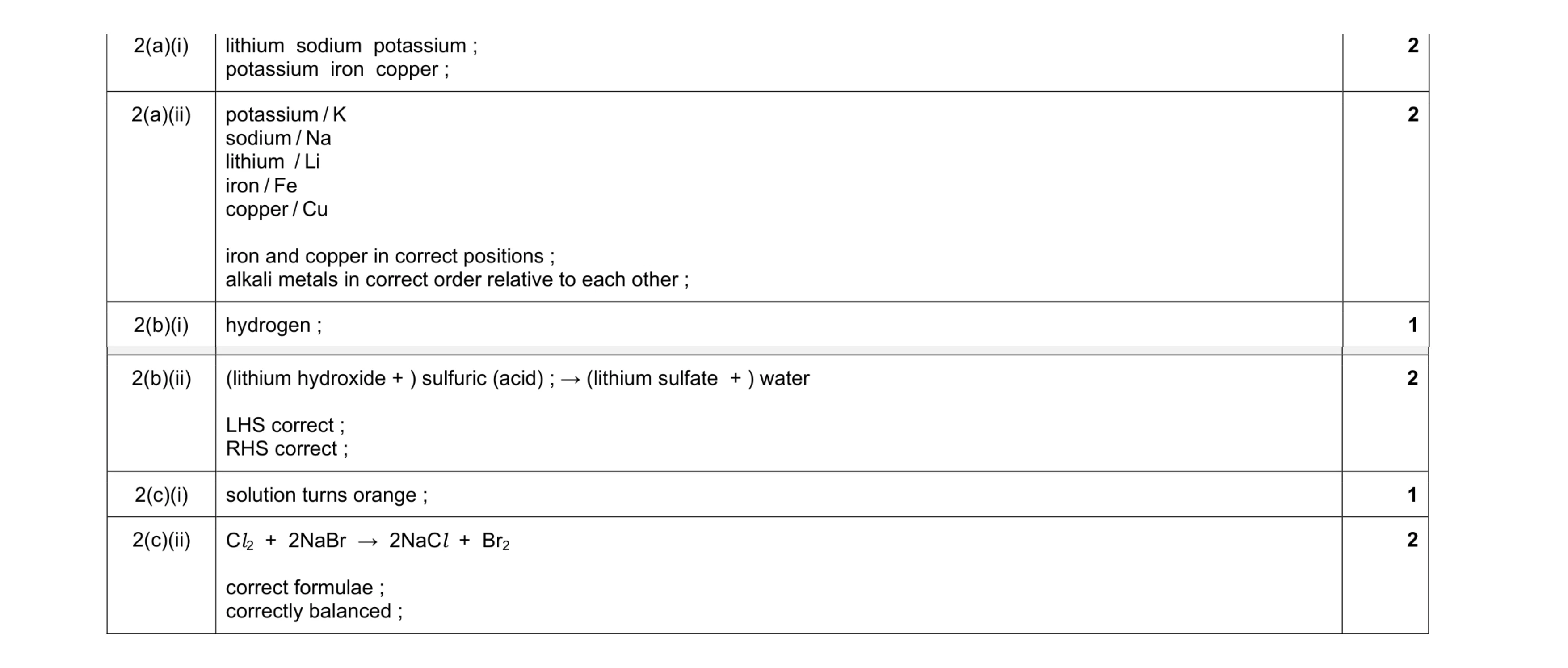
Mark scheme: 2(a)(i) lithium sodium potassium ; potassium iron copper ; 2 2(a)(ii) potassium / K sodium / Na lithium / Li iron / Fe copper / Cu iron and copper in correct positions ; alkali metals in correct order relative to each other ; 2 2(b)(i) hydrogen ; 1 Question Answer Marks 2(b)(ii) (lithium hydroxide + ) sulfuric (acid) ; → (lithium sulfate + ) water LHS correct ; RHS correct ; 2 2(c)(i) solution turns orange ; 1 2(c)(ii) Cl2 + 2NaBr → 2NaCl + Br2 correct formulae ; correctly balanced ; 2
This question in 0654/42 Oct/Nov 2017
Q2 · Iodine is an element in Group VII of the Periodic Table 0654/41 Oct/Nov 2018
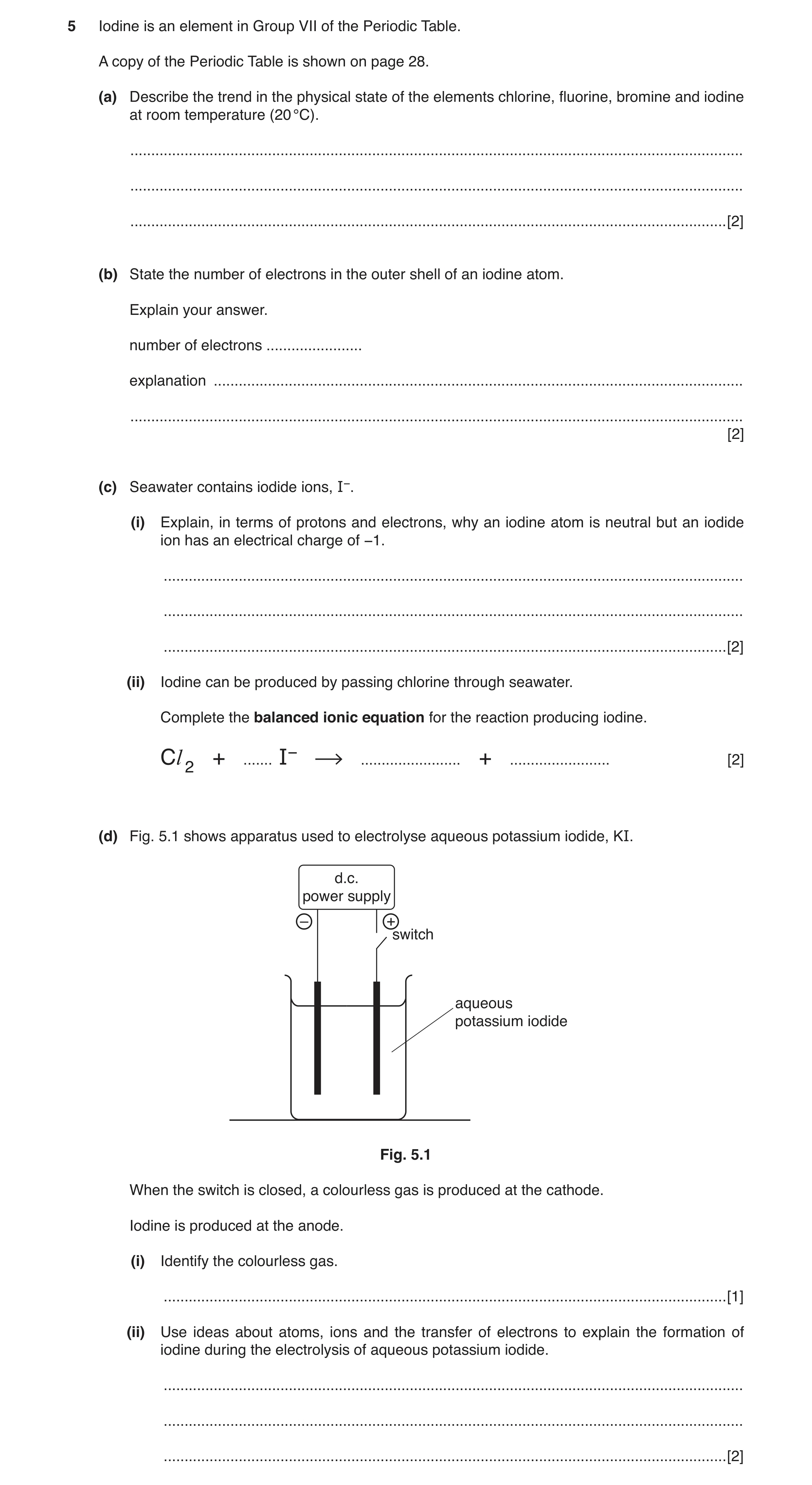
5 Iodine is an element in Group VII of the Periodic Table. A copy of the Periodic Table is shown on page 28. (a) Describe the trend in the physical state of the elements chlorine, fluorine, bromine and iodine at room temperature (20 °C). … … … [2] (b) State the number of electrons in the outer shell of an iodine atom. Explain your answer. number of electrons … explanation … … [2] (c) Seawater contains iodide ions, I−. (i) Explain, in terms of protons and electrons, why an iodine atom is neutral but an iodide ion has an electrical charge of −1. … … … [2] (ii) Iodine can be produced by passing chlorine through seawater. Complete the balanced ionic equation for the reaction producing iodine. Cl + … I− … + … [2] 2 (d) Fig. 5.1 shows apparatus used to electrolyse aqueous potassium iodide, KI. d.c. power supply – + switch aqueous potassium iodide Fig. 5.1 When the switch is closed, a colourless gas is produced at the cathode. Iodine is produced at the anode. (i) Identify the colourless gas. … [1] (ii) Use ideas about atoms, ions and the transfer of electrons to explain the formation of iodine during the electrolysis of aqueous potassium iodide. … … … [2]
11 marks
Mark scheme: 5(a) gas to liquid ; liquid to solid ; 2 5(b) 7 ; outer electron number = group number ; 2 5(c)(i) in the atom, number of protons = number of electrons / positive and negative charge is balanced ; in the ion, electrons exceed protons by one / owtte ; 2 5(c)(ii) (Cl2 +) 2(I–) → 2Cl– + I2 2I– and I2 ; 2Cl– ; 2 5(d)(i) hydrogen ; 1 5(d)(ii) one electron moves from ion (to anode / positive electrode) ; (iodide) ions attracted / move to anode OR (iodide) ions become iodine atoms OR (iodine) atoms form (iodine) molecules ; 2
This question in 0654/41 Oct/Nov 2018
Q3 · Group VII of the Periodic Table contains reactive non-metallic elements 0654/43 Oct/Nov 2018
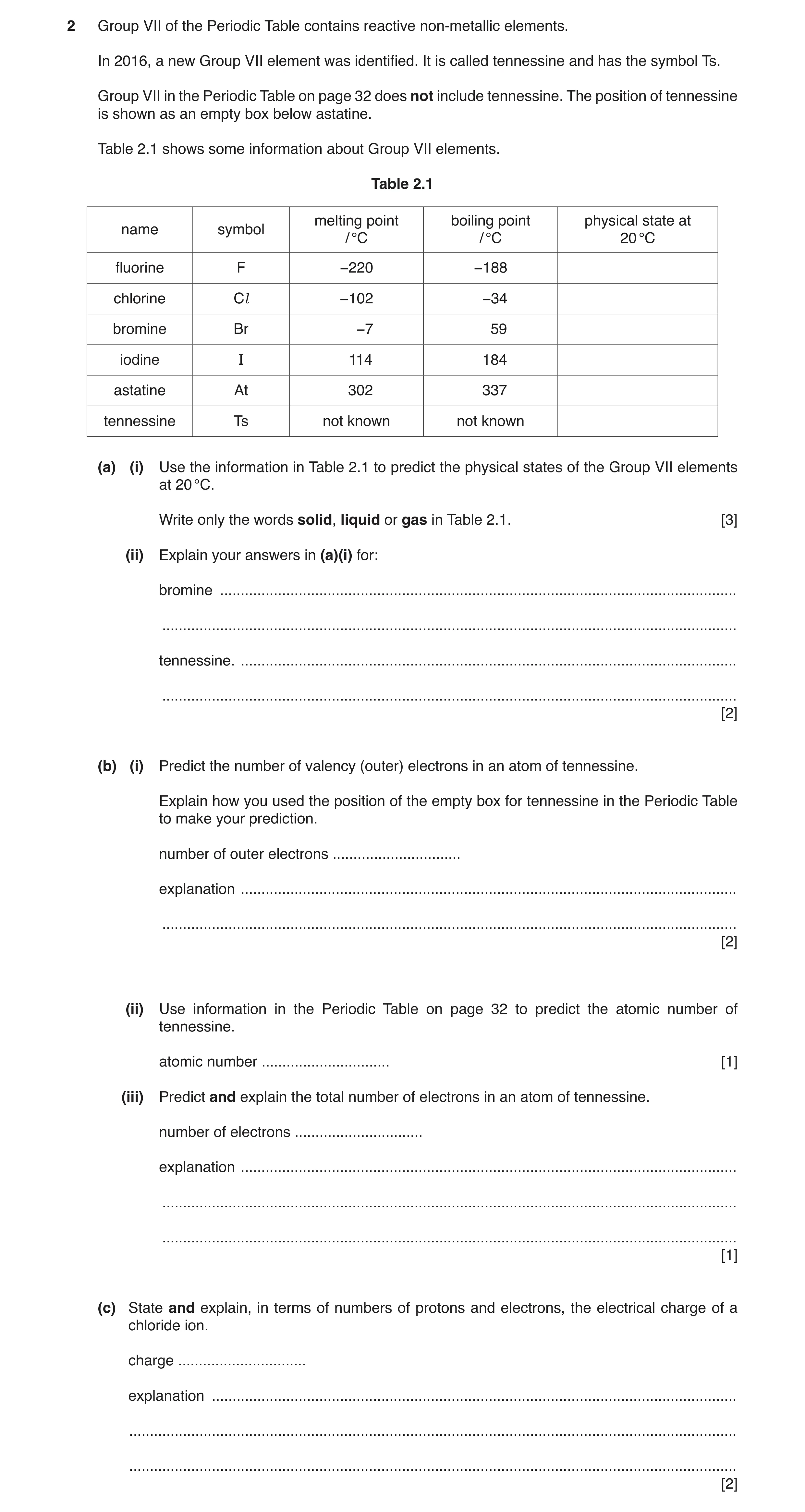
2 Group VII of the Periodic Table contains reactive non-metallic elements. In 2016, a new Group VII element was identified. It is called tennessine and has the symbol Ts. Group VII in the Periodic Table on page 32 does not include tennessine. The position of tennessine is shown as an empty box below astatine. Table 2.1 shows some information about Group VII elements. Table 2.1 melting point boiling point physical state at name symbol / °C / °C 20 °C fluorine F −220 −188 chlorine Cl −102 −34 bromine Br −7 59 iodine I 114 184 astatine At 302 337 tennessine Ts not known not known (a) (i) Use the information in Table 2.1 to predict the physical states of the Group VII elements at 20 °C. Write only the words solid, liquid or gas in Table 2.1. [3] (ii) Explain your answers in (a)(i) for: bromine … … tennessine. … … [2] (b) (i) Predict the number of valency (outer) electrons in an atom of tennessine. Explain how you used the position of the empty box for tennessine in the Periodic Table to make your prediction. number of outer electrons … explanation … … [2] (ii) Use information in the Periodic Table on page 32 to predict the atomic number of tennessine. atomic number … [1] (iii) Predict and explain the total number of electrons in an atom of tennessine. number of electrons … explanation … … … [1] (c) State and explain, in terms of numbers of protons and electrons, the electrical charge of a chloride ion. charge … explanation … … … [2]
11 marks
Mark scheme: 2(a)(i) gas gas ; liquid ; solid solid solid ; 3 2(a)(ii) bromine – m.pt. below 20 °C b.pt. above 20 °C ; tennessine – the idea that the trend will continue ; 2 2(b)(i) 7 ; number of outer electrons same as group number ; 2 2(b)(ii) 117 ; 1 2(b)(iii) 117 AND (number of electrons is) the same as number of protons / atomic number ; 1 2(c) −1 / negative ; the idea that number of electrons exceeds number of protons by one ; 2
This question in 0654/43 Oct/Nov 2018
Q4 · Using information in the Periodic Table on page 32, calculate the relative molecular… 0654/41 May/June 2019
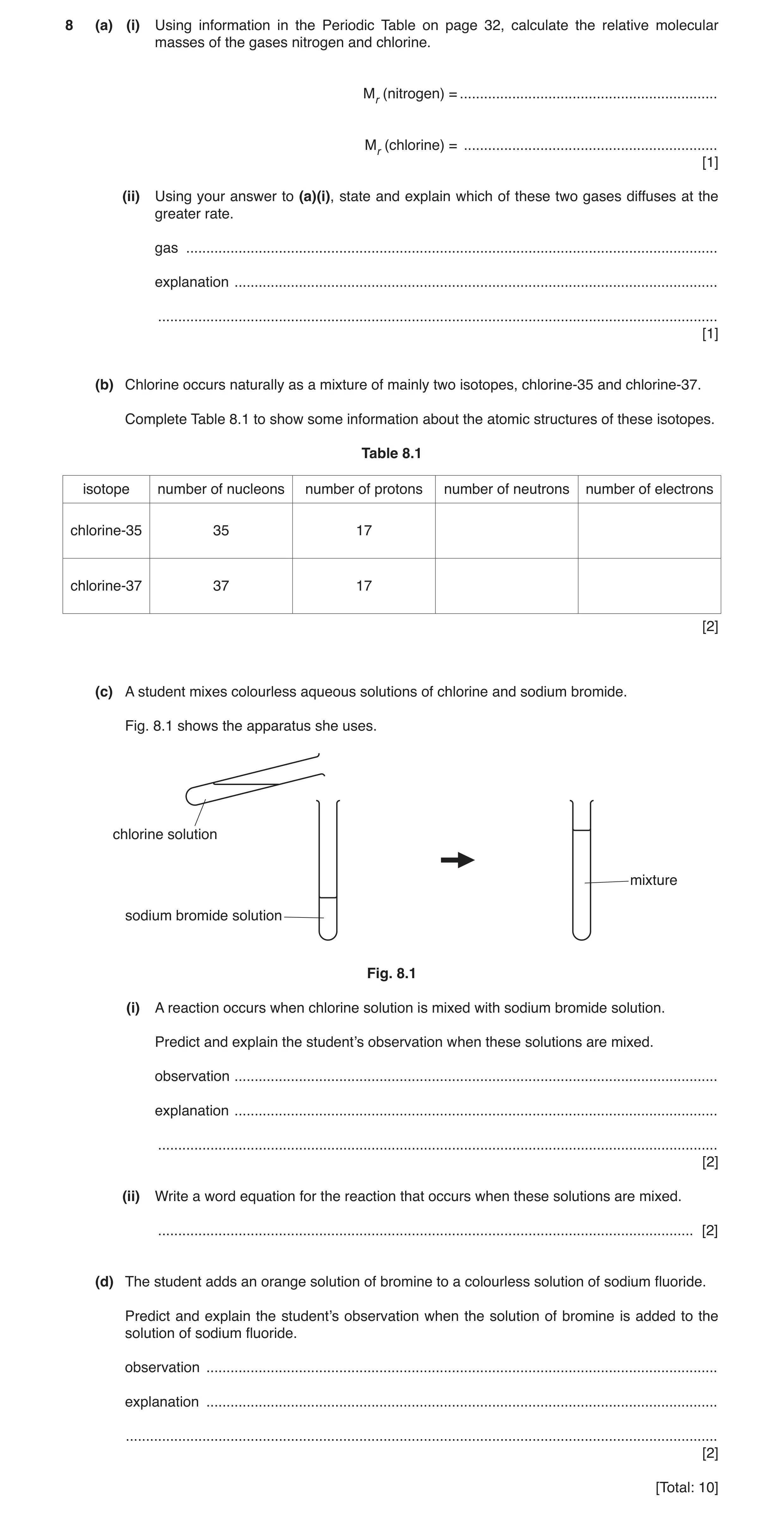
8 (a) (i) Using information in the Periodic Table on page 32, calculate the relative molecular masses of the gases nitrogen and chlorine. Mr (nitrogen) = … Mr (chlorine) = … [1] (ii) Using your answer to (a)(i), state and explain which of these two gases diffuses at the greater rate. gas … explanation … … [1] (b) Chlorine occurs naturally as a mixture of mainly two isotopes, chlorine-35 and chlorine-37. Complete Table 8.1 to show some information about the atomic structures of these isotopes. Table 8.1 isotope number of nucleons number of protons number of neutrons number of electrons chlorine-35 35 17 chlorine-37 37 17 [2] (c) A student mixes colourless aqueous solutions of chlorine and sodium bromide. Fig. 8.1 shows the apparatus she uses. chlorine solution mixture sodium bromide solution Fig. 8.1 (i) A reaction occurs when chlorine solution is mixed with sodium bromide solution. Predict and explain the student’s observation when these solutions are mixed. observation … explanation … … [2] (ii) Write a word equation for the reaction that occurs when these solutions are mixed. … [2] (d) The student adds an orange solution of bromine to a colourless solution of sodium fluoride. Predict and explain the student’s observation when the solution of bromine is added to the solution of sodium fluoride. observation … explanation … … [2] [Total: 10]
10 marks
Mark scheme: 8(a)(i) Mr (nitrogen) = 28 Mr (chlorine) = 71 ; 1 8(a)(ii) nitrogen rate of diffusion increases with decreasing molecular mass / lighter particles move faster than heavier particles (with same energy / in gas at same temperature) ; 1 8(b) correct neutron column ; correct electron column ; isotope number of neutrons number of electrons chlorine-35 18 17 chlorine-37 20 17 2 8(c)(i) yellow / orange solution ; chlorine displaces bromine / chlorine is more reactive than bromine / bromine is formed ; 2 8(c)(ii) chlorine + sodium bromide Æ bromine + sodium chloride bromine as product ; all else correct ; 2 8(d) no change in colour / paler (due to dilution) ; no reaction because bromine is less reactive than fluorine / reference to trend in reactivity down Group VII ; 2
This question in 0654/41 May/June 2019
Q5 · Table 11.1 contains data about some elements 0654/41 Oct/Nov 2019
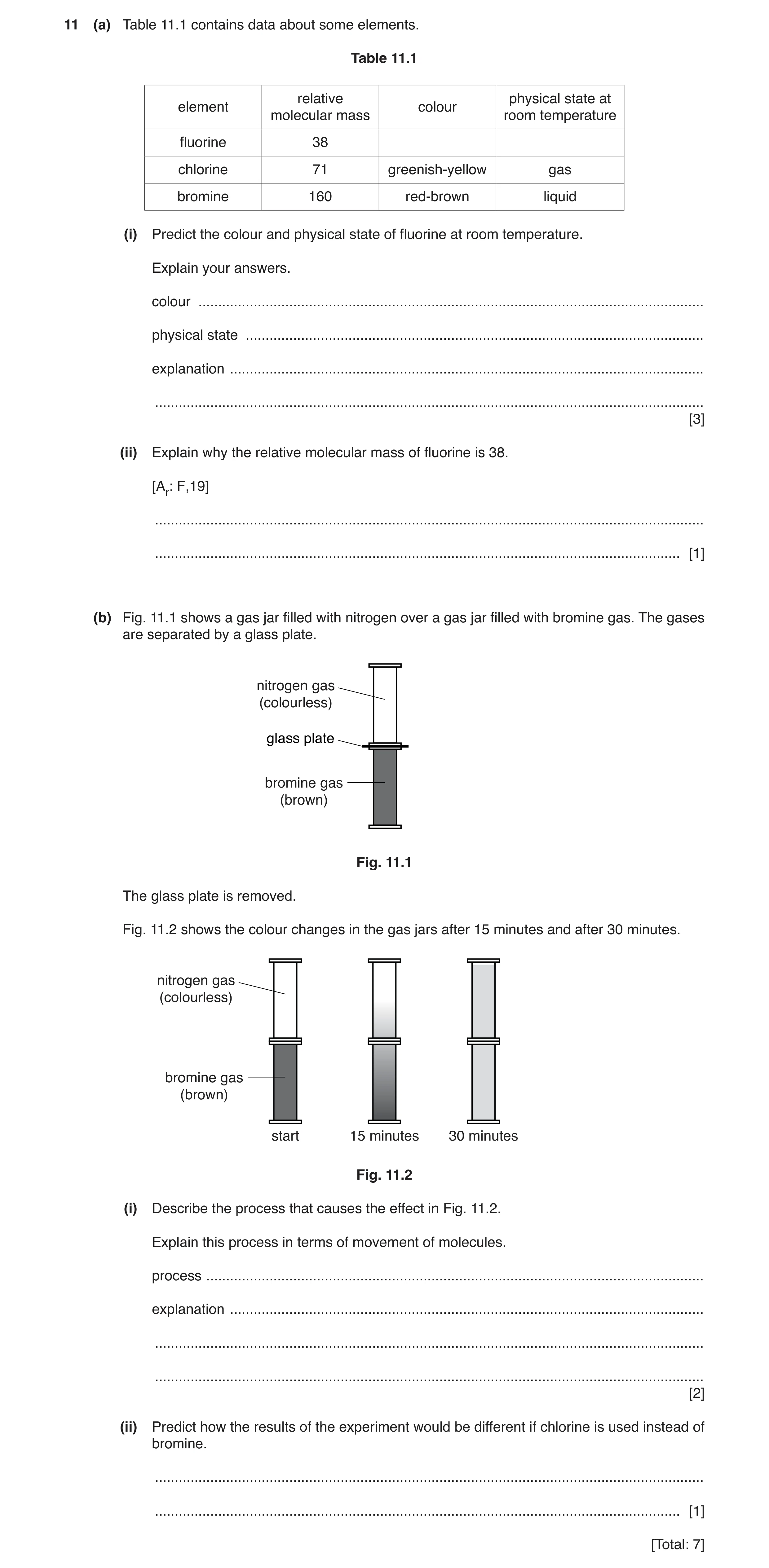
11 (a) Table 11.1 contains data about some elements. Table 11.1 relative physical state at element colour molecular mass room temperature fluorine 38 chlorine 71 greenish-yellow gas bromine 160 red-brown liquid (i) Predict the colour and physical state of fluorine at room temperature. Explain your answers. colour … physical state … explanation … … [3] (ii) Explain why the relative molecular mass of fluorine is 38. [Ar: F,19] … … [1] (b) Fig. 11.1 shows a gas jar filled with nitrogen over a gas jar filled with bromine gas. The gases are separated by a glass plate. nitrogen gas (colourless) glass plate bromine gas (brown) Fig. 11.1 The glass plate is removed. Fig. 11.2 shows the colour changes in the gas jars after 15 minutes and after 30 minutes. nitrogen gas (colourless) bromine gas (brown) start 15 minutes 30 minutes Fig. 11.2 (i) Describe the process that causes the effect in Fig. 11.2. Explain this process in terms of movement of molecules. process … explanation … … … [2] (ii) Predict how the results of the experiment would be different if chlorine is used instead of bromine. … … [1] [Total: 7]
7 marks
Mark scheme: 11(a)(i) pale yellow / lighter than chlorine ; gas ; use of trend to predict property ; 3 11(a)(ii) fluorine is diatomic / formula is F2 ; 1 11(b)(i) diffusion ; molecules move from high concentration to low concentration / molecules move randomly ; 2 11(b)(ii) shorter times / greater rate of diffusion ; 1
This question in 0654/41 Oct/Nov 2019
Q6 · Group VII of the Periodic Table 0654/43 Oct/Nov 2019
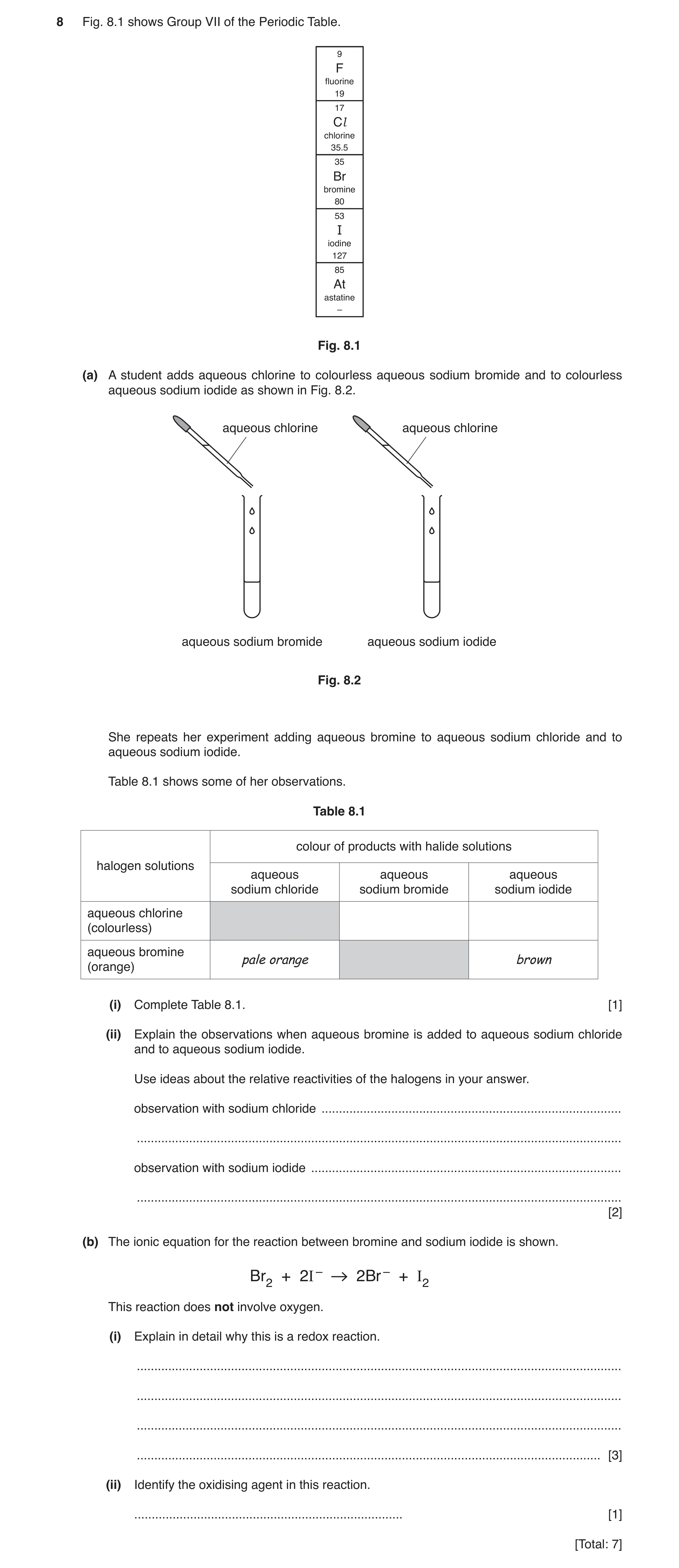
8 Fig. 8.1 shows Group VII of the Periodic Table. 9 F fluorine 19 17 Cl chlorine 35.5 35 Br bromine 80 53 I iodine 127 85 At astatine – Fig. 8.1 (a) A student adds aqueous chlorine to colourless aqueous sodium bromide and to colourless aqueous sodium iodide as shown in Fig. 8.2. aqueous chlorine aqueous chlorine aqueous sodium bromide aqueous sodium iodide Fig. 8.2 She repeats her experiment adding aqueous bromine to aqueous sodium chloride and to aqueous sodium iodide. Table 8.1 shows some of her observations. Table 8.1 colour of products with halide solutions halogen solutions aqueous aqueous aqueous sodium chloride sodium bromide sodium iodide aqueous chlorine (colourless) aqueous bromine paleorange brown (orange) (i) Complete Table 8.1. [1] (ii) Explain the observations when aqueous bromine is added to aqueous sodium chloride and to aqueous sodium iodide. Use ideas about the relative reactivities of the halogens in your answer. observation with sodium chloride … … observation with sodium iodide … … [2] (b) The ionic equation for the reaction between bromine and sodium iodide is shown. Br2 + 2I – 2Br – + I2 This reaction does not involve oxygen. (i) Explain in detail why this is a redox reaction. … … … … [3] (ii) Identify the oxidising agent in this reaction. … [1] [Total: 7]
7 marks
Mark scheme: 8(a)(i) halogen solutions colour of products with halide solutions sodium chloride sodium bromide sodium iodide chlorine orange / yellow brown bromine (pale orange) (brown) 1 8(a)(ii) bromine is less reactive than chlorine ORA ; bromine more reactive than iodine ORA ; 2 8(b)(i) reduction and oxidation are occurring ; (oxidation is) loss of electrons AND (reduction is) gain of electrons ; bromine reduced / gains electrons AND iodide ions oxidised / lose electrons ; 3 8(b)(ii) bromine ; 1
This question in 0654/43 Oct/Nov 2019
Q7 · The electrolysis of dilute sulfuric acid 0654/41 May/June 2020
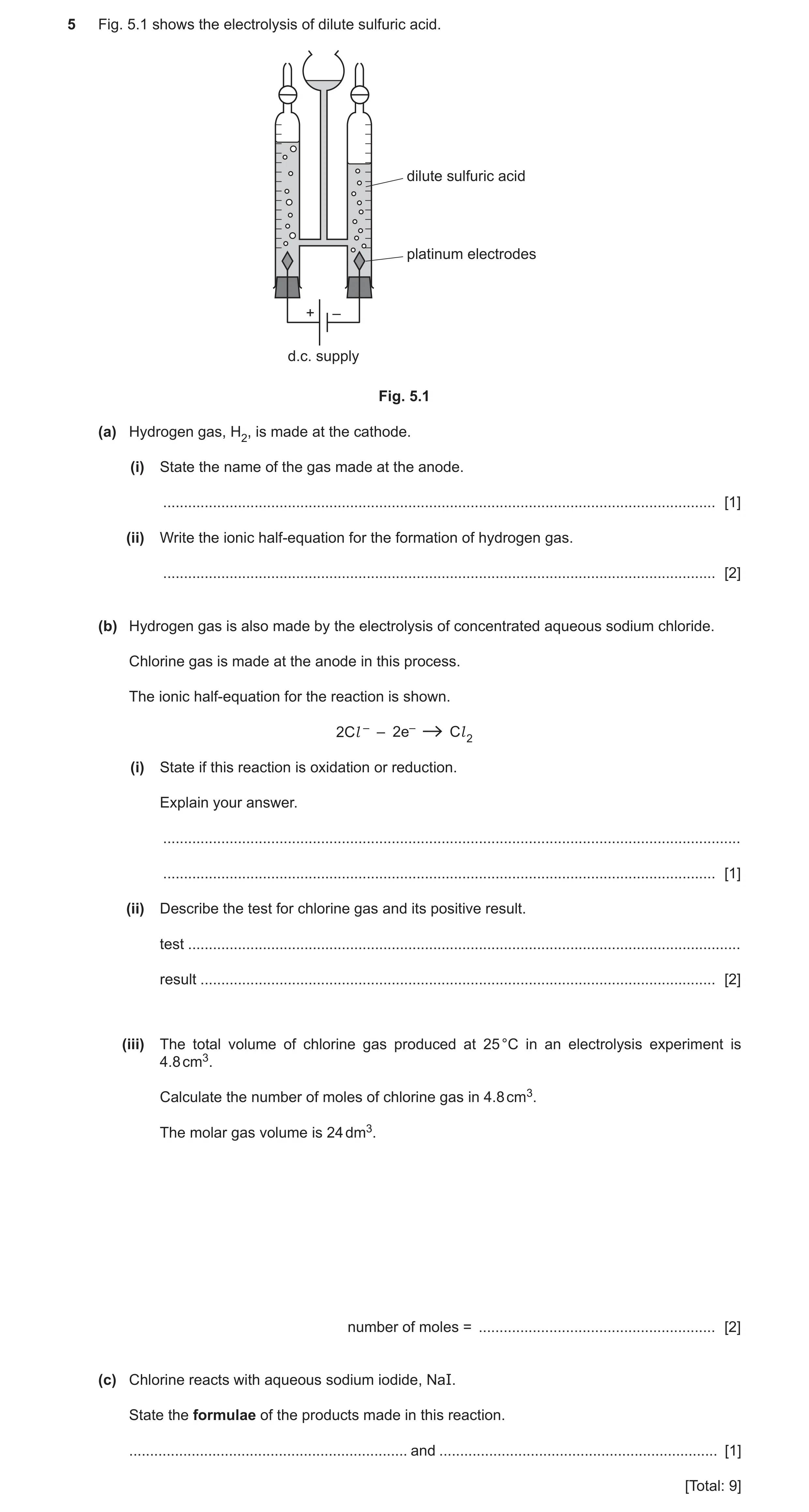
5 Fig. 5.1 shows the electrolysis of dilute sulfuric acid. dilute sulfuric acid platinum electrodes + – d.c. supply Fig. 5.1 (a) Hydrogen gas, H2, is made at the cathode. (i) State the name of the gas made at the anode. … [1] (ii) Write the ionic half-equation for the formation of hydrogen gas. … [2] (b) Hydrogen gas is also made by the electrolysis of concentrated aqueous sodium chloride. Chlorine gas is made at the anode in this process. The ionic half-equation for the reaction is shown. 2Cl – – 2e– Cl 2 (i) State if this reaction is oxidation or reduction. Explain your answer. … … [1] (ii) Describe the test for chlorine gas and its positive result. test … result … [2] (iii) The total volume of chlorine gas produced at 25 °C in an electrolysis experiment is 4.8 cm3. Calculate the number of moles of chlorine gas in 4.8 cm3. The molar gas volume is 24 dm3. number of moles = … [2] (c) Chlorine reacts with aqueous sodium iodide, NaI. State the formulae of the products made in this reaction. … and … [1] [Total: 9]
9 marks
Mark scheme: 5(a)(i) oxygen; 1 5(a)(ii) 2H+ + 2e– → H2 correct formulae; correctly balanced; 2 5(b)(i) (oxidation because) electrons are lost (from chloride ions); 1 5(b)(ii) damp litmus paper ; (is) bleached ; 2 5(b)(iii) 4.8 ÷ (24 × 1000) ; 2.0 × 10⁻⁴ or 0.0002 ; or volume of chlorine = 0.0048 dm3 ; (0.0048 ÷ 24 =) 2.0 × 10⁻⁴ or 0.0002 ; 2 5(c) NaCl and I2 1
This question in 0654/41 May/June 2020
Q8 · An atom of chlorine has a proton number (atomic number) of 17 and a nucleon number (mass… 0654/41 May/June 2021
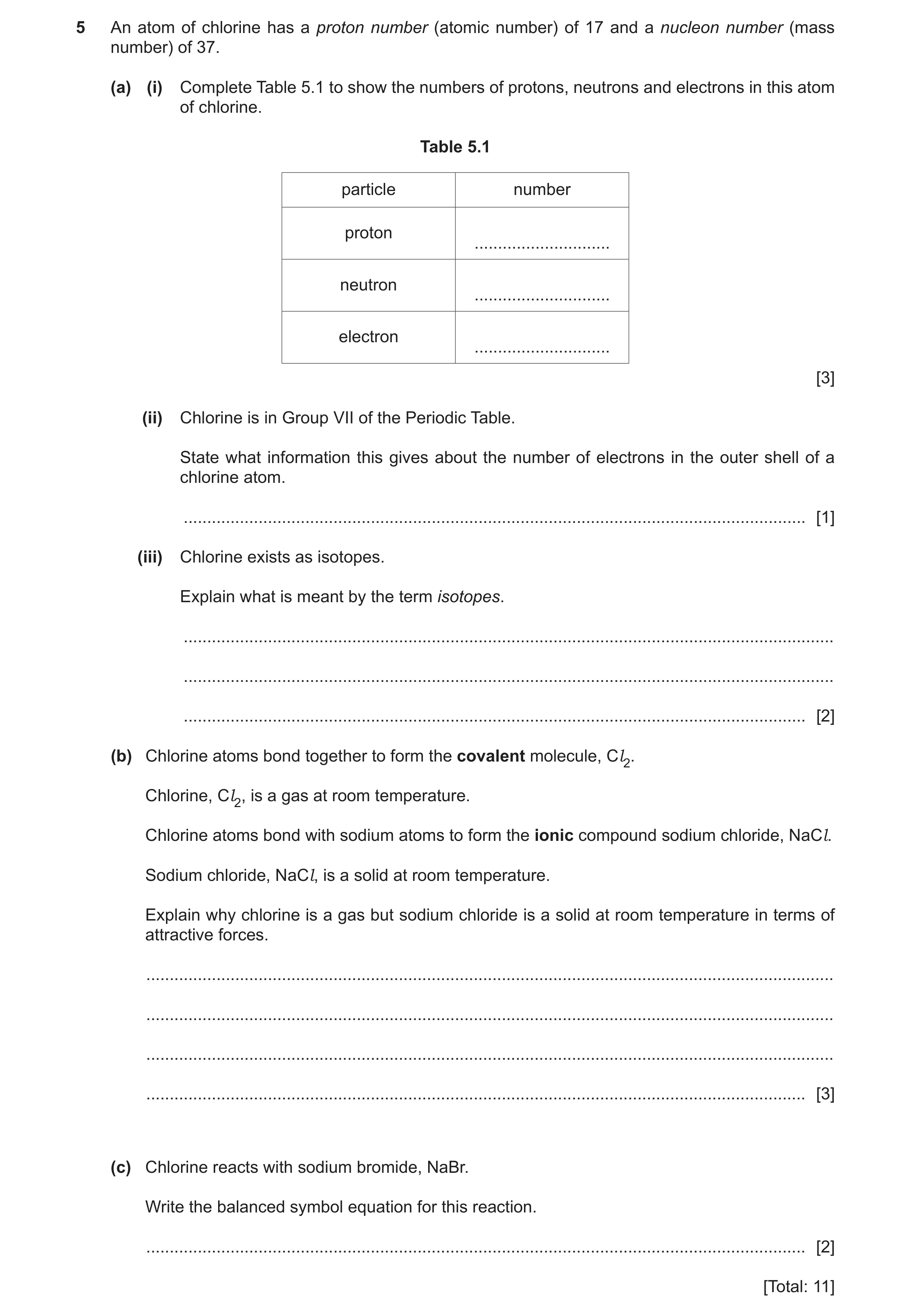
5 An atom of chlorine has a proton number (atomic number) of 17 and a nucleon number (mass number) of 37. (a) (i) Complete Table 5.1 to show the numbers of protons, neutrons and electrons in this atom of chlorine. Table 5.1 particle number proton … neutron … electron … [3] (ii) Chlorine is in Group VII of the Periodic Table. State what information this gives about the number of electrons in the outer shell of a chlorine atom. … [1] (iii) Chlorine exists as isotopes. Explain what is meant by the term isotopes. … … … [2] (b) Chlorine atoms bond together to form the covalent molecule, Cl2. Chlorine, Cl2, is a gas at room temperature. Chlorine atoms bond with sodium atoms to form the ionic compound sodium chloride, NaCl. Sodium chloride, NaCl, is a solid at room temperature. Explain why chlorine is a gas but sodium chloride is a solid at room temperature in terms of attractive forces. … … … … [3] (c) Chlorine reacts with sodium bromide, NaBr. Write the balanced symbol equation for this reaction. … [2] [Total: 11]
11 marks
Mark scheme: 5(a)(i) particle number proton 17 neutron 20 electron 17 3 5(a)(ii) (chlorine has) 7 (electrons in the outer shell) ; 1 5(a)(iii) (atoms with) same proton or atomic number / same number of protons ; different nucleon or mass number / different number of neutrons ; 2 5(b) sodium chloride has strong (electrostatic) forces of attraction between (oppositely charged) ions ; chlorine has weak intermolecular forces / weak attractions between (chlorine) molecules ; strong (electrostatic) forces of attraction take more energy to break than weak intermolecular forces / ORA ; 3 5(c) Cl2 + 2NaBr → Br2 + 2NaCl correct formulae ; then correct balancing ; 2
This question in 0654/41 May/June 2021
Q9 · Chlorine and bromine are Group VII elements of the Periodic Table 0654/43 Oct/Nov 2021
2 Chlorine and bromine are Group VII elements of the Periodic Table. Chlorine is more reactive than bromine. (a) State the names of the two products made when aqueous chlorine reacts with aqueous potassium bromide solution. … and … [2] (b) Chlorine reacts with hydrogen to form hydrogen chloride. Hydrogen chloride is a covalent compound. (i) Explain why hydrogen chloride is a gas at room temperature. Use ideas about structure and bonding. … … … [2] (ii) Hydrogen chloride gas dissolves in water to form dilute hydrochloric acid. Describe the effect of dilute hydrochloric acid on litmus paper. … [1] (iii) State the formula of the ion present in all acids. Choose from the list. Cl – H+ OH – O2– … [1] (c) A solution of dilute hydrochloric acid has a concentration of 73 g / dm3. Calculate the mass of hydrogen chloride in 250 cm3 of the solution. mass of hydrogen chloride = … g [2] (d) Bromine reacts with ethene. Fig. 2.1 shows the structures of the reactants and products in this reaction. H H H H C C + Br Br Br C C Br H H H H Fig. 2.1 (i) Put a circle around each of the bonds which are made when the reaction takes place. [1] (ii) When ethene reacts with bromine the reaction is exothermic. Explain why the reaction of ethene and bromine is exothermic. Use ideas about bond breaking and bond making. … … … [2] [Total: 11]
11 marks
Mark scheme: 2(a) potassium chloride ; bromine ; 2 2(b)(i) hydrogen chloride has weak intermolecular forces / weak attractions between (hydrogen chloride) molecules ; (weak intermolecular forces) take little energy to break / owtte ; 2 2(b)(ii) litmus paper turns red ; 1 2(b)(iii) H+ ; 1 2(c) mass of HCl in 250 cm³ = 73 250 1000 × OR 73 × 0.25 OR 73 ÷ 4 ; 18.25 (g) ; 2 2(d)(i) both C-Br bonds circled ; 1 2(d)(ii) bond breaking is endothermic / takes in energy and bond making is exothermic / gives out energy ; more energy is given out (during bond making) than is taken in (during bond breaking) / energy stored in product is less than energy stored in reactant ; 2
This question in 0654/43 Oct/Nov 2021
Q10 · Some information about particles found in atoms 0654/42 May/June 2022
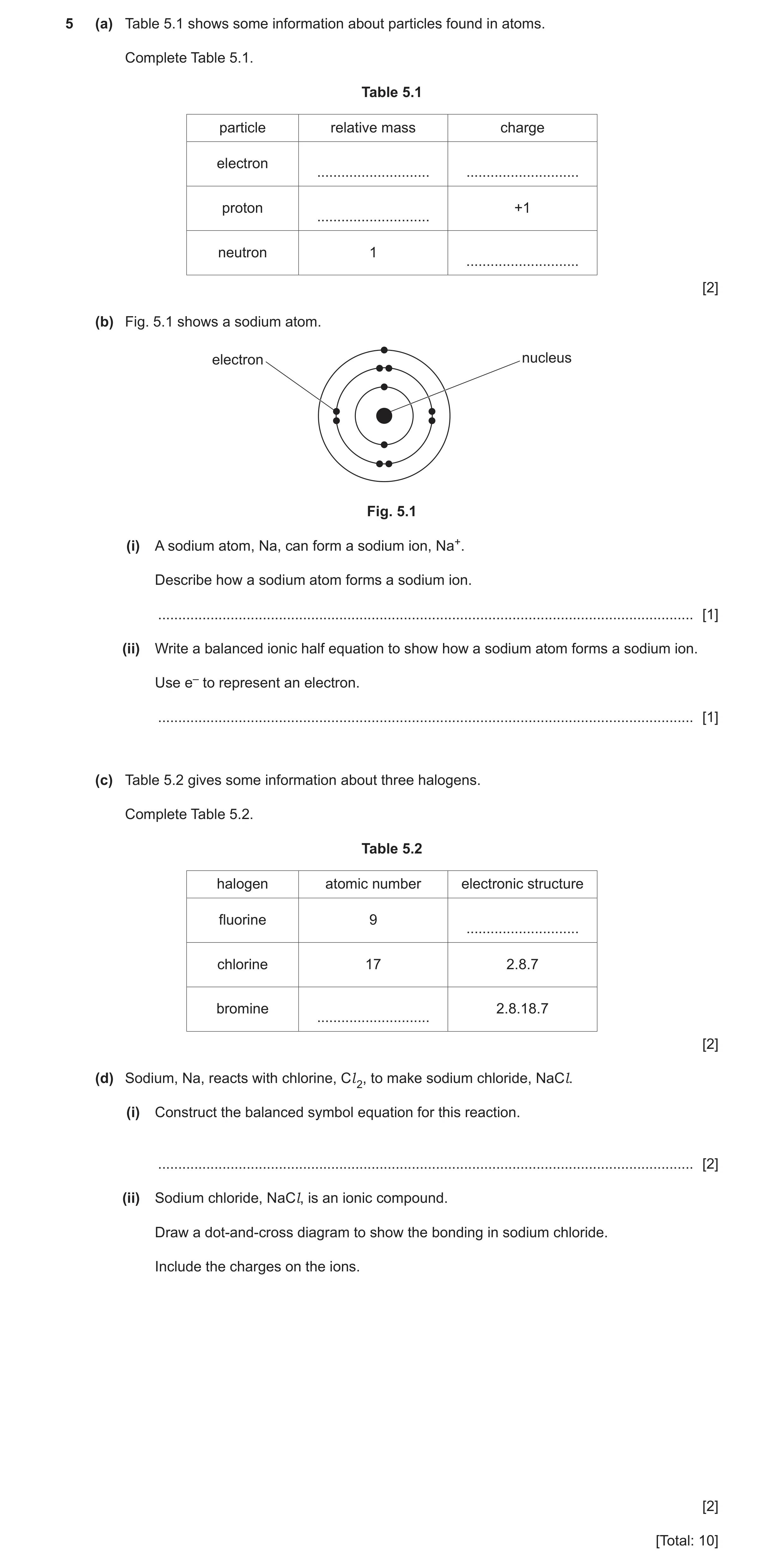
5 (a) Table 5.1 shows some information about particles found in atoms. Complete Table 5.1. Table 5.1 particle relative mass charge electron … … proton +1 … neutron 1 … [2] (b) Fig. 5.1 shows a sodium atom. electron nucleus Fig. 5.1 (i) A sodium atom, Na, can form a sodium ion, Na+. Describe how a sodium atom forms a sodium ion. … [1] (ii) Write a balanced ionic half equation to show how a sodium atom forms a sodium ion. Use e– to represent an electron. … [1] (c) Table 5.2 gives some information about three halogens. Complete Table 5.2. Table 5.2 halogen atomic number electronic structure fluorine 9 … chlorine 17 2.8.7 bromine 2.8.18.7 … [2] (d) Sodium, Na, reacts with chlorine, Cl 2, to make sodium chloride, NaCl. (i) Construct the balanced symbol equation for this reaction. … [2] (ii) Sodium chloride, NaCl, is an ionic compound. Draw a dot‑and‑cross diagram to show the bonding in sodium chloride. Include the charges on the ions. [2] [Total: 10]
10 marks
Mark scheme: 5(a) particle relative mass relative charge electron almost 0 or negligible or 1 / 1850 or 1 / 1836 –1 proton 1 +1 neutron 1 0 or no charge ;; 2 5(b)(i) loses one electron / owtte ; 1 5(b)(ii) Na Na+ + e– ; 1 Question Answer Marks 5(c) halogen atomic number electronic structure fluorine 9 2.7 ; chlorine 17 2.8.7 bromine 35 ; 2.8.18.7 2 5(d)(i) 2Na + Cl2 2 NaCl ;; 2 5(d)(ii) ;; 2
This question in 0654/42 May/June 2022
Q11 · Some information about the properties of the Group VII elements 0654/42 Oct/Nov 2023
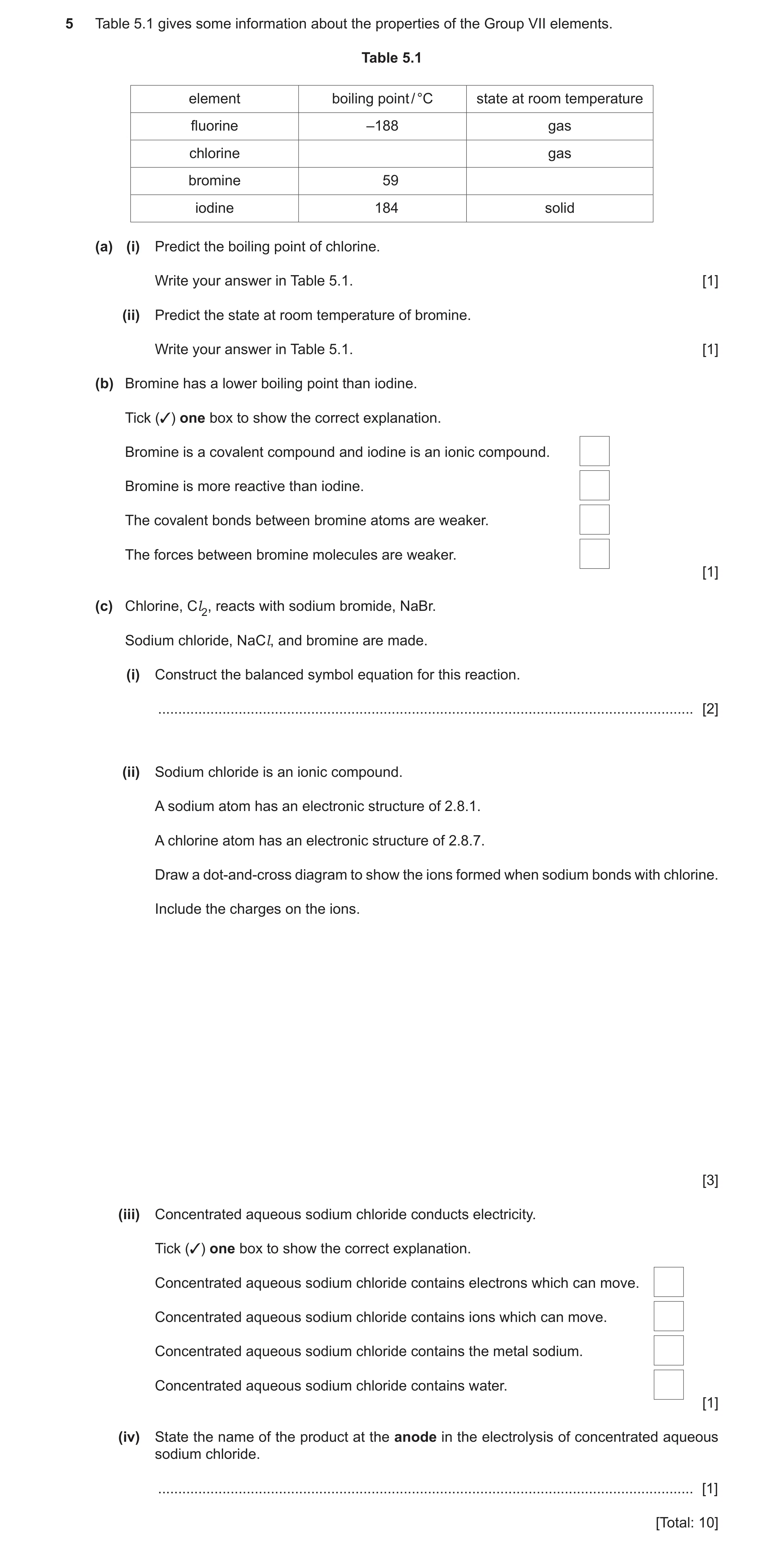
5 Table 5.1 gives some information about the properties of the Group VII elements. Table 5.1 element boiling point / °C state at room temperature fluorine –188 gas chlorine gas bromine 59 iodine 184 solid (a) (i) Predict the boiling point of chlorine. Write your answer in Table 5.1. [1] (ii) Predict the state at room temperature of bromine. Write your answer in Table 5.1. [1] (b) Bromine has a lower boiling point than iodine. Tick (3) one box to show the correct explanation. Bromine is a covalent compound and iodine is an ionic compound. Bromine is more reactive than iodine. The covalent bonds between bromine atoms are weaker. The forces between bromine molecules are weaker. [1] (c) Chlorine, Cl2, reacts with sodium bromide, NaBr. Sodium chloride, NaCl, and bromine are made. (i) Construct the balanced symbol equation for this reaction. … [2] (ii) Sodium chloride is an ionic compound. A sodium atom has an electronic structure of 2.8.1. A chlorine atom has an electronic structure of 2.8.7. Draw a dot-and-cross diagram to show the ions formed when sodium bonds with chlorine. Include the charges on the ions. [3] (iii) Concentrated aqueous sodium chloride conducts electricity. Tick (3) one box to show the correct explanation. Concentrated aqueous sodium chloride contains electrons which can move. Concentrated aqueous sodium chloride contains ions which can move. Concentrated aqueous sodium chloride contains the metal sodium. Concentrated aqueous sodium chloride contains water. [1] (iv) State the name of the product at the anode in the electrolysis of concentrated aqueous sodium chloride. … [1] [Total: 10]
10 marks
Mark scheme: 5(a)(i) answer in the inclusive range – 122 to – 30 °C ; 1 5(a)(ii) liquid ; 1 5(b) the forces between bromine molecules are weaker ; 1 5(c)(i) Cl2 + 2NaBr → 2NaCl + Br2 2 formulae ; balancing ; 5(c)(ii) 3 electronic structure of sodium ion as 2.8 ; electronic structure of chloride ion as 2.8.8 ; sodium + (1) and chloride – (1) ; 5(c)(iii) concentrated aqueous sodium chloride contains ions which can move 1 ; 5(c)(iv) chlorine ; 1
This question in 0654/42 Oct/Nov 2023
Q12 · Some information about the Group VII elements 0654/43 May/June 2024
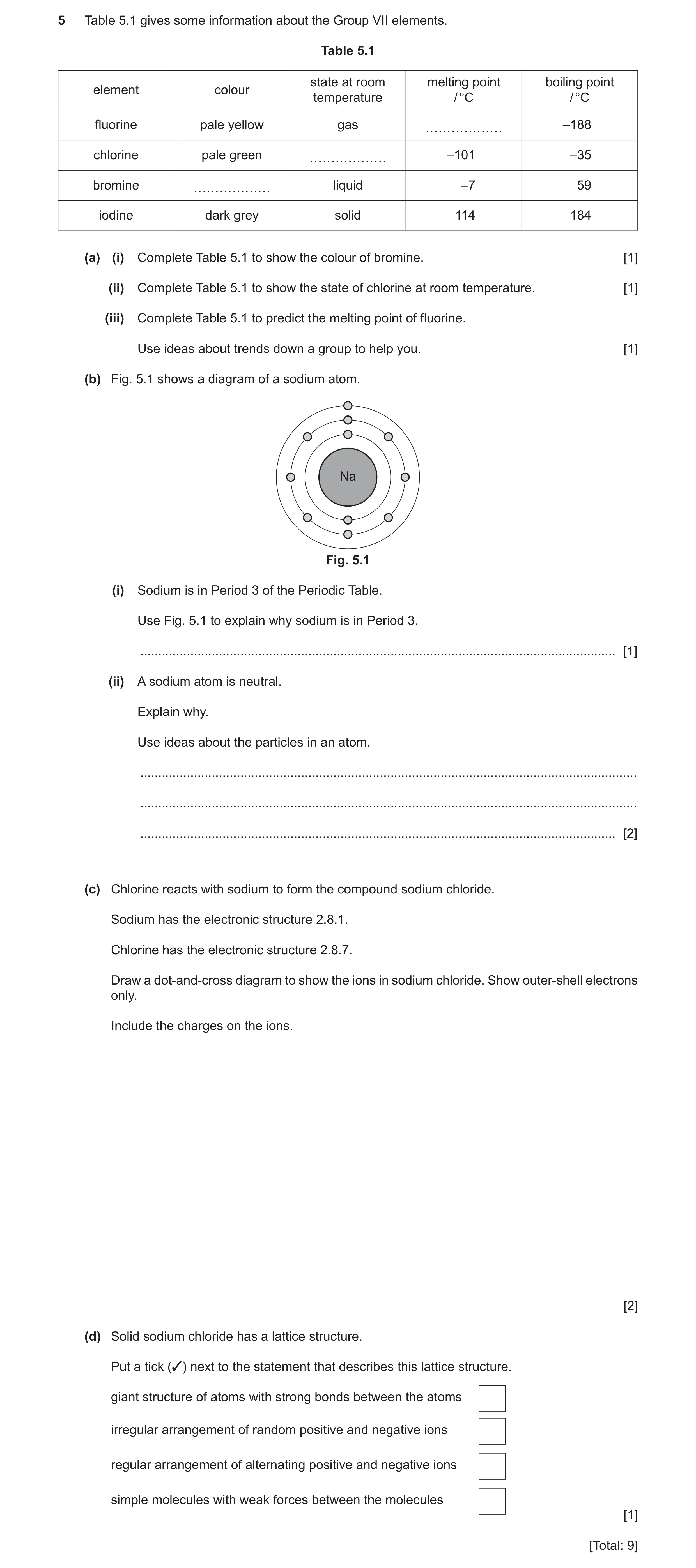
5 Table 5.1 gives some information about the Group VII elements. Table 5.1 state at room melting point boiling point element colour temperature / °C / °C fluorine pale yellow gas ……………… –188 chlorine pale green ……………… –101 –35 bromine ……………… liquid –7 59 iodine dark grey solid 114 184 (a) (i) Complete Table 5.1 to show the colour of bromine. [1] (ii) Complete Table 5.1 to show the state of chlorine at room temperature. [1] (iii) Complete Table 5.1 to predict the melting point of fluorine. Use ideas about trends down a group to help you. [1] (b) Fig. 5.1 shows a diagram of a sodium atom. Na Fig. 5.1 (i) Sodium is in Period 3 of the Periodic Table. Use Fig. 5.1 to explain why sodium is in Period 3. … [1] (ii) A sodium atom is neutral. Explain why. Use ideas about the particles in an atom. … … … [2] (c) Chlorine reacts with sodium to form the compound sodium chloride. Sodium has the electronic structure 2.8.1. Chlorine has the electronic structure 2.8.7. Draw a dot-and-cross diagram to show the ions in sodium chloride. Show outer-shell electrons only. Include the charges on the ions. [2] (d) Solid sodium chloride has a lattice structure. Put a tick (✓) next to the statement that describes this lattice structure. giant structure of atoms with strong bonds between the atoms irregular arrangement of random positive and negative ions regular arrangement of alternating positive and negative ions simple molecules with weak forces between the molecules [1] [Total: 9]
9 marks
Mark scheme: 5(a)(i) red-brown ; 1 5(a)(ii) gas ; 1 5(a)(iii) answer in range –189 to –272 ; 1 5(b)(i) (sodium) has three (occupied) electron shells ; 1 5(b)(ii) idea that protons are positive and electrons are negative ; same number of protons and electrons ; 2 Question Answer Marks 5(c) sodium ion drawn with full outer shell or an empty one and a charge of +1 ; chloride ion drawn with 8 electrons in outer shell and a charge of –1 ; 2 5(d) Regular arrangement of alternating positive and negative ions ; 1
This question in 0654/43 May/June 2024
 12 / 18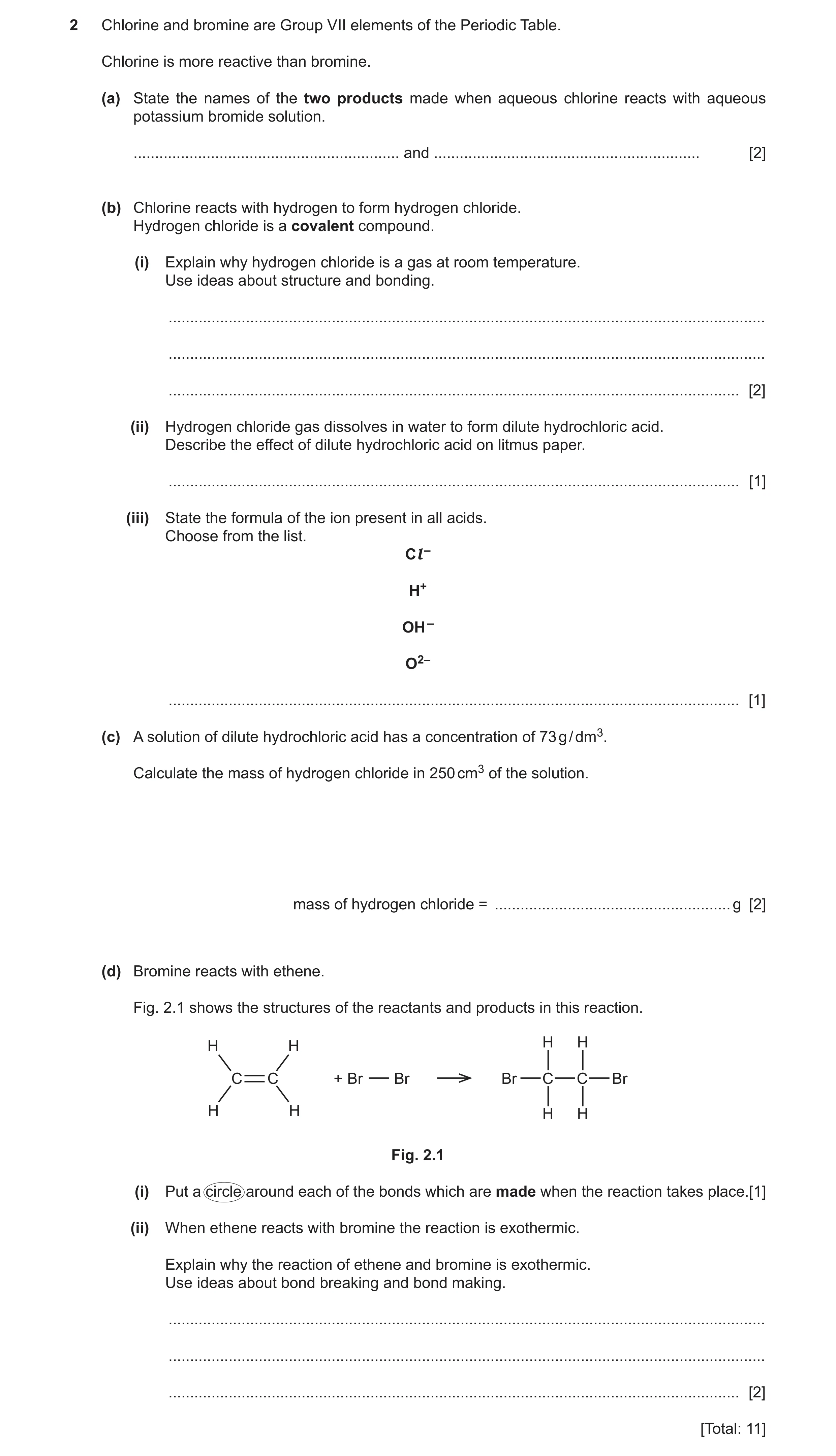
 10
10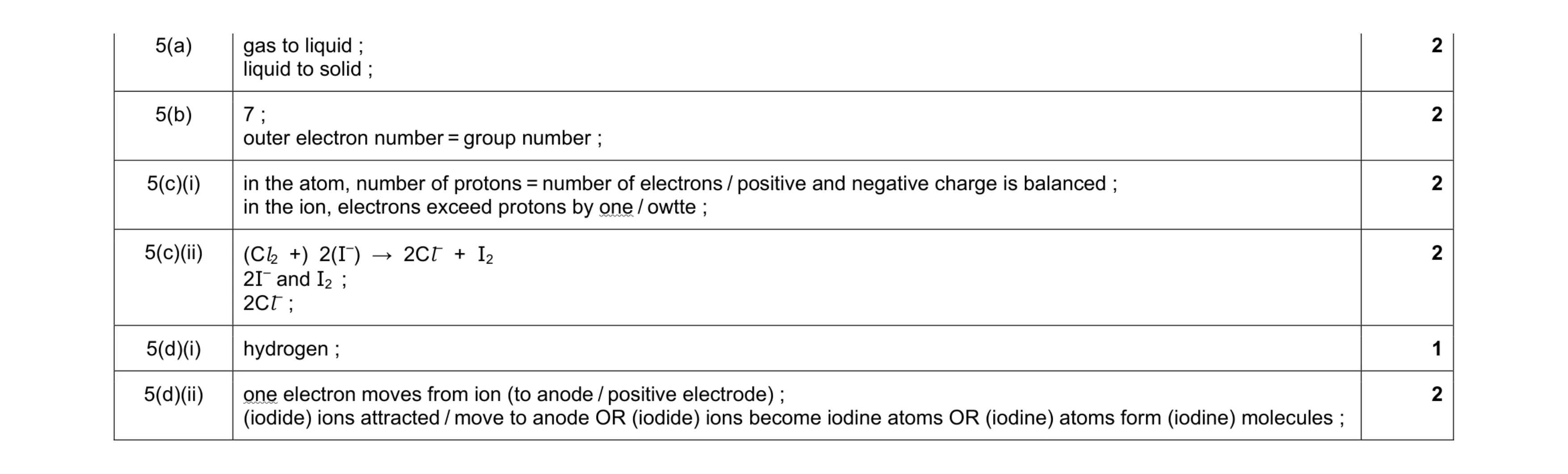 11
11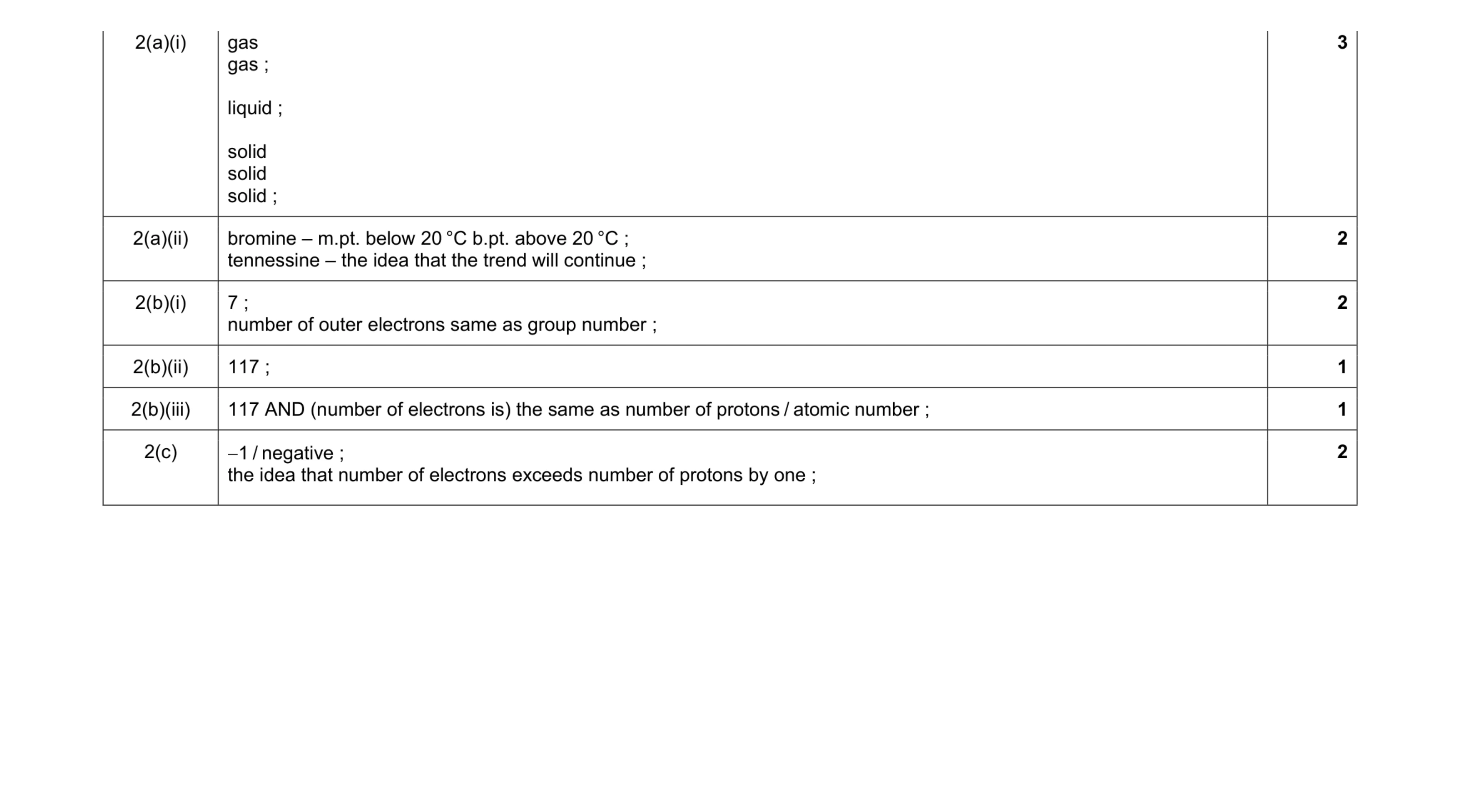 11
11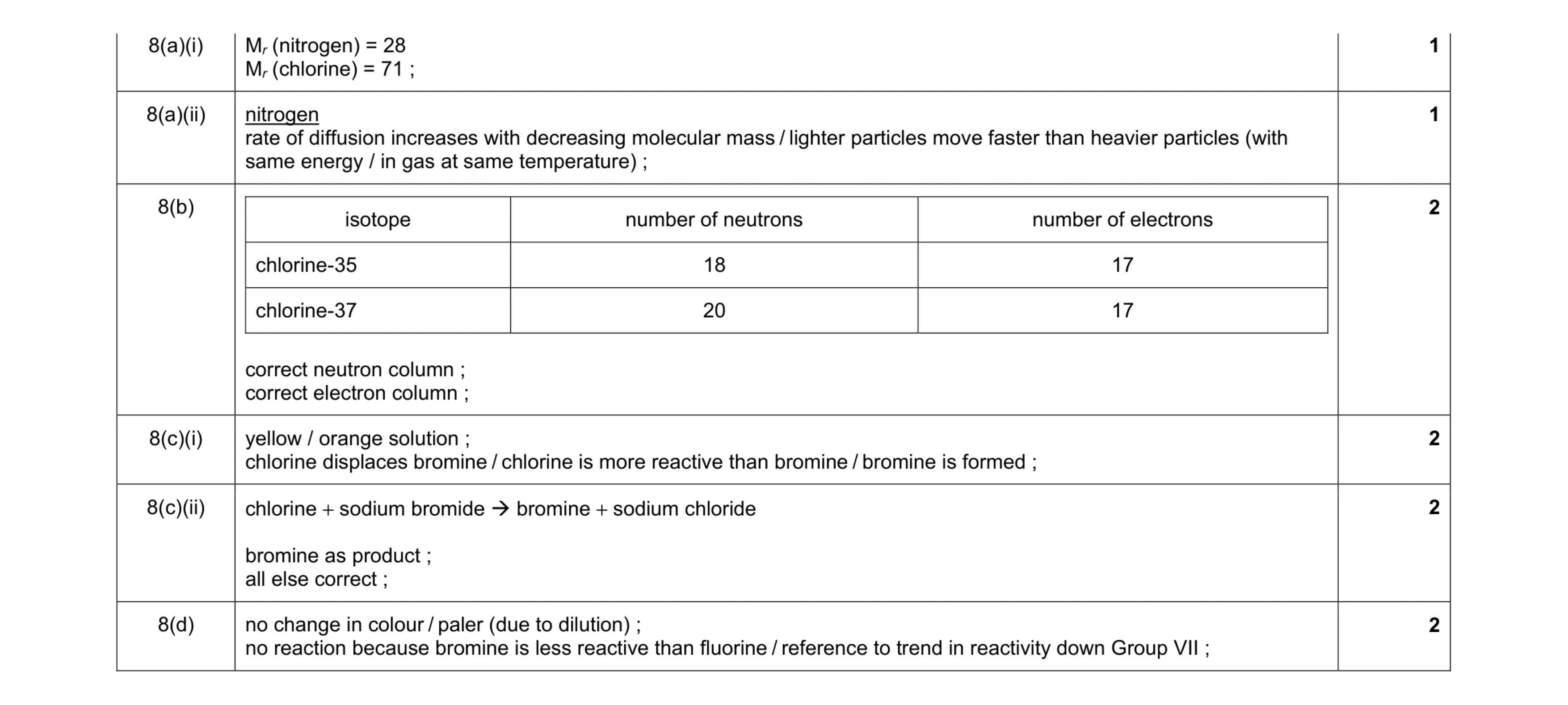 10
10 7
7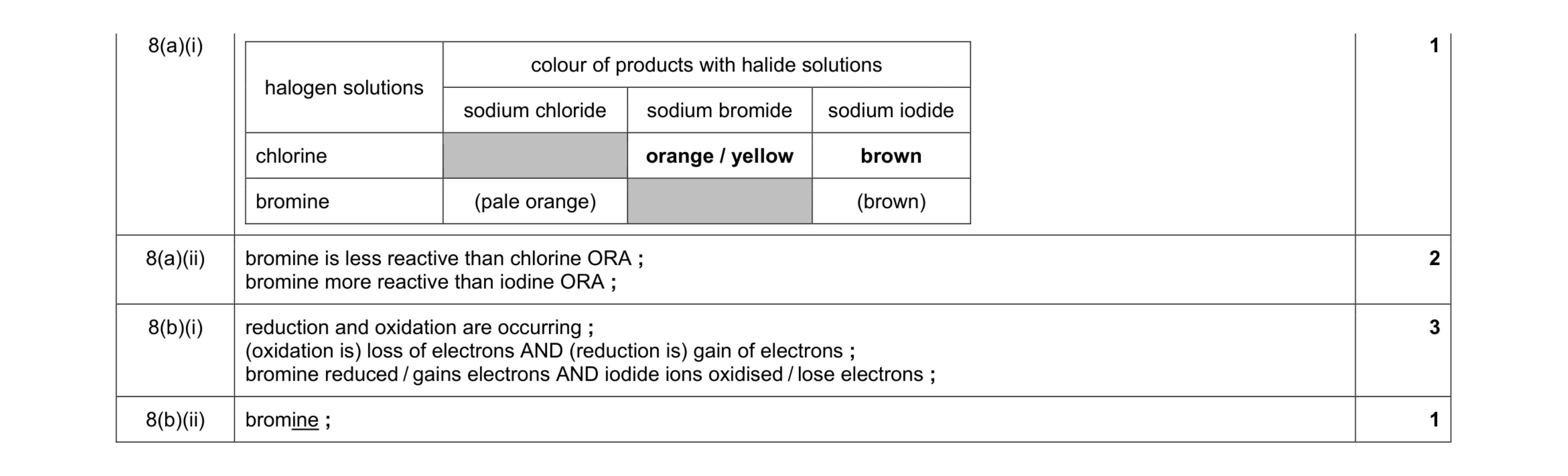 7
7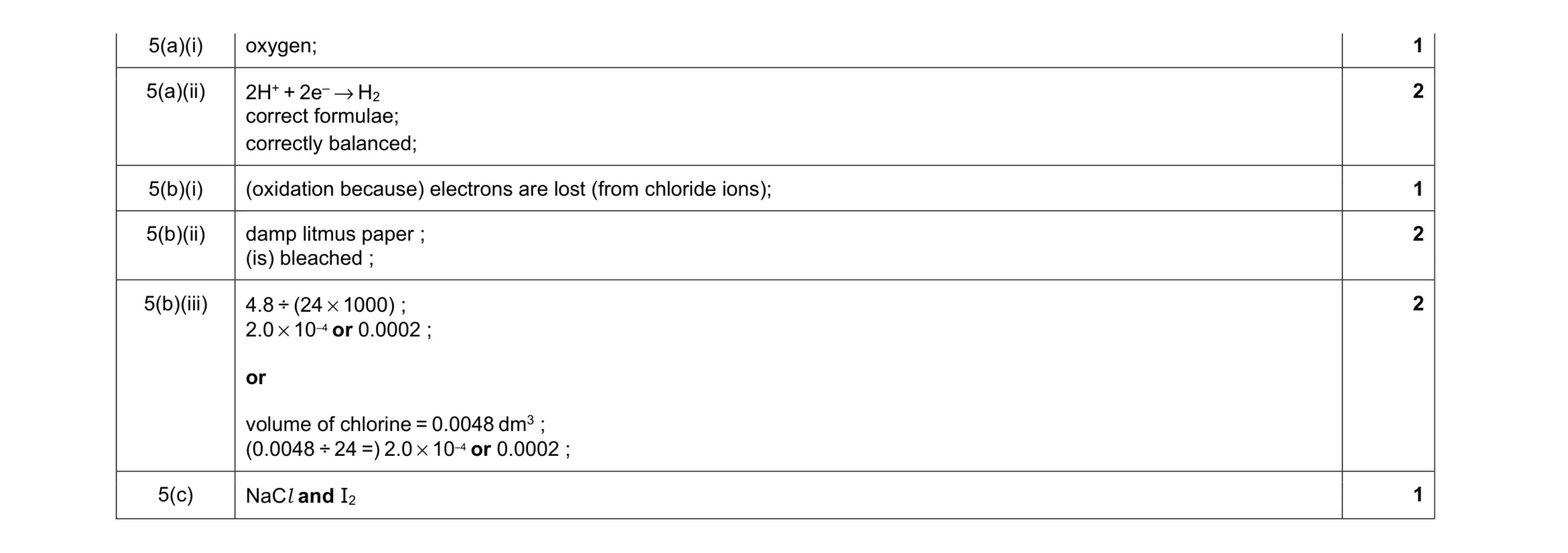 9
9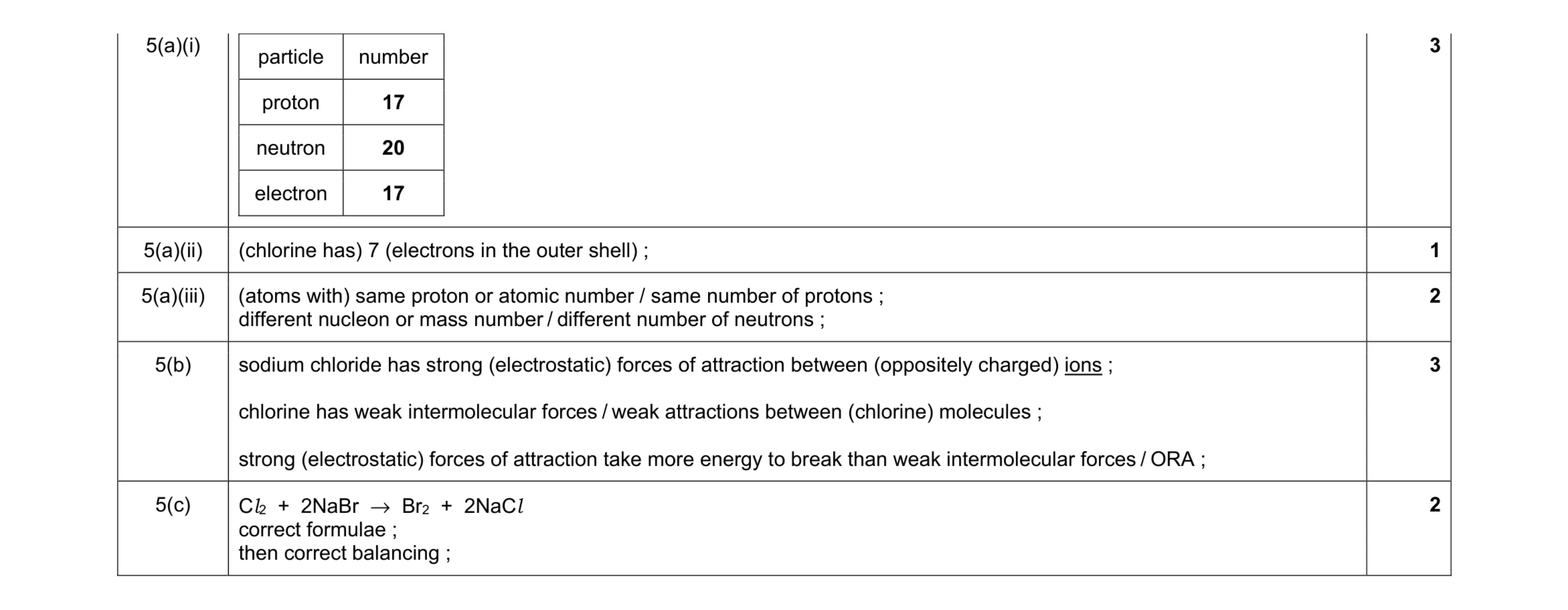 11
11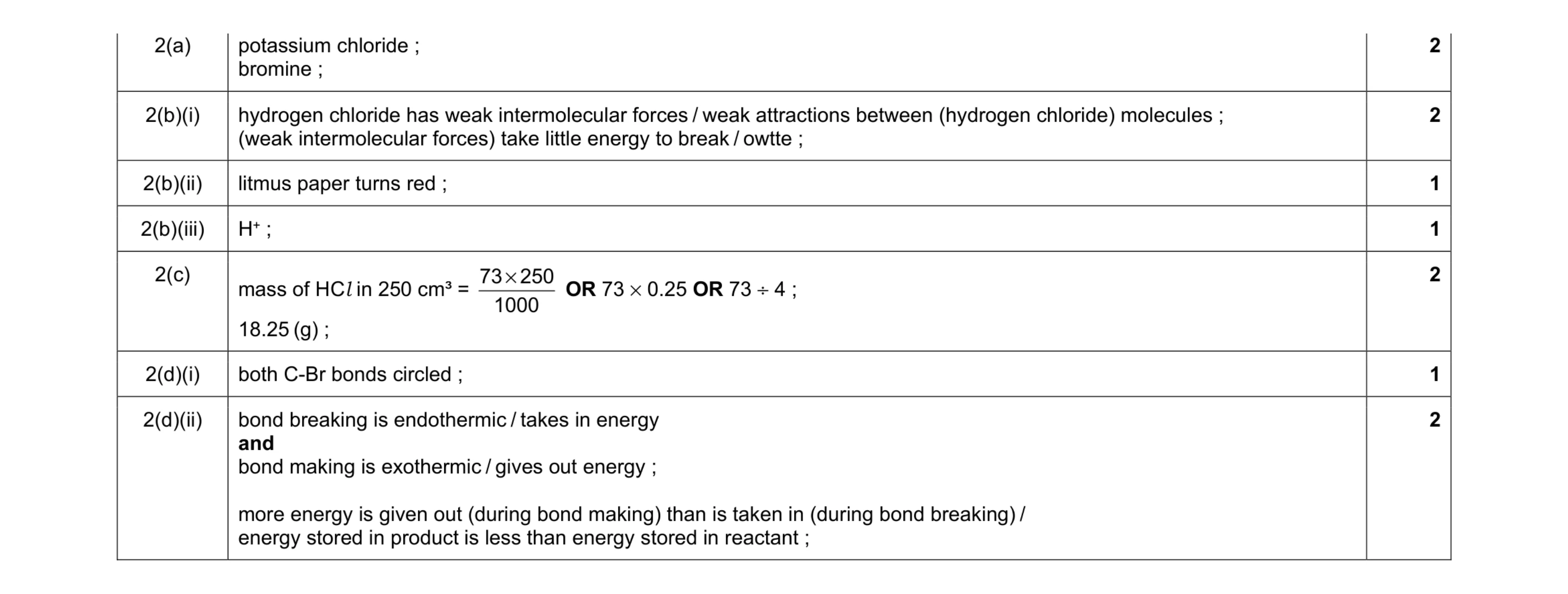 11
11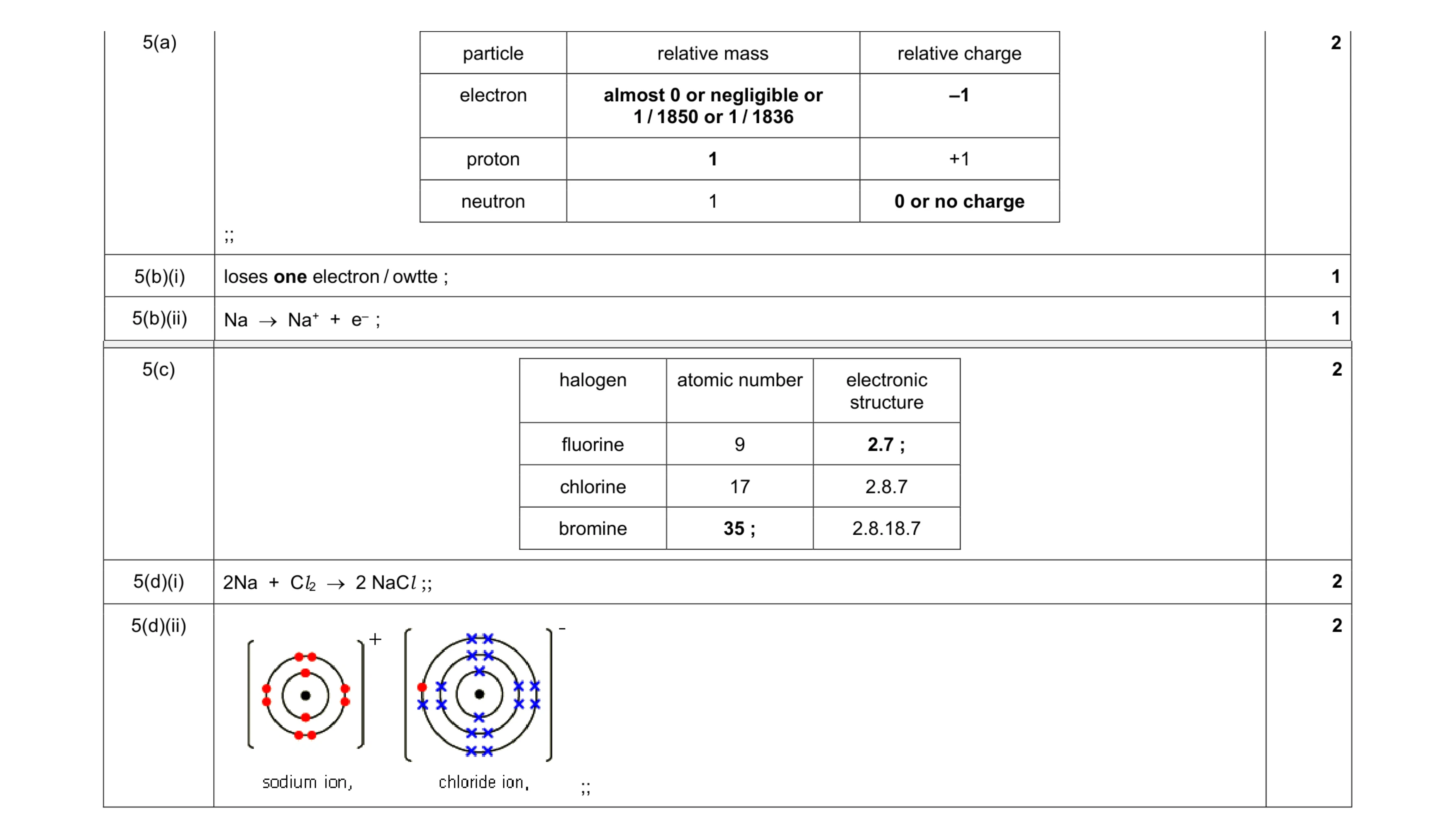 10
10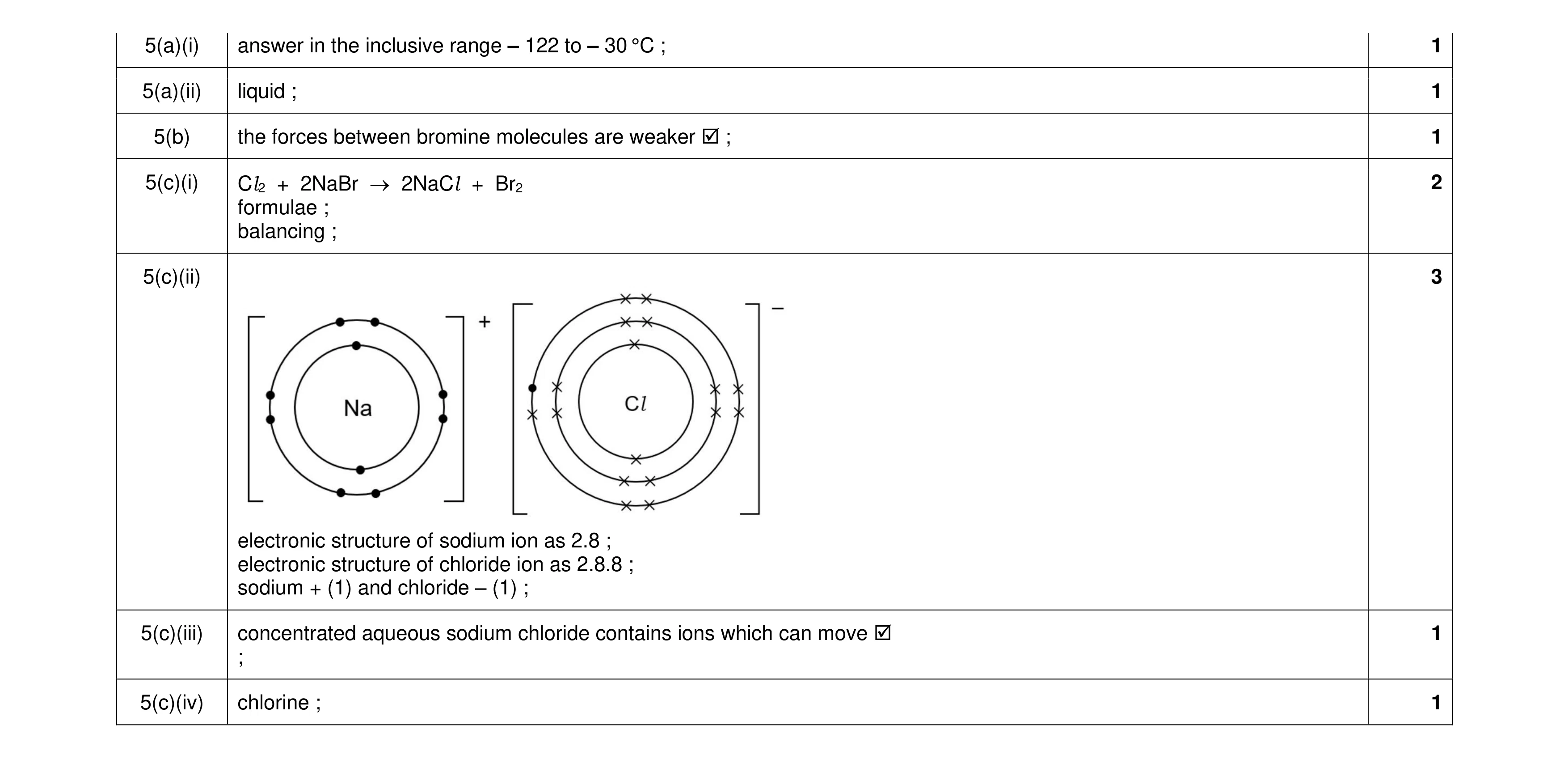 10
10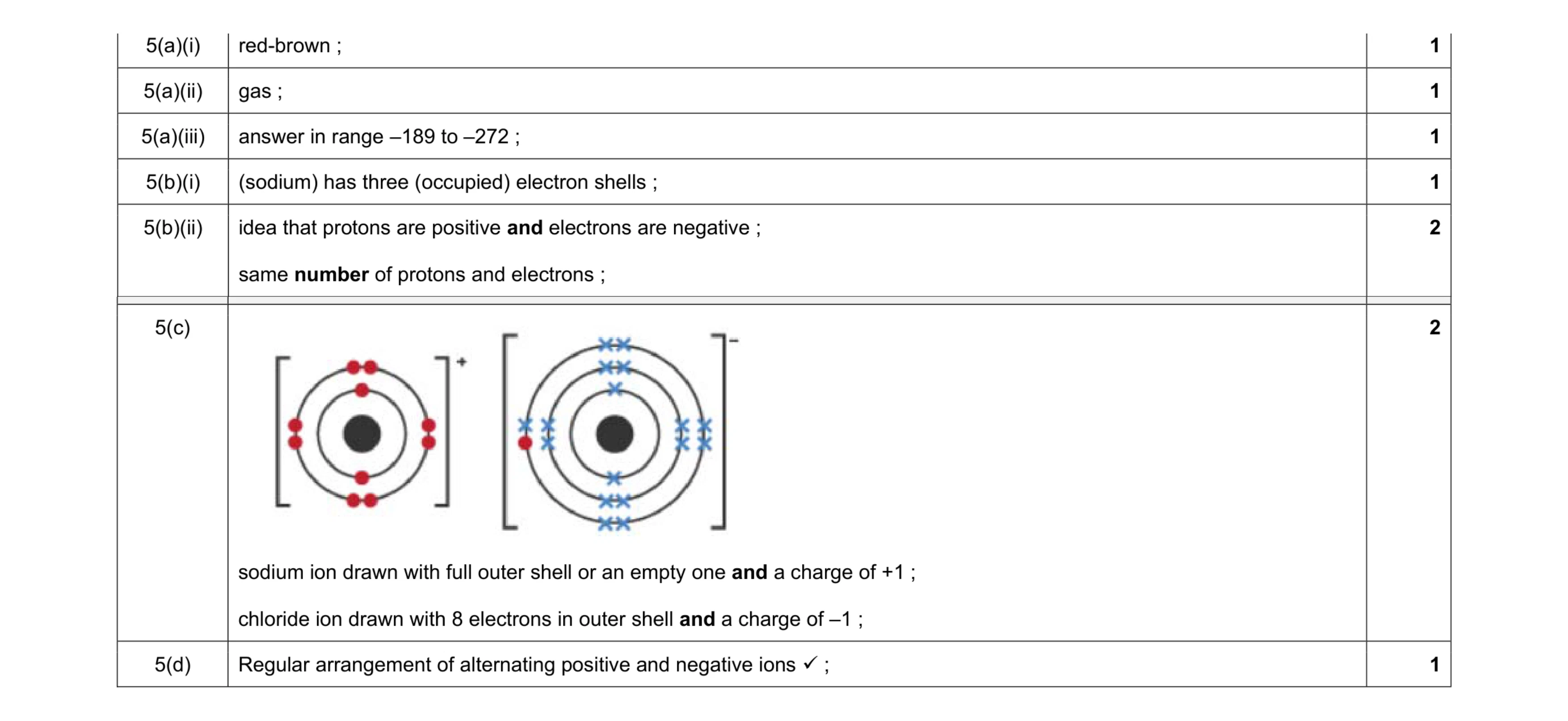 9
9