Questions as text
Q1 · Nitrogen combines with different elements to make ammonia and nitrogen oxides 0654/41 May/June 2017
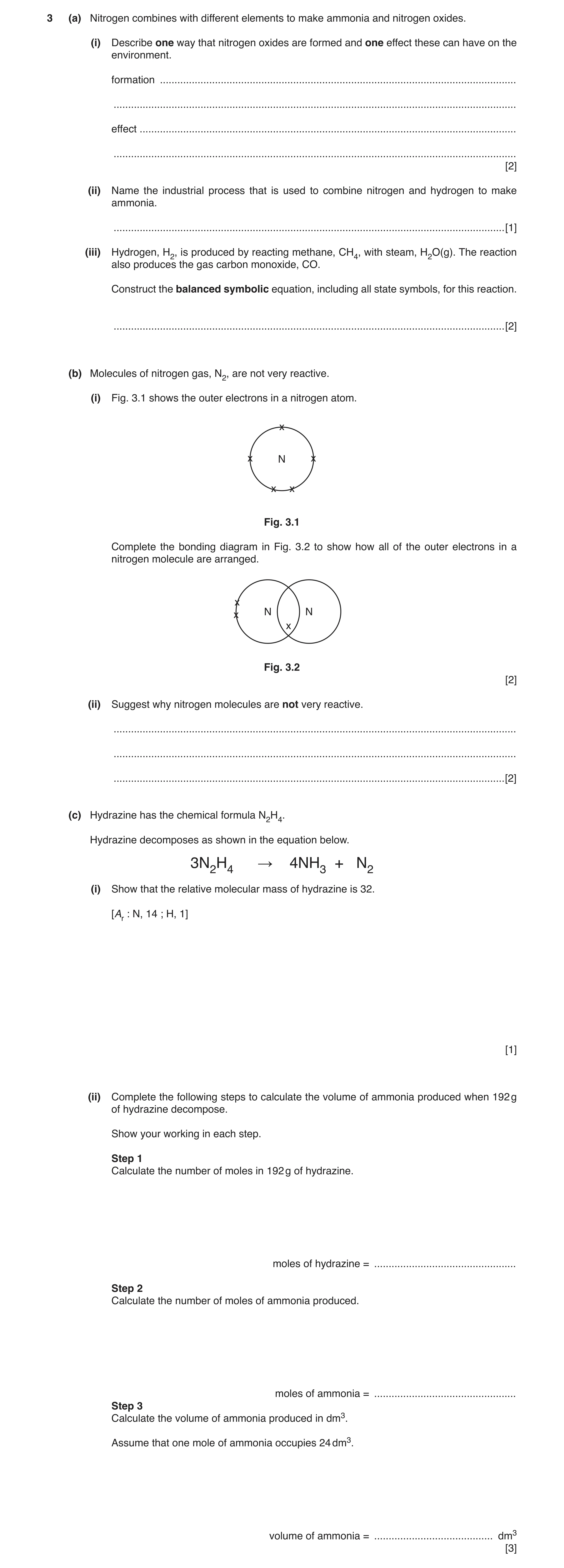
3 (a) Nitrogen combines with different elements to make ammonia and nitrogen oxides. (i) Describe one way that nitrogen oxides are formed and one effect these can have on the environment. formation … … effect … … [2] (ii) Name the industrial process that is used to combine nitrogen and hydrogen to make ammonia. … [1] (iii) Hydrogen, H2, is produced by reacting methane, CH4, with steam, H2O(g). The reaction also produces the gas carbon monoxide, CO. Construct the balanced symbolic equation, including all state symbols, for this reaction. … [2] (b) Molecules of nitrogen gas, N2, are not very reactive. (i) Fig. 3.1 shows the outer electrons in a nitrogen atom. x x N x x x Fig. 3.1 Complete the bonding diagram in Fig. 3.2 to show how all of the outer electrons in a nitrogen molecule are arranged. x x N N x Fig. 3.2 [2] (ii) Suggest why nitrogen molecules are not very reactive. … … … [2] (c) Hydrazine has the chemical formula N2H4. Hydrazine decomposes as shown in the equation below. 3N2H4 → 4NH3 + N2 (i) Show that the relative molecular mass of hydrazine is 32. [Ar : N, 14 ; H, 1] [1] (ii) Complete the following steps to calculate the volume of ammonia produced when 192 g of hydrazine decompose. Show your working in each step. Step 1 Calculate the number of moles in 192 g of hydrazine. moles of hydrazine = … Step 2 Calculate the number of moles of ammonia produced. moles of ammonia = … Step 3 Calculate the volume of ammonia produced in dm3. Assume that one mole of ammonia occupies 24 dm3. volume of ammonia = … dm3 [3]
13 marks
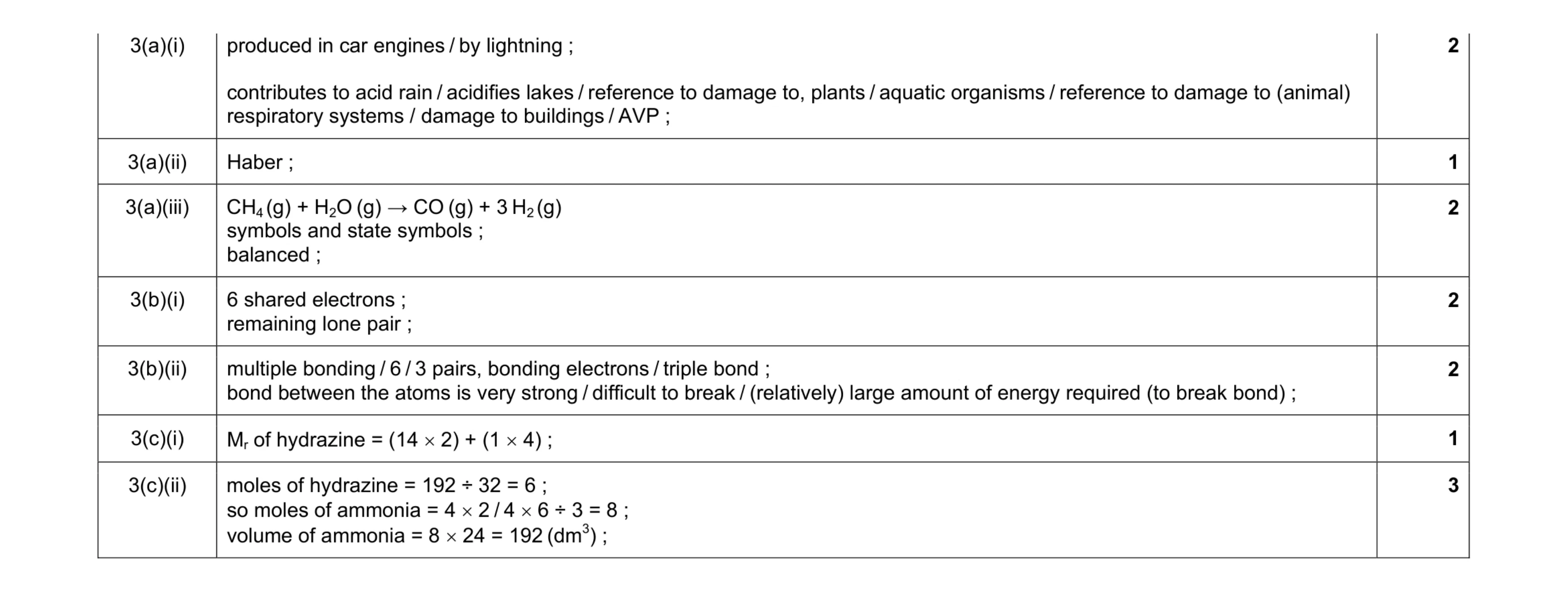
Mark scheme: 3(a)(i) produced in car engines / by lightning ; contributes to acid rain / acidifies lakes / reference to damage to, plants / aquatic organisms / reference to damage to (animal) respiratory systems / damage to buildings / AVP ; 2 3(a)(ii) Haber ; 1 3(a)(iii) CH4 (g) + H2O (g) → CO (g) + 3 H2 (g) symbols and state symbols ; balanced ; 2 3(b)(i) 6 shared electrons ; remaining lone pair ; 2 3(b)(ii) multiple bonding / 6 / 3 pairs, bonding electrons / triple bond ; bond between the atoms is very strong / difficult to break / (relatively) large amount of energy required (to break bond) ; 2 3(c)(i) Mr of hydrazine = (14 × 2) + (1 × 4) ; 1 3(c)(ii) moles of hydrazine = 192 ÷ 32 = 6 ; so moles of ammonia = 4 × 2 / 4 × 6 ÷ 3 = 8 ; volume of ammonia = 8 × 24 = 192 (dm3) ; 3
This question in 0654/41 May/June 2017
Q2 · The atmospheric carbon dioxide concentration measured in Hawaii from 1958 to 2005 0654/41 Oct/Nov 2017
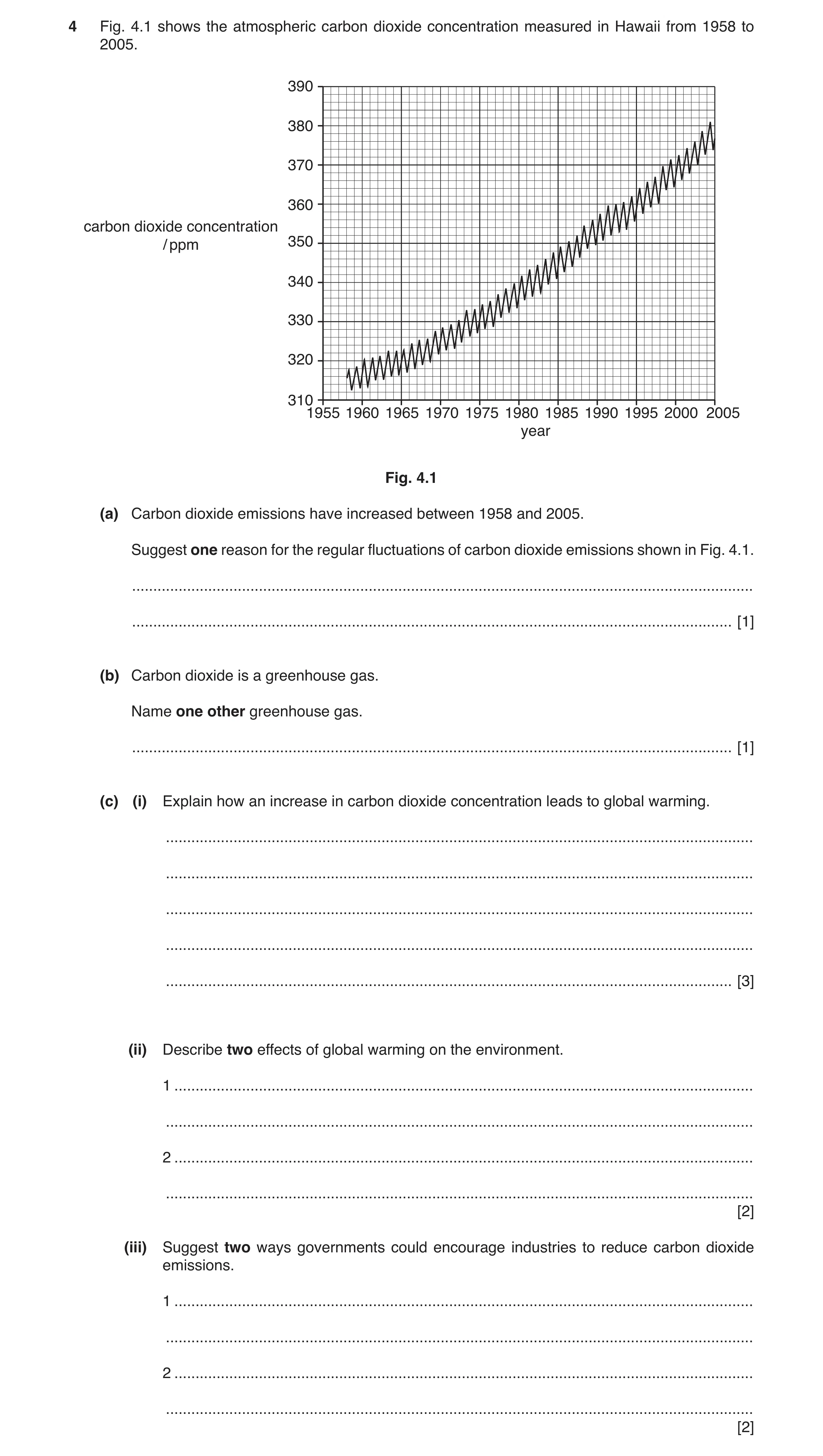
4 Fig. 4.1 shows the atmospheric carbon dioxide concentration measured in Hawaii from 1958 to 2005. 390 380 370 360 carbon dioxide concentration / ppm 350 340 330 320 310 1955 1960 1965 1970 1975 1980 1985 1990 1995 2000 2005 year Fig. 4.1 (a) Carbon dioxide emissions have increased between 1958 and 2005. Suggest one reason for the regular fluctuations of carbon dioxide emissions shown in Fig. 4.1. … … [1] (b) Carbon dioxide is a greenhouse gas. Name one other greenhouse gas. … [1] (c) (i) Explain how an increase in carbon dioxide concentration leads to global warming. … … … … … [3] (ii) Describe two effects of global warming on the environment. 1 … … 2 … … [2] (iii) Suggest two ways governments could encourage industries to reduce carbon dioxide emissions. 1 … … 2 … … [2]
9 marks
Mark scheme: 4(a) more energy / fuel used in cold season (produces more carbon dioxide) ; more photosynthesis in warm season (uses more carbon dioxide) ; max 1 4(b) methane ; 1 4(c)(i) solar radiation enters atmosphere ; reflected from Earth’s, surface / atmosphere (as IR), / Earth absorbs shorter wavelengths and warms up then gives out longer wavelength (IR) / radiation (absorbed and) reradiated from Earth’s surface / owtte ; carbon dioxide, absorbs radiation / prevents radiation escaping / less radiation emitted than absorbed ; 3 4(c)(ii) rising sea levels / melting polar ice ; more extreme weather / hurricane / tsunamis / monsoons / forest fires ; flooding ; desertification ; species extinction / migration ; loss of habitat ; max 2 4(c)(iii) set limits on carbon dioxide emissions / legislation ; fine industries for excess carbon emissions ; subsidise alternative energy ; max 2
This question in 0654/41 Oct/Nov 2017
Q3 · State the percentage of nitrogen in clean air 0654/41 Oct/Nov 2017
5 (a) (i) State the percentage of nitrogen in clean air. … % [1] (ii) Name two other uncombined gaseous elements in clean air. … and … [1] (b) Air bags protect passengers if a car is involved in a collision. When a collision occurs, sodium azide, NaN3, decomposes releasing nitrogen gas to inflate the air bag. Fig. 5.1 shows an air bag protecting a passenger. air bag rapidly inflated by nitrogen gas Fig. 5.1 (i) Sodium azide, NaN3, is an ionic compound. Sodium ions have the formula Na+. Deduce the charge of an azide ion, … the formula of an azide ion … [2] (ii) The balanced equation for the decomposition of sodium azide is shown. 2NaN3(s) 2Na(s) + 3N2(g) Complete the steps in the calculation to find the volume of nitrogen gas that is released when 130 g of sodium azide decomposes completely. Show your working. Step 1 Calculate the relative formula mass of sodium azide. [Ar: Na = 23, N = 14] relative formula mass = … Step 2 Calculate the number of moles in 130 g of sodium azide. number of moles = … Step 3 Deduce the number of moles of nitrogen gas released by 130 g of sodium azide. number of moles = … Step 4 Calculate the volume of nitrogen gas released. [molar gas volume = 24 dm3] volume of nitrogen gas = … dm3 [4] (c) In industry, nitrogen is used in the Haber process to make ammonia. (i) Describe how nitrogen for the Haber process is obtained from air. … … … [2] (ii) State the word equation for the reaction that forms ammonia in the Haber process. … [1]
11 marks
Mark scheme: 5(a)(i) 78 ; 1 5(a)(ii) 2 from oxygen and noble gases ; 1 5(b)(i) negative / minus ; N3 – ; 2 5(b)(ii) Mr sodium azide = 23 + (14 × 3) = 65 ; moles of sodium azide = 130 ÷ 65 = 2 ; 3 moles of nitrogen ; so volume of nitrogen = 3 × 24 = 72 (dm3) ; 4 5(c)((i) fractional distillation ; of liquefied air ; 2 5(c)(ii) nitrogen + hydrogen → ammonia ; 1
This question in 0654/41 Oct/Nov 2017
Q4 · A simplified diagram of the carbon cycle 0654/42 Oct/Nov 2017
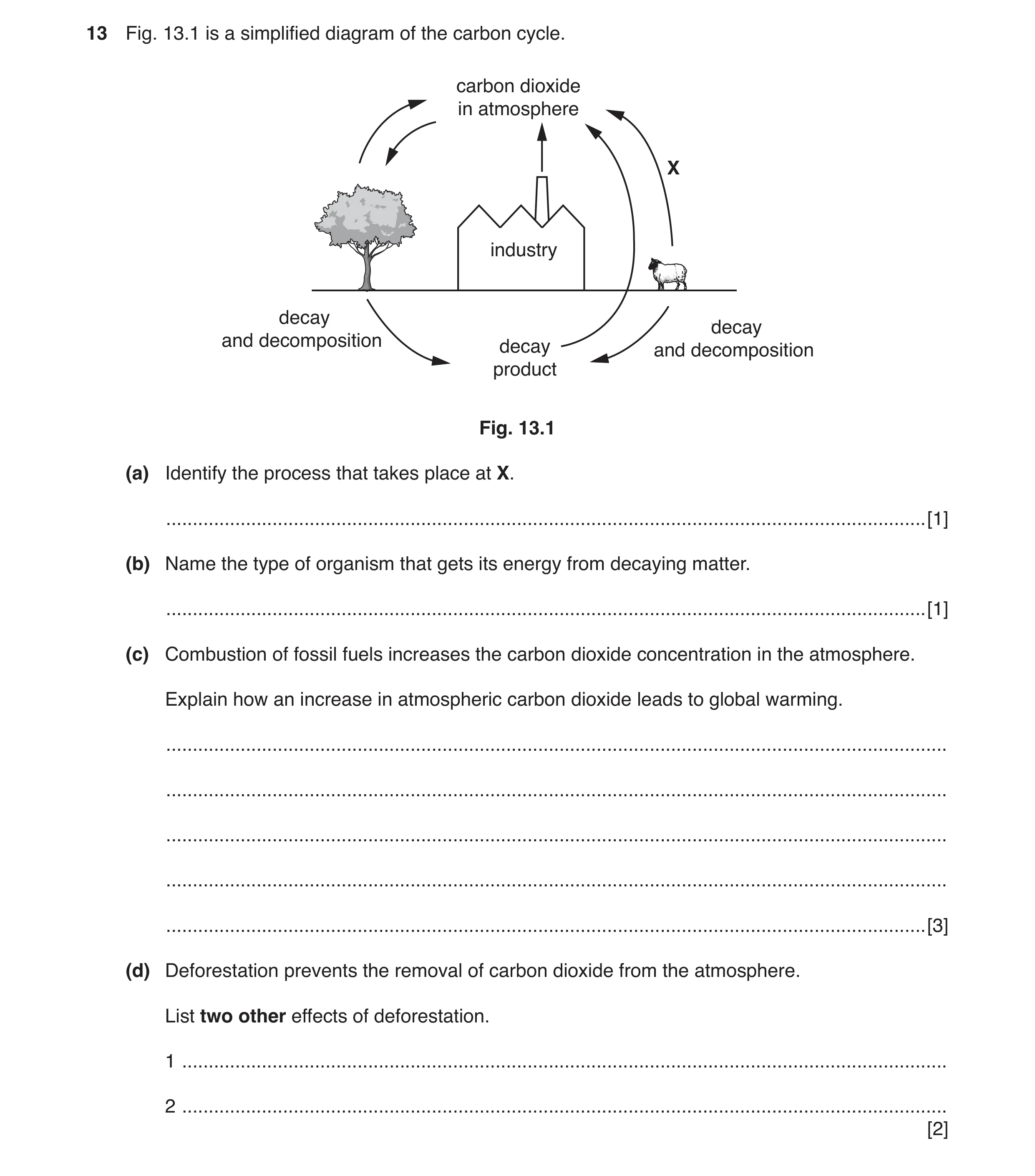
13 Fig. 13.1 is a simplified diagram of the carbon cycle. carbon dioxide in atmosphere X industry decay decay and decomposition decay and decomposition product Fig. 13.1 (a) Identify the process that takes place at X. … [1] (b) Name the type of organism that gets its energy from decaying matter. … [1] (c) Combustion of fossil fuels increases the carbon dioxide concentration in the atmosphere. Explain how an increase in atmospheric carbon dioxide leads to global warming. … … … … … [3] (d) Deforestation prevents the removal of carbon dioxide from the atmosphere. List two other effects of deforestation. 1 … 2 … [2]
7 marks
Mark scheme: 13(a) X respiration ; 1 13(b) decomposer ; 1 13(c) solar radiation enters atmosphere ; reflected from Earth’s surface / atmosphere (as infrared) / Earth absorbs shorter wavelengths and warms up and gives out longer wavelengths (IR) / radiation (absorbed) and reradiated from Earth’s surface / owtte ; carbon dioxide, absorbs radiation / prevents radiation escaping / less radiation emitted than absorbed ; ref to the (enhanced) greenhouse effect / carbon dioxide is a greenhouse gas ; max 3 13(d) soil erosion ; loss of habitat ; species extinction ; flooding ; max 2
This question in 0654/42 Oct/Nov 2017
Q5 · Iron is a metal in the fourth period of the Periodic Table 0654/41 Oct/Nov 2018
8 (a) Iron is a metal in the fourth period of the Periodic Table. Name the collection of metals in the fourth period that contains iron. … [1] (b) Iron is a catalyst for the industrial process that produces ammonia. (i) Name the industrial process that produces ammonia. … [1] (ii) State the gaseous elements that combine to make ammonia. … and … [1] (iii) Define the term catalyst. … … [1] (c) Potassium oxide reacts with pure water. Iron oxide does not react with pure water. (i) Suggest the pH of the mixture formed after potassium oxide reacts with water. Explain your answer. pH … explanation … … [1] (ii) State the pH of the mixture of iron oxide and water. … [1] (d) Polluted air can cause acid rain. (i) Name one gaseous oxide, other than carbon dioxide, that causes acid rain. … [1] (ii) Acid rain reacts slowly with metals and with limestone. Suggest one reason for this low rate of reaction. Explain your answer using ideas about particles. reason … … explanation … … … [2]
9 marks
Mark scheme: 8(a) transition (metals) ; 1 8(b)(i) Haber ; 1 8(b)(ii) nitrogen, hydrogen ; 1 8(b)(iii) (material) that increases reaction rate ; 1 8(c)(i) >7 to 14 AND (potassium oxide reacts to produce an) alkaline solution / potassium hydroxide ; 1 8(c)(ii) 7 ; 1 8(d)(i) sulfur dioxide ; 1 8(d)(ii) Low concentration of acid / low temperature / small surface area ; so collision frequency / chance of collision (between reactants) is low ; 2
This question in 0654/41 Oct/Nov 2018
Q6 · State the percentage of nitrogen in clean air 0654/42 Oct/Nov 2018
2 (a) State the percentage of nitrogen in clean air. … % [1] (b) Fig. 2.1 shows the separation of nitrogen and oxygen from liquid air. nitrogen gas liquid air at –200 °C liquid oxygen Fig. 2.1 The boiling point of liquid nitrogen is −196 °C. The boiling point of liquid oxygen is −183 °C. Suggest a suitable temperature that produces nitrogen gas and liquid oxygen from liquid air. Explain your answer. temperature … °C explanation … … … [2] (c) (i) Nitrogen from the air is used to make ammonium nitrate. There are three steps in this process. Table 2.1 shows these steps. They are not in the correct order. Complete Table 2.1, using the numbers 1, 2 and 3, to show the correct order of these steps. Table 2.1 step order A neutralisation reaction is used to produce ammonium nitrate. Nitrogen is used to produce ammonia in the Haber process. Nitrogen is separated from air. [1] (ii) Name the element that combines with nitrogen to form ammonia in the Haber process. … [1] (d) (i) Complete Fig. 2.2 to show the dot-and-cross diagram of all the outer shell electrons in a nitrogen molecule. N N Fig. 2.2 [2] (ii) During thunderstorms, lightning causes nitrogen and oxygen to combine to form nitrogen dioxide, NO2. Suggest why a large amount of energy is needed for this reaction. … … … [2] (iii) Predict the effect that nitrogen dioxide has, if any, on the pH of rainwater. Explain your answer. effect on pH … explanation … … [2]
11 marks
Mark scheme: 2(a) 78 (%) ; 1 2(b) in the range −195 to −184 °C inclusive ; idea that temperature needs to be above the b.pt. of N and below the b. pt. of O ; 2 2(c)(i) 3 2 1 ; 1 2(c)(ii) hydrogen ; 1 Question Answer Marks 2(d)(i) 1 mark for 3 shared pairs only ; 1 mark for two lone pairs only ; 2 2(d)(ii) the idea that the bond in N2 has to break ; the bond is very strong / there are multiple bonds ; 2 2(d)(iii) pH is reduced ; nitrogen dioxide is an acidic oxide / non-metal oxides are acidic / nitrogen oxides react with (rain)water to form acid with water ; 2
This question in 0654/42 Oct/Nov 2018
Q7 · Sulfur is found in compounds and as an element 0654/43 Oct/Nov 2018
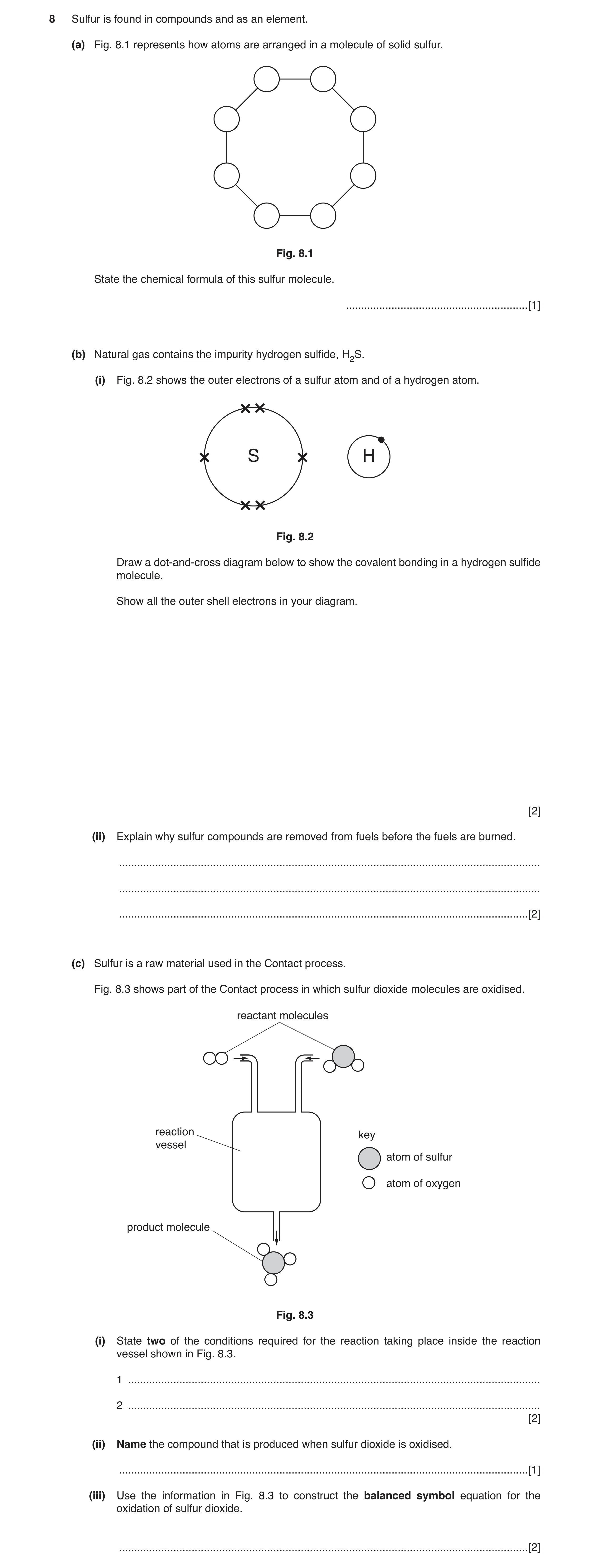
8 Sulfur is found in compounds and as an element. (a) Fig. 8.1 represents how atoms are arranged in a molecule of solid sulfur. Fig. 8.1 State the chemical formula of this sulfur molecule. … [1] (b) Natural gas contains the impurity hydrogen sulfide, H2S. (i) Fig. 8.2 shows the outer electrons of a sulfur atom and of a hydrogen atom. S H Fig. 8.2 Draw a dot-and-cross diagram below to show the covalent bonding in a hydrogen sulfide molecule. Show all the outer shell electrons in your diagram. [2] (ii) Explain why sulfur compounds are removed from fuels before the fuels are burned. … … … [2] (c) Sulfur is a raw material used in the Contact process. Fig. 8.3 shows part of the Contact process in which sulfur dioxide molecules are oxidised. reactant molecules reaction key vessel atom of sulfur atom of oxygen product molecule Fig. 8.3 (i) State two of the conditions required for the reaction taking place inside the reaction vessel shown in Fig. 8.3. 1 … 2 … [2] (ii) Name the compound that is produced when sulfur dioxide is oxidised. … [1] (iii) Use the information in Fig. 8.3 to construct the balanced symbol equation for the oxidation of sulfur dioxide. … [2]
10 marks
Mark scheme: 8(a) S8 ; 1 8(b)(i) two shared pairs ; four lone electrons on sulfur only ; 2 8(b)(ii) avoids formation of sulfur dioxide / SO2 ; reference to acid rain ; 2 8(c)(i) high / moderate temperature / (400–450 °C ) ; pressure between 1 and 2 atmospheres ; catalyst (of vanadium pentoxide) ; max 2 8(c)(ii) sulfur trioxide ; 1 8(c)(iii) 2SO2 + O2 → 2SO3 formulae ; balancing ; 2
This question in 0654/43 Oct/Nov 2018
Q8 · The average global temperature of the Earth’s surface from 1880 to 1980 0654/43 Oct/Nov 2018
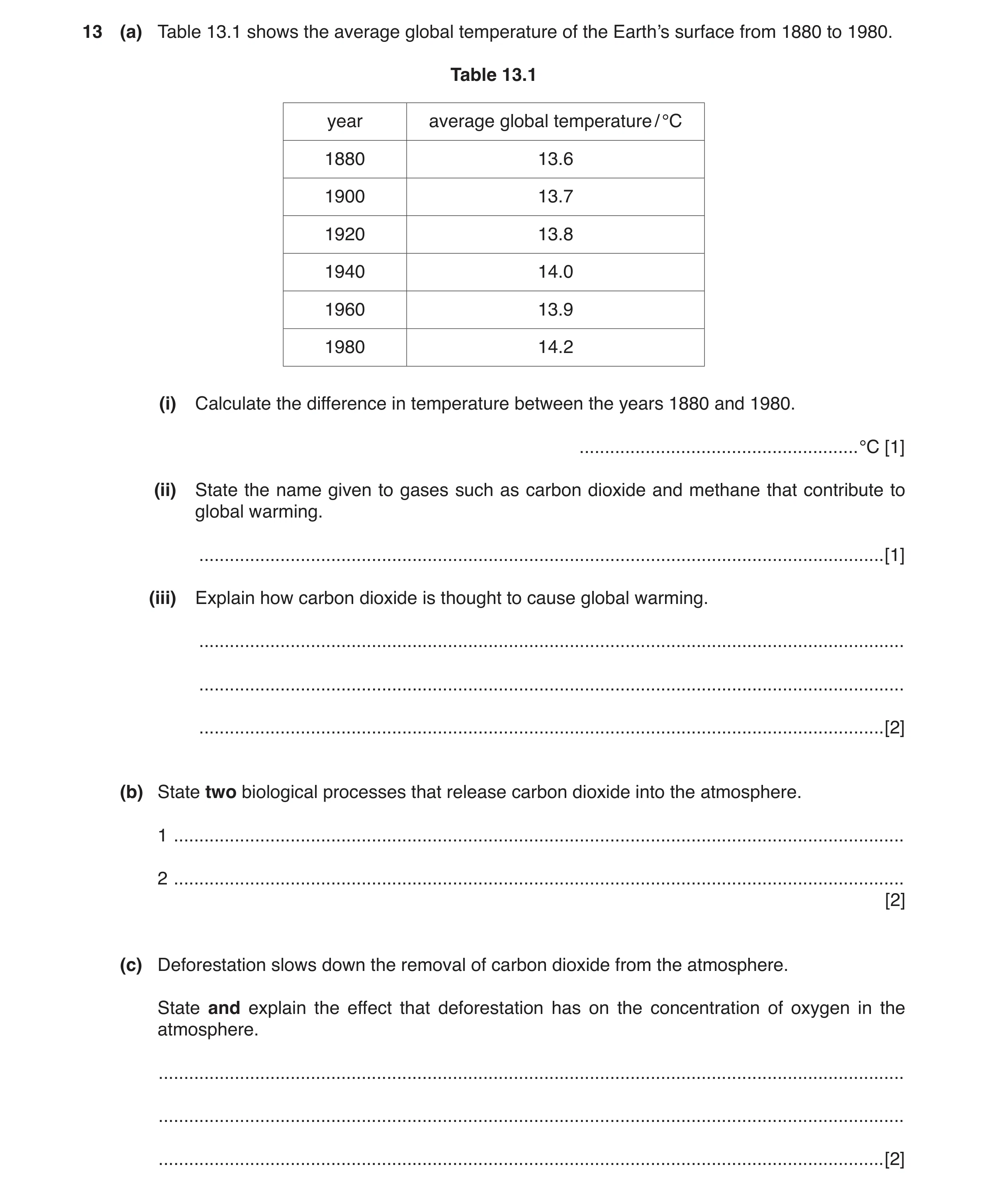
13 (a) Table 13.1 shows the average global temperature of the Earth’s surface from 1880 to 1980. Table 13.1 year average global temperature / °C 1880 13.6 1900 13.7 1920 13.8 1940 14.0 1960 13.9 1980 14.2 (i) Calculate the difference in temperature between the years 1880 and 1980. … °C [1] (ii) State the name given to gases such as carbon dioxide and methane that contribute to global warming. … [1] (iii) Explain how carbon dioxide is thought to cause global warming. … … … [2] (b) State two biological processes that release carbon dioxide into the atmosphere. 1 … 2 … [2] (c) Deforestation slows down the removal of carbon dioxide from the atmosphere. State and explain the effect that deforestation has on the concentration of oxygen in the atmosphere. … … … [2]
8 marks
Mark scheme: 13(a)(i) 0.6 (°C) ; 1 13(a)(ii) greenhouse gases ; 1 13(a)(iii) absorbs (infrared) radiation (from Earth’s surface) ; energy is trapped / radiation is re-radiated (to Earth’s surface) / prevented from leaving atmosphere ; 2 13(b) decay / decomposition ; respiration ; 2 13(c) oxygen (concentration) is reduced / less oxygen is produced ; less photosynthesis ; 2
This question in 0654/43 Oct/Nov 2018
Q9 · The composition of clean air and of natural gas 0654/42 May/June 2019
2 (a) Fig. 2.1 shows the composition of clean air and of natural gas. clean air natural gas other gases other gases oxygen … … Fig. 2.1 (i) Complete the labels in Fig. 2.1 to show the main constituent of clean air and of natural gas. [2] (ii) One of the other gases in natural gas is ethane. Name two gases in clean air that are formed by the complete combustion of ethane. 1 … 2 … [2] (b) Name the process used to convert larger alkane molecules into ethene and hydrogen. … [1] (c) The molecular structure of ethene is shown below. H H C C H H The double bond in ethene allows it to undergo addition reactions. (i) Complete the equation for the addition reaction between ethene and bromine. … [1] C2H4 + Br2 (ii) Ethene is used to make ethanol in an addition reaction. Name the other raw material required in the manufacture of ethanol. … [1] (d) Ethene is used in the manufacture of poly(ethene). Propene is used in the manufacture of poly(propene). (i) The structure of poly(ethene) is shown by H H C C H H n (n is a large number) Describe the formation of poly(ethene) using the terms monomer and polymer. … … … … [2] (ii) The molecular structure of propene is shown below. H CH3 C C H H Suggest the structure of poly(propene). Draw your answer in the space below. [1] [Total: 10]
10 marks
Mark scheme: 2(a)(i) nitrogen ; methane ; 2 2(a)(ii) carbon dioxide ; water (vapour) ; 2 2(b) cracking ; 1 2(c)(i) C2H4Br2 ; 1 2(c)(ii) steam / water (vapour) ; 1 2 (d)(i) ethene is monomer ; many, monomers / molecules, join to make a (long chain) polymer ; 2 2(d)(ii) H CH3 | | ------C---C------ | | H H n ; 1
This question in 0654/42 May/June 2019
Q10 · A pie chart which shows the composition of clean air 0654/41 Oct/Nov 2019
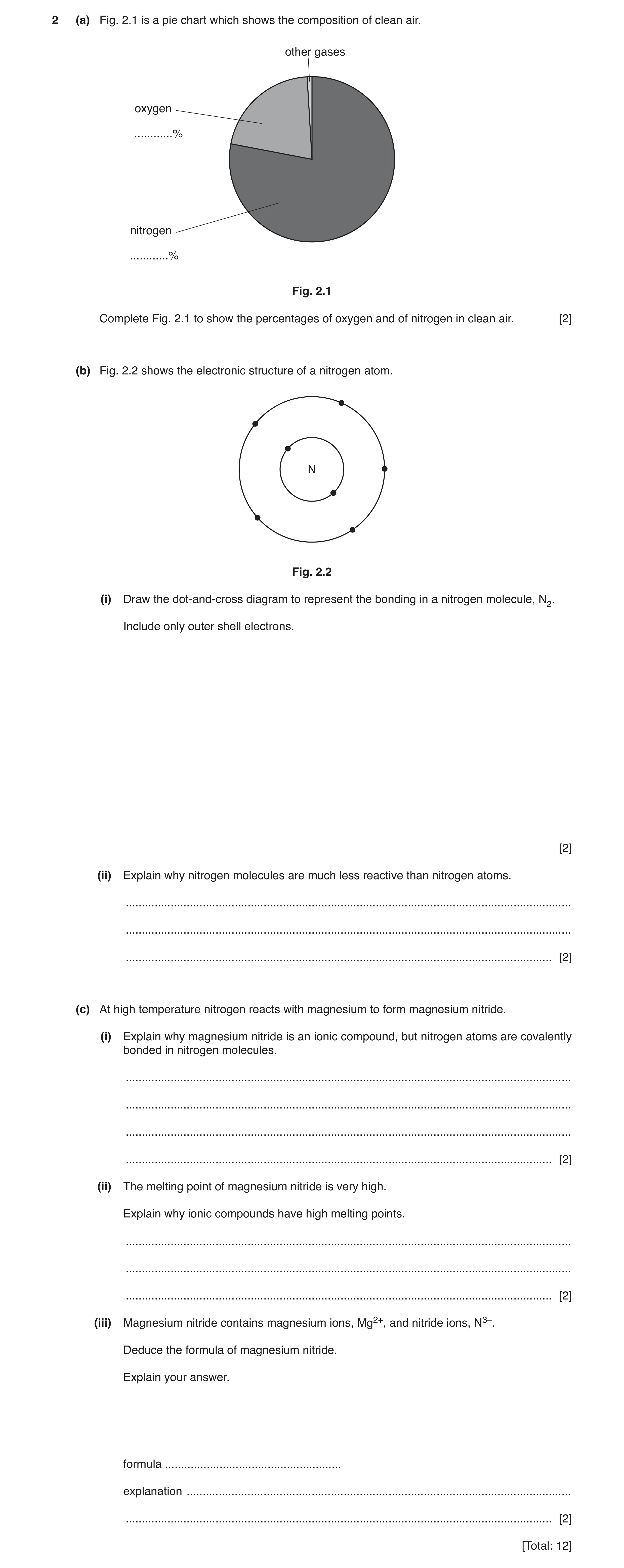
2 (a) Fig. 2.1 is a pie chart which shows the composition of clean air. other gases oxygen … % nitrogen … % Fig. 2.1 Complete Fig. 2.1 to show the percentages of oxygen and of nitrogen in clean air. [2] (b) Fig. 2.2 shows the electronic structure of a nitrogen atom. N Fig. 2.2 (i) Draw the dot-and-cross diagram to represent the bonding in a nitrogen molecule, N2. Include only outer shell electrons. [2] (ii) Explain why nitrogen molecules are much less reactive than nitrogen atoms. … … … [2] (c) At high temperature nitrogen reacts with magnesium to form magnesium nitride. (i) Explain why magnesium nitride is an ionic compound, but nitrogen atoms are covalently bonded in nitrogen molecules. … … … … [2] (ii) The melting point of magnesium nitride is very high. Explain why ionic compounds have high melting points. … … … [2] (iii) Magnesium nitride contains magnesium ions, Mg2+, and nitride ions, N3–. Deduce the formula of magnesium nitride. Explain your answer. formula … explanation … … [2] [Total: 12]
12 marks
Mark scheme: 2(a) oxygen: 21 ; nitrogen: 78 ; 2 2(b)(i) 3 bonding pairs ; 2 lone pairs, all else correct ; 2 2(b)(ii) (molecule is unreactive because of) strong (covalent) bonding between atoms / triple bond ; (atom is reactive because) atom has high tendency to gain electrons / has incomplete electron shell / does not have noble gas structure / owtte ; 2 2(c)(i) ionic bonds between metallic and non-metallic elements ; covalent bonds between non-metallic elements / nitrogen is a non-metal (so covalently bonded) ; 2 2(c)(ii) attractive force between oppositely charged ions / strong force / bonds between ions / many forces / bonds between ions ; more energy required to overcome force / break bond ; 2 2(c)(iii) Mg3N2 ; idea of balanced charges ; 2
This question in 0654/41 Oct/Nov 2019
Q11 · A petrol engine in a car uses a mixture of air and gasoline 0654/41 Oct/Nov 2019
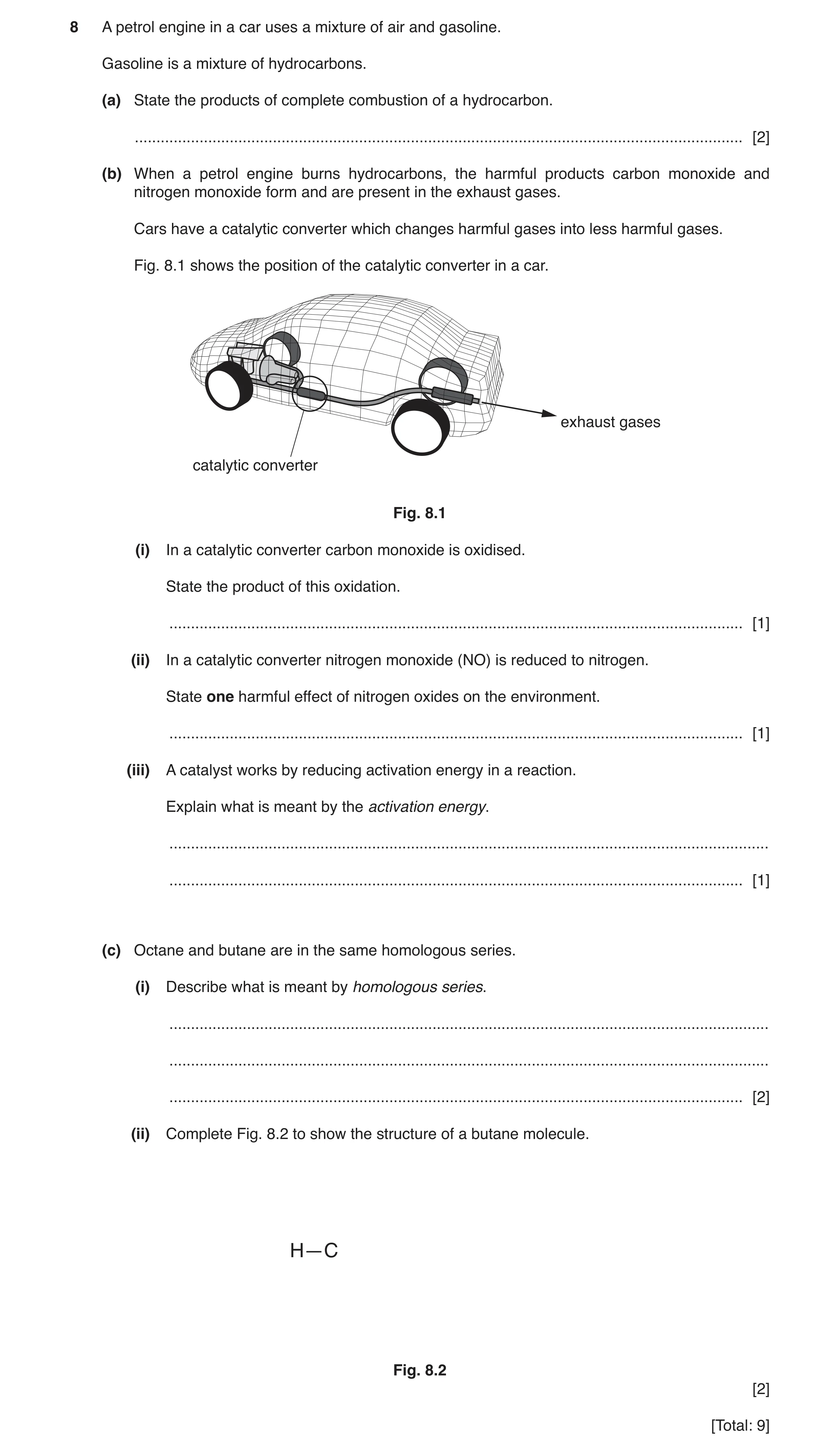
8 A petrol engine in a car uses a mixture of air and gasoline. Gasoline is a mixture of hydrocarbons. (a) State the products of complete combustion of a hydrocarbon. … [2] (b) When a petrol engine burns hydrocarbons, the harmful products carbon monoxide and nitrogen monoxide form and are present in the exhaust gases. Cars have a catalytic converter which changes harmful gases into less harmful gases. Fig. 8.1 shows the position of the catalytic converter in a car. exhaust gases catalytic converter Fig. 8.1 (i) In a catalytic converter carbon monoxide is oxidised. State the product of this oxidation. … [1] (ii) In a catalytic converter nitrogen monoxide (NO) is reduced to nitrogen. State one harmful effect of nitrogen oxides on the environment. … [1] (iii) A catalyst works by reducing activation energy in a reaction. Explain what is meant by the activation energy. … … [1] (c) Octane and butane are in the same homologous series. (i) Describe what is meant by homologous series. … … … [2] (ii) Complete Fig. 8.2 to show the structure of a butane molecule. H—C Fig. 8.2 [2] [Total: 9]
9 marks
Mark scheme: 8(a) carbon dioxide ; water ; 2 8(b)(i) carbon dioxide ; 1 8(b)(ii) acid rain / named effect of acid rain / respiratory disease ; 1 8(b)(iii) minimum energy for particles / reactants to react ; 1 8(c)(i) same general formula ; similar chemical properties ; 2 8(c)(ii) H H H H | | | | H – C – C – C – C – H | | | | H H H H chain of 4 C ; all else correct ; 2
This question in 0654/41 Oct/Nov 2019
Q12 · Ammonia is manufactured in the Haber process 0654/42 Oct/Nov 2019
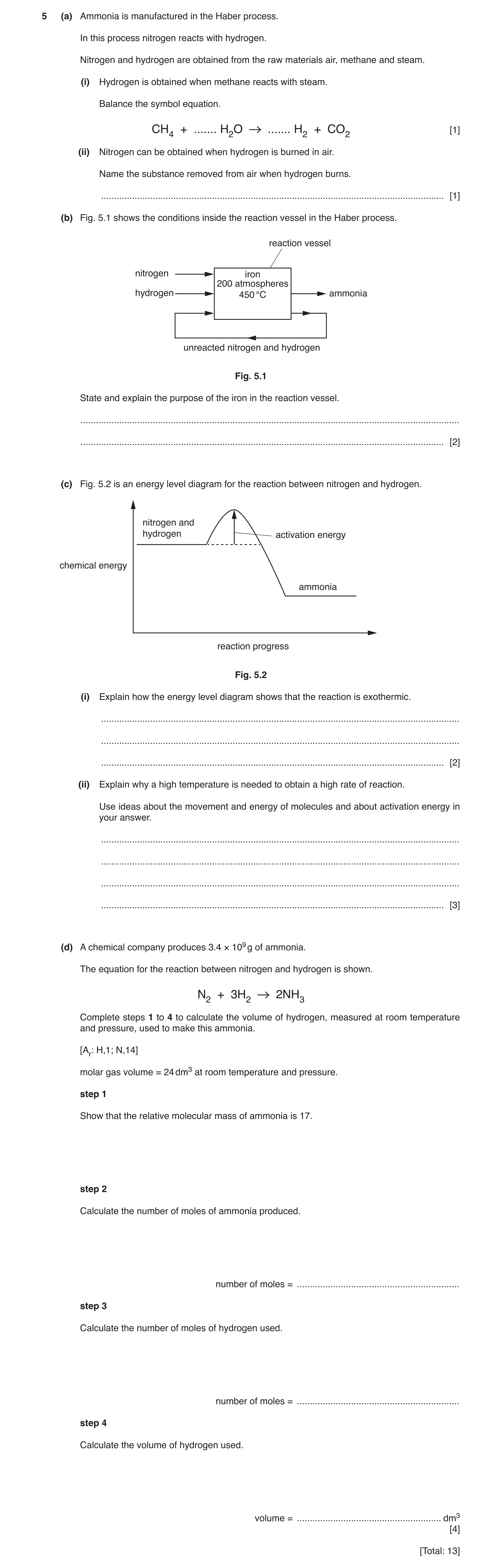
5 (a) Ammonia is manufactured in the Haber process. In this process nitrogen reacts with hydrogen. Nitrogen and hydrogen are obtained from the raw materials air, methane and steam. (i) Hydrogen is obtained when methane reacts with steam. Balance the symbol equation. [1] CH4 + … H2O … H2 + CO2 (ii) Nitrogen can be obtained when hydrogen is burned in air. Name the substance removed from air when hydrogen burns. … [1] (b) Fig. 5.1 shows the conditions inside the reaction vessel in the Haber process. reaction vessel nitrogen iron 200 atmospheres hydrogen 450 °C ammonia unreacted nitrogen and hydrogen Fig. 5.1 State and explain the purpose of the iron in the reaction vessel. … … [2] (c) Fig. 5.2 is an energy level diagram for the reaction between nitrogen and hydrogen. nitrogen and hydrogen activation energy chemical energy ammonia reaction progress Fig. 5.2 (i) Explain how the energy level diagram shows that the reaction is exothermic. … … … [2] (ii) Explain why a high temperature is needed to obtain a high rate of reaction. Use ideas about the movement and energy of molecules and about activation energy in your answer. … … … … [3] (d) A chemical company produces 3.4 × 10⁹ g of ammonia. The equation for the reaction between nitrogen and hydrogen is shown. N2 + 3H2 2NH3 Complete steps 1 to 4 to calculate the volume of hydrogen, measured at room temperature and pressure, used to make this ammonia. [Ar: H,1; N,14] molar gas volume = 24 dm3 at room temperature and pressure. step 1 Show that the relative molecular mass of ammonia is 17. step 2 Calculate the number of moles of ammonia produced. number of moles = … step 3 Calculate the number of moles of hydrogen used. number of moles = … step 4 Calculate the volume of hydrogen used. volume = … dm3 [4] [Total: 13]
13 marks
Mark scheme: 5(a)(i) CH4 + 2H2O → 4H2 + CO2 ; 1 5(a)(ii) oxygen ; 1 5(b) catalyst ; speeds up reaction ; lowers activation energy ; max 2 2 5(c)(i) product stores less energy than reactants ; (surplus) energy released (from system) ; 2 5(c)(ii) high temperature provides molecules with more (kinetic) energy / increases speed of molecules ; more molecules have the activation energy / sufficient energy to react ; increased frequency of (successful) collisions ; 3 5(d) 14 + 3(1) (=17) ; ( 3.4 × 10⁹ 17 =) 2.0 × 10⁸ ; ( 3 × 2.0 × 108 2 ) = 3.0 × 10⁸ ; 3.0 × 108 × 24 = 7.2 × 10⁹ (dm3) ; 4
This question in 0654/42 Oct/Nov 2019
Q13 · Diamond and graphite are different forms of the element carbon 0654/42 May/June 2020
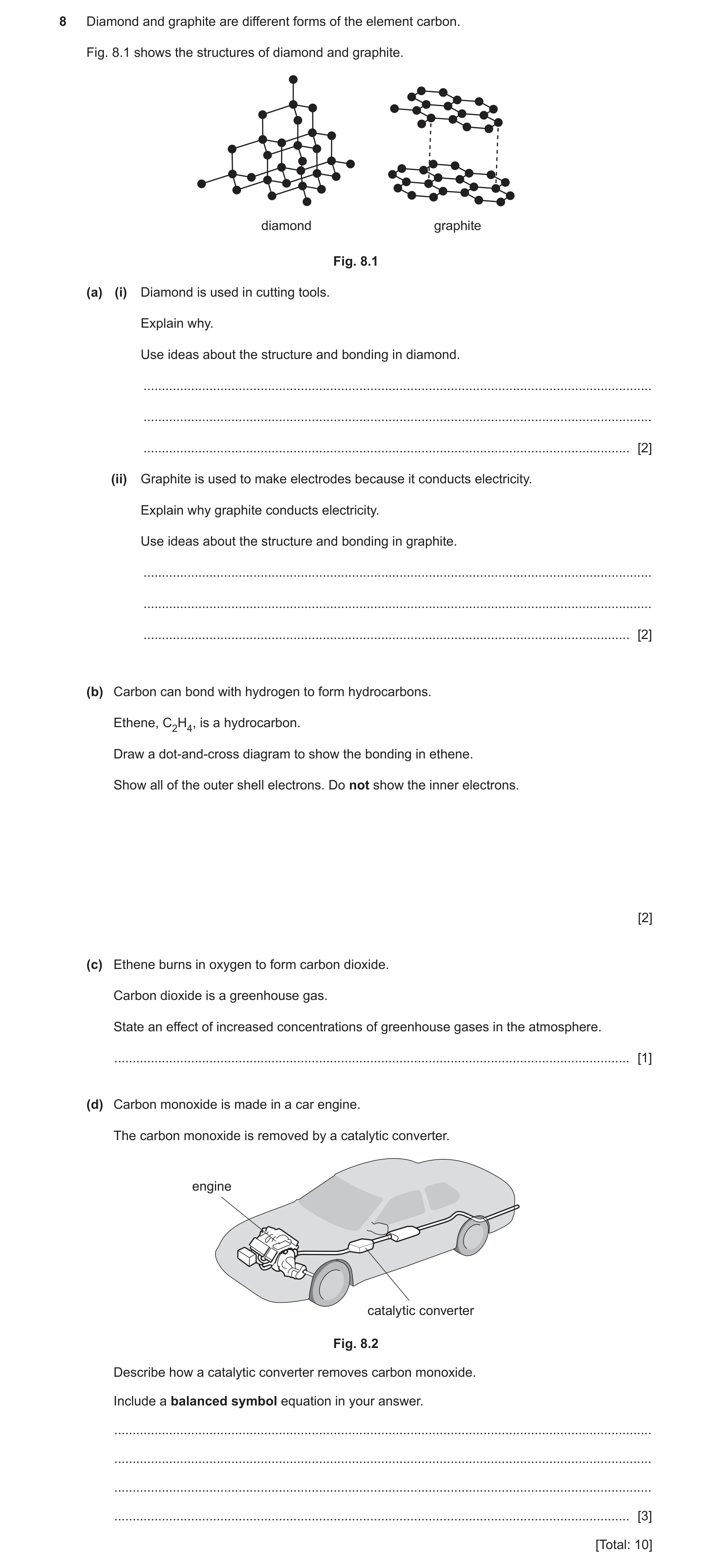
8 Diamond and graphite are different forms of the element carbon. Fig. 8.1 shows the structures of diamond and graphite. diamond graphite Fig. 8.1 (a) (i) Diamond is used in cutting tools. Explain why. Use ideas about the structure and bonding in diamond. … … … [2] (ii) Graphite is used to make electrodes because it conducts electricity. Explain why graphite conducts electricity. Use ideas about the structure and bonding in graphite. … … … [2] (b) Carbon can bond with hydrogen to form hydrocarbons. Ethene, C2H4, is a hydrocarbon. Draw a dot-and-cross diagram to show the bonding in ethene. Show all of the outer shell electrons. Do not show the inner electrons. [2] (c) Ethene burns in oxygen to form carbon dioxide. Carbon dioxide is a greenhouse gas. State an effect of increased concentrations of greenhouse gases in the atmosphere. … [1] (d) Carbon monoxide is made in a car engine. The carbon monoxide is removed by a catalytic converter. engine catalytic converter Fig. 8.2 Describe how a catalytic converter removes carbon monoxide. Include a balanced symbol equation in your answer. … … … … [3] [Total: 10]
10 marks
Mark scheme: 8(a)(i) (diamond) has many strong bonds ; bonds are covalent bonds ; (diamond) is giant molecular / macromolecular / giant tetrahedral (lattice) ; max 2 8(a)(ii) (graphite has) electrons ; that can move / that are delocalised ; 2 8(b) double bond between C atoms ; single bonds between C and H ; 2 Question Answer Marks 8(c) global warming / climate change ; 1 8(d) (catalytic converter) changes carbon monoxide into carbon dioxide ; balanced symbol equation: 2CO + O2 → 2CO2 / 2CO + 2NO → N2 + 2CO2 ;; correct formulae; correctly balanced; 3
This question in 0654/42 May/June 2020
Q14 · A scientist investigates the reaction between calcium carbonate and dilute hydrochloric… 0654/41 Oct/Nov 2020
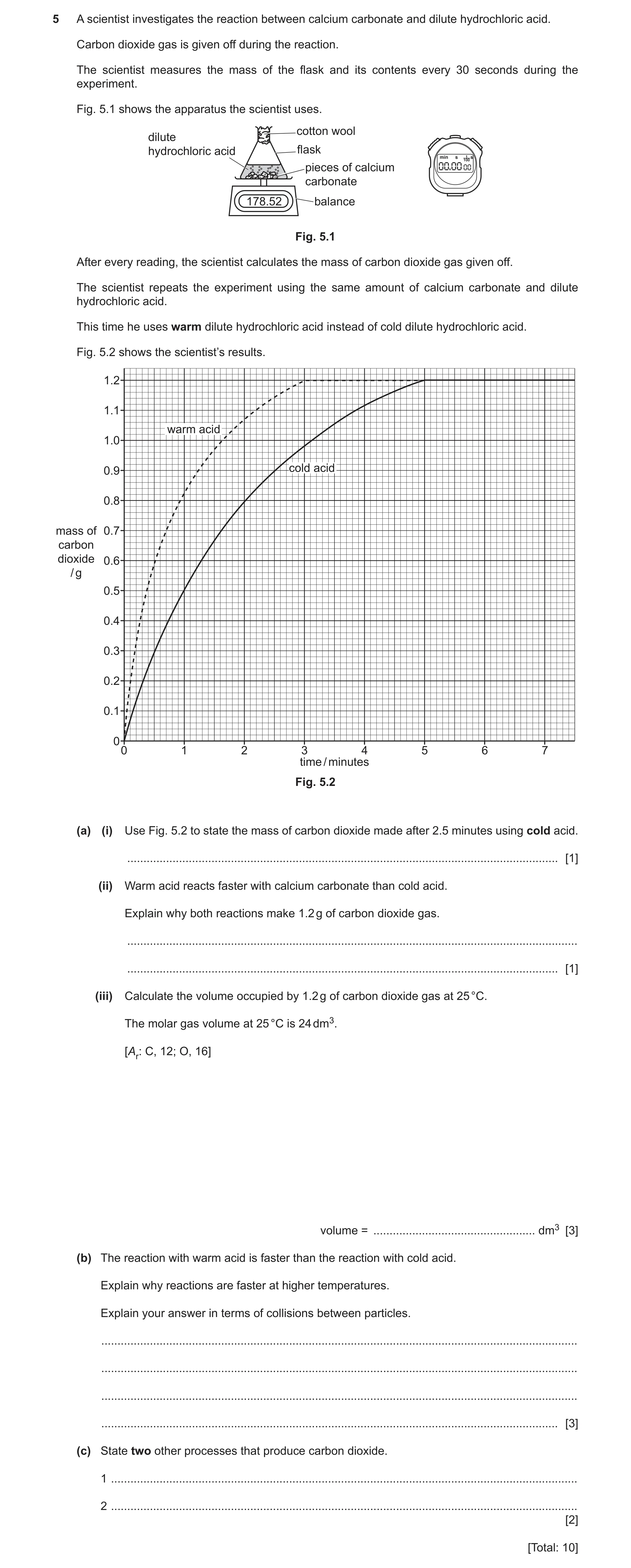
5 A scientist investigates the reaction between calcium carbonate and dilute hydrochloric acid. Carbon dioxide gas is given off during the reaction. The scientist measures the mass of the flask and its contents every 30 seconds during the experiment. Fig. 5.1 shows the apparatus the scientist uses. cotton wool dilute hydrochloric acid flask pieces of calcium carbonate 178.52 balance Fig. 5.1 After every reading, the scientist calculates the mass of carbon dioxide gas given off. The scientist repeats the experiment using the same amount of calcium carbonate and dilute hydrochloric acid. This time he uses warm dilute hydrochloric acid instead of cold dilute hydrochloric acid. Fig. 5.2 shows the scientist’s results. 1.2 1.1 warm acid 1.0 0.9 cold acid 0.8 mass of 0.7 carbon dioxide 0.6 / g 0.5 0.4 0.3 0.2 0.1 00 1 2 3 4 5 6 7 time / minutes Fig. 5.2 (a) (i) Use Fig. 5.2 to state the mass of carbon dioxide made after 2.5 minutes using cold acid. … [1] (ii) Warm acid reacts faster with calcium carbonate than cold acid. Explain why both reactions make 1.2 g of carbon dioxide gas. … … [1] (iii) Calculate the volume occupied by 1.2 g of carbon dioxide gas at 25 °C. The molar gas volume at 25 °C is 24 dm3. [Ar: C, 12; O, 16] volume = … dm3 [3] (b) The reaction with warm acid is faster than the reaction with cold acid. Explain why reactions are faster at higher temperatures. Explain your answer in terms of collisions between particles. … … … … [3] (c) State two other processes that produce carbon dioxide. 1 … 2 … [2] [Total: 10]
10 marks
Mark scheme: 5(a)(i) 0.9 (g) ; 1 5(a)(ii) any one from: same mass / amount of calcium carbonate ; same amount of hydrochloric acid ; 1 5(a)(iii) Mr of CO2 = 44 ; moles of CO2 = 1.2 ÷ 44 = 0.027 ; volume of CO2 = 0.027 × 24 = 0.65 dm³ ; 3 5(b) particles have more kinetic energy / particles move faster ; more collisions per second / greater collision frequency ; more particles have the minimum/activation energy to react; 3 5(c) any two from: combustion of carbon-containing substances; respiration; (thermal) decomposition of carbonate; 2
This question in 0654/41 Oct/Nov 2020
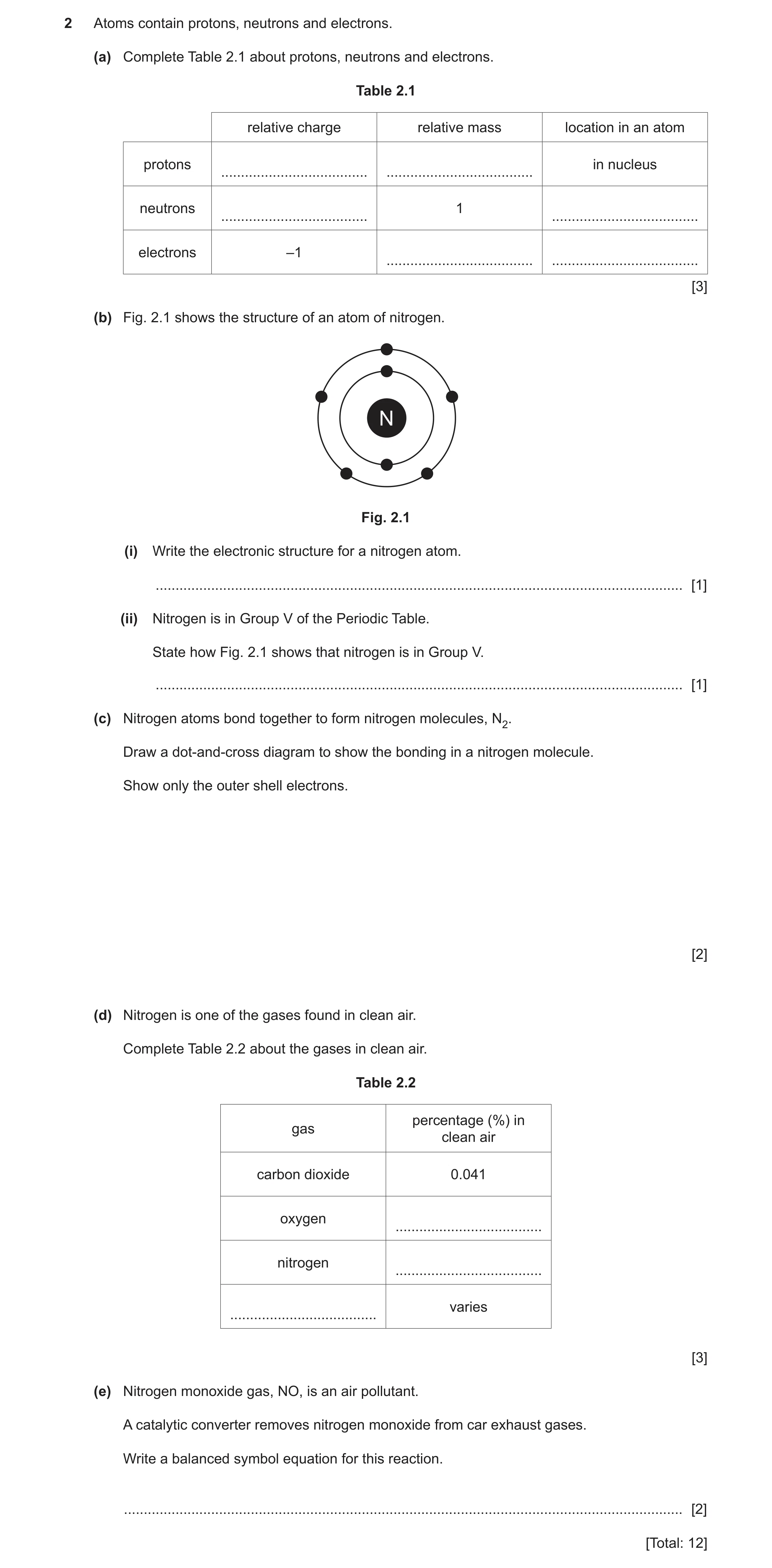
Q15 · Atoms contain protons, neutrons and electrons 0654/42 Oct/Nov 2020
2 Atoms contain protons, neutrons and electrons. (a) Complete Table 2.1 about protons, neutrons and electrons. Table 2.1 relative charge relative mass location in an atom protons in nucleus … … neutrons 1 … … electrons –1 … … [3] (b) Fig. 2.1 shows the structure of an atom of nitrogen. N Fig. 2.1 (i) Write the electronic structure for a nitrogen atom. … [1] (ii) Nitrogen is in Group V of the Periodic Table. State how Fig. 2.1 shows that nitrogen is in Group V. … [1] (c) Nitrogen atoms bond together to form nitrogen molecules, N2. Draw a dot-and-cross diagram to show the bonding in a nitrogen molecule. Show only the outer shell electrons. [2] (d) Nitrogen is one of the gases found in clean air. Complete Table 2.2 about the gases in clean air. Table 2.2 percentage (%) in gas clean air carbon dioxide 0.041 oxygen … nitrogen … varies … [3] (e) Nitrogen monoxide gas, NO, is an air pollutant. A catalytic converter removes nitrogen monoxide from car exhaust gases. Write a balanced symbol equation for this reaction. … [2] [Total: 12]
12 marks
Mark scheme: 2(a) relative charge relative mass location in an atom protons +1 / + 1 (in nucleus) neutrons 0 / no charge / neutral (1) in nucleus electrons (–1) almost 0 / negligible / 1÷1850 in shells / orbits around nucleus ;;; 3 2(b)(i) 2, 5 ; 1 2(b)(ii) (nitrogen has) five electrons in the outer shell ; 1 Question Answer Marks 2(c) ;; 2 2(d) gas percentage in clean air (%) carbon dioxide 0.035 oxygen 21 nitrogen 78 (named) noble gases / water (vapour) varies ;;; 3 2(e) 2CO + 2NO → N2 + 2CO2 / 2NO → N2 + O2 ;; 2
This question in 0654/42 Oct/Nov 2020
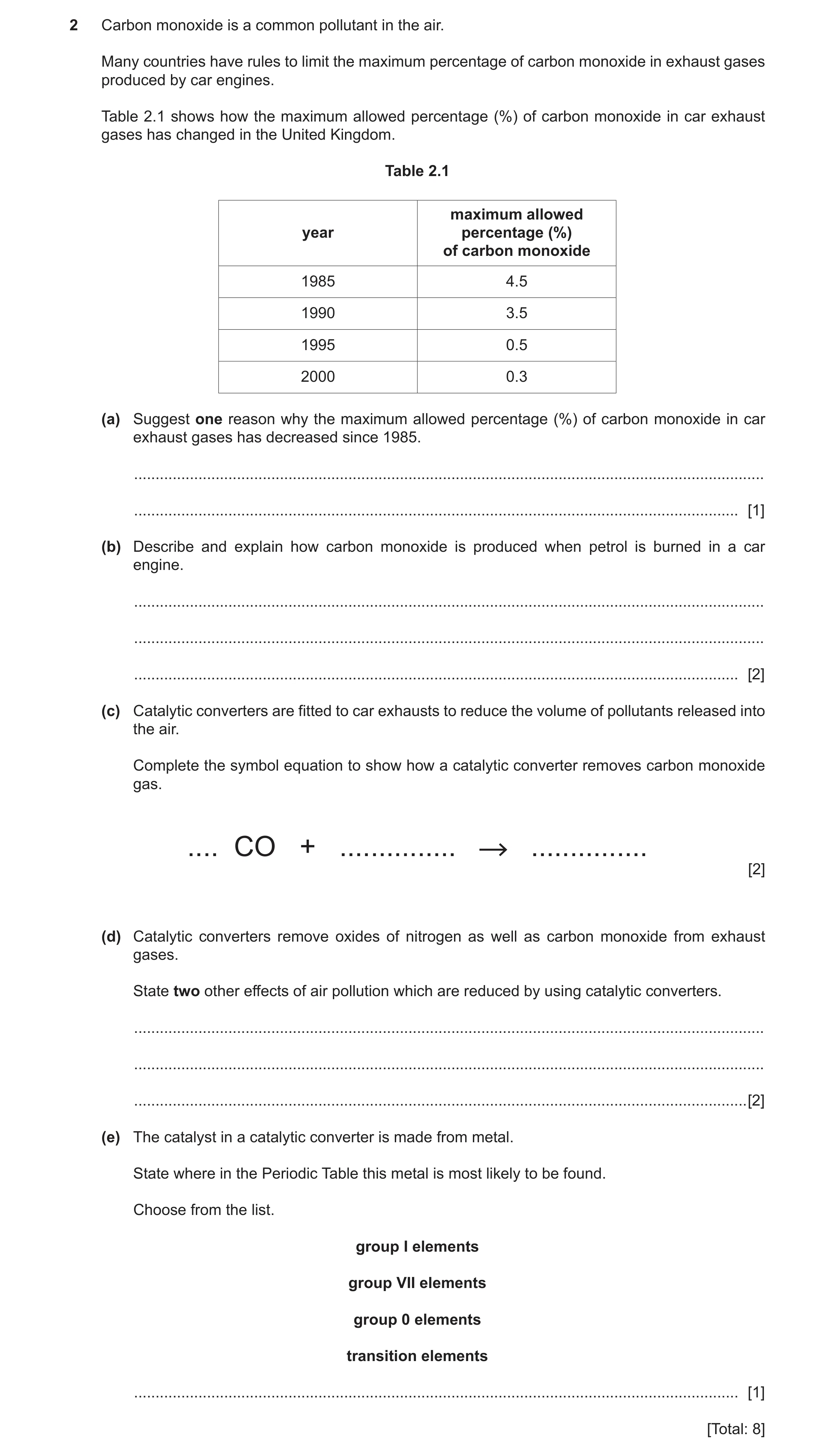
Q16 · Carbon monoxide is a common pollutant in the air 0654/42 Oct/Nov 2021
2 Carbon monoxide is a common pollutant in the air. Many countries have rules to limit the maximum percentage of carbon monoxide in exhaust gases produced by car engines. Table 2.1 shows how the maximum allowed percentage (%) of carbon monoxide in car exhaust gases has changed in the United Kingdom. Table 2.1 maximum allowed year percentage (%) of carbon monoxide 1985 4.5 1990 3.5 1995 0.5 2000 0.3 (a) Suggest one reason why the maximum allowed percentage (%) of carbon monoxide in car exhaust gases has decreased since 1985. … … [1] (b) Describe and explain how carbon monoxide is produced when petrol is burned in a car engine. … … … [2] (c) Catalytic converters are fitted to car exhausts to reduce the volume of pollutants released into the air. Complete the symbol equation to show how a catalytic converter removes carbon monoxide gas. … CO + … … [2] (d) Catalytic converters remove oxides of nitrogen as well as carbon monoxide from exhaust gases. State two other effects of air pollution which are reduced by using catalytic converters. … … … [2] (e) The catalyst in a catalytic converter is made from metal. State where in the Periodic Table this metal is most likely to be found. Choose from the list. group I elements group VII elements group 0 elements transition elements … [1] [Total: 8]
8 marks
Mark scheme: 2(a) any one from: carbon monoxide is, toxic / poisonous ; greater public concern or awareness about pollution ; idea that there are more cars, so there would be more pollution ; improved engine technology / introduction of catalytic converters ; 1 2(b) incomplete combustion ; (because) insufficient oxygen / limited supply of oxygen / owtte ; 2 2(c) 2(CO) + O2 → 2CO2 ;; 2 2(d) any two from: acid rain / named effect of acid rain ; (named) respiratory problems ; ref to (named) neurological disorders ; global dimming or smog ; 2 2(e) transition elements ; 1
This question in 0654/42 Oct/Nov 2021
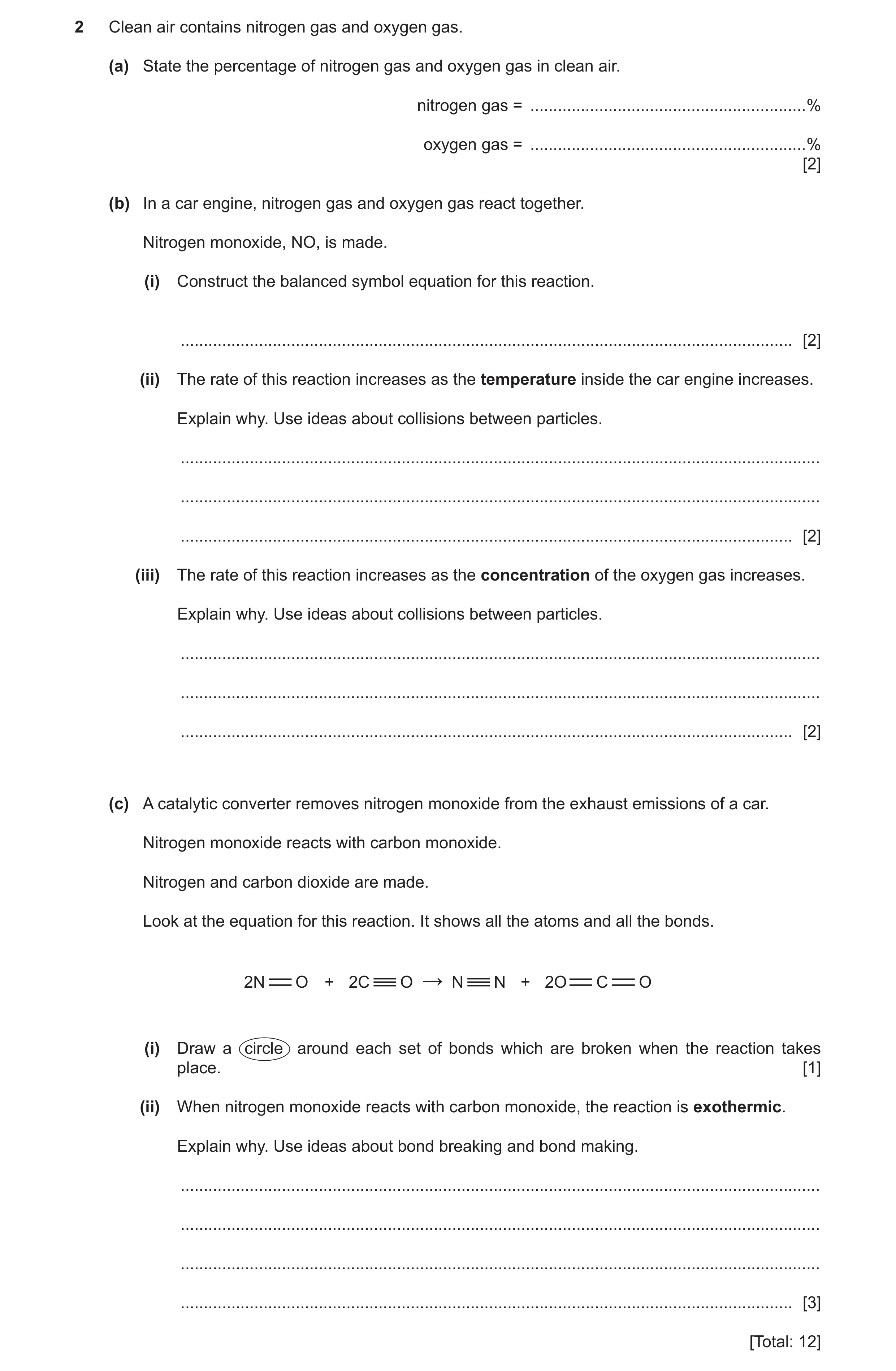
Q17 · Clean air contains nitrogen gas and oxygen gas 0654/42 May/June 2022
2 Clean air contains nitrogen gas and oxygen gas. (a) State the percentage of nitrogen gas and oxygen gas in clean air. nitrogen gas = … % oxygen gas = … % [2] (b) In a car engine, nitrogen gas and oxygen gas react together. Nitrogen monoxide, NO, is made. (i) Construct the balanced symbol equation for this reaction. … [2] (ii) The rate of this reaction increases as the temperature inside the car engine increases. Explain why. Use ideas about collisions between particles. … … … [2] (iii) The rate of this reaction increases as the concentration of the oxygen gas increases. Explain why. Use ideas about collisions between particles. … … … [2] (c) A catalytic converter removes nitrogen monoxide from the exhaust emissions of a car. Nitrogen monoxide reacts with carbon monoxide. Nitrogen and carbon dioxide are made. Look at the equation for this reaction. It shows all the atoms and all the bonds. 2N O + 2C O → N N + 2O C O (i) Draw a circle around each set of bonds which are broken when the reaction takes place. [1] (ii) When nitrogen monoxide reacts with carbon monoxide, the reaction is exothermic. Explain why. Use ideas about bond breaking and bond making. … … … … [3] [Total: 12]
12 marks
Mark scheme: 2(a) nitrogen gas – 78% ; oxygen gas – 21% ; 2 2(b)(i) N2 + O2 2NO ;; 2 2(b)(ii) any two from: particles move faster / particles have more kinetic energy ; more particles have, activation energy / sufficient energy, to react ; increased rate of (successful) collisions ; 2 2(b)(iii) more particles per unit volume / less space between particles ; increased rate of (successful) collisions ; 2 Question Answer Marks 2(c)(i) 2 + 2 ; 1 2(c)(ii) bond breaking, is endothermic / absorbs energy owtte ; bond making, is exothermic / releases energy owtte ; more energy is given out (in bond making) than is taken in (in bond breaking) ; 3
This question in 0654/42 May/June 2022
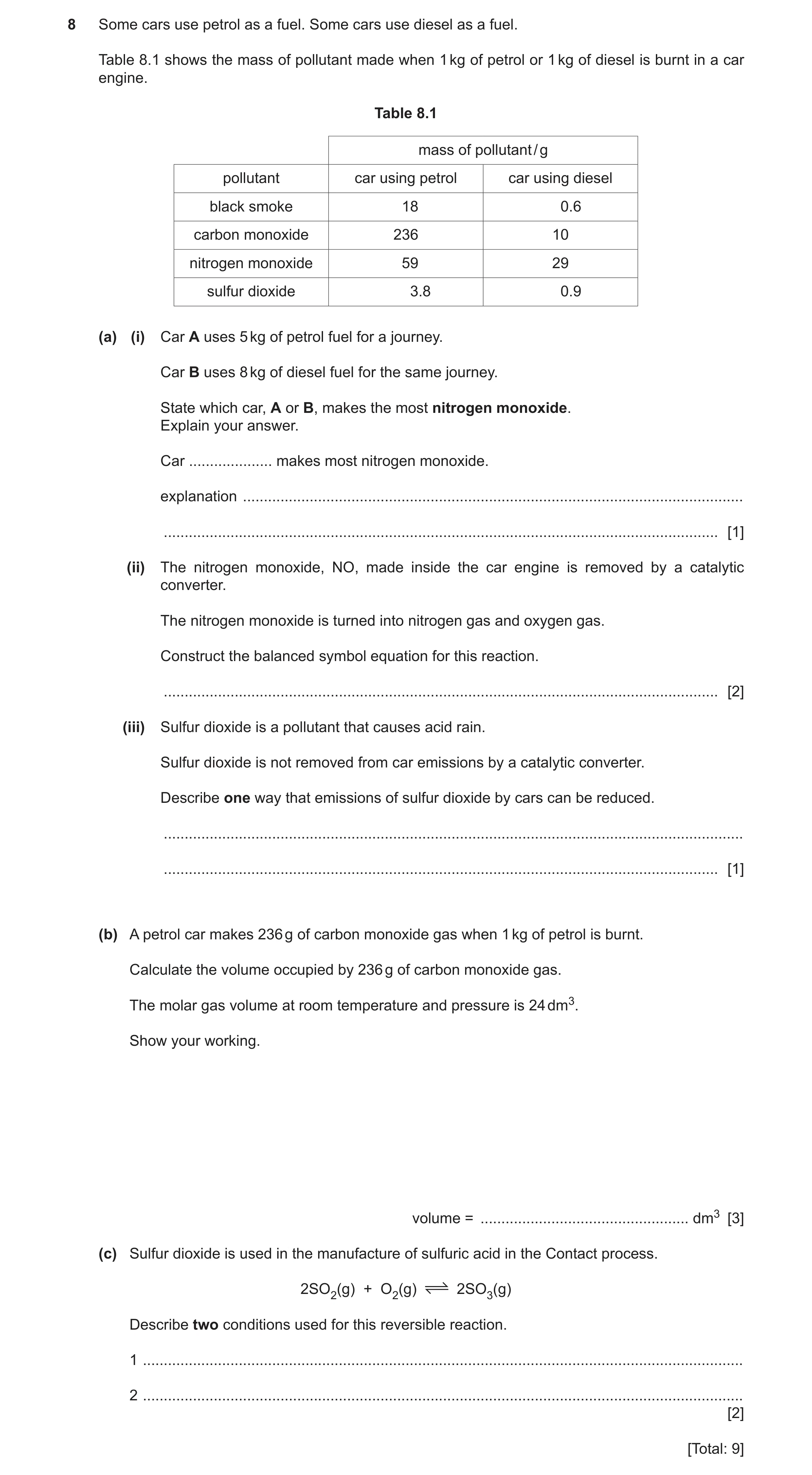
Q18 · Some cars use petrol as a fuel 0654/41 Oct/Nov 2022
8 Some cars use petrol as a fuel. Some cars use diesel as a fuel. Table 8.1 shows the mass of pollutant made when 1 kg of petrol or 1 kg of diesel is burnt in a car engine. Table 8.1 mass of pollutant / g pollutant car using petrol car using diesel black smoke 18 0.6 carbon monoxide 236 10 nitrogen monoxide 59 29 sulfur dioxide 3.8 0.9 (a) (i) Car A uses 5 kg of petrol fuel for a journey. Car B uses 8 kg of diesel fuel for the same journey. State which car, A or B, makes the most nitrogen monoxide. Explain your answer. Car … makes most nitrogen monoxide. explanation … … [1] (ii) The nitrogen monoxide, NO, made inside the car engine is removed by a catalytic converter. The nitrogen monoxide is turned into nitrogen gas and oxygen gas. Construct the balanced symbol equation for this reaction. … [2] (iii) Sulfur dioxide is a pollutant that causes acid rain. Sulfur dioxide is not removed from car emissions by a catalytic converter. Describe one way that emissions of sulfur dioxide by cars can be reduced. … … [1] (b) A petrol car makes 236 g of carbon monoxide gas when 1 kg of petrol is burnt. Calculate the volume occupied by 236 g of carbon monoxide gas. The molar gas volume at room temperature and pressure is 24 dm3. Show your working. volume = … dm3 [3] (c) Sulfur dioxide is used in the manufacture of sulfuric acid in the Contact process. 2SO2(g) + O2(g) 2SO3(g) Describe two conditions used for this reversible reaction. 1 … 2 … [2] [Total: 9]
9 marks
Mark scheme: 8(a)(i) (car A / petrol car because) 1 car A / petrol car makes 5 59 OR 295 g (of nitrogen monoxide) but car B / diesel car makes 8 29 OR 232 g (of nitrogen monoxide) ; 8(a)(ii) 2NO → N2 + O2 2 correct formulae ; correct balancing ; 8(a)(iii) use of low sulfur fuel / remove sulfur from fuel ; 1 8(b) Mr of CO = 28 ; 3 (moles of CO =) 236 ÷ 28 OR 8.43 ; (volume of CO = 8.43 24 =) 202 dm³ ; 8(c) any two from: 2 pressure – 2 atmospheres / 200 kPa ; temperature – 450 °C ; vanadium(V) oxide / V2O5 catalyst ;
This question in 0654/41 Oct/Nov 2022
Q19 · A student reacts calcium carbonate with cold dilute hydrochloric acid 0654/42 Feb/March 2023
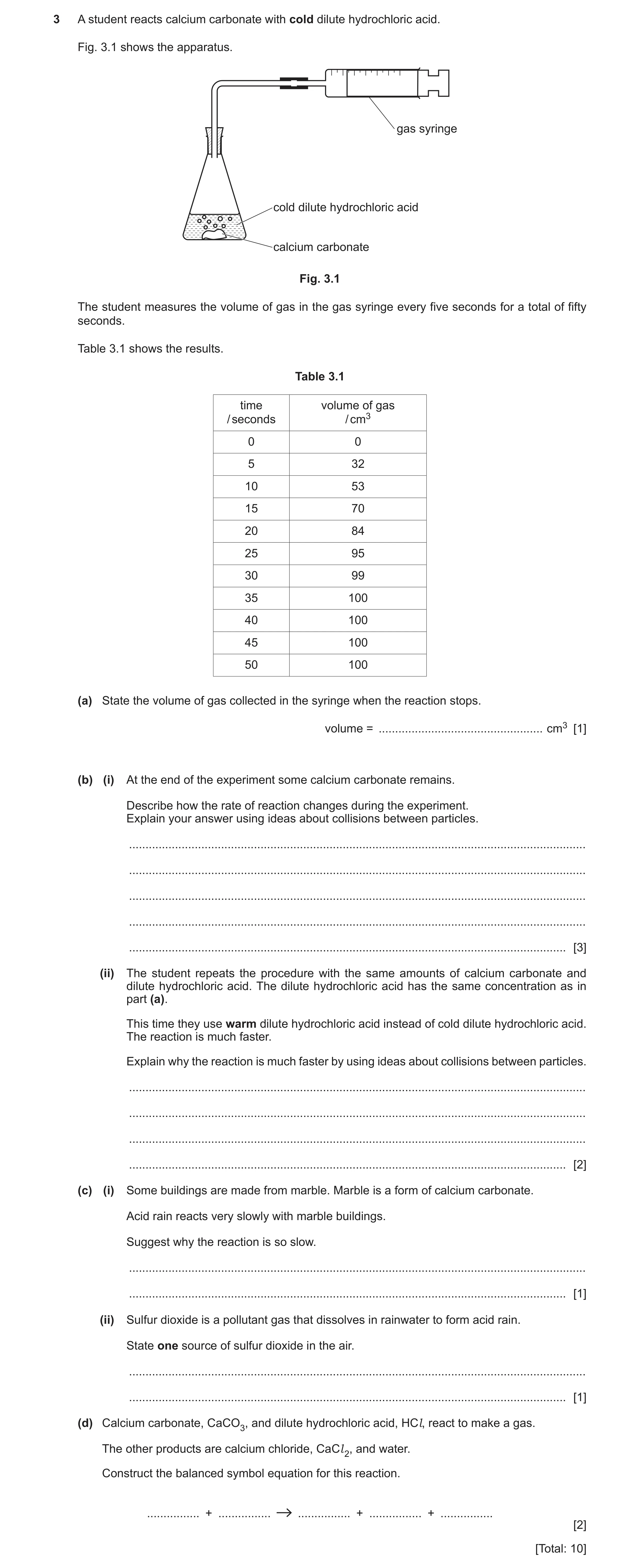
3 A student reacts calcium carbonate with cold dilute hydrochloric acid. Fig. 3.1 shows the apparatus. gas syringe cold dilute hydrochloric acid calcium carbonate Fig. 3.1 The student measures the volume of gas in the gas syringe every five seconds for a total of fifty seconds. Table 3.1 shows the results. Table 3.1 time volume of gas / seconds / cm3 0 0 5 32 10 53 15 70 20 84 25 95 30 99 35 100 40 100 45 100 50 100 (a) State the volume of gas collected in the syringe when the reaction stops. volume = … cm3 [1] (b) (i) At the end of the experiment some calcium carbonate remains. Describe how the rate of reaction changes during the experiment. Explain your answer using ideas about collisions between particles. … … … … … [3] (ii) The student repeats the procedure with the same amounts of calcium carbonate and dilute hydrochloric acid. The dilute hydrochloric acid has the same concentration as in part (a). This time they use warm dilute hydrochloric acid instead of cold dilute hydrochloric acid. The reaction is much faster. Explain why the reaction is much faster by using ideas about collisions between particles. … … … … [2] (c) (i) Some buildings are made from marble. Marble is a form of calcium carbonate. Acid rain reacts very slowly with marble buildings. Suggest why the reaction is so slow. … … [1] (ii) Sulfur dioxide is a pollutant gas that dissolves in rainwater to form acid rain. State one source of sulfur dioxide in the air. … … [1] (d) Calcium carbonate, CaCO3, and dilute hydrochloric acid, HCl, react to make a gas. The other products are calcium chloride, CaCl 2, and water. Construct the balanced symbol equation for this reaction. … + … … + … + … [2] [Total: 10]
10 marks
Mark scheme: 3(a) 100 (cm3) ; 1 3(b)(i) rate of reaction decreases ; 3 as the reaction proceeds there are less particles in the same volume / less crowded particles ; therefore less collisions per second ; 3(b)(ii) particles move faster / particles have more (kinetic) energy ; 2 more (successful) collisions per second / owtte ; 3(c)(i) acid is very dilute / marble is in large pieces or has a small surface area ; 1 3(c)(ii) combustion of fossil fuels (which contain sulfur compounds) / AVP ; 1 3(d) CaCO3 + 2 HCl → CaCl2 + H2O + CO2 ;; 2
This question in 0654/42 Feb/March 2023
Q20 · A boiler that uses combustion of natural gas to heat water 0654/41 May/June 2023
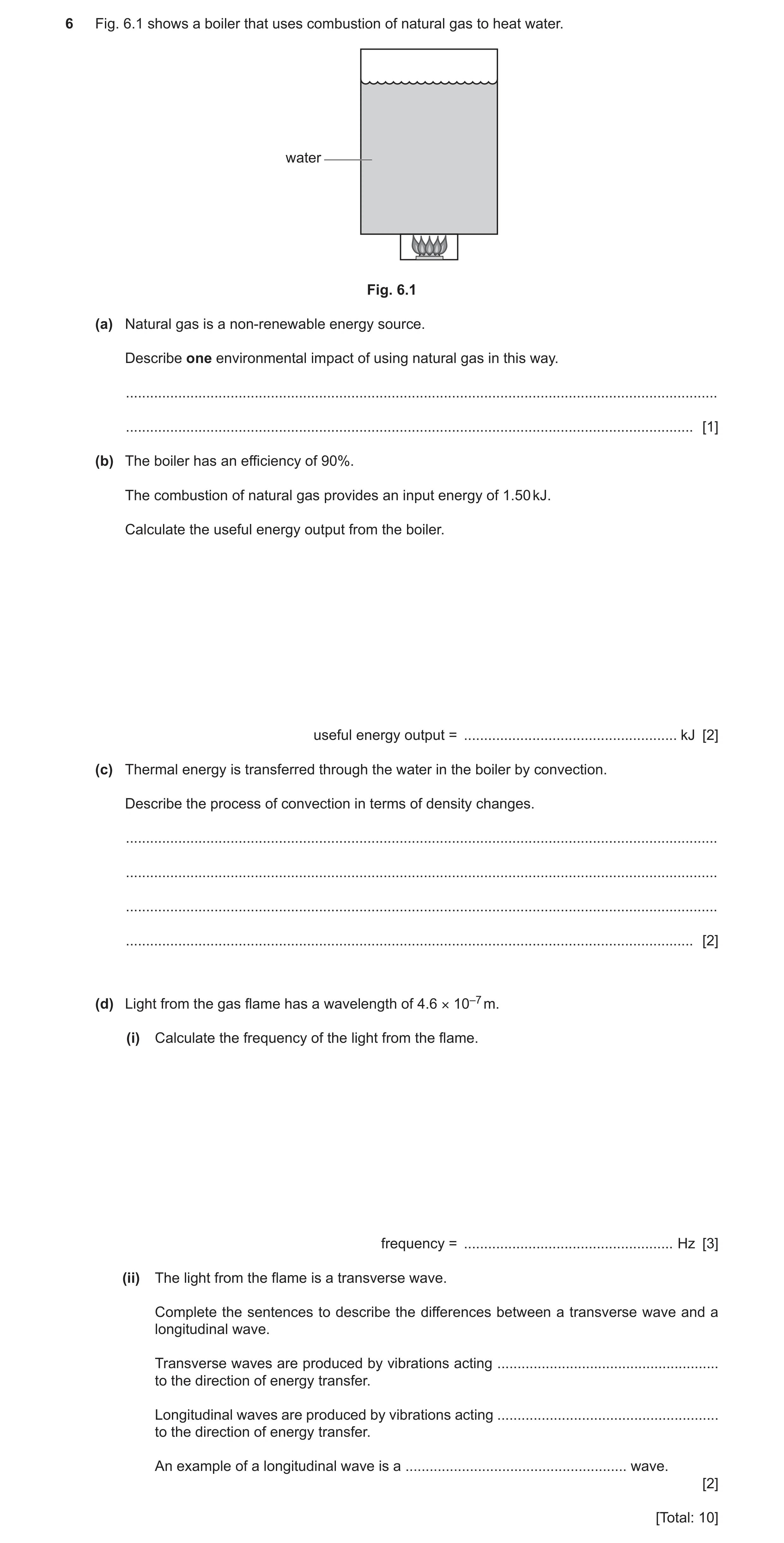
6 Fig. 6.1 shows a boiler that uses combustion of natural gas to heat water. water Fig. 6.1 (a) Natural gas is a non‑renewable energy source. Describe one environmental impact of using natural gas in this way. … … [1] (b) The boiler has an efficiency of 90%. The combustion of natural gas provides an input energy of 1.50 kJ. Calculate the useful energy output from the boiler. useful energy output = … kJ [2] (c) Thermal energy is transferred through the water in the boiler by convection. Describe the process of convection in terms of density changes. … … … … [2] (d) Light from the gas flame has a wavelength of 4.6 × 10⁻⁷ m. (i) Calculate the frequency of the light from the flame. frequency = … Hz [3] (ii) The light from the flame is a transverse wave. Complete the sentences to describe the differences between a transverse wave and a longitudinal wave. Transverse waves are produced by vibrations acting … to the direction of energy transfer. Longitudinal waves are produced by vibrations acting … to the direction of energy transfer. An example of a longitudinal wave is a … wave. [2] [Total: 10]
10 marks
Mark scheme: 6(a) (releases CO2) contributes to global warming / causes climate change / (enhanced) greenhouse effect ; 1 6(b) (output = ) efficiency input / 0.9 1.50 ; (output = ) 1.35 (kJ) ; 2 6(c) density of water decreases as it is heated ; less dense / heated water rises ; 2 6(d)(i) 3 108 (m / s) ; (frequency = ) speed / wavelength / 3 108/4.6 10–7 ; (frequency = ) 6.5 1014 (Hz) ; 3 6(d)(ii) perpendicular and parallel ; sound ; 2
This question in 0654/41 May/June 2023
Q21 · Ammonia is made from the reaction of nitrogen and hydrogen in the Haber process 0654/42 May/June 2023
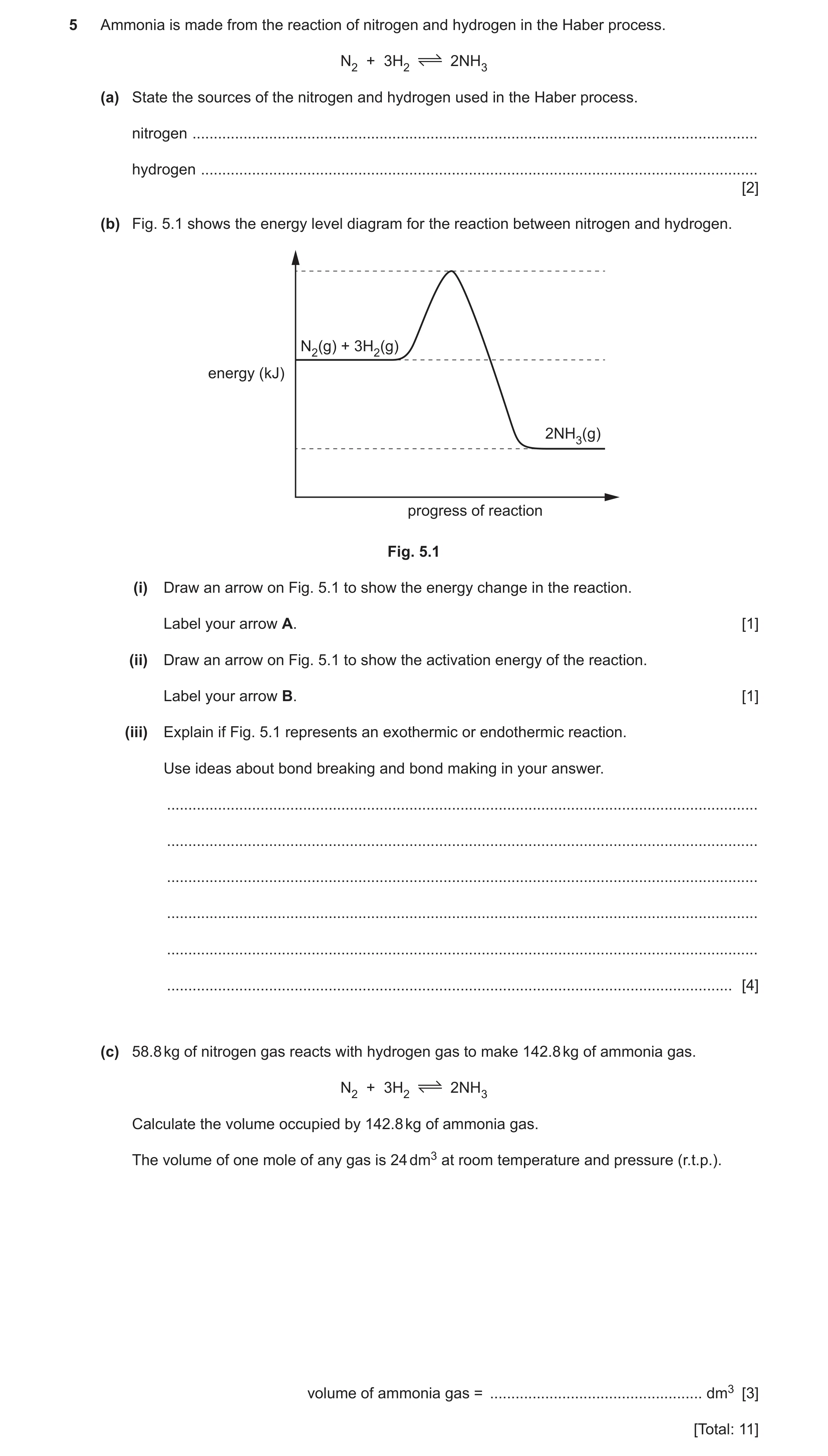
5 Ammonia is made from the reaction of nitrogen and hydrogen in the Haber process. N2 + 3H2 2NH3 (a) State the sources of the nitrogen and hydrogen used in the Haber process. nitrogen … hydrogen … [2] (b) Fig. 5.1 shows the energy level diagram for the reaction between nitrogen and hydrogen. N2(g) + 3H2(g) energy (kJ) 2NH3(g) progress of reaction Fig. 5.1 (i) Draw an arrow on Fig. 5.1 to show the energy change in the reaction. Label your arrow A. [1] (ii) Draw an arrow on Fig. 5.1 to show the activation energy of the reaction. Label your arrow B. [1] (iii) Explain if Fig. 5.1 represents an exothermic or endothermic reaction. Use ideas about bond breaking and bond making in your answer. … … … … … … [4] (c) 58.8 kg of nitrogen gas reacts with hydrogen gas to make 142.8 kg of ammonia gas. N2 + 3H2 2NH3 Calculate the volume occupied by 142.8 kg of ammonia gas. The volume of one mole of any gas is 24 dm3 at room temperature and pressure (r.t.p.). volume of ammonia gas = … dm3 [3] [Total: 11]
11 marks
Mark scheme: 5(a) nitrogen – (from the) air ; hydrogen – from the reaction of methane / natural gas with steam ; 2 5(b)(i) ; 1 5(b)(ii) ; 1 A B Question Answer Marks 5(b)(iii) (exothermic because) energy change is negative / energy is given out in the reaction / energy of reactants is higher than energy of products ; bond breaking is endothermic / owtte ; bond making is exothermic / owtte ; more energy is given out (in bond making) than is taken in (in bond breaking) ; 4 5(c) Mr of NH3 = 17 ; moles of NH3 = 142 800 ÷ 17 = 8400 ; volume of NH3 = 8400 24 = 201 600 (dm³) ; 3
This question in 0654/42 May/June 2023
Q22 · Petroleum is separated into different fractions 0654/43 May/June 2023
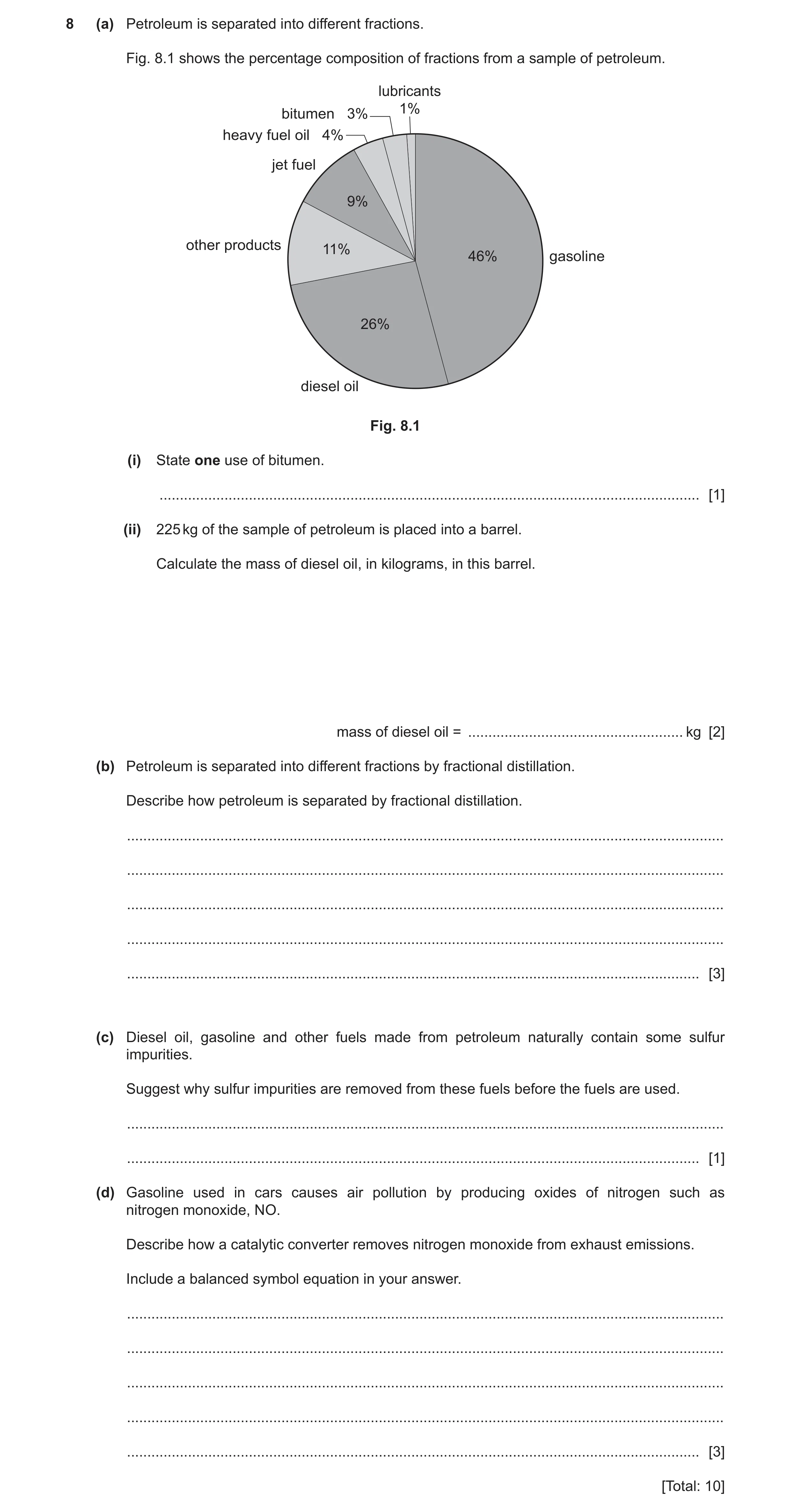
8 (a) Petroleum is separated into different fractions. Fig. 8.1 shows the percentage composition of fractions from a sample of petroleum. lubricants 1% bitumen 3% heavy fuel oil 4% jet fuel 9% other products 11% 46% gasoline 26% diesel oil Fig. 8.1 (i) State one use of bitumen. … [1] (ii) 225 kg of the sample of petroleum is placed into a barrel. Calculate the mass of diesel oil, in kilograms, in this barrel. mass of diesel oil = … kg [2] (b) Petroleum is separated into different fractions by fractional distillation. Describe how petroleum is separated by fractional distillation. … … … … … [3] (c) Diesel oil, gasoline and other fuels made from petroleum naturally contain some sulfur impurities. Suggest why sulfur impurities are removed from these fuels before the fuels are used. … … [1] (d) Gasoline used in cars causes air pollution by producing oxides of nitrogen such as nitrogen monoxide, NO. Describe how a catalytic converter removes nitrogen monoxide from exhaust emissions. Include a balanced symbol equation in your answer. … … … … … [3] [Total: 10]
10 marks
Mark scheme: 8(a)(i) road surfaces ; 1 8(a)(ii) 225 26 100 ; = 59 (kg) ; 2 8(b) fractions are separated according to their boiling point ; petroleum is heated AND idea that vapours rise (and cool) ; idea that vapours condense when they become cool enough ; 3 8(c) idea that sulfur impurities cause acid rain ; 1 Question Answer Marks 8(d) idea that nitrogen monoxide is removed from exhaust emissions by reaction over a hot catalyst / at high temperature ; AND ONE EQUATION FROM 2NO + 2CO N2 + 2CO2 or 2NO N2 + O2 correct formulae ; correct balancing ; 3
This question in 0654/43 May/June 2023
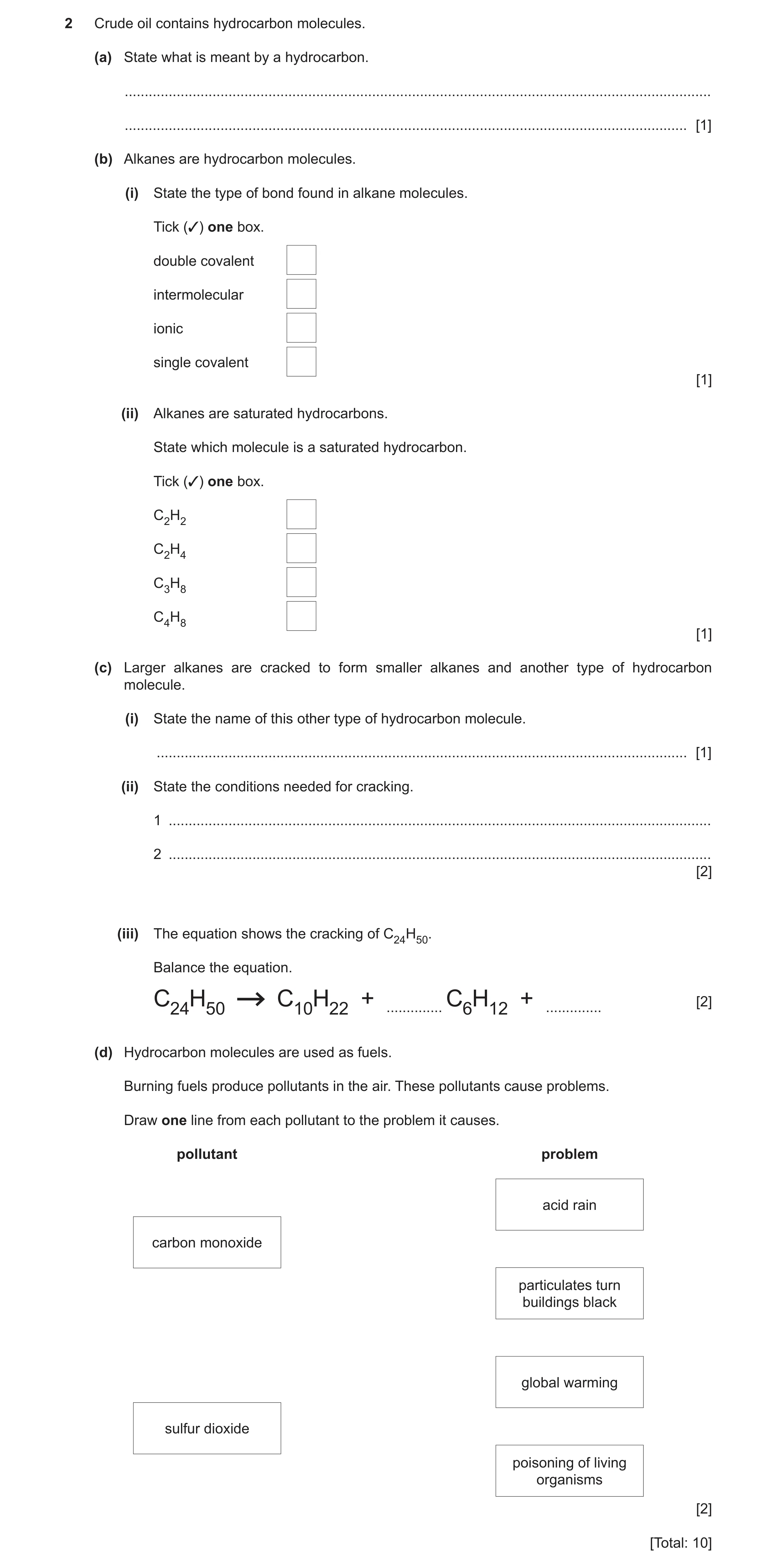
Q23 · Crude oil contains hydrocarbon molecules 0654/41 Oct/Nov 2023
2 Crude oil contains hydrocarbon molecules. (a) State what is meant by a hydrocarbon. … … [1] (b) Alkanes are hydrocarbon molecules. (i) State the type of bond found in alkane molecules. Tick (3) one box. double covalent intermolecular ionic single covalent [1] (ii) Alkanes are saturated hydrocarbons. State which molecule is a saturated hydrocarbon. Tick (3) one box. C2H2 C2H4 C3H8 C4H8 [1] (c) Larger alkanes are cracked to form smaller alkanes and another type of hydrocarbon molecule. (i) State the name of this other type of hydrocarbon molecule. … [1] (ii) State the conditions needed for cracking. 1 … 2 … [2] (iii) The equation shows the cracking of C24H50. Balance the equation. [2] C24H50 C10H22 + … C6H12 + … (d) Hydrocarbon molecules are used as fuels. Burning fuels produce pollutants in the air. These pollutants cause problems. Draw one line from each pollutant to the problem it causes. pollutant problem acid rain carbon monoxide particulates turn buildings black global warming sulfur dioxide poisoning of living organisms [2] [Total: 10]
10 marks
Mark scheme: 2(a) (compound that) contains only carbon and hydrogen (atoms) ; 1 2(b)(i) single covalent ; 1 2(b)(ii) C3H8 ; 1 2(c)(i) alkene ; 1 2(c)(ii) high temperature ; 2 catalyst ; 2(c)(iii) C24H50 → C10H22 + 2 C6H12 + C2H4 2 correct number of C in products ; correct number of H in products ; 2(d) 2 pollutant problem acid rain carbon monoxide particulates turn buildings black global warming sulfur dioxide poisoning of living organisms correct link for carbon monoxide ; correct link for sulfur dioxide ;
This question in 0654/41 Oct/Nov 2023
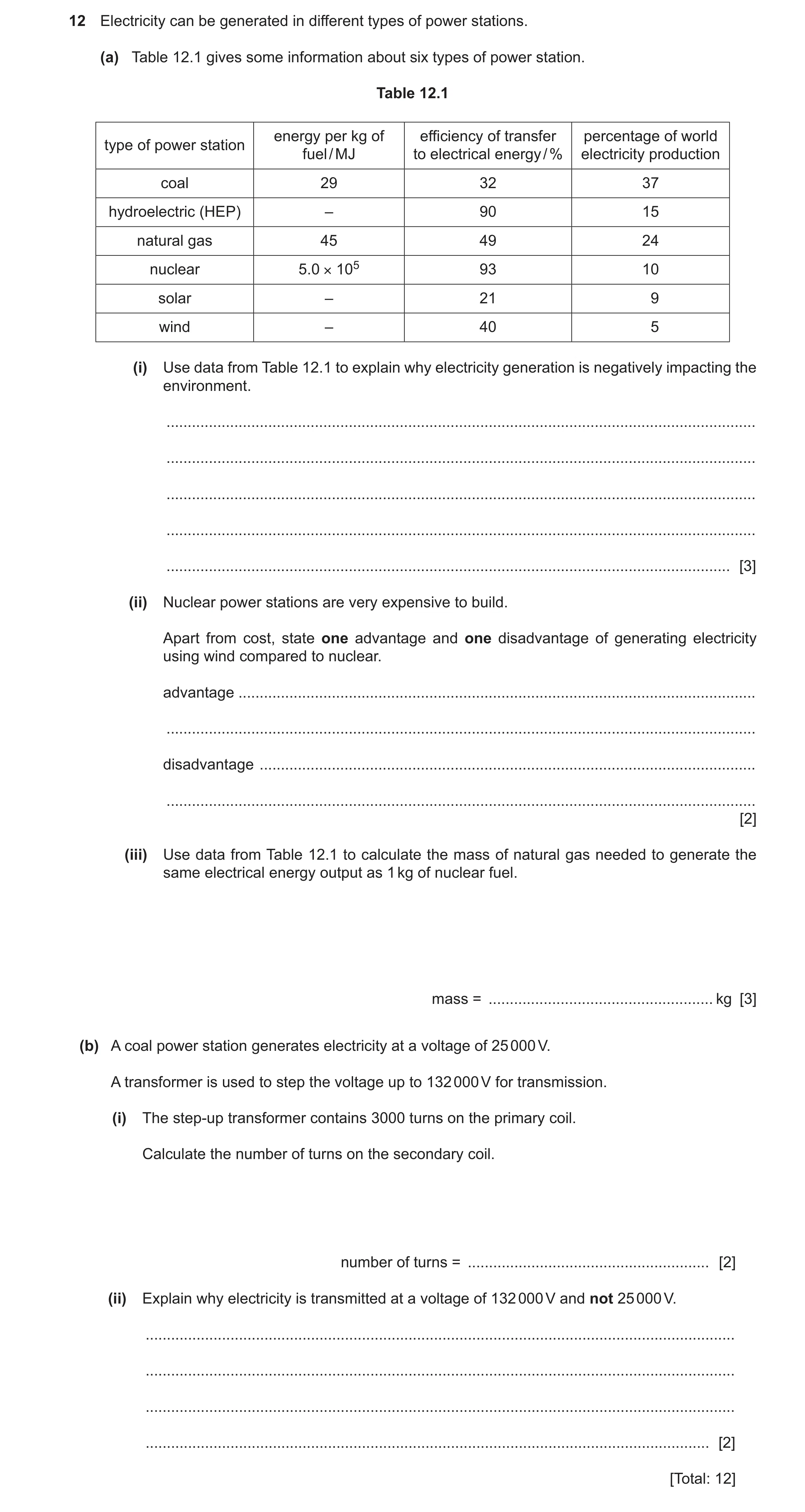
Q24 · Electricity can be generated in different types of power stations 0654/42 May/June 2024
12 Electricity can be generated in different types of power stations. (a) Table 12.1 gives some information about six types of power station. Table 12.1 energy per kg of efficiency of transfer percentage of world type of power station fuel / MJ to electrical energy / % electricity production coal 29 32 37 hydroelectric (HEP) – 90 15 natural gas 45 49 24 nuclear 5.0 × 10⁵ 93 10 solar – 21 9 wind – 40 5 (i) Use data from Table 12.1 to explain why electricity generation is negatively impacting the environment. … … … … … [3] (ii) Nuclear power stations are very expensive to build. Apart from cost, state one advantage and one disadvantage of generating electricity using wind compared to nuclear. advantage … … disadvantage … … [2] (iii) Use data from Table 12.1 to calculate the mass of natural gas needed to generate the same electrical energy output as 1 kg of nuclear fuel. mass = … kg [3] (b) A coal power station generates electricity at a voltage of 25 000 V. A transformer is used to step the voltage up to 132 000 V for transmission. (i) The step‑up transformer contains 3000 turns on the primary coil. Calculate the number of turns on the secondary coil. number of turns = … [2] (ii) Explain why electricity is transmitted at a voltage of 132 000 V and not 25 000 V. … … … … [2] [Total: 12]
12 marks
Mark scheme: 12(a)(i) highest percentage of electricity is generated by, coal (and natural gas) / fossil fuels / 61% of production from fossil fuels or coal and natural gas / 37% of production from coal / 24% of production from natural gas ; plus coal / natural gas / fossil fuels, release, carbon dioxide ; cause climate change / global warming / enhanced greenhouse effect ; OR coal / natural gas / fossil fuels, release sulfur dioxide ; causes acid rain ; Question Answer Marks 12(a)(ii) (advantage:) no nuclear, waste / accidents / suitable for small scale / no fuel is used / less set up time / AVP ; (disadvantage:) only works when wind speed is suitable / is less efficient / need lots of turbines (to generate large amounts of electricity) / noise pollution / AVP ; 2 12(a)(iii) (nuclear output E per kg =) 5.0 105 0.93 = 4.65 105 (MJ) ; (gas output E per kg =) 45 0.49 = 22.05 (MJ) ; = 4.65 105 / 22.05 = 21 000 (kg) ; 3 12(b)(i) (Ns =) NpxVs / Vp OR 3000 132 000 / 25 000 ; (Ns =) 16 000 ; 2 12(b)(ii) (increasing the voltage) reduces the current ; less, energy / power / heat, loss ; 2
This question in 0654/42 May/June 2024
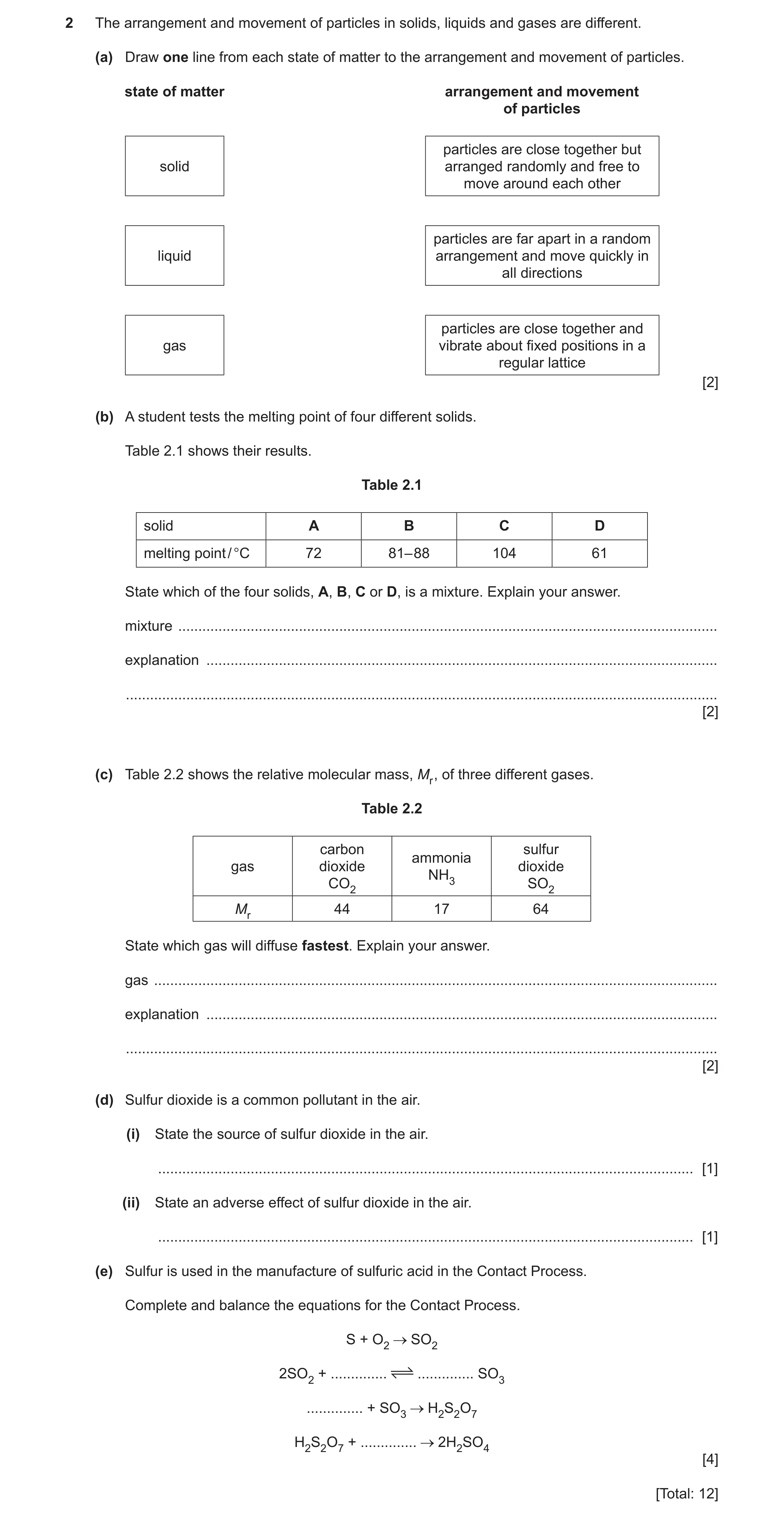
Q25 · The arrangement and movement of particles in solids, liquids and gases are different 0654/41 Oct/Nov 2024
2 The arrangement and movement of particles in solids, liquids and gases are different. (a) Draw one line from each state of matter to the arrangement and movement of particles. state of matter arrangement and movement of particles particles are close together but solid arranged randomly and free to move around each other particles are far apart in a random liquid arrangement and move quickly in all directions particles are close together and gas vibrate about fixed positions in a regular lattice [2] (b) A student tests the melting point of four different solids. Table 2.1 shows their results. Table 2.1 solid A B C D melting point / °C 72 81– 88 104 61 State which of the four solids, A, B, C or D, is a mixture. Explain your answer. mixture … explanation … … [2] (c) Table 2.2 shows the relative molecular mass, Mr , of three different gases. Table 2.2 carbon sulfur ammonia gas dioxide dioxide NH3 CO2 SO2 Mr 44 17 64 State which gas will diffuse fastest. Explain your answer. gas … explanation … … [2] (d) Sulfur dioxide is a common pollutant in the air. (i) State the source of sulfur dioxide in the air. … [1] (ii) State an adverse effect of sulfur dioxide in the air. … [1] (e) Sulfur is used in the manufacture of sulfuric acid in the Contact Process. Complete and balance the equations for the Contact Process. S + O2 SO2 2SO2 + … … SO3 … + SO3 H2S2O7 H2S2O7 + … 2H2SO4 [4] [Total: 12]
12 marks
Mark scheme: 2(a) 2 one or two correct for 1 mark three correct for 2 marks ;; 2(b) (mixture) B ; 2 (mixtures) melt over a range (of temperatures) / not a fixed / certain / sharp / single (melting) point / more than one (melting) point ; 2(c) (gas) ammonia / NH3 ; 2 (ammonia) has the lowest Mr / is the lightest gas ; 2(d)(i) combustion of fossil fuels (containing sulfur compounds) ; 1 2(d)(ii) any one from: 1 causes acid rain ; causes breathing difficulties (asthma) ; 2(e) 2SO2 + O2 ⇌ 2 SO3 ;; 4 H2SO4 + SO3 → H2S2O7 ; H2S2O7 + H2O → 2H2SO4 ;
This question in 0654/41 Oct/Nov 2024
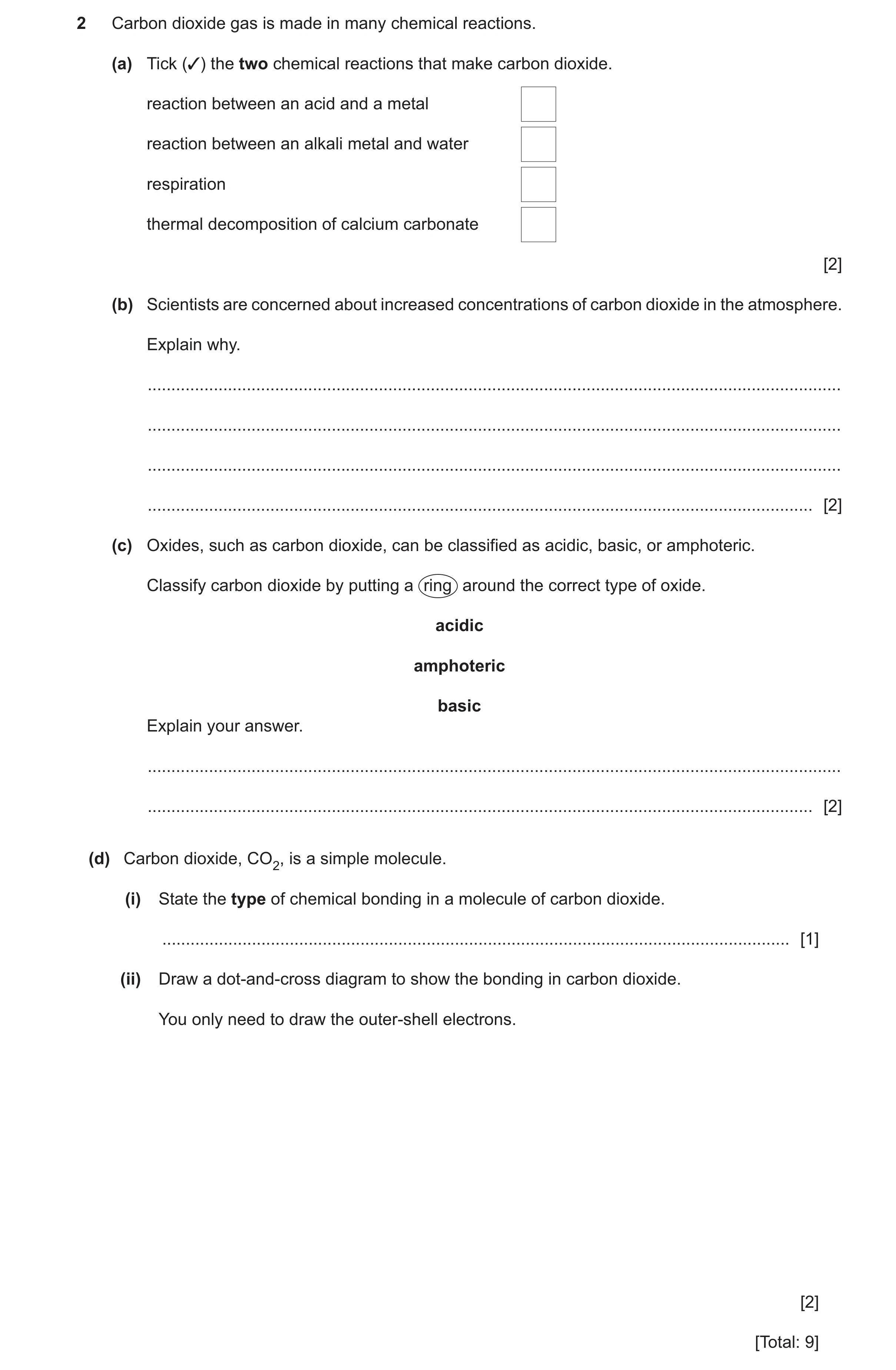
Q26 · Carbon dioxide gas is made in many chemical reactions 0654/42 Oct/Nov 2024
2 Carbon dioxide gas is made in many chemical reactions. (a) Tick (✓) the two chemical reactions that make carbon dioxide. reaction between an acid and a metal reaction between an alkali metal and water respiration thermal decomposition of calcium carbonate [2] (b) Scientists are concerned about increased concentrations of carbon dioxide in the atmosphere. Explain why. … … … … [2] (c) Oxides, such as carbon dioxide, can be classified as acidic, basic, or amphoteric. Classify carbon dioxide by putting a ring around the correct type of oxide. acidic amphoteric basic Explain your answer. … … [2] (d) Carbon dioxide, CO2, is a simple molecule. (i) State the type of chemical bonding in a molecule of carbon dioxide. … [1] (ii) Draw a dot-and-cross diagram to show the bonding in carbon dioxide. You only need to draw the outer-shell electrons. [2] [Total: 9]
9 marks
Mark scheme: 2(a) 2 reaction between an acid and a metal reaction between an alkali metal and water respiration thermal decomposition of calcium carbonate 1 mark for each correct tick ;; 2(b) (idea that) carbon dioxide is a greenhouse gas / there is an (enhanced) greenhouse effect ; 2 (increased concentrations of greenhouse gases cause) climate change ; 2(c) acidic ; 2 carbon is a non-metal ; 2(d)(i) covalent ; 1 2(d)(ii) 2 double bonds between C and O atoms correct ; rest of structure correct ;
This question in 0654/42 Oct/Nov 2024
Q27 · A sodium atom is represented with numbers next to its chemical symbol, as shown in Fig 0654/41 May/June 2025
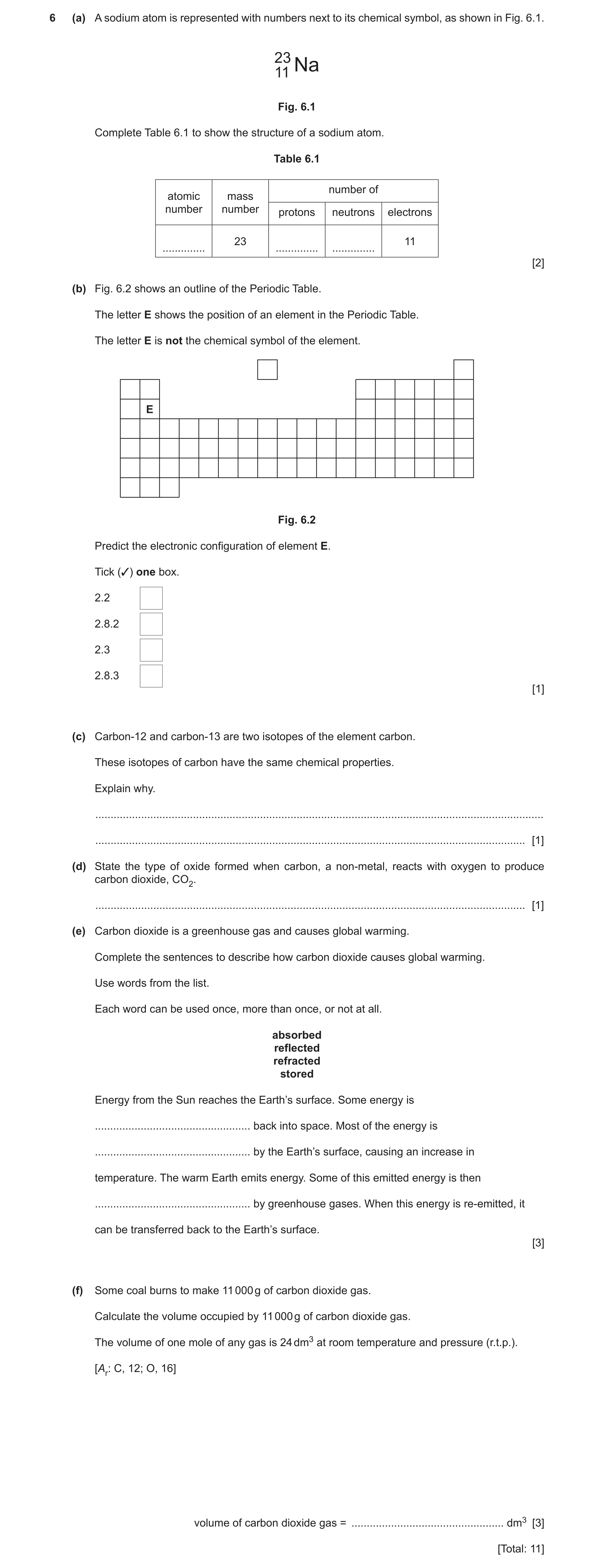
6 (a) A sodium atom is represented with numbers next to its chemical symbol, as shown in Fig. 6.1. 23 Na 11 Fig. 6.1 Complete Table 6.1 to show the structure of a sodium atom. Table 6.1 number of atomic mass number number protons neutrons electrons 23 11 … … … [2] (b) Fig. 6.2 shows an outline of the Periodic Table. The letter E shows the position of an element in the Periodic Table. The letter E is not the chemical symbol of the element. E Fig. 6.2 Predict the electronic configuration of element E. Tick (3) one box. 2.2 2.8.2 2.3 2.8.3 [1] (c) Carbon-12 and carbon-13 are two isotopes of the element carbon. These isotopes of carbon have the same chemical properties. Explain why. … … [1] (d) State the type of oxide formed when carbon, a non-metal, reacts with oxygen to produce carbon dioxide, CO2. … [1] (e) Carbon dioxide is a greenhouse gas and causes global warming. Complete the sentences to describe how carbon dioxide causes global warming. Use words from the list. Each word can be used once, more than once, or not at all. absorbed reflected refracted stored Energy from the Sun reaches the Earth’s surface. Some energy is … back into space. Most of the energy is … by the Earth’s surface, causing an increase in temperature. The warm Earth emits energy. Some of this emitted energy is then … by greenhouse gases. When this energy is re-emitted, it can be transferred back to the Earth’s surface. [3] (f) Some coal burns to make 11 000 g of carbon dioxide gas. Calculate the volume occupied by 11 000 g of carbon dioxide gas. The volume of one mole of any gas is 24 dm3 at room temperature and pressure (r.t.p.). [Ar: C, 12; O, 16] volume of carbon dioxide gas = … dm3 [3] [Total: 11]
11 marks
Mark scheme: 6(a) 2 atomic mass number of number number protons neutrons electrons 11 ; 23 11 12 ; 11 6(b) 2.8.2 ✓ ; 1 6(c) (the isotopes have) the same number of electrons / 1 the same electronic configuration ; 6(d) acidic (oxide) ; 1 6(e) reflected ; 3 absorbed ; absorbed / stored ; 6(f) Mr of CO2 = 44 ; 3 moles of CO2 = 11000 44 = 250 ; volume of CO2 = 250 24 = 6000 dm³ ;
This question in 0654/41 May/June 2025
Q28 · Hydrogen-oxygen fuel cells use hydrogen and oxygen to produce electricity 0654/41 Oct/Nov 2025
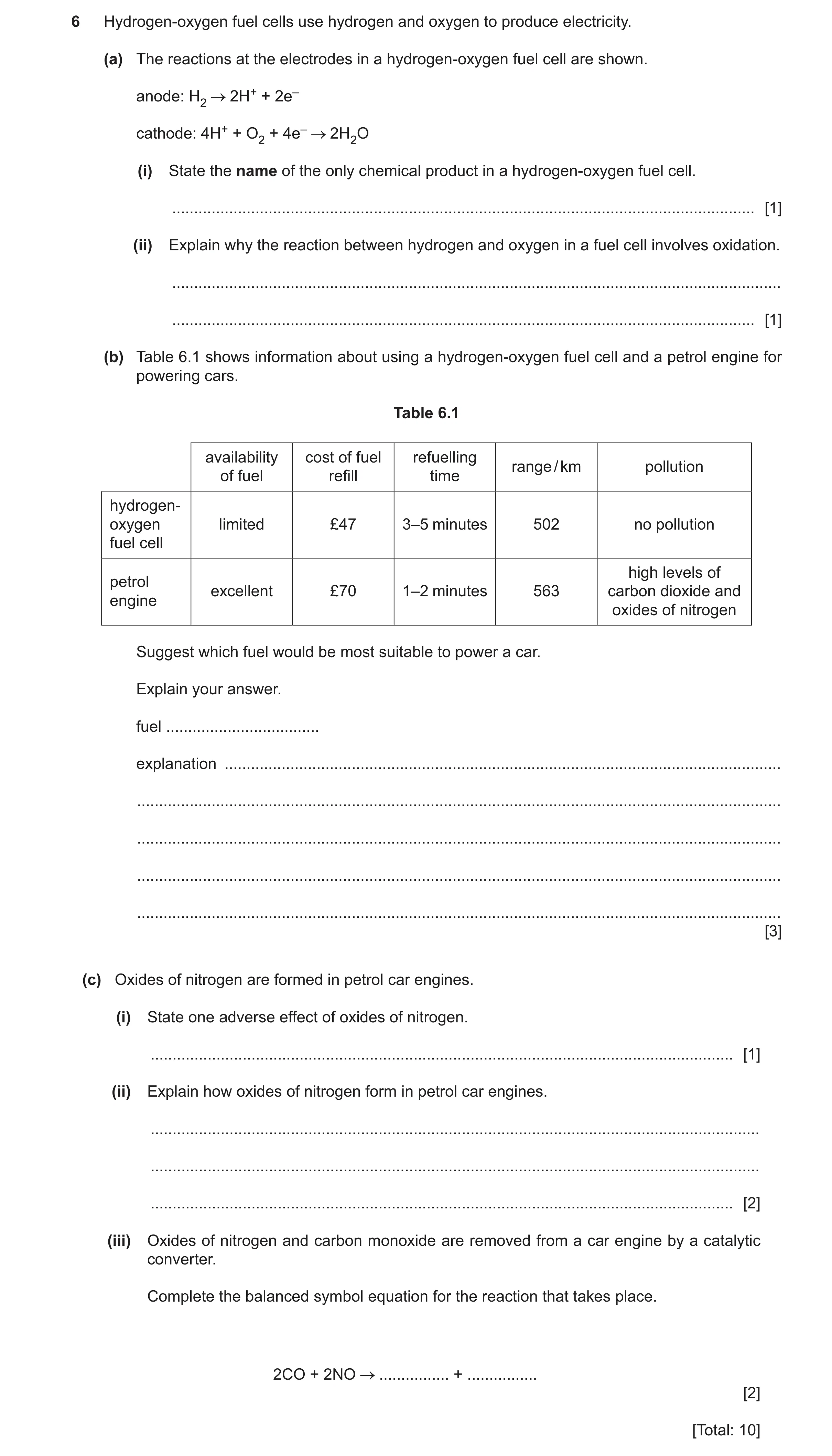
6 Hydrogen-oxygen fuel cells use hydrogen and oxygen to produce electricity. (a) The reactions at the electrodes in a hydrogen-oxygen fuel cell are shown. anode: H2 2H+ + 2e– cathode: 4H+ + O2 + 4e– 2H2O (i) State the name of the only chemical product in a hydrogen-oxygen fuel cell. … [1] (ii) Explain why the reaction between hydrogen and oxygen in a fuel cell involves oxidation. … … [1] (b) Table 6.1 shows information about using a hydrogen-oxygen fuel cell and a petrol engine for powering cars. Table 6.1 availability cost of fuel refuelling range / km pollution of fuel refill time hydrogen- oxygen limited £47 3–5 minutes 502 no pollution fuel cell high levels of petrol excellent £70 1–2 minutes 563 carbon dioxide and engine oxides of nitrogen Suggest which fuel would be most suitable to power a car. Explain your answer. fuel … explanation … … … … … [3] (c) Oxides of nitrogen are formed in petrol car engines. (i) State one adverse effect of oxides of nitrogen. … [1] (ii) Explain how oxides of nitrogen form in petrol car engines. … … … [2] (iii) Oxides of nitrogen and carbon monoxide are removed from a car engine by a catalytic converter. Complete the balanced symbol equation for the reaction that takes place. 2CO + 2NO … + … [2] [Total: 10]
10 marks
Mark scheme: 6(a)(i) water ; 1 6(a)(ii) loss of electrons (from hydrogen) ; 1 6(b) any three from: 3 hydrogen-oxygen (fuel cell) / hydrogen and oxygen • cheap(er) (than petrol) to refill ; • short refueling time ; • good range ; • no pollution ; OR petrol (engine) • high availability / excellent availability ; • quick(er) refueling ; • long(er) range (than hydrogen–oxygen) ; 6(c)(i) acid rain / respiratory problems ; 1 6(c)(ii) nitrogen reacts with oxygen ; 2 at high temperature (inside a car engine) ; 6(c)(iii) 2CO + 2NO → 2CO2 + N2 2 1 mark for products (either order) ; 1 mark for balancing ;
This question in 0654/41 Oct/Nov 2025
![Question 3: (a) (i) State the percentage of nitrogen in clean air. .............................% [1] (ii) Name two other uncombined gaseous elements i…](https://img.pastlit.com/crops/b4946fc1-1ba1-4f4a-a888-af11a644cd24/q5.webp)
 6 / 45
![Question 6: (a) State the percentage of nitrogen in clean air. ....................................................... % [1] (b) Fig. 2.1 shows the sep…](https://img.pastlit.com/crops/74e26cce-806a-4bae-af4d-983ff41c5fe0/q2.webp)
 13 / 45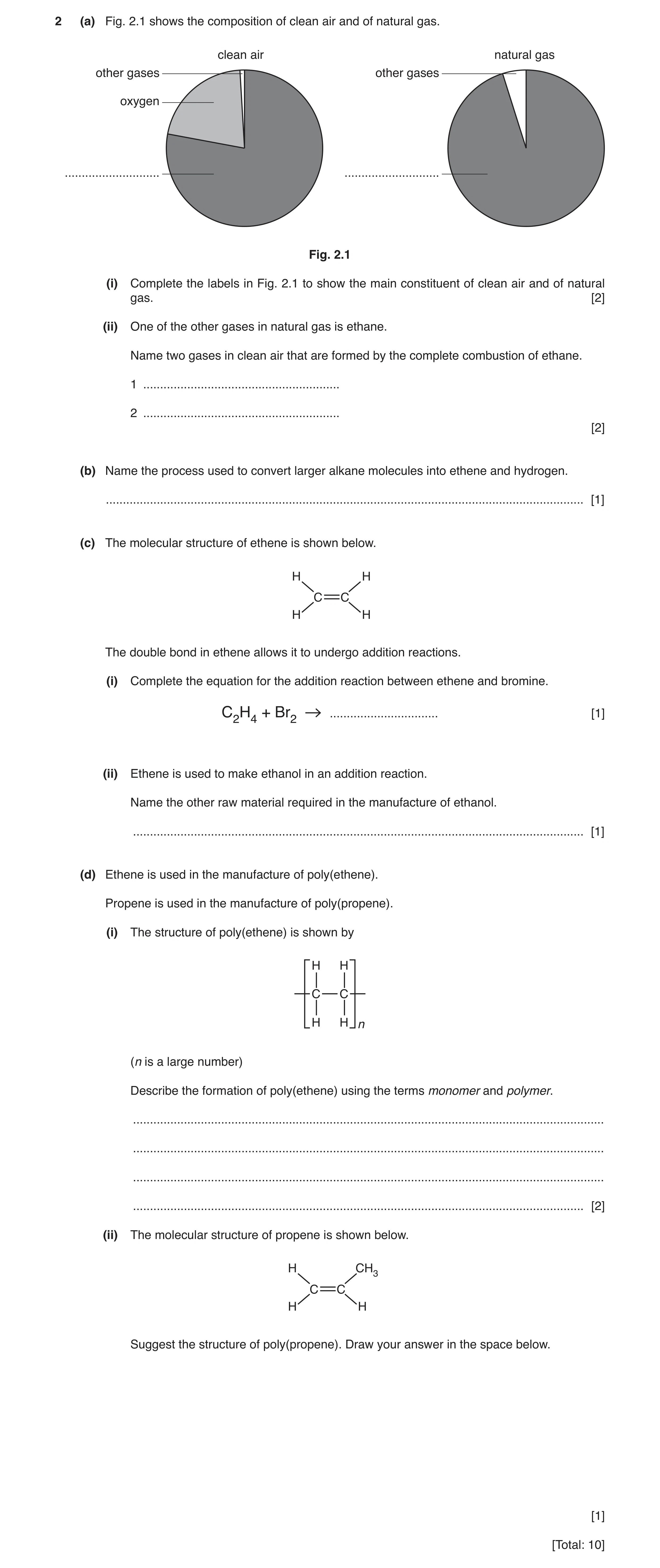
 13
13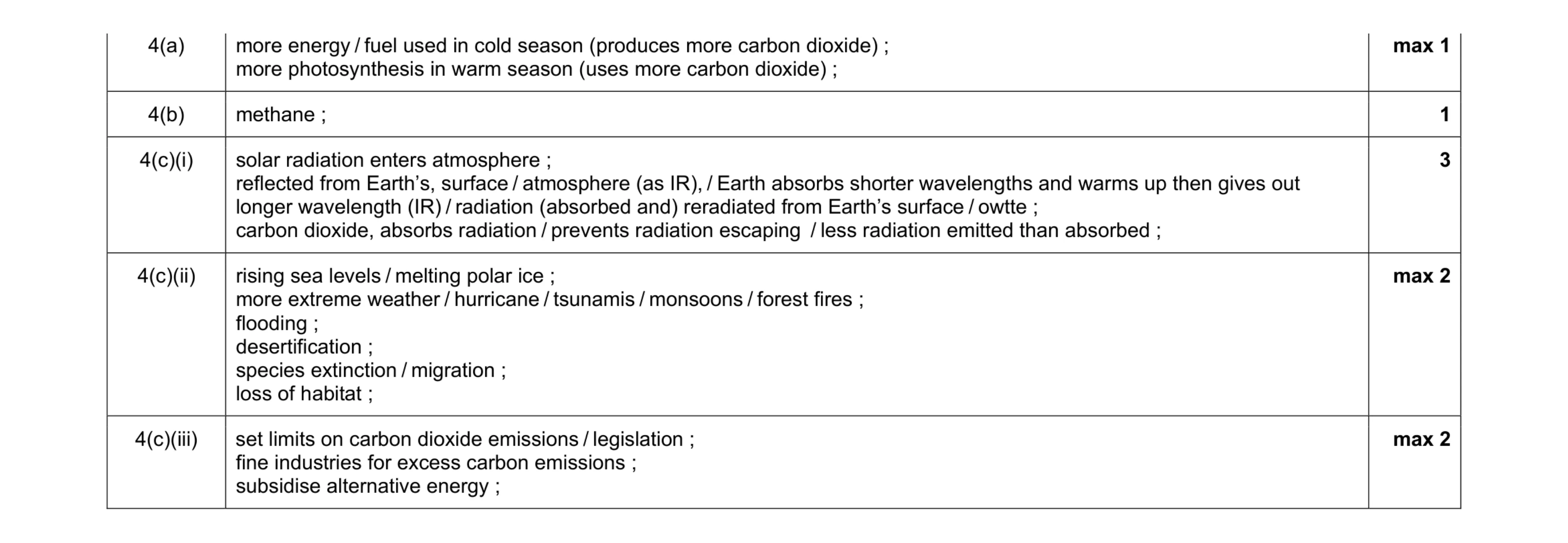 9
9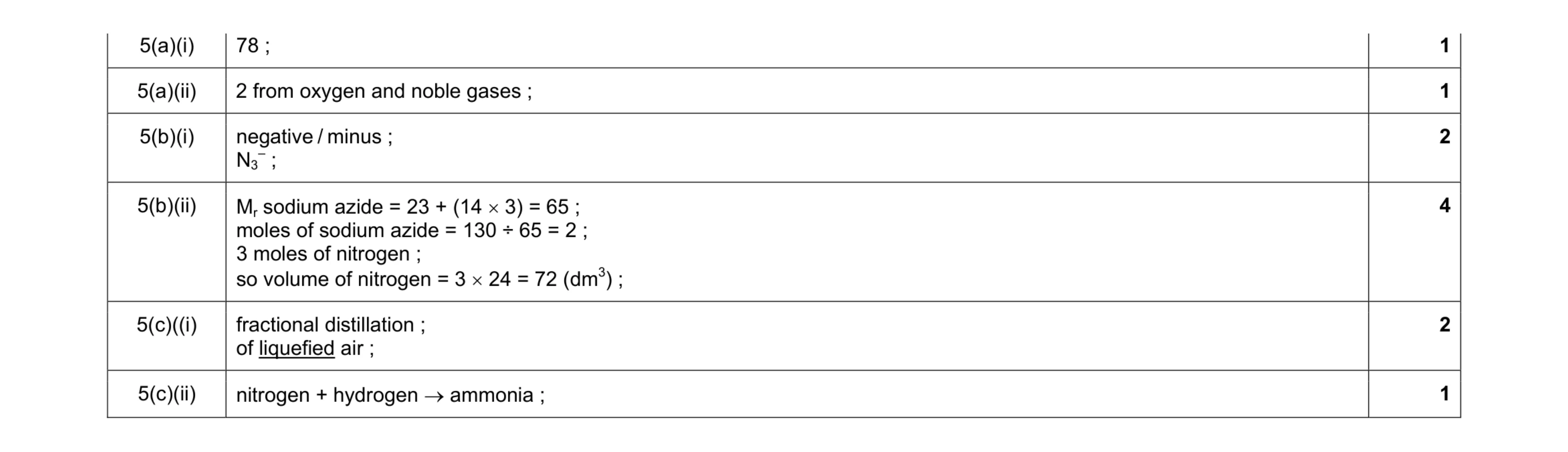 11
11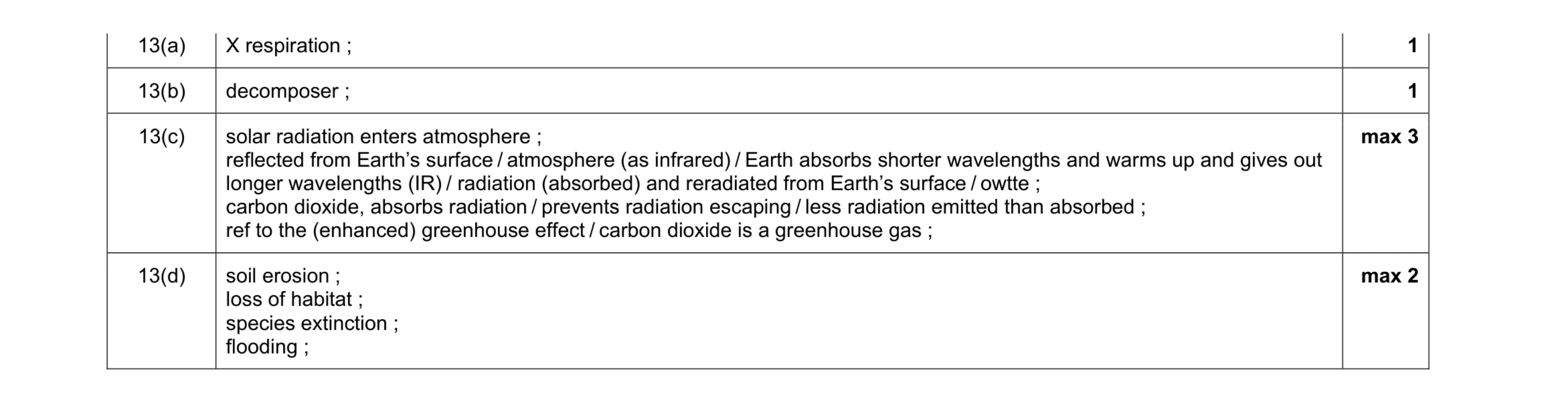 7
7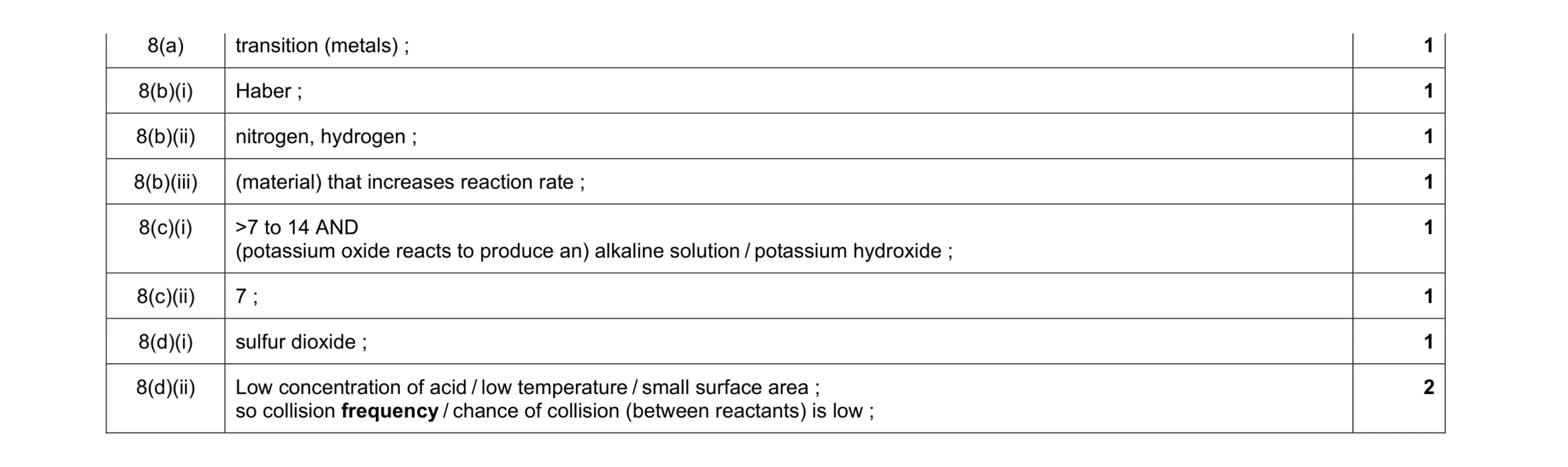 9
9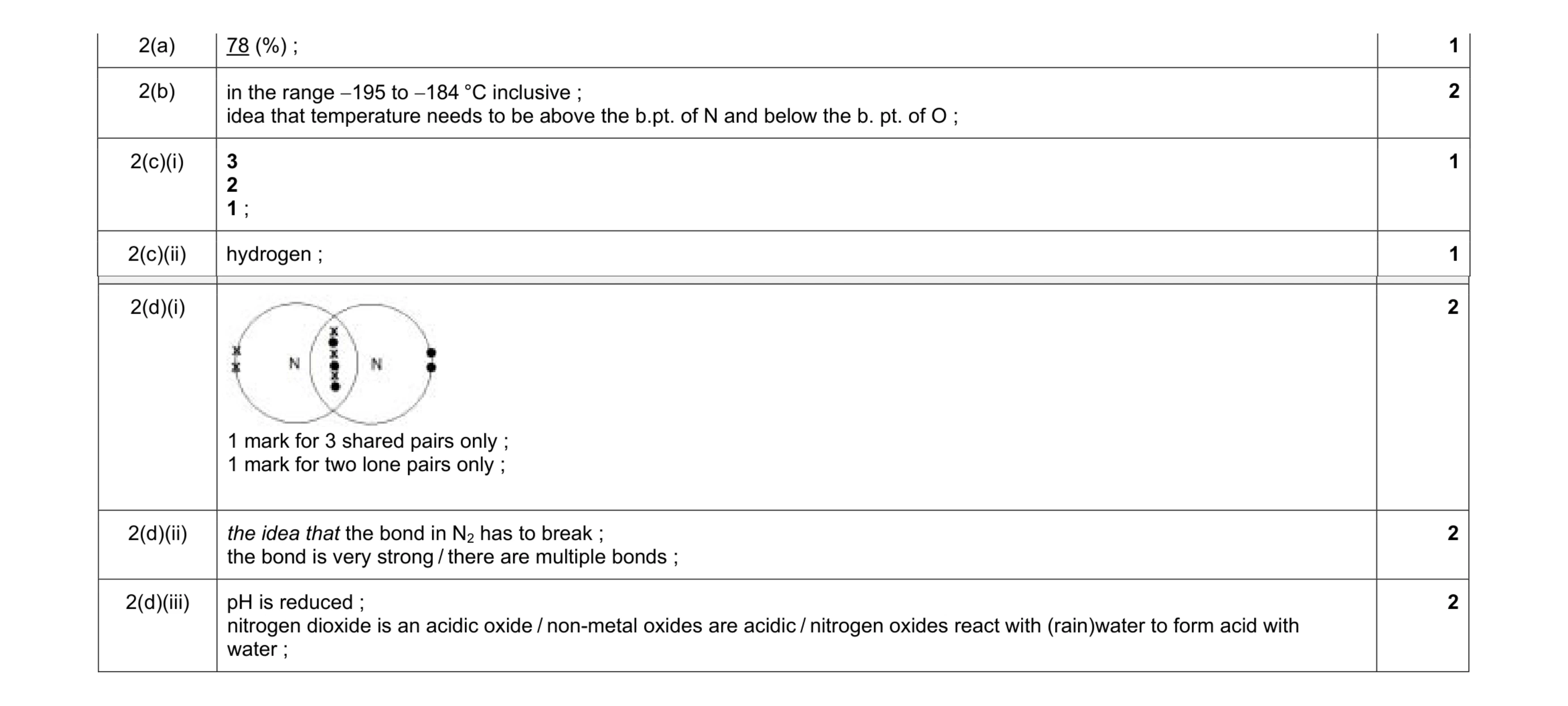 11
11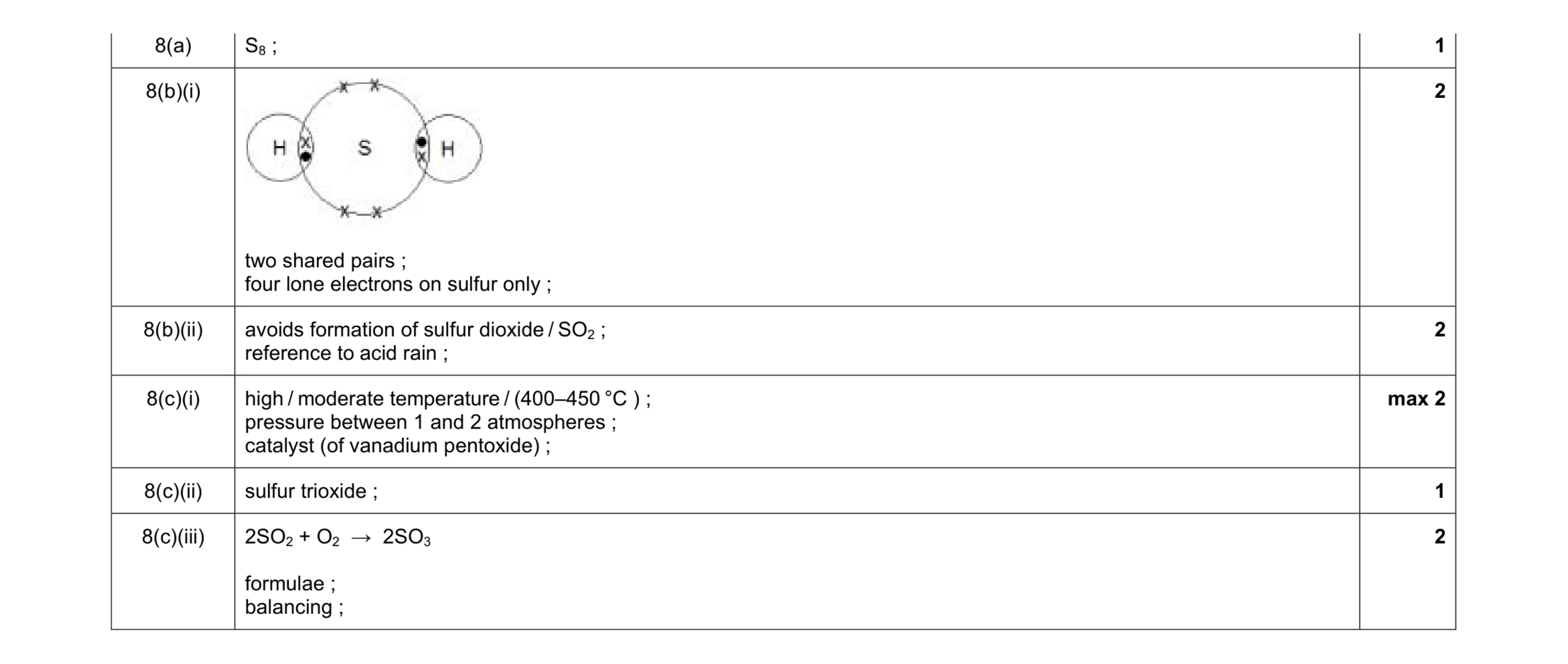 10
10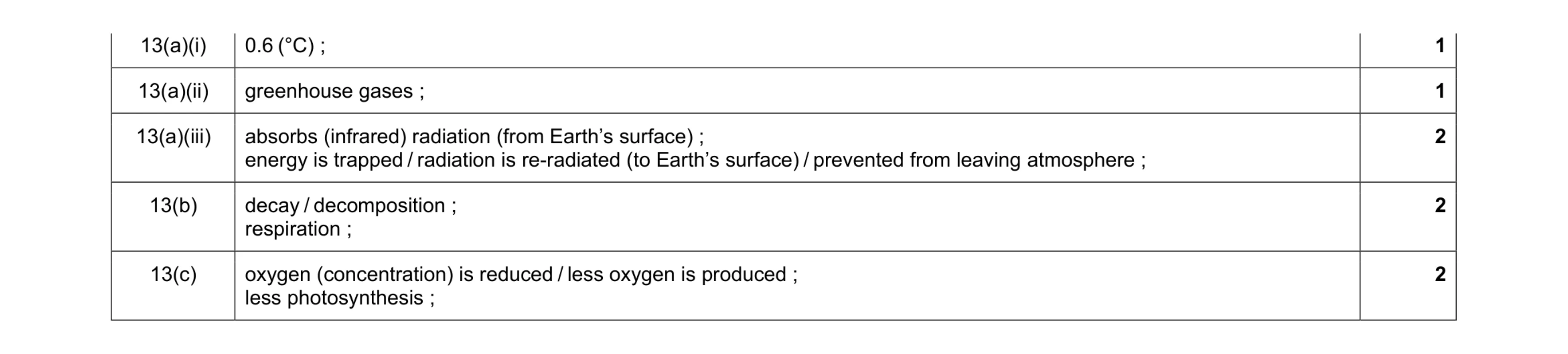 8
8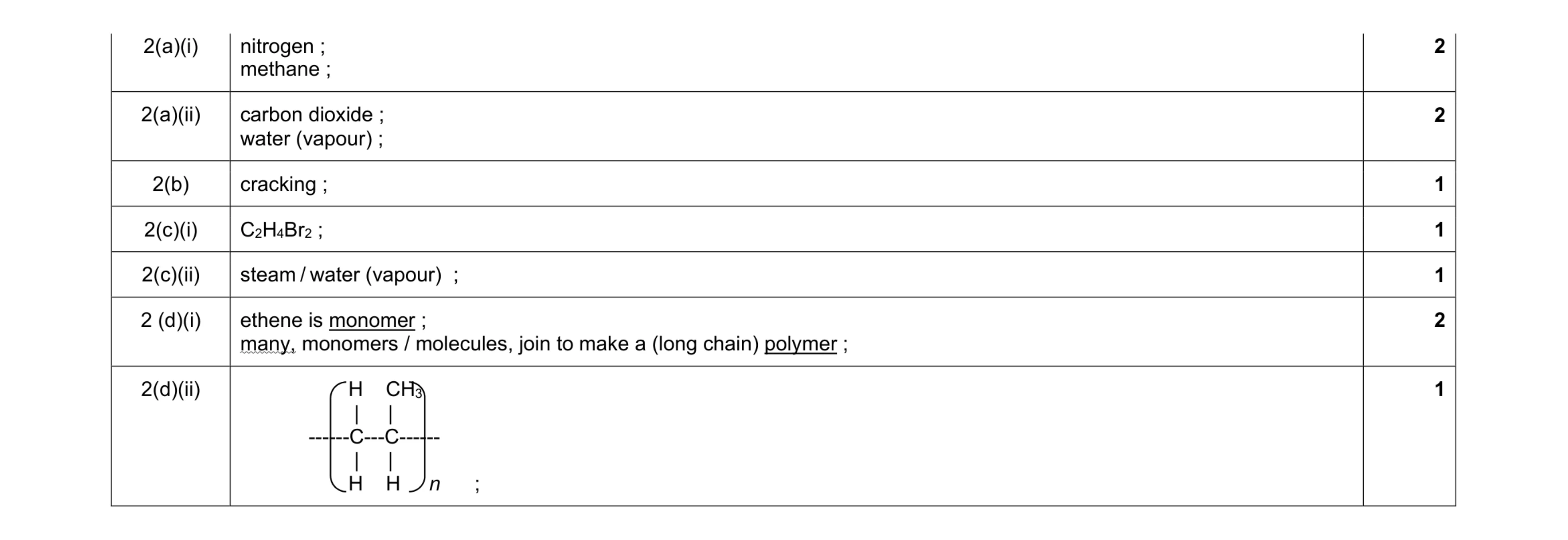 10
10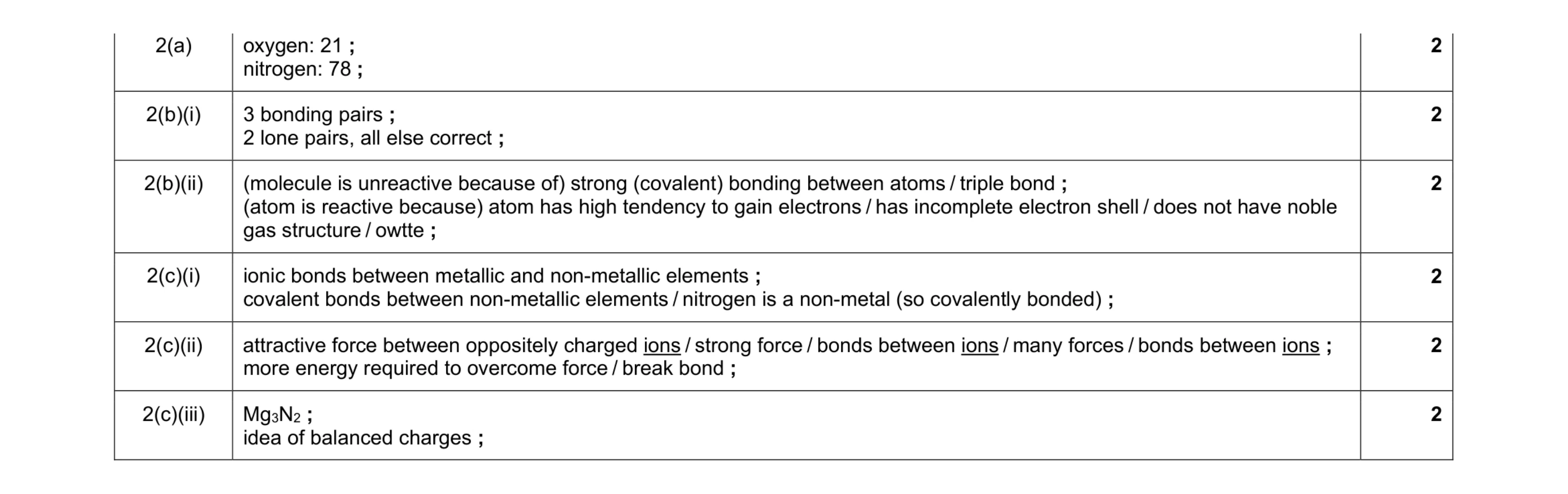 12
12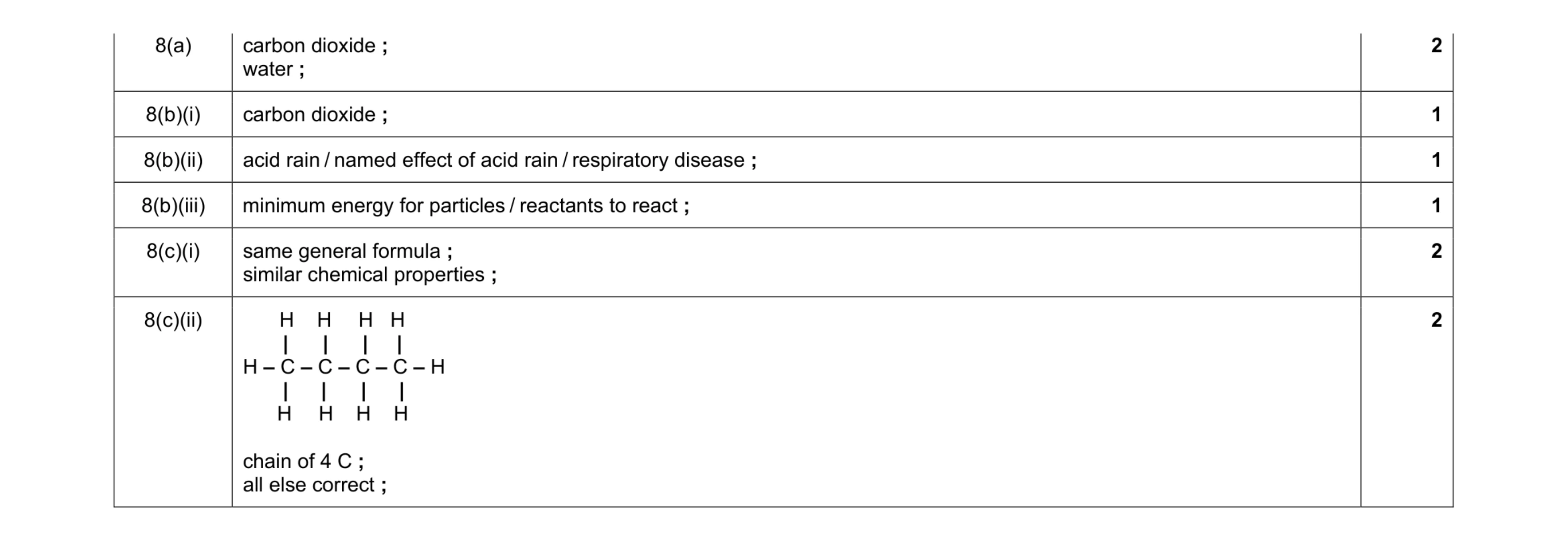 9
9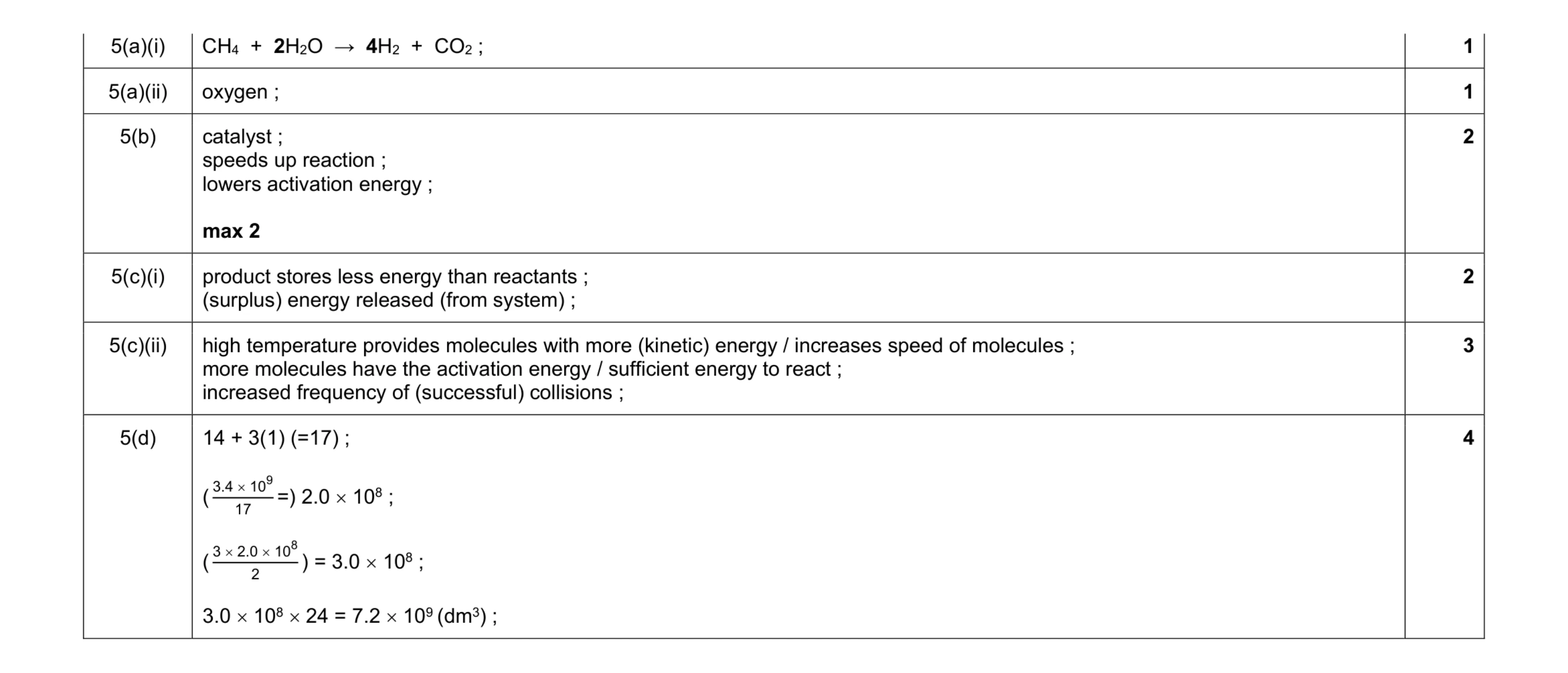 13
13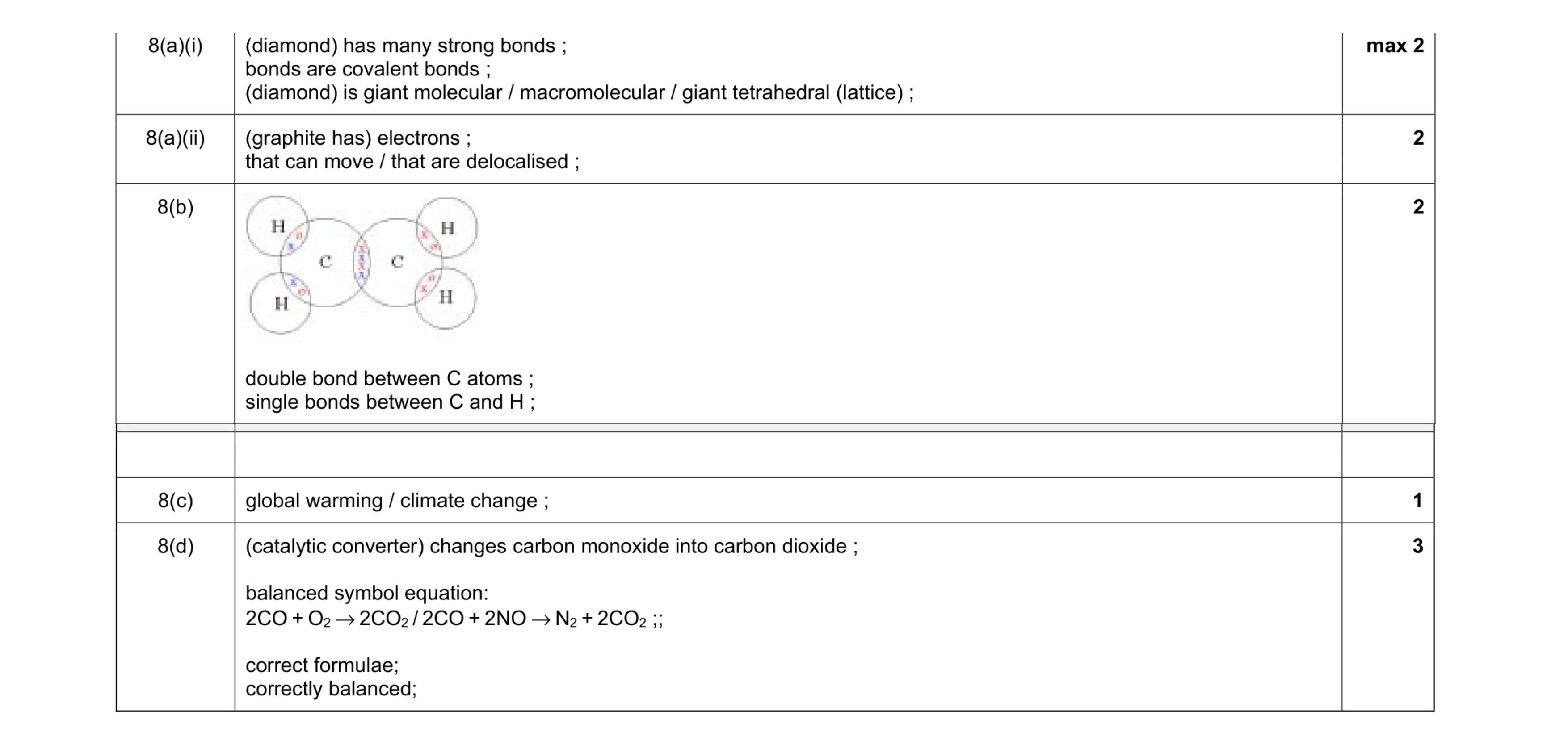 10
10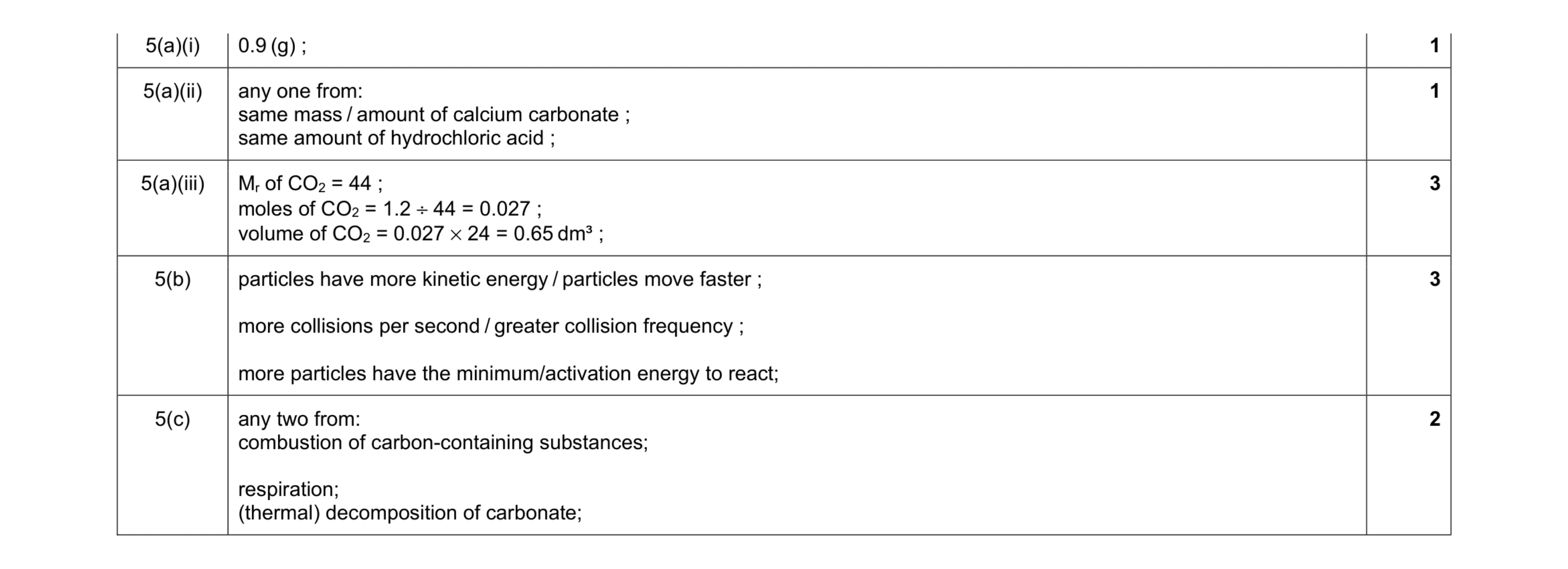 10
10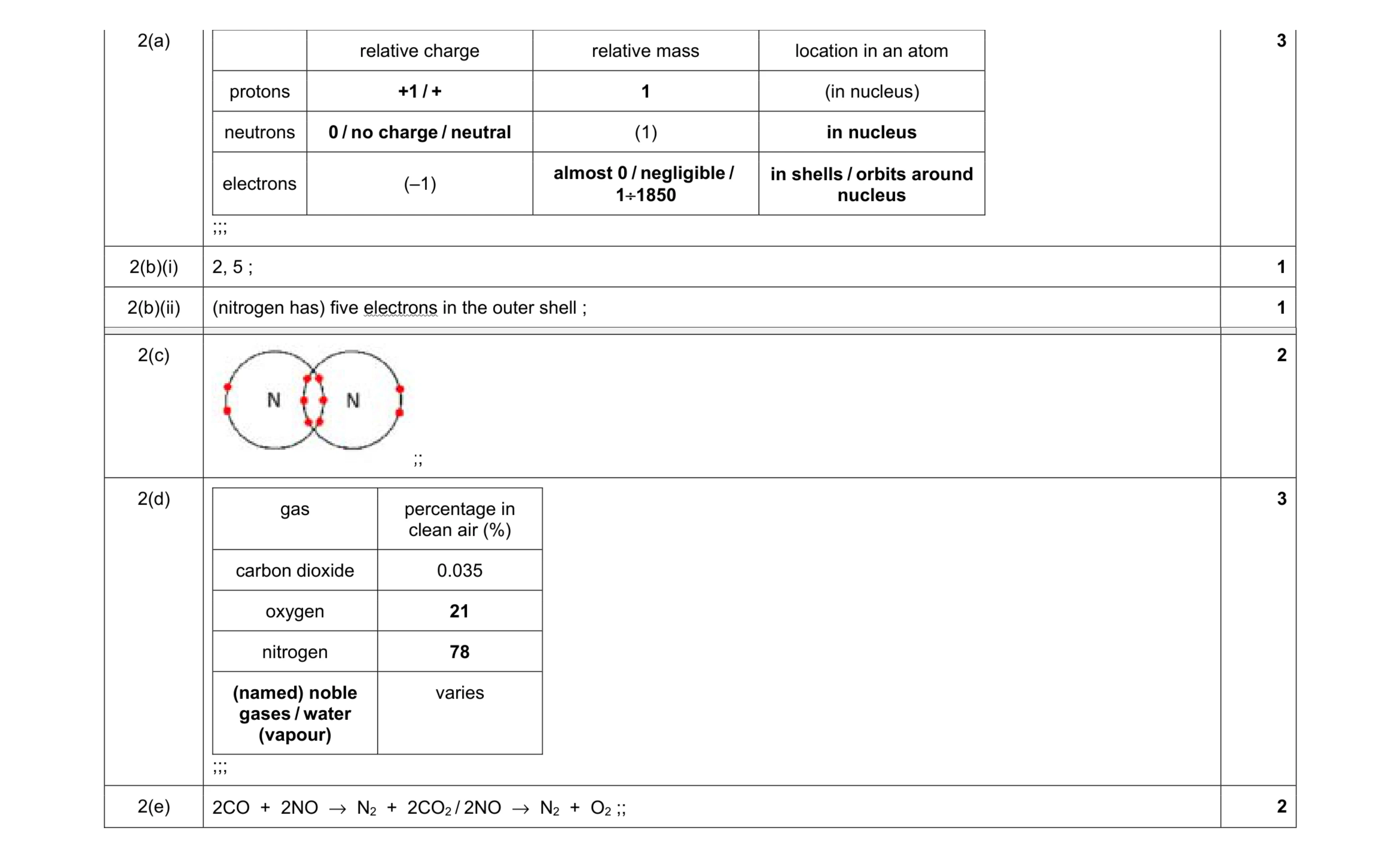 12
12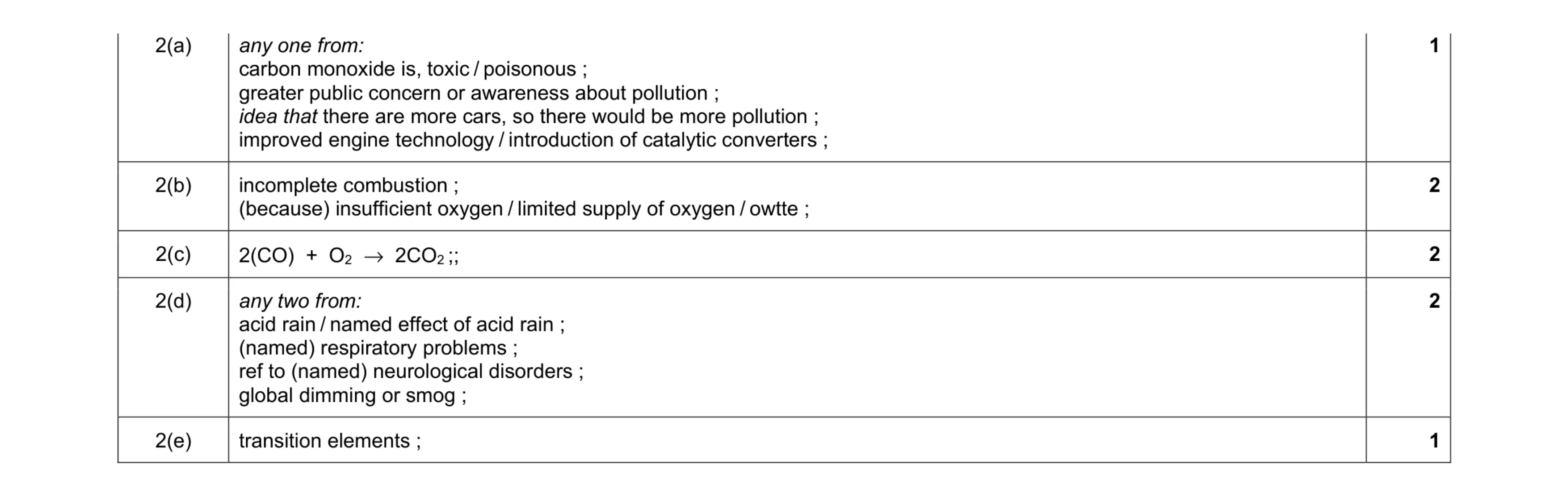 8
8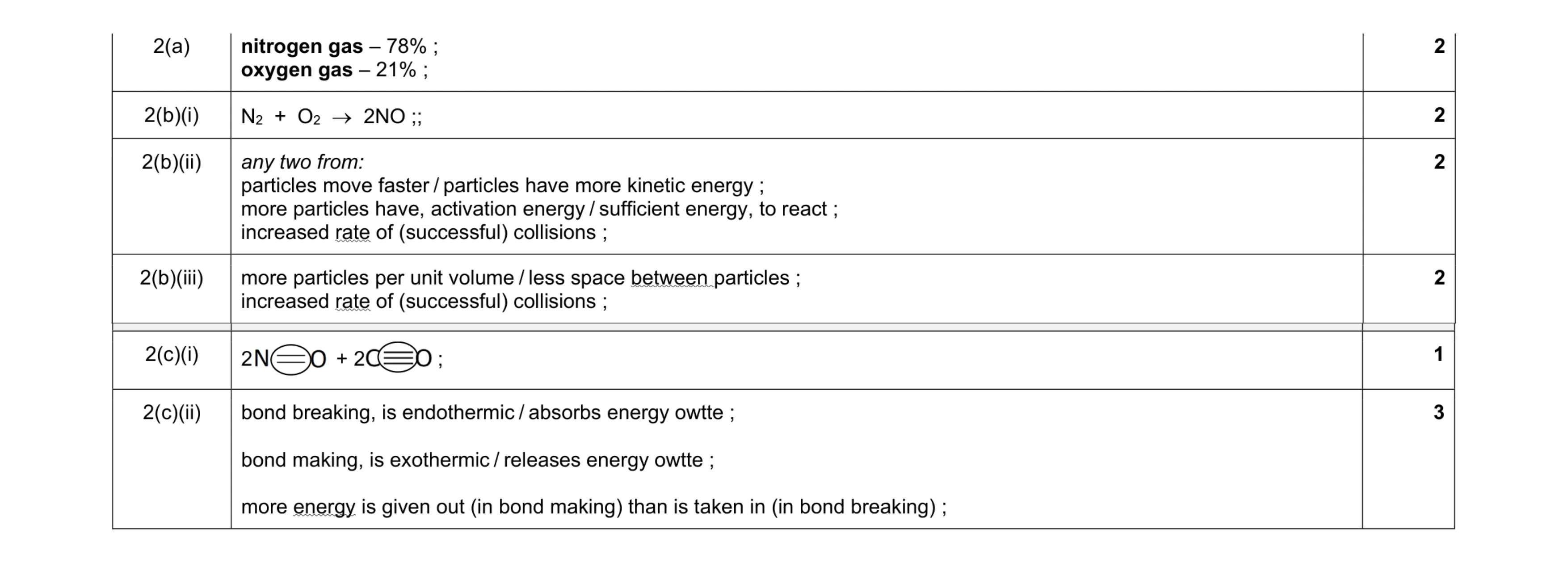 12
12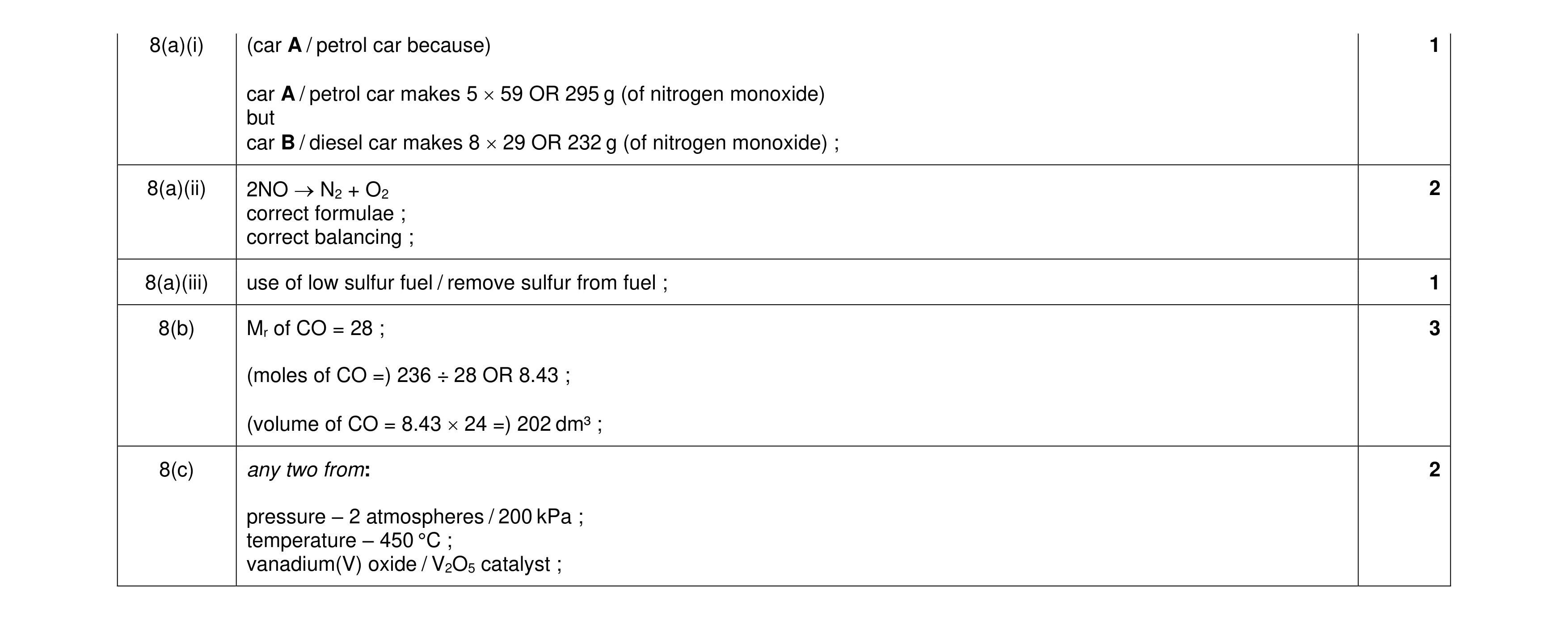 9
9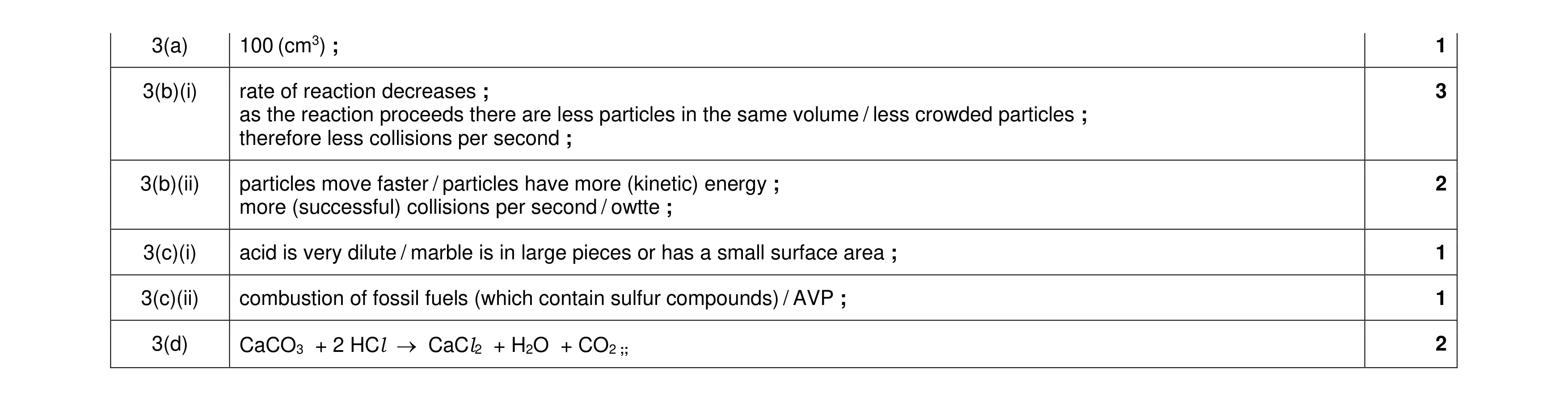 10
10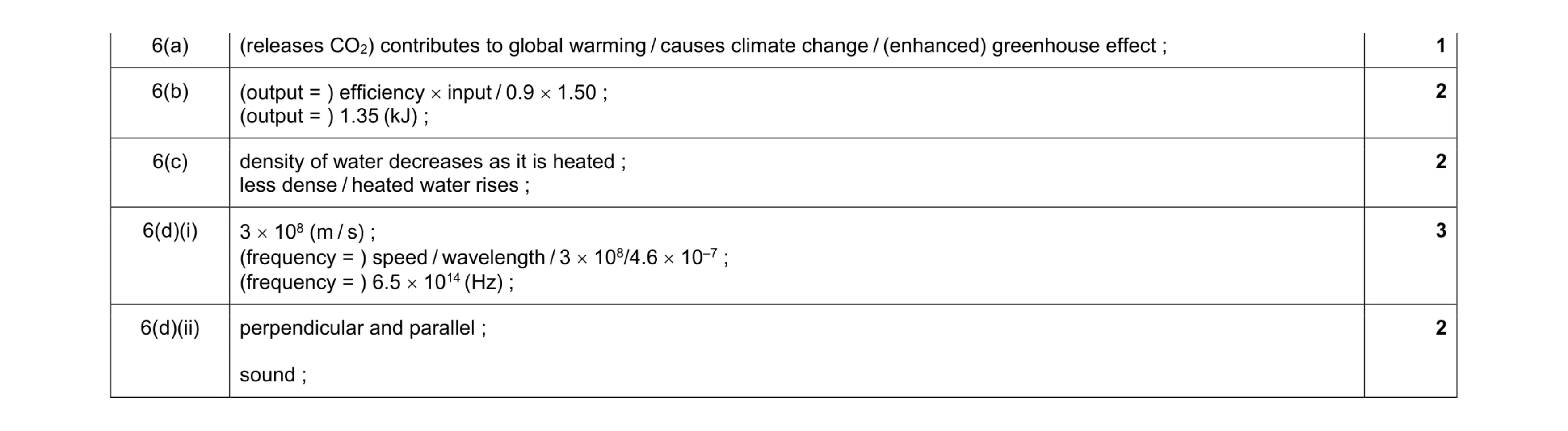 10
10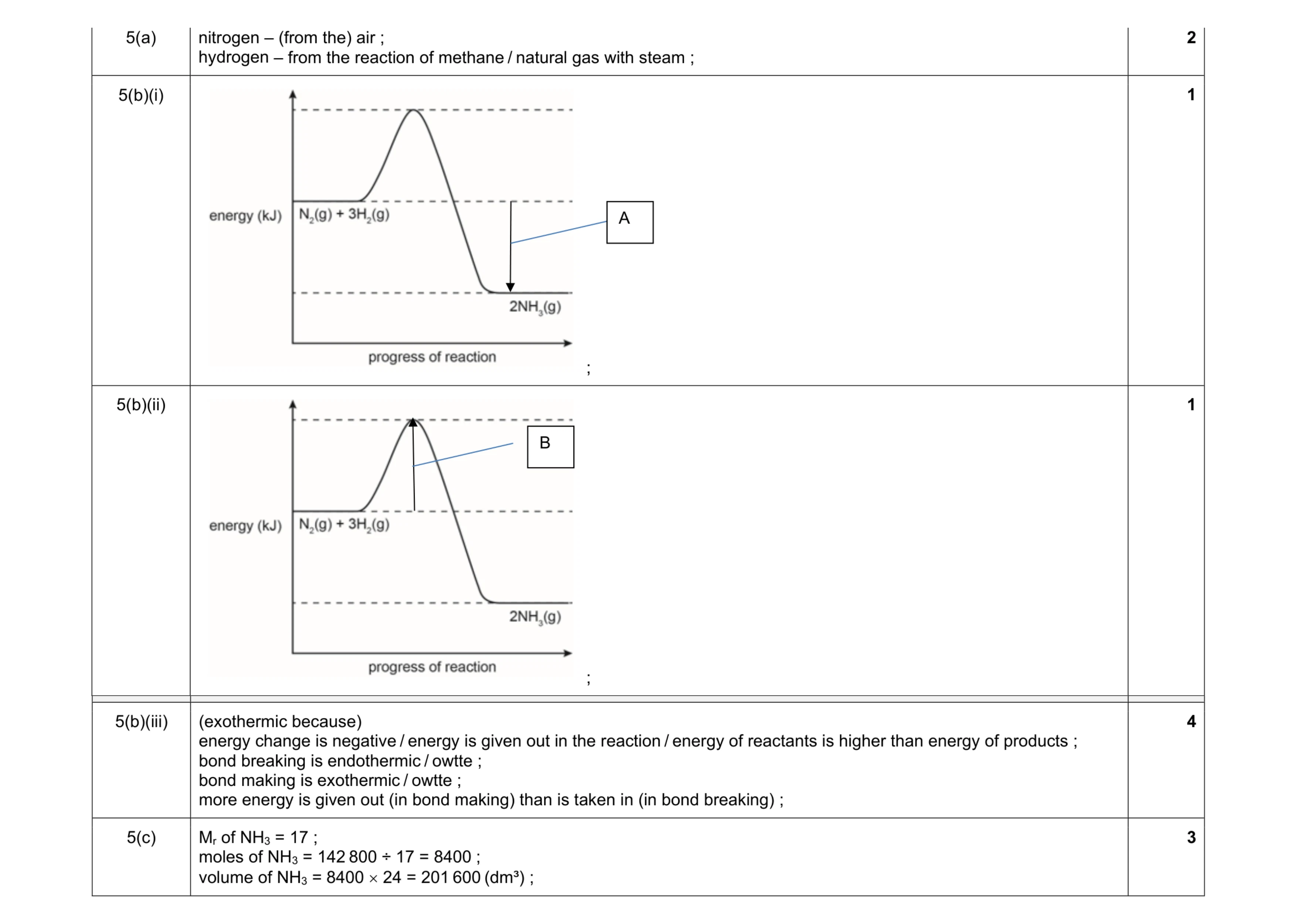 11
11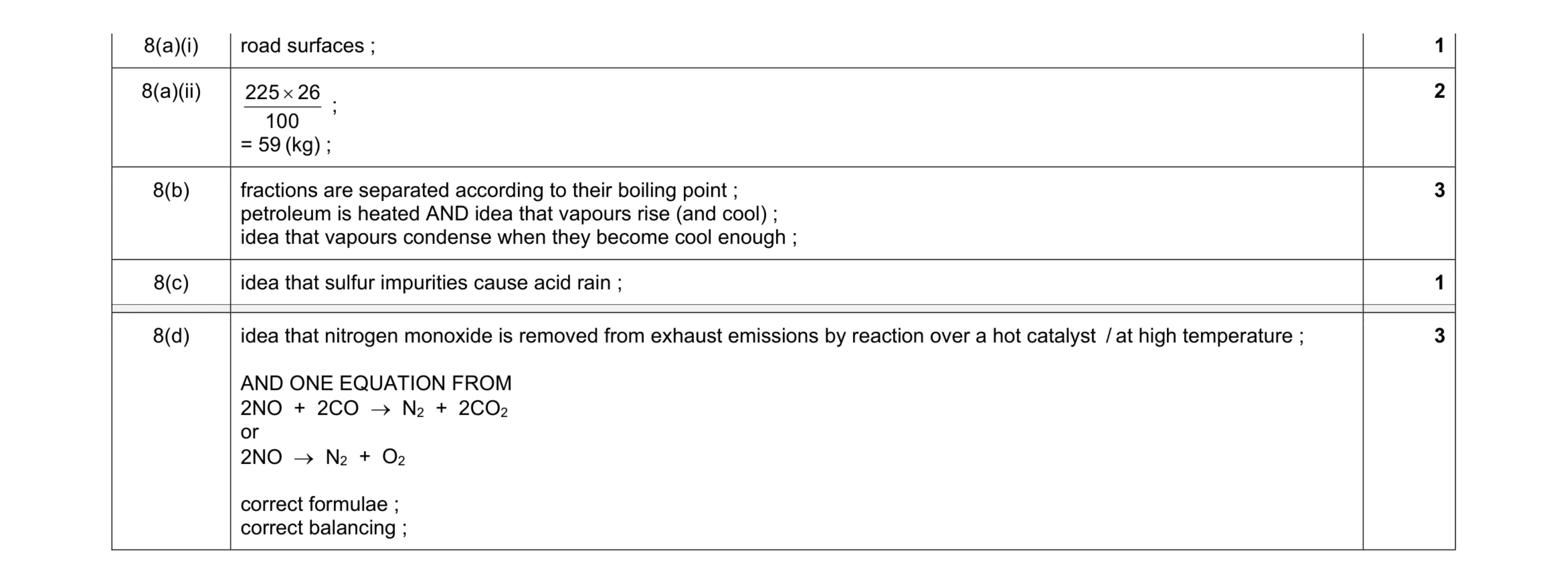 10
10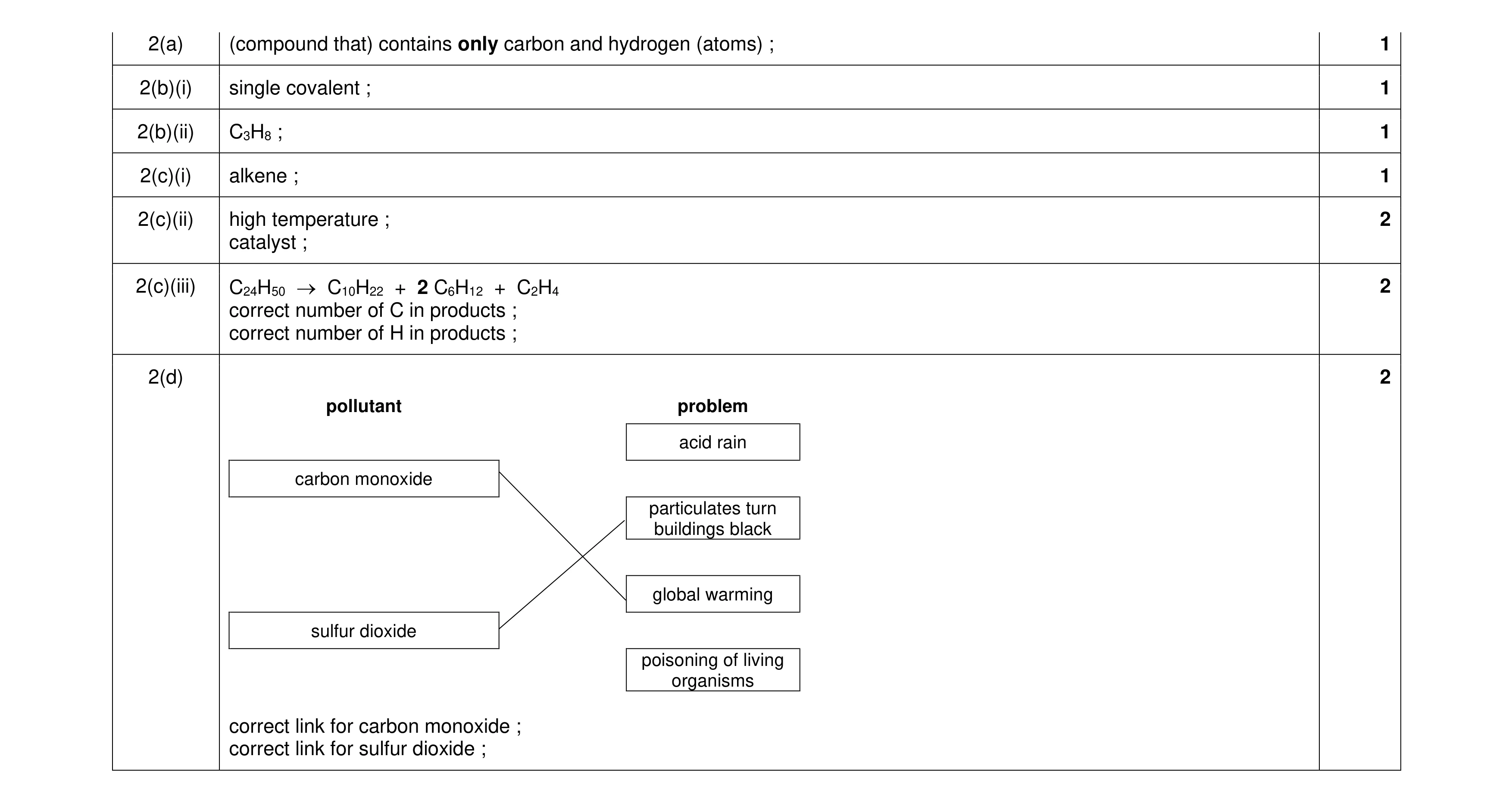 10
10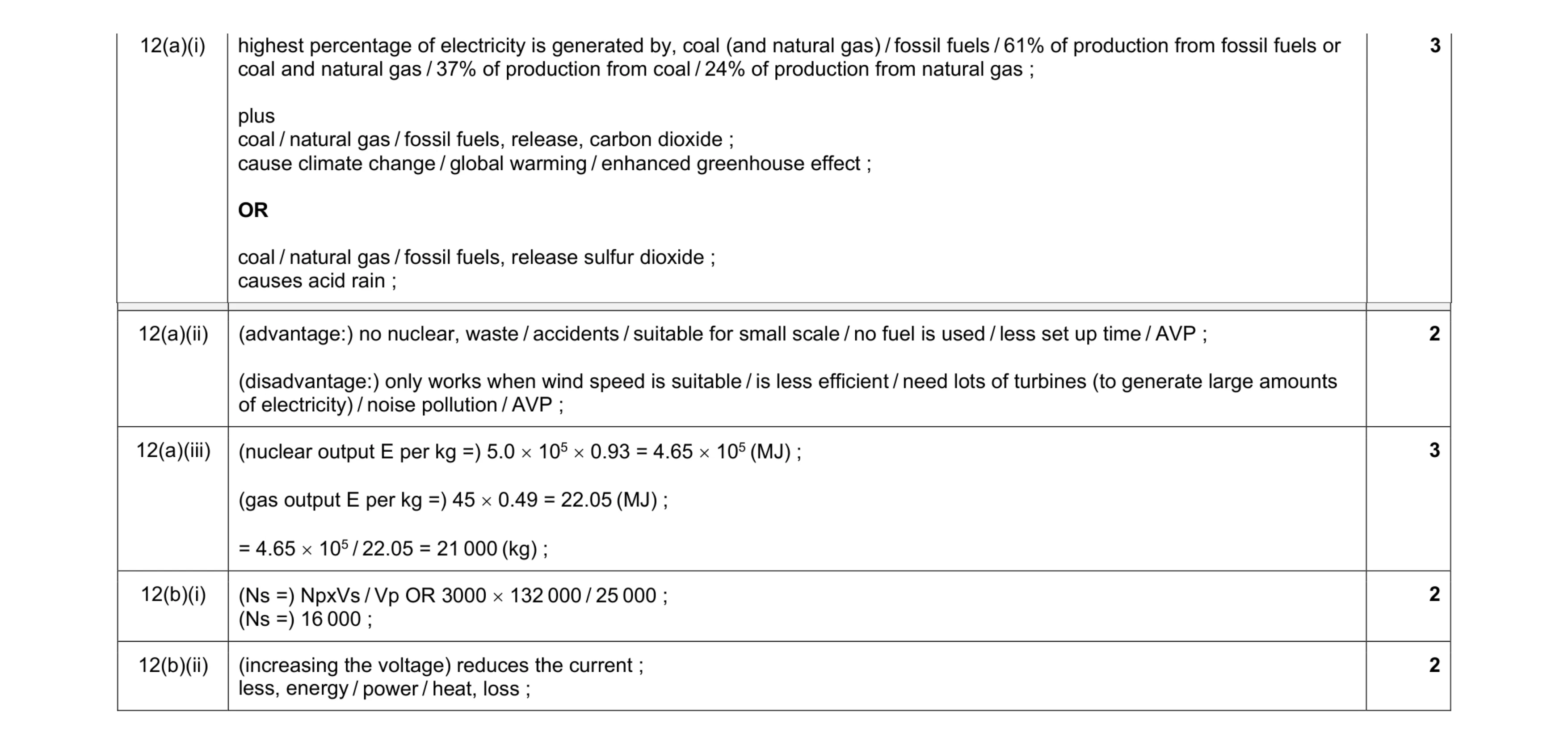 12
12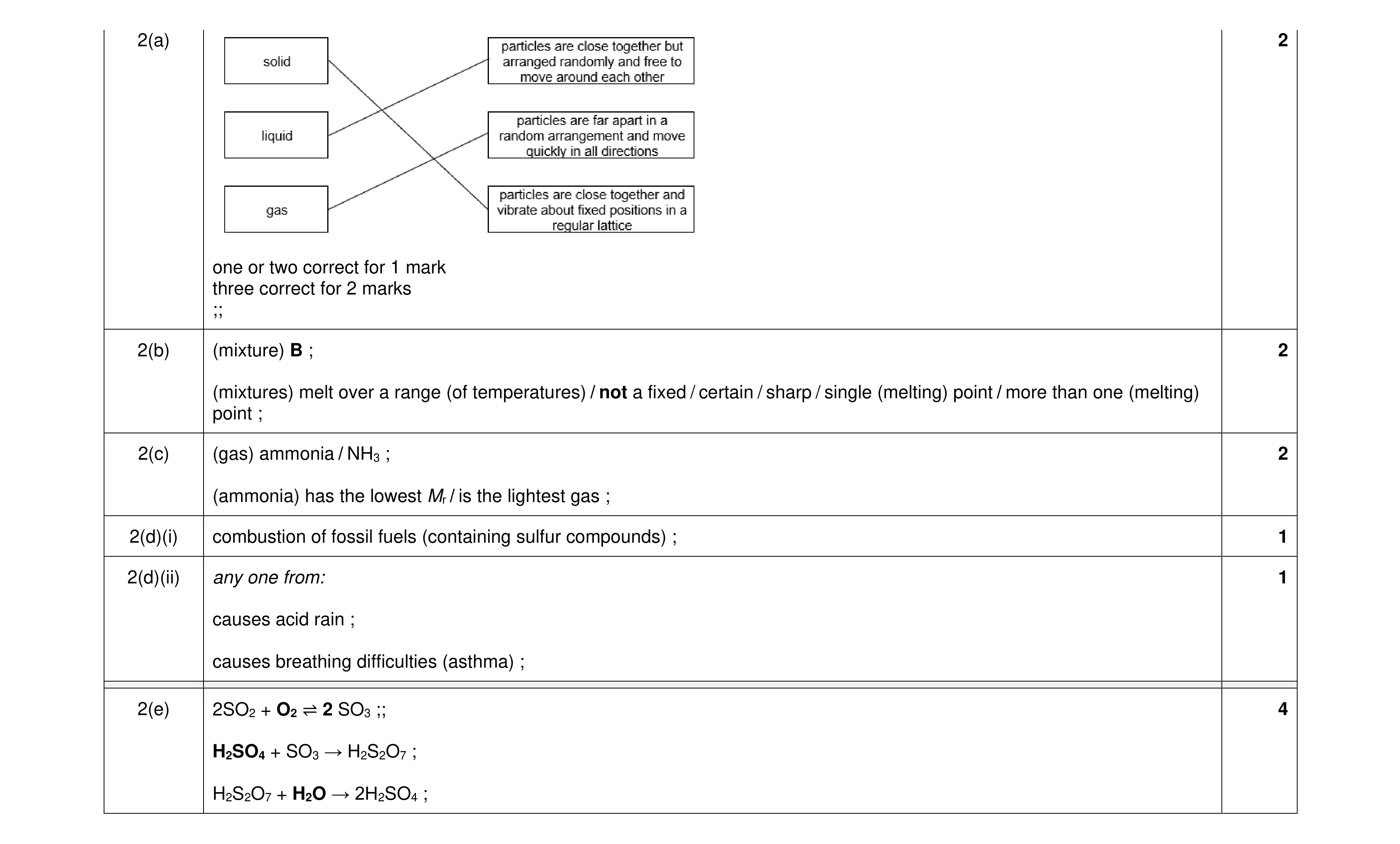 12
12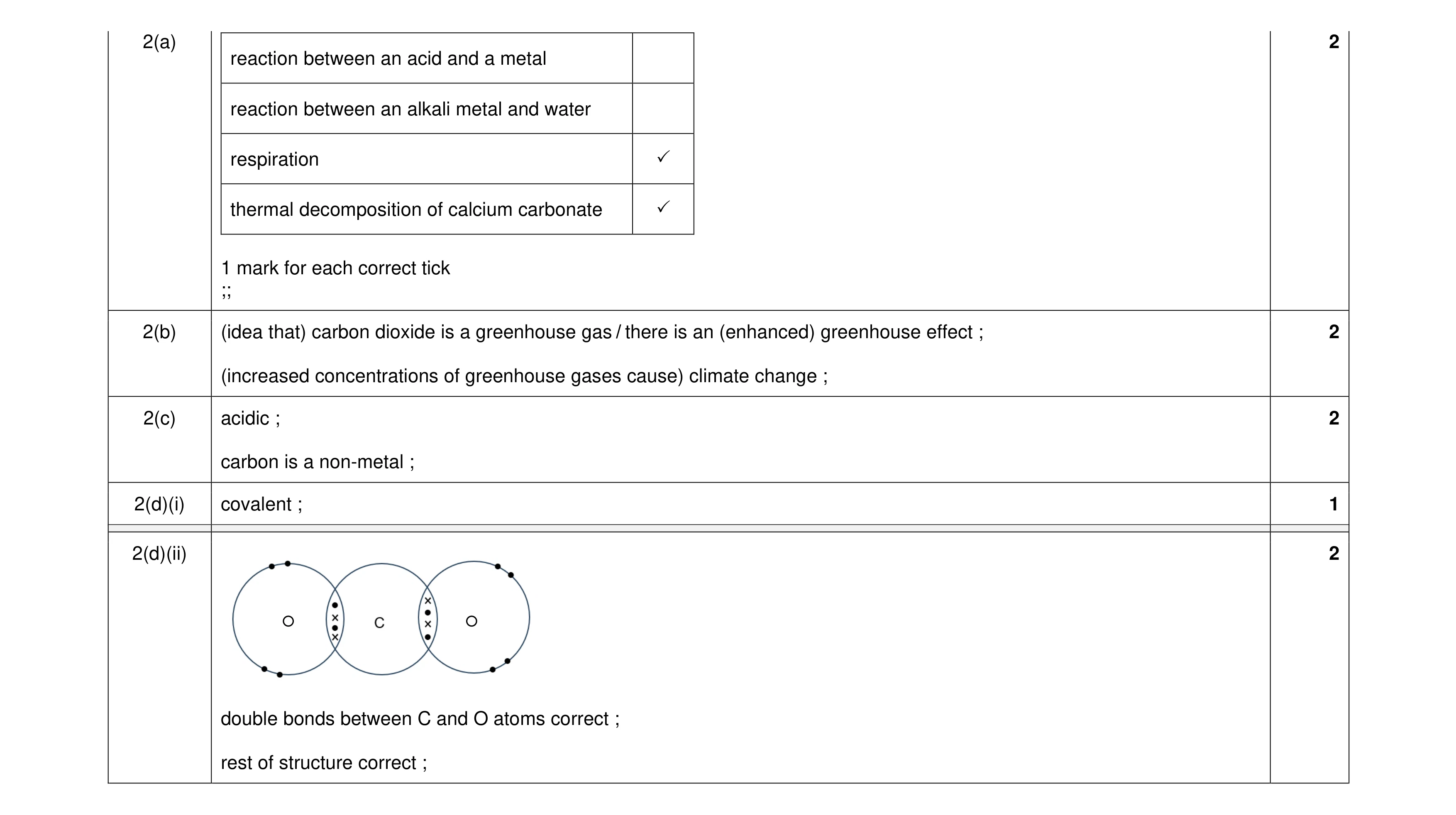 9
9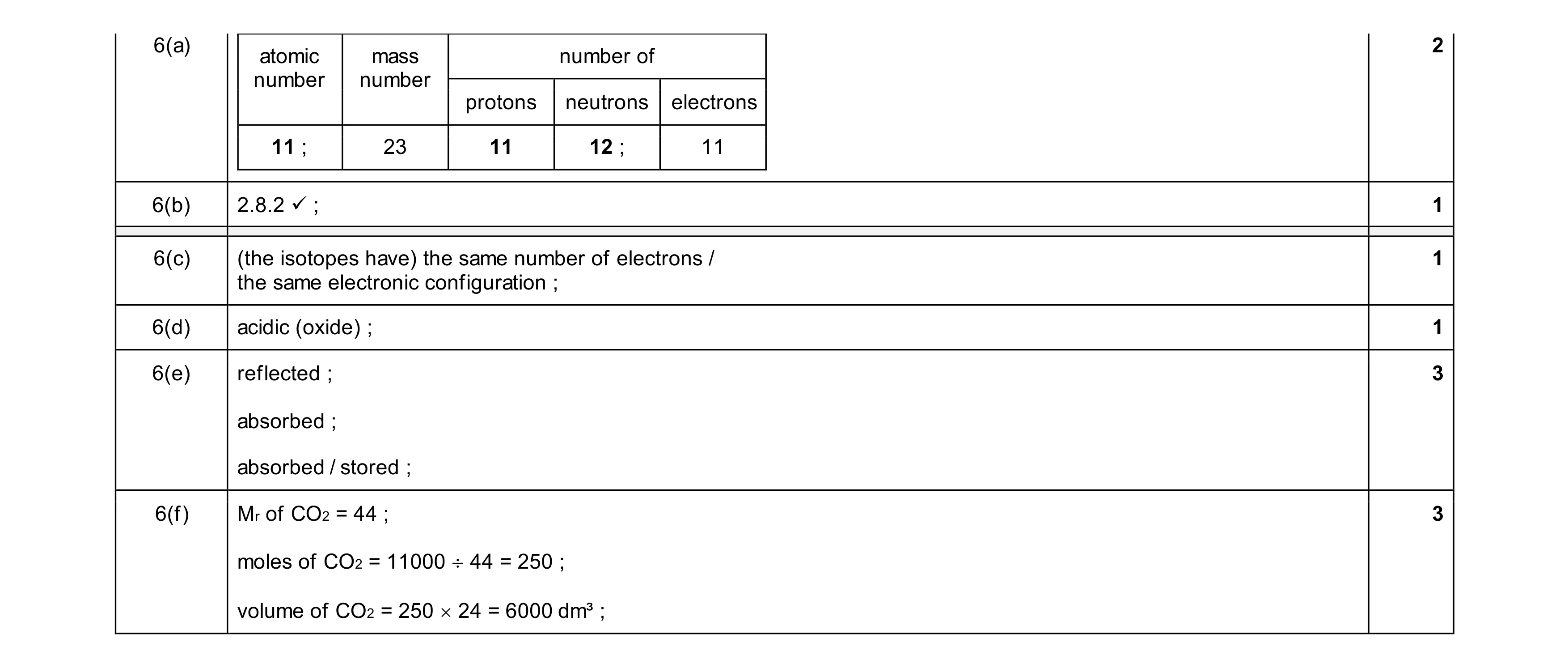 11
11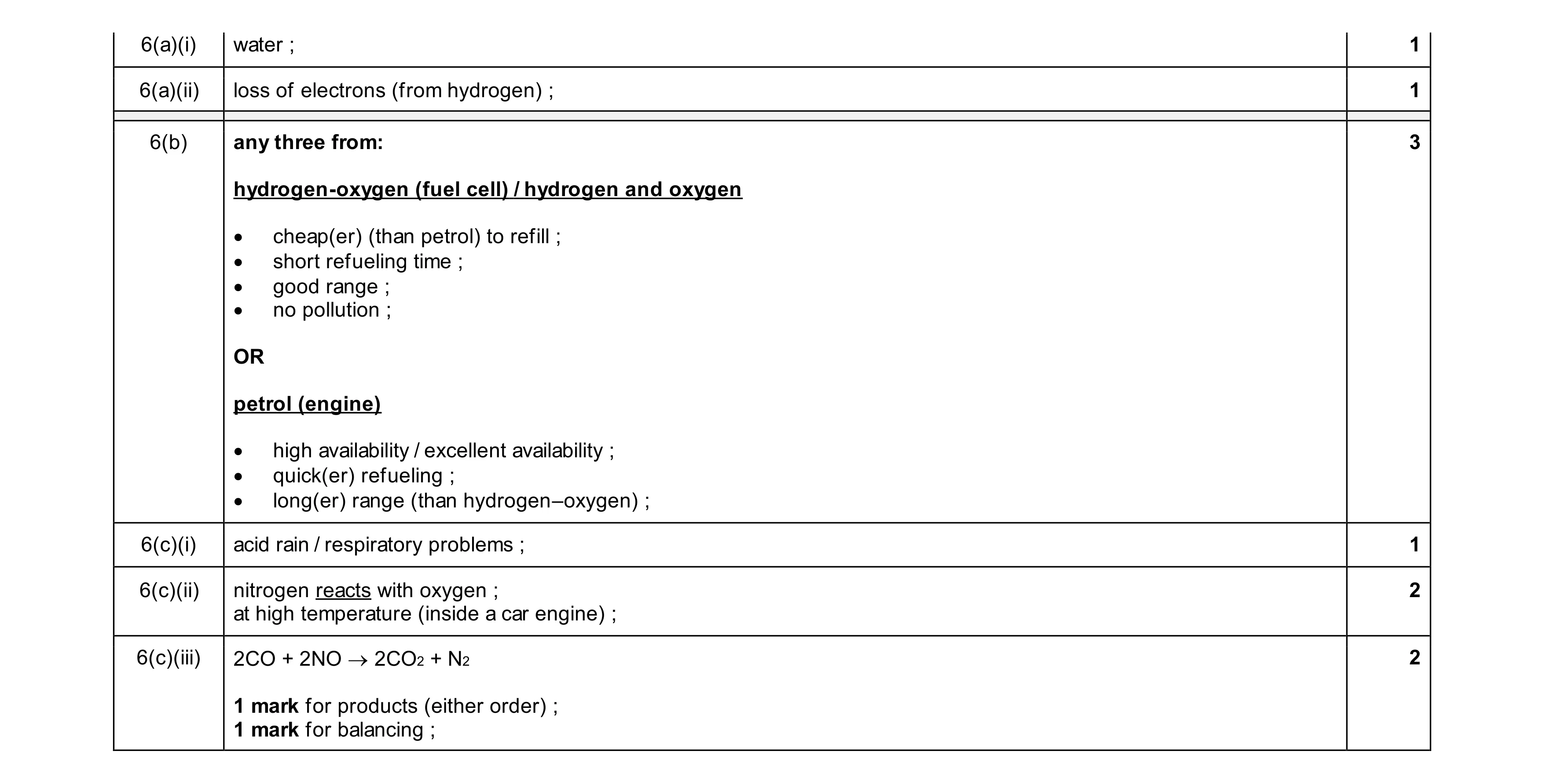 10
10