Questions as text
Q1 · Plants need to use several substances in order to photosynthesise 0654/41 May/June 2017
5 Plants need to use several substances in order to photosynthesise. (a) Write the balanced symbol equation for photosynthesis. … [2] (b) Plants also need mineral ions in order to function efficiently. Describe how the appearance of a plant deficient in nitrate ions would differ from that of a healthy plant. … … [1] (c) Nitrate fertilisers can be applied to the soil. Nitrate ions are taken into the plant and transported with water through the plant. (i) Describe how water and mineral ions are moved from the roots to the leaves in plants. … … … … … [3] (ii) Suggest how an increase in humidity affects the movement of water and ions through the plant. Explain your answer. … … … [2] (d) When nitrate fertilisers are used in excess, they can be washed into lakes and rivers. Describe and explain the effects of excess nitrates on lakes and rivers. … … … … … [3]
11 marks
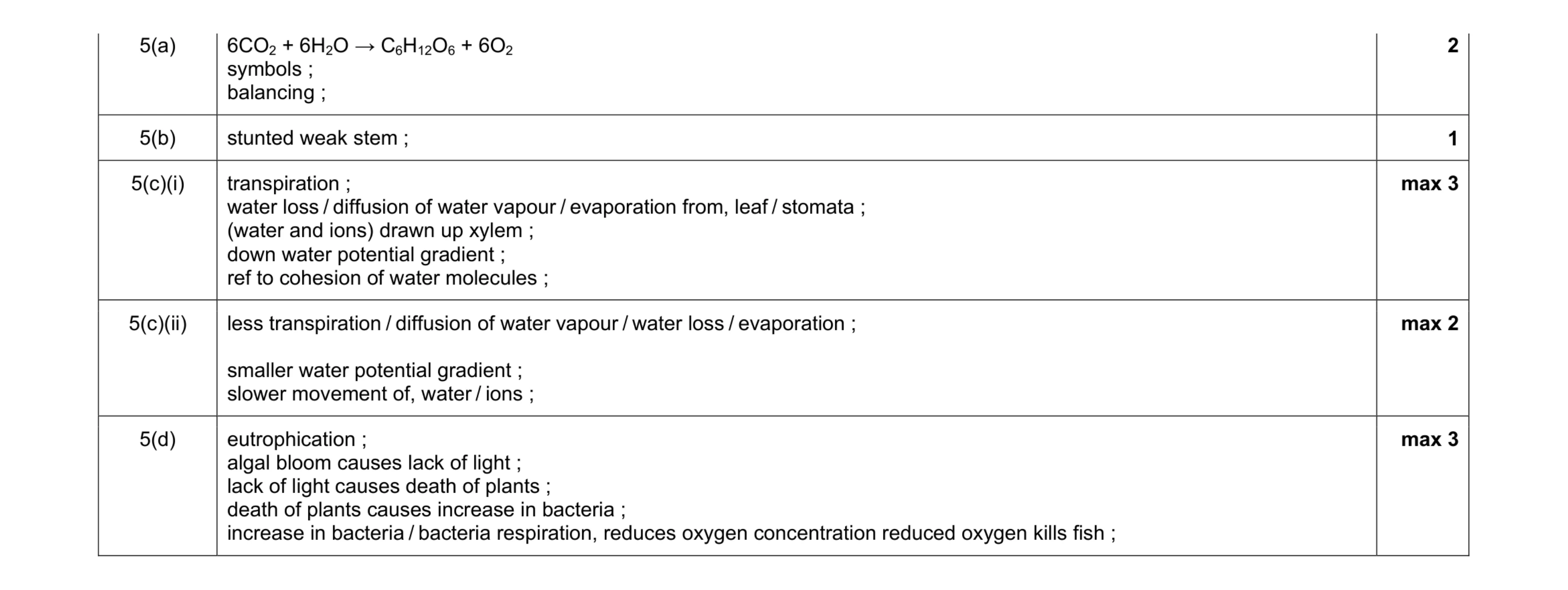
Mark scheme: 5(a) 6CO2 + 6H2O → C6H12O6 + 6O2 symbols ; balancing ; 2 5(b) stunted weak stem ; 1 5(c)(i) transpiration ; water loss / diffusion of water vapour / evaporation from, leaf / stomata ; (water and ions) drawn up xylem ; down water potential gradient ; ref to cohesion of water molecules ; max 3 5(c)(ii) less transpiration / diffusion of water vapour / water loss / evaporation ; smaller water potential gradient ; slower movement of, water / ions ; max 2 5(d) eutrophication ; algal bloom causes lack of light ; lack of light causes death of plants ; death of plants causes increase in bacteria ; increase in bacteria / bacteria respiration, reduces oxygen concentration reduced oxygen kills fish ; max 3
This question in 0654/41 May/June 2017
Q2 · A student carries out an investigation of the growth of a plant shoot by auxins 0654/42 May/June 2017
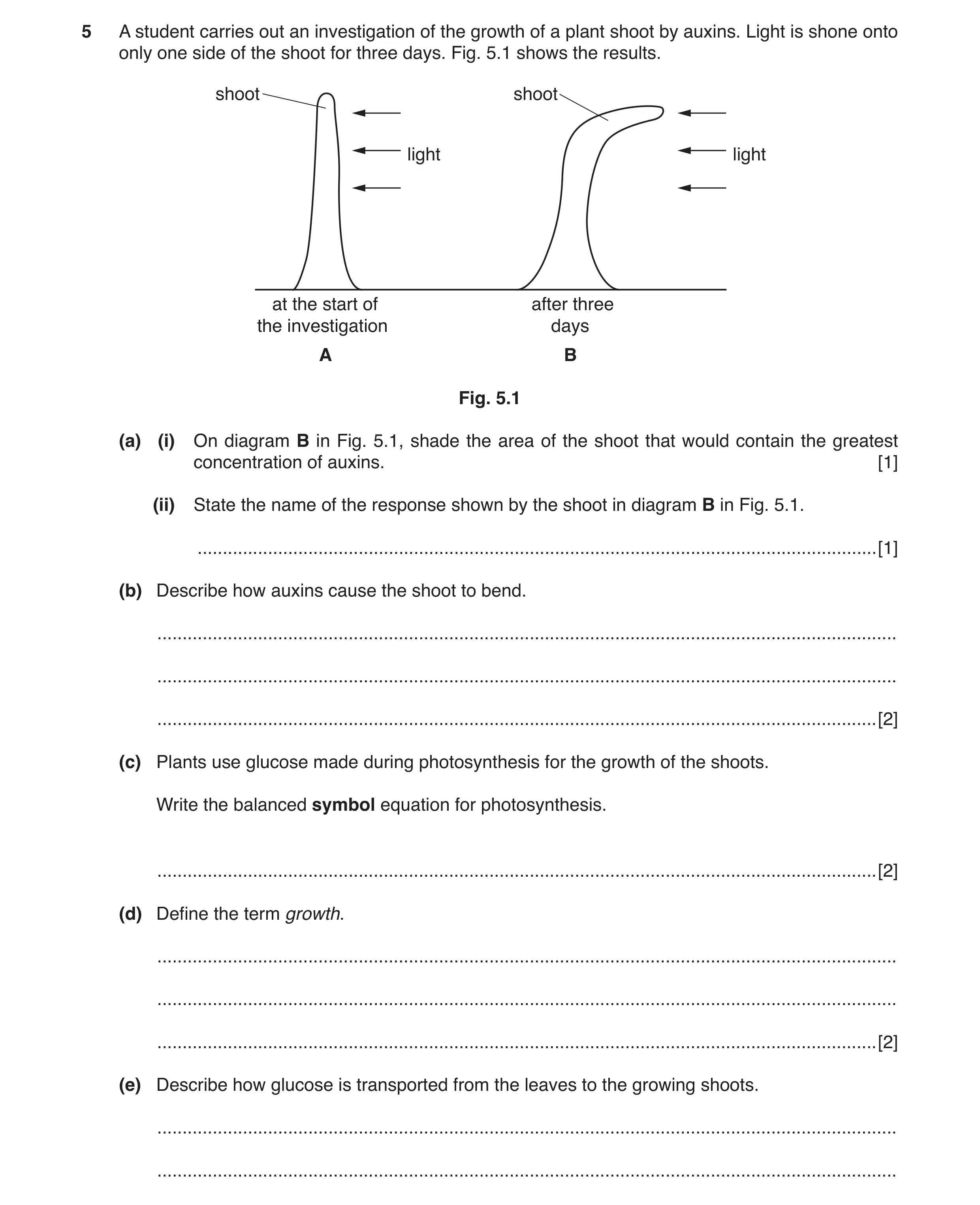
5 A student carries out an investigation of the growth of a plant shoot by auxins. Light is shone onto only one side of the shoot for three days. Fig. 5.1 shows the results. shoot shoot light light at the start of after three the investigation days A B Fig. 5.1 (a) (i) On diagram B in Fig. 5.1, shade the area of the shoot that would contain the greatest concentration of auxins. [1] (ii) State the name of the response shown by the shoot in diagram B in Fig. 5.1. … [1] (b) Describe how auxins cause the shoot to bend. … … … [2] (c) Plants use glucose made during photosynthesis for the growth of the shoots. Write the balanced symbol equation for photosynthesis. … [2] (d) Define the term growth. … … … [2] (e) Describe how glucose is transported from the leaves to the growing shoots. … …
10 marks
Mark scheme: 5(a)(i) shaded area on the left hand side of the shoot after three days ; 1 5(a)(ii) positive phototropism ; 1 5(b) auxins cause cells to increase in, size / elongate / grow ; auxins, move / diffuse, away from light ; ref to uneven growth ; max 2 5(c) light 6CO2 + 6H2O → C6H12O6 + 6O2 ;; chlorophyll 2 5(d) increase in, size – no mark increase in dry mass ; increase in cell, number / size ; ref to permanent ; max 2 5(e) glucose converted to sucrose ; ref to translocation ; in phloem ; max 2
This question in 0654/42 May/June 2017
Q3 · Green plants are living organisms that carry out photosynthesis and respiration 0654/43 Oct/Nov 2017
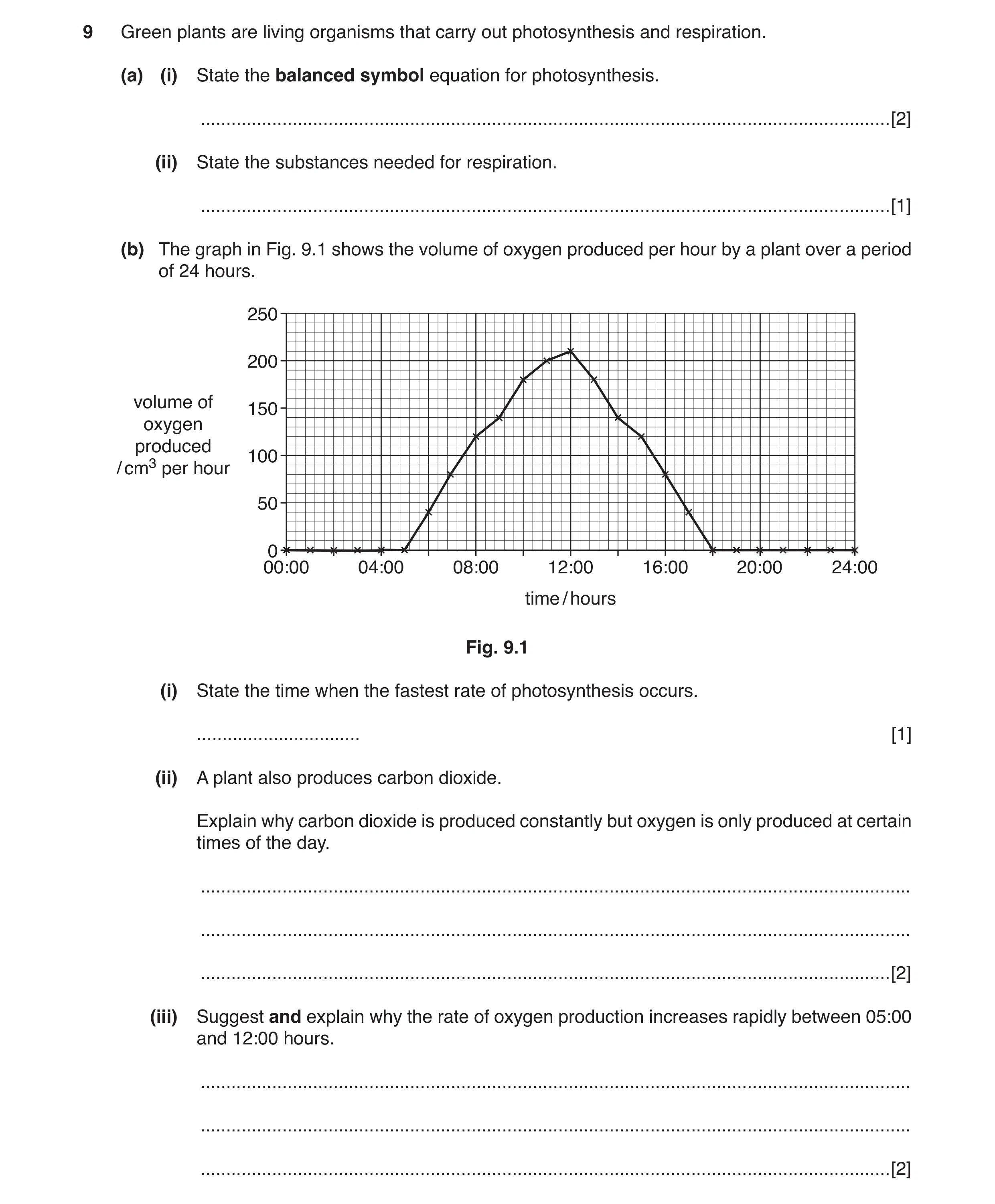
9 Green plants are living organisms that carry out photosynthesis and respiration. (a) (i) State the balanced symbol equation for photosynthesis. … [2] (ii) State the substances needed for respiration. … [1] (b) The graph in Fig. 9.1 shows the volume of oxygen produced per hour by a plant over a period of 24 hours. 250 200 volume of 150 oxygen produced 100 / cm3 per hour 50 0 00:00 04:00 08:00 12:00 16:00 20:00 24:00 time / hours Fig. 9.1 (i) State the time when the fastest rate of photosynthesis occurs. … [1] (ii) A plant also produces carbon dioxide. Explain why carbon dioxide is produced constantly but oxygen is only produced at certain times of the day. … … … [2] (iii) Suggest and explain why the rate of oxygen production increases rapidly between 05:00 and 12:00 hours. … … … [2]
8 marks
Mark scheme: 9(a)(i) 6CO2 + 6H2O → C6H12O6 + 6O2 LHS ; RHS ; 2 9(a)(ii) glucose and oxygen ; 1 9(b)(i) 12:00 ; 1 9(b)(ii) respiration occurs all the time ; photosynthesis only occurs when there is light / in daytime ; 2 9(b)(iii) increase in light intensity ; increase in rate of photosynthesis ; OR increase in temperature ; increase, in enzyme activity / rate of photosynthesis ; max 2
This question in 0654/43 Oct/Nov 2017
Q4 · Two plant cells are placed in different solutions 0654/43 Oct/Nov 2018
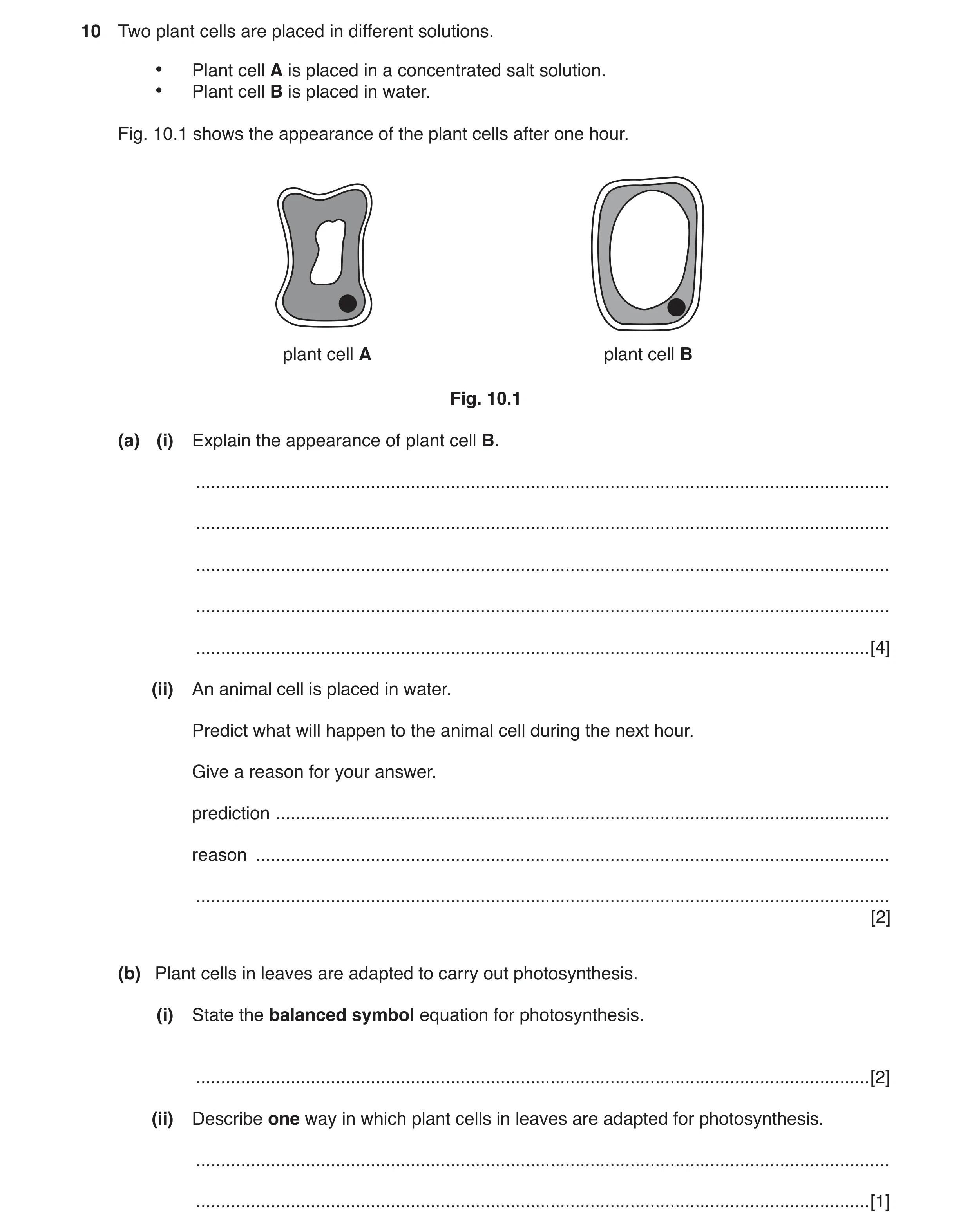
10 Two plant cells are placed in different solutions. • Plant cell A is placed in a concentrated salt solution. • Plant cell B is placed in water. Fig. 10.1 shows the appearance of the plant cells after one hour. plant cell A plant cell B Fig. 10.1 (a) (i) Explain the appearance of plant cell B. … … … … … [4] (ii) An animal cell is placed in water. Predict what will happen to the animal cell during the next hour. Give a reason for your answer. prediction … reason … … [2] (b) Plant cells in leaves are adapted to carry out photosynthesis. (i) State the balanced symbol equation for photosynthesis. … [2] (ii) Describe one way in which plant cells in leaves are adapted for photosynthesis. … … [1]
9 marks
Mark scheme: 10(a)(i) water moves in to plant cell ; correct ref to osmosis ; solution is less concentrated / more dilute than plant cell / ; (water moves) from high to low water potential / dilute to concentrated ; causing is to swell / become turgid / AW ; max 4 10(a)(ii) (animal cell) bursts ; lack of cell wall ; 2 10(b)(i) 6CO2 + 6H2O → C6H12O6 + 6O2 left-hand side correct ; right-hand side correct ; 2 10(b)(ii) presence of chlorophyll / chloroplasts ; 1
This question in 0654/43 Oct/Nov 2018
Q5 · The graph in Fig 0654/41 May/June 2019
1 (a) The graph in Fig. 1.1 shows the effect of light intensity on the rate of photosynthesis. X rate of photosynthesis light intensity Fig. 1.1 (i) Describe the results shown in Fig. 1.1. … … … … [2] (ii) Explain the reasons for the shape of the part of the graph labelled X. … … … … [2] (b) Fig. 1.2 shows a cross-section through a leaf. Fig. 1.2 (i) Describe two features of the leaf shown in Fig. 1.2 that allow efficient gas exchange to occur. 1 … … 2 … … [2] (ii) On Fig. 1.2, use a label line to label an example of a cell that is best adapted for photosynthesis. Include the name of the cell. [2] (c) State the chemical formulae of the two products of photosynthesis. 1 … 2 … [1] [Total: 9]
9 marks
Mark scheme: 1(a)(i) as light intensity increases the rate of photosynthesis increases ; then plateaus / levels off / remains constant ; 2 1(a)(ii) Rate of photosynthesis cannot be increased further by light intensity ; other (named) factors (are limiting the rate of photosynthesis) ; 2 1(b)(i) large (air) spaces (in the spongy mesophyll layer) ; guard cells / stoma / stomata (to allow entry and exit of gases) ; 2 1(b)(ii) palisade (cell) ; labelled correctly ; 2 1(c) C6H12O6 and O2 ; 1
This question in 0654/41 May/June 2019
Q6 · A cross-section through a leaf 0654/42 May/June 2019
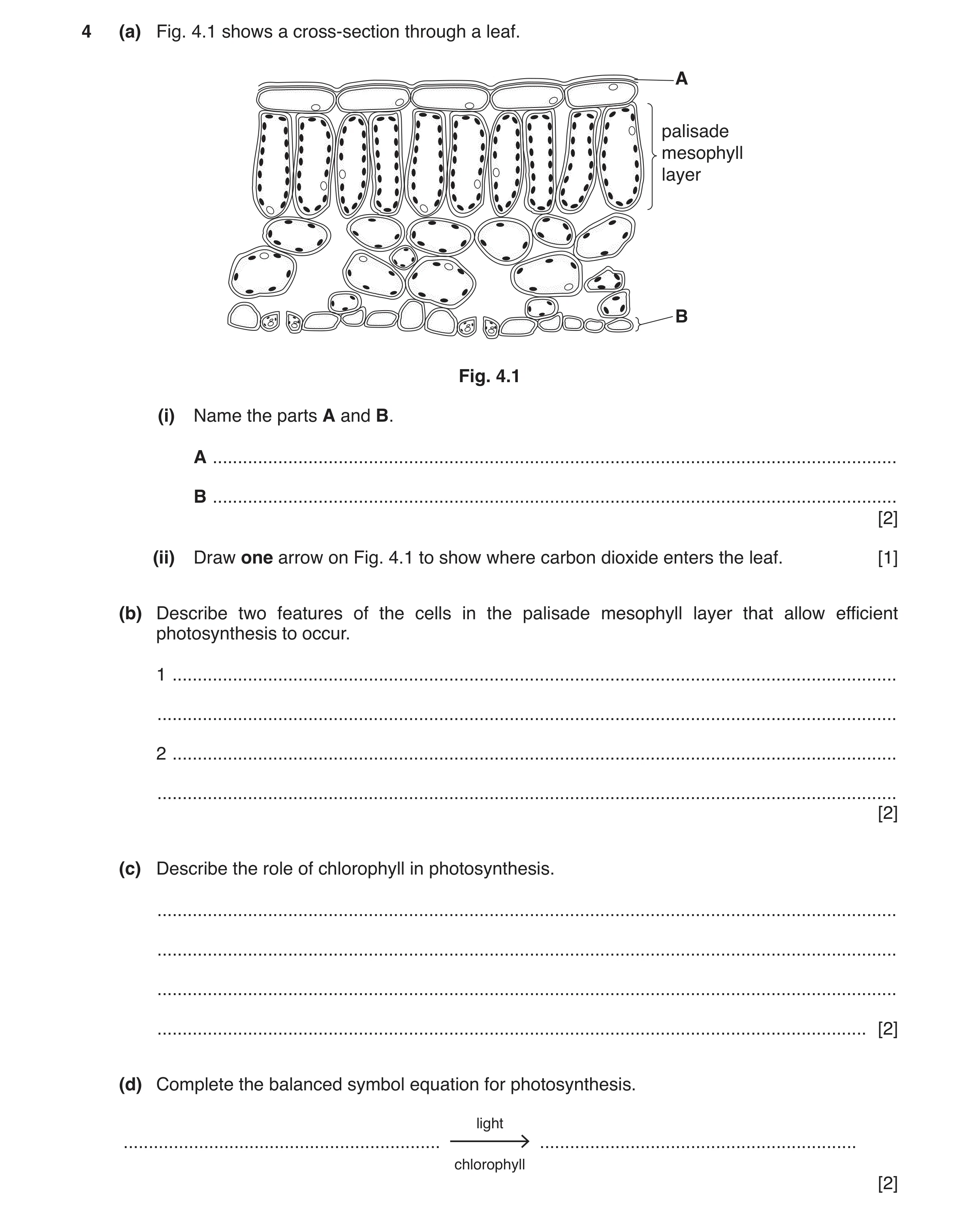
4 (a) Fig. 4.1 shows a cross-section through a leaf. A palisade mesophyll layer B Fig. 4.1 (i) Name the parts A and B. A … B … [2] (ii) Draw one arrow on Fig. 4.1 to show where carbon dioxide enters the leaf. [1] (b) Describe two features of the cells in the palisade mesophyll layer that allow efficient photosynthesis to occur. 1 … … 2 … … [2] (c) Describe the role of chlorophyll in photosynthesis. … … … … [2] (d) Complete the balanced symbol equation for photosynthesis. light … … chlorophyll [2]
9 marks
Mark scheme: 4(a)(i) A (waxy) cuticle ; B (lower) epidermis ; 2 4(a)(ii) arrow pointing to or through the stomata ; 1 4(b) cells tightly packed ; cells are close to the surface of the leaf ; contain, (many) chloroplasts / (lots of) chlorophyll ; large vacuole / chloroplasts are at the edge of cell ; thin cell walls ; max 2 4(c) transfers light energy to chemical energy ; for the synthesis of (named) carbohydrates ; 2 4(d) 6CO2 + 6H2O →C6H12O6 + 6O2 left hand side correct ; right hand side correct ; 2
This question in 0654/42 May/June 2019
Q7 · A student investigates the need for chlorophyll in photosynthesis 0654/43 May/June 2019
7 A student investigates the need for chlorophyll in photosynthesis. He uses a variegated leaf. Fig. 7.1 shows a variegated leaf. green part of the leaf containing chlorophyll white part of the leaf containing no chlorophyll Fig. 7.1 The student prepares the leaf by boiling it in ethanol. He then tests the leaf for the presence of starch using iodine solution. Table 7.1 shows his results. Table 7.1 part of leaf colour when tested with iodine solution green part blue-black white part orange-brown (a) Explain the result for the green part of the leaf. … … … … … [3] (b) Name the mineral ion needed to make chlorophyll. … [1] (c) Starch is one carbohydrate found in plants. Describe how carbohydrates are transported around the plant. … … … … … [3] (d) Water is one of the raw materials needed for photosynthesis. State the chemical formula of one other raw material needed for photosynthesis. … [1] (e) State the term used for the property of water molecules that enables them to be drawn up the xylem during transpiration. … [1] [Total: 9]
9 marks
Mark scheme: 7(a) green parts photosynthesise ; (photosynthesis) produces glucose ; glucose turned to starch ; starch turns iodine blue-black / reacts with iodine ; max 3 7(b) magnesium ; 1 7(c) ref to translocation ; as sucrose ; in the phloem ; from, source / regions of production / leaf, to, sink / regions or storage / where they are used in respiration / examples, / growth ; max 3 7(d) CO2 ; 1 7(e) cohesion ; 1
This question in 0654/43 May/June 2019
Q8 · A student investigates the effect of temperature on the rate of photosynthesis in elodea… 0654/41 May/June 2020
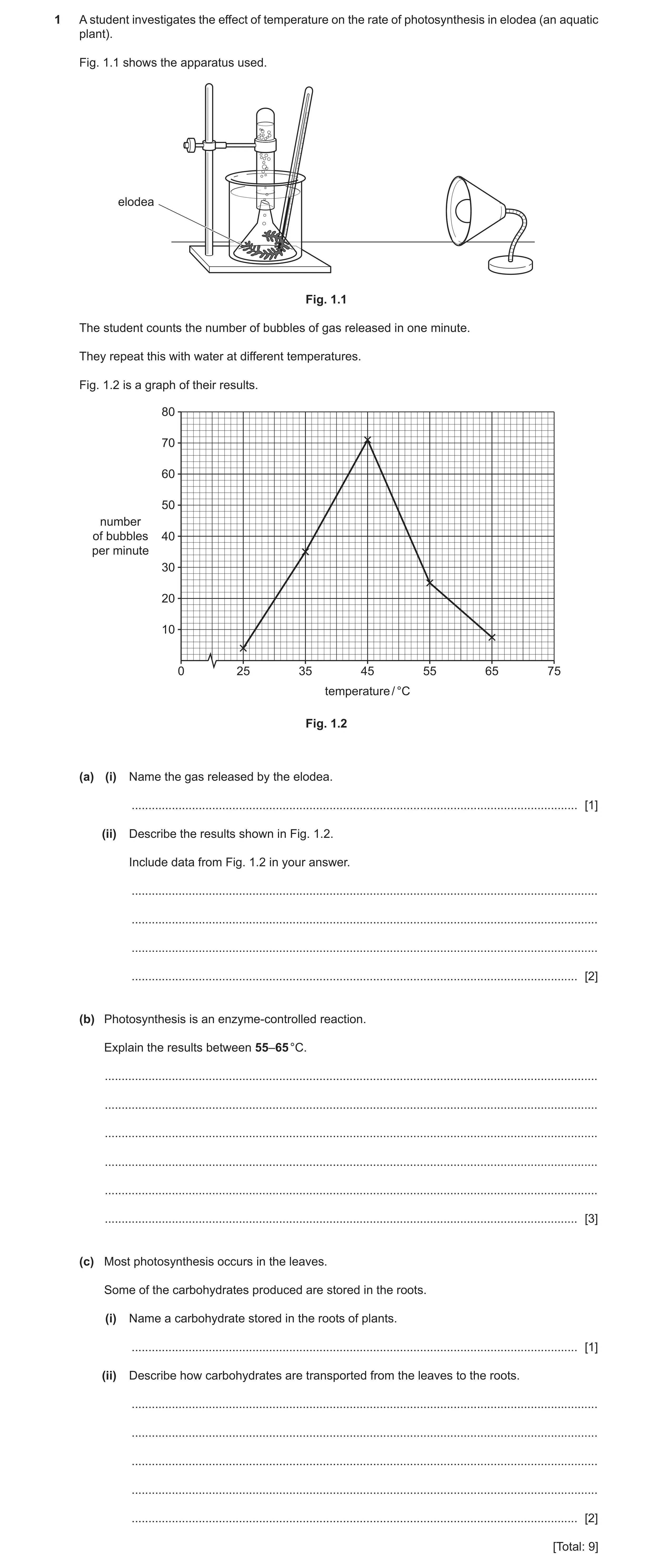
1 A student investigates the effect of temperature on the rate of photosynthesis in elodea (an aquatic plant). Fig. 1.1 shows the apparatus used. elodea Fig. 1.1 The student counts the number of bubbles of gas released in one minute. They repeat this with water at different temperatures. Fig. 1.2 is a graph of their results. 80 70 60 50 number of bubbles 40 per minute 30 20 10 0 25 35 45 55 65 75 temperature / °C Fig. 1.2 (a) (i) Name the gas released by the elodea. … [1] (ii) Describe the results shown in Fig. 1.2. Include data from Fig. 1.2 in your answer. … … … … [2] (b) Photosynthesis is an enzyme-controlled reaction. Explain the results between 55–65 °C. … … … … … … [3] (c) Most photosynthesis occurs in the leaves. Some of the carbohydrates produced are stored in the roots. (i) Name a carbohydrate stored in the roots of plants. … [1] (ii) Describe how carbohydrates are transported from the leaves to the roots. … … … … … [2] [Total: 9]
9 marks
Mark scheme: 1(a)(i) oxygen ; 1 1(a)(ii) the number of bubbles released / rate of photosynthesis increases and decreases (with temperature) ; peak at 45°C / 71 bubbles per minute ; 2 1(b) enzymes denature at high temperature ; active site shape is changed ; substrate can no longer fit ; so rate of, reaction / photosynthesis decreases ; max 3 1(c)(i) starch ; 1 1(c)(ii) ref to translocation ; transported as sucrose ; through the phloem ; max 2
This question in 0654/41 May/June 2020
Q9 · Plant shoots respond to stimuli such as light 0654/41 May/June 2020
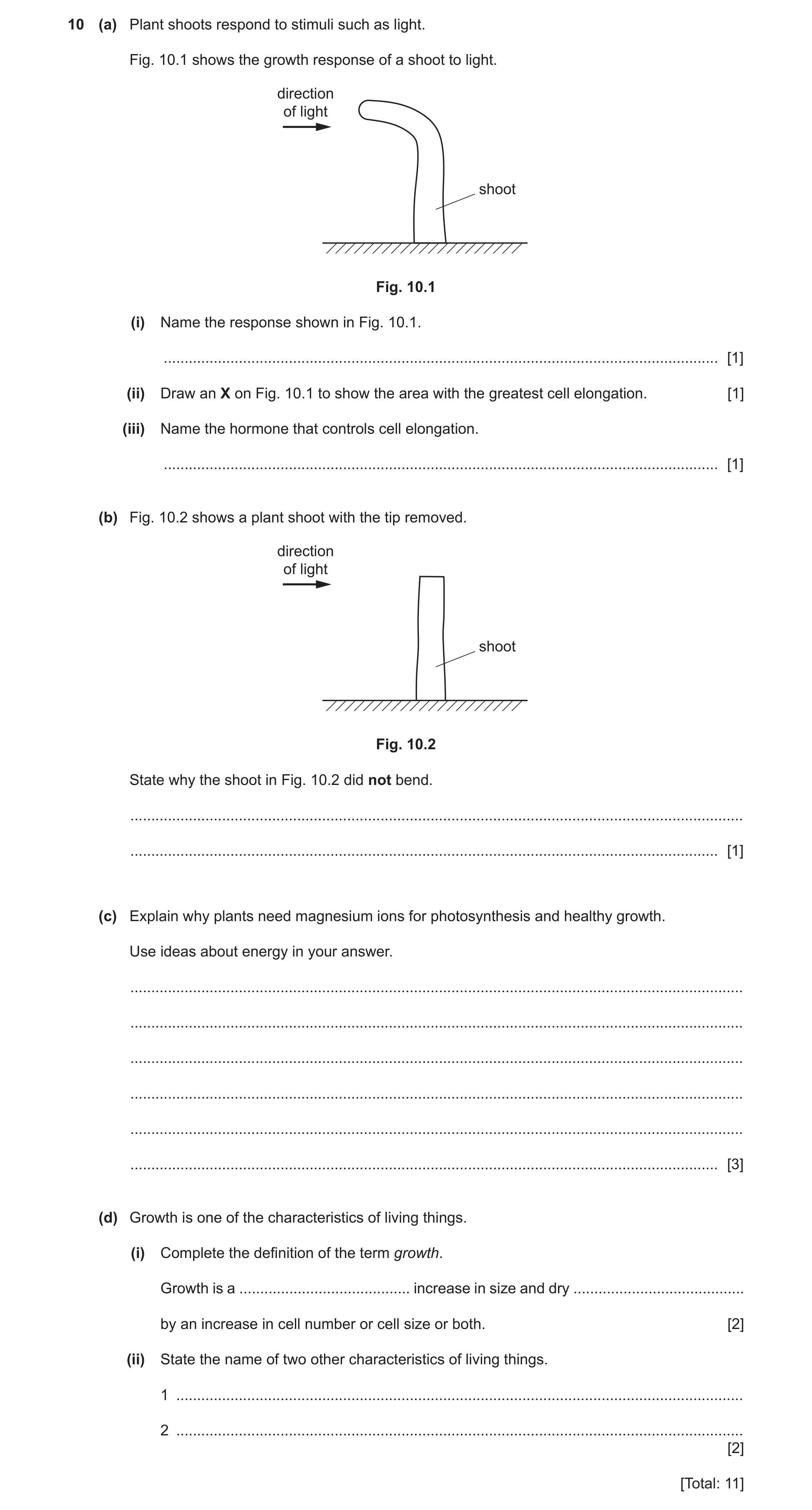
10 (a) Plant shoots respond to stimuli such as light. Fig. 10.1 shows the growth response of a shoot to light. direction of light shoot Fig. 10.1 (i) Name the response shown in Fig. 10.1. … [1] (ii) Draw an X on Fig. 10.1 to show the area with the greatest cell elongation. [1] (iii) Name the hormone that controls cell elongation. … [1] (b) Fig. 10.2 shows a plant shoot with the tip removed. direction of light shoot Fig. 10.2 State why the shoot in Fig. 10.2 did not bend. … … [1] (c) Explain why plants need magnesium ions for photosynthesis and healthy growth. Use ideas about energy in your answer. … … … … … … [3] (d) Growth is one of the characteristics of living things. (i) Complete the definition of the term growth. Growth is a … increase in size and dry … by an increase in cell number or cell size or both. [2] (ii) State the name of two other characteristics of living things. 1 … 2 … [2] [Total: 11]
11 marks
Mark scheme: 10(a)(i) phototropism ; 1 10(a)(ii) X drawn on the upper side of the shoot bend ; 1 10(a)(iii) auxin ; 1 10(b) auxin / hormone / chemical, produced at the shoot tip ; 1 10(c) magnesium ions required to make chlorophyll ; chlorophyll absorbs light energy (and converts this to chemical energy) ; (chemical) energy used to synthesise, carbohydrates or glucose / carbohydrates or glucose are used to make proteins (for growth) ; 3 10(d)(i) permanent ; mass ; 2 10(d)(ii) any two from: movement reproduction sensitivity excretion nutrition respiration ;; 2
This question in 0654/41 May/June 2020
Q10 · A sketch graph showing the effect of temperature on the rate of transpiration (loss of… 0654/42 May/June 2020
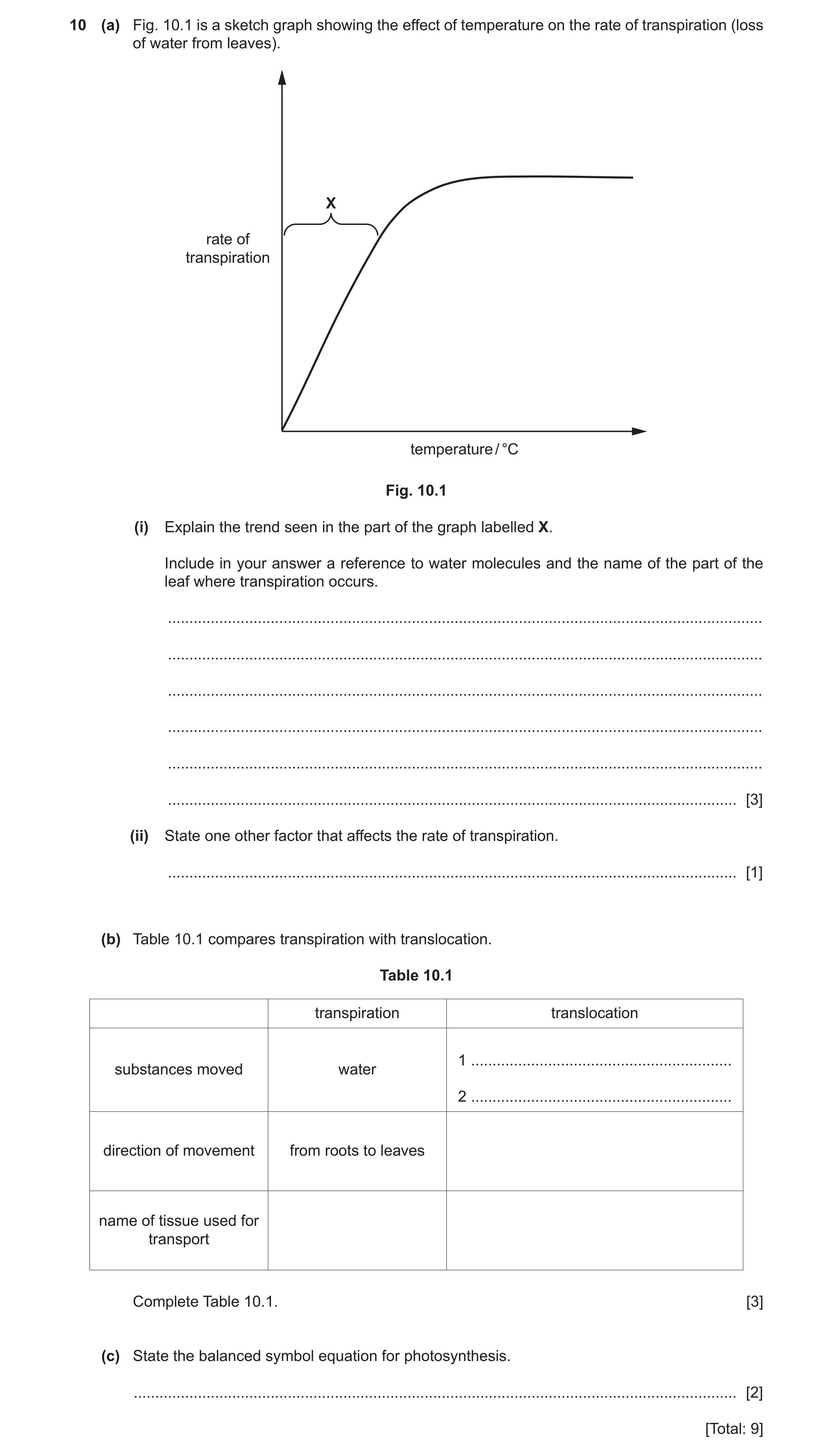
10 (a) Fig. 10.1 is a sketch graph showing the effect of temperature on the rate of transpiration (loss of water from leaves). X rate of transpiration temperature / °C Fig. 10.1 (i) Explain the trend seen in the part of the graph labelled X. Include in your answer a reference to water molecules and the name of the part of the leaf where transpiration occurs. … … … … … … [3] (ii) State one other factor that affects the rate of transpiration. … [1] (b) Table 10.1 compares transpiration with translocation. Table 10.1 transpiration translocation 1 … substances moved water 2 … direction of movement from roots to leaves name of tissue used for transport Complete Table 10.1. [3] (c) State the balanced symbol equation for photosynthesis. … [2] [Total: 9]
9 marks
Mark scheme: 10(a)(i) increase in temperature (no mark) increase in kinetic energy of water molecules ; increased rate of evaporation ; increased loss of water (vapour) through stomata ; 3 10(a)(ii) humidity ; 1 Question Answer Marks 10(b) transpiration translocation substances moved water 1 sucrose 2 amino acids direction of movement from roots to leaves from source to storage / sink name of tissue used for transport xylem phloem ;;; 1 mark for each correct row 3 10(c) 6CO2 + 6H2O → C6H12O6 + 6O2 left hand side ; right hand side ; 2
This question in 0654/42 May/June 2020
Q11 · The effects of using fertilisers containing nitrate ions on the yield of pea plants 0654/42 Oct/Nov 2020
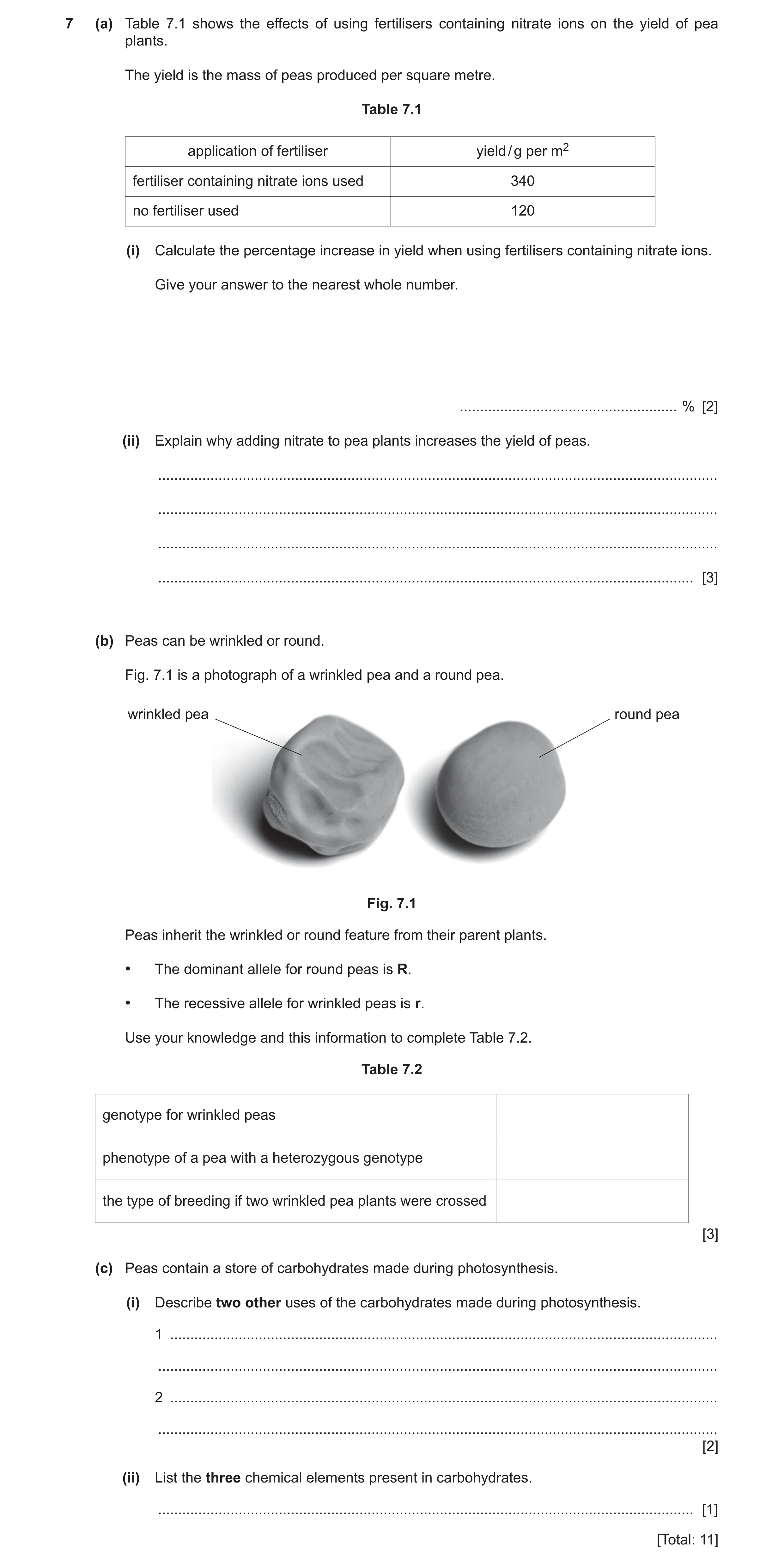
7 (a) Table 7.1 shows the effects of using fertilisers containing nitrate ions on the yield of pea plants. The yield is the mass of peas produced per square metre. Table 7.1 application of fertiliser yield / g per m2 fertiliser containing nitrate ions used 340 no fertiliser used 120 (i) Calculate the percentage increase in yield when using fertilisers containing nitrate ions. Give your answer to the nearest whole number. … % [2] (ii) Explain why adding nitrate to pea plants increases the yield of peas. … … … … [3] (b) Peas can be wrinkled or round. Fig. 7.1 is a photograph of a wrinkled pea and a round pea. wrinkled pea round pea Fig. 7.1 Peas inherit the wrinkled or round feature from their parent plants. • The dominant allele for round peas is R. • The recessive allele for wrinkled peas is r. Use your knowledge and this information to complete Table 7.2. Table 7.2 genotype for wrinkled peas phenotype of a pea with a heterozygous genotype the type of breeding if two wrinkled pea plants were crossed [3] (c) Peas contain a store of carbohydrates made during photosynthesis. (i) Describe two other uses of the carbohydrates made during photosynthesis. 1 … … 2 … … [2] (ii) List the three chemical elements present in carbohydrates. … [1] [Total: 11]
11 marks
Mark scheme: 7(a)(i) 340 – 120 or 220 (220 / 120) × 100 = 183(%) ;; 2 7(a)(ii) nitrate ions are needed to make, amino acids / proteins ; amino acids are needed for protein synthesis ; proteins are needed for growth which increases the yield ; 3 7(b) genotype for wrinkly peas rr ; phenotype of a heterozygous genotype round ; the type of breeding if two wrinkly pea plants were crossed pure ; 3 Question Answer Marks 7(c)(i) as a reactant for respiration / energy source ; used to make cellulose for cell walls ; converted to sucrose for transport ; AVP ;; max 2 2 7(c)(ii) carbon, hydrogen, oxygen ; 1
This question in 0654/42 Oct/Nov 2020
Q12 · A scientist investigates the effect of light intensity, carbon dioxide concentration and… 0654/43 Oct/Nov 2020
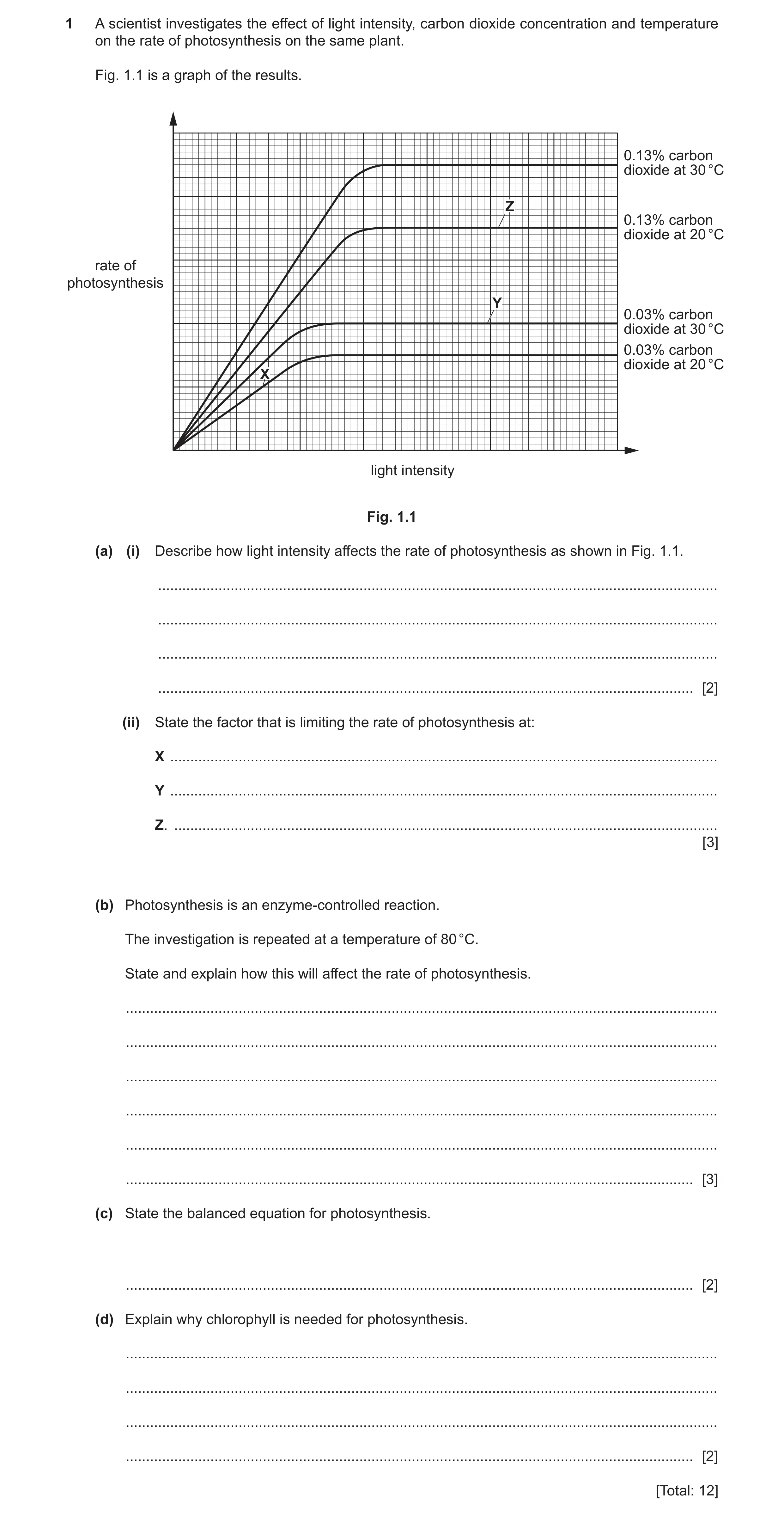
1 A scientist investigates the effect of light intensity, carbon dioxide concentration and temperature on the rate of photosynthesis on the same plant. Fig. 1.1 is a graph of the results. 0.13% carbon dioxide at 30 °C Z 0.13% carbon dioxide at 20 °C rate of photosynthesis Y 0.03% carbon dioxide at 30 °C 0.03% carbon dioxide at 20 °C X light intensity Fig. 1.1 (a) (i) Describe how light intensity affects the rate of photosynthesis as shown in Fig. 1.1. … … … … [2] (ii) State the factor that is limiting the rate of photosynthesis at: X … Y … Z. … [3] (b) Photosynthesis is an enzyme-controlled reaction. The investigation is repeated at a temperature of 80 °C. State and explain how this will affect the rate of photosynthesis. … … … … … … [3] (c) State the balanced equation for photosynthesis. … [2] (d) Explain why chlorophyll is needed for photosynthesis. … … … … [2] [Total: 12]
12 marks
Mark scheme: 1(a)(i) as light intensity increases the rate of photosynthesis increases (initially) ; then rate of photosynthesis stays constant ; 2 1(a)(ii) X light intensity / temperature / carbon dioxide concentration ; Y carbon dioxide concentration ; Z temperature ; 3 1(b) photosynthesis stops ; high temperature denatures enzymes ; shape of active site changes ; substrate can no longer fit ; max 3 3 1(c) 6CO2 + 6H2O → C6H12O6 + 6O2 LHS ; RHS ; 2 1(d) transfers light energy to chemical energy ; to synthesise carbohydrates / glucose ; 2
This question in 0654/43 Oct/Nov 2020
Q13 · State the balanced equation for photosynthesis 0654/42 Feb/March 2021
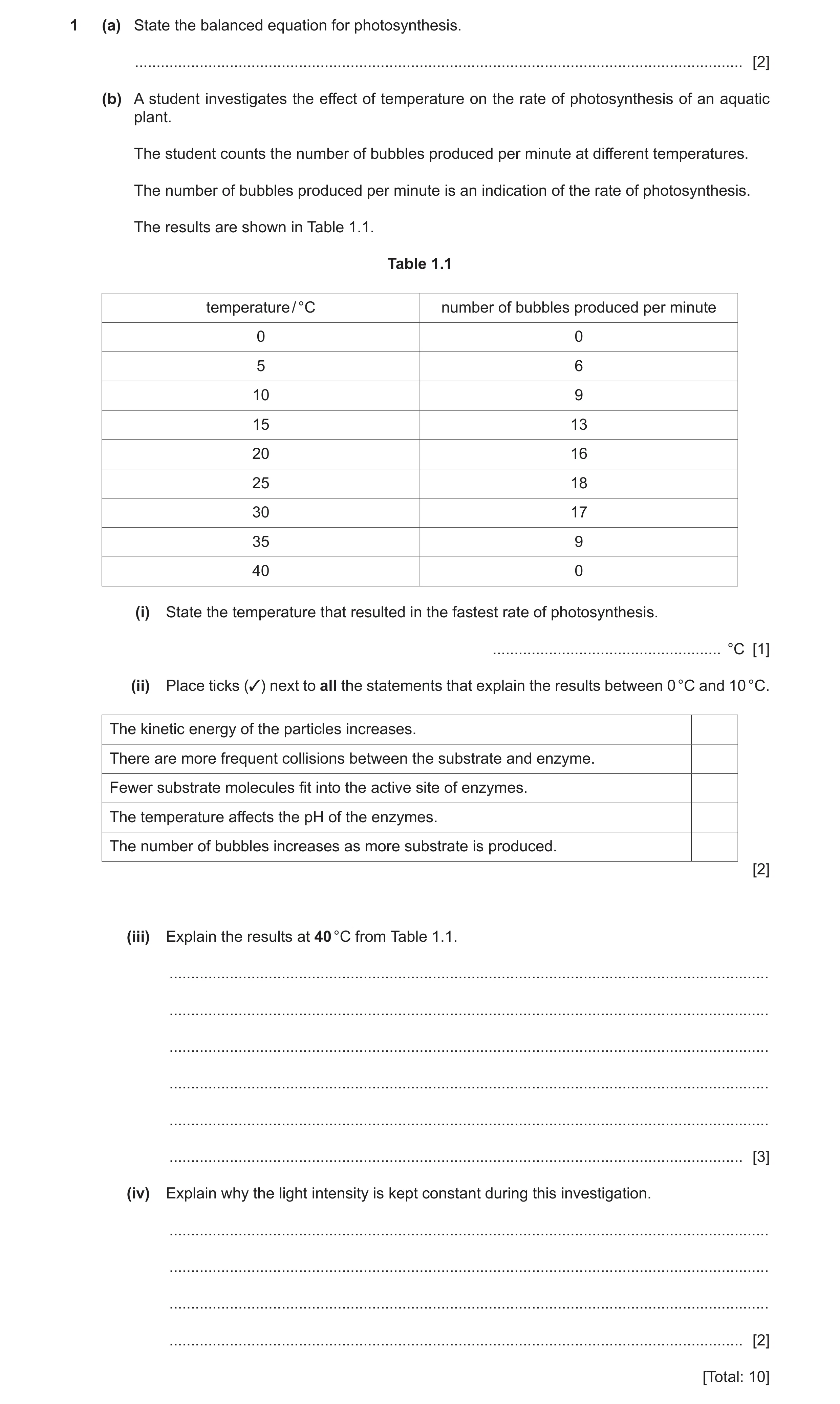
1 (a) State the balanced equation for photosynthesis. … [2] (b) A student investigates the effect of temperature on the rate of photosynthesis of an aquatic plant. The student counts the number of bubbles produced per minute at different temperatures. The number of bubbles produced per minute is an indication of the rate of photosynthesis. The results are shown in Table 1.1. Table 1.1 temperature / °C number of bubbles produced per minute 0 0 5 6 10 9 15 13 20 16 25 18 30 17 35 9 40 0 (i) State the temperature that resulted in the fastest rate of photosynthesis. … °C [1] (ii) Place ticks (3) next to all the statements that explain the results between 0 °C and 10 °C. The kinetic energy of the particles increases. There are more frequent collisions between the substrate and enzyme. Fewer substrate molecules fit into the active site of enzymes. The temperature affects the pH of the enzymes. The number of bubbles increases as more substrate is produced. [2] (iii) Explain the results at 40 °C from Table 1.1. … … … … … … [3] (iv) Explain why the light intensity is kept constant during this investigation. … … … … [2] [Total: 10]
10 marks
Mark scheme: 1(a) 6CO2 + 6H2O → C6H12O6 + 6O2 ;; 2 1(b)(i) 25 (°C) ; 1 1(b)(ii) the kinetic energy of the particles increases ticked ; there are more frequent collisions between the substrate and enzyme ticked ; 2 1(b)(iii) any three from: photosynthesis has stopped ; the enzymes have become denatured ; the active site has changed shape / the shape of the active site is no longer complementary to the substrate ; substrate no longer fits into, enzyme / active site ; 3 1(b)(iv) a change in light intensity will affect the results ; only the effect of temperature is being investigated / all other variables should be kept constant ; 2
This question in 0654/42 Feb/March 2021
Q14 · A flowchart showing the process of eutrophication 0654/41 May/June 2021
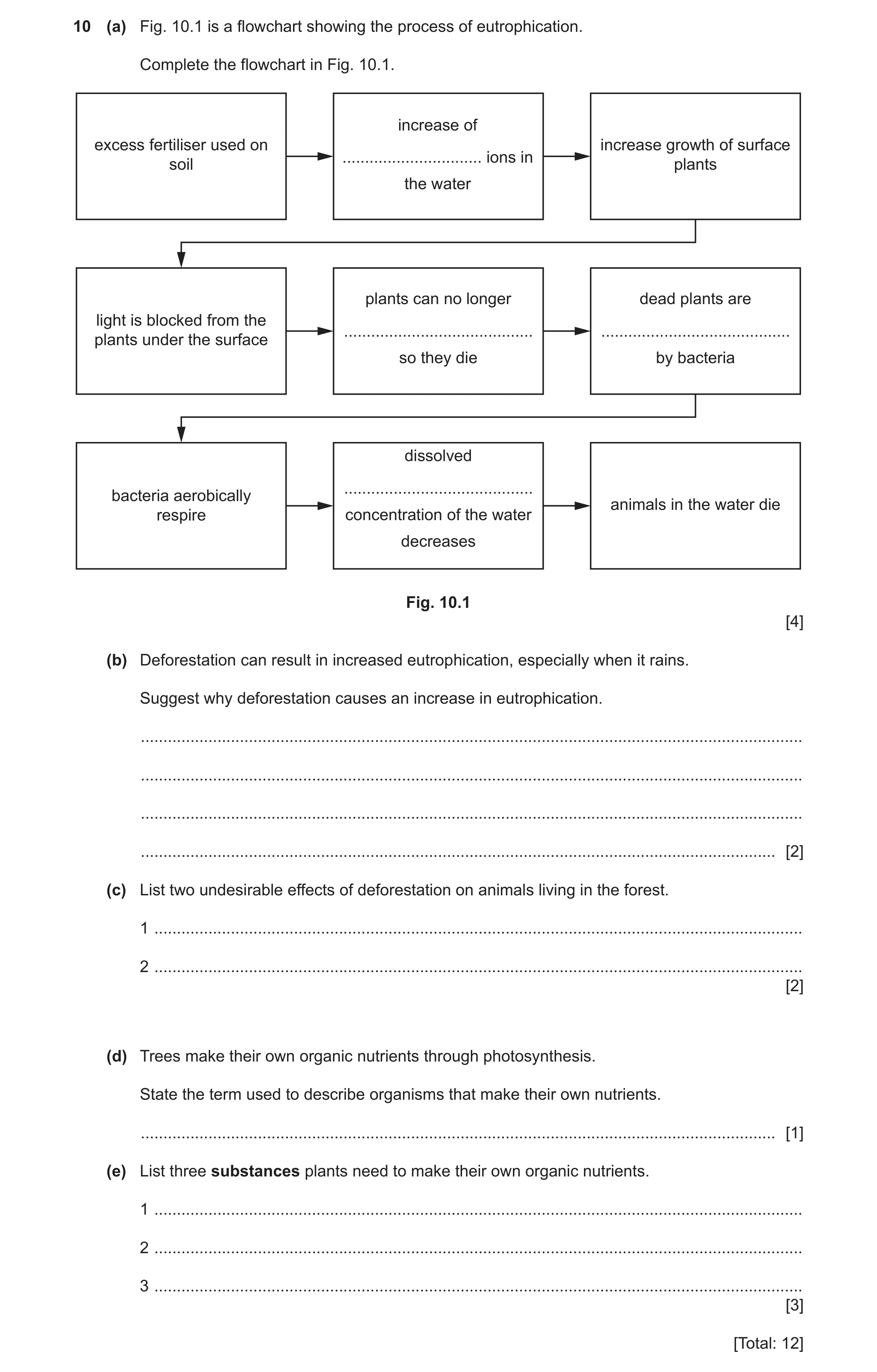
10 (a) Fig. 10.1 is a flowchart showing the process of eutrophication. Complete the flowchart in Fig. 10.1. increase of excess fertiliser used on increase growth of surface … ions in soil plants the water plants can no longer dead plants are light is blocked from the … … plants under the surface so they die by bacteria dissolved … bacteria aerobically animals in the water die respire concentration of the water decreases Fig. 10.1 [4] (b) Deforestation can result in increased eutrophication, especially when it rains. Suggest why deforestation causes an increase in eutrophication. … … … … [2] (c) List two undesirable effects of deforestation on animals living in the forest. 1 … 2 … [2] (d) Trees make their own organic nutrients through photosynthesis. State the term used to describe organisms that make their own nutrients. … [1] (e) List three substances plants need to make their own organic nutrients. 1 … 2 … 3 … [3] [Total: 12]
12 marks
Mark scheme: 10(a) nitrate ; photosynthesise ; decomposed ; oxygen ; 10(b) increased, soil erosion / described ; soil contains nitrate (ions) ; 2 10(c) loss of food / disruption to food chain / web; loss of habitat ; extinction ; migration ; 2 10(d) producer ; 1 Question Answer Marks 10(e) carbon dioxide ; water ; chlorophyll ; (named) mineral ions ; max 3 3
This question in 0654/41 May/June 2021
Q15 · A student investigates the effect of light intensity on the rate of photosynthesis at two… 0654/42 Oct/Nov 2021
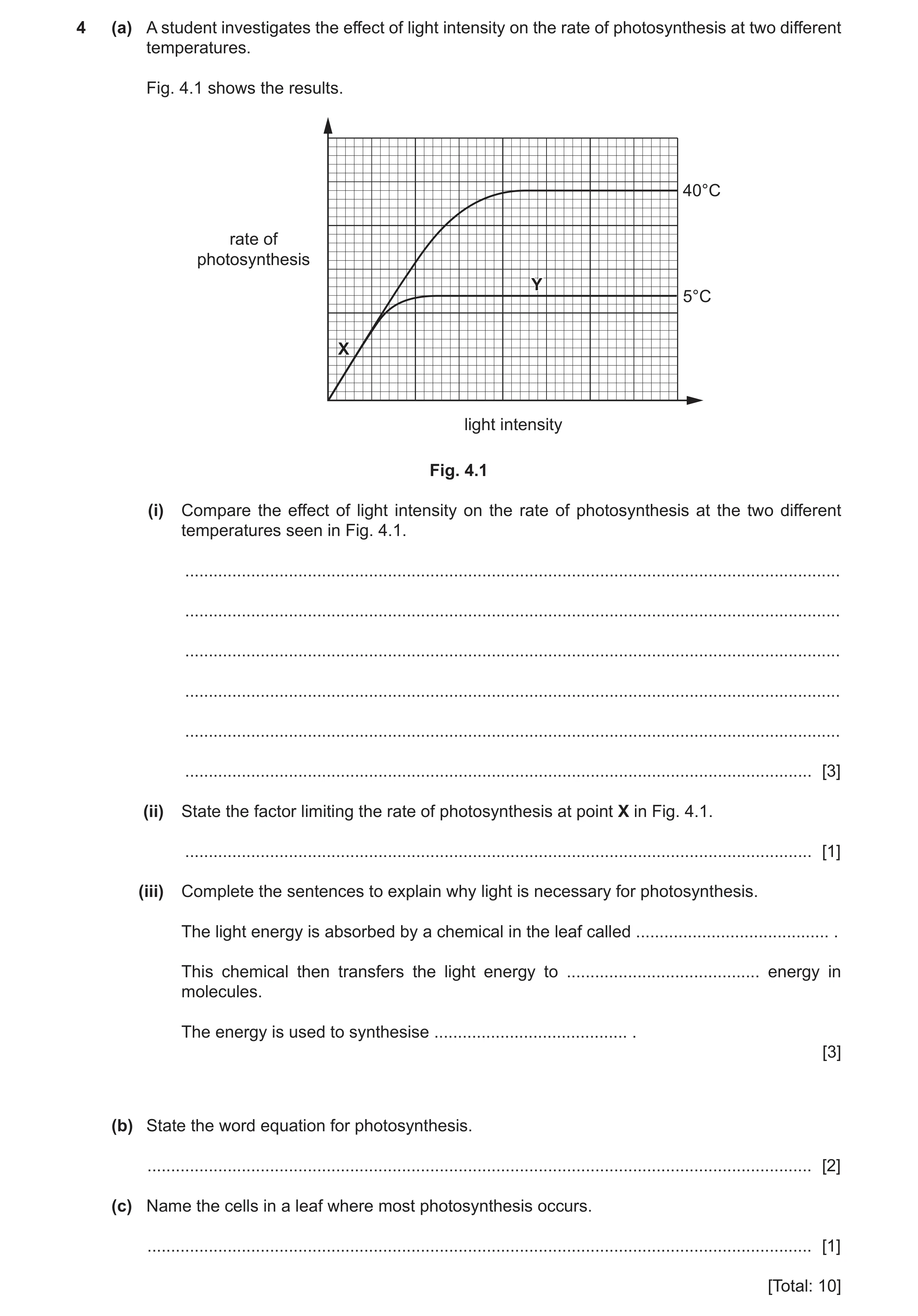
4 (a) A student investigates the effect of light intensity on the rate of photosynthesis at two different temperatures. Fig. 4.1 shows the results. 40°C rate of photosynthesis YY 5°C XX light intensity Fig. 4.1 (i) Compare the effect of light intensity on the rate of photosynthesis at the two different temperatures seen in Fig. 4.1. … … … … … … [3] (ii) State the factor limiting the rate of photosynthesis at point X in Fig. 4.1. … [1] (iii) Complete the sentences to explain why light is necessary for photosynthesis. The light energy is absorbed by a chemical in the leaf called … . This chemical then transfers the light energy to … energy in molecules. The energy is used to synthesise … . [3] (b) State the word equation for photosynthesis. … [2] (c) Name the cells in a leaf where most photosynthesis occurs. … [1] [Total: 10]
10 marks
Mark scheme: 4(a)(i) any three from: as light intensity increases the rate of photosynthesis initially increases and then becomes constant / AW ; the rate of photosynthesis is initially the same at 40 °C as 5 °C ; the rate of photosynthesis becomes constant, at a lower light intensity, at 5 °C than 40 °C ; (then) the rate of photosynthesis becomes higher at increasing light intensity at 40 °C than 5 °C ; 3 4(a)(ii) light intensity ; 1 4(a)(iii) chlorophyll ; chemical ; carbohydrates ; 3 4(b) carbon dioxide + water → glucose + oxygen ;; 2 4(c) palisade mesophyll cells ; 1
This question in 0654/42 Oct/Nov 2021
Q16 · A marine food web 0654/42 Feb/March 2022
7 (a) Fig. 7.1 is a marine food web. orca leopard seal penguin krill arctic cod phytoplankton Fig. 7.1 Table 7.1 shows some of the terms that can be used to describe the organisms in Fig. 7.1. Put ticks (3) in Table 7.1 to show all the terms used to describe each organism. One has been done for you. Table 7.1 quaternary organism producer herbivore carnivore consumer arctic cod krill 3 orca phytoplankton [3] (b) Describe how producers are able to make their own carbohydrates. … … … … [2] (c) Describe three ways energy is lost between trophic levels. 1 … 2 … 3 … [3] (d) Marine organisms have developed adaptations such as gills. (i) Complete the sentences to describe the process of adaptation. Adaptation results from the process of natural … . Some organisms are better adapted to the … than others. These organisms survive and breed, passing on their … . This process takes many … . [4] (ii) Gills are the gas exchange surface in fish. List two features of gas exchange surfaces. 1 … 2 … [2] [Total: 14]
14 marks
Mark scheme: 7(a) organism producer herbivore carnivore quaternary consumer arctic cod krill orca phytoplankton ;;; 7(b) any two from: by photosynthesis ; using light (energy) ; using carbon dioxide and water ; 2 7(c) any three from: heat / respiration ; excretion / faeces / urea ; (named) movement / (named) metabolic processes ; not all the organism is eaten / some parts are undigested ; not all the organisms from the trophic level are eaten ; 3 7(d)(i) selection ; environment ; alleles ; generations ; 4 7(d)(ii) any two from: good blood supply ; thin (walls/surface) / short diffusion distance ; large surface area ; good ventilation ; AVP ; 2
This question in 0654/42 Feb/March 2022
Q17 · A student investigates the effect of temperature on the rate of photosynthesis 0654/43 May/June 2022
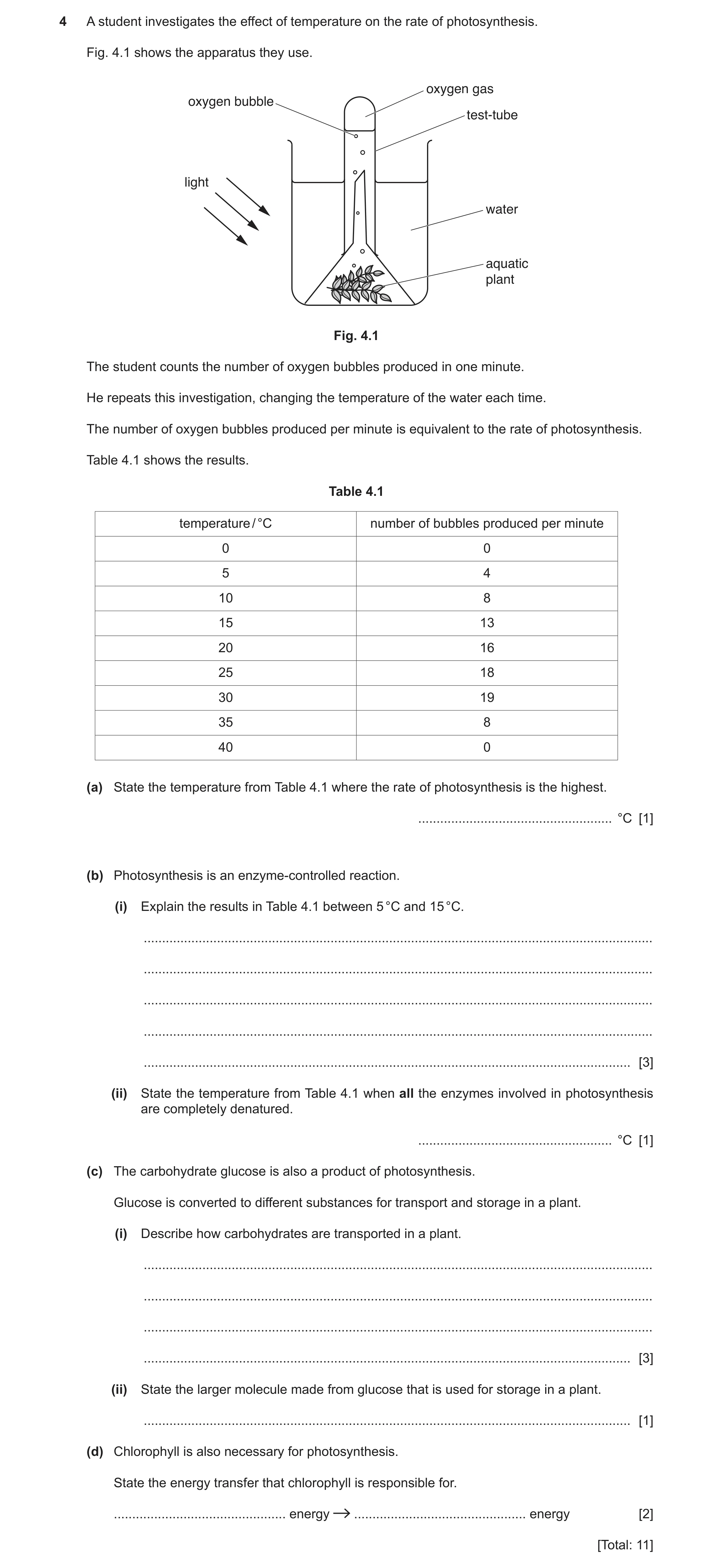
4 A student investigates the effect of temperature on the rate of photosynthesis. Fig. 4.1 shows the apparatus they use. oxygen gas oxygen bubble test-tube light water aquatic plant Fig. 4.1 The student counts the number of oxygen bubbles produced in one minute. He repeats this investigation, changing the temperature of the water each time. The number of oxygen bubbles produced per minute is equivalent to the rate of photosynthesis. Table 4.1 shows the results. Table 4.1 temperature / °C number of bubbles produced per minute 0 0 5 4 10 8 15 13 20 16 25 18 30 19 35 8 40 0 (a) State the temperature from Table 4.1 where the rate of photosynthesis is the highest. … °C [1] (b) Photosynthesis is an enzyme-controlled reaction. (i) Explain the results in Table 4.1 between 5 °C and 15 °C. … … … … … [3] (ii) State the temperature from Table 4.1 when all the enzymes involved in photosynthesis are completely denatured. … °C [1] (c) The carbohydrate glucose is also a product of photosynthesis. Glucose is converted to different substances for transport and storage in a plant. (i) Describe how carbohydrates are transported in a plant. … … … … [3] (ii) State the larger molecule made from glucose that is used for storage in a plant. … [1] (d) Chlorophyll is also necessary for photosynthesis. State the energy transfer that chlorophyll is responsible for. … energy … energy [2] [Total: 11]
11 marks
Mark scheme: 4(a) 30 (°C) ; 1 4(b)(i) (increasing temperature) increases the energy / speed of molecules ; increases number of molecules reaching activation energy ; increases frequency of (effective) collisions ; faster rate of photosynthesis ; max 3 3 4(b)(ii) 40 (°C) ; 1 4(c)(i) as sucrose ; in the phloem ; by translocation ; 3 4(c)(ii) starch ; 1 4(d) light ; chemical ; 2
This question in 0654/43 May/June 2022
Question 18 0654/41 Oct/Nov 2022
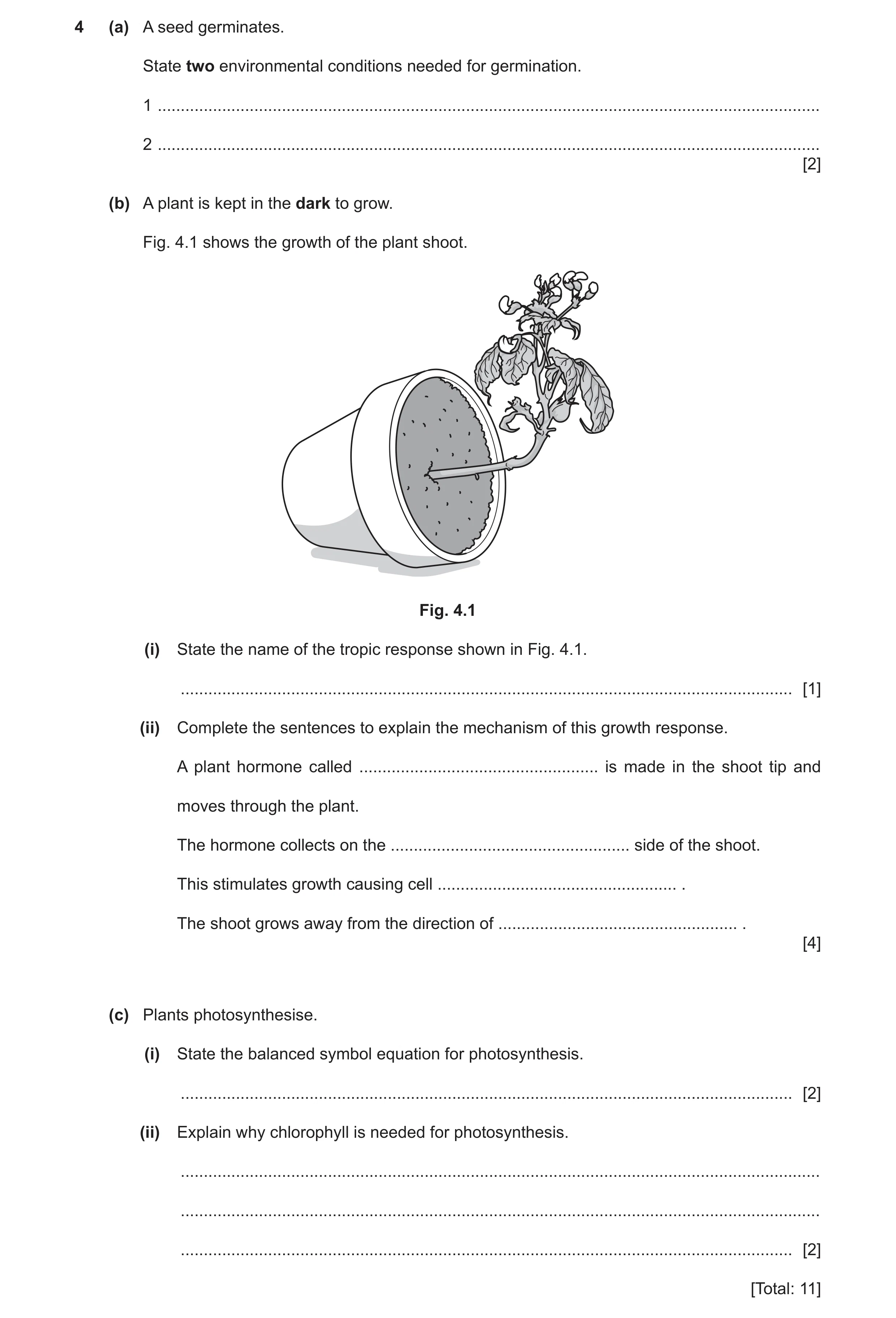
4 (a) A seed germinates. State two environmental conditions needed for germination. 1 … 2 … [2] (b) A plant is kept in the dark to grow. Fig. 4.1 shows the growth of the plant shoot. Fig. 4.1 (i) State the name of the tropic response shown in Fig. 4.1. … [1] (ii) Complete the sentences to explain the mechanism of this growth response. A plant hormone called … is made in the shoot tip and moves through the plant. The hormone collects on the … side of the shoot. This stimulates growth causing cell … . The shoot grows away from the direction of … . [4] (c) Plants photosynthesise. (i) State the balanced symbol equation for photosynthesis. … [2] (ii) Explain why chlorophyll is needed for photosynthesis. … … … [2] [Total: 11]
11 marks
Mark scheme: 4(a) any two from: 2 oxygen ; water / moisture ; warm / suitable temperature ; 4(b)(i) gravitropism ; 1 4(b)(ii) auxin ; 4 lower / owtte ; elongation ; gravity ; 4(c)(i) 6CO2+6H2O →C6H12O6 + 6O2 2 LHS ; RHS ; 4(c)(ii) transfers light energy to chemical energy ; 2 for synthesis of, carbohydrates / glucose ;
This question in 0654/41 Oct/Nov 2022
Q19 · A student investigates the effect of light intensity on the rate of photosynthesis in an… 0654/43 Oct/Nov 2022
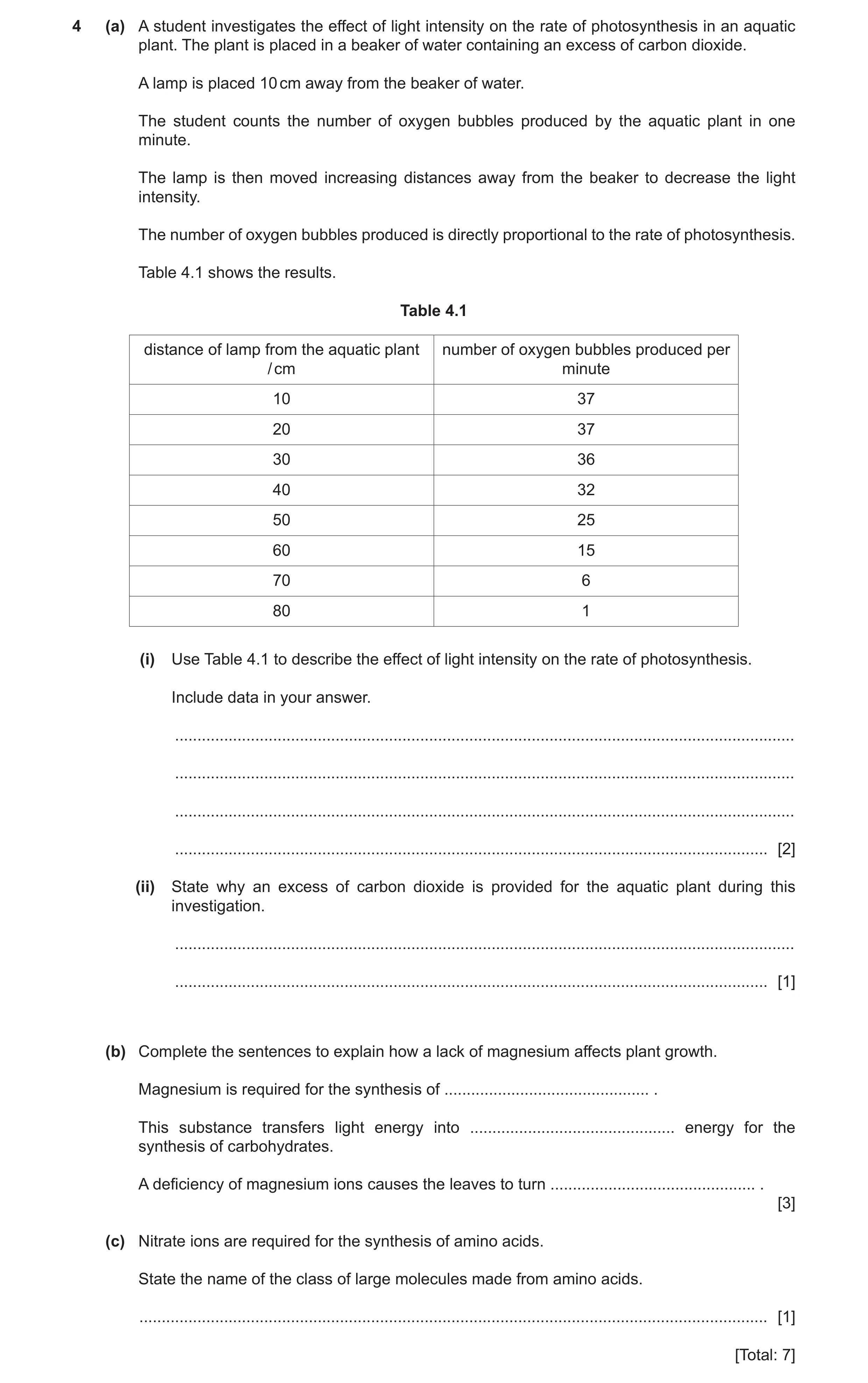
4 (a) A student investigates the effect of light intensity on the rate of photosynthesis in an aquatic plant. The plant is placed in a beaker of water containing an excess of carbon dioxide. A lamp is placed 10 cm away from the beaker of water. The student counts the number of oxygen bubbles produced by the aquatic plant in one minute. The lamp is then moved increasing distances away from the beaker to decrease the light intensity. The number of oxygen bubbles produced is directly proportional to the rate of photosynthesis. Table 4.1 shows the results. Table 4.1 distance of lamp from the aquatic plant number of oxygen bubbles produced per / cm minute 10 37 20 37 30 36 40 32 50 25 60 15 70 6 80 1 (i) Use Table 4.1 to describe the effect of light intensity on the rate of photosynthesis. Include data in your answer. … … … … [2] (ii) State why an excess of carbon dioxide is provided for the aquatic plant during this investigation. … … [1] (b) Complete the sentences to explain how a lack of magnesium affects plant growth. Magnesium is required for the synthesis of … . This substance transfers light energy into … energy for the synthesis of carbohydrates. A deficiency of magnesium ions causes the leaves to turn … . [3] (c) Nitrate ions are required for the synthesis of amino acids. State the name of the class of large molecules made from amino acids. … [1] [Total: 7]
7 marks
Mark scheme: 4(a)(i) as light intensity increases the rate of photosynthesis increases / or reverse argument ; 2 then rate levels off at 20 cm / 37 bubbles per minute ; 4(a)(ii) (carbon dioxide is required) for photosynthesis ; 1 4(b) chlorophyll ; 3 chemical ; yellow ; 4(c) protein ; 1
This question in 0654/43 Oct/Nov 2022
Q20 · Oxygen is one of the products of photosynthesis 0654/41 May/June 2023
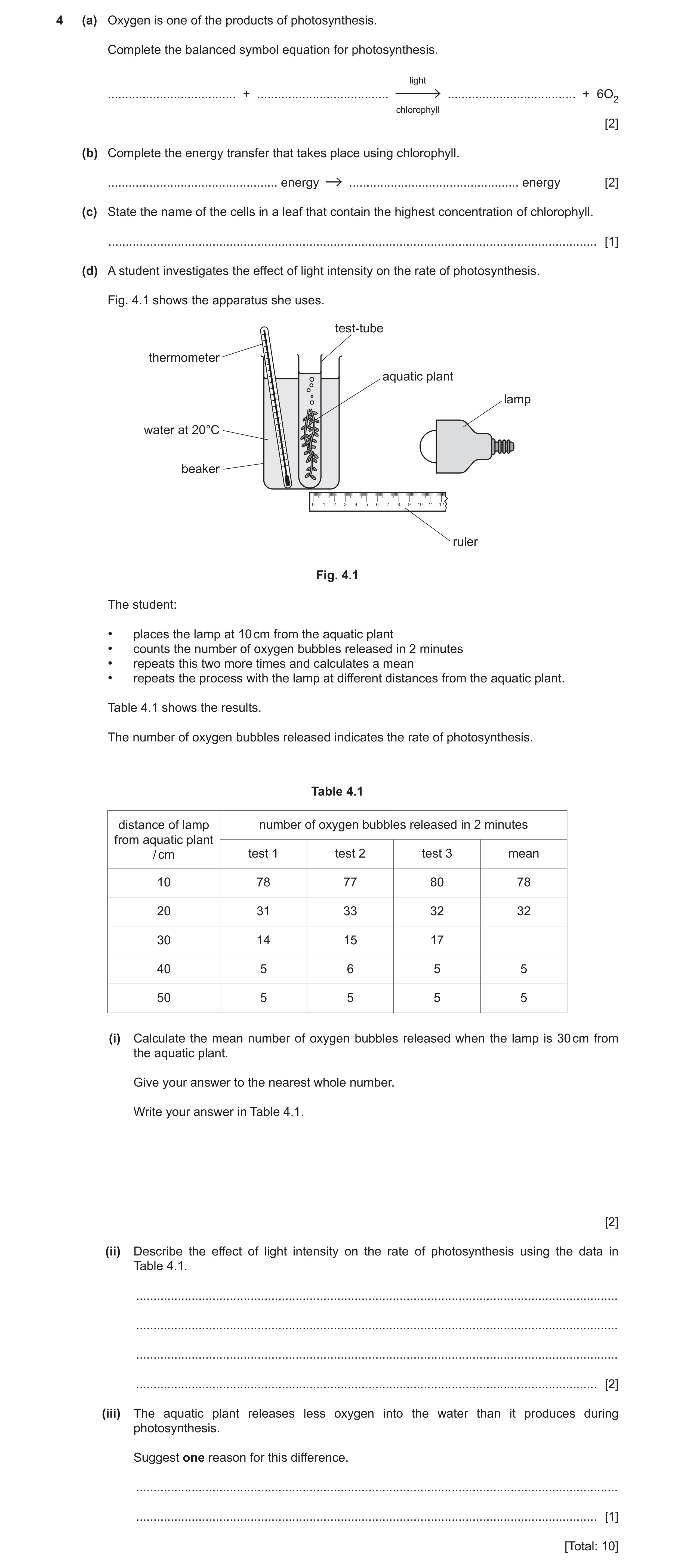
4 (a) Oxygen is one of the products of photosynthesis. Complete the balanced symbol equation for photosynthesis. light … + … … + 6O2 chlorophyll [2] (b) Complete the energy transfer that takes place using chlorophyll. … energy … energy [2] (c) State the name of the cells in a leaf that contain the highest concentration of chlorophyll. … [1] (d) A student investigates the effect of light intensity on the rate of photosynthesis. Fig. 4.1 shows the apparatus she uses. test-tube thermometer aquatic plant lamp water at 20°C beaker ruler Fig. 4.1 The student: • places the lamp at 10 cm from the aquatic plant • counts the number of oxygen bubbles released in 2 minutes • repeats this two more times and calculates a mean • repeats the process with the lamp at different distances from the aquatic plant. Table 4.1 shows the results. The number of oxygen bubbles released indicates the rate of photosynthesis. Table 4.1 distance of lamp number of oxygen bubbles released in 2 minutes from aquatic plant / cm test 1 test 2 test 3 mean 10 78 77 80 78 20 31 33 32 32 30 14 15 17 40 5 6 5 5 50 5 5 5 5 (i) Calculate the mean number of oxygen bubbles released when the lamp is 30 cm from the aquatic plant. Give your answer to the nearest whole number. Write your answer in Table 4.1. [2] (ii) Describe the effect of light intensity on the rate of photosynthesis using the data in Table 4.1. … … … … [2] (iii) The aquatic plant releases less oxygen into the water than it produces during photosynthesis. Suggest one reason for this difference. … … [1] [Total: 10]
10 marks
Mark scheme: 4(a) 6CO2 + 6H2O ; C6H12O6 ; 2 4(b) light ; chemical ; 2 4(c) palisade (mesophyll) ; 1 4(d)(i) evidence of 14+15+17 / 3 or 46 / 3 ; = 15 ; 2 4(d)(ii) as light intensity decreases the, (mean) number of bubbles of oxygen / rate of photosynthesis, decreases (initially) ; Accept ORA the (mean) number of bubbles of oxygen / the rate of photosynthesis, becomes constant after the lamp reaches 40 cm from the plant ; 2 4(d)(iii) some of the oxygen is used in respiration ; 1
This question in 0654/41 May/June 2023
Q21 · Photosynthesis is an enzyme‑controlled reaction 0654/42 May/June 2023
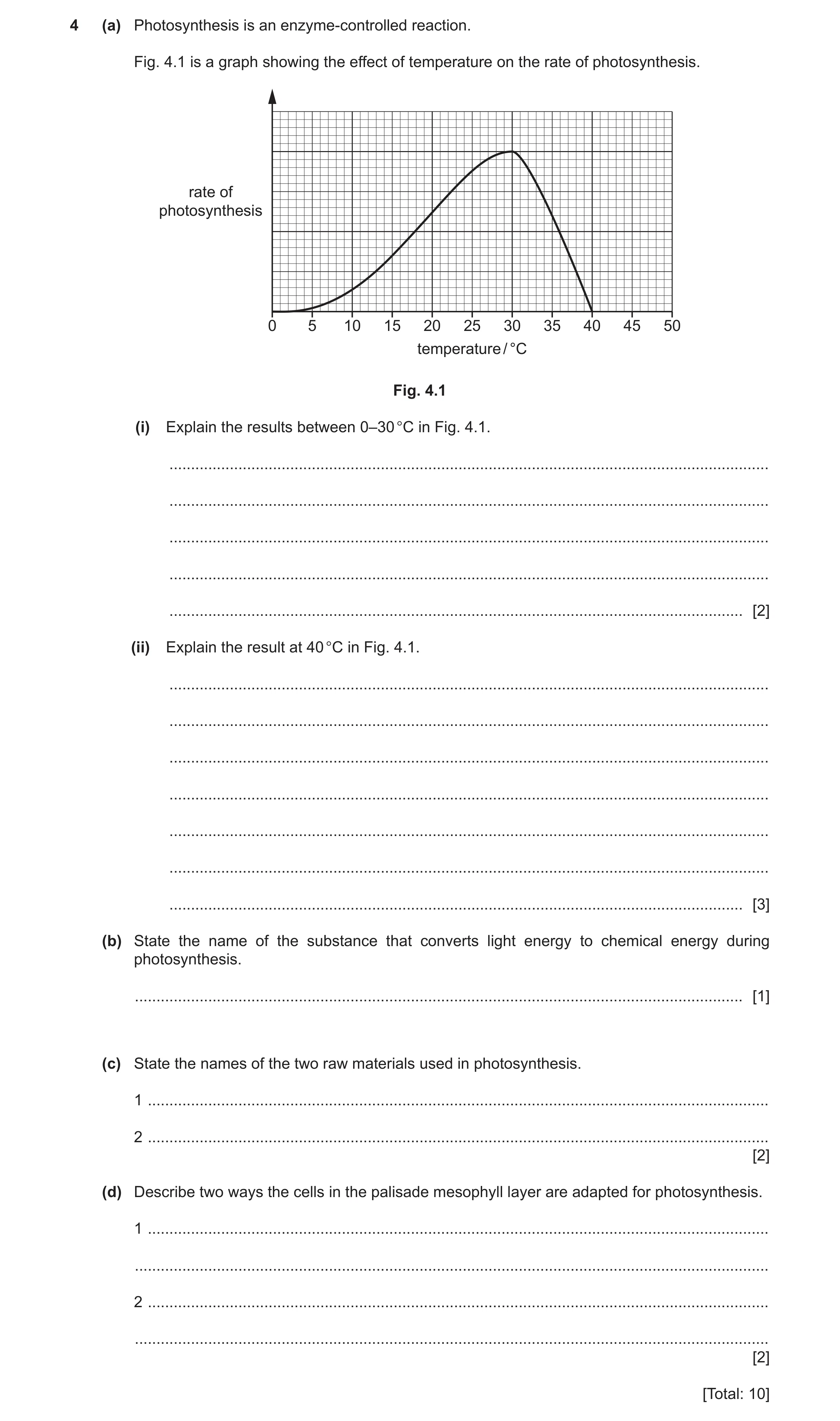
4 (a) Photosynthesis is an enzyme‑controlled reaction. Fig. 4.1 is a graph showing the effect of temperature on the rate of photosynthesis. rate of photosynthesis 0 5 10 15 20 25 30 35 40 45 50 temperature / °C Fig. 4.1 (i) Explain the results between 0–30 °C in Fig. 4.1. … … … … … [2] (ii) Explain the result at 40 °C in Fig. 4.1. … … … … … … … [3] (b) State the name of the substance that converts light energy to chemical energy during photosynthesis. … [1] (c) State the names of the two raw materials used in photosynthesis. 1 … 2 … [2] (d) Describe two ways the cells in the palisade mesophyll layer are adapted for photosynthesis. 1 … … 2 … … [2] [Total: 10]
10 marks
Mark scheme: 4(a)(i) (increasing temperature) increases the kinetic energy of particles ; increased frequency of (effective) collisions / ref to increased rate of substrates entering, active site / enzyme ; 2 4(a)(ii) (no photosynthesis) ref to denaturation (at extreme temperature) ; active site, changes shape / is deformed ; substrate no longer complementary to, active site / enzyme ; 3 4(b) chlorophyll ; 1 4(c) carbon dioxide ; water ; 2 4(d) any two from: contain many, chloroplasts / chlorophyll ; near the surface of the leaf ; are tightly packed / arranged side by side ; column / AW, shaped ; large vacuoles / chloroplasts at edge of cell ; chloroplasts able to move ; 2
This question in 0654/42 May/June 2023
Q22 · A student investigates the effect of light intensity on the rate of photosynthesis 0654/42 Feb/March 2024
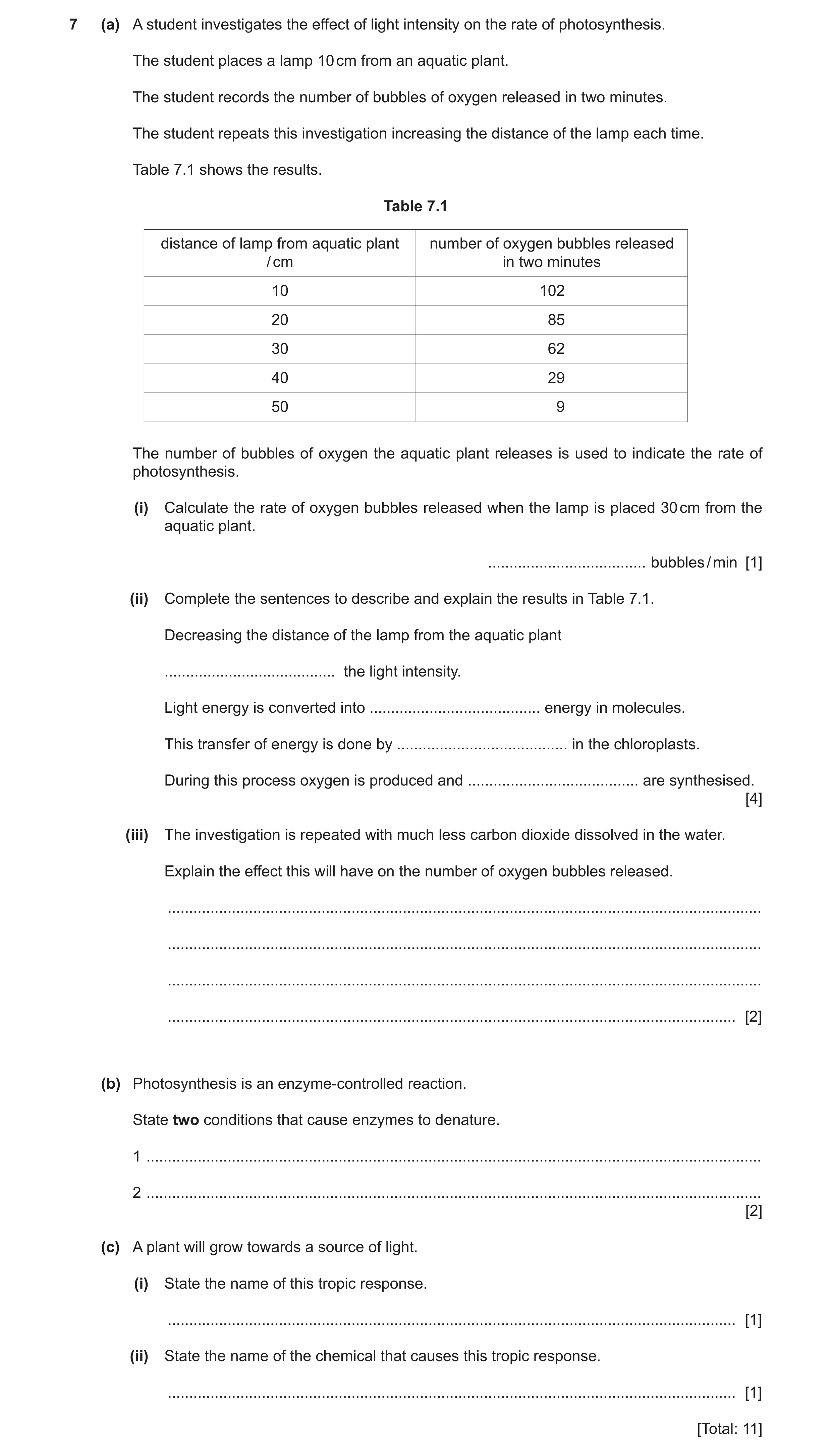
7 (a) A student investigates the effect of light intensity on the rate of photosynthesis. The student places a lamp 10 cm from an aquatic plant. The student records the number of bubbles of oxygen released in two minutes. The student repeats this investigation increasing the distance of the lamp each time. Table 7.1 shows the results. Table 7.1 distance of lamp from aquatic plant number of oxygen bubbles released / cm in two minutes 10 102 20 85 30 62 40 29 50 9 The number of bubbles of oxygen the aquatic plant releases is used to indicate the rate of photosynthesis. (i) Calculate the rate of oxygen bubbles released when the lamp is placed 30 cm from the aquatic plant. … bubbles / min [1] (ii) Complete the sentences to describe and explain the results in Table 7.1. Decreasing the distance of the lamp from the aquatic plant … the light intensity. Light energy is converted into … energy in molecules. This transfer of energy is done by … in the chloroplasts. During this process oxygen is produced and … are synthesised. [4] (iii) The investigation is repeated with much less carbon dioxide dissolved in the water. Explain the effect this will have on the number of oxygen bubbles released. … … … … [2] (b) Photosynthesis is an enzyme-controlled reaction. State two conditions that cause enzymes to denature. 1 … 2 … [2] (c) A plant will grow towards a source of light. (i) State the name of this tropic response. … [1] (ii) State the name of the chemical that causes this tropic response. … [1] [Total: 11]
11 marks
Mark scheme: 7(a)(i) 31 (bubbles / min) ; 1 7(a)(ii) increases ; 4 chemical ; chlorophyll ; carbohydrates ; 7(a)(iii) fewer (bubbles of oxygen produced) ; 2 carbon dioxide is a reactant of photosynthesis ; 7(b) high temperature ; 2 extremes of pH ; 7(c)(i) phototropism ; 1 7(c)(ii) auxin ; 1
This question in 0654/42 Feb/March 2024
Q23 · State the balanced symbol equation for photosynthesis 0654/42 Oct/Nov 2024
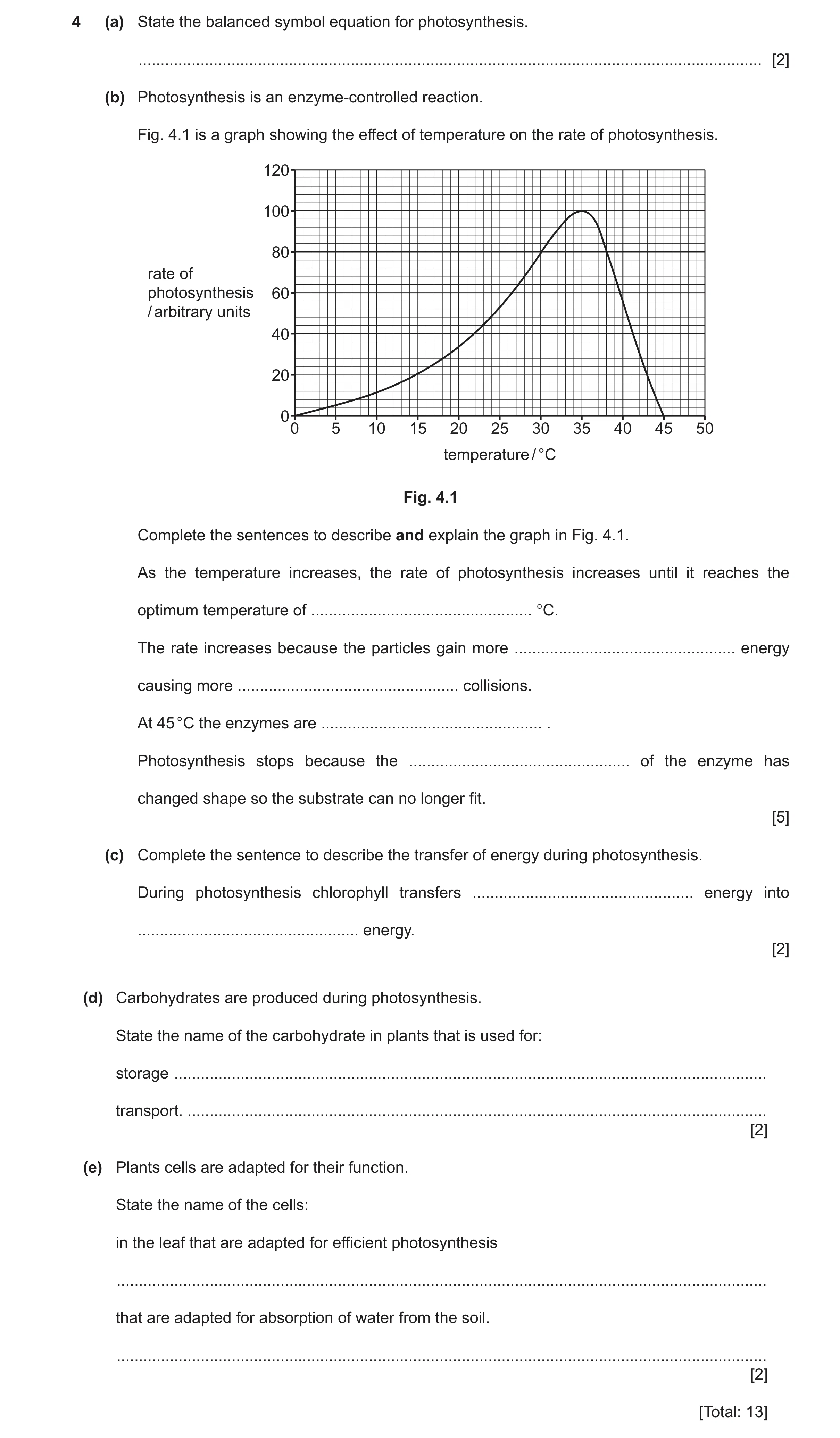
4 (a) State the balanced symbol equation for photosynthesis. … [2] (b) Photosynthesis is an enzyme-controlled reaction. Fig. 4.1 is a graph showing the effect of temperature on the rate of photosynthesis. 120 100 80 rate of photosynthesis 60 / arbitrary units 40 20 00 5 10 15 20 25 30 35 40 45 50 temperature / °C Fig. 4.1 Complete the sentences to describe and explain the graph in Fig. 4.1. As the temperature increases, the rate of photosynthesis increases until it reaches the optimum temperature of … °C. The rate increases because the particles gain more … energy causing more … collisions. At 45 °C the enzymes are … . Photosynthesis stops because the … of the enzyme has changed shape so the substrate can no longer fit. [5] (c) Complete the sentence to describe the transfer of energy during photosynthesis. During photosynthesis chlorophyll transfers … energy into … energy. [2] (d) Carbohydrates are produced during photosynthesis. State the name of the carbohydrate in plants that is used for: storage … transport. … [2] (e) Plants cells are adapted for their function. State the name of the cells: in the leaf that are adapted for efficient photosynthesis … that are adapted for absorption of water from the soil. … [2] [Total: 13]
13 marks
Mark scheme: 4(a) 2 6CO2 + 6H2O → C6H12O6 + 6O2 one mark for correctly balanced reactants (either order) ; one mark for correctly balanced products (either order) ; 4(b) 35 ; 5 kinetic ; successful / effective / frequent ; denatured ; active site ; 4(c) light ; 2 chemical ; 4(d) starch ; 2 sucrose ; 4(e) palisade mesophyll (cell) ; 2 root hair (cell) ;
This question in 0654/42 Oct/Nov 2024
Q24 · A cross-section through a leaf 0654/42 Feb/March 2025
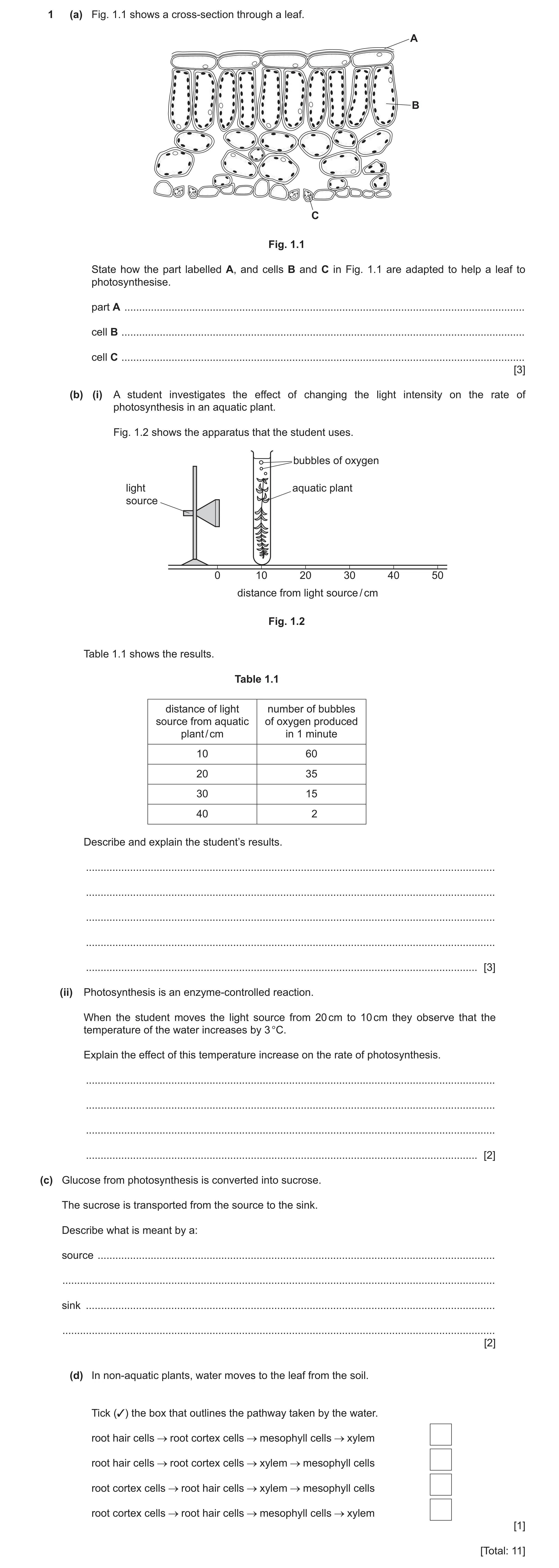
1 (a) Fig. 1.1 shows a cross-section through a leaf. A B C Fig. 1.1 State how the part labelled A, and cells B and C in Fig. 1.1 are adapted to help a leaf to photosynthesise. part A … cell B … cell C … [3] (b) (i) A student investigates the effect of changing the light intensity on the rate of photosynthesis in an aquatic plant. Fig. 1.2 shows the apparatus that the student uses. bubbles of oxygen light aquatic plant source 0 10 20 30 40 50 distance from light source / cm Fig. 1.2 Table 1.1 shows the results. Table 1.1 distance of light number of bubbles source from aquatic of oxygen produced plant / cm in 1 minute 10 60 20 35 30 15 40 2 Describe and explain the student’s results. … … … … … [3] (ii) Photosynthesis is an enzyme-controlled reaction. When the student moves the light source from 20 cm to 10 cm they observe that the temperature of the water increases by 3 °C. Explain the effect of this temperature increase on the rate of photosynthesis. … … … … [2] (c) Glucose from photosynthesis is converted into sucrose. The sucrose is transported from the source to the sink. Describe what is meant by a: source … … sink … … [2] (d) In non-aquatic plants, water moves to the leaf from the soil. Tick (✓) the box that outlines the pathway taken by the water. root hair cells root cortex cells mesophyll cells xylem root hair cells root cortex cells xylem mesophyll cells root cortex cells root hair cells xylem mesophyll cells root cortex cells root hair cells mesophyll cells xylem [1] [Total: 11]
11 marks
Mark scheme: Question Answer Marks 1(a) part A - waterproof / transparent ; 3 cell B - contain lots of chloroplasts / located near the upper surface of leaf / elongated or column-shaped, to pack together more tightly ; cell C - open and close stomata ; 1(b)(i) as distance of light source increases, the number of bubbles / the volume of oxygen, decreases or rate of photosynthesis 3 decreases ; and any two from: light intensity decreases with distance from light source light provides energy for photosynthesis oxygen is a product of photosynthesis ; ; 1(b)(ii) any two from: 2 increase in the rate of photosynthesis – no mark: increase in kinetic energy more effective collisions / more frequent collisions more enzyme-substrate complexes form ; ; 1(c) source – part of the plants that release, sucrose / amino acids ; 2 sink – part of plants that, use / store, sucrose / amino acids ; 1(d) 1 ;
This question in 0654/42 Feb/March 2025
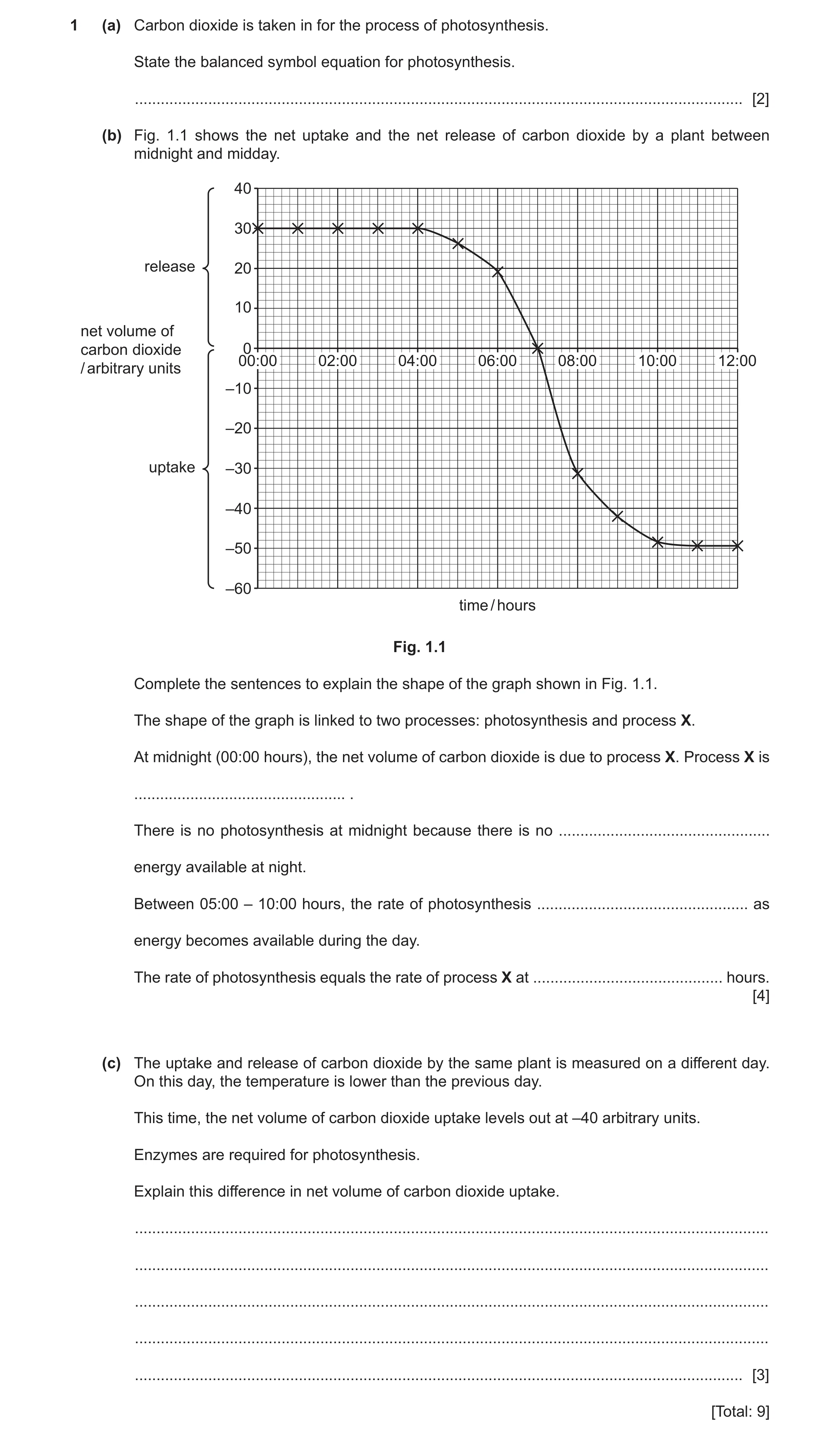
Q25 · Carbon dioxide is taken in for the process of photosynthesis 0654/41 May/June 2025
1 (a) Carbon dioxide is taken in for the process of photosynthesis. State the balanced symbol equation for photosynthesis. … [2] (b) Fig. 1.1 shows the net uptake and the net release of carbon dioxide by a plant between midnight and midday. 40 30 release 20 10 net volume of carbon dioxide 0 00:00 02:00 04:00 06:00 08:00 10:00 12:00 / arbitrary units –10 –20 uptake –30 –40 –50 –60 time / hours Fig. 1.1 Complete the sentences to explain the shape of the graph shown in Fig. 1.1. The shape of the graph is linked to two processes: photosynthesis and process X. At midnight (00:00 hours), the net volume of carbon dioxide is due to process X. Process X is … . There is no photosynthesis at midnight because there is no … energy available at night. Between 05:00 – 10:00 hours, the rate of photosynthesis … as energy becomes available during the day. The rate of photosynthesis equals the rate of process X at … hours. [4] (c) The uptake and release of carbon dioxide by the same plant is measured on a different day. On this day, the temperature is lower than the previous day. This time, the net volume of carbon dioxide uptake levels out at –40 arbitrary units. Enzymes are required for photosynthesis. Explain this difference in net volume of carbon dioxide uptake. … … … … … [3] [Total: 9]
9 marks
Mark scheme: Question Answer Marks 1(a) 6CO2 + 6H2O → 6O2 + C6H12O6 ; ; 2 1(b) respiration ; 4 light ; increases ; 07:00 ; 1(c) (less uptake of carbon dioxide because) slower rate of photosynthesis / photosynthesis limited by temperature ; 3 less kinetic energy / not enough KE ; lower frequency of / fewer effective / successful collisions (between enzyme and substrate) ;
This question in 0654/41 May/June 2025
 1 / 36
 2 / 36
 3 / 36
 4 / 36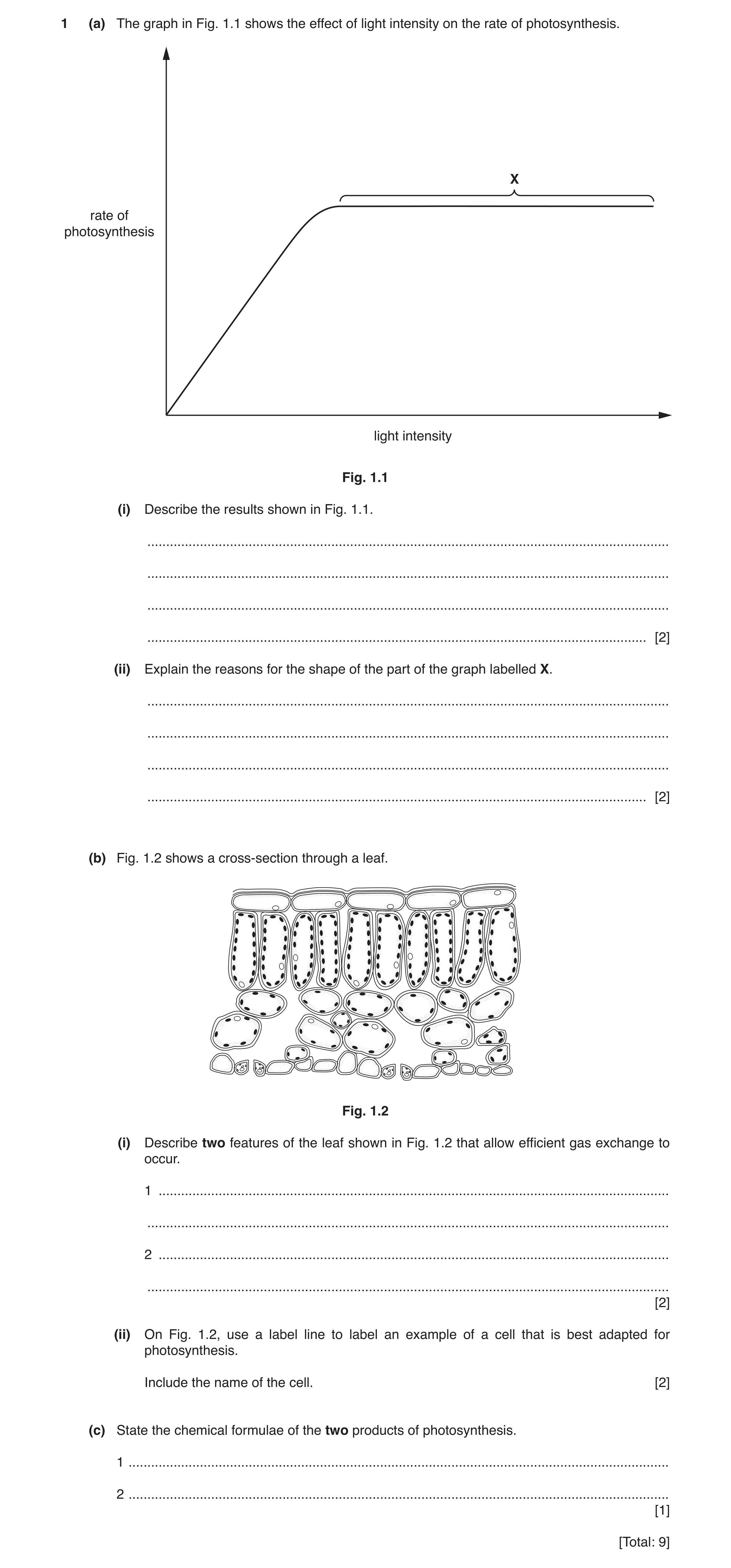
 7 / 36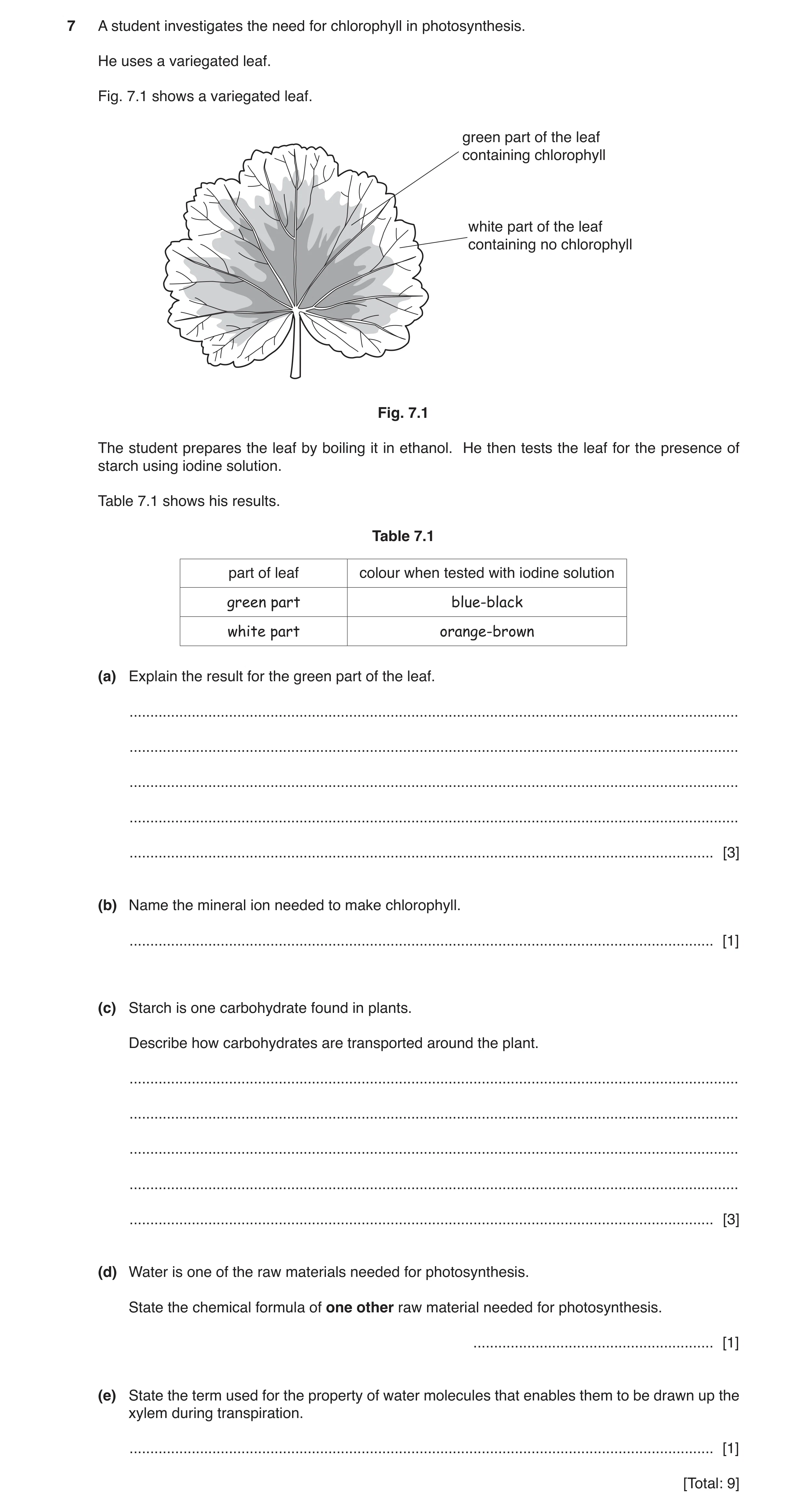
 21 / 36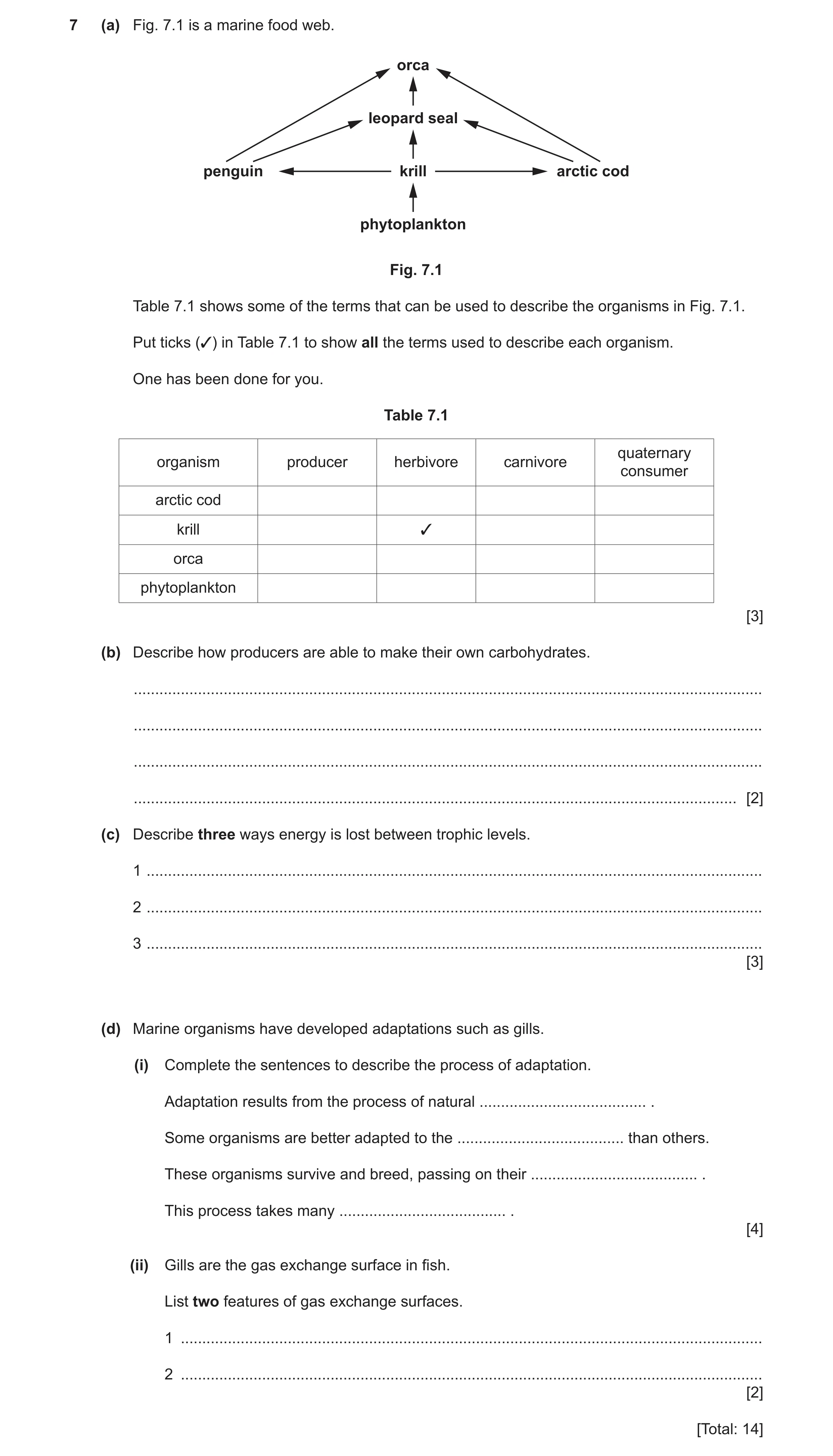
 11
11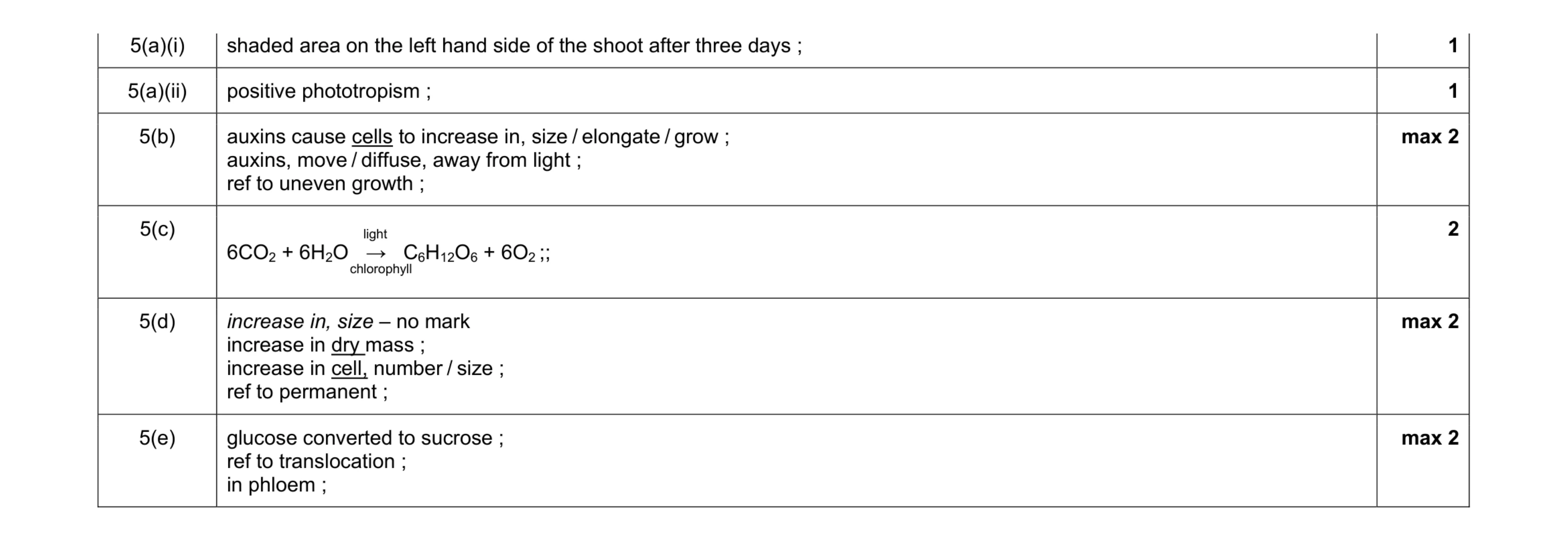 10
10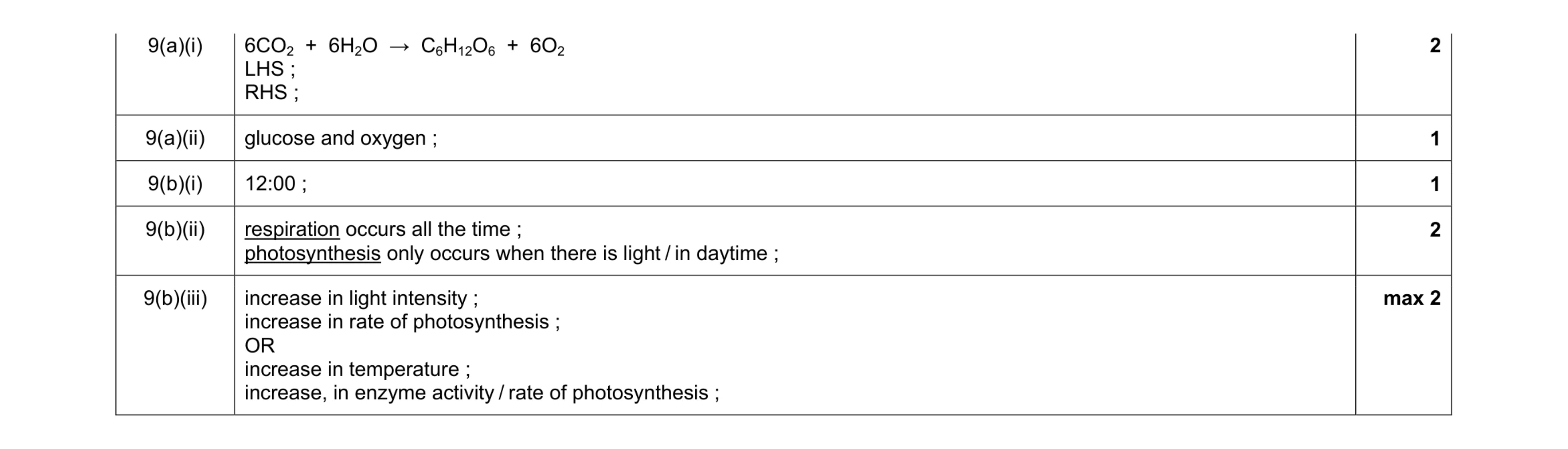 8
8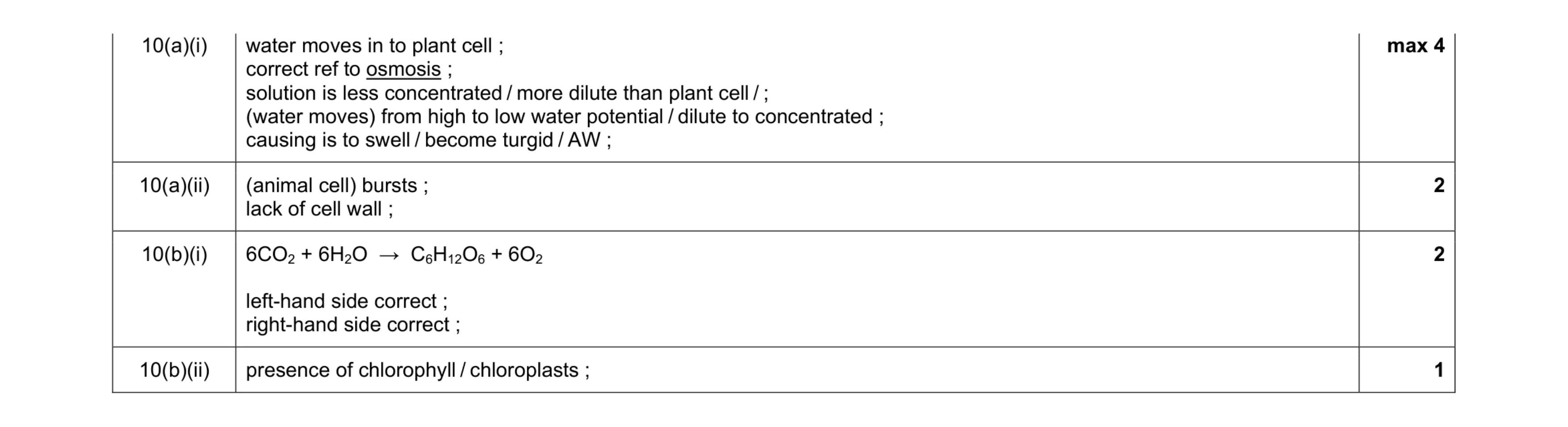 9
9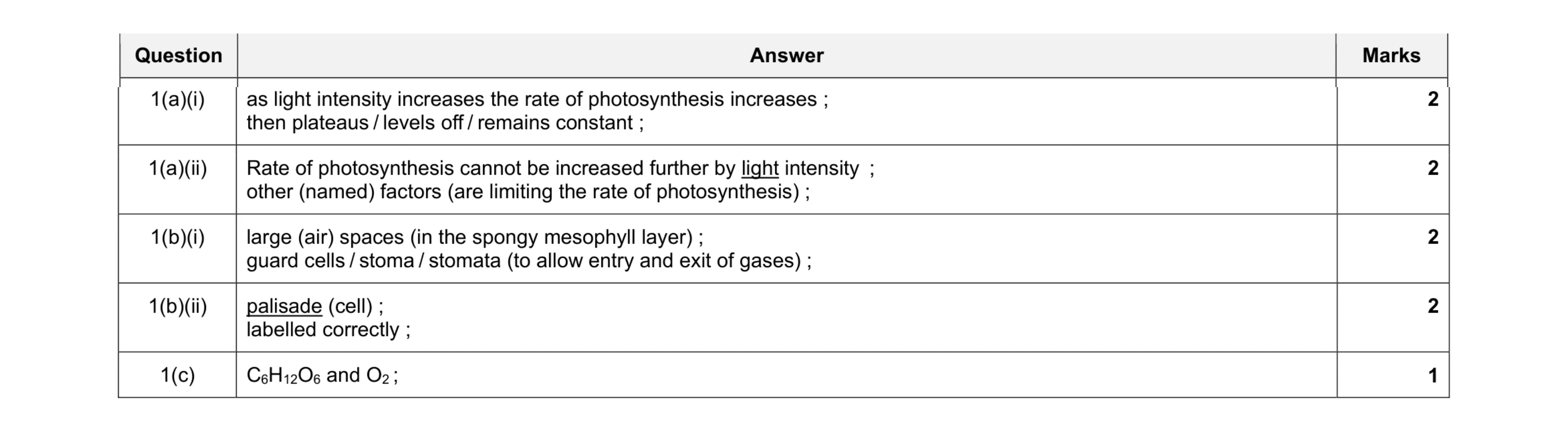 9
9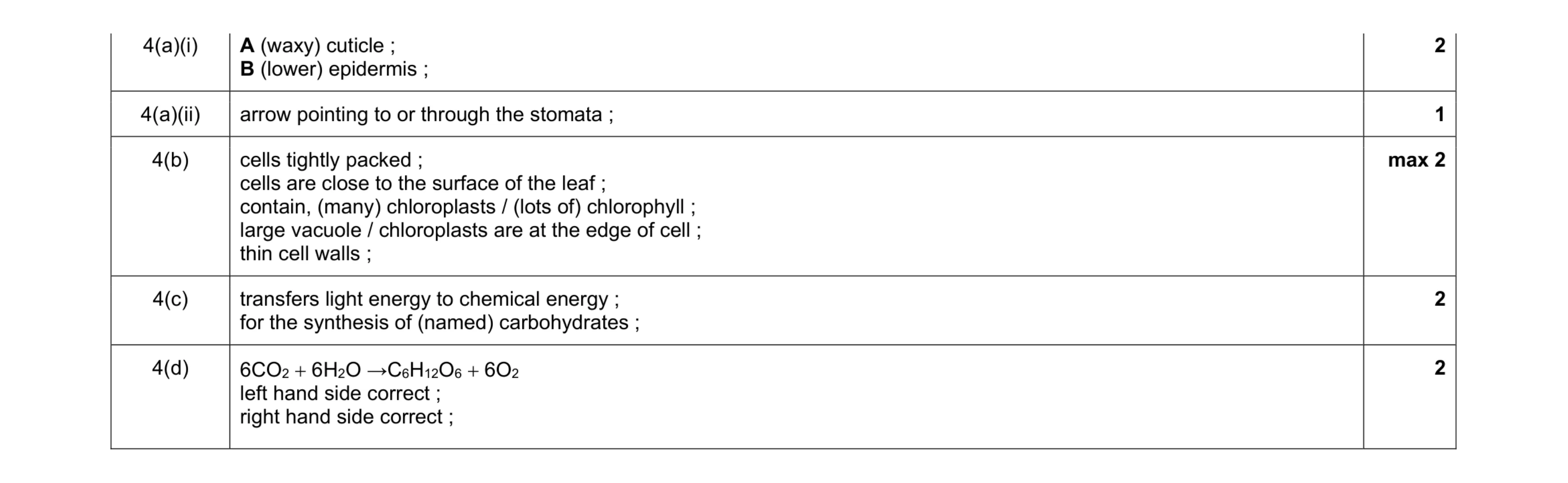 9
9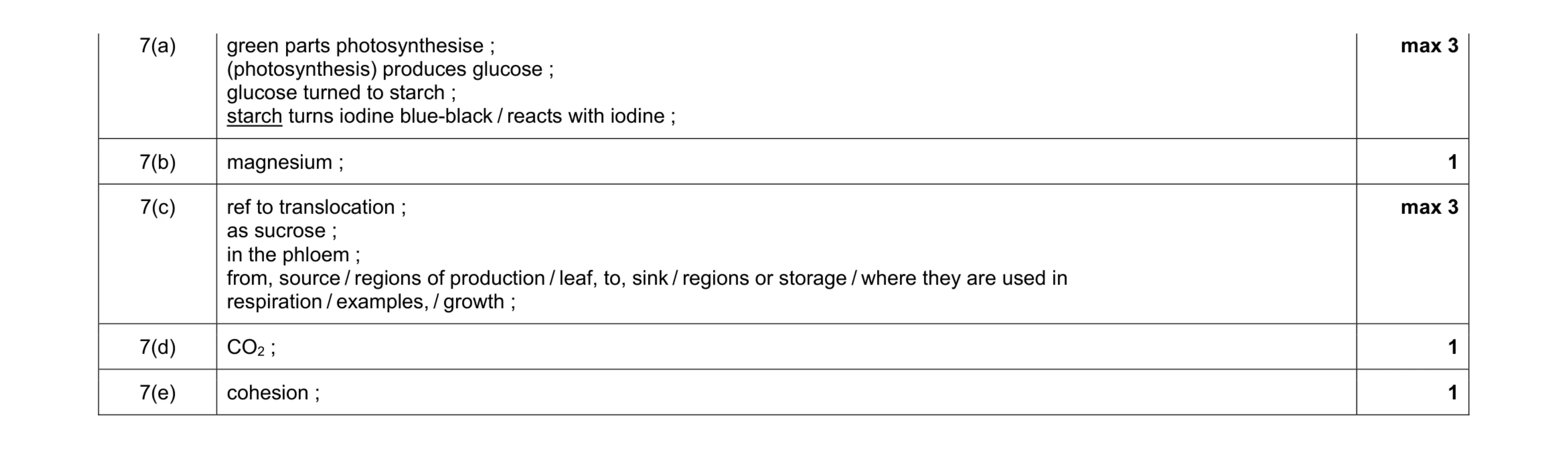 9
9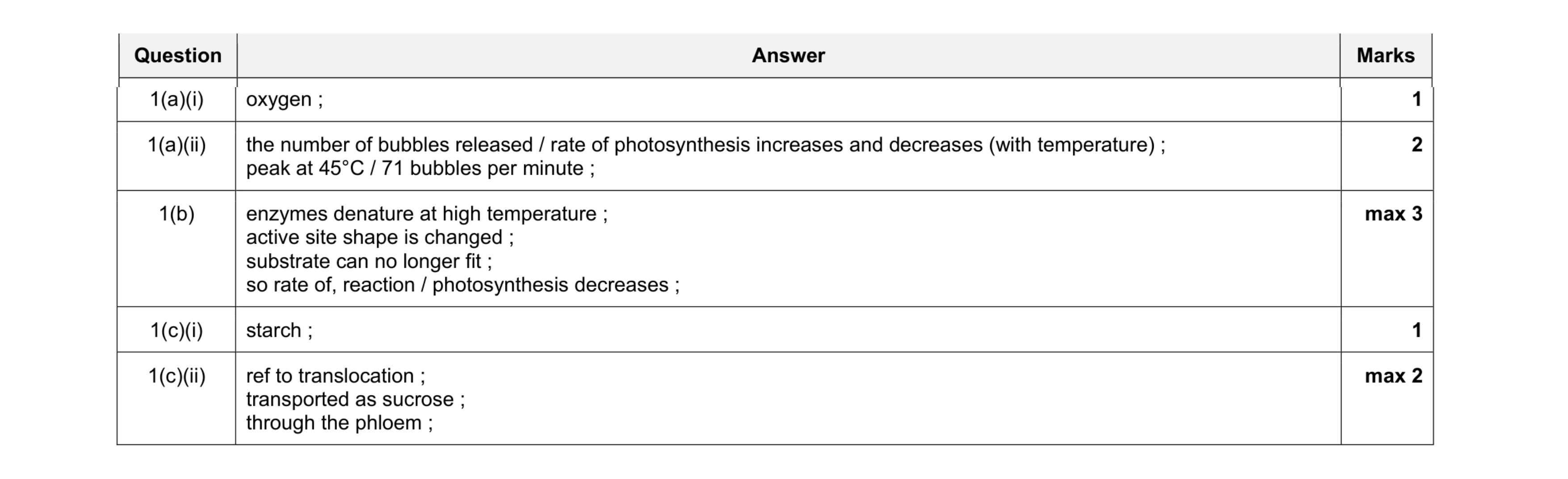 9
9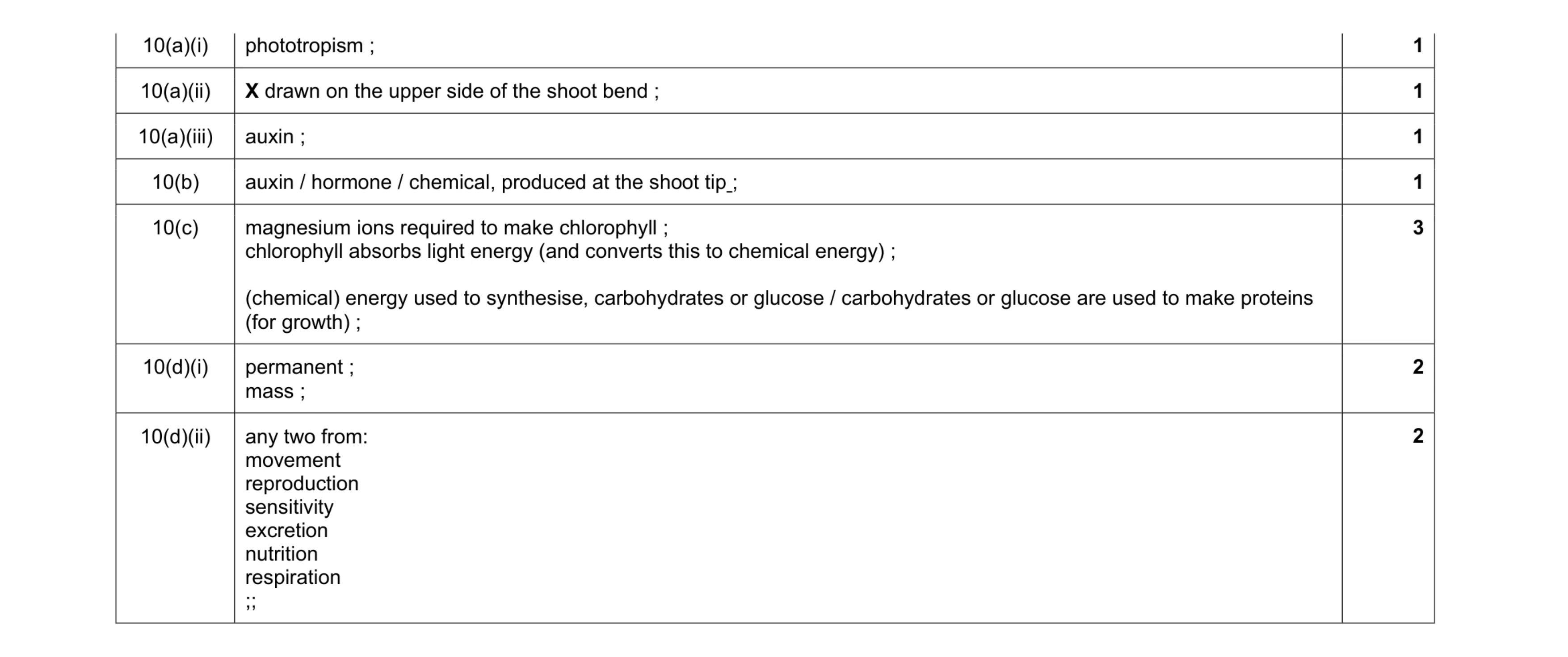 11
11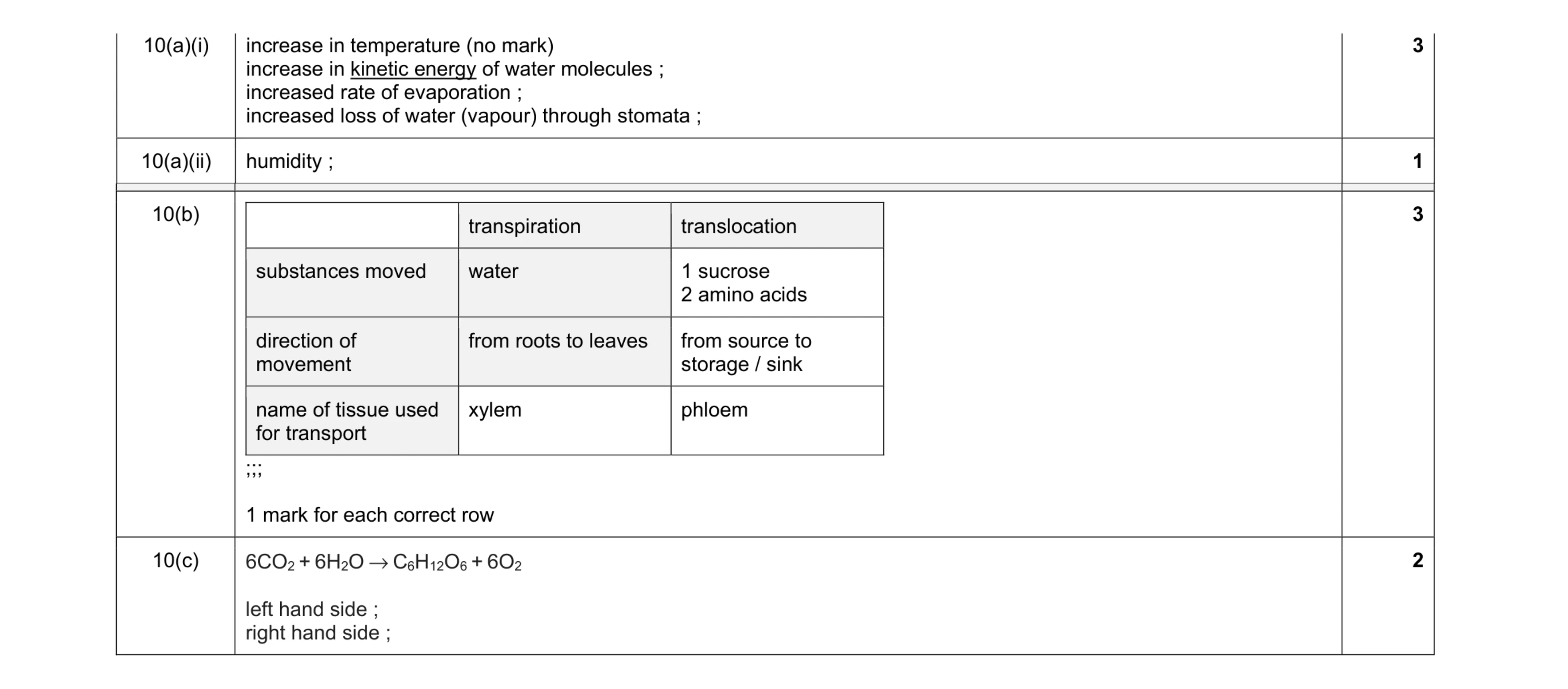 9
9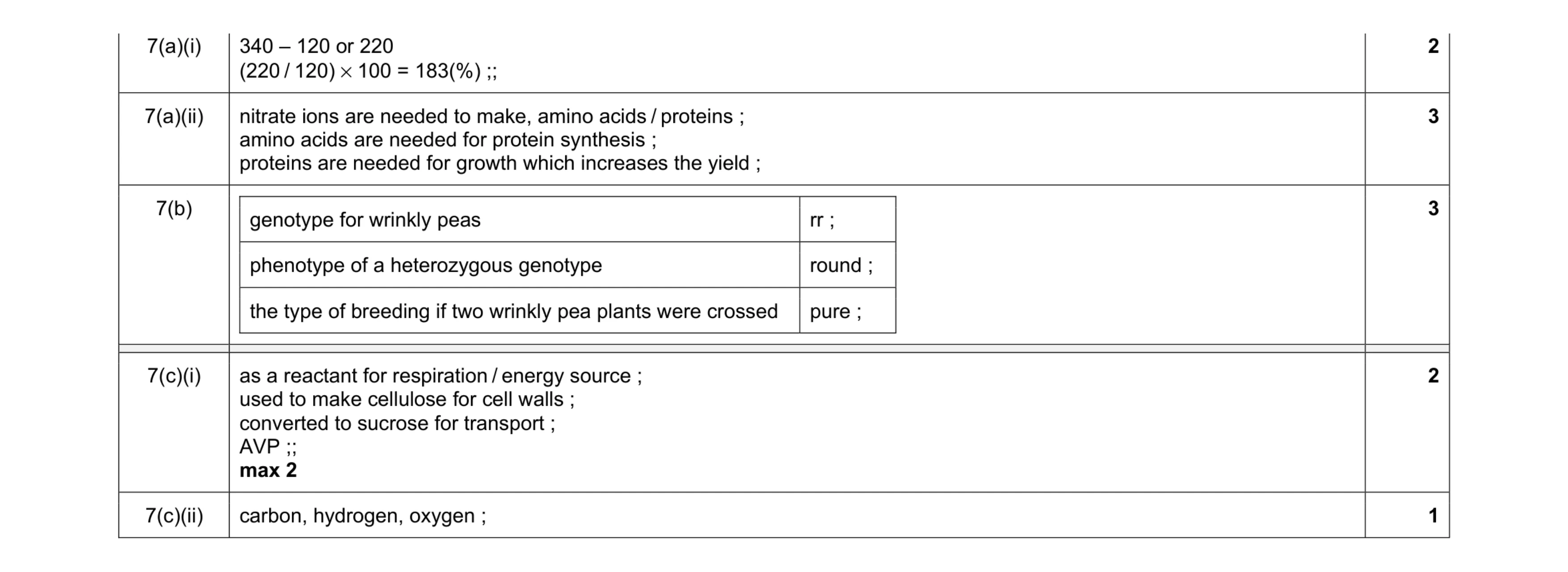 11
11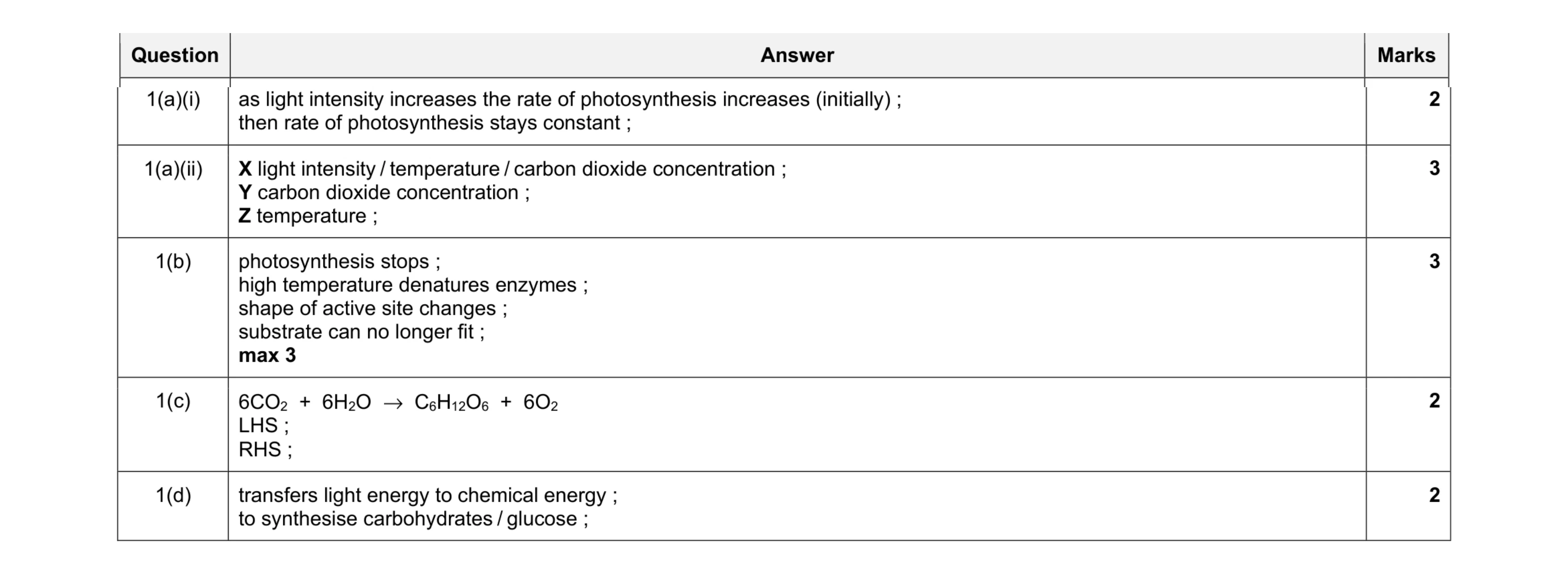 12
12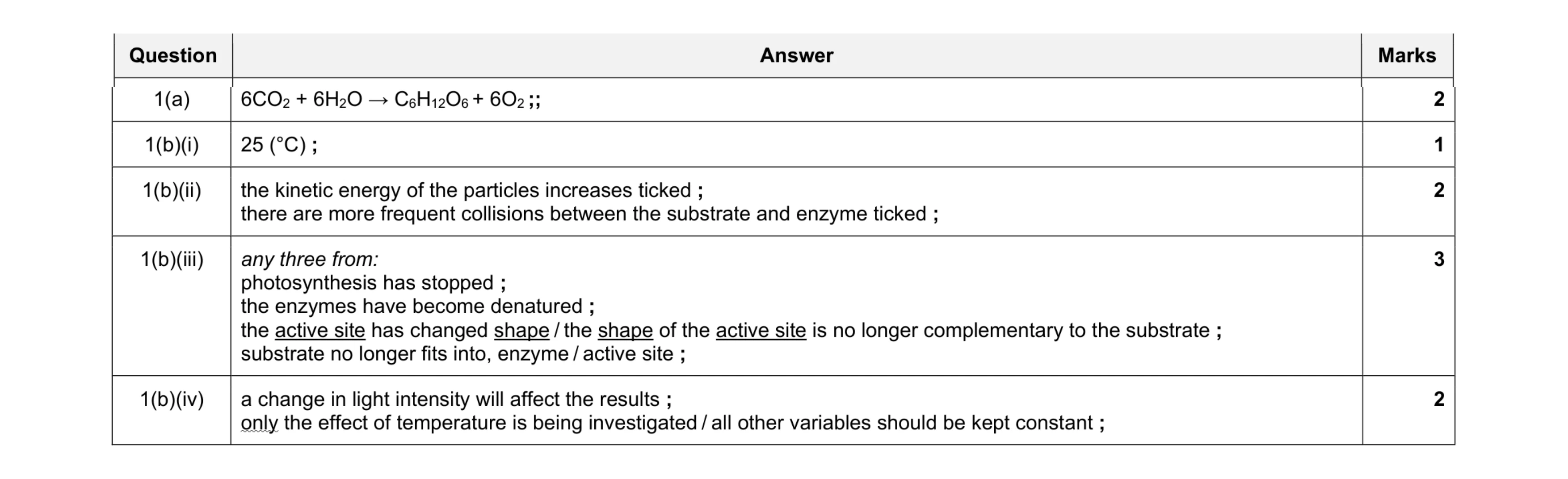 10
10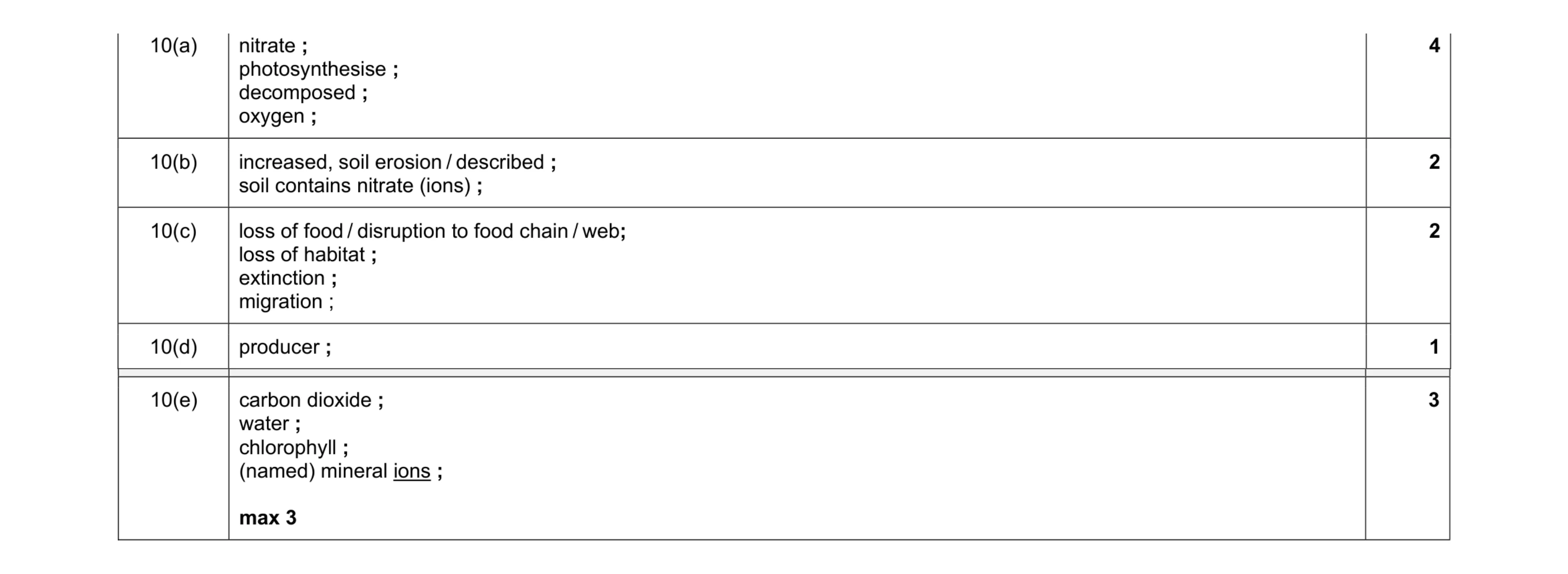 12
12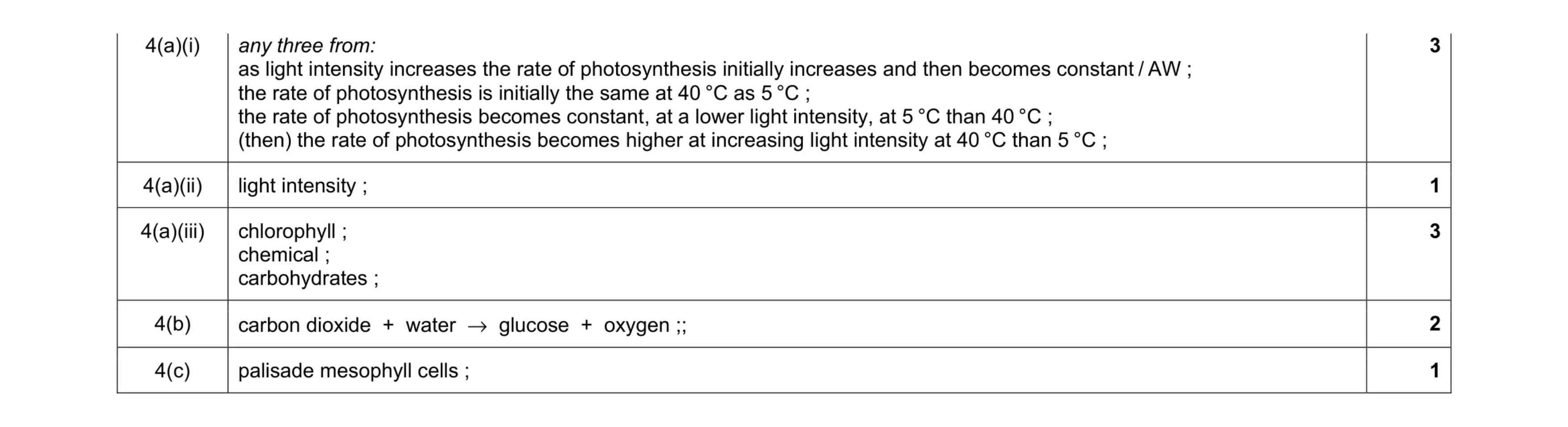 10
10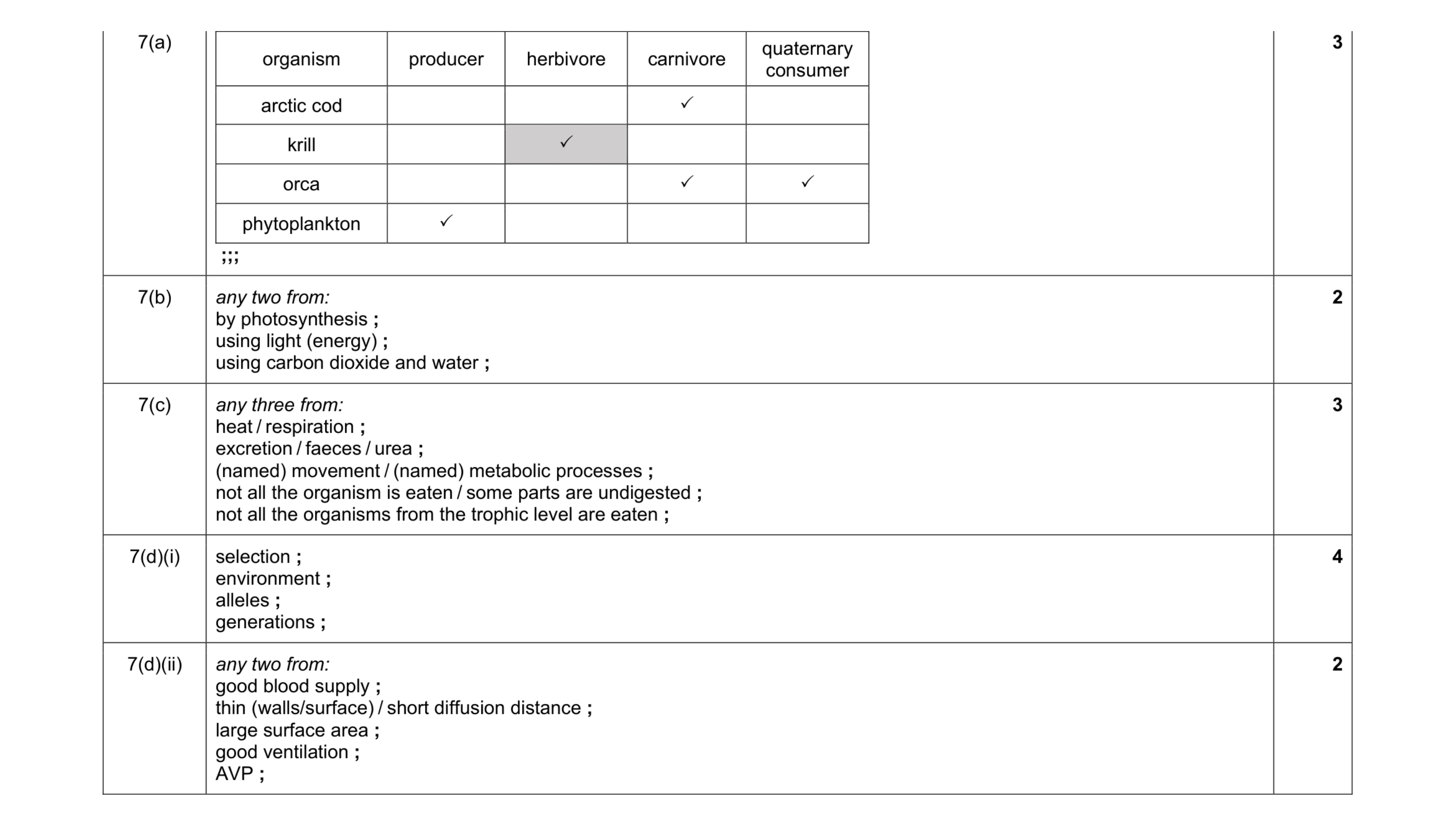 14
14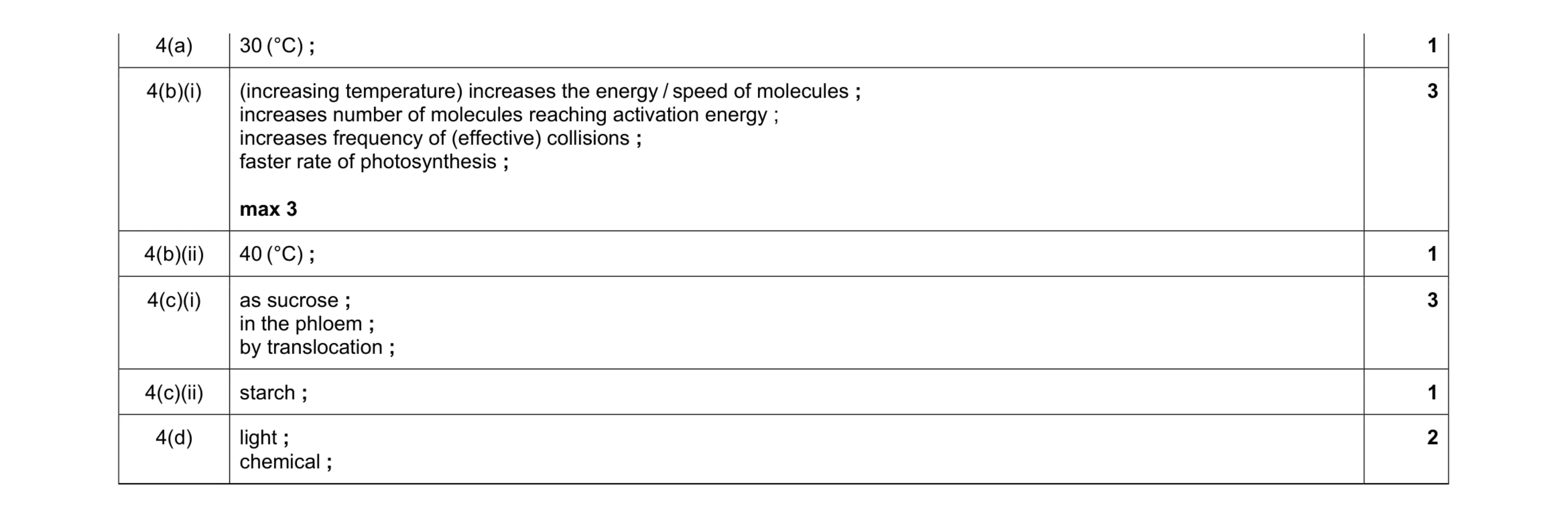 11
11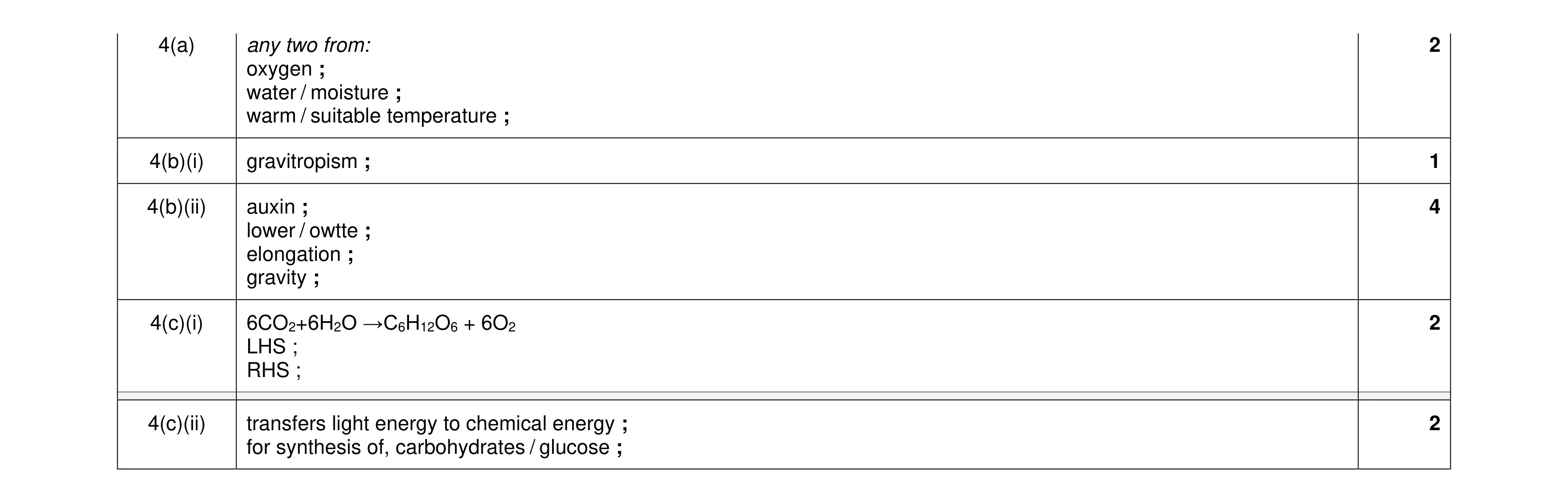 11
11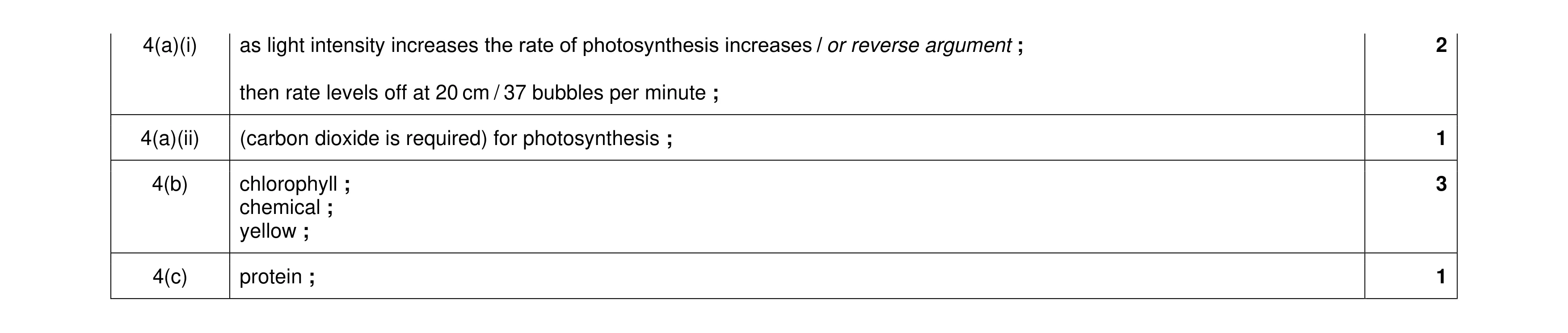 7
7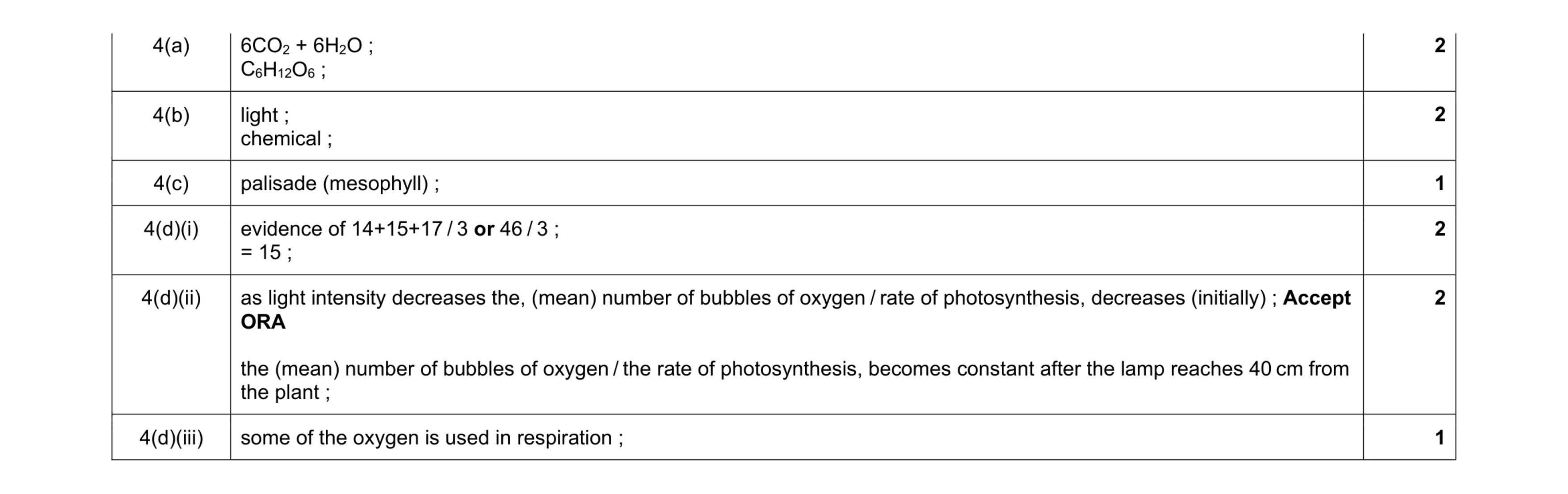 10
10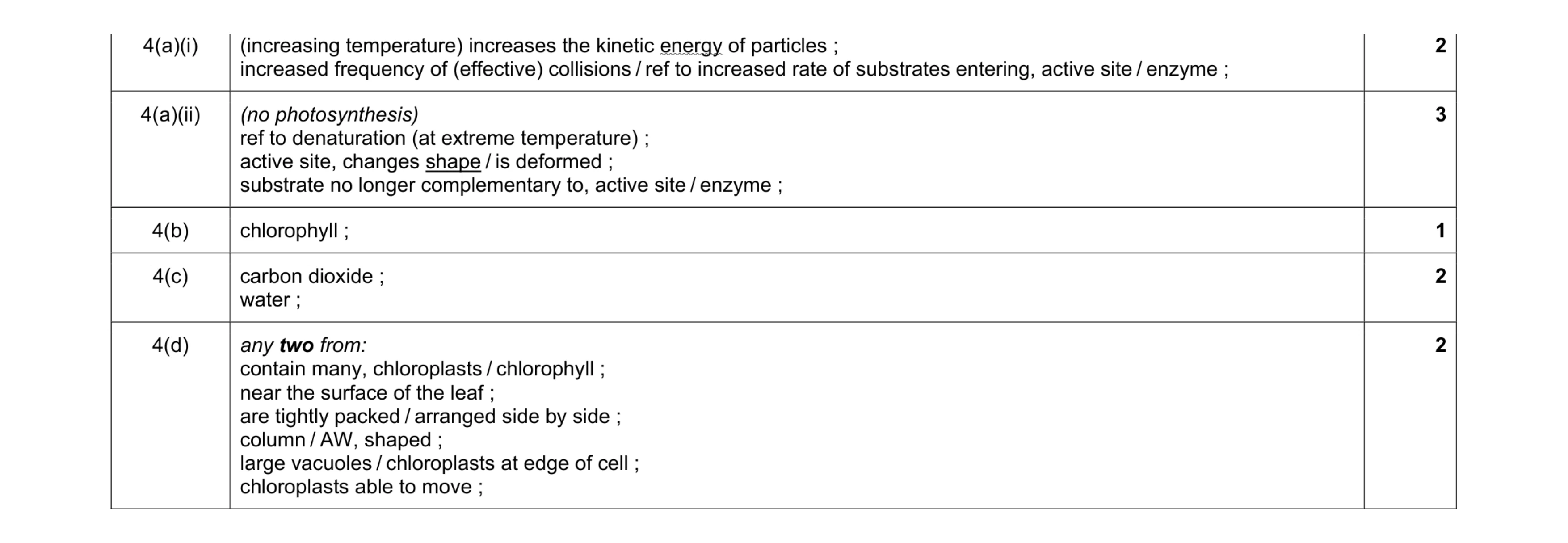 10
10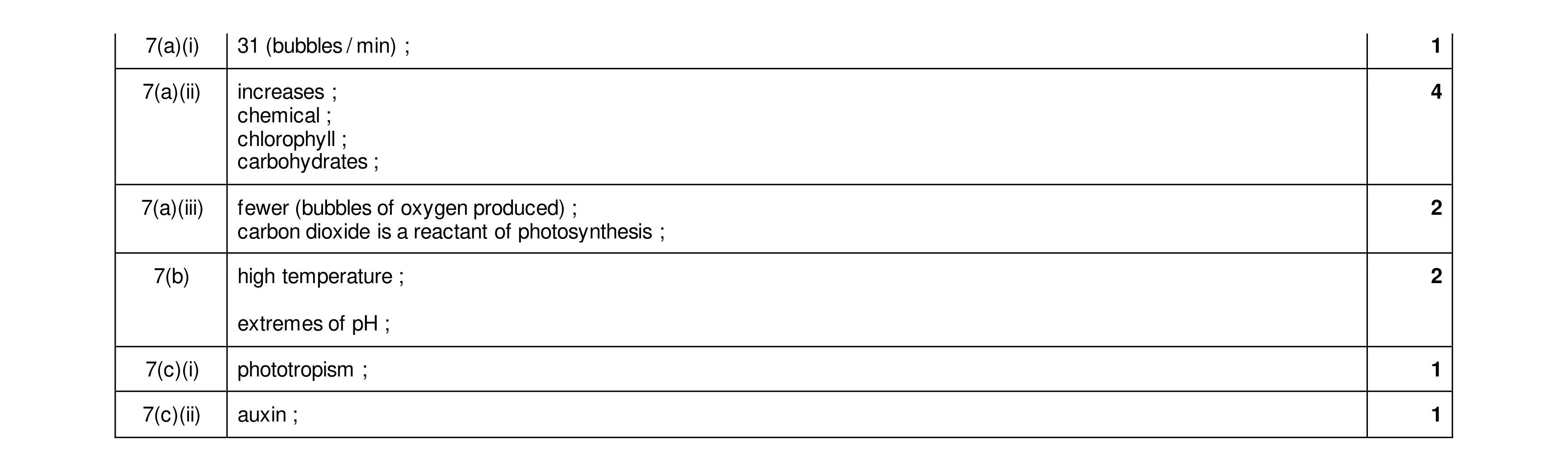 11
11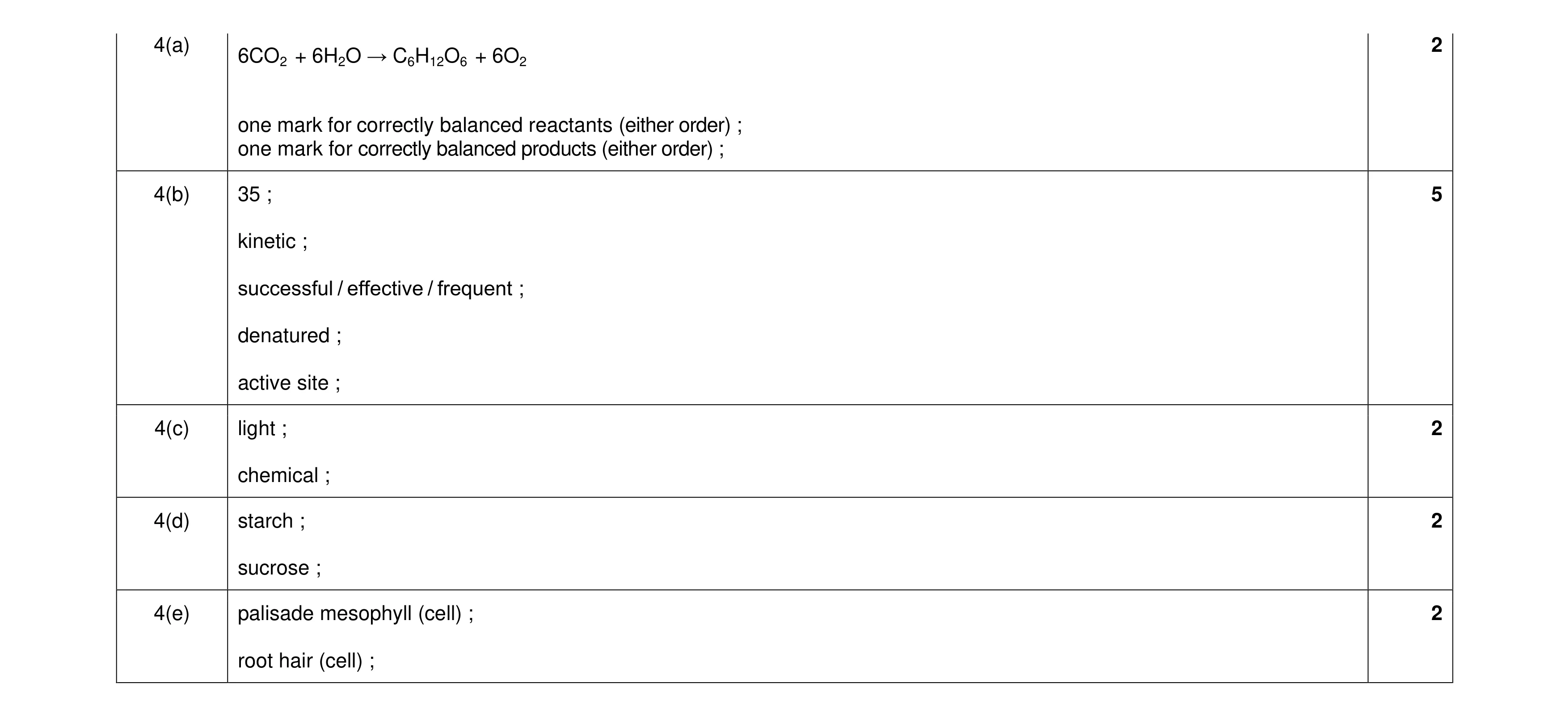 13
13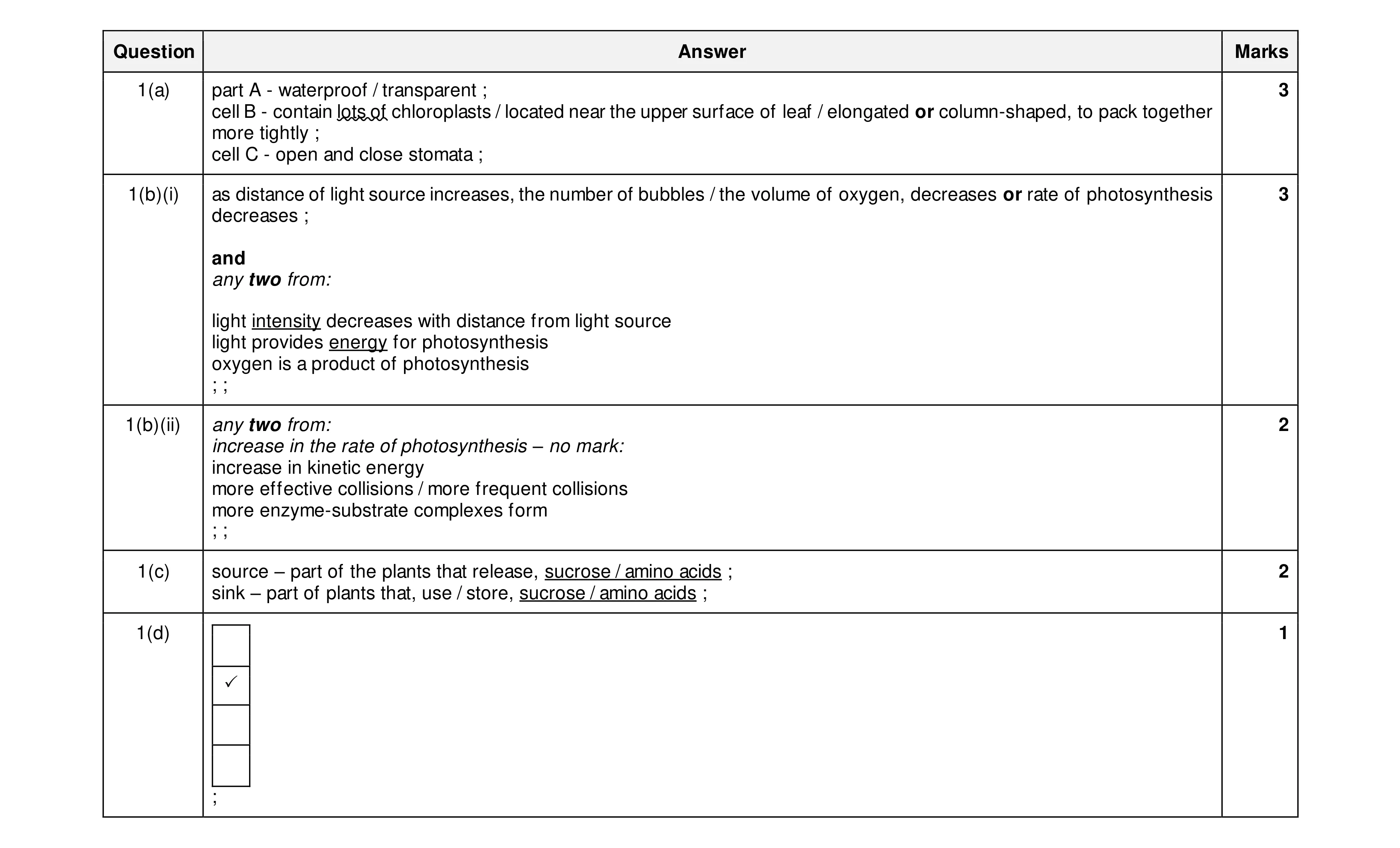 11
11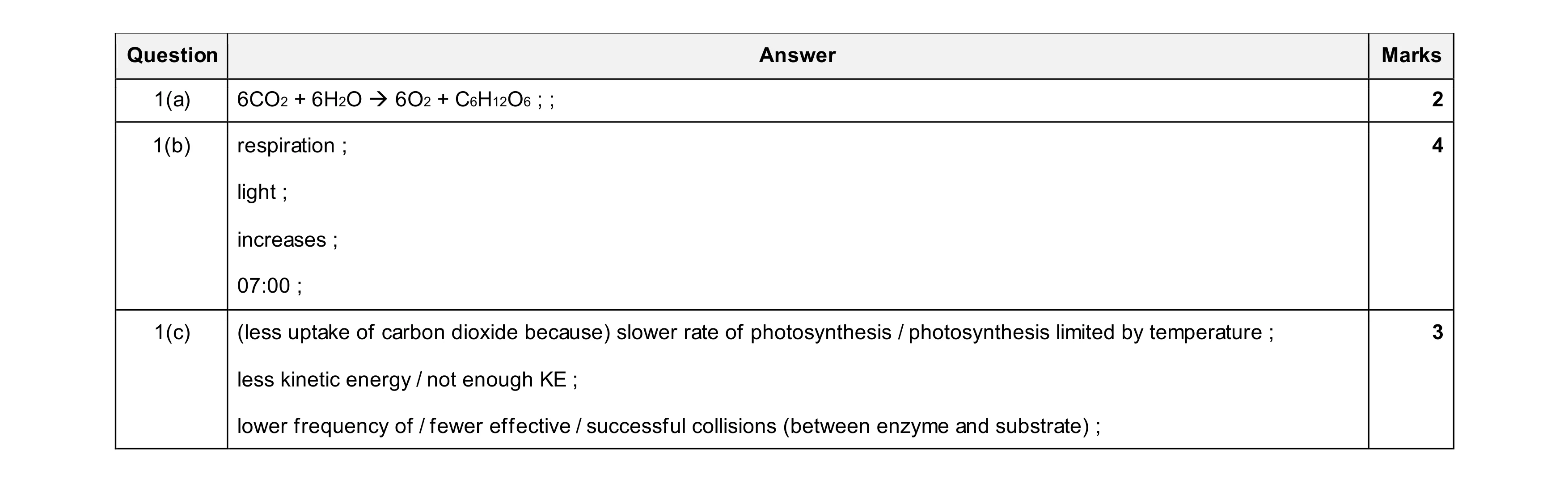 9
9