Questions as text
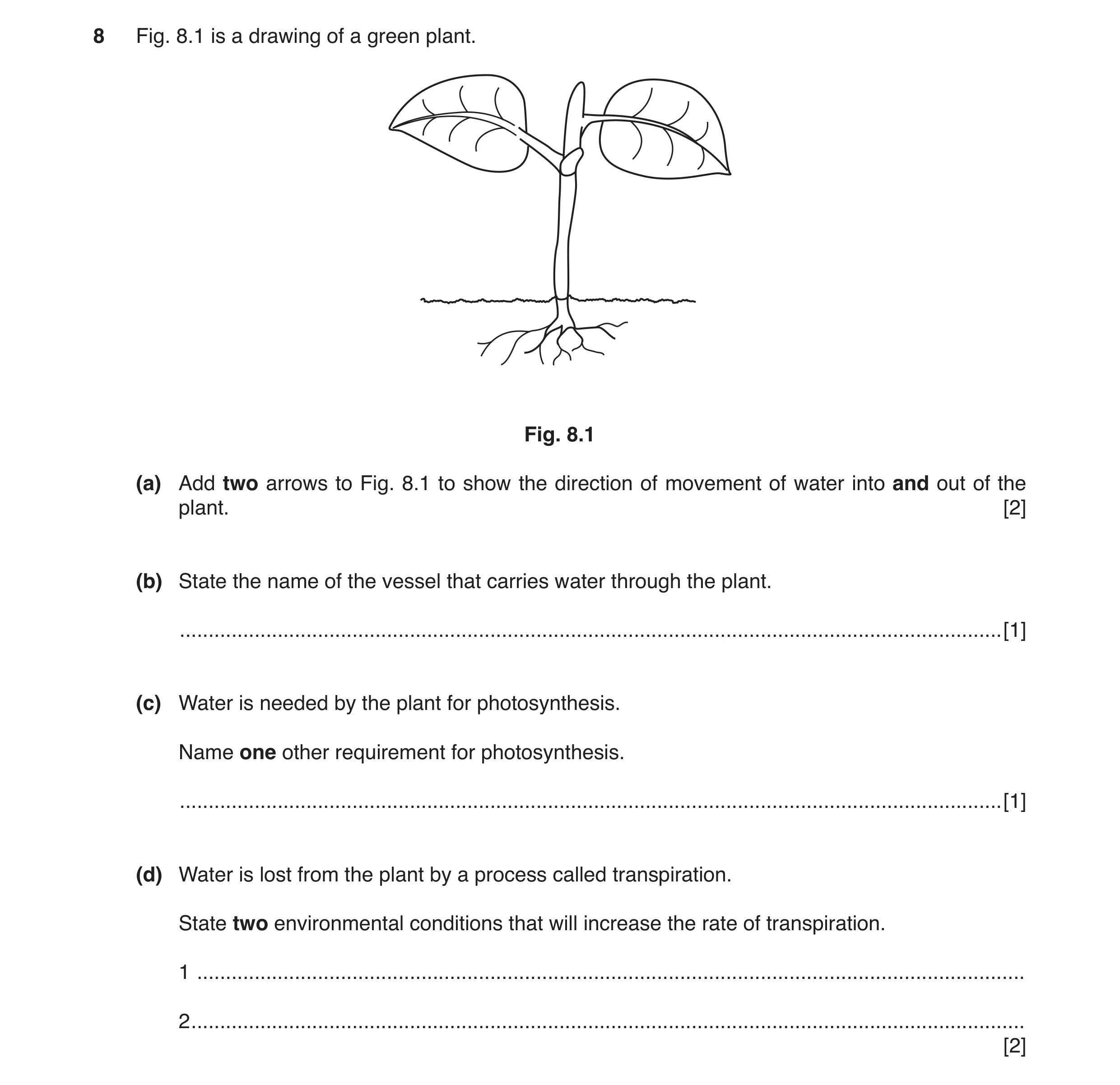
Q1 · A drawing of a green plant 0654/31 May/June 2017
8 Fig. 8.1 is a drawing of a green plant. Fig. 8.1 (a) Add two arrows to Fig. 8.1 to show the direction of movement of water into and out of the plant. [2] (b) State the name of the vessel that carries water through the plant. … [1] (c) Water is needed by the plant for photosynthesis. Name one other requirement for photosynthesis. … [1] (d) Water is lost from the plant by a process called transpiration. State two environmental conditions that will increase the rate of transpiration. 1 … 2 … [2]
6 marks
Mark scheme: 8(a) one arrow pointing into the roots ; one arrow pointing out from the leaf ; 2 8(b) xylem ; 1 8(c) light / carbon dioxide / chlorophyll ; 1 8(d) higher temperature / hot ; increased wind speed / windy ; arid / dry (conditions) ; max 2
This question in 0654/31 May/June 2017
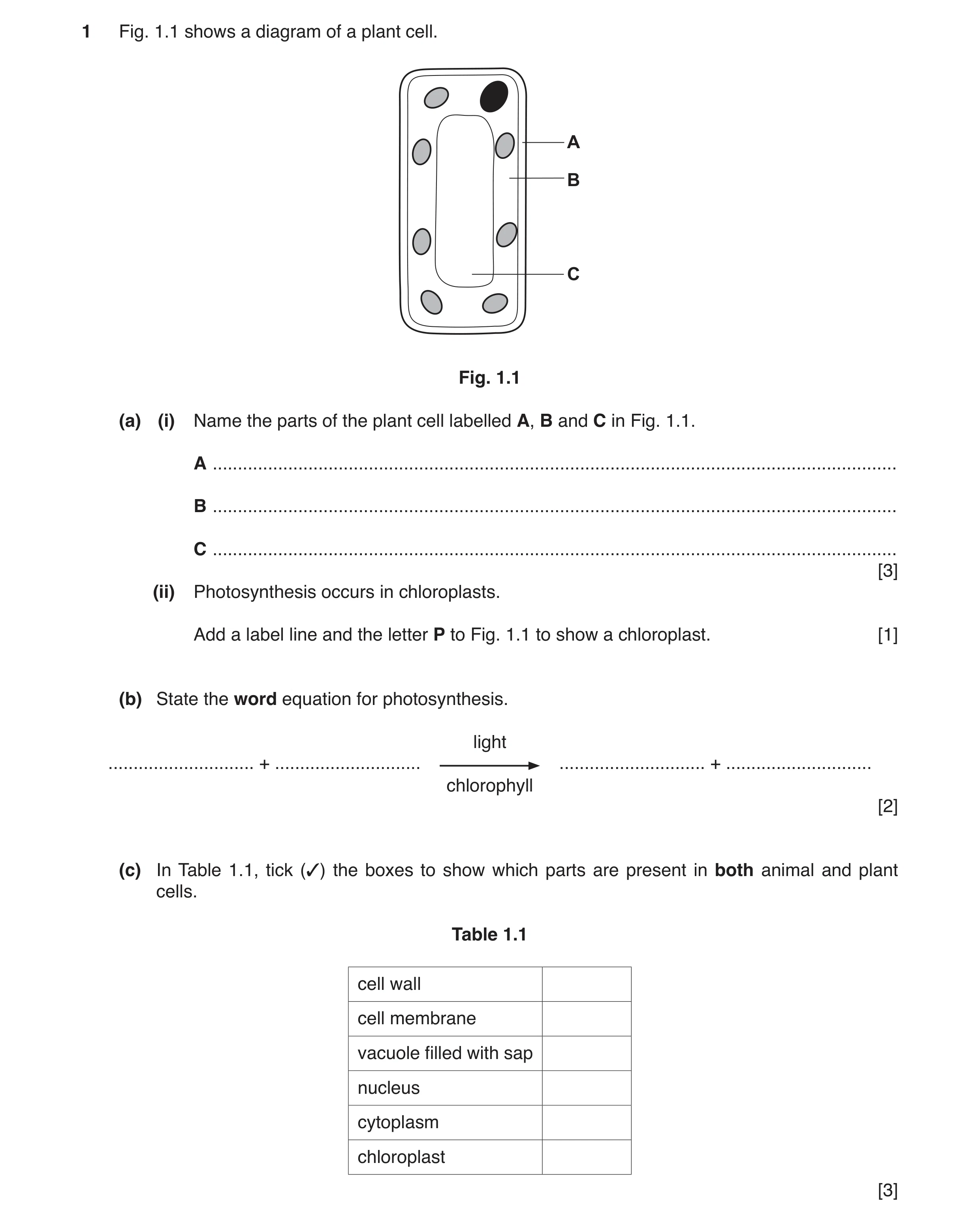
Q2 · A diagram of a plant cell 0654/31 Oct/Nov 2017
1 Fig. 1.1 shows a diagram of a plant cell. A B C Fig. 1.1 (a) (i) Name the parts of the plant cell labelled A, B and C in Fig. 1.1. A … B … C … [3] (ii) Photosynthesis occurs in chloroplasts. Add a label line and the letter P to Fig. 1.1 to show a chloroplast. [1] (b) State the word equation for photosynthesis. light … + … … + … chlorophyll [2] (c) In Table 1.1, tick (3) the boxes to show which parts are present in both animal and plant cells. Table 1.1 cell wall cell membrane vacuole filled with sap nucleus cytoplasm chloroplast [3]
9 marks
Mark scheme: 1(a)(i) cell wall ; cytoplasm ; vacuole ; 3 1(a)(ii) label line to any of the chloroplasts ; 1 1(b) LHS carbon dioxide AND water ; RHS glucose AND oxygen ; 2 1(c) cell membrane ; nucleus ; cytoplasm ; 3
This question in 0654/31 Oct/Nov 2017
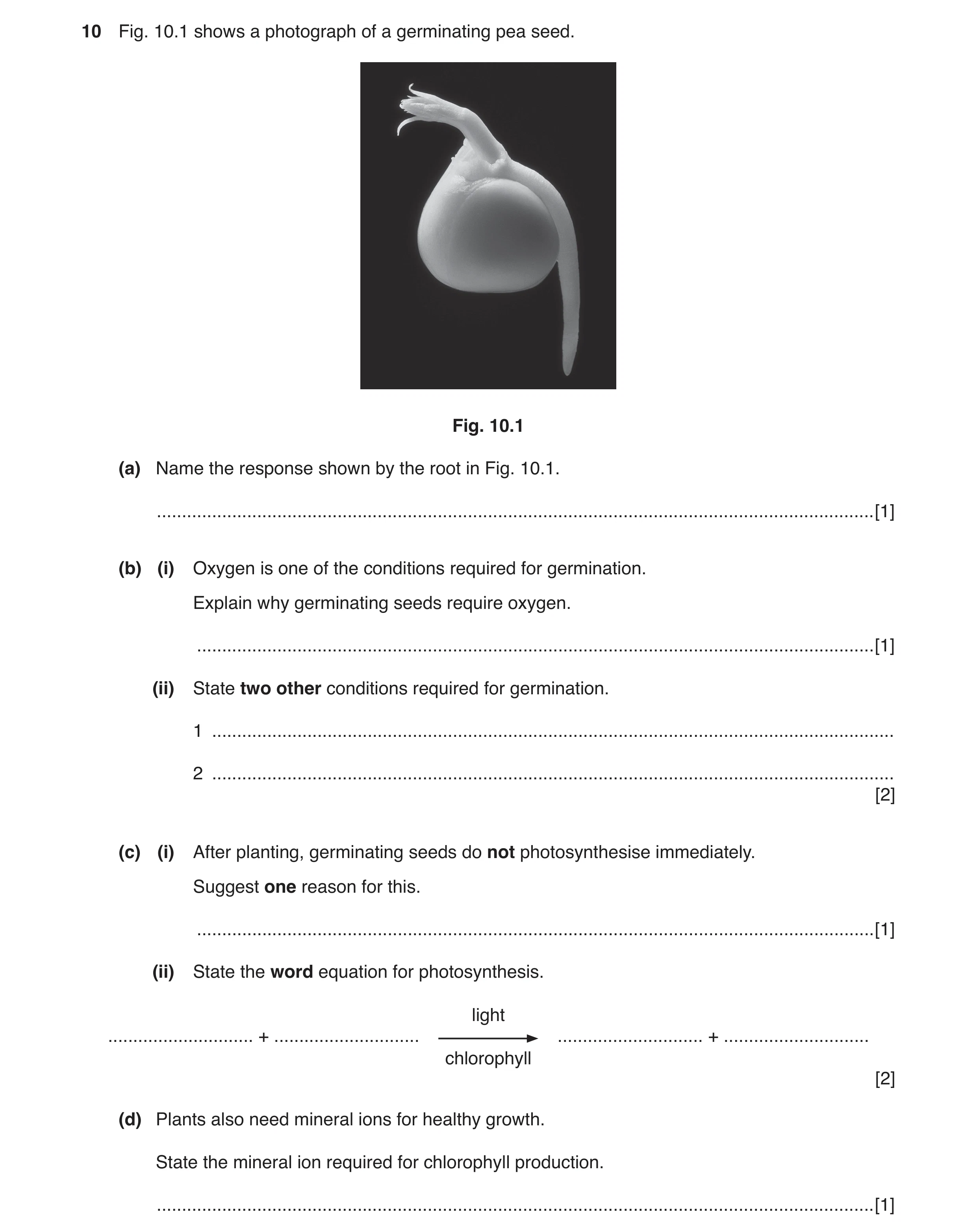
Q3 · A photograph of a germinating pea seed 0654/32 Oct/Nov 2017
10 Fig. 10.1 shows a photograph of a germinating pea seed. Fig. 10.1 (a) Name the response shown by the root in Fig. 10.1. … [1] (b) (i) Oxygen is one of the conditions required for germination. Explain why germinating seeds require oxygen. … [1] (ii) State two other conditions required for germination. 1 … 2 … [2] (c) (i) After planting, germinating seeds do not photosynthesise immediately. Suggest one reason for this. … [1] (ii) State the word equation for photosynthesis. light … + … … + … chlorophyll [2] (d) Plants also need mineral ions for healthy growth. State the mineral ion required for chlorophyll production. … [1]
8 marks
Mark scheme: 10(a) geotropism ; 1 10(b)(i) respiration ; 1 10(b)(ii) moisture / water ; warm (temperature) / suitable temperature ; 2 10(c)(i) (seedling is) underground / no light ; 1 10(c)(ii) LHS carbon dioxide + water ; RHS glucose + oxygen ; 2 10(d) magnesium ; 1
This question in 0654/32 Oct/Nov 2017
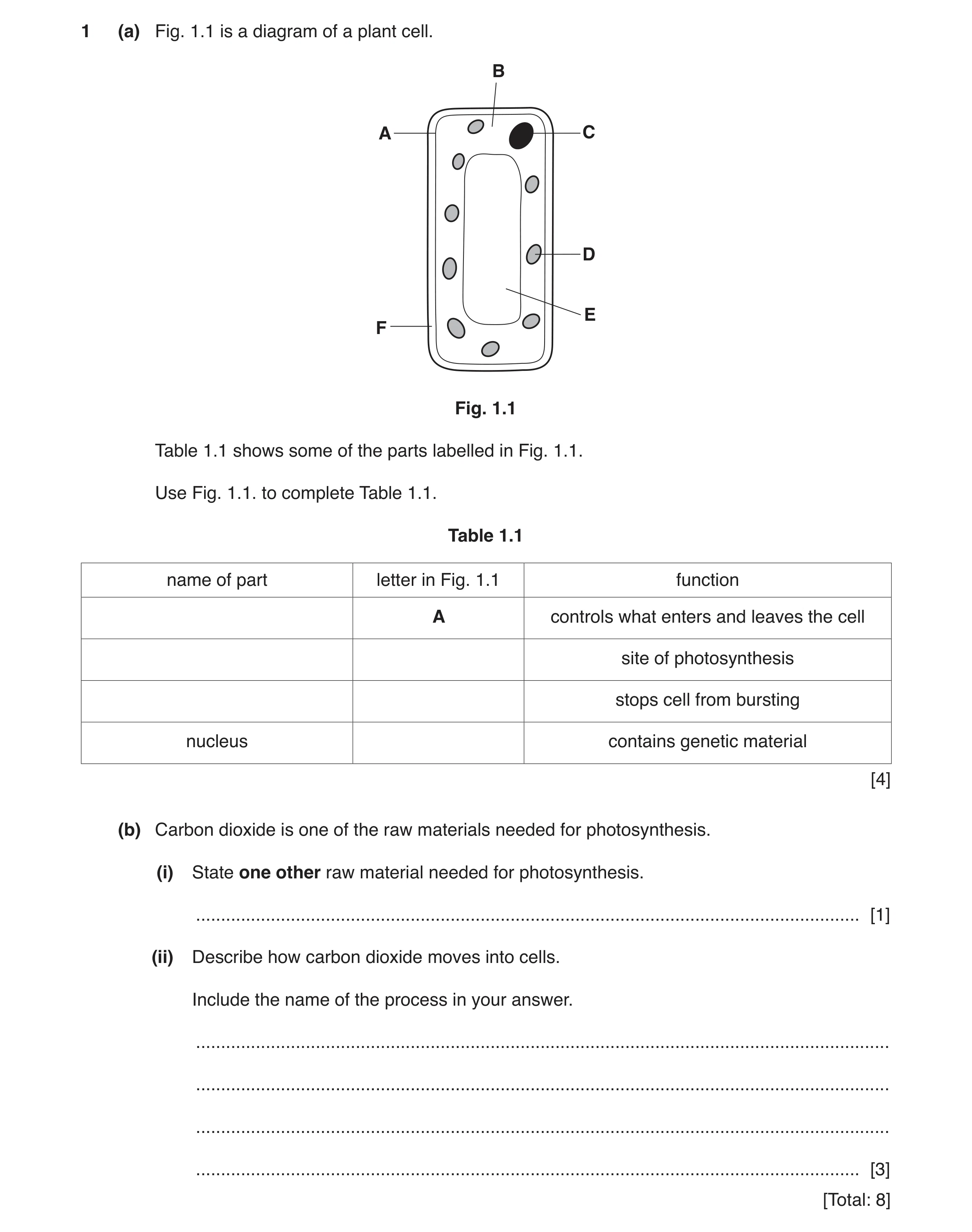
Q4 · A diagram of a plant cell 0654/31 May/June 2019
1 (a) Fig. 1.1 is a diagram of a plant cell. B A C D E F Fig. 1.1 Table 1.1 shows some of the parts labelled in Fig. 1.1. Use Fig. 1.1. to complete Table 1.1. Table 1.1 name of part letter in Fig. 1.1 function A controls what enters and leaves the cell site of photosynthesis stops cell from bursting nucleus contains genetic material [4] (b) Carbon dioxide is one of the raw materials needed for photosynthesis. (i) State one other raw material needed for photosynthesis. … [1] (ii) Describe how carbon dioxide moves into cells. Include the name of the process in your answer. … … … … [3] [Total: 8]
8 marks
Mark scheme: 1(a) name of part letter in Fig. 1.1 function cell membrane A control what enters and leaves the cell chloroplast D site of photosynthesis cell wall F stops cell from bursting nucleus C contains genetic material 1 correct ; 2 or 3 correct ; 4 or 5 correct ; 6 correct ; 4 1(b)(i) water ; 1 1(b)(ii) across the cell membrane ; by diffusion ; from high concentration to low concentration ; by random movement ; max 3
This question in 0654/31 May/June 2019
Q5 · A diagram of an animal cell 0654/32 May/June 2019
1 (a) Fig. 1.1 is a diagram of an animal cell. A B C Fig. 1.1 Table 1.1 shows the parts labelled in Fig. 1.1. Use Fig. 1.1 to complete Table 1.1. Table 1.1 name of part letter in Fig. 1.1 function controls what enters and leaves the cell B contains genetic material [3] (b) Animal cells cannot photosynthesise. Describe the function of photosynthesis, and state why animal cells are unable to photosynthesise. … … … [2] (c) Respiration occurs in living cells. Water is a product of respiration. (i) Name one other product of respiration. … [1] (ii) Describe how water moves out of animal cells. Include the name of the process in your answer. … … … … [3] [Total: 9]
9 marks
Mark scheme: 1(a) 1 or 2 correct ; 3, 4 or 5 correct ; 6 correct ; name of part letter in Fig. 1.1 function cell membrane C control what enters and leaves the cell cytoplasm B chemical reactions occur here nucleus A contains genetic material 3 1(b) (photosynthesis) produces glucose / (named) carbohydrate / sugar ; animals don’t have chloroplasts ; 2 1(c)(i) carbon dioxide ; 1 1(c)(ii) across the, cell / partially permeable, membrane ; by osmosis ; by random movement ; 3
This question in 0654/32 May/June 2019
Q6 · A diagram of an animal cell 0654/33 May/June 2019
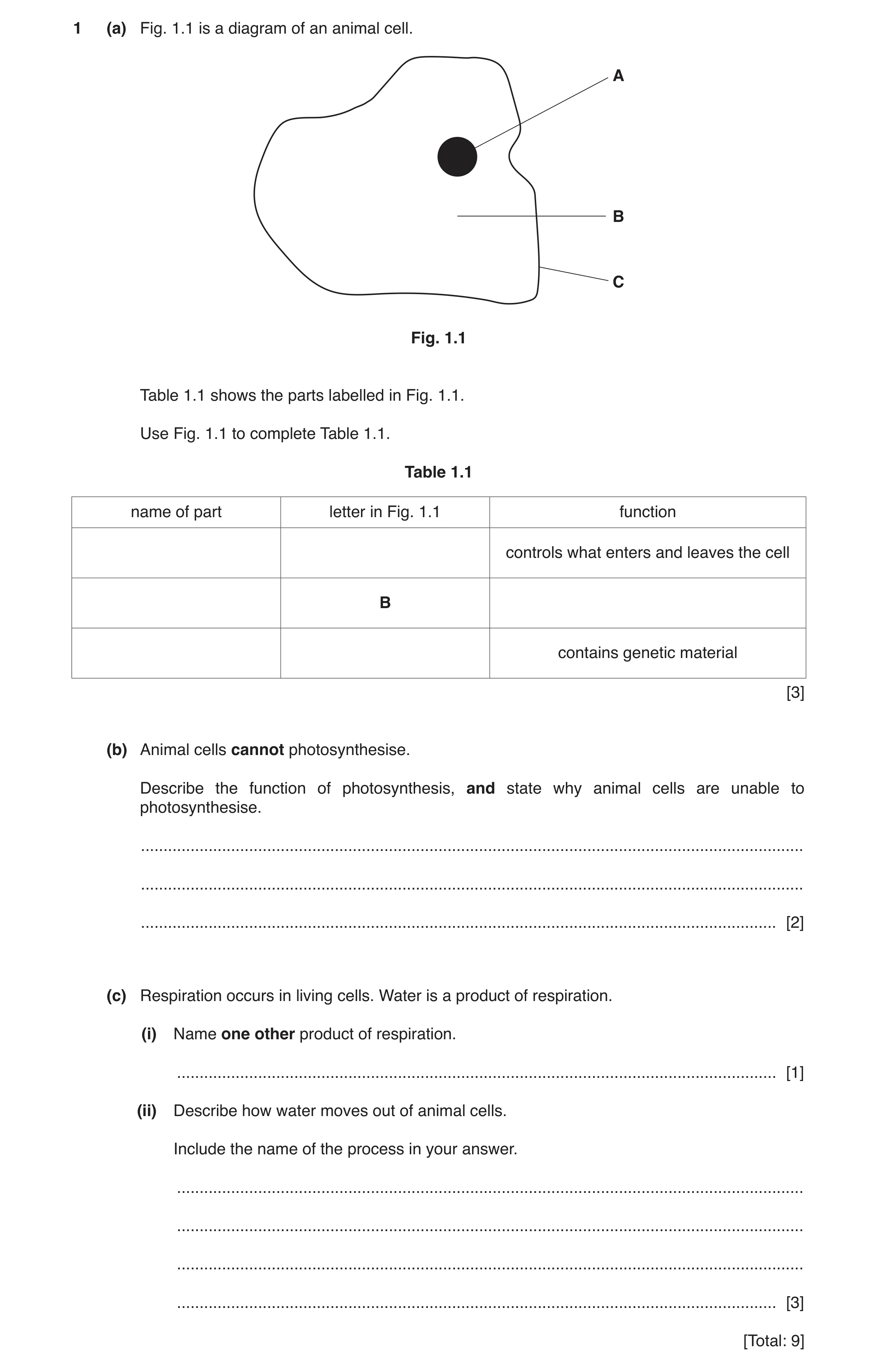
1 (a) Fig. 1.1 is a diagram of an animal cell. A B C Fig. 1.1 Table 1.1 shows the parts labelled in Fig. 1.1. Use Fig. 1.1 to complete Table 1.1. Table 1.1 name of part letter in Fig. 1.1 function controls what enters and leaves the cell B contains genetic material [3] (b) Animal cells cannot photosynthesise. Describe the function of photosynthesis, and state why animal cells are unable to photosynthesise. … … … [2] (c) Respiration occurs in living cells. Water is a product of respiration. (i) Name one other product of respiration. … [1] (ii) Describe how water moves out of animal cells. Include the name of the process in your answer. … … … … [3] [Total: 9]
9 marks
Mark scheme: 1(a) 1 or 2 correct ; 3, 4 or 5 correct ; 6 correct ; name of part letter in Fig. 1.1 function cell membrane C control what enters and leaves the cell cytoplasm B chemical reactions occur here nucleus A contains genetic material 3 1(b) (photosynthesis) produces glucose / (named) carbohydrate / sugar ; animals don’t have chloroplasts ; 2 1(c)(i) carbon dioxide ; 1 1(c)(ii) across the, cell / partially permeable, membrane ; by osmosis ; by random movement ; 3
This question in 0654/33 May/June 2019
Q7 · Glucose is produced by photosynthesis and is stored in the leaves as starch 0654/31 Oct/Nov 2019
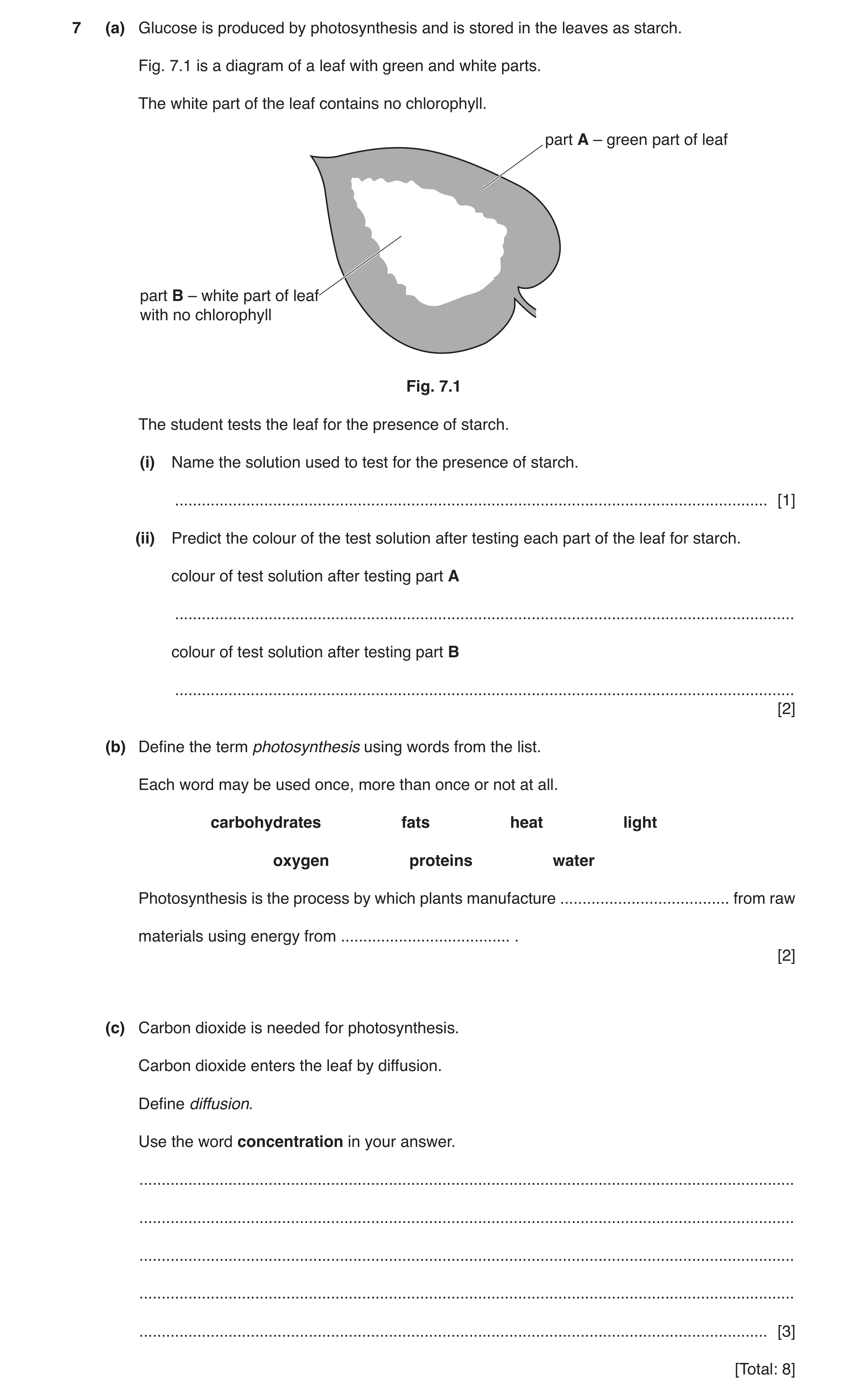
7 (a) Glucose is produced by photosynthesis and is stored in the leaves as starch. Fig. 7.1 is a diagram of a leaf with green and white parts. The white part of the leaf contains no chlorophyll. part A – green part of leaf part B – white part of leaf with no chlorophyll Fig. 7.1 The student tests the leaf for the presence of starch. (i) Name the solution used to test for the presence of starch. … [1] (ii) Predict the colour of the test solution after testing each part of the leaf for starch. colour of test solution after testing part A … colour of test solution after testing part B … [2] (b) Define the term photosynthesis using words from the list. Each word may be used once, more than once or not at all. carbohydrates fats heat light oxygen proteins water Photosynthesis is the process by which plants manufacture … from raw materials using energy from … . [2] (c) Carbon dioxide is needed for photosynthesis. Carbon dioxide enters the leaf by diffusion. Define diffusion. Use the word concentration in your answer. … … … … … [3] [Total: 8]
8 marks
Mark scheme: 7(a)(i) iodine ; 1 7(a)(ii) part A blue-black ; part B orange / yellow / brown ; 2 7(b) carbohydrates ; light ; 2 7(c) (net) movement of particles ; from a region of their higher concentration to a region of their lower concentration/down a concentration gradient ; as a result of their random movement ; 3
This question in 0654/31 Oct/Nov 2019
Q8 · In plants, glucose produced by photosynthesis is stored in leaves as starch 0654/32 Oct/Nov 2019
7 (a) In plants, glucose produced by photosynthesis is stored in leaves as starch. A student investigates one factor that affects photosynthesis by testing for the presence of starch in the leaves of two plants, A and B. • Plant A is kept next to a window for two days. • Plant B is kept in the dark for two days. The student uses iodine solution to test leaves from plants A and B for the presence of starch. (i) Predict the colour of the iodine solution after testing a leaf from each plant for starch. colour of iodine solution after testing a leaf from plant A … colour of iodine solution after testing a leaf from plant B … [2] (ii) State the factor needed for photosynthesis which the student is investigating. … [1] (b) Soil provides mineral ions to plants for healthy growth. Explain the importance of magnesium ions for healthy plant growth. … … … [2] (c) Water is another substance needed by plants. (i) Describe how water enters a plant. … … … [2] (ii) Describe how water is lost from a plant. … … … … [3] [Total: 10]
10 marks
Mark scheme: 7(a)(i) part A blue-black ; part B orange / yellow / brown ; 2 7(a)(ii) light ; 1 7(b) (magnesium ions are) needed for production of chlorophyll ; chlorophyll is necessary for photosynthesis ; 2 7(c)(i) (water enters) through the root hair cell ; by osmosis ; 2 7(c)(ii) ref. to transpiration ; evaporation of water (from mesophyll cells) ; diffusion (of water vapour) ; through the stomata ; max 3 3
This question in 0654/32 Oct/Nov 2019
Q9 · A student investigates the conditions needed for photosynthesis 0654/33 Oct/Nov 2019
7 (a) A student investigates the conditions needed for photosynthesis. He keeps similar plants in different conditions for two days and then tests the leaves for starch. Table 7.1 is a table for the results. Table 7.1 does the plant test conditions plant kept in photosynthesise? (3 / ✗) • carbon dioxide 1 • light • carbon dioxide 2 • no light • no carbon dioxide 3 • light • no carbon dioxide 4 • no light Complete Table 7.1 to predict the expected results. [1] (b) Describe the test for starch and the positive result. test … positive result … [2] (c) Oxygen produced during photosynthesis moves out of the plant cells. Explain in detail how oxygen moves out of plant cells. Use the word concentration in your answer. … … … … … [3] (d) Fig. 7.1 is a diagram of a plant cell. B C A D F E Fig. 7.1 (i) Identify the letter from Fig. 7.1 that shows where photosynthesis occurs. … [1] (ii) Name the part you have identified in (d)(i). … [1] (iii) Name two parts of plant cells that are also present in animal cells. 1 … 2 … [2] [Total: 10]
10 marks
Mark scheme: 7(a) test 19, test 2–4 X ; 1 7(b) iodine solution ; blue-black ; 2 7(c) ref to diffusion ; higher concentration of oxygen inside the cell / ORA ; oxygen moves down a concentration gradient / from high to low concentration ; across the cell membrane / cell wall ; max 3 3 7(d)(i) D ; 1 7(d)(ii) chloroplast ; 1 7(d)(iii) cell membrane ; nucleus ; cytoplasm ; max 2 2
This question in 0654/33 Oct/Nov 2019
Q10 · A student investigates photosynthesis using an aquatic plant (Elodea) 0654/31 May/June 2020
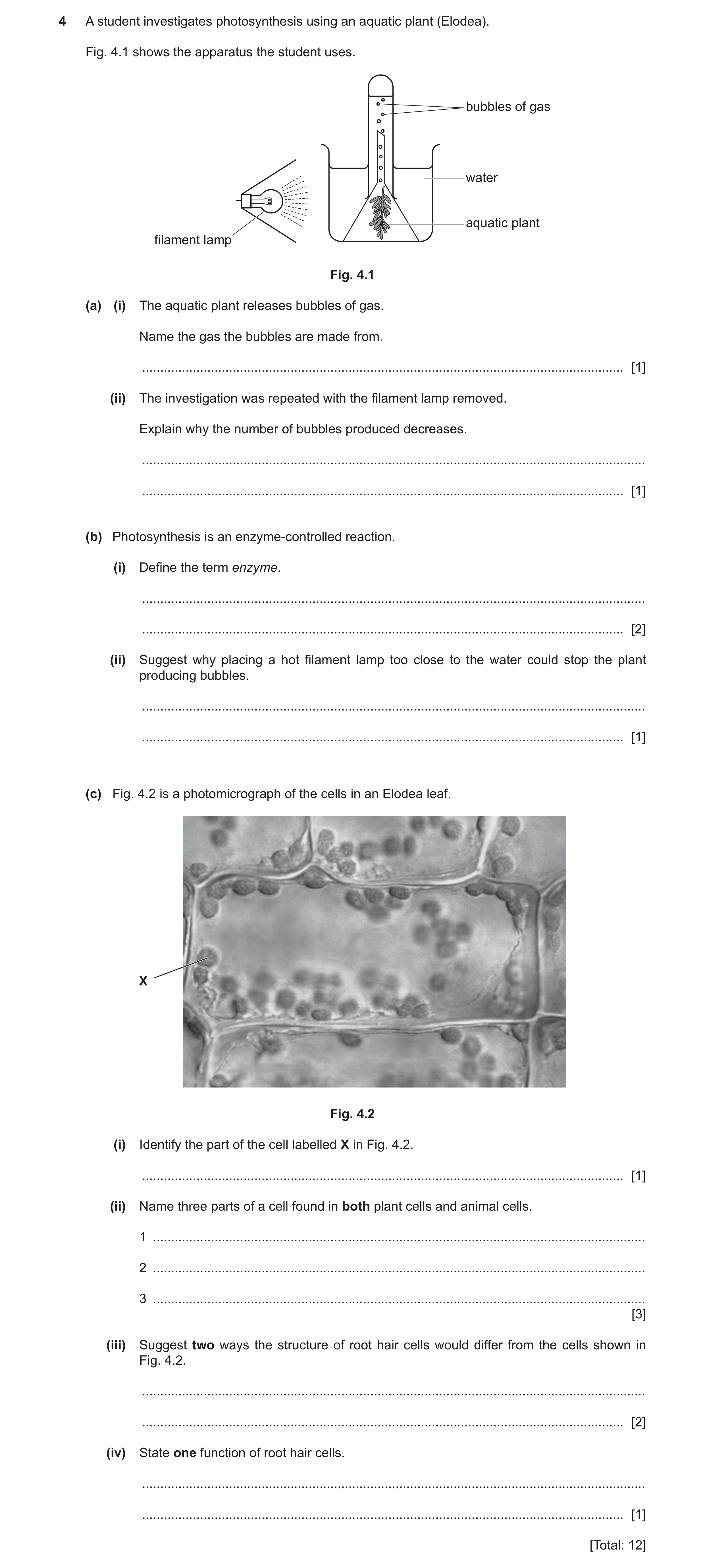
4 A student investigates photosynthesis using an aquatic plant (Elodea). Fig. 4.1 shows the apparatus the student uses. bubbles of gas water aquatic plant filament lamp Fig. 4.1 (a) (i) The aquatic plant releases bubbles of gas. Name the gas the bubbles are made from. … [1] (ii) The investigation was repeated with the filament lamp removed. Explain why the number of bubbles produced decreases. … … [1] (b) Photosynthesis is an enzyme-controlled reaction. (i) Define the term enzyme. … … [2] (ii) Suggest why placing a hot filament lamp too close to the water could stop the plant producing bubbles. … … [1] (c) Fig. 4.2 is a photomicrograph of the cells in an Elodea leaf. X Fig. 4.2 (i) Identify the part of the cell labelled X in Fig. 4.2. … [1] (ii) Name three parts of a cell found in both plant cells and animal cells. 1 … 2 … 3 … [3] (iii) Suggest two ways the structure of root hair cells would differ from the cells shown in Fig. 4.2. … … [2] (iv) State one function of root hair cells. … … [1] [Total: 12]
12 marks
Mark scheme: 4(a)(i) oxygen ; 1 4(a)(ii) light is needed for photosynthesis ; 1 4(b)(i) protein ; (biological) catalyst ; 2 4(b)(ii) enzymes stop working / enzyme activity slows down ; 1 4(c)(i) chloroplast ; 1 4(c)(ii) cell membrane ; cytoplasm ; nucleus ; 3 4(c)(iii) elongated shape ; contains no chloroplasts ; 2 4(c)(iv) absorb, water / mineral ions ; 1
This question in 0654/31 May/June 2020
Question 11 0654/32 May/June 2020
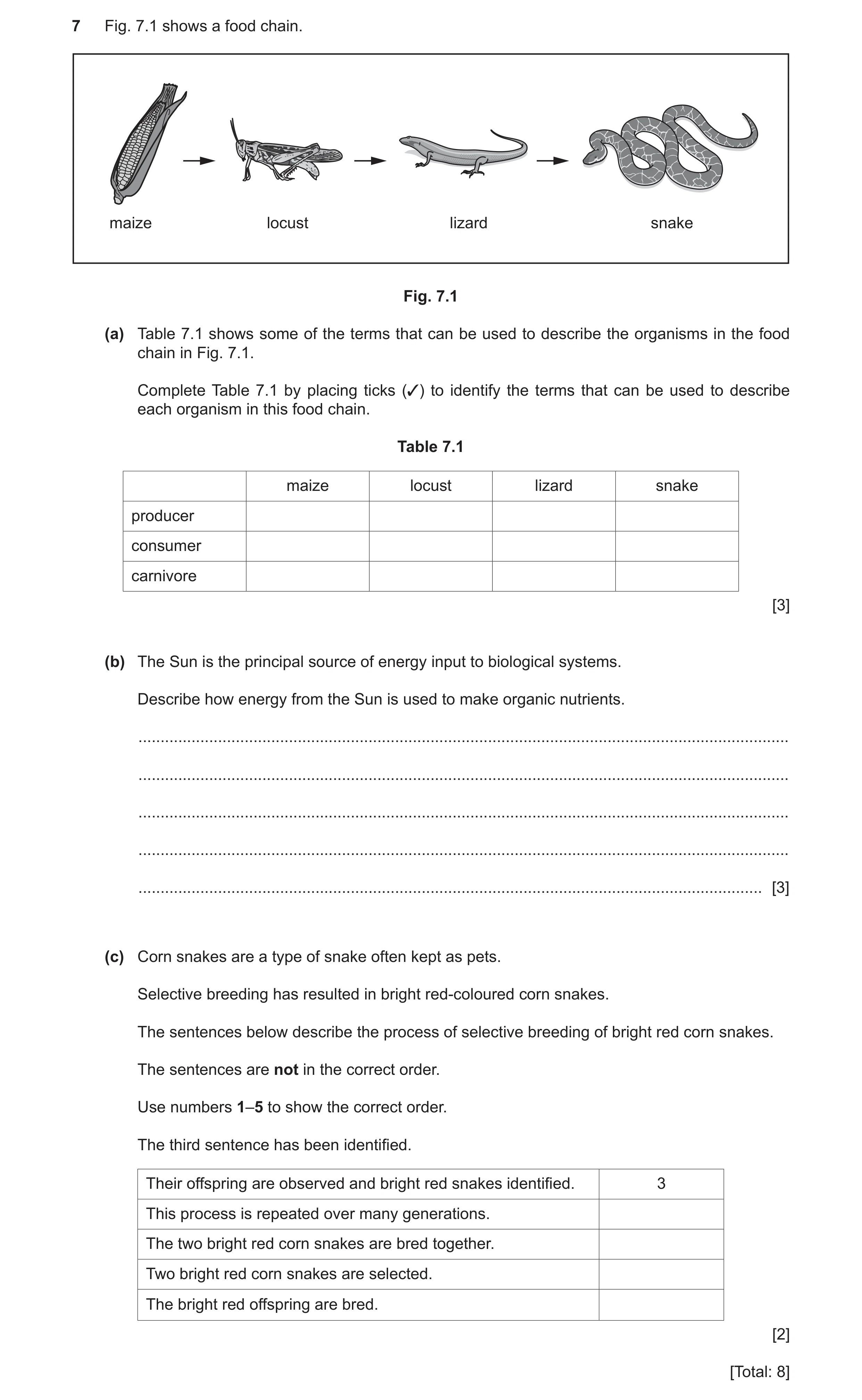
7 Fig. 7.1 shows a food chain. maize locust lizard snake Fig. 7.1 (a) Table 7.1 shows some of the terms that can be used to describe the organisms in the food chain in Fig. 7.1. Complete Table 7.1 by placing ticks (3) to identify the terms that can be used to describe each organism in this food chain. Table 7.1 maize locust lizard snake producer consumer carnivore [3] (b) The Sun is the principal source of energy input to biological systems. Describe how energy from the Sun is used to make organic nutrients. … … … … … [3] (c) Corn snakes are a type of snake often kept as pets. Selective breeding has resulted in bright red-coloured corn snakes. The sentences below describe the process of selective breeding of bright red corn snakes. The sentences are not in the correct order. Use numbers 1–5 to show the correct order. The third sentence has been identified. Their offspring are observed and bright red snakes identified. 3 This process is repeated over many generations. The two bright red corn snakes are bred together. Two bright red corn snakes are selected. The bright red offspring are bred. [2] [Total: 8]
8 marks
Mark scheme: 7(a) producer – maize ticked ; consumer – locust, lizard and snake ticked ; carnivore – lizard and snake ticked ; 3 7(b) ref to photosynthesis ; light energy used ; by producers / plants ; to make carbohydrates ; max 3 7(c) 3 5 2 1 4 ;; 5 at the top and 4 at the bottom for 1 mark 2, 1 in the correct order for 1 mark 2
This question in 0654/32 May/June 2020
Question 12 0654/33 May/June 2020
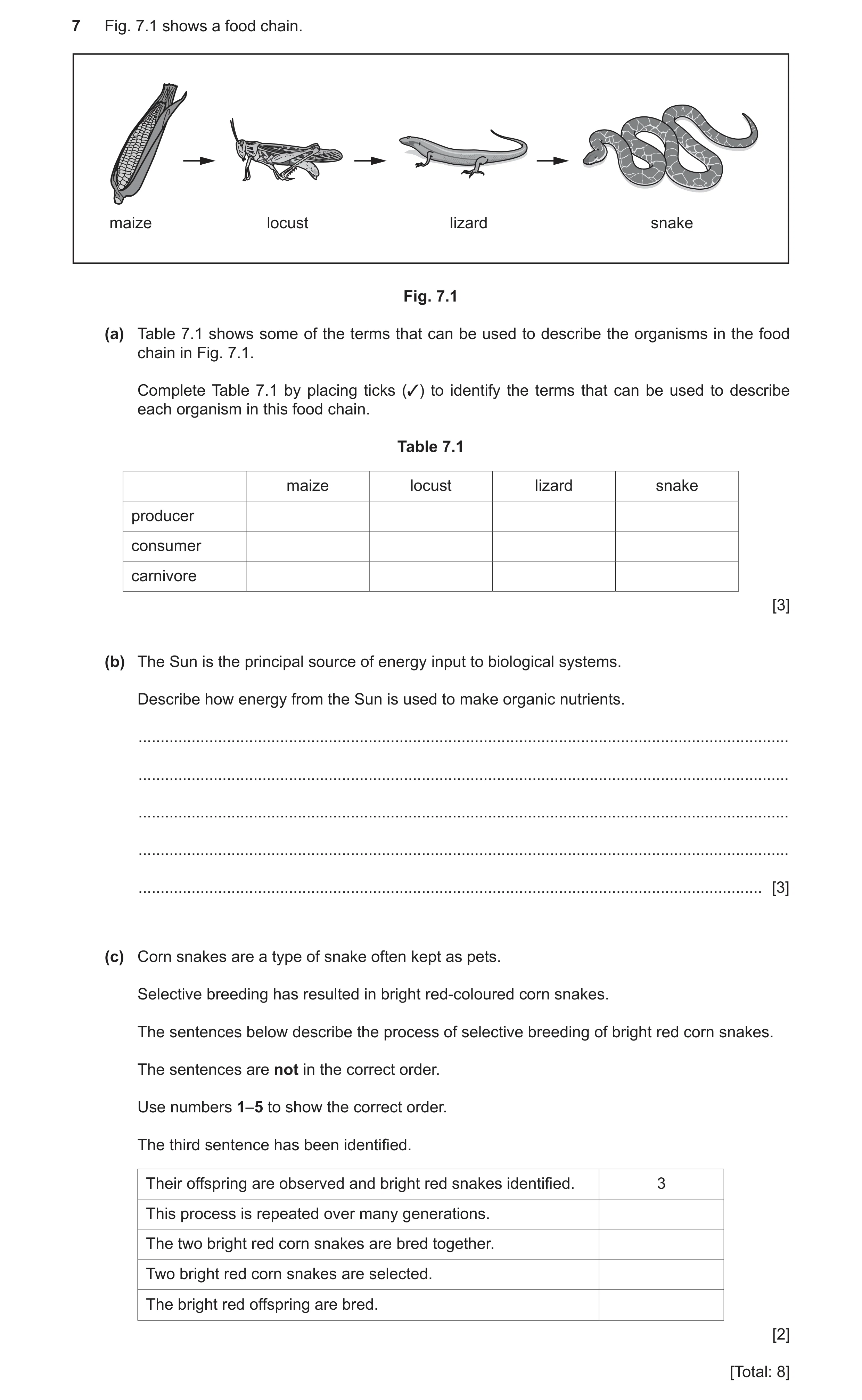
7 Fig. 7.1 shows a food chain. maize locust lizard snake Fig. 7.1 (a) Table 7.1 shows some of the terms that can be used to describe the organisms in the food chain in Fig. 7.1. Complete Table 7.1 by placing ticks (3) to identify the terms that can be used to describe each organism in this food chain. Table 7.1 maize locust lizard snake producer consumer carnivore [3] (b) The Sun is the principal source of energy input to biological systems. Describe how energy from the Sun is used to make organic nutrients. … … … … … [3] (c) Corn snakes are a type of snake often kept as pets. Selective breeding has resulted in bright red-coloured corn snakes. The sentences below describe the process of selective breeding of bright red corn snakes. The sentences are not in the correct order. Use numbers 1–5 to show the correct order. The third sentence has been identified. Their offspring are observed and bright red snakes identified. 3 This process is repeated over many generations. The two bright red corn snakes are bred together. Two bright red corn snakes are selected. The bright red offspring are bred. [2] [Total: 8]
8 marks
Mark scheme: 7(a) producer – maize ticked ; consumer – locust, lizard and snake ticked ; carnivore – lizard and snake ticked ; 3 7(b) ref to photosynthesis ; light energy used ; by producers / plants ; to make carbohydrates ; max 3 7(c) 3 5 2 1 4 ;; 5 at the top and 4 at the bottom for 1 mark 2, 1 in the correct order for 1 mark 2
This question in 0654/33 May/June 2020
Q13 · A student investigates the changes to plant cells when they are immersed in different… 0654/31 Oct/Nov 2020
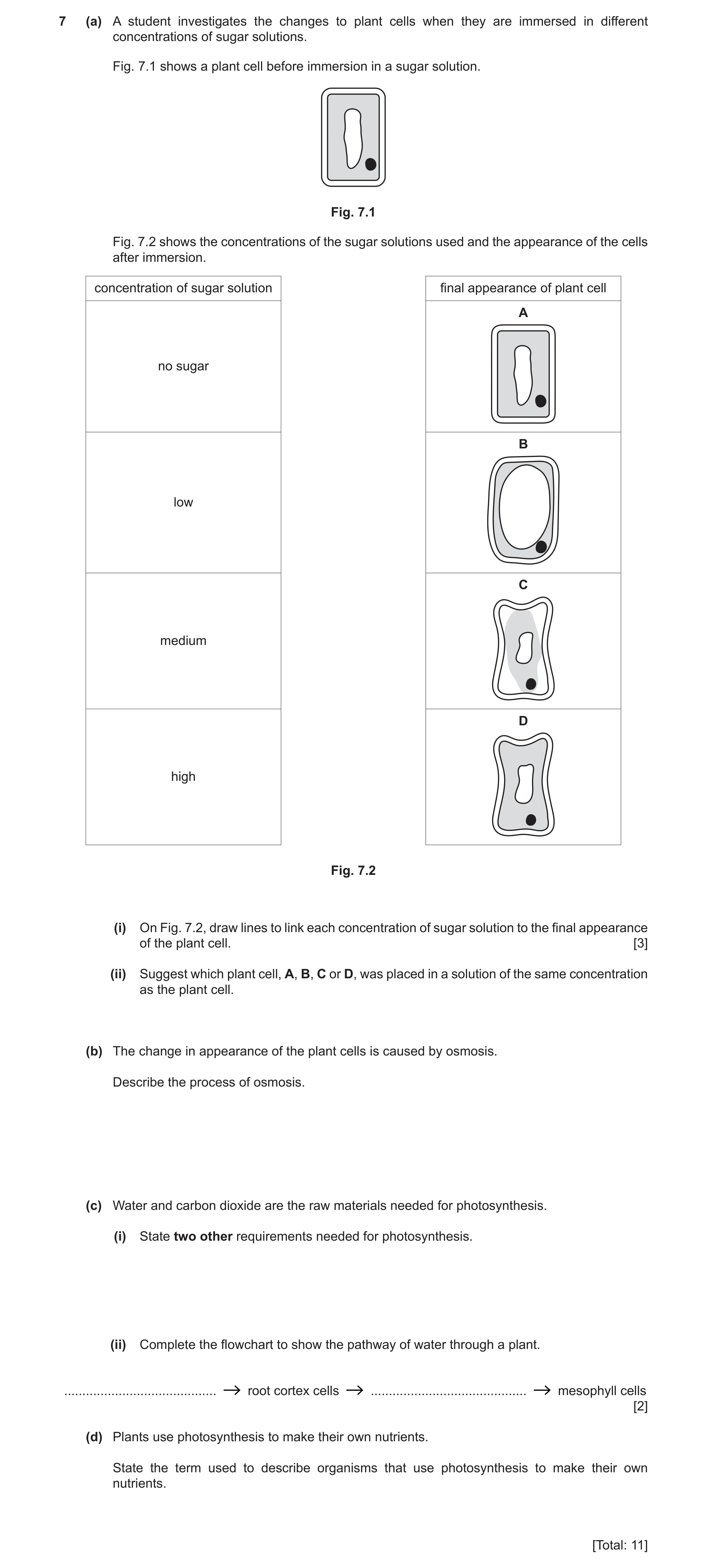
7 (a) A student investigates the changes to plant cells when they are immersed in different concentrations of sugar solutions. Fig. 7.1 shows a plant cell before immersion in a sugar solution. Fig. 7.1 Fig. 7.2 shows the concentrations of the sugar solutions used and the appearance of the cells after immersion. concentration of sugar solution final appearance of plant cell A no sugar B low C medium D high Fig. 7.2 (i) On Fig. 7.2, draw lines to link each concentration of sugar solution to the final appearance of the plant cell. [3] (ii) Suggest which plant cell, A, B, C or D, was placed in a solution of the same concentration as the plant cell. (b) The change in appearance of the plant cells is caused by osmosis. Describe the process of osmosis. (c) Water and carbon dioxide are the raw materials needed for photosynthesis. (i) State two other requirements needed for photosynthesis. (ii) Complete the flowchart to show the pathway of water through a plant. … root cortex cells … mesophyll cells [2] (d) Plants use photosynthesis to make their own nutrients. State the term used to describe organisms that use photosynthesis to make their own nutrients. [Total: 11]
11 marks
Mark scheme: 7(a)(i) no sugar – B low – A medium – D high – C ;;; 3 7(a)(ii) A ; 1 7(b) movement of water ; across a, partially permeable / cell, membrane ; AVP ; 2 7(c)(i) light ; chlorophyll ; 2 Question Answer Marks 7(c)(ii) root hair cell ; xylem ; 2 7(d) producer ; 1
This question in 0654/31 Oct/Nov 2020
Q14 · A student investigates the changes to plant cells when they are immersed in different… 0654/33 Oct/Nov 2020
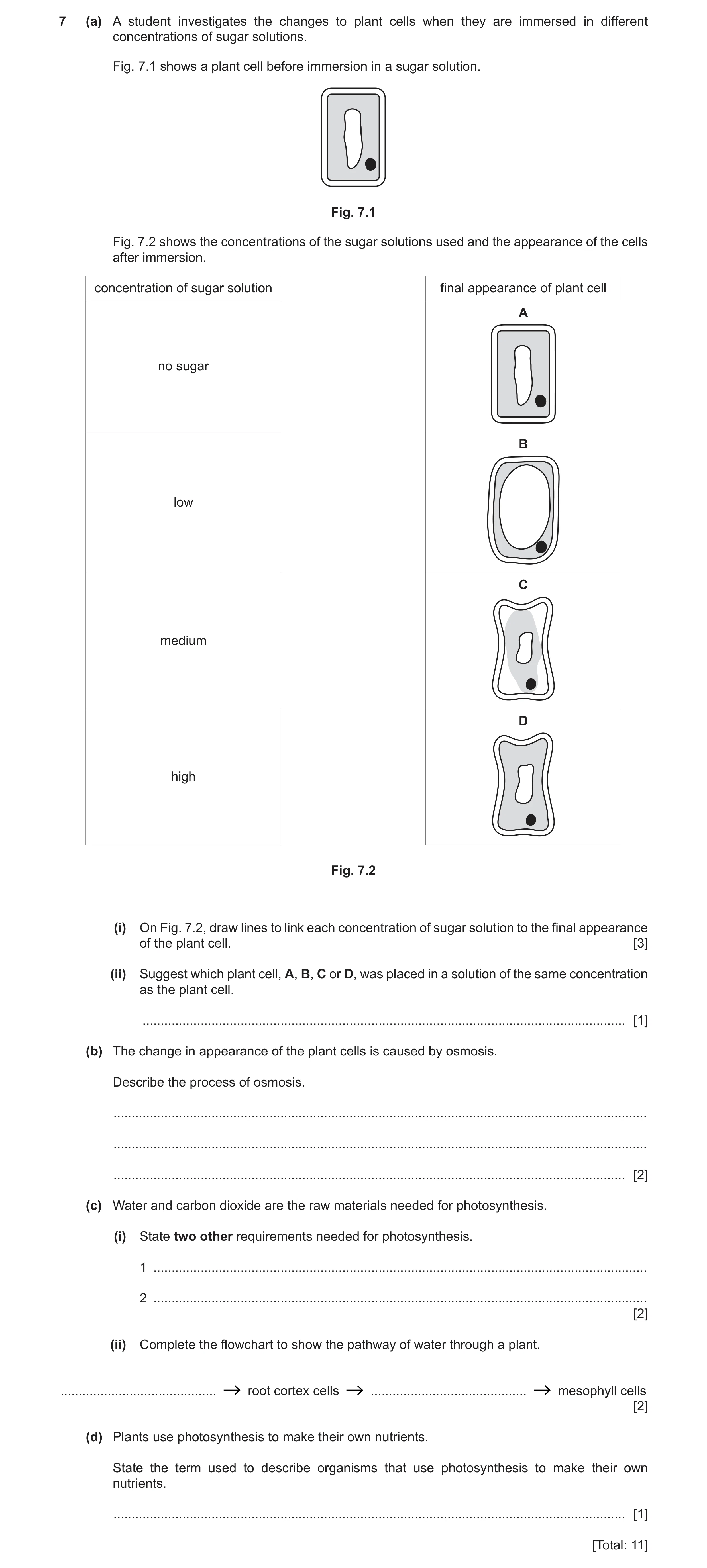
7 (a) A student investigates the changes to plant cells when they are immersed in different concentrations of sugar solutions. Fig. 7.1 shows a plant cell before immersion in a sugar solution. Fig. 7.1 Fig. 7.2 shows the concentrations of the sugar solutions used and the appearance of the cells after immersion. concentration of sugar solution final appearance of plant cell A no sugar B low C medium D high Fig. 7.2 (i) On Fig. 7.2, draw lines to link each concentration of sugar solution to the final appearance of the plant cell. [3] (ii) Suggest which plant cell, A, B, C or D, was placed in a solution of the same concentration as the plant cell. … [1] (b) The change in appearance of the plant cells is caused by osmosis. Describe the process of osmosis. … … … [2] (c) Water and carbon dioxide are the raw materials needed for photosynthesis. (i) State two other requirements needed for photosynthesis. 1 … 2 … [2] (ii) Complete the flowchart to show the pathway of water through a plant. … root cortex cells … mesophyll cells [2] (d) Plants use photosynthesis to make their own nutrients. State the term used to describe organisms that use photosynthesis to make their own nutrients. … [1] [Total: 11]
11 marks
Mark scheme: 7(a)(i) no sugar – B low – A medium – D high – C ;;; 3 7(a)(ii) A ; 1 7(b) movement of water ; across a, partially permeable / cell, membrane ; AVP ; 2 7(c)(i) light ; chlorophyll ; 2 Question Answer Marks 7(c)(ii) root hair cell ; xylem ; 2 7(d) producer ; 1
This question in 0654/33 Oct/Nov 2020
Q15 · A photomicrograph of a cross-section of a root 0654/32 Feb/March 2021
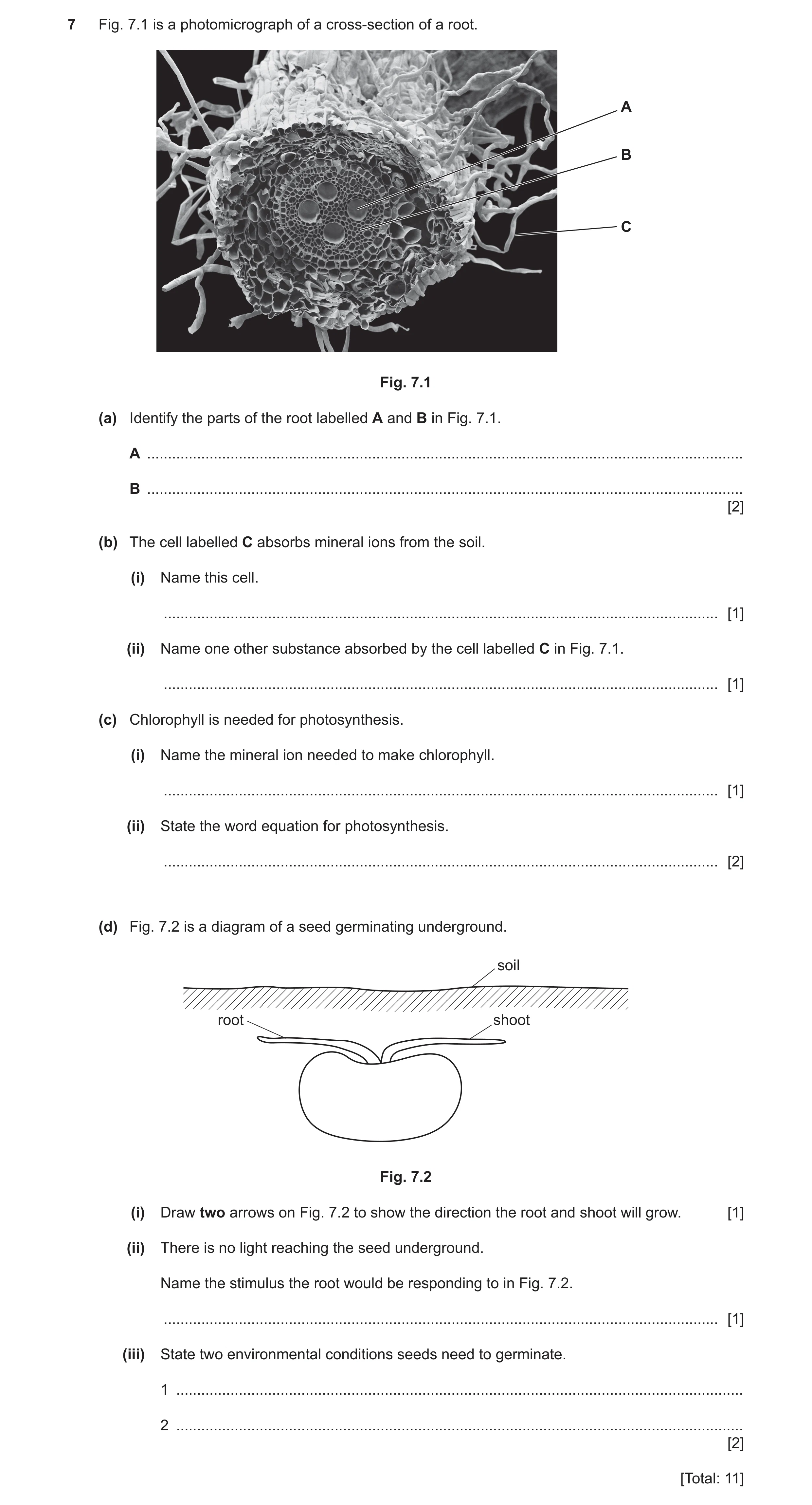
7 Fig. 7.1 is a photomicrograph of a cross-section of a root. A B C Fig. 7.1 (a) Identify the parts of the root labelled A and B in Fig. 7.1. A … B … [2] (b) The cell labelled C absorbs mineral ions from the soil. (i) Name this cell. … [1] (ii) Name one other substance absorbed by the cell labelled C in Fig. 7.1. … [1] (c) Chlorophyll is needed for photosynthesis. (i) Name the mineral ion needed to make chlorophyll. … [1] (ii) State the word equation for photosynthesis. … [2] (d) Fig. 7.2 is a diagram of a seed germinating underground. soil root shoot Fig. 7.2 (i) Draw two arrows on Fig. 7.2 to show the direction the root and shoot will grow. [1] (ii) There is no light reaching the seed underground. Name the stimulus the root would be responding to in Fig. 7.2. … [1] (iii) State two environmental conditions seeds need to germinate. 1 … 2 … [2] [Total: 11]
11 marks
Mark scheme: 7(a) A xylem ; B phloem ; 2 7(b)(i) root hair (cell) ; 1 7(b)(ii) water ; 1 7(c)(i) magnesium ; 1 7(c)(ii) carbon dioxide + water → glucose + oxygen ;; 2 7(d)(i) shoot arrow pointing upwards and root arrow pointing downwards ; 1 7(d)(ii) gravity ; 1 7(d)(iii) any two from warm / suitable temperature ; oxygen ; moisture / water ; 2
This question in 0654/32 Feb/March 2021
Q16 · A diagram showing part of the carbon cycle 0654/31 Oct/Nov 2021
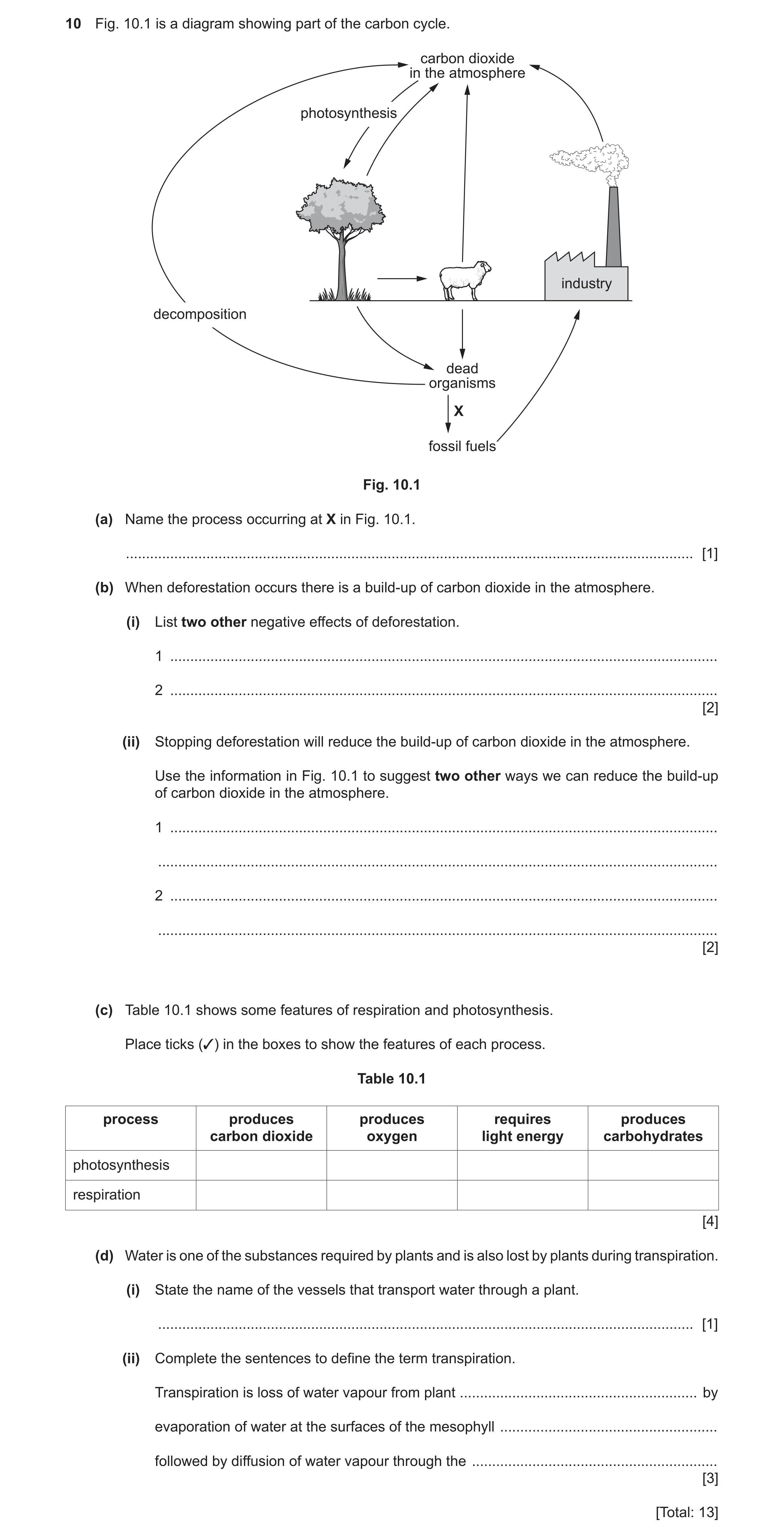
10 Fig. 10.1 is a diagram showing part of the carbon cycle. carbon dioxide in the atmosphere photosynthesis industry decomposition dead organisms X fossil fuels Fig. 10.1 (a) Name the process occurring at X in Fig. 10.1. … [1] (b) When deforestation occurs there is a build-up of carbon dioxide in the atmosphere. (i) List two other negative effects of deforestation. 1 … 2 … [2] (ii) Stopping deforestation will reduce the build-up of carbon dioxide in the atmosphere. Use the information in Fig. 10.1 to suggest two other ways we can reduce the build-up of carbon dioxide in the atmosphere. 1 … … 2 … … [2] (c) Table 10.1 shows some features of respiration and photosynthesis. Place ticks (3) in the boxes to show the features of each process. Table 10.1 process produces produces requires produces carbon dioxide oxygen light energy carbohydrates photosynthesis respiration [4] (d) Water is one of the substances required by plants and is also lost by plants during transpiration. (i) State the name of the vessels that transport water through a plant. … [1] (ii) Complete the sentences to define the term transpiration. Transpiration is loss of water vapour from plant … by evaporation of water at the surfaces of the mesophyll … followed by diffusion of water vapour through the … [3] [Total: 13]
13 marks
Mark scheme: 10(a) fossilisation ; 1 10(b)(i) any two from: habitat destruction ; extinction ; loss of soil ; flooding ; AVP ; 2 10(b)(ii) replant / plant more trees ; reduce, combustion of fossil fuels / emissions by industry ; 2 10(c) ;;;; 4 10(d)(i) xylem ; 1 10(d)(ii) leaves ; cells ; stomata ; 3
This question in 0654/31 Oct/Nov 2021
Q17 · State the word equation for photosynthesis 0654/32 Oct/Nov 2021
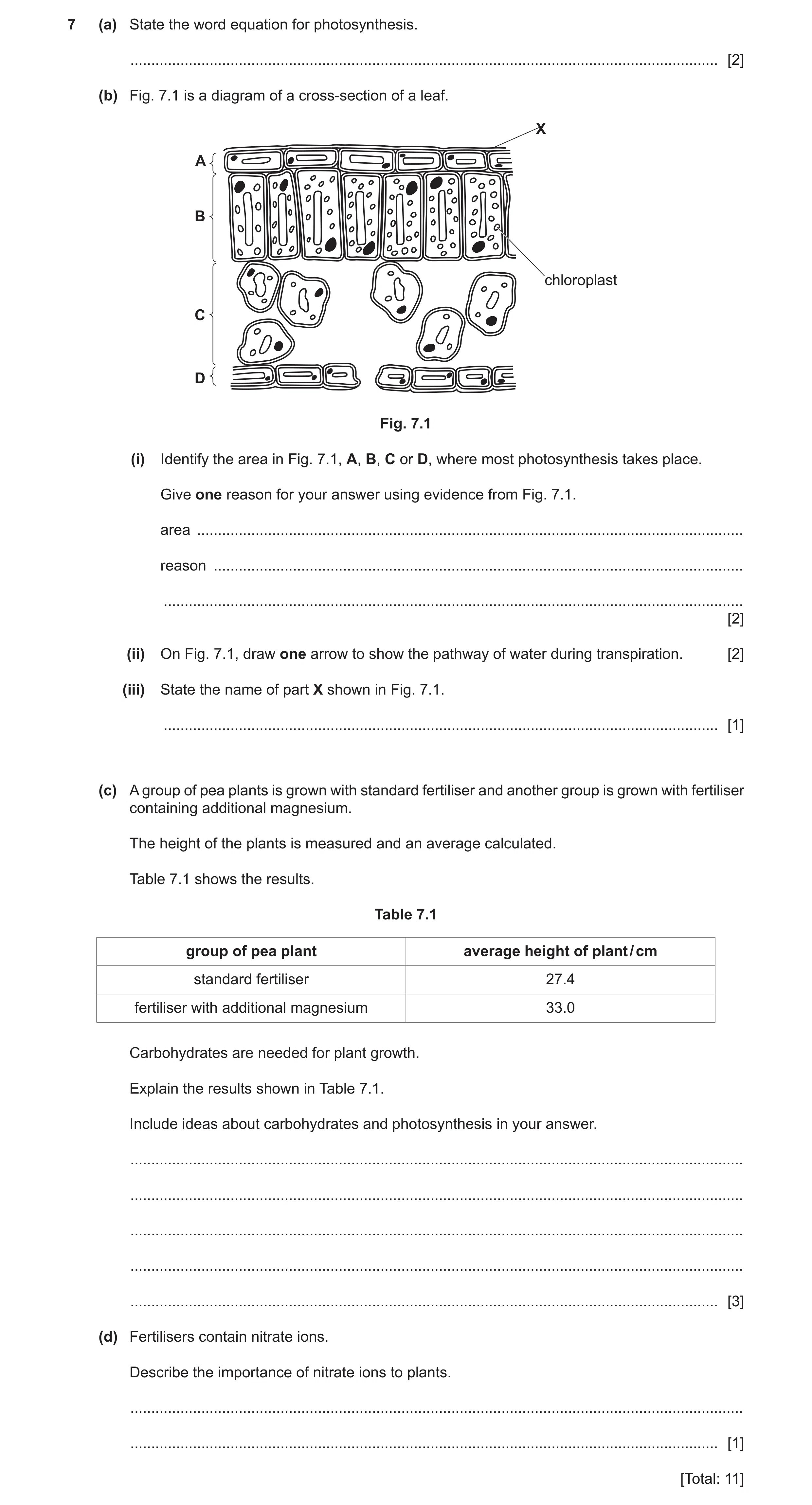
7 (a) State the word equation for photosynthesis. … [2] (b) Fig. 7.1 is a diagram of a cross‑section of a leaf. X A B chloroplast C D Fig. 7.1 (i) Identify the area in Fig. 7.1, A, B, C or D, where most photosynthesis takes place. Give one reason for your answer using evidence from Fig. 7.1. area … reason … … [2] (ii) On Fig. 7.1, draw one arrow to show the pathway of water during transpiration. [2] (iii) State the name of part X shown in Fig. 7.1. … [1] (c) A group of pea plants is grown with standard fertiliser and another group is grown with fertiliser containing additional magnesium. The height of the plants is measured and an average calculated. Table 7.1 shows the results. Table 7.1 group of pea plant average height of plant / cm standard fertiliser 27.4 fertiliser with additional magnesium 33.0 Carbohydrates are needed for plant growth. Explain the results shown in Table 7.1. Include ideas about carbohydrates and photosynthesis in your answer. … … … … … [3] (d) Fertilisers contain nitrate ions. Describe the importance of nitrate ions to plants. … … [1] [Total: 11]
11 marks
Mark scheme: 7(a) carbon dioxide + water → glucose + oxygen ;; 2 7(b)(i) B ; area with the most chloroplasts ; 2 7(b)(ii) arrow starting at the surface of any of the mesophyll cells ; pointing to / through, the stomata ; 2 7(b)(iii) cuticle ; 1 7(c) magnesium required to produce chlorophyll ; chlorophyll is required for photosynthesis ; photosynthesis produces carbohydrates (for growth) ; 3 7(d) nitrate ions are needed to produce amino acids ; 1
This question in 0654/32 Oct/Nov 2021
Q18 · Part of the carbon cycle 0654/32 Feb/March 2022
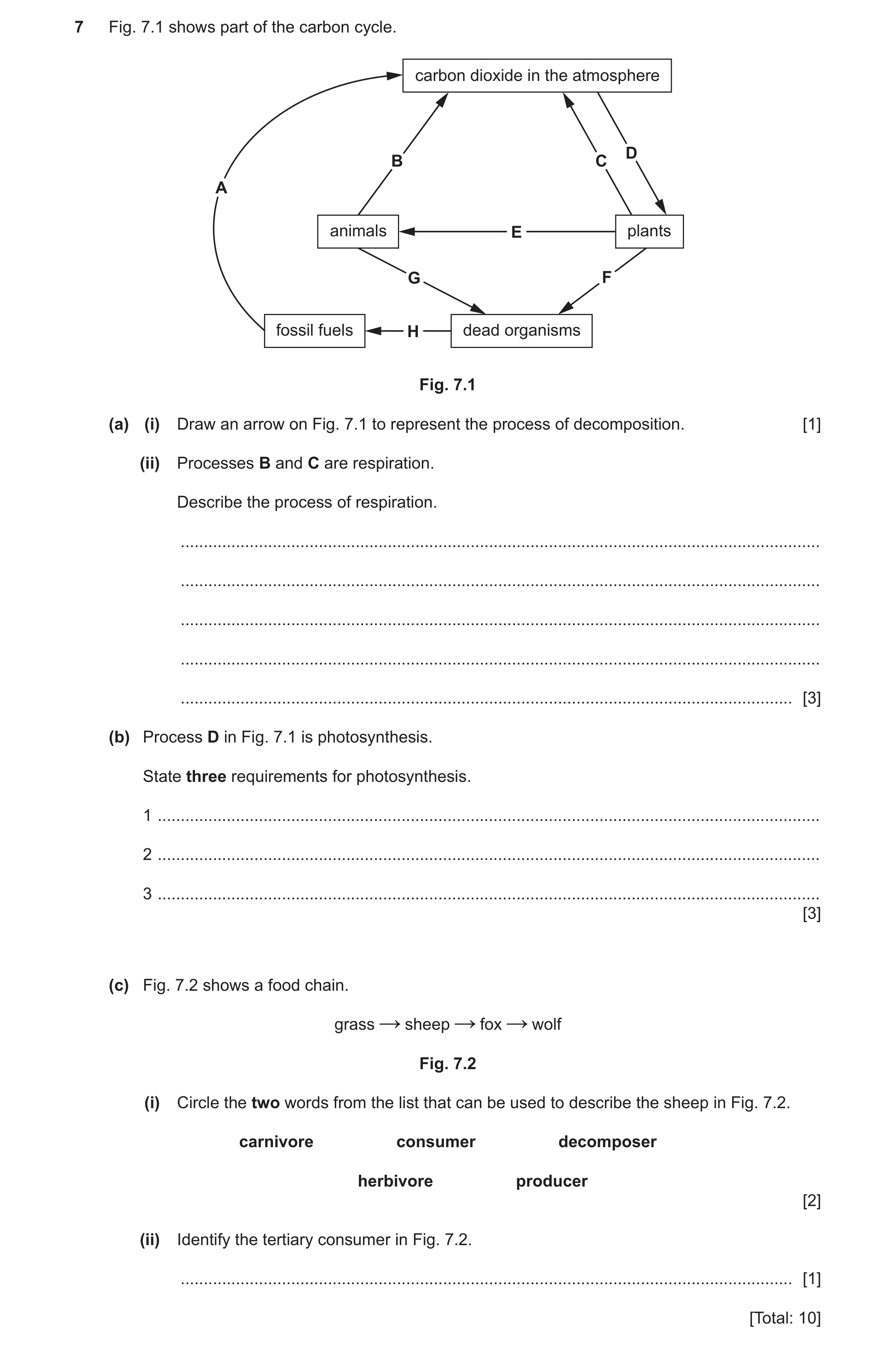
7 Fig. 7.1 shows part of the carbon cycle. carbon dioxide in the atmosphere D B C A animals E plants G F fossil fuels H dead organisms Fig. 7.1 (a) (i) Draw an arrow on Fig. 7.1 to represent the process of decomposition. [1] (ii) Processes B and C are respiration. Describe the process of respiration. … … … … … [3] (b) Process D in Fig. 7.1 is photosynthesis. State three requirements for photosynthesis. 1 … 2 … 3 … [3] (c) Fig. 7.2 shows a food chain. grass sheep fox wolf → → → Fig. 7.2 (i) Circle the two words from the list that can be used to describe the sheep in Fig. 7.2. carnivore consumer decomposer herbivore producer [2] (ii) Identify the tertiary consumer in Fig. 7.2. … [1] [Total: 10]
10 marks
Mark scheme: 7(a)(i) arrow drawn between dead organisms and carbon dioxide in the atmosphere ; 1 7(a)(ii) any three from: chemical reaction that happens in cells ; releases energy ; ref to glucose and oxygen as reactants ; ref to carbon dioxide and water as products ; 3 Question Answer Marks 7(b) any three from: carbon dioxide ; water ; chlorophyll ; light ; warm temperature ; 3 7(c)(i) herbivore circled ; consumer circled ; 2 7(c)(ii) wolf ; 1
This question in 0654/32 Feb/March 2022
Q19 · A diagram of a cross-section through a leaf 0654/32 May/June 2022
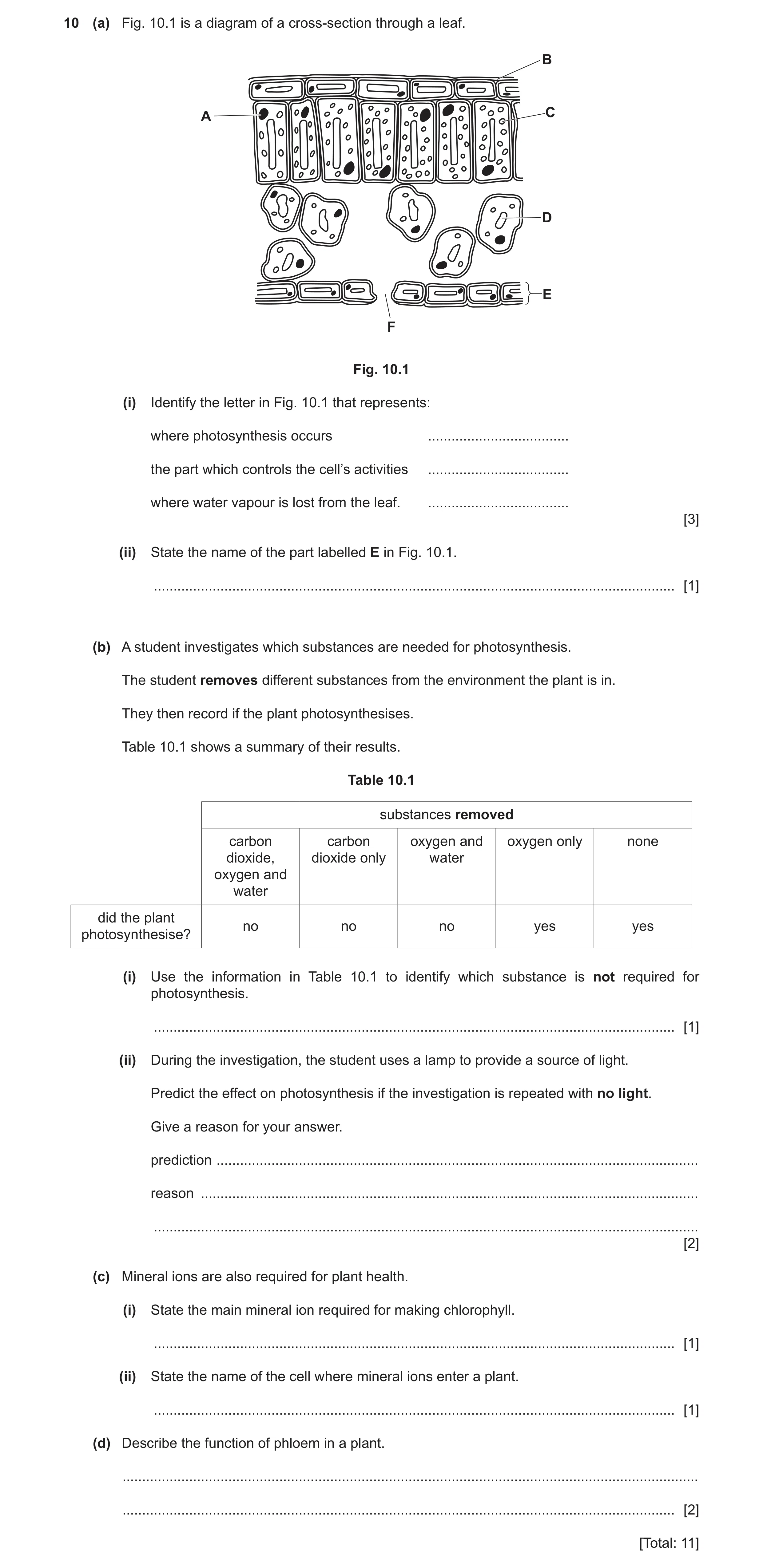
10 (a) Fig. 10.1 is a diagram of a cross-section through a leaf. B A C D E F Fig. 10.1 (i) Identify the letter in Fig. 10.1 that represents: where photosynthesis occurs … the part which controls the cell’s activities … where water vapour is lost from the leaf. … [3] (ii) State the name of the part labelled E in Fig. 10.1. … [1] (b) A student investigates which substances are needed for photosynthesis. The student removes different substances from the environment the plant is in. They then record if the plant photosynthesises. Table 10.1 shows a summary of their results. Table 10.1 substances removed carbon carbon oxygen and oxygen only none dioxide, dioxide only water oxygen and water did the plant no no no yes yesphotosynthesise? (i) Use the information in Table 10.1 to identify which substance is not required for photosynthesis. … [1] (ii) During the investigation, the student uses a lamp to provide a source of light. Predict the effect on photosynthesis if the investigation is repeated with no light. Give a reason for your answer. prediction … reason … … [2] (c) Mineral ions are also required for plant health. (i) State the main mineral ion required for making chlorophyll. … [1] (ii) State the name of the cell where mineral ions enter a plant. … [1] (d) Describe the function of phloem in a plant. … … [2] [Total: 11]
11 marks
Mark scheme: 10(a)(i) C ; A ; F ; 3 10(a)(ii) (lower) epidermis ; 1 10(b)(i) oxygen ; 1 10(b)(ii) no photosynthesis ; light is required (for photosynthesis) ; 2 10(c)(i) magnesium ; 1 10(c)(ii) root hair (cell) ; 1 10(d) transport ; of, sucrose / amino acids ; 2
This question in 0654/32 May/June 2022
Q20 · A diagram of a cross-section through a leaf 0654/33 May/June 2022
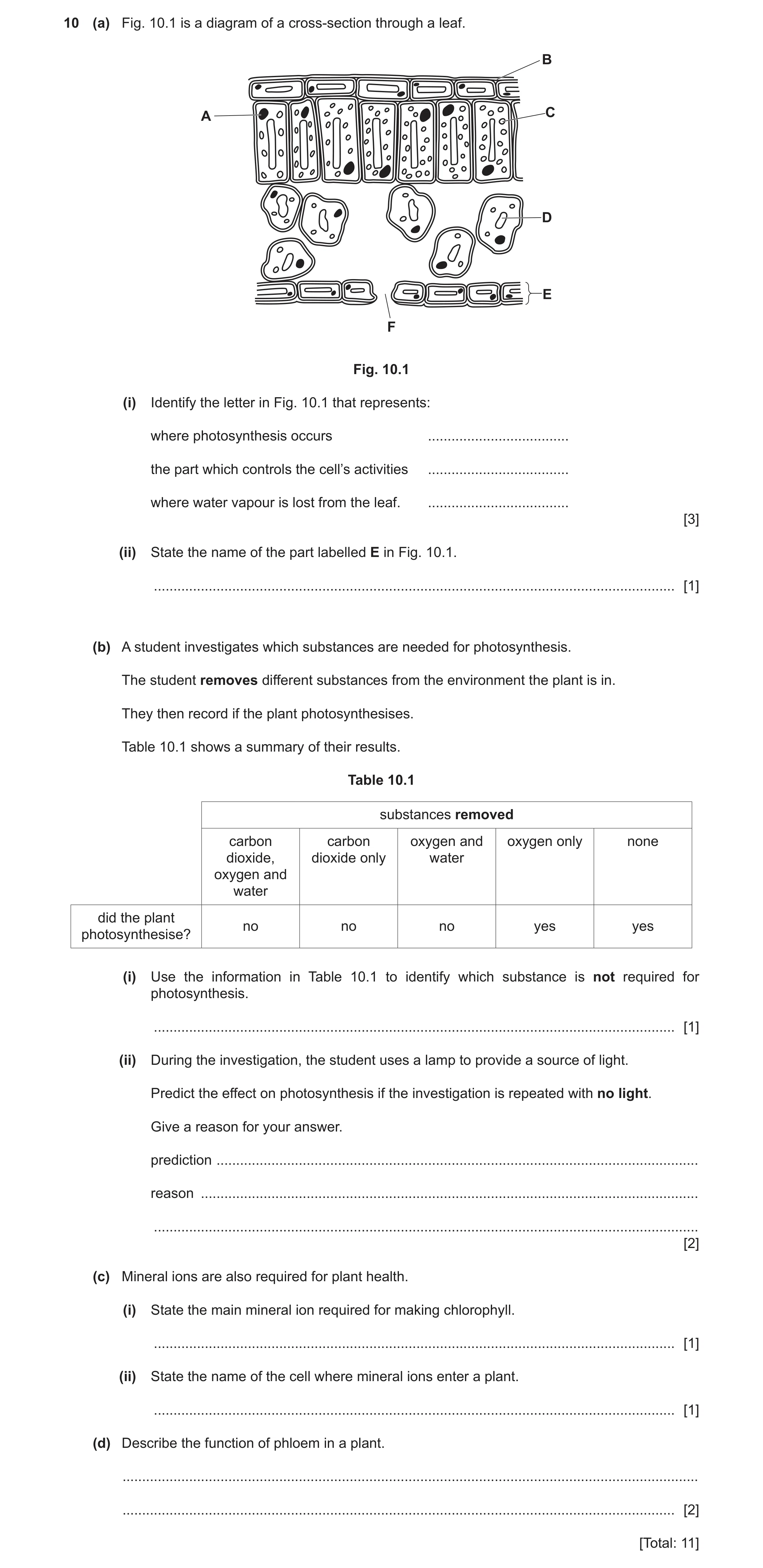
10 (a) Fig. 10.1 is a diagram of a cross-section through a leaf. B A C D E F Fig. 10.1 (i) Identify the letter in Fig. 10.1 that represents: where photosynthesis occurs … the part which controls the cell’s activities … where water vapour is lost from the leaf. … [3] (ii) State the name of the part labelled E in Fig. 10.1. … [1] (b) A student investigates which substances are needed for photosynthesis. The student removes different substances from the environment the plant is in. They then record if the plant photosynthesises. Table 10.1 shows a summary of their results. Table 10.1 substances removed carbon carbon oxygen and oxygen only none dioxide, dioxide only water oxygen and water did the plant no no no yes yesphotosynthesise? (i) Use the information in Table 10.1 to identify which substance is not required for photosynthesis. … [1] (ii) During the investigation, the student uses a lamp to provide a source of light. Predict the effect on photosynthesis if the investigation is repeated with no light. Give a reason for your answer. prediction … reason … … [2] (c) Mineral ions are also required for plant health. (i) State the main mineral ion required for making chlorophyll. … [1] (ii) State the name of the cell where mineral ions enter a plant. … [1] (d) Describe the function of phloem in a plant. … … [2] [Total: 11]
11 marks
Mark scheme: 10(a)(i) C ; A ; F ; 3 10(a)(ii) (lower) epidermis ; 1 10(b)(i) oxygen ; 1 10(b)(ii) no photosynthesis ; light is required (for photosynthesis) ; 2 10(c)(i) magnesium ; 1 10(c)(ii) root hair (cell) ; 1 10(d) transport ; of, sucrose / amino acids ; 2
This question in 0654/33 May/June 2022
Q21 · A student investigates photosynthesis 0654/31 Oct/Nov 2022
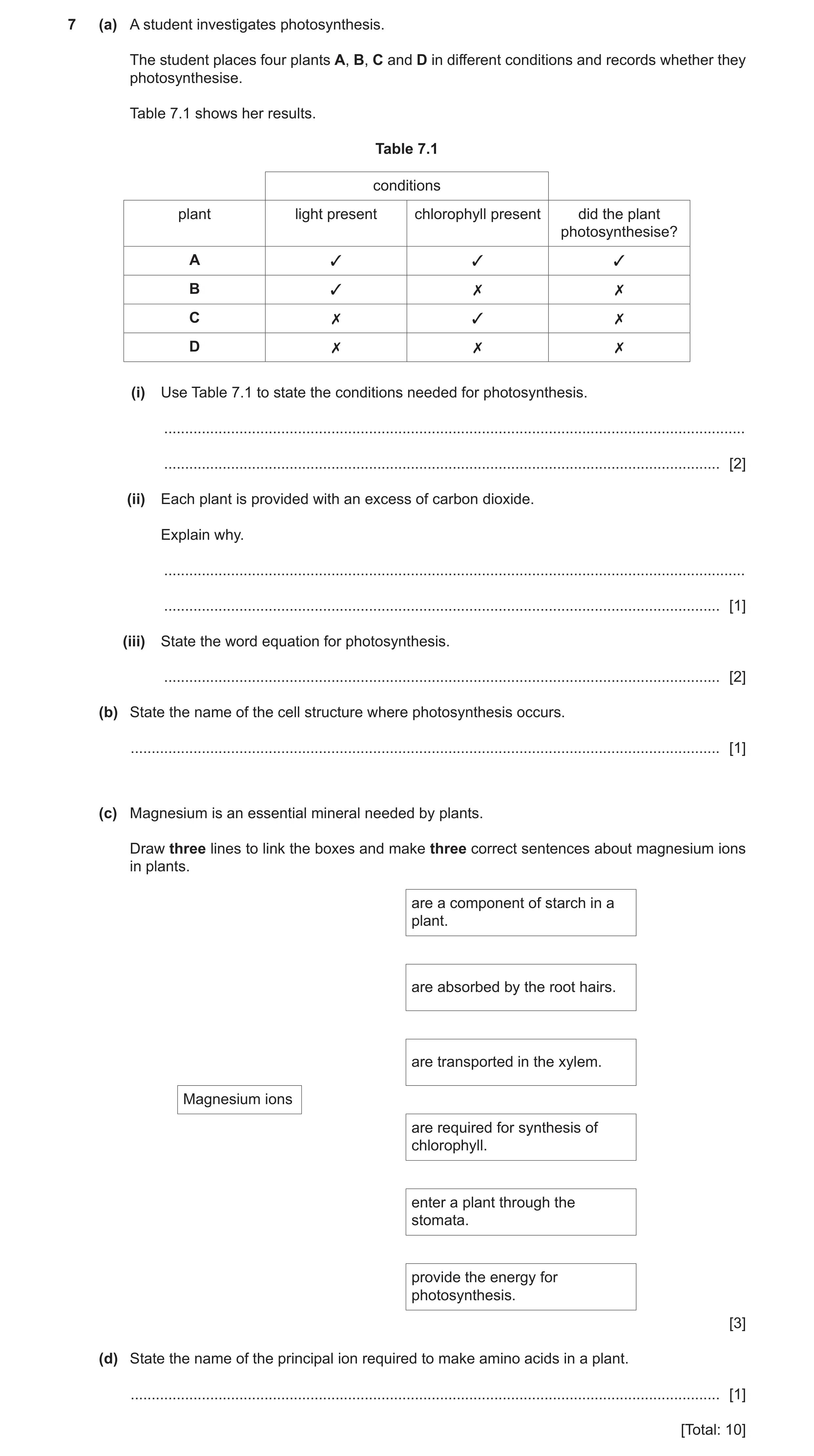
7 (a) A student investigates photosynthesis. The student places four plants A, B, C and D in different conditions and records whether they photosynthesise. Table 7.1 shows her results. Table 7.1 conditions plant light present chlorophyll present did the plant photosynthesise? A 3 3 3 B 3 ✗ ✗ C ✗ 3 ✗ D ✗ ✗ ✗ (i) Use Table 7.1 to state the conditions needed for photosynthesis. … … [2] (ii) Each plant is provided with an excess of carbon dioxide. Explain why. … … [1] (iii) State the word equation for photosynthesis. … [2] (b) State the name of the cell structure where photosynthesis occurs. … [1] (c) Magnesium is an essential mineral needed by plants. Draw three lines to link the boxes and make three correct sentences about magnesium ions in plants. are a component of starch in a plant. are absorbed by the root hairs. are transported in the xylem. Magnesium ions are required for synthesis of chlorophyll. enter a plant through the stomata. provide the energy for photosynthesis. [3] (d) State the name of the principal ion required to make amino acids in a plant. … [1] [Total: 10]
10 marks
Mark scheme: 7(a)(i) light ; 2 chlorophyll ; 7(a)(ii) carbon dioxide is required for photosynthesis ; 1 7(a)(iii) carbon dioxide + water → glucose and oxygen ;; 2 7(b) chloroplast ; 1 7(c) 3 are a component of starch in a plant are absorbed by the root hairs. are transported in the xylem. Magnesium ions are required for synthesis of chlorophyll. enter a plant through the stomata. provide the energy for photosynthesis. ;;; 7(d) nitrate ; 1
This question in 0654/31 Oct/Nov 2022
Q22 · A diagram of a marine food web 0654/32 Oct/Nov 2023
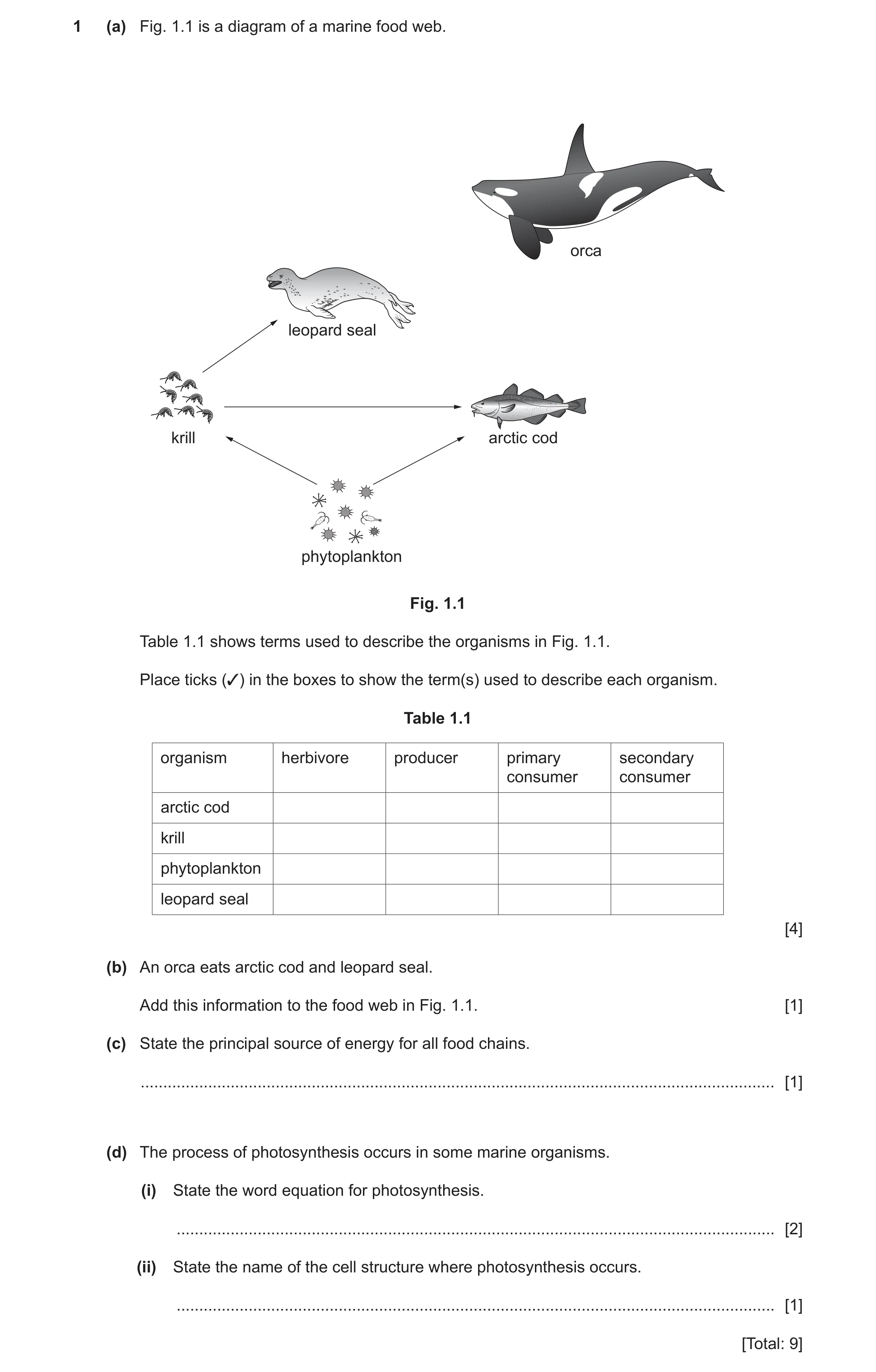
1 (a) Fig. 1.1 is a diagram of a marine food web. orca leopard seal krill arctic cod phytoplankton Fig. 1.1 Table 1.1 shows terms used to describe the organisms in Fig. 1.1. Place ticks (✓) in the boxes to show the term(s) used to describe each organism. Table 1.1 organism herbivore producer primary secondary consumer consumer arctic cod krill phytoplankton leopard seal [4] (b) An orca eats arctic cod and leopard seal. Add this information to the food web in Fig. 1.1. [1] (c) State the principal source of energy for all food chains. … [1] (d) The process of photosynthesis occurs in some marine organisms. (i) State the word equation for photosynthesis. … [2] (ii) State the name of the cell structure where photosynthesis occurs. … [1] [Total: 9]
9 marks
Mark scheme: Question Answer Marks 1(a) 4 organism herbivore producer primary secondary consumer consumer arctic cod krill plankton leopard seal 1 mark for each row ;;;; 1(b) arrows drawn from leopard seal and artic cod to orca ; 1 1(c) Sun ; 1 1(d)(i) carbon dioxide + water → glucose + oxygen ; 2 1(d)(ii) chloroplast ; 1
This question in 0654/32 Oct/Nov 2023
Q23 · A food web from a rainforest environment 0654/31 May/June 2024
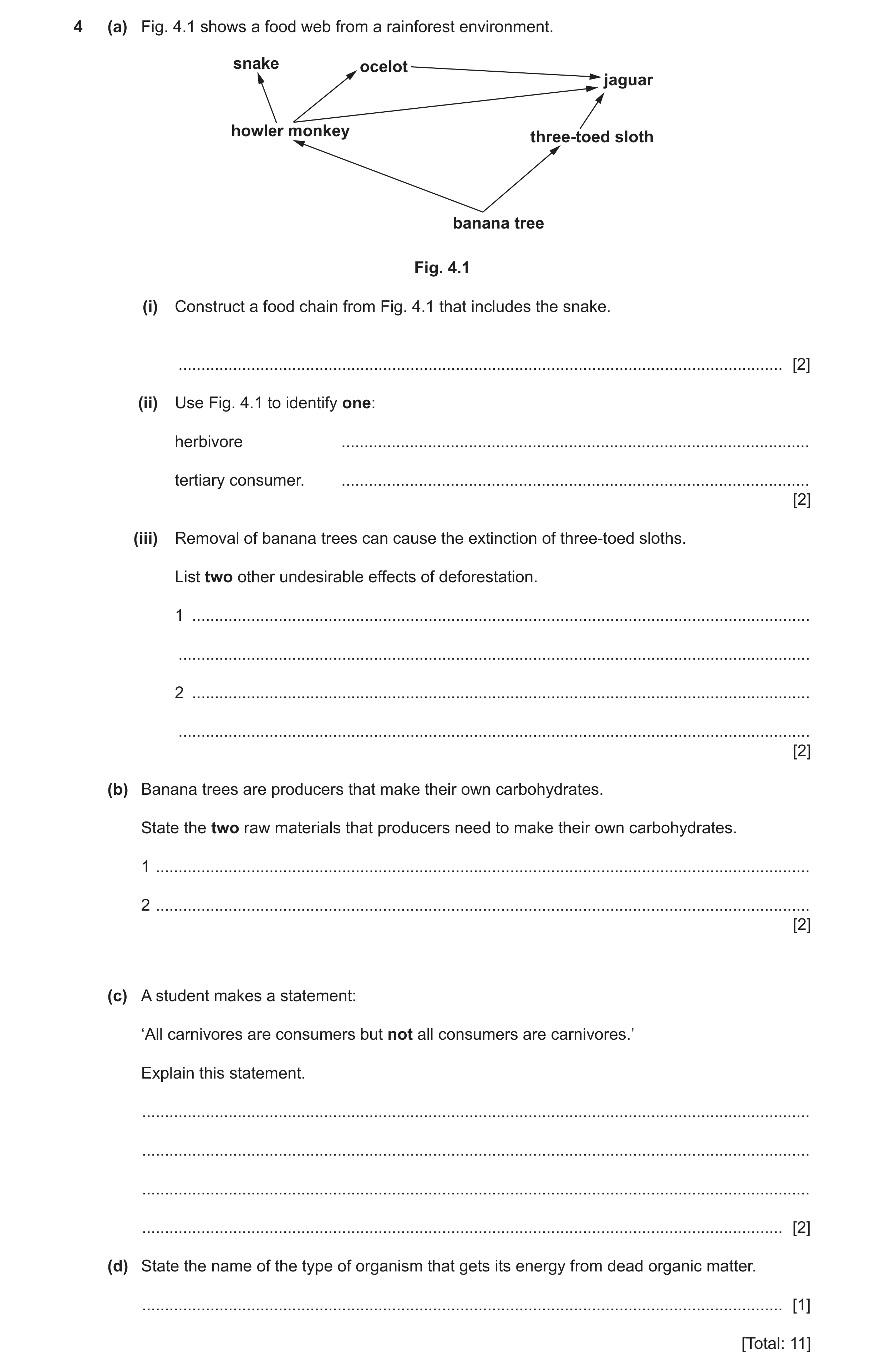
4 (a) Fig. 4.1 shows a food web from a rainforest environment. snake ocelot jaguar howler monkey three-toed sloth banana tree Fig. 4.1 (i) Construct a food chain from Fig. 4.1 that includes the snake. … [2] (ii) Use Fig. 4.1 to identify one: herbivore … tertiary consumer. … [2] (iii) Removal of banana trees can cause the extinction of three‑toed sloths. List two other undesirable effects of deforestation. 1 … … 2 … … [2] (b) Banana trees are producers that make their own carbohydrates. State the two raw materials that producers need to make their own carbohydrates. 1 … 2 … [2] (c) A student makes a statement: ‘All carnivores are consumers but not all consumers are carnivores.’ Explain this statement. … … … … [2] (d) State the name of the type of organism that gets its energy from dead organic matter. … [1] [Total: 11]
11 marks
Mark scheme: 4(a)(i) banana tree → howler monkey → snake ;; 2 4(a)(ii) herbivore howler monkey / three-toed sloth ; tertiary consumer jaguar ; 2 4(a)(iii) any two from: loss of soil / soil erosion ; flooding ; increase of carbon dioxide in the atmosphere ; habitat destruction / animals displaced ; decreased biodiversity ; AVP ;; 2 4(b) carbon dioxide ; water ; 2 4(c) consumers get their energy from eating animals or plants / consumers can be herbivores ; carnivores get their energy from eating (only) animals ; 2 4(d) decomposer ; 1
This question in 0654/31 May/June 2024
Q24 · A student investigates the effect of light on an aquatic plant 0654/32 May/June 2024
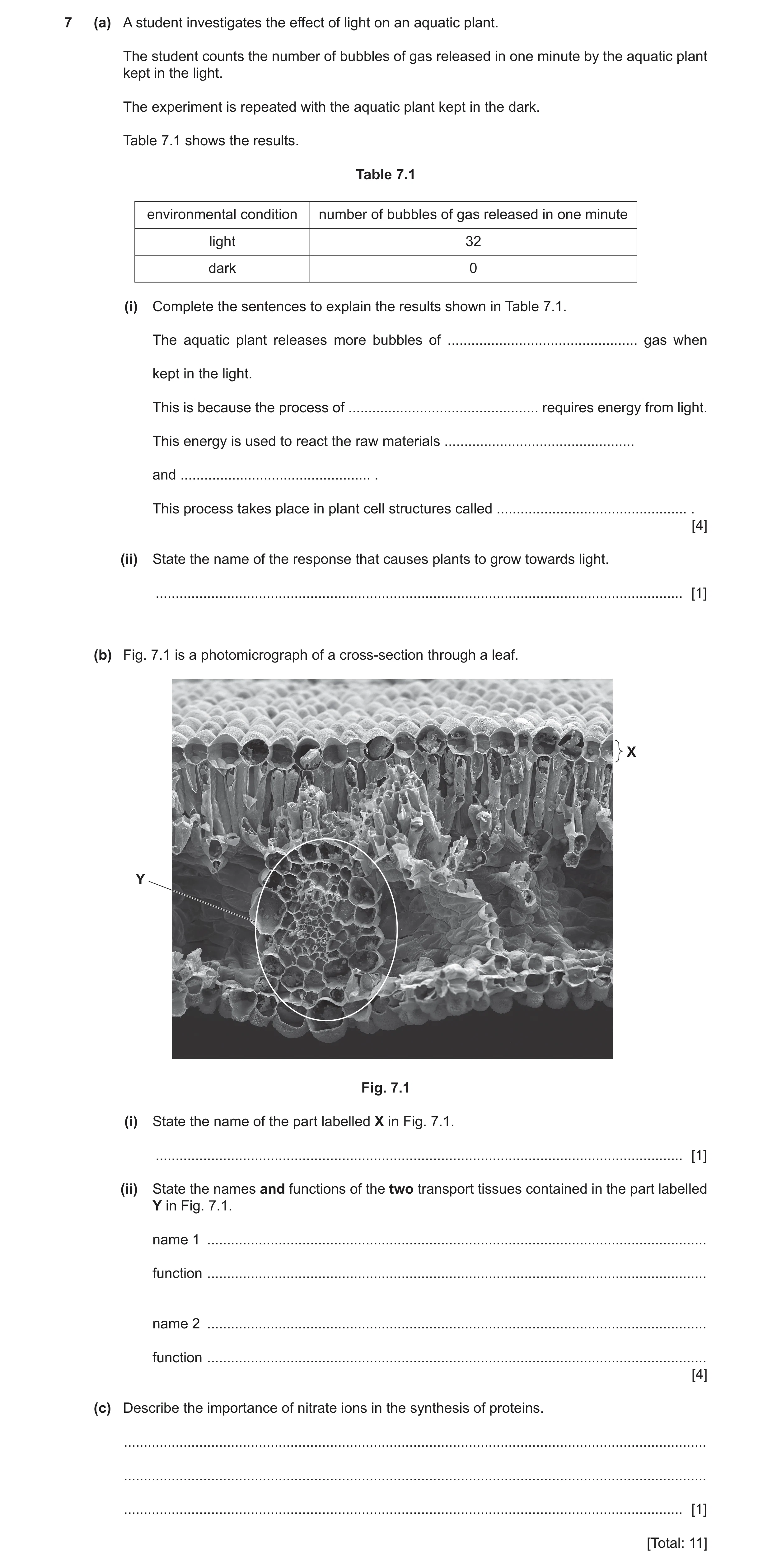
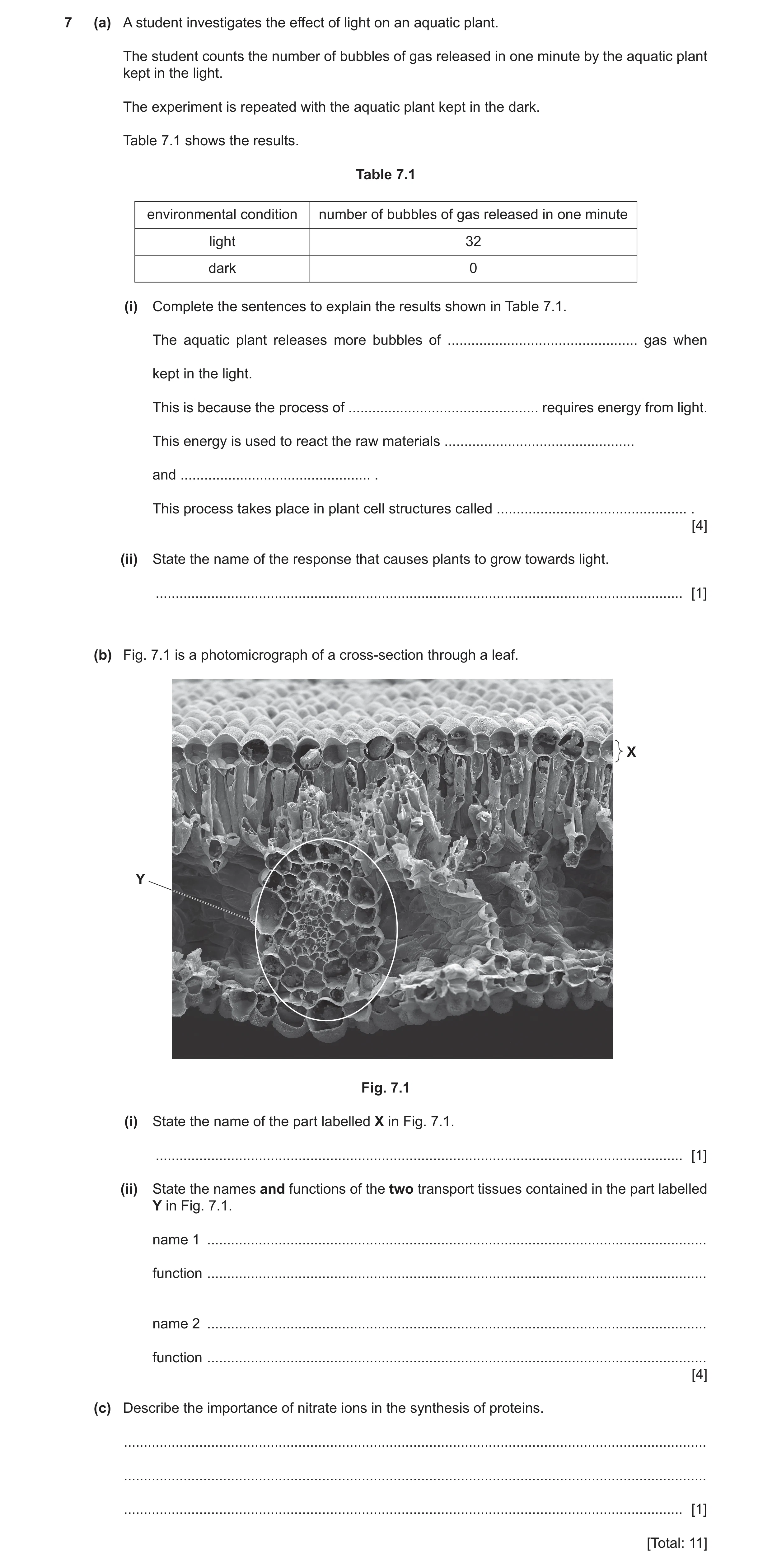
7 (a) A student investigates the effect of light on an aquatic plant. The student counts the number of bubbles of gas released in one minute by the aquatic plant kept in the light. The experiment is repeated with the aquatic plant kept in the dark. Table 7.1 shows the results. Table 7.1 environmental condition number of bubbles of gas released in one minute light 32 dark 0 (i) Complete the sentences to explain the results shown in Table 7.1. The aquatic plant releases more bubbles of … gas when kept in the light. This is because the process of … requires energy from light. This energy is used to react the raw materials … and … . This process takes place in plant cell structures called … . [4] (ii) State the name of the response that causes plants to grow towards light. … [1] (b) Fig. 7.1 is a photomicrograph of a cross‑section through a leaf. X Y Fig. 7.1 (i) State the name of the part labelled X in Fig. 7.1. … [1] (ii) State the names and functions of the two transport tissues contained in the part labelled Y in Fig. 7.1. name 1 … function … name 2 … function … [4] (c) Describe the importance of nitrate ions in the synthesis of proteins. … … … [1] [Total: 11]
11 marks
Mark scheme: 7(a)(i) oxygen ; photosynthesis ; carbon dioxide and water ; chloroplasts ; 4 7(a)(ii) phototropism ; 1 7(b)(i) (upper) epidermis ; 1 Question Answer Marks 7(b)(ii) xylem ; transports mineral ions / water or xylem is for support (of leaf) ; phloem ; transports dissolved sugars ; 4 7(c) nitrates are required to synthesise, amino acids (which make proteins) ; 1
This question in 0654/32 May/June 2024
Q25 · A student investigates the effect of light on an aquatic plant 0654/33 May/June 2024
7 (a) A student investigates the effect of light on an aquatic plant. The student counts the number of bubbles of gas released in one minute by the aquatic plant kept in the light. The experiment is repeated with the aquatic plant kept in the dark. Table 7.1 shows the results. Table 7.1 environmental condition number of bubbles of gas released in one minute light 32 dark 0 (i) Complete the sentences to explain the results shown in Table 7.1. The aquatic plant releases more bubbles of … gas when kept in the light. This is because the process of … requires energy from light. This energy is used to react the raw materials … and … . This process takes place in plant cell structures called … . [4] (ii) State the name of the response that causes plants to grow towards light. … [1] (b) Fig. 7.1 is a photomicrograph of a cross‑section through a leaf. X Y Fig. 7.1 (i) State the name of the part labelled X in Fig. 7.1. … [1] (ii) State the names and functions of the two transport tissues contained in the part labelled Y in Fig. 7.1. name 1 … function … name 2 … function … [4] (c) Describe the importance of nitrate ions in the synthesis of proteins. … … … [1] [Total: 11]
11 marks
Mark scheme: 7(a)(i) oxygen ; photosynthesis ; carbon dioxide and water ; chloroplasts ; 4 7(a)(ii) phototropism ; 1 7(b)(i) (upper) epidermis ; 1 Question Answer Marks 7(b)(ii) xylem ; transports mineral ions / water or xylem is for support (of leaf) ; phloem ; transports dissolved sugars ; 4 7(c) nitrates are required to synthesise, amino acids (which make proteins) ; 1
This question in 0654/33 May/June 2024
Q26 · A photomicrograph of a cross-section through a root 0654/32 Oct/Nov 2024
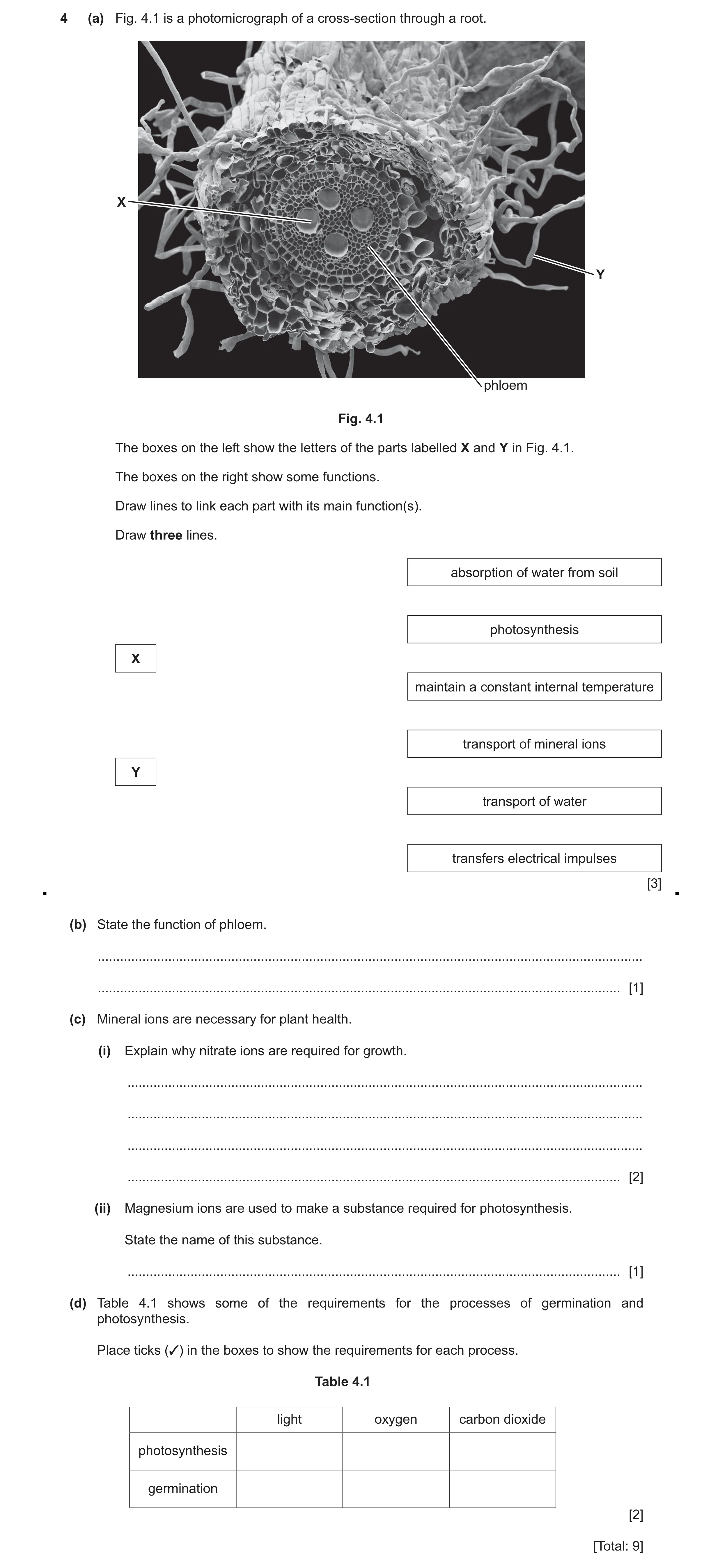
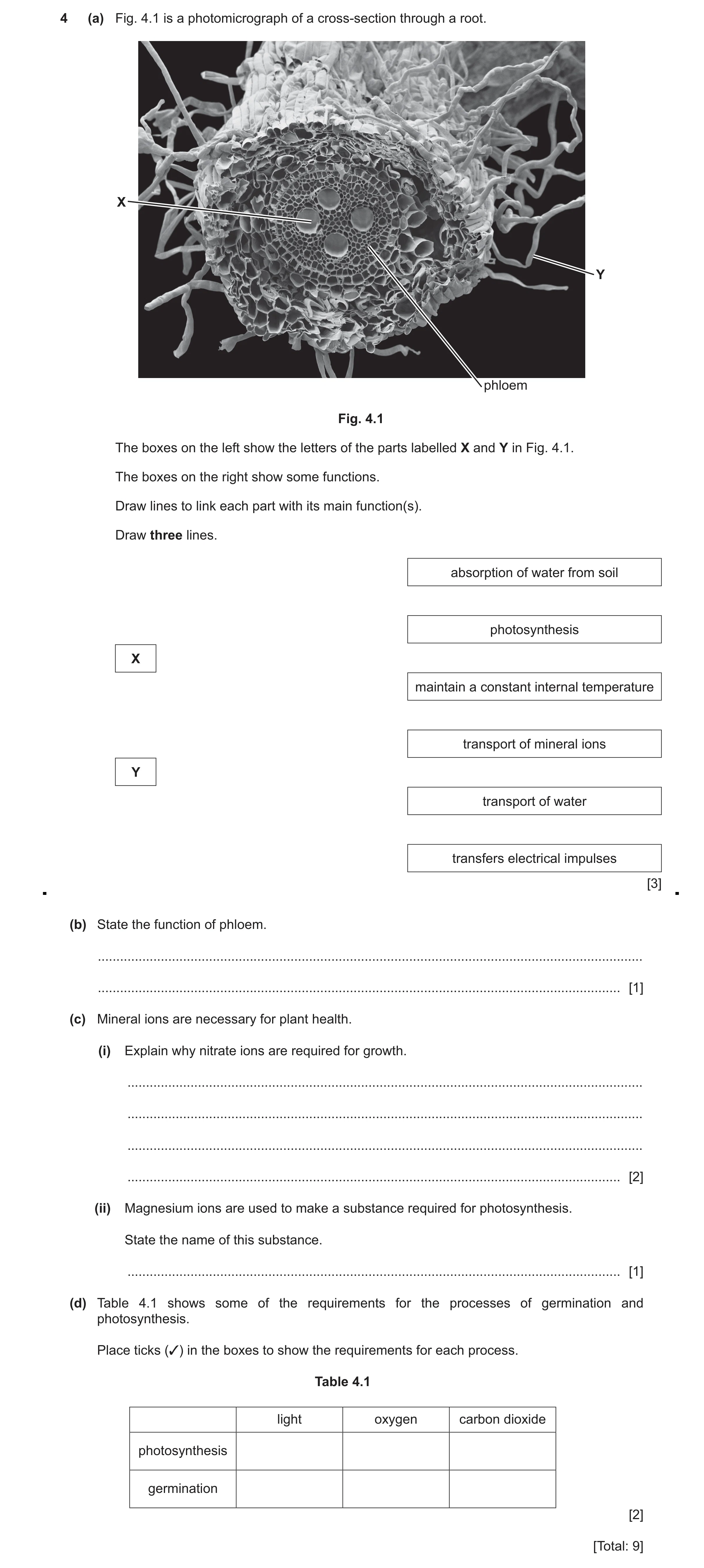
4 (a) Fig. 4.1 is a photomicrograph of a cross-section through a root. X Y phloem Fig. 4.1 The boxes on the left show the letters of the parts labelled X and Y in Fig. 4.1. The boxes on the right show some functions. Draw lines to link each part with its main function(s). Draw three lines. absorption of water from soil photosynthesis X maintain a constant internal temperature transport of mineral ions Y transport of water transfers electrical impulses [3] (b) State the function of phloem. … … [1] (c) Mineral ions are necessary for plant health. (i) Explain why nitrate ions are required for growth. … … … … [2] (ii) Magnesium ions are used to make a substance required for photosynthesis. State the name of this substance. … [1] (d) Table 4.1 shows some of the requirements for the processes of germination and photosynthesis. Place ticks (✓) in the boxes to show the requirements for each process. Table 4.1 light oxygen carbon dioxide photosynthesis germination [2] [Total: 9]
9 marks
Mark scheme: 4(a) absorption of water 3 photosynthesis X maintain a constant internal temperature transport of mineral ions Y transport of water transfers electrical impulses one mark for each correct line ;;; 4(b) transport of, dissolved sugars / sucrose / amino acids ; 1 4(c)(i) (nitrate ions) are needed to, synthesise / make, amino acids ; 2 amino acids make up proteins (which are required for growth) ; 4(c)(ii) chlorophyll ; 1 4(d) 2 light oxygen carbon dioxide photosynthesis germination 1 mark for each correct row ;;
This question in 0654/32 Oct/Nov 2024
Q27 · A photomicrograph of a cross-section through a root 0654/33 Oct/Nov 2024
4 (a) Fig. 4.1 is a photomicrograph of a cross-section through a root. X Y phloem Fig. 4.1 The boxes on the left show the letters of the parts labelled X and Y in Fig. 4.1. The boxes on the right show some functions. Draw lines to link each part with its main function(s). Draw three lines. absorption of water from soil photosynthesis X maintain a constant internal temperature transport of mineral ions Y transport of water transfers electrical impulses [3] (b) State the function of phloem. … … [1] (c) Mineral ions are necessary for plant health. (i) Explain why nitrate ions are required for growth. … … … … [2] (ii) Magnesium ions are used to make a substance required for photosynthesis. State the name of this substance. … [1] (d) Table 4.1 shows some of the requirements for the processes of germination and photosynthesis. Place ticks (✓) in the boxes to show the requirements for each process. Table 4.1 light oxygen carbon dioxide photosynthesis germination [2] [Total: 9]
9 marks
Mark scheme: 4(a) absorption of water 3 photosynthesis X maintain a constant internal temperature transport of mineral ions Y transport of water transfers electrical impulses one mark for each correct line ;;; 4(b) transport of, dissolved sugars / sucrose / amino acids ; 1 4(c)(i) (nitrate ions) are needed to, synthesise / make, amino acids ; 2 amino acids make up proteins (which are required for growth) ; 4(c)(ii) chlorophyll ; 1 4(d) 2 light oxygen carbon dioxide photosynthesis germination 1 mark for each correct row ;;
This question in 0654/33 Oct/Nov 2024
Q28 · A diagram of a plant cell 0654/32 Feb/March 2025
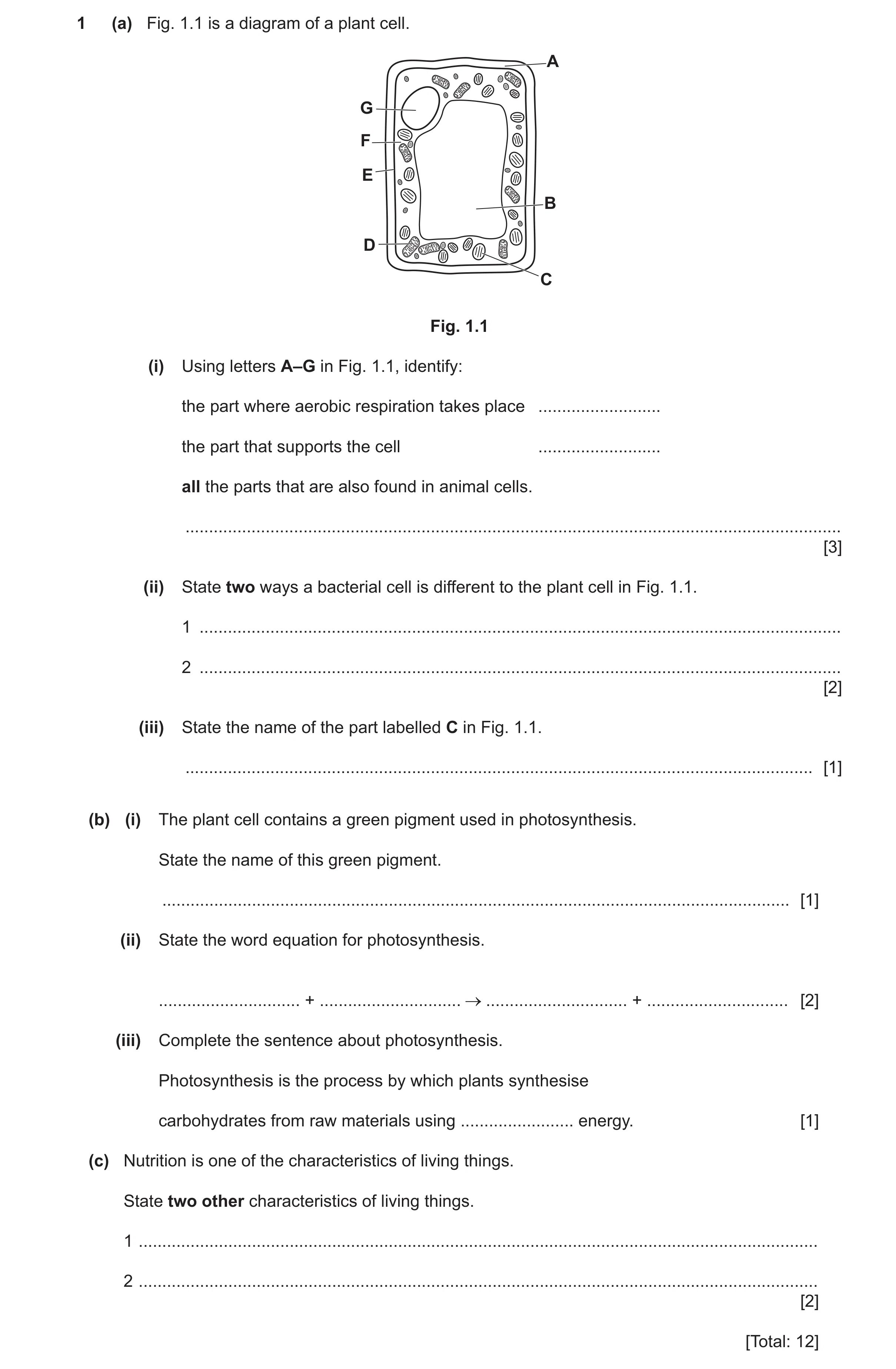
1 (a) Fig. 1.1 is a diagram of a plant cell. A G F E B D C Fig. 1.1 (i) Using letters A–G in Fig. 1.1, identify: the part where aerobic respiration takes place … the part that supports the cell … all the parts that are also found in animal cells. … [3] (ii) State two ways a bacterial cell is different to the plant cell in Fig. 1.1. 1 … 2 … [2] (iii) State the name of the part labelled C in Fig. 1.1. … [1] (b) (i) The plant cell contains a green pigment used in photosynthesis. State the name of this green pigment. … [1] (ii) State the word equation for photosynthesis. … + … … + … [2] (iii) Complete the sentence about photosynthesis. Photosynthesis is the process by which plants synthesise carbohydrates from raw materials using … energy. [1] (c) Nutrition is one of the characteristics of living things. State two other characteristics of living things. 1 … 2 … [2] [Total: 12]
12 marks
Mark scheme: Question Answer Marks 1(a)(i) D ; 3 A or B ; D, E, F and G ; 1(a)(ii) any two from: 2 no nucleus / G no chloroplast / C no mitochondria / D no vacuole / B ;; 1(a)(iii) chloroplast ; 1 1(b)(i) chlorophyll ; 1 1(b)(ii) LHS 2 carbon dioxide + water ; RHS glucose + oxygen ; 1(b)(iii) light ; 1 1(c) any two from: 2 movement respiration sensitivity growth reproduction excretion ;;
This question in 0654/32 Feb/March 2025
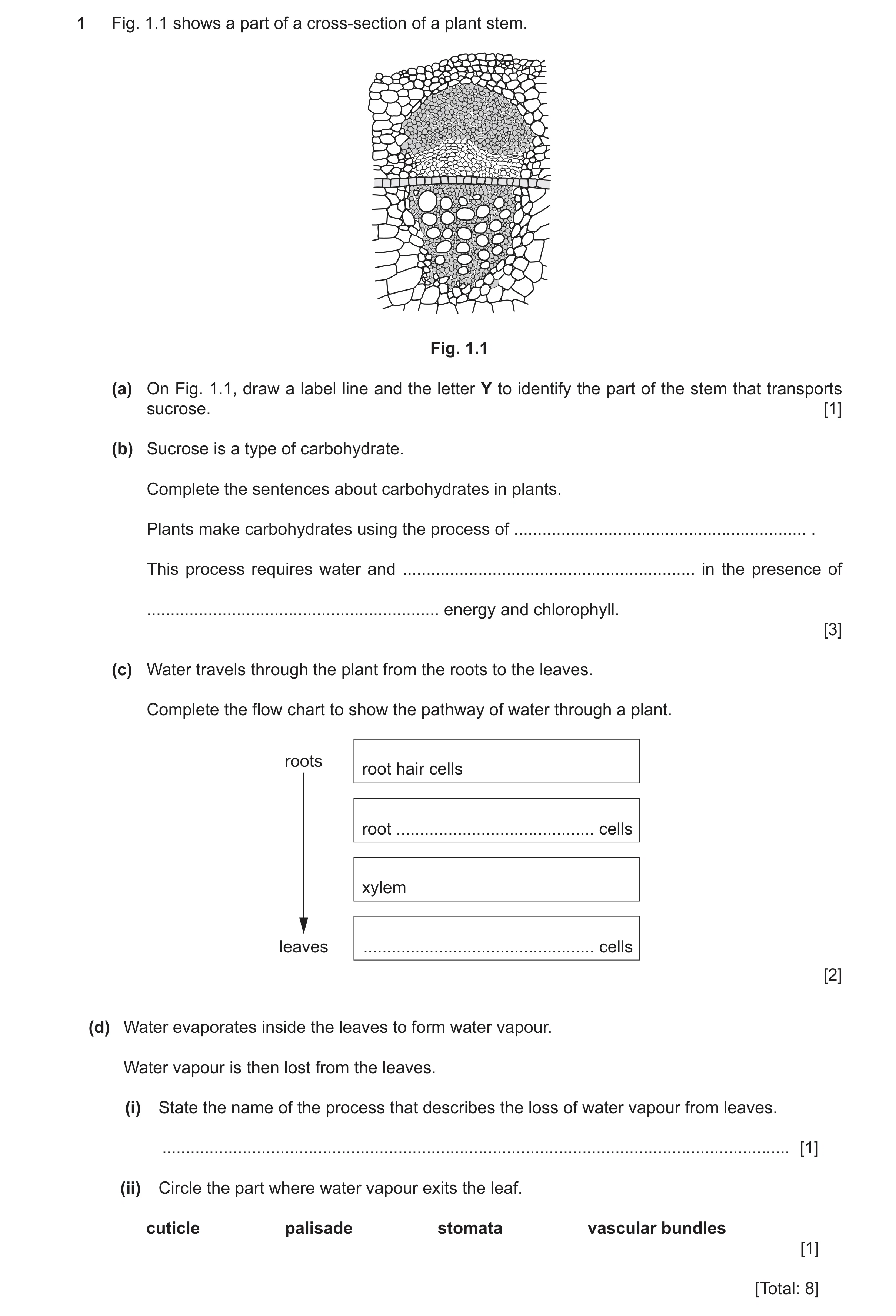
Q29 · A part of a cross-section of a plant stem 0654/31 May/June 2025
1 Fig. 1.1 shows a part of a cross-section of a plant stem. Fig. 1.1 (a) On Fig. 1.1, draw a label line and the letter Y to identify the part of the stem that transports sucrose. [1] (b) Sucrose is a type of carbohydrate. Complete the sentences about carbohydrates in plants. Plants make carbohydrates using the process of … . This process requires water and … in the presence of … energy and chlorophyll. [3] (c) Water travels through the plant from the roots to the leaves. Complete the flow chart to show the pathway of water through a plant. roots root hair cells root … cells xylem leaves … cells [2] (d) Water evaporates inside the leaves to form water vapour. Water vapour is then lost from the leaves. (i) State the name of the process that describes the loss of water vapour from leaves. … [1] (ii) Circle the part where water vapour exits the leaf. cuticle palisade stomata vascular bundles [1] [Total: 8]
8 marks
Mark scheme: Question Answer Marks 1(a) correct line drawn and labelled Y ; 1 1(b) photosynthesis ; 3 carbon dioxide / CO2 ; light ; 1(c) cortex ; 2 mesophyll ; 1(d)(i) transpiration ; 1 1(d)(ii) stomata ; 1
This question in 0654/31 May/June 2025
 1 / 41
 2 / 41
 3 / 41
 4 / 41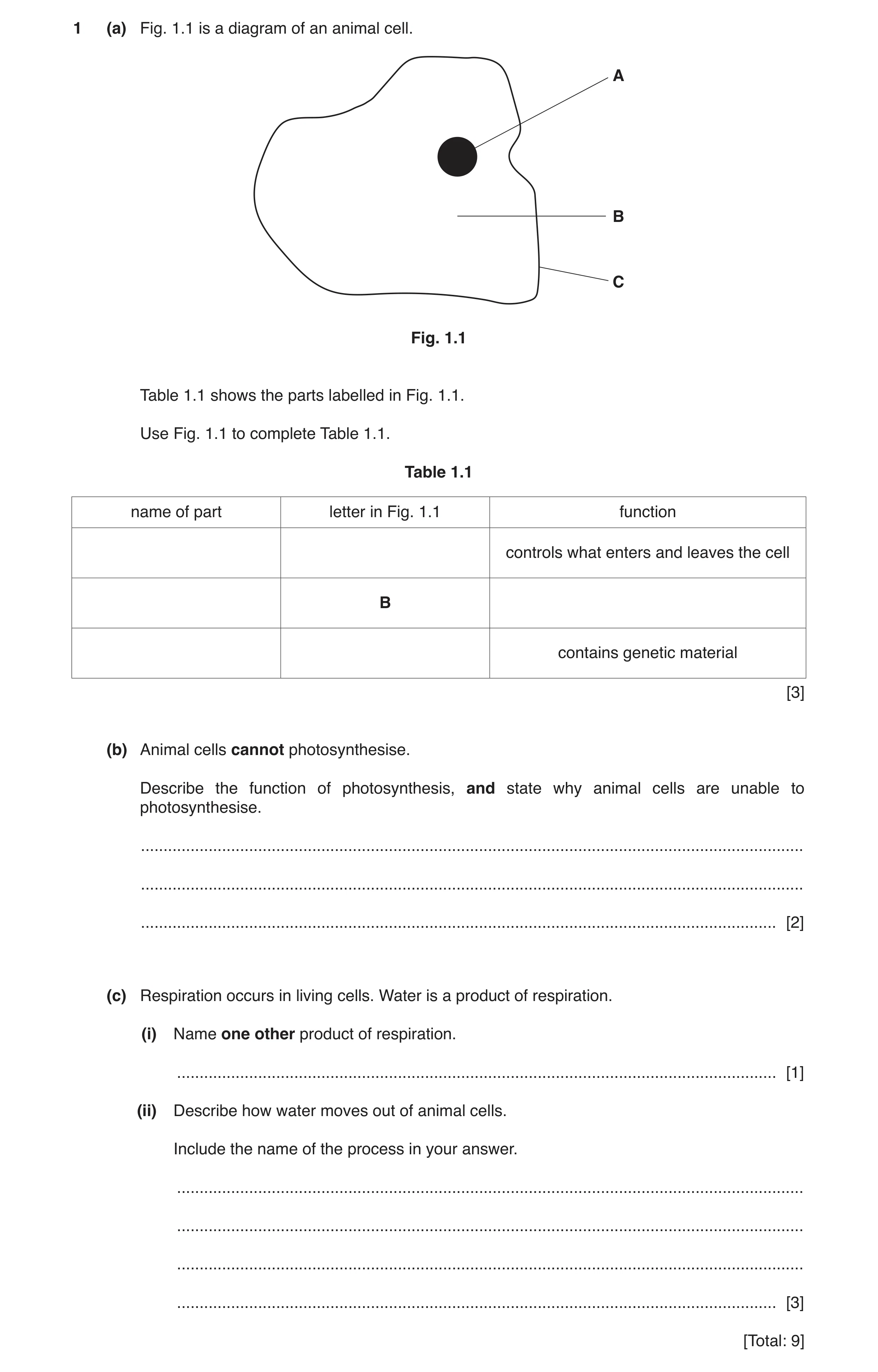
 9 / 41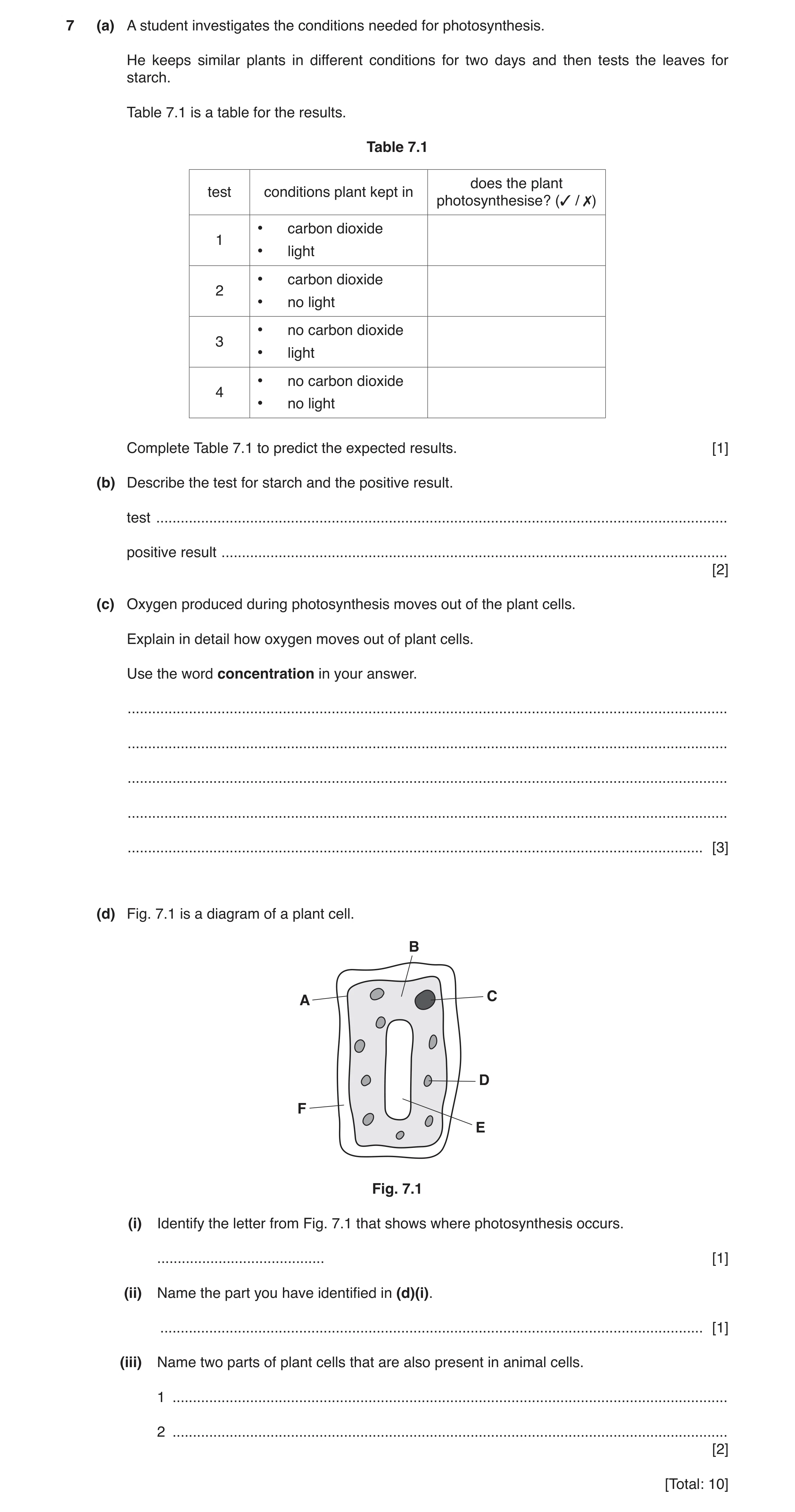
 6
6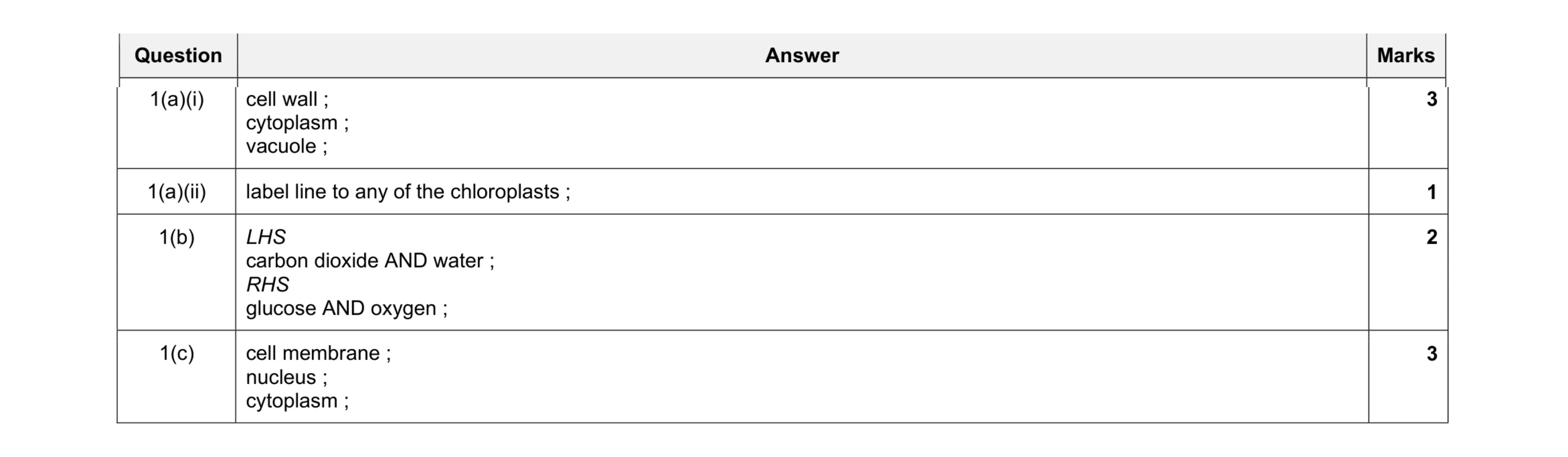 9
9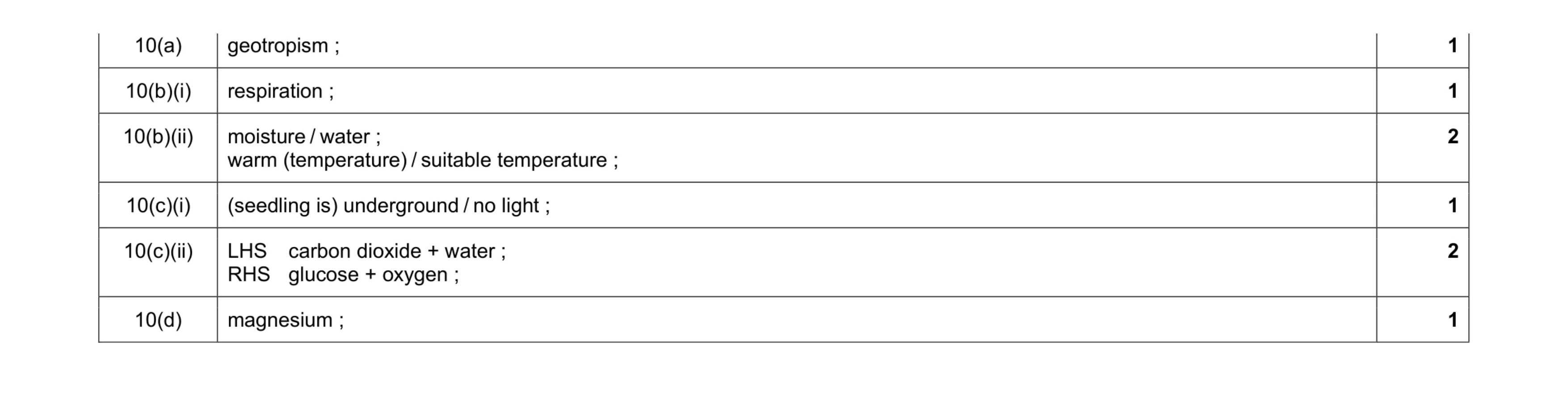 8
8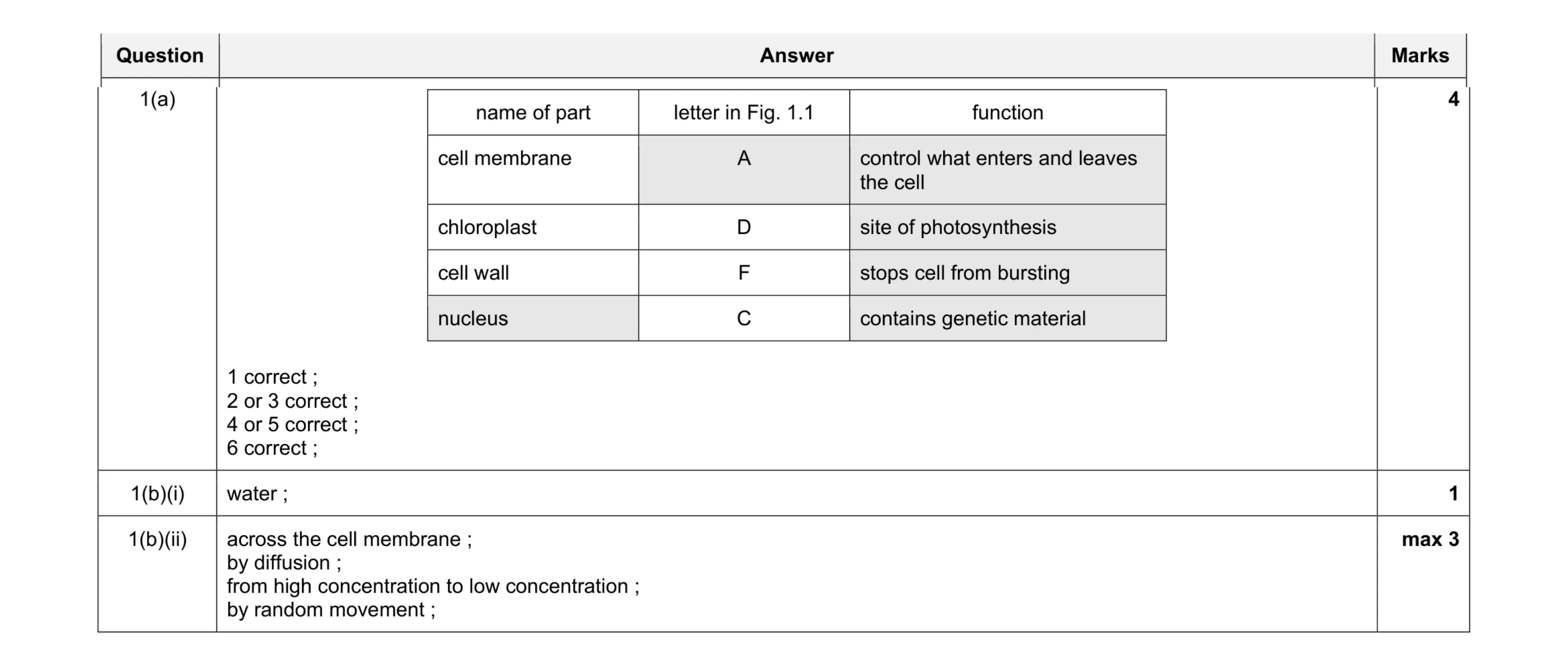 8
8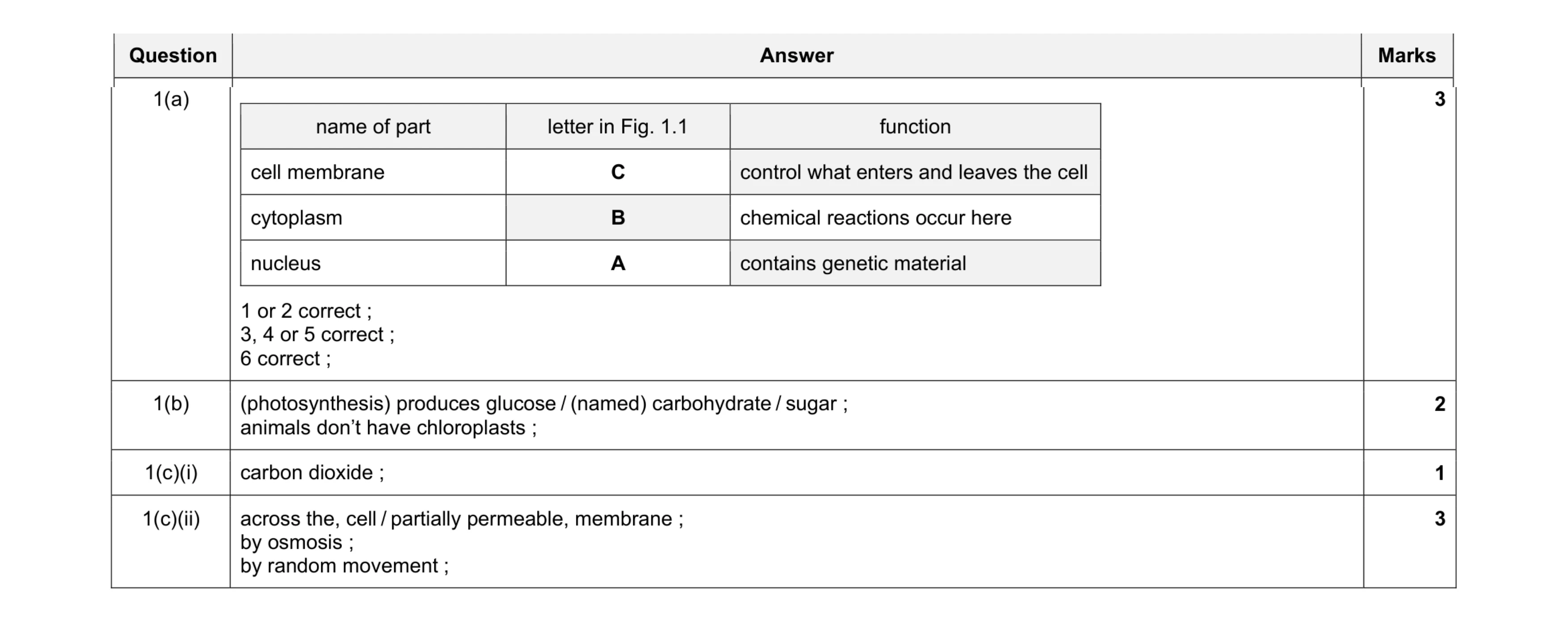 9
9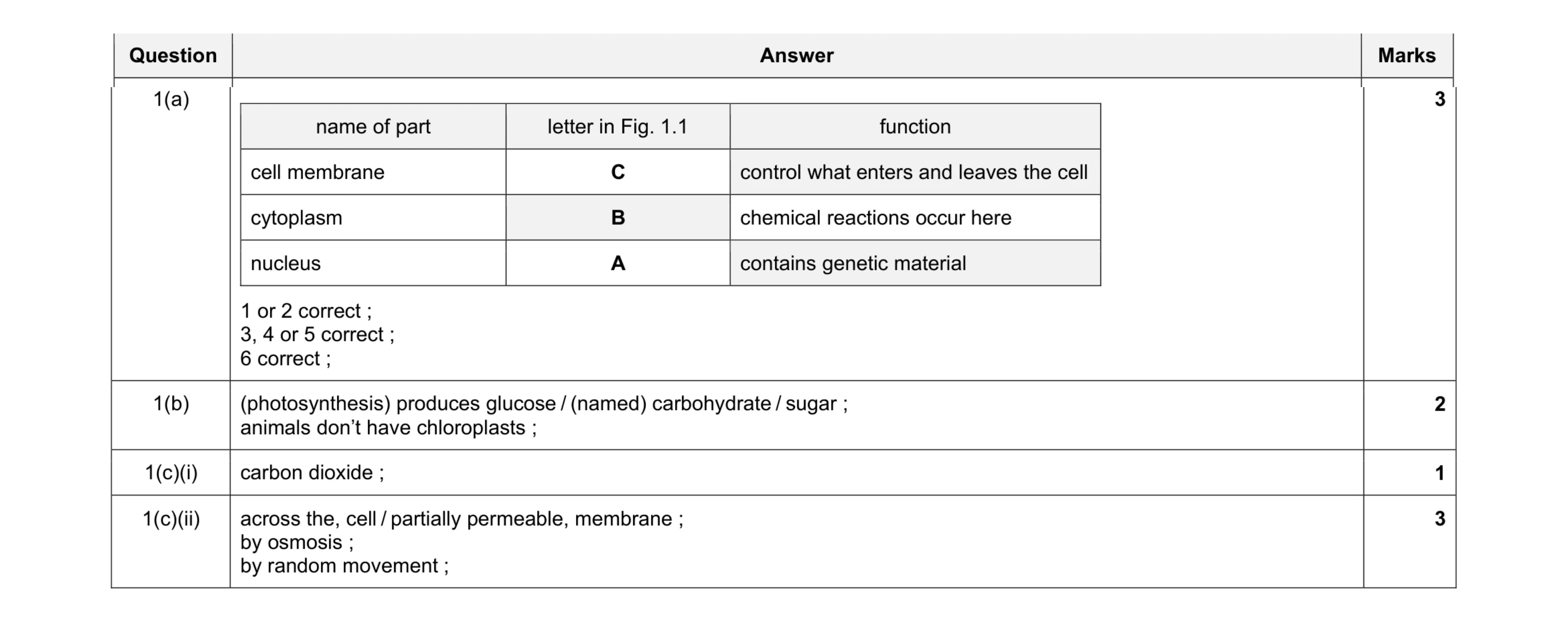 9
9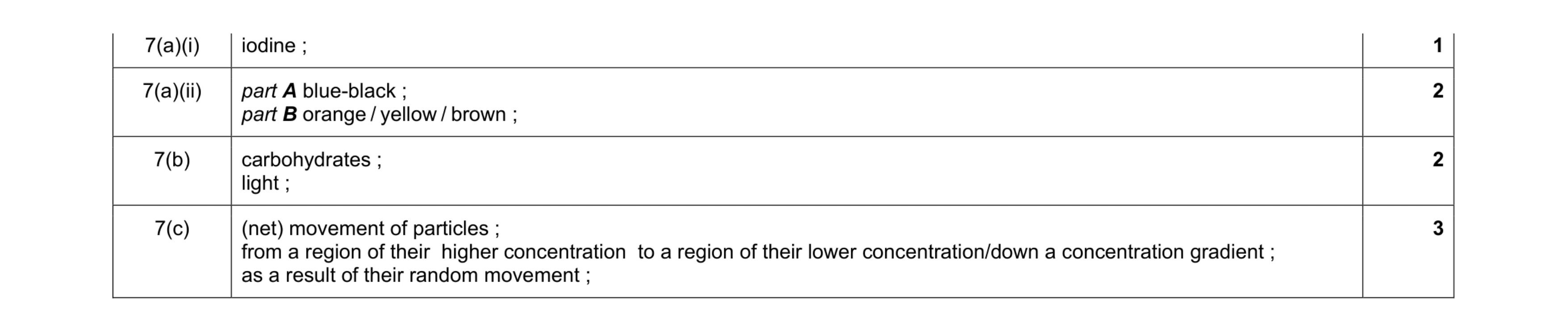 8
8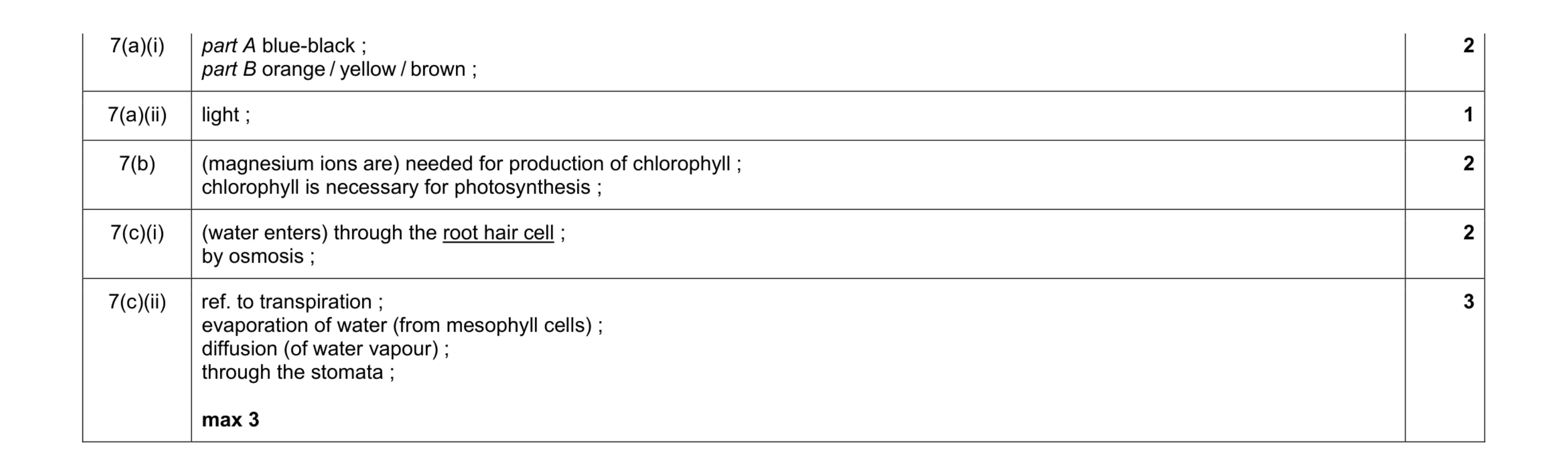 10
10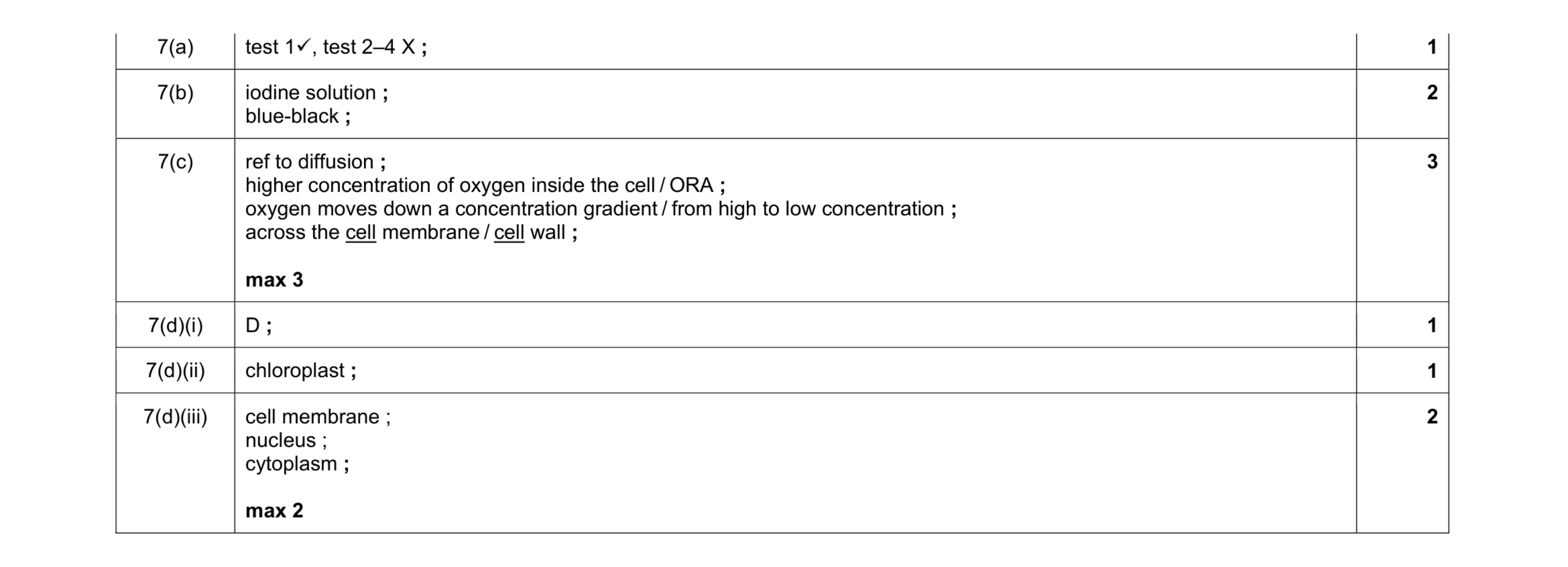 10
10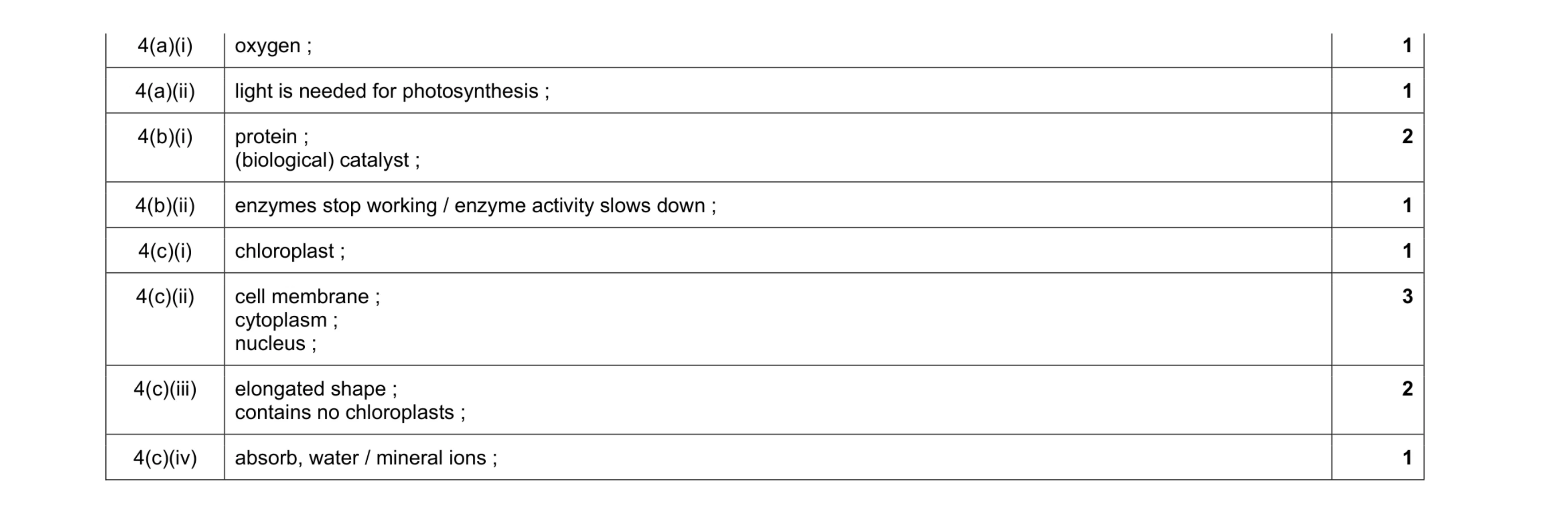 12
12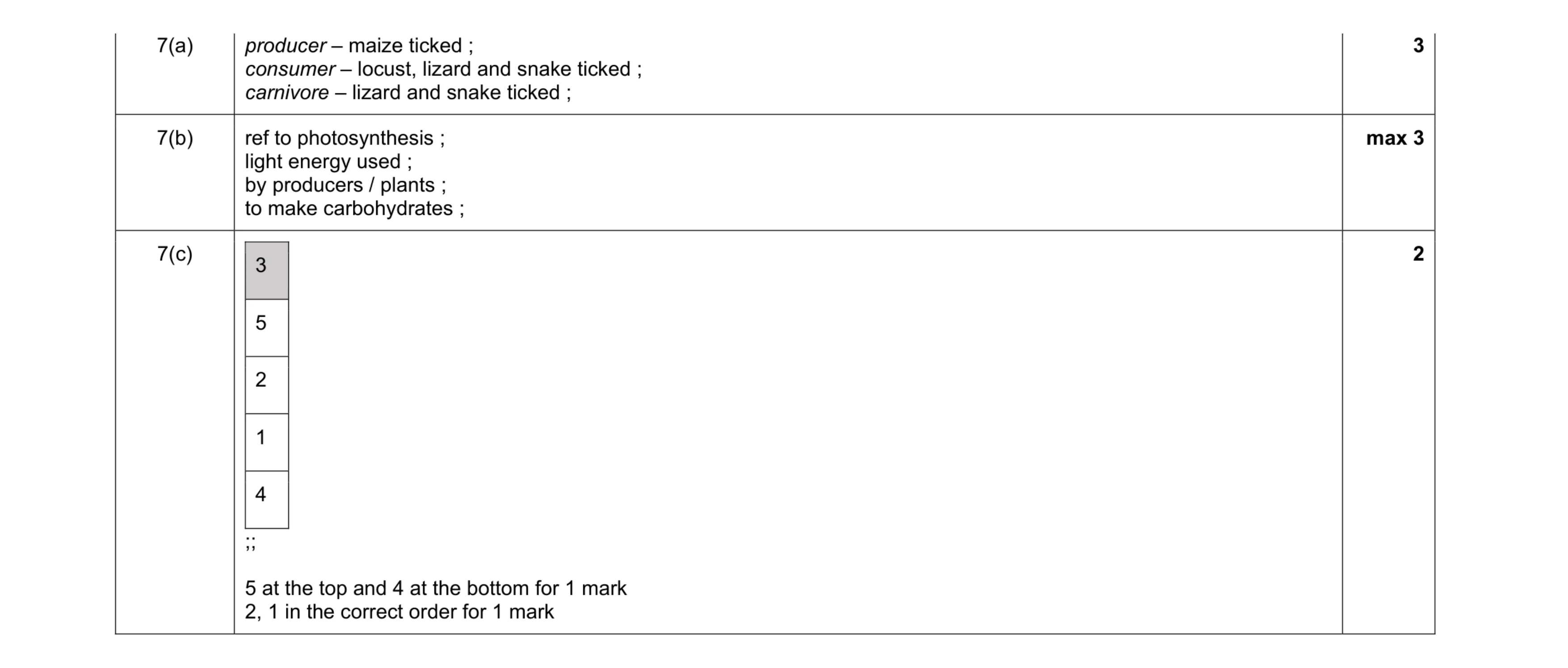 8
8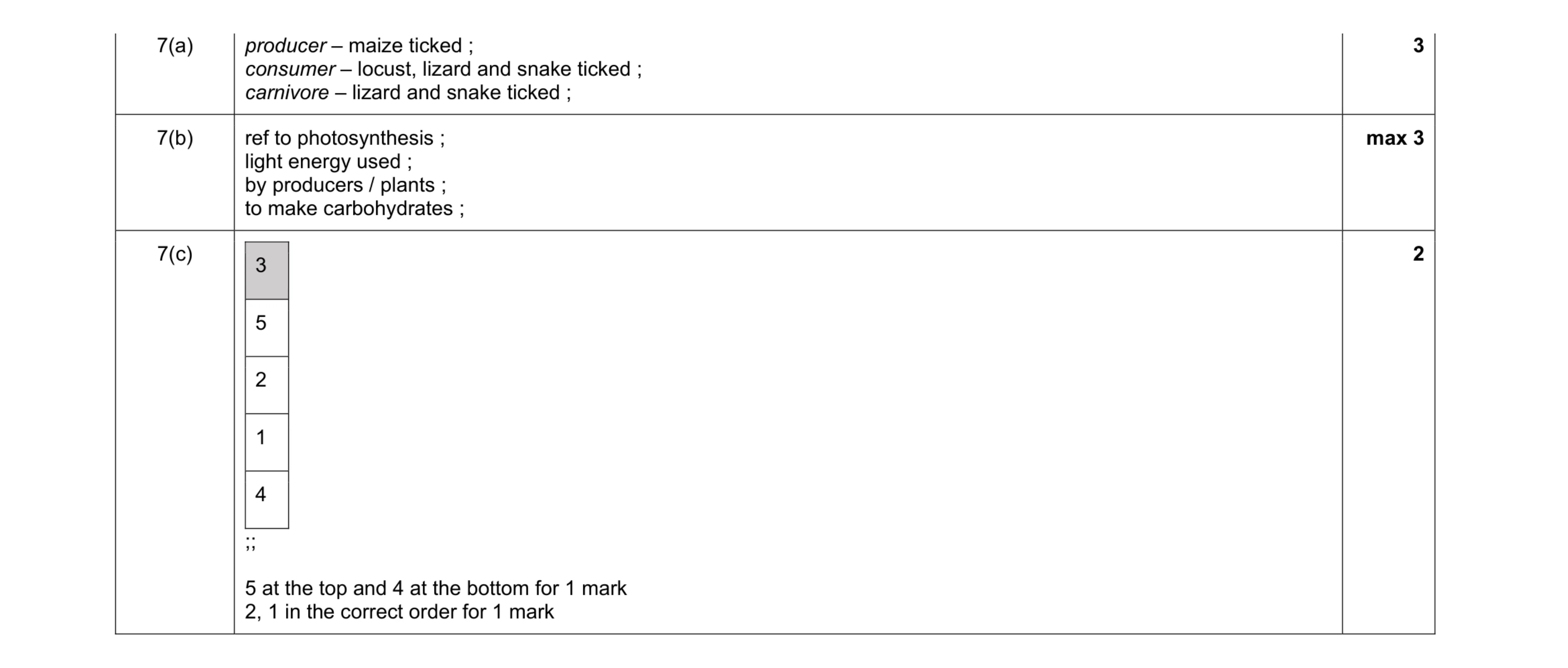 8
8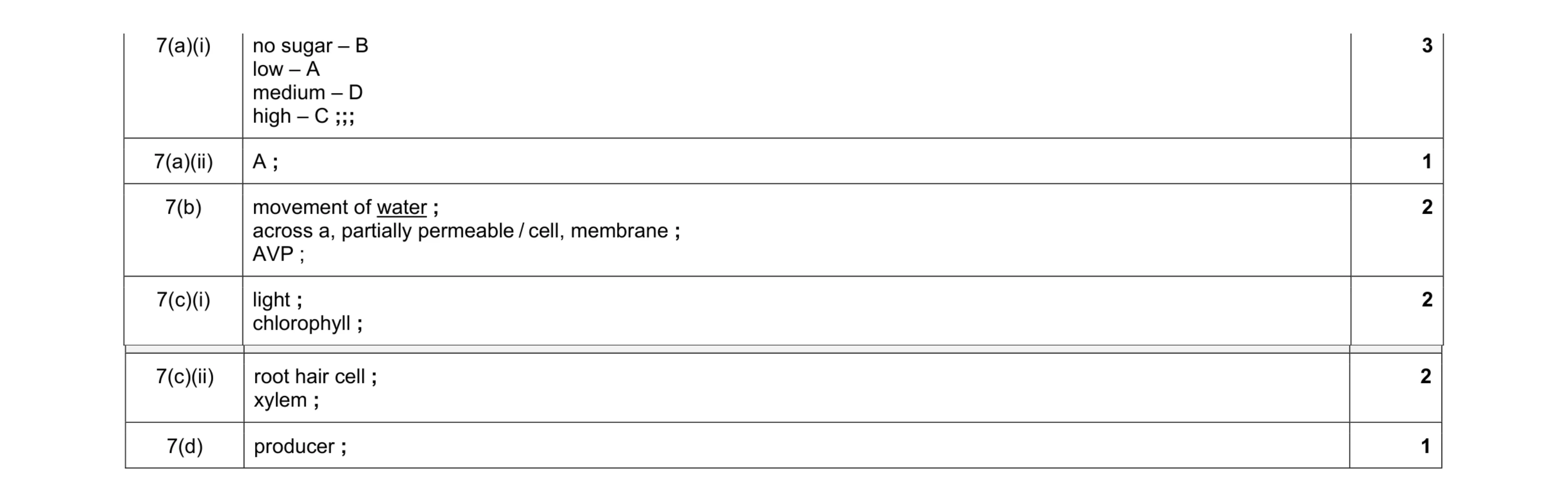 11
11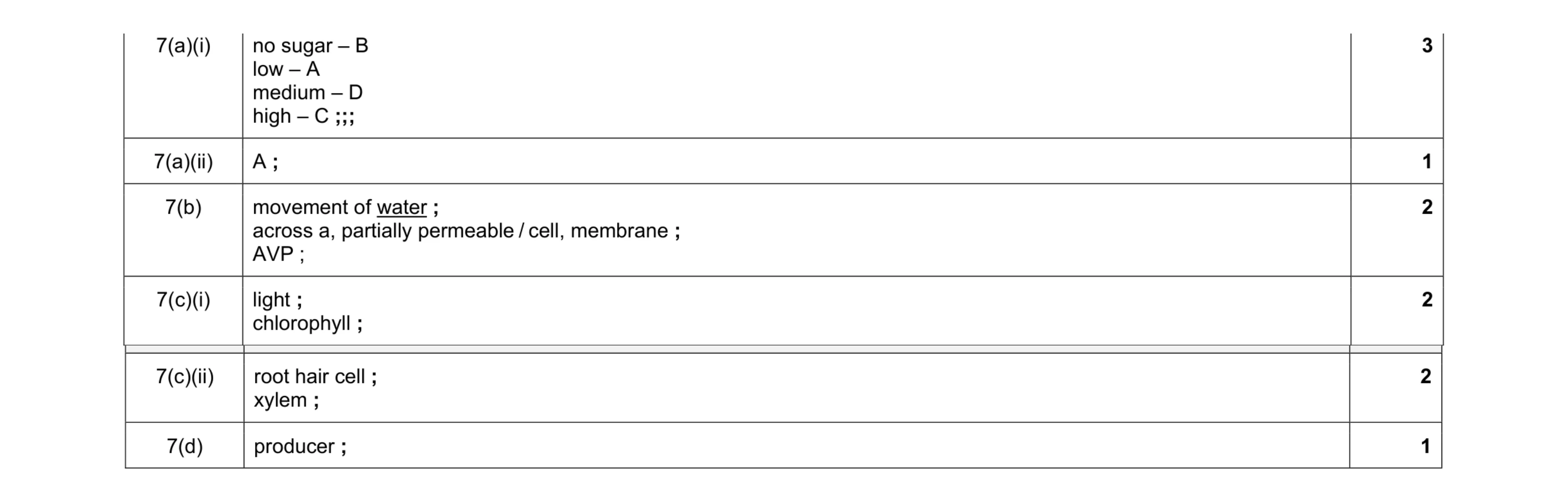 11
11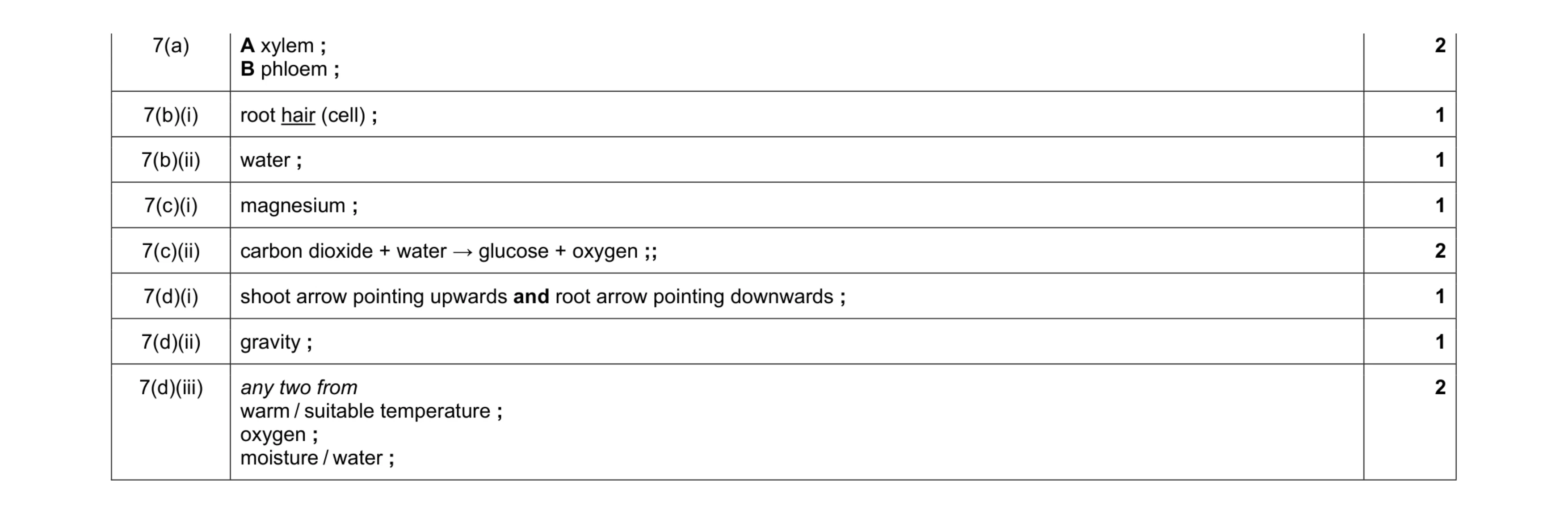 11
11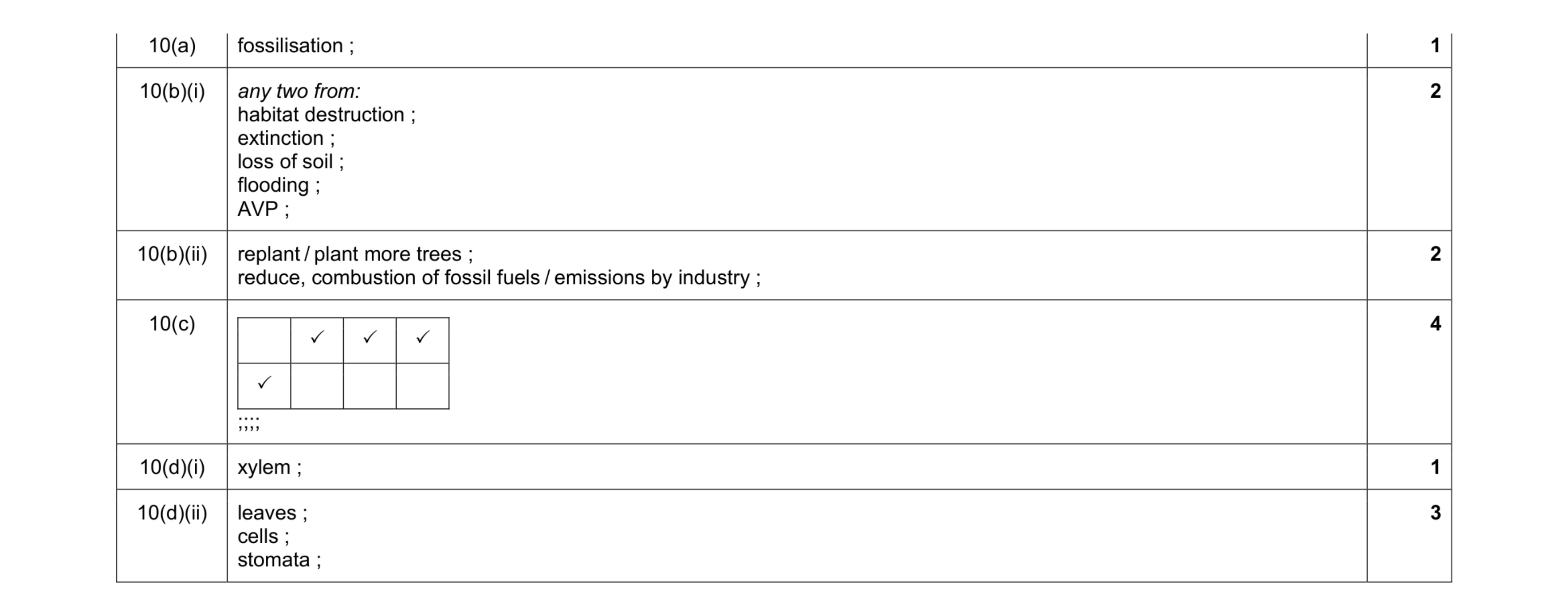 13
13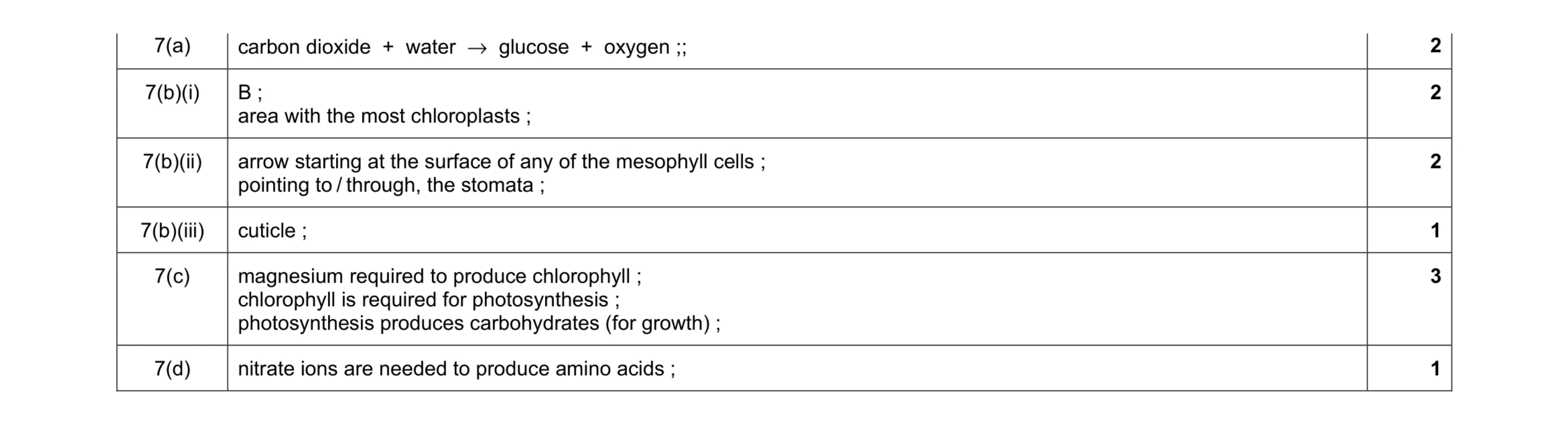 11
11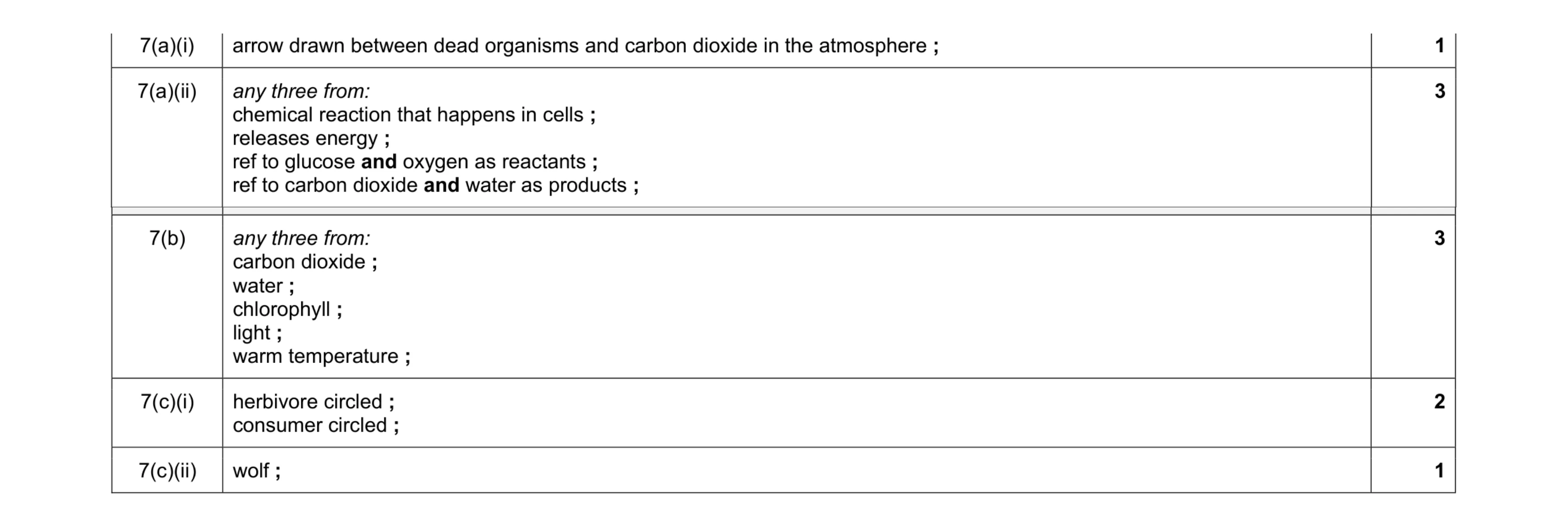 10
10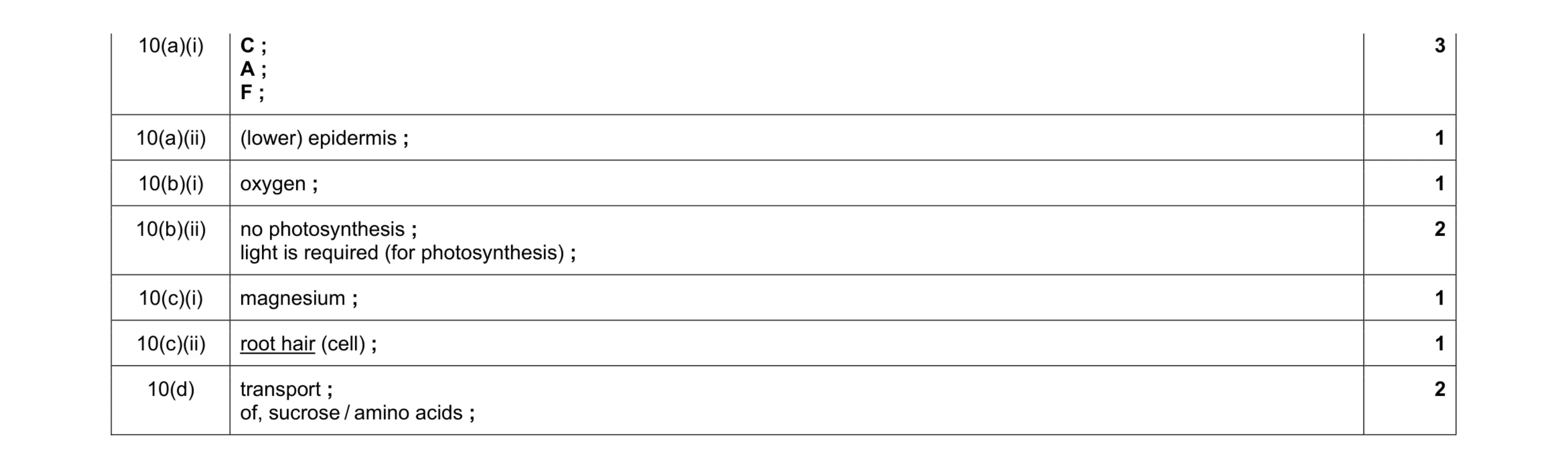 11
11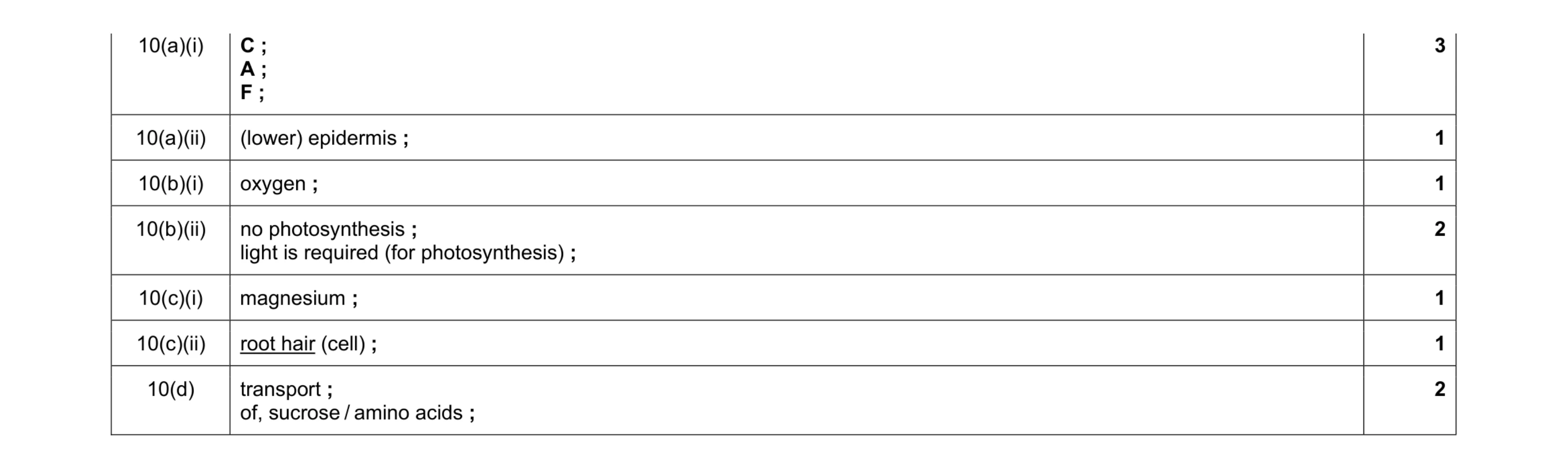 11
11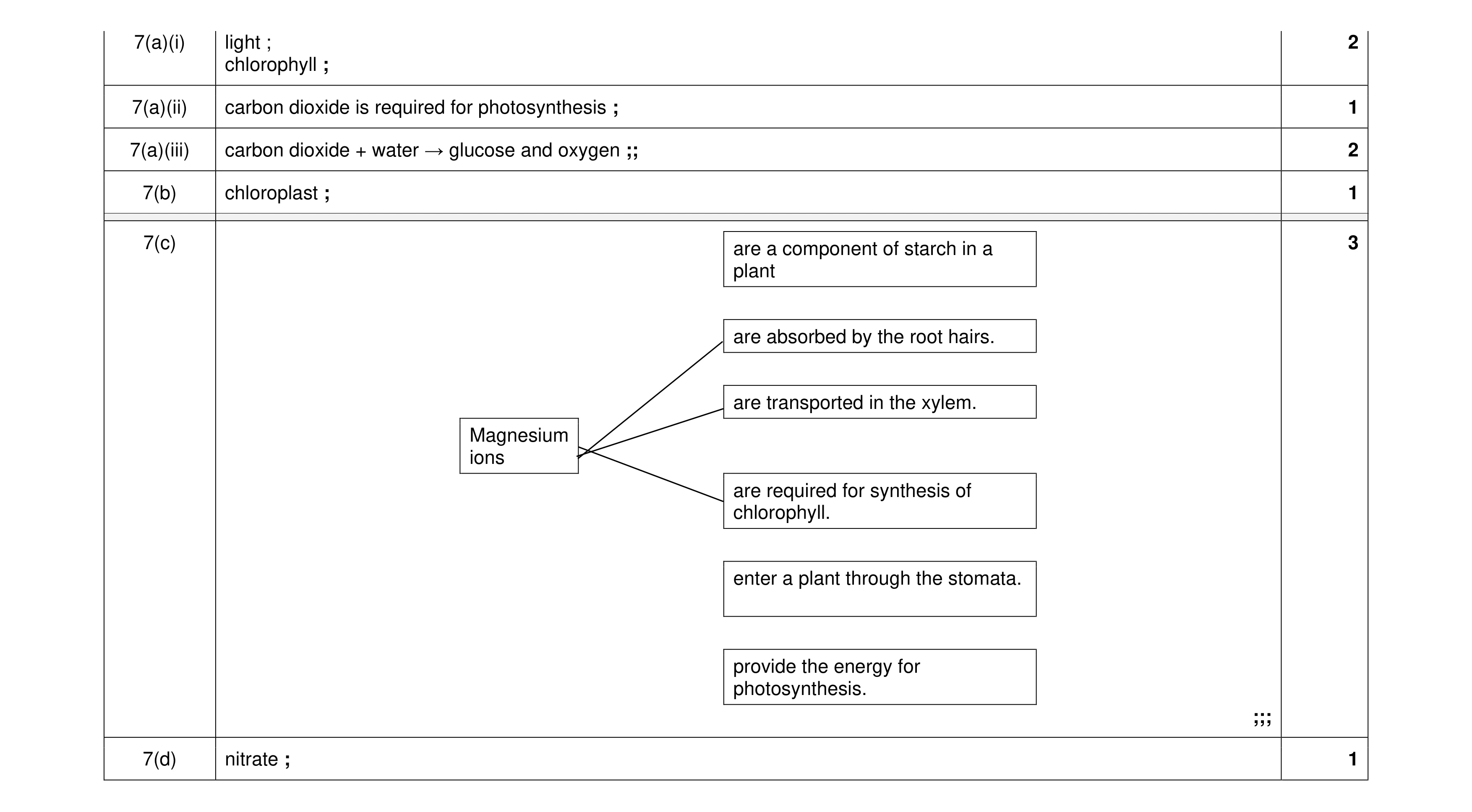 10
10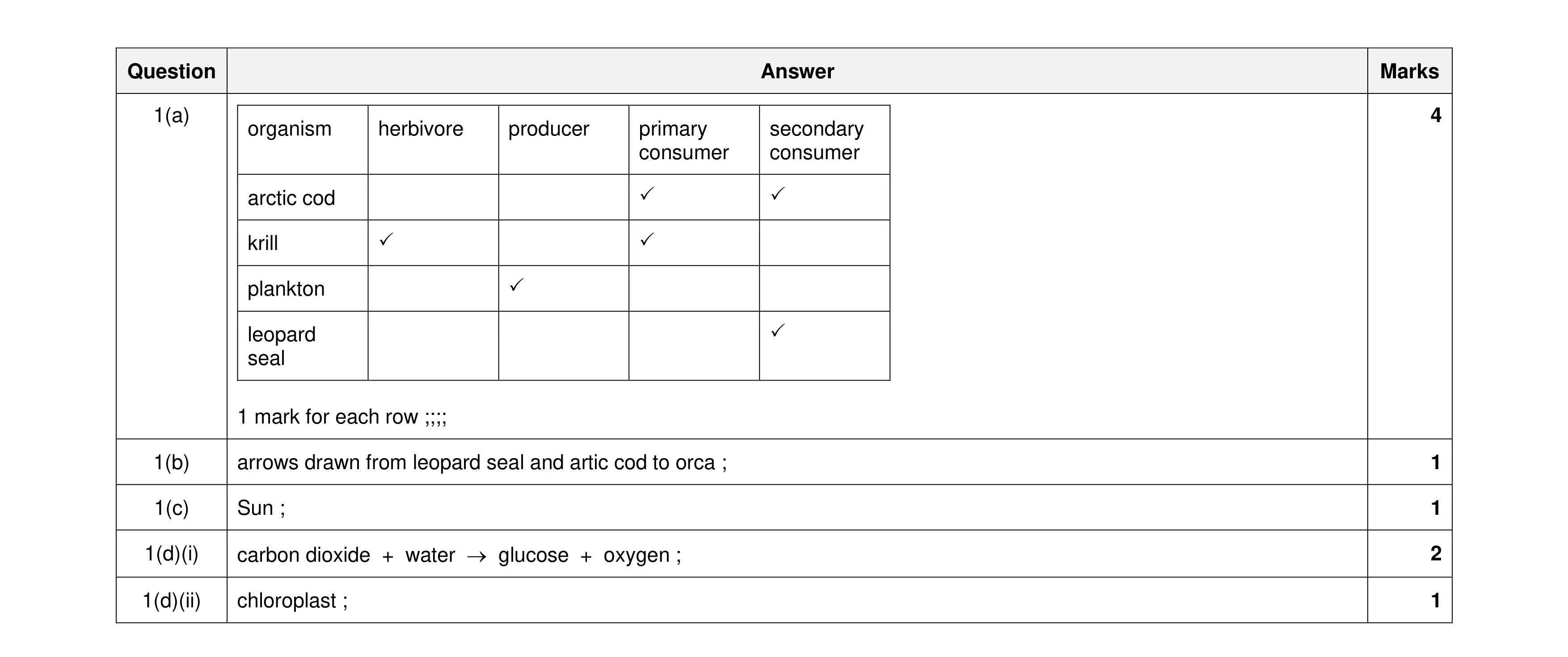 9
9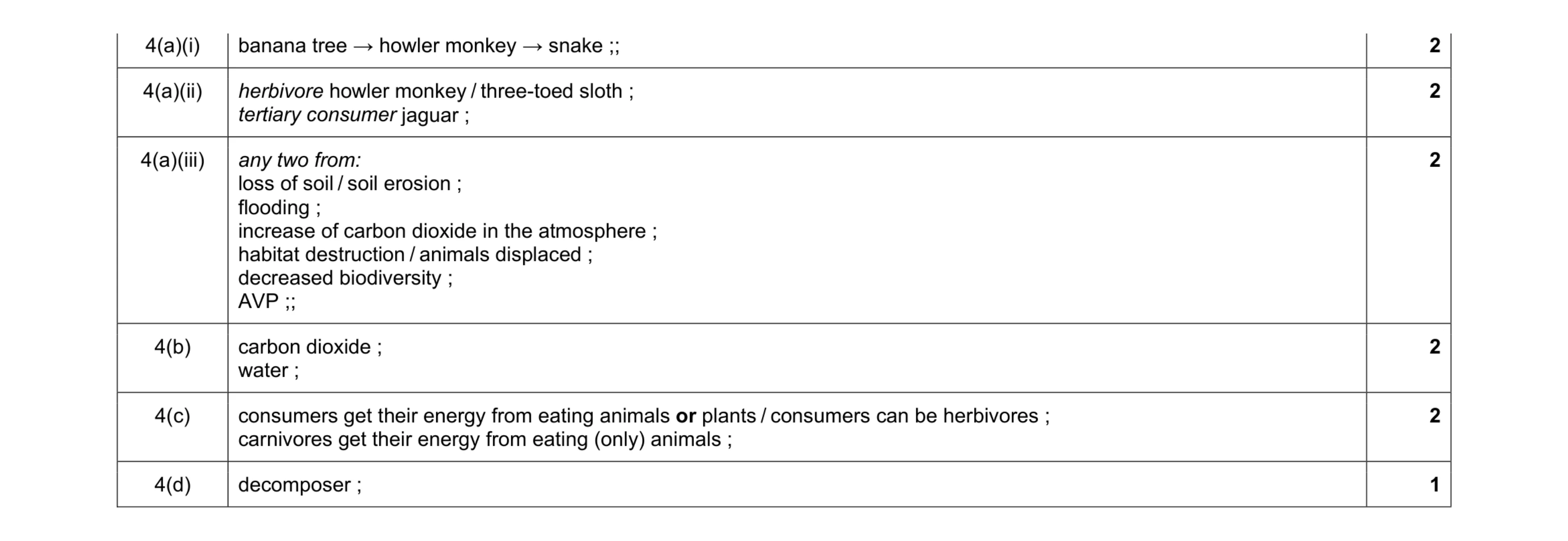 11
11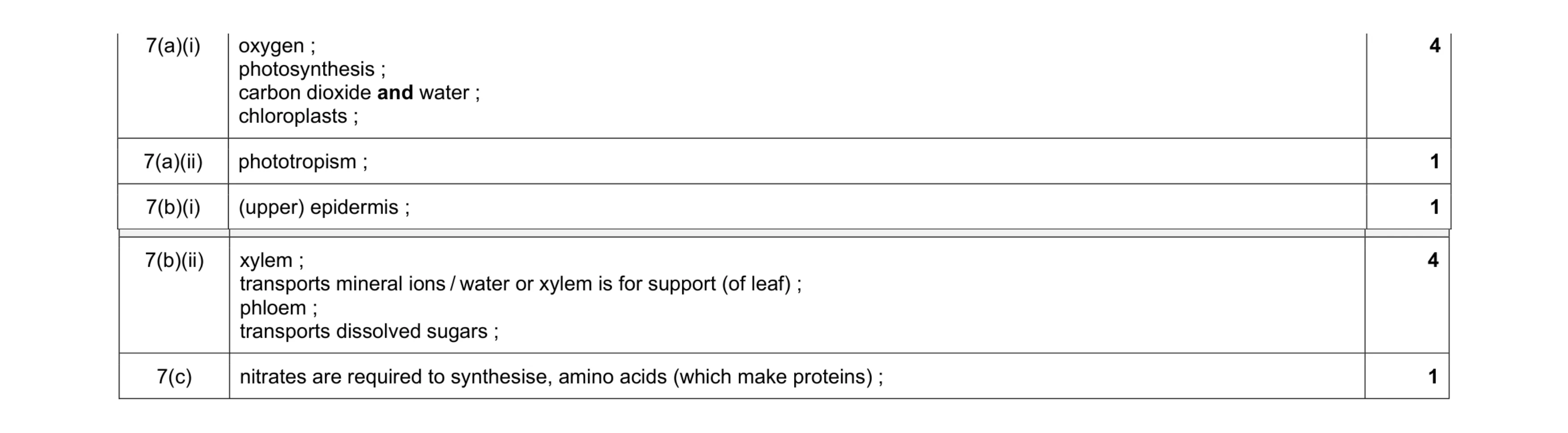 11
11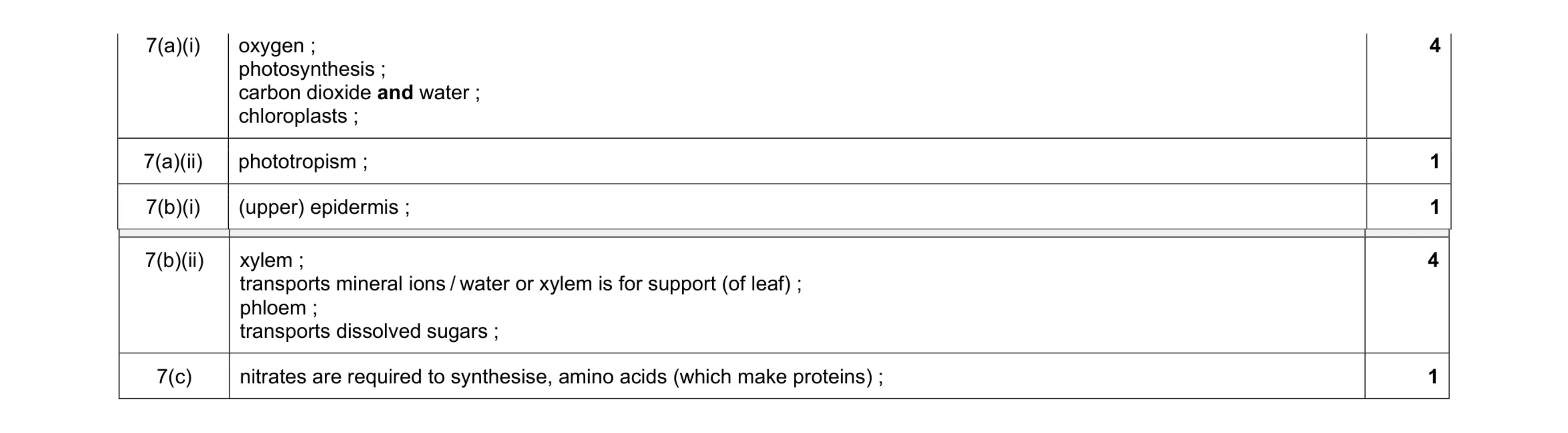 11
11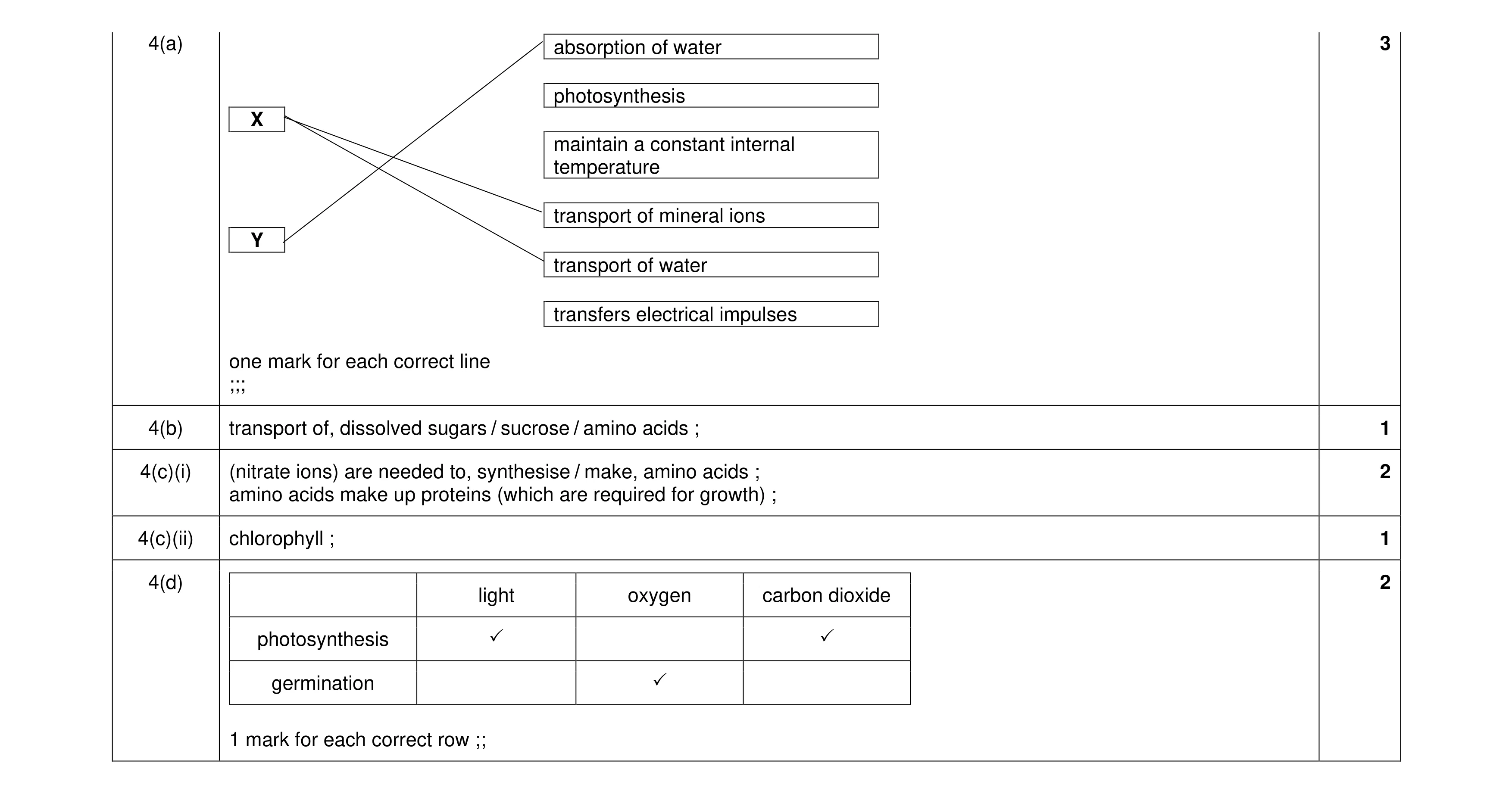 9
9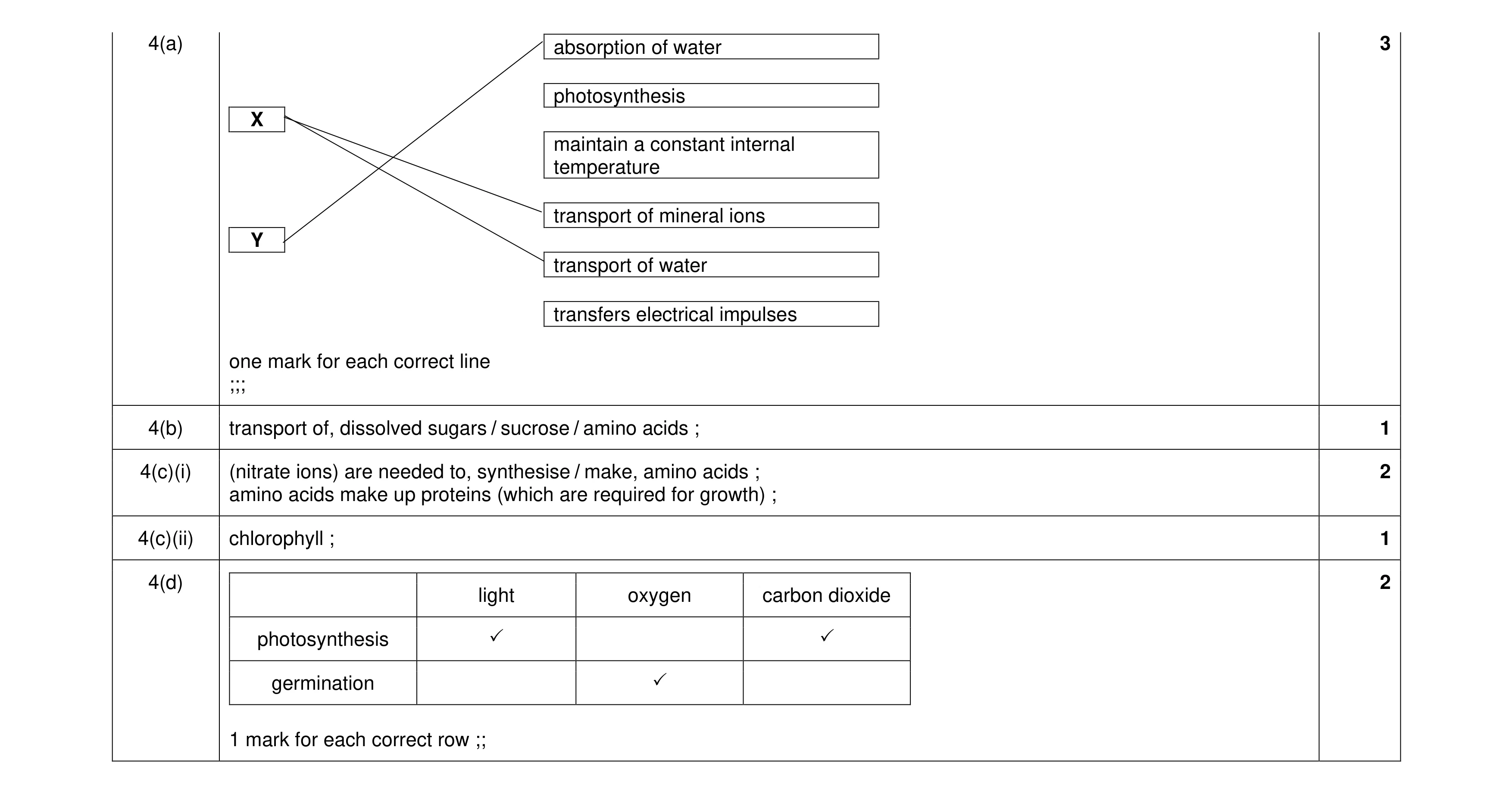 9
9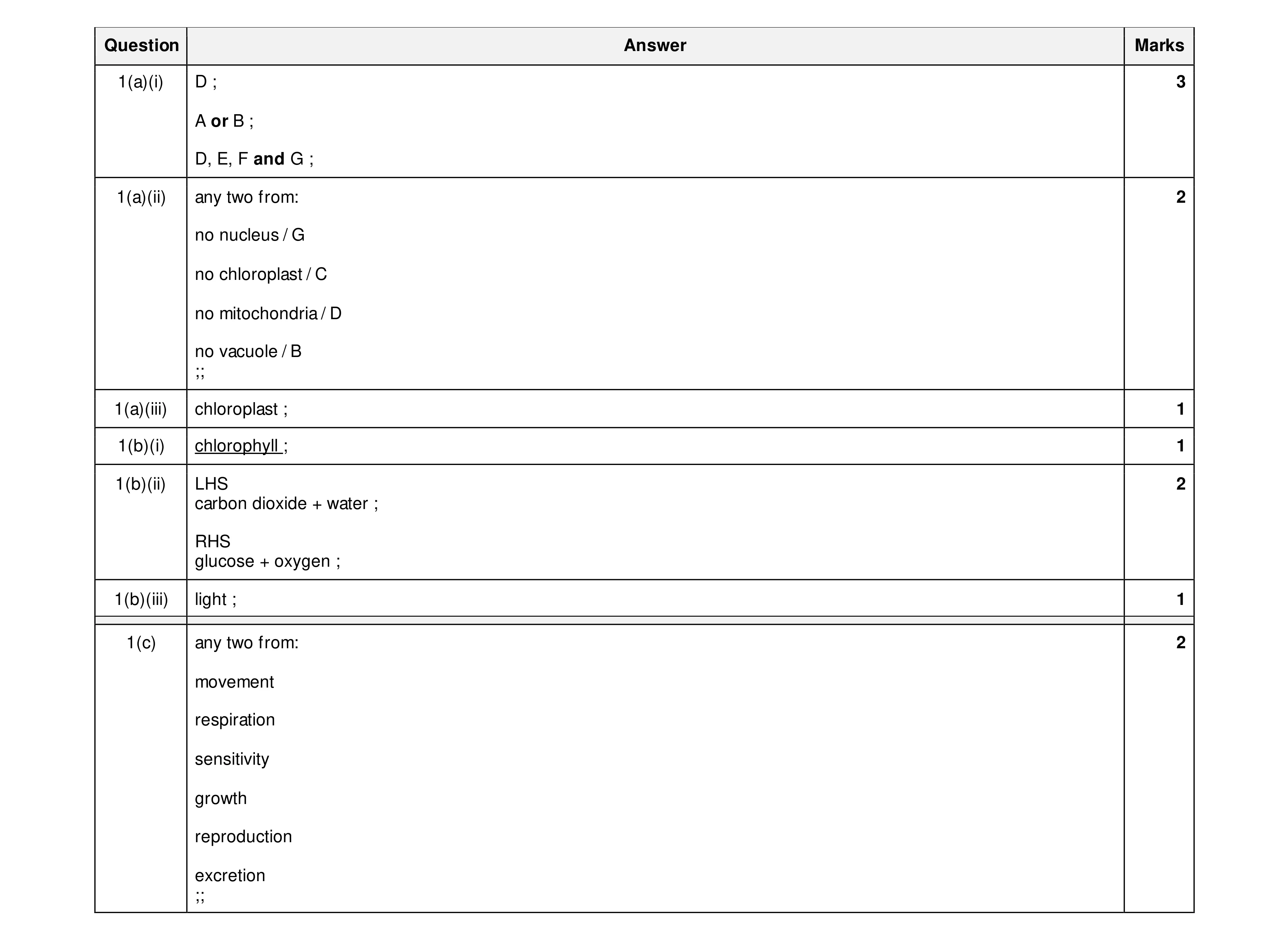 12
12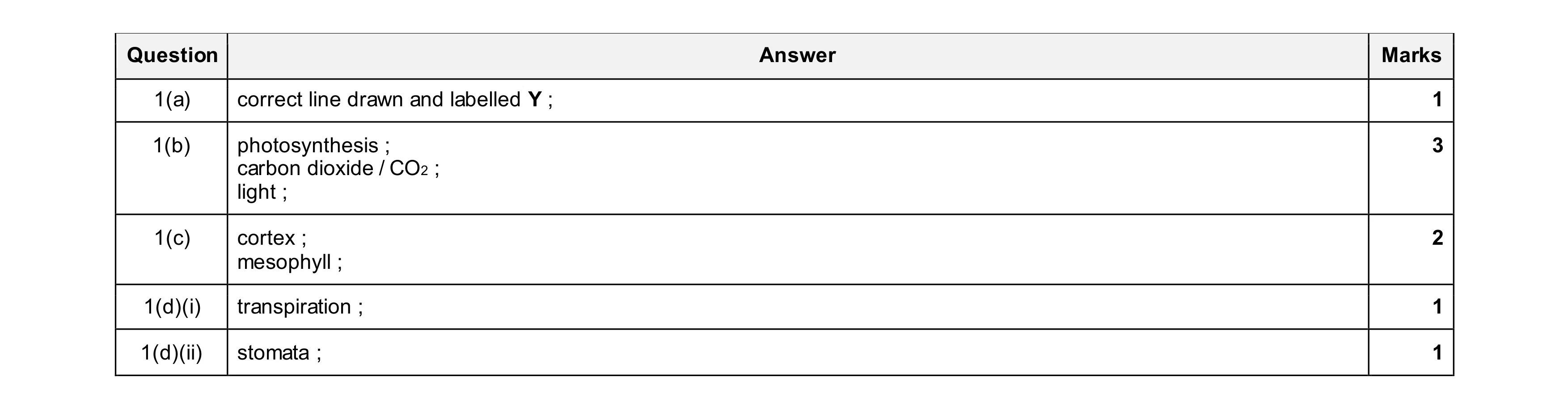 8
8