Questions as text
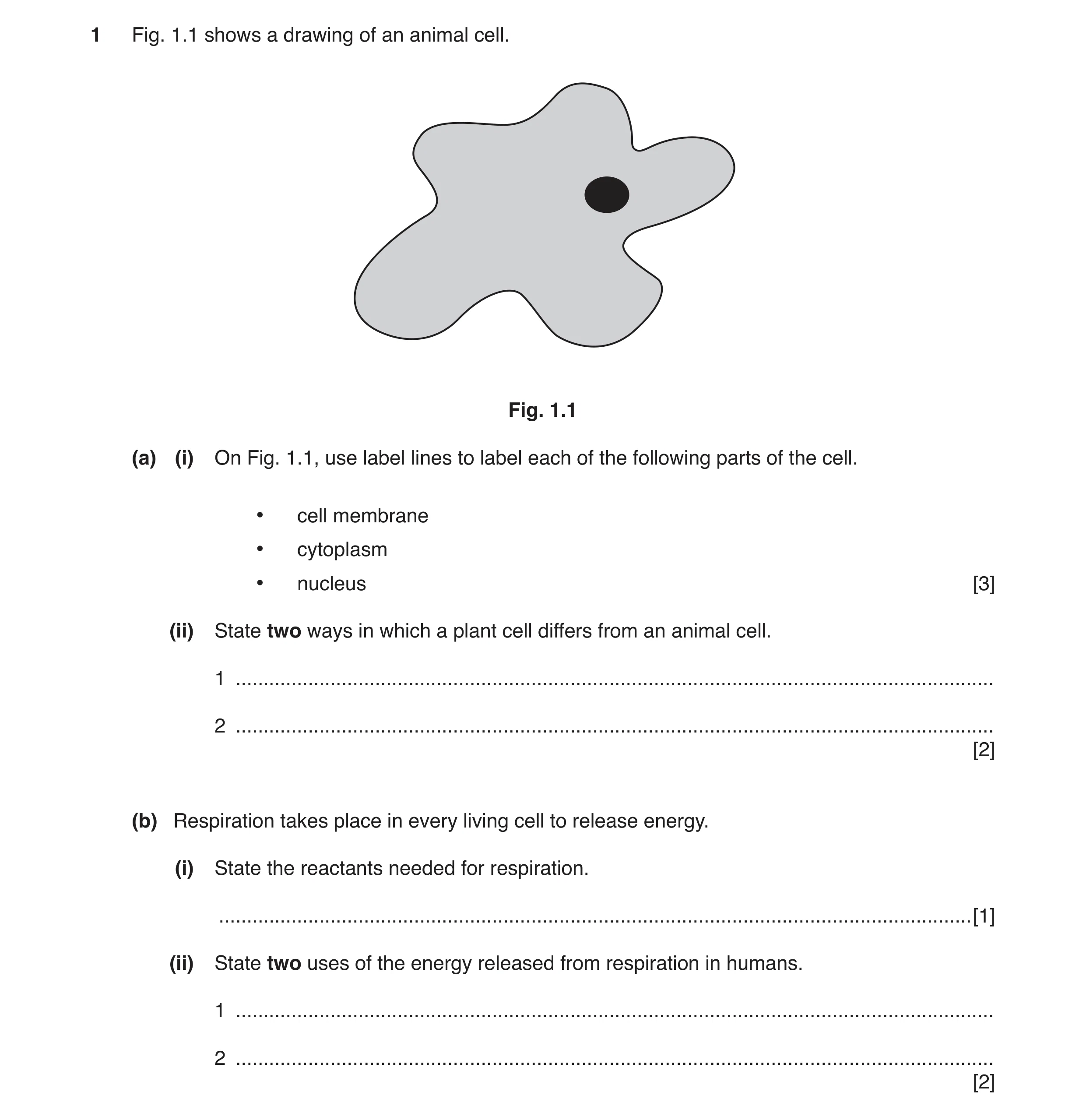
Q1 · A drawing of an animal cell 0654/31 May/June 2017
1 Fig. 1.1 shows a drawing of an animal cell. Fig. 1.1 (a) (i) On Fig. 1.1, use label lines to label each of the following parts of the cell. • cell membrane • cytoplasm • nucleus [3] (ii) State two ways in which a plant cell differs from an animal cell. 1 … 2 … [2] (b) Respiration takes place in every living cell to release energy. (i) State the reactants needed for respiration. … [1] (ii) State two uses of the energy released from respiration in humans. 1 … 2 … [2]
8 marks
Mark scheme: 1(a)(i) cell membrane, cytoplasm and nucleus labelled ;;; 3 1(a)(ii) any two of the following chloroplasts ; cell wall ; vacuole ; max 2 1(b)(i) glucose and oxygen ; 1 1(b)(ii) any two of the following muscle contraction ; protein synthesis ; cell division ; growth ; the passage of nerve impulses ; maintenance of a constant body temperature ; max 2
This question in 0654/31 May/June 2017
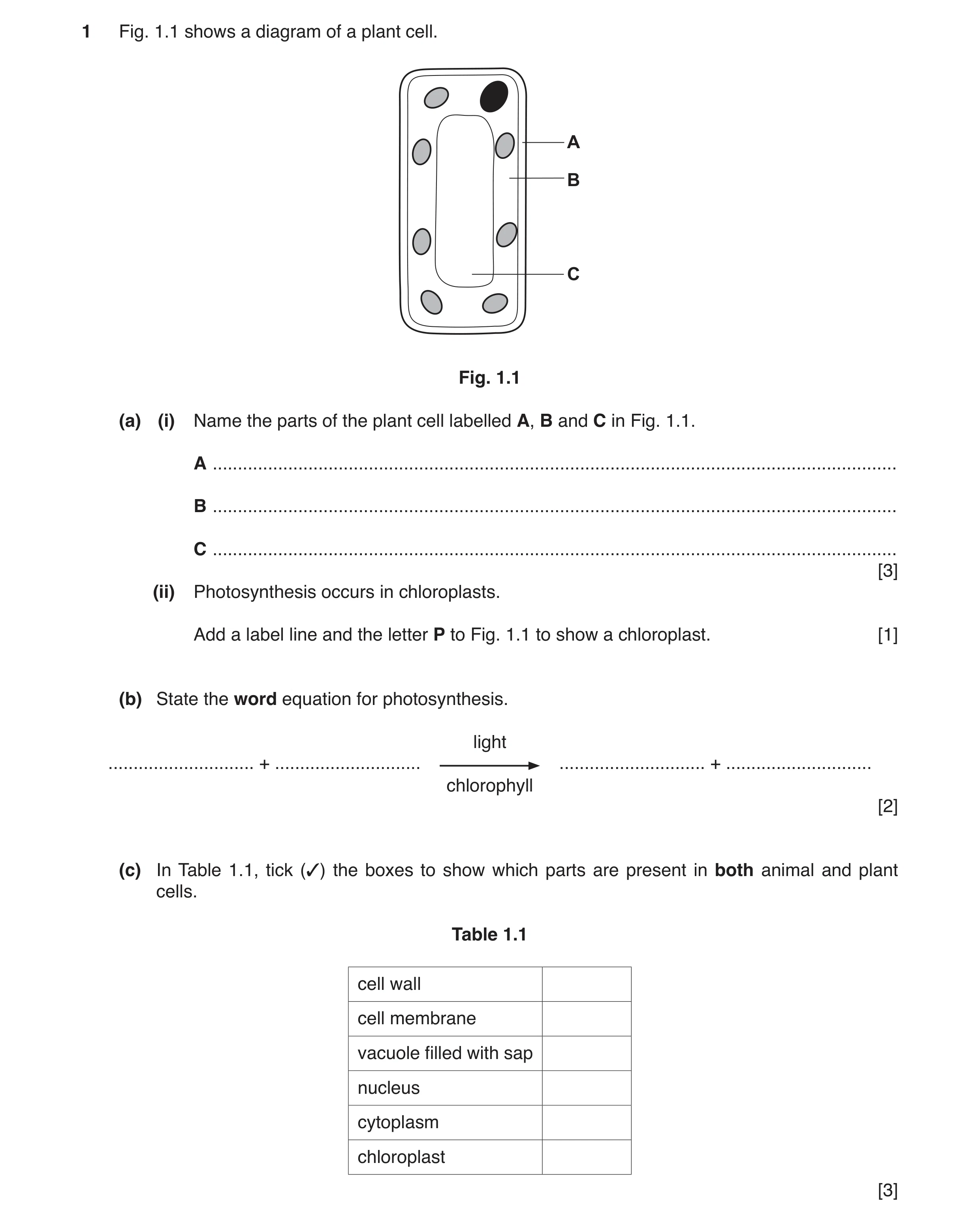
Q2 · A diagram of a plant cell 0654/31 Oct/Nov 2017
1 Fig. 1.1 shows a diagram of a plant cell. A B C Fig. 1.1 (a) (i) Name the parts of the plant cell labelled A, B and C in Fig. 1.1. A … B … C … [3] (ii) Photosynthesis occurs in chloroplasts. Add a label line and the letter P to Fig. 1.1 to show a chloroplast. [1] (b) State the word equation for photosynthesis. light … + … … + … chlorophyll [2] (c) In Table 1.1, tick (3) the boxes to show which parts are present in both animal and plant cells. Table 1.1 cell wall cell membrane vacuole filled with sap nucleus cytoplasm chloroplast [3]
9 marks
Mark scheme: 1(a)(i) cell wall ; cytoplasm ; vacuole ; 3 1(a)(ii) label line to any of the chloroplasts ; 1 1(b) LHS carbon dioxide AND water ; RHS glucose AND oxygen ; 2 1(c) cell membrane ; nucleus ; cytoplasm ; 3
This question in 0654/31 Oct/Nov 2017
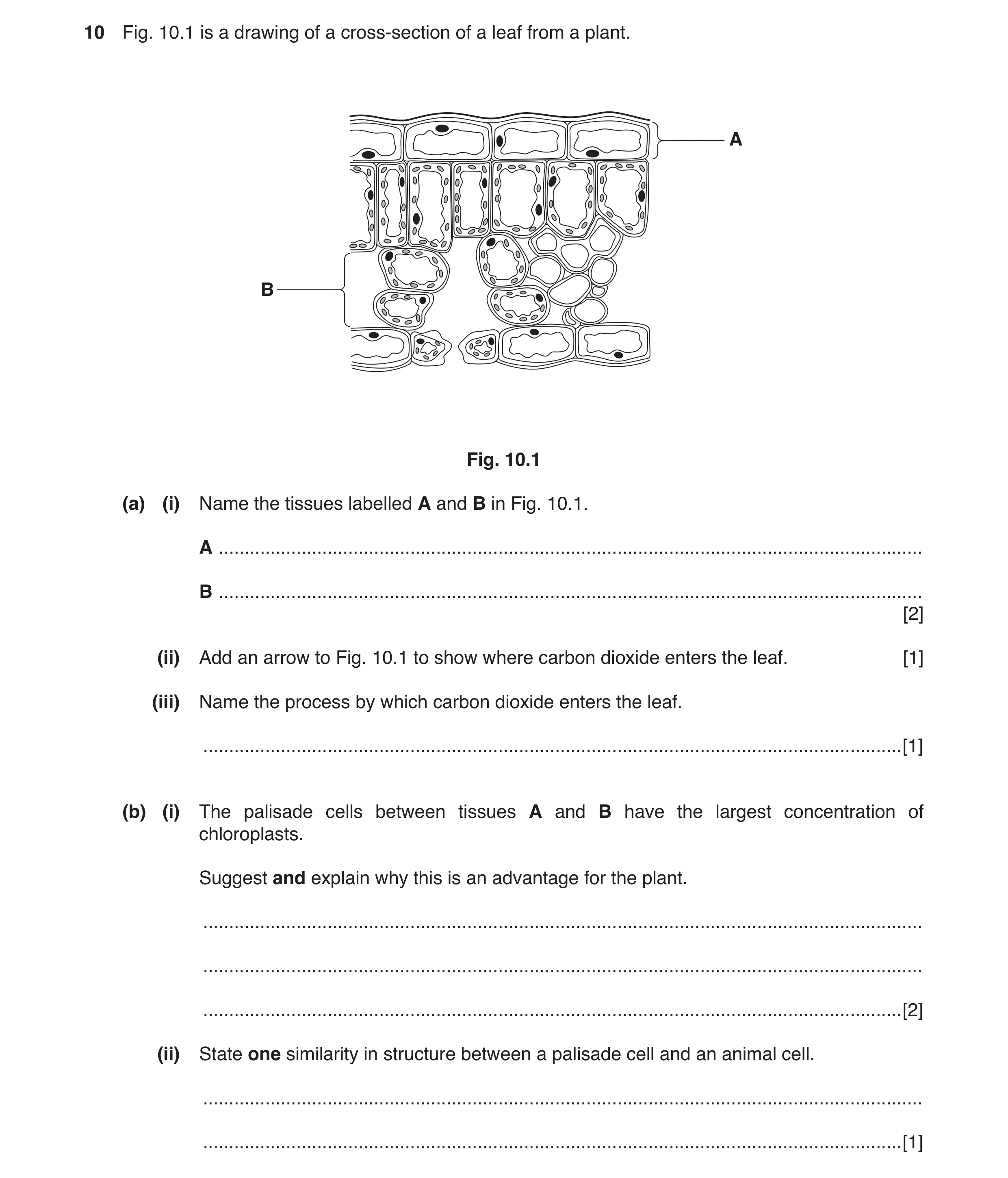
Q3 · A drawing of a cross-section of a leaf from a plant 0654/33 Oct/Nov 2017
10 Fig. 10.1 is a drawing of a cross-section of a leaf from a plant. A B Fig. 10.1 (a) (i) Name the tissues labelled A and B in Fig. 10.1. A … B … [2] (ii) Add an arrow to Fig. 10.1 to show where carbon dioxide enters the leaf. [1] (iii) Name the process by which carbon dioxide enters the leaf. … [1] (b) (i) The palisade cells between tissues A and B have the largest concentration of chloroplasts. Suggest and explain why this is an advantage for the plant. … … … [2] (ii) State one similarity in structure between a palisade cell and an animal cell. … … [1]
7 marks
Mark scheme: 10(a)(i) A (upper) epidermis ; B spongy mesophyll (layer) ; 2 10(a)(ii) arrow pointing to or through the stomata ; 1 Question Answer Marks 10(a)(iii) diffusion ; 1 10(b)(i) (they) absorb (more) (sun) light ; for photosynthesis ; 2 10(b)(ii) (presence of) cell membrane / nucleus / cytoplasm ; 1
This question in 0654/33 Oct/Nov 2017
Q4 · A diagram of a palisade cell 0654/32 Oct/Nov 2018
1 Fig. 1.1 shows a diagram of a palisade cell. Fig. 1.1 (a) On Fig. 1.1, use label lines to label the: • nucleus • cytoplasm. [2] (b) Describe two ways in which the structure of a palisade cell differs from the structure of an animal cell. 1 … … 2 … … [2] (c) Molecules can enter and leave the cell across the cell membrane by the process of diffusion. Describe how molecules enter the cell by diffusion. … … … … [2] (d) Respiration occurs in cells. State one substance required for respiration that will diffuse into cells. … [1]
7 marks
Mark scheme: 1(a) nucleus labelled; cytoplasm labelled; 2 1(b) presence of cell wall; presence of chloroplasts; presence of (permanent) vacuole; max 2 1(c) from higher concentration (outside the cell) to lower concentration (inside the cell); by (molecules) random movement; 2 1(d) glucose / oxygen; 1
This question in 0654/32 Oct/Nov 2018
Q5 · A diagram of a plant cell 0654/31 May/June 2019
1 (a) Fig. 1.1 is a diagram of a plant cell. B A C D E F Fig. 1.1 Table 1.1 shows some of the parts labelled in Fig. 1.1. Use Fig. 1.1. to complete Table 1.1. Table 1.1 name of part letter in Fig. 1.1 function A controls what enters and leaves the cell site of photosynthesis stops cell from bursting nucleus contains genetic material [4] (b) Carbon dioxide is one of the raw materials needed for photosynthesis. (i) State one other raw material needed for photosynthesis. … [1] (ii) Describe how carbon dioxide moves into cells. Include the name of the process in your answer. … … … … [3] [Total: 8]
8 marks
Mark scheme: 1(a) name of part letter in Fig. 1.1 function cell membrane A control what enters and leaves the cell chloroplast D site of photosynthesis cell wall F stops cell from bursting nucleus C contains genetic material 1 correct ; 2 or 3 correct ; 4 or 5 correct ; 6 correct ; 4 1(b)(i) water ; 1 1(b)(ii) across the cell membrane ; by diffusion ; from high concentration to low concentration ; by random movement ; max 3
This question in 0654/31 May/June 2019
Q6 · A diagram of an animal cell 0654/32 May/June 2019
1 (a) Fig. 1.1 is a diagram of an animal cell. A B C Fig. 1.1 Table 1.1 shows the parts labelled in Fig. 1.1. Use Fig. 1.1 to complete Table 1.1. Table 1.1 name of part letter in Fig. 1.1 function controls what enters and leaves the cell B contains genetic material [3] (b) Animal cells cannot photosynthesise. Describe the function of photosynthesis, and state why animal cells are unable to photosynthesise. … … … [2] (c) Respiration occurs in living cells. Water is a product of respiration. (i) Name one other product of respiration. … [1] (ii) Describe how water moves out of animal cells. Include the name of the process in your answer. … … … … [3] [Total: 9]
9 marks
Mark scheme: 1(a) 1 or 2 correct ; 3, 4 or 5 correct ; 6 correct ; name of part letter in Fig. 1.1 function cell membrane C control what enters and leaves the cell cytoplasm B chemical reactions occur here nucleus A contains genetic material 3 1(b) (photosynthesis) produces glucose / (named) carbohydrate / sugar ; animals don’t have chloroplasts ; 2 1(c)(i) carbon dioxide ; 1 1(c)(ii) across the, cell / partially permeable, membrane ; by osmosis ; by random movement ; 3
This question in 0654/32 May/June 2019
Q7 · A diagram of an animal cell 0654/33 May/June 2019
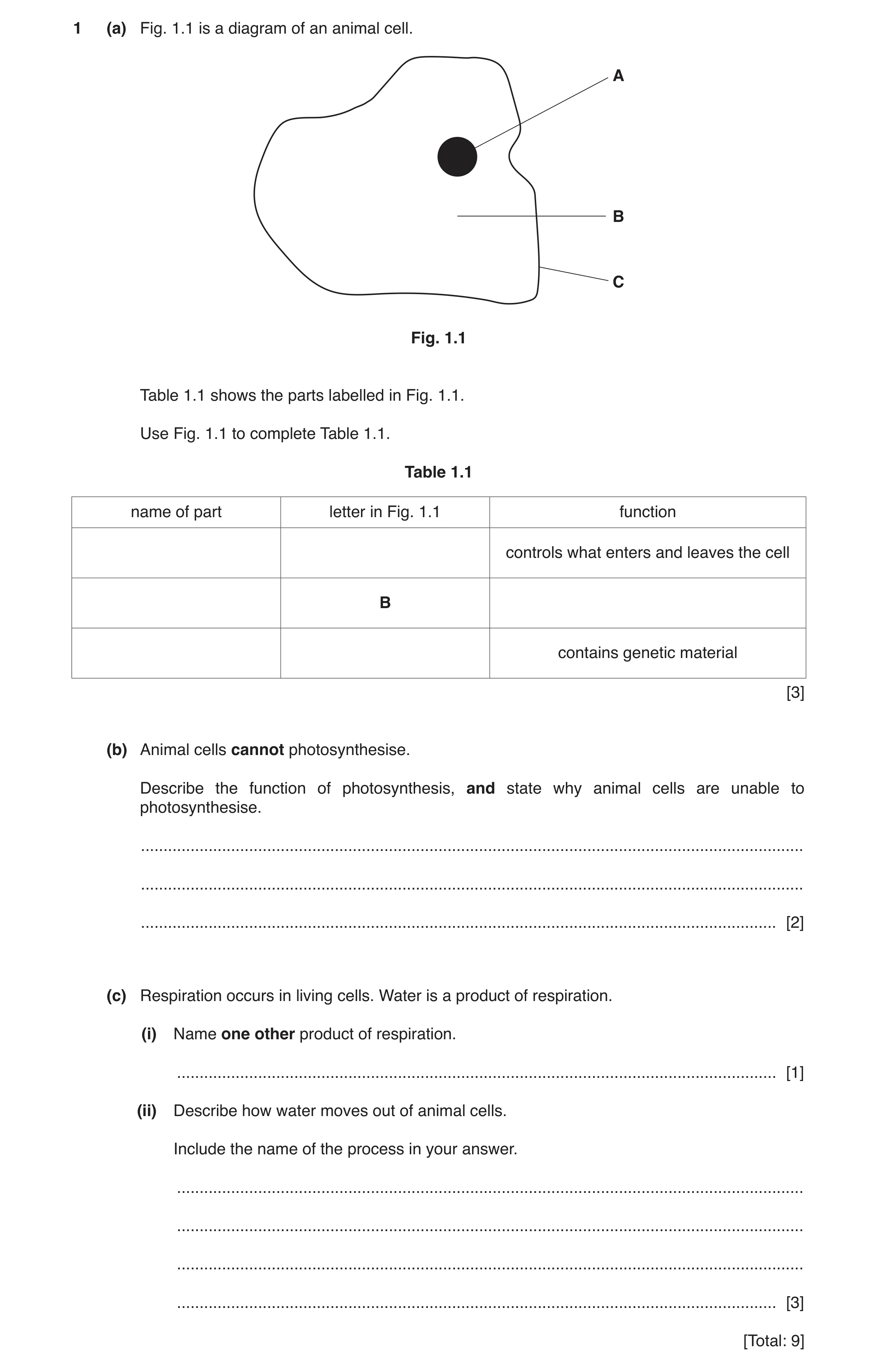
1 (a) Fig. 1.1 is a diagram of an animal cell. A B C Fig. 1.1 Table 1.1 shows the parts labelled in Fig. 1.1. Use Fig. 1.1 to complete Table 1.1. Table 1.1 name of part letter in Fig. 1.1 function controls what enters and leaves the cell B contains genetic material [3] (b) Animal cells cannot photosynthesise. Describe the function of photosynthesis, and state why animal cells are unable to photosynthesise. … … … [2] (c) Respiration occurs in living cells. Water is a product of respiration. (i) Name one other product of respiration. … [1] (ii) Describe how water moves out of animal cells. Include the name of the process in your answer. … … … … [3] [Total: 9]
9 marks
Mark scheme: 1(a) 1 or 2 correct ; 3, 4 or 5 correct ; 6 correct ; name of part letter in Fig. 1.1 function cell membrane C control what enters and leaves the cell cytoplasm B chemical reactions occur here nucleus A contains genetic material 3 1(b) (photosynthesis) produces glucose / (named) carbohydrate / sugar ; animals don’t have chloroplasts ; 2 1(c)(i) carbon dioxide ; 1 1(c)(ii) across the, cell / partially permeable, membrane ; by osmosis ; by random movement ; 3
This question in 0654/33 May/June 2019
Q8 · A student investigates the conditions needed for photosynthesis 0654/33 Oct/Nov 2019
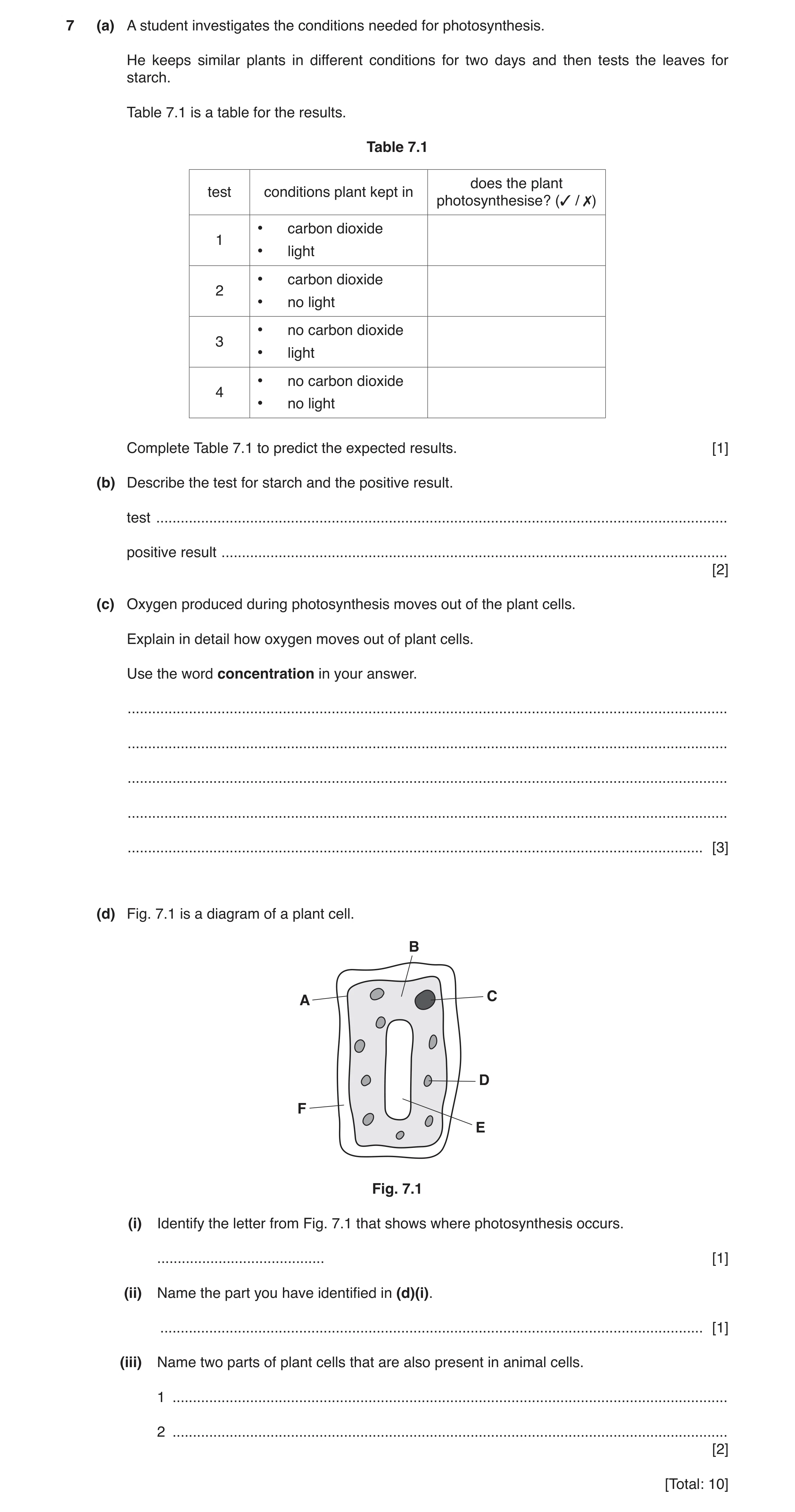
7 (a) A student investigates the conditions needed for photosynthesis. He keeps similar plants in different conditions for two days and then tests the leaves for starch. Table 7.1 is a table for the results. Table 7.1 does the plant test conditions plant kept in photosynthesise? (3 / ✗) • carbon dioxide 1 • light • carbon dioxide 2 • no light • no carbon dioxide 3 • light • no carbon dioxide 4 • no light Complete Table 7.1 to predict the expected results. [1] (b) Describe the test for starch and the positive result. test … positive result … [2] (c) Oxygen produced during photosynthesis moves out of the plant cells. Explain in detail how oxygen moves out of plant cells. Use the word concentration in your answer. … … … … … [3] (d) Fig. 7.1 is a diagram of a plant cell. B C A D F E Fig. 7.1 (i) Identify the letter from Fig. 7.1 that shows where photosynthesis occurs. … [1] (ii) Name the part you have identified in (d)(i). … [1] (iii) Name two parts of plant cells that are also present in animal cells. 1 … 2 … [2] [Total: 10]
10 marks
Mark scheme: 7(a) test 19, test 2–4 X ; 1 7(b) iodine solution ; blue-black ; 2 7(c) ref to diffusion ; higher concentration of oxygen inside the cell / ORA ; oxygen moves down a concentration gradient / from high to low concentration ; across the cell membrane / cell wall ; max 3 3 7(d)(i) D ; 1 7(d)(ii) chloroplast ; 1 7(d)(iii) cell membrane ; nucleus ; cytoplasm ; max 2 2
This question in 0654/33 Oct/Nov 2019
Q9 · A student investigates photosynthesis using an aquatic plant (Elodea) 0654/31 May/June 2020
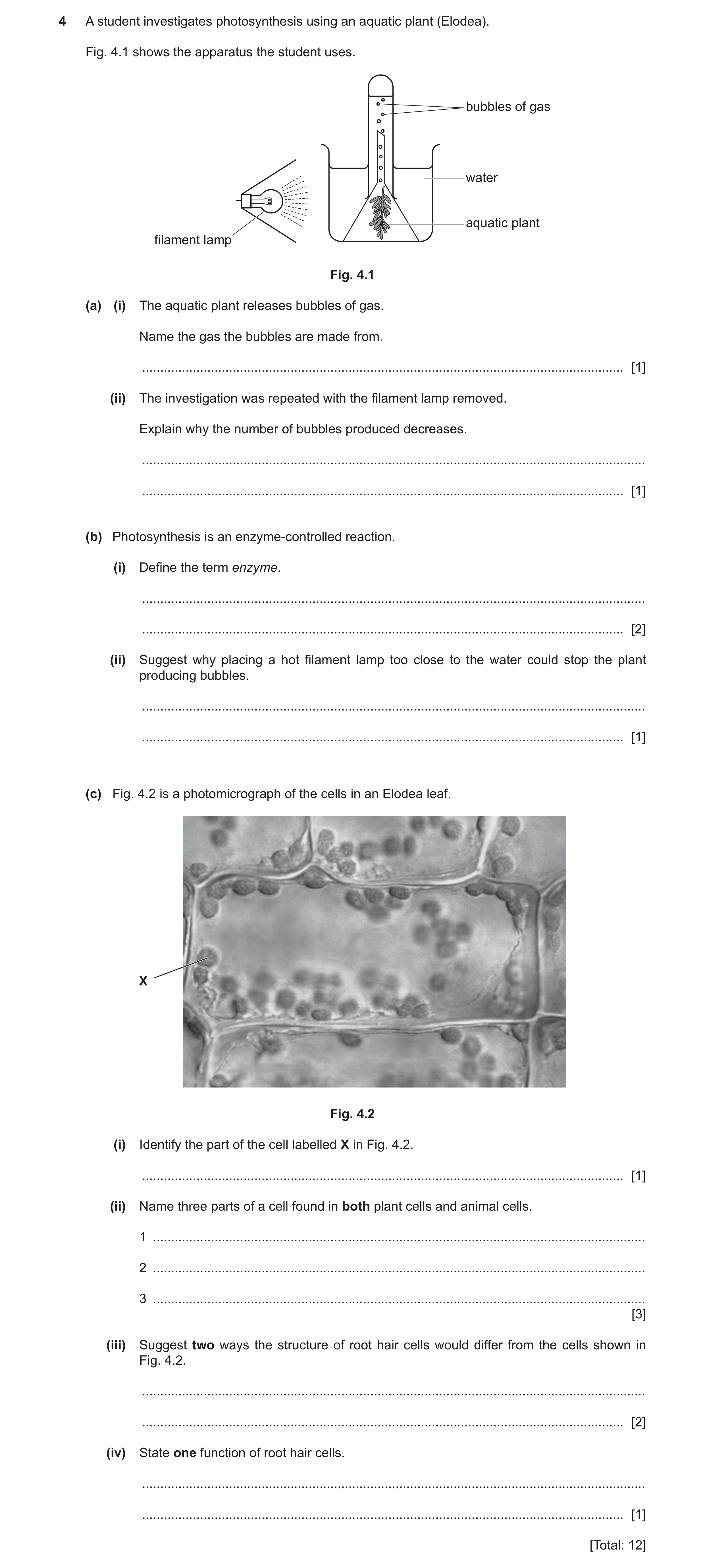
4 A student investigates photosynthesis using an aquatic plant (Elodea). Fig. 4.1 shows the apparatus the student uses. bubbles of gas water aquatic plant filament lamp Fig. 4.1 (a) (i) The aquatic plant releases bubbles of gas. Name the gas the bubbles are made from. … [1] (ii) The investigation was repeated with the filament lamp removed. Explain why the number of bubbles produced decreases. … … [1] (b) Photosynthesis is an enzyme-controlled reaction. (i) Define the term enzyme. … … [2] (ii) Suggest why placing a hot filament lamp too close to the water could stop the plant producing bubbles. … … [1] (c) Fig. 4.2 is a photomicrograph of the cells in an Elodea leaf. X Fig. 4.2 (i) Identify the part of the cell labelled X in Fig. 4.2. … [1] (ii) Name three parts of a cell found in both plant cells and animal cells. 1 … 2 … 3 … [3] (iii) Suggest two ways the structure of root hair cells would differ from the cells shown in Fig. 4.2. … … [2] (iv) State one function of root hair cells. … … [1] [Total: 12]
12 marks
Mark scheme: 4(a)(i) oxygen ; 1 4(a)(ii) light is needed for photosynthesis ; 1 4(b)(i) protein ; (biological) catalyst ; 2 4(b)(ii) enzymes stop working / enzyme activity slows down ; 1 4(c)(i) chloroplast ; 1 4(c)(ii) cell membrane ; cytoplasm ; nucleus ; 3 4(c)(iii) elongated shape ; contains no chloroplasts ; 2 4(c)(iv) absorb, water / mineral ions ; 1
This question in 0654/31 May/June 2020
Q10 · Plants use different tissues to transport substances around the plant 0654/31 May/June 2021
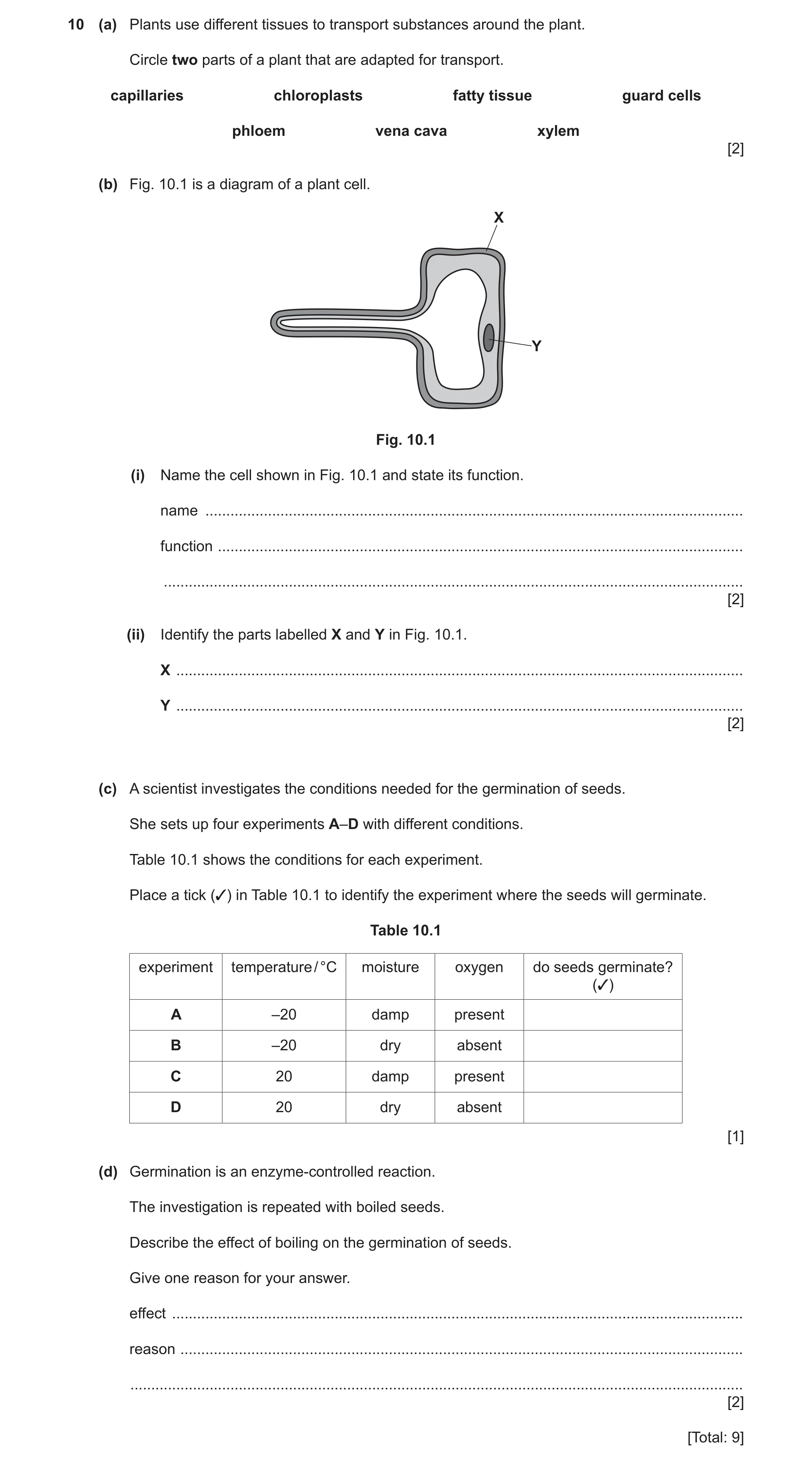
10 (a) Plants use different tissues to transport substances around the plant. Circle two parts of a plant that are adapted for transport. capillaries chloroplasts fatty tissue guard cells phloem vena cava xylem [2] (b) Fig. 10.1 is a diagram of a plant cell. X Y Fig. 10.1 (i) Name the cell shown in Fig. 10.1 and state its function. name … function … … [2] (ii) Identify the parts labelled X and Y in Fig. 10.1. X … Y … [2] (c) A scientist investigates the conditions needed for the germination of seeds. She sets up four experiments A–D with different conditions. Table 10.1 shows the conditions for each experiment. Place a tick (3) in Table 10.1 to identify the experiment where the seeds will germinate. Table 10.1 experiment temperature / °C moisture oxygen do seeds germinate? (3) A –20 damp present B –20 dry absent C 20 damp present D 20 dry absent [1] (d) Germination is an enzyme‑controlled reaction. The investigation is repeated with boiled seeds. Describe the effect of boiling on the germination of seeds. Give one reason for your answer. effect … reason … … [2] [Total: 9]
9 marks
Mark scheme: 10(a) phloem circled ; xylem circled ; 2 10(b)(i) name root hair (cell) ; function absorption of, water / mineral ions ; 2 10(b)(ii) X cell wall ; Y nucleus ; 2 Question Answer Marks 10(c) prediction of germination (/ X) X X X ; 1 10(d) effect no germination ; reason (high temperature) decreases enzyme / stops activity ; 2
This question in 0654/31 May/June 2021
Q11 · Scientists measure the length of sperm cells from different animals 0654/31 Oct/Nov 2021
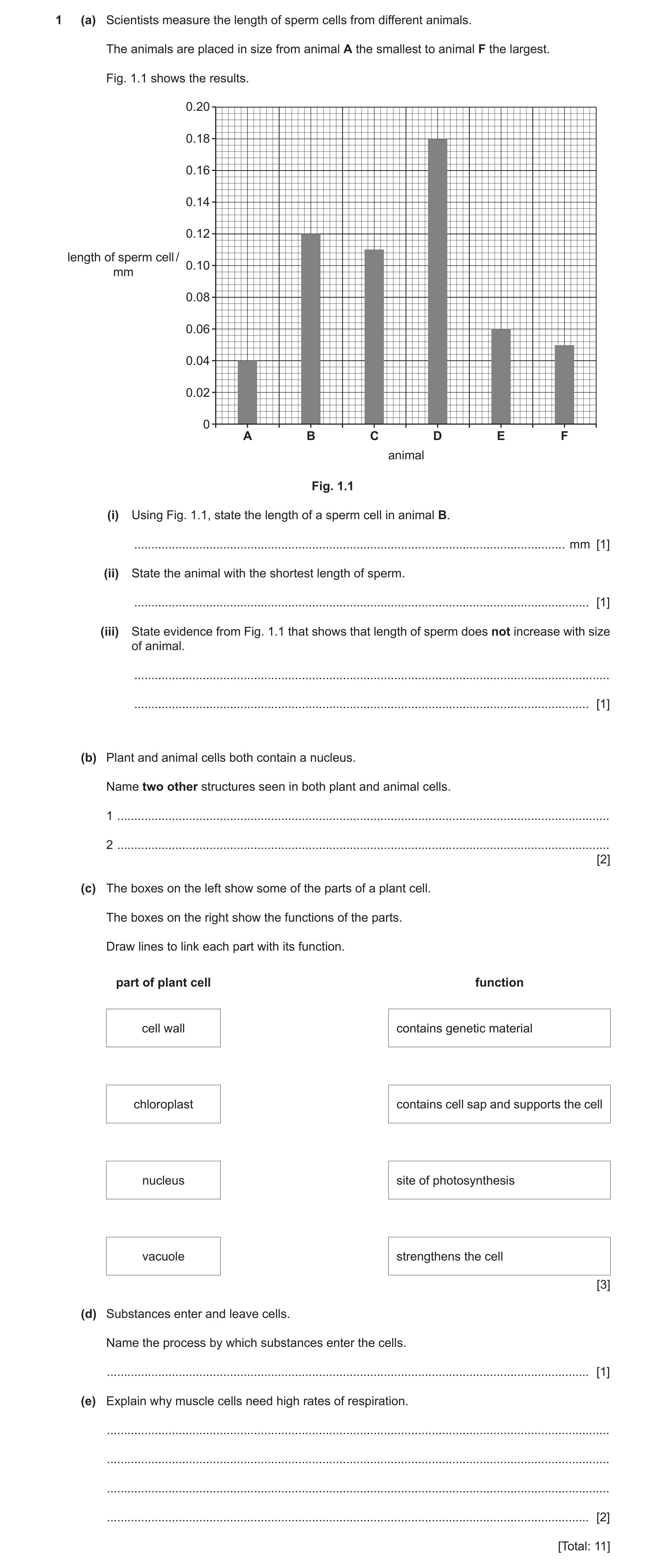
1 (a) Scientists measure the length of sperm cells from different animals. The animals are placed in size from animal A the smallest to animal F the largest. Fig. 1.1 shows the results. 0.20 0.18 0.16 0.14 0.12 length of sperm cell / 0.10 mm 0.08 0.06 0.04 0.02 0 A B C D E F animal Fig. 1.1 (i) Using Fig. 1.1, state the length of a sperm cell in animal B. … mm [1] (ii) State the animal with the shortest length of sperm. … [1] (iii) State evidence from Fig. 1.1 that shows that length of sperm does not increase with size of animal. … … [1] (b) Plant and animal cells both contain a nucleus. Name two other structures seen in both plant and animal cells. 1 … 2 … [2] (c) The boxes on the left show some of the parts of a plant cell. The boxes on the right show the functions of the parts. Draw lines to link each part with its function. part of plant cell function cell wall contains genetic material chloroplast contains cell sap and supports the cell nucleus site of photosynthesis vacuole strengthens the cell [3] (d) Substances enter and leave cells. Name the process by which substances enter the cells. … [1] (e) Explain why muscle cells need high rates of respiration. … … … … [2] [Total: 11]
11 marks
Mark scheme: 1(a)(i) 0.12 (mm) ; 1 1(a)(ii) A ; 1 1(a)(iii) animal F is the biggest but does not have the longest length of sperm / animal D has the longest sperm but is not the biggest animal / avp ; 1 1(b) any two from: cell membrane ; cytoplasm ; AVP ; e.g. ribosomes / mitochondria 2 1(c) cell wall contains genetic material chloroplast contains cell sap and supports the cell nucleus site of photosynthesis vacuole strengthens the cell ;;; 3 1(d) diffusion ; 1 1(e) respiration releases energy ; (energy is required) for muscle contraction / movement ; 2
This question in 0654/31 Oct/Nov 2021
Q12 · A diagram of a single‑celled organism called a euglena 0654/32 Oct/Nov 2021
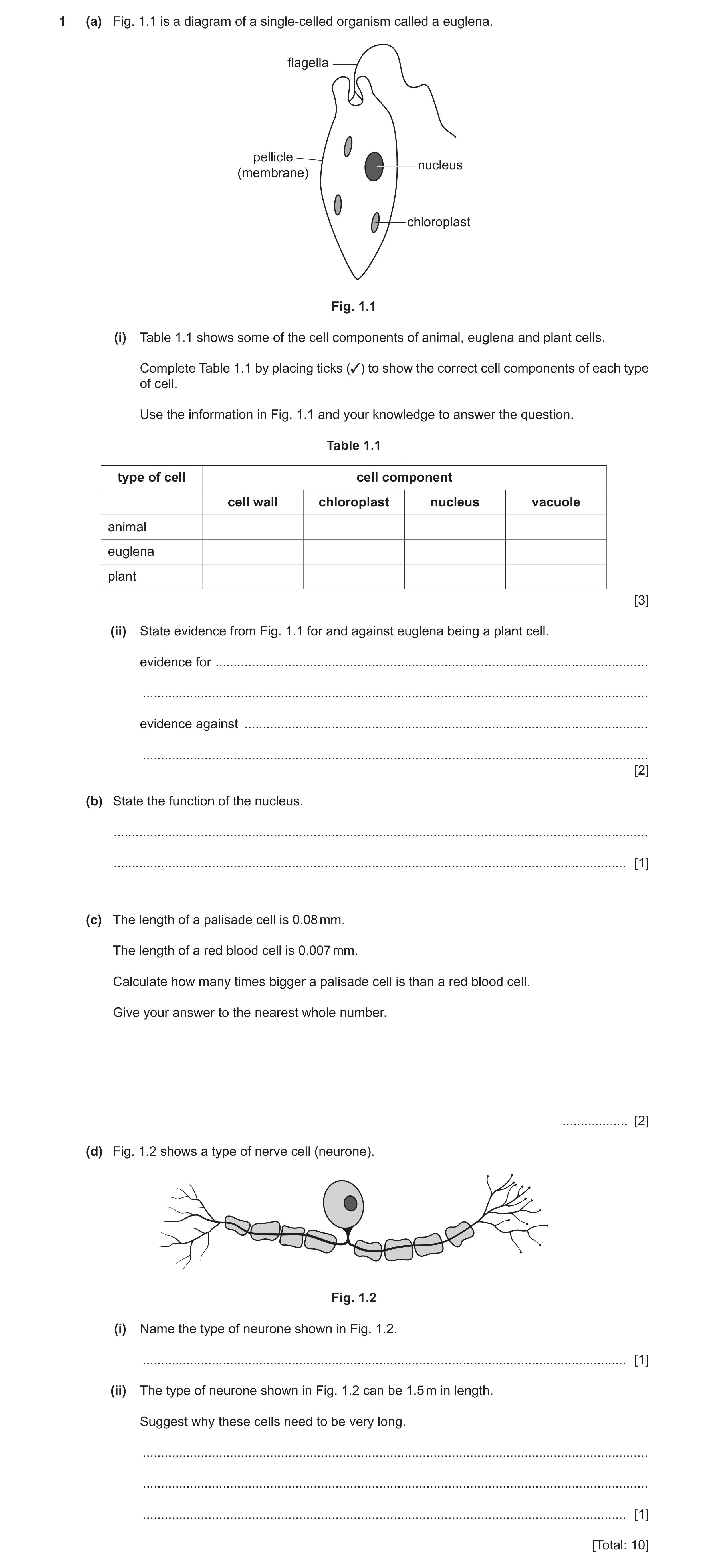
1 (a) Fig. 1.1 is a diagram of a single‑celled organism called a euglena. flagella pellicle nucleus (membrane) chloroplast Fig. 1.1 (i) Table 1.1 shows some of the cell components of animal, euglena and plant cells. Complete Table 1.1 by placing ticks (3) to show the correct cell components of each type of cell. Use the information in Fig. 1.1 and your knowledge to answer the question. Table 1.1 type of cell cell component cell wall chloroplast nucleus vacuole animal euglena plant [3] (ii) State evidence from Fig. 1.1 for and against euglena being a plant cell. evidence for … … evidence against … … [2] (b) State the function of the nucleus. … … [1] (c) The length of a palisade cell is 0.08 mm. The length of a red blood cell is 0.007 mm. Calculate how many times bigger a palisade cell is than a red blood cell. Give your answer to the nearest whole number. … [2] (d) Fig. 1.2 shows a type of nerve cell (neurone). Fig. 1.2 (i) Name the type of neurone shown in Fig. 1.2. … [1] (ii) The type of neurone shown in Fig. 1.2 can be 1.5 m in length. Suggest why these cells need to be very long. … … … [1] [Total: 10]
10 marks
Mark scheme: 1(a)(i) type of cell cell wall chloroplast nucleus vacuole animal euglena plant ;;; 1(a)(ii) for: euglena has chloroplasts ; against: euglena does not have, cell wall / vacuole ; 2 1(b) controls cells activities or contains, genetic material / DNA ; 1 1(c) 0.08÷ 0.007 or 11.428 ; 11 ; 2 1(d)(i) sensory (neurone) ; 1 1(d)(ii) transmit impulses, over large, areas / distances / AW ; 1
This question in 0654/32 Oct/Nov 2021
Q13 · A student puts potato cubes in sugar solutions of different concentrations 0654/33 Oct/Nov 2021
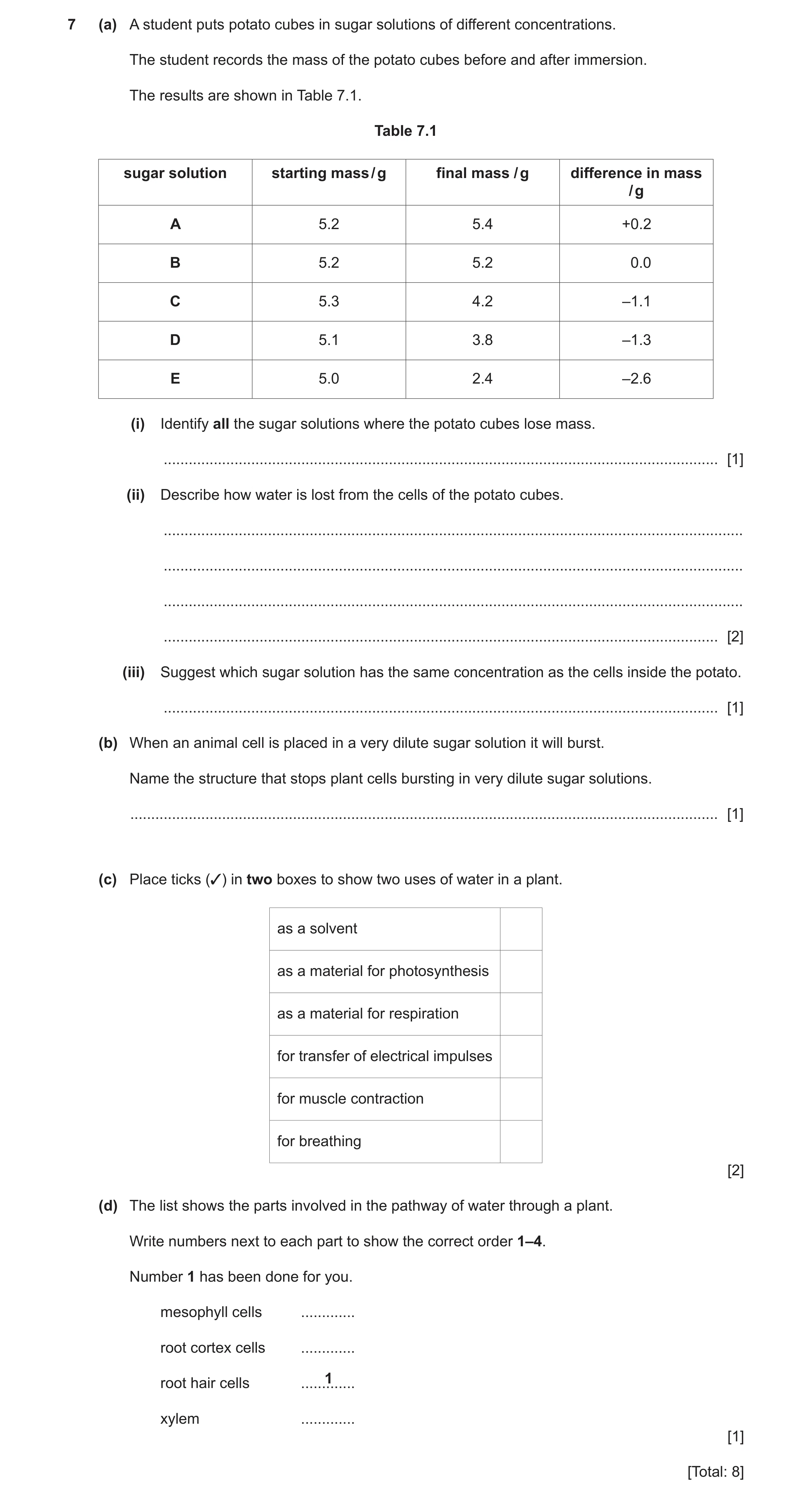
7 (a) A student puts potato cubes in sugar solutions of different concentrations. The student records the mass of the potato cubes before and after immersion. The results are shown in Table 7.1. Table 7.1 sugar solution starting mass / g final mass / g difference in mass / g A 5.2 5.4 +0.2 B 5.2 5.2 0.0 C 5.3 4.2 –1.1 D 5.1 3.8 –1.3 E 5.0 2.4 –2.6 (i) Identify all the sugar solutions where the potato cubes lose mass. … [1] (ii) Describe how water is lost from the cells of the potato cubes. … … … … [2] (iii) Suggest which sugar solution has the same concentration as the cells inside the potato. … [1] (b) When an animal cell is placed in a very dilute sugar solution it will burst. Name the structure that stops plant cells bursting in very dilute sugar solutions. … [1] (c) Place ticks (3) in two boxes to show two uses of water in a plant. as a solvent as a material for photosynthesis as a material for respiration for transfer of electrical impulses for muscle contraction for breathing [2] (d) The list shows the parts involved in the pathway of water through a plant. Write numbers next to each part to show the correct order 1–4. Number 1 has been done for you. mesophyll cells … root cortex cells … root hair cells … 1 xylem … [1] [Total: 8]
8 marks
Mark scheme: 7(a)(i) C, D and E ; 1 7(a)(ii) by osmosis ; through, cell / partially permeable, membrane ; AVP ; max 2 7(a)(iii) B ; 1 7(b) cell wall ; 1 7(c) as a solvent ; as a material for photosynthesis ; 2 7(d) 4, 2, 1, 3 ; 1
This question in 0654/33 Oct/Nov 2021
Q14 · A diagram of a plant cell 0654/32 Feb/March 2022
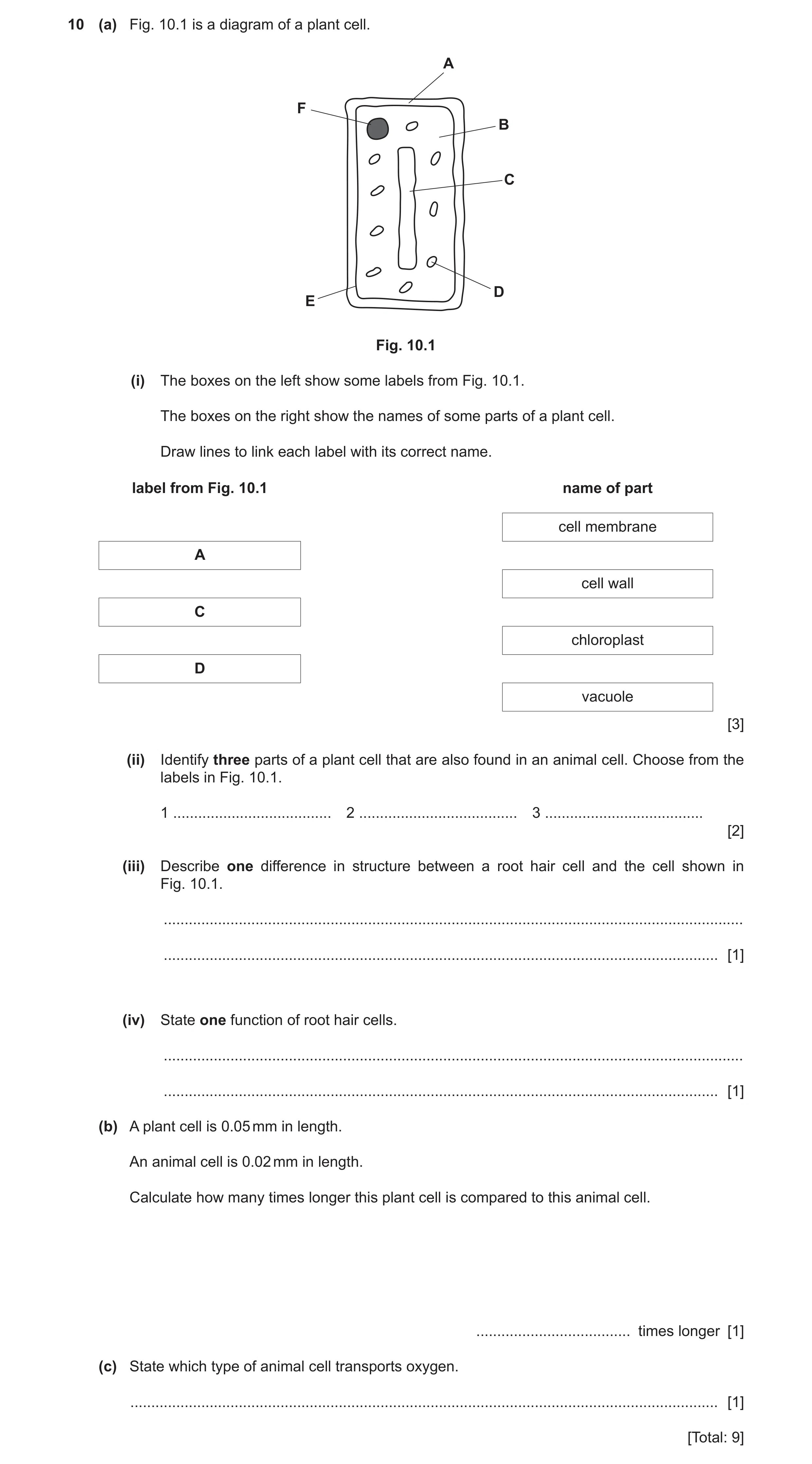
10 (a) Fig. 10.1 is a diagram of a plant cell. A F B C D E Fig. 10.1 (i) The boxes on the left show some labels from Fig. 10.1. The boxes on the right show the names of some parts of a plant cell. Draw lines to link each label with its correct name. label from Fig. 10.1 name of part cell membrane A cell wall C chloroplast D vacuole [3] (ii) Identify three parts of a plant cell that are also found in an animal cell. Choose from the labels in Fig. 10.1. 1 … 2 … 3 … [2] (iii) Describe one difference in structure between a root hair cell and the cell shown in Fig. 10.1. … … [1] (iv) State one function of root hair cells. … … [1] (b) A plant cell is 0.05 mm in length. An animal cell is 0.02 mm in length. Calculate how many times longer this plant cell is compared to this animal cell. … times longer [1] (c) State which type of animal cell transports oxygen. … [1] [Total: 9]
9 marks
Mark scheme: 10(a)(i) cell membrane A cell wall C chloroplast D vacuole ;;; 10(a)(ii) B, E and F ;; 2 10(a)(iii) elongated shape / no chloroplasts ; 1 10(a)(iv) absorption (of water / mineral ions) ; 1 10(b) 2.5 ; 1 Question Answer Marks 10(c) red blood cell ; 1
This question in 0654/32 Feb/March 2022
Q15 · A diagram of the male reproductive system 0654/31 May/June 2022
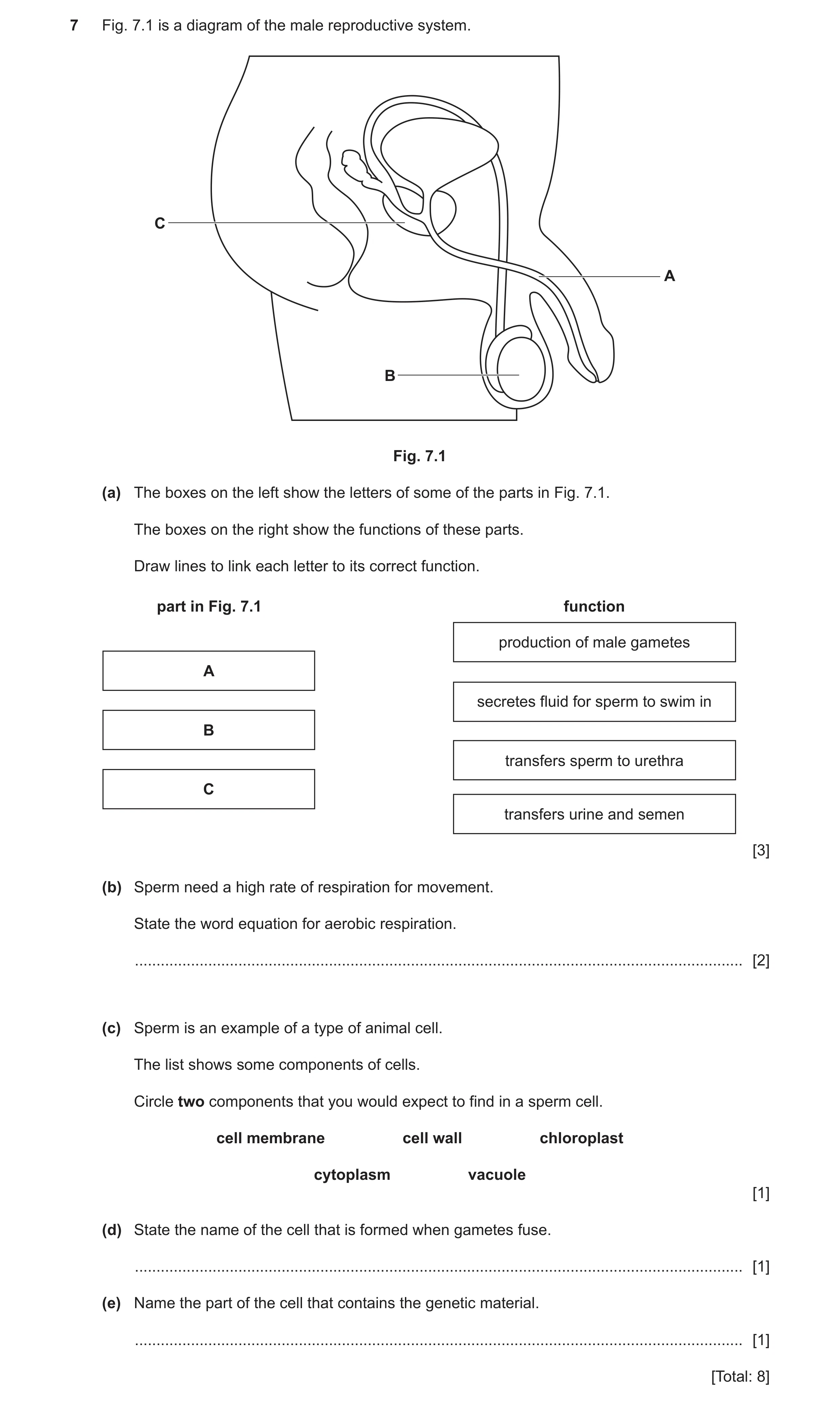
7 Fig. 7.1 is a diagram of the male reproductive system. C A B Fig. 7.1 (a) The boxes on the left show the letters of some of the parts in Fig. 7.1. The boxes on the right show the functions of these parts. Draw lines to link each letter to its correct function. part in Fig. 7.1 function production of male gametes A secretes fluid for sperm to swim in B transfers sperm to urethra C transfers urine and semen [3] (b) Sperm need a high rate of respiration for movement. State the word equation for aerobic respiration. … [2] (c) Sperm is an example of a type of animal cell. The list shows some components of cells. Circle two components that you would expect to find in a sperm cell. cell membrane cell wall chloroplast cytoplasm vacuole [1] (d) State the name of the cell that is formed when gametes fuse. … [1] (e) Name the part of the cell that contains the genetic material. … [1] [Total: 8]
8 marks
Mark scheme: 7(a) production of male gametes A secretes fluid for sperm to swim in B transfers sperm to urethra C transfers urine and semen 3 Question Answer Marks 7(b) glucose + oxygen carbon dioxide + water LHS 1; RHS 1; 2 7(c) cell membrane and cytoplasm circled ; 1 7(d) zygote ; 1 7(e) nucleus ; 1
This question in 0654/31 May/June 2022
Q16 · A student investigates photosynthesis 0654/31 Oct/Nov 2022
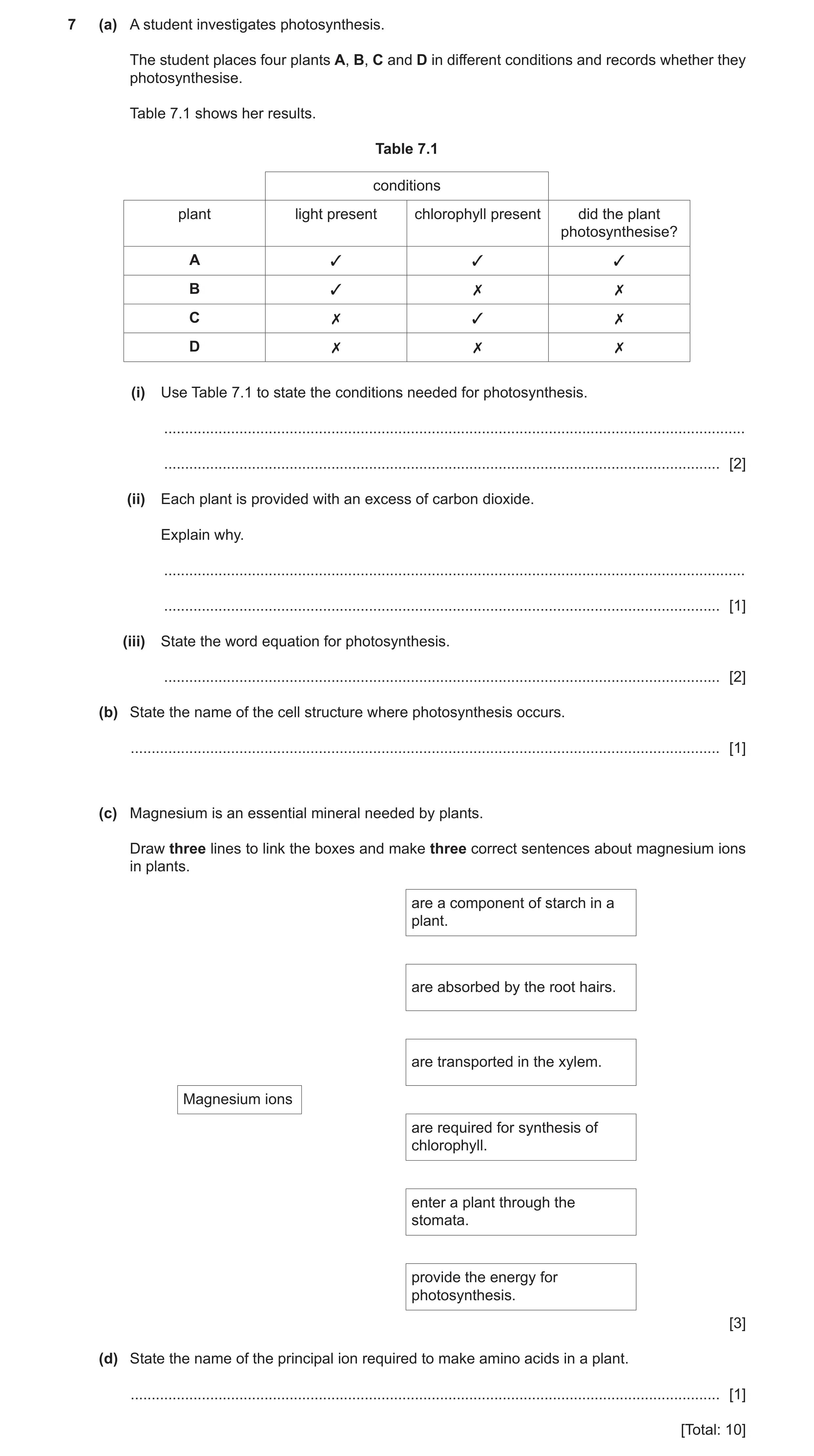
7 (a) A student investigates photosynthesis. The student places four plants A, B, C and D in different conditions and records whether they photosynthesise. Table 7.1 shows her results. Table 7.1 conditions plant light present chlorophyll present did the plant photosynthesise? A 3 3 3 B 3 ✗ ✗ C ✗ 3 ✗ D ✗ ✗ ✗ (i) Use Table 7.1 to state the conditions needed for photosynthesis. … … [2] (ii) Each plant is provided with an excess of carbon dioxide. Explain why. … … [1] (iii) State the word equation for photosynthesis. … [2] (b) State the name of the cell structure where photosynthesis occurs. … [1] (c) Magnesium is an essential mineral needed by plants. Draw three lines to link the boxes and make three correct sentences about magnesium ions in plants. are a component of starch in a plant. are absorbed by the root hairs. are transported in the xylem. Magnesium ions are required for synthesis of chlorophyll. enter a plant through the stomata. provide the energy for photosynthesis. [3] (d) State the name of the principal ion required to make amino acids in a plant. … [1] [Total: 10]
10 marks
Mark scheme: 7(a)(i) light ; 2 chlorophyll ; 7(a)(ii) carbon dioxide is required for photosynthesis ; 1 7(a)(iii) carbon dioxide + water → glucose and oxygen ;; 2 7(b) chloroplast ; 1 7(c) 3 are a component of starch in a plant are absorbed by the root hairs. are transported in the xylem. Magnesium ions are required for synthesis of chlorophyll. enter a plant through the stomata. provide the energy for photosynthesis. ;;; 7(d) nitrate ; 1
This question in 0654/31 Oct/Nov 2022
Q17 · A diagram of a plant cell 0654/32 Oct/Nov 2022
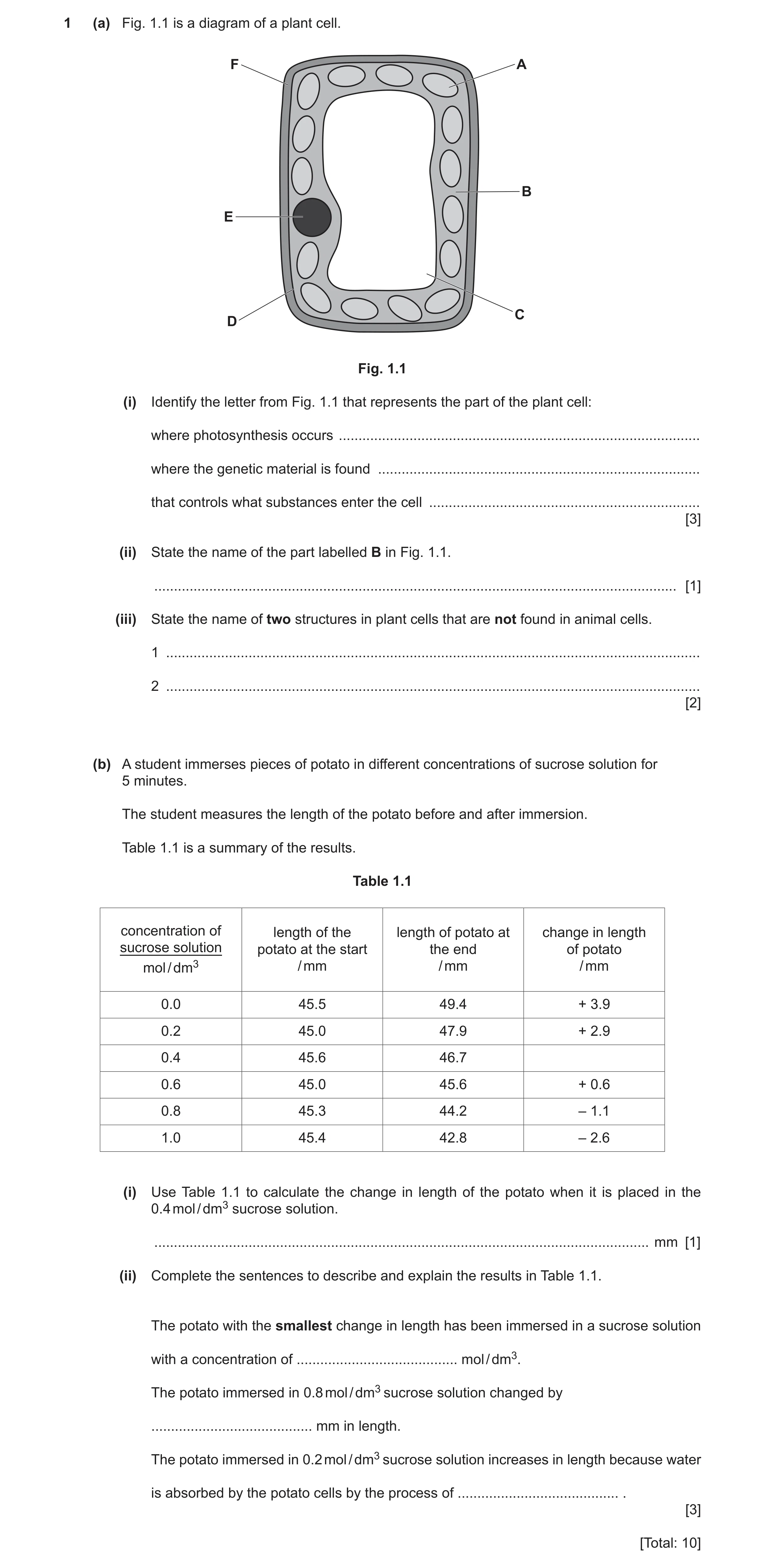
1 (a) Fig. 1.1 is a diagram of a plant cell. F A B E C D Fig. 1.1 (i) Identify the letter from Fig. 1.1 that represents the part of the plant cell: where photosynthesis occurs … where the genetic material is found … that controls what substances enter the cell … [3] (ii) State the name of the part labelled B in Fig. 1.1. … [1] (iii) State the name of two structures in plant cells that are not found in animal cells. 1 … 2 … [2] (b) A student immerses pieces of potato in different concentrations of sucrose solution for 5 minutes. The student measures the length of the potato before and after immersion. Table 1.1 is a summary of the results. Table 1.1 concentration of length of the length of potato at change in length sucrose solution potato at the start the end of potato mol / dm3 / mm / mm / mm 0.0 45.5 49.4 + 3.9 0.2 45.0 47.9 + 2.9 0.4 45.6 46.7 0.6 45.0 45.6 + 0.6 0.8 45.3 44.2 – 1.1 1.0 45.4 42.8 – 2.6 (i) Use Table 1.1 to calculate the change in length of the potato when it is placed in the 0.4 mol / dm3 sucrose solution. … mm [1] (ii) Complete the sentences to describe and explain the results in Table 1.1. The potato with the smallest change in length has been immersed in a sucrose solution with a concentration of … mol / dm3. The potato immersed in 0.8 mol / dm3 sucrose solution changed by … mm in length. The potato immersed in 0.2 mol / dm3 sucrose solution increases in length because water is absorbed by the potato cells by the process of … . [3] [Total: 10]
10 marks
Mark scheme: Question Answer Marks 1(a)(i) A ; 3 E ; D ; 1(a)(ii) cytoplasm ; 1 1(a)(iii) any two from: 2 chloroplast ; vacuole ; cell wall ; 1(b)(i) (+) 1.1 (mm) ; 1 1(b)(ii) 0.6 ; 3 (–) 1.1 ; osmosis ;
This question in 0654/32 Oct/Nov 2022
Q18 · Scientists investigate diffusion by measuring the distance travelled by two different… 0654/33 Oct/Nov 2022
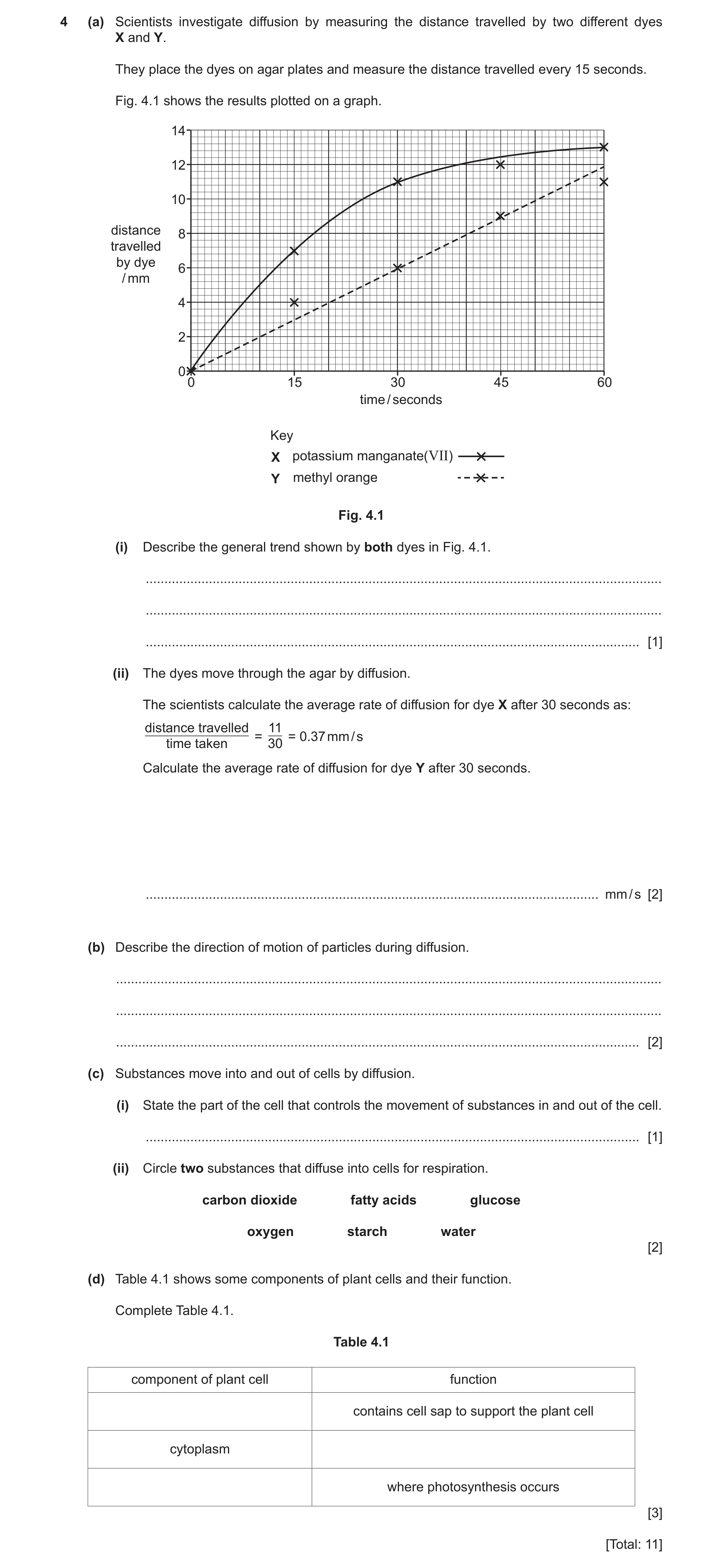
4 (a) Scientists investigate diffusion by measuring the distance travelled by two different dyes X and Y. They place the dyes on agar plates and measure the distance travelled every 15 seconds. Fig. 4.1 shows the results plotted on a graph. 14 12 10 distance 8 travelled by dye 6 / mm 4 2 0 0 15 30 45 60 time / seconds Key X potassium manganate(VII) Y methyl orange Fig. 4.1 (i) Describe the general trend shown by both dyes in Fig. 4.1. … … … [1] (ii) The dyes move through the agar by diffusion. The scientists calculate the average rate of diffusion for dye X after 30 seconds as: distance travelled 11 = = 0.37 mm / s time taken 30 Calculate the average rate of diffusion for dye Y after 30 seconds. … mm / s [2] (b) Describe the direction of motion of particles during diffusion. … … … [2] (c) Substances move into and out of cells by diffusion. (i) State the part of the cell that controls the movement of substances in and out of the cell. … [1] (ii) Circle two substances that diffuse into cells for respiration. carbon dioxide fatty acids glucose oxygen starch water [2] (d) Table 4.1 shows some components of plant cells and their function. Complete Table 4.1. Table 4.1 component of plant cell function contains cell sap to support the plant cell cytoplasm where photosynthesis occurs [3] [Total: 11]
11 marks
Mark scheme: 4(a)(i) the distance travelled by the dyes increases with time ; 1 4(a)(ii) 6 ; 2 (6 / 30) = 0.2 (mm / s) ; 4(b) from a region of higher concentration to a region of lower concentration ; 2 by random movement ; 4(c)(i) cell membrane ; 1 4(c)(ii) glucose circled ; 2 oxygen circled ; 4(d) 3 component of cell function vacuole ; contains cell sap that supports the plant cell cytoplasm where chemical reactions occur / contains the cell structures / contain enzymes ; chloroplast ; where photosynthesis occurs
This question in 0654/33 Oct/Nov 2022
Q19 · A diagram of the female reproductive system in humans 0654/31 Oct/Nov 2023
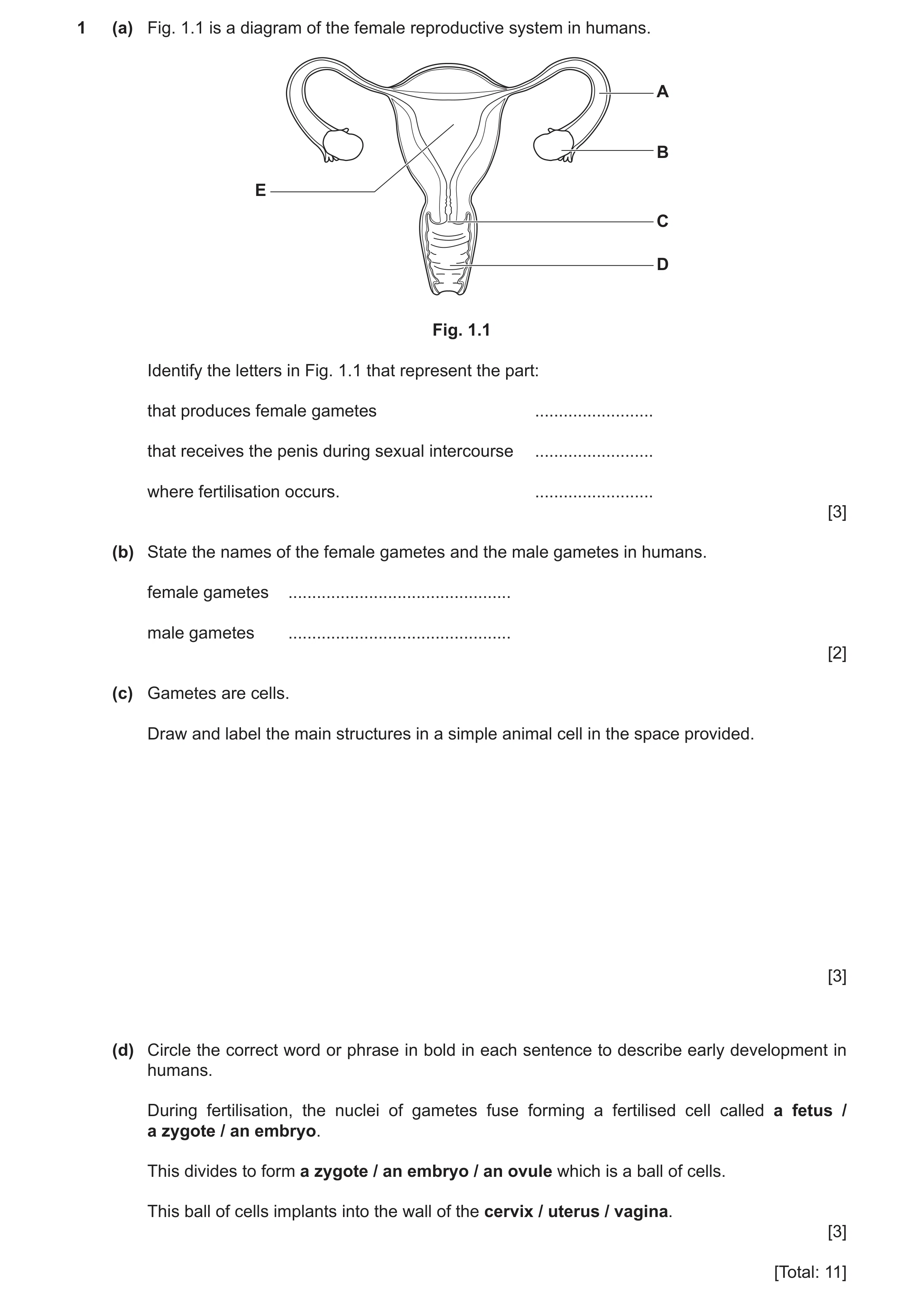
1 (a) Fig. 1.1 is a diagram of the female reproductive system in humans. A B E C D Fig. 1.1 Identify the letters in Fig. 1.1 that represent the part: that produces female gametes … that receives the penis during sexual intercourse … where fertilisation occurs. … [3] (b) State the names of the female gametes and the male gametes in humans. female gametes … male gametes … [2] (c) Gametes are cells. Draw and label the main structures in a simple animal cell in the space provided. [3] (d) Circle the correct word or phrase in bold in each sentence to describe early development in humans. During fertilisation, the nuclei of gametes fuse forming a fertilised cell called a fetus / a zygote / an embryo. This divides to form a zygote / an embryo / an ovule which is a ball of cells. This ball of cells implants into the wall of the cervix / uterus / vagina. [3] [Total: 11]
11 marks
Mark scheme: Question Answer Marks 1(a) B ; 3 D ; A ; 1(b) female – ovum / egg ; 2 male – sperm ; 1(c) cell membrane drawn correctly and labelled ; 3 nucleus drawn correctly and labelled ; space around nucleus inside of the cell membrane labelled cytoplasm ; 1(d) a zygote ; 3 an embryo ; uterus ;
This question in 0654/31 Oct/Nov 2023
Q20 · Reproduction is one of the characteristics of living things 0654/33 Oct/Nov 2023
1 (a) Reproduction is one of the characteristics of living things. Complete the definition. Reproduction is the process that makes more of the same kind of … [1] (b) Fig. 1.1 is a diagram of the male reproductive system in humans. A C B Fig. 1.1 The boxes on the left show the letters labelling some of the parts in Fig. 1.1. The boxes on the right show functions of some of the parts. Draw one line to link each letter to its function. carries semen and urine out of the body A produces sperm B secretes fluid for sperm to swim in C transfers sperm to urethra [3] (c) Fig. 1.2 is a drawing of a sperm cell. Label the cell structure that contains the genetic material with a label line and the correct name. Fig. 1.2 [2] (d) State the names of two cell structures that are present in plant cells but not present in animal cells. 1 … 2 … [2] [Total: 8]
8 marks
Mark scheme: Question Answer Marks 1(a) organism ; 1 1(b) 3 carries semen and urine out of the body A produces sperm B secretes fluid for sperm to swim in C transfers sperm to urethra 1 mark for each line ;;; 1(c) nucleus correctly labelled 2 labelling correct structure ; correct name ; 1(d) any two from: 2 chloroplast ; cell wall ; (permanent) vacuole ;
This question in 0654/33 Oct/Nov 2023
Q21 · A diagram of a plant cell 0654/32 Feb/March 2024
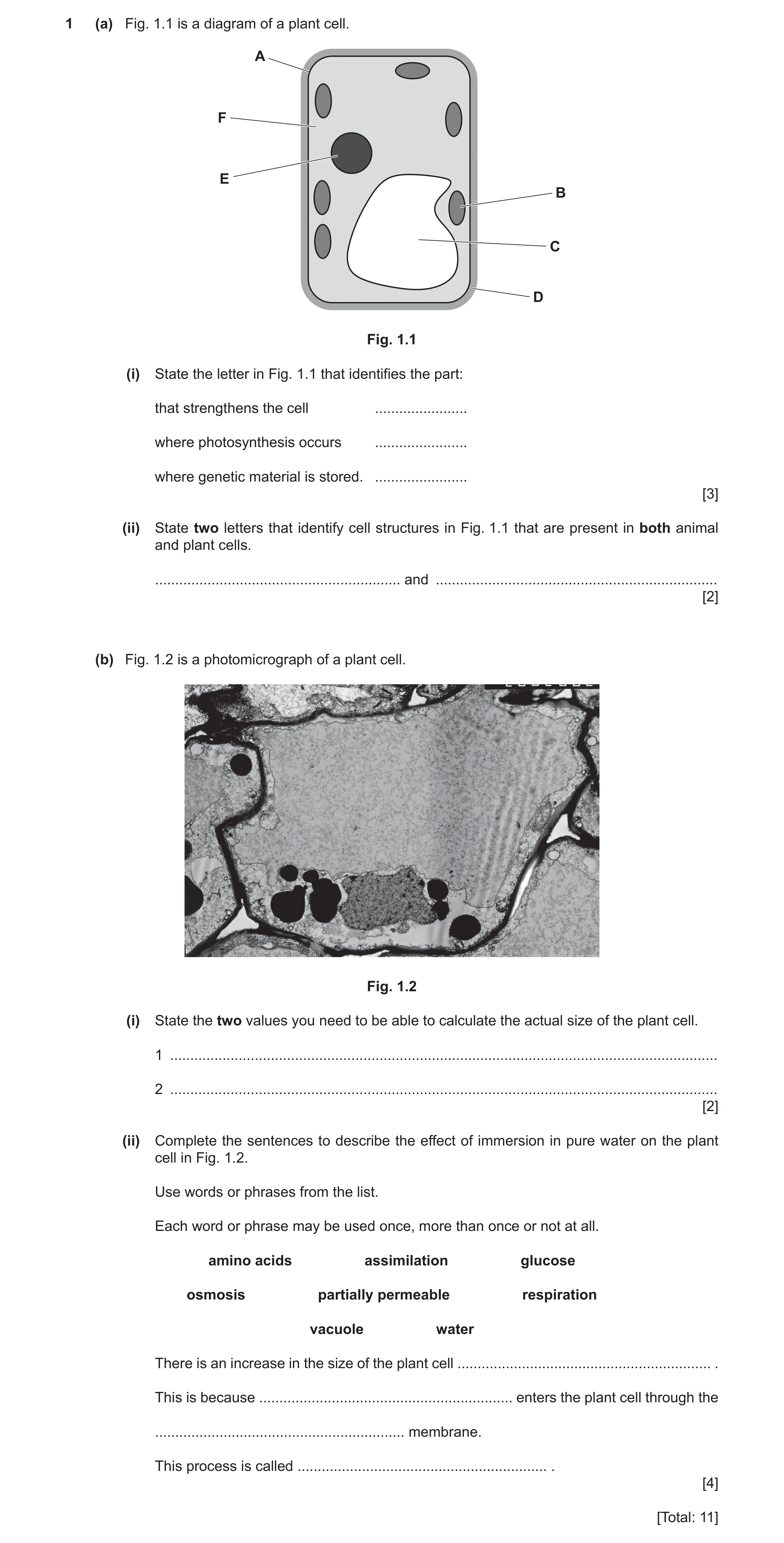
1 (a) Fig. 1.1 is a diagram of a plant cell. A F E B C D Fig. 1.1 (i) State the letter in Fig. 1.1 that identifies the part: that strengthens the cell … where photosynthesis occurs … where genetic material is stored. … [3] (ii) State two letters that identify cell structures in Fig. 1.1 that are present in both animal and plant cells. … and … [2] (b) Fig. 1.2 is a photomicrograph of a plant cell. Fig. 1.2 (i) State the two values you need to be able to calculate the actual size of the plant cell. 1 … 2 … [2] (ii) Complete the sentences to describe the effect of immersion in pure water on the plant cell in Fig. 1.2. Use words or phrases from the list. Each word or phrase may be used once, more than once or not at all. amino acids assimilation glucose osmosis partially permeable respiration vacuole water There is an increase in the size of the plant cell … . This is because … enters the plant cell through the … membrane. This process is called … . [4] [Total: 11]
11 marks
Mark scheme: Question Answer Marks 1(a)(i) D ; 3 B ; E ; 1(a)(ii) any two from: 2 A ; E ; F ; 1(b)(i) image size ; 2 magnification ; 1(b)(ii) vacuole ; 4 water ; partially permeable (membrane) ; osmosis ;
This question in 0654/32 Feb/March 2024
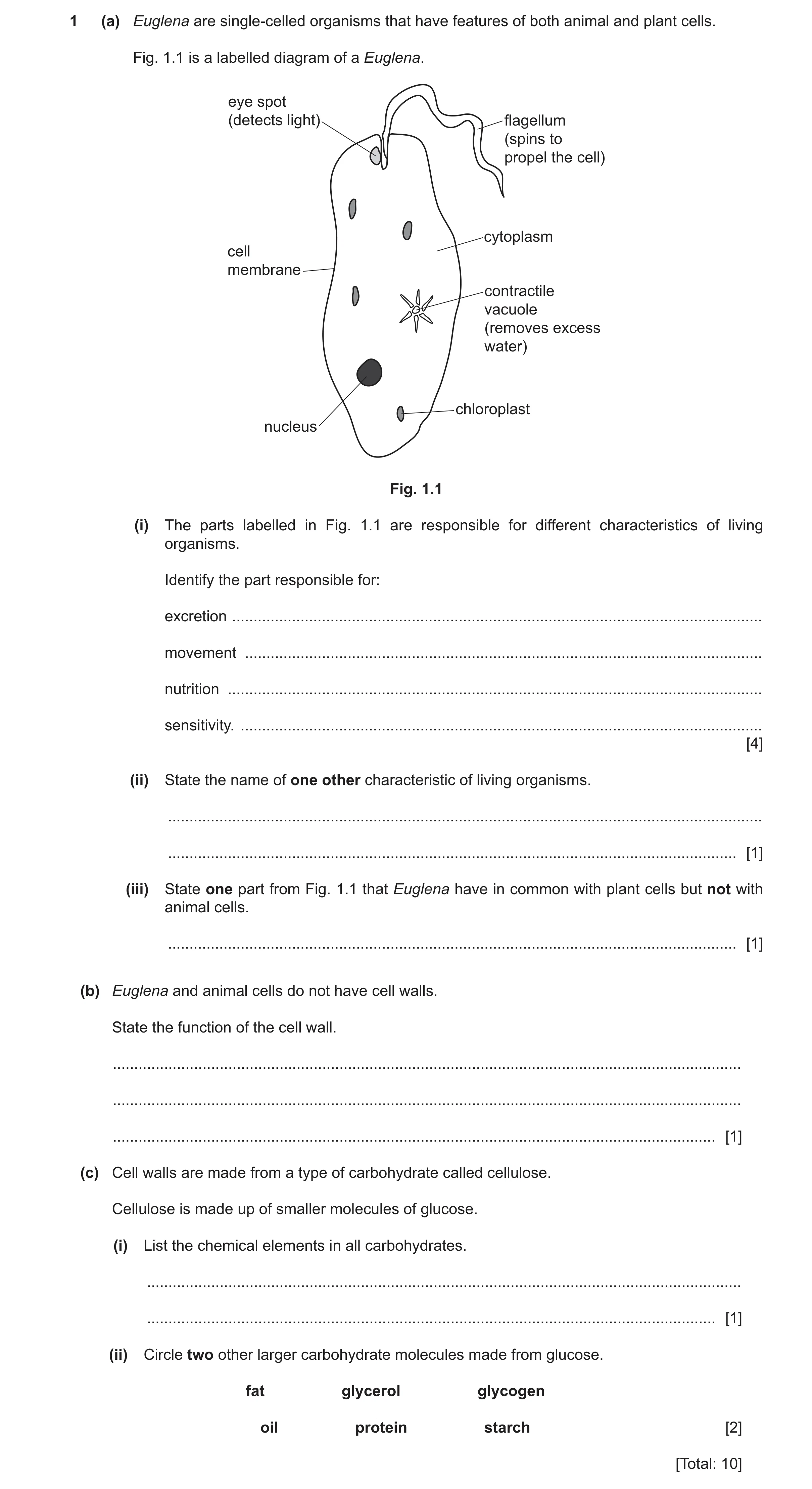
Q22 · Euglena are single-celled organisms that have features of both animal and plant cells 0654/31 Oct/Nov 2024
1 (a) Euglena are single-celled organisms that have features of both animal and plant cells. Fig. 1.1 is a labelled diagram of a Euglena. eye spot (detects light) flagellum (spins to propel the cell) cytoplasm cell membrane contractile vacuole (removes excess water) chloroplast nucleus Fig. 1.1 (i) The parts labelled in Fig. 1.1 are responsible for different characteristics of living organisms. Identify the part responsible for: excretion … movement … nutrition … sensitivity. … [4] (ii) State the name of one other characteristic of living organisms. … … [1] (iii) State one part from Fig. 1.1 that Euglena have in common with plant cells but not with animal cells. … [1] (b) Euglena and animal cells do not have cell walls. State the function of the cell wall. … … … [1] (c) Cell walls are made from a type of carbohydrate called cellulose. Cellulose is made up of smaller molecules of glucose. (i) List the chemical elements in all carbohydrates. … … [1] (ii) Circle two other larger carbohydrate molecules made from glucose. fat glycerol glycogen oil protein starch [2] [Total: 10]
10 marks
Mark scheme: Question Answer Marks 1(a)(i) contractile vacuole ; 4 flagellum ; chloroplast ; eyespot ; 1(a)(ii) respiration / growth / reproduction ; 1 1(a)(iii) chloroplast ; 1 1(b) strengthen cell / AW ; 1 1(c)(i) carbon, hydrogen, oxygen ; 1 1(c)(ii) glycogen circled ; 2 starch circled ;
This question in 0654/31 Oct/Nov 2024
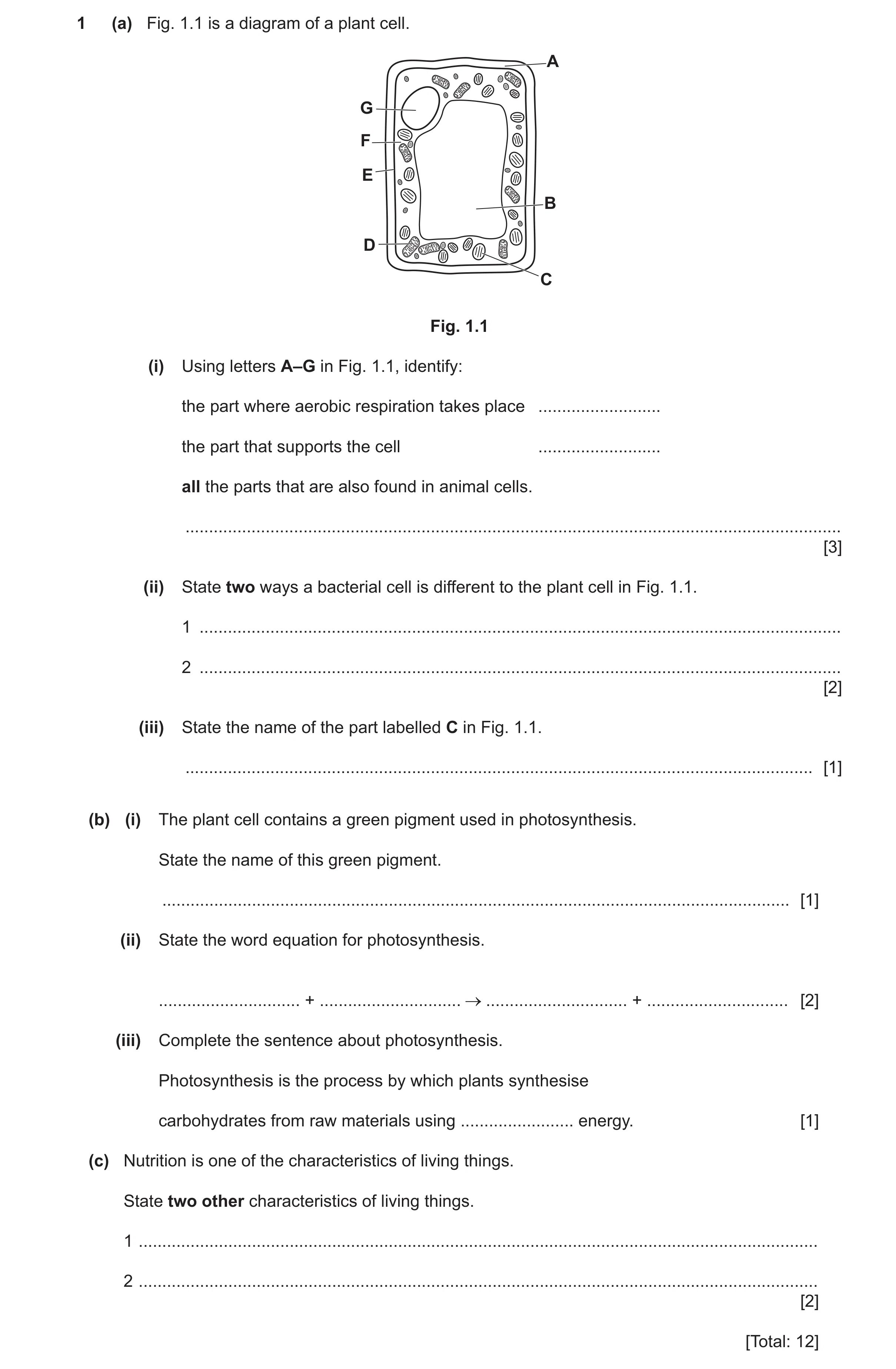
Q23 · A diagram of a plant cell 0654/32 Feb/March 2025
1 (a) Fig. 1.1 is a diagram of a plant cell. A G F E B D C Fig. 1.1 (i) Using letters A–G in Fig. 1.1, identify: the part where aerobic respiration takes place … the part that supports the cell … all the parts that are also found in animal cells. … [3] (ii) State two ways a bacterial cell is different to the plant cell in Fig. 1.1. 1 … 2 … [2] (iii) State the name of the part labelled C in Fig. 1.1. … [1] (b) (i) The plant cell contains a green pigment used in photosynthesis. State the name of this green pigment. … [1] (ii) State the word equation for photosynthesis. … + … … + … [2] (iii) Complete the sentence about photosynthesis. Photosynthesis is the process by which plants synthesise carbohydrates from raw materials using … energy. [1] (c) Nutrition is one of the characteristics of living things. State two other characteristics of living things. 1 … 2 … [2] [Total: 12]
12 marks
Mark scheme: Question Answer Marks 1(a)(i) D ; 3 A or B ; D, E, F and G ; 1(a)(ii) any two from: 2 no nucleus / G no chloroplast / C no mitochondria / D no vacuole / B ;; 1(a)(iii) chloroplast ; 1 1(b)(i) chlorophyll ; 1 1(b)(ii) LHS 2 carbon dioxide + water ; RHS glucose + oxygen ; 1(b)(iii) light ; 1 1(c) any two from: 2 movement respiration sensitivity growth reproduction excretion ;;
This question in 0654/32 Feb/March 2025
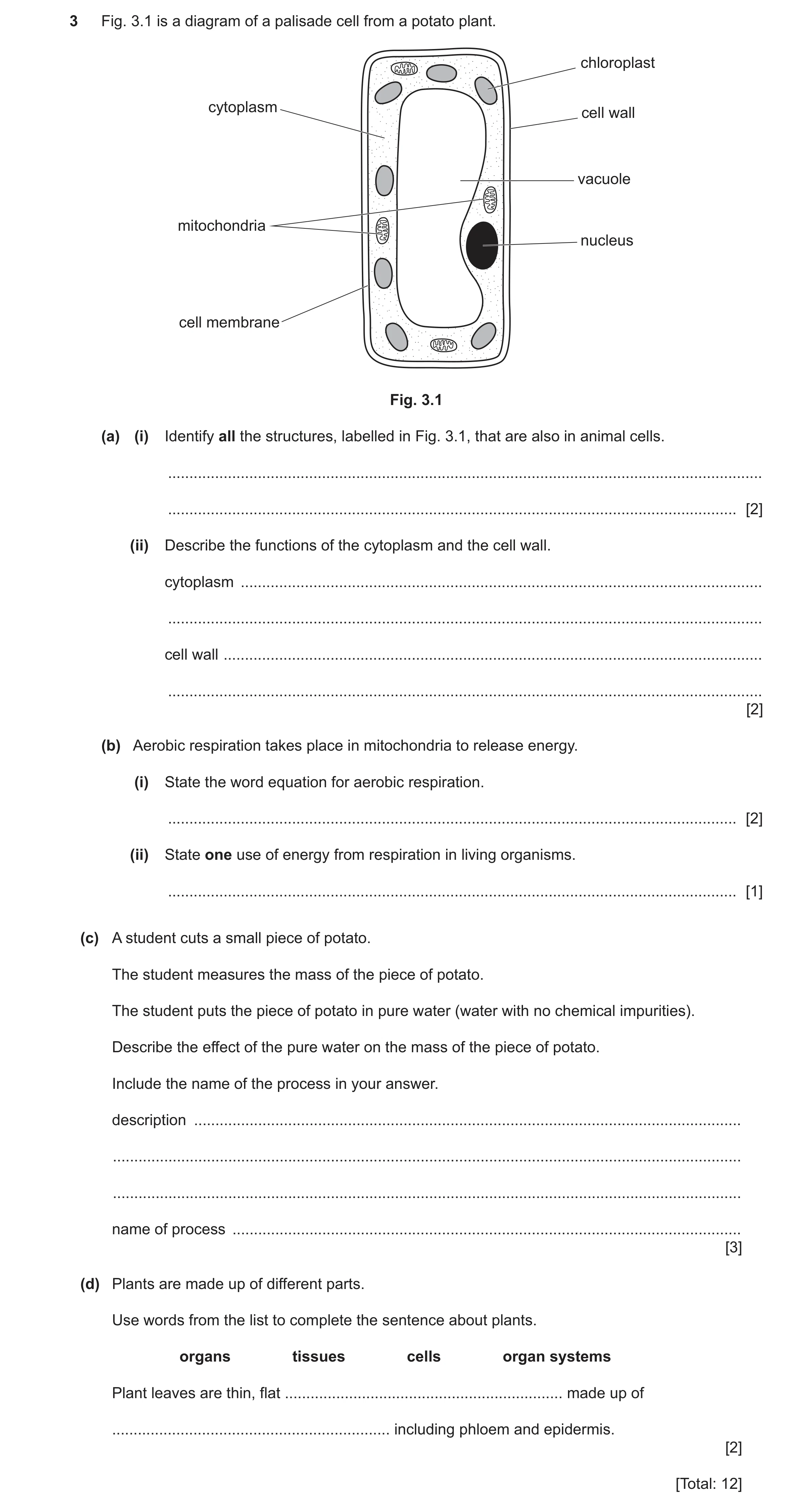
Q24 · A diagram of a palisade cell from a potato plant 0654/31 May/June 2025
3 Fig. 3.1 is a diagram of a palisade cell from a potato plant. chloroplast cytoplasm cell wall vacuole mitochondria nucleus cell membrane Fig. 3.1 (a) (i) Identify all the structures, labelled in Fig. 3.1, that are also in animal cells. … … [2] (ii) Describe the functions of the cytoplasm and the cell wall. cytoplasm … … cell wall … … [2] (b) Aerobic respiration takes place in mitochondria to release energy. (i) State the word equation for aerobic respiration. … [2] (ii) State one use of energy from respiration in living organisms. … [1] (c) A student cuts a small piece of potato. The student measures the mass of the piece of potato. The student puts the piece of potato in pure water (water with no chemical impurities). Describe the effect of the pure water on the mass of the piece of potato. Include the name of the process in your answer. description … … … name of process … [3] (d) Plants are made up of different parts. Use words from the list to complete the sentence about plants. organs tissues cells organ systems Plant leaves are thin, flat … made up of … including phloem and epidermis. [2] [Total: 12]
12 marks
Mark scheme: 3(a)(i) cell membrane 2 nucleus cytoplasm mitochondria ;; 3(a)(ii) (cytoplasm) site of, metabolic / chemical, reactions / AW ; 2 (cell wall) protects / supports, (the cell) ; 3(b)(i) glucose + oxygen → carbon dioxide + water 2 1 mark for correct reactants (either order) ; 1 mark for correct products (either order) ; 3(b)(ii) protein synthesis / cell division / growth / muscle contraction / passage of nerve impulses / maintenance of constant body 1 temperature / active transport; 3(c) water move into, tissue / potato ; 3 mass will increase / AW ; osmosis ; 3(d) organs ; 2 tissues ;
This question in 0654/31 May/June 2025
 1 / 32
 2 / 32
 3 / 32
![Question 4: Fig. 1.1 shows a diagram of a palisade cell. Fig. 1.1 (a) On Fig. 1.1, use label lines to label the: • nucleus • cytoplasm. [2] (b) Describ…](https://img.pastlit.com/crops/dc75ffe3-b431-4aae-b524-798876e6d157/q1.webp) 4 / 32
4 / 32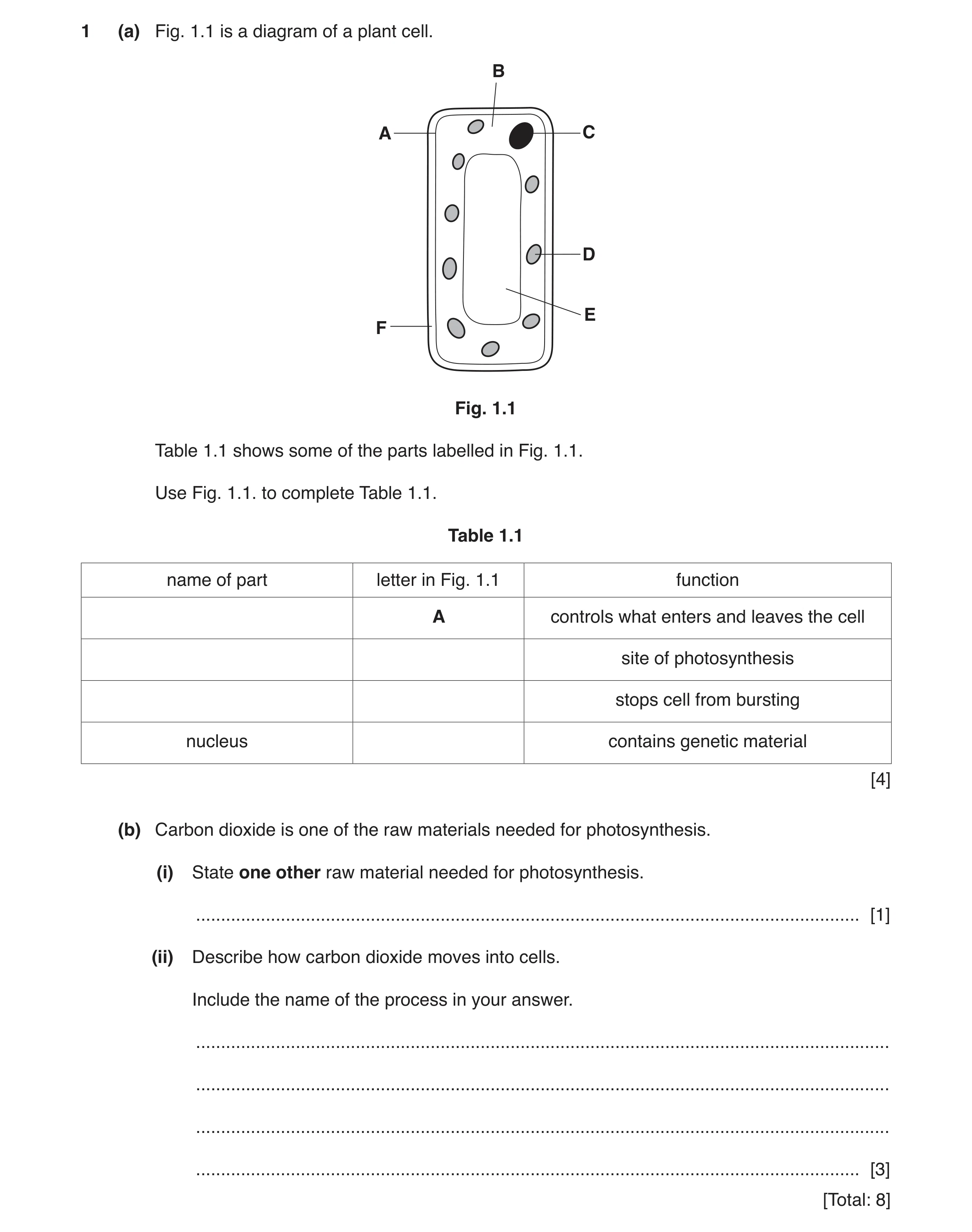 5 / 32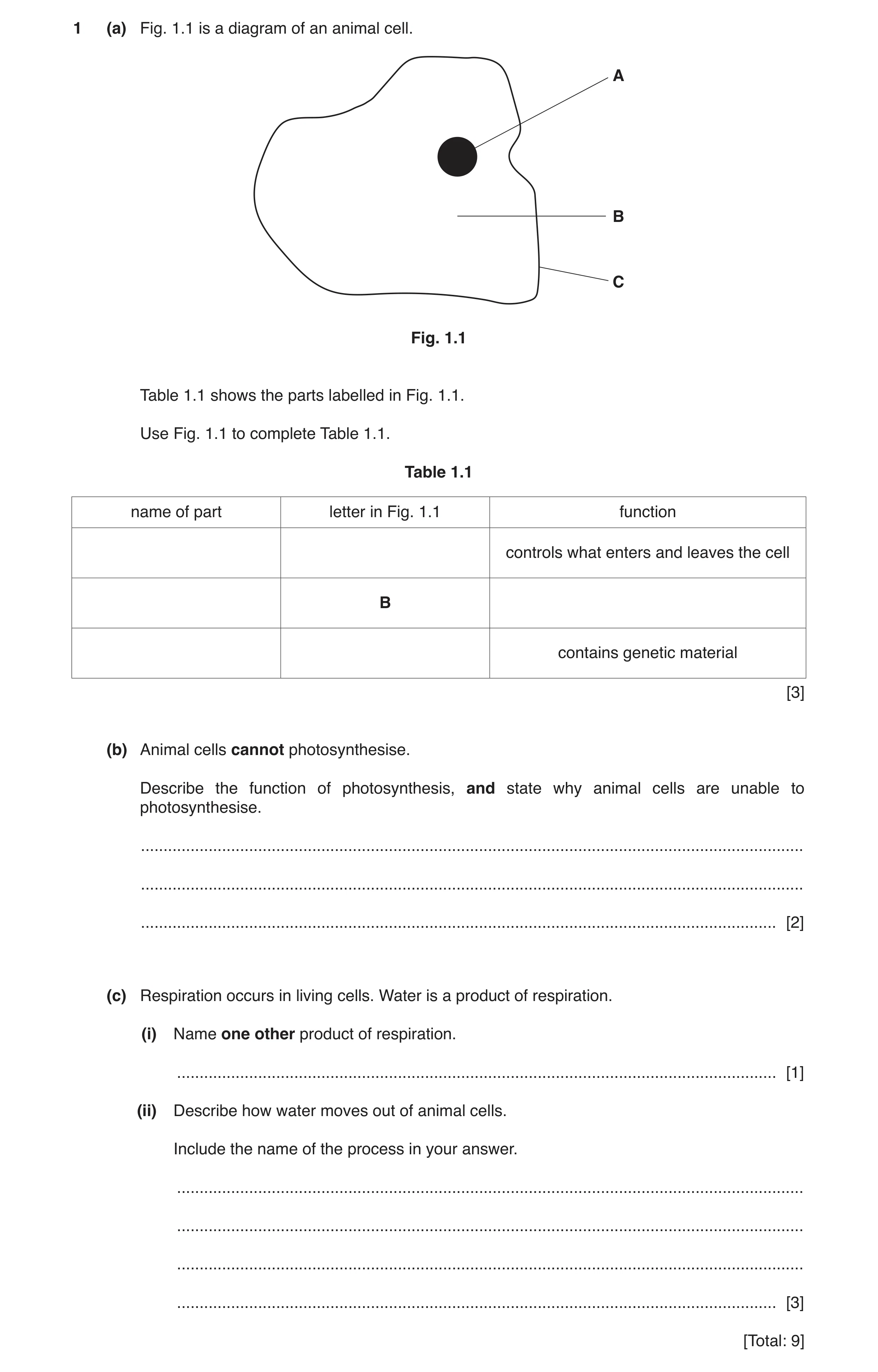
 25 / 32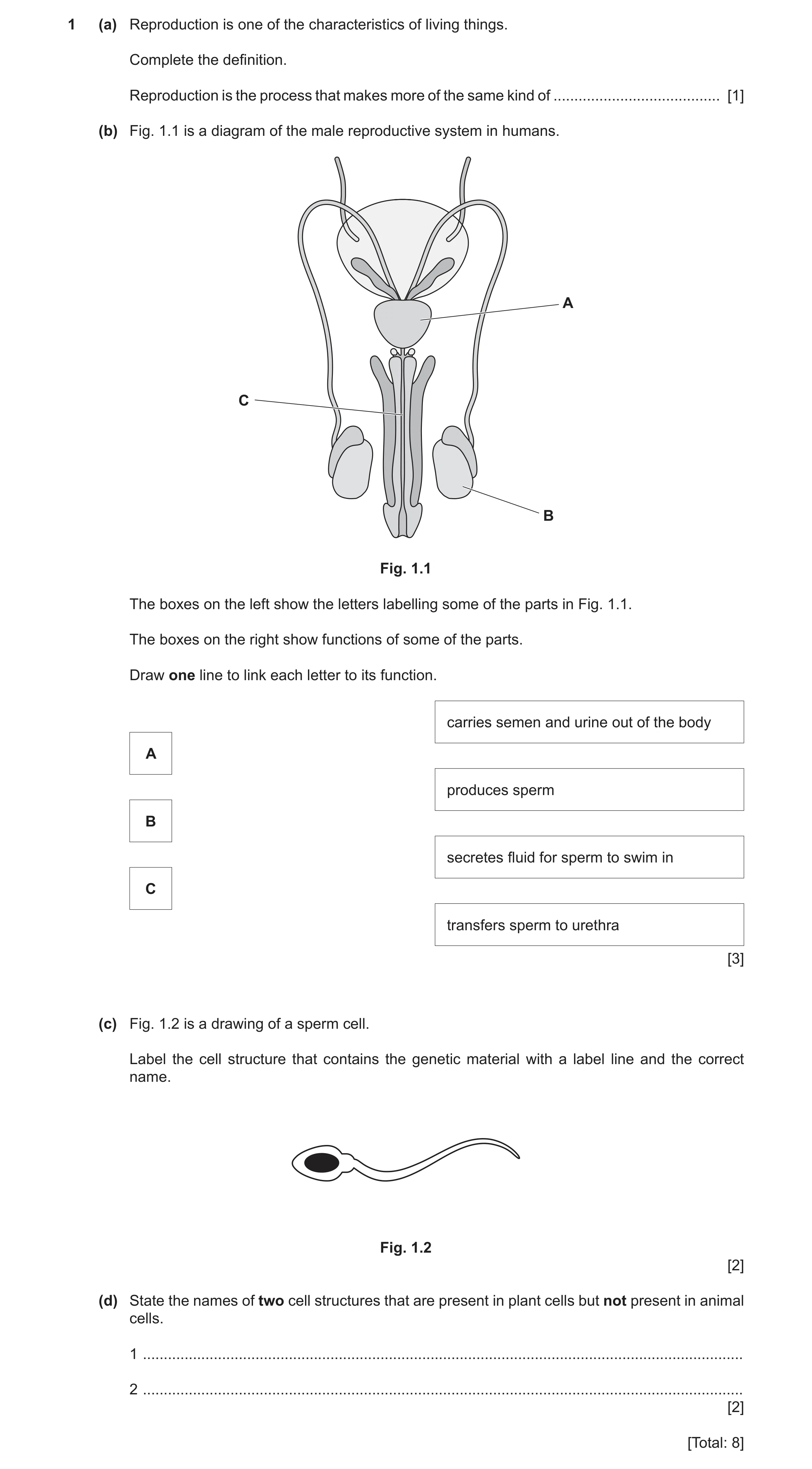
 8
8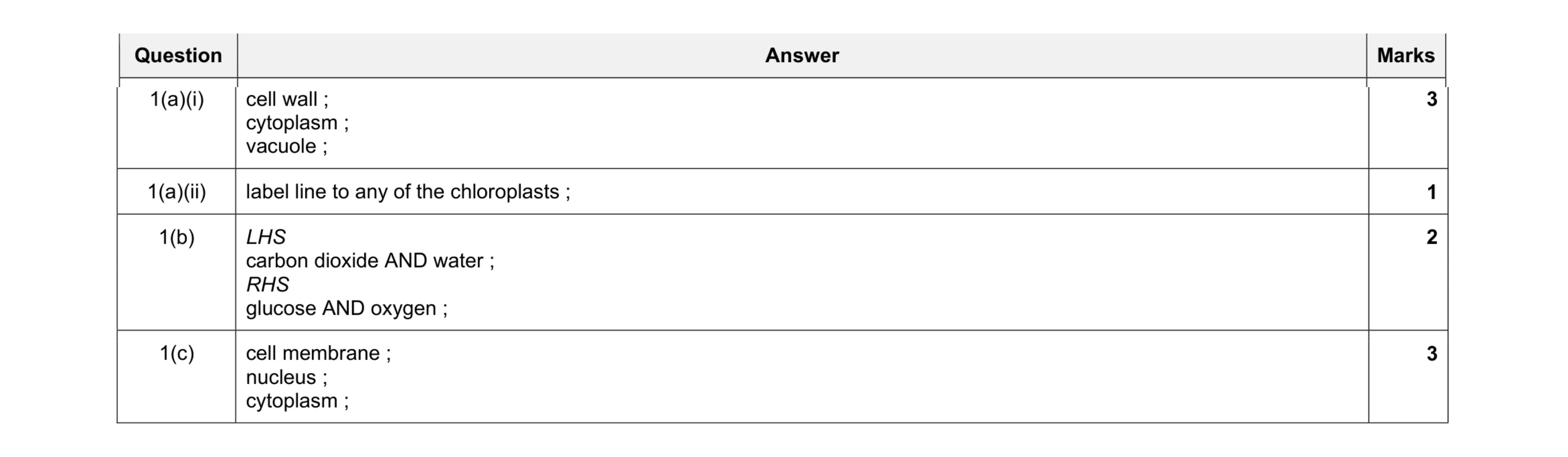 9
9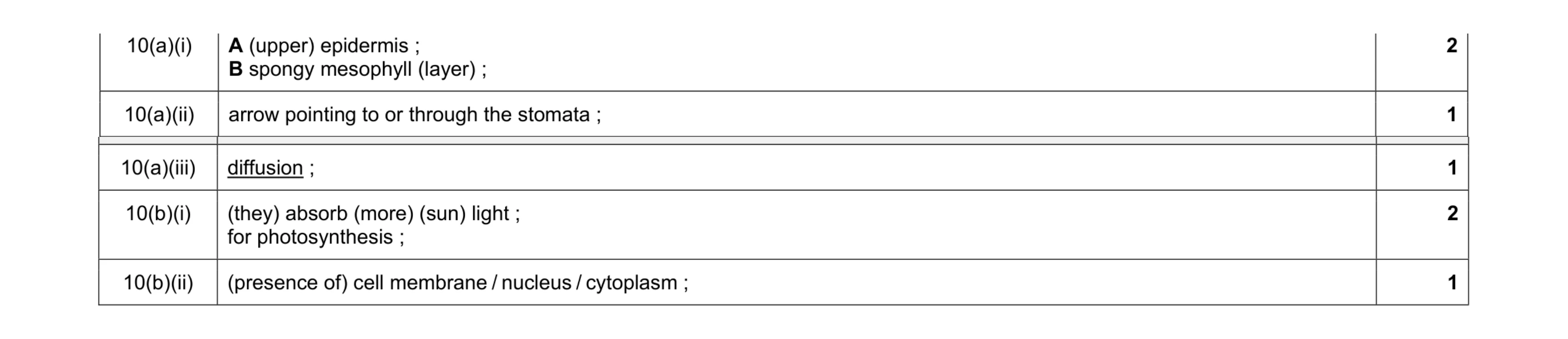 7
7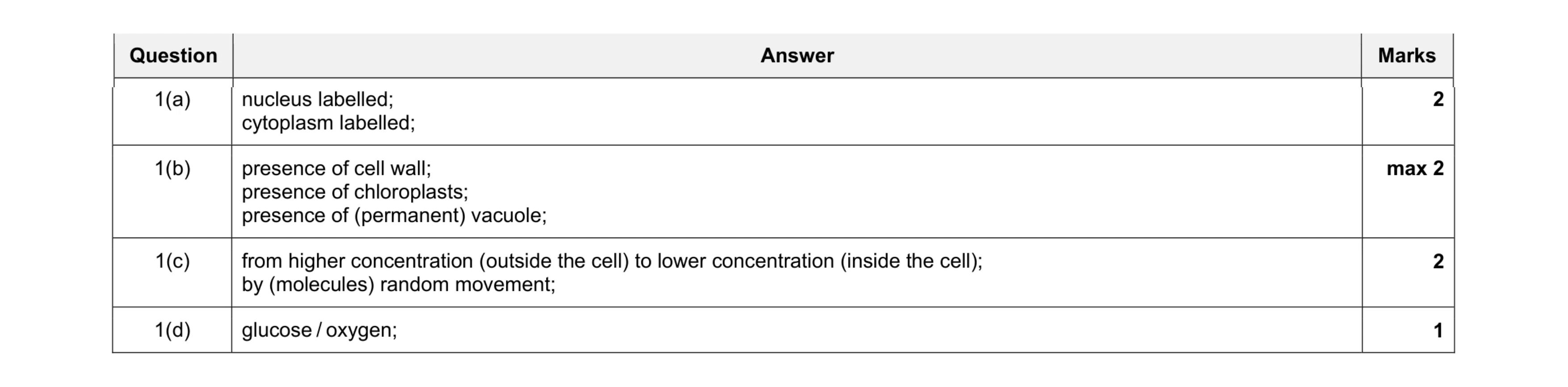 7
7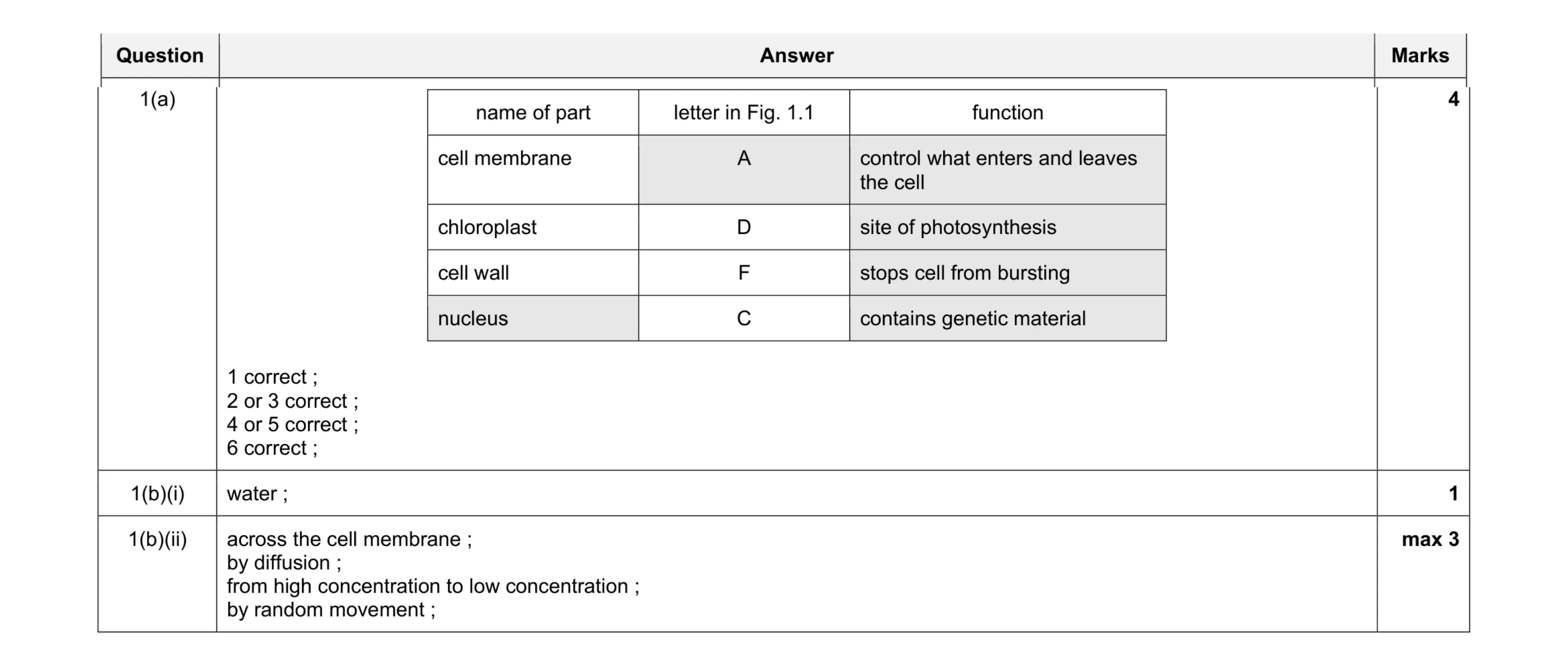 8
8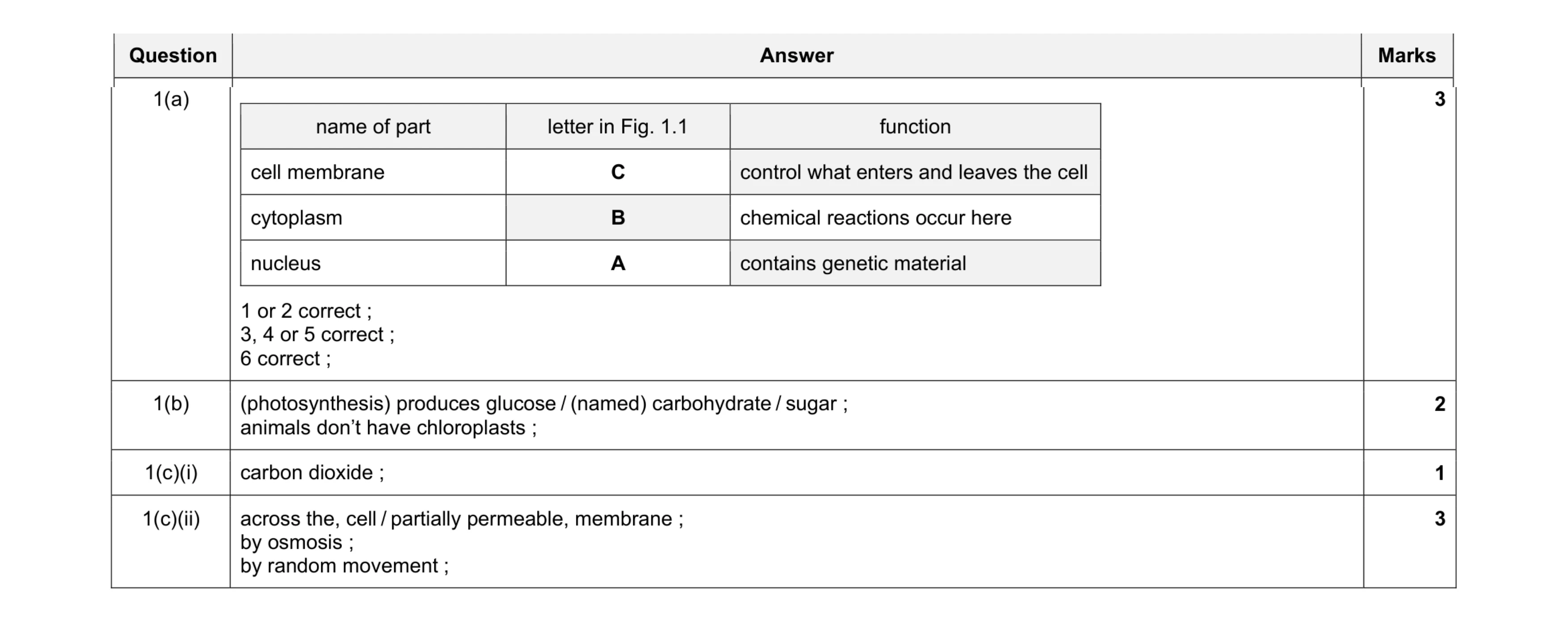 9
9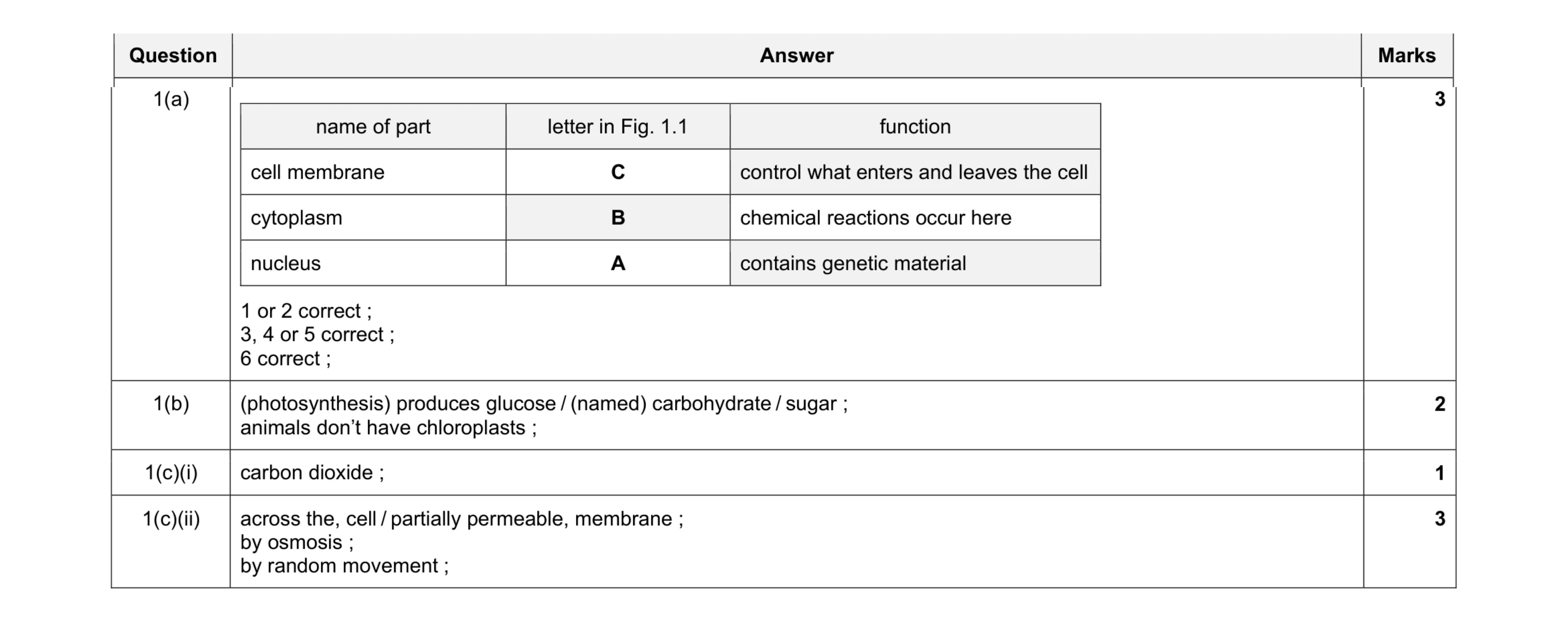 9
9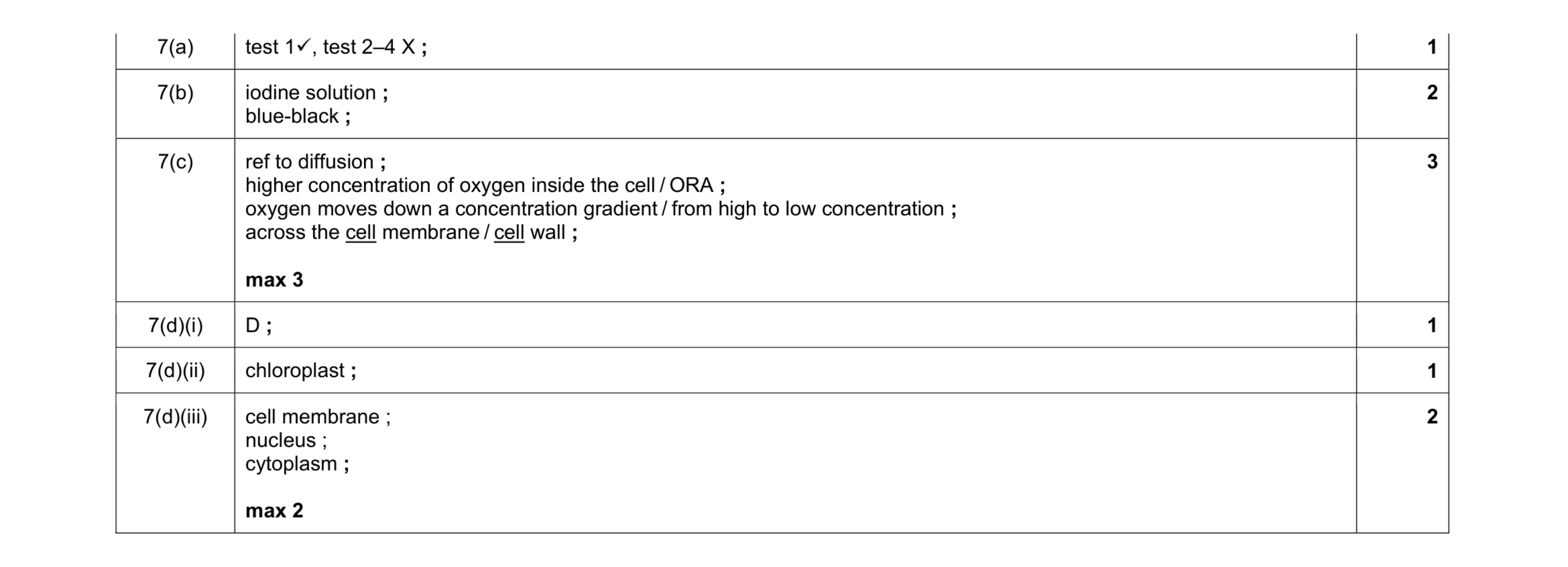 10
10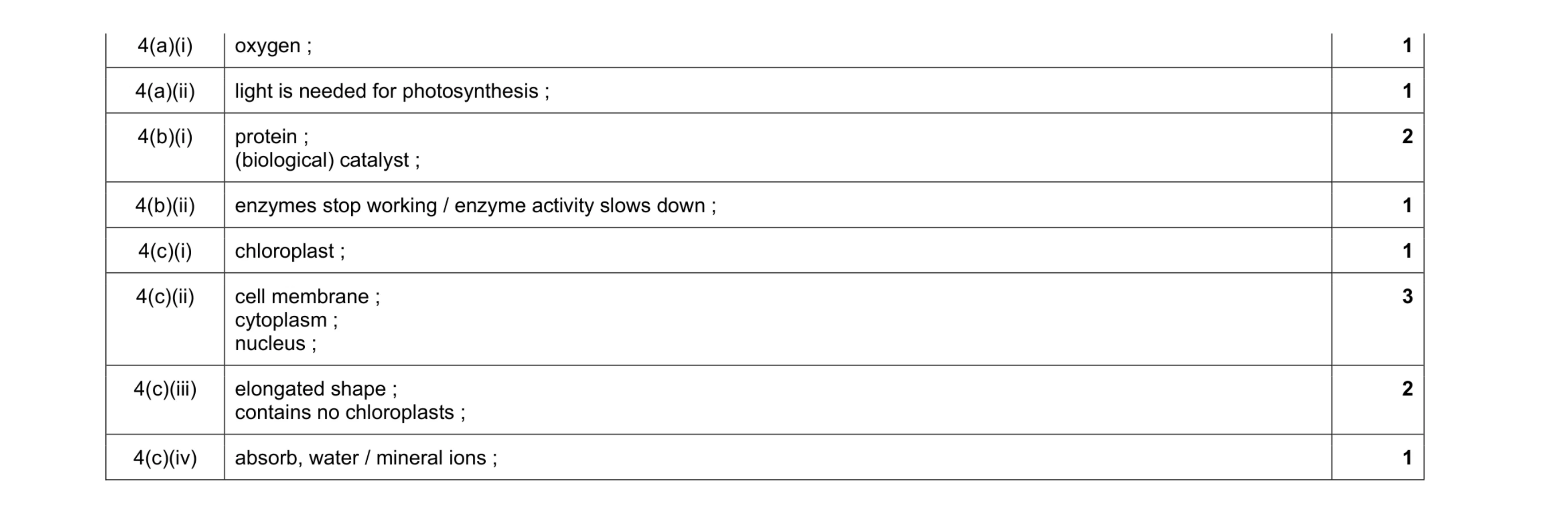 12
12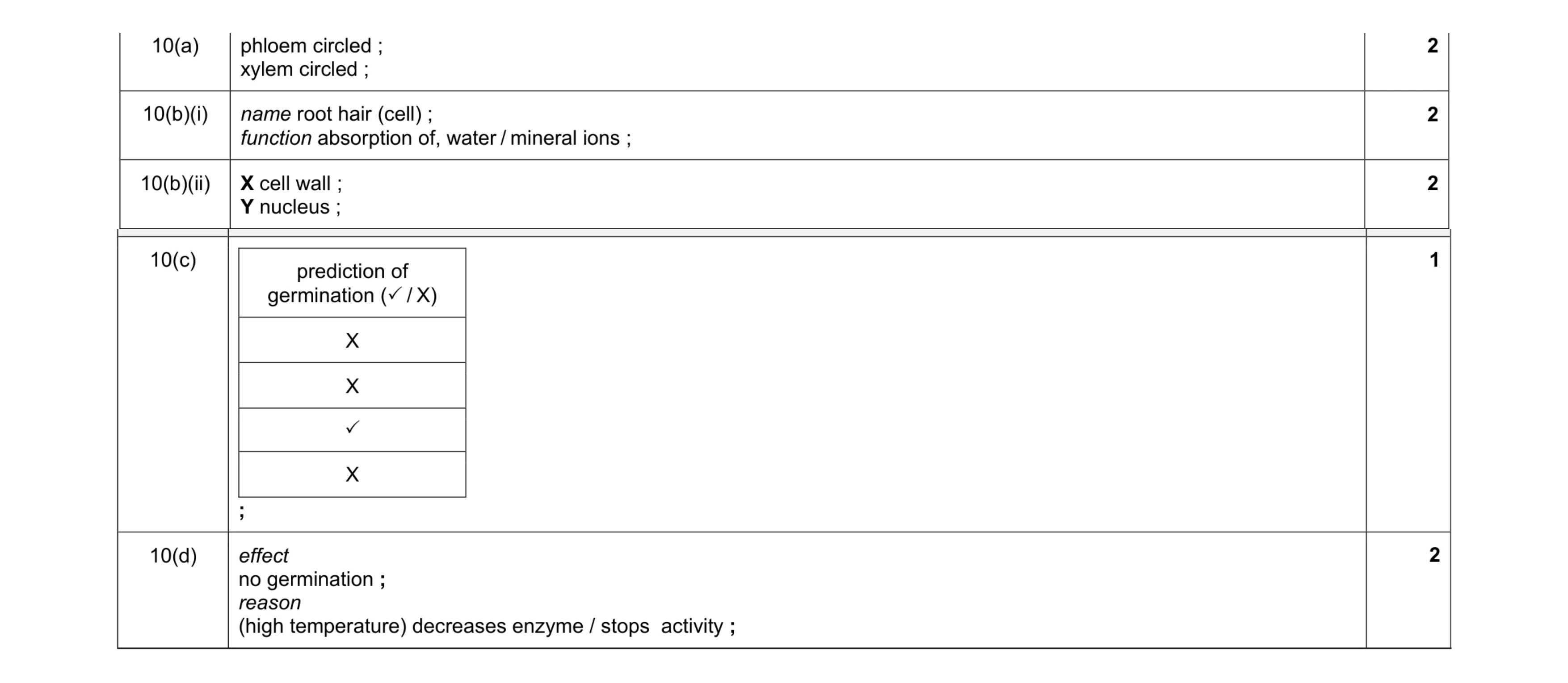 9
9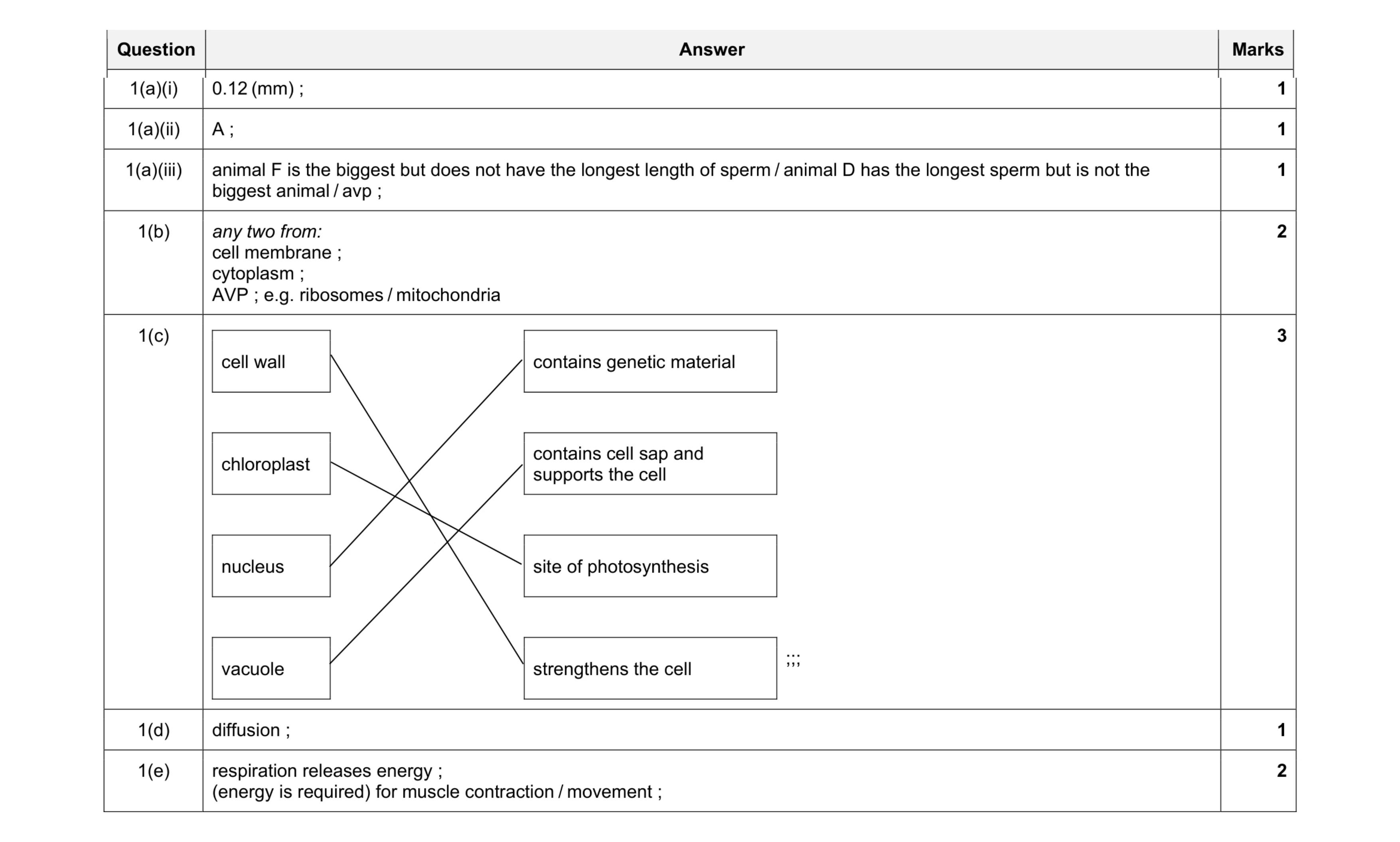 11
11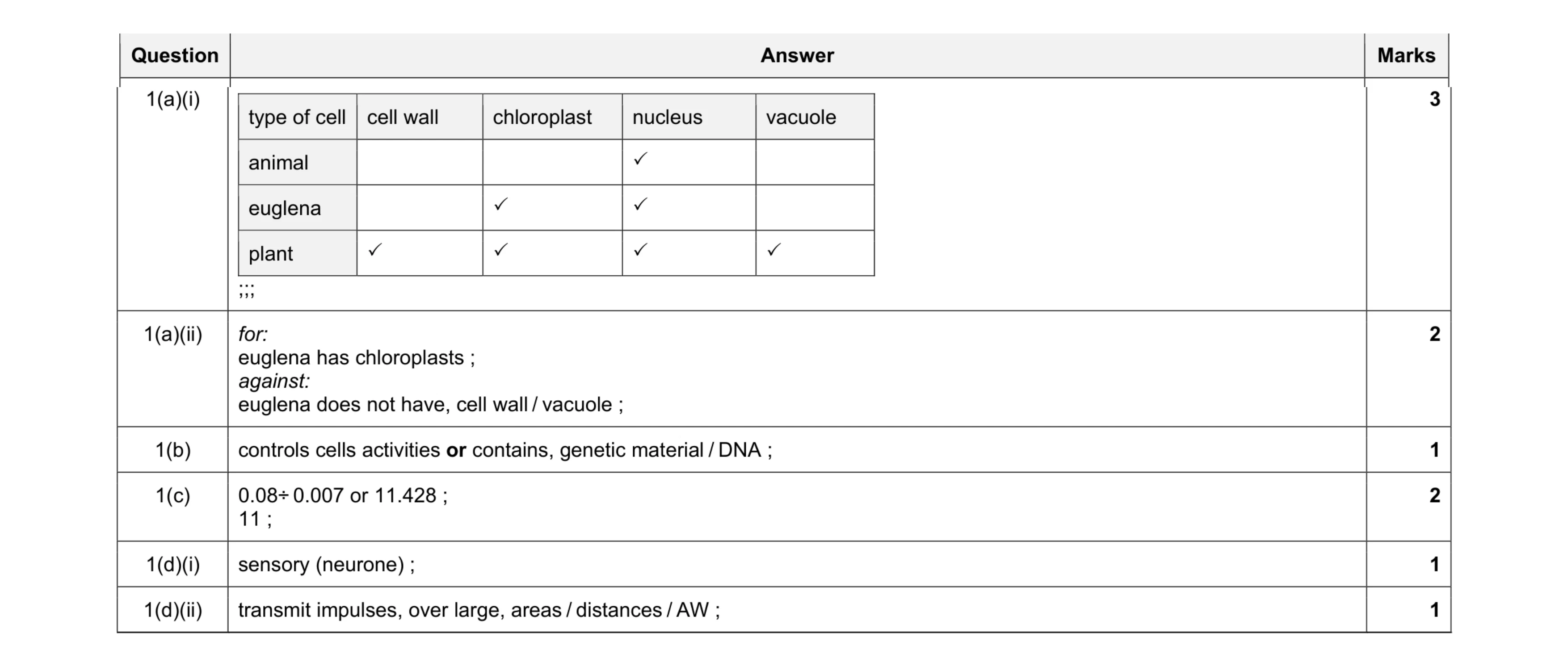 10
10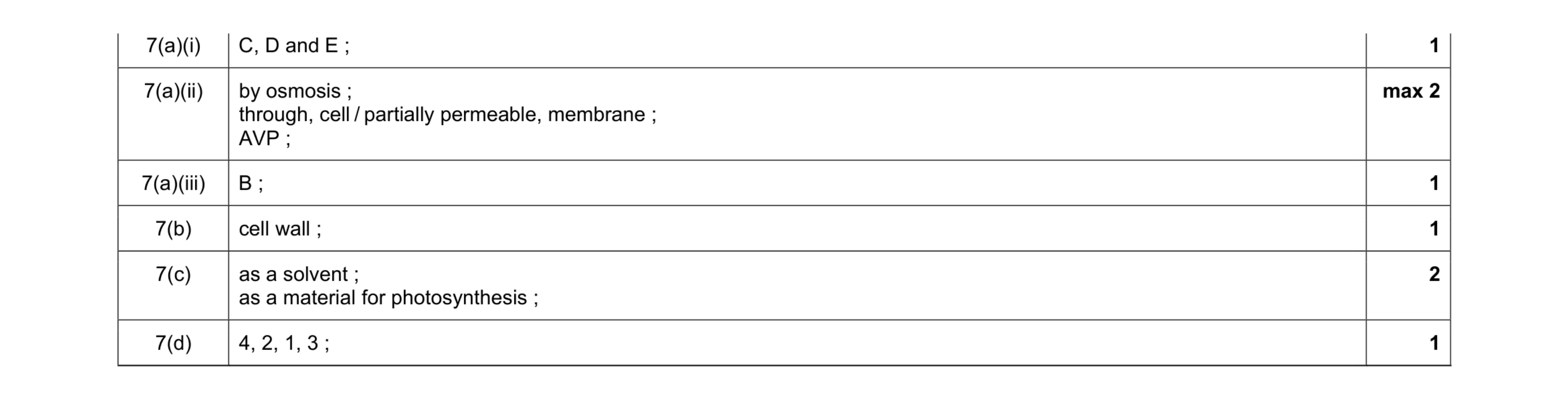 8
8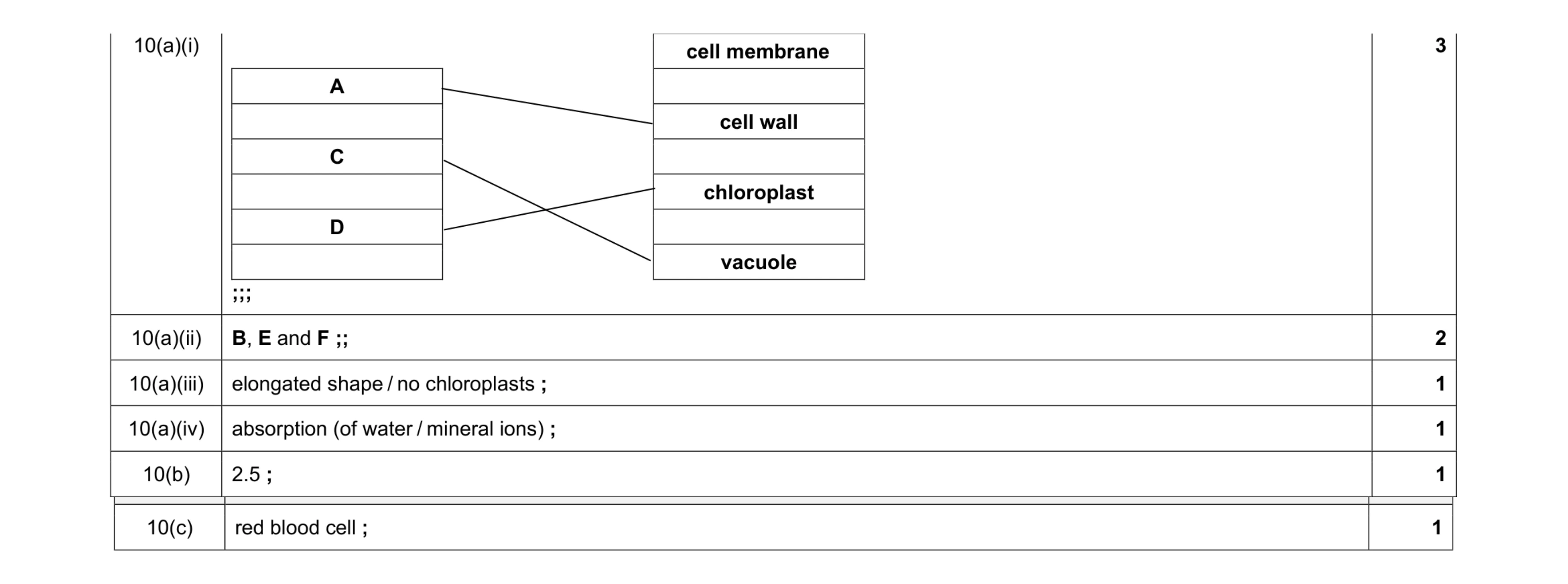 9
9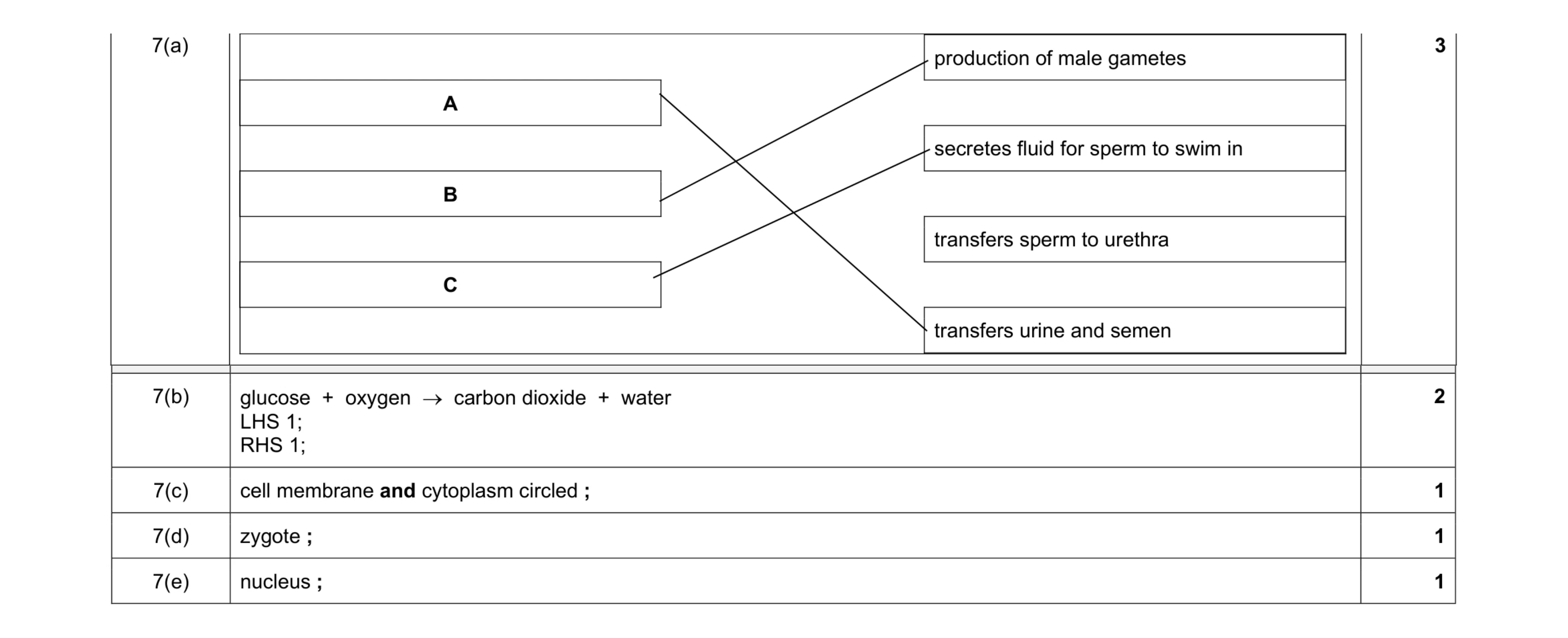 8
8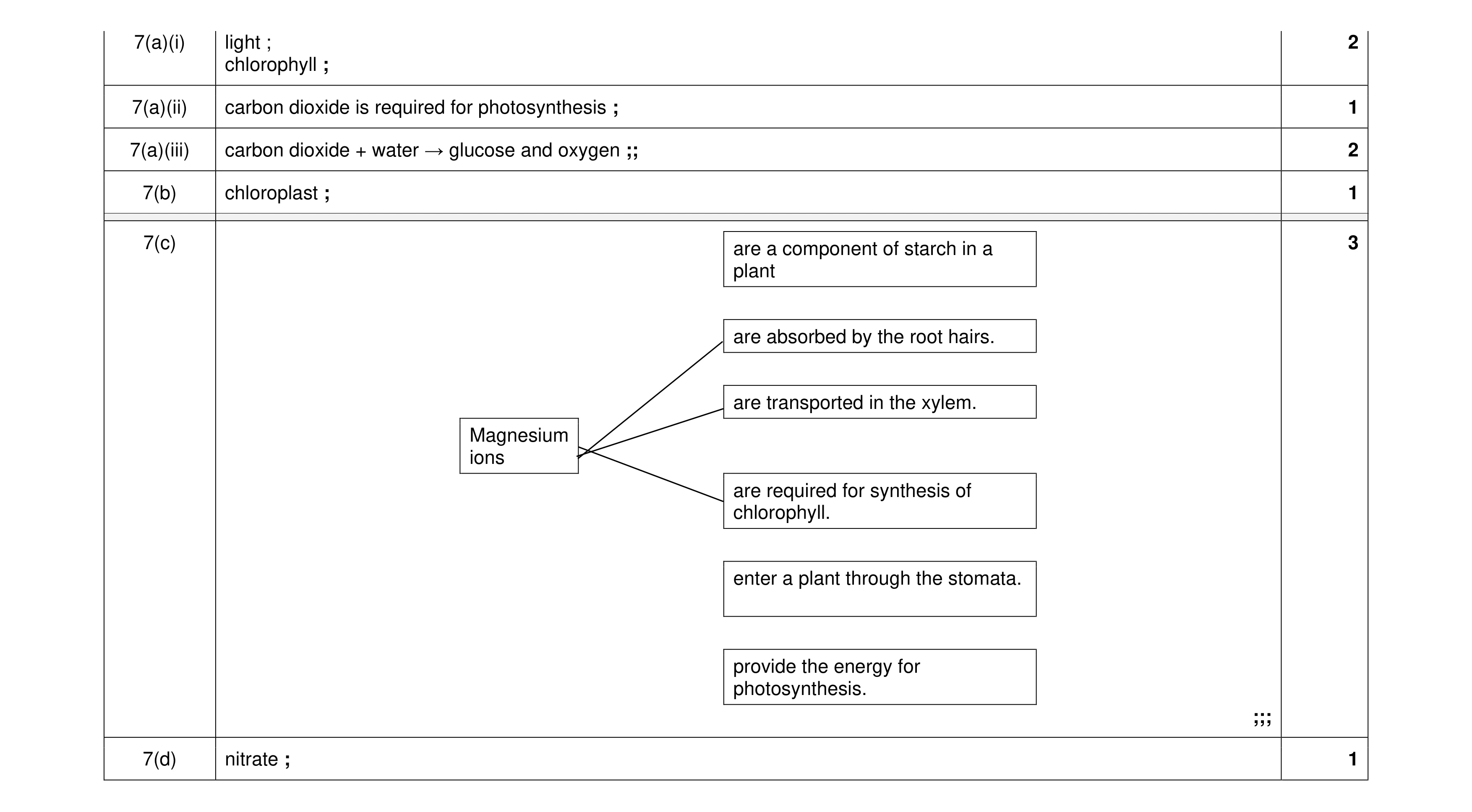 10
10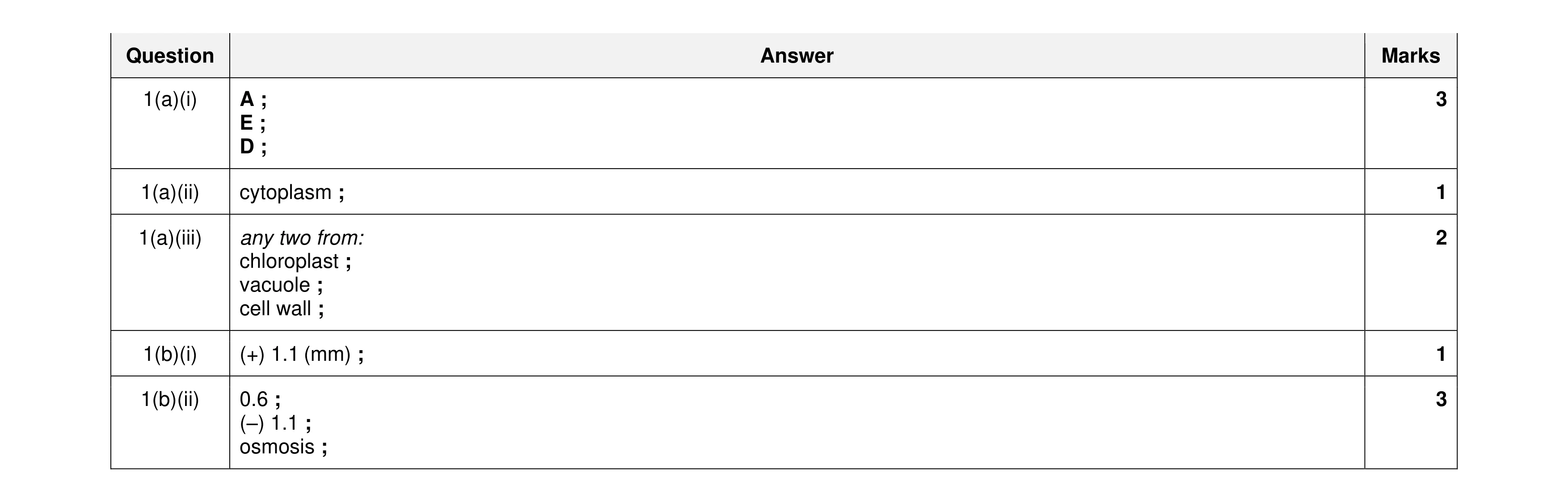 10
10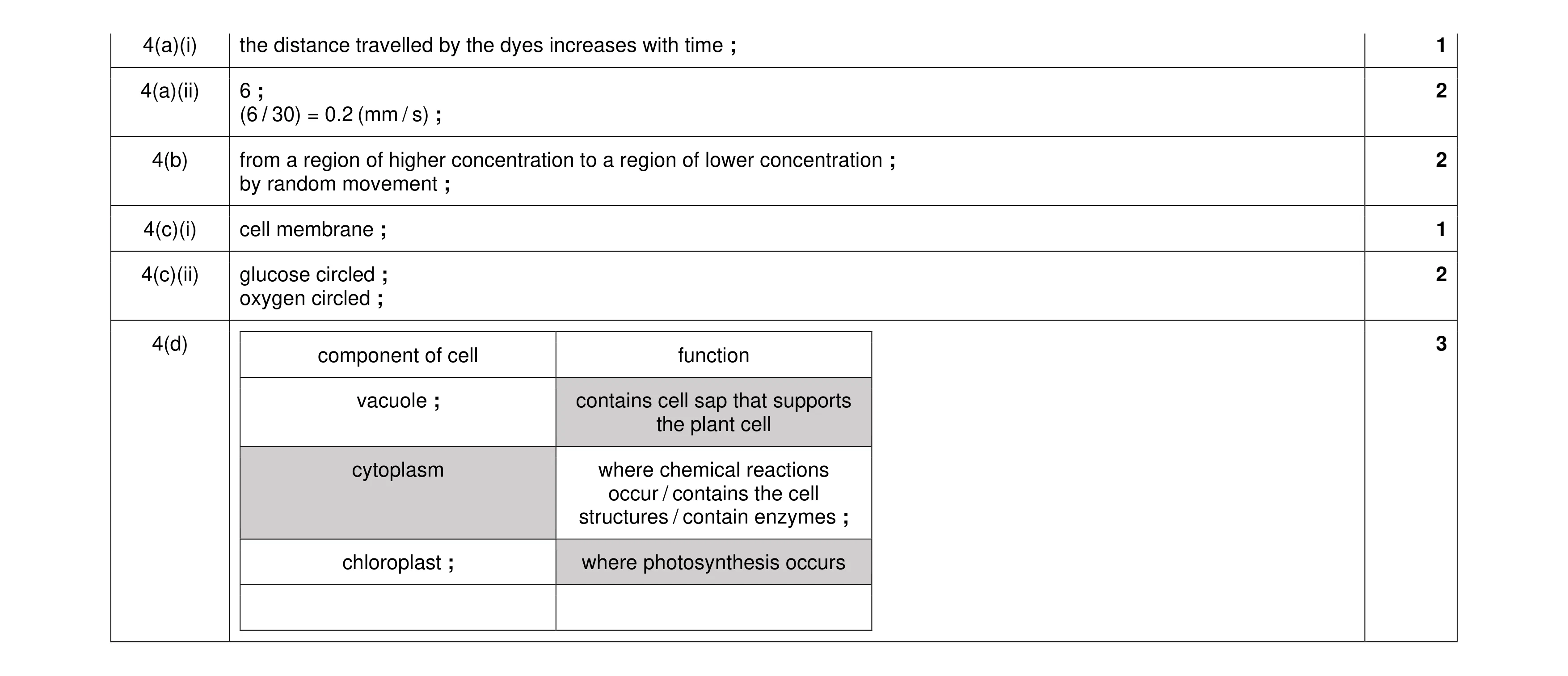 11
11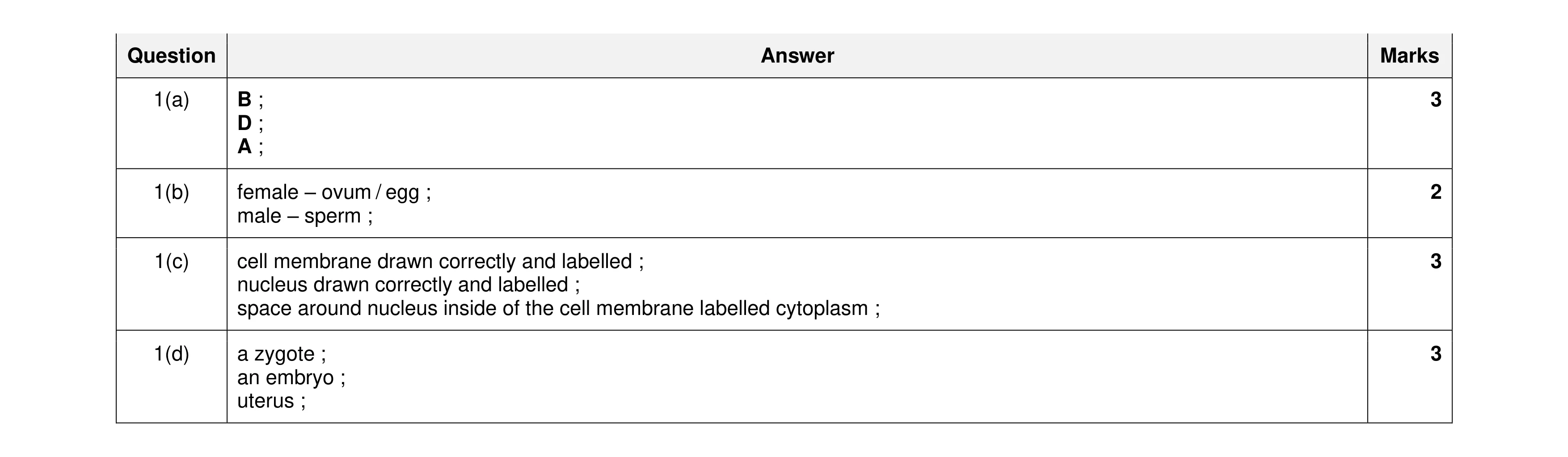 11
11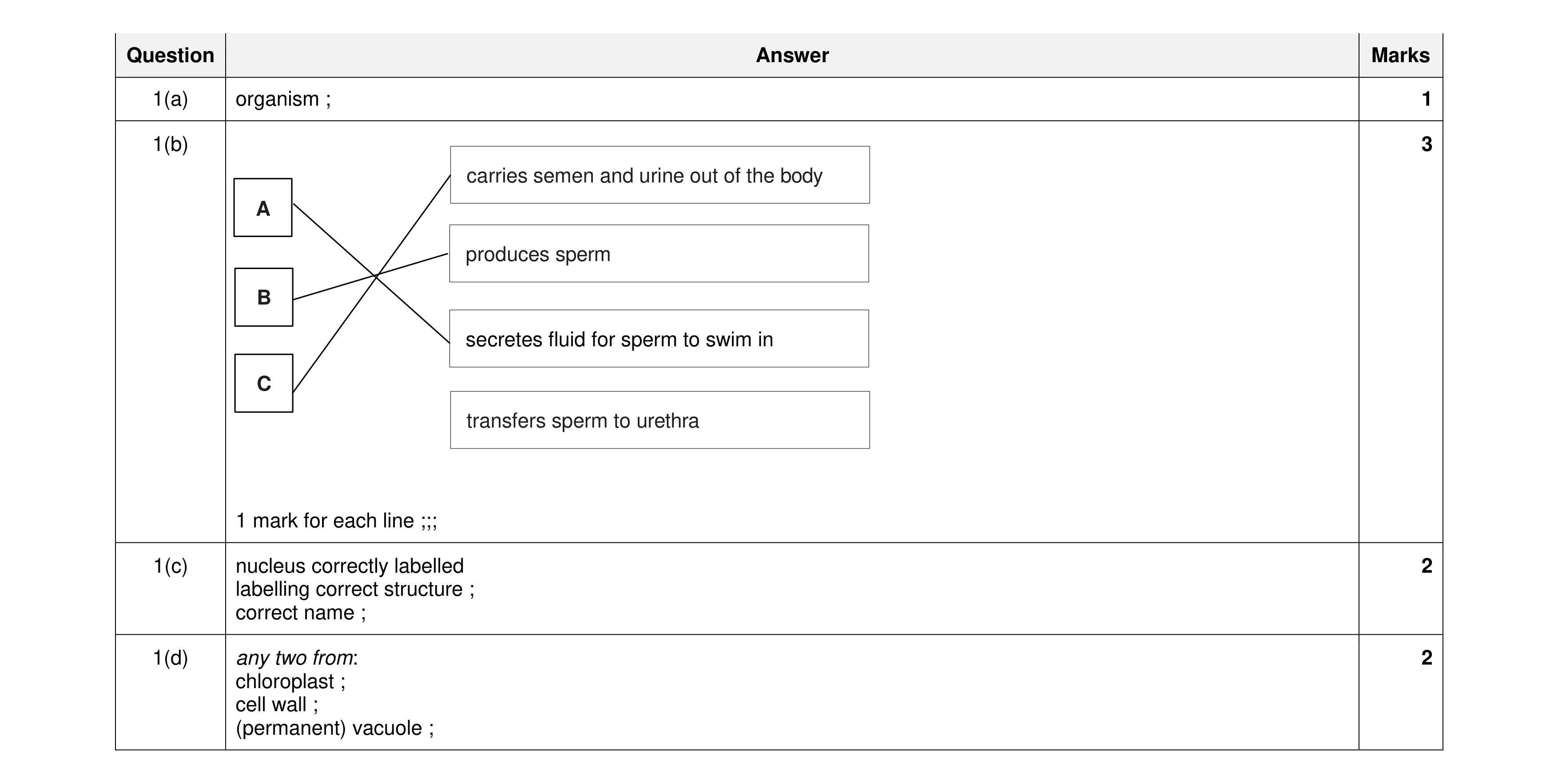 8
8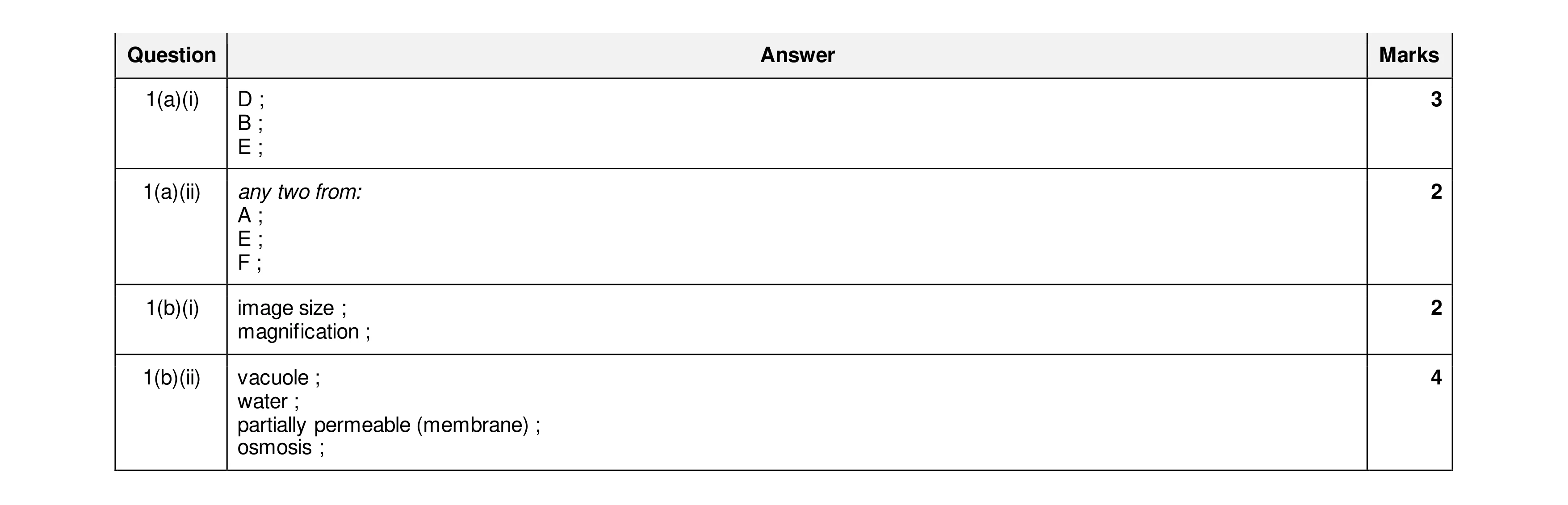 11
11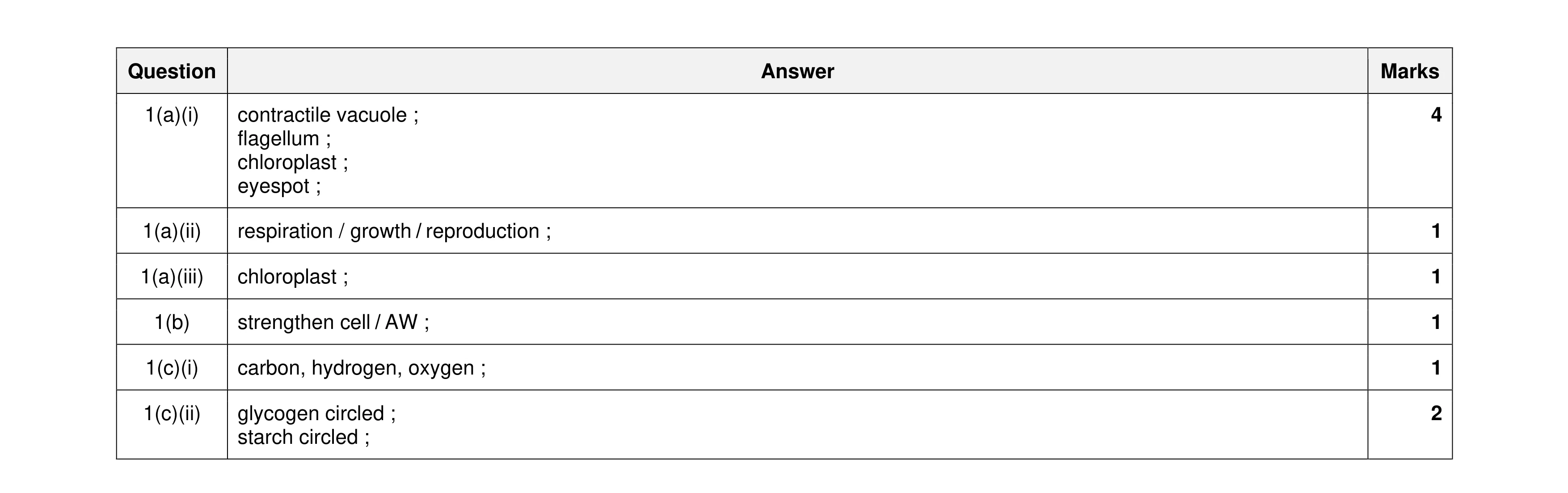 10
10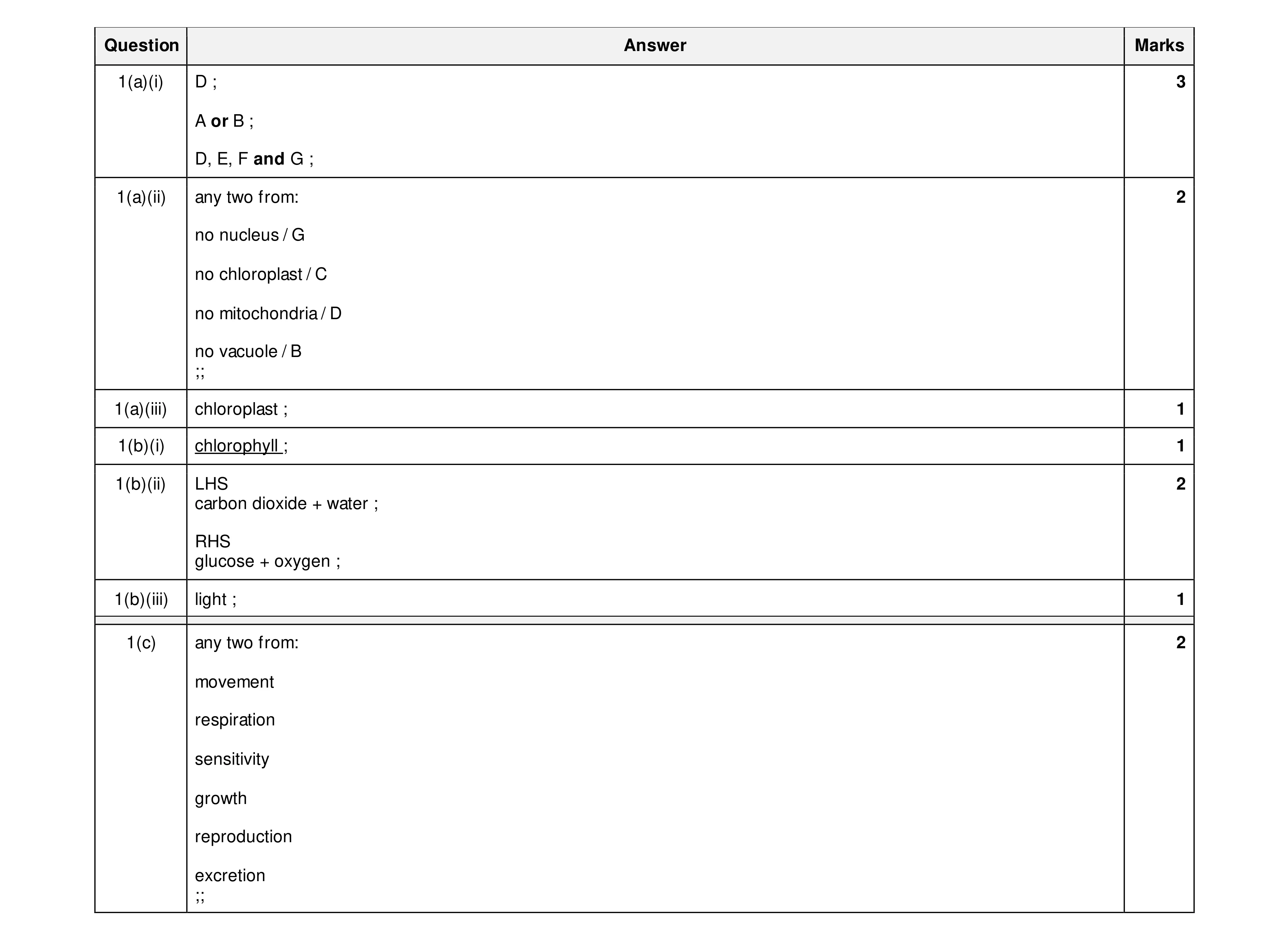 12
12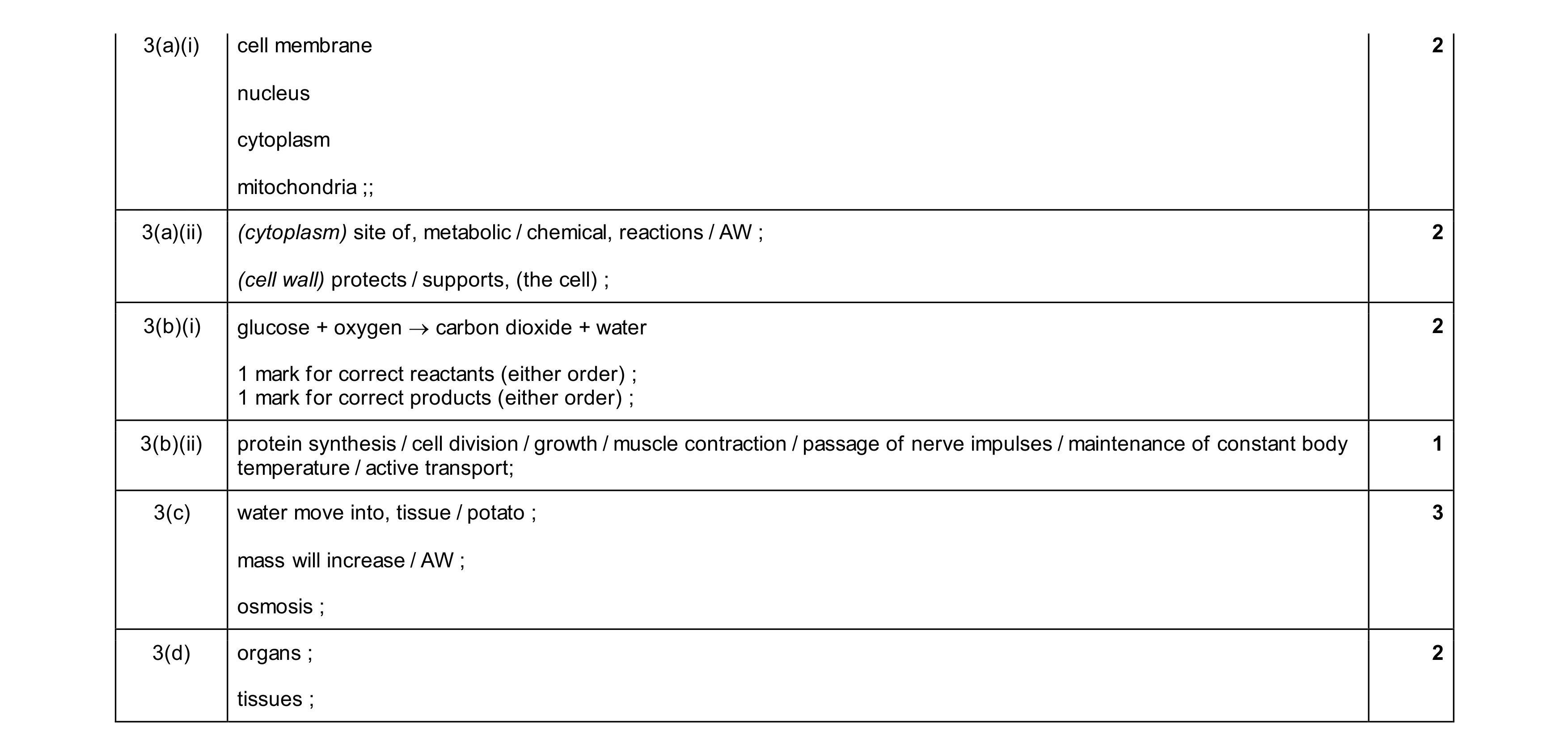 12
12