Questions as text
Q1 · Methane, CH4, and butane, C4H10, are both alkanes 0653/42 Feb/March 2017
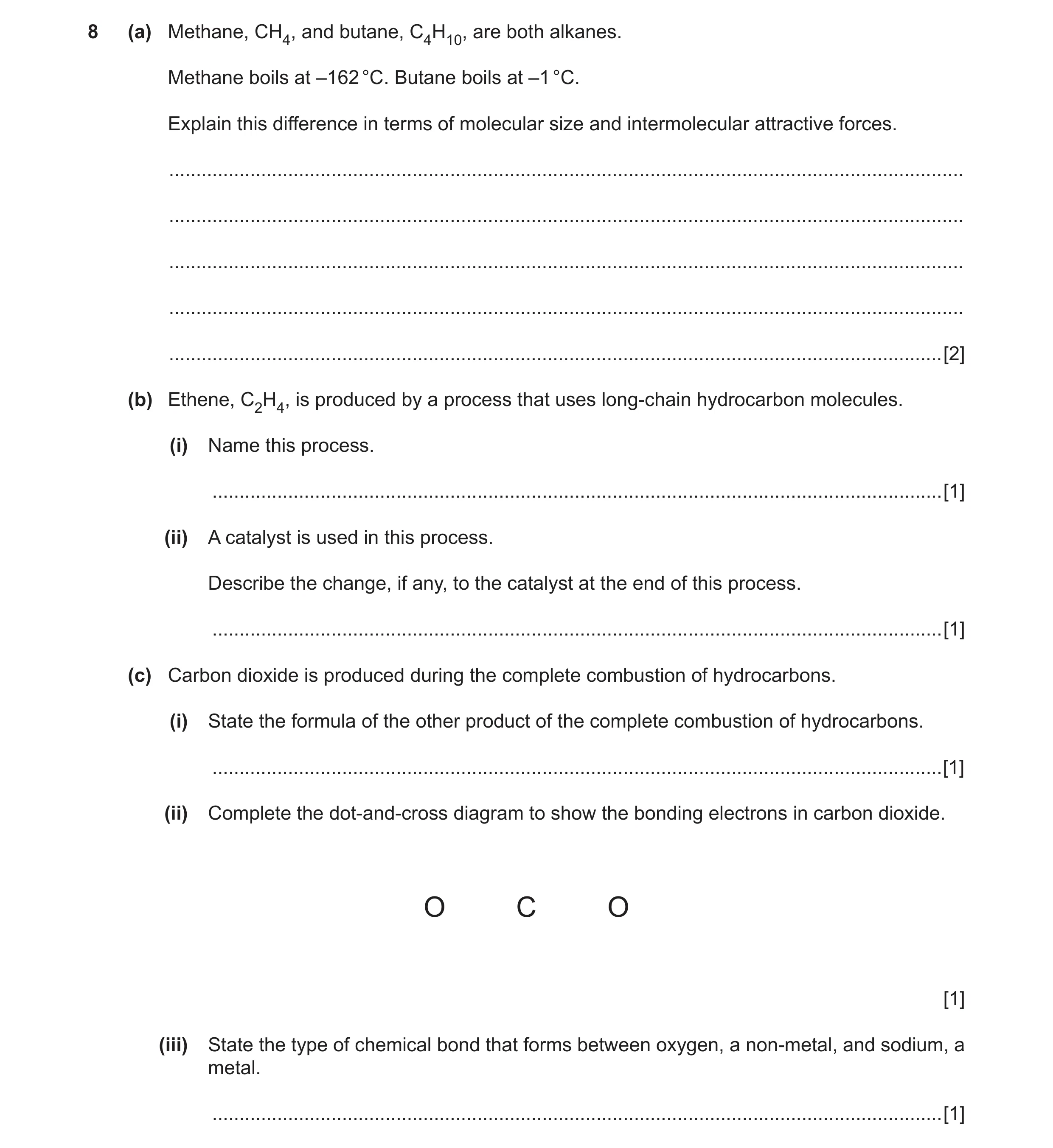
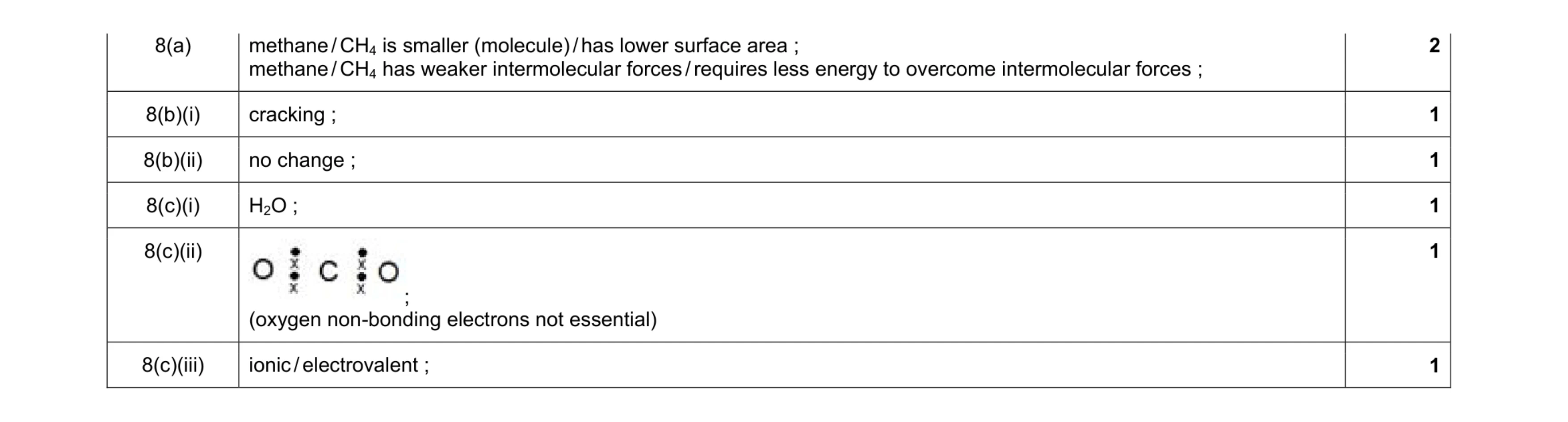
8 (a) Methane, CH4, and butane, C4H10, are both alkanes. Methane boils at –162 °C. Butane boils at –1 °C. Explain this difference in terms of molecular size and intermolecular attractive forces. … … … … … [2] (b) Ethene, C2H4, is produced by a process that uses long-chain hydrocarbon molecules. (i) Name this process. … [1] (ii) A catalyst is used in this process. Describe the change, if any, to the catalyst at the end of this process. … [1] (c) Carbon dioxide is produced during the complete combustion of hydrocarbons. (i) State the formula of the other product of the complete combustion of hydrocarbons. … [1] (ii) Complete the dot-and-cross diagram to show the bonding electrons in carbon dioxide. O C O [1] (iii) State the type of chemical bond that forms between oxygen, a non-metal, and sodium, a metal. … [1]
7 marks
Mark scheme: 8(a) methane / CH4 is smaller (molecule) / has lower surface area ; methane / CH4 has weaker intermolecular forces / requires less energy to overcome intermolecular forces ; 2 8(b)(i) cracking ; 1 8(b)(ii) no change ; 1 8(c)(i) H2O ; 1 8(c)(ii) ; (oxygen non-bonding electrons not essential) 1 8(c)(iii) ionic / electrovalent ; 1
This question in 0653/42 Feb/March 2017
Q2 · Ethane and octane are obtained from petroleum by fractional distillation 0653/43 May/June 2017
2 (a) Ethane and octane are obtained from petroleum by fractional distillation. The structures of a molecule of ethane and a molecule of octane are shown in Fig. 2.1. H H H H H H H H H H H C C H H C C C C C C C C H H H H H H H H H H H ethane octane Fig. 2.1 (i) State the formula of octane. … [1] (ii) Different fractions obtained from petroleum contain different amounts of ethane and octane. Explain why a fraction formed higher up the fractional distillation column contains more ethane than octane. Use ideas about molecular size, boiling points and intermolecular attractive forces in your answer. … … … … … … [3] (b) Ethene molecules are made from large hydrocarbon molecules. Name this process. … [1] (c) Ethane, ethene and octane are hydrocarbons. Identify the type of each of these hydrocarbons. ethane … ethene … octane … [2] (d) Complete the diagram below to show the bonding electrons in a molecule of ethene, C2H4. Use dots and crosses to represent the electrons. C C [2]
9 marks
Mark scheme: 2(a)(i) C8H18 ; allow H18C8 1 2(a)(ii) (higher up) lower boiling point ; smaller molecules ; lower intermolecular forces ; 3 2(b) cracking ; 1 2(c) (ethene) alkene / unsaturated ; both (ethane) and (octane) alkane / saturated ; 2 2(d) 2 pairs between carbon ; 1 pair between each H and C ; (whether dots or crosses does not affect marks) 2
This question in 0653/43 May/June 2017
Q3 · Catalytic cracking breaks down large saturated hydrocarbon molecules into smaller… 0653/42 May/June 2019
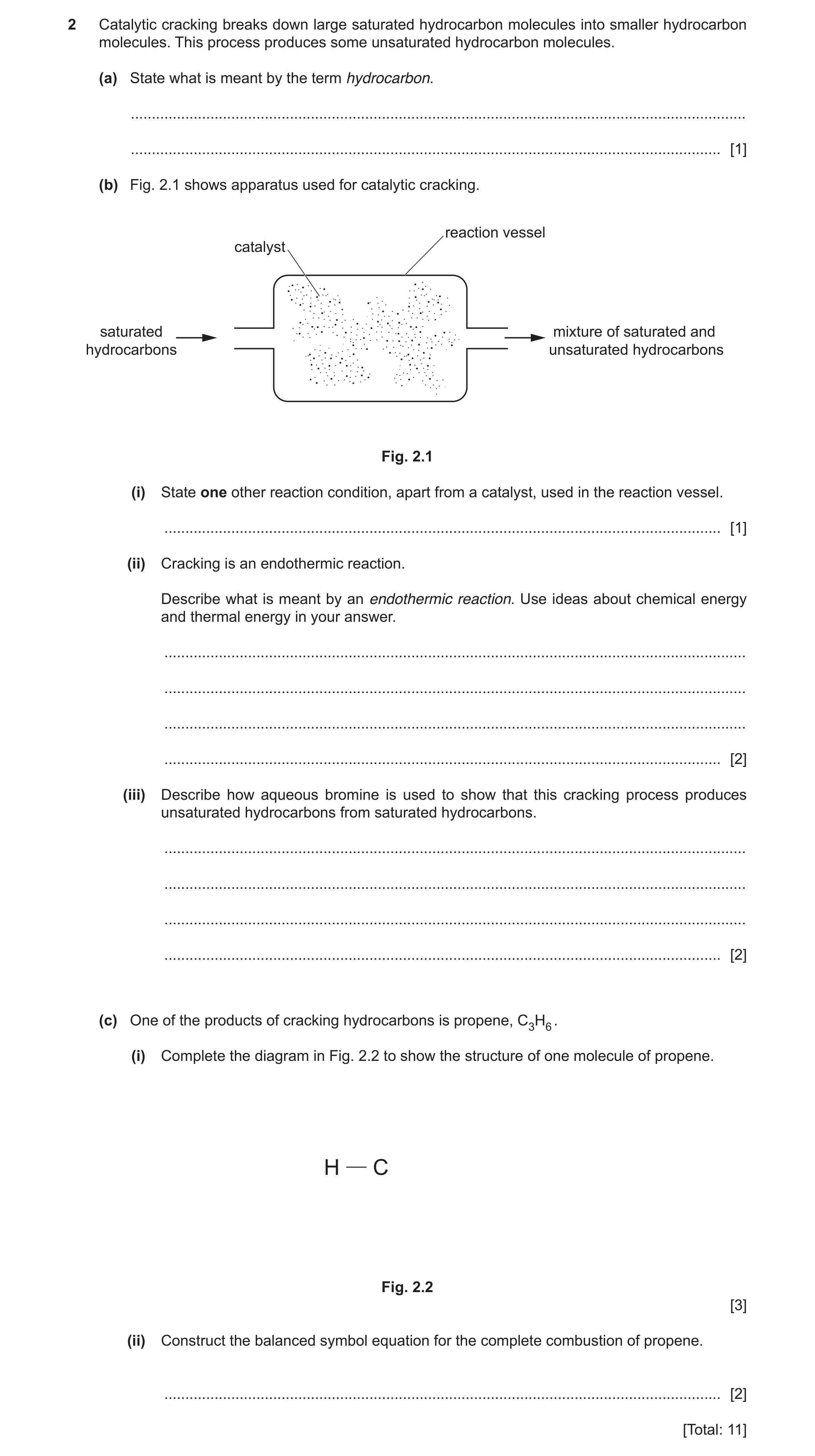
2 Catalytic cracking breaks down large saturated hydrocarbon molecules into smaller hydrocarbon molecules. This process produces some unsaturated hydrocarbon molecules. (a) State what is meant by the term hydrocarbon. … … [1] (b) Fig. 2.1 shows apparatus used for catalytic cracking. reaction vessel catalyst saturated mixture of saturated and hydrocarbons unsaturated hydrocarbons Fig. 2.1 (i) State one other reaction condition, apart from a catalyst, used in the reaction vessel. … [1] (ii) Cracking is an endothermic reaction. Describe what is meant by an endothermic reaction. Use ideas about chemical energy and thermal energy in your answer. … … … … [2] (iii) Describe how aqueous bromine is used to show that this cracking process produces unsaturated hydrocarbons from saturated hydrocarbons. … … … … [2] (c) One of the products of cracking hydrocarbons is propene, C3H6 . (i) Complete the diagram in Fig. 2.2 to show the structure of one molecule of propene. H C Fig. 2.2 [3] (ii) Construct the balanced symbol equation for the complete combustion of propene. … [2] [Total: 11]
11 marks
Mark scheme: 2(a) molecule / compound containing carbon and hydrogen atoms only ; 1 2(b)(i) high temperature / high pressure ; 1 2(b)(ii) thermal energy is changed into chemical energy ; so thermal energy is absorbed / removed from surroundings / temperature (of surroundings) decreases ; 2 2(b)(iii) aqueous bromine remains orange / not decolourised by saturated hydrocarbons ; aqueous bromine is decolourised by unsaturated hydrocarbons ; 2 Question Answer Marks 2(c)(i) 3 carbon atoms in chain ; only one carbon-carbon double bond ; all else correct ; 3 2(c)(ii) 2C3H6 + 9O2 → 6CO2 + 6H2O all formulae correct ; balancing (dependent on correct formulae) ; 2
This question in 0653/42 May/June 2019
Q4 · A fractional distillation column used in the separation of petroleum 0653/42 Oct/Nov 2019
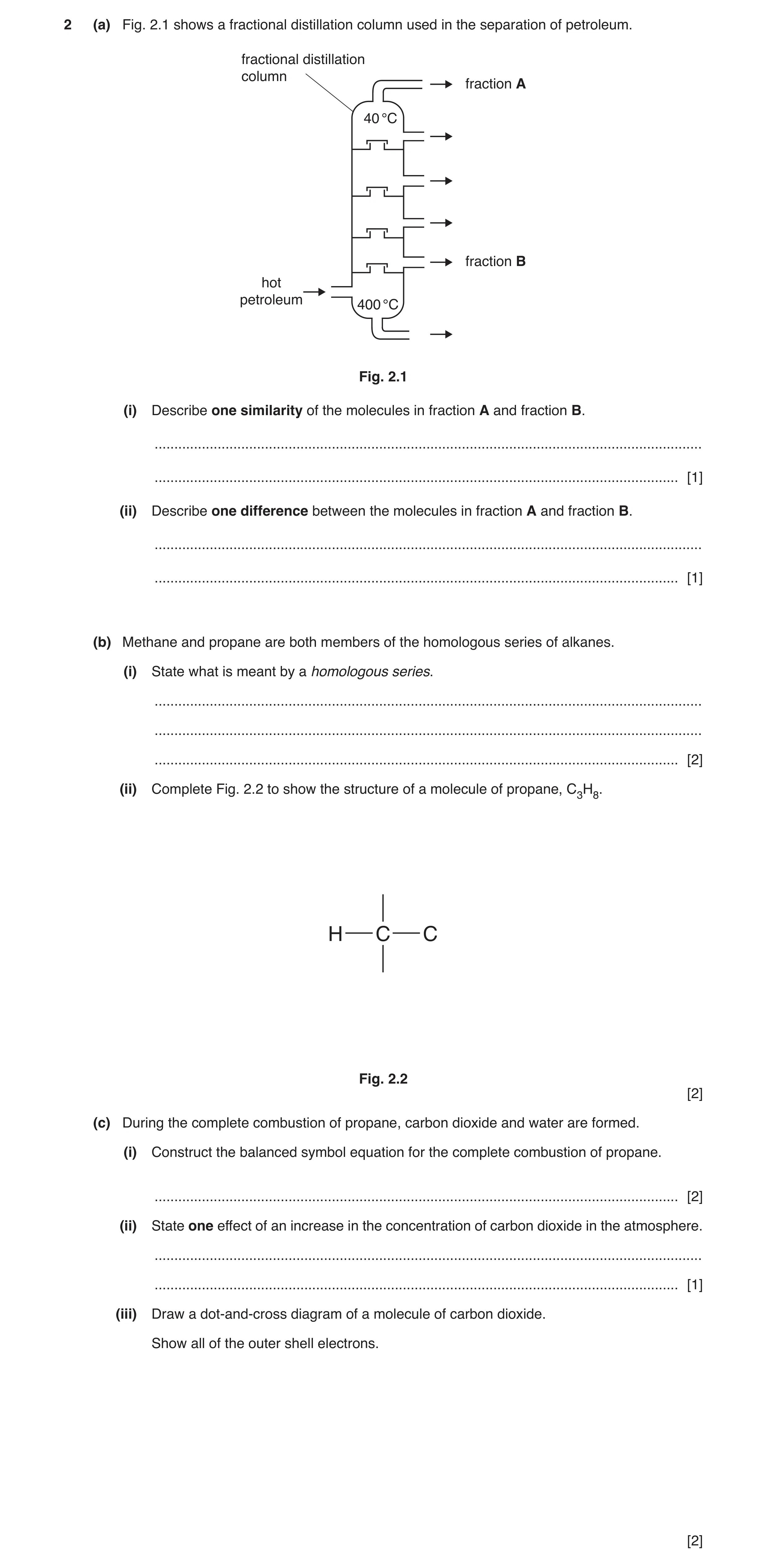
2 (a) Fig. 2.1 shows a fractional distillation column used in the separation of petroleum. fractional distillation column fraction A 40 °C fraction B hot petroleum 400 °C Fig. 2.1 (i) Describe one similarity of the molecules in fraction A and fraction B. … … [1] (ii) Describe one difference between the molecules in fraction A and fraction B. … … [1] (b) Methane and propane are both members of the homologous series of alkanes. (i) State what is meant by a homologous series. … … … [2] (ii) Complete Fig. 2.2 to show the structure of a molecule of propane, C3H8. H C C Fig. 2.2 [2] (c) During the complete combustion of propane, carbon dioxide and water are formed. (i) Construct the balanced symbol equation for the complete combustion of propane. … [2] (ii) State one effect of an increase in the concentration of carbon dioxide in the atmosphere. … … [1] (iii) Draw a dot-and-cross diagram of a molecule of carbon dioxide. Show all of the outer shell electrons. [2]
11 marks
Mark scheme: 2(a)(i) molecules contain carbon and hydrogen (only) / are hydrocarbons / are covalent ; 1 2(a)(ii) fraction A molecules are smaller / have fewer carbon atoms / have lower intermolecular forces ; 1 2(b)(i) family of compounds with the same general formula ; similar chemical properties ; 2 2(b)(ii) 3 carbon atoms in chain ; all else correct ; 2 2(c)(i) C3H8 + 5O2 → 3CO2 + 4H2O ; correct formulae ; correctly balanced ; 2 2(c)(ii) global warming / climate change / consequence of climate change / enhanced greenhouse effect ; 1 2(c)(iii) two shared pairs of electrons between oxygen and carbon ; all else correct ; 2
This question in 0653/42 Oct/Nov 2019
Q5 · The formula of methanol is CH3OH 0653/42 Feb/March 2020
2 (a) The formula of methanol is CH3OH. Complete the structure of a molecule of methanol. Include all atoms and all bonds. C O [1] (b) (i) Explain why methanol is not an alkane. … … [1] (ii) Explain why a molecule of methanol contains only covalent bonds. … … [1] (c) Methanol can be used as a fuel. It burns in oxygen and releases energy. (i) Complete the equation for the complete combustion of methanol. 2CH3OH + … … + … [2] (ii) The combustion of methanol is an exothermic reaction. Describe what is meant by exothermic. Use ideas about energy, bond breaking and bond forming in your answer. … … … [2] (d) Methane is a greenhouse gas. State one effect of increased levels of greenhouse gases in the atmosphere. … … [1] [Total: 8]
8 marks
Mark scheme: 2(a) ; 2(b)(i) contains oxygen / is not carbon and hydrogen only ; 1 2(b)(ii) all bonds are between non-metal atoms ; 1 2(c)(i) (2CH3OH +) 3O2 → 2CO2 + 4H2O all formulae correct ; (correct formulae) balanced ; 2 Question Answer Marks 2(c)(ii) idea that energy is taken in to break bonds / that energy is released when bonds form ; (exothermic means) energy released is greater (than taken in) / (during an exothermic reaction) temperature increases / chemical energy converted to thermal ; 2 2(d) global warming / climate change / consequence of climate change, e.g. extreme weather events / rising sea level ; 1
This question in 0653/42 Feb/March 2020
Q6 · The formula of methanol is CH3OH 0653/41 May/June 2020
2 The formula of methanol is CH3OH. (a) Explain why methanol is not a hydrocarbon. … … [1] (b) (i) Complete the dot-and-cross diagram for a molecule of methanol. C O [2] (ii) Explain why a molecule of methanol contains only covalent bonds. … … [1] (c) Methanol is used as a fuel because it burns in oxygen. Complete the equation for the complete combustion of methanol. 2CH3OH + … … + … [2] (d) Fig. 2.1 shows the energy level diagram for the complete combustion of methanol. X energy progress of reaction Fig. 2.1 (i) On Fig. 2.1, write the words reactants and products in suitable places. [1] (ii) State what the energy value X on Fig. 2.1 represents. … [1] (e) During the combustion of methanol, the amount of carbon dioxide in the atmosphere increases. Suggest one effect of this increase. … … [1] [Total: 9]
9 marks
Mark scheme: 2(a) contains oxygen / is not just carbon and hydrogen ; 1 2(b)(i) correct electrons around carbon atom ; correct electrons around oxygen atom ; 2 2(b)(ii) all atoms are non-metallic elements ; 1 Question Answer Marks 2(c) (2CH3OH) + 3O2 → 2CO2 + 4H2O correct formulae ; correctly balanced ; 2 2(d)(i) reactants on left and products on right ; 1 2(d)(ii) activation energy ; 1 2(e) (carbon dioxide is a greenhouse gas) so enhanced greenhouse effect / global warming / climate change / example of an effect of climate change ; 1
This question in 0653/41 May/June 2020
Q7 · The fractional distillation of petroleum is shown in Fig 0653/42 May/June 2020
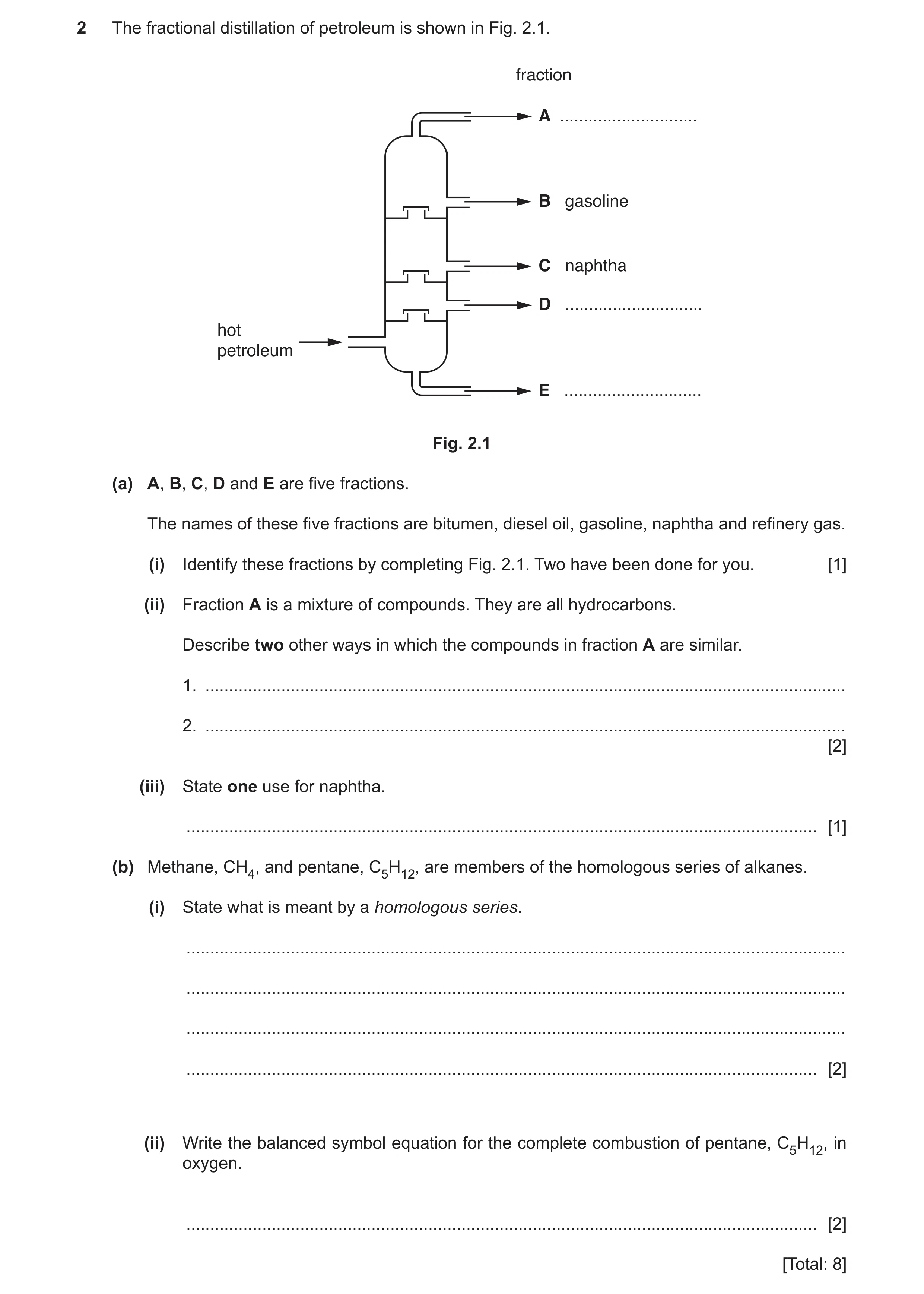
2 The fractional distillation of petroleum is shown in Fig. 2.1. fraction A … B gasoline C naphtha D … hot petroleum E … Fig. 2.1 (a) A, B, C, D and E are five fractions. The names of these five fractions are bitumen, diesel oil, gasoline, naphtha and refinery gas. (i) Identify these fractions by completing Fig. 2.1. Two have been done for you. [1] (ii) Fraction A is a mixture of compounds. They are all hydrocarbons. Describe two other ways in which the compounds in fraction A are similar. 1. … 2. … [2] (iii) State one use for naphtha. … [1] (b) Methane, CH4, and pentane, C5H12, are members of the homologous series of alkanes. (i) State what is meant by a homologous series. … … … … [2] (ii) Write the balanced symbol equation for the complete combustion of pentane, C5H12, in oxygen. … [2] [Total: 8]
8 marks
Mark scheme: 2(a)(i) A refinery gas B (gasoline) C (naphtha) D diesel oil E bitumen ; all three correct for one mark 2(a)(ii) any two from: all gases ; similar boiling points ; small molecules ; 2 2(a)(iii) feedstock for making chemicals ; 1 Question Answer Marks 2(b)(i) family of compounds with, the same general formula ; similar chemical properties ; 2 2(b)(ii) C5H12 + 8O2 → 5CO2 + 6H2O formula ; balancing ; 2
This question in 0653/42 May/June 2020
Q8 · A simplified diagram of the fractional distillation of petroleum 0653/41 Oct/Nov 2020
2 Fig. 2.1 is a simplified diagram of the fractional distillation of petroleum. The formulae of three compounds contained in different fractions are shown. C4H10 C7H16 C17H36 hot petroleum Fig. 2.1 (a) Describe the trend in the boiling points of the compounds C4H10, C7H16 and C17H36. Use ideas about the sizes of the molecules and the forces between the molecules to explain your answer. trend … … explanation … … … … [3] (b) C4H10 and C7H16 are members of the homologous series of alkanes. (i) Describe what is meant by a homologous series. … … … [2] (ii) Draw a dot-and-cross diagram to show the bonding in a molecule of carbon dioxide, CO2. Show only the outer shell electrons. [2] (iii) Carbon dioxide is one of the products of the complete combustion of heptane, C7H16. Complete and balance the symbol equation for the complete combustion of heptane, C7H16. State symbols are not required. C7H16 + CO2 + [2] (c) Carbon dioxide is a greenhouse gas. State one effect of an increase in the concentration of carbon dioxide in the atmosphere. … … … [1] [Total: 10]
10 marks
Mark scheme: 2(a) trend: boiling point increases ; explanation: molecules are larger ; stronger (intermolecular) forces ; 2(b)(i) (family of compounds with) the same general formula ; similar chemical properties ; 2 2(b)(ii) two double bonds shown ; all else correct including chemical symbols ; 2 Question Answer Marks 2(b)(iii) (C7H16) + 11 O2 → 7 (CO2) + 8 H2O all formulae correct ; balanced correctly dependent on correct formulae ; 2 2(c) global warming / enhanced greenhouse effect / climate change / consequence of climate change ; 1
This question in 0653/41 Oct/Nov 2020
Q9 · Cracking breaks down large saturated hydrocarbon molecules into smaller hydrocarbon… 0653/42 Oct/Nov 2020
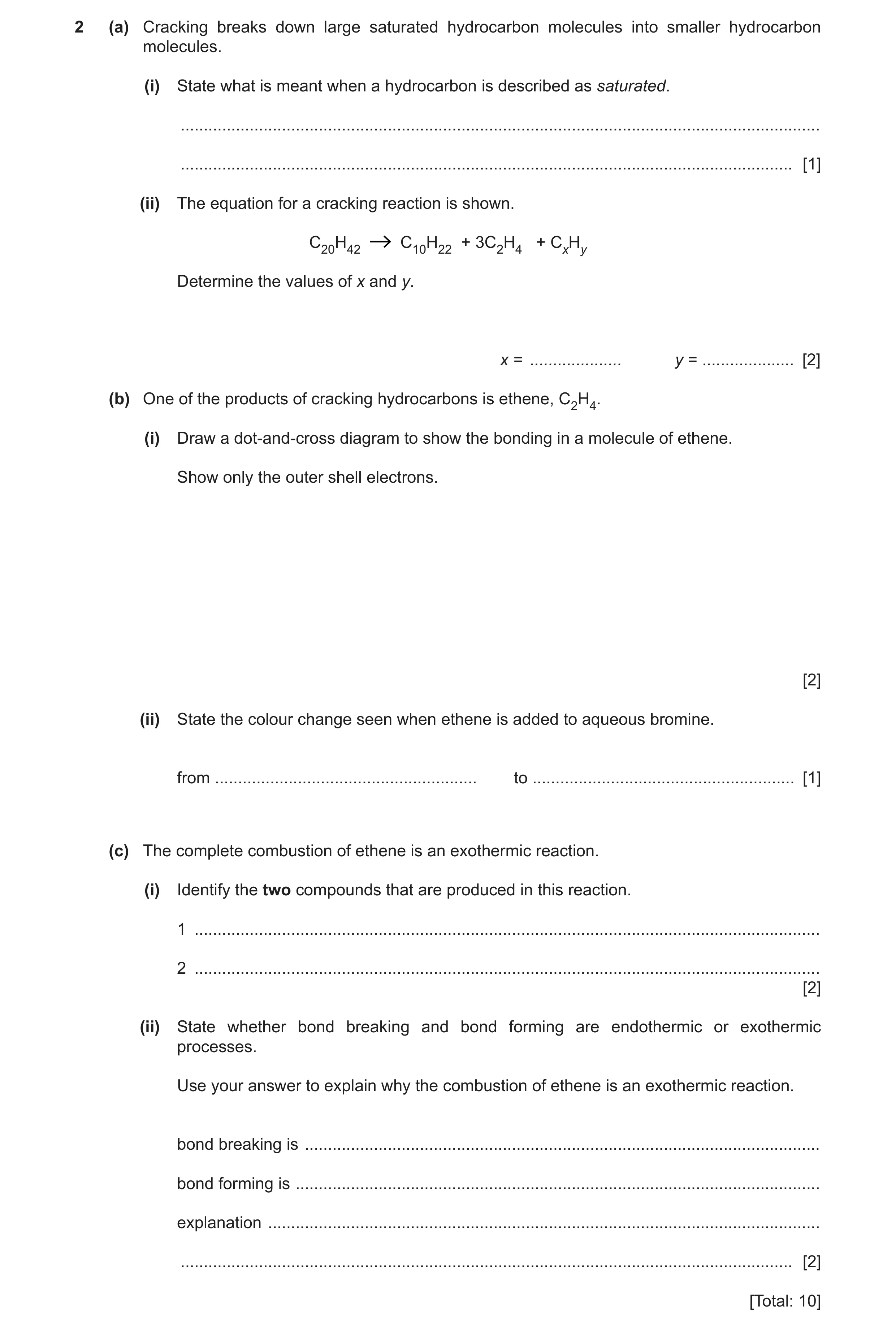
2 (a) Cracking breaks down large saturated hydrocarbon molecules into smaller hydrocarbon molecules. (i) State what is meant when a hydrocarbon is described as saturated. … … [1] (ii) The equation for a cracking reaction is shown. C20H42 C10H22 + 3C2H4 + CxHy Determine the values of x and y. x = … y = … [2] (b) One of the products of cracking hydrocarbons is ethene, C2H4. (i) Draw a dot-and-cross diagram to show the bonding in a molecule of ethene. Show only the outer shell electrons. [2] (ii) State the colour change seen when ethene is added to aqueous bromine. from … to … [1] (c) The complete combustion of ethene is an exothermic reaction. (i) Identify the two compounds that are produced in this reaction. 1 … 2 … [2] (ii) State whether bond breaking and bond forming are endothermic or exothermic processes. Use your answer to explain why the combustion of ethene is an exothermic reaction. bond breaking is … bond forming is … explanation … … [2] [Total: 10]
10 marks
Mark scheme: 2(a)(i) (compound containing only carbon and hydrogen and) only single (covalent) bonds (between carbon atoms) ; 1 2(a)(ii) x = 4 ; y = 8 ; 2 2(b)(i) double bond between carbon atoms; all else correct including chemical symbols ; 2 2(b)(ii) orange to colourless ; 1 2(c)(i) carbon dioxide / CO2 ; water / H2O ; 2 2(c)(ii) (bond breaking is) endothermic AND (bond forming is) exothermic ; more energy released during bond formation than energy required for bond breaking ; 2
This question in 0653/42 Oct/Nov 2020
Q10 · Some gas ovens use methane as a fuel, other gas ovens use propane 0653/41 May/June 2021
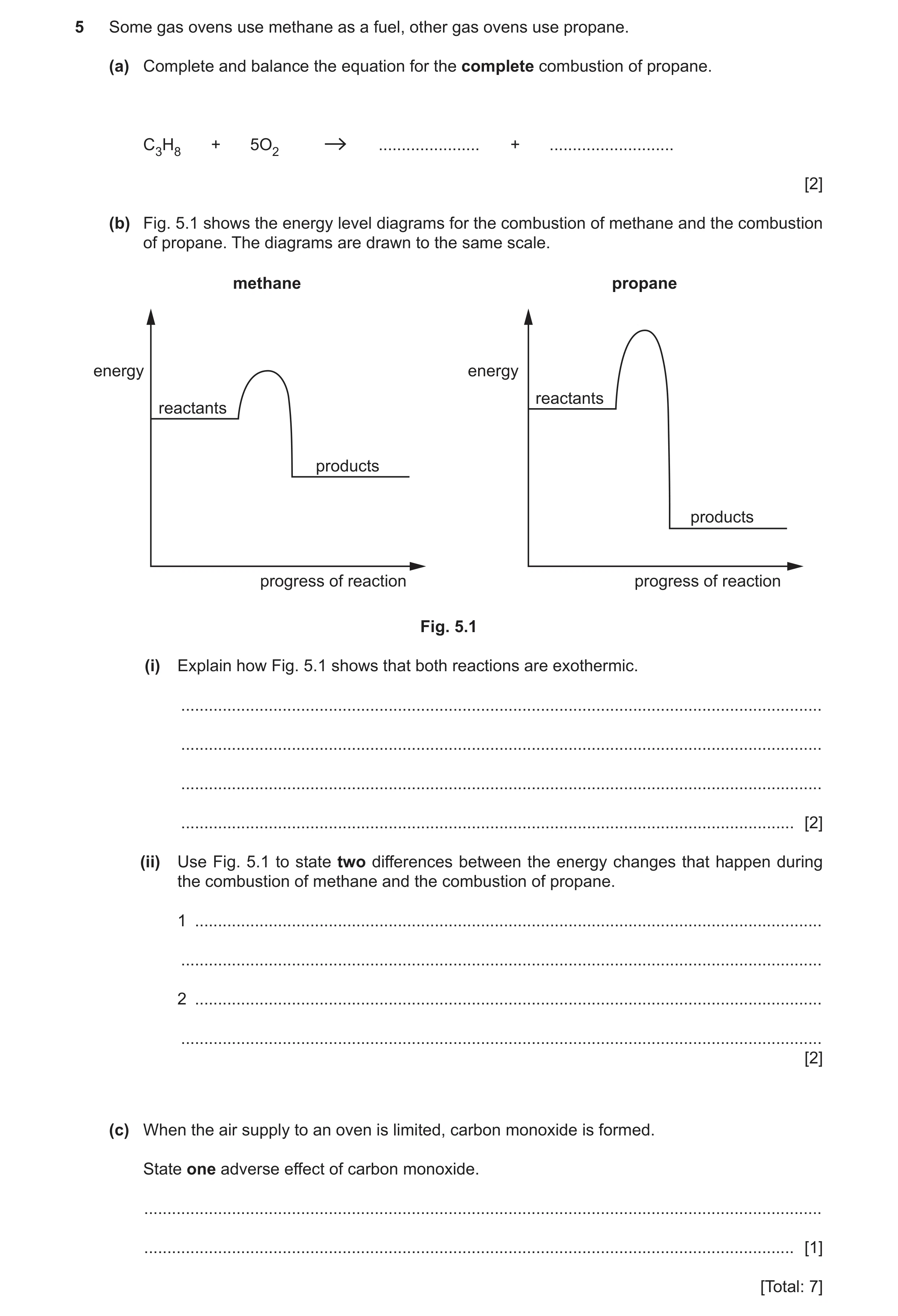
5 Some gas ovens use methane as a fuel, other gas ovens use propane. (a) Complete and balance the equation for the complete combustion of propane. C3H8 + 5O2 … + … [2] (b) Fig. 5.1 shows the energy level diagrams for the combustion of methane and the combustion of propane. The diagrams are drawn to the same scale. methane propane energy energy reactants reactants products products progress of reaction progress of reaction Fig. 5.1 (i) Explain how Fig. 5.1 shows that both reactions are exothermic. … … … … [2] (ii) Use Fig. 5.1 to state two differences between the energy changes that happen during the combustion of methane and the combustion of propane. 1 … … 2 … … [2] (c) When the air supply to an oven is limited, carbon monoxide is formed. State one adverse effect of carbon monoxide. … … [1] [Total: 7]
7 marks
Mark scheme: 5(a) CO2 AND H2O given as products ; balanced equation 3CO2 + 4H2O ; 2 5(b)(i) (in both reactions) energy is given out ; energy change is negative / energy of the products is lower than energy of the reactants OWTTE ; 2 5(b)(ii) propane has a higher activation energy ; propane gives out more energy / gives a more exothermic reaction ; 2 5(c) toxic / poisonous ; 1
This question in 0653/41 May/June 2021
Q11 · The alkanes and the alkenes are both homologous series 0653/42 May/June 2021
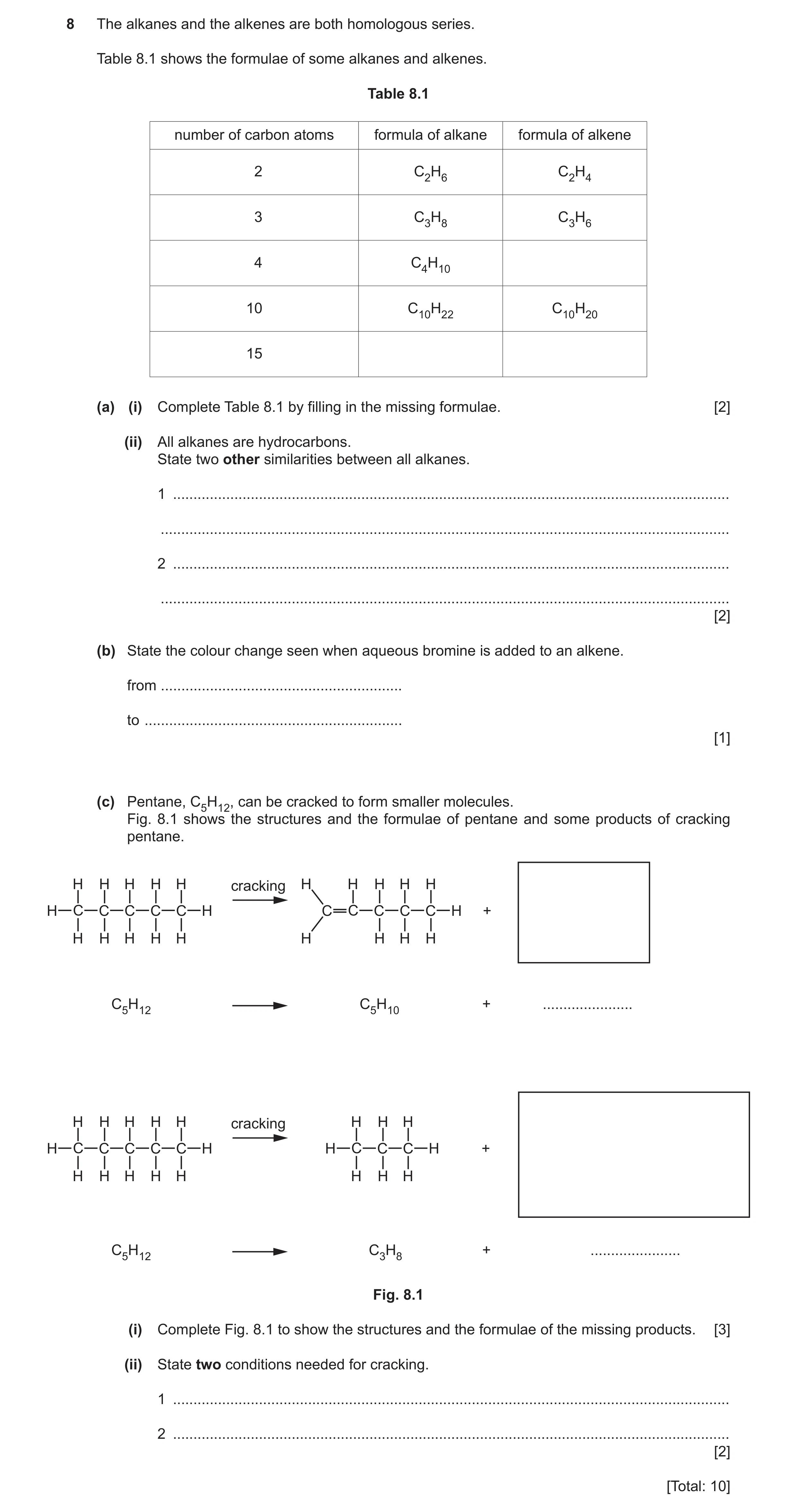
8 The alkanes and the alkenes are both homologous series. Table 8.1 shows the formulae of some alkanes and alkenes. Table 8.1 number of carbon atoms formula of alkane formula of alkene 2 C2H6 C2H4 3 C3H8 C3H6 4 C4H10 10 C10H22 C10H20 15 (a) (i) Complete Table 8.1 by filling in the missing formulae. [2] (ii) All alkanes are hydrocarbons. State two other similarities between all alkanes. 1 … … 2 … … [2] (b) State the colour change seen when aqueous bromine is added to an alkene. from … to … [1] (c) Pentane, C5H12, can be cracked to form smaller molecules. Fig. 8.1 shows the structures and the formulae of pentane and some products of cracking pentane. H H H H H cracking H H H H H H C C C C C H C C C C C H + H H H H H H H H H C5H12 C5H10 + … H H H H H cracking H H H H C C C C C H H C C C H + H H H H H H H H C5H12 C3H8 + … Fig. 8.1 (i) Complete Fig. 8.1 to show the structures and the formulae of the missing products. [3] (ii) State two conditions needed for cracking. 1 … 2 … [2] [Total: 10]
10 marks
Mark scheme: 8(a)(i) C4H8 C15H32 C15H30 ;; all three correct = 2 one or two correct = 1 8(a)(ii) any two from: same general formula as each other ; similar chemical properties to each other ; all saturated / only single bonds ; 2 8(b) (from) orange (to) colourless ; 1 8(c)(i) H–H AND H2 ; ethene displayed formula ; C2H4 ; 3 Question Answer Marks 8(c)(ii) high temperature ; catalyst / high pressure ; 2
This question in 0653/42 May/June 2021
Q12 · Energy level diagrams for two reactions are shown in Fig 0653/42 May/June 2022
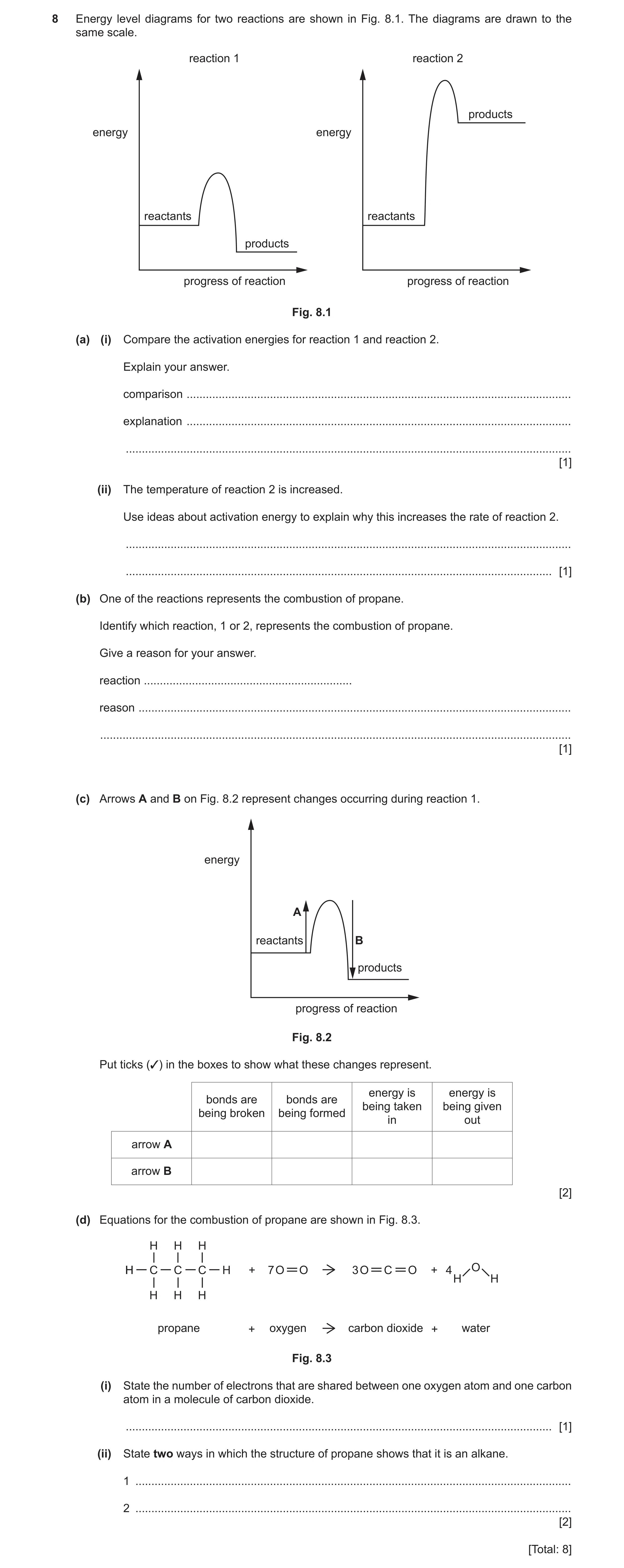
8 Energy level diagrams for two reactions are shown in Fig. 8.1. The diagrams are drawn to the same scale. reaction 1 reaction 2 products energy energy reactants reactants products progress of reaction progress of reaction Fig. 8.1 (a) (i) Compare the activation energies for reaction 1 and reaction 2. Explain your answer. comparison … explanation … … [1] (ii) The temperature of reaction 2 is increased. Use ideas about activation energy to explain why this increases the rate of reaction 2. … … [1] (b) One of the reactions represents the combustion of propane. Identify which reaction, 1 or 2, represents the combustion of propane. Give a reason for your answer. reaction … reason … … [1] (c) Arrows A and B on Fig. 8.2 represent changes occurring during reaction 1. energy A reactants B products progress of reaction Fig. 8.2 Put ticks (✓) in the boxes to show what these changes represent. energy is energy is bonds are bonds are being taken being given being broken being formed in out arrow A arrow B [2] (d) Equations for the combustion of propane are shown in Fig. 8.3. H H H H C C C H + 7 O O 3 O C O + 4 O H H H H H propane + oxygen carbon dioxide + water Fig. 8.3 (i) State the number of electrons that are shared between one oxygen atom and one carbon atom in a molecule of carbon dioxide. … [1] (ii) State two ways in which the structure of propane shows that it is an alkane. 1 … 2 … [2] [Total: 8]
8 marks
Mark scheme: 8(a)(i) (activation energy of ) reaction 2 is higher because the difference in energy of reactants and energy of the peak is greater / ORA ; 1 8(a)(ii) more collisions have the activation energy / frequency of successful collisions increases ; 1 8(b) reaction 1 AND because it is exothermic / energy is given out ; 1 8(c) bonds are being broken bonds are being formed energy is being taken in energy is being given out arrow A ; arrow B ; 2 8(d)(i) 4 ; 1 8(d)(ii) Any two from: contains (only) carbon and hydrogen ; all single bonds / saturated ; has the same general formula ; 2
This question in 0653/42 May/June 2022
Q13 · The structures of the hydrocarbons propane and ethene are shown in Fig 0653/42 Feb/March 2023
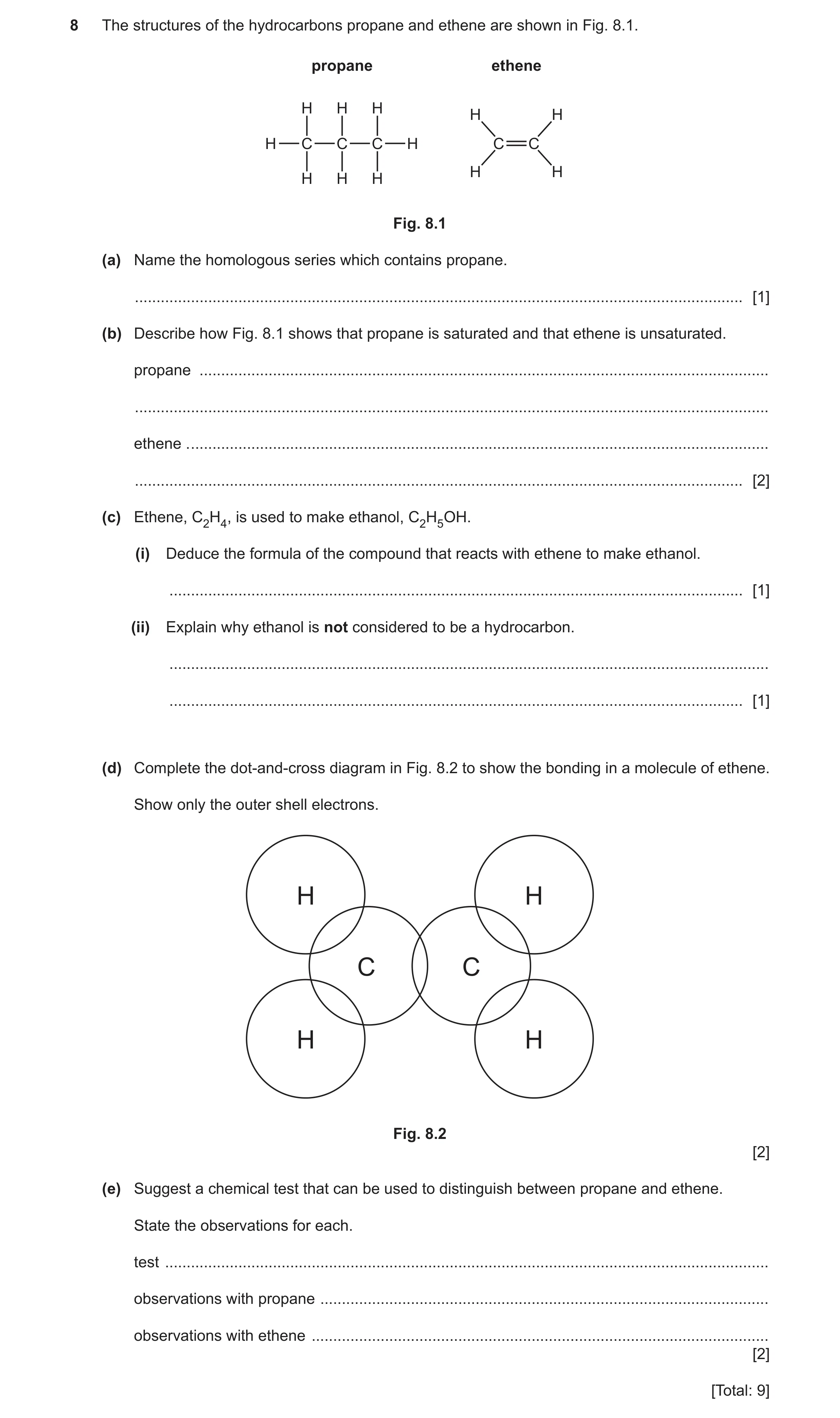
8 The structures of the hydrocarbons propane and ethene are shown in Fig. 8.1. propane ethene H H H H H H C C C H C C H H H H H Fig. 8.1 (a) Name the homologous series which contains propane. … [1] (b) Describe how Fig. 8.1 shows that propane is saturated and that ethene is unsaturated. propane … … ethene . … … [2] (c) Ethene, C2H4, is used to make ethanol, C2H5OH. (i) Deduce the formula of the compound that reacts with ethene to make ethanol. … [1] (ii) Explain why ethanol is not considered to be a hydrocarbon. … … [1] (d) Complete the dot-and-cross diagram in Fig. 8.2 to show the bonding in a molecule of ethene. Show only the outer shell electrons. H H C C H H Fig. 8.2 [2] (e) Suggest a chemical test that can be used to distinguish between propane and ethene. State the observations for each. test … observations with propane … observations with ethene … [2] [Total: 9]
9 marks
Mark scheme: 8(a) alkane ; 1 8(b) propane contains only single bonds / propane has single bonds between C atoms ; 2 ethene has a double bond (between C atoms) ; 8(c)(i) H2O ; 1 8(c)(ii) contains oxygen ; 1 8(d) carbon-carbon double bond correct ; 2 carbon – hydrogen bonds correct ; e.g., 8(e) (aqueous) bromine (water) ; 2 propane – remains orange AND observations with ethene – goes (from orange to) colourless ;
This question in 0653/42 Feb/March 2023
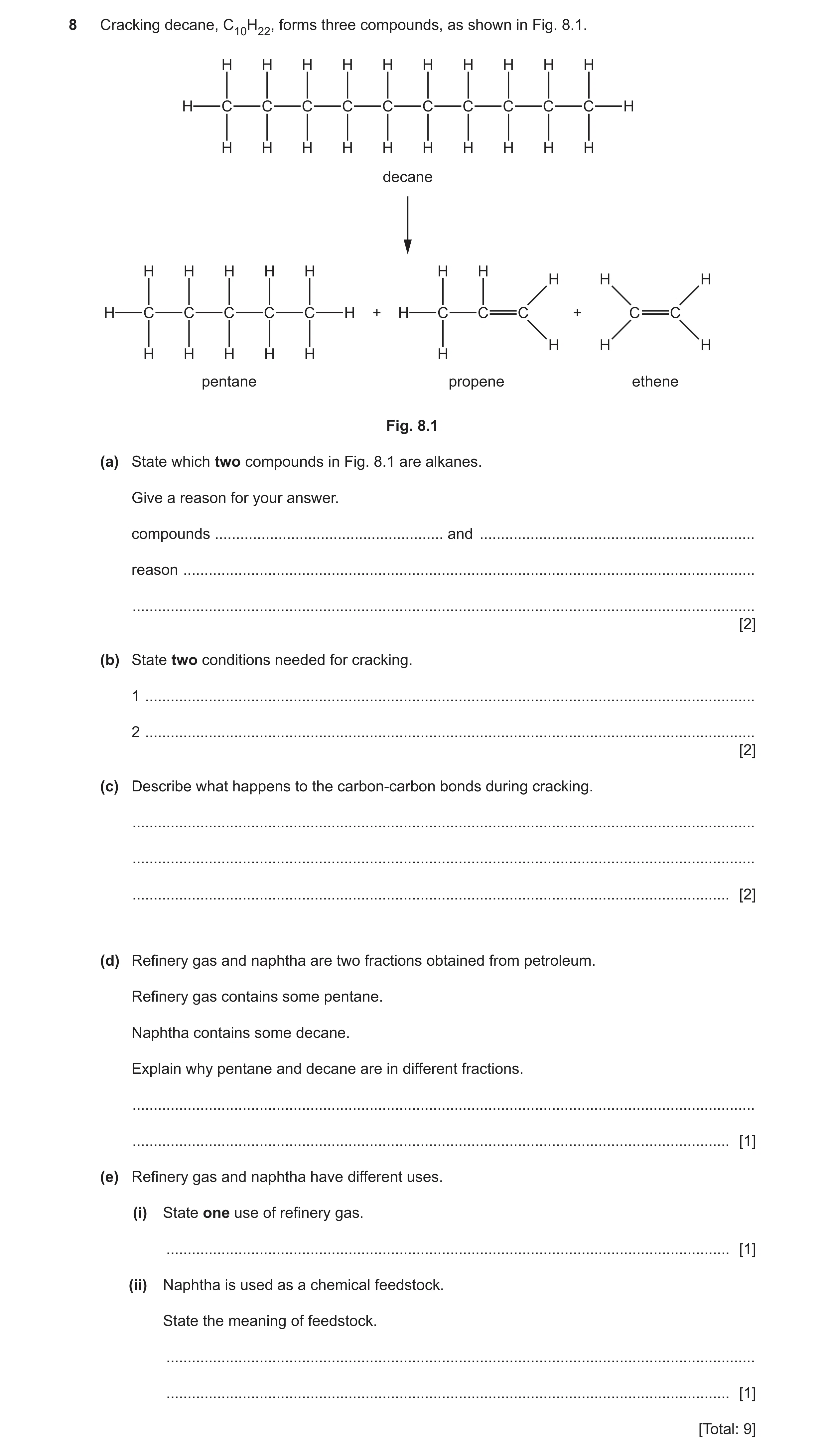
Q14 · Cracking decane, C10H22, forms three compounds, as shown in Fig 0653/42 May/June 2023
8 Cracking decane, C10H22, forms three compounds, as shown in Fig. 8.1. H H H H H H H H H H H C C C C C C C C C C H H H H H H H H H H H decane H H H H H H H H H H H C C C C C H + H C C C + C C H H H H H H H H H pentane propene ethene Fig. 8.1 (a) State which two compounds in Fig. 8.1 are alkanes. Give a reason for your answer. compounds … and … reason … … [2] (b) State two conditions needed for cracking. 1 … 2 … [2] (c) Describe what happens to the carbon-carbon bonds during cracking. … … … [2] (d) Refinery gas and naphtha are two fractions obtained from petroleum. Refinery gas contains some pentane. Naphtha contains some decane. Explain why pentane and decane are in different fractions. … … [1] (e) Refinery gas and naphtha have different uses. (i) State one use of refinery gas. … [1] (ii) Naphtha is used as a chemical feedstock. State the meaning of feedstock. … … [1] [Total: 9]
9 marks
Mark scheme: 8(a) decane and pentane ; reason: they are saturated (hydrocarbons) / do not contain double (C=C) bonds / contain only single bonds ; 2 8(b) any two from: high temperature ; high pressure ; catalyst ; 2 8(c) (some carbon – carbon single) bonds break ; (some) carbon atoms form double bonds (with each other) ; 2 8(d) they have different boiling points ; 1 8(e)(i) bottled gas / heating and cooking ; 1 8(e)(ii) (source / reactant for) making (other) chemicals ; 1
This question in 0653/42 May/June 2023
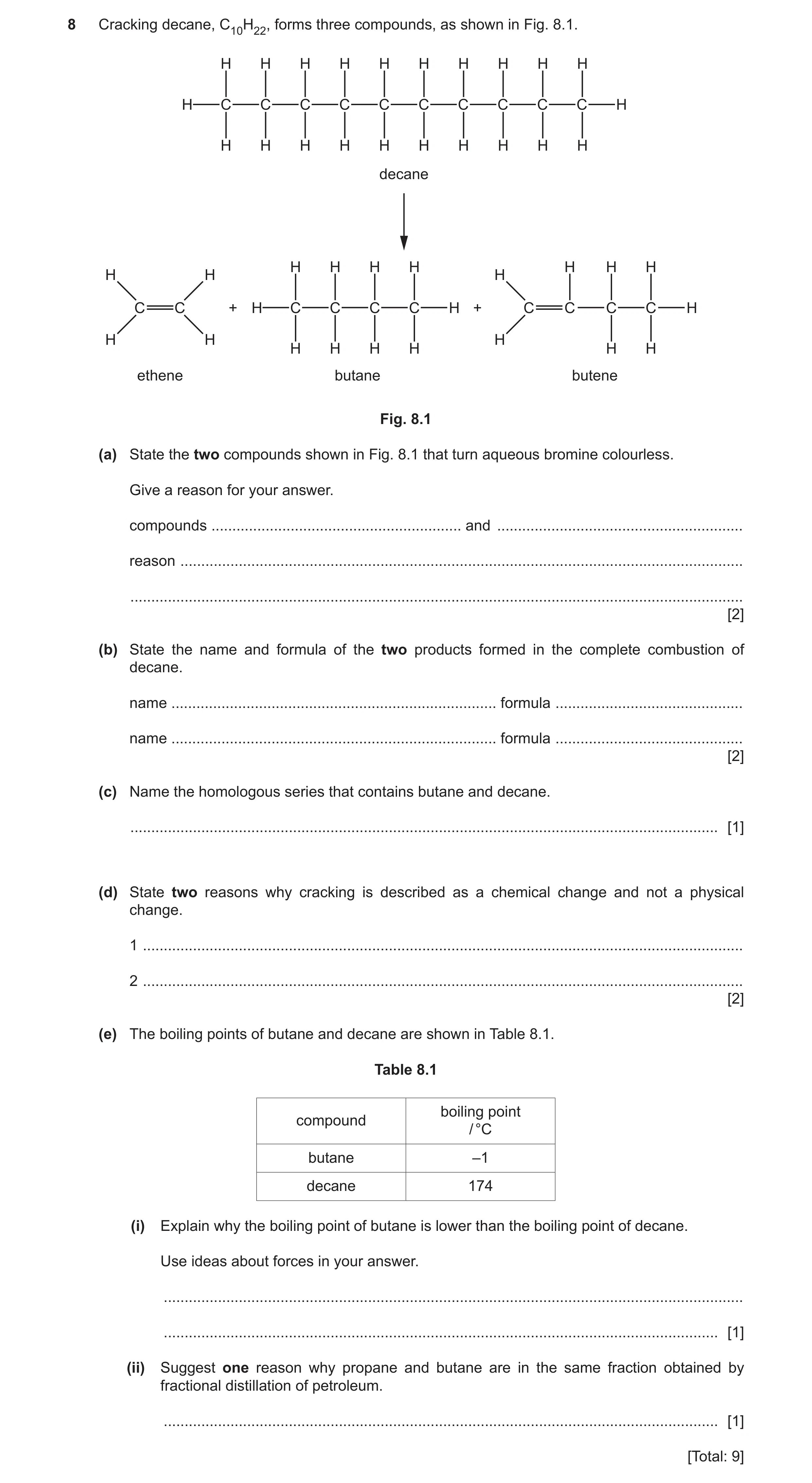
Q15 · Cracking decane, C10H22, forms three compounds, as shown in Fig 0653/43 May/June 2023
8 Cracking decane, C10H22, forms three compounds, as shown in Fig. 8.1. H H H H H H H H H H H C C C C C C C C C C H H H H H H H H H H H decane H H H H H H H H H H C C + H C C C C H + C C C C H H H H H H H H H H ethene butane butene Fig. 8.1 (a) State the two compounds shown in Fig. 8.1 that turn aqueous bromine colourless. Give a reason for your answer. compounds … and … reason … … [2] (b) State the name and formula of the two products formed in the complete combustion of decane. name … formula … name … formula … [2] (c) Name the homologous series that contains butane and decane. … [1] (d) State two reasons why cracking is described as a chemical change and not a physical change. 1 … 2 … [2] (e) The boiling points of butane and decane are shown in Table 8.1. Table 8.1 boiling point compound / °C butane –1 decane 174 (i) Explain why the boiling point of butane is lower than the boiling point of decane. Use ideas about forces in your answer. … … [1] (ii) Suggest one reason why propane and butane are in the same fraction obtained by fractional distillation of petroleum. … [1] [Total: 9]
9 marks
Mark scheme: 8(a) ethene and butene ; they both contain a double bond / are unsaturated / are alkenes ; 2 8(b) either order: carbon dioxide CO2 ; water H2O ; 2 8(c) alkanes ; 1 8(d) cannot be reversed by physical means ; new products formed ; 2 8(e)(i) butane has weaker forces between its molecules ; 1 8(e)(ii) similar boiling points ; 1
This question in 0653/43 May/June 2023
Q16 · Some information about some alkanes and alkenes 0653/43 Oct/Nov 2023
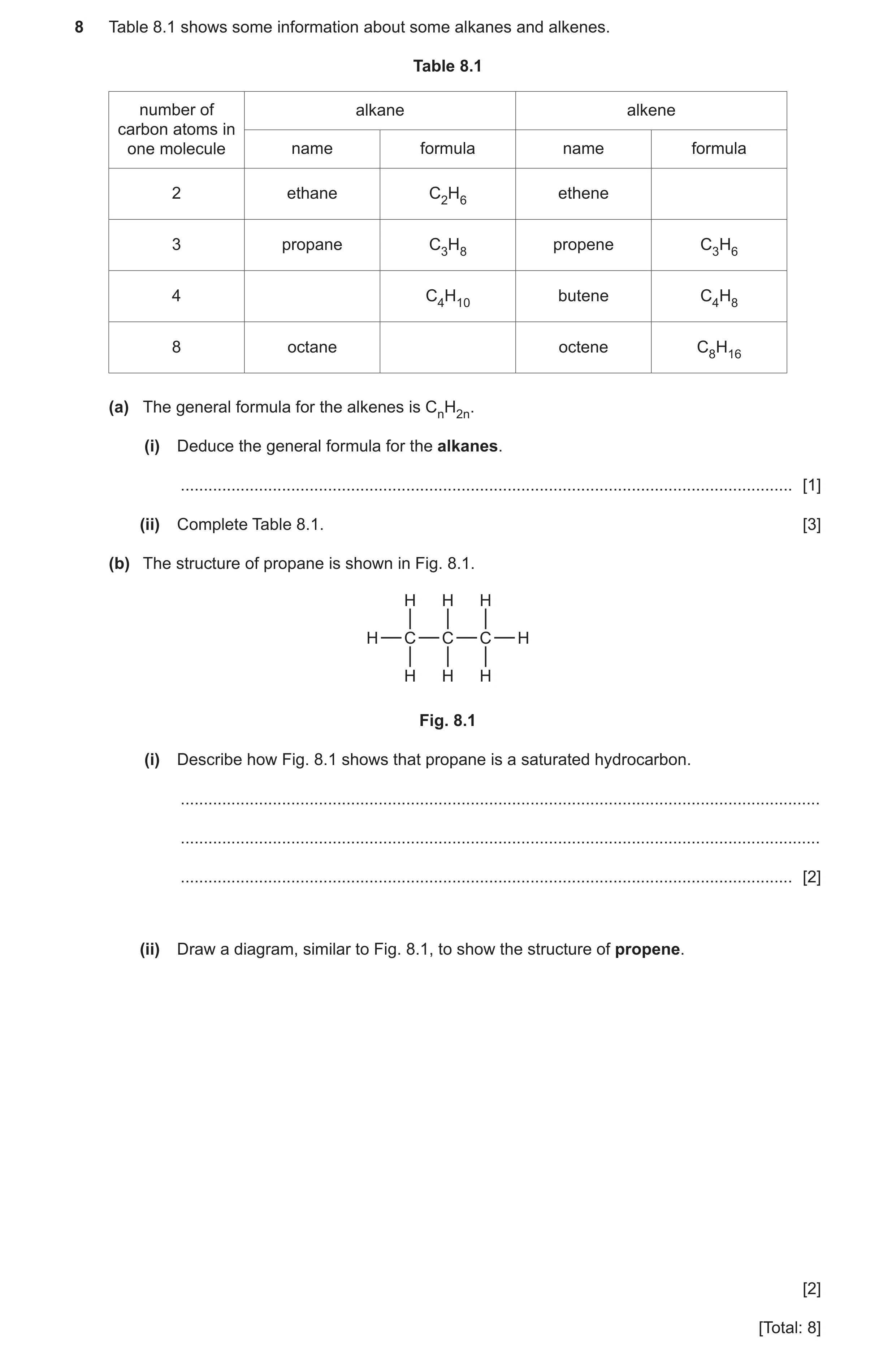
8 Table 8.1 shows some information about some alkanes and alkenes. Table 8.1 number of alkane alkene carbon atoms in one molecule name formula name formula 2 ethane C2H6 ethene 3 propane C3H8 propene C3H6 4 C4H10 butene C4H8 8 octane octene C8H16 (a) The general formula for the alkenes is CnH2n. (i) Deduce the general formula for the alkanes. … [1] (ii) Complete Table 8.1. [3] (b) The structure of propane is shown in Fig. 8.1. H H H H C C C H H H H Fig. 8.1 (i) Describe how Fig. 8.1 shows that propane is a saturated hydrocarbon. … … … [2] (ii) Draw a diagram, similar to Fig. 8.1, to show the structure of propene. [2] [Total: 8]
8 marks
Mark scheme: 8(a)(i) CnH2n +2 ; 1 8(a)(ii) C2H4 ; 3 butane ; C8H18 ; 8(b)(i) hydrocarbon because it contains hydrogen and carbon only ; 2 saturated because, it contains only single bonds / no double (carbon-carbon) bond ; 8(b)(ii) 2 structure contains 3 carbon atoms AND one double bond between 2 carbons ; structure fully correct ;
This question in 0653/43 Oct/Nov 2023
Q17 · Petroleum contains a mixture of hydrocarbons 0653/42 Feb/March 2024
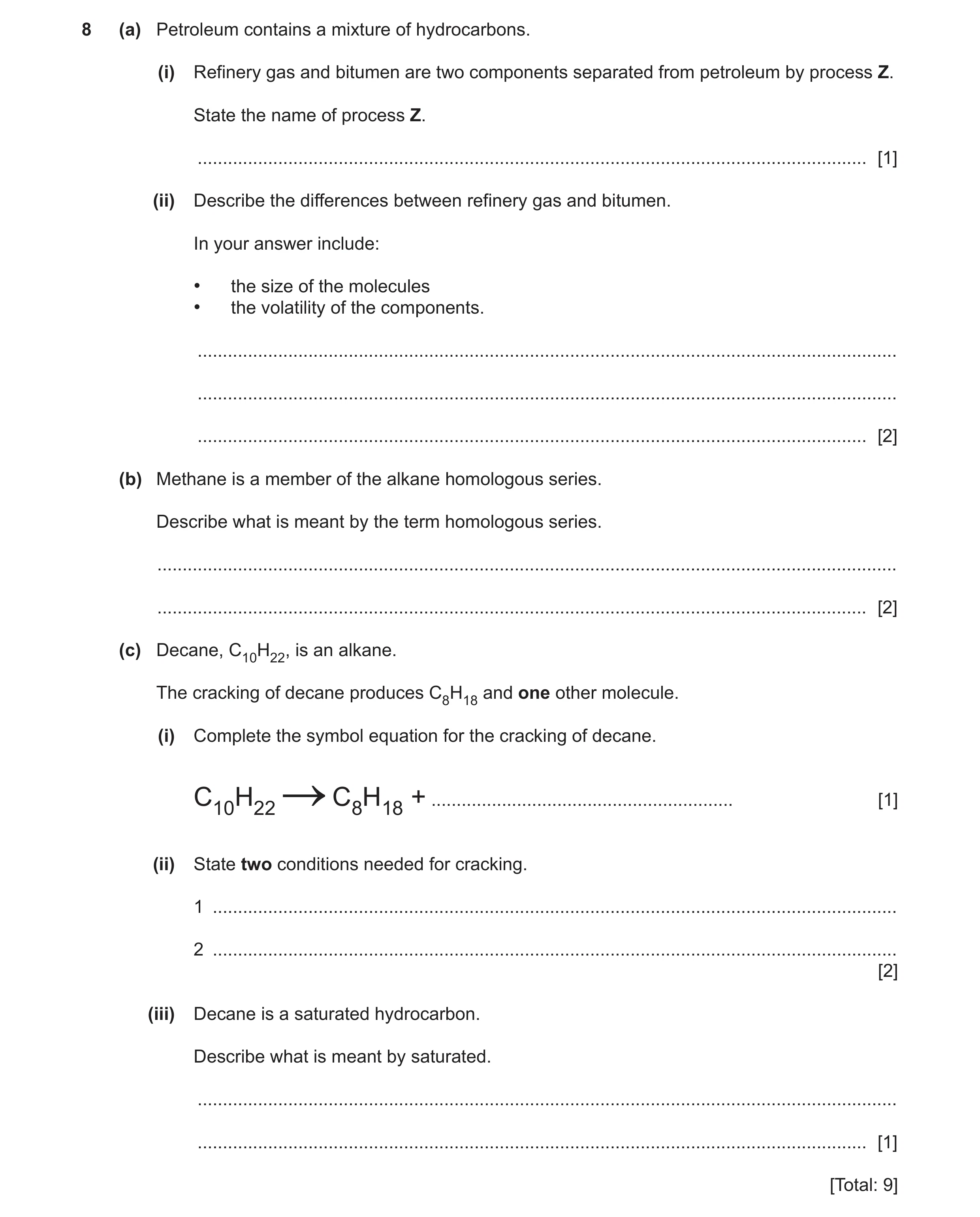
8 (a) Petroleum contains a mixture of hydrocarbons. (i) Refinery gas and bitumen are two components separated from petroleum by process Z. State the name of process Z. … [1] (ii) Describe the differences between refinery gas and bitumen. In your answer include: • the size of the molecules • the volatility of the components. … … … [2] (b) Methane is a member of the alkane homologous series. Describe what is meant by the term homologous series. … … [2] (c) Decane, C10H22, is an alkane. The cracking of decane produces C8H18 and one other molecule. (i) Complete the symbol equation for the cracking of decane. … [1] C10H22 C8H18 + (ii) State two conditions needed for cracking. 1 … 2 … [2] (iii) Decane is a saturated hydrocarbon. Describe what is meant by saturated. … … [1] [Total: 9]
9 marks
Mark scheme: 8(a)(i) fractional and distillation ; 1 8(a)(ii) refinery gas: 2 smaller molecules ; more volatile ; ORA 8(b) (family of compounds with): 2 same general formula ; similar chemical properties ; 8(c)(i) C2H4 ; 1 8(c)(ii) any two from: 2 high temperature / 400−700 C ; high pressure / 60–70 atmosphere ; catalyst ; 8(c)(iii) contains only single (C-C) (covalent) bonds / does not contain double (C=C) (covalent) bonds ; 1
This question in 0653/42 Feb/March 2024
Q18 · Carbon dioxide is a greenhouse gas 0653/41 Oct/Nov 2024
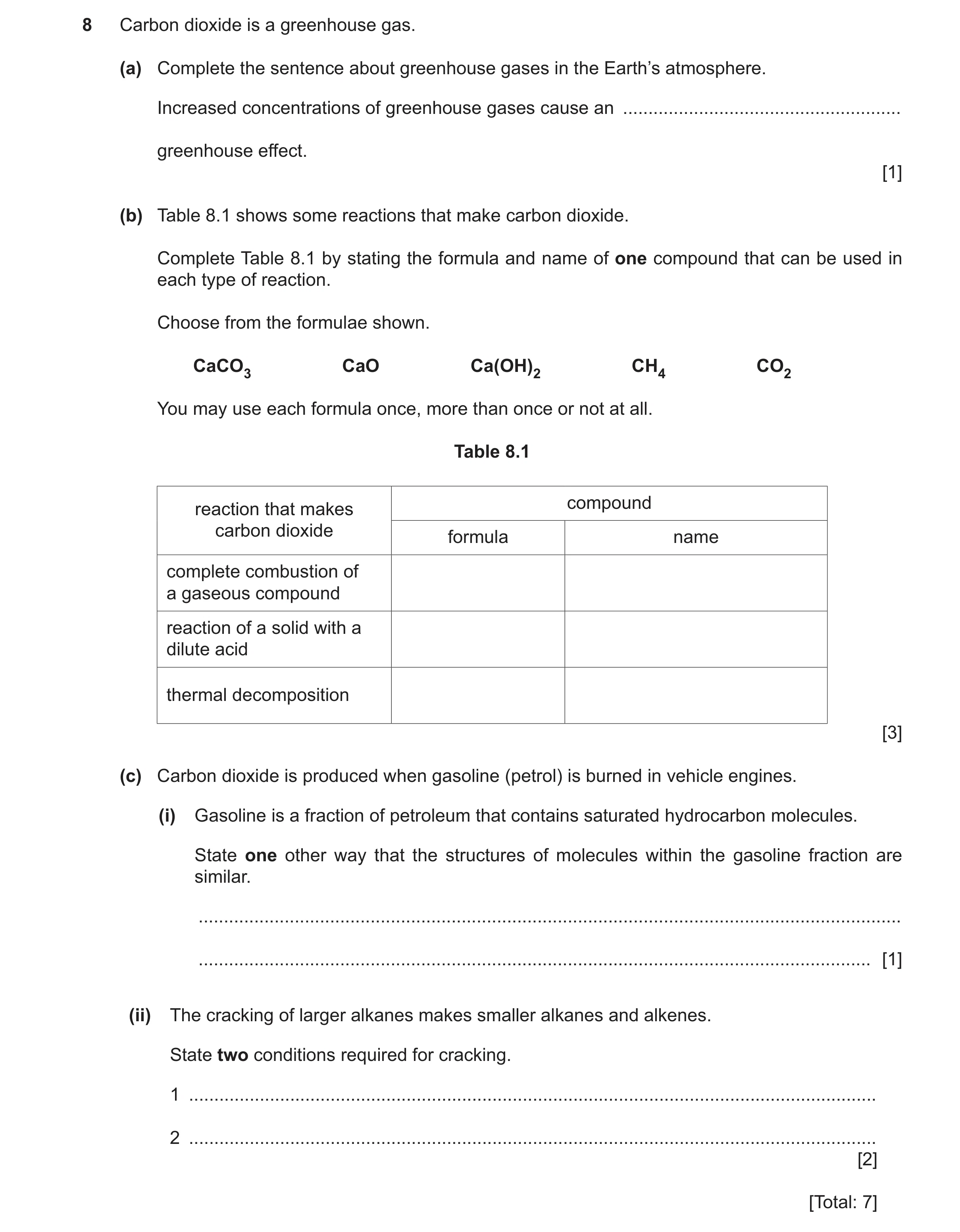
8 Carbon dioxide is a greenhouse gas. (a) Complete the sentence about greenhouse gases in the Earth’s atmosphere. Increased concentrations of greenhouse gases cause an … greenhouse effect. [1] (b) Table 8.1 shows some reactions that make carbon dioxide. Complete Table 8.1 by stating the formula and name of one compound that can be used in each type of reaction. Choose from the formulae shown. CaCO3 CaO Ca(OH)2 CH4 CO2 You may use each formula once, more than once or not at all. Table 8.1 compound reaction that makes carbon dioxide formula name complete combustion of a gaseous compound reaction of a solid with a dilute acid thermal decomposition [3] (c) Carbon dioxide is produced when gasoline (petrol) is burned in vehicle engines. (i) Gasoline is a fraction of petroleum that contains saturated hydrocarbon molecules. State one other way that the structures of molecules within the gasoline fraction are similar. … … [1] (ii) The cracking of larger alkanes makes smaller alkanes and alkenes. State two conditions required for cracking. 1 … 2 … [2] [Total: 7]
7 marks
Mark scheme: 8(a) enhanced ; 1 8(b) 3 reaction that makes compound carbon dioxide formula name complete combustion of a gaseous compound CH4 methane a solid with a dilute acid CaCO3 calcium carbonate thermal decomposition CaCO3 calcium carbonate one mark for each correct row ;;; 8(c)(i) (similar) size / chain length ; 1 8(c)(ii) any two from: 2 high temperature ; high pressure ; catalyst ;
This question in 0653/41 Oct/Nov 2024
Q19 · The formula for methanol is CH3OH 0653/43 Oct/Nov 2024
8 (a) The formula for methanol is CH3OH. Complete the dot-and-cross diagram in Fig. 8.1 to show the bonding in methanol. Show outer-shell electrons only. H H C O H H Fig. 8.1 [3] (b) Ethene, C2H4, is an alkene. Ethane, C2H6, is an alkane. (i) State one difference in the bonding of ethene and of ethane. … … [1] (ii) The complete combustion reactions of both ethene and ethane produce carbon dioxide and water. Identify whether the statements are true or false. Tick (3) one box for each statement. true false One molecule of ethene produces the same number of molecules of carbon dioxide as one molecule of ethane. One molecule of ethene produces the same number of molecules of water as one molecule of ethane. The combustion reactions of ethene and ethane are both endothermic. [2] (c) The general formulae for alkenes and alkanes are shown in Table 8.1. Table 8.1 alkenes alkanes CnH2n CnH2n+2 Write the formula for: an alkene with 10 hydrogen atoms … an alkane with 10 hydrogen atoms. … [2] (d) Aqueous bromine is added to a sample of an alkene and to a separate sample of an alkane. State the colour of each sample after the aqueous bromine is added. alkene … alkane … [2] [Total: 10]
10 marks
Mark scheme: 8(a) 3 four pairs bonding electrons around carbon correct ; one bonding pair between oxygen and hydrogen (O-H bond) correct ; four non-bonding electrons on oxygen shell AND no extra electrons (on hydrogen) ; 8(b)(i) ethene, has a double bond / shares 4 electrons OR 1 ethane, has only single bonds / has single bond between carbons / shares 2 electrons ; 8(b)(ii) 2 two correct ; three correct ; 8(c) alkene C5H10 ; 2 alkane C4H10 ; 8(d) alkene no colour / colourless ; 2 alkane orange ;
This question in 0653/43 Oct/Nov 2024
Q20 · The structures of ethene and ethane 0653/42 Oct/Nov 2025
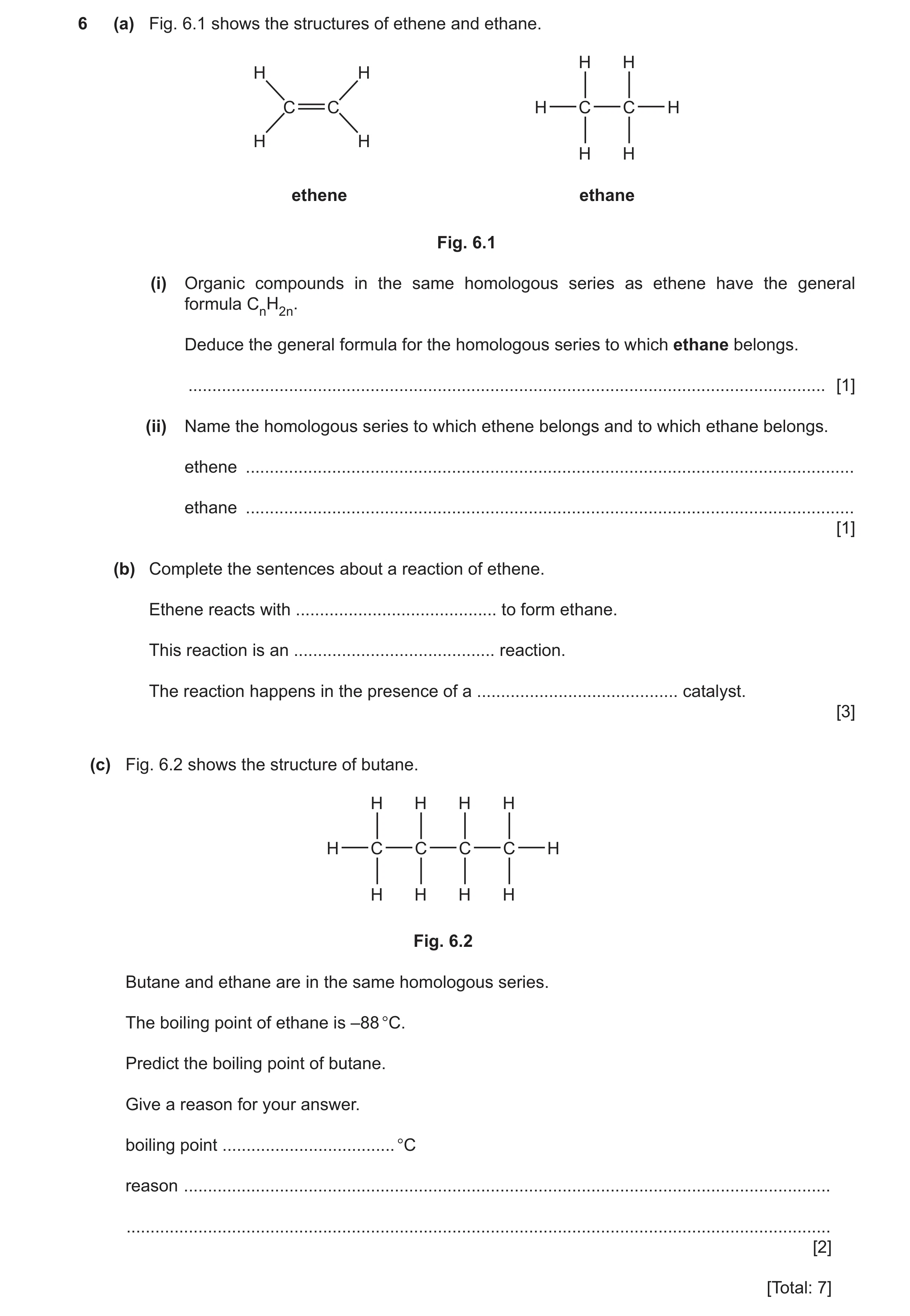
6 (a) Fig. 6.1 shows the structures of ethene and ethane. H H H H C C H C C H H H H H ethene ethane Fig. 6.1 (i) Organic compounds in the same homologous series as ethene have the general formula CnH2n. Deduce the general formula for the homologous series to which ethane belongs. … [1] (ii) Name the homologous series to which ethene belongs and to which ethane belongs. ethene … ethane … [1] (b) Complete the sentences about a reaction of ethene. Ethene reacts with … to form ethane. This reaction is an … reaction. The reaction happens in the presence of a … catalyst. [3] (c) Fig. 6.2 shows the structure of butane. H H H H H C C C C H H H H H Fig. 6.2 Butane and ethane are in the same homologous series. The boiling point of ethane is –88 °C. Predict the boiling point of butane. Give a reason for your answer. boiling point … °C reason … … [2] [Total: 7]
7 marks
Mark scheme: 6(a)(i) CnH2n+2 ; 1 6(a)(ii) (ethene) alkene and (ethane) alkane ; 1 6(b) hydrogen ; 3 addition ; nickel / Ni ; 6(c) boiling point any temperature higher than –88 °C ; 2 reason idea of, longer chain length / larger molecule ;
This question in 0653/42 Oct/Nov 2025
 1 / 27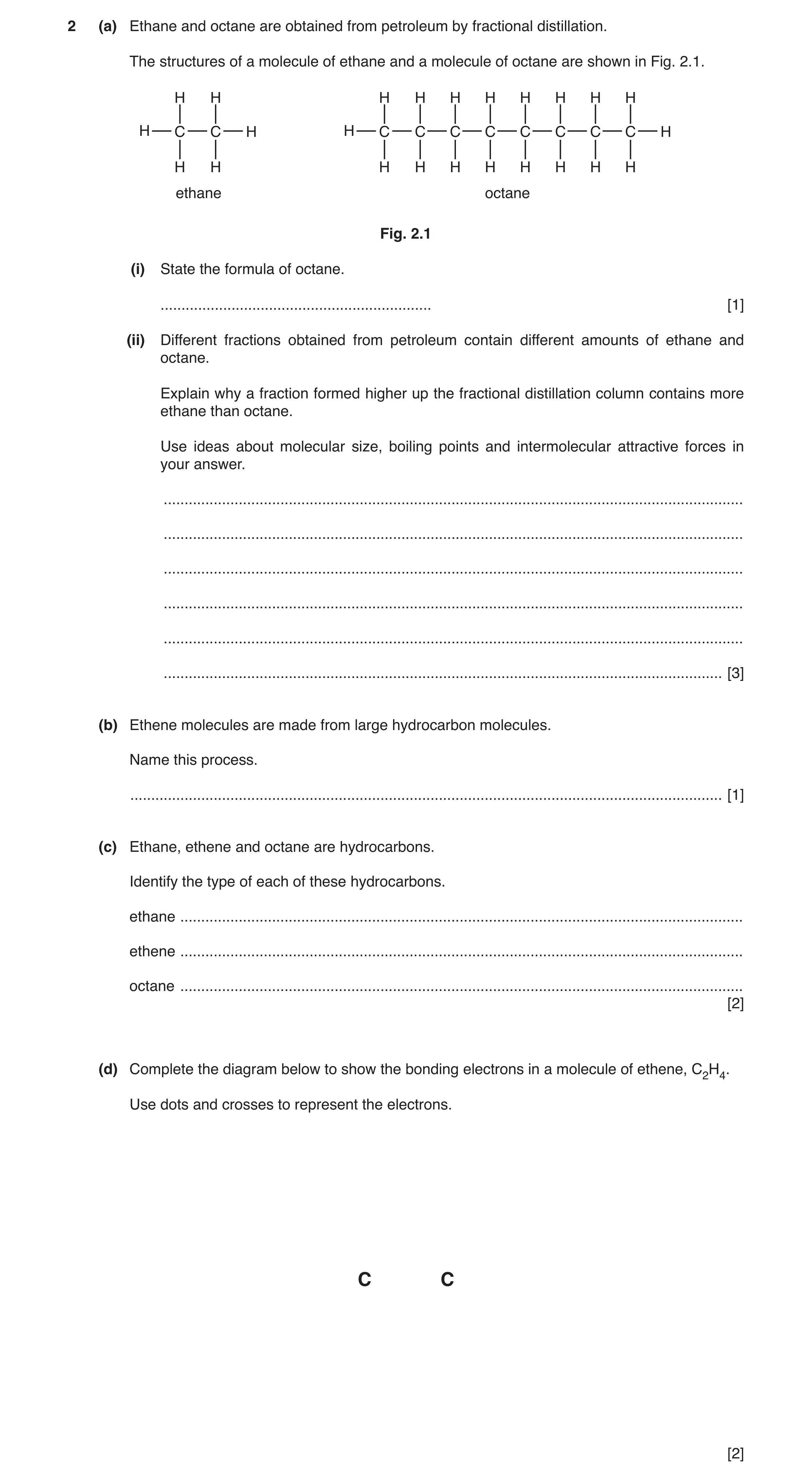
![Question 5: (a) The formula of methanol is CH3OH. Complete the structure of a molecule of methanol. Include all atoms and all bonds. C O [1] (b) (i) Ex…](https://img.pastlit.com/crops/ce89baf8-7d64-4617-851e-c29da4d5ba90/q2.webp) 6 / 27
6 / 27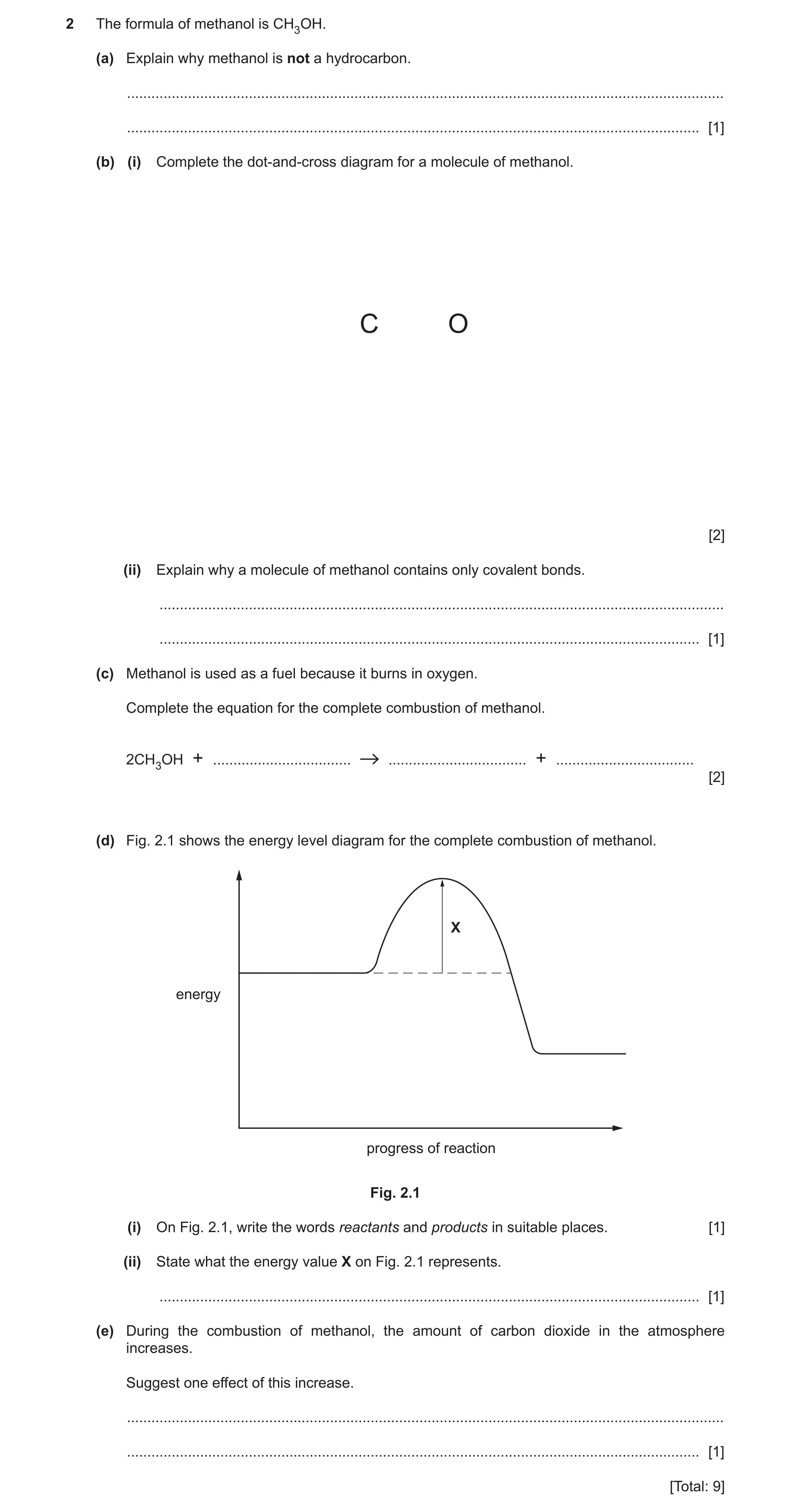
 9 / 27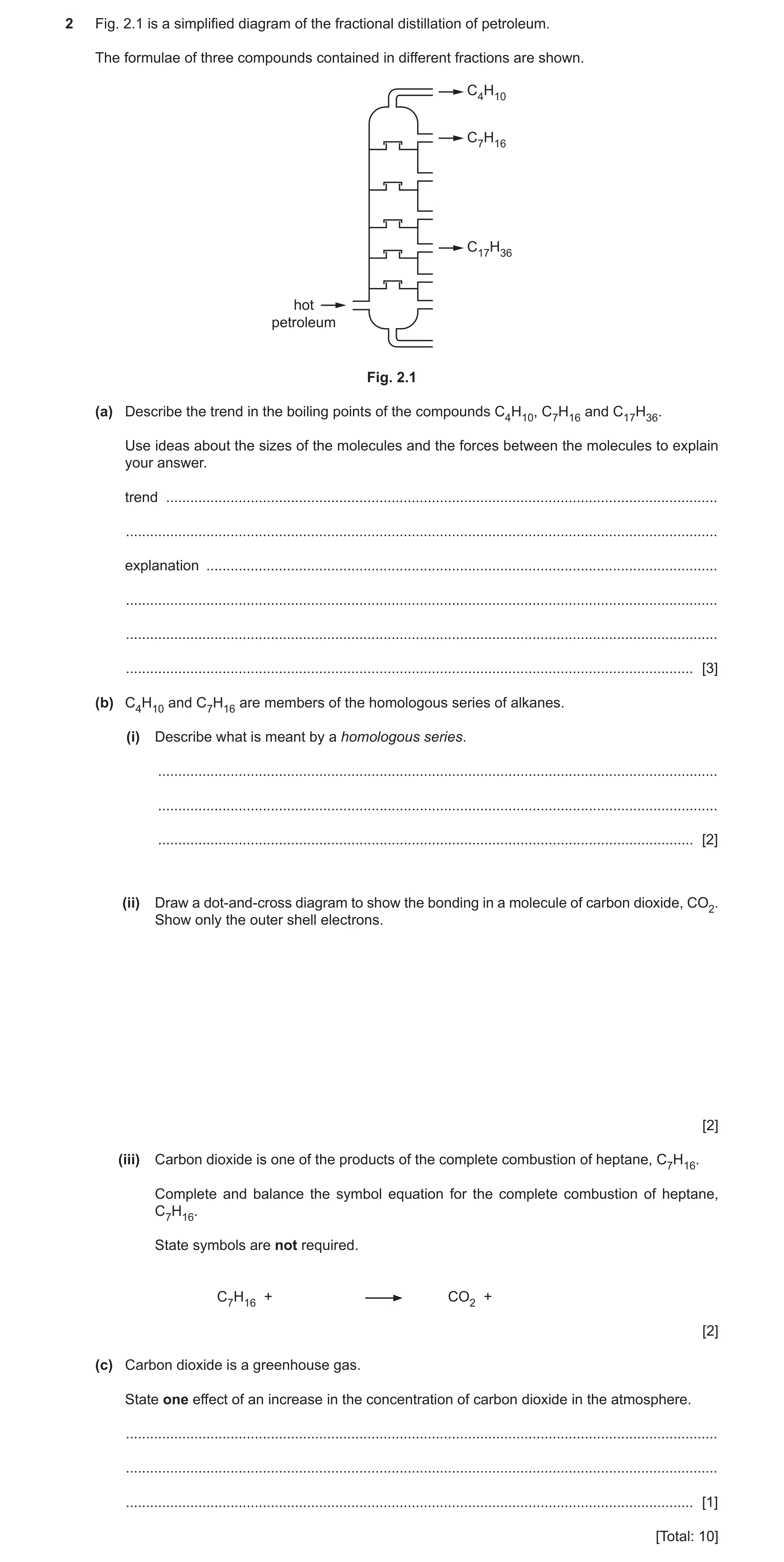
 23 / 27
 24 / 27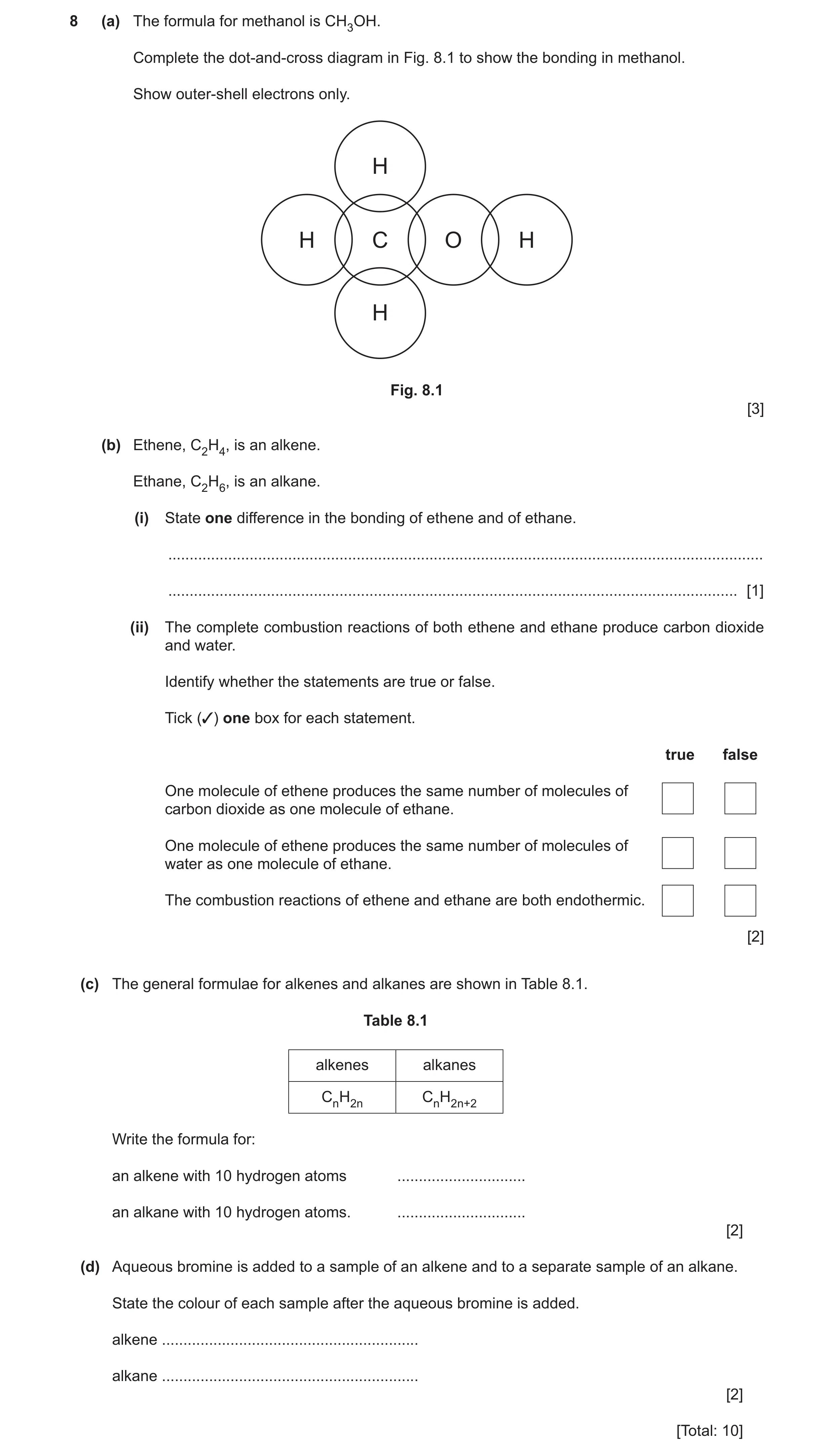
 27 / 27
 7
7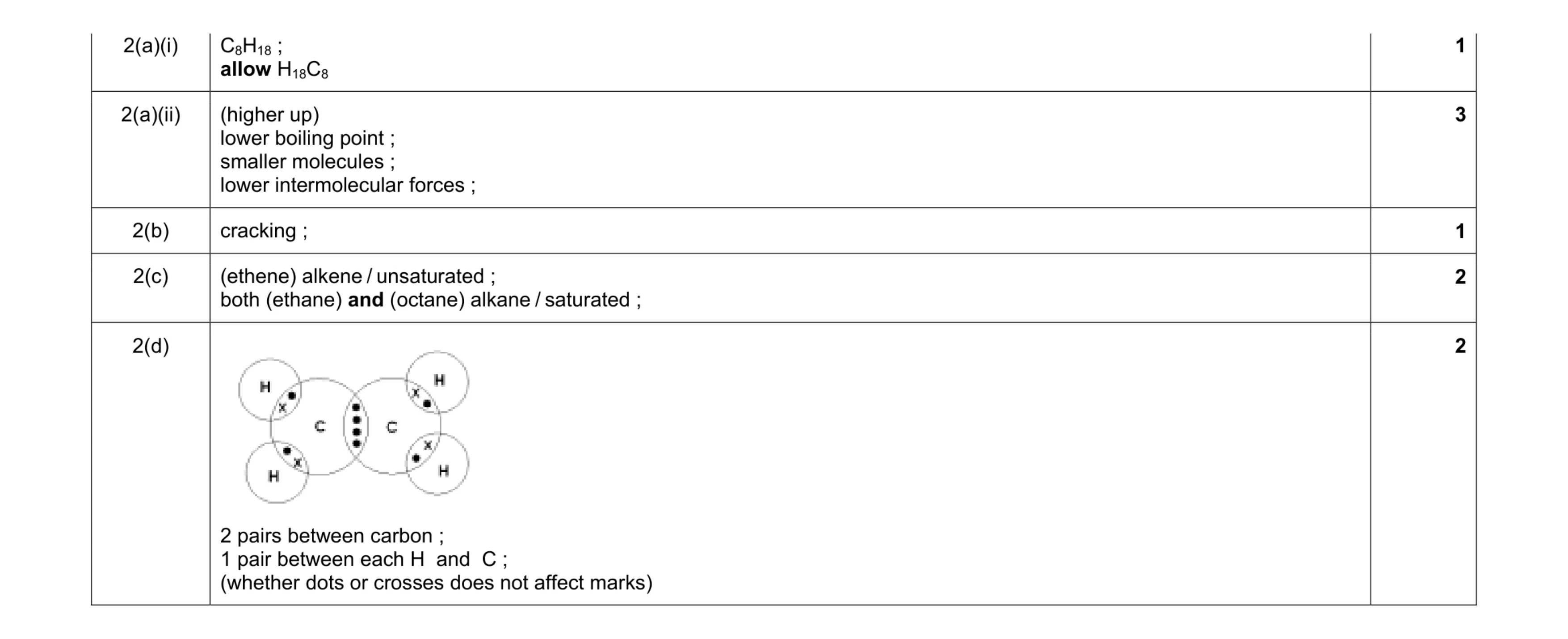 9
9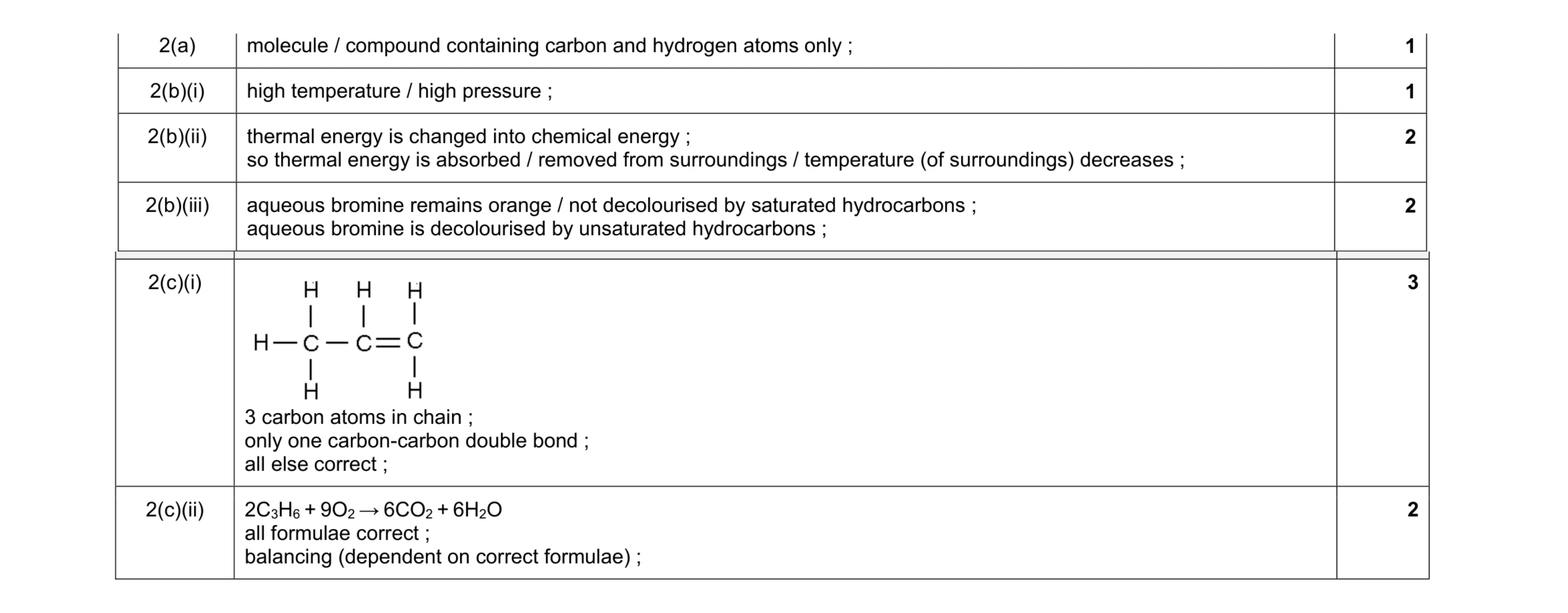 11
11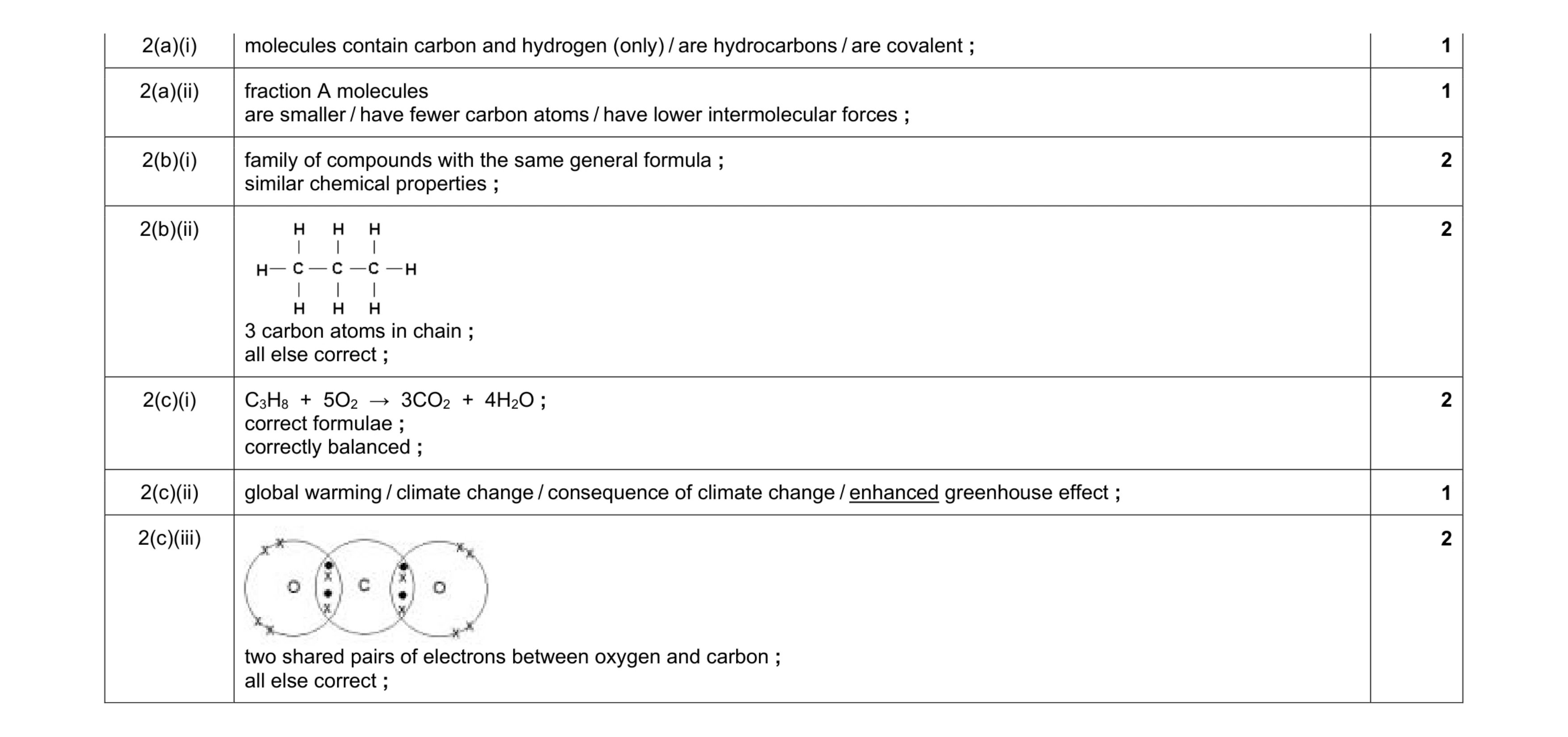 11
11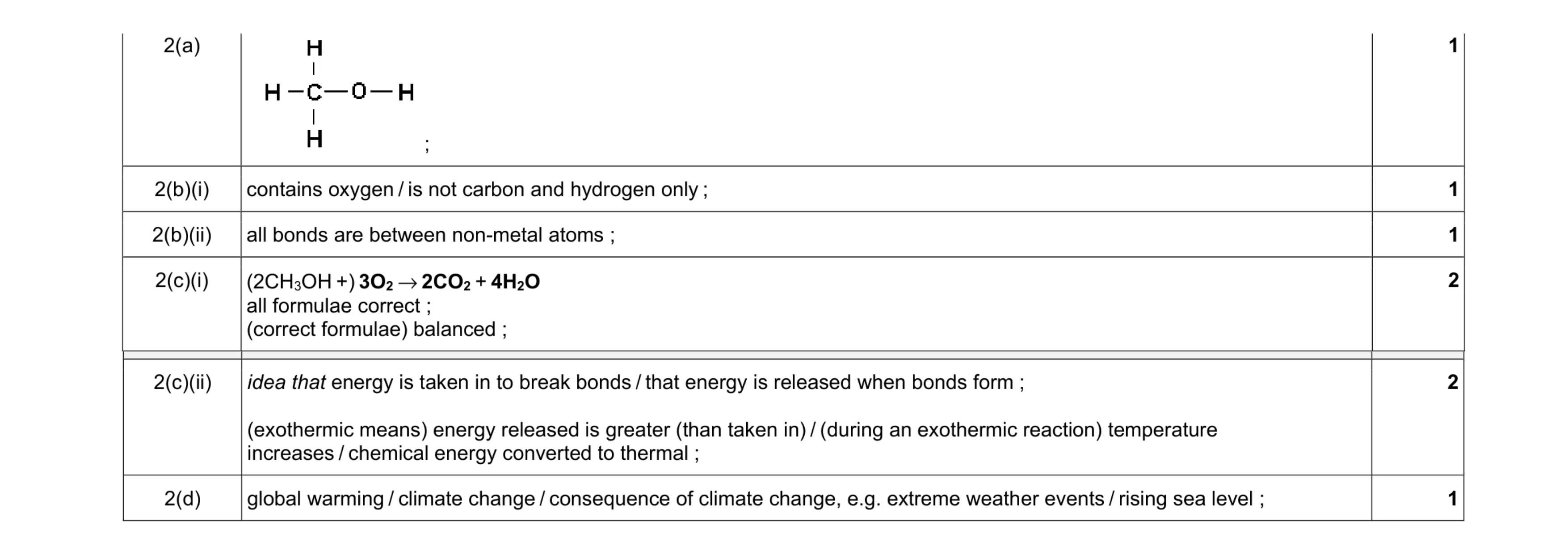 8
8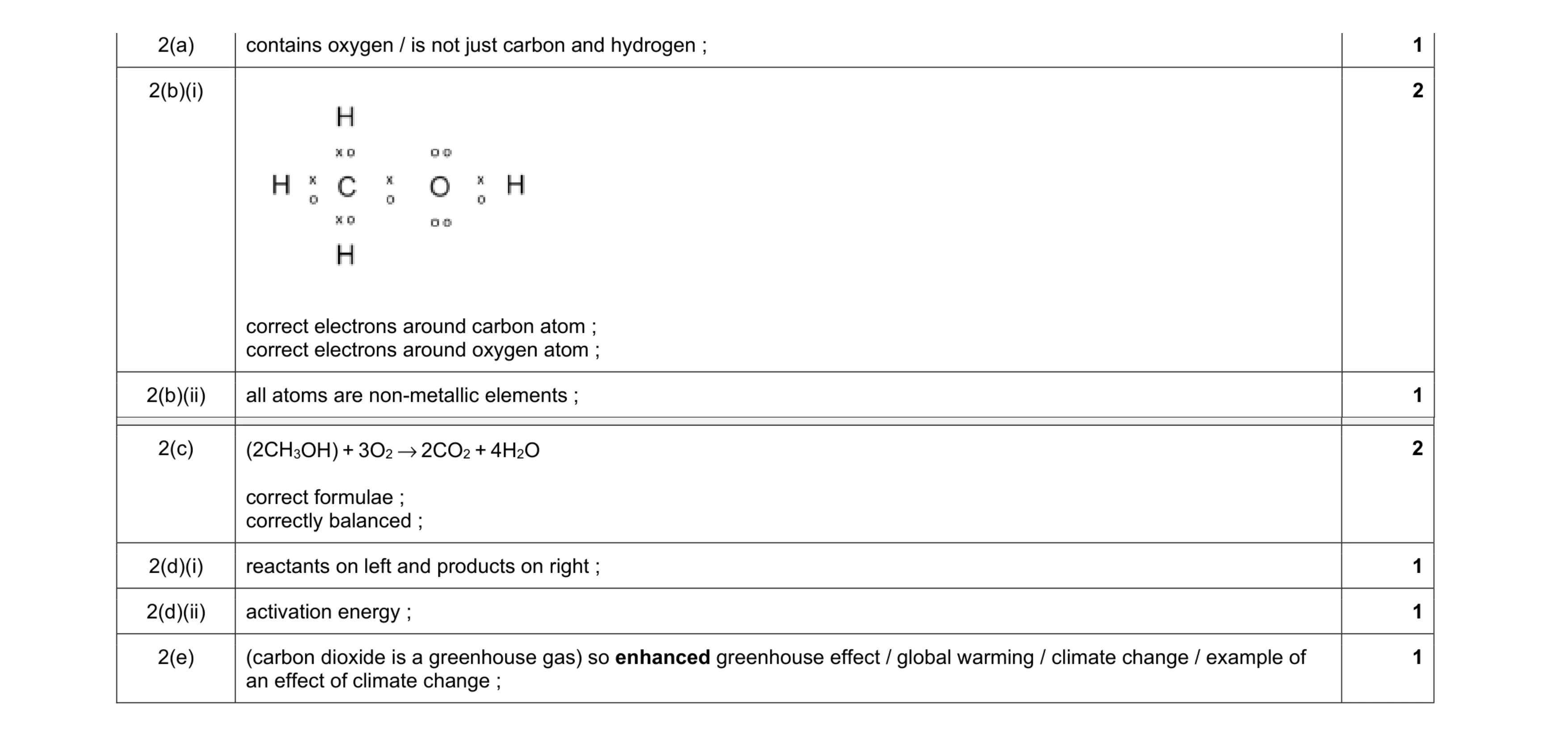 9
9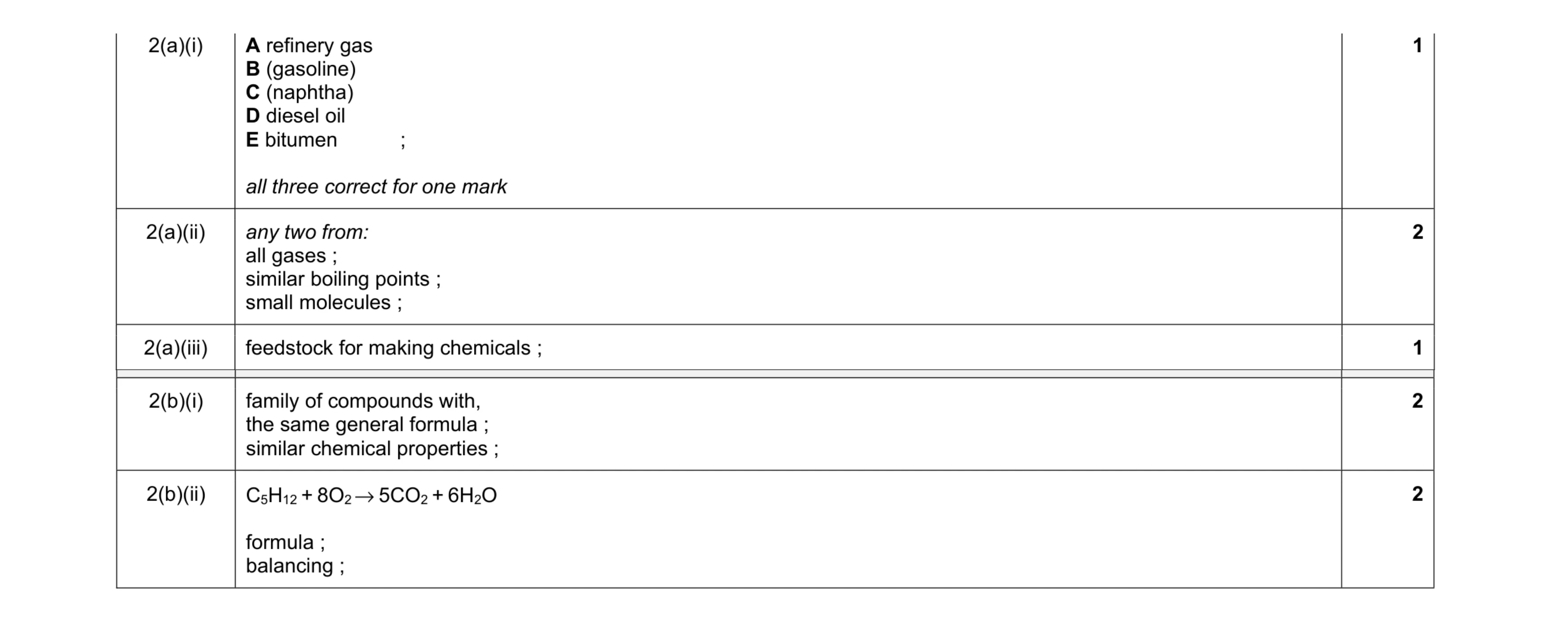 8
8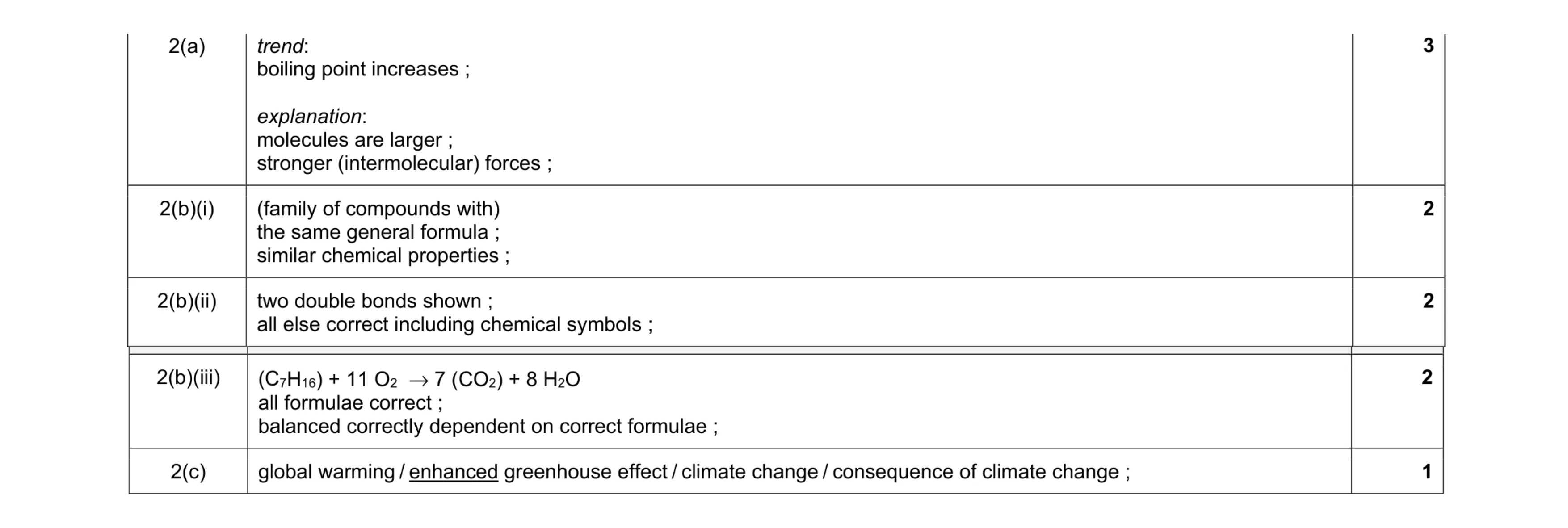 10
10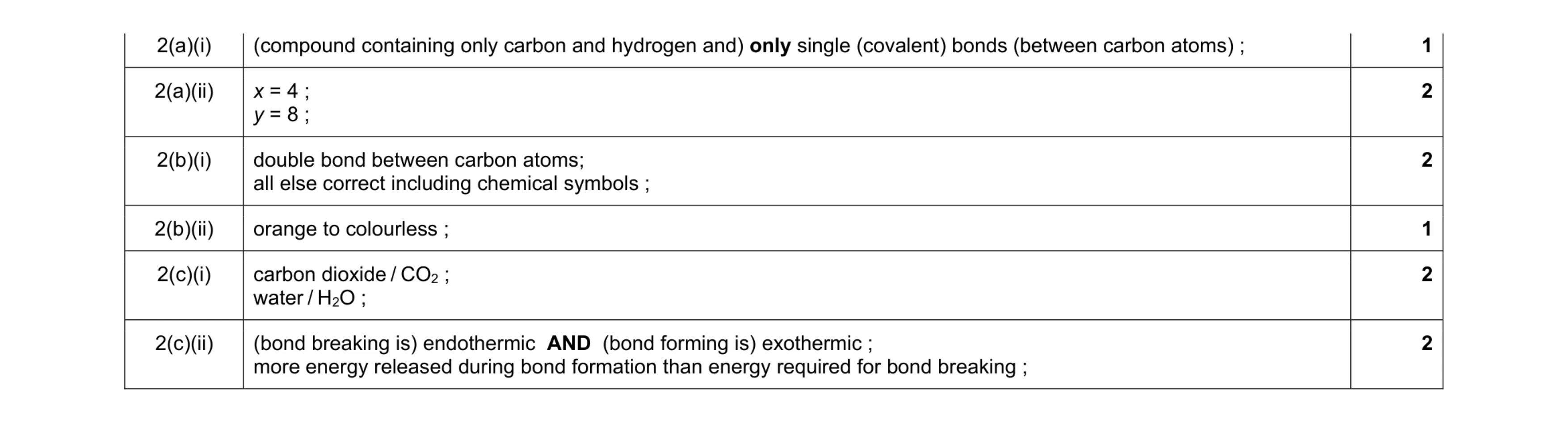 10
10 7
7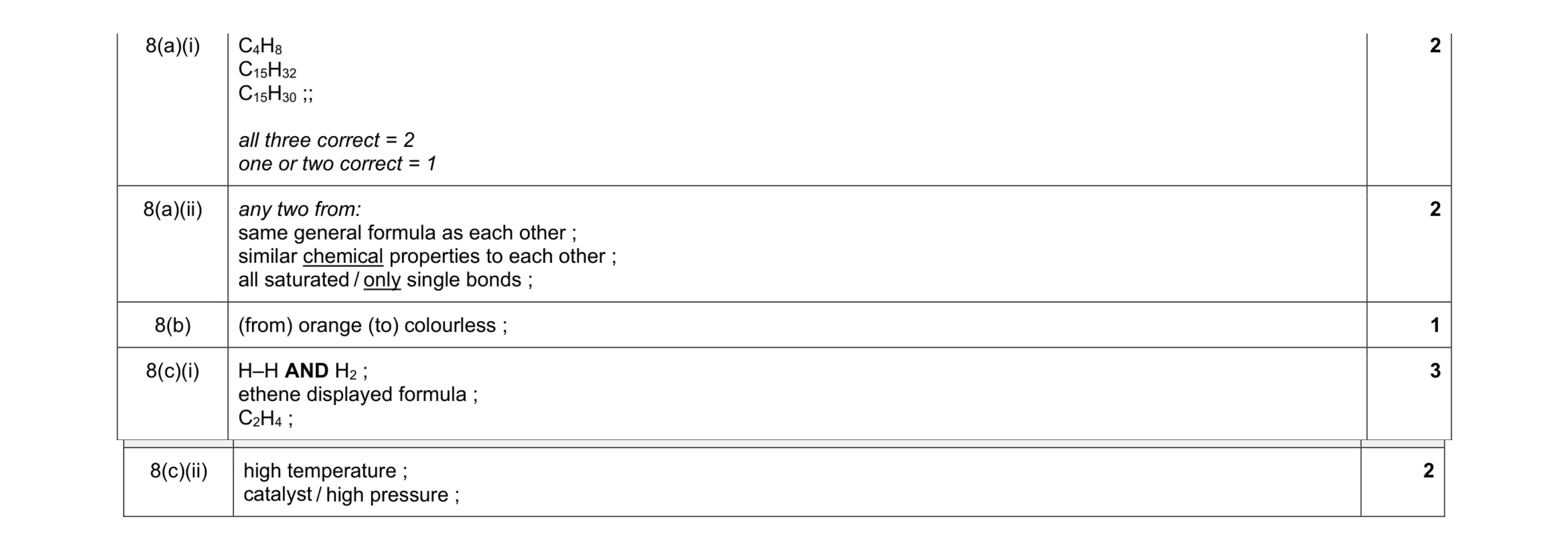 10
10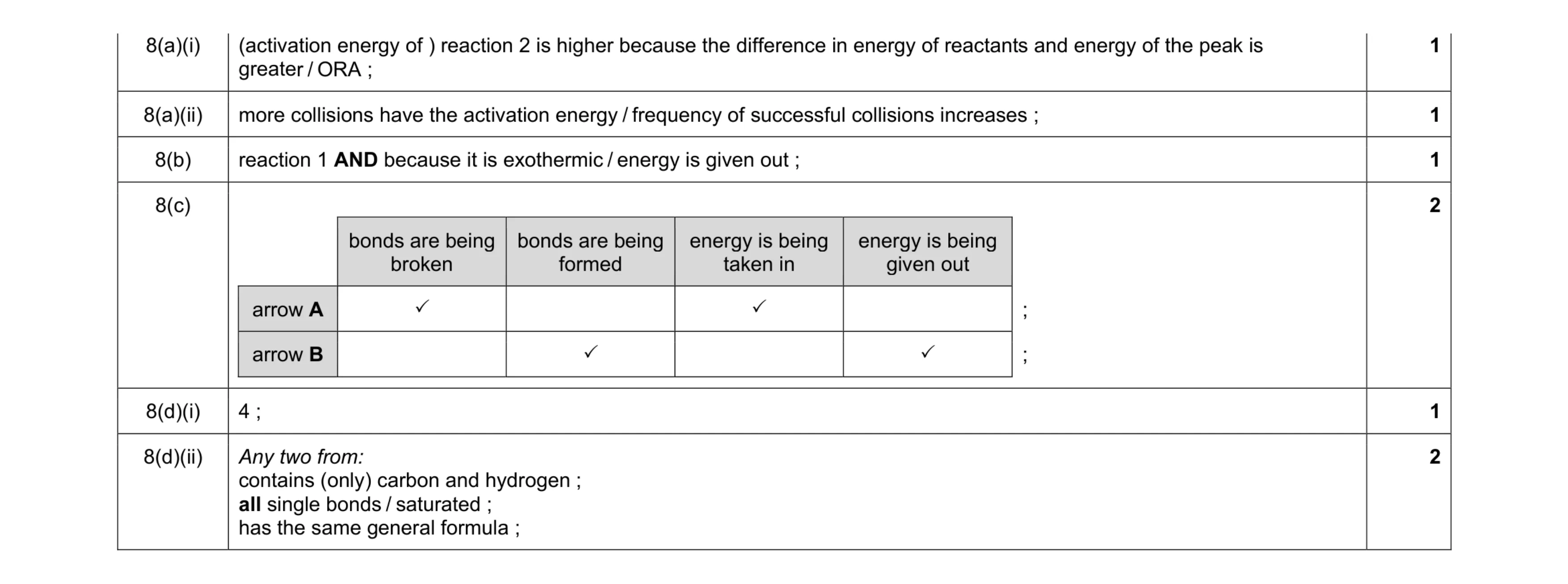 8
8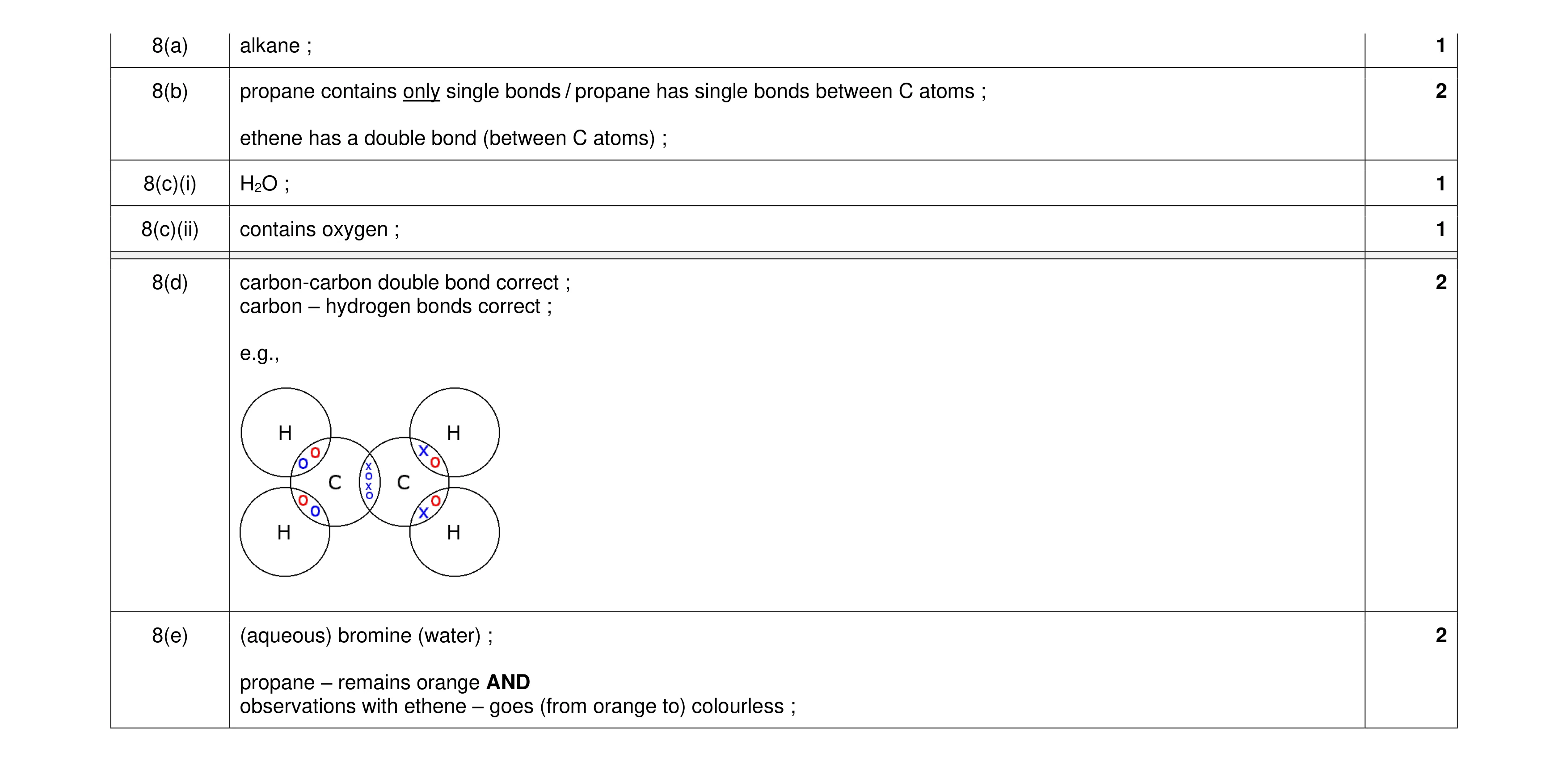 9
9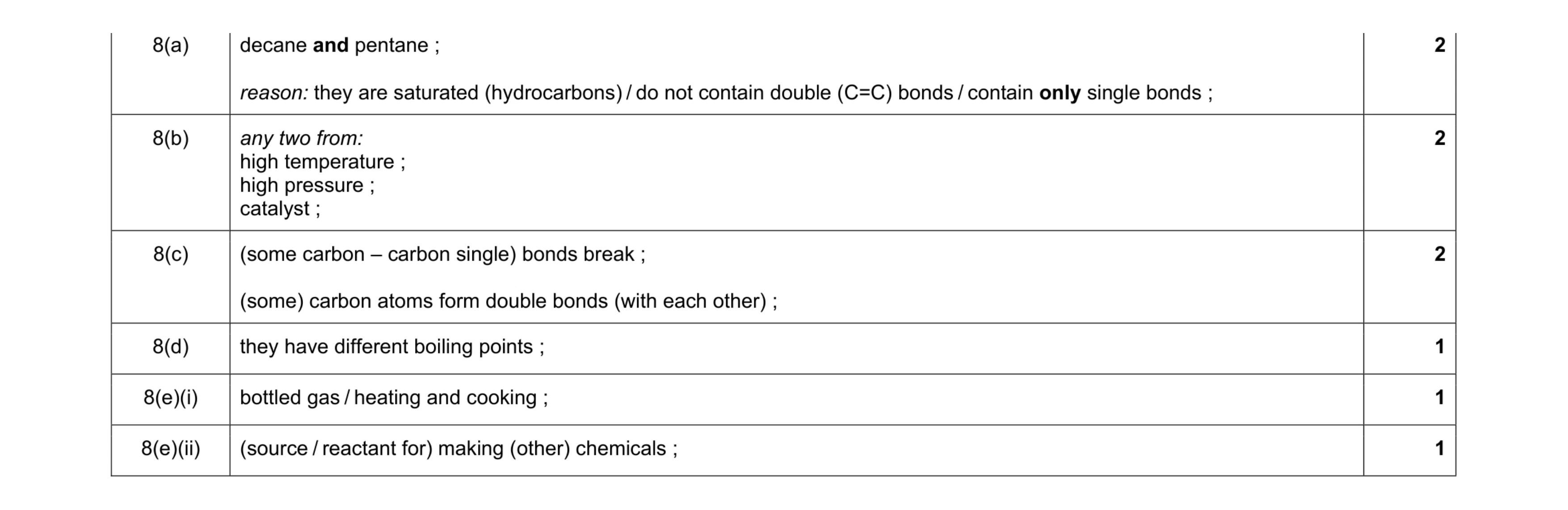 9
9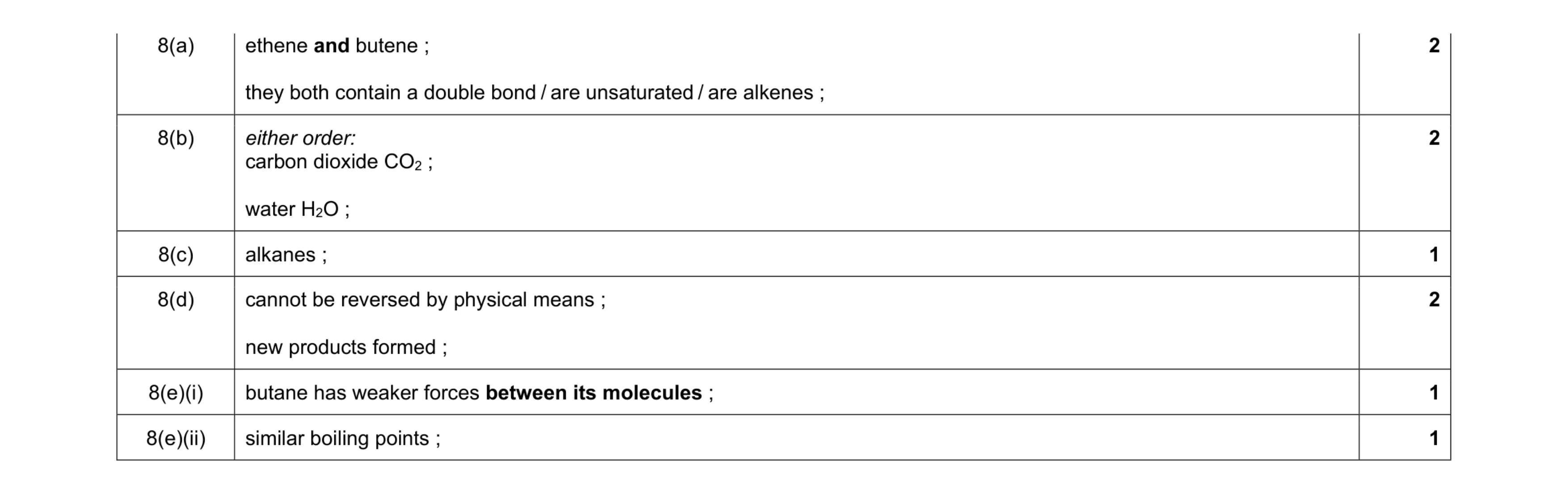 9
9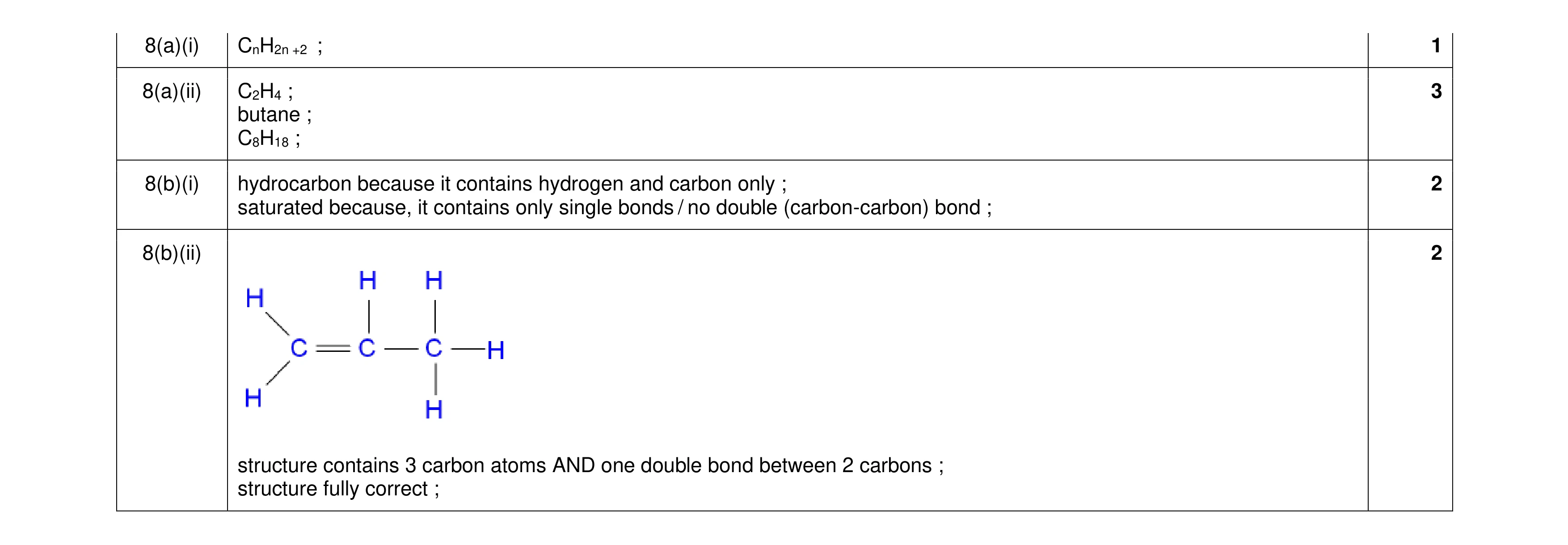 8
8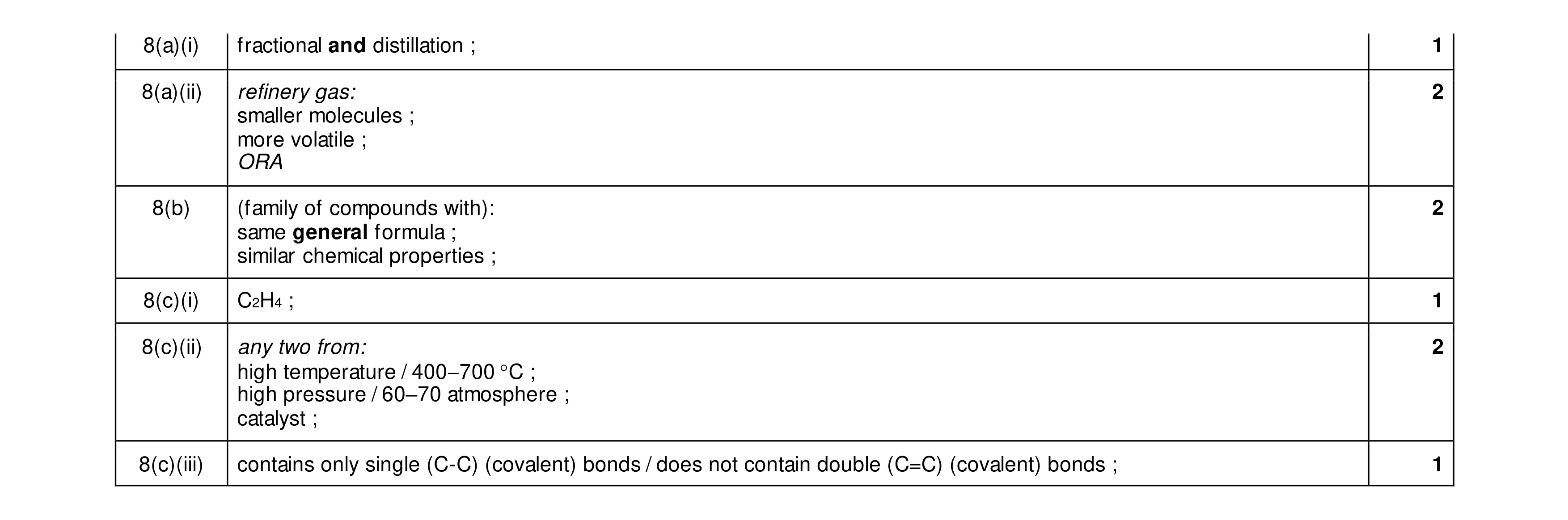 9
9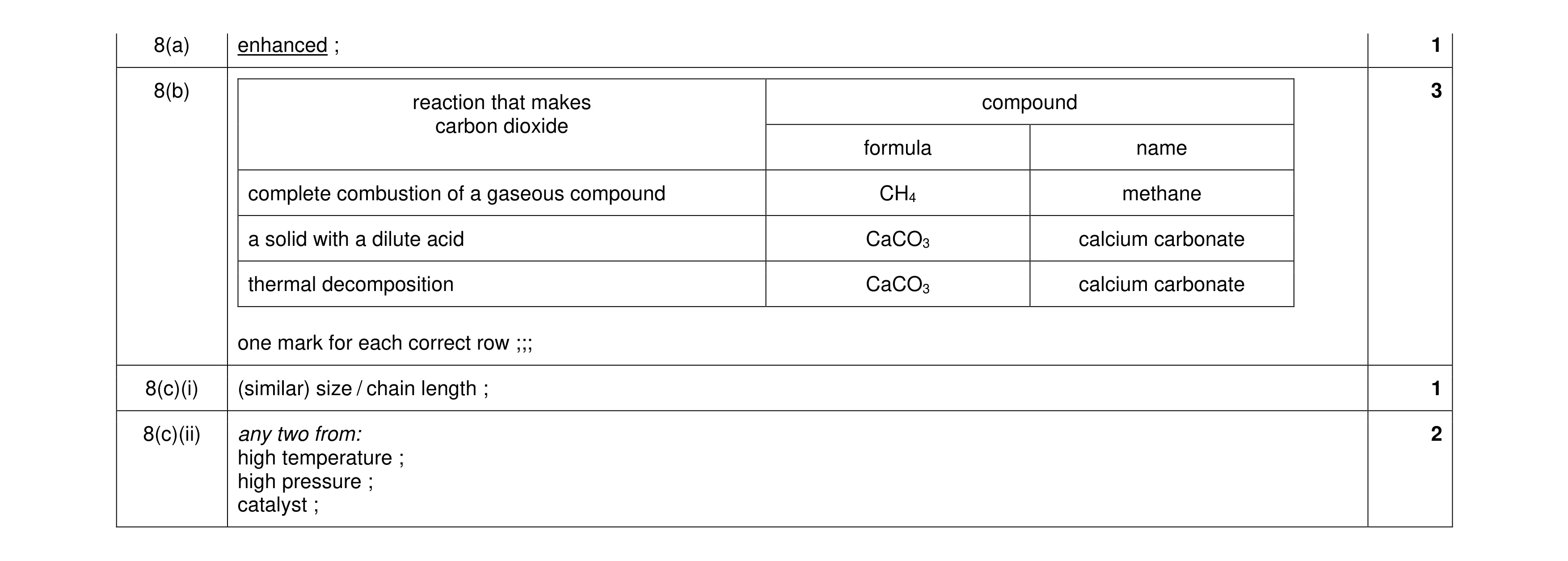 7
7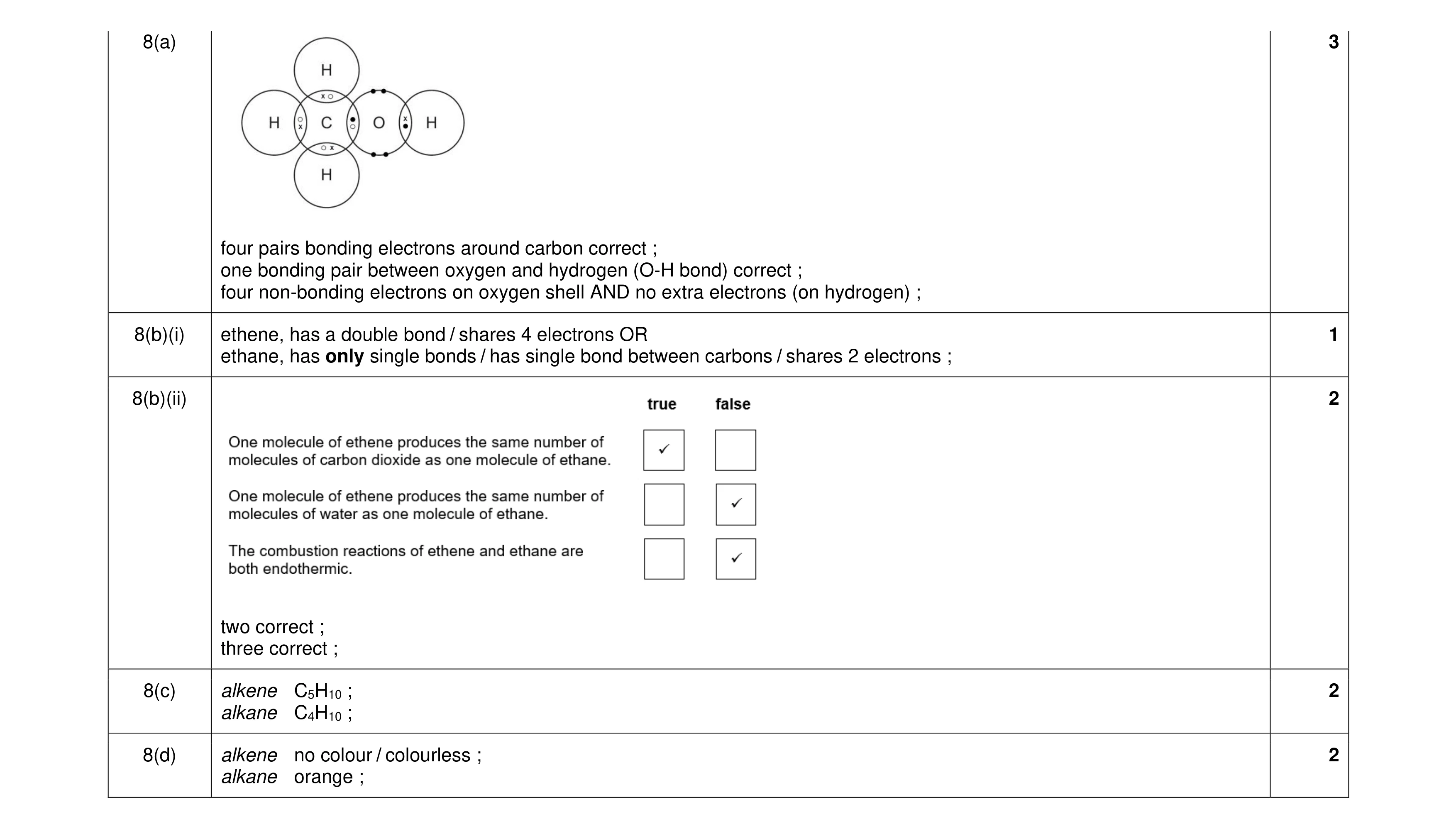 10
10 7
7