Questions as text
Q1 · Butane, C4H10, and decane, C10H22, are alkanes 0653/21 May/June 2018
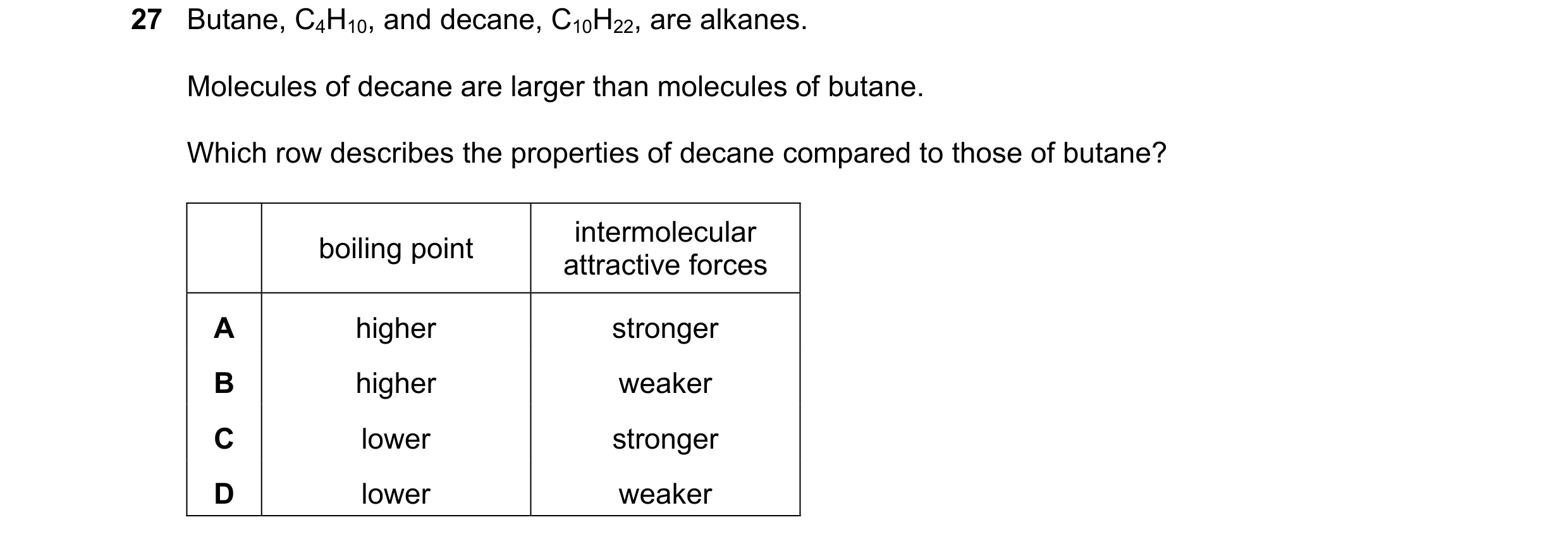
27 Butane, C4H10, and decane, C10H22, are alkanes. Molecules of decane are larger than molecules of butane. Which row describes the properties of decane compared to those of butane? intermolecular boiling point attractive forces A higher stronger B higher weaker C lower stronger D lower weaker
1 marks
Answer: A
This question in 0653/21 May/June 2018
Q2 · Which statement about alkanes is not correct? 0653/21 May/June 2019
26 Which statement about alkanes is not correct? A Alkanes are unsaturated hydrocarbons. B Alkanes burn to release heat energy. C Alkanes form carbon dioxide and water when they burn. D Alkane molecules contain only single bonds.
1 marks
Answer: A
This question in 0653/21 May/June 2019
Q3 · Which statement about alkanes is correct? 0653/22 May/June 2019
26 Which statement about alkanes is correct? A Alkanes are compounds containing carbon, hydrogen and oxygen. B Alkanes are saturated hydrocarbons. C Ethane is used to make poly(ethene). D Methane is the only alkane that does not contain a double bond.
1 marks
Answer: B
This question in 0653/22 May/June 2019
Q4 · Which row identifies the temperature used and describes the change to the alkane… 0653/22 May/June 2019
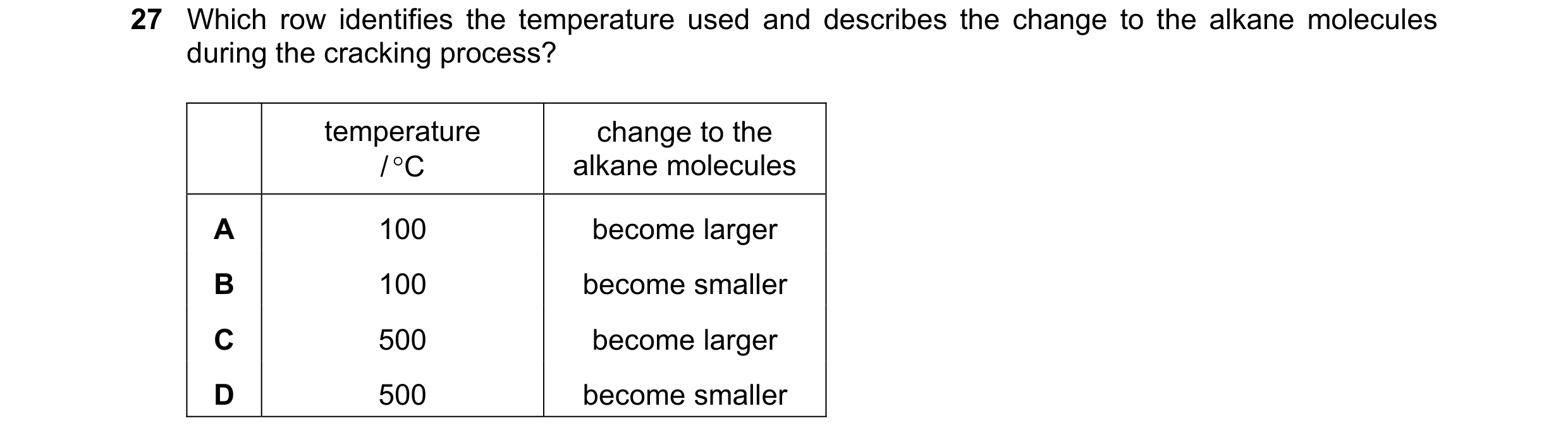
27 Which row identifies the temperature used and describes the change to the alkane molecules during the cracking process? temperature change to the / °C alkane molecules A 100 become larger B 100 become smaller C 500 become larger D 500 become smaller
1 marks
Answer: D
This question in 0653/22 May/June 2019
Q5 · What is a typical property of alkanes? 0653/23 Oct/Nov 2019
27 What is a typical property of alkanes? A They are catalysts. B They burn in air. C They can be neutralised. D They react endothermically.
1 marks
Answer: B
This question in 0653/23 Oct/Nov 2019
Q6 · In which list are all of the hydrocarbons in the same homologous series? 0653/22 May/June 2020
27 In which list are all of the hydrocarbons in the same homologous series? A CH4, C2H6, C3H8, C5H10 B C2H4, C2H6, C3H6, C4H8 C C2H4, C3H6, C4H8, C5H10 D C2H6, C3H6, C4H8, C5H10
1 marks
Answer: C
This question in 0653/22 May/June 2020
Q7 · Which statement about hydrocarbons is not correct? 0653/22 Feb/March 2021
27 Which statement about hydrocarbons is not correct? A Alkenes are made by cracking alkanes. B Butene decolourises aqueous bromine. C C2H4 is used to make poly(ethene). D The general formula of alkanes is CnH2n.
1 marks
Answer: D
This question in 0653/22 Feb/March 2021
Q8 · Refinery gas contains methane 0653/22 Feb/March 2022
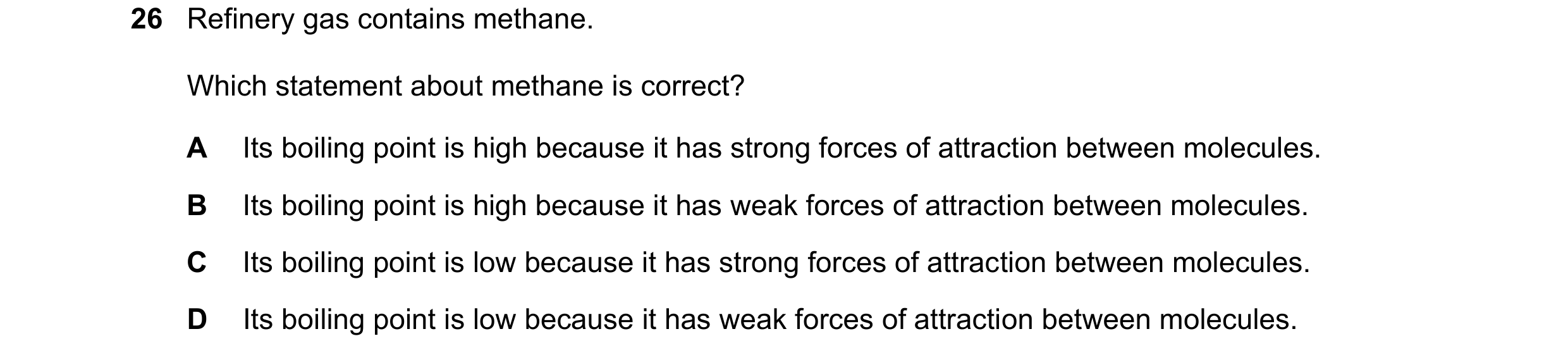
26 Refinery gas contains methane. Which statement about methane is correct? A Its boiling point is high because it has strong forces of attraction between molecules. B Its boiling point is high because it has weak forces of attraction between molecules. C Its boiling point is low because it has strong forces of attraction between molecules. D Its boiling point is low because it has weak forces of attraction between molecules.
1 marks
Answer: D
This question in 0653/22 Feb/March 2022
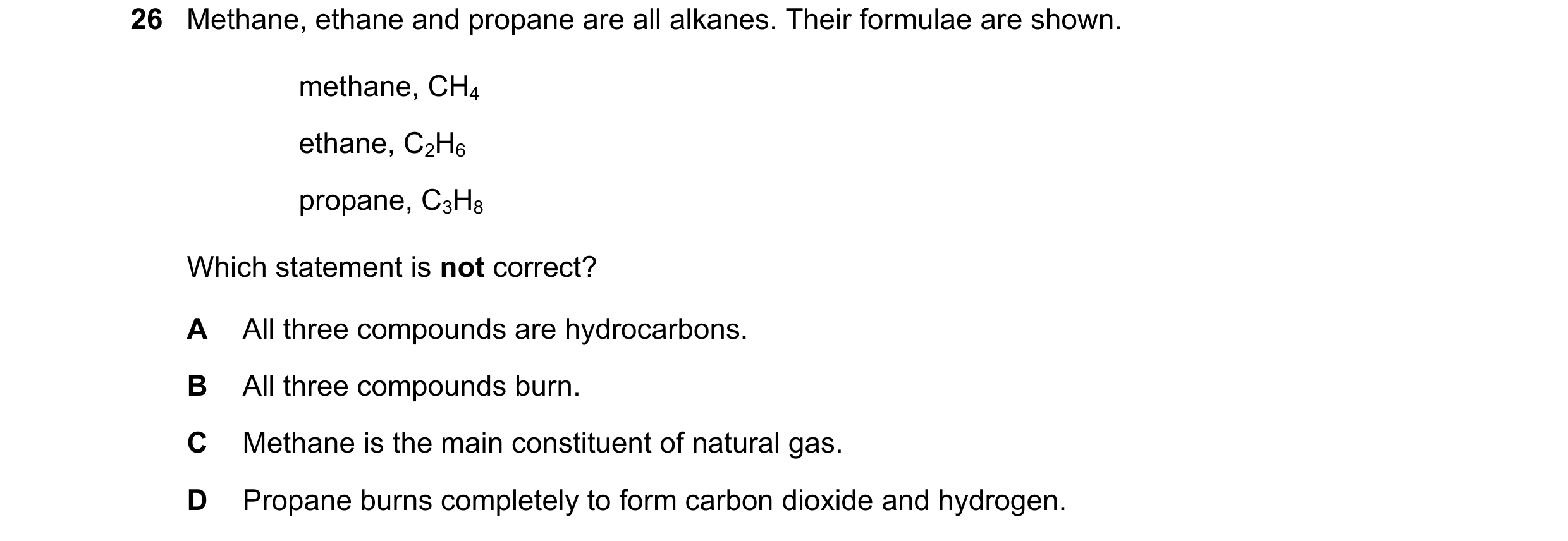
Q9 · Methane, ethane and propane are all alkanes 0653/21 May/June 2022
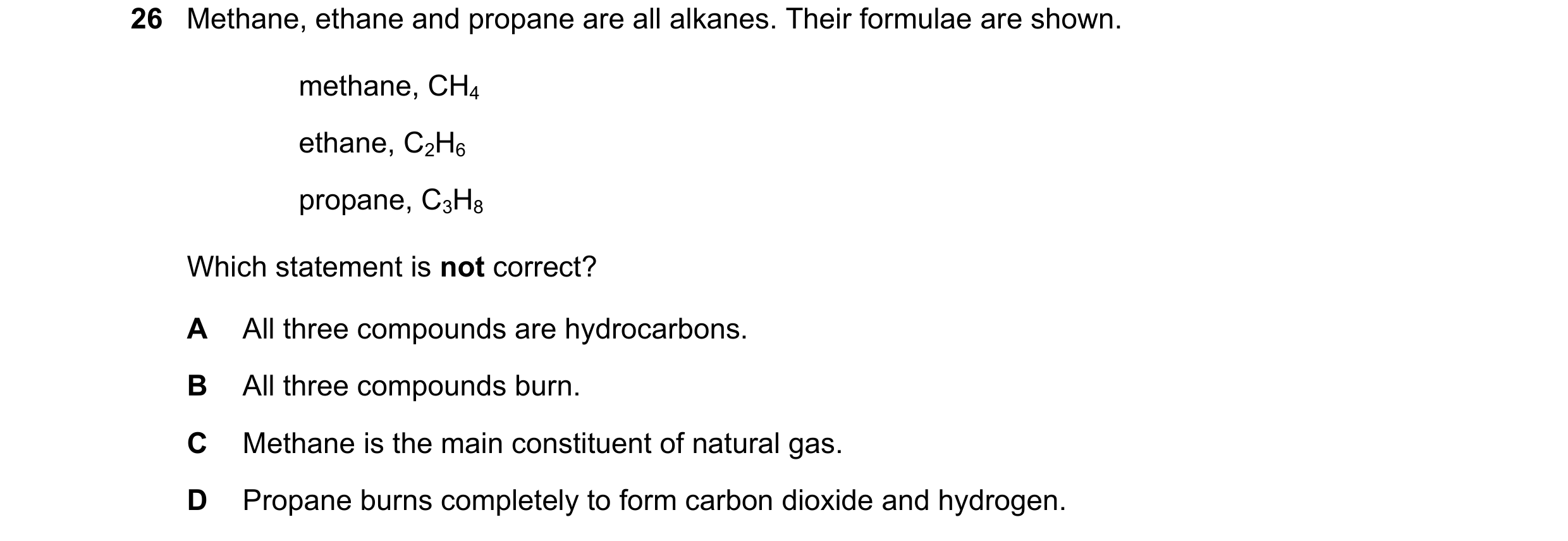
26 Methane, ethane and propane are all alkanes. Their formulae are shown. methane, CH4 ethane, C2H6 propane, C3H8 Which statement is not correct? A All three compounds are hydrocarbons. B All three compounds burn. C Methane is the main constituent of natural gas. D Propane burns completely to form carbon dioxide and hydrogen.
1 marks
Answer: D
This question in 0653/21 May/June 2022
Q10 · Methane, ethane and propane are all alkanes 0653/22 May/June 2022
26 Methane, ethane and propane are all alkanes. Their formulae are shown. methane, CH4 ethane, C2H6 propane, C3H8 Which statement is not correct? A All three compounds are hydrocarbons. B All three compounds burn. C Methane is the main constituent of natural gas. D Propane burns completely to form carbon dioxide and hydrogen.
1 marks
Answer: D
This question in 0653/22 May/June 2022
Q11 · Methane, ethane and propane are all alkanes 0653/23 May/June 2022
26 Methane, ethane and propane are all alkanes. Their formulae are shown. methane, CH4 ethane, C2H6 propane, C3H8 Which statement is not correct? A All three compounds are hydrocarbons. B All three compounds burn. C Methane is the main constituent of natural gas. D Propane burns completely to form carbon dioxide and hydrogen.
1 marks
Answer: D
This question in 0653/23 May/June 2022
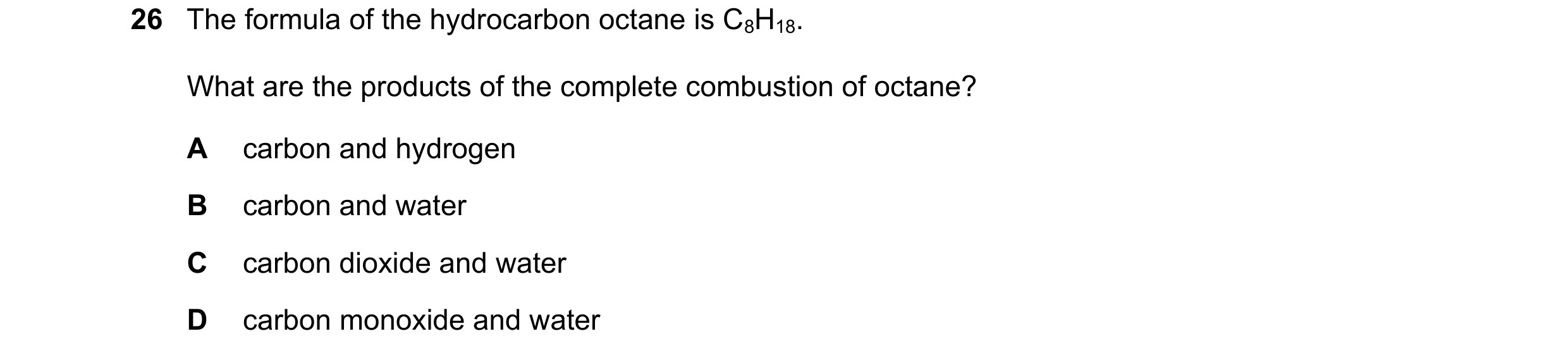
Q12 · The formula of the hydrocarbon octane is C8H18 0653/21 Oct/Nov 2022
26 The formula of the hydrocarbon octane is C8H18. What are the products of the complete combustion of octane? A carbon and hydrogen B carbon and water C carbon dioxide and water D carbon monoxide and water
1 marks
Answer: C
This question in 0653/21 Oct/Nov 2022
Q13 · Why are alkanes members of the same homologous series? 0653/21 May/June 2023
26 Why are alkanes members of the same homologous series? A They are all hydrocarbons. B They have similar physical properties. C They have the same general formula. D They all undergo combustion to give carbon dioxide and water.
1 marks
Answer: C
This question in 0653/21 May/June 2023
Q14 · Which statement about all alkanes is correct? 0653/23 May/June 2023
26 Which statement about all alkanes is correct? A They contain the same number of carbon atoms. B They have different chemical properties. C They have the same general formula. D They have the same melting point.
1 marks
Answer: C
This question in 0653/23 May/June 2023
Q15 · Which statement about alkanes is correct? 0653/21 Oct/Nov 2023
27 Which statement about alkanes is correct? A Their molecules are unsaturated. B They are generally reactive compounds. C They are mixtures of carbon and hydrogen atoms only. D They produce water when they burn.
1 marks
Answer: D
This question in 0653/21 Oct/Nov 2023
Q16 · Decane is an alkane 0653/22 Oct/Nov 2023
27 Decane is an alkane. Which statement about decane is correct? A It burns in air to form carbon dioxide and hydrogen. B It is an unsaturated hydrocarbon. C It only contains single C–C and C–H bonds. D It rapidly decolourises bromine water.
1 marks
Answer: C
This question in 0653/22 Oct/Nov 2023
Q17 · Which statement about alkanes is correct? 0653/23 Oct/Nov 2023
27 Which statement about alkanes is correct? A They are unsaturated hydrocarbons. B They are very reactive. C They burn to form carbon dioxide and hydrogen. D They contain only single covalent bonds.
1 marks
Answer: D
This question in 0653/23 Oct/Nov 2023
Q18 · Which statements about the alkanes are correct? 0653/21 Oct/Nov 2024
26 Which statements about the alkanes are correct? 1 They are saturated hydrocarbons. 2 They produce carbon monoxide and water during complete combustion. 3 They are generally unreactive, except in terms of burning. A 1, 2 and 3 B 1 and 2 only C 1 and 3 only D 2 and 3 only
1 marks
Answer: C
This question in 0653/21 Oct/Nov 2024
Q19 · Methane, ethane and propane are all members of the same homologous series 0653/23 May/June 2025
24 Methane, ethane and propane are all members of the same homologous series. Which statement about these compounds is correct? A They contain double carbon–carbon covalent bonds. B They have different general formulas. C They have the same molecular structure. D They react in similar ways.
1 marks
Answer: D
This question in 0653/23 May/June 2025
Q20 · Which equation represents cracking? 0653/21 Oct/Nov 2025
23 Which equation represents cracking? A C10H22 2C2H4 + C6H12 + H2 B C10H20 + H2 C10H22 C 2C10H22 + 21O2 20CO + 22H2O D 2C10H22 + 31O2 20CO2 + 22H2O
1 marks
Answer: A
This question in 0653/21 Oct/Nov 2025
Q21 · The structures of some compounds are shown 0653/23 Oct/Nov 2025
24 The structures of some compounds are shown. H H H H H H H C H H C C H H C C C H H H H H H H Which statement about these compounds is correct? A They have the same boiling point. B They are in the same homologous series. C They are unsaturated. D They have different chemical properties.
1 marks
Answer: B
This question in 0653/23 Oct/Nov 2025
Q22 · Which statement about methane is correct? 0653/23 Oct/Nov 2025
25 Which statement about methane is correct? A Its increase in the atmosphere contributes to climate change. B It reacts with steam in the presence of an acid catalyst. C It has the molecular formula CH3OH. D It reacts with bromine in an addition reaction.
1 marks
Answer: A
This question in 0653/23 Oct/Nov 2025


 1 / 5
1 / 5

 2 / 5
2 / 5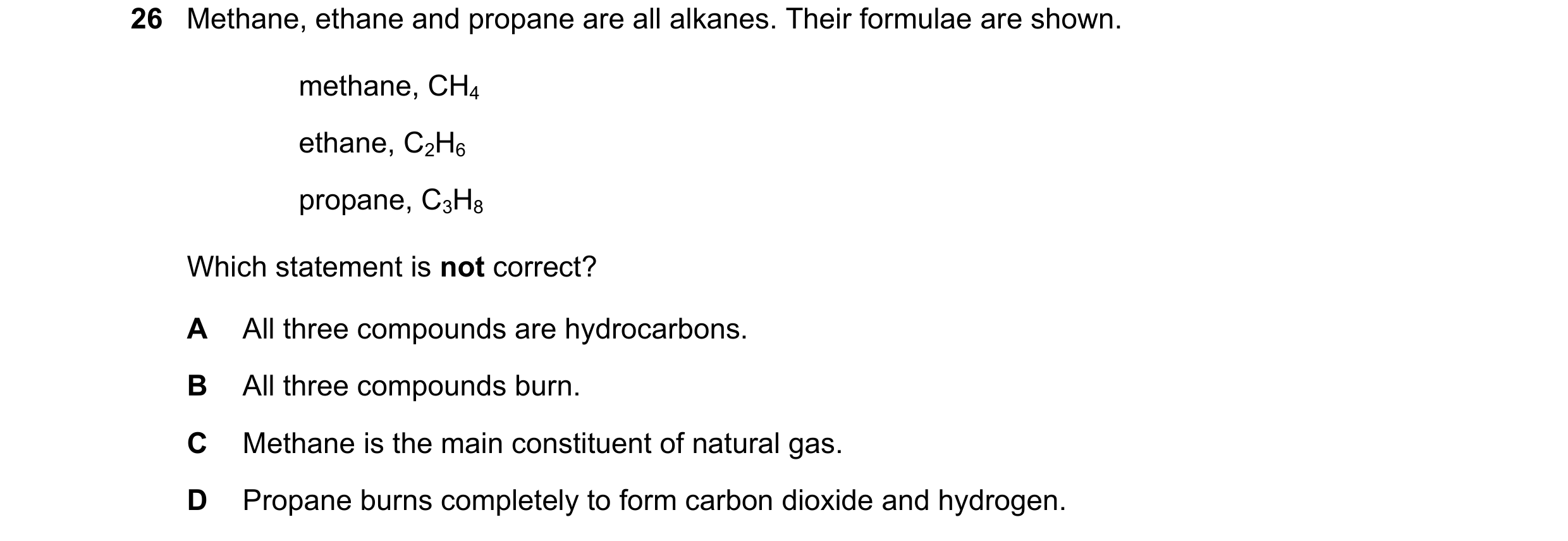


 3 / 5
3 / 5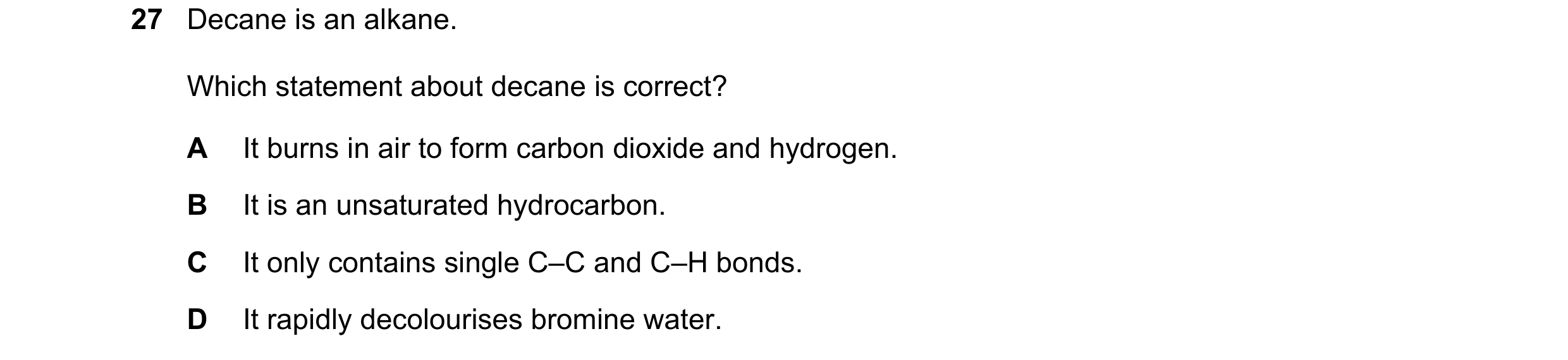


 4 / 5
4 / 5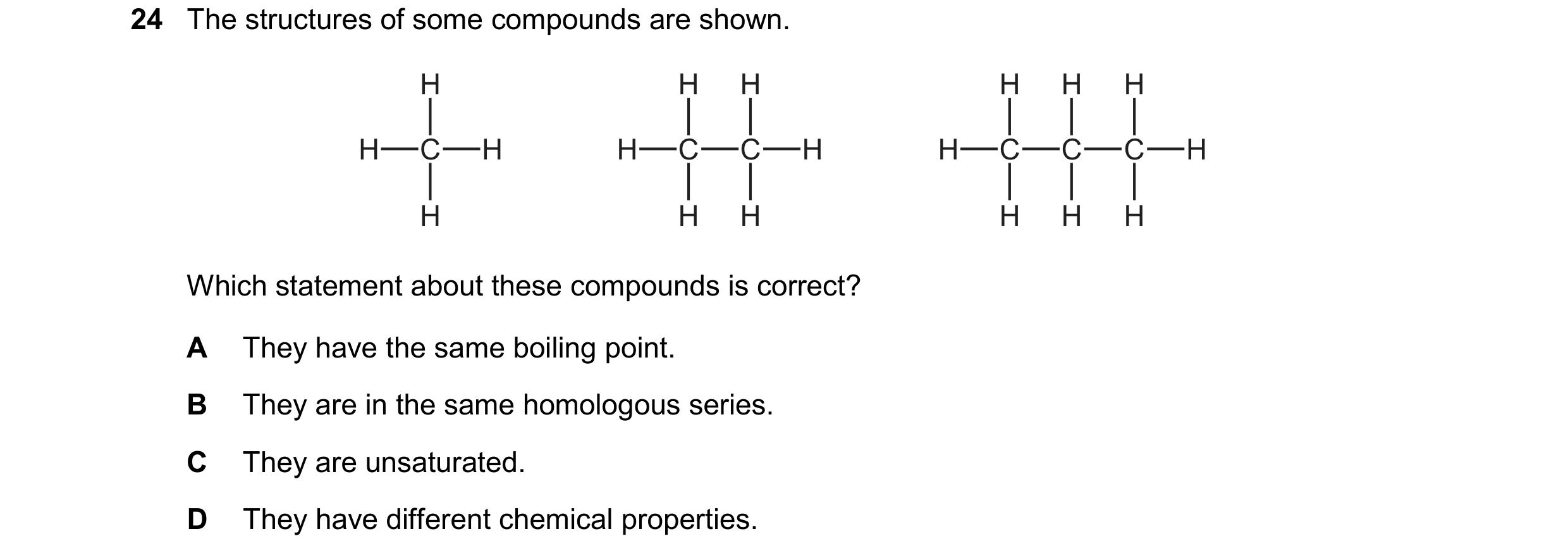
 5 / 5
5 / 5