Questions as text
Q1 · What is the correct sequence that takes place during fractional distillation? 0653/22 Oct/Nov 2017
15 What is the correct sequence that takes place during fractional distillation? A evaporate → condense → collect → heat B evaporate → condense → heat → collect C heat → condense → collect → evaporate D heat → evaporate → condense → collect
1 marks
Answer: D
This question in 0653/22 Oct/Nov 2017
Q2 · Sucrose is a covalent compound 0653/21 Oct/Nov 2018
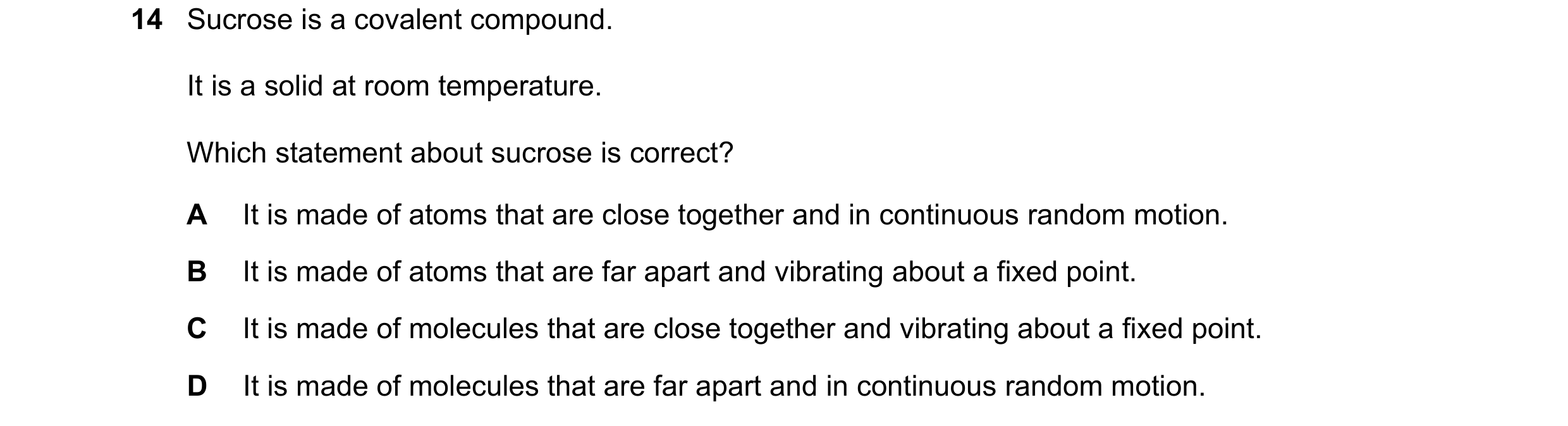
14 Sucrose is a covalent compound. It is a solid at room temperature. Which statement about sucrose is correct? A It is made of atoms that are close together and in continuous random motion. B It is made of atoms that are far apart and vibrating about a fixed point. C It is made of molecules that are close together and vibrating about a fixed point. D It is made of molecules that are far apart and in continuous random motion.
1 marks
Answer: C
This question in 0653/21 Oct/Nov 2018
Q3 · Sucrose is a covalent compound 0653/22 Oct/Nov 2018
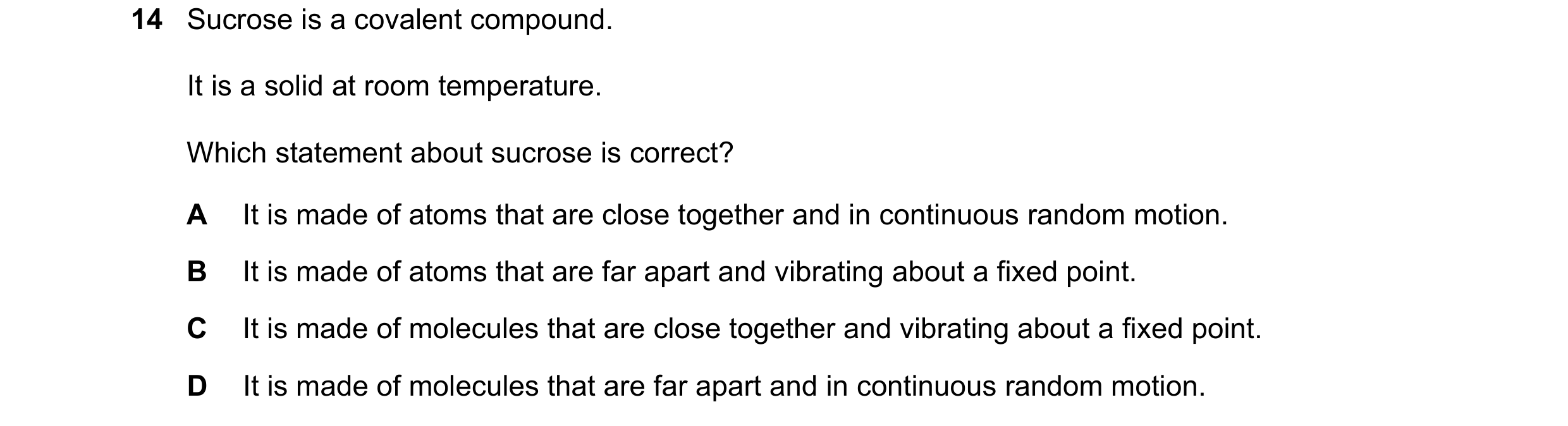
14 Sucrose is a covalent compound. It is a solid at room temperature. Which statement about sucrose is correct? A It is made of atoms that are close together and in continuous random motion. B It is made of atoms that are far apart and vibrating about a fixed point. C It is made of molecules that are close together and vibrating about a fixed point. D It is made of molecules that are far apart and in continuous random motion.
1 marks
Answer: C
This question in 0653/22 Oct/Nov 2018
Q4 · Sucrose is a covalent compound 0653/23 Oct/Nov 2018
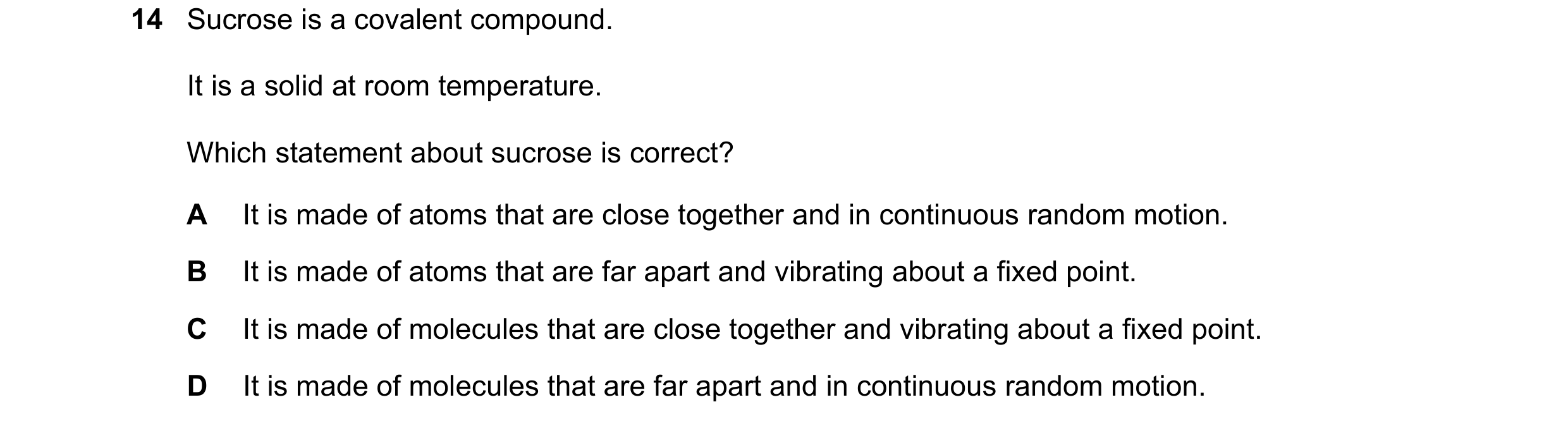
14 Sucrose is a covalent compound. It is a solid at room temperature. Which statement about sucrose is correct? A It is made of atoms that are close together and in continuous random motion. B It is made of atoms that are far apart and vibrating about a fixed point. C It is made of molecules that are close together and vibrating about a fixed point. D It is made of molecules that are far apart and in continuous random motion.
1 marks
Answer: C
This question in 0653/23 Oct/Nov 2018
Q5 · Which statement describes oxygen molecules at room temperature and pressure? 0653/22 Feb/March 2019
14 Which statement describes oxygen molecules at room temperature and pressure? A They are closely packed and move around slowly. B They are closely packed and vibrate about a fixed point. C They are loosely packed and move around rapidly. D They are loosely packed and vibrate about a fixed point.
1 marks
Answer: C
This question in 0653/22 Feb/March 2019
Q6 · What happens to water molecules when water is heated to 100 °C in a beaker? 0653/22 Feb/March 2020
14 What happens to water molecules when water is heated to 100 °C in a beaker? A They gain energy and escape from the beaker. B They gain energy and move more slowly. C They lose energy and escape from the beaker. D They lose energy and move more slowly.
1 marks
Answer: A
This question in 0653/22 Feb/March 2020
Q7 · In which change of state do the particles gain kinetic energy and remain tightly packed? 0653/21 May/June 2020
14 In which change of state do the particles gain kinetic energy and remain tightly packed? A gas to liquid B liquid to gas C liquid to solid D solid to liquid
1 marks
Answer: D
This question in 0653/21 May/June 2020
Q8 · Oxygen in a steel cylinder is easily compressed, but steel cannot be compressed 0653/21 May/June 2020
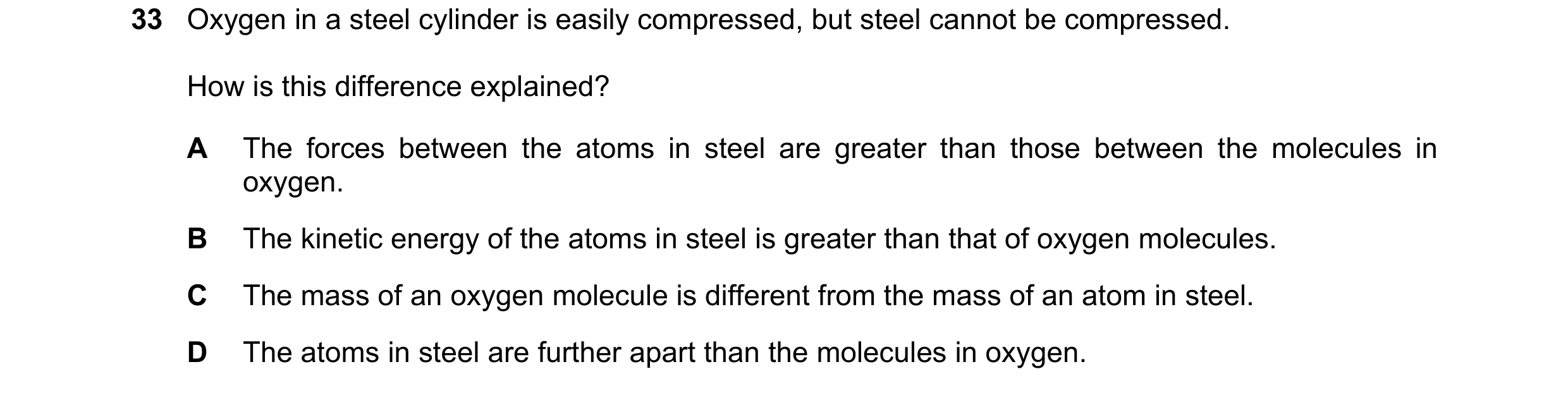
33 Oxygen in a steel cylinder is easily compressed, but steel cannot be compressed. How is this difference explained? A The forces between the atoms in steel are greater than those between the molecules in oxygen. B The kinetic energy of the atoms in steel is greater than that of oxygen molecules. C The mass of an oxygen molecule is different from the mass of an atom in steel. D The atoms in steel are further apart than the molecules in oxygen.
1 marks
Answer: A
This question in 0653/21 May/June 2020
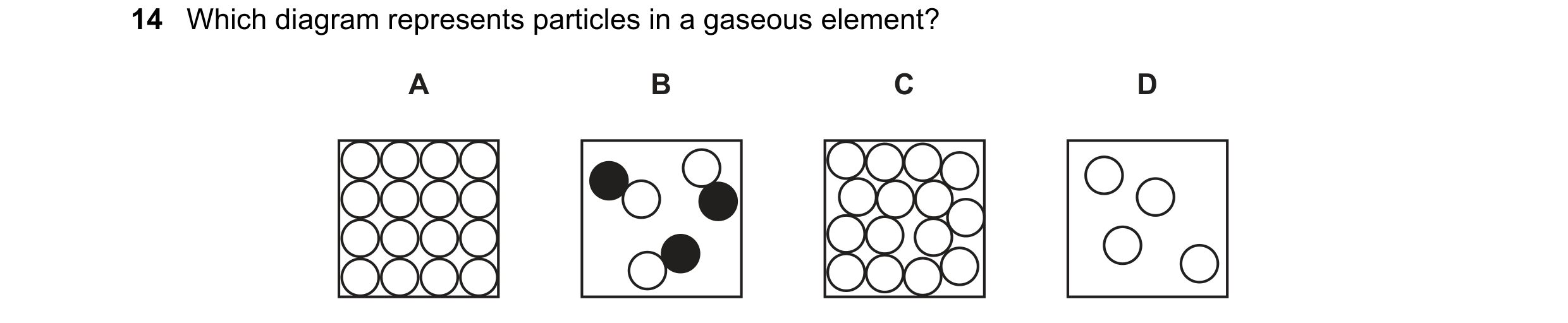
Q9 · Which diagram represents particles in a gaseous element? 0653/22 Oct/Nov 2020
14 Which diagram represents particles in a gaseous element? A B C D
1 marks
Answer: D
This question in 0653/22 Oct/Nov 2020
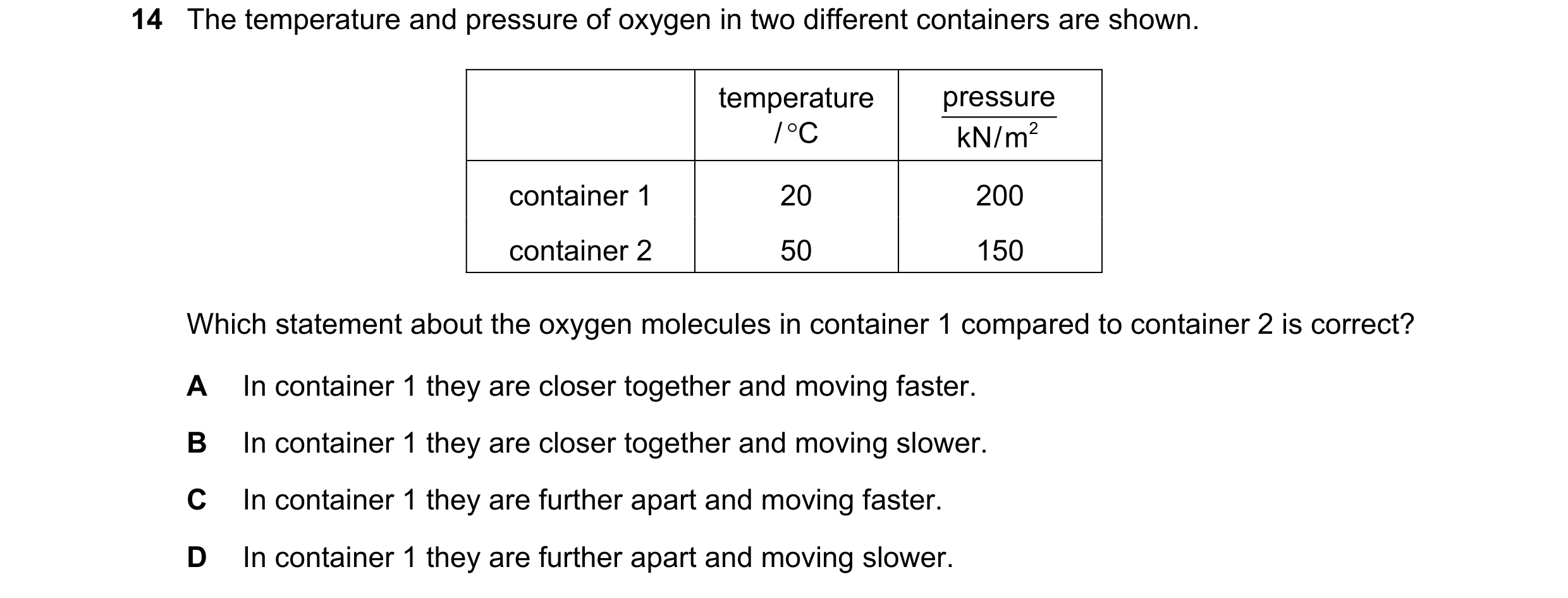
Q10 · The temperature and pressure of oxygen in two different containers are shown 0653/23 Oct/Nov 2020
14 The temperature and pressure of oxygen in two different containers are shown. temperature p r es ur s e / C kN / m 2 container 1 20 200 container 2 50 150 Which statement about the oxygen molecules in container 1 compared to container 2 is correct? A In container 1 they are closer together and moving faster. B In container 1 they are closer together and moving slower. C In container 1 they are further apart and moving faster. D In container 1 they are further apart and moving slower.
1 marks
Answer: B
This question in 0653/23 Oct/Nov 2020
Q11 · The melting point and boiling point of oxygen and nitrogen are shown 0653/23 May/June 2021
14 The melting point and boiling point of oxygen and nitrogen are shown. melting point boiling point / C / C oxygen –219 –183 nitrogen –210 –196 A sealed flask contains a mixture of oxygen and nitrogen. Which diagram shows the arrangement of oxygen and nitrogen particles at –190 C? A B C D key = nitrogen molecules = oxygen molecules
1 marks
Answer: A
This question in 0653/23 May/June 2021
Q12 · When water boils it changes from a liquid to a gas 0653/23 May/June 2021
18 When water boils it changes from a liquid to a gas. Which statement about this process is correct? A It is endothermic because it requires energy to break covalent bonds. B It is endothermic because energy is needed to break attractive forces between molecules. C It is exothermic because it requires energy to break attractive forces between atoms. D It is exothermic because energy is given out when bonds form.
1 marks
Answer: B
This question in 0653/23 May/June 2021
Q13 · Which statement describes the change when water becomes ice at 0 C? 0653/21 Oct/Nov 2021
14 Which statement describes the change when water becomes ice at 0 C? A The particles collide with each other more frequently. B The particles have more kinetic energy. C The process is endothermic. D The process is exothermic.
1 marks
Answer: D
This question in 0653/21 Oct/Nov 2021
Q14 · Refinery gas contains methane 0653/22 Feb/March 2022
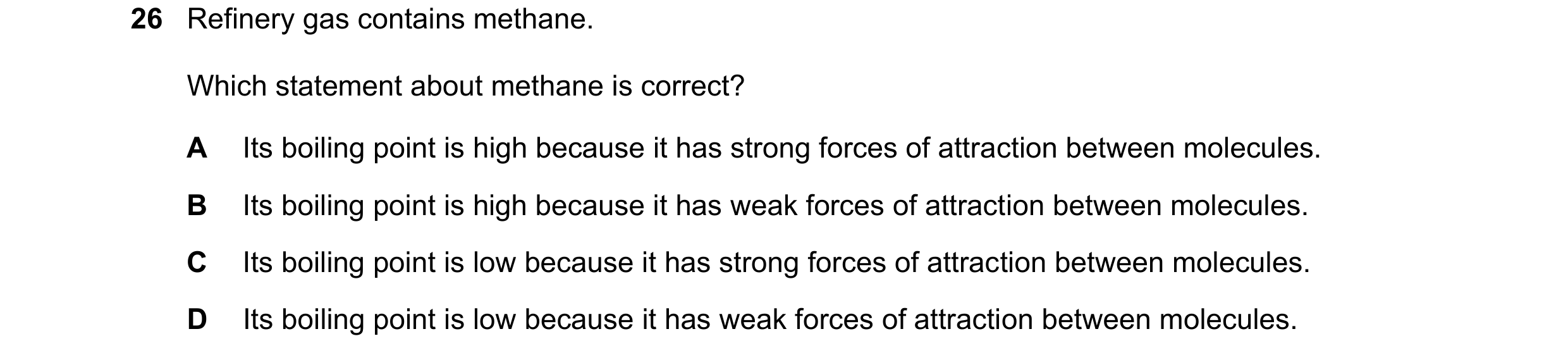
26 Refinery gas contains methane. Which statement about methane is correct? A Its boiling point is high because it has strong forces of attraction between molecules. B Its boiling point is high because it has weak forces of attraction between molecules. C Its boiling point is low because it has strong forces of attraction between molecules. D Its boiling point is low because it has weak forces of attraction between molecules.
1 marks
Answer: D
This question in 0653/22 Feb/March 2022
Q15 · Which diagram represents particles in a gaseous element? 0653/21 May/June 2023
14 Which diagram represents particles in a gaseous element? A B C D
1 marks
Answer: D
This question in 0653/21 May/June 2023
Q16 · Which substance is liquid at 25 C? 0653/21 Oct/Nov 2023
14 Which substance is liquid at 25 C? melting point boiling point / C / C A –182 –161 B –100 80 C –77 –34 D 44 280
1 marks
Answer: B
This question in 0653/21 Oct/Nov 2023
Q17 · Copper sulfate crystals dissolve in water 0653/23 May/June 2024
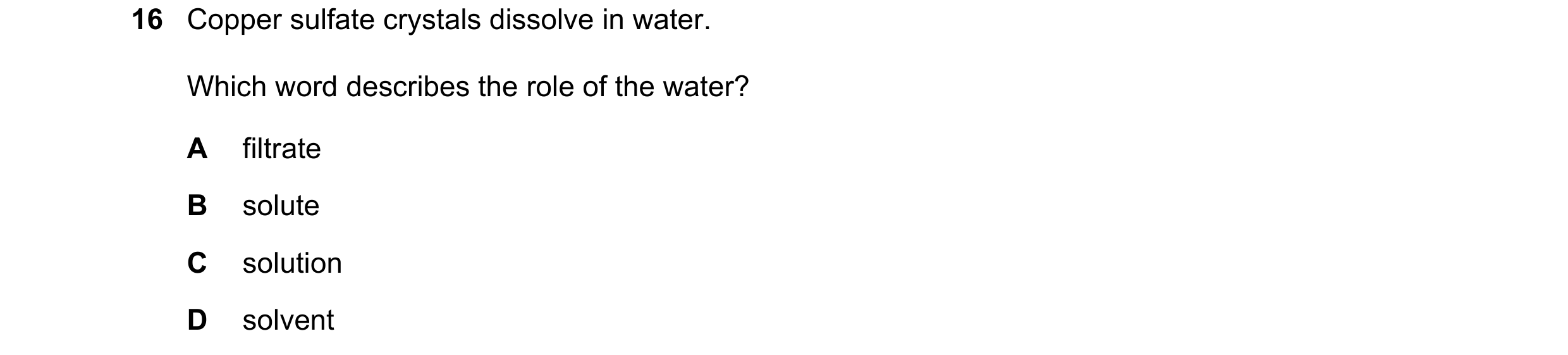
16 Copper sulfate crystals dissolve in water. Which word describes the role of the water? A filtrate B solute C solution D solvent
1 marks
Answer: D
This question in 0653/23 May/June 2024
Q18 · When a substance is heated, it absorbs energy and changes from a solid to a liquid 0653/22 Feb/March 2025
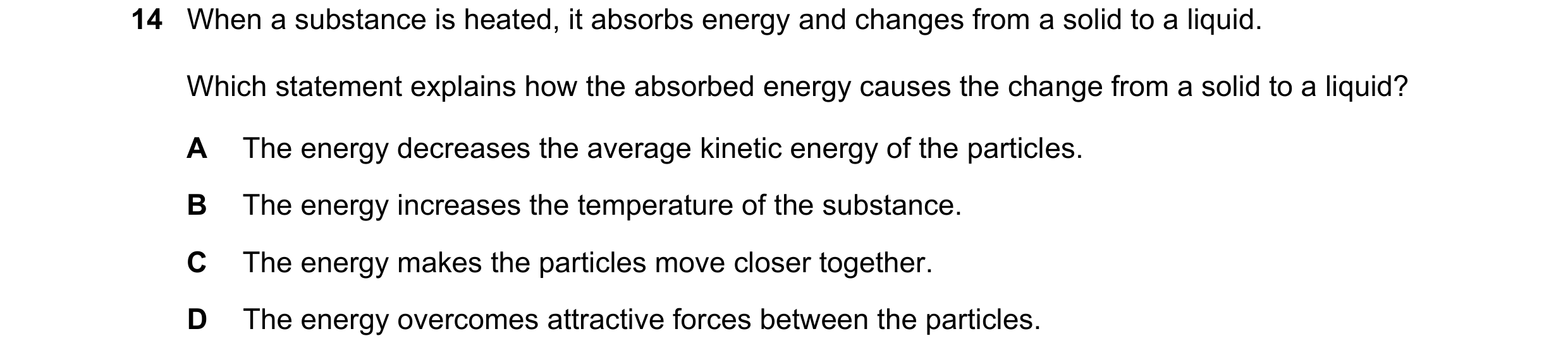
14 When a substance is heated, it absorbs energy and changes from a solid to a liquid. Which statement explains how the absorbed energy causes the change from a solid to a liquid? A The energy decreases the average kinetic energy of the particles. B The energy increases the temperature of the substance. C The energy makes the particles move closer together. D The energy overcomes attractive forces between the particles.
1 marks
Answer: D
This question in 0653/22 Feb/March 2025
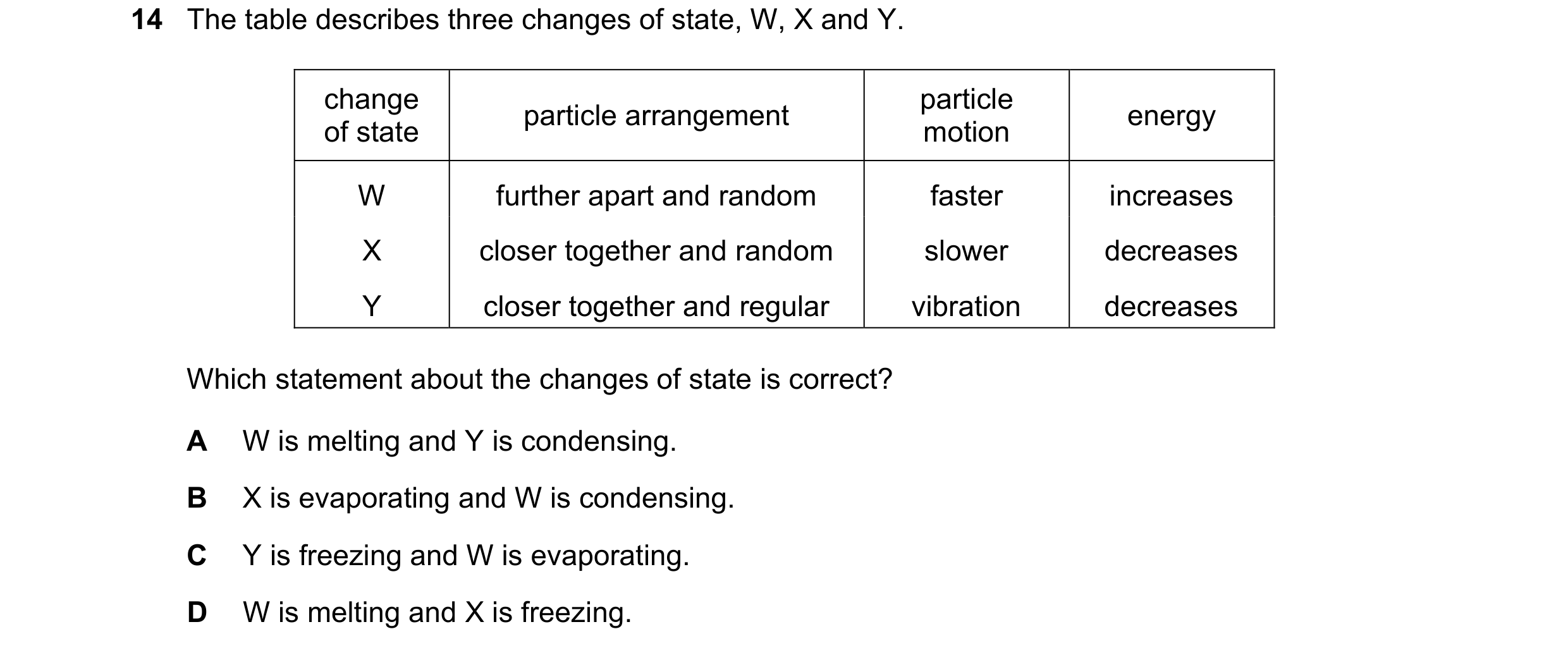
Q19 · The table describes three changes of state, W, X and Y 0653/22 May/June 2025
14 The table describes three changes of state, W, X and Y. change particle particle arrangement energy of state motion W further apart and random faster increases X closer together and random slower decreases Y closer together and regular vibration decreases Which statement about the changes of state is correct? A W is melting and Y is condensing. B X is evaporating and W is condensing. C Y is freezing and W is evaporating. D W is melting and X is freezing.
1 marks
Answer: C
This question in 0653/22 May/June 2025
Q20 · Which states of matter contain particles that are close together? 0653/23 May/June 2025
32 Which states of matter contain particles that are close together? A solids, liquids and gases B liquids and gases only C solids and gases only D solids and liquids only
1 marks
Answer: D
This question in 0653/23 May/June 2025
Q21 · Which statement describes the changes that occur when water freezes? 0653/21 Oct/Nov 2025
14 Which statement describes the changes that occur when water freezes? A The water molecules gain energy and move faster. B The water molecules lose energy and move slower. C The water molecules gain energy as liquid water forms a solid. D The water molecules lose energy as solid water forms a liquid.
1 marks
Answer: B
This question in 0653/21 Oct/Nov 2025
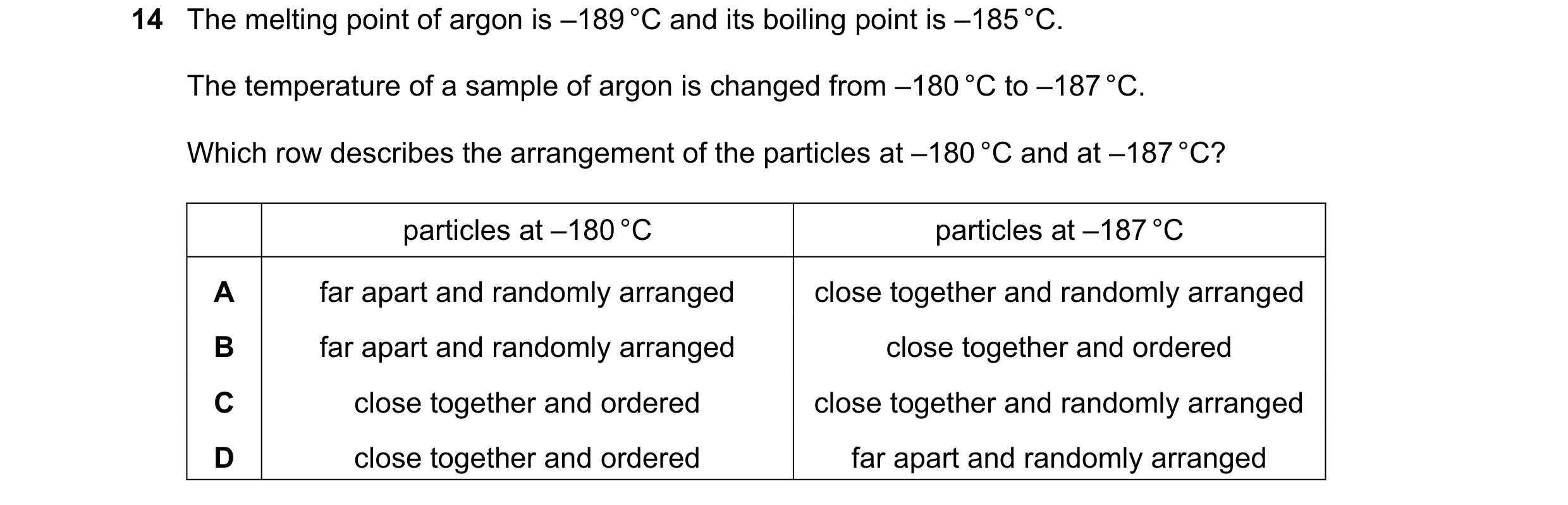
Q22 · The melting point of argon is –189 °C and its boiling point is –185 °C 0653/22 Oct/Nov 2025
14 The melting point of argon is –189 °C and its boiling point is –185 °C. The temperature of a sample of argon is changed from –180 °C to –187 °C. Which row describes the arrangement of the particles at –180 °C and at –187 °C? particles at –180 °C particles at –187 °C A far apart and randomly arranged close together and randomly arranged B far apart and randomly arranged close together and ordered C close together and ordered close together and randomly arranged D close together and ordered far apart and randomly arranged
1 marks
Answer: A
This question in 0653/22 Oct/Nov 2025
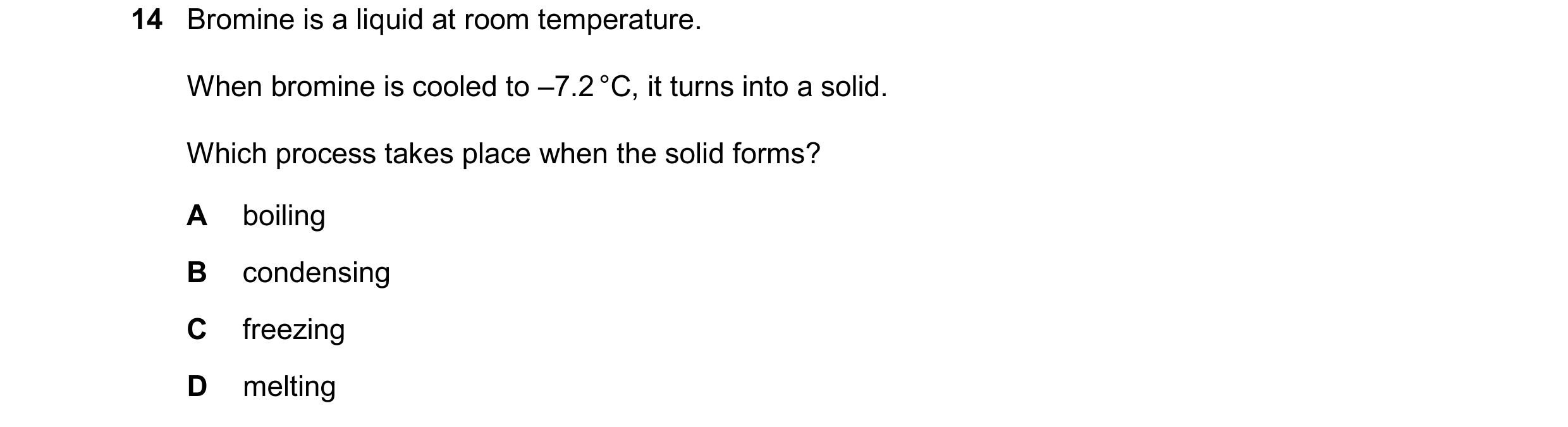
Q23 · Bromine is a liquid at room temperature 0653/23 Oct/Nov 2025
14 Bromine is a liquid at room temperature. When bromine is cooled to –7.2 °C, it turns into a solid. Which process takes place when the solid forms? A boiling B condensing C freezing D melting
1 marks
Answer: C
This question in 0653/23 Oct/Nov 2025

 1 / 5
1 / 5

 2 / 5
2 / 5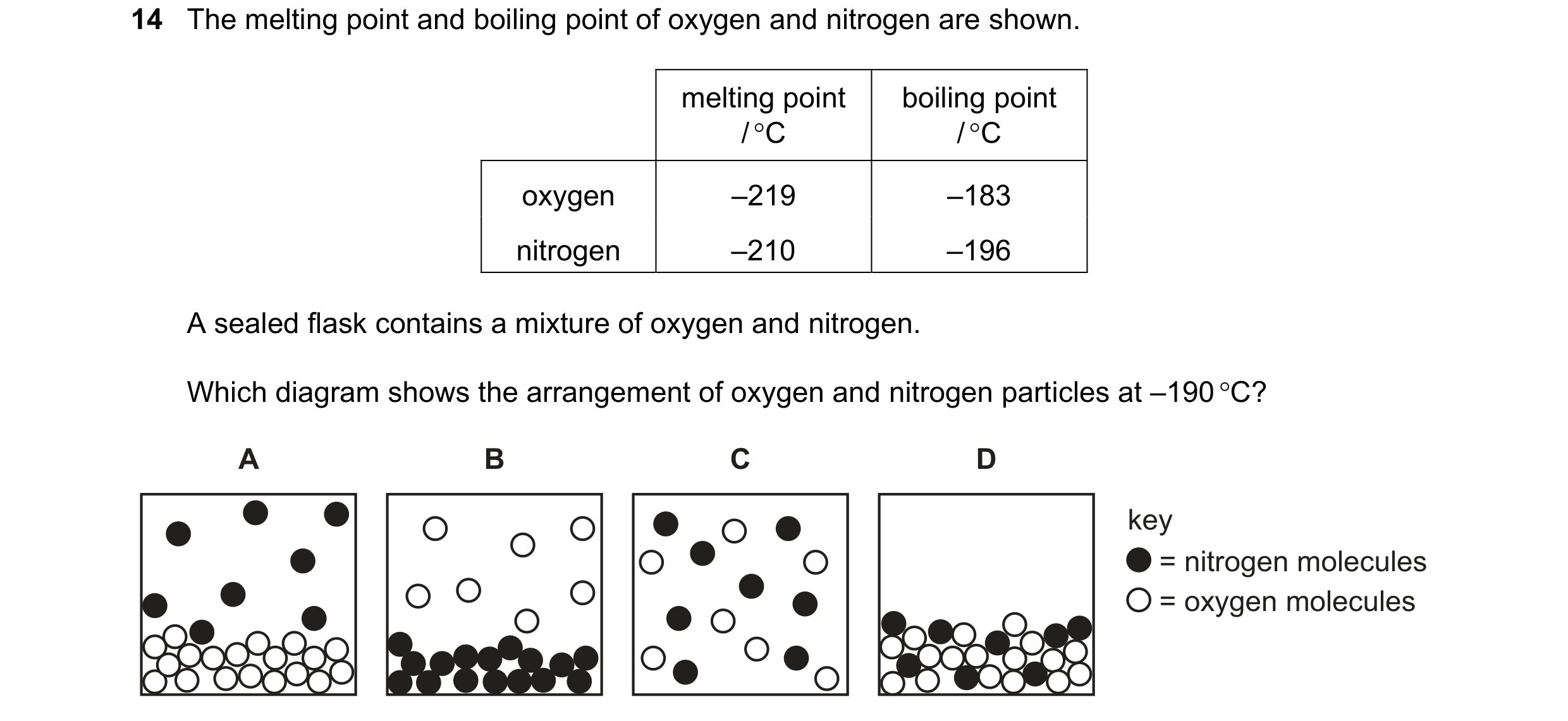

 3 / 5
3 / 5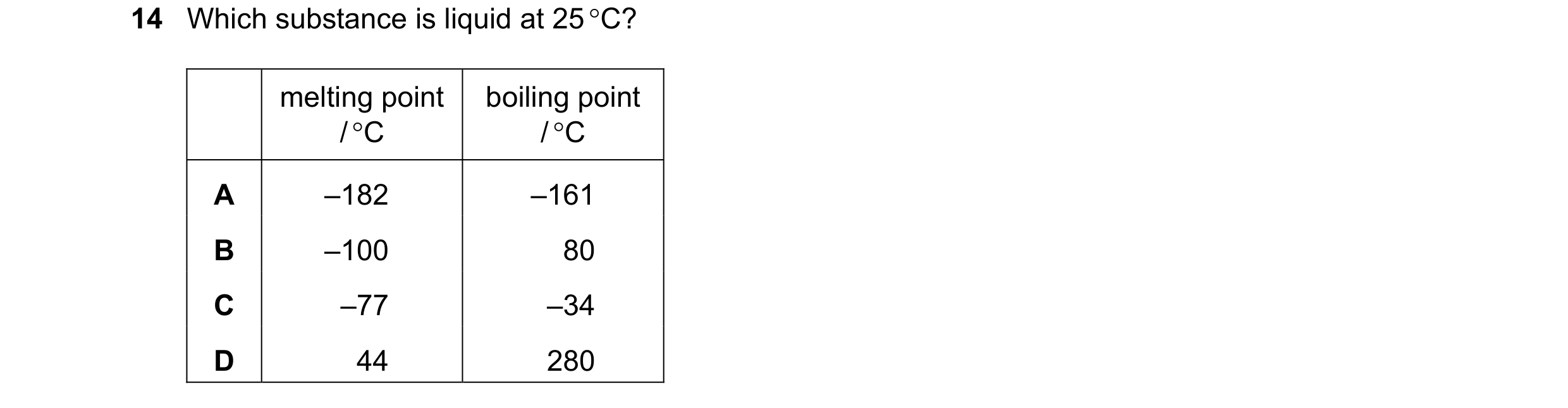
 4 / 5
4 / 5
 5 / 5
5 / 5