Questions as text
Q1 · A man riding a snowmobile across snow and ice at a research station in Antarctica 0653/43 May/June 2017
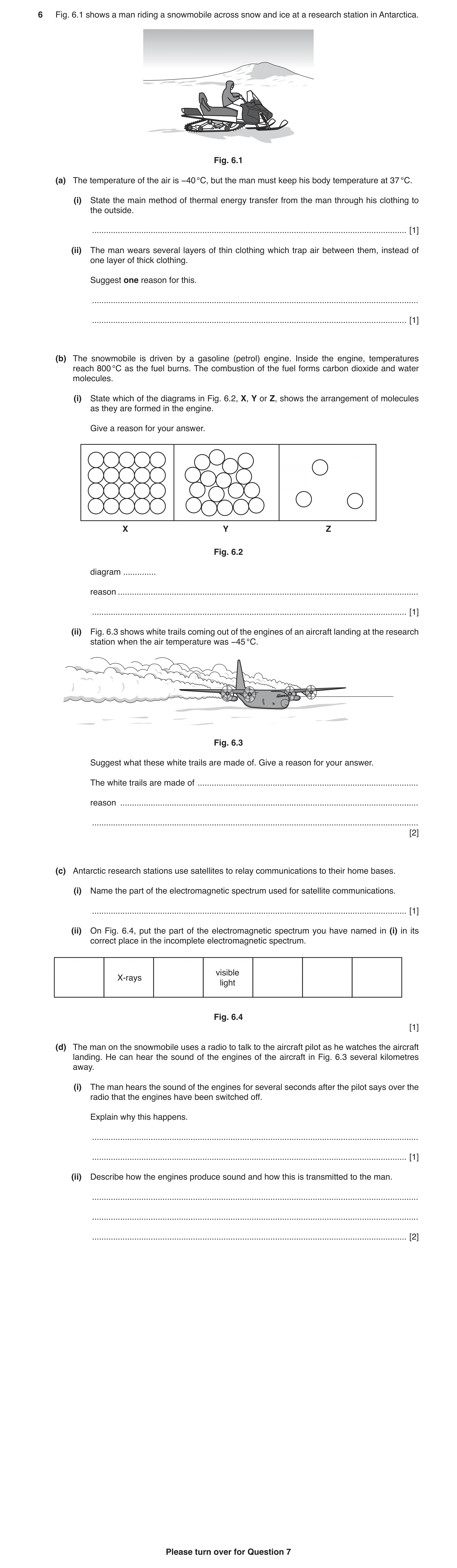
6 Fig. 6.1 shows a man riding a snowmobile across snow and ice at a research station in Antarctica. Fig. 6.1 (a) The temperature of the air is −40 °C, but the man must keep his body temperature at 37 °C. (i) State the main method of thermal energy transfer from the man through his clothing to the outside. … [1] (ii) The man wears several layers of thin clothing which trap air between them, instead of one layer of thick clothing. Suggest one reason for this. … … [1] (b) The snowmobile is driven by a gasoline (petrol) engine. Inside the engine, temperatures reach 800 °C as the fuel burns. The combustion of the fuel forms carbon dioxide and water molecules. (i) State which of the diagrams in Fig. 6.2, X, Y or Z, shows the arrangement of molecules as they are formed in the engine. Give a reason for your answer. X Y Z Fig. 6.2 diagram … reason … … [1] (ii) Fig. 6.3 shows white trails coming out of the engines of an aircraft landing at the research station when the air temperature was −45 °C. Fig. 6.3 Suggest what these white trails are made of. Give a reason for your answer. The white trails are made of … reason … … [2] (c) Antarctic research stations use satellites to relay communications to their home bases. (i) Name the part of the electromagnetic spectrum used for satellite communications. … [1] (ii) On Fig. 6.4, put the part of the electromagnetic spectrum you have named in (i) in its correct place in the incomplete electromagnetic spectrum. visible X-rays light Fig. 6.4 [1] (d) The man on the snowmobile uses a radio to talk to the aircraft pilot as he watches the aircraft landing. He can hear the sound of the engines of the aircraft in Fig. 6.3 several kilometres away. (i) The man hears the sound of the engines for several seconds after the pilot says over the radio that the engines have been switched off. Explain why this happens. … … [1] (ii) Describe how the engines produce sound and how this is transmitted to the man. … … … [2] Please turn over for Question 7
10 marks
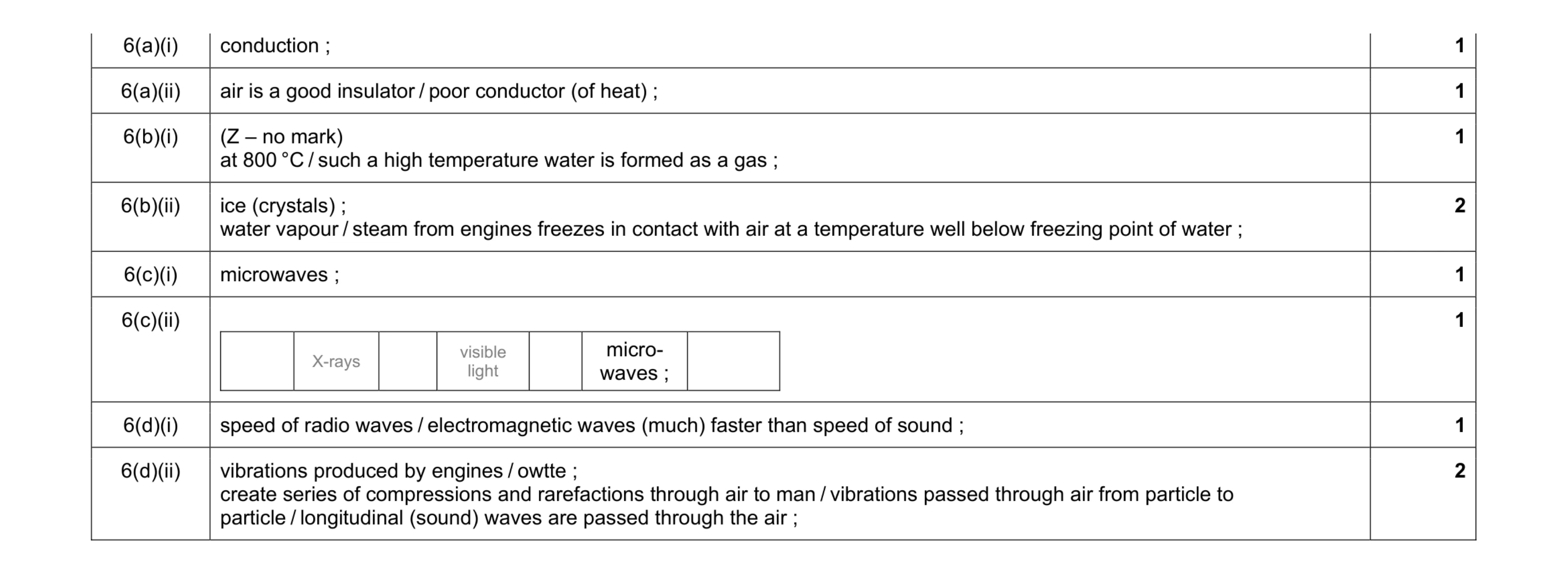
Mark scheme: 6(a)(i) conduction ; 1 6(a)(ii) air is a good insulator / poor conductor (of heat) ; 1 6(b)(i) (Z – no mark) at 800 °C / such a high temperature water is formed as a gas ; 1 6(b)(ii) ice (crystals) ; water vapour / steam from engines freezes in contact with air at a temperature well below freezing point of water ; 2 6(c)(i) microwaves ; 1 6(c)(ii) X-rays visible light micro- waves ; 1 6(d)(i) speed of radio waves / electromagnetic waves (much) faster than speed of sound ; 1 6(d)(ii) vibrations produced by engines / owtte ; create series of compressions and rarefactions through air to man / vibrations passed through air from particle to particle / longitudinal (sound) waves are passed through the air ; 2
This question in 0653/43 May/June 2017
Q2 · Petroleum is separated into useful products by process W shown in Fig 0653/41 Oct/Nov 2017
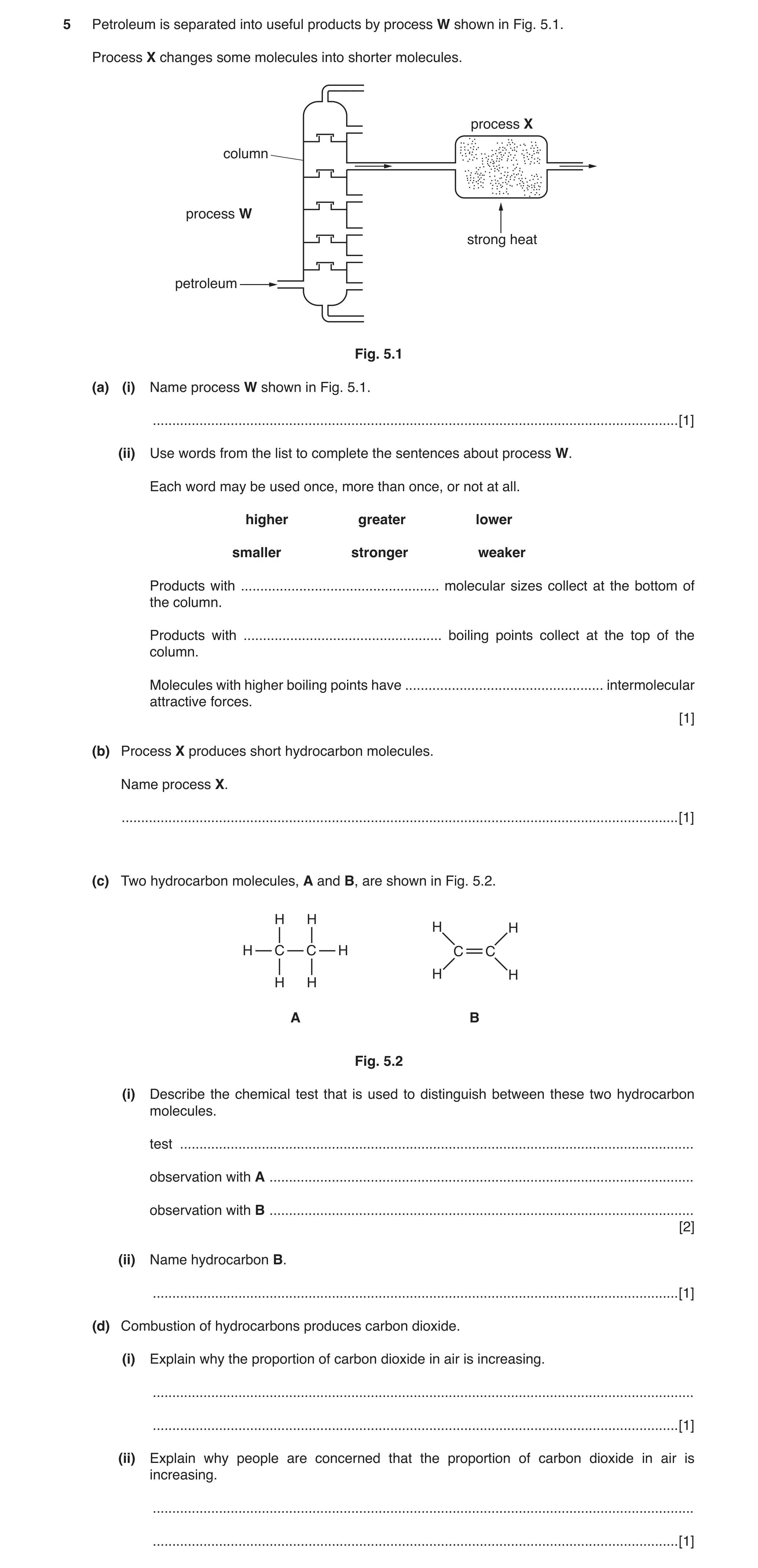
5 Petroleum is separated into useful products by process W shown in Fig. 5.1. Process X changes some molecules into shorter molecules. process X column process W strong heat petroleum Fig. 5.1 (a) (i) Name process W shown in Fig. 5.1. … [1] (ii) Use words from the list to complete the sentences about process W. Each word may be used once, more than once, or not at all. higher greater lower smaller stronger weaker Products with … molecular sizes collect at the bottom of the column. Products with … boiling points collect at the top of the column. Molecules with higher boiling points have … intermolecular attractive forces. [1] (b) Process X produces short hydrocarbon molecules. Name process X. … [1] (c) Two hydrocarbon molecules, A and B, are shown in Fig. 5.2. H H H H H C C H C C H H H H A B Fig. 5.2 (i) Describe the chemical test that is used to distinguish between these two hydrocarbon molecules. test … observation with A … observation with B … [2] (ii) Name hydrocarbon B. … [1] (d) Combustion of hydrocarbons produces carbon dioxide. (i) Explain why the proportion of carbon dioxide in air is increasing. … … [1] (ii) Explain why people are concerned that the proportion of carbon dioxide in air is increasing. … … [1]
8 marks
Mark scheme: 5(a)(i) fractional distillation ; 1 5(a)(ii) greater lower greater ; 1 5(b) cracking ; 1 Question Answer Marks 5(c)(i) (test) bromine (water) ; (observation A) no change and (observation B) decolourises / turns (brown to) colourless ; 2 5(c)(ii) ethene ; 1 5(d)(i) reference to use of (fossil) fuel / named fuel / industrialisation / deforestation ; 1 5(d)(ii) global warming / consequences of global warming ; 1
This question in 0653/41 Oct/Nov 2017
Q3 · The density of water, a liquid, is very different from the density of steam, a gas 0653/43 Oct/Nov 2018
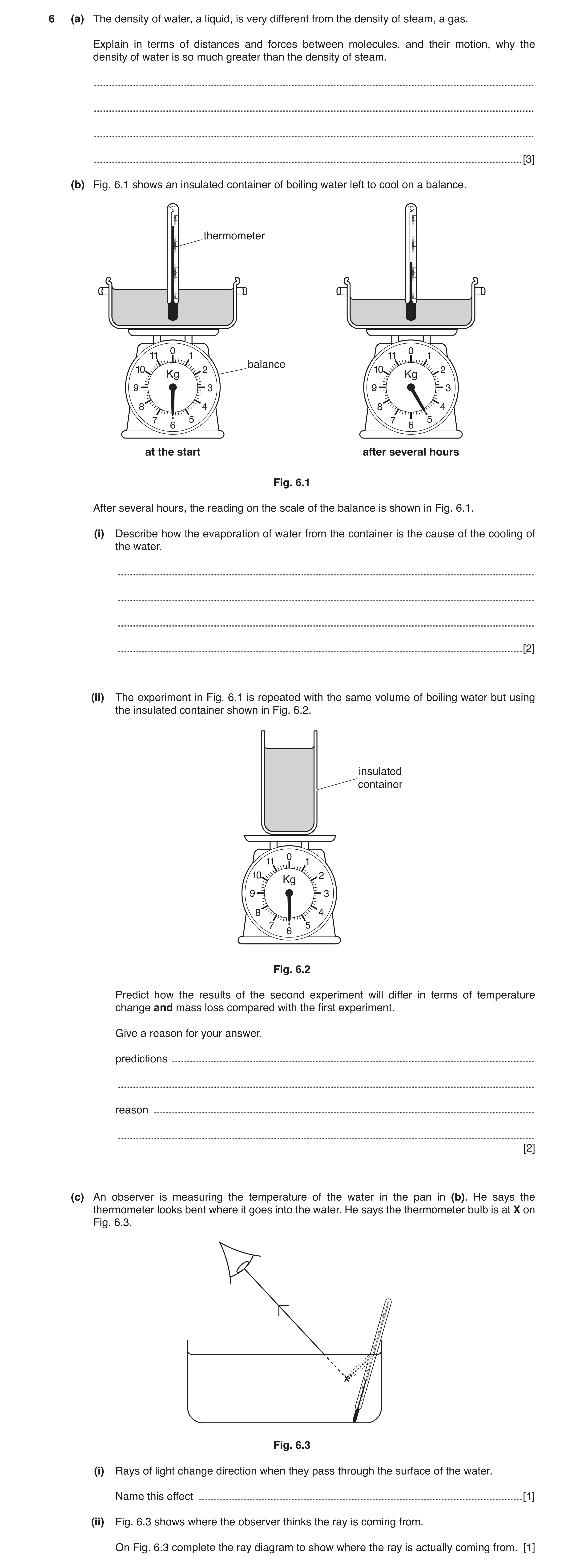
6 (a) The density of water, a liquid, is very different from the density of steam, a gas. Explain in terms of distances and forces between molecules, and their motion, why the density of water is so much greater than the density of steam. … … … … [3] (b) Fig. 6.1 shows an insulated container of boiling water left to cool on a balance. °C °C thermometer 0 0 11 1 11 1 balance 10 2 10 2 Kg Kg 9 3 9 3 8 4 8 4 7 5 7 5 6 6 at the start after several hours Fig. 6.1 After several hours, the reading on the scale of the balance is shown in Fig. 6.1. (i) Describe how the evaporation of water from the container is the cause of the cooling of the water. … … … … [2] (ii) The experiment in Fig. 6.1 is repeated with the same volume of boiling water but using the insulated container shown in Fig. 6.2. insulated container 0 11 1 10 2 Kg 9 3 8 4 7 5 6 Fig. 6.2 Predict how the results of the second experiment will differ in terms of temperature change and mass loss compared with the first experiment. Give a reason for your answer. predictions … … reason … … [2] (c) An observer is measuring the temperature of the water in the pan in (b). He says the thermometer looks bent where it goes into the water. He says the thermometer bulb is at X on Fig. 6.3. 5 Fig. 6.3 (i) Rays of light change direction when they pass through the surface of the water. Name this effect … [1] (ii) Fig. 6.3 shows where the observer thinks the ray is coming from. On Fig. 6.3 complete the ray diagram to show where the ray is actually coming from. [1]
9 marks
Mark scheme: 6(a) any three of distances between molecules greater / molecules further apart in gases molecules are closer together in liquids ; forces between molecules of gases are weaker / forces between molecules of a liquid are stronger ; molecules can move freely in gas / molecules rolling / sliding over each other in liquids ; gas volume greater for same mass / liquid volume is smaller for the same mass ; Max 3 3 6(b)(i) faster / more energetic molecules escape (from surface) ; average speed of remaining molecules less / water has less energy (leading to cooling) ; 2 Question Answer Marks 6(b)(ii) less / slower cooling and less / slower mass loss ; less surface area for evaporation ; 2 6(c)(i) refraction ; 1 6(c)(ii) ray from thermometer bulb to meet ray to eye at water surface; 1
This question in 0653/43 Oct/Nov 2018
Q4 · Some data about the planets Earth, Mars, Mercury and Venus 0653/41 Oct/Nov 2019
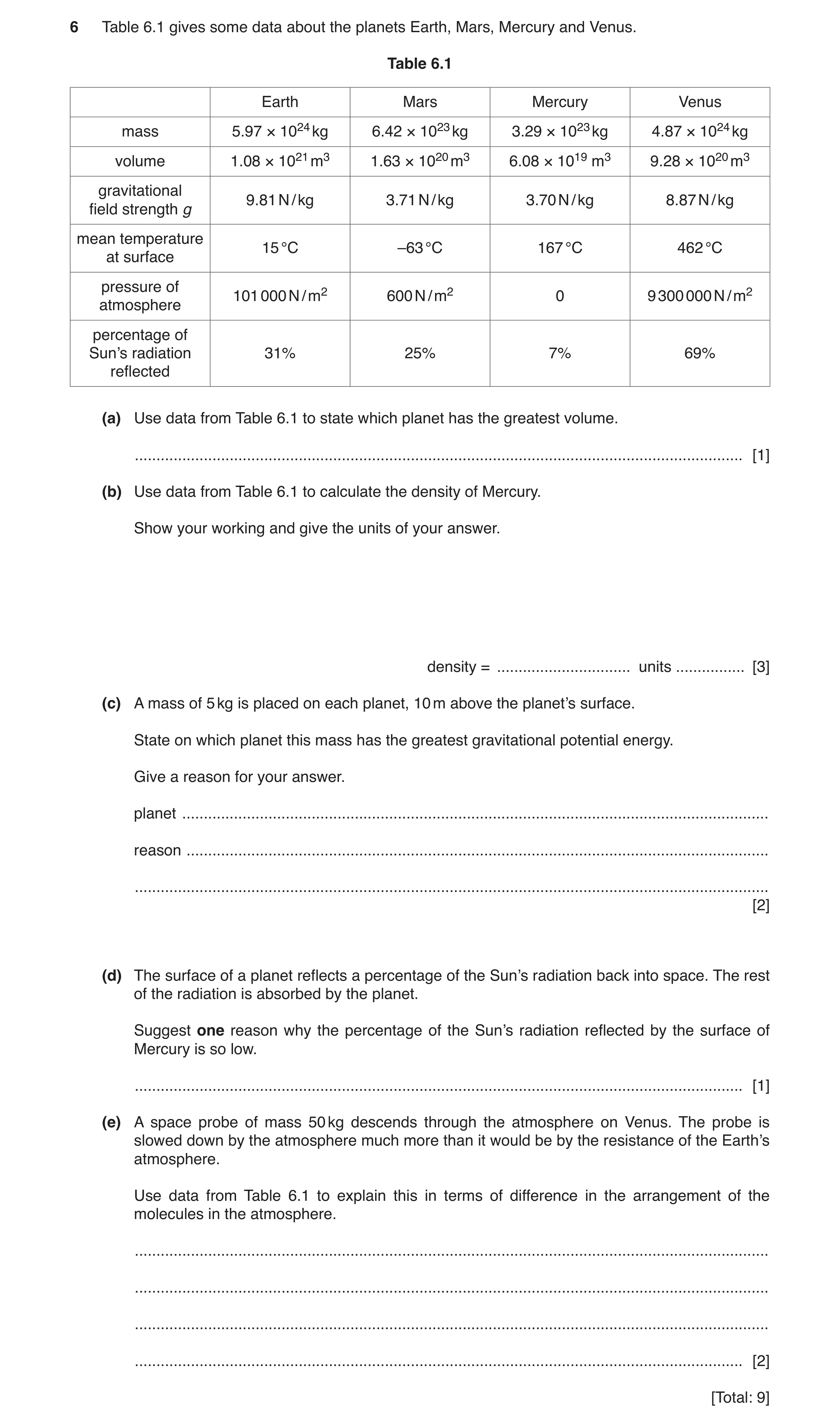
6 Table 6.1 gives some data about the planets Earth, Mars, Mercury and Venus. Table 6.1 Earth Mars Mercury Venus mass 5.97 × 1024 kg 6.42 × 10²³ kg 3.29 × 10²³ kg 4.87 × 1024 kg volume 1.08 × 10²¹ m3 1.63 × 10²⁰ m3 6.08 × 10¹⁹ m3 9.28 × 10²⁰ m3 gravitational 9.81 N / kg 3.71 N / kg 3.70 N / kg 8.87 N / kg field strength g mean temperature 15 °C –63 °C 167 °C 462 °C at surface pressure of 101 000 N / m2 600 N / m2 0 9 300 000 N / m2 atmosphere percentage of Sun’s radiation 31% 25% 7% 69% reflected (a) Use data from Table 6.1 to state which planet has the greatest volume. … [1] (b) Use data from Table 6.1 to calculate the density of Mercury. Show your working and give the units of your answer. density = … units … [3] (c) A mass of 5 kg is placed on each planet, 10 m above the planet’s surface. State on which planet this mass has the greatest gravitational potential energy. Give a reason for your answer. planet … reason … … [2] (d) The surface of a planet reflects a percentage of the Sun’s radiation back into space. The rest of the radiation is absorbed by the planet. Suggest one reason why the percentage of the Sun’s radiation reflected by the surface of Mercury is so low. … [1] (e) A space probe of mass 50 kg descends through the atmosphere on Venus. The probe is slowed down by the atmosphere much more than it would be by the resistance of the Earth’s atmosphere. Use data from Table 6.1 to explain this in terms of difference in the arrangement of the molecules in the atmosphere. … … … … [2] [Total: 9]
9 marks
Mark scheme: 6(a) Earth ; 1 6(b) use of d = m/V ; (3.29 × 10²³ / 0.608 × 10²⁰) = 5.41 × 10³ (3sf) ; kg/m3 ; 3 6(c) Earth ; greatest mass / highest gravitational field strength ; 2 6(d) darker colour / duller surface ; 1 6(e) (on Venus) pressure of atmosphere much higher so molecules more concentrated ; so (atmospheric) resistance is greater / more work done by probe pushing molecules aside / owtte ; ORA 2
This question in 0653/41 Oct/Nov 2019
Q5 · A bromine atom contains seven electrons in its outer shell 0653/42 Feb/March 2020
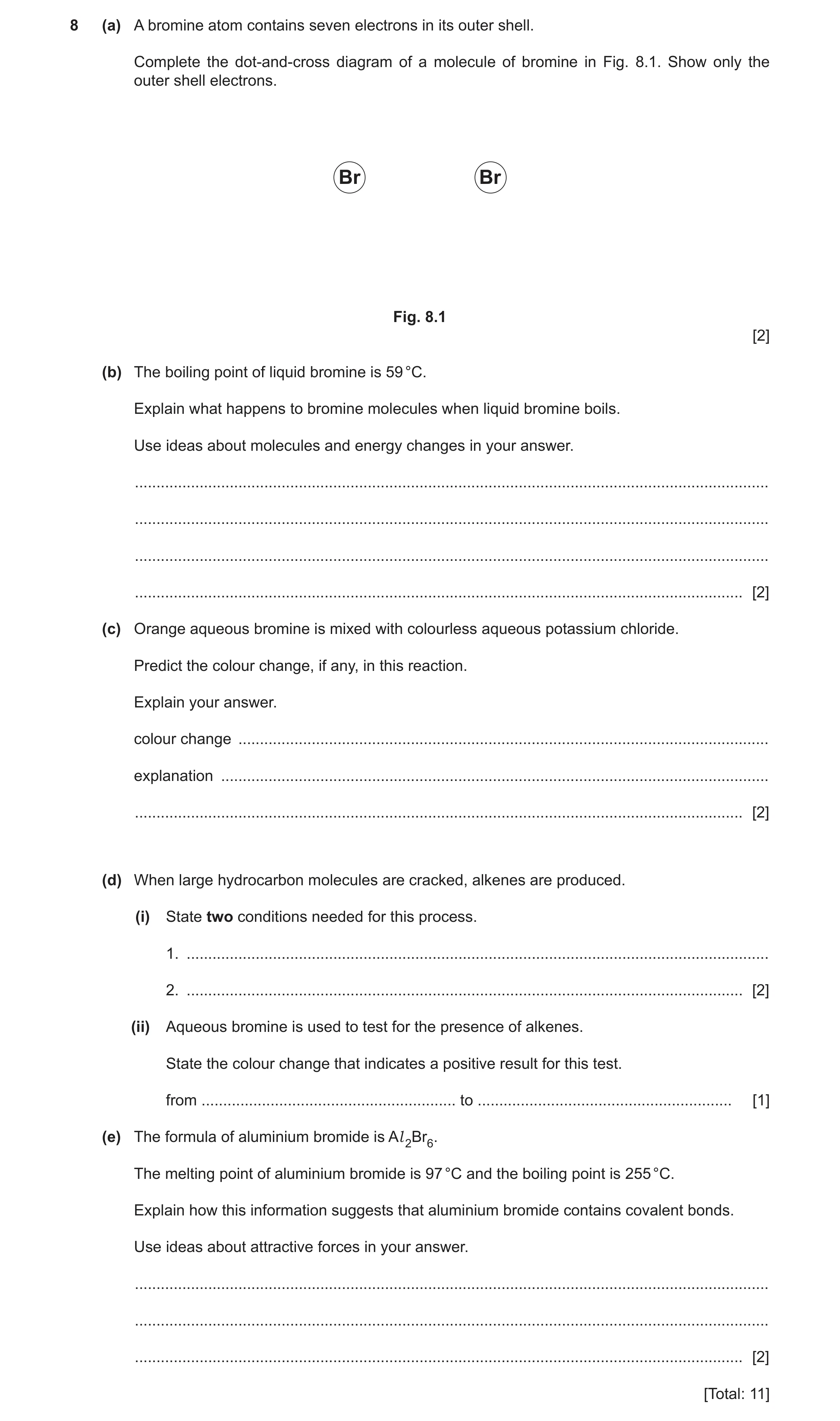
8 (a) A bromine atom contains seven electrons in its outer shell. Complete the dot-and-cross diagram of a molecule of bromine in Fig. 8.1. Show only the outer shell electrons. Br Br Fig. 8.1 [2] (b) The boiling point of liquid bromine is 59 °C. Explain what happens to bromine molecules when liquid bromine boils. Use ideas about molecules and energy changes in your answer. … … … … [2] (c) Orange aqueous bromine is mixed with colourless aqueous potassium chloride. Predict the colour change, if any, in this reaction. Explain your answer. colour change … explanation … … [2] (d) When large hydrocarbon molecules are cracked, alkenes are produced. (i) State two conditions needed for this process. 1. … 2. … [2] (ii) Aqueous bromine is used to test for the presence of alkenes. State the colour change that indicates a positive result for this test. from … to … [1] (e) The formula of aluminium bromide is Al 2Br6. The melting point of aluminium bromide is 97 °C and the boiling point is 255 °C. Explain how this information suggests that aluminium bromide contains covalent bonds. Use ideas about attractive forces in your answer. … … … [2] [Total: 11]
11 marks
Mark scheme: 8(a) shared pair ; seven outer electrons in each bromine atom ; 8(b) distance between bromine molecules increases ; (because) energy is used to, break / overcome intermolecular forces ; 2 8(c) no colour change ; bromine is less reactive than chlorine / bromine does not displace chlorine ; 2 8(d)(i) high temperature ; catalyst ; 2 8(d)(ii) (from) orange (to) colourless ; 1 8(e) covalently bonded substances have (relatively) low melting points and boiling points / ionic compounds would have much higher melting points and boiling points ; attractive intermolecular forces are (relatively) low ; 2
This question in 0653/42 Feb/March 2020
Q6 · Naphthalene is a solid that melts at 80 °C to form a liquid 0653/41 May/June 2020
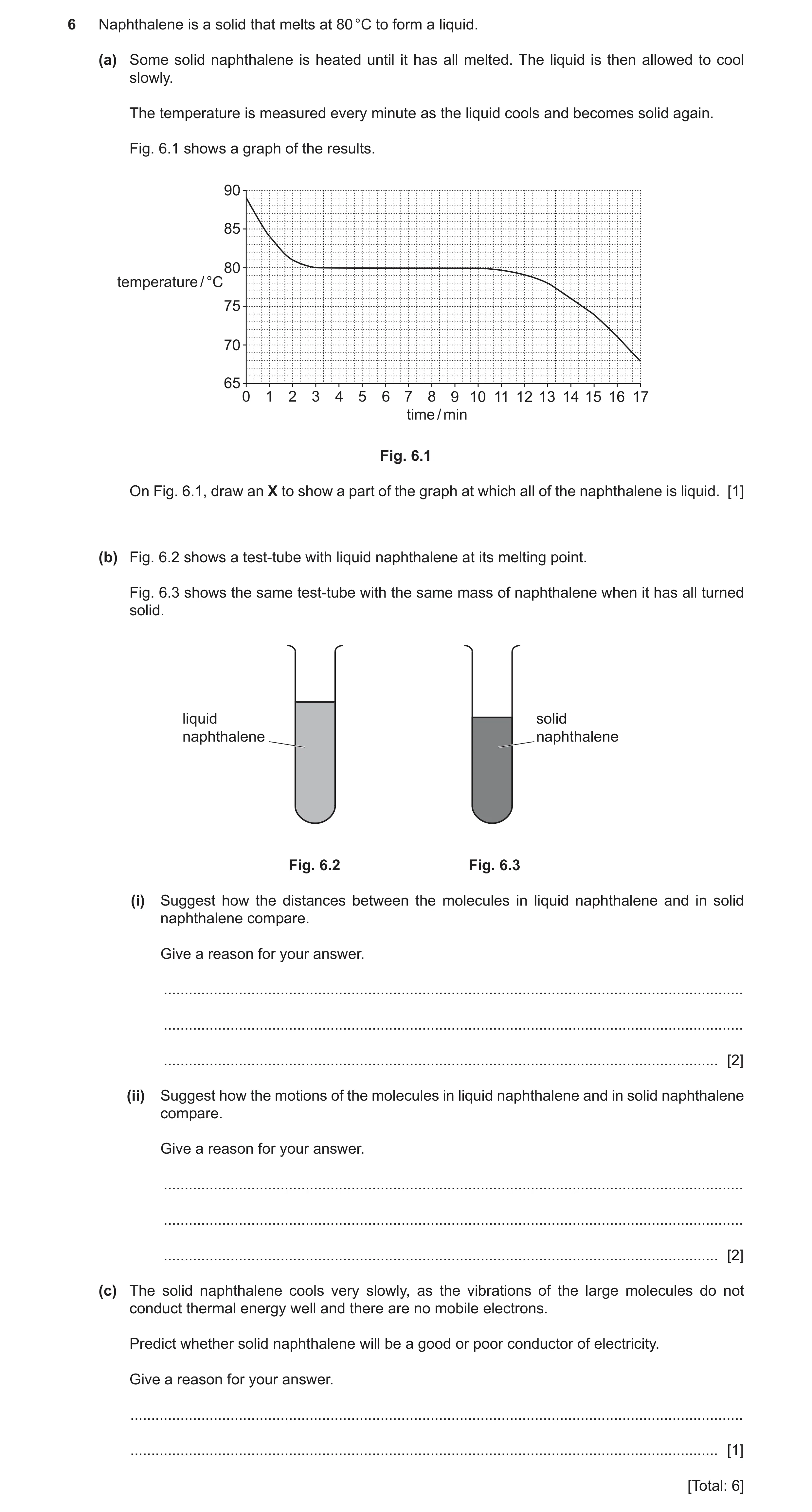
6 Naphthalene is a solid that melts at 80 °C to form a liquid. (a) Some solid naphthalene is heated until it has all melted. The liquid is then allowed to cool slowly. The temperature is measured every minute as the liquid cools and becomes solid again. Fig. 6.1 shows a graph of the results. 90 85 80 temperature / °C 75 70 65 0 1 2 3 4 5 6 7 8 9 10 11 12 13 14 15 16 17 time / min Fig. 6.1 On Fig. 6.1, draw an X to show a part of the graph at which all of the naphthalene is liquid. [1] (b) Fig. 6.2 shows a test-tube with liquid naphthalene at its melting point. Fig. 6.3 shows the same test-tube with the same mass of naphthalene when it has all turned solid. liquid solid naphthalene naphthalene Fig. 6.2 Fig. 6.3 (i) Suggest how the distances between the molecules in liquid naphthalene and in solid naphthalene compare. Give a reason for your answer. … … … [2] (ii) Suggest how the motions of the molecules in liquid naphthalene and in solid naphthalene compare. Give a reason for your answer. … … … [2] (c) The solid naphthalene cools very slowly, as the vibrations of the large molecules do not conduct thermal energy well and there are no mobile electrons. Predict whether solid naphthalene will be a good or poor conductor of electricity. Give a reason for your answer. … … [1] [Total: 6]
6 marks
Mark scheme: 6(a) X drawn anywhere on curve between 0s and 3s ; 1 6(b)(i) (molecules) closer in solid / further apart in liquid ; the idea that the regular arrangement of molecules in solid means that molecules more efficiently packed / owtte ; or in liquid, random arrangement so molecules less efficiently packed / owtte ; 2 6(b)(ii) slower in solid / faster in liquid ; in solid less (thermal / kinetic) energy / in liquid more (thermal / kinetic) energy ; 2 6(c) (poor conductor – no mark) good conductors of electricity require free electrons ; 1
This question in 0653/41 May/June 2020
Q7 · An extractor fan in the wall of a bathroom 0653/43 Oct/Nov 2020
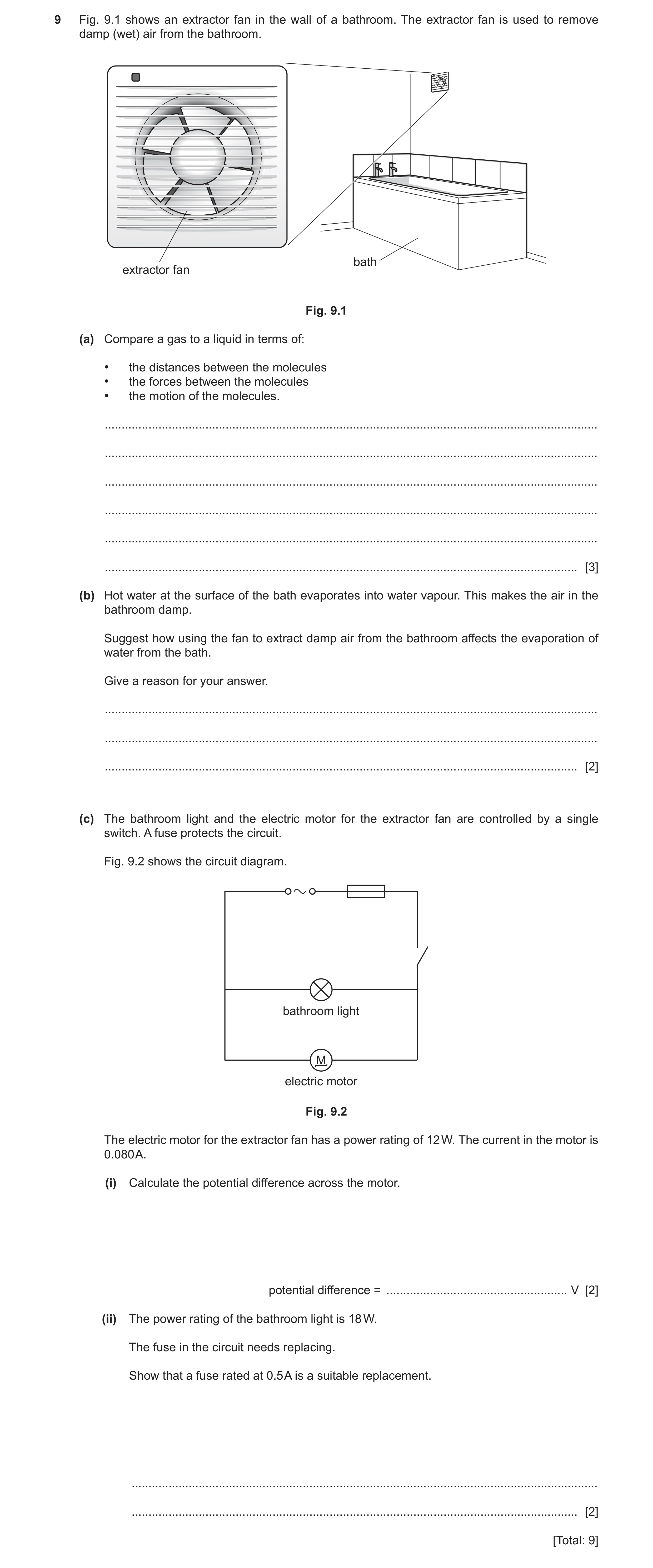
9 Fig. 9.1 shows an extractor fan in the wall of a bathroom. The extractor fan is used to remove damp (wet) air from the bathroom. bath extractor fan Fig. 9.1 (a) Compare a gas to a liquid in terms of: • the distances between the molecules • the forces between the molecules • the motion of the molecules. … … … … … … [3] (b) Hot water at the surface of the bath evaporates into water vapour. This makes the air in the bathroom damp. Suggest how using the fan to extract damp air from the bathroom affects the evaporation of water from the bath. Give a reason for your answer. … … … [2] (c) The bathroom light and the electric motor for the extractor fan are controlled by a single switch. A fuse protects the circuit. Fig. 9.2 shows the circuit diagram. bathroom light M electric motor Fig. 9.2 The electric motor for the extractor fan has a power rating of 12 W. The current in the motor is 0.080 A. (i) Calculate the potential difference across the motor. potential difference = … V [2] (ii) The power rating of the bathroom light is 18 W. The fuse in the circuit needs replacing. Show that a fuse rated at 0.5 A is a suitable replacement. … … [2] [Total: 9]
9 marks
Mark scheme: 9(a) (gas compared to a liquid) distances between molecules are larger ; forces between molecules are smaller ; molecules are faster-moving / molecules have more KE / move more freely ; 3 9(b) increases rate of evaporation ; water (vapour) molecules taken away from surface of bath (by moving air, preventing them returning to the bath water) ; 2 9(c)(i) P = IV in any form / 12 ÷ 0.080 ; 150 (V) ; 2 9(c)(ii) (I = P ÷ V = 18 ÷ 150 =) 0.12 A ; (current in main circuit = 0.12 + 0.080 =) 0.20 A (so 0.5 A fuse gives suitable margin) ; 2
This question in 0653/43 Oct/Nov 2020
Q8 · Carbon and oxygen are two elements in Period 2 of the Periodic Table 0653/42 Feb/March 2021
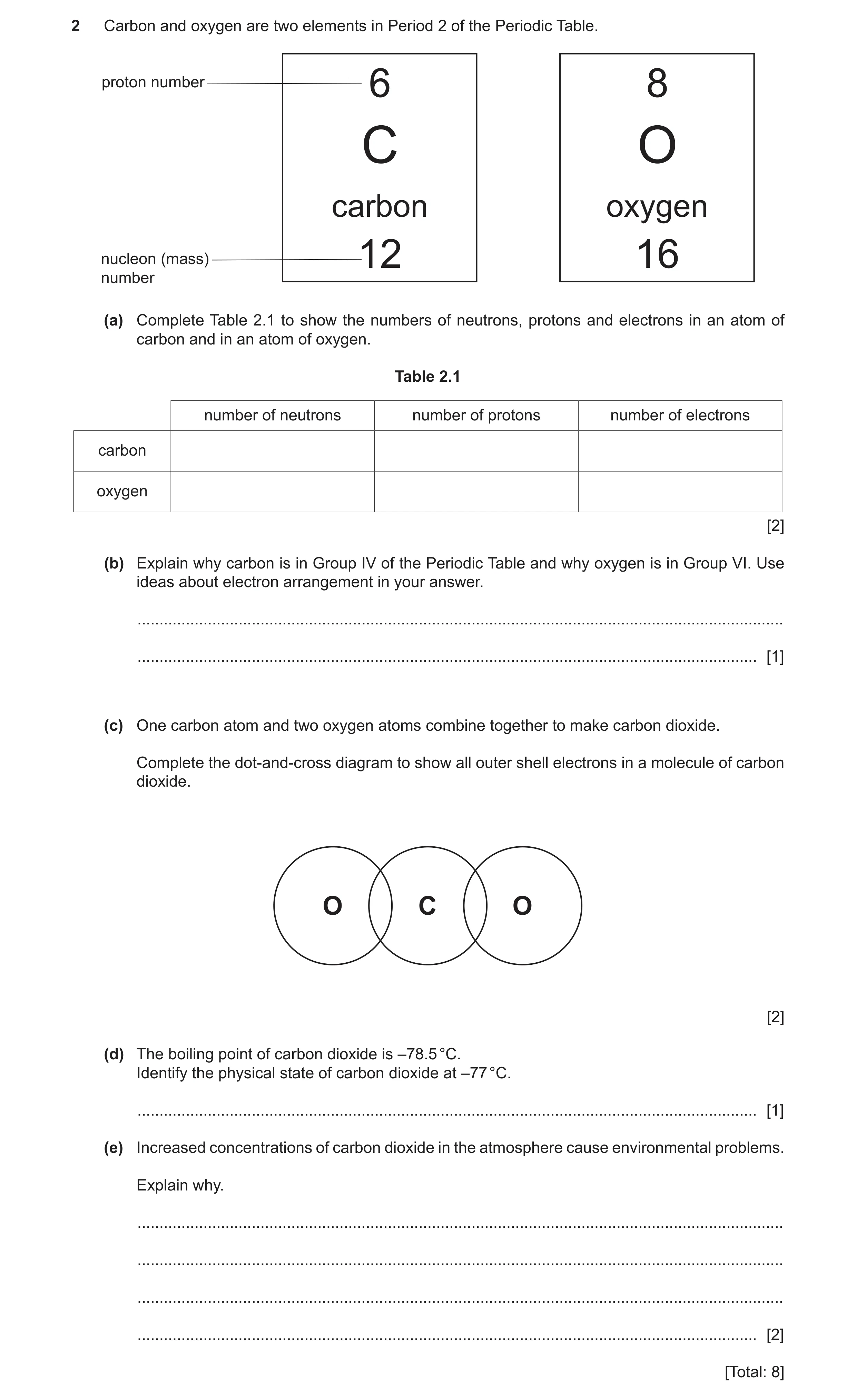
2 Carbon and oxygen are two elements in Period 2 of the Periodic Table. proton number 6 8 C O carbon oxygen nucleon (mass) 12 16 number (a) Complete Table 2.1 to show the numbers of neutrons, protons and electrons in an atom of carbon and in an atom of oxygen. Table 2.1 number of neutrons number of protons number of electrons carbon oxygen [2] (b) Explain why carbon is in Group IV of the Periodic Table and why oxygen is in Group VI. Use ideas about electron arrangement in your answer. … … [1] (c) One carbon atom and two oxygen atoms combine together to make carbon dioxide. Complete the dot-and-cross diagram to show all outer shell electrons in a molecule of carbon dioxide. O C O [2] (d) The boiling point of carbon dioxide is –78.5 °C. Identify the physical state of carbon dioxide at –77 °C. … [1] (e) Increased concentrations of carbon dioxide in the atmosphere cause environmental problems. Explain why. … … … … [2] [Total: 8]
8 marks
Mark scheme: 2(a) number of neutrons number of protons number of electrons 6 6 6 8 8 8 ;; one mark neutrons correct second mark protons and electrons correct 2 2(b) carbon has 4 outer shell electrons and oxygen has 6 ; 1 Question Answer Marks 2(c) four bonding electrons shown between carbon and each oxygen ; (dependent on MP1) rest of molecule correct ; 2 2(d) gas ; 1 2(e) one point from: CO2 is a greenhouse gas / causes enhanced greenhouse effect / causes atmosphere to heat up / traps excess heat in atmosphere / causes global warming ; and one point from: climate change ; extreme weather events / named example, e.g. hurricanes ; sea level rise / flooding (of coastal areas) ; polar ice caps melt ; 2
This question in 0653/42 Feb/March 2021
Q9 · A thermometer in a solution of salt in water 0653/41 May/June 2021
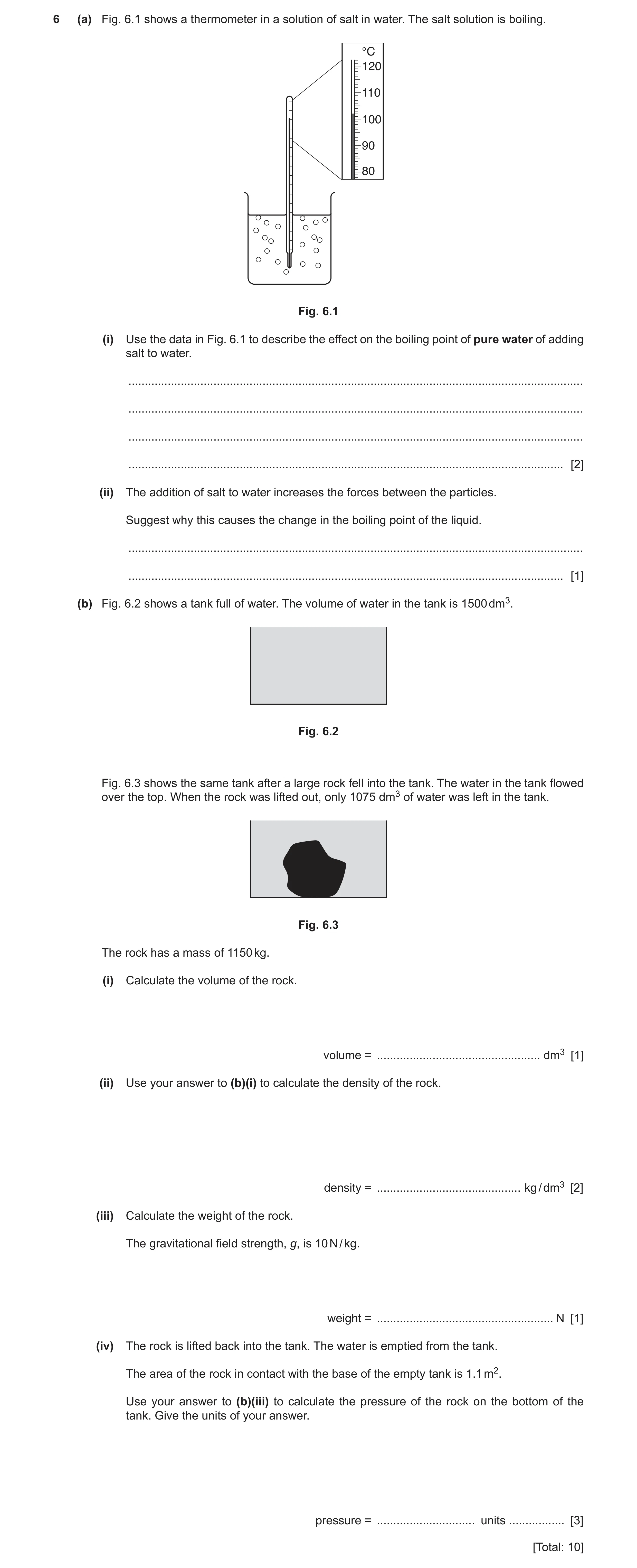
6 (a) Fig. 6.1 shows a thermometer in a solution of salt in water. The salt solution is boiling. °C 120 110 100 90 80 Fig. 6.1 (i) Use the data in Fig. 6.1 to describe the effect on the boiling point of pure water of adding salt to water. … … … … [2] (ii) The addition of salt to water increases the forces between the particles. Suggest why this causes the change in the boiling point of the liquid. … … [1] (b) Fig. 6.2 shows a tank full of water. The volume of water in the tank is 1500 dm3. Fig. 6.2 Fig. 6.3 shows the same tank after a large rock fell into the tank. The water in the tank flowed over the top. When the rock was lifted out, only 1075 dm3 of water was left in the tank. Fig. 6.3 The rock has a mass of 1150 kg. (i) Calculate the volume of the rock. volume = … dm3 [1] (ii) Use your answer to (b)(i) to calculate the density of the rock. density = … kg / dm3 [2] (iii) Calculate the weight of the rock. The gravitational field strength, g, is 10 N / kg. weight = … N [1] (iv) The rock is lifted back into the tank. The water is emptied from the tank. The area of the rock in contact with the base of the empty tank is 1.1 m2. Use your answer to (b)(iii) to calculate the pressure of the rock on the bottom of the tank. Give the units of your answer. pressure = … units … [3] [Total: 10]
10 marks
Mark scheme: 6(a)(i) boiling point raised ; boiling point of pure water is 100 °C ; 2 6(a)(ii) more work / energy needed (to separate the particles) ; 1 6(b)(i) 425 (dm3) ; 1 6(b)(ii) (density =) m ÷ V / 1150 ÷ 425 ; = 2.71 (kg / dm3) ; 2 6(b)(iii) 11 500 (N) ; 1 6(b)(iv) (P =) F ÷ A / 11 500 ÷ 1.1 ; = 1.05 × 10⁴ / 10 455 ; N / m2 OR Pa (pascals) ; 3
This question in 0653/41 May/June 2021
Q10 · The melting and boiling points of six substances 0653/43 May/June 2021
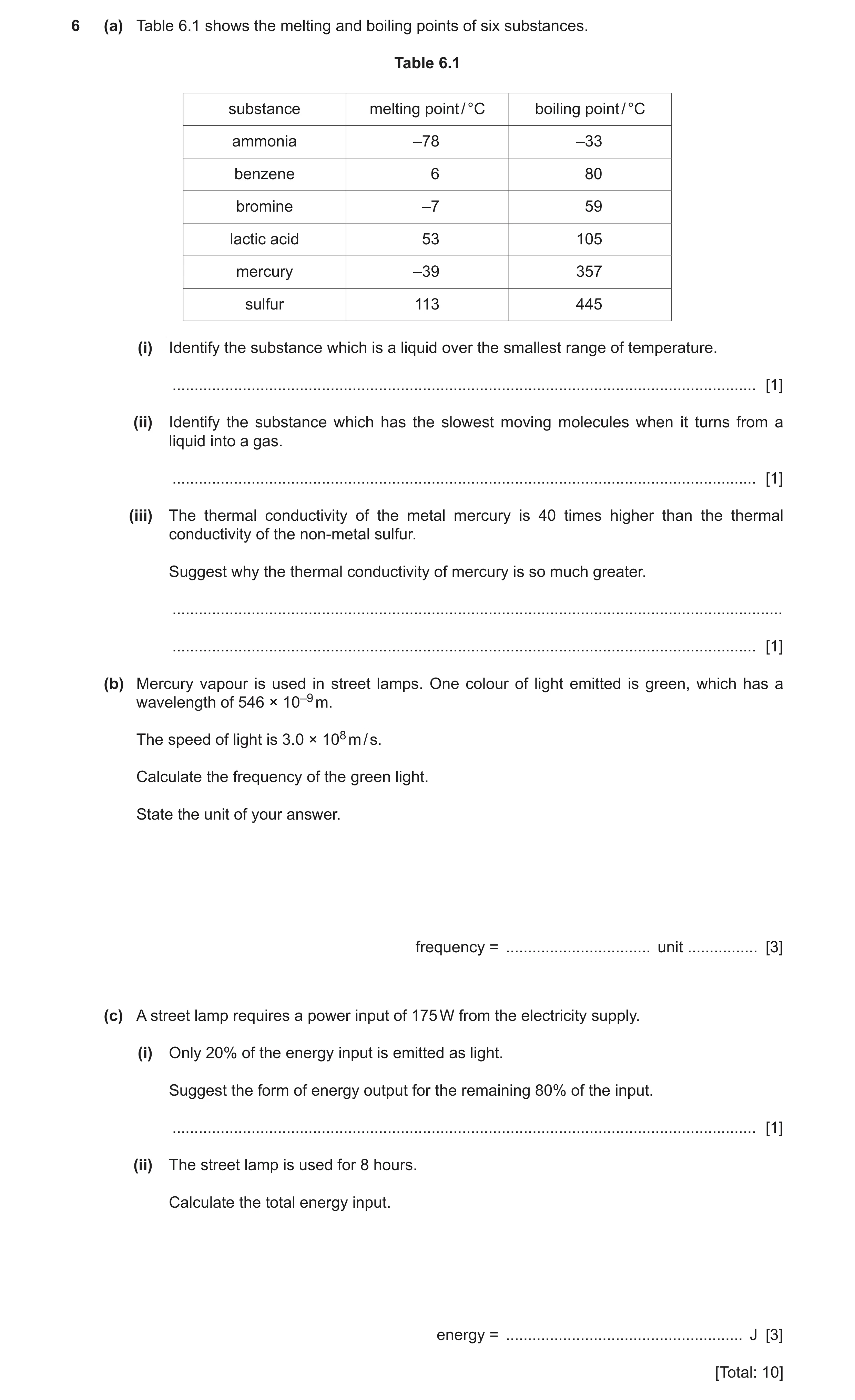
6 (a) Table 6.1 shows the melting and boiling points of six substances. Table 6.1 substance melting point / °C boiling point / °C ammonia –78 –33 benzene 6 80 bromine –7 59 lactic acid 53 105 mercury –39 357 sulfur 113 445 (i) Identify the substance which is a liquid over the smallest range of temperature. … [1] (ii) Identify the substance which has the slowest moving molecules when it turns from a liquid into a gas. … [1] (iii) The thermal conductivity of the metal mercury is 40 times higher than the thermal conductivity of the non-metal sulfur. Suggest why the thermal conductivity of mercury is so much greater. … … [1] (b) Mercury vapour is used in street lamps. One colour of light emitted is green, which has a wavelength of 546 × 10–9 m. The speed of light is 3.0 × 10⁸ m / s. Calculate the frequency of the green light. State the unit of your answer. frequency = … unit … [3] (c) A street lamp requires a power input of 175 W from the electricity supply. (i) Only 20% of the energy input is emitted as light. Suggest the form of energy output for the remaining 80% of the input. … [1] (ii) The street lamp is used for 8 hours. Calculate the total energy input. energy = … J [3] [Total: 10]
10 marks
Mark scheme: 6(a)(i) ammonia ; 1 6(a)(ii) ammonia ; 1 6(a)(iii) (thermal conductivity greater due to) transfer by (delocalised) electrons ; 1 6(b) f = v / λ = 3 × 10⁸ / 546 × 10–9 ; = 5.49 × 10¹⁴ / 5.5 × 10¹⁴ ; Hz ; 3 6(c)(i) thermal ; 1 6(c)(ii) 175 W = 175 J / s / energy = power × time ; 8 hrs = 8 × 3600 = 28 800 s ; (total energy =) 175 × 28 800 = 5 040 000 (J) ; 3
This question in 0653/43 May/June 2021
Q11 · The energy and state changes for water when it is heated from –10 °C to 120 °C 0653/41 Oct/Nov 2021
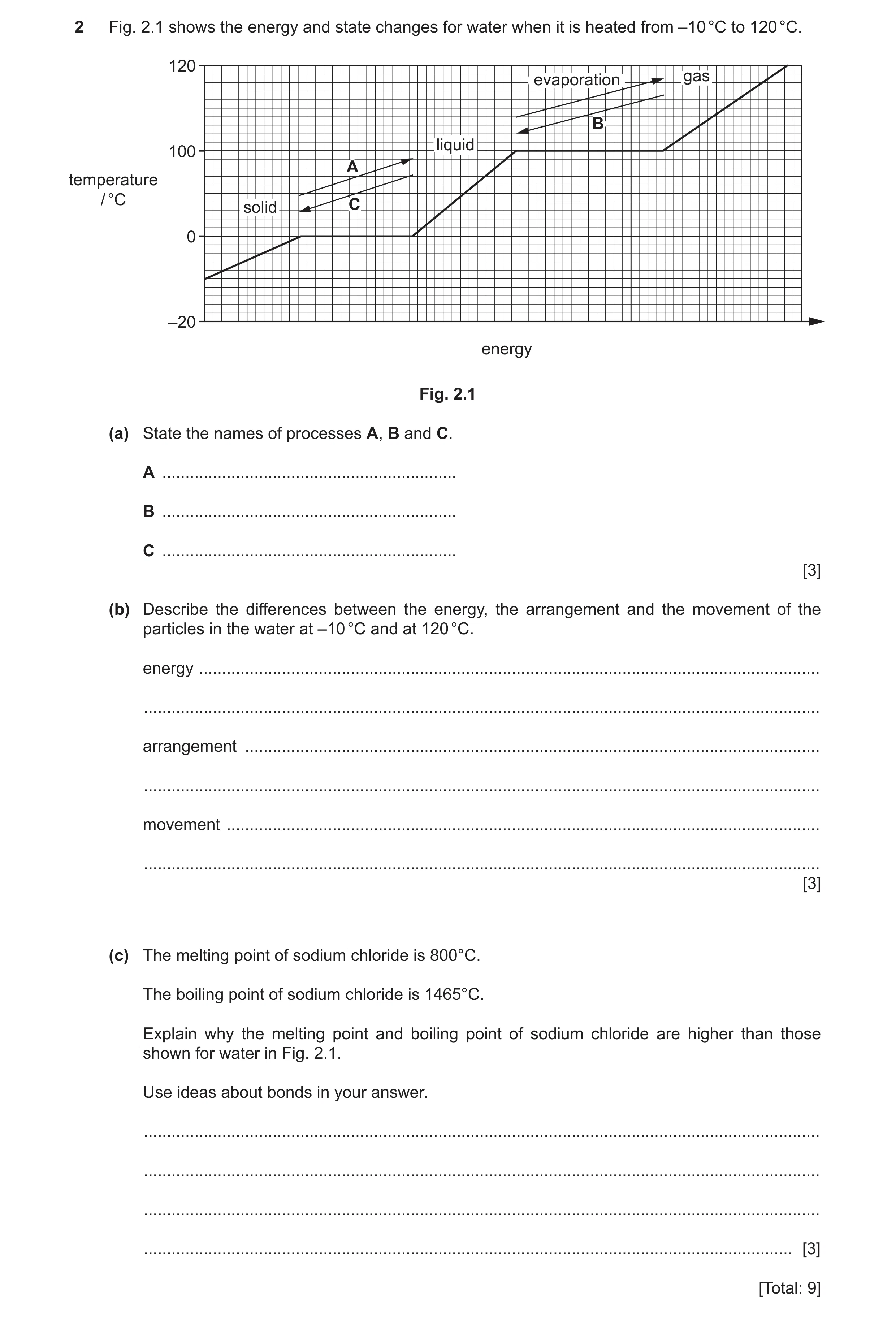
2 Fig. 2.1 shows the energy and state changes for water when it is heated from –10 °C to 120 °C. 120 evaporation gas B liquid 100 A temperature / °C solid C 0 –20 energy Fig. 2.1 (a) State the names of processes A, B and C. A … B … C … [3] (b) Describe the differences between the energy, the arrangement and the movement of the particles in the water at –10 °C and at 120 °C. energy … … arrangement … … movement … … [3] (c) The melting point of sodium chloride is 800°C. The boiling point of sodium chloride is 1465°C. Explain why the melting point and boiling point of sodium chloride are higher than those shown for water in Fig. 2.1. Use ideas about bonds in your answer. … … … … [3] [Total: 9]
9 marks
Mark scheme: 2(a) A melting ; B condensation ; C freezing ; 3 2(b) energy: particles have more (kinetic) energy at 120 °C ; arrangement: particles close / regular / lattice at –10 °C but random / spread out at 120 °C ; movement: particles (vibrate) in fixed positions at –10 °C but move around freely at 120 °C ; 3 2(c) any three from: more (thermal) energy needed to break bonds (in sodium chloride) ; sodium chloride, contains ionic bonds / is ionic ; the bonds between ions are stronger than between (water) molecules ; attraction between ions is high due to opposite electrical charges / strong electrostatic attraction between ions ; 3
This question in 0653/41 Oct/Nov 2021
Q12 · A student investigates a solid, a liquid and a gas 0653/42 May/June 2022
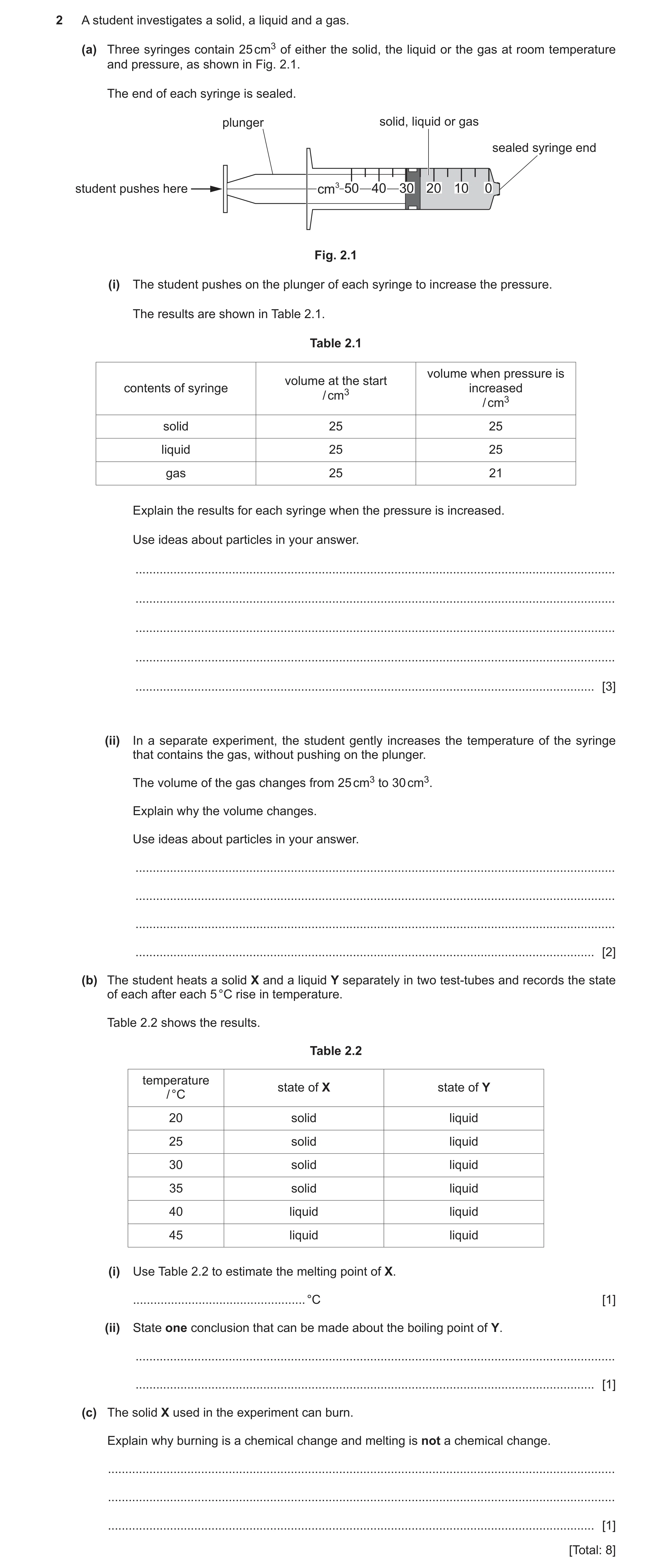
2 A student investigates a solid, a liquid and a gas. (a) Three syringes contain 25 cm3 of either the solid, the liquid or the gas at room temperature and pressure, as shown in Fig. 2.1. The end of each syringe is sealed. plunger solid, liquid or gas sealed syringe end student pushes here cm3 50 40 30 20 10 0 Fig. 2.1 (i) The student pushes on the plunger of each syringe to increase the pressure. The results are shown in Table 2.1. Table 2.1 volume when pressure is volume at the start contents of syringe increased / cm3 / cm3 solid 25 25 liquid 25 25 gas 25 21 Explain the results for each syringe when the pressure is increased. Use ideas about particles in your answer. … … … … … [3] (ii) In a separate experiment, the student gently increases the temperature of the syringe that contains the gas, without pushing on the plunger. The volume of the gas changes from 25 cm3 to 30 cm3. Explain why the volume changes. Use ideas about particles in your answer. … … … … [2] (b) The student heats a solid X and a liquid Y separately in two test‑tubes and records the state of each after each 5 °C rise in temperature. Table 2.2 shows the results. Table 2.2 temperature state of X state of Y / °C 20 solid liquid 25 solid liquid 30 solid liquid 35 solid liquid 40 liquid liquid 45 liquid liquid (i) Use Table 2.2 to estimate the melting point of X. … °C [1] (ii) State one conclusion that can be made about the boiling point of Y. … … [1] (c) The solid X used in the experiment can burn. Explain why burning is a chemical change and melting is not a chemical change. … … … [1] [Total: 8]
8 marks
Mark scheme: 2(a)(i) volumes of solid and liquid do not change and gas volume decreases / changes ; solid and liquid particles are close together and gas particles are (far) apart ; the idea that solid / liquid particles cannot be pushed closer together and gas particles can be pushed closer together ; 3 2(a)(ii) (volume increases because) particles move / become further apart ; particles gain (kinetic) energy / particles move faster ; 2 2(b)(i) 36–39 (°C) (any value in this range) ; 1 2(b)(ii) above 45 (°C) ; 1 2(c) (chemical / burning) new chemicals are formed / (physical / state change / melting) same substances present / ORA ; 1
This question in 0653/42 May/June 2022
 10
10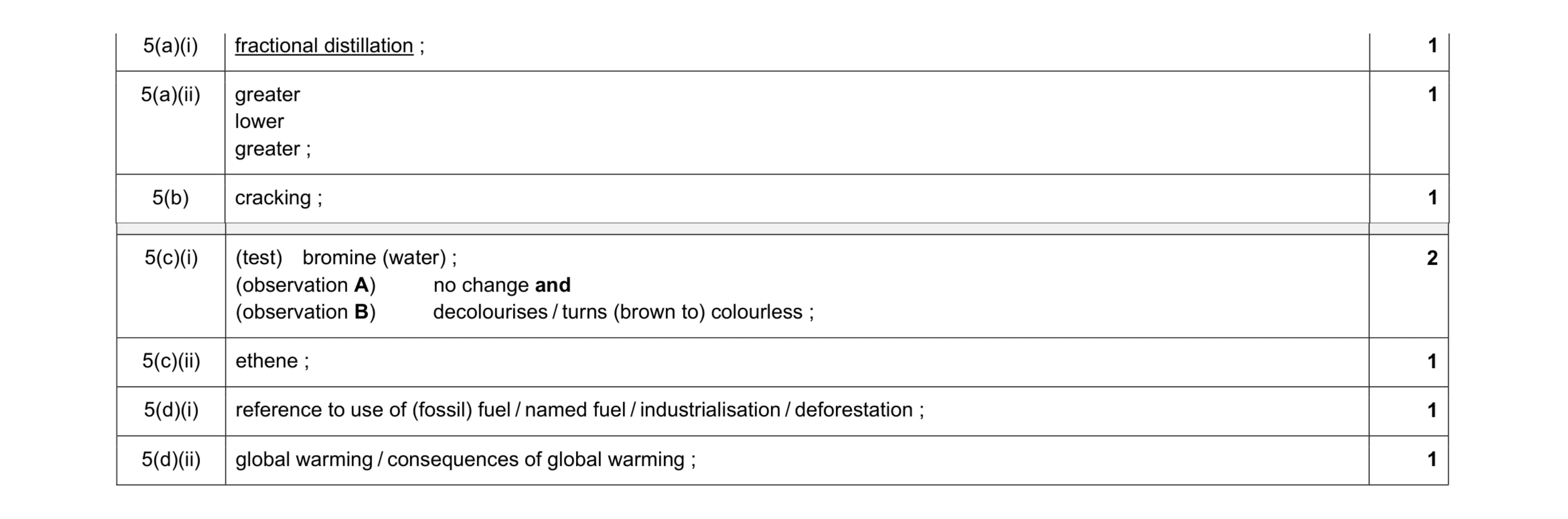 8
8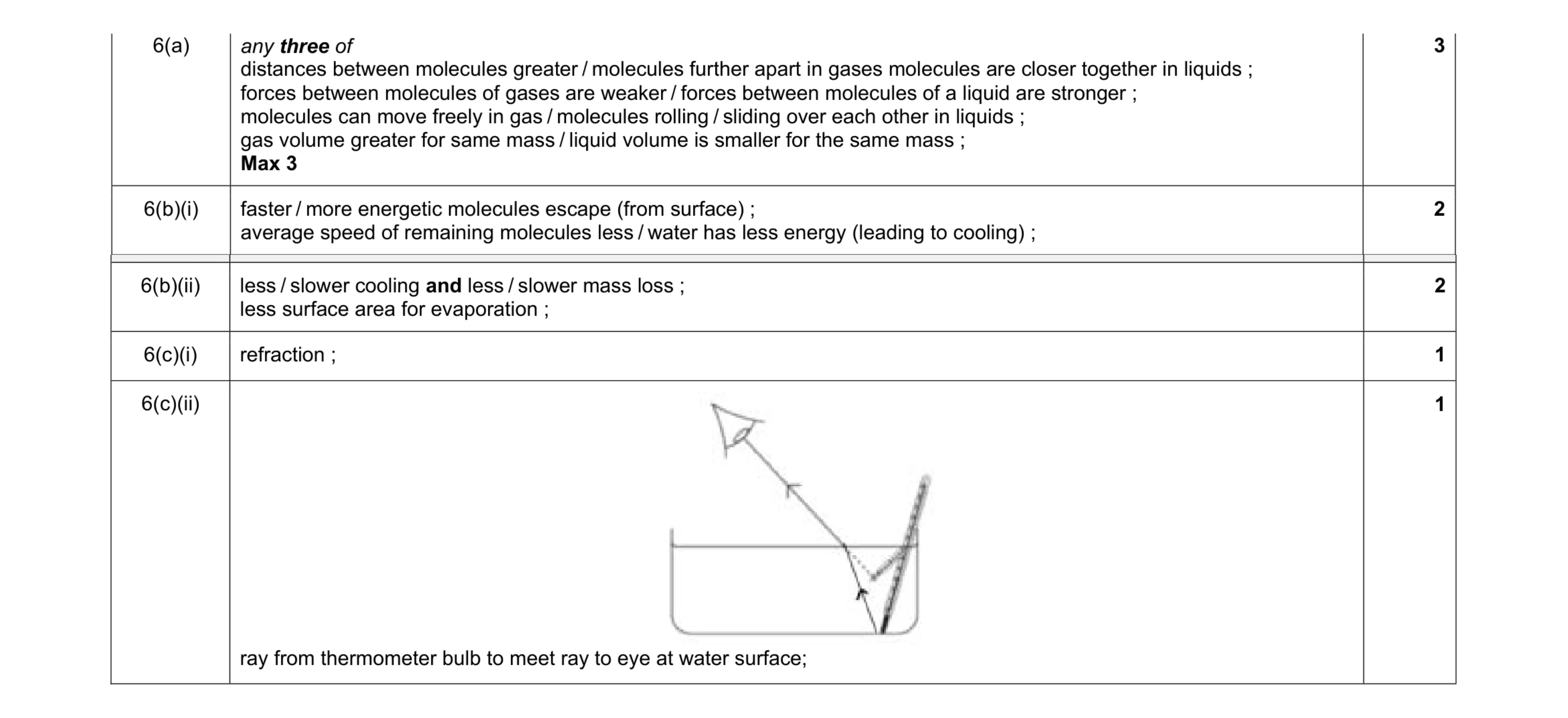 9
9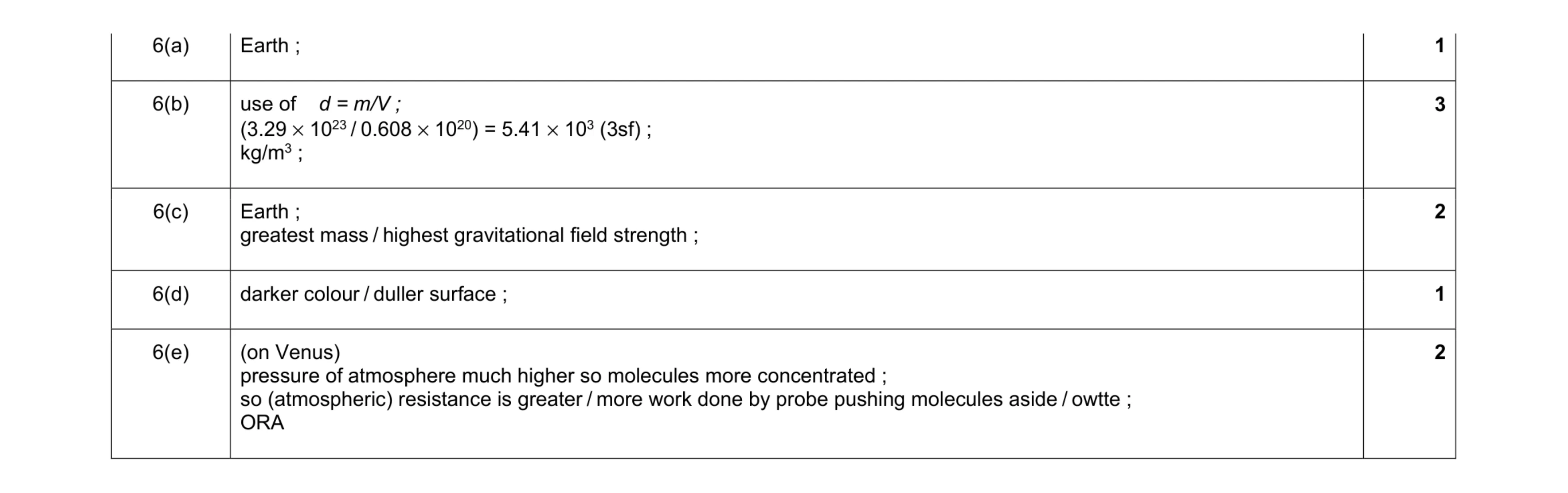 9
9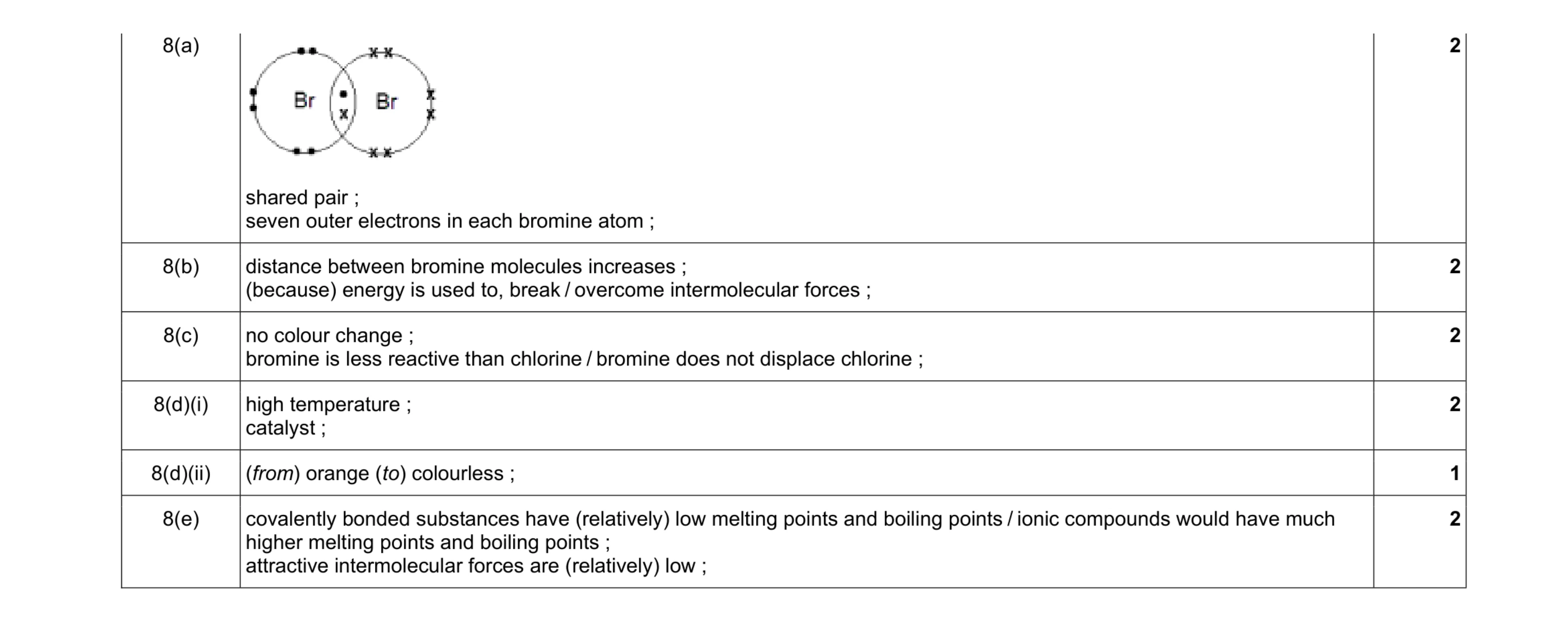 11
11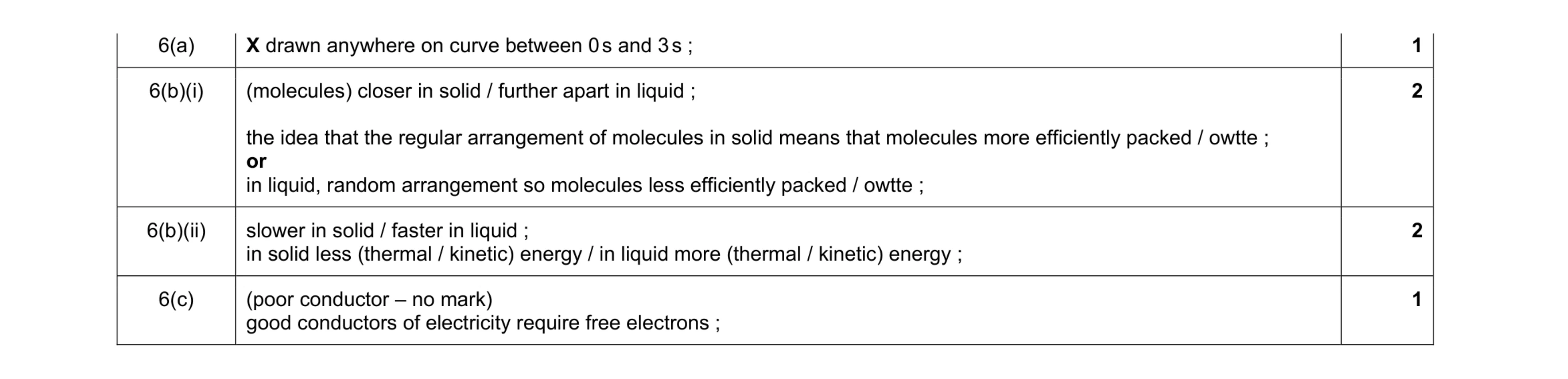 6
6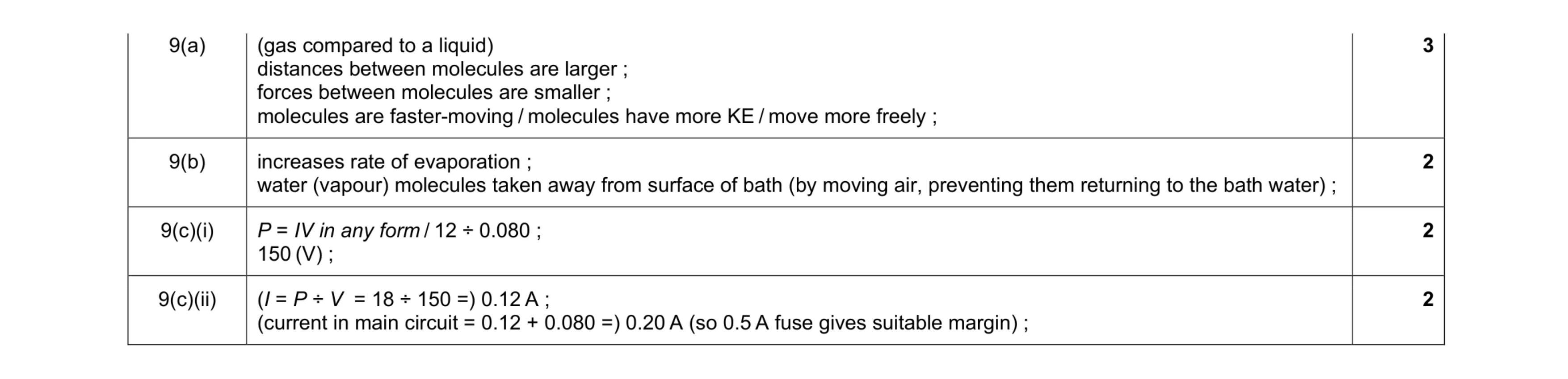 9
9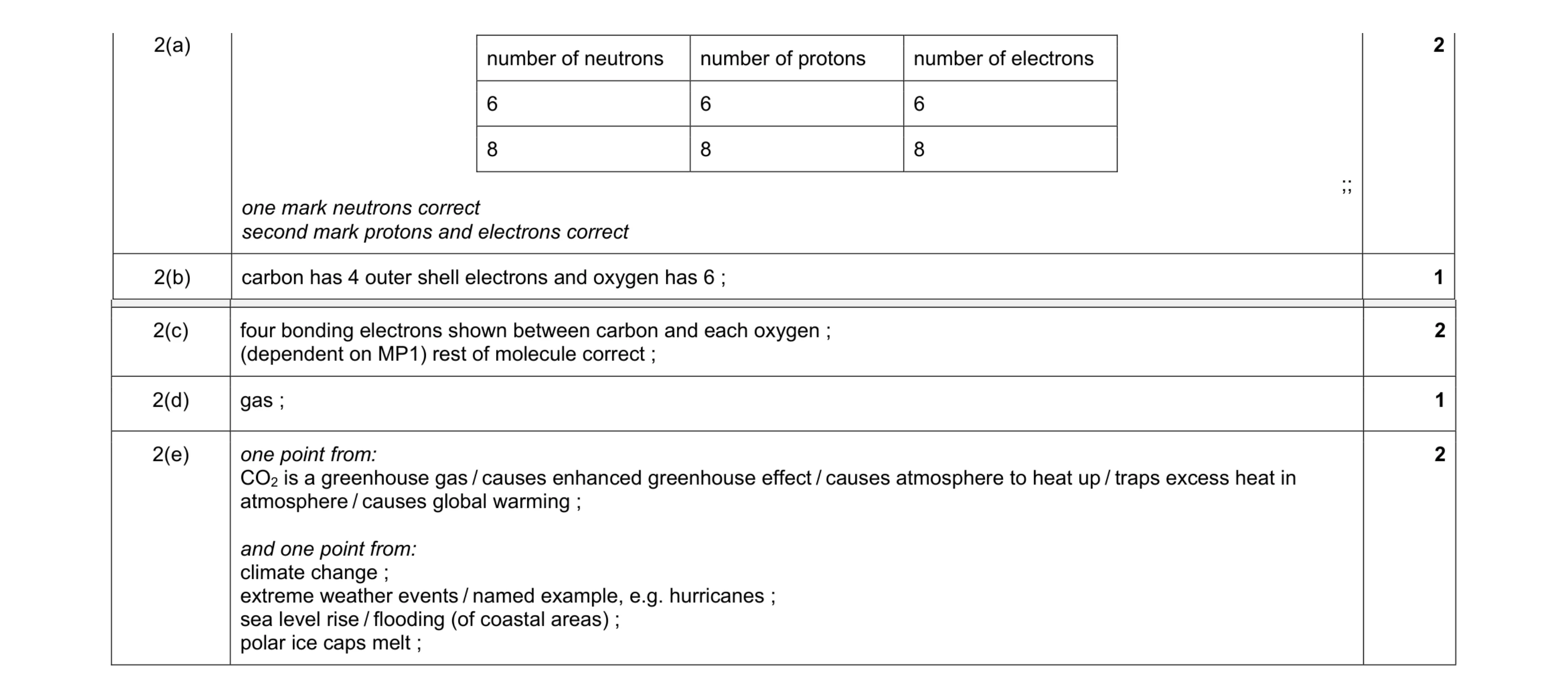 8
8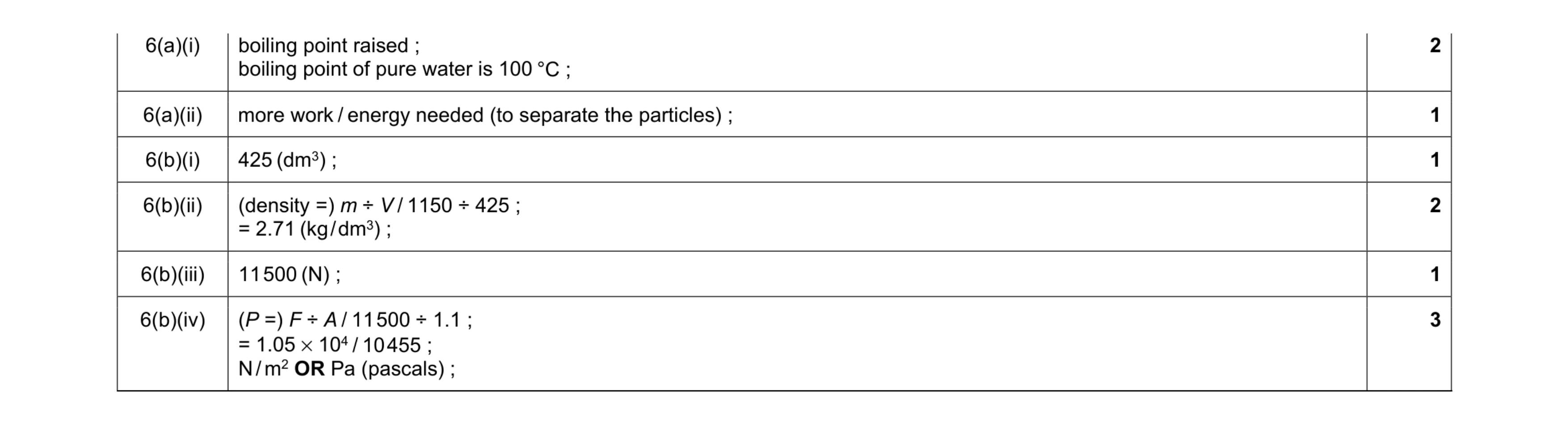 10
10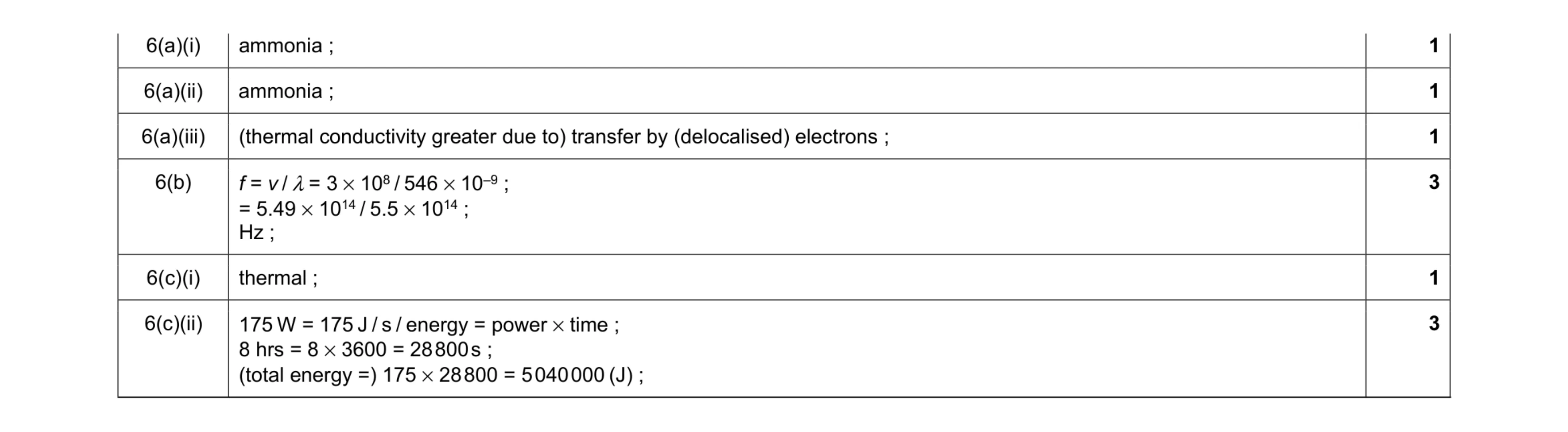 10
10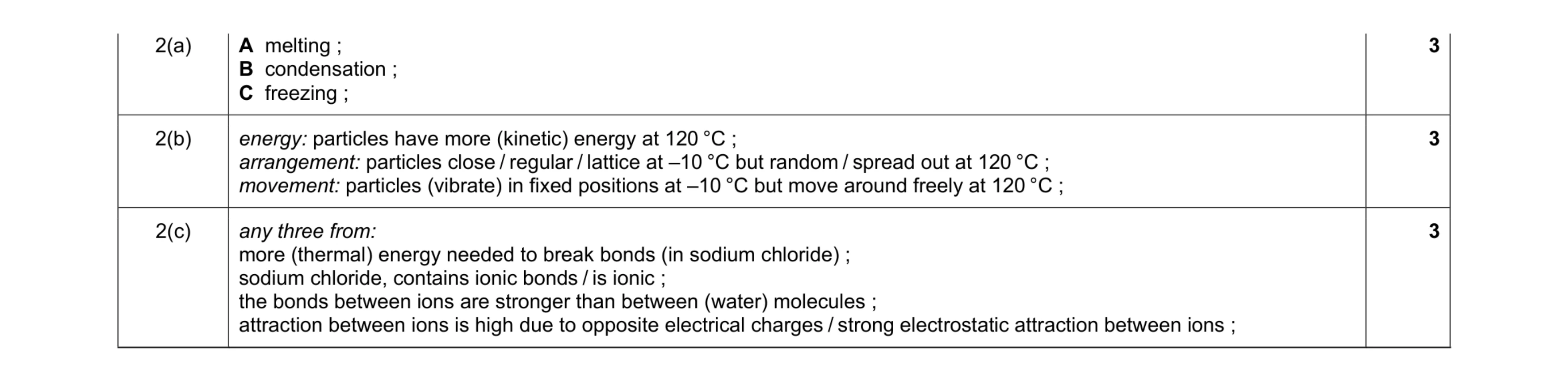 9
9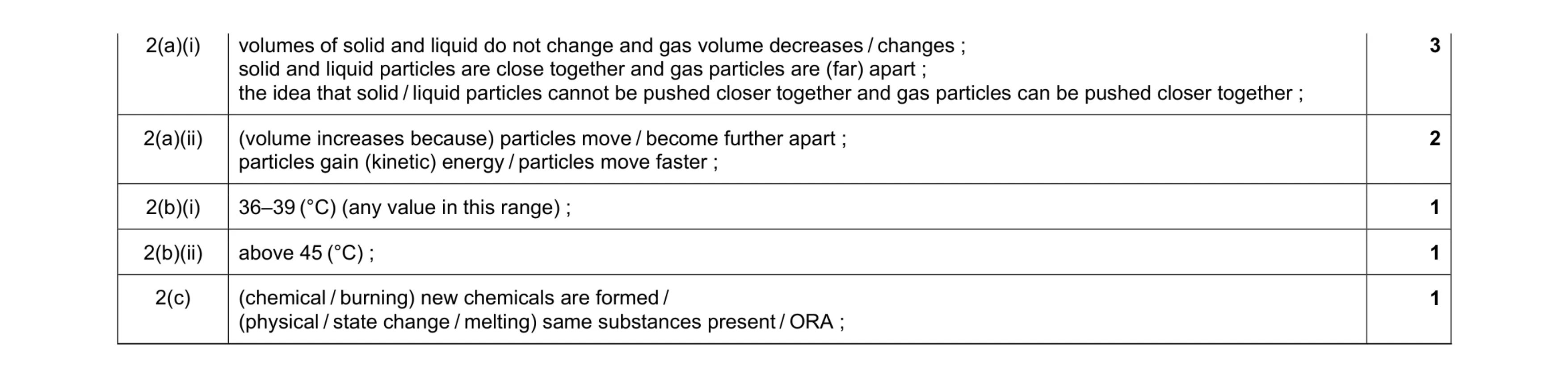 8
8