Questions as text
Q1 · State one property that distinguishes a liquid from a solid 0653/32 Oct/Nov 2018
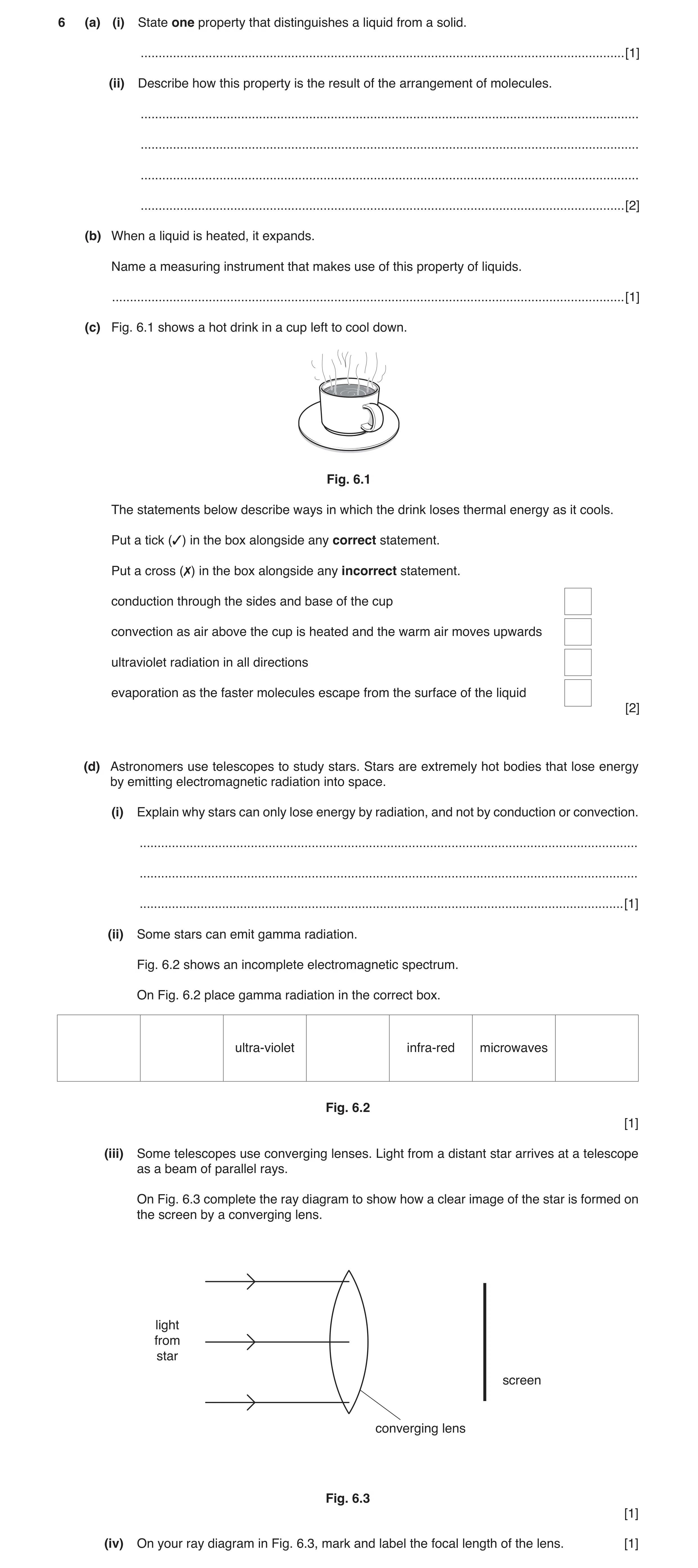
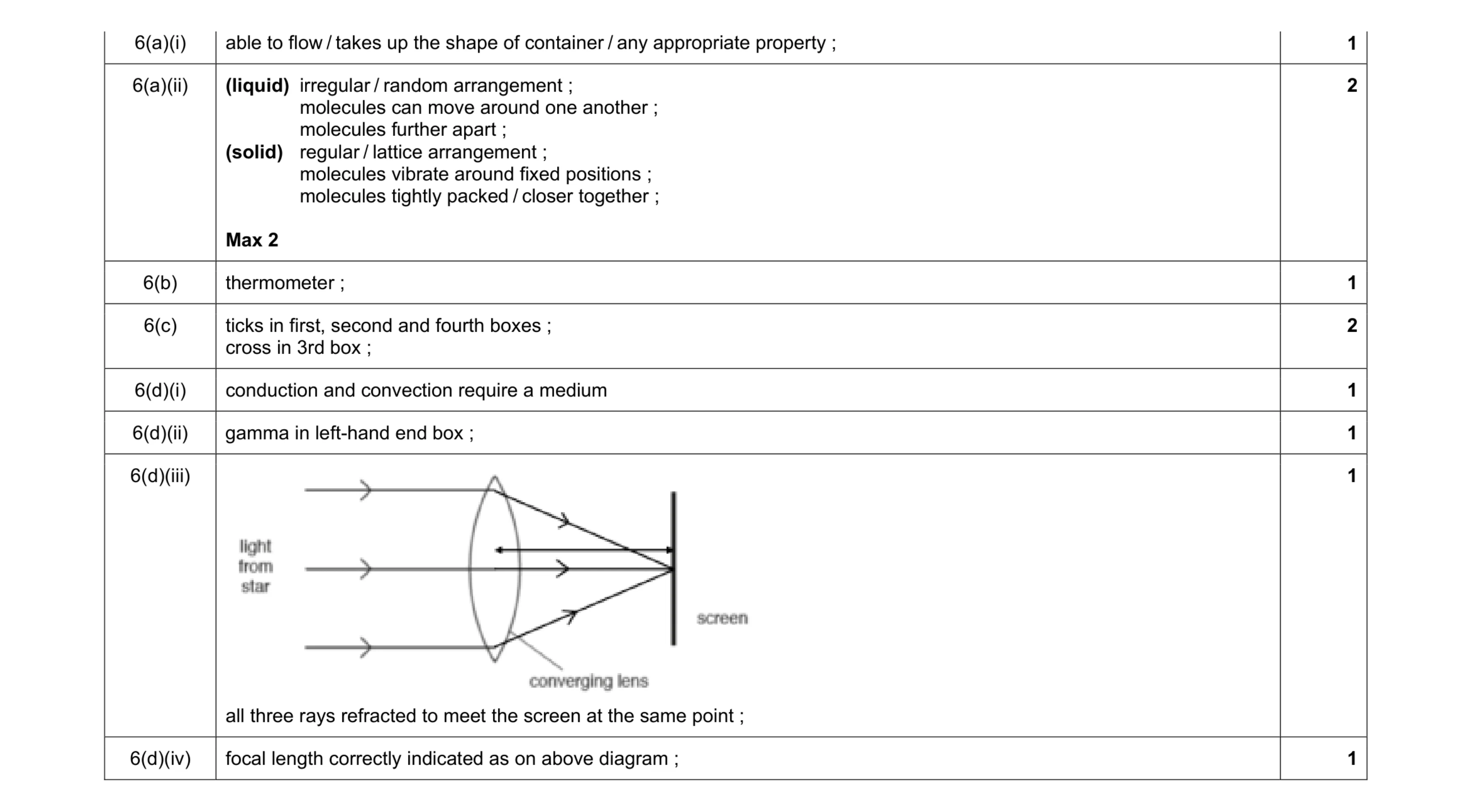
6 (a) (i) State one property that distinguishes a liquid from a solid. … [1] (ii) Describe how this property is the result of the arrangement of molecules. … … … … [2] (b) When a liquid is heated, it expands. Name a measuring instrument that makes use of this property of liquids. … [1] (c) Fig. 6.1 shows a hot drink in a cup left to cool down. Fig. 6.1 The statements below describe ways in which the drink loses thermal energy as it cools. Put a tick (3) in the box alongside any correct statement. Put a cross (✗) in the box alongside any incorrect statement. conduction through the sides and base of the cup convection as air above the cup is heated and the warm air moves upwards ultraviolet radiation in all directions evaporation as the faster molecules escape from the surface of the liquid [2] (d) Astronomers use telescopes to study stars. Stars are extremely hot bodies that lose energy by emitting electromagnetic radiation into space. (i) Explain why stars can only lose energy by radiation, and not by conduction or convection. … … … [1] (ii) Some stars can emit gamma radiation. Fig. 6.2 shows an incomplete electromagnetic spectrum. On Fig. 6.2 place gamma radiation in the correct box. ultra-violet infra-red microwaves Fig. 6.2 [1] (iii) Some telescopes use converging lenses. Light from a distant star arrives at a telescope as a beam of parallel rays. On Fig. 6.3 complete the ray diagram to show how a clear image of the star is formed on the screen by a converging lens. light from star screen converging lens Fig. 6.3 [1] (iv) On your ray diagram in Fig. 6.3, mark and label the focal length of the lens. [1]
10 marks
Mark scheme: 6(a)(i) able to flow / takes up the shape of container / any appropriate property ; 1 6(a)(ii) (liquid) irregular / random arrangement ; molecules can move around one another ; molecules further apart ; (solid) regular / lattice arrangement ; molecules vibrate around fixed positions ; molecules tightly packed / closer together ; Max 2 2 6(b) thermometer ; 1 6(c) ticks in first, second and fourth boxes ; cross in 3rd box ; 2 6(d)(i) conduction and convection require a medium 1 6(d)(ii) gamma in left-hand end box ; 1 6(d)(iii) all three rays refracted to meet the screen at the same point ; 1 6(d)(iv) focal length correctly indicated as on above diagram ; 1
This question in 0653/32 Oct/Nov 2018
Q2 · State one property that distinguishes a liquid from a gas 0653/33 Oct/Nov 2018
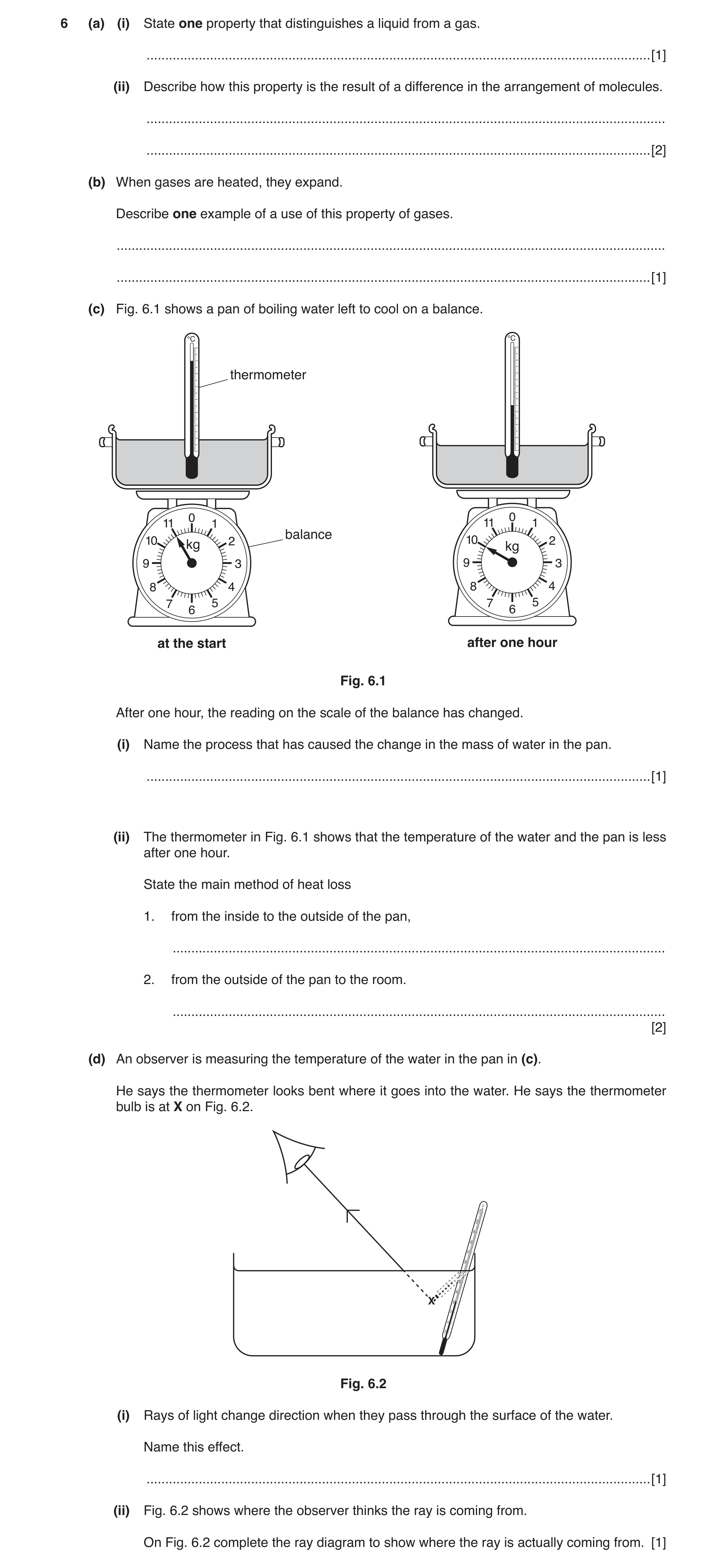
6 (a) (i) State one property that distinguishes a liquid from a gas. … [1] (ii) Describe how this property is the result of a difference in the arrangement of molecules. … … [2] (b) When gases are heated, they expand. Describe one example of a use of this property of gases. … … [1] (c) Fig. 6.1 shows a pan of boiling water left to cool on a balance. °C °C thermometer 0 0 11 1 11 1 balance 10 kg 2 10 kg 2 9 3 9 3 8 4 8 4 7 5 7 5 6 6 at the start after one hour Fig. 6.1 After one hour, the reading on the scale of the balance has changed. (i) Name the process that has caused the change in the mass of water in the pan. … [1] (ii) The thermometer in Fig. 6.1 shows that the temperature of the water and the pan is less after one hour. State the main method of heat loss 1. from the inside to the outside of the pan, … 2. from the outside of the pan to the room. … [2] (d) An observer is measuring the temperature of the water in the pan in (c). He says the thermometer looks bent where it goes into the water. He says the thermometer bulb is at X on Fig. 6.2. °C 110 100 90 80 70 60 30 40505 0 10 20 40 –10 30 20 10 0 –10 Fig. 6.2 (i) Rays of light change direction when they pass through the surface of the water. Name this effect. … [1] (ii) Fig. 6.2 shows where the observer thinks the ray is coming from. On Fig. 6.2 complete the ray diagram to show where the ray is actually coming from. [1]
9 marks
Mark scheme: 6(a)(i) density / volume / cannot be compressed ; 1 6(a)(ii) (liquid) molecules close together ; molecules can move around / slide over one another ; (gas) molecules far apart ; Molecules free to move apart ; Max 2 2 6(b) example of use of gas expansion on heating (e.g. hot air balloon, convection heater) ; 1 6(c)(i) evaporation ; 1 6(c)(ii) conduction ; convection ; 2 6(d)(i) refraction ; 1 6(d)(ii) ray from thermometer bulb to meet ray to eye at water surface ; 1
This question in 0653/33 Oct/Nov 2018
Q3 · A device called a ‘solar still’ 0653/32 Oct/Nov 2020
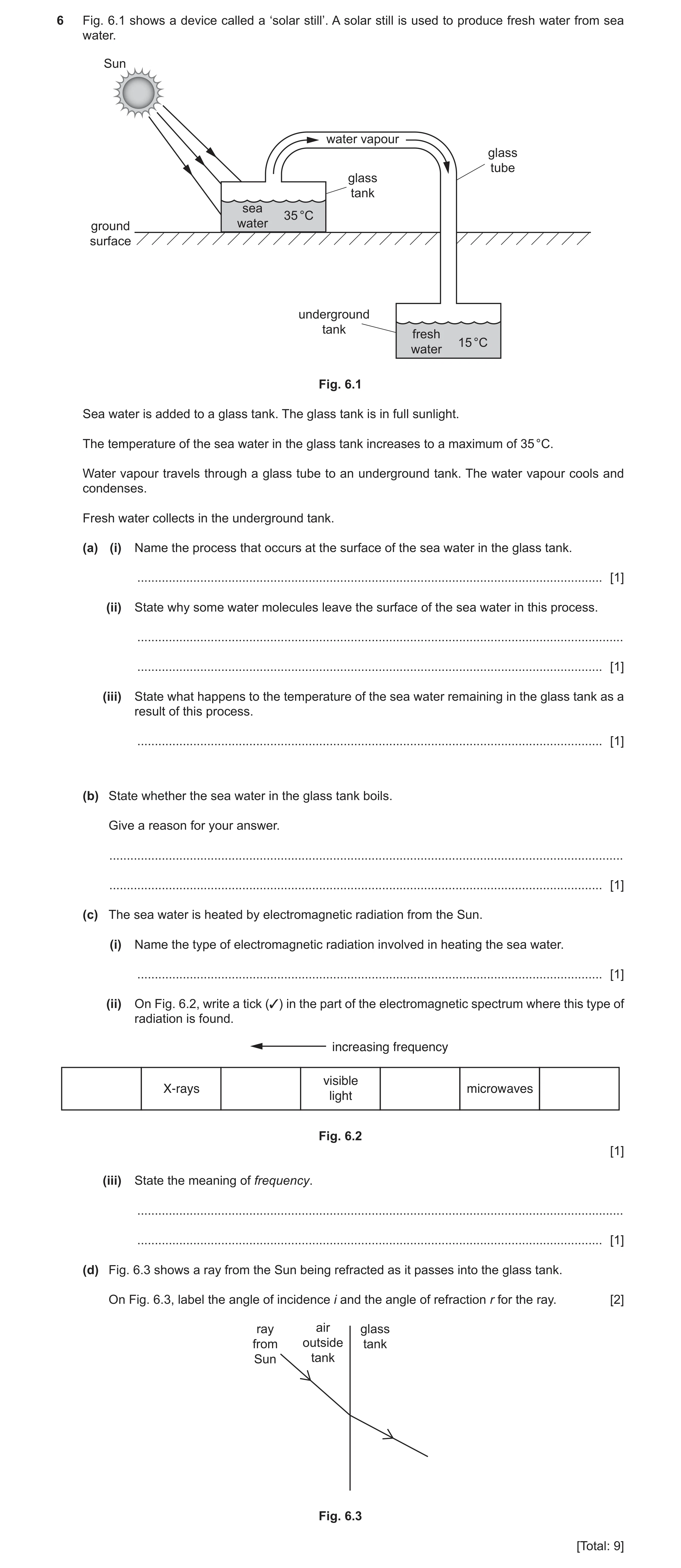
6 Fig. 6.1 shows a device called a ‘solar still’. A solar still is used to produce fresh water from sea water. Sun water vapour glass tube glass tank sea 35 °C ground water surface underground tank fresh 15 °C water Fig. 6.1 Sea water is added to a glass tank. The glass tank is in full sunlight. The temperature of the sea water in the glass tank increases to a maximum of 35 °C. Water vapour travels through a glass tube to an underground tank. The water vapour cools and condenses. Fresh water collects in the underground tank. (a) (i) Name the process that occurs at the surface of the sea water in the glass tank. … [1] (ii) State why some water molecules leave the surface of the sea water in this process. … … [1] (iii) State what happens to the temperature of the sea water remaining in the glass tank as a result of this process. … [1] (b) State whether the sea water in the glass tank boils. Give a reason for your answer. … … [1] (c) The sea water is heated by electromagnetic radiation from the Sun. (i) Name the type of electromagnetic radiation involved in heating the sea water. … [1] (ii) On Fig. 6.2, write a tick (3) in the part of the electromagnetic spectrum where this type of radiation is found. increasing frequency visible X-rays microwaves light Fig. 6.2 [1] (iii) State the meaning of frequency. … … [1] (d) Fig. 6.3 shows a ray from the Sun being refracted as it passes into the glass tank. On Fig. 6.3, label the angle of incidence i and the angle of refraction r for the ray. [2] ray air glass from outside tank Sun tank Fig. 6.3 [Total: 9]
9 marks
Mark scheme: 6(a)(i) evaporation ; 1 6(a)(ii) faster / more energetic molecules have enough energy to (break their bonds and) escape ; 1 6(a)(iii) (temperature) decreases / (sea water) cools down ; 1 Question Answer Marks 6(b) No AND (because) maximum temperature is below boiling point of (sea) water ; 1 6(c)(i) infrared ; 1 6(c)(ii) increasing frequency X-rays visible light microwaves ; 1 6(c)(iii) the number of complete waves per second / the number of waves that pass a fixed point in unit time ; 1 6(d) angle i correctly located ; angle r correctly located ; 2
This question in 0653/32 Oct/Nov 2020
Q4 · In the box in Fig 0653/33 Oct/Nov 2020
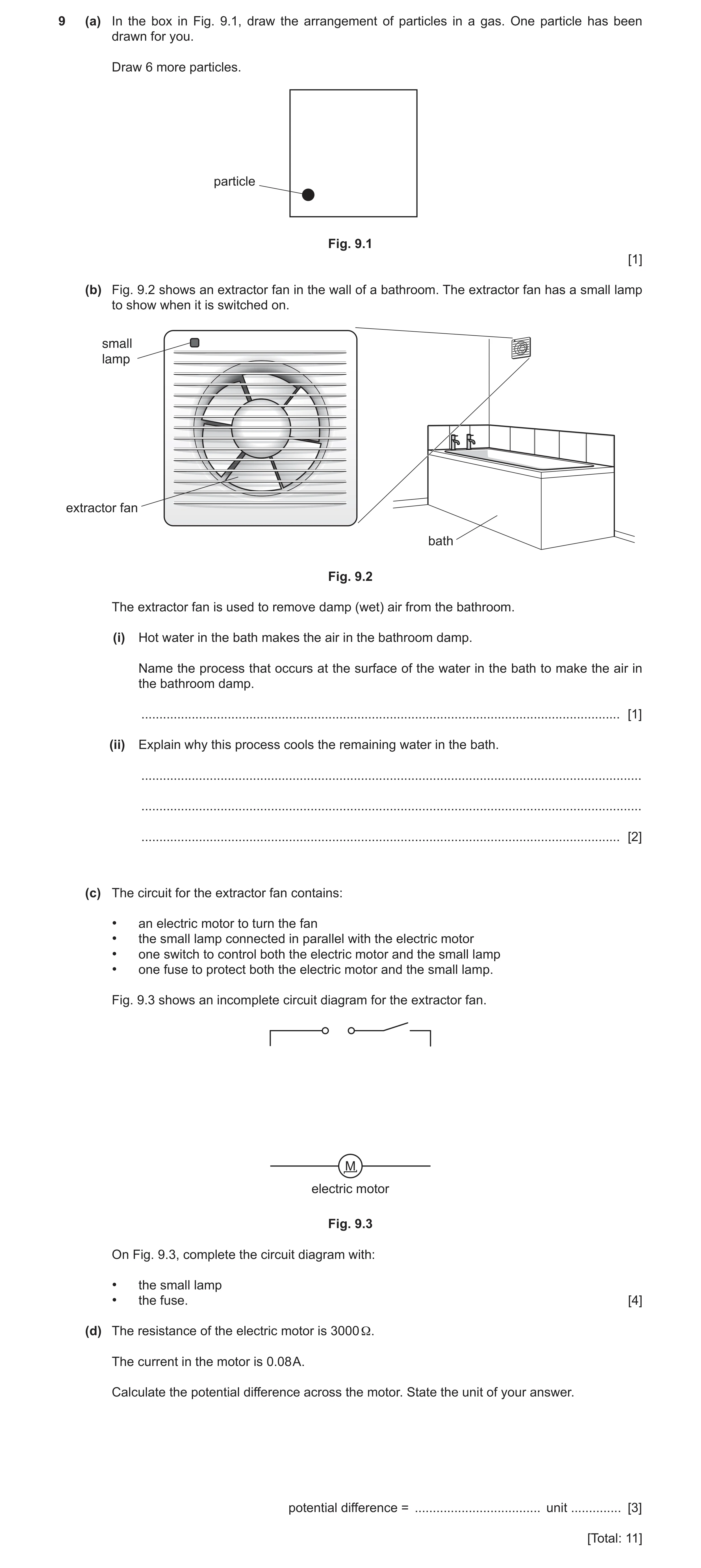
9 (a) In the box in Fig. 9.1, draw the arrangement of particles in a gas. One particle has been drawn for you. Draw 6 more particles. particle Fig. 9.1 [1] (b) Fig. 9.2 shows an extractor fan in the wall of a bathroom. The extractor fan has a small lamp to show when it is switched on. small lamp extractor fan bath Fig. 9.2 The extractor fan is used to remove damp (wet) air from the bathroom. (i) Hot water in the bath makes the air in the bathroom damp. Name the process that occurs at the surface of the water in the bath to make the air in the bathroom damp. … [1] (ii) Explain why this process cools the remaining water in the bath. … … … [2] (c) The circuit for the extractor fan contains: • an electric motor to turn the fan • the small lamp connected in parallel with the electric motor • one switch to control both the electric motor and the small lamp • one fuse to protect both the electric motor and the small lamp. Fig. 9.3 shows an incomplete circuit diagram for the extractor fan. M electric motor Fig. 9.3 On Fig. 9.3, complete the circuit diagram with: • the small lamp • the fuse. [4] (d) The resistance of the electric motor is 3000 Ω. The current in the motor is 0.08 A. Calculate the potential difference across the motor. State the unit of your answer. potential difference = … unit … [3] [Total: 11]
11 marks
Mark scheme: 9(a) random arrangement of 6 additional particles, far apart ; 1 9(b)(i) evaporation ; 1 9(b)(ii) faster / more-energetic, water molecules escape ; remaining molecules have less energy (so water is cooler) ; 2 9(c) correct symbol for lamp ; correct symbol for fuse ; lamp in parallel with motor ; fuse in main circuit ; 4 9(c) V = IR in any form / 0.080 × 3000 ; 240 ; V / volts ; 3
This question in 0653/33 Oct/Nov 2020
Q5 · The melting points and boiling points of six substances 0653/33 May/June 2021
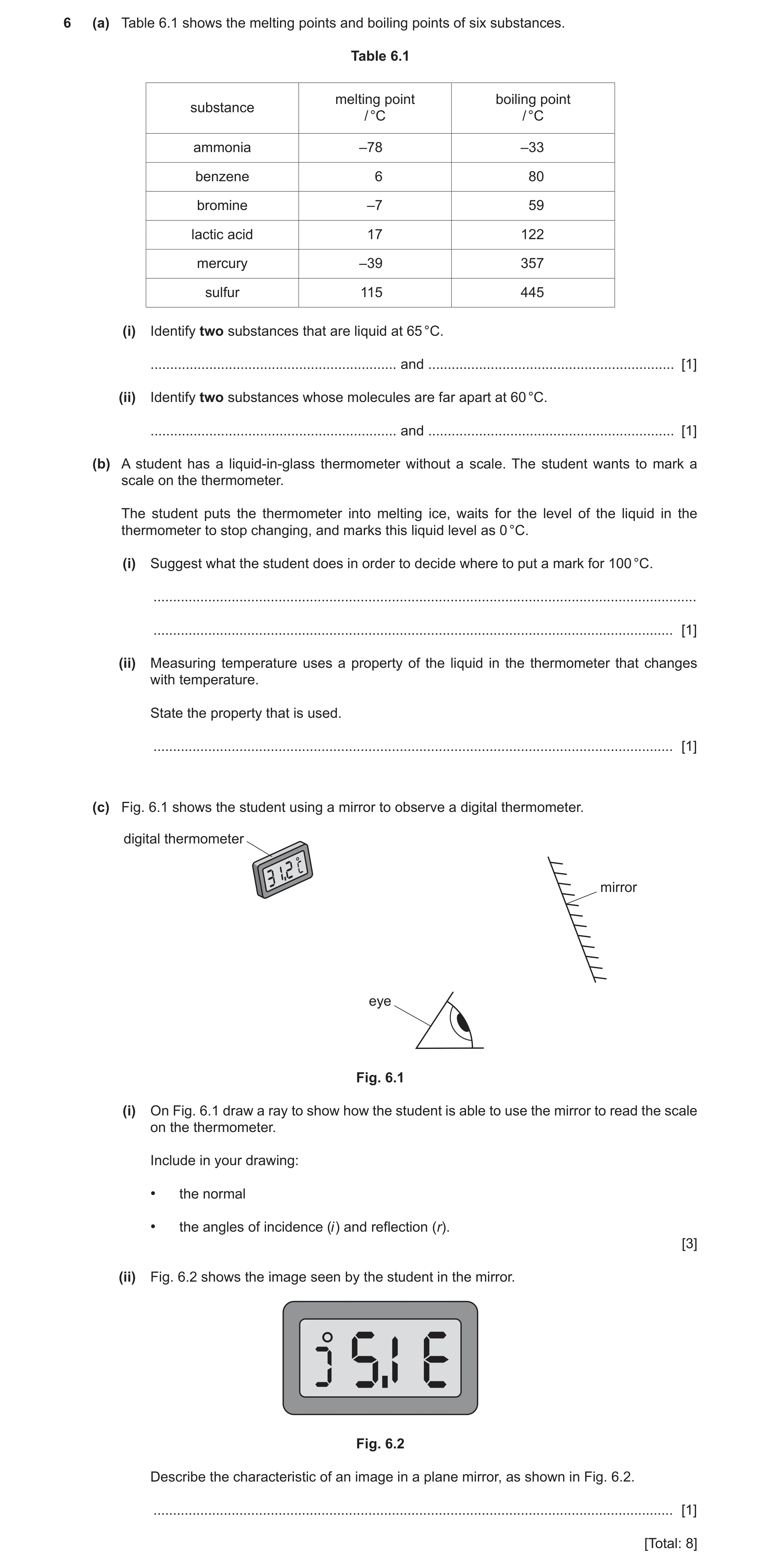
6 (a) Table 6.1 shows the melting points and boiling points of six substances. Table 6.1 melting point boiling point substance / °C / °C ammonia –78 –33 benzene 6 80 bromine –7 59 lactic acid 17 122 mercury –39 357 sulfur 115 445 (i) Identify two substances that are liquid at 65 °C. … and … [1] (ii) Identify two substances whose molecules are far apart at 60 °C. … and … [1] (b) A student has a liquid-in-glass thermometer without a scale. The student wants to mark a scale on the thermometer. The student puts the thermometer into melting ice, waits for the level of the liquid in the thermometer to stop changing, and marks this liquid level as 0 °C. (i) Suggest what the student does in order to decide where to put a mark for 100 °C. … … [1] (ii) Measuring temperature uses a property of the liquid in the thermometer that changes with temperature. State the property that is used. … [1] (c) Fig. 6.1 shows the student using a mirror to observe a digital thermometer. digital thermometer mirror eye Fig. 6.1 (i) On Fig. 6.1 draw a ray to show how the student is able to use the mirror to read the scale on the thermometer. Include in your drawing: • the normal • the angles of incidence (i) and reflection (r). [3] (ii) Fig. 6.2 shows the image seen by the student in the mirror. Fig. 6.2 Describe the characteristic of an image in a plane mirror, as shown in Fig. 6.2. … [1] [Total: 8]
8 marks
Mark scheme: 6(a)(i) any two for one mark: benzene / lactic acid / mercury ; 1 6(a)(ii) ammonia AND bromine ; 1 6(b)(i) hold bulb in boiling water / hold bulb in steam (above boiling water) ; 1 6(b)(ii) (thermal) expansion / increase in volume ; 1 Question Answer Marks 6(c)(i) ray from thermometer to mirror to eye, with at least one arrowhead ; normal drawn at mirror with equal angles (judged by eye) of incidence and reflection ; i and r correctly marked ; 3 6(c)(ii) laterally inverted OWTTE ; 1
This question in 0653/33 May/June 2021
Q6 · A salt solution is made by dissolving solid salt in water 0653/32 Feb/March 2022
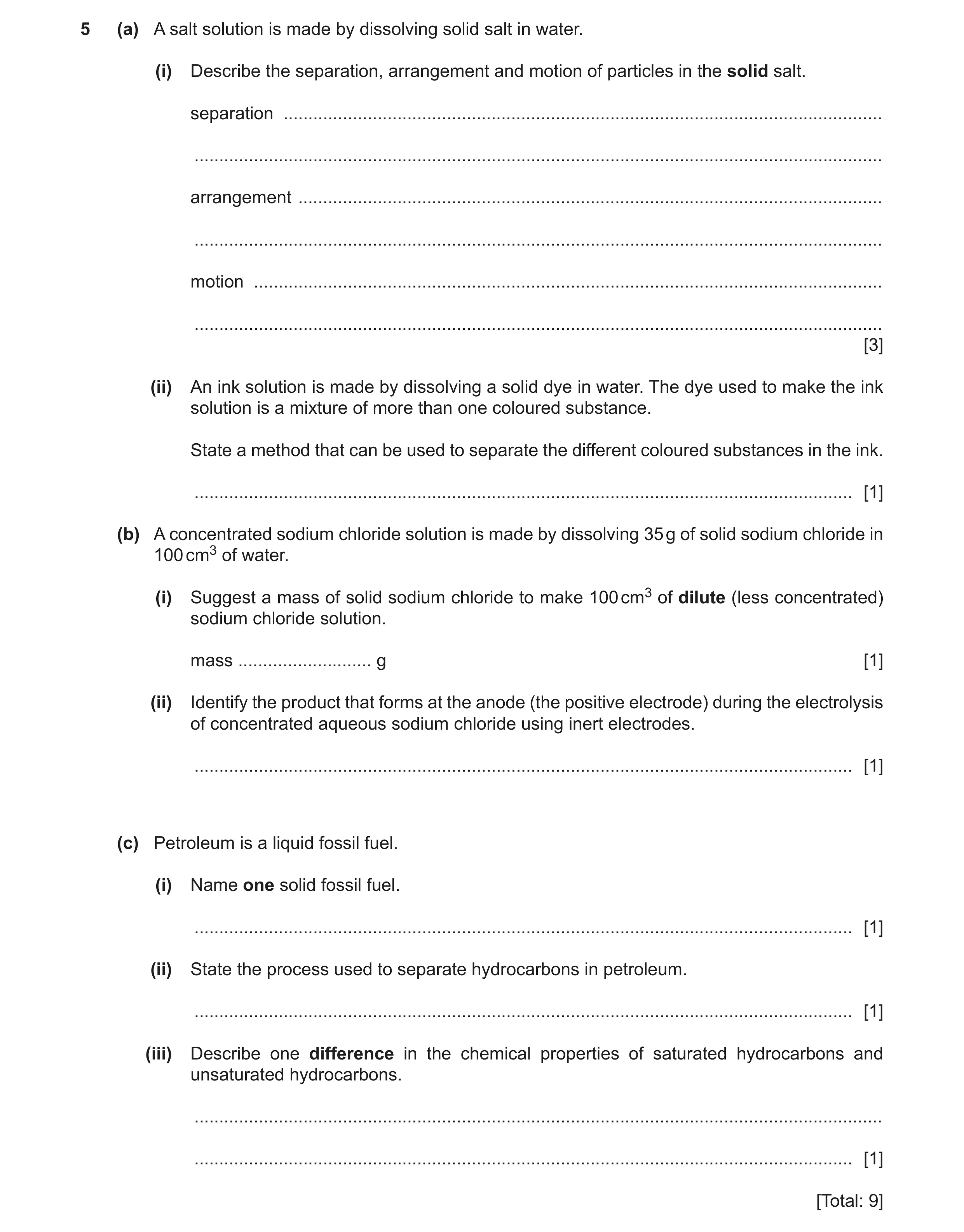
5 (a) A salt solution is made by dissolving solid salt in water. (i) Describe the separation, arrangement and motion of particles in the solid salt. separation … … arrangement … … motion … … [3] (ii) An ink solution is made by dissolving a solid dye in water. The dye used to make the ink solution is a mixture of more than one coloured substance. State a method that can be used to separate the different coloured substances in the ink. … [1] (b) A concentrated sodium chloride solution is made by dissolving 35 g of solid sodium chloride in 100 cm3 of water. (i) Suggest a mass of solid sodium chloride to make 100 cm3 of dilute (less concentrated) sodium chloride solution. mass … g [1] (ii) Identify the product that forms at the anode (the positive electrode) during the electrolysis of concentrated aqueous sodium chloride using inert electrodes. … [1] (c) Petroleum is a liquid fossil fuel. (i) Name one solid fossil fuel. … [1] (ii) State the process used to separate hydrocarbons in petroleum. … [1] (iii) Describe one difference in the chemical properties of saturated hydrocarbons and unsaturated hydrocarbons. … … [1] [Total: 9]
9 marks
Mark scheme: 5(a)(i) (separation) close together ; (arrangement) regular ; (motion) vibrate / don’t move about ; 3 5(a)(ii) chromatography ; 1 5(b)(i) any value less than 35 (g) ; 1 5(b)(ii) chlorine / Cl2 ; 1 Question Answer Marks 5(c)(i) coal ; 1 5(c)(ii) fractional distillation ; 1 5(c)(iii) any one from: saturated hydrocarbons are unreactive / unsaturated hydrocarbons reactive ; unsaturated hydrocarbons react with (aqueous) bromine / decolourise bromine water ; unsaturated hydrocarbons form polymers ; 1
This question in 0653/32 Feb/March 2022
Q7 · A thermometer in a beaker of water 0653/32 Feb/March 2022
6 Fig. 6.1 shows a thermometer in a beaker of water. A student heats the beaker of water from 20 °C to 90 °C. Fig. 6.1 (a) (i) A visible cloud rises above the water in the beaker. Identify the processes that occur to form this cloud. … … … [2] (ii) There is more water vapour above the water surface at 90 °C than at 20 °C. Explain why, in terms of the motion of water molecules. … … … [2] (b) Fig. 6.2 shows the student’s hand near the Bunsen burner. The student can see the blue colour of the flame. The student’s hand is heated by radiation from the flame. Fig. 6.2 (i) Fig. 6.3 shows an incomplete electromagnetic spectrum. Complete Fig. 6.3 to show the quantity that increases in the direction of the arrow. increasing … gamma visible radio X-ray ultraviolet infrared microwaves radiation light waves Fig. 6.3 [1] (ii) Use Fig. 6.3 to identify the part of the electromagnetic spectrum responsible for: the student seeing the blue colour of the flame … the student’s hand being heated by radiation. … [2] (c) The Bunsen burner flame emits a constant sound with a frequency of 85 Hz. The student has healthy ears. State whether the student is able to hear this sound. Give a reason for your answer. … … [1] [Total: 8]
8 marks
Mark scheme: 6(a)(i) evaporation / water in beaker evaporates (from surface) ; condensation / water vapour condenses to form visible cloud ; 2 6(a)(ii) molecules moving faster / more energetic at 90 °C ; more (have sufficient energy to) escape ; 2 6(b)(i) frequency ; 1 6(b)(ii) visible light ; infrared (radiation) ; 2 6(c) (yes – no mark) frequency lies between 20 Hz and 20 kHz ; 1
This question in 0653/32 Feb/March 2022
Q8 · An ice cube floating in a glass of water 0653/33 May/June 2022
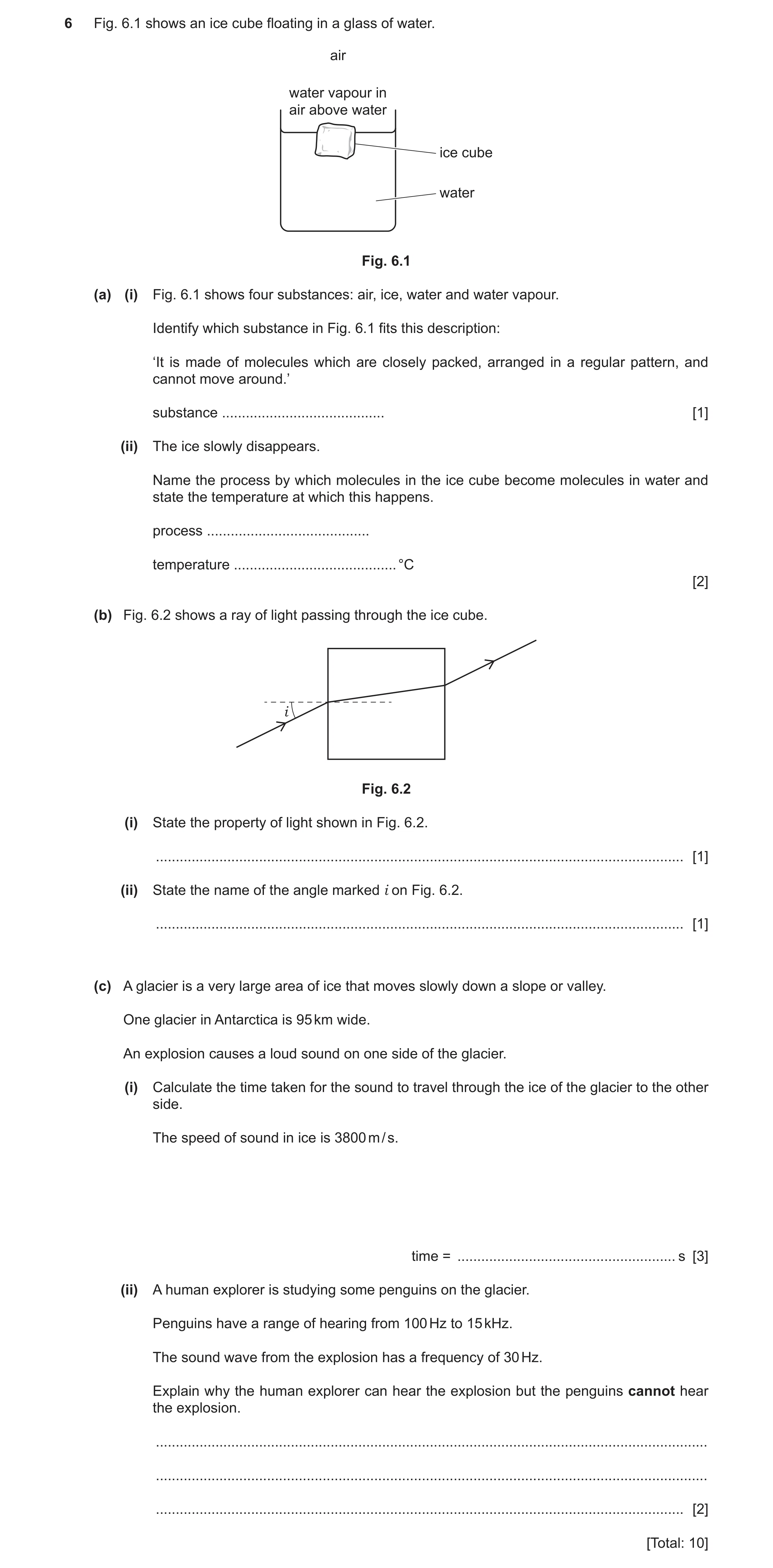
6 Fig. 6.1 shows an ice cube floating in a glass of water. air water vapour in air above water ice cube water Fig. 6.1 (a) (i) Fig. 6.1 shows four substances: air, ice, water and water vapour. Identify which substance in Fig. 6.1 fits this description: ‘It is made of molecules which are closely packed, arranged in a regular pattern, and cannot move around.’ substance … [1] (ii) The ice slowly disappears. Name the process by which molecules in the ice cube become molecules in water and state the temperature at which this happens. process … temperature … °C [2] (b) Fig. 6.2 shows a ray of light passing through the ice cube. i Fig. 6.2 (i) State the property of light shown in Fig. 6.2. … [1] (ii) State the name of the angle marked i on Fig. 6.2. … [1] (c) A glacier is a very large area of ice that moves slowly down a slope or valley. One glacier in Antarctica is 95 km wide. An explosion causes a loud sound on one side of the glacier. (i) Calculate the time taken for the sound to travel through the ice of the glacier to the other side. The speed of sound in ice is 3800 m / s. time = … s [3] (ii) A human explorer is studying some penguins on the glacier. Penguins have a range of hearing from 100 Hz to 15 kHz. The sound wave from the explosion has a frequency of 30 Hz. Explain why the human explorer can hear the explosion but the penguins cannot hear the explosion. … … … [2] [Total: 10]
10 marks
Mark scheme: 6(a)(i) ice ; 1 6(a)(ii) melting ; 0 (°C) ; 2 Question Answer Marks 6(b)(i) refraction ; 1 6(b)(ii) (angle of) incidence ; 1 6(c)(i) speed = distance ÷ time (in any form) OR = 95 000 ÷ 3800 OR 95 ÷ 3.8 ; unit conversion: 95 km = 95 000 m OR 3800 m / s = 3.8 km / s ; 25 (s) ; 3 6(c)(ii) (sound of explosion) outside range of hearing for penguins ; human hearing range 20 Hz – 20 kHz includes frequency of explosion ; 2
This question in 0653/33 May/June 2022
Q9 · Ethene is an example of an alkene 0653/32 Feb/March 2024
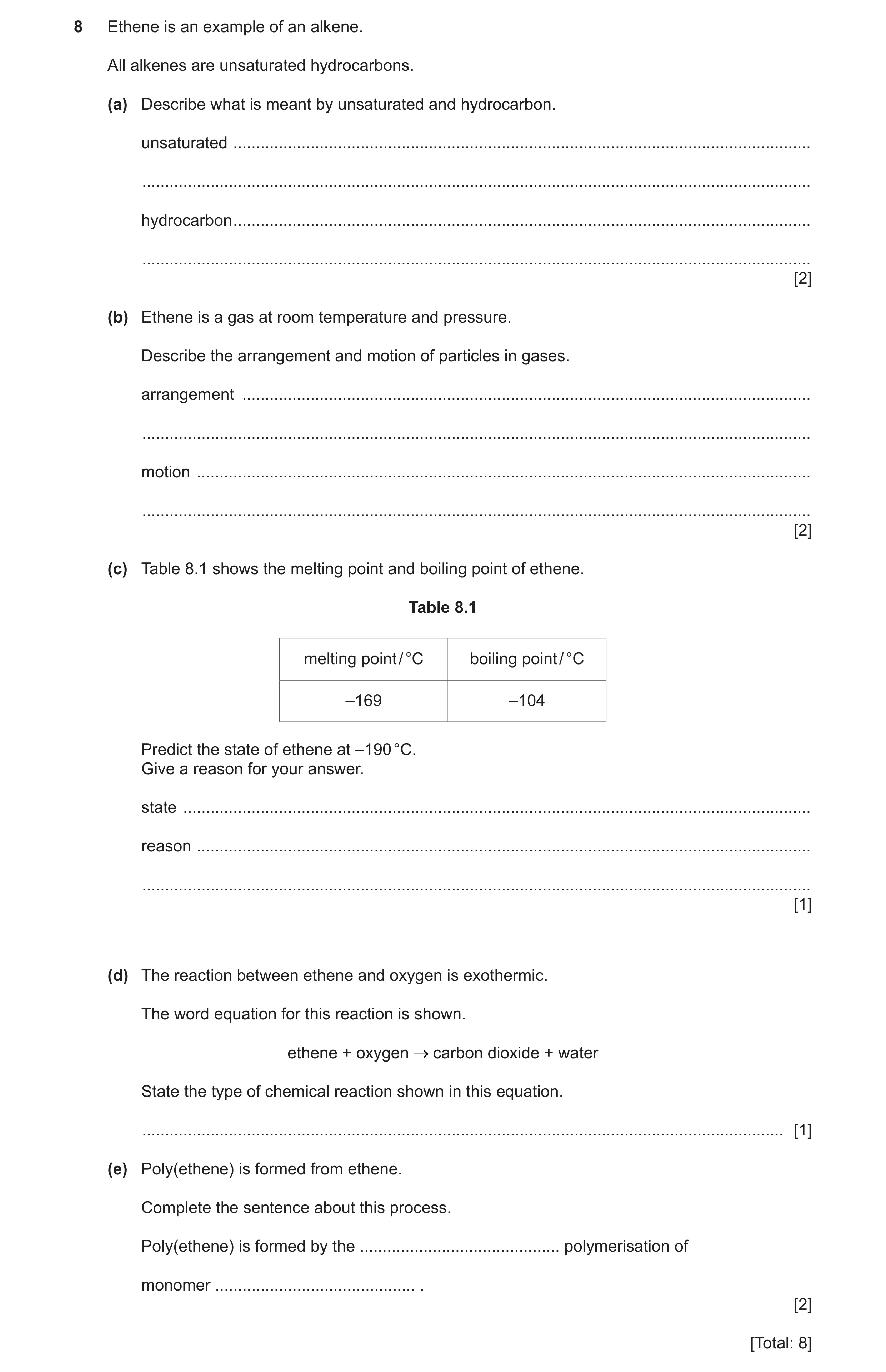
8 Ethene is an example of an alkene. All alkenes are unsaturated hydrocarbons. (a) Describe what is meant by unsaturated and hydrocarbon. unsaturated … … hydrocarbon … … [2] (b) Ethene is a gas at room temperature and pressure. Describe the arrangement and motion of particles in gases. arrangement … … motion … … [2] (c) Table 8.1 shows the melting point and boiling point of ethene. Table 8.1 melting point / °C boiling point / °C –169 –104 Predict the state of ethene at –190 °C. Give a reason for your answer. state … reason … … [1] (d) The reaction between ethene and oxygen is exothermic. The word equation for this reaction is shown. ethene + oxygen carbon dioxide + water State the type of chemical reaction shown in this equation. … [1] (e) Poly(ethene) is formed from ethene. Complete the sentence about this process. Poly(ethene) is formed by the … polymerisation of monomer … . [2] [Total: 8]
8 marks
Mark scheme: 8(a) unsaturated: 2 contains a double (C=C) covalent bond ; hydrocarbon: contains carbon AND hydrogen only ; 8(b) arrangement: 2 far apart / not touching / random ; motion: move quickly ; 8(c) solid AND 1 −190 °C is less than melting point / melting point is higher than −190 °C ; 8(d) combustion ; 1 8(e) addition ; 2 units / molecules ;
This question in 0653/32 Feb/March 2024
Q10 · Copper is a metal 0653/31 Oct/Nov 2024
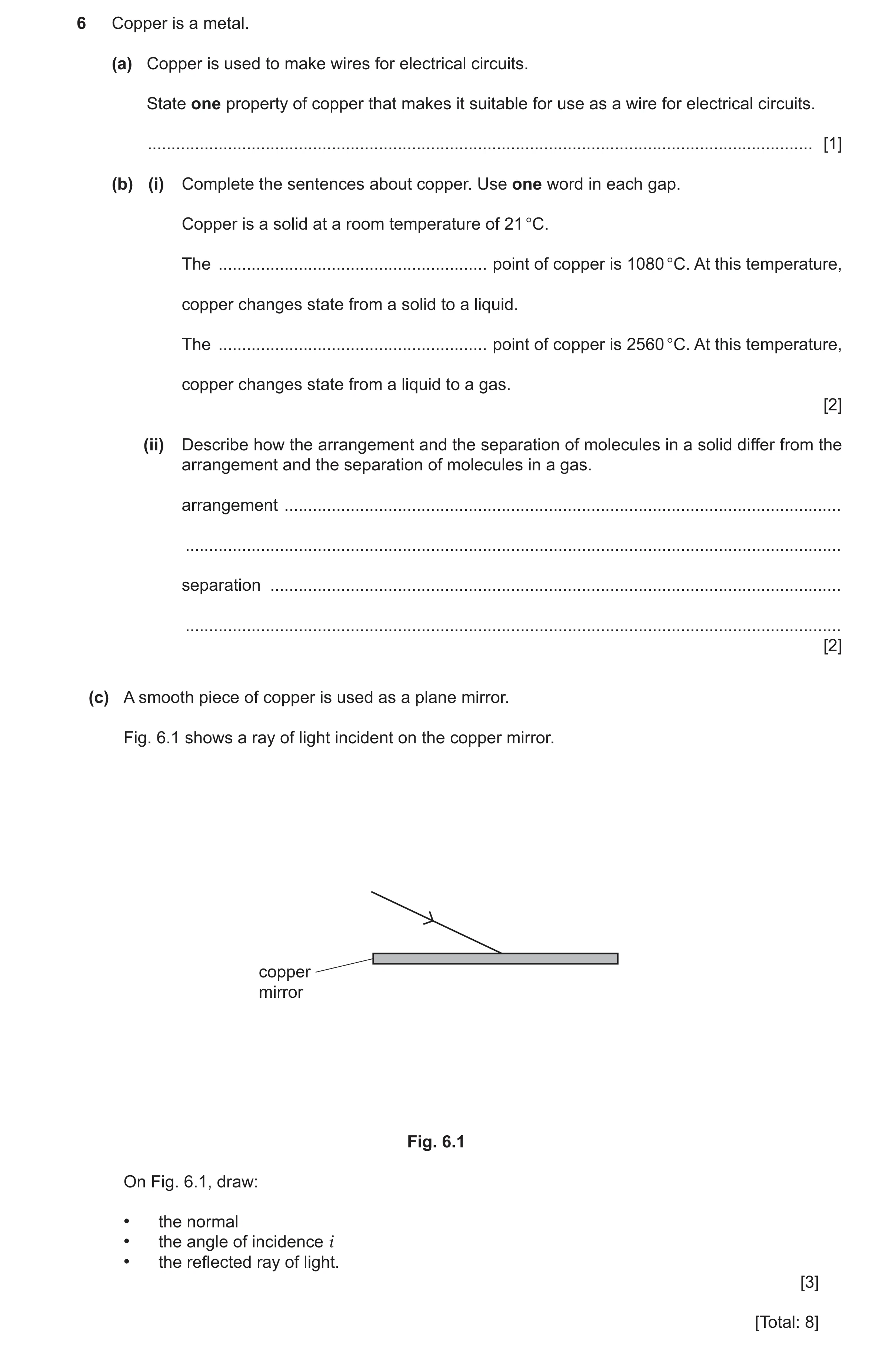
6 Copper is a metal. (a) Copper is used to make wires for electrical circuits. State one property of copper that makes it suitable for use as a wire for electrical circuits. … [1] (b) (i) Complete the sentences about copper. Use one word in each gap. Copper is a solid at a room temperature of 21 °C. The … point of copper is 1080 °C. At this temperature, copper changes state from a solid to a liquid. The … point of copper is 2560 °C. At this temperature, copper changes state from a liquid to a gas. [2] (ii) Describe how the arrangement and the separation of molecules in a solid differ from the arrangement and the separation of molecules in a gas. arrangement … … separation … … [2] (c) A smooth piece of copper is used as a plane mirror. Fig. 6.1 shows a ray of light incident on the copper mirror. copper mirror Fig. 6.1 On Fig. 6.1, draw: • the normal • the angle of incidence i • the reflected ray of light. [3] [Total: 8]
8 marks
Mark scheme: 6(a) (good) conductor (of electricity) ; 1 6(b)(i) melting ; 2 boiling ; 6(b)(ii) in a solid (ORA), the molecules are: 2 regular / ordered ; close together ; 6(c) 3 normal drawn ; angle of incidence shown AND labelled ; reflected ray drawn AND angle of reflection equal to angle of incidence, by eye ;
This question in 0653/31 Oct/Nov 2024
Q11 · Three diagrams, A, B and C, of particles in the three states of matter 0653/32 Feb/March 2025
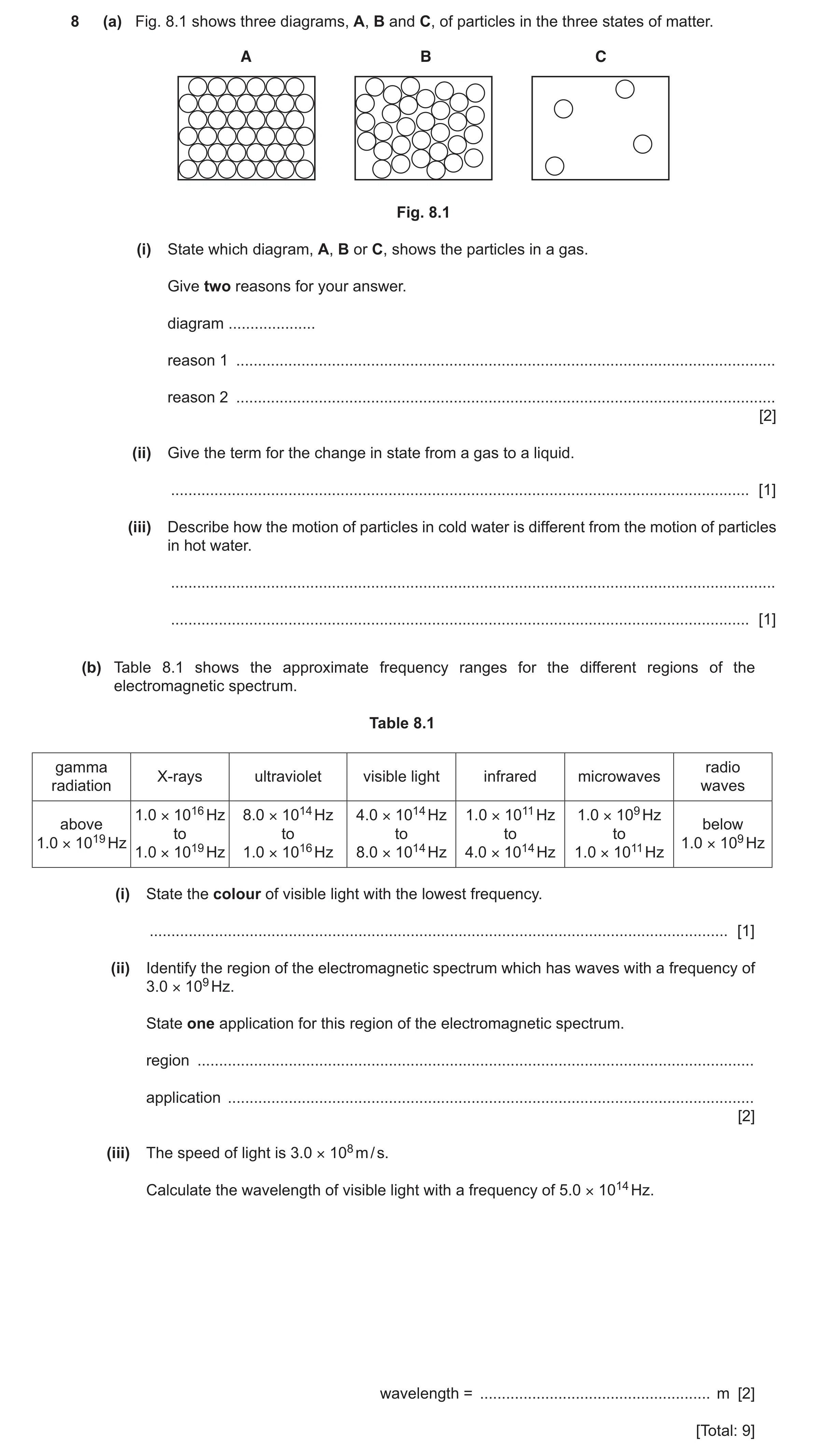
8 (a) Fig. 8.1 shows three diagrams, A, B and C, of particles in the three states of matter. A B C Fig. 8.1 (i) State which diagram, A, B or C, shows the particles in a gas. Give two reasons for your answer. diagram … reason 1 … reason 2 … [2] (ii) Give the term for the change in state from a gas to a liquid. … [1] (iii) Describe how the motion of particles in cold water is different from the motion of particles in hot water. … … [1] (b) Table 8.1 shows the approximate frequency ranges for the different regions of the electromagnetic spectrum. Table 8.1 gamma radio X-rays ultraviolet visible light infrared microwaves radiation waves 1.0 × 10¹⁶ Hz 8.0 × 10¹⁴ Hz 4.0 × 10¹⁴ Hz 1.0 × 10¹¹ Hz 1.0 × 10⁹ Hz above below to to to to to 1.0 × 10¹⁹ Hz 1.0 × 10⁹ Hz 1.0 × 10¹⁹ Hz 1.0 × 10¹⁶ Hz 8.0 × 10¹⁴ Hz 4.0 × 10¹⁴ Hz 1.0 × 10¹¹ Hz (i) State the colour of visible light with the lowest frequency. … [1] (ii) Identify the region of the electromagnetic spectrum which has waves with a frequency of 3.0 × 10⁹ Hz. State one application for this region of the electromagnetic spectrum. region … application … [2] (iii) The speed of light is 3.0 × 10⁸ m / s. Calculate the wavelength of visible light with a frequency of 5.0 × 10¹⁴ Hz. wavelength = … m [2] [Total: 9]
9 marks
Mark scheme: 8(a)(i) (C – no mark) 2 random / irregular, arrangement ; far apart / not touching ; 8(a)(ii) condensation ; 1 8(a)(iii) (particles in cold water) move, slower / with less speed ; 1 8(b)(i) red ; 1 8(b)(ii) microwaves ; 2 satellite TV / mobile phone / microwave / AVP, e.g. Bluetooth ; 8(b)(iii) v = f / 3.0 108 ÷ 5.0 1014 ; 2 6.0 10–7 (m) ;
This question in 0653/32 Feb/March 2025
Q12 · Iron is a metal 0653/31 May/June 2025
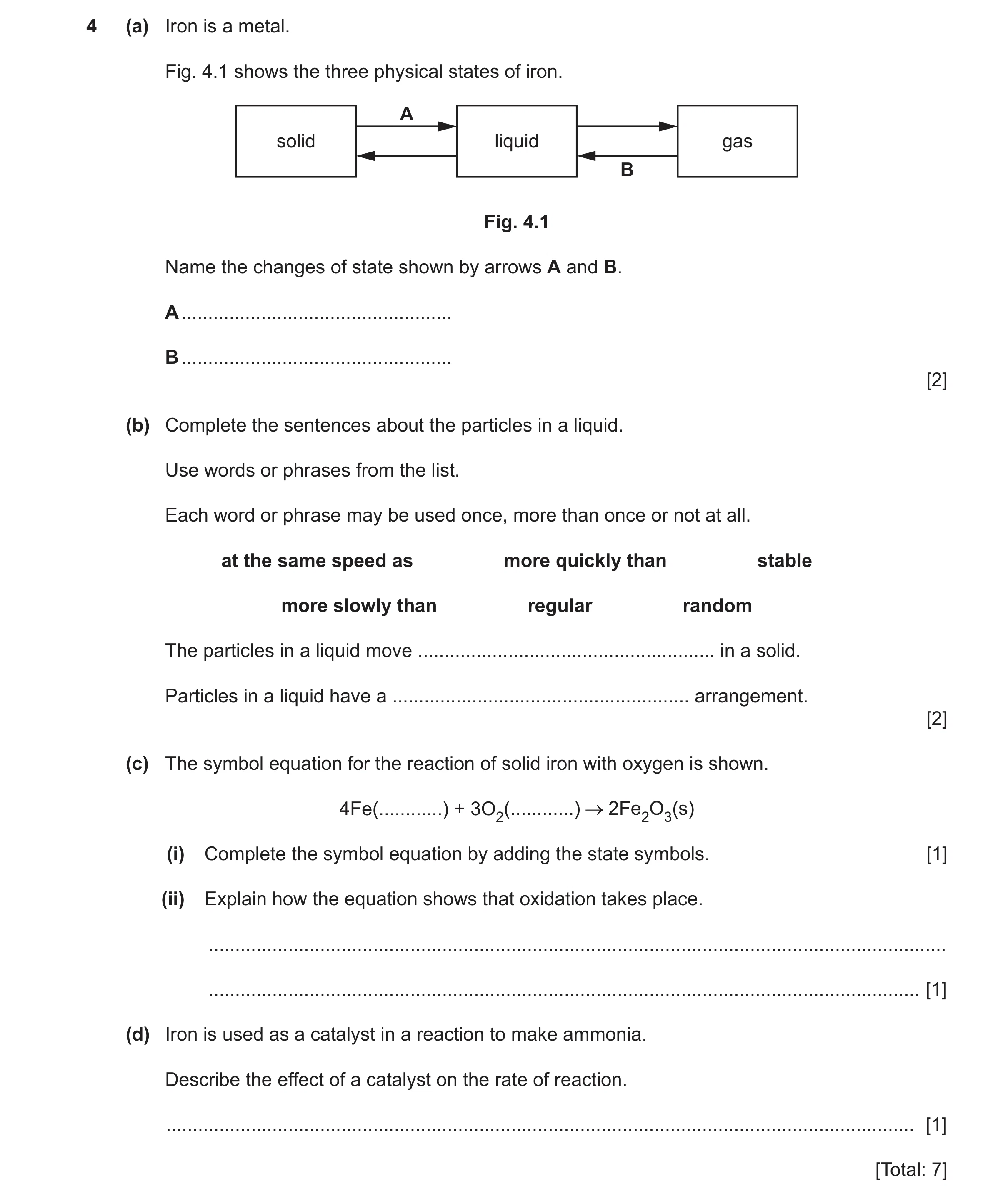
4 (a) Iron is a metal. Fig. 4.1 shows the three physical states of iron. A solid liquid gas B Fig. 4.1 Name the changes of state shown by arrows A and B. A … B … [2] (b) Complete the sentences about the particles in a liquid. Use words or phrases from the list. Each word or phrase may be used once, more than once or not at all. at the same speed as more quickly than stable more slowly than regular random The particles in a liquid move … in a solid. Particles in a liquid have a … arrangement. [2] (c) The symbol equation for the reaction of solid iron with oxygen is shown. 4Fe( … ) + 3O2( … ) 2Fe2O3(s) (i) Complete the symbol equation by adding the state symbols. [1] (ii) Explain how the equation shows that oxidation takes place. … … [1] (d) Iron is used as a catalyst in a reaction to make ammonia. Describe the effect of a catalyst on the rate of reaction. … [1] [Total: 7]
7 marks
Mark scheme: 4(a) A: melting / melt ; 2 B: condensing / condensation ; 4(b) more quickly than ; 2 random ; 4(c)(i) s and g ; 1 4(c)(ii) Fe / iron, gains oxygen ; 1 4(d) increases (the rate) ; 1
This question in 0653/31 May/June 2025
Q13 · Solid sodium reacts with water 0653/32 May/June 2025
4 (a) Solid sodium reacts with water. (i) Circle the gas that forms when sodium reacts with water. carbon dioxide chlorine hydrogen oxygen [1] (ii) State one way the reaction of potassium with water is different from the reaction of sodium with water. … … [1] (b) Aqueous sodium chloride is a mixture of two compounds, sodium chloride and water. State one similarity and one difference between a compound and a mixture. similarity … … difference … … [2] (c) Solid sodium is heated to form a liquid. (i) Tick () all the boxes that show correct properties of a liquid. A liquid cannot be squashed. A liquid has no fixed volume. A liquid takes the shape of its container. [1] (ii) The symbol for solid sodium is Na(s). Complete the symbol for liquid sodium by adding the missing state symbol. Na( … ) [1] (d) The noble gases are in Group VIII of the Periodic Table. Explain how the electronic configuration of neon affects its reactivity. … … [1] (e) Nitrogen is a gas. (i) State the percentage of nitrogen gas in clean, dry air. … % [1] (ii) Oxides of nitrogen are air pollutants. State one source of these oxides of nitrogen. … [1] (iii) State one adverse effect of oxides of nitrogen. … [1] [Total: 10]
10 marks
Mark scheme: 4(a)(i) hydrogen ; 1 4(a)(ii) any one from: 1 idea of potassium is more reactive than sodium ; (potassium) moves more quickly on surface of water / ignites ; 4(b) similarity: 2 both contain two or more different, atoms / elements ; any one difference: in a compound, (the atoms / ions / elements) are (chemically) bonded together ORA ; a compound cannot be changed back / separated (into its elements) (by physical means) / mixture can be separated (by physical means) ; 4(c)(i) first and last box ticked ; 1 4(c)(ii) l / l ; 1 4(d) full outer shell or 2,8 and unreactive / inert / stable ; 1 4(e)(i) 78(%) ; 1 4(e)(ii) (reactions in) car engines ; 1 4(e)(iii) any one from: 1 acid rain ; respiratory problems ;
This question in 0653/32 May/June 2025
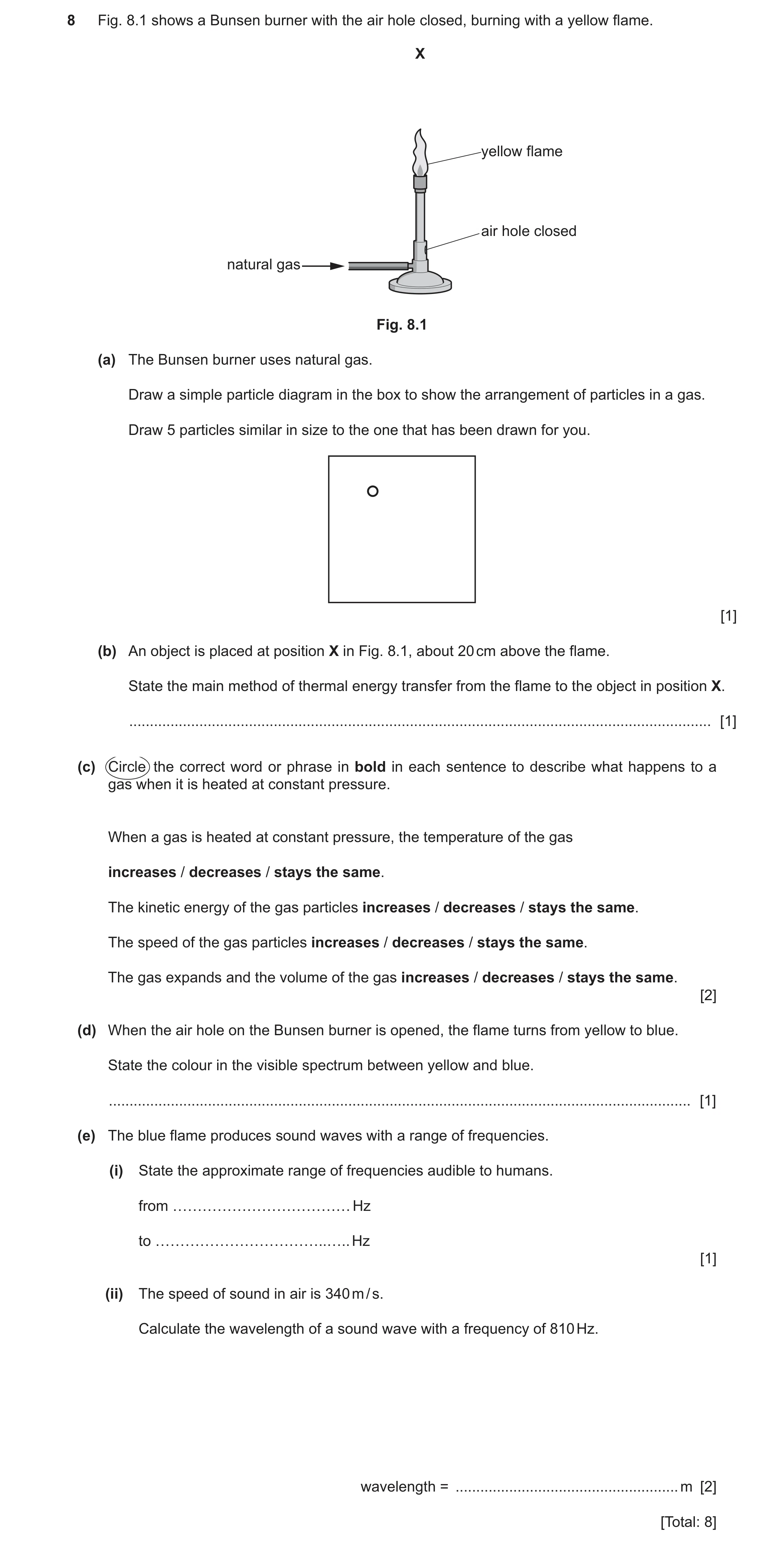
Q14 · A Bunsen burner with the air hole closed, burning with a yellow flame 0653/33 May/June 2025
8 Fig. 8.1 shows a Bunsen burner with the air hole closed, burning with a yellow flame. X yellow flame air hole closed natural gas Fig. 8.1 (a) The Bunsen burner uses natural gas. Draw a simple particle diagram in the box to show the arrangement of particles in a gas. Draw 5 particles similar in size to the one that has been drawn for you. [1] (b) An object is placed at position X in Fig. 8.1, about 20 cm above the flame. State the main method of thermal energy transfer from the flame to the object in position X. … [1] (c) Circle the correct word or phrase in bold in each sentence to describe what happens to a gas when it is heated at constant pressure. When a gas is heated at constant pressure, the temperature of the gas increases / decreases / stays the same. The kinetic energy of the gas particles increases / decreases / stays the same. The speed of the gas particles increases / decreases / stays the same. The gas expands and the volume of the gas increases / decreases / stays the same. [2] (d) When the air hole on the Bunsen burner is opened, the flame turns from yellow to blue. State the colour in the visible spectrum between yellow and blue. … [1] (e) The blue flame produces sound waves with a range of frequencies. (i) State the approximate range of frequencies audible to humans. from ……………………………… Hz to ……………………………..….. Hz [1] (ii) The speed of sound in air is 340 m / s. Calculate the wavelength of a sound wave with a frequency of 810 Hz. wavelength = … m [2] [Total: 8]
8 marks
Mark scheme: 8(a) 5 additional particles shown in an irregular arrangement AND clearly separated ; 1 8(b) convection ; 1 8(c) When a gas is heated at constant pressure, the temperature of the gas 2 increases / decreases / stays the same. The kinetic energy of the gas particles increases / decreases / stays the same. The speed of the gas particles increases / decreases/stays the same. The gas expands and the volume of the gas increases / decreases / stays the same. ;; any two correct = 1 mark all four correct = 2 marks 8(d) green ; 1 8(e)(i) from 20 to 20 000 (Hz) ; 1 8(e)(ii) λ= v ÷ f / wavelength = speed ÷ frequency / λ= 340 ÷ 810 ; 2 0.41975 / 0.42 (m) ;
This question in 0653/33 May/June 2025
 10 / 21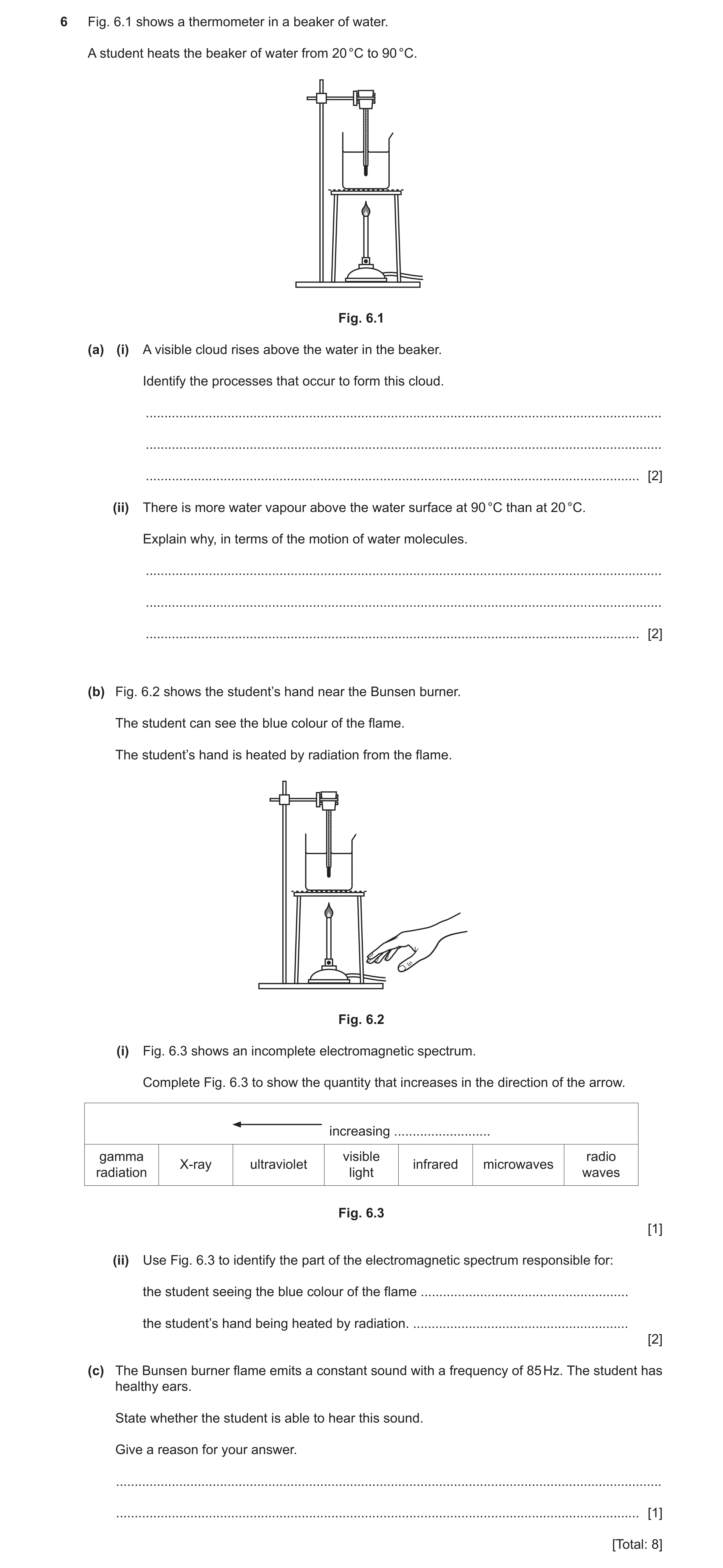
 18 / 21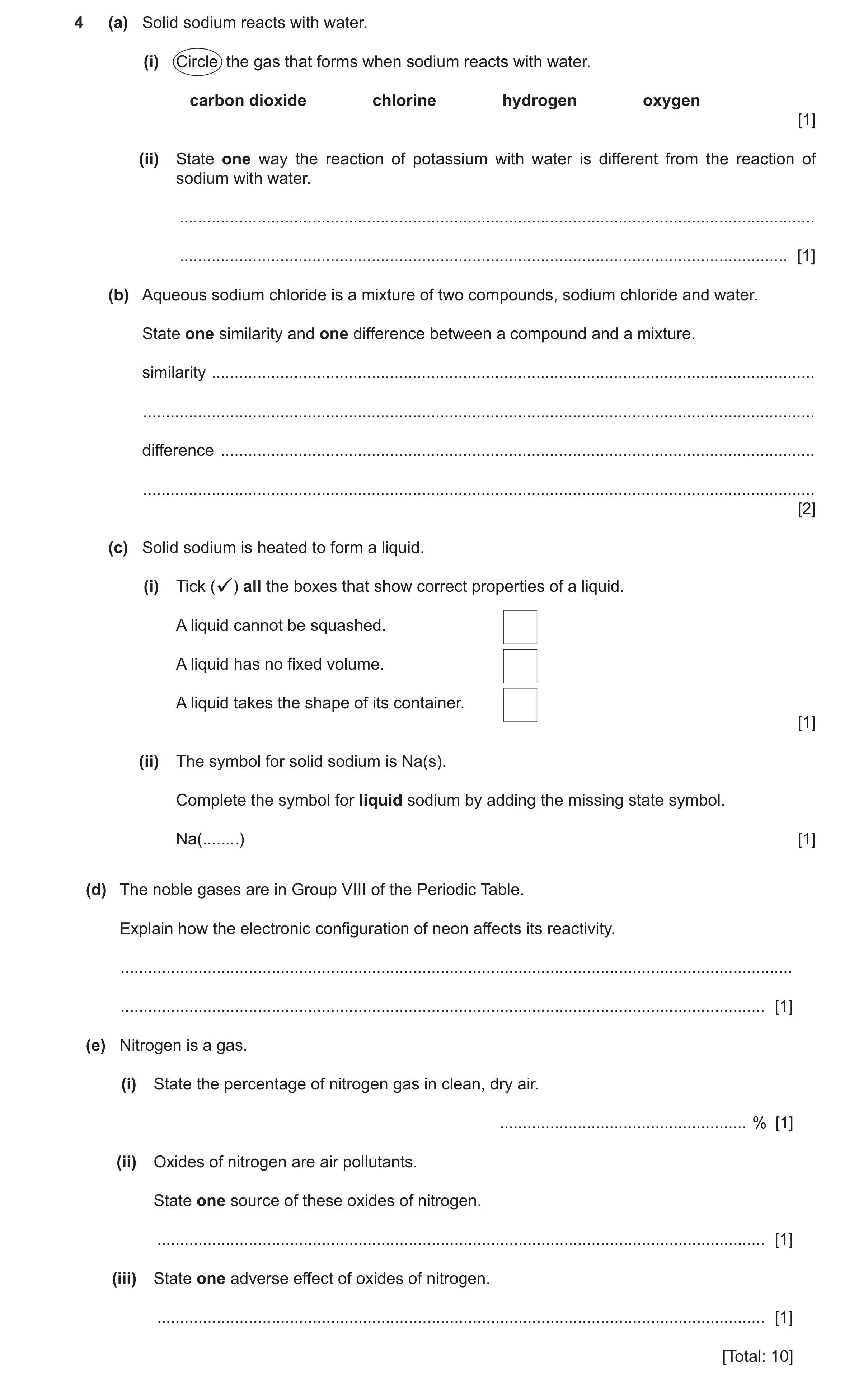
 10
10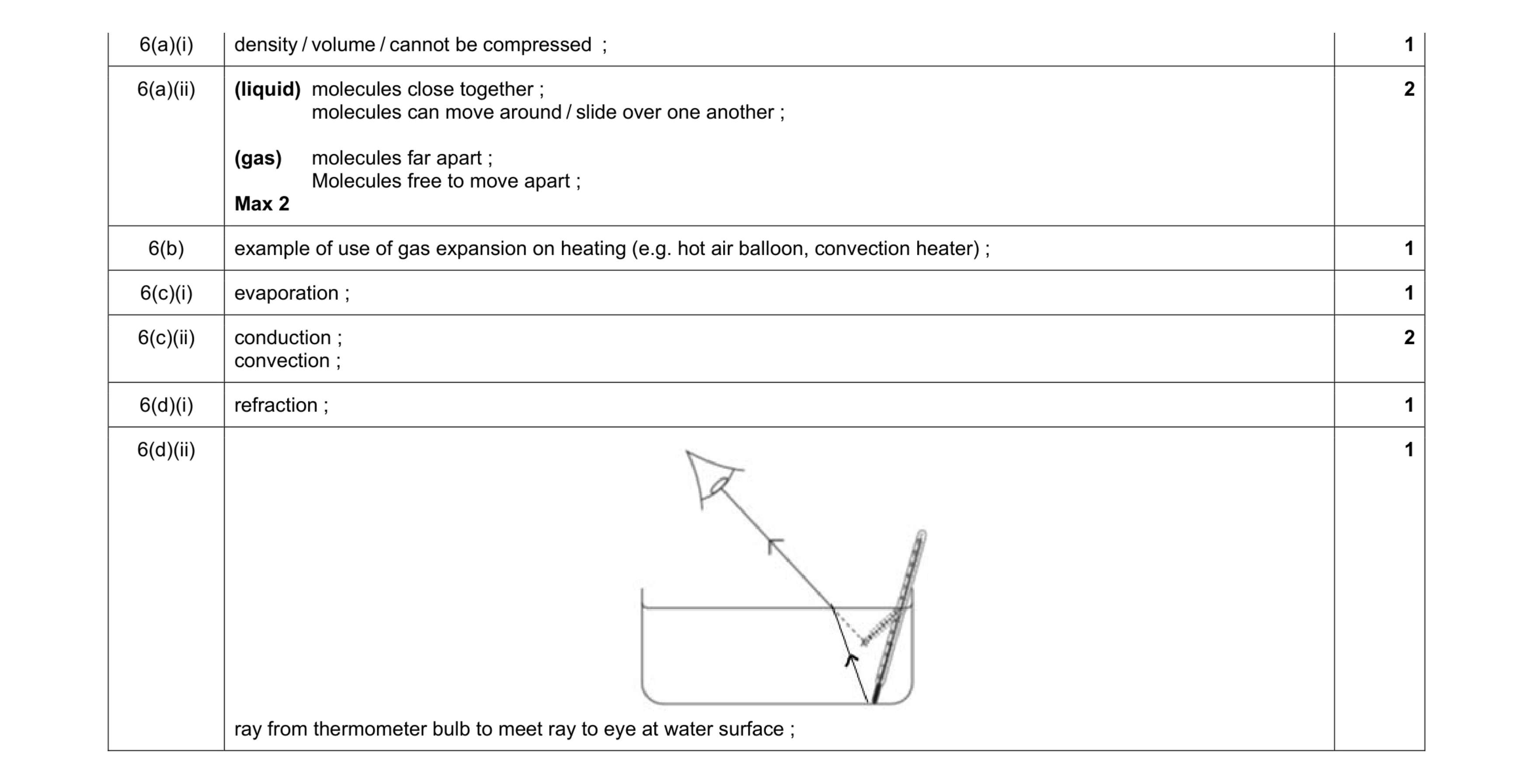 9
9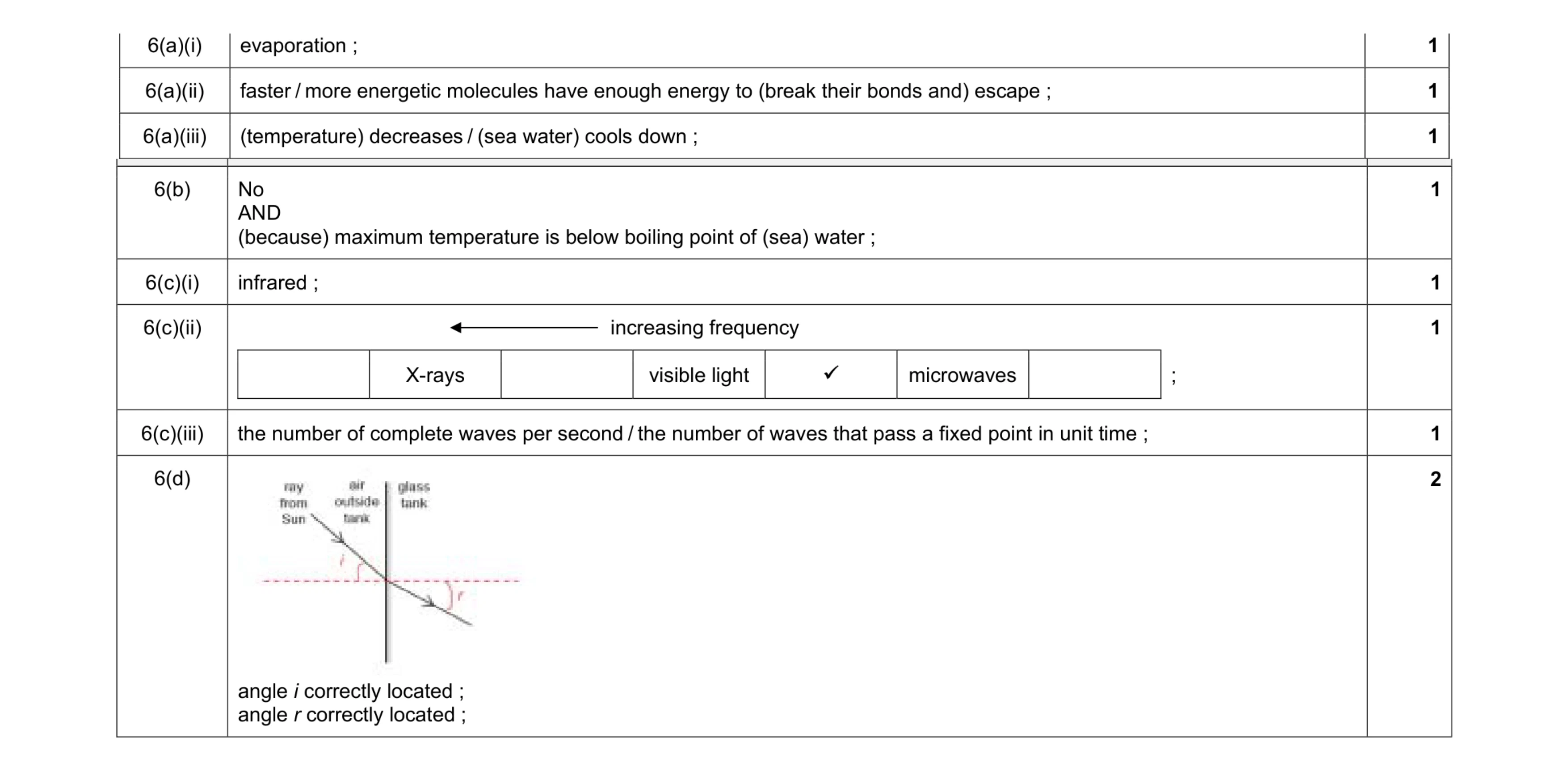 9
9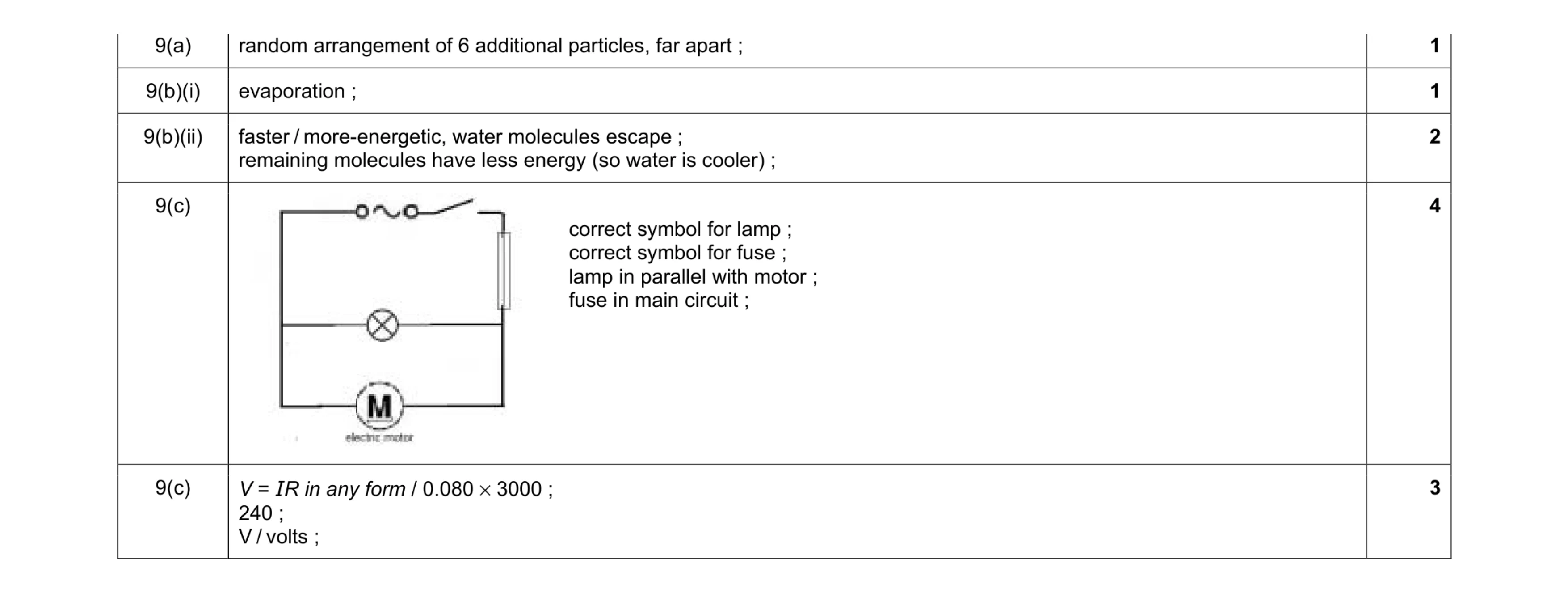 11
11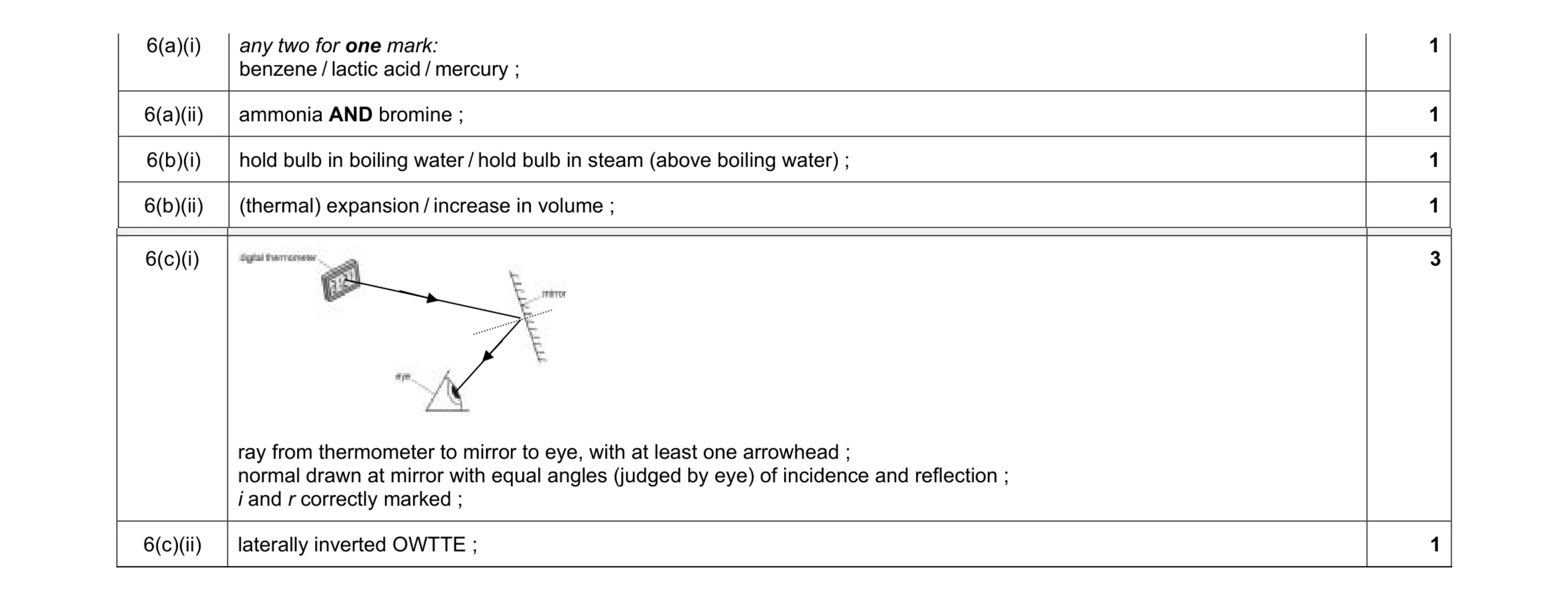 8
8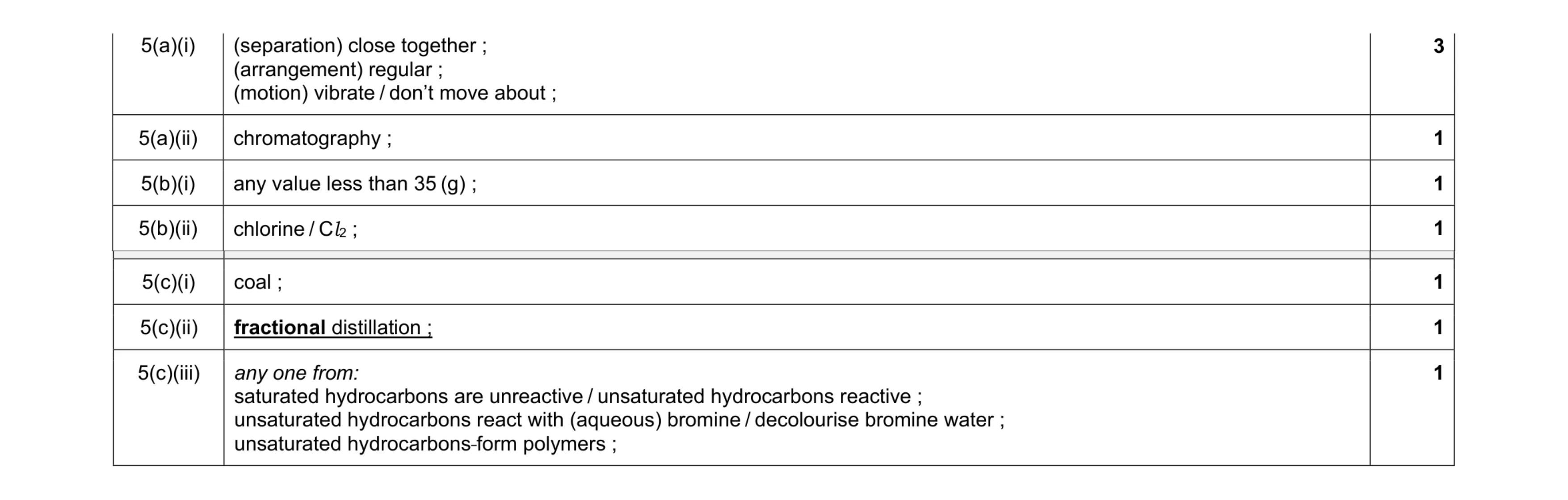 9
9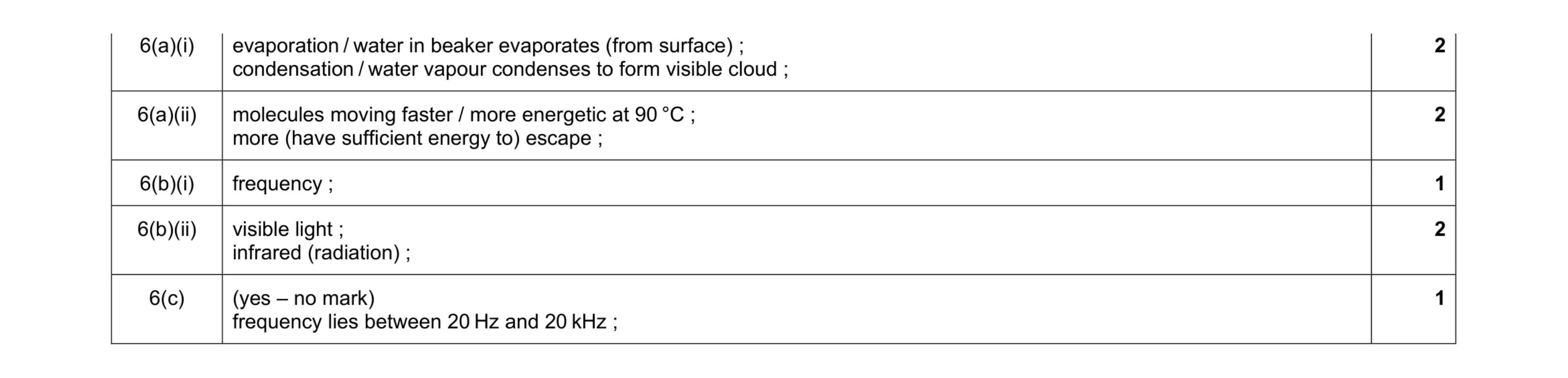 8
8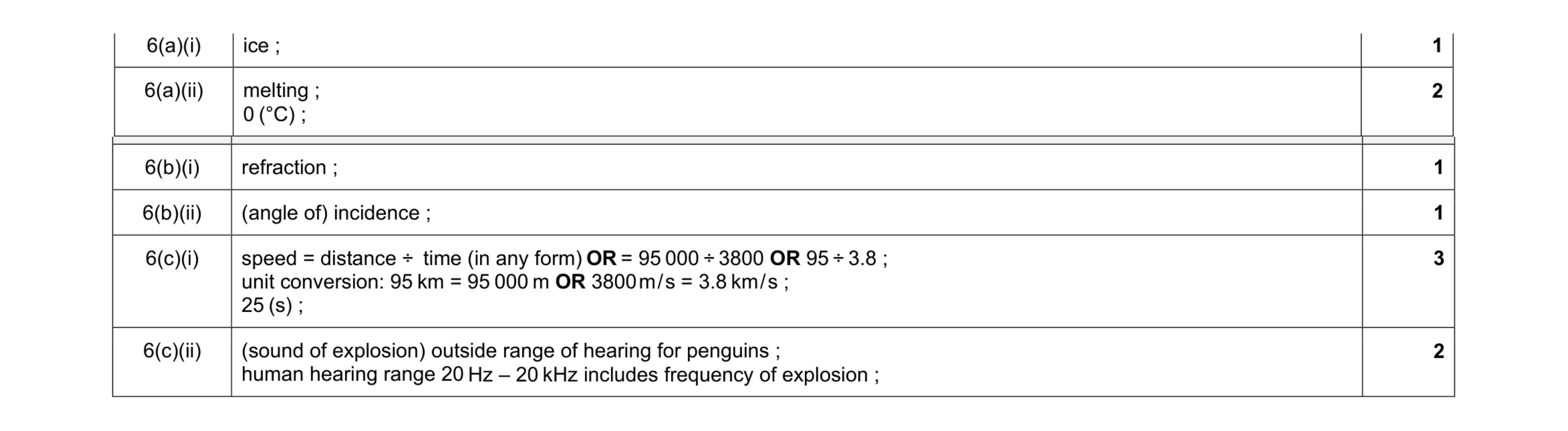 10
10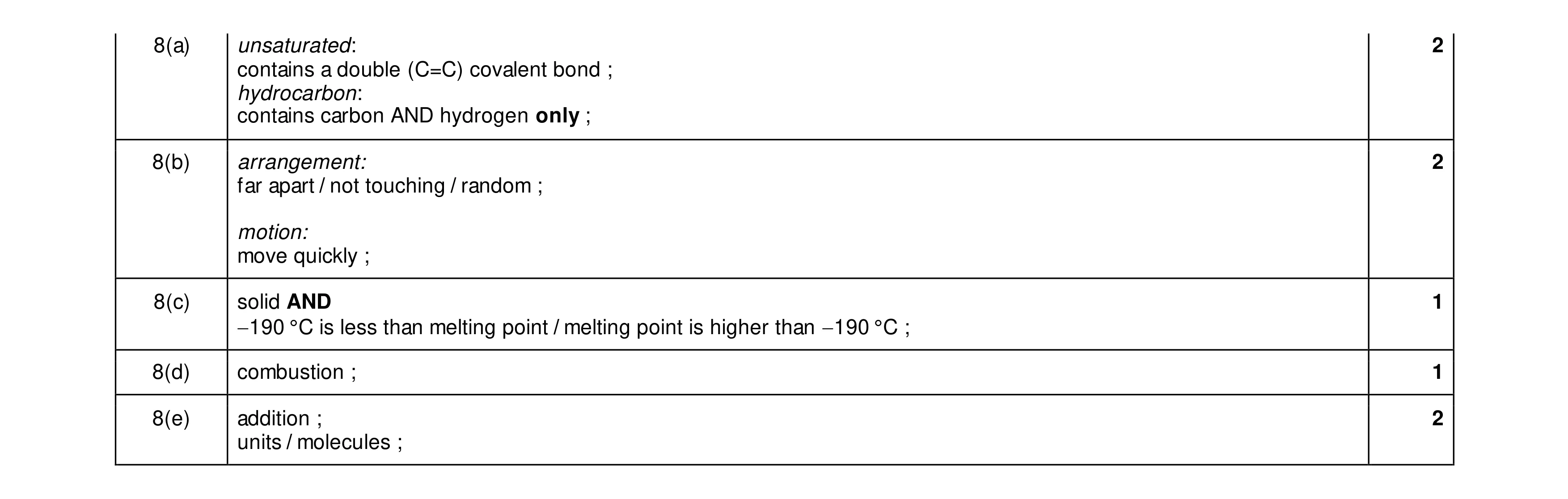 8
8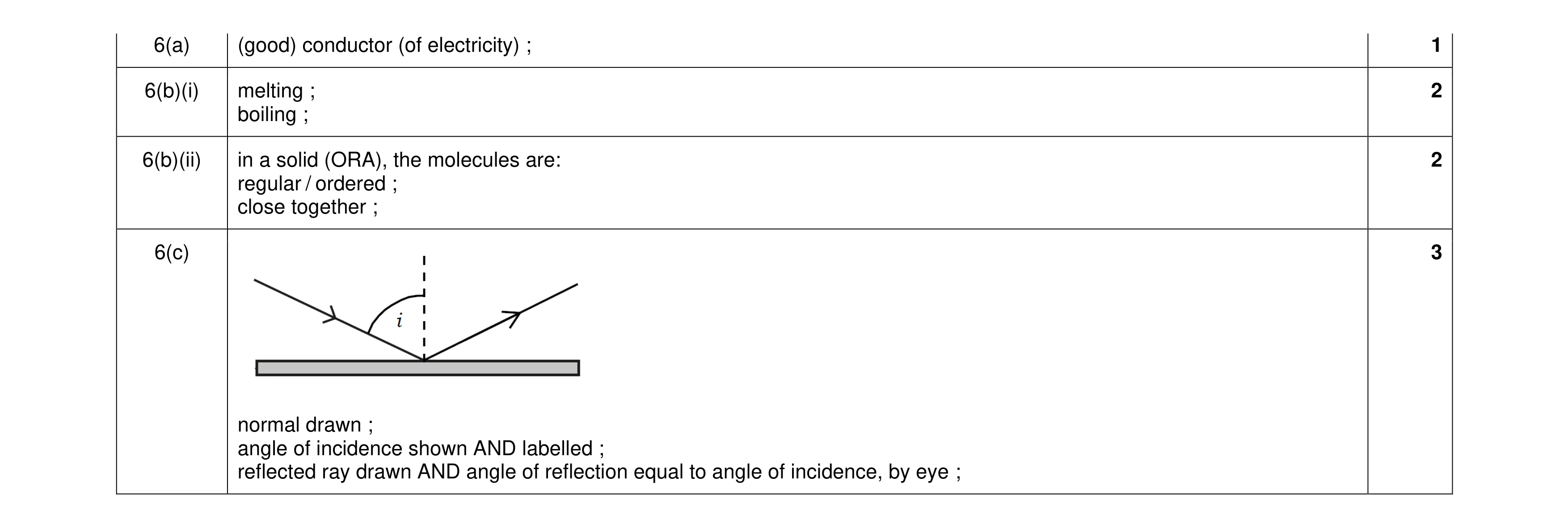 8
8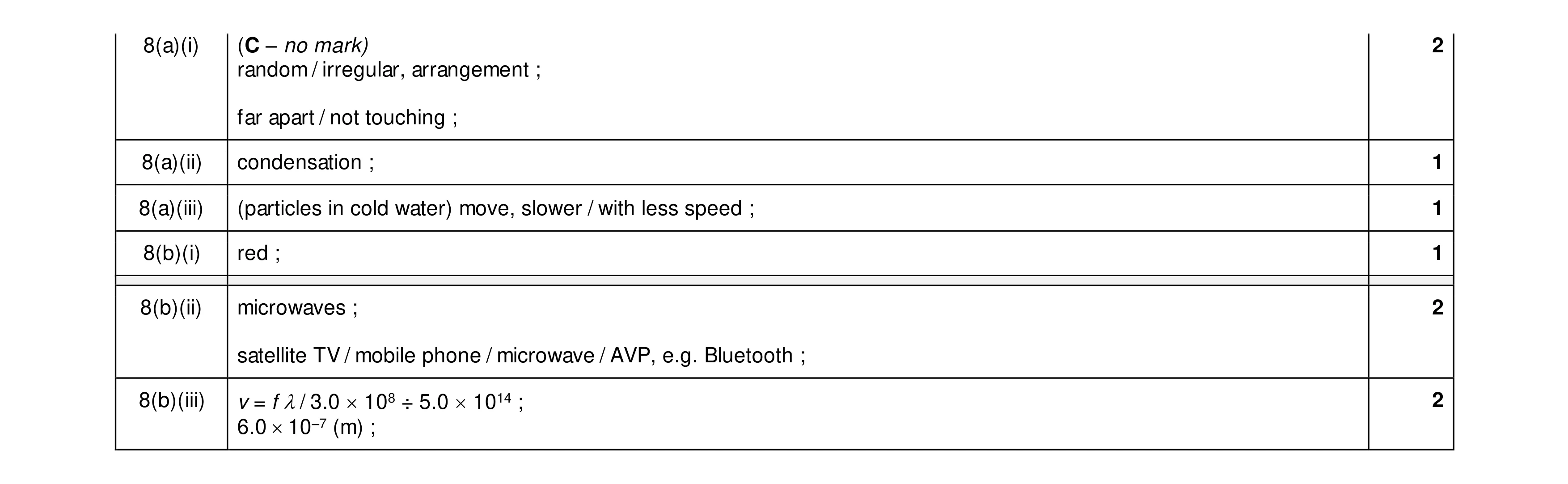 9
9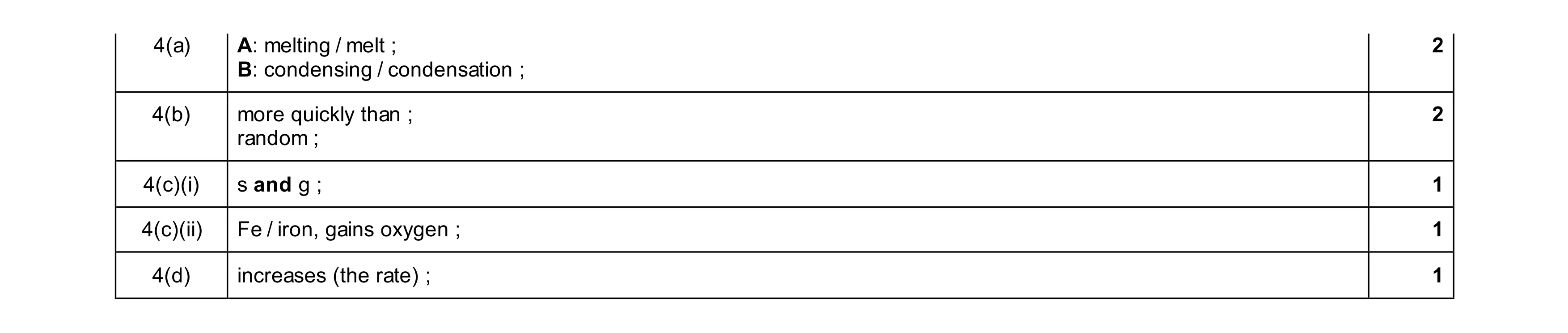 7
7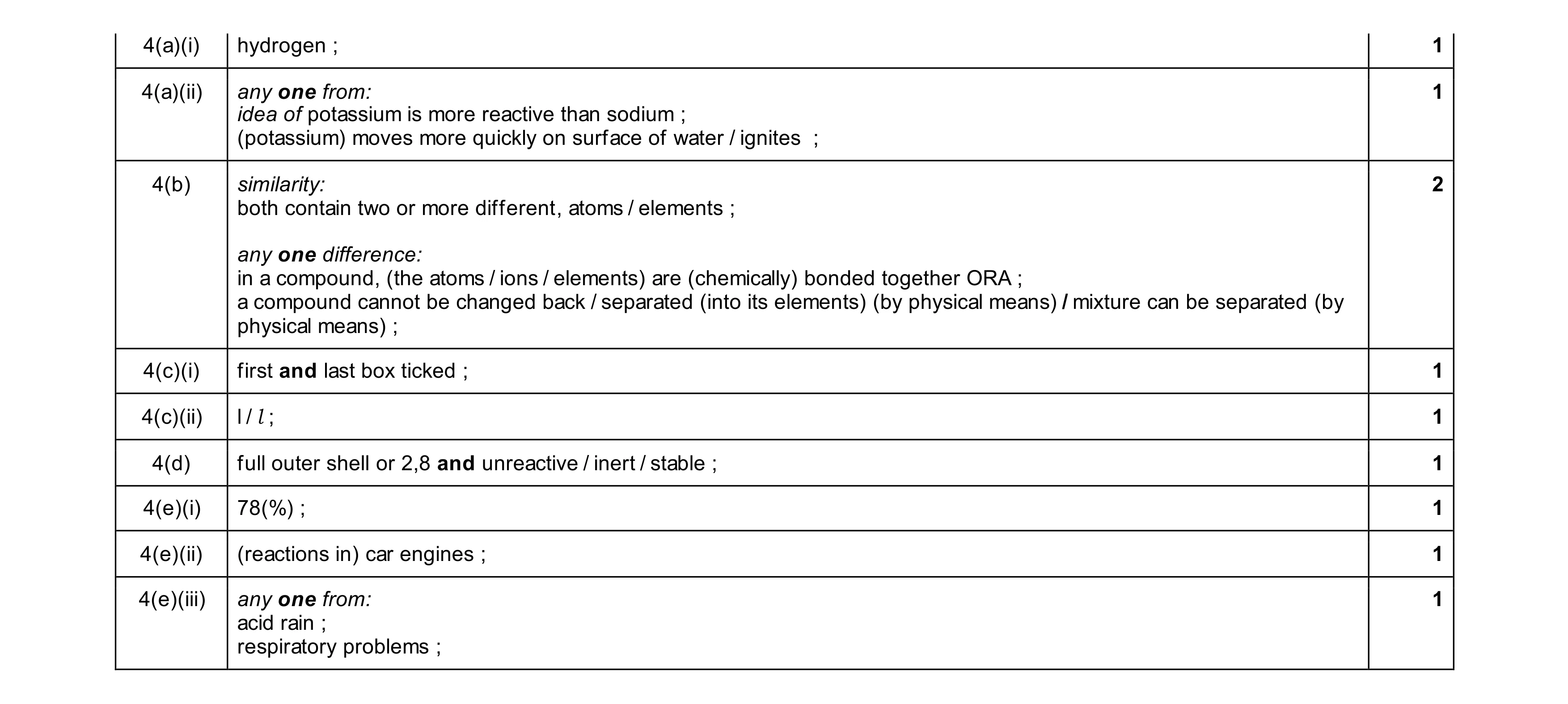 10
10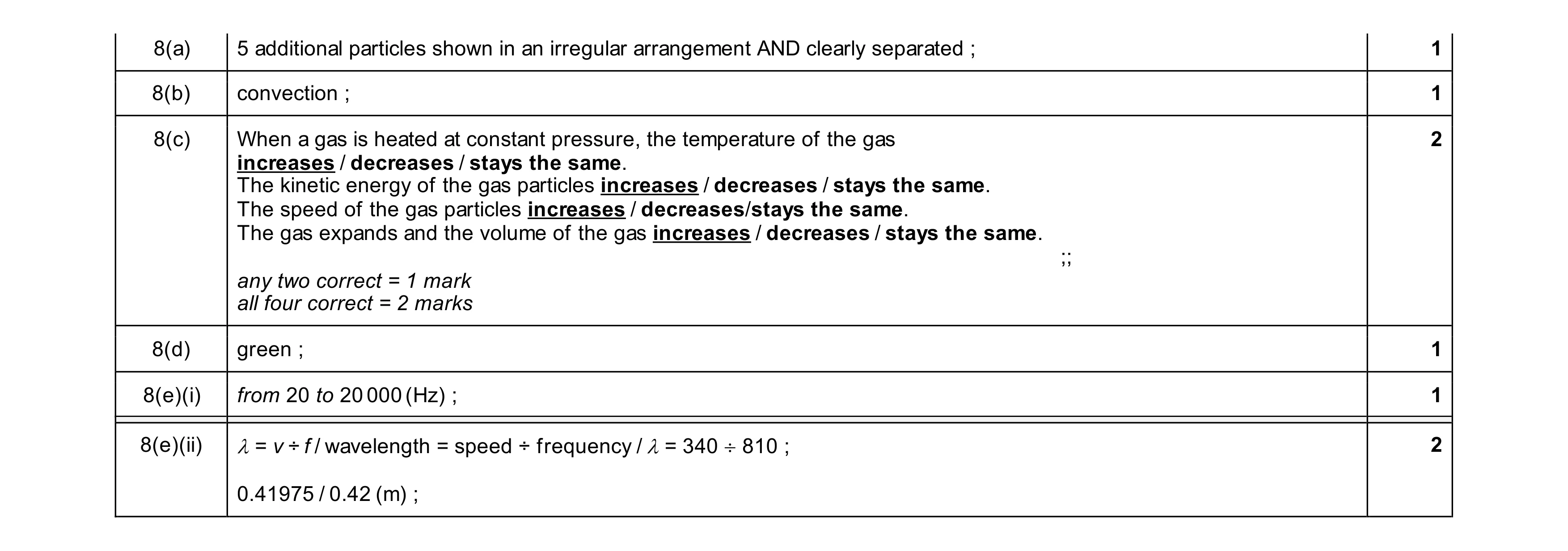 8
8