Cambridge A Level Physics 9702 — 2018 Oct/Nov Paper 2 · Variant 1
9702/21/O/N/18 · 6 questions · 60 marks · ≈68 min
The question paper and its mark scheme, free to read here and free to download. This is Cambridge’s own paper, exactly as it was sat.
Question paper16 pages

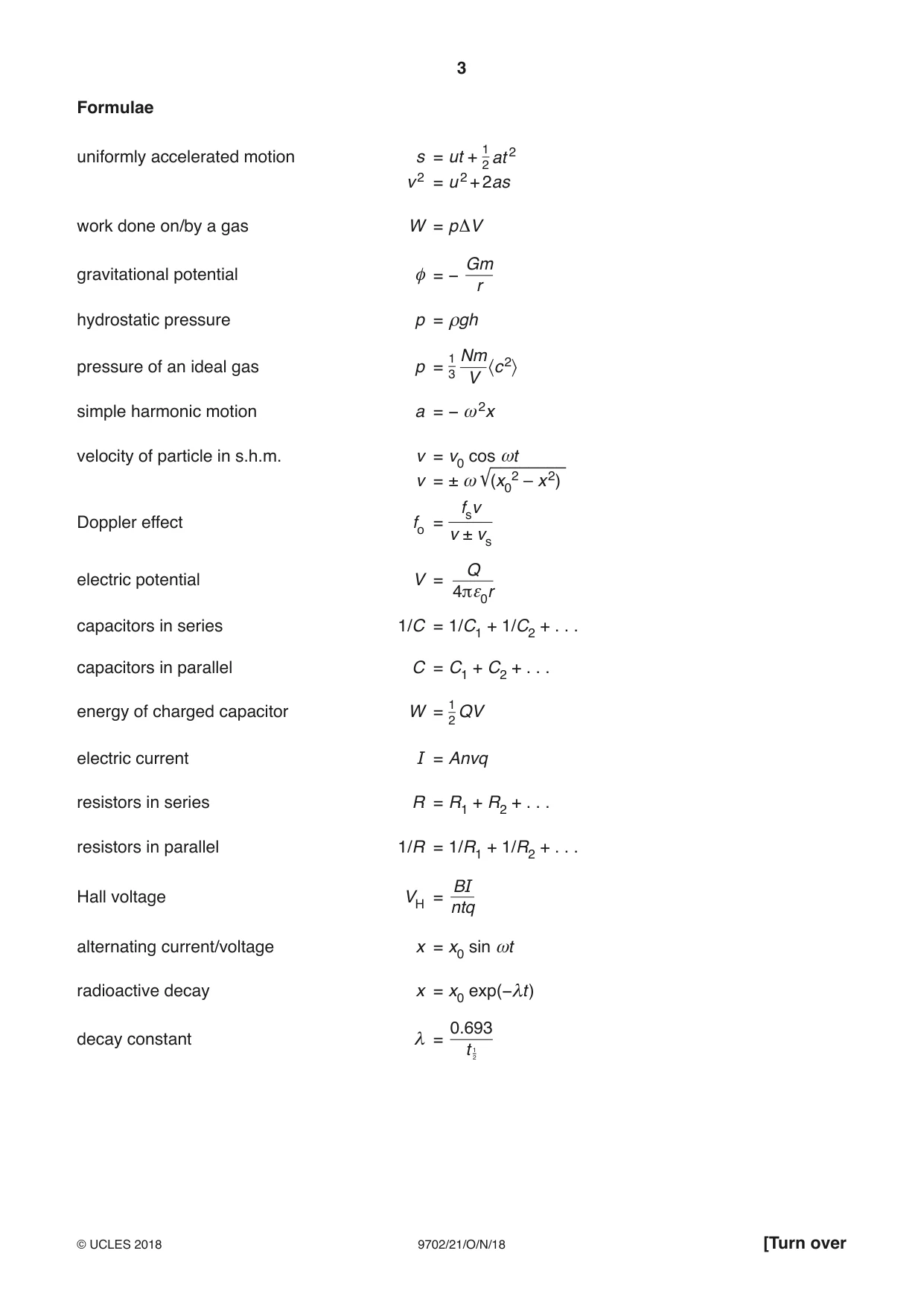

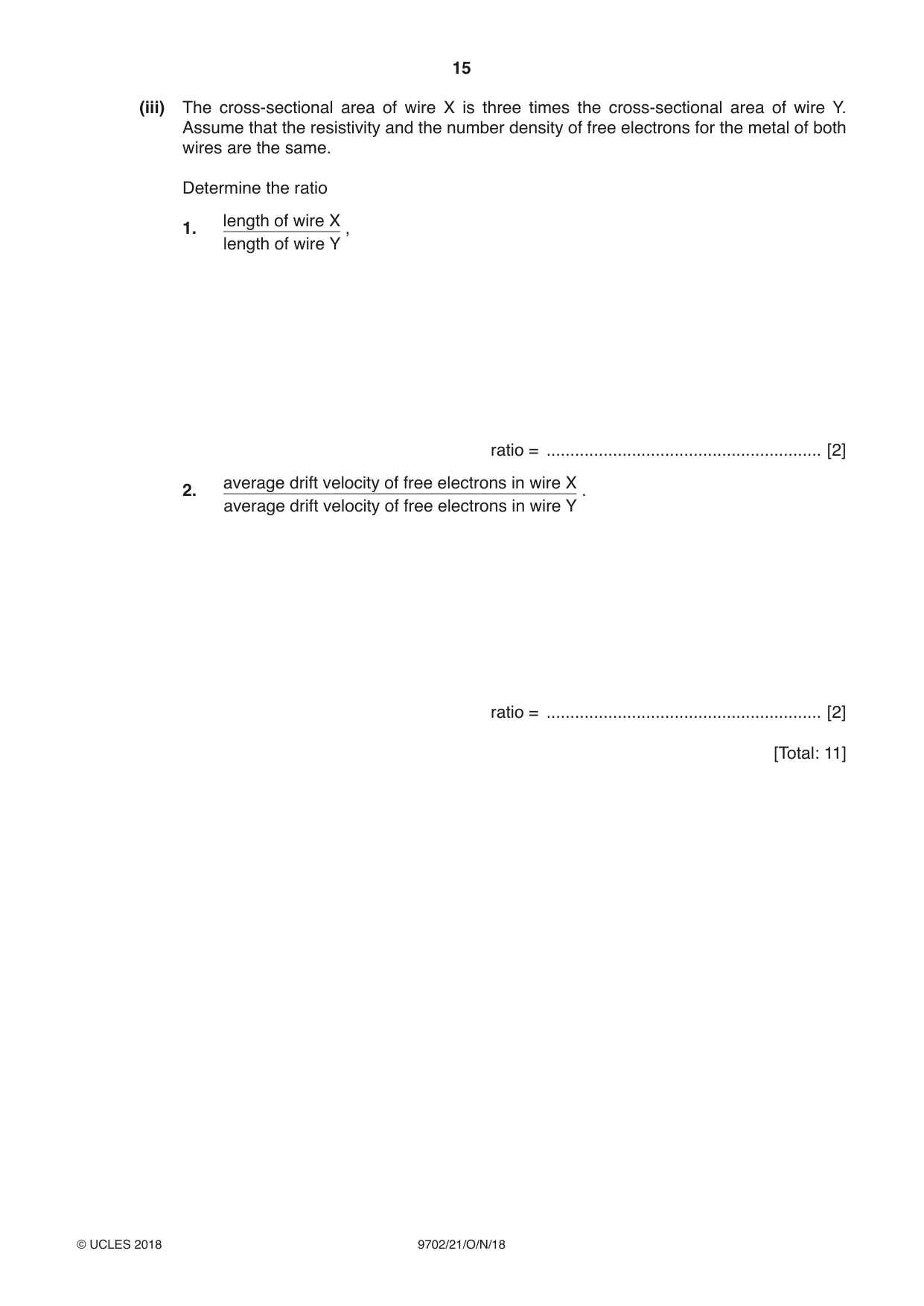
Mark scheme10 pages
Answers below. Sit the paper first if you are practising.
Questions as text
Question 1
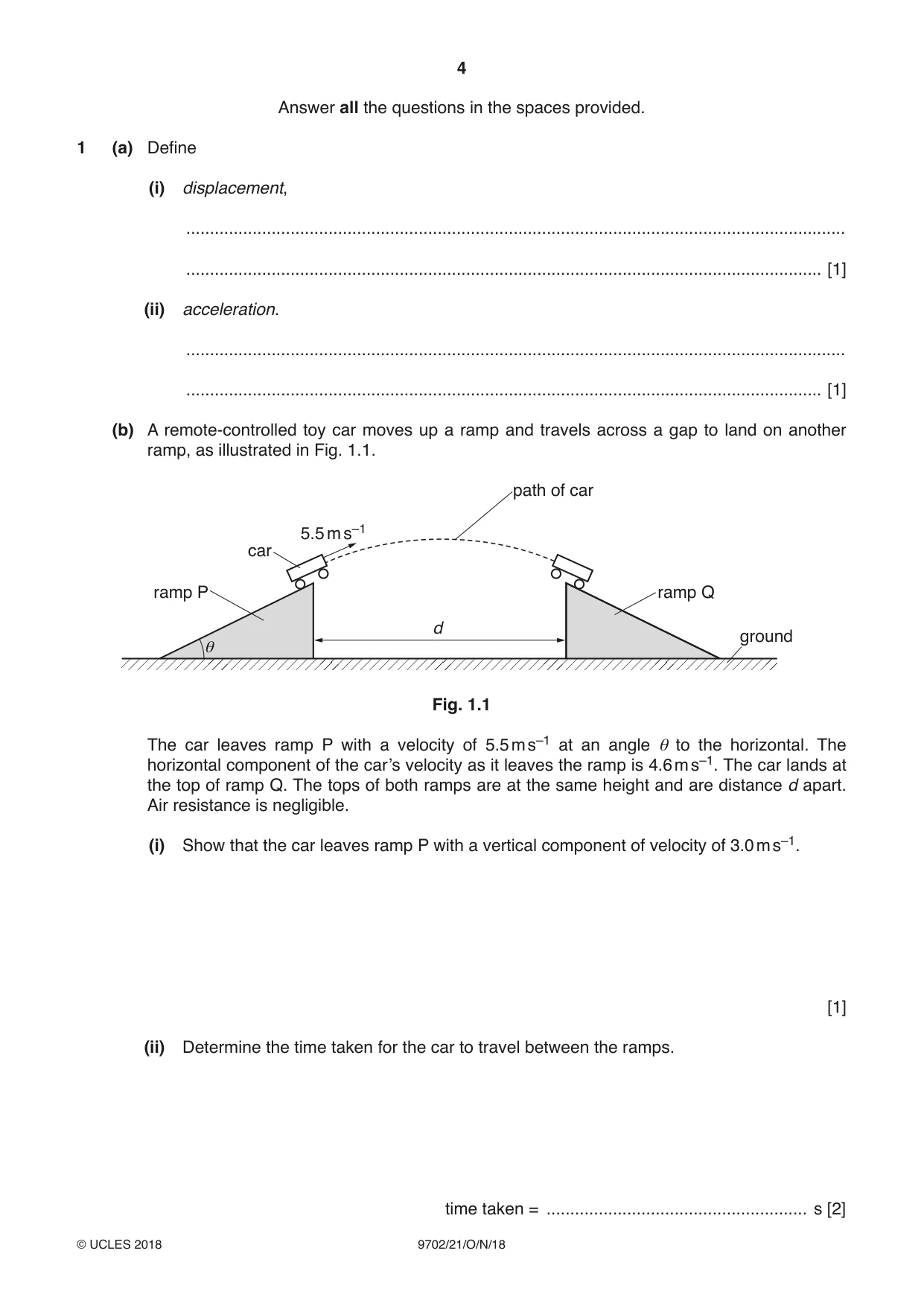
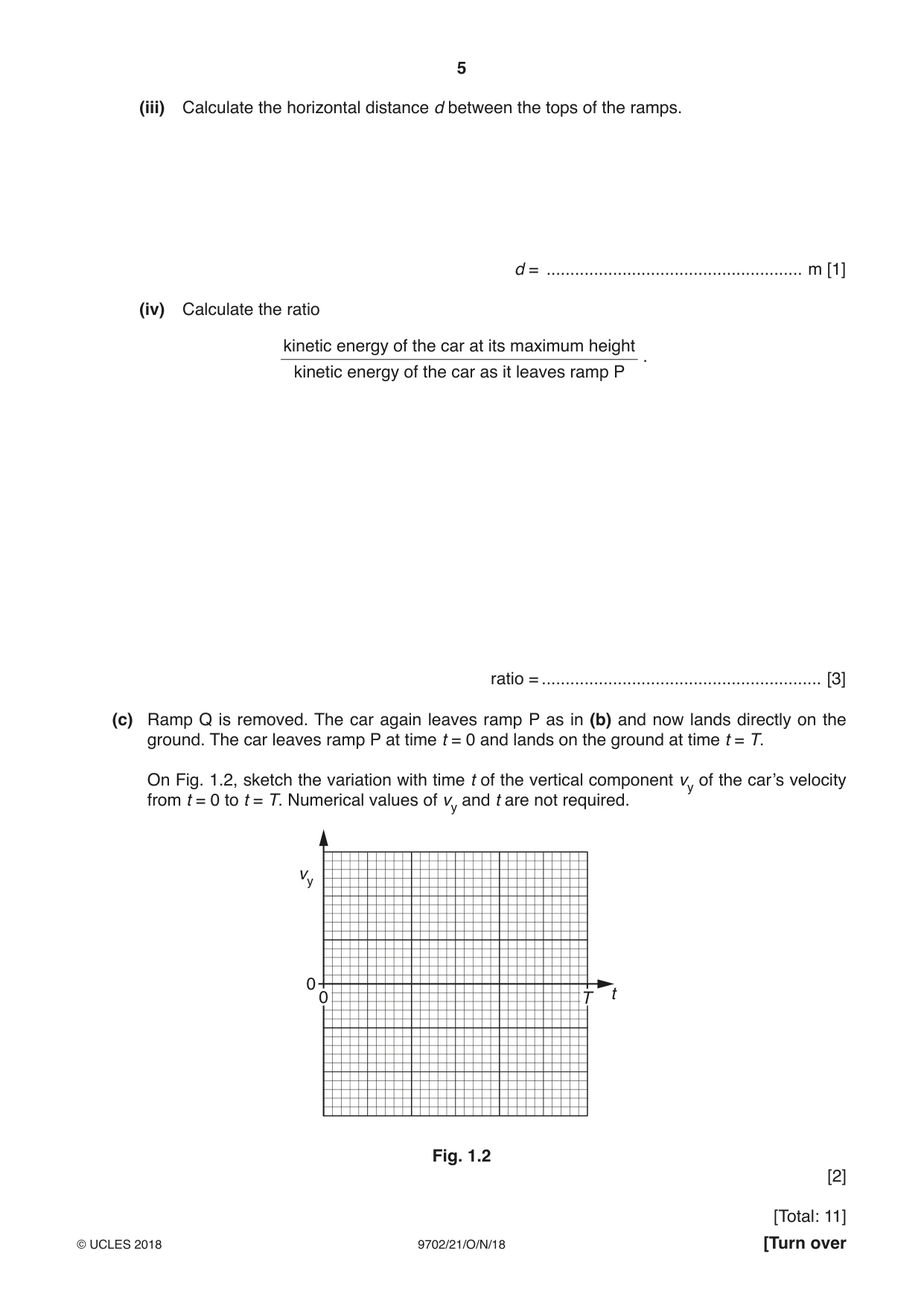
1 (a) Define (i) displacement, ........................................................................................................................................... ...................................................................................................................................... [1] (ii) acceleration. ........................................................................................................................................... ...................................................................................................................................... [1] (b) A remote-controlled toy car moves up a ramp and travels across a gap to land on another ramp, as illustrated in Fig. 1.1. path of car 5.5 m s–1 car ramp P ramp Q d ground θ Fig. 1.1 The car leaves ramp P with a velocity of 5.5 m s–1 at an angle θ to the horizontal. The horizontal component of the car’s velocity as it leaves the ramp is 4.6 m s–1. The car lands at the top of ramp Q. The tops of both ramps are at the same height and are distance d apart. Air resistance is negligible. (i) Show that the car leaves ramp P with a vertical component of velocity of 3.0 m s–1. [1] (ii) Determine the time taken for the car to travel between the ramps. time taken = ....................................................... s [2] (iii) Calculate the horizontal distance d between the tops of the ramps. d = ...................................................... m [1] (iv) Calculate the ratio kinetic energy of the car at its maximum height . kinetic energy of the car as it leaves ramp P ratio = ........................................................... [3] (c) Ramp Q is removed. The car again leaves ramp P as in (b) and now lands directly on the ground. The car leaves ramp P at time t = 0 and lands on the ground at time t = T. On Fig. 1.2, sketch the variation with time t of the vertical component vy of the car’s velocity from t = 0 to t = T. Numerical values of vy and t are not required. vy 0 0 TT t t Fig. 1.2 [2] [Total: 11]
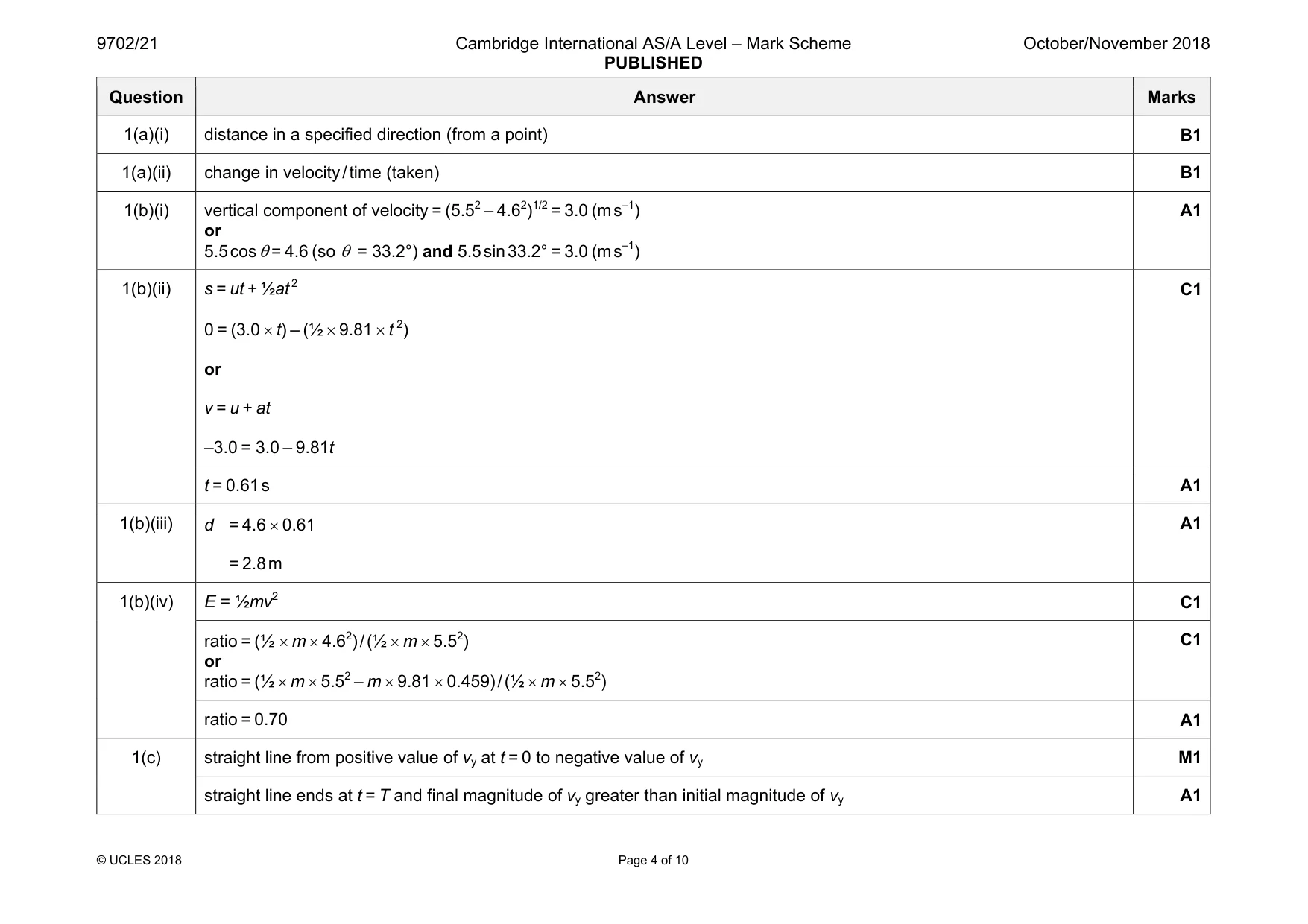
Mark scheme: 1(a)(i) distance in a specified direction (from a point) B1 1(a)(ii) change in velocity / time (taken) B1 1(b)(i) vertical component of velocity = (5.52 – 4.62)1/2 = 3.0 (m s–1) or 5.5 cos θ = 4.6 (so θ = 33.2°) and 5.5 sin 33.2° = 3.0 (m s–1) A1 1(b)(ii) s = ut + ½at 2 0 = (3.0 × t) – (½ × 9.81 × t 2) or v = u + at –3.0 = 3.0 – 9.81t C1 t = 0.61 s A1 1(b)(iii) d = 4.6 × 0.61 = 2.8 m A1 1(b)(iv) E = ½mv2 C1 ratio = (½ × m × 4.62) / (½ × m × 5.52) or ratio = (½ × m × 5.52 – m × 9.81 × 0.459) / (½ × m × 5.52) C1 ratio = 0.70 A1 1(c) straight line from positive value of vy at t = 0 to negative value of vy M1 straight line ends at t = T and final magnitude of vy greater than initial magnitude of vy A1
Q2 · A wooden block moves along a horizontal frictionless surface, as shown in Fig
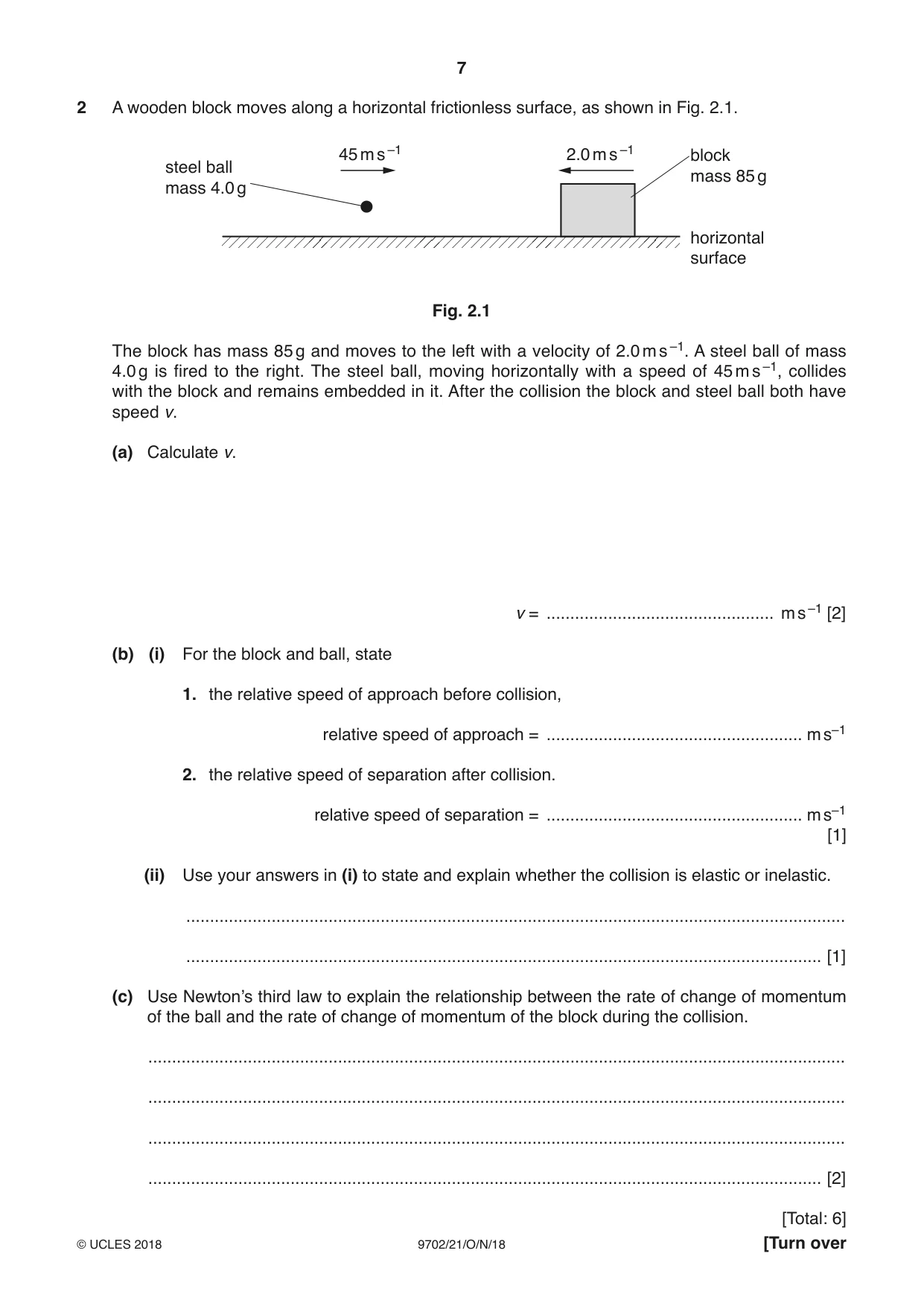
2 A wooden block moves along a horizontal frictionless surface, as shown in Fig. 2.1. 45 m s –1 2.0 m s –1 block steel ball mass 85 g mass 4.0 g horizontal surface Fig. 2.1 The block has mass 85 g and moves to the left with a velocity of 2.0 m s –1. A steel ball of mass 4.0 g is fired to the right. The steel ball, moving horizontally with a speed of 45 m s –1, collides with the block and remains embedded in it. After the collision the block and steel ball both have speed v. (a) Calculate v. v = ................................................ m s –1 [2] (b) (i) For the block and ball, state 1. the relative speed of approach before collision, relative speed of approach = ...................................................... m s–1 2. the relative speed of separation after collision. relative speed of separation = ...................................................... m s–1 [1] (ii) Use your answers in (i) to state and explain whether the collision is elastic or inelastic. ........................................................................................................................................... ...................................................................................................................................... [1] (c) Use Newton’s third law to explain the relationship between the rate of change of momentum of the ball and the rate of change of momentum of the block during the collision. ................................................................................................................................................... ................................................................................................................................................... ................................................................................................................................................... .............................................................................................................................................. [2]
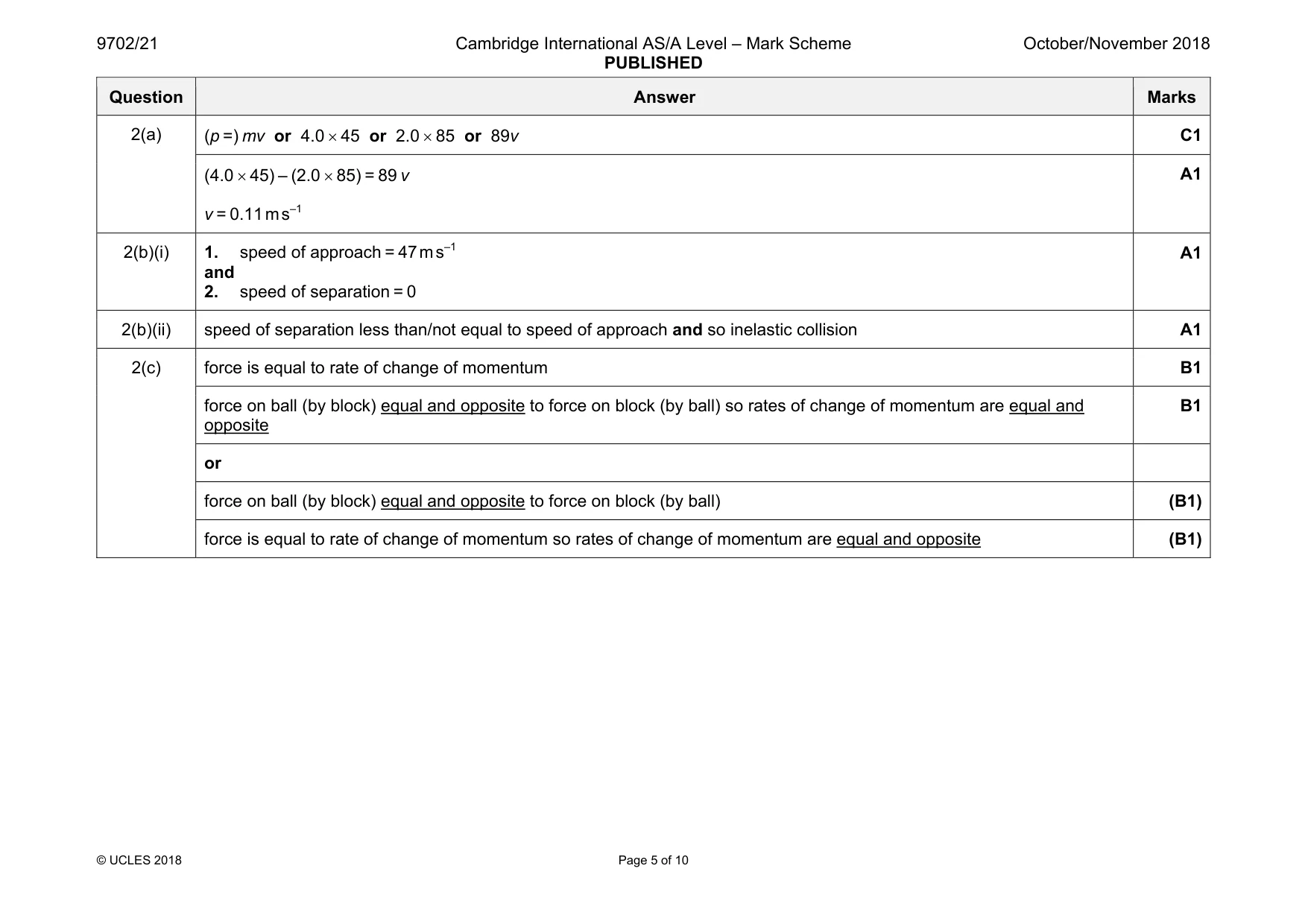
Mark scheme: 2(a) C1 (4.0 × 45) – (2.0 × 85) = 89 v v = 0.11 m s–1 A1 2(b)(i) 1. speed of approach = 47 m s–1 and 2. speed of separation = 0 A1 2(b)(ii) speed of separation less than/not equal to speed of approach and so inelastic collision A1 2(c) force is equal to rate of change of momentum B1 force on ball (by block) equal and opposite to force on block (by ball) so rates of change of momentum are equal and opposite B1 or force on ball (by block) equal and opposite to force on block (by ball) (B1) force is equal to rate of change of momentum so rates of change of momentum are equal and opposite (B1)
Question 3
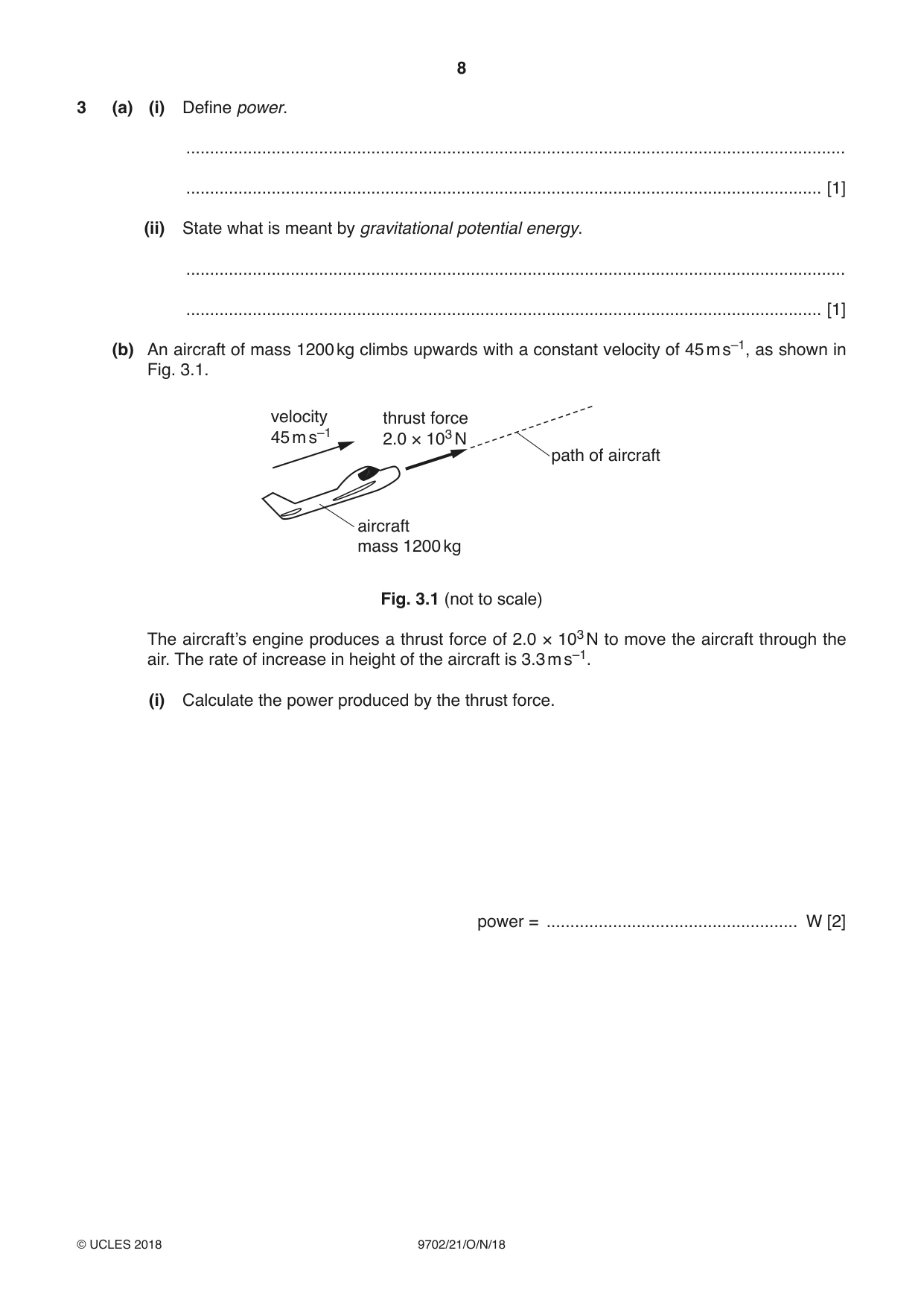
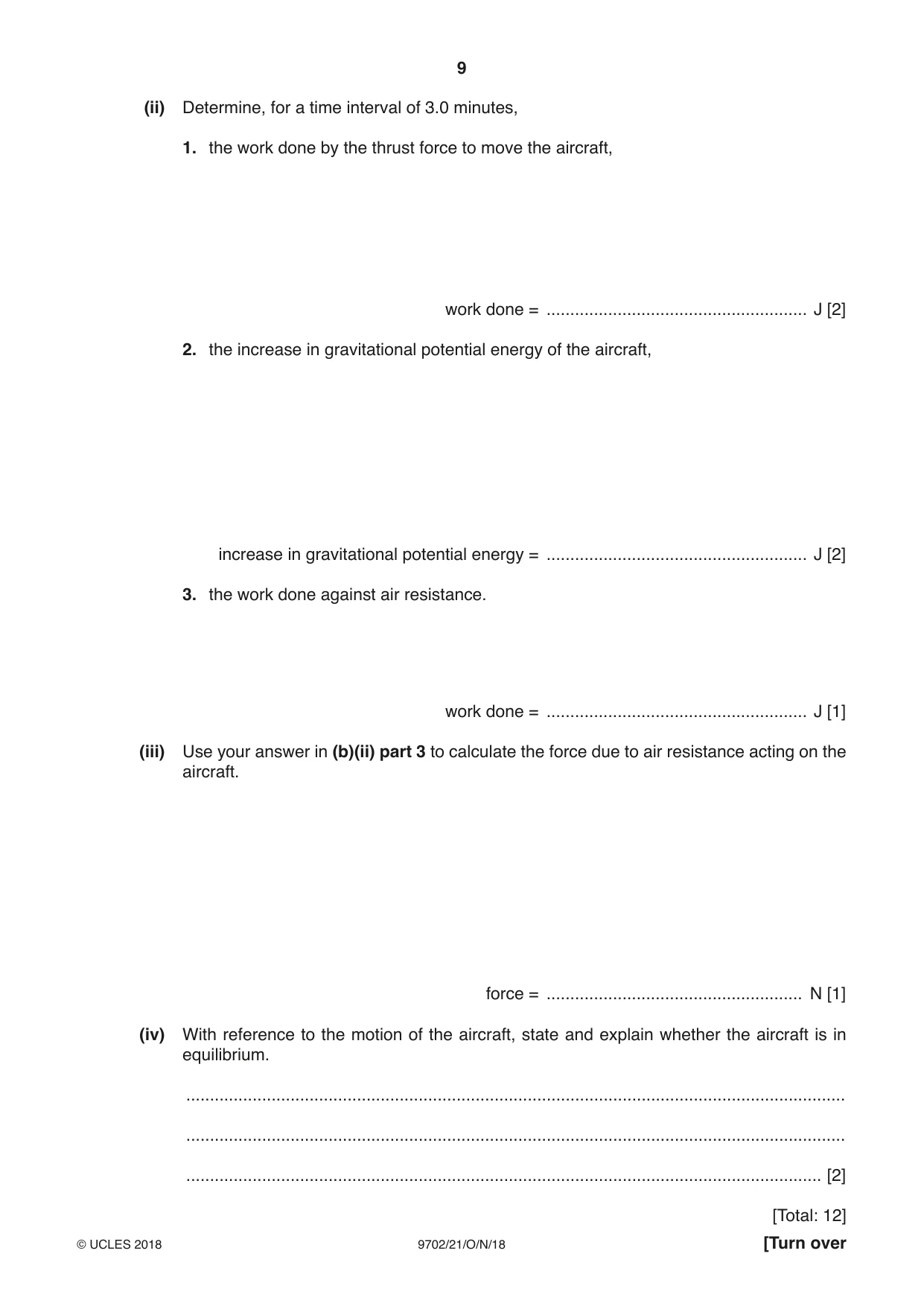
3 (a) (i) Define power. ........................................................................................................................................... ...................................................................................................................................... [1] (ii) State what is meant by gravitational potential energy. ........................................................................................................................................... ...................................................................................................................................... [1] (b) An aircraft of mass 1200 kg climbs upwards with a constant velocity of 45 m s–1, as shown in Fig. 3.1. velocity thrust force 45 m s–1 2.0 × 10³ N path of aircraft aircraft mass 1200 kg Fig. 3.1 (not to scale) The aircraft’s engine produces a thrust force of 2.0 × 10³ N to move the aircraft through the air. The rate of increase in height of the aircraft is 3.3 m s–1. (i) Calculate the power produced by the thrust force. power = ..................................................... W [2] (ii) Determine, for a time interval of 3.0 minutes, 1. the work done by the thrust force to move the aircraft, work done = ....................................................... J [2] 2. the increase in gravitational potential energy of the aircraft, increase in gravitational potential energy = ....................................................... J [2] 3. the work done against air resistance. work done = ....................................................... J [1] (iii) Use your answer in (b)(ii) part 3 to calculate the force due to air resistance acting on the aircraft. force = ...................................................... N [1] (iv) With reference to the motion of the aircraft, state and explain whether the aircraft is in equilibrium. ........................................................................................................................................... ........................................................................................................................................... ...................................................................................................................................... [2] [Total: 12]
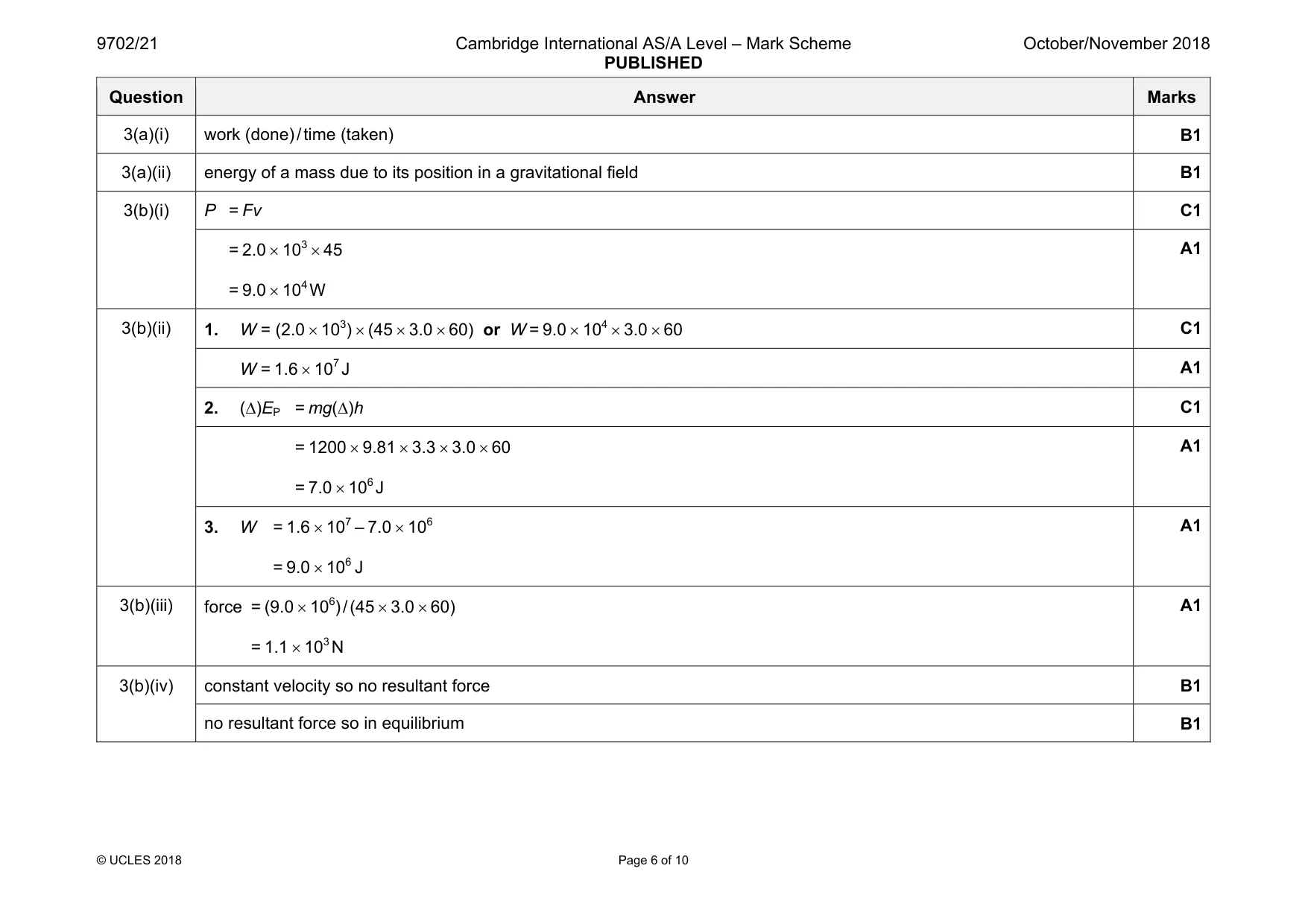
Mark scheme: 3(a)(i) work (done) / time (taken) B1 3(a)(ii) energy of a mass due to its position in a gravitational field B1 3(b)(i) P = Fv C1 = 2.0 × 103 × 45 = 9.0 × 10⁴ W A1 3(b)(ii) 1. W = (2.0 × 103) × (45 × 3.0 × 60) or W = 9.0 × 104 × 3.0 × 60 C1 W = 1.6 × 10⁷ J A1 2. (∆)EP = mg(∆)h C1 = 1200 × 9.81 × 3.3 × 3.0 × 60 = 7.0 × 10⁶ J A1 3. W = 1.6 × 10⁷ – 7.0 × 106 = 9.0 × 10⁶ J A1 3(b)(iii) force = (9.0 × 10⁶) / (45 × 3.0 × 60) = 1.1 × 10³ N A1 3(b)(iv) constant velocity so no resultant force B1 no resultant force so in equilibrium B1
More questions on Gravitational potential energy and kinetic energy
Q4 · State the principle of superposition
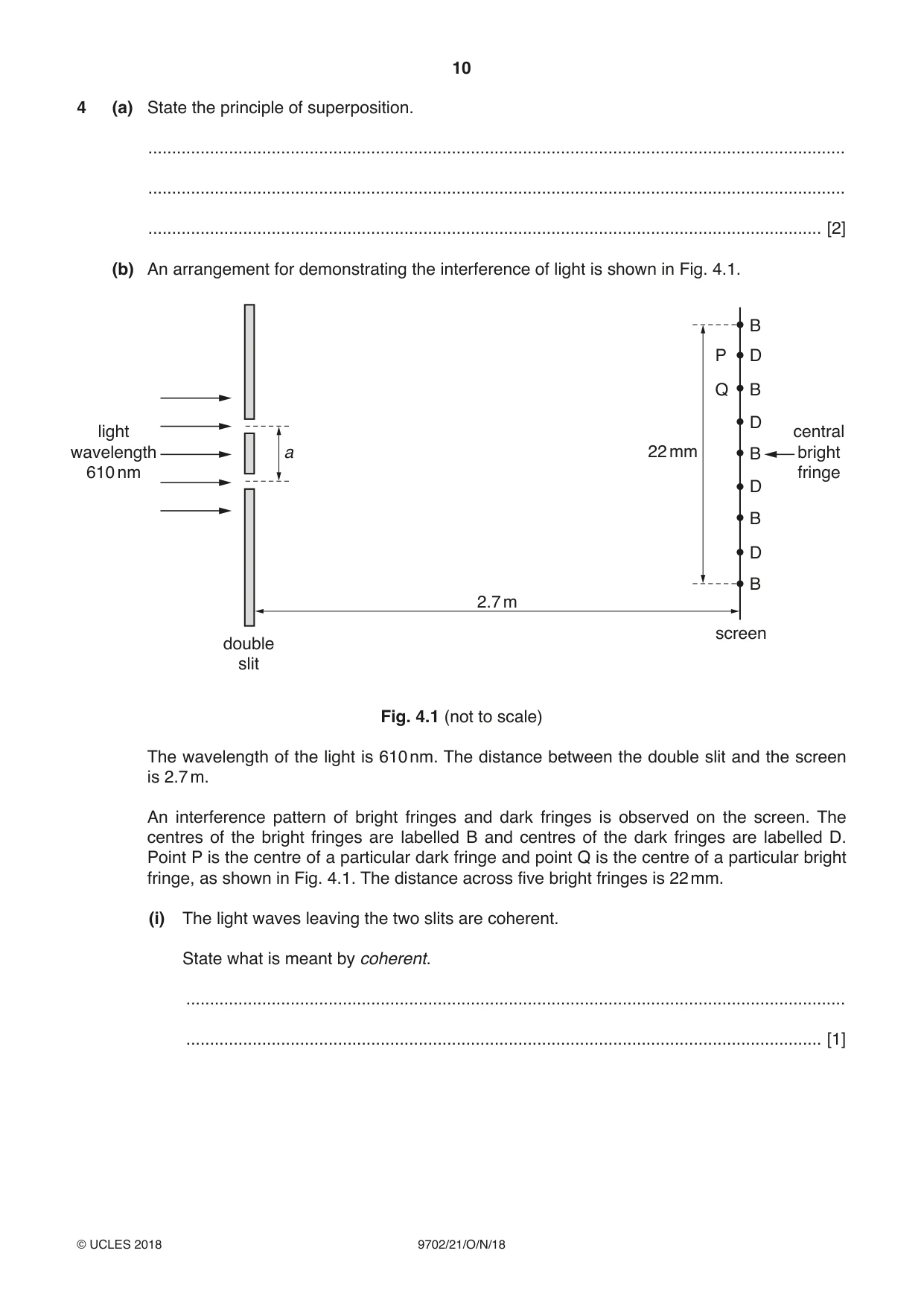
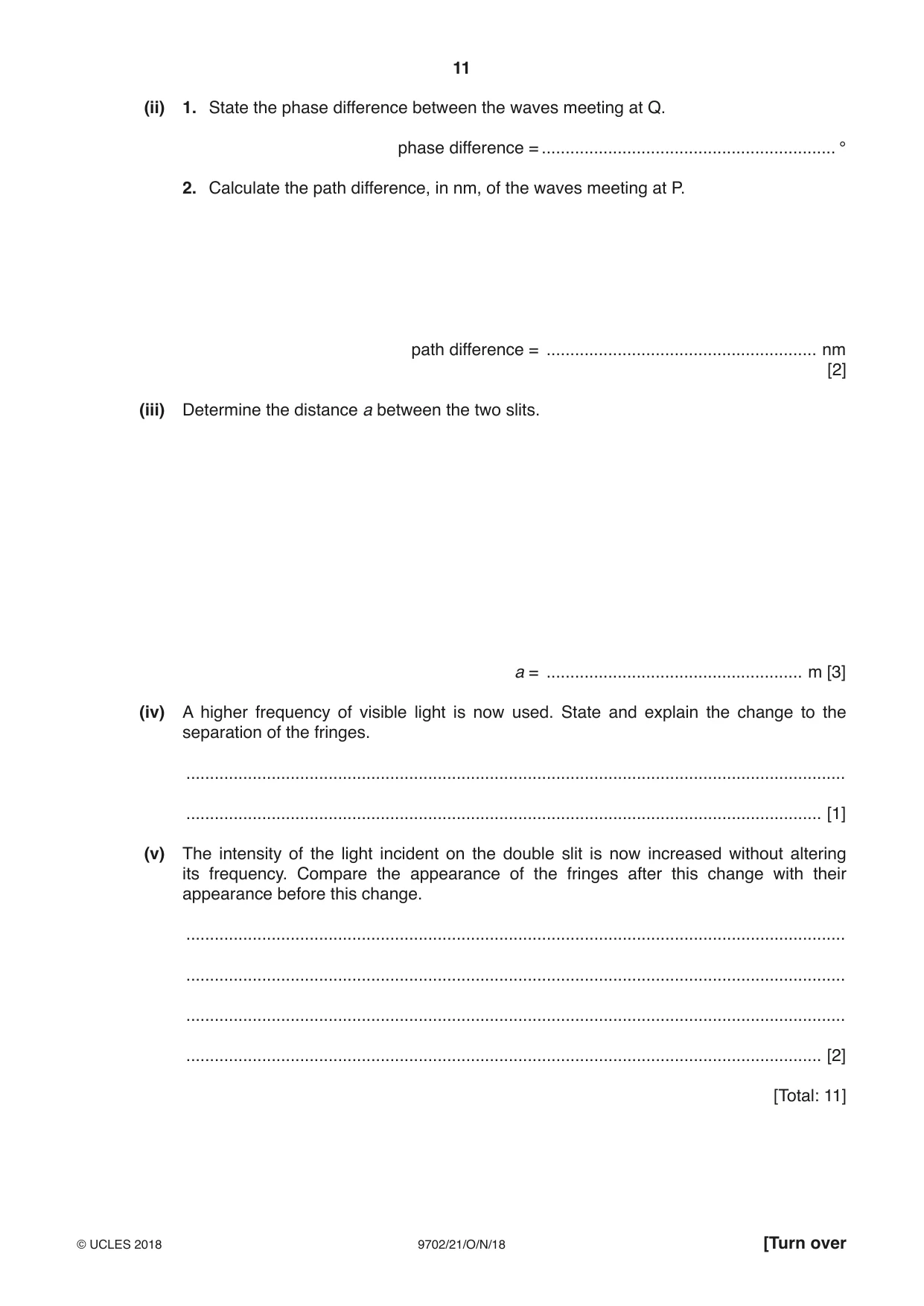
4 (a) State the principle of superposition. ................................................................................................................................................... ................................................................................................................................................... .............................................................................................................................................. [2] (b) An arrangement for demonstrating the interference of light is shown in Fig. 4.1. B P D Q B D light central wavelength a 22 mm B bright 610 nm fringe D B D B 2.7 m screen double slit Fig. 4.1 (not to scale) The wavelength of the light is 610 nm. The distance between the double slit and the screen is 2.7 m. An interference pattern of bright fringes and dark fringes is observed on the screen. The centres of the bright fringes are labelled B and centres of the dark fringes are labelled D. Point P is the centre of a particular dark fringe and point Q is the centre of a particular bright fringe, as shown in Fig. 4.1. The distance across five bright fringes is 22 mm. (i) The light waves leaving the two slits are coherent. State what is meant by coherent. ........................................................................................................................................... ...................................................................................................................................... [1] (ii) 1. State the phase difference between the waves meeting at Q. phase difference = .............................................................. ° 2. Calculate the path difference, in nm, of the waves meeting at P. path difference = ......................................................... nm [2] (iii) Determine the distance a between the two slits. a = ...................................................... m [3] (iv) A higher frequency of visible light is now used. State and explain the change to the separation of the fringes. ........................................................................................................................................... ...................................................................................................................................... [1] (v) The intensity of the light incident on the double slit is now increased without altering its frequency. Compare the appearance of the fringes after this change with their appearance before this change. ........................................................................................................................................... ........................................................................................................................................... ........................................................................................................................................... ...................................................................................................................................... [2] [Total: 11]
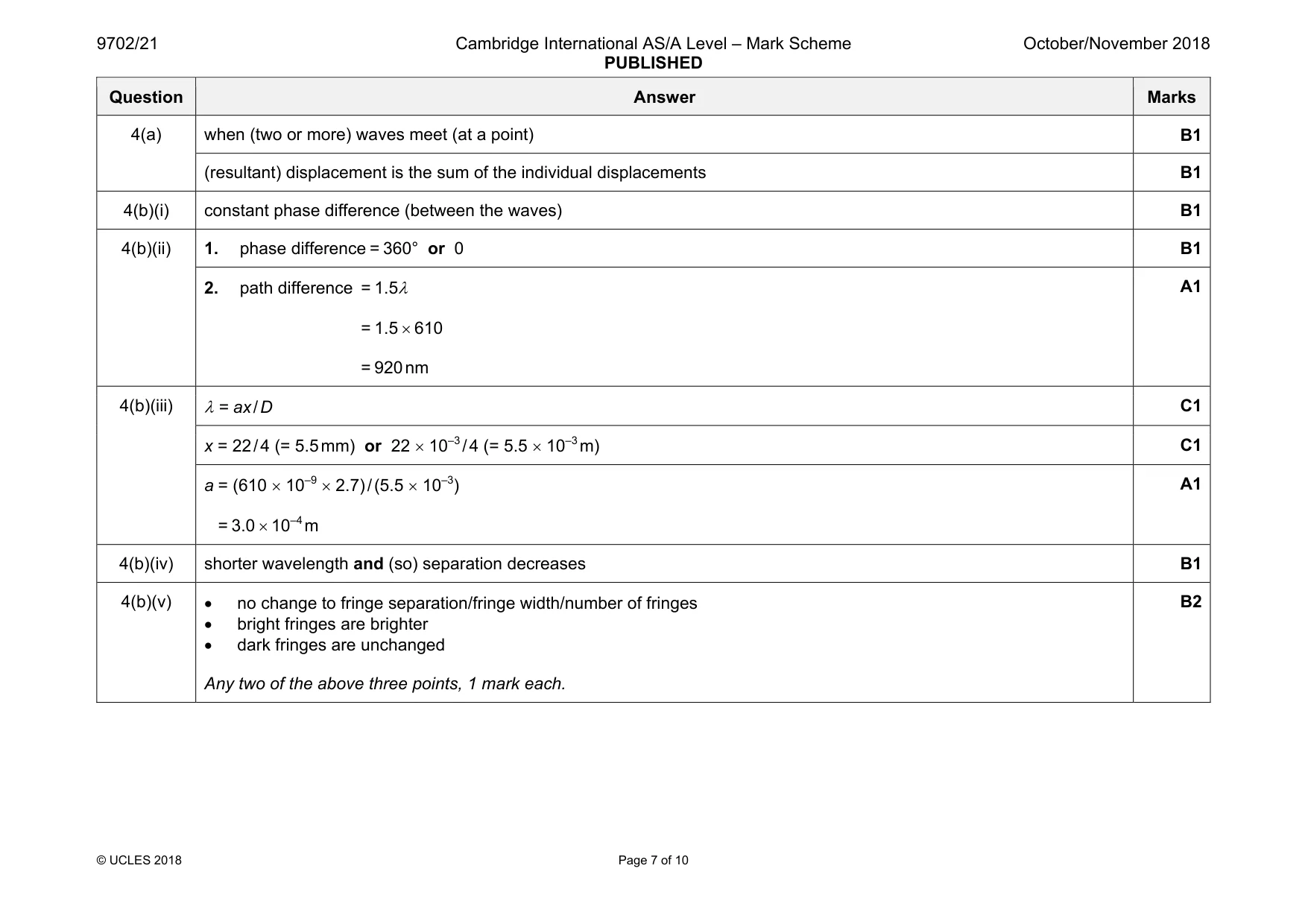
Mark scheme: 4(a) when (two or more) waves meet (at a point) B1 (resultant) displacement is the sum of the individual displacements B1 4(b)(i) constant phase difference (between the waves) B1 4(b)(ii) 1. phase difference = 360° or 0 B1 2. path difference = 1.5λ = 1.5 × 610 = 920 nm A1 4(b)(iii) λ = ax / D C1 x = 22 / 4 (= 5.5 mm) or 22 × 10–3 / 4 (= 5.5 × 10⁻³ m) C1 a = (610 × 10–9 × 2.7) / (5.5 × 10⁻³) = 3.0 × 10⁻⁴ m A1 4(b)(iv) shorter wavelength and (so) separation decreases B1 4(b)(v) • no change to fringe separation/fringe width/number of fringes • bright fringes are brighter • dark fringes are unchanged Any two of the above three points, 1 mark each. B2
Q5 · State what is meant by an electric field
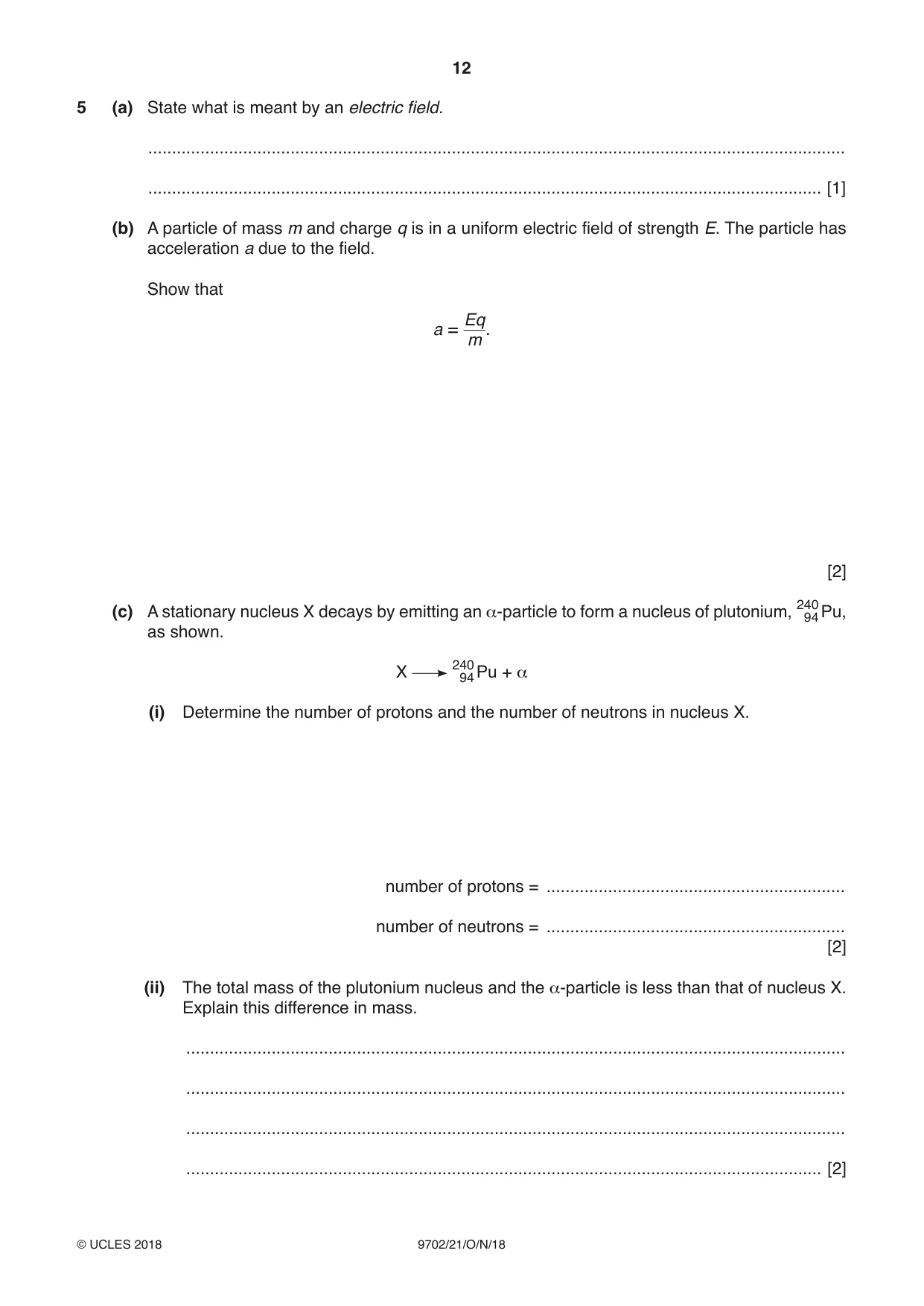
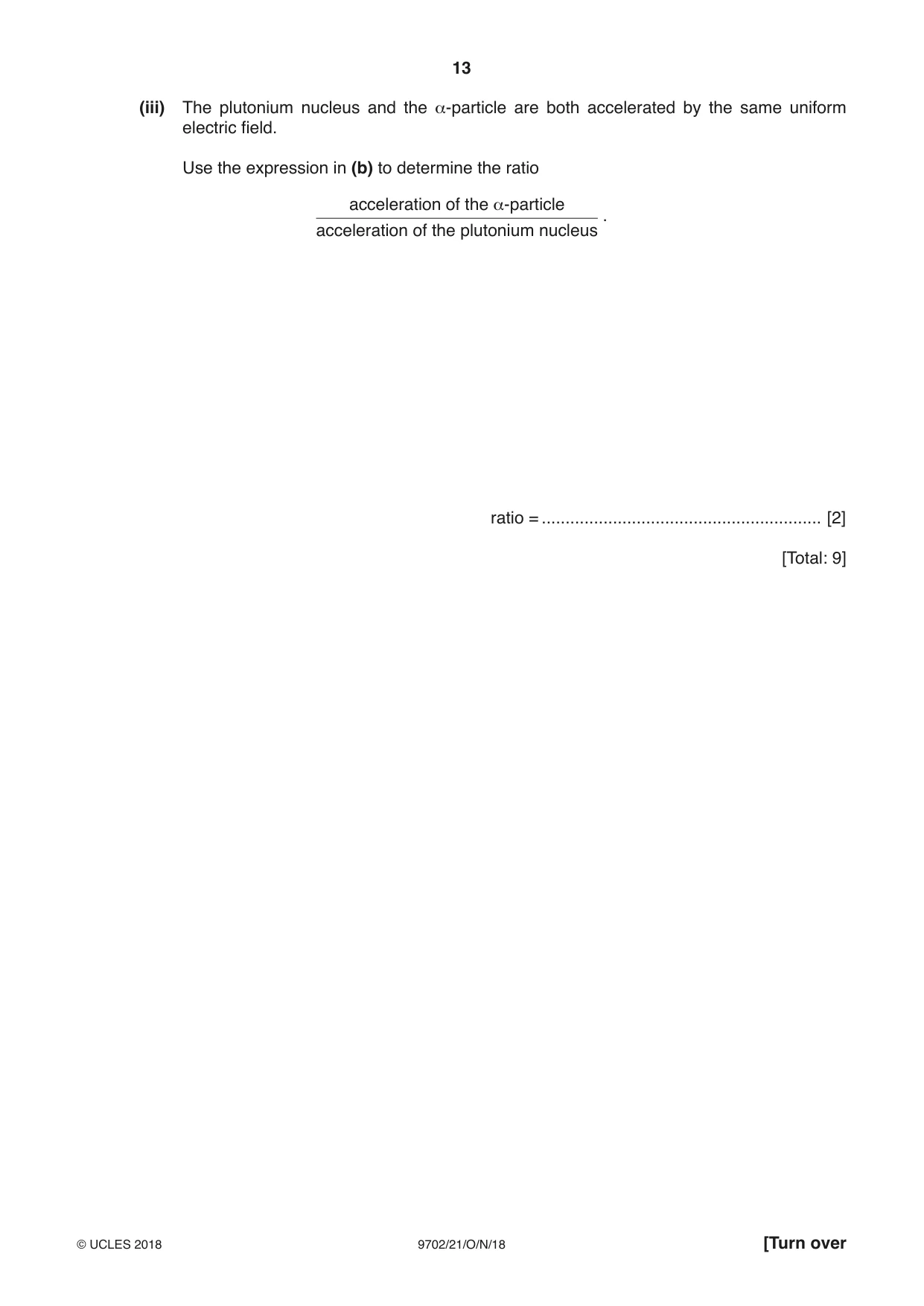
5 (a) State what is meant by an electric field. ................................................................................................................................................... .............................................................................................................................................. [1] (b) A particle of mass m and charge q is in a uniform electric field of strength E. The particle has acceleration a due to the field. Show that Eq a = . m [2] (c) A stationary nucleus X decays by emitting an α-particle to form a nucleus of plutonium, 24094 Pu, as shown. α X 24094 Pu + (i) Determine the number of protons and the number of neutrons in nucleus X. number of protons = ............................................................... number of neutrons = ............................................................... [2] (ii) The total mass of the plutonium nucleus and the α-particle is less than that of nucleus X. Explain this difference in mass. ........................................................................................................................................... ........................................................................................................................................... ........................................................................................................................................... ...................................................................................................................................... [2] (iii) The plutonium nucleus and the α-particle are both accelerated by the same uniform electric field. Use the expression in (b) to determine the ratio acceleration of the α-particle . acceleration of the plutonium nucleus ratio = ........................................................... [2] [Total: 9]
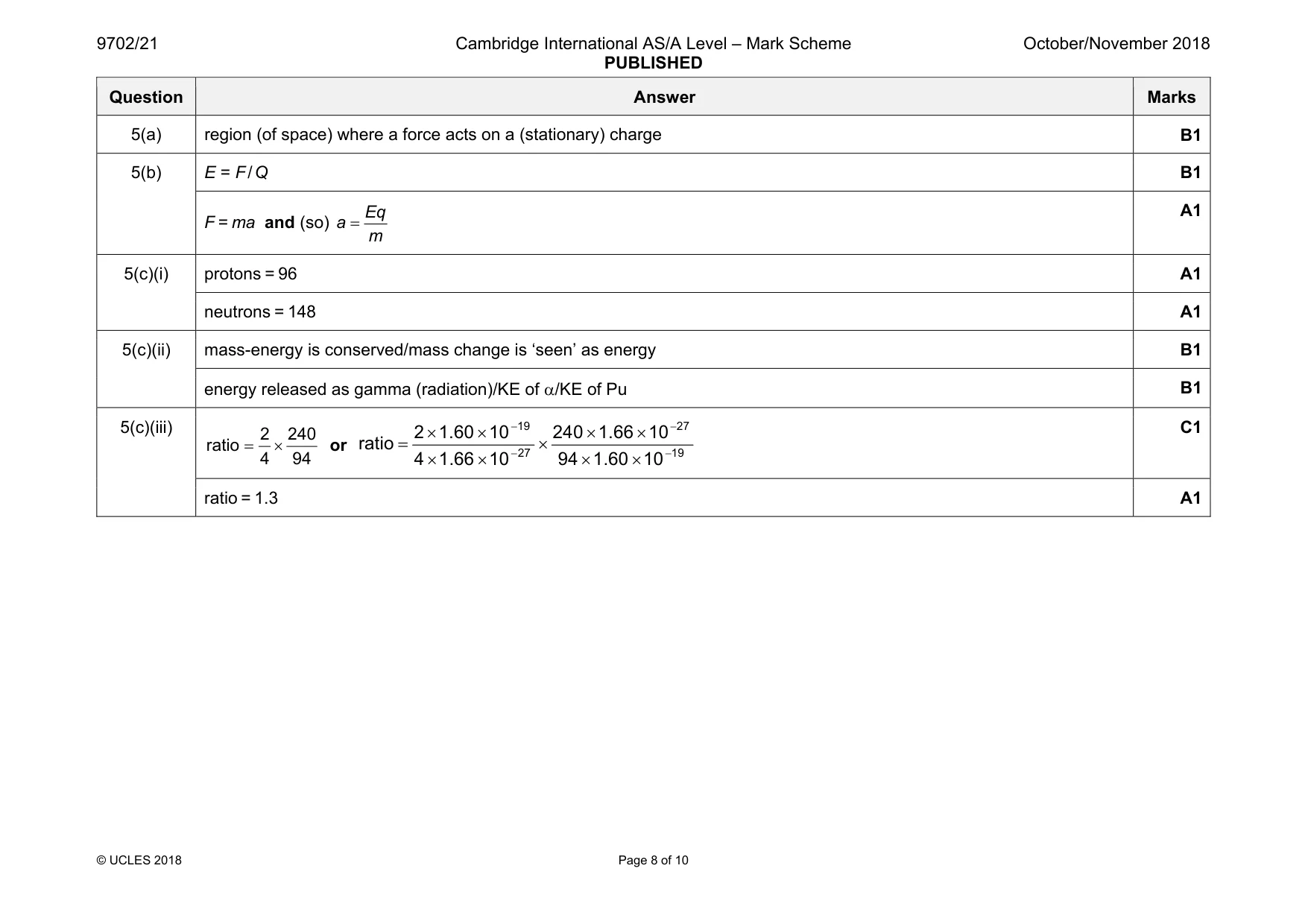
Mark scheme: 5(a) region (of space) where a force acts on a (stationary) charge B1 5(b) E = F / Q B1 F = ma and (so) Eq a m = A1 5(c)(i) protons = 96 A1 neutrons = 148 A1 5(c)(ii) mass-energy is conserved/mass change is ‘seen’ as energy B1 energy released as gamma (radiation)/KE of α/KE of Pu B1 5(c)(iii) 9 4 2 4 0 × = 4 2 ratio or 1 9 2 7 2 7 1 9 1 0 6 0 . 1 9 4 1 0 6 6 . 1 2 4 0 1 0 6 6 . 1 4 − − − − × × × × × × × × × = 10 1.60 2 ratio C1 ratio = 1.3 A1
Q6 · State Kirchhoff’s second law
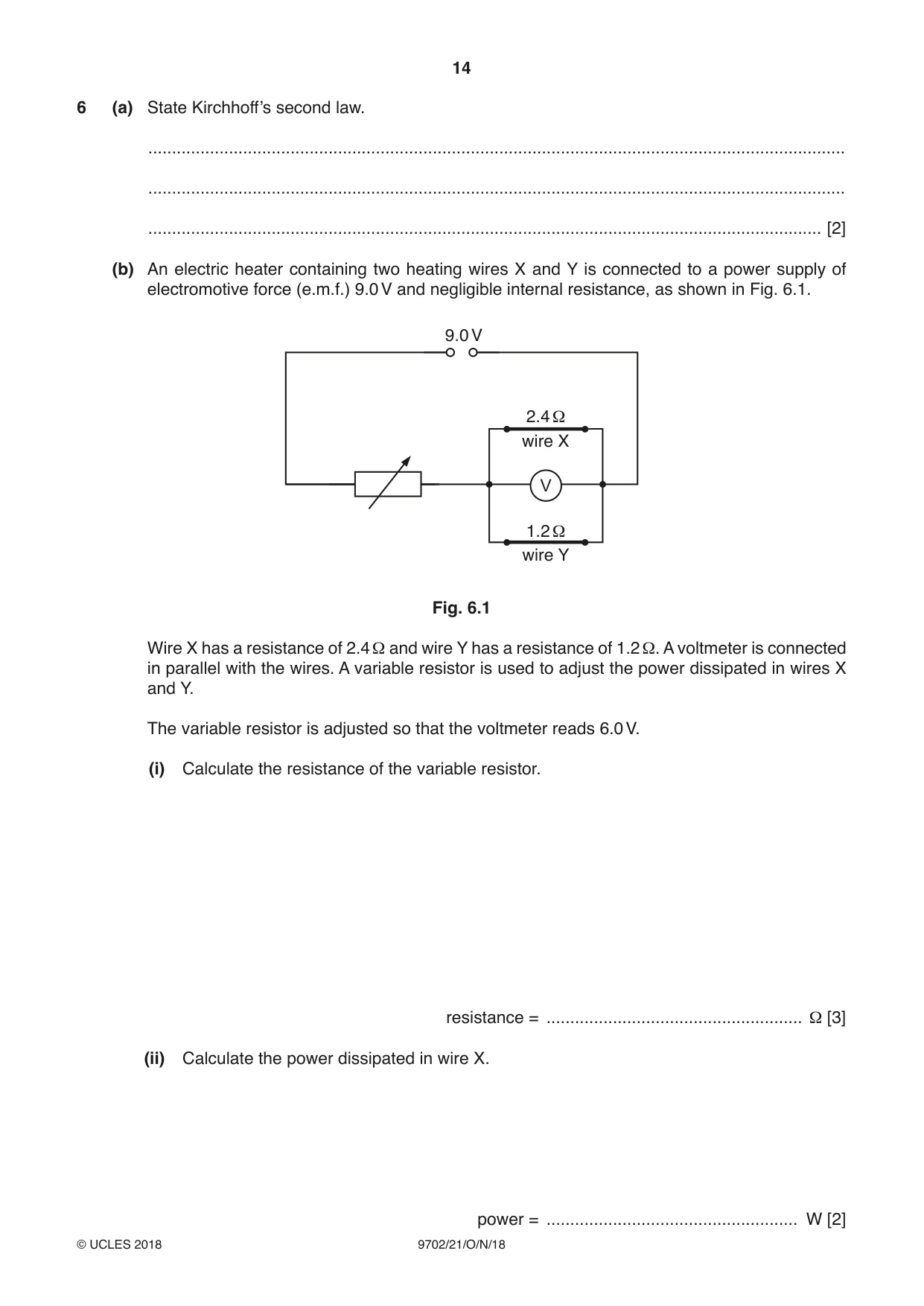
6 (a) State Kirchhoff’s second law. ................................................................................................................................................... ................................................................................................................................................... .............................................................................................................................................. [2] (b) An electric heater containing two heating wires X and Y is connected to a power supply of electromotive force (e.m.f.) 9.0 V and negligible internal resistance, as shown in Fig. 6.1. 9.0 V 2.4 Ω wire X V 1.2Ω wire Y Fig. 6.1 Wire X has a resistance of 2.4 Ω and wire Y has a resistance of 1.2 Ω. A voltmeter is connected in parallel with the wires. A variable resistor is used to adjust the power dissipated in wires X and Y. The variable resistor is adjusted so that the voltmeter reads 6.0 V. (i) Calculate the resistance of the variable resistor. resistance = ...................................................... Ω [3] (ii) Calculate the power dissipated in wire X. power = ..................................................... W [2] (iii) The cross-sectional area of wire X is three times the cross-sectional area of wire Y. Assume that the resistivity and the number density of free electrons for the metal of both wires are the same. Determine the ratio length of wire X 1. , length of wire Y ratio = .......................................................... [2] average drift velocity of free electrons in wire X 2. . average drift velocity of free electrons in wire Y ratio = .......................................................... [2] [Total: 11]
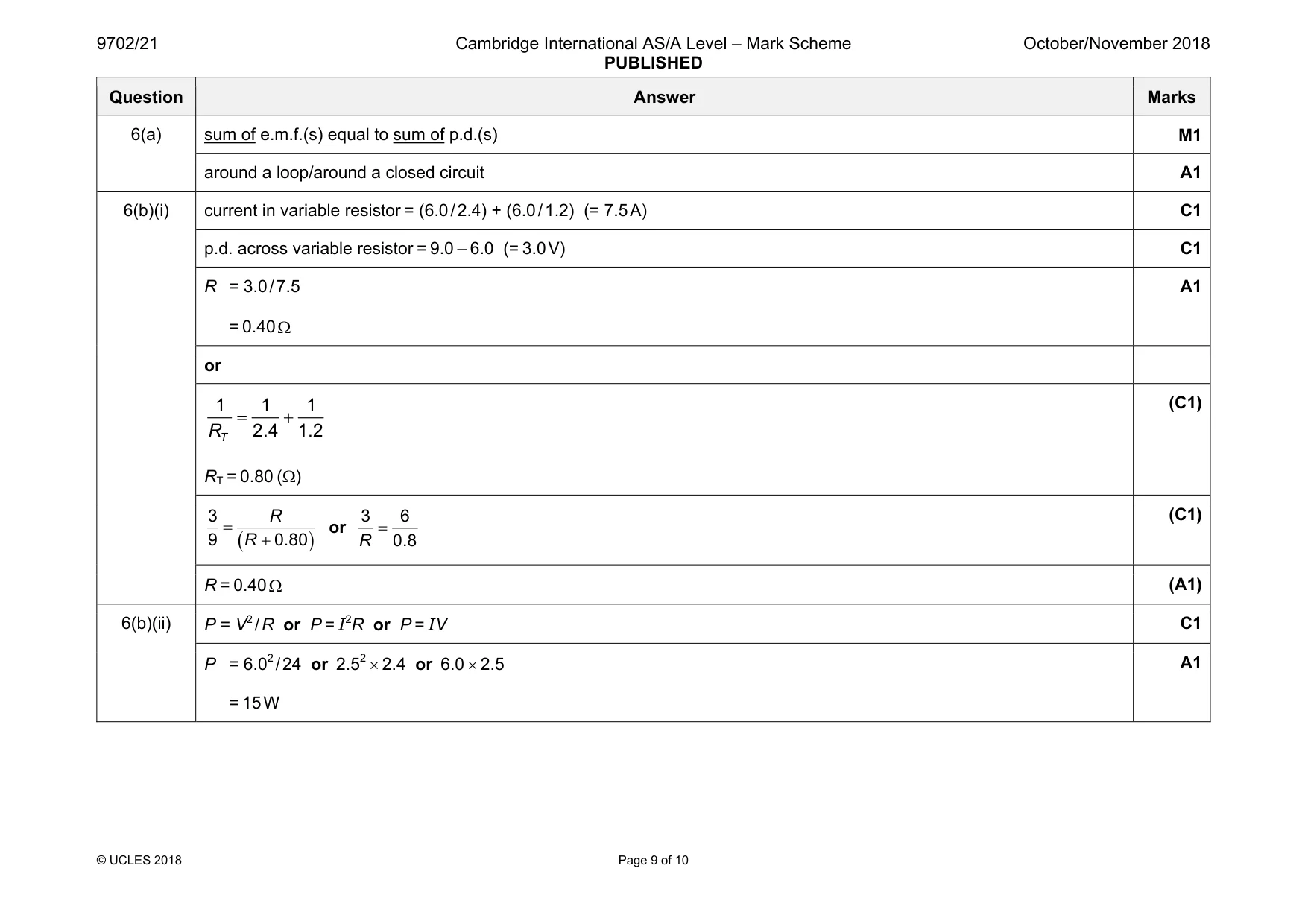
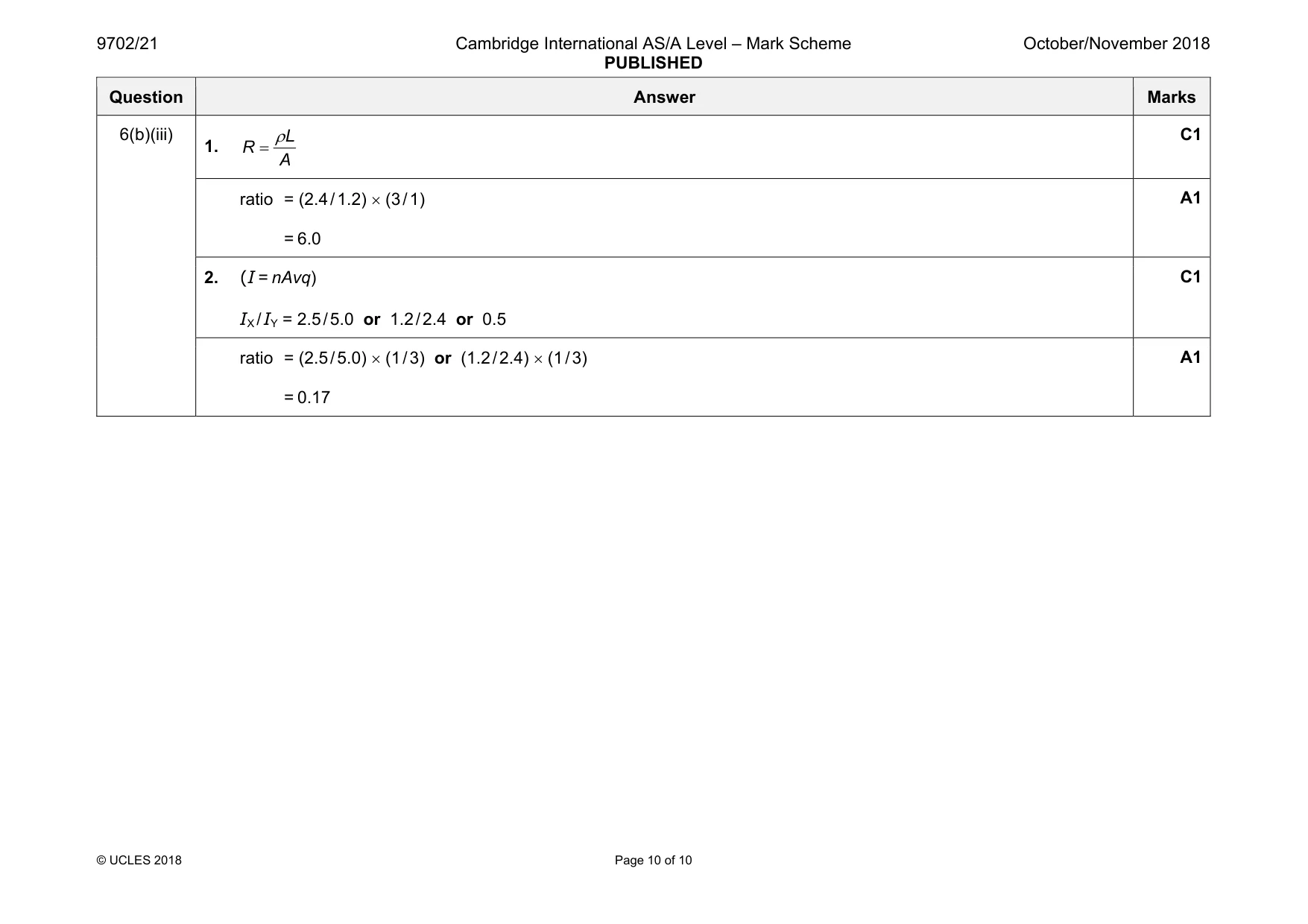
Mark scheme: 6(a) sum of e.m.f.(s) equal to sum of p.d.(s) M1 around a loop/around a closed circuit A1 6(b)(i) current in variable resistor = (6.0 / 2.4) + (6.0 / 1.2) (= 7.5 A) C1 p.d. across variable resistor = 9.0 – 6.0 (= 3.0 V) C1 R = 3.0 / 7.5 = 0.40 Ω A1 or 1 1 1 2.4 1.2 T R = + RT = 0.80 (Ω) (C1) ( ) 3 9 0.80 R R = + or 3 6 0.8 R = (C1) R = 0.40 Ω (A1) 6(b)(ii) P = V2 / R or P = I2R or P = IV C1 P = 6.02 / 24 or 2.52 × 2.4 or 6.0 × 2.5 = 15 W A1 Question Answer Marks 6(b)(iii) 1. L R A ρ = C1 ratio = (2.4 / 1.2) × (3 / 1) = 6.0 A1 2. (I = nAvq) IX / IY = 2.5 / 5.0 or 1.2 / 2.4 or 0.5 C1 ratio = (2.5 / 5.0) × (1 / 3) or (1.2 / 2.4) × (1 / 3) = 0.17 A1
What was in this paper
The subtopics covered by these 6 questions, and how many questions each got. Open one in a new tab to see every Cambridge question on it.
What you needed in this session
Cambridge’s own grade thresholds for 2018 Oct/Nov, Paper 2 · Variant 1. A higher threshold means an easier paper — the bar moves with how the cohort did.