Cambridge A Level Physics 9702 — 2021 Oct/Nov Paper 2 · Variant 2
9702/22/O/N/21 · 7 questions · 60 marks · ≈68 min
The question paper and its mark scheme, free to read here and free to download. This is Cambridge’s own paper, exactly as it was sat.
Question paper20 pages


Mark scheme12 pages
Answers below. Sit the paper first if you are practising.
Questions as text
Q1 · A unit may be stated with a prefix that represents a power-of-ten multiple or submultiple
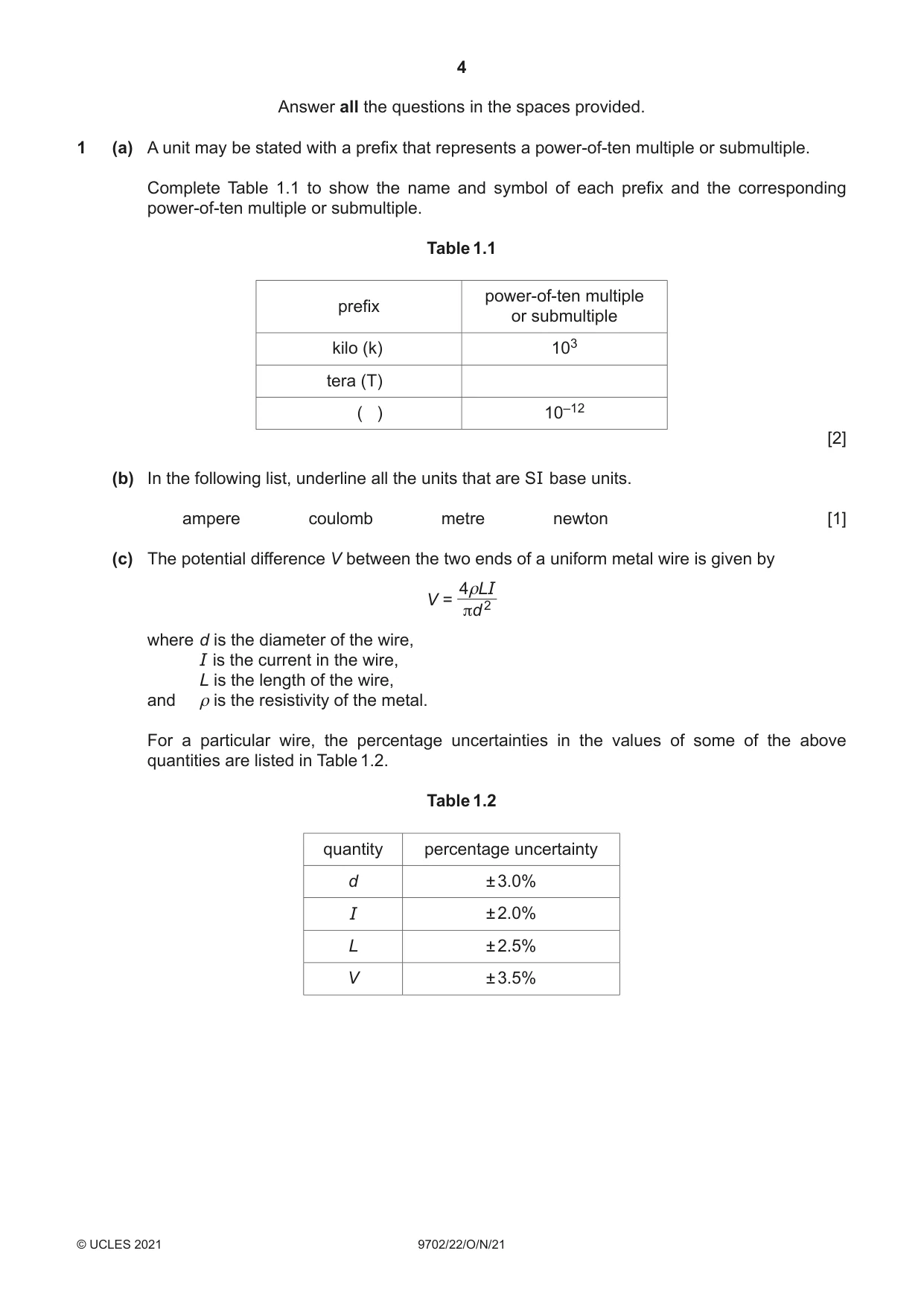
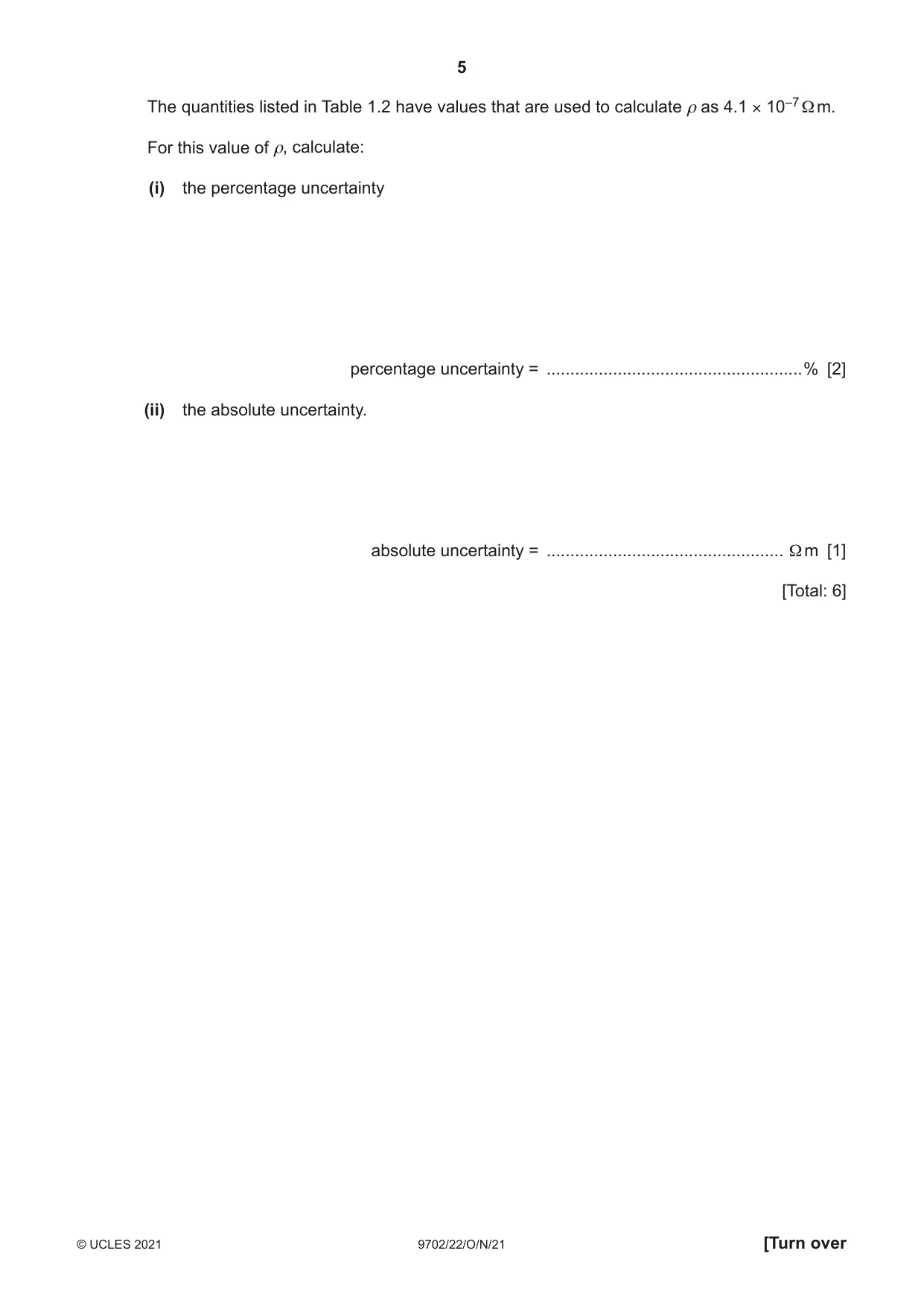
1 (a) A unit may be stated with a prefix that represents a power-of-ten multiple or submultiple. Complete Table 1.1 to show the name and symbol of each prefix and the corresponding power-of-ten multiple or submultiple. Table 1.1 power-of-ten multiple prefix or submultiple kilo (k) 103 tera (T) ( ) 10–12 [2] (b) In the following list, underline all the units that are SI base units. ampere coulomb metre newton [1] (c) The potential difference V between the two ends of a uniform metal wire is given by 4ρLI V = 2 πd where d is the diameter of the wire, I is the current in the wire, L is the length of the wire, and ρ is the resistivity of the metal. For a particular wire, the percentage uncertainties in the values of some of the above quantities are listed in Table 1.2. Table 1.2 quantity percentage uncertainty d ± 3.0% I ± 2.0% L ± 2.5% V ± 3.5% The quantities listed in Table 1.2 have values that are used to calculate ρ as 4.1 × 10⁻⁷ Ω m. For this value of ρ, calculate: (i) the percentage uncertainty percentage uncertainty = ......................................................% [2] (ii) the absolute uncertainty. absolute uncertainty = .................................................. Ω m [1] [Total: 6]
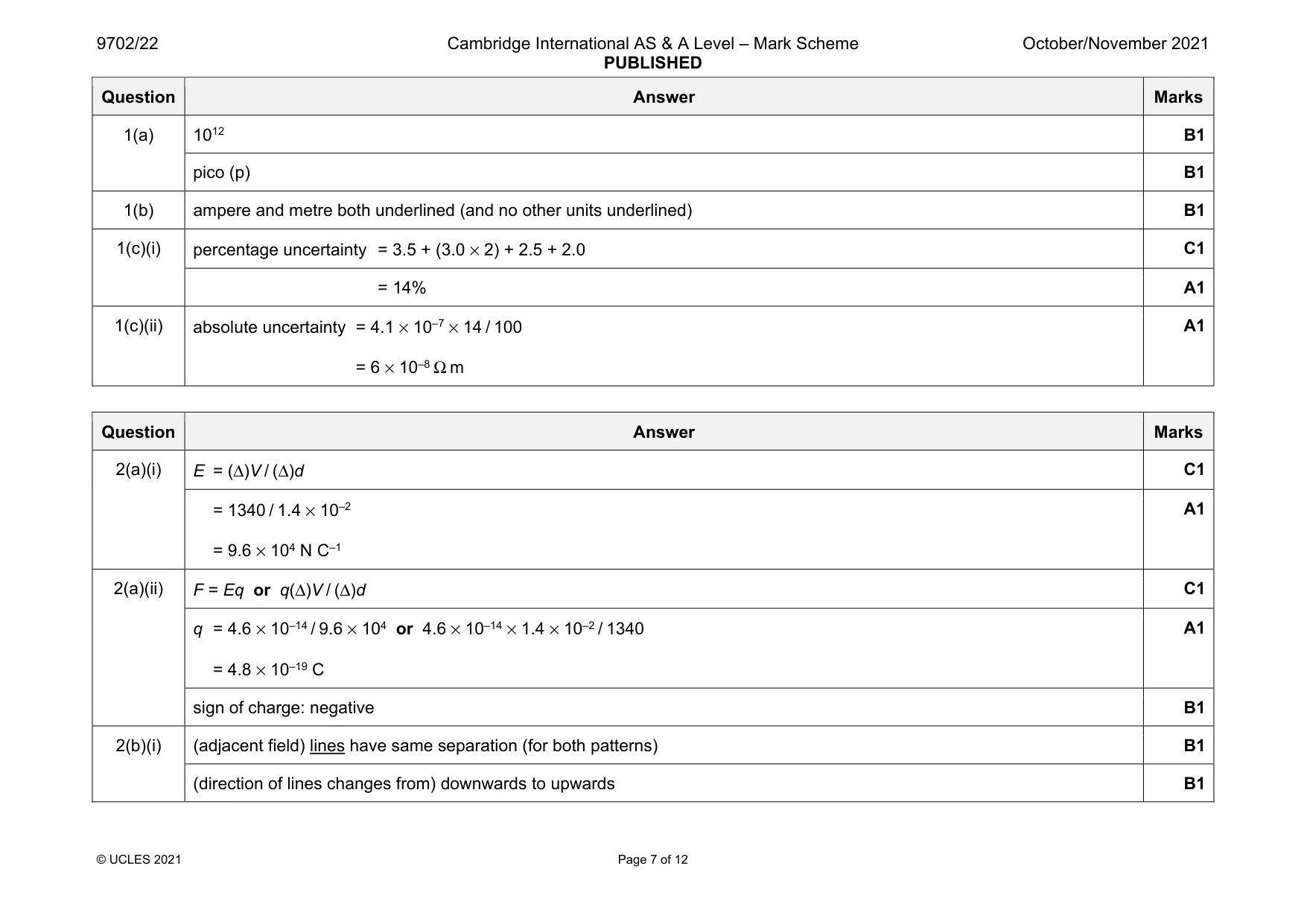
Mark scheme: 1(a) 1012 B1 pico (p) B1 1(b) ampere and metre both underlined (and no other units underlined) B1 1(c)(i) percentage uncertainty = 3.5 + (3.0 × 2) + 2.5 + 2.0 C1 = 14% A1 1(c)(ii) absolute uncertainty = 4.1 × 10–7 × 14 / 100 = 6 × 10⁻⁸ Ω m A1
Q2 · A charged oil drop is in a vacuum between two horizontal metal plates
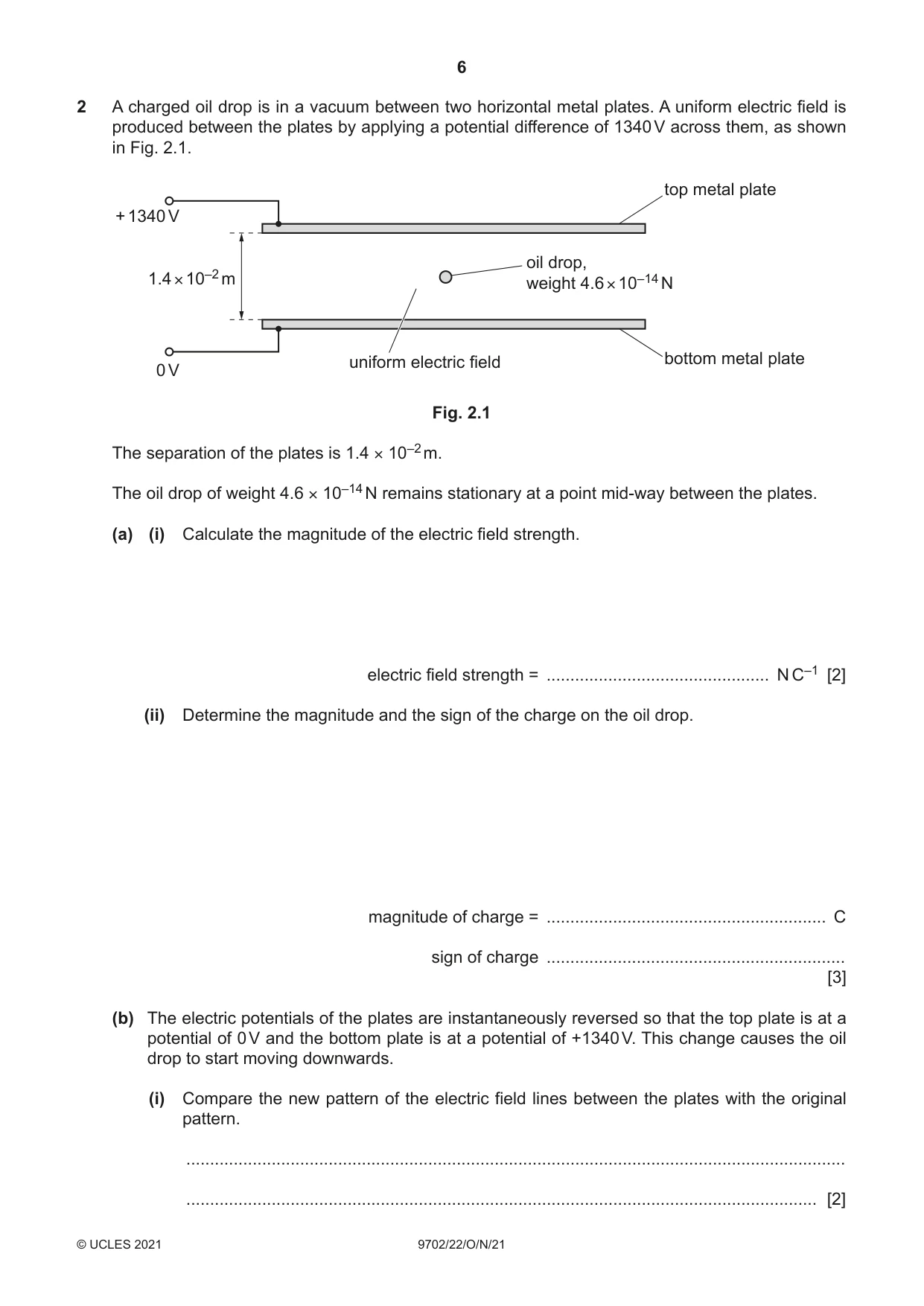
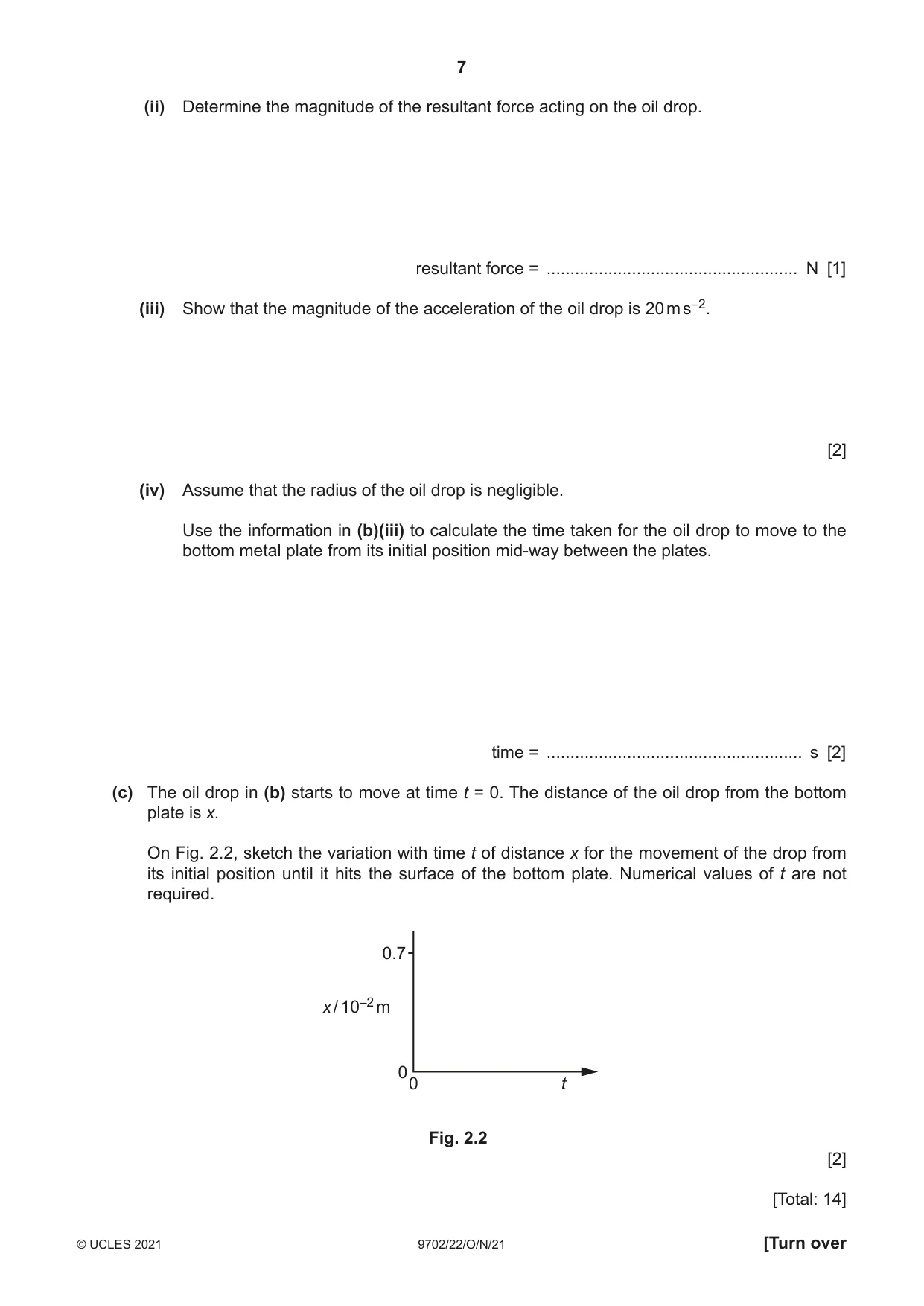
2 A charged oil drop is in a vacuum between two horizontal metal plates. A uniform electric field is produced between the plates by applying a potential difference of 1340 V across them, as shown in Fig. 2.1. top metal plate + 1340 V oil drop, 1.4 × 10⁻² m weight 4.6 × 10⁻¹⁴ N uniform electric field bottom metal plate 0 V Fig. 2.1 The separation of the plates is 1.4 × 10⁻² m. The oil drop of weight 4.6 × 10⁻¹⁴ N remains stationary at a point mid-way between the plates. (a) (i) Calculate the magnitude of the electric field strength. electric field strength = ............................................... N C–1 [2] (ii) Determine the magnitude and the sign of the charge on the oil drop. magnitude of charge = ........................................................... C sign of charge ............................................................... [3] (b) The electric potentials of the plates are instantaneously reversed so that the top plate is at a potential of 0 V and the bottom plate is at a potential of +1340 V. This change causes the oil drop to start moving downwards. (i) Compare the new pattern of the electric field lines between the plates with the original pattern. ........................................................................................................................................... ..................................................................................................................................... [2] (ii) Determine the magnitude of the resultant force acting on the oil drop. resultant force = ..................................................... N [1] (iii) Show that the magnitude of the acceleration of the oil drop is 20 m s–2. [2] (iv) Assume that the radius of the oil drop is negligible. Use the information in (b)(iii) to calculate the time taken for the oil drop to move to the bottom metal plate from its initial position mid-way between the plates. time = ...................................................... s [2] (c) The oil drop in (b) starts to move at time t = 0. The distance of the oil drop from the bottom plate is x. On Fig. 2.2, sketch the variation with time t of distance x for the movement of the drop from its initial position until it hits the surface of the bottom plate. Numerical values of t are not required. 0.7 x / 10–2 m 0 0 t Fig. 2.2 [2] [Total: 14]
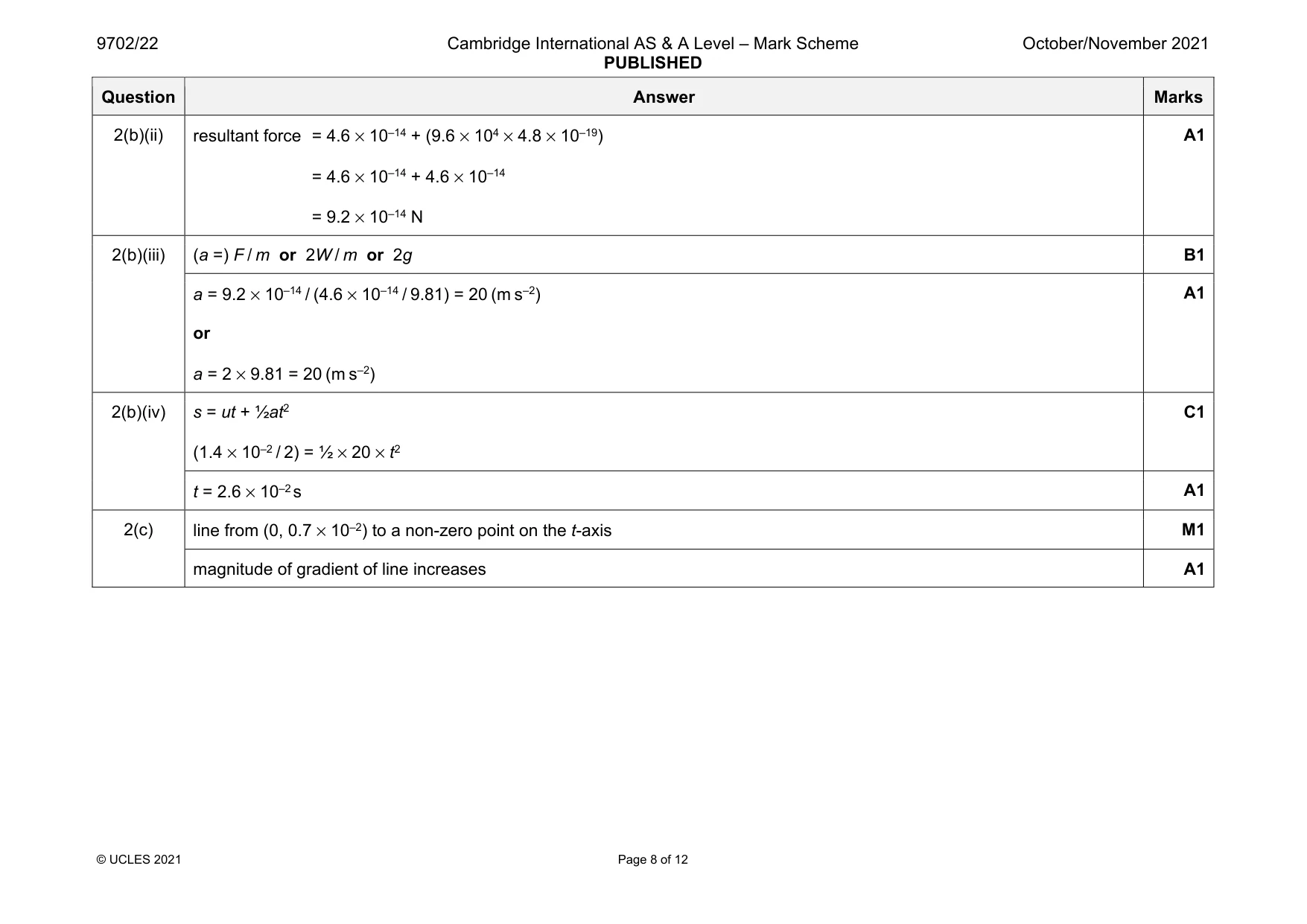
Mark scheme: 2(a)(i) E = (Δ)V / (Δ)d C1 = 1340 / 1.4 × 10–2 = 9.6 × 10⁴ N C–1 A1 2(a)(ii) F = Eq or q(Δ)V / (Δ)d C1 q = 4.6 × 10⁻¹⁴ / 9.6 × 10⁴ or 4.6 × 10–14 × 1.4 × 10–2 / 1340 = 4.8 × 10⁻¹⁹ C A1 sign of charge: negative B1 2(b)(i) (adjacent field) lines have same separation (for both patterns) B1 (direction of lines changes from) downwards to upwards B1 Question Answer Marks 2(b)(ii) resultant force = 4.6 × 10⁻¹⁴ + (9.6 × 104 × 4.8 × 10–19) = 4.6 × 10⁻¹⁴ + 4.6 × 10–14 = 9.2 × 10⁻¹⁴ N A1 2(b)(iii) (a =) F / m or 2W / m or 2g B1 a = 9.2 × 10⁻¹⁴ / (4.6 × 10⁻¹⁴ / 9.81) = 20 (m s–2) or a = 2 × 9.81 = 20 (m s–2) A1 2(b)(iv) s = ut + ½at2 (1.4 × 10⁻² / 2) = ½ × 20 × t2 C1 t = 2.6 × 10⁻² s A1 2(c) line from (0, 0.7 × 10⁻²) to a non-zero point on the t-axis M1 magnitude of gradient of line increases A1
Question 3
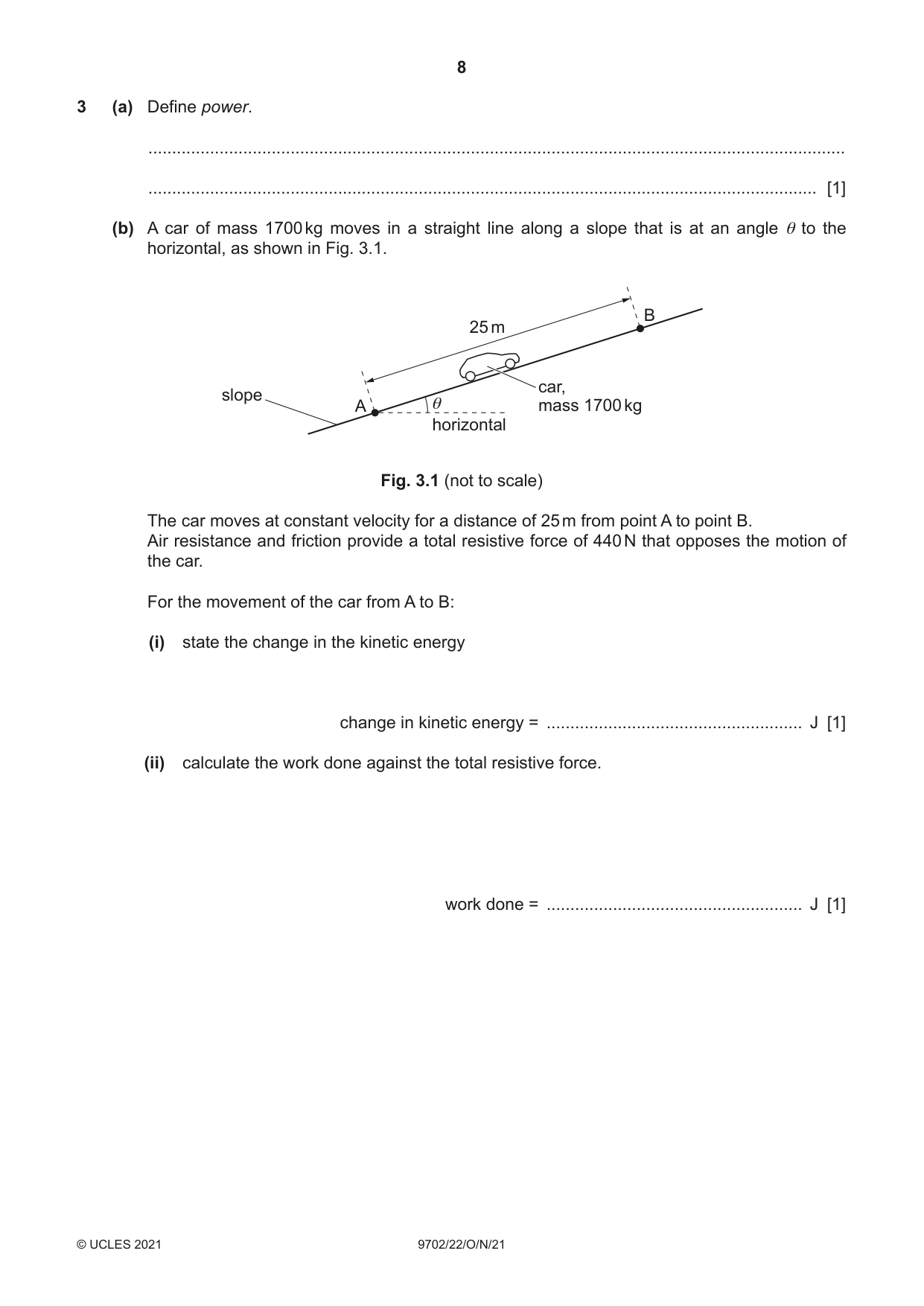
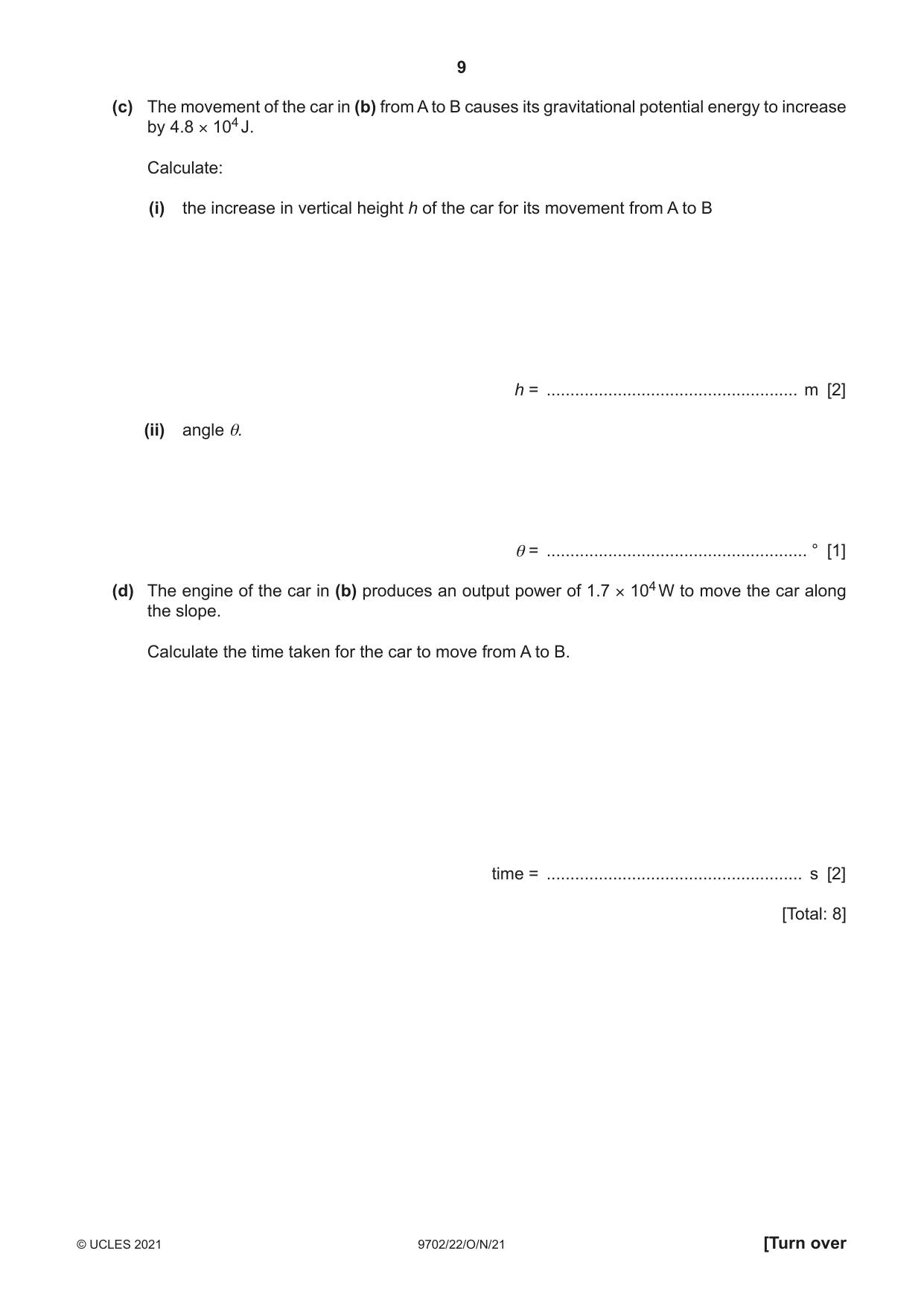
3 (a) Define power. ................................................................................................................................................... ............................................................................................................................................. [1] (b) A car of mass 1700 kg moves in a straight line along a slope that is at an angle θ to the horizontal, as shown in Fig. 3.1. B 25 m car, slope A θ mass 1700 kg horizontal Fig. 3.1 (not to scale) The car moves at constant velocity for a distance of 25 m from point A to point B. Air resistance and friction provide a total resistive force of 440 N that opposes the motion of the car. For the movement of the car from A to B: (i) state the change in the kinetic energy change in kinetic energy = ...................................................... J [1] (ii) calculate the work done against the total resistive force. work done = ...................................................... J [1] (c) The movement of the car in (b) from A to B causes its gravitational potential energy to increase by 4.8 × 10⁴ J. Calculate: (i) the increase in vertical height h of the car for its movement from A to B h = ..................................................... m [2] (ii) angle θ. θ = ....................................................... ° [1] (d) The engine of the car in (b) produces an output power of 1.7 × 10⁴ W to move the car along the slope. Calculate the time taken for the car to move from A to B. time = ...................................................... s [2] [Total: 8]
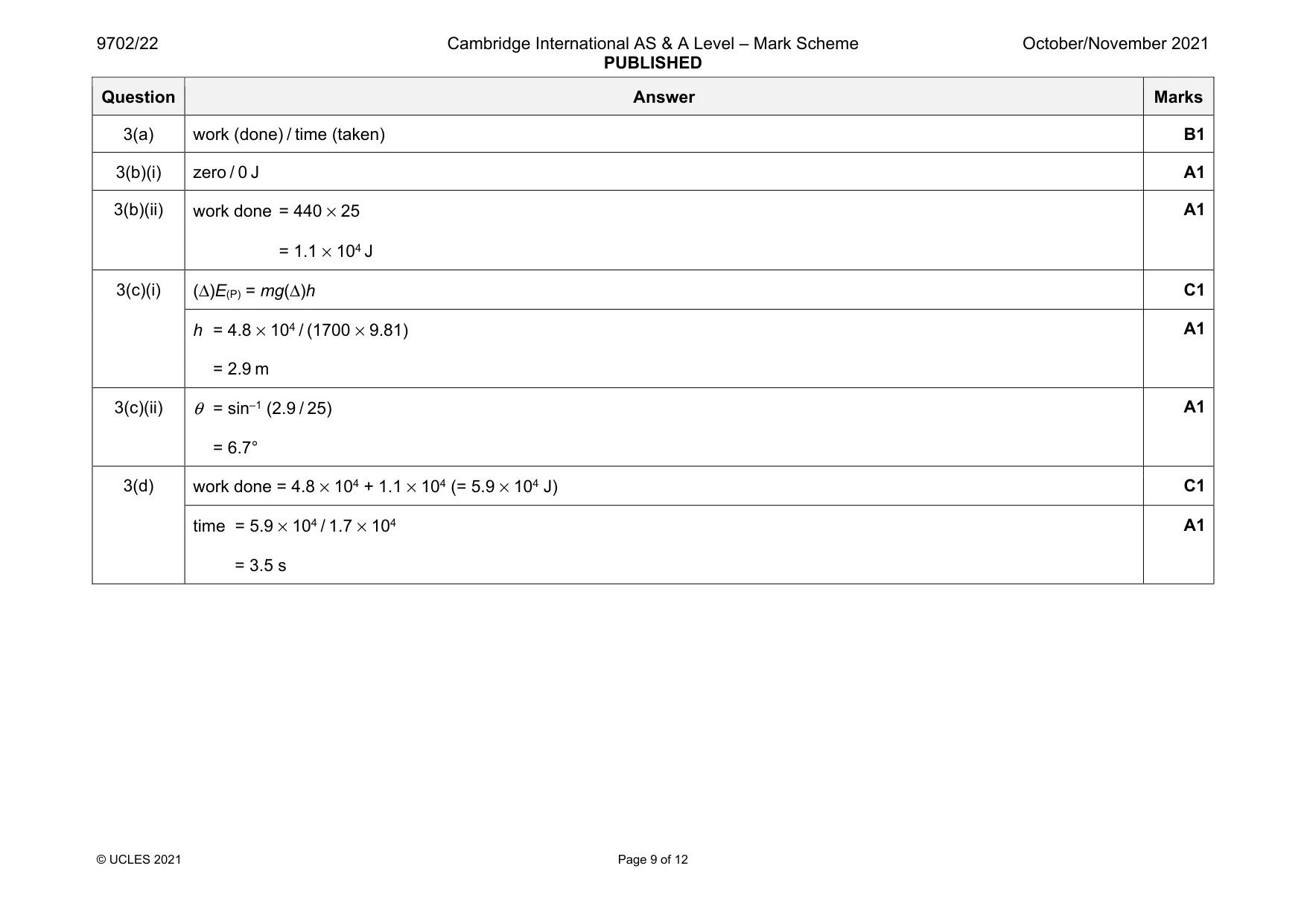
Mark scheme: 3(a) work (done) / time (taken) B1 3(b)(i) zero / 0 J A1 3(b)(ii) work done = 440 × 25 = 1.1 × 10⁴ J A1 3(c)(i) (Δ)E(P) = mg(Δ)h C1 h = 4.8 × 10⁴ / (1700 × 9.81) = 2.9 m A1 3(c)(ii) θ = sin–1 (2.9 / 25) = 6.7° A1 3(d) work done = 4.8 × 10⁴ + 1.1 × 10⁴ (= 5.9 × 10⁴ J) C1 time = 5.9 × 10⁴ / 1.7 × 104 = 3.5 s A1
Q4 · A child sits on the ground next to a remote-controlled toy car
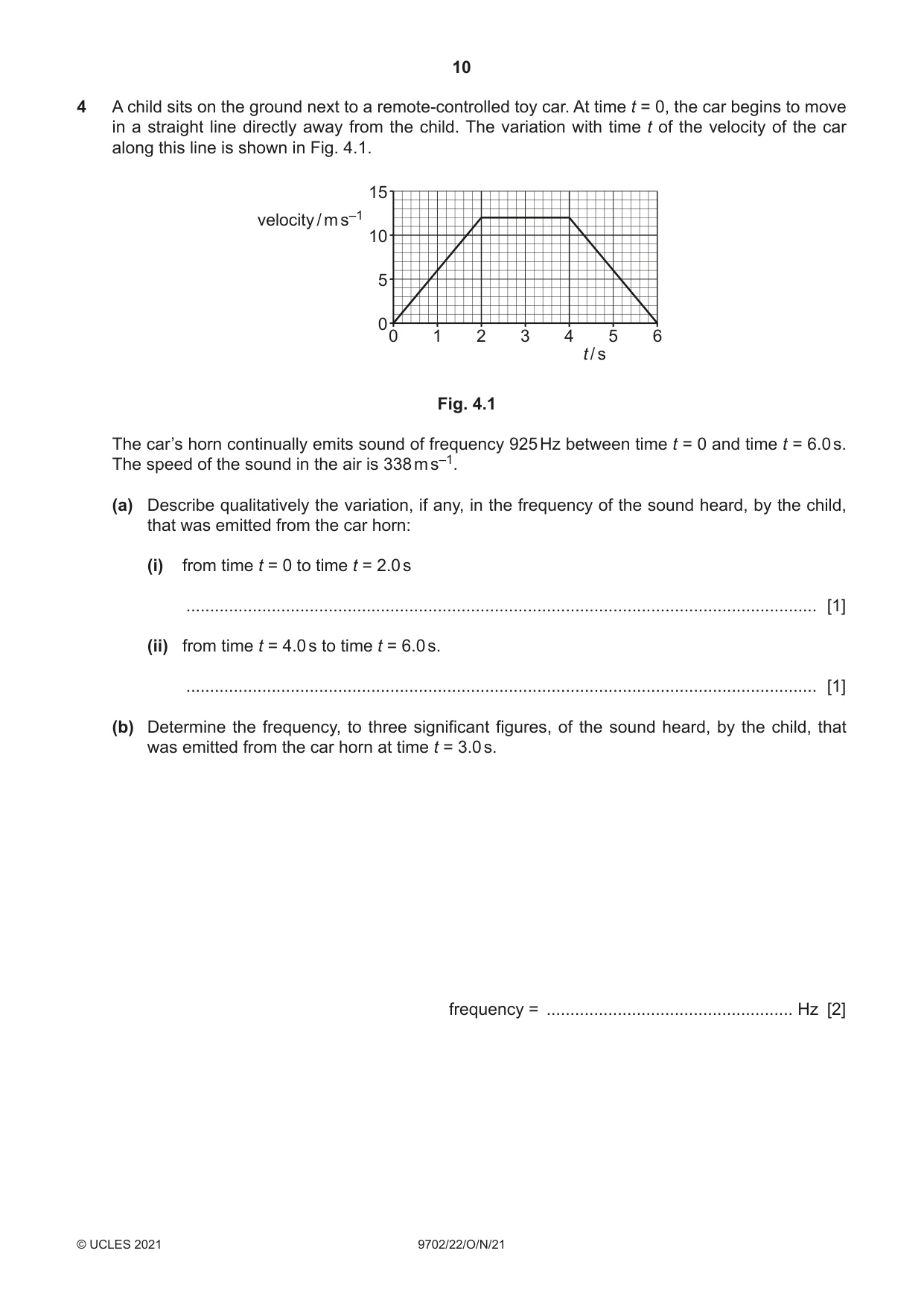
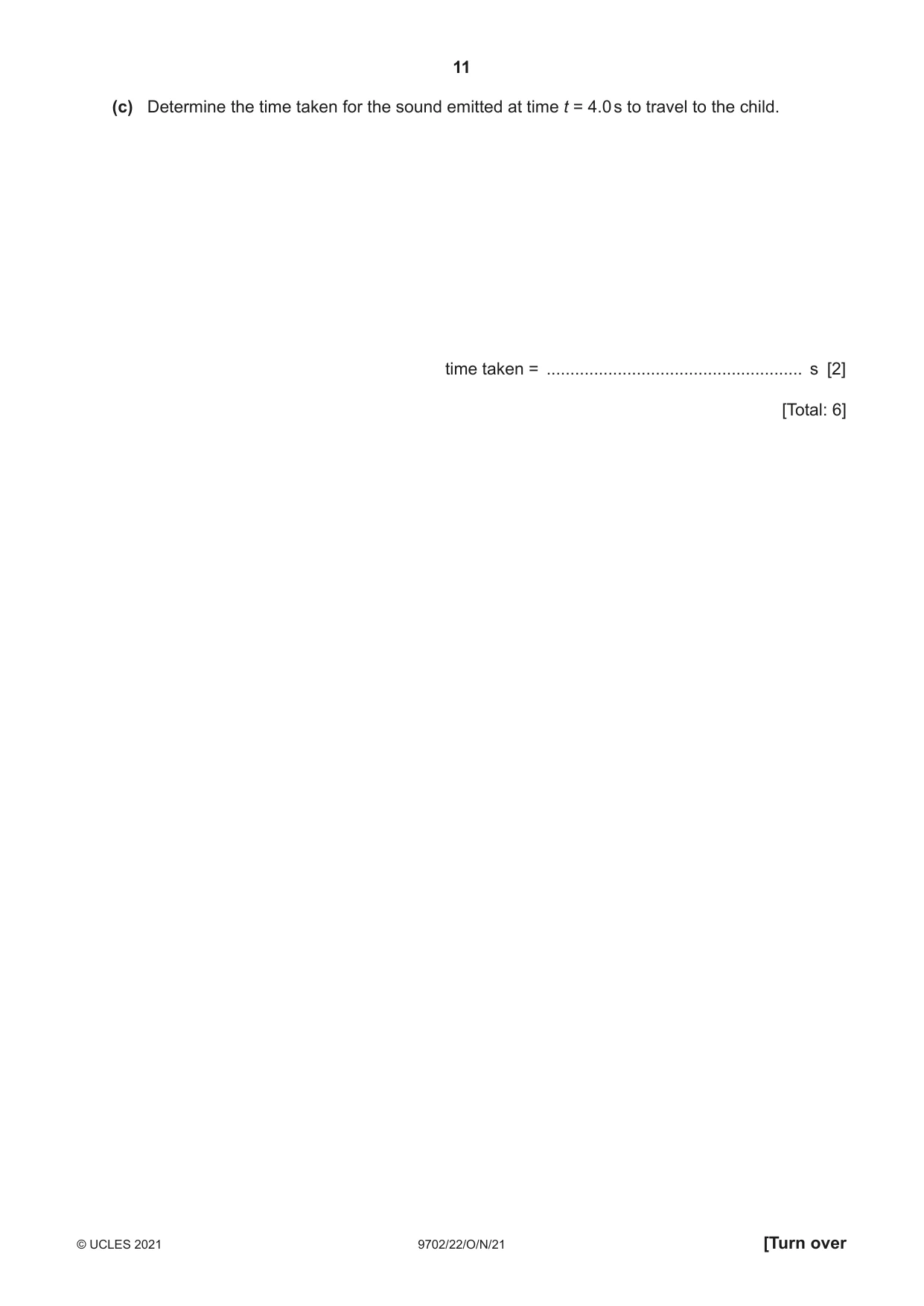
4 A child sits on the ground next to a remote-controlled toy car. At time t = 0, the car begins to move in a straight line directly away from the child. The variation with time t of the velocity of the car along this line is shown in Fig. 4.1. 15 velocity / m s–1 10 5 00 1 2 3 4 5 6 t / s Fig. 4.1 The car’s horn continually emits sound of frequency 925 Hz between time t = 0 and time t = 6.0 s. The speed of the sound in the air is 338 m s–1. (a) Describe qualitatively the variation, if any, in the frequency of the sound heard, by the child, that was emitted from the car horn: (i) from time t = 0 to time t = 2.0 s ..................................................................................................................................... [1] (ii) from time t = 4.0 s to time t = 6.0 s. ..................................................................................................................................... [1] (b) Determine the frequency, to three significant figures, of the sound heard, by the child, that was emitted from the car horn at time t = 3.0 s. frequency = .................................................... Hz [2] (c) Determine the time taken for the sound emitted at time t = 4.0 s to travel to the child. time taken = ...................................................... s [2] [Total: 6]
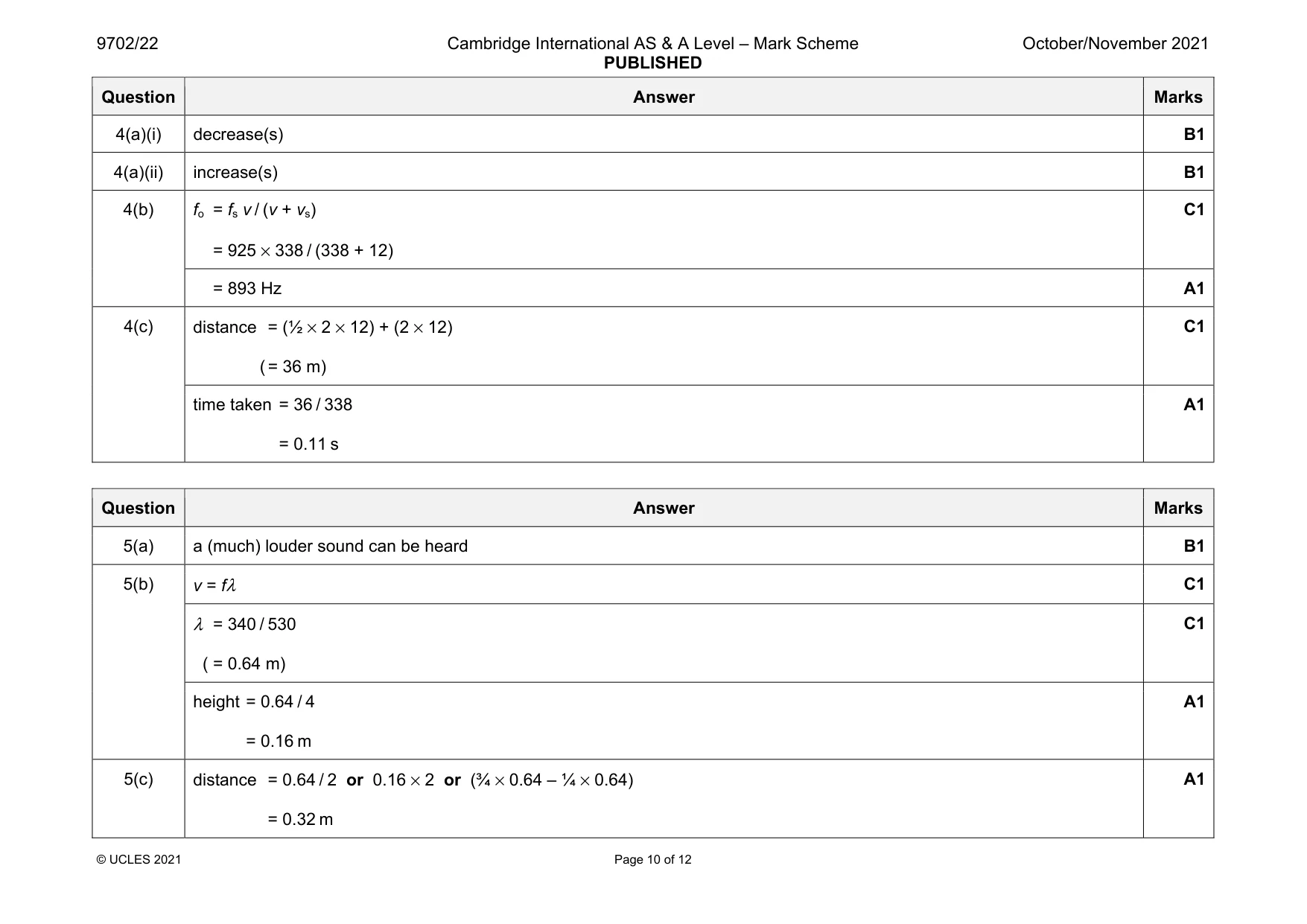
Mark scheme: 4(a)(i) decrease(s) B1 4(a)(ii) increase(s) B1 4(b) fo = fs v / (v + vs) = 925 × 338 / (338 + 12) C1 = 893 Hz A1 4(c) distance = (½ × 2 × 12) + (2 × 12) ( = 36 m) C1 time taken = 36 / 338 = 0.11 s A1
Q5 · A tube is initially fully submerged in water
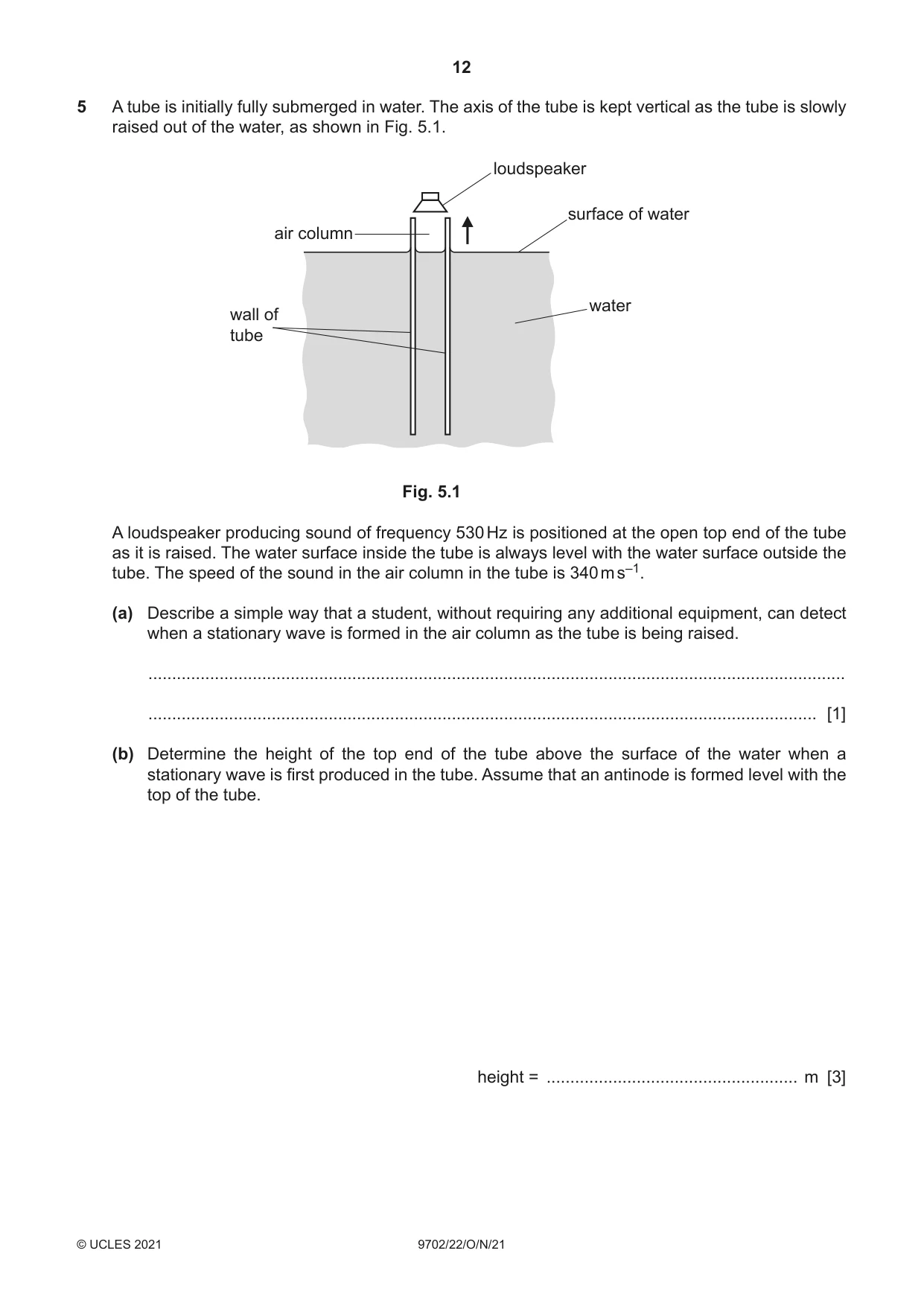
5 A tube is initially fully submerged in water. The axis of the tube is kept vertical as the tube is slowly raised out of the water, as shown in Fig. 5.1. loudspeaker surface of water air column water wall of tube Fig. 5.1 A loudspeaker producing sound of frequency 530 Hz is positioned at the open top end of the tube as it is raised. The water surface inside the tube is always level with the water surface outside the tube. The speed of the sound in the air column in the tube is 340 m s–1. (a) Describe a simple way that a student, without requiring any additional equipment, can detect when a stationary wave is formed in the air column as the tube is being raised. ................................................................................................................................................... ............................................................................................................................................. [1] (b) Determine the height of the top end of the tube above the surface of the water when a stationary wave is first produced in the tube. Assume that an antinode is formed level with the top of the tube. height = ..................................................... m [3] (c) Determine the distance moved by the tube between the positions at which the first and second stationary waves are formed. distance = ..................................................... m [1] [Total: 5]
Mark scheme: 5(a) a (much) louder sound can be heard B1 5(b) v = fλ C1 λ = 340 / 530 ( = 0.64 m) C1 height = 0.64 / 4 = 0.16 m A1 5(c) distance = 0.64 / 2 or 0.16 × 2 or (¾ × 0.64 – ¼ × 0.64) = 0.32 m A1
Q6 · A cell of electromotive force (e.m.f.) 0.48 V is connected to a metal wire X, as shown in…
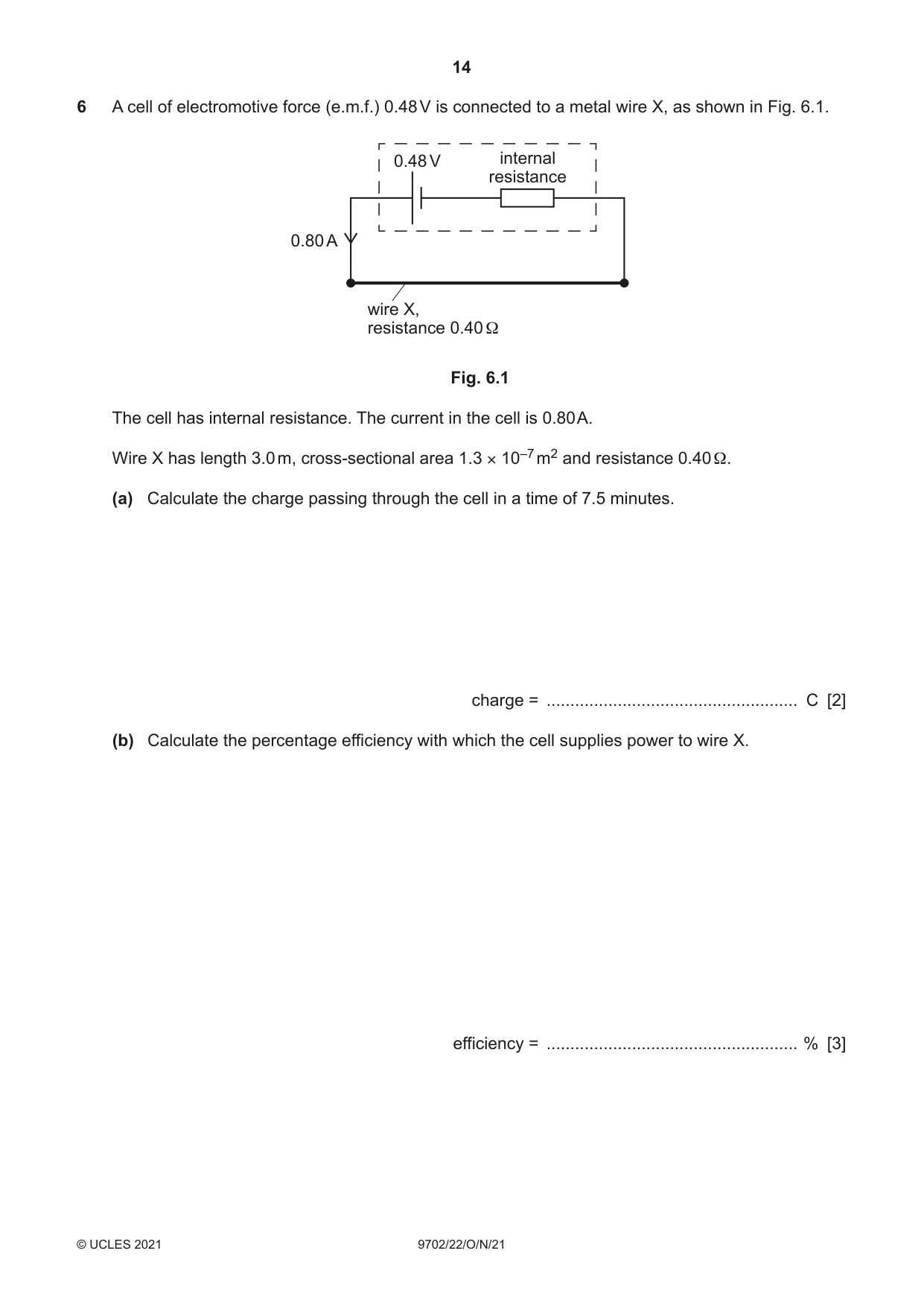
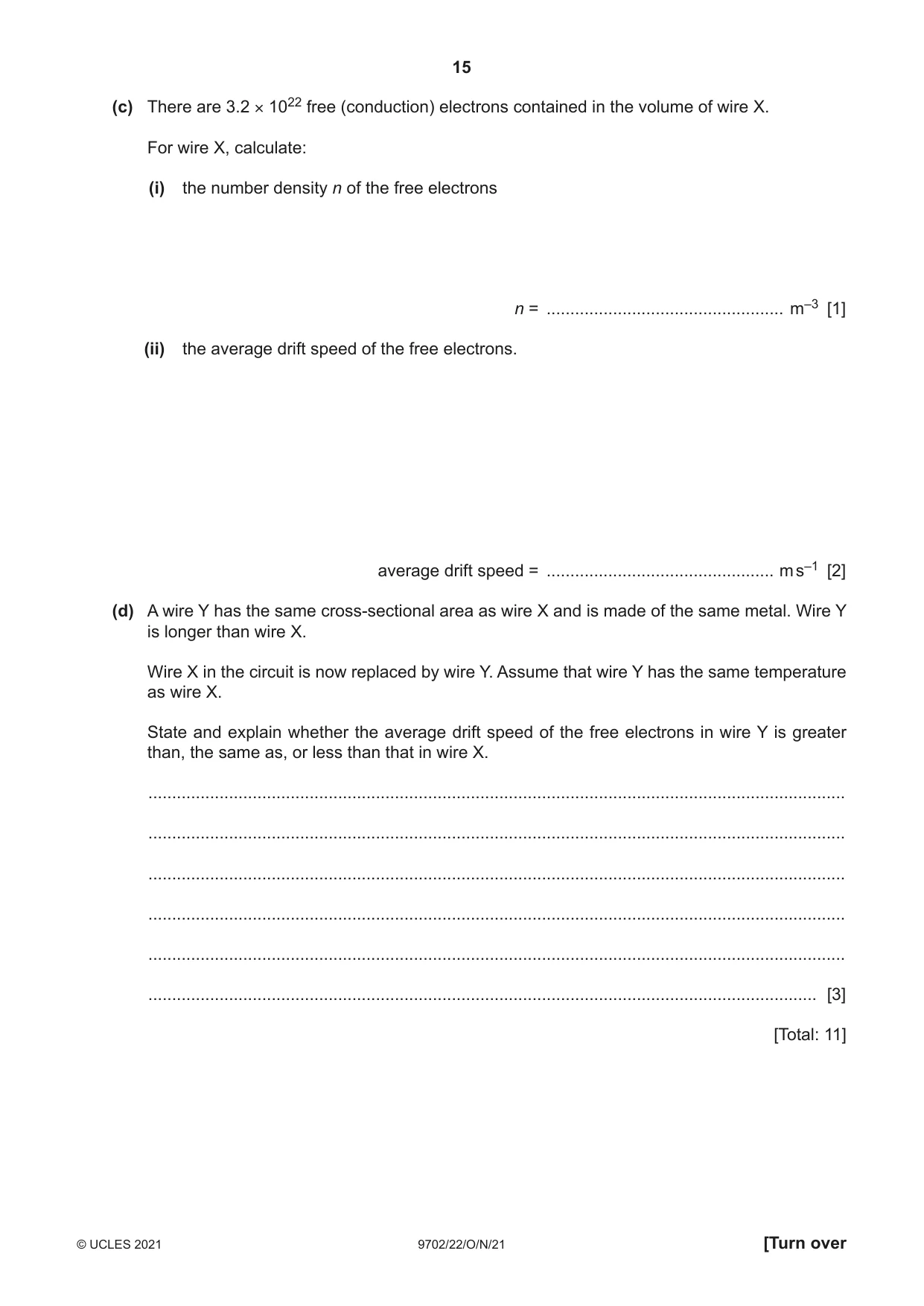
6 A cell of electromotive force (e.m.f.) 0.48 V is connected to a metal wire X, as shown in Fig. 6.1. 0.48 V internal resistance 0.80 A wire X, resistance 0.40 Ω Fig. 6.1 The cell has internal resistance. The current in the cell is 0.80 A. Wire X has length 3.0 m, cross-sectional area 1.3 × 10⁻⁷ m2 and resistance 0.40 Ω. (a) Calculate the charge passing through the cell in a time of 7.5 minutes. charge = ..................................................... C [2] (b) Calculate the percentage efficiency with which the cell supplies power to wire X. efficiency = ..................................................... % [3] (c) There are 3.2 × 10²² free (conduction) electrons contained in the volume of wire X. For wire X, calculate: (i) the number density n of the free electrons n = .................................................. m–3 [1] (ii) the average drift speed of the free electrons. average drift speed = ................................................ m s–1 [2] (d) A wire Y has the same cross-sectional area as wire X and is made of the same metal. Wire Y is longer than wire X. Wire X in the circuit is now replaced by wire Y. Assume that wire Y has the same temperature as wire X. State and explain whether the average drift speed of the free electrons in wire Y is greater than, the same as, or less than that in wire X. ................................................................................................................................................... ................................................................................................................................................... ................................................................................................................................................... ................................................................................................................................................... ................................................................................................................................................... ............................................................................................................................................. [3] [Total: 11]
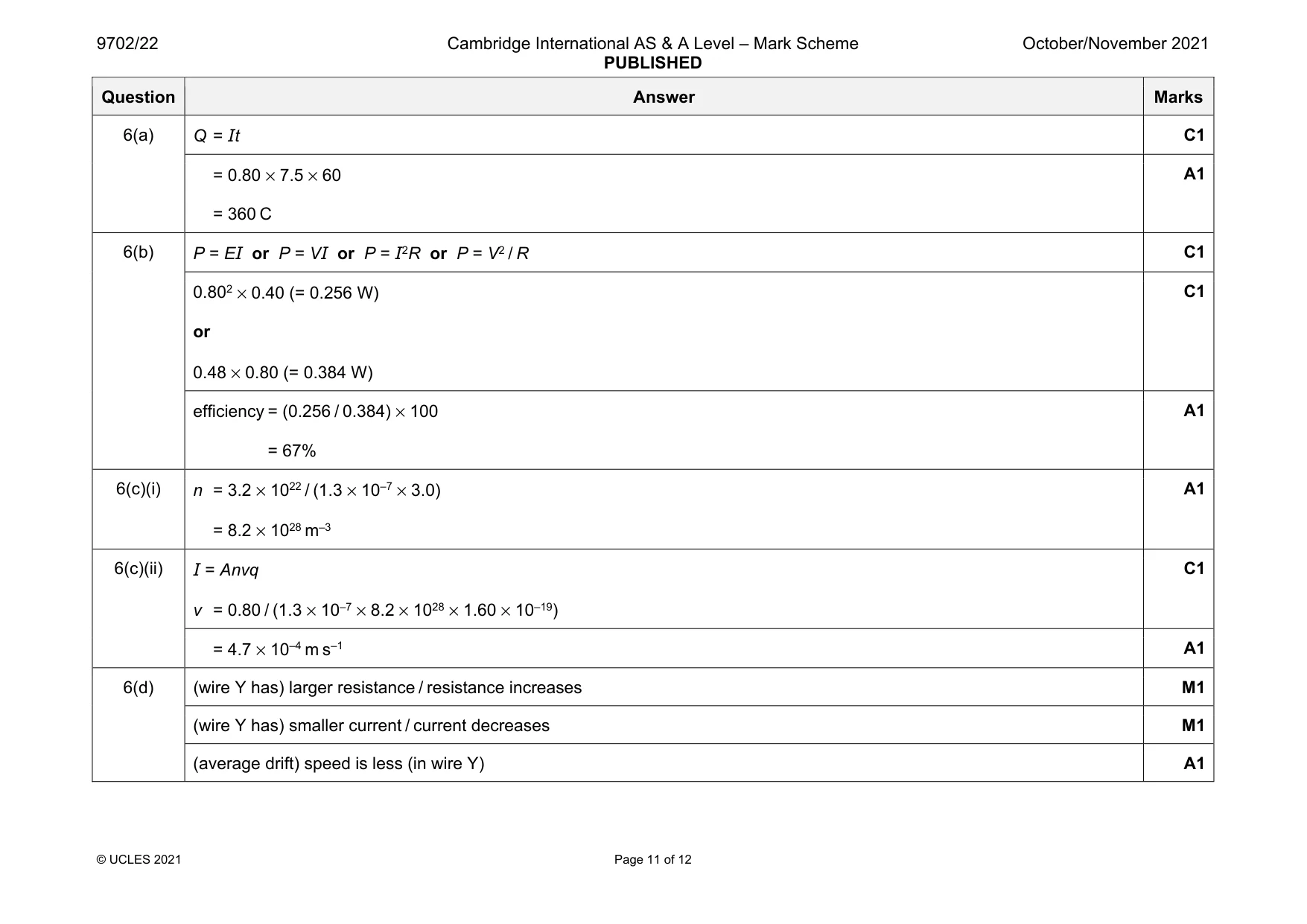
Mark scheme: 6(a) C1 = 0.80 × 7.5 × 60 = 360 C A1 6(b) P = EI or P = VI or P = I2R or P = V2 / R C1 0.802 × 0.40 (= 0.256 W) or 0.48 × 0.80 (= 0.384 W) C1 efficiency = (0.256 / 0.384) × 100 = 67% A1 6(c)(i) n = 3.2 × 10²² / (1.3 × 10–7 × 3.0) = 8.2 × 1028 m–3 A1 6(c)(ii) I = Anvq v = 0.80 / (1.3 × 10–7 × 8.2 × 1028 × 1.60 × 10–19) C1 = 4.7 × 10⁻⁴ m s–1 A1 6(d) (wire Y has) larger resistance / resistance increases M1 (wire Y has) smaller current / current decreases M1 (average drift) speed is less (in wire Y) A1
Q7 · A stationary nucleus P of mass 243 u decays by emitting an α-particle of mass 4 u to form…
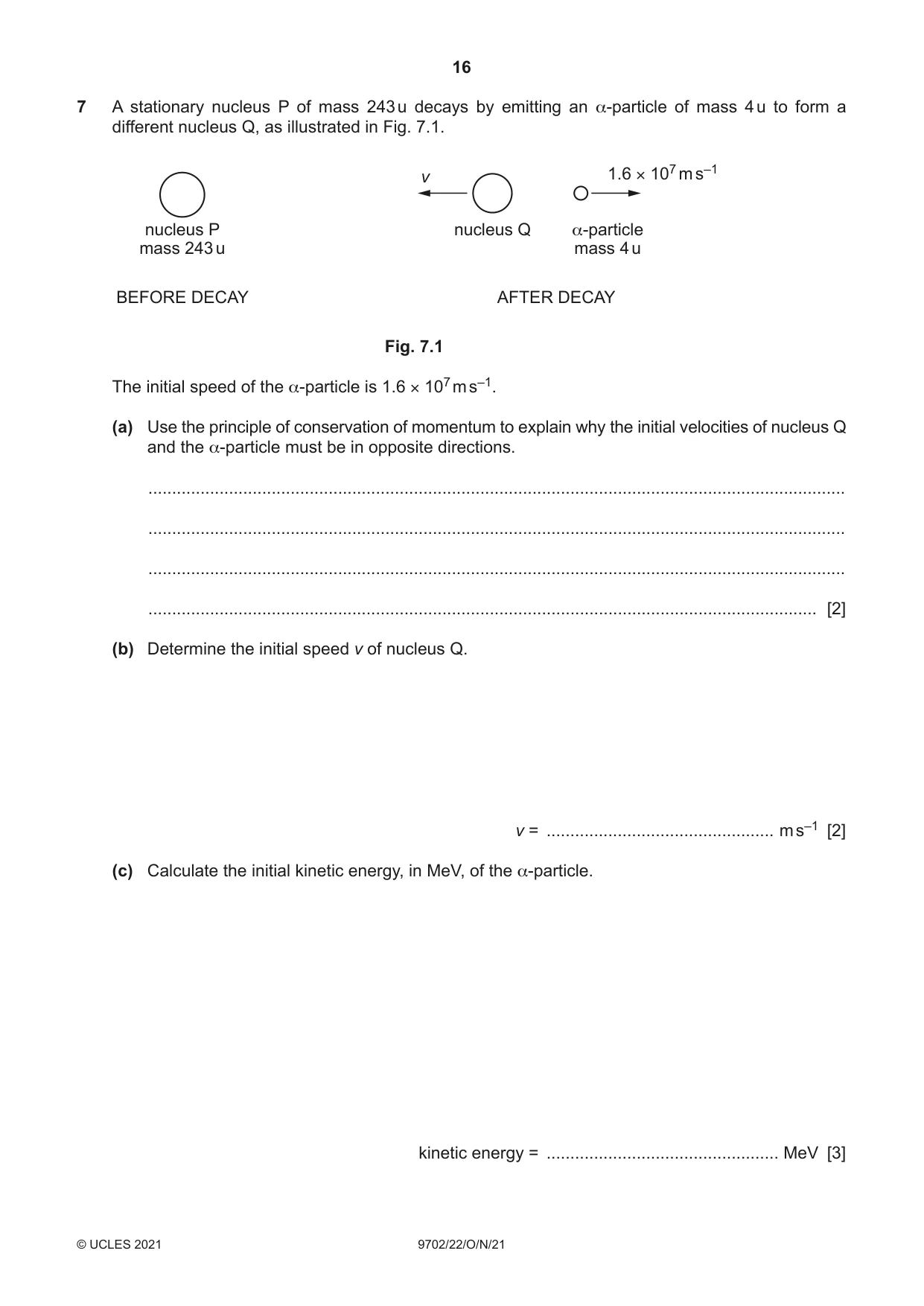
7 A stationary nucleus P of mass 243 u decays by emitting an α-particle of mass 4 u to form a different nucleus Q, as illustrated in Fig. 7.1. v 1.6 × 10⁷ m s–1 nucleus P nucleus Q α-particle mass 243 u mass 4 u BEFORE DECAY AFTER DECAY Fig. 7.1 The initial speed of the α-particle is 1.6 × 10⁷ m s–1. (a) Use the principle of conservation of momentum to explain why the initial velocities of nucleus Q and the α-particle must be in opposite directions. ................................................................................................................................................... ................................................................................................................................................... ................................................................................................................................................... ............................................................................................................................................. [2] (b) Determine the initial speed v of nucleus Q. v = ................................................ m s–1 [2] (c) Calculate the initial kinetic energy, in MeV, of the α-particle. kinetic energy = ................................................. MeV [3] (d) A graph of number of neutrons N against proton number Z is shown in Fig. 7.2. 151 150 149 number of P 148 neutrons N 147 146 14592 93 94 95 96 97 98 proton number Z Fig. 7.2 The graph shows a cross that represents nucleus P. A nucleus R has a nucleon number of 242 and is an isotope of nucleus P. Nucleus R decays by emitting a β– particle to form a different nucleus S. (i) On Fig. 7.2, draw a cross to represent: 1. nucleus R (label this cross R) 2. nucleus S (label this cross S). [2] (ii) State the name of the other lepton, in addition to the β– particle, that is emitted during the decay of nucleus R. ..................................................................................................................................... [1] [Total: 10]
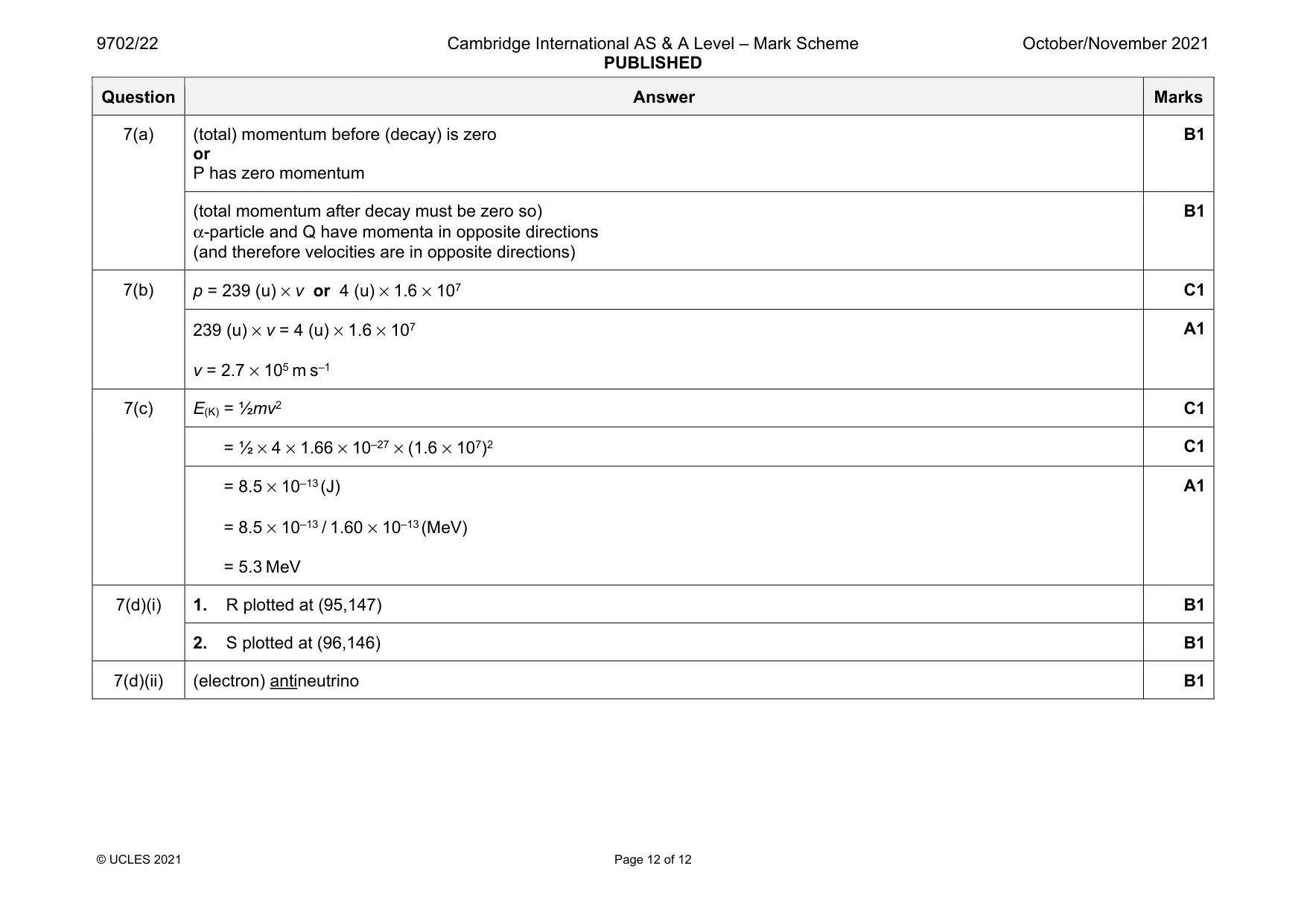
Mark scheme: 7(a) (total) momentum before (decay) is zero or P has zero momentum B1 (total momentum after decay must be zero so) α-particle and Q have momenta in opposite directions (and therefore velocities are in opposite directions) B1 7(b) p = 239 (u) × v or 4 (u) × 1.6 × 10⁷ C1 239 (u) × v = 4 (u) × 1.6 × 10⁷ v = 2.7 × 10⁵ m s–1 A1 7(c) E(K) = ½mv2 C1 = ½ × 4 × 1.66 × 10–27 × (1.6 × 107)2 C1 = 8.5 × 10⁻¹³ (J) = 8.5 × 10⁻¹³ / 1.60 × 10⁻¹³ (MeV) = 5.3 MeV A1 7(d)(i) 1. R plotted at (95,147) B1 2. S plotted at (96,146) B1 7(d)(ii) (electron) antineutrino B1
What was in this paper
The subtopics covered by these 7 questions, and how many questions each got. Open one in a new tab to see every Cambridge question on it.
What you needed in this session
Cambridge’s own grade thresholds for 2021 Oct/Nov, Paper 2 · Variant 2. A higher threshold means an easier paper — the bar moves with how the cohort did.