Cambridge A Level Physics 9702 — 2019 Oct/Nov Paper 2 · Variant 2
9702/22/O/N/19 · 7 questions · 60 marks · ≈68 min
The question paper and its mark scheme, free to read here and free to download. This is Cambridge’s own paper, exactly as it was sat.
Question paper16 pages

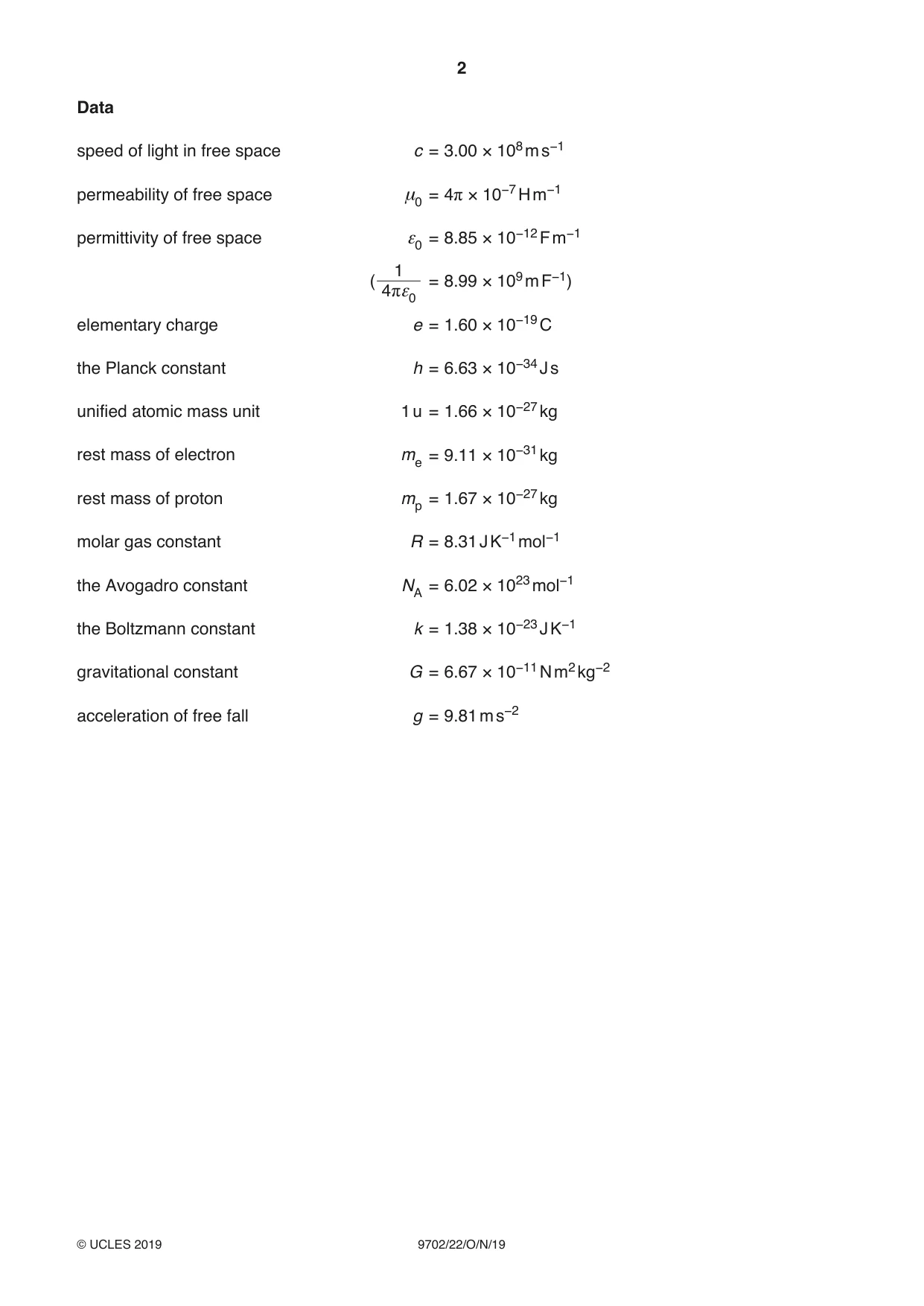
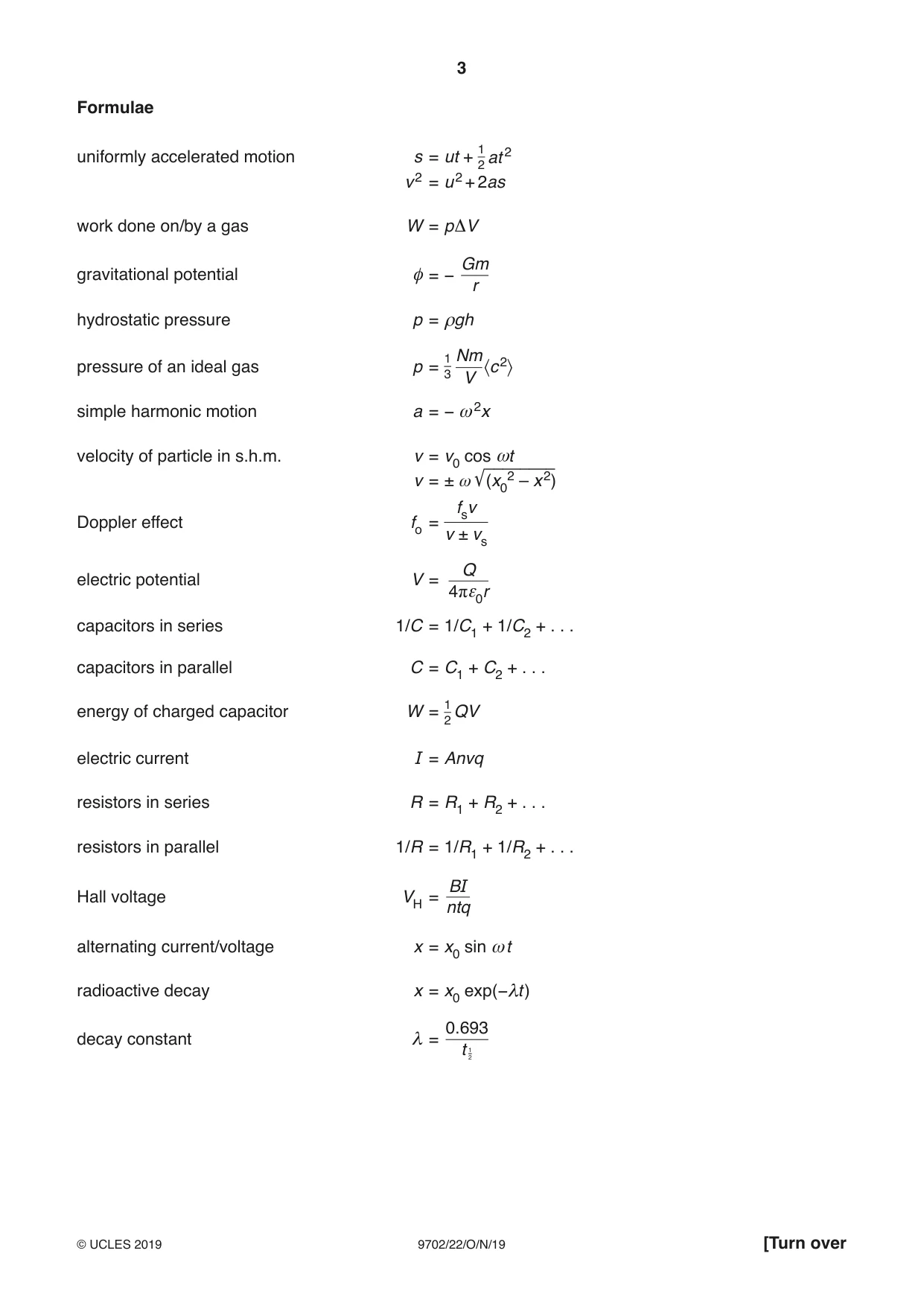

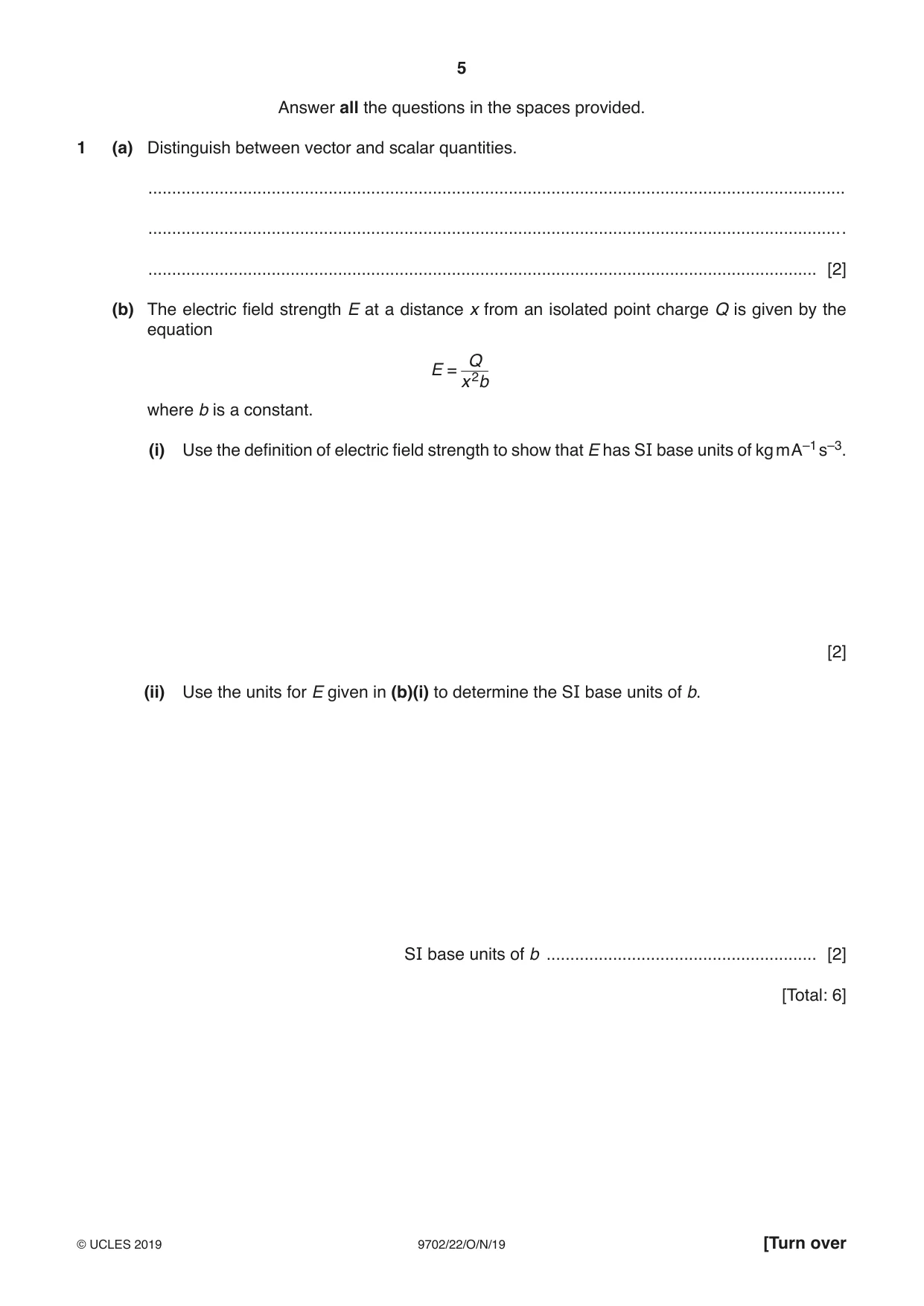
Mark scheme10 pages
Answers below. Sit the paper first if you are practising.

Questions as text
Q1 · Distinguish between vector and scalar quantities
1 (a) Distinguish between vector and scalar quantities. ................................................................................................................................................... ................................................................................................................................................... ............................................................................................................................................. [2] (b) The electric field strength E at a distance x from an isolated point charge Q is given by the equation Q E = x 2b where b is a constant. (i) Use the definition of electric field strength to show that E has SI base units of kg m A–1 s–3. [2] (ii) Use the units for E given in (b)(i) to determine the SI base units of b. SI base units of b ......................................................... [2] [Total: 6]
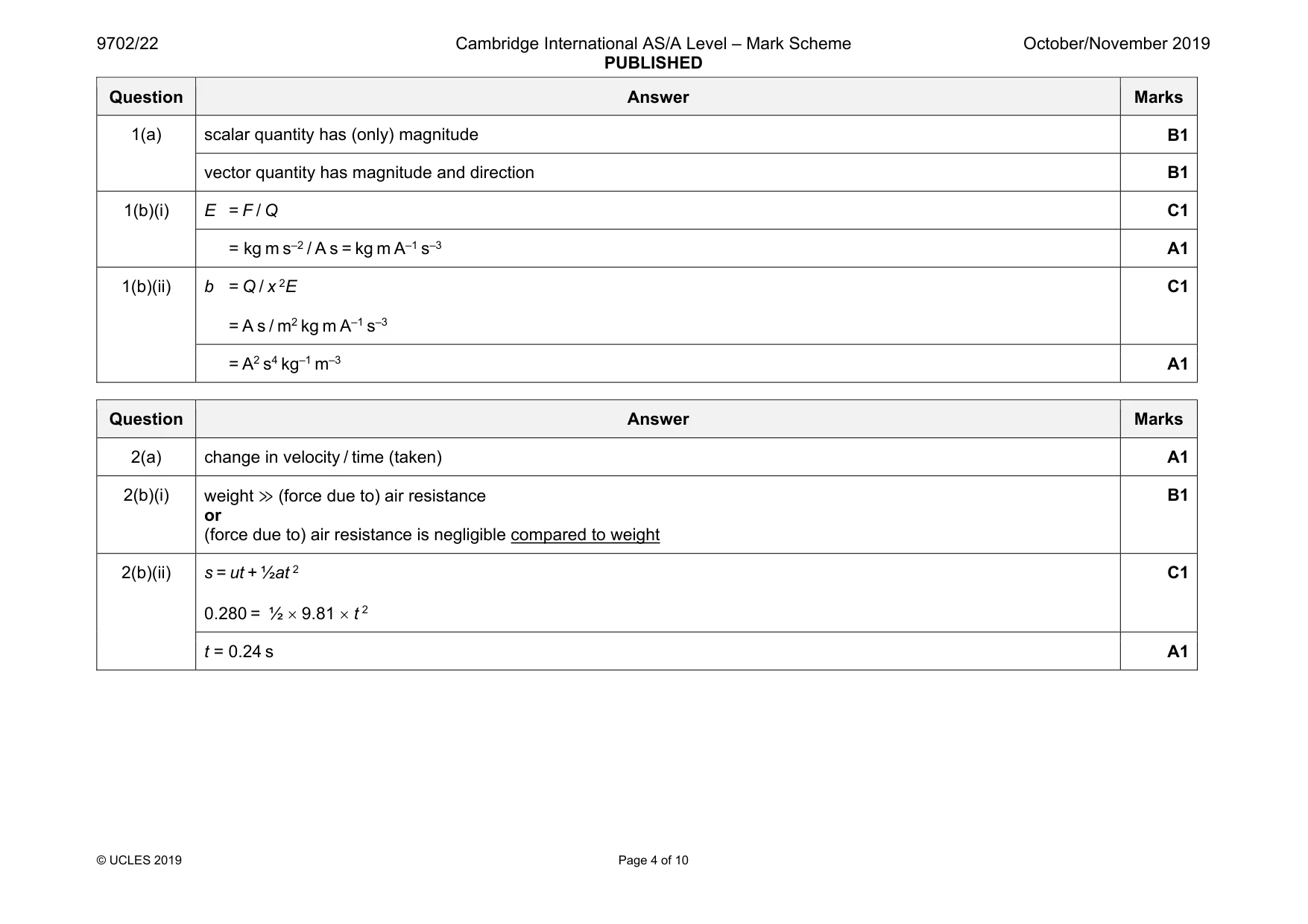
Mark scheme: 1(a) scalar quantity has (only) magnitude B1 vector quantity has magnitude and direction B1 1(b)(i) E = F / Q C1 = kg m s–2 / A s = kg m A–1 s–3 A1 1(b)(ii) b = Q / x 2E = A s / m2 kg m A–1 s–3 C1 = A2 s4 kg–1 m–3 A1
Question 2
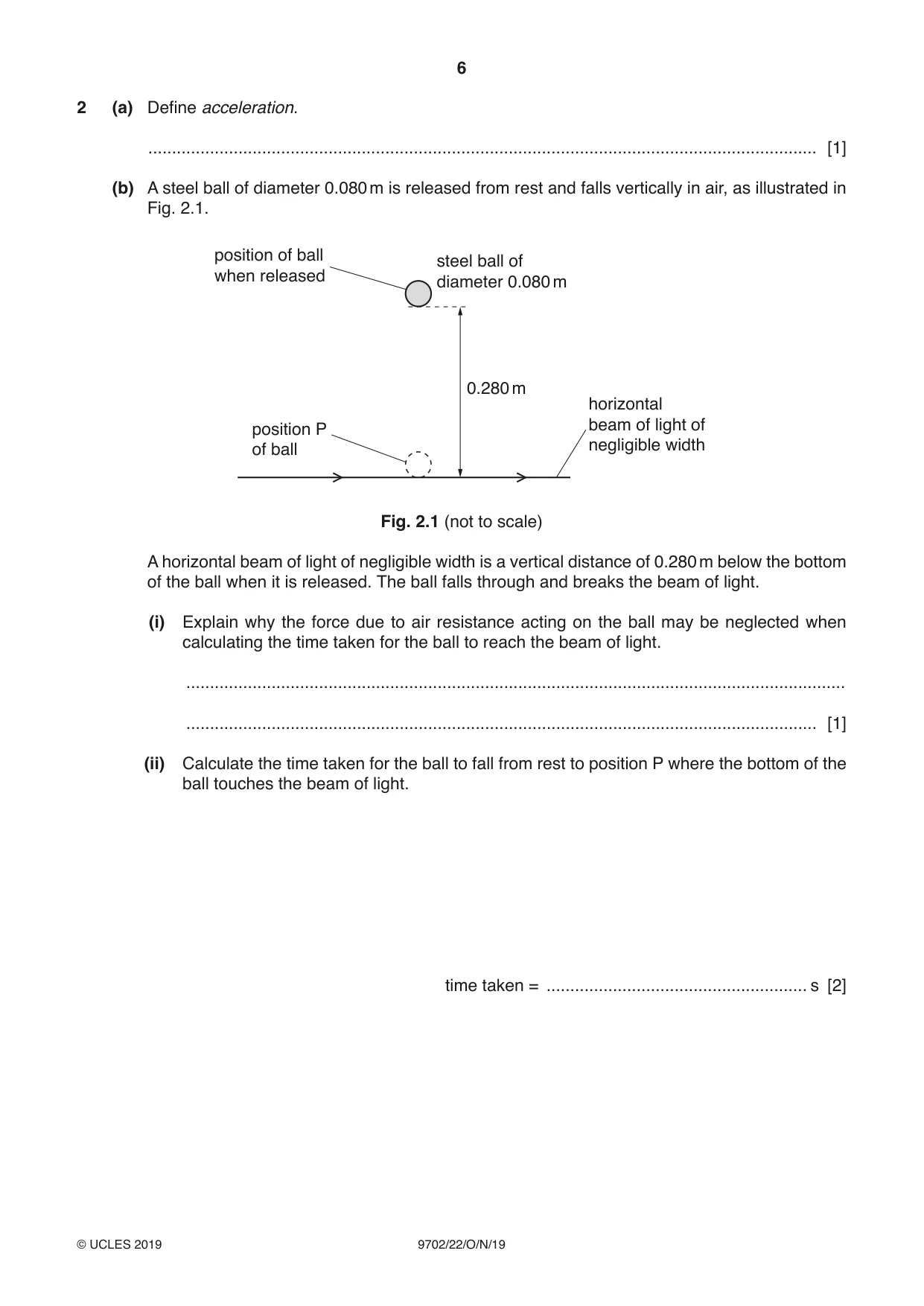
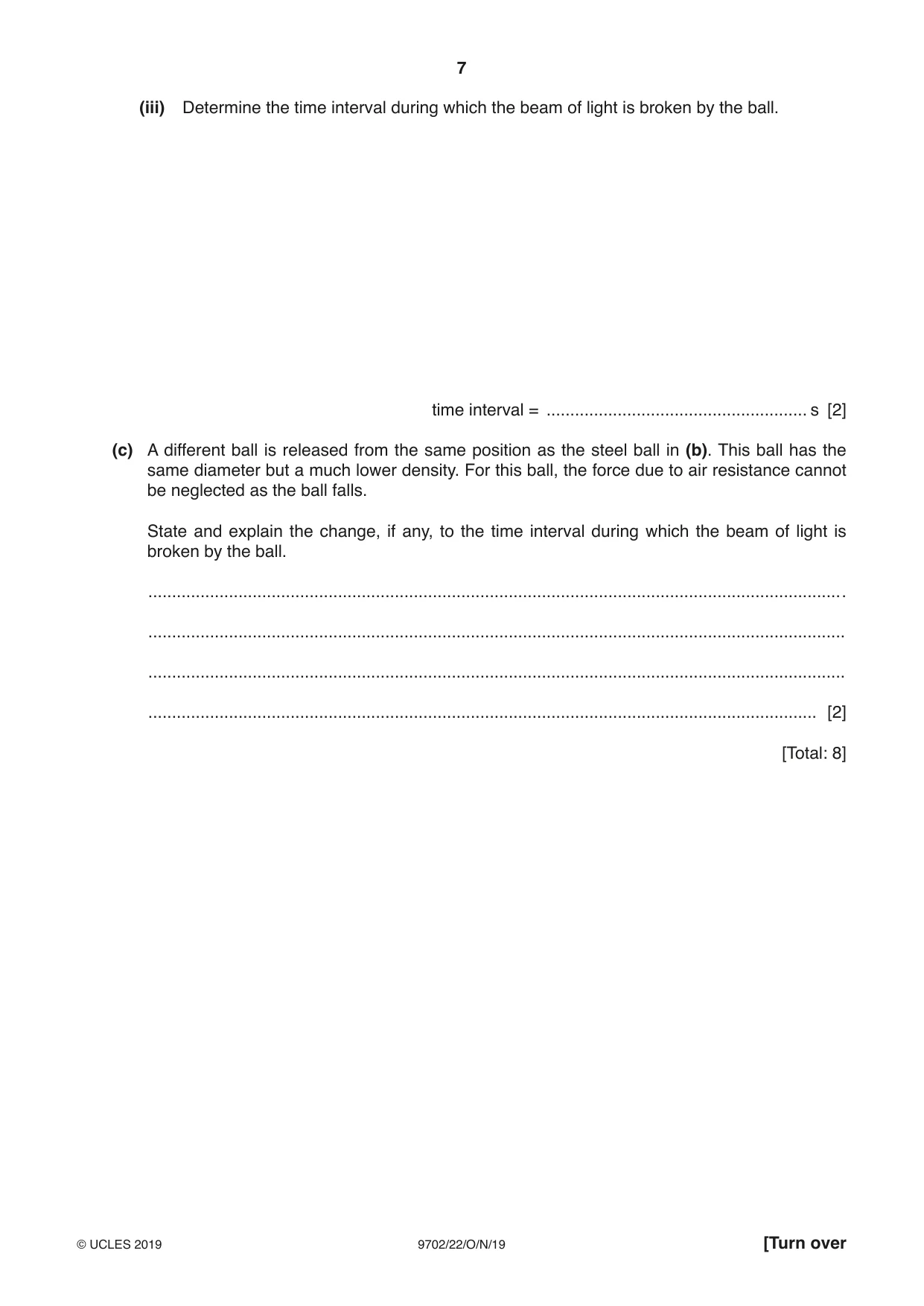
2 (a) Define acceleration. ............................................................................................................................................. [1] (b) A steel ball of diameter 0.080 m is released from rest and falls vertically in air, as illustrated in Fig. 2.1. position of ball steel ball of when released diameter 0.080 m 0.280 m horizontal beam of light of position P negligible width of ball Fig. 2.1 (not to scale) A horizontal beam of light of negligible width is a vertical distance of 0.280 m below the bottom of the ball when it is released. The ball falls through and breaks the beam of light. (i) Explain why the force due to air resistance acting on the ball may be neglected when calculating the time taken for the ball to reach the beam of light. ........................................................................................................................................... ..................................................................................................................................... [1] (ii) Calculate the time taken for the ball to fall from rest to position P where the bottom of the ball touches the beam of light. time taken = ....................................................... s [2] (iii) Determine the time interval during which the beam of light is broken by the ball. time interval = ....................................................... s [2] (c) A different ball is released from the same position as the steel ball in (b). This ball has the same diameter but a much lower density. For this ball, the force due to air resistance cannot be neglected as the ball falls. State and explain the change, if any, to the time interval during which the beam of light is broken by the ball. ................................................................................................................................................... ................................................................................................................................................... ................................................................................................................................................... ............................................................................................................................................. [2] [Total: 8]
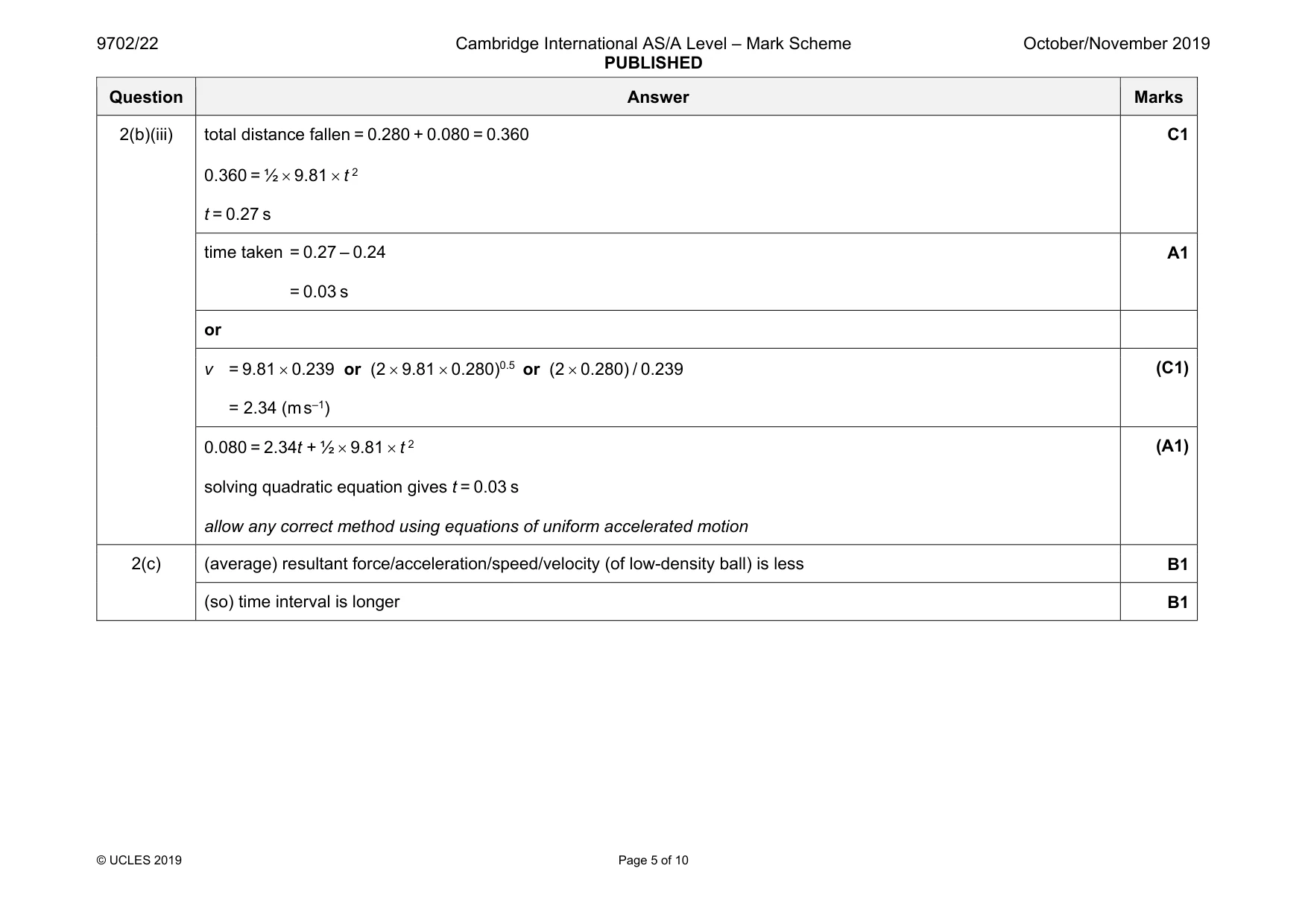
Mark scheme: 2(a) change in velocity / time (taken) A1 2(b)(i) weight ≫ (force due to) air resistance or (force due to) air resistance is negligible compared to weight B1 2(b)(ii) s = ut + ½at 2 0.280 = ½ × 9.81 × t 2 C1 t = 0.24 s A1 Question Answer Marks 2(b)(iii) total distance fallen = 0.280 + 0.080 = 0.360 0.360 = ½ × 9.81 × t 2 t = 0.27 s C1 time taken = 0.27 – 0.24 = 0.03 s A1 or v = 9.81 × 0.239 or (2 × 9.81 × 0.280)0.5 or (2 × 0.280) / 0.239 v = 2.34 (m s–1) (C1) 0.080 = 2.34t + ½ × 9.81 × t 2 solving quadratic equation gives t = 0.03 s allow any correct method using equations of uniform accelerated motion (A1) 2(c) (average) resultant force/acceleration/speed/velocity (of low-density ball) is less B1 (so) time interval is longer B1
Q3 · State Newton’s third law of motion
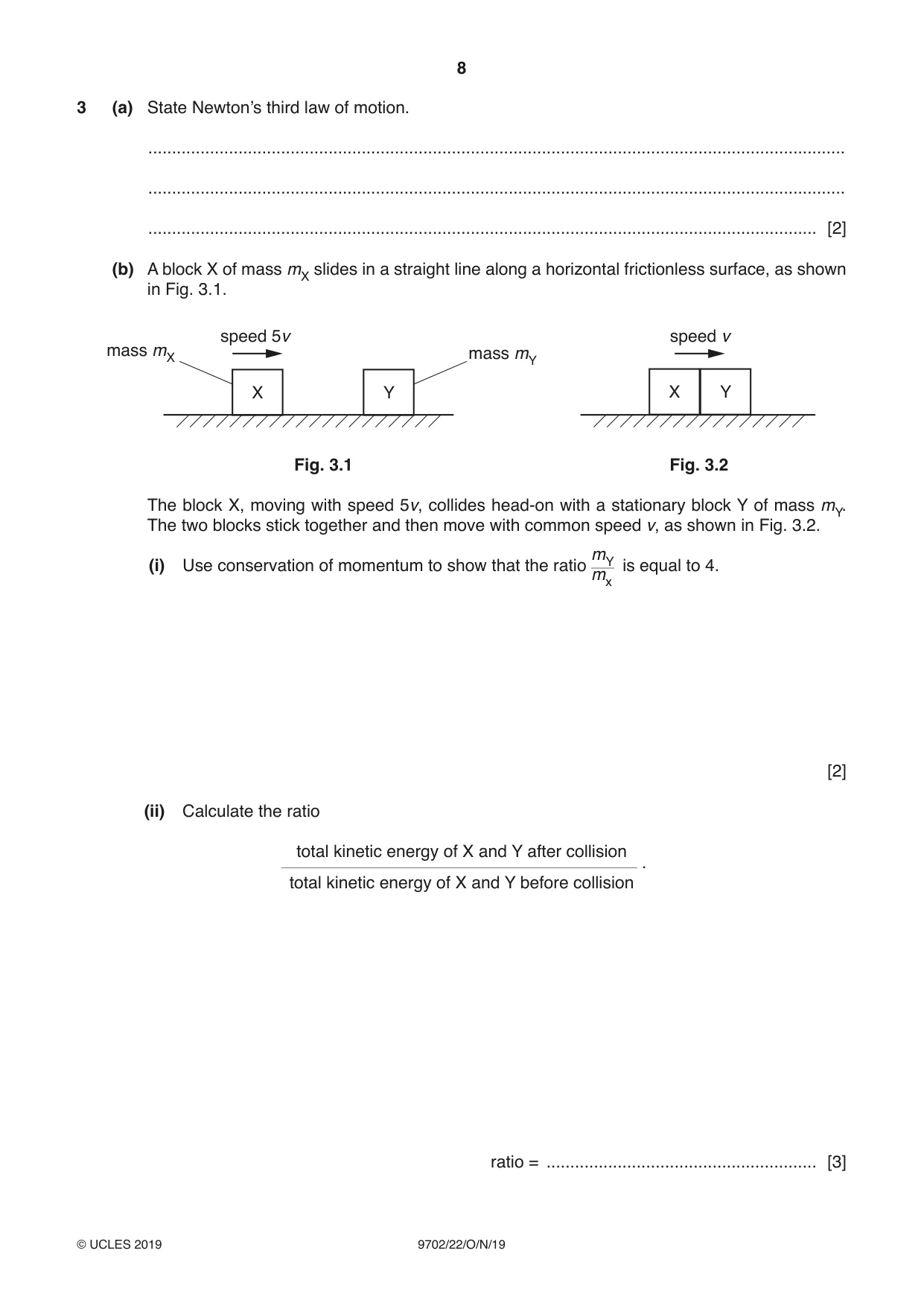
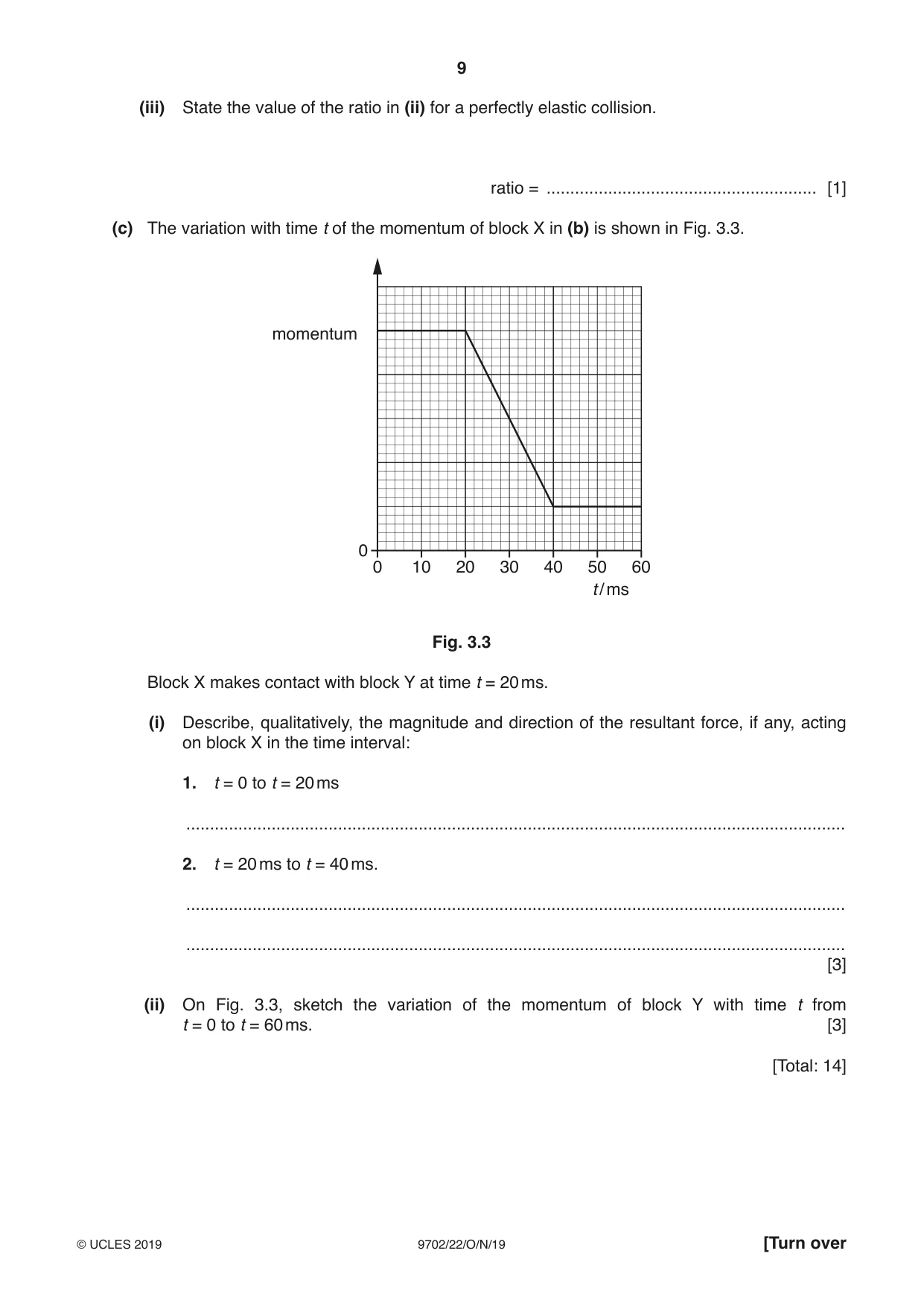
3 (a) State Newton’s third law of motion. ................................................................................................................................................... ................................................................................................................................................... ............................................................................................................................................. [2] (b) A block X of mass mX slides in a straight line along a horizontal frictionless surface, as shown in Fig. 3.1. speed 5v speed v mass mX mass mY X Y X Y Fig. 3.1 Fig. 3.2 The block X, moving with speed 5v, collides head-on with a stationary block Y of mass mY. The two blocks stick together and then move with common speed v, as shown in Fig. 3.2. mY (i) Use conservation of momentum to show that the ratio is equal to 4. mx [2] (ii) Calculate the ratio total kinetic energy of X and Y after collision . total kinetic energy of X and Y before collision ratio = ......................................................... [3] (iii) State the value of the ratio in (ii) for a perfectly elastic collision. ratio = ......................................................... [1] (c) The variation with time t of the momentum of block X in (b) is shown in Fig. 3.3. momentum 0 0 10 20 30 40 50 60 t / ms Fig. 3.3 Block X makes contact with block Y at time t = 20 ms. (i) Describe, qualitatively, the magnitude and direction of the resultant force, if any, acting on block X in the time interval: 1. t = 0 to t = 20 ms ........................................................................................................................................... 2. t = 20 ms to t = 40 ms. ........................................................................................................................................... ........................................................................................................................................... [3] (ii) On Fig. 3.3, sketch the variation of the momentum of block Y with time t from t = 0 to t = 60 ms. [3] [Total: 14]
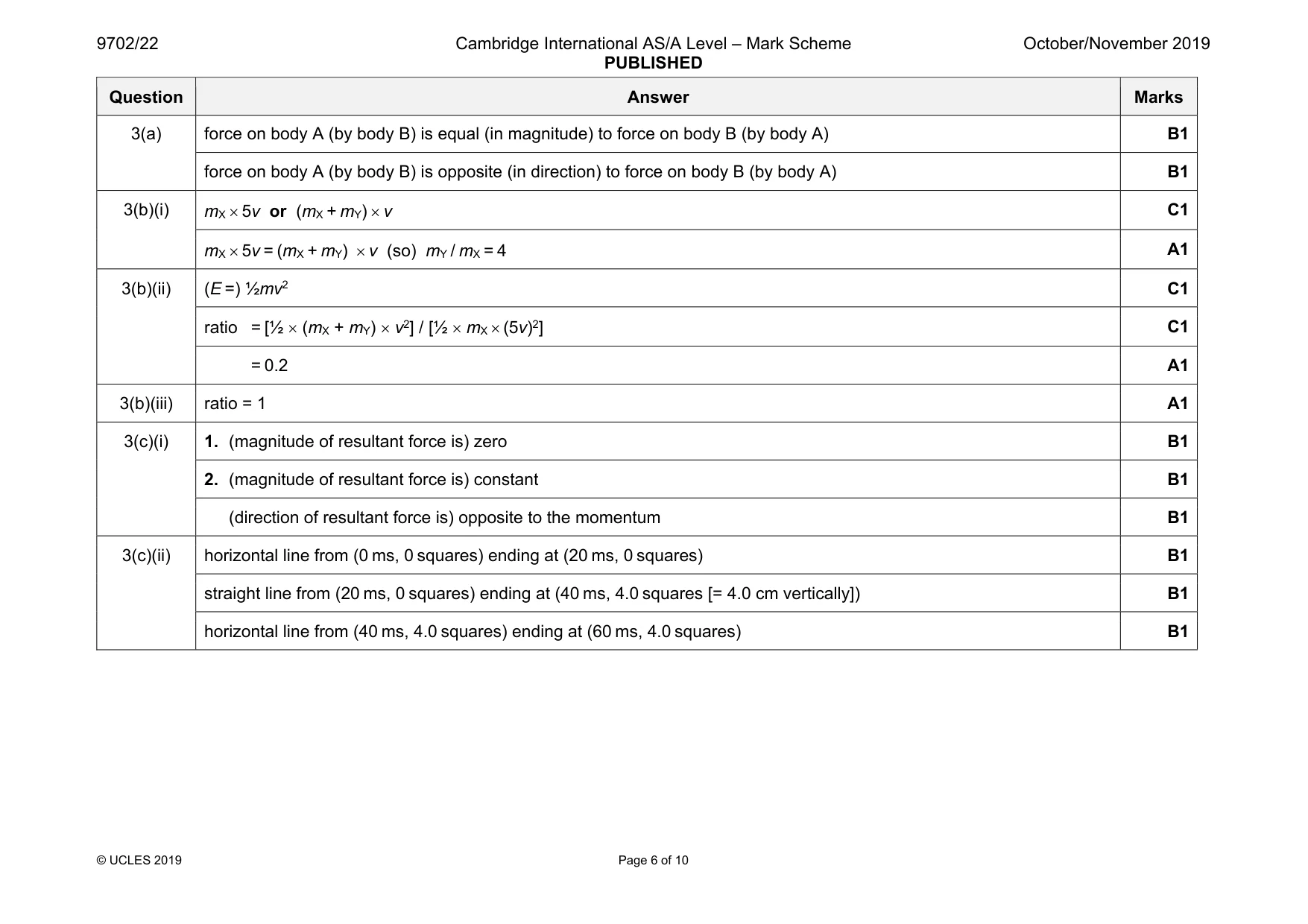
Mark scheme: 3(a) force on body A (by body B) is equal (in magnitude) to force on body B (by body A) B1 force on body A (by body B) is opposite (in direction) to force on body B (by body A) B1 3(b)(i) mX × 5v or (mX + mY) × v C1 mX × 5v = (mX + mY) × v (so) mY / mX = 4 A1 3(b)(ii) (E =) ½mv2 C1 ratio = [½ × (mX + mY) × v2] / [½ × mX × (5v)2] C1 ratio = 0.2 A1 3(b)(iii) ratio = 1 A1 3(c)(i) 1. (magnitude of resultant force is) zero B1 2. (magnitude of resultant force is) constant B1 (direction of resultant force is) opposite to the momentum B1 3(c)(ii) horizontal line from (0 ms, 0 squares) ending at (20 ms, 0 squares) B1 straight line from (20 ms, 0 squares) ending at (40 ms, 4.0 squares [= 4.0 cm vertically]) B1 horizontal line from (40 ms, 4.0 squares) ending at (60 ms, 4.0 squares) B1
Q4 · A sphere in a liquid accelerates vertically downwards from rest
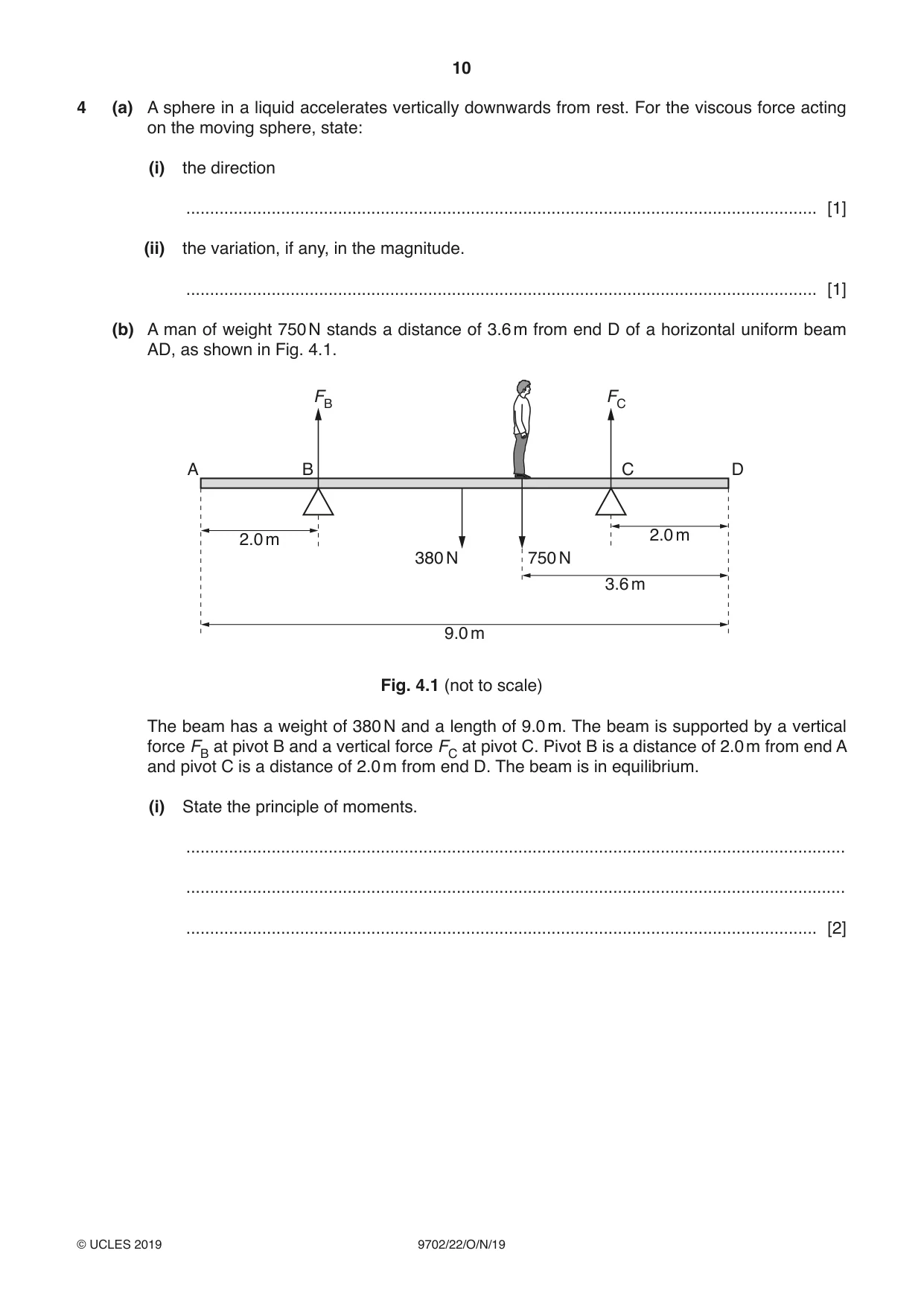
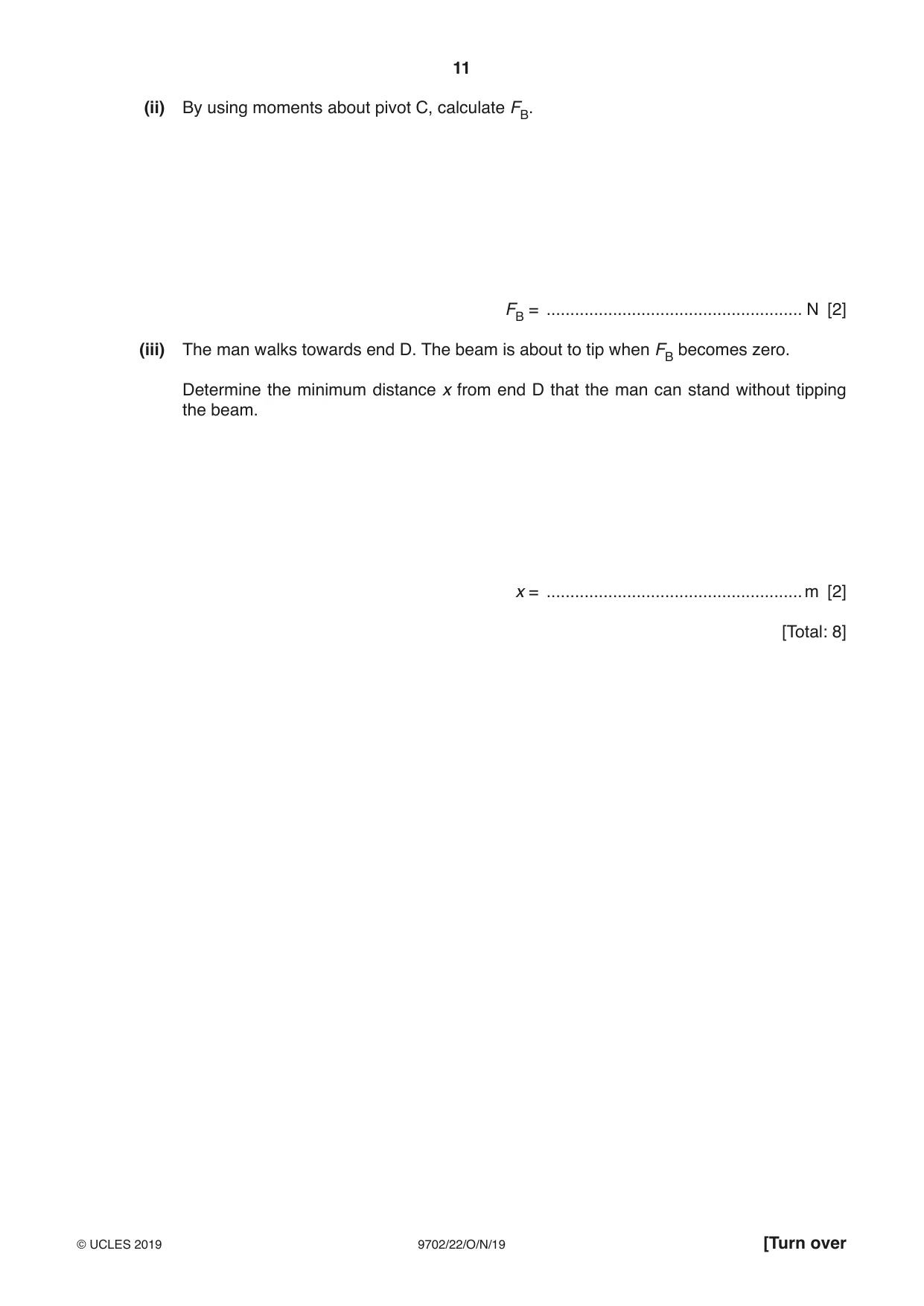
4 (a) A sphere in a liquid accelerates vertically downwards from rest. For the viscous force acting on the moving sphere, state: (i) the direction ..................................................................................................................................... [1] (ii) the variation, if any, in the magnitude. ..................................................................................................................................... [1] (b) A man of weight 750 N stands a distance of 3.6 m from end D of a horizontal uniform beam AD, as shown in Fig. 4.1. FB FC A B C D 2.0 m 2.0 m 380 N 750 N 3.6 m 9.0 m Fig. 4.1 (not to scale) The beam has a weight of 380 N and a length of 9.0 m. The beam is supported by a vertical force FB at pivot B and a vertical force FC at pivot C. Pivot B is a distance of 2.0 m from end A and pivot C is a distance of 2.0 m from end D. The beam is in equilibrium. (i) State the principle of moments. ........................................................................................................................................... ........................................................................................................................................... ..................................................................................................................................... [2] (ii) By using moments about pivot C, calculate FB. FB = ...................................................... N [2] (iii) The man walks towards end D. The beam is about to tip when FB becomes zero. Determine the minimum distance x from end D that the man can stand without tipping the beam. x = ......................................................m [2] [Total: 8]
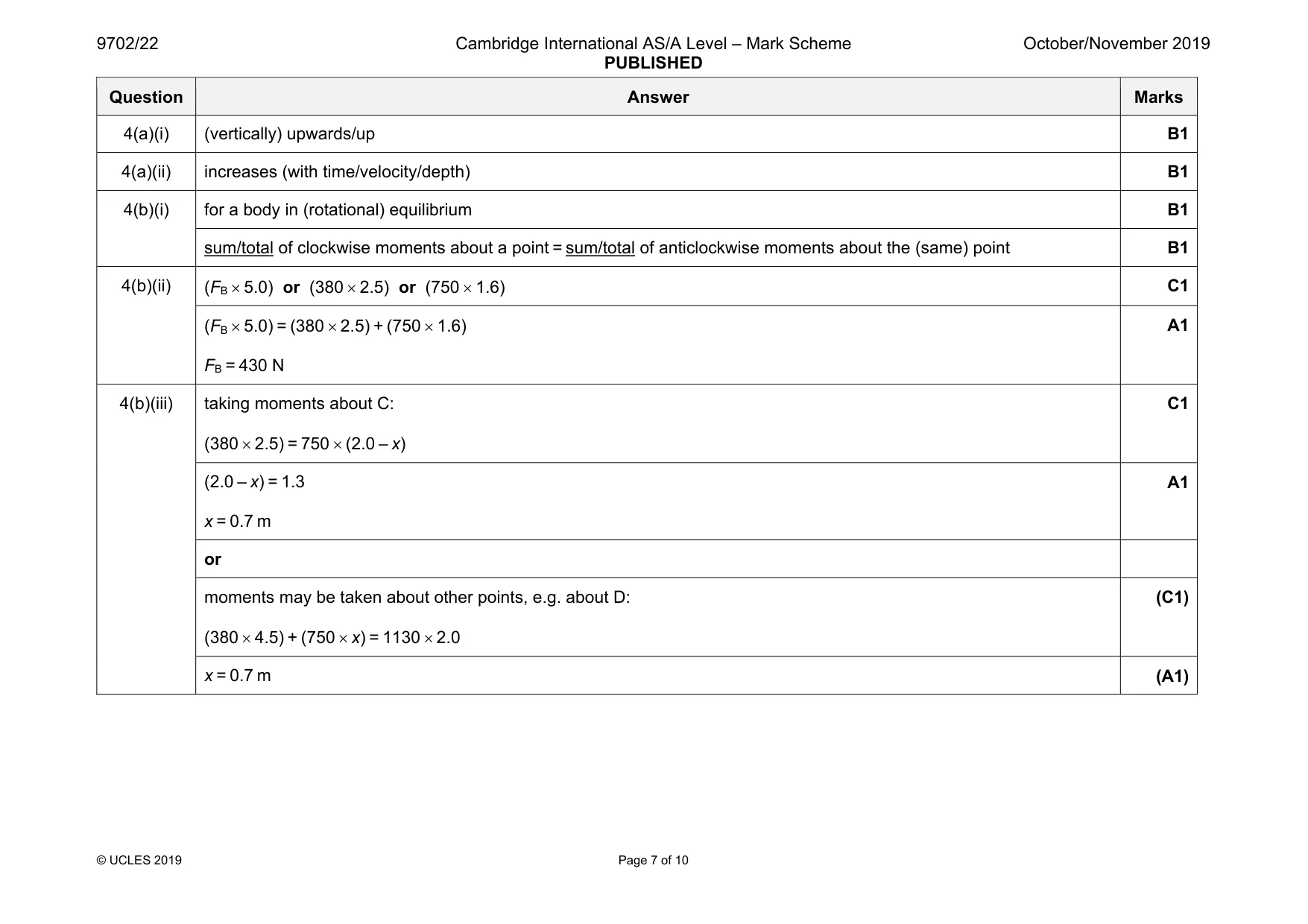
Mark scheme: 4(a)(i) (vertically) upwards/up B1 4(a)(ii) increases (with time/velocity/depth) B1 4(b)(i) for a body in (rotational) equilibrium B1 sum/total of clockwise moments about a point = sum/total of anticlockwise moments about the (same) point B1 4(b)(ii) (FB × 5.0) or (380 × 2.5) or (750 × 1.6) C1 (FB × 5.0) = (380 × 2.5) + (750 × 1.6) FB = 430 N A1 4(b)(iii) taking moments about C: (380 × 2.5) = 750 × (2.0 – x) C1 (2.0 – x) = 1.3 x = 0.7 m A1 or moments may be taken about other points, e.g. about D: (380 × 4.5) + (750 × x) = 1130 × 2.0 (C1) x = 0.7 m (A1)
Q5 · State what is meant by the wavelength of a progressive wave
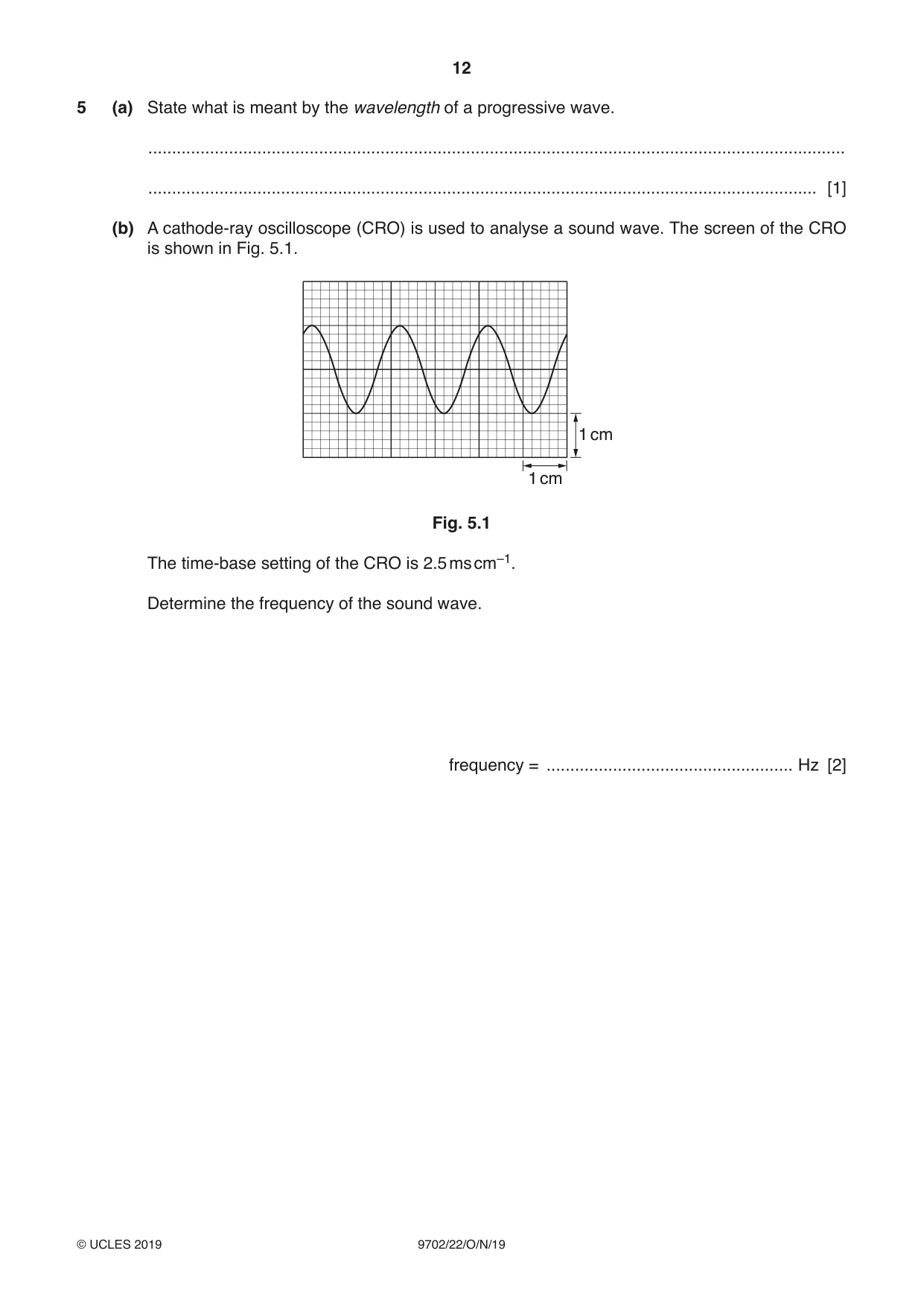
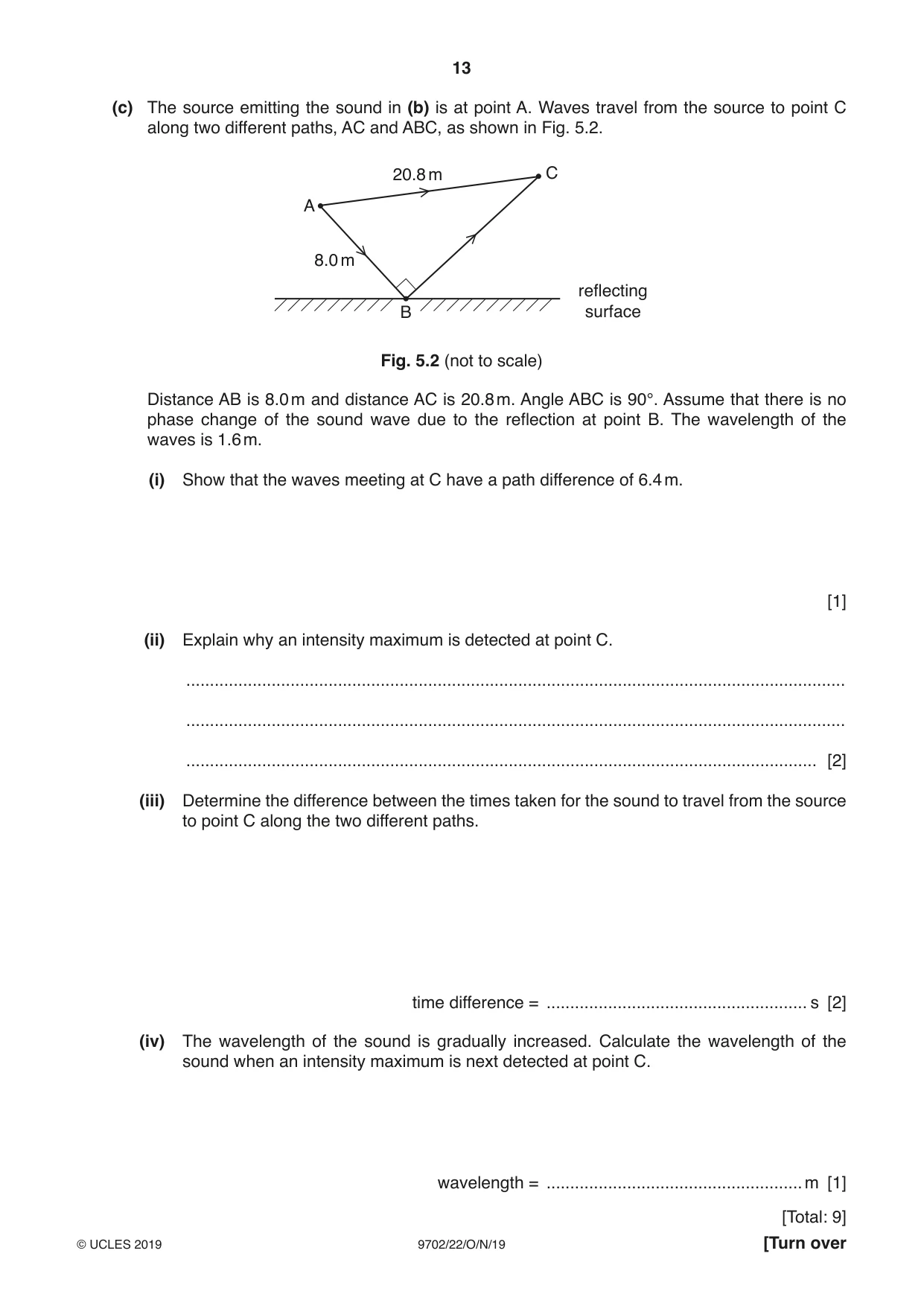
5 (a) State what is meant by the wavelength of a progressive wave. ................................................................................................................................................... ............................................................................................................................................. [1] (b) A cathode-ray oscilloscope (CRO) is used to analyse a sound wave. The screen of the CRO is shown in Fig. 5.1. 1 cm 1 cm Fig. 5.1 The time-base setting of the CRO is 2.5 ms cm–1. Determine the frequency of the sound wave. frequency = .................................................... Hz [2] (c) The source emitting the sound in (b) is at point A. Waves travel from the source to point C along two different paths, AC and ABC, as shown in Fig. 5.2. 20.8 m C A 8.0 m reflecting B surface Fig. 5.2 (not to scale) Distance AB is 8.0 m and distance AC is 20.8 m. Angle ABC is 90°. Assume that there is no phase change of the sound wave due to the reflection at point B. The wavelength of the waves is 1.6 m. (i) Show that the waves meeting at C have a path difference of 6.4 m. [1] (ii) Explain why an intensity maximum is detected at point C. ........................................................................................................................................... ........................................................................................................................................... ..................................................................................................................................... [2] (iii) Determine the difference between the times taken for the sound to travel from the source to point C along the two different paths. time difference = ....................................................... s [2] (iv) The wavelength of the sound is gradually increased. Calculate the wavelength of the sound when an intensity maximum is next detected at point C. wavelength = ......................................................m [1] [Total: 9]
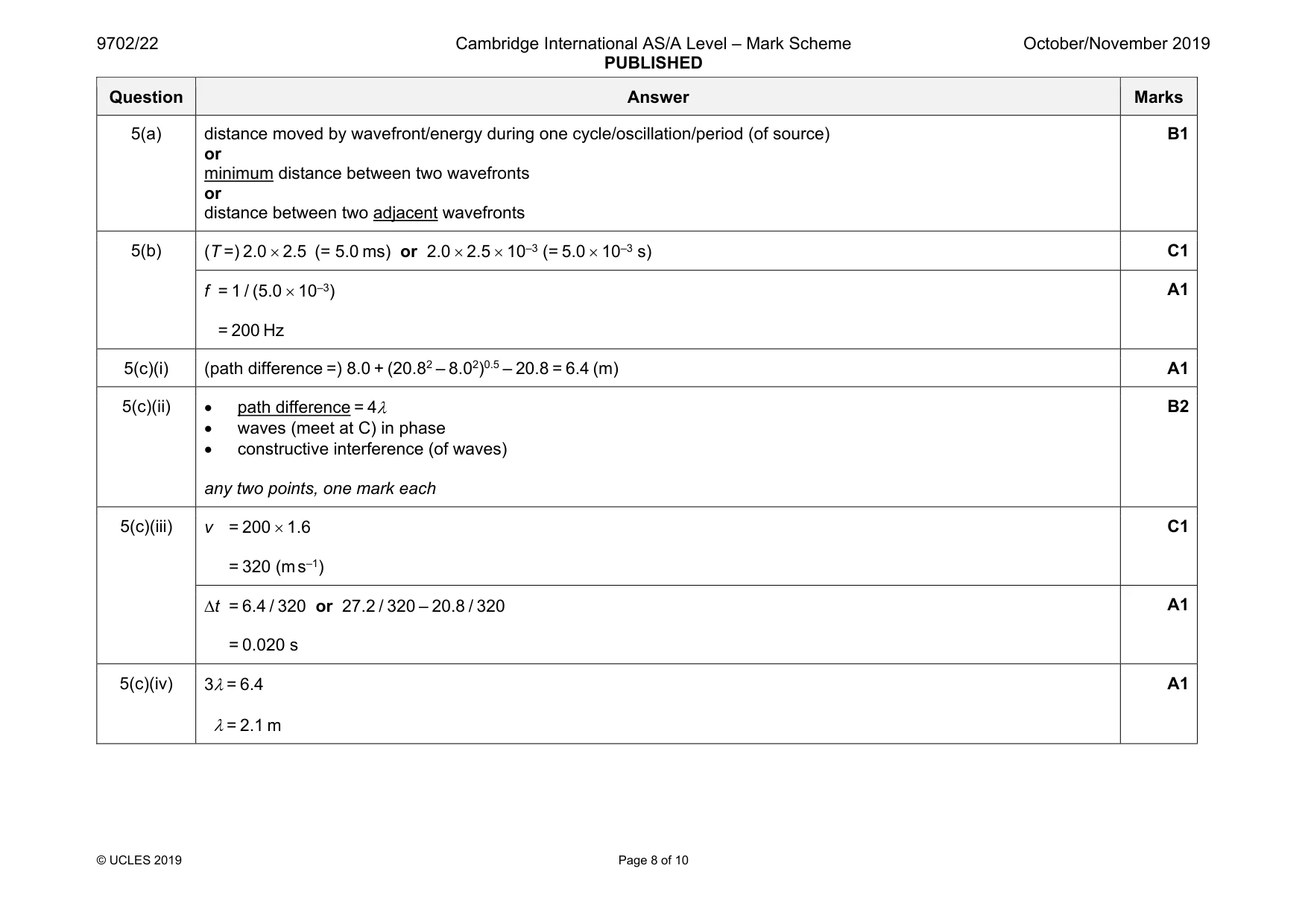
Mark scheme: 5(a) distance moved by wavefront/energy during one cycle/oscillation/period (of source) or minimum distance between two wavefronts or distance between two adjacent wavefronts B1 5(b) (T =) 2.0 × 2.5 (= 5.0 ms) or 2.0 × 2.5 × 10–3 (= 5.0 × 10⁻³ s) C1 f = 1 / (5.0 × 10⁻³) = 200 Hz A1 5(c)(i) (path difference =) 8.0 + (20.82 – 8.02)0.5 – 20.8 = 6.4 (m) A1 5(c)(ii) • path difference = 4λ • waves (meet at C) in phase • constructive interference (of waves) any two points, one mark each B2 5(c)(iii) v = 200 × 1.6 v = 320 (m s–1) C1 ∆t = 6.4 / 320 or 27.2 / 320 – 20.8 / 320 = 0.020 s A1 5(c)(iv) 3λ = 6.4 3λ = 2.1 m A1
Q6 · State Kirchhoff’s first law
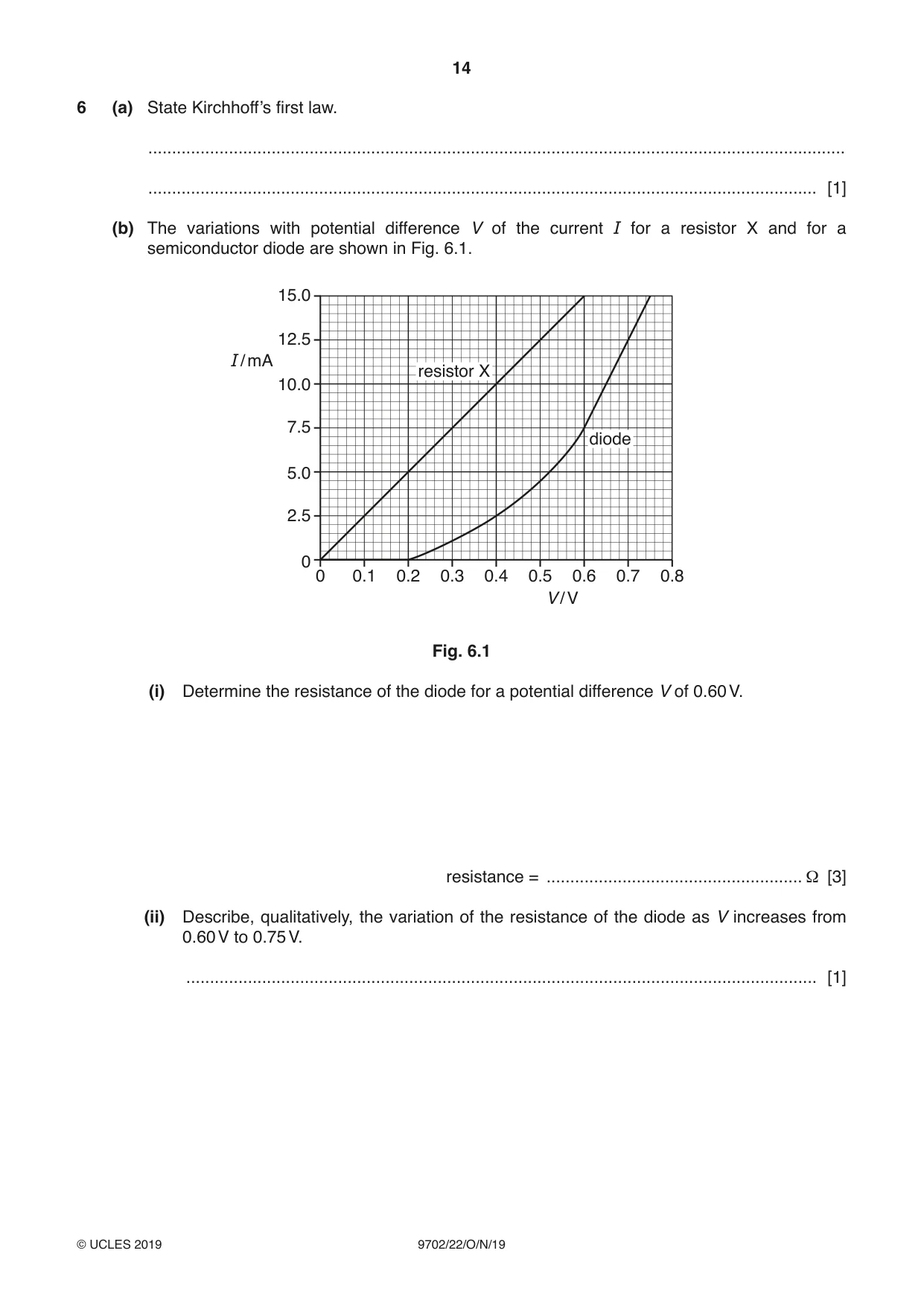
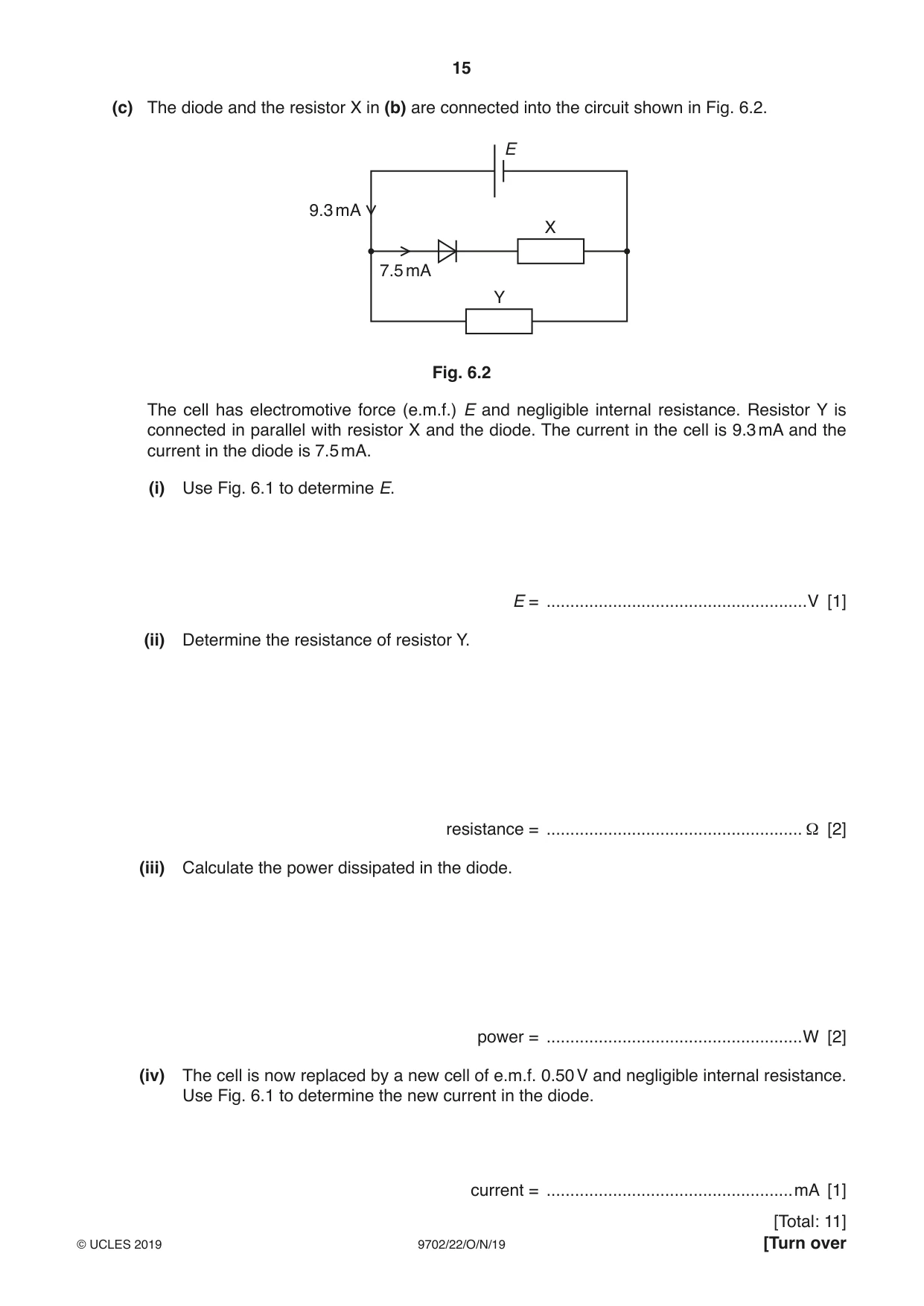
6 (a) State Kirchhoff’s first law. ................................................................................................................................................... ............................................................................................................................................. [1] (b) The variations with potential difference V of the current I for a resistor X and for a semiconductor diode are shown in Fig. 6.1. 15.0 12.5 I / mA resistor X 10.0 7.5 diode 5.0 2.5 0 0 0.1 0.2 0.3 0.4 0.5 0.6 0.7 0.8 V / V Fig. 6.1 (i) Determine the resistance of the diode for a potential difference V of 0.60 V. resistance = ...................................................... Ω [3] (ii) Describe, qualitatively, the variation of the resistance of the diode as V increases from 0.60 V to 0.75 V. ..................................................................................................................................... [1] (c) The diode and the resistor X in (b) are connected into the circuit shown in Fig. 6.2. E 9.3 mA X 7.5 mA Y Fig. 6.2 The cell has electromotive force (e.m.f.) E and negligible internal resistance. Resistor Y is connected in parallel with resistor X and the diode. The current in the cell is 9.3 mA and the current in the diode is 7.5 mA. (i) Use Fig. 6.1 to determine E. E = .......................................................V [1] (ii) Determine the resistance of resistor Y. resistance = ...................................................... Ω [2] (iii) Calculate the power dissipated in the diode. power = ......................................................W [2] (iv) The cell is now replaced by a new cell of e.m.f. 0.50 V and negligible internal resistance. Use Fig. 6.1 to determine the new current in the diode. current = ....................................................mA [1]
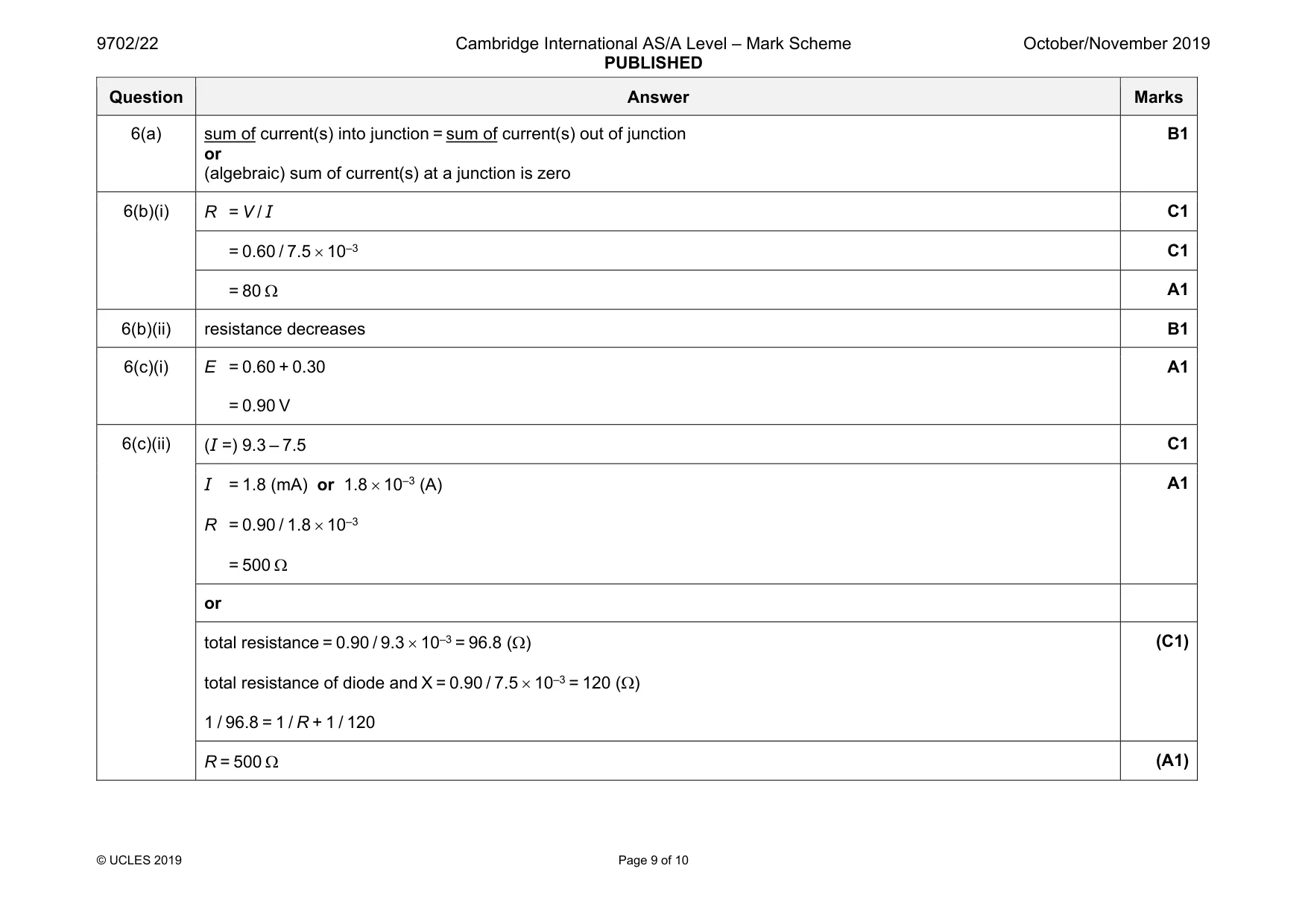
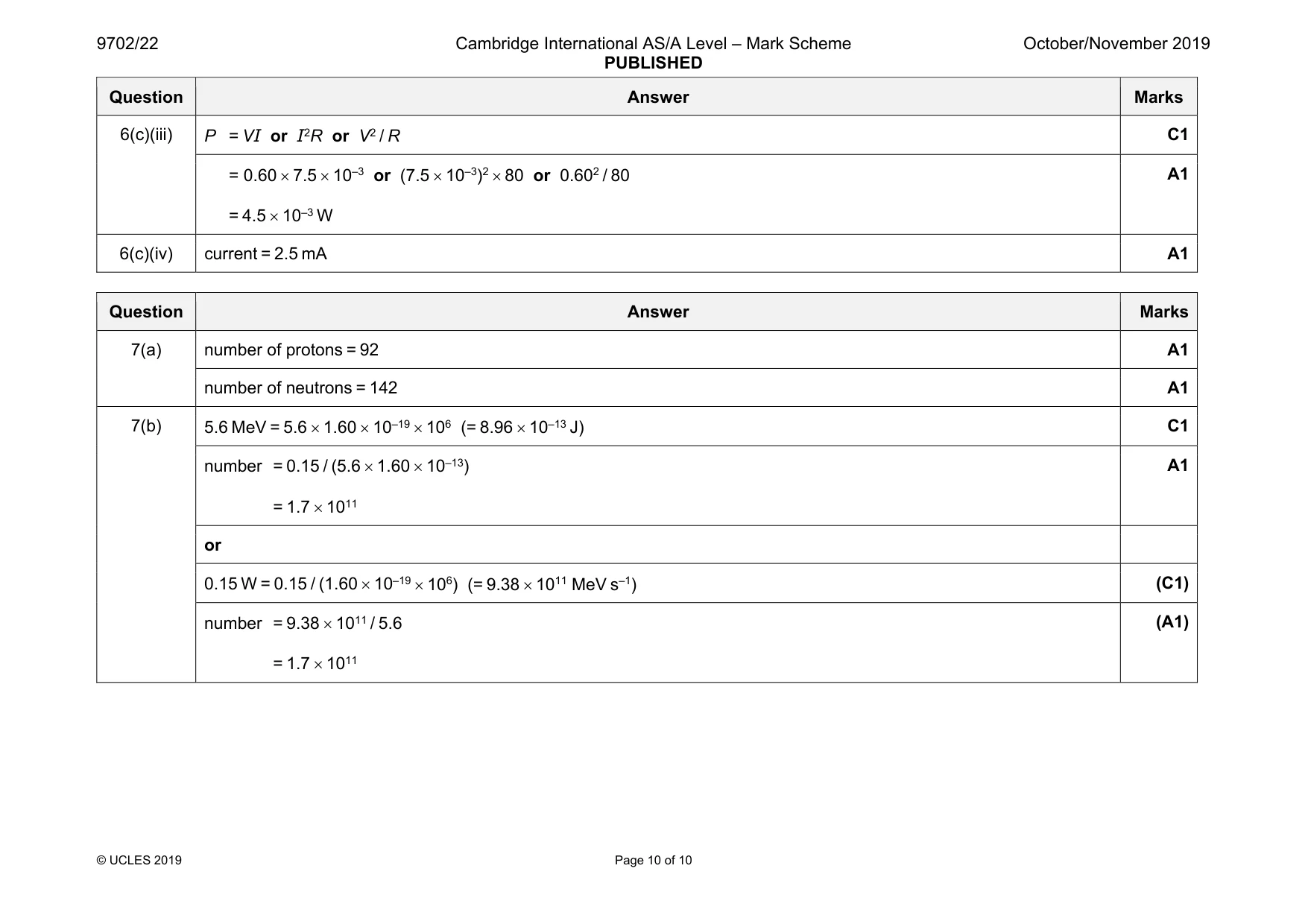
Mark scheme: 6(a) sum of current(s) into junction = sum of current(s) out of junction or (algebraic) sum of current(s) at a junction is zero B1 6(b)(i) R = V / I C1 R = 0.60 / 7.5 × 10⁻³ C1 R = 80 Ω A1 6(b)(ii) resistance decreases B1 6(c)(i) E = 0.60 + 0.30 E = 0.90 V A1 6(c)(ii) (I =) 9.3 – 7.5 C1 I = 1.8 (mA) or 1.8 × 10⁻³ (A) R = 0.90 / 1.8 × 10–3 = 500 Ω A1 or total resistance = 0.90 / 9.3 × 10–3 = 96.8 (Ω) total resistance of diode and X = 0.90 / 7.5 × 10–3 = 120 (Ω) 1 / 96.8 = 1 / R + 1 / 120 (C1) R = 500 Ω (A1) Question Answer Marks 6(c)(iii) P = VI or I2R or V2 / R C1 P = 0.60 × 7.5 × 10–3 or (7.5 × 10⁻³)2 × 80 or 0.602 / 80 = 4.5 × 10⁻³ W A1 6(c)(iv) current = 2.5 mA A1
Q7 · A nucleus of plutonium-238 (23894Pu) decays by emitting an α-particle to produce a new…
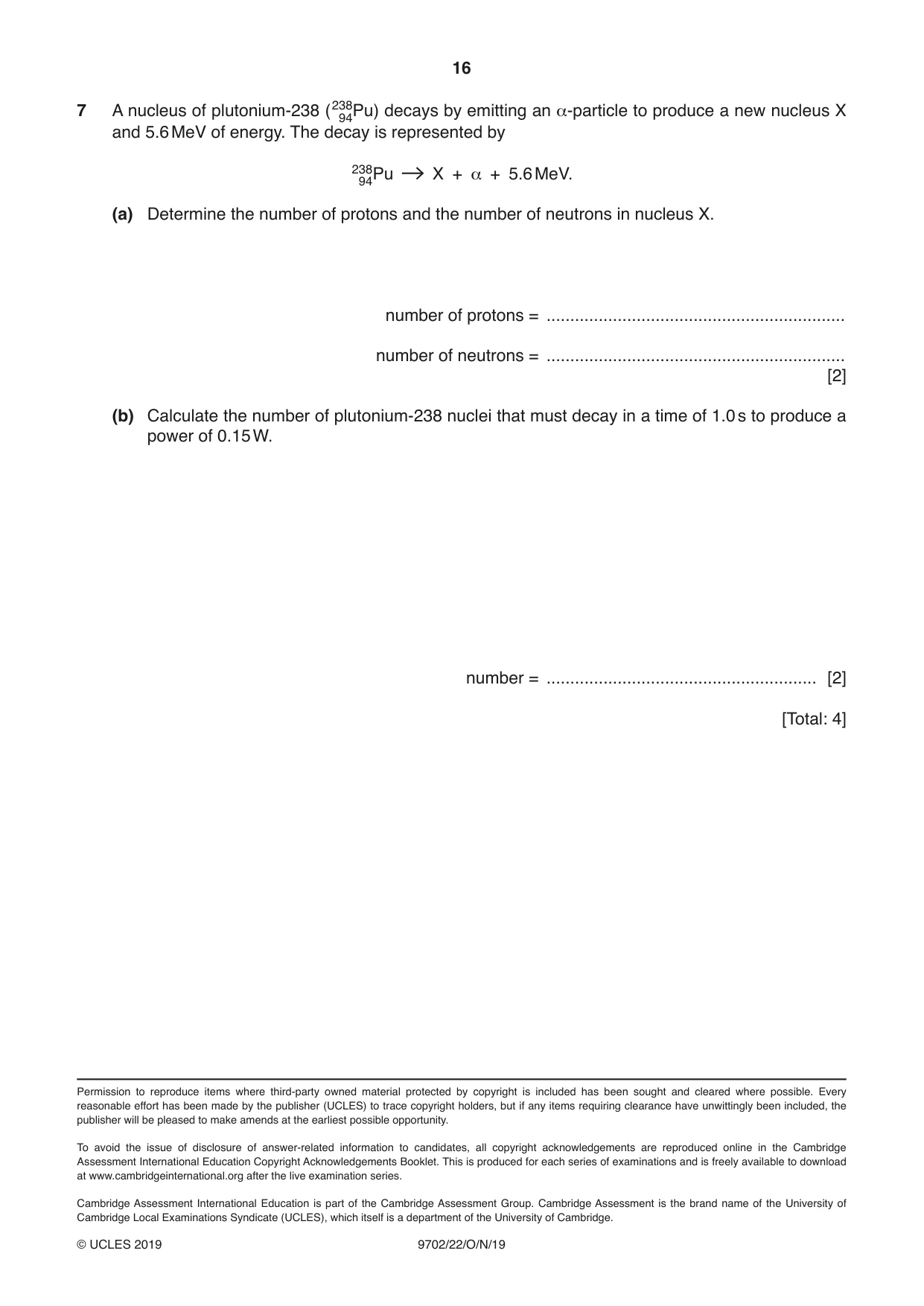
7 A nucleus of plutonium-238 (23894Pu) decays by emitting an α-particle to produce a new nucleus X and 5.6 MeV of energy. The decay is represented by α + 5.6 MeV. 23894Pu X + (a) Determine the number of protons and the number of neutrons in nucleus X. number of protons = ............................................................... number of neutrons = ............................................................... [2] (b) Calculate the number of plutonium-238 nuclei that must decay in a time of 1.0 s to produce a power of 0.15 W. number = ......................................................... [2] [Total: 4]
Mark scheme: 7(a) number of protons = 92 A1 number of neutrons = 142 A1 7(b) 5.6 MeV = 5.6 × 1.60 × 10–19 × 106 (= 8.96 × 10⁻¹³ J) C1 number = 0.15 / (5.6 × 1.60 × 10–13) number = 1.7 × 10¹¹ A1 or 0.15 W = 0.15 / (1.60 × 10–19 × 106) (= 9.38 × 10¹¹ MeV s–1) (C1) number = 9.38 × 10¹¹ / 5.6 number = 1.7 × 10¹¹ (A1)
What was in this paper
The subtopics covered by these 7 questions, and how many questions each got. Open one in a new tab to see every Cambridge question on it.
What you needed in this session
Cambridge’s own grade thresholds for 2019 Oct/Nov, Paper 2 · Variant 2. A higher threshold means an easier paper — the bar moves with how the cohort did.