Cambridge A Level Physics 9702 — 2025 Feb/March Paper 2 · Variant 2
9702/22/F/M/25 · 7 questions · 60 marks · 75 min
The question paper and its mark scheme, free to read here and free to download. This is Cambridge’s own paper, exactly as it was sat.
Question paper16 pages
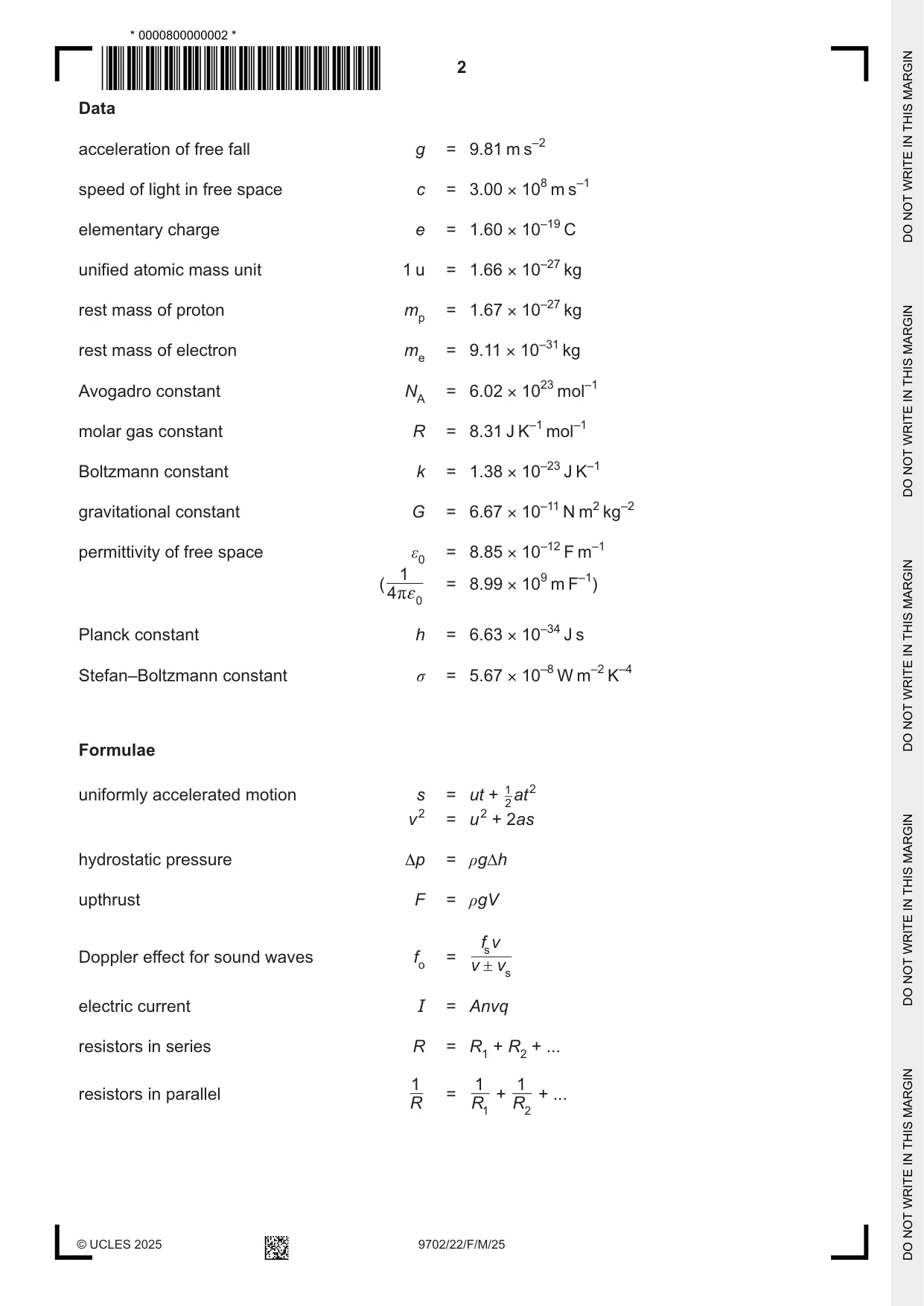
Mark scheme13 pages
Answers below. Sit the paper first if you are practising.
Questions as text
Q1 · Explain what is meant by the accuracy of a measured value
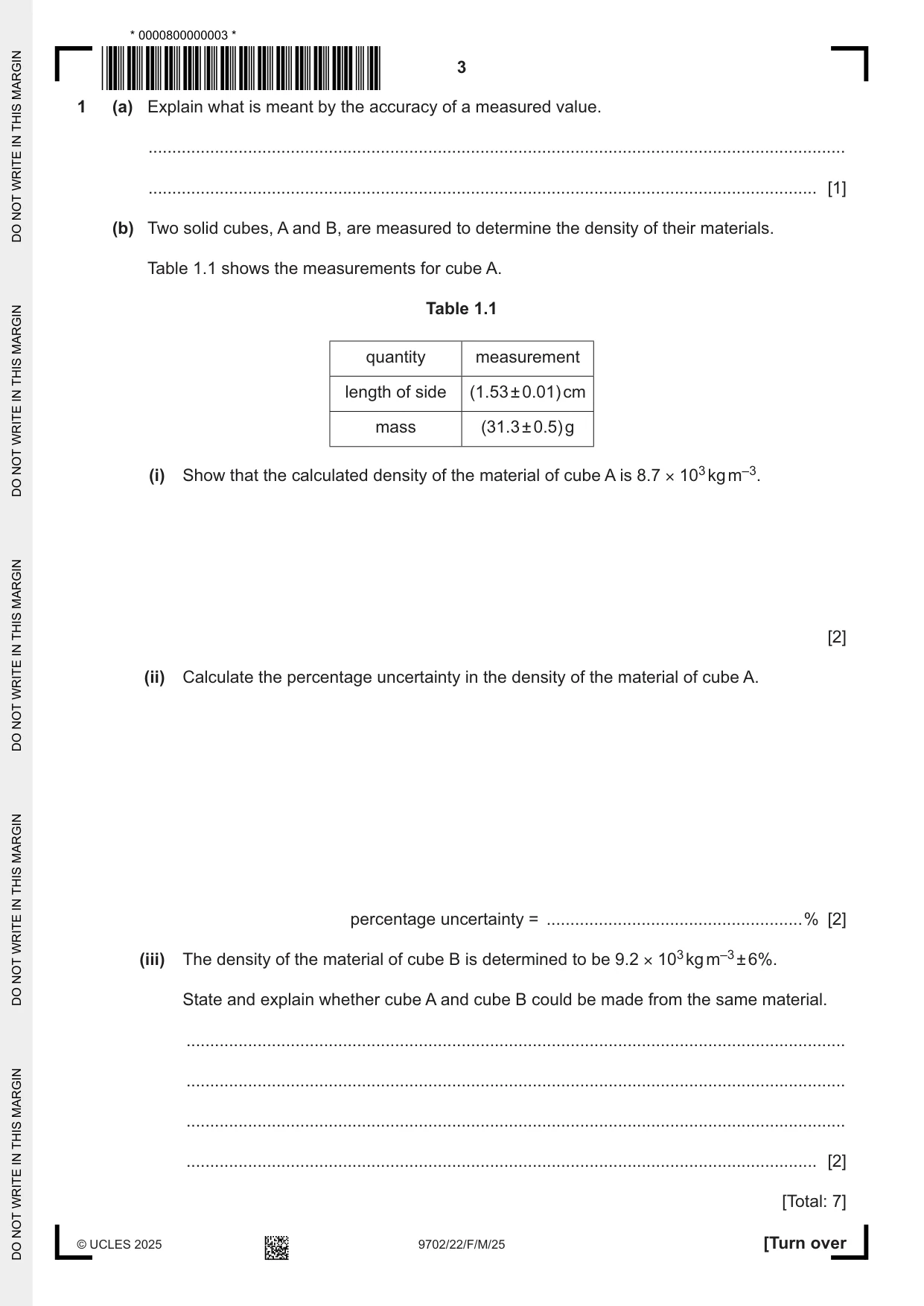
1 (a) Explain what is meant by the accuracy of a measured value. ................................................................................................................................................... ............................................................................................................................................. [1] (b) Two solid cubes, A and B, are measured to determine the density of their materials. Table 1.1 shows the measurements for cube A. Table 1.1 quantity measurement length of side (1.53 ± 0.01) cm mass (31.3 ± 0.5) g (i) Show that the calculated density of the material of cube A is 8.7 × 10³ kg m–3. [2] (ii) Calculate the percentage uncertainty in the density of the material of cube A. percentage uncertainty = ......................................................% [2] (iii) The density of the material of cube B is determined to be 9.2 × 10³ kg m–3 ± 6%. State and explain whether cube A and cube B could be made from the same material. ........................................................................................................................................... ........................................................................................................................................... ........................................................................................................................................... ..................................................................................................................................... [2] [Total: 7]
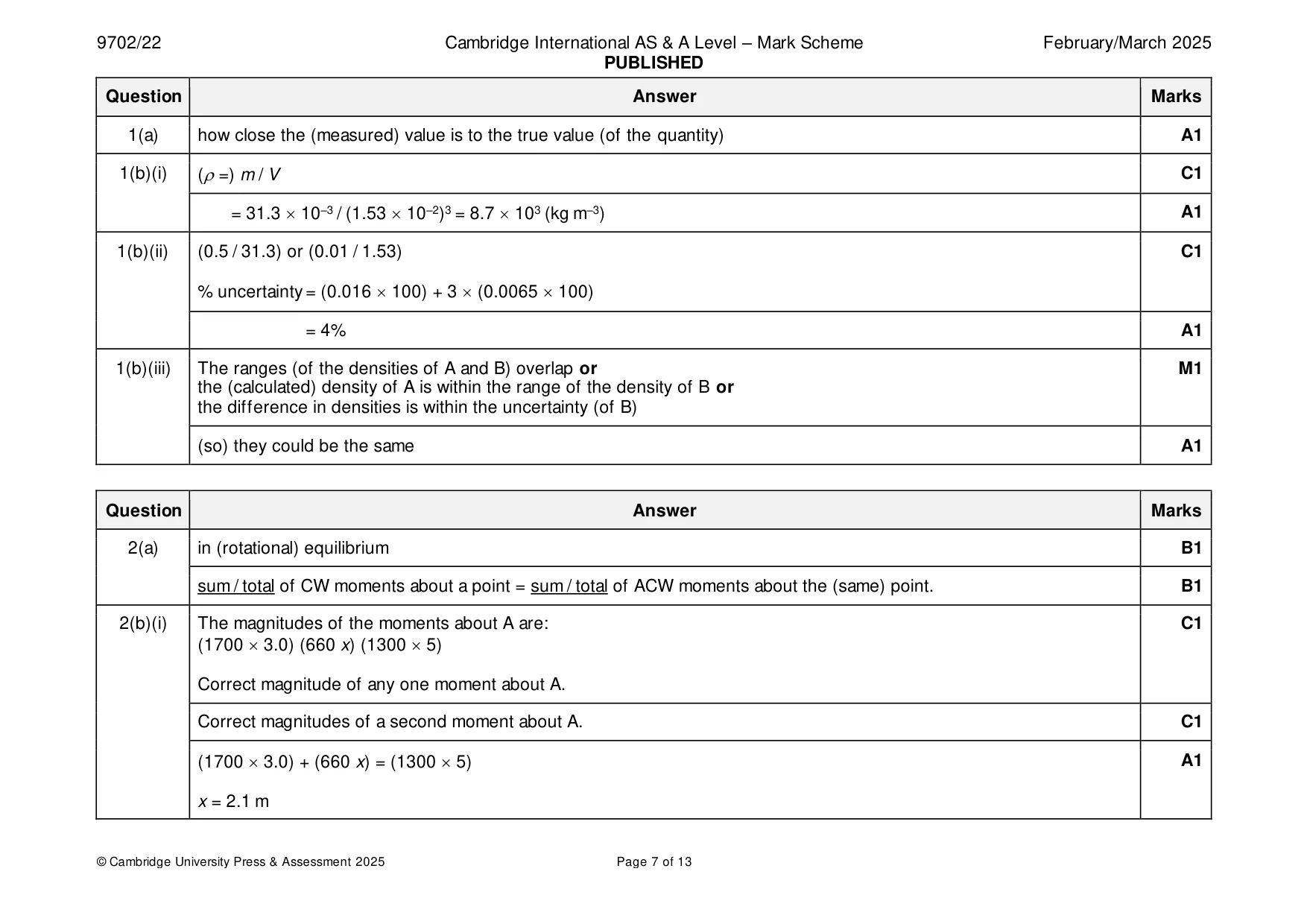
Mark scheme: Question Answer Marks 1(a) how close the (measured) value is to the true value (of the quantity) A1 1(b)(i) (=) m / V C1 = 31.3 10–3 / (1.53 10–2)3 = 8.7 103 (kg m–3) A1 1(b)(ii) (0.5 / 31.3) or (0.01 / 1.53) C1 % uncertainty = (0.016 100) + 3 (0.0065 100) = 4% A1 1(b)(iii) The ranges (of the densities of A and B) overlap or M1 the (calculated) density of A is within the range of the density of B or the difference in densities is within the uncertainty (of B) (so) they could be the same A1
Q2 · State the principle of moments
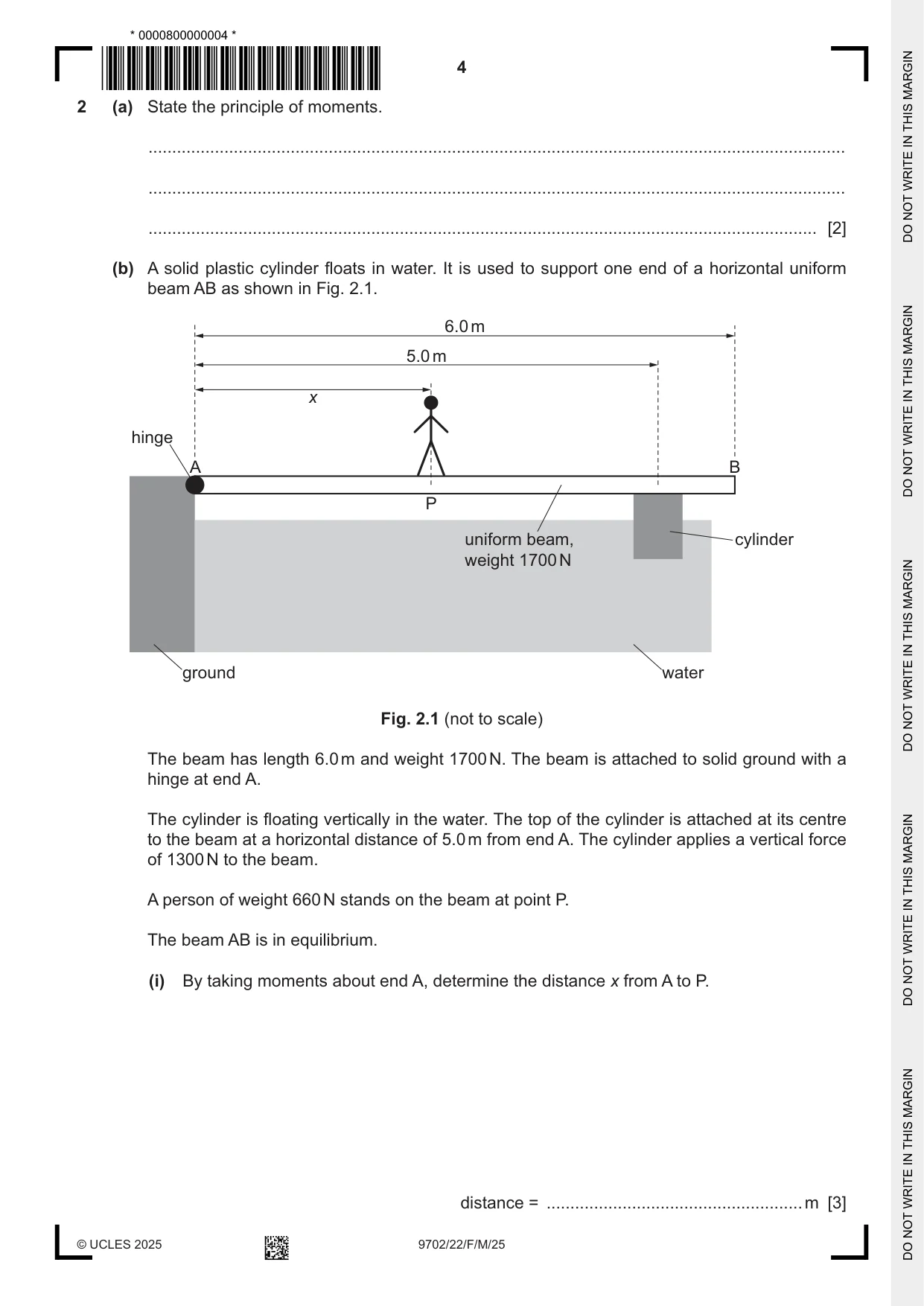
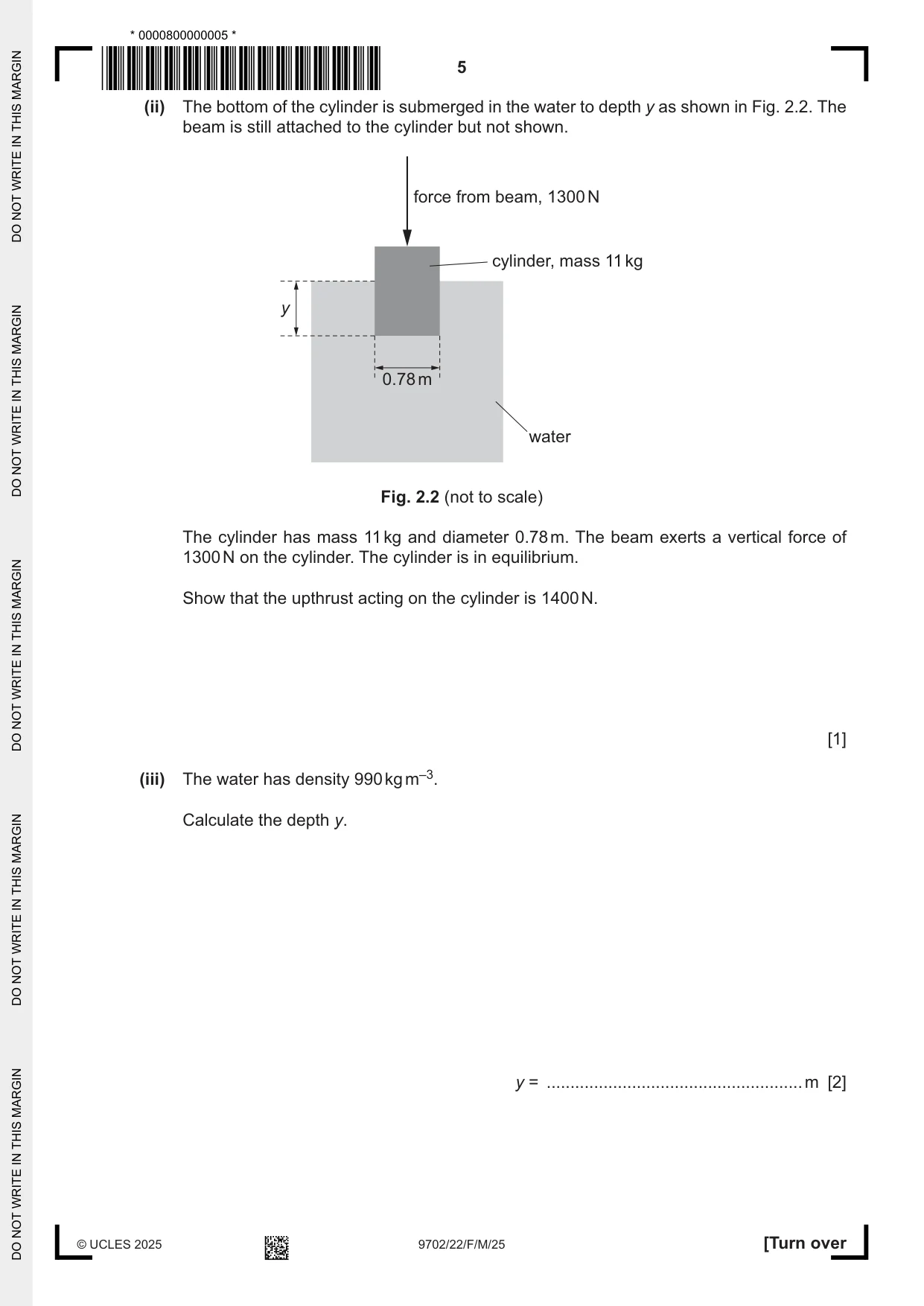
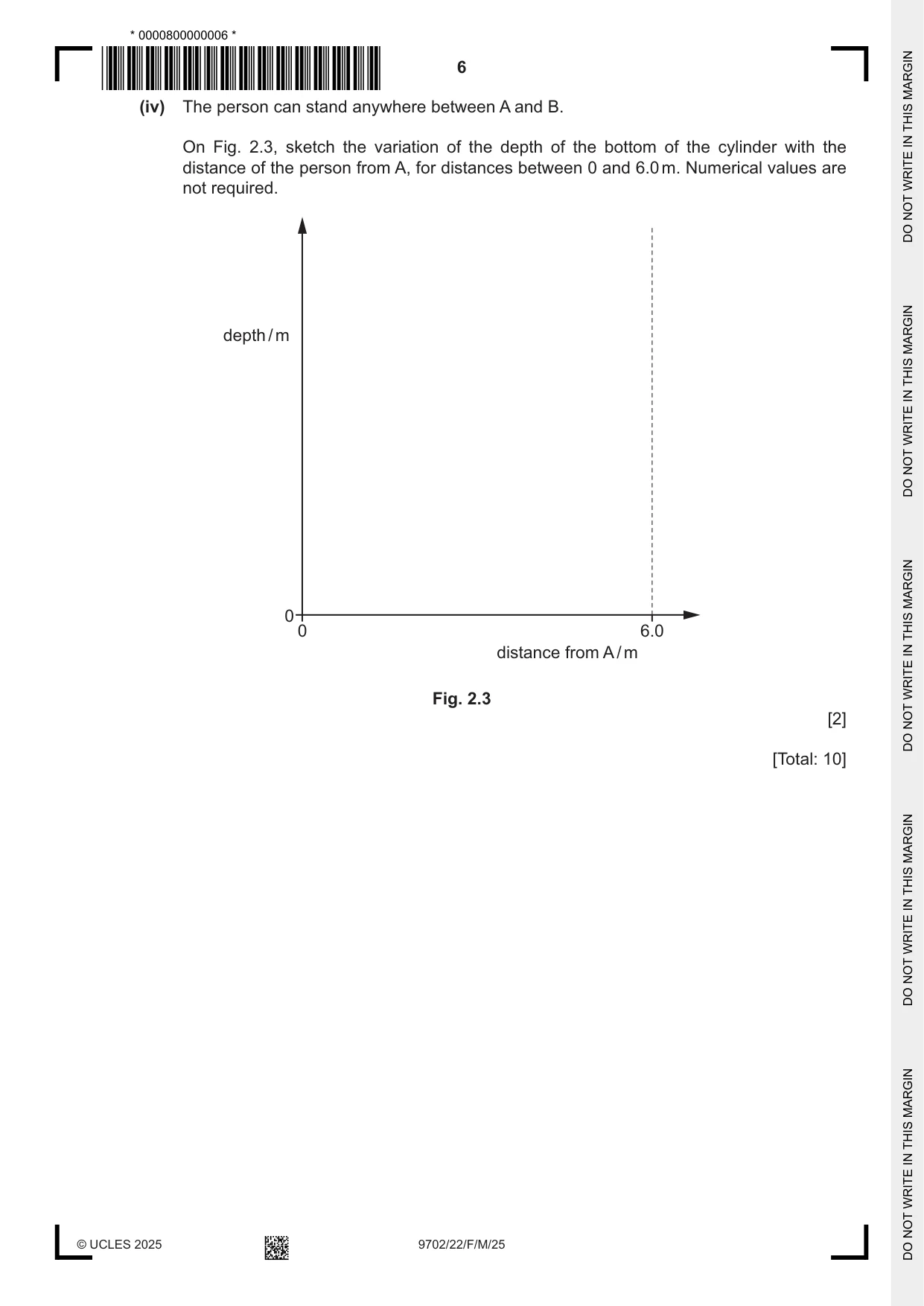
2 (a) State the principle of moments. ................................................................................................................................................... ................................................................................................................................................... ............................................................................................................................................. [2] (b) A solid plastic cylinder floats in water. It is used to support one end of a horizontal uniform beam AB as shown in Fig. 2.1. 6.0 m 5.0 m x hinge A B P uniform beam, cylinder weight 1700 N ground water Fig. 2.1 (not to scale) The beam has length 6.0 m and weight 1700 N. The beam is attached to solid ground with a hinge at end A. The cylinder is floating vertically in the water. The top of the cylinder is attached at its centre to the beam at a horizontal distance of 5.0 m from end A. The cylinder applies a vertical force of 1300 N to the beam. A person of weight 660 N stands on the beam at point P. The beam AB is in equilibrium. (i) By taking moments about end A, determine the distance x from A to P. distance = ...................................................... m [3] (ii) The bottom of the cylinder is submerged in the water to depth y as shown in Fig. 2.2. The beam is still attached to the cylinder but not shown. force from beam, 1300 N cylinder, mass 11 kg y 0.78 m water Fig. 2.2 (not to scale) The cylinder has mass 11 kg and diameter 0.78 m. The beam exerts a vertical force of 1300 N on the cylinder. The cylinder is in equilibrium. Show that the upthrust acting on the cylinder is 1400 N. [1] (iii) The water has density 990 kg m–3. Calculate the depth y. y = ...................................................... m [2] (iv) The person can stand anywhere between A and B. On Fig. 2.3, sketch the variation of the depth of the bottom of the cylinder with the distance of the person from A, for distances between 0 and 6.0 m. Numerical values are not required. depth / m 0 0 6.0 distance from A / m Fig. 2.3 [2] [Total: 10]
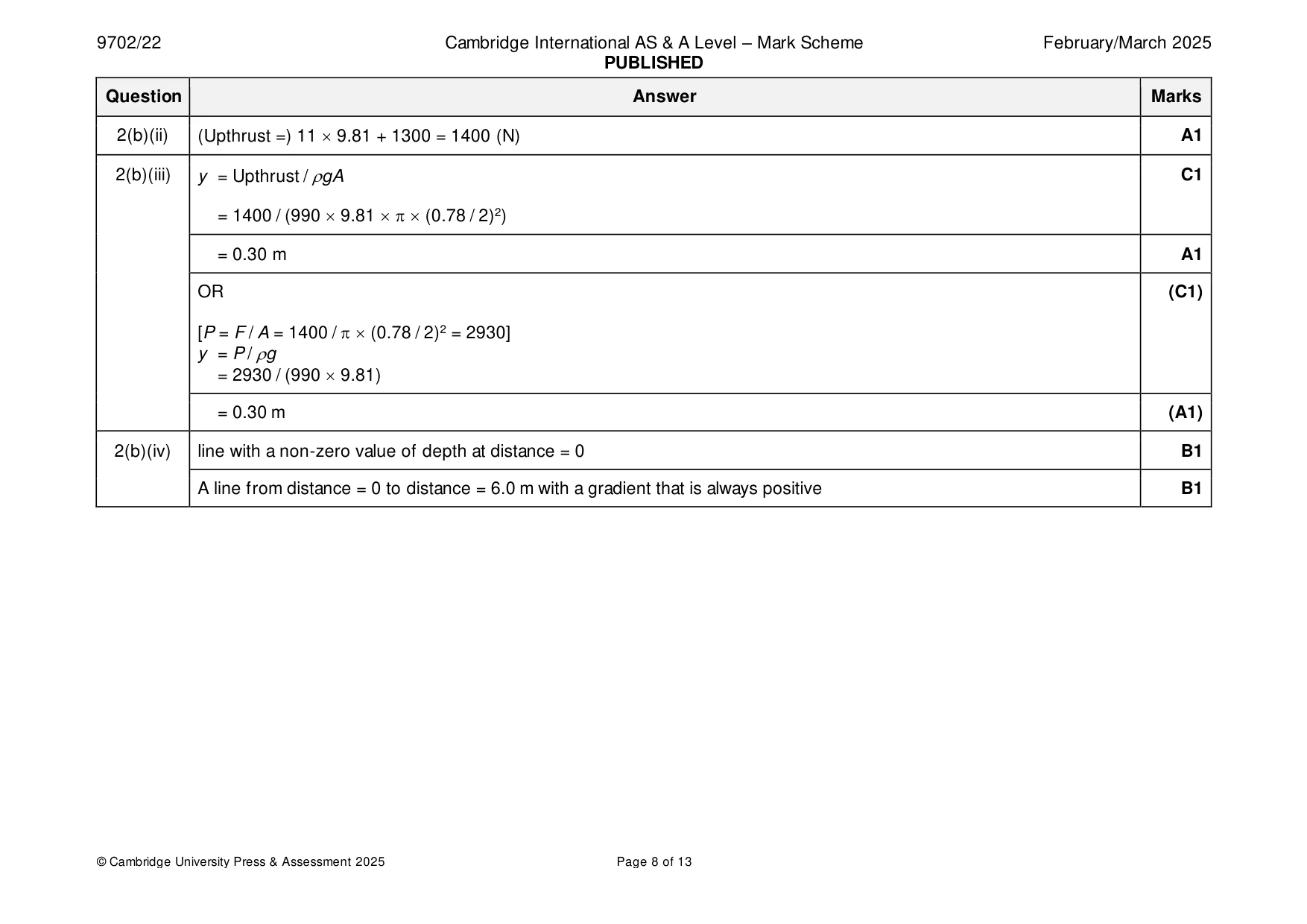
Mark scheme: 2(a) in (rotational) equilibrium B1 sum / total of CW moments about a point = sum / total of ACW moments about the (same) point. B1 2(b)(i) The magnitudes of the moments about A are: C1 (1700 3.0) (660 x) (1300 5) Correct magnitude of any one moment about A. Correct magnitudes of a second moment about A. C1 (1700 3.0) + (660 x) = (1300 5) A1 x = 2.1 m 2(b)(ii) (Upthrust =) 11 9.81 + 1300 = 1400 (N) A1 2(b)(iii) y = Upthrust / gA C1 = 1400 / (990 9.81 (0.78 / 2)2) = 0.30 m A1 OR (C1) [P = F / A = 1400 / (0.78 / 2)2 = 2930] y = P / g = 2930 / (990 9.81) = 0.30 m (A1) 2(b)(iv) line with a non-zero value of depth at distance = 0 B1 A line from distance = 0 to distance = 6.0 m with a gradient that is always positive B1
Q3 · A truck R of mass 9400 kg moves with constant acceleration in a straight line down a…
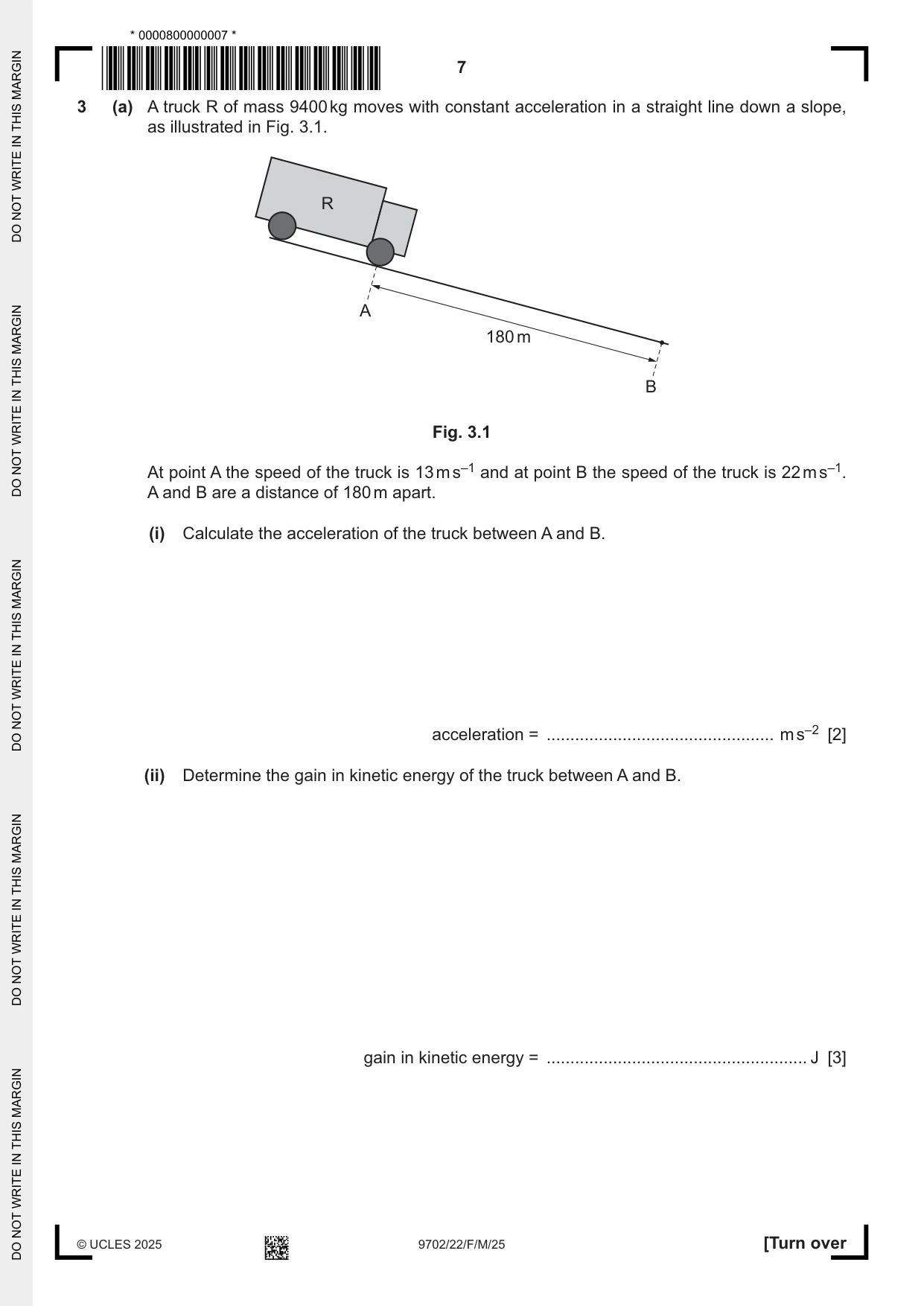
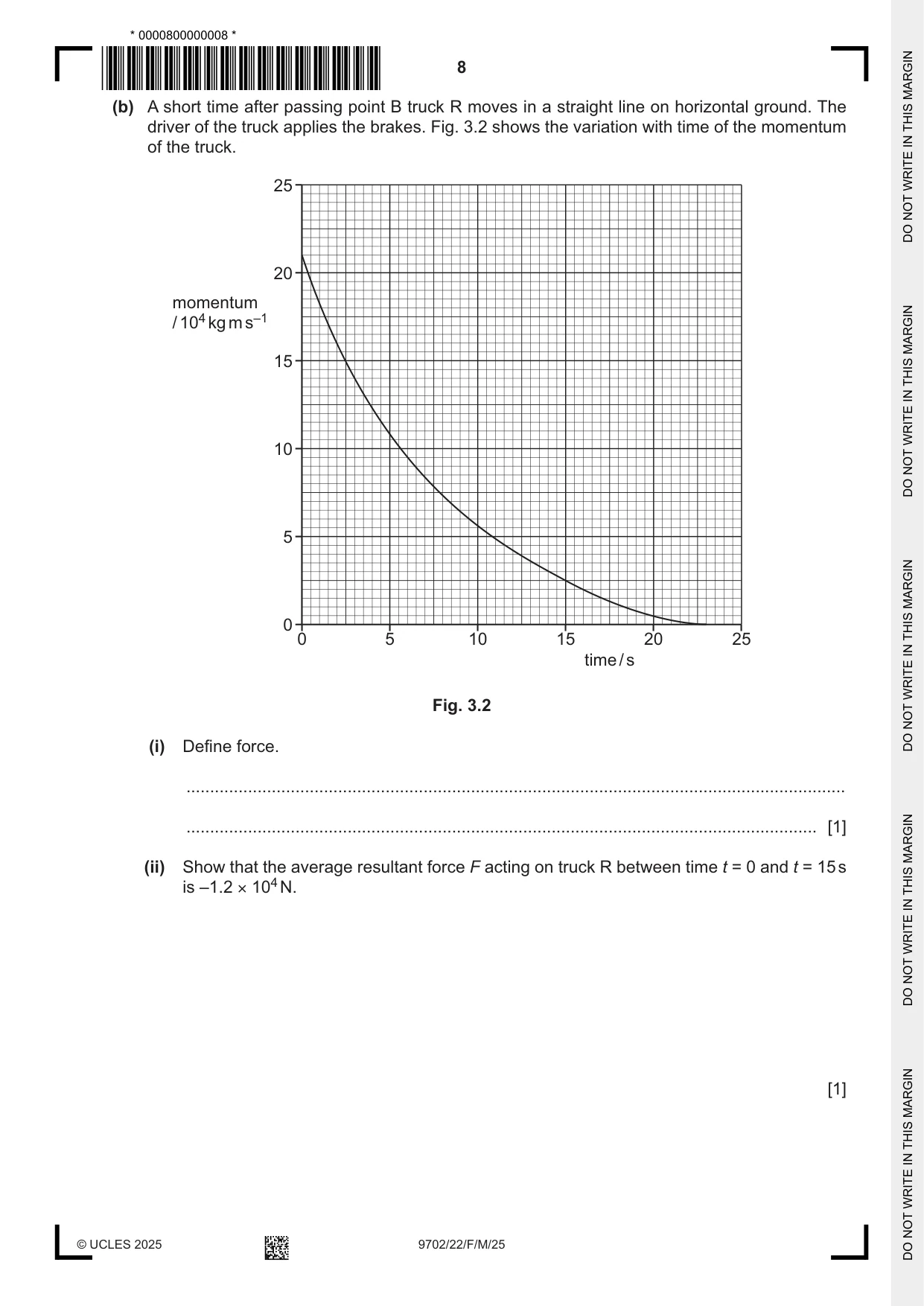
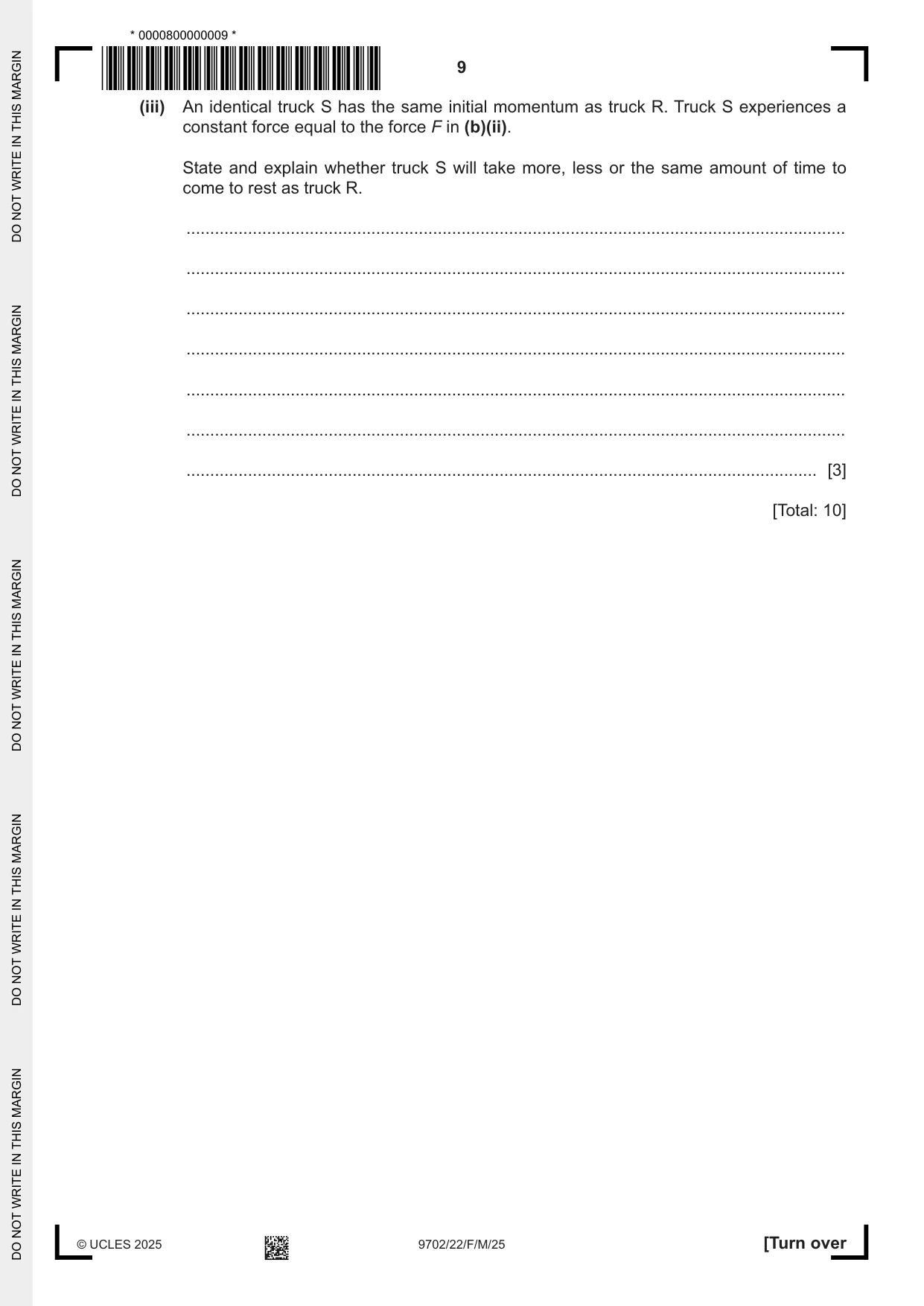
3 (a) A truck R of mass 9400 kg moves with constant acceleration in a straight line down a slope, as illustrated in Fig. 3.1. R A 180 m B Fig. 3.1 At point A the speed of the truck is 13 m s–1 and at point B the speed of the truck is 22 m s–1. A and B are a distance of 180 m apart. (i) Calculate the acceleration of the truck between A and B. acceleration = ................................................ m s–2 [2] (ii) Determine the gain in kinetic energy of the truck between A and B. gain in kinetic energy = ....................................................... J [3] (b) A short time after passing point B truck R moves in a straight line on horizontal ground. The driver of the truck applies the brakes. Fig. 3.2 shows the variation with time of the momentum of the truck. 25 20 momentum / 104 kg m s–1 15 10 5 0 0 5 10 15 20 25 time / s Fig. 3.2 (i) Define force. ........................................................................................................................................... ..................................................................................................................................... [1] (ii) Show that the average resultant force F acting on truck R between time t = 0 and t = 15 s is –1.2 × 10⁴ N. [1] (iii) An identical truck S has the same initial momentum as truck R. Truck S experiences a constant force equal to the force F in (b)(ii). State and explain whether truck S will take more, less or the same amount of time to come to rest as truck R. ........................................................................................................................................... ........................................................................................................................................... ........................................................................................................................................... ........................................................................................................................................... ........................................................................................................................................... ........................................................................................................................................... ..................................................................................................................................... [3] [Total: 10]
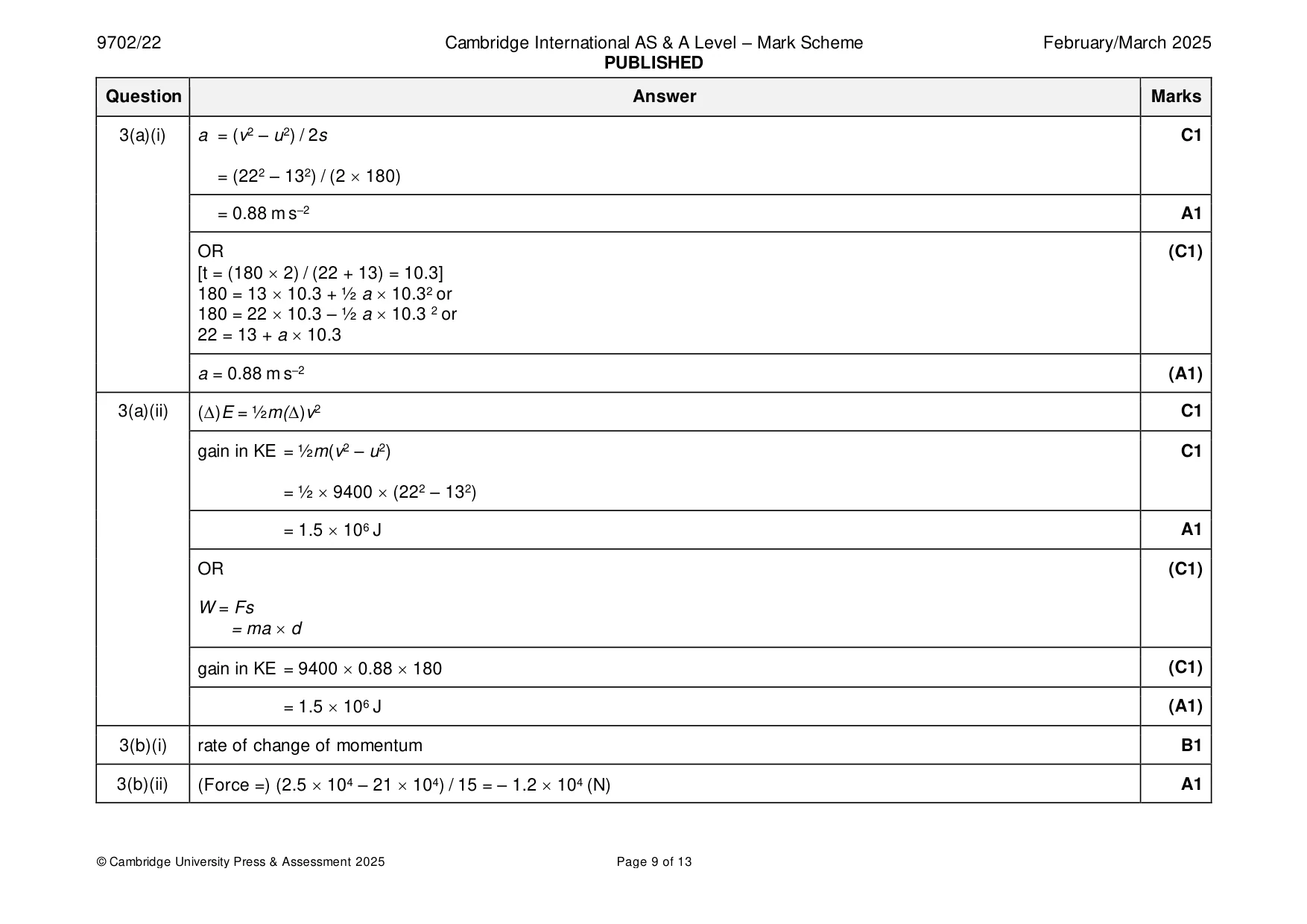
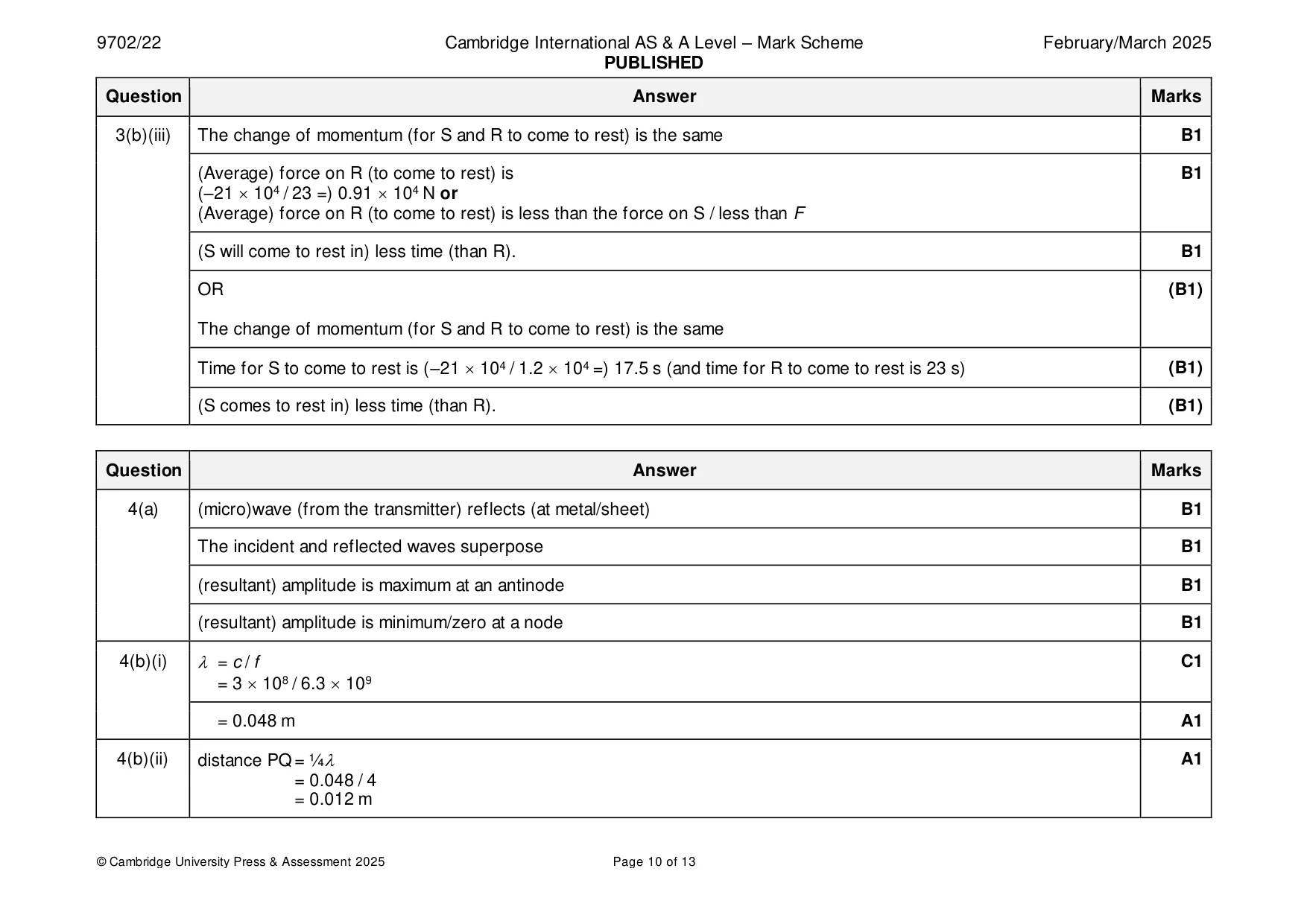
Mark scheme: 3(a)(i) a = (v2 – u2) / 2s C1 = (222 – 132) / (2 180) = 0.88 m s–2 A1 OR (C1) [t = (180 2) / (22 + 13) = 10.3] 180 = 13 10.3 + ½ a 10.32 or 180 = 22 10.3 – ½ a 10.3 2 or 22 = 13 + a 10.3 a = 0.88 m s–2 (A1) 3(a)(ii) ()E = ½m()v2 C1 gain in KE = ½m(v2 – u2) C1 = ½ 9400 (222 – 132) = 1.5 106 J A1 OR (C1) W = Fs = ma d gain in KE = 9400 0.88 180 (C1) = 1.5 106 J (A1) 3(b)(i) rate of change of momentum B1 3(b)(ii) (Force =) (2.5 104 – 21 104) / 15 = – 1.2 104 (N) A1 3(b)(iii) The change of momentum (for S and R to come to rest) is the same B1 (Average) force on R (to come to rest) is B1 (–21 104 / 23 =) 0.91 104 N or (Average) force on R (to come to rest) is less than the force on S / less than F (S will come to rest in) less time (than R). B1 OR (B1) The change of momentum (for S and R to come to rest) is the same Time for S to come to rest is (–21 104 / 1.2 104 =) 17.5 s (and time for R to come to rest is 23 s) (B1) (S comes to rest in) less time (than R). (B1)
Q4 · A device containing a microwave emitter and receiver is placed in front of a large metal…
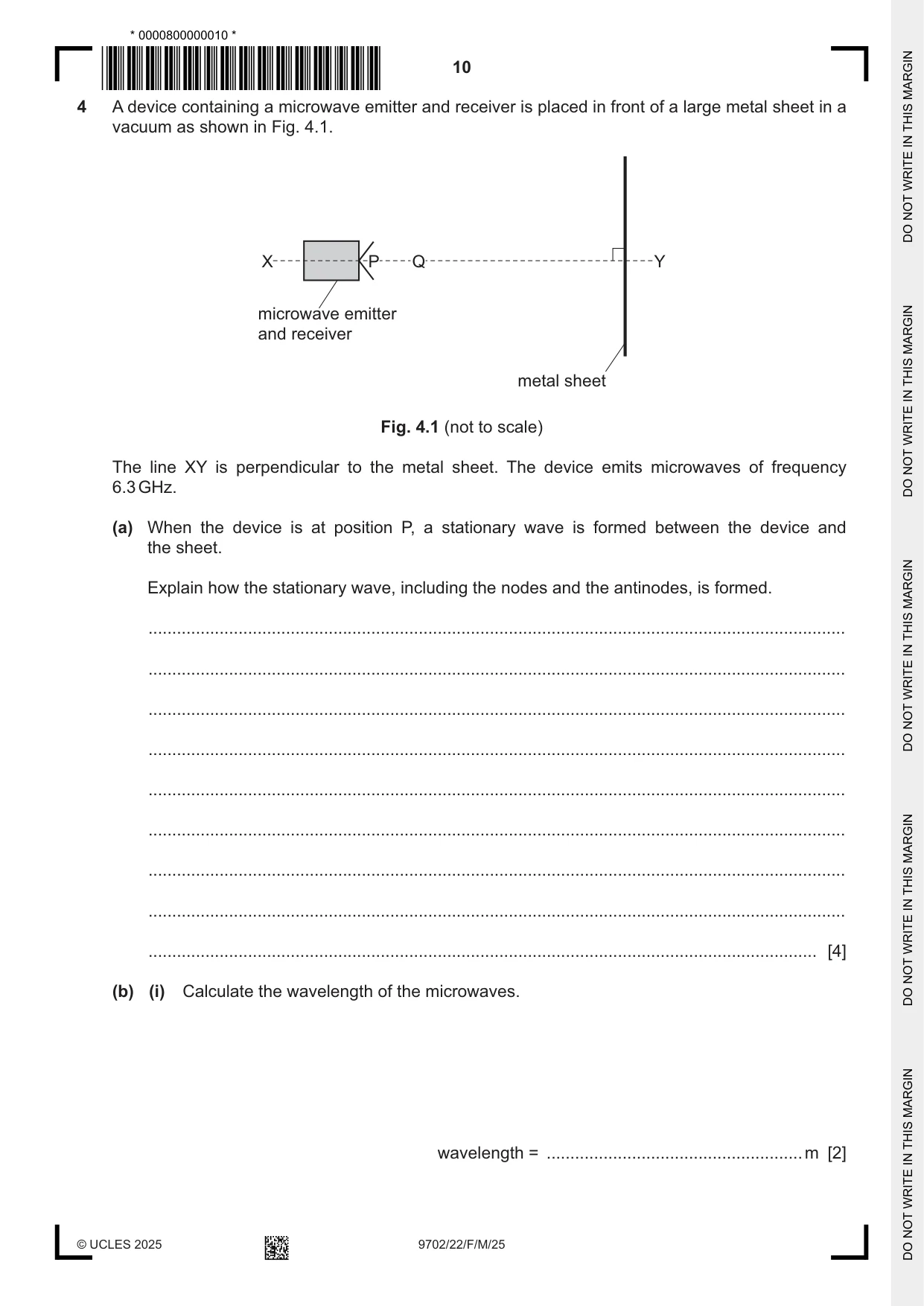
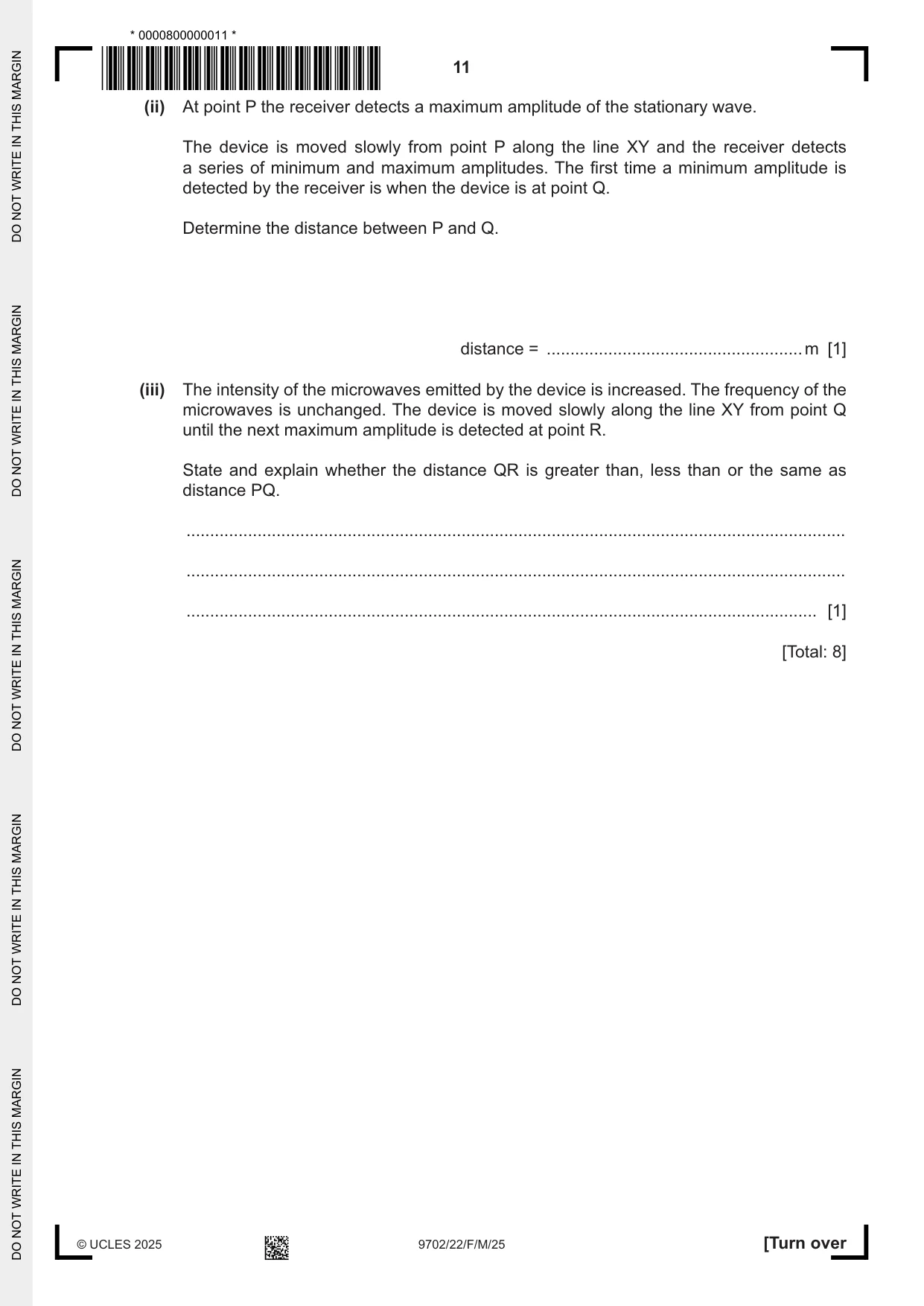
4 A device containing a microwave emitter and receiver is placed in front of a large metal sheet in a vacuum as shown in Fig. 4.1. X P Q Y microwave emitter and receiver metal sheet Fig. 4.1 (not to scale) The line XY is perpendicular to the metal sheet. The device emits microwaves of frequency 6.3 GHz. (a) When the device is at position P, a stationary wave is formed between the device and the sheet. Explain how the stationary wave, including the nodes and the antinodes, is formed. ................................................................................................................................................... ................................................................................................................................................... ................................................................................................................................................... ................................................................................................................................................... ................................................................................................................................................... ................................................................................................................................................... ................................................................................................................................................... ................................................................................................................................................... ............................................................................................................................................. [4] (b) (i) Calculate the wavelength of the microwaves. wavelength = ...................................................... m [2] (ii) At point P the receiver detects a maximum amplitude of the stationary wave. The device is moved slowly from point P along the line XY and the receiver detects a series of minimum and maximum amplitudes. The first time a minimum amplitude is detected by the receiver is when the device is at point Q. Determine the distance between P and Q. distance = ...................................................... m [1] (iii) The intensity of the microwaves emitted by the device is increased. The frequency of the microwaves is unchanged. The device is moved slowly along the line XY from point Q until the next maximum amplitude is detected at point R. State and explain whether the distance QR is greater than, less than or the same as distance PQ. ........................................................................................................................................... ........................................................................................................................................... ..................................................................................................................................... [1] [Total: 8]
Mark scheme: 4(a) (micro)wave (from the transmitter) reflects (at metal/sheet) B1 The incident and reflected waves superpose B1 (resultant) amplitude is maximum at an antinode B1 (resultant) amplitude is minimum/zero at a node B1 4(b)(i) = c / f C1 = 3 108 / 6.3 109 = 0.048 m A1 4(b)(ii) distance PQ = ¼ A1 = 0.048 / 4 = 0.012 m 4(b)(iii) (Distance QR is the) same (as PQ) and one of: B1 • Distance (between maxima / minima) does not depend on intensity • distance depends only on wavelength • wavelength is unchanged / constant
Q5 · A stationary loudspeaker emits sound of constant frequency
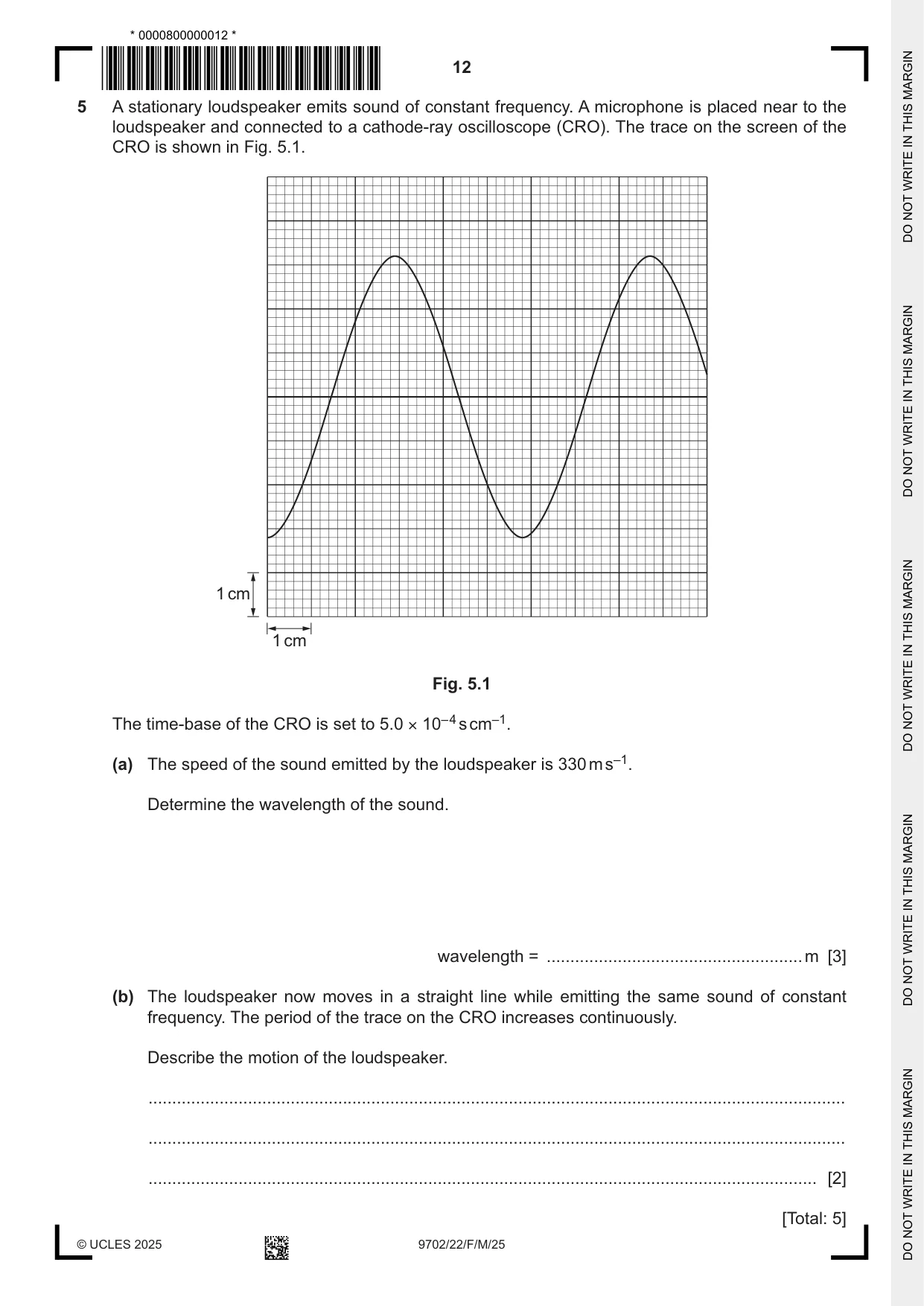
5 A stationary loudspeaker emits sound of constant frequency. A microphone is placed near to the loudspeaker and connected to a cathode-ray oscilloscope (CRO). The trace on the screen of the CRO is shown in Fig. 5.1. 1 cm 1 cm Fig. 5.1 The time-base of the CRO is set to 5.0 × 10– 4 s cm–1. (a) The speed of the sound emitted by the loudspeaker is 330 m s–1. Determine the wavelength of the sound. wavelength = ...................................................... m [3] (b) The loudspeaker now moves in a straight line while emitting the same sound of constant frequency. The period of the trace on the CRO increases continuously. Describe the motion of the loudspeaker. ................................................................................................................................................... ................................................................................................................................................... ............................................................................................................................................. [2] [Total: 5]
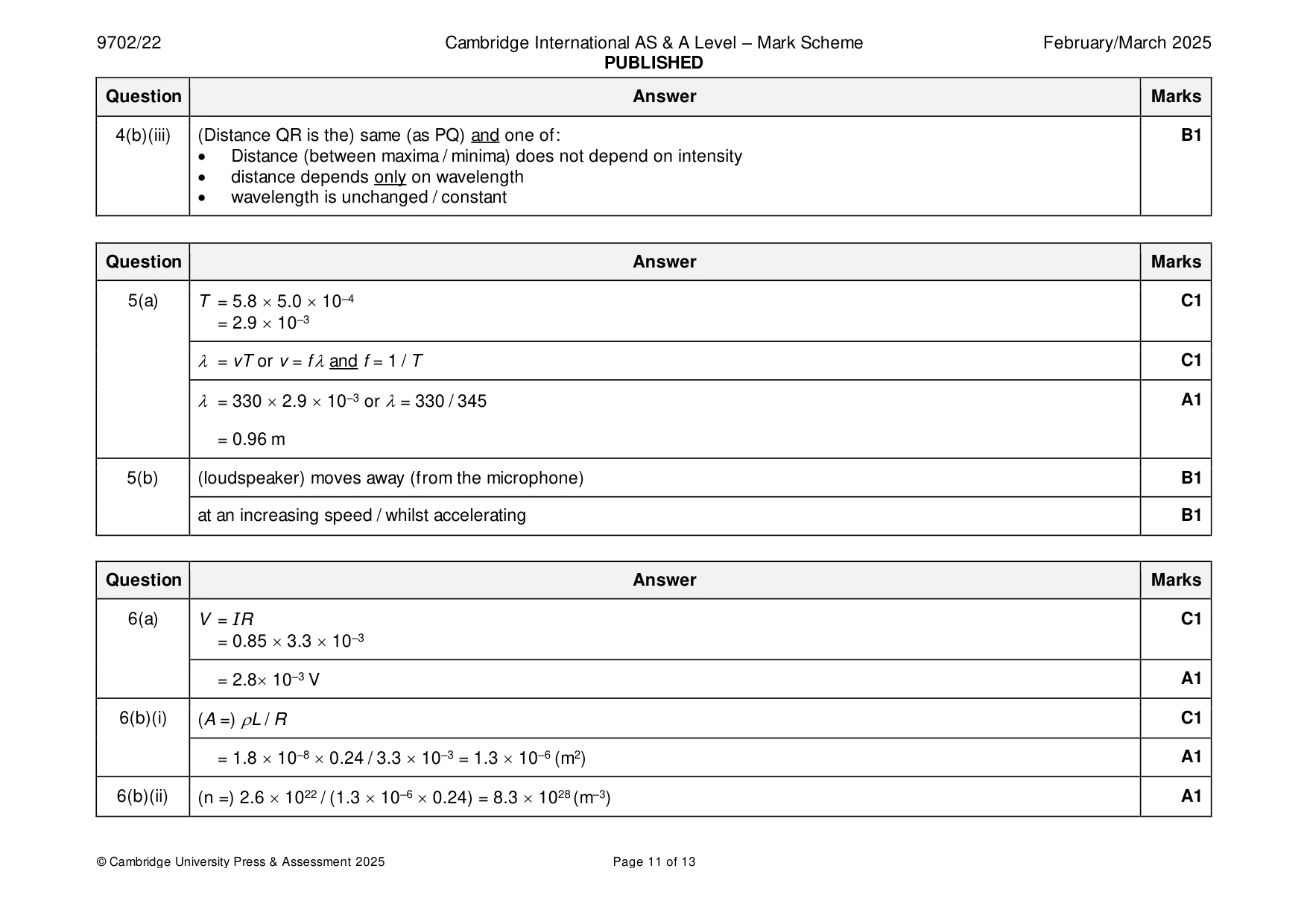
Mark scheme: 5(a) T = 5.8 5.0 10–4 C1 = 2.9 10–3 = vT or v = f and f = 1 / T C1 = 330 2.9 10–3 or = 330 / 345 A1 = 0.96 m 5(b) (loudspeaker) moves away (from the microphone) B1 at an increasing speed / whilst accelerating B1
Q6 · A cylindrical copper wire P of length 0.24 m is shown in Fig
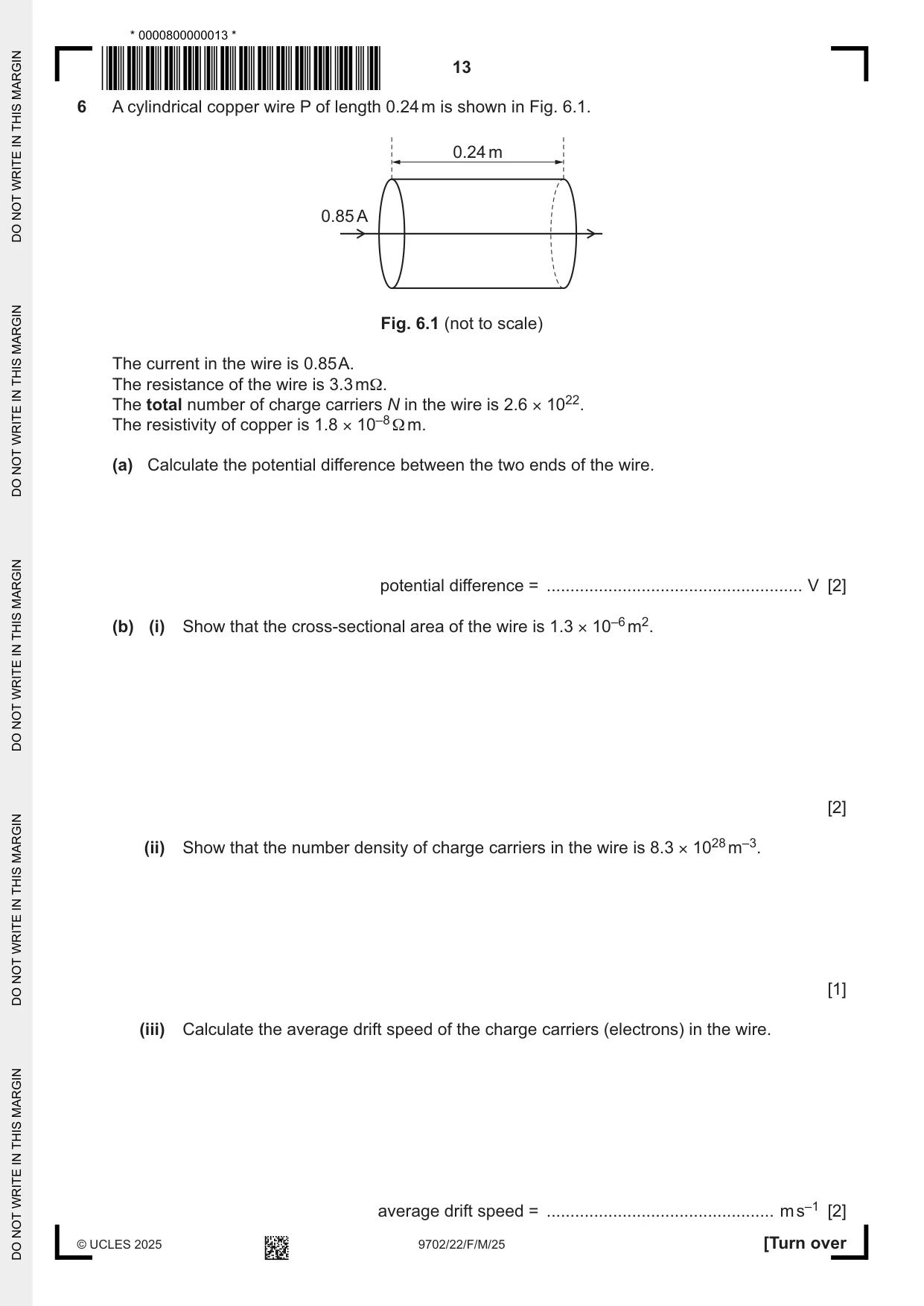
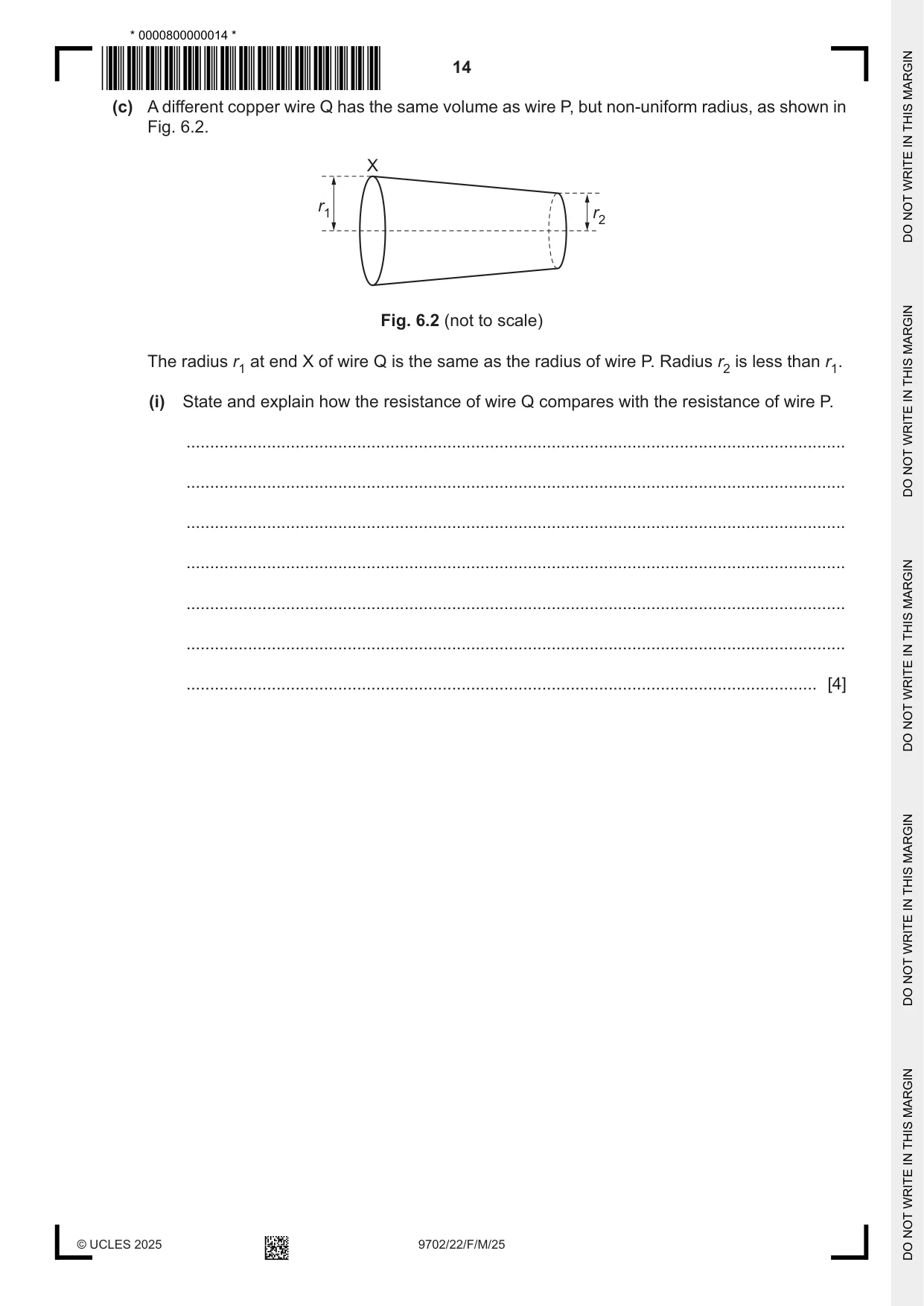
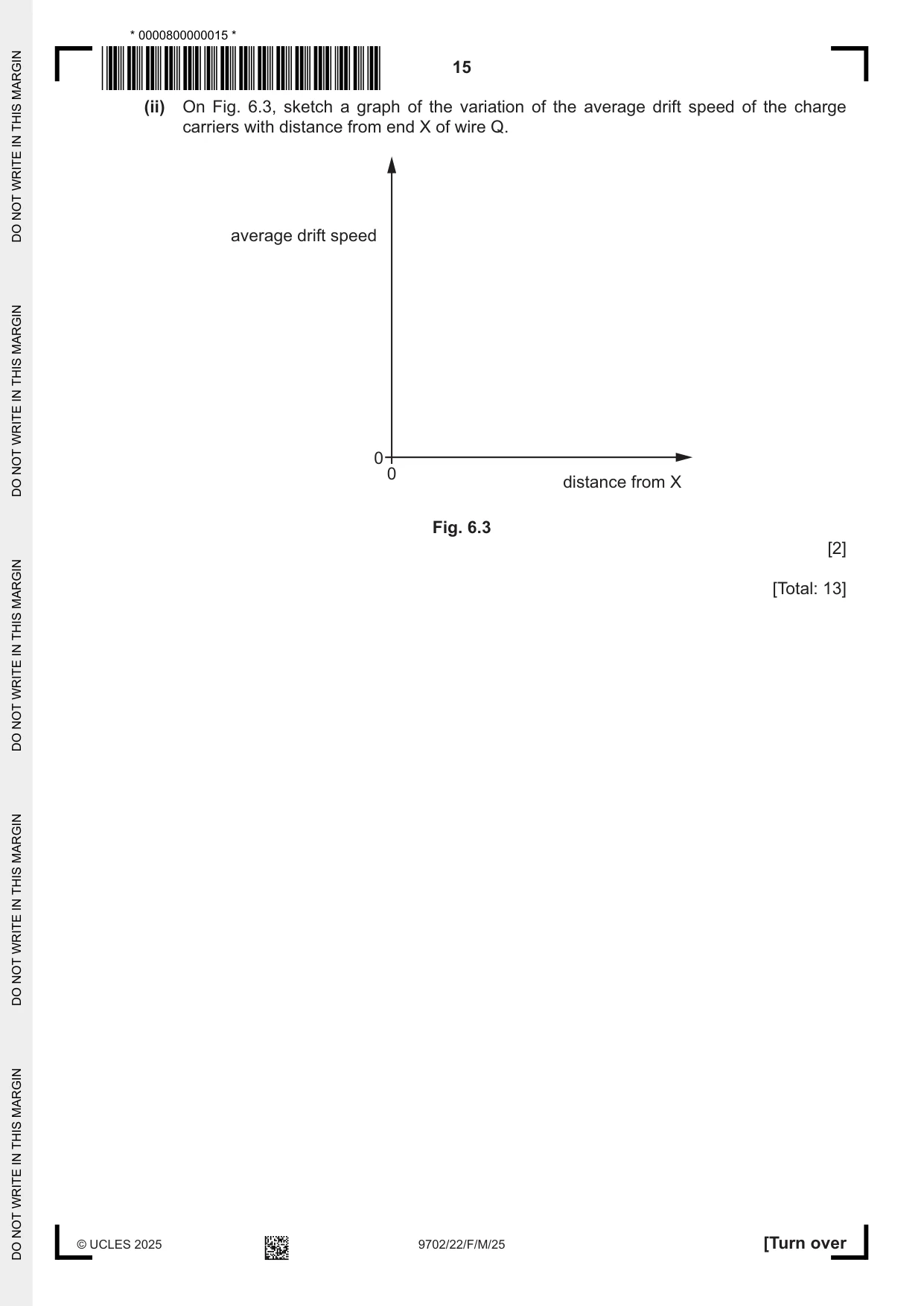
6 A cylindrical copper wire P of length 0.24 m is shown in Fig. 6.1. 0.24 m 0.85 A Fig. 6.1 (not to scale) The current in the wire is 0.85 A. The resistance of the wire is 3.3 mΩ. The total number of charge carriers N in the wire is 2.6 × 10²². The resistivity of copper is 1.8 × 10⁻⁸ Ω m. (a) Calculate the potential difference between the two ends of the wire. potential difference = ...................................................... V [2] (b) (i) Show that the cross-sectional area of the wire is 1.3 × 10⁻⁶ m2. [2] (ii) Show that the number density of charge carriers in the wire is 8.3 × 1028 m–3. [1] (iii) Calculate the average drift speed of the charge carriers (electrons) in the wire. average drift speed = ................................................ m s–1 [2] (c) A different copper wire Q has the same volume as wire P, but non-uniform radius, as shown in Fig. 6.2. X r1 r2 Fig. 6.2 (not to scale) The radius r1 at end X of wire Q is the same as the radius of wire P. Radius r2 is less than r1. (i) State and explain how the resistance of wire Q compares with the resistance of wire P. ........................................................................................................................................... ........................................................................................................................................... ........................................................................................................................................... ........................................................................................................................................... ........................................................................................................................................... ........................................................................................................................................... ..................................................................................................................................... [4] (ii) On Fig. 6.3, sketch a graph of the variation of the average drift speed of the charge carriers with distance from end X of wire Q. average drift speed 0 0 distance from X Fig. 6.3 [2] [Total: 13]
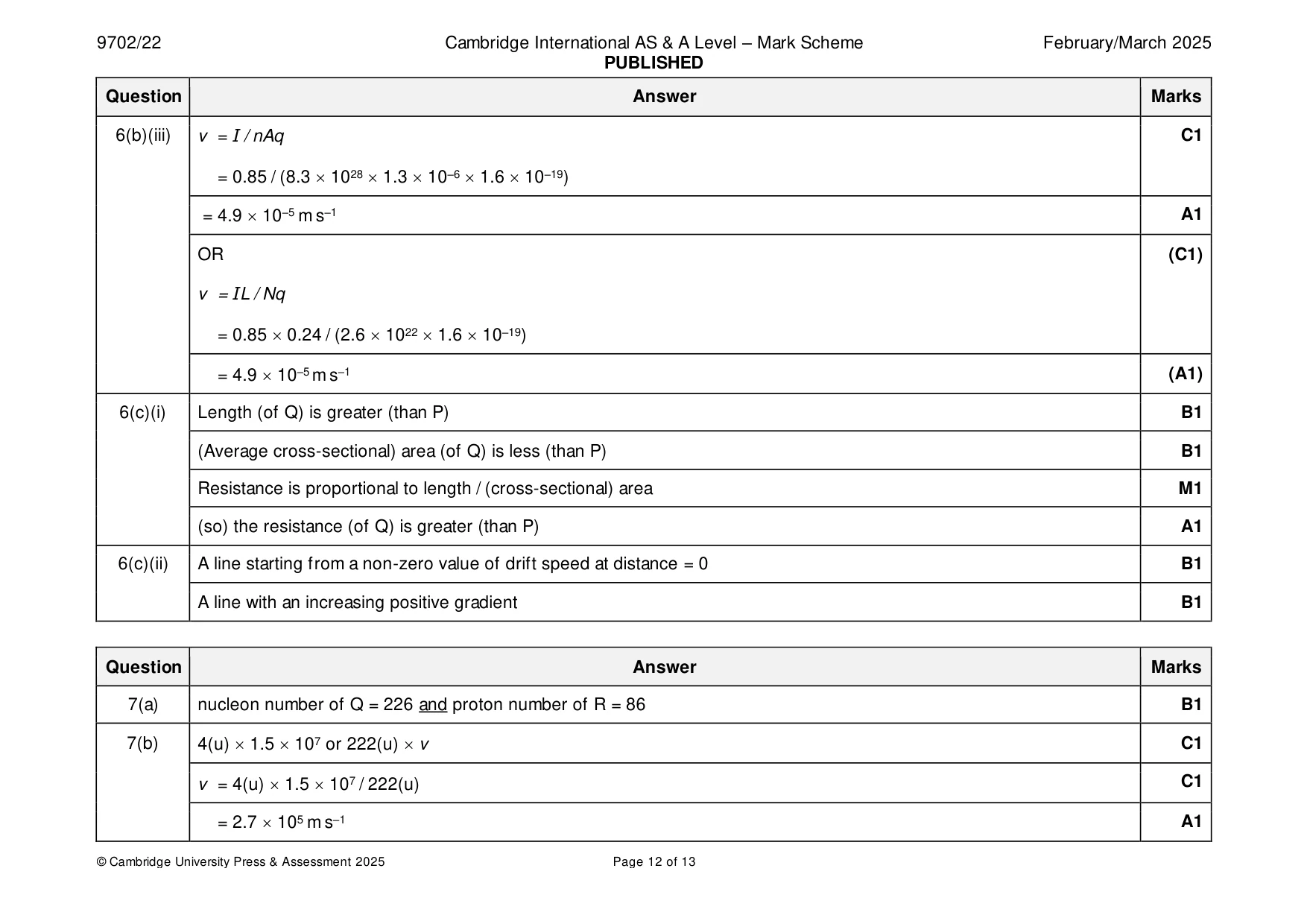
Mark scheme: 6(a) V = IR C1 = 0.85 3.3 10–3 = 2.8 10–3 V A1 6(b)(i) (A =) L / R C1 = 1.8 10–8 0.24 / 3.3 10–3 = 1.3 10–6 (m2) A1 6(b)(ii) (n =) 2.6 1022 / (1.3 10–6 0.24) = 8.3 1028 (m–3) A1 6(b)(iii) v = I / nAq C1 = 0.85 / (8.3 1028 1.3 10–6 1.6 10–19) = 4.9 10–5 m s–1 A1 OR (C1) v = IL / Nq = 0.85 0.24 / (2.6 1022 1.6 10–19) = 4.9 10–5 m s–1 (A1) 6(c)(i) Length (of Q) is greater (than P) B1 (Average cross-sectional) area (of Q) is less (than P) B1 Resistance is proportional to length / (cross-sectional) area M1 (so) the resistance (of Q) is greater (than P) A1 6(c)(ii) A line starting from a non-zero value of drift speed at distance = 0 B1 A line with an increasing positive gradient B1
Q7 · An isolated stationary nucleus Q decays into nucleus R and an α-particle
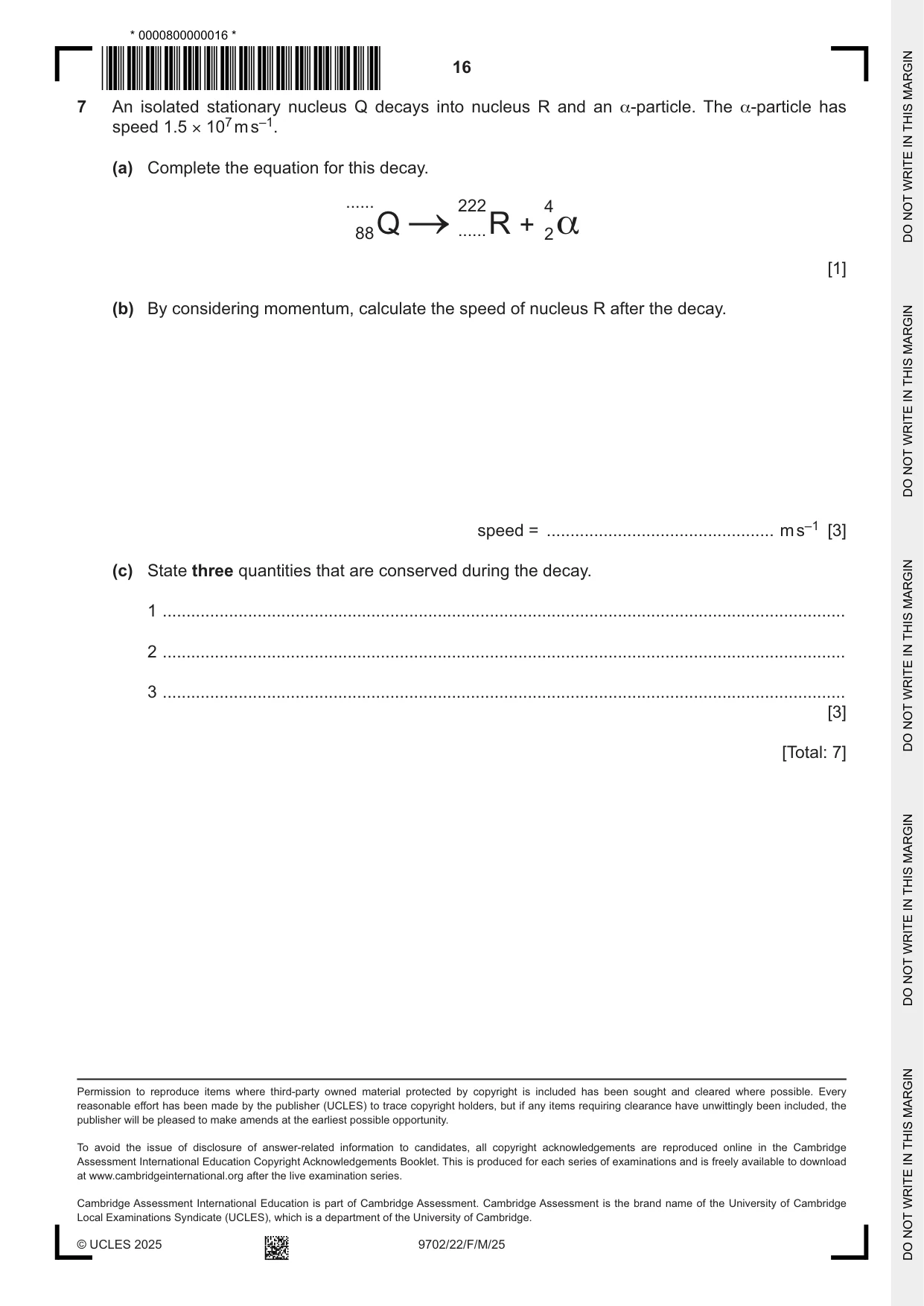
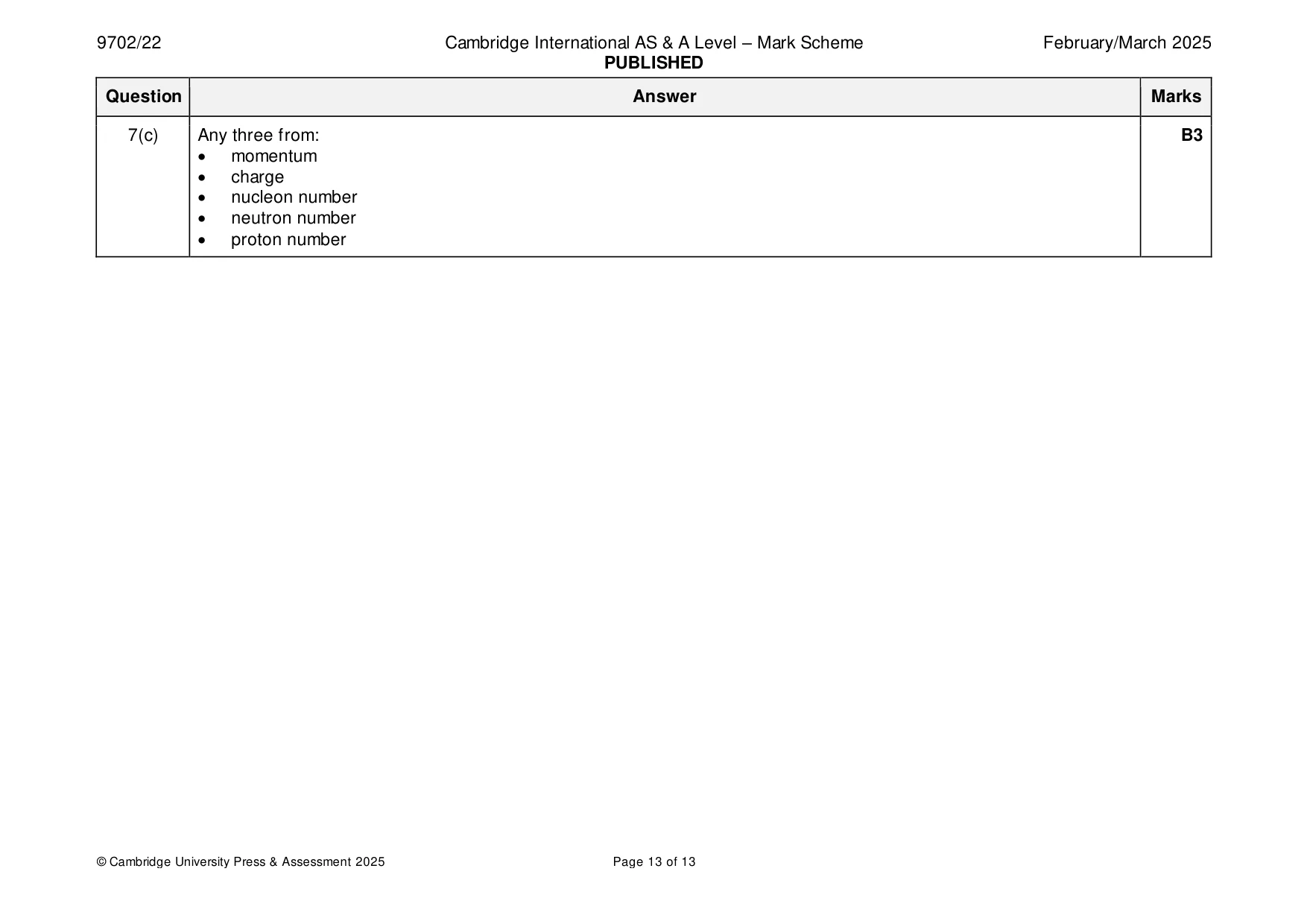
7 An isolated stationary nucleus Q decays into nucleus R and an α-particle. The α-particle has speed 1.5 × 10⁷ m s–1. (a) Complete the equation for this decay. ...... 222 4 88 Q ...... R + 2 α [1] (b) By considering momentum, calculate the speed of nucleus R after the decay. speed = ................................................ m s–1 [3] (c) State three quantities that are conserved during the decay. 1 ................................................................................................................................................ 2 ................................................................................................................................................ 3 ................................................................................................................................................ [3] [Total: 7]
Mark scheme: 7(a) nucleon number of Q = 226 and proton number of R = 86 B1 7(b) 4(u) 1.5 107 or 222(u) v C1 v = 4(u) 1.5 107 / 222(u) C1 = 2.7 105 m s–1 A1 7(c) Any three from: B3 • momentum • charge • nucleon number • neutron number • proton number
What was in this paper
The subtopics covered by these 7 questions, and how many questions each got. Open one in a new tab to see every Cambridge question on it.
What you needed in this session
Cambridge’s own grade thresholds for 2025 Feb/March, Paper 2 · Variant 2. A higher threshold means an easier paper — the bar moves with how the cohort did.