Cambridge A Level Physics 9702 — 2020 Oct/Nov Paper 2 · Variant 3
9702/23/O/N/20 · 7 questions · 60 marks · ≈68 min
The question paper and its mark scheme, free to read here and free to download. This is Cambridge’s own paper, exactly as it was sat.
Question paper16 pages


Mark scheme13 pages
Answers below. Sit the paper first if you are practising.
Questions as text
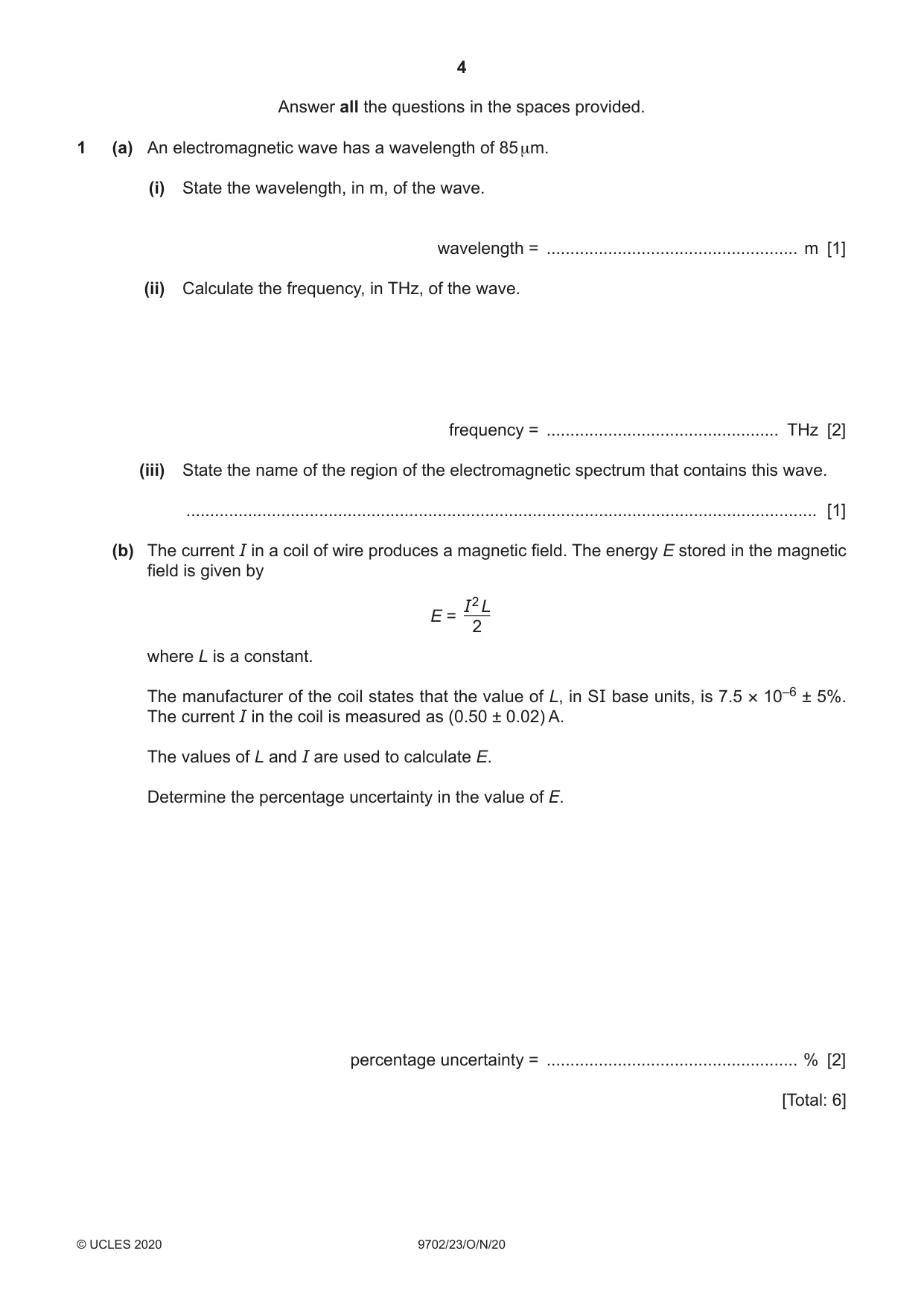
Q1 · An electromagnetic wave has a wavelength of 85 μm
1 (a) An electromagnetic wave has a wavelength of 85 μm. (i) State the wavelength, in m, of the wave. wavelength = ..................................................... m [1] (ii) Calculate the frequency, in THz, of the wave. frequency = ................................................. THz [2] (iii) State the name of the region of the electromagnetic spectrum that contains this wave. ..................................................................................................................................... [1] (b) The current I in a coil of wire produces a magnetic field. The energy E stored in the magnetic field is given by I 2 L E = 2 where L is a constant. The manufacturer of the coil states that the value of L, in SI base units, is 7.5 × 10⁻⁶ ± 5%. The current I in the coil is measured as (0.50 ± 0.02) A. The values of L and I are used to calculate E. Determine the percentage uncertainty in the value of E. percentage uncertainty = ..................................................... % [2] [Total: 6]
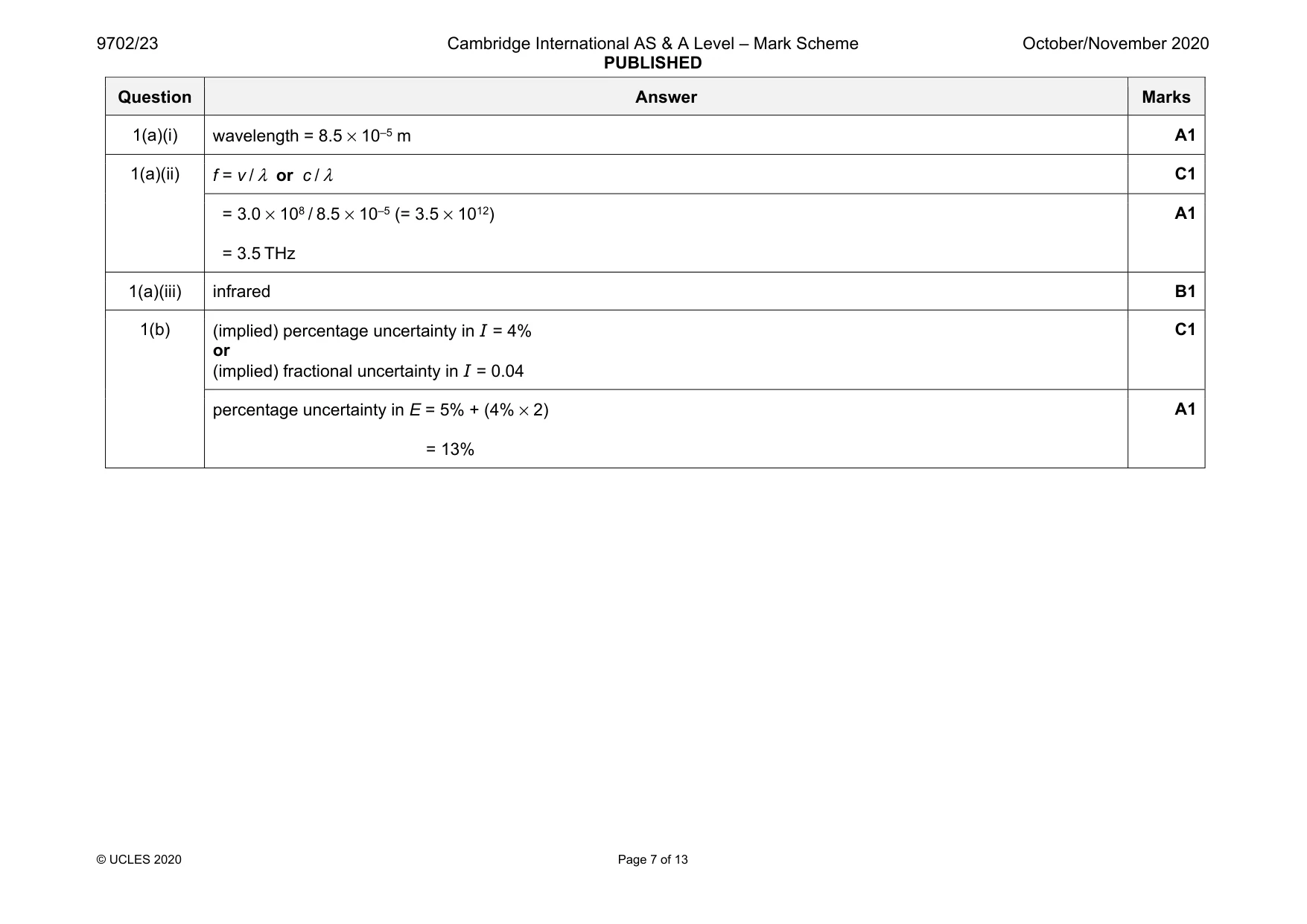
Mark scheme: 1(a)(i) wavelength = 8.5 × 10⁻⁵ m A1 1(a)(ii) f = v / λ or c / λ C1 = 3.0 × 10⁸ / 8.5 × 10⁻⁵ (= 3.5 × 10¹²) = 3.5 THz A1 1(a)(iii) infrared B1 1(b) (implied) percentage uncertainty in I = 4% or (implied) fractional uncertainty in I = 0.04 C1 percentage uncertainty in E = 5% + (4% × 2) = 13% A1
Q2 · State what is meant by the centre of gravity of a body
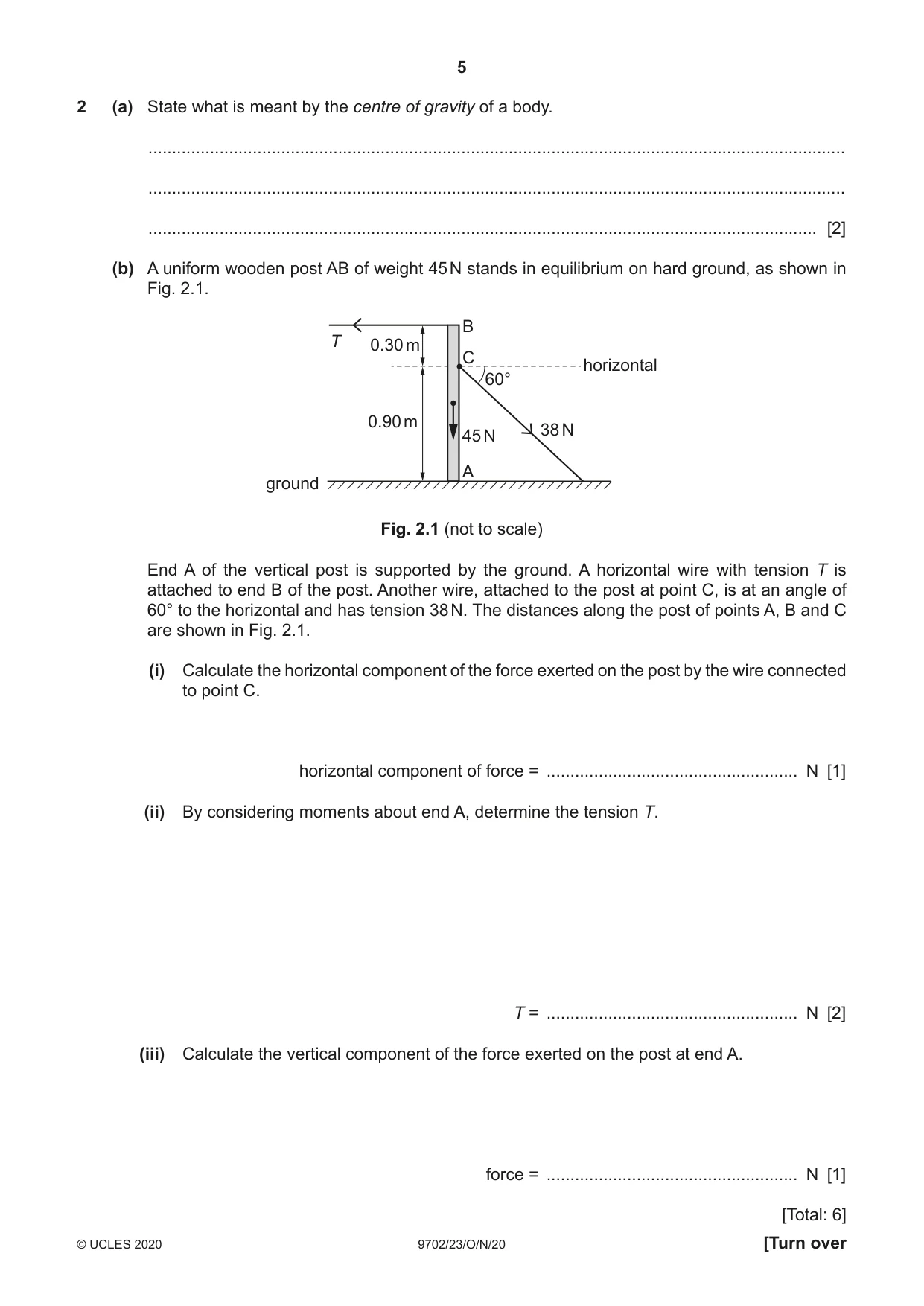
2 (a) State what is meant by the centre of gravity of a body. ................................................................................................................................................... ................................................................................................................................................... ............................................................................................................................................. [2] (b) A uniform wooden post AB of weight 45 N stands in equilibrium on hard ground, as shown in Fig. 2.1. B T 0.30 m C horizontal 60° 0.90 m 38 N 45 N A ground Fig. 2.1 (not to scale) End A of the vertical post is supported by the ground. A horizontal wire with tension T is attached to end B of the post. Another wire, attached to the post at point C, is at an angle of 60° to the horizontal and has tension 38 N. The distances along the post of points A, B and C are shown in Fig. 2.1. (i) Calculate the horizontal component of the force exerted on the post by the wire connected to point C. horizontal component of force = ..................................................... N [1] (ii) By considering moments about end A, determine the tension T. T = ..................................................... N [2] (iii) Calculate the vertical component of the force exerted on the post at end A. force = ..................................................... N [1] [Total: 6]
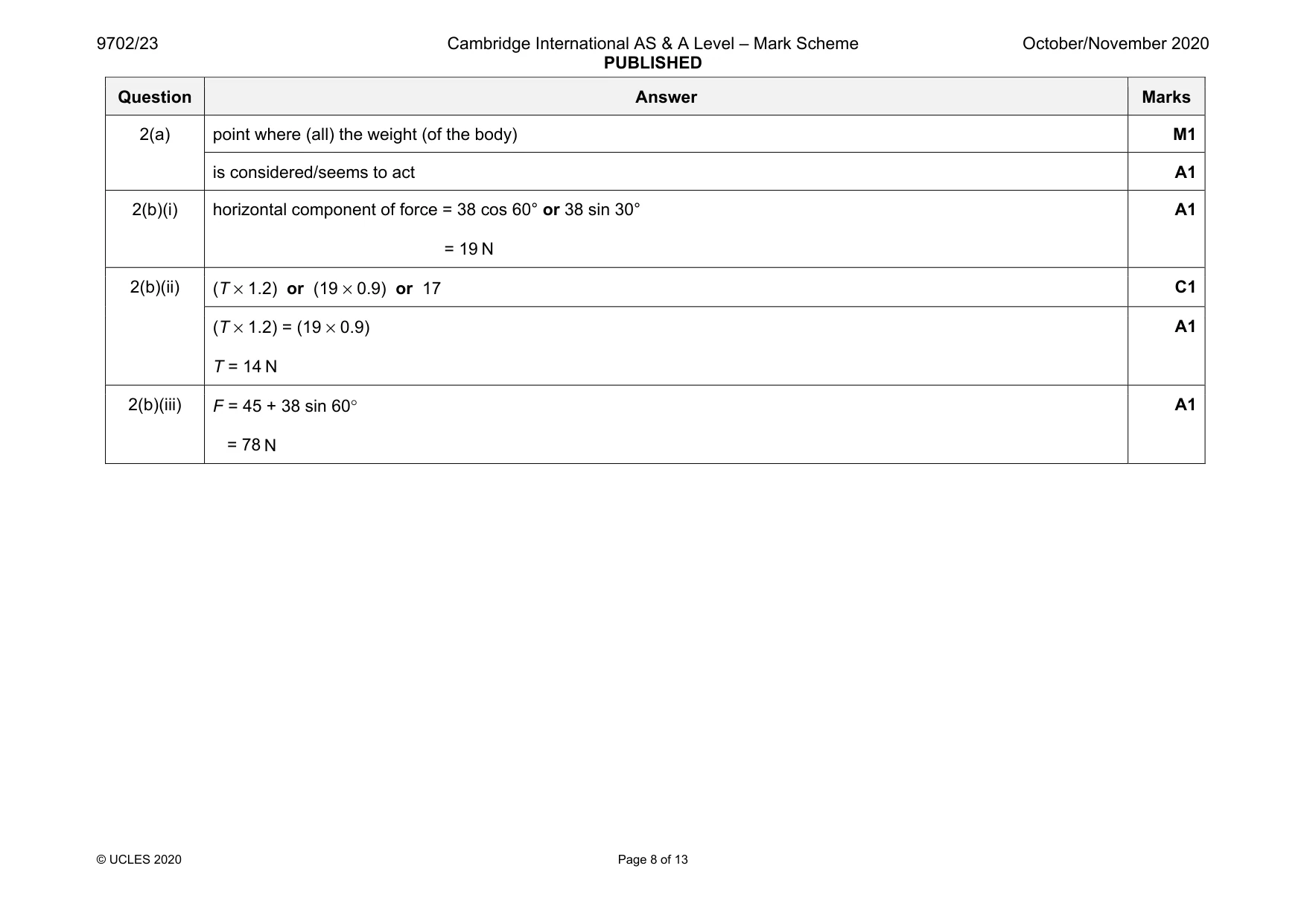
Mark scheme: 2(a) point where (all) the weight (of the body) M1 is considered/seems to act A1 2(b)(i) horizontal component of force = 38 cos 60° or 38 sin 30° = 19 N A1 2(b)(ii) (T × 1.2) or (19 × 0.9) or 17 C1 (T × 1.2) = (19 × 0.9) T = 14 N A1 2(b)(iii) F = 45 + 38 sin 60° = 78 N A1
Q3 · A ball is fired horizontally with a speed of 41.0 m s–1 from a stationary cannon at the…
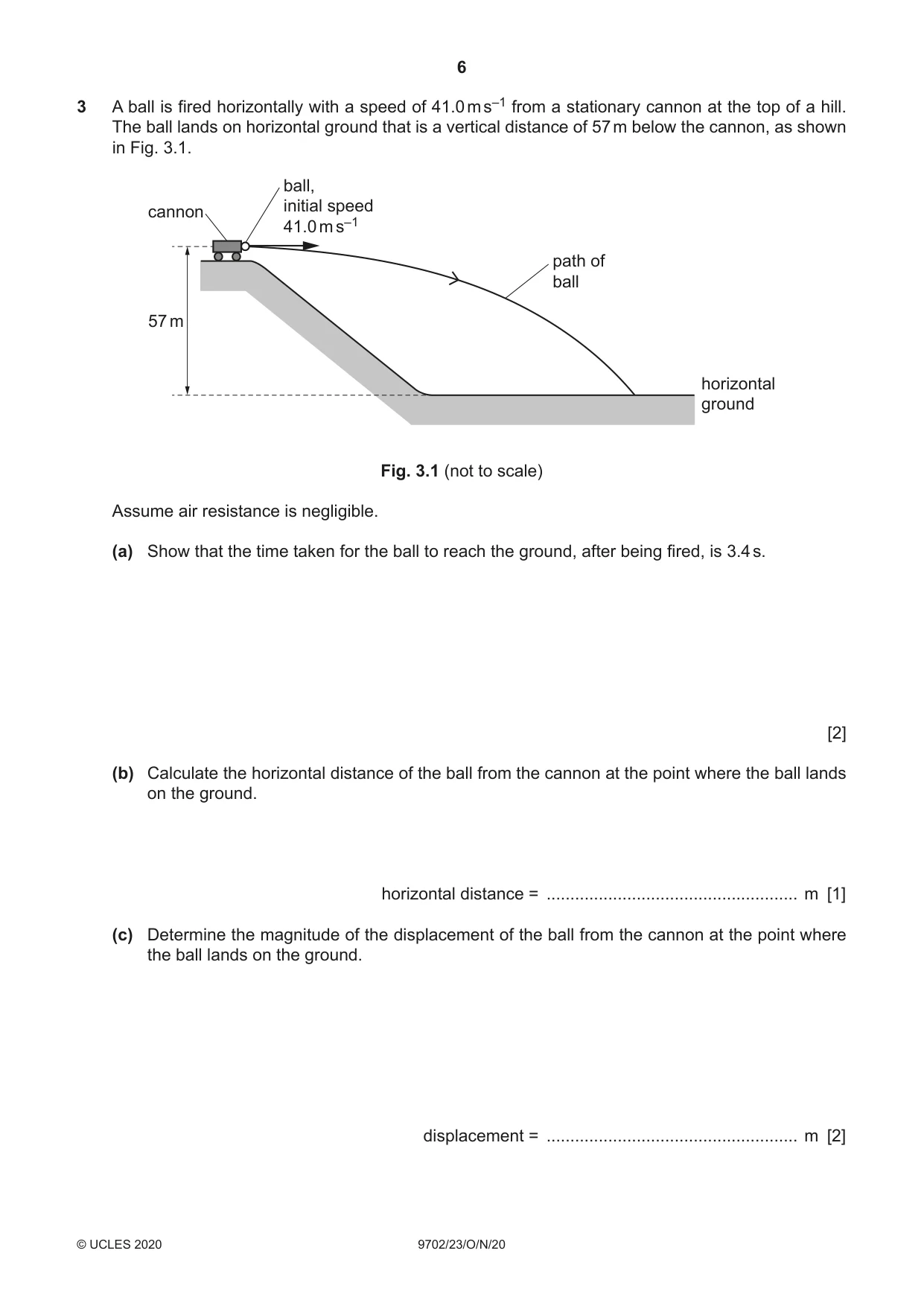
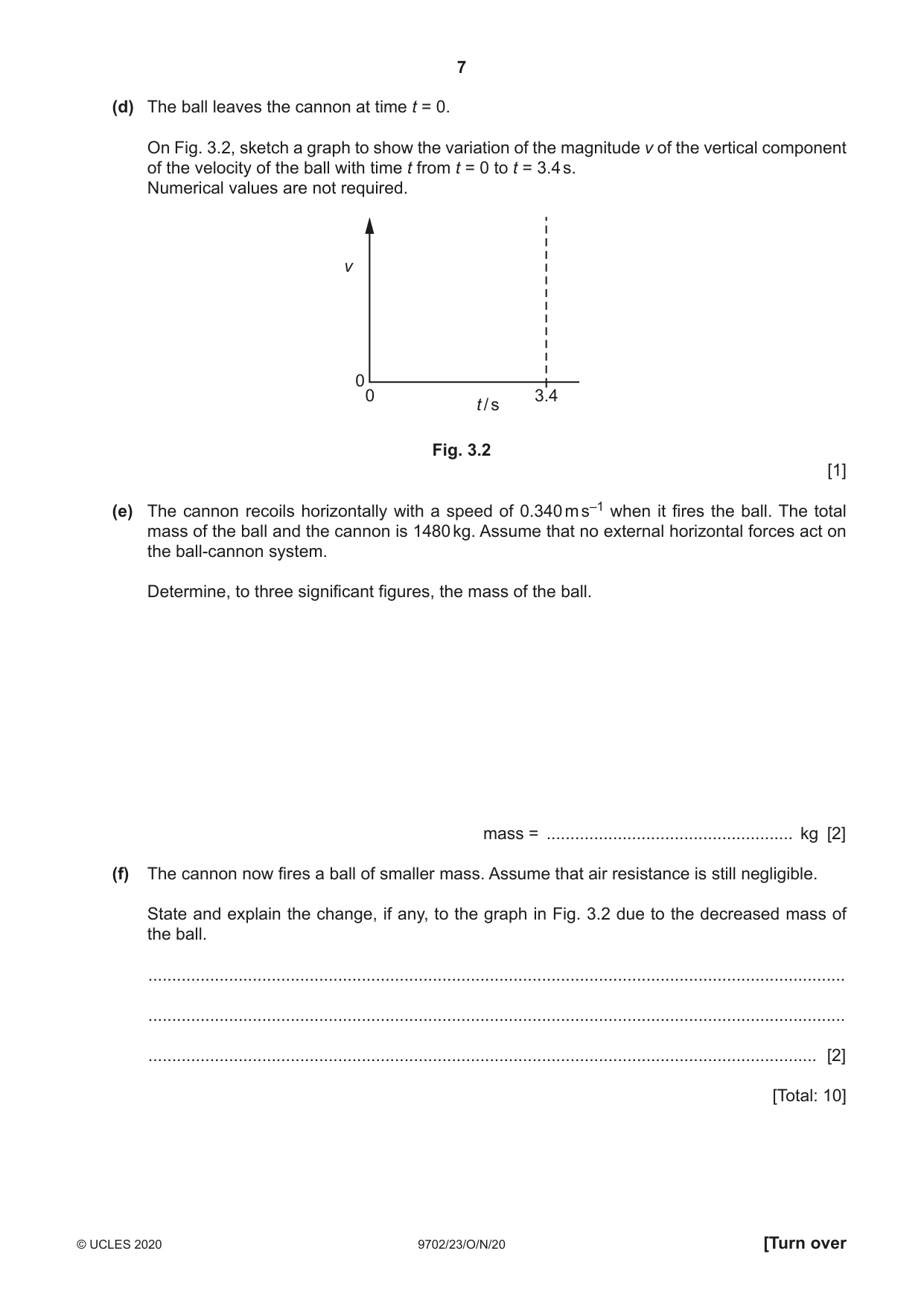
3 A ball is fired horizontally with a speed of 41.0 m s–1 from a stationary cannon at the top of a hill. The ball lands on horizontal ground that is a vertical distance of 57 m below the cannon, as shown in Fig. 3.1. ball, initial speed cannon 41.0 m s–1 path of ball 57 m horizontal ground Fig. 3.1 (not to scale) Assume air resistance is negligible. (a) Show that the time taken for the ball to reach the ground, after being fired, is 3.4 s. [2] (b) Calculate the horizontal distance of the ball from the cannon at the point where the ball lands on the ground. horizontal distance = ..................................................... m [1] (c) Determine the magnitude of the displacement of the ball from the cannon at the point where the ball lands on the ground. displacement = ..................................................... m [2] (d) The ball leaves the cannon at time t = 0. On Fig. 3.2, sketch a graph to show the variation of the magnitude v of the vertical component of the velocity of the ball with time t from t = 0 to t = 3.4 s. Numerical values are not required. v 0 0 3.4 t / s Fig. 3.2 [1] (e) The cannon recoils horizontally with a speed of 0.340 m s–1 when it fires the ball. The total mass of the ball and the cannon is 1480 kg. Assume that no external horizontal forces act on the ball-cannon system. Determine, to three significant figures, the mass of the ball. mass = .................................................... kg [2] (f) The cannon now fires a ball of smaller mass. Assume that air resistance is still negligible. State and explain the change, if any, to the graph in Fig. 3.2 due to the decreased mass of the ball. ................................................................................................................................................... ................................................................................................................................................... ............................................................................................................................................. [2] [Total: 10]
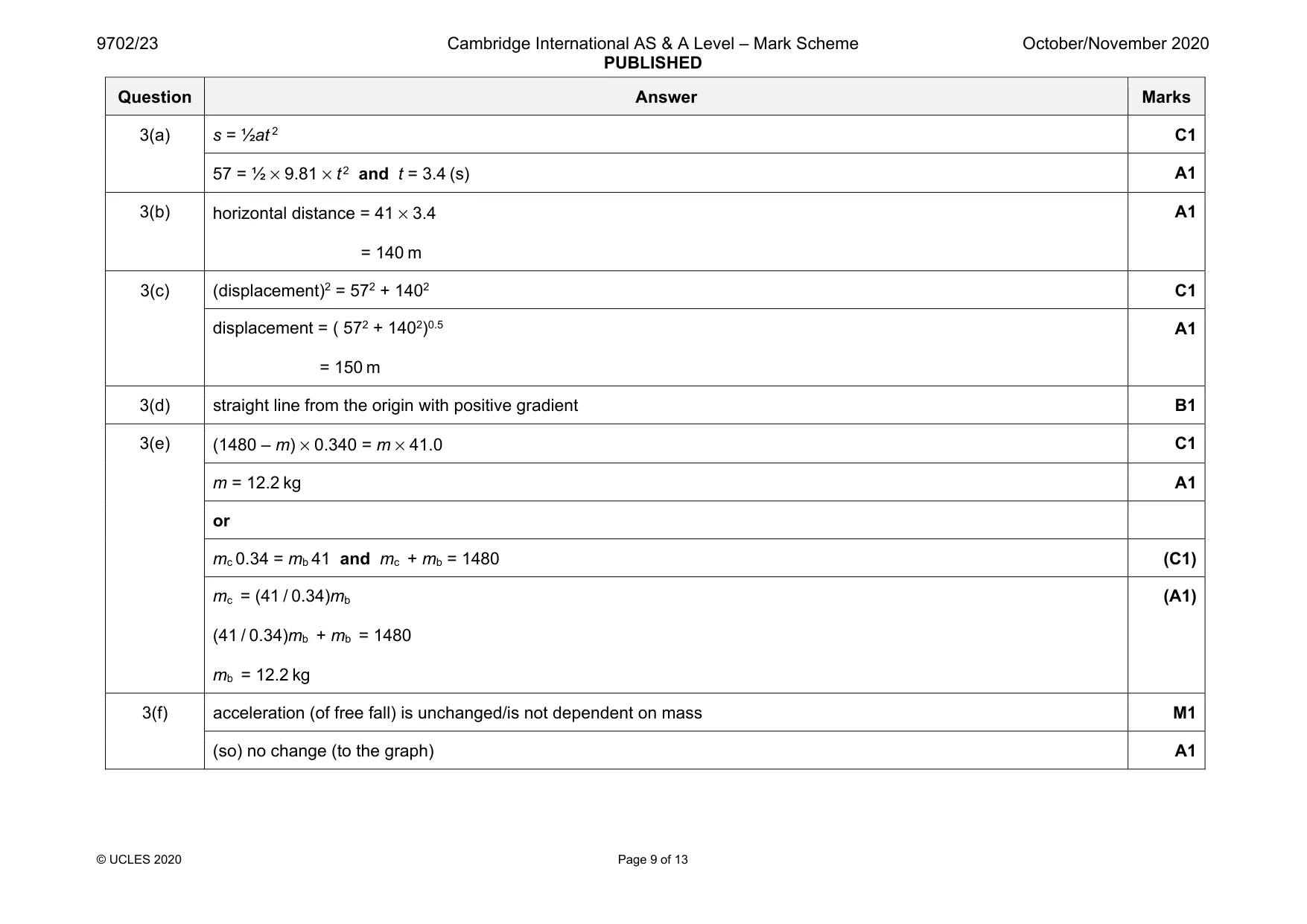
Mark scheme: 3(a) s = ½at 2 C1 57 = ½ × 9.81 × t 2 and t = 3.4 (s) A1 3(b) horizontal distance = 41 × 3.4 = 140 m A1 3(c) (displacement)2 = 572 + 1402 C1 displacement = ( 572 + 1402)0.5 = 150 m A1 3(d) straight line from the origin with positive gradient B1 3(e) (1480 – m) × 0.340 = m × 41.0 C1 m = 12.2 kg A1 or mc 0.34 = mb 41 and mc + mb = 1480 (C1) mc = (41 / 0.34)mb (41 / 0.34)mb + mb = 1480 mb = 12.2 kg (A1) 3(f) acceleration (of free fall) is unchanged/is not dependent on mass M1 (so) no change (to the graph) A1
Question 4
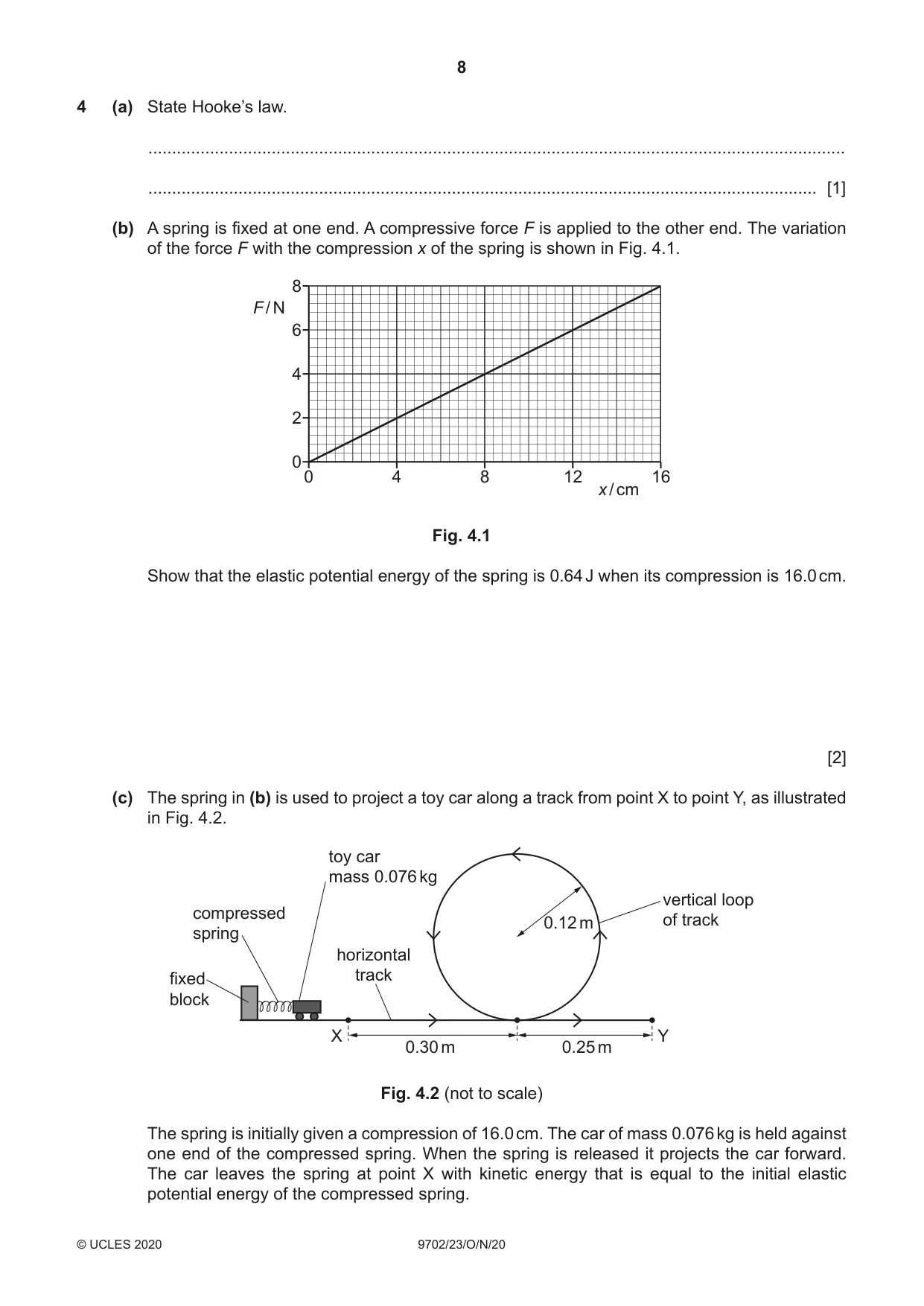
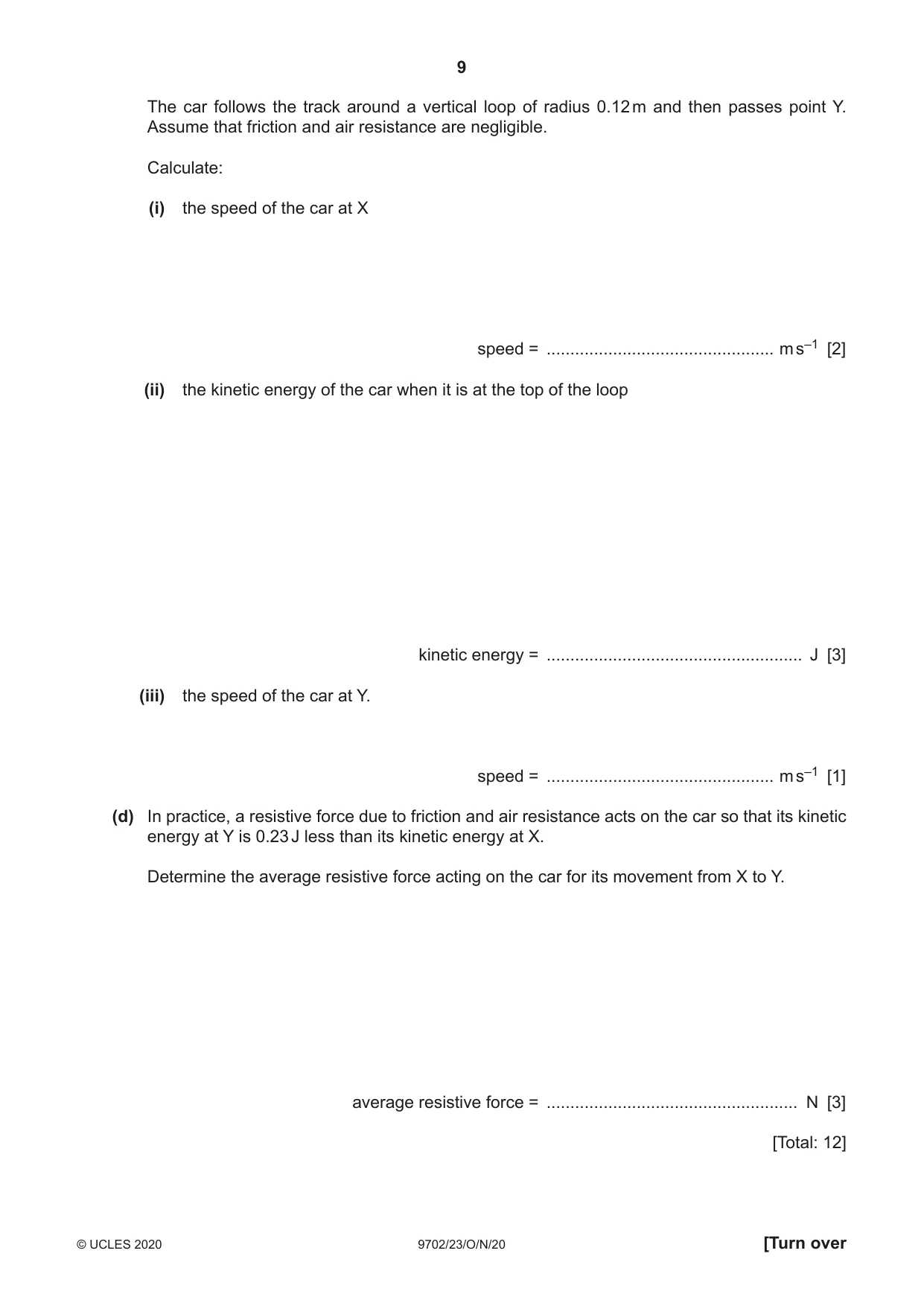
4 (a) State Hooke’s law. ................................................................................................................................................... ............................................................................................................................................. [1] (b) A spring is fixed at one end. A compressive force F is applied to the other end. The variation of the force F with the compression x of the spring is shown in Fig. 4.1. 8 F / N 6 4 2 0 0 4 8 12 16 x / cm Fig. 4.1 Show that the elastic potential energy of the spring is 0.64 J when its compression is 16.0 cm. [2] (c) The spring in (b) is used to project a toy car along a track from point X to point Y, as illustrated in Fig. 4.2. toy car mass 0.076 kg vertical loop compressed 0.12 m of track spring horizontal fixed track block X Y 0.30 m 0.25 m Fig. 4.2 (not to scale) The spring is initially given a compression of 16.0 cm. The car of mass 0.076 kg is held against one end of the compressed spring. When the spring is released it projects the car forward. The car leaves the spring at point X with kinetic energy that is equal to the initial elastic potential energy of the compressed spring. The car follows the track around a vertical loop of radius 0.12 m and then passes point Y. Assume that friction and air resistance are negligible. Calculate: (i) the speed of the car at X speed = ................................................ m s–1 [2] (ii) the kinetic energy of the car when it is at the top of the loop kinetic energy = ...................................................... J [3] (iii) the speed of the car at Y. speed = ................................................ m s–1 [1] (d) In practice, a resistive force due to friction and air resistance acts on the car so that its kinetic energy at Y is 0.23 J less than its kinetic energy at X. Determine the average resistive force acting on the car for its movement from X to Y. average resistive force = ..................................................... N [3] [Total: 12]
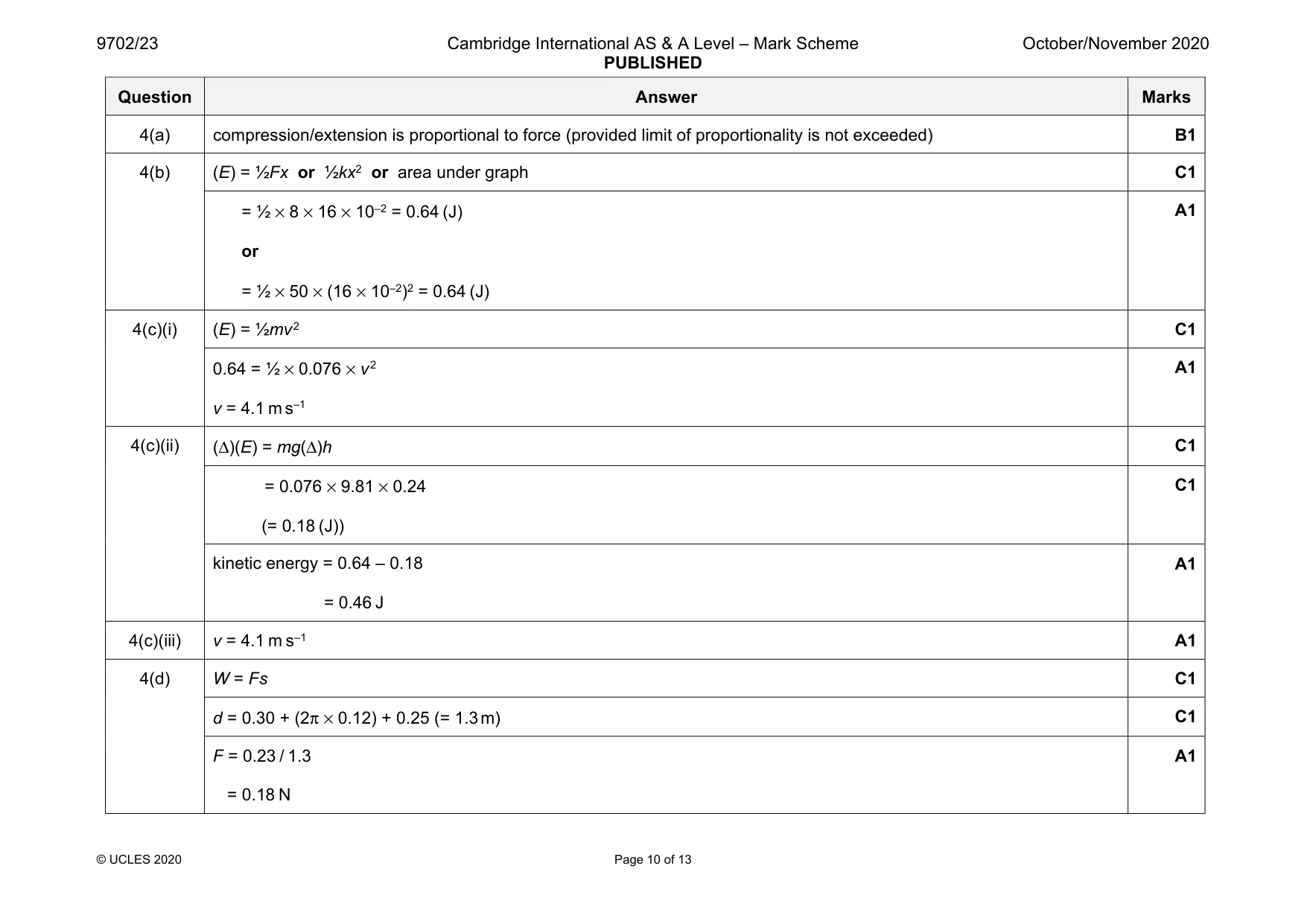
Mark scheme: 4(a) compression/extension is proportional to force (provided limit of proportionality is not exceeded) B1 4(b) (E) = ½Fx or ½kx2 or area under graph C1 = ½ × 8 × 16 × 10–2 = 0.64 (J) or = ½ × 50 × (16 × 10–2)2 = 0.64 (J) A1 4(c)(i) (E) = ½mv 2 C1 0.64 = ½ × 0.076 × v 2 v = 4.1 m s–1 A1 4(c)(ii) (Δ)(E) = mg(Δ)h C1 = 0.076 × 9.81 × 0.24 (= 0.18 (J)) C1 kinetic energy = 0.64 – 0.18 = 0.46 J A1 4(c)(iii) v = 4.1 m s–1 A1 4(d) W = Fs C1 d = 0.30 + (2π × 0.12) + 0.25 (= 1.3 m) C1 F = 0.23 / 1.3 = 0.18 N A1
Q5 · A sound wave is detected by a microphone that is connected to a cathode-ray oscilloscope…
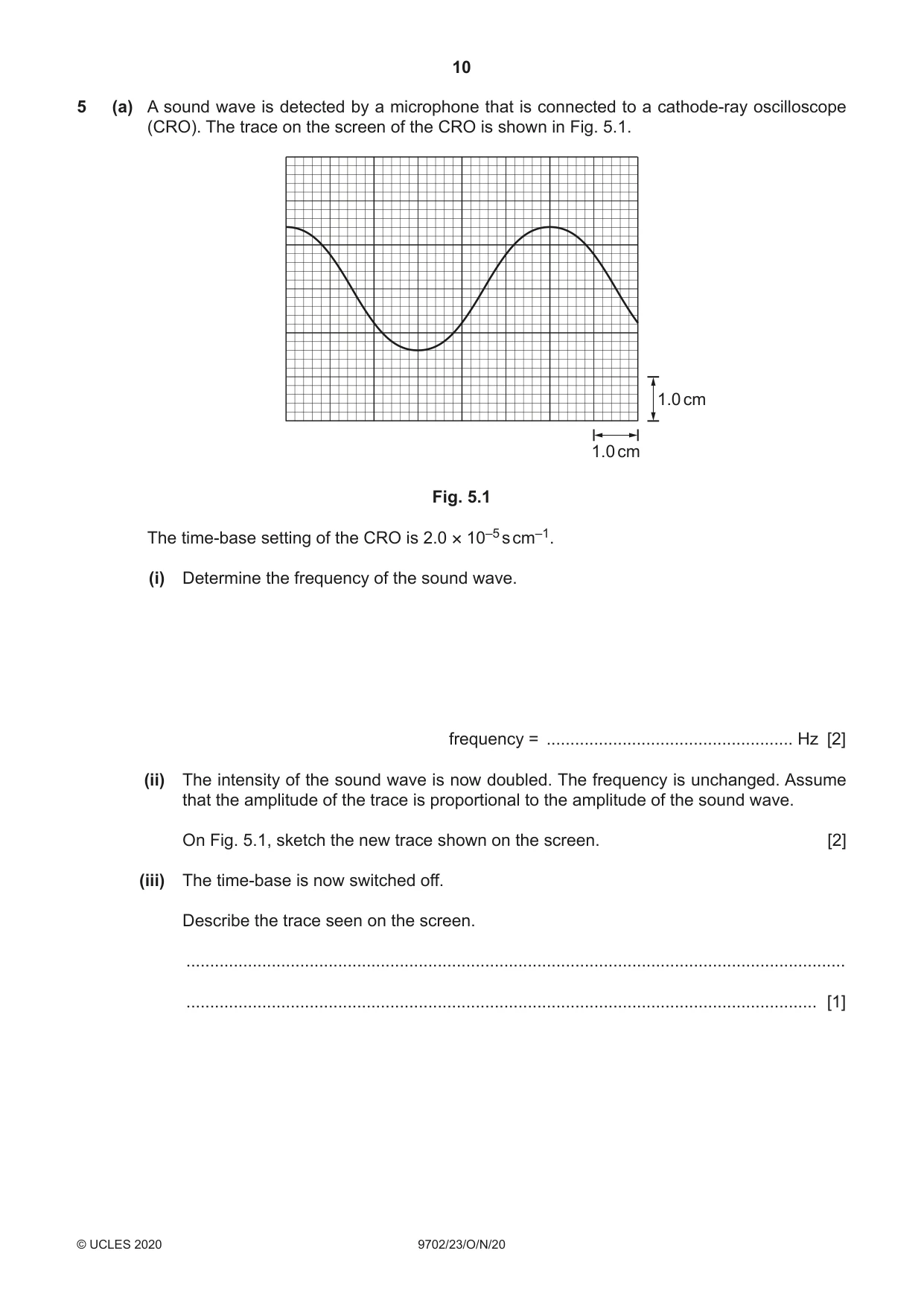
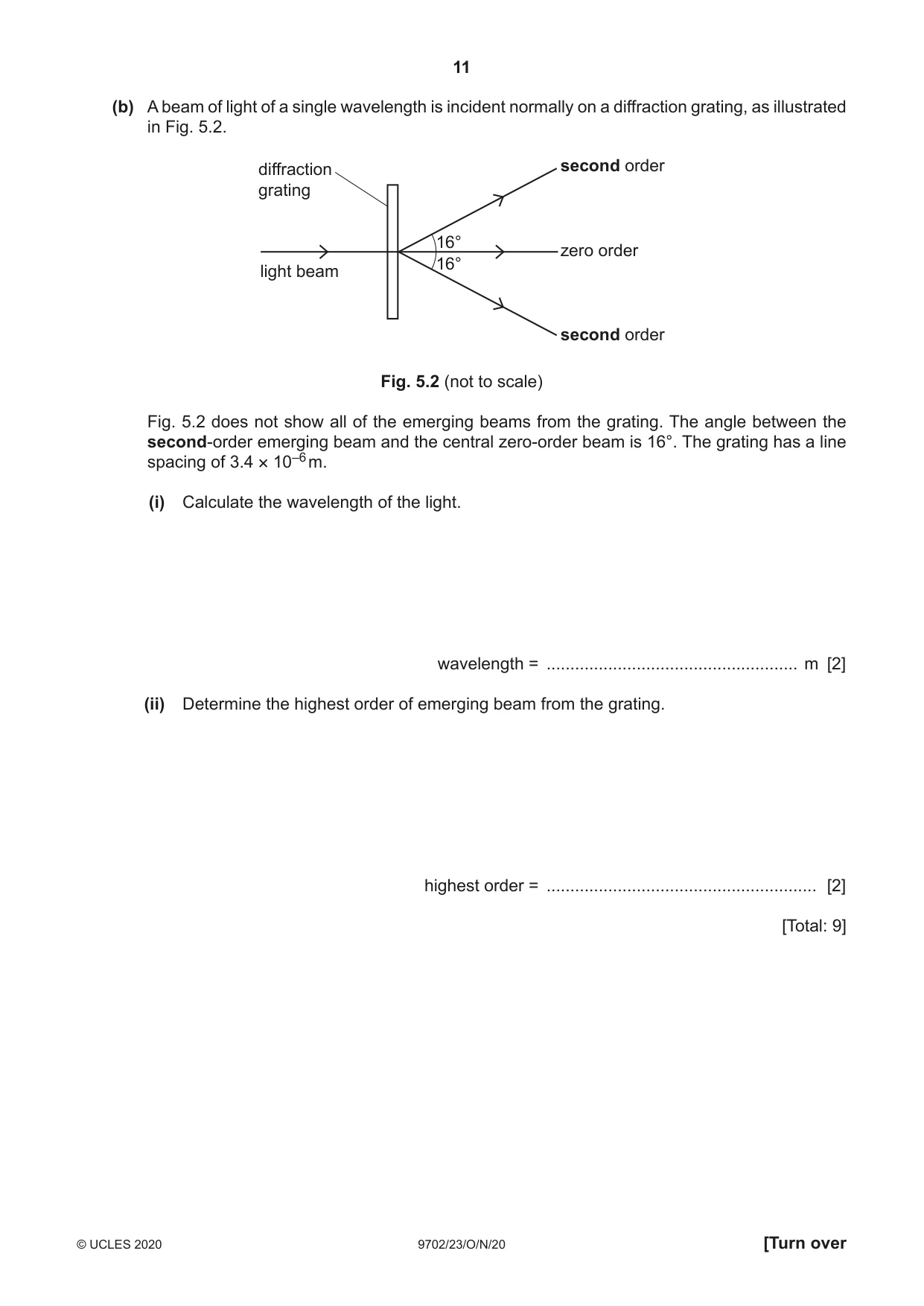
5 (a) A sound wave is detected by a microphone that is connected to a cathode-ray oscilloscope (CRO). The trace on the screen of the CRO is shown in Fig. 5.1. 1.0 cm 1.0 cm Fig. 5.1 The time-base setting of the CRO is 2.0 × 10⁻⁵ s cm–1. (i) Determine the frequency of the sound wave. frequency = .................................................... Hz [2] (ii) The intensity of the sound wave is now doubled. The frequency is unchanged. Assume that the amplitude of the trace is proportional to the amplitude of the sound wave. On Fig. 5.1, sketch the new trace shown on the screen. [2] (iii) The time-base is now switched off. Describe the trace seen on the screen. ........................................................................................................................................... ..................................................................................................................................... [1] (b) A beam of light of a single wavelength is incident normally on a diffraction grating, as illustrated in Fig. 5.2. diffraction second order grating 16° zero order 16° light beam second order Fig. 5.2 (not to scale) Fig. 5.2 does not show all of the emerging beams from the grating. The angle between the second-order emerging beam and the central zero-order beam is 16°. The grating has a line spacing of 3.4 × 10⁻⁶ m. (i) Calculate the wavelength of the light. wavelength = ..................................................... m [2] (ii) Determine the highest order of emerging beam from the grating. highest order = ......................................................... [2] [Total: 9]
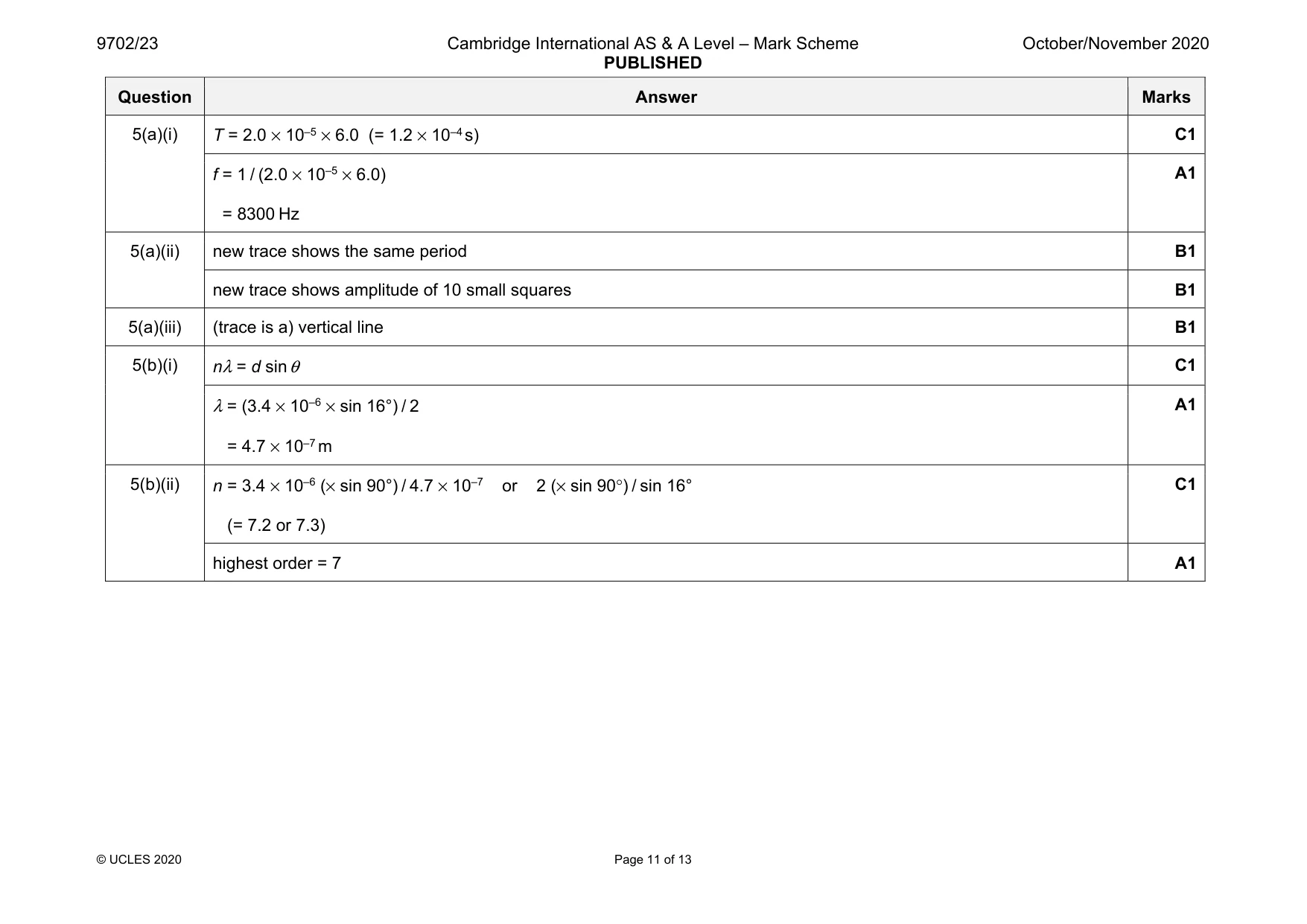
Mark scheme: 5(a)(i) T = 2.0 × 10–5 × 6.0 (= 1.2 × 10⁻⁴ s) C1 f = 1 / (2.0 × 10–5 × 6.0) = 8300 Hz A1 5(a)(ii) new trace shows the same period B1 new trace shows amplitude of 10 small squares B1 5(a)(iii) (trace is a) vertical line B1 5(b)(i) nλ = d sin θ C1 λ = (3.4 × 10⁻⁶ × sin 16°) / 2 = 4.7 × 10⁻⁷ m A1 5(b)(ii) n = 3.4 × 10⁻⁶ (× sin 90°) / 4.7 × 10⁻⁷ or 2 (× sin 90°) / sin 16° (= 7.2 or 7.3) C1 highest order = 7 A1
Q6 · Define electric potential difference (p.d.)
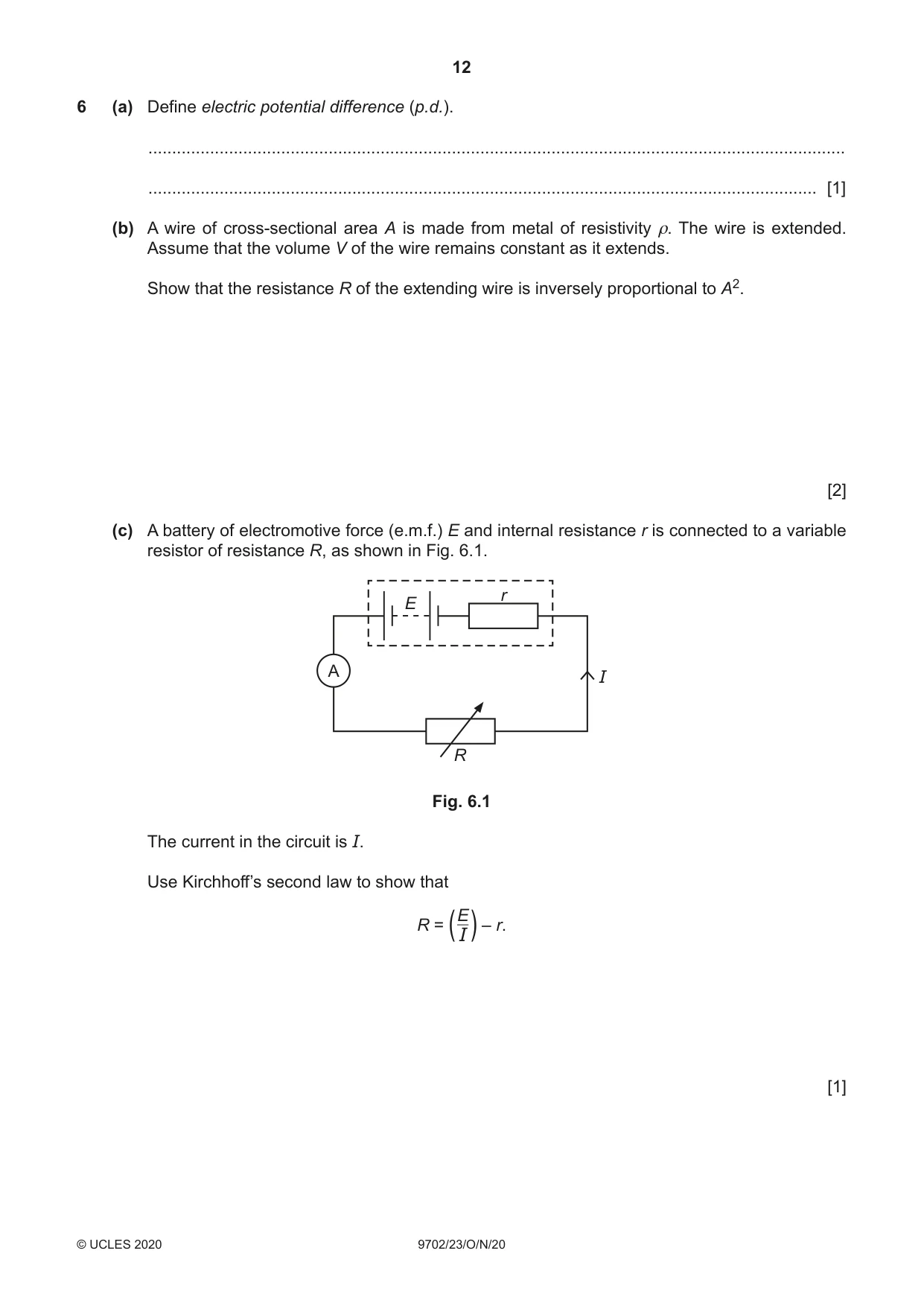
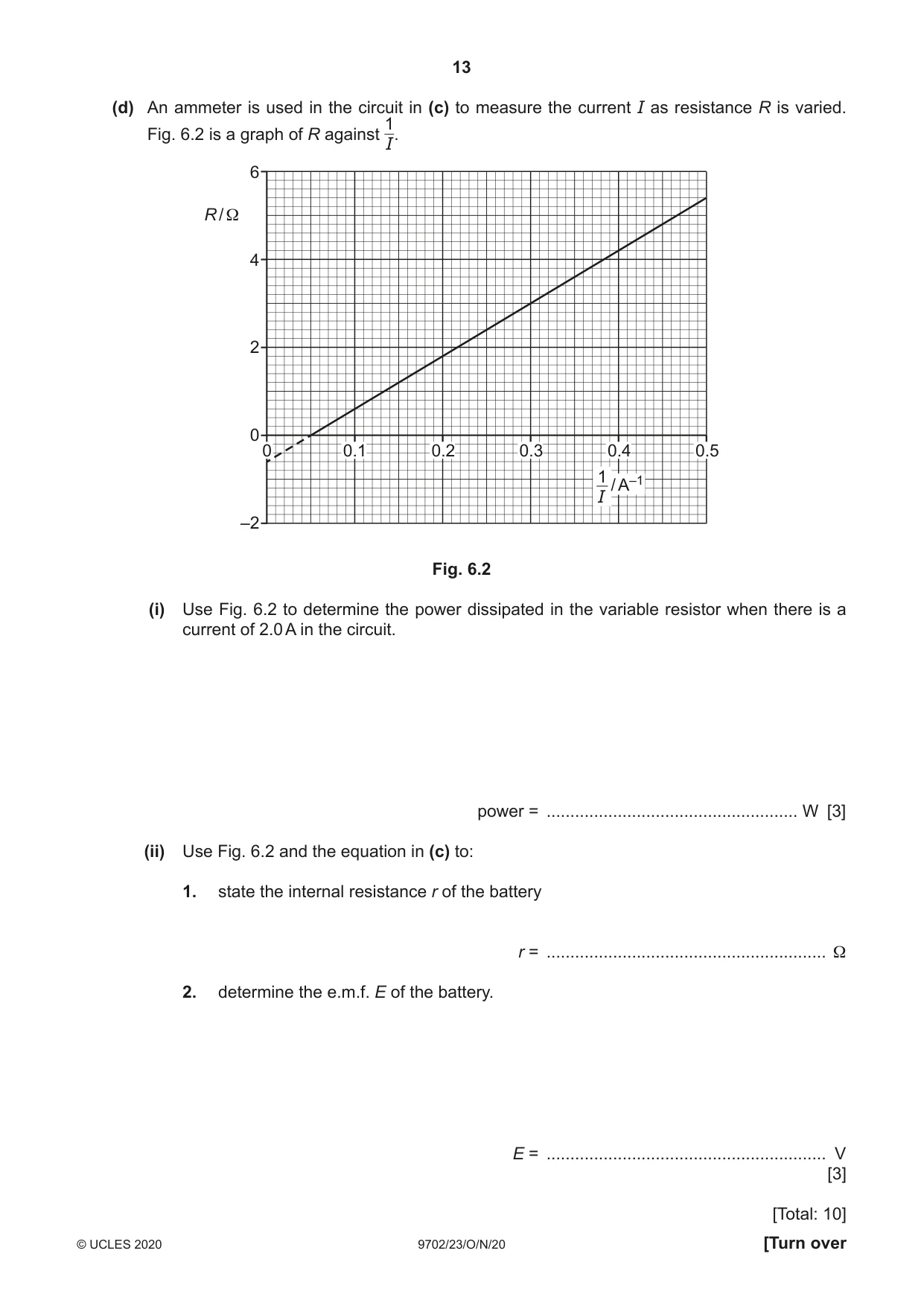
6 (a) Define electric potential difference (p.d.). ................................................................................................................................................... ............................................................................................................................................. [1] (b) A wire of cross-sectional area A is made from metal of resistivity ρ. The wire is extended. Assume that the volume V of the wire remains constant as it extends. Show that the resistance R of the extending wire is inversely proportional to A2. [2] (c) A battery of electromotive force (e.m.f.) E and internal resistance r is connected to a variable resistor of resistance R, as shown in Fig. 6.1. r E A I R Fig. 6.1 The current in the circuit is I. Use Kirchhoff’s second law to show that R = – r. (EI) [1] (d) An ammeter is used in the circuit in (c) to measure the current I as resistance R is varied. 1 Fig. 6.2 is a graph of R against I. 6 R / Ω 4 2 0 0 0.1 0.2 0.3 0.4 0.5 1 / A–1 I –2 Fig. 6.2 (i) Use Fig. 6.2 to determine the power dissipated in the variable resistor when there is a current of 2.0 A in the circuit. power = ..................................................... W [3] (ii) Use Fig. 6.2 and the equation in (c) to: 1. state the internal resistance r of the battery r = ........................................................... Ω 2. determine the e.m.f. E of the battery. E = ........................................................... V [3] [Total: 10]
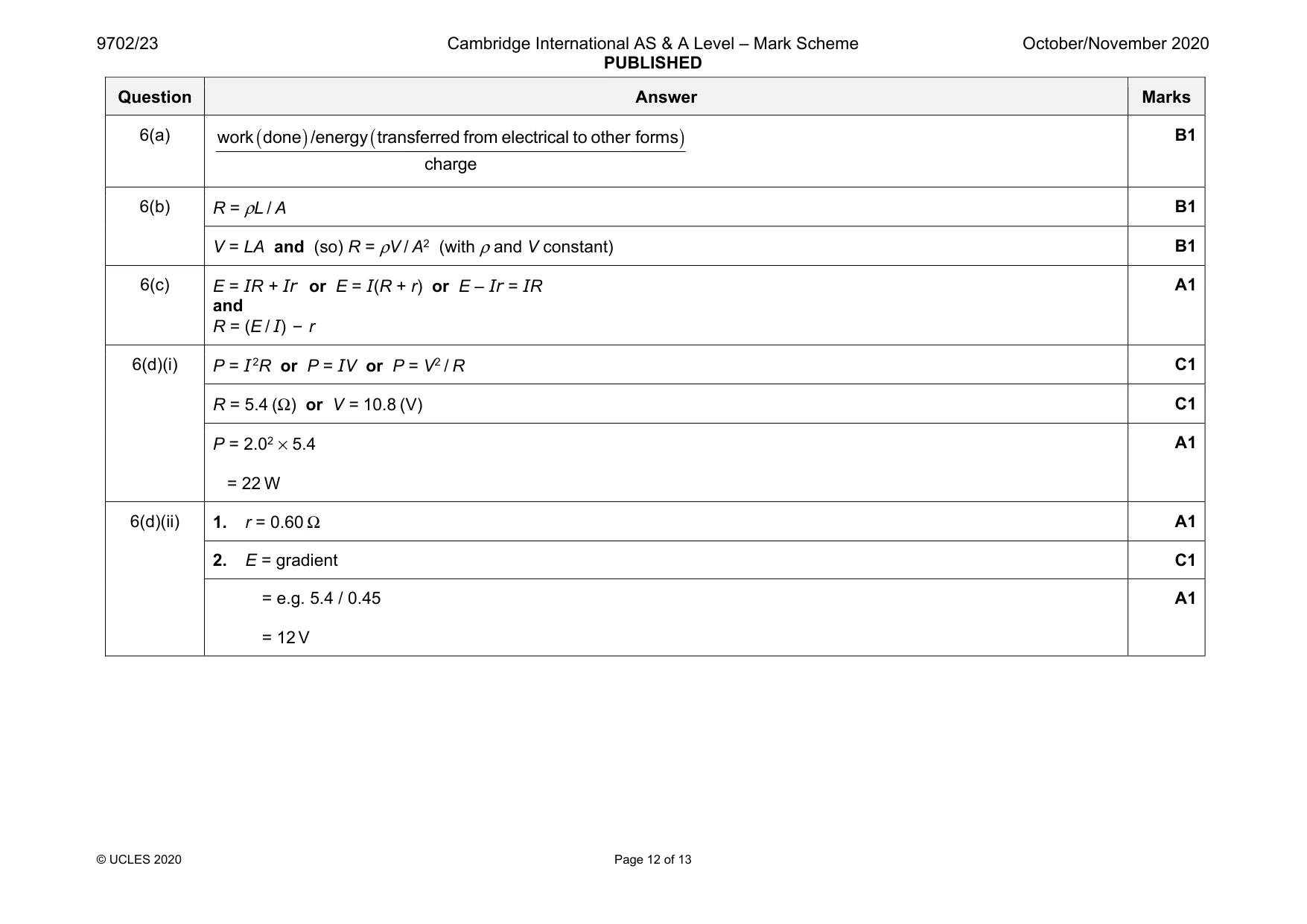
Mark scheme: 6(a) ( ) ( ) work done /energy transferred from electrical to other forms charge B1 6(b) R = ρL / A B1 V = LA and (so) R = ρV / A2 (with ρ and V constant) B1 6(c) E = IR + Ir or E = I(R + r) or E – Ir = IR and R = (E / I) – r A1 6(d)(i) P = I 2R or P = IV or P = V2 / R C1 R = 5.4 (Ω) or V = 10.8 (V) C1 P = 2.02 × 5.4 = 22 W A1 6(d)(ii) 1. r = 0.60 Ω A1 2. E = gradient C1 = e.g. 5.4 / 0.45 = 12 V A1
Q7 · Two vertical metal plates are separated by a distance d in a vacuum, as shown in Fig
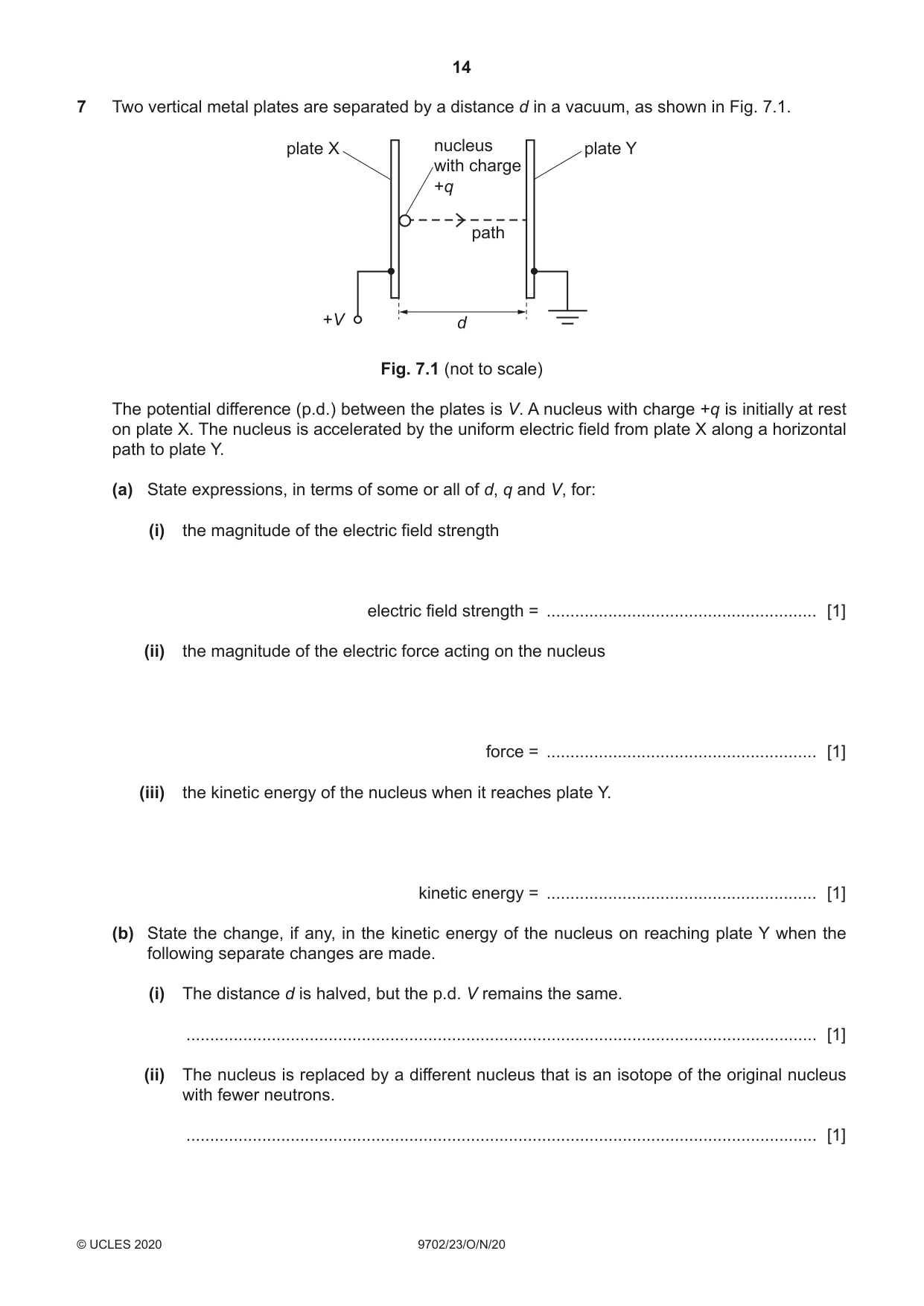
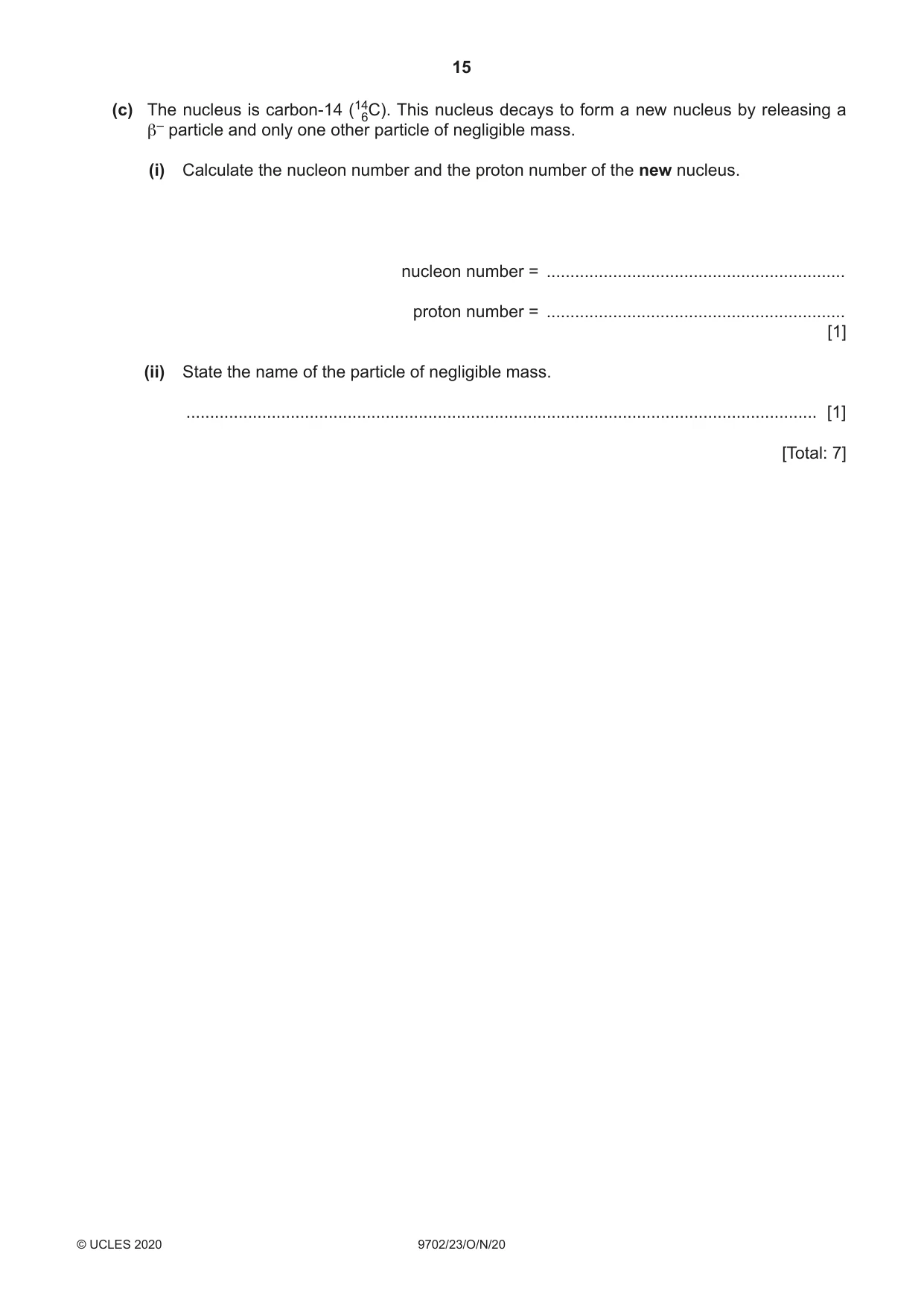
7 Two vertical metal plates are separated by a distance d in a vacuum, as shown in Fig. 7.1. plate X nucleus plate Y with charge +q path +V d Fig. 7.1 (not to scale) The potential difference (p.d.) between the plates is V. A nucleus with charge +q is initially at rest on plate X. The nucleus is accelerated by the uniform electric field from plate X along a horizontal path to plate Y. (a) State expressions, in terms of some or all of d, q and V, for: (i) the magnitude of the electric field strength electric field strength = ......................................................... [1] (ii) the magnitude of the electric force acting on the nucleus force = ......................................................... [1] (iii) the kinetic energy of the nucleus when it reaches plate Y. kinetic energy = ......................................................... [1] (b) State the change, if any, in the kinetic energy of the nucleus on reaching plate Y when the following separate changes are made. (i) The distance d is halved, but the p.d. V remains the same. ..................................................................................................................................... [1] (ii) The nucleus is replaced by a different nucleus that is an isotope of the original nucleus with fewer neutrons. ..................................................................................................................................... [1] (c) The nucleus is carbon-14 (146C). This nucleus decays to form a new nucleus by releasing a β– particle and only one other particle of negligible mass. (i) Calculate the nucleon number and the proton number of the new nucleus. nucleon number = ............................................................... proton number = ............................................................... [1] (ii) State the name of the particle of negligible mass. ..................................................................................................................................... [1] [Total: 7]
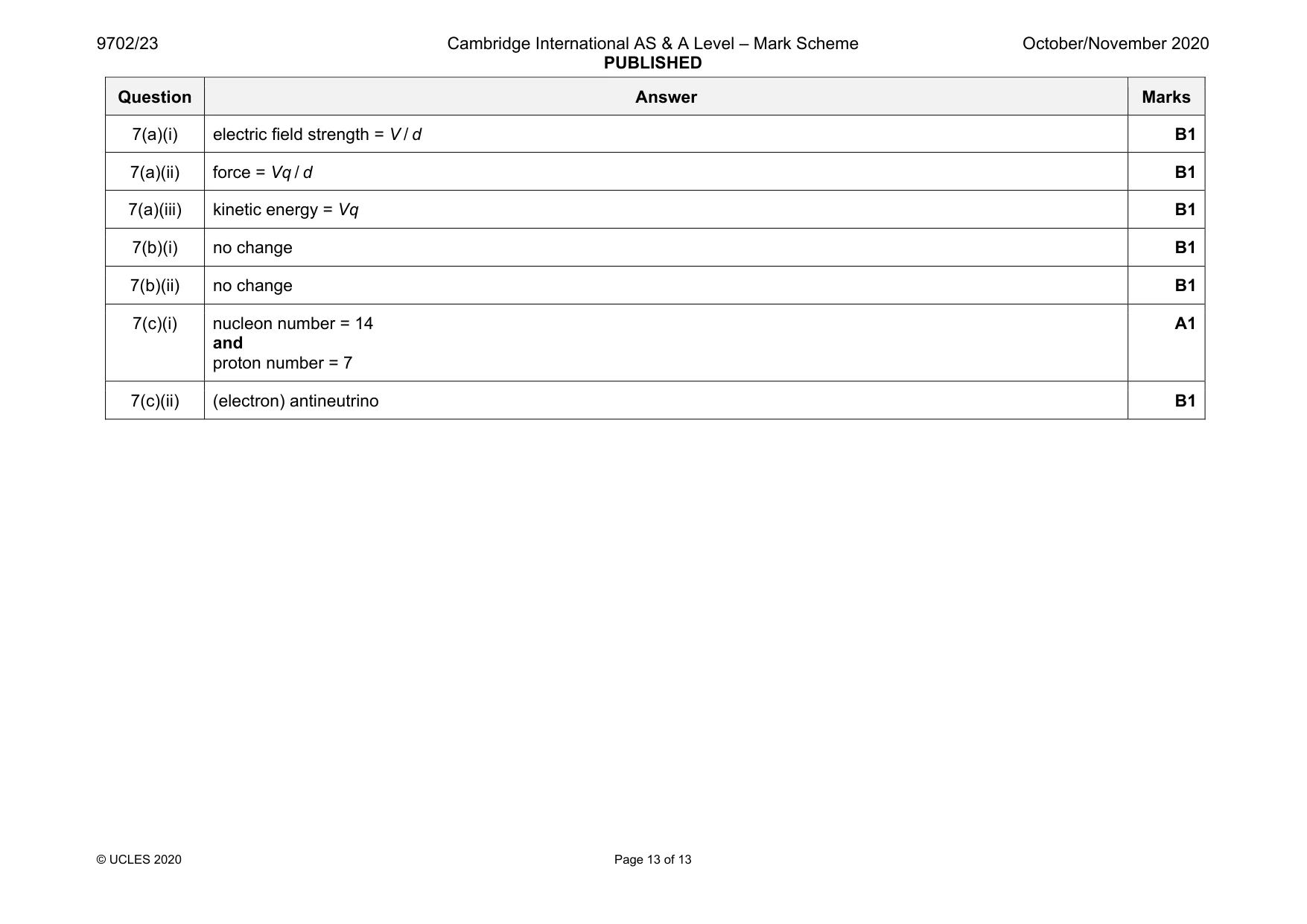
Mark scheme: 7(a)(i) electric field strength = V / d B1 7(a)(ii) force = Vq / d B1 7(a)(iii) kinetic energy = Vq B1 7(b)(i) no change B1 7(b)(ii) no change B1 7(c)(i) nucleon number = 14 and proton number = 7 A1 7(c)(ii) (electron) antineutrino B1
What was in this paper
The subtopics covered by these 7 questions, and how many questions each got. Open one in a new tab to see every Cambridge question on it.
What you needed in this session
Cambridge’s own grade thresholds for 2020 Oct/Nov, Paper 2 · Variant 3. A higher threshold means an easier paper — the bar moves with how the cohort did.