Questions as text
Q1 · The Earth may be considered to be a sphere of radius 6.4 ×10⁶ m with its mass of 6.0… 9702/41 Oct/Nov 2005
1 The Earth may be considered to be a sphere of radius 6.4 ×10⁶ m with its mass of 6.0 ×1024 kg concentrated at its centre. A satellite of mass 650 kg is to be launched from the Equator and put into geostationary orbit. (a) Show that the radius of the geostationary orbit is 4.2 ×10⁷m. [3] (b) Determine the increase in gravitational potential energy of the satellite during its launch from the Earth’s surface to the geostationary orbit. energy = ………………………………... J [4] (c) Suggest one advantage of launching satellites from the Equator in the direction of rotation of the Earth. … … [1]
8 marks
Mark scheme: 1 (a) GM / R2 = Rω2 …………….…………………...…..………………….. C1 ω = 2π / (24 × 3600) ………………………………..……..…………… C1 6.67 × 10–11 × 6.0 × 1024 = R3 × ω2
This question in 9702/41 Oct/Nov 2005
Q2 · Explain what is meant by a gravitational field 9702/41 May/June 2007
1 (a) Explain what is meant by a gravitational field. … … [1] (b) A spherical planet has mass M and radius R. The planet may be considered to have all its mass concentrated at its centre. A rocket is launched from the surface of the planet such that the rocket moves radially away from the planet. The rocket engines are stopped when the rocket is at a height R above the surface of the planet, as shown in Fig. 1.1. R 2R planet R Fig. 1.1 The mass of the rocket, after its engines have been stopped, is m. (i) Show that, for the rocket to travel from a height R to a height 2R above the planet’s surface, the change ΔEP in the magnitude of the gravitational potential energy of the rocket is given by the expression GMm ΔEP = . 6R [2] Examiner’s Use (ii) During the ascent from a height R to a height 2R, the speed of the rocket changes from 7600 m s–1 to 7320 m s–1. Show that, in SI units, the change ΔEK in the kinetic energy of the rocket is given by the expression ΔEK = (2.09 × 10⁶)m. [1] (c) The planet has a radius of 3.40 × 10⁶ m. (i) Use the expressions in (b) to determine a value for the mass M of the planet. M = …………………………… kg [2] (ii) State one assumption made in the determination in (i). … … [1]
7 marks
Mark scheme: 1 (a) (region of space) where a mass experiences a force B1 [1] (b) (i) potential energy = (–)GMm / x C1 ∆EP = GMm/2R – GMm/3R M1 = GMm/6R A0 [2] (ii) EK = ½m (76002 – 73202) M1 = (2.09 × 10⁶)m A0 [1] (c) (i) 2.09 × 106 = (6.67 × 10⁻¹¹ M)/(6 × 3.4 × 106) C1 M = 6.39 × 10²³ kg A1 [2] (ii) e.g. no energy dissipated due to friction with atmosphere/air rocket is outside atmosphere not influenced by another planet etc. B1 [1]
This question in 9702/41 May/June 2007
Q3 · A small charged metal sphere is situated in an earthed metal box 9702/41 Oct/Nov 2007
4 A small charged metal sphere is situated in an earthed metal box. Fig. 4.1 illustrates the electric field between the sphere and the metal box. A Fig. 4.1 (a) By reference to Fig. 4.1, state and explain (i) whether the sphere is positively or negatively charged, … … … [2] (ii) why it appears as if the charge on the sphere is concentrated at the centre of the sphere. … … [1] (b) On Fig. 4.1, draw an arrow to show the direction of the force on a stationary electron situated at point A. [2] Examiner’s Use (c) The radius r of the sphere is 2.4 cm. The magnitude of the charge q on the sphere is 0.76 nC. (i) Use the expression Q V = 4πε0r to calculate a value for the magnitude of the potential V at the surface of the sphere. V = … V [2] (ii) State the sign of the charge induced on the inside of the metal box. Hence explain whether the actual magnitude of the potential will be greater or smaller than the value calculated in (i). … … … … [3] (d) A lead sphere is placed in a lead box in free space, in a similar arrangement to that shown in Fig. 4.1. Explain why it is not possible for the gravitational field to have a similar shape to that of the electric field. … … … [1]
11 marks
Mark scheme: 4 (a) (i) either lines directed away from sphere or lines go from positive to negative or line shows direction of force on positive charge … M1 so positively charged … A1 [2] (ii) either all lines (appear to) radiate from centre or all lines are normal to surface of sphere … B1 [1] (b) tangent to curve … B1 in correct position and direction … B1 [2] (c) (i) V = (0.76 × 10⁻⁹) / (4π × 8.85 × 10-12 × 0.024) … C1 = 285 V … A1 [2] (ii) negative charge is induced on (inside of) box … M1 formula applies to isolated (point) charge OR less work done moving test charge from infinity … A1 so potential is lower … A1 [3] (d) either gravitational field is always attractive or field lines must be directed towards both box and sphere … B1 [1] GCE A/AS LEVEL – October/November 2007 9702 04
This question in 9702/41 Oct/Nov 2007
Q4 · A spherical planet has mass M and radius R 9702/41 Oct/Nov 2008
1 A spherical planet has mass M and radius R. The planet may be assumed to be isolated in space and to have its mass concentrated at its centre. The planet spins on its axis with angular speed ω, as illustrated in Fig. 1.1. mass m R equator of planet pole of planet Fig. 1.1 A small object of mass m rests on the equator of the planet. The surface of the planet exerts a normal reaction force on the mass. (a) State formulae, in terms of M, m, R and ω, for (i) the gravitational force between the planet and the object, … [1] (ii) the centripetal force required for circular motion of the small mass, … [1] (iii) the normal reaction exerted by the planet on the mass. … [1] (b) (i) Explain why the normal reaction on the mass will have different values at the equator and at the poles. … … … [2] (ii) The radius of the planet is 6.4 × 10⁶ m. It completes one revolution in 8.6 × 10⁴ s. For Calculate the magnitude of the centripetal acceleration at Examiner’s Use 1. the equator, acceleration = … m s–2 [2] 2. one of the poles. acceleration = … m s–2 [1] (c) Suggest two factors that could, in the case of a real planet, cause variations in the acceleration of free fall at its surface. 1. … … 2. … … [2]
10 marks
Mark scheme: 1 (a) (i) F = GMm / R2 B1 [1] (ii) F = mRω2 B1 [1] (iii) reaction force = GMm / R2 – mRω2 (allow e.c.f.) B1 [1] (b) (i) either value of R in expression Rω2 varies or mRω2 no longer parallel to GMm / R2 / normal to surface B1 becomes smaller as object approaches a pole / is zero at pole B1 [2] (ii) 1. acceleration = 6.4 × 106 × (2π / {8.6 × 10⁴})2 C1 = 0.034 m s–2 A1 [2] 2. acceleration = 0 A1 [1] (c) e.g. ‘radius’ of planet varies density of planet not constant planet spinning nearby planets / stars (any sensible comments, 1 mark each, maximum 2) B2 [2]
This question in 9702/41 Oct/Nov 2008
Q5 · State Newton’s law of gravitation 9702/41 Oct/Nov 2009
1 (a) State Newton’s law of gravitation. … … … [2] (b) The Earth may be considered to be a uniform sphere of radius R equal to 6.4 × 10⁶ m. A satellite is in a geostationary orbit. (i) Describe what is meant by a geostationary orbit. … … … … [3] (ii) Show that the radius x of the geostationary orbit is given by the expression gR2 = x3ω2 where g is the acceleration of free fall at the Earth’s surface and ω is the angular speed of the satellite about the centre of the Earth. [3] (iii) Determine the radius x of the geostationary orbit. radius = … m [3]
11 marks
Mark scheme: 1 (a) F ∝ Mm / R2 …..…(words or explained symbols) … M1 either M and m are point masses or R >> diameter of masses …(do not allow ‘size’) … A1 [2] (b) (i) equatorial orbit … B1 period 24 hours / same angular speed … B1 from west to east / same direction of rotation … B1 [3] (allow one of the last two marks for ‘always overhead’ if 2nd or 3rd marks not scored) (ii) gravitational force provides centripetal force / gives rise to centripetal acceleration ….(in ‘words’) … B1 GM / x2 = xω2 … M1 g = GM / R2 … M1 to give gR2 = x3ω2 … A0 [3] (iii) ω = 2π / (24 × 3600) = 7.27 × 10⁻⁵ rad s-1 … C1 9.81 × (6.4 × 106)2 = x3 × (7.27 × 10-5)2 … C1 x3 = 7.6 × 10²² x = 4.2 × 10⁷ m … A1 [3] (use of g = 10 m s-2, loses 1 mark but once only in the Paper) [Total: 11]
This question in 9702/41 Oct/Nov 2009
Q6 · The Earth may be considered to be a uniform sphere of radius 6.38 × 10³ km, with its mass… 9702/42 Oct/Nov 2009
1 (a) The Earth may be considered to be a uniform sphere of radius 6.38 × 10³ km, with its mass concentrated at its centre. (i) Define gravitational field strength. … … [1] (ii) By considering the gravitational field strength at the surface of the Earth, show that the mass of the Earth is 5.99 × 1024 kg. [2] (b) The Global Positioning System (GPS) is a navigation system that can be used anywhere on Earth. It uses a number of satellites that orbit the Earth in circular orbits at a distance of 2.22 × 10⁴ km above its surface. (i) Use data from (a) to calculate the angular speed of a GPS satellite in its orbit. angular speed = … rad s–1 [3] (ii) Use your answer in (i) to show that the satellites are not in geostationary orbits. For Examiner’s Use [3] (c) The planes of the orbits of the GPS satellites in (b) are inclined at an angle of 55° to the Equator. Suggest why the satellites are not in equatorial orbits. … … [1]
10 marks
Mark scheme: 1 (a) (i) force per (unit) mass ……(ratio idea essential) … B1 [1] (ii) g = GM / R2 … C1 9.81 = (6.67 × 10⁻¹¹ × M) / (6.38 × 10⁶)2 ……(all 3 s.f) … M1 M = 5.99 × 1024 kg … A0 [2] (b) (i) either GM = ω2r3 or gR2 = ω2r3 … C1 either 6.67 × 10-11 x 5.99 × 1024 = ω2 × (2.86 × 107)3 or 9.81 × (6.38 × 106)2 = ω2 × (2.86 × 107)3 … C1 ω = 1.3 × 10⁻⁴ rad s-1 … A1 [3] (use of r = 2.22 × 10⁷m scores max 2 marks) (ii) period of orbit = 2π / ω … C1 = 4.8 × 10⁴ s (= 13.4 hours) … A1 period for geostationary satellite is 24 hours (= 8.6 × 10⁴ s) … A1 so no … A0 [3] (c) satellite can then provide cover at Poles … B1 [1] [Total: 10]
This question in 9702/42 Oct/Nov 2009
Q7 · Define gravitational field strength 9702/41 Oct/Nov 2010
1 (a) Define gravitational field strength. … … [1] (b) An isolated star has radius R. The mass of the star may be considered to be a point mass at the centre of the star. The gravitational field strength at the surface of the star is gs. On Fig. 1.1, sketch a graph to show the variation of the gravitational field strength of the star with distance from its centre. You should consider distances in the range R to 4R. 1.0gs 0.8gs gravitational field strength 0.6gs 0.4gs 0.2gs 0R 2R 3R 4R surface distance of star Fig. 1.1 [2] (c) The Earth and the Moon may be considered to be spheres that are isolated in space with their masses concentrated at their centres. The masses of the Earth and the Moon are 6.00 × 1024 kg and 7.40 × 10²² kg respectively. The radius of the Earth is RE and the separation of the centres of the Earth and the Moon is 60 RE, as illustrated in Fig. 1.2. RE Moon mass Earth 7.40 x 10²² kg mass 6.00 x 1024 kg 60 RE Fig. 1.2 (not to scale) (i) Explain why there is a point between the Earth and the Moon at which the For gravitational field strength is zero. Examiner’s Use … … … [2] (ii) Determine the distance, in terms of RE, from the centre of the Earth at which the gravitational field strength is zero. distance = … RE [3] (iii) On the axes of Fig. 1.3, sketch a graph to show the variation of the gravitational field strength with position between the surface of the Earth and the surface of the Moon. gravitational field strength 0 distance surface surface of Earth of Moon Fig. 1.3 [3]
11 marks
Mark scheme: 1 (a) force per unit mass (ratio idea essential) B1 [1] (b) graph: correct curvature M1 from (R,1.0 gS) & at least one other correct point A1 [2] (c) (i) fields of Earth and Moon are in opposite directions M1 either resultant field found by subtraction of the field strength or any other sensible comment A1 so there is a point where it is zero A0 [2] (allow FE = –FM for 2 marks) (ii) GME / x2 = GMM / (D – x)2 C1 (6.0 × 1024) / (7.4 × 10²²) = x2 / (60RE – x)2 C1 x = 54 RE A1 [3] (iii) graph: g = 0 at least ⅔ distance to Moon B1 gE and gM in opposite directions M1 correct curvature (by eye) and gE > gM at surface A1 [3]
This question in 9702/41 Oct/Nov 2010
Q8 · Define gravitational field strength 9702/42 Oct/Nov 2010
1 (a) Define gravitational field strength. … … [1] (b) An isolated star has radius R. The mass of the star may be considered to be a point mass at the centre of the star. The gravitational field strength at the surface of the star is gs. On Fig. 1.1, sketch a graph to show the variation of the gravitational field strength of the star with distance from its centre. You should consider distances in the range R to 4R. 1.0gs 0.8gs gravitational field strength 0.6gs 0.4gs 0.2gs 0R 2R 3R 4R surface distance of star Fig. 1.1 [2] (c) The Earth and the Moon may be considered to be spheres that are isolated in space with their masses concentrated at their centres. The masses of the Earth and the Moon are 6.00 × 1024 kg and 7.40 × 10²² kg respectively. The radius of the Earth is RE and the separation of the centres of the Earth and the Moon is 60 RE, as illustrated in Fig. 1.2. RE Moon mass Earth 7.40 x 10²² kg mass 6.00 x 1024 kg 60 RE Fig. 1.2 (not to scale) (i) Explain why there is a point between the Earth and the Moon at which the For gravitational field strength is zero. Examiner’s Use … … … [2] (ii) Determine the distance, in terms of RE, from the centre of the Earth at which the gravitational field strength is zero. distance = … RE [3] (iii) On the axes of Fig. 1.3, sketch a graph to show the variation of the gravitational field strength with position between the surface of the Earth and the surface of the Moon. gravitational field strength 0 distance surface surface of Earth of Moon Fig. 1.3 [3]
11 marks
Mark scheme: 1 (a) force per unit mass (ratio idea essential) B1 [1] (b) graph: correct curvature M1 from (R,1.0 gS) & at least one other correct point A1 [2] (c) (i) fields of Earth and Moon are in opposite directions M1 either resultant field found by subtraction of the field strength or any other sensible comment A1 so there is a point where it is zero A0 [2] (allow FE = –FM for 2 marks) (ii) GME / x2 = GMM / (D – x)2 C1 (6.0 × 1024) / (7.4 × 10²²) = x2 / (60RE – x)2 C1 x = 54 RE A1 [3] (iii) graph: g = 0 at least ⅔ distance to Moon B1 gE and gM in opposite directions M1 correct curvature (by eye) and gE > gM at surface A1 [3]
This question in 9702/42 Oct/Nov 2010
Q9 · State what is meant by a field of force 9702/42 May/June 2011
1 (a) State what is meant by a field of force. … … [1] (b) Gravitational fields and electric fields are two examples of fields of force. State one similarity and one difference between these two fields of force. similarity: … … difference: … … … [3] (c) Two protons are isolated in space. Their centres are separated by a distance R. Each proton may be considered to be a point mass with point charge. Determine the magnitude of the ratio force between protons due to electric field . force between protons due to gravitational field ratio = … [3]
7 marks
Mark scheme: 1 (a) region (of space) where a particle / body experiences a force B1 [1] (b) similarity: e.g. force ∝ 1 / r 2 potential ∝ 1 / r B1 [1] difference: e.g. gravitation force (always) attractive B1 electric force attractive or repulsive B1 [2] (c) either ratio is Q1Q2 / 4πε0m1m2G C1 = (1.6 × 10⁻¹⁹)2 / 4π × 8.85 × 10–12 × (1.67 × 10–27)2 × 6.67 × 10–11 C1 = 1.2 × 1036 A1 [3] or FE = 2.30 × 10⁻²⁸ × R –2 (C1) FG = 1.86 × 10–64 × R –2 (C1) FE / FG = 1.2 × 1036 (A1)
This question in 9702/42 May/June 2011
Q10 · State what is meant by a field of force 9702/43 May/June 2011
1 (a) State what is meant by a field of force. … … [1] (b) Gravitational fields and electric fields are two examples of fields of force. State one similarity and one difference between these two fields of force. similarity: … … difference: … … … [3] (c) Two protons are isolated in space. Their centres are separated by a distance R. Each proton may be considered to be a point mass with point charge. Determine the magnitude of the ratio force between protons due to electric field . force between protons due to gravitational field ratio = … [3]
7 marks
Mark scheme: 1 (a) region (of space) where a particle / body experiences a force B1 [1] (b) similarity: e.g. force ∝ 1 / r 2 potential ∝ 1 / r B1 [1] difference: e.g. gravitation force (always) attractive B1 electric force attractive or repulsive B1 [2] (c) either ratio is Q1Q2 / 4πε0m1m2G C1 = (1.6 × 10⁻¹⁹)2 / 4π × 8.85 × 10–12 × (1.67 × 10–27)2 × 6.67 × 10–11 C1 = 1.2 × 1036 A1 [3] or FE = 2.30 × 10⁻²⁸ × R –2 (C1) FG = 1.86 × 10–64 × R –2 (C1) FE / FG = 1.2 × 1036 (A1)
This question in 9702/43 May/June 2011
Q11 · The planet Mars may be considered to be an isolated sphere of diameter 6.79 × 10⁶ m with… 9702/43 Oct/Nov 2011
1 The planet Mars may be considered to be an isolated sphere of diameter 6.79 × 10⁶ m with its mass of 6.42 × 10²³ kg concentrated at its centre. A rock of mass 1.40 kg rests on the surface of Mars. For this rock, (a) (i) determine its weight, weight = … N [3] (ii) show that its gravitational potential energy is –1.77 × 10⁷ J. [2] (b) Use the information in (a)(ii) to determine the speed at which the rock must leave the surface of Mars so that it will escape the gravitational attraction of the planet. speed = … m s–1 [3] (c) The mean translational kinetic energy <EK> of a molecule of an ideal gas is given by the For expression Examiner’s Use <EK> = 32kT where T is the thermodynamic temperature of the gas and k is the Boltzmann constant. (i) Determine the temperature at which the root-mean-square (r.m.s.) speed of hydrogen molecules is equal to the speed calculated in (b). Hydrogen may be assumed to be an ideal gas. A molecule of hydrogen has a mass of 2 u. temperature = … K [2] (ii) State and explain one reason why hydrogen molecules may escape from Mars at temperatures below that calculated in (i). … … … [2]
12 marks
Mark scheme: 1 (a) (i) weight = GMm/r 2 C1 = (6.67 × 10–11 × 6.42 × 1023 × 1.40)/(½ × 6.79 × 10⁶)2 C1 = 5.20 N A1 [3] (ii) potential energy = –GMm/r C1 = –(6.67 × 10–11 × 6.42 × 1023 × 1.40)/(½ × 6.79 × 10⁶) M1 = –1.77 × 10⁷ J A0 [2] (b) either ½mv 2 = 1.77 × 10⁷ C1 v 2 = (1.77 × 107 × 2)/1.40 C1 v = 5.03 × 10³ m s–1 A1 or ½mv 2 = GMm/r (C1) v 2 = (2 × 6.67 x 10–11 × 6.42 × 1023)/(6.79 × 106/2) (C1) v = 5.02 × 10³ m s–1 (A1) [3] 3 (c) (i) ½ × 2 × 1.66 × 10–27 × (5.03 × 103)2 = × 1.38 × 10⁻²³ × T C1 2 T = 2030 K A1 [2] (ii) either because there is a range of speeds M1 some molecules have a higher speed A1 or some escape from point above planet surface (M1) so initial potential energy is higher (A1) [2]
This question in 9702/43 Oct/Nov 2011
Q12 · Define gravitational potential at a point 9702/41 May/June 2012
1 (a) Define gravitational potential at a point. … … [1] (b) The gravitational potential φ at distance r from point mass M is given by the expression GM φ = – r where G is the gravitational constant. Explain the significance of the negative sign in this expression. … … … [2] (c) A spherical planet may be assumed to be an isolated point mass with its mass concentrated at its centre. A small mass m is moving near to, and normal to, the surface of the planet. The mass moves away from the planet through a short distance h. State and explain why the change in gravitational potential energy ΔEP of the mass is given by the expression ΔEP = mgh where g is the acceleration of free fall. … … … … … … [4] (d) The planet in (c) has mass M and diameter 6.8 × 10³ km. The product GM for this planet For is 4.3 × 10¹³ N m2 kg–1. Examiner’s Use A rock, initially at rest a long distance from the planet, accelerates towards the planet. Assuming that the planet has negligible atmosphere, calculate the speed of the rock as it hits the surface of the planet. speed = … m s–1 [3]
10 marks
Mark scheme: 1 (a) work done in bringing unit mass from infinity (to the point) B1 [1] (b) gravitational force is (always) attractive B1 either as r decreases, object/mass/body does work or work is done by masses as they come together B1 [2] (c) either force on mass = mg (where g is the acceleration of free fall /gravitational field strength) B1 g = GM/r2 B1 if r @ h, g is constant B1 ∆EP = force × distance moved M1 = mgh A0 or ∆EP = m∆φ (C1) = GMm(1/r1 – 1/r2) = GMm(r2 – r1)/r1r2 (B1) if r2 ≈ r1, then (r2 – r1) = h and r1r2 = r2 (B1) g = GM/r2 (B1) ∆EP = mgh (A0) [4] (d) ½mv2 = m∆φ v2 = 2 × GM/r C1 = (2 × 4.3 × 1013) / (3.4 × 10⁶) C1 v = 5.0 × 10³ m s–1 A1 [3] (Use of diameter instead of radius to give v = 3.6 × 10³ m s–1 scores 2 marks)
This question in 9702/41 May/June 2012
Q13 · State Newton’s law of gravitation 9702/42 May/June 2012
1 (a) State Newton’s law of gravitation. … … … [2] (b) The Earth and the Moon may be considered to be isolated in space with their masses concentrated at their centres. The orbit of the Moon around the Earth is circular with a radius of 3.84 × 10⁵ km. The period of the orbit is 27.3 days. Show that (i) the angular speed of the Moon in its orbit around the Earth is 2.66 × 10⁻⁶ rad s–1, [1] (ii) the mass of the Earth is 6.0 × 1024 kg. [2] (c) The mass of the Moon is 7.4 × 10²² kg. For Examiner’s (i) Using data from (b), determine the gravitational force between the Earth and the Use Moon. force = … N [2] (ii) Tidal action on the Earth’s surface causes the radius of the orbit of the Moon to increase by 4.0 cm each year. Use your answer in (i) to determine the change, in one year, of the gravitational potential energy of the Moon. Explain your working. energy change = … J [3]
10 marks
Mark scheme: 1 (a) force proportional to product of masses and inversely proportional to square of separation (do not allow square of distance/radius) M1 either point masses or separation @ size of masses A1 [2] (b) (i) ω = 2π / (27.3 × 24 × 3600) or 2π / (2.36 x 10⁶) M1 = 2.66 × 10⁻⁶ rad s–1 A0 [1] (ii) GM = r3ω2 or GM = v2r C1 M = (3.84 × 105 × 103)3 × (2.66 × 10–6)2 / (6.67 × 10⁻¹¹) M1 = 6.0 × 1024 kg A0 [2] (special case: uses g = GM/r2 with g = 9.81, r = 6.4 × 10⁶ scores max 1 mark) (c) (i) grav. force = (6.0 × 1024) × (7.4 × 1022) × (6.67 × 10–11)/(3.84 × 108)2 C1 = 2.0 × 10²⁰ N (allow 1 SF) A1 [2] (ii) either ∆EP = Fx because F constant as x ! radius of orbit B1 ∆EP = 2.0 × 1020 × 4.0 × 10–2 C1 = 8.0 × 10¹⁸ J (allow 1 SF) A1 [3] or ∆EP = GMm/r1 – GMm/r2 C1 Correct substitution B1 8.0 × 10¹⁸ J A1 (∆EP = GMm/r1 + GMm/r2 is incorrect physics so 0/3) 2 2
This question in 9702/42 May/June 2012
Q14 · Define gravitational potential at a point 9702/43 May/June 2012
1 (a) Define gravitational potential at a point. … … [1] (b) The gravitational potential φ at distance r from point mass M is given by the expression GM φ = – r where G is the gravitational constant. Explain the significance of the negative sign in this expression. … … … [2] (c) A spherical planet may be assumed to be an isolated point mass with its mass concentrated at its centre. A small mass m is moving near to, and normal to, the surface of the planet. The mass moves away from the planet through a short distance h. State and explain why the change in gravitational potential energy ΔEP of the mass is given by the expression ΔEP = mgh where g is the acceleration of free fall. … … … … … … [4] (d) The planet in (c) has mass M and diameter 6.8 × 10³ km. The product GM for this planet For is 4.3 × 10¹³ N m2 kg–1. Examiner’s Use A rock, initially at rest a long distance from the planet, accelerates towards the planet. Assuming that the planet has negligible atmosphere, calculate the speed of the rock as it hits the surface of the planet. speed = … m s–1 [3]
10 marks
Mark scheme: 1 (a) work done in bringing unit mass from infinity (to the point) B1 [1] (b) gravitational force is (always) attractive B1 either as r decreases, object/mass/body does work or work is done by masses as they come together B1 [2] (c) either force on mass = mg (where g is the acceleration of free fall /gravitational field strength) B1 g = GM/r2 B1 if r @ h, g is constant B1 ∆EP = force × distance moved M1 = mgh A0 or ∆EP = m∆φ (C1) = GMm(1/r1 – 1/r2) = GMm(r2 – r1)/r1r2 (B1) if r2 ≈ r1, then (r2 – r1) = h and r1r2 = r2 (B1) g = GM/r2 (B1) ∆EP = mgh (A0) [4] (d) ½mv2 = m∆φ v2 = 2 × GM/r C1 = (2 × 4.3 × 1013) / (3.4 × 10⁶) C1 v = 5.0 × 10³ m s–1 A1 [3] (Use of diameter instead of radius to give v = 3.6 × 10³ m s–1 scores 2 marks)
This question in 9702/43 May/June 2012
Q15 · State what is meant by a line of force in For Examiner’s (i) a gravitational field, Use …… 9702/43 Oct/Nov 2012
3 (a) State what is meant by a line of force in For Examiner’s (i) a gravitational field, Use … … [1] (ii) an electric field. … … [2] (b) A charged metal sphere is isolated in space. State one similarity and one difference between the gravitational force field and the electric force field around the sphere. similarity: … … difference: … … … [3] (c) Two horizontal metal plates are separated by a distance of 1.8 cm in a vacuum. A potential difference of 270 V is maintained between the plates, as shown in Fig. 3.1. 0 V proton 1.8 cm +270 V Fig. 3.1 A proton is in the space between the plates. Explain quantitatively why, when predicting the motion of the proton between the plates, the gravitational field is not taken into consideration. [4]
10 marks
Mark scheme: 3 (a) (i) (tangent to line gives) direction of force on a (small test) mass B1 [1] (ii) (tangent to line gives) direction of force on a (small test) charge M1 charge is positive A1 [2] (b) similarity: e.g. radial fields lines normal to surface greater separation of lines with increased distance from sphere field strength ∝ 1 / (distance to centre of sphere)2 (allow any sensible answer) B1 difference: e.g. gravitational force (always) towards sphere B1 electric force direction depends on sign of charge on sphere / towards or away from sphere B1 e.g. gravitational field/force is attractive (B1) electric field/force is attractive or repulsive (B1) (allow any sensible comparison) [3] (c) gravitational force = 1.67 × 10–27 × 9.81 = 1.6 × 10⁻²⁶ N A1 electric force = 1.6 × 10–19 × 270 / (1.8 × 10⁻²) C1 = 2.4 × 10⁻¹⁵ N A1 electric force very much greater than gravitational force B1 [4]
This question in 9702/43 Oct/Nov 2012
Q16 · State what is meant by a gravitational field 9702/41 May/June 2013
1 (a) State what is meant by a gravitational field. … … … [2] (b) In the Solar System, the planets may be assumed to be in circular orbits about the Sun. Data for the radii of the orbits of the Earth and Jupiter about the Sun are given in Fig. 1.1. radius of orbit / km Earth 1.50 × 10⁸ Jupiter 7.78 × 10⁸ Fig. 1.1 (i) State Newton’s law of gravitation. … … … … [3] (ii) Use Newton’s law to determine the ratio gravitational field strength due to the Sun at orbit of Earth . gravitational field strength due to the Sun at orbit of Jupiter ratio = … [3] (c) The orbital period of the Earth about the Sun is T. For Examiner’s (i) Use ideas about circular motion to show that the mass M of the Sun is given by Use 4π2R 3 M = GT 2 where R is the radius of the Earth’s orbit about the Sun and G is the gravitational constant. Explain your working. [3] (ii) The orbital period T of the Earth about the Sun is 3.16 × 10⁷ s. The radius of the Earth’s orbit is given in Fig. 1.1. Use the expression in (i) to determine the mass of the Sun. mass = … kg [2]
13 marks
Mark scheme: 1 (a) region of space area / volume B1 where a mass experiences a force B1 [2] (b) (i) force proportional to product of two masses M1 force inversely proportional to the square of their separation M1 either reference to point masses or separation >> ‘size’ of masses A1 [3] (ii) field strength = GM / x2 or field strength ∝ 1 / x2 C1 ratio = (7.78 × 10⁸)2 / (1.5 × 10⁸)2 C1 = 27 A1 [3] (c) (i) either centripetal force = mRω2 and ω = 2π / T or centripetal force = mv2 / R and v = 2πR /T B1 gravitational force provides the centripetal force B1 either GMm / R2 = mRω2 or GMm / R2 = mv2 / R M1 M = 4π2R3 / GT2 A0 [3] (allow working to be given in terms of acceleration) (ii) M = {4π2 × (1.5 × 1011)3} / {6.67 × 10–11 × (3.16 × 107)2} C1 = 2.0 × 1030 kg A1 [2]
This question in 9702/41 May/June 2013
Q17 · Explain what is meant by a geostationary orbit 9702/42 May/June 2013
1 (a) Explain what is meant by a geostationary orbit. … … … … [3] (b) A satellite of mass m is in a circular orbit about a planet. The mass M of the planet may be considered to be concentrated at its centre. Show that the radius R of the orbit of the satellite is given by the expression GMT 2 R3 = 4π2 where T is the period of the orbit of the satellite and G is the gravitational constant. Explain your working. [4] (c) The Earth has mass 6.0 × 1024 kg. Use the expression given in (b) to determine the radius of the geostationary orbit about the Earth. radius = … m [3]
10 marks
Mark scheme: 1 (a) equatorial orbit / above equator B1 satellite moves from west to east / same direction as Earth spins B1 period is 24 hours / same period as spinning of Earth B1 [3] (allow 1 mark for ‘appears to be stationary/overhead’ if none of above marks scored) (b) gravitational force provides/is the centripetal force B1 GMm/R2 = mRω2 or GMm/R2 = mv2/R M1 ω = 2π /T or v = 2πR / T or clear substitution M1 clear working to give R3 = (GMT2 / 4π2) A1 [4] (c) R3 = 6.67 × 10–11 × 6.0 × 1024 × (24 × 3600)2 / 4π2 C1 = 7.57 × 10²² C1 R = 4.2 × 10⁷ m A1 [3] (missing out 3600 gives 1.8 × 10⁵ m and scores 2/3 marks)
This question in 9702/42 May/June 2013
Q18 · State what is meant by a gravitational field 9702/43 May/June 2013
1 (a) State what is meant by a gravitational field. … … … [2] (b) In the Solar System, the planets may be assumed to be in circular orbits about the Sun. Data for the radii of the orbits of the Earth and Jupiter about the Sun are given in Fig. 1.1. radius of orbit / km Earth 1.50 × 10⁸ Jupiter 7.78 × 10⁸ Fig. 1.1 (i) State Newton’s law of gravitation. … … … … [3] (ii) Use Newton’s law to determine the ratio gravitational field strength due to the Sun at orbit of Earth . gravitational field strength due to the Sun at orbit of Jupiter ratio = … [3] (c) The orbital period of the Earth about the Sun is T. For Examiner’s (i) Use ideas about circular motion to show that the mass M of the Sun is given by Use 4π2R 3 M = GT 2 where R is the radius of the Earth’s orbit about the Sun and G is the gravitational constant. Explain your working. [3] (ii) The orbital period T of the Earth about the Sun is 3.16 × 10⁷ s. The radius of the Earth’s orbit is given in Fig. 1.1. Use the expression in (i) to determine the mass of the Sun. mass = … kg [2]
13 marks
Mark scheme: 1 (a) region of space area / volume B1 where a mass experiences a force B1 [2] (b) (i) force proportional to product of two masses M1 force inversely proportional to the square of their separation M1 either reference to point masses or separation >> ‘size’ of masses A1 [3] (ii) field strength = GM / x2 or field strength ∝ 1 / x2 C1 ratio = (7.78 × 10⁸)2 / (1.5 × 10⁸)2 C1 = 27 A1 [3] (c) (i) either centripetal force = mRω2 and ω = 2π / T or centripetal force = mv2 / R and v = 2πR /T B1 gravitational force provides the centripetal force B1 either GMm / R2 = mRω2 or GMm / R2 = mv2 / R M1 M = 4π2R3 / GT2 A0 [3] (allow working to be given in terms of acceleration) (ii) M = {4π2 × (1.5 × 1011)3} / {6.67 × 10–11 × (3.16 × 107)2} C1 = 2.0 × 1030 kg A1 [2]
This question in 9702/43 May/June 2013
Q19 · Define gravitational potential at a point 9702/41 May/June 2014
1 (a) Define gravitational potential at a point. … … … [2] (b) A stone of mass m has gravitational potential energy EP at a point X in a gravitational field. The magnitude of the gravitational potential at X is φ. State the relation between m, EP and φ. … [1] (c) An isolated spherical planet of radius R may be assumed to have all its mass concentrated at its centre. The gravitational potential at the surface of the planet is − 6.30 × 10⁷ J kg−1. A stone of mass 1.30 kg is travelling towards the planet such that its distance from the centre of the planet changes from 6R to 5R. Calculate the change in gravitational potential energy of the stone. change in energy = … J [4]
7 marks
Mark scheme: 1 (a) work done bringing unit mass M1 from infinity (to the point) A1 [2] (b) EP = –mφ B1 [1] (c) φ ∝ 1/x C1 either at 6R from centre, potential is (6.3 × 10⁷)/6 (= 1.05 × 10⁷ J kg–1) and at 5R from centre, potential is (6.3 × 10⁷)/5 (= 1.26 × 10⁷ J kg–1) C1 change in energy = (1.26 – 1.05) × 107 × 1.3 C1 = 2.7 × 10⁶ J A1 or change in potential = (1/5 – 1/6) × (6.3 × 107) (C1) change in energy = (1/5 – 1/6) × (6.3 × 107) × 1.3 (C1) = 2.7 × 10⁶ J (A1) [4]
This question in 9702/41 May/June 2014
Q20 · Two people, living in different regions of the Earth, communicate either using a link… 9702/42 May/June 2014
12 Two people, living in different regions of the Earth, communicate either using a link provided by a geostationary satellite or using optic fibres. (a) (i) Explain what is meant by a geostationary satellite. … … … … … [3] (ii) The uplink frequency for communication with the satellite is 6 GHz and the downlink has a frequency of 4 GHz. Explain why the frequencies are different. … … … … [2] (b) Comment on the time delays experienced by the two people when communicating either using geostationary satellites or using optic fibres. Explain your answer. … … … … … [3]
8 marks
Mark scheme: 12 (a) (i) satellite is in equatorial orbit B1 travelling from west to east B1 period of 24 hours / 1 day B1 [3] GCE A LEVEL – May/June 2014 9702 42 (ii) either uplink signal is highly attenuated or signal is highly amplified (before transmission) as downlink signal B1 prevents downlink signal swamping the uplink signal B1 [2] (b) speed of signal is same order of magnitude in both systems B1 optic fibre link (much) shorter than via satellite M1 time delay using optic fibre is less A1 [3]
This question in 9702/42 May/June 2014
Q21 · Define gravitational potential at a point 9702/43 May/June 2014
1 (a) Define gravitational potential at a point. … … … [2] (b) A stone of mass m has gravitational potential energy EP at a point X in a gravitational field. The magnitude of the gravitational potential at X is φ. State the relation between m, EP and φ. … [1] (c) An isolated spherical planet of radius R may be assumed to have all its mass concentrated at its centre. The gravitational potential at the surface of the planet is − 6.30 × 10⁷ J kg−1. A stone of mass 1.30 kg is travelling towards the planet such that its distance from the centre of the planet changes from 6R to 5R. Calculate the change in gravitational potential energy of the stone. change in energy = … J [4]
7 marks
Mark scheme: 1 (a) work done bringing unit mass M1 from infinity (to the point) A1 [2] (b) EP = –mφ B1 [1] (c) φ ∝ 1/x C1 either at 6R from centre, potential is (6.3 × 10⁷)/6 (= 1.05 × 10⁷ J kg–1) and at 5R from centre, potential is (6.3 × 10⁷)/5 (= 1.26 × 10⁷ J kg–1) C1 change in energy = (1.26 – 1.05) × 107 × 1.3 C1 = 2.7 × 10⁶ J A1 or change in potential = (1/5 – 1/6) × (6.3 × 107) (C1) change in energy = (1/5 – 1/6) × (6.3 × 107) × 1.3 (C1) = 2.7 × 10⁶ J (A1) [4]
This question in 9702/43 May/June 2014
Q22 · An isolated spherical planet has a diameter of 6.8 × 10⁶ m 9702/41 Oct/Nov 2014
1 An isolated spherical planet has a diameter of 6.8 × 10⁶ m. Its mass of 6.4 × 10²³ kg may be assumed to be a point mass at the centre of the planet. (a) Show that the gravitational field strength at the surface of the planet is 3.7 N kg−1. [2] (b) A stone of mass 2.4 kg is raised from the surface of the planet through a vertical height of 1800 m. Use the value of field strength given in (a) to determine the change in gravitational potential energy of the stone. Explain your working. change in energy = … J [3] (c) A rock, initially at rest at infinity, moves towards the planet. At point P, its height above the surface of the planet is 3.5 D, where D is the diameter of the planet, as shown in Fig. 1.1. D 3.5 D path of rock P planet Fig. 1.1 Calculate the speed of the rock at point P, assuming that the change in gravitational potential energy is all transferred to kinetic energy. speed = … m s−1 [4]
9 marks
Mark scheme: 1 (a) g = GM / R2 C1 = (6.67 × 10–11 × 6.4 × 1023) / (3.4 × 10⁶)2 = 3.7 N kg–1 A1 [2] (b) ∆EP = mg∆h because ∆h ≪ R (or 1800 m ≪ 3.4 × 10⁶ m) g is constant B1 ∆EP = 2.4 × 3.7 × 1800 C1 = 1.6 × 10⁴ J A1 [3] (use of g = 9.8 m s–2 max. 1 for explanation) (c) gravitational potential energy = (–)GMm / x C1 v2 = 2GM / x C1 x = 4D = 4 × 6.8 × 106 C1 v2 = (2 × 6.67 × 10–11 × 6.4 × 1023) / (4 × 6.8 × 106) = 3.14 × 10⁶ v = 1.8 × 10³ m s–1 A1 [4] (use of 3.5 D giving 1.9 × 10³ m s–1, allow max. 3)
This question in 9702/41 Oct/Nov 2014
Q23 · A particle has mass m, charge +q and speed v 9702/41 Oct/Nov 2015
6 (a) A particle has mass m, charge +q and speed v. State the magnitude and direction of the force, if any, on the particle when the particle is travelling along the direction of (i) a uniform gravitational field of field strength g, … … [2] (ii) a uniform magnetic field of flux density B. … … [1] (b) Two charged horizontal metal plates, situated in a vacuum, produce a uniform electric field of field strength E between the plates. The field strength outside the region between the plates is zero. The particle in (a) enters the region of the electric field at right-angles to the direction of the field, as illustrated in Fig. 6.1. particle, v charge +q mass m E Fig. 6.1 A uniform magnetic field is to be applied in the same region as the electric field so that the particle passes undeviated through the region between the plates. (i) State and explain the direction of the magnetic field. … … [2] (ii) Derive, with explanation, the relation between the speed v and the magnitudes of the electric field strength E and the magnetic flux density B. [3] (c) A second particle has the same mass m and charge +q as that in (b) but its speed is 2v. This particle enters the region between the plates along the same direction as the particle in (b). On Fig. 6.1, sketch the path of this particle in the region between the plates. [2]
10 marks
Mark scheme: 6 (a) (i) force = mg M1 along the direction of the field/of the motion A1 [2] (ii) no force B1 [1] (b) (i) force due to E-field downwards so force due to B-field upwards B1 into the plane of the paper B1 [2] (ii) force due to magnetic field = Bqv B1 force due to electric field = Eq B1 (use of FB and FE not explained, allow 1/2) forces are equal (and opposite) so Bv = E or Eq = Bqv so E = Bv B1 [3] (c) sketch: smooth curved path M1 in ‘upward’ direction A1 [2]
This question in 9702/41 Oct/Nov 2015
Q24 · A particle has mass m, charge +q and speed v 9702/42 Oct/Nov 2015
6 (a) A particle has mass m, charge +q and speed v. State the magnitude and direction of the force, if any, on the particle when the particle is travelling along the direction of (i) a uniform gravitational field of field strength g, … … [2] (ii) a uniform magnetic field of flux density B. … … [1] (b) Two charged horizontal metal plates, situated in a vacuum, produce a uniform electric field of field strength E between the plates. The field strength outside the region between the plates is zero. The particle in (a) enters the region of the electric field at right-angles to the direction of the field, as illustrated in Fig. 6.1. particle, v charge +q mass m E Fig. 6.1 A uniform magnetic field is to be applied in the same region as the electric field so that the particle passes undeviated through the region between the plates. (i) State and explain the direction of the magnetic field. … … [2] (ii) Derive, with explanation, the relation between the speed v and the magnitudes of the electric field strength E and the magnetic flux density B. [3] (c) A second particle has the same mass m and charge +q as that in (b) but its speed is 2v. This particle enters the region between the plates along the same direction as the particle in (b). On Fig. 6.1, sketch the path of this particle in the region between the plates. [2]
10 marks
Mark scheme: 6 (a) (i) force = mg M1 along the direction of the field/of the motion A1 [2] (ii) no force B1 [1] (b) (i) force due to E-field downwards so force due to B-field upwards B1 into the plane of the paper B1 [2] (ii) force due to magnetic field = Bqv B1 force due to electric field = Eq B1 (use of FB and FE not explained, allow 1/2) forces are equal (and opposite) so Bv = E or Eq = Bqv so E = Bv B1 [3] (c) sketch: smooth curved path M1 in ‘upward’ direction A1 [2]
This question in 9702/42 Oct/Nov 2015
Q25 · By reference to the definition of gravitational potential, explain why gravitational… 9702/41 May/June 2016
1 (a) By reference to the definition of gravitational potential, explain why gravitational potential is a negative quantity. … … … [2] (b) Two stars A and B have their surfaces separated by a distance of 1.4 × 10¹² m, as illustrated in Fig. 1.1. 1.4 = 1012 m star A star B P x Fig. 1.1 Point P lies on the line joining the centres of the two stars. The distance x of point P from the surface of star A may be varied. The variation with distance x of the gravitational potential φ at point P is shown in Fig. 1.2. x / 1012 m 0 0.2 0.4 0.6 0.8 1.0 1.2 1.4 –2 –4 –6 –8 q/ 108 J kg–1 –10 –12 –14 –16 Fig. 1.2 A rock of mass 180 kg moves along the line joining the centres of the two stars, from star A towards star B. (i) Use data from Fig. 1.2 to calculate the change in kinetic energy of the rock when it moves from the point where x = 0.1 × 10¹² m to the point where x = 1.2 × 10¹² m. State whether this change is an increase or a decrease. change = … J … [3] (ii) At a point where x = 0.1 × 10¹² m, the speed of the rock is v. Determine the minimum speed v such that the rock reaches the point where x = 1.2 × 10¹² m. minimum speed = … m s−1 [3] [Total: 8]
8 marks
Mark scheme: 1 (a) (gravitational) potential at infinity defined as/is zero B1 (gravitational) force attractive so work got out/done as object moves from infinity (so potential is negative) B1 [2] (b) (i) ∆E = m∆φ = 180 × (14 – 10) × 108 C1 = 7.2 × 10¹⁰ J A1 increase B1 [3] (ii) energy required = 180 × (10 – 4.4) × 108 or energy per unit mass = (10 – 4.4) × 108 C1 ½ × 180 × v2 = 180 × (10 – 4.4) × 108 or ½ × v2 = (10 – 4.4) × 108 C1 v = 3.3 × 10⁴ m s–1 A1 [3]
This question in 9702/41 May/June 2016
Q26 · By reference to the definition of gravitational potential, explain why gravitational… 9702/43 May/June 2016
1 (a) By reference to the definition of gravitational potential, explain why gravitational potential is a negative quantity. … … … [2] (b) Two stars A and B have their surfaces separated by a distance of 1.4 × 10¹² m, as illustrated in Fig. 1.1. 1.4 = 1012 m star A star B P x Fig. 1.1 Point P lies on the line joining the centres of the two stars. The distance x of point P from the surface of star A may be varied. The variation with distance x of the gravitational potential φ at point P is shown in Fig. 1.2. x / 1012 m 0 0.2 0.4 0.6 0.8 1.0 1.2 1.4 –2 –4 –6 –8 q/ 108 J kg–1 –10 –12 –14 –16 Fig. 1.2 A rock of mass 180 kg moves along the line joining the centres of the two stars, from star A towards star B. (i) Use data from Fig. 1.2 to calculate the change in kinetic energy of the rock when it moves from the point where x = 0.1 × 10¹² m to the point where x = 1.2 × 10¹² m. State whether this change is an increase or a decrease. change = … J … [3] (ii) At a point where x = 0.1 × 10¹² m, the speed of the rock is v. Determine the minimum speed v such that the rock reaches the point where x = 1.2 × 10¹² m. minimum speed = … m s−1 [3] [Total: 8]
8 marks
Mark scheme: 1 (a) (gravitational) potential at infinity defined as/is zero B1 (gravitational) force attractive so work got out/done as object moves from infinity (so potential is negative) B1 [2] (b) (i) ∆E = m∆φ = 180 × (14 – 10) × 108 C1 = 7.2 × 10¹⁰ J A1 increase B1 [3] (ii) energy required = 180 × (10 – 4.4) × 108 or energy per unit mass = (10 – 4.4) × 108 C1 ½ × 180 × v2 = 180 × (10 – 4.4) × 108 or ½ × v2 = (10 – 4.4) × 108 C1 v = 3.3 × 10⁴ m s–1 A1 [3]
This question in 9702/43 May/June 2016
Q27 · Define gravitational field strength 9702/42 Oct/Nov 2016
1 (a) Define gravitational field strength. … … [1] (b) The nearest star to the Sun is Proxima Centauri. This star has a mass of 2.5 × 1029 kg and is a distance of 4.0 × 10¹³ km from the Sun. The Sun has a mass of 2.0 × 1030 kg. (i) State why Proxima Centauri may be assumed to be a point mass when viewed from the Sun. … … [1] (ii) Calculate 1. the gravitational field strength due to Proxima Centauri at a distance of 4.0 × 10¹³ km, field strength = … N kg–1 [2] 2. the gravitational force of attraction between the Sun and Proxima Centauri. force = … N [2] (c) Suggest quantitatively why it may be assumed that the Sun is isolated in space from other stars. … … … [2] [Total: 8]
8 marks
Mark scheme: 1 (a) force per unit mass B1 [1] (b) (i) radius/diameter/size (of Proxima Centauri) ≪ /is much less than 4.0 × 10¹³ km/separation (of Sun and star) or (because) it is a uniform sphere B1 [1] (ii) 1. field strength = GM / x2 = (6.67 × 10–11 × 2.5 × 1029) / (4.0 × 1013 × 103)2 C1 = 1.0 × 10⁻¹⁴ N kg–1 A1 [2] 2. force = field strength × mass = 1.0 × 10–14 × 2.0 × 1030 C1 or force = GMm / x2 = (6.67 × 10–11 × 2.5 × 1029 × 2.0 × 1030) / (4.0 × 1013 × 103)2 (C1) = 2.0 × 10¹⁶ N A1 [2] (c) force (of 2 × 10¹⁶ N) would have little effect on (large) mass of Sun B1 would cause an acceleration of Sun of 1.0 × 10⁻¹⁴ m s–2/very small/negligible acceleration B1 [2] or many stars all around the Sun (B1) net effect of forces/fields is zero (B1)
This question in 9702/42 Oct/Nov 2016
Q28 · A satellite is in a circular orbit of radius r about the Earth of mass M, as illustrated… 9702/43 Oct/Nov 2016
1 A satellite is in a circular orbit of radius r about the Earth of mass M, as illustrated in Fig. 1.1. Earth satellite mass M r Fig. 1.1 The mass of the Earth may be assumed to be concentrated at its centre. (a) Show that the period T of the orbit of the satellite is given by the expression 2 4π2r 3 T = GM where G is the gravitational constant. Explain your working. [3] (b) (i) A satellite in geostationary orbit appears to remain above the same point on the Earth and has a period of 24 hours. State two other features of a geostationary orbit. 1. … … 2. … … [2] (ii) The mass M of the Earth is 6.0 × 1024 kg. Use the expression in (a) to determine the radius of a geostationary orbit. radius = … m [2] (c) A global positioning system (GPS) satellite orbits the Earth at a height of 2.0 × 10⁴ km above the Earth’s surface. The radius of the Earth is 6.4 × 10³ km. Use your answer in (b)(ii) and the expression T 2 ∝ r3 to calculate, in hours, the period of the orbit of this satellite. period = … hours [2] [Total: 9]
9 marks
Mark scheme: 1 (a) gravitational force provides/is the centripetal force B1 GMm / r 2 = mv 2 / r or GMm / r 2 = mrω2 and v = 2πr / T or ω= 2π / T M1 with algebra to T 2 = 4π2r 3 / GM A1 [3] or acceleration due to gravity is the centripetal acceleration (B1) GM / r 2 = v 2 / r or GM / r 2 = rω2 and v = 2πr / T or ω= 2π / T (M1) with algebra to T 2 = 4π2r3 / GM (A1) (b) (i) equatorial orbit/orbits (directly) above the equator B1 from west to east B1 [2] (ii) (24 × 3600)2 = 4π2r 3 / (6.67 × 10–11 × 6.0 × 1024) C1 r 3 = 7.57 × 10²² r = 4.2 × 10⁷ m A1 [2] (c) (T / 24)2 = {(2.64 × 10⁷) / (4.23 × 10⁷)}3 B1 = 0.243 T = 12 hours A1 [2] or k (= T 2 / r 3) = 242 / (4.23 × 10⁷)3 (B1) k = 7.61 × 10⁻²¹ T 2 (= kr 3) = 7.61 × 10–21 × (2.64 × 107)3 = 140 T = 12 hours (A1)
This question in 9702/43 Oct/Nov 2016
Q29 · Explain what is meant by a field of force 9702/43 Oct/Nov 2016
7 (a) Explain what is meant by a field of force. … … [1] (b) State the type of field, or fields, that will give rise to a force acting on (i) a moving uncharged particle, … [1] (ii) a stationary charged particle, … [1] (iii) a charged particle moving at an angle to the field or fields. … … [1] (c) An electron, mass m and charge −q, is moving at speed v in a vacuum. It enters a region of uniform magnetic field of flux density B, as shown in Fig. 7.1. uniform magnetic field flux density B path of electron mass m, charge –q Fig. 7.1 Initially, the electron is moving at right-angles to the direction of the magnetic field. (i) Explain why the path of the electron in the magnetic field is the arc of a circle. … … … … … [3] (ii) Derive an expression, in terms of the radius r of the path, for the linear momentum of the electron. Show your working. [2] [Total: 9]
9 marks
Mark scheme: 7 (a) region (of space) where a force is experienced by a particle B1 [1] (b) (i) gravitational B1 (ii) gravitational and electric B1 (iii) gravitational, electric and magnetic B1 [3] (c) (i) force (always) normal to direction of motion M1 (magnitude of) force constant or speed is constant/kinetic energy is constant M1 magnetic force provides/is the centripetal force A1 [3] (ii) mv2 / r = Bqv B1 momentum or p or mv = Bqr B1 [2]
This question in 9702/43 Oct/Nov 2016
Q30 · Define gravitational field strength 9702/41 Oct/Nov 2017
3 (a) Define gravitational field strength. … … [1] (b) Explain why, for changes in vertical position of a point mass near the Earth’s surface, the gravitational field strength may be considered to be constant. … … … … [2] (c) The orbit of the Earth about the Sun is approximately circular with a radius of 1.5 × 10⁸ km. The time period of the orbit is 365 days. Determine a value for the mass M of the Sun. Explain your working. M = … kg [5] [Total: 8]
8 marks
Mark scheme: 3(a) force per unit mass B1 3(b) changes in height much less than radius of Earth M1 so (radial) field lines are almost parallel or g = GM / R2 ≈ GM / (R + h)2 A1 Question Answer Marks 3(c) gravitational force provides/is centripetal force B1 GMm / r2 = mv2 / r C1 v = (2π × 1.5 × 1011) / (3600 × 24 × 365) = 2.99 × 10⁴ (m s–1) C1 6.67 × 10⁻¹¹M = 1.5 × 1011 × (2.99 × 104)2 C1 M = 2.0 × 1030 kg A1 or GMm / r2 = mrω2 (C1) ω = 2π / (3600 × 24 × 365) = 1.99 × 10⁻⁷ (rad s–1) (C1) 6.67 × 10⁻¹¹M = (1.5 × 10¹¹)3 × (1.99 × 10–7)2 (C1) M = 2.0 × 1030 kg (A1) or T2 = 4π2r3 / GM (C2) M = 4π2 × (1.5 × 1011)3 / ({3600 × 24 × 365}2 × 6.67 × 10–11) (C1) = 2.0 × 1030 kg (A1)
This question in 9702/41 Oct/Nov 2017
Q31 · Define gravitational field strength 9702/43 Oct/Nov 2017
3 (a) Define gravitational field strength. … … [1] (b) Explain why, for changes in vertical position of a point mass near the Earth’s surface, the gravitational field strength may be considered to be constant. … … … … [2] (c) The orbit of the Earth about the Sun is approximately circular with a radius of 1.5 × 10⁸ km. The time period of the orbit is 365 days. Determine a value for the mass M of the Sun. Explain your working. M = … kg [5] [Total: 8]
8 marks
Mark scheme: 3(a) force per unit mass B1 3(b) changes in height much less than radius of Earth M1 so (radial) field lines are almost parallel or g = GM / R2 ≈ GM / (R + h)2 A1 Question Answer Marks 3(c) gravitational force provides/is centripetal force B1 GMm / r2 = mv2 / r C1 v = (2π × 1.5 × 1011) / (3600 × 24 × 365) = 2.99 × 10⁴ (m s–1) C1 6.67 × 10⁻¹¹M = 1.5 × 1011 × (2.99 × 104)2 C1 M = 2.0 × 1030 kg A1 or GMm / r2 = mrω2 (C1) ω = 2π / (3600 × 24 × 365) = 1.99 × 10⁻⁷ (rad s–1) (C1) 6.67 × 10⁻¹¹M = (1.5 × 10¹¹)3 × (1.99 × 10–7)2 (C1) M = 2.0 × 1030 kg (A1) or T2 = 4π2r3 / GM (C2) M = 4π2 × (1.5 × 1011)3 / ({3600 × 24 × 365}2 × 6.67 × 10–11) (C1) = 2.0 × 1030 kg (A1)
This question in 9702/43 Oct/Nov 2017
Q32 · State what is meant by a line of force in a gravitational field 9702/42 Feb/March 2018
1 (a) (i) State what is meant by a line of force in a gravitational field. … … … [1] (ii) By reference to the pattern of the lines of gravitational force near to the surface of the Earth, explain why the acceleration of free fall near to the Earth’s surface is approximately constant. … … … … … [3] (b) The Moon may be considered to be a uniform sphere that is isolated in space. It has radius 1.74 × 10³ km and mass 7.35 × 10²² kg. (i) Calculate the gravitational field strength at the Moon’s surface. gravitational field strength = … N kg–1 [2] (ii) A satellite is in a circular orbit about the Moon at a height of 320 km above its surface. Calculate the time for the satellite to complete one orbit of the Moon. time = … s [3] [Total: 9]
9 marks
Mark scheme: 1(a)(i) either direction of force on a (small test) mass or direction of acceleration of a (small test) mass B1 1(a)(ii) Any three from: • the lines are radial • near the surface the lines are (approximately) parallel • parallel lines so constant field strength • constant field strength hence constant acceleration of free fall B3 1(b)(i) g = GM / R2 g = (6.67 × 10–11 × 7.35 × 1022) / (1.74 × 103 × 103)2 C1 g = 1.62 N kg–1 A1 1(b)(ii) either xω2 = GM / x2 and ω = 2π / T or v2 / x = GM / x2 and v = 2πr / T C1 (1.74 × 10⁶ + 320 × 103)3 × 4π2 / T2 = (6.67 × 10–11 × 7.35 × 1022) C1 T2 = 7.04 × 10⁷ T = 8400 s (8390) A1
This question in 9702/42 Feb/March 2018
Q33 · A gravitational field may be represented by lines of gravitational force 9702/42 May/June 2018
1 (a) (i) A gravitational field may be represented by lines of gravitational force. State what is meant by a line of gravitational force. … … … [1] (ii) By reference to lines of gravitational force near to the surface of the Earth, explain why the gravitational field strength g close to the Earth’s surface is approximately constant. … … … … … … [3] (b) The Moon may be considered to be a uniform sphere of diameter 3.4 × 10³ km and mass 7.4 × 10²² kg. The Moon has no atmosphere. During a collision of the Moon with a meteorite, a rock is thrown vertically up from the surface of the Moon with a speed of 2.8 km s–1. Assuming that the Moon is isolated in space, determine whether the rock will travel out into distant space or return to the Moon’s surface. [4] [Total: 8]
8 marks
Mark scheme: 1(a)(i) direction of force on a (small test) mass or path in which a (small test) mass will move B1 1(a)(ii) (at surface,) lines (of force) are radial B1 Earth has large radius/height above surface is small so lines are (approximately) parallel B1 parallel lines → constant field strength B1 1(b) (change in) KE of rock = (change in) PE or ½mv2 = GMm / R C1 (m)v2 = (m)(2 × 6.67 × 10–11 × 7.4 × 1022) / (1.7 × 103 × 103) C1 v = 2.4 × 10³ m s–1 A1 correct conclusion based on comparison of v with 2.8 km s–1 B1 or (change in) KE of rock = (change in) PE (C1) (at infinity) EP = (6.67 × 10–11 × 7.4 × 1022 × m) / (1.7 × 103 × 103) = 2.9 × 10⁶ m (C1) EK of rock = ½ × m × (2.8 × 10³)2 = 3.9 × 10⁶ m (A1) correct conclusion based on comparison of EK and EP values (B1) or Question Answer Marks (change in) KE of rock = (change in) PE or ½mv2 = GMm / R (C1) (m) (2800)2 = (m) (2 × 6.67 × 10–11 × 7.4 × 1022) / R (C1) R = 1.3 × 10³ km (A1) correct conclusion based on comparison of R with 1.7 × 10³ km (B1) or (change in) KE of rock = (change in) PE or ½mv 2 = GMm / R (C1) (m) (2800)2 = (m) (2 × 6.67 × 10–11 × M) / (1.7 × 10⁶) (C1) M = 1.0 × 10²³ kg (A1) correct conclusion based on comparison of M with 7.4 × 10²² kg (B1)
This question in 9702/42 May/June 2018
Q34 · In radio communication, the radio wave is usually modulated 9702/42 Oct/Nov 2018
5 (a) In radio communication, the radio wave is usually modulated. State what is meant by amplitude modulation (AM ). … … … [2] (b) A sinusoidal radio carrier wave has a frequency of 900 kHz and an unmodulated amplitude measured to be 4.0 V. The carrier wave is amplitude modulated by a signal of frequency 5.0 kHz. For the amplitude modulated wave, (i) determine the wavelength, wavelength = … m [1] (ii) describe the amplitude variation, … … … [2] (iii) state the bandwidth. bandwidth = … Hz [1] (c) Communication is sometimes made using satellites in geostationary orbits that have a period of rotation about the Earth of 24 hours. (i) State two other features, apart from the period, of a geostationary orbit. 1. … … 2. … … [2] (ii) Suggest why 1. frequencies of the order of gigahertz are used for satellite communication, … … [1] 2. the uplink frequency to the satellite is different from the downlink frequency. … … … [2] [Total: 11]
11 marks
Mark scheme: 5(a) amplitude of carrier (wave) varies B1 variation in synchrony with displacement of information signal B1 5(b)(i) wavelength = (3.0 × 10⁸) / (900 × 103) = 3.3 × 10² m A1 5(b)(ii) amplitude varies (continuously) between a maximum and a minimum B1 variations repeat 5000 times each second or variations repeat every 0.2 ms or variations above and below 4.0 V B1 5(b)(iii) 10000 Hz A1 5(c)(i) Any two from: • (orbit is) above the Equator • (orbit is) from west to east/same direction as Earth’s rotation • orbit is circular/orbit has a particular radius B2 5(c)(ii) 1. minimal reflection/absorption/attenuation by atmosphere or maximum penetration of/transmission through atmosphere B1 2. uplink signal is greatly attenuated/must be greatly amplified B1 prevents downlink signal swamping the uplink signal B1
This question in 9702/42 Oct/Nov 2018
Q35 · State what is meant by a field of force 9702/41 Oct/Nov 2020
1 (a) (i) State what is meant by a field of force. … … … [2] (ii) Define gravitational field strength. … … [1] (b) An isolated planet may be assumed to be a uniform sphere of radius 3.39 × 10⁶ m with its mass of 6.42 × 10²³ kg concentrated at its centre. Calculate the gravitational field strength at the surface of the planet. field strength = … N kg–1 [3] (c) Calculate the height above the surface of the planet in (b) at which the gravitational field strength is 1.0% less than its value at the surface of the planet. height = … m [3] [Total: 9]
9 marks
Mark scheme: 1(a)(i) region (of space) B1 where a particle experiences a force B1 1(a)(ii) force per unit mass B1 1(b) g = GM / R2 C1 = (6.67 × 10–11 × 6.42 × 1023) / (3.39 × 10⁶)2 C1 = 3.73 N kg–1 A1 Question Answer Marks 1(c) 0.99 × 3.73 = (6.67 × 10–11 × 6.42 × 1023) / r2 C1 r = 3.41 × 10⁶ (m) C1 height = (r – R) = 2 × 10⁴ m A1 or 0.99 × 3.73 = (6.67 × 10–11 × 6.42 × 1023) / (R + h)2 (R + h)2 = 1.1596 × 10¹³ (C1) R + h = 3.41 × 10⁶ (m) (C1) h = 2 × 10⁴ m (A1) or 0.99 = (3.39 × 10⁶)2 / r2 (C1) r = 3.41 × 10⁶ (m) (C1) height = 2 × 10⁴ m (A1)
This question in 9702/41 Oct/Nov 2020
Q36 · State what is meant by a field of force 9702/43 Oct/Nov 2020
1 (a) (i) State what is meant by a field of force. … … … [2] (ii) Define gravitational field strength. … … [1] (b) An isolated planet may be assumed to be a uniform sphere of radius 3.39 × 10⁶ m with its mass of 6.42 × 10²³ kg concentrated at its centre. Calculate the gravitational field strength at the surface of the planet. field strength = … N kg–1 [3] (c) Calculate the height above the surface of the planet in (b) at which the gravitational field strength is 1.0% less than its value at the surface of the planet. height = … m [3] [Total: 9]
9 marks
Mark scheme: 1(a)(i) region (of space) B1 where a particle experiences a force B1 1(a)(ii) force per unit mass B1 1(b) g = GM / R2 C1 = (6.67 × 10–11 × 6.42 × 1023) / (3.39 × 10⁶)2 C1 = 3.73 N kg–1 A1 Question Answer Marks 1(c) 0.99 × 3.73 = (6.67 × 10–11 × 6.42 × 1023) / r2 C1 r = 3.41 × 10⁶ (m) C1 height = (r – R) = 2 × 10⁴ m A1 or 0.99 × 3.73 = (6.67 × 10–11 × 6.42 × 1023) / (R + h)2 (R + h)2 = 1.1596 × 10¹³ (C1) R + h = 3.41 × 10⁶ (m) (C1) h = 2 × 10⁴ m (A1) or 0.99 = (3.39 × 10⁶)2 / r2 (C1) r = 3.41 × 10⁶ (m) (C1) height = 2 × 10⁴ m (A1)
This question in 9702/43 Oct/Nov 2020
Q37 · The Earth may be assumed to be an isolated uniform sphere with its mass of 6.0 × 1024 kg… 9702/41 May/June 2021
1 The Earth may be assumed to be an isolated uniform sphere with its mass of 6.0 × 1024 kg concentrated at its centre. A satellite of mass 1200 kg is in a circular orbit about the Earth in the Earth’s gravitational field. The period of the orbit is 94 minutes. (a) Define gravitational field strength. … … [1] (b) Calculate the radius of the orbit of the satellite. radius = … m [3] (c) Rockets on the satellite are fired so that the satellite enters a different circular orbit that has a period of 150 minutes. The change in the mass of the satellite may be assumed to be negligible. (i) Show that the radius of the new orbit is 9.4 × 10⁶ m. [2] (ii) State, with a reason, whether the gravitational potential energy of the satellite increases or decreases. … … [1] (iii) Determine the magnitude of the change in the gravitational potential energy of the satellite. change in potential energy = … J [3] [Total: 10]
10 marks
Mark scheme: 1(a) force per unit mass B1 1(b) GMm / r 2 = mrω 2 and ω = 2π/T or GMm / r 2 = mv2 / r and v = 2πr / T C1 6.67 × 10–11 × 6.0 × 1024 = r3 × [2π / (94 × 60)]2 C1 r = 6.9 × 10⁶ m A1 1(c)(i) r3ω2 = constant or r3 / T2 = constant C1 r3 / (6.9 × 10⁶)3 = (150 / 94)2 so r = 9.4 × 10⁶ m A1 or GMT2/4π2 = r3 and clear that M is 6.0 × 1024 (C1) 6.67 × 10–11 × 6.0 × 1024 = r3 × [2π / (150 × 60)]2 so r = 9.4 × 10⁶ m (A1) 1(c)(ii) separation increases so (potential energy) increases or movement is against gravitational force so (potential energy) increases B1 1(c)(iii) potential energy = (–)GMm / r C1 ΔEP = 6.67 × 10–11 × 6.0 × 1024 × 1200 × [(6.9 × 10⁶)–1 – (9.4 × 10⁶)–1] C1 = 1.9 × 10¹⁰ J A1
This question in 9702/41 May/June 2021
Q38 · Define gravitational field strength 9702/42 May/June 2021
1 (a) Define gravitational field strength. … … [1] (b) An isolated planet is a uniform sphere of radius 3.39 × 10⁶ m. Its mass of 6.42 × 10²³ kg may be considered to be a point mass concentrated at its centre. The planet rotates about its axis with a period of 24.6 hours. For an object resting on the surface of the planet at the equator, calculate, to three significant figures: (i) the gravitational field strength field strength = … N kg−1 [2] (ii) the centripetal acceleration acceleration = … m s−2 [2] (iii) the force per unit mass exerted on the object by the surface of the planet. force per unit mass = … N kg−1 [1] [Total: 6]
6 marks
Mark scheme: 1(a) (gravitational) force per unit mass B1 1(b)(i) g = GM / r2 C1 = (6.67 × 10–11 × 6.42 × 1023) / (3.39 × 10⁶)2 = 3.73 N kg–1 A1 1(b)(ii) a = rω2 and ω = 2π / T or a = v2 / r and v = 2πr / T C1 a = 3.39 × 106 × (2π / (24.6 × 3600))2 = 0.0171 m s–2 A1 1(b)(iii) force per unit mass = 3.73 – 0.0171 = 3.71 N kg–1 A1
This question in 9702/42 May/June 2021
Q39 · The Earth may be assumed to be an isolated uniform sphere with its mass of 6.0 × 1024 kg… 9702/43 May/June 2021
1 The Earth may be assumed to be an isolated uniform sphere with its mass of 6.0 × 1024 kg concentrated at its centre. A satellite of mass 1200 kg is in a circular orbit about the Earth in the Earth’s gravitational field. The period of the orbit is 94 minutes. (a) Define gravitational field strength. … … [1] (b) Calculate the radius of the orbit of the satellite. radius = … m [3] (c) Rockets on the satellite are fired so that the satellite enters a different circular orbit that has a period of 150 minutes. The change in the mass of the satellite may be assumed to be negligible. (i) Show that the radius of the new orbit is 9.4 × 10⁶ m. [2] (ii) State, with a reason, whether the gravitational potential energy of the satellite increases or decreases. … … [1] (iii) Determine the magnitude of the change in the gravitational potential energy of the satellite. change in potential energy = … J [3] [Total: 10]
10 marks
Mark scheme: 1(a) force per unit mass B1 1(b) GMm / r 2 = mrω 2 and ω = 2π/T or GMm / r 2 = mv2 / r and v = 2πr / T C1 6.67 × 10–11 × 6.0 × 1024 = r3 × [2π / (94 × 60)]2 C1 r = 6.9 × 10⁶ m A1 1(c)(i) r3ω2 = constant or r3 / T2 = constant C1 r3 / (6.9 × 10⁶)3 = (150 / 94)2 so r = 9.4 × 10⁶ m A1 or GMT2/4π2 = r3 and clear that M is 6.0 × 1024 (C1) 6.67 × 10–11 × 6.0 × 1024 = r3 × [2π / (150 × 60)]2 so r = 9.4 × 10⁶ m (A1) 1(c)(ii) separation increases so (potential energy) increases or movement is against gravitational force so (potential energy) increases B1 1(c)(iii) potential energy = (–)GMm / r C1 ΔEP = 6.67 × 10–11 × 6.0 × 1024 × 1200 × [(6.9 × 10⁶)–1 – (9.4 × 10⁶)–1] C1 = 1.9 × 10¹⁰ J A1
This question in 9702/43 May/June 2021
Question 40 9702/42 Oct/Nov 2022
1 (a) Define gravitational field. … … [1] (b) A spherical planet can be considered as a point mass at its centre. (i) On Fig. 1.1, draw gravitational field lines outside the planet to represent the gravitational field due to the planet. planet Fig. 1.1 [2] (ii) A satellite is in a circular orbit around the planet. Explain, with reference to your answer in (b)(i), why the path of the satellite is circular. … … … [2] (c) An object rests on the surface of the Earth at the Equator. The radius of the Earth is 6.4 × 10⁶ m. (i) Determine the centripetal acceleration of the object. centripetal acceleration = … m s–2 [3] (ii) Describe how the two forces acting on the object give rise to this centripetal acceleration. You may draw a diagram if you wish. … … … [2] [Total: 10]
10 marks
Mark scheme: Question Answer Marks 1(a) force per unit mass B1 1(b)(i) lines drawn are radial from the surface B1 arrows show pointing towards planet B1 1(b)(ii) field lines show force (on satellite) is towards centre of planet B1 or velocity of satellite is perpendicular to field lines (gravitational) force perpendicular to velocity causes centripetal acceleration B1 1(c)(i) T = 24 hours C1 a = r2 and = 2 / T C1 or a = v2 / r and v = 2r /T or a = 42r / T 2 a = (42 6.4 106) / (24 60 60)2 A1 = 0.034 m s–2 1(c)(ii) identification of the two forces acting on the object as gravitational force and (normal) contact force M1 gravitational force and normal contact force are in opposite directions, and their resultant causes the (centripetal) A1 acceleration
This question in 9702/42 Oct/Nov 2022
Question 41 9702/41 May/June 2023
1 (a) (i) Define gravitational field. … … [1] (ii) Define electric field. … … [1] (iii) State one similarity and one difference between the gravitational potential due to a point mass and the electric potential due to a point charge. similarity: … … difference: … … [2] (b) An isolated uniform conducting sphere has mass M and charge Q. The gravitational field strength at the surface of the sphere is g. The electric field strength at the surface of the sphere is E. (i) Show that M g = α Q E where α is a constant. [3] (ii) Show that the numerical value of α is 1.35 × 10²⁰ kg2 C–2. [1] (c) Assume that the Earth is a uniform conducting sphere of mass 5.98 × 1024 kg. The surface of the Earth carries a charge of – 4.80 × 10⁵ C that is evenly distributed. (i) Use the information in (b) to determine the electric field strength at the surface of the Earth. Give a unit with your answer. electric field strength = … unit … [2] (ii) State how the direction of the electric field at the surface of the Earth compares with the direction of the gravitational field. … [1] [Total: 11]
11 marks
Mark scheme: 1(a)(i) force per unit mass B1 1(a)(ii) force per unit positive charge B1 1(a)(iii) similarity: inversely proportional to distance (from point) points of equal potential lie on concentric spheres zero at infinite distance Any point, 1 mark B1 difference: gravitational potential is (always) negative electric potential can be positive or negative Any point, 1 mark B1 1(b)(i) g = GM / r2 M1 E = Q / 40r2 M1 algebra showing the elimination of r leading to M / Q = (1 / 4G0) (g / E) A1 1(b)(ii) = 1 / (4 6.67 10–11 8.85 10–12) = 1.35 1020 (kg2 C–2) or = (8.99 109) / (6.67 10–11) = 1.35 1020 (kg2 C–2) A1 1(c)(i) E = gQ / M = (1.35 1020 9.81 4.80 105) / (5.98 1024) C1 = 106 N C–1 or 106 V m–1 A1 1(c)(ii) same (direction) B1
This question in 9702/41 May/June 2023
Question 42 9702/43 May/June 2023
1 (a) (i) Define gravitational field. … … [1] (ii) Define electric field. … … [1] (iii) State one similarity and one difference between the gravitational potential due to a point mass and the electric potential due to a point charge. similarity: … … difference: … … [2] (b) An isolated uniform conducting sphere has mass M and charge Q. The gravitational field strength at the surface of the sphere is g. The electric field strength at the surface of the sphere is E. (i) Show that M g = α Q E where α is a constant. [3] (ii) Show that the numerical value of α is 1.35 × 10²⁰ kg2 C–2. [1] (c) Assume that the Earth is a uniform conducting sphere of mass 5.98 × 1024 kg. The surface of the Earth carries a charge of – 4.80 × 10⁵ C that is evenly distributed. (i) Use the information in (b) to determine the electric field strength at the surface of the Earth. Give a unit with your answer. electric field strength = … unit … [2] (ii) State how the direction of the electric field at the surface of the Earth compares with the direction of the gravitational field. … [1] [Total: 11]
11 marks
Mark scheme: 1(a)(i) force per unit mass B1 1(a)(ii) force per unit positive charge B1 1(a)(iii) similarity: inversely proportional to distance (from point) points of equal potential lie on concentric spheres zero at infinite distance Any point, 1 mark B1 difference: gravitational potential is (always) negative electric potential can be positive or negative Any point, 1 mark B1 1(b)(i) g = GM / r2 M1 E = Q / 40r2 M1 algebra showing the elimination of r leading to M / Q = (1 / 4G0) (g / E) A1 1(b)(ii) = 1 / (4 6.67 10–11 8.85 10–12) = 1.35 1020 (kg2 C–2) or = (8.99 109) / (6.67 10–11) = 1.35 1020 (kg2 C–2) A1 1(c)(i) E = gQ / M = (1.35 1020 9.81 4.80 105) / (5.98 1024) C1 = 106 N C–1 or 106 V m–1 A1 1(c)(ii) same (direction) B1
This question in 9702/43 May/June 2023
Q43 · State what is indicated by the direction of the gravitational field line at a point in a… 9702/41 Oct/Nov 2023
1 (a) (i) State what is indicated by the direction of the gravitational field line at a point in a gravitational field. … … [1] (ii) Explain, with reference to gravitational field lines, why the gravitational field near the surface of the Earth is approximately constant for small changes in height. … … … [2] (b) A large isolated uniform sphere has mass M and radius R. Point P lies on a straight line passing through the centre of the sphere, at a variable displacement x from the centre, as shown in Fig. 1.1. x P R uniform sphere, mass M Fig. 1.1 Fig. 1.2 shows the variation with x of the gravitational field g at point P due to the sphere for the values of x for which P is inside the sphere. 1.0Y g 0.5Y 0 – 3R – 2R – R 0 R 2R 3R x – 0.5Y – 1.0Y Fig. 1.2 The magnitude of the gravitational field at the surface of the sphere is Y. (i) Determine an expression for Y in terms of M and R. Identify any other symbols that you use. [2] (ii) Explain why, at the surface of the sphere, g always has the opposite sign to x. … … … [2] (iii) Complete Fig. 1.2 to show the variation of g with x for values of x, up to ±3R, for which point P is outside the sphere. [3] [Total: 10]
10 marks
Mark scheme: Question Answer Marks 1(a)(i) direction of the force acting on a (test) mass placed at the point B1 1(a)(ii) change in height negligible compared with radius (of Earth) B1 (so) field lines are (effectively) parallel B1 1(b)(i) Y = GM / R2 M1 G is the gravitational constant A1 1(b)(ii) gravitational force is (always) attractive B1 or gravitational force (always) acts towards the centre of the sphere force is in opposite direction to displacement B1 or at a point to the right of the centre, force acts to the left or at a point to the left of the centre, force acts to the right 1(b)(iii) sketch: smooth curve with decreasing positive gradient, starting at (R, –Y) and reaching 3R with g still negative B1 or smooth curve with increasing positive gradient, ending at (–R, Y) and reaching –3R with g still positive both of the above curves, in correct quadrants B1 curve passing through (2R, 0.25Y) and (3R, 0.11Y) B1
This question in 9702/41 Oct/Nov 2023
Q44 · State what is indicated by the direction of the gravitational field line at a point in a… 9702/43 Oct/Nov 2023
1 (a) (i) State what is indicated by the direction of the gravitational field line at a point in a gravitational field. … … [1] (ii) Explain, with reference to gravitational field lines, why the gravitational field near the surface of the Earth is approximately constant for small changes in height. … … … [2] (b) A large isolated uniform sphere has mass M and radius R. Point P lies on a straight line passing through the centre of the sphere, at a variable displacement x from the centre, as shown in Fig. 1.1. x P R uniform sphere, mass M Fig. 1.1 Fig. 1.2 shows the variation with x of the gravitational field g at point P due to the sphere for the values of x for which P is inside the sphere. 1.0Y g 0.5Y 0 – 3R – 2R – R 0 R 2R 3R x – 0.5Y – 1.0Y Fig. 1.2 The magnitude of the gravitational field at the surface of the sphere is Y. (i) Determine an expression for Y in terms of M and R. Identify any other symbols that you use. [2] (ii) Explain why, at the surface of the sphere, g always has the opposite sign to x. … … … [2] (iii) Complete Fig. 1.2 to show the variation of g with x for values of x, up to ±3R, for which point P is outside the sphere. [3] [Total: 10]
10 marks
Mark scheme: Question Answer Marks 1(a)(i) direction of the force acting on a (test) mass placed at the point B1 1(a)(ii) change in height negligible compared with radius (of Earth) B1 (so) field lines are (effectively) parallel B1 1(b)(i) Y = GM / R2 M1 G is the gravitational constant A1 1(b)(ii) gravitational force is (always) attractive B1 or gravitational force (always) acts towards the centre of the sphere force is in opposite direction to displacement B1 or at a point to the right of the centre, force acts to the left or at a point to the left of the centre, force acts to the right 1(b)(iii) sketch: smooth curve with decreasing positive gradient, starting at (R, –Y) and reaching 3R with g still negative B1 or smooth curve with increasing positive gradient, ending at (–R, Y) and reaching –3R with g still positive both of the above curves, in correct quadrants B1 curve passing through (2R, 0.25Y) and (3R, 0.11Y) B1
This question in 9702/43 Oct/Nov 2023
Q45 · The Sun may be considered as a uniform sphere with a mass of 1.99 × 1030 kg and a surface… 9702/42 Oct/Nov 2024
2 The Sun may be considered as a uniform sphere with a mass of 1.99 × 1030 kg and a surface temperature of 5780 K. A probe with a mass of 2.63 kg moves in a straight line towards the Sun. When it is at a distance x from the centre of the Sun, the probe measures the gravitational field strength g due to the Sun and the radiant flux intensity F of radiation from the Sun. (a) Define gravitational field. … … [1] (b) For the position of the probe where x = 1.47 × 10¹¹ m: (i) calculate g g = … N kg–1 [2] (ii) determine the gravitational potential energy EP of the probe. EP = … J [2] (c) (i) Show that, for any particular value of x, the numerical values of g and F are related by 4πGM g = F L where M is the mass of the Sun, L is the luminosity of the Sun and G is the gravitational constant. [3] (ii) Fig. 2.1 shows the variation of g with F. 8 g / 10–3 N kg–1 4 0 0 0.5 1.0 1.5 2.0 F / 103 W m–2 Fig. 2.1 Determine a value for the luminosity L of the Sun. Give a unit with your answer. L = … unit … [2] (iii) Use your answer in (c)(ii) to determine the radius r of the Sun. r = … m [2] [Total: 12]
12 marks
Mark scheme: 2(a) force per unit mass B1 2(b)(i) g = GM / x2 C1 = (6.67 10–11 1.99 1030) / (1.47 1011)2 A1 = 6.14 10–3 N kg– 1 2(b)(ii) EP = – GMm / x C1 = – (6.67 10–11 1.99 1030 2.63) / (1.47 1011) = – 2.37 109 J A1 2(c)(i) F = L / 4x2 C1 (g = GM / x2 and so) x2 = GM / g M1 and x2 = L / 4F elimination of x and subsequent algebra shown leading to g = 4GMF / L A1 2(c)(ii) correct read-off of pair of values of g and F and full substitution of values of g, G, M and F into equation C1 e.g. L = (4 6.67 10–11 1.99 1030 1.83 103) / (8.0 10–3) L = 3.8 1026 W A1 2(c)(iii) L = 4r2T4 C1 3.8 1026 = (4 5.67 10–8 57804) r2 r = 6.9 108 m A1
This question in 9702/42 Oct/Nov 2024
Q46 · State what is represented by a gravitational field line 9702/42 May/June 2025
2 (a) (i) State what is represented by a gravitational field line. … … … [2] (ii) The Earth may be considered as a uniform sphere, as shown in Fig. 2.1. Earth Fig. 2.1 On Fig. 2.1, draw field lines to represent the Earth’s gravitational field outside the Earth. [2] (b) The Earth’s magnetic field may be considered as being due to the Earth acting as a long solenoid, as shown in Fig. 2.2. axis of magnetic rotation pole solenoid Equator magnetic pole Fig. 2.2 The magnetic poles do not align with the geographic poles, which are on the axis of rotation. Fig. 2.3 is a copy of Fig. 2.2 without the labels but with two magnetic field lines shown. Fig. 2.3 (i) On Fig. 2.3, label the magnetic poles with the letters N and S to indicate which one is the magnetic N pole and which one is the magnetic S pole. [1] (ii) On Fig. 2.3, draw field lines to represent the Earth’s magnetic field outside the Earth. [2] (c) An observer moves around the surface of the Earth. (i) Use your answer in (a)(ii) to explain why the observed gravitational field of the Earth does not vary around the surface. … … … [2] (ii) With reference to your answer in (b)(ii), describe how the observed magnetic field of the Earth varies around the surface. … … … … … [3] [Total: 12]
12 marks
Mark scheme: 2(a)(i) direction of force B1 force acting on a (test) mass B1 2(a)(ii) at least four radial lines from the Earth’s surface, equally spaced around the surface B1 arrows indicating direction towards Earth B1 2(b)(i) top pole labelled S and bottom pole labelled N B1 2(b)(ii) solenoid field pattern at the poles: B1 at least two field lines either side of both poles, close to the poles, clustered closely together, leaving the surface approximately perpendicularly to the surface and curving away from the axis of the poles as their distance from the surface increases solenoid field pattern above the equator: B1 at least one field line either side of the Earth connecting two points on the surface that are on the same side of the poles, one north of the equator and one south of it, passing above the surface near the magnetic equator approximately parallel to the surface 2(c)(i) (around the surface) lines are evenly spaced B1 all lines perpendicular to surface B1 or pointing down towards surface (at all points around the surface) 2(c)(ii) Any three bulleted points from: B3 • strongest at the poles • weakest near the Equator Up to two points from: • perpendicular to surface at the poles • parallel to the surface near the Equator • angle to surface increases from Equator to poles
This question in 9702/42 May/June 2025
Question 47 9702/44 May/June 2025
1 (a) Define gravitational field. … … [1] (b) The gravitational field strength g at a distance x from the centre of a uniform spherical planet of mass M is given by the expression GM g = x2 where G is the gravitational constant and distance x is greater than the radius of the planet. (i) Describe the pattern of the field lines outside the planet that represent the gravitational field due to the planet. … … … [2] (ii) Explain why, for small changes in vertical height near the surface of the planet, g may be assumed to be constant. … … … [2] (c) Assume that the Earth is a uniform sphere. For the Earth, the product GM is equal to 3.99 × 10¹⁴ m3 s–2. (i) Determine a value, to three significant figures, for the radius R of the Earth. R = … m [2] (ii) Calculate the gravitational potential at the Earth’s surface. Give a unit with your answer. gravitational potential = … unit … [2] (d) Explain why the gravitational potential energy of two point masses is always negative. … … … [2] [Total: 11]
11 marks
Mark scheme: Question Answer Marks 1(a) force per unit mass B1 1(b)(i) radial B1 towards (centre of) planet B1 1(b)(ii) (changes in) height (very) much smaller than radius B1 (radius + height)2 radius2 B1 or field lines are approximately parallel 1(c)(i) 9.81 R2 = 3.99 1014 C1 R = 6.38 106 m A1 1(c)(ii) gravitational potential = – (GM / R) C1 = – (3.99 1014) / (6.38 106) = – 6.25 107 J kg–1 A1 1(d) potential (energy) zero at infinite separation B1 (gravitational) force is attractive B1
This question in 9702/44 May/June 2025
Q48 · Define gravitational field at a point 9702/41 Oct/Nov 2025
3 (a) Define gravitational field at a point. … … [1] (b) Fig. 3.1 shows an isolated point mass of mass M. mass M P x Fig. 3.1 Point P is at distance x from the point mass. (i) By considering the force exerted by the point mass on a test mass of mass m placed at P, derive an equation for the gravitational field strength g at P, in terms of M and x. Identify any other symbols you use. [2] (ii) On Fig. 3.1, draw an arrow to indicate the direction of the gravitational field at P. [1] x (iii) Point Q is at distance from the point mass, on the opposite side of the mass from P, as 2 shown in Fig. 3.2. Q mass M P x 2 x Fig. 3.2 Compare the gravitational field at Q with that at P. … … … [2] (c) Two identical isolated uniform spheres X and Y each have radius R. The centres of the spheres are separated by distance L, as shown in Fig. 3.3. X Y P x L Fig. 3.3 Point P lies on the line joining the centres of X and Y, and is at a variable displacement x from the centre of sphere X. The gravitational field strength at the surface of each sphere is g0. On Fig. 3.4, sketch the variation with x of the gravitational field g at point P between x = R and x = L – R. g0 g 1 2 g0 0 R L / 2 L – R x – 1 2 g0 –g0 Fig. 3.4 [3] [Total: 9]
9 marks
Mark scheme: 3(a) force per unit mass B1 3(b)(i) F = GMm / x2 C1 g = F / m A1 g = [GMm / x2] / m = GM / x2 and G = gravitational constant 3(b)(ii) arrow drawn at P pointing directly towards the point mass B1 3(b)(iii) fields are in opposite directions B1 field strength at Q is four times the field strength at P B1 3(c) line starting at (R, –g0) and ending at (L – R, +g0) B1 line passing through (L / 2, 0) B1 curve becoming shallower from R to (L / 2) and then steeper from (L / 2) to (L – R) B1
This question in 9702/41 Oct/Nov 2025
Q49 · Define gravitational field at a point 9702/43 Oct/Nov 2025
3 (a) Define gravitational field at a point. … … [1] (b) Fig. 3.1 shows an isolated point mass of mass M. mass M P x Fig. 3.1 Point P is at distance x from the point mass. (i) By considering the force exerted by the point mass on a test mass of mass m placed at P, derive an equation for the gravitational field strength g at P, in terms of M and x. Identify any other symbols you use. [2] (ii) On Fig. 3.1, draw an arrow to indicate the direction of the gravitational field at P. [1] x (iii) Point Q is at distance from the point mass, on the opposite side of the mass from P, as 2 shown in Fig. 3.2. Q mass M P x 2 x Fig. 3.2 Compare the gravitational field at Q with that at P. … … … [2] (c) Two identical isolated uniform spheres X and Y each have radius R. The centres of the spheres are separated by distance L, as shown in Fig. 3.3. X Y P x L Fig. 3.3 Point P lies on the line joining the centres of X and Y, and is at a variable displacement x from the centre of sphere X. The gravitational field strength at the surface of each sphere is g0. On Fig. 3.4, sketch the variation with x of the gravitational field g at point P between x = R and x = L – R. g0 g 1 2 g0 0 R L / 2 L – R x – 1 2 g0 –g0 Fig. 3.4 [3] [Total: 9]
9 marks
Mark scheme: 3(a) force per unit mass B1 3(b)(i) F = GMm / x2 C1 g = F / m A1 g = [GMm / x2] / m = GM / x2 and G = gravitational constant 3(b)(ii) arrow drawn at P pointing directly towards the point mass B1 3(b)(iii) fields are in opposite directions B1 field strength at Q is four times the field strength at P B1 3(c) line starting at (R, –g0) and ending at (L – R, +g0) B1 line passing through (L / 2, 0) B1 curve becoming shallower from R to (L / 2) and then steeper from (L / 2) to (L – R) B1
This question in 9702/43 Oct/Nov 2025
 1 / 69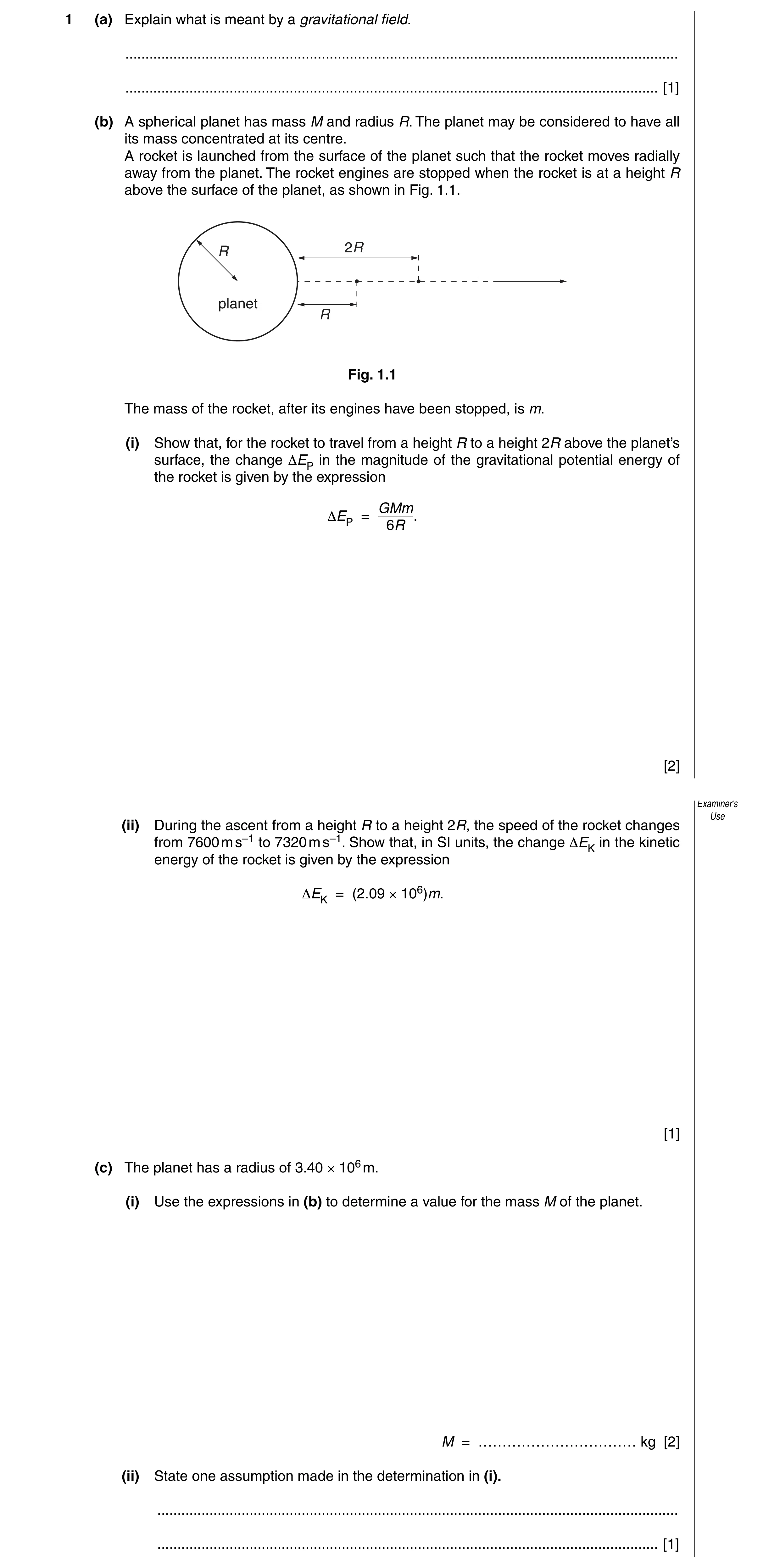
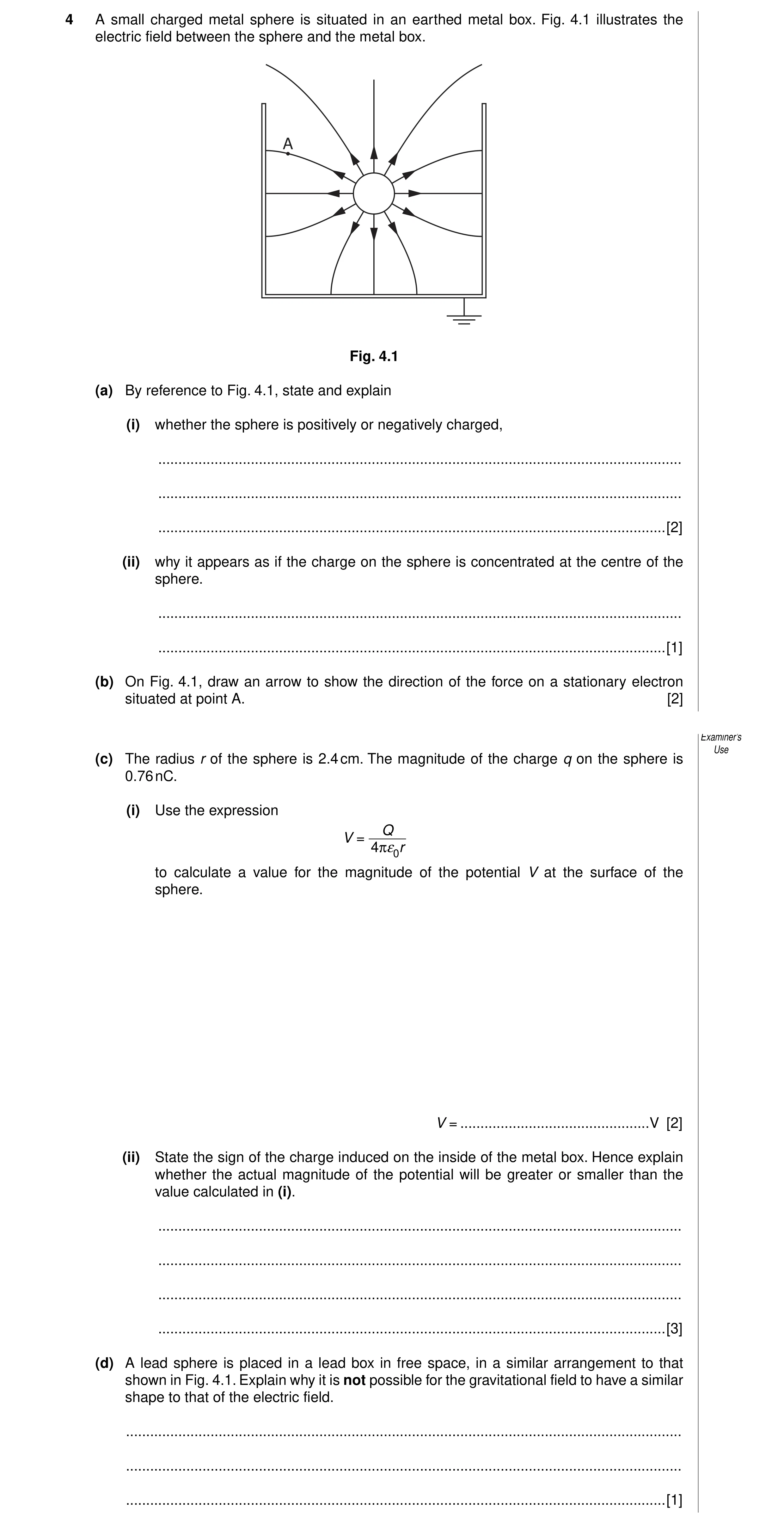
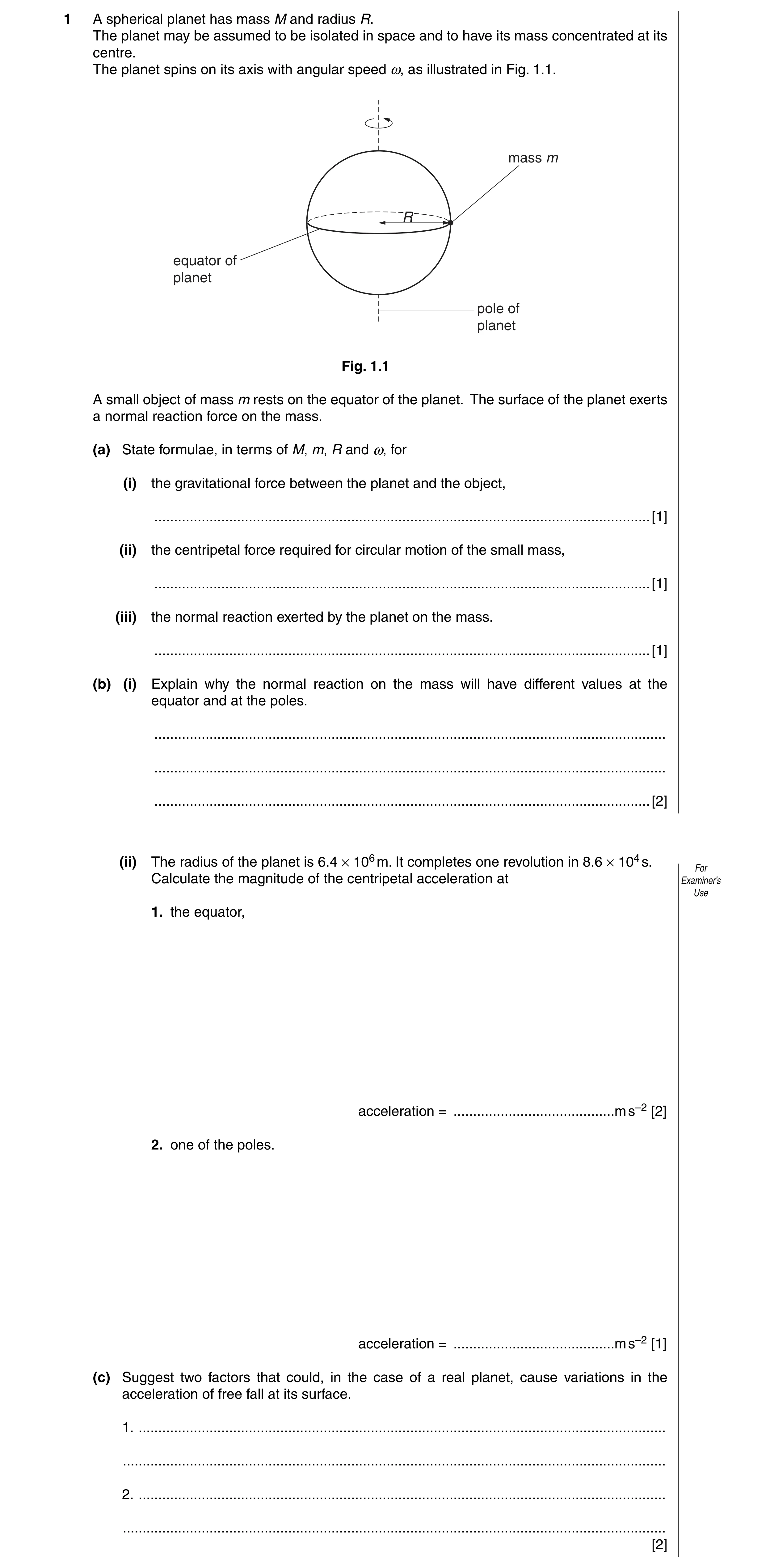
 8 / 69
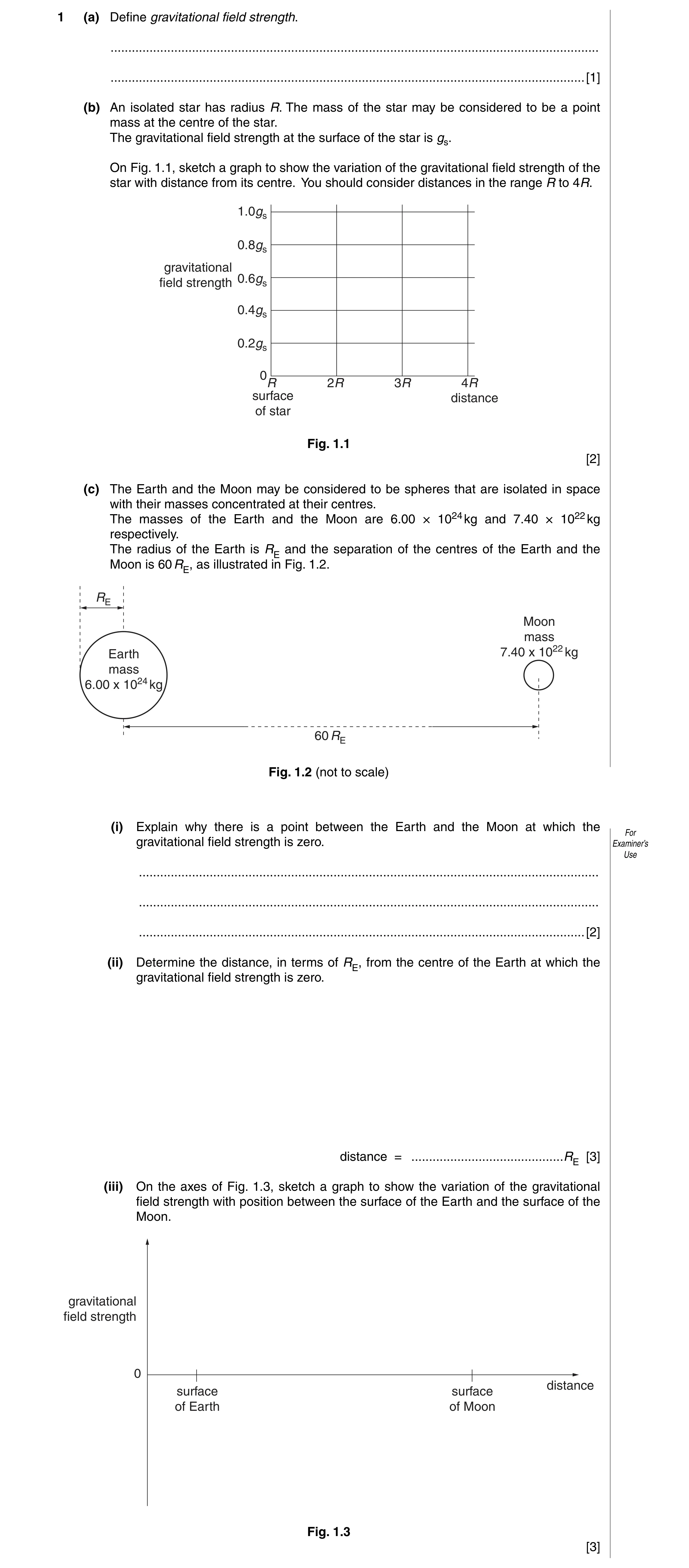
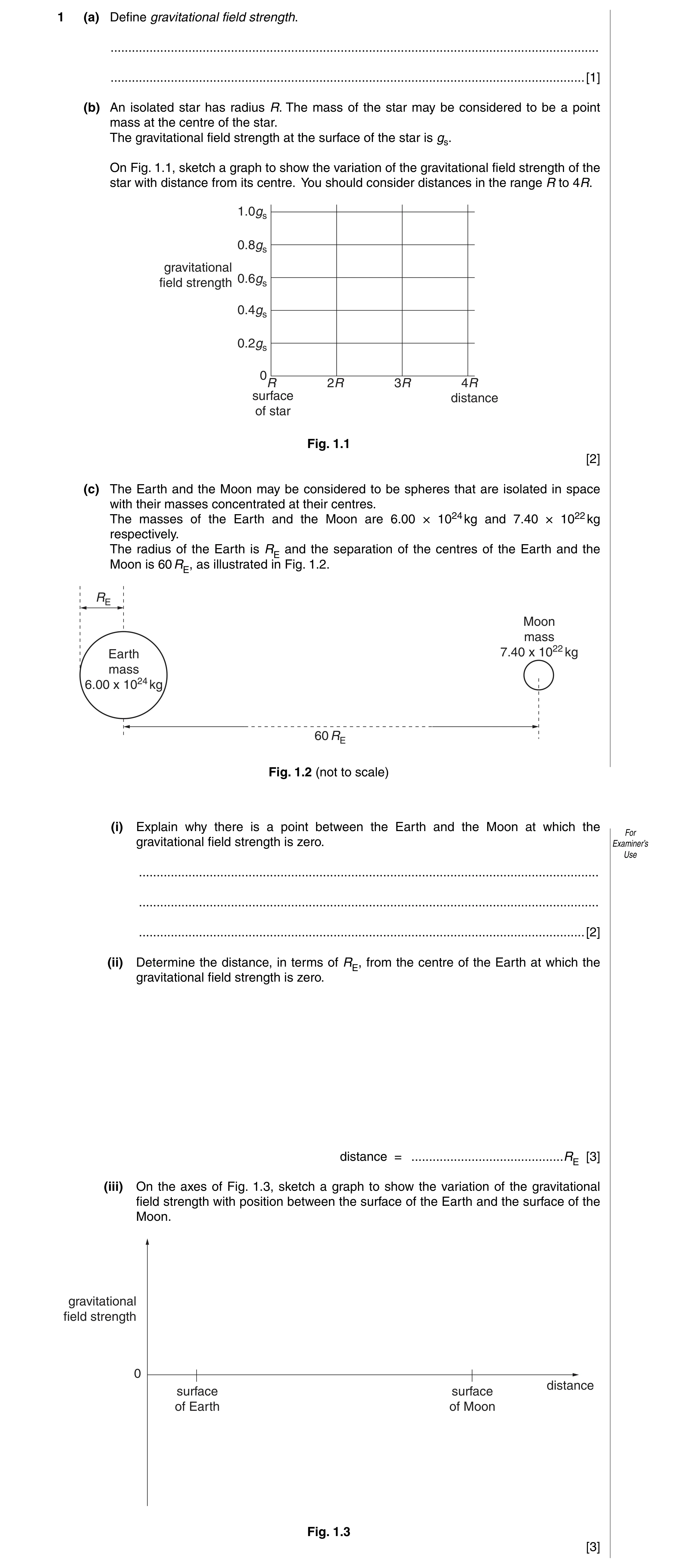
 15 / 69
 16 / 69
 19 / 69
 22 / 69
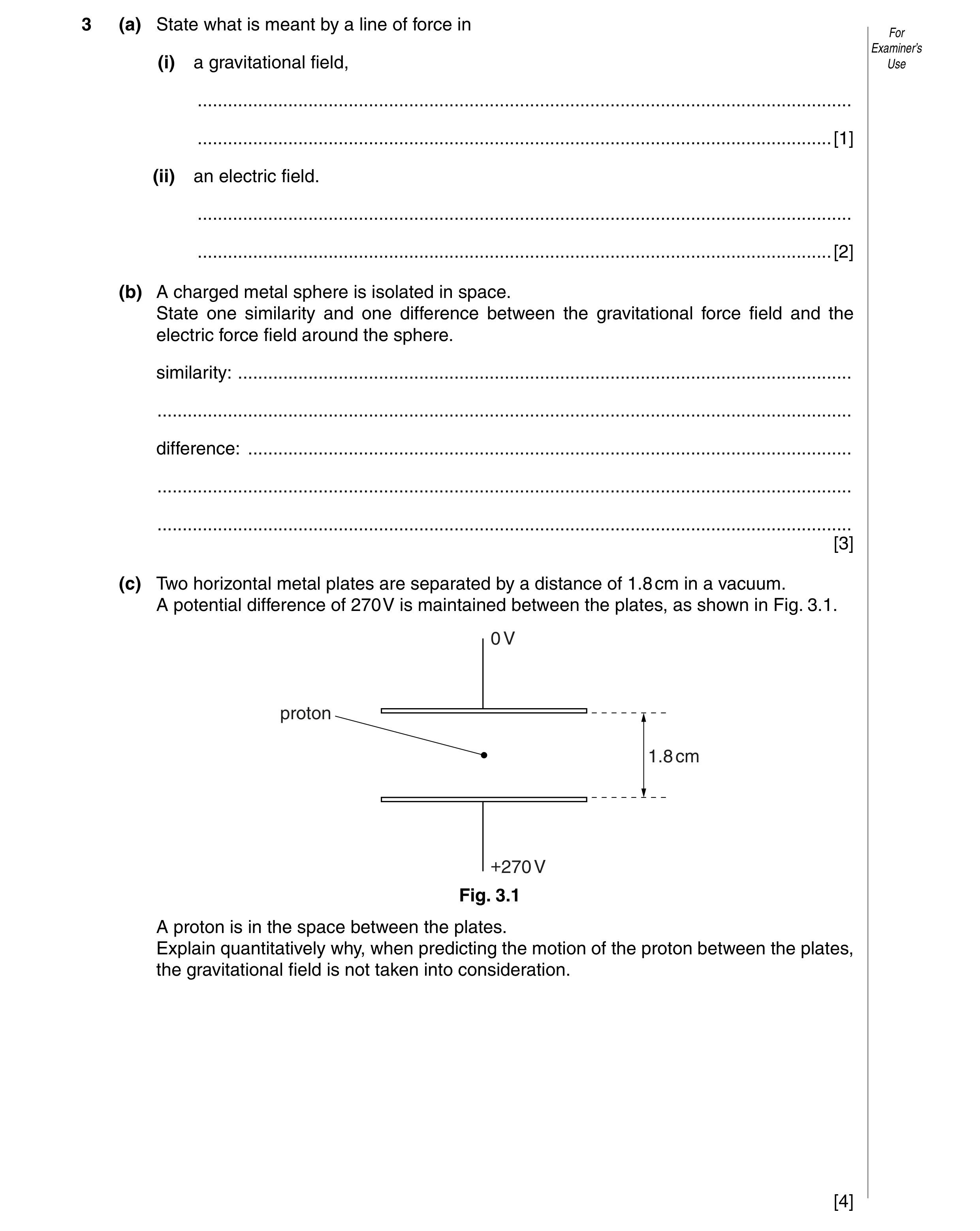 23 / 69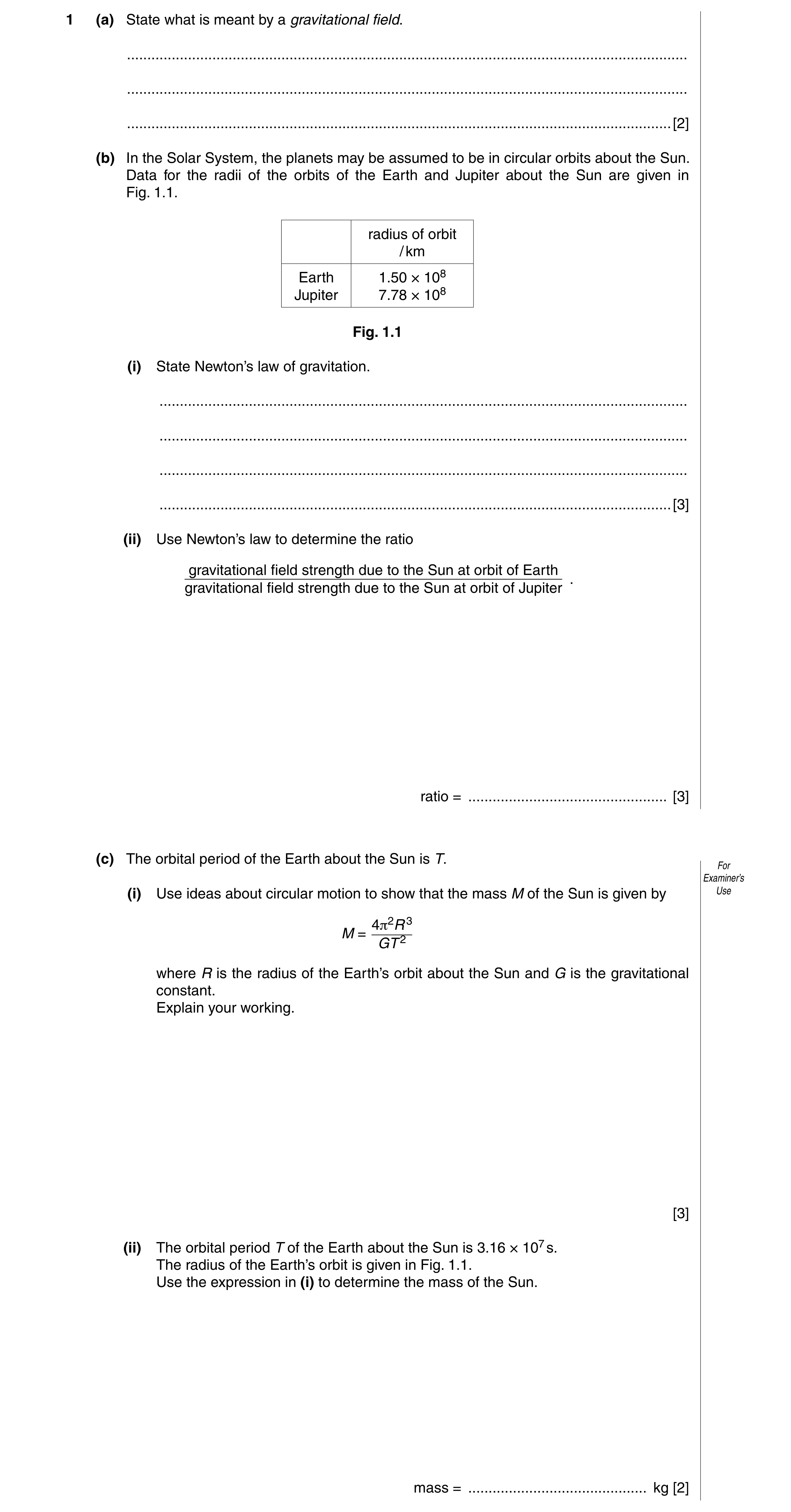
 26 / 69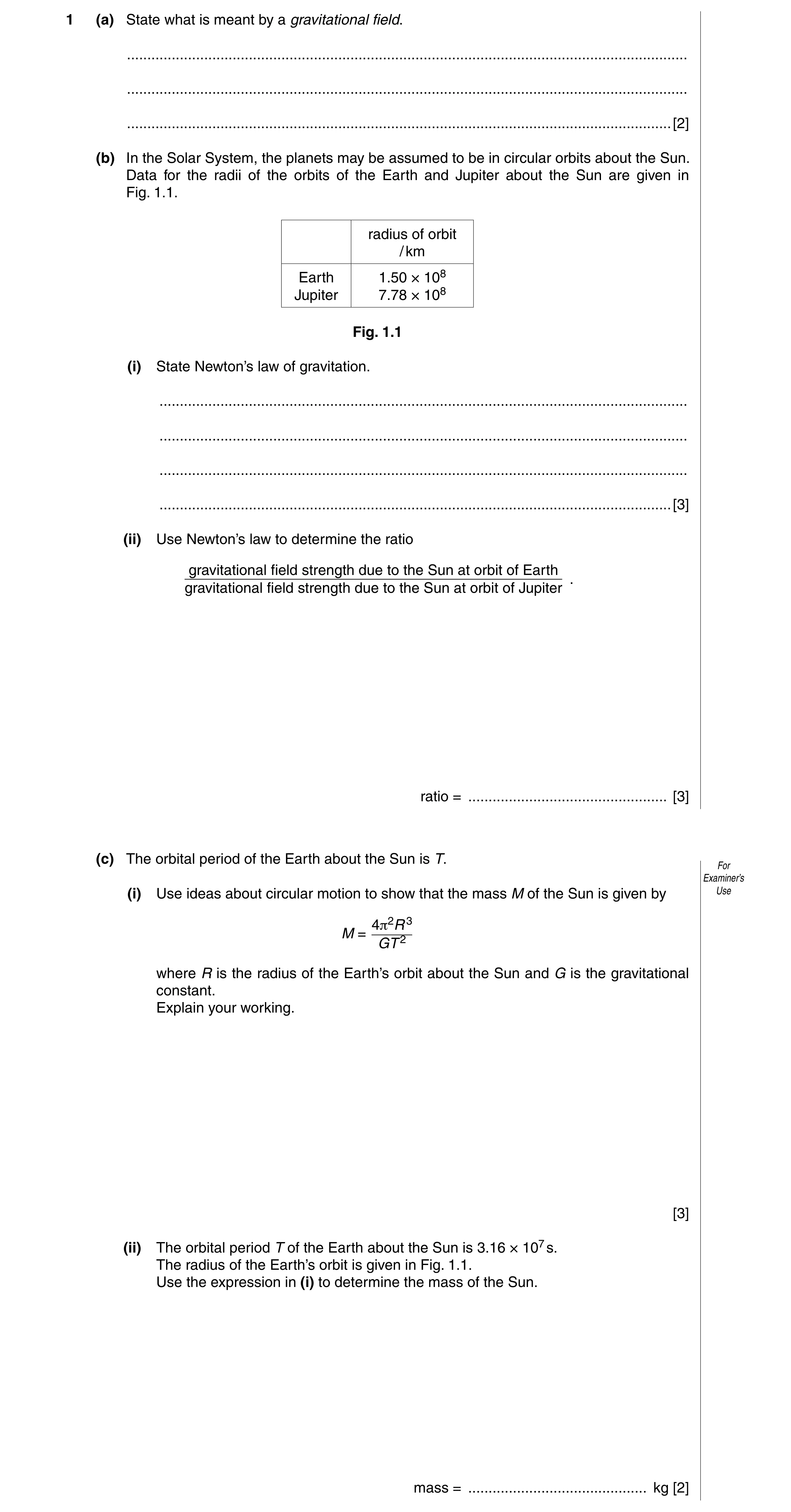
 29 / 69
 30 / 69
 31 / 69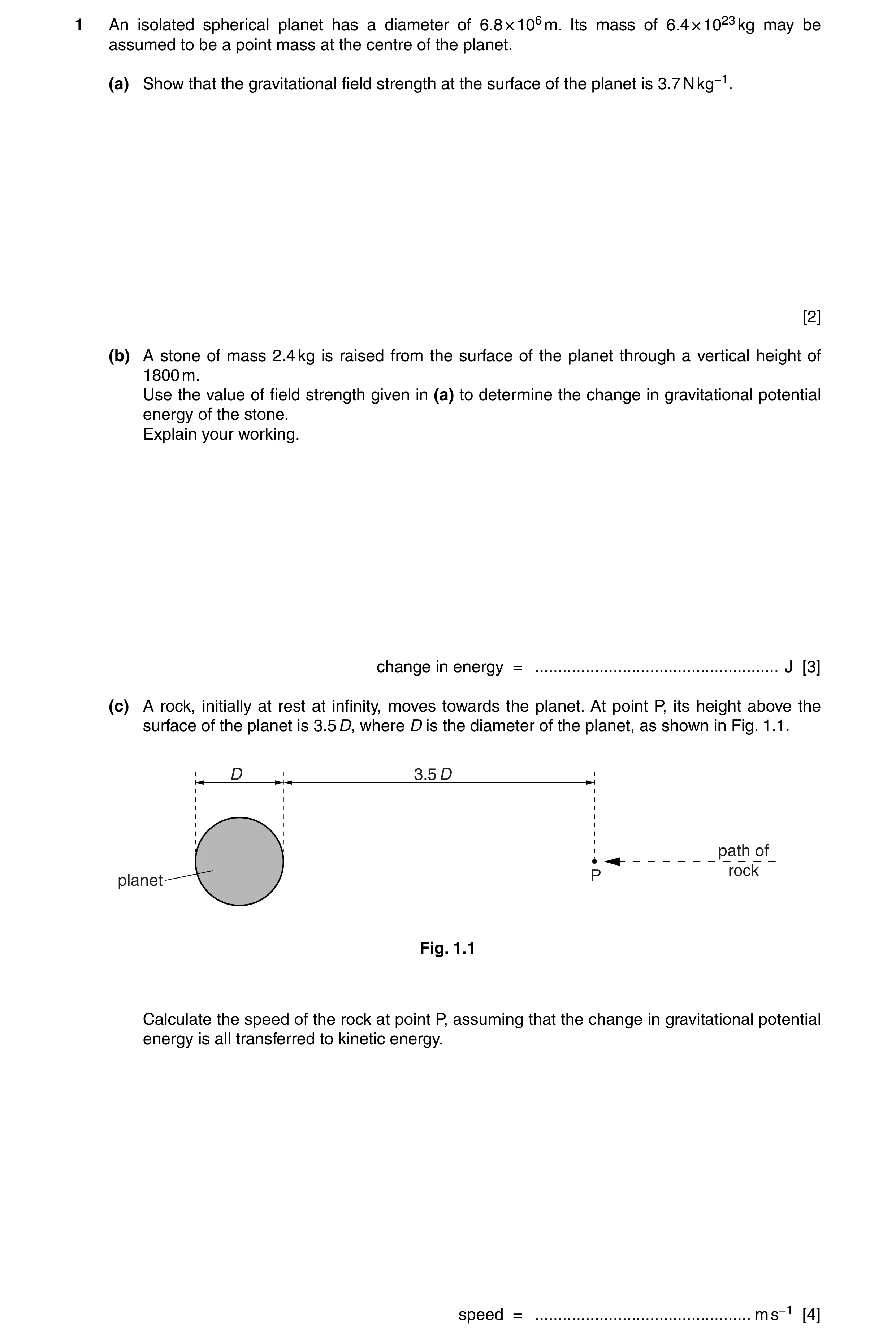
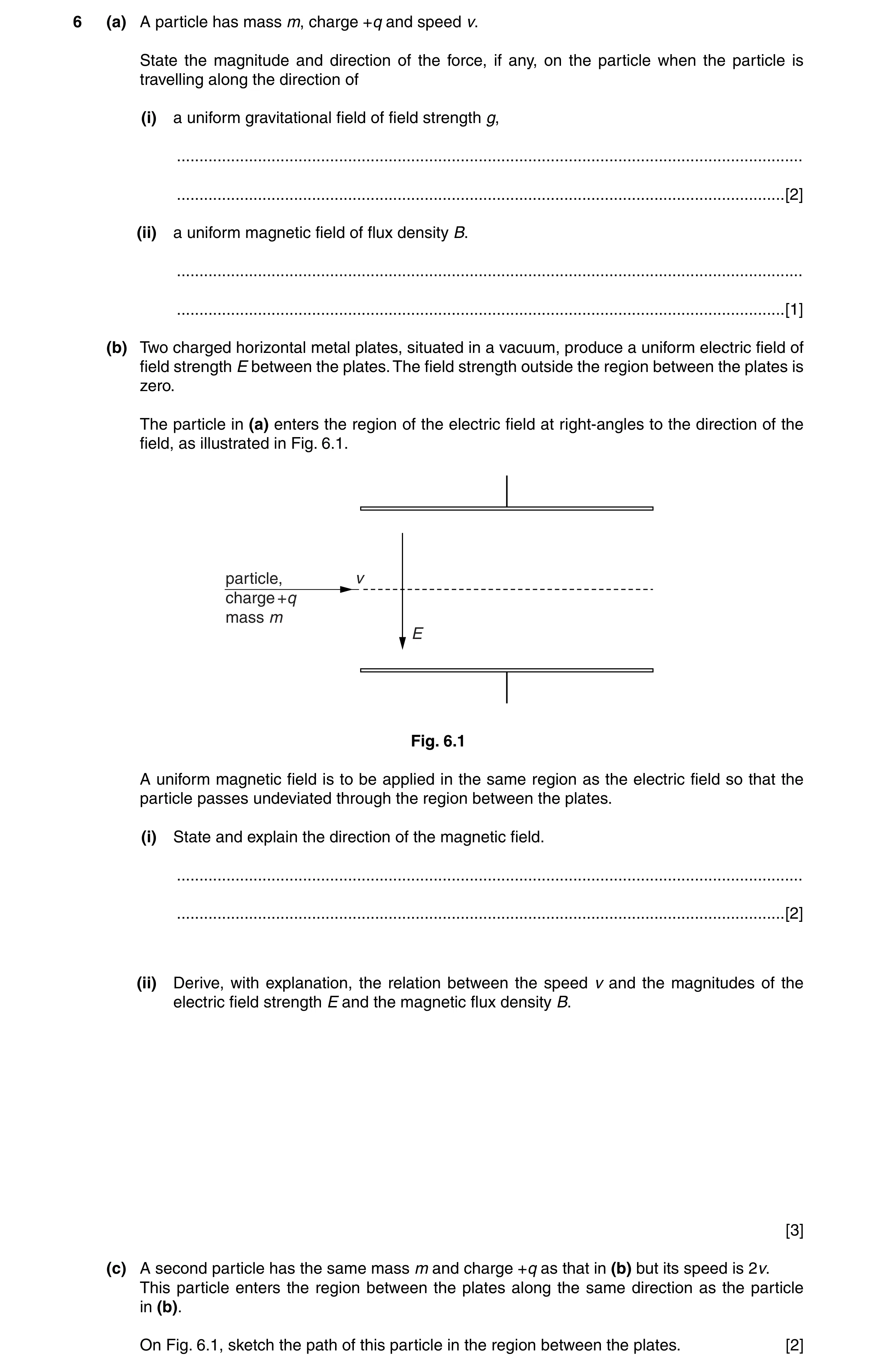
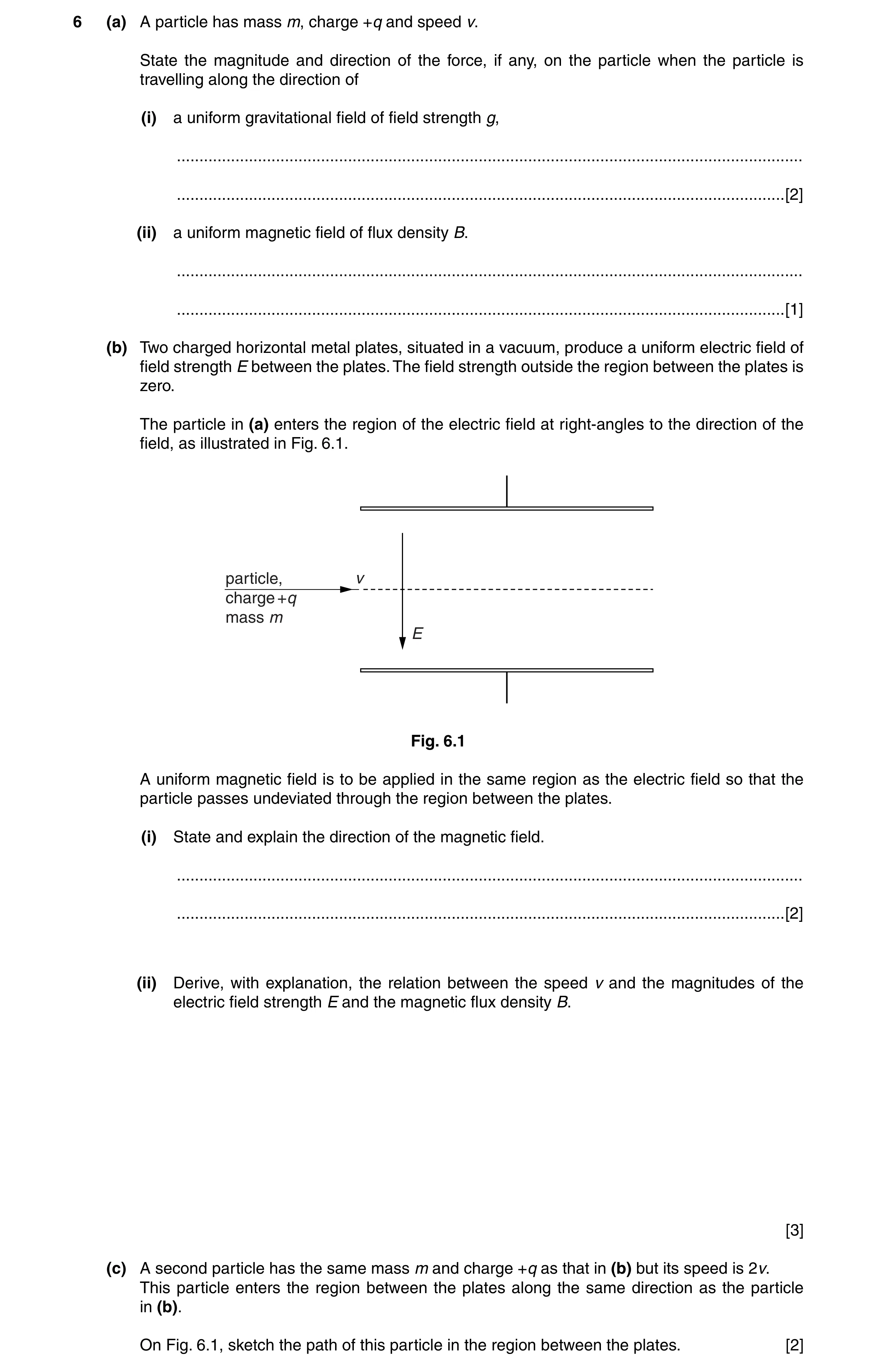
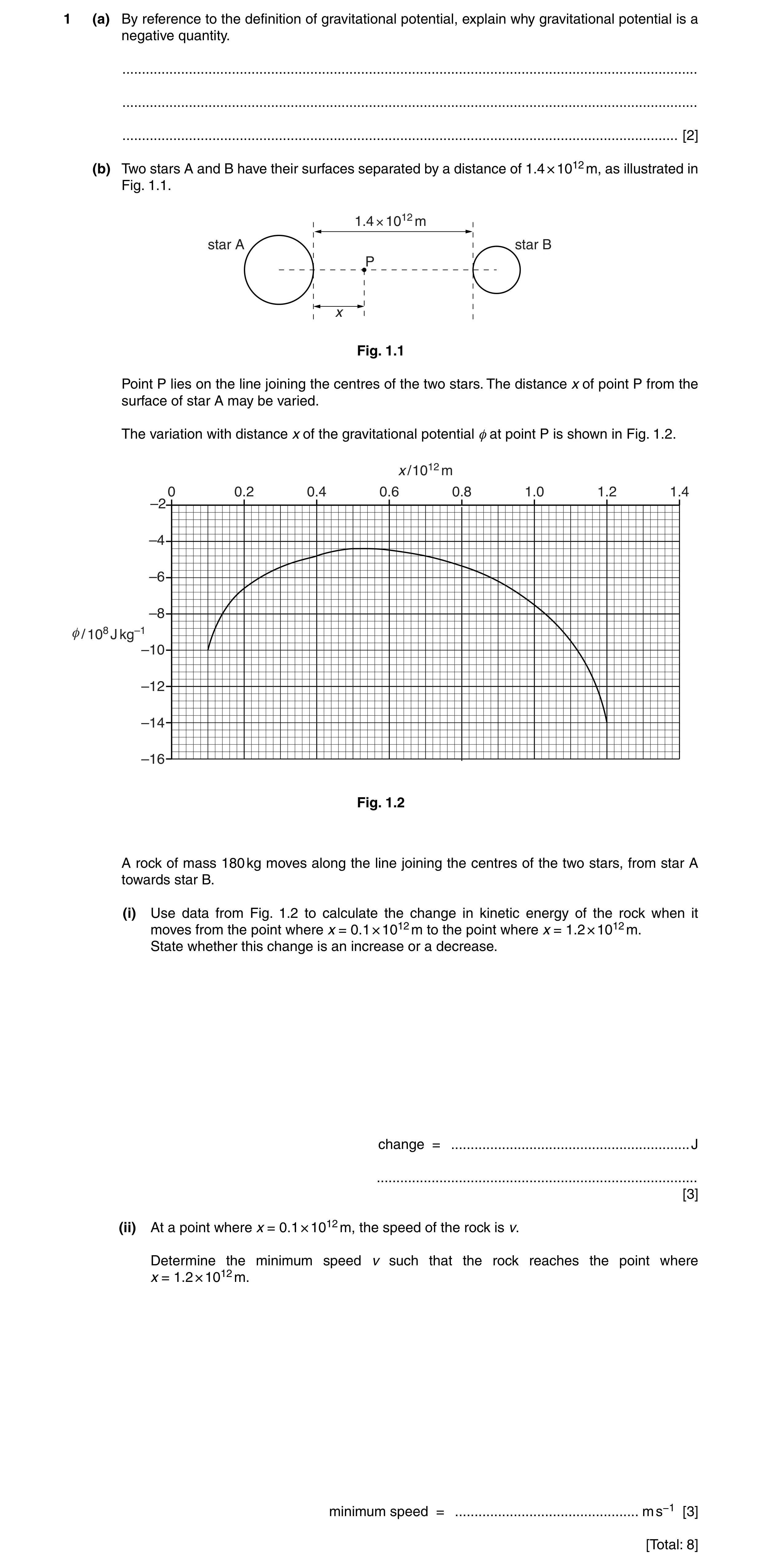
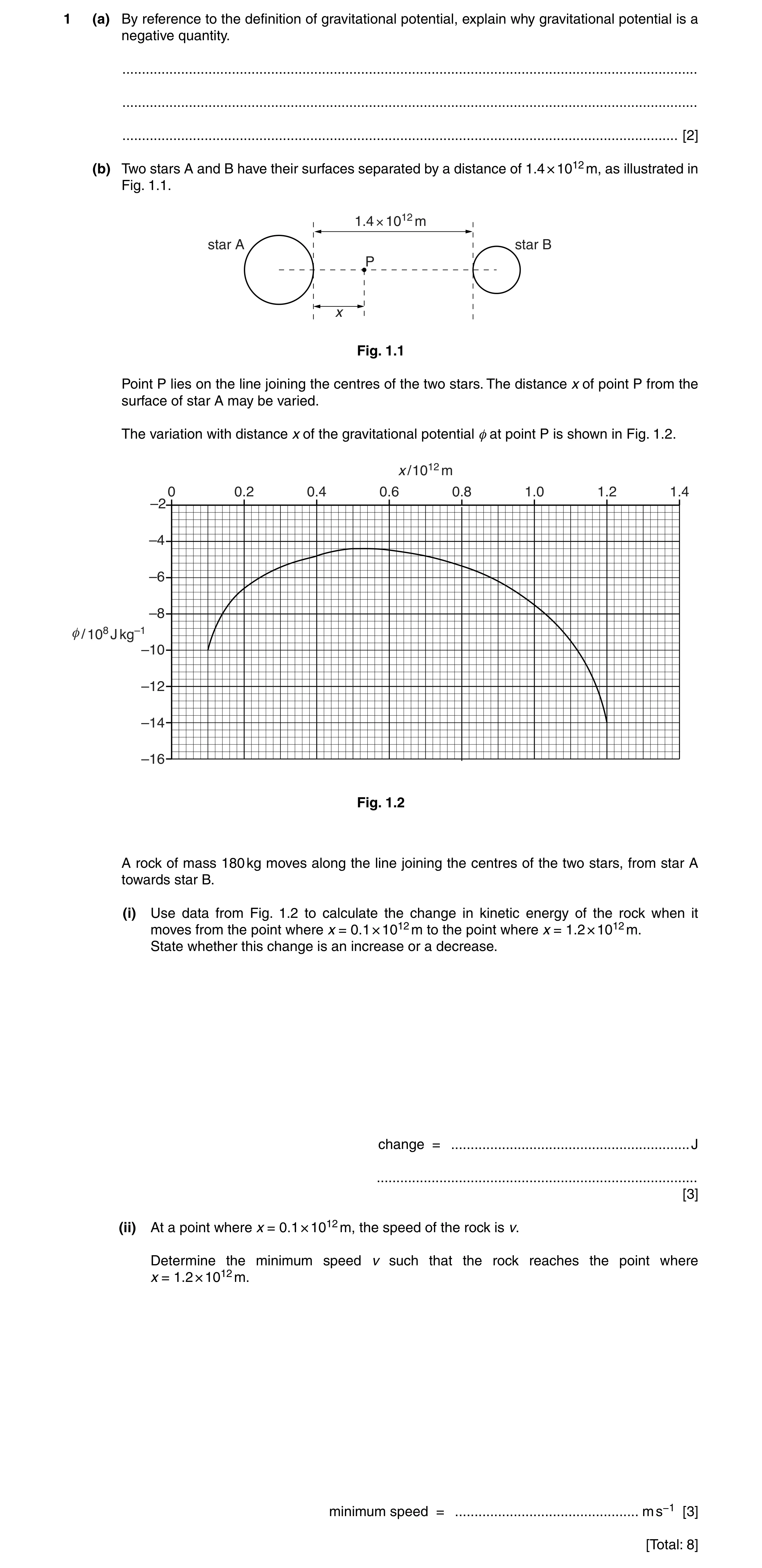
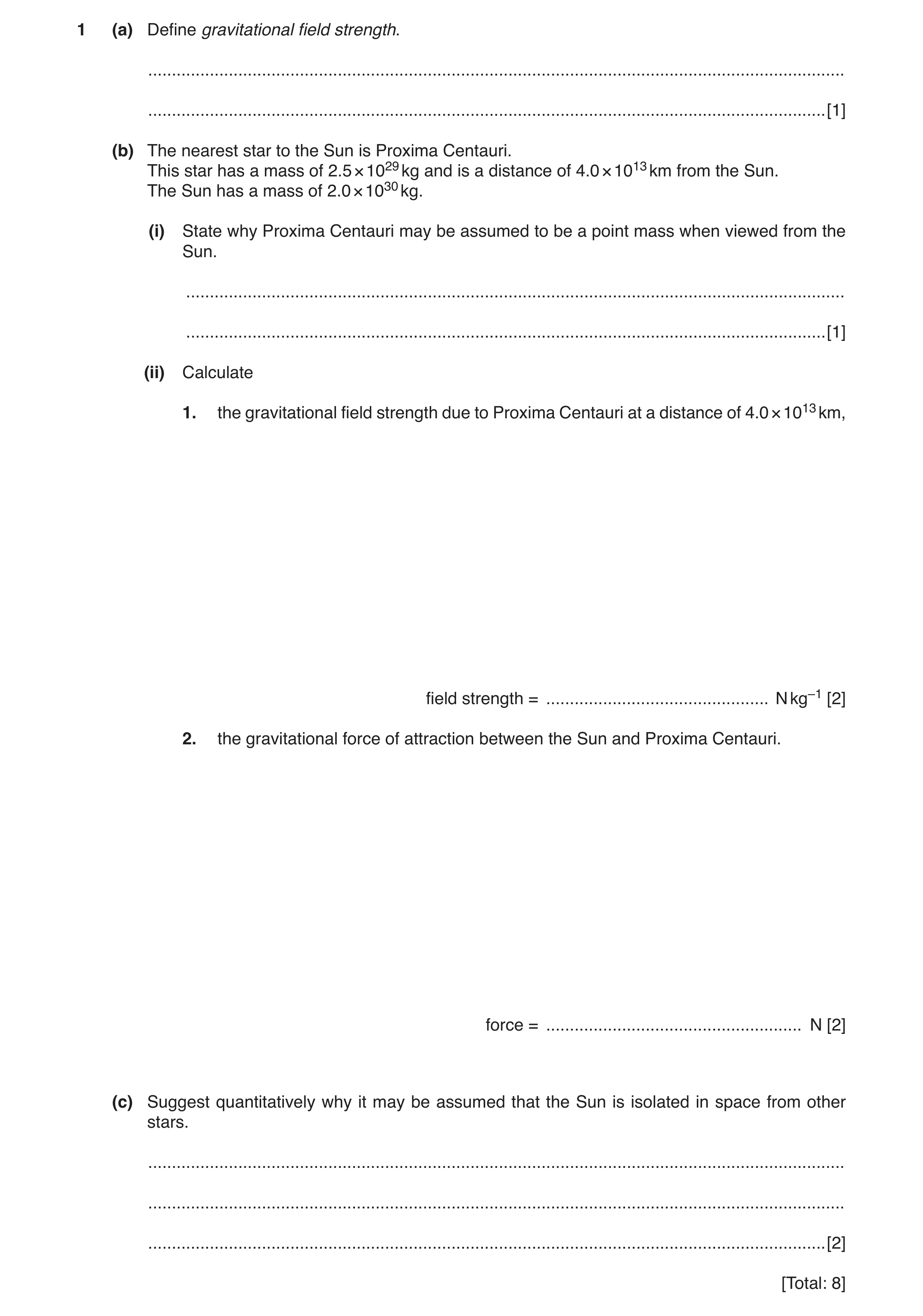 39 / 69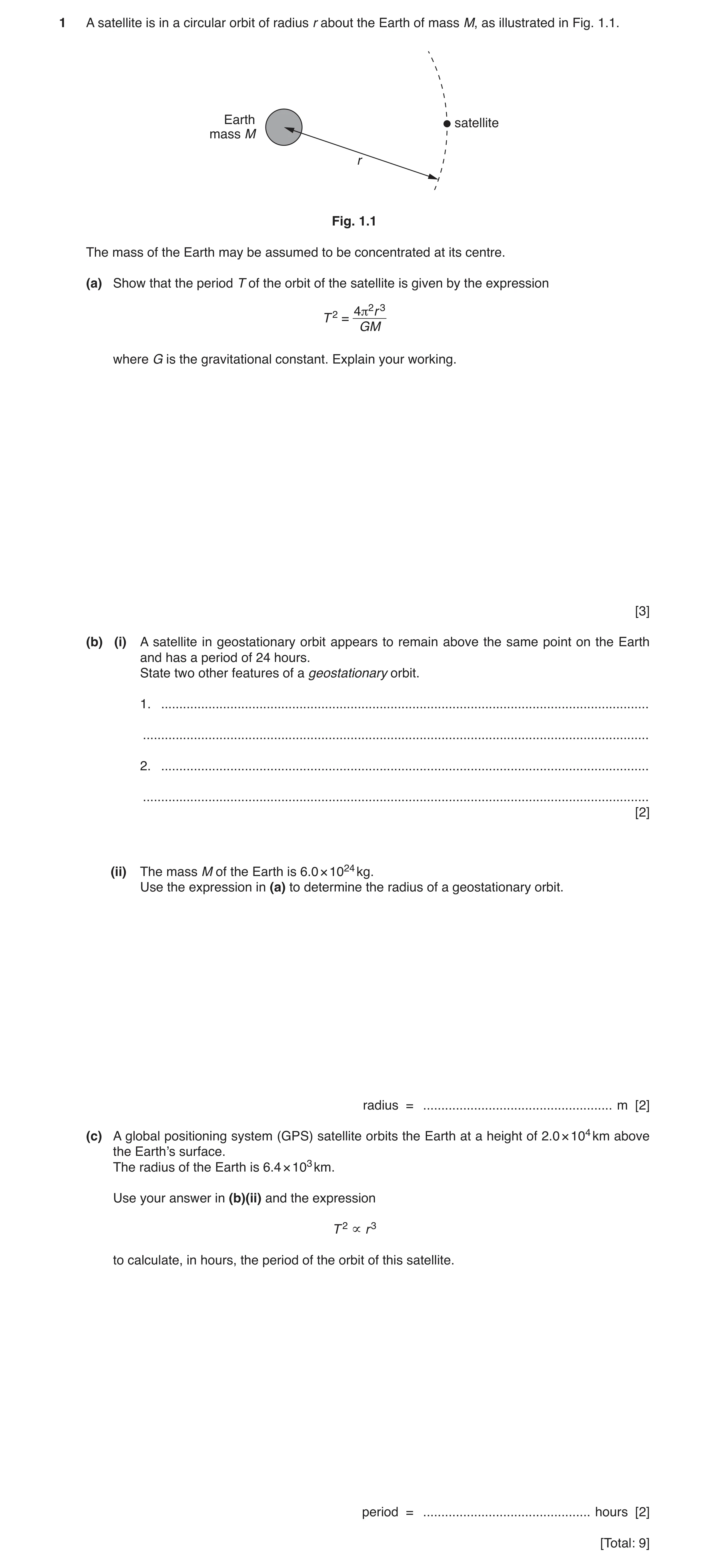
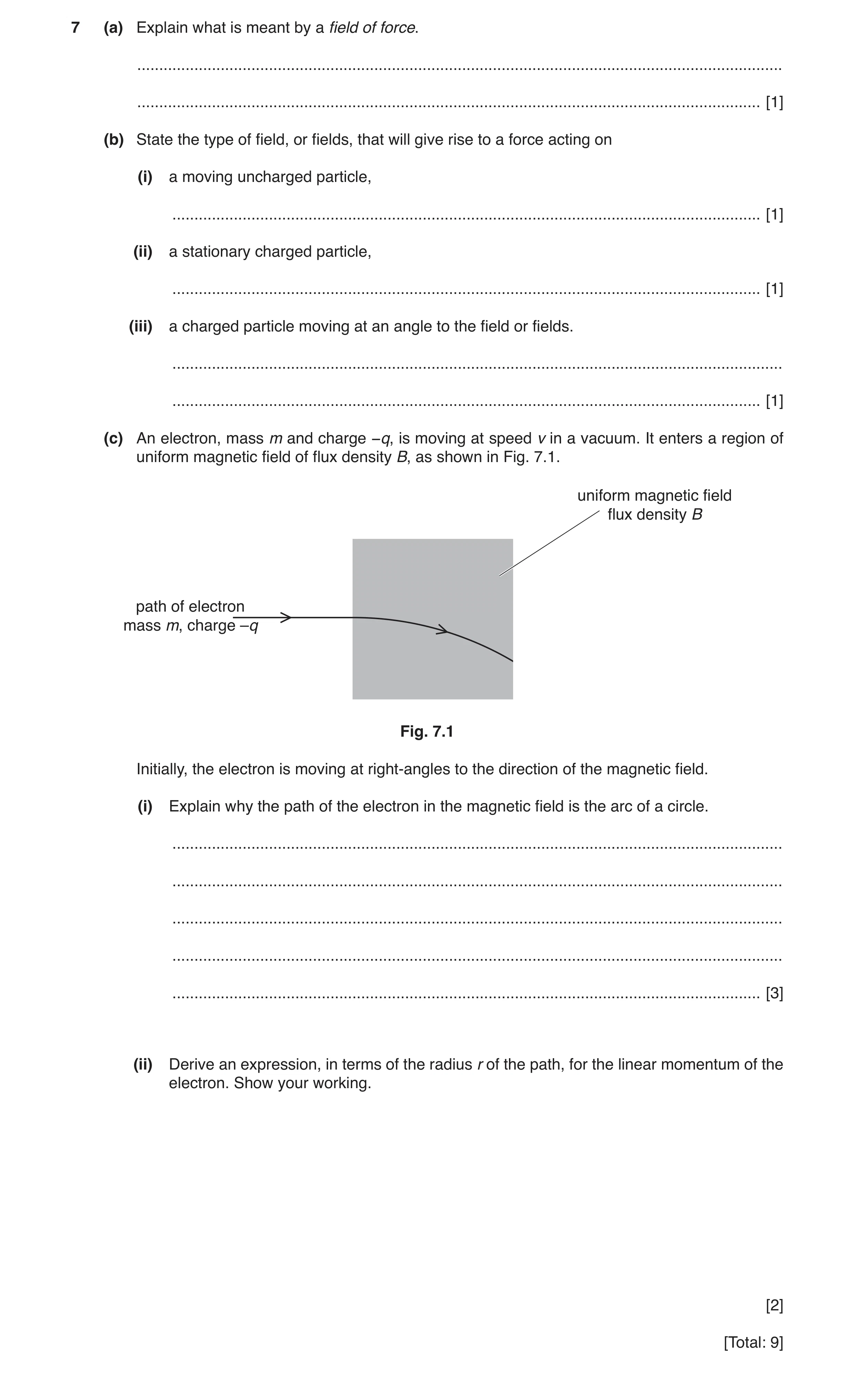
 43 / 69
 44 / 69
 45 / 69
 46 / 69
 48 / 69
 49 / 69
 52 / 69
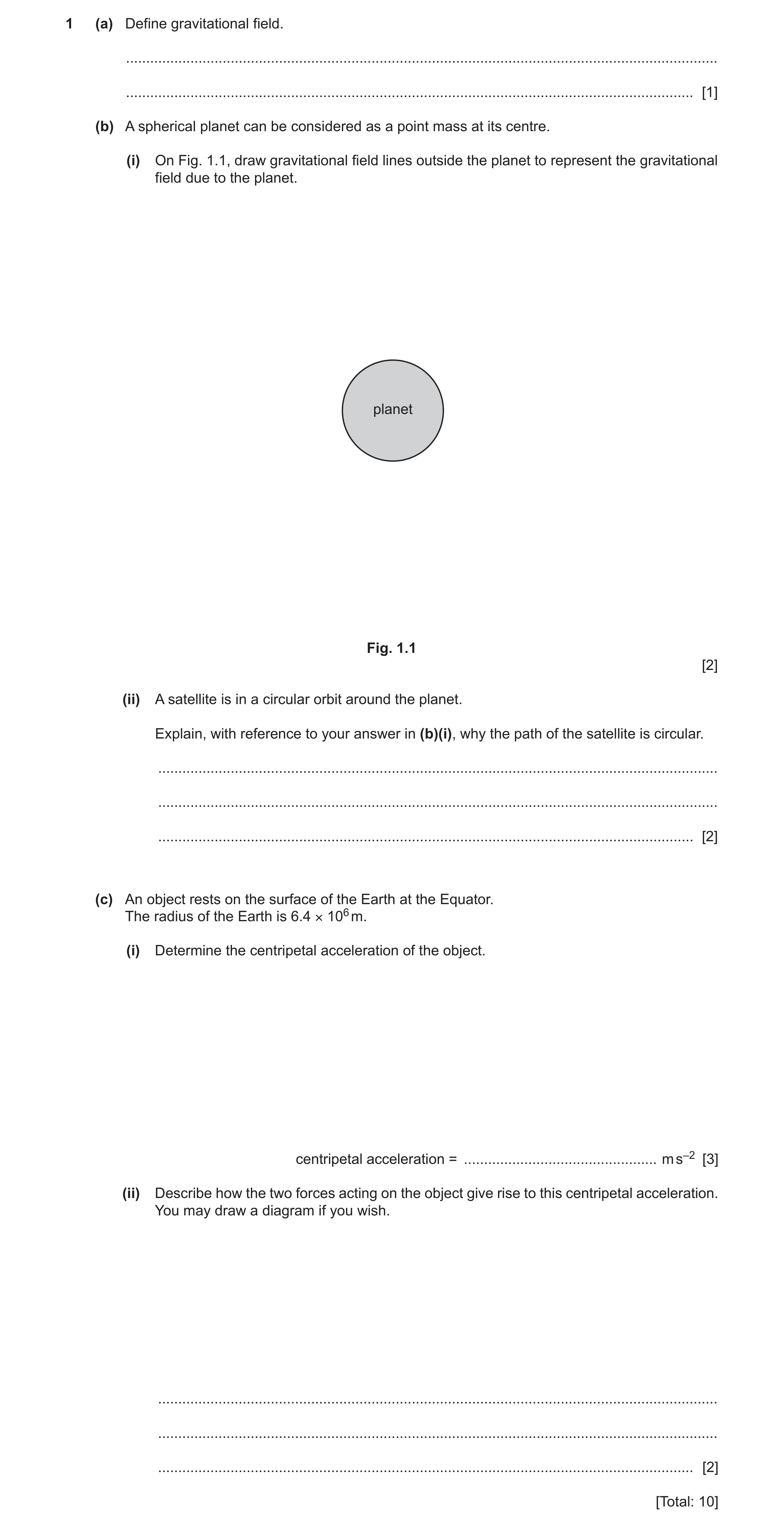
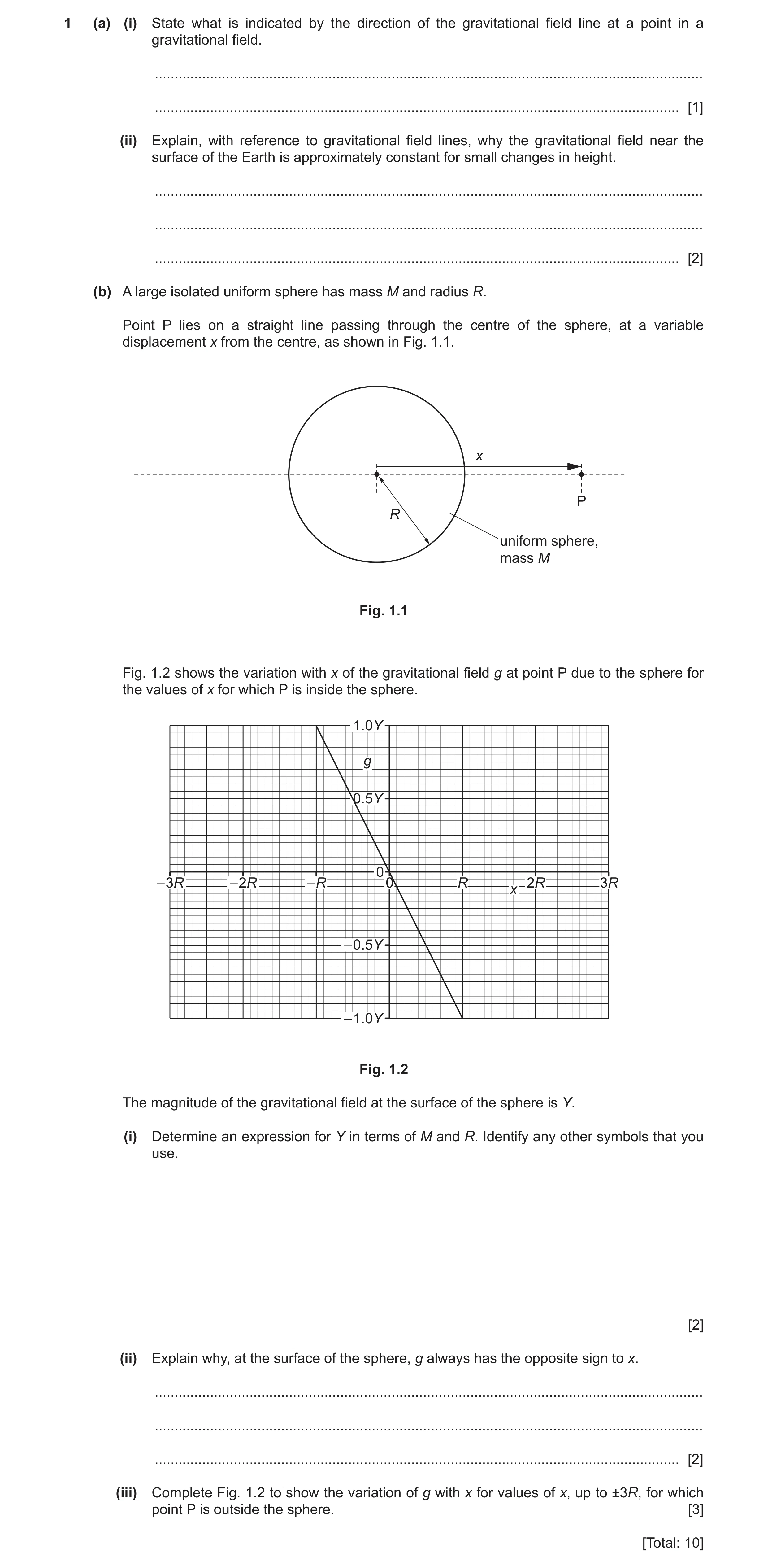
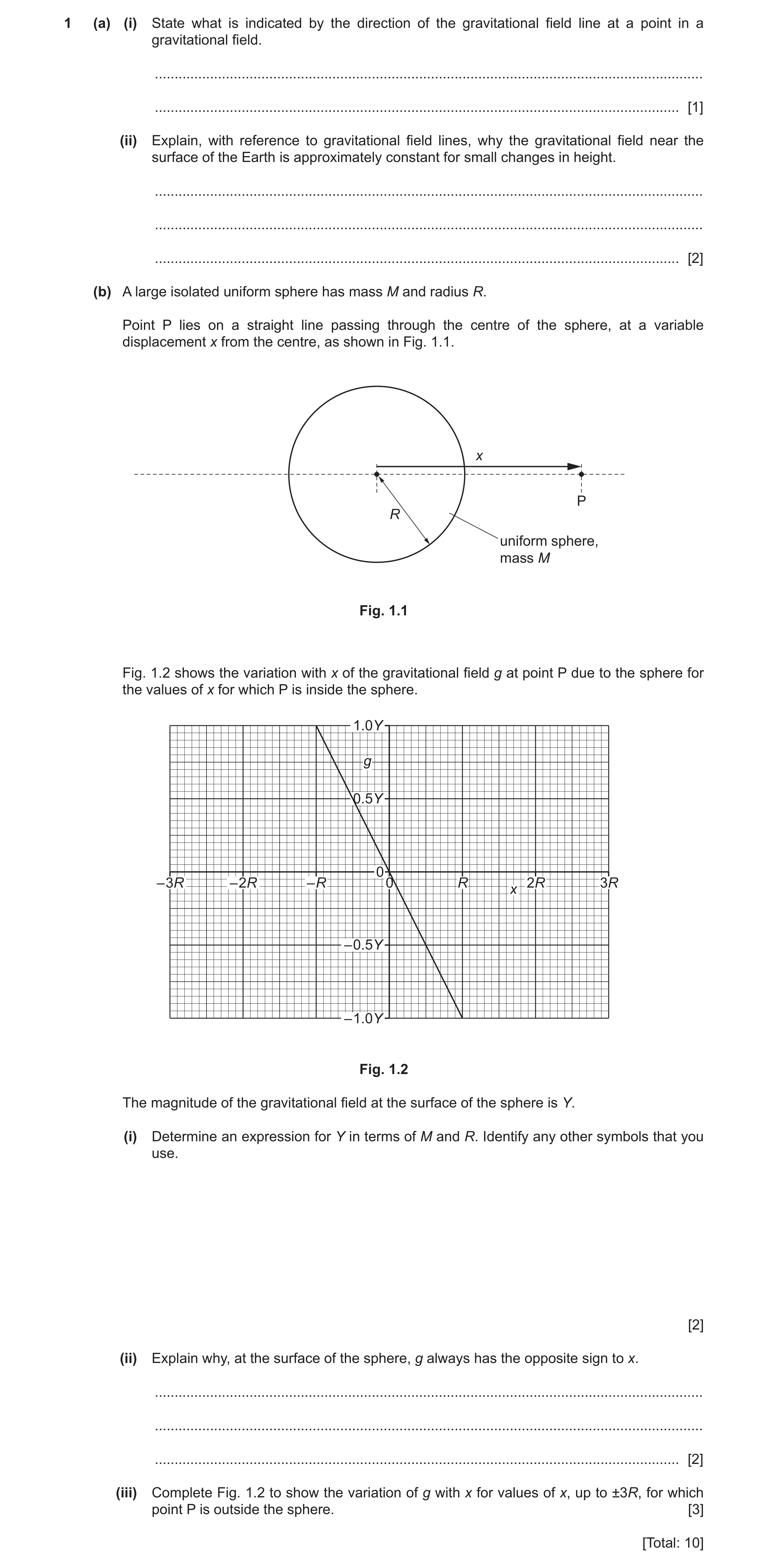
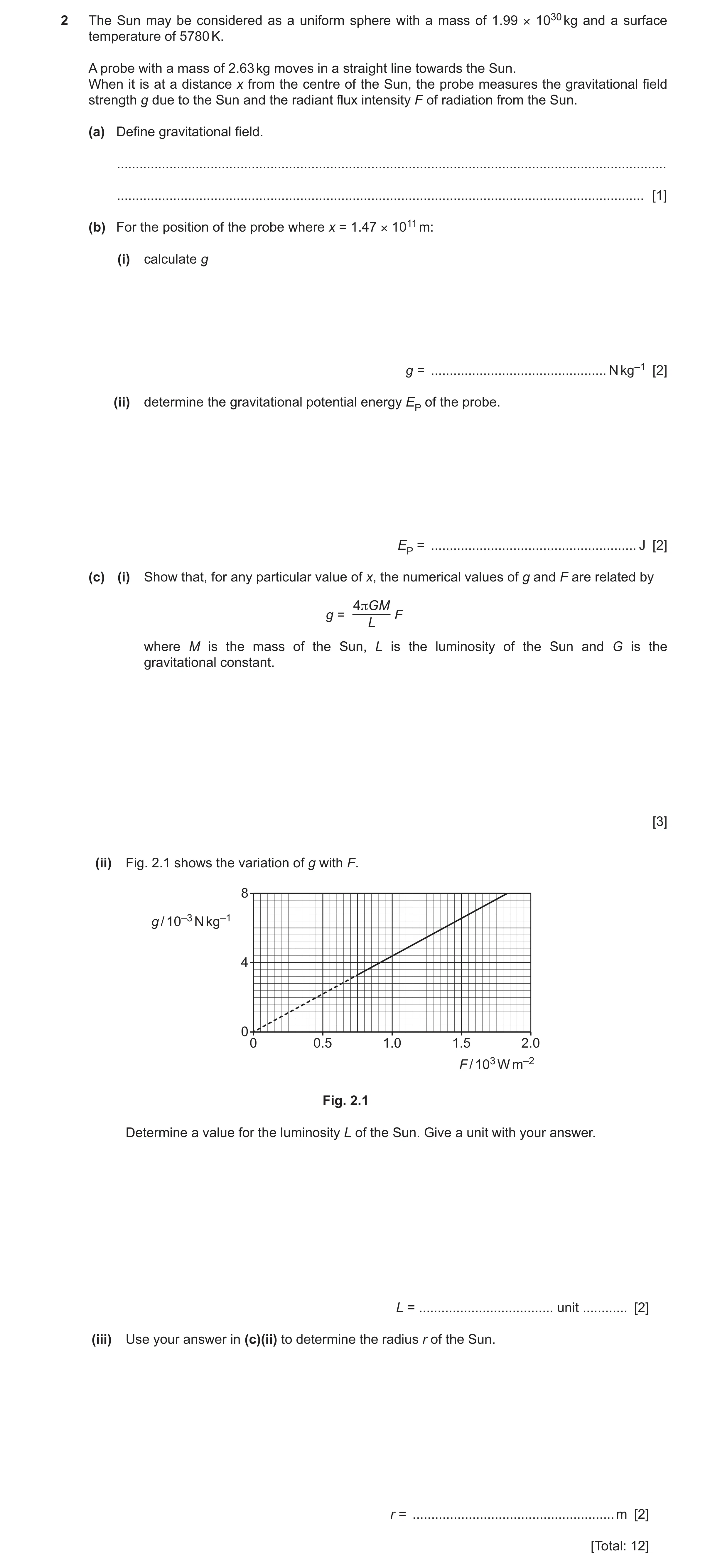
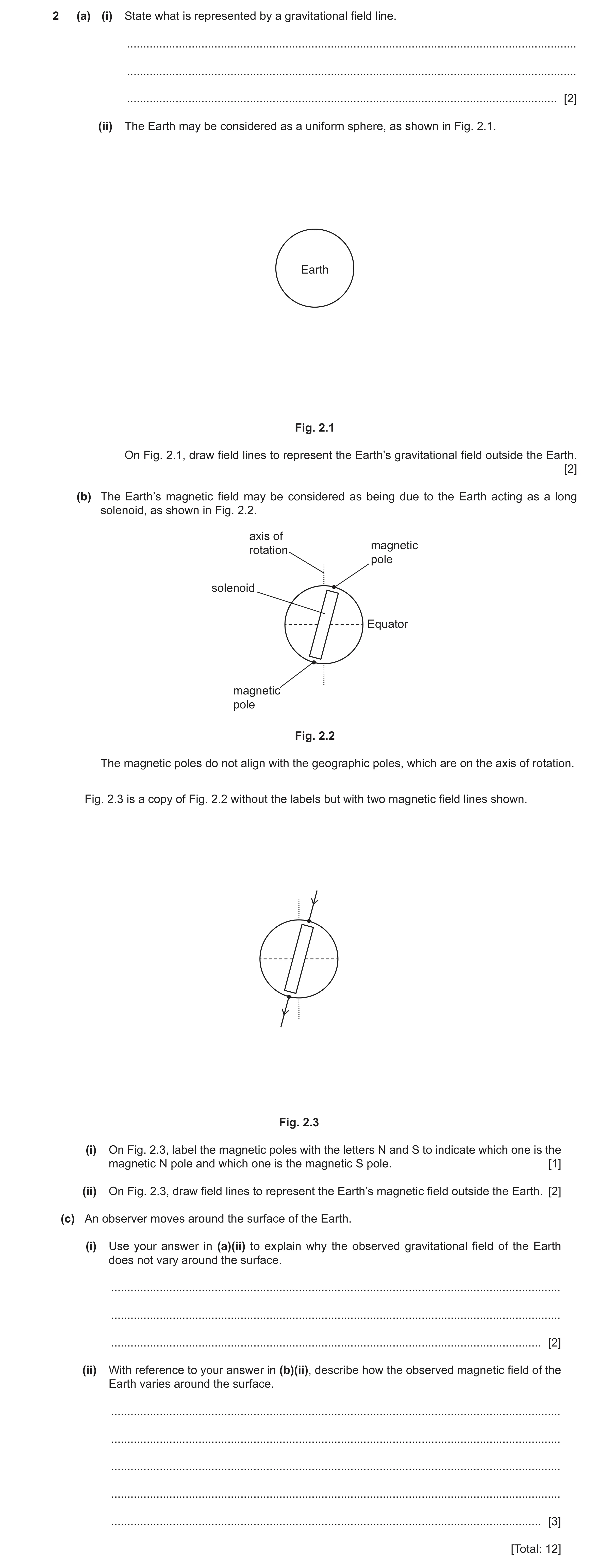
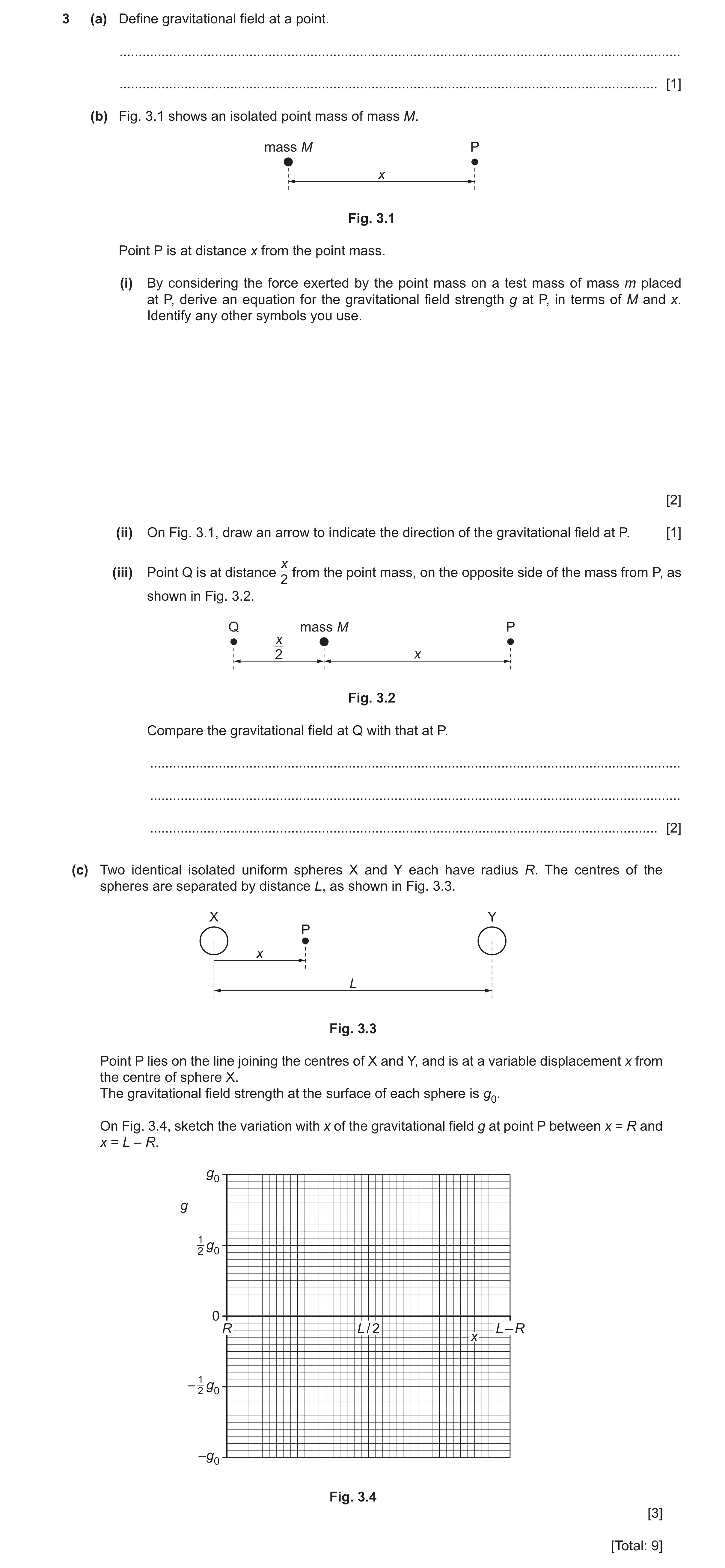
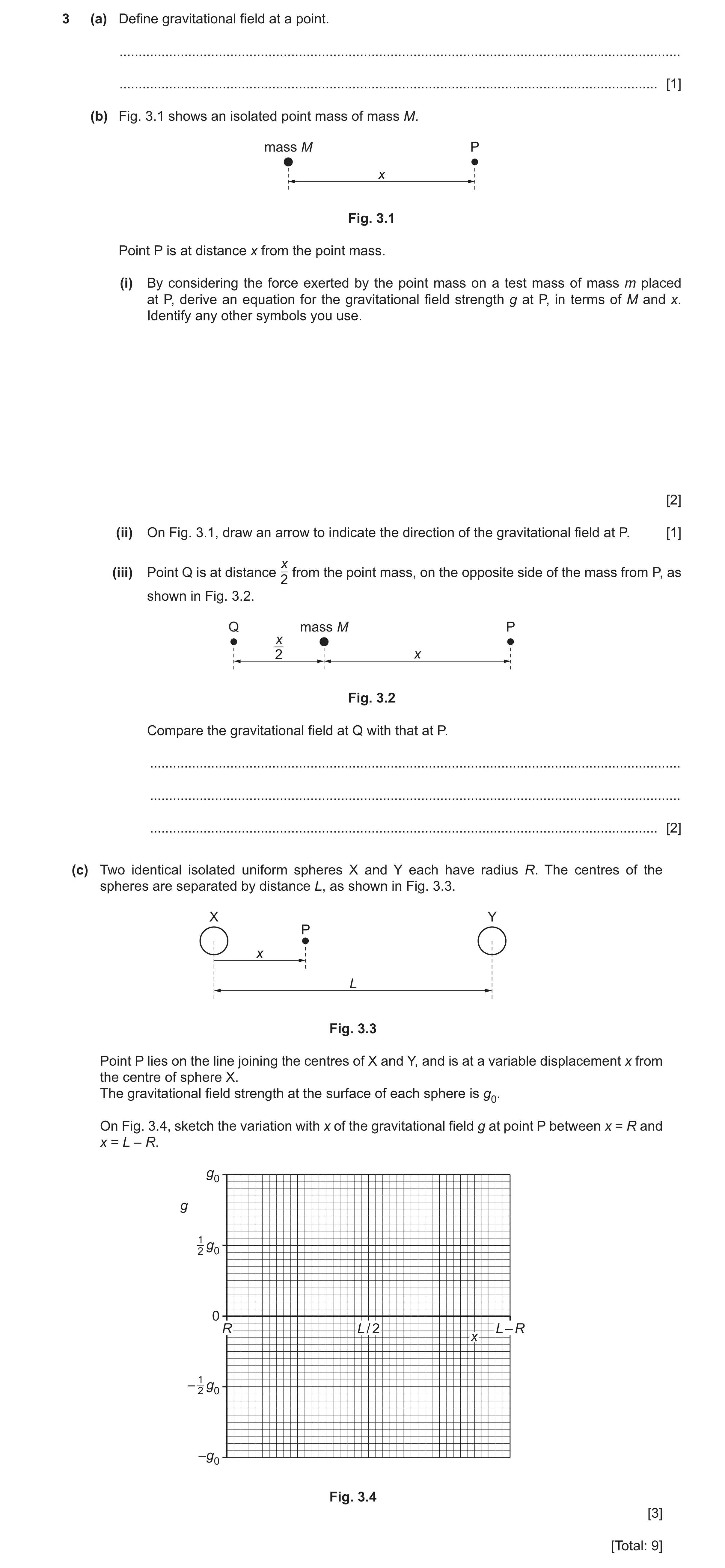
 8
8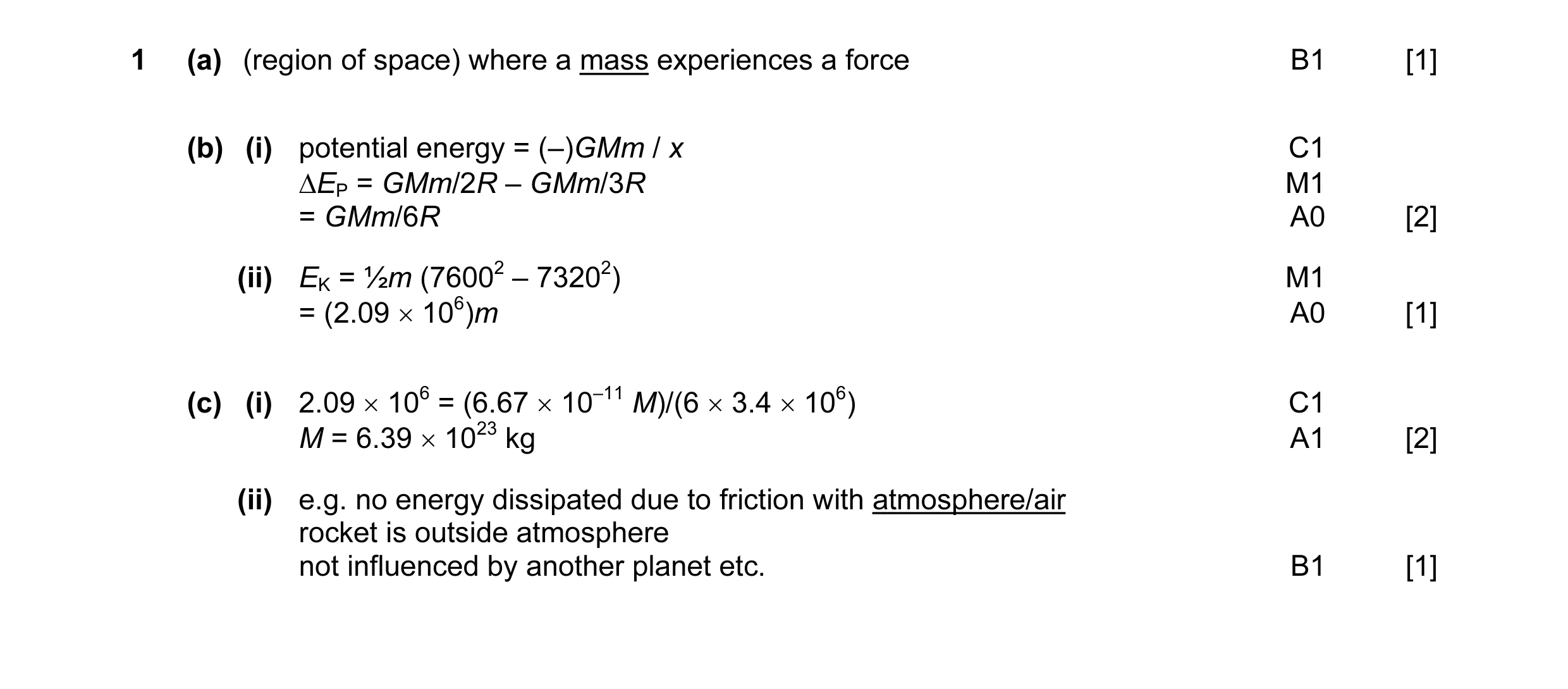 7
7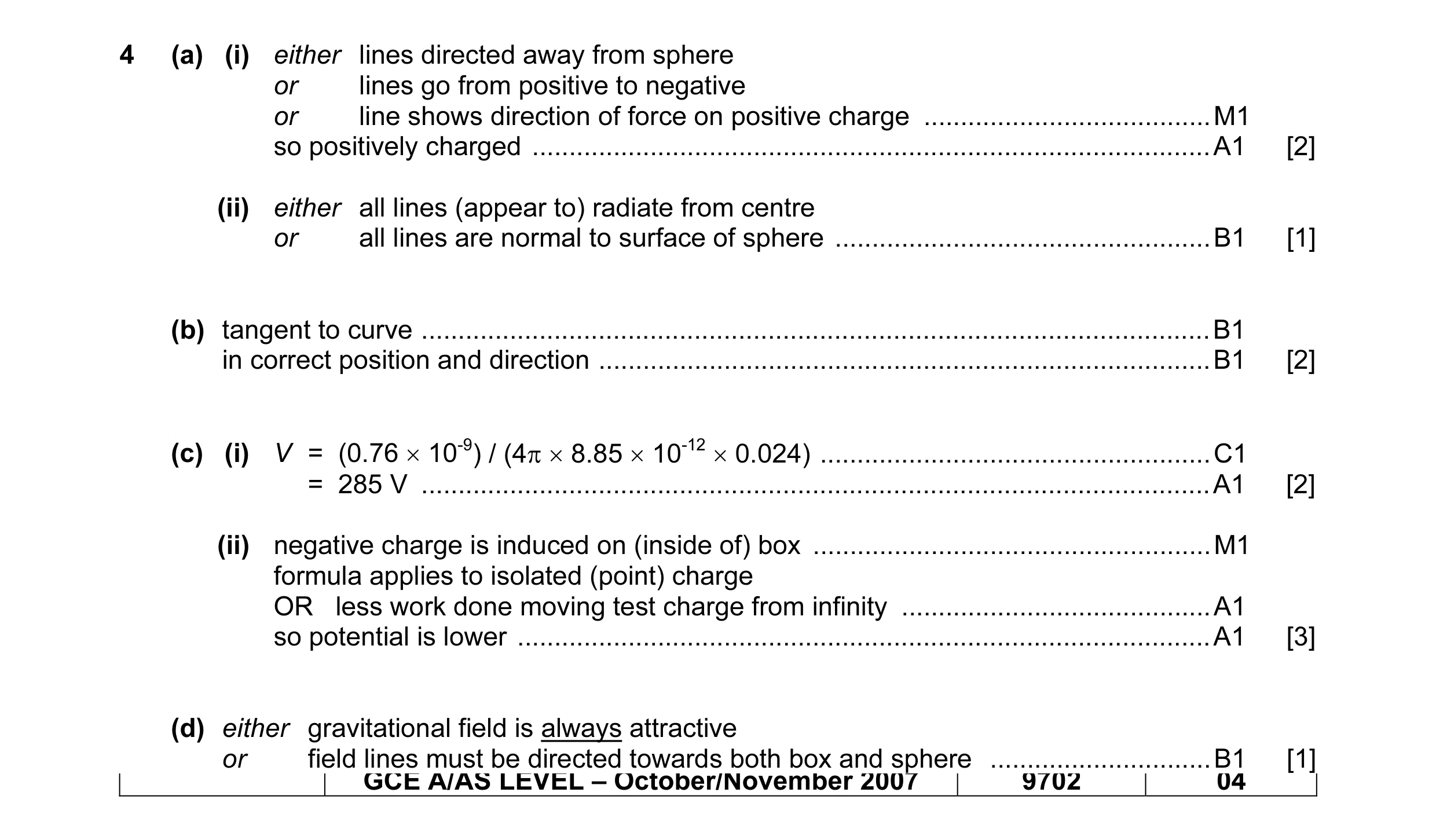 11
11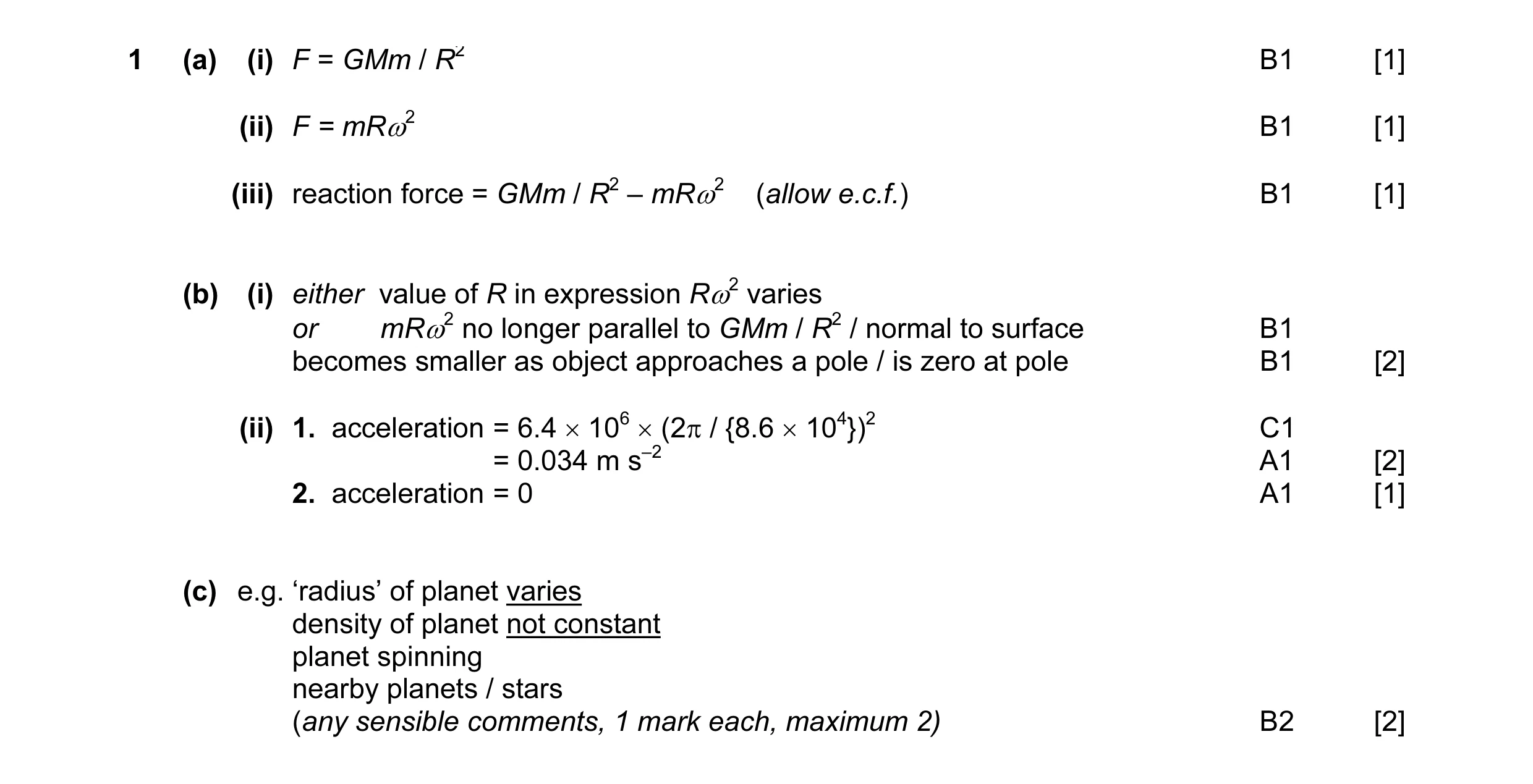 10
10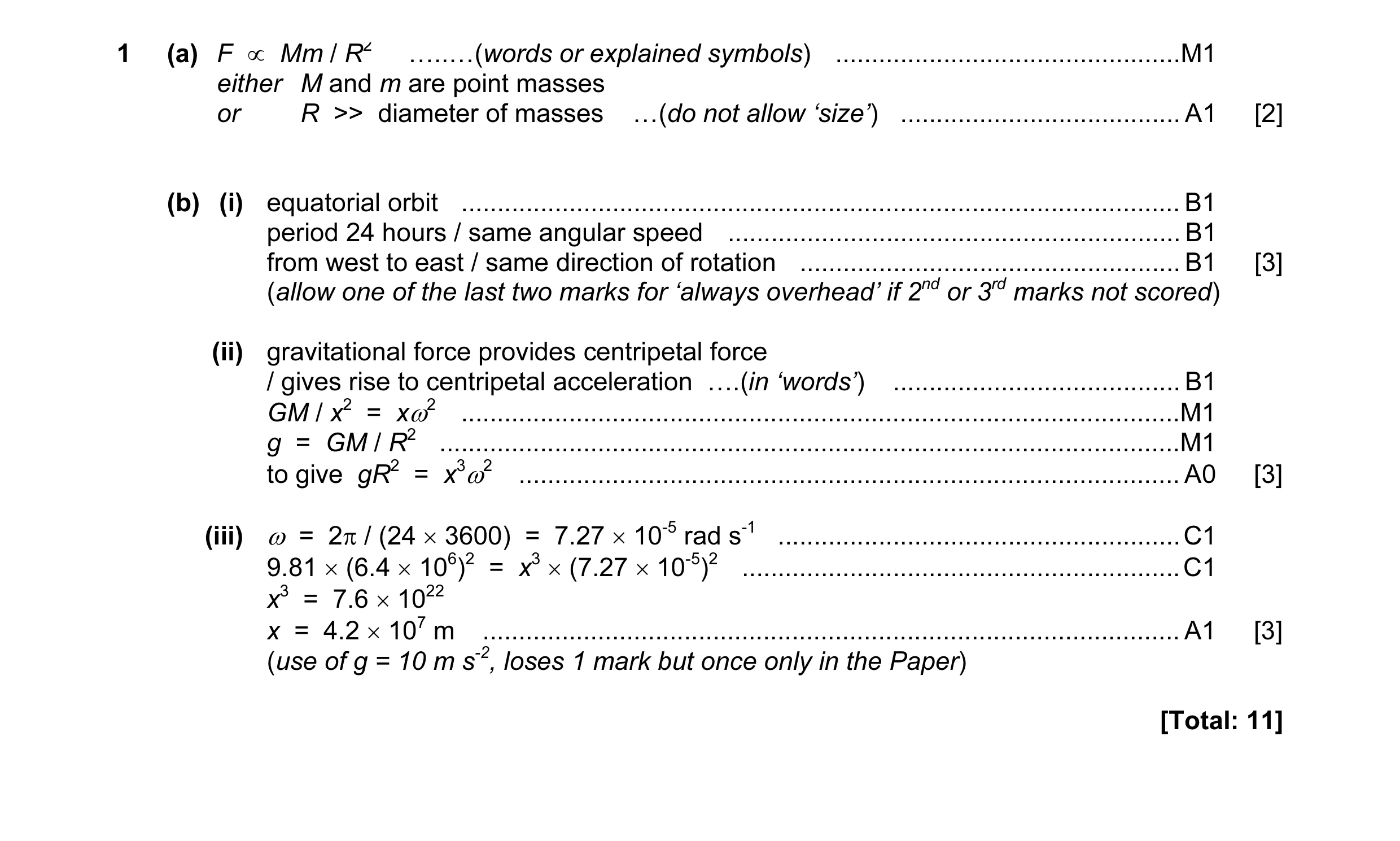 11
11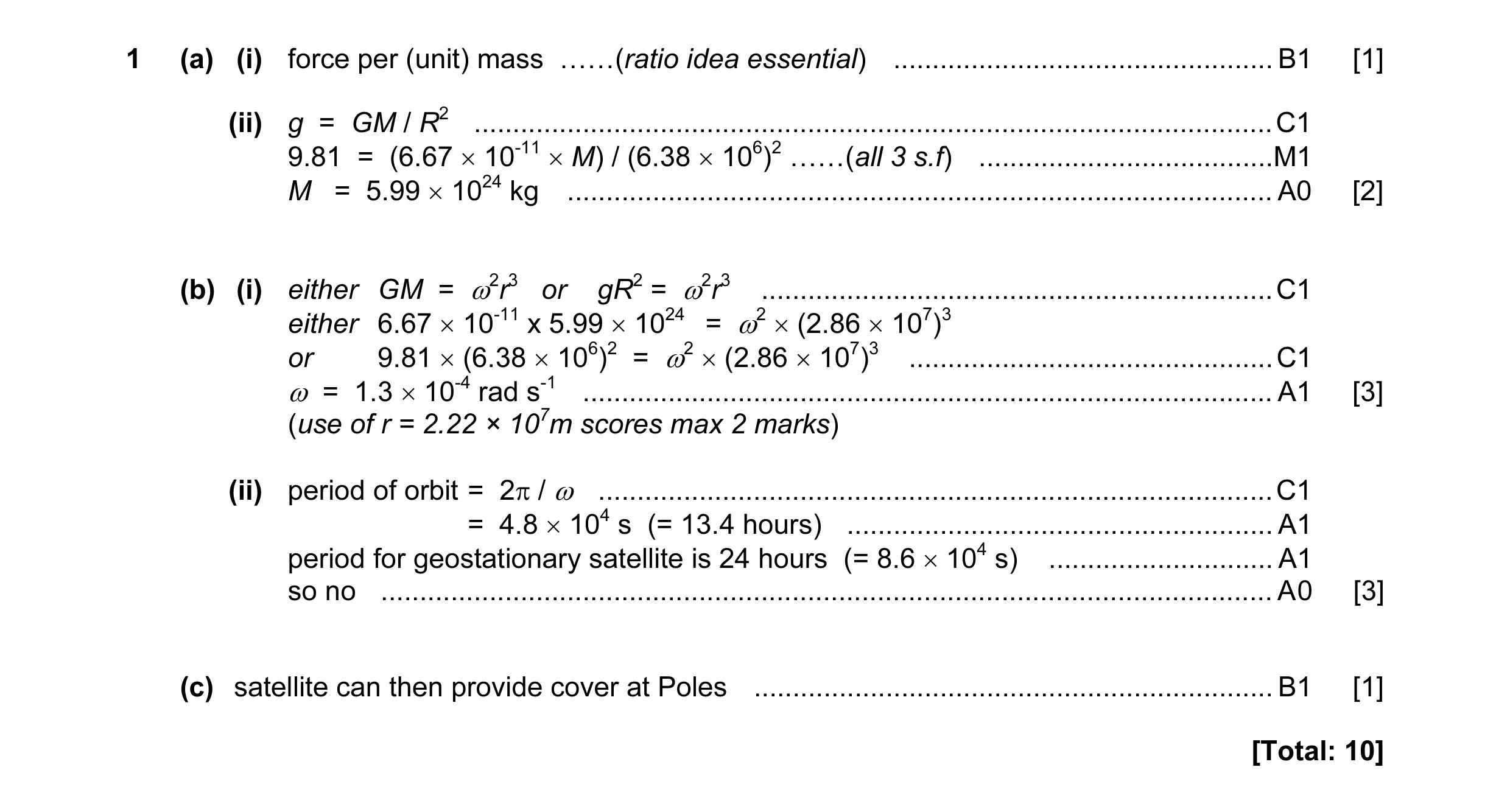 10
10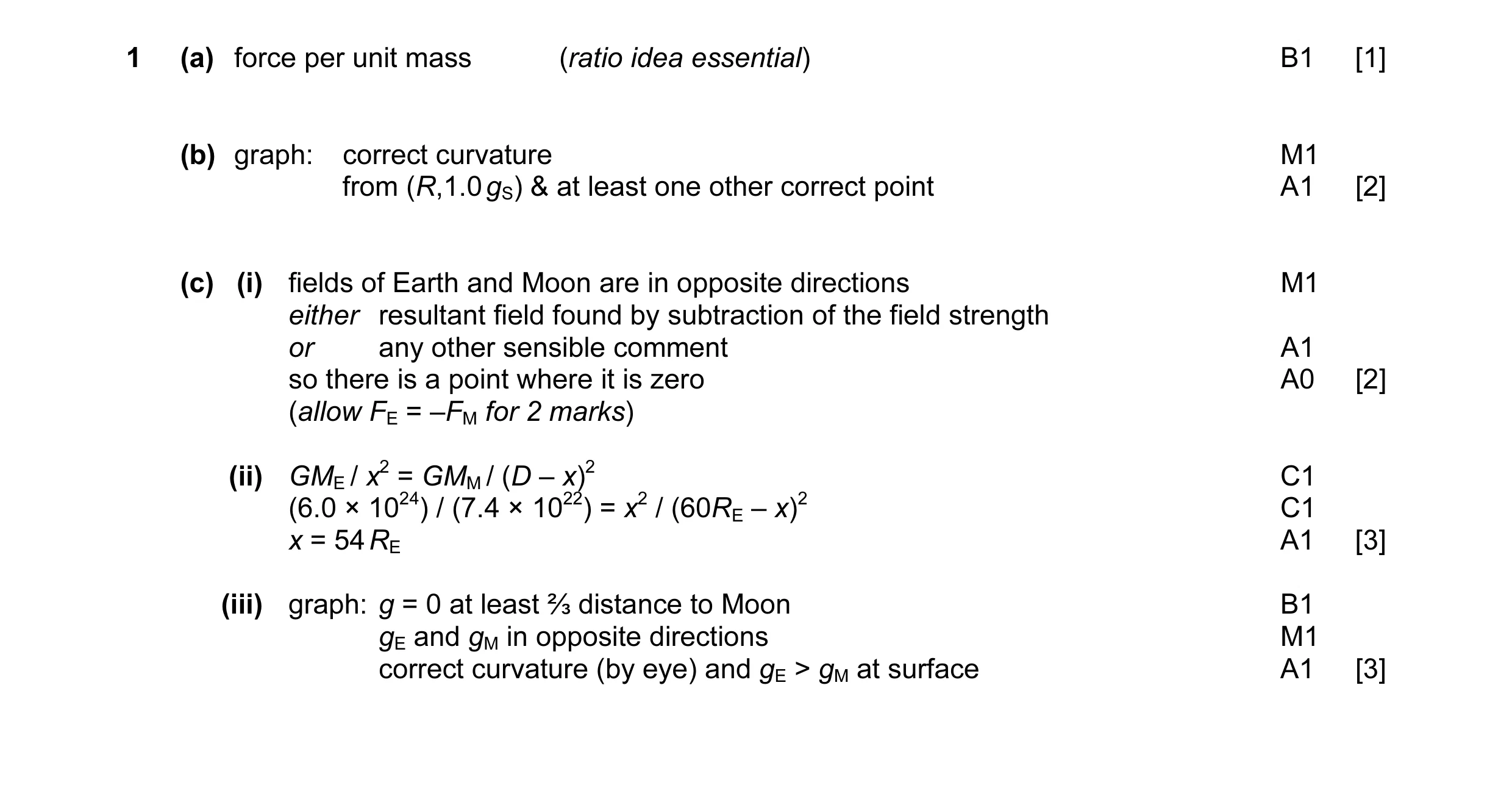 11
11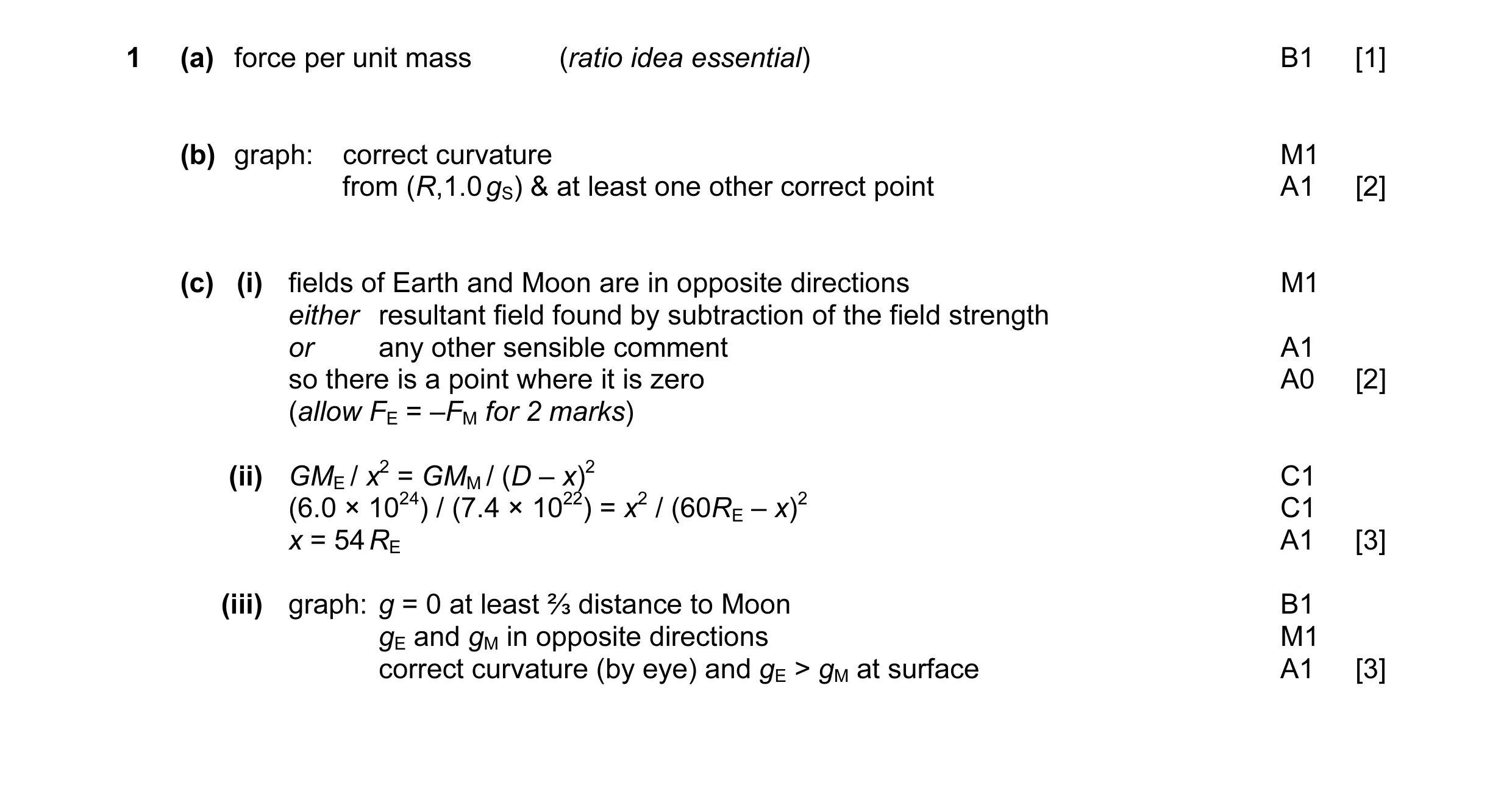 11
11 7
7 7
7 12
12 10
10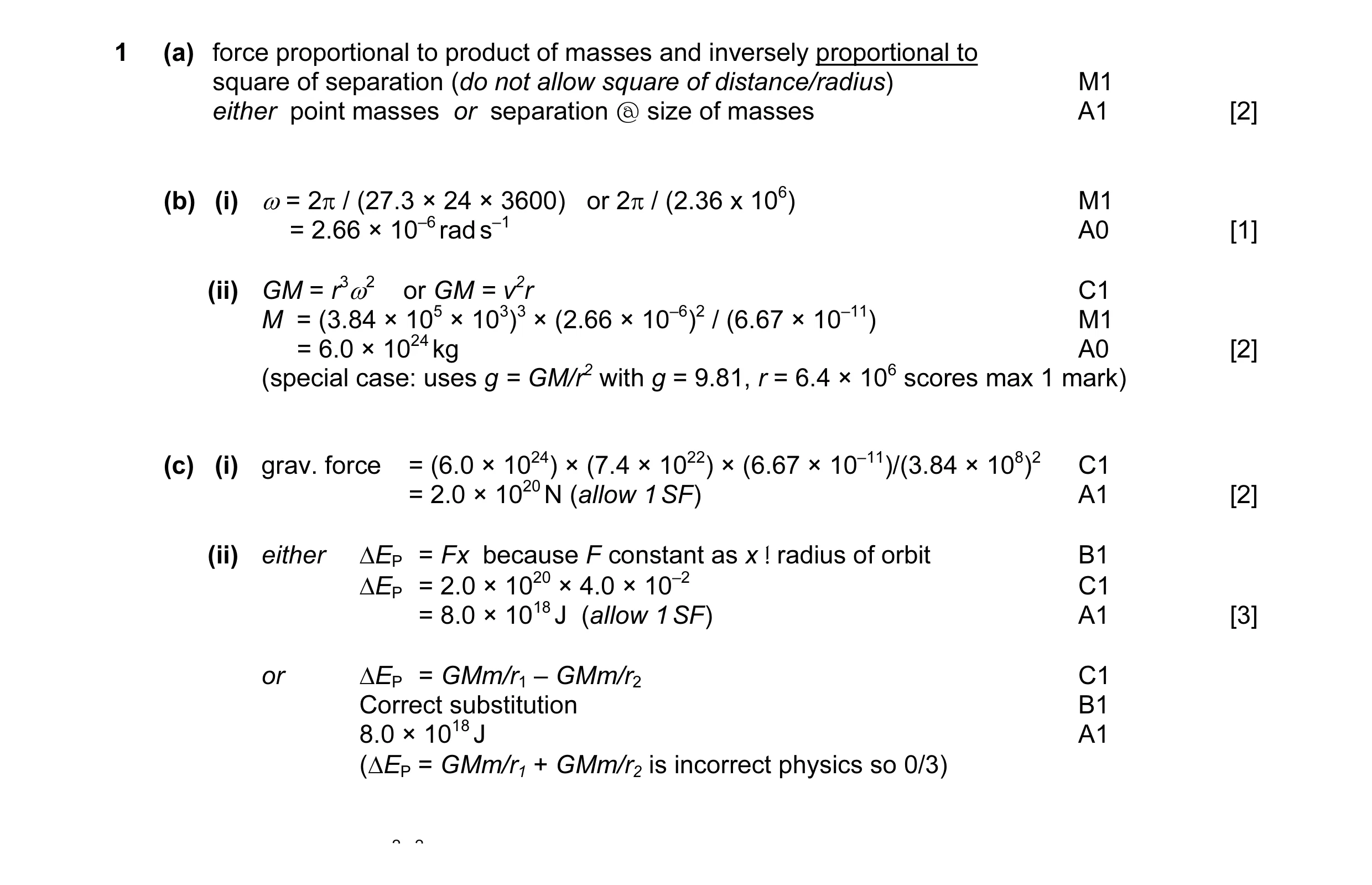 10
10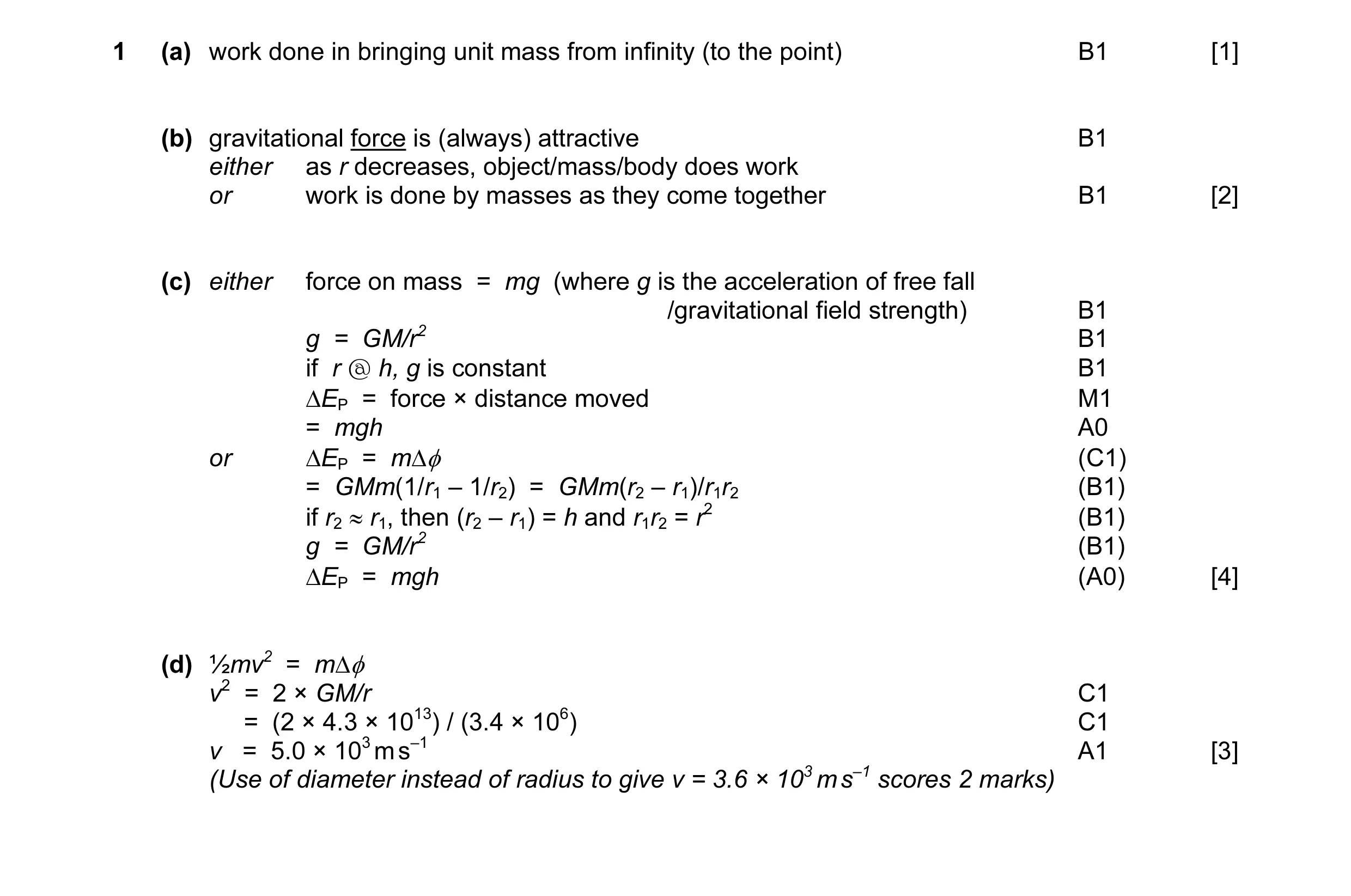 10
10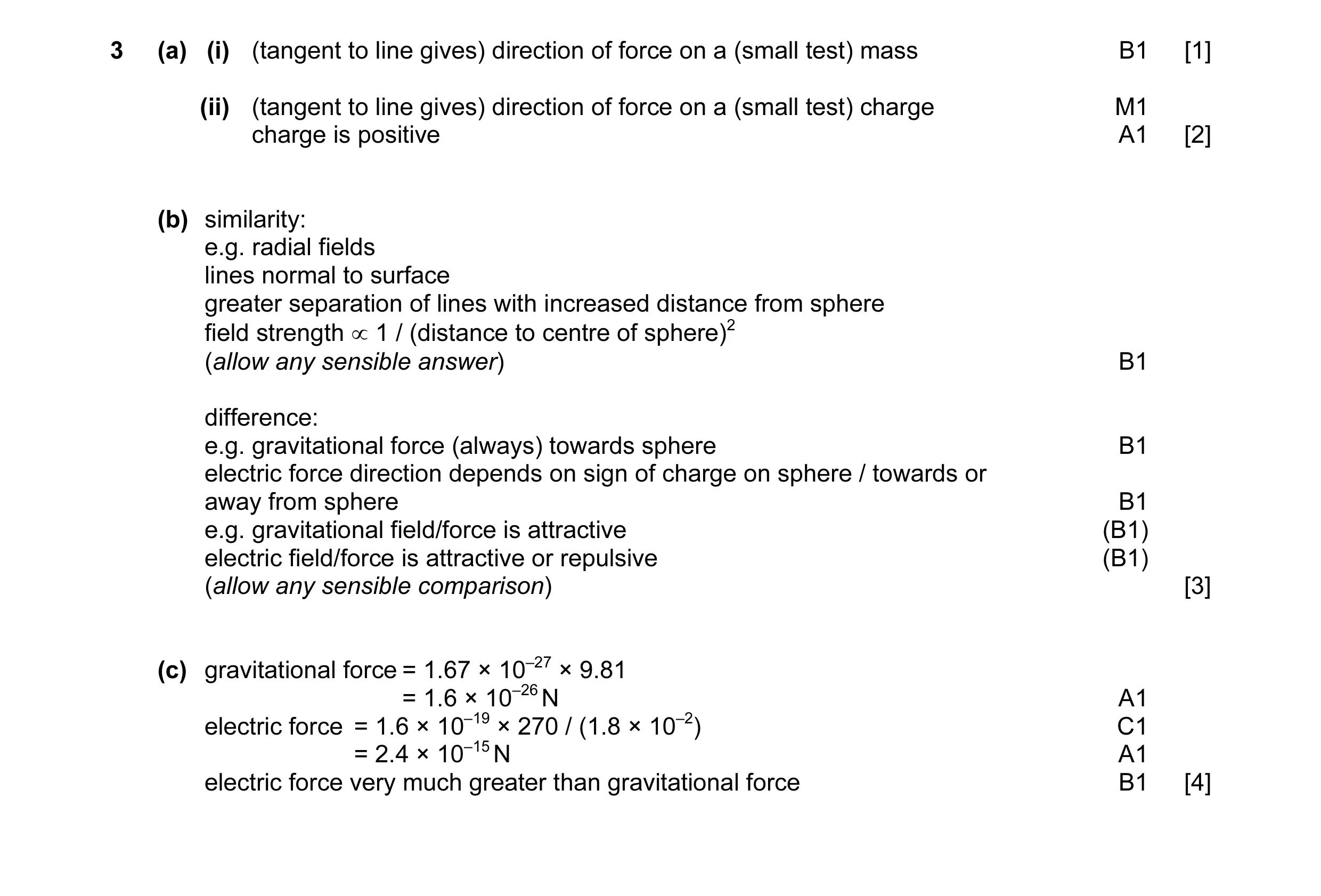 10
10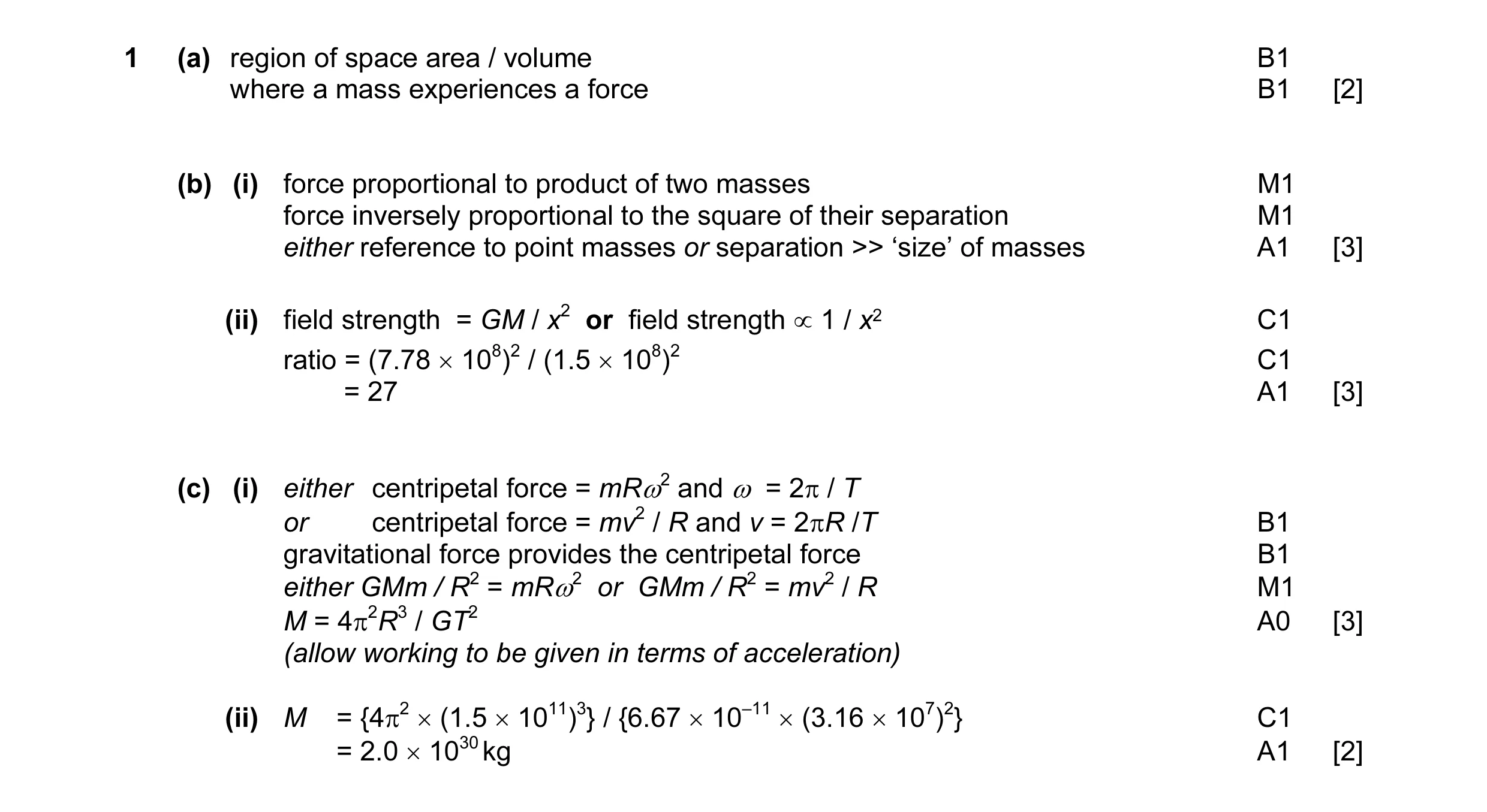 13
13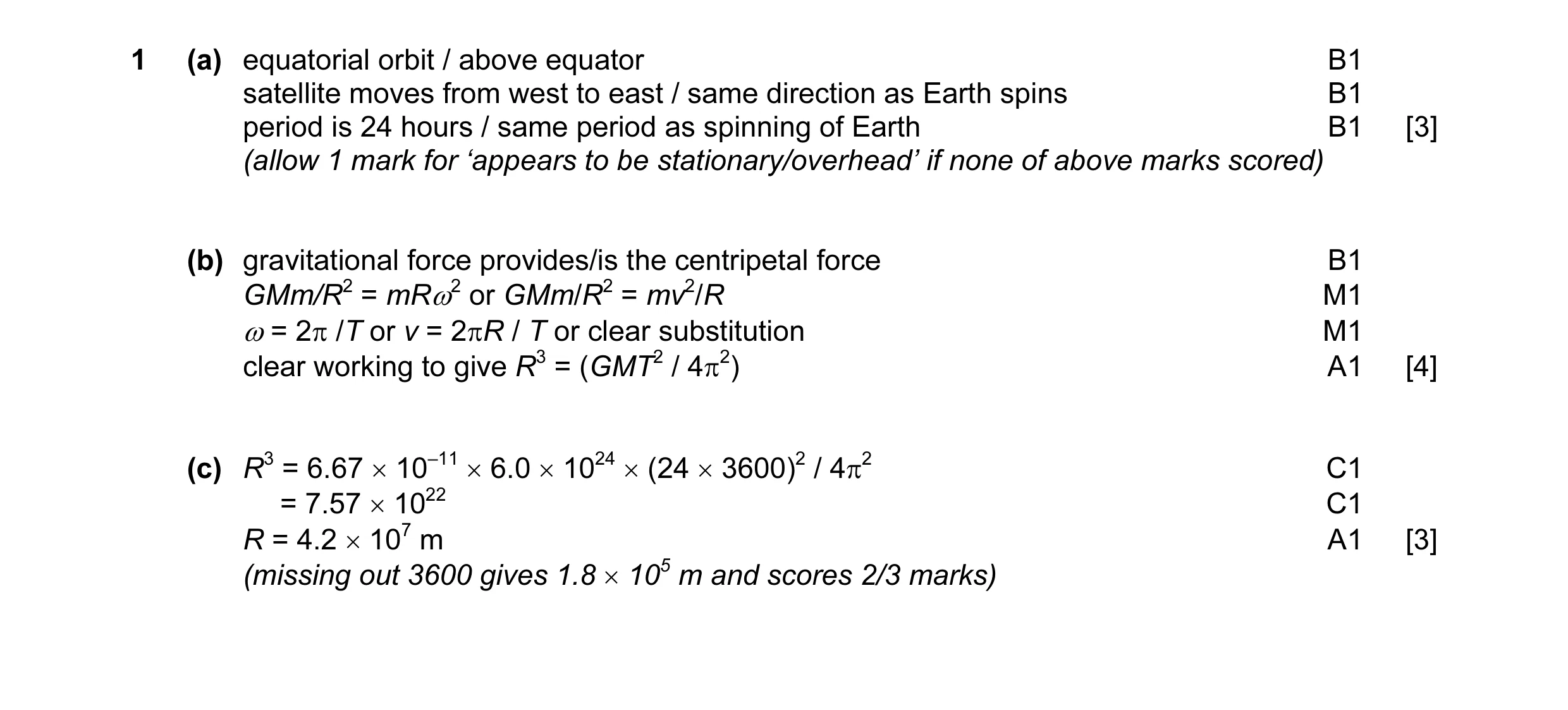 10
10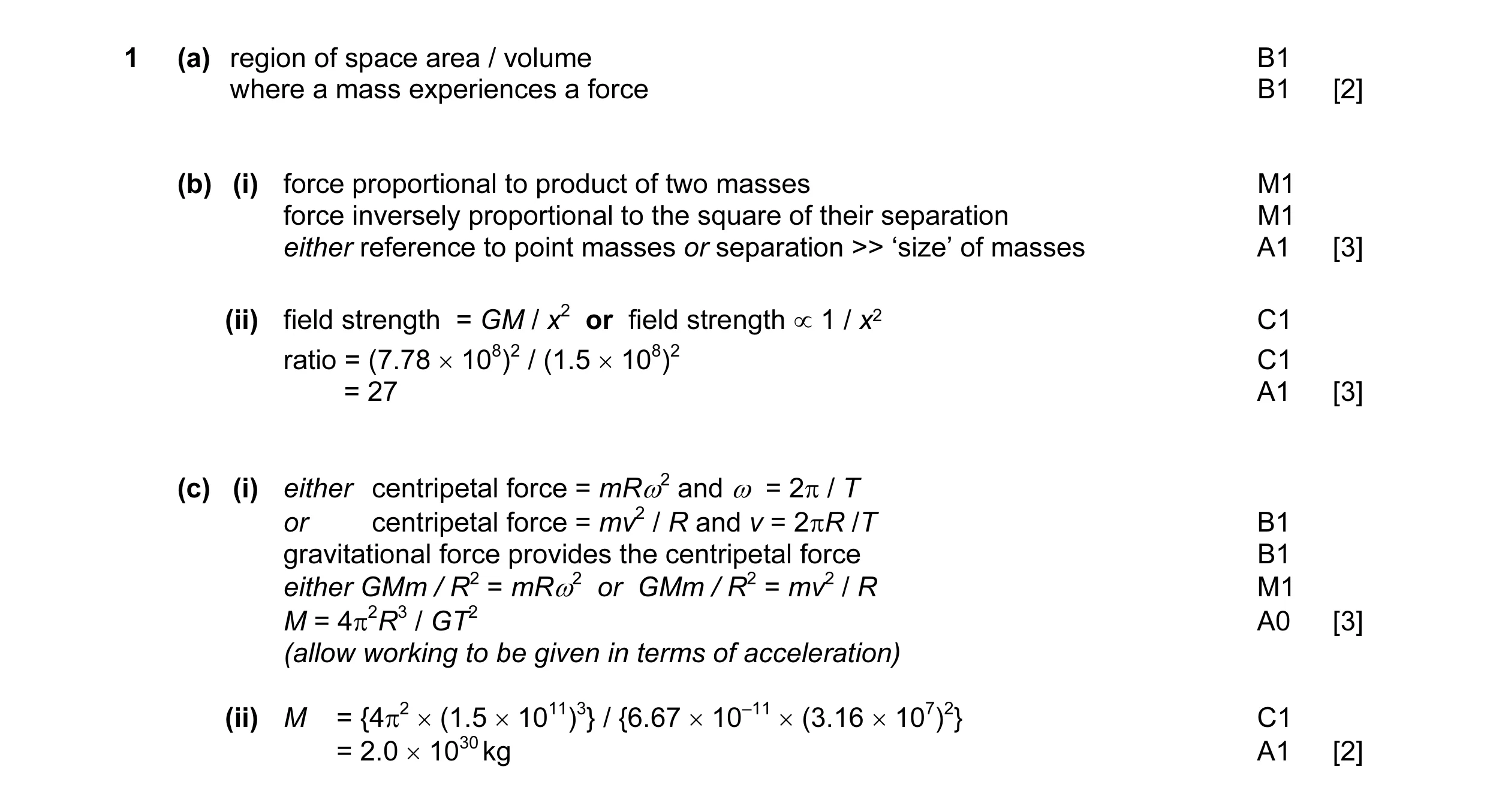 13
13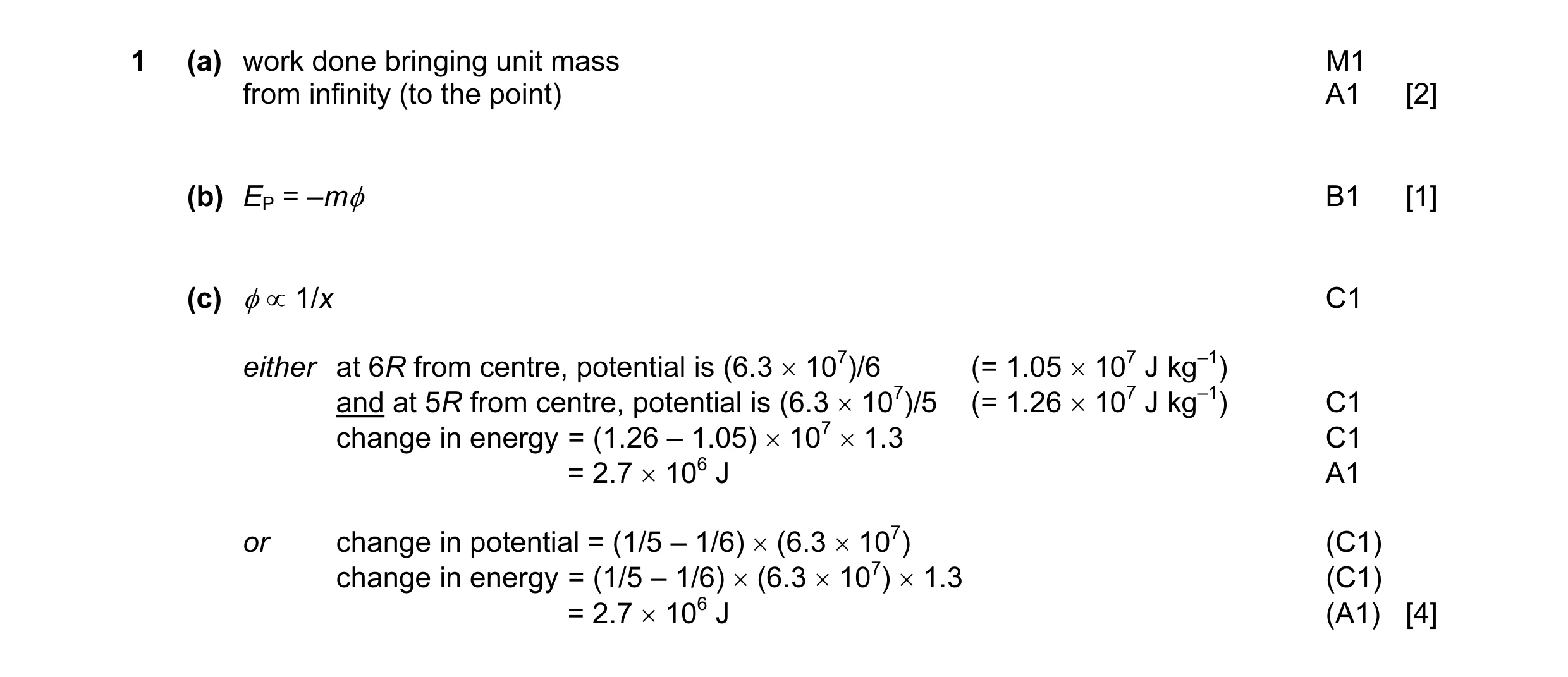 7
7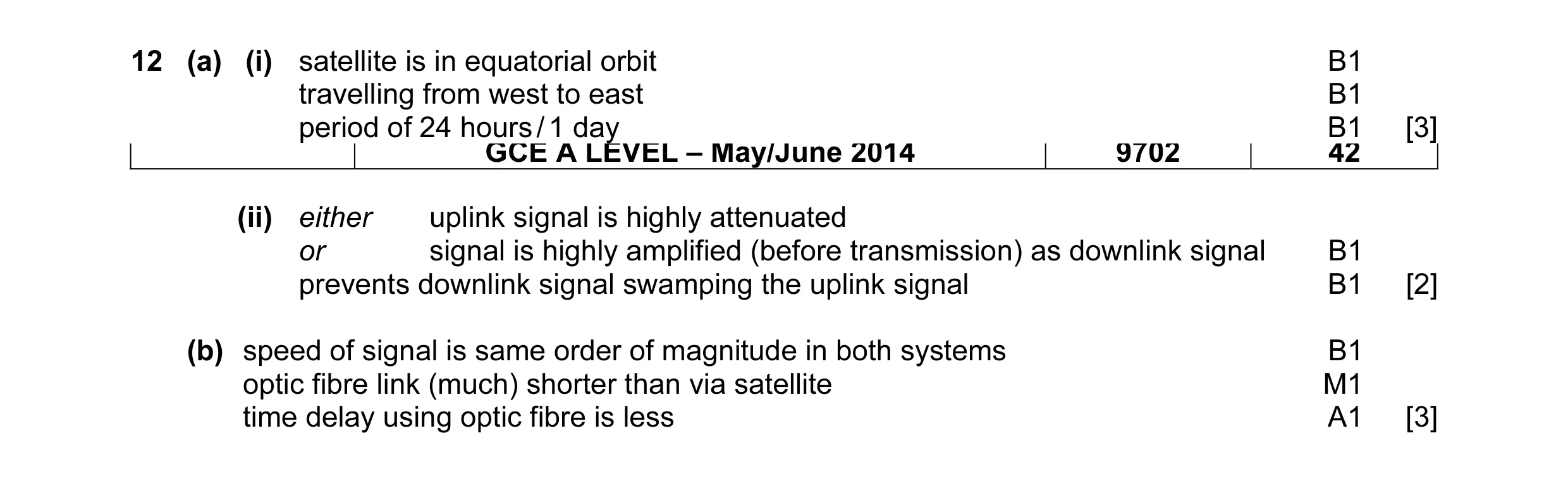 8
8 7
7 9
9 10
10 10
10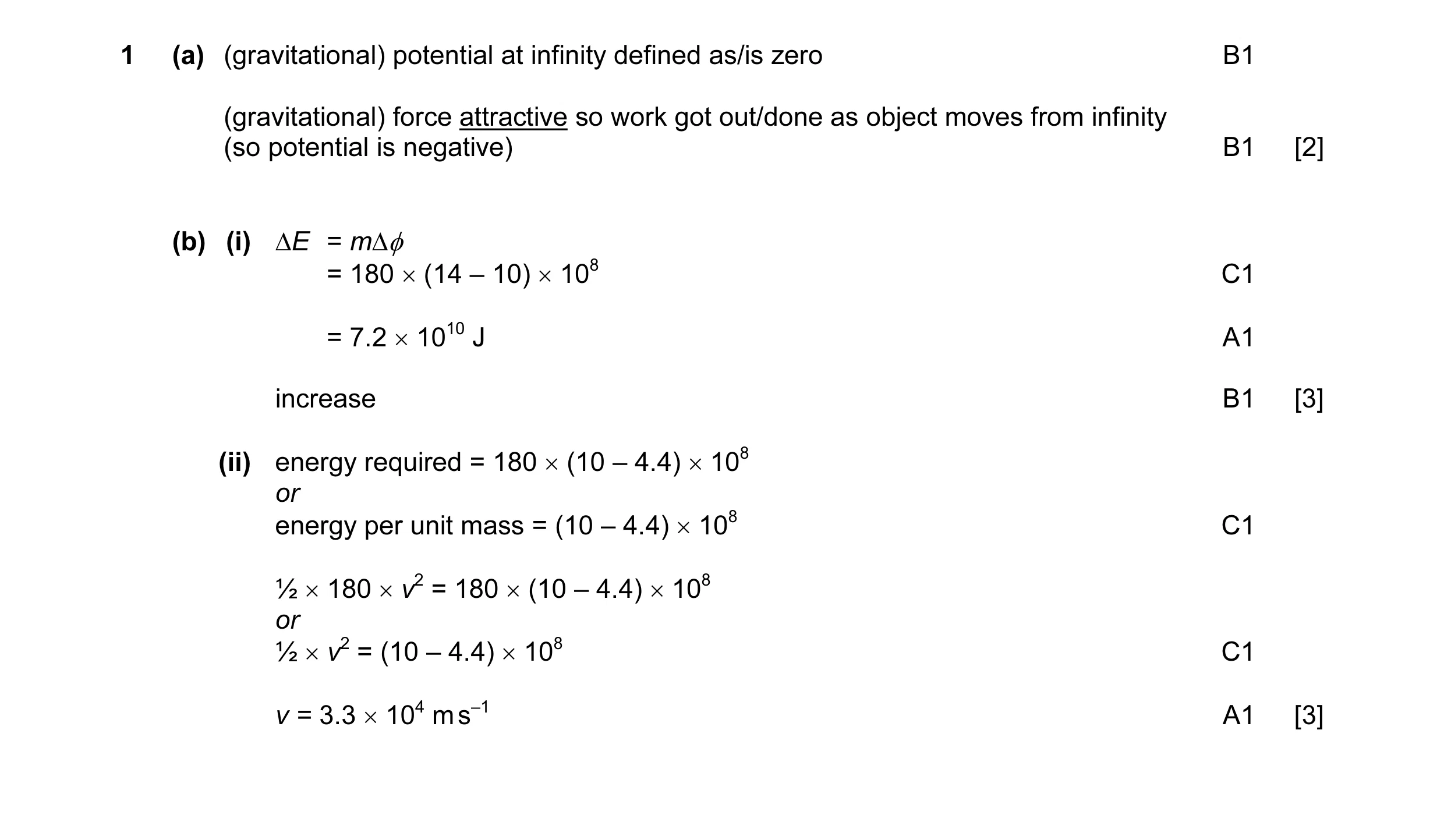 8
8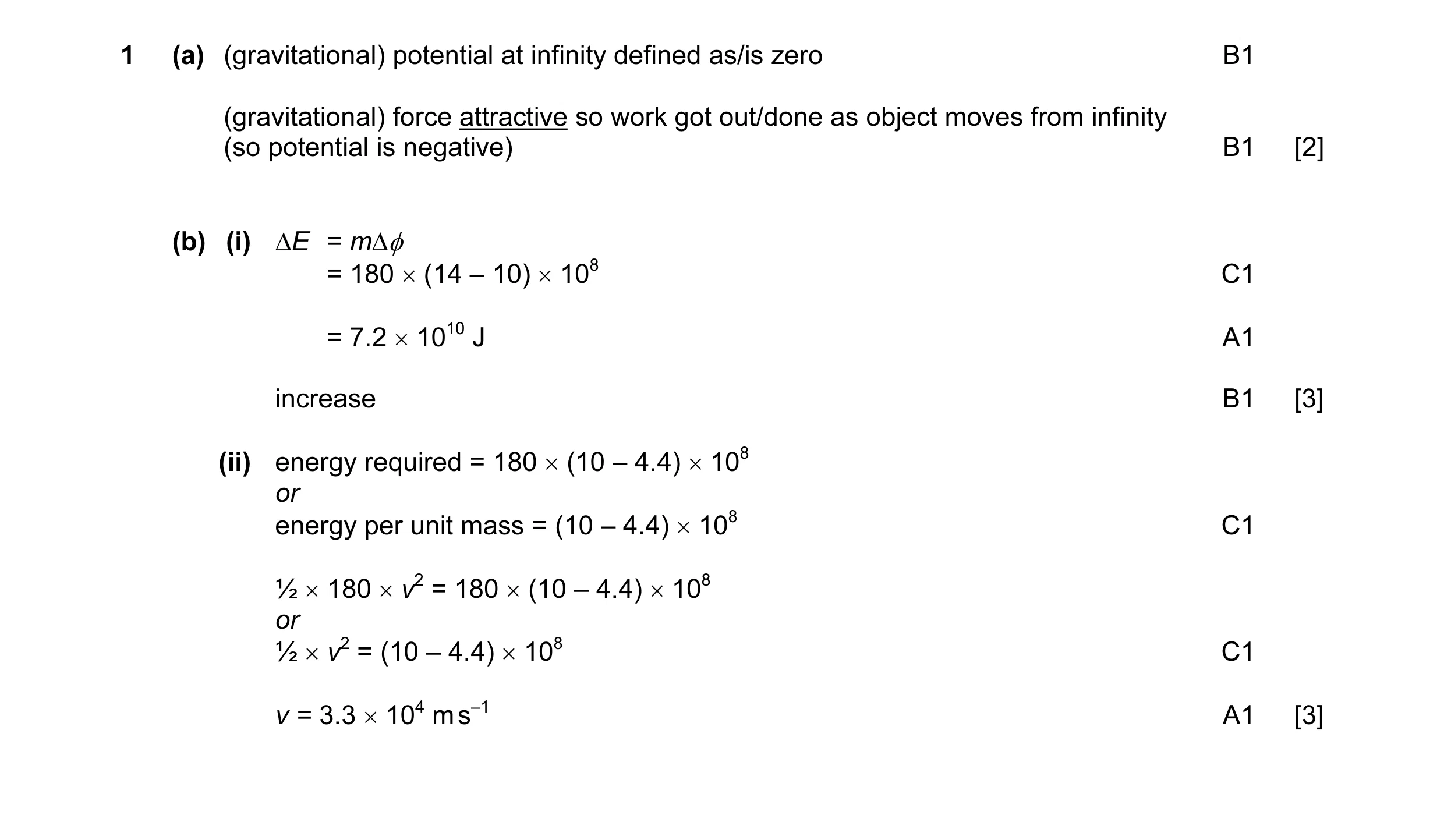 8
8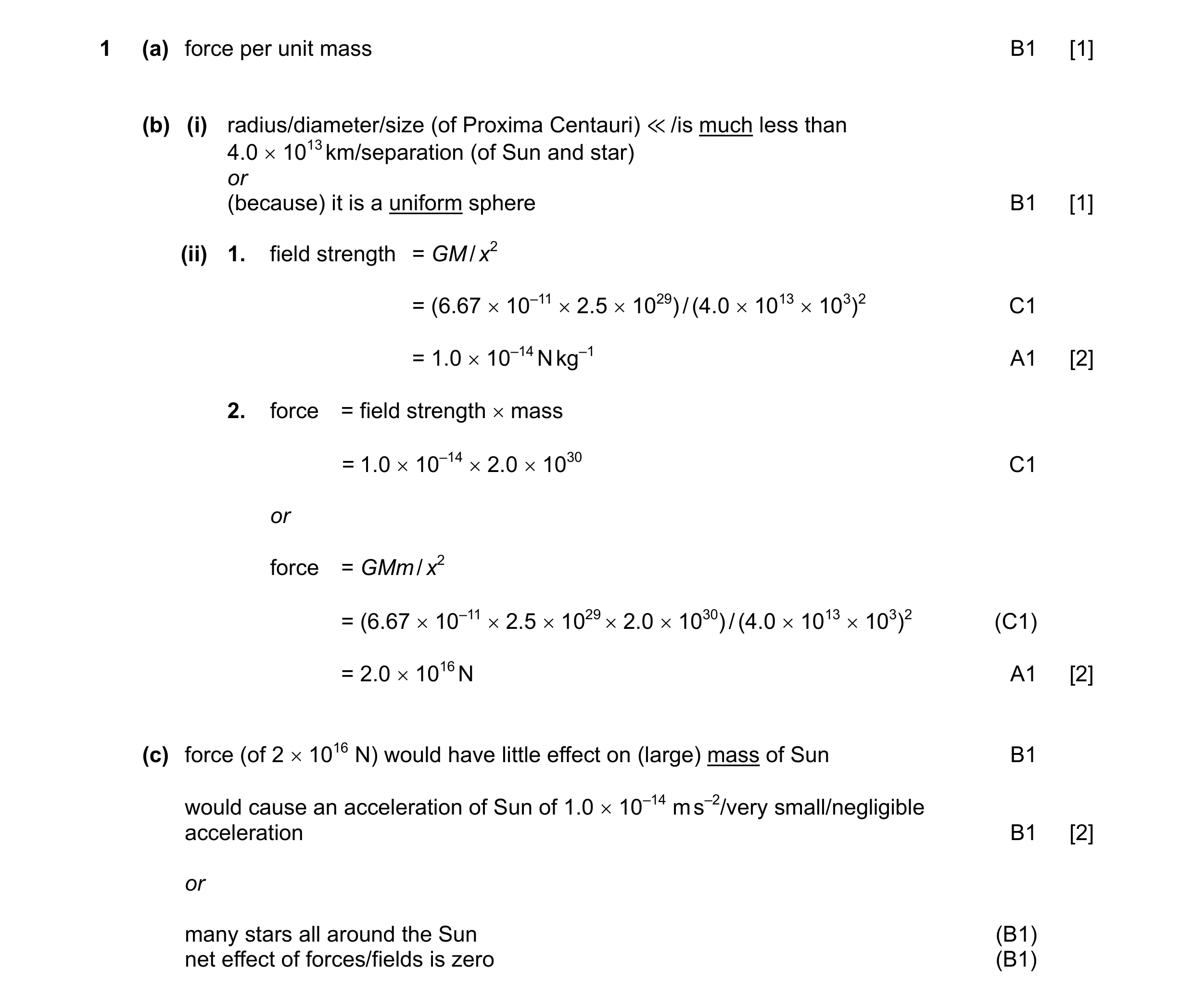 8
8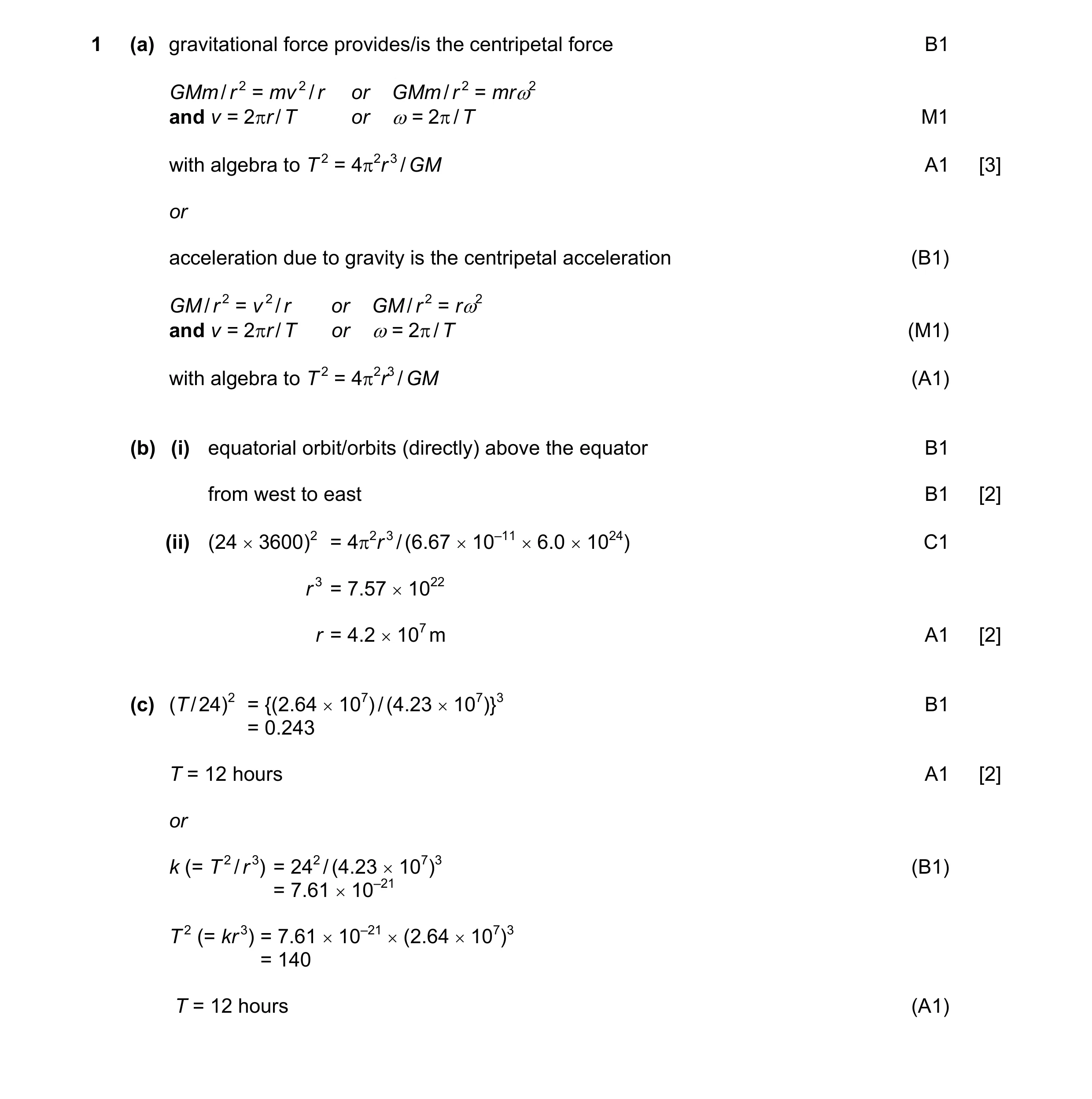 9
9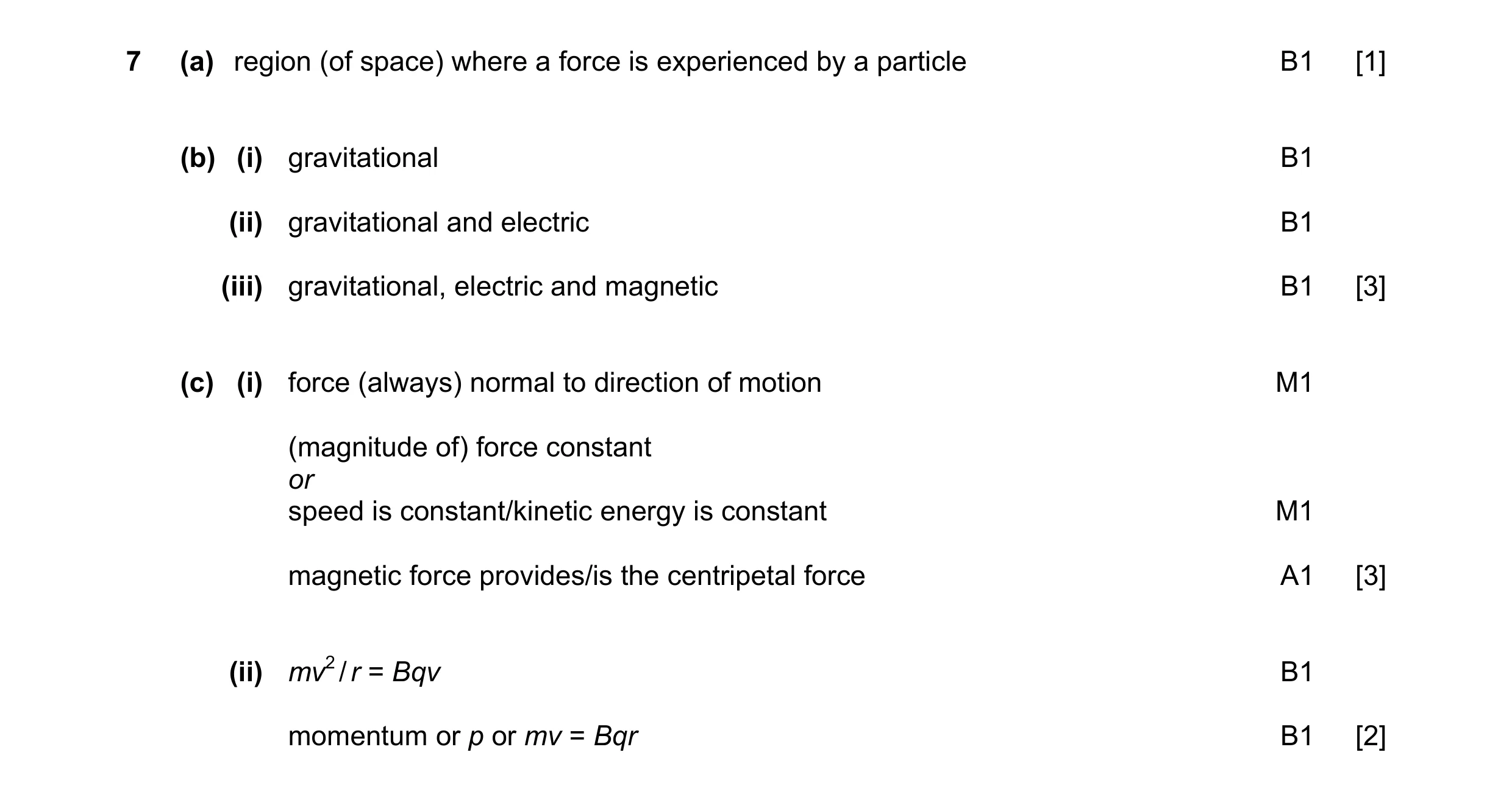 9
9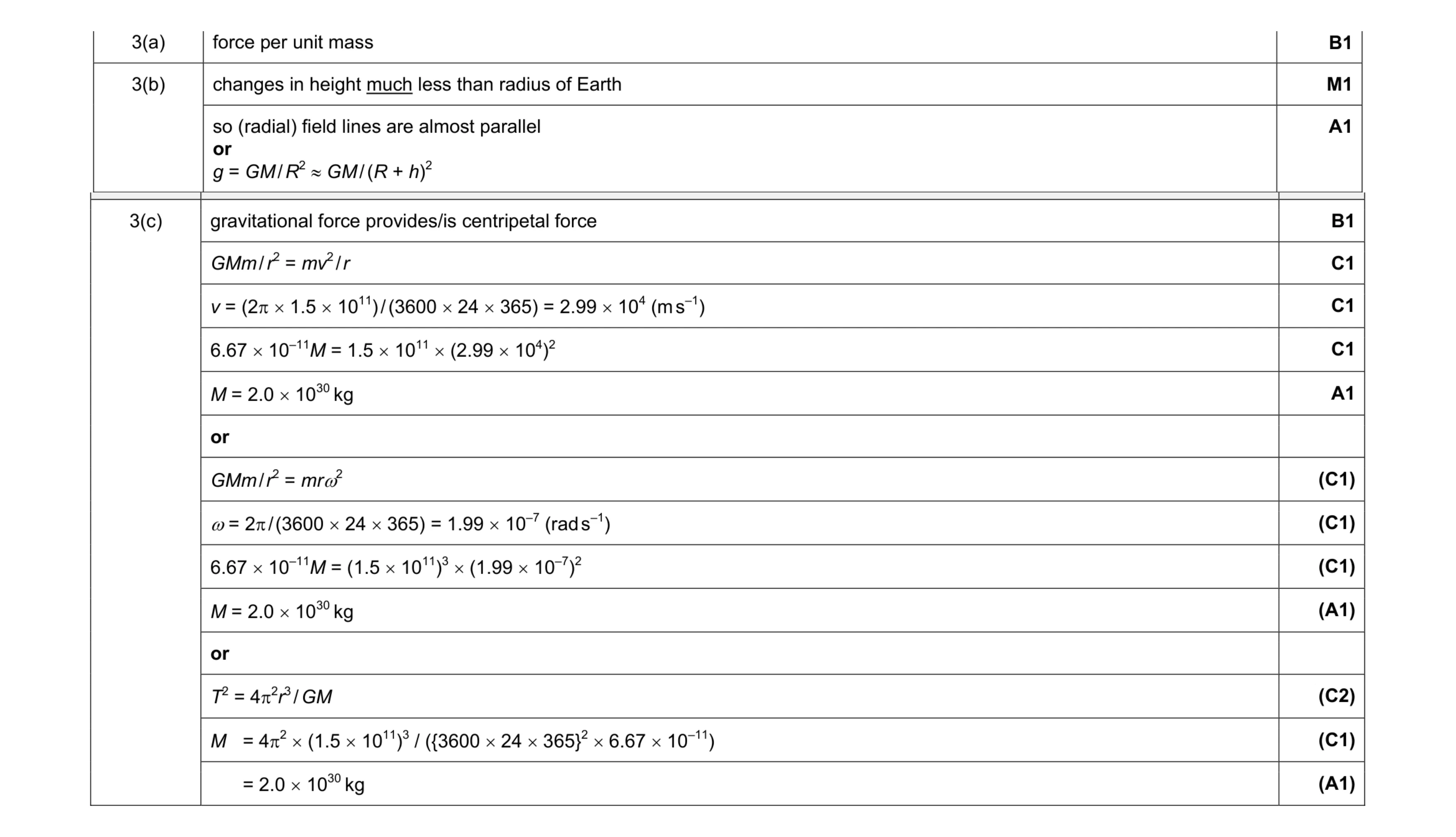 8
8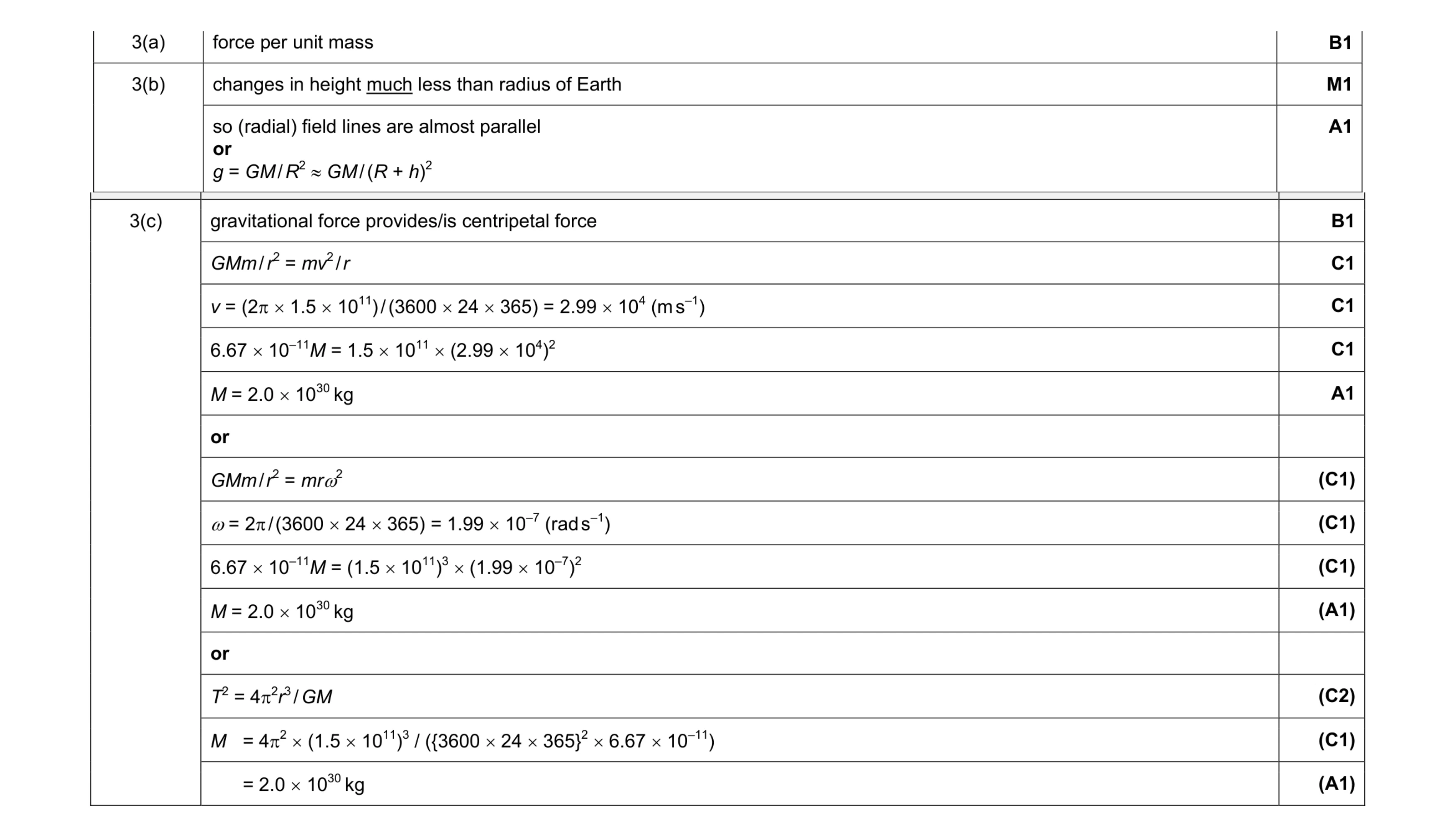 8
8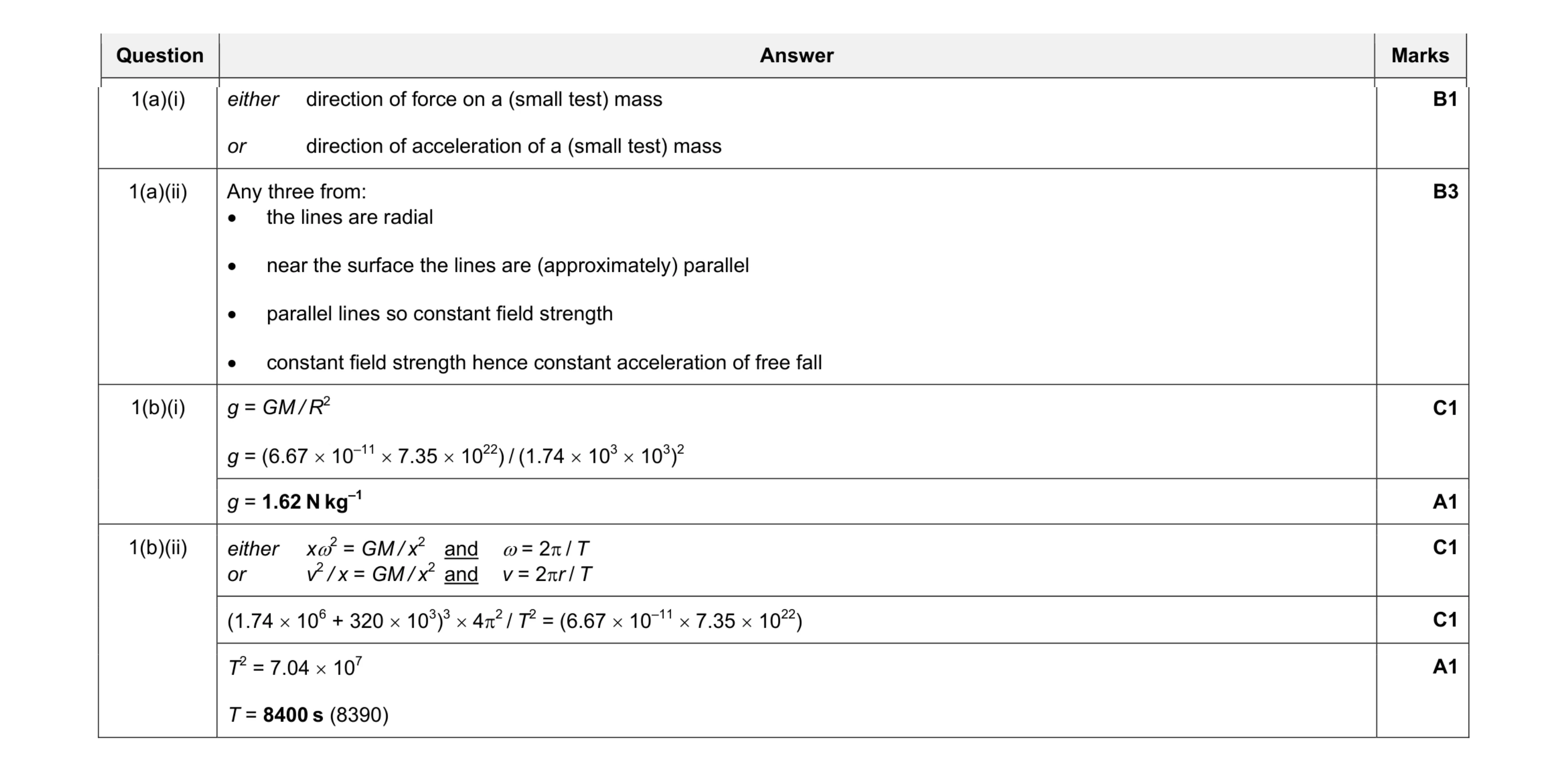 9
9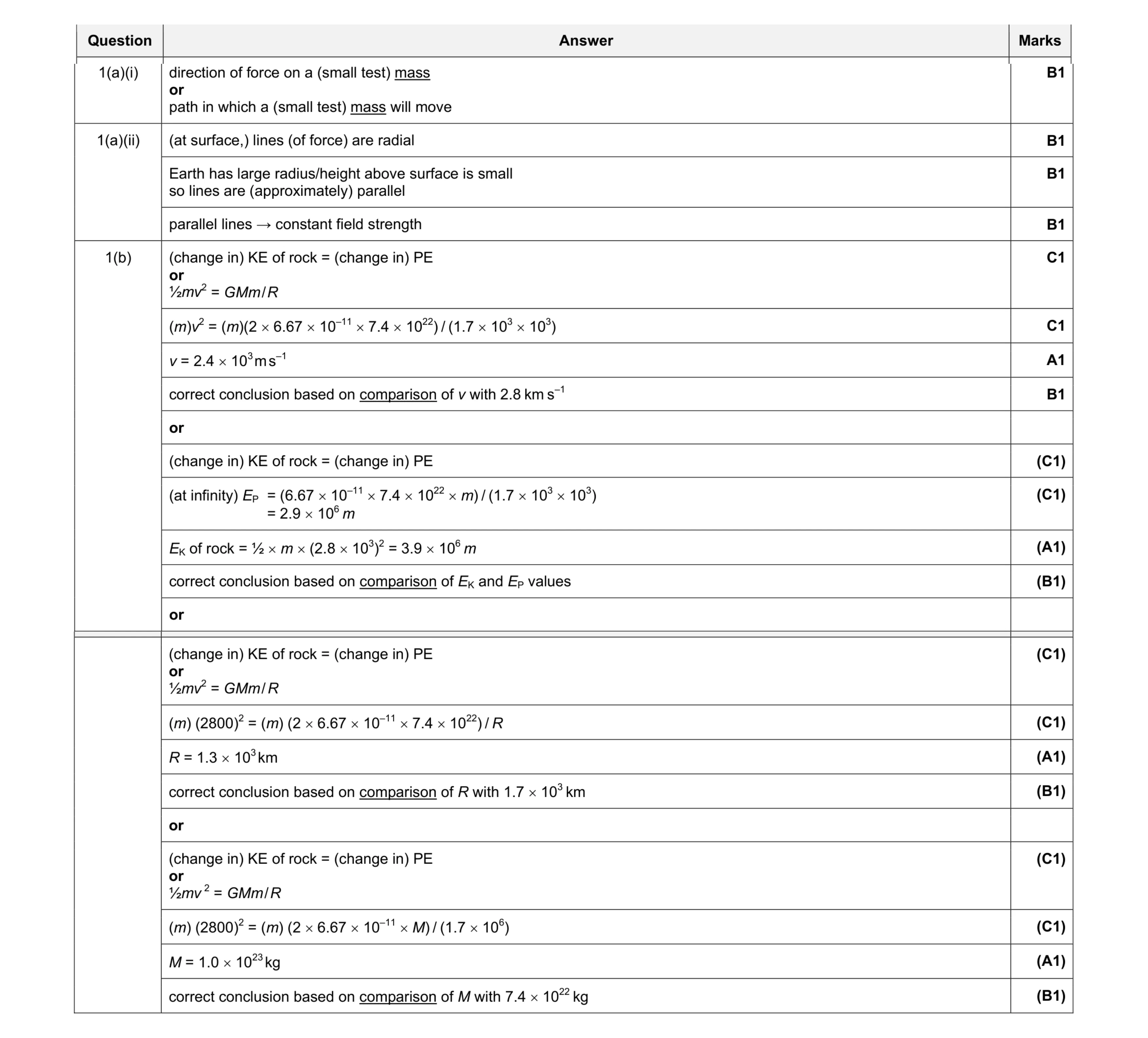 8
8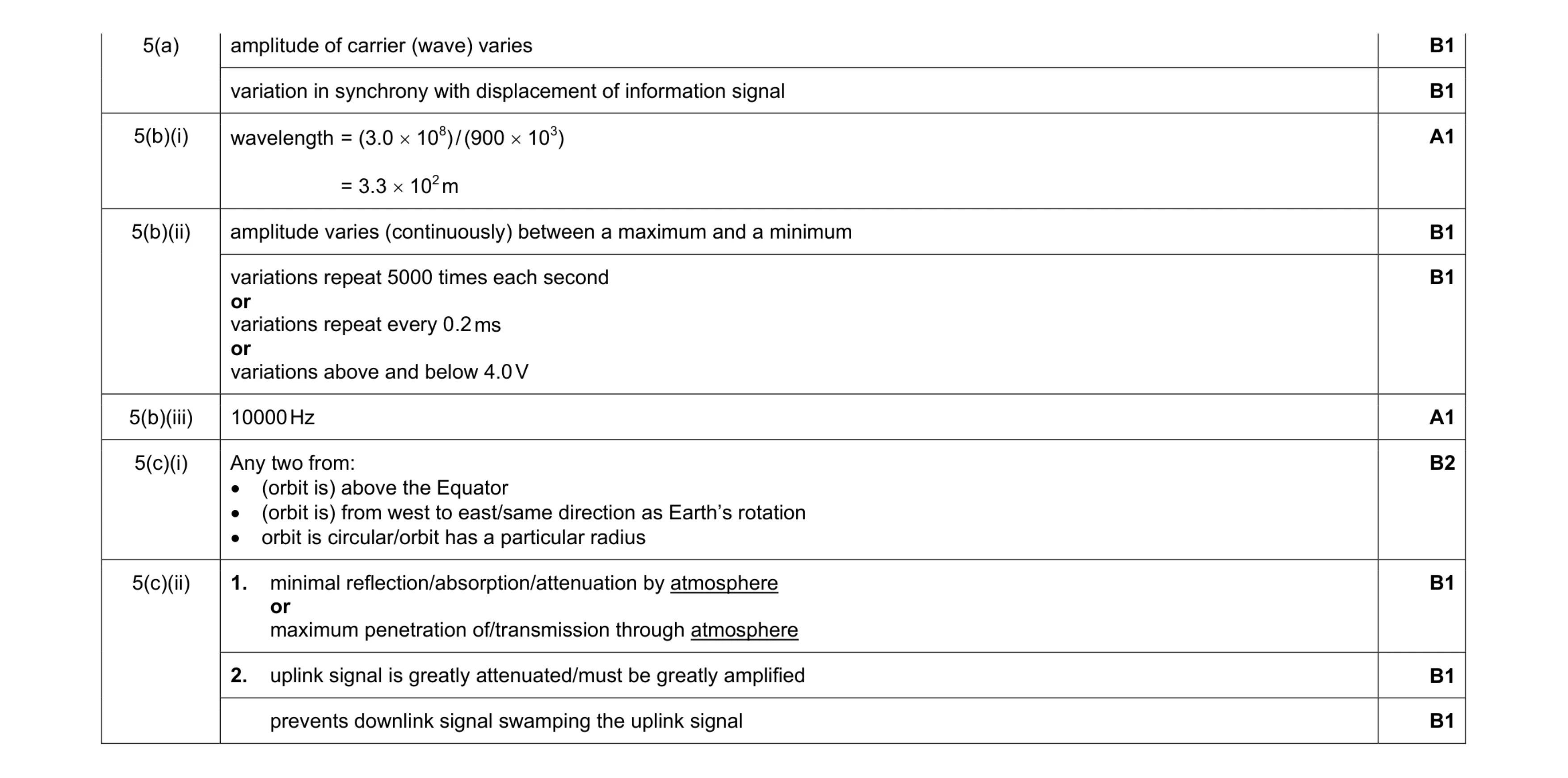 11
11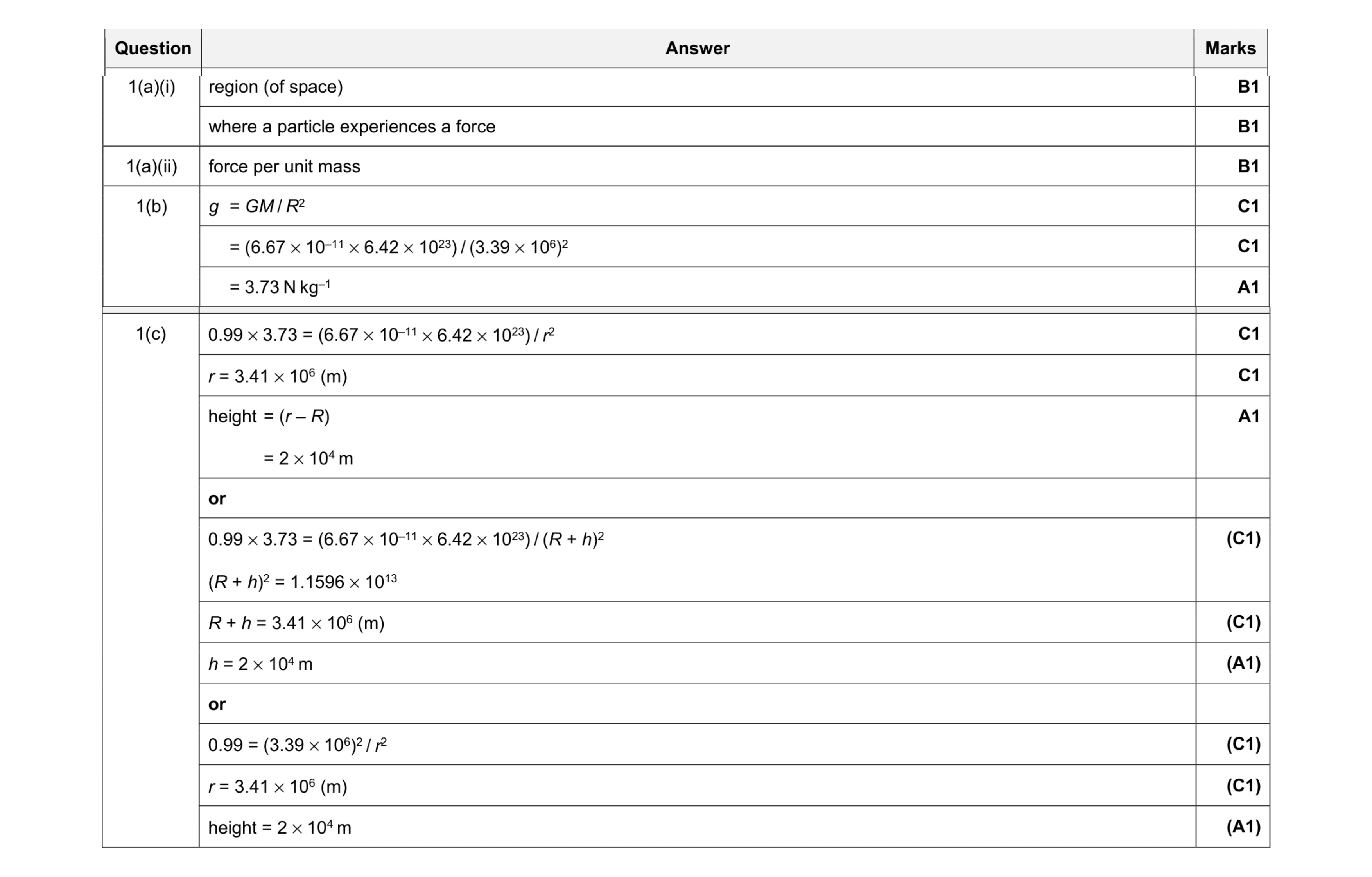 9
9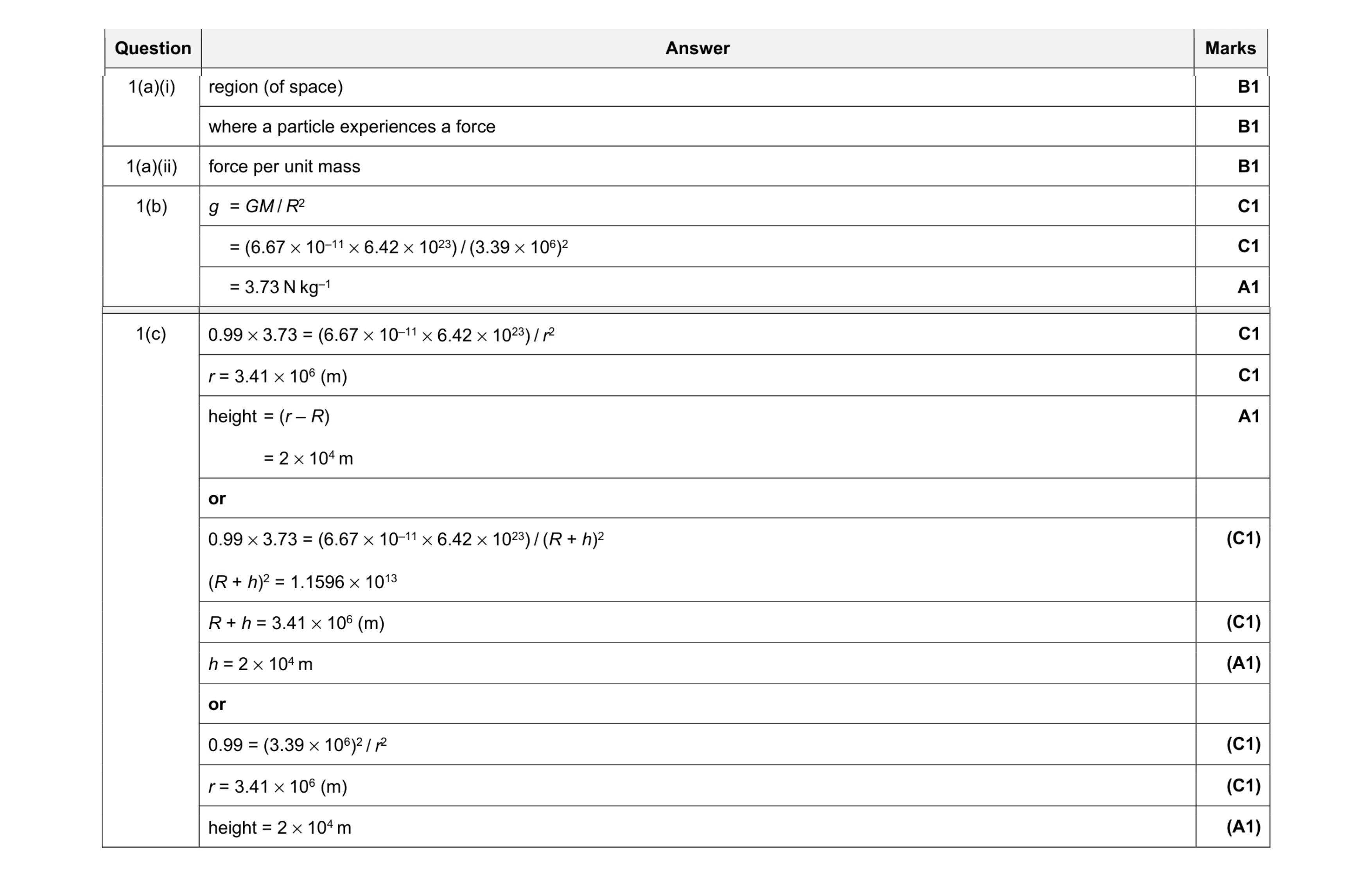 9
9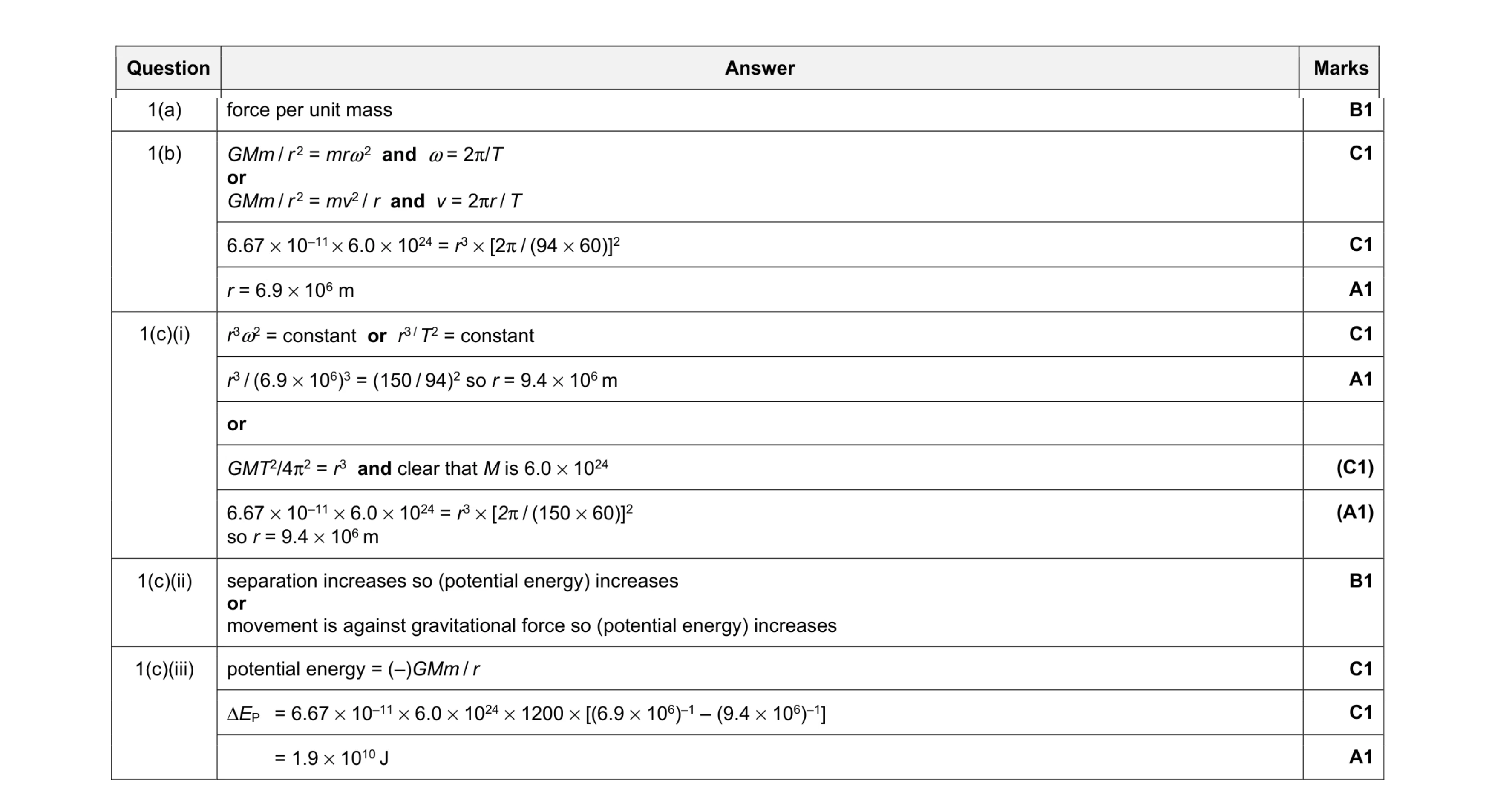 10
10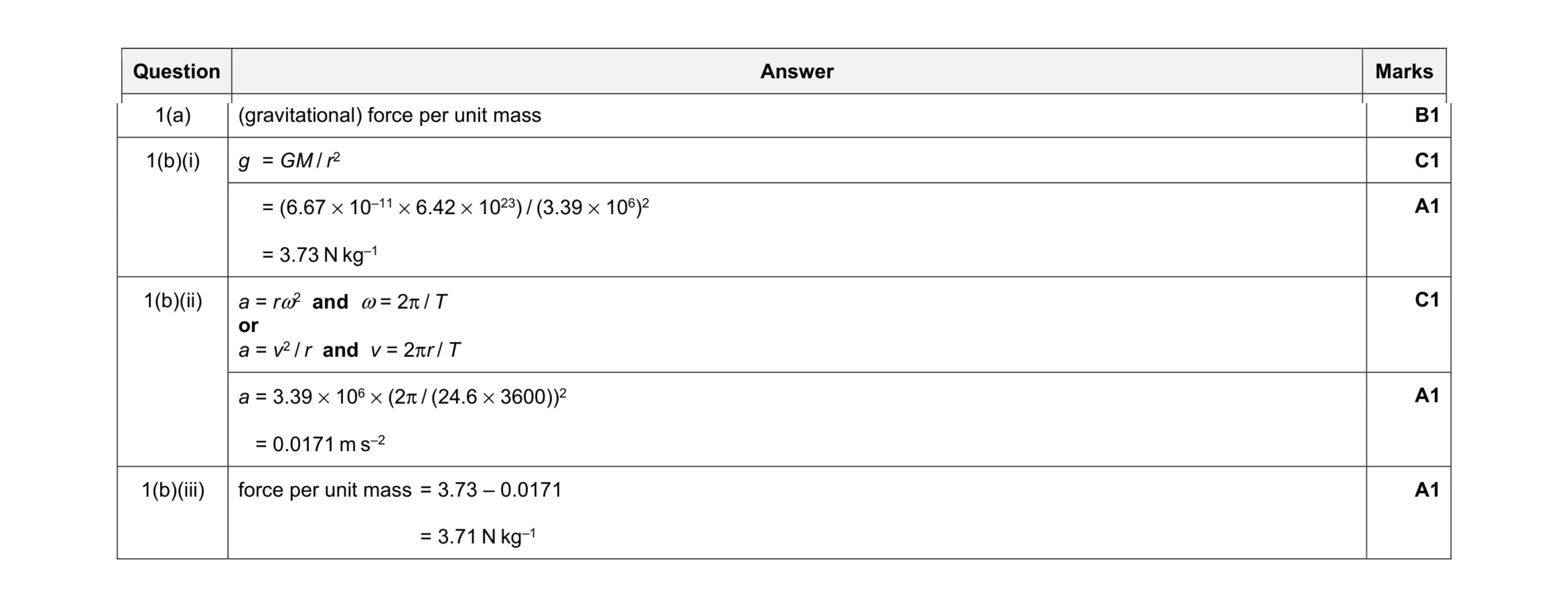 6
6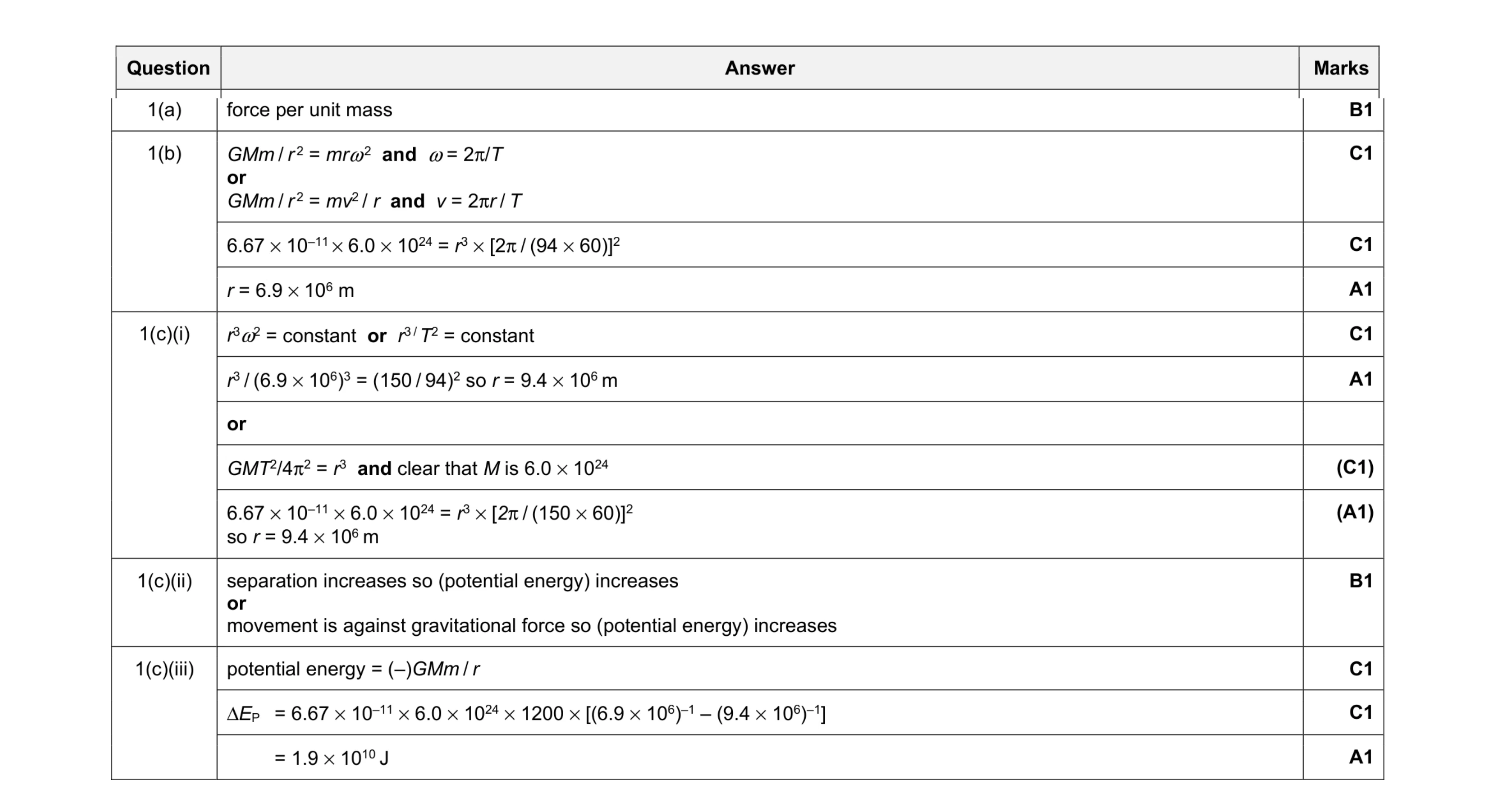 10
10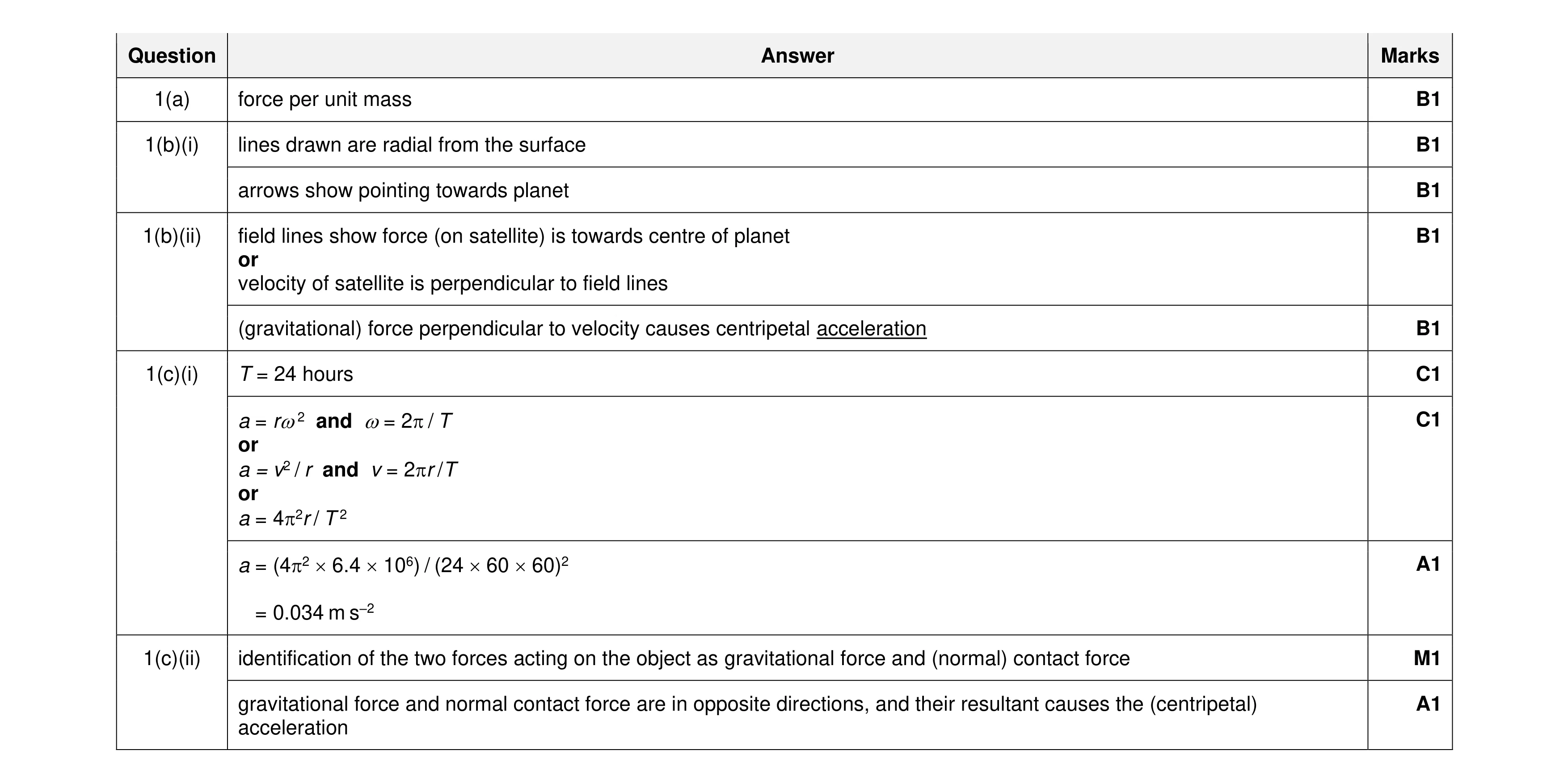 10
10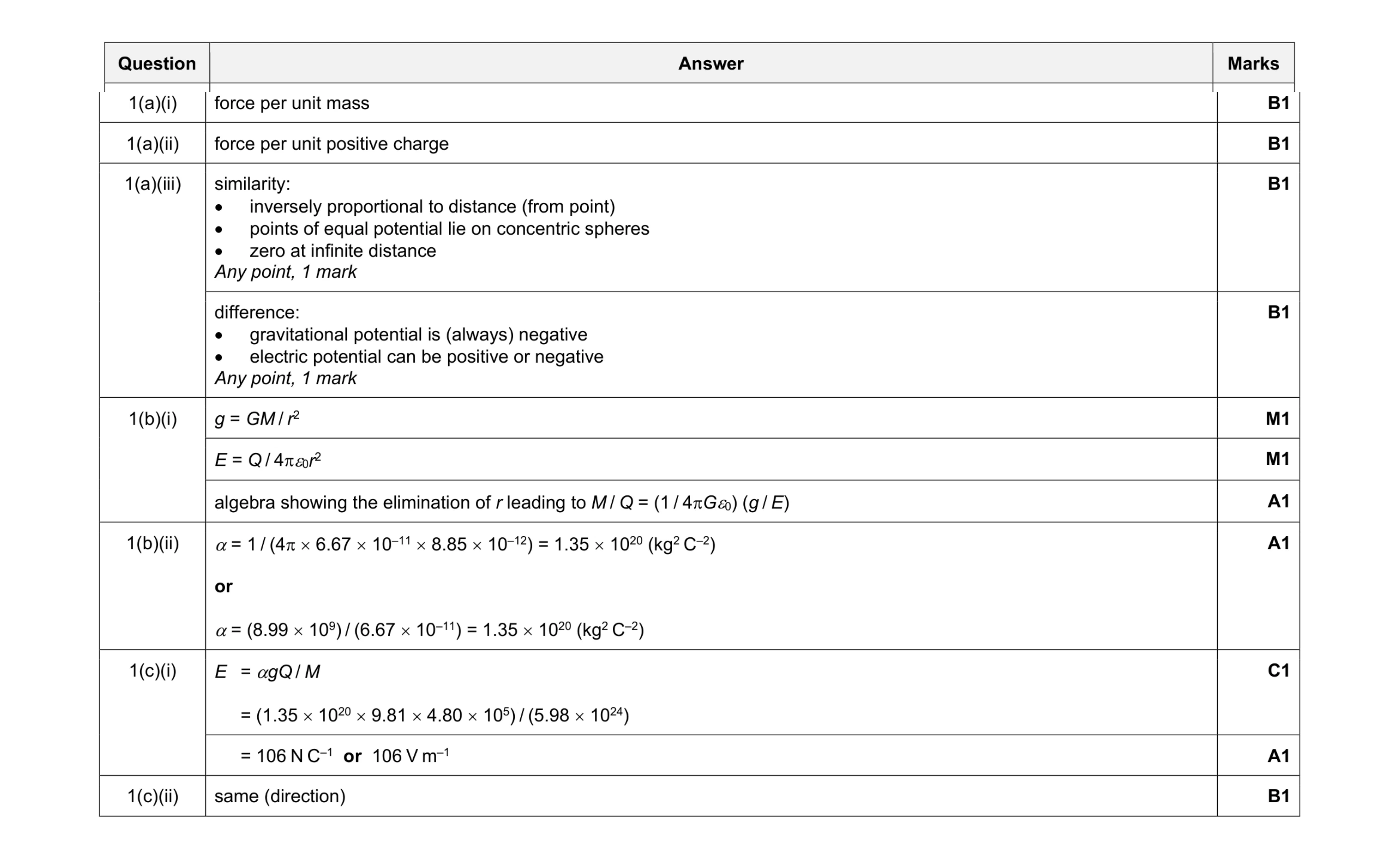 11
11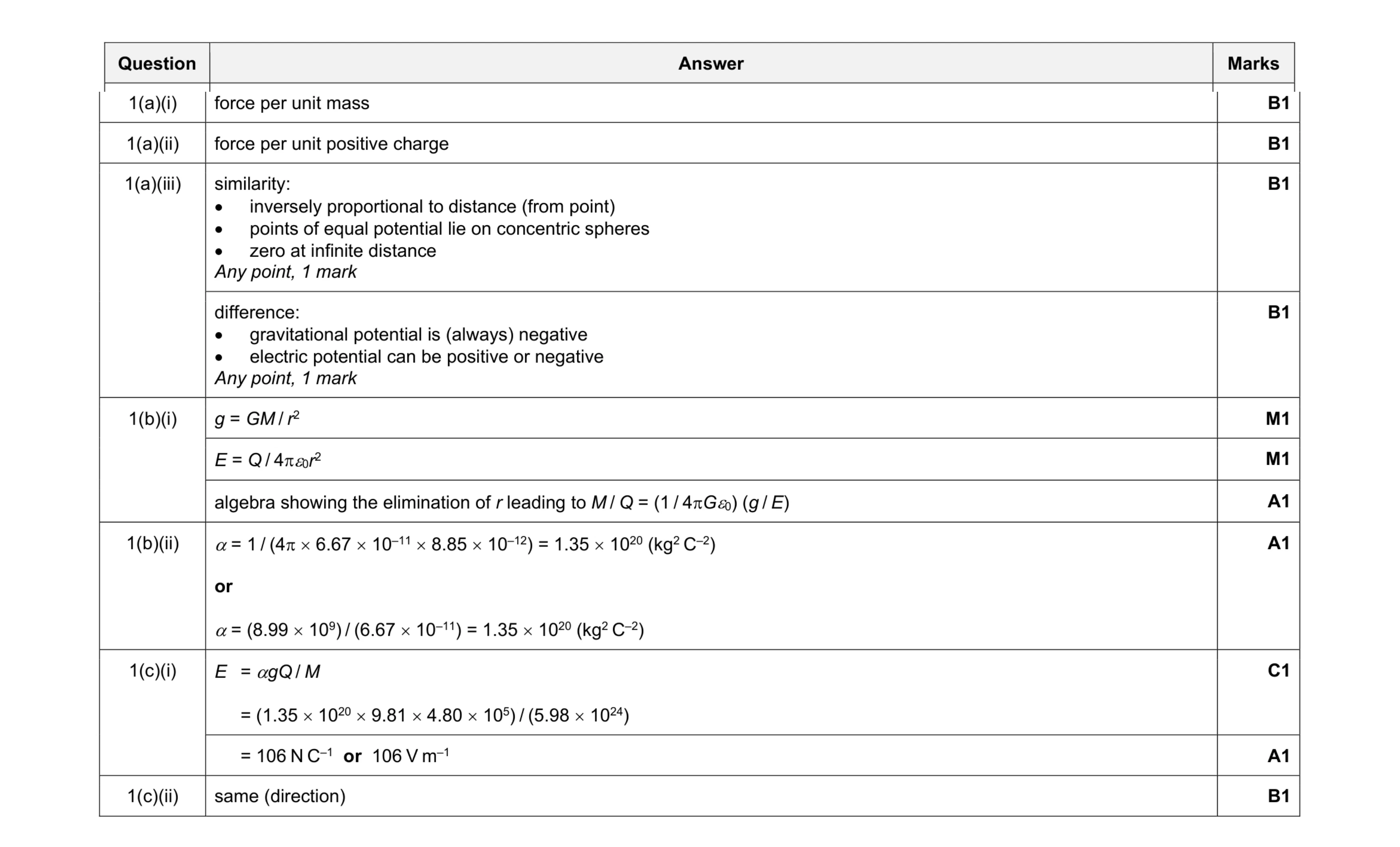 11
11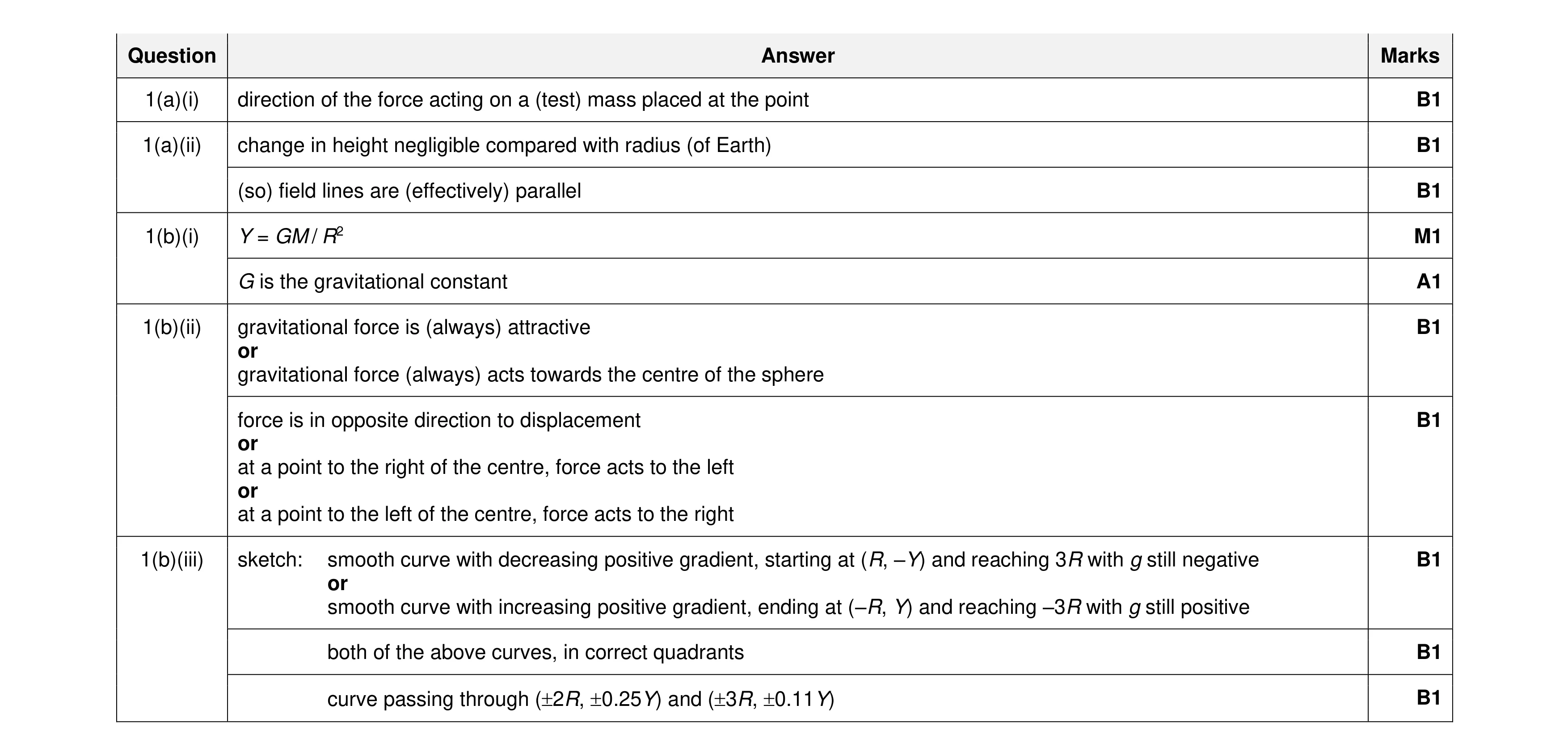 10
10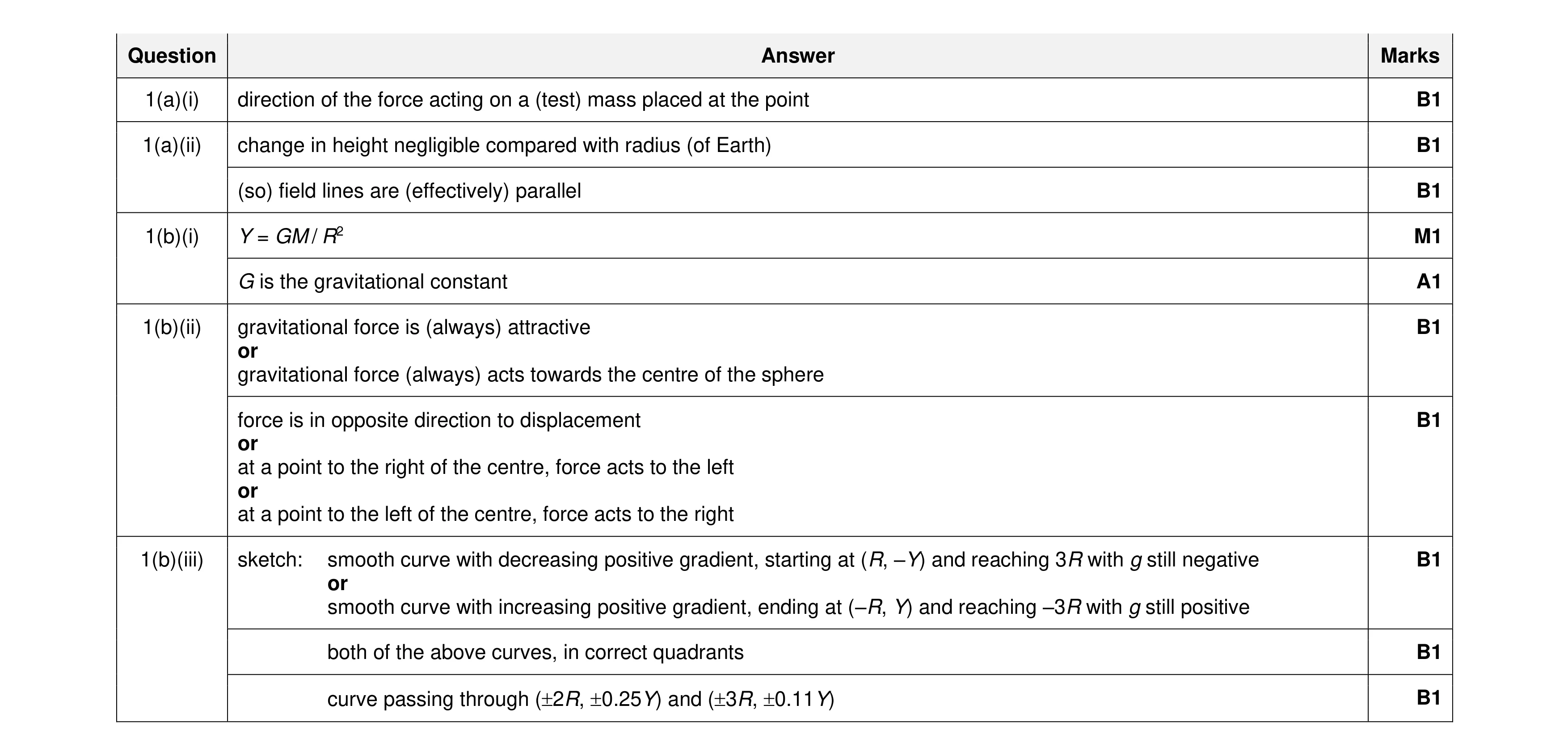 10
10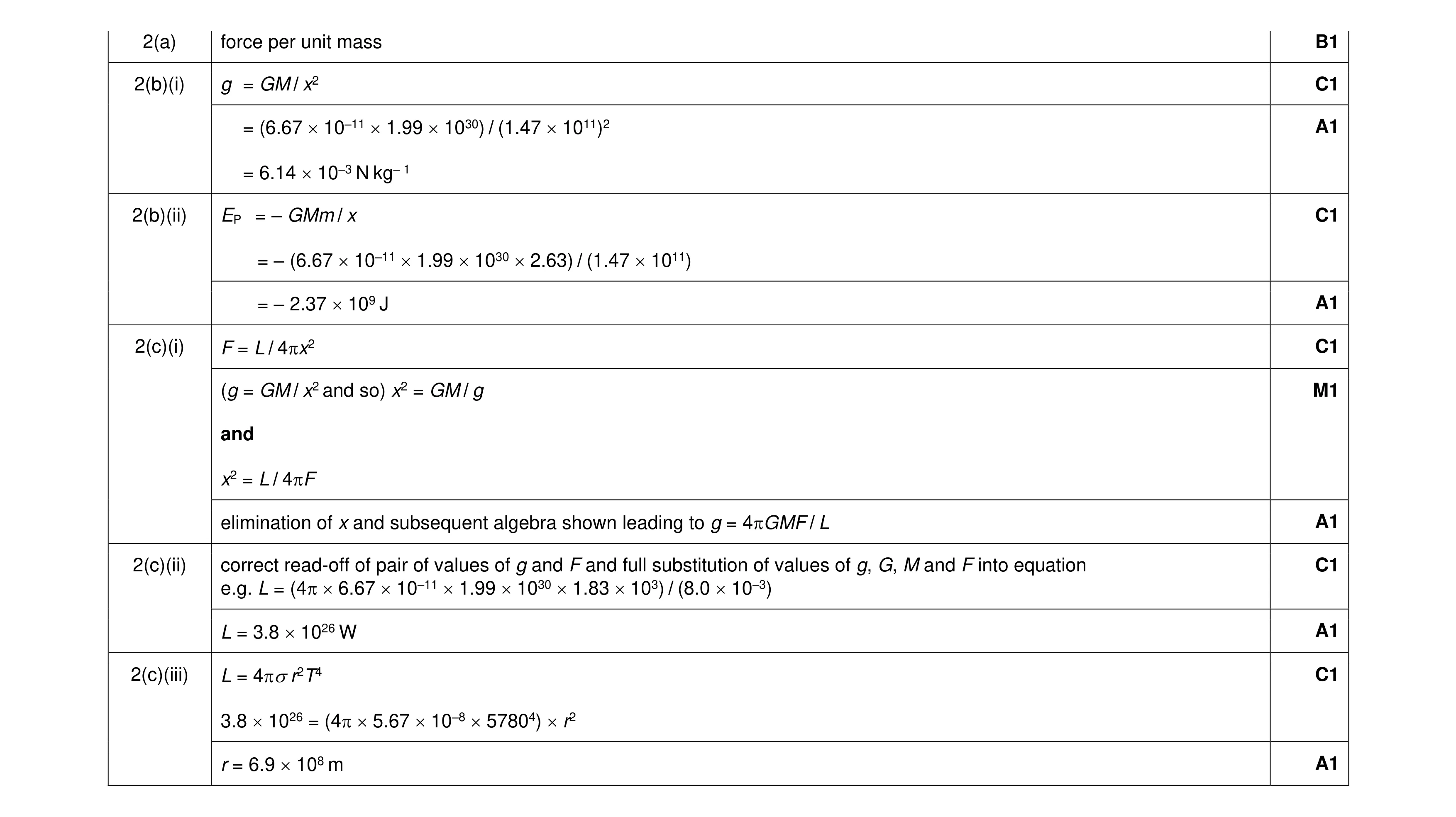 12
12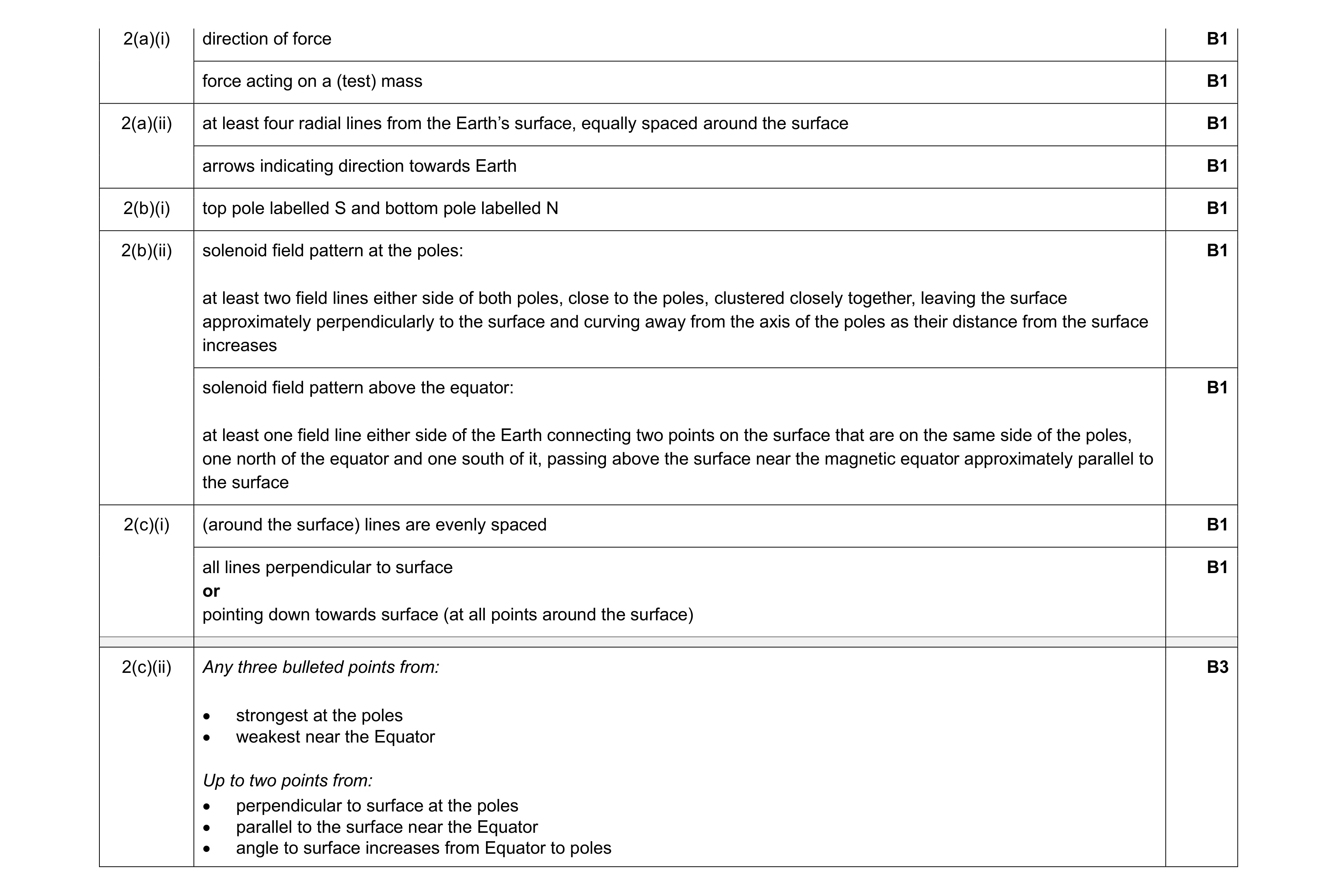 12
12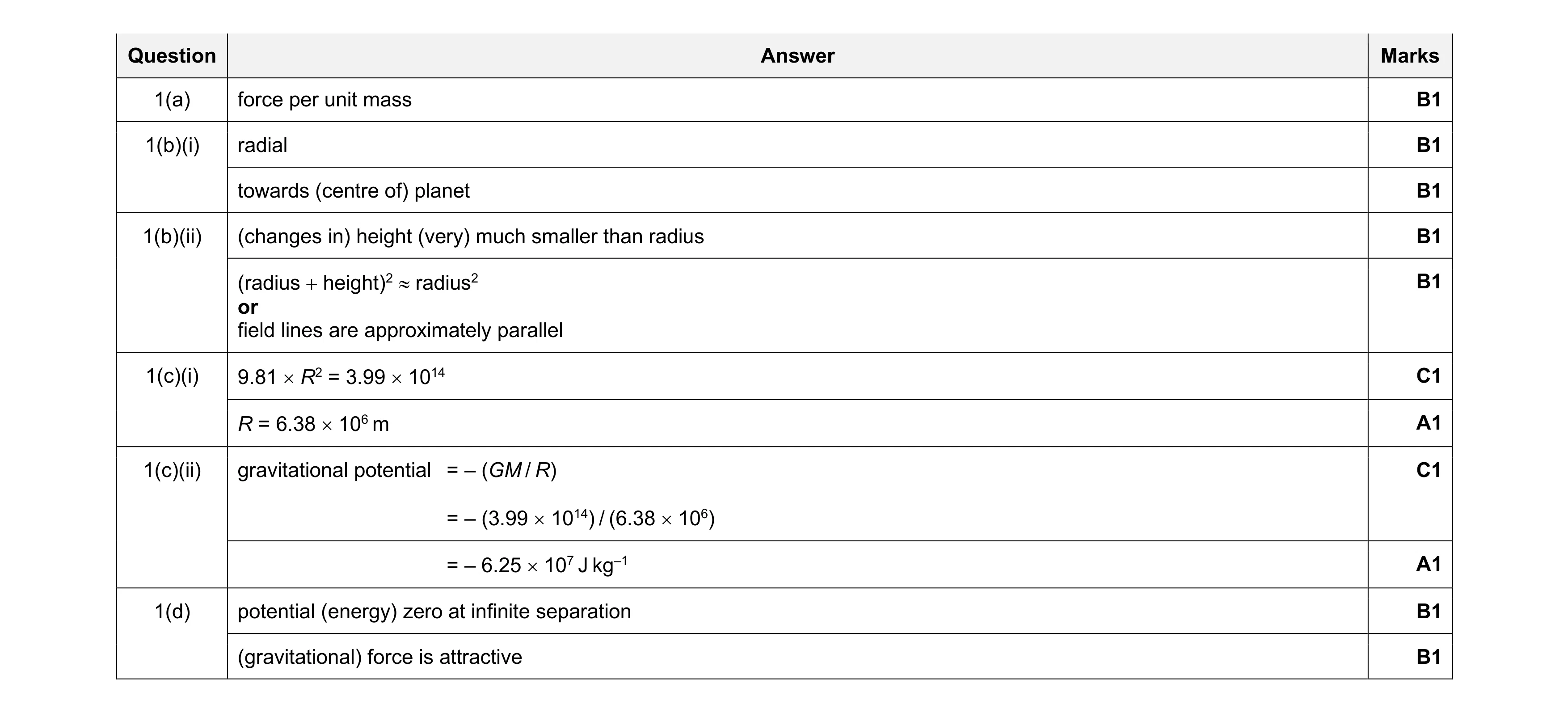 11
11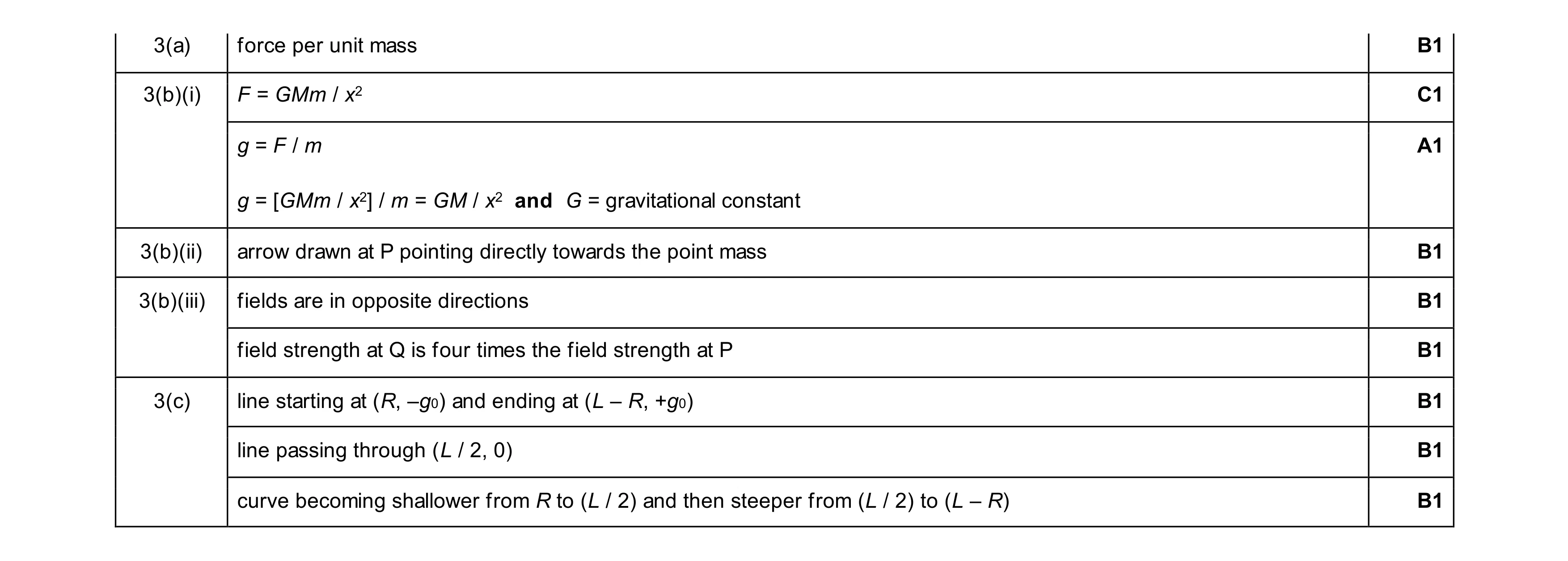 9
9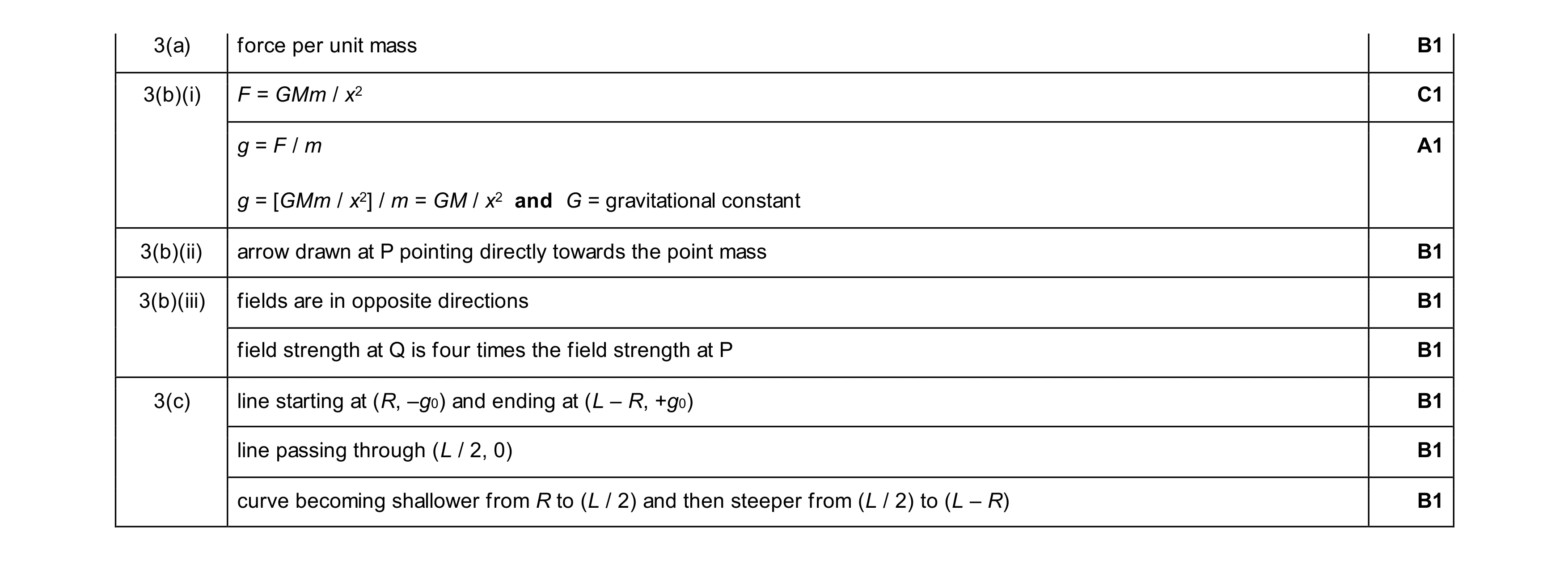 9
9