Cambridge A Level Physics 9702 — 2024 Oct/Nov Paper 4 · Variant 2
9702/42/O/N/24 · 10 questions · 100 marks · ≈113 min
The question paper and its mark scheme, free to read here and free to download. This is Cambridge’s own paper, exactly as it was sat.
Question paper24 pages

Mark scheme14 pages
Answers below. Sit the paper first if you are practising.
Questions as text
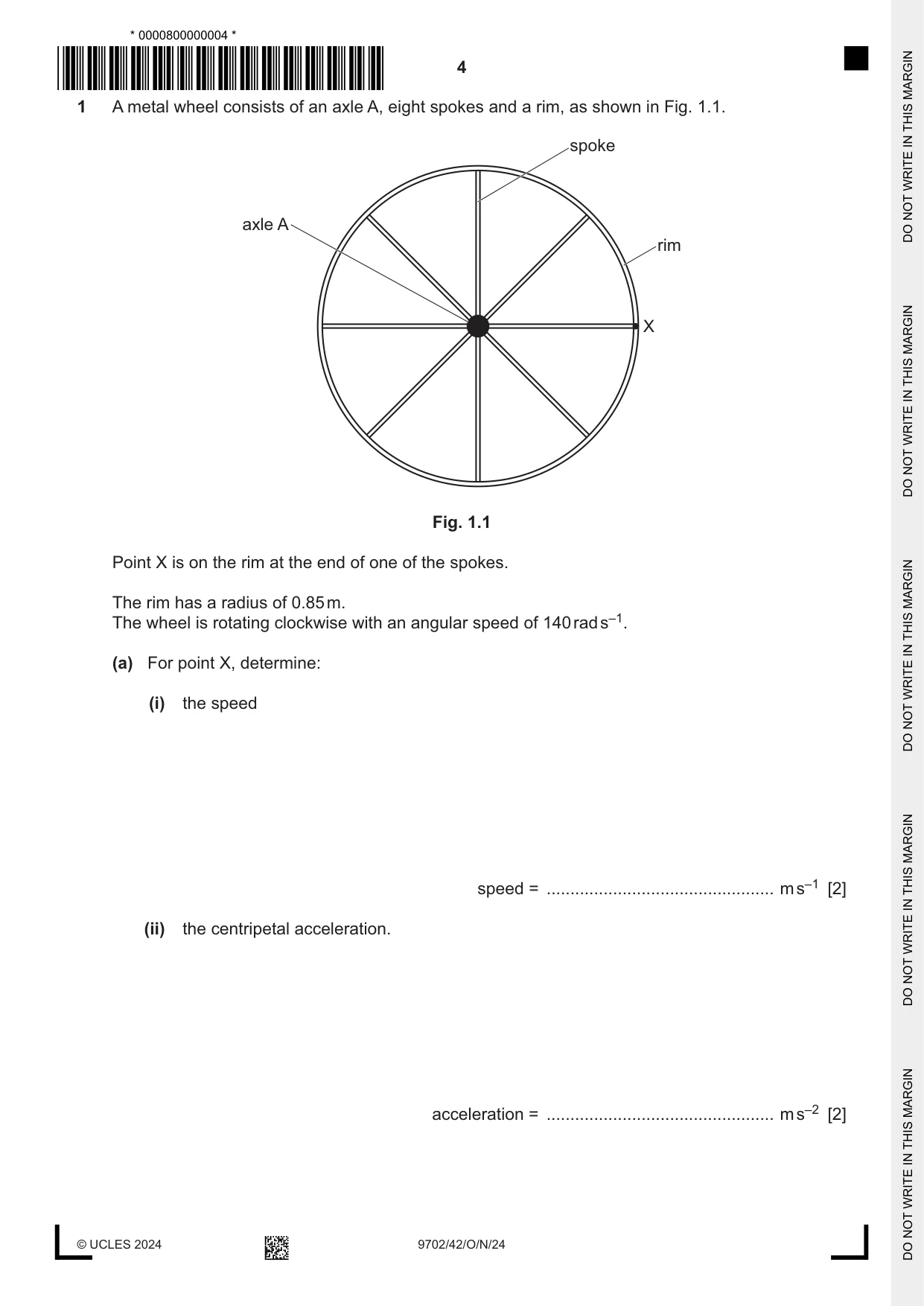
Q1 · A metal wheel consists of an axle A, eight spokes and a rim, as shown in Fig
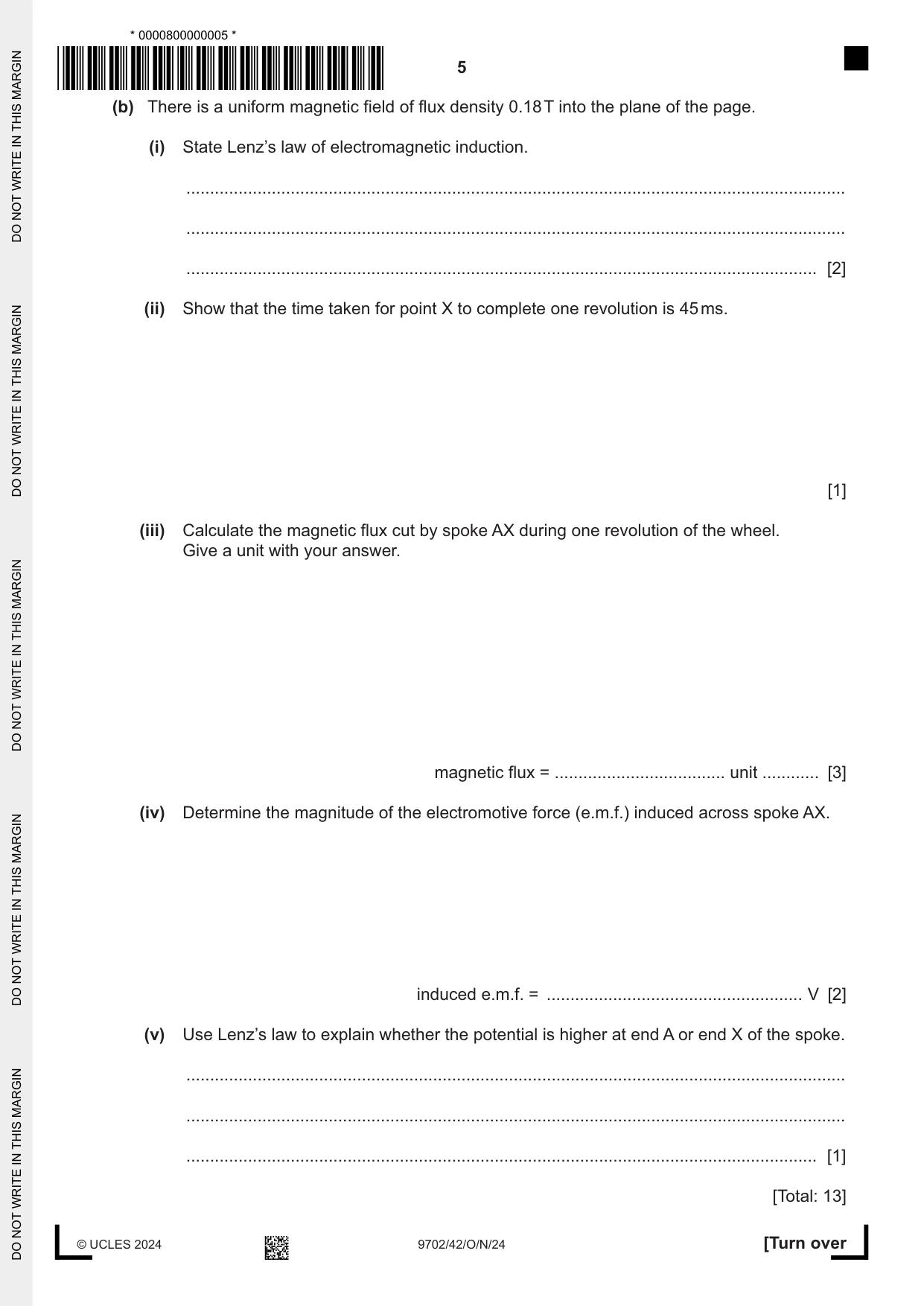
1 A metal wheel consists of an axle A, eight spokes and a rim, as shown in Fig. 1.1. spoke axle A rim X Fig. 1.1 Point X is on the rim at the end of one of the spokes. The rim has a radius of 0.85 m. The wheel is rotating clockwise with an angular speed of 140 rad s–1. (a) For point X, determine: (i) the speed speed = ................................................ m s–1 [2] (ii) the centripetal acceleration. acceleration = ................................................ m s–2 [2] (b) There is a uniform magnetic field of flux density 0.18 T into the plane of the page. (i) State Lenz’s law of electromagnetic induction. ........................................................................................................................................... ........................................................................................................................................... ..................................................................................................................................... [2] (ii) Show that the time taken for point X to complete one revolution is 45 ms. [1] (iii) Calculate the magnetic flux cut by spoke AX during one revolution of the wheel. Give a unit with your answer. magnetic flux = .................................... unit ............ [3] (iv) Determine the magnitude of the electromotive force (e.m.f.) induced across spoke AX. induced e.m.f. = ...................................................... V [2] (v) Use Lenz’s law to explain whether the potential is higher at end A or end X of the spoke. ........................................................................................................................................... ........................................................................................................................................... ..................................................................................................................................... [1] [Total: 13]
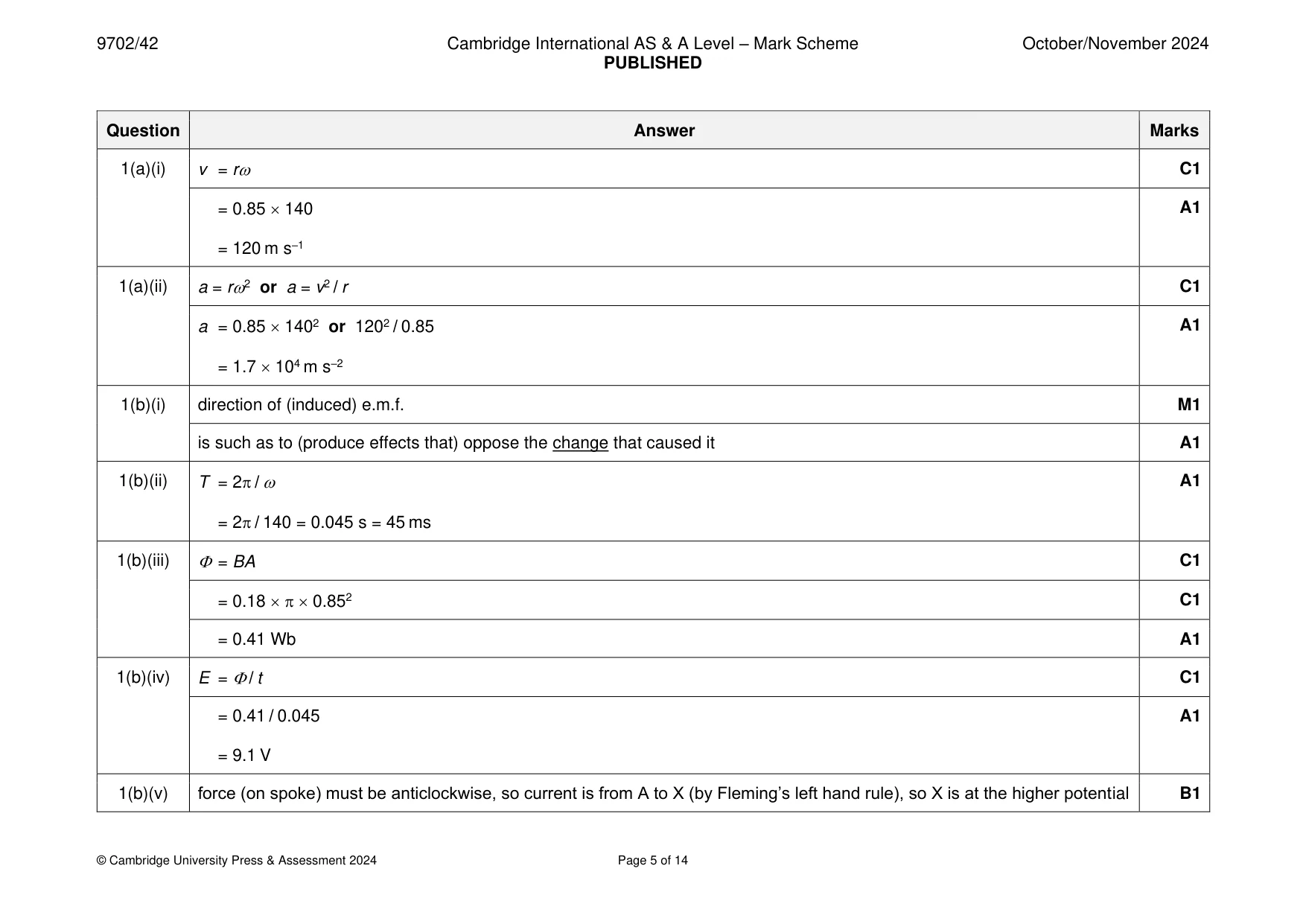
Mark scheme: Question Answer Marks 1(a)(i) v = r C1 = 0.85 140 A1 = 120 m s–1 1(a)(ii) a = r2 or a = v2 / r C1 a = 0.85 1402 or 1202 / 0.85 A1 = 1.7 104 m s–2 1(b)(i) direction of (induced) e.m.f. M1 is such as to (produce effects that) oppose the change that caused it A1 1(b)(ii) T = 2 / A1 = 2 / 140 = 0.045 s = 45 ms 1(b)(iii) = BA C1 = 0.18 0.852 C1 = 0.41 Wb A1 1(b)(iv) E = / t C1 = 0.41 / 0.045 A1 = 9.1 V 1(b)(v) force (on spoke) must be anticlockwise, so current is from A to X (by Fleming’s left hand rule), so X is at the higher potential B1
Q2 · The Sun may be considered as a uniform sphere with a mass of 1.99 × 1030 kg and a surface…
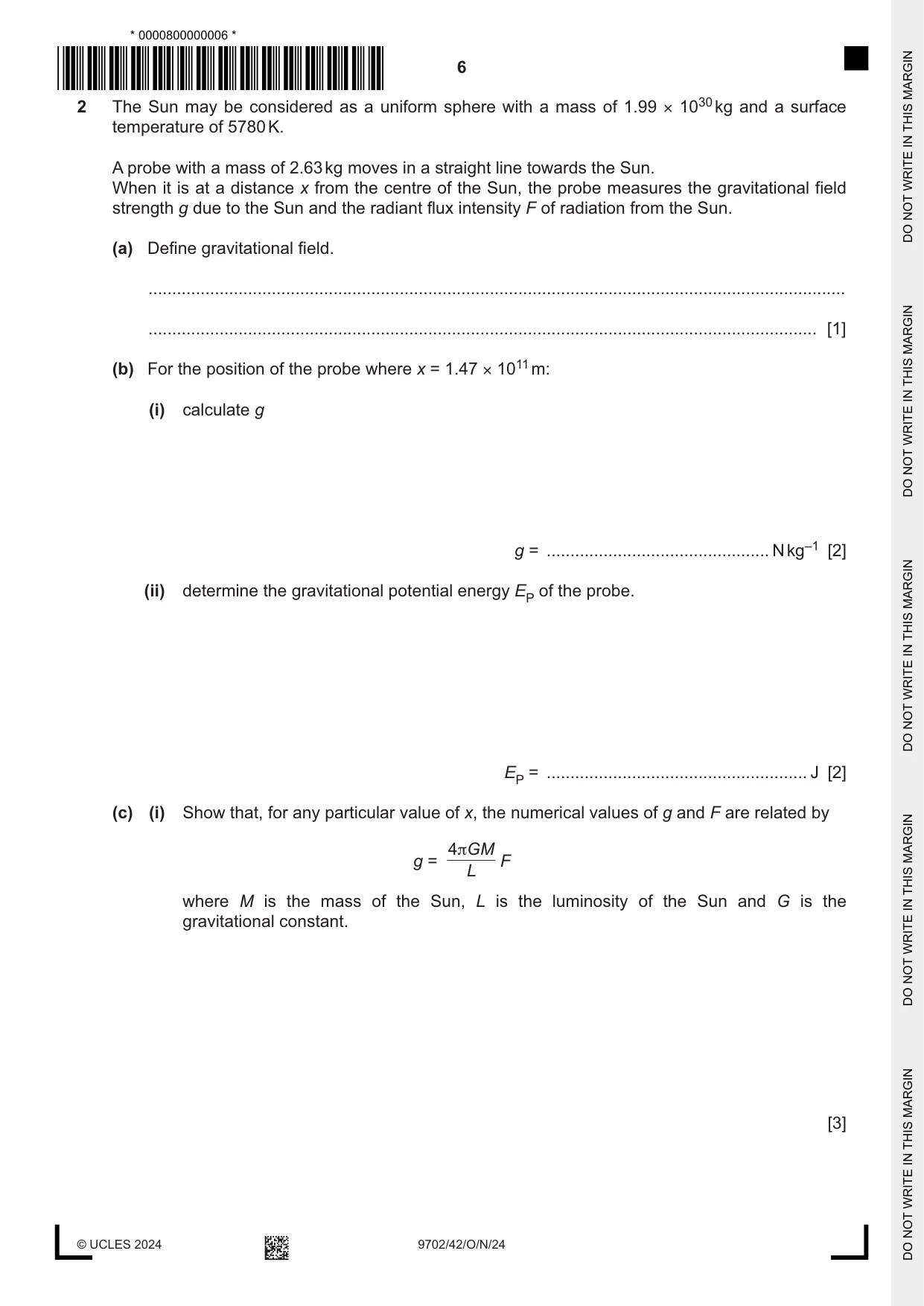
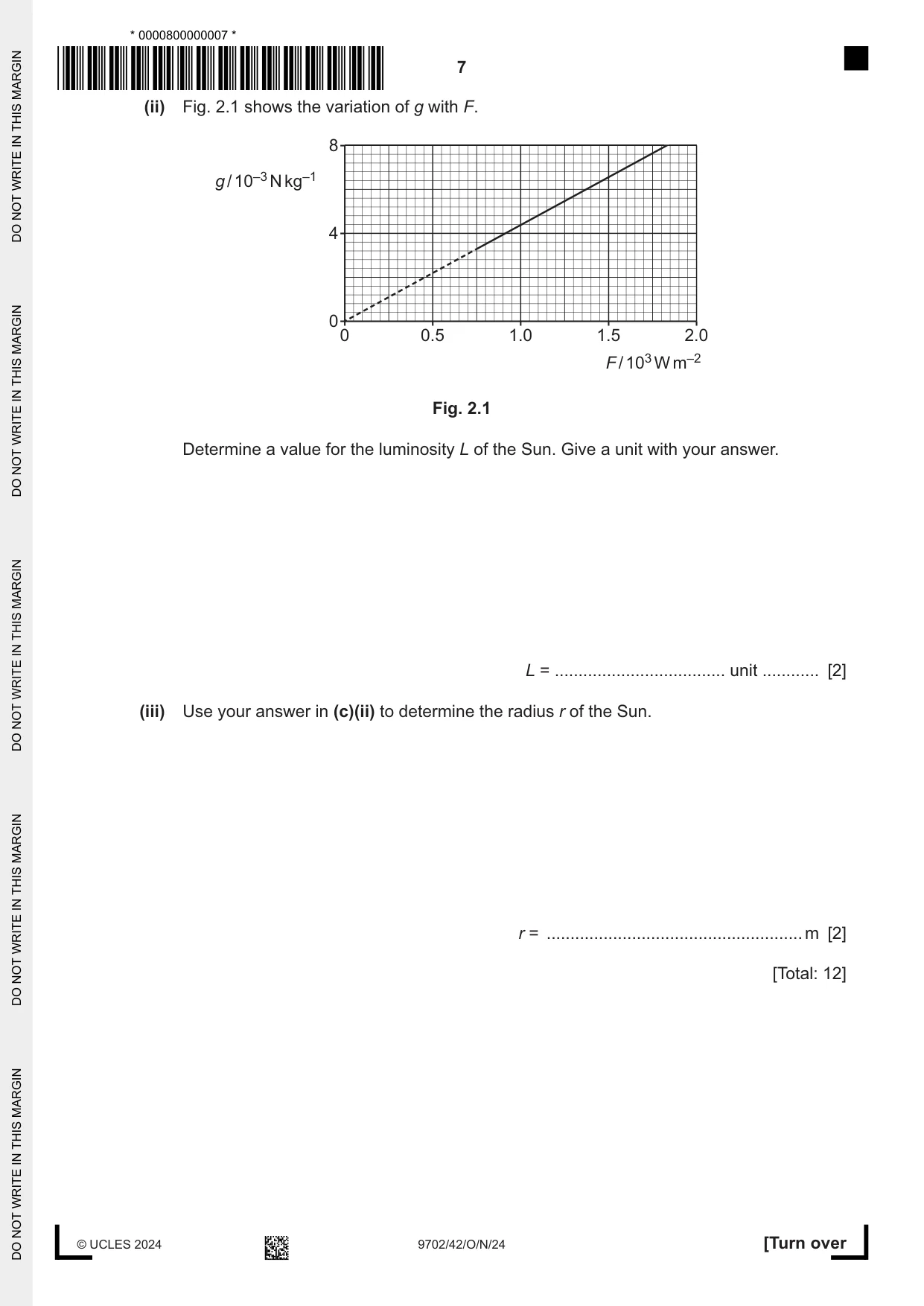
2 The Sun may be considered as a uniform sphere with a mass of 1.99 × 1030 kg and a surface temperature of 5780 K. A probe with a mass of 2.63 kg moves in a straight line towards the Sun. When it is at a distance x from the centre of the Sun, the probe measures the gravitational field strength g due to the Sun and the radiant flux intensity F of radiation from the Sun. (a) Define gravitational field. ................................................................................................................................................... ............................................................................................................................................. [1] (b) For the position of the probe where x = 1.47 × 10¹¹ m: (i) calculate g g = ............................................... N kg–1 [2] (ii) determine the gravitational potential energy EP of the probe. EP = ....................................................... J [2] (c) (i) Show that, for any particular value of x, the numerical values of g and F are related by 4πGM g = F L where M is the mass of the Sun, L is the luminosity of the Sun and G is the gravitational constant. [3] (ii) Fig. 2.1 shows the variation of g with F. 8 g / 10–3 N kg–1 4 0 0 0.5 1.0 1.5 2.0 F / 103 W m–2 Fig. 2.1 Determine a value for the luminosity L of the Sun. Give a unit with your answer. L = .................................... unit ............ [2] (iii) Use your answer in (c)(ii) to determine the radius r of the Sun. r = ...................................................... m [2] [Total: 12]
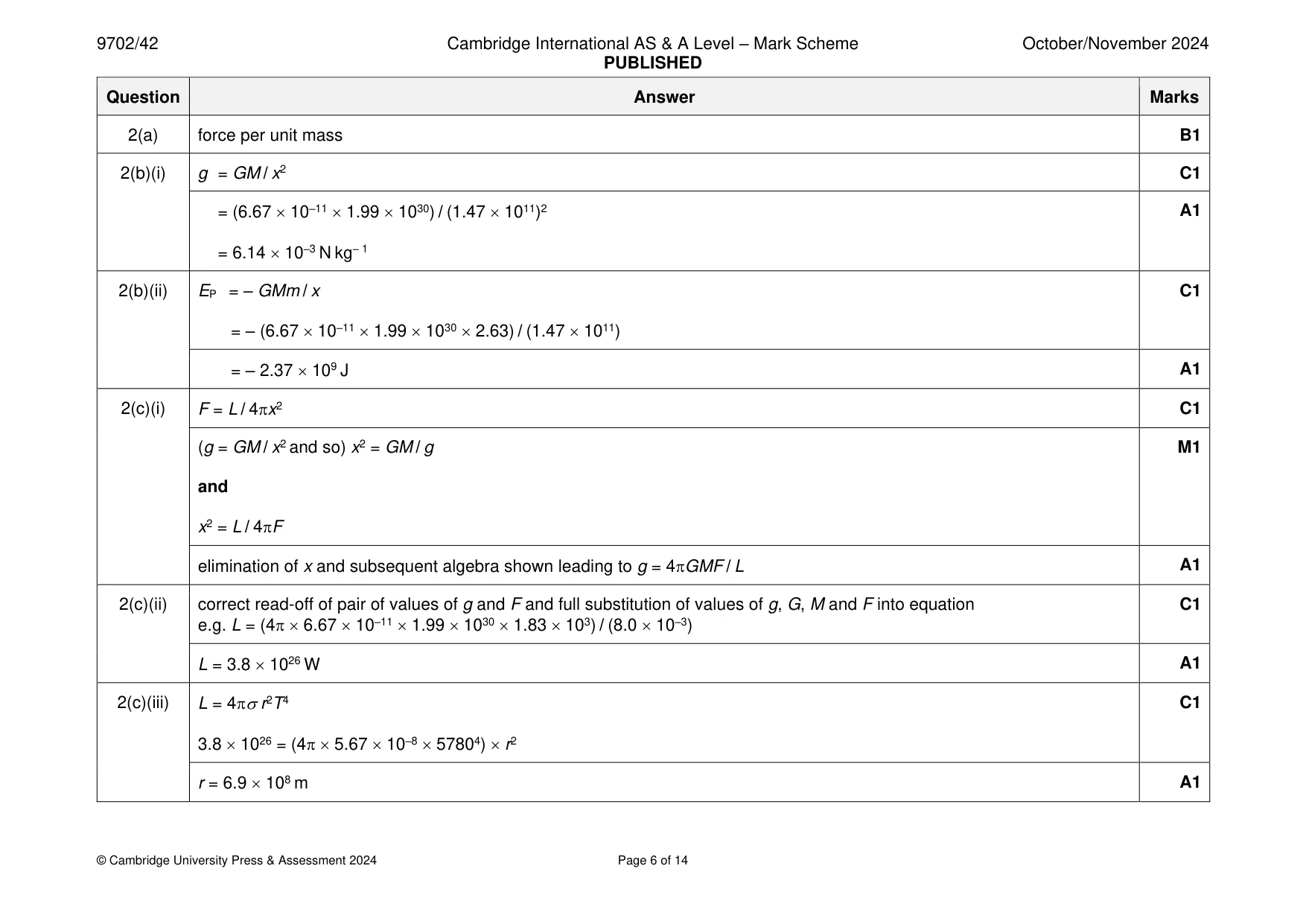
Mark scheme: 2(a) force per unit mass B1 2(b)(i) g = GM / x2 C1 = (6.67 10–11 1.99 1030) / (1.47 1011)2 A1 = 6.14 10–3 N kg– 1 2(b)(ii) EP = – GMm / x C1 = – (6.67 10–11 1.99 1030 2.63) / (1.47 1011) = – 2.37 109 J A1 2(c)(i) F = L / 4x2 C1 (g = GM / x2 and so) x2 = GM / g M1 and x2 = L / 4F elimination of x and subsequent algebra shown leading to g = 4GMF / L A1 2(c)(ii) correct read-off of pair of values of g and F and full substitution of values of g, G, M and F into equation C1 e.g. L = (4 6.67 10–11 1.99 1030 1.83 103) / (8.0 10–3) L = 3.8 1026 W A1 2(c)(iii) L = 4r2T4 C1 3.8 1026 = (4 5.67 10–8 57804) r2 r = 6.9 108 m A1
Q3 · Define specific latent heat
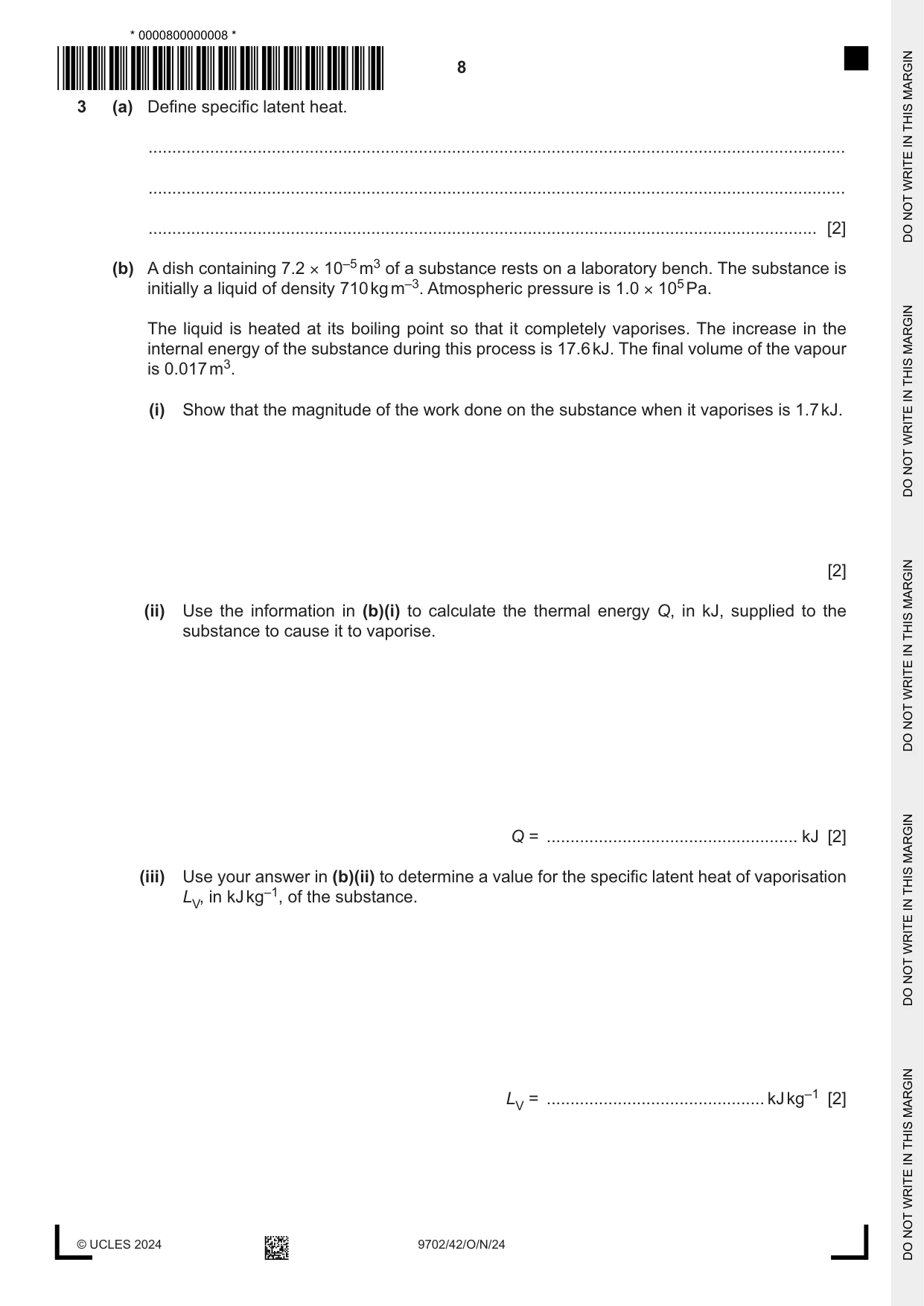
3 (a) Define specific latent heat. ................................................................................................................................................... ................................................................................................................................................... ............................................................................................................................................. [2] (b) A dish containing 7.2 × 10⁻⁵ m3 of a substance rests on a laboratory bench. The substance is initially a liquid of density 710 kg m–3. Atmospheric pressure is 1.0 × 10⁵ Pa. The liquid is heated at its boiling point so that it completely vaporises. The increase in the internal energy of the substance during this process is 17.6 kJ. The final volume of the vapour is 0.017 m3. (i) Show that the magnitude of the work done on the substance when it vaporises is 1.7 kJ. [2] (ii) Use the information in (b)(i) to calculate the thermal energy Q, in kJ, supplied to the substance to cause it to vaporise. Q = ..................................................... kJ [2] (iii) Use your answer in (b)(ii) to determine a value for the specific latent heat of vaporisation LV, in kJ kg–1, of the substance. LV = .............................................. kJ kg–1 [2] (c) The substance in (b) has a specific latent heat of fusion LF. Suggest and explain whether LF is likely to be less than, the same as, or greater than the answer in (b)(iii). ................................................................................................................................................... ................................................................................................................................................... ................................................................................................................................................... ................................................................................................................................................... ............................................................................................................................................. [3] [Total: 11]
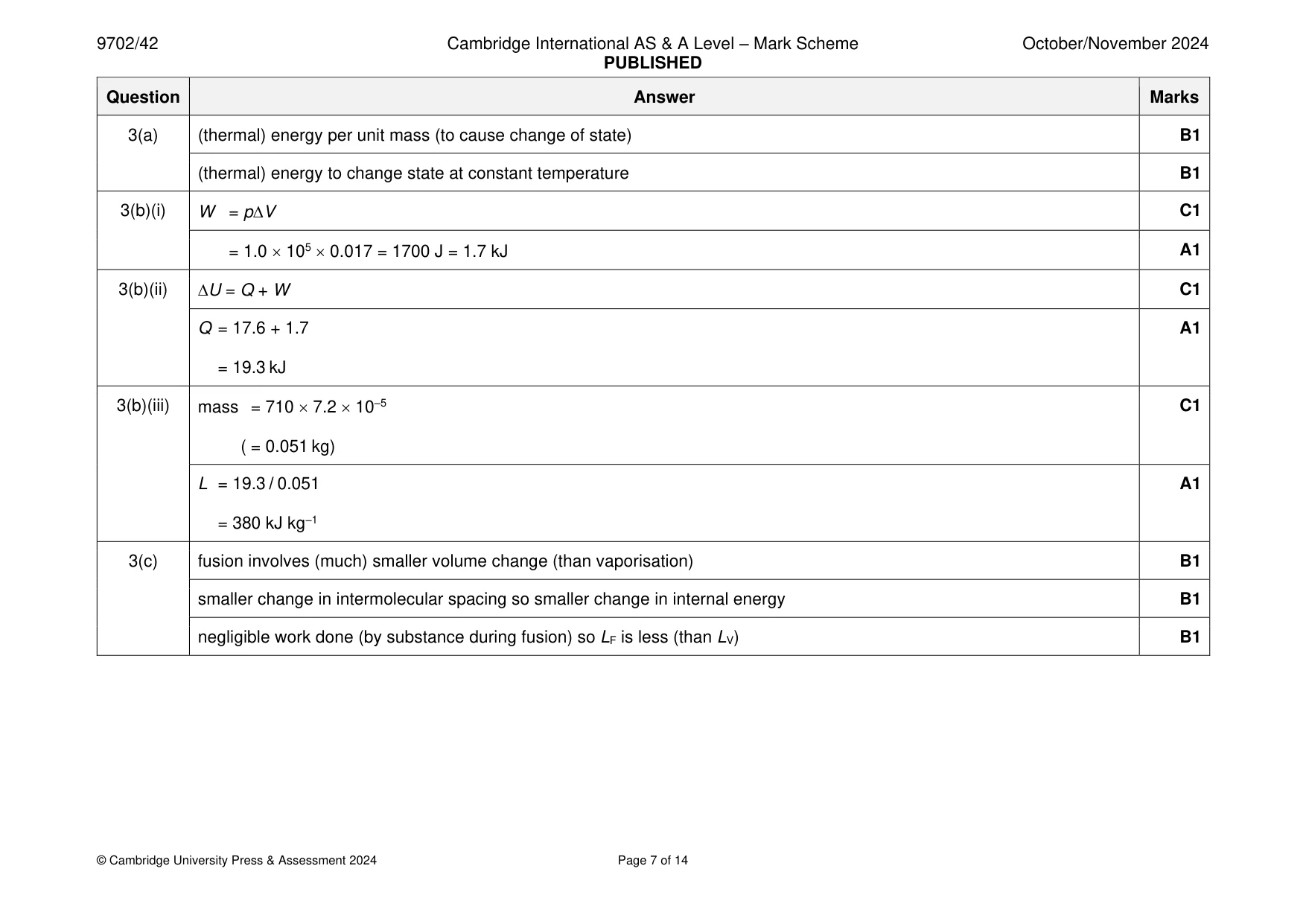
Mark scheme: 3(a) (thermal) energy per unit mass (to cause change of state) B1 (thermal) energy to change state at constant temperature B1 3(b)(i) W = pV C1 = 1.0 105 0.017 = 1700 J = 1.7 kJ A1 3(b)(ii) U = Q + W C1 Q = 17.6 + 1.7 A1 = 19.3 kJ 3(b)(iii) mass = 710 7.2 10–5 C1 ( = 0.051 kg) L = 19.3 / 0.051 A1 = 380 kJ kg–1 3(c) fusion involves (much) smaller volume change (than vaporisation) B1 smaller change in intermolecular spacing so smaller change in internal energy B1 negligible work done (by substance during fusion) so LF is less (than LV) B1
Q4 · State three of the basic assumptions of the kinetic theory of gases
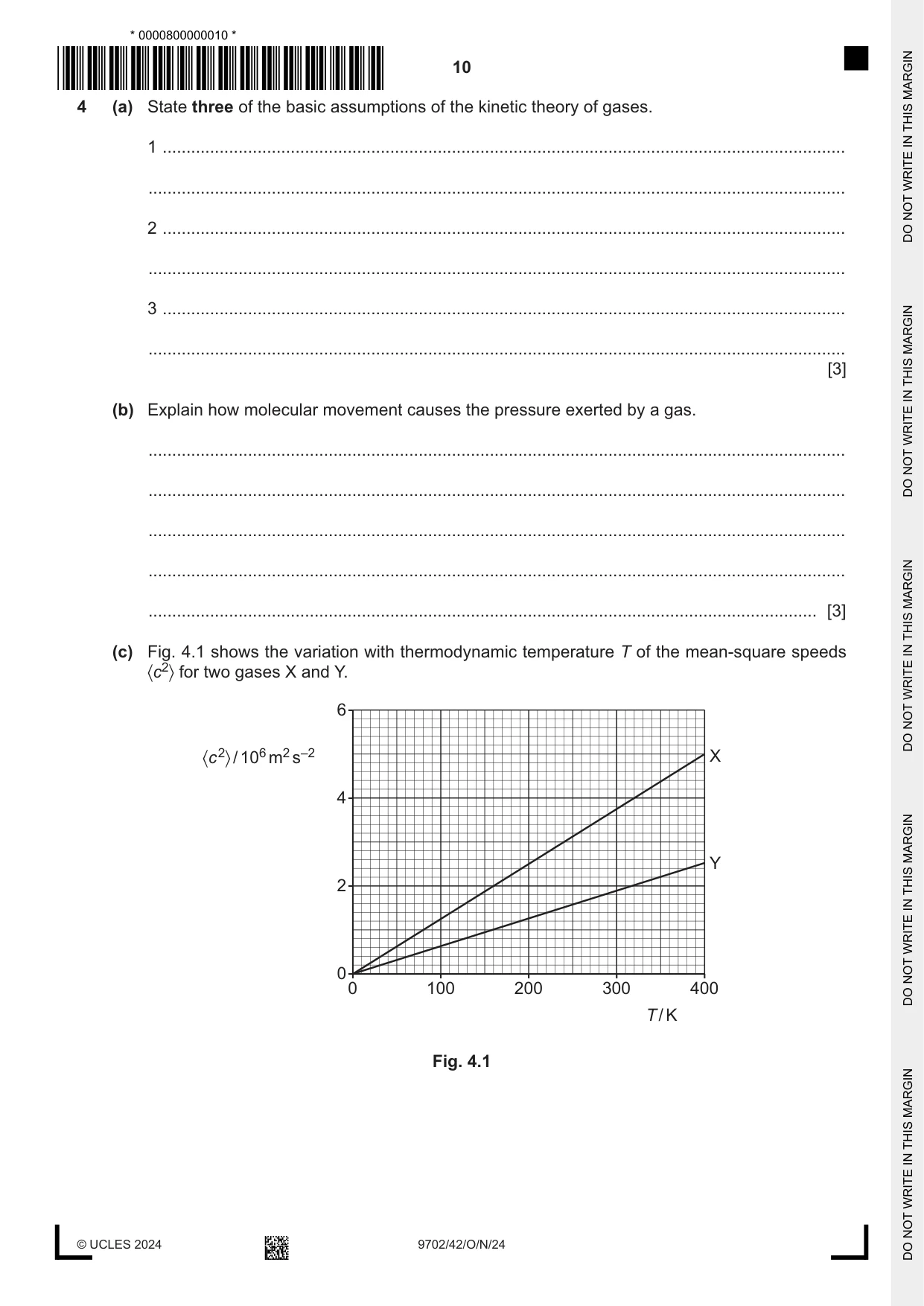
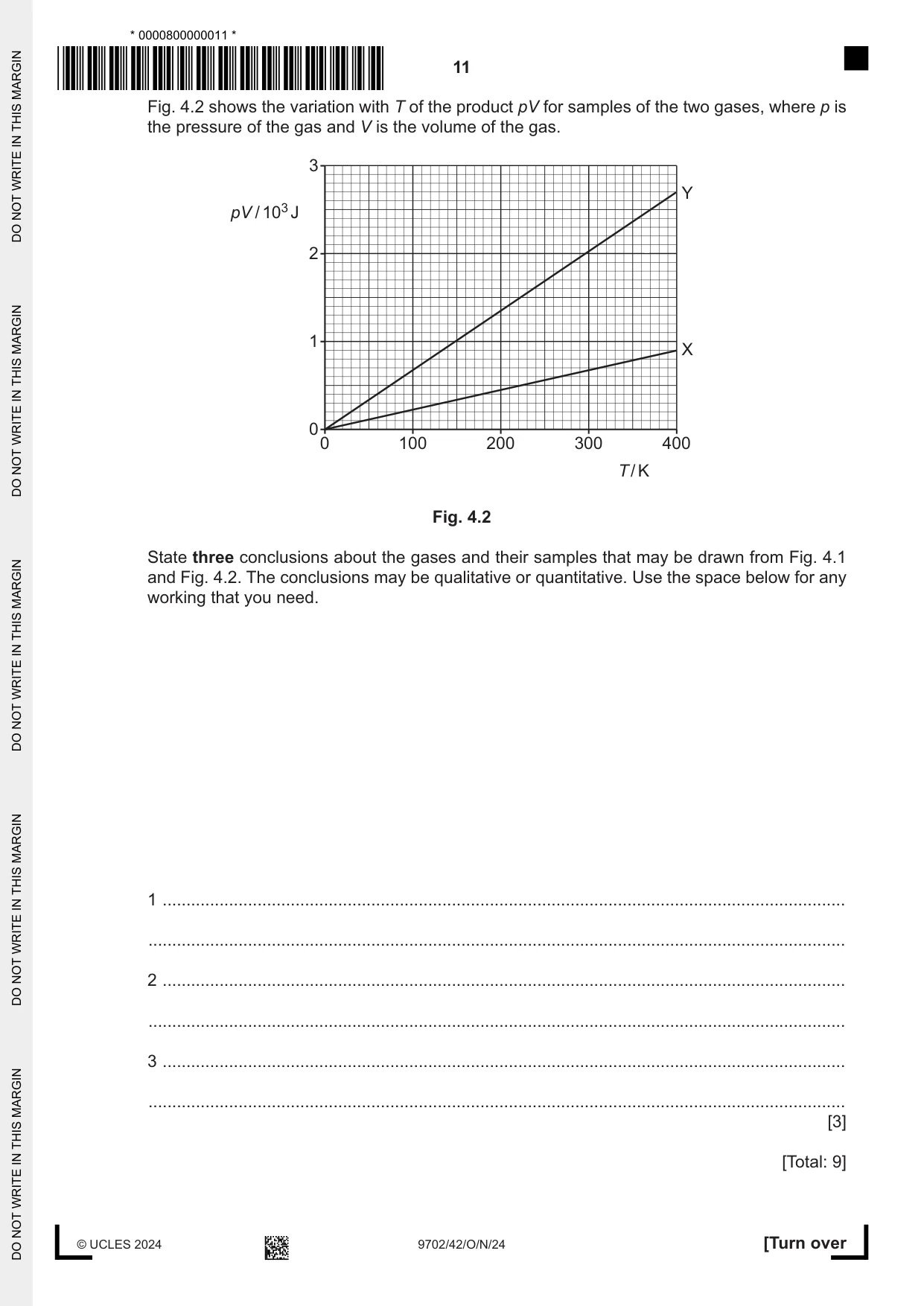
4 (a) State three of the basic assumptions of the kinetic theory of gases. 1 ................................................................................................................................................ ................................................................................................................................................... 2 ................................................................................................................................................ ................................................................................................................................................... 3 ................................................................................................................................................ ................................................................................................................................................... [3] (b) Explain how molecular movement causes the pressure exerted by a gas. ................................................................................................................................................... ................................................................................................................................................... ................................................................................................................................................... ................................................................................................................................................... ............................................................................................................................................. [3] (c) Fig. 4.1 shows the variation with thermodynamic temperature T of the mean‑square speeds 〈c2〉 for two gases X and Y. 6 〈c 2〉 / 106 m2 s–2 X 4 Y 2 0 0 100 200 300 400 T / K Fig. 4.1 Fig. 4.2 shows the variation with T of the product pV for samples of the two gases, where p is the pressure of the gas and V is the volume of the gas. 3 Y pV / 103 J 2 1 X 0 0 100 200 300 400 T / K Fig. 4.2 State three conclusions about the gases and their samples that may be drawn from Fig. 4.1 and Fig. 4.2. The conclusions may be qualitative or quantitative. Use the space below for any working that you need. 1 ................................................................................................................................................ ................................................................................................................................................... 2 ................................................................................................................................................ ................................................................................................................................................... 3 ................................................................................................................................................ ................................................................................................................................................... [3] [Total: 9]
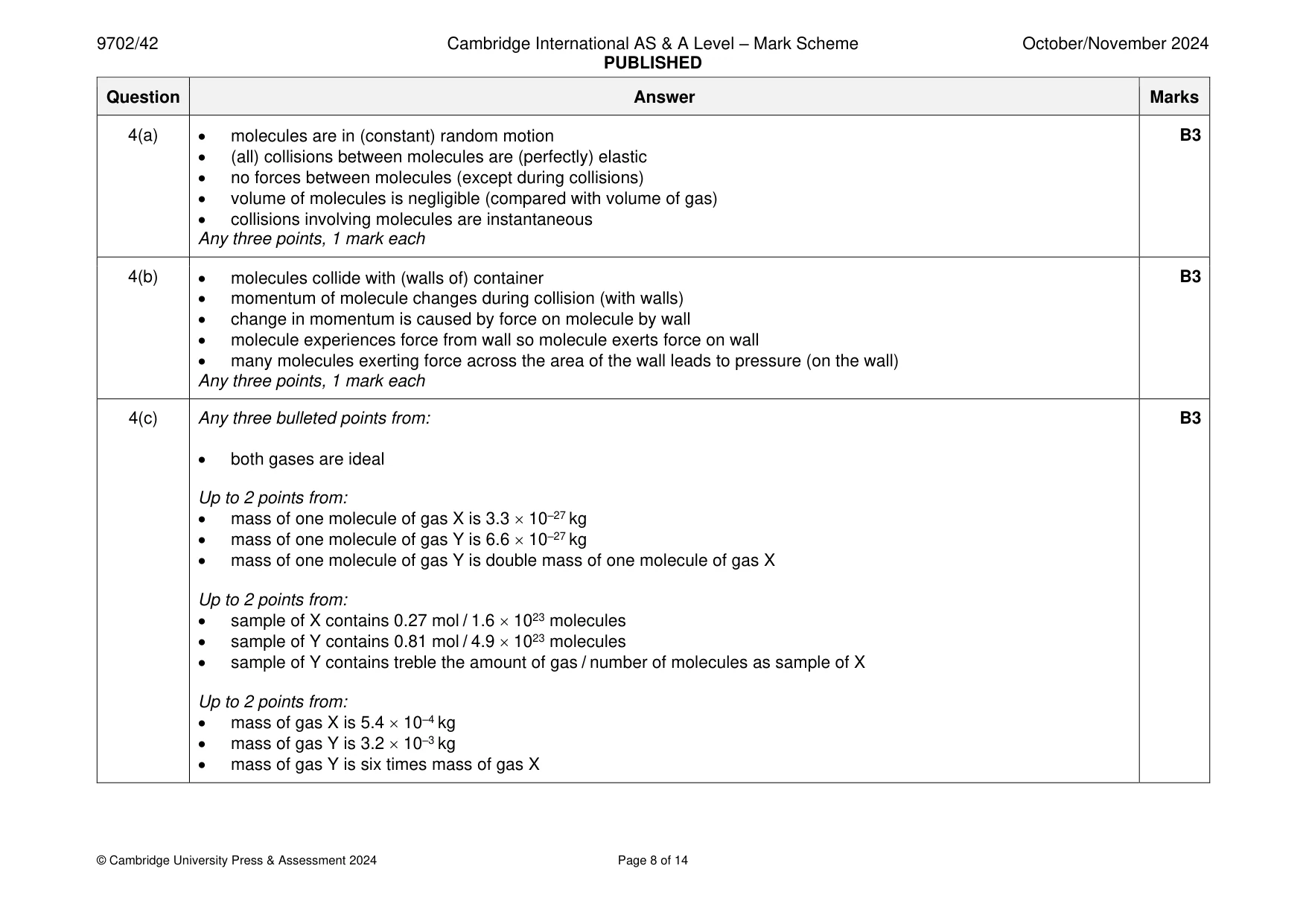
Mark scheme: 4(a) • molecules are in (constant) random motion B3 • (all) collisions between molecules are (perfectly) elastic • no forces between molecules (except during collisions) • volume of molecules is negligible (compared with volume of gas) • collisions involving molecules are instantaneous Any three points, 1 mark each 4(b) • molecules collide with (walls of) container B3 • momentum of molecule changes during collision (with walls) • change in momentum is caused by force on molecule by wall • molecule experiences force from wall so molecule exerts force on wall • many molecules exerting force across the area of the wall leads to pressure (on the wall) Any three points, 1 mark each 4(c) Any three bulleted points from: B3 • both gases are ideal Up to 2 points from: • mass of one molecule of gas X is 3.3 10–27 kg • mass of one molecule of gas Y is 6.6 10–27 kg • mass of one molecule of gas Y is double mass of one molecule of gas X Up to 2 points from: • sample of X contains 0.27 mol / 1.6 1023 molecules • sample of Y contains 0.81 mol / 4.9 1023 molecules • sample of Y contains treble the amount of gas / number of molecules as sample of X Up to 2 points from: • mass of gas X is 5.4 10–4 kg • mass of gas Y is 3.2 10–3 kg • mass of gas Y is six times mass of gas X
Q5 · A pendulum consisting of a metal sphere suspended by a thin string
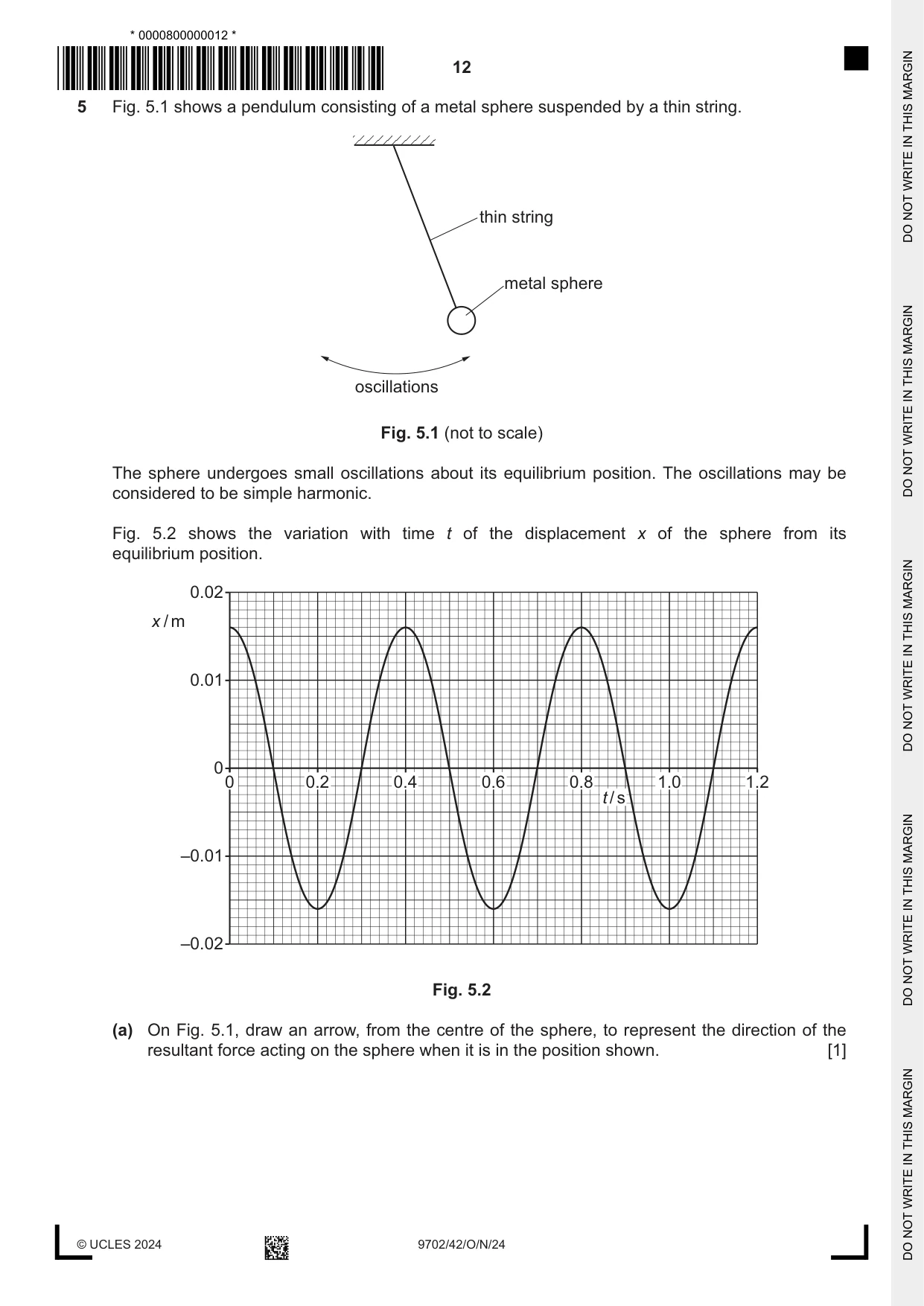
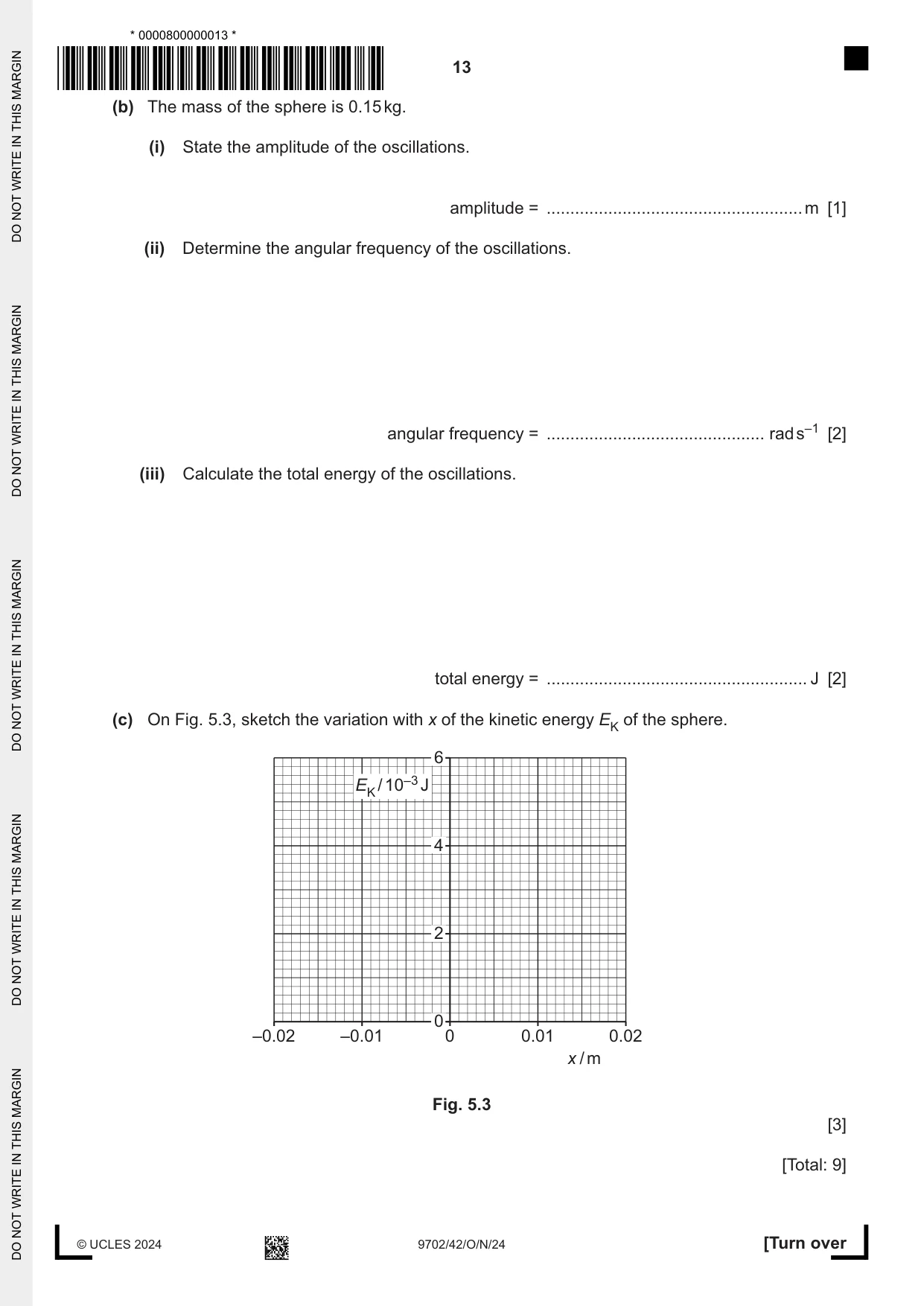
5 Fig. 5.1 shows a pendulum consisting of a metal sphere suspended by a thin string. thin string metal sphere oscillations Fig. 5.1 (not to scale) The sphere undergoes small oscillations about its equilibrium position. The oscillations may be considered to be simple harmonic. Fig. 5.2 shows the variation with time t of the displacement x of the sphere from its equilibrium position. 0.02 x / m 0.01 0 0 0.2 0.4 0.6 0.8 1.0 1.2 t / s –0.01 –0.02 Fig. 5.2 (a) On Fig. 5.1, draw an arrow, from the centre of the sphere, to represent the direction of the resultant force acting on the sphere when it is in the position shown. [1] (b) The mass of the sphere is 0.15 kg. (i) State the amplitude of the oscillations. amplitude = ...................................................... m [1] (ii) Determine the angular frequency of the oscillations. angular frequency = .............................................. rad s–1 [2] (iii) Calculate the total energy of the oscillations. total energy = ....................................................... J [2] (c) On Fig. 5.3, sketch the variation with x of the kinetic energy EK of the sphere. 6 EK / 10–3 J 4 2 0 –0.02 –0.01 0 0.01 0.02 x / m Fig. 5.3 [3] [Total: 9]
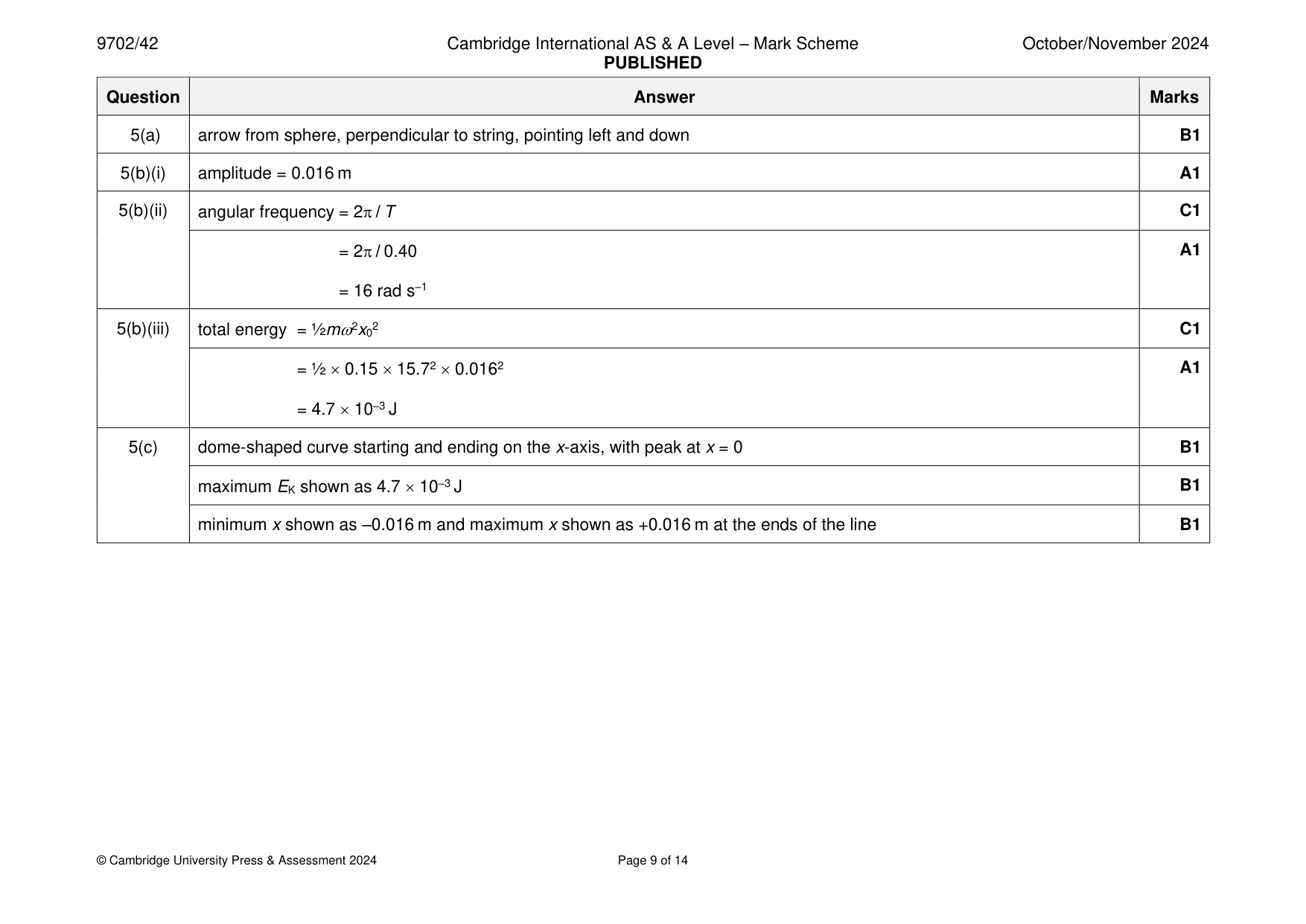
Mark scheme: 5(a) arrow from sphere, perpendicular to string, pointing left and down B1 5(b)(i) amplitude = 0.016 m A1 5(b)(ii) angular frequency = 2 / T C1 = 2 / 0.40 A1 = 16 rad s–1 5(b)(iii) total energy = ½m2x02 C1 = ½ 0.15 15.72 0.0162 A1 = 4.7 10–3 J 5(c) dome-shaped curve starting and ending on the x-axis, with peak at x = 0 B1 maximum EK shown as 4.7 10–3 J B1 minimum x shown as –0.016 m and maximum x shown as +0.016 m at the ends of the line B1
Question 6
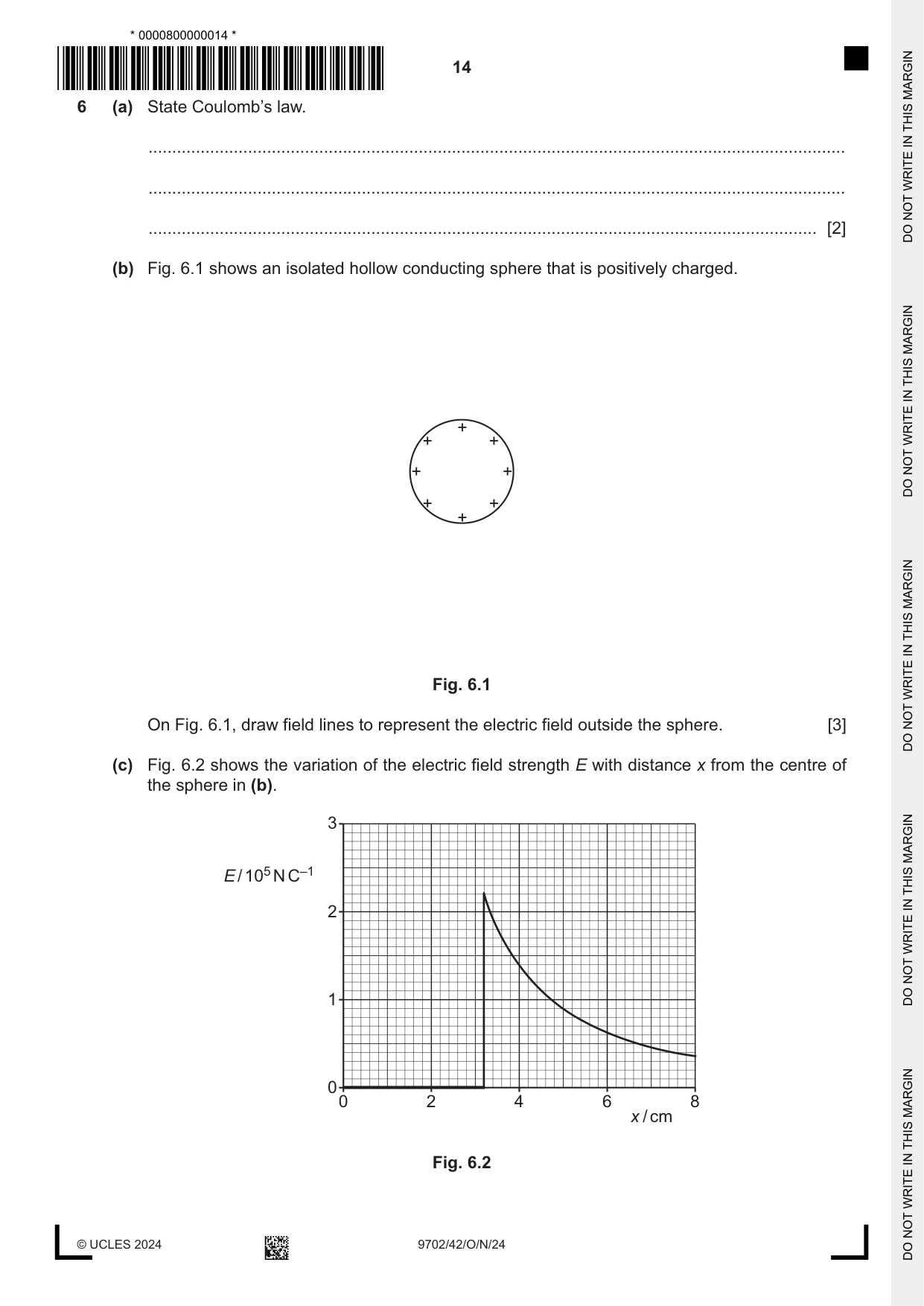
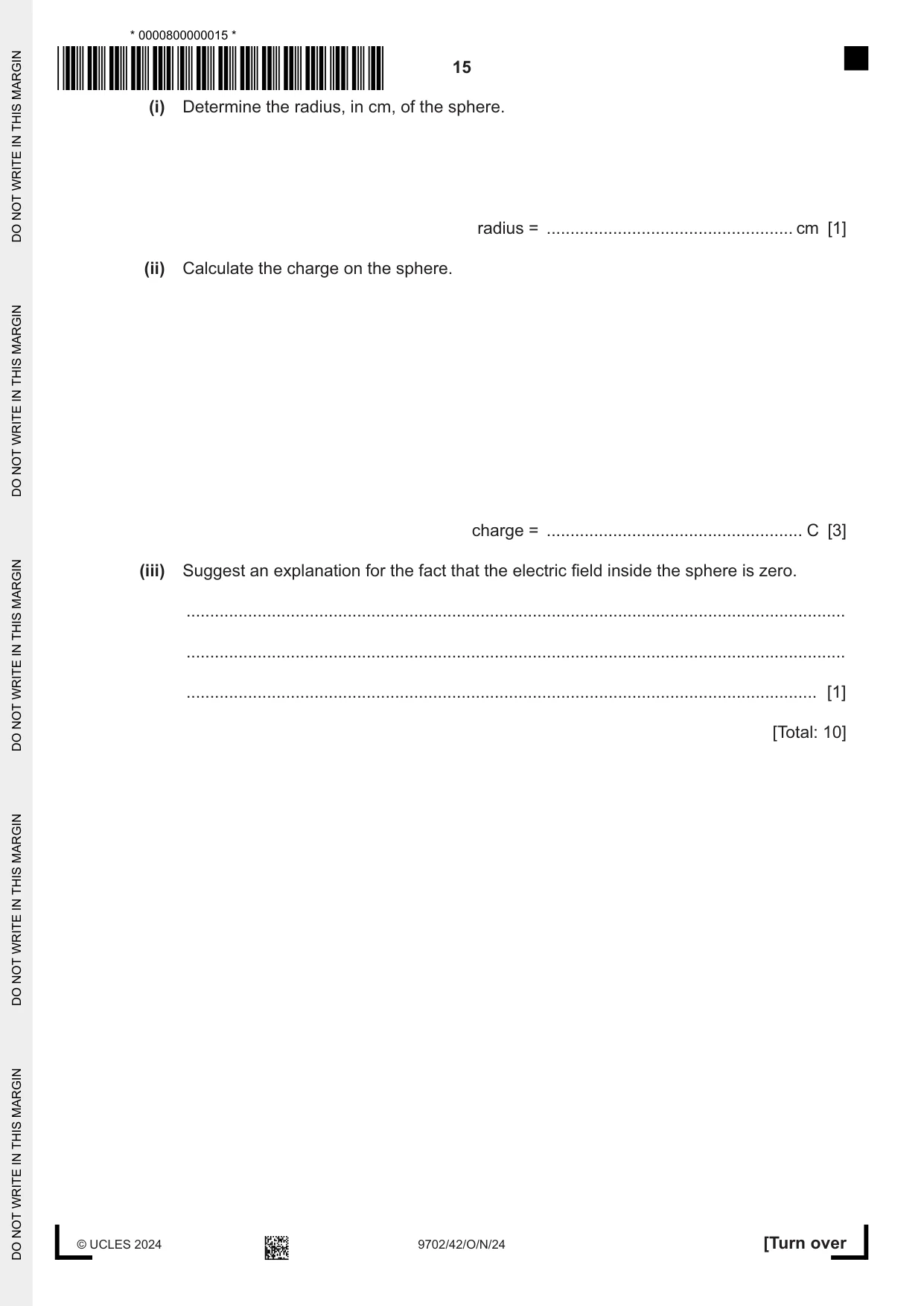
6 (a) State Coulomb’s law. ................................................................................................................................................... ................................................................................................................................................... ............................................................................................................................................. [2] (b) Fig. 6.1 shows an isolated hollow conducting sphere that is positively charged. + + + + + + + + Fig. 6.1 On Fig. 6.1, draw field lines to represent the electric field outside the sphere. [3] (c) Fig. 6.2 shows the variation of the electric field strength E with distance x from the centre of the sphere in (b). 3 E / 105 N C–1 2 1 0 0 2 4 6 8 x / cm Fig. 6.2 (i) Determine the radius, in cm, of the sphere. radius = .................................................... cm [1] (ii) Calculate the charge on the sphere. charge = ...................................................... C [3] (iii) Suggest an explanation for the fact that the electric field inside the sphere is zero. ........................................................................................................................................... ........................................................................................................................................... ..................................................................................................................................... [1] [Total: 10]
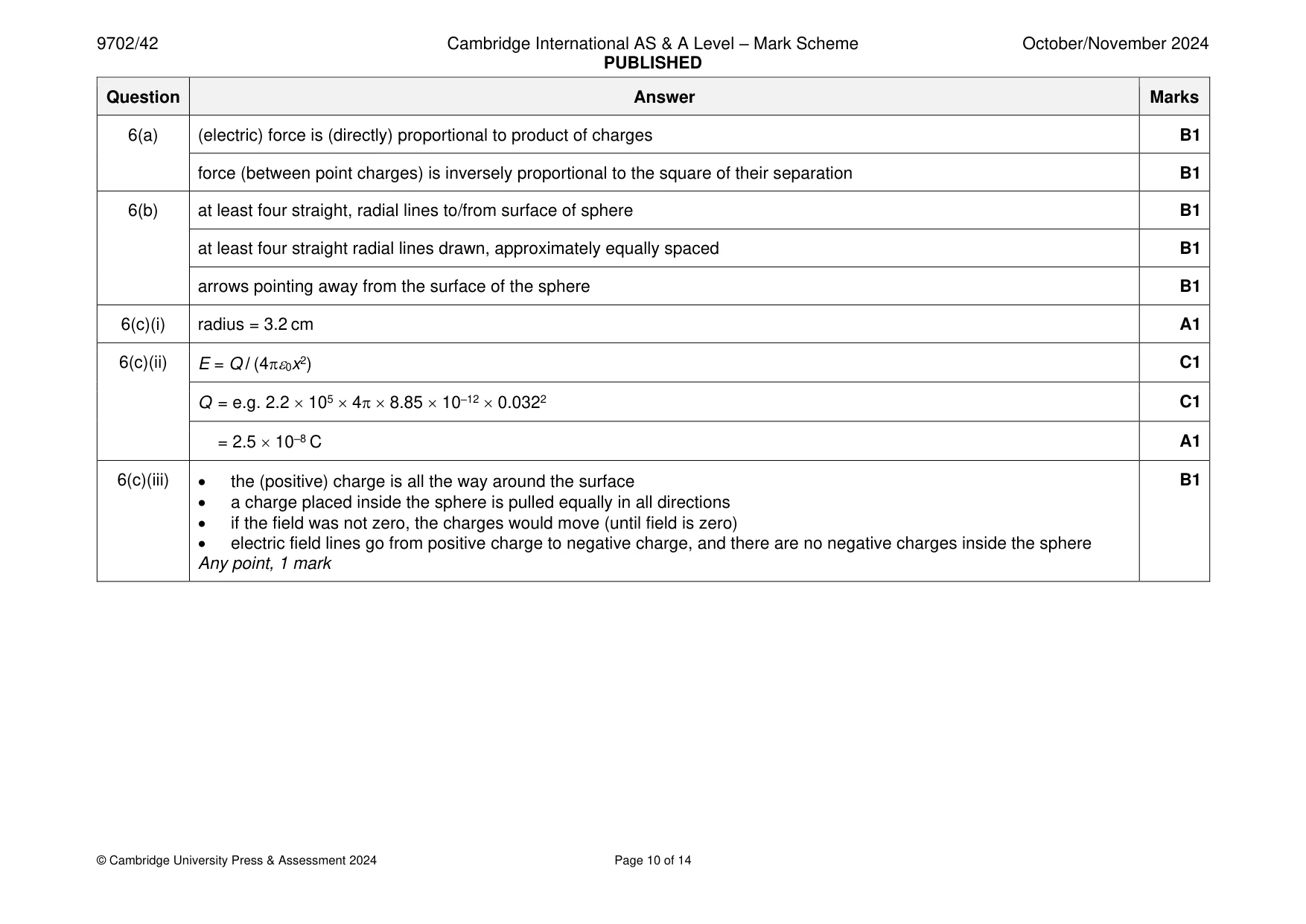
Mark scheme: 6(a) (electric) force is (directly) proportional to product of charges B1 force (between point charges) is inversely proportional to the square of their separation B1 6(b) at least four straight, radial lines to/from surface of sphere B1 at least four straight radial lines drawn, approximately equally spaced B1 arrows pointing away from the surface of the sphere B1 6(c)(i) radius = 3.2 cm A1 6(c)(ii) E = Q / (40x2) C1 Q = e.g. 2.2 105 4 8.85 10–12 0.0322 C1 = 2.5 10–8 C A1 6(c)(iii) • the (positive) charge is all the way around the surface B1 • a charge placed inside the sphere is pulled equally in all directions • if the field was not zero, the charges would move (until field is zero) • electric field lines go from positive charge to negative charge, and there are no negative charges inside the sphere Any point, 1 mark
Q7 · Define the capacitance of a parallel‑plate capacitor
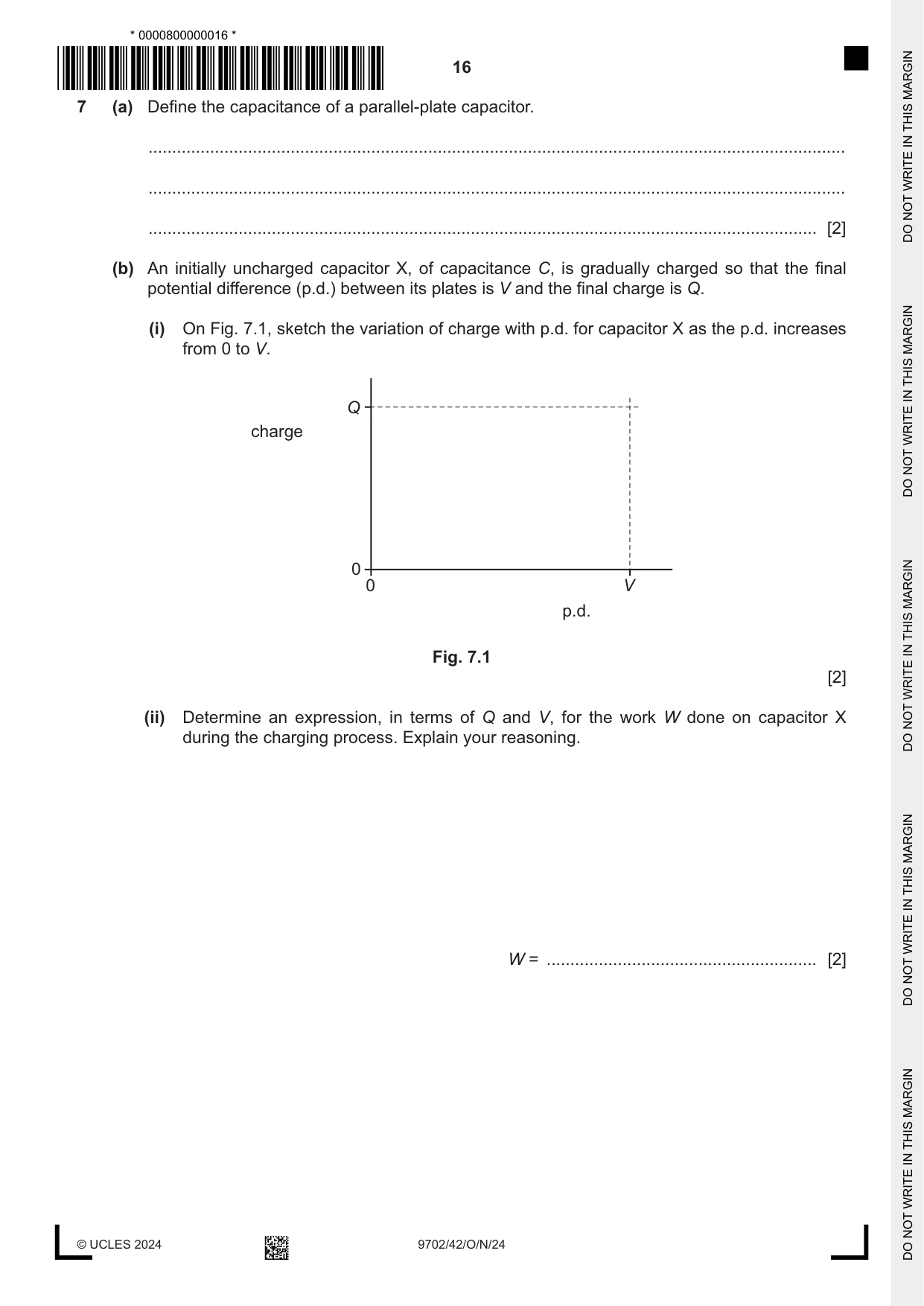
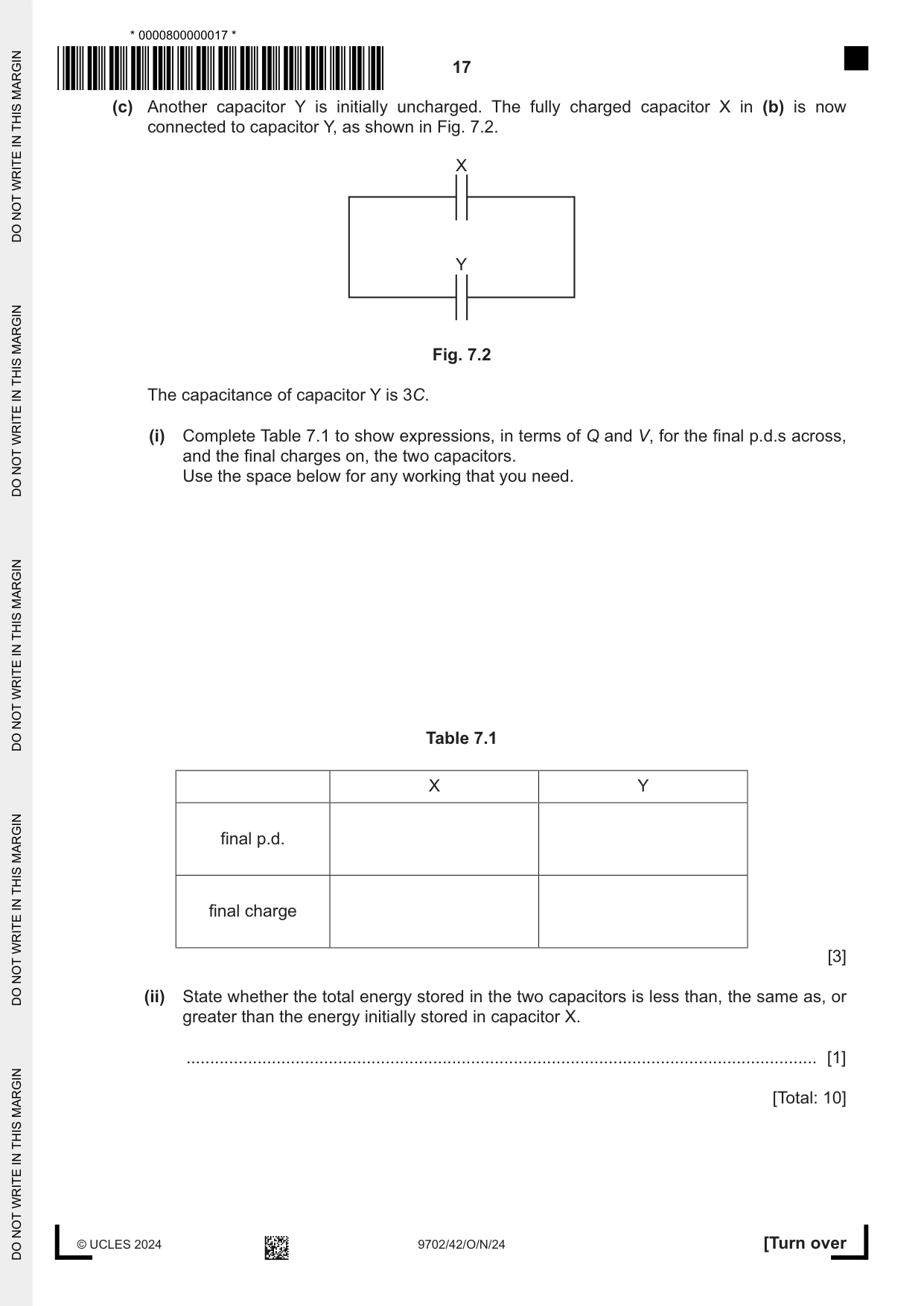
7 (a) Define the capacitance of a parallel‑plate capacitor. ................................................................................................................................................... ................................................................................................................................................... ............................................................................................................................................. [2] (b) An initially uncharged capacitor X, of capacitance C, is gradually charged so that the final potential difference (p.d.) between its plates is V and the final charge is Q. (i) On Fig. 7.1, sketch the variation of charge with p.d. for capacitor X as the p.d. increases from 0 to V. Q charge 0 0 V p.d. Fig. 7.1 [2] (ii) Determine an expression, in terms of Q and V, for the work W done on capacitor X during the charging process. Explain your reasoning. W = ......................................................... [2] (c) Another capacitor Y is initially uncharged. The fully charged capacitor X in (b) is now connected to capacitor Y, as shown in Fig. 7.2. X Y Fig. 7.2 The capacitance of capacitor Y is 3C. (i) Complete Table 7.1 to show expressions, in terms of Q and V, for the final p.d.s across, and the final charges on, the two capacitors. Use the space below for any working that you need. Table 7.1 X Y final p.d. final charge [3] (ii) State whether the total energy stored in the two capacitors is less than, the same as, or greater than the energy initially stored in capacitor X. ..................................................................................................................................... [1] [Total: 10]
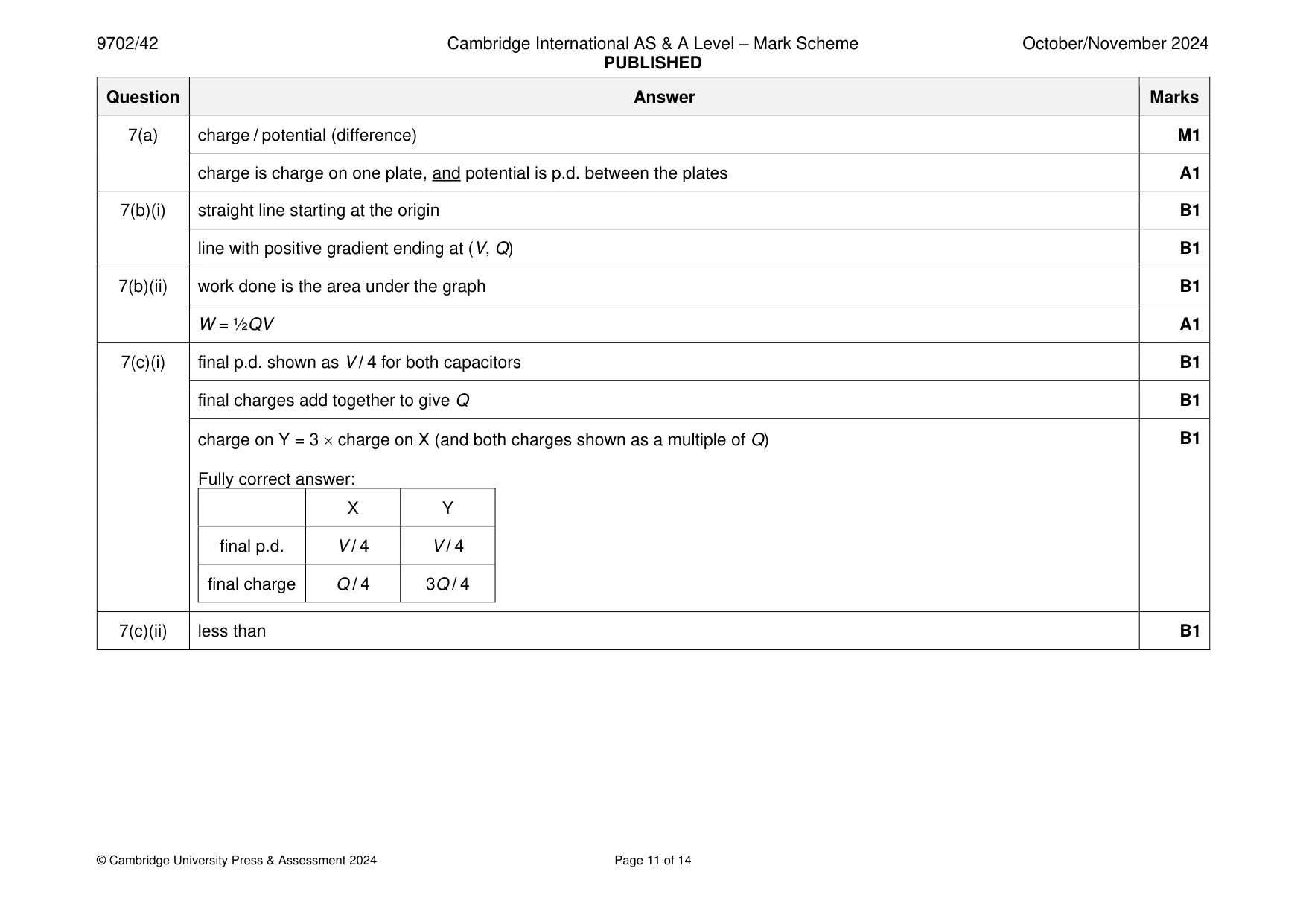
Mark scheme: 7(a) charge / potential (difference) M1 charge is charge on one plate, and potential is p.d. between the plates A1 7(b)(i) straight line starting at the origin B1 line with positive gradient ending at (V, Q) B1 7(b)(ii) work done is the area under the graph B1 W = ½QV A1 7(c)(i) final p.d. shown as V / 4 for both capacitors B1 final charges add together to give Q B1 charge on Y = 3 charge on X (and both charges shown as a multiple of Q) B1 Fully correct answer: X Y final p.d. V / 4 V / 4 final charge Q / 4 3Q / 4 7(c)(ii) less than B1
Q8 · State what is meant by the frequency of an alternating current
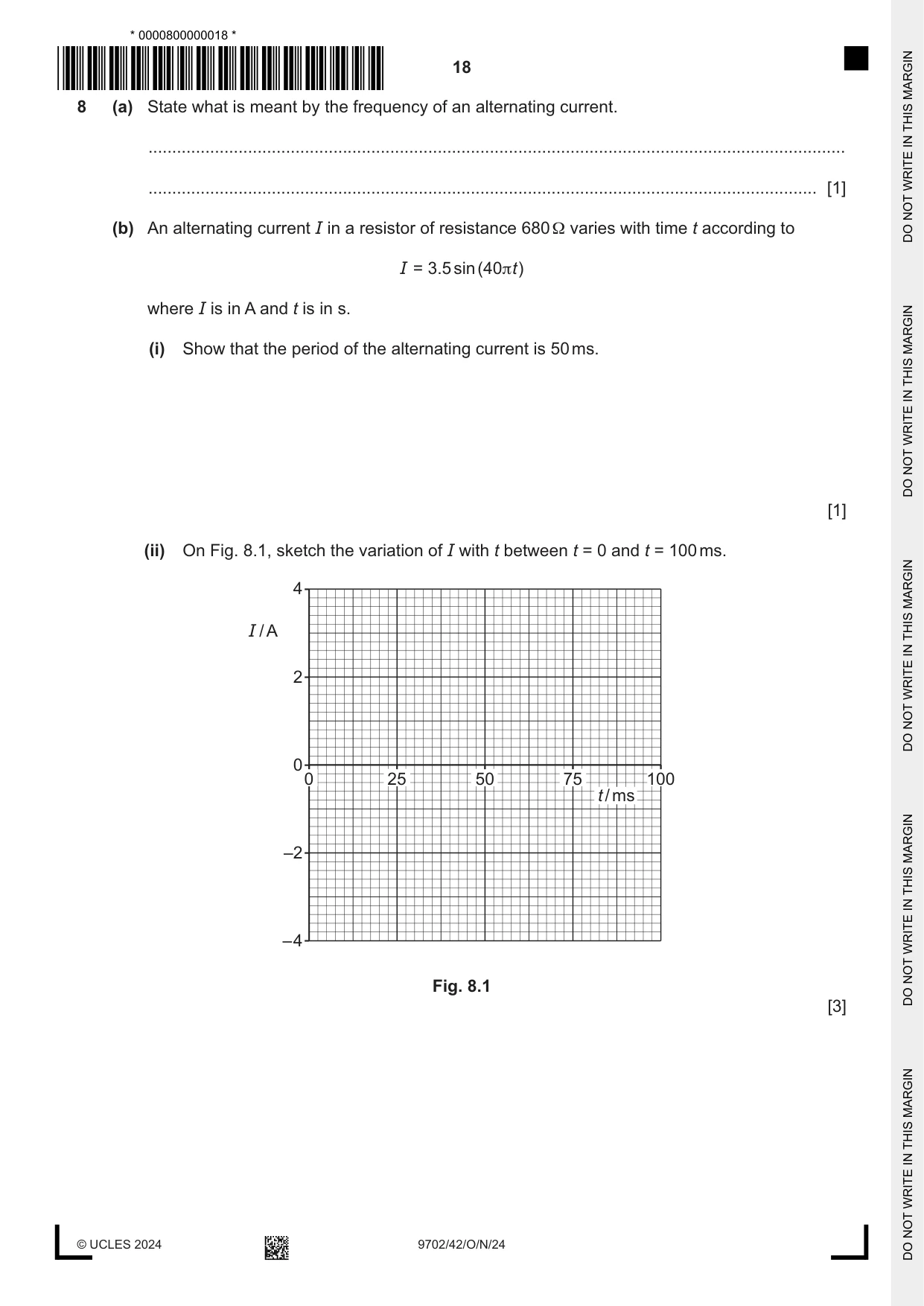
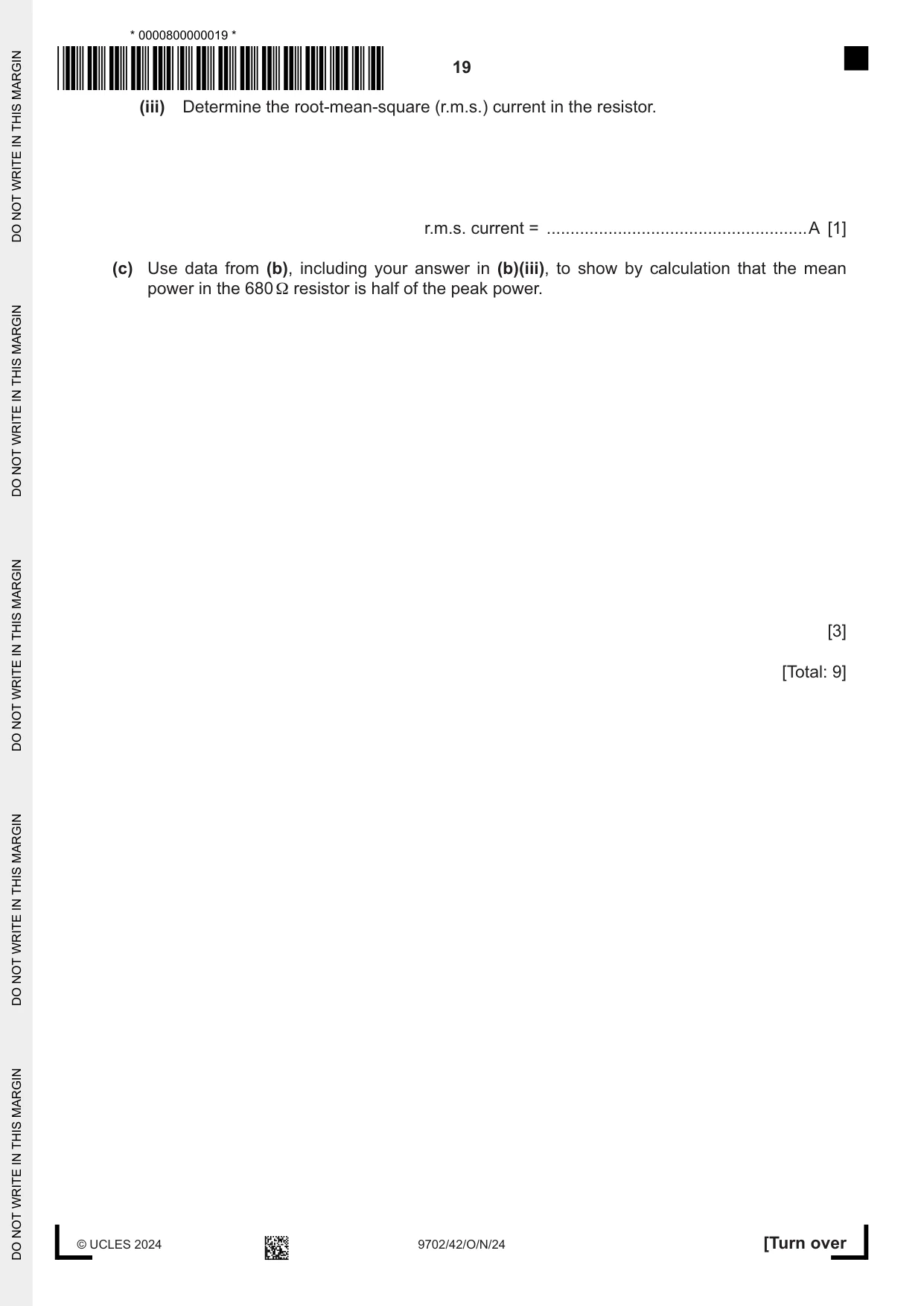
8 (a) State what is meant by the frequency of an alternating current. ................................................................................................................................................... ............................................................................................................................................. [1] (b) An alternating current I in a resistor of resistance 680 Ω varies with time t according to I = 3.5 sin (40πt) where I is in A and t is in s. (i) Show that the period of the alternating current is 50 ms. [1] (ii) On Fig. 8.1, sketch the variation of I with t between t = 0 and t = 100 ms. 4 I / A 2 0 0 25 50 75 100 t / ms –2 – 4 Fig. 8.1 [3] (iii) Determine the root‑mean‑square (r.m.s.) current in the resistor. r.m.s. current = ....................................................... A [1] (c) Use data from (b), including your answer in (b)(iii), to show by calculation that the mean power in the 680 Ω resistor is half of the peak power. [3] [Total: 9]
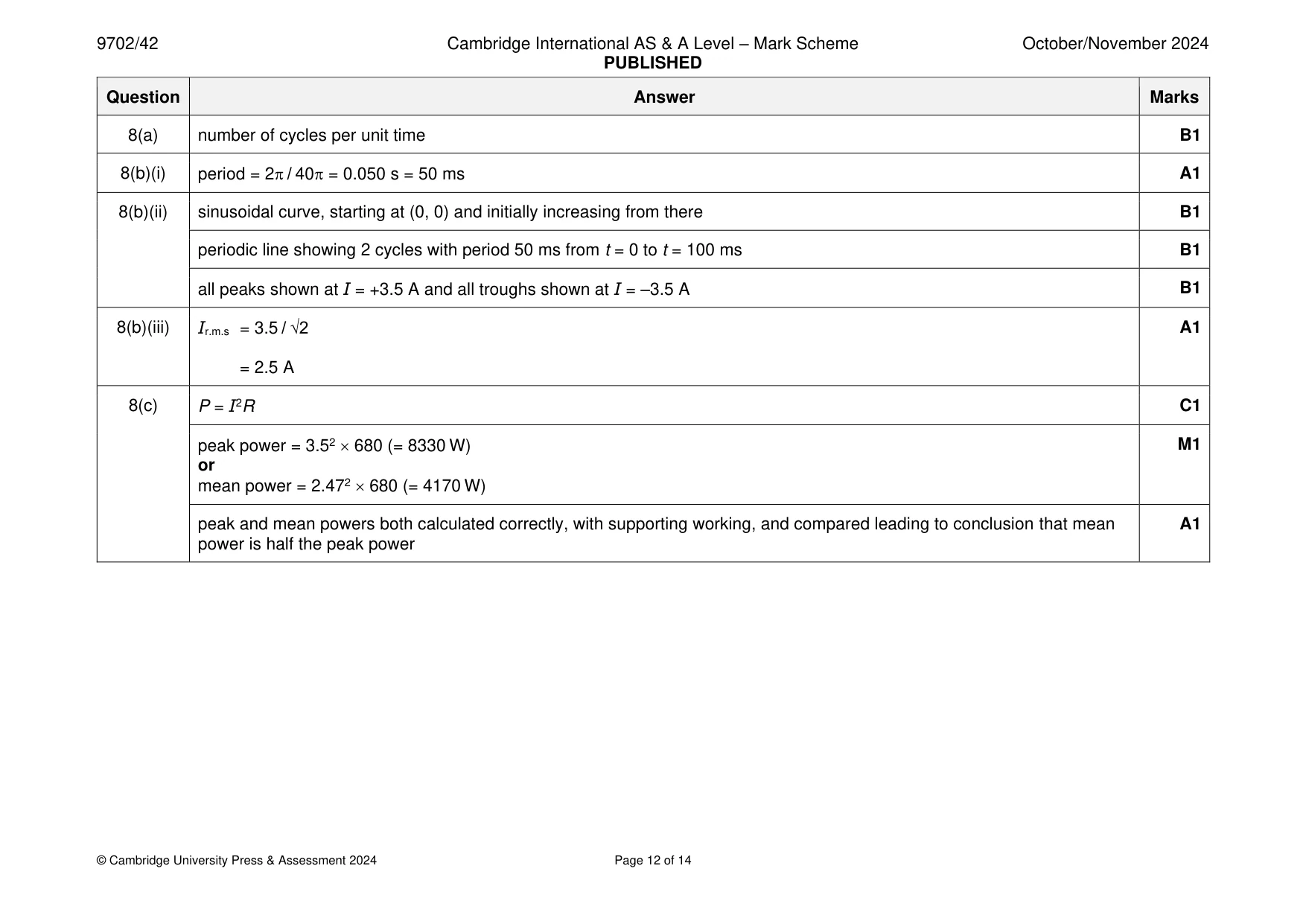
Mark scheme: 8(a) number of cycles per unit time B1 8(b)(i) period = 2 / 40 = 0.050 s = 50 ms A1 8(b)(ii) sinusoidal curve, starting at (0, 0) and initially increasing from there B1 periodic line showing 2 cycles with period 50 ms from t = 0 to t = 100 ms B1 all peaks shown at I = +3.5 A and all troughs shown at I = –3.5 A B1 8(b)(iii) Ir.m.s = 3.5 / √2 A1 = 2.5 A 8(c) P = I2R C1 peak power = 3.52 680 (= 8330 W) M1 or mean power = 2.472 680 (= 4170 W) peak and mean powers both calculated correctly, with supporting working, and compared leading to conclusion that mean A1 power is half the peak power
Q9 · Electrons in a vacuum are accelerated from rest through a potential difference (p.d.) V…
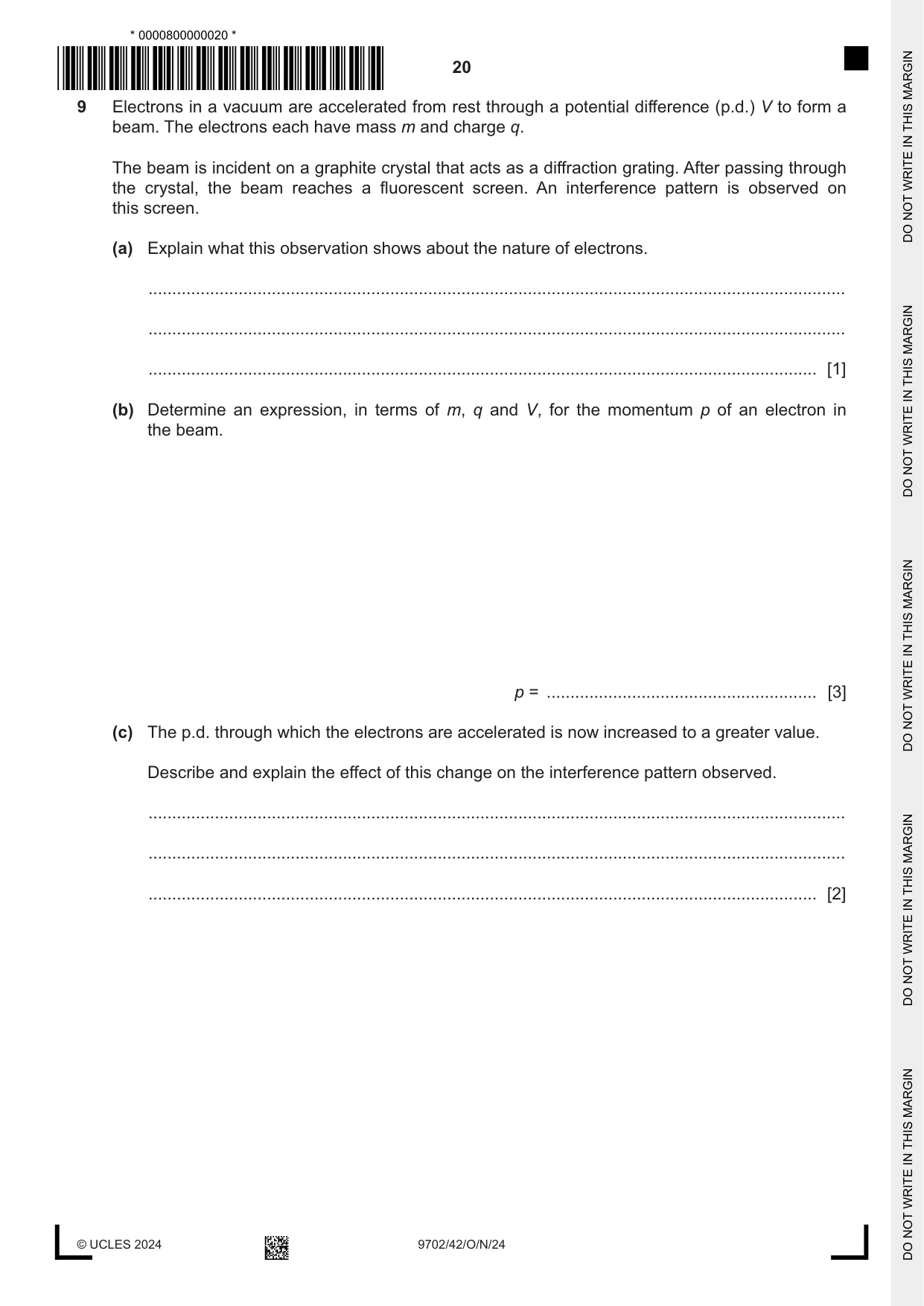
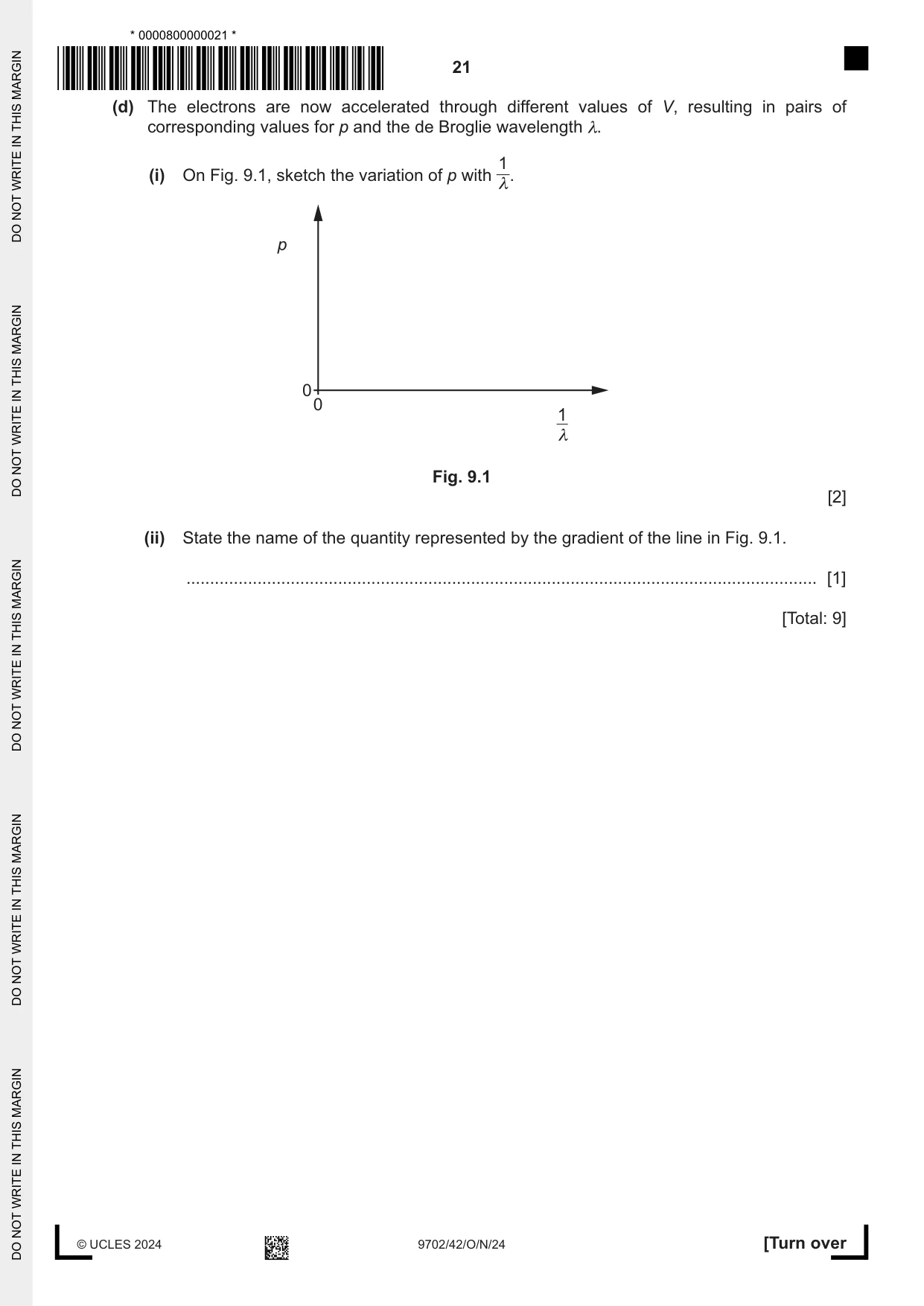
9 Electrons in a vacuum are accelerated from rest through a potential difference (p.d.) V to form a beam. The electrons each have mass m and charge q. The beam is incident on a graphite crystal that acts as a diffraction grating. After passing through the crystal, the beam reaches a fluorescent screen. An interference pattern is observed on this screen. (a) Explain what this observation shows about the nature of electrons. ................................................................................................................................................... ................................................................................................................................................... ............................................................................................................................................. [1] (b) Determine an expression, in terms of m, q and V, for the momentum p of an electron in the beam. p = ......................................................... [3] (c) The p.d. through which the electrons are accelerated is now increased to a greater value. Describe and explain the effect of this change on the interference pattern observed. ................................................................................................................................................... ................................................................................................................................................... ............................................................................................................................................. [2] (d) The electrons are now accelerated through different values of V, resulting in pairs of corresponding values for p and the de Broglie wavelength λ. 1 (i) On Fig. 9.1, sketch the variation of p with λ. p 0 0 1 λ Fig. 9.1 [2] (ii) State the name of the quantity represented by the gradient of the line in Fig. 9.1. ..................................................................................................................................... [1] [Total: 9]
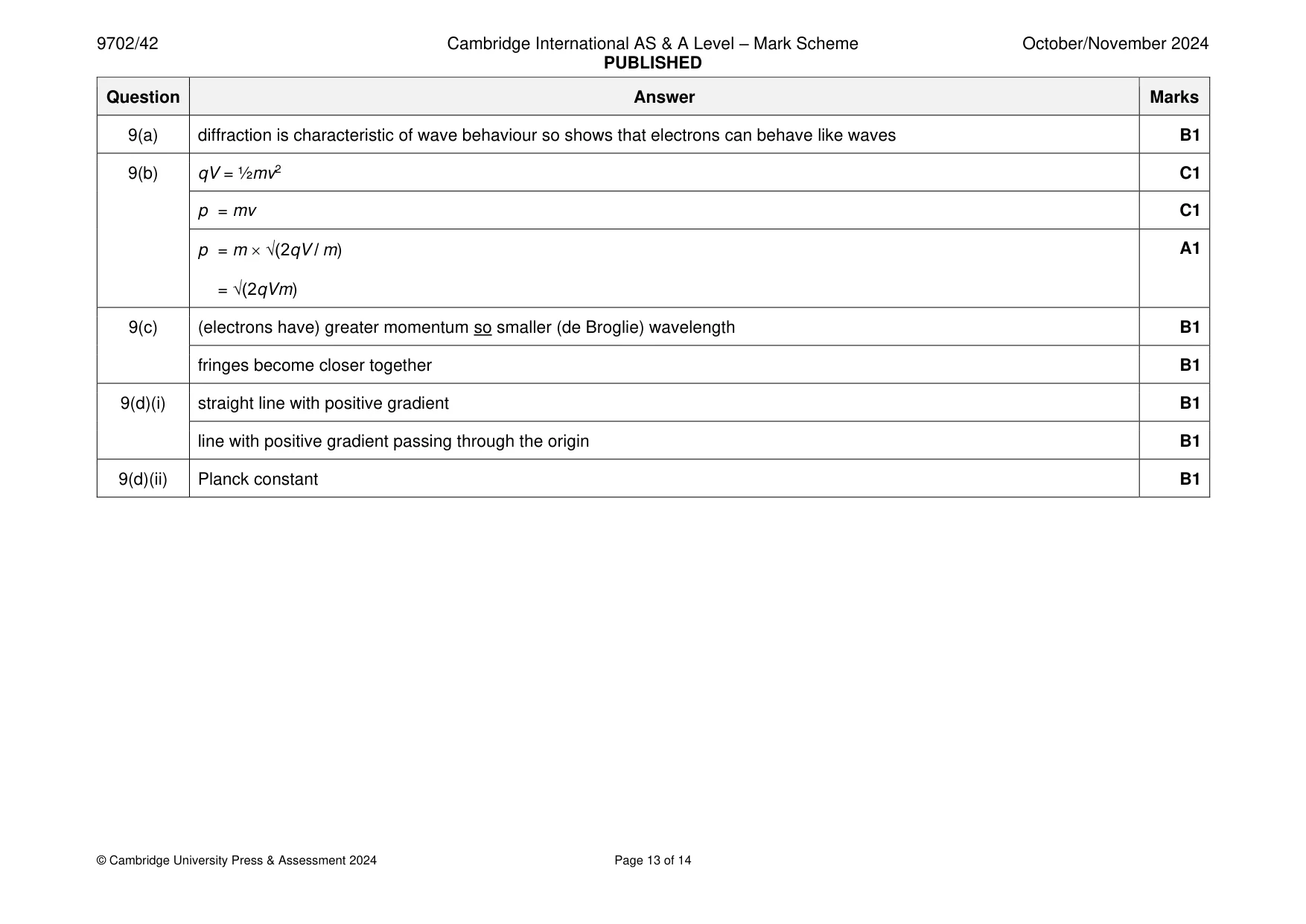
Mark scheme: 9(a) diffraction is characteristic of wave behaviour so shows that electrons can behave like waves B1 9(b) qV = ½mv2 C1 p = mv C1 p = m √(2qV / m) A1 = √(2qVm) 9(c) (electrons have) greater momentum so smaller (de Broglie) wavelength B1 fringes become closer together B1 9(d)(i) straight line with positive gradient B1 line with positive gradient passing through the origin B1 9(d)(ii) Planck constant B1
Q10 · Radioactive decay is both random and spontaneous
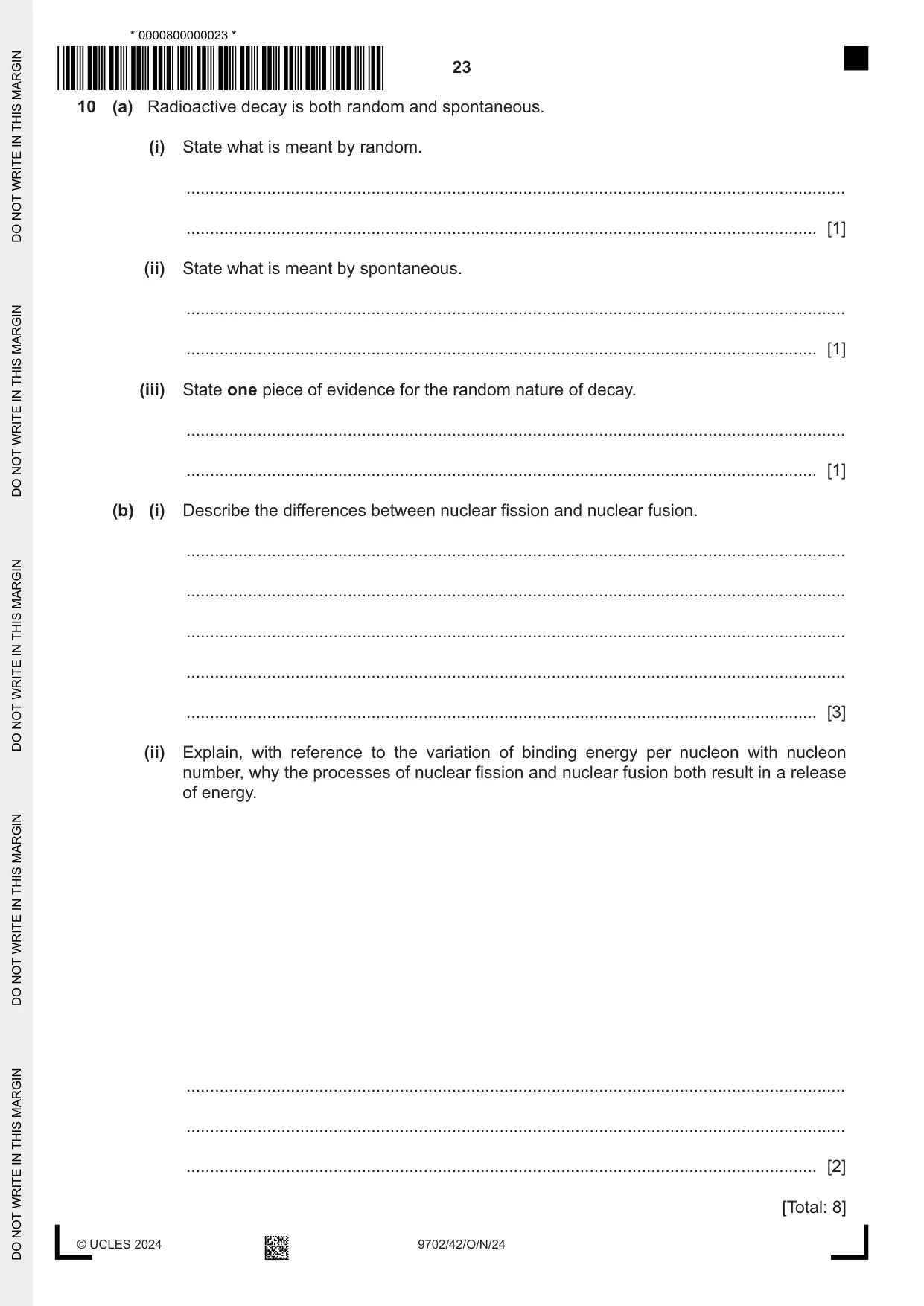
10 (a) Radioactive decay is both random and spontaneous. (i) State what is meant by random. ........................................................................................................................................... ..................................................................................................................................... [1] (ii) State what is meant by spontaneous. ........................................................................................................................................... ..................................................................................................................................... [1] (iii) State one piece of evidence for the random nature of decay. ........................................................................................................................................... ..................................................................................................................................... [1] (b) (i) Describe the differences between nuclear fission and nuclear fusion. ........................................................................................................................................... ........................................................................................................................................... ........................................................................................................................................... ........................................................................................................................................... ..................................................................................................................................... [3] (ii) Explain, with reference to the variation of binding energy per nucleon with nucleon number, why the processes of nuclear fission and nuclear fusion both result in a release of energy. ........................................................................................................................................... ........................................................................................................................................... ..................................................................................................................................... [2] [Total: 8]
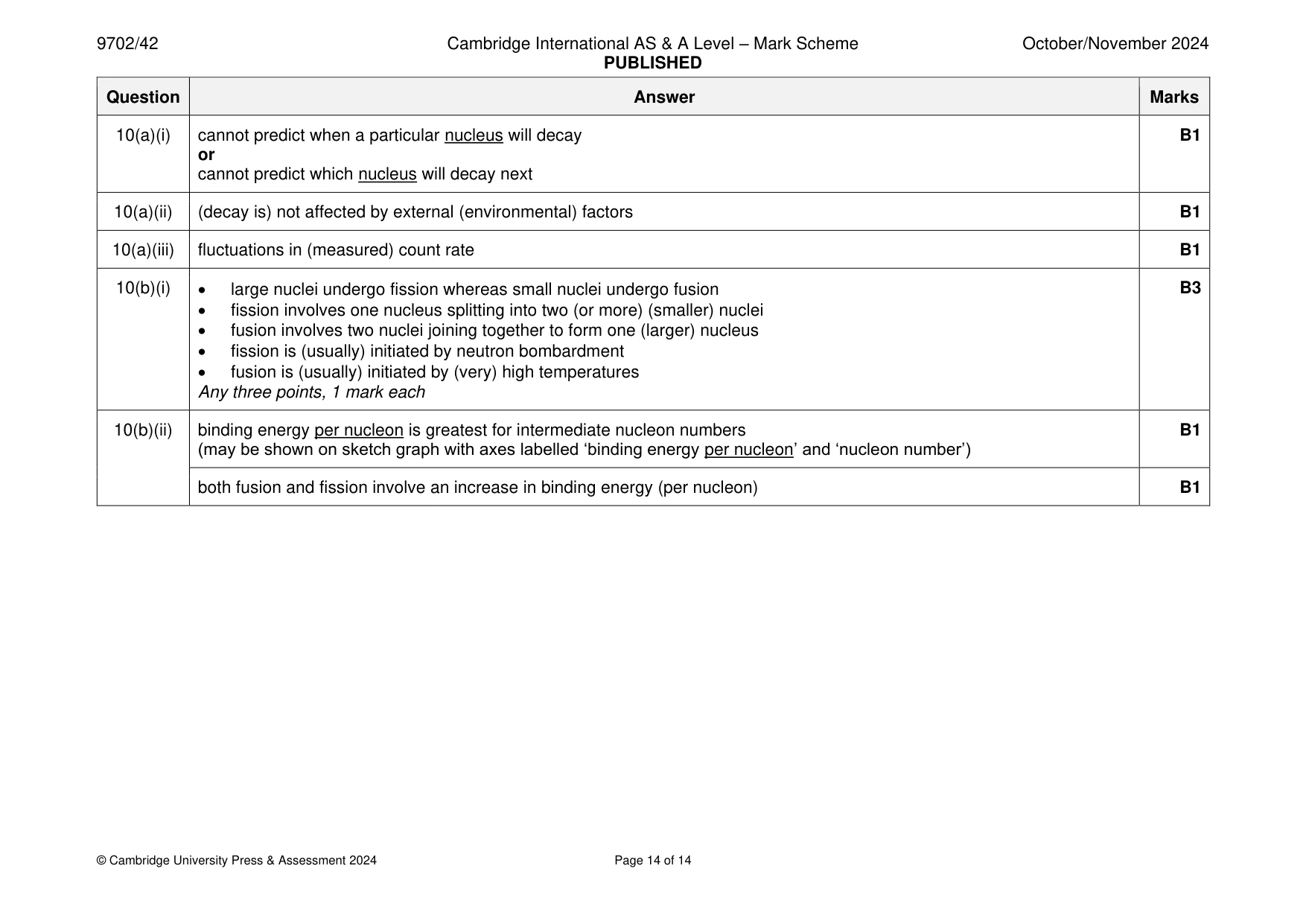
Mark scheme: 10(a)(i) cannot predict when a particular nucleus will decay B1 or cannot predict which nucleus will decay next 10(a)(ii) (decay is) not affected by external (environmental) factors B1 10(a)(iii) fluctuations in (measured) count rate B1 10(b)(i) • large nuclei undergo fission whereas small nuclei undergo fusion B3 • fission involves one nucleus splitting into two (or more) (smaller) nuclei • fusion involves two nuclei joining together to form one (larger) nucleus • fission is (usually) initiated by neutron bombardment • fusion is (usually) initiated by (very) high temperatures Any three points, 1 mark each 10(b)(ii) binding energy per nucleon is greatest for intermediate nucleon numbers B1 (may be shown on sketch graph with axes labelled ‘binding energy per nucleon’ and ‘nucleon number’) both fusion and fission involve an increase in binding energy (per nucleon) B1
What was in this paper
The subtopics covered by these 10 questions, and how many questions each got. Open one in a new tab to see every Cambridge question on it.
What you needed in this session
Cambridge’s own grade thresholds for 2024 Oct/Nov, Paper 4 · Variant 2. A higher threshold means an easier paper — the bar moves with how the cohort did.