Cambridge A Level Physics 9702 — 2021 May/June Paper 4 · Variant 2
9702/42/M/J/21 · 12 questions · 100 marks · ≈113 min
The question paper and its mark scheme, free to read here and free to download. This is Cambridge’s own paper, exactly as it was sat.
Question paper28 pages


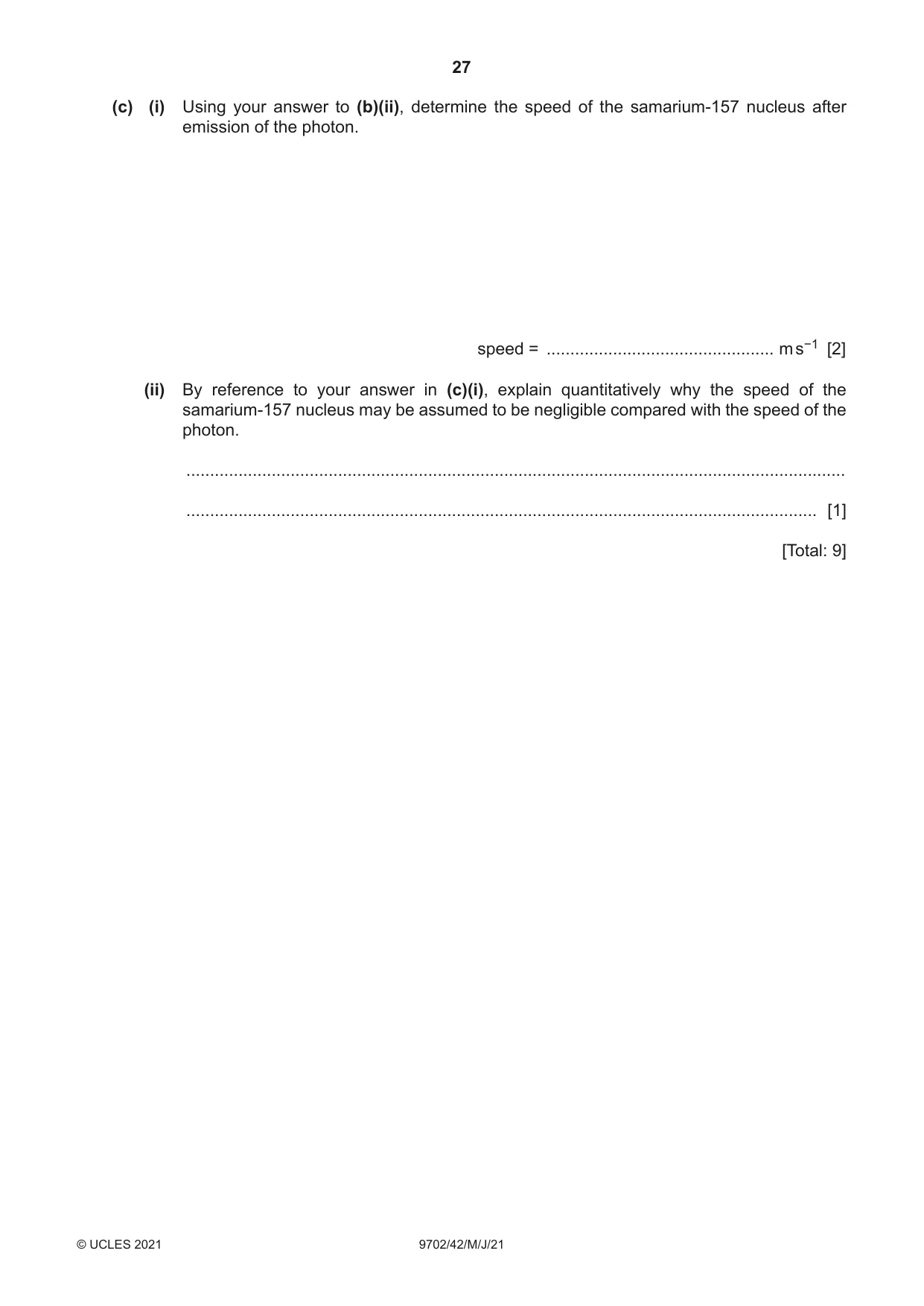
Mark scheme19 pages
Answers below. Sit the paper first if you are practising.
Questions as text
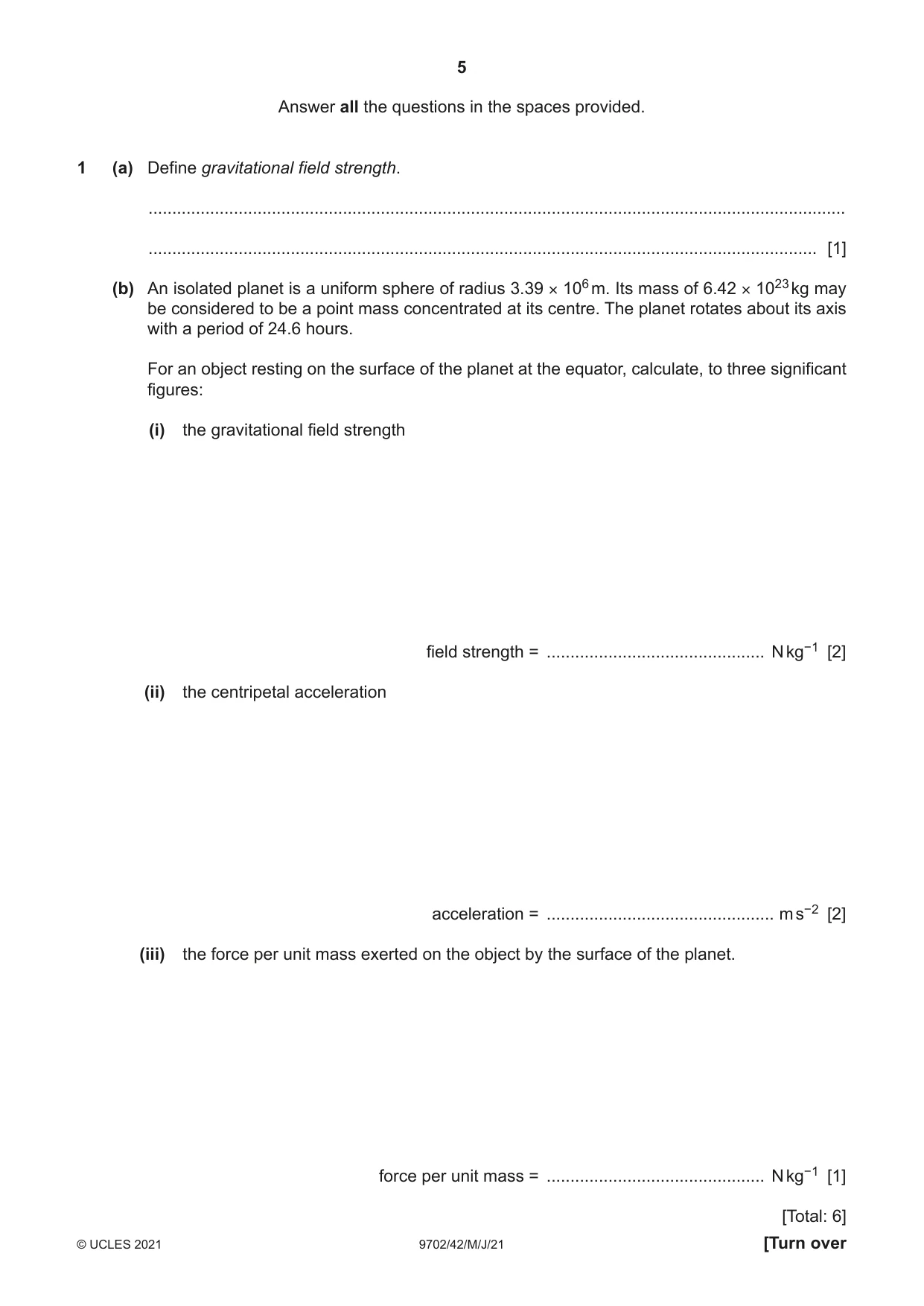
Q1 · Define gravitational field strength
1 (a) Define gravitational field strength. ................................................................................................................................................... ............................................................................................................................................. [1] (b) An isolated planet is a uniform sphere of radius 3.39 × 10⁶ m. Its mass of 6.42 × 10²³ kg may be considered to be a point mass concentrated at its centre. The planet rotates about its axis with a period of 24.6 hours. For an object resting on the surface of the planet at the equator, calculate, to three significant figures: (i) the gravitational field strength field strength = .............................................. N kg−1 [2] (ii) the centripetal acceleration acceleration = ................................................ m s−2 [2] (iii) the force per unit mass exerted on the object by the surface of the planet. force per unit mass = .............................................. N kg−1 [1] [Total: 6]
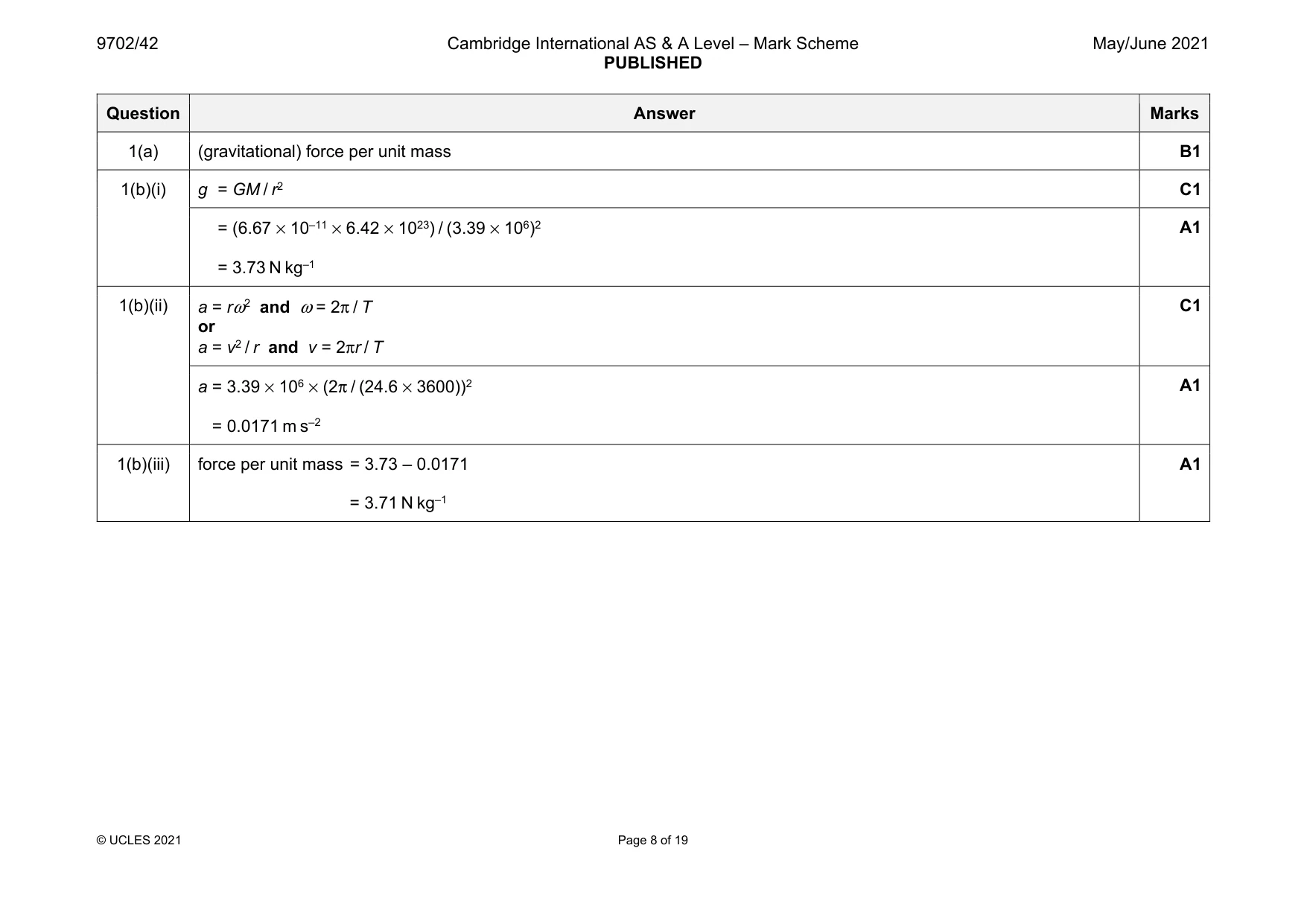
Mark scheme: 1(a) (gravitational) force per unit mass B1 1(b)(i) g = GM / r2 C1 = (6.67 × 10–11 × 6.42 × 1023) / (3.39 × 10⁶)2 = 3.73 N kg–1 A1 1(b)(ii) a = rω2 and ω = 2π / T or a = v2 / r and v = 2πr / T C1 a = 3.39 × 106 × (2π / (24.6 × 3600))2 = 0.0171 m s–2 A1 1(b)(iii) force per unit mass = 3.73 – 0.0171 = 3.71 N kg–1 A1
Q2 · An ideal gas has a volume of 3.1 × 10⁻³ m3 at a pressure of 8.5 × 10⁵ Pa and a…
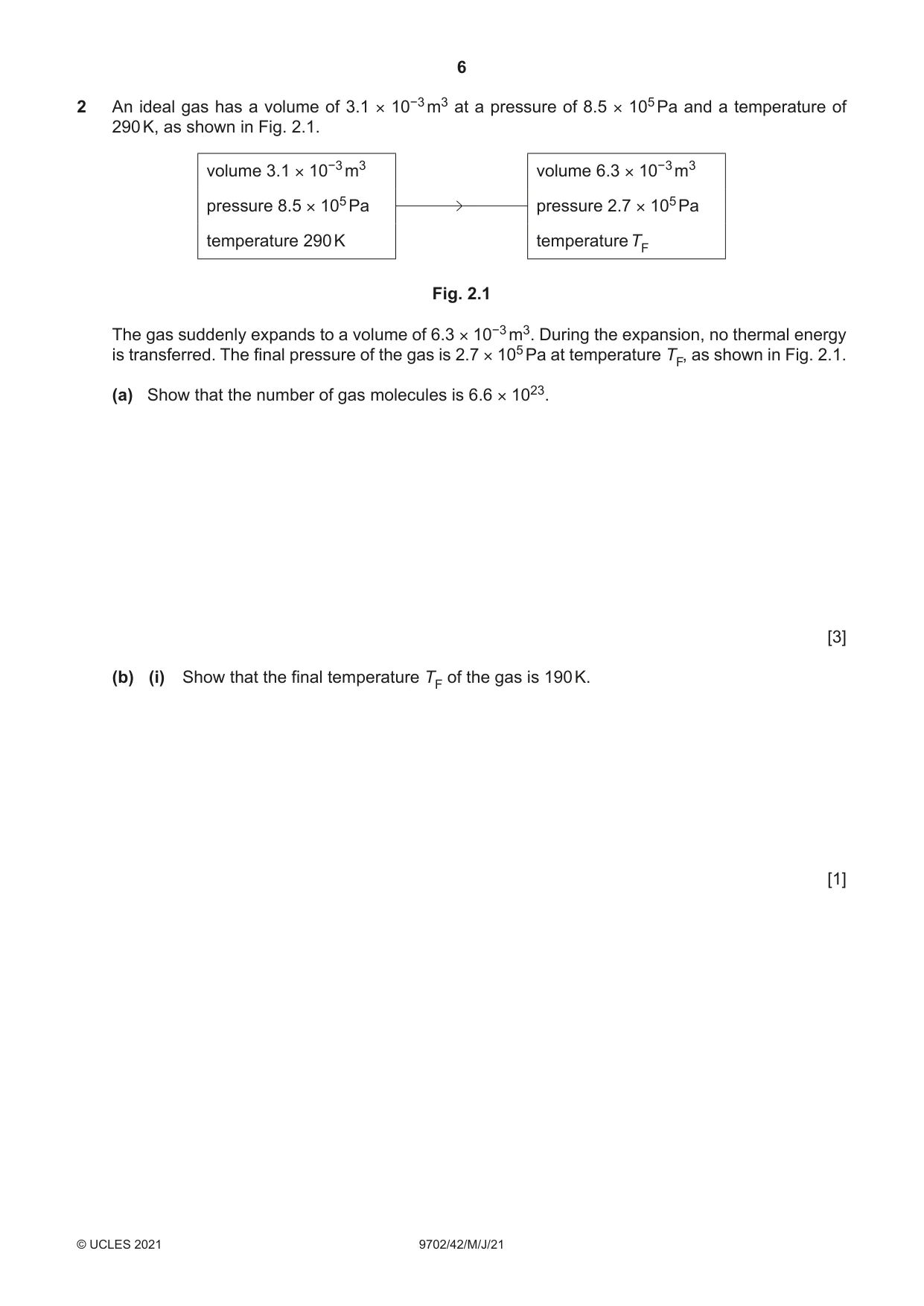
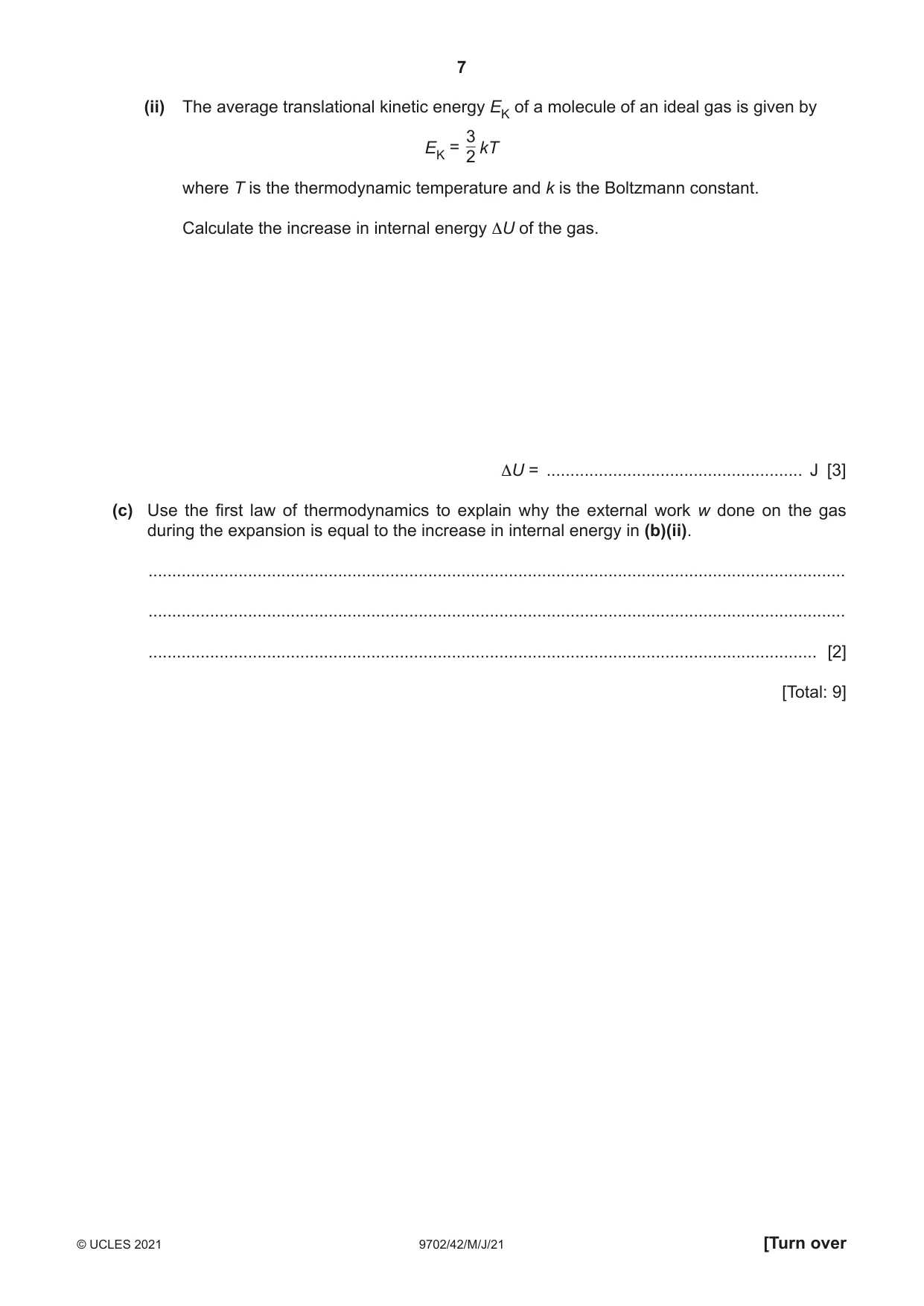
2 An ideal gas has a volume of 3.1 × 10⁻³ m3 at a pressure of 8.5 × 10⁵ Pa and a temperature of 290 K, as shown in Fig. 2.1. volume 3.1 × 10⁻³ m3 volume 6.3 × 10⁻³ m3 pressure 8.5 × 10⁵ Pa pressure 2.7 × 10⁵ Pa temperature 290 K temperature TF Fig. 2.1 The gas suddenly expands to a volume of 6.3 × 10⁻³ m3. During the expansion, no thermal energy is transferred. The final pressure of the gas is 2.7 × 10⁵ Pa at temperature TF, as shown in Fig. 2.1. (a) Show that the number of gas molecules is 6.6 × 10²³. [3] (b) (i) Show that the final temperature TF of the gas is 190 K. [1] (ii) The average translational kinetic energy EK of a molecule of an ideal gas is given by 3 EK = kT 2 where T is the thermodynamic temperature and k is the Boltzmann constant. Calculate the increase in internal energy ΔU of the gas. ΔU = ...................................................... J [3] (c) Use the first law of thermodynamics to explain why the external work w done on the gas during the expansion is equal to the increase in internal energy in (b)(ii). ................................................................................................................................................... ................................................................................................................................................... ............................................................................................................................................. [2] [Total: 9]
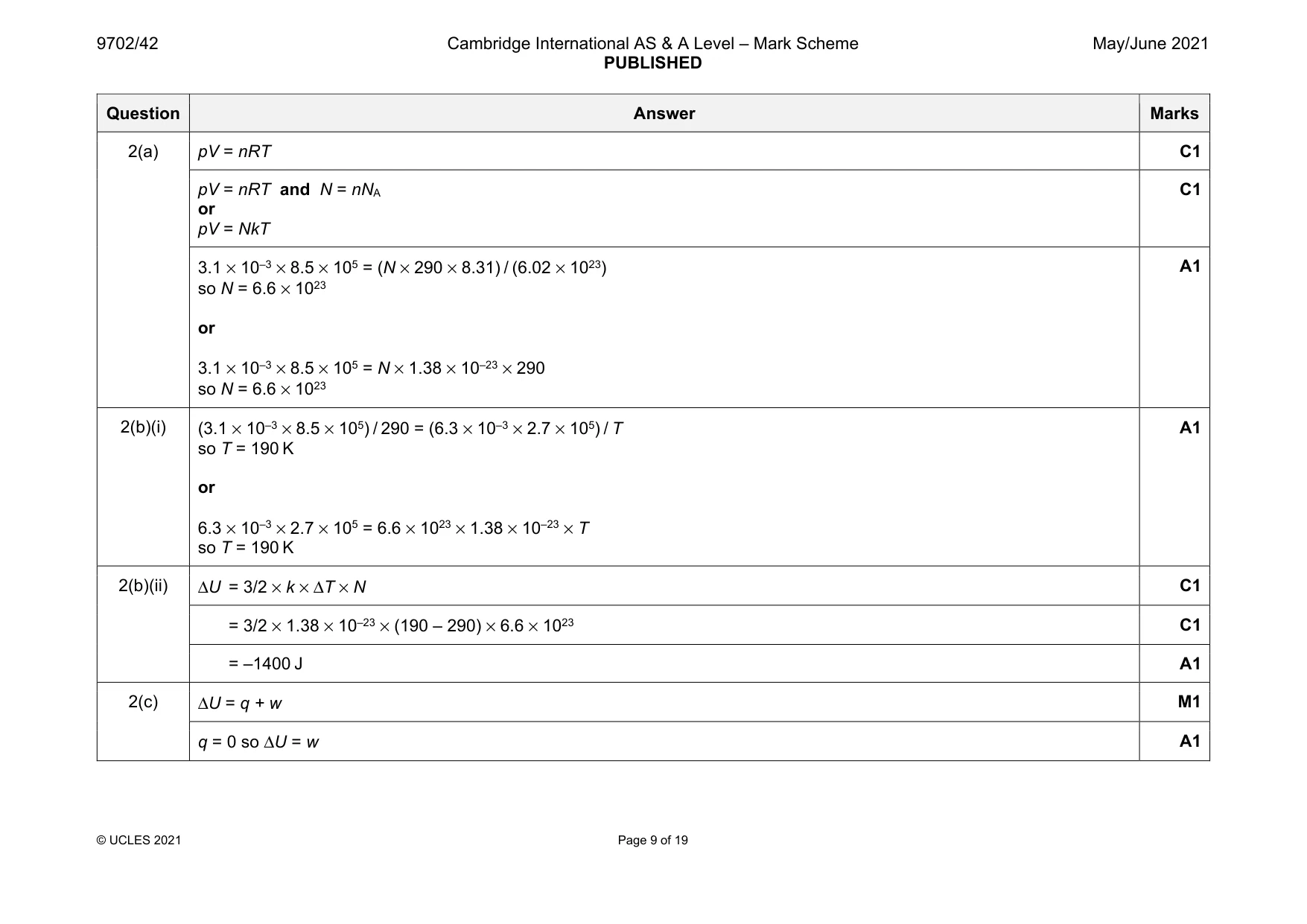
Mark scheme: 2(a) pV = nRT C1 pV = nRT and N = nNA or pV = NkT C1 3.1 × 10–3 × 8.5 × 105 = (N × 290 × 8.31) / (6.02 × 10²³) so N = 6.6 × 10²³ or 3.1 × 10–3 × 8.5 × 105 = N × 1.38 × 10–23 × 290 so N = 6.6 × 10²³ A1 2(b)(i) (3.1 × 10–3 × 8.5 × 105) / 290 = (6.3 × 10–3 × 2.7 × 105) / T so T = 190 K or 6.3 × 10–3 × 2.7 × 105 = 6.6 × 1023 × 1.38 × 10–23 × T so T = 190 K A1 2(b)(ii) ΔU = 3/2 × k × ΔT × N C1 = 3/2 × 1.38 × 10–23 × (190 – 290) × 6.6 × 1023 C1 = –1400 J A1 2(c) ΔU = q + w M1 q = 0 so ΔU = w A1
Q3 · A U-shaped tube contains some liquid
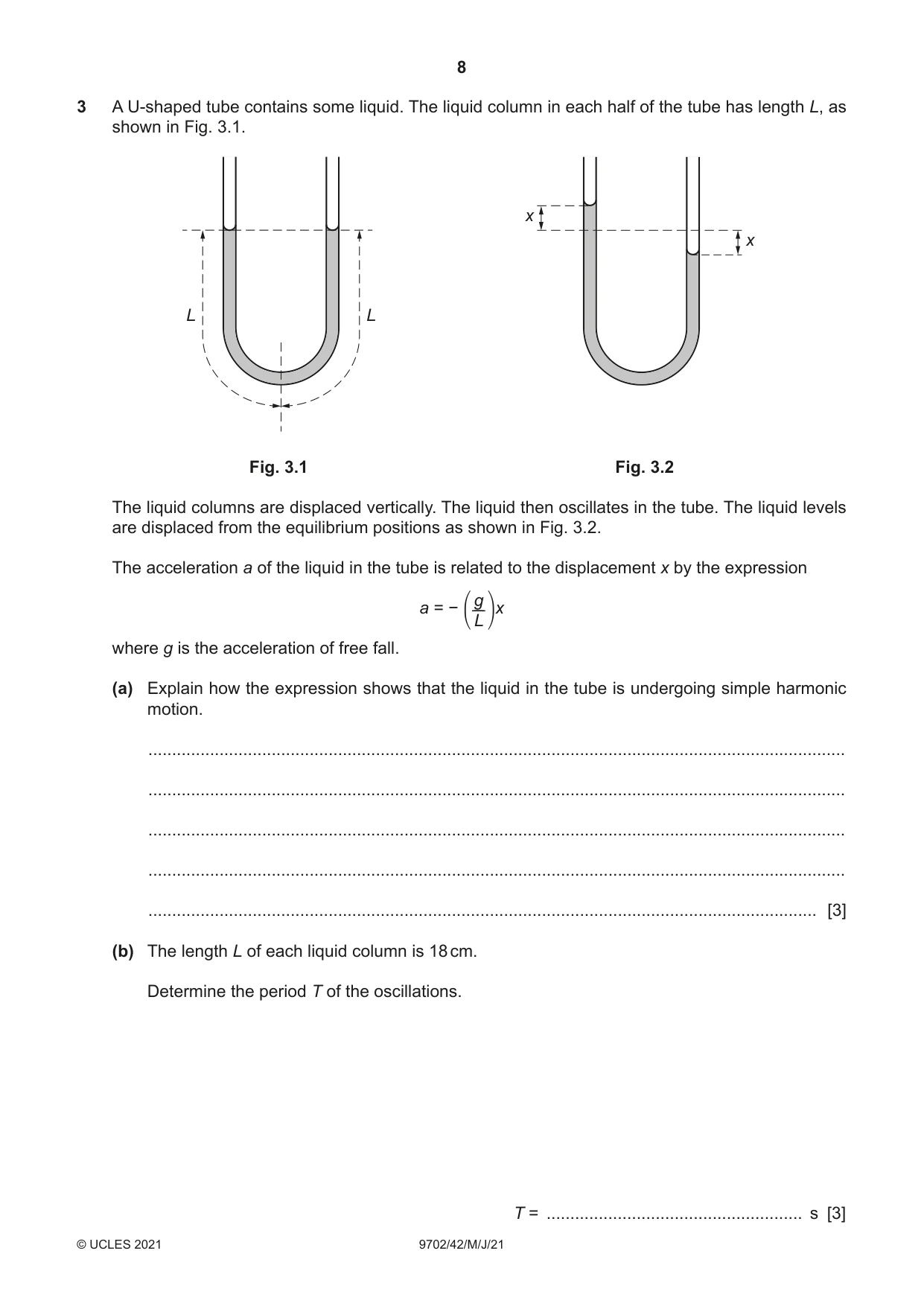
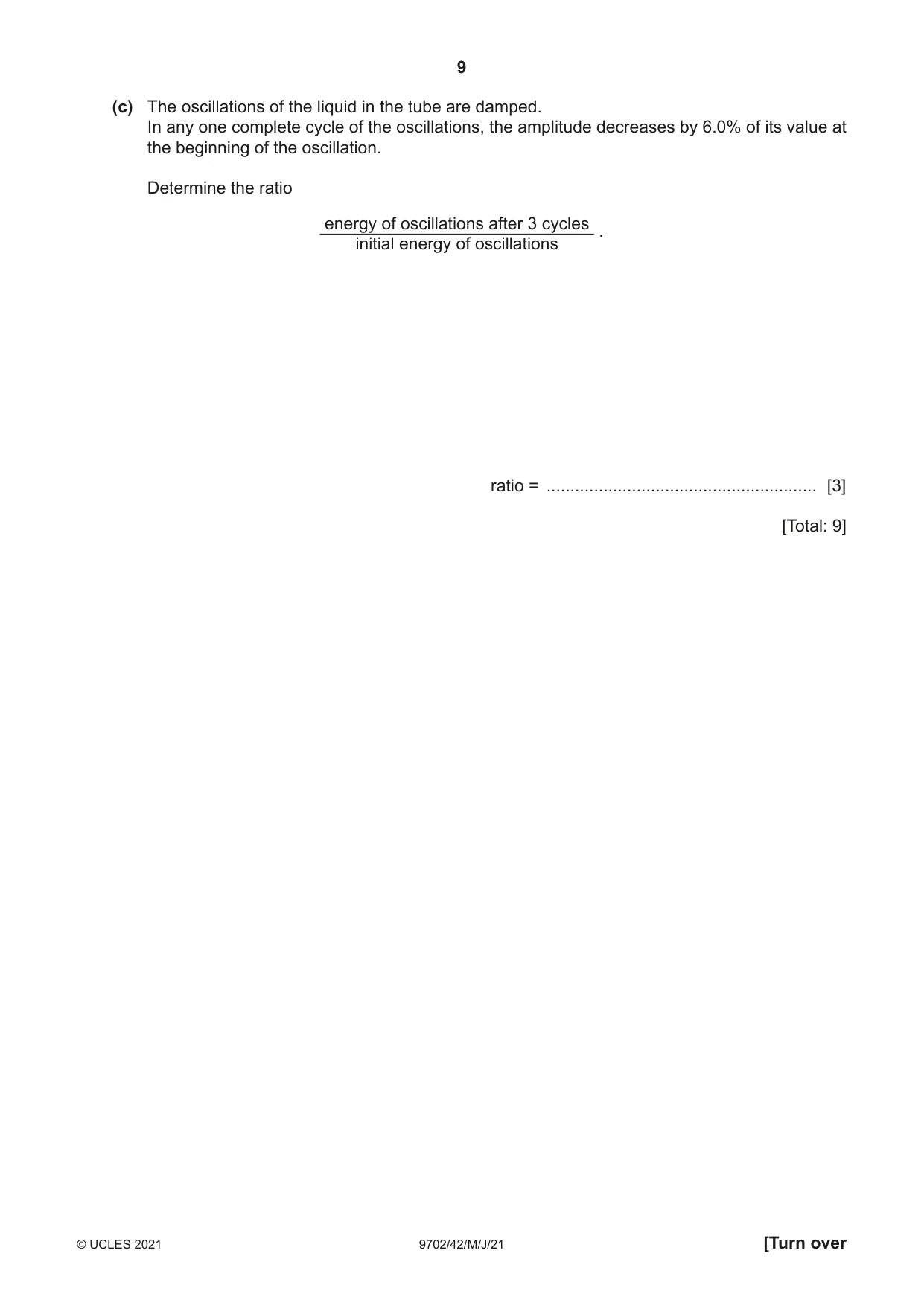
3 A U-shaped tube contains some liquid. The liquid column in each half of the tube has length L, as shown in Fig. 3.1. x x L L Fig. 3.1 Fig. 3.2 The liquid columns are displaced vertically. The liquid then oscillates in the tube. The liquid levels are displaced from the equilibrium positions as shown in Fig. 3.2. The acceleration a of the liquid in the tube is related to the displacement x by the expression ⎛ g ⎞ a = − x ⎝ L ⎠ where g is the acceleration of free fall. (a) Explain how the expression shows that the liquid in the tube is undergoing simple harmonic motion. ................................................................................................................................................... ................................................................................................................................................... ................................................................................................................................................... ................................................................................................................................................... ............................................................................................................................................. [3] (b) The length L of each liquid column is 18 cm. Determine the period T of the oscillations. T = ...................................................... s [3] (c) The oscillations of the liquid in the tube are damped. In any one complete cycle of the oscillations, the amplitude decreases by 6.0% of its value at the beginning of the oscillation. Determine the ratio energy of oscillations after 3 cycles . initial energy of oscillations ratio = ......................................................... [3] [Total: 9]
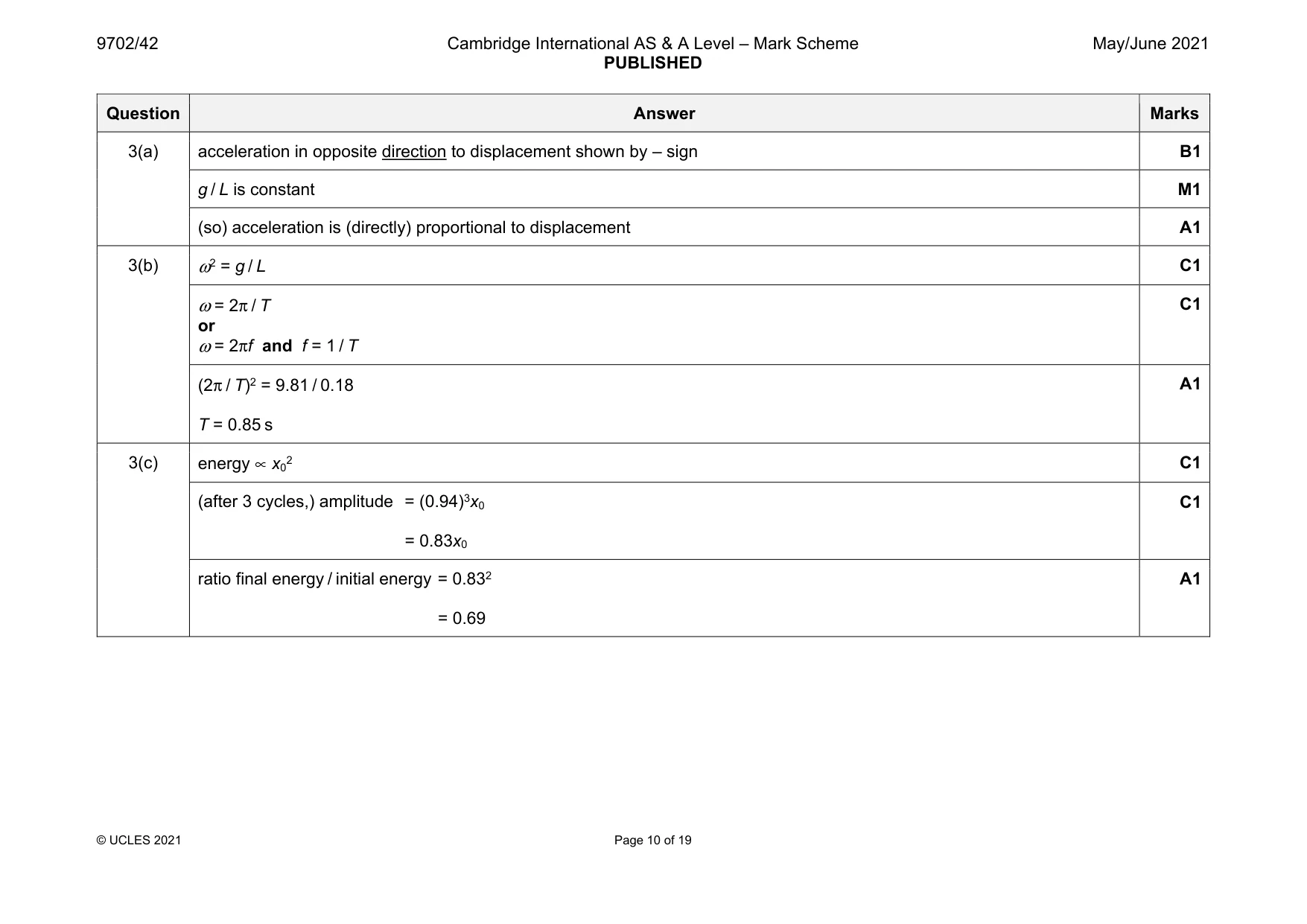
Mark scheme: 3(a) acceleration in opposite direction to displacement shown by – sign B1 g / L is constant M1 (so) acceleration is (directly) proportional to displacement A1 3(b) ω2 = g / L C1 ω = 2π / T or ω = 2πf and f = 1 / T C1 (2π / T)2 = 9.81 / 0.18 T = 0.85 s A1 3(c) energy ∝ x02 C1 (after 3 cycles,) amplitude = (0.94)3x0 = 0.83x0 C1 ratio final energy / initial energy = 0.832 = 0.69 A1
Q4 · A sinusoidal carrier wave has a constant amplitude and a frequency of 1.2 MHz
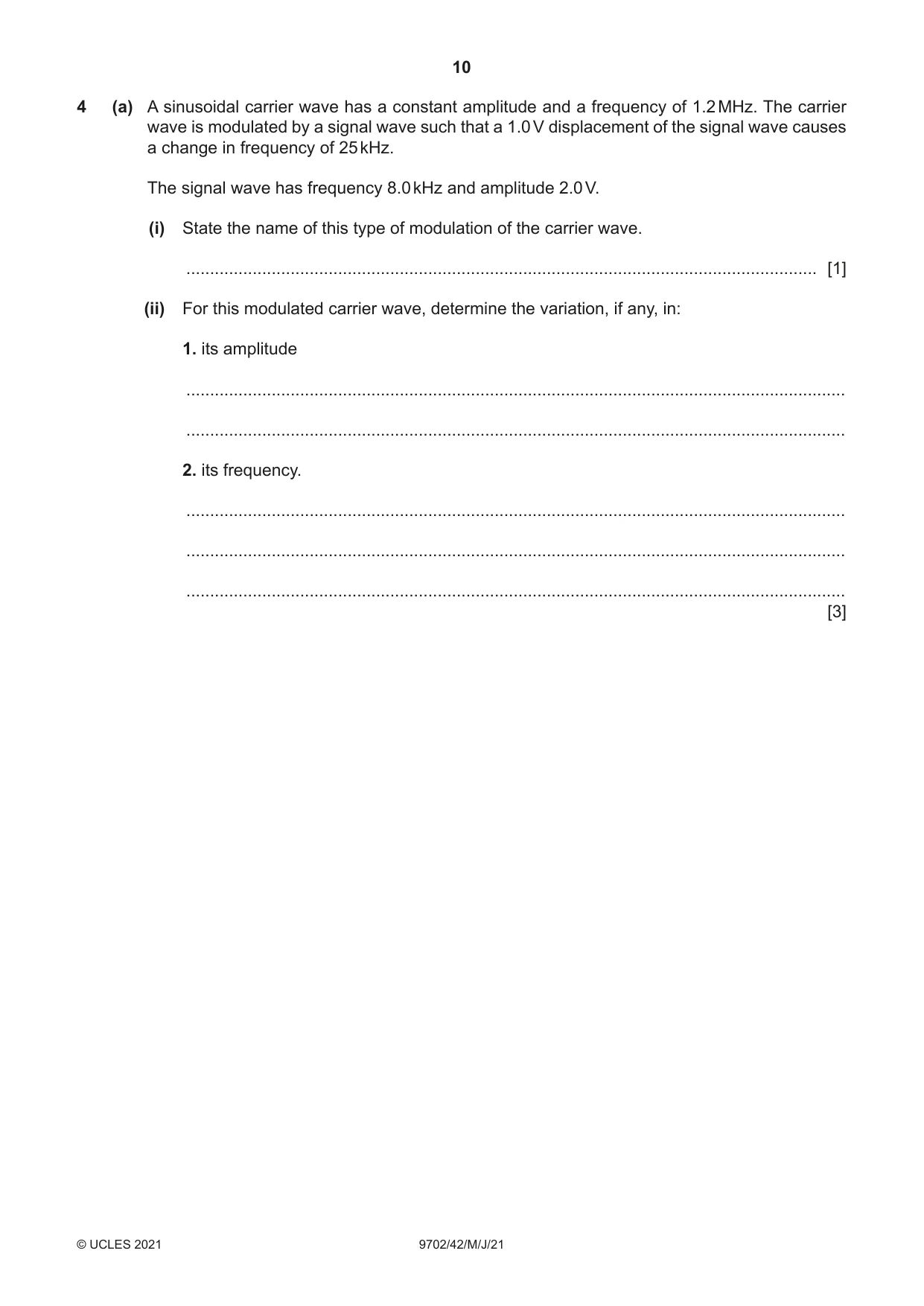
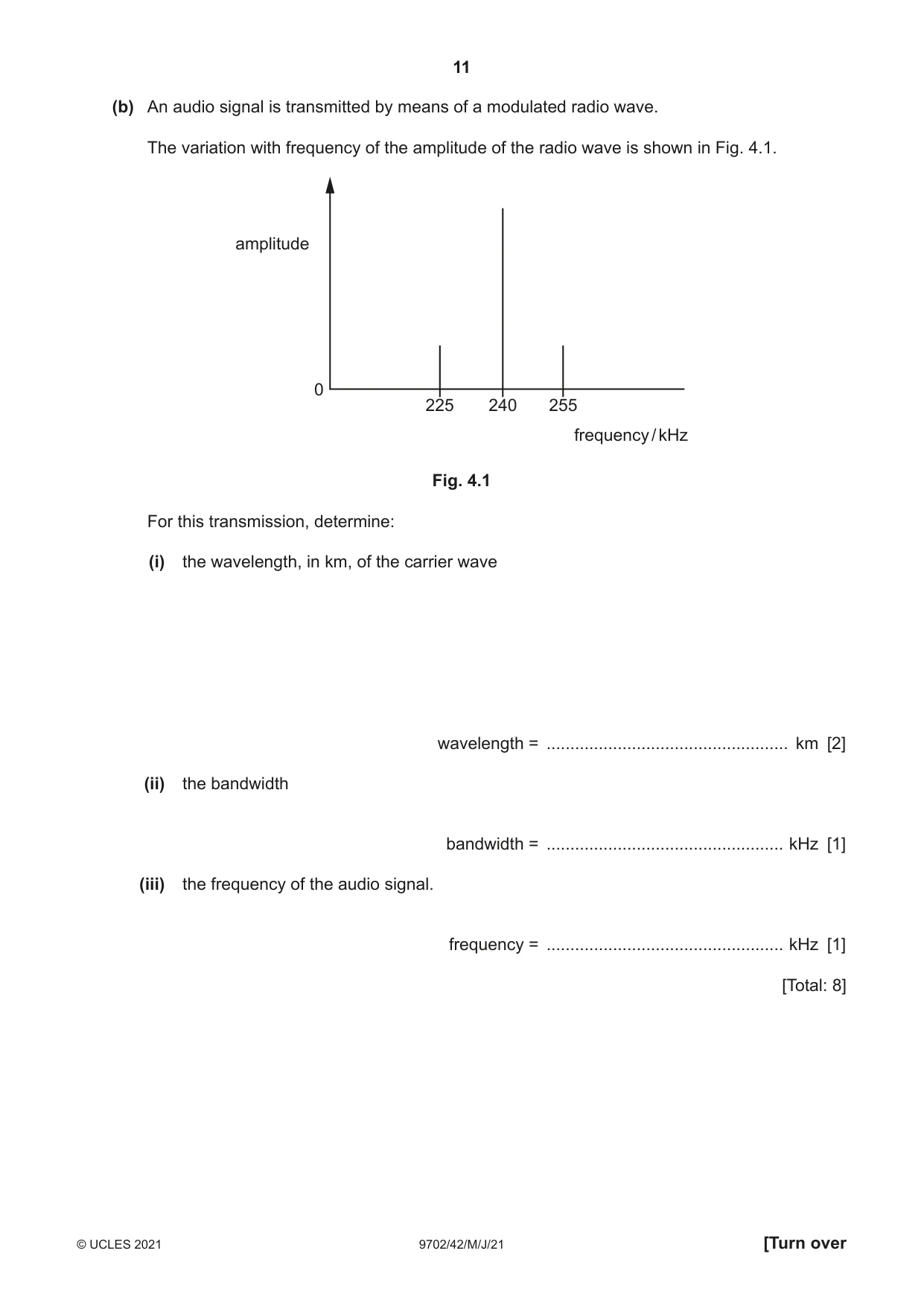
4 (a) A sinusoidal carrier wave has a constant amplitude and a frequency of 1.2 MHz. The carrier wave is modulated by a signal wave such that a 1.0 V displacement of the signal wave causes a change in frequency of 25 kHz. The signal wave has frequency 8.0 kHz and amplitude 2.0 V. (i) State the name of this type of modulation of the carrier wave. ..................................................................................................................................... [1] (ii) For this modulated carrier wave, determine the variation, if any, in: 1. its amplitude ........................................................................................................................................... ........................................................................................................................................... 2. its frequency. ........................................................................................................................................... ........................................................................................................................................... ........................................................................................................................................... [3] (b) An audio signal is transmitted by means of a modulated radio wave. The variation with frequency of the amplitude of the radio wave is shown in Fig. 4.1. amplitude 0 225 240 255 frequency / kHz Fig. 4.1 For this transmission, determine: (i) the wavelength, in km, of the carrier wave wavelength = ................................................... km [2] (ii) the bandwidth bandwidth = .................................................. kHz [1] (iii) the frequency of the audio signal. frequency = .................................................. kHz [1] [Total: 8]
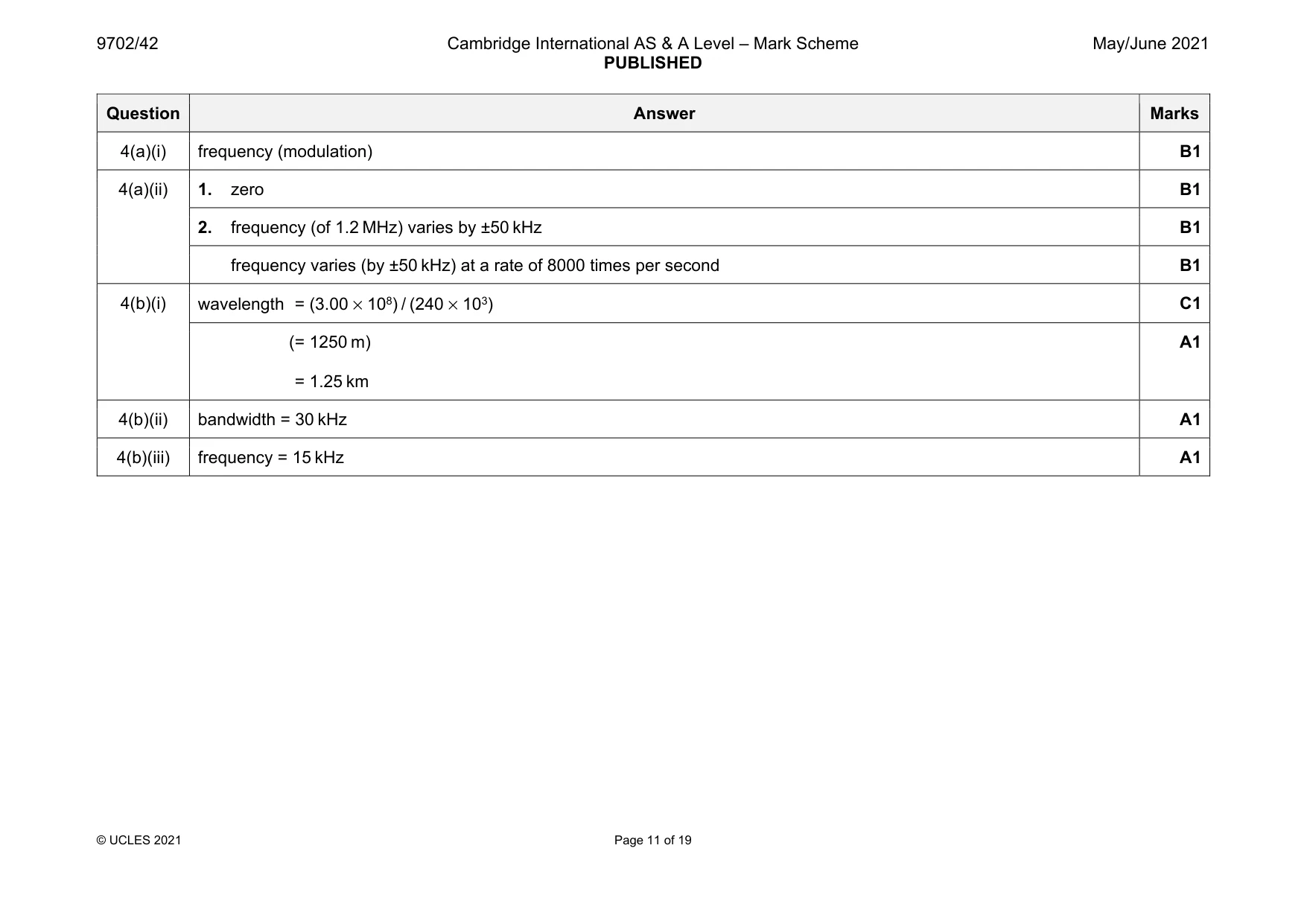
Mark scheme: 4(a)(i) frequency (modulation) B1 4(a)(ii) 1. zero B1 2. frequency (of 1.2 MHz) varies by ±50 kHz B1 frequency varies (by ±50 kHz) at a rate of 8000 times per second B1 4(b)(i) wavelength = (3.00 × 10⁸) / (240 × 103) C1 (= 1250 m) = 1.25 km A1 4(b)(ii) bandwidth = 30 kHz A1 4(b)(iii) frequency = 15 kHz A1
Q5 · An isolated metal sphere of radius r is charged so that the electric potential at its…
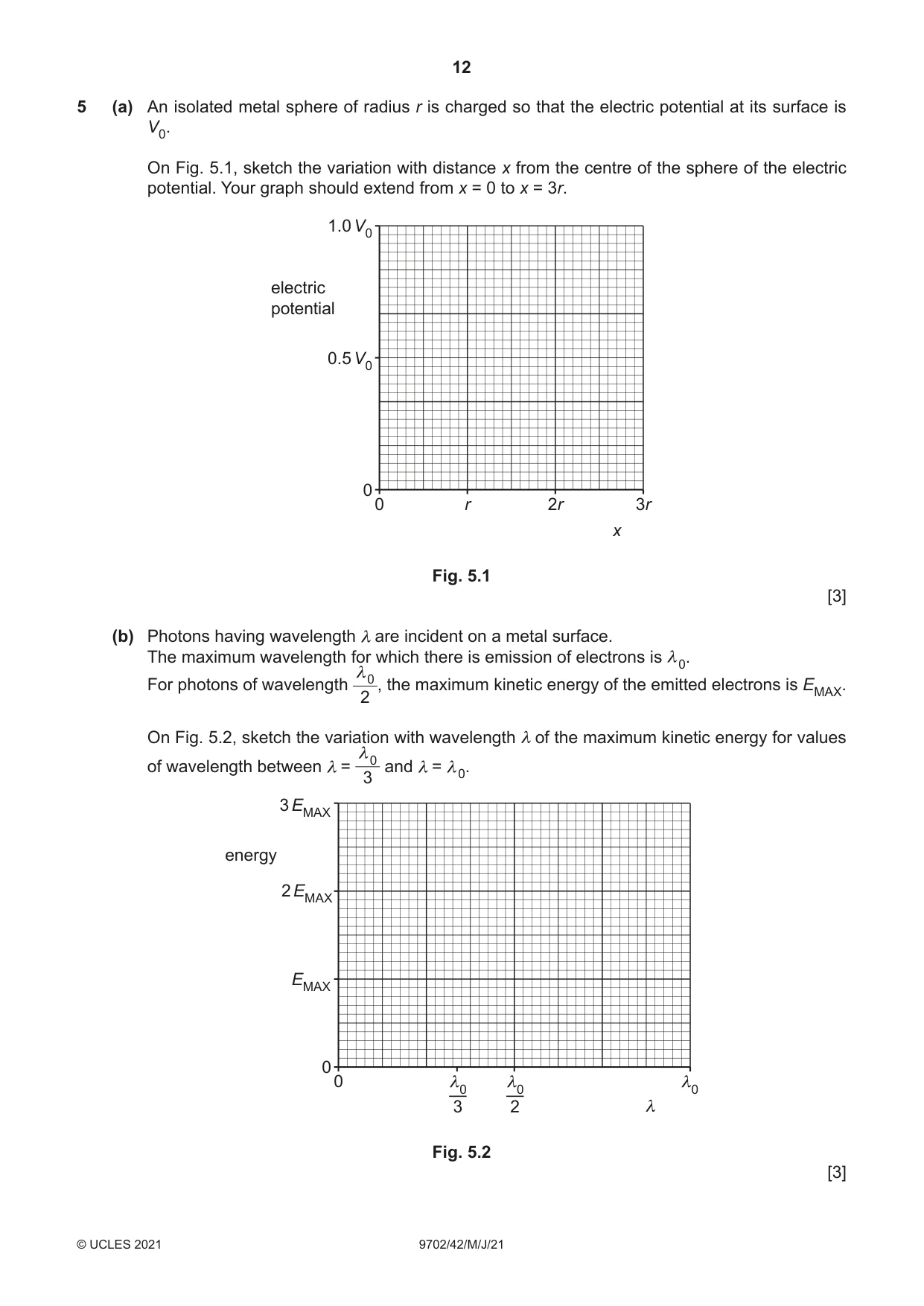
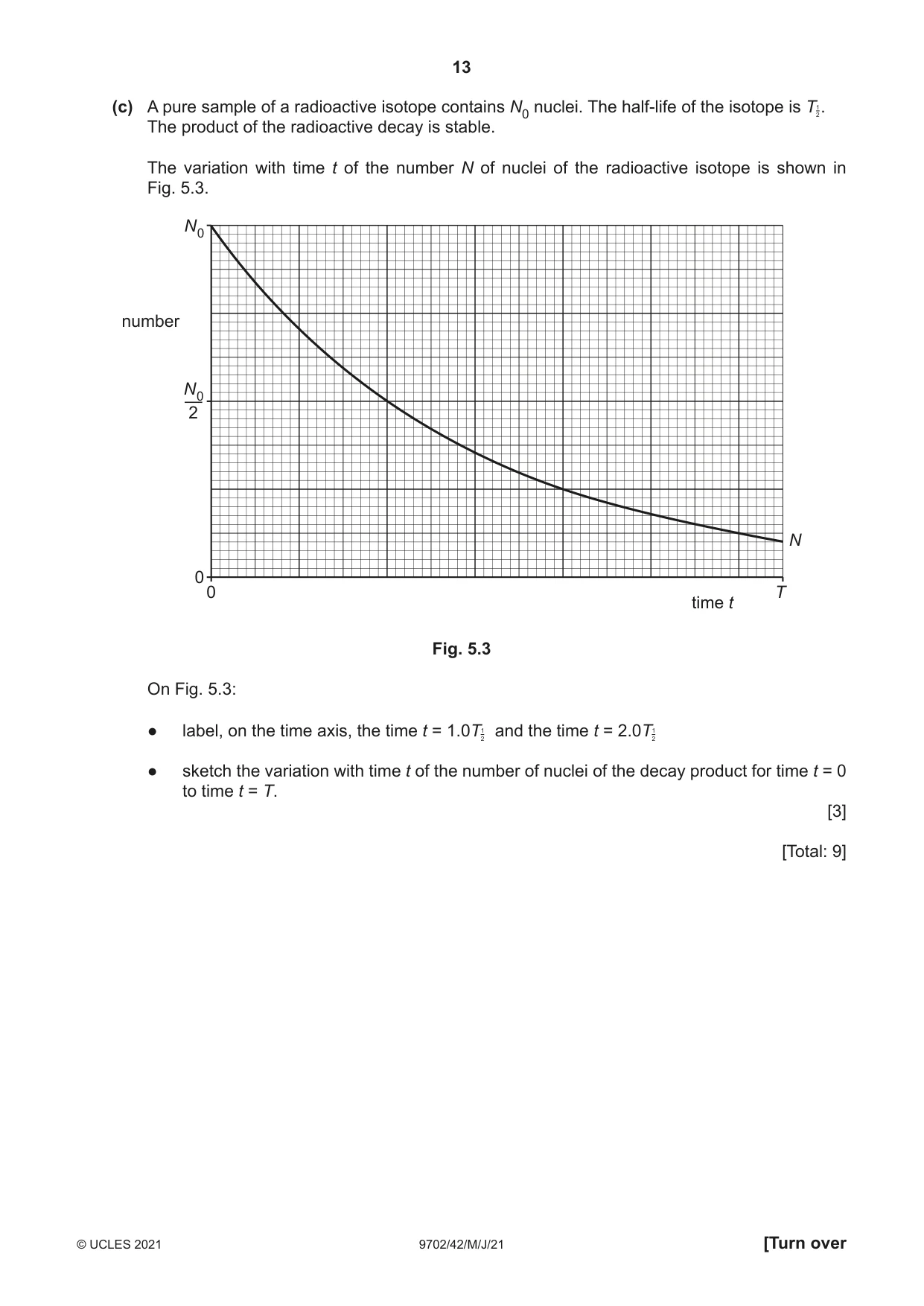
5 (a) An isolated metal sphere of radius r is charged so that the electric potential at its surface is V0. On Fig. 5.1, sketch the variation with distance x from the centre of the sphere of the electric potential. Your graph should extend from x = 0 to x = 3r. 1.0 V0 electric potential 0.5 V0 0 0 r 2r 3r x Fig. 5.1 [3] (b) Photons having wavelength λ are incident on a metal surface. The maximum wavelength for which there is emission of electrons is λ 0. λ 0 For photons of wavelength , the maximum kinetic energy of the emitted electrons is EMAX. 2 On Fig. 5.2, sketch the variation with wavelength λ of the maximum kinetic energy for values λ 0 of wavelength between λ = and λ = λ 0. 3 3 EMAX energy 2 EMAX EMAX 0 0 λ λ λ 0 0 0 3 2 λ Fig. 5.2 [3] (c) A pure sample of a radioactive isotope contains N0 nuclei. The half-life of the isotope is T12. The product of the radioactive decay is stable. The variation with time t of the number N of nuclei of the radioactive isotope is shown in Fig. 5.3. N0 number N0 2 N 0 0 T time t Fig. 5.3 On Fig. 5.3: ● label, on the time axis, the time t = 1.0T12 and the time t = 2.0T12 ● sketch the variation with time t of the number of nuclei of the decay product for time t = 0 to time t = T. [3] [Total: 9]
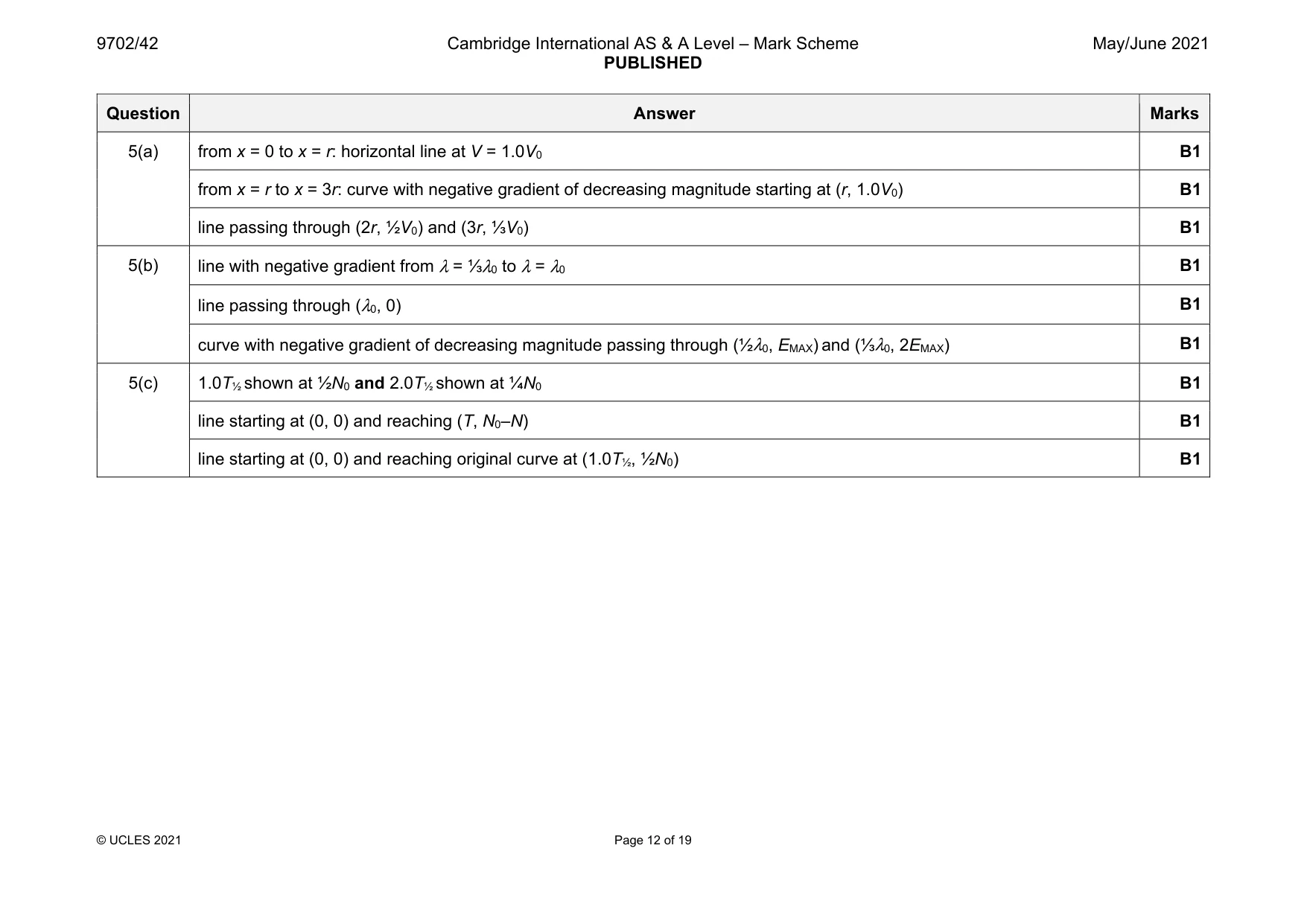
Mark scheme: 5(a) from x = 0 to x = r: horizontal line at V = 1.0V0 B1 from x = r to x = 3r: curve with negative gradient of decreasing magnitude starting at (r, 1.0V0) B1 line passing through (2r, ½V0) and (3r, ⅓V0) B1 5(b) line with negative gradient from λ = ⅓λ0 to λ = λ0 B1 line passing through (λ0, 0) B1 curve with negative gradient of decreasing magnitude passing through (½λ0, EMAX) and (⅓λ0, 2EMAX) B1 5(c) 1.0T½ shown at ½N0 and 2.0T½ shown at ¼N0 B1 line starting at (0, 0) and reaching (T, N0–N) B1 line starting at (0, 0) and reaching original curve at (1.0T½, ½N0) B1
Q6 · Two flat metal plates are held a small distance apart by means of insulating pads, as…
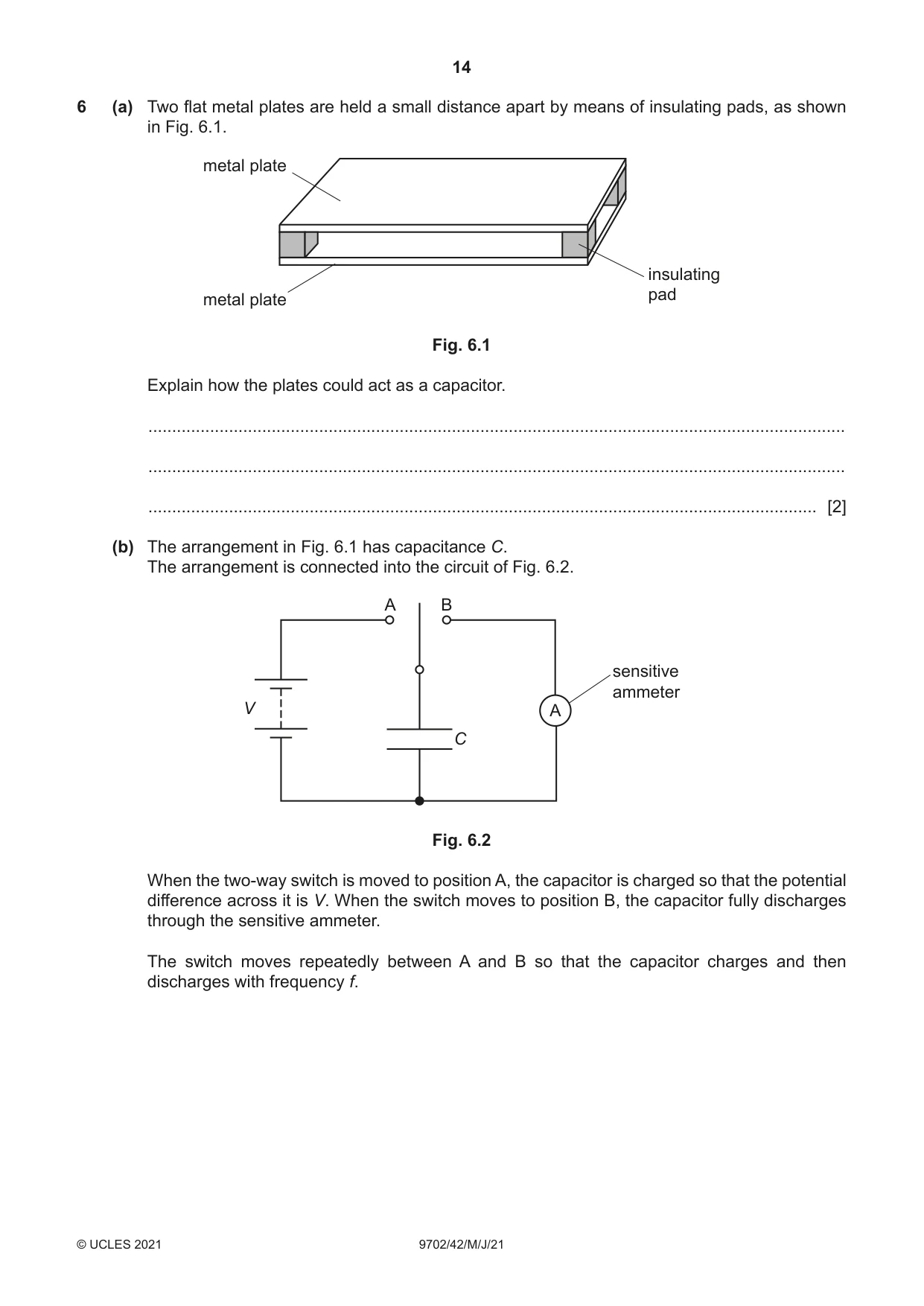
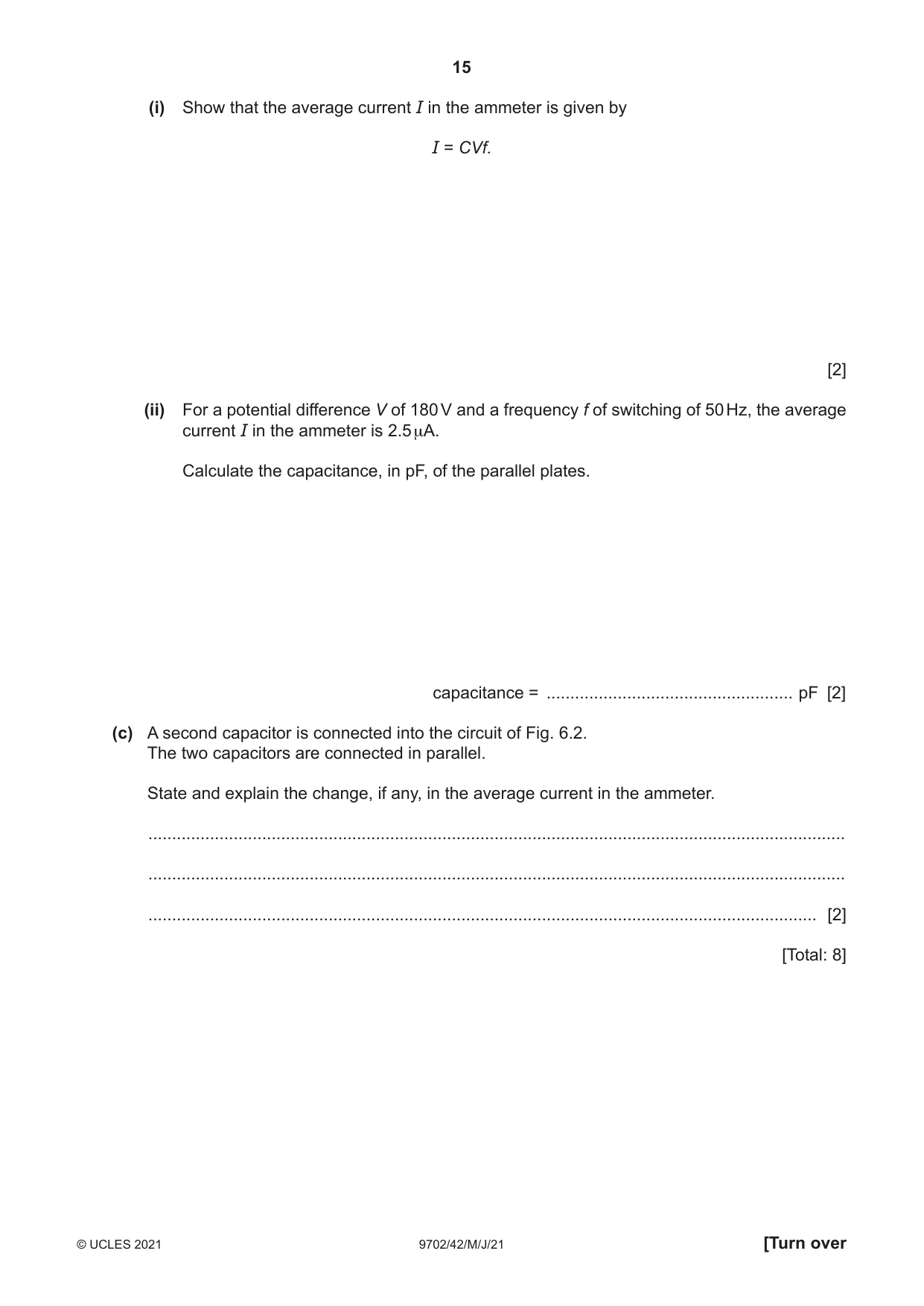
6 (a) Two flat metal plates are held a small distance apart by means of insulating pads, as shown in Fig. 6.1. metal plate insulating pad metal plate Fig. 6.1 Explain how the plates could act as a capacitor. ................................................................................................................................................... ................................................................................................................................................... ............................................................................................................................................. [2] (b) The arrangement in Fig. 6.1 has capacitance C. The arrangement is connected into the circuit of Fig. 6.2. A B sensitive ammeter V A C Fig. 6.2 When the two-way switch is moved to position A, the capacitor is charged so that the potential difference across it is V. When the switch moves to position B, the capacitor fully discharges through the sensitive ammeter. The switch moves repeatedly between A and B so that the capacitor charges and then discharges with frequency f. (i) Show that the average current I in the ammeter is given by I = CVf. [2] (ii) For a potential difference V of 180 V and a frequency f of switching of 50 Hz, the average current I in the ammeter is 2.5 μA. Calculate the capacitance, in pF, of the parallel plates. capacitance = .................................................... pF [2] (c) A second capacitor is connected into the circuit of Fig. 6.2. The two capacitors are connected in parallel. State and explain the change, if any, in the average current in the ammeter. ................................................................................................................................................... ................................................................................................................................................... ............................................................................................................................................. [2] [Total: 8]
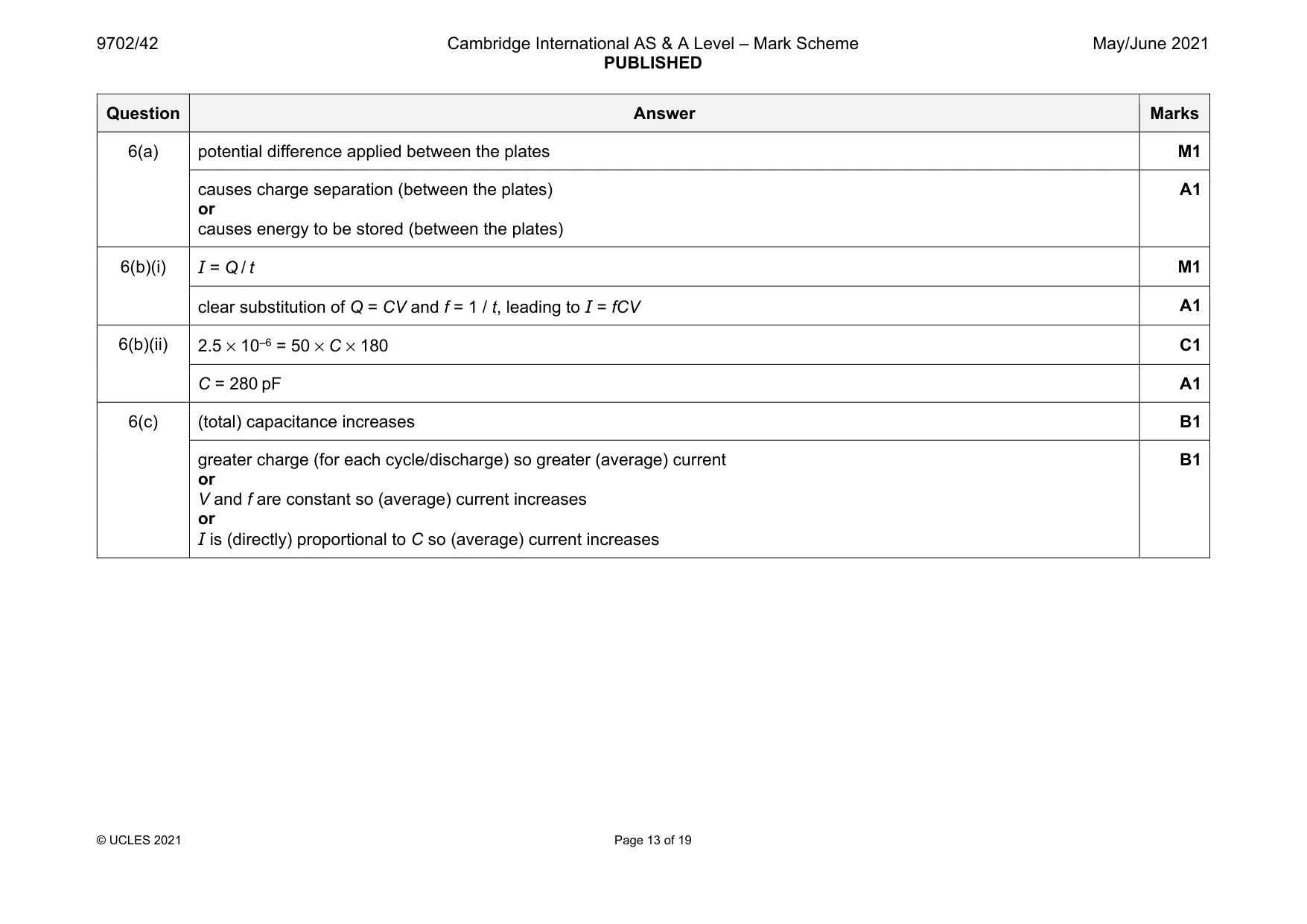
Mark scheme: 6(a) potential difference applied between the plates M1 causes charge separation (between the plates) or causes energy to be stored (between the plates) A1 6(b)(i) I = Q / t M1 clear substitution of Q = CV and f = 1 / t, leading to I = fCV A1 6(b)(ii) 2.5 × 10–6 = 50 × C × 180 C1 C = 280 pF A1 6(c) (total) capacitance increases B1 greater charge (for each cycle/discharge) so greater (average) current or V and f are constant so (average) current increases or I is (directly) proportional to C so (average) current increases B1
Q7 · Two properties of an ideal operational amplifier (op-amp) are infinite input impedance…
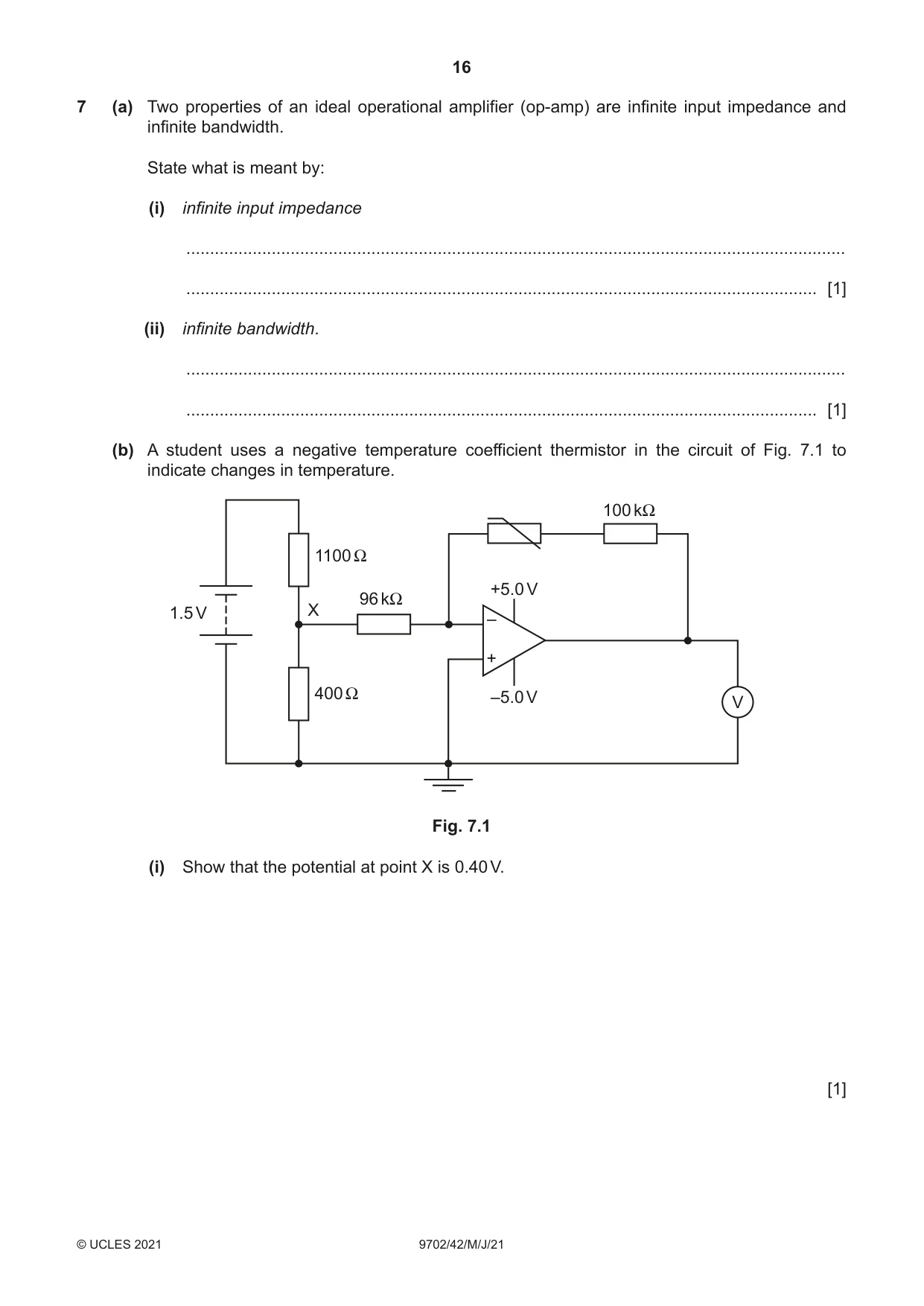
7 (a) Two properties of an ideal operational amplifier (op-amp) are infinite input impedance and infinite bandwidth. State what is meant by: (i) infinite input impedance ........................................................................................................................................... ..................................................................................................................................... [1] (ii) infinite bandwidth. ........................................................................................................................................... ..................................................................................................................................... [1] (b) A student uses a negative temperature coefficient thermistor in the circuit of Fig. 7.1 to indicate changes in temperature. 100 kΩ 1100 Ω +5.0 V 96 kΩ 1.5 V X – + 400 Ω –5.0 V V Fig. 7.1 (i) Show that the potential at point X is 0.40 V. [1] (ii) The thermistor has a resistance of 360 kΩ at a particular temperature. For this temperature of the thermistor, calculate the magnitude of the reading on the voltmeter. voltmeter reading = ...................................................... V [3] (iii) The temperature of the thermistor increases. State and explain the effect of this change on the magnitude of the reading on the voltmeter. ........................................................................................................................................... ........................................................................................................................................... ..................................................................................................................................... [2] (iv) Explain why the amplifier circuit will no longer indicate temperature changes when the magnitude of the gain of the circuit is greater than 12.5. ........................................................................................................................................... ..................................................................................................................................... [1] [Total: 9]
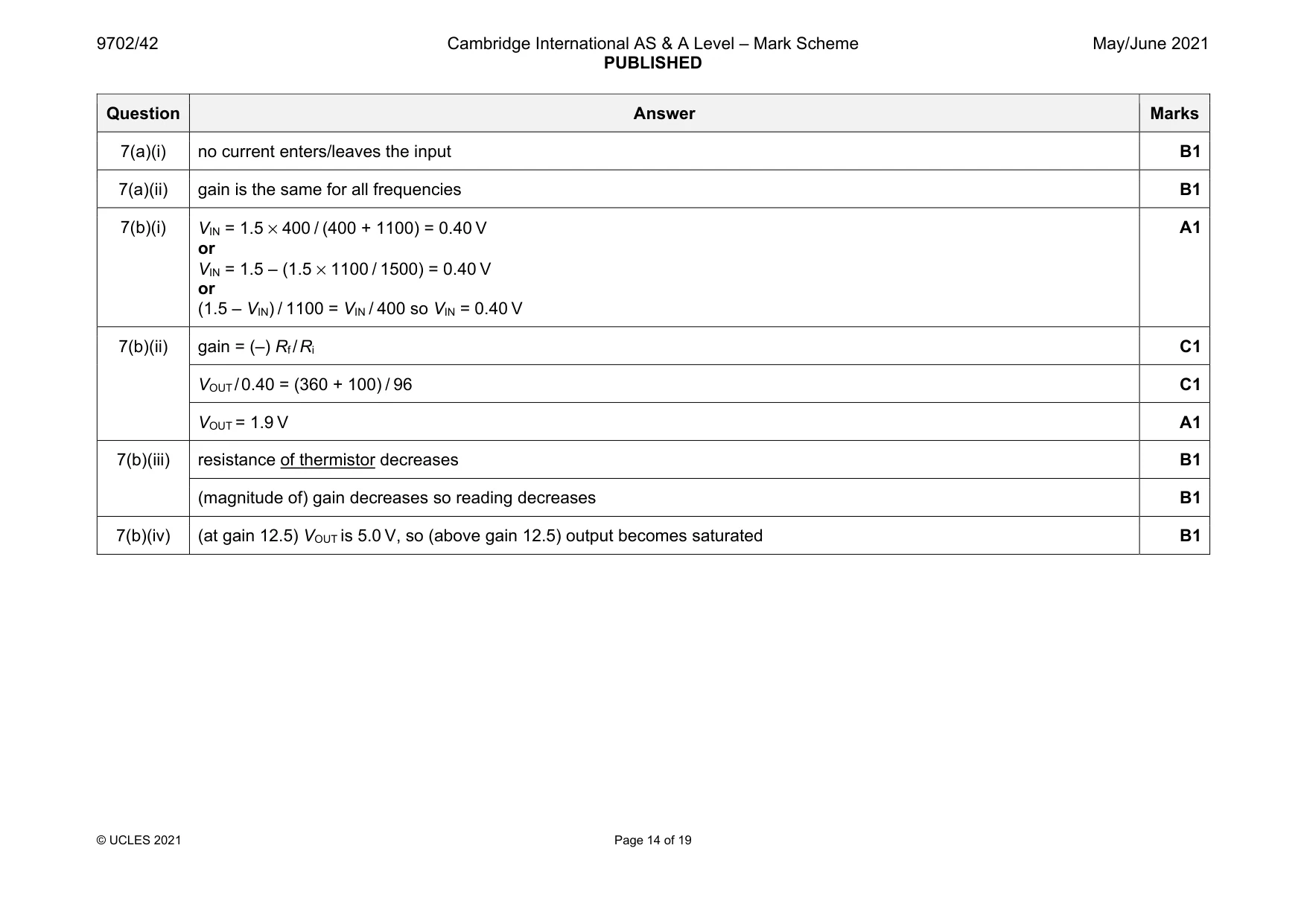
Mark scheme: 7(a)(i) no current enters/leaves the input B1 7(a)(ii) gain is the same for all frequencies B1 7(b)(i) VIN = 1.5 × 400 / (400 + 1100) = 0.40 V or VIN = 1.5 – (1.5 × 1100 / 1500) = 0.40 V or (1.5 – VIN) / 1100 = VIN / 400 so VIN = 0.40 V A1 7(b)(ii) gain = (–) Rf/Ri C1 VOUT/0.40 = (360 + 100) / 96 C1 VOUT = 1.9 V A1 7(b)(iii) resistance of thermistor decreases B1 (magnitude of) gain decreases so reading decreases B1 7(b)(iv) (at gain 12.5) VOUT is 5.0 V, so (above gain 12.5) output becomes saturated B1 Question Answer Marks
Q8 · Define magnetic flux density
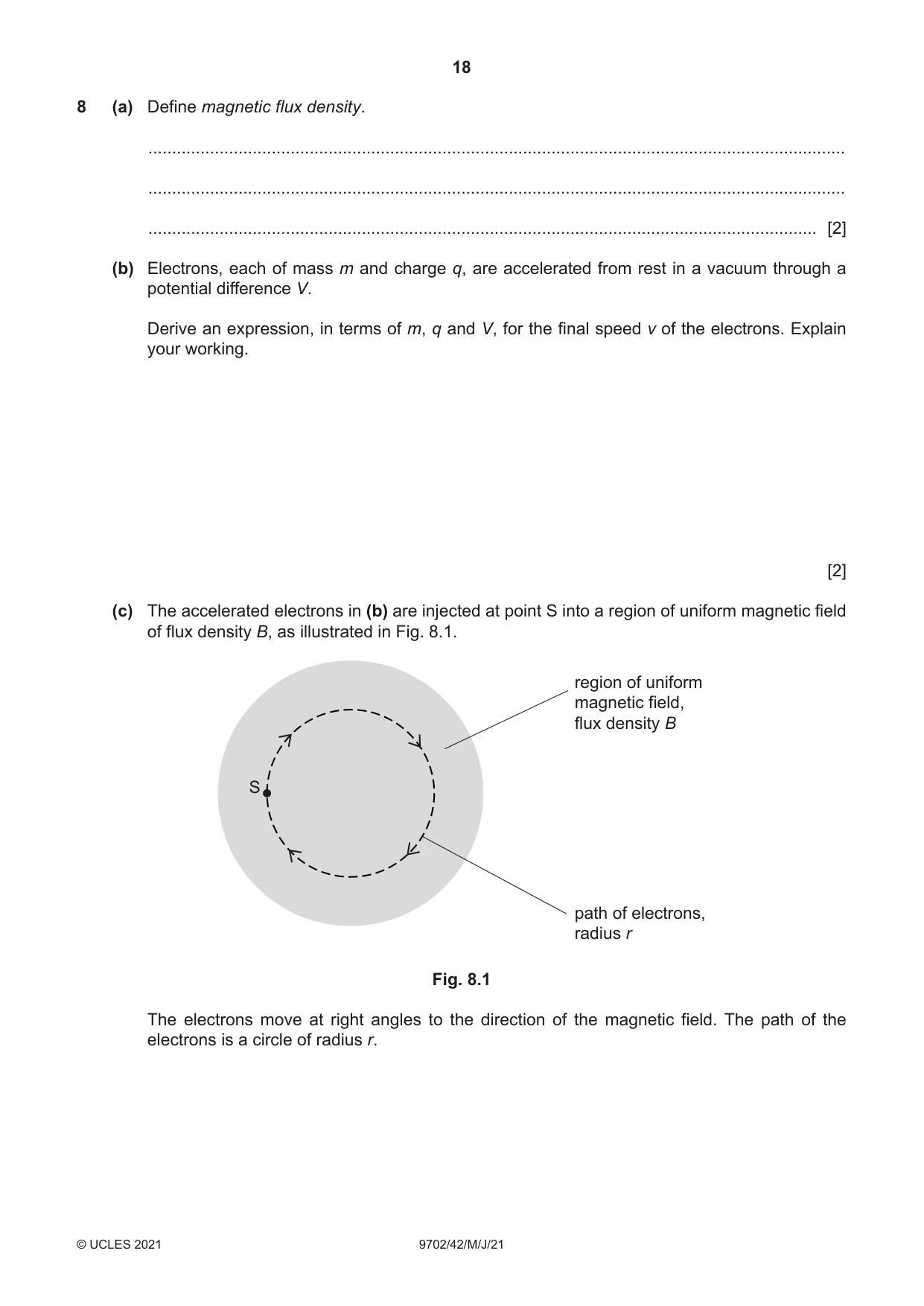
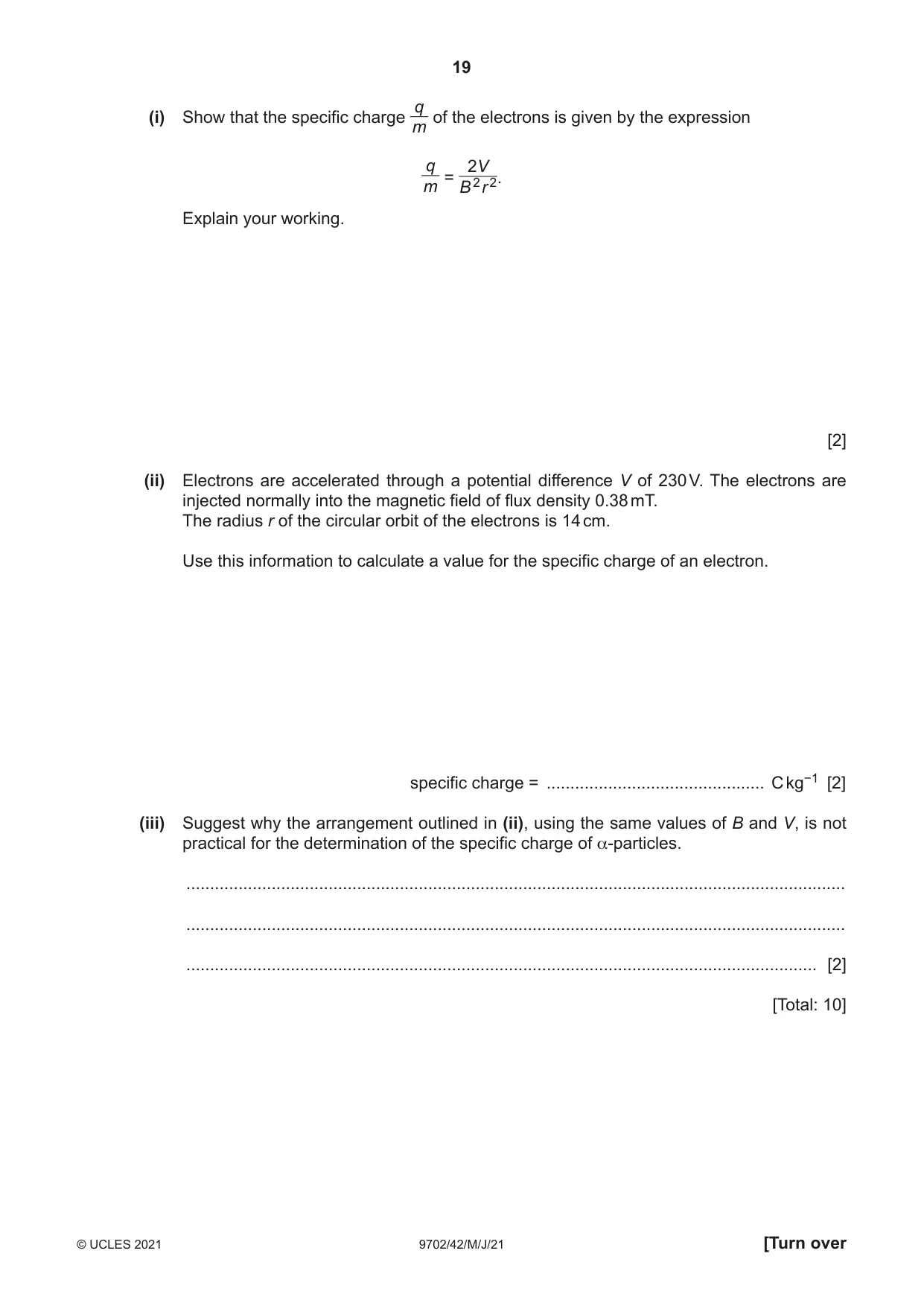
8 (a) Define magnetic flux density. ................................................................................................................................................... ................................................................................................................................................... ............................................................................................................................................. [2] (b) Electrons, each of mass m and charge q, are accelerated from rest in a vacuum through a potential difference V. Derive an expression, in terms of m, q and V, for the final speed v of the electrons. Explain your working. [2] (c) The accelerated electrons in (b) are injected at point S into a region of uniform magnetic field of flux density B, as illustrated in Fig. 8.1. region of uniform magnetic field, flux density B S path of electrons, radius r Fig. 8.1 The electrons move at right angles to the direction of the magnetic field. The path of the electrons is a circle of radius r. q (i) Show that the specific charge of the electrons is given by the expression m q 2V = 2 2. m B r Explain your working. [2] (ii) Electrons are accelerated through a potential difference V of 230 V. The electrons are injected normally into the magnetic field of flux density 0.38 mT. The radius r of the circular orbit of the electrons is 14 cm. Use this information to calculate a value for the specific charge of an electron. specific charge = .............................................. C kg−1 [2] (iii) Suggest why the arrangement outlined in (ii), using the same values of B and V, is not practical for the determination of the specific charge of α-particles. ........................................................................................................................................... ........................................................................................................................................... ..................................................................................................................................... [2] [Total: 10]
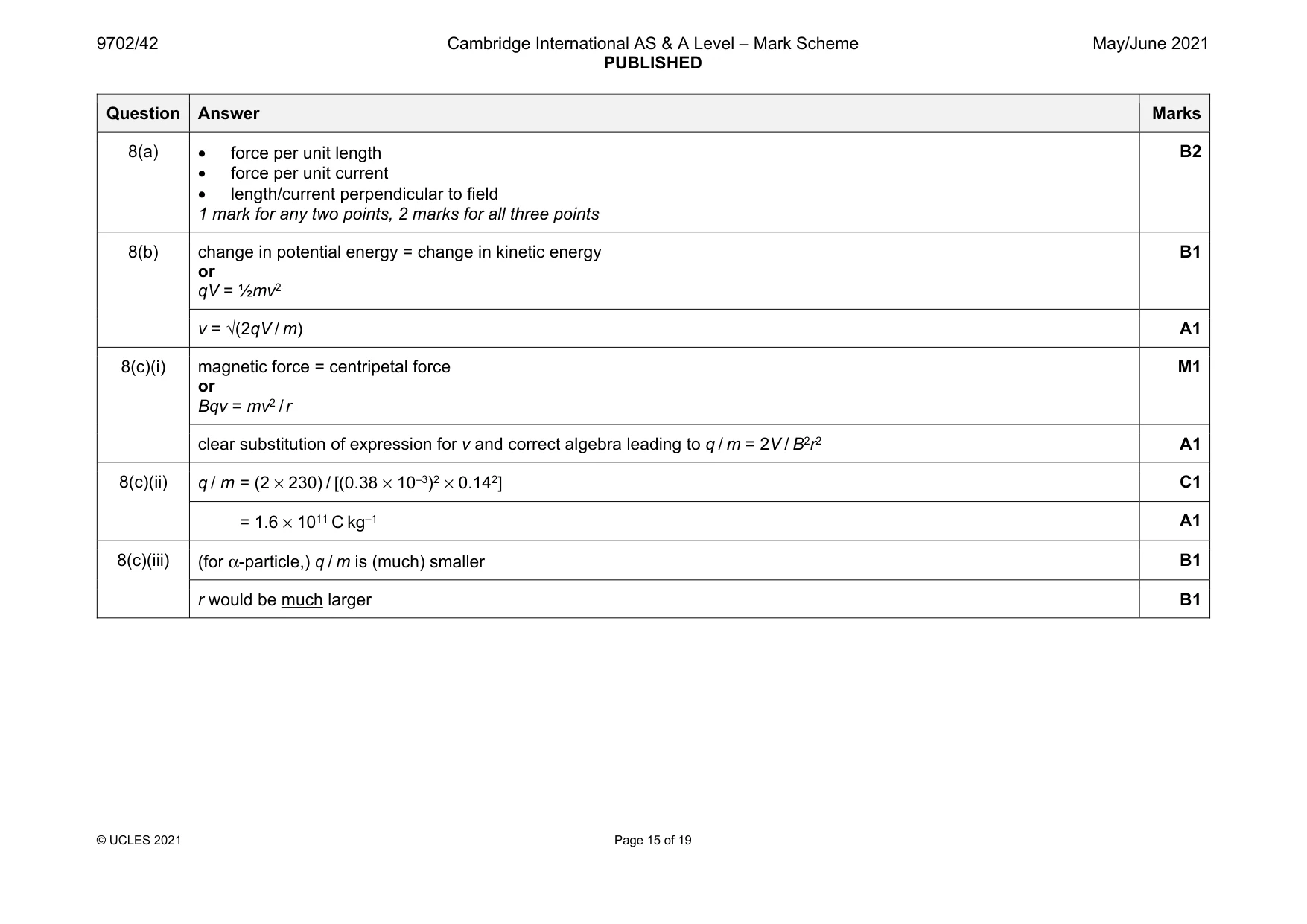
Mark scheme: 8(a) • force per unit length • force per unit current • length/current perpendicular to field 1 mark for any two points, 2 marks for all three points B2 8(b) change in potential energy = change in kinetic energy or qV = ½mv2 B1 v = √(2qV / m) A1 8(c)(i) magnetic force = centripetal force or Bqv = mv2 / r M1 clear substitution of expression for v and correct algebra leading to q / m = 2V / B2r2 A1 8(c)(ii) q / m = (2 × 230) / [(0.38 × 10⁻³)2 × 0.142] C1 = 1.6 × 10¹¹ C kg–1 A1 8(c)(iii) (for α-particle,) q / m is (much) smaller B1 r would be much larger B1
Q9 · State two situations in which a charged particle in a magnetic field does not experience…
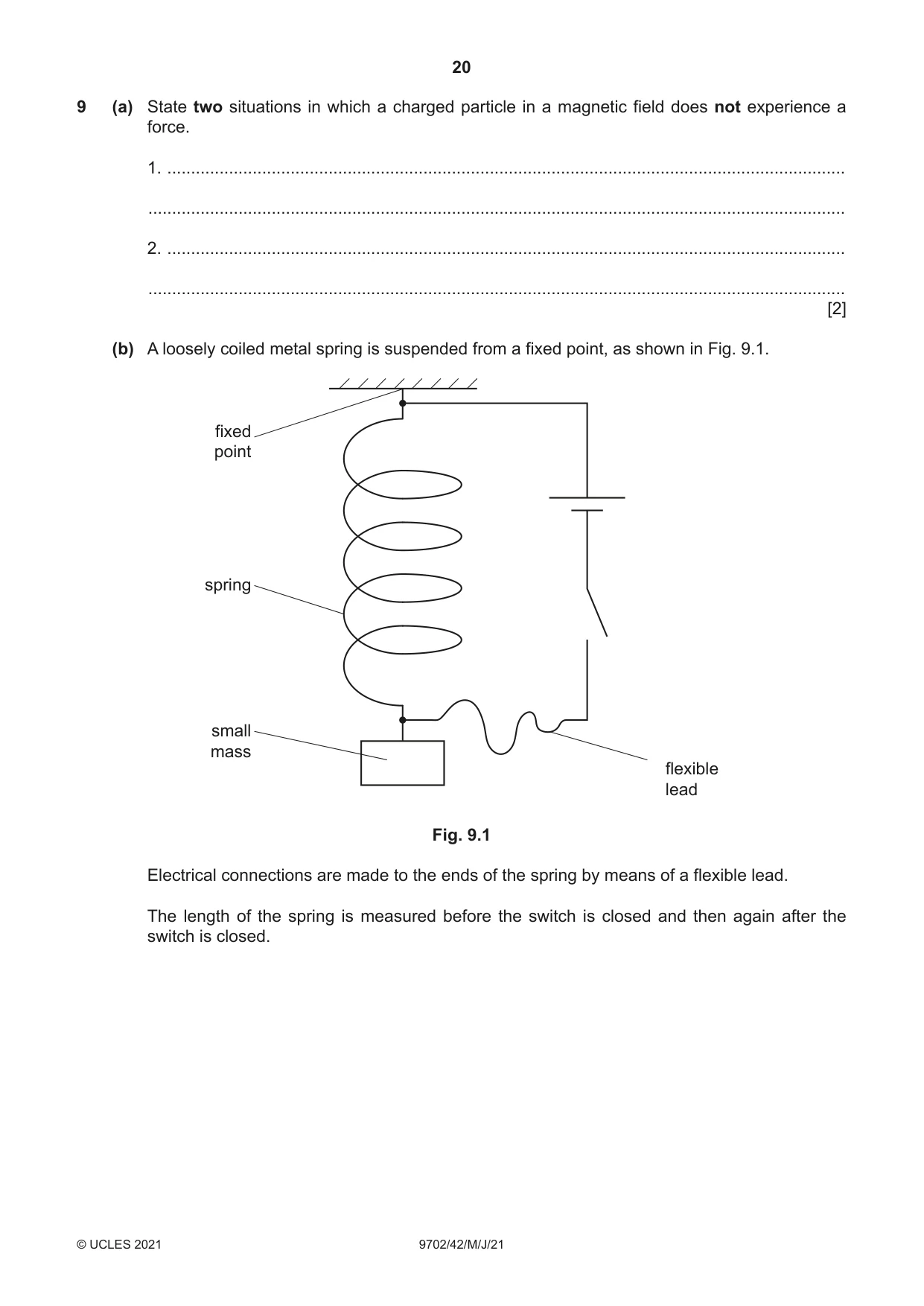
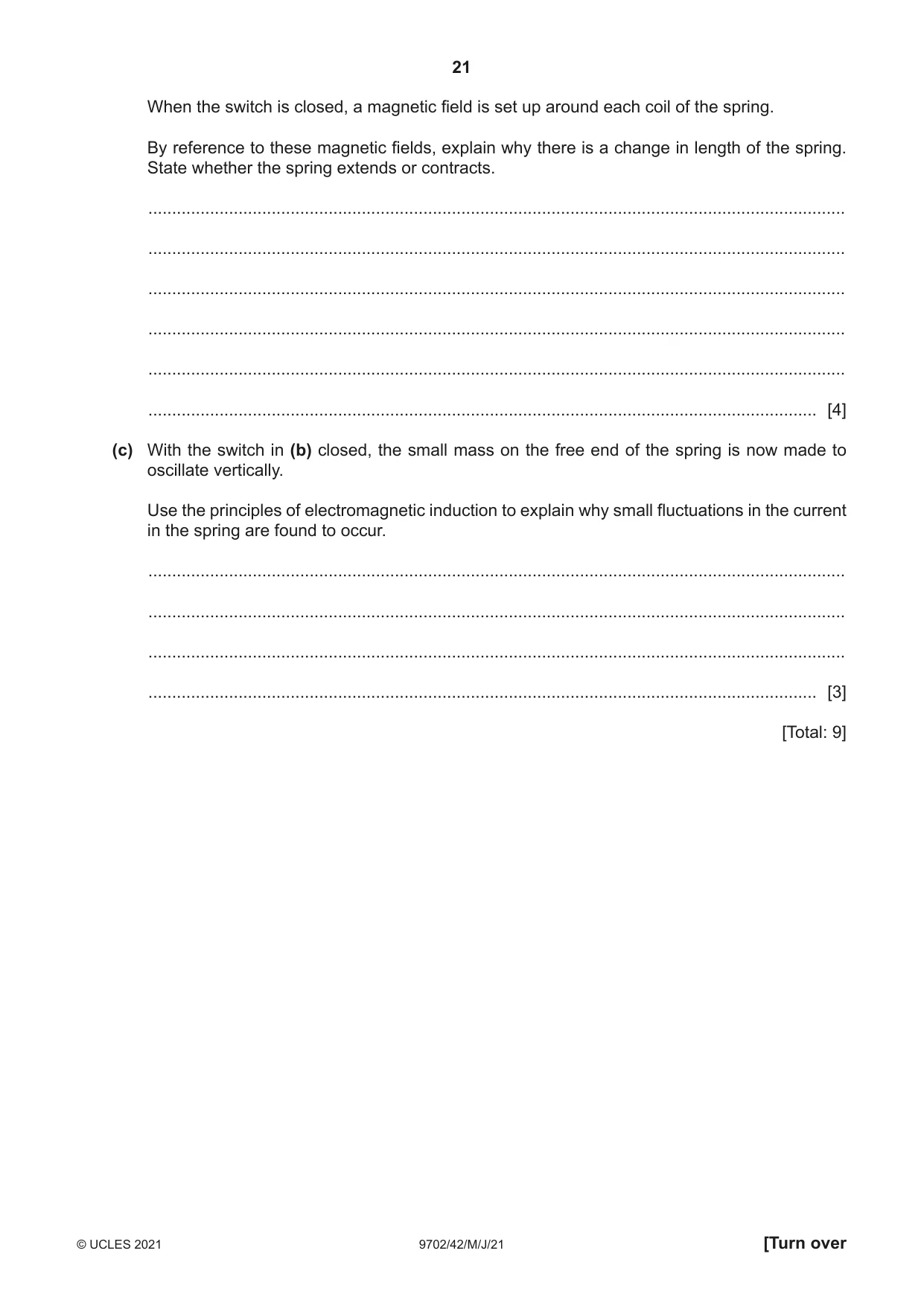
9 (a) State two situations in which a charged particle in a magnetic field does not experience a force. 1. ............................................................................................................................................... ................................................................................................................................................... 2. ............................................................................................................................................... ................................................................................................................................................... [2] (b) A loosely coiled metal spring is suspended from a fixed point, as shown in Fig. 9.1. fixed point spring small mass flexible lead Fig. 9.1 Electrical connections are made to the ends of the spring by means of a flexible lead. The length of the spring is measured before the switch is closed and then again after the switch is closed. When the switch is closed, a magnetic field is set up around each coil of the spring. By reference to these magnetic fields, explain why there is a change in length of the spring. State whether the spring extends or contracts. ................................................................................................................................................... ................................................................................................................................................... ................................................................................................................................................... ................................................................................................................................................... ................................................................................................................................................... ............................................................................................................................................. [4] (c) With the switch in (b) closed, the small mass on the free end of the spring is now made to oscillate vertically. Use the principles of electromagnetic induction to explain why small fluctuations in the current in the spring are found to occur. ................................................................................................................................................... ................................................................................................................................................... ................................................................................................................................................... ............................................................................................................................................. [3] [Total: 9]
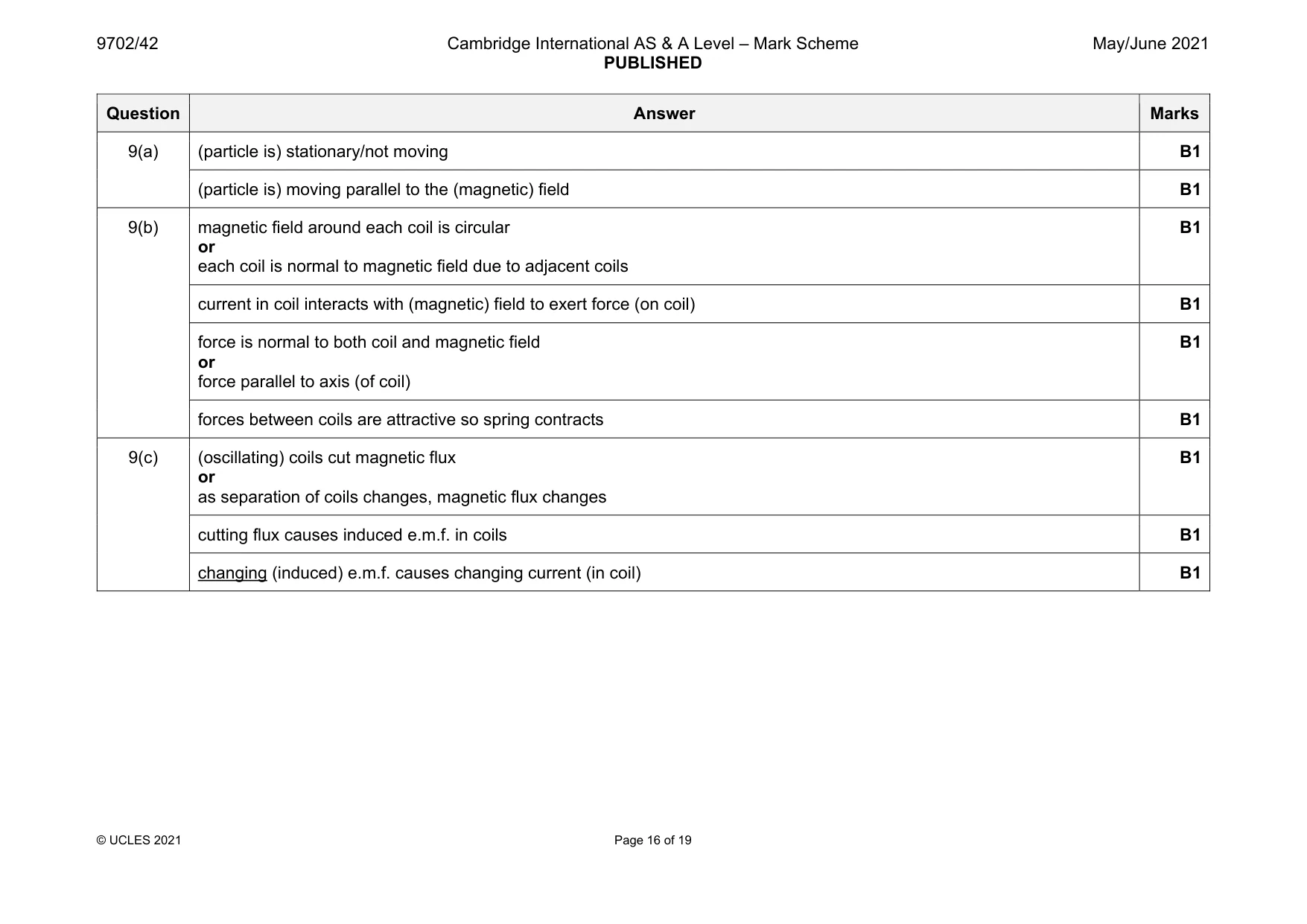
Mark scheme: 9(a) (particle is) stationary/not moving B1 (particle is) moving parallel to the (magnetic) field B1 9(b) magnetic field around each coil is circular or each coil is normal to magnetic field due to adjacent coils B1 current in coil interacts with (magnetic) field to exert force (on coil) B1 force is normal to both coil and magnetic field or force parallel to axis (of coil) B1 forces between coils are attractive so spring contracts B1 9(c) (oscillating) coils cut magnetic flux or as separation of coils changes, magnetic flux changes B1 cutting flux causes induced e.m.f. in coils B1 changing (induced) e.m.f. causes changing current (in coil) B1
Q10 · By reference to heating effect, explain what is meant by the root-mean-square (r.m.s.)…
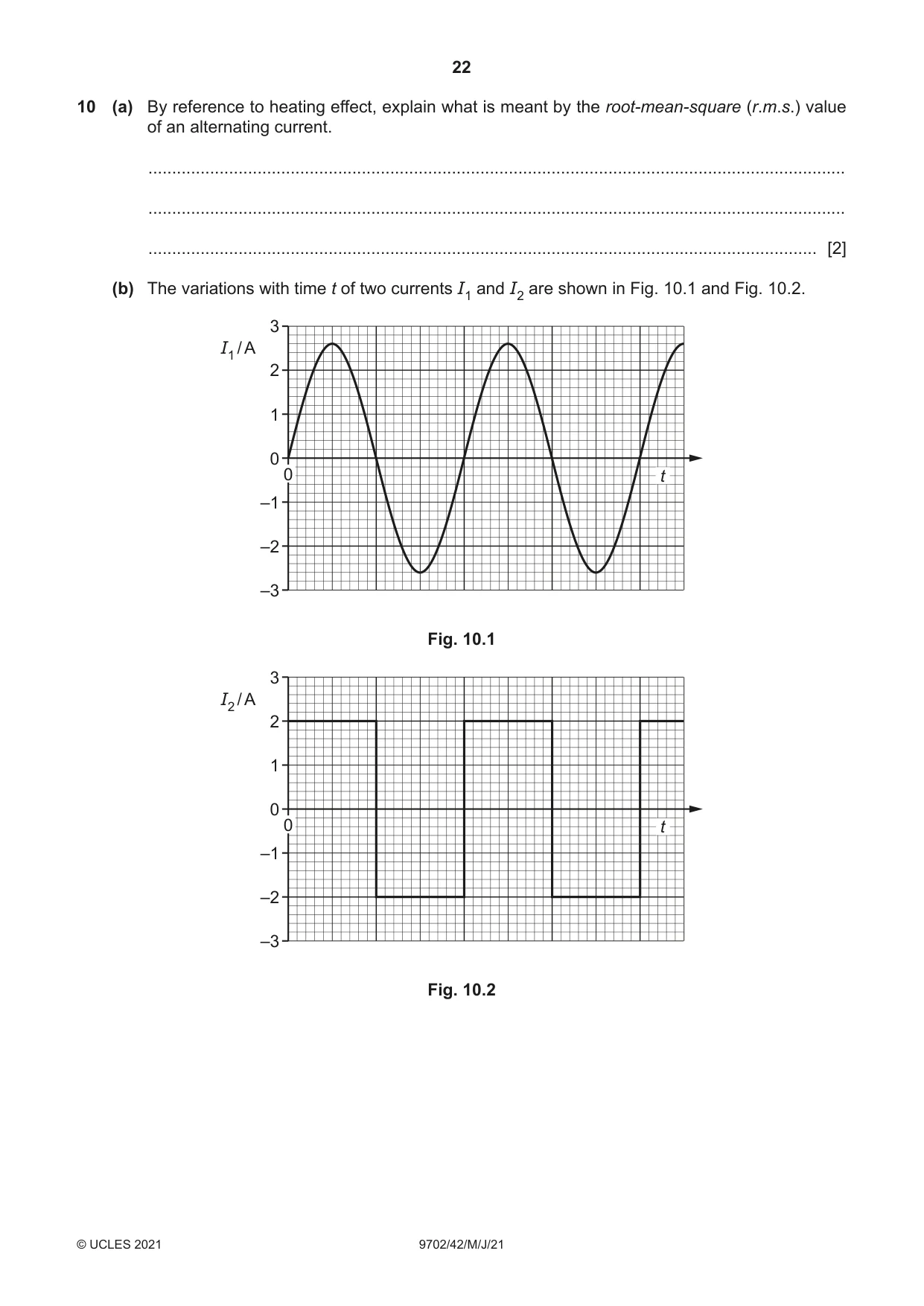
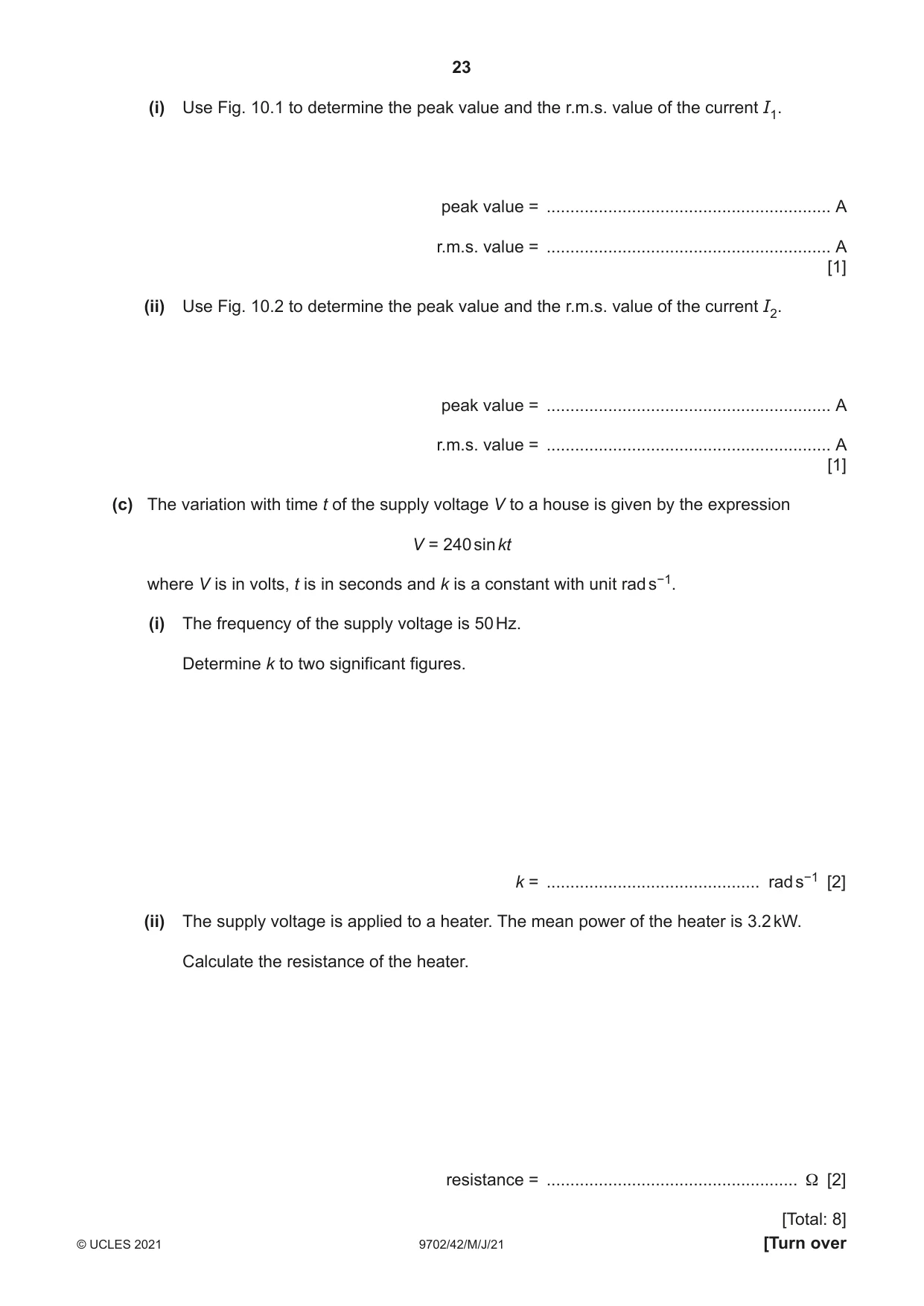
10 (a) By reference to heating effect, explain what is meant by the root-mean-square (r.m.s.) value of an alternating current. ................................................................................................................................................... ................................................................................................................................................... ............................................................................................................................................. [2] (b) The variations with time t of two currents I1 and I2 are shown in Fig. 10.1 and Fig. 10.2. 3 I1 / A 2 1 0 0 t –1 –2 –3 Fig. 10.1 3 I2 / A 2 1 0 0 t –1 –2 –3 Fig. 10.2 (i) Use Fig. 10.1 to determine the peak value and the r.m.s. value of the current I1. peak value = ............................................................ A r.m.s. value = ............................................................ A [1] (ii) Use Fig. 10.2 to determine the peak value and the r.m.s. value of the current I2. peak value = ............................................................ A r.m.s. value = ............................................................ A [1] (c) The variation with time t of the supply voltage V to a house is given by the expression V = 240 sin kt where V is in volts, t is in seconds and k is a constant with unit rad s−1. (i) The frequency of the supply voltage is 50 Hz. Determine k to two significant figures. k = ............................................. rad s−1 [2] (ii) The supply voltage is applied to a heater. The mean power of the heater is 3.2 kW. Calculate the resistance of the heater. resistance = ..................................................... Ω [2] [Total: 8]
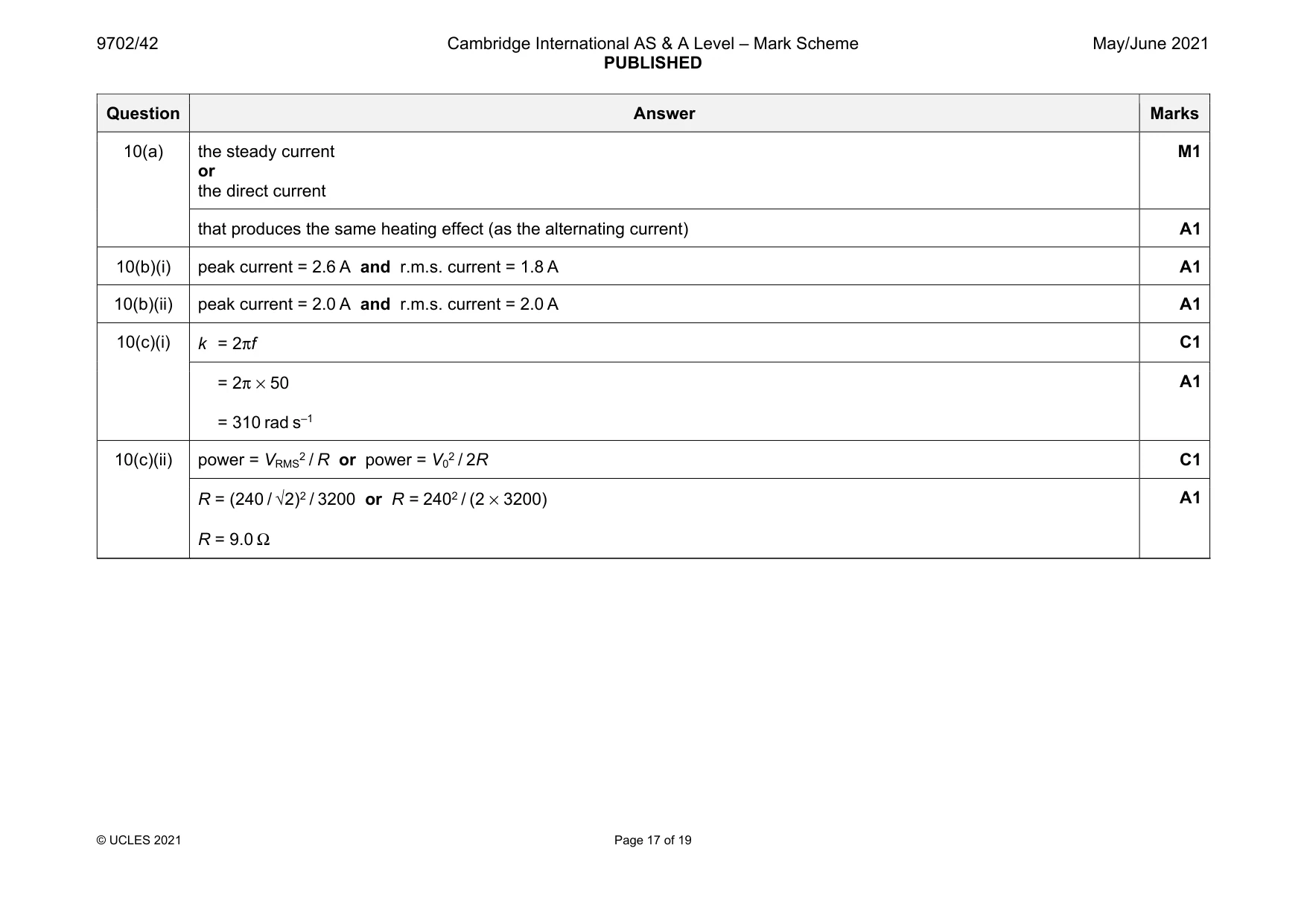
Mark scheme: 10(a) the steady current or the direct current M1 that produces the same heating effect (as the alternating current) A1 10(b)(i) peak current = 2.6 A and r.m.s. current = 1.8 A A1 10(b)(ii) peak current = 2.0 A and r.m.s. current = 2.0 A A1 10(c)(i) k = 2πf C1 = 2π × 50 = 310 rad s–1 A1 10(c)(ii) power = VRMS2 / R or power = V02 / 2R C1 R = (240 / √2)2 / 3200 or R = 2402 / (2 × 3200) R = 9.0 Ω A1
Q11 · State the purpose of computed tomography (CT scanning)
11 (a) State the purpose of computed tomography (CT scanning). ................................................................................................................................................... ............................................................................................................................................. [1] (b) Outline the principles of CT scanning. ................................................................................................................................................... ................................................................................................................................................... ................................................................................................................................................... ................................................................................................................................................... ................................................................................................................................................... ................................................................................................................................................... ................................................................................................................................................... ................................................................................................................................................... ................................................................................................................................................... ............................................................................................................................................. [5] [Total: 6]
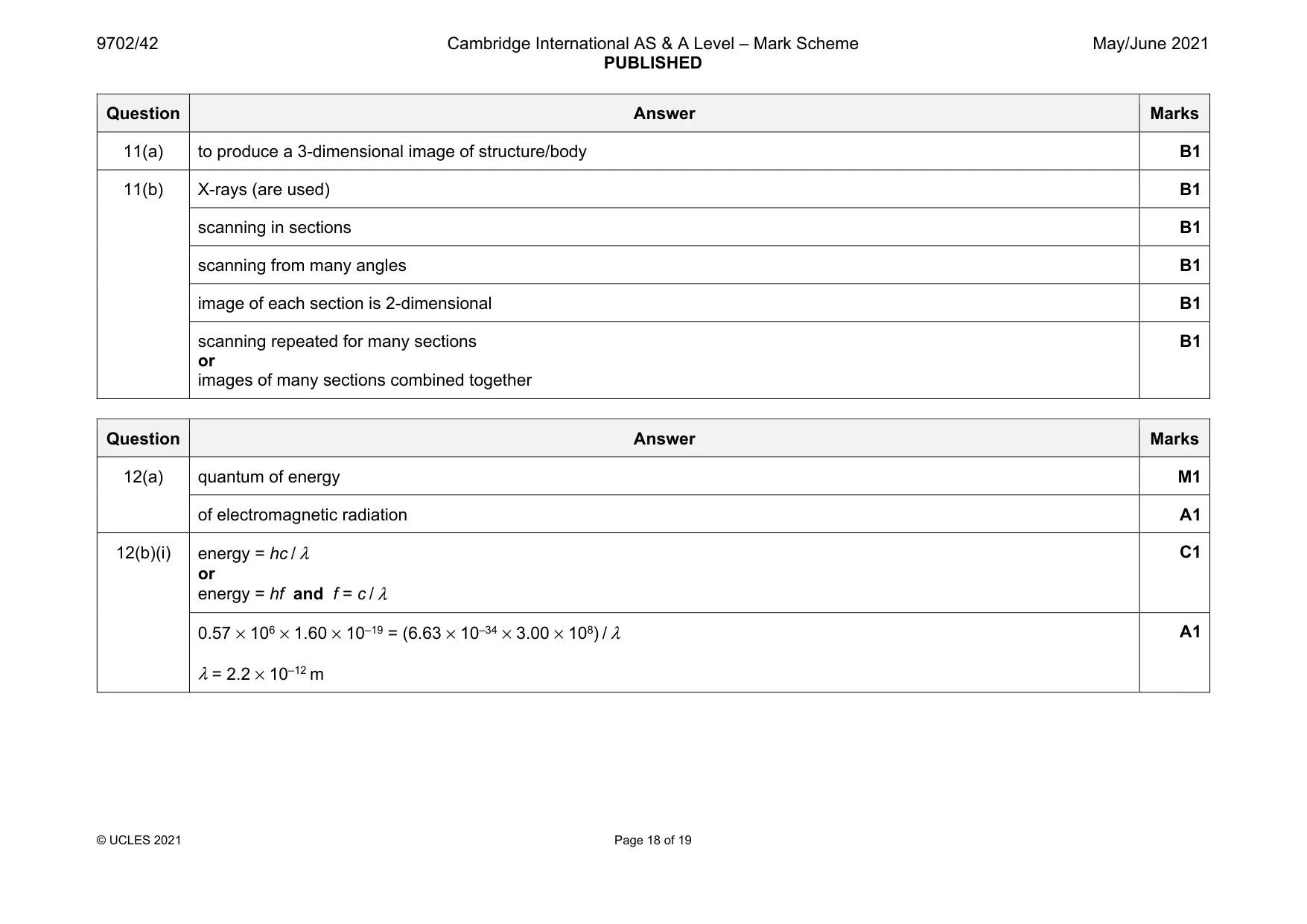
Mark scheme: 11(a) to produce a 3-dimensional image of structure/body B1 11(b) X-rays (are used) B1 scanning in sections B1 scanning from many angles B1 image of each section is 2-dimensional B1 scanning repeated for many sections or images of many sections combined together B1
Q12 · State what is meant by a photon
12 (a) State what is meant by a photon. ................................................................................................................................................... ................................................................................................................................................... ............................................................................................................................................. [2] (b) A stationary nucleus of samarium-157 (15762 Sm) emits a gamma-ray (γ-ray) photon of energy 0.57 MeV. Determine, for one γ-ray photon: (i) its wavelength wavelength = ..................................................... m [2] (ii) its momentum. momentum = ................................................... N s [2] (c) (i) Using your answer to (b)(ii), determine the speed of the samarium-157 nucleus after emission of the photon. speed = ................................................ m s−1 [2] (ii) By reference to your answer in (c)(i), explain quantitatively why the speed of the samarium-157 nucleus may be assumed to be negligible compared with the speed of the photon. ........................................................................................................................................... ..................................................................................................................................... [1] [Total: 9]
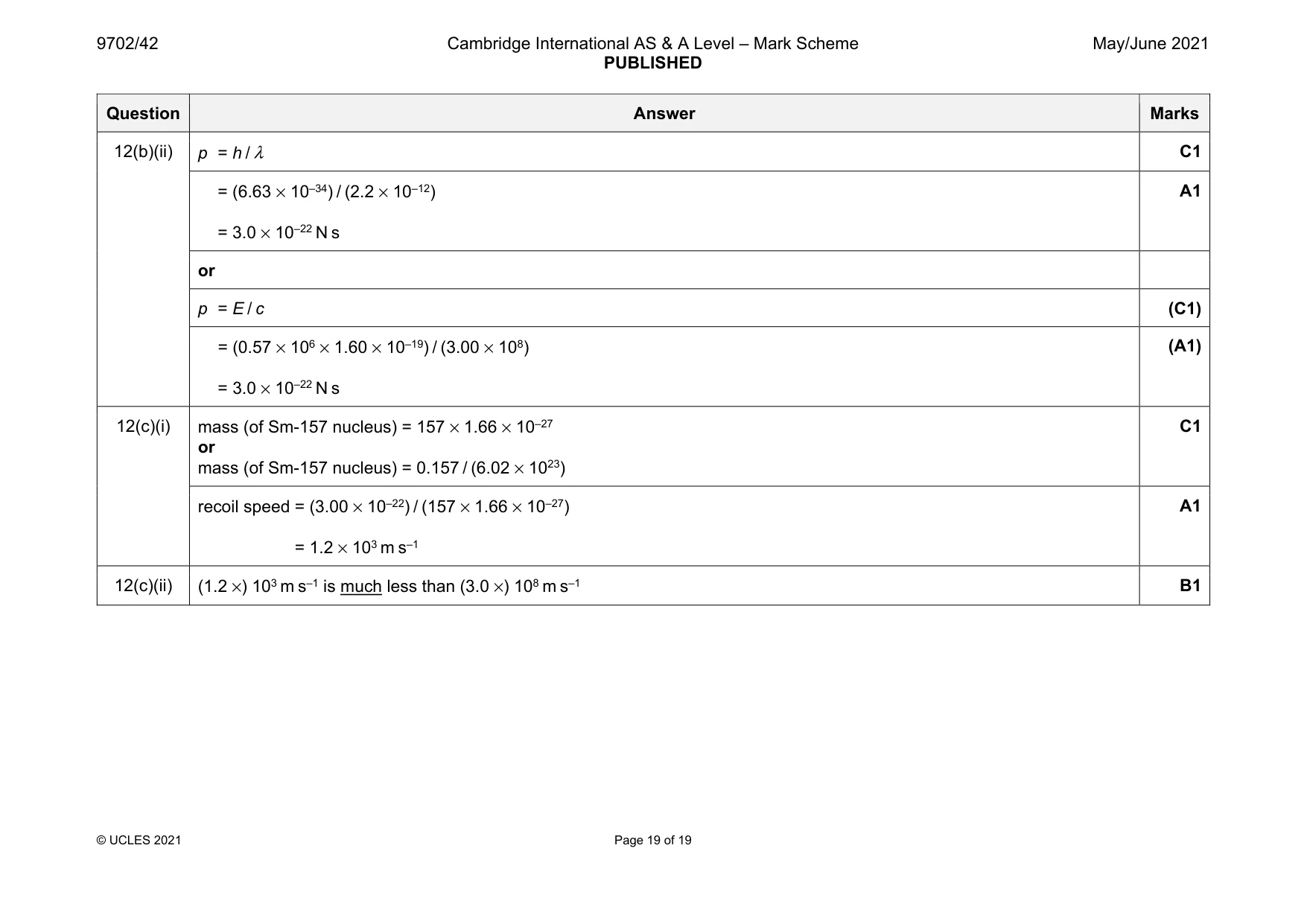
Mark scheme: 12(a) quantum of energy M1 of electromagnetic radiation A1 12(b)(i) energy = hc / λ or energy = hf and f = c / λ C1 0.57 × 106 × 1.60 × 10–19 = (6.63 × 10–34 × 3.00 × 108) / λ λ = 2.2 × 10⁻¹² m A1 Question Answer Marks 12(b)(ii) p = h / λ C1 = (6.63 × 10⁻³⁴) / (2.2 × 10⁻¹²) = 3.0 × 10⁻²² N s A1 or p = E / c (C1) = (0.57 × 106 × 1.60 × 10–19) / (3.00 × 10⁸) = 3.0 × 10⁻²² N s (A1) 12(c)(i) mass (of Sm-157 nucleus) = 157 × 1.66 × 10–27 or mass (of Sm-157 nucleus) = 0.157 / (6.02 × 10²³) C1 recoil speed = (3.00 × 10⁻²²) / (157 × 1.66 × 10–27) = 1.2 × 10³ m s–1 A1 12(c)(ii) (1.2 ×) 103 m s–1 is much less than (3.0 ×) 108 m s–1 B1
What was in this paper
The subtopics covered by these 12 questions, and how many questions each got. Open one in a new tab to see every Cambridge question on it.
1Characteristics of alternating currents1Electric potential1Electromagnetic spectrum1Energy and momentum of a photon1Force on a moving charge1Gravitational field of a point mass1Magnetic fields due to currents1Practical circuits1Production and use of X-rays1Simple harmonic oscillations1The first law of thermodynamics1What you needed in this session
Cambridge’s own grade thresholds for 2021 May/June, Paper 4 · Variant 2. A higher threshold means an easier paper — the bar moves with how the cohort did.