Cambridge A Level Physics 9702 — 2025 May/June Paper 4 · Variant 4
9702/44/M/J/25 · 11 questions · 100 marks · 120 min
The question paper and its mark scheme, free to read here and free to download. This is Cambridge’s own paper, exactly as it was sat.
Question paper24 pages


Mark scheme19 pages
Answers below. Sit the paper first if you are practising.
Questions as text
Question 1
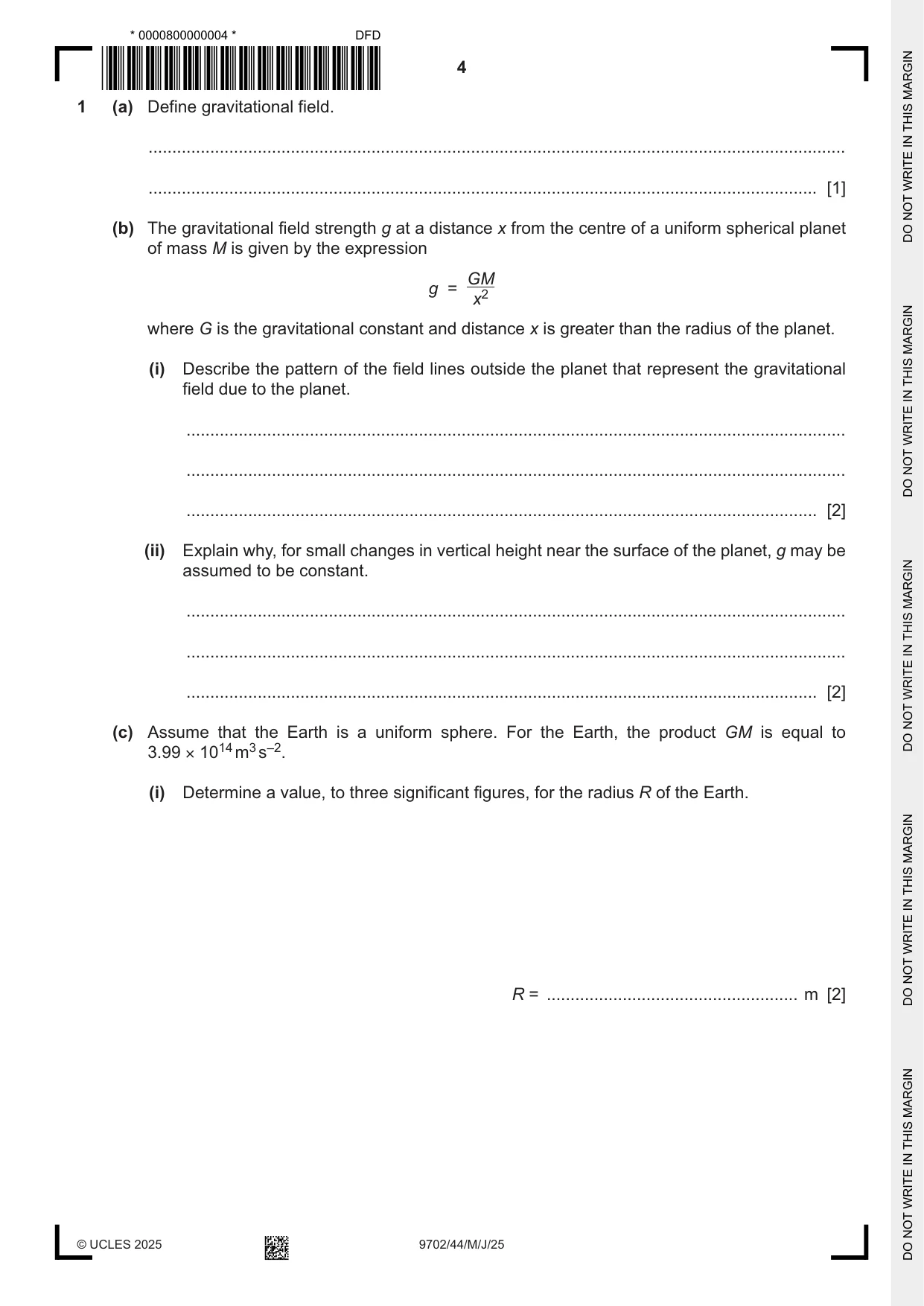
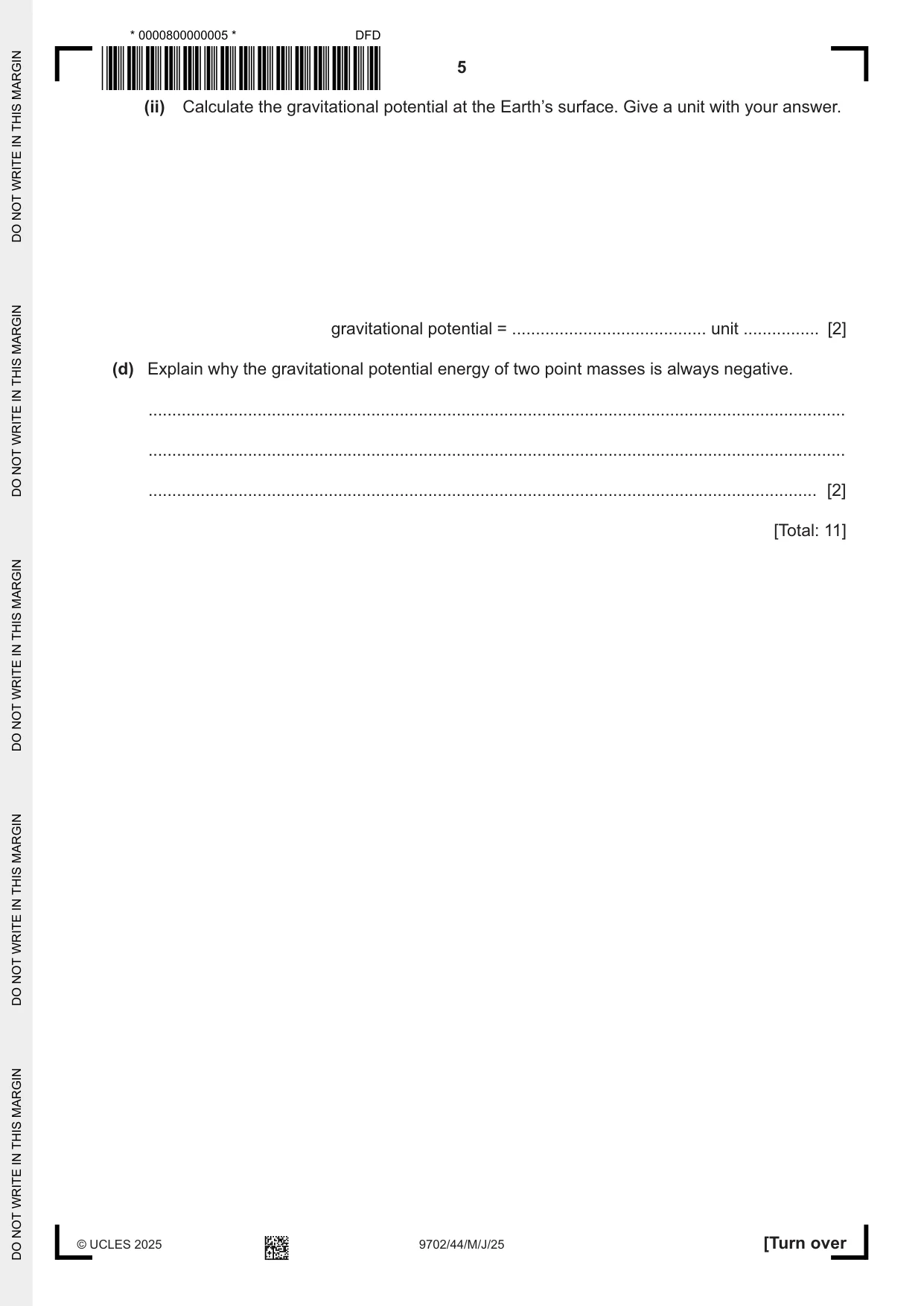
1 (a) Define gravitational field. ................................................................................................................................................... ............................................................................................................................................. [1] (b) The gravitational field strength g at a distance x from the centre of a uniform spherical planet of mass M is given by the expression GM g = x2 where G is the gravitational constant and distance x is greater than the radius of the planet. (i) Describe the pattern of the field lines outside the planet that represent the gravitational field due to the planet. ........................................................................................................................................... ........................................................................................................................................... ..................................................................................................................................... [2] (ii) Explain why, for small changes in vertical height near the surface of the planet, g may be assumed to be constant. ........................................................................................................................................... ........................................................................................................................................... ..................................................................................................................................... [2] (c) Assume that the Earth is a uniform sphere. For the Earth, the product GM is equal to 3.99 × 10¹⁴ m3 s–2. (i) Determine a value, to three significant figures, for the radius R of the Earth. R = ..................................................... m [2] (ii) Calculate the gravitational potential at the Earth’s surface. Give a unit with your answer. gravitational potential = ......................................... unit ................ [2] (d) Explain why the gravitational potential energy of two point masses is always negative. ................................................................................................................................................... ................................................................................................................................................... ............................................................................................................................................. [2] [Total: 11]
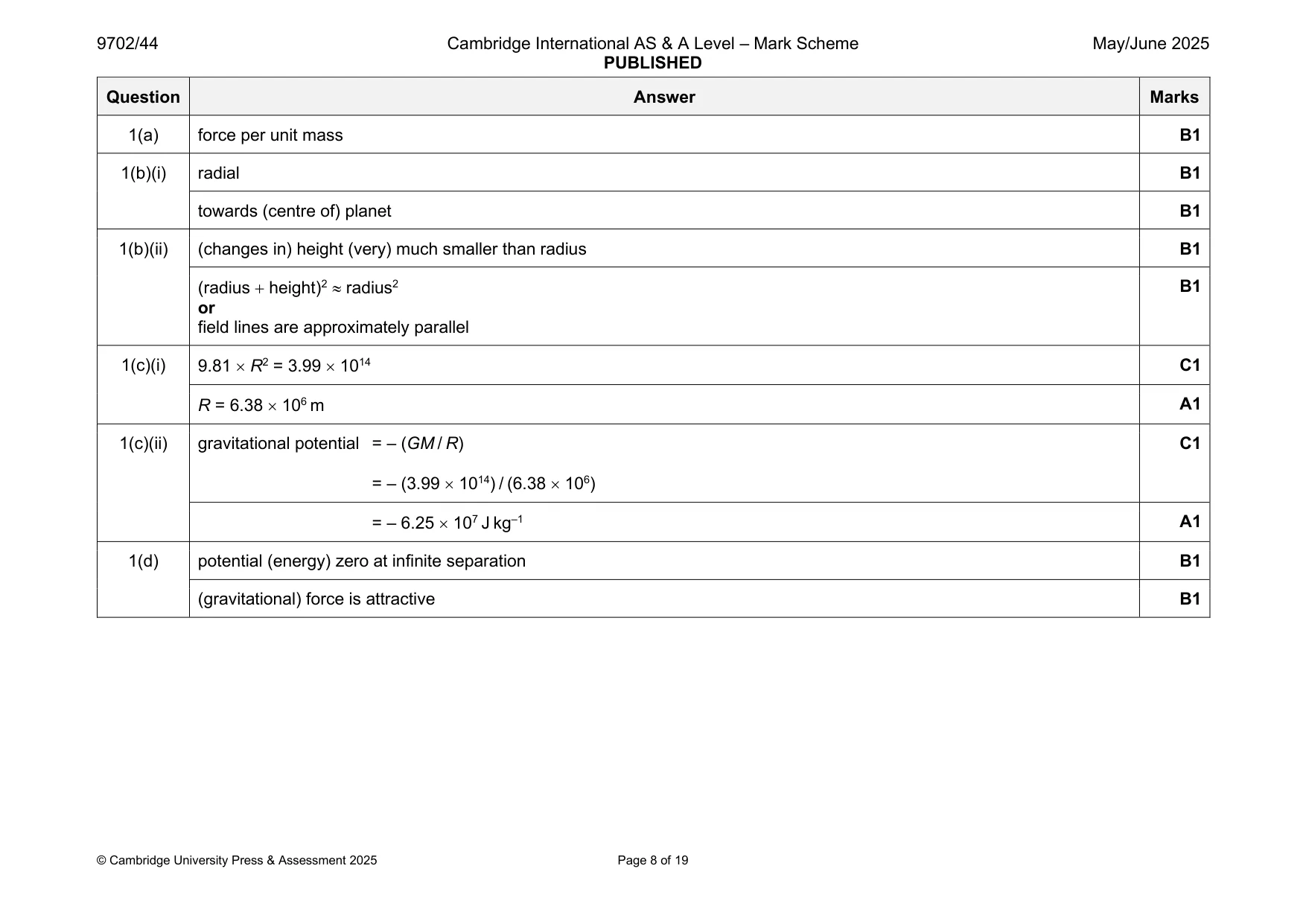
Mark scheme: Question Answer Marks 1(a) force per unit mass B1 1(b)(i) radial B1 towards (centre of) planet B1 1(b)(ii) (changes in) height (very) much smaller than radius B1 (radius + height)2 radius2 B1 or field lines are approximately parallel 1(c)(i) 9.81 R2 = 3.99 1014 C1 R = 6.38 106 m A1 1(c)(ii) gravitational potential = – (GM / R) C1 = – (3.99 1014) / (6.38 106) = – 6.25 107 J kg–1 A1 1(d) potential (energy) zero at infinite separation B1 (gravitational) force is attractive B1
Q2 · State what is meant by two objects being in thermal equilibrium
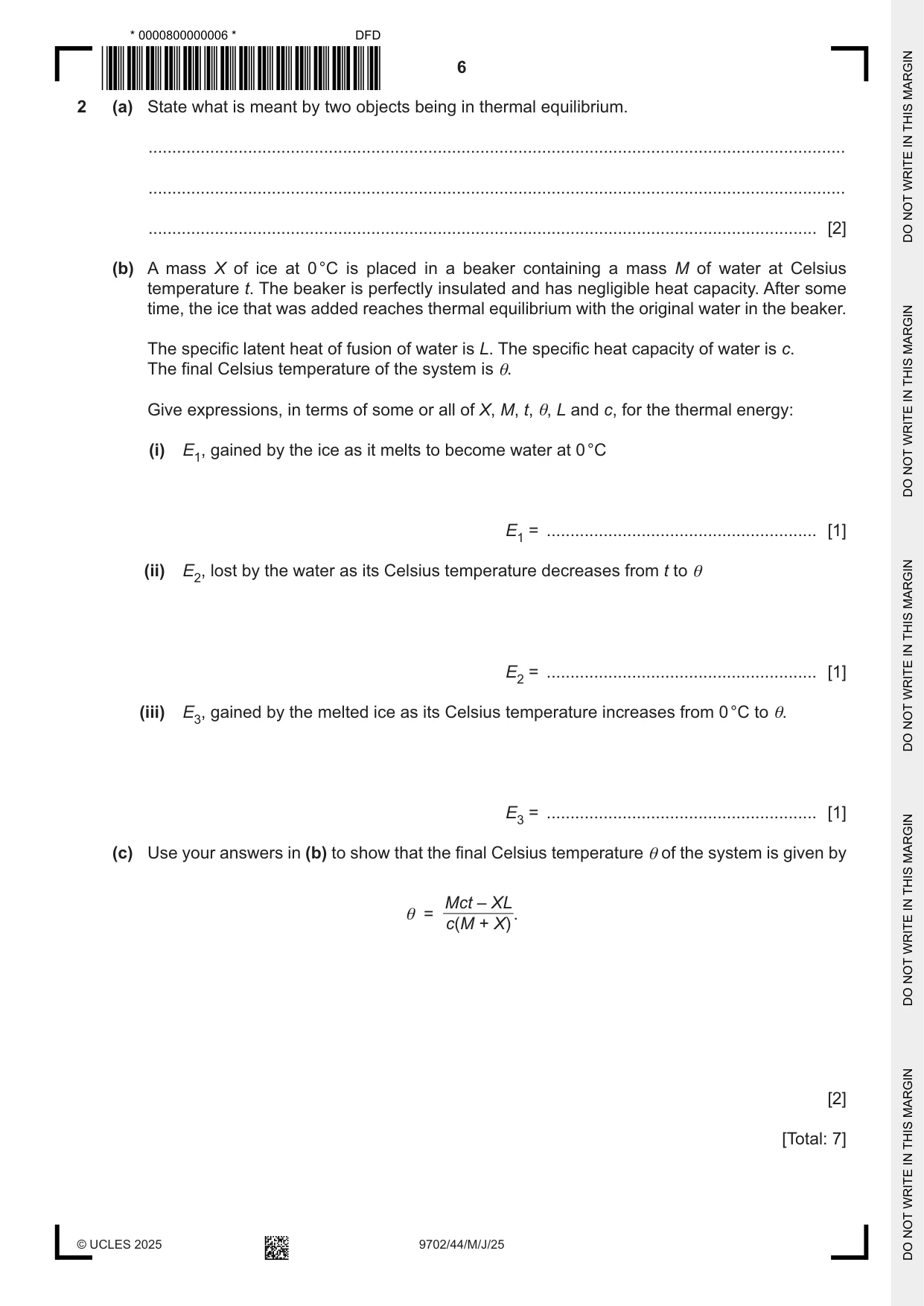
2 (a) State what is meant by two objects being in thermal equilibrium. ................................................................................................................................................... ................................................................................................................................................... ............................................................................................................................................. [2] (b) A mass X of ice at 0 °C is placed in a beaker containing a mass M of water at Celsius temperature t. The beaker is perfectly insulated and has negligible heat capacity. After some time, the ice that was added reaches thermal equilibrium with the original water in the beaker. The specific latent heat of fusion of water is L. The specific heat capacity of water is c. The final Celsius temperature of the system is θ. Give expressions, in terms of some or all of X, M, t, θ, L and c, for the thermal energy: (i) E1, gained by the ice as it melts to become water at 0 °C E1 = ......................................................... [1] (ii) E2, lost by the water as its Celsius temperature decreases from t to θ E2 = ......................................................... [1] (iii) E3, gained by the melted ice as its Celsius temperature increases from 0 °C to θ. E3 = ......................................................... [1] (c) Use your answers in (b) to show that the final Celsius temperature θ of the system is given by Mct – XL θ = . c(M + X) [2] [Total: 7]
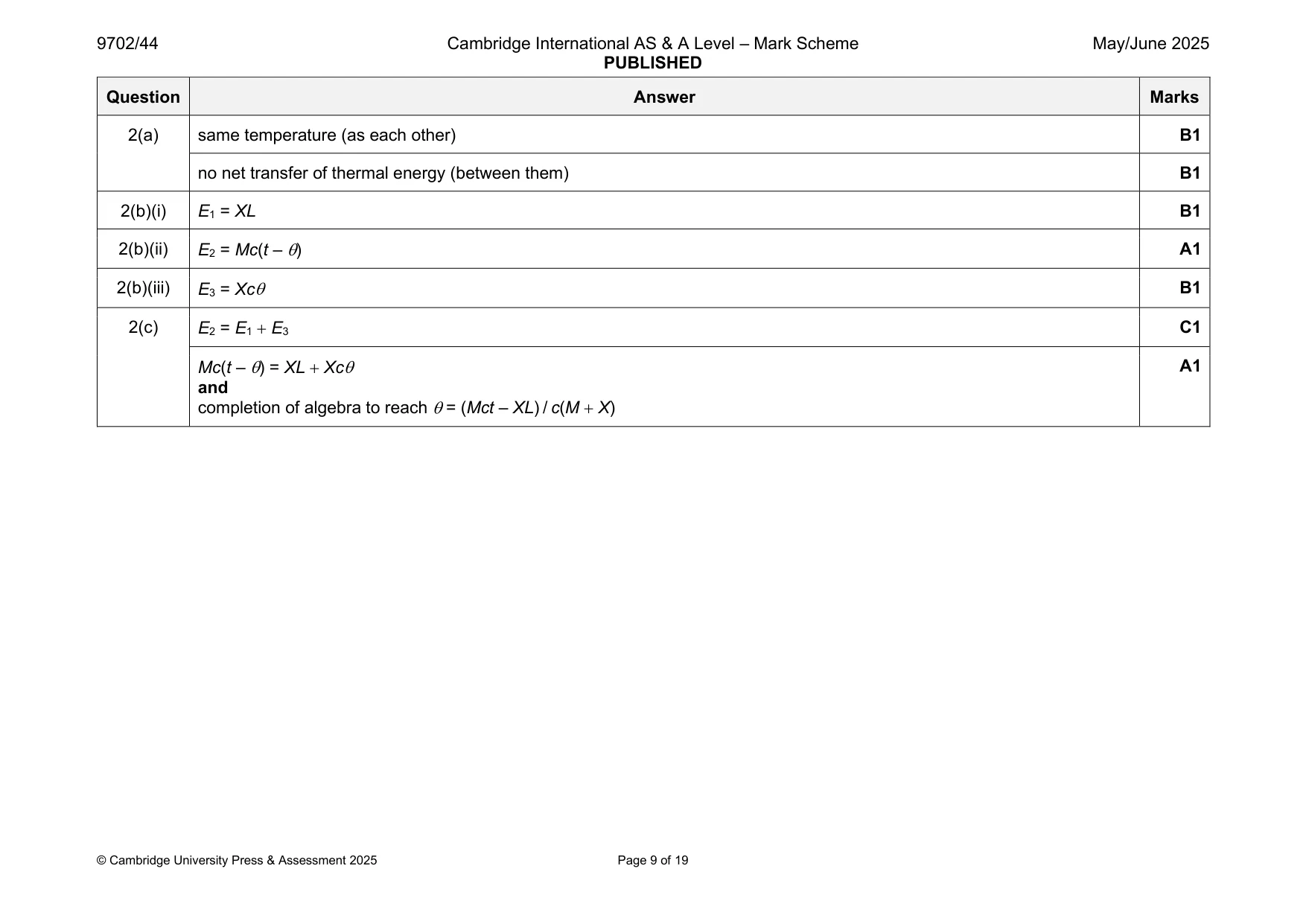
Mark scheme: 2(a) same temperature (as each other) B1 no net transfer of thermal energy (between them) B1 2(b)(i) E1 = XL B1 2(b)(ii) E2 = Mc(t – ) A1 2(b)(iii) E3 = Xc B1 2(c) E2 = E1 + E3 C1 Mc(t – ) = XL + Xc A1 and completion of algebra to reach = (Mct – XL) / c(M + X)
More questions on Specific heat capacity and specific latent heat
Q3 · State what is meant by an ideal gas
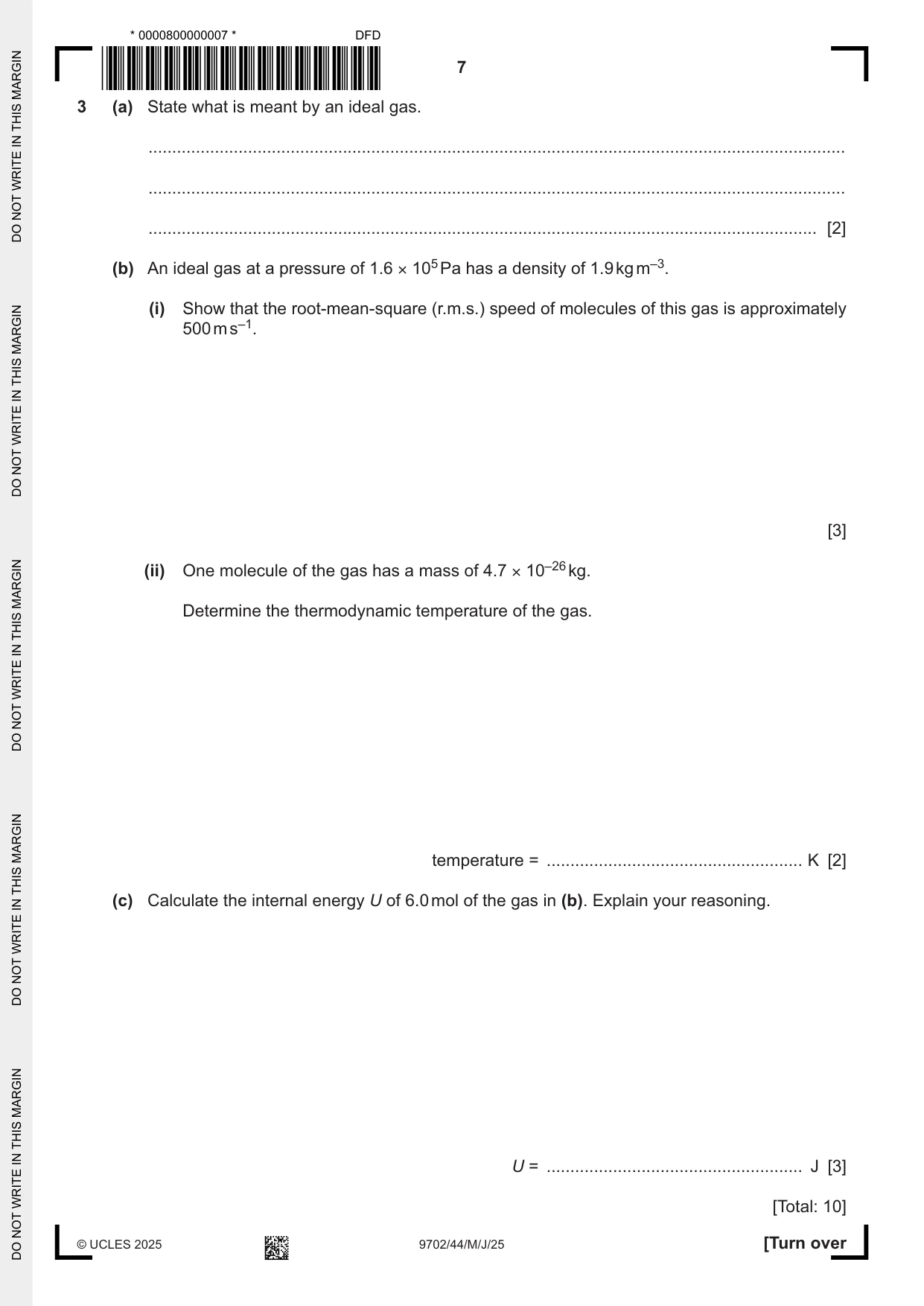
3 (a) State what is meant by an ideal gas. ................................................................................................................................................... ................................................................................................................................................... ............................................................................................................................................. [2] (b) An ideal gas at a pressure of 1.6 × 10⁵ Pa has a density of 1.9 kg m–3. (i) Show that the root-mean-square (r.m.s.) speed of molecules of this gas is approximately 500 m s–1. [3] (ii) One molecule of the gas has a mass of 4.7 × 10⁻²⁶ kg. Determine the thermodynamic temperature of the gas. temperature = ...................................................... K [2] (c) Calculate the internal energy U of 6.0 mol of the gas in (b). Explain your reasoning. U = ...................................................... J [3] [Total: 10]
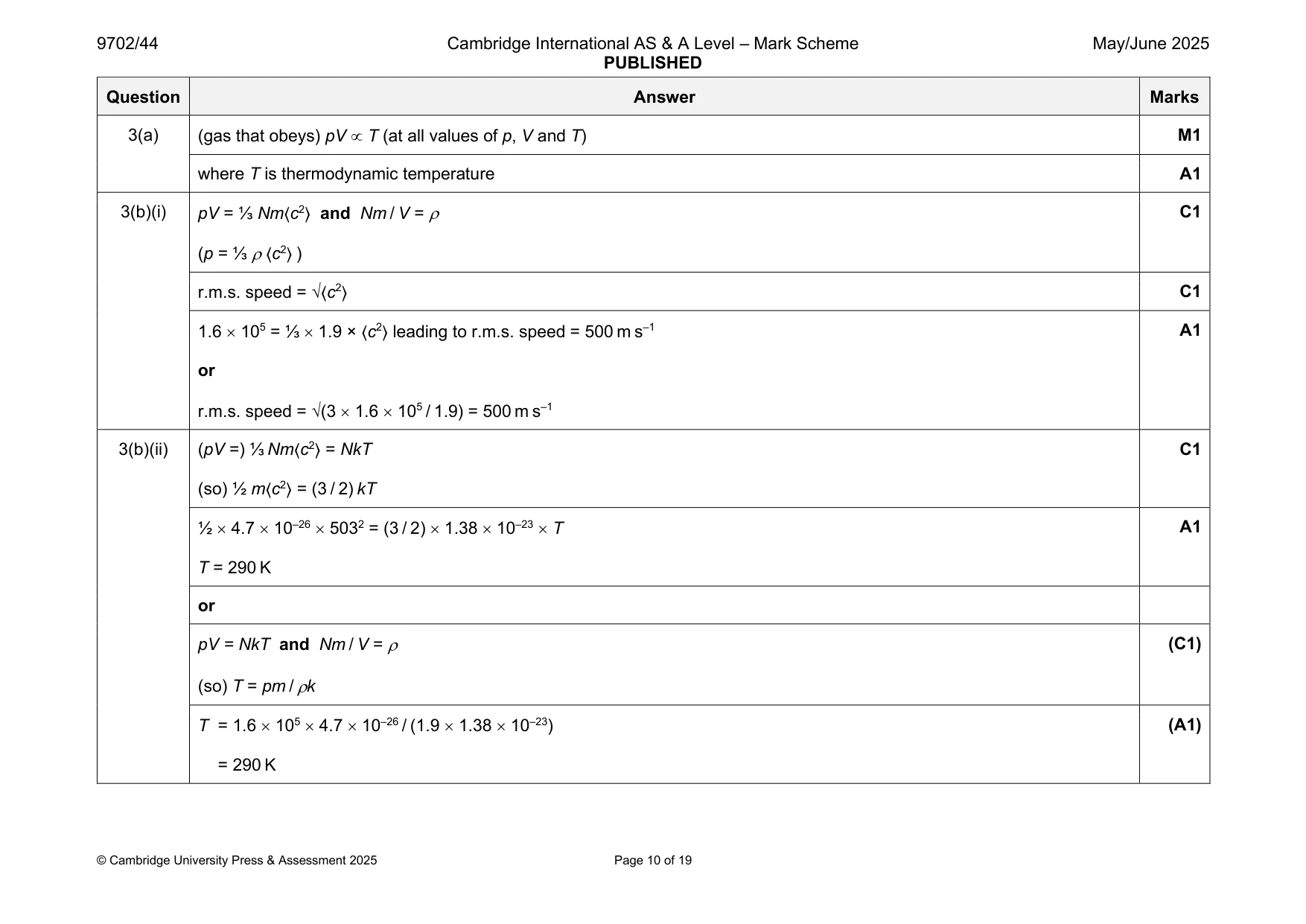
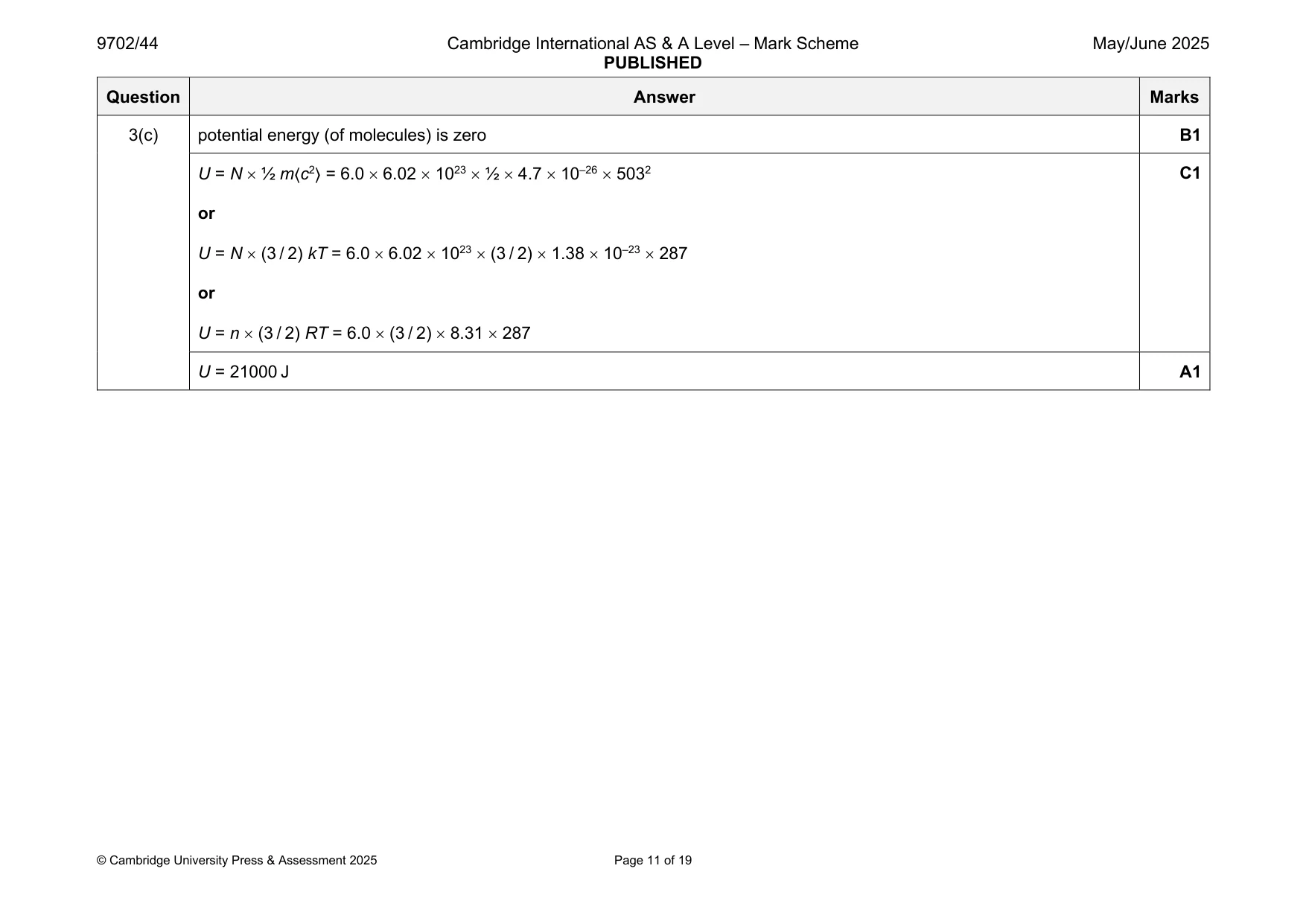
Mark scheme: 3(a) (gas that obeys) pV T (at all values of p, V and T) M1 where T is thermodynamic temperature A1 3(b)(i) pV = ⅓ Nm〈c2〉 and Nm / V = C1 (p = ⅓ 〈c2〉 ) r.m.s. speed = √〈c2〉 C1 1.6 105 = ⅓ 1.9 × 〈c2〉 leading to r.m.s. speed = 500 m s–1 A1 or r.m.s. speed = √(3 1.6 105 / 1.9) = 500 m s–1 3(b)(ii) (pV =) ⅓ Nm〈c2〉 = NkT C1 (so) ½ m〈c2〉 = (3 / 2) kT ½ 4.7 10–26 5032 = (3 / 2) 1.38 10–23 T A1 T = 290 K or pV = NkT and Nm / V = (C1) (so) T = pm / k T = 1.6 105 4.7 10–26 / (1.9 1.38 10–23) (A1) = 290 K 3(c) potential energy (of molecules) is zero B1 U = N ½ m〈c2〉 = 6.0 6.02 1023 ½ 4.7 10–26 5032 C1 or U = N (3 / 2) kT = 6.0 6.02 1023 (3 / 2) 1.38 10–23 287 or U = n (3 / 2) RT = 6.0 (3 / 2) 8.31 287 U = 21000 J A1
Q4 · State what is meant by simple harmonic motion
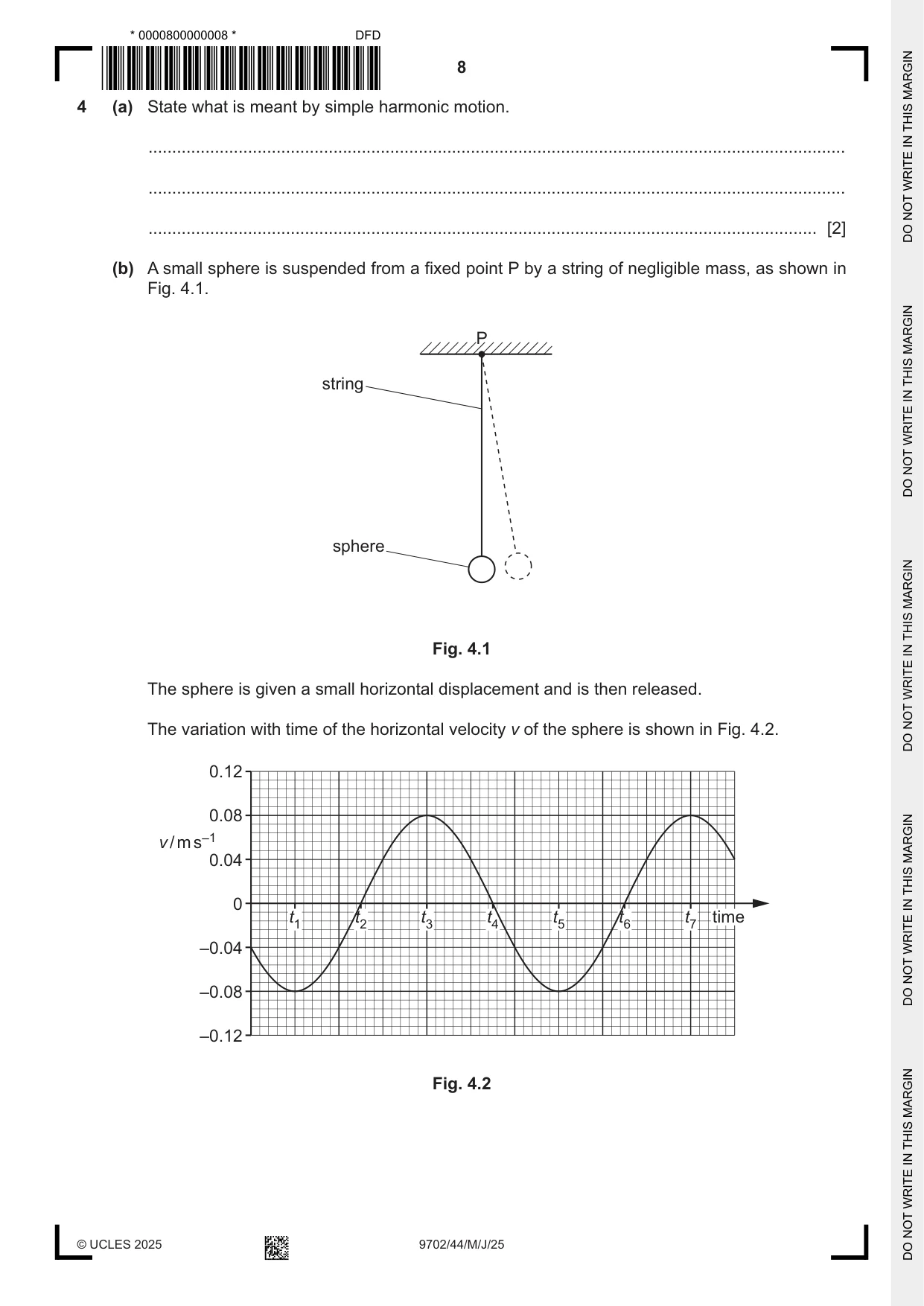
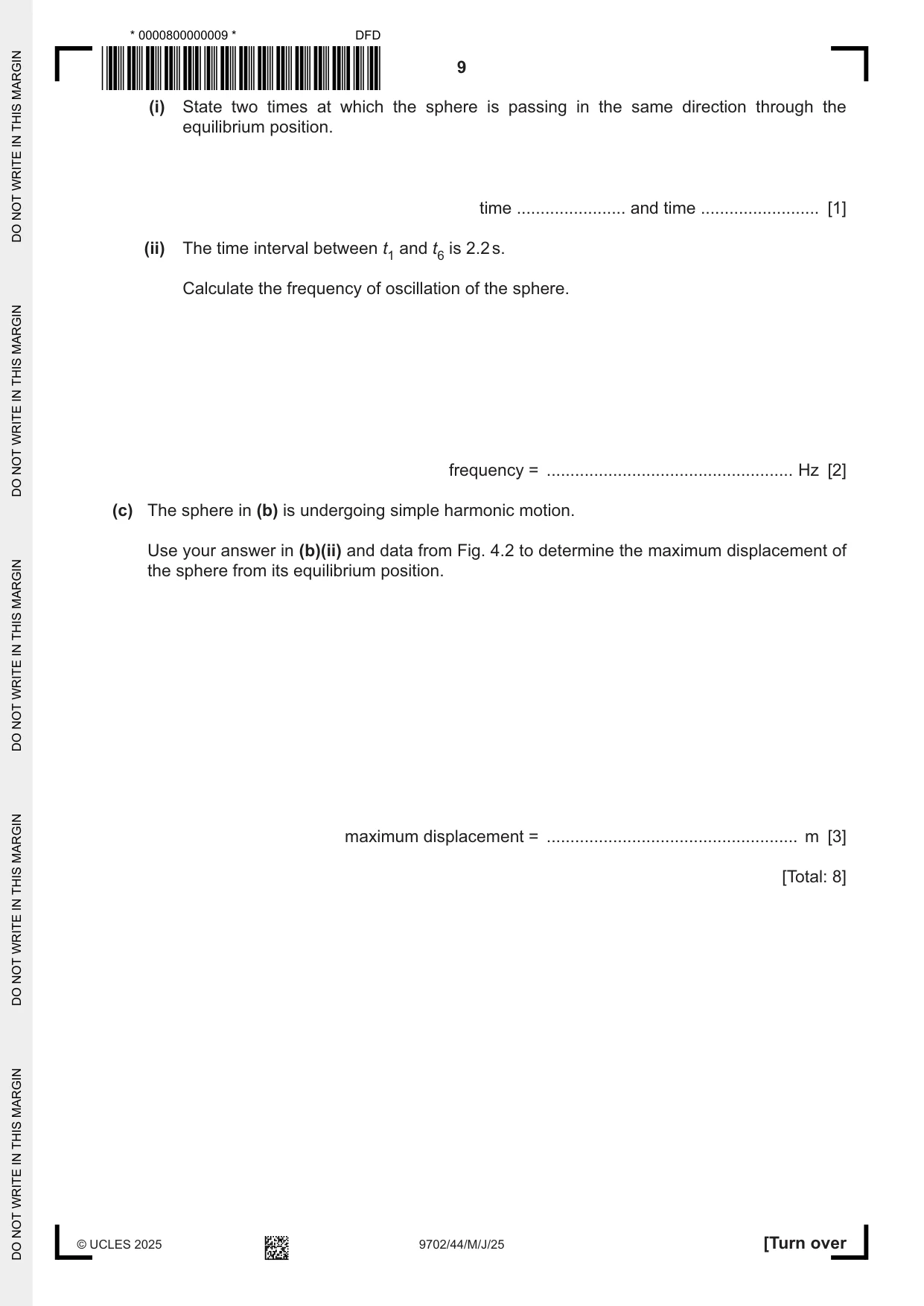
4 (a) State what is meant by simple harmonic motion. ................................................................................................................................................... ................................................................................................................................................... ............................................................................................................................................. [2] (b) A small sphere is suspended from a fixed point P by a string of negligible mass, as shown in Fig. 4.1. P string sphere Fig. 4.1 The sphere is given a small horizontal displacement and is then released. The variation with time of the horizontal velocity v of the sphere is shown in Fig. 4.2. 0.12 0.08 v / m s–1 0.04 0 t1 t2 t3 t4 t5 t6 t7 time –0.04 –0.08 –0.12 Fig. 4.2 (i) State two times at which the sphere is passing in the same direction through the equilibrium position. time ....................... and time ......................... [1] (ii) The time interval between t1 and t6 is 2.2 s. Calculate the frequency of oscillation of the sphere. frequency = .................................................... Hz [2] (c) The sphere in (b) is undergoing simple harmonic motion. Use your answer in (b)(ii) and data from Fig. 4.2 to determine the maximum displacement of the sphere from its equilibrium position. maximum displacement = ..................................................... m [3] [Total: 8]
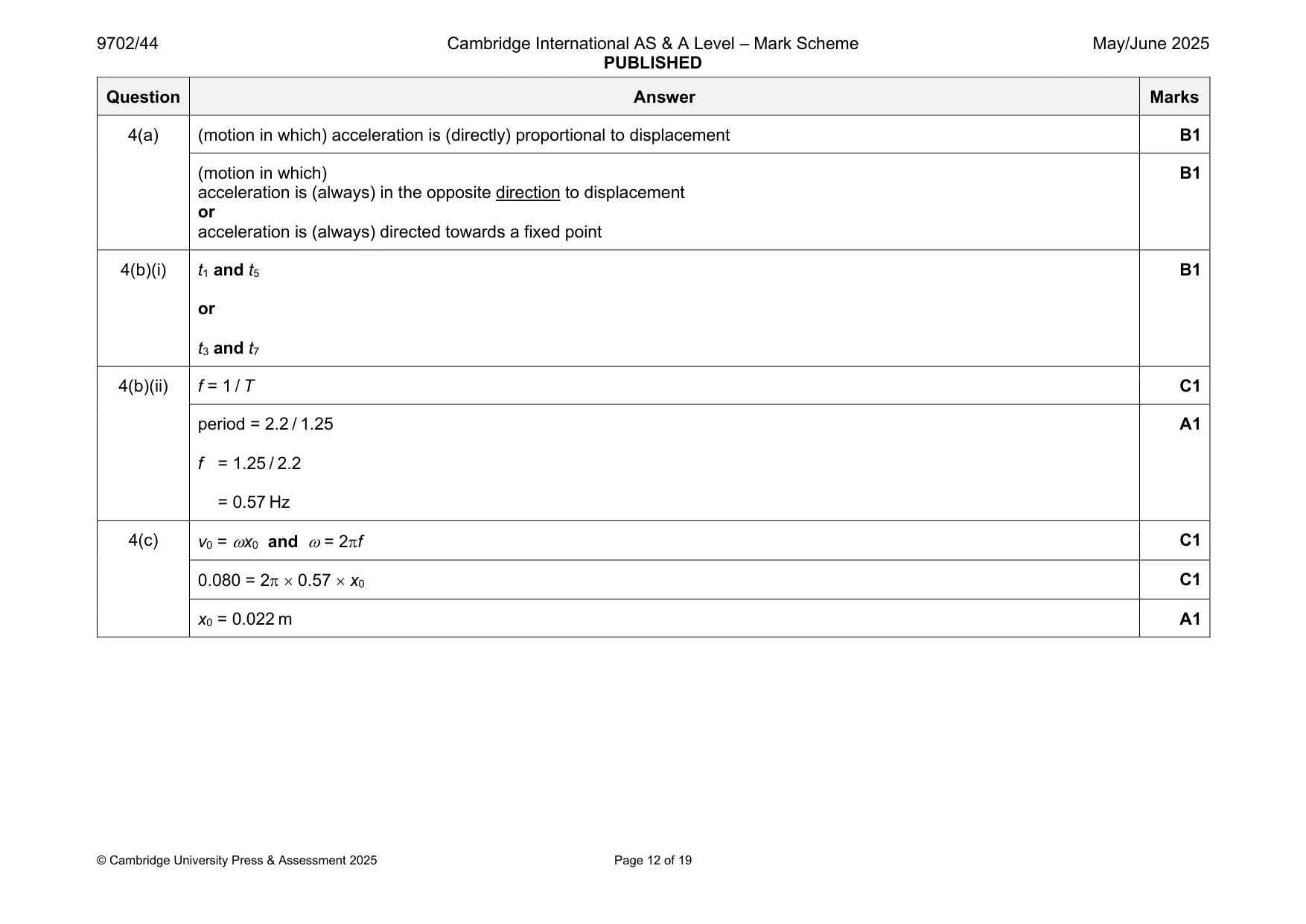
Mark scheme: 4(a) (motion in which) acceleration is (directly) proportional to displacement B1 (motion in which) B1 acceleration is (always) in the opposite direction to displacement or acceleration is (always) directed towards a fixed point 4(b)(i) t1 and t5 B1 or t3 and t7 4(b)(ii) f = 1 / T C1 period = 2.2 / 1.25 A1 f = 1.25 / 2.2 = 0.57 Hz 4(c) v0 = x0 and = 2f C1 0.080 = 2 0.57 x0 C1 x0 = 0.022 m A1
Q5 · Define electric potential at a point
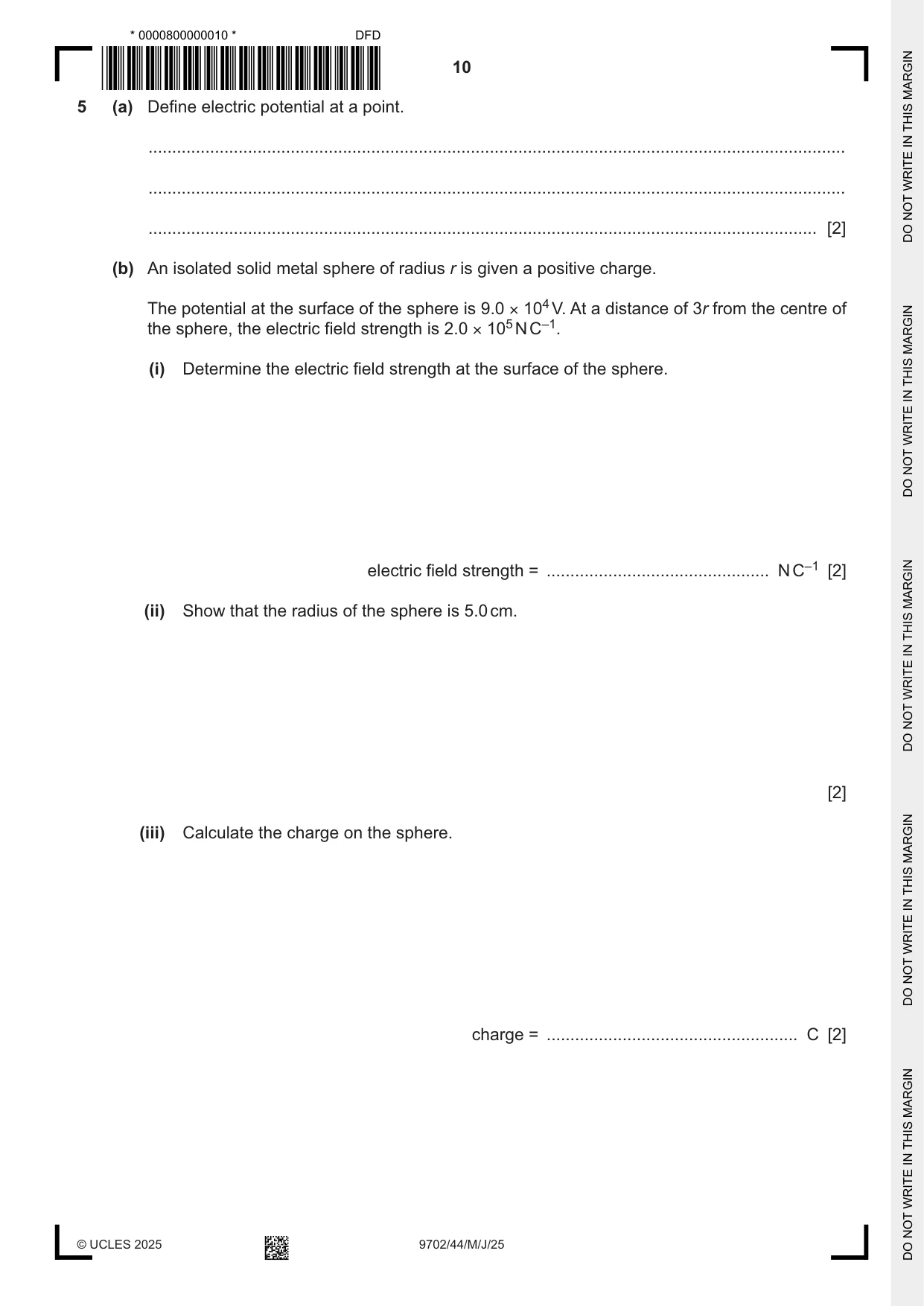
5 (a) Define electric potential at a point. ................................................................................................................................................... ................................................................................................................................................... ............................................................................................................................................. [2] (b) An isolated solid metal sphere of radius r is given a positive charge. The potential at the surface of the sphere is 9.0 × 10⁴ V. At a distance of 3r from the centre of the sphere, the electric field strength is 2.0 × 10⁵ N C–1. (i) Determine the electric field strength at the surface of the sphere. electric field strength = ............................................... N C–1 [2] (ii) Show that the radius of the sphere is 5.0 cm. [2] (iii) Calculate the charge on the sphere. charge = ..................................................... C [2] (iv) Use your answer in (b)(iii) to determine the capacitance of the sphere. capacitance = ...................................................... F [2] [Total: 10]
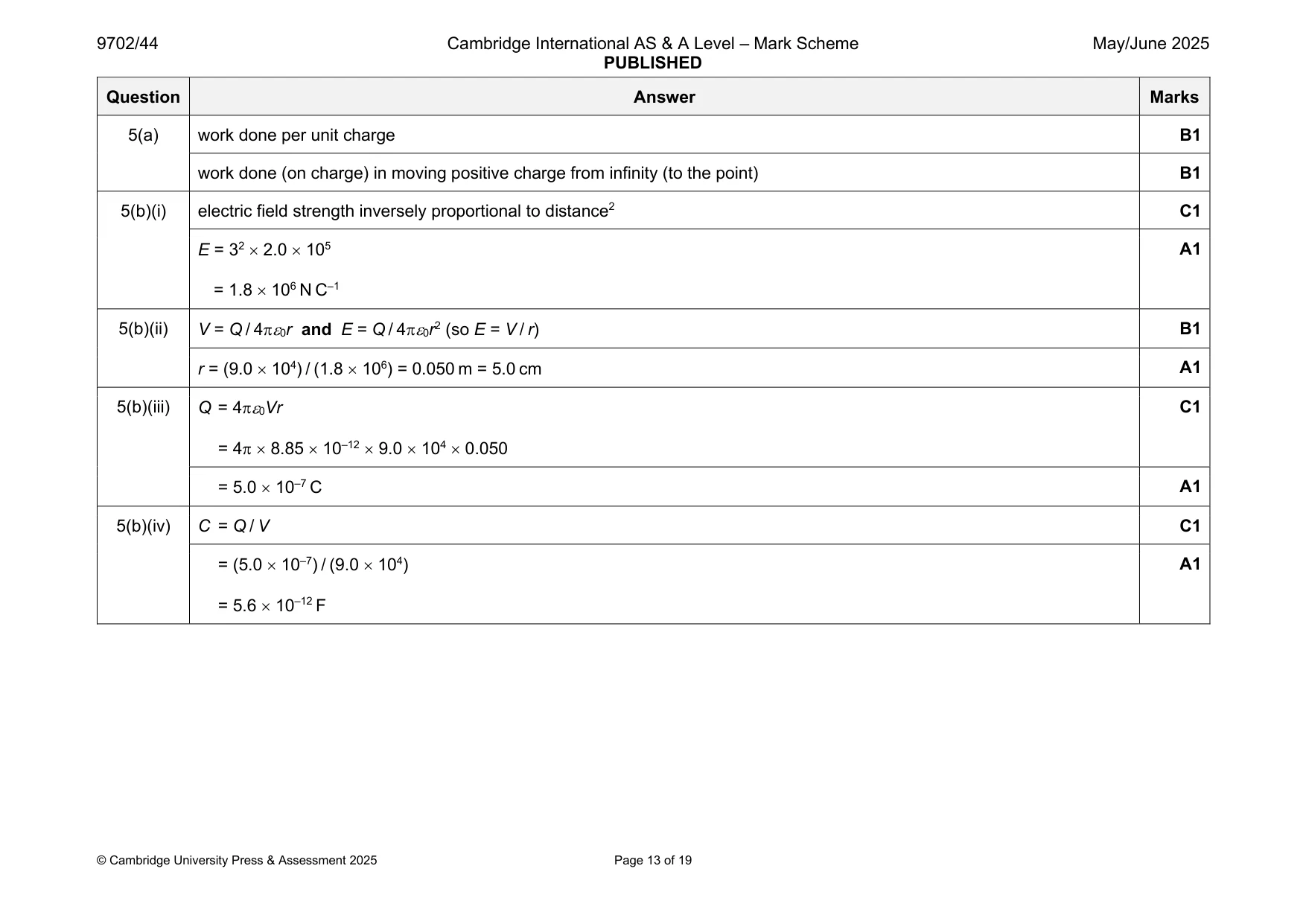
Mark scheme: 5(a) work done per unit charge B1 work done (on charge) in moving positive charge from infinity (to the point) B1 5(b)(i) electric field strength inversely proportional to distance2 C1 E = 32 2.0 105 A1 = 1.8 106 N C–1 5(b)(ii) V = Q / 40r and E = Q / 40r2 (so E = V / r) B1 r = (9.0 104) / (1.8 106) = 0.050 m = 5.0 cm A1 5(b)(iii) Q = 40Vr C1 = 4 8.85 10–12 9.0 104 0.050 = 5.0 10–7 C A1 5(b)(iv) C = Q / V C1 = (5.0 10–7) / (9.0 104) A1 = 5.6 10–12 F
Q6 · A rectangular coil PQRS of wire is free to rotate about its axis XY, as shown in Fig
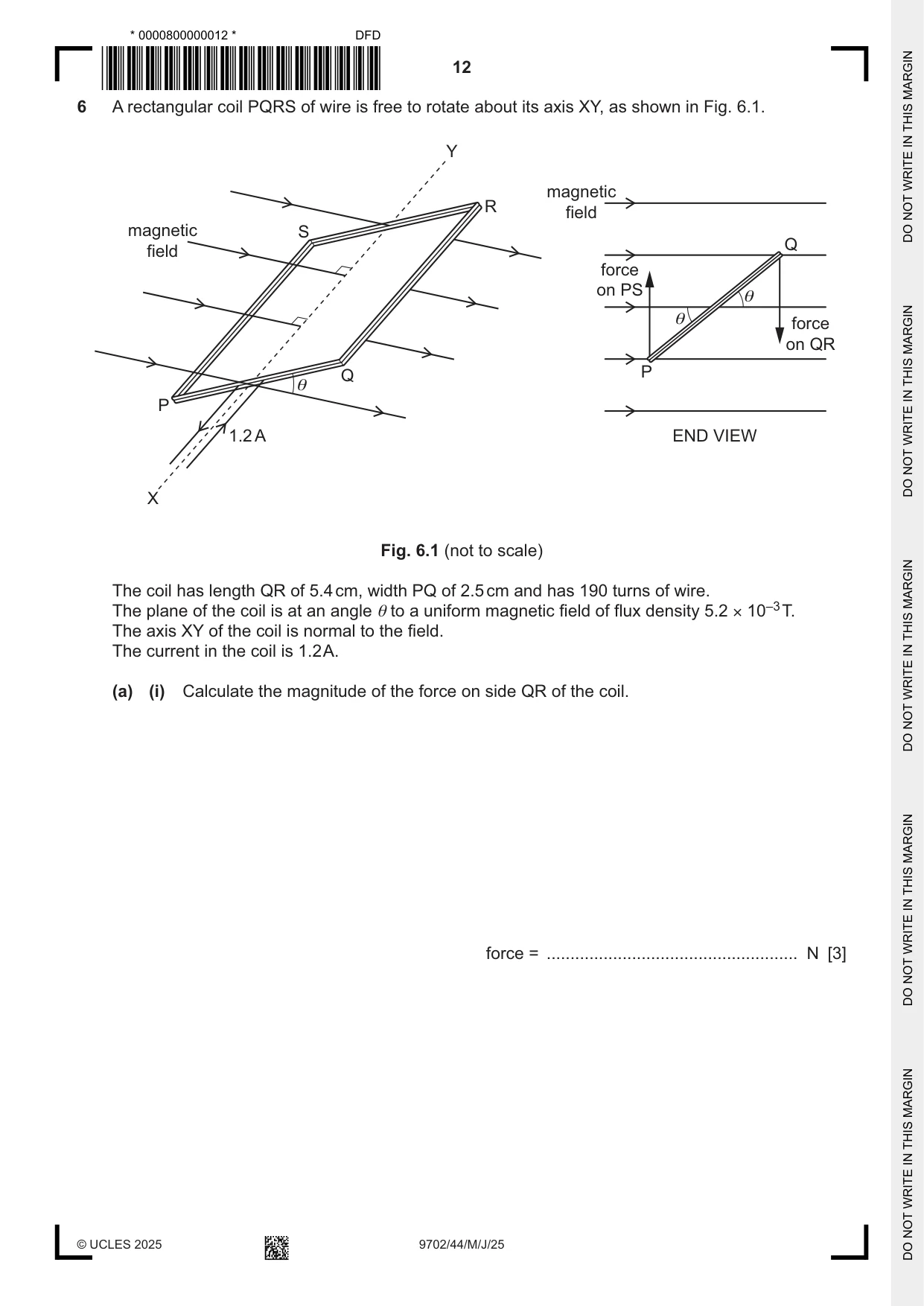
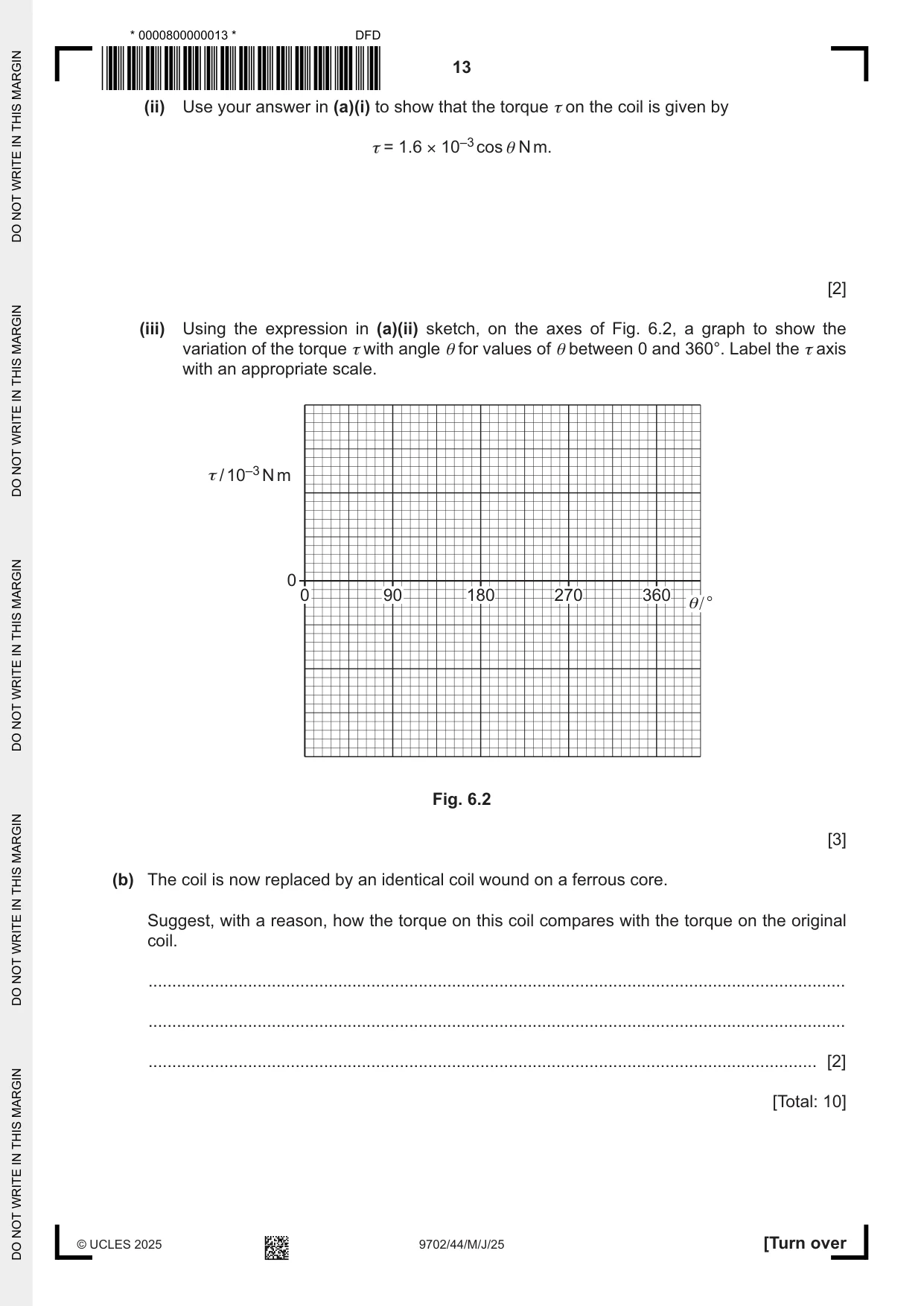
6 A rectangular coil PQRS of wire is free to rotate about its axis XY, as shown in Fig. 6.1. Y magnetic R field magnetic S Q field force on PS θ θ force on QR Q P θ P 1.2 A END VIEW X Fig. 6.1 (not to scale) The coil has length QR of 5.4 cm, width PQ of 2.5 cm and has 190 turns of wire. The plane of the coil is at an angle θ to a uniform magnetic field of flux density 5.2 × 10⁻³ T. The axis XY of the coil is normal to the field. The current in the coil is 1.2 A. (a) (i) Calculate the magnitude of the force on side QR of the coil. force = ..................................................... N [3] (ii) Use your answer in (a)(i) to show that the torque τ on the coil is given by τ = 1.6 × 10⁻³ cos θ N m. [2] (iii) Using the expression in (a)(ii) sketch, on the axes of Fig. 6.2, a graph to show the variation of the torque τ with angle θ for values of θ between 0 and 360°. Label the τ axis with an appropriate scale. τ / 10–3 N m 0 0 90 180 270 360 θ/ ° Fig. 6.2 [3] (b) The coil is now replaced by an identical coil wound on a ferrous core. Suggest, with a reason, how the torque on this coil compares with the torque on the original coil. ................................................................................................................................................... ................................................................................................................................................... ............................................................................................................................................. [2] [Total: 10]
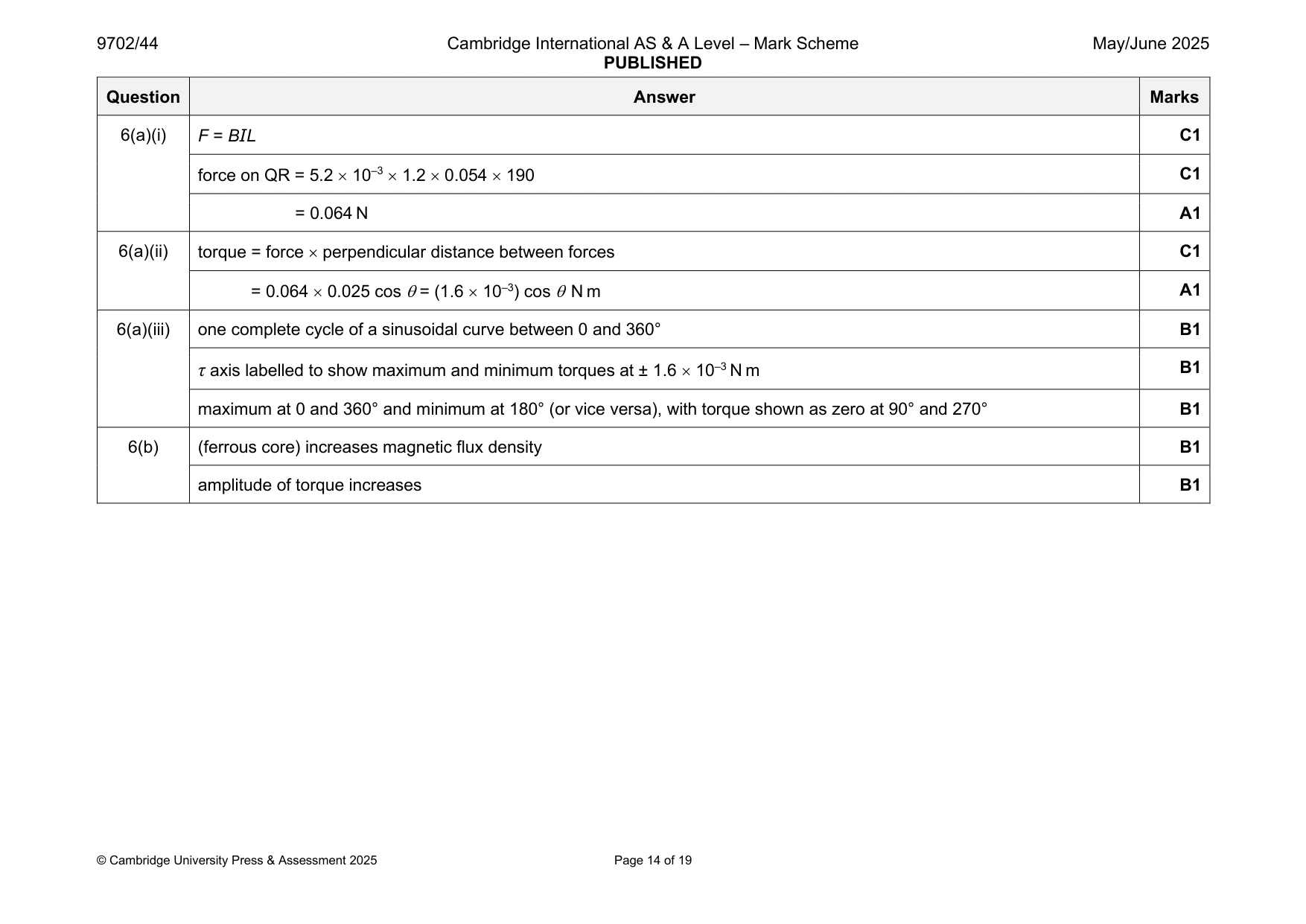
Mark scheme: 6(a)(i) F = BIL C1 force on QR = 5.2 10–3 1.2 0.054 190 C1 = 0.064 N A1 6(a)(ii) torque = force perpendicular distance between forces C1 = 0.064 0.025 cos = (1.6 10–3) cos N m A1 6(a)(iii) one complete cycle of a sinusoidal curve between 0 and 360° B1 τ axis labelled to show maximum and minimum torques at ± 1.6 10–3 N m B1 maximum at 0 and 360° and minimum at 180° (or vice versa), with torque shown as zero at 90° and 270° B1 6(b) (ferrous core) increases magnetic flux density B1 amplitude of torque increases B1
Q7 · A bar magnet is suspended from a spring
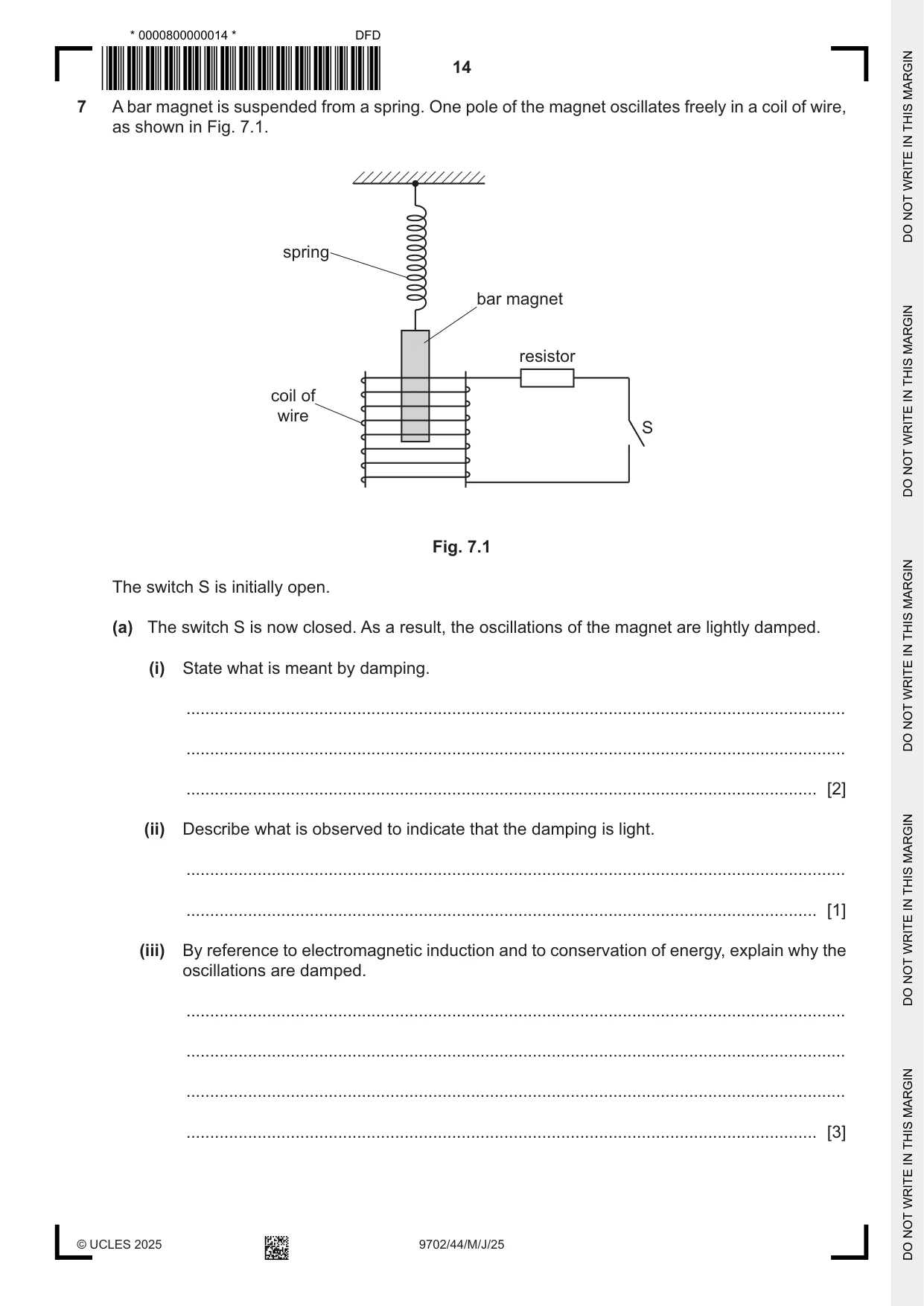
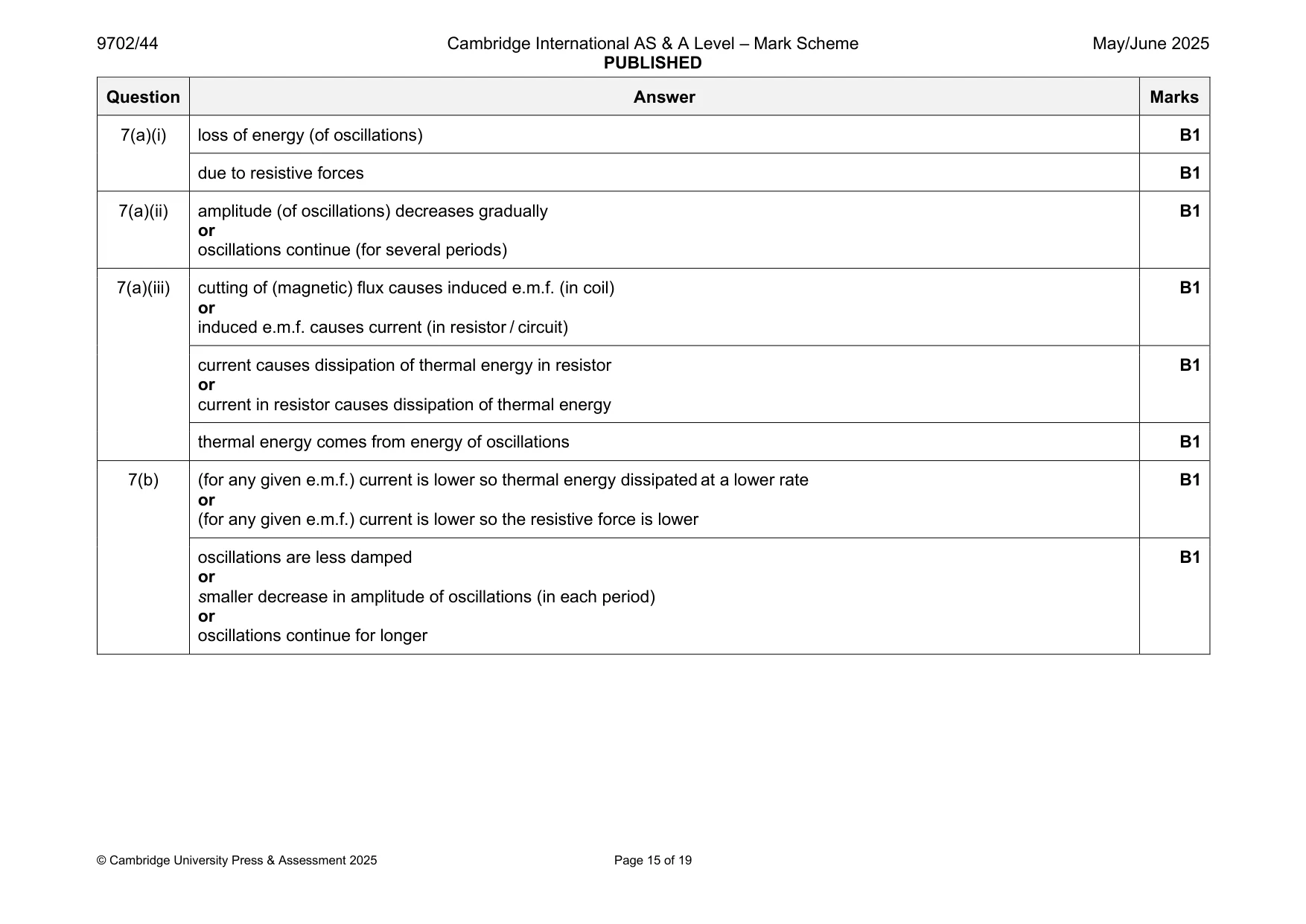
7 A bar magnet is suspended from a spring. One pole of the magnet oscillates freely in a coil of wire, as shown in Fig. 7.1. spring bar magnet resistor coil of wire S Fig. 7.1 The switch S is initially open. (a) The switch S is now closed. As a result, the oscillations of the magnet are lightly damped. (i) State what is meant by damping. ........................................................................................................................................... ........................................................................................................................................... ..................................................................................................................................... [2] (ii) Describe what is observed to indicate that the damping is light. ........................................................................................................................................... ..................................................................................................................................... [1] (iii) By reference to electromagnetic induction and to conservation of energy, explain why the oscillations are damped. ........................................................................................................................................... ........................................................................................................................................... ........................................................................................................................................... ..................................................................................................................................... [3] (b) The procedure in (a) is repeated after replacing the resistor with one of greater resistance. Suggest, with a reason, the effect of this change on the oscillations. ................................................................................................................................................... ................................................................................................................................................... ............................................................................................................................................. [2] [Total: 8]
Mark scheme: 7(a)(i) loss of energy (of oscillations) B1 due to resistive forces B1 7(a)(ii) amplitude (of oscillations) decreases gradually B1 or oscillations continue (for several periods) 7(a)(iii) cutting of (magnetic) flux causes induced e.m.f. (in coil) B1 or induced e.m.f. causes current (in resistor / circuit) current causes dissipation of thermal energy in resistor B1 or current in resistor causes dissipation of thermal energy thermal energy comes from energy of oscillations B1 7(b) (for any given e.m.f.) current is lower so thermal energy dissipated at a lower rate B1 or (for any given e.m.f.) current is lower so the resistive force is lower oscillations are less damped B1 or smaller decrease in amplitude of oscillations (in each period) or oscillations continue for longer
Q8 · An incomplete circuit diagram of a bridge rectifier is shown in Fig
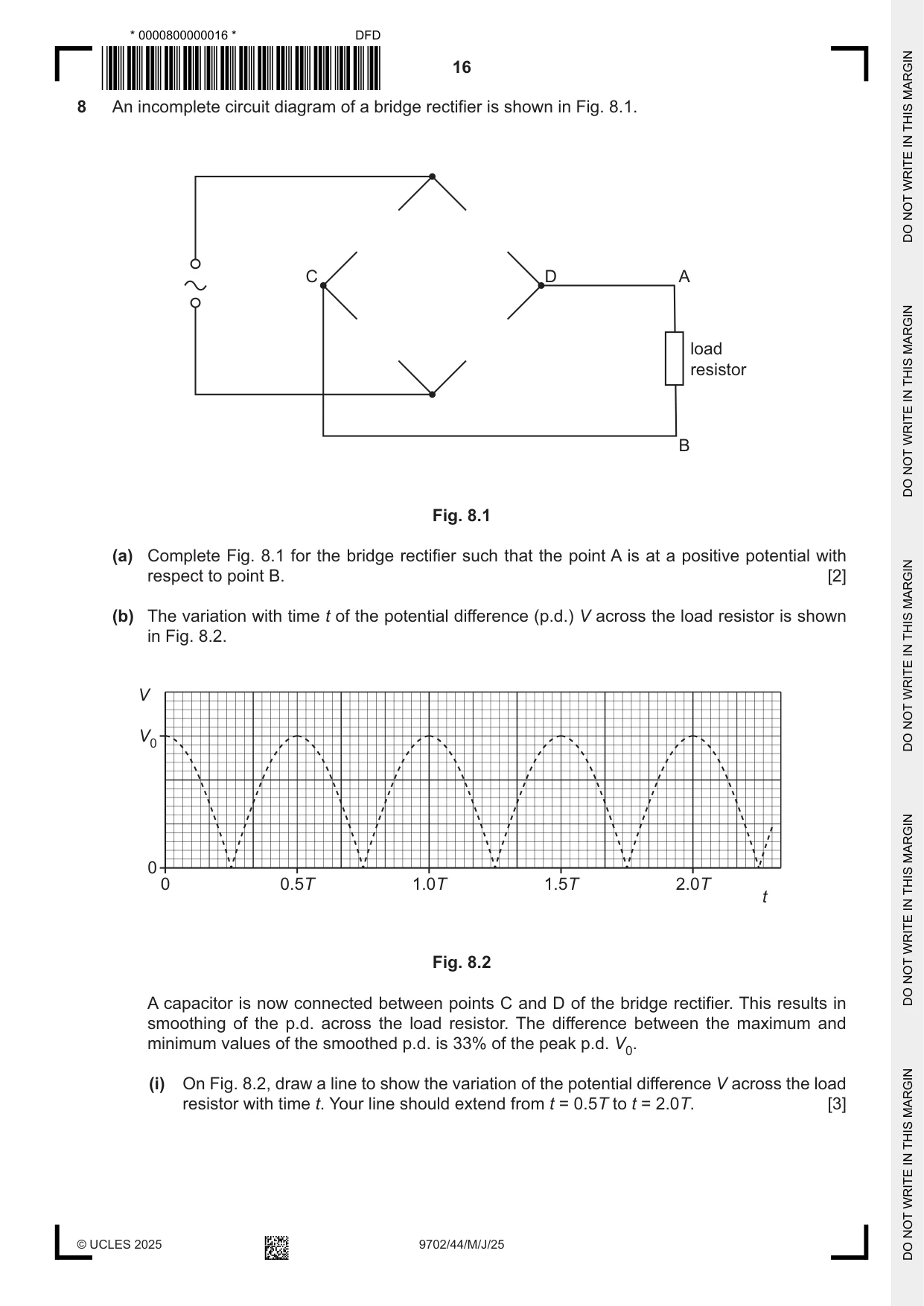
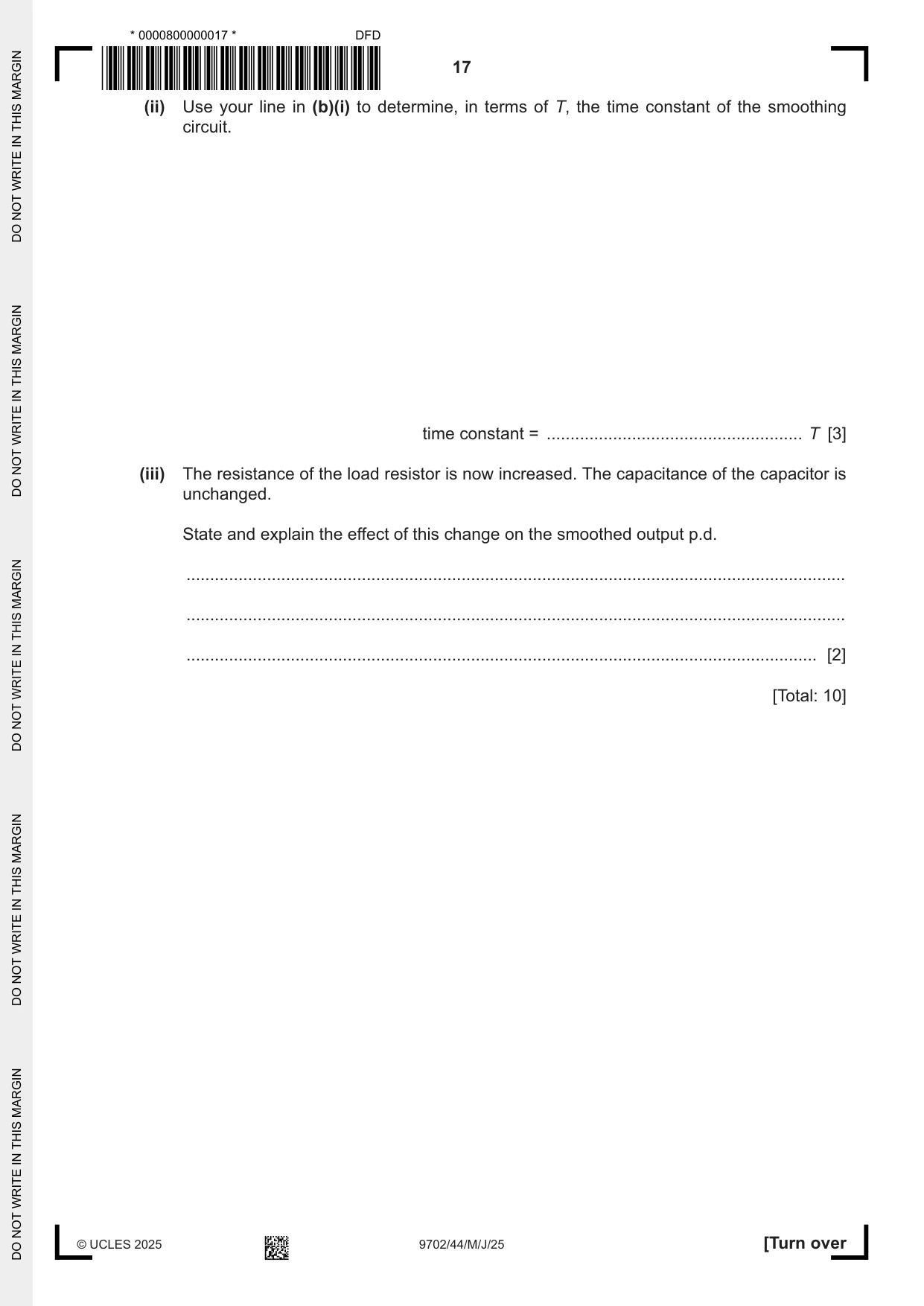
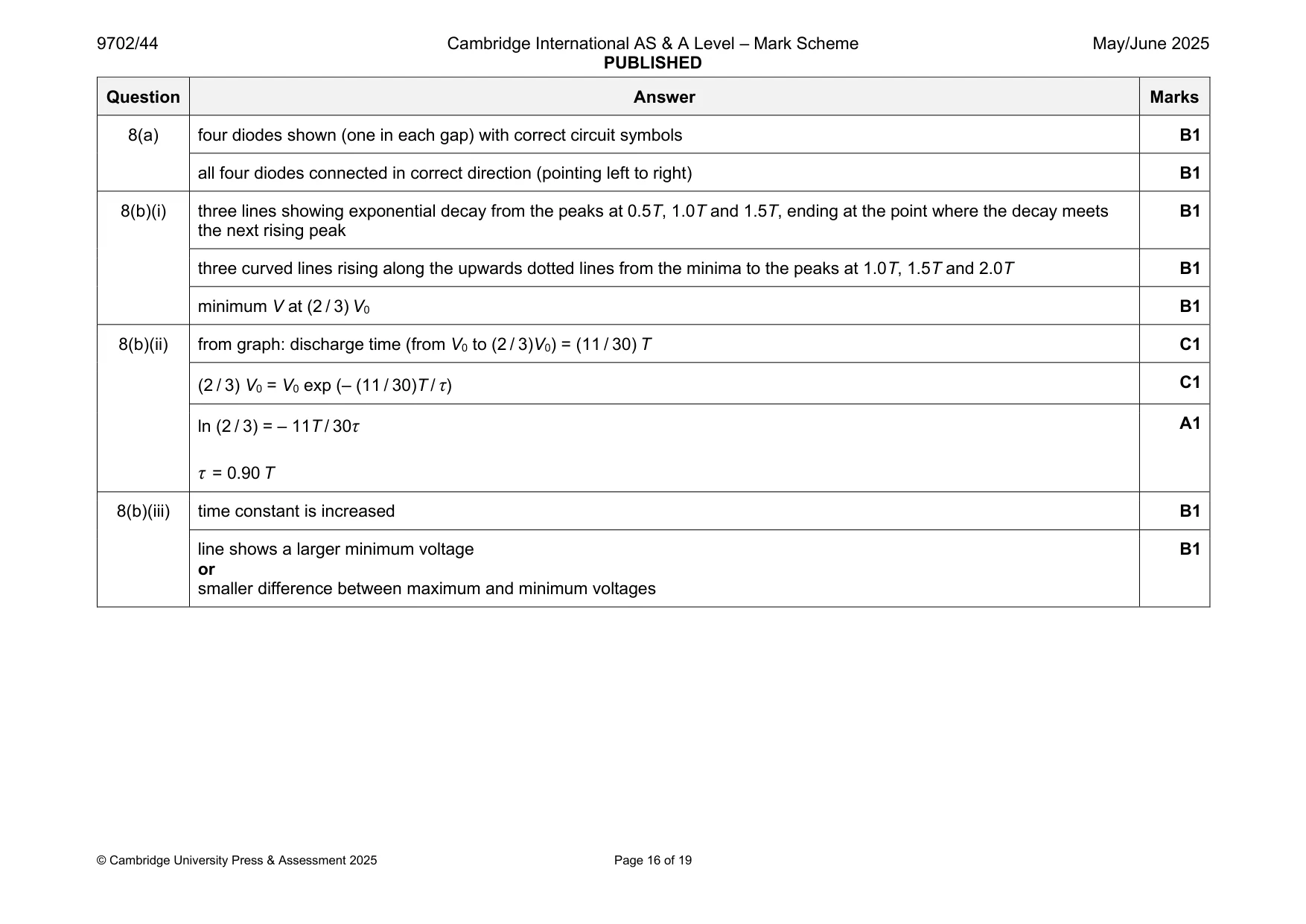
8 An incomplete circuit diagram of a bridge rectifier is shown in Fig. 8.1. C D A load resistor B Fig. 8.1 (a) Complete Fig. 8.1 for the bridge rectifier such that the point A is at a positive potential with respect to point B. [2] (b) The variation with time t of the potential difference (p.d.) V across the load resistor is shown in Fig. 8.2. V V0 0 0 0.5T 1.0T 1.5T 2.0T t Fig. 8.2 A capacitor is now connected between points C and D of the bridge rectifier. This results in smoothing of the p.d. across the load resistor. The difference between the maximum and minimum values of the smoothed p.d. is 33% of the peak p.d. V0. (i) On Fig. 8.2, draw a line to show the variation of the potential difference V across the load resistor with time t. Your line should extend from t = 0.5T to t = 2.0T. [3] (ii) Use your line in (b)(i) to determine, in terms of T, the time constant of the smoothing circuit. time constant = ...................................................... T [3] (iii) The resistance of the load resistor is now increased. The capacitance of the capacitor is unchanged. State and explain the effect of this change on the smoothed output p.d. ........................................................................................................................................... ........................................................................................................................................... ..................................................................................................................................... [2] [Total: 10]
Mark scheme: 8(a) four diodes shown (one in each gap) with correct circuit symbols B1 all four diodes connected in correct direction (pointing left to right) B1 8(b)(i) three lines showing exponential decay from the peaks at 0.5T, 1.0T and 1.5T, ending at the point where the decay meets B1 the next rising peak three curved lines rising along the upwards dotted lines from the minima to the peaks at 1.0T, 1.5T and 2.0T B1 minimum V at (2 / 3) V0 B1 8(b)(ii) from graph: discharge time (from V0 to (2 / 3)V0) = (11 / 30) T C1 (2 / 3) V0 = V0 exp (– (11 / 30)T / τ) C1 ln (2 / 3) = – 11T / 30τ A1 τ = 0.90 T 8(b)(iii) time constant is increased B1 line shows a larger minimum voltage B1 or smaller difference between maximum and minimum voltages
Q9 · Describe what is meant by wave–particle duality
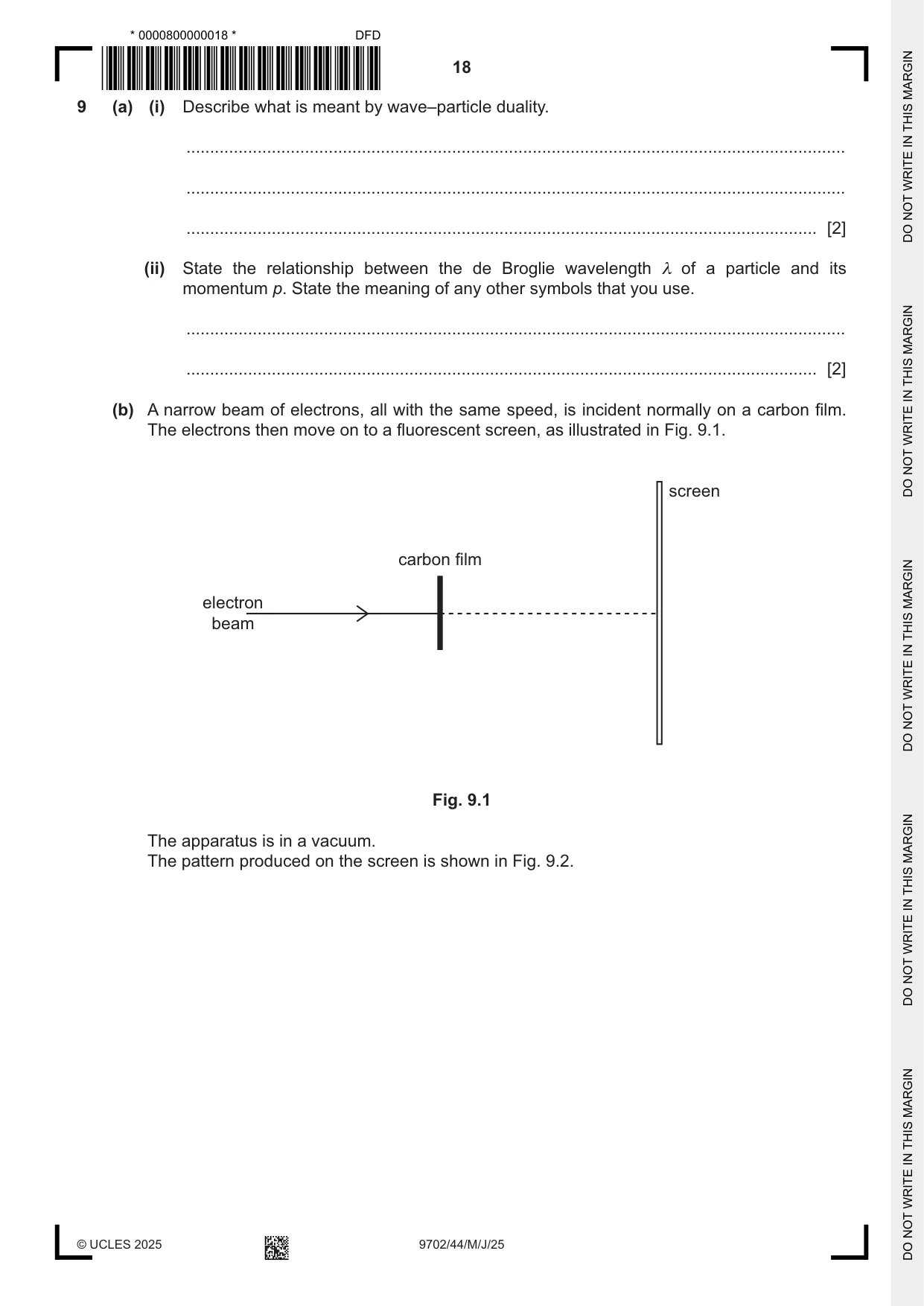
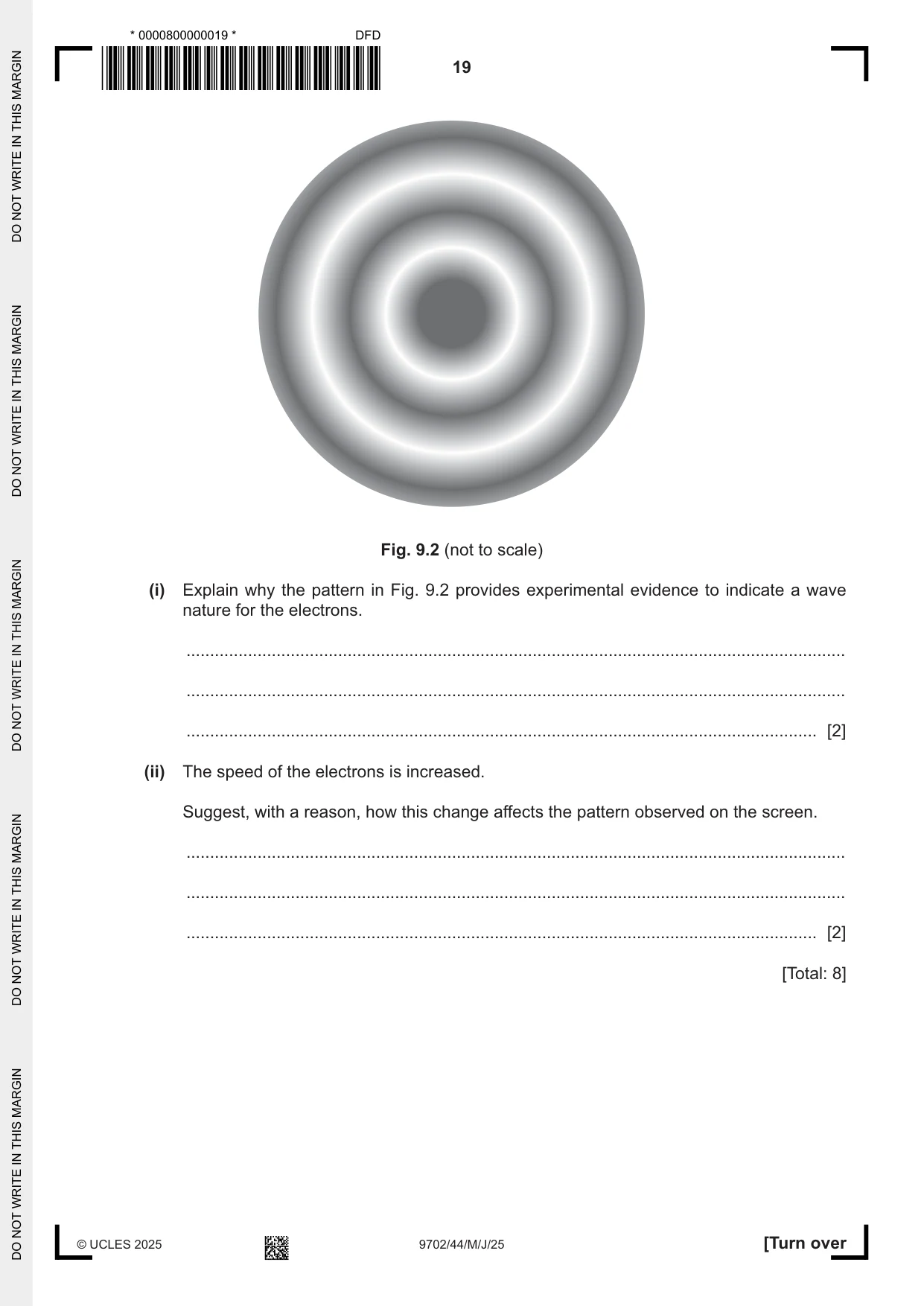
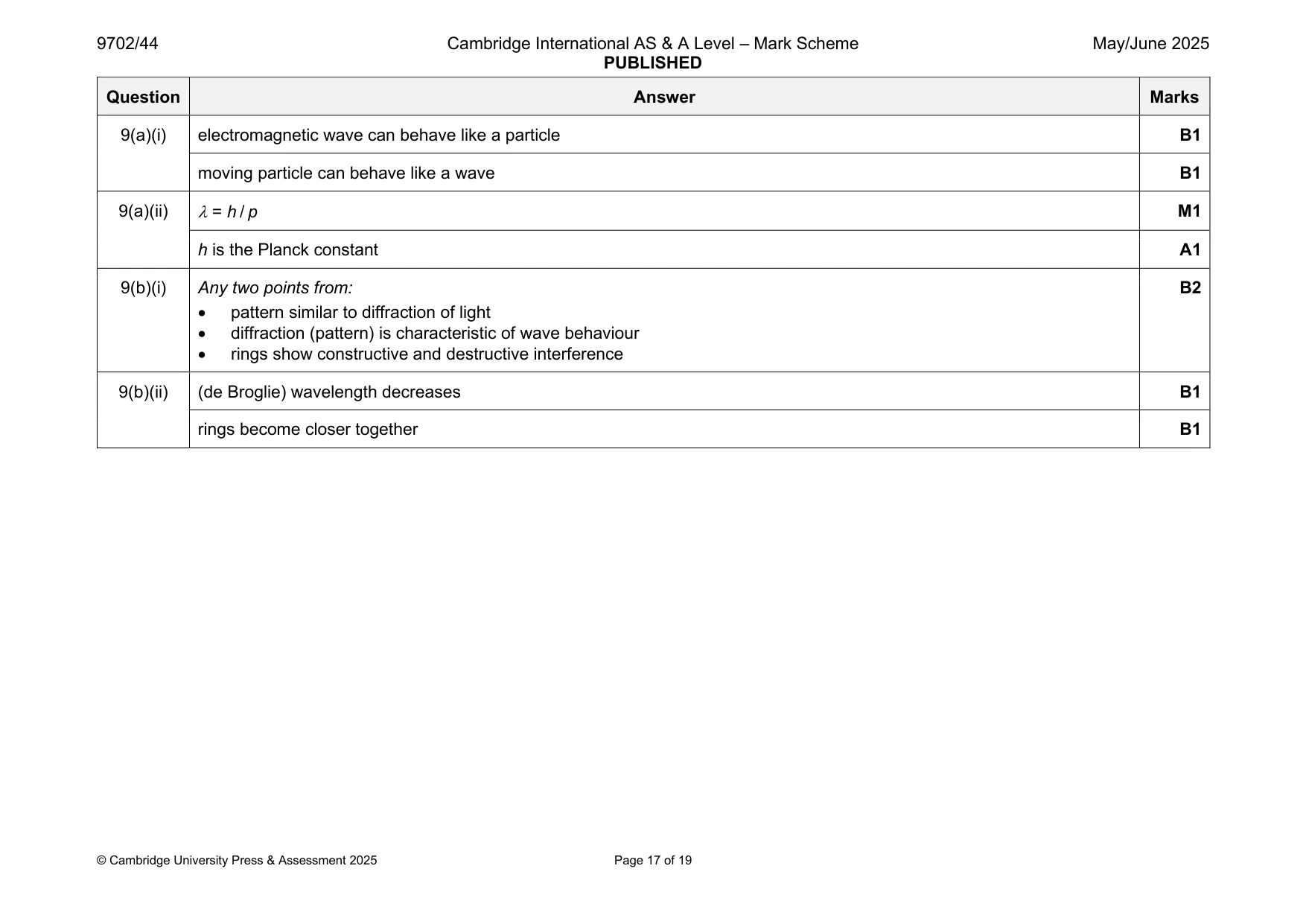
9 (a) (i) Describe what is meant by wave–particle duality. ........................................................................................................................................... ........................................................................................................................................... ..................................................................................................................................... [2] (ii) State the relationship between the de Broglie wavelength λ of a particle and its momentum p. State the meaning of any other symbols that you use. ........................................................................................................................................... ..................................................................................................................................... [2] (b) A narrow beam of electrons, all with the same speed, is incident normally on a carbon film. The electrons then move on to a fluorescent screen, as illustrated in Fig. 9.1. screen carbon film electron beam Fig. 9.1 The apparatus is in a vacuum. The pattern produced on the screen is shown in Fig. 9.2. Fig. 9.2 (not to scale) (i) Explain why the pattern in Fig. 9.2 provides experimental evidence to indicate a wave nature for the electrons. ........................................................................................................................................... ........................................................................................................................................... ..................................................................................................................................... [2] (ii) The speed of the electrons is increased. Suggest, with a reason, how this change affects the pattern observed on the screen. ........................................................................................................................................... ........................................................................................................................................... ..................................................................................................................................... [2] [Total: 8]
Mark scheme: 9(a)(i) electromagnetic wave can behave like a particle B1 moving particle can behave like a wave B1 9(a)(ii) = h / p M1 h is the Planck constant A1 9(b)(i) Any two points from: B2 • pattern similar to diffraction of light • diffraction (pattern) is characteristic of wave behaviour • rings show constructive and destructive interference 9(b)(ii) (de Broglie) wavelength decreases B1 rings become closer together B1
Q10 · Describe how the piezoelectric crystal in a transducer generates ultrasound waves for use…
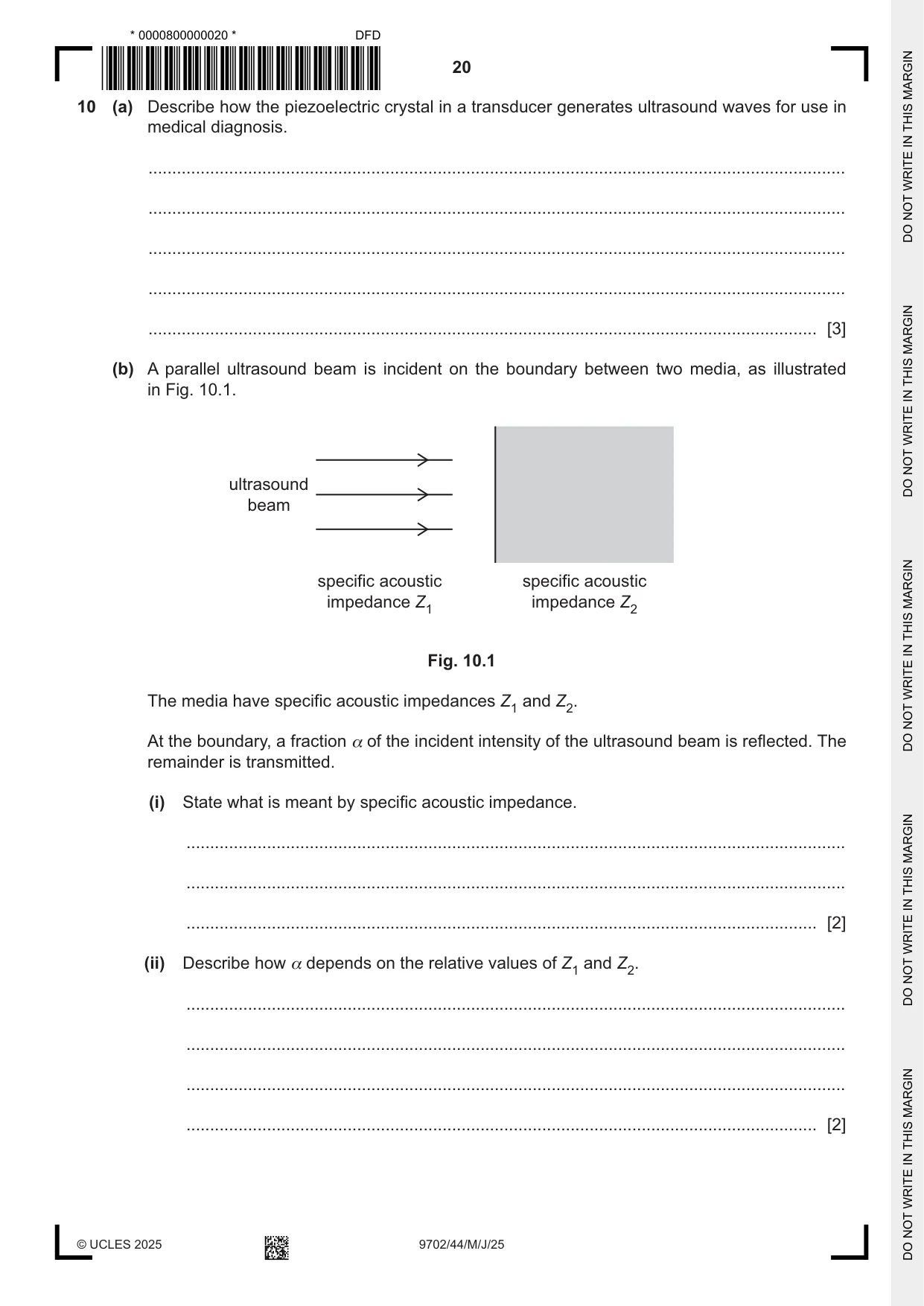
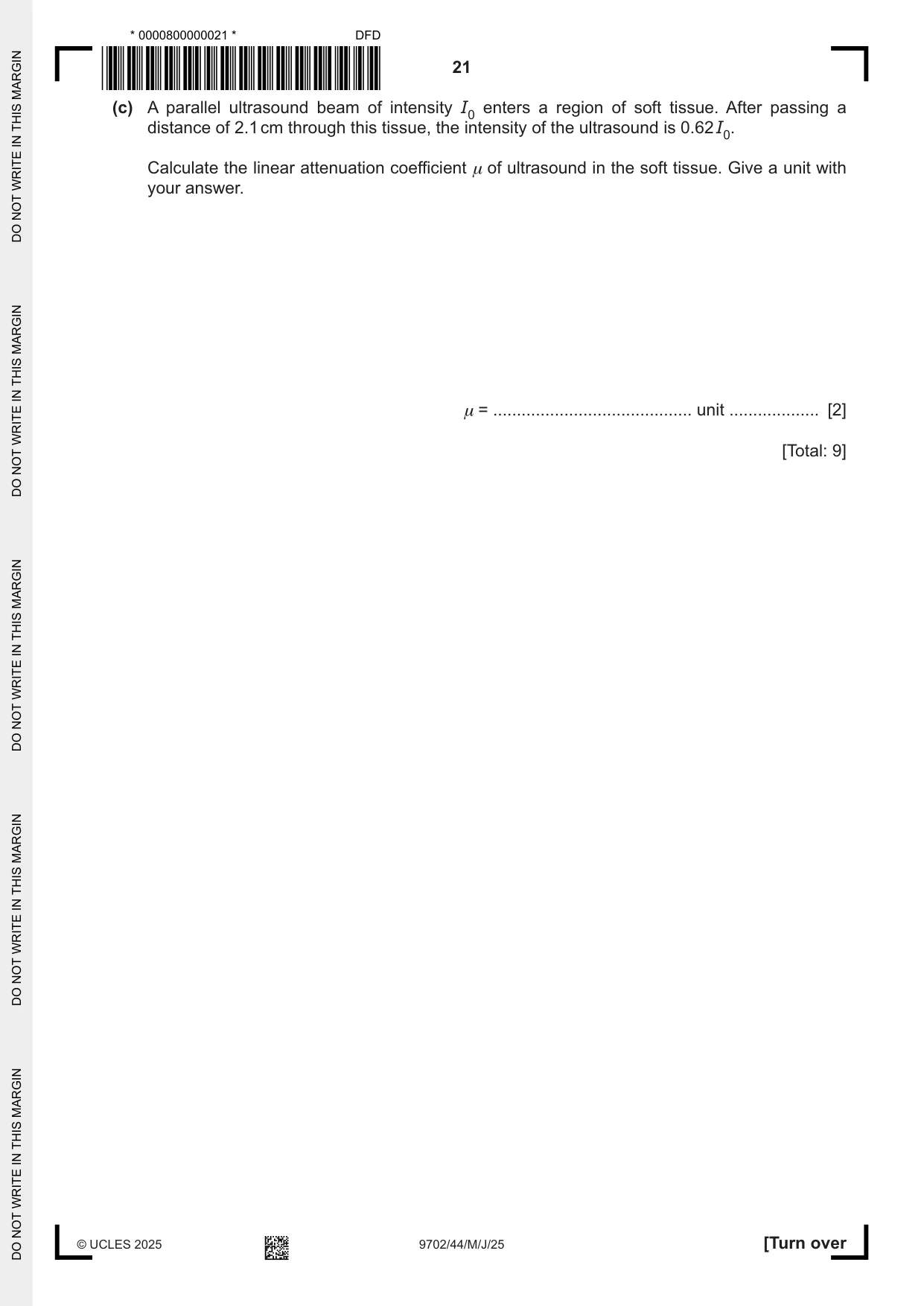
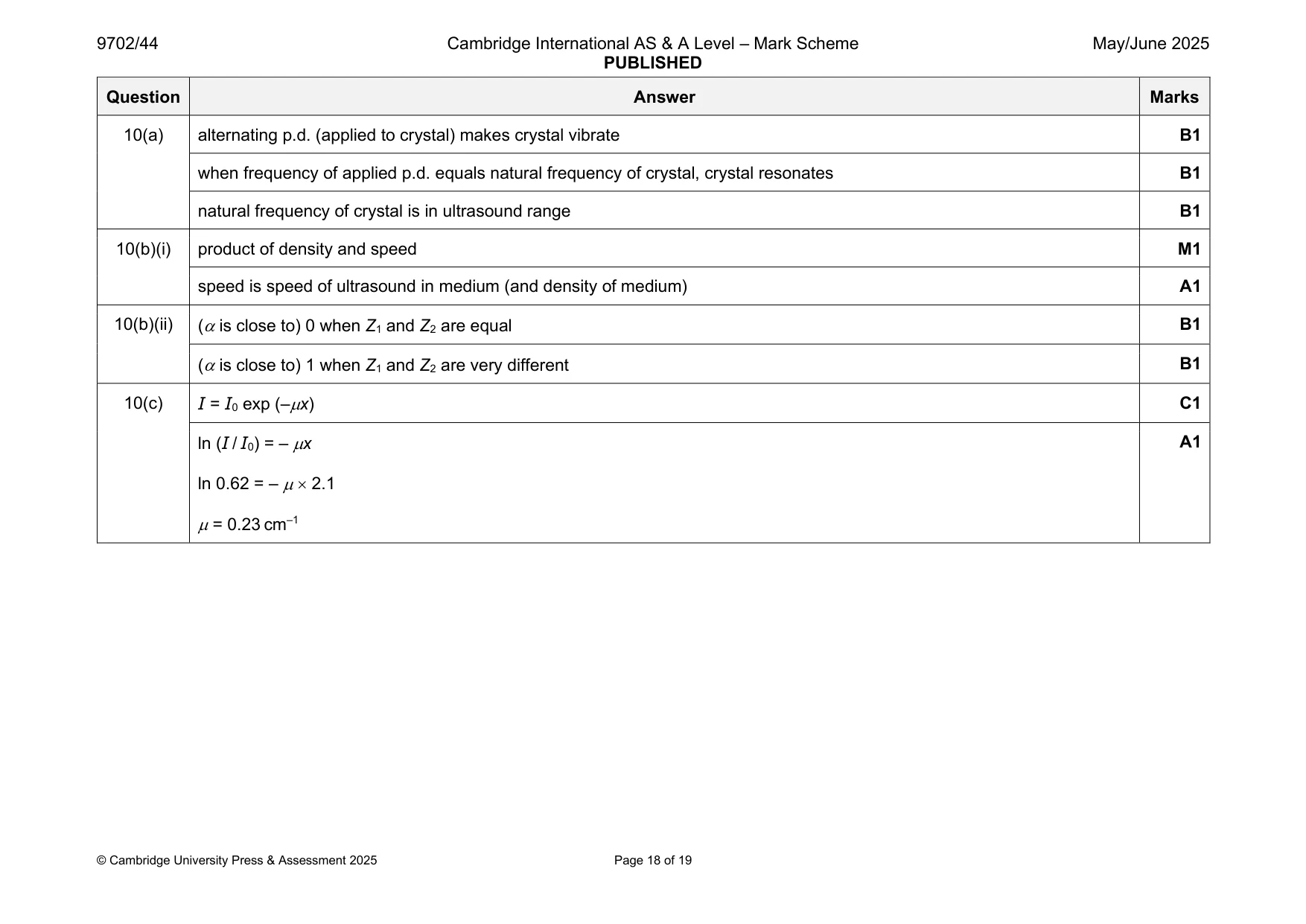
10 (a) Describe how the piezoelectric crystal in a transducer generates ultrasound waves for use in medical diagnosis. ................................................................................................................................................... ................................................................................................................................................... ................................................................................................................................................... ................................................................................................................................................... ............................................................................................................................................. [3] (b) A parallel ultrasound beam is incident on the boundary between two media, as illustrated in Fig. 10.1. ultrasound beam specific acoustic specific acoustic impedance Z1 impedance Z2 Fig. 10.1 The media have specific acoustic impedances Z1 and Z2. At the boundary, a fraction α of the incident intensity of the ultrasound beam is reflected. The remainder is transmitted. (i) State what is meant by specific acoustic impedance. ........................................................................................................................................... ........................................................................................................................................... ..................................................................................................................................... [2] (ii) Describe how α depends on the relative values of Z1 and Z2. ........................................................................................................................................... ........................................................................................................................................... ........................................................................................................................................... ..................................................................................................................................... [2] (c) A parallel ultrasound beam of intensity I0 enters a region of soft tissue. After passing a distance of 2.1 cm through this tissue, the intensity of the ultrasound is 0.62 I0. Calculate the linear attenuation coefficient μ of ultrasound in the soft tissue. Give a unit with your answer. μ = .......................................... unit ................... [2] [Total: 9]
Mark scheme: 10(a) alternating p.d. (applied to crystal) makes crystal vibrate B1 when frequency of applied p.d. equals natural frequency of crystal, crystal resonates B1 natural frequency of crystal is in ultrasound range B1 10(b)(i) product of density and speed M1 speed is speed of ultrasound in medium (and density of medium) A1 10(b)(ii) (is close to) 0 when Z1 and Z2 are equal B1 (is close to) 1 when Z1 and Z2 are very different B1 10(c) I = I0 exp (–x) C1 ln (I / I0) = – x A1 ln 0.62 = – 2.1 = 0.23 cm–1
Q11 · The deuterium nucleus (21H) has a mass defect of 0.002 388 u
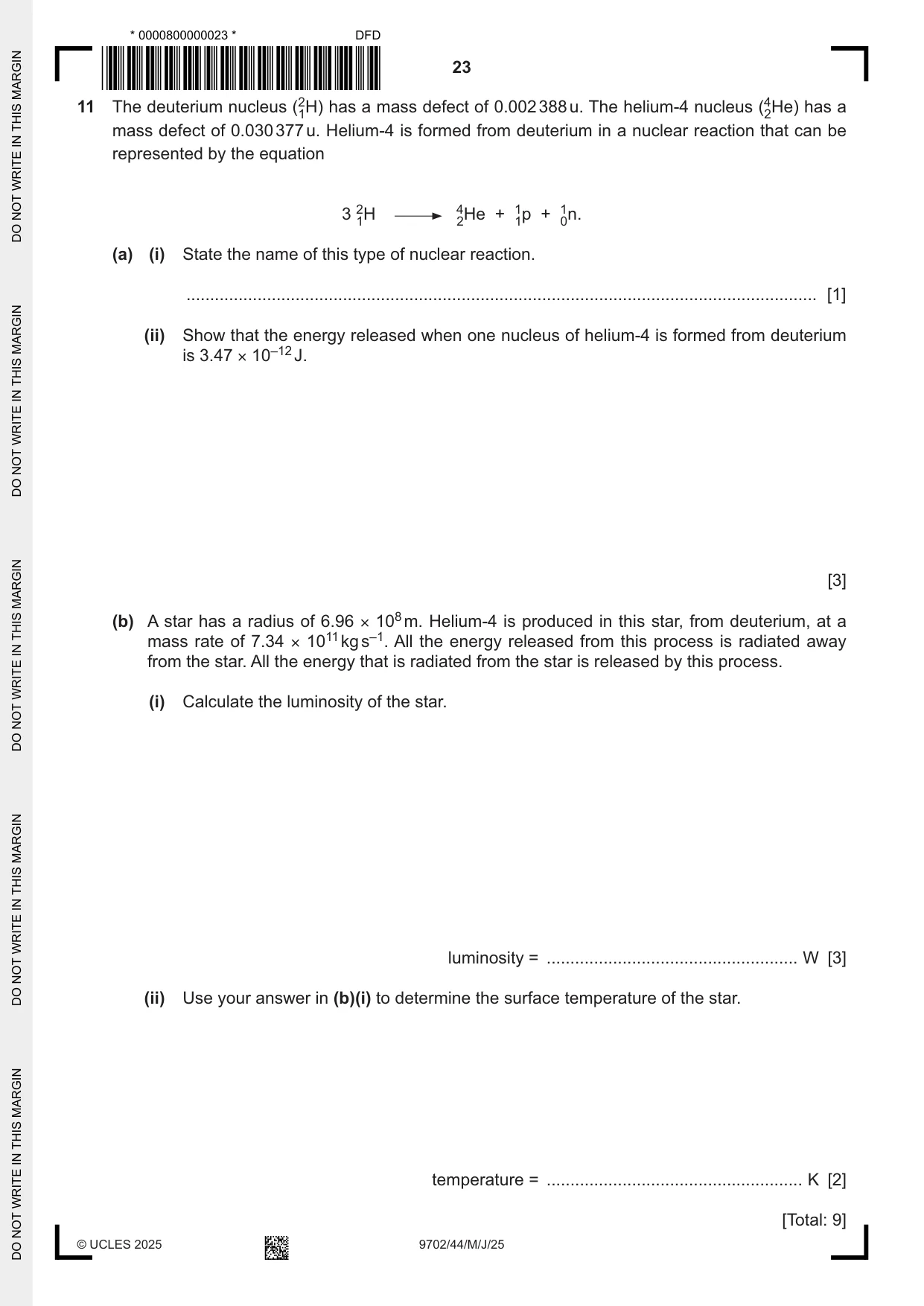
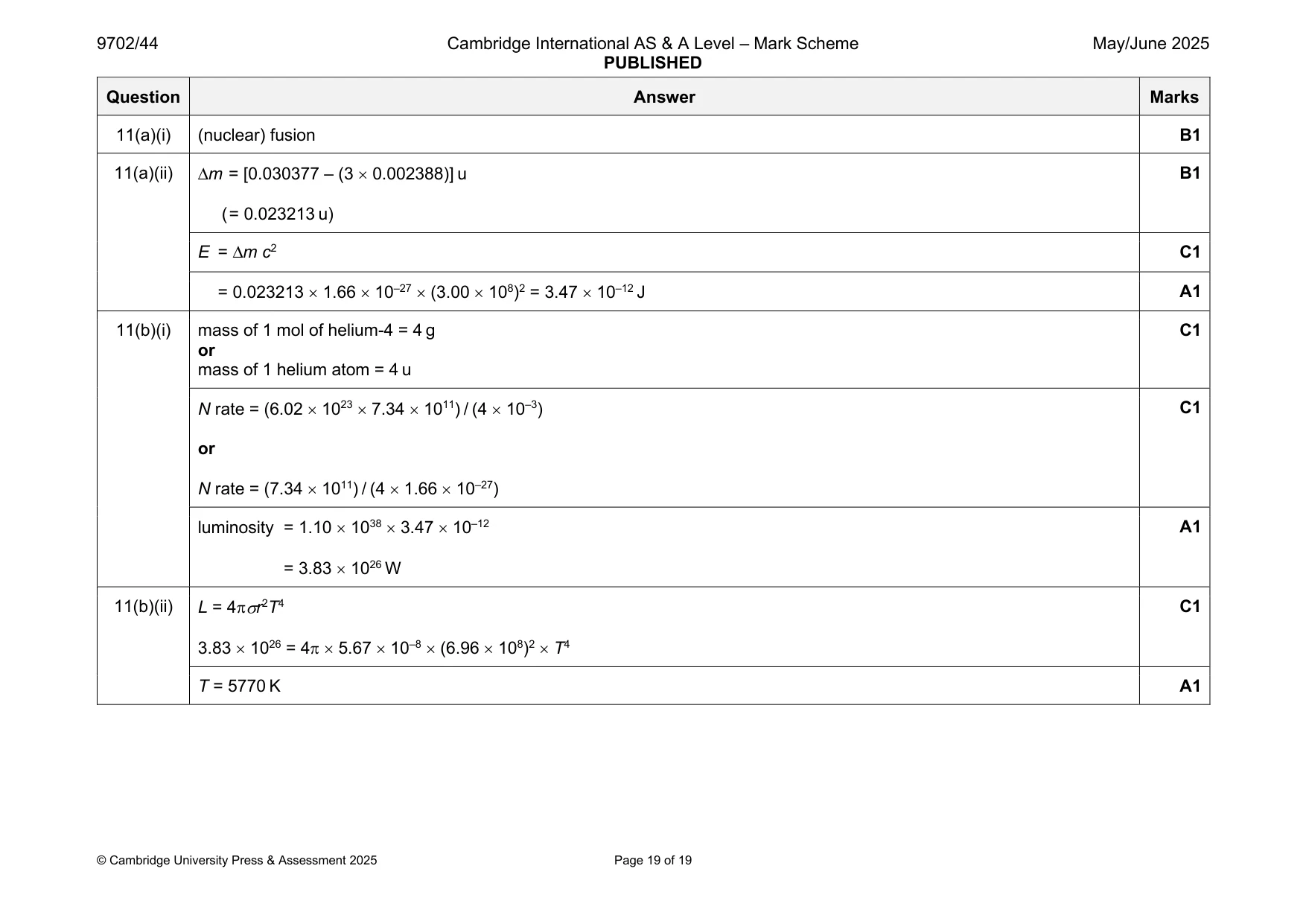
11 The deuterium nucleus (21H) has a mass defect of 0.002 388 u. The helium-4 nucleus (42He) has a mass defect of 0.030 377 u. Helium-4 is formed from deuterium in a nuclear reaction that can be represented by the equation 3 21H 42He + 11p + 10n. (a) (i) State the name of this type of nuclear reaction. ..................................................................................................................................... [1] (ii) Show that the energy released when one nucleus of helium-4 is formed from deuterium is 3.47 × 10⁻¹² J. [3] (b) A star has a radius of 6.96 × 10⁸ m. Helium-4 is produced in this star, from deuterium, at a mass rate of 7.34 × 10¹¹ kg s–1. All the energy released from this process is radiated away from the star. All the energy that is radiated from the star is released by this process. (i) Calculate the luminosity of the star. luminosity = ..................................................... W [3] (ii) Use your answer in (b)(i) to determine the surface temperature of the star. temperature = ...................................................... K [2] [Total: 9]
Mark scheme: 11(a)(i) (nuclear) fusion B1 11(a)(ii) ∆m = [0.030377 – (3 0.002388)] u B1 ( = 0.023213 u) E = ∆m c2 C1 = 0.023213 1.66 10–27 (3.00 108)2 = 3.47 10–12 J A1 11(b)(i) mass of 1 mol of helium-4 = 4 g C1 or mass of 1 helium atom = 4 u N rate = (6.02 1023 7.34 1011) / (4 10–3) C1 or N rate = (7.34 1011) / (4 1.66 10–27) luminosity = 1.10 1038 3.47 10–12 A1 = 3.83 1026 W 11(b)(ii) L = 4r2T4 C1 3.83 1026 = 4 5.67 10–8 (6.96 108)2 T4 T = 5770 K A1
What was in this paper
The subtopics covered by these 11 questions, and how many questions each got. Open one in a new tab to see every Cambridge question on it.
1Electric field of a point charge1Force on a current-carrying conductor1Gravitational field of a point mass1Kinetic theory of gases1Mass defect and nuclear binding energy1Production and use of ultrasound1Rectification and smoothing1Simple harmonic oscillations1Specific heat capacity and specific latent heat1Wave-particle duality1What you needed in this session
Cambridge’s own grade thresholds for 2025 May/June, Paper 4 · Variant 4. A higher threshold means an easier paper — the bar moves with how the cohort did.