Cambridge A Level Physics 9702 — 2016 Oct/Nov Paper 4 · Variant 3
9702/43/O/N/16 · 12 questions · 100 marks · ≈113 min
The question paper and its mark scheme, free to read here and free to download. This is Cambridge’s own paper, exactly as it was sat.
Question paper24 pages


Mark scheme8 pages
Answers below. Sit the paper first if you are practising.
Questions as text
Q1 · A satellite is in a circular orbit of radius r about the Earth of mass M, as illustrated…
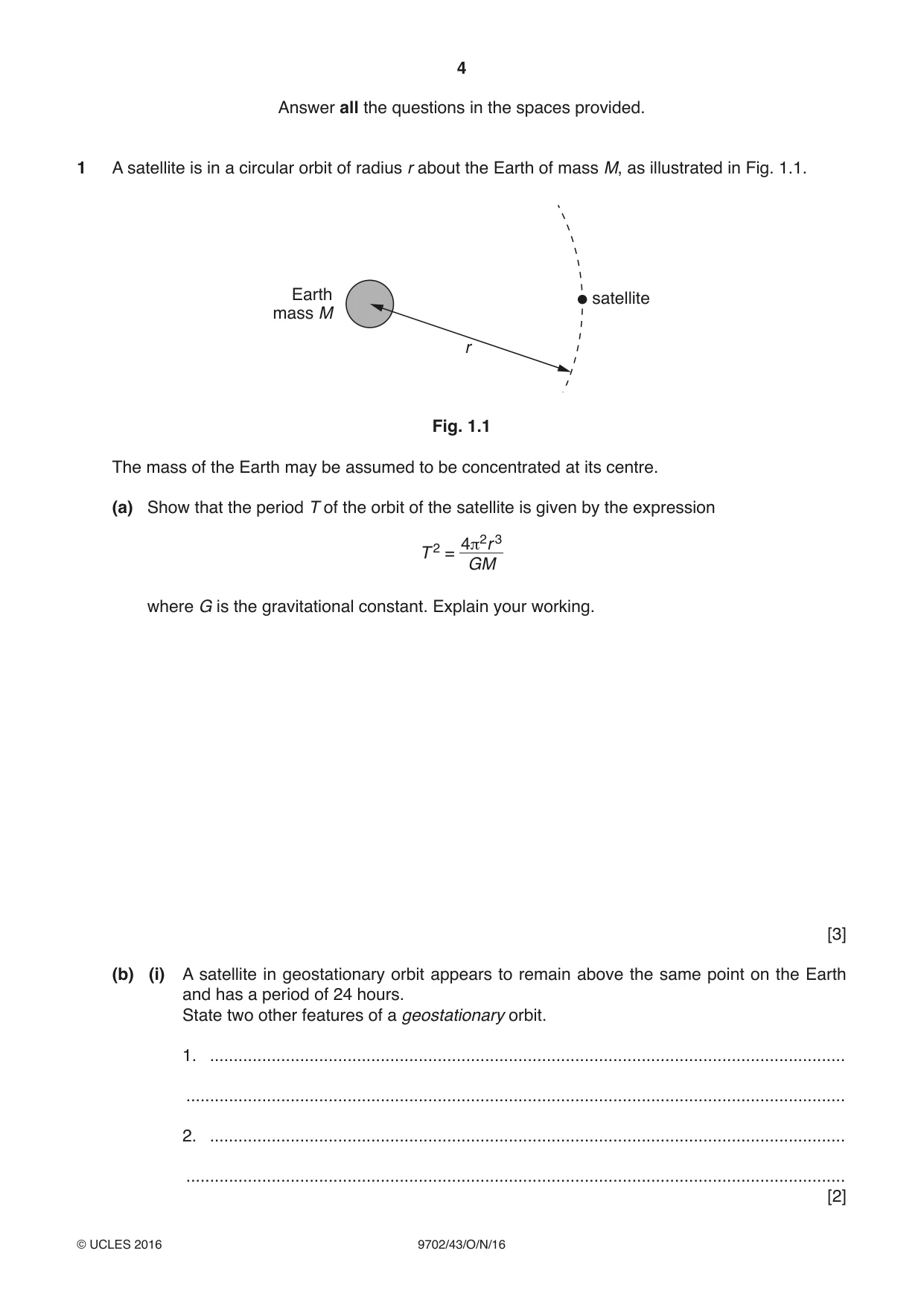
1 A satellite is in a circular orbit of radius r about the Earth of mass M, as illustrated in Fig. 1.1. Earth satellite mass M r Fig. 1.1 The mass of the Earth may be assumed to be concentrated at its centre. (a) Show that the period T of the orbit of the satellite is given by the expression 2 4π2r 3 T = GM where G is the gravitational constant. Explain your working. [3] (b) (i) A satellite in geostationary orbit appears to remain above the same point on the Earth and has a period of 24 hours. State two other features of a geostationary orbit. 1. ...................................................................................................................................... ........................................................................................................................................... 2. ...................................................................................................................................... ........................................................................................................................................... [2] (ii) The mass M of the Earth is 6.0 × 1024 kg. Use the expression in (a) to determine the radius of a geostationary orbit. radius = .................................................... m [2] (c) A global positioning system (GPS) satellite orbits the Earth at a height of 2.0 × 10⁴ km above the Earth’s surface. The radius of the Earth is 6.4 × 10³ km. Use your answer in (b)(ii) and the expression T 2 ∝ r3 to calculate, in hours, the period of the orbit of this satellite. period = .............................................. hours [2] [Total: 9]
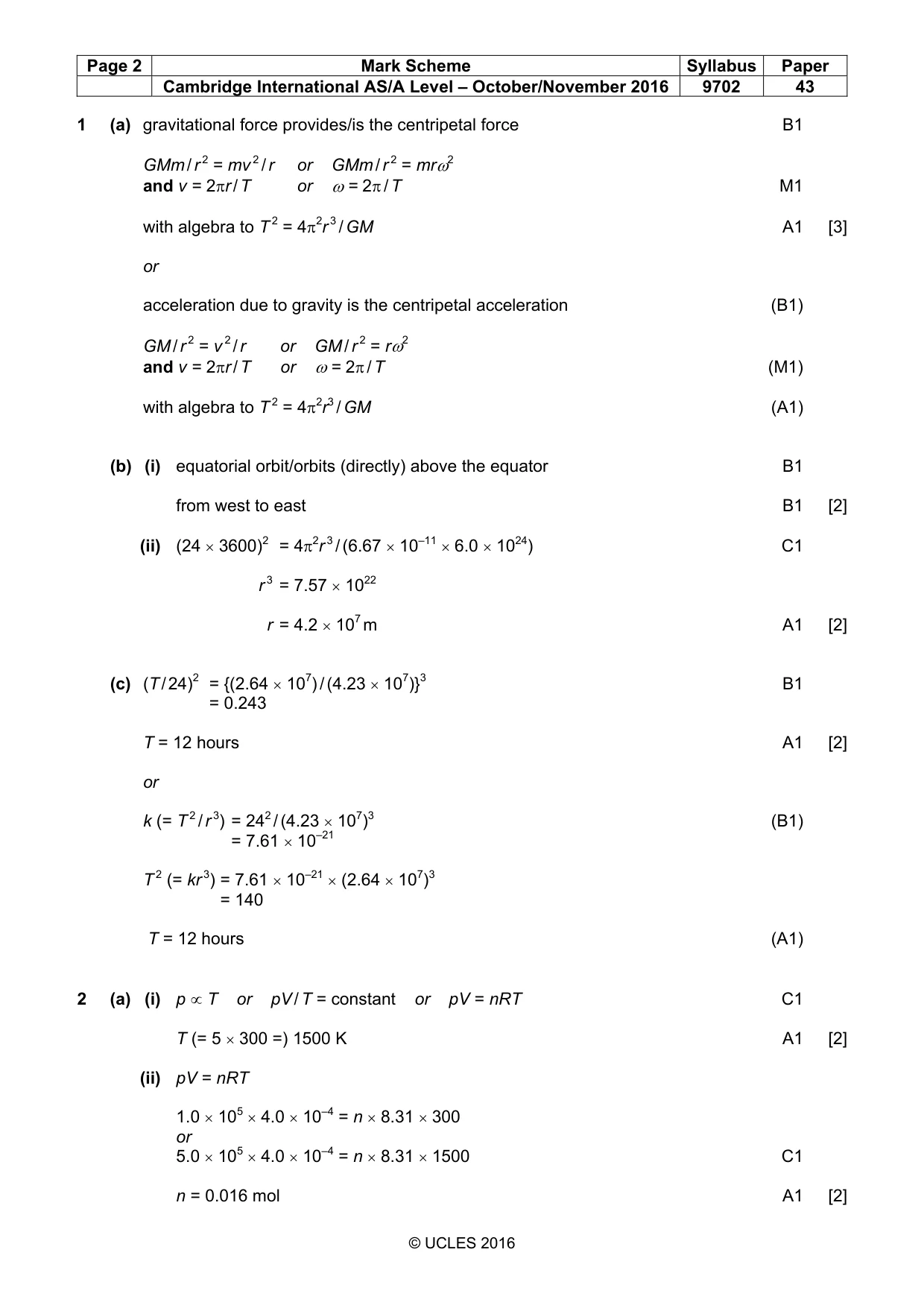
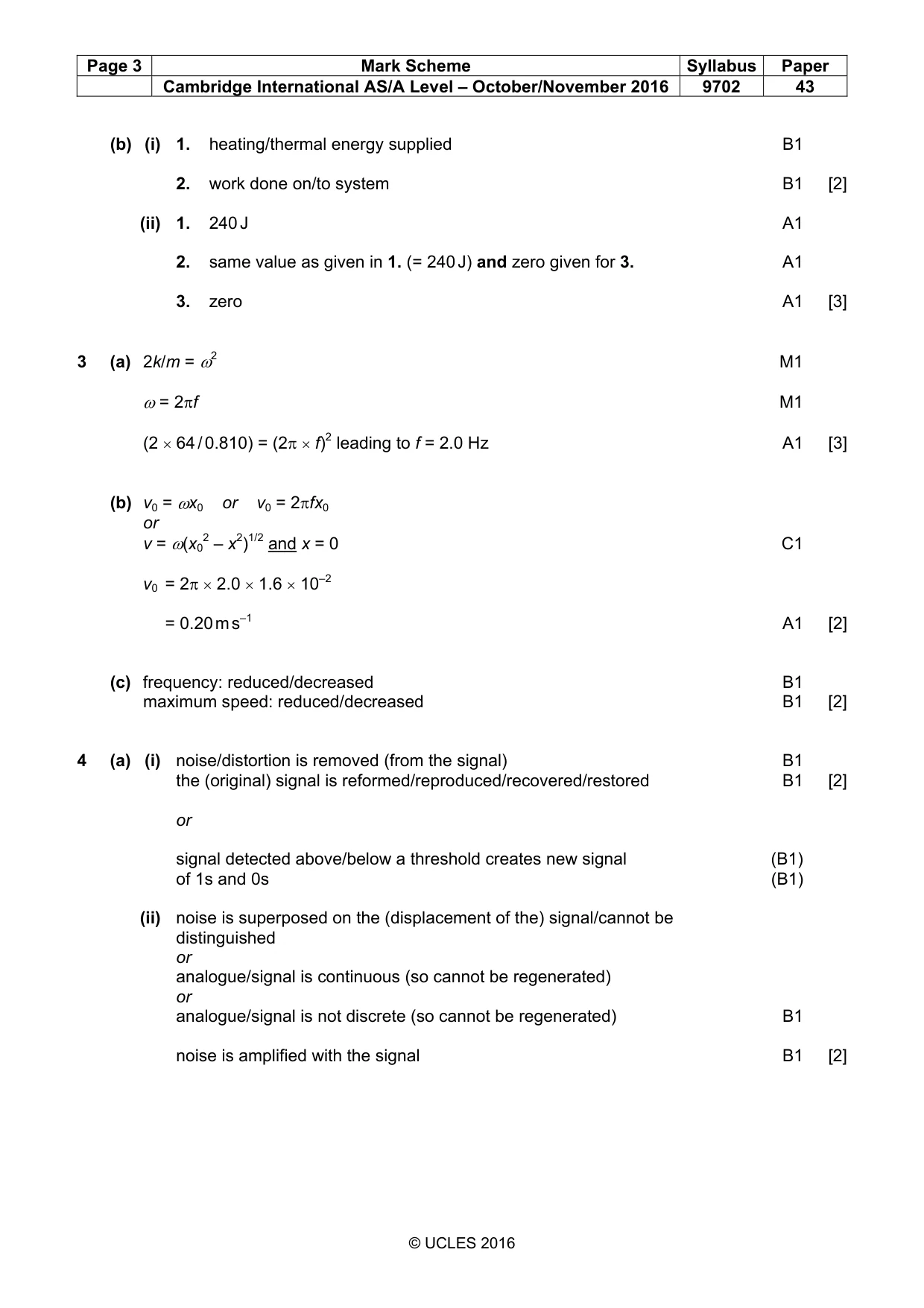
Mark scheme: 1 (a) gravitational force provides/is the centripetal force B1 GMm / r 2 = mv 2 / r or GMm / r 2 = mrω2 and v = 2πr / T or ω= 2π / T M1 with algebra to T 2 = 4π2r 3 / GM A1 [3] or acceleration due to gravity is the centripetal acceleration (B1) GM / r 2 = v 2 / r or GM / r 2 = rω2 and v = 2πr / T or ω= 2π / T (M1) with algebra to T 2 = 4π2r3 / GM (A1) (b) (i) equatorial orbit/orbits (directly) above the equator B1 from west to east B1 [2] (ii) (24 × 3600)2 = 4π2r 3 / (6.67 × 10–11 × 6.0 × 1024) C1 r 3 = 7.57 × 10²² r = 4.2 × 10⁷ m A1 [2] (c) (T / 24)2 = {(2.64 × 10⁷) / (4.23 × 10⁷)}3 B1 = 0.243 T = 12 hours A1 [2] or k (= T 2 / r 3) = 242 / (4.23 × 10⁷)3 (B1) k = 7.61 × 10⁻²¹ T 2 (= kr 3) = 7.61 × 10–21 × (2.64 × 107)3 = 140 T = 12 hours (A1)
Q2 · An ideal gas initially has pressure 1.0 × 10⁵ Pa, volume 4.0 × 10⁻⁴ m3 and temperature…
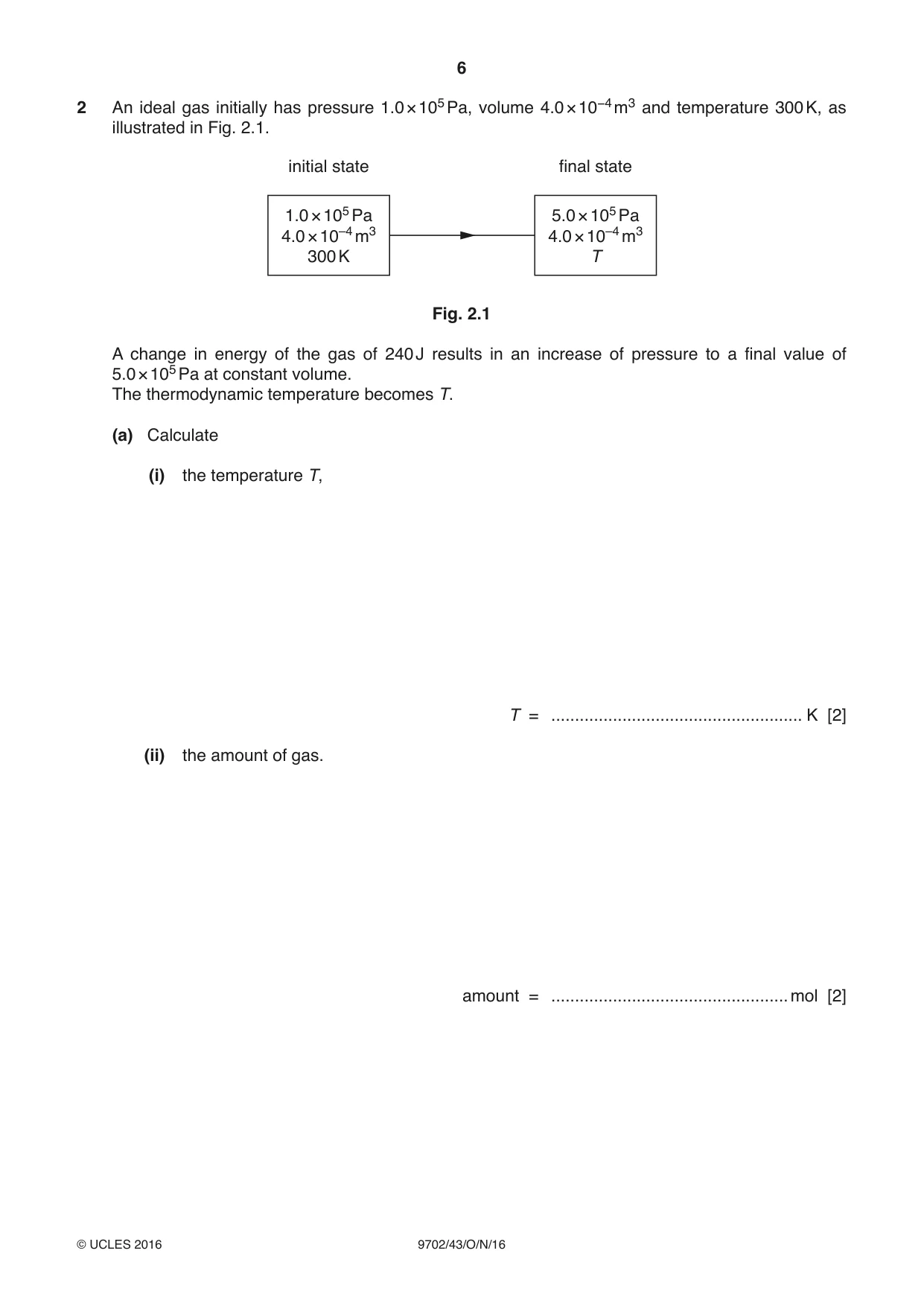
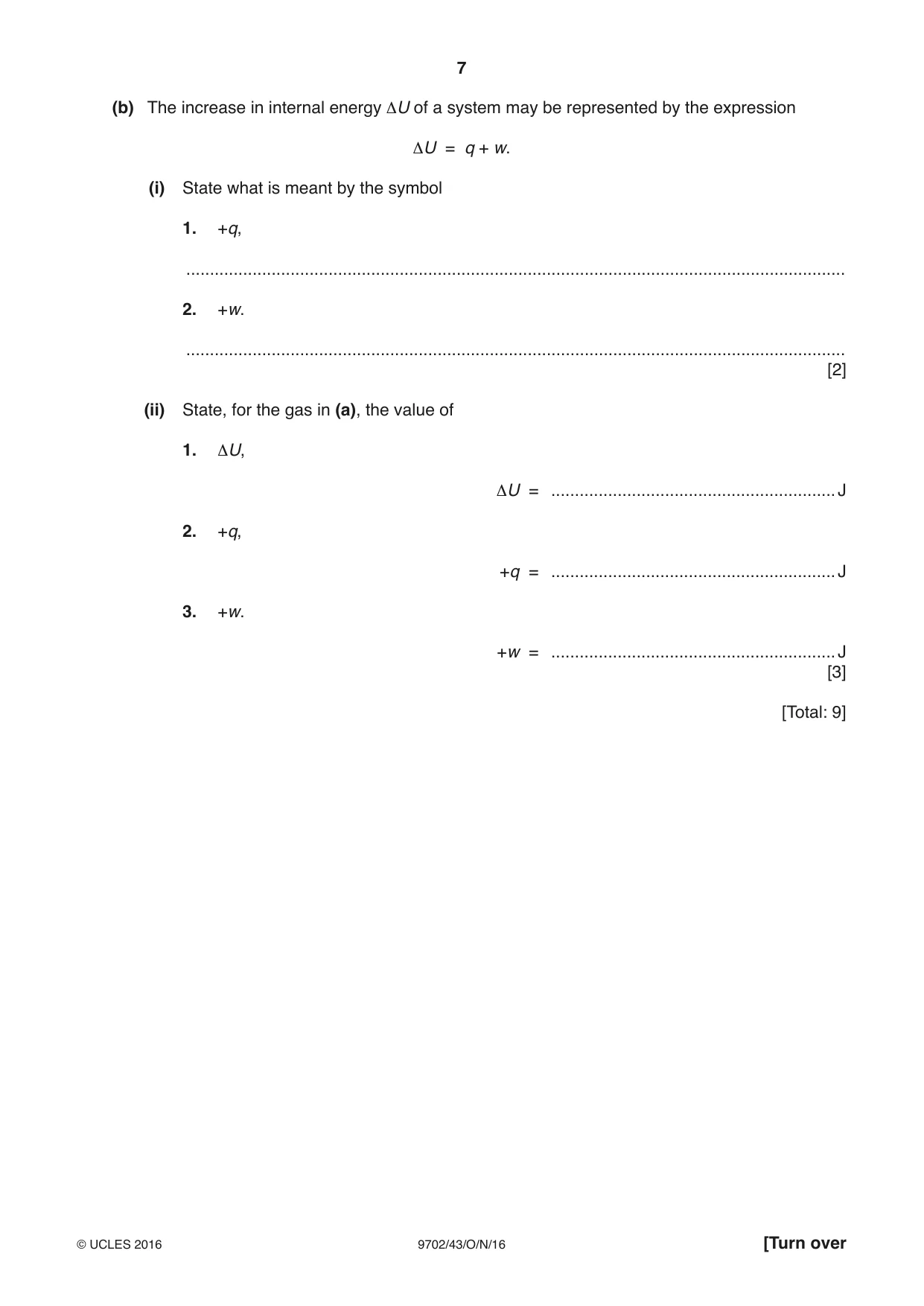
2 An ideal gas initially has pressure 1.0 × 10⁵ Pa, volume 4.0 × 10⁻⁴ m3 and temperature 300 K, as illustrated in Fig. 2.1. initial state final state 1.0 × 10⁵ Pa 5.0 × 10⁵ Pa 4.0 × 10⁻⁴ m3 4.0 × 10⁻⁴ m3 300 K T Fig. 2.1 A change in energy of the gas of 240 J results in an increase of pressure to a final value of 5.0 × 10⁵ Pa at constant volume. The thermodynamic temperature becomes T. (a) Calculate (i) the temperature T, T = ..................................................... K [2] (ii) the amount of gas. amount = .................................................. mol [2] (b) The increase in internal energy ΔU of a system may be represented by the expression ΔU = q + w. (i) State what is meant by the symbol 1. +q, ........................................................................................................................................... 2. +w. ........................................................................................................................................... [2] (ii) State, for the gas in (a), the value of 1. ΔU, ΔU = ............................................................ J 2. +q, +q = ............................................................ J 3. +w. +w = ............................................................ J [3] [Total: 9]
Mark scheme: 2 (a) (i) p ∝ T or pV / T = constant or pV = nRT C1 T (= 5 × 300 =) 1500 K A1 [2] (ii) pV = nRT 1.0 × 105 × 4.0 × 10–4 = n × 8.31 × 300 or 5.0 × 105 × 4.0 × 10–4 = n × 8.31 × 1500 C1 n = 0.016 mol A1 [2] (b) (i) 1. heating/thermal energy supplied B1 2. work done on/to system B1 [2] (ii) 1. 240 J A1 2. same value as given in 1. (= 240 J) and zero given for 3. A1 3. zero A1 [3] 2
Q3 · To demonstrate simple harmonic motion, a student attaches a trolley to two similar…
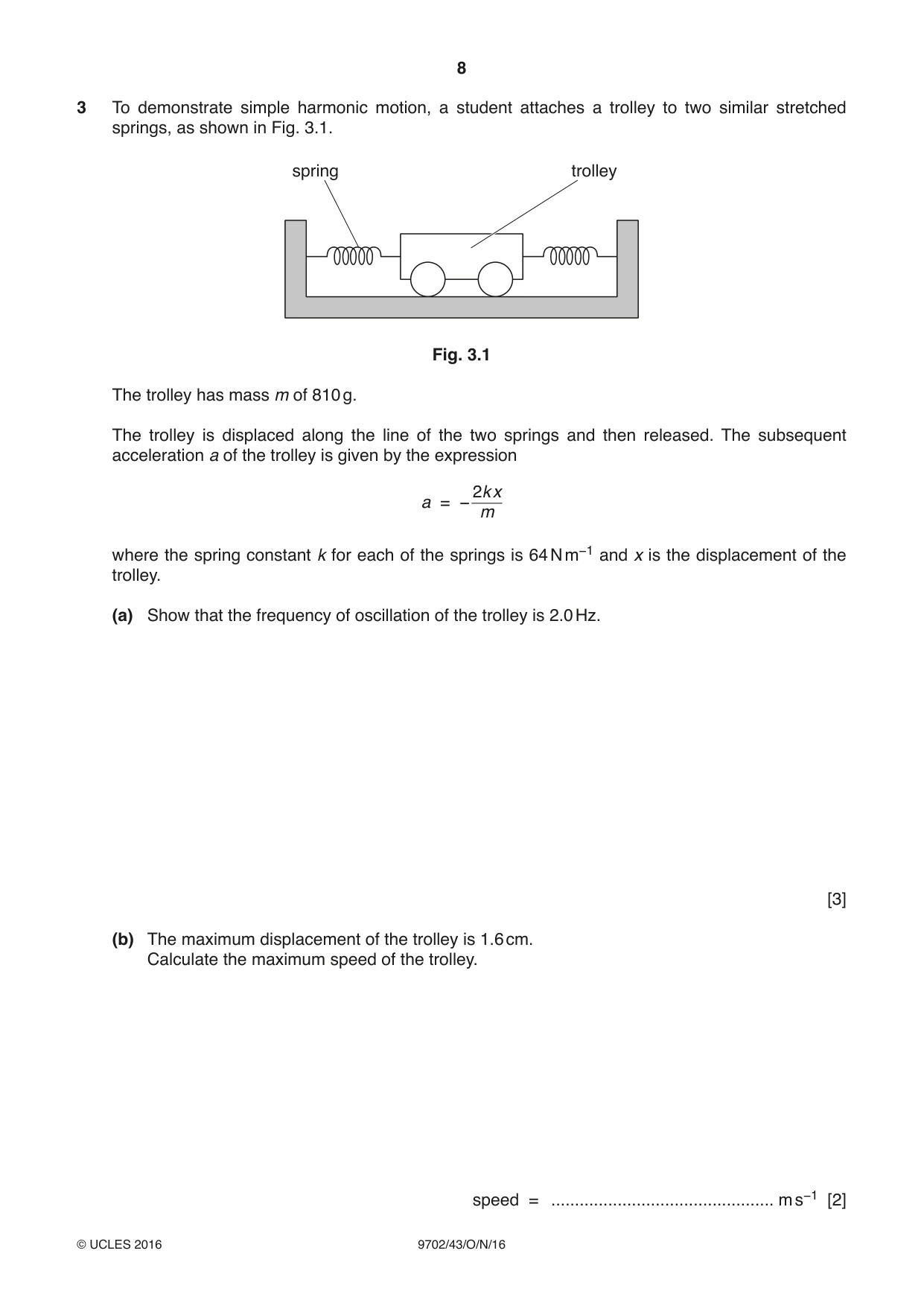
3 To demonstrate simple harmonic motion, a student attaches a trolley to two similar stretched springs, as shown in Fig. 3.1. spring trolley Fig. 3.1 The trolley has mass m of 810 g. The trolley is displaced along the line of the two springs and then released. The subsequent acceleration a of the trolley is given by the expression 2k x a = − m where the spring constant k for each of the springs is 64 N m−1 and x is the displacement of the trolley. (a) Show that the frequency of oscillation of the trolley is 2.0 Hz. [3] (b) The maximum displacement of the trolley is 1.6 cm. Calculate the maximum speed of the trolley. speed = ............................................... m s−1 [2] (c) The mass of the trolley is increased. The initial displacement of the trolley remains unchanged. Suggest the change, if any, that occurs in the frequency and in the maximum speed of the oscillations of the trolley. frequency: ................................................................................................................................. maximum speed: ...................................................................................................................... [2] [Total: 7]
Mark scheme: 3 (a) 2k/m = ω2 M1 ω= 2πf M1 (2 × 64 / 0.810) = (2π × f)2 leading to f = 2.0 Hz A1 [3] (b) v0 = ωx0 or v0 = 2πfx0 or v = ω(x02 – x2)1/2 and x = 0 C1 v0 = 2π × 2.0 × 1.6 × 10–2 = 0.20 m s–1 A1 [2] (c) frequency: reduced/decreased B1 maximum speed: reduced/decreased B1 [2]
Q4 · Signals may be transmitted in either analogue or digital form
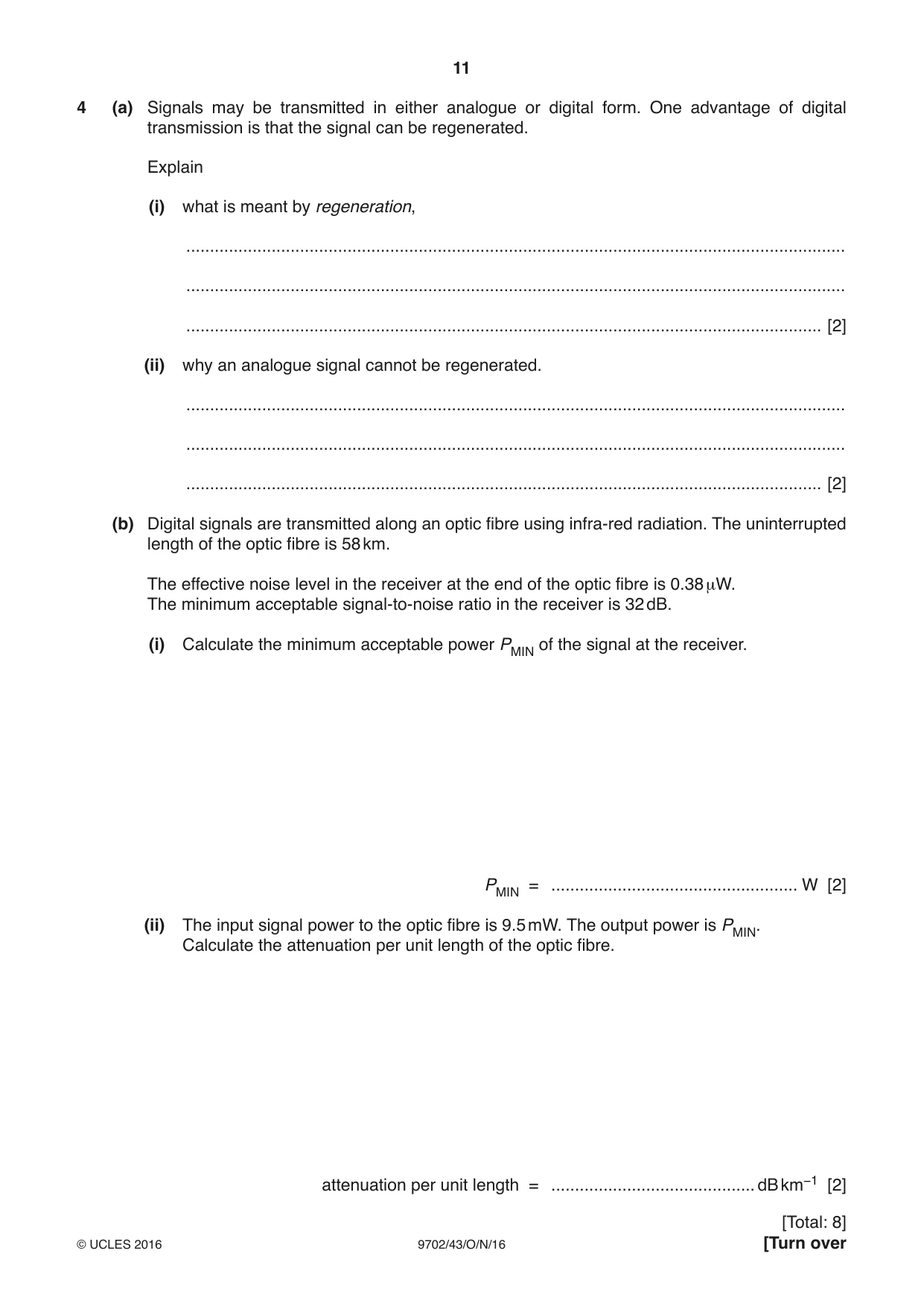
4 (a) Signals may be transmitted in either analogue or digital form. One advantage of digital transmission is that the signal can be regenerated. Explain (i) what is meant by regeneration, ........................................................................................................................................... ........................................................................................................................................... ...................................................................................................................................... [2] (ii) why an analogue signal cannot be regenerated. ........................................................................................................................................... ........................................................................................................................................... ...................................................................................................................................... [2] (b) Digital signals are transmitted along an optic fibre using infra-red radiation. The uninterrupted length of the optic fibre is 58 km. The effective noise level in the receiver at the end of the optic fibre is 0.38 μW. The minimum acceptable signal-to-noise ratio in the receiver is 32 dB. (i) Calculate the minimum acceptable power PMIN of the signal at the receiver. PMIN = .................................................... W [2] (ii) The input signal power to the optic fibre is 9.5 mW. The output power is PMIN. Calculate the attenuation per unit length of the optic fibre. attenuation per unit length = ........................................... dB km−1 [2]
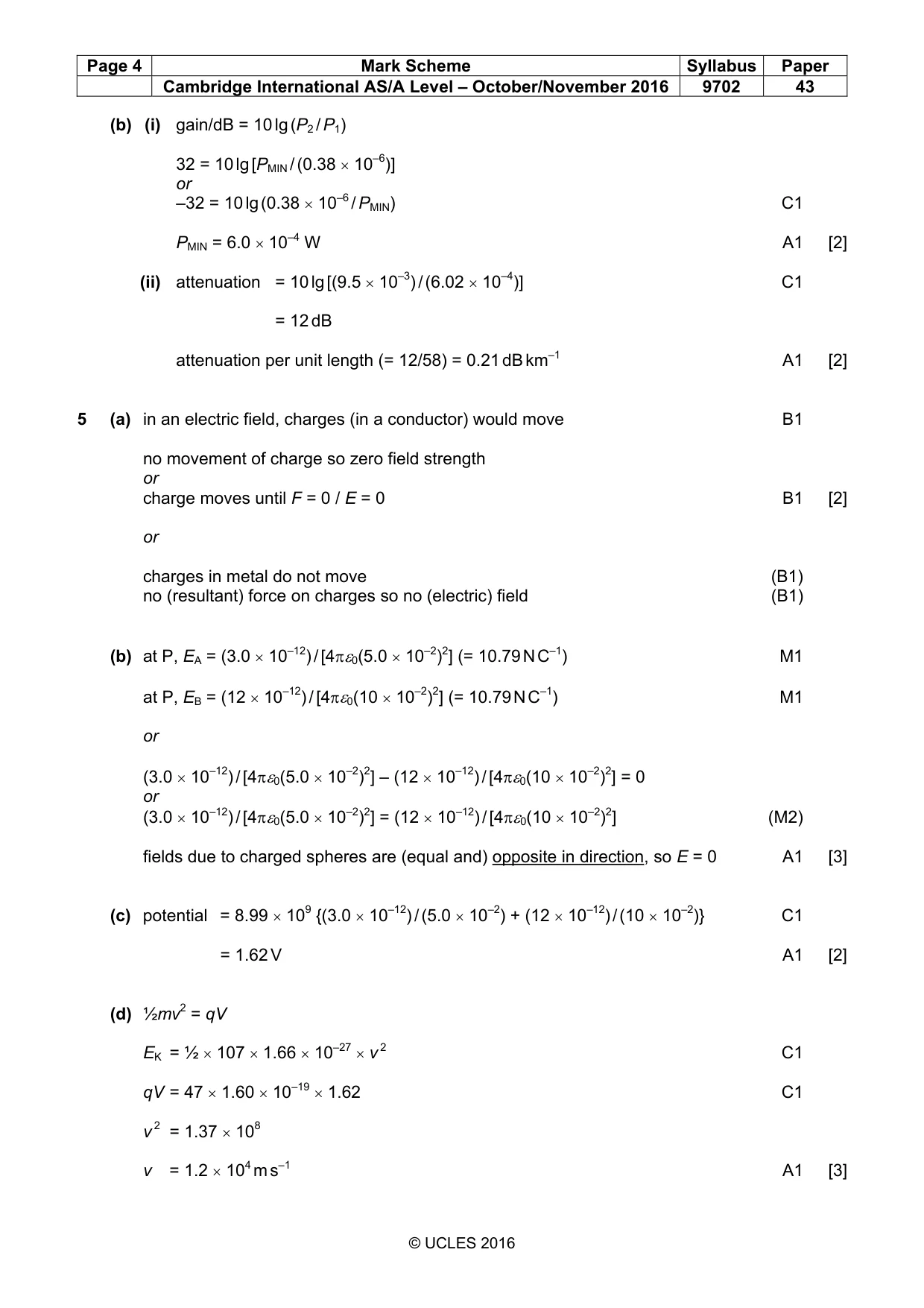
Mark scheme: 4 (a) (i) noise/distortion is removed (from the signal) B1 the (original) signal is reformed/reproduced/recovered/restored B1 [2] or signal detected above/below a threshold creates new signal (B1) of 1s and 0s (B1) (ii) noise is superposed on the (displacement of the) signal/cannot be distinguished or analogue/signal is continuous (so cannot be regenerated) or analogue/signal is not discrete (so cannot be regenerated) B1 noise is amplified with the signal B1 [2] (b) (i) gain/dB = 10 lg (P2 / P1) 32 = 10 lg [PMIN / (0.38 × 10⁻⁶)] or –32 = 10 lg (0.38 × 10⁻⁶ / PMIN) C1 PMIN = 6.0 × 10⁻⁴ W A1 [2] (ii) attenuation = 10 lg [(9.5 × 10⁻³) / (6.02 × 10⁻⁴)] C1 = 12 dB attenuation per unit length (= 12/58) = 0.21 dB km–1 A1 [2]
Q5 · Two small solid metal spheres A and B have equal radii and are in a vacuum
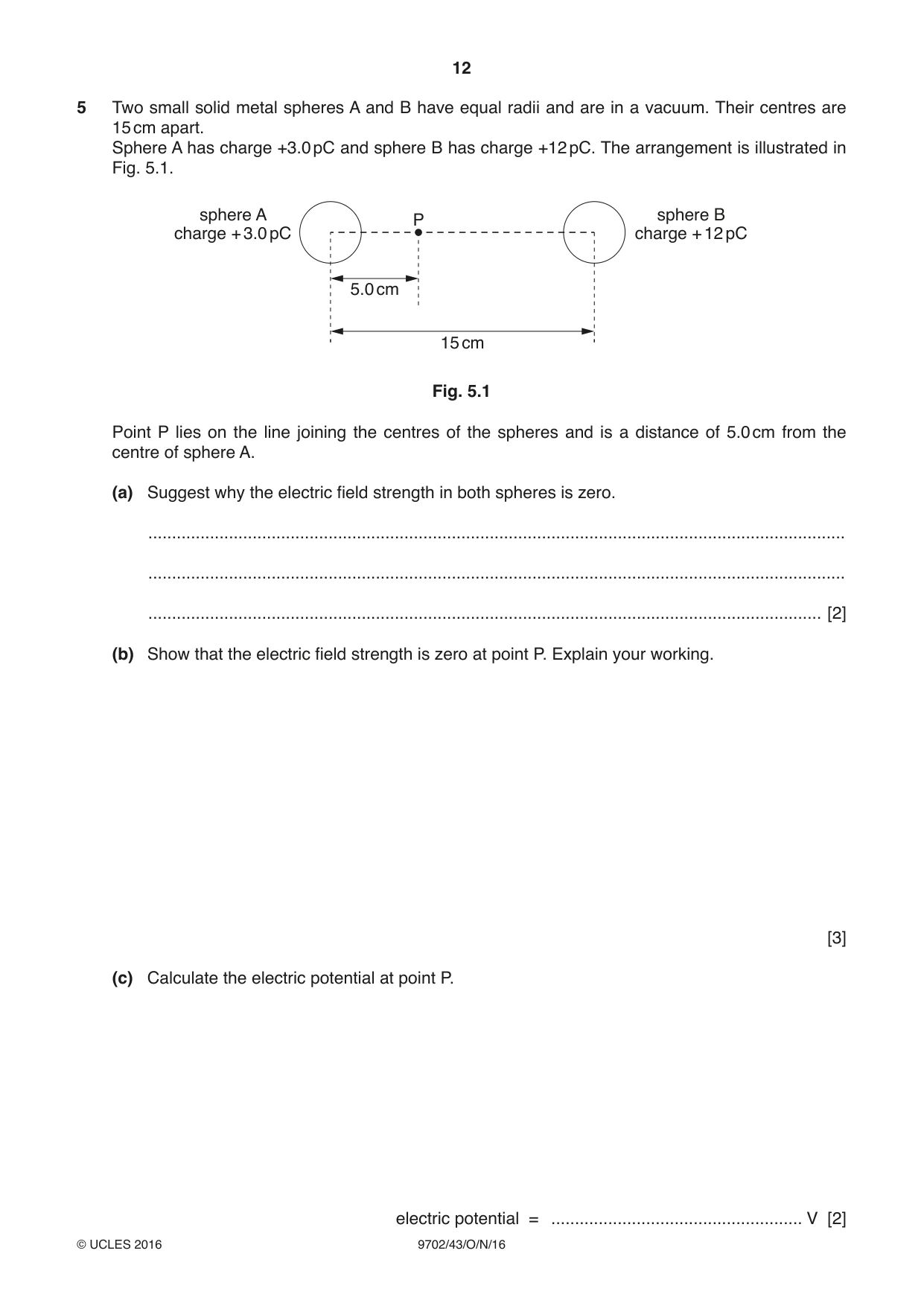
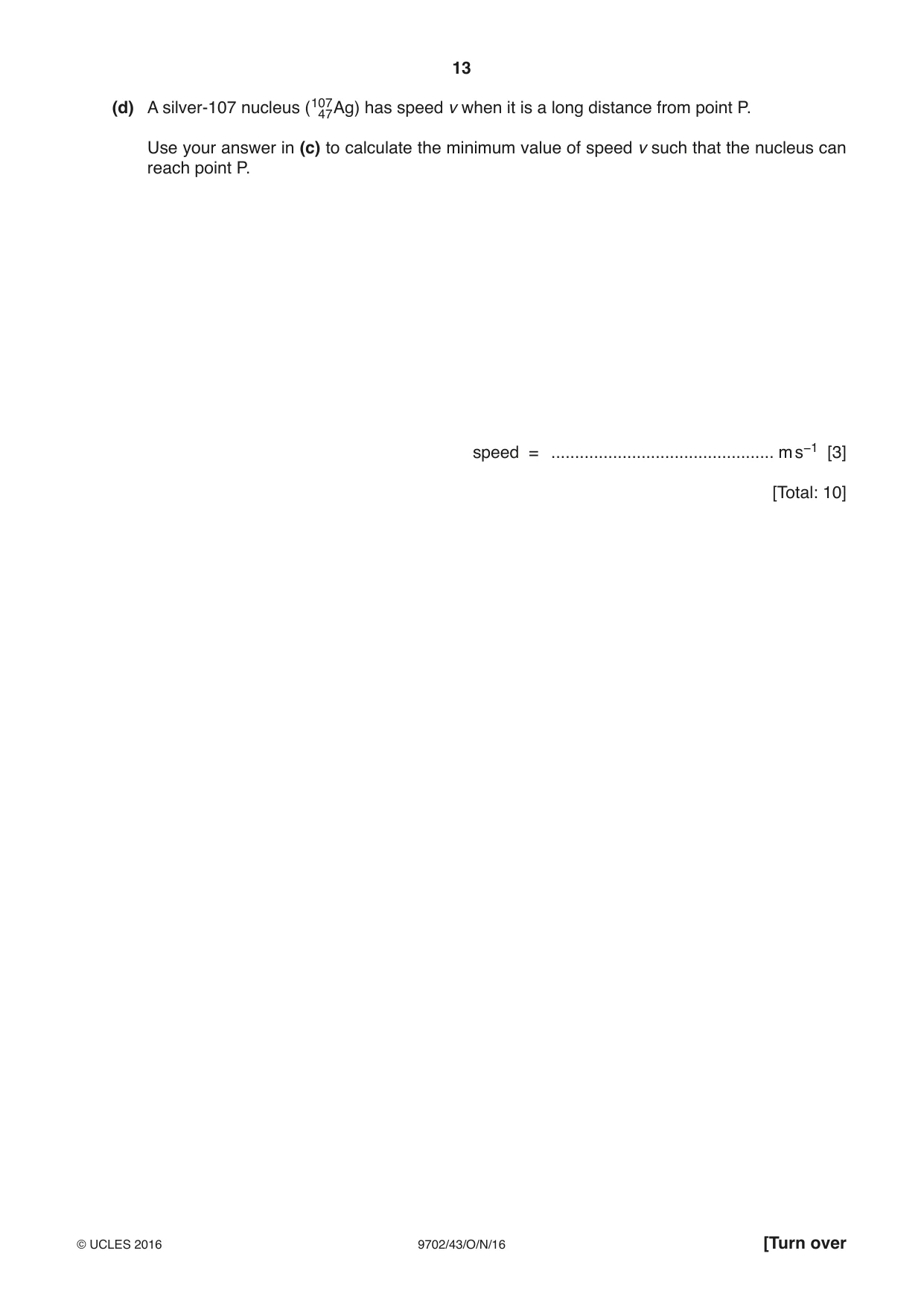
5 Two small solid metal spheres A and B have equal radii and are in a vacuum. Their centres are 15 cm apart. Sphere A has charge +3.0 pC and sphere B has charge +12 pC. The arrangement is illustrated in Fig. 5.1. sphere A sphere B P charge + 3.0 pC charge + 12 pC 5.0 cm 15 cm Fig. 5.1 Point P lies on the line joining the centres of the spheres and is a distance of 5.0 cm from the centre of sphere A. (a) Suggest why the electric field strength in both spheres is zero. ................................................................................................................................................... ................................................................................................................................................... .............................................................................................................................................. [2] (b) Show that the electric field strength is zero at point P. Explain your working. [3] (c) Calculate the electric potential at point P. electric potential = ..................................................... V [2] (d) A silver-107 nucleus (10747 Ag) has speed v when it is a long distance from point P. Use your answer in (c) to calculate the minimum value of speed v such that the nucleus can reach point P. speed = ............................................... m s−1 [3] [Total: 10]
Mark scheme: 5 (a) in an electric field, charges (in a conductor) would move B1 no movement of charge so zero field strength or charge moves until F = 0 / E = 0 B1 [2] or charges in metal do not move (B1) no (resultant) force on charges so no (electric) field (B1) (b) at P, EA = (3.0 × 10⁻¹²) / [4πε0(5.0 × 10⁻²)2] (= 10.79 N C–1) M1 at P, EB = (12 × 10–12) / [4πε0(10 × 10–2)2] (= 10.79 N C–1) M1 or (3.0 × 10⁻¹²) / [4πε0(5.0 × 10⁻²)2] – (12 × 10–12) / [4πε0(10 × 10–2)2] = 0 or (3.0 × 10⁻¹²) / [4πε0(5.0 × 10⁻²)2] = (12 × 10–12) / [4πε0(10 × 10–2)2] (M2) fields due to charged spheres are (equal and) opposite in direction, so E = 0 A1 [3] (c) potential = 8.99 × 10⁹ {(3.0 × 10⁻¹²) / (5.0 × 10⁻²) + (12 × 10–12) / (10 × 10–2)} C1 = 1.62 V A1 [2] (d) ½mv2 = qV EK = ½ × 107 × 1.66 × 10–27 × v 2 C1 qV = 47 × 1.60 × 10–19 × 1.62 C1 v 2 = 1.37 × 10⁸ v = 1.2 × 10⁴ m s–1 A1 [3]
Q6 · The slew rate of an ideal operational amplifier (op-amp) is said to be infinite
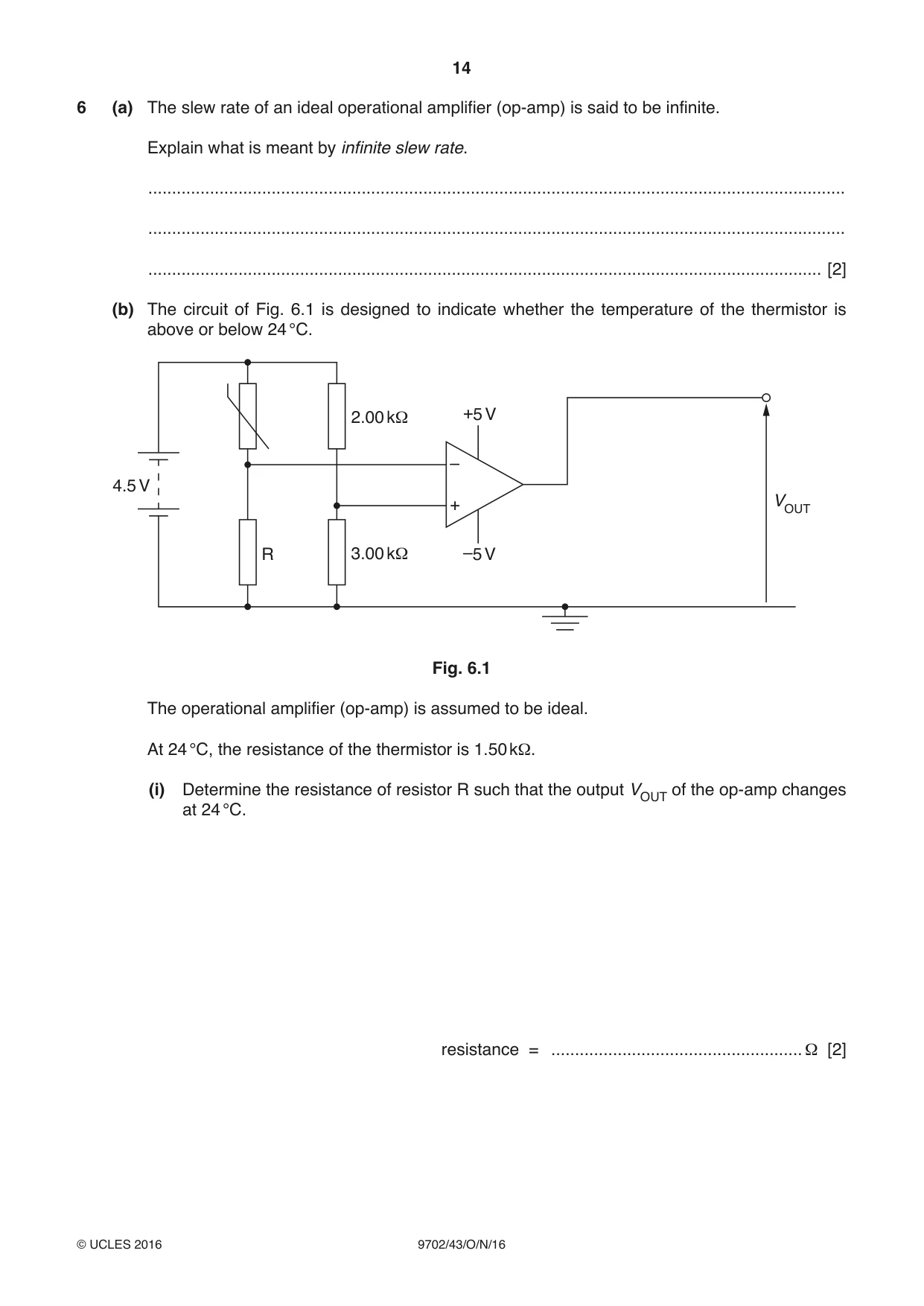
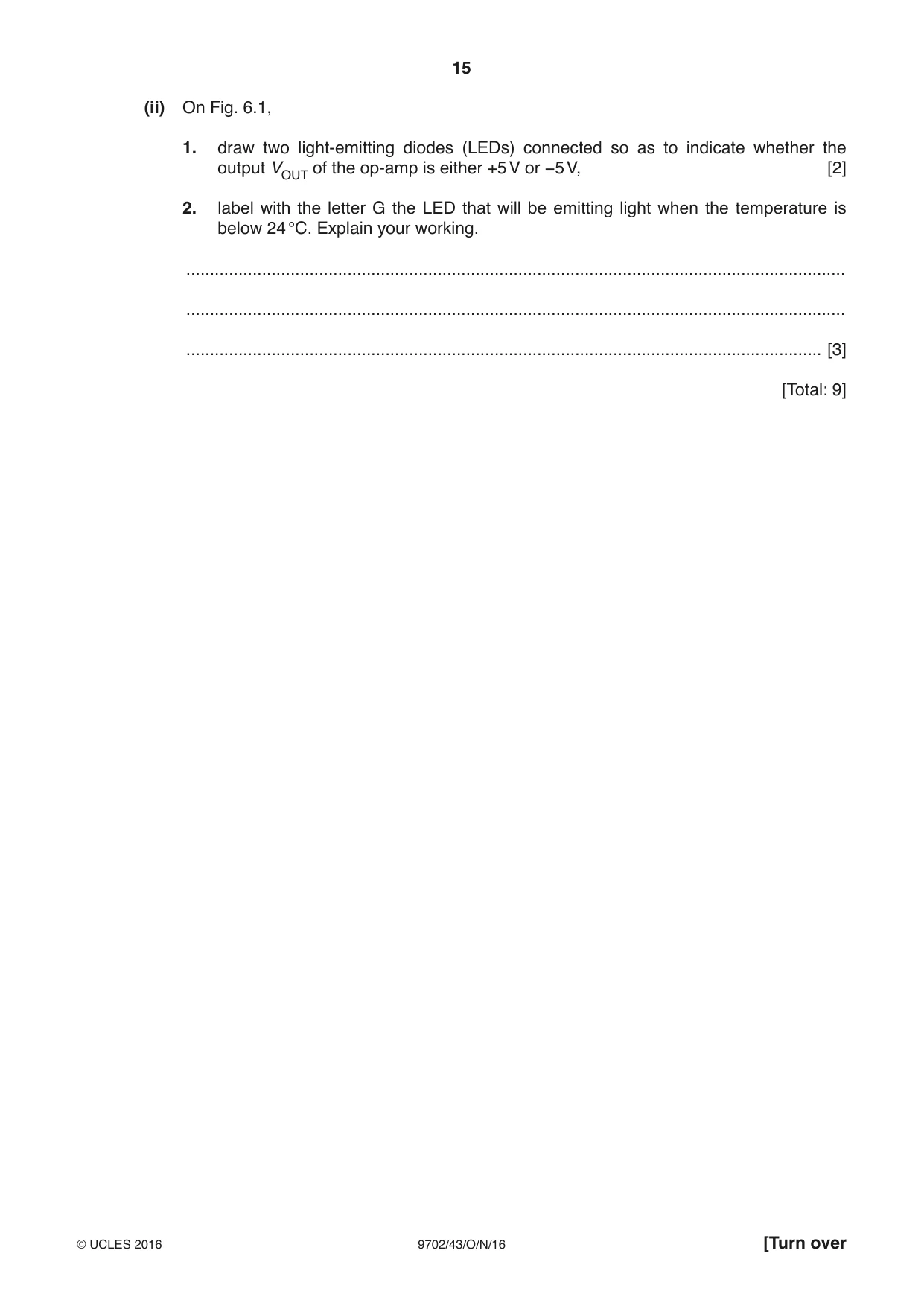
6 (a) The slew rate of an ideal operational amplifier (op-amp) is said to be infinite. Explain what is meant by infinite slew rate. ................................................................................................................................................... ................................................................................................................................................... .............................................................................................................................................. [2] (b) The circuit of Fig. 6.1 is designed to indicate whether the temperature of the thermistor is above or below 24 °C. 2.00 kΩ +5 V – 4.5 V + VOUT R 3.00 kΩ –5 V Fig. 6.1 The operational amplifier (op-amp) is assumed to be ideal. At 24 °C, the resistance of the thermistor is 1.50 kΩ. (i) Determine the resistance of resistor R such that the output VOUT of the op-amp changes at 24 °C. resistance = ..................................................... Ω [2] (ii) On Fig. 6.1, 1. draw two light-emitting diodes (LEDs) connected so as to indicate whether the output VOUT of the op-amp is either +5 V or −5 V, [2] 2. label with the letter G the LED that will be emitting light when the temperature is below 24 °C. Explain your working. ........................................................................................................................................... ........................................................................................................................................... ...................................................................................................................................... [3] [Total: 9]
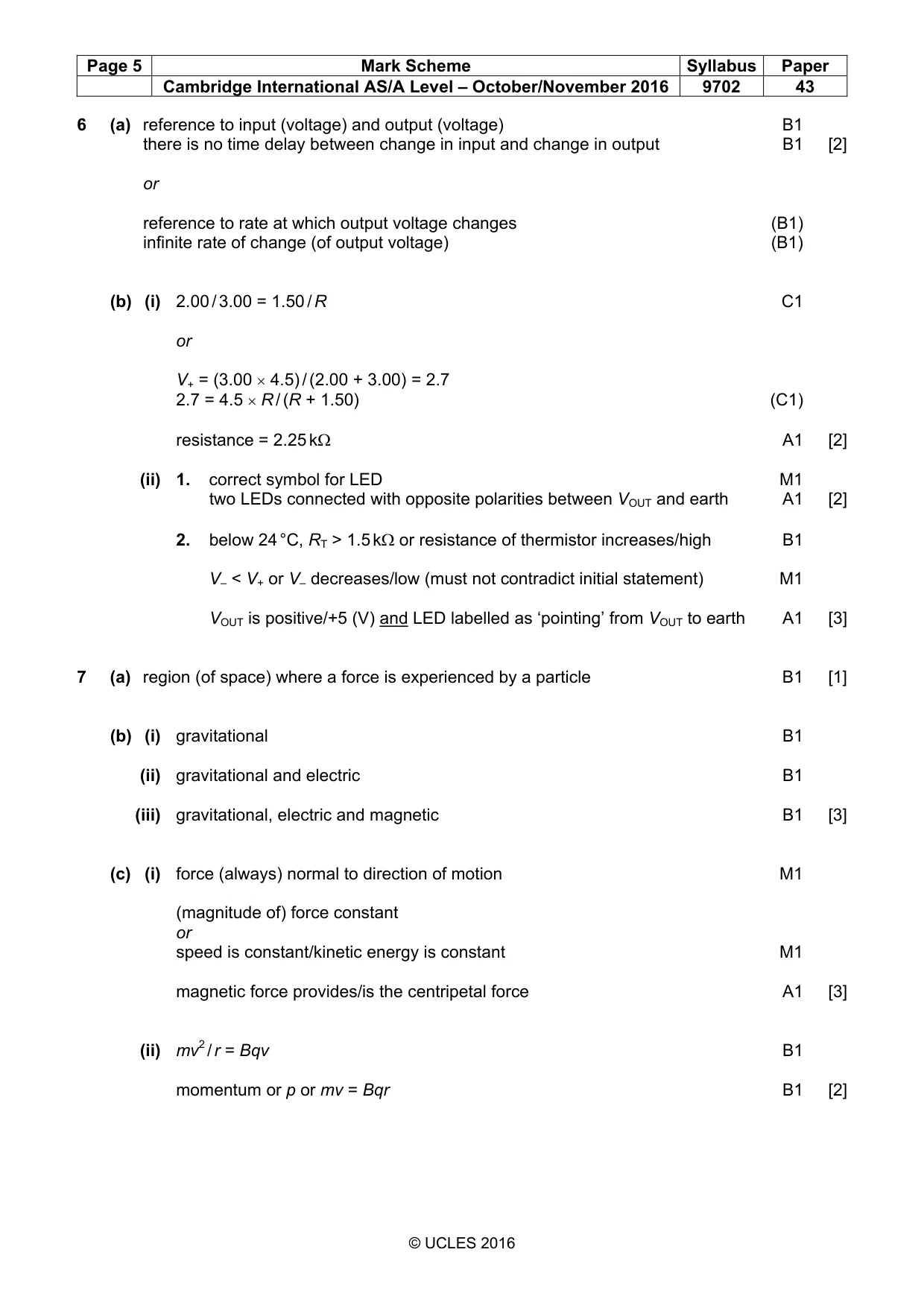
Mark scheme: 6 (a) reference to input (voltage) and output (voltage) B1 there is no time delay between change in input and change in output B1 [2] or reference to rate at which output voltage changes (B1) infinite rate of change (of output voltage) (B1) (b) (i) 2.00 / 3.00 = 1.50 / R C1 or V+ = (3.00 × 4.5) / (2.00 + 3.00) = 2.7 2.7 = 4.5 × R / (R + 1.50) (C1) resistance = 2.25 kΩ A1 [2] (ii) 1. correct symbol for LED M1 two LEDs connected with opposite polarities between VOUT and earth A1 [2] 2. below 24 °C, RT > 1.5 kΩ or resistance of thermistor increases/high B1 V– < V+ or V– decreases/low (must not contradict initial statement) M1 VOUT is positive/+5 (V) and LED labelled as ‘pointing’ from VOUT to earth A1 [3]
Q7 · Explain what is meant by a field of force
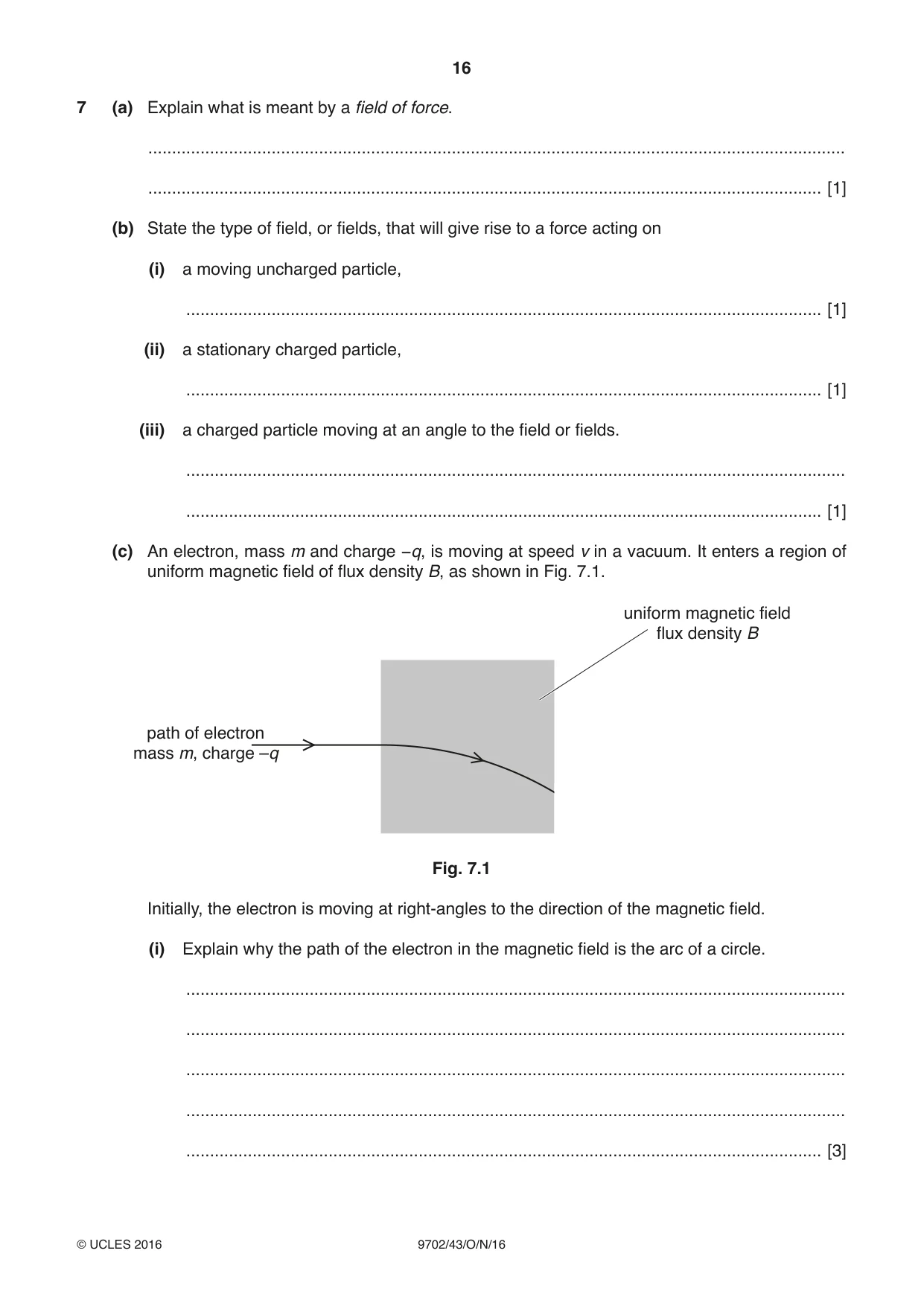
7 (a) Explain what is meant by a field of force. ................................................................................................................................................... .............................................................................................................................................. [1] (b) State the type of field, or fields, that will give rise to a force acting on (i) a moving uncharged particle, ...................................................................................................................................... [1] (ii) a stationary charged particle, ...................................................................................................................................... [1] (iii) a charged particle moving at an angle to the field or fields. ........................................................................................................................................... ...................................................................................................................................... [1] (c) An electron, mass m and charge −q, is moving at speed v in a vacuum. It enters a region of uniform magnetic field of flux density B, as shown in Fig. 7.1. uniform magnetic field flux density B path of electron mass m, charge –q Fig. 7.1 Initially, the electron is moving at right-angles to the direction of the magnetic field. (i) Explain why the path of the electron in the magnetic field is the arc of a circle. ........................................................................................................................................... ........................................................................................................................................... ........................................................................................................................................... ........................................................................................................................................... ...................................................................................................................................... [3] (ii) Derive an expression, in terms of the radius r of the path, for the linear momentum of the electron. Show your working. [2] [Total: 9]
Mark scheme: 7 (a) region (of space) where a force is experienced by a particle B1 [1] (b) (i) gravitational B1 (ii) gravitational and electric B1 (iii) gravitational, electric and magnetic B1 [3] (c) (i) force (always) normal to direction of motion M1 (magnitude of) force constant or speed is constant/kinetic energy is constant M1 magnetic force provides/is the centripetal force A1 [3] (ii) mv2 / r = Bqv B1 momentum or p or mv = Bqr B1 [2]
Q8 · Explain the main principles behind the use of nuclear magnetic resonance imaging (NMRI)…
8 Explain the main principles behind the use of nuclear magnetic resonance imaging (NMRI) to obtain diagnostic information about internal body structures. .......................................................................................................................................................... .......................................................................................................................................................... .......................................................................................................................................................... .......................................................................................................................................................... .......................................................................................................................................................... .......................................................................................................................................................... .......................................................................................................................................................... .......................................................................................................................................................... .......................................................................................................................................................... .......................................................................................................................................................... .......................................................................................................................................................... ..................................................................................................................................................... [8] [Total: 8]
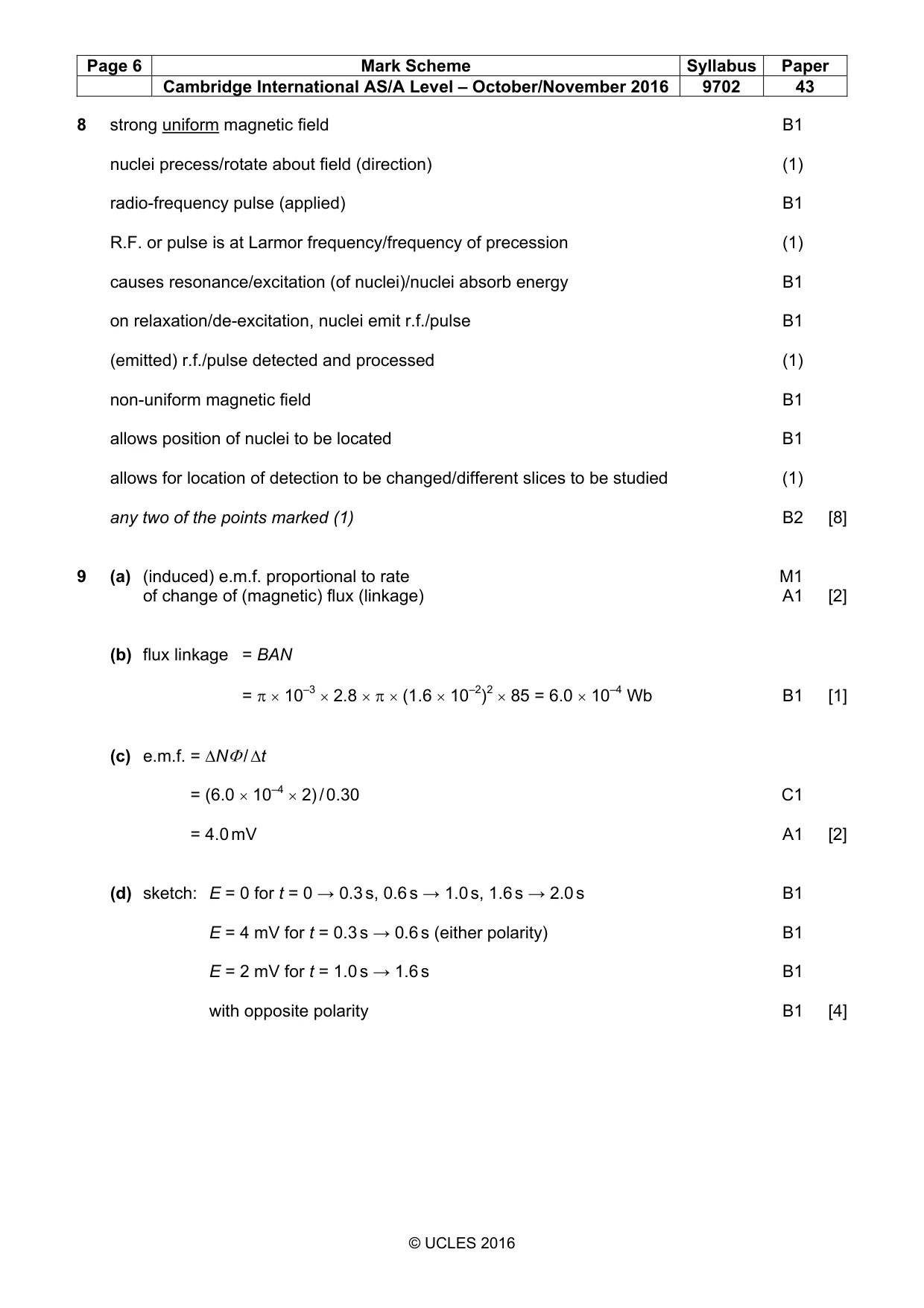
Mark scheme: 8 strong uniform magnetic field B1 nuclei precess/rotate about field (direction) (1) radio-frequency pulse (applied) B1 R.F. or pulse is at Larmor frequency/frequency of precession (1) causes resonance/excitation (of nuclei)/nuclei absorb energy B1 on relaxation/de-excitation, nuclei emit r.f./pulse B1 (emitted) r.f./pulse detected and processed (1) non-uniform magnetic field B1 allows position of nuclei to be located B1 allows for location of detection to be changed/different slices to be studied (1) any two of the points marked (1) B2 [8]
Q9 · State Faraday’s law of electromagnetic induction
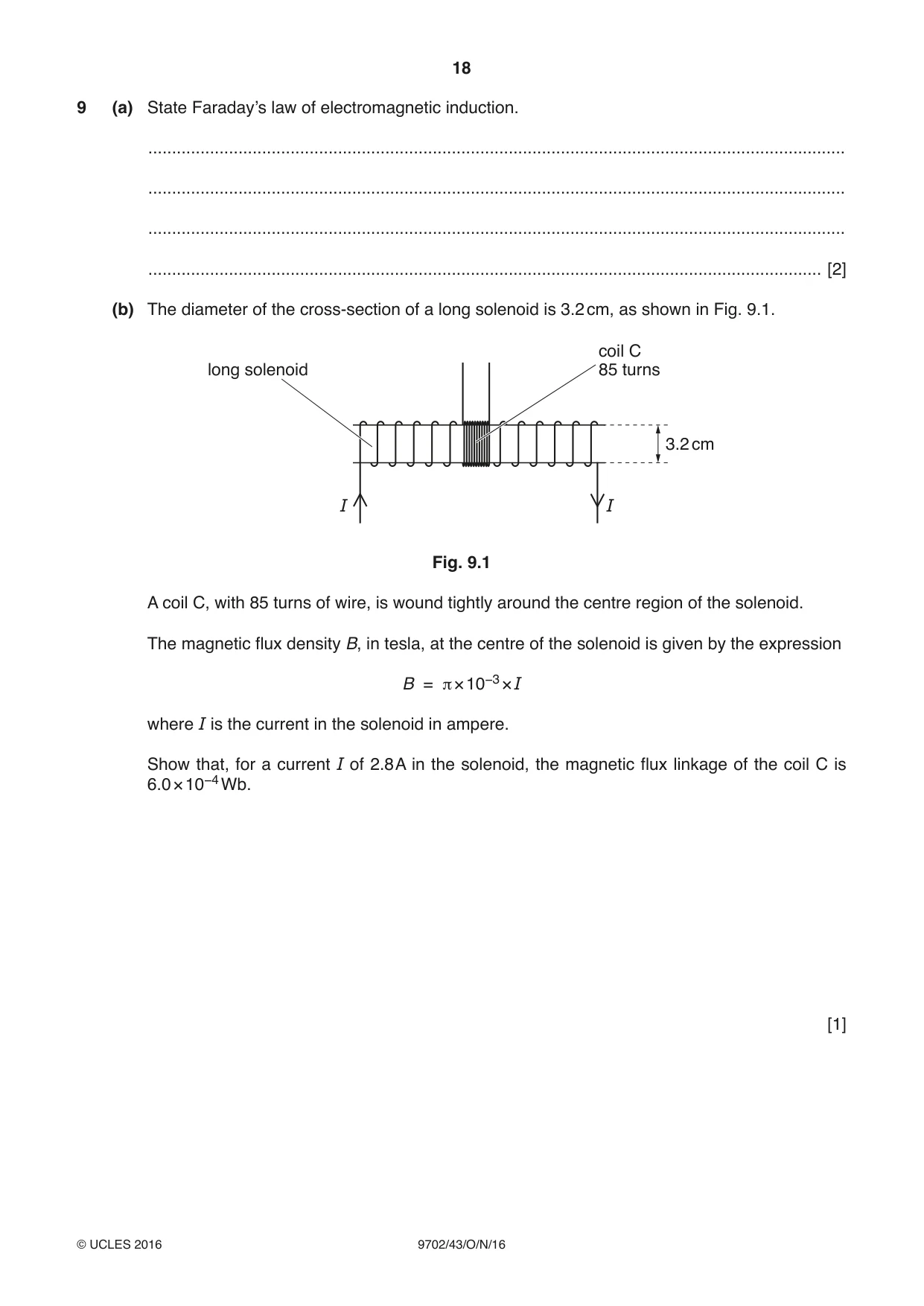
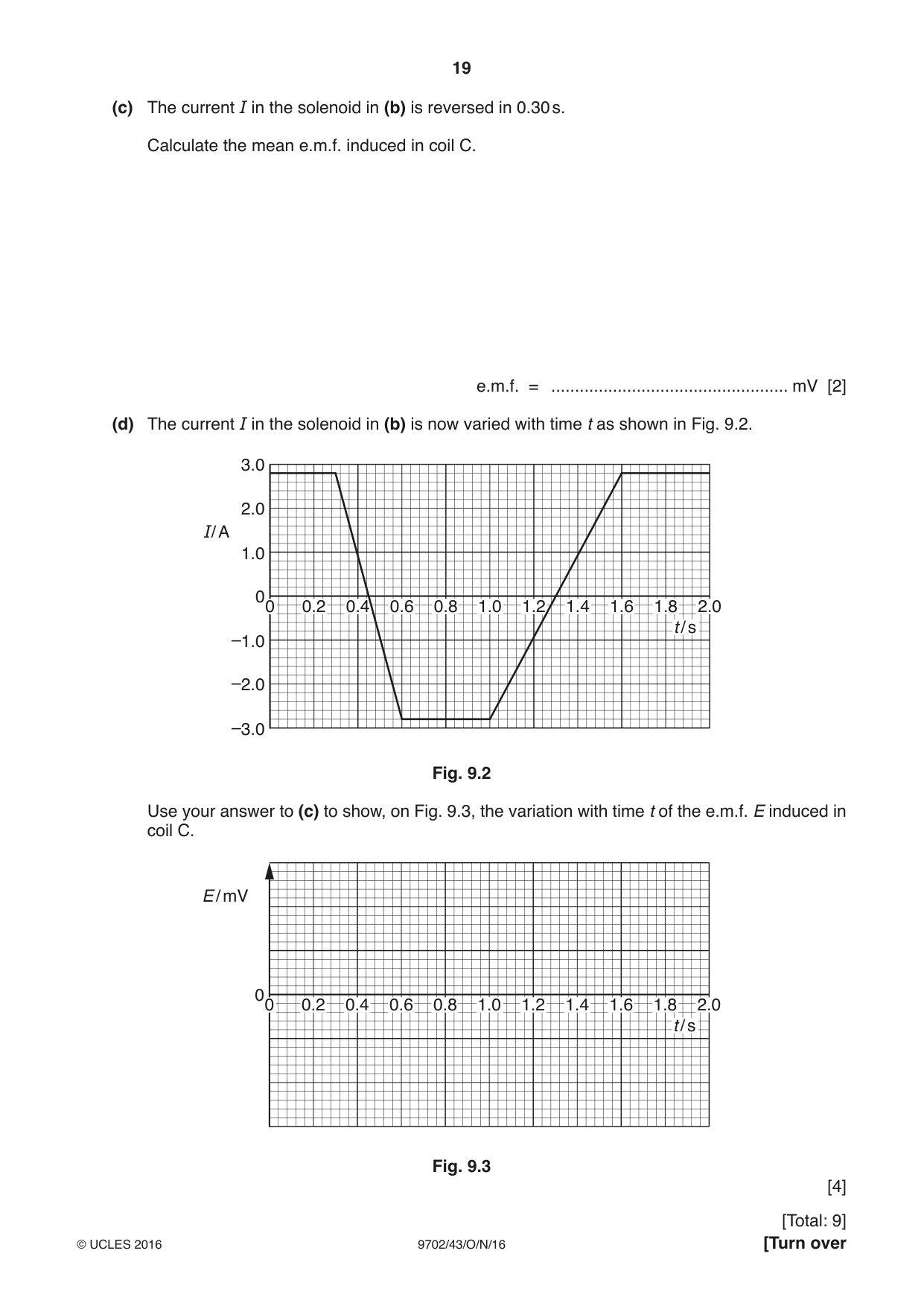
9 (a) State Faraday’s law of electromagnetic induction. ................................................................................................................................................... ................................................................................................................................................... ................................................................................................................................................... .............................................................................................................................................. [2] (b) The diameter of the cross-section of a long solenoid is 3.2 cm, as shown in Fig. 9.1. coil C long solenoid 85 turns 3.2 cm I I Fig. 9.1 A coil C, with 85 turns of wire, is wound tightly around the centre region of the solenoid. The magnetic flux density B, in tesla, at the centre of the solenoid is given by the expression B = π × 10−3 × I where I is the current in the solenoid in ampere. Show that, for a current I of 2.8 A in the solenoid, the magnetic flux linkage of the coil C is 6.0 × 10⁻⁴ Wb. [1] (c) The current I in the solenoid in (b) is reversed in 0.30 s. Calculate the mean e.m.f. induced in coil C. e.m.f. = .................................................. mV [2] (d) The current I in the solenoid in (b) is now varied with time t as shown in Fig. 9.2. 3.0 2.0 I/ A 1.0 0 0 0.2 0.4 0.6 0.8 1.0 1.2 1.4 1.6 1.8 2.0 t / s –1.0 –2.0 –3.0 Fig. 9.2 Use your answer to (c) to show, on Fig. 9.3, the variation with time t of the e.m.f. E induced in coil C. E / mV 00 0.2 0.4 0.6 0.8 1.0 1.2 1.4 1.6 1.8 2.0 t / s Fig. 9.3 [4]
Mark scheme: 9 (a) (induced) e.m.f. proportional to rate M1 of change of (magnetic) flux (linkage) A1 [2] (b) flux linkage = BAN = π × 10–3 × 2.8 × π × (1.6 × 10⁻²)2 × 85 = 6.0 × 10⁻⁴ Wb B1 [1] (c) e.m.f. = ∆NΦ/ ∆t e.m.f. = (6.0 × 10–4 × 2) / 0.30 C1 e.m.f. = 4.0 mV A1 [2] (d) sketch: E = 0 for t = 0 → 0.3 s, 0.6 s → 1.0 s, 1.6 s → 2.0 s B1 E = 4 mV for t = 0.3 s → 0.6 s (either polarity) B1 E = 2 mV for t = 1.0 s → 1.6 s B1 with opposite polarity B1 [4]
Q10 · Explain what is meant by the photoelectric effect
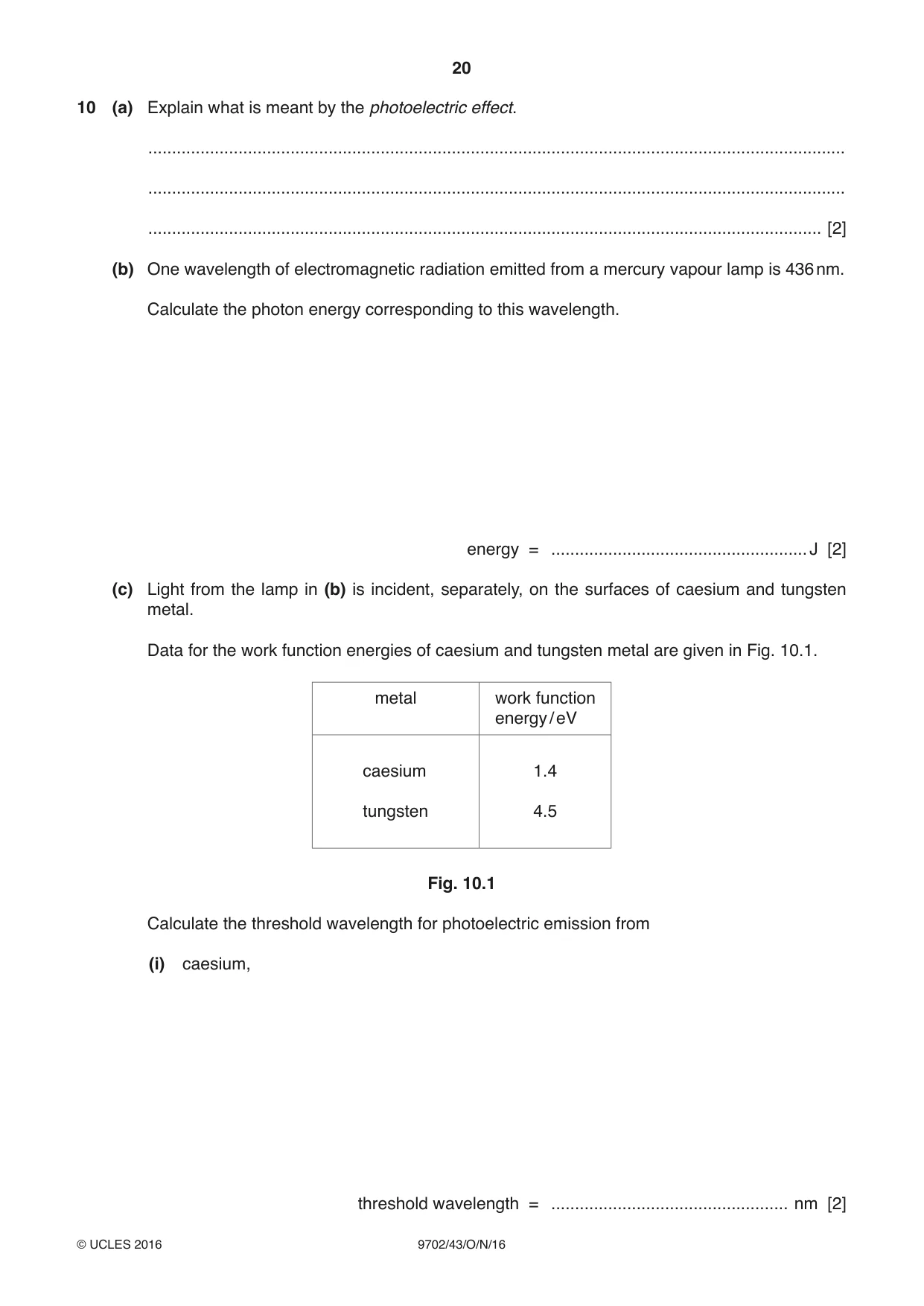
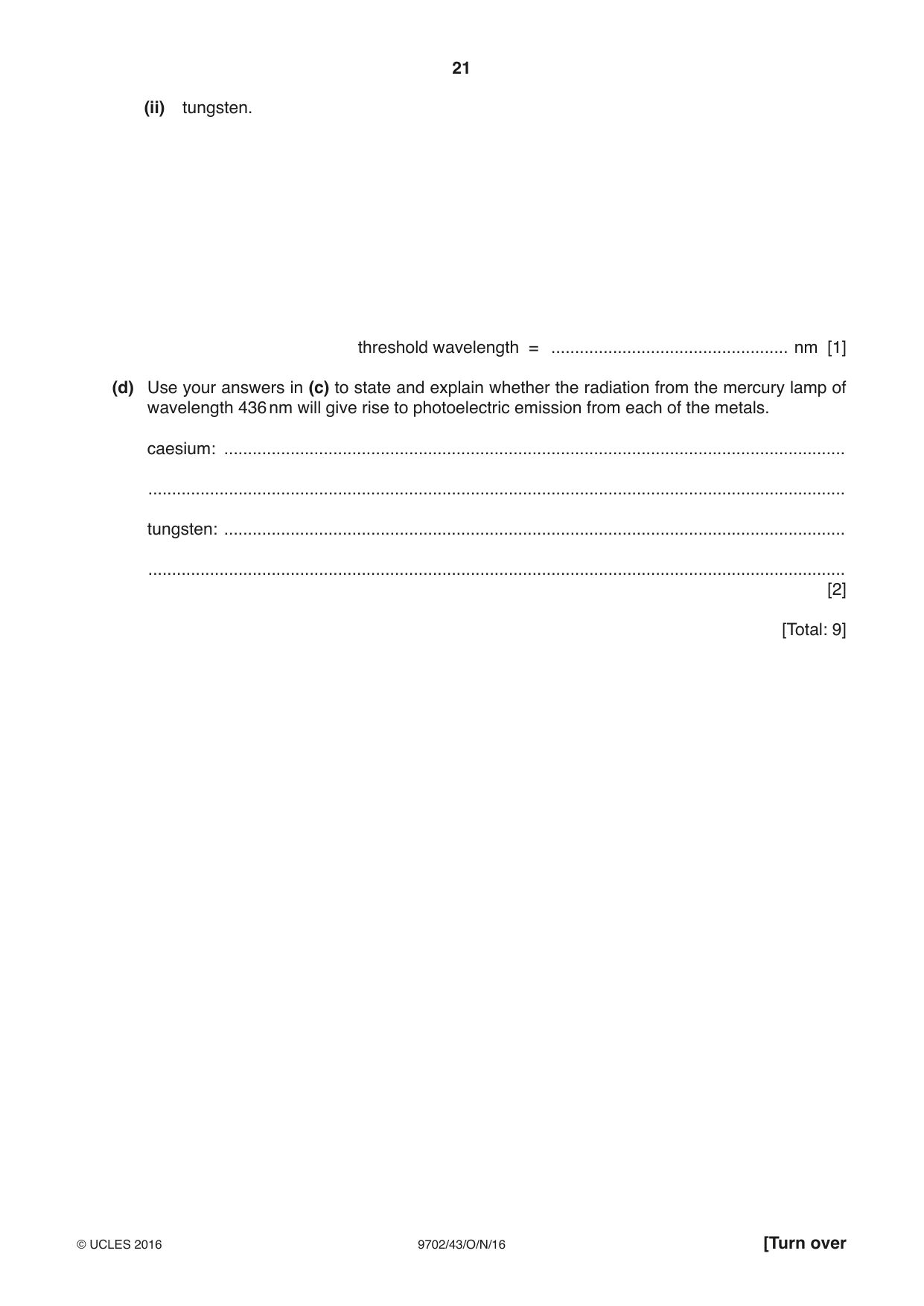
10 (a) Explain what is meant by the photoelectric effect. ................................................................................................................................................... ................................................................................................................................................... .............................................................................................................................................. [2] (b) One wavelength of electromagnetic radiation emitted from a mercury vapour lamp is 436 nm. Calculate the photon energy corresponding to this wavelength. energy = ...................................................... J [2] (c) Light from the lamp in (b) is incident, separately, on the surfaces of caesium and tungsten metal. Data for the work function energies of caesium and tungsten metal are given in Fig. 10.1. metal work function energy / eV caesium 1.4 tungsten 4.5 Fig. 10.1 Calculate the threshold wavelength for photoelectric emission from (i) caesium, threshold wavelength = .................................................. nm [2] (ii) tungsten. threshold wavelength = .................................................. nm [1] (d) Use your answers in (c) to state and explain whether the radiation from the mercury lamp of wavelength 436 nm will give rise to photoelectric emission from each of the metals. caesium: ................................................................................................................................... ................................................................................................................................................... tungsten: ................................................................................................................................... ................................................................................................................................................... [2] [Total: 9]
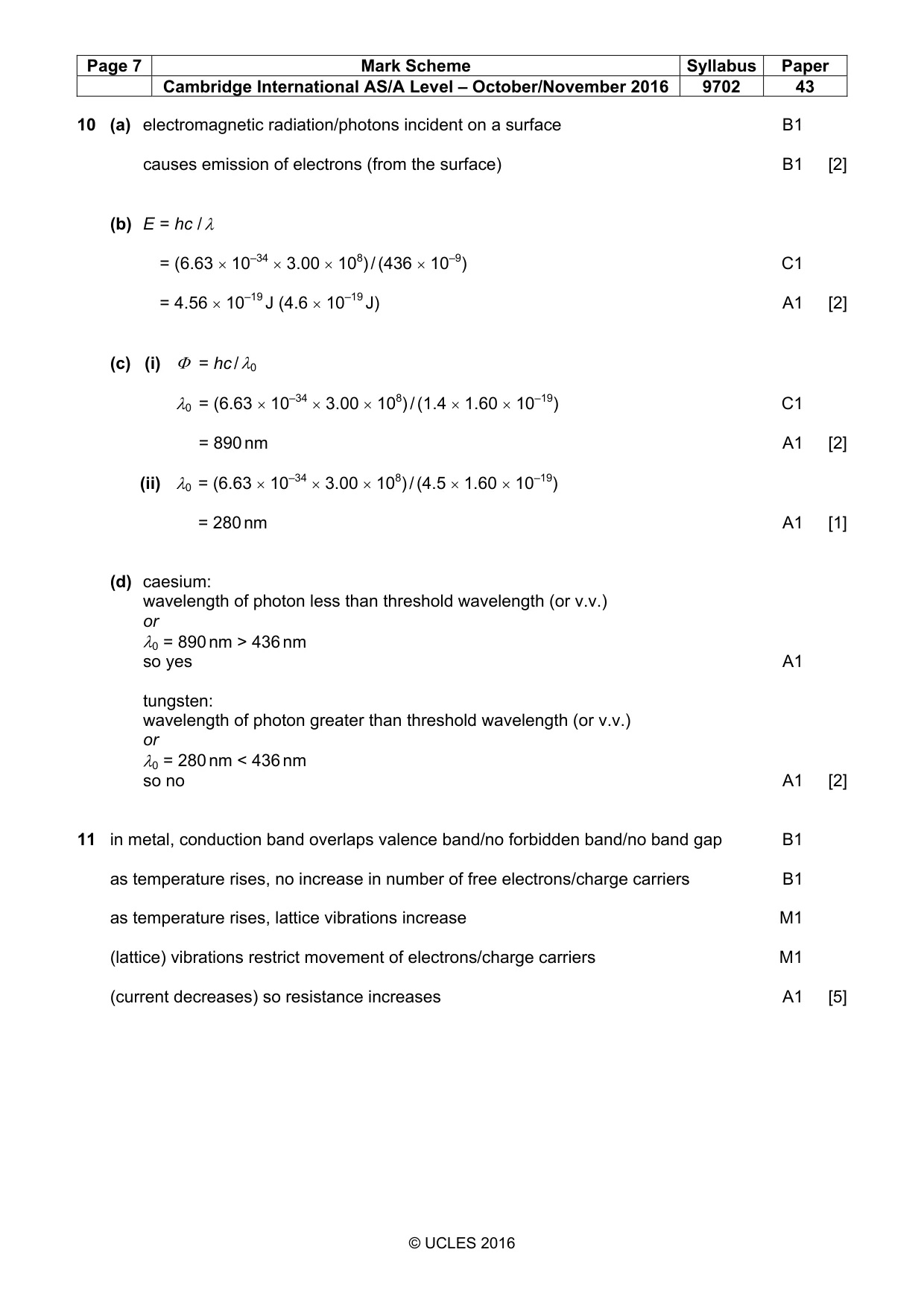
Mark scheme: 10 (a) electromagnetic radiation/photons incident on a surface B1 causes emission of electrons (from the surface) B1 [2] (b) E = hc / λ = (6.63 × 10–34 × 3.00 × 108) / (436 × 10–9) C1 = 4.56 × 10⁻¹⁹ J (4.6 × 10⁻¹⁹ J) A1 [2] (c) (i) Φ = hc / λ0 λ0 = (6.63 × 10–34 × 3.00 × 108) / (1.4 × 1.60 × 10–19) C1 = 890 nm A1 [2] (ii) λ0 = (6.63 × 10–34 × 3.00 × 108) / (4.5 × 1.60 × 10–19) = 280 nm A1 [1] (d) caesium: wavelength of photon less than threshold wavelength (or v.v.) or λ0 = 890 nm > 436 nm so yes A1 tungsten: wavelength of photon greater than threshold wavelength (or v.v.) or λ0 = 280 nm < 436 nm so no A1 [2]
Q11 · Some of the electron energy bands in a solid are illustrated in Fig
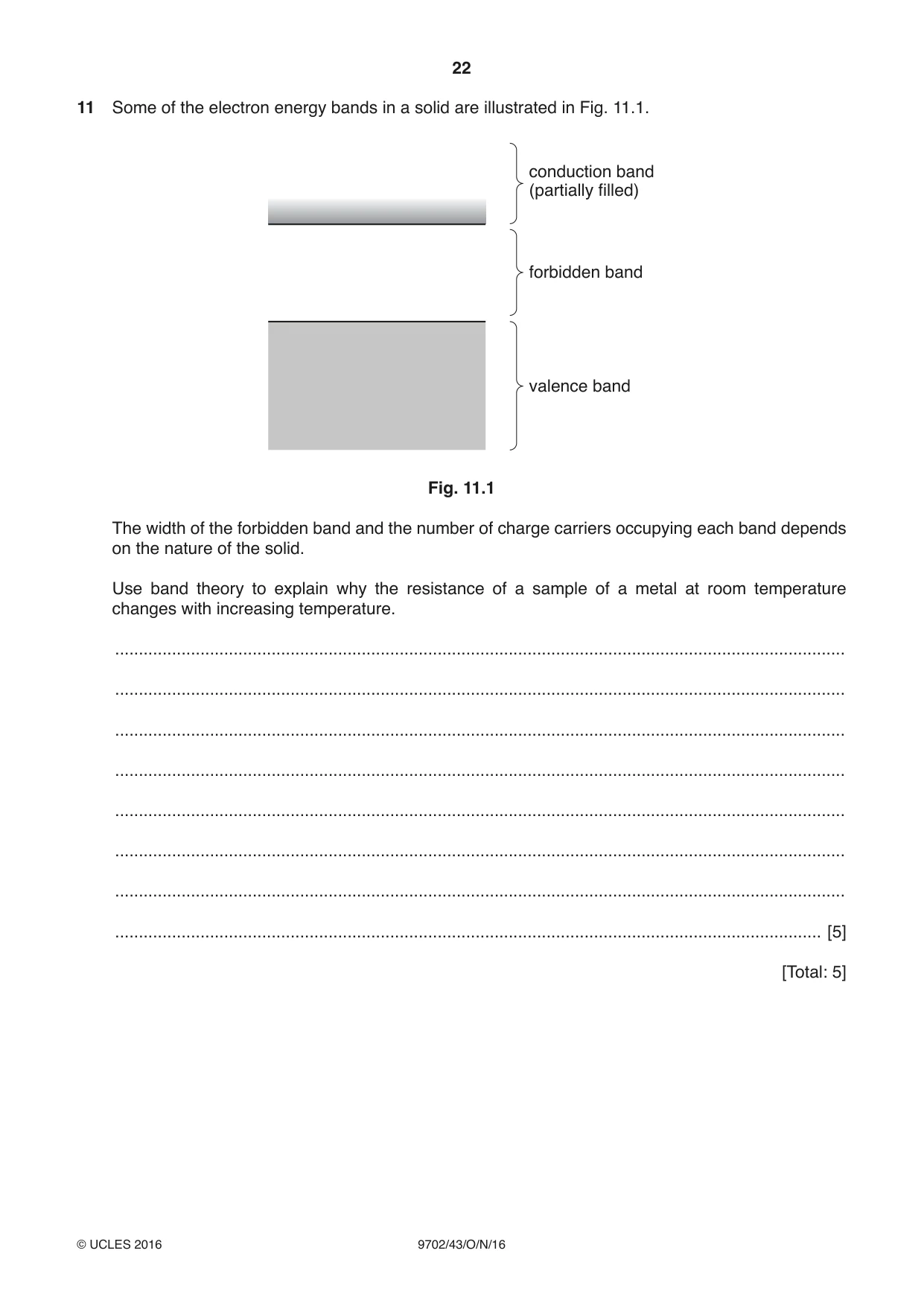
11 Some of the electron energy bands in a solid are illustrated in Fig. 11.1. conduction band (partially filled) forbidden band valence band Fig. 11.1 The width of the forbidden band and the number of charge carriers occupying each band depends on the nature of the solid. Use band theory to explain why the resistance of a sample of a metal at room temperature changes with increasing temperature. .......................................................................................................................................................... .......................................................................................................................................................... .......................................................................................................................................................... .......................................................................................................................................................... .......................................................................................................................................................... .......................................................................................................................................................... .......................................................................................................................................................... ..................................................................................................................................................... [5] [Total: 5]
Mark scheme: 11 in metal, conduction band overlaps valence band/no forbidden band/no band gap B1 as temperature rises, no increase in number of free electrons/charge carriers B1 as temperature rises, lattice vibrations increase M1 (lattice) vibrations restrict movement of electrons/charge carriers M1 (current decreases) so resistance increases A1 [5]
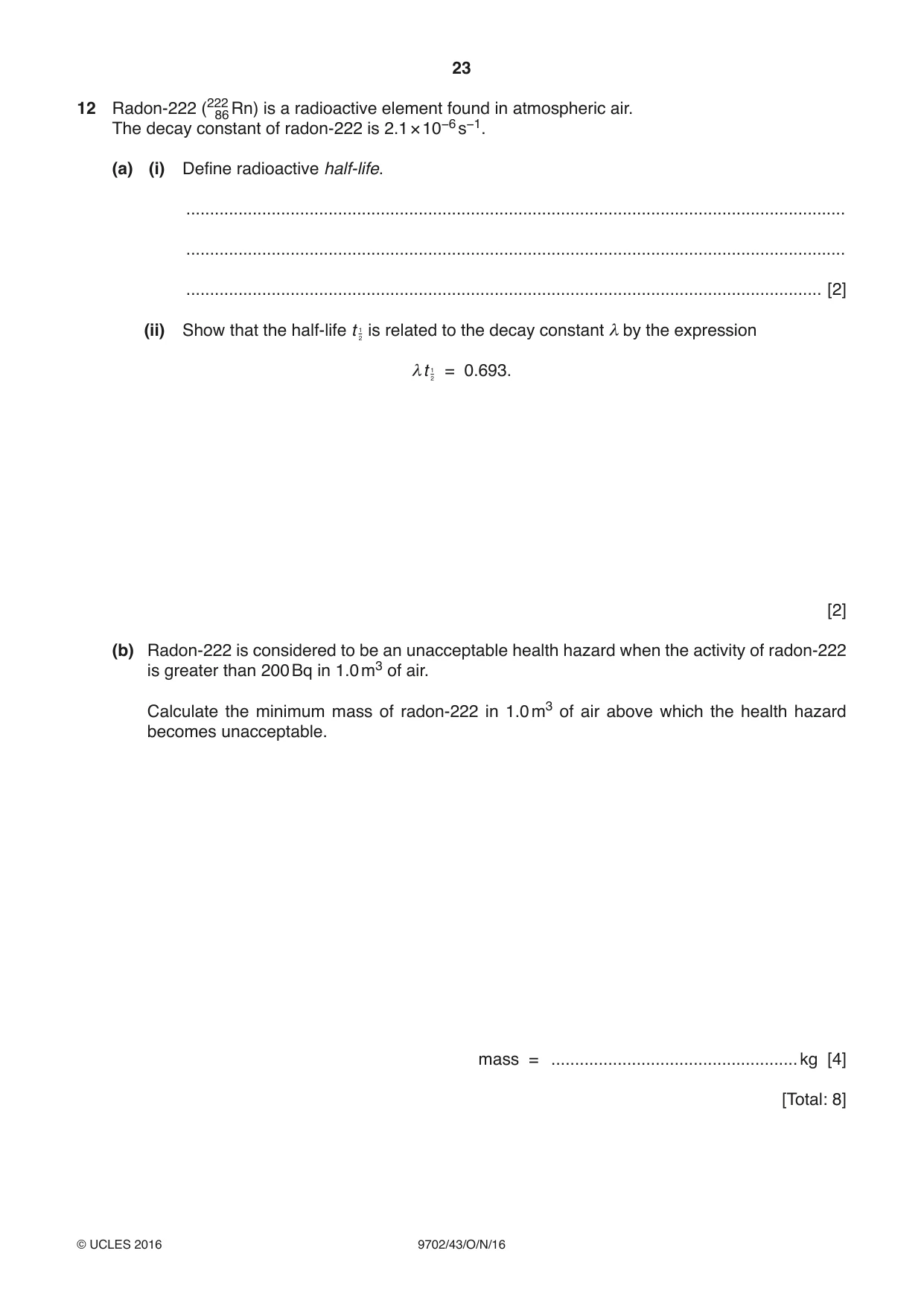
Q12 · Radon-222 (22286 Rn) is a radioactive element found in atmospheric air
12 Radon-222 (22286 Rn) is a radioactive element found in atmospheric air. The decay constant of radon-222 is 2.1 × 10⁻⁶ s−1. (a) (i) Define radioactive half-life. ........................................................................................................................................... ........................................................................................................................................... ...................................................................................................................................... [2] 1 2 is related to the decay constant λ by the expression (ii) Show that the half-life t 1 λt 2 = 0.693. [2] (b) Radon-222 is considered to be an unacceptable health hazard when the activity of radon-222 is greater than 200 Bq in 1.0 m3 of air. Calculate the minimum mass of radon-222 in 1.0 m3 of air above which the health hazard becomes unacceptable. mass = .................................................... kg [4] [Total: 8]
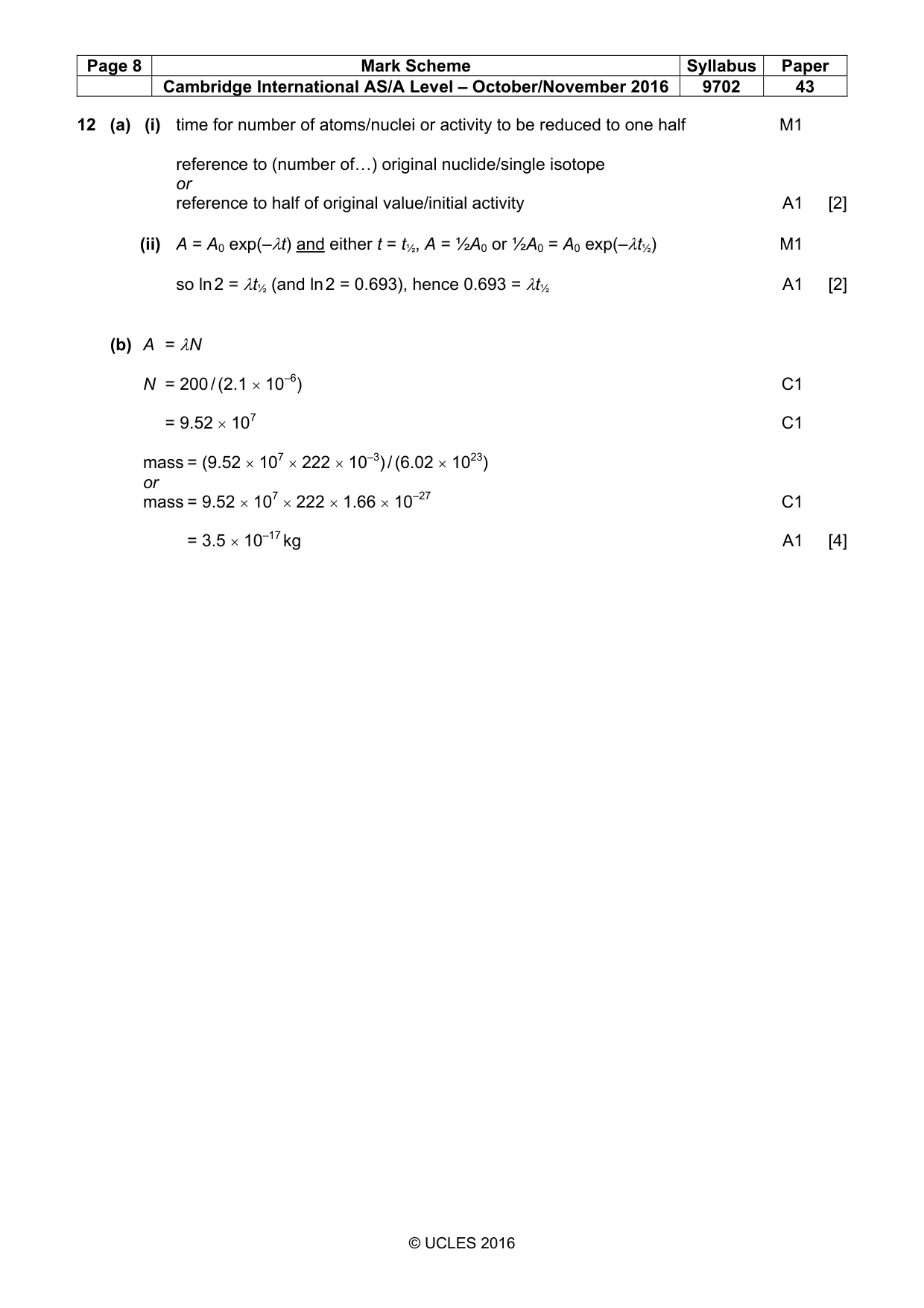
Mark scheme: 12 (a) (i) time for number of atoms/nuclei or activity to be reduced to one half M1 reference to (number of…) original nuclide/single isotope or reference to half of original value/initial activity A1 [2] (ii) A = A0 exp(–λt) and either t = t½, A = ½A0 or ½A0 = A0 exp(–λt½) M1 so ln 2 = λt½ (and ln 2 = 0.693), hence 0.693 = λt½ A1 [2] (b) A = λN N = 200 / (2.1 × 10⁻⁶) C1 = 9.52 × 10⁷ C1 mass = (9.52 × 107 × 222 × 10–3) / (6.02 × 10²³) or mass = 9.52 × 107 × 222 × 1.66 × 10–27 C1 = 3.5 × 10⁻¹⁷ kg A1 [4]
What was in this paper
The subtopics covered by these 12 questions, and how many questions each got. Open one in a new tab to see every Cambridge question on it.
What you needed in this session
Cambridge’s own grade thresholds for 2016 Oct/Nov, Paper 4 · Variant 3. A higher threshold means an easier paper — the bar moves with how the cohort did.