Cambridge A Level Physics 9702 — 2012 May/June Paper 4 · Variant 3
9702/43/M/J/12 · 13 questions · 100 marks · ≈113 min
The question paper and its mark scheme, free to read here and free to download. This is Cambridge’s own paper, exactly as it was sat.
Question paper24 pages
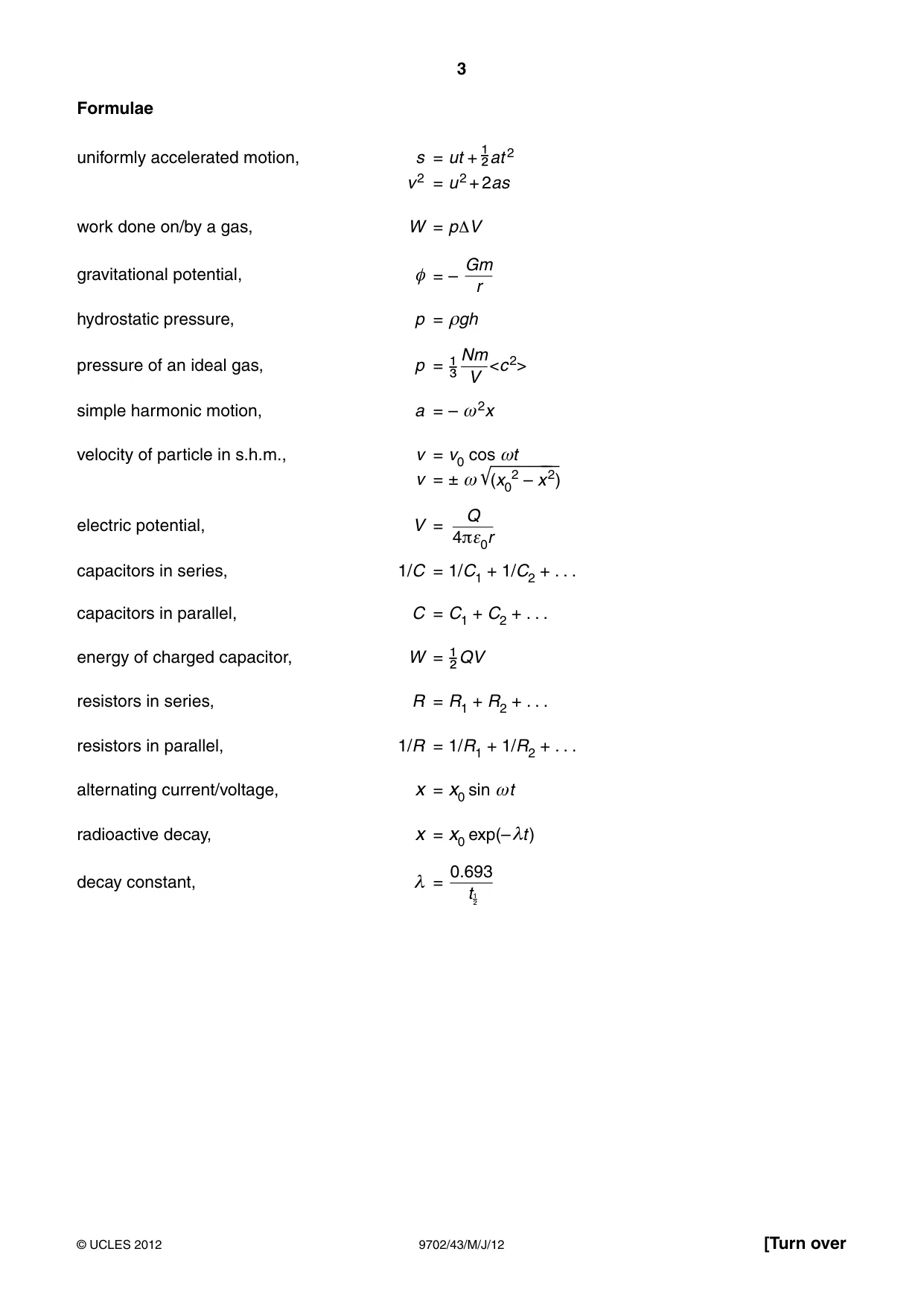
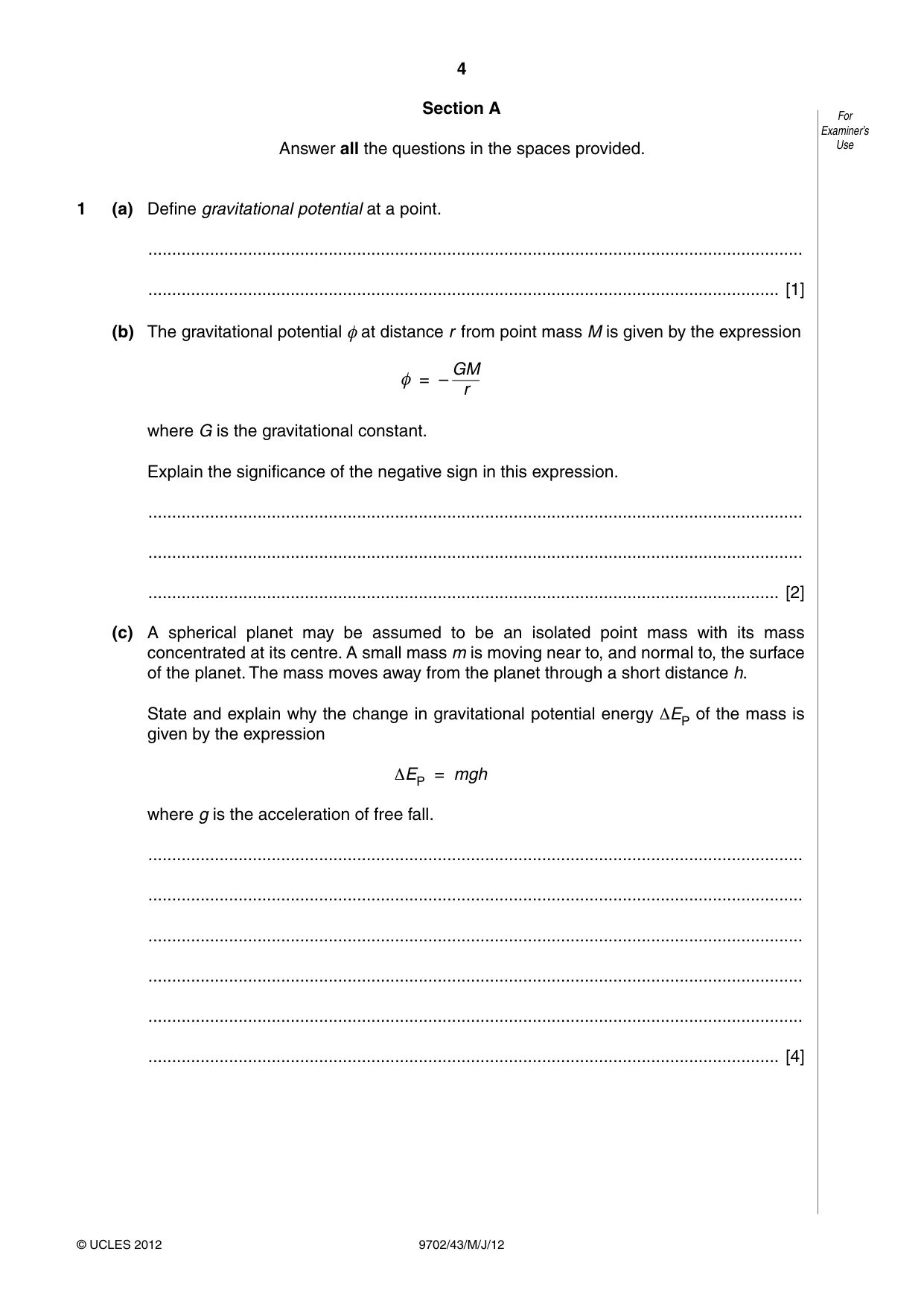

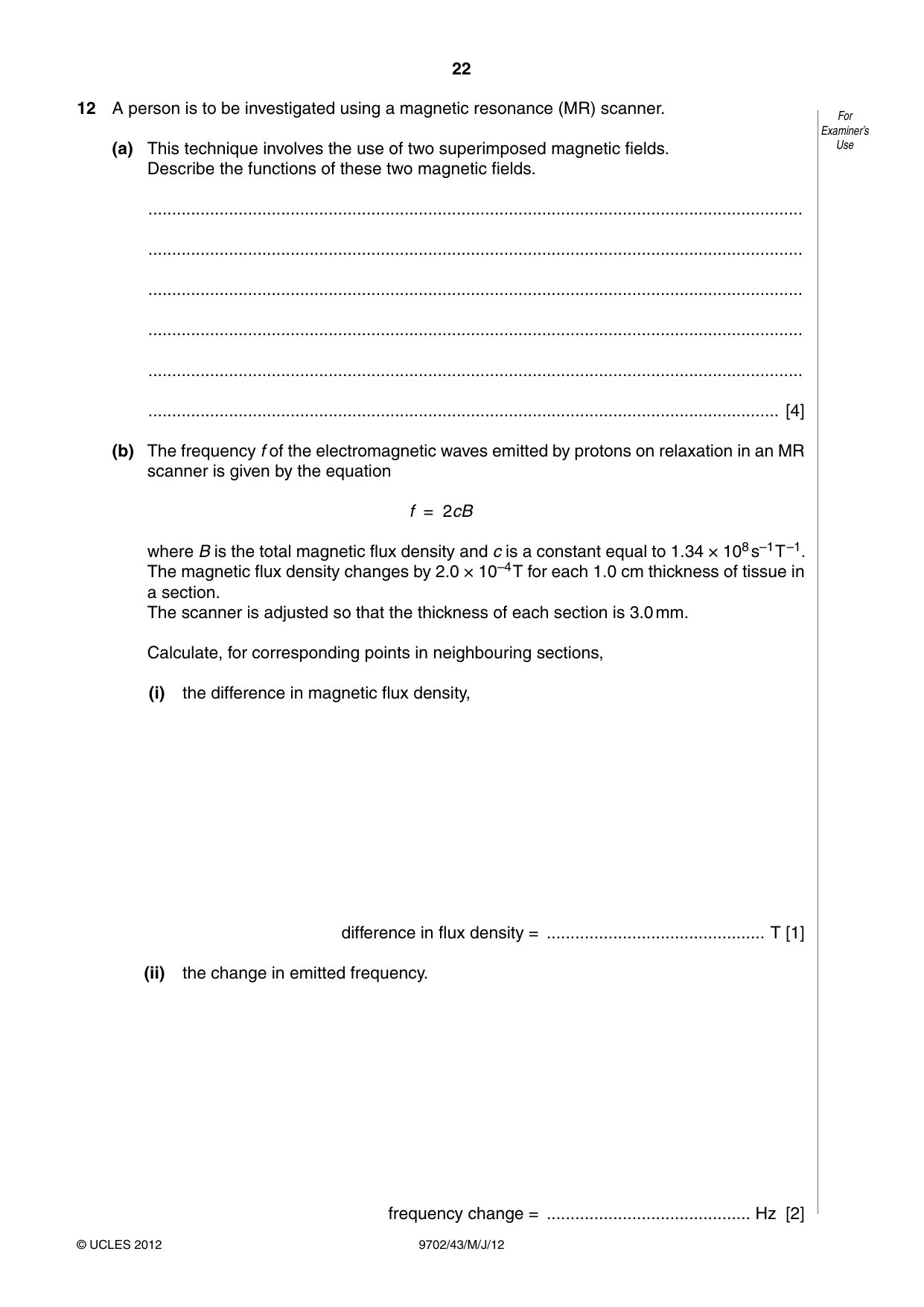
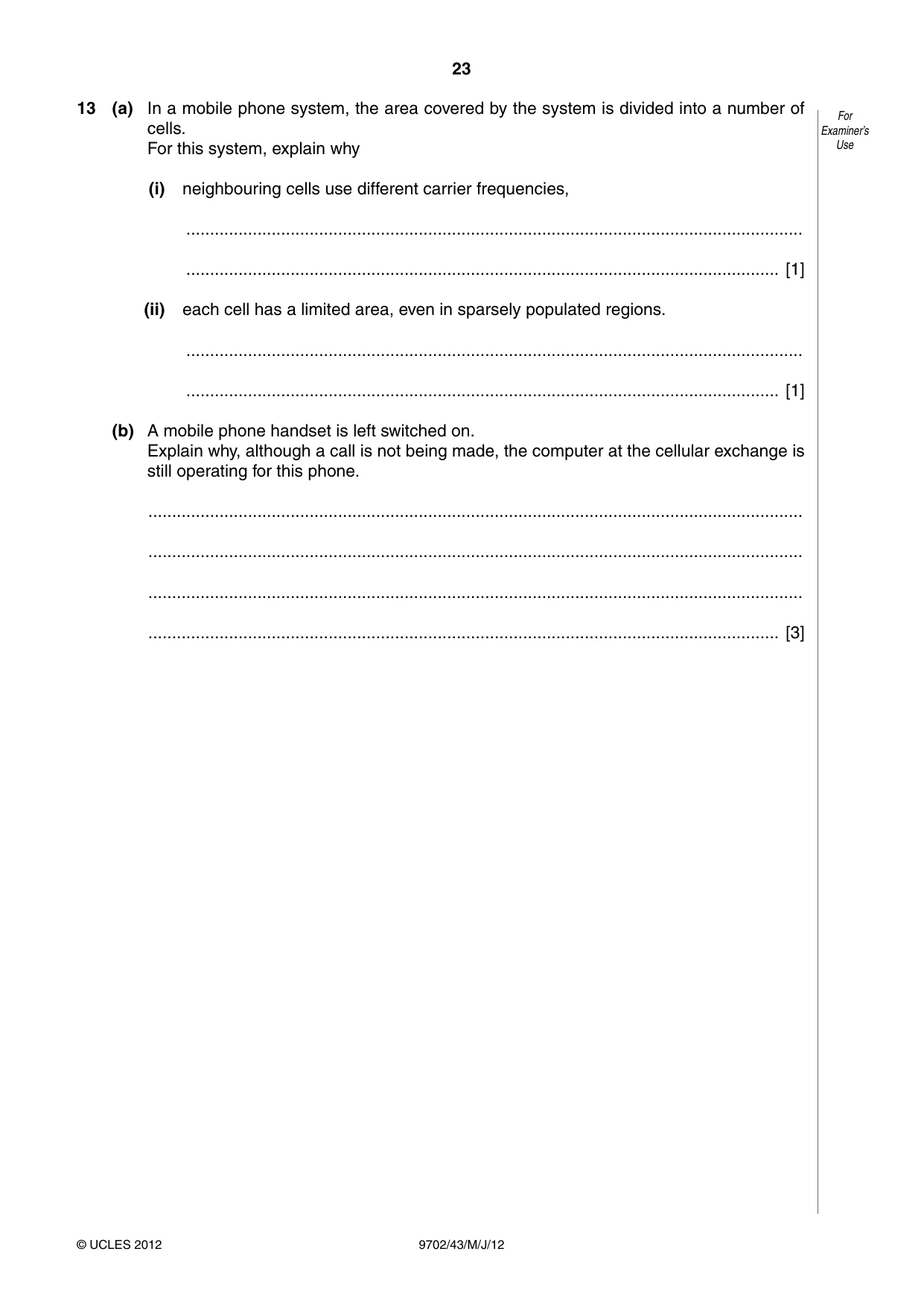

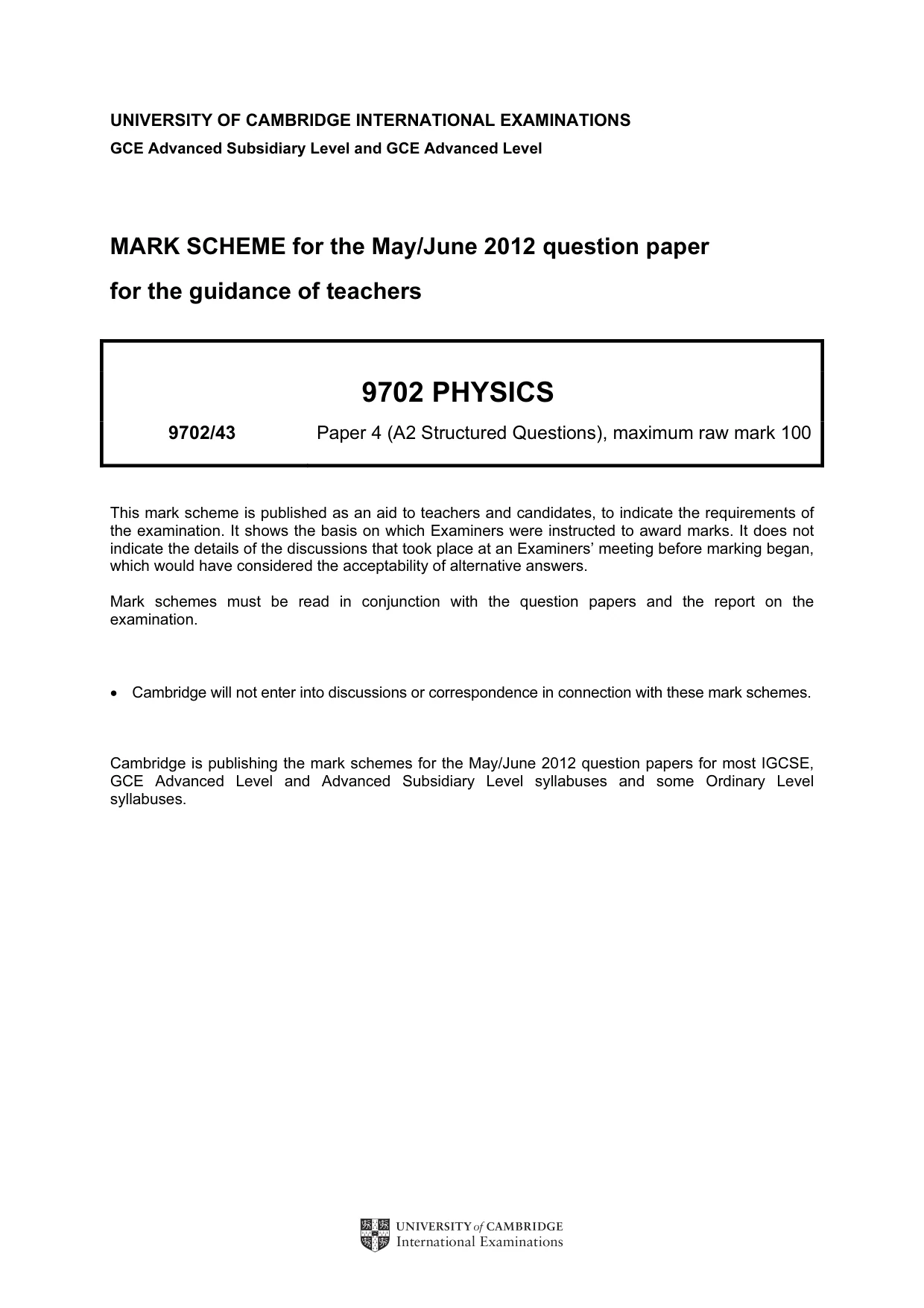
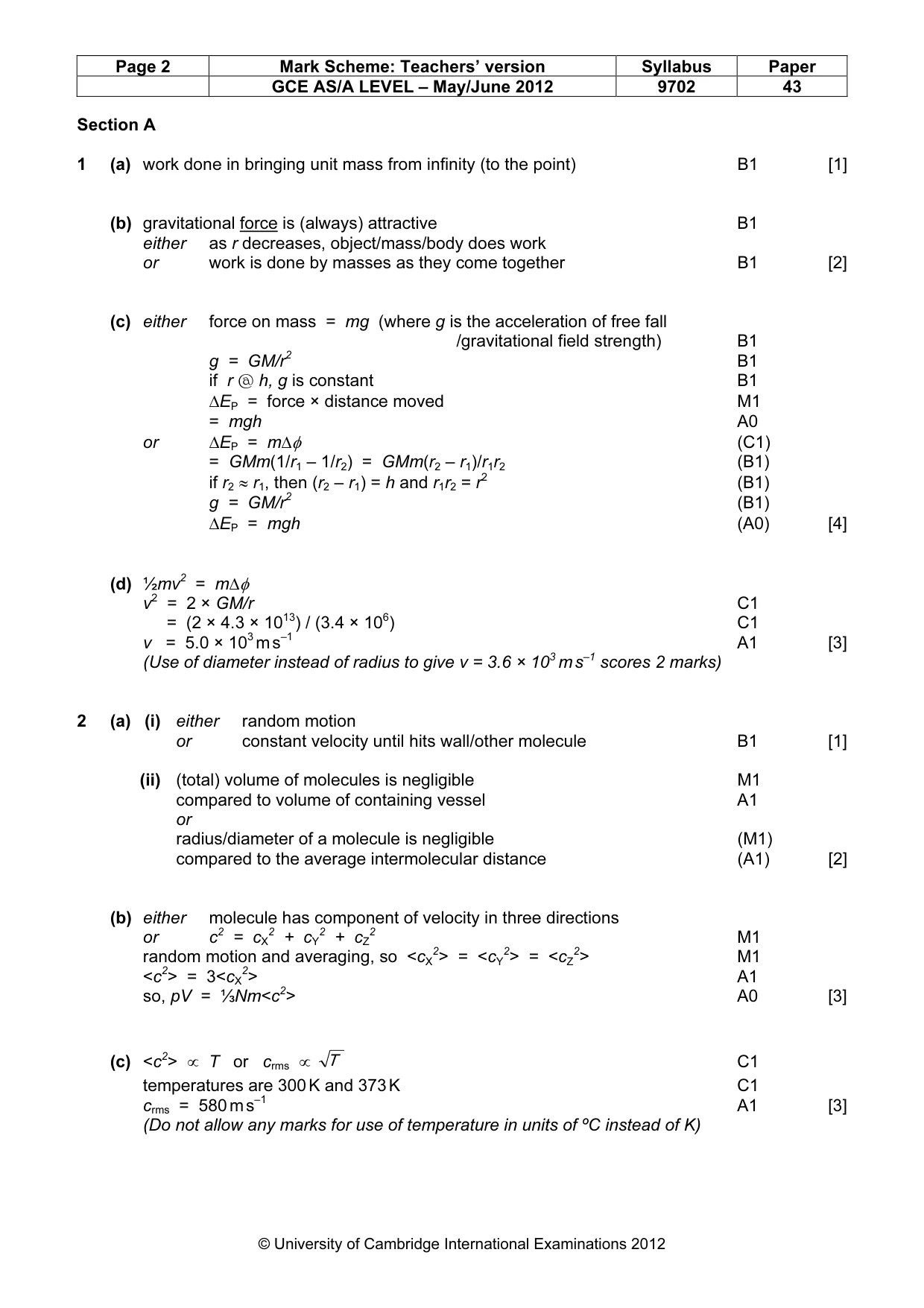
Mark scheme7 pages
Answers below. Sit the paper first if you are practising.
Questions as text
Q1 · Define gravitational potential at a point
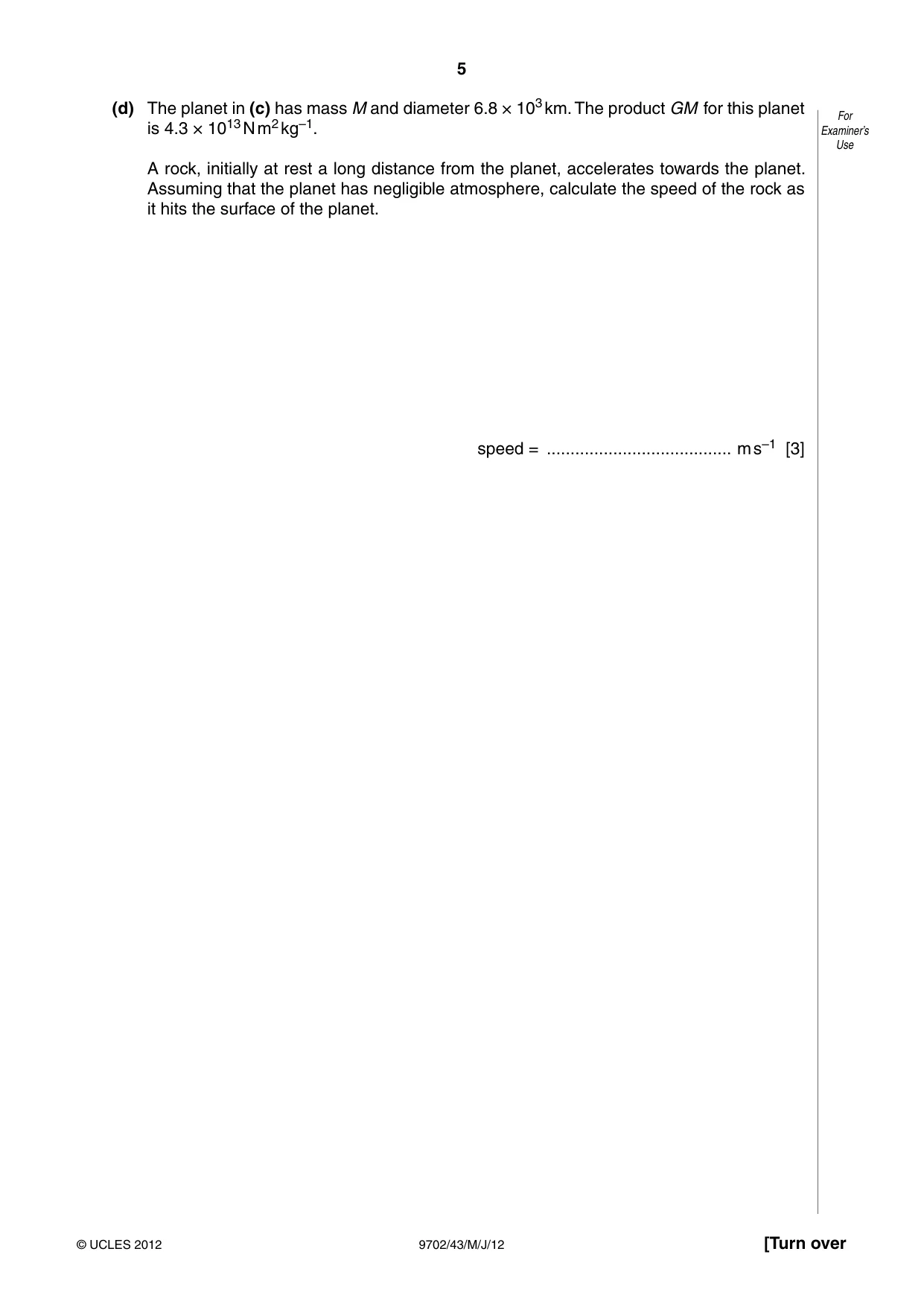
1 (a) Define gravitational potential at a point. .......................................................................................................................................... ..................................................................................................................................... [1] (b) The gravitational potential φ at distance r from point mass M is given by the expression GM φ = – r where G is the gravitational constant. Explain the significance of the negative sign in this expression. .......................................................................................................................................... .......................................................................................................................................... ..................................................................................................................................... [2] (c) A spherical planet may be assumed to be an isolated point mass with its mass concentrated at its centre. A small mass m is moving near to, and normal to, the surface of the planet. The mass moves away from the planet through a short distance h. State and explain why the change in gravitational potential energy ΔEP of the mass is given by the expression ΔEP = mgh where g is the acceleration of free fall. .......................................................................................................................................... .......................................................................................................................................... .......................................................................................................................................... .......................................................................................................................................... .......................................................................................................................................... ..................................................................................................................................... [4] (d) The planet in (c) has mass M and diameter 6.8 × 10³ km. The product GM for this planet For is 4.3 × 10¹³ N m2 kg–1. Examiner’s Use A rock, initially at rest a long distance from the planet, accelerates towards the planet. Assuming that the planet has negligible atmosphere, calculate the speed of the rock as it hits the surface of the planet. speed = ....................................... m s–1 [3]
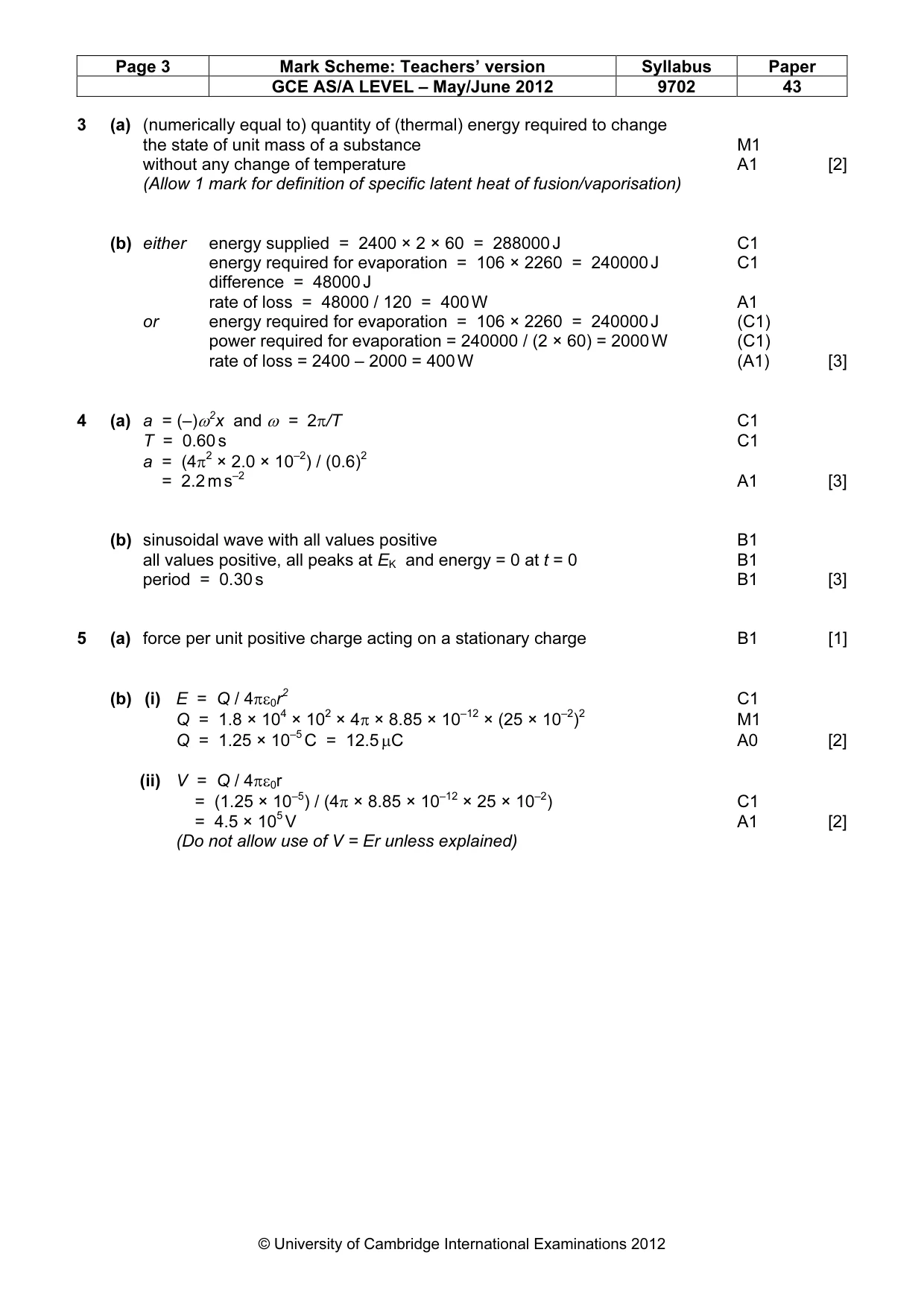
Mark scheme: 1 (a) work done in bringing unit mass from infinity (to the point) B1 [1] (b) gravitational force is (always) attractive B1 either as r decreases, object/mass/body does work or work is done by masses as they come together B1 [2] (c) either force on mass = mg (where g is the acceleration of free fall /gravitational field strength) B1 g = GM/r2 B1 if r @ h, g is constant B1 ∆EP = force × distance moved M1 = mgh A0 or ∆EP = m∆φ (C1) = GMm(1/r1 – 1/r2) = GMm(r2 – r1)/r1r2 (B1) if r2 ≈ r1, then (r2 – r1) = h and r1r2 = r2 (B1) g = GM/r2 (B1) ∆EP = mgh (A0) [4] (d) ½mv2 = m∆φ v2 = 2 × GM/r C1 = (2 × 4.3 × 1013) / (3.4 × 10⁶) C1 v = 5.0 × 10³ m s–1 A1 [3] (Use of diameter instead of radius to give v = 3.6 × 10³ m s–1 scores 2 marks)
Q2 · The kinetic theory of gases is based on some simplifying assumptions
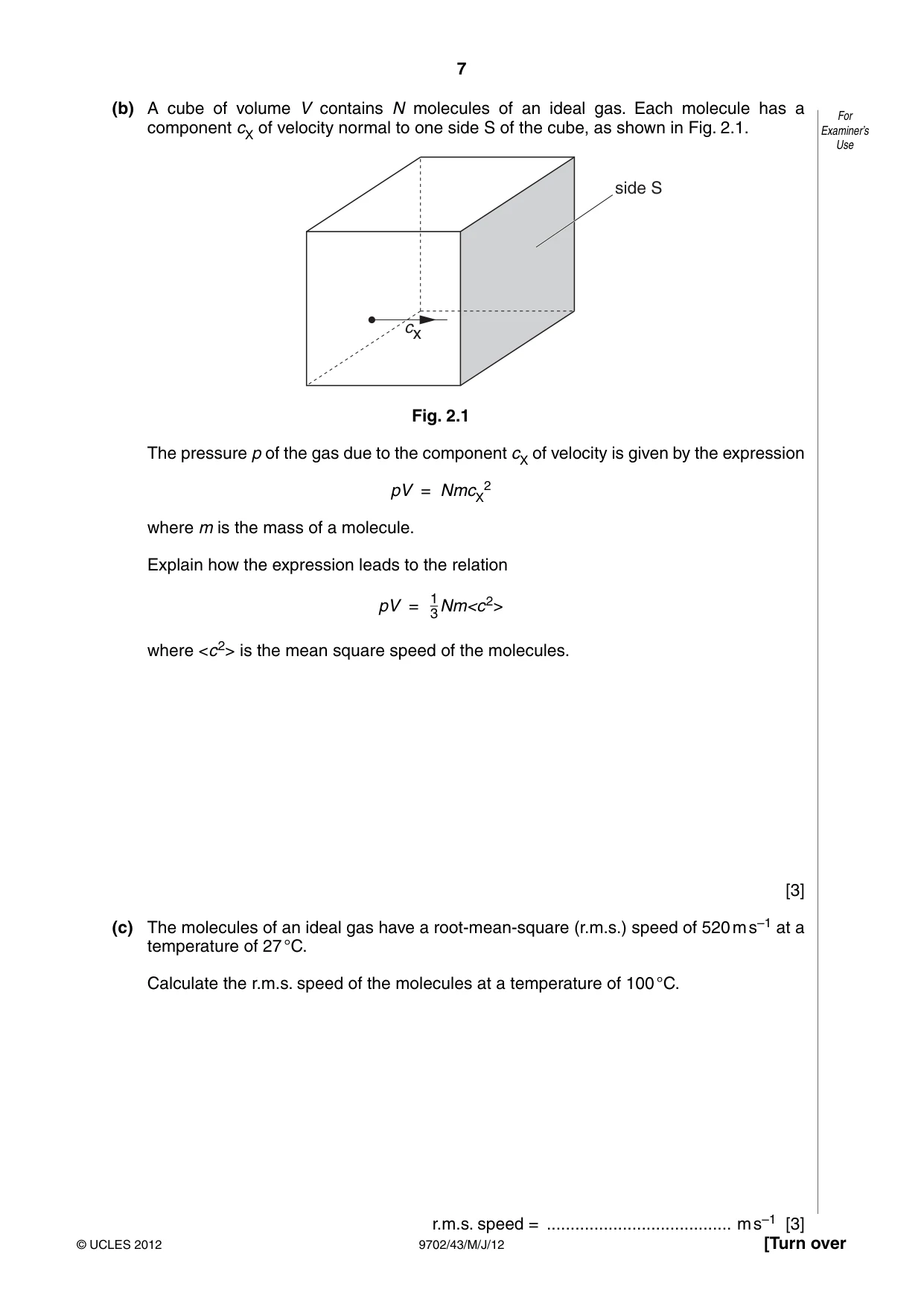
2 (a) The kinetic theory of gases is based on some simplifying assumptions. For The molecules of the gas are assumed to behave as hard elastic identical spheres. Examiner’s State the assumption about ideal gas molecules based on Use (i) the nature of their movement, .................................................................................................................................. ............................................................................................................................. [1] (ii) their volume. .................................................................................................................................. .................................................................................................................................. ............................................................................................................................. [2] (b) A cube of volume V contains N molecules of an ideal gas. Each molecule has a For Examiner’s component cX of velocity normal to one side S of the cube, as shown in Fig. 2.1. Use side S cx Fig. 2.1 The pressure p of the gas due to the component cX of velocity is given by the expression pV = NmcX2 where m is the mass of a molecule. Explain how the expression leads to the relation 1 pV = 3Nm<c2> where <c2> is the mean square speed of the molecules. [3] (c) The molecules of an ideal gas have a root-mean-square (r.m.s.) speed of 520 m s–1 at a temperature of 27 °C. Calculate the r.m.s. speed of the molecules at a temperature of 100 °C. r.m.s. speed = ....................................... m s–1 [3]
Mark scheme: 2 (a) (i) either random motion or constant velocity until hits wall/other molecule B1 [1] (ii) (total) volume of molecules is negligible M1 compared to volume of containing vessel A1 or radius/diameter of a molecule is negligible (M1) compared to the average intermolecular distance (A1) [2] (b) either molecule has component of velocity in three directions or c2 = cX2 + cY2 + cZ 2 M1 random motion and averaging, so <cX2> = <cY2> = <cZ 2> M1 <c2> = 3<cX2> A1 so, pV = ⅓Nm<c2> A0 [3] (c) <c2> ∝ T or crms ∝ T C1 temperatures are 300 K and 373 K C1 crms = 580 m s–1 A1 [3] (Do not allow any marks for use of temperature in units of ºC instead of K) GCE AS/A LEVEL – May/June 2012 9702 43
Q3 · Define specific latent heat
3 (a) Define specific latent heat. For Examiner’s .......................................................................................................................................... Use .......................................................................................................................................... ..................................................................................................................................... [2] (b) The heater in an electric kettle has a power of 2.40 kW. When the water in the kettle is boiling at a steady rate, the mass of water evaporated in 2.0 minutes is 106 g. The specific latent heat of vaporisation of water is 2260 J g–1. Calculate the rate of loss of thermal energy to the surroundings of the kettle during the boiling process. rate of loss = ............................................ W [3]
Mark scheme: 3 (a) (numerically equal to) quantity of (thermal) energy required to change the state of unit mass of a substance M1 without any change of temperature A1 [2] (Allow 1 mark for definition of specific latent heat of fusion/vaporisation) (b) either energy supplied = 2400 × 2 × 60 = 288000 J C1 energy required for evaporation = 106 × 2260 = 240000 J C1 difference = 48000 J rate of loss = 48000 / 120 = 400 W A1 or energy required for evaporation = 106 × 2260 = 240000 J (C1) power required for evaporation = 240000 / (2 × 60) = 2000 W (C1) rate of loss = 2400 – 2000 = 400 W (A1) [3] 2
More questions on Specific heat capacity and specific latent heat
Q4 · A small metal ball is suspended from a fixed point by means of a string, as shown in Fig
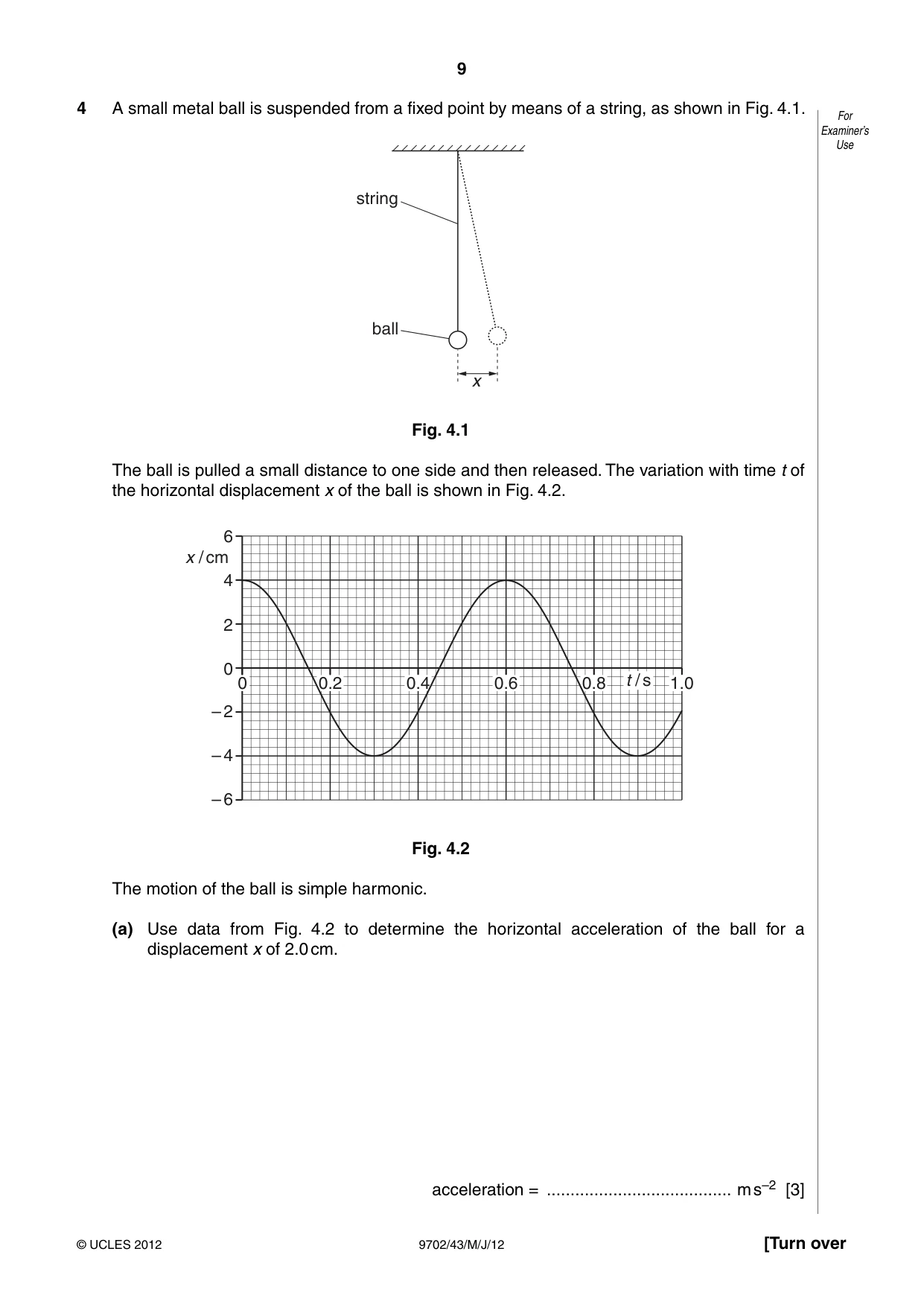
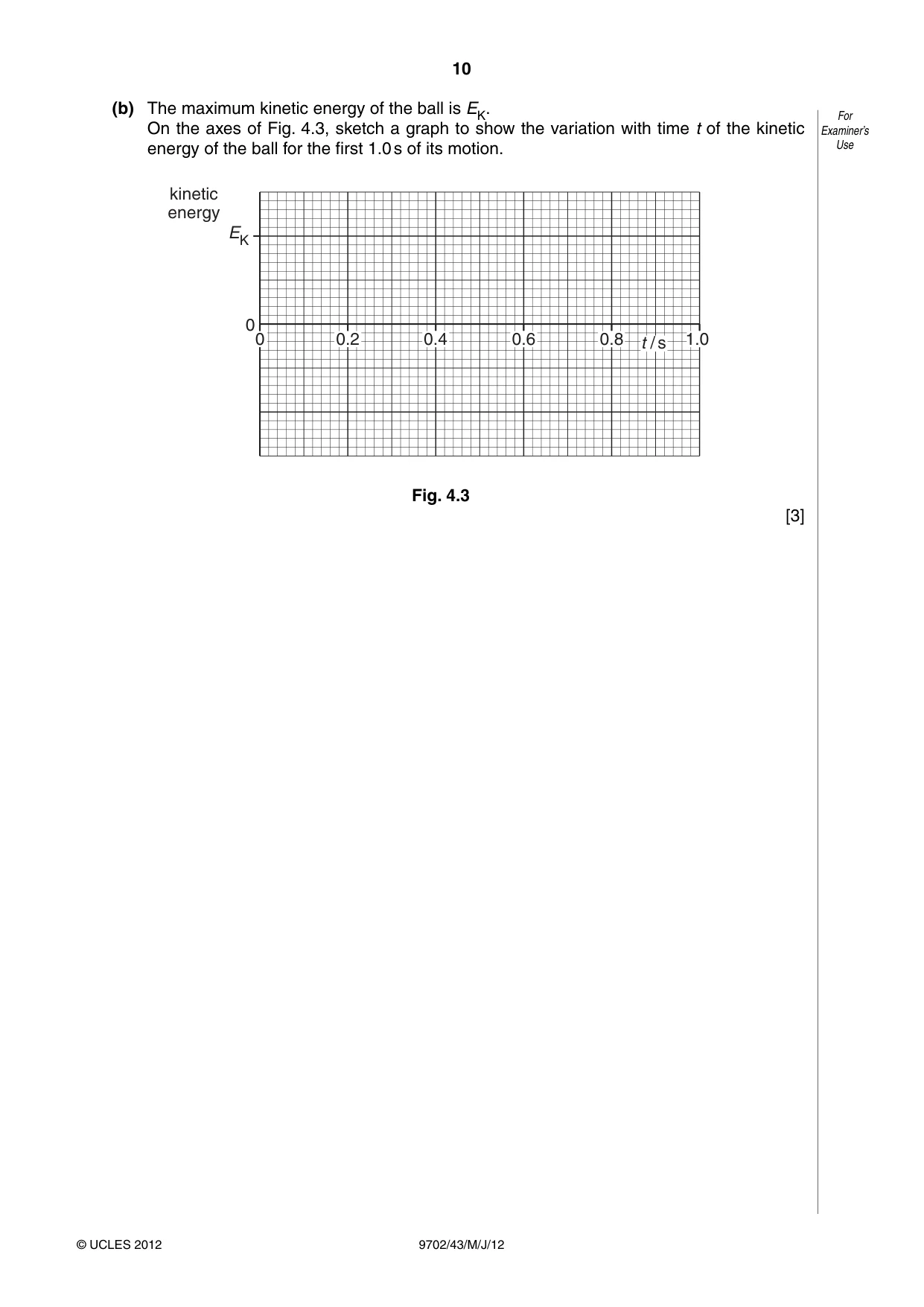
4 A small metal ball is suspended from a fixed point by means of a string, as shown in Fig. 4.1. For Examiner’s Use string ball x Fig. 4.1 The ball is pulled a small distance to one side and then released. The variation with time t of the horizontal displacement x of the ball is shown in Fig. 4.2. 6 x / cm 4 2 0 0 0.2 0.4 0.6 0.8 tt // ss 1.0 – 2 – 4 – 6 Fig. 4.2 The motion of the ball is simple harmonic. (a) Use data from Fig. 4.2 to determine the horizontal acceleration of the ball for a displacement x of 2.0 cm. acceleration = ....................................... m s–2 [3] (b) The maximum kinetic energy of the ball is EK. For On the axes of Fig. 4.3, sketch a graph to show the variation with time t of the kinetic Examiner’s energy of the ball for the first 1.0 s of its motion. Use kinetic energy EK 0 0 0.2 0.4 0.6 0.8 t / s 1.0 Fig. 4.3 [3]
Mark scheme: 4 (a) a = (–)ω2x and ω = 2π/T C1 T = 0.60 s C1 a = (4π2 × 2.0 × 10–2) / (0.6)2 = 2.2 m s–2 A1 [3] (b) sinusoidal wave with all values positive B1 all values positive, all peaks at EK and energy = 0 at t = 0 B1 period = 0.30 s B1 [3]
Q5 · Define electric field strength
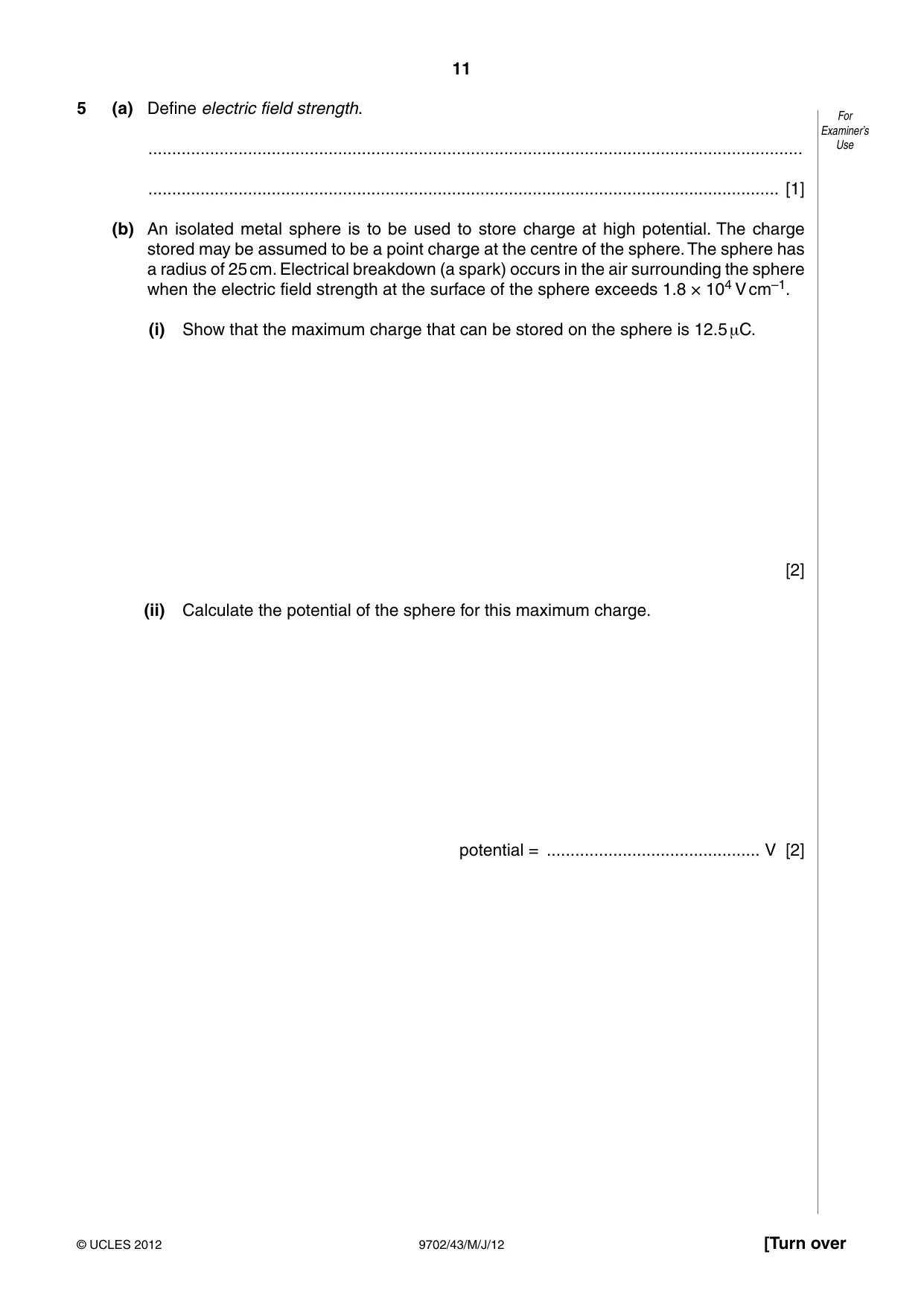
5 (a) Define electric field strength. For Examiner’s .......................................................................................................................................... Use ..................................................................................................................................... [1] (b) An isolated metal sphere is to be used to store charge at high potential. The charge stored may be assumed to be a point charge at the centre of the sphere. The sphere has a radius of 25 cm. Electrical breakdown (a spark) occurs in the air surrounding the sphere when the electric field strength at the surface of the sphere exceeds 1.8 × 10⁴ V cm–1. (i) Show that the maximum charge that can be stored on the sphere is 12.5 μC. [2] (ii) Calculate the potential of the sphere for this maximum charge. potential = ............................................. V [2]
Mark scheme: 5 (a) force per unit positive charge acting on a stationary charge B1 [1] (b) (i) E = Q / 4πε0r2 C1 Q = 1.8 × 104 × 102 × 4π × 8.85 × 10–12 × (25 × 10–2)2 M1 Q = 1.25 × 10⁻⁵ C = 12.5 µC A0 [2] (ii) V = Q / 4πε0r = (1.25 × 10⁻⁵) / (4π × 8.85 × 10–12 × 25 × 10–2) C1 = 4.5 × 10⁵ V A1 [2] (Do not allow use of V = Er unless explained) GCE AS/A LEVEL – May/June 2012 9702 43
Q6 · A sinusoidal alternating voltage supply is connected to a bridge rectifier consisting of…
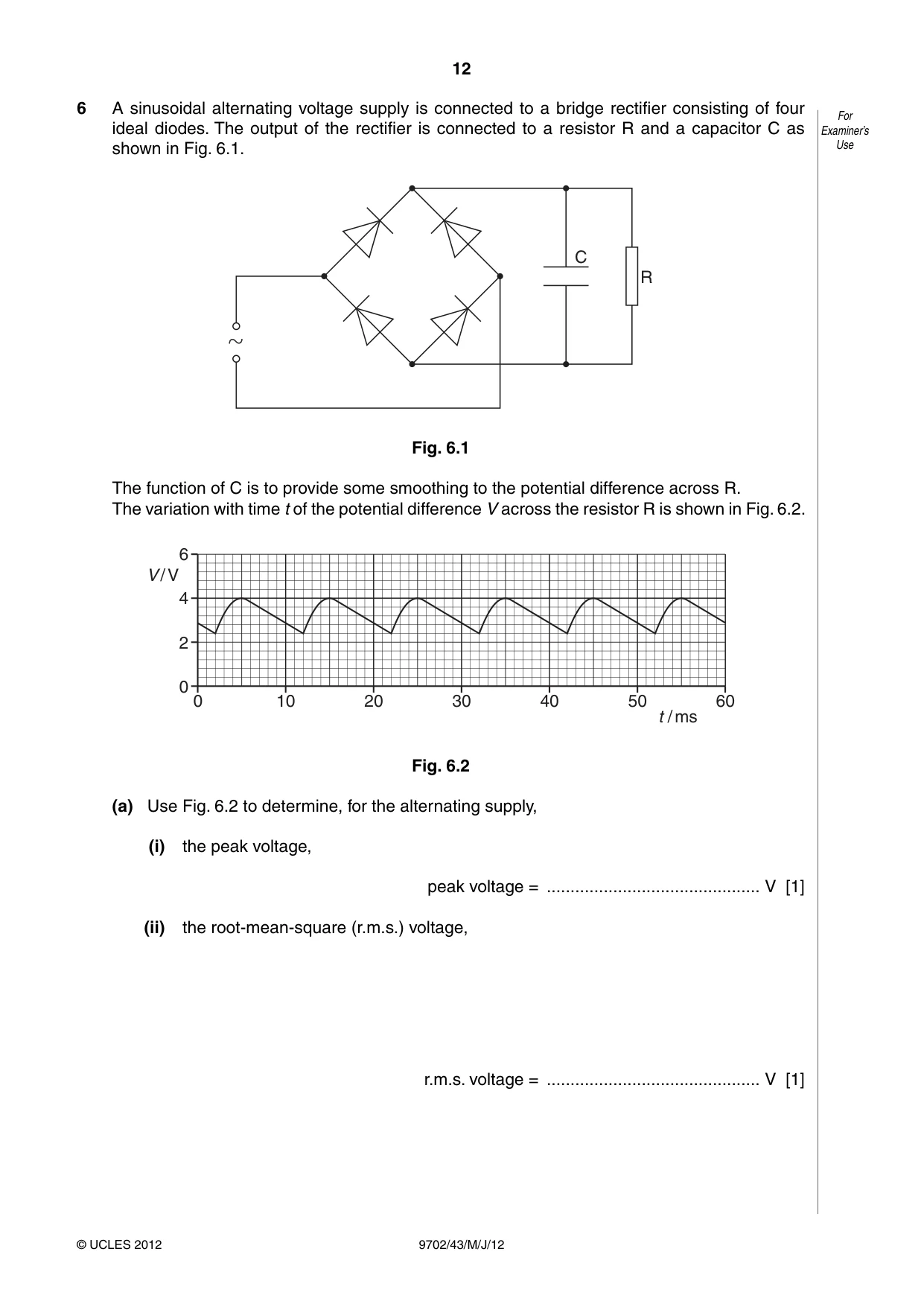
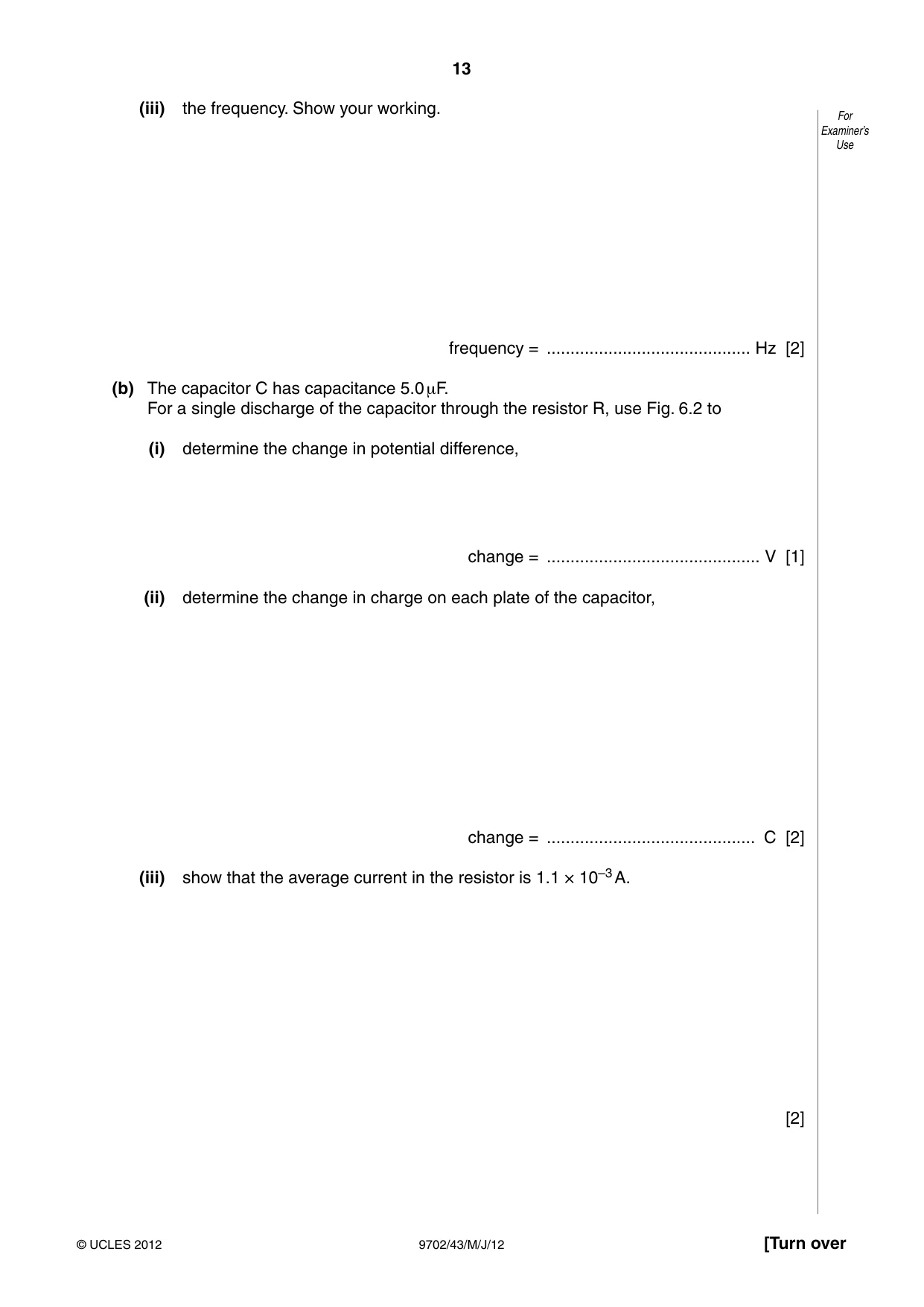
6 A sinusoidal alternating voltage supply is connected to a bridge rectifier consisting of four For ideal diodes. The output of the rectifier is connected to a resistor R and a capacitor C as Examiner’s shown in Fig. 6.1. Use C R Fig. 6.1 The function of C is to provide some smoothing to the potential difference across R. The variation with time t of the potential difference V across the resistor R is shown in Fig. 6.2. 6 V / V 4 2 0 0 10 20 30 40 50 60 t / ms Fig. 6.2 (a) Use Fig. 6.2 to determine, for the alternating supply, (i) the peak voltage, peak voltage = ............................................. V [1] (ii) the root-mean-square (r.m.s.) voltage, r.m.s. voltage = ............................................. V [1] (iii) the frequency. Show your working. For Examiner’s Use frequency = ........................................... Hz [2] (b) The capacitor C has capacitance 5.0 μF. For a single discharge of the capacitor through the resistor R, use Fig. 6.2 to (i) determine the change in potential difference, change = ............................................. V [1] (ii) determine the change in charge on each plate of the capacitor, change = ............................................ C [2] (iii) show that the average current in the resistor is 1.1 × 10⁻³ A. [2] (c) Use Fig. 6.2 and the value of the current given in (b)(iii) to estimate the resistance of For resistor R. Examiner’s Use resistance = ............................................. Ω [2]
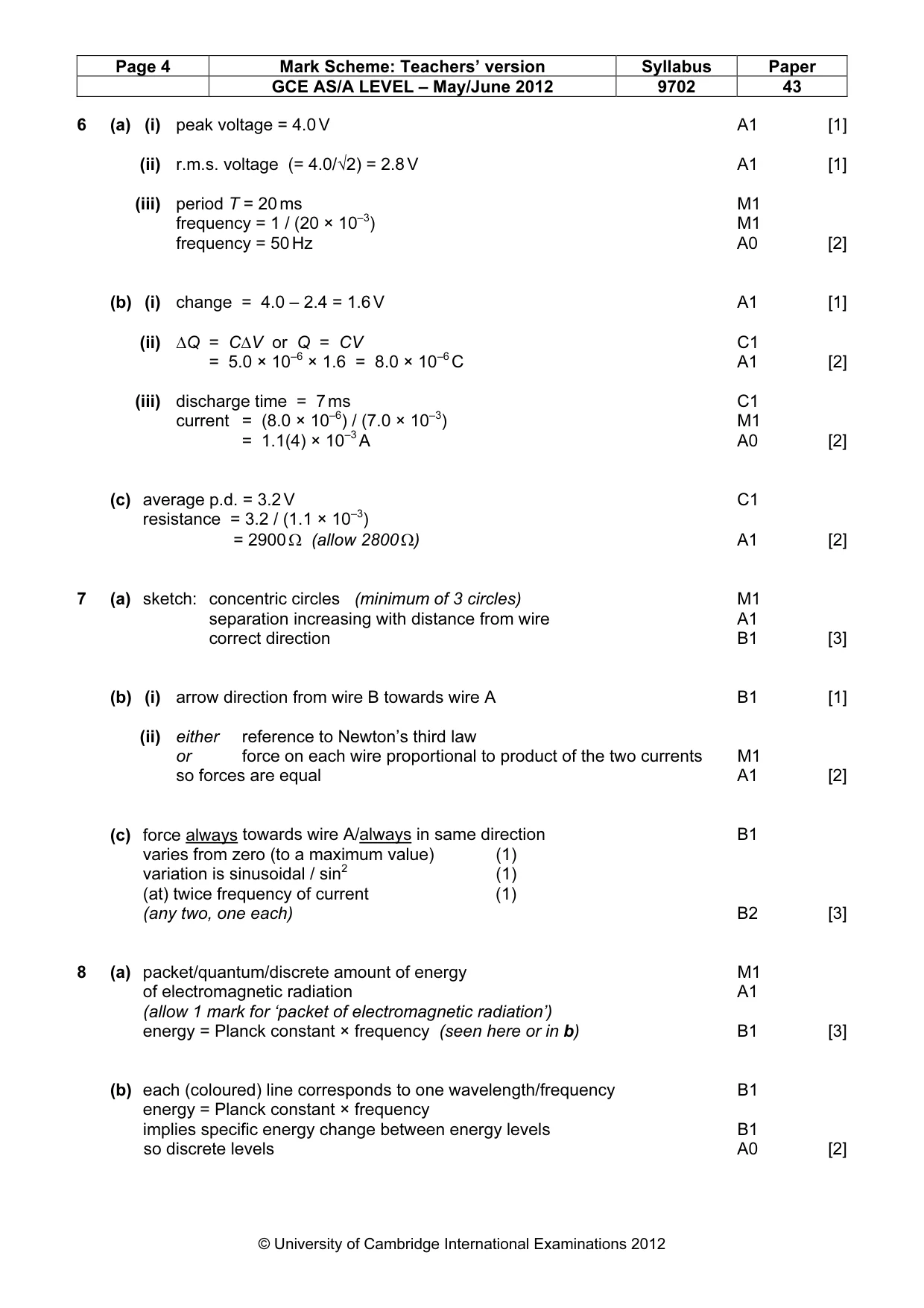
Mark scheme: 6 (a) (i) peak voltage = 4.0 V A1 [1] (ii) r.m.s. voltage (= 4.0/√2) = 2.8 V A1 [1] (iii) period T = 20 ms M1 frequency = 1 / (20 × 10–3) M1 frequency = 50 Hz A0 [2] (b) (i) change = 4.0 – 2.4 = 1.6 V A1 [1] (ii) ∆Q = C∆V or Q = CV C1 = 5.0 × 10–6 × 1.6 = 8.0 × 10⁻⁶ C A1 [2] (iii) discharge time = 7 ms C1 current = (8.0 × 10⁻⁶) / (7.0 × 10⁻³) M1 = 1.1(4) × 10–3 A A0 [2] (c) average p.d. = 3.2 V C1 resistance = 3.2 / (1.1 × 10⁻³) = 2900 Ω (allow 2800 Ω) A1 [2]
Q7 · Two long straight parallel copper wires A and B are clamped vertically
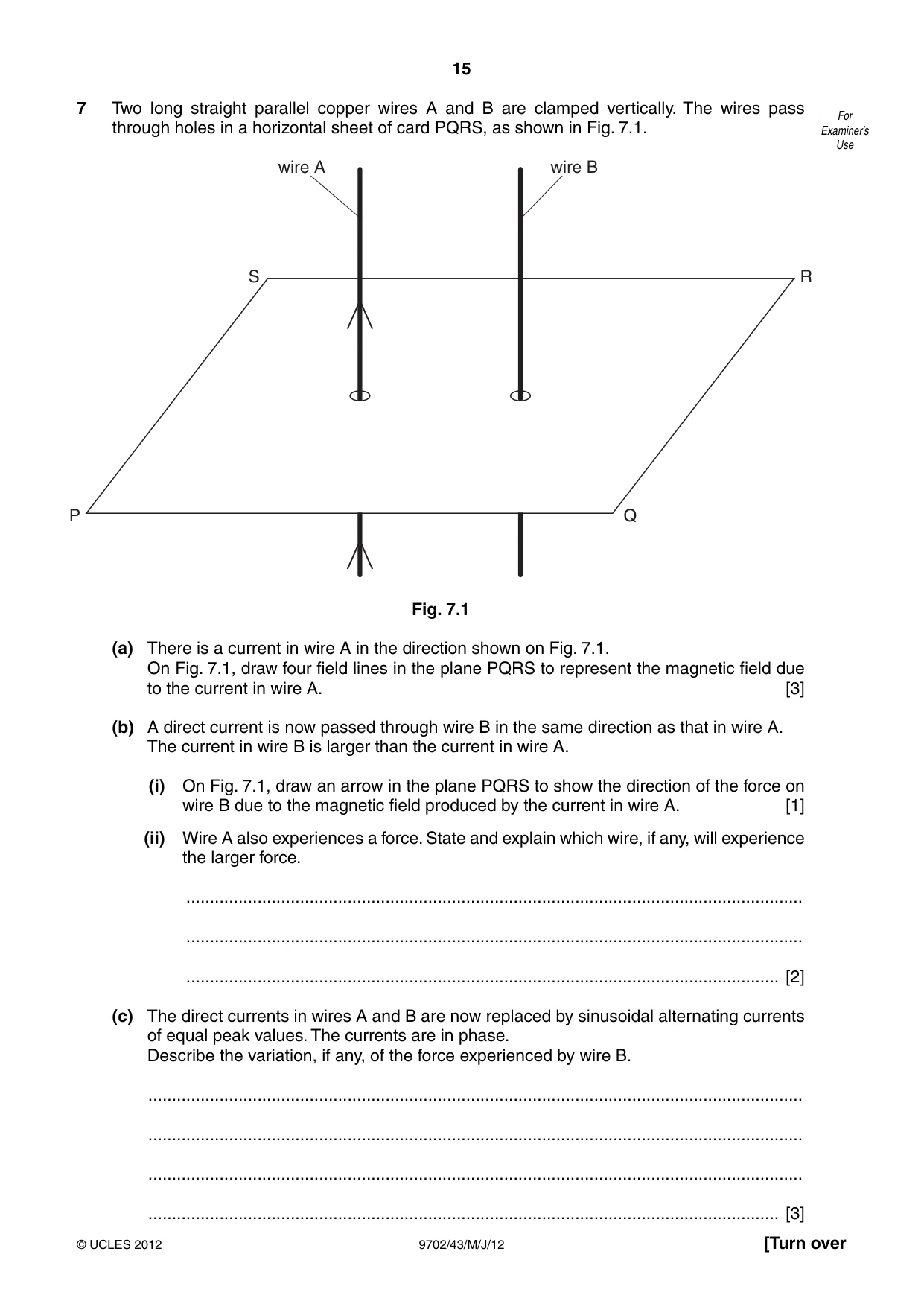
7 Two long straight parallel copper wires A and B are clamped vertically. The wires pass For through holes in a horizontal sheet of card PQRS, as shown in Fig. 7.1. Examiner’s Use wire A wire B S R P Q Fig. 7.1 (a) There is a current in wire A in the direction shown on Fig. 7.1. On Fig. 7.1, draw four field lines in the plane PQRS to represent the magnetic field due to the current in wire A. [3] (b) A direct current is now passed through wire B in the same direction as that in wire A. The current in wire B is larger than the current in wire A. (i) On Fig. 7.1, draw an arrow in the plane PQRS to show the direction of the force on wire B due to the magnetic field produced by the current in wire A. [1] (ii) Wire A also experiences a force. State and explain which wire, if any, will experience the larger force. .................................................................................................................................. .................................................................................................................................. ............................................................................................................................. [2] (c) The direct currents in wires A and B are now replaced by sinusoidal alternating currents of equal peak values. The currents are in phase. Describe the variation, if any, of the force experienced by wire B. .......................................................................................................................................... .......................................................................................................................................... .......................................................................................................................................... ..................................................................................................................................... [3]
Mark scheme: 7 (a) sketch: concentric circles (minimum of 3 circles) M1 separation increasing with distance from wire A1 correct direction B1 [3] (b) (i) arrow direction from wire B towards wire A B1 [1] (ii) either reference to Newton’s third law or force on each wire proportional to product of the two currents M1 so forces are equal A1 [2] (c) force always towards wire A/always in same direction B1 varies from zero (to a maximum value) (1) variation is sinusoidal / sin2 (1) (at) twice frequency of current (1) (any two, one each) B2 [3]
Q8 · Explain what is meant by a photon
8 (a) Explain what is meant by a photon. For Examiner’s .......................................................................................................................................... Use .......................................................................................................................................... .......................................................................................................................................... ..................................................................................................................................... [3] (b) An emission spectrum is seen as a series of differently coloured lines on a black background. Suggest how this observation provides evidence for discrete electron energy levels in atoms. .......................................................................................................................................... .......................................................................................................................................... .......................................................................................................................................... ..................................................................................................................................... [2]
Mark scheme: 8 (a) packet/quantum/discrete amount of energy M1 of electromagnetic radiation A1 (allow 1 mark for ‘packet of electromagnetic radiation’) energy = Planck constant × frequency (seen here or in b) B1 [3] (b) each (coloured) line corresponds to one wavelength/frequency B1 energy = Planck constant × frequency implies specific energy change between energy levels B1 so discrete levels A0 [2] GCE AS/A LEVEL – May/June 2012 9702 43
Q9 · State what is meant by the decay constant of a radioactive isotope
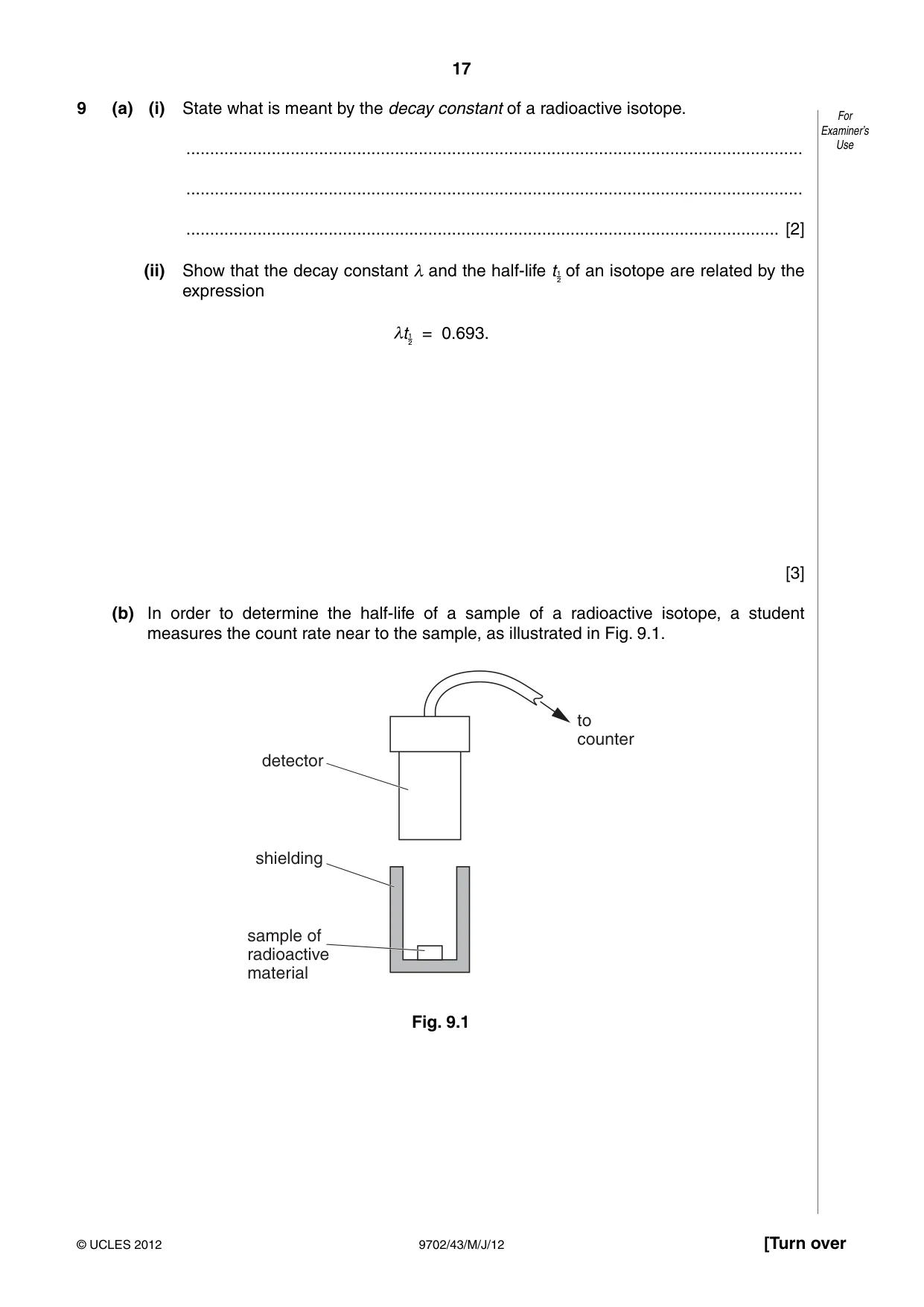
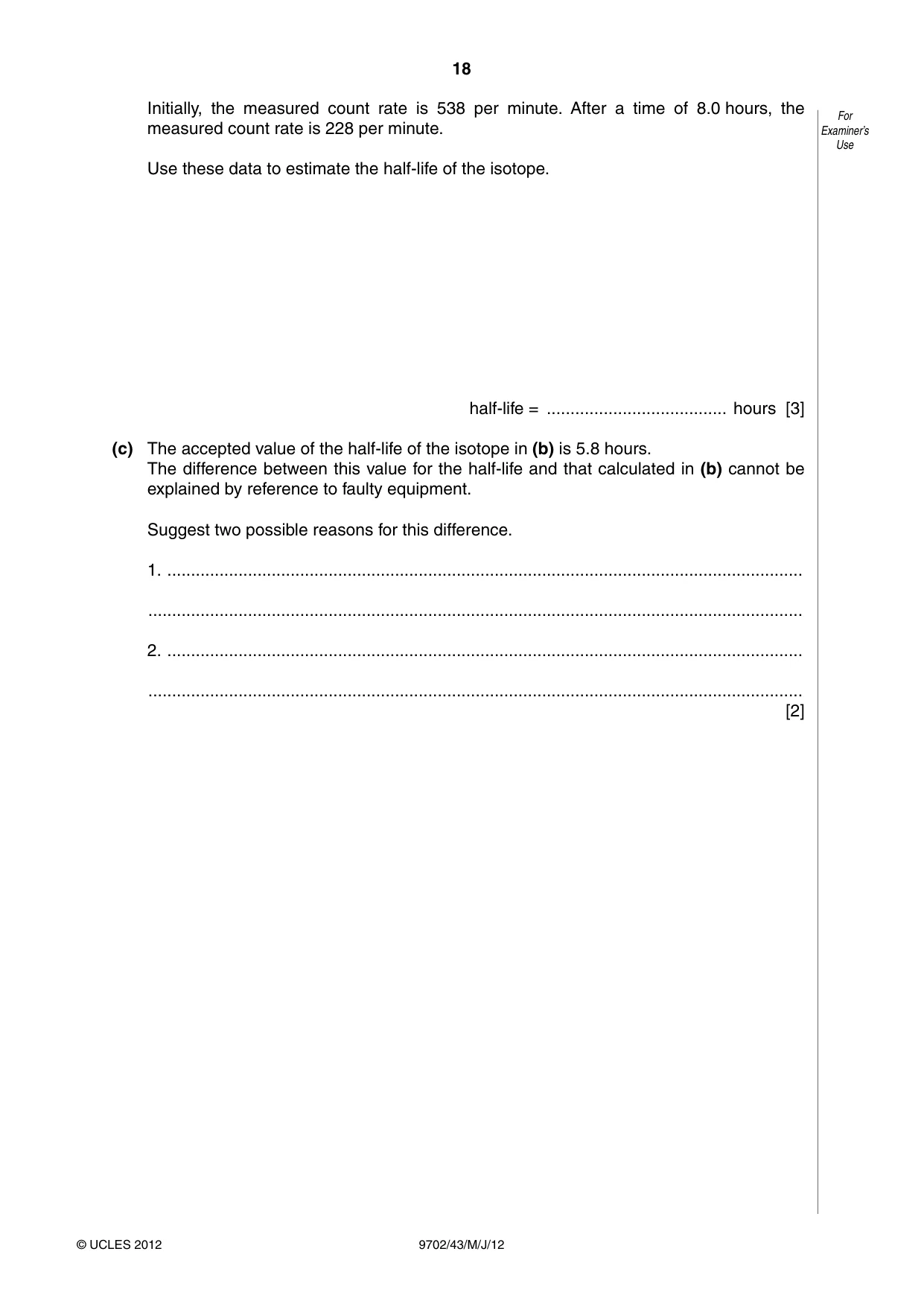
9 (a) (i) State what is meant by the decay constant of a radioactive isotope. For Examiner’s .................................................................................................................................. Use .................................................................................................................................. ............................................................................................................................. [2] (ii) Show that the decay constant λ and the half-life t of an isotope are related by the expression λt = 0.693. [3] (b) In order to determine the half-life of a sample of a radioactive isotope, a student measures the count rate near to the sample, as illustrated in Fig. 9.1. to counter detector shielding sample of radioactive material Fig. 9.1 Initially, the measured count rate is 538 per minute. After a time of 8.0 hours, the For measured count rate is 228 per minute. Examiner’s Use Use these data to estimate the half-life of the isotope. half-life = ...................................... hours [3] (c) The accepted value of the half-life of the isotope in (b) is 5.8 hours. The difference between this value for the half-life and that calculated in (b) cannot be explained by reference to faulty equipment. Suggest two possible reasons for this difference. 1. ...................................................................................................................................... .......................................................................................................................................... 2. ...................................................................................................................................... .......................................................................................................................................... [2]
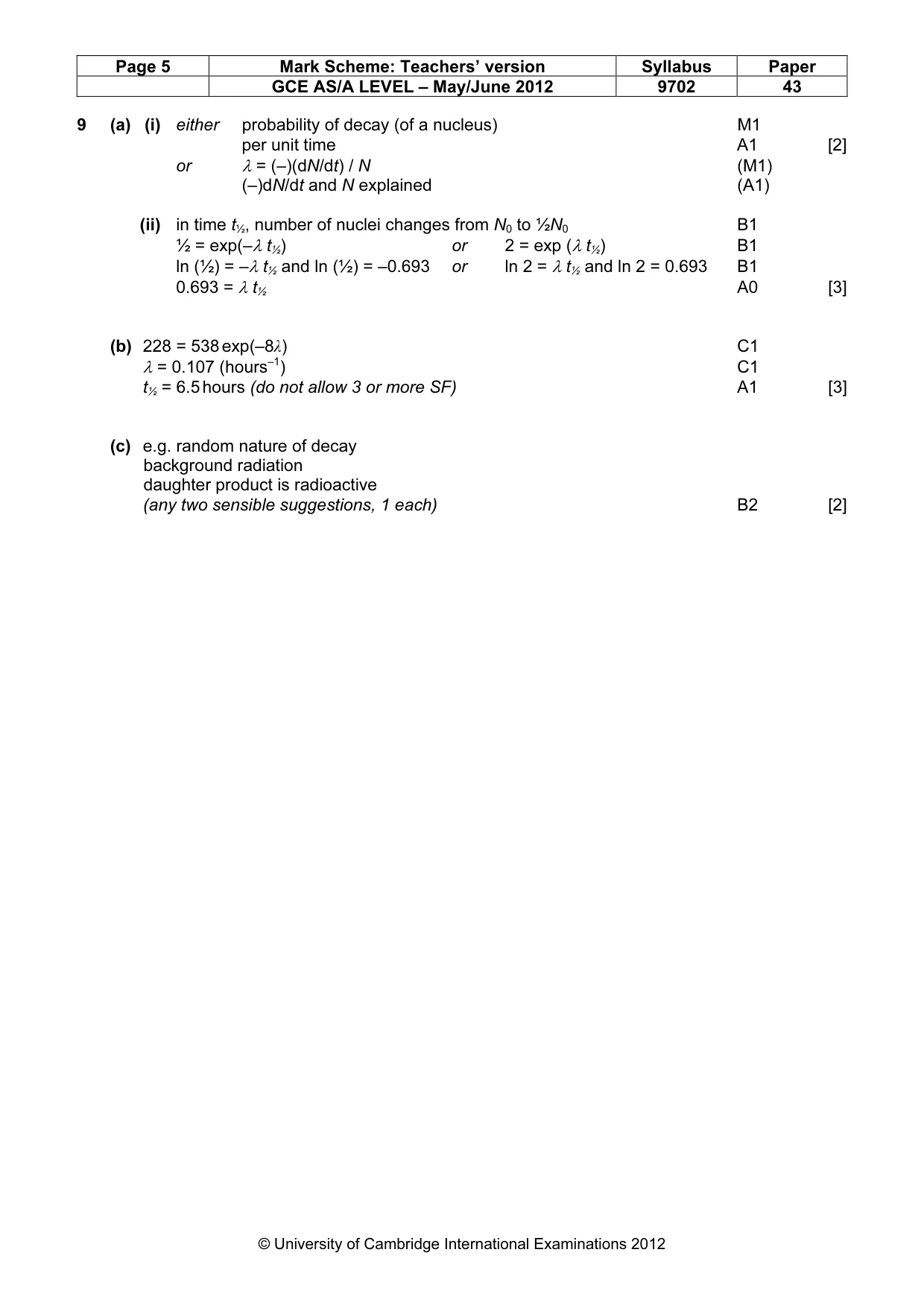
Mark scheme: 9 (a) (i) either probability of decay (of a nucleus) M1 per unit time A1 [2] or λ = (–)(dN/dt) / N (M1) (–)dN/dt and N explained (A1) (ii) in time t½, number of nuclei changes from N0 to ½N0 B1 ½ = exp(–λ t½) or 2 = exp (λ t½) B1 ln (½) = –λ t½ and ln (½) = –0.693 or ln 2 = λ t½ and ln 2 = 0.693 B1 0.693 = λ t½ A0 [3] (b) 228 = 538 exp(–8λ) C1 λ = 0.107 (hours–1) C1 t½ = 6.5 hours (do not allow 3 or more SF) A1 [3] (c) e.g. random nature of decay background radiation daughter product is radioactive (any two sensible suggestions, 1 each) B2 [2] GCE AS/A LEVEL – May/June 2012 9702 43 Section B
Q10 · A student designs an electronic sensor that is to be used to switch on a lamp when the…
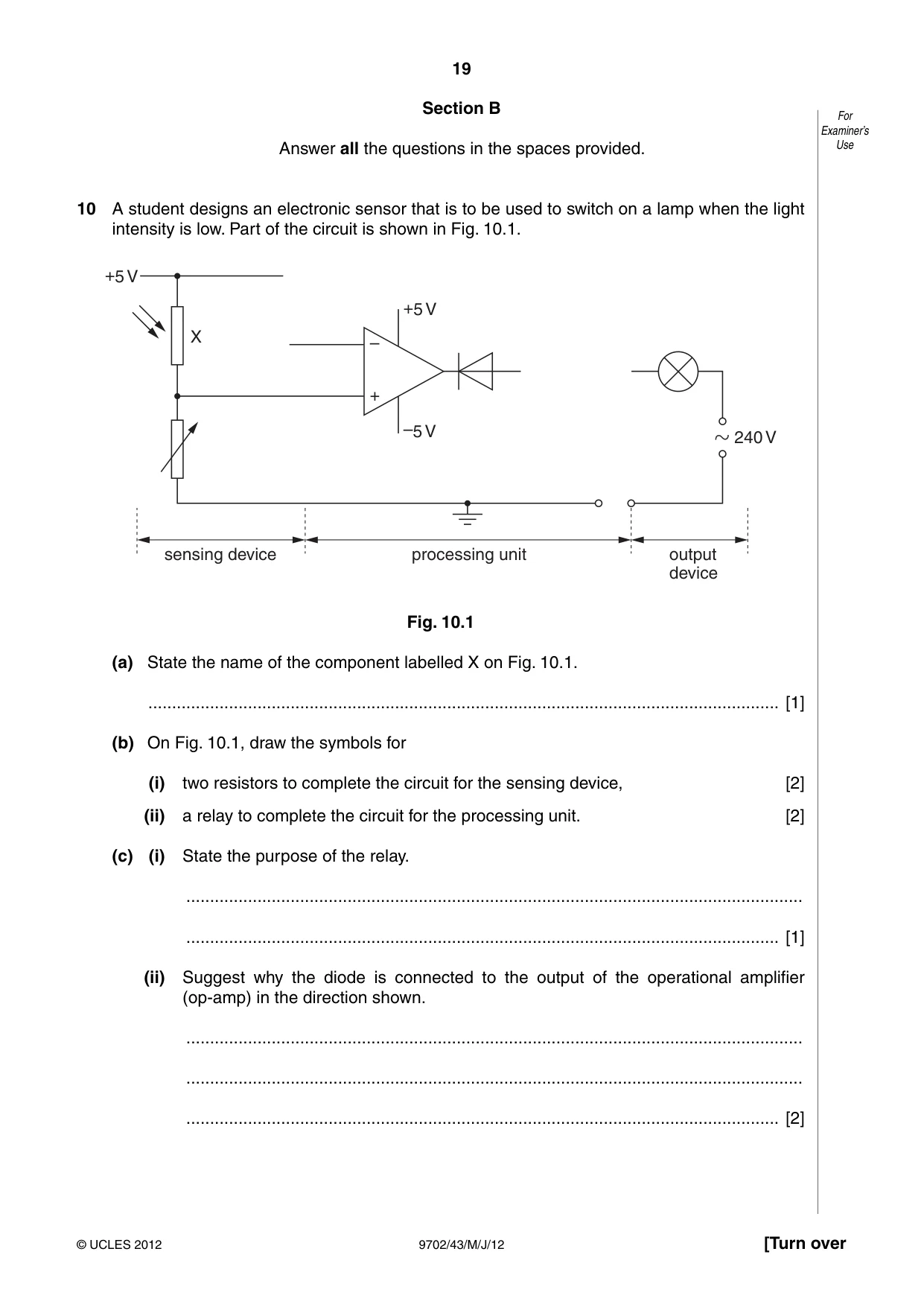
10 A student designs an electronic sensor that is to be used to switch on a lamp when the light intensity is low. Part of the circuit is shown in Fig. 10.1. +5 V +5 V X – + –5 V 240 V sensing device processing unit output device Fig. 10.1 (a) State the name of the component labelled X on Fig. 10.1. ..................................................................................................................................... [1] (b) On Fig. 10.1, draw the symbols for (i) two resistors to complete the circuit for the sensing device, [2] (ii) a relay to complete the circuit for the processing unit. [2] (c) (i) State the purpose of the relay. .................................................................................................................................. ............................................................................................................................. [1] (ii) Suggest why the diode is connected to the output of the operational amplifier (op-amp) in the direction shown. .................................................................................................................................. .................................................................................................................................. ............................................................................................................................. [2]
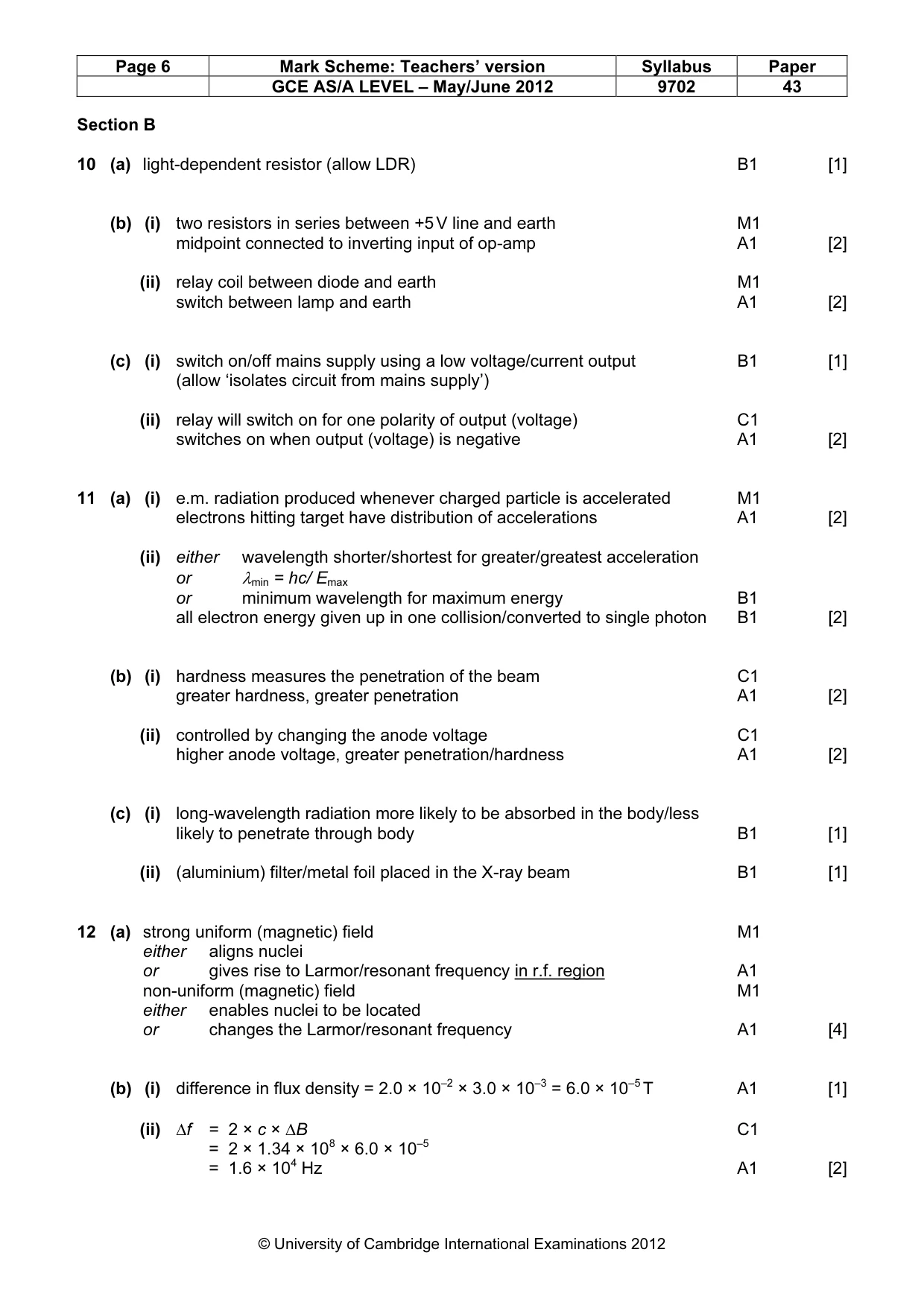
Mark scheme: 10 (a) light-dependent resistor (allow LDR) B1 [1] (b) (i) two resistors in series between +5 V line and earth M1 midpoint connected to inverting input of op-amp A1 [2] (ii) relay coil between diode and earth M1 switch between lamp and earth A1 [2] (c) (i) switch on/off mains supply using a low voltage/current output B1 [1] (allow ‘isolates circuit from mains supply’) (ii) relay will switch on for one polarity of output (voltage) C1 switches on when output (voltage) is negative A1 [2]
Q11 · High-speed electrons are incident on a metal target
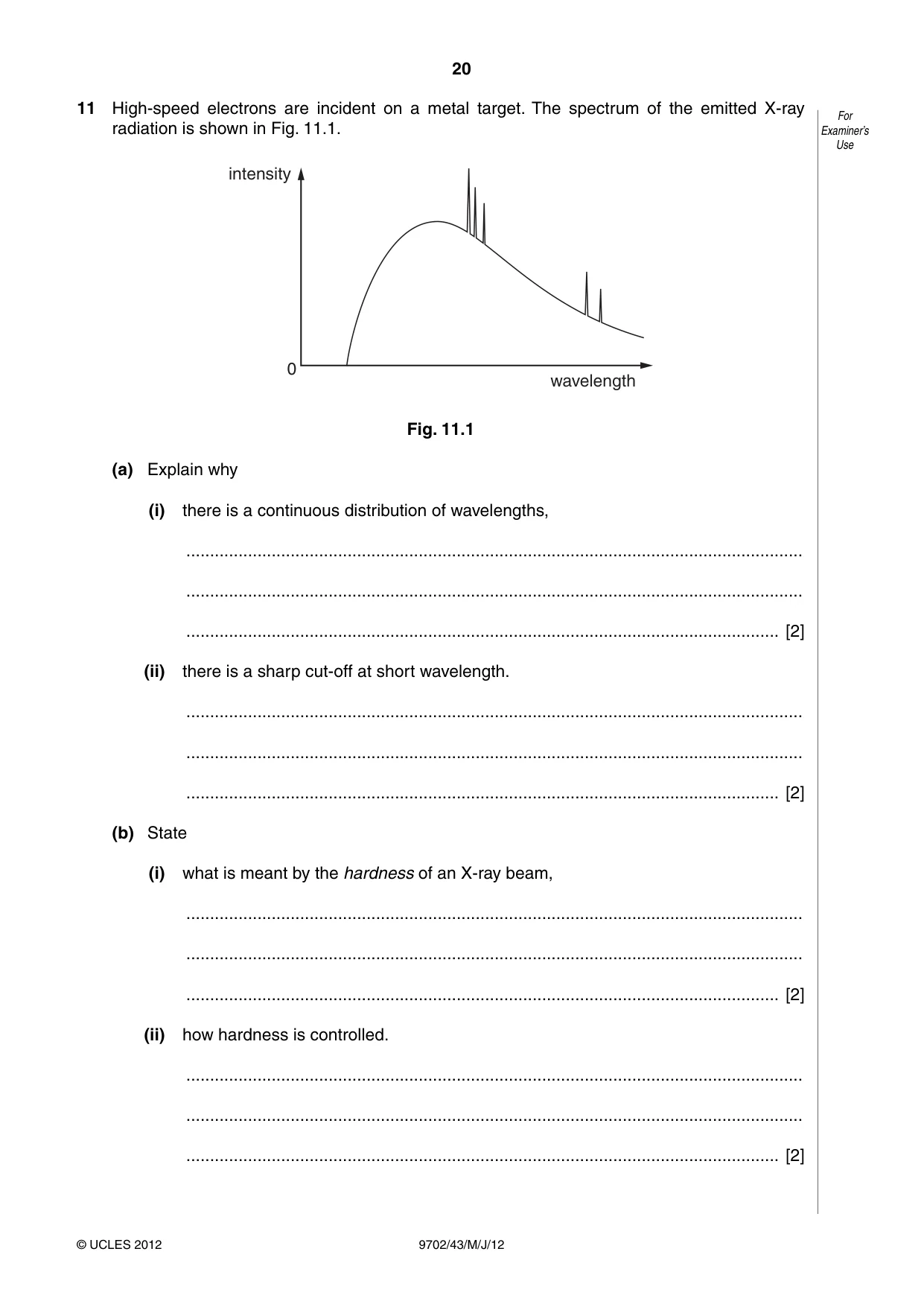
11 High-speed electrons are incident on a metal target. The spectrum of the emitted X-ray For radiation is shown in Fig. 11.1. Examiner’s Use intensity 0 wavelength Fig. 11.1 (a) Explain why (i) there is a continuous distribution of wavelengths, .................................................................................................................................. .................................................................................................................................. ............................................................................................................................. [2] (ii) there is a sharp cut-off at short wavelength. .................................................................................................................................. .................................................................................................................................. ............................................................................................................................. [2] (b) State (i) what is meant by the hardness of an X-ray beam, .................................................................................................................................. .................................................................................................................................. ............................................................................................................................. [2] (ii) how hardness is controlled. .................................................................................................................................. .................................................................................................................................. ............................................................................................................................. [2] (c) (i) Suggest why, when producing an X-ray image, long-wavelength X-ray radiation For poses a greater hazard to health than short-wavelength radiation. Examiner’s Use .................................................................................................................................. ............................................................................................................................. [1] (ii) Suggest how this hazard is minimised. .................................................................................................................................. ............................................................................................................................. [1]
Mark scheme: 11 (a) (i) e.m. radiation produced whenever charged particle is accelerated M1 electrons hitting target have distribution of accelerations A1 [2] (ii) either wavelength shorter/shortest for greater/greatest acceleration or λmin = hc/ Emax or minimum wavelength for maximum energy B1 all electron energy given up in one collision/converted to single photon B1 [2] (b) (i) hardness measures the penetration of the beam C1 greater hardness, greater penetration A1 [2] (ii) controlled by changing the anode voltage C1 higher anode voltage, greater penetration/hardness A1 [2] (c) (i) long-wavelength radiation more likely to be absorbed in the body/less likely to penetrate through body B1 [1] (ii) (aluminium) filter/metal foil placed in the X-ray beam B1 [1]
Q12 · A person is to be investigated using a magnetic resonance (MR) scanner
12 A person is to be investigated using a magnetic resonance (MR) scanner. For Examiner’s (a) This technique involves the use of two superimposed magnetic fields. Use Describe the functions of these two magnetic fields. .......................................................................................................................................... .......................................................................................................................................... .......................................................................................................................................... .......................................................................................................................................... .......................................................................................................................................... ..................................................................................................................................... [4] (b) The frequency f of the electromagnetic waves emitted by protons on relaxation in an MR scanner is given by the equation f = 2cB where B is the total magnetic flux density and c is a constant equal to 1.34 × 10⁸ s–1 T–1. The magnetic flux density changes by 2.0 × 10⁻⁴ T for each 1.0 cm thickness of tissue in a section. The scanner is adjusted so that the thickness of each section is 3.0 mm. Calculate, for corresponding points in neighbouring sections, (i) the difference in magnetic flux density, difference in flux density = .............................................. T [1] (ii) the change in emitted frequency. frequency change = ........................................... Hz [2]
Mark scheme: 12 (a) strong uniform (magnetic) field M1 either aligns nuclei or gives rise to Larmor/resonant frequency in r.f. region A1 non-uniform (magnetic) field M1 either enables nuclei to be located or changes the Larmor/resonant frequency A1 [4] (b) (i) difference in flux density = 2.0 × 10–2 × 3.0 × 10–3 = 6.0 × 10⁻⁵ T A1 [1] (ii) ∆f = 2 × c × ∆B C1 = 2 × 1.34 × 108 × 6.0 × 10–5 = 1.6 × 10⁴ Hz A1 [2] GCE AS/A LEVEL – May/June 2012 9702 43
Q13 · In a mobile phone system, the area covered by the system is divided into a number of For…
13 (a) In a mobile phone system, the area covered by the system is divided into a number of For cells. Examiner’s For this system, explain why Use (i) neighbouring cells use different carrier frequencies, .................................................................................................................................. ............................................................................................................................. [1] (ii) each cell has a limited area, even in sparsely populated regions. .................................................................................................................................. ............................................................................................................................. [1] (b) A mobile phone handset is left switched on. Explain why, although a call is not being made, the computer at the cellular exchange is still operating for this phone. .......................................................................................................................................... .......................................................................................................................................... .......................................................................................................................................... ..................................................................................................................................... [3]
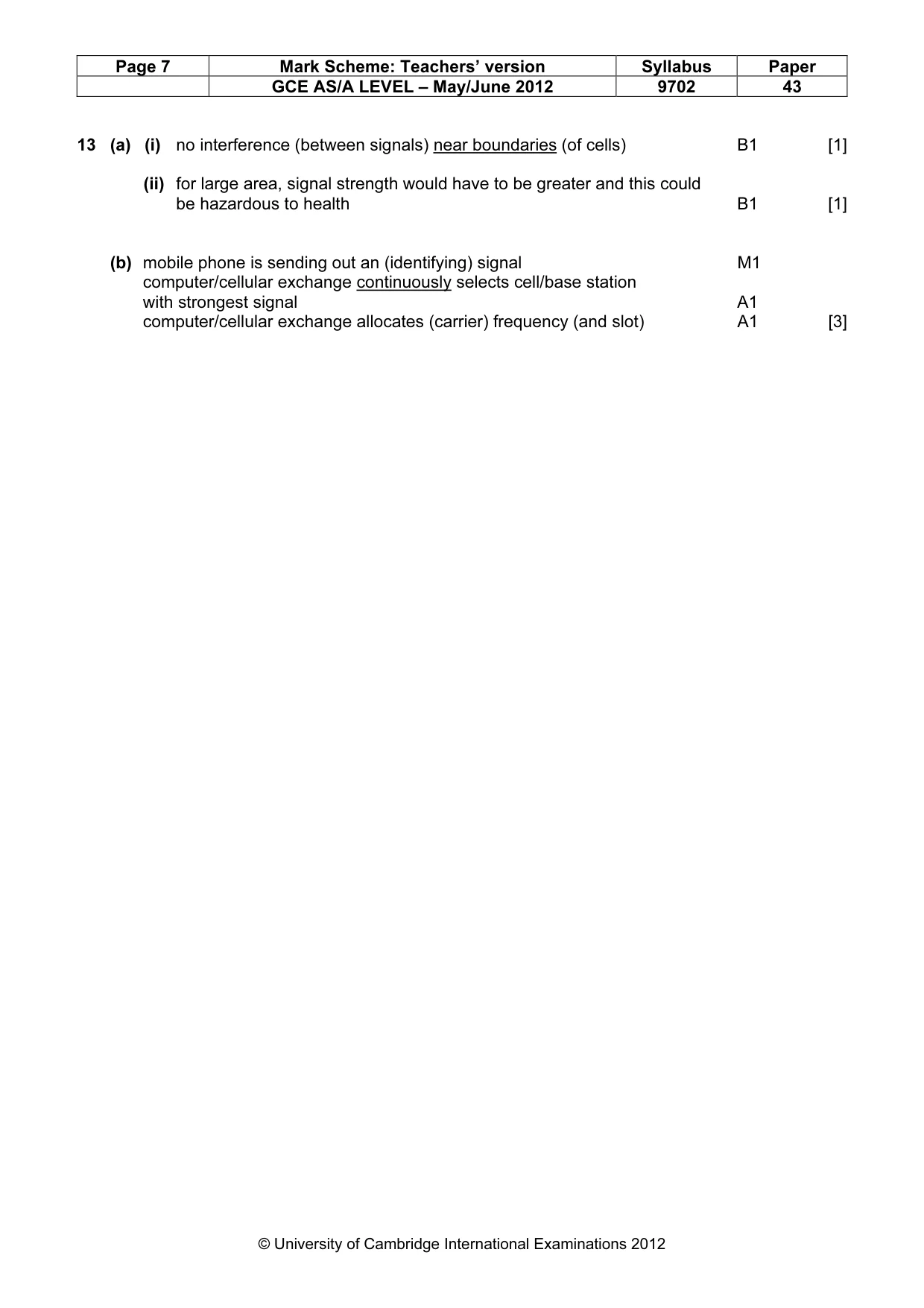
Mark scheme: 13 (a) (i) no interference (between signals) near boundaries (of cells) B1 [1] (ii) for large area, signal strength would have to be greater and this could be hazardous to health B1 [1] (b) mobile phone is sending out an (identifying) signal M1 computer/cellular exchange continuously selects cell/base station with strongest signal A1 computer/cellular exchange allocates (carrier) frequency (and slot) A1 [3]
What was in this paper
The subtopics covered by these 13 questions, and how many questions each got. Open one in a new tab to see every Cambridge question on it.
2Concept of a magnetic field1Density and pressure1Electric field of a point charge1Force on a current-carrying conductor1Gravitational field of a point mass1Kinetic theory of gases1Potential difference and power1Practical circuits1Radioactive decay1Simple harmonic oscillations1Specific heat capacity and specific latent heat1What you needed in this session
Cambridge’s own grade thresholds for 2012 May/June, Paper 4 · Variant 3. A higher threshold means an easier paper — the bar moves with how the cohort did.