Cambridge A Level Physics 9702 — 2009 Oct/Nov Paper 4 · Variant 2
9702/42/O/N/09 · 12 questions · 100 marks · ≈113 min
The question paper and its mark scheme, free to read here and free to download. This is Cambridge’s own paper, exactly as it was sat.
Question paper28 pages
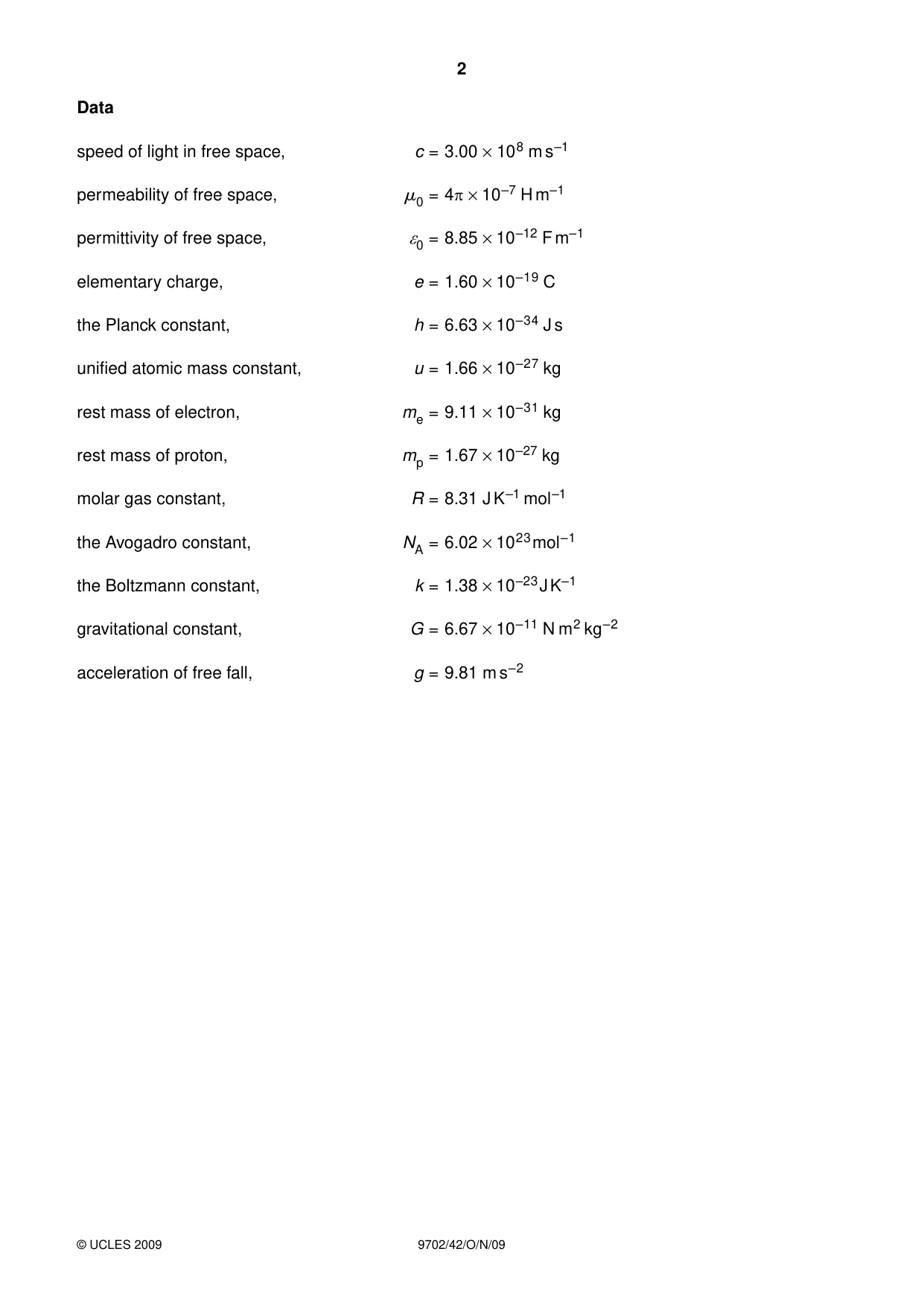





Mark scheme6 pages
Answers below. Sit the paper first if you are practising.
Questions as text
Q1 · The Earth may be considered to be a uniform sphere of radius 6.38 × 10³ km, with its mass…
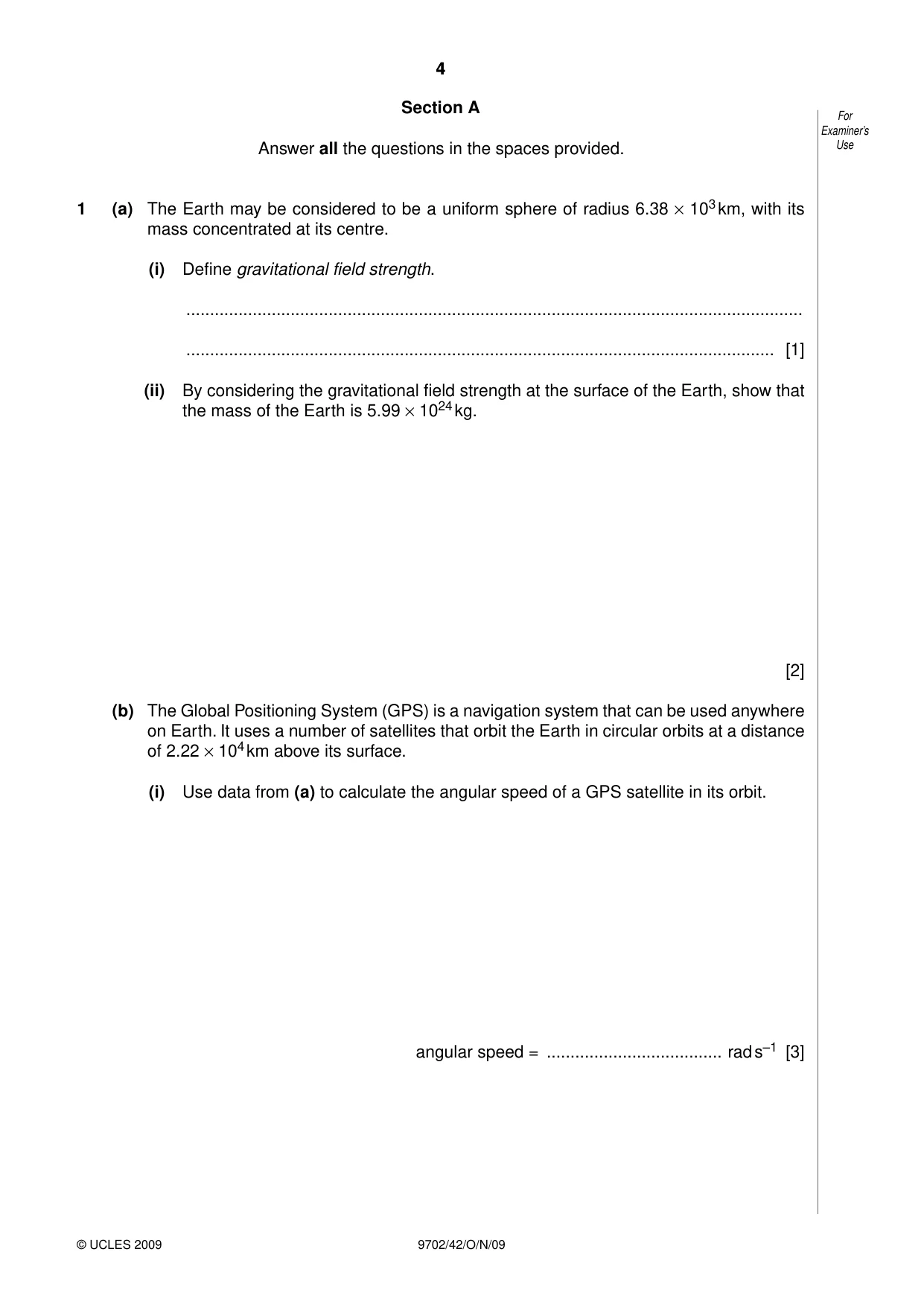
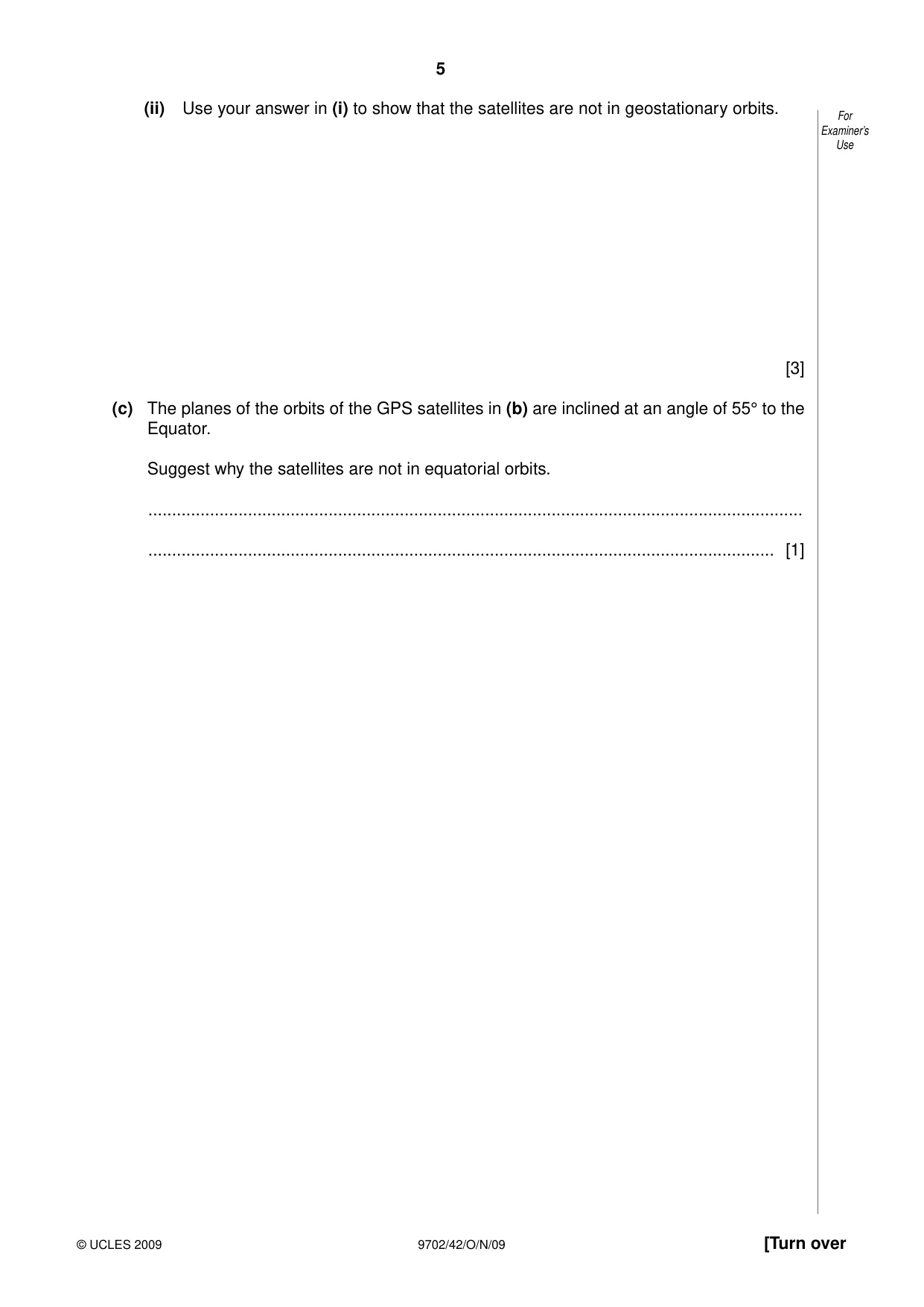
1 (a) The Earth may be considered to be a uniform sphere of radius 6.38 × 10³ km, with its mass concentrated at its centre. (i) Define gravitational field strength. .................................................................................................................................. ............................................................................................................................ [1] (ii) By considering the gravitational field strength at the surface of the Earth, show that the mass of the Earth is 5.99 × 1024 kg. [2] (b) The Global Positioning System (GPS) is a navigation system that can be used anywhere on Earth. It uses a number of satellites that orbit the Earth in circular orbits at a distance of 2.22 × 10⁴ km above its surface. (i) Use data from (a) to calculate the angular speed of a GPS satellite in its orbit. angular speed = ..................................... rad s–1 [3] (ii) Use your answer in (i) to show that the satellites are not in geostationary orbits. For Examiner’s Use [3] (c) The planes of the orbits of the GPS satellites in (b) are inclined at an angle of 55° to the Equator. Suggest why the satellites are not in equatorial orbits. .......................................................................................................................................... .................................................................................................................................... [1]
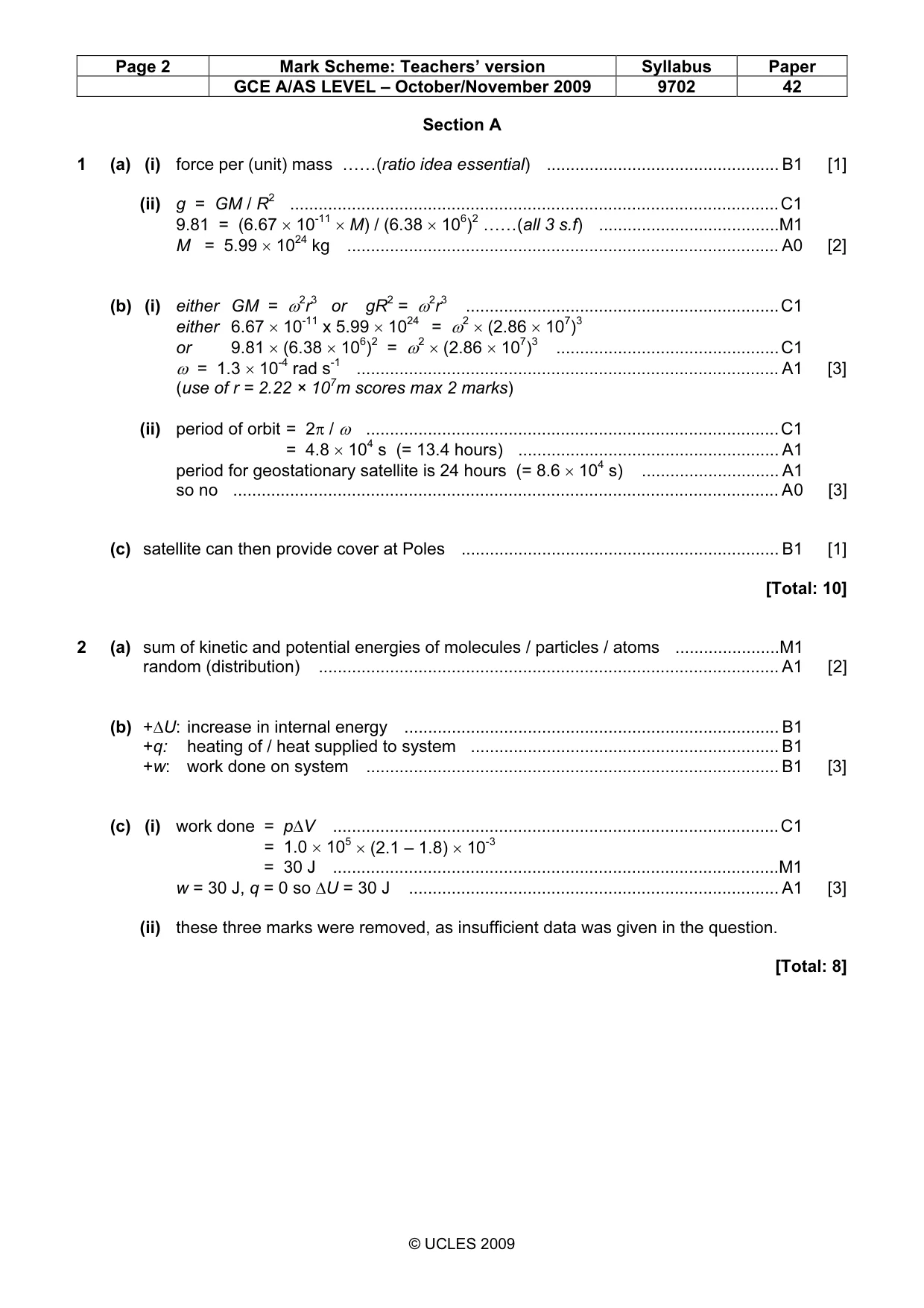
Mark scheme: 1 (a) (i) force per (unit) mass ……(ratio idea essential) ................................................. B1 [1] (ii) g = GM / R2 .......................................................................................................C1 9.81 = (6.67 × 10⁻¹¹ × M) / (6.38 × 10⁶)2 ……(all 3 s.f) ......................................M1 M = 5.99 × 1024 kg ........................................................................................... A0 [2] (b) (i) either GM = ω2r3 or gR2 = ω2r3 ..................................................................C1 either 6.67 × 10-11 x 5.99 × 1024 = ω2 × (2.86 × 107)3 or 9.81 × (6.38 × 106)2 = ω2 × (2.86 × 107)3 ...............................................C1 ω = 1.3 × 10⁻⁴ rad s-1 ......................................................................................... A1 [3] (use of r = 2.22 × 10⁷m scores max 2 marks) (ii) period of orbit = 2π / ω .......................................................................................C1 = 4.8 × 10⁴ s (= 13.4 hours) ....................................................... A1 period for geostationary satellite is 24 hours (= 8.6 × 10⁴ s) ............................. A1 so no ................................................................................................................... A0 [3] (c) satellite can then provide cover at Poles ................................................................... B1 [1] [Total: 10]
Q2 · State what is meant by the internal energy of a gas
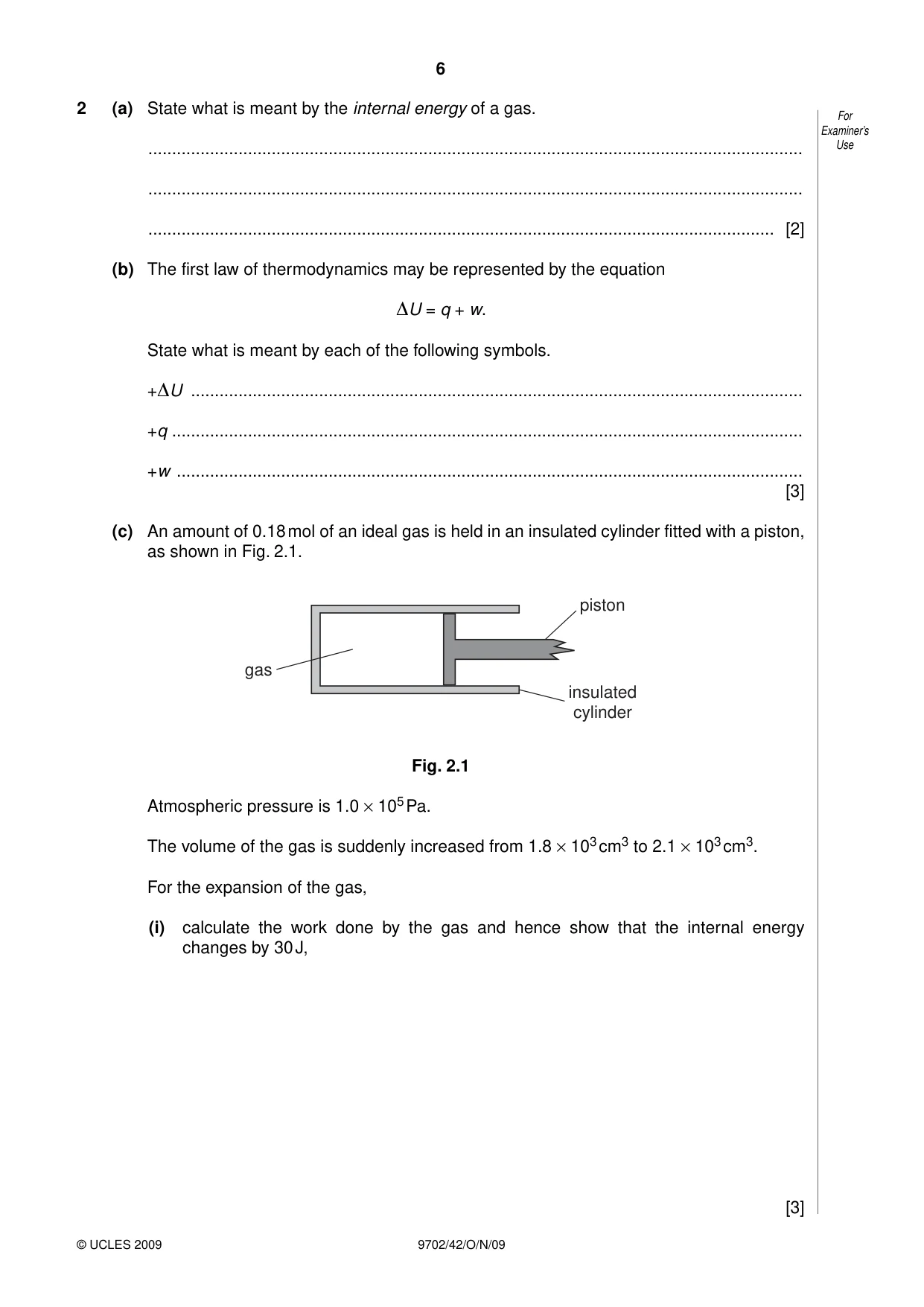
2 (a) State what is meant by the internal energy of a gas. For Examiner’s .......................................................................................................................................... Use .......................................................................................................................................... .................................................................................................................................... [2] (b) The first law of thermodynamics may be represented by the equation U = q + w. State what is meant by each of the following symbols. + U ................................................................................................................................. +q ..................................................................................................................................... +w .................................................................................................................................... [3] (c) An amount of 0.18 mol of an ideal gas is held in an insulated cylinder fitted with a piston, as shown in Fig. 2.1. piston gas insulated cylinder Fig. 2.1 Atmospheric pressure is 1.0 × 10⁵ Pa. The volume of the gas is suddenly increased from 1.8 × 103 cm3 to 2.1 × 103 cm3. For the expansion of the gas, (i) calculate the work done by the gas and hence show that the internal energy changes by 30 J, [3] (ii) determine the temperature change of the gas and state whether the change is an For increase or a decrease. Examiner’s Use change = ................................................... K ....................................................... [3]
Mark scheme: 2 (a) sum of kinetic and potential energies of molecules / particles / atoms ......................M1 random (distribution) ................................................................................................. A1 [2] (b) +∆U: increase in internal energy ............................................................................... B1 +q: heating of / heat supplied to system ................................................................. B1 +w: work done on system ....................................................................................... B1 [3] (c) (i) work done = p∆V ..............................................................................................C1 = 1.0 × 105 × (2.1 – 1.8) × 10-3 = 30 J ..............................................................................................M1 w = 30 J, q = 0 so ∆U = 30 J .............................................................................. A1 [3] (ii) these three marks were removed, as insufficient data was given in the question. [Total: 8] GCE A/AS LEVEL – October/November 2009 9702 42
Q3 · The variation with displacement x of the acceleration a of the centre of the cone of a…
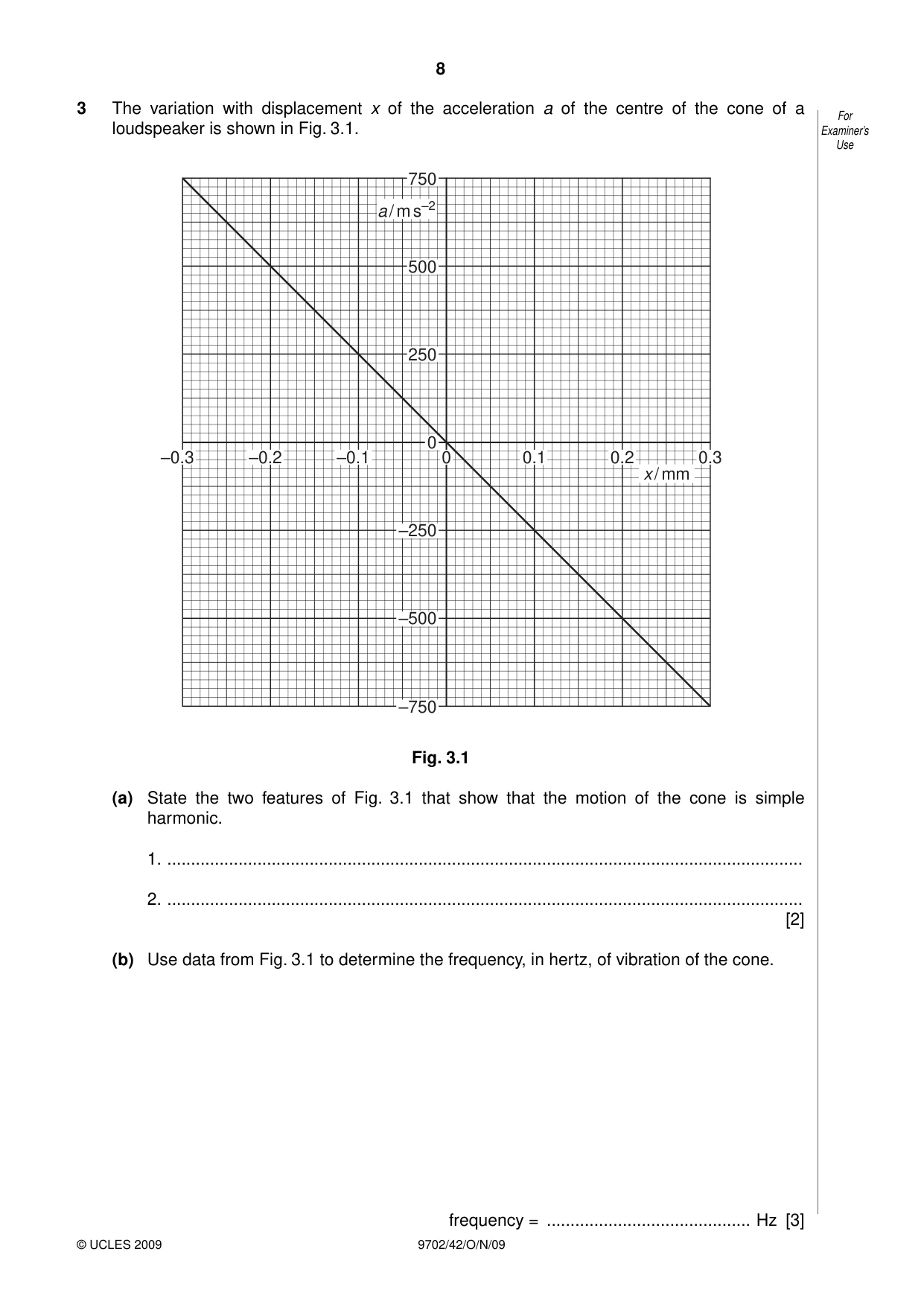
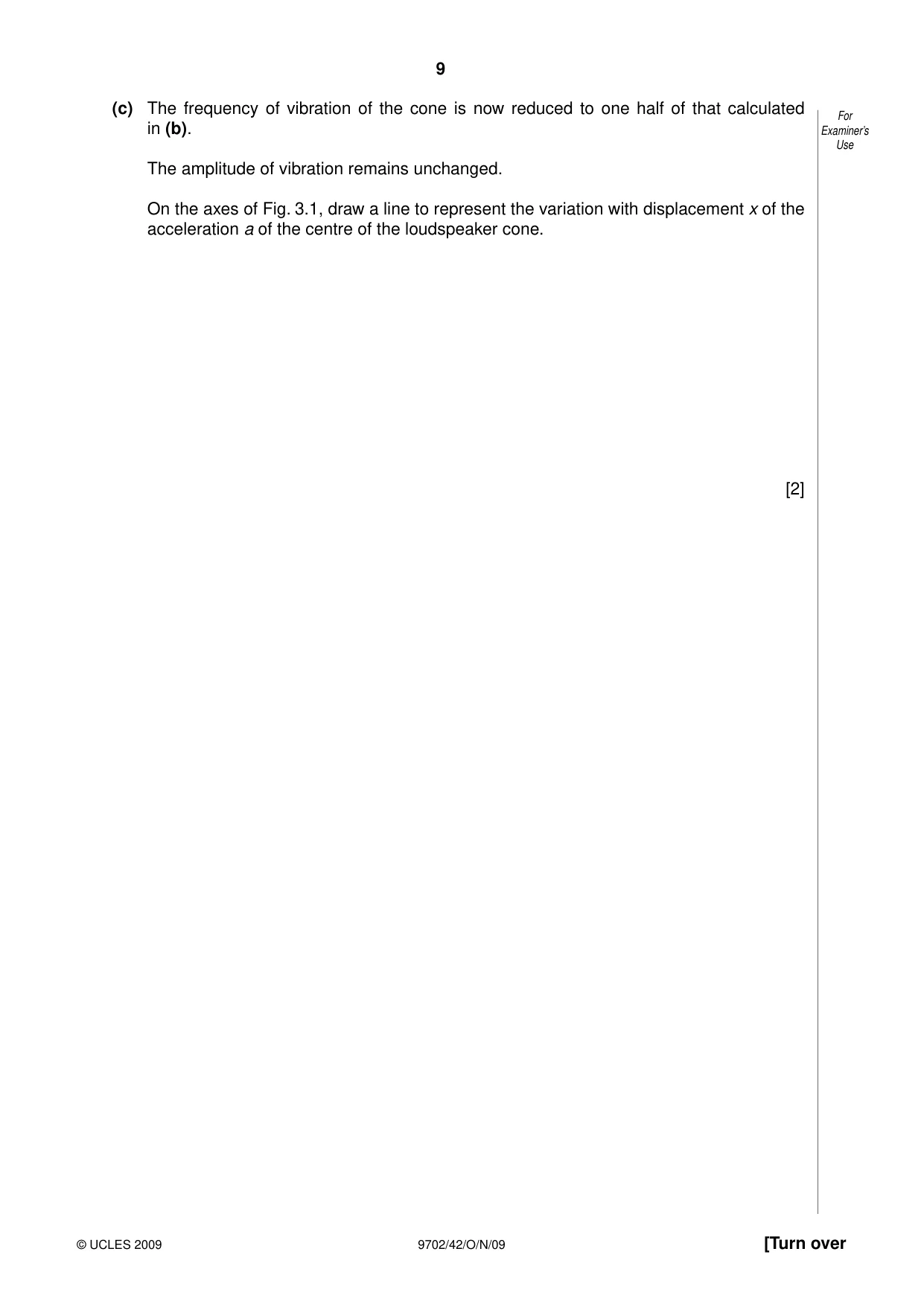
3 The variation with displacement x of the acceleration a of the centre of the cone of a For loudspeaker is shown in Fig. 3.1. Examiner’s Use 750 a / m s–2 500 250 0 –0.3 –0.2 –0.1 0 0.1 0.2 0.3 x / mm –250 –500 –750 Fig. 3.1 (a) State the two features of Fig. 3.1 that show that the motion of the cone is simple harmonic. 1. ...................................................................................................................................... 2. ...................................................................................................................................... [2] (b) Use data from Fig. 3.1 to determine the frequency, in hertz, of vibration of the cone. frequency = ........................................... Hz [3] (c) The frequency of vibration of the cone is now reduced to one half of that calculated For in (b). Examiner’s Use The amplitude of vibration remains unchanged. On the axes of Fig. 3.1, draw a line to represent the variation with displacement x of the acceleration a of the centre of the loudspeaker cone. [2]
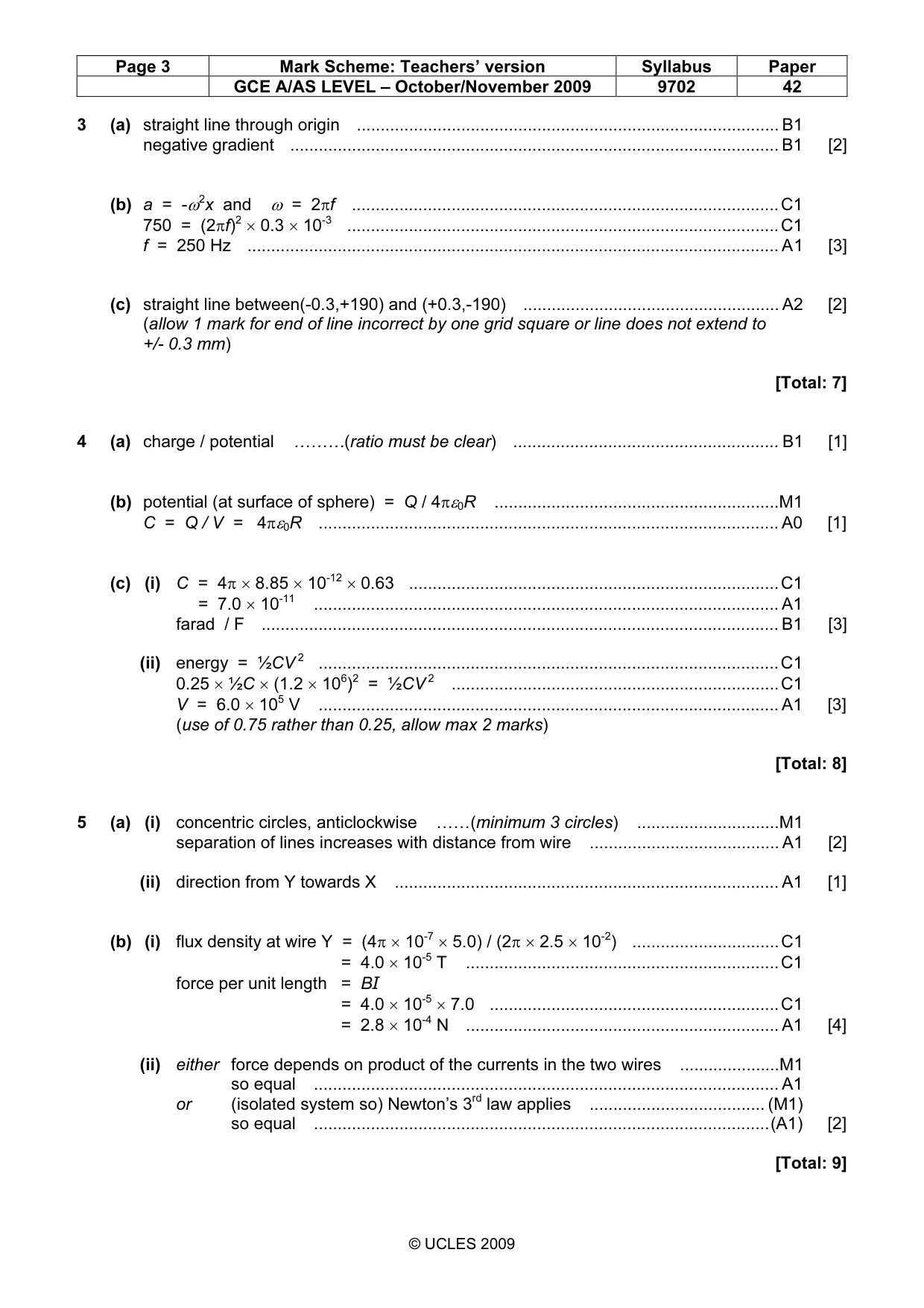
Mark scheme: 3 (a) straight line through origin ......................................................................................... B1 negative gradient ....................................................................................................... B1 [2] (b) a = -ω2x and ω = 2πf ..........................................................................................C1 750 = (2πf)2 × 0.3 × 10-3 ...........................................................................................C1 f = 250 Hz ................................................................................................................ A1 [3] (c) straight line between(-0.3,+190) and (+0.3,-190) ...................................................... A2 [2] (allow 1 mark for end of line incorrect by one grid square or line does not extend to +/- 0.3 mm) [Total: 7]
Question 4
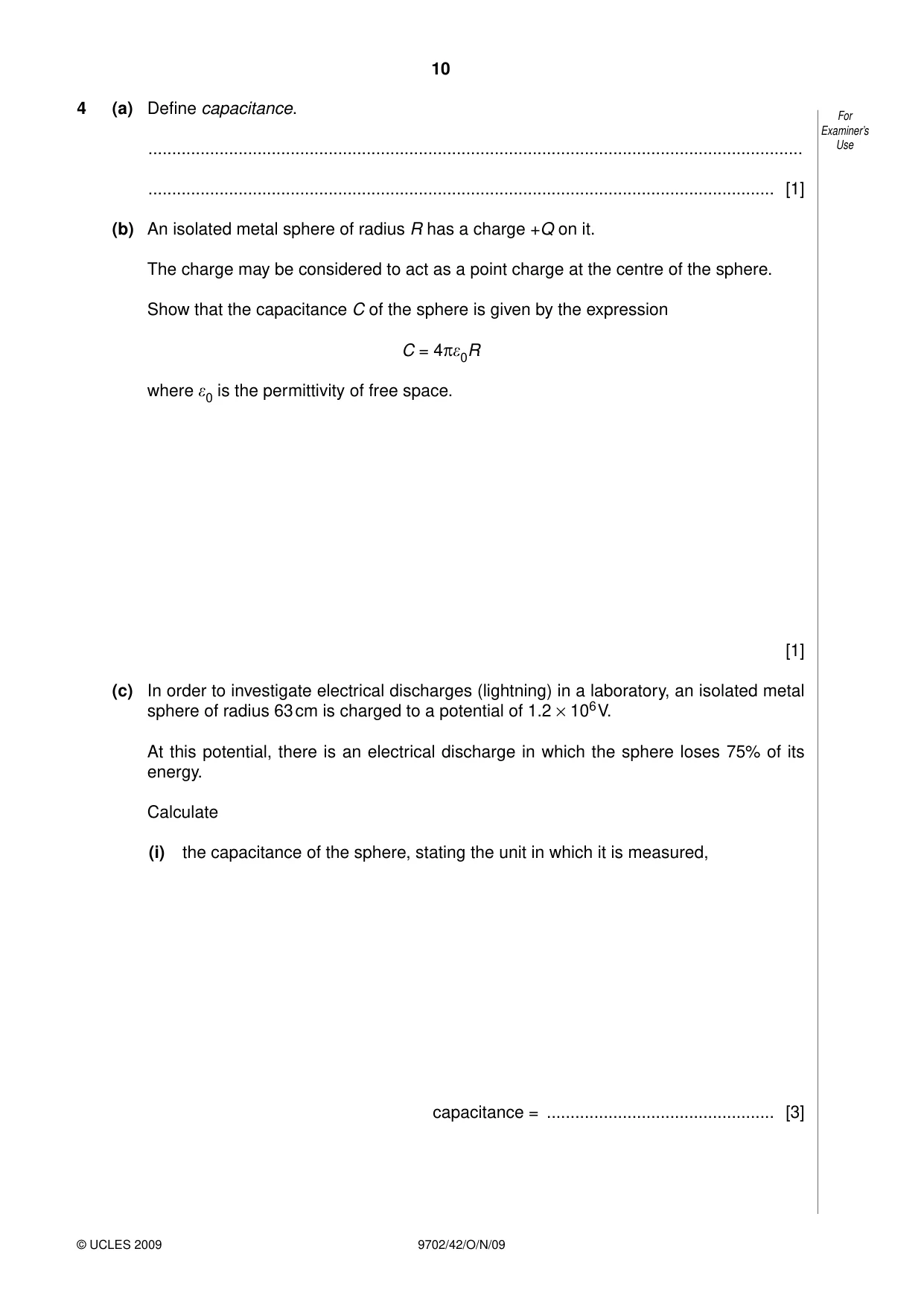
4 (a) Define capacitance. For Examiner’s .......................................................................................................................................... Use .................................................................................................................................... [1] (b) An isolated metal sphere of radius R has a charge +Q on it. The charge may be considered to act as a point charge at the centre of the sphere. Show that the capacitance C of the sphere is given by the expression C = 4 0R where is the permittivity of free space. 0 [1] (c) In order to investigate electrical discharges (lightning) in a laboratory, an isolated metal sphere of radius 63 cm is charged to a potential of 1.2 × 10⁶ V. At this potential, there is an electrical discharge in which the sphere loses 75% of its energy. Calculate (i) the capacitance of the sphere, stating the unit in which it is measured, capacitance = ................................................ [3] (ii) the potential of the sphere after the discharge has taken place. For Examiner’s Use potential = ............................................. V [3]
Mark scheme: 4 (a) charge / potential ………(ratio must be clear) ........................................................ B1 [1] (b) potential (at surface of sphere) = Q / 4πε0R ............................................................M1 C = Q / V = 4πε0R ................................................................................................. A0 [1] (c) (i) C = 4π × 8.85 × 10-12 × 0.63 ..............................................................................C1 = 7.0 × 10⁻¹¹ .................................................................................................. A1 farad / F ............................................................................................................. B1 [3] 2 (ii) energy = ½CV .................................................................................................C1 2 0.25 × ½C × (1.2 × 10⁶)2 = ½CV .....................................................................C1 V = 6.0 × 10⁵ V ................................................................................................. A1 [3] (use of 0.75 rather than 0.25, allow max 2 marks) [Total: 8]
Q5 · Two long straight vertical wires X and Y pass through a horizontal card, as shown in For…
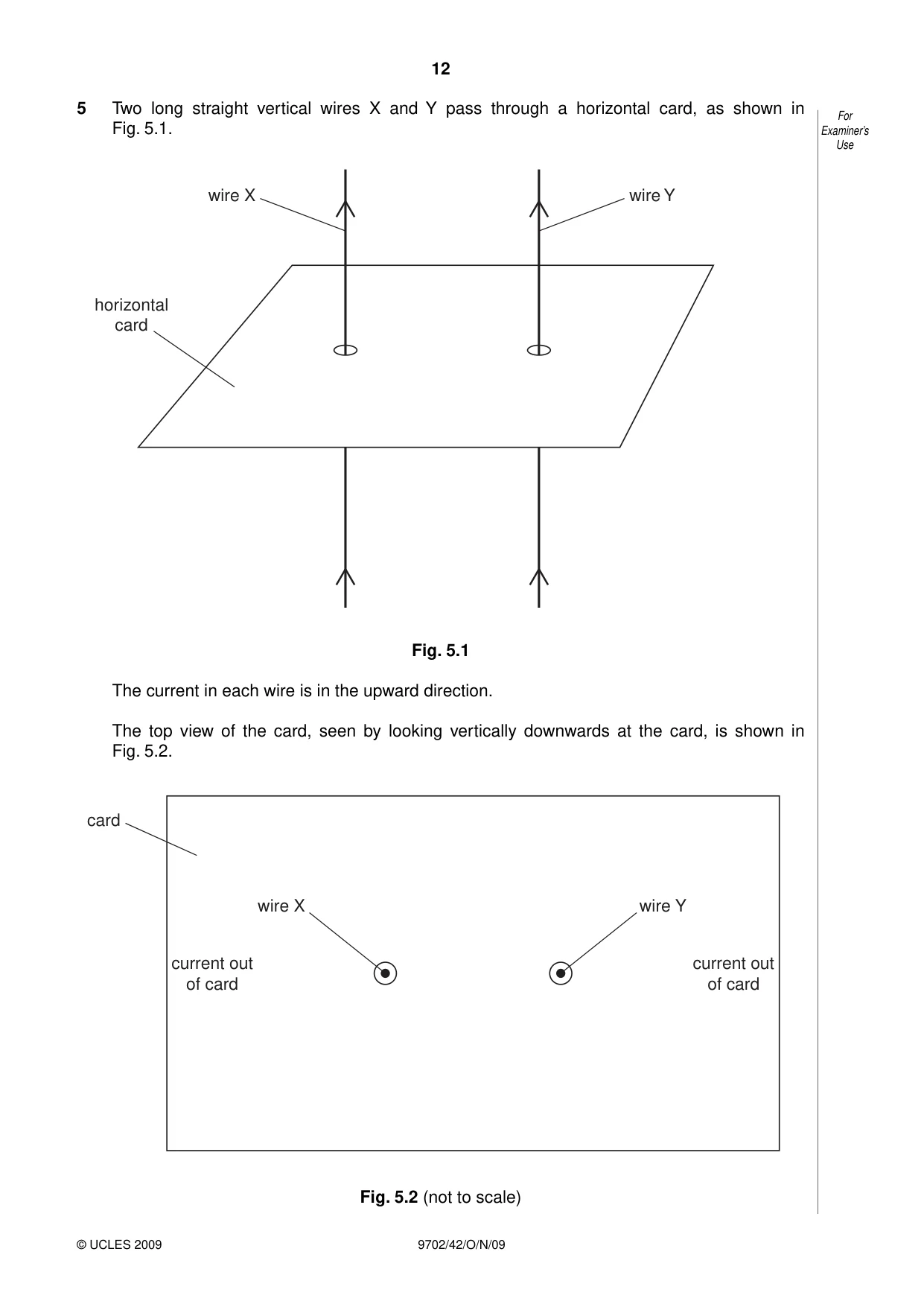
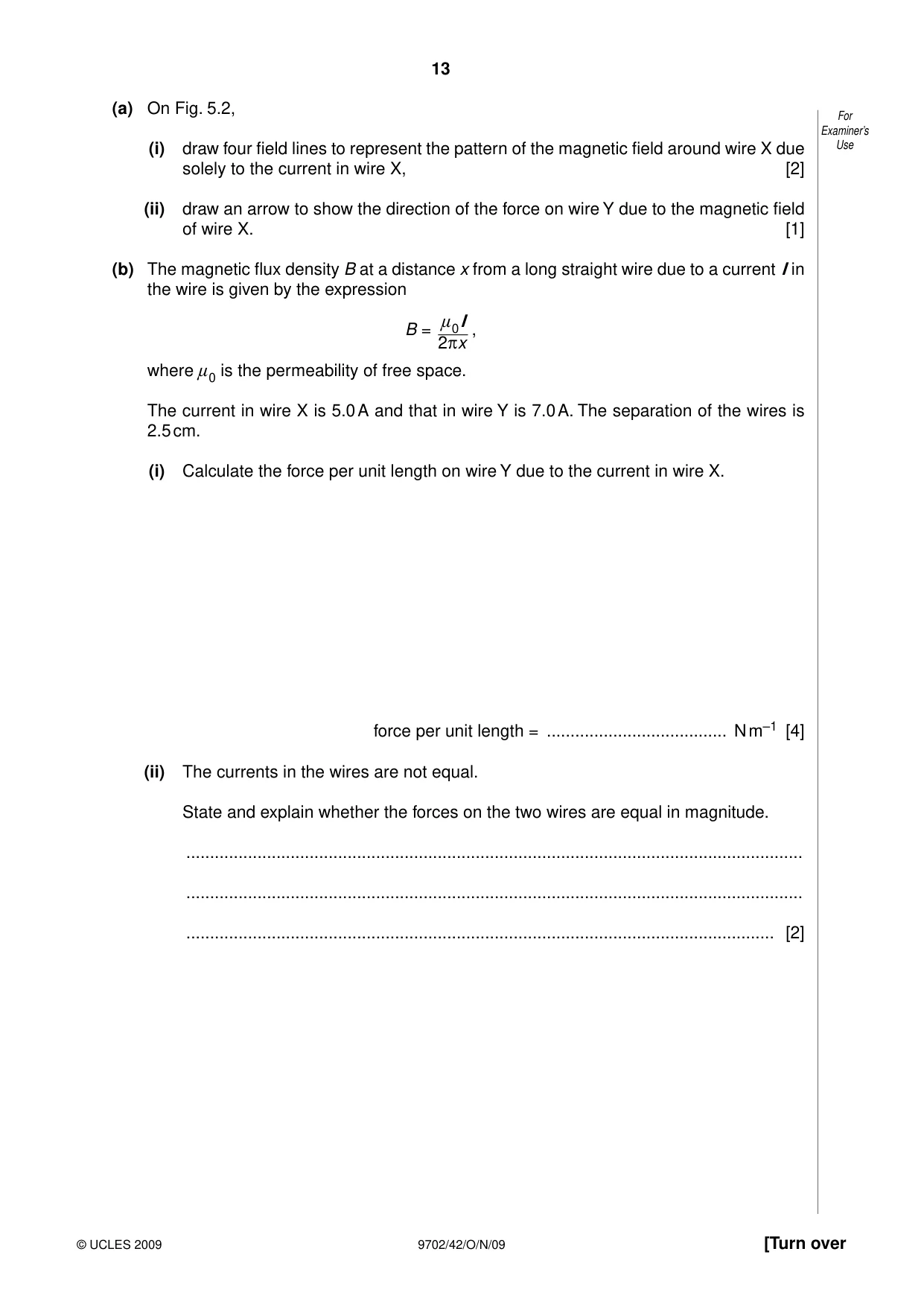
5 Two long straight vertical wires X and Y pass through a horizontal card, as shown in For Fig. 5.1. Examiner’s Use wire X wire Y horizontal card Fig. 5.1 The current in each wire is in the upward direction. The top view of the card, seen by looking vertically downwards at the card, is shown in Fig. 5.2. card wire X wire Y current out current out of card of card Fig. 5.2 (not to scale) (a) On Fig. 5.2, For Examiner’s (i) draw four field lines to represent the pattern of the magnetic field around wire X due Use solely to the current in wire X, [2] (ii) draw an arrow to show the direction of the force on wire Y due to the magnetic field of wire X. [1] (b) The magnetic flux density B at a distance x from a long straight wire due to a current I in the wire is given by the expression B = 0I , 2 x where is the permeability of free space. 0 The current in wire X is 5.0 A and that in wire Y is 7.0 A. The separation of the wires is 2.5 cm. (i) Calculate the force per unit length on wire Y due to the current in wire X. force per unit length = ...................................... N m–1 [4] (ii) The currents in the wires are not equal. State and explain whether the forces on the two wires are equal in magnitude. .................................................................................................................................. .................................................................................................................................. ............................................................................................................................ [2]
Mark scheme: 5 (a) (i) concentric circles, anticlockwise ……(minimum 3 circles) ..............................M1 separation of lines increases with distance from wire ........................................ A1 [2] (ii) direction from Y towards X ................................................................................. A1 [1] (b) (i) flux density at wire Y = (4π × 10-7 × 5.0) / (2π × 2.5 × 10-2) ...............................C1 = 4.0 × 10⁻⁵ T ..................................................................C1 force per unit length = BI = 4.0 × 10-5 × 7.0 .............................................................C1 = 2.8 × 10⁻⁴ N .................................................................. A1 [4] (ii) either force depends on product of the currents in the two wires .....................M1 so equal .................................................................................................. A1 or (isolated system so) Newton’s 3rd law applies ..................................... (M1) so equal ................................................................................................(A1) [2] [Total: 9] GCE A/AS LEVEL – October/November 2009 9702 42
Q6 · An ideal transformer is illustrated in Fig
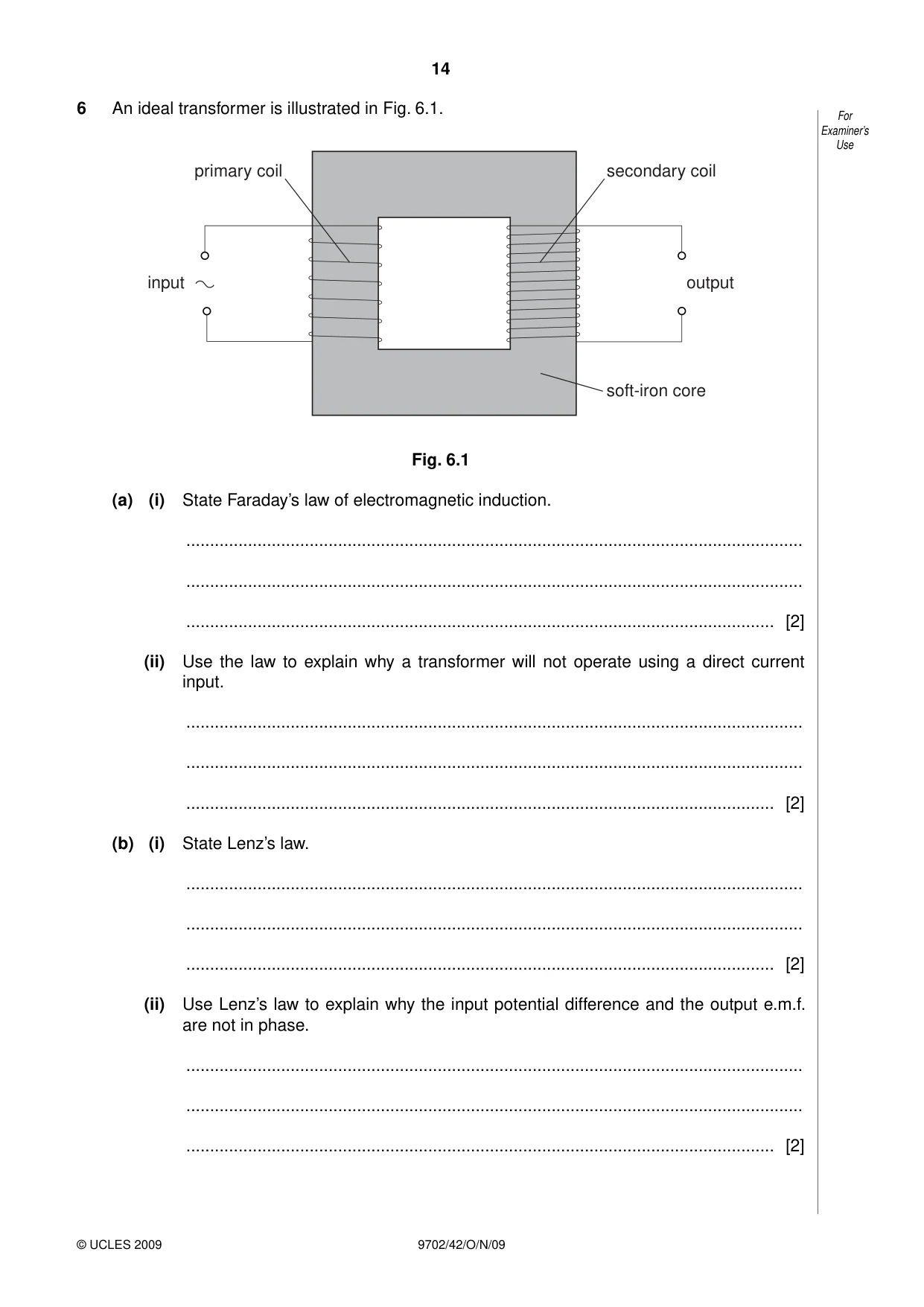
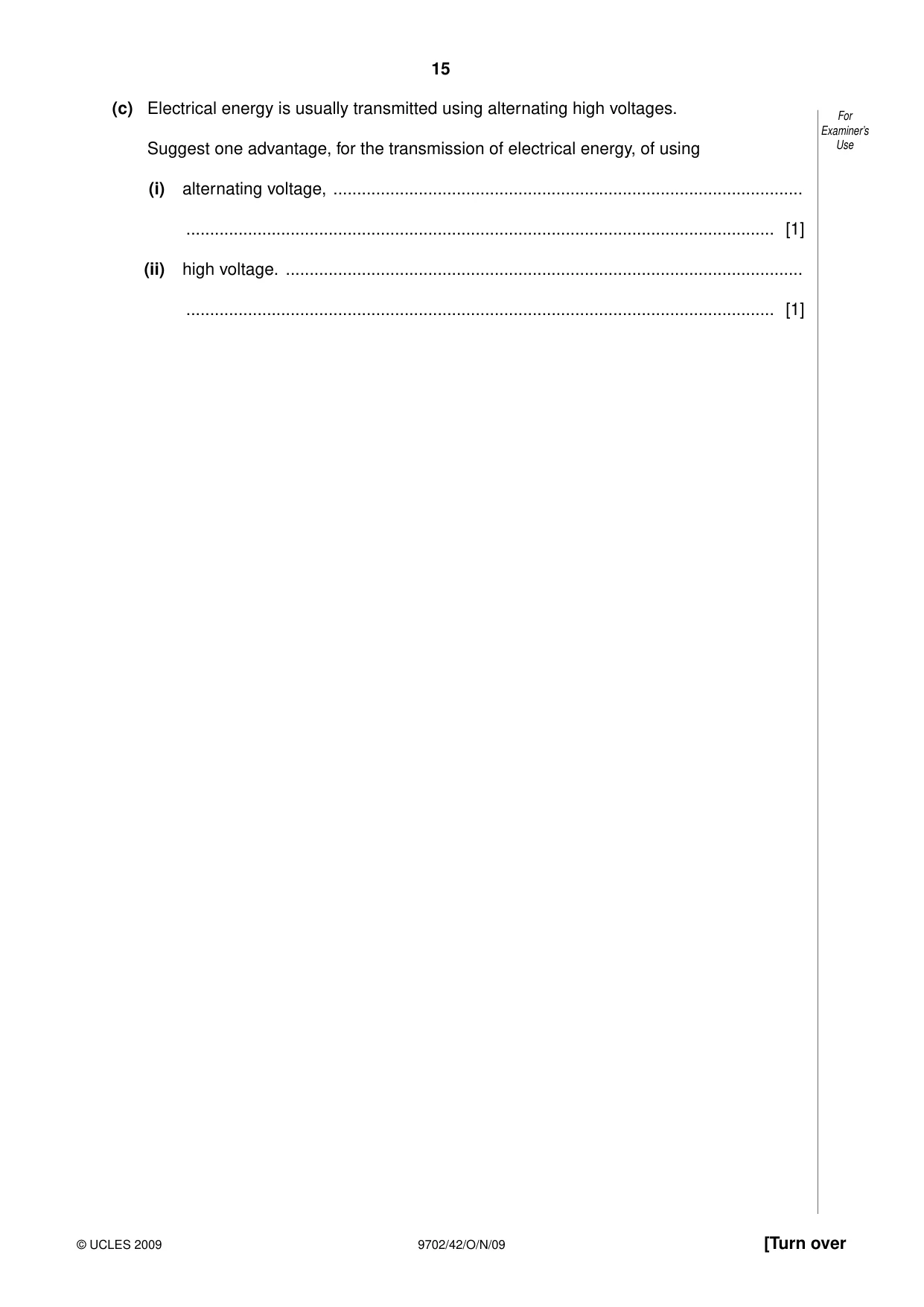
6 An ideal transformer is illustrated in Fig. 6.1. For Examiner’s Use primary coil secondary coil input output soft-iron core Fig. 6.1 (a) (i) State Faraday’s law of electromagnetic induction. .................................................................................................................................. .................................................................................................................................. ............................................................................................................................ [2] (ii) Use the law to explain why a transformer will not operate using a direct current input. .................................................................................................................................. .................................................................................................................................. ............................................................................................................................ [2] (b) (i) State Lenz’s law. .................................................................................................................................. .................................................................................................................................. ............................................................................................................................ [2] (ii) Use Lenz’s law to explain why the input potential difference and the output e.m.f. are not in phase. .................................................................................................................................. .................................................................................................................................. ............................................................................................................................ [2] (c) Electrical energy is usually transmitted using alternating high voltages. For Examiner’s Suggest one advantage, for the transmission of electrical energy, of using Use (i) alternating voltage, ................................................................................................... ............................................................................................................................ [1] (ii) high voltage. ............................................................................................................. ............................................................................................................................ [1]
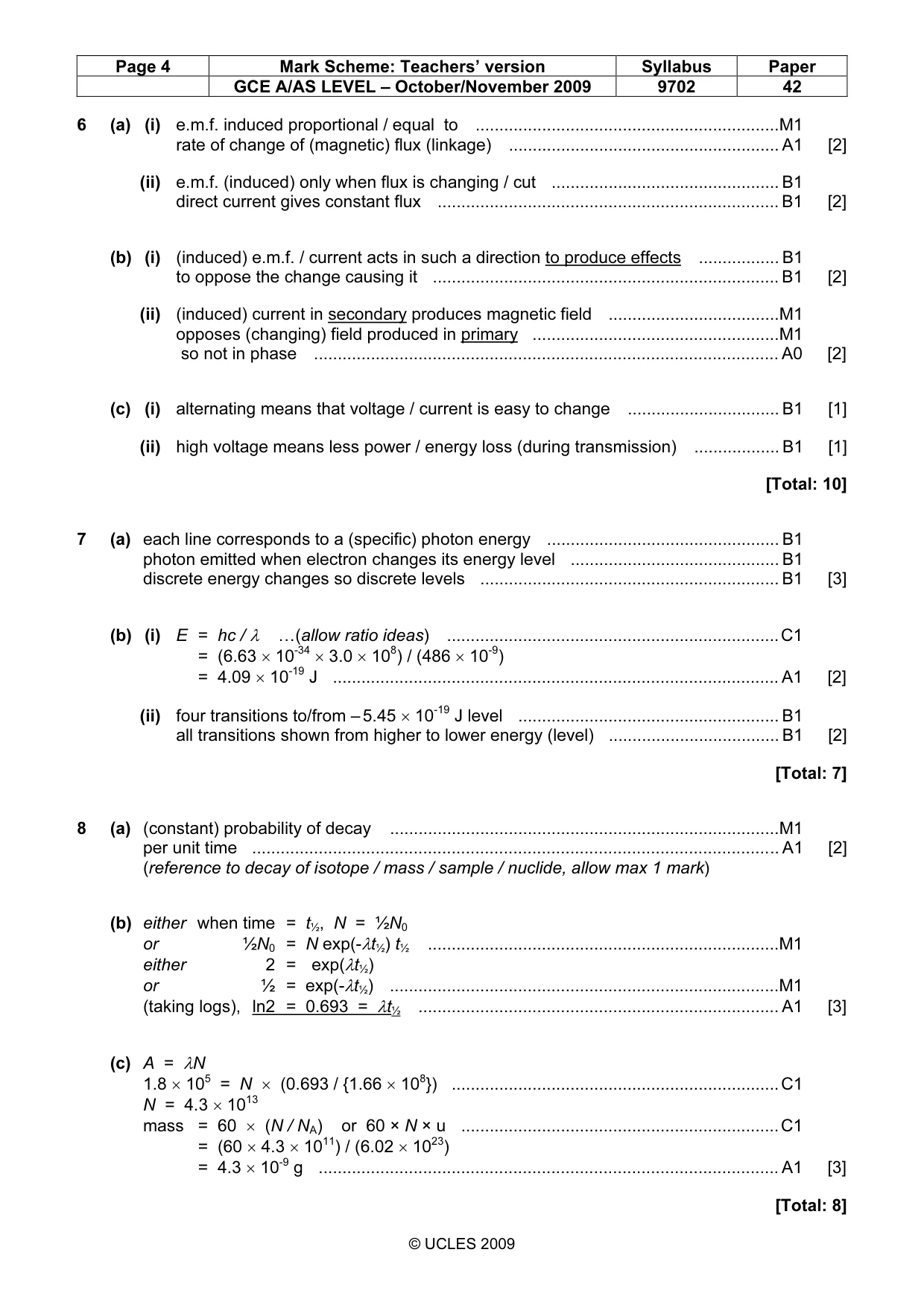
Mark scheme: 6 (a) (i) e.m.f. induced proportional / equal to ................................................................M1 rate of change of (magnetic) flux (linkage) ......................................................... A1 [2] (ii) e.m.f. (induced) only when flux is changing / cut ................................................ B1 direct current gives constant flux ........................................................................ B1 [2] (b) (i) (induced) e.m.f. / current acts in such a direction to produce effects ................. B1 to oppose the change causing it ......................................................................... B1 [2] (ii) (induced) current in secondary produces magnetic field ....................................M1 opposes (changing) field produced in primary ....................................................M1 so not in phase .................................................................................................. A0 [2] (c) (i) alternating means that voltage / current is easy to change ................................ B1 [1] (ii) high voltage means less power / energy loss (during transmission) .................. B1 [1] [Total: 10]
Q7 · Explain how a line emission spectrum leads to an understanding of the existence of For…
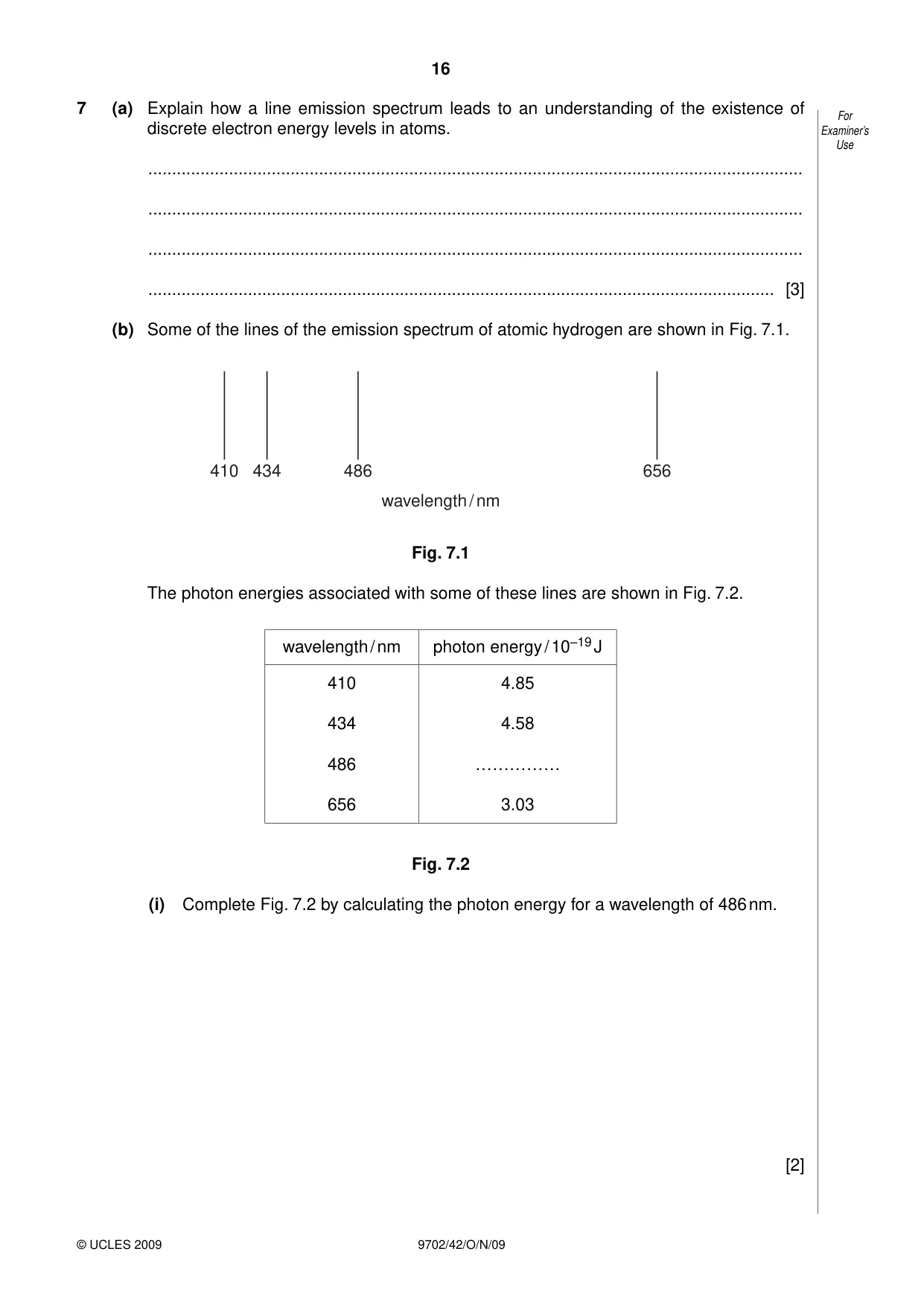
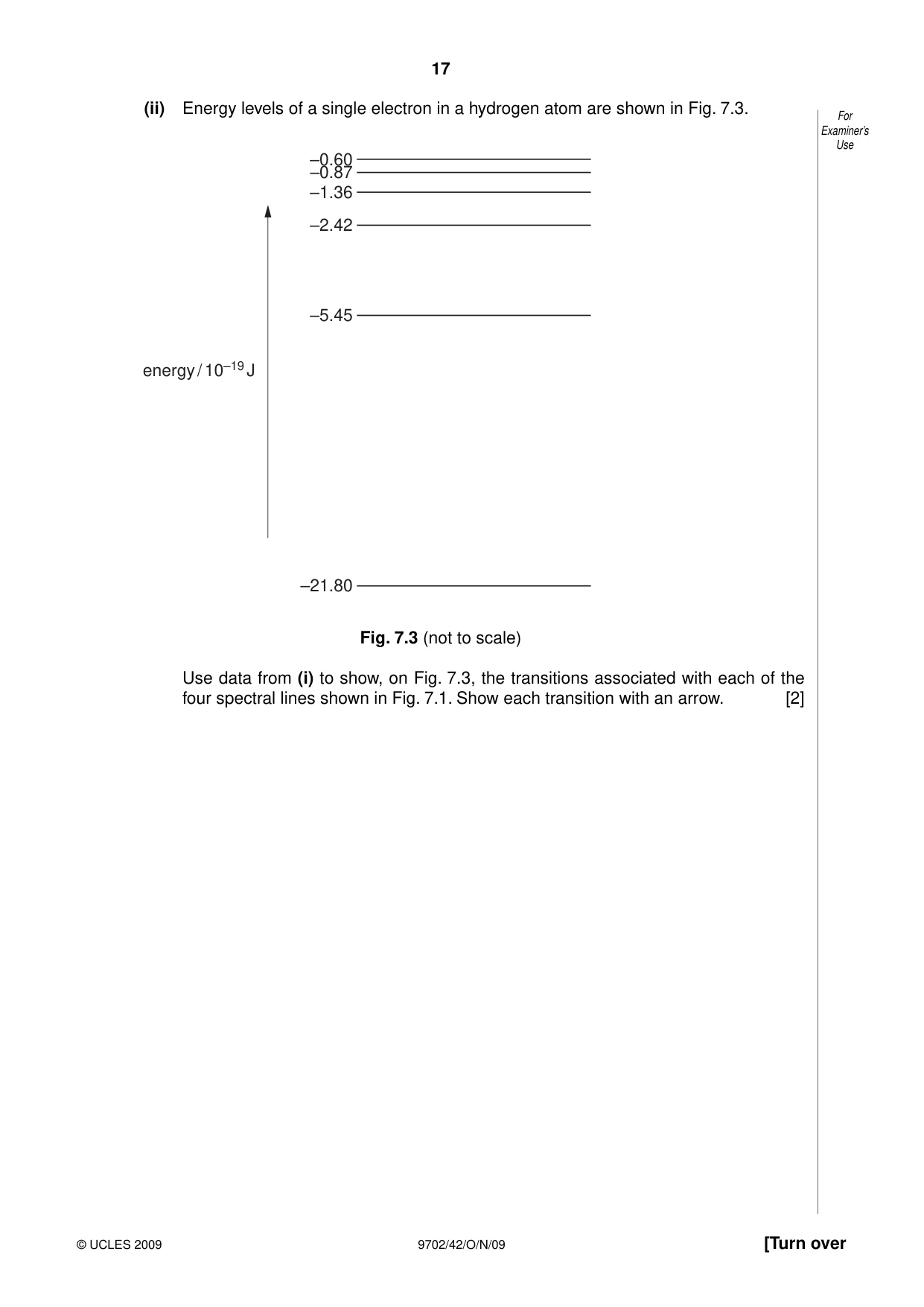
7 (a) Explain how a line emission spectrum leads to an understanding of the existence of For discrete electron energy levels in atoms. Examiner’s Use .......................................................................................................................................... .......................................................................................................................................... .......................................................................................................................................... .................................................................................................................................... [3] (b) Some of the lines of the emission spectrum of atomic hydrogen are shown in Fig. 7.1. 410 434 486 656 wavelength / nm Fig. 7.1 The photon energies associated with some of these lines are shown in Fig. 7.2. wavelength / nm photon energy / 10–19 J 410 4.85 434 4.58 486 …………… 656 3.03 Fig. 7.2 (i) Complete Fig. 7.2 by calculating the photon energy for a wavelength of 486 nm. [2] (ii) Energy levels of a single electron in a hydrogen atom are shown in Fig. 7.3. For Examiner’s Use –0.60 –0.87 –1.36 –2.42 –5.45 energy / 10–19 J –21.80 Fig. 7.3 (not to scale) Use data from (i) to show, on Fig. 7.3, the transitions associated with each of the four spectral lines shown in Fig. 7.1. Show each transition with an arrow. [2]
Mark scheme: 7 (a) each line corresponds to a (specific) photon energy ................................................. B1 photon emitted when electron changes its energy level ............................................ B1 discrete energy changes so discrete levels ............................................................... B1 [3] (b) (i) E = hc / λ …(allow ratio ideas) ......................................................................C1 = (6.63 × 10-34 × 3.0 × 108) / (486 × 10-9) = 4.09 × 10⁻¹⁹ J .............................................................................................. A1 [2] (ii) four transitions to/from – 5.45 × 10⁻¹⁹ J level ....................................................... B1 all transitions shown from higher to lower energy (level) .................................... B1 [2] [Total: 7]
Q8 · State what is meant by the decay constant of a radioactive isotope
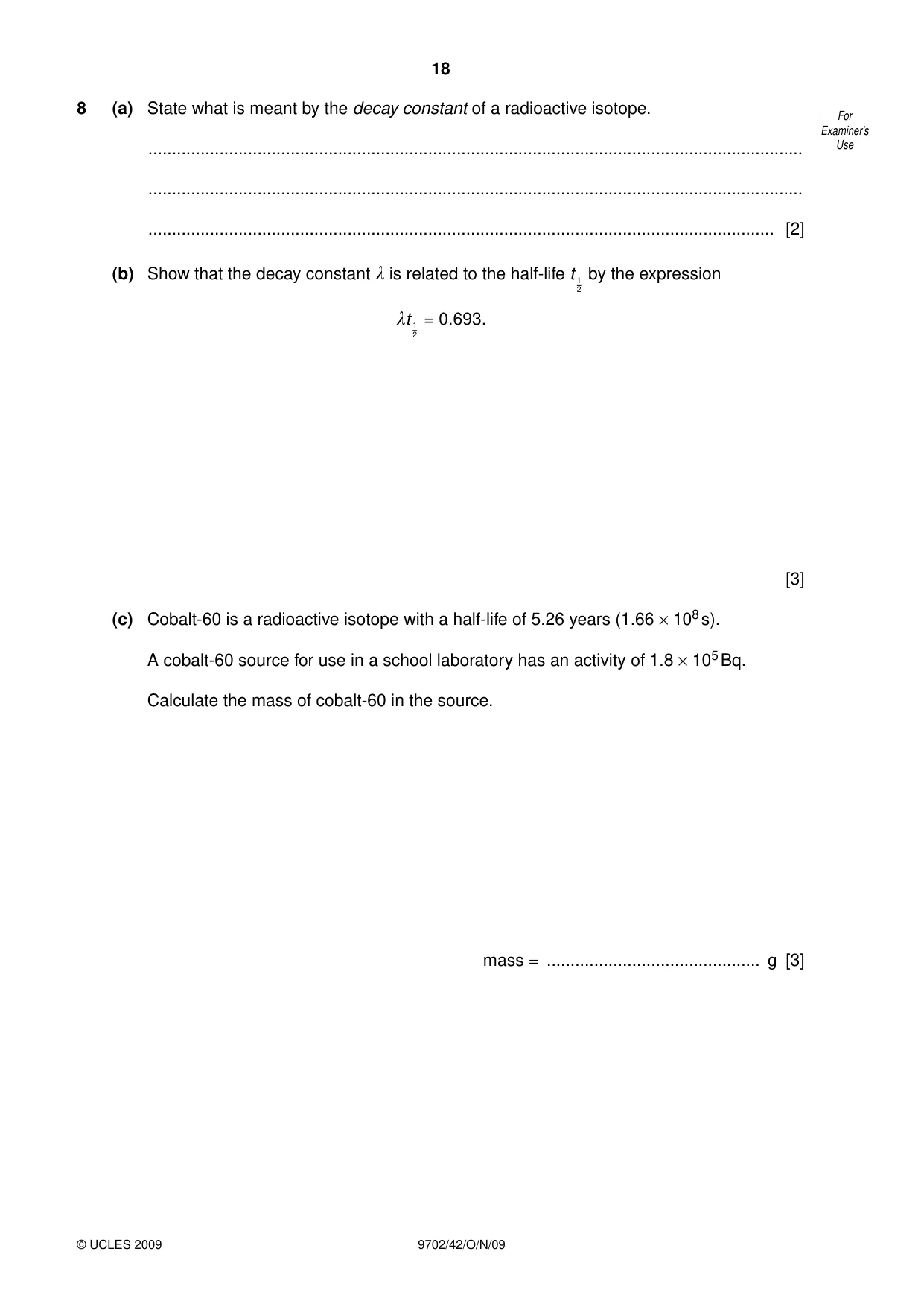
8 (a) State what is meant by the decay constant of a radioactive isotope. For Examiner’s .......................................................................................................................................... Use .......................................................................................................................................... .................................................................................................................................... [2] (b) Show that the decay constant is related to the half-life t 1 by the expression 2 t 1 = 0.693. 2 [3] (c) Cobalt-60 is a radioactive isotope with a half-life of 5.26 years (1.66 × 10⁸ s). A cobalt-60 source for use in a school laboratory has an activity of 1.8 × 10⁵ Bq. Calculate the mass of cobalt-60 in the source. mass = ............................................. g [3]
Mark scheme: 8 (a) (constant) probability of decay ..................................................................................M1 per unit time ............................................................................................................... A1 [2] (reference to decay of isotope / mass / sample / nuclide, allow max 1 mark) (b) either when time = t½, N = ½N0 or ½N0 = N exp(-λt½) t½ ..........................................................................M1 either 2 = exp(λt½) or ½ = exp(-λt½) ..................................................................................M1 (taking logs), ln2 = 0.693 = λt½ ............................................................................ A1 [3] (c) A = λN 1.8 × 105 = N × (0.693 / {1.66 × 10⁸}) .....................................................................C1 N = 4.3 × 10¹³ mass = 60 × (N / NA) or 60 × N × u ...................................................................C1 = (60 × 4.3 × 1011) / (6.02 × 10²³) = 4.3 × 10⁻⁹ g ................................................................................................. A1 [3] [Total: 8] GCE A/AS LEVEL – October/November 2009 9702 42 Section B
Q9 · An amplifier incorporating an operational amplifier (op-amp) has three inputs A, B and C…
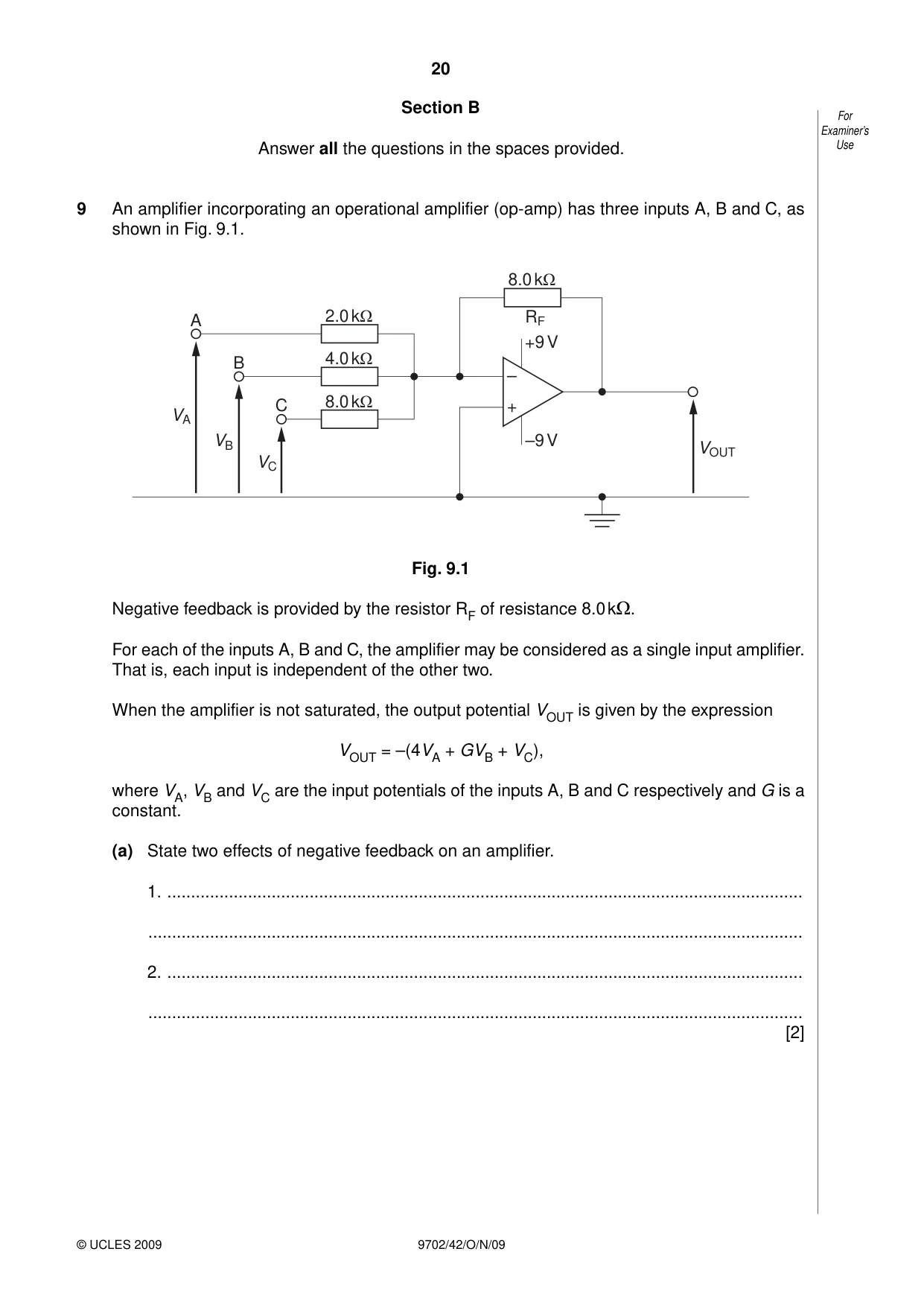
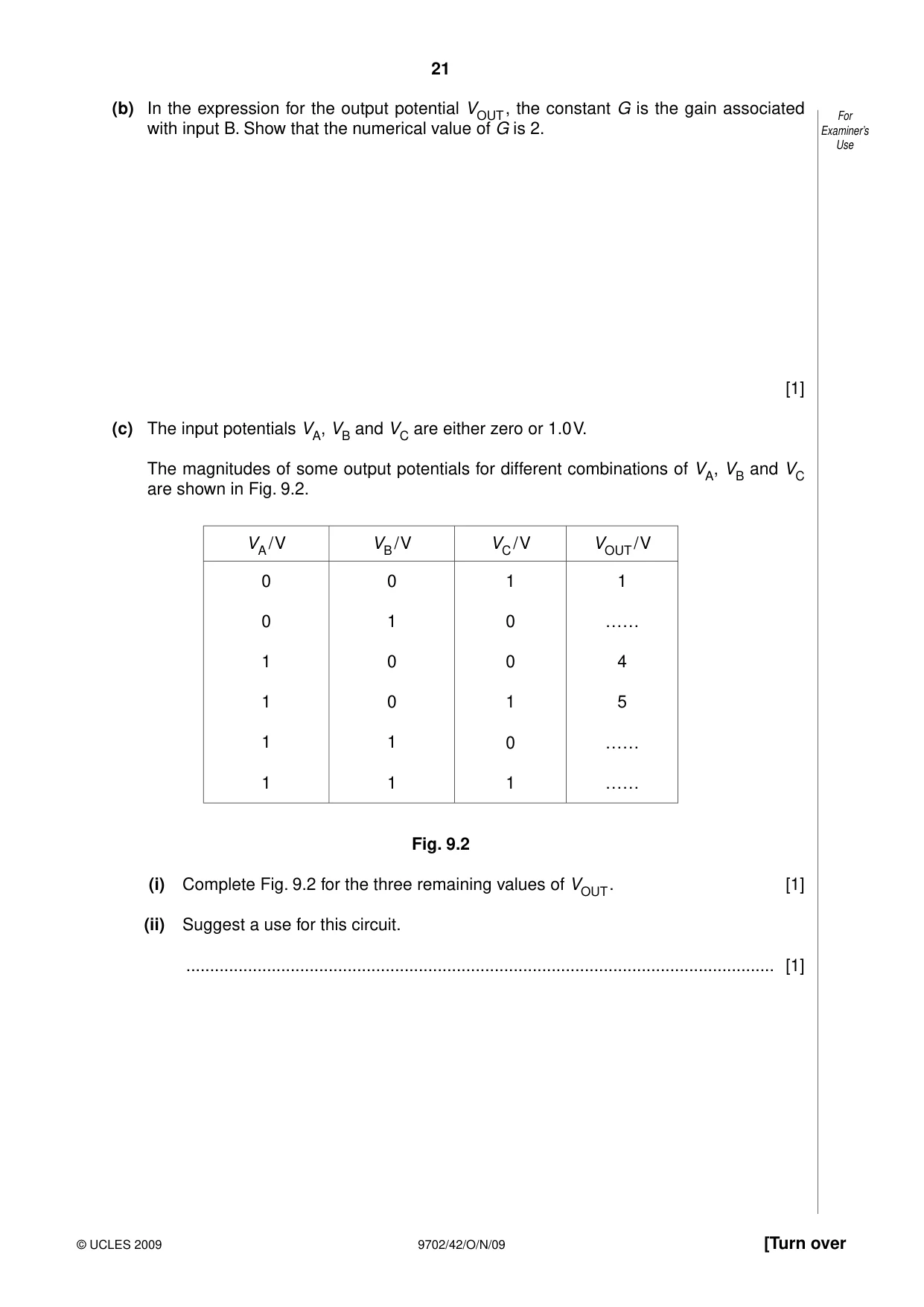
9 An amplifier incorporating an operational amplifier (op-amp) has three inputs A, B and C, as shown in Fig. 9.1. 8.0 kΩ A 2.0 kΩ RF +9 V B 4.0 kΩ – C 8.0 kΩ + VA VB –9 V VOUT VC Fig. 9.1 Negative feedback is provided by the resistor RF of resistance 8.0 k . For each of the inputs A, B and C, the amplifier may be considered as a single input amplifier. That is, each input is independent of the other two. When the amplifier is not saturated, the output potential VOUT is given by the expression VOUT = –(4VA + GVB + VC), where VA, VB and VC are the input potentials of the inputs A, B and C respectively and G is a constant. (a) State two effects of negative feedback on an amplifier. 1. ...................................................................................................................................... .......................................................................................................................................... 2. ...................................................................................................................................... .......................................................................................................................................... [2] (b) In the expression for the output potential VOUT , the constant G is the gain associated For with input B. Show that the numerical value of G is 2. Examiner’s Use [1] (c) The input potentials VA, VB and VC are either zero or 1.0 V. The magnitudes of some output potentials for different combinations of VA, VB and VC are shown in Fig. 9.2. VA / V VB / V VC / V VOUT / V 0 0 1 1 0 1 0 …… 1 0 0 4 1 0 1 5 1 1 0 …… 1 1 1 …… Fig. 9.2 (i) Complete Fig. 9.2 for the three remaining values of VOUT . [1] (ii) Suggest a use for this circuit. ............................................................................................................................ [1]
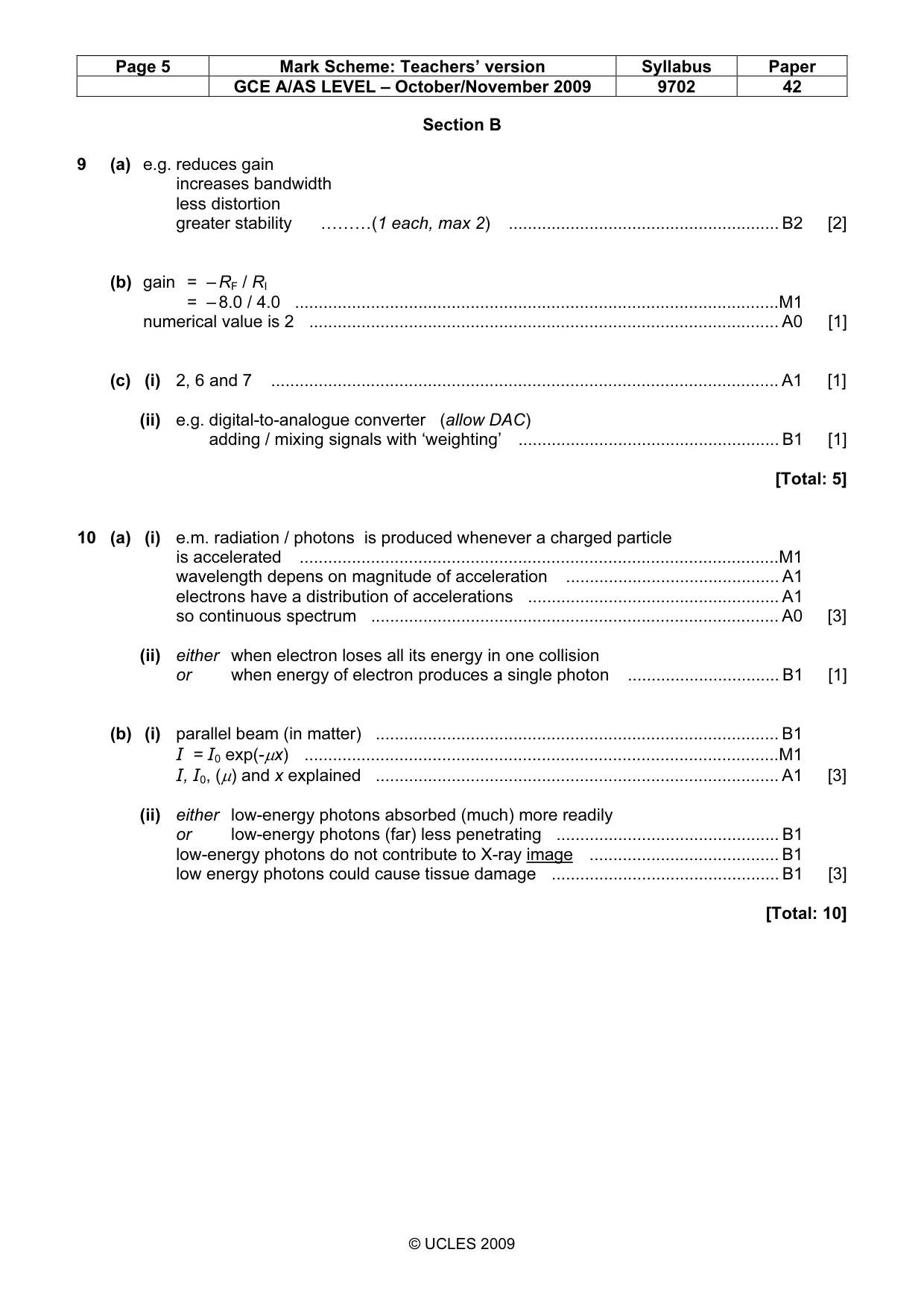
Mark scheme: 9 (a) e.g. reduces gain increases bandwidth less distortion greater stability ………(1 each, max 2) ......................................................... B2 [2] (b) gain = – RF / RI = – 8.0 / 4.0 ......................................................................................................M1 numerical value is 2 ................................................................................................... A0 [1] (c) (i) 2, 6 and 7 ........................................................................................................... A1 [1] (ii) e.g. digital-to-analogue converter (allow DAC) adding / mixing signals with ‘weighting’ ....................................................... B1 [1] [Total: 5]
Q10 · A typical spectrum of the X-ray radiation produced by electron bombardment of a metal For…
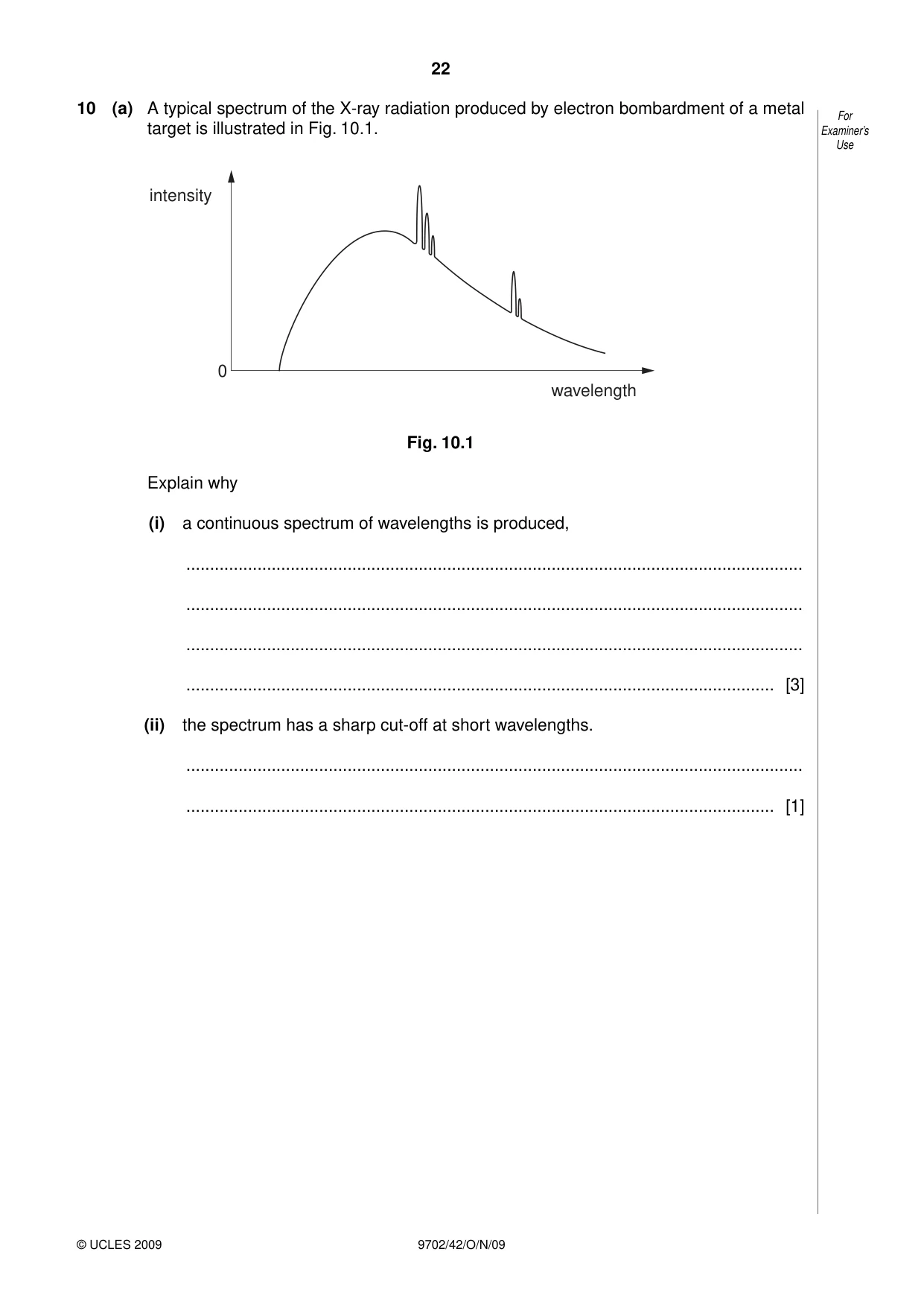
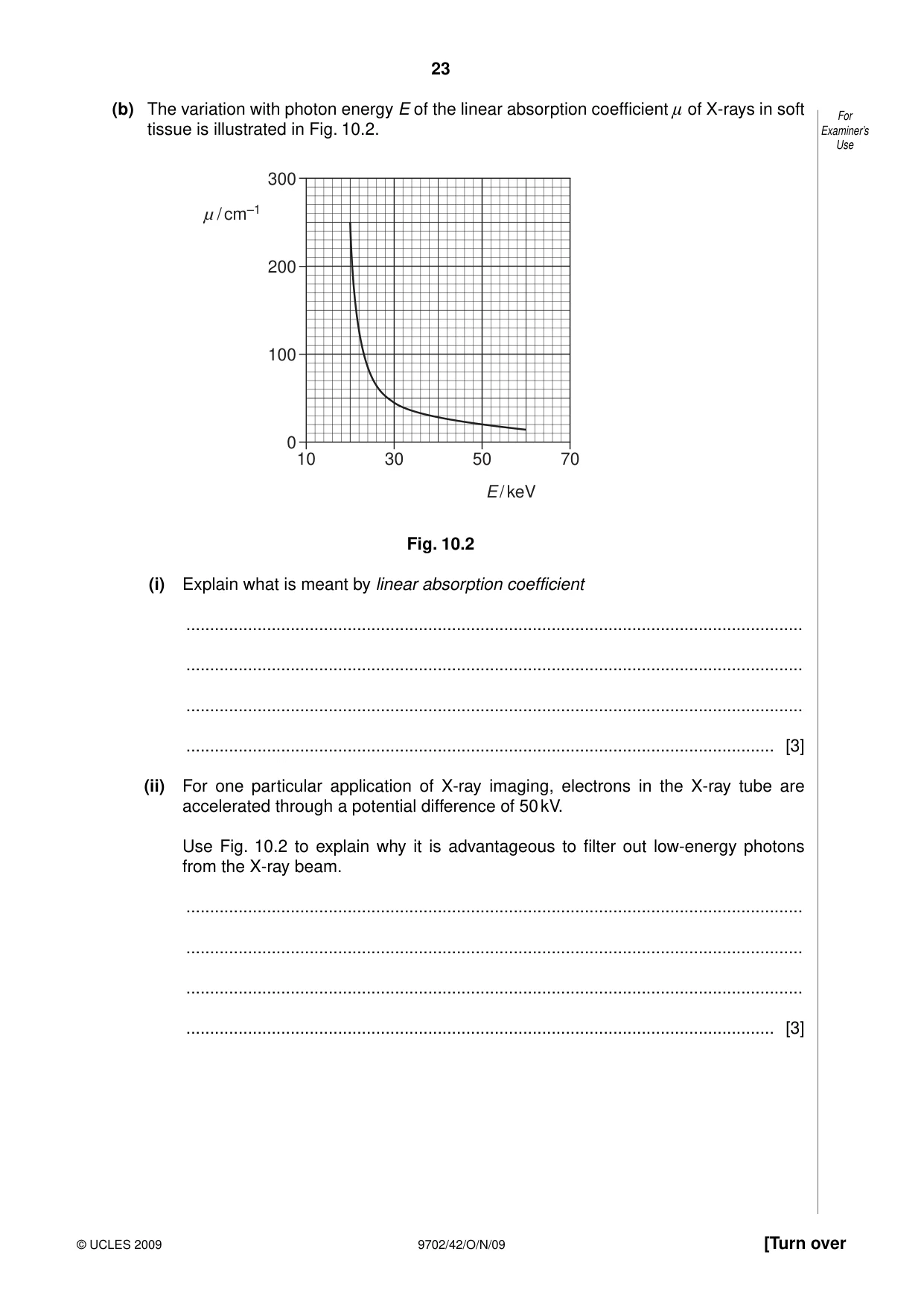
10 (a) A typical spectrum of the X-ray radiation produced by electron bombardment of a metal For target is illustrated in Fig. 10.1. Examiner’s Use intensity 0 wavelength Fig. 10.1 Explain why (i) a continuous spectrum of wavelengths is produced, .................................................................................................................................. .................................................................................................................................. .................................................................................................................................. ............................................................................................................................ [3] (ii) the spectrum has a sharp cut-off at short wavelengths. .................................................................................................................................. ............................................................................................................................ [1] (b) The variation with photon energy E of the linear absorption coefficient of X-rays in soft For tissue is illustrated in Fig. 10.2. Examiner’s Use 300 µ / cm–1 200 100 0 10 30 50 70 E / keV Fig. 10.2 (i) Explain what is meant by linear absorption coefficient .................................................................................................................................. .................................................................................................................................. .................................................................................................................................. ............................................................................................................................ [3] (ii) For one particular application of X-ray imaging, electrons in the X-ray tube are accelerated through a potential difference of 50 kV. Use Fig. 10.2 to explain why it is advantageous to filter out low-energy photons from the X-ray beam. .................................................................................................................................. .................................................................................................................................. .................................................................................................................................. ............................................................................................................................ [3]
Mark scheme: 10 (a) (i) e.m. radiation / photons is produced whenever a charged particle is accelerated .....................................................................................................M1 wavelength depens on magnitude of acceleration ............................................. A1 electrons have a distribution of accelerations ..................................................... A1 so continuous spectrum ...................................................................................... A0 [3] (ii) either when electron loses all its energy in one collision or when energy of electron produces a single photon ................................ B1 [1] (b) (i) parallel beam (in matter) ..................................................................................... B1 I = I0 exp(-µx) ....................................................................................................M1 I, I0, (µ) and x explained ..................................................................................... A1 [3] (ii) either low-energy photons absorbed (much) more readily or low-energy photons (far) less penetrating ............................................... B1 low-energy photons do not contribute to X-ray image ........................................ B1 low energy photons could cause tissue damage ................................................ B1 [3] [Total: 10] GCE A/AS LEVEL – October/November 2009 9702 42
Q11 · The variation with time of the signal transmitted from an aerial is shown in Fig
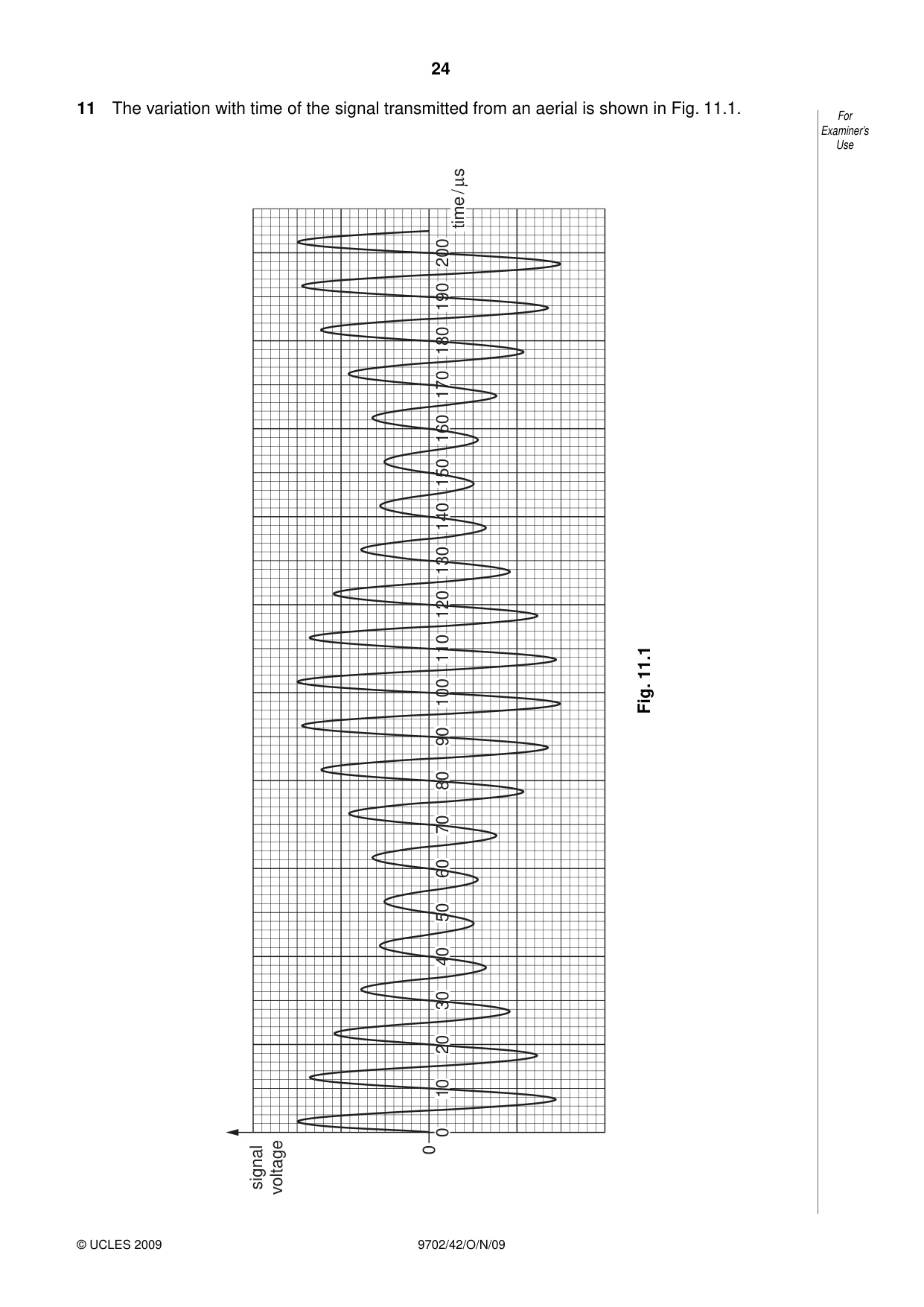
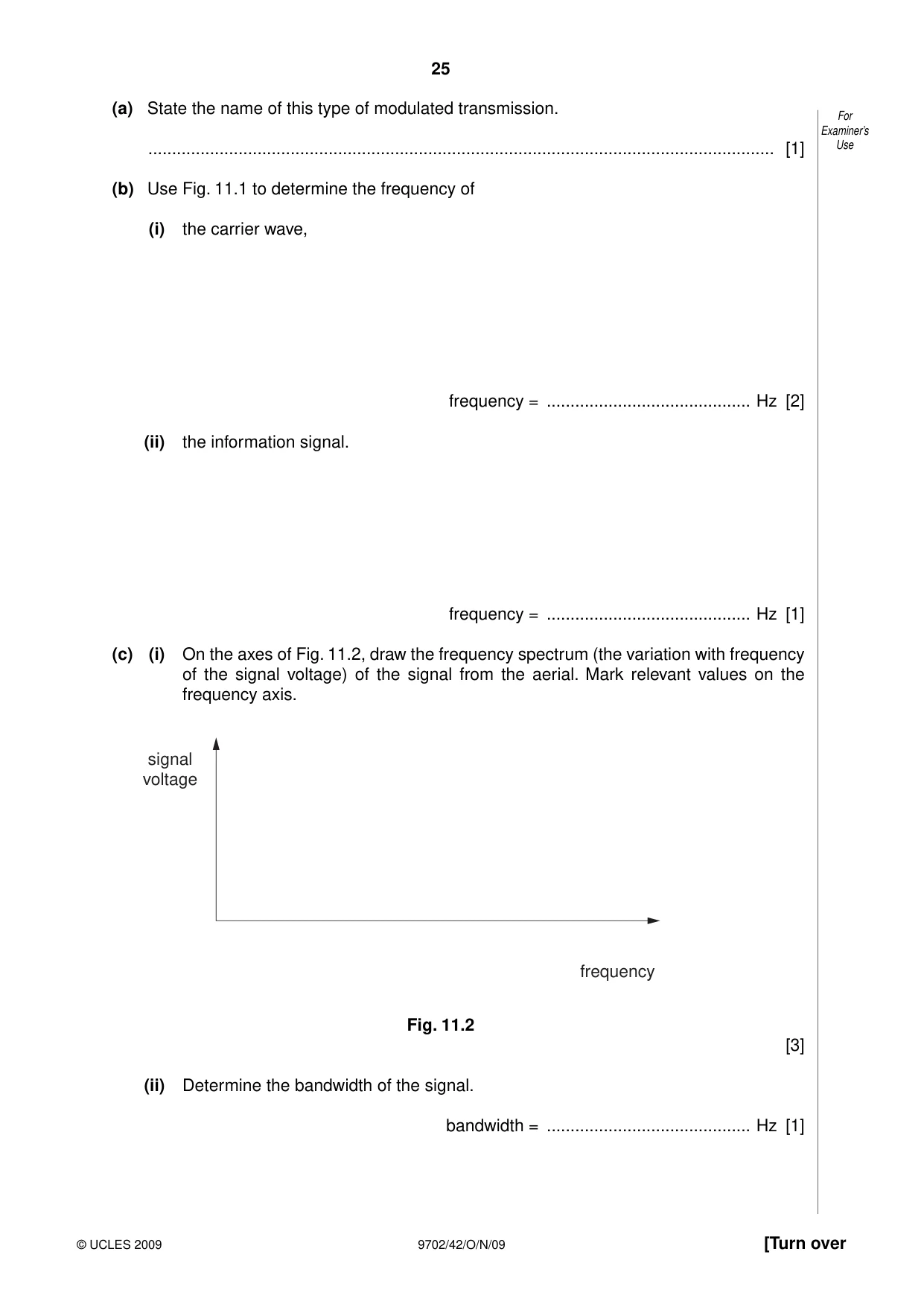
11 The variation with time of the signal transmitted from an aerial is shown in Fig. 11.1. For Examiner’s Use ls / time 200 190 180 170 160 150 140 130 120 110 11.1 100 Fig. 90 80 70 60 50 40 30 20 10 0 (a) State the name of this type of modulated transmission. For Examiner’s .................................................................................................................................... [1] Use (b) Use Fig. 11.1 to determine the frequency of (i) the carrier wave, frequency = ........................................... Hz [2] (ii) the information signal. frequency = ........................................... Hz [1] (c) (i) On the axes of Fig. 11.2, draw the frequency spectrum (the variation with frequency of the signal voltage) of the signal from the aerial. Mark relevant values on the frequency axis. signal voltage frequency Fig. 11.2 [3] (ii) Determine the bandwidth of the signal. bandwidth = ........................................... Hz [1]
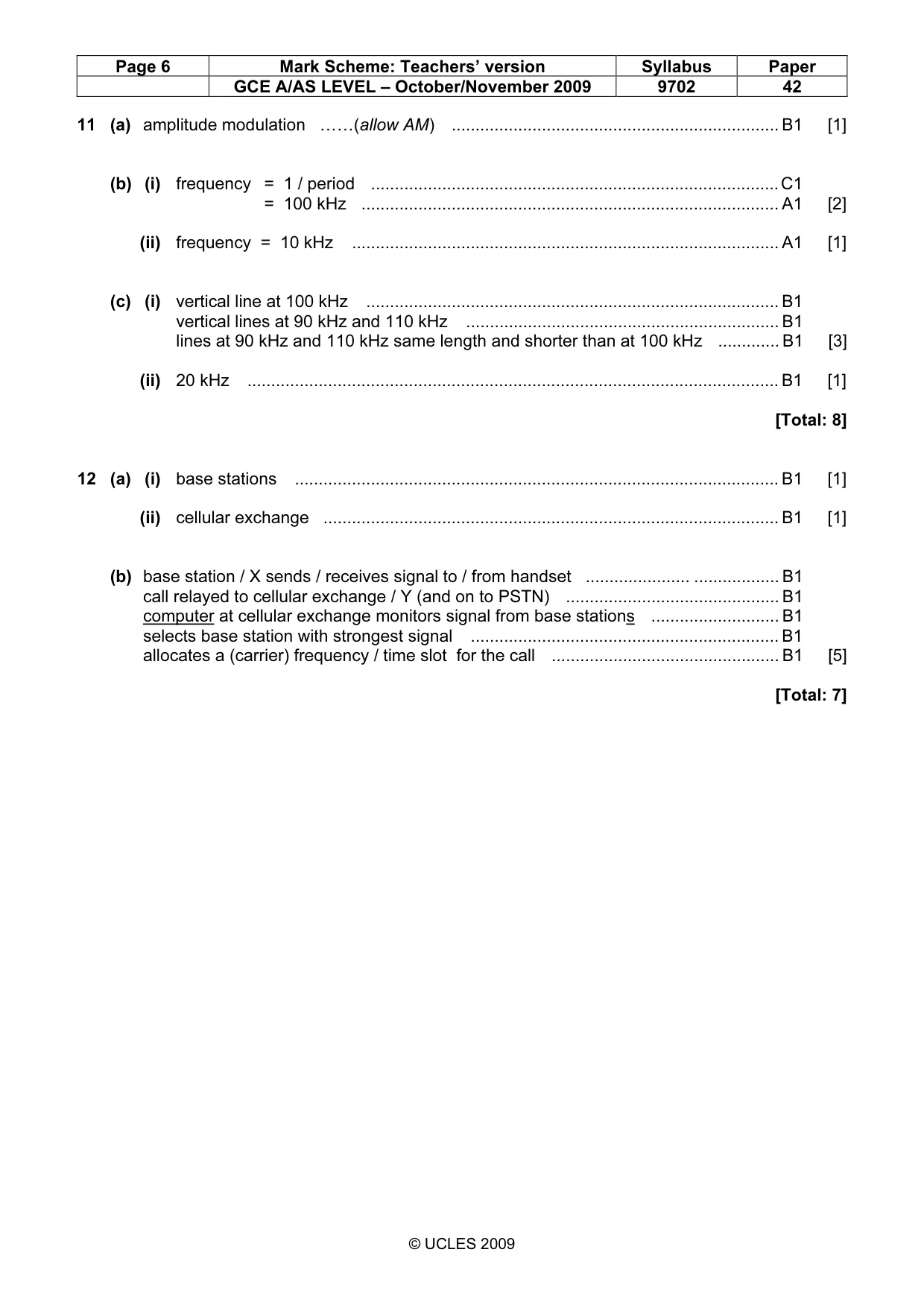
Mark scheme: 11 (a) amplitude modulation ……(allow AM) ..................................................................... B1 [1] (b) (i) frequency = 1 / period ......................................................................................C1 = 100 kHz ........................................................................................ A1 [2] (ii) frequency = 10 kHz .......................................................................................... A1 [1] (c) (i) vertical line at 100 kHz ....................................................................................... B1 vertical lines at 90 kHz and 110 kHz .................................................................. B1 lines at 90 kHz and 110 kHz same length and shorter than at 100 kHz ............. B1 [3] (ii) 20 kHz ................................................................................................................ B1 [1] [Total: 8]
Q12 · A block diagram representing part of a mobile phone network is shown in Fig
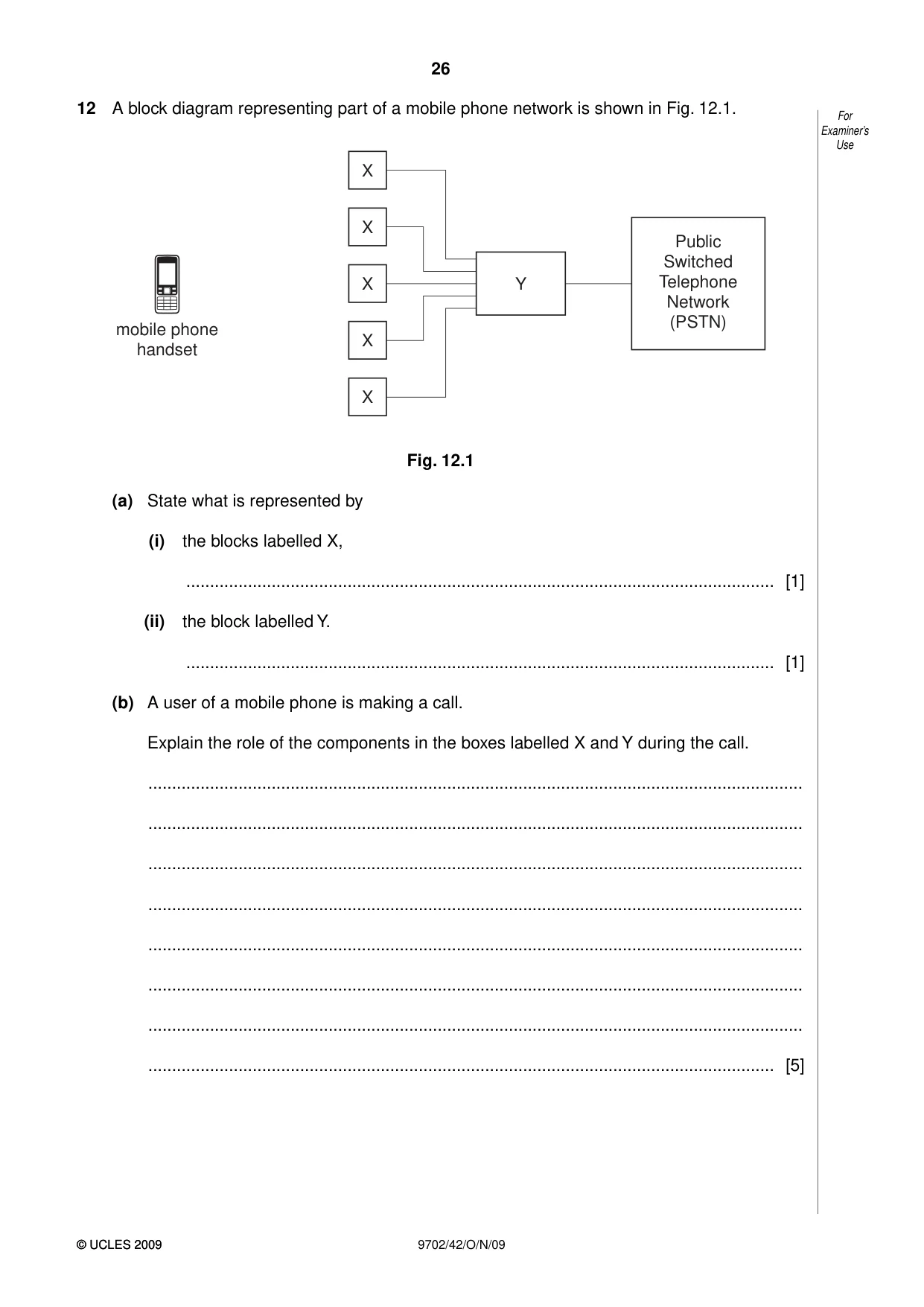
12 A block diagram representing part of a mobile phone network is shown in Fig. 12.1. For Examiner’s Use X X Public Switched X Y Telephone Network (PSTN) mobile phone X handset X Fig. 12.1 (a) State what is represented by (i) the blocks labelled X, ............................................................................................................................ [1] (ii) the block labelled Y. ............................................................................................................................ [1] (b) A user of a mobile phone is making a call. Explain the role of the components in the boxes labelled X and Y during the call. .......................................................................................................................................... .......................................................................................................................................... .......................................................................................................................................... .......................................................................................................................................... .......................................................................................................................................... .......................................................................................................................................... .......................................................................................................................................... .................................................................................................................................... [5]
Mark scheme: 12 (a) (i) base stations ...................................................................................................... B1 [1] (ii) cellular exchange ................................................................................................ B1 [1] (b) base station / X sends / receives signal to / from handset ...................... .................. B1 call relayed to cellular exchange / Y (and on to PSTN) ............................................. B1 computer at cellular exchange monitors signal from base stations ........................... B1 selects base station with strongest signal ................................................................. B1 allocates a (carrier) frequency / time slot for the call ................................................ B1 [5] [Total: 7]
What was in this paper
The subtopics covered by these 12 questions, and how many questions each got. Open one in a new tab to see every Cambridge question on it.
What you needed in this session
Cambridge’s own grade thresholds for 2009 Oct/Nov, Paper 4 · Variant 2. A higher threshold means an easier paper — the bar moves with how the cohort did.