Questions as text
Q1 · A particle is in a uniform field 9702/11 Oct/Nov 2008
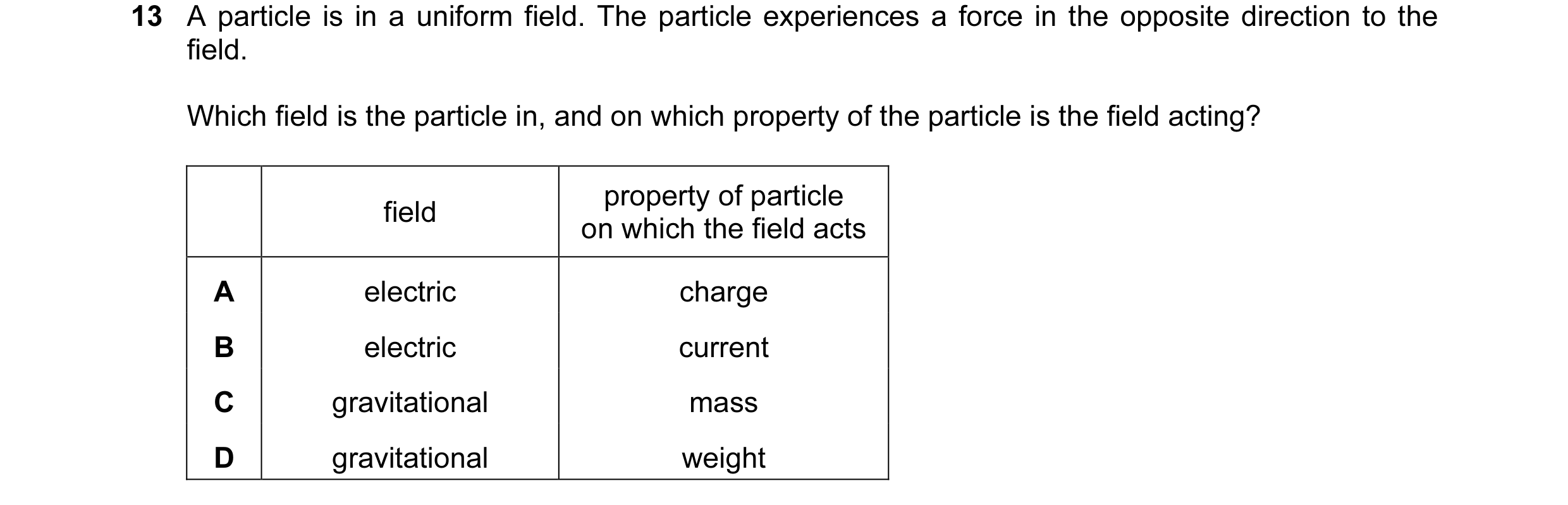
13 A particle is in a uniform field. The particle experiences a force in the opposite direction to the field. Which field is the particle in, and on which property of the particle is the field acting? property of particle field on which the field acts A electric charge B electric current C gravitational mass D gravitational weight
1 marks
Answer: A
This question in 9702/11 Oct/Nov 2008
Q2 · A particle has a charge of 4.8 × 10⁻¹⁹ C 9702/11 Oct/Nov 2008
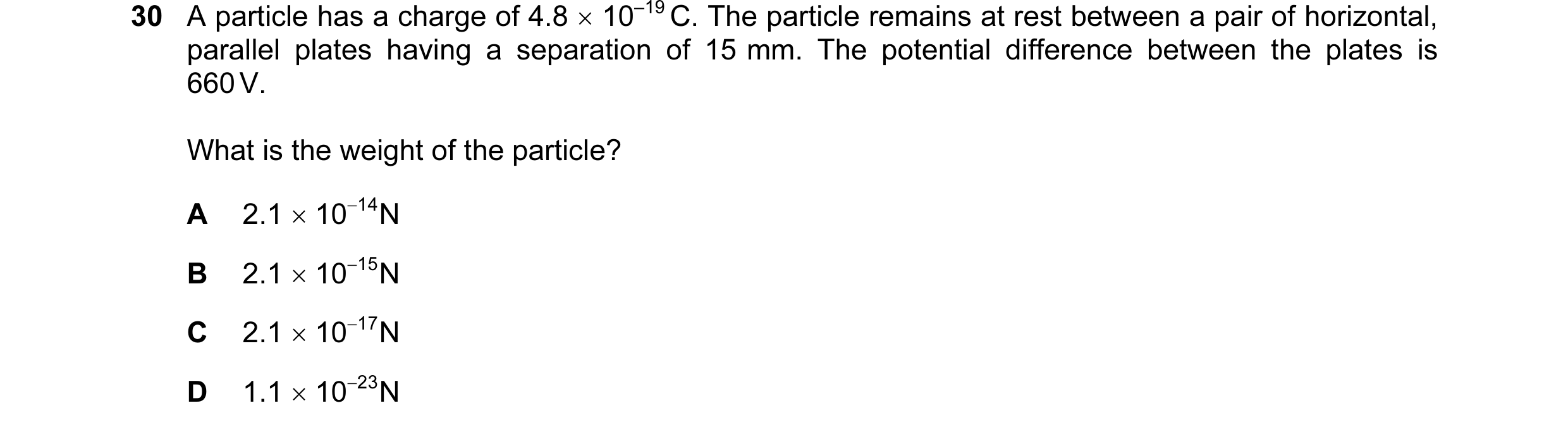
30 A particle has a charge of 4.8 × 10⁻¹⁹ C. The particle remains at rest between a pair of horizontal, parallel plates having a separation of 15 mm. The potential difference between the plates is 660 V. What is the weight of the particle? A 2.1 × 10⁻¹⁴ N B 2.1 × 10⁻¹⁵ N C 2.1 × 10⁻¹⁷ N D 1.1 × 10⁻²³ N
1 marks
Answer: A
This question in 9702/11 Oct/Nov 2008
Q3 · The gravitational field strength on the surface of planet P is one tenth of that on the… 9702/13 Oct/Nov 2010
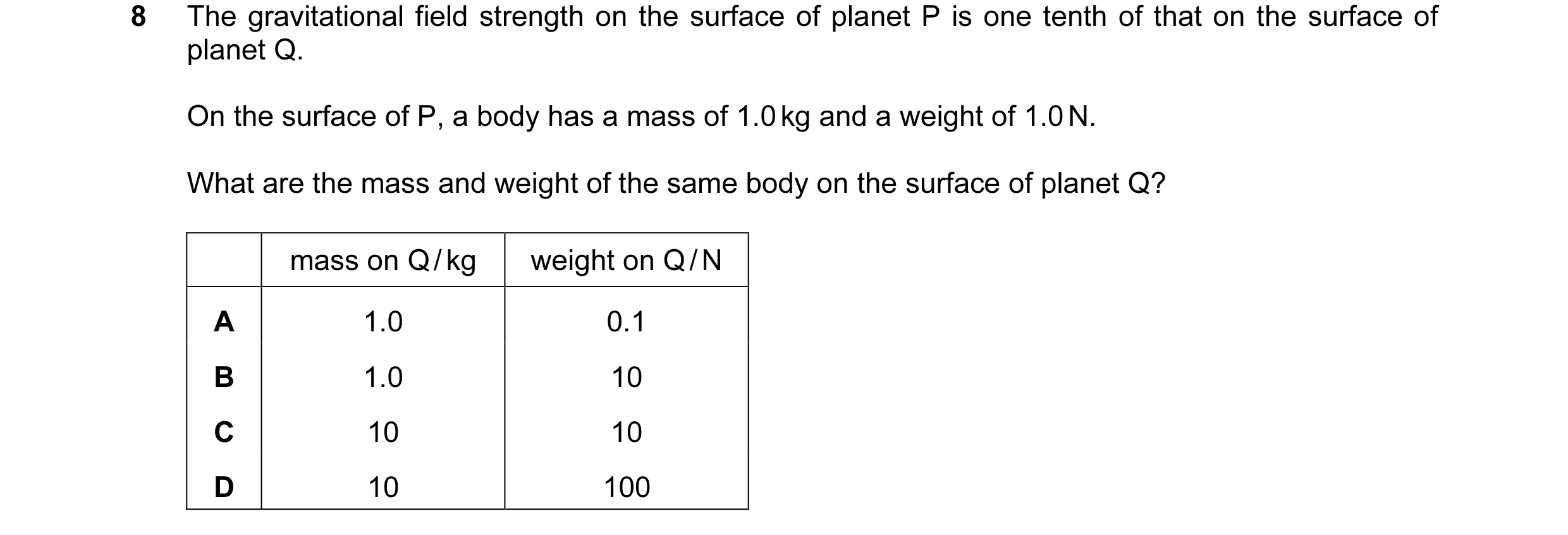
8 The gravitational field strength on the surface of planet P is one tenth of that on the surface of planet Q. On the surface of P, a body has a mass of 1.0 kg and a weight of 1.0 N. What are the mass and weight of the same body on the surface of planet Q? mass on Q / kg weight on Q / N A 1.0 0.1 B 1.0 10 C 10 10 D 10 100
1 marks
Answer: B
This question in 9702/13 Oct/Nov 2010
Q4 · A mass m is situated in space in a uniform gravitational field 9702/11 Oct/Nov 2011
20 A mass m is situated in space in a uniform gravitational field. gravitational P Q field lines x When the mass moves through a displacement x, from P to Q, it loses an amount of potential energy E. Which row correctly specifies the magnitude and the direction of the acceleration due to the gravity in this field? magnitude direction E A → mx E B ← mx E C → x E D ← x
1 marks
Answer: A
This question in 9702/11 Oct/Nov 2011
Q5 · A mass m is situated in space in a uniform gravitational field 9702/13 Oct/Nov 2011
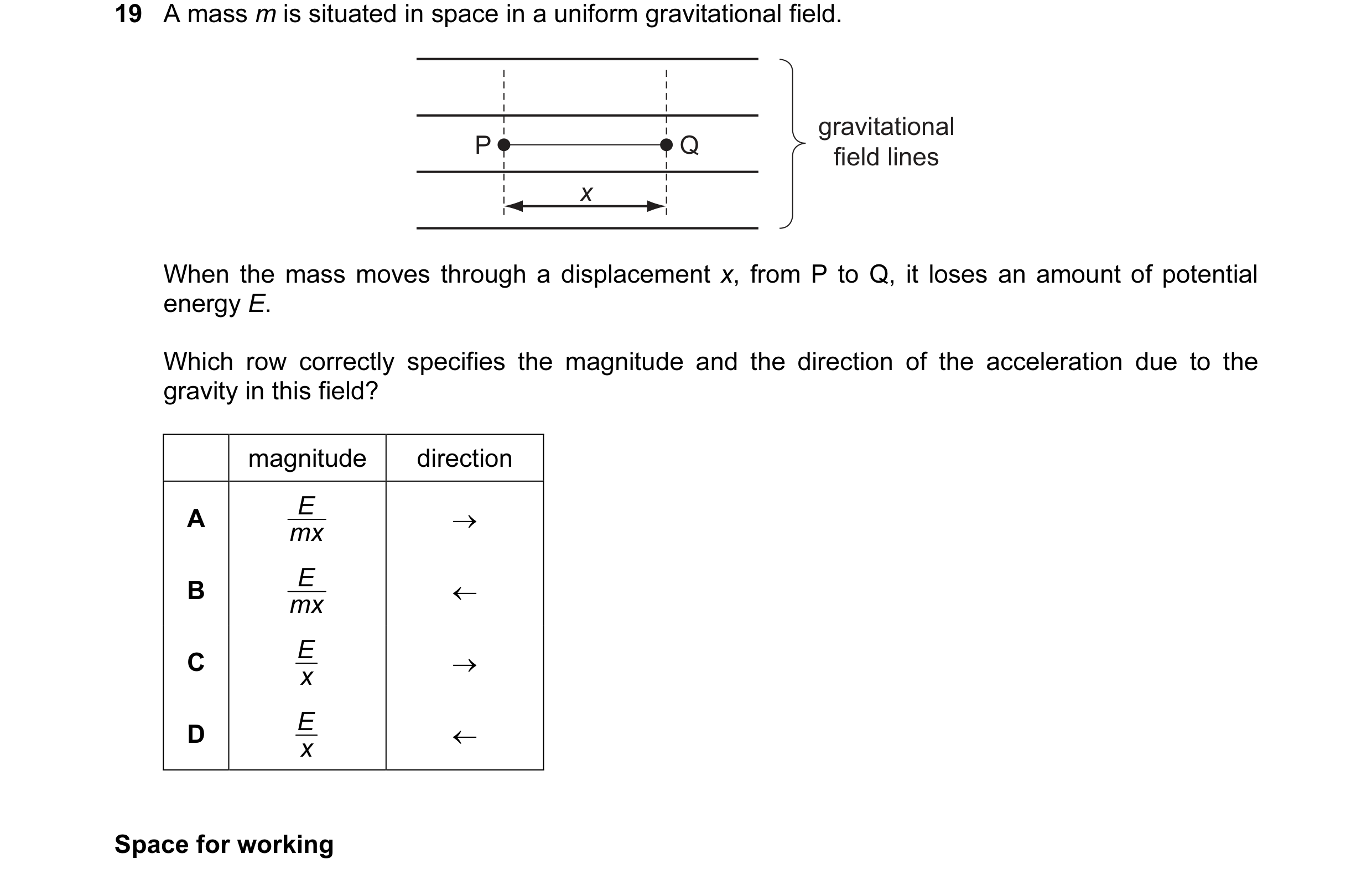
19 A mass m is situated in space in a uniform gravitational field. gravitational P Q field lines x When the mass moves through a displacement x, from P to Q, it loses an amount of potential energy E. Which row correctly specifies the magnitude and the direction of the acceleration due to the gravity in this field? magnitude direction E A → mx E B ← mx E C → x E D ← x Space for working
1 marks
Answer: A
This question in 9702/13 Oct/Nov 2011
Q6 · A particle is in a uniform field 9702/11 Oct/Nov 2013
13 A particle is in a uniform field. The particle experiences a force in the opposite direction to the field. Which field is the particle in, and on which property of the particle is the field acting? property of particle field on which the field acts A electric charge B electric current C gravitational mass D gravitational weight
1 marks
Answer: A
This question in 9702/11 Oct/Nov 2013
Q7 · A particle is in a uniform field 9702/12 Oct/Nov 2013
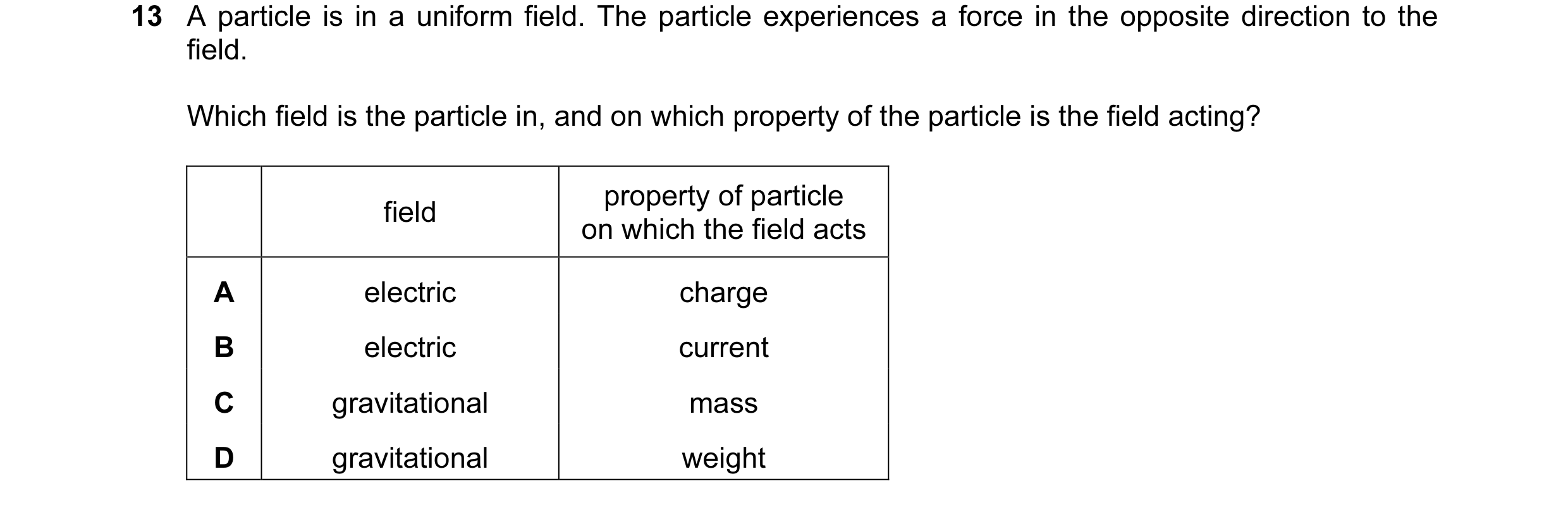
13 A particle is in a uniform field. The particle experiences a force in the opposite direction to the field. Which field is the particle in, and on which property of the particle is the field acting? property of particle field on which the field acts A electric charge B electric current C gravitational mass D gravitational weight
1 marks
Answer: A
This question in 9702/12 Oct/Nov 2013
Q8 · A mass m is situated in a uniform gravitational field 9702/11 Oct/Nov 2014
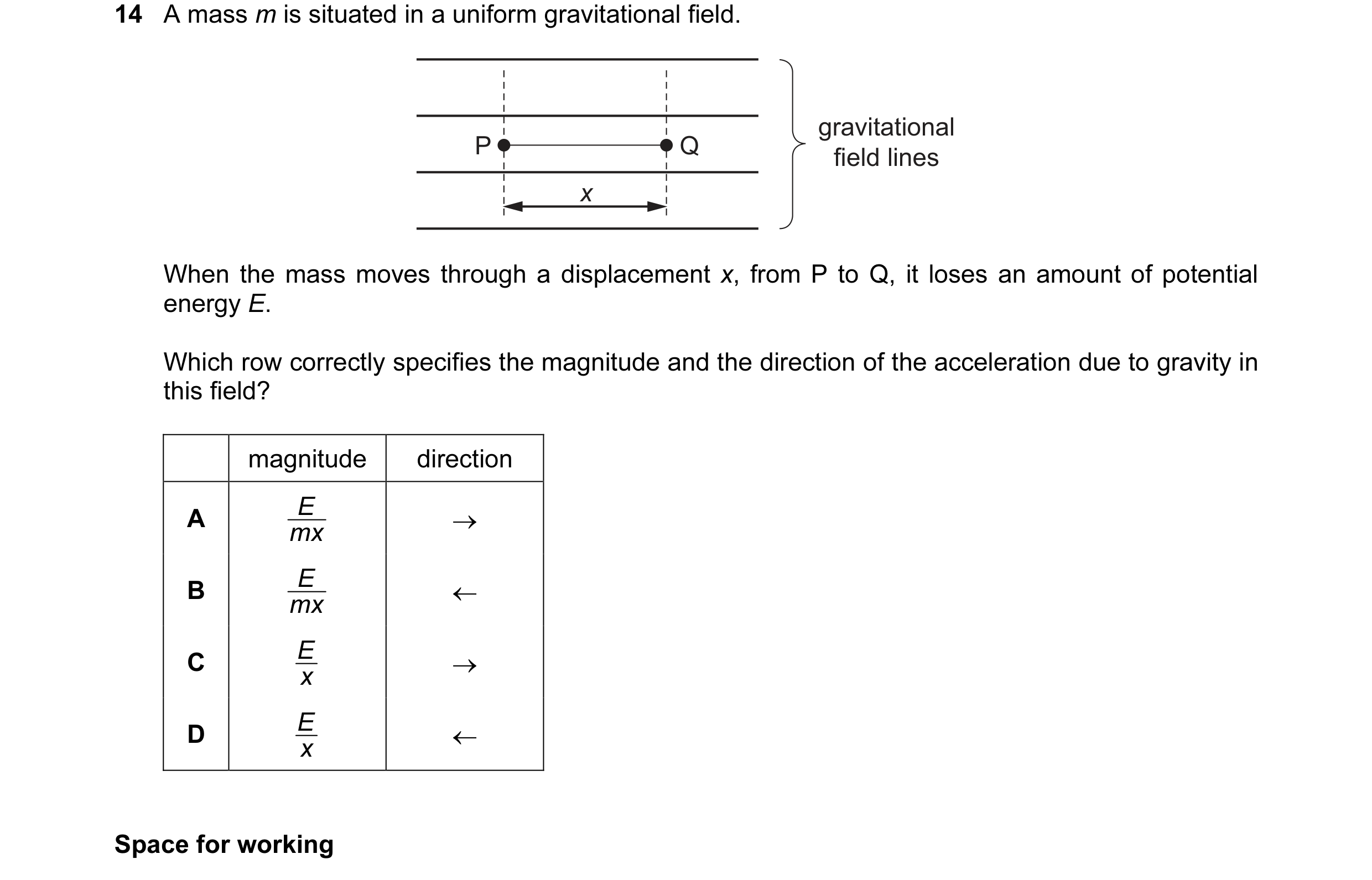
14 A mass m is situated in a uniform gravitational field. gravitational P Q field lines x When the mass moves through a displacement x, from P to Q, it loses an amount of potential energy E. Which row correctly specifies the magnitude and the direction of the acceleration due to gravity in this field? magnitude direction E A → mx E B ← mx E C → x E D ← x Space for working
1 marks
Answer: A
This question in 9702/11 Oct/Nov 2014
Q9 · A mass m is situated in a uniform gravitational field 9702/12 Oct/Nov 2014
14 A mass m is situated in a uniform gravitational field. gravitational P Q field lines x When the mass moves through a displacement x, from P to Q, it loses an amount of potential energy E. Which row correctly specifies the magnitude and the direction of the acceleration due to gravity in this field? magnitude direction E A → mx E B ← mx E C → x E D ← x Space for working
1 marks
Answer: A
This question in 9702/12 Oct/Nov 2014
Q10 · A particle with mass and charge is moving from left to right in a uniform gravitational… 9702/11 May/June 2017
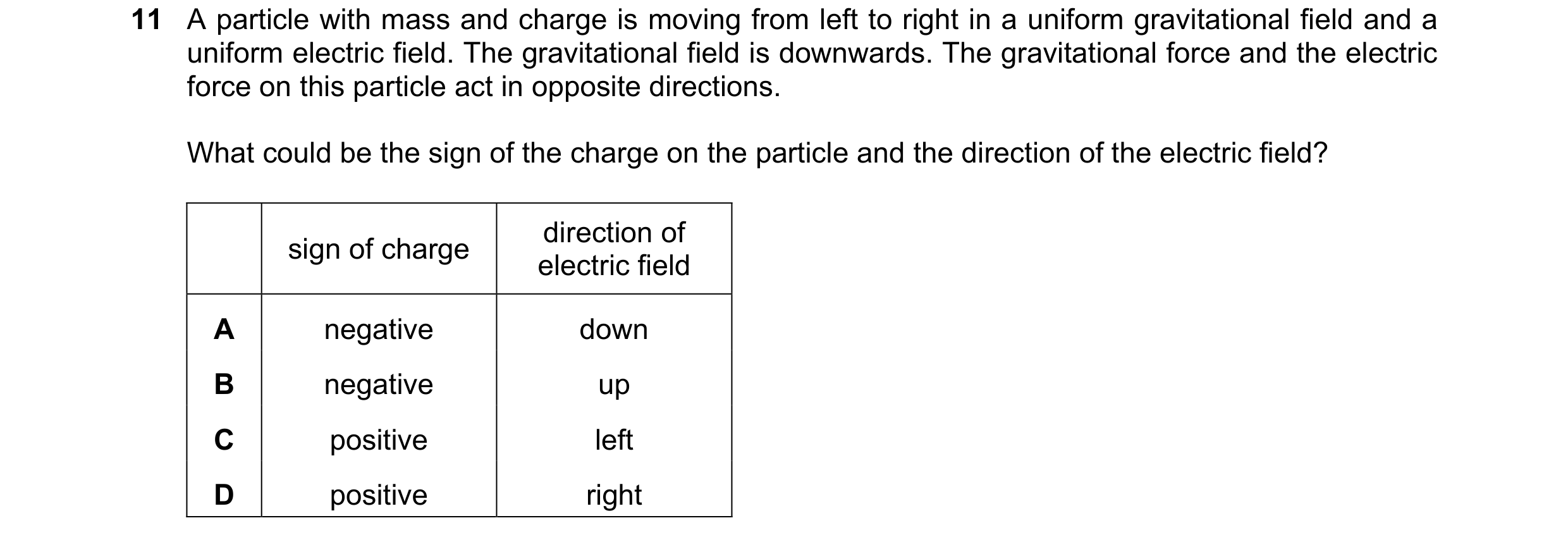
11 A particle with mass and charge is moving from left to right in a uniform gravitational field and a uniform electric field. The gravitational field is downwards. The gravitational force and the electric force on this particle act in opposite directions. What could be the sign of the charge on the particle and the direction of the electric field? direction of sign of charge electric field A negative down B negative up C positive left D positive right
1 marks
Answer: A
This question in 9702/11 May/June 2017
Q11 · A charged oil drop is held stationary between two charged parallel plates 9702/12 Feb/March 2018
12 A charged oil drop is held stationary between two charged parallel plates. top plate charged oil drop bottom plate Which forces act on the oil drop? A both electric and gravitational B electric only C gravitational only D neither electric nor gravitational
1 marks
Answer: A
This question in 9702/12 Feb/March 2018
Q12 · A charged particle is placed in a uniform field of force 9702/11 Oct/Nov 2018
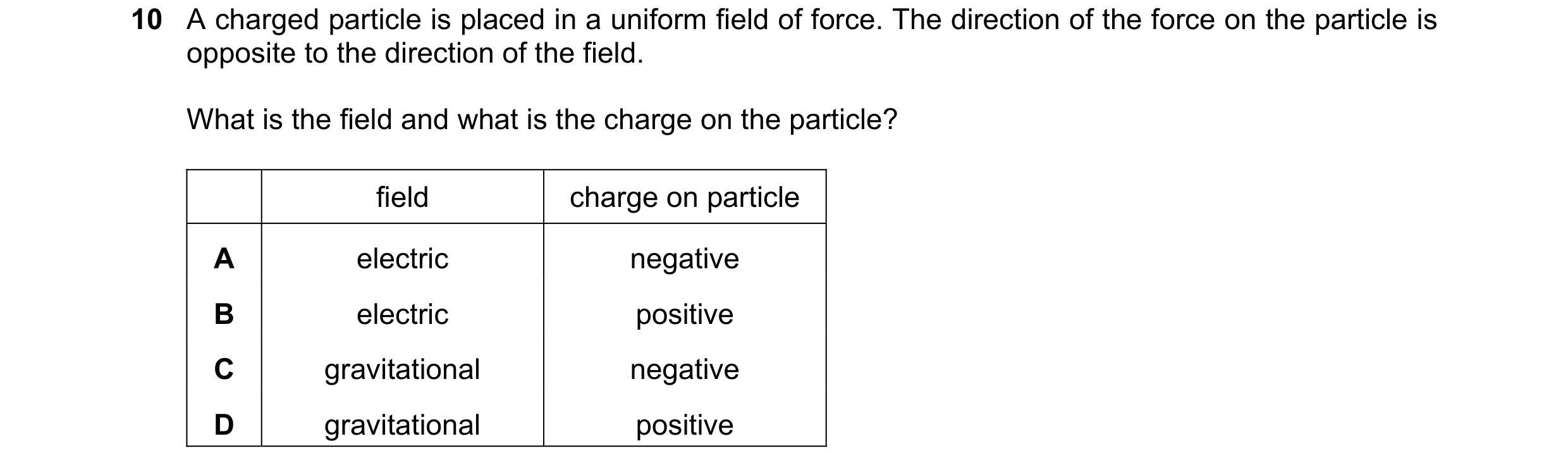
10 A charged particle is placed in a uniform field of force. The direction of the force on the particle is opposite to the direction of the field. What is the field and what is the charge on the particle? field charge on particle A electric negative B electric positive C gravitational negative D gravitational positive
1 marks
Answer: A
This question in 9702/11 Oct/Nov 2018
Q13 · On the surface of a planet, 30 J of work is done against gravity to raise a mass of 1.0… 9702/13 May/June 2019
18 On the surface of a planet, 30 J of work is done against gravity to raise a mass of 1.0 kg through a height of 10 m. How much work must be done to raise a mass of 4.0 kg through a height of 5.0 m on this planet? A 15 J B 60 J C 120 J D 200 J
1 marks
Answer: B
This question in 9702/13 May/June 2019
Q14 · A particle is in a uniform field 9702/12 Feb/March 2020
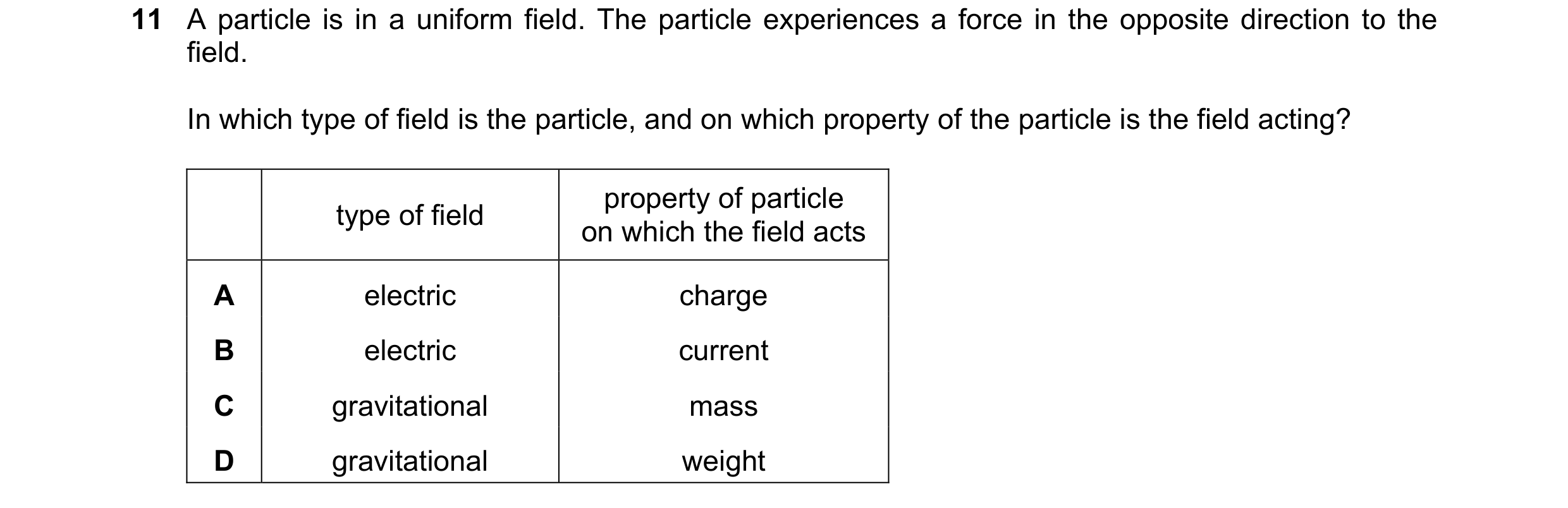
11 A particle is in a uniform field. The particle experiences a force in the opposite direction to the field. In which type of field is the particle, and on which property of the particle is the field acting? property of particle type of field on which the field acts A electric charge B electric current C gravitational mass D gravitational weight
1 marks
Answer: A
This question in 9702/12 Feb/March 2020
Q15 · The diagrams show a negative electric charge situated in a uniform electric field and a… 9702/12 May/June 2020
10 The diagrams show a negative electric charge situated in a uniform electric field and a mass situated in a uniform gravitational field. – charge mass uniform electric field uniform gravitational field Which row shows the directions of the forces acting on the charge and on the mass? charge mass A – B – C – D –
1 marks
Answer: B
This question in 9702/12 May/June 2020
Q16 · A charged oil drop is held stationary between two charged parallel plates 9702/11 May/June 2021
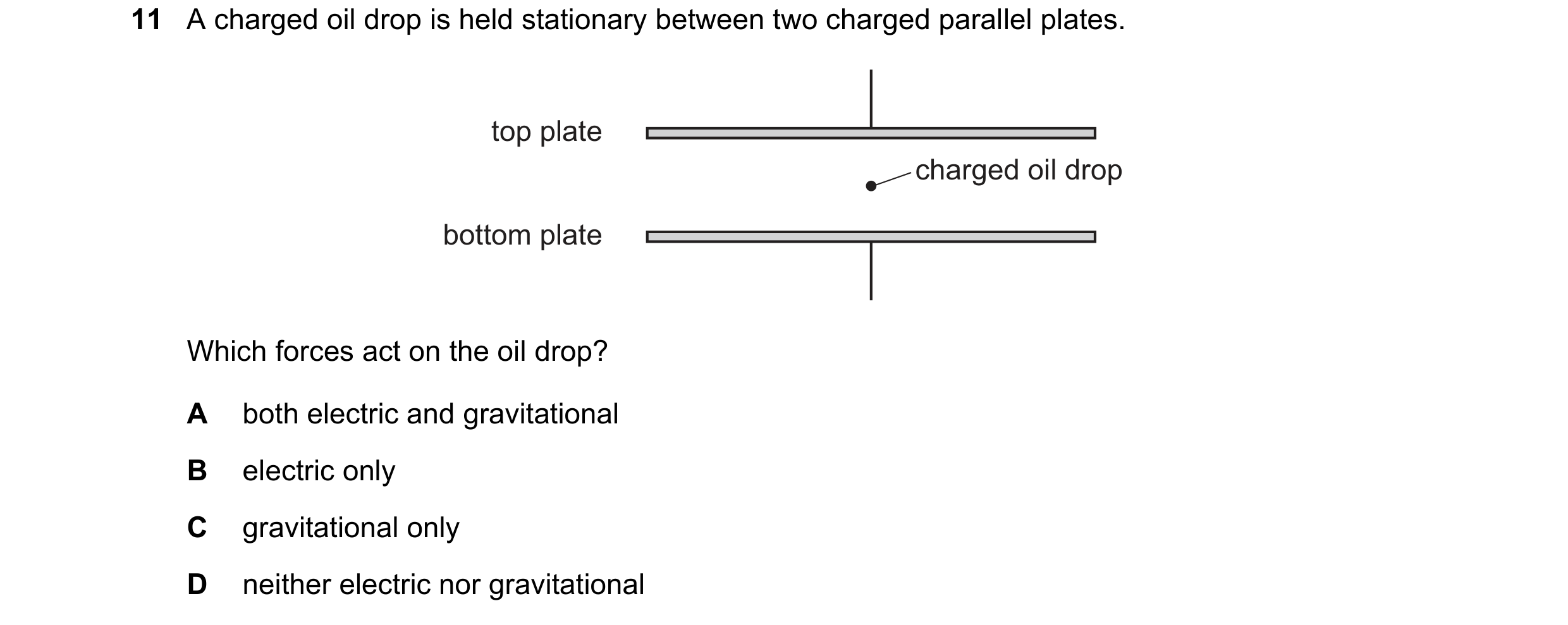
11 A charged oil drop is held stationary between two charged parallel plates. top plate charged oil drop bottom plate Which forces act on the oil drop? A both electric and gravitational B electric only C gravitational only D neither electric nor gravitational
1 marks
Answer: A
This question in 9702/11 May/June 2021
Q17 · Which statement must be true for an object in a gravitational field? 9702/11 Oct/Nov 2021
9 Which statement must be true for an object in a gravitational field? A If the object has mass then the field causes it to accelerate. B If the object has mass then the field causes it to have weight. C If the object has weight then the field causes it to accelerate. D If the object has weight then the field causes it to have mass.
1 marks
Answer: B
This question in 9702/11 Oct/Nov 2021
Q18 · An object of mass m is dropped onto the surface of two planets, X and Y, which have no… 9702/12 Oct/Nov 2022
19 An object of mass m is dropped onto the surface of two planets, X and Y, which have no atmosphere. The height from which the object is dropped and the change in gravitational potential energy of the object, for each planet, are given in the table. change in gravitational height / m potential energy planet X 3 ∆E planet Y 4 4∆E The acceleration of free fall near the surface of planet X is gX. What is the acceleration of free fall near the surface of planet Y? 3 g 4 g A B C 3gX D 4gX 4 X 3 X
1 marks
Answer: C
This question in 9702/12 Oct/Nov 2022
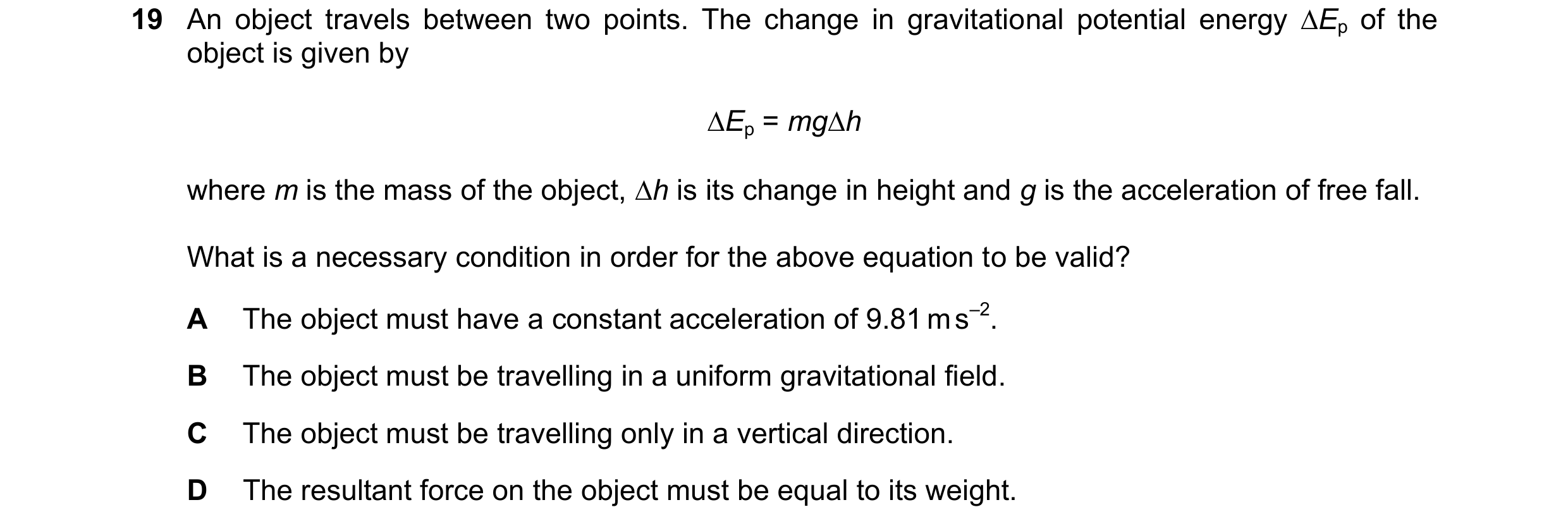
Q19 · An object travels between two points 9702/14 Oct/Nov 2025
19 An object travels between two points. The change in gravitational potential energy Ep of the object is given by Ep = mgh where m is the mass of the object, h is its change in height and g is the acceleration of free fall. What is a necessary condition in order for the above equation to be valid? A The object must have a constant acceleration of 9.81 m s–2. B The object must be travelling in a uniform gravitational field. C The object must be travelling only in a vertical direction. D The resultant force on the object must be equal to its weight.
1 marks
Answer: B
This question in 9702/14 Oct/Nov 2025
 1 / 7
1 / 7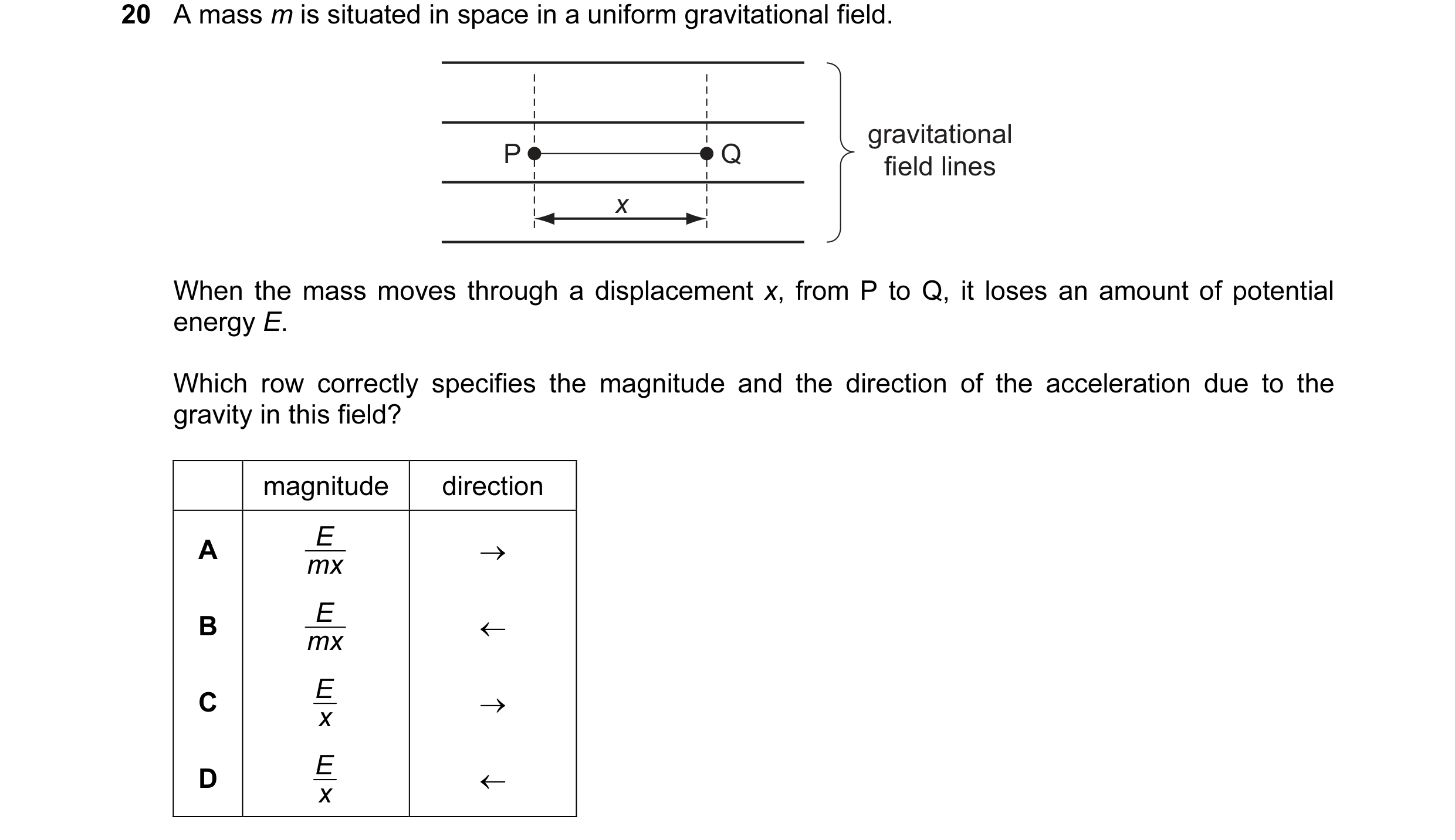
 2 / 7
2 / 7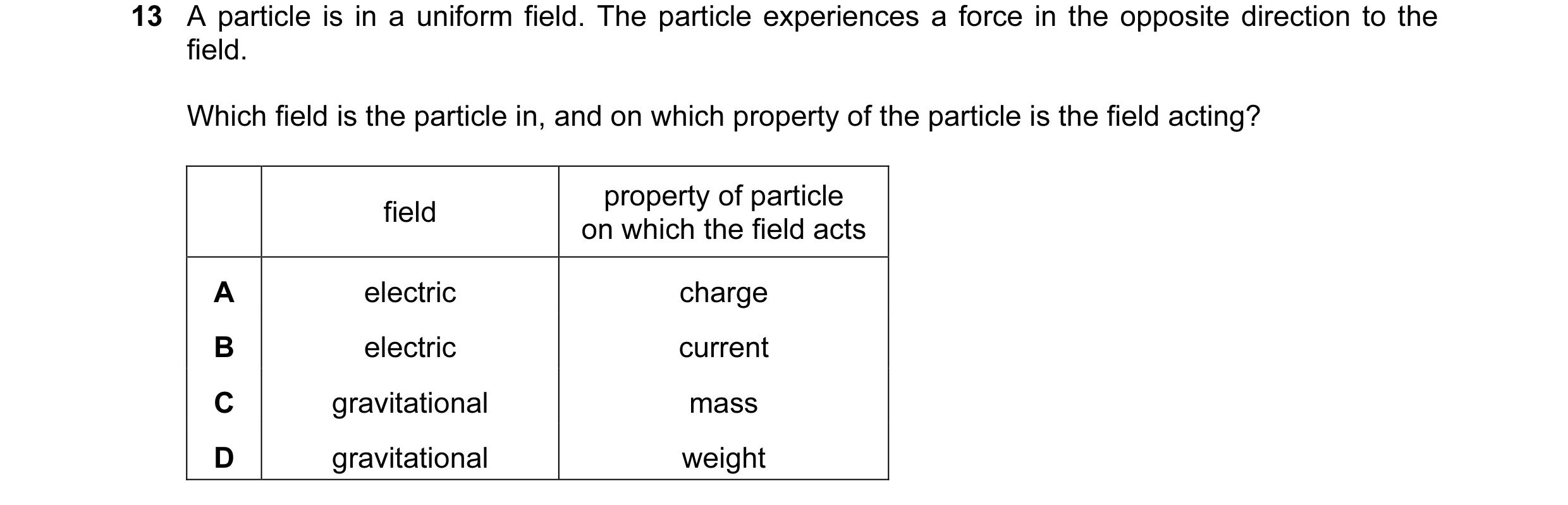
 3 / 7
3 / 7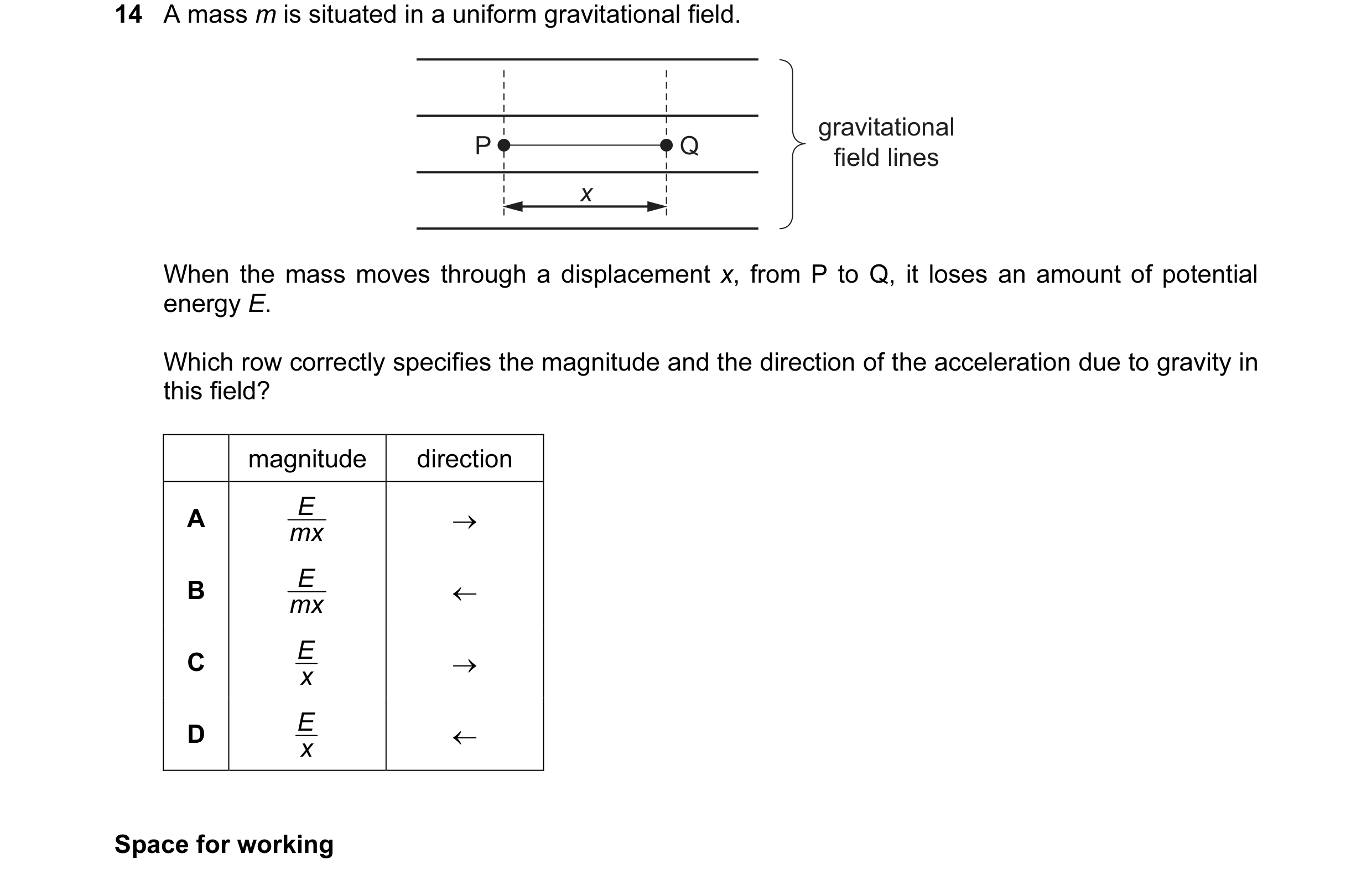
 4 / 7
4 / 7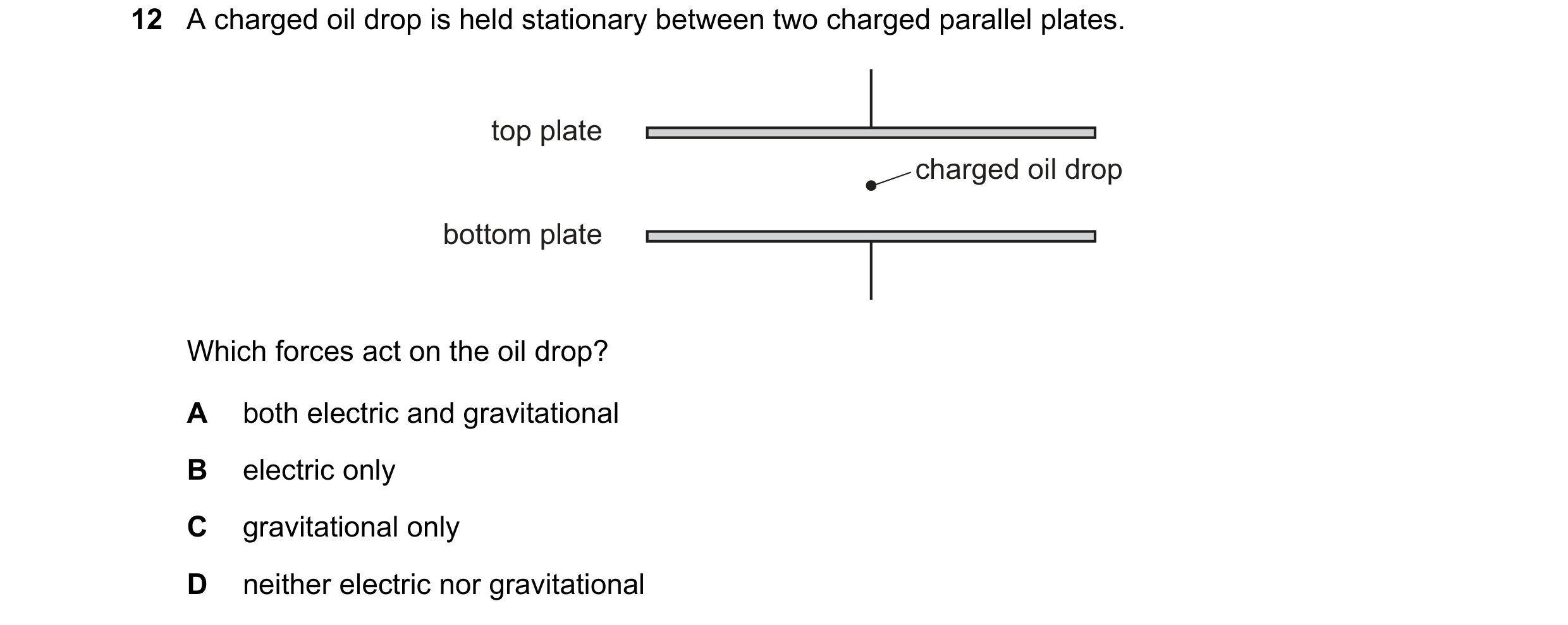

 5 / 7
5 / 7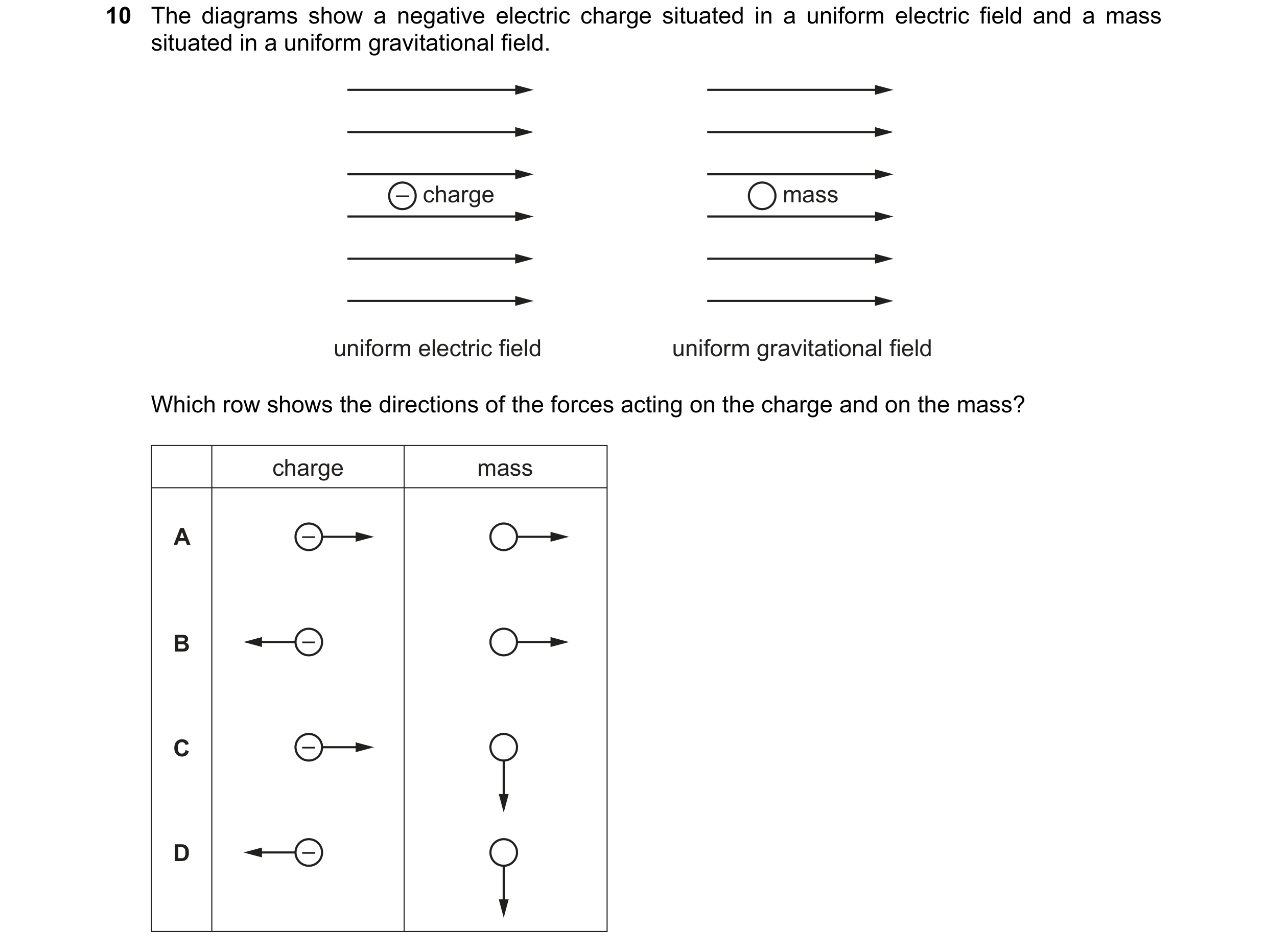
 6 / 7
6 / 7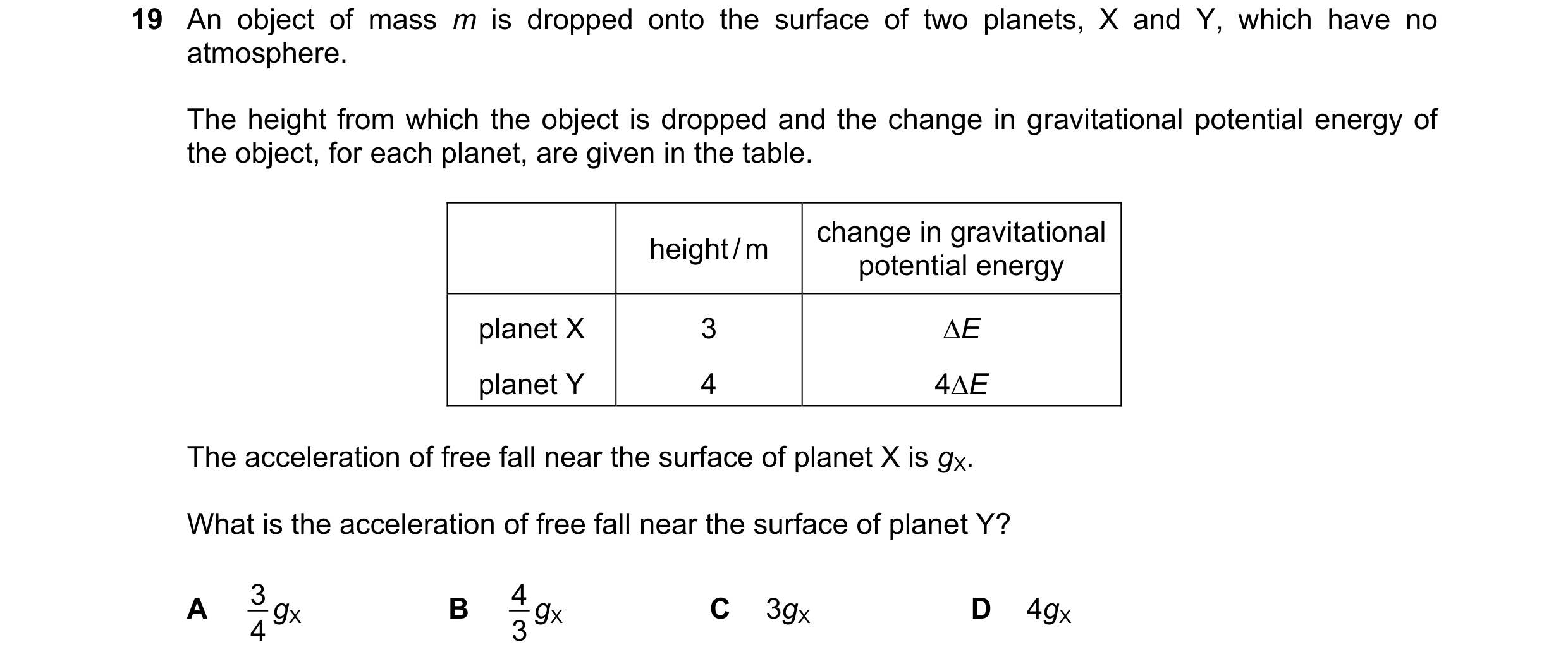
 7 / 7
7 / 7