Cambridge A Level Physics 9702 — 2023 Oct/Nov Paper 4 · Variant 3
9702/43/O/N/23 · 10 questions · 100 marks · ≈113 min
The question paper and its mark scheme, free to read here and free to download. This is Cambridge’s own paper, exactly as it was sat.
Question paper24 pages

Mark scheme16 pages
Answers below. Sit the paper first if you are practising.
Questions as text
Q1 · State what is indicated by the direction of the gravitational field line at a point in a…
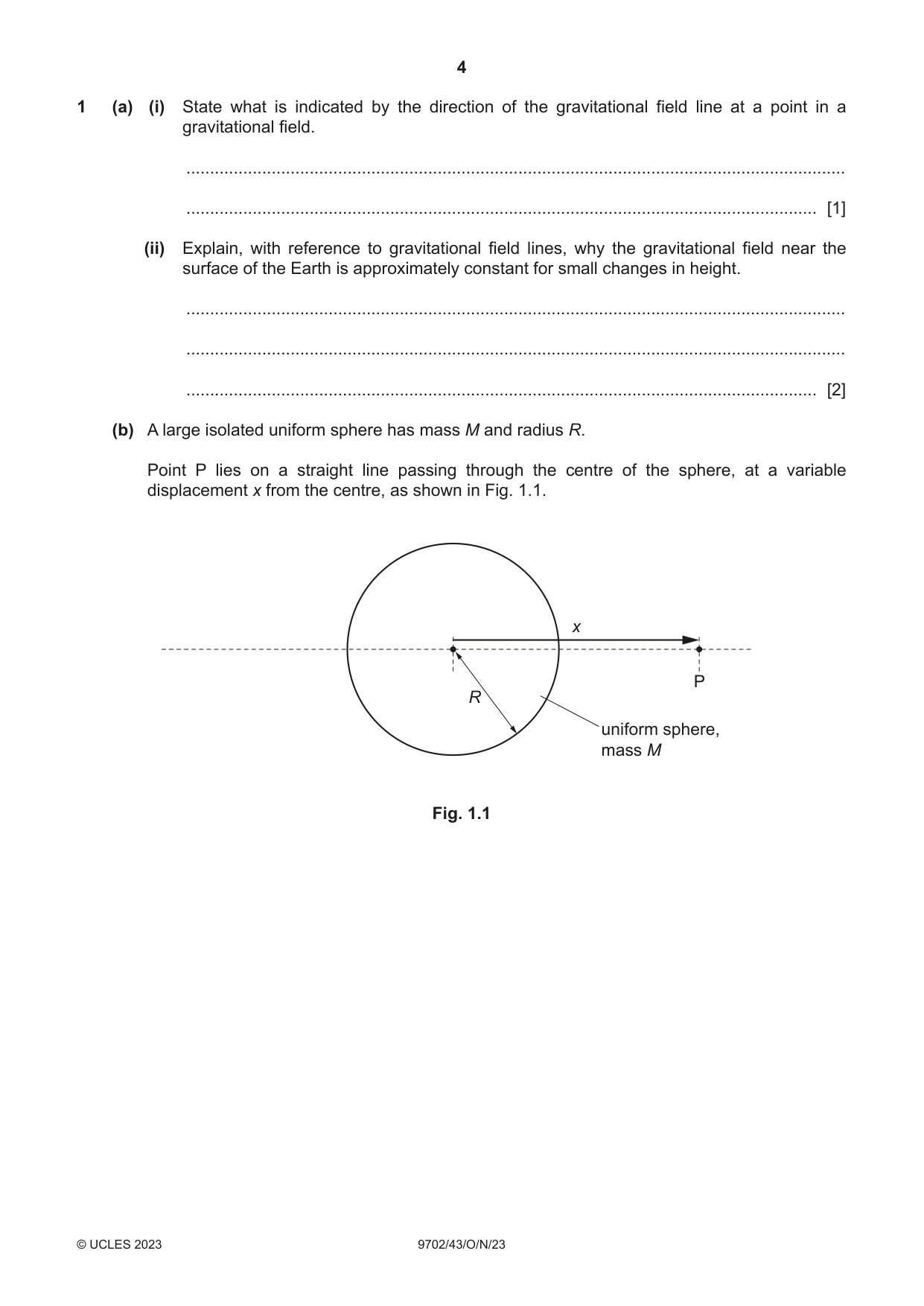
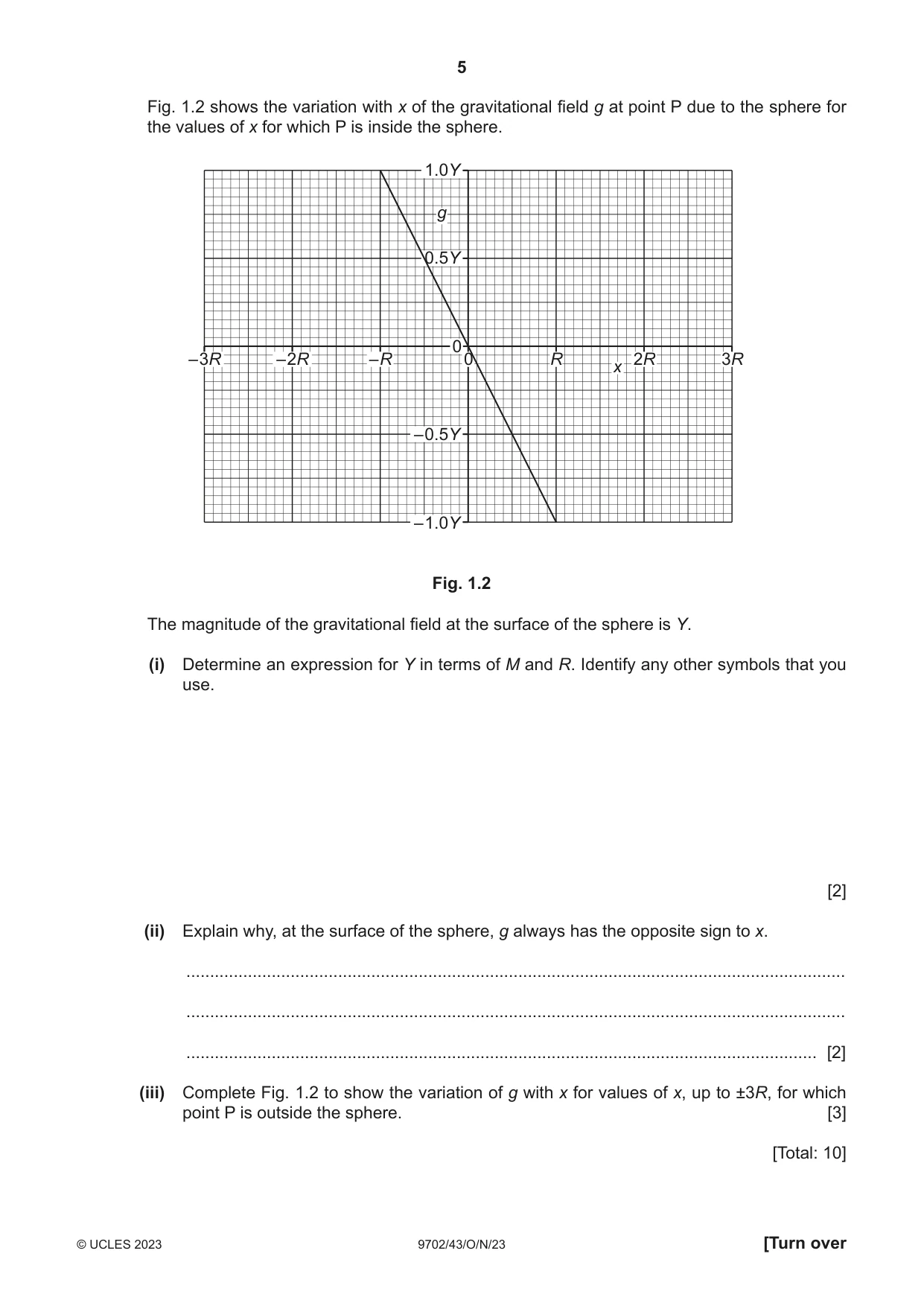
1 (a) (i) State what is indicated by the direction of the gravitational field line at a point in a gravitational field. ........................................................................................................................................... ..................................................................................................................................... [1] (ii) Explain, with reference to gravitational field lines, why the gravitational field near the surface of the Earth is approximately constant for small changes in height. ........................................................................................................................................... ........................................................................................................................................... ..................................................................................................................................... [2] (b) A large isolated uniform sphere has mass M and radius R. Point P lies on a straight line passing through the centre of the sphere, at a variable displacement x from the centre, as shown in Fig. 1.1. x P R uniform sphere, mass M Fig. 1.1 Fig. 1.2 shows the variation with x of the gravitational field g at point P due to the sphere for the values of x for which P is inside the sphere. 1.0Y g 0.5Y 0 – 3R – 2R – R 0 R 2R 3R x – 0.5Y – 1.0Y Fig. 1.2 The magnitude of the gravitational field at the surface of the sphere is Y. (i) Determine an expression for Y in terms of M and R. Identify any other symbols that you use. [2] (ii) Explain why, at the surface of the sphere, g always has the opposite sign to x. ........................................................................................................................................... ........................................................................................................................................... ..................................................................................................................................... [2] (iii) Complete Fig. 1.2 to show the variation of g with x for values of x, up to ±3R, for which point P is outside the sphere. [3] [Total: 10]
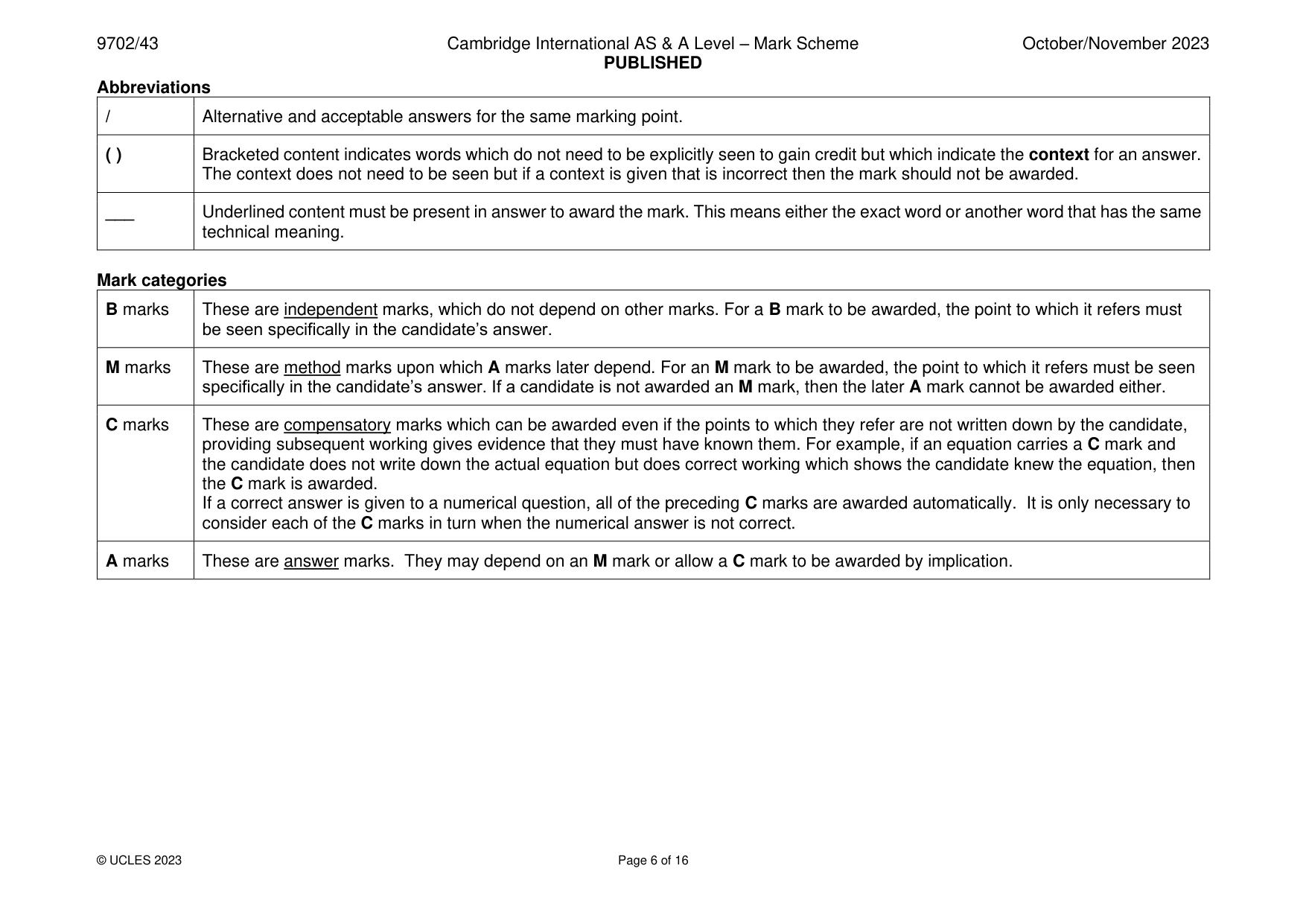
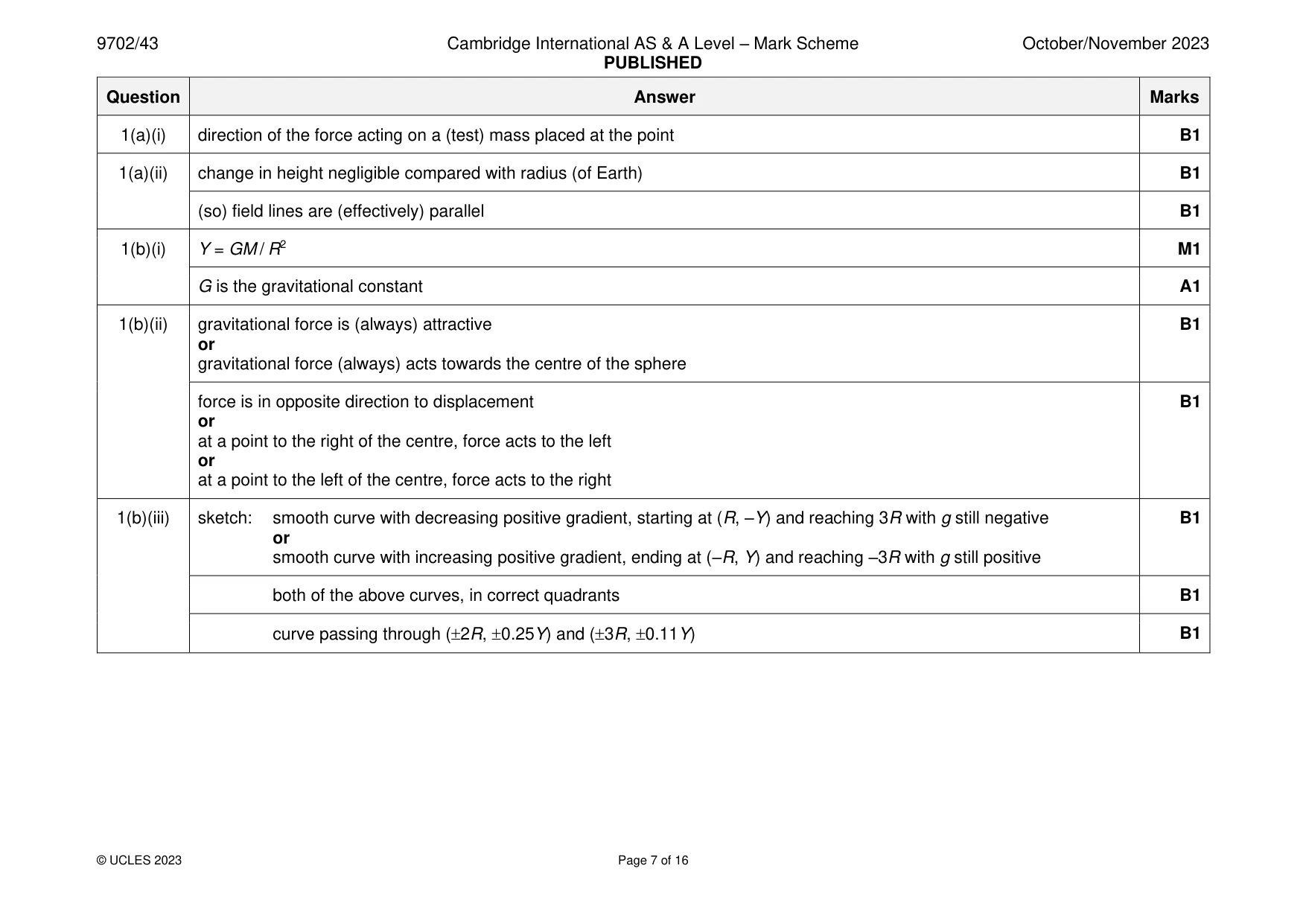
Mark scheme: Question Answer Marks 1(a)(i) direction of the force acting on a (test) mass placed at the point B1 1(a)(ii) change in height negligible compared with radius (of Earth) B1 (so) field lines are (effectively) parallel B1 1(b)(i) Y = GM / R2 M1 G is the gravitational constant A1 1(b)(ii) gravitational force is (always) attractive B1 or gravitational force (always) acts towards the centre of the sphere force is in opposite direction to displacement B1 or at a point to the right of the centre, force acts to the left or at a point to the left of the centre, force acts to the right 1(b)(iii) sketch: smooth curve with decreasing positive gradient, starting at (R, –Y) and reaching 3R with g still negative B1 or smooth curve with increasing positive gradient, ending at (–R, Y) and reaching –3R with g still positive both of the above curves, in correct quadrants B1 curve passing through (2R, 0.25Y) and (3R, 0.11Y) B1
Q2 · Define specific heat capacity
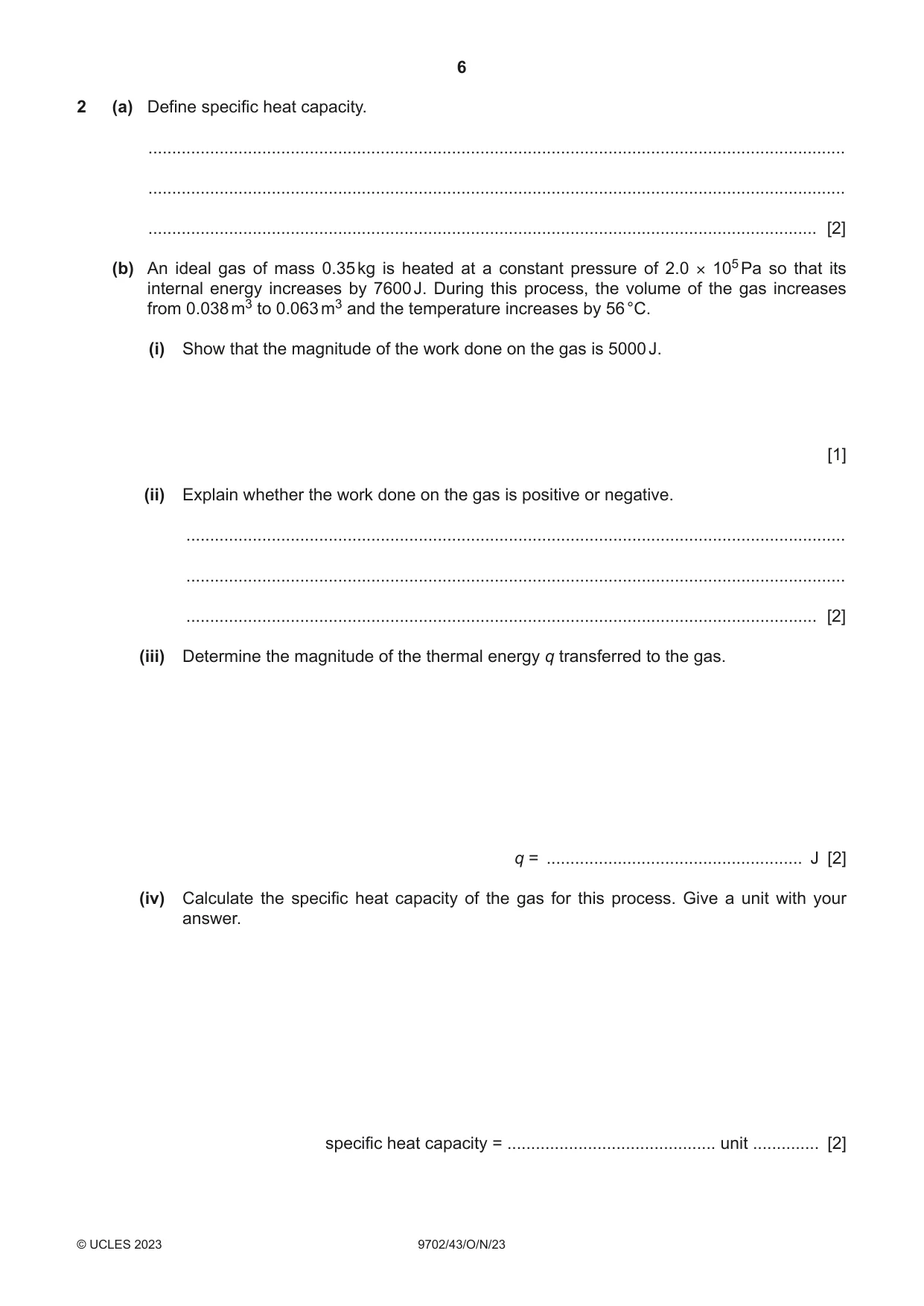
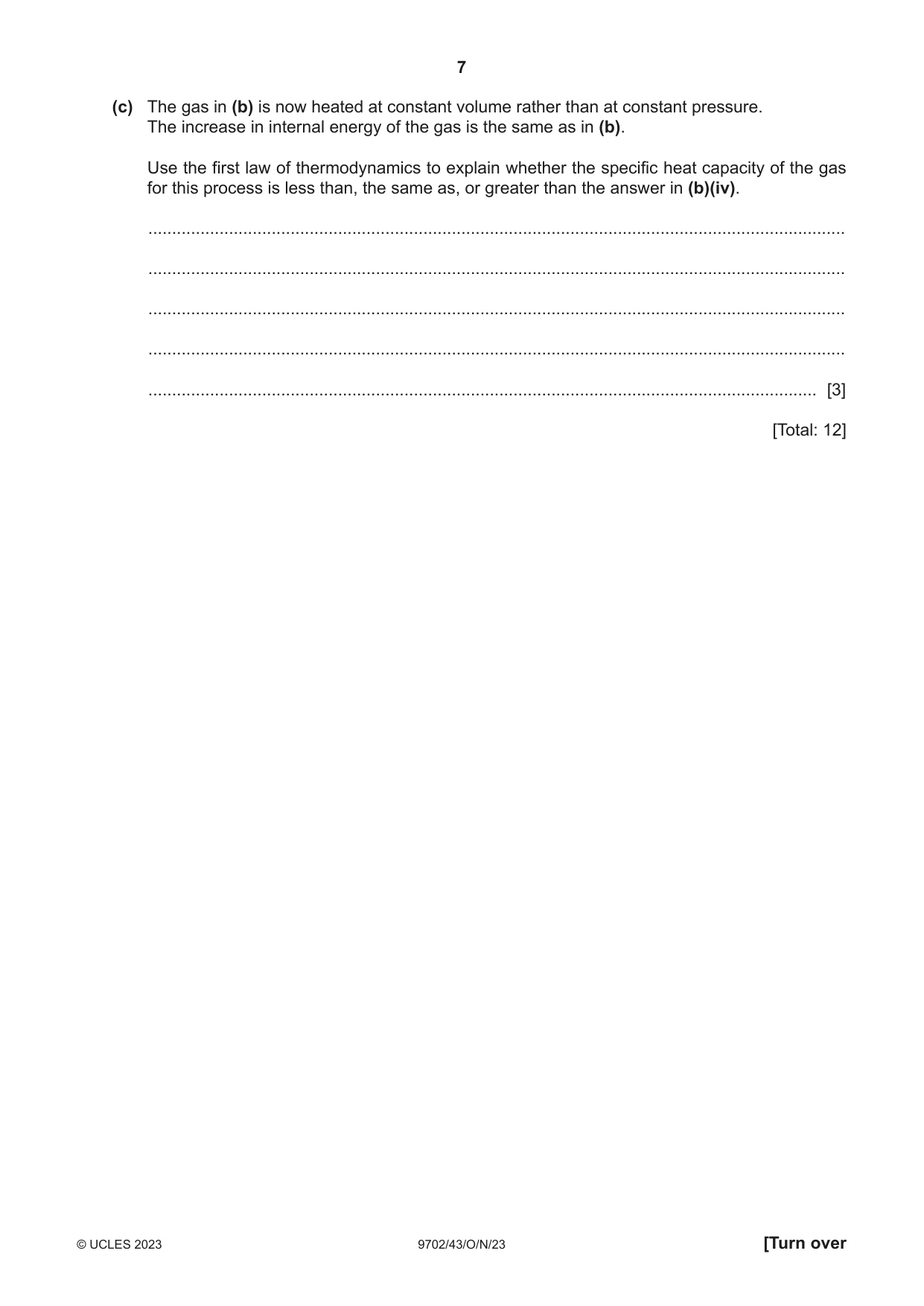
2 (a) Define specific heat capacity. ................................................................................................................................................... ................................................................................................................................................... ............................................................................................................................................. [2] (b) An ideal gas of mass 0.35 kg is heated at a constant pressure of 2.0 × 10⁵ Pa so that its internal energy increases by 7600 J. During this process, the volume of the gas increases from 0.038 m3 to 0.063 m3 and the temperature increases by 56 °C. (i) Show that the magnitude of the work done on the gas is 5000 J. [1] (ii) Explain whether the work done on the gas is positive or negative. ........................................................................................................................................... ........................................................................................................................................... ..................................................................................................................................... [2] (iii) Determine the magnitude of the thermal energy q transferred to the gas. q = ...................................................... J [2] (iv) Calculate the specific heat capacity of the gas for this process. Give a unit with your answer. specific heat capacity = ............................................ unit .............. [2] (c) The gas in (b) is now heated at constant volume rather than at constant pressure. The increase in internal energy of the gas is the same as in (b). Use the first law of thermodynamics to explain whether the specific heat capacity of the gas for this process is less than, the same as, or greater than the answer in (b)(iv). ................................................................................................................................................... ................................................................................................................................................... ................................................................................................................................................... ................................................................................................................................................... ............................................................................................................................................. [3] [Total: 12]
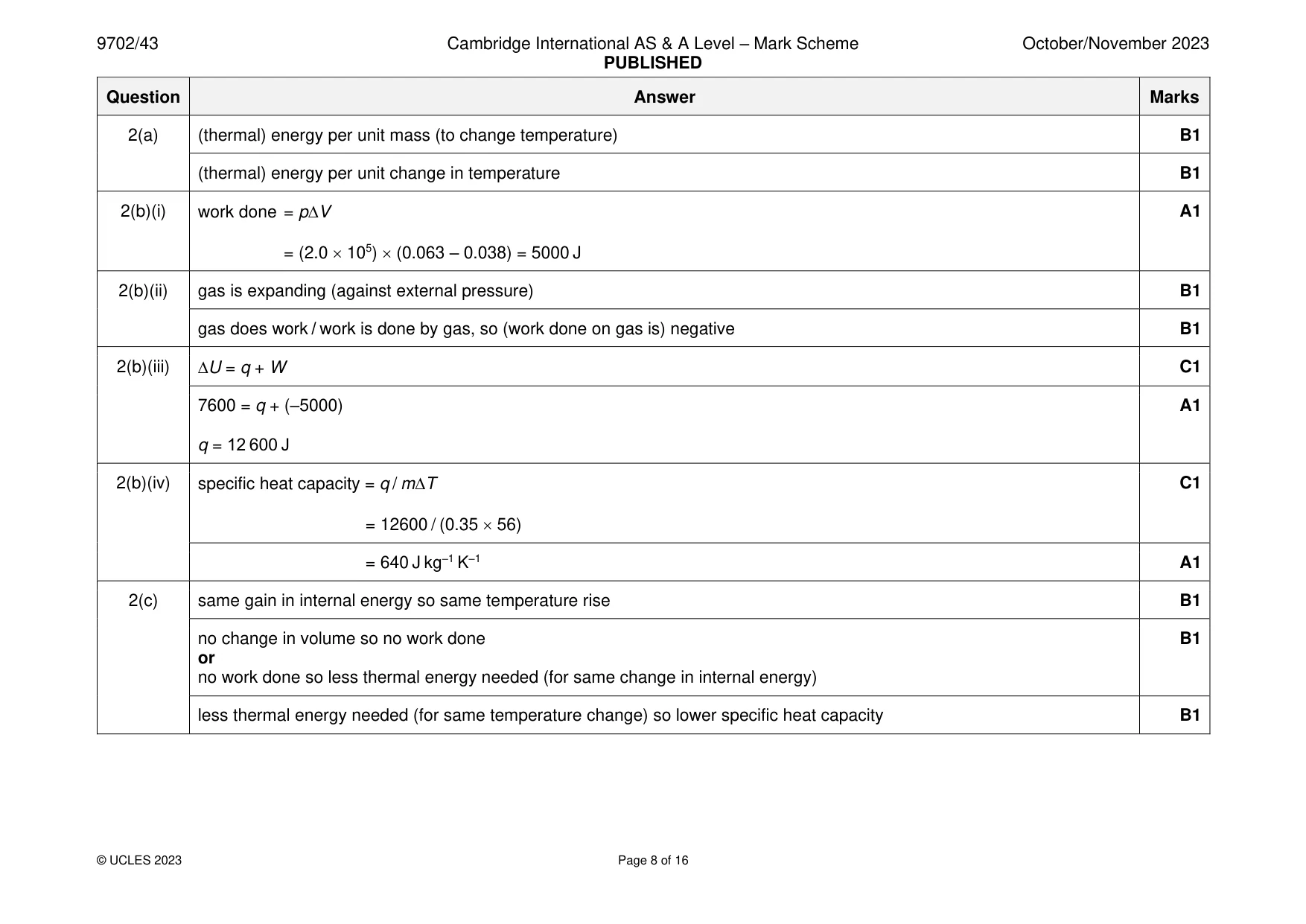
Mark scheme: 2(a) (thermal) energy per unit mass (to change temperature) B1 (thermal) energy per unit change in temperature B1 2(b)(i) work done = pV A1 = (2.0 105) (0.063 – 0.038) = 5000 J 2(b)(ii) gas is expanding (against external pressure) B1 gas does work / work is done by gas, so (work done on gas is) negative B1 2(b)(iii) U = q + W C1 7600 = q + (–5000) A1 q = 12 600 J 2(b)(iv) specific heat capacity = q / mT C1 = 12600 / (0.35 56) = 640 J kg–1 K–1 A1 2(c) same gain in internal energy so same temperature rise B1 no change in volume so no work done B1 or no work done so less thermal energy needed (for same change in internal energy) less thermal energy needed (for same temperature change) so lower specific heat capacity B1
Q3 · The product pV for an ideal gas is given by 1 pV = Nm〈c2〉 3 where p is the pressure of…
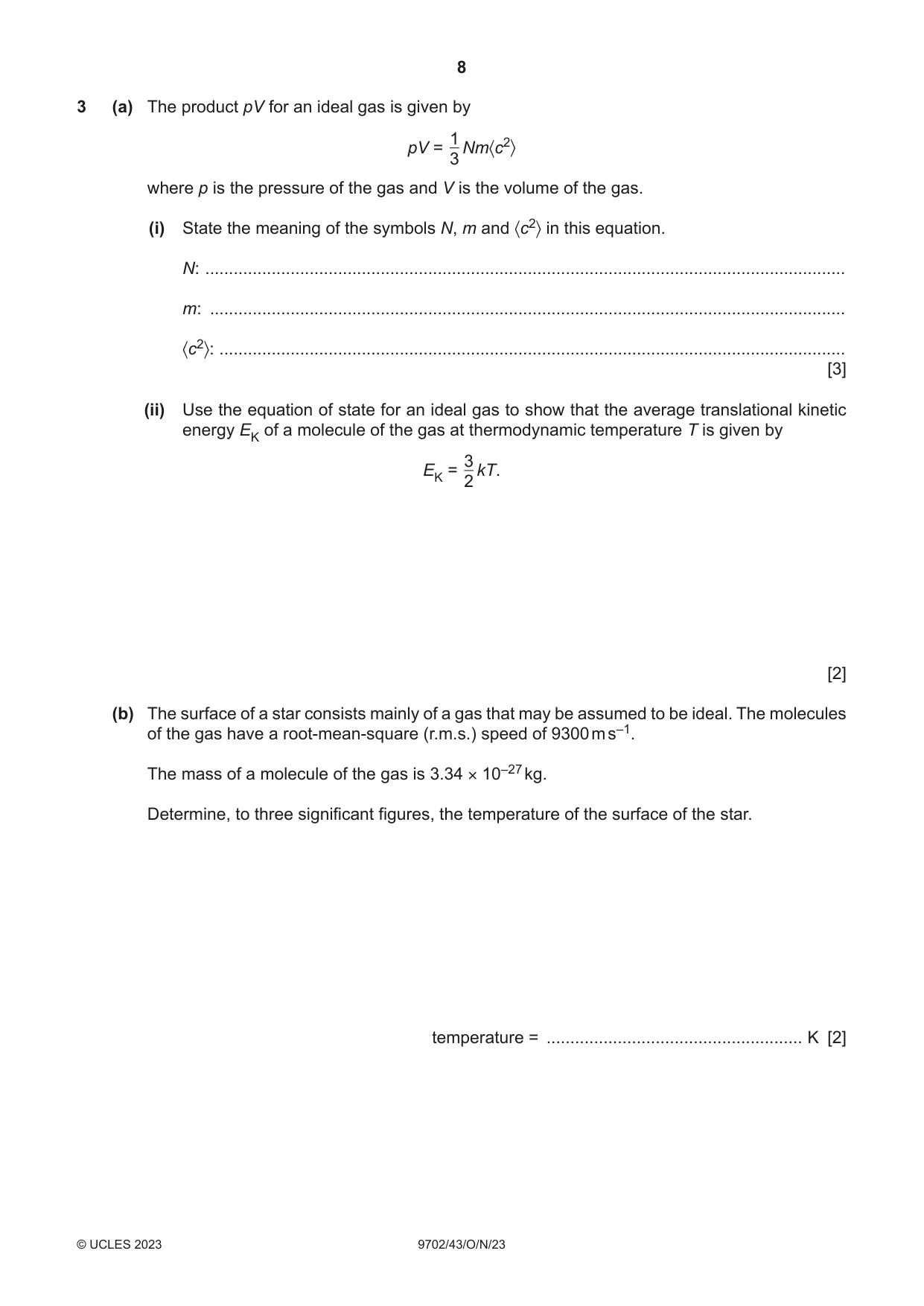
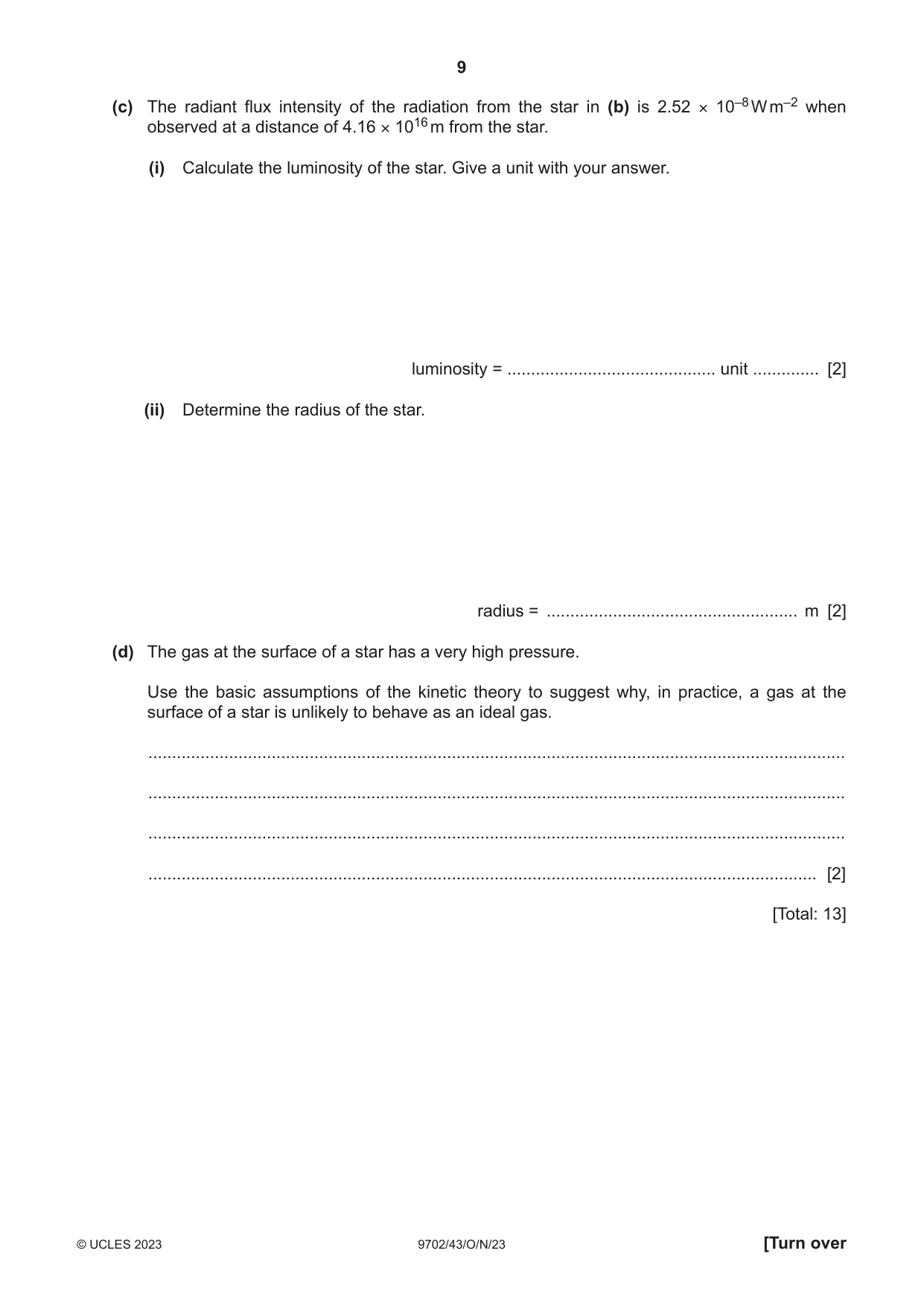
3 (a) The product pV for an ideal gas is given by 1 pV = Nm〈c2〉 3 where p is the pressure of the gas and V is the volume of the gas. (i) State the meaning of the symbols N, m and 〈c2〉 in this equation. N: ....................................................................................................................................... m: ...................................................................................................................................... 〈c2〉: .................................................................................................................................... [3] (ii) Use the equation of state for an ideal gas to show that the average translational kinetic energy EK of a molecule of the gas at thermodynamic temperature T is given by 3 EK = kT. 2 [2] (b) The surface of a star consists mainly of a gas that may be assumed to be ideal. The molecules of the gas have a root-mean-square (r.m.s.) speed of 9300 m s–1. The mass of a molecule of the gas is 3.34 × 10⁻²⁷ kg. Determine, to three significant figures, the temperature of the surface of the star. temperature = ...................................................... K [2] (c) The radiant flux intensity of the radiation from the star in (b) is 2.52 × 10⁻⁸ W m–2 when observed at a distance of 4.16 × 10¹⁶ m from the star. (i) Calculate the luminosity of the star. Give a unit with your answer. luminosity = ............................................ unit .............. [2] (ii) Determine the radius of the star. radius = ..................................................... m [2] (d) The gas at the surface of a star has a very high pressure. Use the basic assumptions of the kinetic theory to suggest why, in practice, a gas at the surface of a star is unlikely to behave as an ideal gas. ................................................................................................................................................... ................................................................................................................................................... ................................................................................................................................................... ............................................................................................................................................. [2] [Total: 13]
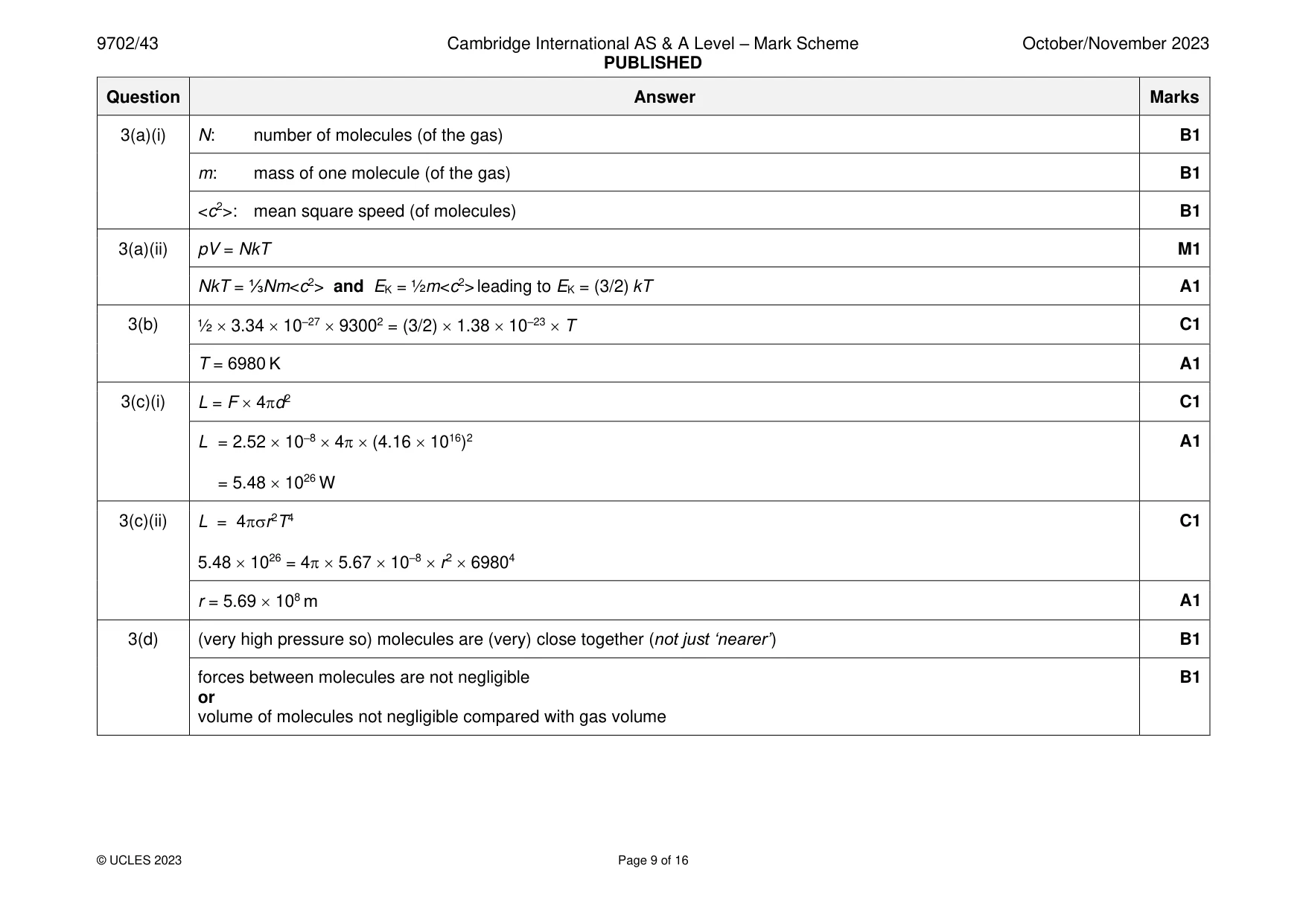
Mark scheme: 3(a)(i) N: number of molecules (of the gas) B1 m: mass of one molecule (of the gas) B1 <c2>: mean square speed (of molecules) B1 3(a)(ii) pV = NkT M1 NkT = ⅓Nm<c2> and EK = ½m<c2> leading to EK = (3/2) kT A1 3(b) ½ 3.34 10–27 93002 = (3/2) 1.38 10–23 T C1 T = 6980 K A1 3(c)(i) L = F 4d2 C1 L = 2.52 10–8 4 (4.16 1016)2 A1 = 5.48 1026 W 3(c)(ii) L = 4r2T4 C1 5.48 1026 = 4 5.67 10–8 r2 69804 r = 5.69 108 m A1 3(d) (very high pressure so) molecules are (very) close together (not just ‘nearer’) B1 forces between molecules are not negligible B1 or volume of molecules not negligible compared with gas volume
Q4 · A heavy metal sphere of mass 0.81 kg is suspended from a string
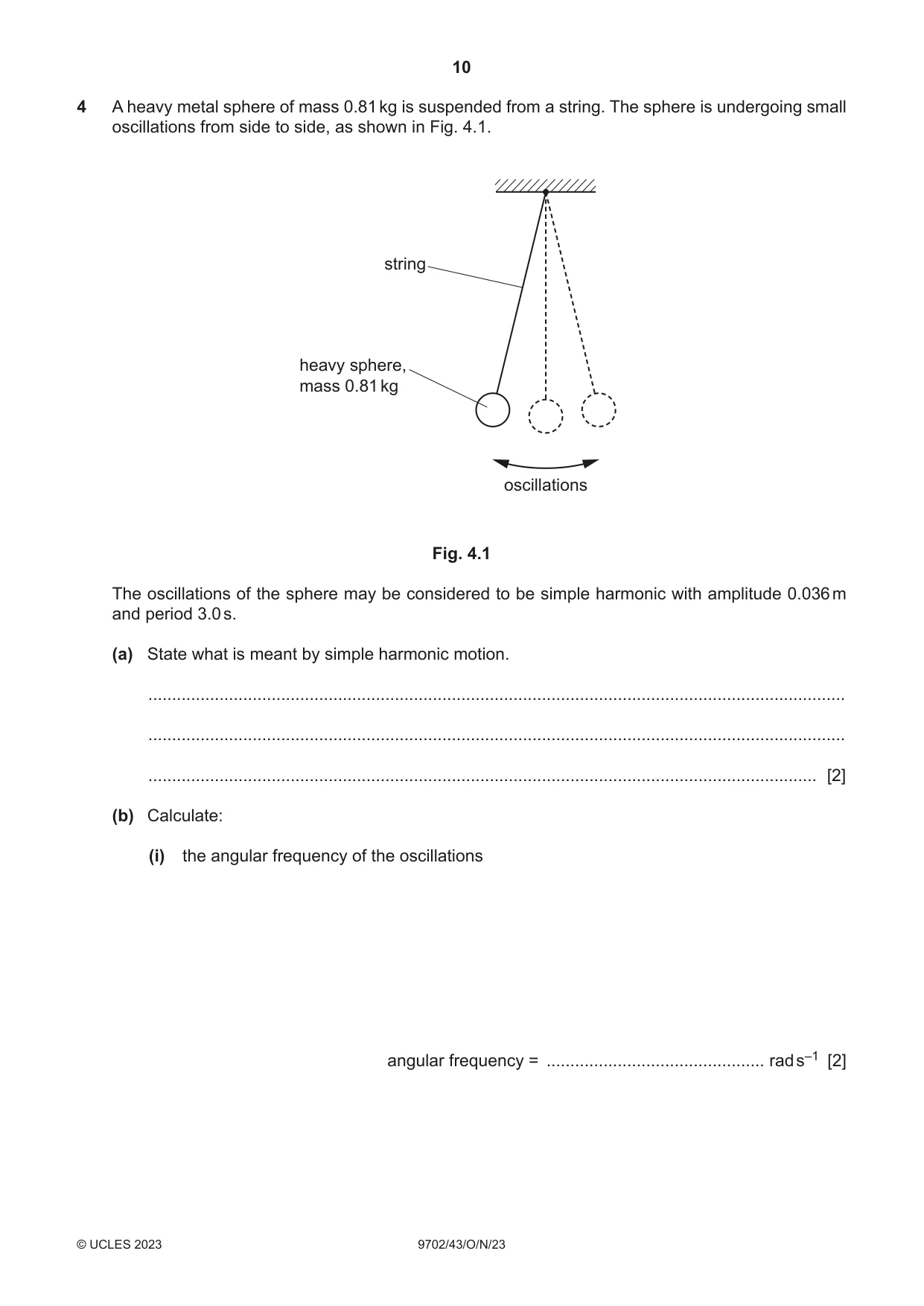
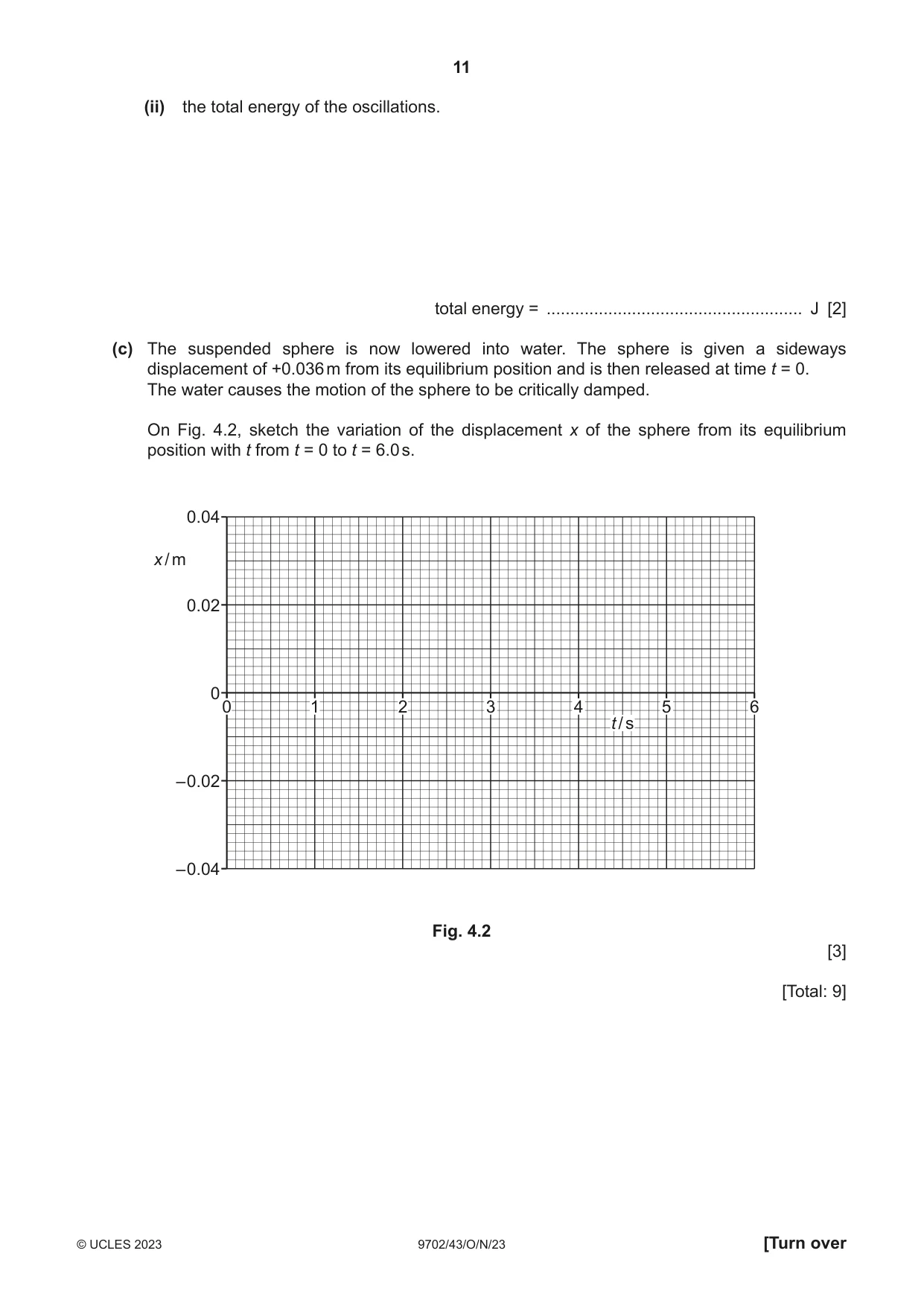
4 A heavy metal sphere of mass 0.81 kg is suspended from a string. The sphere is undergoing small oscillations from side to side, as shown in Fig. 4.1. string heavy sphere, mass 0.81 kg oscillations Fig. 4.1 The oscillations of the sphere may be considered to be simple harmonic with amplitude 0.036 m and period 3.0 s. (a) State what is meant by simple harmonic motion. ................................................................................................................................................... ................................................................................................................................................... ............................................................................................................................................. [2] (b) Calculate: (i) the angular frequency of the oscillations angular frequency = .............................................. rad s–1 [2] (ii) the total energy of the oscillations. total energy = ...................................................... J [2] (c) The suspended sphere is now lowered into water. The sphere is given a sideways displacement of +0.036 m from its equilibrium position and is then released at time t = 0. The water causes the motion of the sphere to be critically damped. On Fig. 4.2, sketch the variation of the displacement x of the sphere from its equilibrium position with t from t = 0 to t = 6.0 s. 0.04 x / m 0.02 0 0 1 2 3 4 5 6 t / s – 0.02 – 0.04 Fig. 4.2 [3] [Total: 9]
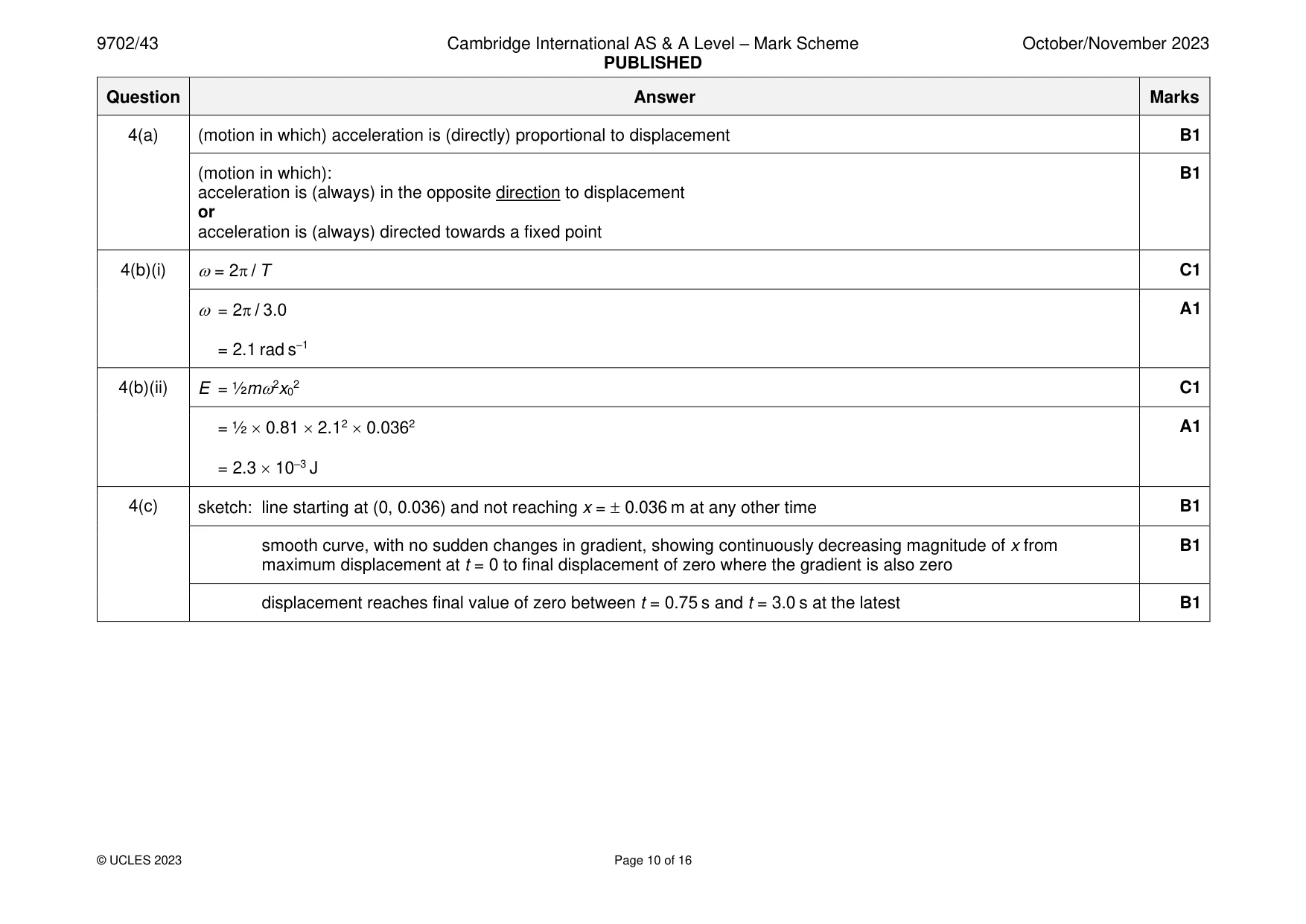
Mark scheme: 4(a) (motion in which) acceleration is (directly) proportional to displacement B1 (motion in which): B1 acceleration is (always) in the opposite direction to displacement or acceleration is (always) directed towards a fixed point 4(b)(i) = 2 / T C1 = 2 / 3.0 A1 = 2.1 rad s–1 4(b)(ii) E = ½m2x02 C1 = ½ 0.81 2.12 0.0362 A1 = 2.3 10–3 J 4(c) sketch: line starting at (0, 0.036) and not reaching x = 0.036 m at any other time B1 smooth curve, with no sudden changes in gradient, showing continuously decreasing magnitude of x from B1 maximum displacement at t = 0 to final displacement of zero where the gradient is also zero displacement reaches final value of zero between t = 0.75 s and t = 3.0 s at the latest B1
Q5 · Define electric potential at a point
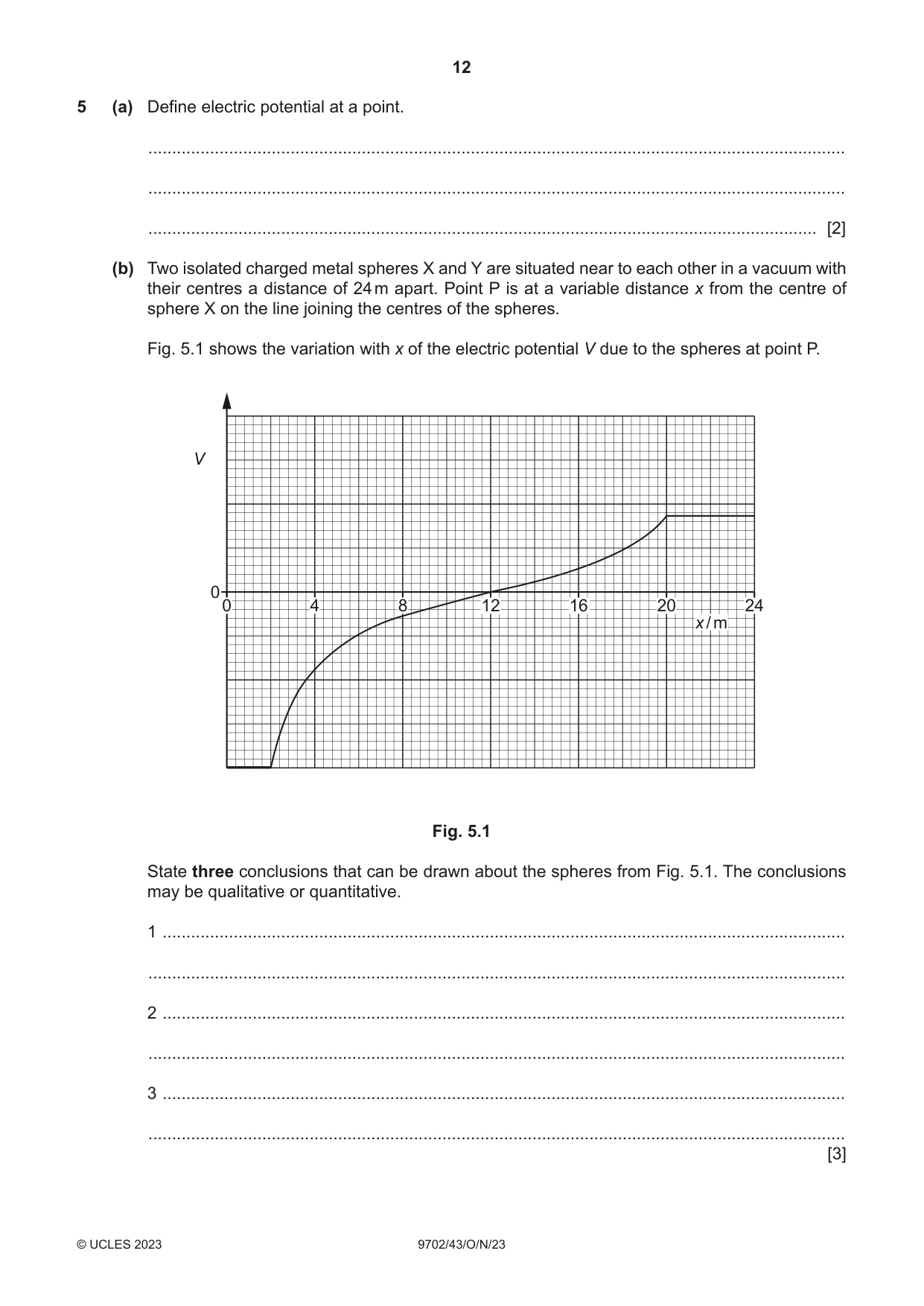
5 (a) Define electric potential at a point. ................................................................................................................................................... ................................................................................................................................................... ............................................................................................................................................. [2] (b) Two isolated charged metal spheres X and Y are situated near to each other in a vacuum with their centres a distance of 24 m apart. Point P is at a variable distance x from the centre of sphere X on the line joining the centres of the spheres. Fig. 5.1 shows the variation with x of the electric potential V due to the spheres at point P. V 0 0 4 8 12 16 20 24 x / m Fig. 5.1 State three conclusions that can be drawn about the spheres from Fig. 5.1. The conclusions may be qualitative or quantitative. 1 ................................................................................................................................................ ................................................................................................................................................... 2 ................................................................................................................................................ ................................................................................................................................................... 3 ................................................................................................................................................ ................................................................................................................................................... [3] (c) A positively charged particle is placed at point P in (b), such that x = 12 m. The particle is released. Describe and explain the subsequent motion of the particle. ................................................................................................................................................... ................................................................................................................................................... ................................................................................................................................................... ................................................................................................................................................... ............................................................................................................................................. [3] [Total: 8]
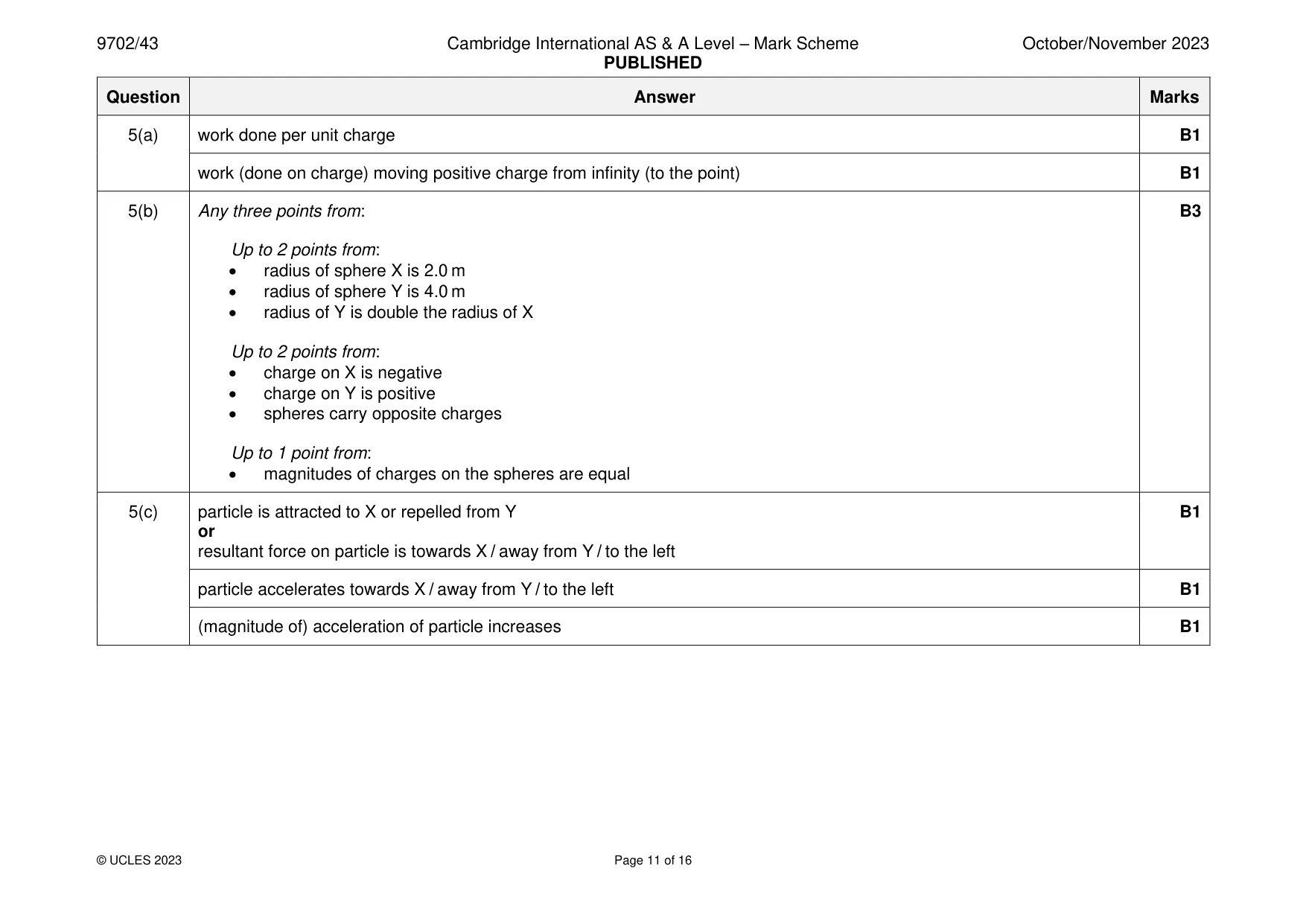
Mark scheme: 5(a) work done per unit charge B1 work (done on charge) moving positive charge from infinity (to the point) B1 5(b) Any three points from: B3 Up to 2 points from: • radius of sphere X is 2.0 m • radius of sphere Y is 4.0 m • radius of Y is double the radius of X Up to 2 points from: • charge on X is negative • charge on Y is positive • spheres carry opposite charges Up to 1 point from: • magnitudes of charges on the spheres are equal 5(c) particle is attracted to X or repelled from Y B1 or resultant force on particle is towards X / away from Y / to the left particle accelerates towards X / away from Y / to the left B1 (magnitude of) acceleration of particle increases B1
Q6 · Define magnetic flux density
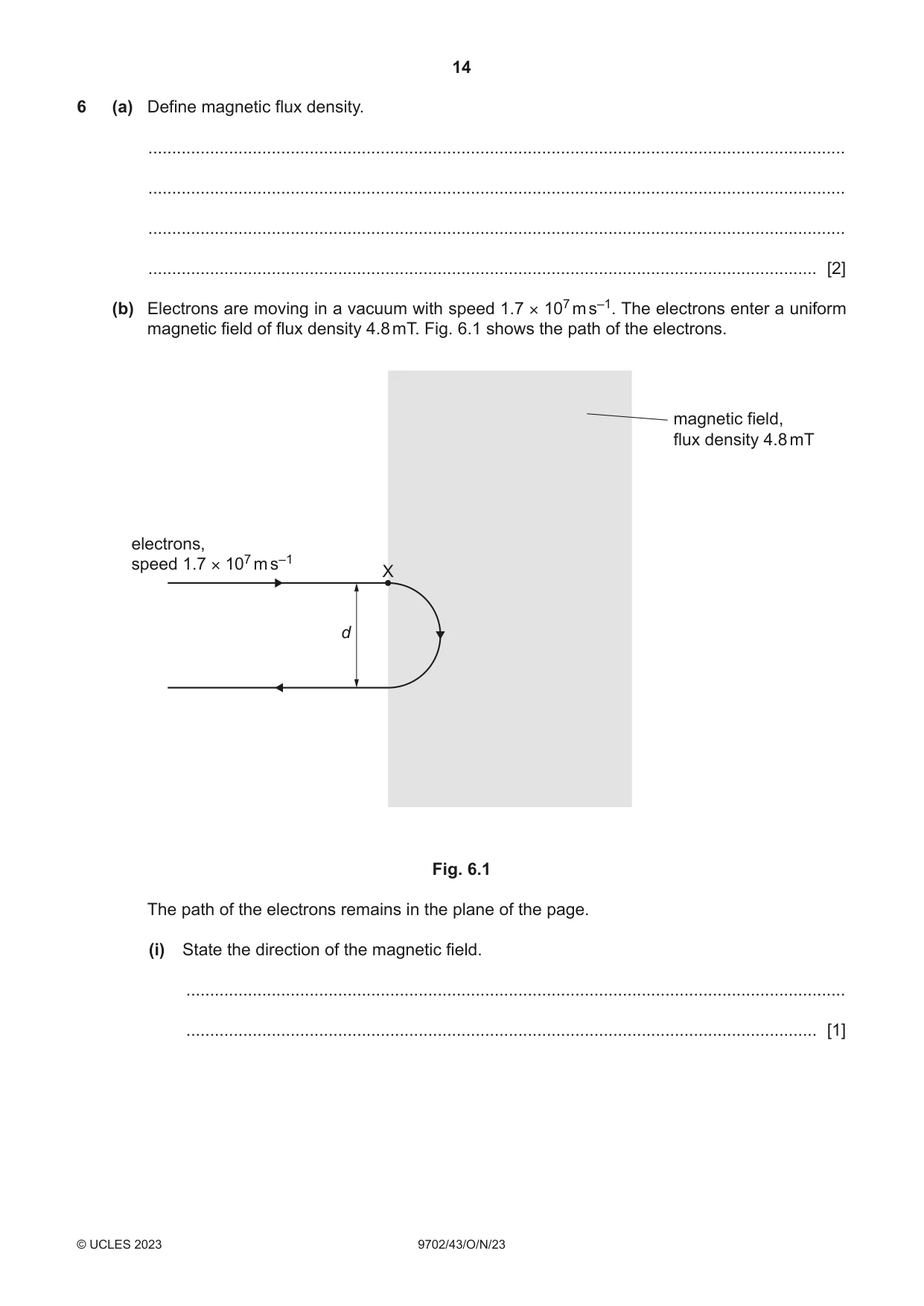
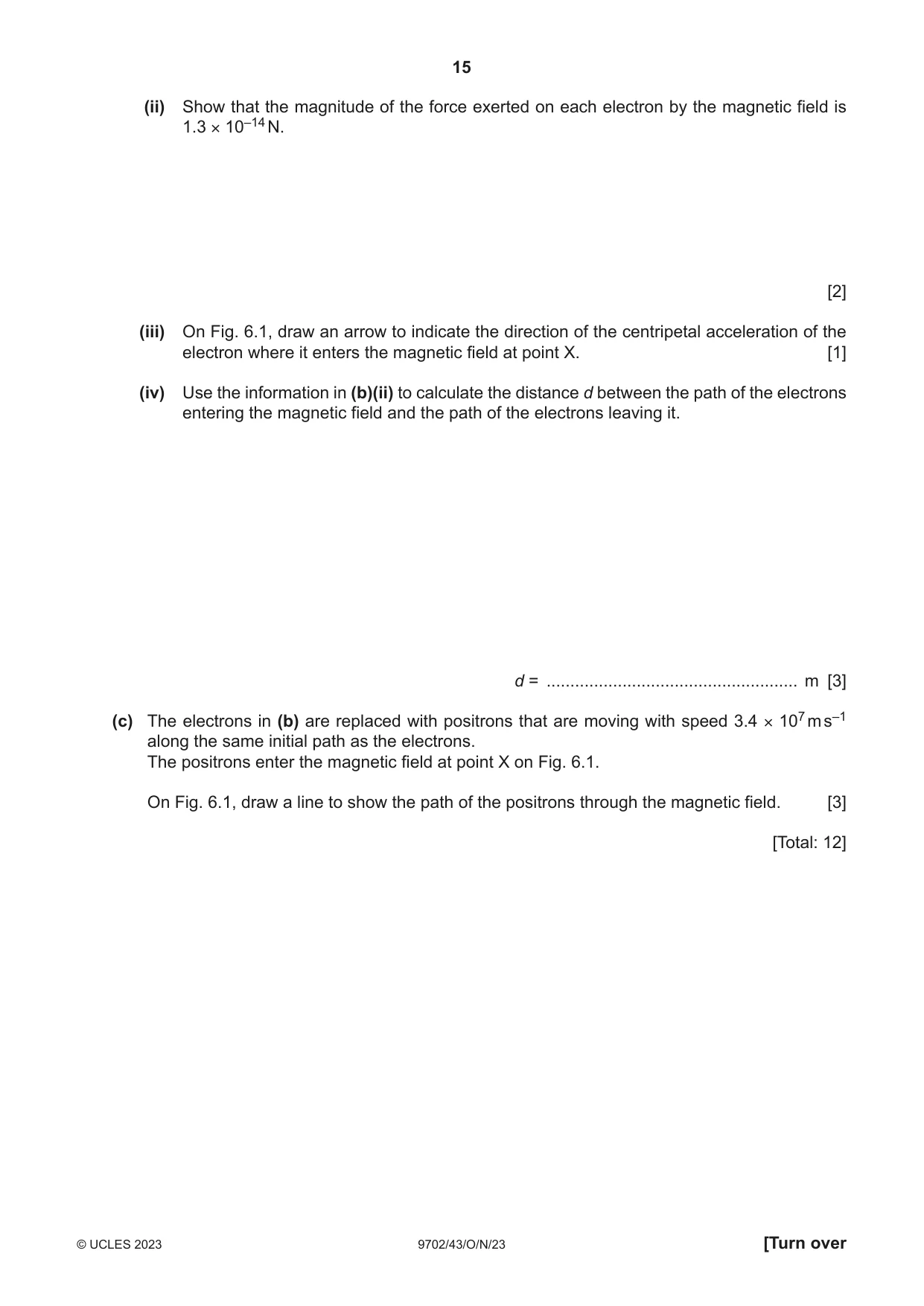
6 (a) Define magnetic flux density. ................................................................................................................................................... ................................................................................................................................................... ................................................................................................................................................... ............................................................................................................................................. [2] (b) Electrons are moving in a vacuum with speed 1.7 × 10⁷ m s–1. The electrons enter a uniform magnetic field of flux density 4.8 mT. Fig. 6.1 shows the path of the electrons. magnetic field, flux density 4.8 mT electrons, speed 1.7 × 10⁷ m s–1 X d Fig. 6.1 The path of the electrons remains in the plane of the page. (i) State the direction of the magnetic field. ........................................................................................................................................... ..................................................................................................................................... [1] (ii) Show that the magnitude of the force exerted on each electron by the magnetic field is 1.3 × 10⁻¹⁴ N. [2] (iii) On Fig. 6.1, draw an arrow to indicate the direction of the centripetal acceleration of the electron where it enters the magnetic field at point X. [1] (iv) Use the information in (b)(ii) to calculate the distance d between the path of the electrons entering the magnetic field and the path of the electrons leaving it. d = ..................................................... m [3] (c) The electrons in (b) are replaced with positrons that are moving with speed 3.4 × 10⁷ m s–1 along the same initial path as the electrons. The positrons enter the magnetic field at point X on Fig. 6.1. On Fig. 6.1, draw a line to show the path of the positrons through the magnetic field. [3] [Total: 12]
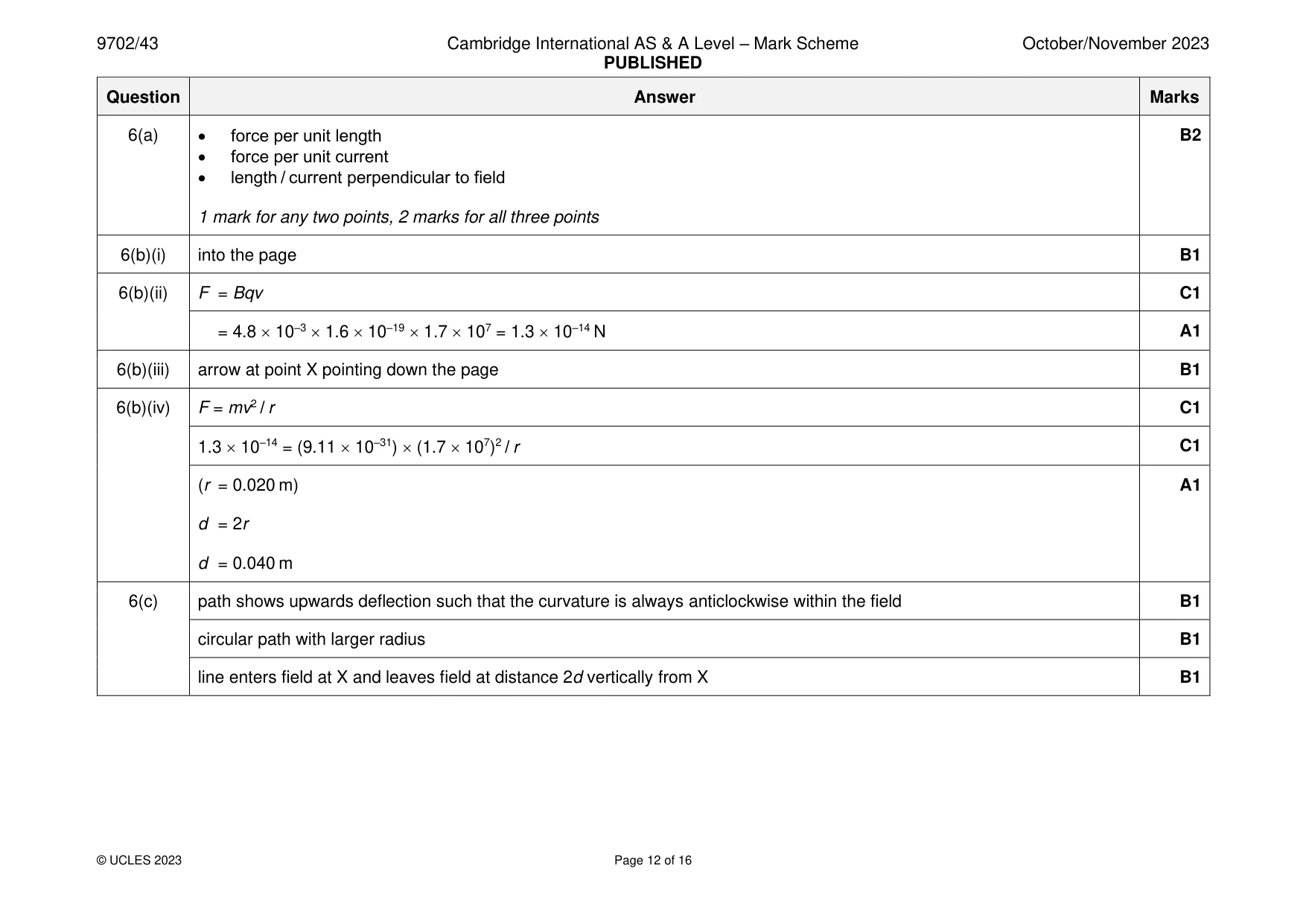
Mark scheme: 6(a) • force per unit length B2 • force per unit current • length / current perpendicular to field 1 mark for any two points, 2 marks for all three points 6(b)(i) into the page B1 6(b)(ii) F = Bqv C1 = 4.8 10–3 1.6 10–19 1.7 107 = 1.3 10–14 N A1 6(b)(iii) arrow at point X pointing down the page B1 6(b)(iv) F = mv2 / r C1 1.3 10–14 = (9.11 10–31) (1.7 107)2 / r C1 (r = 0.020 m) A1 d = 2r d = 0.040 m 6(c) path shows upwards deflection such that the curvature is always anticlockwise within the field B1 circular path with larger radius B1 line enters field at X and leaves field at distance 2d vertically from X B1
Q7 · A varying current I passes through a resistor of resistance R in the circuit shown in Fig
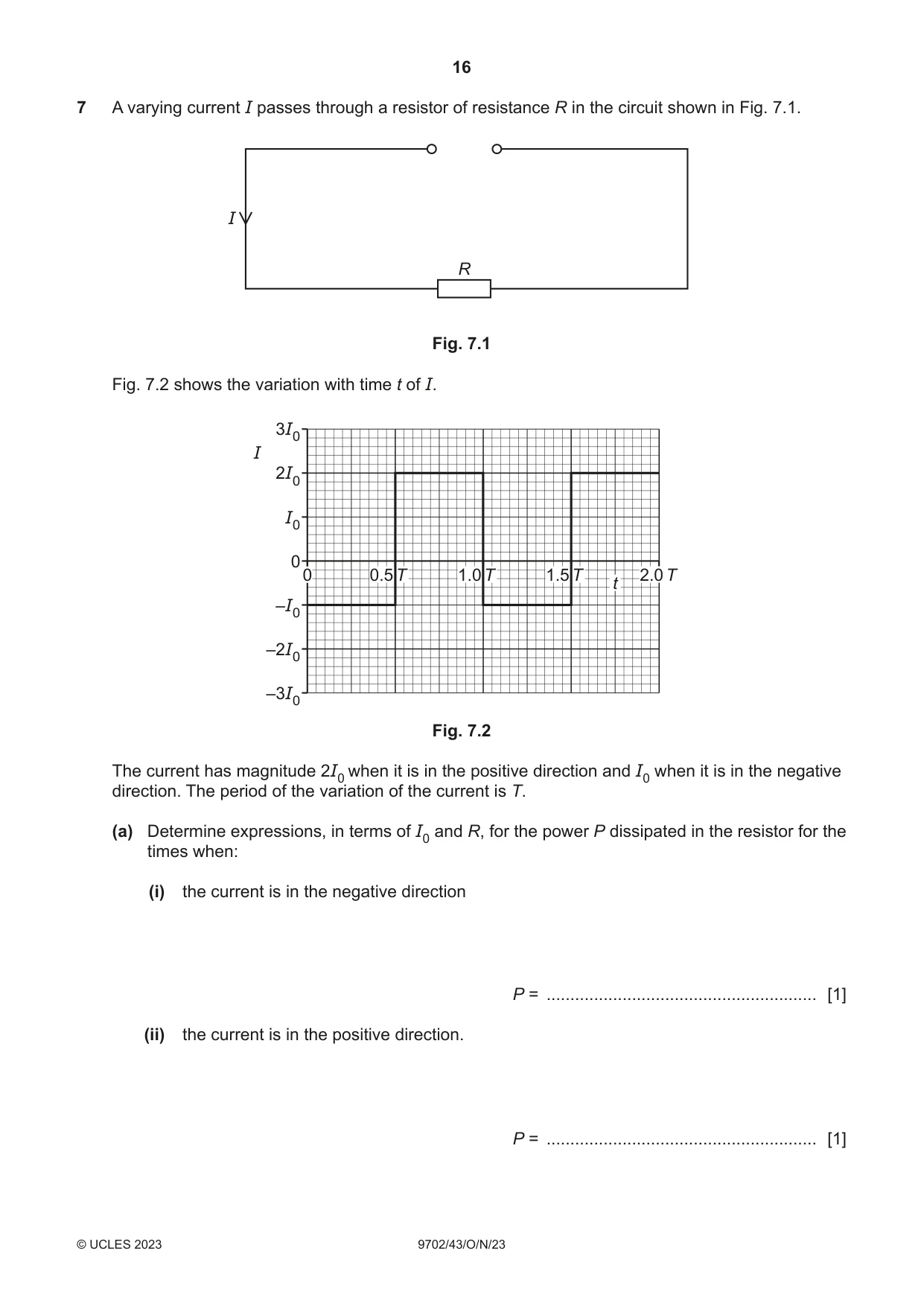
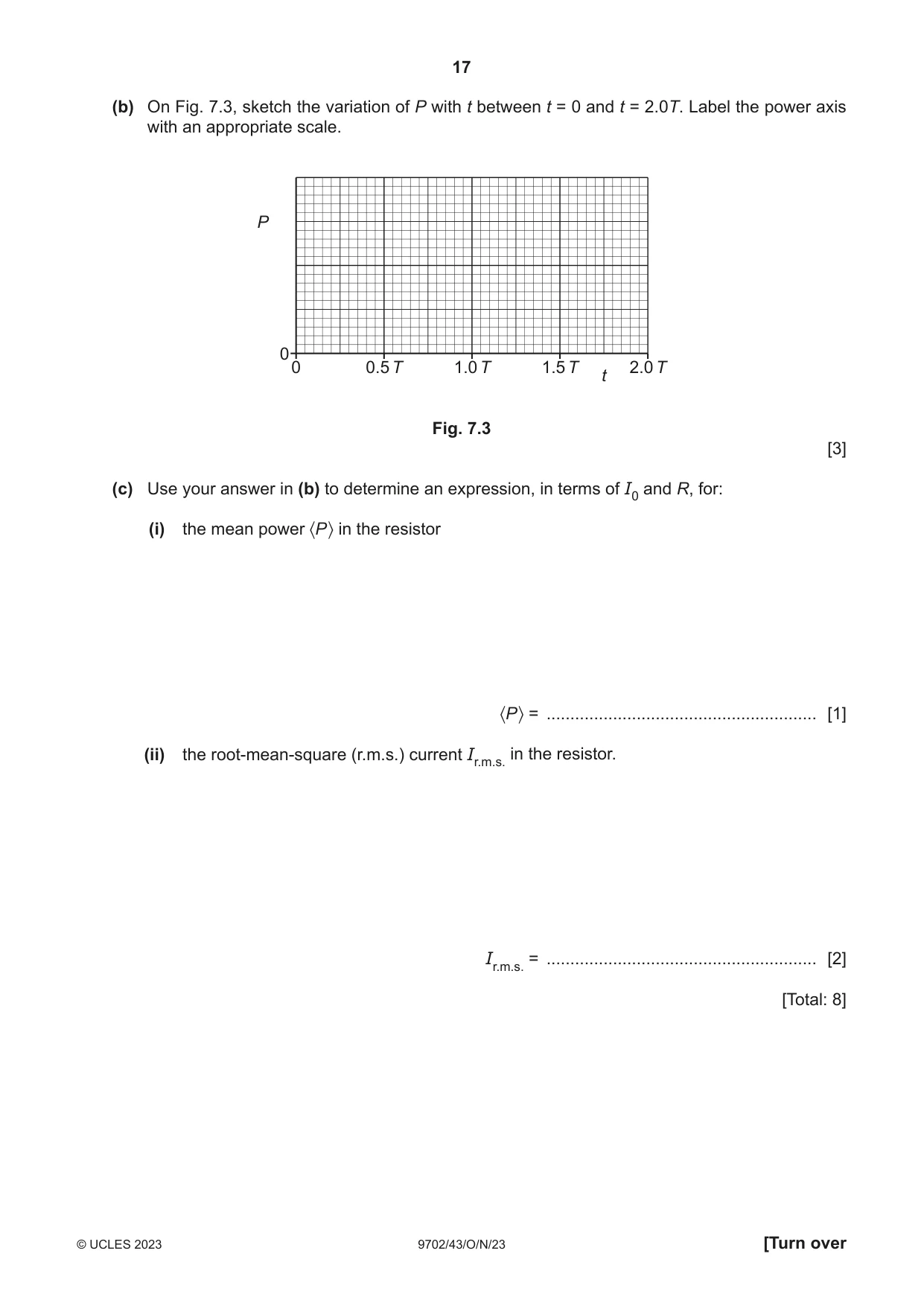
7 A varying current I passes through a resistor of resistance R in the circuit shown in Fig. 7.1. I R Fig. 7.1 Fig. 7.2 shows the variation with time t of I. 3I0 I 2I0 I0 0 0 0.5 T 1.0 T 1.5 T 2.0 T t –I0 –2I0 –3I0 Fig. 7.2 The current has magnitude 2I0 when it is in the positive direction and I0 when it is in the negative direction. The period of the variation of the current is T. (a) Determine expressions, in terms of I0 and R, for the power P dissipated in the resistor for the times when: (i) the current is in the negative direction P = ......................................................... [1] (ii) the current is in the positive direction. P = ......................................................... [1] (b) On Fig. 7.3, sketch the variation of P with t between t = 0 and t = 2.0T. Label the power axis with an appropriate scale. P 0 0 0.5 T 1.0 T 1.5 T 2.0 T t Fig. 7.3 [3] (c) Use your answer in (b) to determine an expression, in terms of I0 and R, for: (i) the mean power 〈P 〉 in the resistor 〈P 〉 = ......................................................... [1] (ii) the root-mean-square (r.m.s.) current Ir.m.s. in the resistor. Ir.m.s. = ......................................................... [2] [Total: 8]
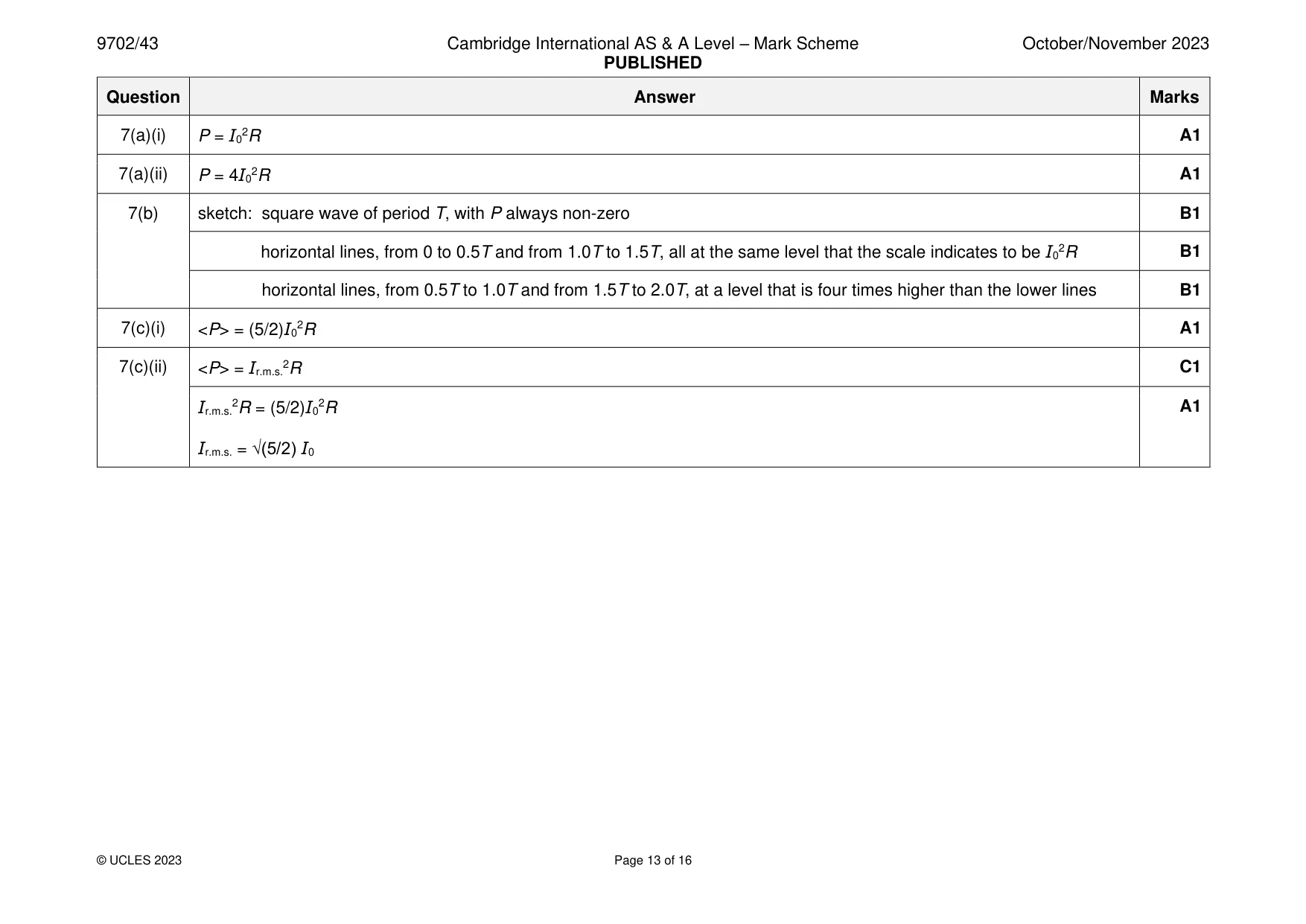
Mark scheme: 7(a)(i) P = I02R A1 7(a)(ii) P = 4I02R A1 7(b) sketch: square wave of period T, with P always non-zero B1 horizontal lines, from 0 to 0.5T and from 1.0T to 1.5T, all at the same level that the scale indicates to be I02R B1 horizontal lines, from 0.5T to 1.0T and from 1.5T to 2.0T, at a level that is four times higher than the lower lines B1 7(c)(i) <P> = (5/2)I02R A1 7(c)(ii) <P> = Ir.m.s.2R C1 Ir.m.s.2R = (5/2)I02R A1 Ir.m.s. = √(5/2) I0
Q8 · Show that the momentum p of a photon of electromagnetic radiation with wavelength λ is…
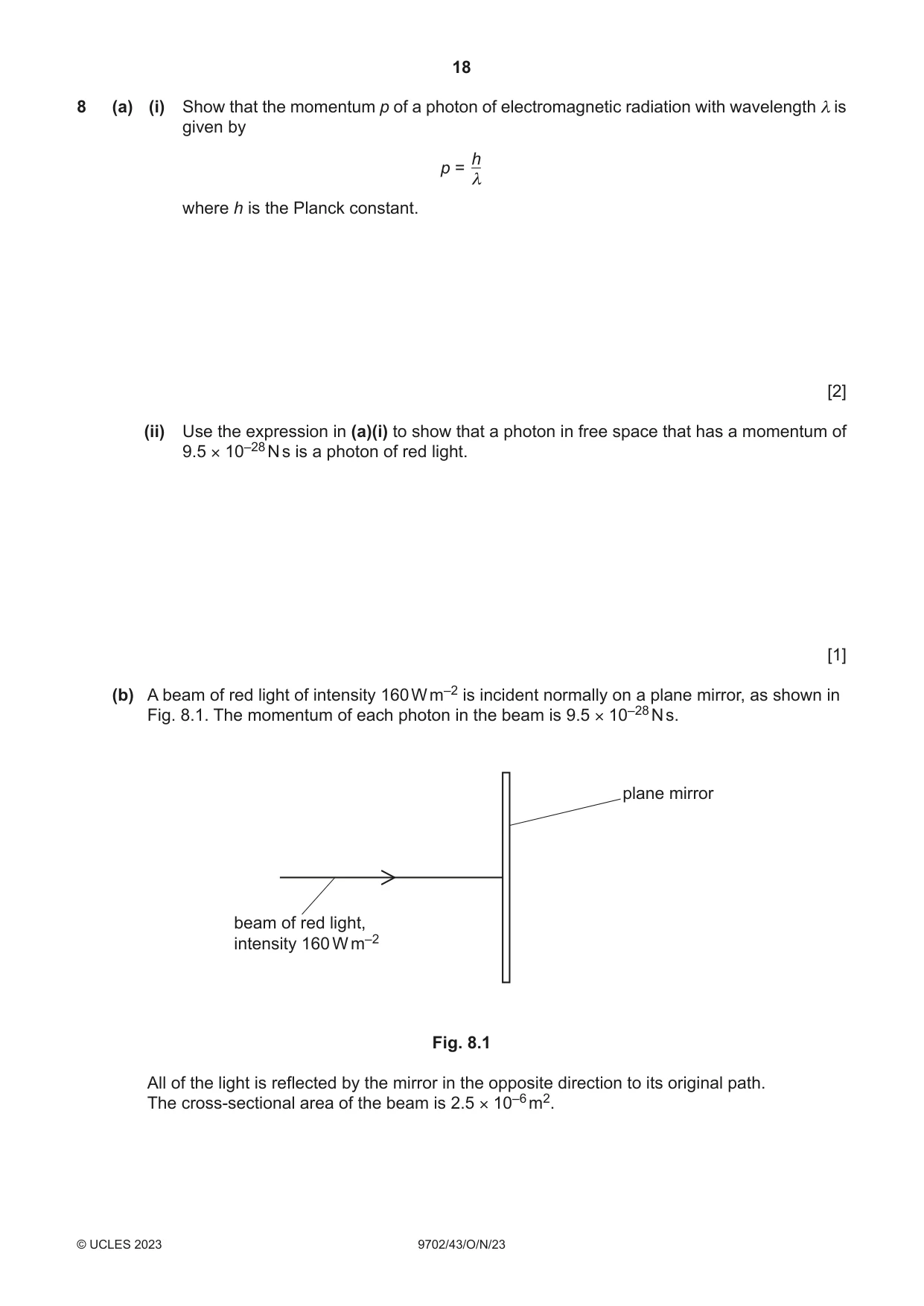
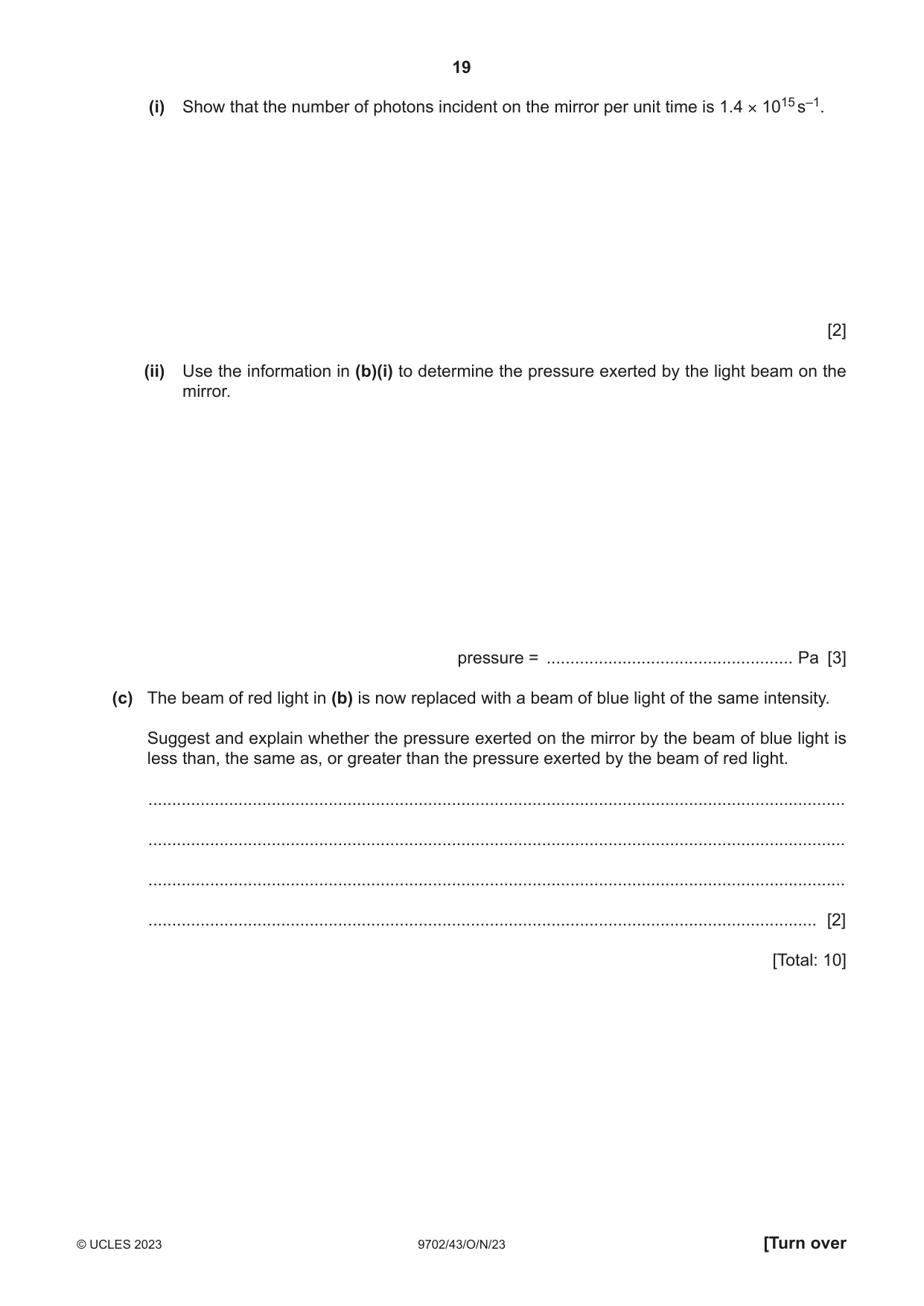
8 (a) (i) Show that the momentum p of a photon of electromagnetic radiation with wavelength λ is given by h p = λ where h is the Planck constant. [2] (ii) Use the expression in (a)(i) to show that a photon in free space that has a momentum of 9.5 × 10⁻²⁸ N s is a photon of red light. [1] (b) A beam of red light of intensity 160 W m–2 is incident normally on a plane mirror, as shown in Fig. 8.1. The momentum of each photon in the beam is 9.5 × 10⁻²⁸ N s. plane mirror beam of red light, intensity 160 W m–2 Fig. 8.1 All of the light is reflected by the mirror in the opposite direction to its original path. The cross-sectional area of the beam is 2.5 × 10⁻⁶ m2. (i) Show that the number of photons incident on the mirror per unit time is 1.4 × 10¹⁵ s–1. [2] (ii) Use the information in (b)(i) to determine the pressure exerted by the light beam on the mirror. pressure = .................................................... Pa [3] (c) The beam of red light in (b) is now replaced with a beam of blue light of the same intensity. Suggest and explain whether the pressure exerted on the mirror by the beam of blue light is less than, the same as, or greater than the pressure exerted by the beam of red light. ................................................................................................................................................... ................................................................................................................................................... ................................................................................................................................................... ............................................................................................................................................. [2] [Total: 10]
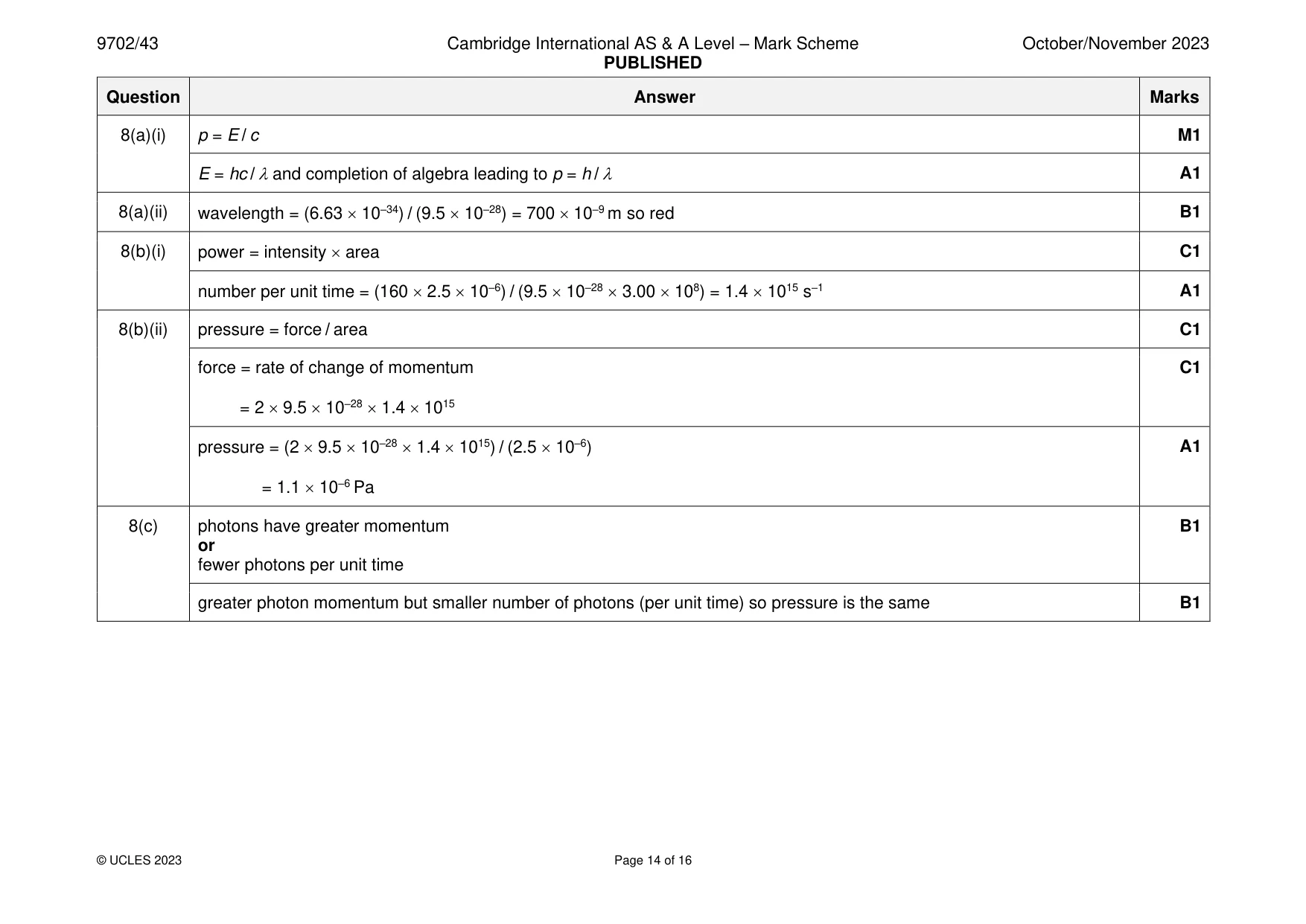
Mark scheme: 8(a)(i) p = E / c M1 E = hc / and completion of algebra leading to p = h / A1 8(a)(ii) wavelength = (6.63 10–34) / (9.5 10–28) = 700 10–9 m so red B1 8(b)(i) power = intensity area C1 number per unit time = (160 2.5 10–6) / (9.5 10–28 3.00 108) = 1.4 1015 s–1 A1 8(b)(ii) pressure = force / area C1 force = rate of change of momentum C1 = 2 9.5 10–28 1.4 1015 pressure = (2 9.5 10–28 1.4 1015) / (2.5 10–6) A1 = 1.1 10–6 Pa 8(c) photons have greater momentum B1 or fewer photons per unit time greater photon momentum but smaller number of photons (per unit time) so pressure is the same B1
Q9 · State what is meant by nuclear fusion
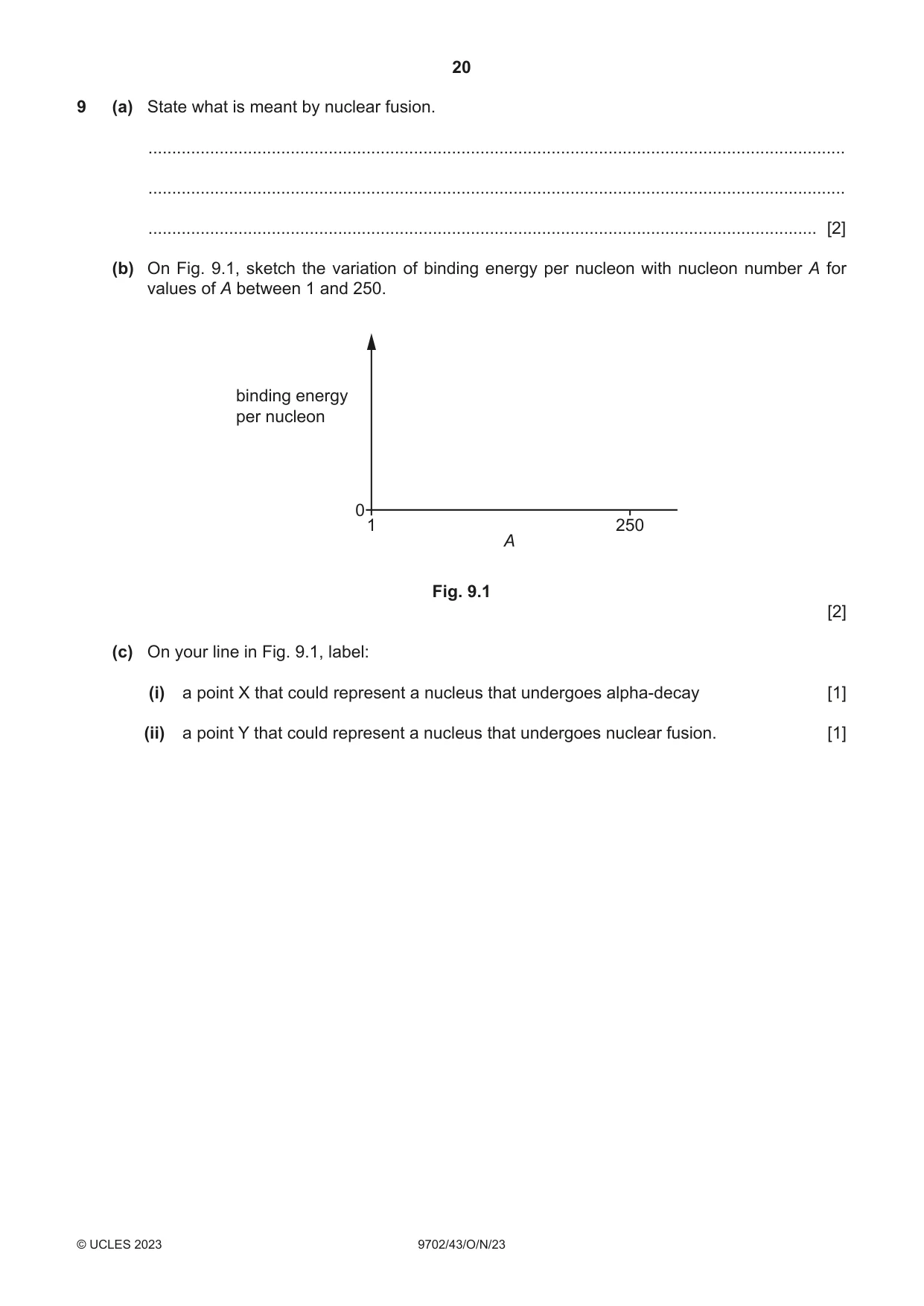
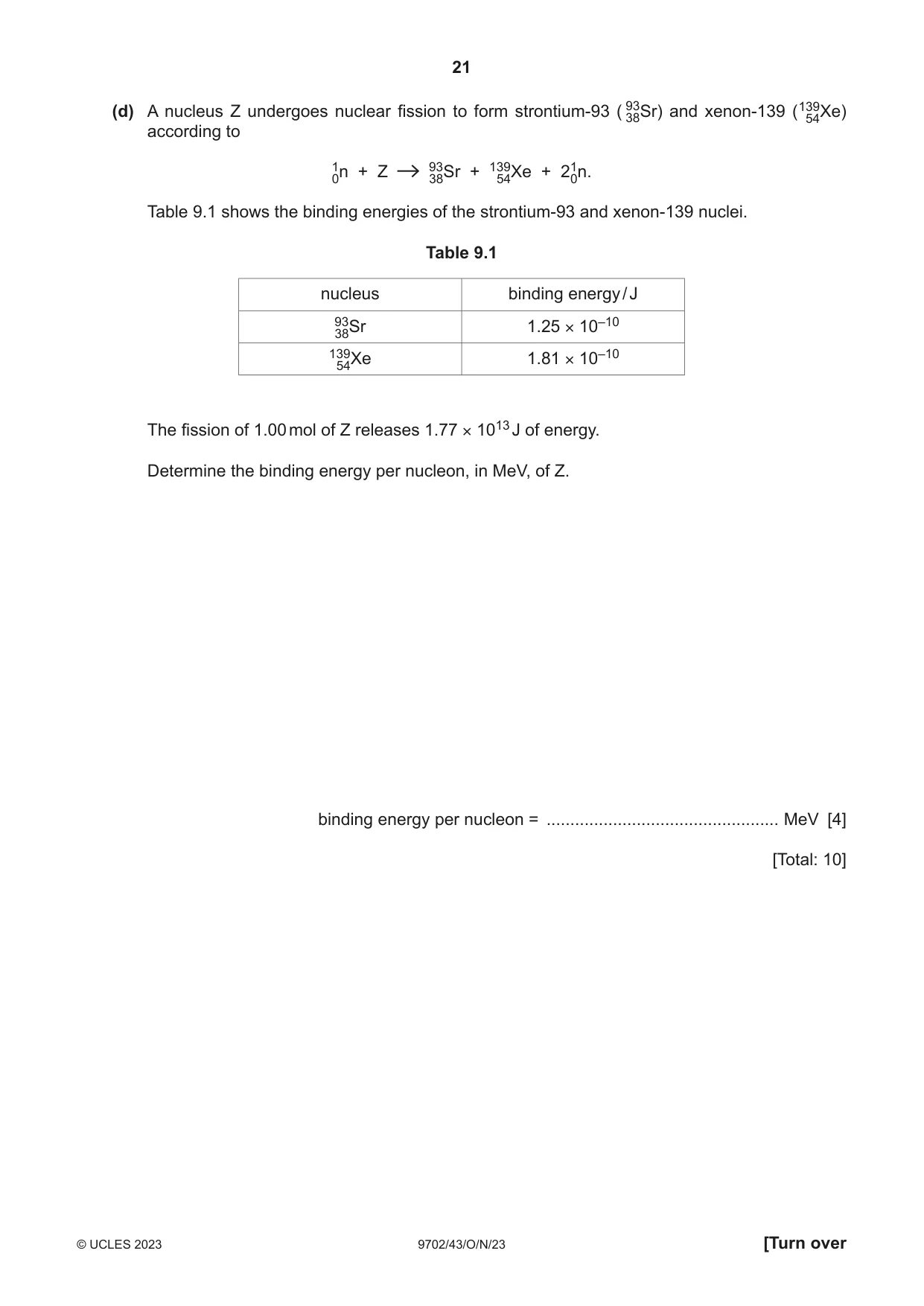
9 (a) State what is meant by nuclear fusion. ................................................................................................................................................... ................................................................................................................................................... ............................................................................................................................................. [2] (b) On Fig. 9.1, sketch the variation of binding energy per nucleon with nucleon number A for values of A between 1 and 250. binding energy per nucleon 0 1 250 A Fig. 9.1 [2] (c) On your line in Fig. 9.1, label: (i) a point X that could represent a nucleus that undergoes alpha-decay [1] (ii) a point Y that could represent a nucleus that undergoes nuclear fusion. [1] (d) A nucleus Z undergoes nuclear fission to form strontium-93 ( 9338Sr) and xenon-139 (13954Xe) according to 10n + Z 9338Sr + 13954Xe + 210n. Table 9.1 shows the binding energies of the strontium-93 and xenon-139 nuclei. Table 9.1 nucleus binding energy / J × 10–10 9338Sr 1.25 × 10⁻¹⁰ 13954Xe 1.81 The fission of 1.00 mol of Z releases 1.77 × 10¹³ J of energy. Determine the binding energy per nucleon, in MeV, of Z. binding energy per nucleon = ................................................. MeV [4] [Total: 10]
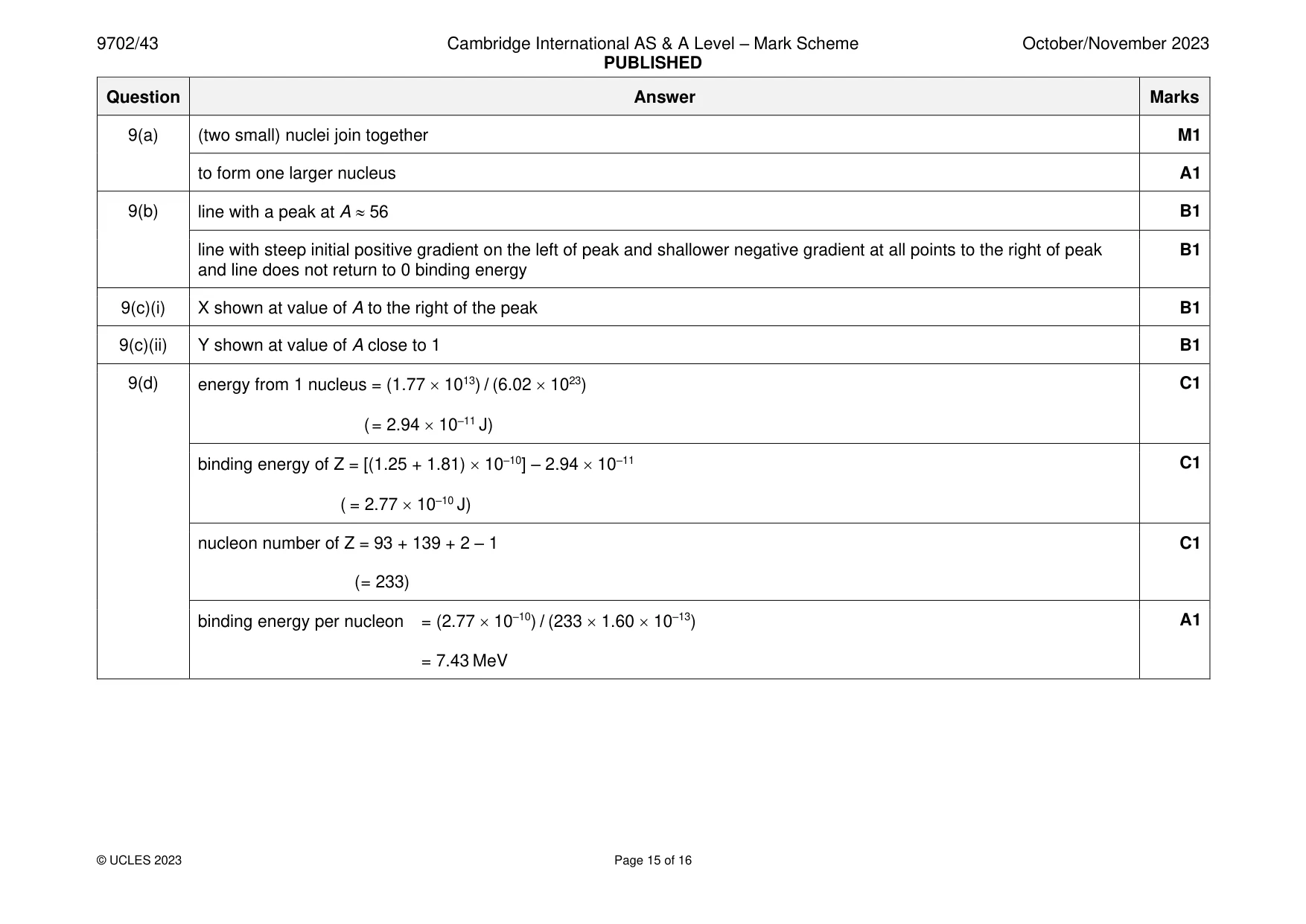
Mark scheme: 9(a) (two small) nuclei join together M1 to form one larger nucleus A1 9(b) line with a peak at A 56 B1 line with steep initial positive gradient on the left of peak and shallower negative gradient at all points to the right of peak B1 and line does not return to 0 binding energy 9(c)(i) X shown at value of A to the right of the peak B1 9(c)(ii) Y shown at value of A close to 1 B1 9(d) energy from 1 nucleus = (1.77 1013) / (6.02 1023) C1 ( = 2.94 10–11 J) binding energy of Z = [(1.25 + 1.81) 10–10] – 2.94 10–11 C1 ( = 2.77 10–10 J) nucleon number of Z = 93 + 139 + 2 – 1 C1 ( = 233) binding energy per nucleon = (2.77 10–10) / (233 1.60 10–13) A1 = 7.43 MeV
Q10 · Ultrasound and X-rays are both types of wave that are used in medical diagnosis to form…
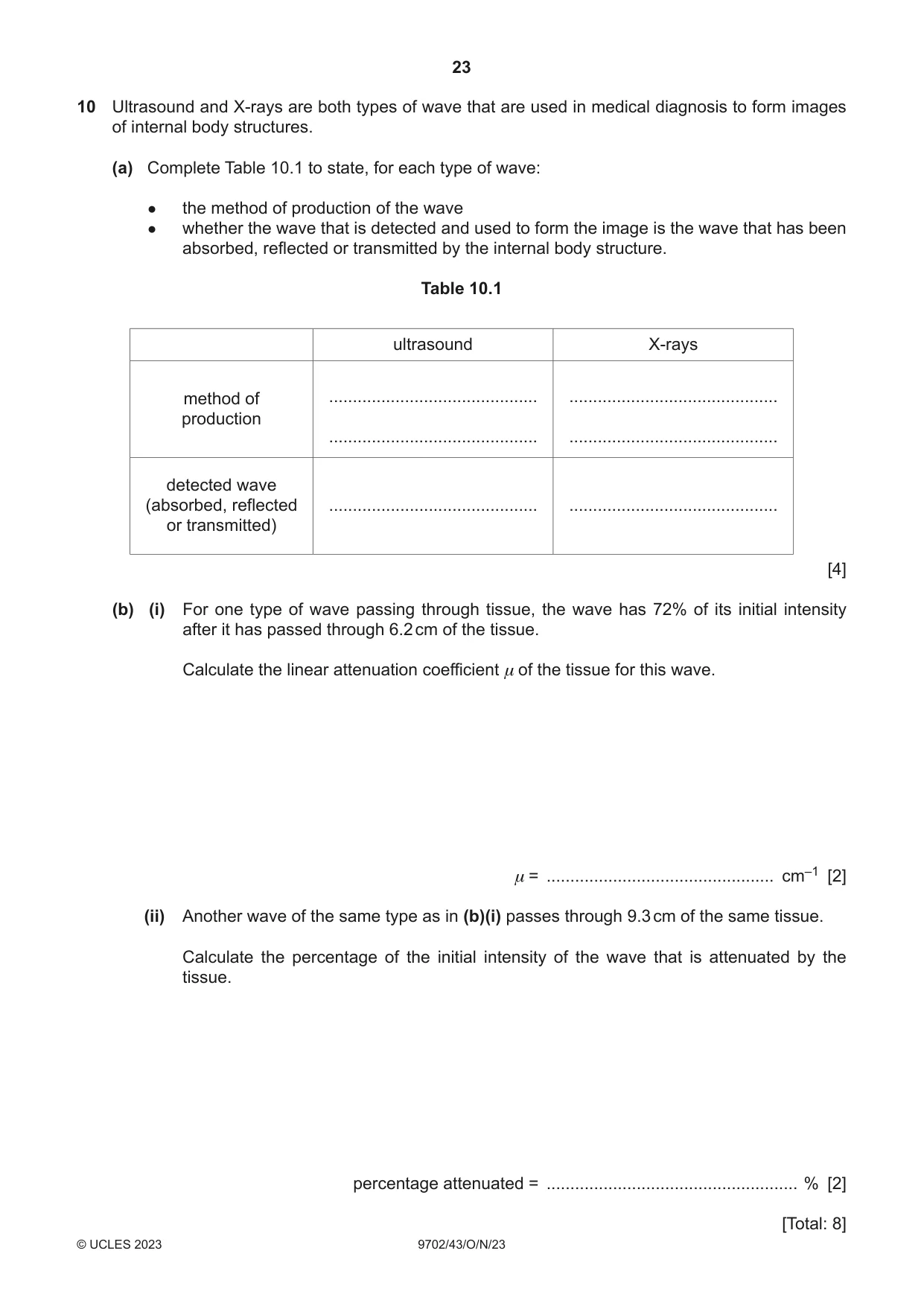
10 Ultrasound and X-rays are both types of wave that are used in medical diagnosis to form images of internal body structures. (a) Complete Table 10.1 to state, for each type of wave: ● the method of production of the wave ● whether the wave that is detected and used to form the image is the wave that has been absorbed, reflected or transmitted by the internal body structure. Table 10.1 ultrasound X-rays method of ............................................ ............................................ production ............................................ ............................................ detected wave (absorbed, reflected ............................................ ............................................ or transmitted) [4] (b) (i) For one type of wave passing through tissue, the wave has 72% of its initial intensity after it has passed through 6.2 cm of the tissue. Calculate the linear attenuation coefficient μ of the tissue for this wave. μ = ................................................ cm–1 [2] (ii) Another wave of the same type as in (b)(i) passes through 9.3 cm of the same tissue. Calculate the percentage of the initial intensity of the wave that is attenuated by the tissue. percentage attenuated = ..................................................... % [2]
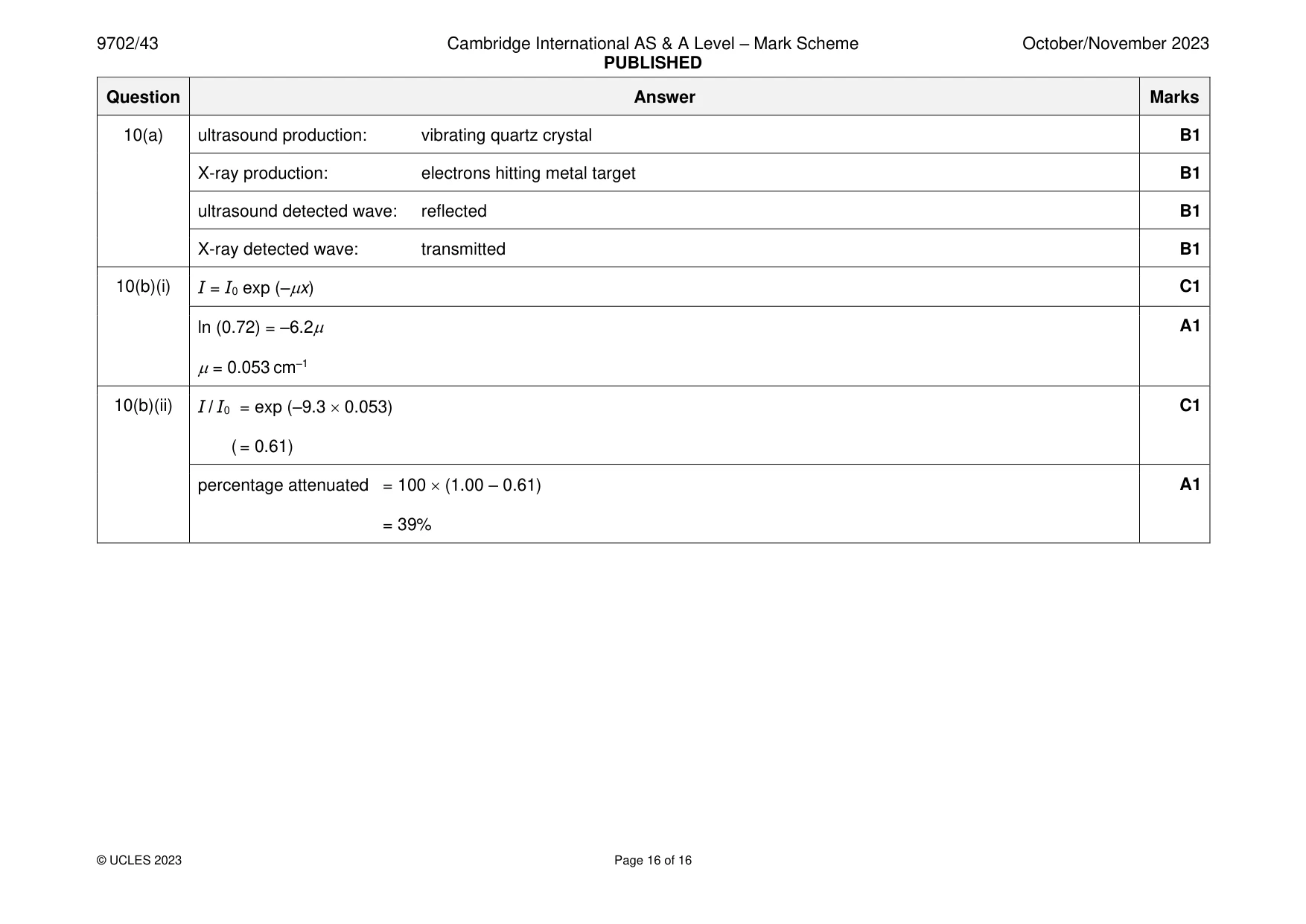
Mark scheme: 10(a) ultrasound production: vibrating quartz crystal B1 X-ray production: electrons hitting metal target B1 ultrasound detected wave: reflected B1 X-ray detected wave: transmitted B1 10(b)(i) I = I0 exp (–x) C1 ln (0.72) = –6.2 A1 = 0.053 cm–1 10(b)(ii) I / I0 = exp (–9.3 0.053) C1 ( = 0.61) percentage attenuated = 100 (1.00 – 0.61) A1 = 39%
What was in this paper
The subtopics covered by these 10 questions, and how many questions each got. Open one in a new tab to see every Cambridge question on it.
What you needed in this session
Cambridge’s own grade thresholds for 2023 Oct/Nov, Paper 4 · Variant 3. A higher threshold means an easier paper — the bar moves with how the cohort did.