Questions as text
Q1 · The genus Sargassum is a group of macroscopic brown algae found in many parts of the… 9693/31 May/June 2017
1 The genus Sargassum is a group of macroscopic brown algae found in many parts of the world’s oceans. Some species are free-floating. Other species are attached to rocks or coral reefs, in shallow water. (a) Fig. 1.1 shows an attached Sargassum species, S. flavicans. A thallus air bladder line showing approximate length of thallus B holdfast scale: 10 cm Fig. 1.1 (i) State the function of the holdfast. … … [1] (ii) Suggest how the air bladders are important to photosynthesis. … … … … [2] (iii) The line labelled A-B on Fig. 1.1 shows the approximate length of a thallus of S. flavicans. Use the scale to estimate the length of the thallus shown in Fig. 1.1. (iv) Use your answer to (a)(iii) and your knowledge of photosynthesis to suggest why these algae are found mainly in shallow water up to a depth of six metres. … … … … [2] (b) Other species of Sargassum always float freely as large mats on the surface of the open ocean. Complex ecosystems form within these mats. Describe the role of the free-floating Sargassum species in marine ecosystems. … … … … … … … … … [3] (c) One species of Sargassum, S. muticum, is often introduced with molluscs imported for aquaculture. Suggest two harmful effects of the introduction of S. muticum to marine ecosystems. 1 … … 2 … … [2] [Total: 12]
12 marks
Mark scheme: 1(a)(i) fix the algae to the substratum / AW / stops alga being washed away by current ; 1 1(a)(ii) idea of, holding up the algae / gives buoyancy (to the thallus) ORA ; idea of, more / enough light (for photosynthesis) ; 2 1(a)(iiii) 7 ± 0.1 cm (length of line A to B cm) ×10 (scale line) ; = 70 ± 1 cm ; 2 1(a)(iv) idea that: light penetration decreases with depth / different wave lengths go to different depths ; (so any deeper) not all of the thallus would get enough light for photosynthesis / light highest / more light in photic zone ; 2 1(b) any 3 of: (primary) producers (in the marine food web / chain / ecosystem) ; fix carbon / introduce energy into the ecosystem ; provide food for (a wide range of) organisms / species / named species ; provides a habitat / shelter / home / for marine organisms / number of species / named species ; nursery area for a number of species / named species ; decomposition provides source of nutrient / mineral salts in the ocean ; provide oxygen for marine organisms to respire ; reduce water movement so prevent small organisms from being washed away by current ; 3 e.g. turtles, fish e.g. small fish, sea urchins e.g. eels and turtles Question Answer Marks Guidance 1(c) any 2 of: spread diseases ; idea of outcompetes local species (of Sargassum) / AW ; grows very fast / uses more resources (than local species of algae) ; 2
This question in 9693/31 May/June 2017
Q2 · Tuna catches along the Namibian coast in south west Africa have decreased significantly… 9693/31 May/June 2017
6 Tuna catches along the Namibian coast in south west Africa have decreased significantly in recent years. (a) The reduction in the catch has been blamed on seismic blasting during oil and gas exploration in the waters off the Namibian coast. Seismic blasting is carried out by firing airguns underwater every 10 seconds causing very large sound vibrations in the water. (i) Suggest why seismic blasting could affect tuna catch. … … … … … … … [3] (ii) Seismic blasting is unregulated. The tuna fishing season lasts from October to April, with 70% of fish caught in February and March. Use this information to suggest what steps the Namibian government can take to reduce the decline in tuna catch, but continue with oil and gas exploration. … … … … [2] (b) Scientists have suggested tagging tuna that migrate through the area, so that they can be monitored by satellite. State what information the satellite tag could provide. … … [1] (c) Environmentalists are concerned that oil exploration along the Namibian coast could result in an oil spill. (i) Explain how oil pollution could affect fish-eating seabirds in the area. … … … … … … … … … … [4] (ii) Describe how biotechnology could be used to remove oil pollution from the environment. … … … … [2] [Total: 12]
12 marks
Mark scheme: 6(a)(i) any 3 of: idea of, tuna / fish move away (from blasting) ; can kill tuna outright ; can kill tuna prey fish ; increases sediment in water / turbidity preventing tuna finding food ; kills eggs / larvae / fry ; 3 6(a)(ii) ban any seismic surveys between October and April / between February and March / during main fishing season ; avoid seismic surveys on migration routes / fishing hotspots / spawning areas ; 2 6(b) any 1 of: location of tuna / fish / spawning or feeding areas ; numbers of tuna ; (exact) migration route ; timing of migration / when not to blast ; 1 Question Answer Marks Guidance 6(c)(i) any 4 of: sticks to their feathers and inhibits flight ; coats feathers limiting temperature regulation ; coats feathers so decreases / reduces buoyancy (so bird sinks / drowns) ; kills seabirds as it is toxic / poisonous / carcinogenic ; swallowed by sea birds (blocking the intestines) / gets into beak (and blocks breathing system) ; damages internal) organs as corrosive ; washes onto shores and covers eggs / kills chicks / nest abandoned ; hormonal changes in some birds (and disrupts breeding) ; fish killed by oil, so less food for birds ; ref. to bioaccumulation of chemicals / pollutants from oil ; 4 6(c)(ii) using microorganisms / bacteria ; that digest the oil ; 2
This question in 9693/31 May/June 2017
Q3 · Ecotourism is based on the appreciation of the natural environment and should involve… 9693/31 May/June 2017
7 Ecotourism is based on the appreciation of the natural environment and should involve good practice in conserving the environment. Read the descriptions of two types of ecotourism. type 1 • travelling by car to the tourist area • staying in small locally run hotels • helping to remove refuse from reefs and making maps of damaged reef areas • taking part in educational classes about reefs and the uses made of the resources of the reef type 2 • travelling by a small cruise ship to protected areas in a marine reserve • visiting islands, reefs and seagrass beds in small groups with a local tour guide who is an expert on the area (a) For each of these types of ecotourism, discuss the ways in which they support or undermine conservation. (i) type 1 … … … … … … [3] (ii) type 2 … … … … … … … … [3] (b) A beach hotel that is part of an international chain is going to be closed for redevelopment. All the existing guest rooms will be refitted and a new block of guest bedrooms built. The company that owns the hotel wants to improve the way in which the hotel uses energy and water so it is more ecologically sustainable. At present, energy is supplied from the main electricity supply for heating, lighting and air conditioning. Water is supplied from the main water supply for cooking, washing, toilets, the swimming pool and grass sprinklers. Suggest and explain two ways in which the use of energy and water by the hotel could be made more sustainable. 1 … … … 2 … … … [4] [Total: 10]
10 marks
Mark scheme: 7(a)(i) support: any 2 of: using local people to provide hotel service ; small hotel so less impact on the environment ; more money into local economy ; helps conservation / protects environment by clearing rubbish / mapping reefs ; raising awareness / showing appreciation of the natural environment, by educational classes ; undermine: ref. to car travel causing (air) pollution / adds carbon dioxide to the air ; 3 answers must relate to an aim of ecotourism: involving local people, raising awareness, conservation, minimising ecological impact 7(a)(ii) support: any 2 of: small cruise ships carry fewer people, so less impact on the environment ; using local people as guides ; raising awareness / showing appreciation by using an expert on the area ; small groups for trips have less impact ; undermine: any 2 of: cruise ships cause pollution / litter in water (damaging the environment) ; cruise ships also cause physical damage to reefs / seagrass ; idea that a small cruise ship will still have a lot of small groups that could damage the ecosystem / environment ; 3 answers must relate to an aim of ecotourism: involving local people, raising awareness, conservation, minimising ecological impact Question Answer Marks Guidance 7(b) 1 × 2 for energy of: 1 use solar panels / wind turbine (for electricity / energy) ; using renewable resource / reducing use of fossil fuels ; 2 ref. to any method of reducing electricity consumption ; using less energy from the (mains) supply ; 1 × 2 for water of: 1 collect water from showers / baths / to use for watering grass / plants ; re-using water / recycling water reduces clean water demand (from mains) ; 2 replace grass with less water-demanding / drought tolerant plants ; OR collect rain water for watering grass / plants ; OR collect rain water for water in showers / baths / laundry / cleaning ; (because) it reduces the use of clean water from the mains ; 3 replace the water in the swimming pool with sea water ; reducing use of fresh water / using local resources ; 4 install eco-friendly showers and toilets ; reduce water consumption ; 4 A water power A grey water A replacing with artificial grass / paving I filling in swimming pool A re-using towels and bed linen
This question in 9693/31 May/June 2017
Q4 · The Gulf of California separates mainland Mexico from part of California 9693/31 Oct/Nov 2017
5 (a) The Gulf of California separates mainland Mexico from part of California. Read the information about the effects of agricultural run-off on the water in the Gulf of California. A study into the link between large scale coastal farming and algal blooms was carried out over a five year period. A satellite able to detect floating plankton was used to produce images of the narrow 1127 km long stretch of water. The area studied has a high marine biodiversity and is an important commercial fishing centre. It has one of the highest natural nutrient contents in the oceans due to wind-driven upwellings and very high productivity. Along one stretch of the Mexican coast line, there is an agricultural area of 2250 km2 of irrigated wheat. The whole valley is irrigated and fertilised four times a year. The excess run-off enters the sea through the Yaqui river. Images from the satellite showed that there was an algal bloom within a few days of each irrigation and fertilisation. Each bloom was very large, covering between 50 to 577 km2. (i) Explain what is meant by a wind-driven upwelling. … … … … [2] (ii) Explain why the upwellings in the Gulf of California make it an important commercial fishing area. … … … … … … [3] (b) Very large algal blooms can unbalance an ecosystem by causing an oxygen-depleted dead zone at the bottom of the sea. (i) Explain why these oxygen-depleted zones occur at the bottom of the sea. … … … … … … [3] (ii) Suggest why these oxygen-depleted zones can unbalance the ecosystem. … … … … … [2] (c) State one agricultural pollutant, other than fertiliser, that can reach the oceans. Describe its effect on the marine ecosystem. pollutant … effect on the marine ecosystem … … … [2] [Total: 12]
12 marks
Mark scheme: 5(a)(i) wind blows the warmer surface waters away ; replaced by colder nutrient rich water from beneath ; 2 5(a)(ii) nutrients brought by upwelling increase growth of phytoplankton ; phytoplankton are basis of food webs / attract herbivores ; provide food source for large number of fish ; 3 A named nutrient 5(b)(i) algae die when nutrients run out ; dead algae sink to the bottom of the sea ; bacteria use up the oxygen to decompose the algae ; 3 5(b)(ii) (most) benthic animals die due to, lack of oxygen / no oxygen, for respiration ; idea of, food chains / webs disrupted so other, organisms / fish, die ; 2 Question Answer Marks Guidance 5(c) any 1 of: pesticide or named pesticide / silt / manure ; 1 1 mark for pollutant 1 mark for effect. effect must match the pollutant. correct effect for stated pollutant : any 1 of: (pesticide) contain toxins that kill most marine organisms or accumulate in food chains ; (silt) reduces light penetration through water so algae in deeper water die ; OR settles on coral killing the polyps ; (manure) brings organic material that decomposes using oxygen ; 1
This question in 9693/31 Oct/Nov 2017
Q5 · Some information about the life cycle of salmon 9693/31 Oct/Nov 2017
6 (a) Table 6.1 shows some information about the life cycle of salmon. Complete Table 6.1 to match the stage of the life cycle of salmon to the habitat where it is most likely to be found. Table 6.1 habitat stage in life cycle nest in stream bed freshwater streams smolt [3] (b) Fig. 6.1 shows part of the Bristol Bay area in the state of Alaska, United States of America, and the proposed location of a mine. If constructed, the mine would be one of the largest gold and copper mines in the world. N Key Lake direction of Iliamna Cook river flow Inlet proposed Dillingham mine site proposed new road Naknek Bristol Bay Fig. 6.1 The mining process will involve: • extracting water from local streams and rivers, • adding toxic chemicals to the rocks, • using explosives on the highly permeable rocks, • construction of large dams to contain the toxic liquid mine waste and over 10 billion tonnes of waste rock and silt. The proposed site is in an area of unspoilt wilderness and the streams close to the site are spawning grounds for 25% of the world’s sockeye salmon population. (i) Explain why the mine could pose a threat to salmon spawning grounds. … … … … … … [3] The human population is very small and lives in villages around Lake Iliamna and Cook Inlet. There are two small towns on the Bristol Bay coast. Scattered hunting and fishing lodges found throughout the area generate vital income from tourism. Bristol Bay is one of the largest sustainable commercial salmon fishing areas in the world. A meeting took place between the owners of the proposed mine and other stakeholders to discuss the need to maintain biodiversity with economic activities for the local people. (ii) State what is meant by the term stakeholder. … … [1] (iii) Identify two stakeholders, other than the owners of the proposed mine, one who would support the mine project and another who would oppose the mine project. For each stakeholder, give a reason for your answer. support … reason … … oppose … reason … … [4] [Total: 11]
11 marks
Mark scheme: 6(a) environment stage in life cycle nest in stream bed egg / alevin ; freshwater streams parr / fry ; estuaries ; smolt 3 Question Answer Marks Guidance 6(b)(i) any 3 of: less water in rivers and streams, so salmon can’t reach spawning grounds ; rocks are porous, so toxic chemicals could pass into the water and poison the eggs and sperm / alevin / parr / fry ; vibrations / noise, in water from, blasting / explosives, keep fish away from spawning areas ; damage to dams could release toxic chemicals into the water to poison, eggs and sperm / alevin / parr / fry ; damage to dams could release silt which makes water too cloudy and unsuitable for spawning OR ref. to silt damaging gills ; dams could block migration route to spawning grounds ; 3 A vibrations may damage nests / river bed 6(b)(ii) idea of, a person who has an interest (commercial or ecological) in a particular area ; 1 Question Answer Marks Guidance 6(b)(iii) support villager from Cook Inlet / villager from Iliamna lake ; idea of, new employment opportunities (from mine / new port) / better transport links / more money in local economy ; oppose any 1 × 2 of: hunting / fishing lodge owner ; idea of, ensuring local wildlife is preserved to maintain income from tourism ; OR villager from Iliamna lake ; idea of, protecting fish stocks in the lake to sustain local population / income from tourism ; OR commercial salmon fisherman ; idea of, protecting employment in salmon fishing industry / ensuring salmon stocks are sustainable ; OR environmental groups / named environmental groups ; idea of, protecting specific species / representing the interests of their group ; 4 Note: The stakeholder should be a person or representative of a group of people
This question in 9693/31 Oct/Nov 2017
Q6 · Some definitions of terms related to the commercial breeding of fish 9693/31 Oct/Nov 2017
7 (a) Table 7.1 shows some definitions of terms related to the commercial breeding of fish. Complete Table 7.1 by stating the term that matches each of the definitions. Table 7.1 definition term the industrial application of biological processes a section of DNA that controls the inheritance of a specific feature choosing parents with desired features to be bred together [3] (b) In genetic engineering, genes are transferred from one species to another. (i) Explain why genes cannot be accurately placed in a genome when being transferred. … … … … [2] (ii) State why a promoter may need to be attached to a gene before it is transferred. … … [1] (c) Explain why some people are concerned about the possible impacts of the escape of genetically engineered salmon into the wild. … … … … … … … [3] [Total: 9]
9 marks
Mark scheme: 7(a) term biotechnology ; gene ; selective breeding ; 3 Question Answer Marks Guidance 7(b)(i) idea that, transferred genes are not placed in the nucleus / transferred genes are placed in the, cell / cytoplasm ; DNA will attach randomly to the DNA of the host cell ; 2 7(b)(ii) idea of, switching on a gene ; 1 7(c) any 3 of: transfer of genes into the wild population ; competition with wild populations (for food) ; disruption of food chains ; could introduce disease ; 3
This question in 9693/31 Oct/Nov 2017
Q7 · Sea turtles spend their lives in the sea 9693/30 May/June 2018
6 Sea turtles spend their lives in the sea. They migrate thousands of miles to reach their breeding grounds. All species of sea turtle are listed as threatened or endangered. Fig. 6.1 shows the change in the number of loggerhead sea turtle nests on beaches in Florida from 1989 to 2005. Other species show a similar pattern. 65 000 55 000 number of nests 45 000 35 000 25 000 1989 1991 1993 1995 1997 1999 2001 2003 2005 year of sampling Fig. 6.1 (a) Describe the trend shown in Fig. 6.1. … … … … … [2] (b) Female sea turtles leave the sea to lay their eggs on sandy beaches. When the eggs hatch, usually at night, the young use the horizon and reflected light of the moon and stars to reach the sea. (i) Suggest two ways in which increased human activity on beaches may have contributed to sea turtles becoming endangered. 1 … … 2 … … [2] (ii) Suggest two other human actions in the ocean that could present a risk to sea turtle survival. 1 … … 2 … … [2] (c) Loggerhead sea turtles take between 25 and 30 years to become sexually mature. Females mate once every three years, making up to three nests with about 100 eggs in each. An average of one egg per nest survives to reach breeding age. Conservation programmes in Florida started in the 1980s. (i) Suggest one way each of the following actions could help more loggerhead sea turtles to survive. marking and covering nests with netting … … keeping a 24-hour watch over the nests during the hatching time … … [2] (ii) An article from a Florida newspaper in 2013 claimed that these conservation efforts have had some success in increasing the population of loggerhead sea turtles. Table 6.1 shows the data on which this claim was based. Indicator beaches are those used as a measure of turtle nesting success. Table 6.1 year of survey 2008 2009 2010 2011 2012 number of nests on 2060 3135 1980 3506 2910 indicator beaches number of nests in 39 000 35 000 44 000 41 000 58 000 the whole of Florida Describe how the data in Table 6.1 support the claim that the population of loggerhead sea turtles is increasing. … … … … … [2] [Total: 10]
10 marks
This question in 9693/30 May/June 2018
Q8 · Read the information about aquaculture 9693/30 Oct/Nov 2018
5 Read the information about aquaculture. The increase in aquaculture during the last 30 years has contributed to the world food supply and improved the economies of some countries. A study by the Food and Agriculture Organization of the United Nations predicts that aquaculture will continue to expand and by 2030 will contribute over 60% of the fish used for direct human consumption. High export value shellfish, such as mussels and clams, are often used for aquaculture because they are filter feeders that eat plankton and other organic material in the water. Bony fish, such as salmon and tuna, require feeding, often from wild fish stocks. The increase in aquaculture has caused great changes to the coasts and estuaries of many countries due to clearing of mangroves, mud flats and seagrass to create ponds for aquaculture. (a) Suggest two reasons why aquaculture has increased and is expected to continue to increase. 1 … … 2 … … [2] (b) (i) Describe two negative impacts of aquaculture on the marine ecosystem. 1 … … 2 … … [2] (ii) Aquaculture in some parts of the world has improved the economy of the country as a whole, but has increased poverty of many people who have a low income. Use the information about aquaculture and your own knowledge to suggest reasons for these effects. … … … … … … … [3] (c) Concern over some of the environmental impacts of fish farming has resulted in some types of aquaculture changing to an integrated multi‑trophic system, where two or more organisms are cultured together. Sea urchins are often grown in cages beneath the cages of intensively farmed fish. Sea urchins are mobile grazing animals that eat almost any organic matter. Kelp is often grown next to the fish cages. Kelp, which is used in the cosmetic industry, has a high requirement for nitrate and phosphate. Explain how growing sea urchins and kelp close to sea cages of intensively farmed fish could help reduce the negative effects of intensive fish farming on the environment. … … … … … … … [3] (d) Explain how, apart from global warming, increasing quantities of carbon dioxide in the atmosphere may result in problems for shellfish aquaculture. … … … … … … … [3] [Total: 13]
13 marks
This question in 9693/30 Oct/Nov 2018
Q9 · Coral reefs around the island of Maui in Hawaii provide major economic benefits from… 9693/30 Oct/Nov 2018
6 Coral reefs around the island of Maui in Hawaii provide major economic benefits from recreation and tourism. Since the 1970s the reefs have suffered extensive damage, including reduced coral growth and excessive growth of algae. Algae grow at a much faster rate than coral. (a) Fishing for herbivores is banned in a marine protected area around part of the reef. Suggest and explain how this ban will help to restore the coral reef. … … … … … … … [3] (b) A major pollutant in Maui is waste water, which includes nitrogen‑rich sewage, from homes and hotels on the shore, next to the reef. Use this information to explain why this waste water may cause excessive growth of algae. … … … [1] (c) Fig. 6.1 shows the estimated nitrogen discharge from West Maui from 1960 onwards. In 1975, a water treatment works was opened and some years later, a system of recycling treated waste water was started. 150 125 100 nitrogen 75 discharge / 103 kg year–1 50 25 0 1960 1965 1970 1975 1980 1985 1990 1995 2000 2005 2010 year Fig. 6.1 (i) Use the information in Fig. 6.1 to state the year in which the waste water recycling treatment was started. … [1] (ii) Fig. 6.2 shows how waste water from hotels and homes is transported to the treatment works and from here, to a storage well. Treated water is still nitrogen‑rich. escape of nitrogen-rich water water hotel treatment works home storage well coral reef groundwater Fig. 6.2 Use the information in Fig. 6.1 and Fig. 6.2 to discuss the effectiveness of the water treatment works opened in 1975. … … … … … … … [3] (d) Fresh water supply is expensive on Maui and increasing tourism puts pressure on scarce supplies. As a result, the use of recycled water is becoming more common. In 2012, water used by properties bordering the reef was 922.76 million dm3 per year and of this, 382.78 million dm3 was recycled. Calculate the percentage of treated waste water recycled in 2012. Show your working. … % [2] (e) Large tourist hotels lining the shore next to the reef often have landscaped gardens and golf courses, which need to be regularly watered. Suggest how the use of recycled treated water by these hotels could lead to increased profits for them. … … … … … [2] [Total: 12]
12 marks
This question in 9693/30 Oct/Nov 2018
Q10 · Seaweed farming is the main source of income in traditional village communities on a few… 9693/31 May/June 2019
1 Seaweed farming is the main source of income in traditional village communities on a few small tropical Indonesian islands. The seaweeds are grown on horizontal ropes, held in place by wooden posts in sheltered bays with shallow clear water. They are harvested every few weeks by wading out to the ropes at low tide. Fig. 1.1 shows seaweed collection at low tide. Fig. 1.1 (a) (i) State and explain three ways in which the conditions where the seaweeds are farmed enable them to grow quickly. … … … … … … [3] (ii) Suggest how farming seaweed in the bays could benefit local fishing. … … … … [2] (b) The seaweed farmed is a red alga. Red algae can grow at depths down to 35 m. It is farmed at depths of between 1 m and 7 m, where it is able to grow rapidly. Explain how the pigments in red algae enable them to photosynthesise and grow rapidly at these depths. … … … … … … … … [4] (c) Seaweed farming usually involves the whole family. The hard physical work of harvesting, drying and packing the seaweed for distribution is very labour intensive. Tourism is gradually spreading to these islands. Suggest and explain the social impacts on the community if tourism increases. … … … … … … [3] [Total: 12]
12 marks
Mark scheme: 1(a)(i) any 3 of: clear / shallow water and allows maximum / more / enough, light / right wavelength, for photosynthesis ; sheltered bays and protected from storms / rough seas / wave action ; tropical / warm and optimum temperature for, growth / photosynthesis ; cultured on ropes and closer to light for photosynthesis ; cultured on ropes and (closer to surface) so more carbon dioxide (from dissolution) for photosynthesis ; cultured on ropes and so less competition for space ; 3 1(a)(ii) any 2 of: seaweed provides more habitat for, fish / invertebrates ; provides a source of food for fish ; provides, protection / shelter, from predators ; provides a source of oxygen (for fish / invertebrate respiration) ; 2 1(b) any 4 of: most light / all wavelengths, penetrate, between 1 and 7 m / shallow water / at this depth ; contains chlorophyll (a) ; which absorbs red light in shallow water ; and blue light in deeper water ; contains other named pigment(s) ; extra / accessory, pigments allow seaweed to absorb, more / different, wavelengths ; 4 A light penetration decreases with depth R chlorophyll b e.g. phycobilins / phycocyanin / phycoerythrin / carotenes / carotenoids / xanthophyll 1(c) any 3 of: people change to work in tourism ; as there is less physical work / less labour intensive ; higher / easier income ; seaweed farming will decrease / become unsustainable OR way of life lost ; due to lack of labour / fewer family members work in seaweed farming ; idea of: cultural exchange ; 3 I ref. to pollution
This question in 9693/31 May/June 2019
Q11 · Sea bass are fish that live in the sea or in estuaries where sea water has been diluted… 9693/31 May/June 2019
4 (a) Sea bass are fish that live in the sea or in estuaries where sea water has been diluted by fresh water. The fish can be reared in cages suspended in the water. Fig. 4.1 shows two possible sites, A and B, for a new aquaculture business to produce sea bass. B river area flooded at high tide on most days A bay with strong tidal flow coastal town with direction of fishing fleet and a ocean current small harbour 1 km Fig. 4.1 (i) Suggest and explain why site A might not be suitable for an aquaculture business. … … … … … … [3] (ii) Discuss, with reasons, whether the water quality at site B is likely to be suitable for the aquaculture of sea bass. … … … … … … [3] (b) The global expansion of aquaculture has increased concern about the quality of food it produces, the impact on the marine environment, and its sustainability. The Aquaculture Stewardship Council (ASC) was set up in 2010. It works with everyone associated with aquaculture, including producers, retailers, scientists, conservation groups and consumers to: • recognise and reward responsible aquaculture through the ASC aquaculture certification programme and seafood label. • promote best environmental and social choice when buying seafood. • contribute to transforming seafood markets towards sustainability. (i) State and explain two effects of the expansion of aquaculture on the marine environment that are a cause for concern. 1 … … 2 … … [2] (ii) Suggest two ways in which an ASC certification programme could help an aquaculture producer become more responsible. 1 … … … 2 … … … [2] [Total: 10]
10 marks
Mark scheme: 4(a)(i) any 3 of: strong tidal flow could cause damage to fish / sea cages ; strong tidal flow could wash away food / medication ; strong tidal flow increases the dangers of, getting to / working at the site / harvesting fish ; close to town so increased risk of pollution from, sewage / agricultural run-off / toxins / boat oil or fuel ; sewage from town contains pathogens which could cause disease in fish / oil from boats could clog gills of fish ; close to town so increased risk of poaching ; idea of: conflict of interest with fishermen who want to fish in the bay / competition for fish sales ; energy used to swim against current rather than growth ; 3 A strong current for strong tidal flow I pollution unqualified Question Answer Marks Guidance 4(a)(ii) MAX 2 from each: suitable: flooding / ocean current / river flow, will bring in fresh oxygen supplies for fish respiration ; flooding / ocean current / river flow, brings fresh food supply OR removes waste products ; town further away, so less chance of pollution + example ; away from / protected from, strong, currents / tidal flow / waves, so less damage ; unsuitable: high levels of silt in river water could damage fish gills ; site is 1 km from river mouth, so neap tides might not flood the site ; resulting in less, oxygen / food supply / removal of waste ; 3 Question Answer Marks Guidance 4(b)(i) any 2 of: loss of habitat and causing loss of some species / loss of breeding grounds ; wild population harvested as, feed / breeding stock and loss of wild population ; pollution from the wastes / uneaten food and causing eutrophication / harmful algal blooms ; escape of farmed fish / exotic species and outcompete wild fish / introduce disease / parasites ; idea of: escape of farmed fish and might introduce new / undesirable, genes / alleles / genotypes ; release of antibiotic into the water and increases bacterial resistance ; converting land to aquaculture and displacement of people / financial hardship ; 2 4(b)(ii) any 2 of; idea of: providing advice about stocking (so fish are not overcrowded) ; idea of: education about, alternative / sustainable, food sources ; idea of: education about, disease control / use of antibiotics ; idea of: education about impact on, the environment / habitats / other species; idea of: information about best techniques to raise healthy fish ; idea of: recognition / sustainable farming, opens up more markets / products more appealing ; 2 A idea of: applying precautionary principle / recycling water
This question in 9693/31 May/June 2019
Q12 · Read the information about coastal areas 9693/31 May/June 2019
6 Read the information about coastal areas. Humans use coastal areas for water, shipping, ports, food from fisheries and aquaculture developments and recreation such as fishing and diving. Approximately half of the world’s population lives in coastal areas. This is expected to increase greatly by 2025 as the number of people migrating to coastal areas is increasing. Coastal areas worldwide are destinations for tourists and offer a major source of income for some regions. Management of coastal areas to cope with growing pressures involves many conflicts of interest. These can be difficult to control because different government departments control industry, housing, tourism, road building, sanitation and environmental protection. (a) Describe what is meant by a conflict of interest. … … [1] (b) A coastal manager of a large expanding town, 5 km from the coast, is assessing the issues involving two applications for further development in an area of mangrove forest close to the town. Fig. 6.1 represents a map of the area showing the proposed applications. application 1 Expand the Key housing in the town towards the town mangrove forest and clear a 1 km strip of mangrove forest in front of the mangrove new houses. application 1 application 2 2 km application 2 Remove about half of the mangrove forest to build a luxury tourist hotel, keeping the rest of the mangrove forest as a reserve. 5 km Fig. 6.1 (i) Explain the negative effects of the removal of mangrove forests from coastal areas. … … … … … … [3] (ii) The use of land is a source of conflict of interest between the tourism department and the housing department. Suggest one argument the housing department could make to support application 1 and one argument the tourism department could make to support application 2. housing department … … … tourism department … … … [2] [Total: 6]
6 marks
Mark scheme: 6(a) idea of: opposing / different views (about how an area should be used) ; 1 6(b)(i) mangroves are part of coastal defences / protects coastline (from flooding) ; as roots dissipate wave energy / roots, bind / stabilise, soil ; if lost could lead to erosion of coast ; may be breeding or nursery grounds for, juvenile / rare / endangered, species ; they are an important habitat for other (land and marine) organisms ; if lost, results in less recruitment of fish for fishing industry ; idea of: act as carbon sinks (so removal will contribute to global warming) ; (human) community loses supply of, fuel / building materials / raw materials ; 3 Question Answer Marks Guidance 6(b)(ii) any 1 from housing: idea of: more housing available for expected increase in population ; reduces house prices in area (idea of: more affordable housing) ; brings more people to live in the area, so improving economy ; could also lead to improvements in sanitation / less overcrowding / improved living conditions ; inland mangrove cleared so there will be no soil erosion on coastline ; building houses provides employment for local, builders / trades people ; any 1 from tourism: building hotel provides employment for local, builders / trades people ; hotel / increase in tourism, creates new jobs / money into the economy ; (spin off development of) more shops / businesses for tourists in the town ; would improve roads / infrastructure of area ; 2 I ref. to the amount of mangrove removed Do NOT award MP6 and MP7– one or the other can be awarded
This question in 9693/31 May/June 2019
Q13 · Chinook salmon lay large eggs compared to other salmon species 9693/30 Oct/Nov 2019
2 (a) Chinook salmon lay large eggs compared to other salmon species. Fig. 2.1 shows a Chinook salmon egg in fresh water. The arrows show the movement of gases into and out of the egg. gas A gas B 7 mm Fig. 2.1 (i) Name gas A and gas B, which are exchanged with the surrounding water. gas A … gas B … [1] (ii) State the process by which these gases enter and leave the egg. … [1] (b) Fig. 2.2 shows a Chinook salmon nest. Eggs are laid in three groups and buried near the surface of the gravel at point B. Arrows represent the direction and speed of water flow, with the thickest arrows representing the greatest flow. three groups of eggs water surface B water flow C A gravel Fig. 2.2 (i) State one reason why the salmon eggs are buried. … … [1] (ii) Use the information in Fig. 2.2 to suggest one disadvantage of laying eggs in gravel at point A and at point C. point A … … point C … … [2] (c) Explain why larger eggs require a greater water flow rate for efficient gas exchange than smaller eggs. … … … … … … … … (d) Chinook salmon in the Sacramento River in the United States of America are adapted to spawn in cold water, so they lay very large eggs. In the past, these salmon used to spawn in cold water high up the river. A dam has now been built, forcing the fish to spawn in warmer water lower down the river. From 2014 to 2015, an estimated 75% of eggs died. Fig. 2.3 shows how temperature affects the survival of the Chinook salmon eggs. 90 80 70 percentage 60 of eggs 50 surviving 40 30 20 10 0 10 15 20 temperature / °C Fig. 2.3 (i) Use Fig. 2.3 to suggest the temperature of the water in the part of the Sacramento river where these Chinook salmon laid their eggs after the dam had been built. … °C [1] (ii) Fig. 2.4 shows a Chinook salmon egg hatching and three alevin (newly hatched fish). yolk sac Fig. 2.4 Use all of the information provided in part (d) and your own knowledge to suggest and explain the advantages of the adaptations shown by Chinook salmon to cold water. … … … … … … [3] [Total: 13]
13 marks
This question in 9693/30 Oct/Nov 2019
Q14 · Read the information on prawn farming in the tidal delta region of Bangladesh 9693/30 Oct/Nov 2019
4 Read the information on prawn farming in the tidal delta region of Bangladesh. Traditional village communities in this region are self-sufficient, growing rice, fish and vegetables in fresh water ponds. The ponds are surrounded by earth banks to prevent sea water entry at high tide. A series of ditches and gates allows any excess fresh water to drain into the sea at low tide. Small scale salt water ponds produce prawns to sell. Over the past ten years, there has been a rapid change to higher income, prawn-only farming. Fresh water ponds were drained and flooded with salt water. In 2016, there were 35 000 prawn farms in the delta region. A consequence of this change is that the land becomes infertile and disease outbreaks in ponds are common. Recently, many village communities have experienced problems. The income from prawn farming has been much less than expected, as large companies who sell the prawns keep profits and pay less to the farmers. (a) Use the information provided to explain the negative impacts of the change to prawn-only farming on village communities. … … … … … … … [3] (b) Rotational polyculture is a method of growing prawns, rice and fresh water fish in the same ponds. The ponds are filled with salt water during the dry season, and used to produce prawns. In the monsoon season, the ponds are stocked with rice and fresh water fish such as tilapia. Suggest how the monsoon and design of the ponds can help to make the ponds suitable for growing rice and fresh water fish during the monsoon season. … … … … … … … [3] (c) The ponds used for rotational polyculture can be filled to a high or low depth of water. Fig. 4.1 shows the mean yield of prawns and fish from traditional farming and from rotational polyculture, at two different water depths. 4000 Key: prawn at low depth 3500 fish at low depth 3000 prawn at high depth fish at high depth 2500 yield / kg per 2000 hectare per year 1500 1000 500 0 traditional farming rotational polyculture Fig. 4.1 Use Fig. 4.1 and all the information provided to suggest the benefits of rotational polyculture over traditional farming methods. … … … … … … … … … [4] [Total: 10]
10 marks
This question in 9693/30 Oct/Nov 2019
Q15 · Antifouling paint such as TBT (tributyltin) was developed to kill marine organisms such… 9693/30 Oct/Nov 2019
5 Antifouling paint such as TBT (tributyltin) was developed to kill marine organisms such as barnacles and algae that attach to the bottom of boats. (a) Suggest why it is necessary to prevent the attachment of marine organisms to the bottom of boats. … … … … [2] (b) TBT was used in antifouling paint from the 1960s until 2001. Applying TBT to boats was then banned because of its effect on the marine environment. In 2008 all boats with this type of antifouling paint were required under international law to replace it with another type of antifouling paint. The problems associated with TBT include: • It interferes with the development of mussels and oysters, causing females to develop male characteristics (imposex). • High levels of TBT have been found in tuna and dolphins as a result of bioaccumulation. • It gradually dissolves in the water and eventually binds to sediments on the sea bed. • It takes up to two years to decompose into less harmful chemicals and may be bound in sediments for up to 30 years before being released. (i) The oyster harvest in Arcachon Bay on the coast of France decreased from 15 000 tonnes per year in the mid-1970s to 3000 tonnes in 1981. Explain how the use of TBT caused this decrease. … … … … [2] (ii) Describe how bioaccumulation could lead to high levels of TBT in tuna and dolphins. … … … … … … … [3] (iii) Explain why the presence of TBT in the marine environment is still a problem, even though its use is banned by international law. … … … … [2] [Total: 9]
9 marks
This question in 9693/30 Oct/Nov 2019
Q16 · The seas around Scotland are important for farming salmon in sea cages, as well as for… 9693/30 May/June 2020
6 The seas around Scotland are important for farming salmon in sea cages, as well as for their stocks of wild salmon. Over the past 20 years, sea lice have become an increasing problem and kill thousands of farmed fish every year. Sea lice occur naturally, usually in small numbers, in shallow water. They attach to and feed on salmon skin. Fig. 6.1 shows sea lice feeding on salmon skin. sea lice Fig. 6.1 (a) (i) Suggest why sea lice have increased in number in farmed fish. … … … … [2] (ii) Chemicals are added to the water in salmon cages to control sea lice numbers. In Scotland, farmed salmon production increased by 35% between 2006 and 2016, while the use of chemicals to control sea lice rose by 932%. The chemicals have been linked to reduced fertility in wild salmon. Suggest and explain why recreational wild salmon fishermen are concerned about the increase in farmed salmon. … … … … [2] (iii) By 2012, there were changes in the sea lice genes. This affected their phenotype so that the chemicals were no longer effective. State the term used for the genetic make-up of an organism, which affects its phenotype. … … [1] (b) (i) Wrasse are small fish that are natural predators of sea lice. Recently, wrasse have been introduced to salmon cages to reduce sea lice numbers. Suggest the environmental advantage of using wrasse to eat sea lice. … … [1] (ii) Wrasse are caught from wild stocks around the coast. Fig. 6.2 shows part of a food web involving wrasse. wrasse sea urchin limpets periwinkles kelp forest Fig. 6.2 Use Fig. 6.2 to suggest the negative impacts of collecting too many wrasse from the wild. … … … … … … [3] [Total: 9]
9 marks
This question in 9693/30 May/June 2020
Q17 · Macquarie Harbour is a large natural harbour, partly within the protected Tasmanian… 9693/30 May/June 2020
7 Macquarie Harbour is a large natural harbour, partly within the protected Tasmanian Wilderness World Heritage Area, Australia. The area was important for mining in the 1880s. Mining waste was either washed out to sea by local rivers, or became locked in sediment on the sea bed within the harbour. Fish farming began in the deeper water in the centre of the harbour around 30 years ago, after water quality had improved. Fish cages provide a source of salmon both locally and for export. Today, the small community at Strahan is an important tourist destination. It provides locally run hotels, restaurants and boat tours within the harbour. The shores of the harbour are important areas for commercial and recreational fishing using nets. All fishing is banned in deeper water. Fig. 7.1 shows a map of the area. Strahan King River Southern salmon farms Ocean Macquarie Harbour Gordon River Fig. 7.1 (a) (i) Use the information provided to explain why Macquarie Harbour is a suitable location for salmon cages. … … … … … … [3] (ii) Between 1990 and 2005 annual salmon production was less than 2000 tonnes. By 2011, production increased to 9000 tonnes and by 2015 it reached 20 000 tonnes. Water quality monitoring in the harbour since 2015 has shown a significant decrease in dissolved oxygen levels in deeper water, below 15 m depth. Explain how the increase in the number of salmon cages might have contributed to the decrease in dissolved oxygen levels. … … … … … … [3] (b) A meeting took place between the fish companies and other stakeholders to discuss a further increase in the number of salmon cages in the harbour. (i) State the meaning of the term stakeholder. … … [1] (ii) Conservationists may oppose the increase in the number of salmon cages in the harbour. Suggest one other stakeholder who would oppose this increase and give a reason for your answer. stakeholder … reason … … … [2] (c) The fish companies have suggested dredging the sediment beneath the fish cages to remove any pollutants and improve water quality. Use the information provided to suggest why this might not be a suitable solution. … … [1] (d) Macquarie Harbour is one of only two areas in Tasmania where the endangered Maugean skate is found. The adult lives in estuaries, in shallow water between 5 m and 10 m depth, around the shores of the harbour. It lays its eggs in deeper water, below 15 m depth, where juveniles are found. Suggest and explain why conservationists are concerned about the future of the Maugean skate in Macquarie Harbour. … … … … … … [3] [Total: 13]
13 marks
This question in 9693/30 May/June 2020
Q18 · Arcata Bay is one of the largest estuaries in California, United States of America 9693/30 Oct/Nov 2020
1 Arcata Bay is one of the largest estuaries in California, United States of America. Fig. 1.1 shows a plan of Arcata Bay. Key deep water channel shallow, clear water Pacific Ocean mud flats Arcata Bay town and several villages narrow entrance to Pacific Ocean Fig. 1.1 (a) (i) Several rivers drain into Arcata Bay to form an estuary. State the meaning of estuary. … … [1] (ii) Extensive seagrass beds are found in shallow clear water. Explain why seagrass is only found in shallow clear water in Fig. 1.1. … … … … … … … … [4] (iii) Fig. 1.2 shows the structure of seagrass found in Arcata Bay. long, flexible leaves horizontal stem roots and stem roots buried in mud/silt Fig. 1.2 Use Fig. 1.2 to suggest how the structure of seagrass plants helps to modify the conditions in the shallow water, making it more suitable for seagrass to survive. … … … … [2] (b) Oyster farming has taken place in the same shallow water as the seagrass beds since the 1950s. Oysters used to be cultured on the sea bed and harvested by dredging. Since 2001, the oysters have been cultured in beds, attached to long lines suspended above the seagrass. (i) Use all the information provided to suggest why the culture method was changed in 2001. … … [1] (ii) Fig. 1.3 shows seagrass cover below and around the suspended oyster beds. position of Key suspended partial seagrass cover oyster beds total seagrass cover Fig. 1.3 In 2017, the oyster farming company applied to increase the oyster beds by 34%. Use the information provided and your own knowledge to explain why commercial fishermen might object to the proposed increase. … … … … … … … … [4] [Total: 12]
12 marks
This question in 9693/30 Oct/Nov 2020
Q19 · It is estimated that eight million tonnes of plastic refuse enters the oceans every year 9693/30 Oct/Nov 2020
5 It is estimated that eight million tonnes of plastic refuse enters the oceans every year. Plastic refuse usually floats and is carried by surface currents. Fig. 5.1 shows the main global surface currents. X Fig. 5.1 (a) (i) Name the effect that produces ocean currents as a result of the Earth’s rotation. … [1] (ii) State two other causes of ocean currents. 1 … 2 … [1] (iii) Plastic refuse eventually gathers in ocean areas to form huge floating masses. One of these areas is marked at X on Fig. 5.1. Suggest why plastic often collects in this area. … … [1] (b) Plastics remain in the environment for a long time and much of the plastic that has ever existed is still around today. Plastics are eventually broken down into small pieces called microplastics. Table 5.1 shows the estimated number of years for some plastics to break down. Table 5.1 estimated number of type of plastic years to break down styrofoam cup 50 plastic bottle 450 fishing line (i) Fishing line takes an estimated 34% longer to break down than plastic bottles. Calculate the estimated number of years for fishing line to break down. Space for working. … [2] (ii) Explain one way that fishing line poses a threat to marine animals. … … … … [2] (c) Microplastics are a similar size and density to phytoplankton. Edible shellfish such as mussels feed on phytoplankton. Suggest why scientists are concerned about the increasing volume of microplastics in the marine environment. … … … … … … [3] (d) Several companies are developing an alternative to plastic made from waste prawn shells. Suggest and explain the advantages of using this alternative to plastic. … … … … … … … … [4] [Total: 14]
14 marks
This question in 9693/30 Oct/Nov 2020
Q20 · Phytoplankton are important producers in food chains in aquatic habitats 9693/30 May/June 2021
1 (a) Phytoplankton are important producers in food chains in aquatic habitats. (i) State two reasons why phytoplankton are important to consumers in aquatic habitats. 1 … … 2 … … [2] (ii) Food webs depend on the balance between the numbers of producers and the numbers of consumers. Many farmers add manure (animal faeces) to their aquaculture ponds to increase phytoplankton numbers. Explain how adding manure can cause phytoplankton numbers to increase. … … … … [2] (b) (i) Suggest why algal blooms occur in coastal areas. … … … … … … … … [4] (ii) Explain how some algal blooms can be a threat to consumers. … … … … … … [3] (c) Farmers who use aquaculture on a large scale need to monitor water quality. They often use sensors placed in the water next to fish cages. The sensors are checked on site regularly. The readings on the sensor can be used to predict the chance of algal blooms. In 2018, two new remote monitoring systems were trialled. • Canadian scientists attached a small sensor to mussels grown next to fish cages. The sensor automatically sends data to a computer on land when the mussels open and close their shells. The opening and closing of shells is affected by the environmental conditions. • A European company is using satellites to monitor algal blooms worldwide by taking daily photographs. The system generates maps of risk, based on mathematical modelling. Discuss whether these new remote methods of monitoring offer any advantages over traditional methods of monitoring. … … … … … … [3] [Total: 14]
14 marks
This question in 9693/30 May/June 2021
Q21 · Desalination is a method used to provide fresh water from sea water by removing salt and… 9693/30 May/June 2021
5 (a) Desalination is a method used to provide fresh water from sea water by removing salt and minerals. Millions of people worldwide rely on desalinated water. Suggest one reason, other than the increase in human population, for the increase in desalination. … … [1] (b) Fig. 5.1 is a diagram of a typical desalination plant. screening inflow of and pumping sea water station seasea waterwater water isis forcedforced shallow (but not throughthrough coastal salt) microscopicmicroscopic water passes porespores atat through highhigh pores pressurepressure fresh water outflow of brine water storage (concentrated delivery tank sea water) at pipeline high pressure Fig. 5.1 (i) The water entering from the inflow pipe is filtered and screened to remove plankton and fish eggs. Suggest and explain where the inflow pipe could be repositioned to reduce the numbers of plankton and fish eggs entering the inflow pipe. … … … … [2] (ii) Explain why the high salt concentration in the brine from the outflow makes conditions in that area unsuitable for molluscs such as mussels. … … … … … … [3] (iii) The brine released from the outflow is at high pressure. Suggest why the high-pressure outflow should not be placed too close to the sea bed. … … … … … … … … [4] (c) Fig. 5.2 shows a typical halocline in tropical waters. salinity ‰ 34.0 34.5 35.0 35.5 36.0 36.5 0 500 depth / m 1000 1500 Fig. 5.2 (i) Sketch on the graph the shape of the halocline if the outflow from the desalination plant was at 250 m depth. [1] (ii) State one reason for the change in shape of the halocline. … … [1] (d) A second method used for desalination involves heating sea water to high temperatures. The water evaporates and is then cooled, leaving the salt behind in hot, concentrated brine. This brine is then released from an outflow. Explain two reasons why the higher temperature of this brine can cause problems for marine organisms. … … … … [2] [Total: 14]
14 marks
This question in 9693/30 May/June 2021
Q22 · The stages in the life cycle of Pacific salmon 9693/30 May/June 2021
6 (a) Fig. 6.1 shows the stages in the life cycle of Pacific salmon. egg … fry … smolt adult Fig. 6.1 Complete Fig. 6.1 with the names of the missing stages in the life cycle. [2] (b) In Japan, as well as in many other countries, river beds are excavated to increase channel depth and dams are constructed to retain fresh water. Salmon hatcheries collect mature wild salmon to be used in aquaculture for breeding purposes. Suggest and explain how these activities have affected salmon numbers. … … … … … … [3] (c) Farm-hatched fish are often released in large numbers, to help increase wild populations. Suggest and explain two advantages of rearing salmon in a hatchery, rather than relying on natural reproduction in the wild. 1 … … 2 … … [2] (d) (i) Conservation areas in Japanese rivers have been created to separate wild salmon from hatchery-produced salmon to prevent them breeding together. Suggest one reason for preventing the wild salmon from breeding with hatchery-produced salmon. … … [1] (ii) State two other disadvantages of releasing hatchery-produced salmon into the ocean. 1 … … 2 … … [2] [Total: 10]
10 marks
This question in 9693/30 May/June 2021
Q23 · Marine food fish such as seabass are often cultured in sea cages 9693/30 Oct/Nov 2021
5 (a) Marine food fish such as seabass are often cultured in sea cages. Fig. 5.1 shows a typical sea cage containing seabass. Fig. 5.1 This type of aquaculture is partly intensive and partly extensive. (i) State one feature which makes this type of aquaculture partly intensive. … … [1] (ii) State one feature which makes this type of aquaculture partly extensive. … … [1] (iii) Suggest one reason why the top of the cage is netted. … … [1] (iv) Stocking densities for cage culture of seabass range from 15 to 40 kg m–3 although some may be as high as 60 kg m–3. At very high stocking densities oxygen levels inside sea cages can fall to lower levels than in the surrounding water. Suggest and explain one other potential negative impact on the seabass of these high stocking densities. … … … … [2] (v) Oxygen concentration inside the sea cages is usually monitored. Explain why the oxygen concentration needs to remain high. … … [1] (vi) Describe why the oxygen concentration underneath sea cages is usually much lower than the surrounding water. … … … … … … [3] (b) Benthic monitoring usually occurs below sea cages to check on water quality. The animals collected in the sediment are identified and compared with a biotic index. The biotic index identifies the number of key species, which are used to classify water quality. Fig. 5.2 shows the stages involved in benthic monitoring. water quality poor average good sieving expert identifies each species sediment animals sorted into biotic index of water collected by groups quality formed hand Fig. 5.2 Recently scientists have used the latest digital technology for benthic monitoring. • Sediment samples are collected remotely from the seabed under the cages. The sediment contains fragments of genes called eDNA, from each species living below the cage. • Computers identify the species each piece of eDNA came from and predict the numbers of each species present. • This is compared to a biotic index to classify water quality. (i) Suggest two advantages of using this technology instead of using the traditional method for benthic monitoring. 1 … … 2 … … [2] (ii) Suggest one reason why using this new technology might not be accurate. … … [1] [Total: 12]
12 marks
This question in 9693/30 Oct/Nov 2021
Q24 · Combustion of fossil fuels, particularly coal, releases mercury and other substances into… 9693/31 May/June 2022
4 (a) Combustion of fossil fuels, particularly coal, releases mercury and other substances into the atmosphere. (i) State two examples of ‘other substances’ released by combustion of fossil fuels. 1 … 2 … [1] (ii) Describe how mercury in the atmosphere can be passed to marine phytoplankton. … … … … [2] (iii) Explain why top predators such as tuna contain higher concentrations of mercury than marine phytoplankton. … … … … … … [3] (b) From 1990 to 2007 the United States of America (USA) reduced its emissions from burning fossil fuels by 2.8% per year. Table 4.1 shows mercury concentrations in the atmosphere and in sea water in the North Atlantic from 1990 to 2005. Table 4.1 year mercury concentration mercury concentration in air in sea water / arbitrary units / arbitrary units 1990 2.25 no data 1995 1.95 no data 2000 1.80 255 2005 1.55 175 (i) Use Table 4.1 to suggest why there might be a possible link between the effects of the reduction in fossil fuels emissions by the USA, and mercury concentrations in the North Atlantic. … … … … [2] (ii) More recent data suggests that mercury concentrations in the North Atlantic have not increased since 2005. Suggest a factor that might cause mercury concentrations in the North Atlantic to increase in future. … … [1] [Total: 9]
9 marks
Mark scheme: 4(a)(i) any 2 from: carbon dioxide / methane / nitrous oxide / water vapour / NOx gases / sulfur dioxide / carbon monoxide / particulates ; 1 4(a)(ii) any 2 from: brought (to sea) by rainfall / precipitation ; dissolves / dissolution (in sea water) ; absorbed by producers / algae / phytoplankton ; 2 4(a)(iii) any 3 from: mercury cannot be excreted from the body ; bioaccumulates in body ; consumers eat many producers ; so concentration increases up the food chain ; biomagnification occurs (up through food chain) ; 3 4(b)(i) mercury (concentrations) in the air and sea water have decreased ; manipulation of figures ; 2 4(b)(ii) any 1 from: countries could increase their fossil fuel emissions ; mercury might be coming from other sources, e.g. mining / dredging / volcanic eruptions / increased use of cars (which use fuel) ; 1
This question in 9693/31 May/June 2022
Q25 · Numbers of offshore wind farms are increasing annually 9693/32 May/June 2022
4 (a) Numbers of offshore wind farms are increasing annually. Wind power is converted to electricity by turbines. There can be more than 650 turbines in the largest wind farms. State two reasons why the number of wind farms is increasing worldwide. 1 … … 2 … … [2] (b) Fig. 4.1 shows two turbines from a typical offshore wind farm. blade length can be 40 m or more generator uses wind energy to generate electricity using electromagnetism shaft of turbine placed into steel tube for support steel tube 4 m in diameter is hammered 25 m into the seabed Fig. 4.1 During construction, the steel tubes are placed into the seabed either by drilling in rocky areas or by being hammered into the sediment. Large ships bring the parts to the site for assembly and lay cables to transport the electricity generated from the wind farm to the land. Suggest and explain the likely impacts of construction activities on marine fish. … … … … … … [3] (c) Several different methods are used to protect the base of the turbine from erosion by water currents. These methods include placing large 2 m structures, either large rocks or reef balls, around the base. Fig. 4.2 shows a typical reef ball. Fig. 4.2 Suggest the ecological advantages of using reef balls instead of using large rocks. … … … … … … [3] (d) Suggest an advantage and a disadvantage of large offshore wind farms to commercial fishermen. advantage … … disadvantage … … [2] [Total: 10]
10 marks
Mark scheme: 4(a) any 2 from: demand for energy is increasing ; it is, renewable / sustainable, energy source / it does not use fossil fuels ; no / less carbon dioxide released into the atmosphere / reduced carbon footprint ; so less effect on global warming ; idea of legislation to decrease carbon dioxide emissions ; Question Answer Marks 4(b) any 3 from: loss of, feeding / breeding / nursery area, reduces fish numbers ; electromagnetic field (from cables) / loud noise from, drilling / hammering, drives, fish / prey species, away ; loud noise / drilling / vibrations, can damage, fish, eggs / larvae / cause fish to migrate ; fish migration routes might change ; increase in sediment / turbidity (from construction) + suitable effect on marine species ; sediment / construction materials, might release toxins, killing fish ; laying cables / steel tubes / drilling, destroys benthic habitat / dislodges benthic organisms ; AVP ; 3 4(c) any 3 from: larger surface area for attachment of organisms ; more habitat available for organisms / acts as an artificial reef ; (holes) provide more hiding places for prey / more breeding areas ; reef balls / holes, will dissipate energy in currents ; causing less erosion ; more biodiversity (over time) ; quarrying of large rocks causes ecological damage ; 3 4(d) advantage provide a refuge for fish to breed ; or can act as fish aggregation devices ; or can increase fish numbers in surrounding areas ; disadvantage loss of fishing areas ; or increases competition for fish (in a smaller fishing area) ; or cables can damage benthic trawls / rocks can damage nets / vibrations form wind farms cause fish migration away from area ; or increased fuel costs / difficulty navigating around wind farm ; 2
This question in 9693/32 May/June 2022
Q26 · Numbers of offshore wind farms are increasing annually 9693/33 May/June 2022
4 (a) Numbers of offshore wind farms are increasing annually. Wind power is converted to electricity by turbines. There can be more than 650 turbines in the largest wind farms. State two reasons why the number of wind farms is increasing worldwide. 1 … … 2 … … [2] (b) Fig. 4.1 shows two turbines from a typical offshore wind farm. blade length can be 40 m or more generator uses wind energy to generate electricity using electromagnetism shaft of turbine placed into steel tube for support steel tube 4 m in diameter is hammered 25 m into the seabed Fig. 4.1 During construction, the steel tubes are placed into the seabed either by drilling in rocky areas or by being hammered into the sediment. Large ships bring the parts to the site for assembly and lay cables to transport the electricity generated from the wind farm to the land. Suggest and explain the likely impacts of construction activities on marine fish. … … … … … … [3] (c) Several different methods are used to protect the base of the turbine from erosion by water currents. These methods include placing large 2 m structures, either large rocks or reef balls, around the base. Fig. 4.2 shows a typical reef ball. Fig. 4.2 Suggest the ecological advantages of using reef balls instead of using large rocks. … … … … … … [3] (d) Suggest an advantage and a disadvantage of large offshore wind farms to commercial fishermen. advantage … … disadvantage … … [2] [Total: 10]
10 marks
Mark scheme: 4(a) any 2 from: demand for energy is increasing ; it is, renewable / sustainable, energy source / it does not use fossil fuels ; no / less carbon dioxide released into the atmosphere / reduced carbon footprint ; so less effect on global warming ; idea of legislation to decrease carbon dioxide emissions ; Question Answer Marks 4(b) any 3 from: loss of, feeding / breeding / nursery area, reduces fish numbers ; electromagnetic field (from cables) / loud noise from, drilling / hammering, drives, fish / prey species, away ; loud noise / drilling / vibrations, can damage, fish, eggs / larvae / cause fish to migrate ; fish migration routes might change ; increase in sediment / turbidity (from construction) + suitable effect on marine species ; sediment / construction materials, might release toxins, killing fish ; laying cables / steel tubes / drilling, destroys benthic habitat / dislodges benthic organisms ; AVP ; 3 4(c) any 3 from: larger surface area for attachment of organisms ; more habitat available for organisms / acts as an artificial reef ; (holes) provide more hiding places for prey / more breeding areas ; reef balls / holes, will dissipate energy in currents ; causing less erosion ; more biodiversity (over time) ; quarrying of large rocks causes ecological damage ; 3 4(d) advantage provide a refuge for fish to breed ; or can act as fish aggregation devices ; or can increase fish numbers in surrounding areas ; disadvantage loss of fishing areas ; or increases competition for fish (in a smaller fishing area) ; or cables can damage benthic trawls / rocks can damage nets / vibrations form wind farms cause fish migration away from area ; or increased fuel costs / difficulty navigating around wind farm ; 2
This question in 9693/33 May/June 2022
Q27 · Explain why marine invasive species are successful and outline the negative impacts they… 9693/31 Oct/Nov 2022
7 Explain why marine invasive species are successful and outline the negative impacts they have on marine ecosystems and the local community. … … … … … … … … … … … … … … … … … … [9] The boundaries and names shown, the designations used and the presentation of material on any maps contained in this question paper/insert do not imply official endorsement or acceptance by Cambridge Assessment International Education concerning the legal status of any country, territory, or area or any of its authorities, or of the delimitation of its frontiers or boundaries.
9 marks
Mark scheme: 7 any 9 of: 9 1 invasive species are non-native ; 2 introduced to a new ecosystem by release of ballast water / escape from aquariums / accidentally released by humans ; 3 suitable example e.g. crown-of-thorns starfish / Asian shore crab ; 4 rapid growth rate ; 5 high, breeding success / recruitment rate / fecundity ; 6 (invasive animal) eat a wide variety of prey / native species ; 7 suitable effect on native species ; 8 no / few natural predators ; 9 outcompetes native species ; 10 can lead to native marine species becoming endangered / extinct / migrating to other areas ; 11 decrease biodiversity ; 12 permanently alter habitats ; 13 causes economic loss of, income / employment, from, tourism / fishing industry ; 14 reduce fish numbers for, fishing / feeding population ; 15 costly to, remove / introduce prevention methods ; 16 could introduce disease into the local ecosystem ;
This question in 9693/31 Oct/Nov 2022
Q28 · Explain why marine invasive species are successful and outline the negative impacts they… 9693/32 Oct/Nov 2022
7 Explain why marine invasive species are successful and outline the negative impacts they have on marine ecosystems and the local community. … … … … … … … … … … … … … … … … … … [9] The boundaries and names shown, the designations used and the presentation of material on any maps contained in this question paper/insert do not imply official endorsement or acceptance by Cambridge Assessment International Education concerning the legal status of any country, territory, or area or any of its authorities, or of the delimitation of its frontiers or boundaries.
9 marks
Mark scheme: 7 any 9 of: 9 1 invasive species are non-native ; 2 introduced to a new ecosystem by release of ballast water / escape from aquariums / accidentally released by humans ; 3 suitable example e.g. crown-of-thorns starfish / Asian shore crab ; 4 rapid growth rate ; 5 high, breeding success / recruitment rate / fecundity ; 6 (invasive animal) eat a wide variety of prey / native species ; 7 suitable effect on native species ; 8 no / few natural predators ; 9 outcompetes native species ; 10 can lead to native marine species becoming endangered / extinct / migrating to other areas ; 11 decrease biodiversity ; 12 permanently alter habitats ; 13 causes economic loss of, income / employment, from, tourism / fishing industry ; 14 reduce fish numbers for, fishing / feeding population ; 15 costly to, remove / introduce prevention methods ; 16 could introduce disease into the local ecosystem ;
This question in 9693/32 Oct/Nov 2022
Q29 · Explain why marine invasive species are successful and outline the negative impacts they… 9693/33 Oct/Nov 2022
7 Explain why marine invasive species are successful and outline the negative impacts they have on marine ecosystems and the local community. … … … … … … … … … … … … … … … … … … [9] The boundaries and names shown, the designations used and the presentation of material on any maps contained in this question paper/insert do not imply official endorsement or acceptance by Cambridge Assessment International Education concerning the legal status of any country, territory, or area or any of its authorities, or of the delimitation of its frontiers or boundaries.
9 marks
Mark scheme: 7 any 9 of: 9 1 invasive species are non-native ; 2 introduced to a new ecosystem by release of ballast water / escape from aquariums / accidentally released by humans ; 3 suitable example e.g. crown-of-thorns starfish / Asian shore crab ; 4 rapid growth rate ; 5 high, breeding success / recruitment rate / fecundity ; 6 (invasive animal) eat a wide variety of prey / native species ; 7 suitable effect on native species ; 8 no / few natural predators ; 9 outcompetes native species ; 10 can lead to native marine species becoming endangered / extinct / migrating to other areas ; 11 decrease biodiversity ; 12 permanently alter habitats ; 13 causes economic loss of, income / employment, from, tourism / fishing industry ; 14 reduce fish numbers for, fishing / feeding population ; 15 costly to, remove / introduce prevention methods ; 16 could introduce disease into the local ecosystem ;
This question in 9693/33 Oct/Nov 2022
Q30 · New River estuary in South Island, New Zealand, is a shallow tidal lagoon 9693/31 May/June 2023
1 (a) New River estuary in South Island, New Zealand, is a shallow tidal lagoon. The estuary has a wide range of wetland habitats, including extensive mudflats, saltmarsh and seagrass. Fig. 1.1 shows a map of the estuary. Oreti River Waihopai River Key direction of Invercargill water flow city intensively city boundary farmed agricultural saltmarsh land mudflats NewNew Sandy Point RiverRiver Foveaux estuaryestuary Strait Fig. 1.1 (i) Explain why mudflats are formed in intertidal areas of the estuary. … … … … … … [3] (ii) Describe how seagrass and saltmarsh plants help reduce erosion of the surrounding land and reduce nutrient levels in the estuary. … … … … … … … … [4] (b) Land drainage and clearance over the last 20 years have reduced the area of wetland. The volume and speed of water entering the estuary as run-off has increased, bringing with it more nutrients and microorganisms, such as bacteria. (i) Use Fig. 1.1 to suggest two reasons why quantities of nutrients and microorganisms in run-off have increased over the last 20 years. 1 … … 2 … … [2] (ii) Excess nutrients have resulted in blooms of macroalgae, which form large mats covering the water surface. Explain how these mats reduce the numbers of seagrass and saltmarsh plants. … … … … [2] (c) Water monitoring since 2001 shows that the estuary suffers from increasing eutrophication. Eutrophication occurs when excess nutrients stimulate an overgrowth of producers, which usually results in oxygen depletion. In 2001, 1% of the area was highly eutrophic, increasing to 15% in 2019. (i) Suggest why an estuary is more likely to experience eutrophication than open seas. … … [1] (ii) In the eutrophic areas there is black mud a few centimetres below the surface, which contains very little or no oxygen. Only specialised bacteria survive in this mud. Describe the processes used by these bacteria to obtain and then release energy. … … … … … … [3] [Total: 15]
15 marks
Mark scheme: 1(a)(i) any 3 of: (large amount of) sediment / silt, from rivers / in run-off from land ; sediment / silt, deposited / settles / sedimentation occurs ; due to, slowing down of water / water flow decreases ; narrow entrance to sea (causes slowing down of water) ; rate of sedimentation greater than erosion ; sheltered from waves, so little erosion ; ref. to tides and effect on water flow from river ; 1(a)(ii) any 4 of: (idea of) leaves / plants, slow down current / absorb wave energy / act as a barrier (to waves) ; (idea of) plants trap sediment / silt / substrate ; using roots / rhizomes ; builds up height of land ; (roots / leaves / plants), absorb / uptake, nutrients ; e.g. nitrates for, proteins / growth ; 4 1(b)(i) any 2 of: (more) sewage from the city ; (more) waste / sewage from (intensive) farming / cattle / sheep / other animals ; (more) fertiliser use (from intensive farming of crops) ; AVP ; 2 1(b)(ii) any 2 of: mats block, light / sunlight ; so less / no photosynthesis (in, seagrass / saltmarsh plants) ; (less photosynthesis) so less / no growth ; 2 Question Answer Marks 1(c)(i) any 1 of: less water exchange / currents ; closer to source of (excess) nutrients ; 1 1(c)(ii) ref. to anaerobic respiration ; carry out chemosynthesis ; AND any 1 of: ATP produced ; (chemosynthesis) fix carbon using chemical energy ; from hydrogen sulfide / methane / hydrogen / iron / carbon dioxide ; 3
This question in 9693/31 May/June 2023
Q31 · Sandeels in the North Sea are an important food source for many predators including fish… 9693/31 May/June 2023
4 (a) Sandeels in the North Sea are an important food source for many predators including fish, marine mammals and seabirds. Sandeels are a short-lived species which swim in large shoals just above the sea bed. Sandeels support a large commercial fishery in the North Sea. (i) State the trawling method used to catch sandeels and give a reason for your answer. trawling method … reason … [1] Fig. 4.1 shows the mass of spawning adult sandeels between 1998 and 2019, in part of the North Sea. 600 400 mass of spawning adult sandeels maximum / tonnes × 103 sustainable 200 yield 0 1998 2003 2008 2013 2018 2023 year Fig. 4.1 (ii) Calculate the change in mass of spawning adult sandeels between 1998 and 2019. Show your working. … tonnes [2] (iii) Quotas on catch limits were introduced in 2004 and are set each year. Quotas ensure that there are enough sandeels to support both the local ecosystem and commercial fishing. Use the information in Fig. 4.1 to evaluate if quotas have been successful. … … … … [2] (b) Sandeels feed on zooplankton, particularly copepods. Copepods feed on phytoplankton. The outer circle in Fig. 4.2 shows the life cycle of sandeels over one year. The middle circle shows the food source for each stage in the life cycle and its availability. The inner circle shows the temperature change with each season. egg Key larval pb = phytoplankton bloom hibernation stage over pb cl = copepod larvae winter cl ac = adult copepods winter spring settling (cold) (warming) juvenile autumn summer (cooling) (warm) ac food for seabirds adult sandeel Fig. 4.2 Adult sandeels actively feed over the summer and autumn to build up energy stores for hibernation over winter. During hibernation adult sandeels ‘sleep’, buried in sand on the sea bed and do not feed. At the end of this time they produce eggs, ready for release onto the sea bed in January. The planktonic larvae hatch in early spring and drift with the currents until they settle on the sea bed. Increasing sea temperatures have increased the rate at which adults use their energy stores while hibernating, so less energy is available for egg production, and egg release is delayed. Use the information in Fig. 4.2 to suggest and explain the effect of increasing sea temperatures on sandeel eggs, larvae and juveniles. … … … … … … [3] (c) Seabirds such as kittiwakes nest on sea cliffs and depend on adult sandeels to feed their chicks during early summer. Increasing wind farm construction in the North Sea close to shore has concerned conservationists. Wind farms have a negative effect on seabirds if they are within 75 km of their nesting sites. Seabirds either fly through a wind farm, or around the wind farm, to reach feeding areas. Use all the information provided to suggest possible causes for the decline in numbers of seabirds such as kittiwakes, on sea cliffs around the North Sea. … … … … … … … … [4] [Total: 12]
12 marks
Mark scheme: 4(a)(i) benthic (trawling) AND as sandeels swim just above sea bed ; 1 4(a)(ii) 1998 = 520 000 2019 = 65 000 ; (change is,) 455 000 (tonnes) decrease / – 455 000 ; 2 4(a)(iii) (idea of) no, as numbers have fluctuated ; correct reference to (sometimes) below maximum sustainable yield ; 2 4(b) any 3 of: fewer eggs are produced / released ; phytoplankton bloom is over (before eggs hatch) ; less, copepod larvae / food, present for sandeel larvae to feed on ; so less growth of sandeel larvae ; fewer juveniles, survive / settle, to become adults / less recruitment ; 3 Question Answer Marks 4(c) any 4 of: less food for birds due to overfishing of sandeels, eq ; less food for birds due to, mismatch of sandeels with their prey / decreased food availability (for sandeels) / fewer sandeels reaching maturity ; seabirds could be, killed / injured, flying / colliding into wind farm ; seabirds have to fly further (around windfarm) ; so use up more energy (to find food) ; less food for chicks / chicks starve / fewer chicks survive to adulthood ; ref. to construction / installation + suitable effect on sandeels or birds ; AVP ; 4
This question in 9693/31 May/June 2023
Q32 · The life cycle of jellyfish has two different forms – a free‑swimming medusa and a… 9693/32 May/June 2023
1 (a) The life cycle of jellyfish has two different forms – a free‑swimming medusa and a sessile polyp. This is similar to the life cycle of coral polyps. Name the phylum to which jellyfish belong. … [1] (b) Fig. 1.1 shows part of a food web containing jellyfish. sea turtles jellyfish comb jellies tuna larval fish zooplankton anchoveta phytoplankton Fig. 1.1 Over the past 20 years, jellyfish numbers have increased. Commercial fishing is one of the factors blamed for this increase. Use the information in Fig. 1.1 to explain how commercial fishing could have contributed to this increase. … … … … … … [3] (c) Some female jellyfish can produce 45 000 eggs per day. Males and females gather in vast swarms to spawn. Swarms are increasing in size and frequency. Suggest and explain how these swarms have caused problems for the fishing industry and for desalination plants. fishing industry … … desalination plants … … [2] (d) Jellyfish naturally produce mucus (slime), which is especially rich in nitrogen. The amount of mucus increases when jellyfish are under stress, for example in waters affected by pollution, such as an oil spill. Some specialised bacteria are able to break down crude oil in a marine oil spill, using it as an energy source to grow and reproduce. Table 1.1 shows the effect of adding these bacteria to sea water containing crude oil with and without jellyfish mucus. Table 1.1 number of bacteria cells per cm3 day sea water + crude oil + bacteria sea water + crude oil + bacteria + jellyfish mucus 0 3.0 × 10⁷ 3.0 × 10⁷ 7 4.1 × 10⁷ 1.0 × 10⁸ 14 5.0 × 10⁷ 1.3 × 10⁸ (i) Use the information provided to describe and explain the effect of jellyfish mucus on the breakdown of oil by bacteria. … … … … … … [3] (ii) Many cosmetics contain plastic microbeads, which are then washed away in waste water. The microbeads are so small that they pass straight through water treatment works and are released into the oceans. Suggest how jellyfish mucus could be used to reduce the amount of plastic microbeads released into the oceans. … … … … [2] [Total: 11]
11 marks
Mark scheme: 1(a) cnidaria ; 1 1(b) any 3 of: overfishing of anchoveta / tuna ; fewer anchoveta means, less competition for zooplankton ; more zooplankton for jellyfish, (so numbers increase) ; (fewer) turtles, as caught (in fishing nets) as by-catch ; fewer, tuna / turtles, results in less predation, (so numbers increase) ; 3 1(c) fishing industry – idea of fill up nets, so reducing fish catch ; desalination plants – block water inlet / outlet pipes, (so stopping desalination process) ; 2 1(d)(i) any 3 of: oil breakdown, increases / is faster, when mucus is added ; as nitrogen is limiting (in sea water) ; (jellyfish) mucus provides bacteria with (extra) nitrogen ; nitrogen used to make, DNA / RNA / amino acids / proteins (for growth) ; increased reproduction / numbers of bacteria ; correct manipulation of data ; 3 1(d)(ii) idea of mucus from jellyfish traps plastic microbeads ; could be used in water treatment / before release into oceans / increased bacterial numbers to break down plastic ; 2
This question in 9693/32 May/June 2023
Q33 · Discuss the impacts of sonar, purse‑seine fishing and benthic trawling on populations and… 9693/32 May/June 2023
5 Discuss the impacts of sonar, purse‑seine fishing and benthic trawling on populations and habitats of marine organisms. … … … … … … … … … … … … … … … … … … … … [10]
10 marks
Mark scheme: 5 any 10 of: 1 can lead to overfishing ; 2 can lead to loss of biodiversity / negative impact of food webs ; sonar 3 can find / locate, shoals / schools, of fish ; 4 shows depth of fish ; 5 more efficient than using, marine animals / birds, to indicate fish presence ; 6 idea of fish caught more, quickly / efficiently, (increasing catch) ; 7 suitable negative effect on marine mammals ; purse-seine fishing 8 catches pelagic fish ; 9 net sizes have increased / can be several hundred metres long ; 10 catches whole shoals ; 11 catches high levels of, juveniles / by-catch / non-target species ; 12 e.g. dolphins / turtles / sharks ; benthic trawling 13 net trawled / dragged across the bottom / sea bed ; 14 results in very high, by-catch / non-target species ; 15 damages habitat / nursery areas (for marine organisms) ; 16 releases sediment / increases turbidity; 17 example of a negative effect of sediment on marine organisms ; 10
This question in 9693/32 May/June 2023
Q34 · The life cycle of jellyfish has two different forms – a free‑swimming medusa and a… 9693/33 May/June 2023
1 (a) The life cycle of jellyfish has two different forms – a free‑swimming medusa and a sessile polyp. This is similar to the life cycle of coral polyps. Name the phylum to which jellyfish belong. … [1] (b) Fig. 1.1 shows part of a food web containing jellyfish. sea turtles jellyfish comb jellies tuna larval fish zooplankton anchoveta phytoplankton Fig. 1.1 Over the past 20 years, jellyfish numbers have increased. Commercial fishing is one of the factors blamed for this increase. Use the information in Fig. 1.1 to explain how commercial fishing could have contributed to this increase. … … … … … … [3] (c) Some female jellyfish can produce 45 000 eggs per day. Males and females gather in vast swarms to spawn. Swarms are increasing in size and frequency. Suggest and explain how these swarms have caused problems for the fishing industry and for desalination plants. fishing industry … … desalination plants … … [2] (d) Jellyfish naturally produce mucus (slime), which is especially rich in nitrogen. The amount of mucus increases when jellyfish are under stress, for example in waters affected by pollution, such as an oil spill. Some specialised bacteria are able to break down crude oil in a marine oil spill, using it as an energy source to grow and reproduce. Table 1.1 shows the effect of adding these bacteria to sea water containing crude oil with and without jellyfish mucus. Table 1.1 number of bacteria cells per cm3 day sea water + crude oil + bacteria sea water + crude oil + bacteria + jellyfish mucus 0 3.0 × 10⁷ 3.0 × 10⁷ 7 4.1 × 10⁷ 1.0 × 10⁸ 14 5.0 × 10⁷ 1.3 × 10⁸ (i) Use the information provided to describe and explain the effect of jellyfish mucus on the breakdown of oil by bacteria. … … … … … … [3] (ii) Many cosmetics contain plastic microbeads, which are then washed away in waste water. The microbeads are so small that they pass straight through water treatment works and are released into the oceans. Suggest how jellyfish mucus could be used to reduce the amount of plastic microbeads released into the oceans. … … … … [2] [Total: 11]
11 marks
Mark scheme: 1(a) cnidaria ; 1 1(b) any 3 of: overfishing of anchoveta / tuna ; fewer anchoveta means, less competition for zooplankton ; more zooplankton for jellyfish, (so numbers increase) ; (fewer) turtles, as caught (in fishing nets) as by-catch ; fewer, tuna / turtles, results in less predation, (so numbers increase) ; 3 1(c) fishing industry – idea of fill up nets, so reducing fish catch ; desalination plants – block water inlet / outlet pipes, (so stopping desalination process) ; 2 1(d)(i) any 3 of: oil breakdown, increases / is faster, when mucus is added ; as nitrogen is limiting (in sea water) ; (jellyfish) mucus provides bacteria with (extra) nitrogen ; nitrogen used to make, DNA / RNA / amino acids / proteins (for growth) ; increased reproduction / numbers of bacteria ; correct manipulation of data ; 3 1(d)(ii) idea of mucus from jellyfish traps plastic microbeads ; could be used in water treatment / before release into oceans / increased bacterial numbers to break down plastic ; 2
This question in 9693/33 May/June 2023
Q35 · Discuss the impacts of sonar, purse‑seine fishing and benthic trawling on populations and… 9693/33 May/June 2023
5 Discuss the impacts of sonar, purse‑seine fishing and benthic trawling on populations and habitats of marine organisms. … … … … … … … … … … … … … … … … … … … … [10]
10 marks
Mark scheme: 5 any 10 of: 1 can lead to overfishing ; 2 can lead to loss of biodiversity / negative impact of food webs ; sonar 3 can find / locate, shoals / schools, of fish ; 4 shows depth of fish ; 5 more efficient than using, marine animals / birds, to indicate fish presence ; 6 idea of fish caught more, quickly / efficiently, (increasing catch) ; 7 suitable negative effect on marine mammals ; purse-seine fishing 8 catches pelagic fish ; 9 net sizes have increased / can be several hundred metres long ; 10 catches whole shoals ; 11 catches high levels of, juveniles / by-catch / non-target species ; 12 e.g. dolphins / turtles / sharks ; benthic trawling 13 net trawled / dragged across the bottom / sea bed ; 14 results in very high, by-catch / non-target species ; 15 damages habitat / nursery areas (for marine organisms) ; 16 releases sediment / increases turbidity; 17 example of a negative effect of sediment on marine organisms ; 10
This question in 9693/33 May/June 2023
Q36 · In July 2020, an oil tanker ran aground on coral reefs just off the coast of Mauritius in… 9693/31 Oct/Nov 2023
2 (a) In July 2020, an oil tanker ran aground on coral reefs just off the coast of Mauritius in the Indian Ocean. The ship began leaking oil and broke apart in August. The site is close to a marine protected area, an important habitat for seagrass, corals, mangroves, 72 fish species, nesting seabird colonies and the endangered green turtle. (i) Explain how a layer of oil covering the water surface will reduce photosynthesis in seagrass and marine algae. … … … … [2] (ii) As part of the clean-up operation, booms were placed on the sea surface to trap the oil and prevent it from spreading. Booms were held in place by ropes and chains anchored to the sea bed. Chemicals were used to disperse the oil. Fig. 2.1 shows a boom that has trapped oil. oil collected by boom boom Fig. 2.1 Suggest one negative effect of using booms on local marine organisms and one negative effect of using chemicals on local marine organisms. booms … … chemicals … … [2] (b) Explain the negative effects of the oil spill on nesting seabird colonies. … … … … … … [3] (c) Tourism and fishing are the main sources of employment in this area. Suggest and explain the long-term effect of the oil spill on the local human population. … … … … … … [3] [Total: 10]
10 marks
Mark scheme: 2(a)(i) any 2 of: 2 blocks light (from penetrating water) ; so less / no, photoactivation of chlorophyll ; reduced dissolution of carbon dioxide (from atmosphere) ; less / no, carbon dioxide fixed (during light-independent stage) ; 2(a)(ii) booms: 2 marine organisms / mammals, could become entangled in ropes / chains or marine mammals could collide with boom or anchors / chains on sea bed damage corals / benthic habitat ; chemicals (chemicals used to disperse oil) are toxic to marine organisms ; 2(b) any 3 of: 3 oil sticks to feathers of birds AND any suitable effects ; oil kills prey species / reduced food source AND any suitable effect ; ingest oil AND any suitable effect ; oil covers nests AND any suitable effect ; 2(c) any 3 of: 3 fewer / no tourists will visit, so less income / loss of employment ; fewer tourists, so less money invested in conservation ; reduced fish numbers, as fish move away from / are killed by toxins (in polluted areas) ; reduced fish numbers so, less fish to eat / more money spent on buying food / price of fish increases ; less fish to catch / sell, so reducing, income / employment (in fishing industry) ; health risks of eating contaminated fish ;
This question in 9693/31 Oct/Nov 2023
Q37 · In July 2020, an oil tanker ran aground on coral reefs just off the coast of Mauritius in… 9693/32 Oct/Nov 2023
2 (a) In July 2020, an oil tanker ran aground on coral reefs just off the coast of Mauritius in the Indian Ocean. The ship began leaking oil and broke apart in August. The site is close to a marine protected area, an important habitat for seagrass, corals, mangroves, 72 fish species, nesting seabird colonies and the endangered green turtle. (i) Explain how a layer of oil covering the water surface will reduce photosynthesis in seagrass and marine algae. … … … … [2] (ii) As part of the clean-up operation, booms were placed on the sea surface to trap the oil and prevent it from spreading. Booms were held in place by ropes and chains anchored to the sea bed. Chemicals were used to disperse the oil. Fig. 2.1 shows a boom that has trapped oil. oil collected by boom boom Fig. 2.1 Suggest one negative effect of using booms on local marine organisms and one negative effect of using chemicals on local marine organisms. booms … … chemicals … … [2] (b) Explain the negative effects of the oil spill on nesting seabird colonies. … … … … … … [3] (c) Tourism and fishing are the main sources of employment in this area. Suggest and explain the long-term effect of the oil spill on the local human population. … … … … … … [3] [Total: 10]
10 marks
Mark scheme: 2(a)(i) any 2 of: 2 blocks light (from penetrating water) ; so less / no, photoactivation of chlorophyll ; reduced dissolution of carbon dioxide (from atmosphere) ; less / no, carbon dioxide fixed (during light-independent stage) ; 2(a)(ii) booms: 2 marine organisms / mammals, could become entangled in ropes / chains or marine mammals could collide with boom or anchors / chains on sea bed damage corals / benthic habitat ; chemicals (chemicals used to disperse oil) are toxic to marine organisms ; 2(b) any 3 of: 3 oil sticks to feathers of birds AND any suitable effects ; oil kills prey species / reduced food source AND any suitable effect ; ingest oil AND any suitable effect ; oil covers nests AND any suitable effect ; 2(c) any 3 of: 3 fewer / no tourists will visit, so less income / loss of employment ; fewer tourists, so less money invested in conservation ; reduced fish numbers, as fish move away from / are killed by toxins (in polluted areas) ; reduced fish numbers so, less fish to eat / more money spent on buying food / price of fish increases ; less fish to catch / sell, so reducing, income / employment (in fishing industry) ; health risks of eating contaminated fish ;
This question in 9693/32 Oct/Nov 2023
Q38 · In July 2020, an oil tanker ran aground on coral reefs just off the coast of Mauritius in… 9693/33 Oct/Nov 2023
2 (a) In July 2020, an oil tanker ran aground on coral reefs just off the coast of Mauritius in the Indian Ocean. The ship began leaking oil and broke apart in August. The site is close to a marine protected area, an important habitat for seagrass, corals, mangroves, 72 fish species, nesting seabird colonies and the endangered green turtle. (i) Explain how a layer of oil covering the water surface will reduce photosynthesis in seagrass and marine algae. … … … … [2] (ii) As part of the clean-up operation, booms were placed on the sea surface to trap the oil and prevent it from spreading. Booms were held in place by ropes and chains anchored to the sea bed. Chemicals were used to disperse the oil. Fig. 2.1 shows a boom that has trapped oil. oil collected by boom boom Fig. 2.1 Suggest one negative effect of using booms on local marine organisms and one negative effect of using chemicals on local marine organisms. booms … … chemicals … … [2] (b) Explain the negative effects of the oil spill on nesting seabird colonies. … … … … … … [3] (c) Tourism and fishing are the main sources of employment in this area. Suggest and explain the long-term effect of the oil spill on the local human population. … … … … … … [3] [Total: 10]
10 marks
Mark scheme: 2(a)(i) any 2 of: 2 blocks light (from penetrating water) ; so less / no, photoactivation of chlorophyll ; reduced dissolution of carbon dioxide (from atmosphere) ; less / no, carbon dioxide fixed (during light-independent stage) ; 2(a)(ii) booms: 2 marine organisms / mammals, could become entangled in ropes / chains or marine mammals could collide with boom or anchors / chains on sea bed damage corals / benthic habitat ; chemicals (chemicals used to disperse oil) are toxic to marine organisms ; 2(b) any 3 of: 3 oil sticks to feathers of birds AND any suitable effects ; oil kills prey species / reduced food source AND any suitable effect ; ingest oil AND any suitable effect ; oil covers nests AND any suitable effect ; 2(c) any 3 of: 3 fewer / no tourists will visit, so less income / loss of employment ; fewer tourists, so less money invested in conservation ; reduced fish numbers, as fish move away from / are killed by toxins (in polluted areas) ; reduced fish numbers so, less fish to eat / more money spent on buying food / price of fish increases ; less fish to catch / sell, so reducing, income / employment (in fishing industry) ; health risks of eating contaminated fish ;
This question in 9693/33 Oct/Nov 2023
Q39 · The Salinas y Arenales Regional Park is a protected natural area on Spain’s Mediterranean… 9693/31 May/June 2024
1 (a) The Salinas y Arenales Regional Park is a protected natural area on Spain’s Mediterranean coast. Fig. 1.1 shows the location of the Salinas y Arenales Regional Park. area of pine forest Mediterranean Sea commercial area containing salt port and marina lakes and salt ponds for commercial production of sea salt beaches backed by sand dunes and low bushes Mar Menor lagoon small salt water ponds surrounded by reed beds and salt marsh Fig. 1.1 The Salinas y Arenales is a protected area due to its ecological diversity. State the meaning of the term ecological diversity. … … [1] (b) A conservation project has been set up to protect and enhance the habitat for wildlife in this area. Two species that are particularly important are: • Audouin’s gull (Larus audouinii), which is on the IUCN red list of threatened species • Spanish killifish (Aphanius iberus), which is on the IUCN red list of endangered species. (i) State the meaning of the term endangered species. … … [1] Fig. 1.2 shows a pair of Audouin’s gulls next to their nesting site on an embankment surrounding one of the salt ponds. The salt pond contains fish which are the main food source for the gulls. salt pond top of embankmentstones lining the covered in graveledge of the salt and mud from pond and salt pond embankment Fig. 1.2 (ii) Some of the embankments surrounding the salt ponds have gradually eroded over time. Other embankments are now covered with plants. Conservation work has constructed new embankments to increase the numbers of Audouin’s gull and Spanish killifish. Suggest why using gravel (small stones) and mud from the salt ponds to construct the new embankments would be better for their long-term management than using gravel and soil from the surrounding area. … … … … [2] (iii) Spanish killifish are carnivores and swim around the stones lining the embankments. Suggest why the new embankments have caused an increase in the numbers of Spanish killifish. … … … … [2] (iv) One of the main threats to biodiversity in the Salinas y Arenales protected area is a large increase in the numbers of yellow-legged gulls which also breed there. These gulls are larger than Audouin’s gull and are omnivores. Yellow-legged gulls produce large quantities of faeces. High numbers of these gulls have increased the concentration of nitrogen compounds in the salt ponds. Explain how yellow-legged gulls pose a threat to biodiversity in this area. … … … … … … … … [4] (c) Another aim of the conservation project is to improve priority habitats such as the coastal dunes and bushes. In the past, American agave (Agave americana) and sour fig (Carpobrotus acinaciformis) were introduced to help stabilise the sand dunes. Now, these plants have become invasive species. Fig. 1.3 shows these invasive plants. American agave sour fig Fig. 1.3 Use Fig. 1.3 and your own knowledge to explain why these invasive species now pose a threat to biodiversity. … … … … … … [3] [Total: 13]
13 marks
Mark scheme: 1(a) variation in ecosystems / many different ecosystems present ; 1 1(b)(i) one that has a (high) risk of becoming extinct ; 1 1(b)(ii) any two of: it contains salt ; which will inhibit growth of most plants ; so provide more nesting areas for birds for longer ; soil could contain seeds that produce plants quickly ; 2 1(b)(iii) any two of: (stones) provide a place to hide from predators ; (stones increase) breeding areas ; more prey (found around the stones) ; 2 1(b)(iv) any 4 of: idea of increased competition with native species for food / nesting sites ; (increased faeces / nitrogen compound in ponds) causes, eutrophication / increased growth of plants / algae / algal blooms ; less light for photosynthesis (in benthic producers) ; (dead) plants / algae are broken down by bacteria / decomposers ; suitable reason why oxygen is depleted ; correct ref. to why biodiversity is reduced ; 4 1(c) any 3 of: competes with, local vegetation / native species, for named resource ; has high growth / reproductive, rate (than local vegetation) ; idea of dominates the area ; suitable effect on local species ; AVP ; 3
This question in 9693/31 May/June 2024
Q40 · Two different methods of mussel aquaculture 9693/31 May/June 2024
2 (a) Fig. 2.1 shows two different methods of mussel aquaculture. method A method B spawning spawning takes takes place place in a naturally hatchery stage 1 in the sea larval larval stages stages larval and spat production spat spat natural settlement onto rock spat settles on coconut rope stage 2 below low tide level settlement and growth of spat into young mussels young mussels dredged from bottom and placed in growing plots at lower densities rope wrapped around wooden poles in intertidal areas stage 3 harvesting of adult mussels harvesting by dredging harvesting by hand or by machine at low tide Fig. 2.1 (i) The mussel life cycle includes metamorphosis. State the meaning of the term metamorphosis. … … [1] (ii) Larval and spat production for method A takes place naturally in the sea. Larval and spat production for method B takes place in a hatchery. List two advantages and two disadvantages of using a hatchery to produce larvae and spat rather than allowing natural reproduction in the sea. advantages of using a hatchery 1 … … 2 … … disadvantages of using a hatchery 1 … … 2 … … [4] (iii) Suggest why the growth of adult mussels is usually faster using method A than using method B. … … … … [2] (iv) Explain why harvesting using method A is more damaging to the environment than using method B. … … … … [2] (b) (i) Mussels are checked regularly for shell damage. Shell damage can result in a loss of 2% of income from mussel aquaculture. Low salinity is known to decrease mineral content in sea water. Suggest why low salinity might increase shell damage in mussels. … … … … [2] (ii) Suggest two other reasons why the mussels need to be checked regularly. 1 … … 2 … … [2] [Total: 13]
13 marks
Mark scheme: 2(a)(i) a change, of form / from larval to adult ; 1 2(a)(ii) any 4 of: advantages – max 2 of: (more) guaranteed supply of spat ; not affected by pollution / adverse weather ; can develop new strains / hybrids ; can control (abiotic) conditions / provide optimum conditions, (for growth or breeding) ; AVP ; disadvantages – max 2 of: hatchery / equipment costs are high ; more labour intensive ; artificial conditions / light / temperature, required (for spawning) ; AVP ; 4 2(a)(iii) any two of: mussels always covered in sea water (in A) ; mussels in intertidal area only covered when tide is in (in B) ; so can feed constantly (in A) ; ORA reaches harvesting size sooner (in A) ; ORA 2 2(a)(iv) any two of: (dredging) damages sea bed / destroys benthic habitat ; releases sediment which, reduces light penetration / prevents photosynthesis / reduces productivity in producers / smothers benthic organisms ; greater chance of oil pollution from boat ; 2 2(b)(i) any two of: (less) calcium / carbonate (dissolved in sea water) ; (minerals) required for shell formation ; shells are weaker, (so more easily damaged) ; 2 Question Answer Marks 2(b)(ii) any two of: to remove predators ; to remove algae ; (to check) growth / when to harvest ; for disease / parasites ; 2
This question in 9693/31 May/June 2024
Q41 · The manufacture and use of clothing contributes to harmful effects on the marine… 9693/31 May/June 2024
3 (a) The manufacture and use of clothing contributes to harmful effects on the marine environment. Many items of clothing are now produced quickly and cheaply to follow the latest fashion trends. This is called fast fashion. Global surveys suggest that on average customers throw away 60% of their clothing less than a year after buying it. Fig. 3.1 shows how clothing sales and use changed between 2000 and 2015. Key clothing sales average number of times an item of clothing is worn average number clothing of times an item sales of clothing is worn 2000 2005 2010 2015 year Fig. 3.1 Describe the trends shown in Fig. 3.1. … … [1] (b) Many of the discarded clothes end up in landfill, where they decompose, or they are sent for burning. This releases carbon dioxide into the atmosphere and contributes to the increase in global sea water temperatures. Describe how increasing sea temperatures affect corals. … … … … [2] (c) Cotton is a natural fibre used in the production of clothes. It is often dyed using synthetic dyes which do not bind well to the cotton fibres. The dyes enter streams and rivers during the dyeing process and when the clothes are washed. The dyes eventually enter the sea where they reflect sunlight falling on the water surface. Suggest how these dyes could affect marine organisms. … … … … … … [3] (d) Washing clothes made from synthetic fibres is estimated to produce 35% of the microplastics in the oceans. Explain how microplastic is a problem for top predators in the oceans. … … … … … … [3] (e) Use all the information provided to suggest how the fast fashion industry could reduce its environmental impact. … … … … [2] [Total: 11]
11 marks
Mark scheme: 3(a) as clothing sales increase, the average number of times clothes are worn decreases ; 1 3(b) any 2 of: coral bleaching ; as zooxanthellae / algae are expelled ; results in a lack of nutrients for coral (which dies) ; eq less oxygen available for (aerobic) respiration ; 2 3(c) any 3 of: less / no light able to reach producers, so less photosynthesis ; reducing productivity ; consumers, die from lack of food / move away to other areas ; less dissolution of gases at surface, so reducing availability of gases for photosynthesis / respiration ; dyes could be toxic ; 3 3(d) any 3 of: microplastics taken up by filter-feeders e.g. mussels / zooplankton ; microplastics cannot be excreted / ref. to bioaccumulation ; biomagnification occurs at each trophic level ; as more prey consumed ; microplastics contain toxins which could kill top predators ; 3 Question Answer Marks 3(e) any 2 of: use natural dyes (instead of synthetic ones) / biodegradable dyes ; (encourage) recycling clothes / wearing them for longer before throwing away / giving clothes to charity ; make / buy clothes made from natural fibres / biodegradable fibres (instead of synthetic ones to reduce release of microplastics) ; produce / market sustainable clothes ; 2
This question in 9693/31 May/June 2024
Q42 · Hay Point in Queensland, Australia, is one of the largest ports for coal export in the… 9693/32 May/June 2024
1 Hay Point in Queensland, Australia, is one of the largest ports for coal export in the world. Fig. 1.1 shows the location of Hay Point. boundary of Great Barrier Reef Marine Park shipping estuary channel conservationKey area boat-loading dumping area areas for dredged material Hay Point coal-storage maintenance- areas dredging area 1 km sandy beach Fig. 1.1 (a) Long roads connect the coal-storage areas with the boat-loading areas due to the high tidal range at Hay Point. State the meaning of the term tidal range. … … [1] (b) Hay Point is an important tourist destination for visits to the Great Barrier Reef. The reef is a few kilometres offshore and is a World Heritage Site. At the beginning of 2019, severe flooding in the area caused a significant amount of sediment to be washed from local rivers into the sea around Hay Point. (i) Suggest the impact of increased sediment on corals in the Great Barrier Reef. … … … … … … … … [4] (ii) Suggest three further impacts that a significant quantity of fresh water would have on the sea water at Hay Point. 1 … … 2 … … 3 … … [3] (c) In February 2019 the Port Authority was granted permission to carry out maintenance dredging of the shipping channel and to dump one million tonnes of sediment along part of the Great Barrier Reef. Suggest and explain the possible effect of the maintenance dredging on local fish stocks. … … … … … … … … [4] [Total: 12]
12 marks
Mark scheme: 1(a) difference in height between high tide and low tide ; 1 1(b)(i) any 4 of: sediment covers the coral / increases turbidity of sea water ; blocking / reducing light ; less / no, photosynthesis in zooxanthellae ; less / no, food / glucose, for coral ; zooxanthellae expelled / coral bleaches ; sediment might contain toxins that poison corals ; AVP ; 4 1(b)(ii) any 3 of: reduce the concentration of dissolved salts in the water ; which increases, gas solubility / dissolution of gases ; bring dissolved nutrients from land ; ORA could cause a change in the density of water ; could affect water temperature ; could affect (the depth of the), thermocline / halocline ; increased / changes to, water currents (around river mouth / estuary) ; 3 1(c) any 4 of: stocks will decrease ; as dredging / dumping of sediment could, remove food sources / breeding ground / damage benthic habitat ; dredging creates, noise / vibrations, in the water ; increased sediment / covers eggs / nests, / reduces light for photosynthesis (in producers) ; resulting effect (of loss of habitat / food sources / noise / sediment) on fish ;; 4
This question in 9693/32 May/June 2024
Q43 · Seagrasses have a global distribution 9693/32 May/June 2024
4 (a) Seagrasses have a global distribution. Seagrass beds are highly productive and economically valuable habitats. (i) Explain why seagrass beds are highly productive. … … … … … … [3] (ii) Explain why seagrass beds are considered to be economically valuable habitats. … … … … … … [3] (b) Recent research on the islands of Orkney, UK, has studied the effect of microplastics on seagrass. State two environmental factors which cause large pieces of plastic to break down to form microplastics. 1 … 2 … [2] (c) Researchers wanted to find out if seagrass beds could act as microplastic sinks. Microplastic sinks are areas where microplastics build up. Samples were collected from three different areas: • bare sediment away from seagrass beds • sediment in a seagrass bed • seagrass leaves. The results are shown in Table 4.1. Table 4.1 mean number of sample area number of samples microplastic particles per sample bare sediment 5 3.40 sediment in a 20 5.65 seagrass bed seagrass leaves 60 4.25 (i) Use the results in Table 4.1 to explain whether seagrass beds could be considered as microplastic sinks. … … … … [2] (ii) With reference to the results in Table 4.1, suggest the impact of microplastics on primary consumers. … … … … … … [3] [Total: 13]
13 marks
Mark scheme: 4(a)(i) any 3 of: found in, shallow water / photic zone ; high light intensities ; so high rate of photosynthesis ; biomass increases quickly ; AVP ; 3 4(a)(ii) any 3 of: provide a habitat (for a wide variety of commercially important species) ; idea of, a nursery / spawning area, for these species ; so more available (to harvest / sell) ; ref to income from, tourism / source of medicines / fish sales ; AVP ; 3 4(b) any 2 of: UV radiation ; wind action ; wave action ; 2 4(c)(i) any 2 of: the mean numbers of microplastic per sample is greater in sediment, in a seagrass bed / on seagrass leaves, than surrounding bare sediment ; manipulation of figures ; idea of more data from bare sediment required to make a valid conclusion ; 2 4(c)(ii) any 3 of: microplastic could be ingested by primary consumers ; when they graze on, seagrass blades / phytoplankton (on surrounding sediment) ; many leaves are eaten ; correct ref. to bioaccumulation ; can block intestines / can be absorbed into blood ; ref. to toxins + suitable effect on primary consumer ; 3
This question in 9693/32 May/June 2024
Q44 · Hay Point in Queensland, Australia, is one of the largest ports for coal export in the… 9693/33 May/June 2024
1 Hay Point in Queensland, Australia, is one of the largest ports for coal export in the world. Fig. 1.1 shows the location of Hay Point. boundary of Great Barrier Reef Marine Park shipping estuary channel conservationKey area boat-loading dumping area areas for dredged material Hay Point coal-storage maintenance- areas dredging area 1 km sandy beach Fig. 1.1 (a) Long roads connect the coal-storage areas with the boat-loading areas due to the high tidal range at Hay Point. State the meaning of the term tidal range. … … [1] (b) Hay Point is an important tourist destination for visits to the Great Barrier Reef. The reef is a few kilometres offshore and is a World Heritage Site. At the beginning of 2019, severe flooding in the area caused a significant amount of sediment to be washed from local rivers into the sea around Hay Point. (i) Suggest the impact of increased sediment on corals in the Great Barrier Reef. … … … … … … … … [4] (ii) Suggest three further impacts that a significant quantity of fresh water would have on the sea water at Hay Point. 1 … … 2 … … 3 … … [3] (c) In February 2019 the Port Authority was granted permission to carry out maintenance dredging of the shipping channel and to dump one million tonnes of sediment along part of the Great Barrier Reef. Suggest and explain the possible effect of the maintenance dredging on local fish stocks. … … … … … … … … [4] [Total: 12]
12 marks
Mark scheme: 1(a) difference in height between high tide and low tide ; 1 1(b)(i) any 4 of: sediment covers the coral / increases turbidity of sea water ; blocking / reducing light ; less / no, photosynthesis in zooxanthellae ; less / no, food / glucose, for coral ; zooxanthellae expelled / coral bleaches ; sediment might contain toxins that poison corals ; AVP ; 4 1(b)(ii) any 3 of: reduce the concentration of dissolved salts in the water ; which increases, gas solubility / dissolution of gases ; bring dissolved nutrients from land ; ORA could cause a change in the density of water ; could affect water temperature ; could affect (the depth of the), thermocline / halocline ; increased / changes to, water currents (around river mouth / estuary) ; 3 1(c) any 4 of: stocks will decrease ; as dredging / dumping of sediment could, remove food sources / breeding ground / damage benthic habitat ; dredging creates, noise / vibrations, in the water ; increased sediment / covers eggs / nests, / reduces light for photosynthesis (in producers) ; resulting effect (of loss of habitat / food sources / noise / sediment) on fish ;; 4
This question in 9693/33 May/June 2024
Q45 · Seagrasses have a global distribution 9693/33 May/June 2024
4 (a) Seagrasses have a global distribution. Seagrass beds are highly productive and economically valuable habitats. (i) Explain why seagrass beds are highly productive. … … … … … … [3] (ii) Explain why seagrass beds are considered to be economically valuable habitats. … … … … … … [3] (b) Recent research on the islands of Orkney, UK, has studied the effect of microplastics on seagrass. State two environmental factors which cause large pieces of plastic to break down to form microplastics. 1 … 2 … [2] (c) Researchers wanted to find out if seagrass beds could act as microplastic sinks. Microplastic sinks are areas where microplastics build up. Samples were collected from three different areas: • bare sediment away from seagrass beds • sediment in a seagrass bed • seagrass leaves. The results are shown in Table 4.1. Table 4.1 mean number of sample area number of samples microplastic particles per sample bare sediment 5 3.40 sediment in a 20 5.65 seagrass bed seagrass leaves 60 4.25 (i) Use the results in Table 4.1 to explain whether seagrass beds could be considered as microplastic sinks. … … … … [2] (ii) With reference to the results in Table 4.1, suggest the impact of microplastics on primary consumers. … … … … … … [3] [Total: 13]
13 marks
Mark scheme: 4(a)(i) any 3 of: found in, shallow water / photic zone ; high light intensities ; so high rate of photosynthesis ; biomass increases quickly ; AVP ; 3 4(a)(ii) any 3 of: provide a habitat (for a wide variety of commercially important species) ; idea of, a nursery / spawning area, for these species ; so more available (to harvest / sell) ; ref to income from, tourism / source of medicines / fish sales ; AVP ; 3 4(b) any 2 of: UV radiation ; wind action ; wave action ; 2 4(c)(i) any 2 of: the mean numbers of microplastic per sample is greater in sediment, in a seagrass bed / on seagrass leaves, than surrounding bare sediment ; manipulation of figures ; idea of more data from bare sediment required to make a valid conclusion ; 2 4(c)(ii) any 3 of: microplastic could be ingested by primary consumers ; when they graze on, seagrass blades / phytoplankton (on surrounding sediment) ; many leaves are eaten ; correct ref. to bioaccumulation ; can block intestines / can be absorbed into blood ; ref. to toxins + suitable effect on primary consumer ; 3
This question in 9693/33 May/June 2024
Q46 · Producers at hydrothermal vents fix energy into a form that consumers can use 9693/31 Oct/Nov 2024
3 (a) Producers at hydrothermal vents fix energy into a form that consumers can use. (i) Name these producers. … [1] (ii) State two reasons why photosynthesis cannot occur at hydrothermal vents. 1 … … 2 … … [2] (b) Countries around the world are gradually increasing their supply of energy from renewable sources instead of from fossil fuels. (i) State one disadvantage of using fossil fuels as a source of energy. … … [1] (ii) Batteries are increasingly used to store energy from renewable sources. Batteries power electric vehicles, mobile phones and computers. Battery components include cobalt, copper, lithium and other rare elements. These elements are currently mined from localised deposits on land. Fig. 3.1 shows the price in USD ($) per tonne of two of these elements for the month of January 2021. Lithium prices followed the same trend. cobalt copper 45.0 9 42.5 8 price price 40.0 7 / USD ($) / USD ($) 37.5 6per tonne per tonne 35.0 5 32.5 4 January 2021 January 2021 Fig. 3.1 Hydrothermal vents are rich in elements required to make batteries. Use Fig. 3.1 and your own knowledge to suggest reasons why companies are now considering mining at hydrothermal vents as a new source of these elements. … … … … [2] (iii) Oil and gas have been extracted from the sea bed for many years. Suggest two reasons why mining at hydrothermal vents will be more challenging than extracting oil and gas from the sea bed. 1 … … 2 … … [2] (iv) Fig. 3.2 shows a possible method for mining at a hydrothermal vent. Content removed due to copyright resrictions. Fig. 3.2 Use Fig. 3.2 to suggest and explain why conservation organisations oppose deep-sea mining in this area. … … … … … … … … [4] [Total: 12]
12 marks
Mark scheme: 3(a)(i) (chemosynthetic) bacteria ; 1 3(a)(ii) any 2 of: 2 too deep for light to penetrate; no plants / algae present ; (photosynthetic) enzymes denature due to extreme temperature ; 3(b)(i) any 1 of: 1 fossil fuels are, running out / a finite energy source ; (burning fossil fuels), releases greenhouse gases which, increase global warming / increase ocean acidification ; 3(b)(ii) any 2 of: 2 1 cost of these elements is increasing ; 2 elements are in short supply / rare on land ; 3 demand (for batteries) is increasing / exceeds supply ; 4 disposing of waste material from land extraction is, expensive / (often) toxic to the environment ; 5 AVP ; 3(b)(iii) any 2 of: 2 1 extreme, depth / pressure / temperature / pH / toxic environment; 2 specialised / expensive equipment required ; 3 often a long way from shore ; 4 AVP ; 3(b)(iv) any 4 of: 4 1 increases sediment (from return pipe), can block gills of fish / smothers benthic organisms / affects feeding in filter- feeders; 2 increases sediment (from return pipe), reduces visibility for catching prey ; 3 increases sediment releases toxins which poison marine organisms ; 4 noise / vibrations (from equipment), drives fish / mammals away ; 5 noise / vibrations (from equipment), interferes with communication of marine mammals ; 6 noise / vibrations (from equipment), interferes with breeding in fish / mammals ; 7 extraction damages / destroys habitats / hydrothermal vent community ; 8 increased light pollution, drives away marine organisms ; 9 pollutants / toxic products could bioaccumulate in marine organisms ; 10 AVP ;
This question in 9693/31 Oct/Nov 2024
Q47 · Explain why microplastics have increased in the marine environment 9693/31 Oct/Nov 2024
7 Explain why microplastics have increased in the marine environment. … … … … … … … … … … … … [6]
6 marks
Mark scheme: 7 any 6 of: 6 1 greater production / use of (micro)plastic ; 2 microplastic is not biodegradable ; 3 large plastic items can be broken down into secondary microplastics ; 4 by UV radiation ; 5 wind action / wave action ; 6 (process increases at) higher temperatures ; 7 primary microplastics are not broken down from larger plastic ; 8 e.g. microbeads from the cosmetic industry ; 9 e.g. microfibres from clothes ; 10 ref. to suitable method (micro)plastic reaches the marine environment ; 11 e.g. fragments of nylon from fishing nets (enter marine environment directly) ; 12 AVP ;
This question in 9693/31 Oct/Nov 2024
Q48 · Producers at hydrothermal vents fix energy into a form that consumers can use 9693/32 Oct/Nov 2024
3 (a) Producers at hydrothermal vents fix energy into a form that consumers can use. (i) Name these producers. … [1] (ii) State two reasons why photosynthesis cannot occur at hydrothermal vents. 1 … … 2 … … [2] (b) Countries around the world are gradually increasing their supply of energy from renewable sources instead of from fossil fuels. (i) State one disadvantage of using fossil fuels as a source of energy. … … [1] (ii) Batteries are increasingly used to store energy from renewable sources. Batteries power electric vehicles, mobile phones and computers. Battery components include cobalt, copper, lithium and other rare elements. These elements are currently mined from localised deposits on land. Fig. 3.1 shows the price in USD ($) per tonne of two of these elements for the month of January 2021. Lithium prices followed the same trend. cobalt copper 45.0 9 42.5 8 price price 40.0 7 / USD ($) / USD ($) 37.5 6per tonne per tonne 35.0 5 32.5 4 January 2021 January 2021 Fig. 3.1 Hydrothermal vents are rich in elements required to make batteries. Use Fig. 3.1 and your own knowledge to suggest reasons why companies are now considering mining at hydrothermal vents as a new source of these elements. … … … … [2] (iii) Oil and gas have been extracted from the sea bed for many years. Suggest two reasons why mining at hydrothermal vents will be more challenging than extracting oil and gas from the sea bed. 1 … … 2 … … [2] (iv) Fig. 3.2 shows a possible method for mining at a hydrothermal vent. Content removed due to copyright restrictions. Fig. 3.2 Use Fig. 3.2 to suggest and explain why conservation organisations oppose deep-sea mining in this area. … … … … … … … … [4] [Total: 12]
12 marks
Mark scheme: 3(a)(i) (chemosynthetic) bacteria ; 1 3(a)(ii) any 2 of: 2 too deep for light to penetrate; no plants / algae present ; (photosynthetic) enzymes denature due to extreme temperature ; 3(b)(i) any 1 of: 1 fossil fuels are, running out / a finite energy source ; (burning fossil fuels), releases greenhouse gases which, increase global warming / increase ocean acidification ; 3(b)(ii) any 2 of: 2 1 cost of these elements is increasing ; 2 elements are in short supply / rare on land ; 3 demand (for batteries) is increasing / exceeds supply ; 4 disposing of waste material from land extraction is, expensive / (often) toxic to the environment ; 5 AVP ; 3(b)(iii) any 2 of: 2 1 extreme, depth / pressure / temperature / pH / toxic environment; 2 specialised / expensive equipment required ; 3 often a long way from shore ; 4 AVP ; 3(b)(iv) any 4 of: 4 1 increases sediment (from return pipe), can block gills of fish / smothers benthic organisms / affects feeding in filter- feeders; 2 increases sediment (from return pipe), reduces visibility for catching prey ; 3 increases sediment releases toxins which poison marine organisms ; 4 noise / vibrations (from equipment), drives fish / mammals away ; 5 noise / vibrations (from equipment), interferes with communication of marine mammals ; 6 noise / vibrations (from equipment), interferes with breeding in fish / mammals ; 7 extraction damages / destroys habitats / hydrothermal vent community ; 8 increased light pollution, drives away marine organisms ; 9 pollutants / toxic products could bioaccumulate in marine organisms ; 10 AVP ;
This question in 9693/32 Oct/Nov 2024
Q49 · Explain why microplastics have increased in the marine environment 9693/32 Oct/Nov 2024
7 Explain why microplastics have increased in the marine environment. … … … … … … … … … … … … [6]
6 marks
Mark scheme: 7 any 6 of: 6 1 greater production / use of (micro)plastic ; 2 microplastic is not biodegradable ; 3 large plastic items can be broken down into secondary microplastics ; 4 by UV radiation ; 5 wind action / wave action ; 6 (process increases at) higher temperatures ; 7 primary microplastics are not broken down from larger plastic ; 8 e.g. microbeads from the cosmetic industry ; 9 e.g. microfibres from clothes ; 10 ref. to suitable method (micro)plastic reaches the marine environment ; 11 e.g. fragments of nylon from fishing nets (enter marine environment directly) ; 12 AVP ;
This question in 9693/32 Oct/Nov 2024
Q50 · Producers at hydrothermal vents fix energy into a form that consumers can use 9693/33 Oct/Nov 2024
3 (a) Producers at hydrothermal vents fix energy into a form that consumers can use. (i) Name these producers. … [1] (ii) State two reasons why photosynthesis cannot occur at hydrothermal vents. 1 … … 2 … … [2] (b) Countries around the world are gradually increasing their supply of energy from renewable sources instead of from fossil fuels. (i) State one disadvantage of using fossil fuels as a source of energy. … … [1] (ii) Batteries are increasingly used to store energy from renewable sources. Batteries power electric vehicles, mobile phones and computers. Battery components include cobalt, copper, lithium and other rare elements. These elements are currently mined from localised deposits on land. Fig. 3.1 shows the price in USD ($) per tonne of two of these elements for the month of January 2021. Lithium prices followed the same trend. cobalt copper 45.0 9 42.5 8 price price 40.0 7 / USD ($) / USD ($) 37.5 6per tonne per tonne 35.0 5 32.5 4 January 2021 January 2021 Fig. 3.1 Hydrothermal vents are rich in elements required to make batteries. Use Fig. 3.1 and your own knowledge to suggest reasons why companies are now considering mining at hydrothermal vents as a new source of these elements. … … … … [2] (iii) Oil and gas have been extracted from the sea bed for many years. Suggest two reasons why mining at hydrothermal vents will be more challenging than extracting oil and gas from the sea bed. 1 … … 2 … … [2] (iv) Fig. 3.2 shows a possible method for mining at a hydrothermal vent. Content removed due to copyright restrictions. Fig. 3.2 Use Fig. 3.2 to suggest and explain why conservation organisations oppose deep-sea mining in this area. … … … … … … … … [4] [Total: 12]
12 marks
Mark scheme: 3(a)(i) (chemosynthetic) bacteria ; 1 3(a)(ii) any 2 of: 2 too deep for light to penetrate; no plants / algae present ; (photosynthetic) enzymes denature due to extreme temperature ; 3(b)(i) any 1 of: 1 fossil fuels are, running out / a finite energy source ; (burning fossil fuels), releases greenhouse gases which, increase global warming / increase ocean acidification ; 3(b)(ii) any 2 of: 2 1 cost of these elements is increasing ; 2 elements are in short supply / rare on land ; 3 demand (for batteries) is increasing / exceeds supply ; 4 disposing of waste material from land extraction is, expensive / (often) toxic to the environment ; 5 AVP ; 3(b)(iii) any 2 of: 2 1 extreme, depth / pressure / temperature / pH / toxic environment; 2 specialised / expensive equipment required ; 3 often a long way from shore ; 4 AVP ; 3(b)(iv) any 4 of: 4 1 increases sediment (from return pipe), can block gills of fish / smothers benthic organisms / affects feeding in filter- feeders; 2 increases sediment (from return pipe), reduces visibility for catching prey ; 3 increases sediment releases toxins which poison marine organisms ; 4 noise / vibrations (from equipment), drives fish / mammals away ; 5 noise / vibrations (from equipment), interferes with communication of marine mammals ; 6 noise / vibrations (from equipment), interferes with breeding in fish / mammals ; 7 extraction damages / destroys habitats / hydrothermal vent community ; 8 increased light pollution, drives away marine organisms ; 9 pollutants / toxic products could bioaccumulate in marine organisms ; 10 AVP ;
This question in 9693/33 Oct/Nov 2024
Q51 · Explain why microplastics have increased in the marine environment 9693/33 Oct/Nov 2024
7 Explain why microplastics have increased in the marine environment. … … … … … … … … … … … … [6]
6 marks
Mark scheme: 7 any 6 of: 6 1 greater production / use of (micro)plastic ; 2 microplastic is not biodegradable ; 3 large plastic items can be broken down into secondary microplastics ; 4 by UV radiation ; 5 wind action / wave action ; 6 (process increases at) higher temperatures ; 7 primary microplastics are not broken down from larger plastic ; 8 e.g. microbeads from the cosmetic industry ; 9 e.g. microfibres from clothes ; 10 ref. to suitable method (micro)plastic reaches the marine environment ; 11 e.g. fragments of nylon from fishing nets (enter marine environment directly) ; 12 AVP ;
This question in 9693/33 Oct/Nov 2024
Q52 · Mar Menor is the largest coastal lagoon in Spain and is a major tourist destination 9693/31 May/June 2025
1 (a) Mar Menor is the largest coastal lagoon in Spain and is a major tourist destination. There are no rivers entering the lagoon, so the water there is calm, and has a maximum depth of seven metres. The tidal range is small, ranging less than a metre. Fig. 1.1 shows the location of Mar Menor next to the Mediterranean Sea. smallsmall gapgap connectingconnecting lagoonlagoon toto MediterraneanMediterranean SeaSea LosLosLosLos AlcázaresAlcázaresAlcázaresAlcázares Mar Menor Mediterranean Sea LosLosLosLos UrrutiasUrrutiasUrrutiasUrrutias LosLosLosLos NietosNietosNietosNietos KeyKey landland roadsroads towntown Fig. 1.1 (i) State the meaning of the term tidal range. … … [1] (ii) Use Fig. 1.1 to explain why the water in the lagoon generally has a temperature 5 °C higher than the water in the surrounding Mediterranean Sea. … … … … [2] (iii) Los Urrutias is a small town surrounded by intensively farmed land. Run-off from this farmland drains into the lagoon. In 2016, a phytoplankton bloom in the lagoon caused the beaches around Los Urrutias to be closed. Suggest how the phytoplankton bloom could be caused by intensive farming. … … … … … … [3] (iv) Most of the lagoon floor is covered by macroalgae and small patches of seagrass. Explain why the phytoplankton bloom caused 80% of these plants to die. … … … … … … [3] (b) (i) As there are no sources of fresh water around the lagoon, many farmers have invested in small desalination plants to provide fresh water to irrigate their crops. State how the outflow of water from these desalination plants can affect water quality in the lagoon. … … [1] (ii) Although there are no rivers entering the lagoon, storm drains are present to remove rainwater from the land after heavy rainfall. Severe flooding in 2019 caused the lagoon water to turn brown, due to silt washed into the lagoon. Thousands of fish and crustaceans died. Explain reasons why increased silt caused these organisms to die. … … … … … … … … [4] (c) In 2021, thousands of dead fish were again found in the lagoon. There was no phytoplankton bloom and no flooding, but water temperatures had increased suddenly from 28.2 °C to 31 °C in just two days. Suggest how this increased temperature could cause fish to die. … … … … [2] [Total: 16]
16 marks
Mark scheme: Question Answer Marks 1(a)(i) the difference in height between high tide and low tide ; 1 1(a)(ii) any 2 of: 2 1 shallow / only 7 m deep / calmer / smaller body of water, so heats up easily / faster / ORA ; 2 no rivers to bring cold(er) water to lagoon ; 3 water calmer / little interchange of water with the Mediterranean Sea / small tidal range, so little mixing of water (of different temperatures) ; 4 AVP ; 1(a)(iii) any 3 of: 3 1 (run-off) of (excess), fertiliser / sewage (from farm animals) ; 2 named nutrient in fertiliser / sewage ; 3 nitrates used to make proteins / amino acids OR magnesium used for chlorophyll OR phosphates used for DNA ; 4 so increasing, photosynthesis / growth / biomass / productivity ; 5 so increasing (rate of) reproduction (in phytoplankton) ; 1(a)(iv) any 3 of: 3 1 phytoplankton covered the surface (of the lagoon) ; 2 preventing light from reaching, macroalgae / seagrass / (benthic) plants ; 3 phytoplankton use up, minerals / nitrates / carbon dioxide ; 4 so, preventing / decreasing, photosynthesis (in plants) ; 5 less / no growth, (so plant dies) ; 6 correct reference to decomposition (by bacteria / decomposers) ; 7 (decomposers) use up oxygen for respiration / which cause a decrease in oxygen for (plant) respiration ; 8 (decomposition) releases toxins ; 1(b)(i) idea of water becomes more saline ; 1 1(b)(ii) any 4 of: 4 1 (increased) silt blocks gills (of, fish / crustaceans) ; 2 so they suffocate / are unable to respire ; 3 prevents feeding in filter feeders ; 4 unable to find prey / smothers prey (causing starvation) ; 5 silt blocks light, less food / less oxygen, produced from, photosynthesis / plants ; 6 silt makes it harder to, see / avoid, predators ; 7 toxins / pollutants, (in silt) ; 8 AVP ; 1(c) (higher temperatures) hold less oxygen ; 2 so fish suffocate / unable to respire ; OR (increased temperature) causes an increase in salinity ; so fish dehydrates (as water is lost due to difference in water potential) ; OR can denature enzymes ; so preventing respiration / chemical reactions ;
This question in 9693/31 May/June 2025
Q53 · Seahorses belong to the phylum Chordata 9693/31 May/June 2025
4 Seahorses belong to the phylum Chordata. They are small bony fish which live in shallow sheltered waters such as seagrass beds and estuaries. They are poor swimmers and rest by winding their tail around seagrass or seaweed. They feed on phytoplankton, small shrimp and fish larvae. Fig. 4.1 shows a seahorse. pectoral fin bony plates covered gills covered by in skin operculum dorsal fin anal fin tail Fig. 4.1 (a) (i) State two features that are shared by all organisms in the phylum Chordata. 1 … … 2 … … [1] (ii) Fig. 4.1 shows that seahorses have bony plates in their bodies. State one other feature, visible in Fig. 4.1, that is present in all bony fish. … … [1] (iii) State one reason why seahorses are not typical bony fish. … … [1] (b) At the start of the 20th century the Ria Formosa National Park in southern Portugal was home to the largest seahorse population in the world. By the 21st century seahorse numbers had fallen by more than 90%. The area is important for commercial fishing and is also a tourist destination. Fig. 4.2 shows part of the Ria Formosa National Park. Beaches next Small channels to the Atlantic containing Ocean. seaweed and / or seagrass. A series of rivers and channels form a transport route for tourist boats to reach the beaches. Land areas They are also widely contain a mix of used by commercial marsh, scrub fishermen to harvest and small tidal fish and shellfish. pools, much of which is flooded at high tide. Fig. 4.2 Use Fig 4.2 and all the information provided to suggest reasons why seahorse numbers have decreased by 90% in the Ria Formosa National Park. … … … … … … … … [4] (c) Little is known about seahorses, but research over the past decade on why seahorse numbers have declined in Ria Formosa National Park has allowed scientists to learn more about them. Identify three research topics about seahorses that the scientists would have focused on to explain the decline in their numbers. 1 … … 2 … … 3 … … [3] (d) Suggest strategies that could be introduced to increase seahorse numbers in Ria Formosa National Park. … … … … … … … … [4] [Total: 14]
14 marks
Mark scheme: 4(a)(i) any 2 of: 1 notochord dorsal neural tube pharyngeal slits post-anal tail ; 4(a)(ii) any 1 of: 1 fins / named fin ; gills / gill cover / operculum ; 4(a)(iii) any 1 of: 1 no caudal / pelvic fin ; no scales / skin covers body ; AVP ; 4(b) any 4 of: 4 1 example of how, boats / tourists, cause, disturbance / damage, (to seahorses) ; 2 pollutants / toxins, OR example, oil / fuel, (from boats) / sunscreens ; 3 caught as by-catch (in fishing nets) / overfishing has depleted their food supply (shrimp) ; 4 habitat destruction (by boats / dredging / tourism) ; 5 idea of trapped, on land / in tidal pools, after high tide / flooding OR so desiccate ; 6 poor swimmers so cannot avoid danger ; 7 AVP ; 4(c) any 3 of: 3 1 actual numbers present ; 2 life cycle / breeding habits ; 3 feeding / prey / predators ; 4 habitat / location ; 5 effect of, boats / fishing / tourism / pollutants ; 6 optimum conditions for survival ; 4(d) any 4 of: 4 1 create a marine protected area (MPA) ; 2 restrict / reduce / ban, all fishing / (motorised) boats / tourism / plastic (from where seahorses are located) ; 3 carry out captive breeding (to increases numbers) ; 4 education programmes / raising awareness ; 5 legislation / laws, to protect seahorses ; 6 idea of highlighting species in, marine aquaria / marine zoos ; 7 create more suitable habitat ; 8 AVP ;
This question in 9693/31 May/June 2025
Q54 · Sea cucumbers are benthic animals which are found in all oceans worldwide 9693/32 May/June 2025
2 Sea cucumbers are benthic animals which are found in all oceans worldwide. Fig. 2.1 shows a sea cucumber. Fig. 2.1 Sea cucumbers are in high demand as a food in some Asian countries. Some people also consider them to have health benefits. Fishers in tropical countries harvest adult sea cucumbers from coastal waters for this multi‑billion‑dollar industry worldwide. This has resulted in overfishing, with some governments placing a ban on collection of adult sea cucumbers. (a) Suggest two reasons why the ban might not result in an increase in the sea cucumber population. 1 … … 2 … … [2] (b) Sea cucumber aquaculture started in the 1980s after successful hatchery technology was developed. Suggest what information was required about sea cucumbers so that they could be grown successfully in a hatchery. … … … … [2] (c) Small villages in Indonesia, where local fish stocks have been depleted, are being encouraged to farm sea cucumbers. Suggest the advantages of involving the local community in managing the aquaculture project rather than having a large multinational company manage it. … … … … [2] (d) Sea cucumbers eat sand, digesting the organic matter it contains, cleaning it in the process. Scientists have proposed that sea cucumbers might have a valuable role if grown under commercial fish cages in coastal waters. Explain the benefits of growing sea cucumbers under fish cages. … … … … … … … … [4] [Total: 10]
10 marks
Mark scheme: 2(a) any 2 of: 2 1 ban might be ignored by fishers / illegal fishing (for adults) continues ; 2 juveniles will be harvested instead ; 3 ban would be difficult to monitor / enforce ; 4 AVP ; 2(b) any 2 of: 2 1 (optimum) abiotic conditions (required for spawning / larval survival / growth) ; 2 life-cycle / breeding ; 3 suitable feed for adults / larvae ; 4 AVP ; 2(c) any 2 of: 2 1 provide, employment / income (for local community) ; 2 more likely to, look after / ensure success of, aquaculture project ; 3 idea that local people will look after the environment ; 4 AVP ; 2(d) any 4 of: 4 1 removes, organic waste / faeces, from sea floor ; 2 so recycling nutrients ; 3 decreases the chance of algal blooms ; 4 decreases the chance of, oxygen depletion / anoxic conditions ; 5 provides another source of income ; 6 no feed input required / no extra cost of feed ; 7 AVP ;
This question in 9693/32 May/June 2025
Q55 · Green crabs, Carcinus maenas, are an invasive species found in coastal habitats including… 9693/32 May/June 2025
6 (a) Green crabs, Carcinus maenas, are an invasive species found in coastal habitats including estuaries and marshes. They actively feed on oysters, mussels, clams, worms and small crustaceans. A female crab can hold up to 185 000 eggs at one time. Fig. 6.1 shows a green crab on a sandy shore. Fig. 6.2 shows the distribution of green crabs worldwide. Fig. 6.1 Key native range invasive range potential invasive range Fig. 6.2 State reasons why green crabs pose a threat to native marine species and ecosystems. … … … … … … … … … … … … [6] (b) Discuss how discarded plastic poses a threat to marine species and ecosystems. … … … … … … … … … … … … … … … … [8] [Total: 14]
14 marks
Mark scheme: 6(a) any 6 of: 6 1 they can inhabit a wide variety of habitats ; 2 they have few / no natural predators ; 3 they feed on a wide variety of prey species ; 4 outcompete native species for e.g. food / shelter ; 5 reduce biodiversity ; 6 ecological linkages / food chains / food webs, affected ; 7 (large) claws present to deter predators ; 8 tolerate a wide range of temperatures ; 9 tolerate a wide range of salinities / are euryhaline ; 10 high reproductive rate ; 11 larval forms easily transported to new areas by water currents ; 12 AVP ; 6(b) any 8 of: 8 1 (fishing gear / nets / ghost gear), cause entanglement ; 2 causing physical injuries e.g. to fins / flippers ; 3 so increasing the chance of, disease / infections / predation ; 4 correct ref. to suffocation ; 5 when ingested can cause, blockage / starvation ; 6 organism drowns if they cannot reach surface to breathe ; 7 can be used to transfer invasive species to new habitats ; 8 (larger) plastic broken down into (secondary) microplastic ; 9 taken up by zooplankton / filter feeders ; 10 can, bioaccumulate in marine organisms / biomagnify along food chains ; 11 can, contain toxins (which poison marine organisms) ; 12 can cover coral preventing photosynthesis ; 13 leading to coral bleaching ; 14 AVP ;
This question in 9693/32 May/June 2025
Q56 · Sea cucumbers are benthic animals which are found in all oceans worldwide 9693/33 May/June 2025
2 Sea cucumbers are benthic animals which are found in all oceans worldwide. Fig. 2.1 shows a sea cucumber. Fig. 2.1 Sea cucumbers are in high demand as a food in some Asian countries. Some people also consider them to have health benefits. Fishers in tropical countries harvest adult sea cucumbers from coastal waters for this multi‑billion‑dollar industry worldwide. This has resulted in overfishing, with some governments placing a ban on collection of adult sea cucumbers. (a) Suggest two reasons why the ban might not result in an increase in the sea cucumber population. 1 … … 2 … … [2] (b) Sea cucumber aquaculture started in the 1980s after successful hatchery technology was developed. Suggest what information was required about sea cucumbers so that they could be grown successfully in a hatchery. … … … … [2] (c) Small villages in Indonesia, where local fish stocks have been depleted, are being encouraged to farm sea cucumbers. Suggest the advantages of involving the local community in managing the aquaculture project rather than having a large multinational company manage it. … … … … [2] (d) Sea cucumbers eat sand, digesting the organic matter it contains, cleaning it in the process. Scientists have proposed that sea cucumbers might have a valuable role if grown under commercial fish cages in coastal waters. Explain the benefits of growing sea cucumbers under fish cages. … … … … … … … … [4] [Total: 10]
10 marks
Mark scheme: 2(a) any 2 of: 2 1 ban might be ignored by fishers / illegal fishing (for adults) continues ; 2 juveniles will be harvested instead ; 3 ban would be difficult to monitor / enforce ; 4 AVP ; 2(b) any 2 of: 2 1 (optimum) abiotic conditions (required for spawning / larval survival / growth) ; 2 life-cycle / breeding ; 3 suitable feed for adults / larvae ; 4 AVP ; 2(c) any 2 of: 2 1 provide, employment / income (for local community) ; 2 more likely to, look after / ensure success of, aquaculture project ; 3 idea that local people will look after the environment ; 4 AVP ; 2(d) any 4 of: 4 1 removes, organic waste / faeces, from sea floor ; 2 so recycling nutrients ; 3 decreases the chance of algal blooms ; 4 decreases the chance of, oxygen depletion / anoxic conditions ; 5 provides another source of income ; 6 no feed input required / no extra cost of feed ; 7 AVP ;
This question in 9693/33 May/June 2025
Q57 · Green crabs, Carcinus maenas, are an invasive species found in coastal habitats including… 9693/33 May/June 2025
6 (a) Green crabs, Carcinus maenas, are an invasive species found in coastal habitats including estuaries and marshes. They actively feed on oysters, mussels, clams, worms and small crustaceans. A female crab can hold up to 185 000 eggs at one time. Fig. 6.1 shows a green crab on a sandy shore. Fig. 6.2 shows the distribution of green crabs worldwide. Fig. 6.1 Key native range invasive range potential invasive range Fig. 6.2 State reasons why green crabs pose a threat to native marine species and ecosystems. … … … … … … … … … … … … [6] (b) Discuss how discarded plastic poses a threat to marine species and ecosystems. … … … … … … … … … … … … … … … … [8] [Total: 14]
14 marks
Mark scheme: 6(a) any 6 of: 6 1 they can inhabit a wide variety of habitats ; 2 they have few / no natural predators ; 3 they feed on a wide variety of prey species ; 4 outcompete native species for e.g. food / shelter ; 5 reduce biodiversity ; 6 ecological linkages / food chains / food webs, affected ; 7 (large) claws present to deter predators ; 8 tolerate a wide range of temperatures ; 9 tolerate a wide range of salinities / are euryhaline ; 10 high reproductive rate ; 11 larval forms easily transported to new areas by water currents ; 12 AVP ; 6(b) any 8 of: 8 1 (fishing gear / nets / ghost gear), cause entanglement ; 2 causing physical injuries e.g. to fins / flippers ; 3 so increasing the chance of, disease / infections / predation ; 4 correct ref. to suffocation ; 5 when ingested can cause, blockage / starvation ; 6 organism drowns if they cannot reach surface to breathe ; 7 can be used to transfer invasive species to new habitats ; 8 (larger) plastic broken down into (secondary) microplastic ; 9 taken up by zooplankton / filter feeders ; 10 can, bioaccumulate in marine organisms / biomagnify along food chains ; 11 can, contain toxins (which poison marine organisms) ; 12 can cover coral preventing photosynthesis ; 13 leading to coral bleaching ; 14 AVP ;
This question in 9693/33 May/June 2025
Q58 · Describe the effect of desalination plants on sea-water quality and marine organisms 9693/31 Oct/Nov 2025
7 Describe the effect of desalination plants on sea-water quality and marine organisms. … … … … … … … … … … … … … … … … … … [9]
9 marks
Mark scheme: 7 any nine of: 9 1 inflow will suck in plankton / zooplankton / fish eggs / larvae ; 2 so reducing recruitment / less food for consumers ; 3 outflow will increase the concentration of dissolved salts / increase salinity, in sea water ; 4 can change depth of halocline ; 5 increased water loss from marine organisms (due to higher salinity / lower water potential of sea water) ; 6 (water loss) by osmosis ; 7 (increased salinity) affects osmoconformers / stenohaline organisms ; 8 makes (immediate) habitat unsuitable for many marine organisms / reduces biodiversity ; 9 can stir up sediment ; 10 which blocks gills of, fish / invertebrates / filter feeders, OR covers coral causing bleaching ; 11 sea water more turbid ; 12 prey not easily seen ; 13 blocks / less light for producers ; 14 reduced photosynthesis / (primary) productivity ; 15 effect of, hot water / toxins / chemicals, released on organisms ; 16 (increased salinity) reduces oxygen concentration in sea water ; 17 causing suffocation / less available for (aerobic) respiration ;
This question in 9693/31 Oct/Nov 2025
Q59 · Describe the effect of desalination plants on sea-water quality and marine organisms 9693/32 Oct/Nov 2025
7 Describe the effect of desalination plants on sea-water quality and marine organisms. … … … … … … … … … … … … … … … … … … [9]
9 marks
Mark scheme: 7 any nine of: 9 1 inflow will suck in plankton / zooplankton / fish eggs / larvae ; 2 so reducing recruitment / less food for consumers ; 3 outflow will increase the concentration of dissolved salts / increase salinity, in sea water ; 4 can change depth of halocline ; 5 increased water loss from marine organisms (due to higher salinity / lower water potential of sea water) ; 6 (water loss) by osmosis ; 7 (increased salinity) affects osmoconformers / stenohaline organisms ; 8 makes (immediate) habitat unsuitable for many marine organisms / reduces biodiversity ; 9 can stir up sediment ; 10 which blocks gills of, fish / invertebrates / filter feeders, OR covers coral causing bleaching ; 11 sea water more turbid ; 12 prey not easily seen ; 13 blocks / less light for producers ; 14 reduced photosynthesis / (primary) productivity ; 15 effect of, hot water / toxins / chemicals, released on organisms ; 16 (increased salinity) reduces oxygen concentration in sea water ; 17 causing suffocation / less available for (aerobic) respiration ;
This question in 9693/32 Oct/Nov 2025
Q60 · Describe the effect of desalination plants on sea-water quality and marine organisms 9693/33 Oct/Nov 2025
7 Describe the effect of desalination plants on sea-water quality and marine organisms. … … … … … … … … … … … … … … … … … … [9]
9 marks
Mark scheme: 7 any nine of: 9 1 inflow will suck in plankton / zooplankton / fish eggs / larvae ; 2 so reducing recruitment / less food for consumers ; 3 outflow will increase the concentration of dissolved salts / increase salinity, in sea water ; 4 can change depth of halocline ; 5 increased water loss from marine organisms (due to higher salinity / lower water potential of sea water) ; 6 (water loss) by osmosis ; 7 (increased salinity) affects osmoconformers / stenohaline organisms ; 8 makes (immediate) habitat unsuitable for many marine organisms / reduces biodiversity ; 9 can stir up sediment ; 10 which blocks gills of, fish / invertebrates / filter feeders, OR covers coral causing bleaching ; 11 sea water more turbid ; 12 prey not easily seen ; 13 blocks / less light for producers ; 14 reduced photosynthesis / (primary) productivity ; 15 effect of, hot water / toxins / chemicals, released on organisms ; 16 (increased salinity) reduces oxygen concentration in sea water ; 17 causing suffocation / less available for (aerobic) respiration ;
This question in 9693/33 Oct/Nov 2025
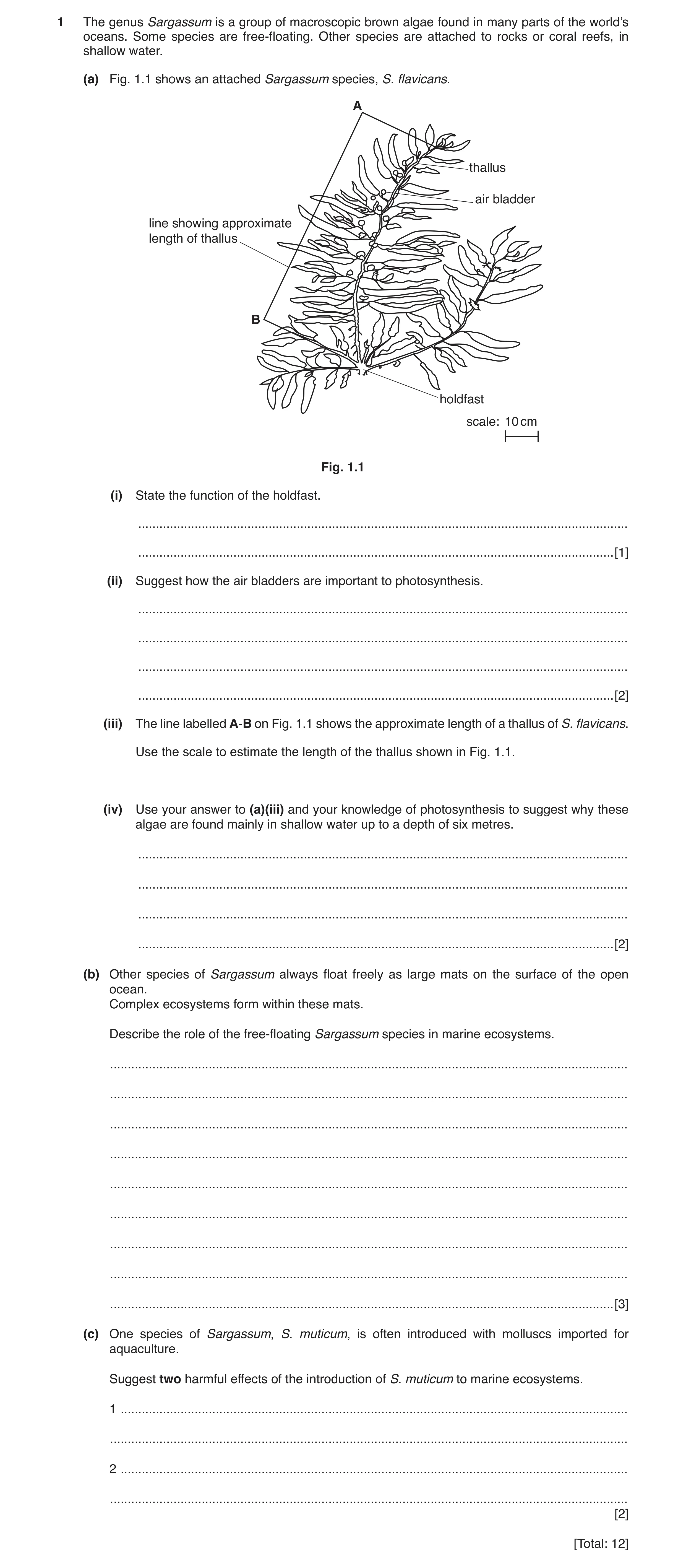
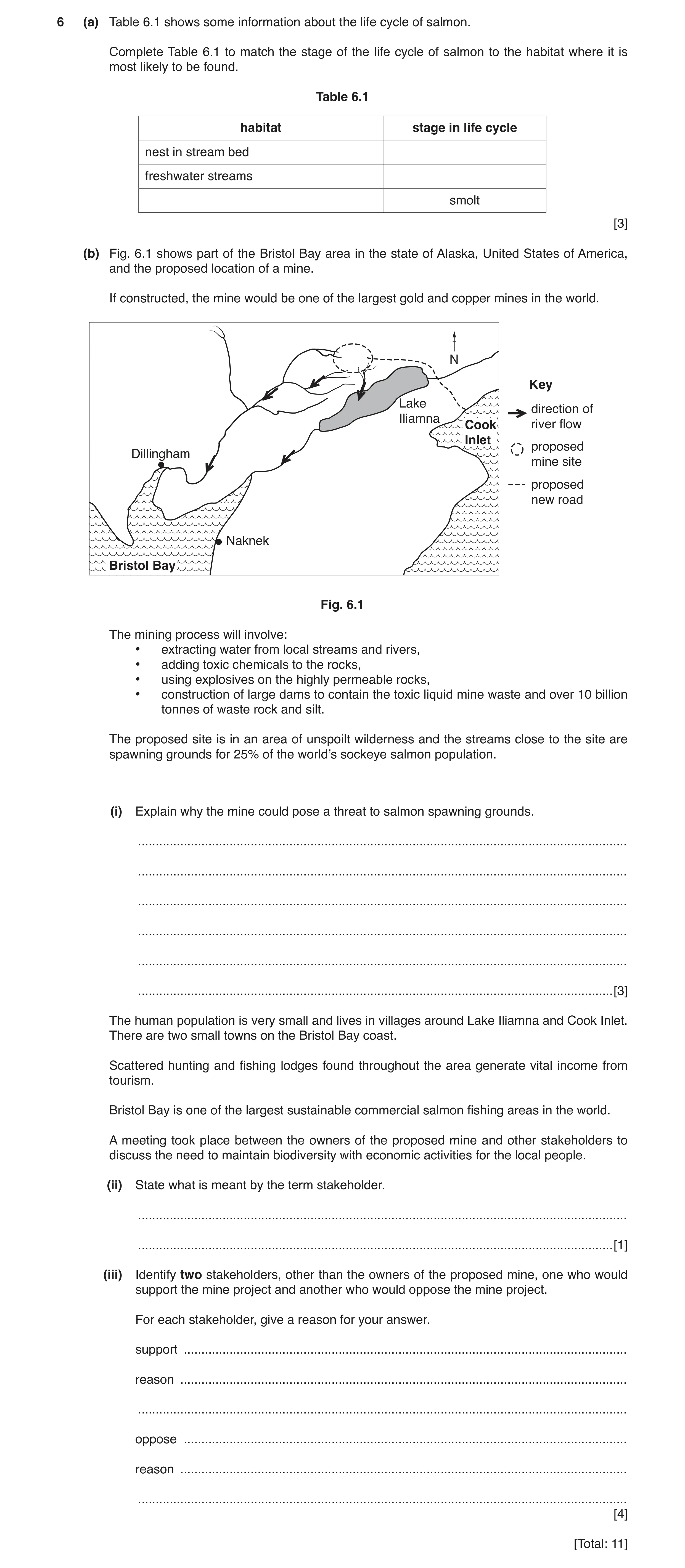
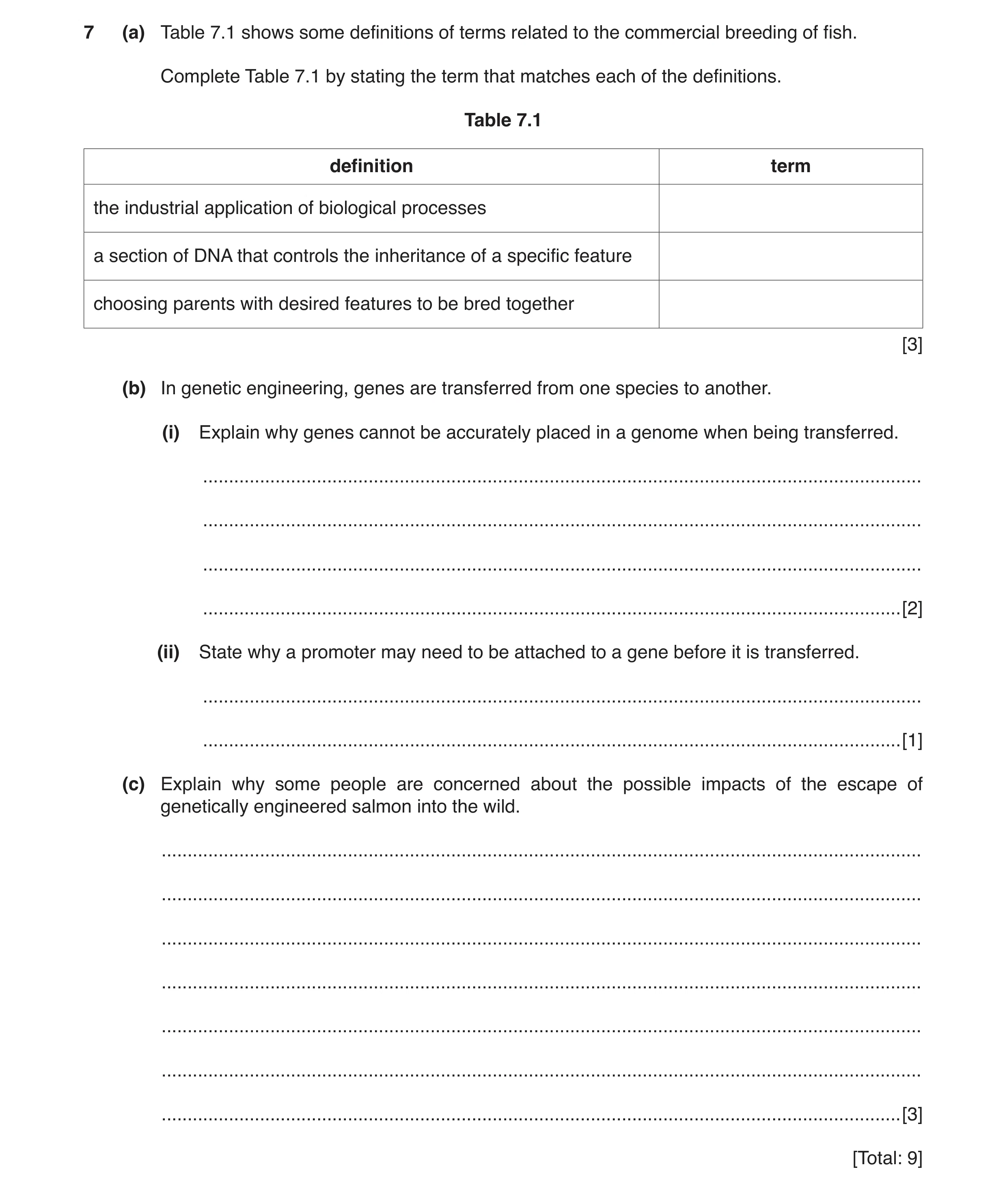 9 / 101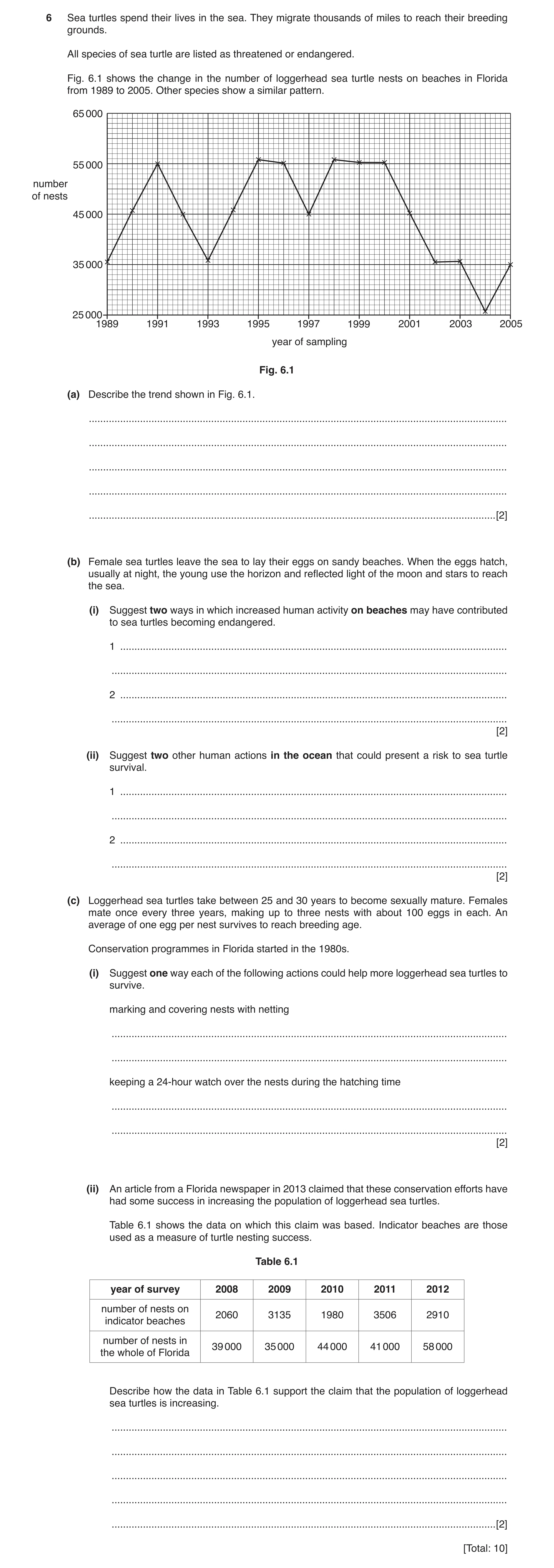
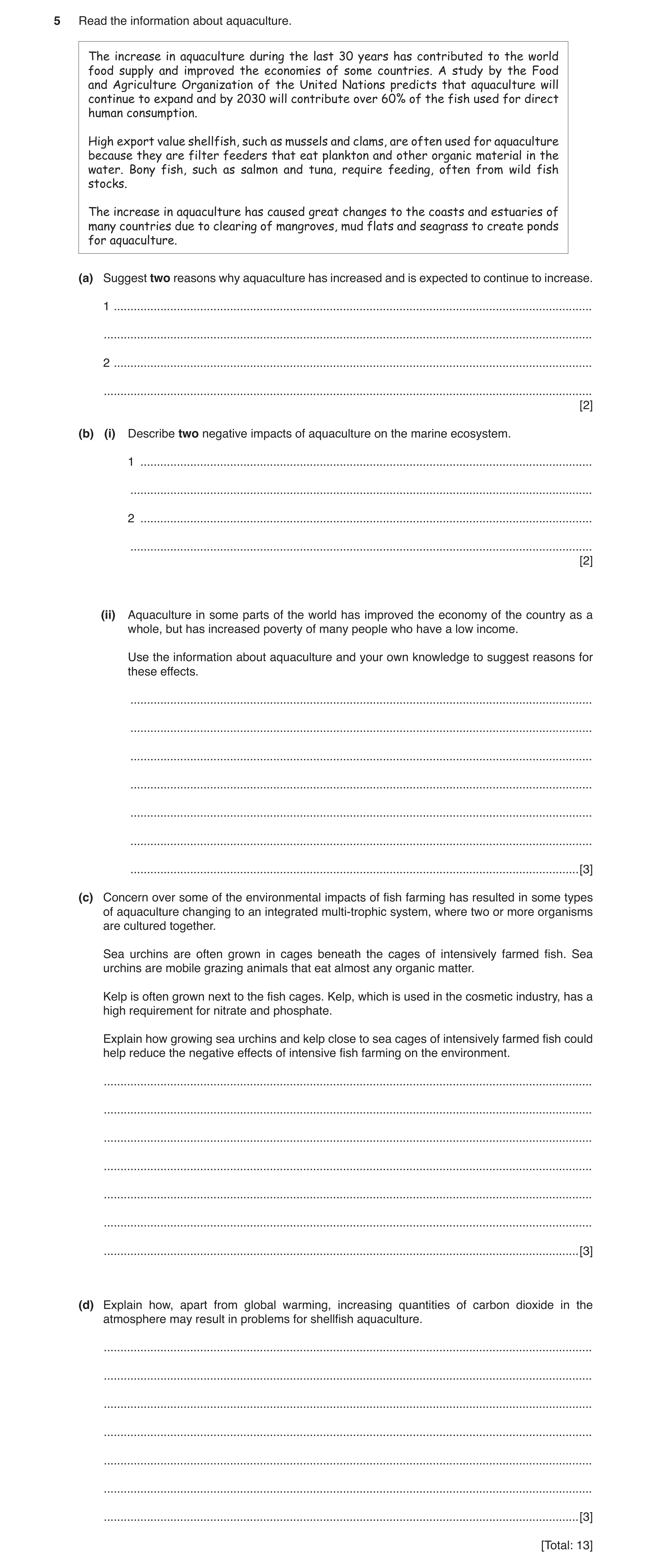
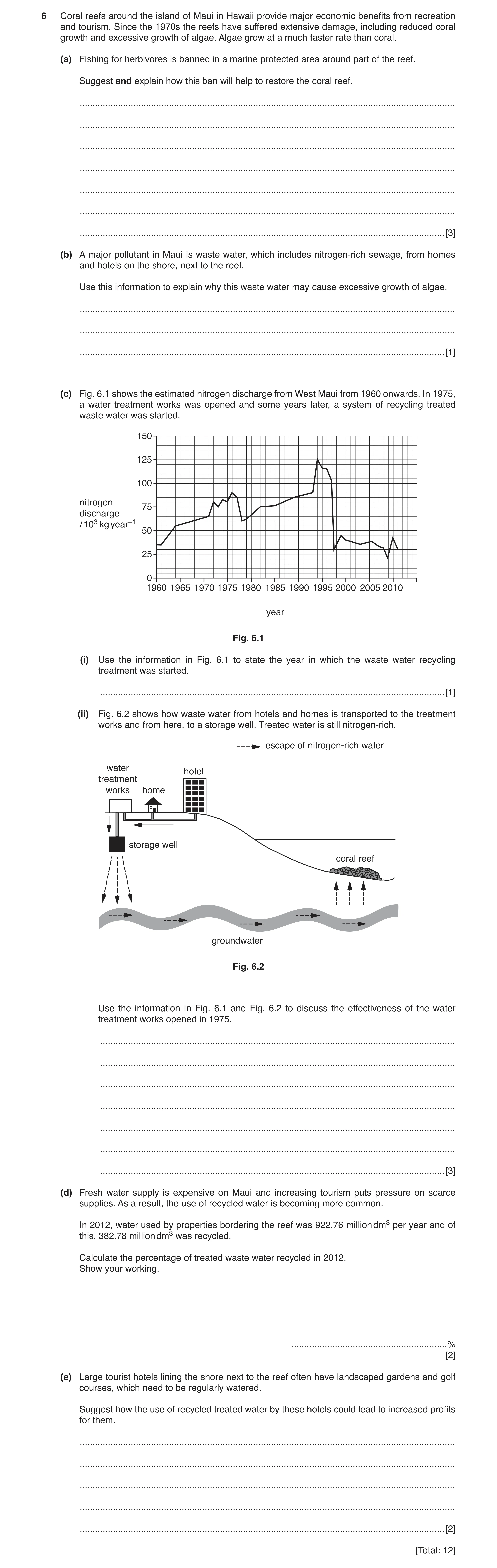
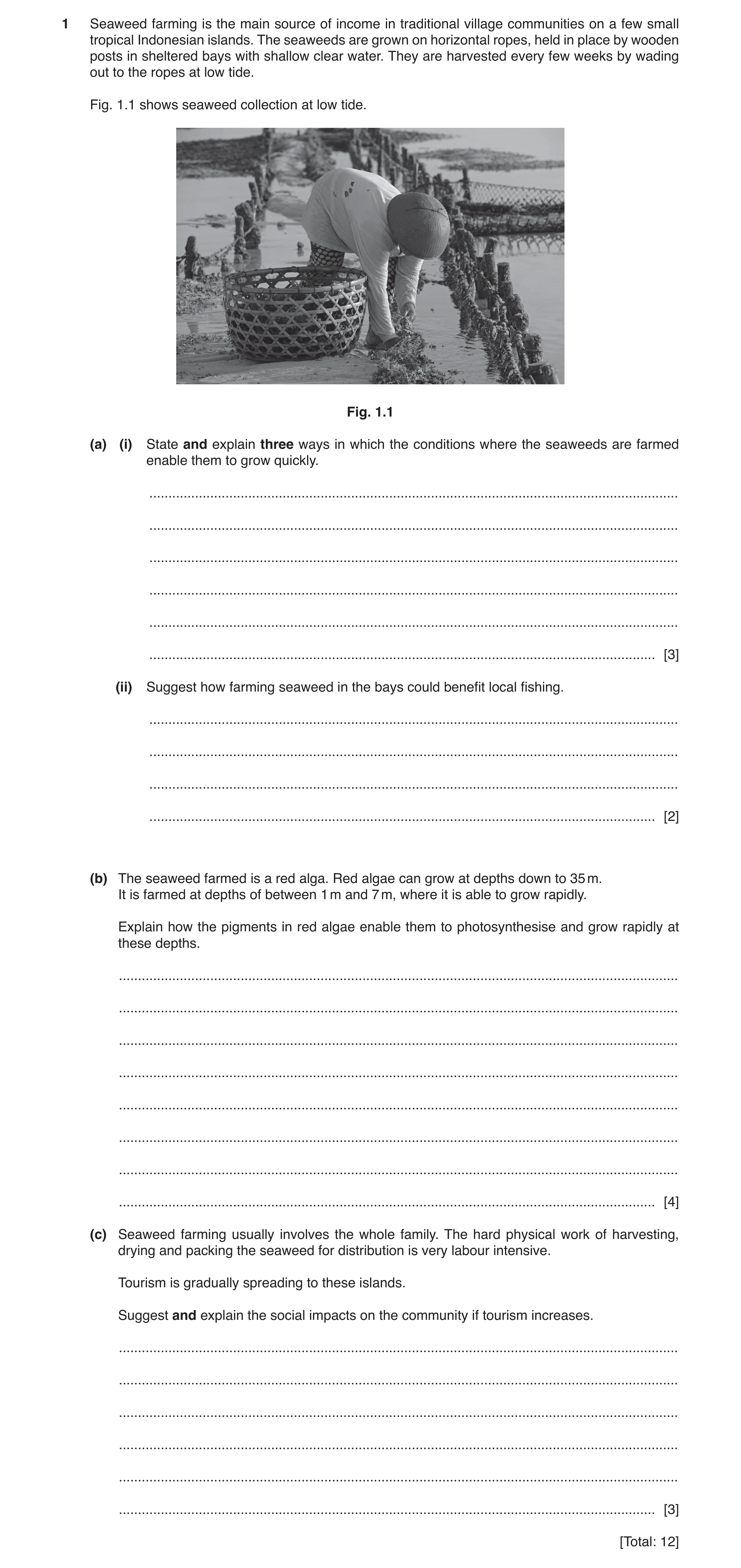
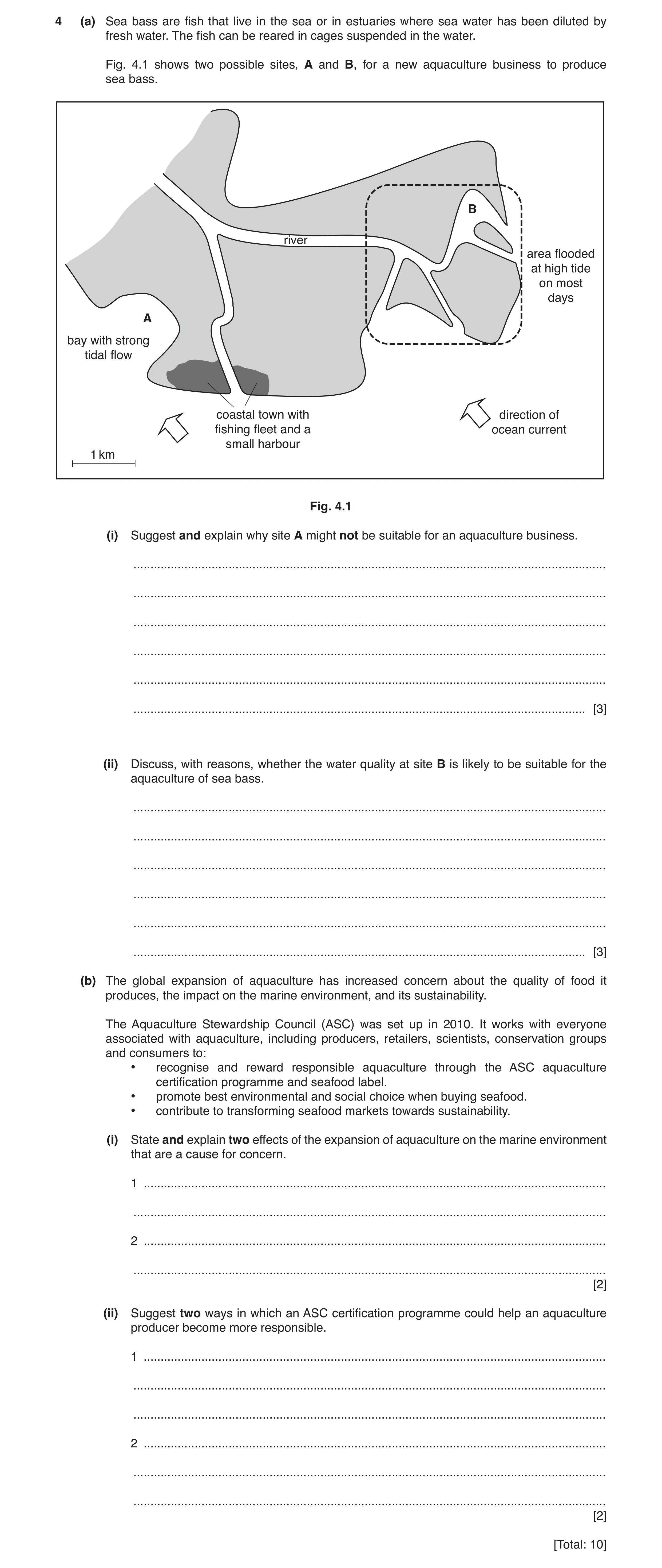
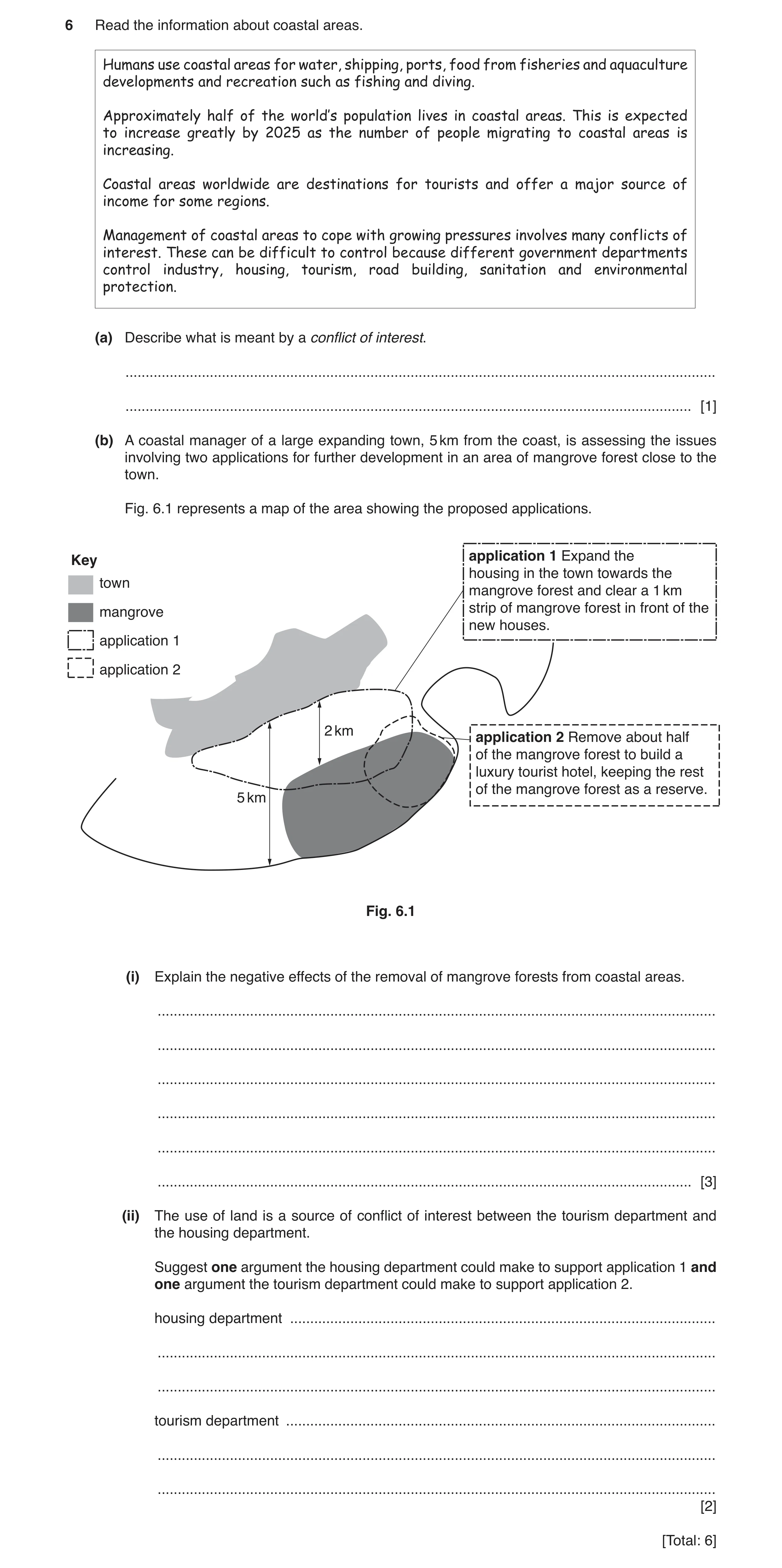
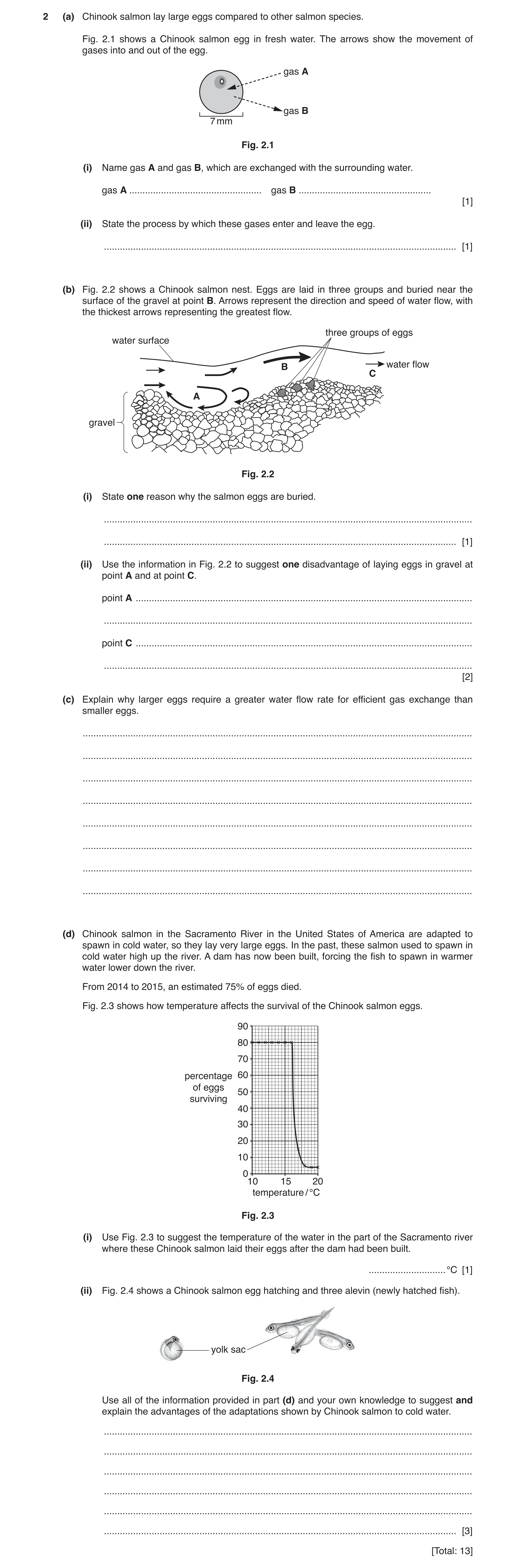
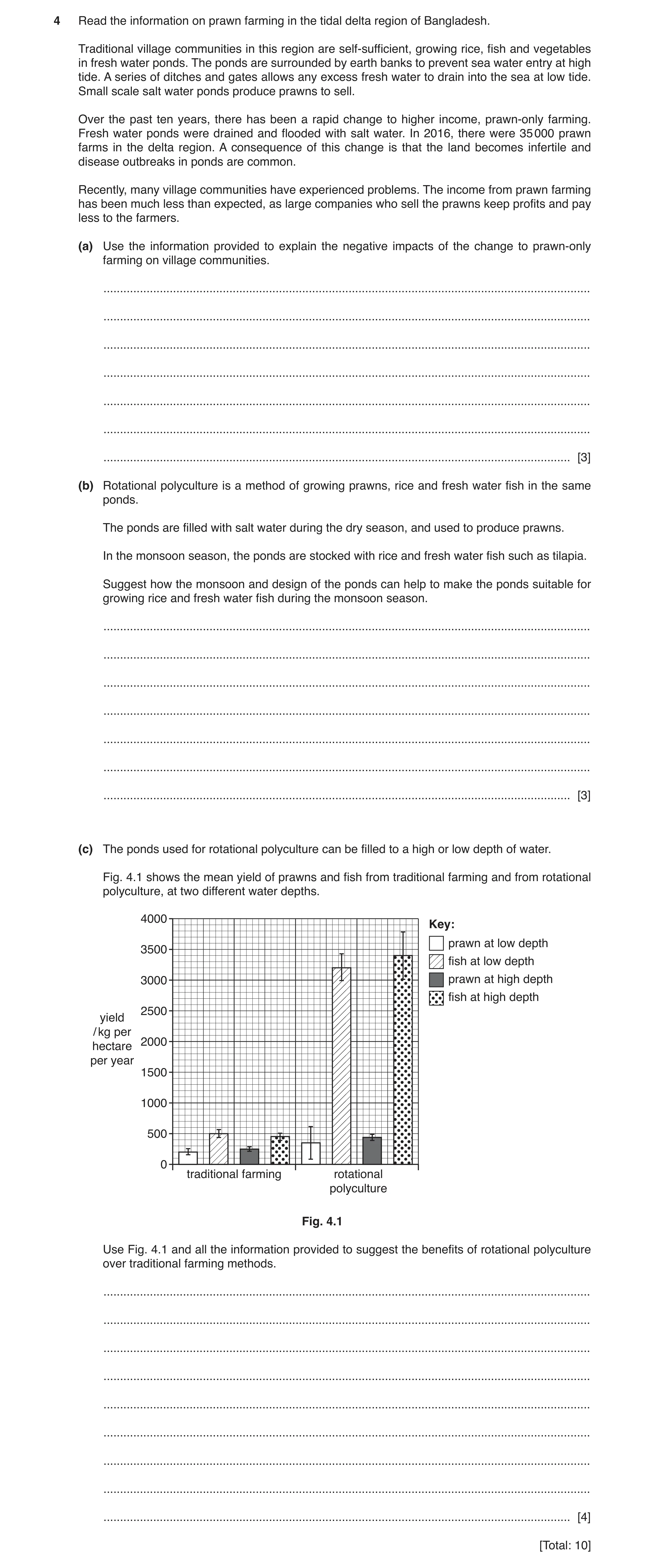
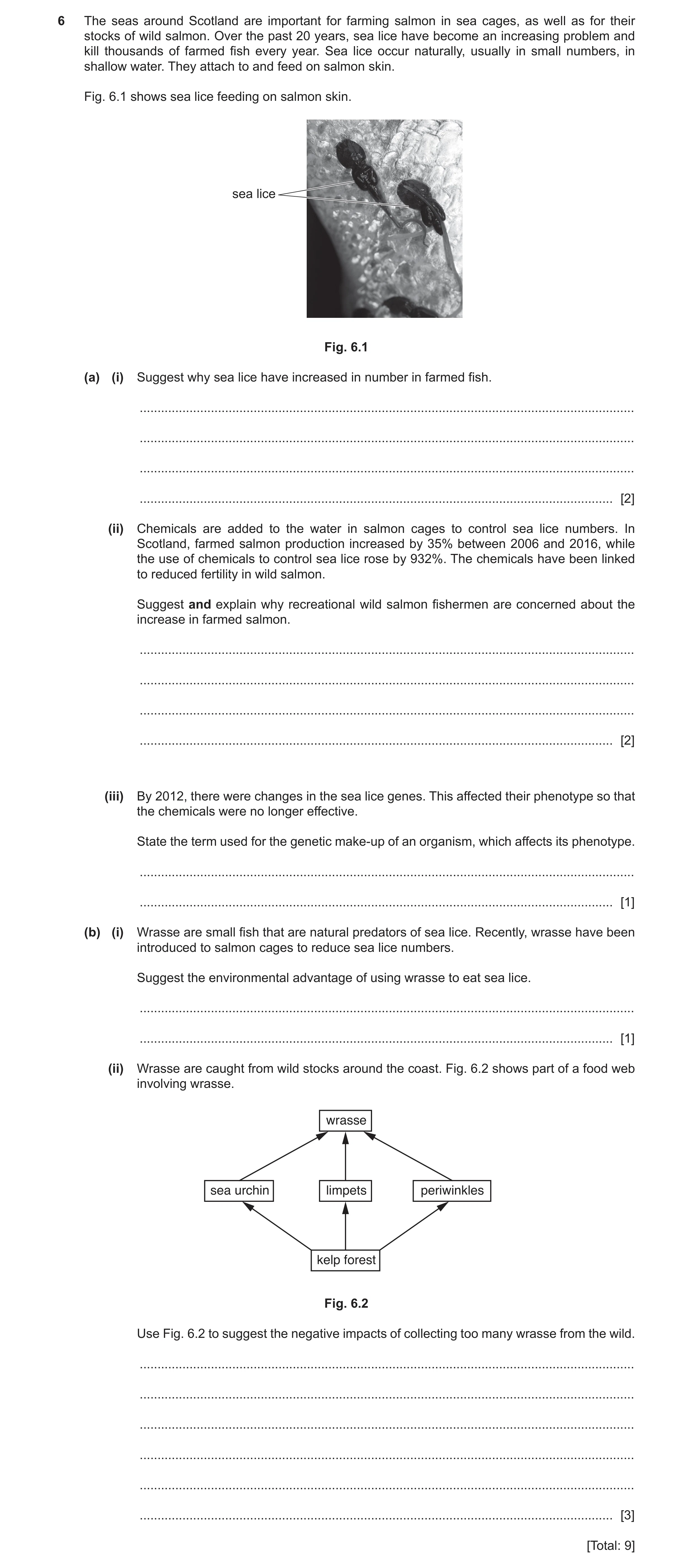
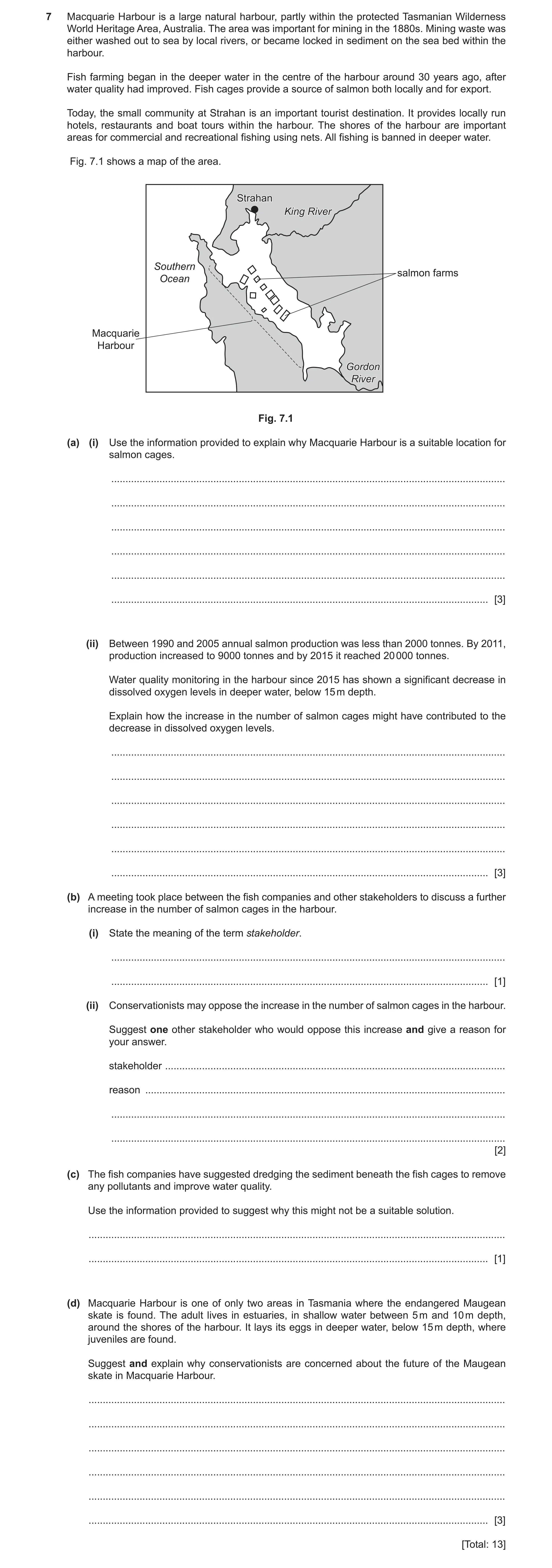
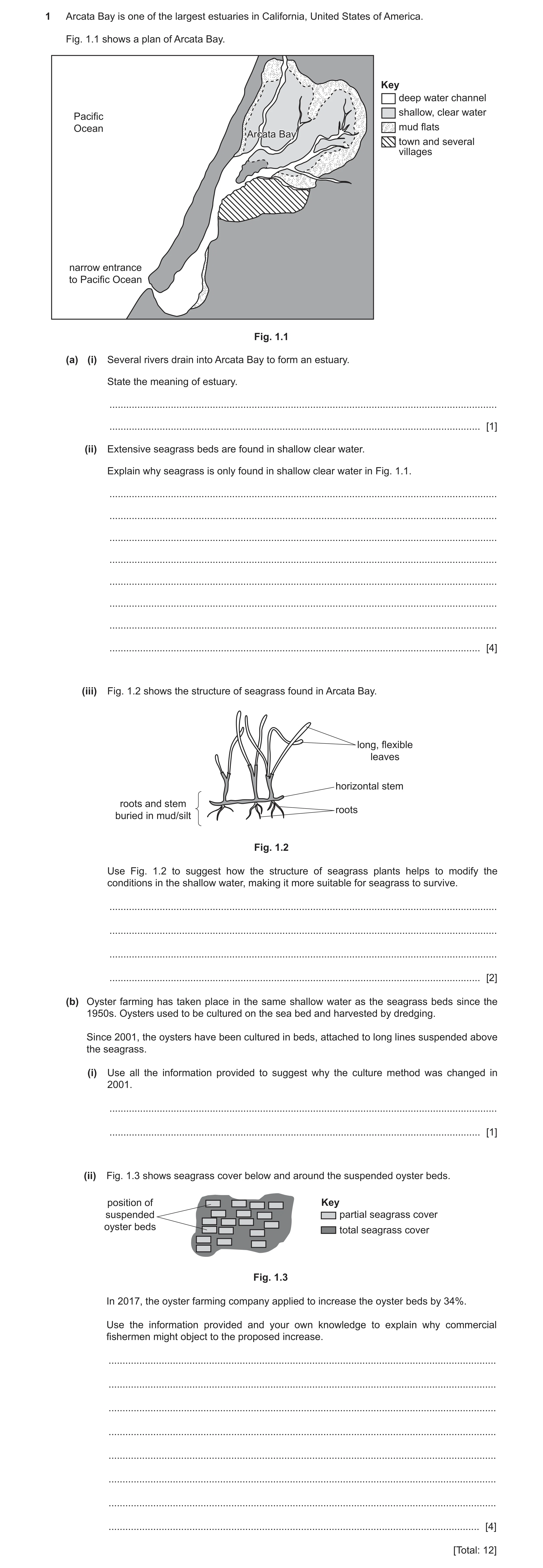
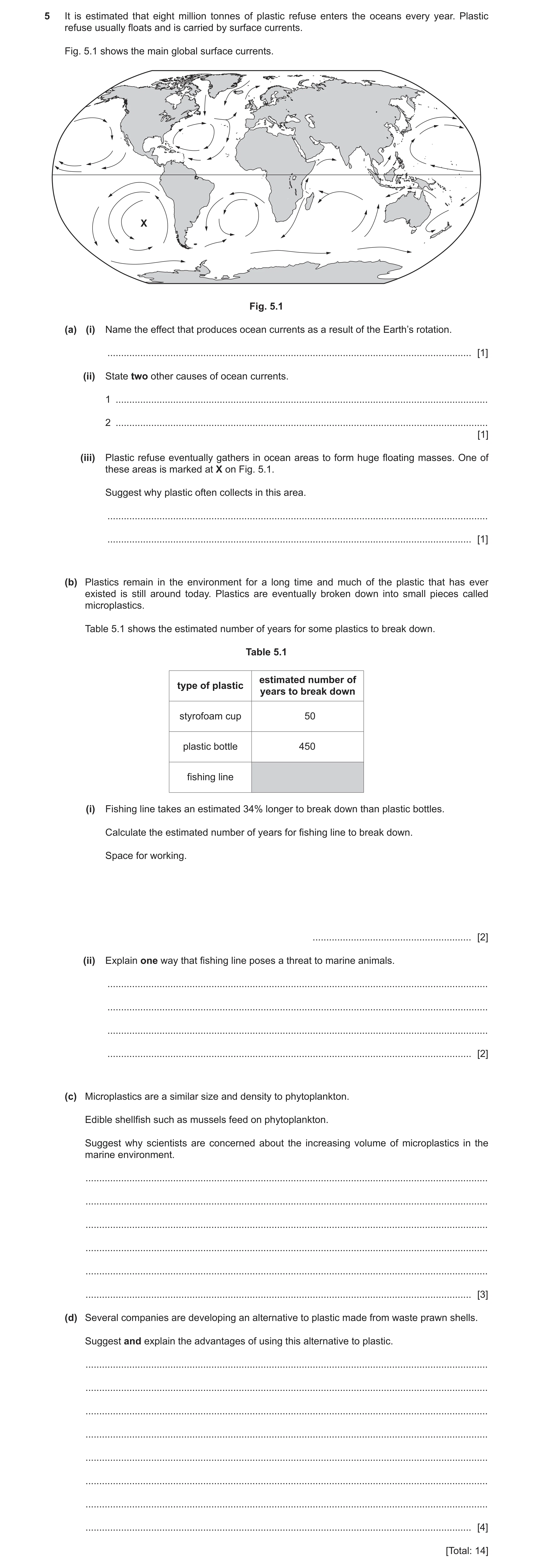
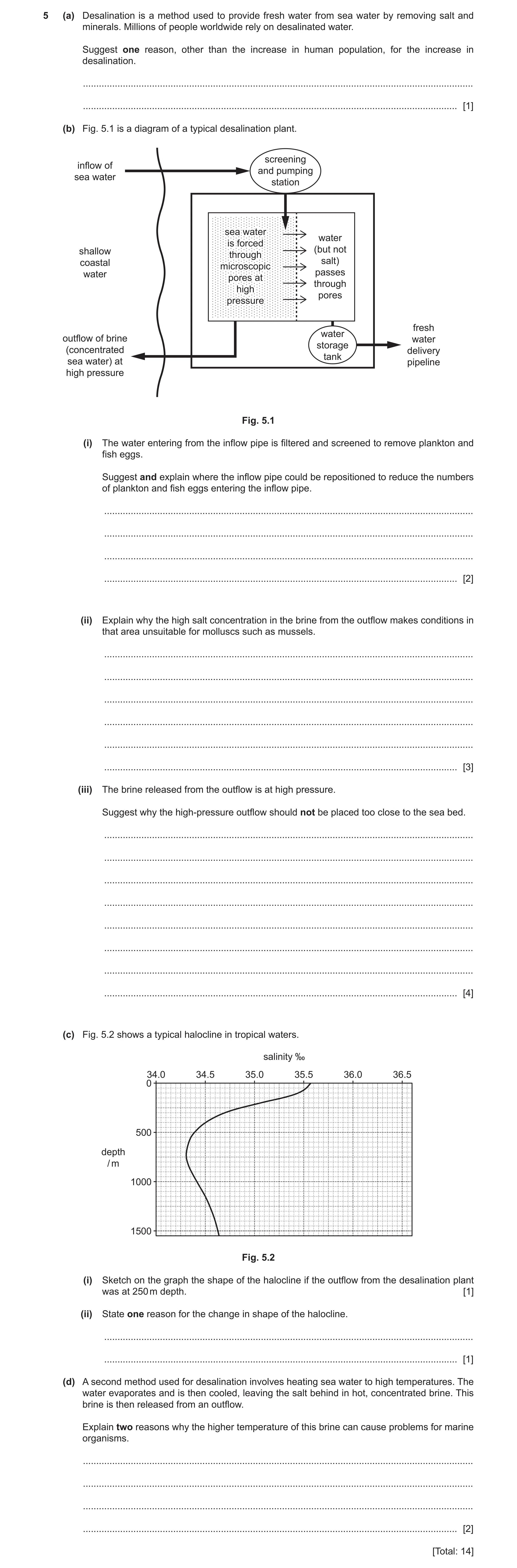
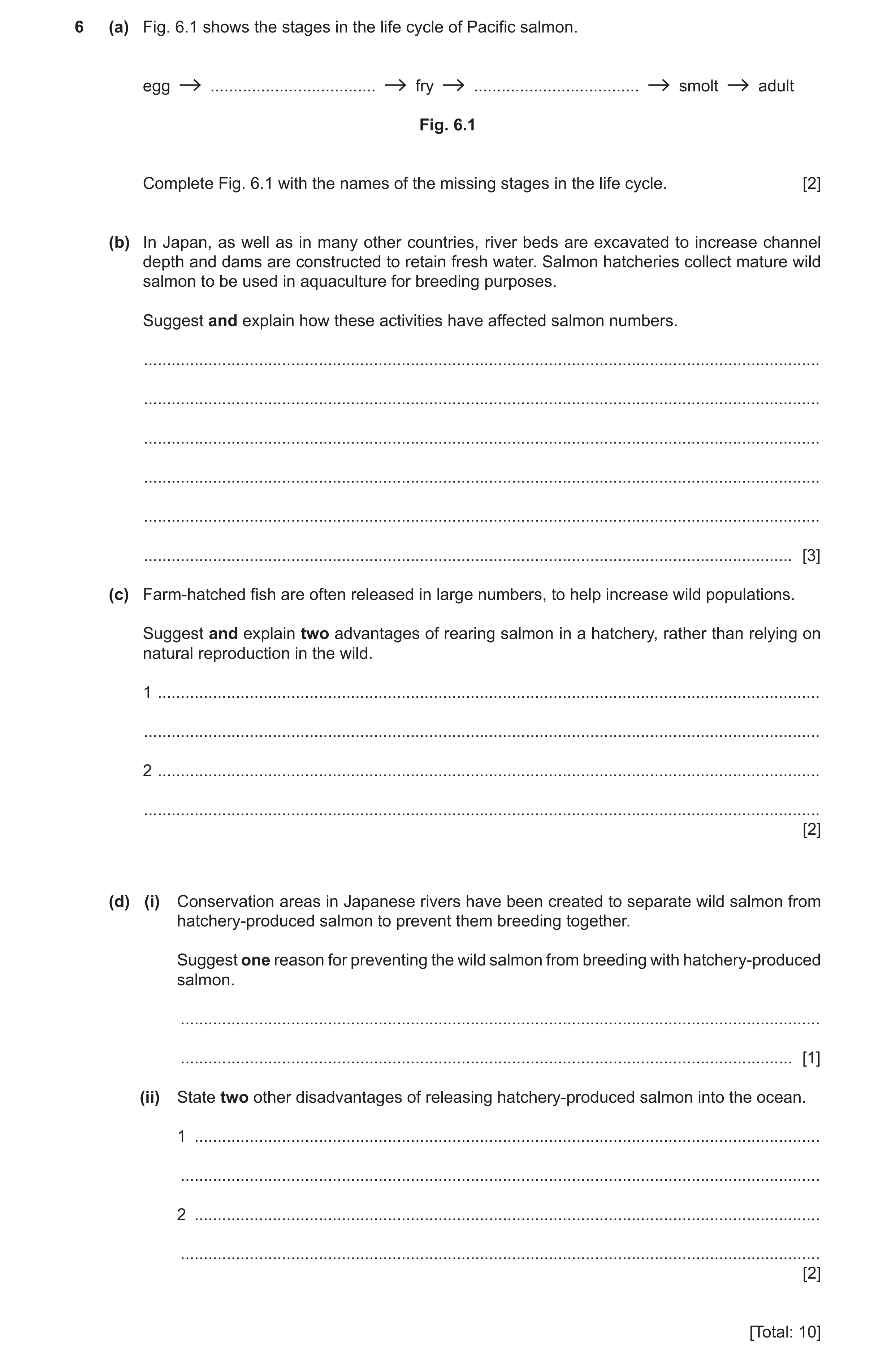
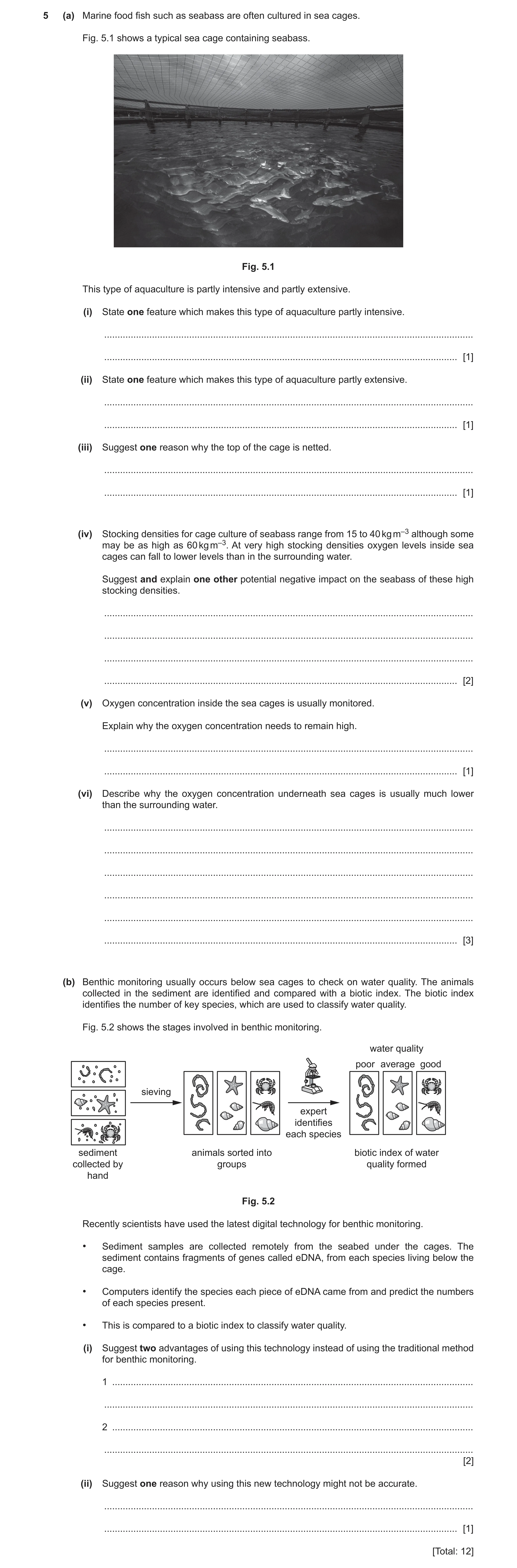
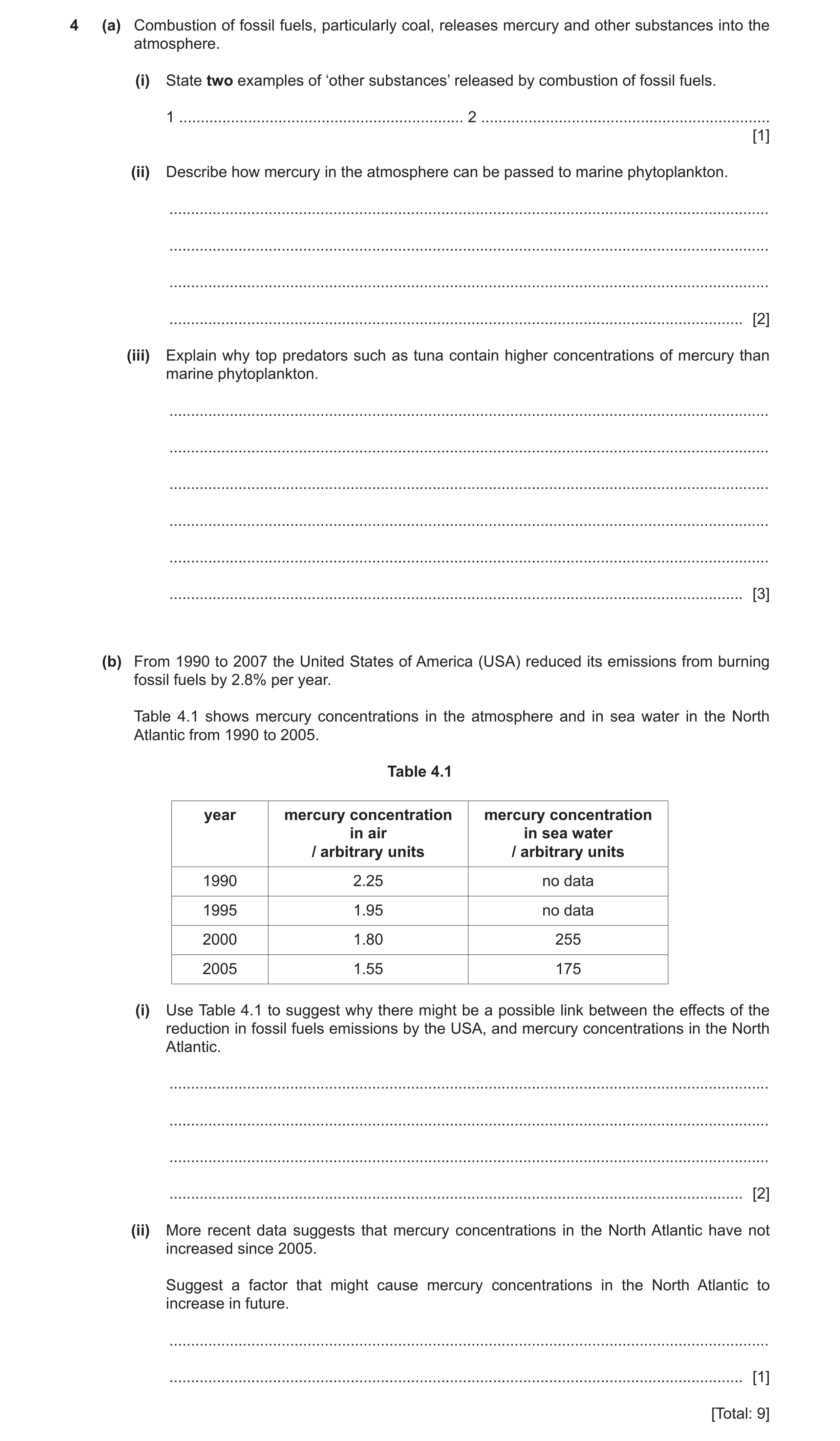
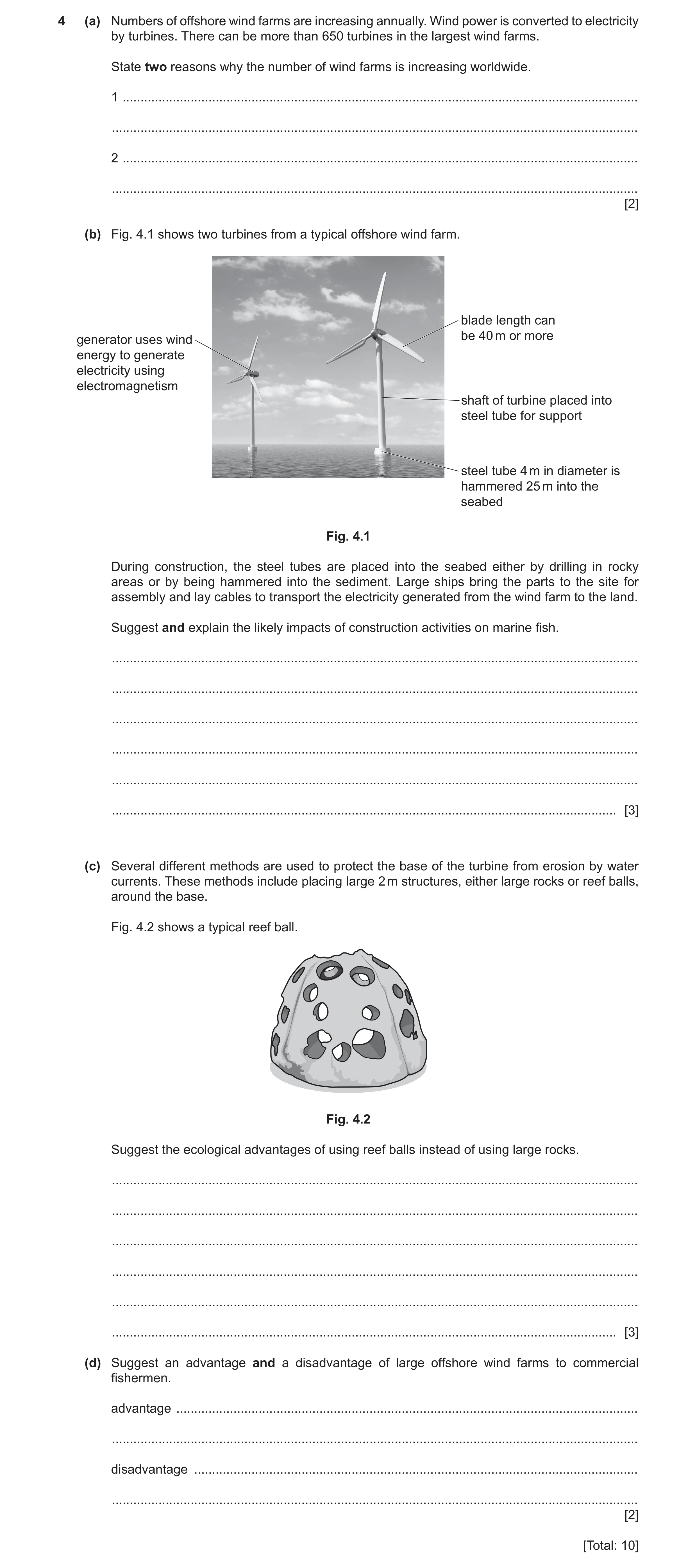
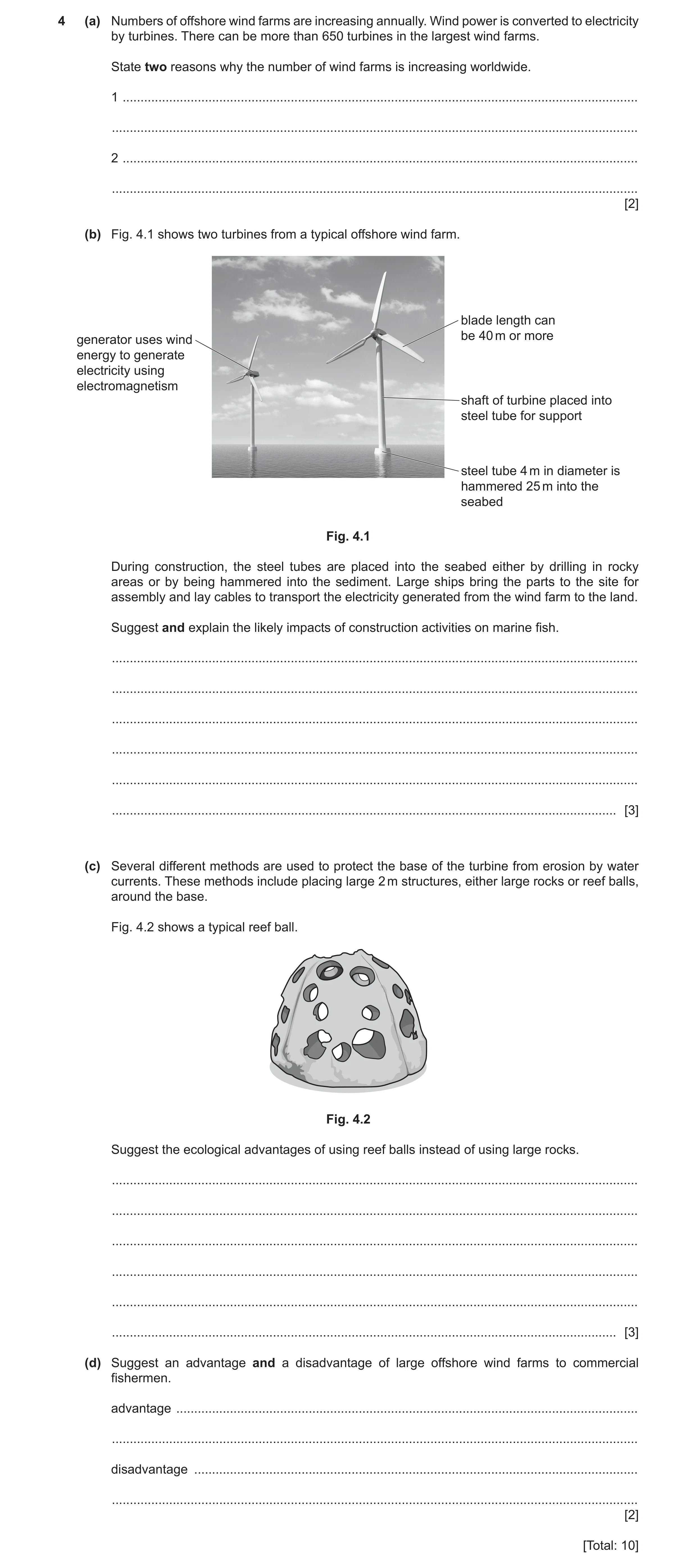
 47 / 101
 48 / 101
 49 / 101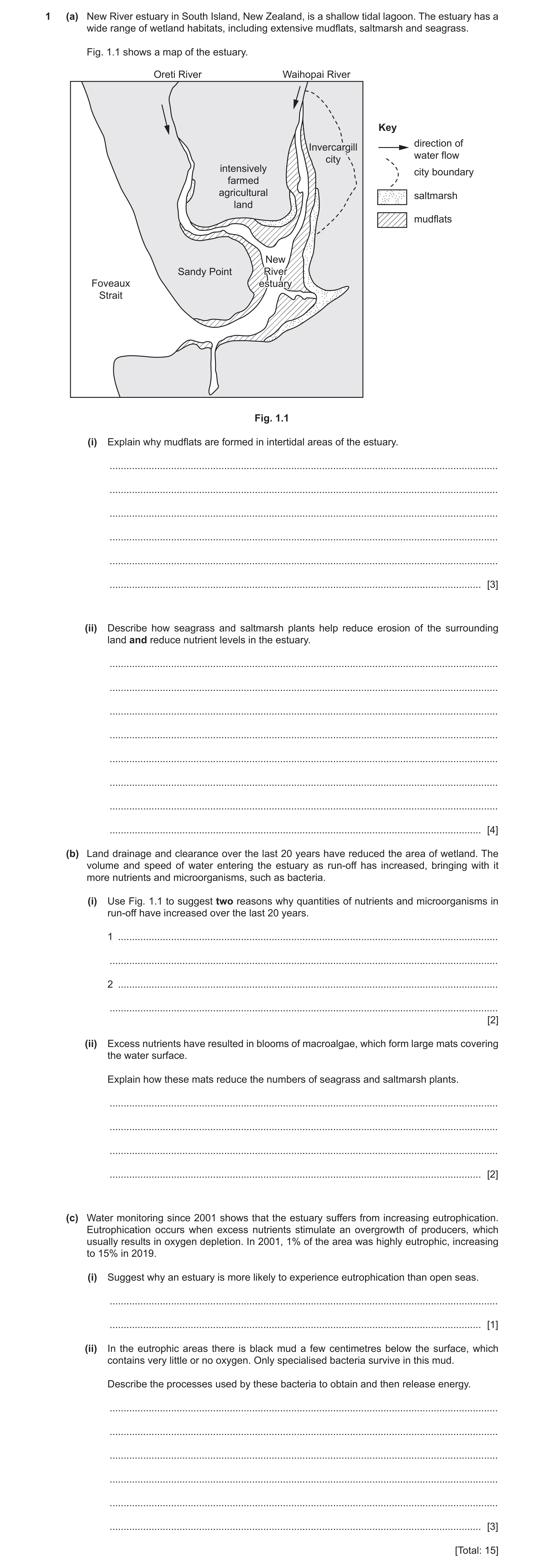
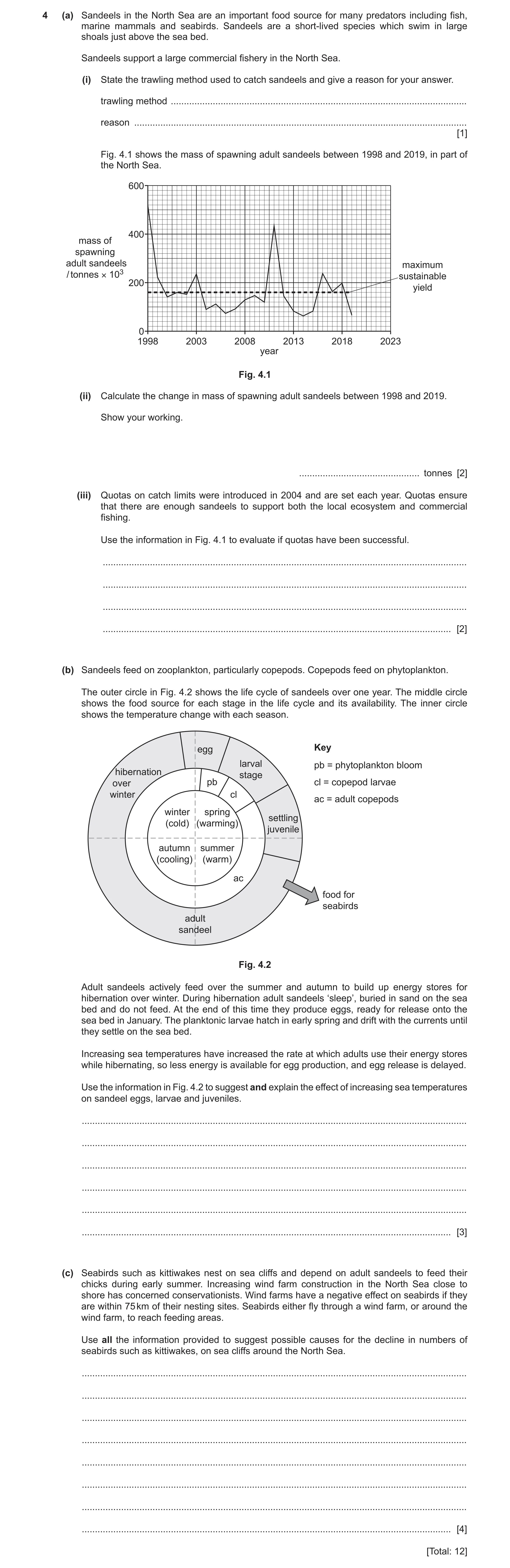
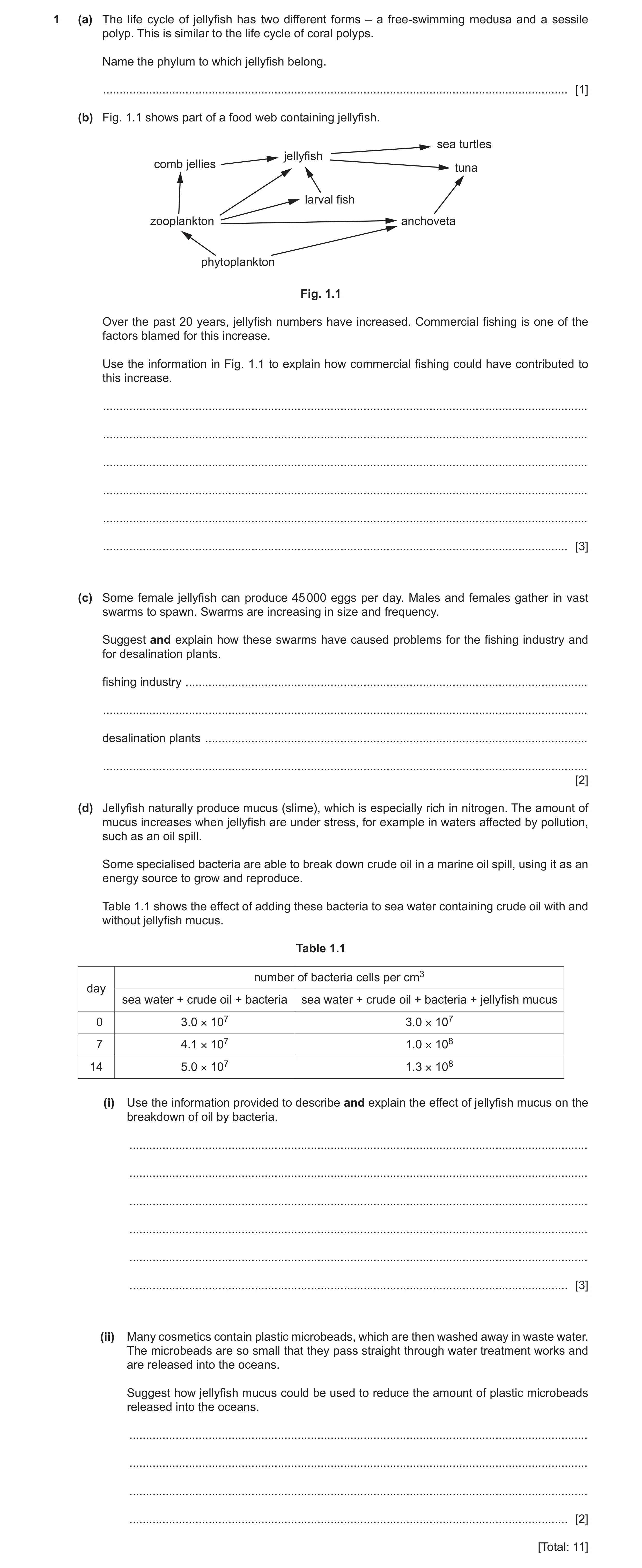
 56 / 101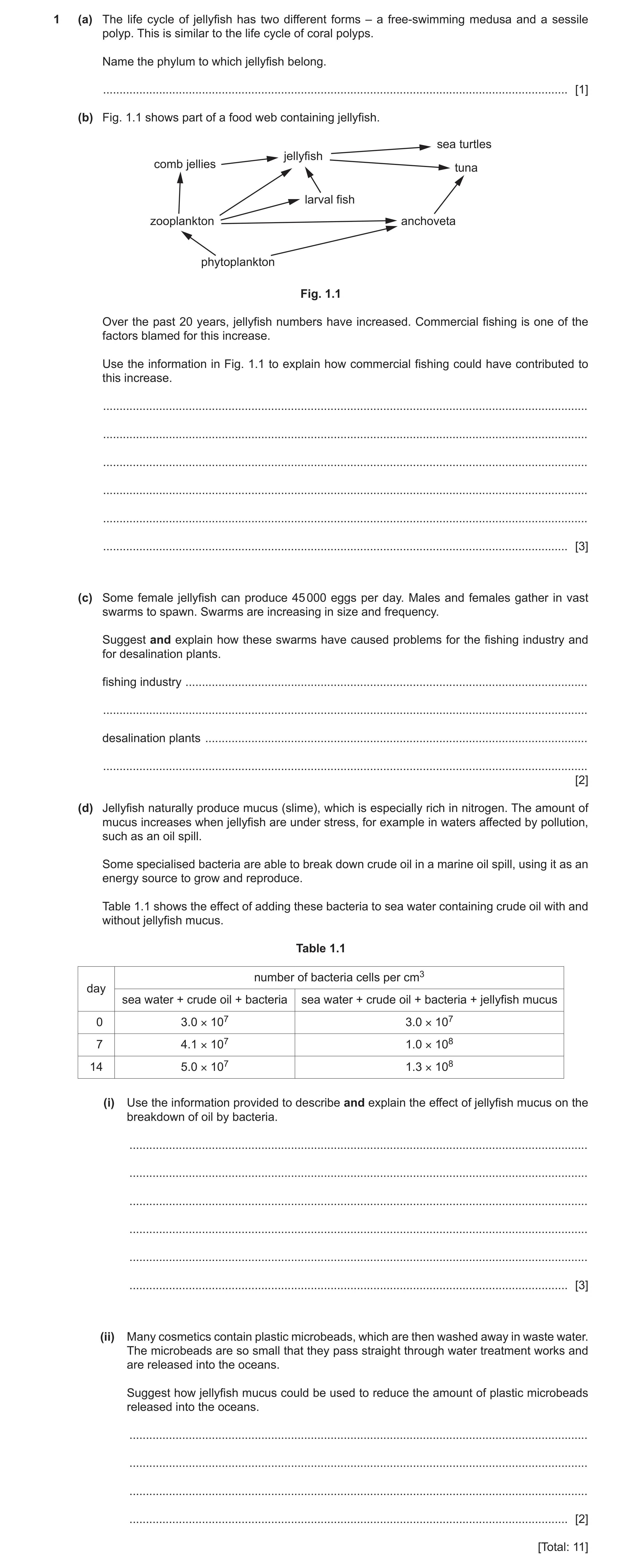
 59 / 101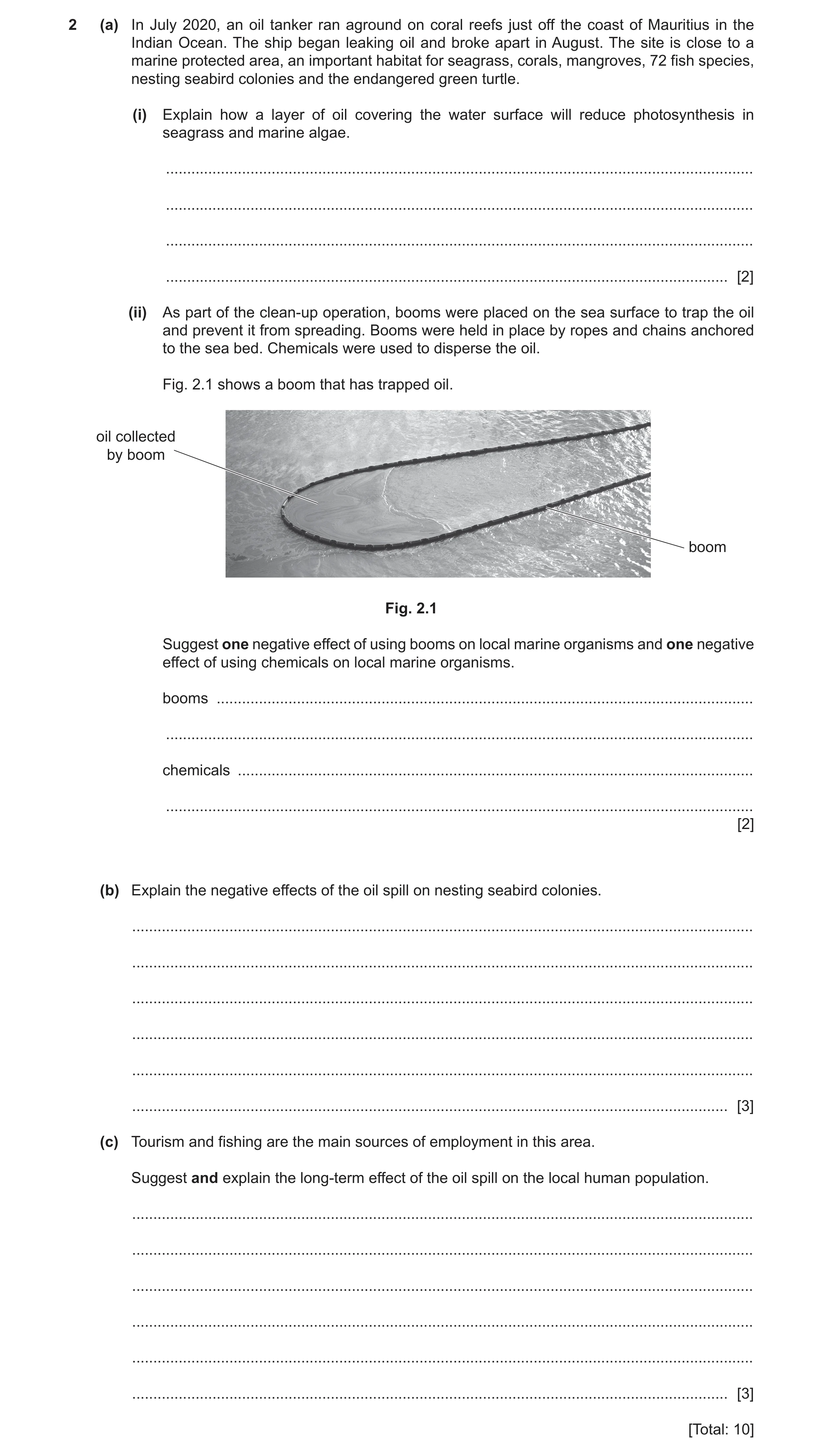
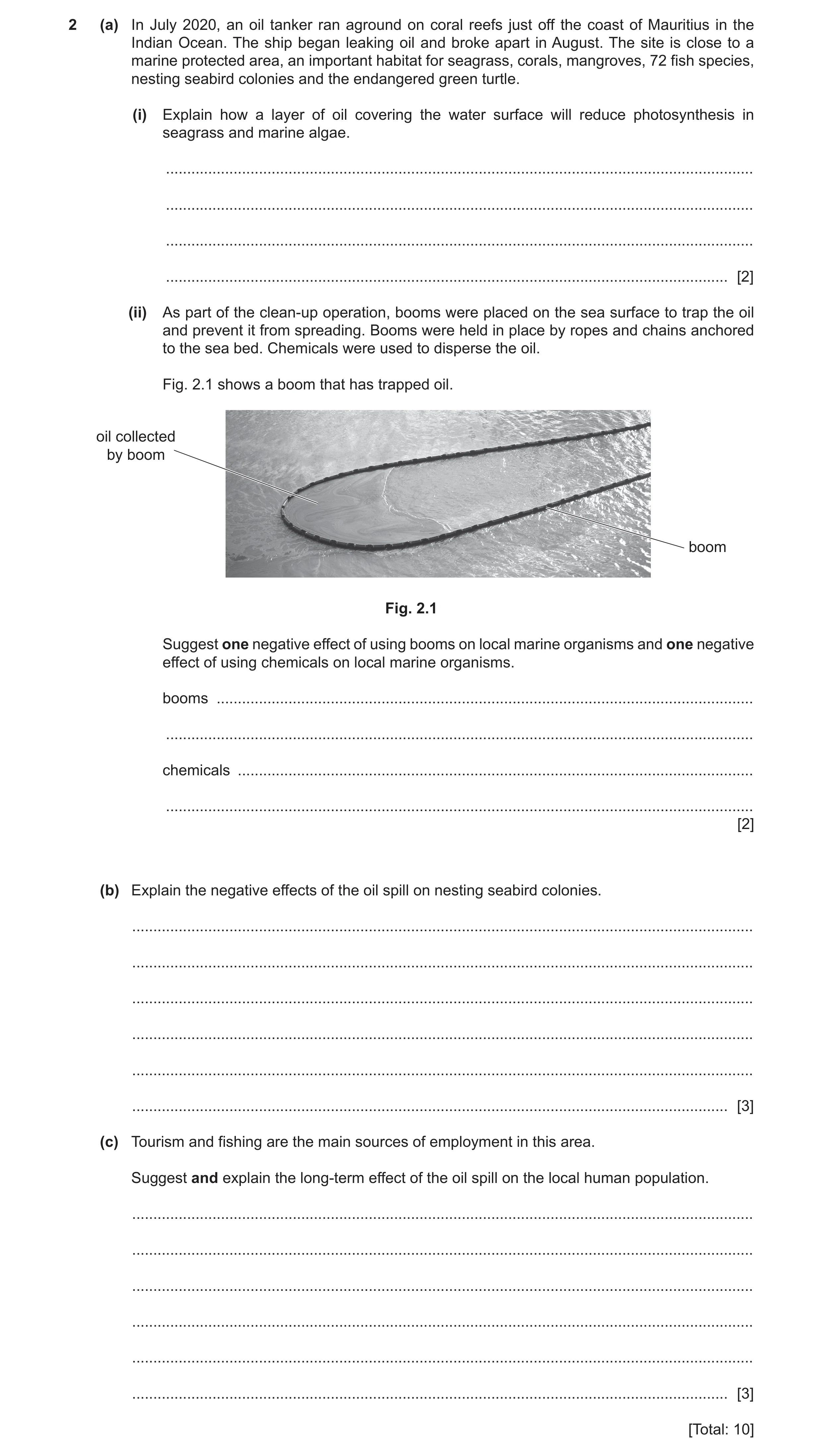
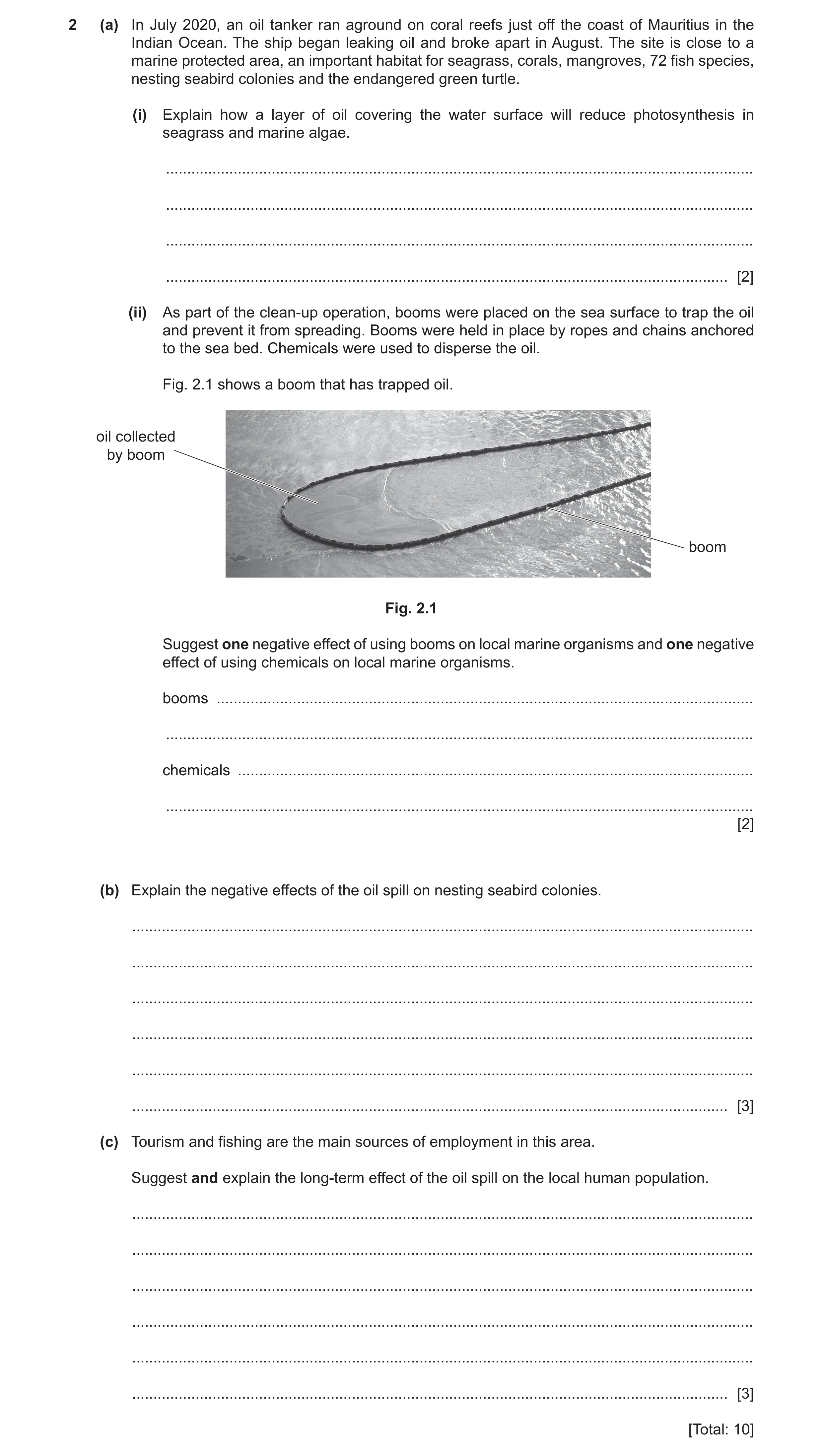
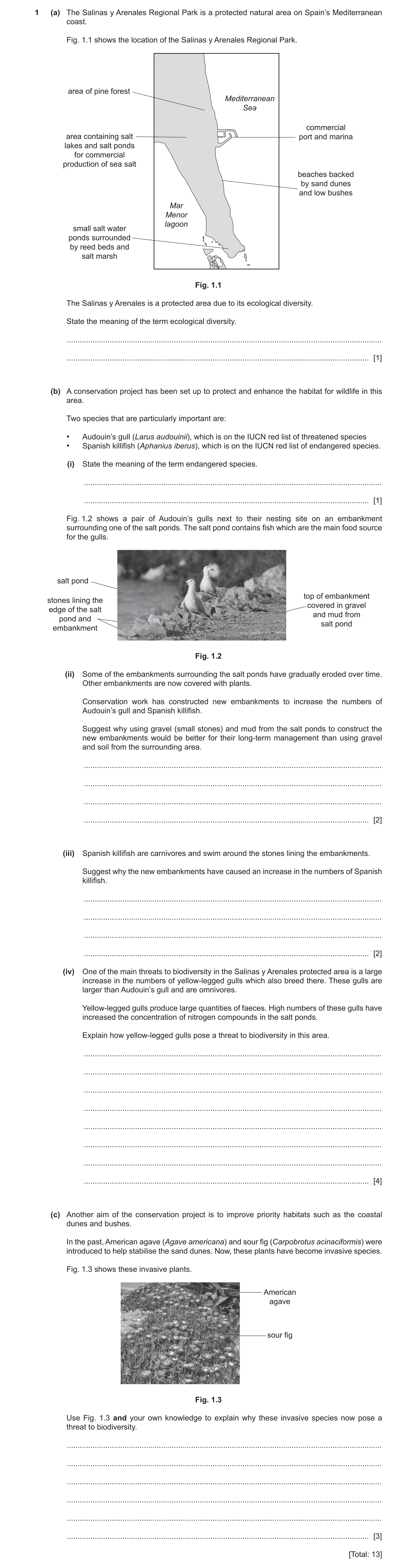
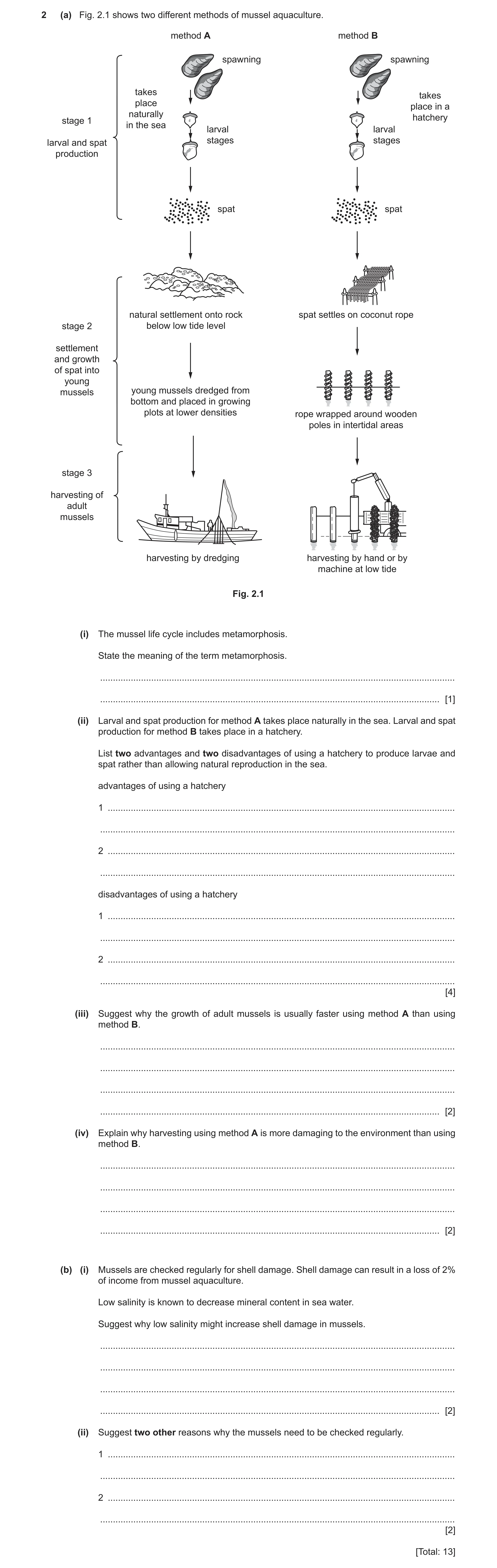
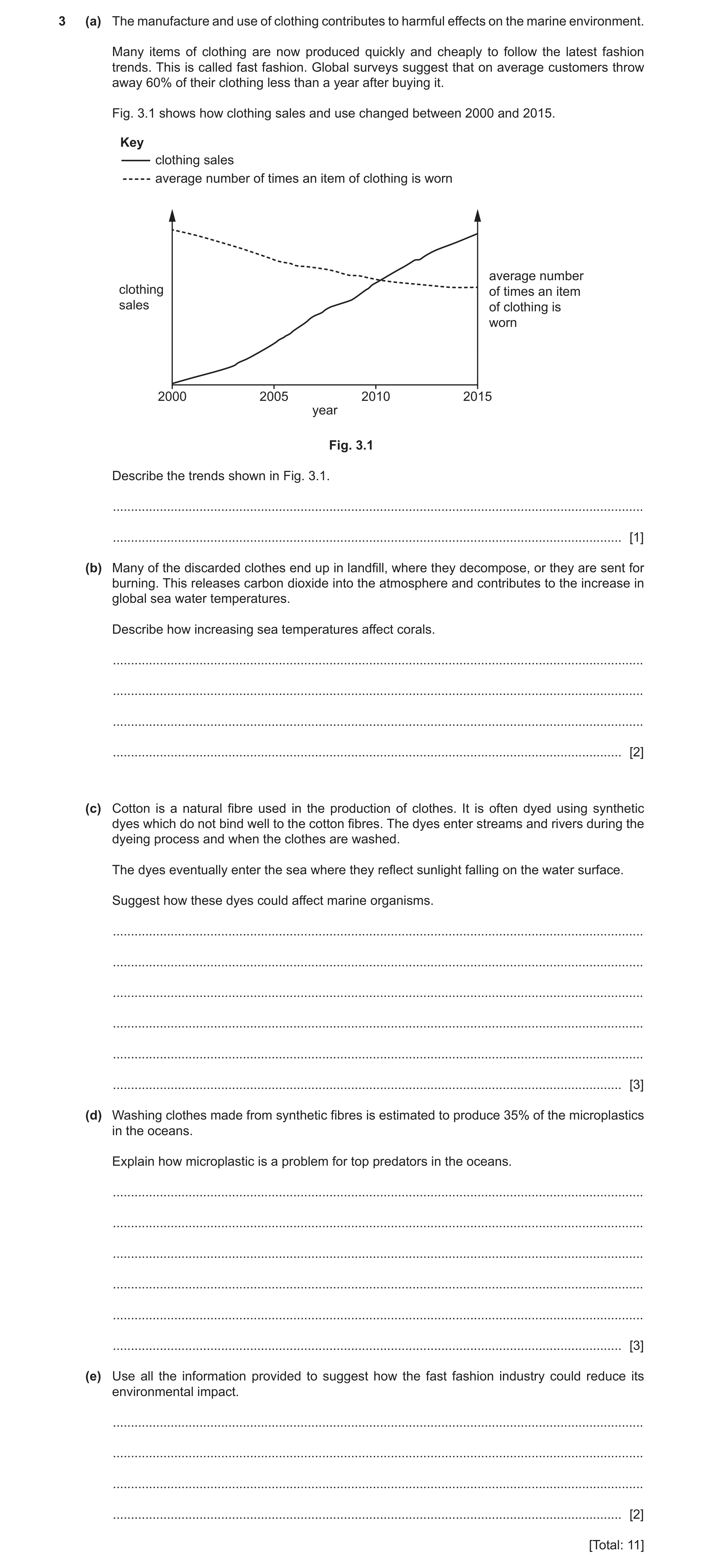
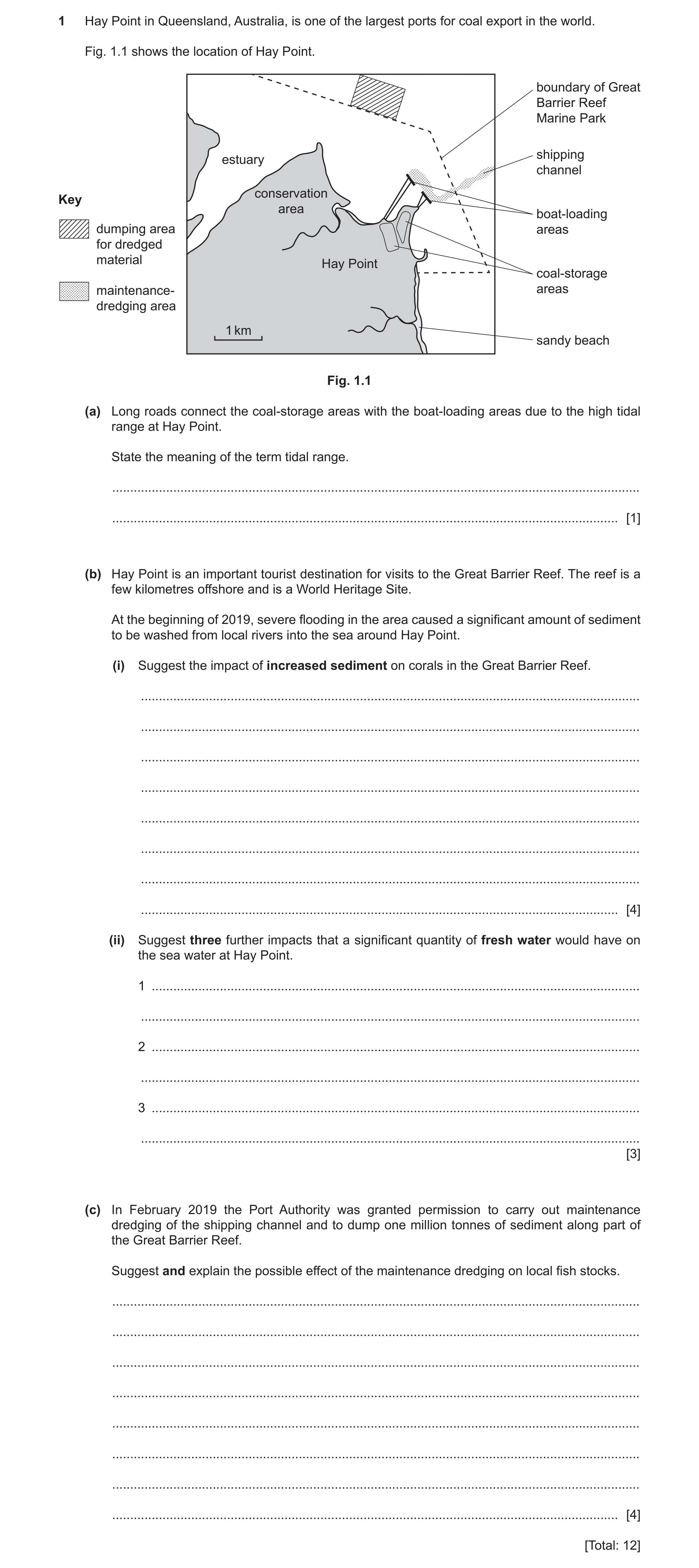
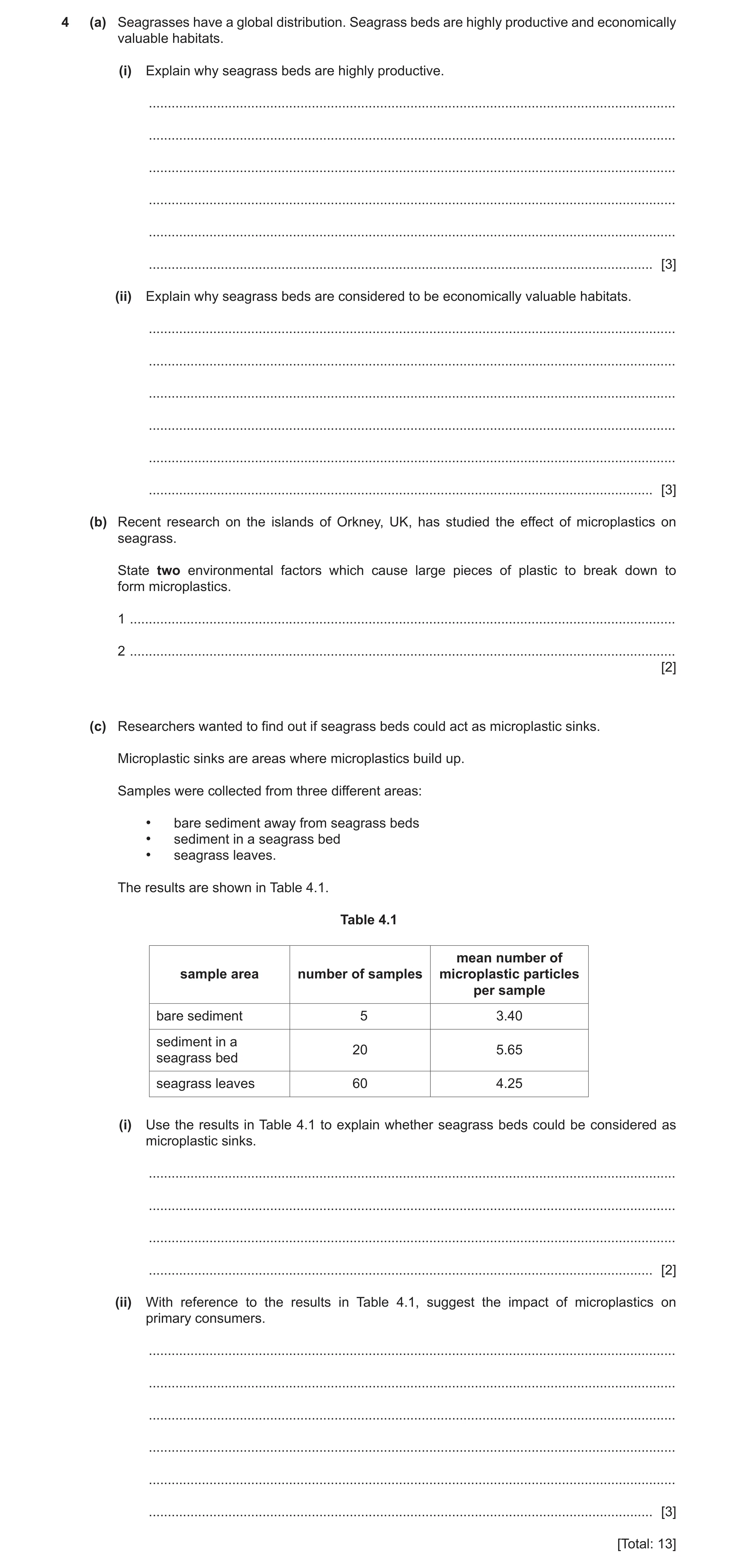
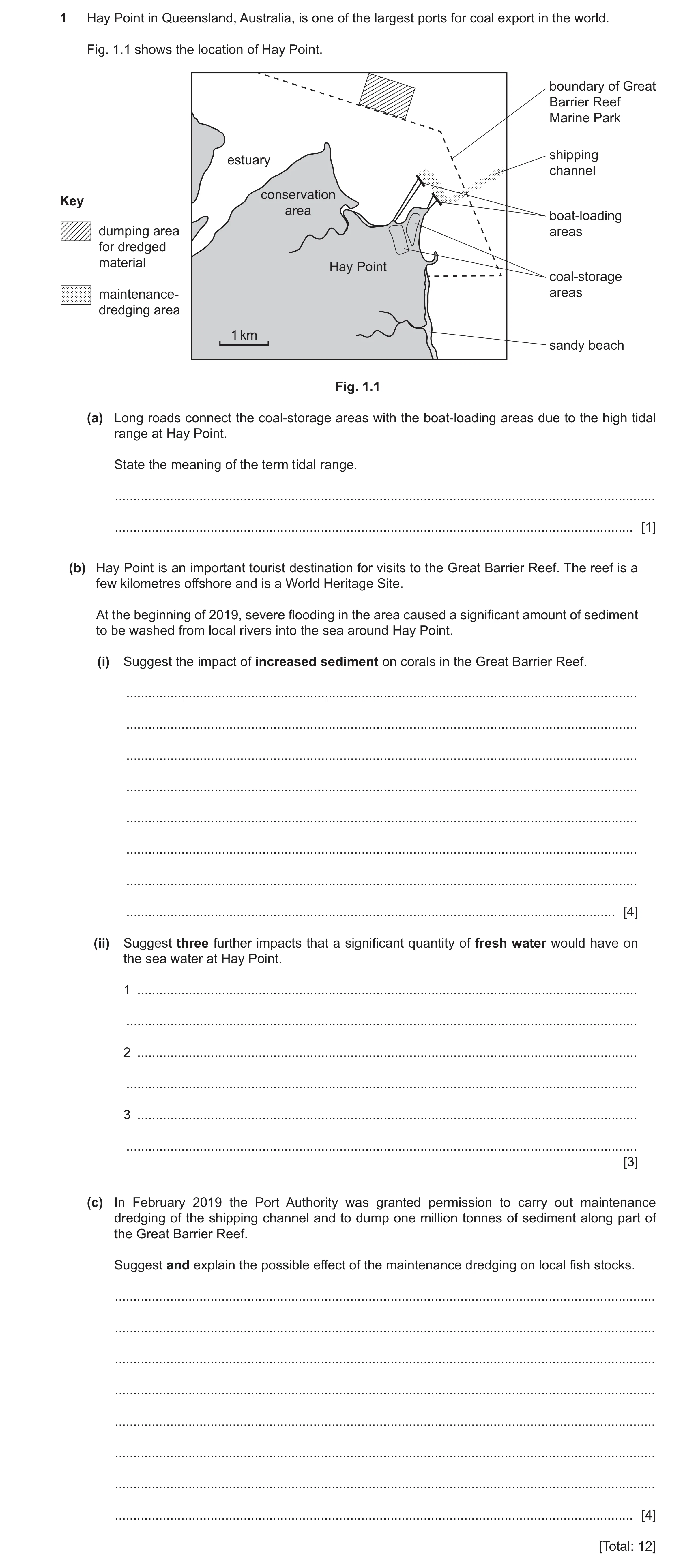
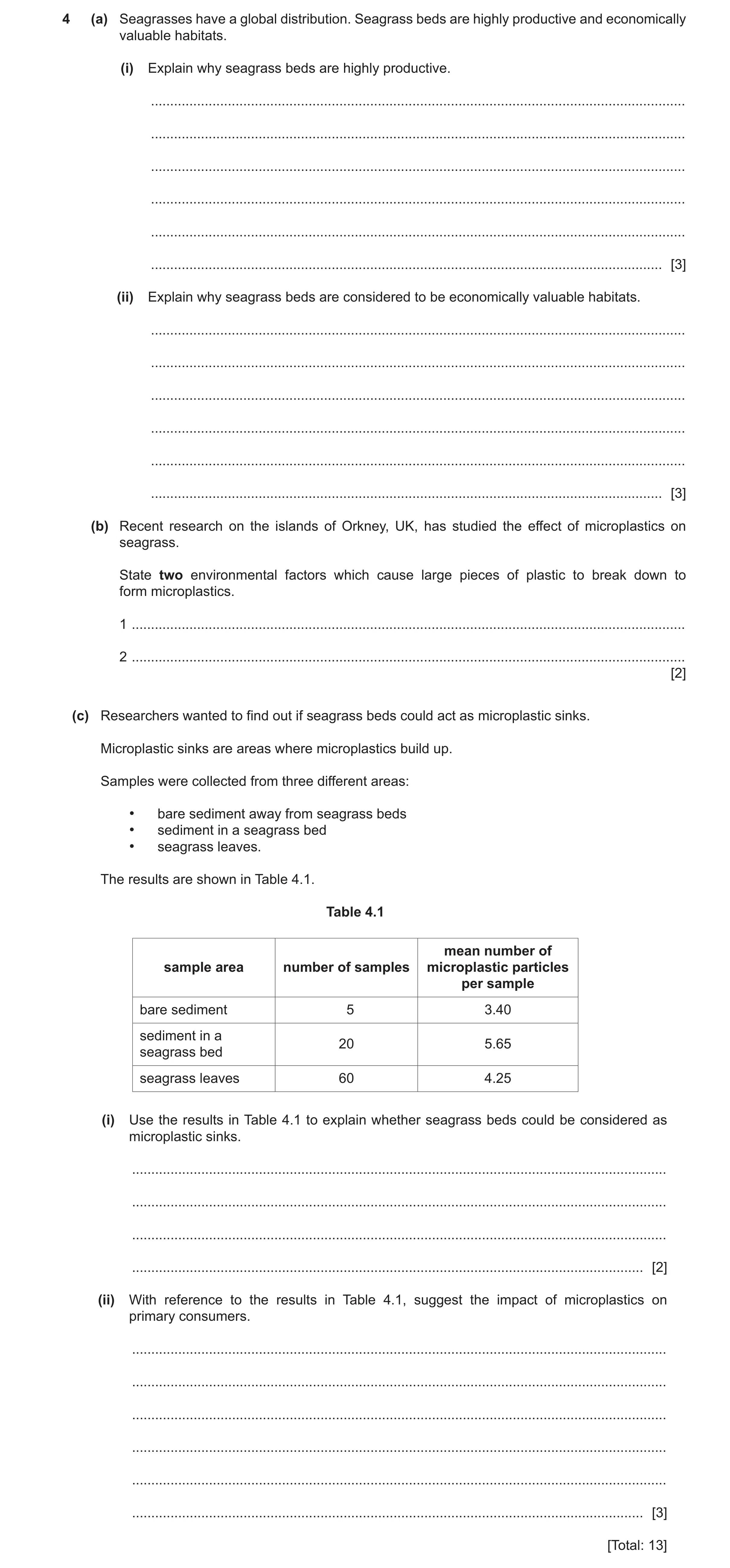
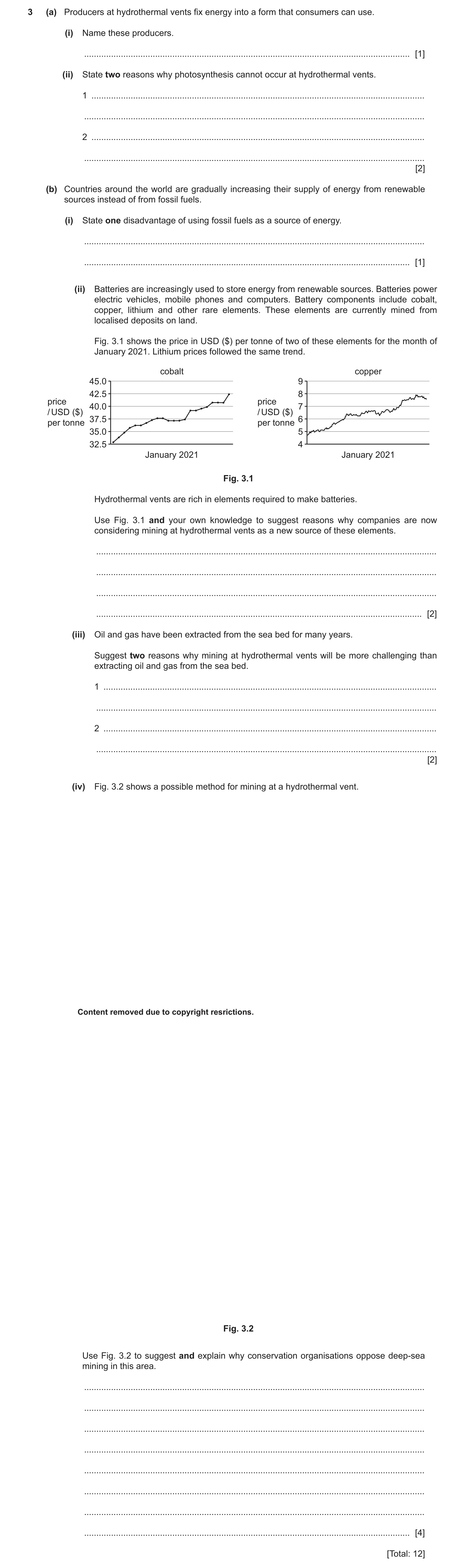
 80 / 101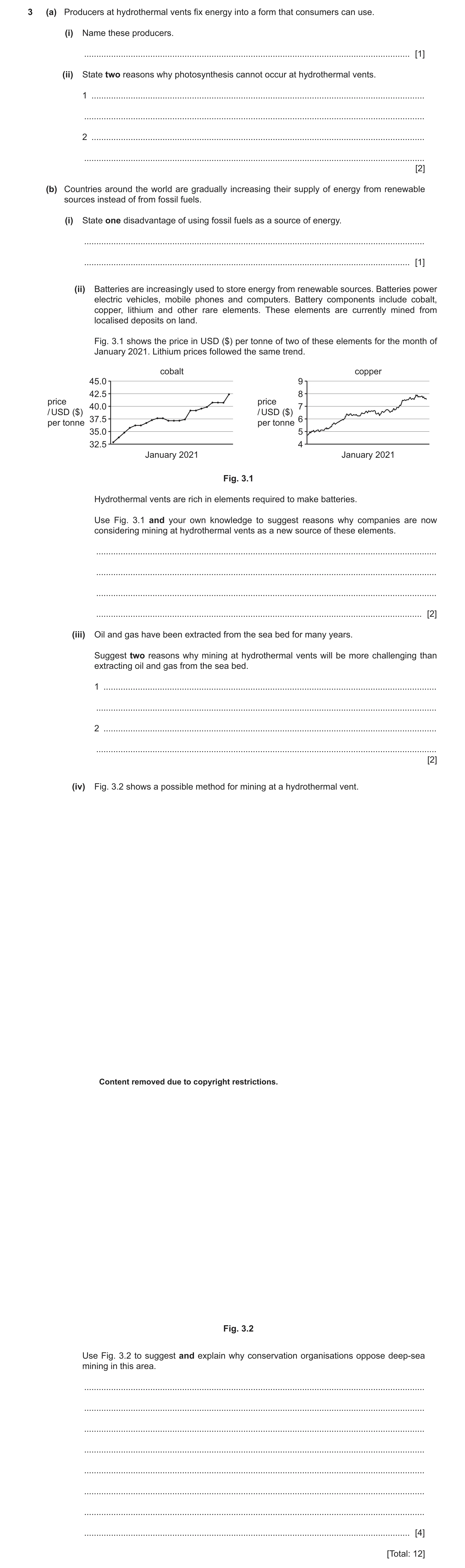
 83 / 101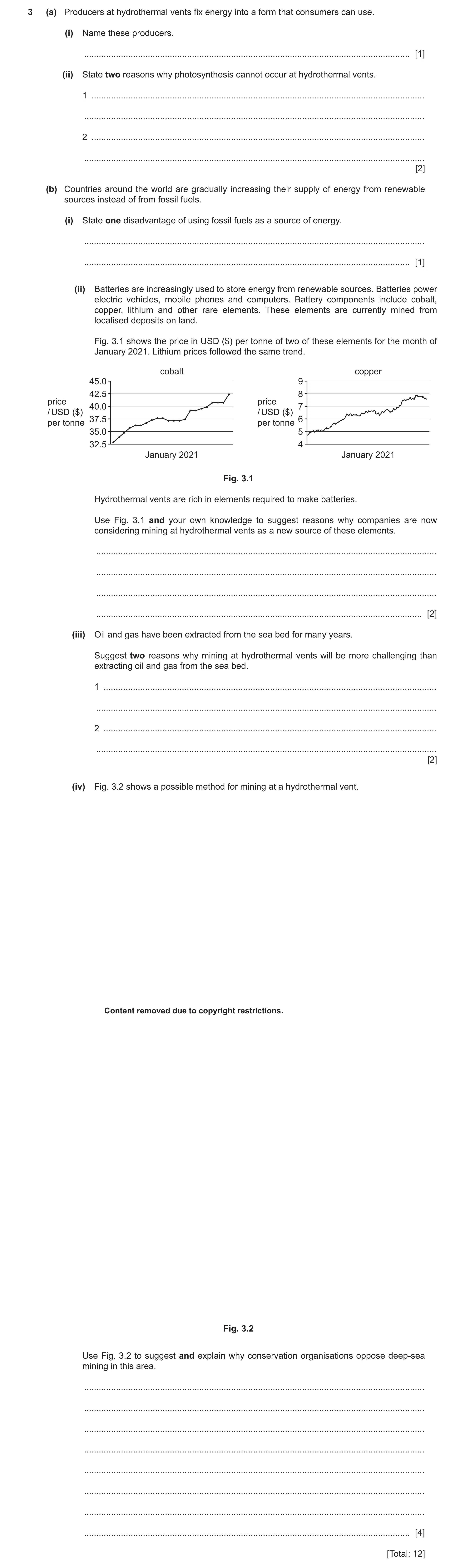
 86 / 101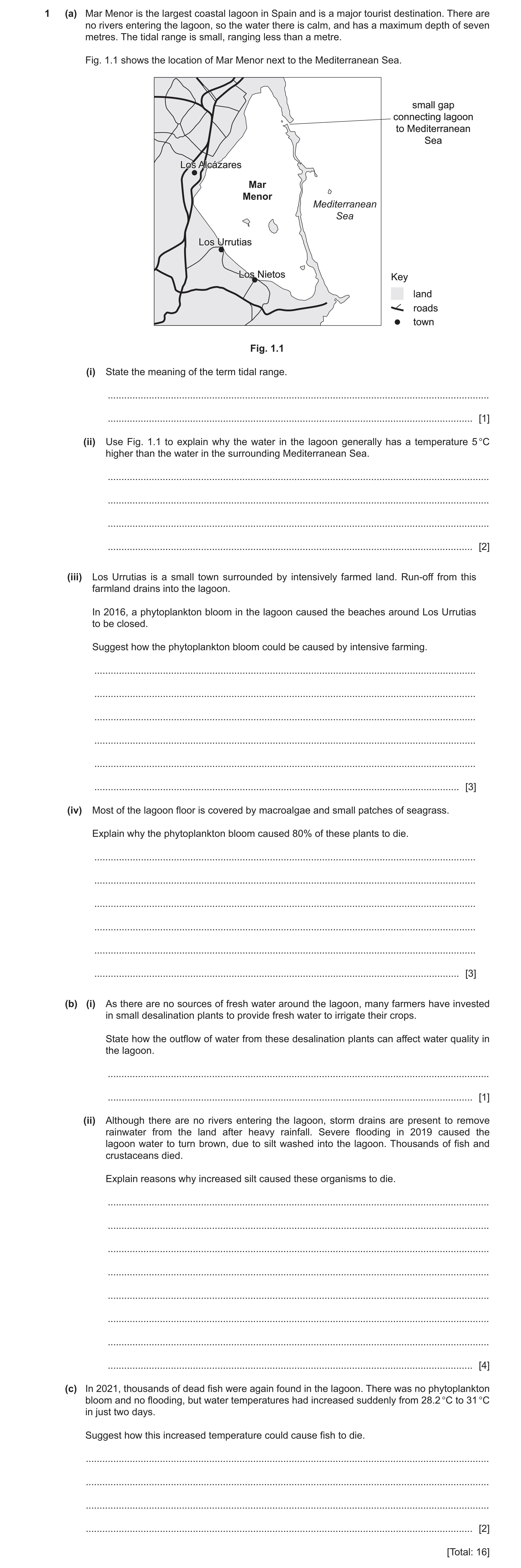
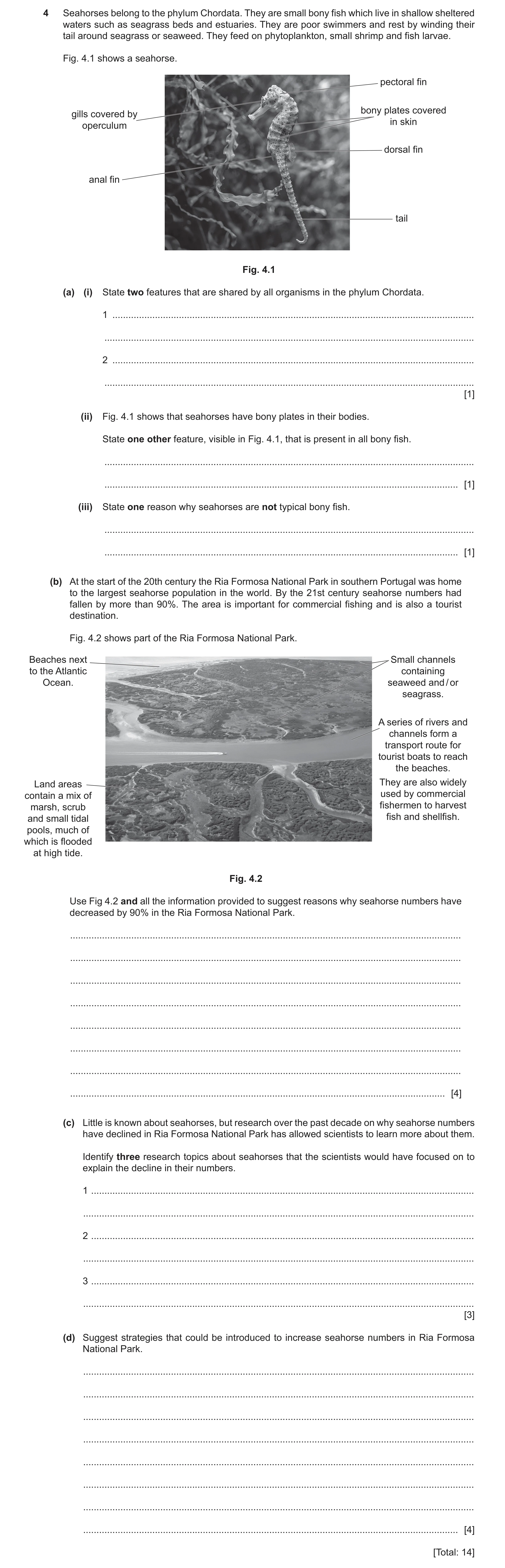
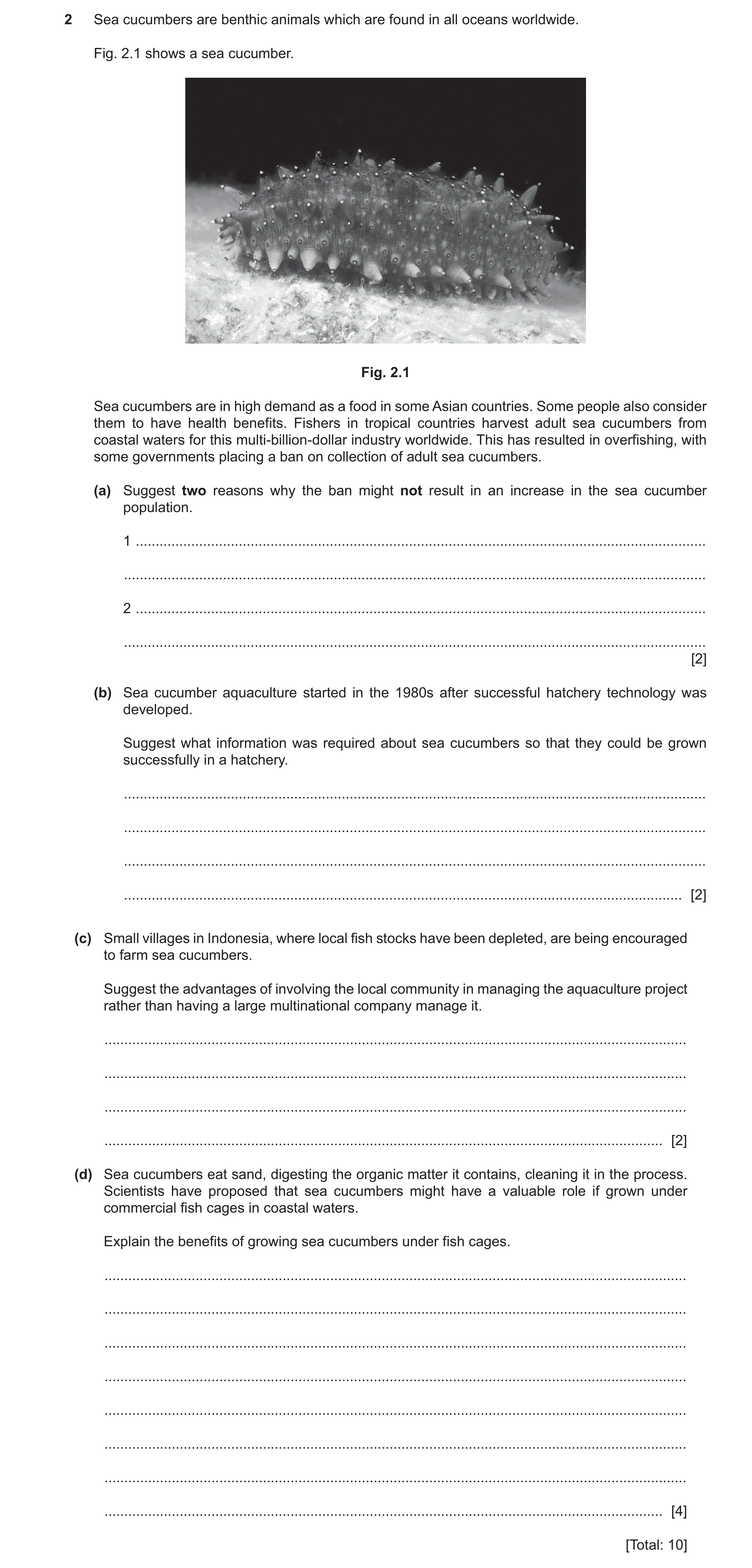
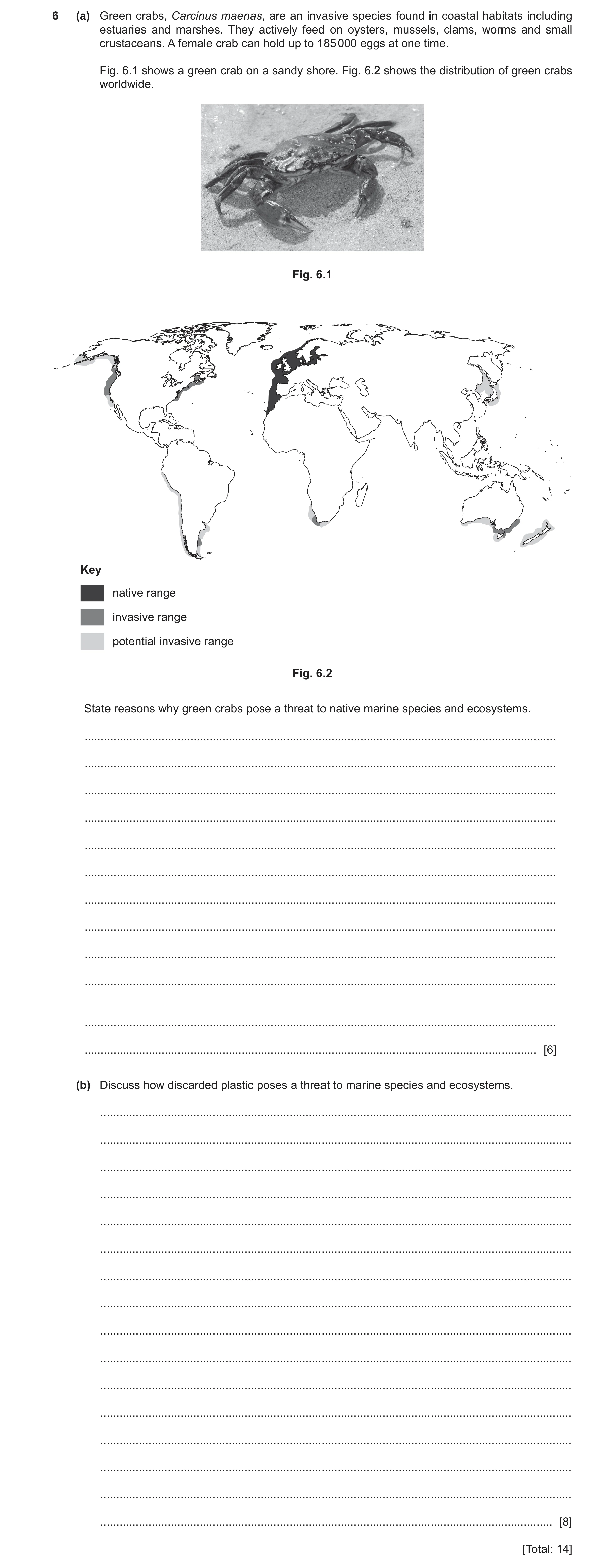
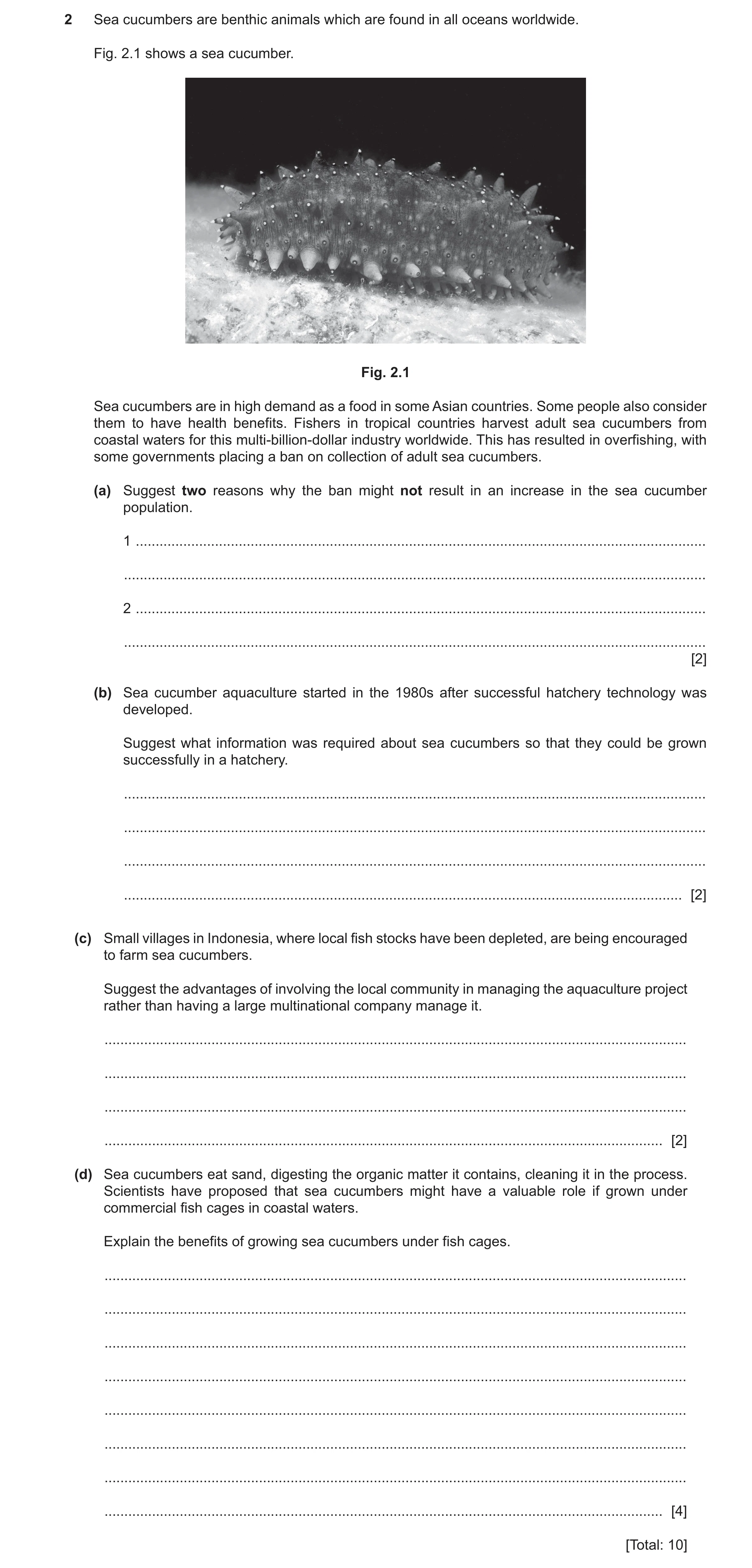
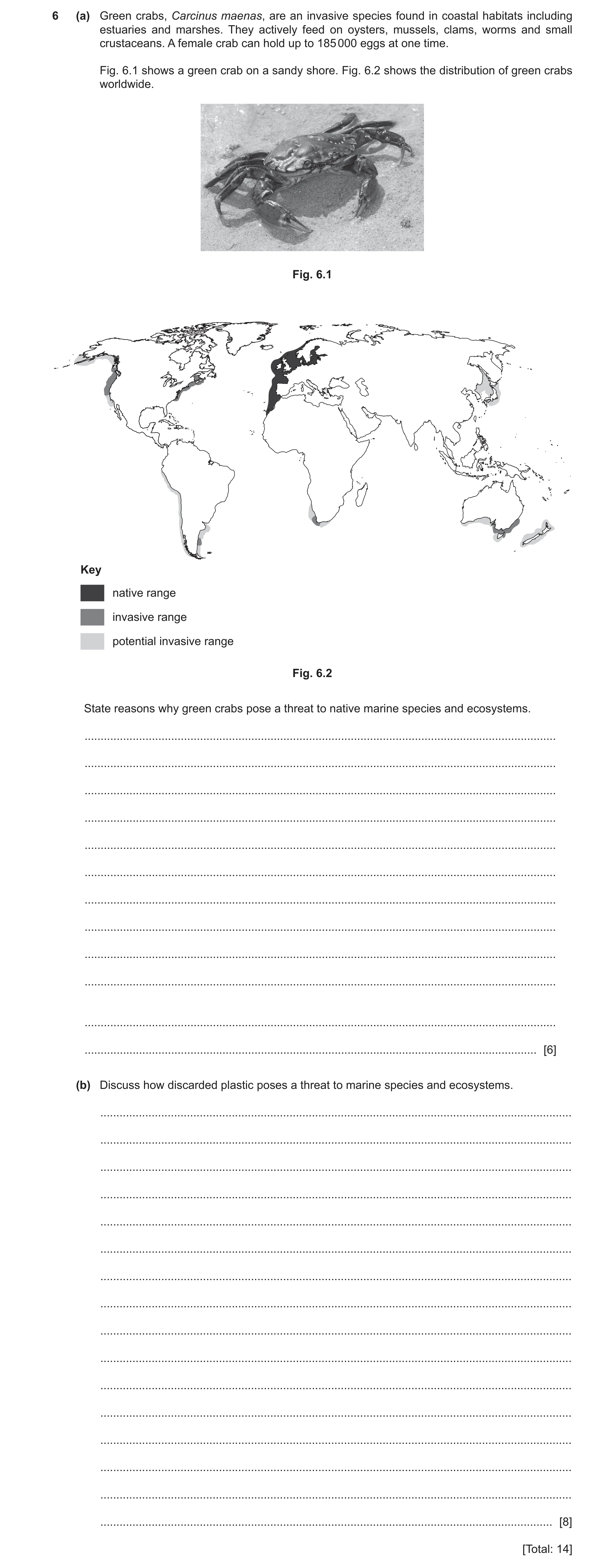
 99 / 101
 100 / 101
 101 / 101
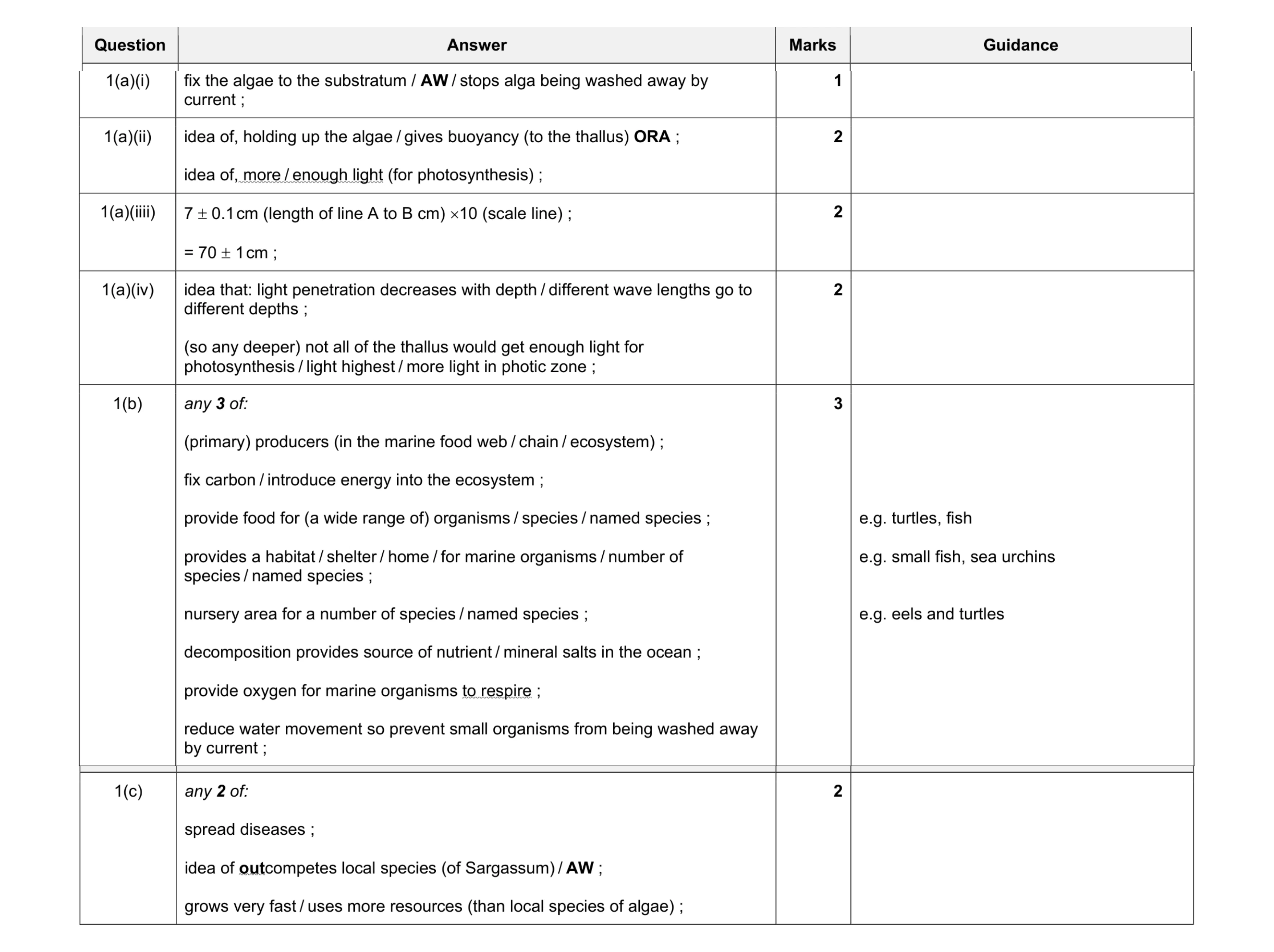 12
12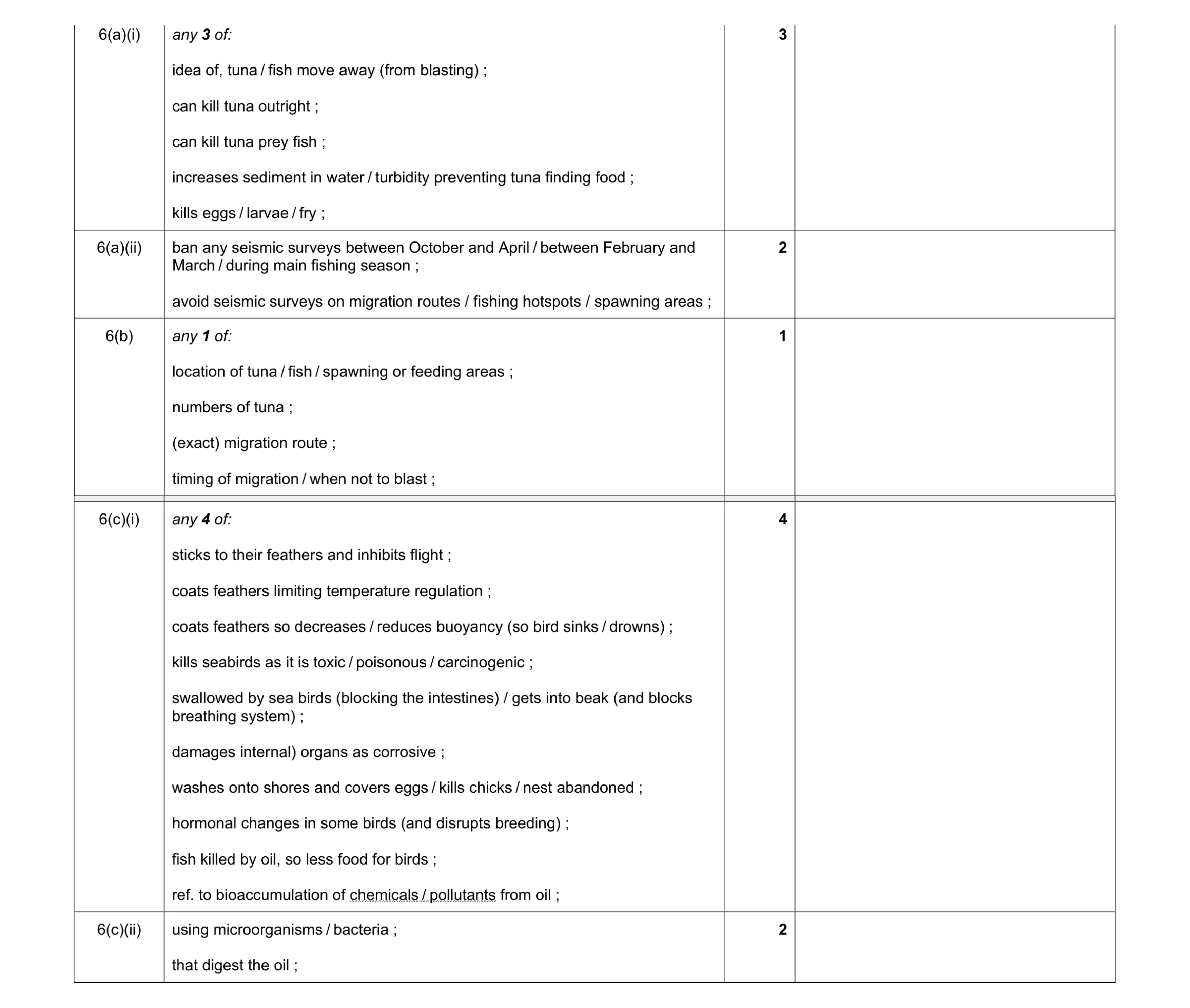 12
12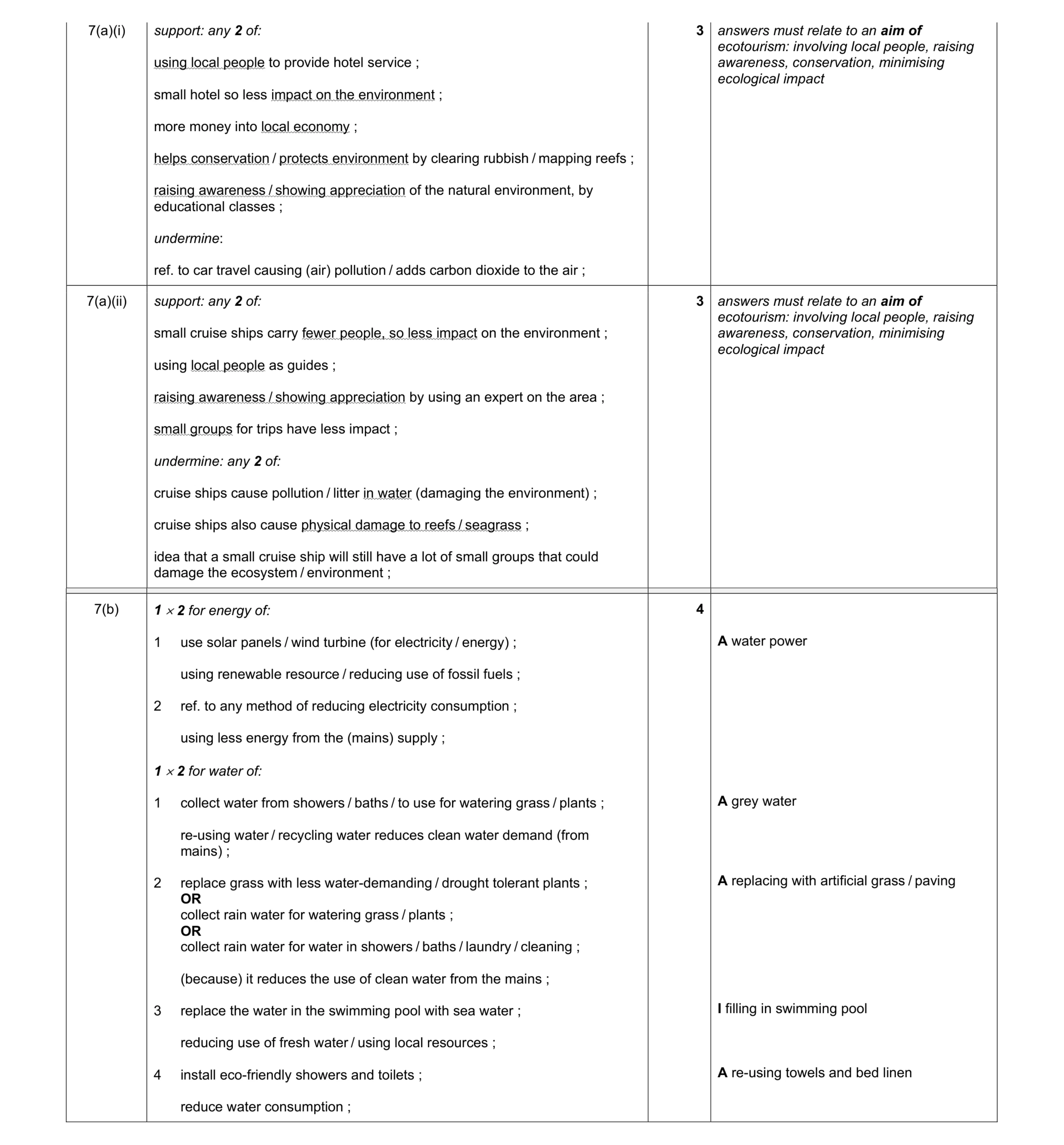 10
10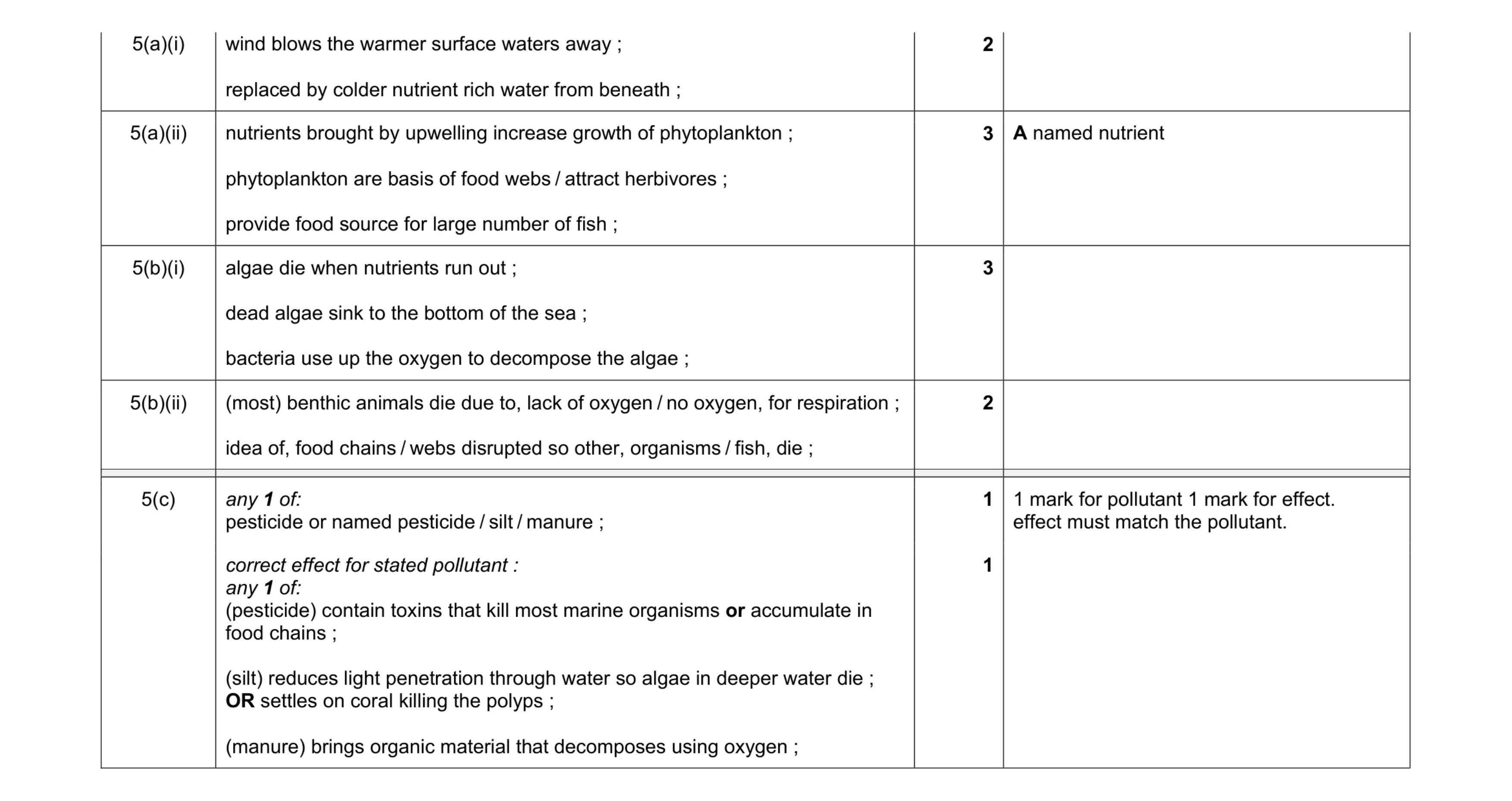 12
12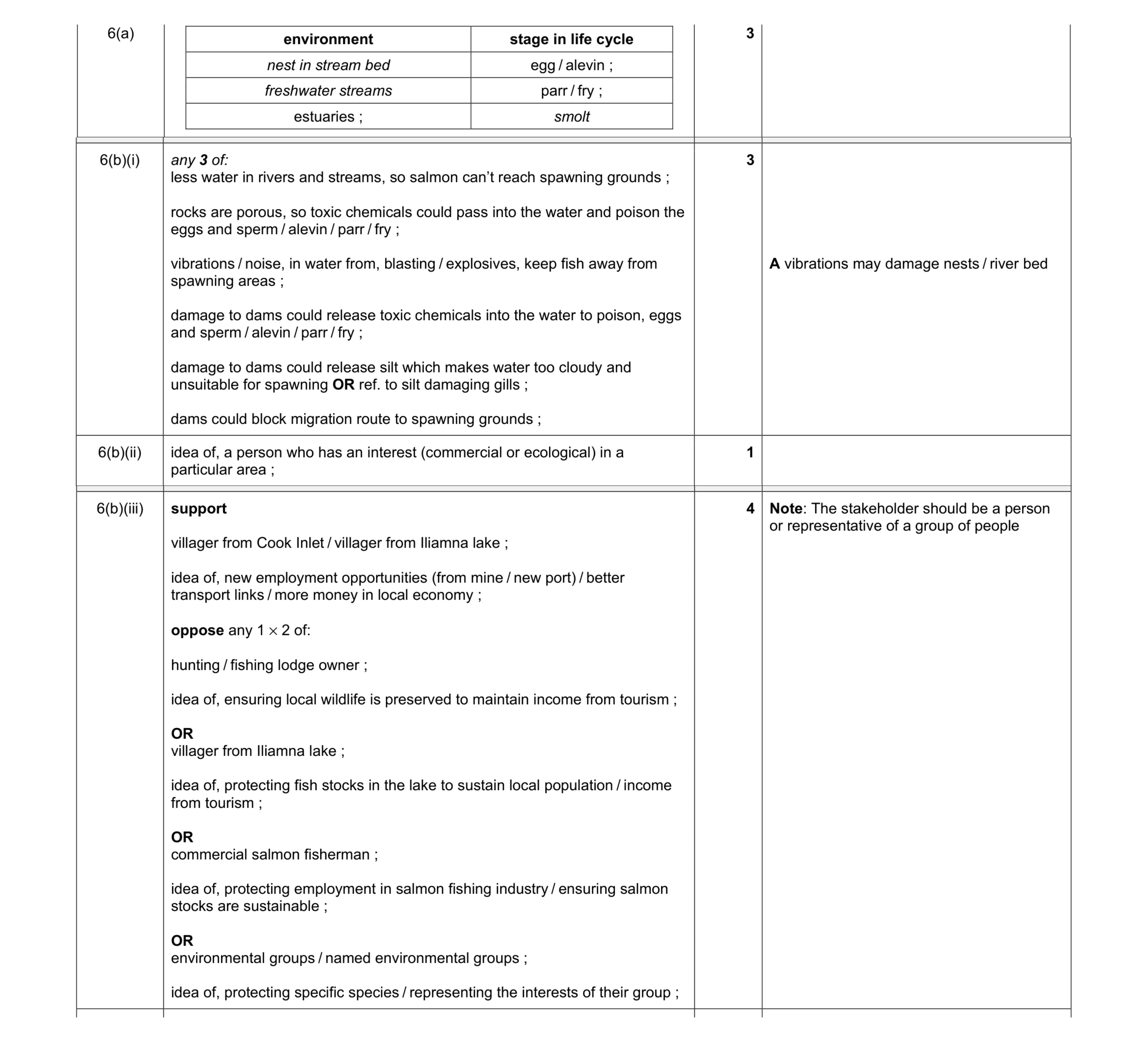 11
11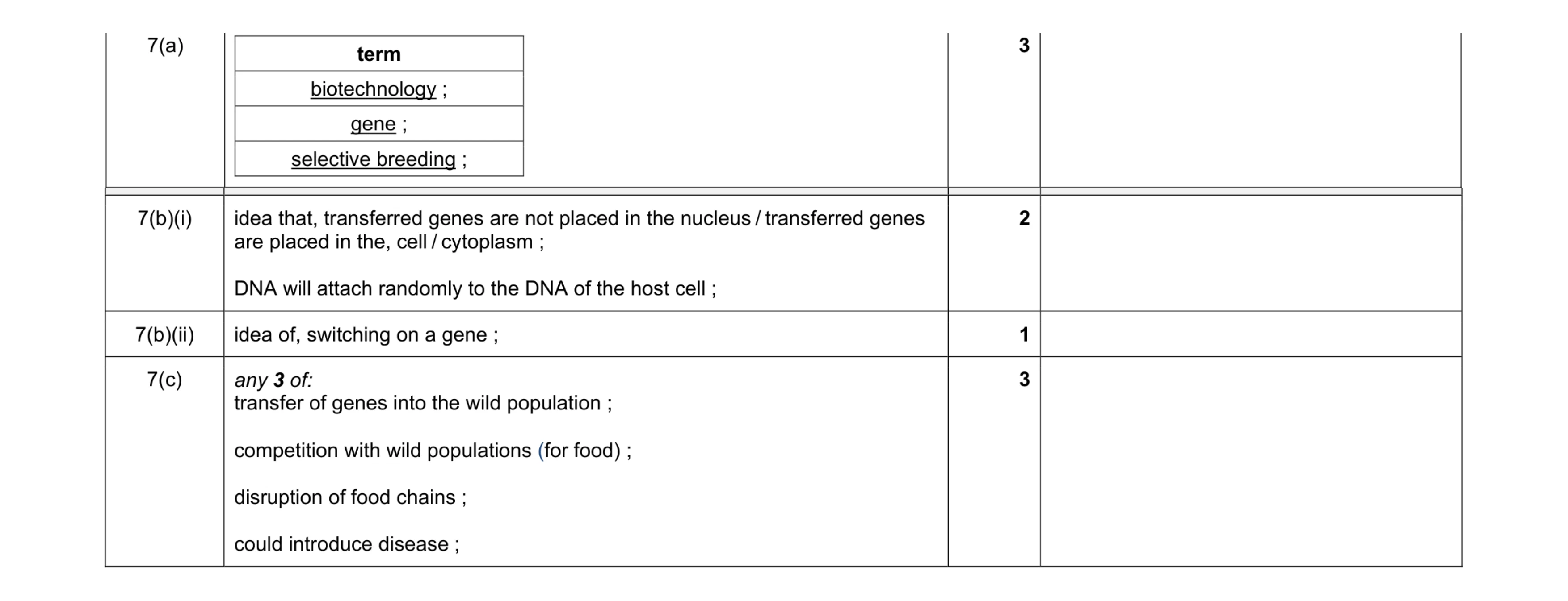 9
9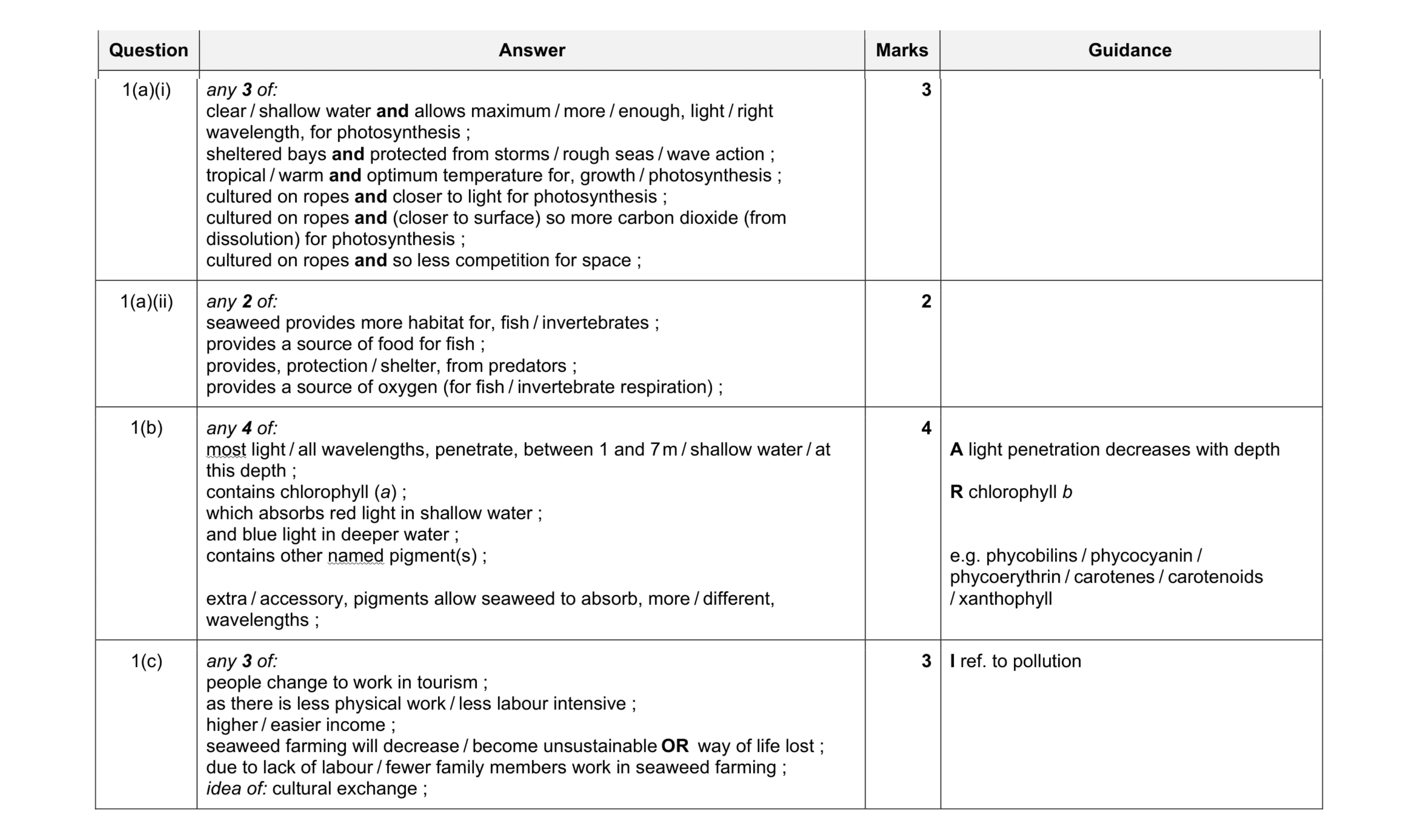 12
12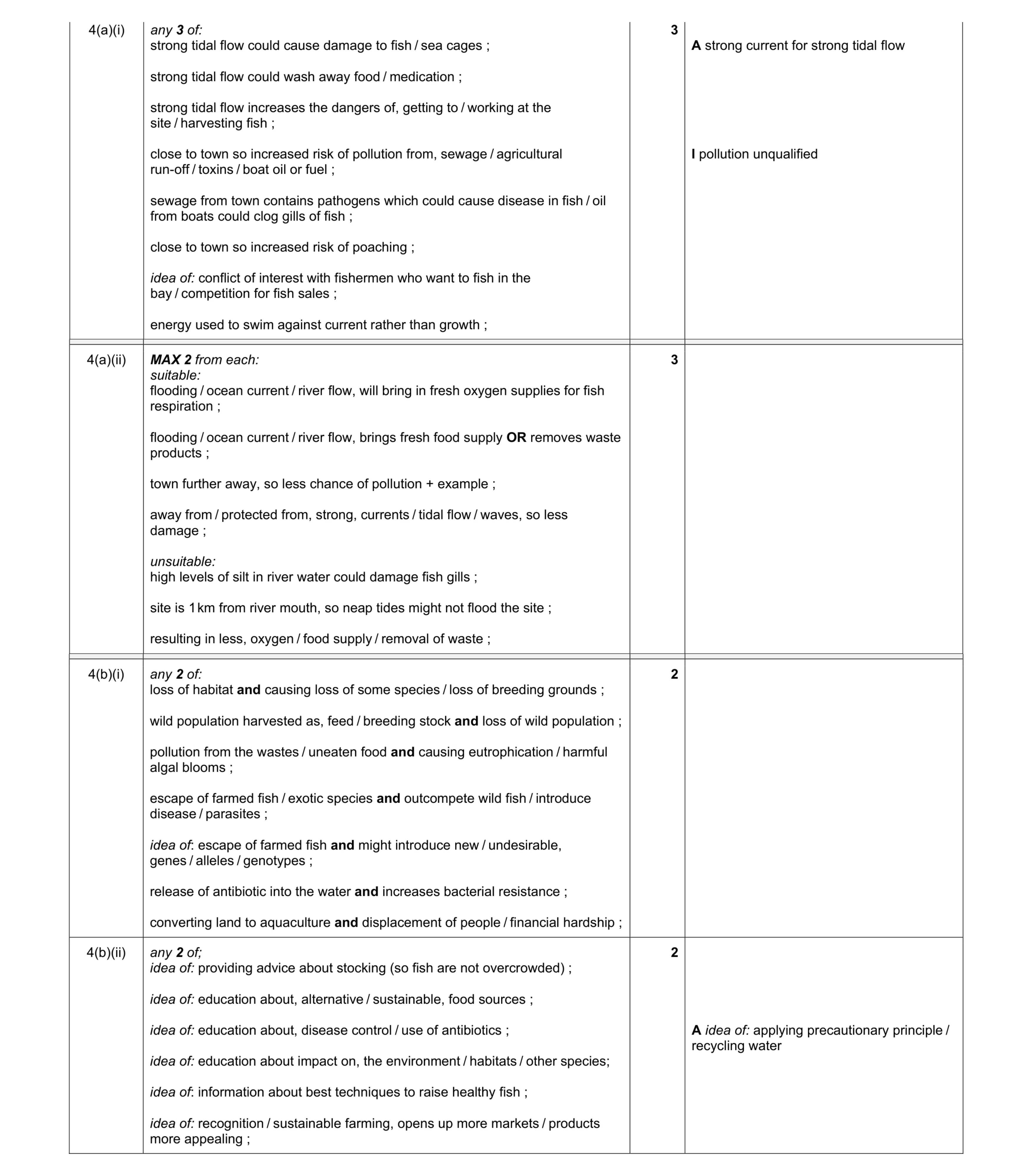 10
10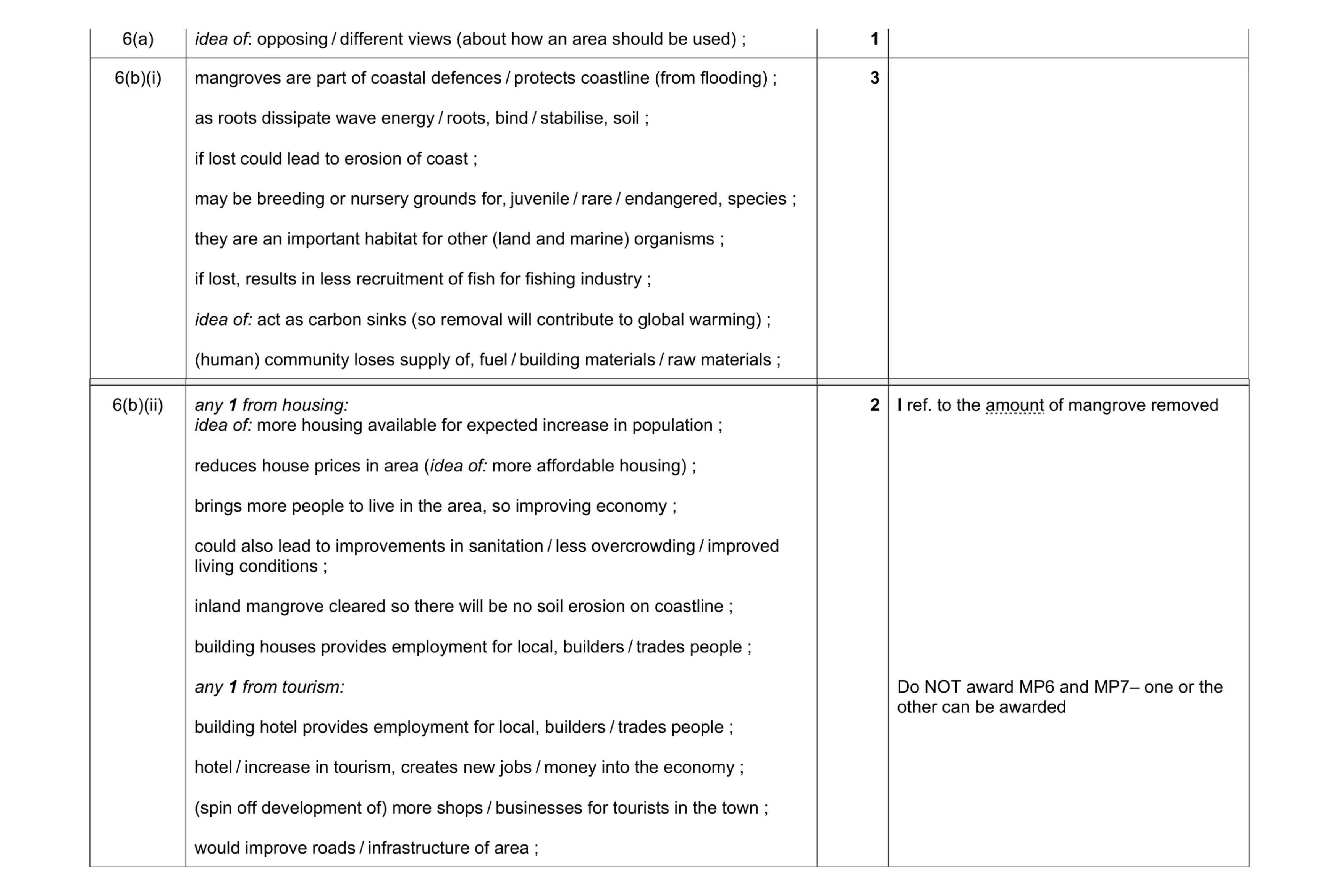 6
6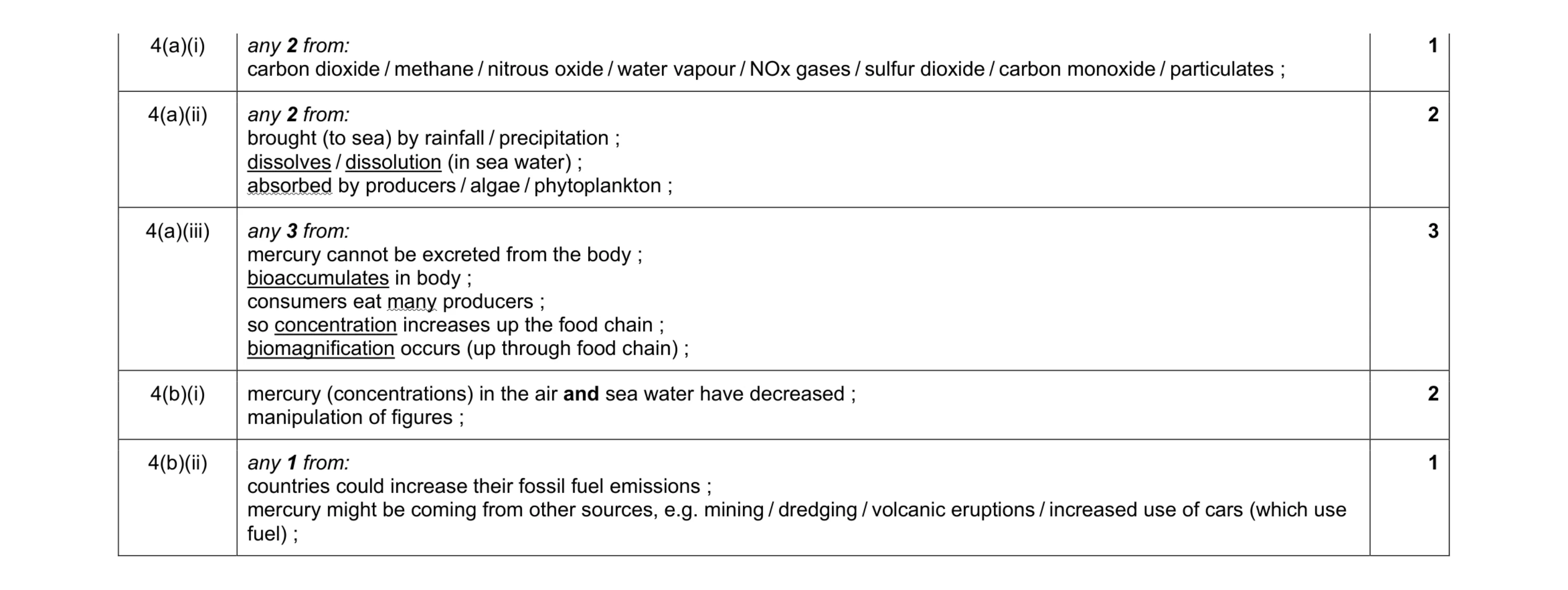 9
9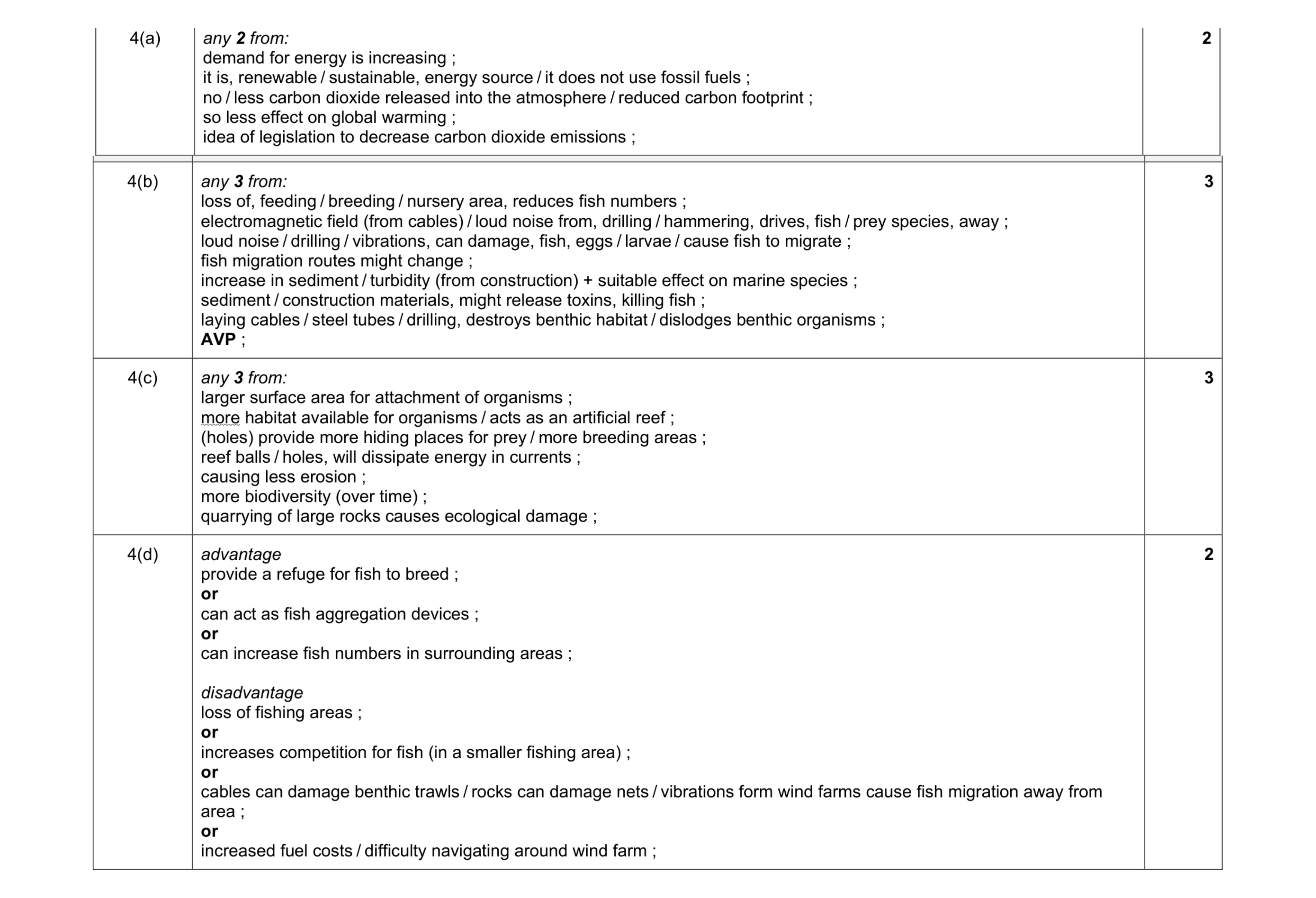 10
10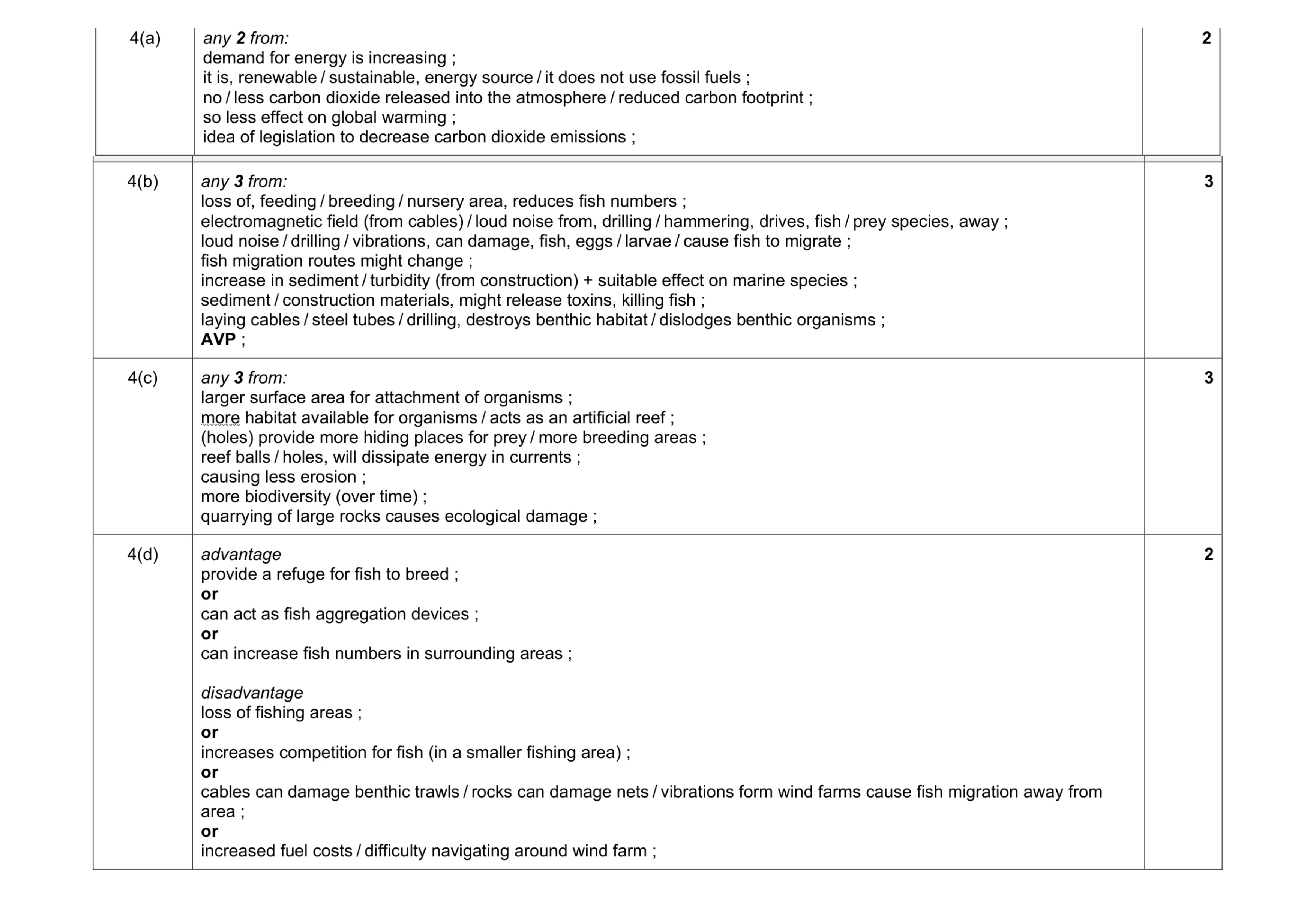 10
10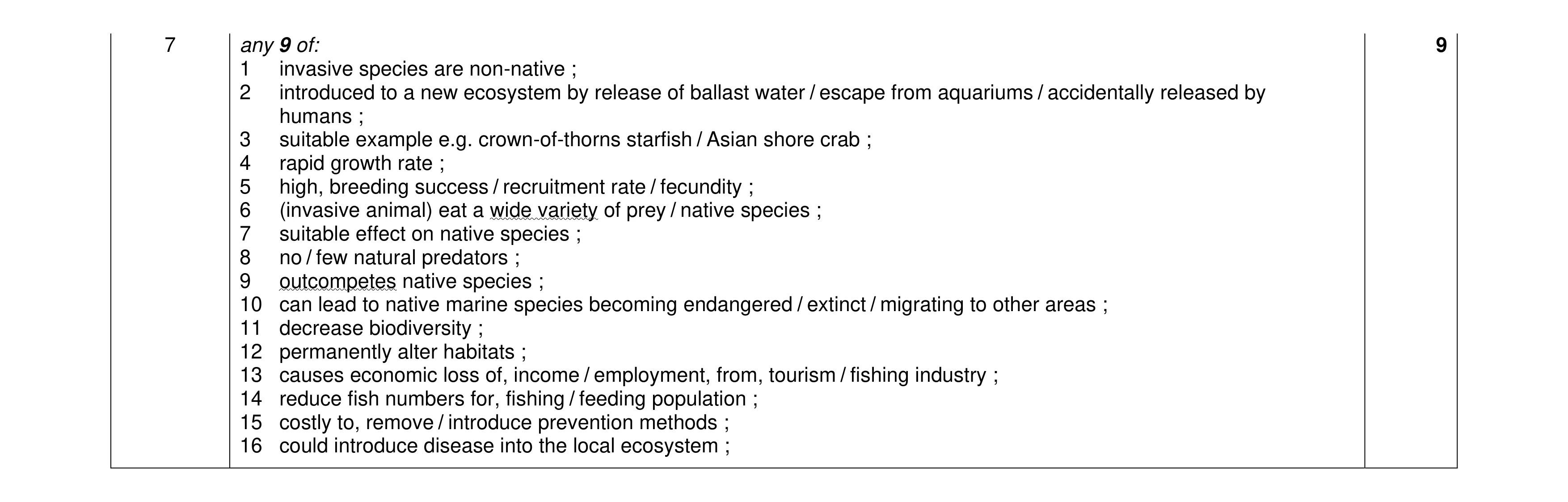 9
9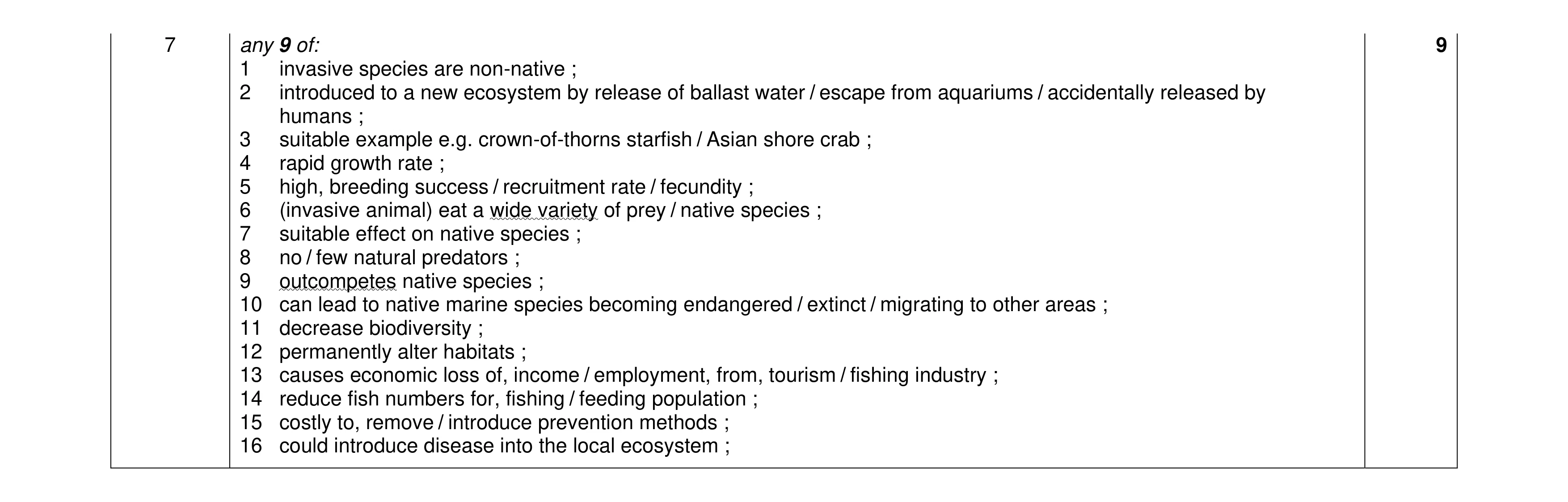 9
9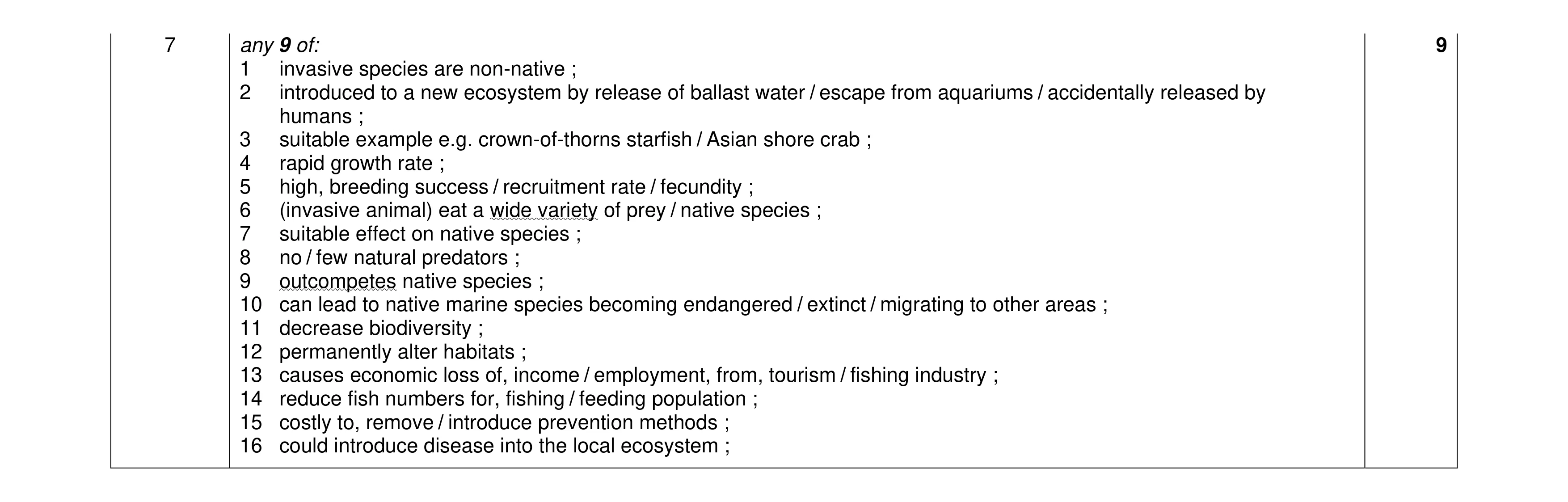 9
9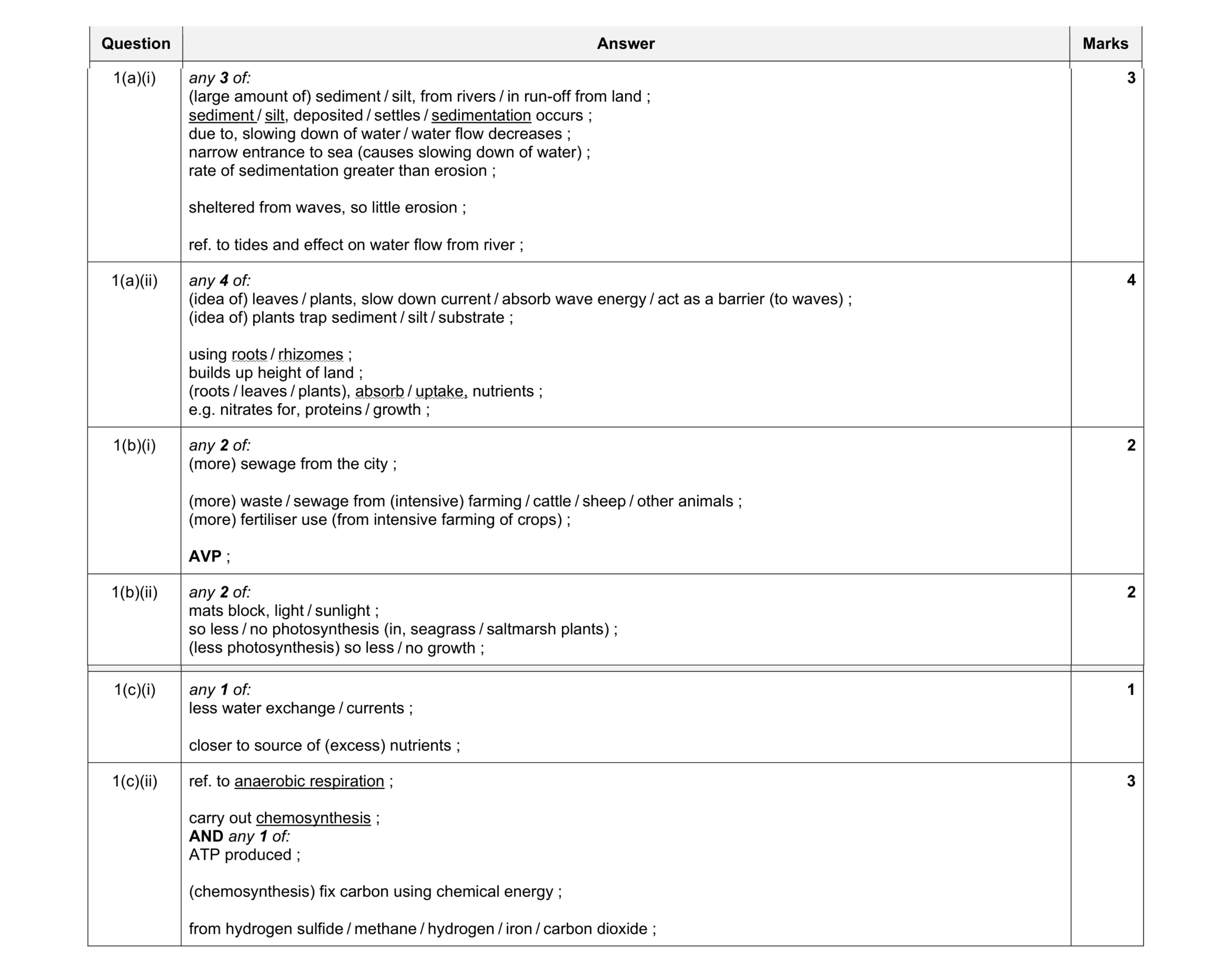 15
15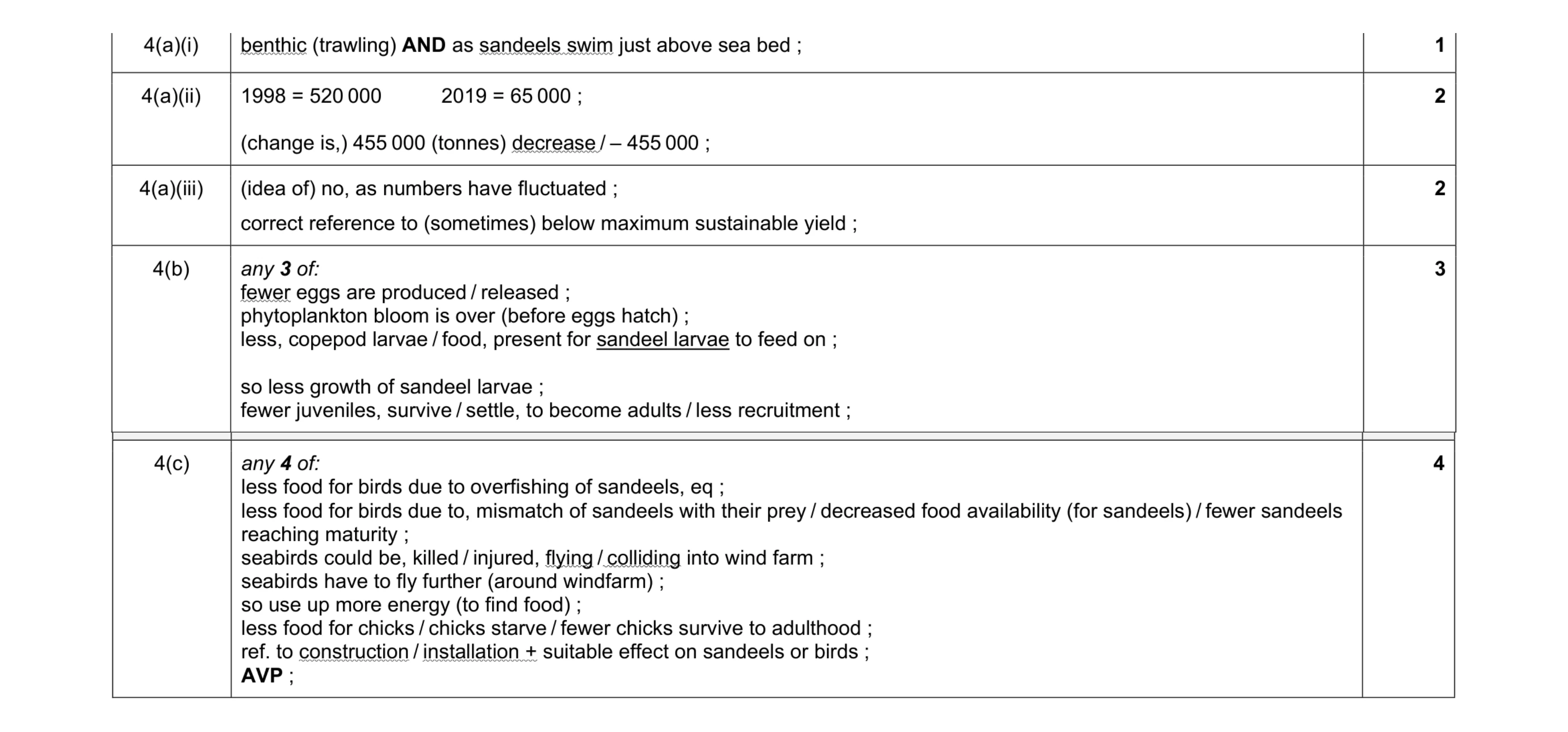 12
12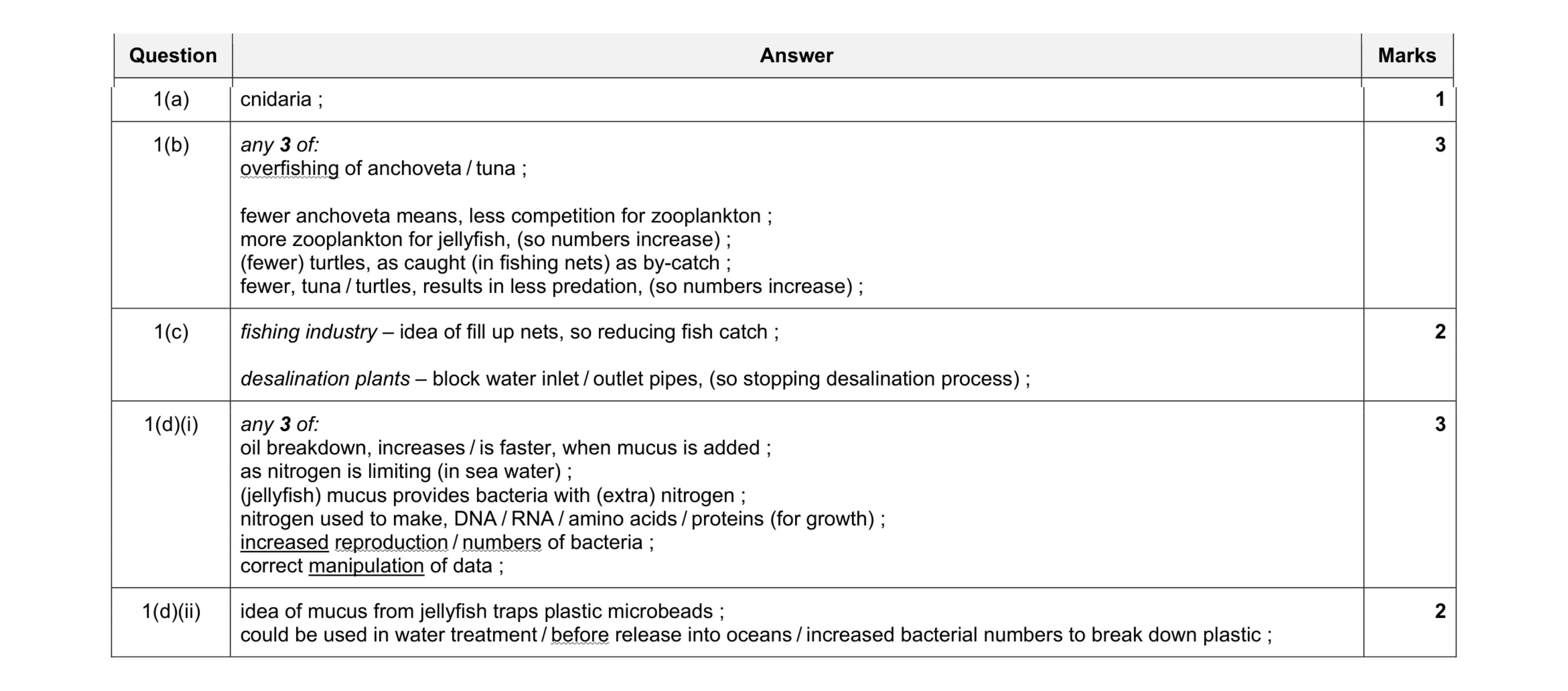 11
11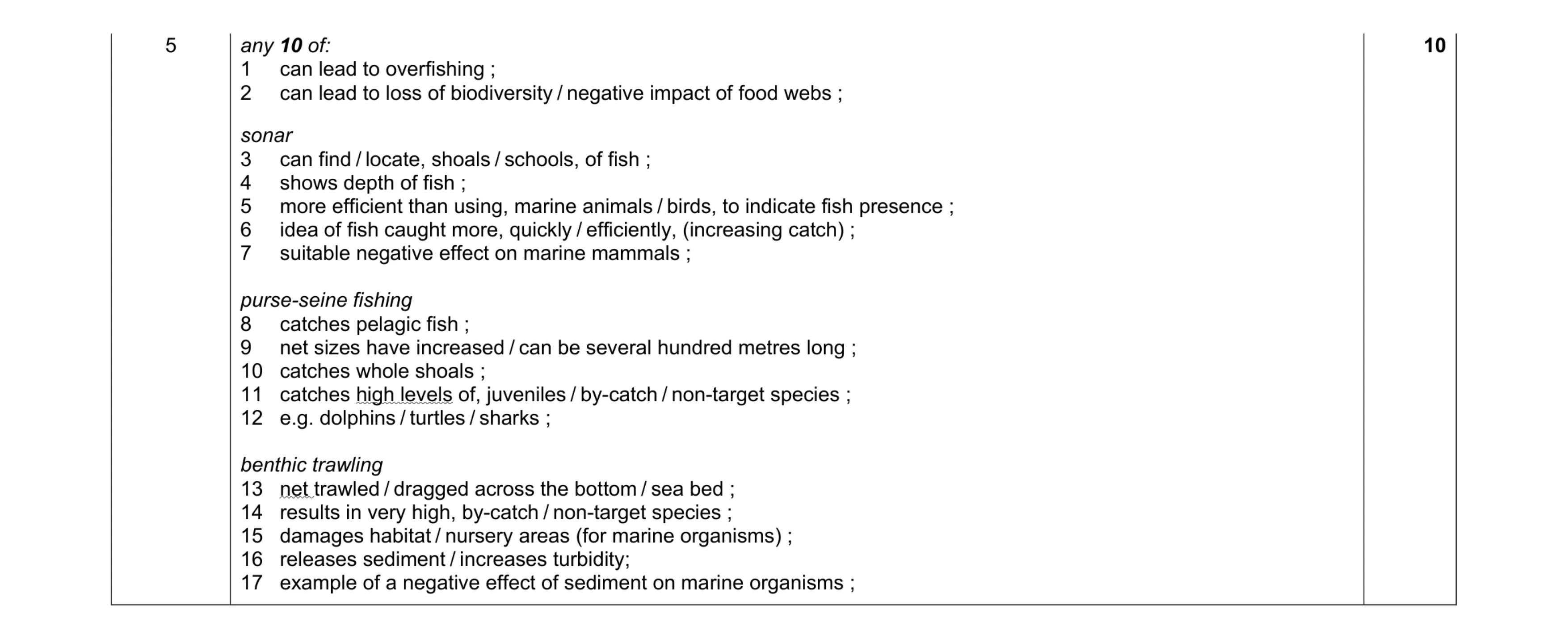 10
10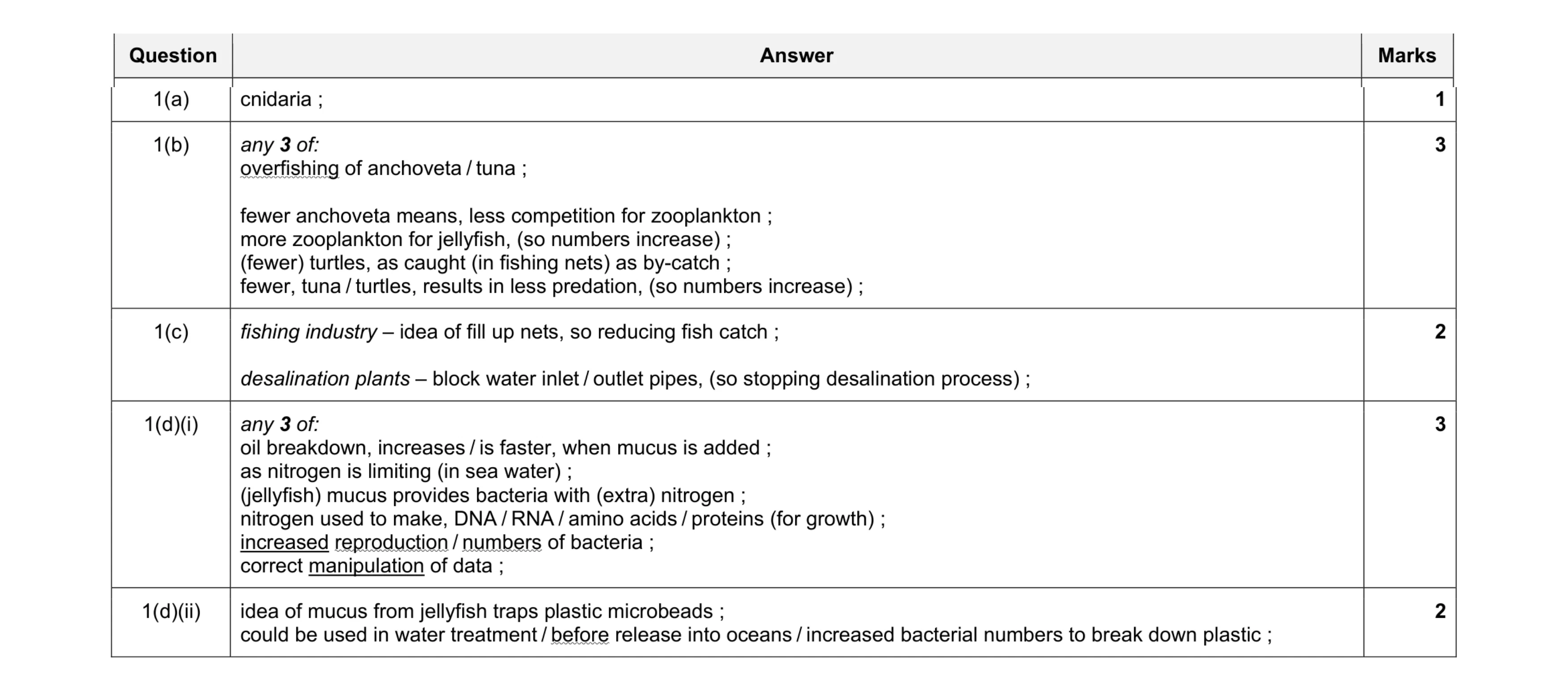 11
11 10
10 10
10 10
10 10
10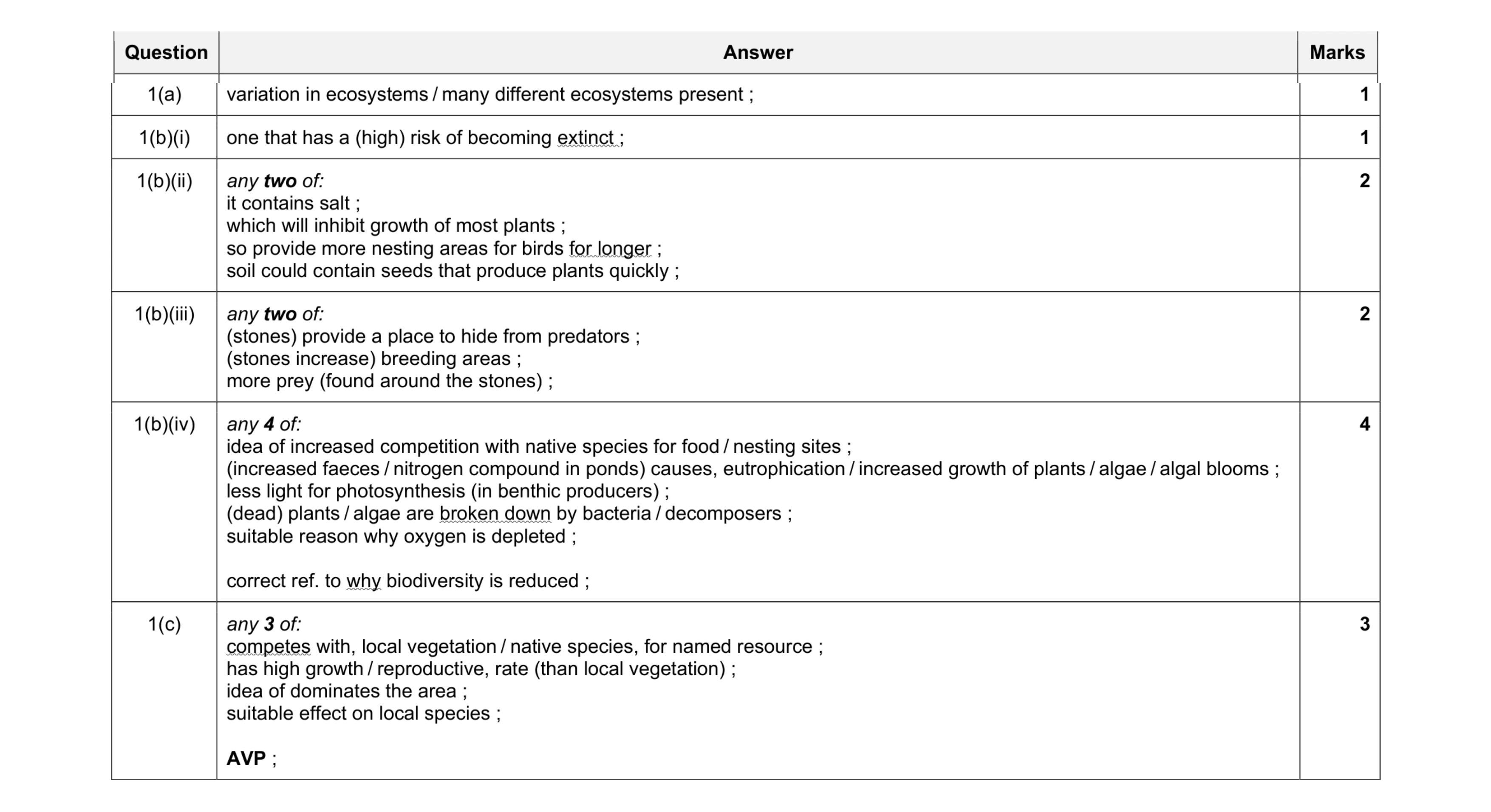 13
13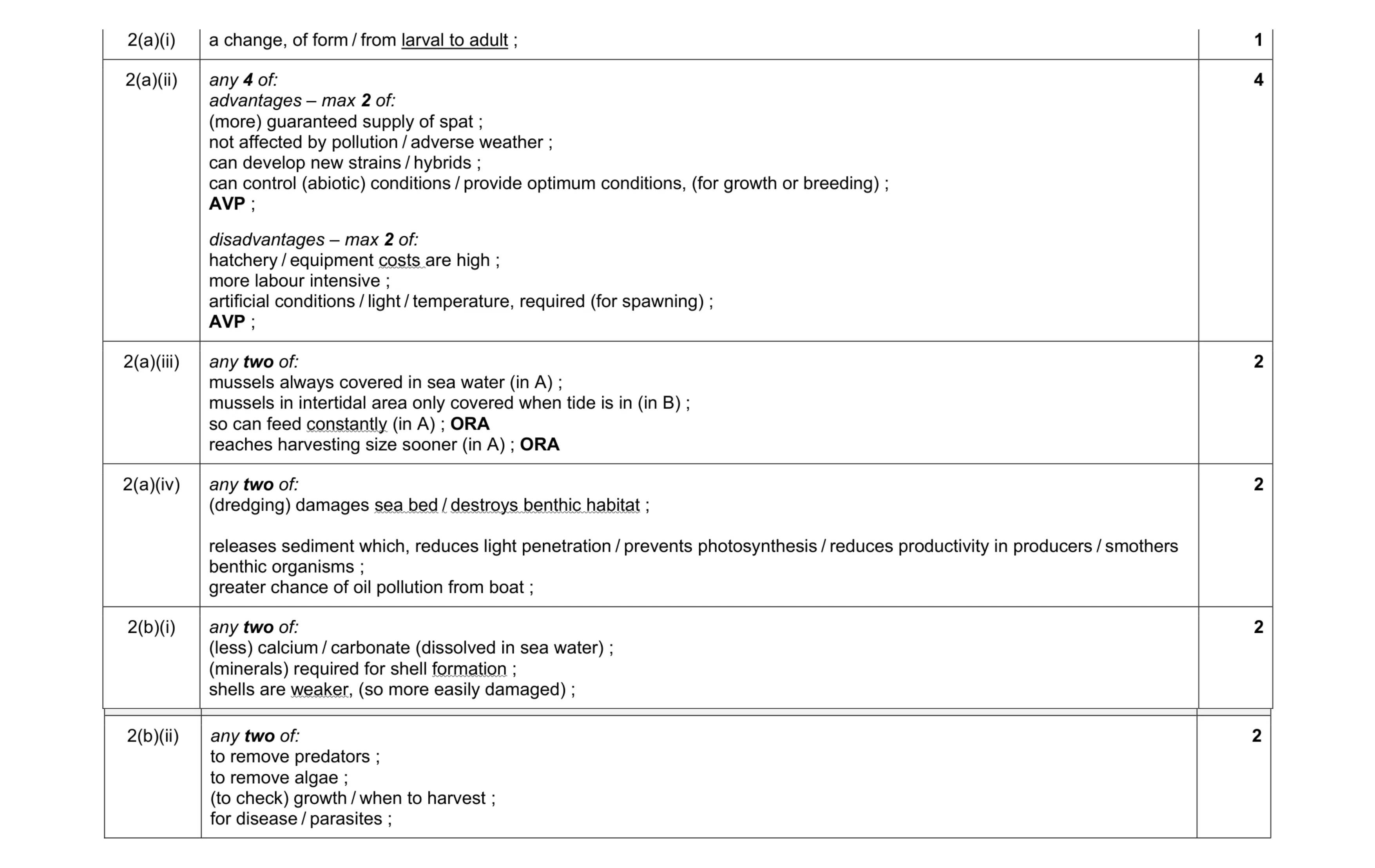 13
13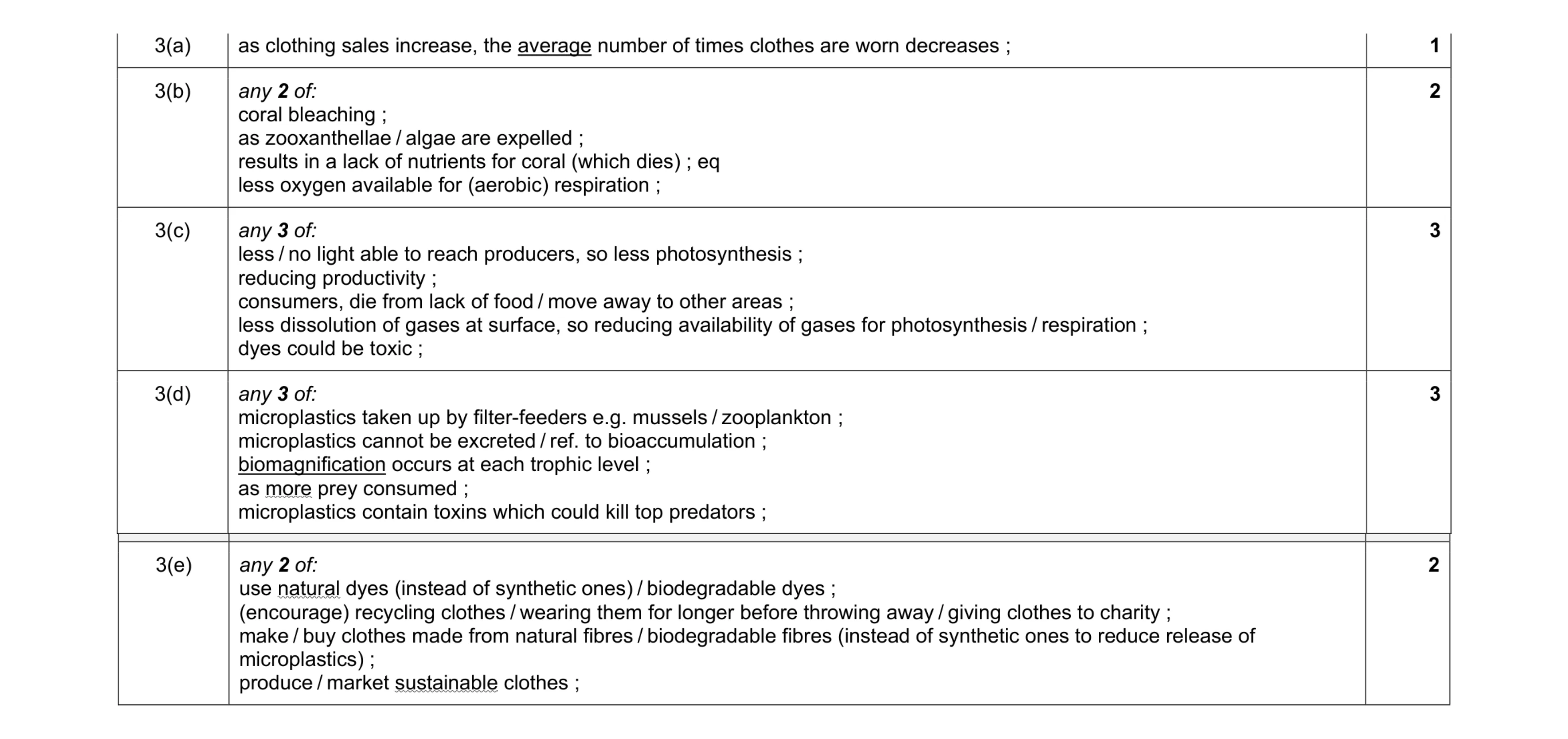 11
11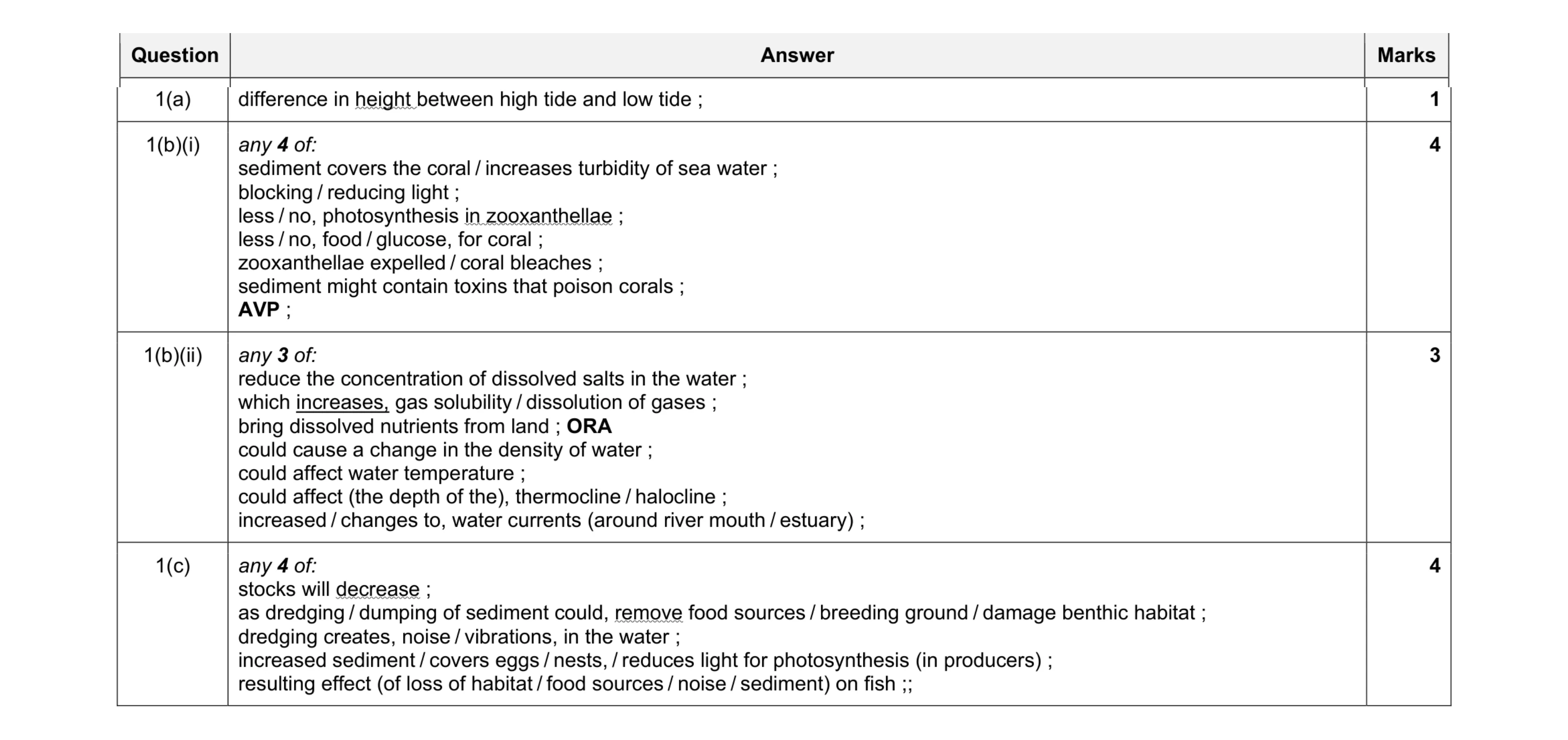 12
12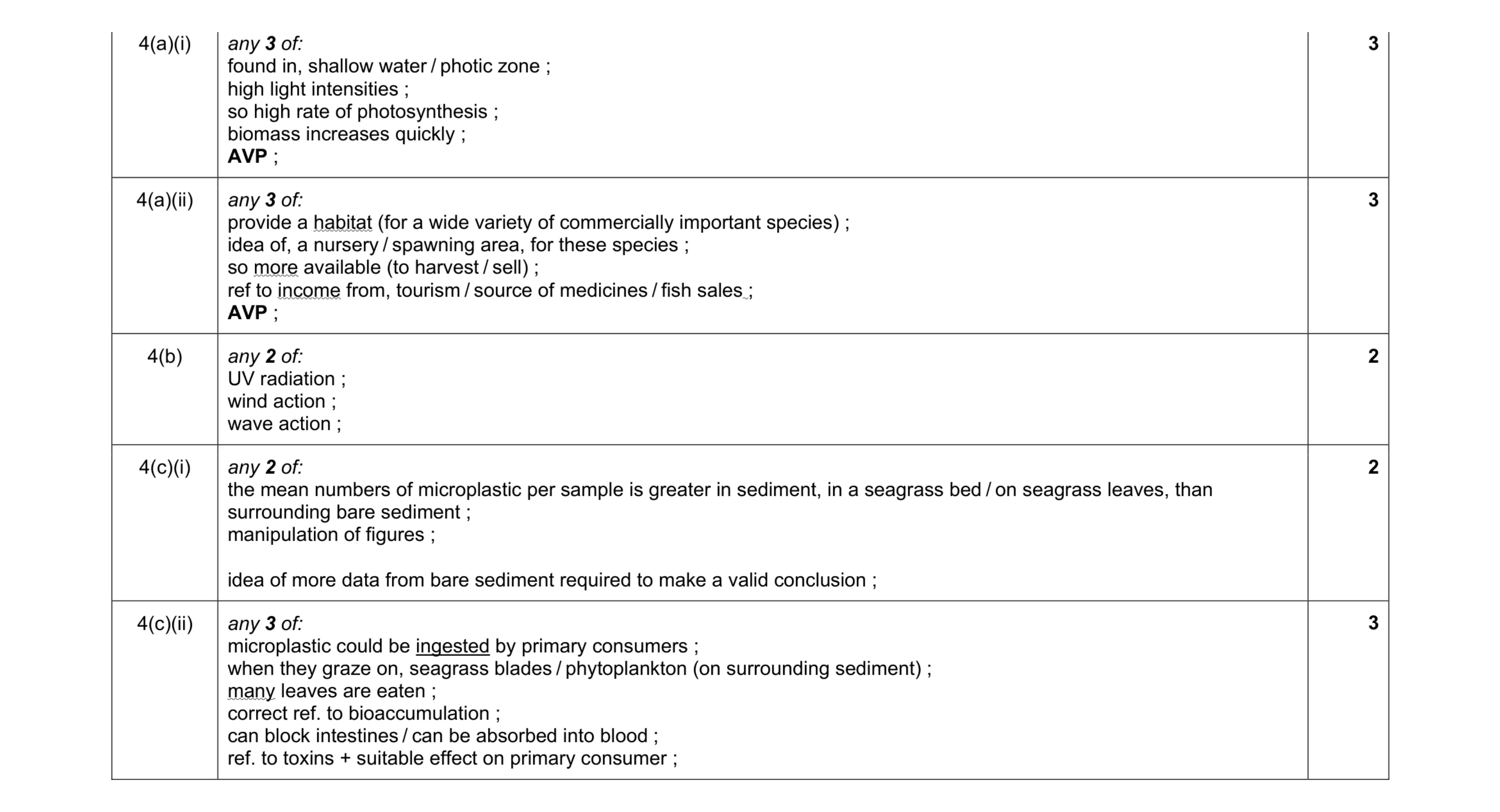 13
13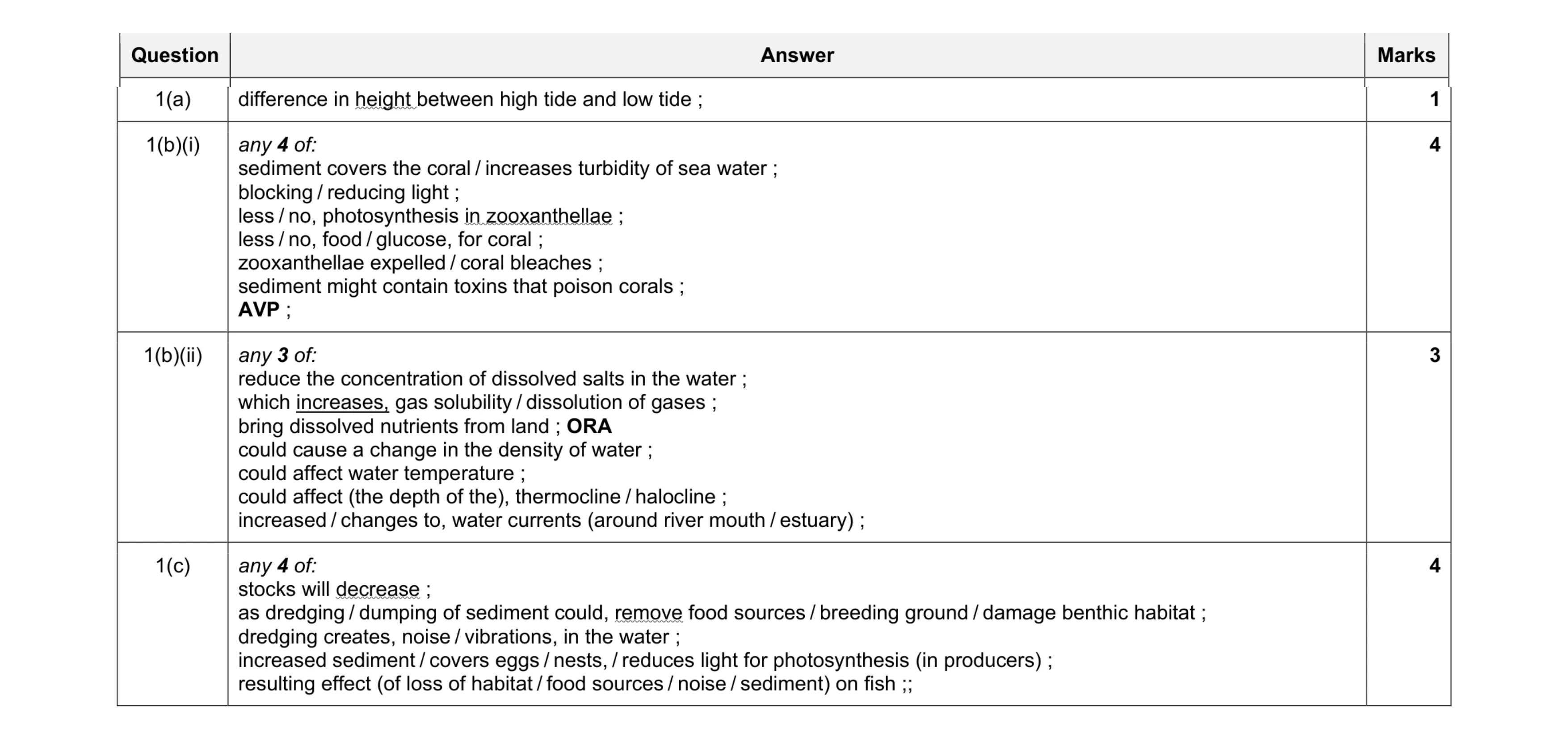 12
12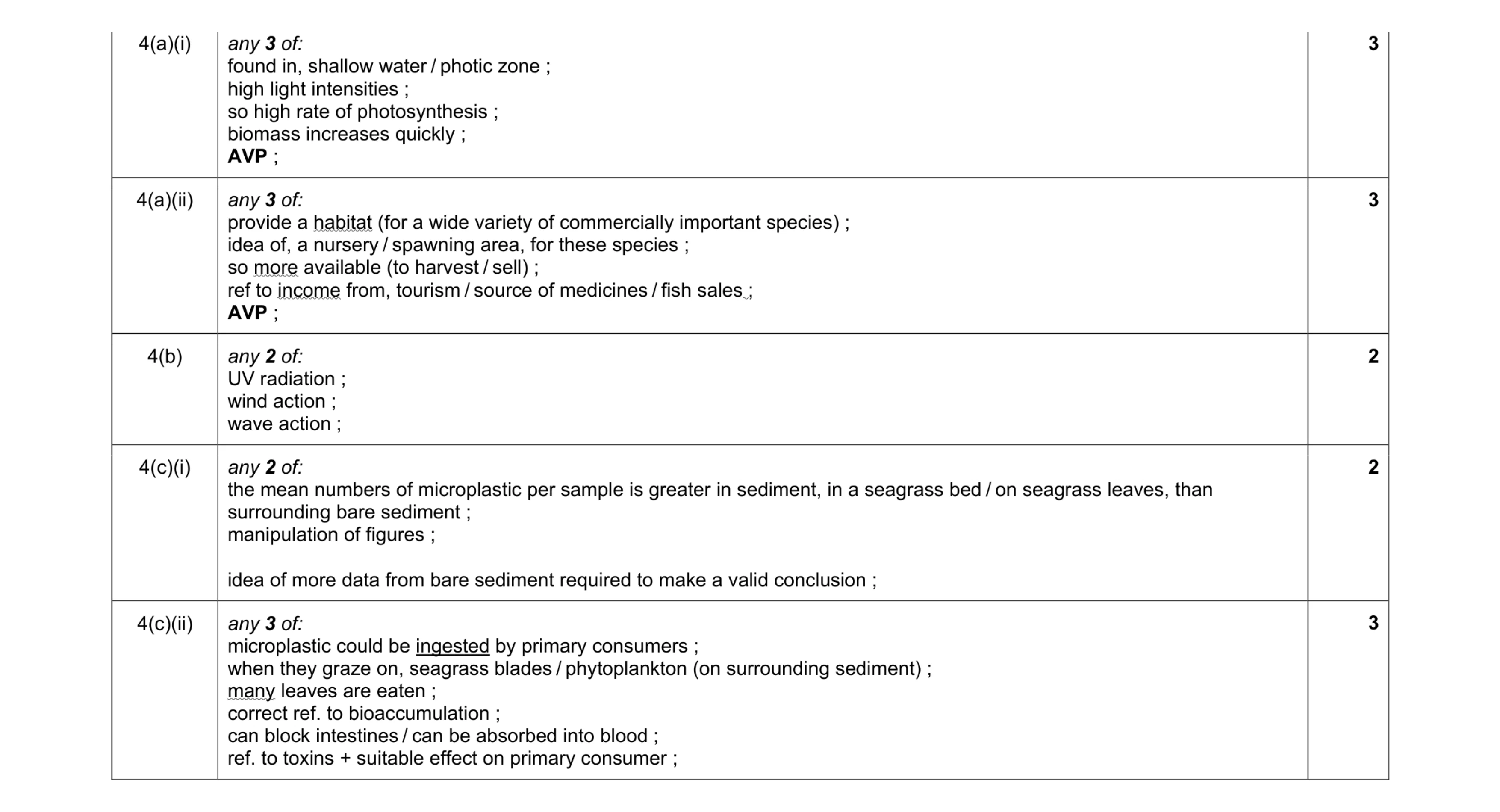 13
13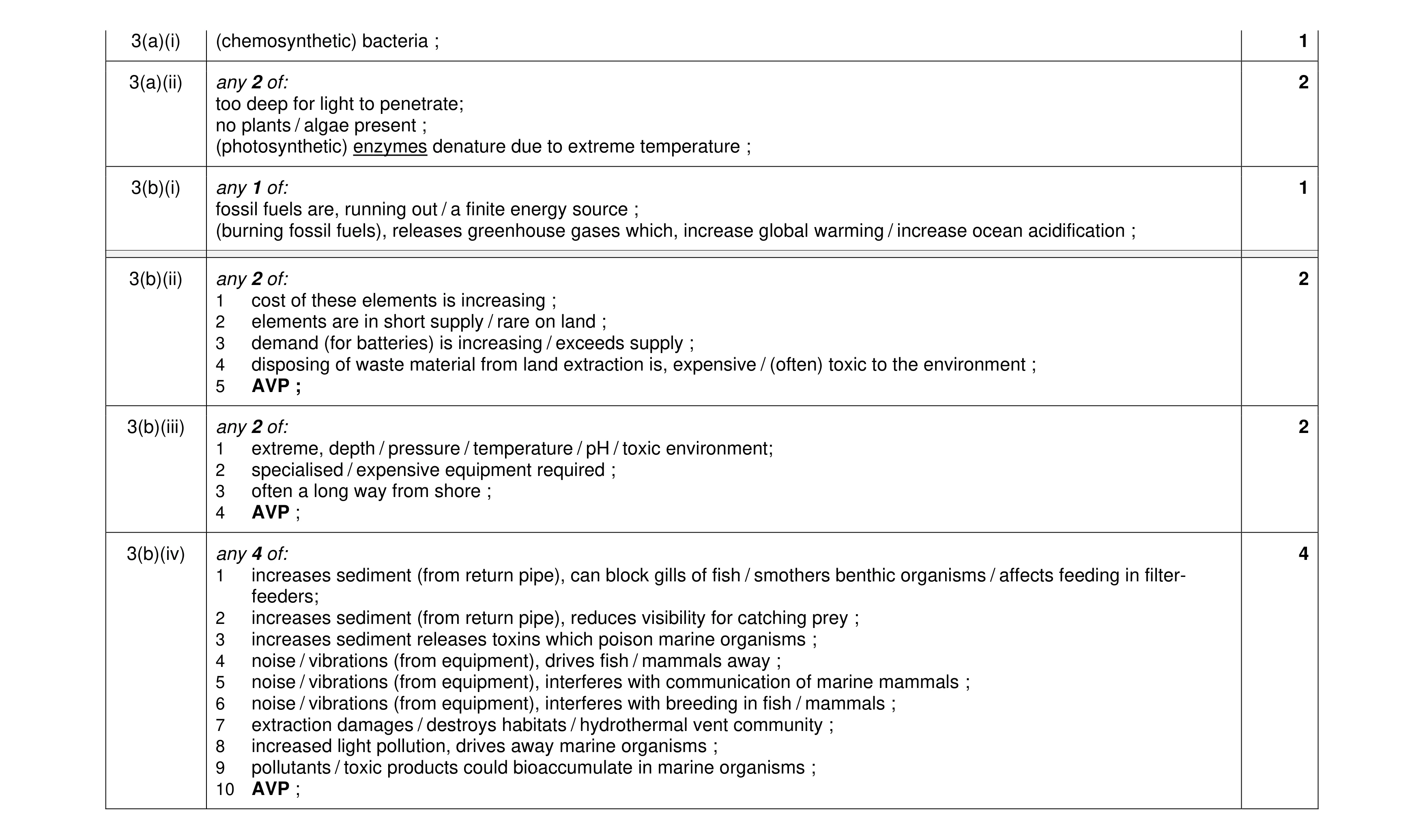 12
12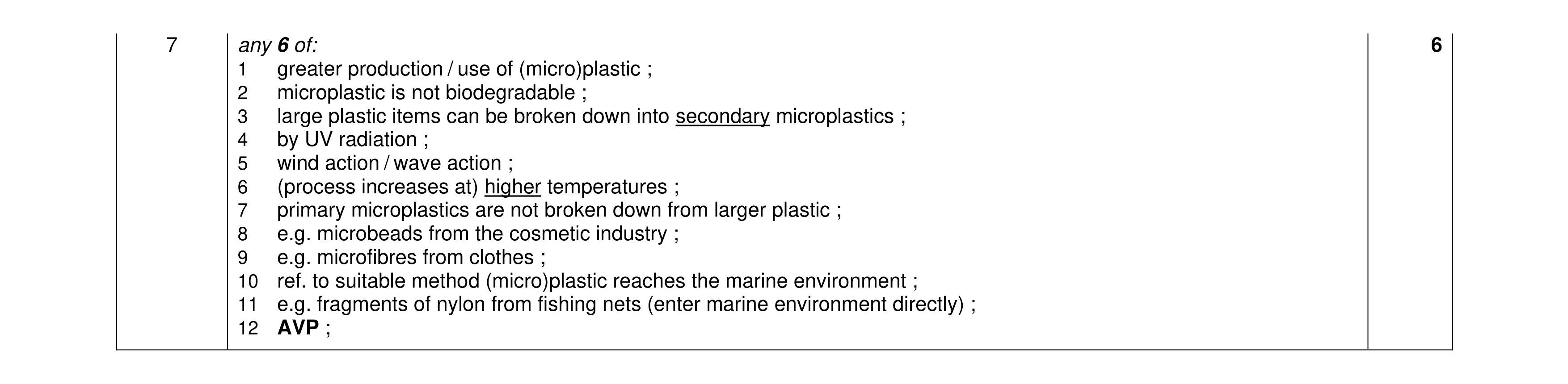 6
6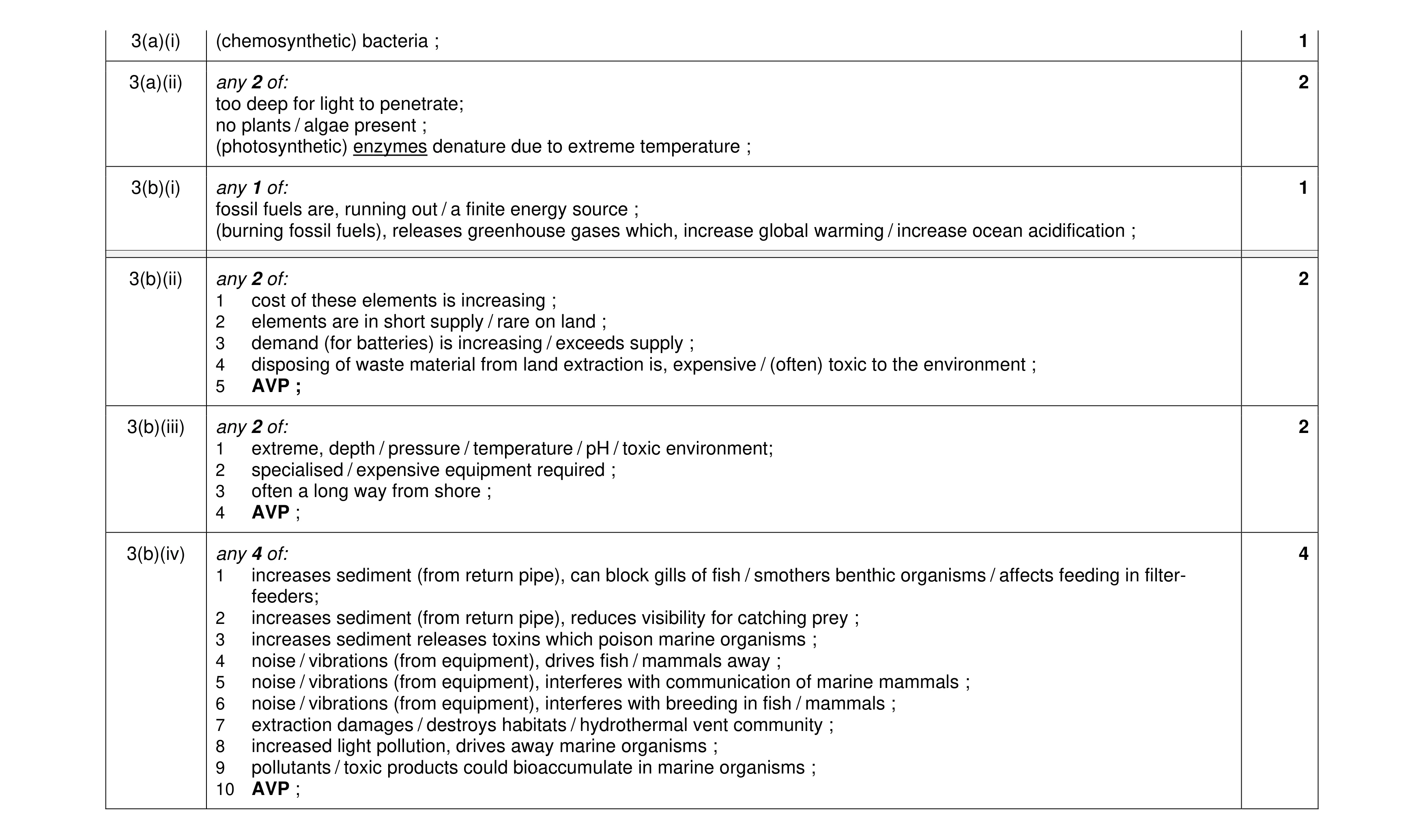 12
12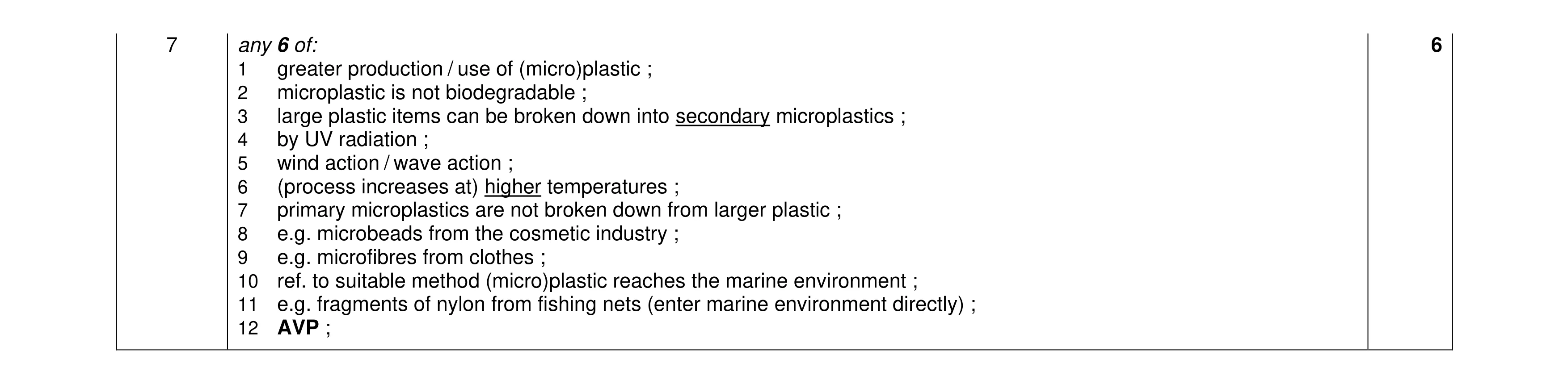 6
6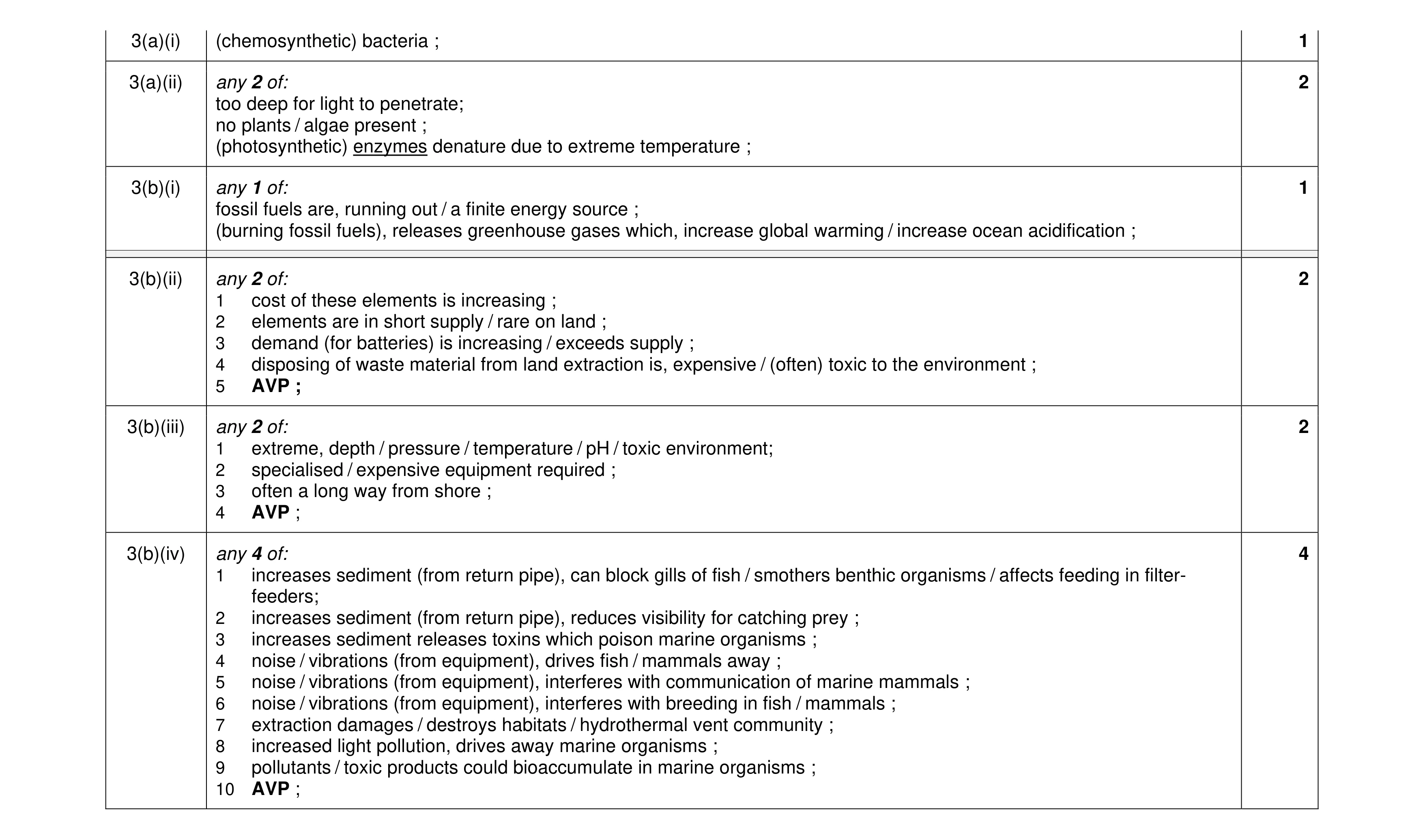 12
12 6
6 16
16 14
14 10
10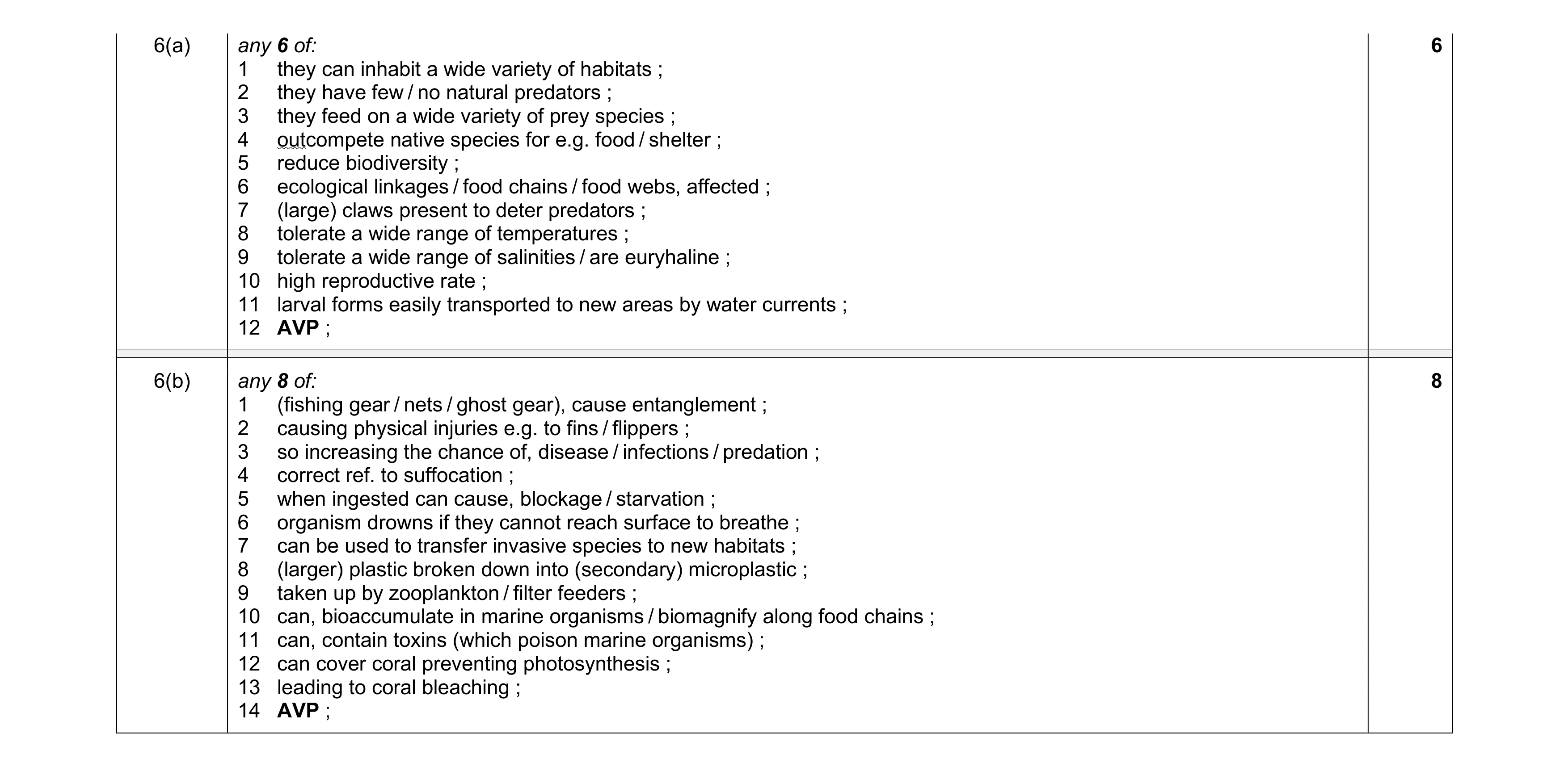 14
14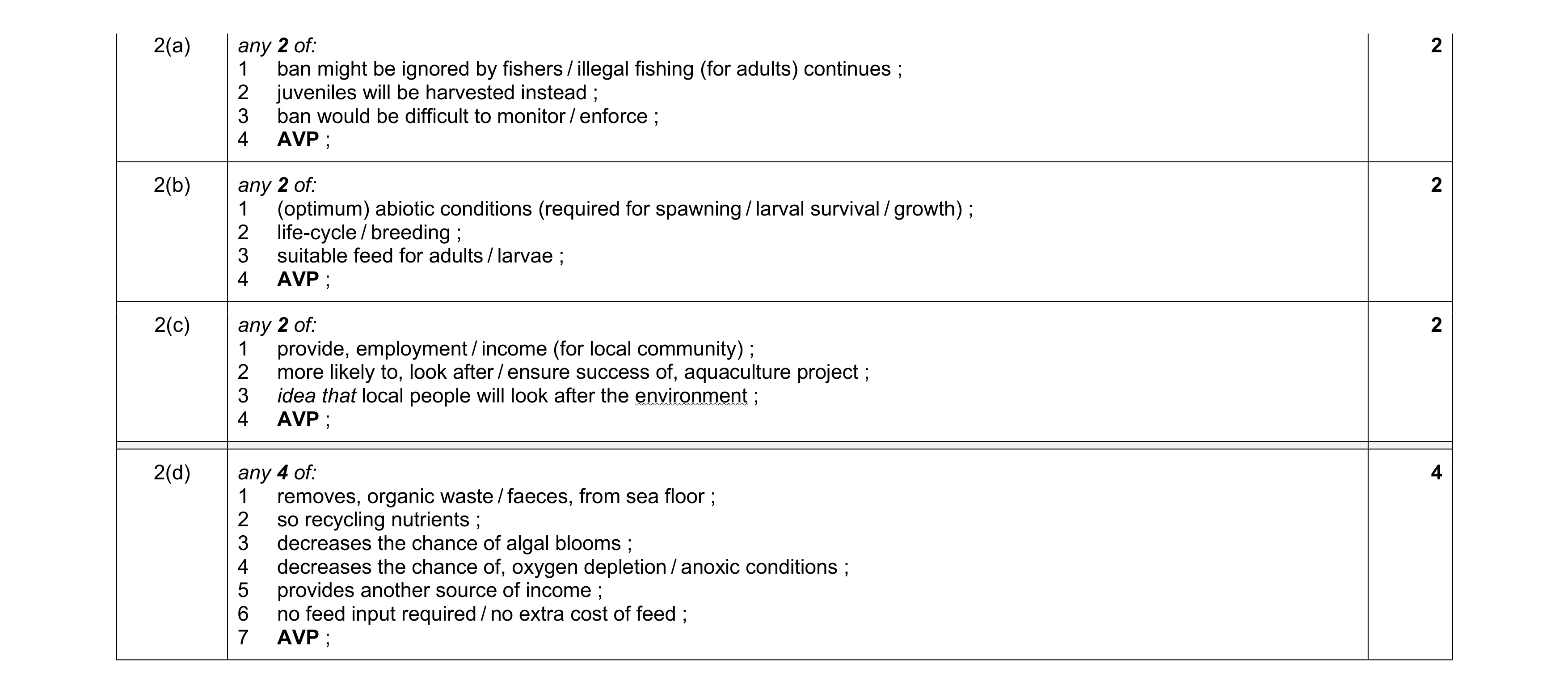 10
10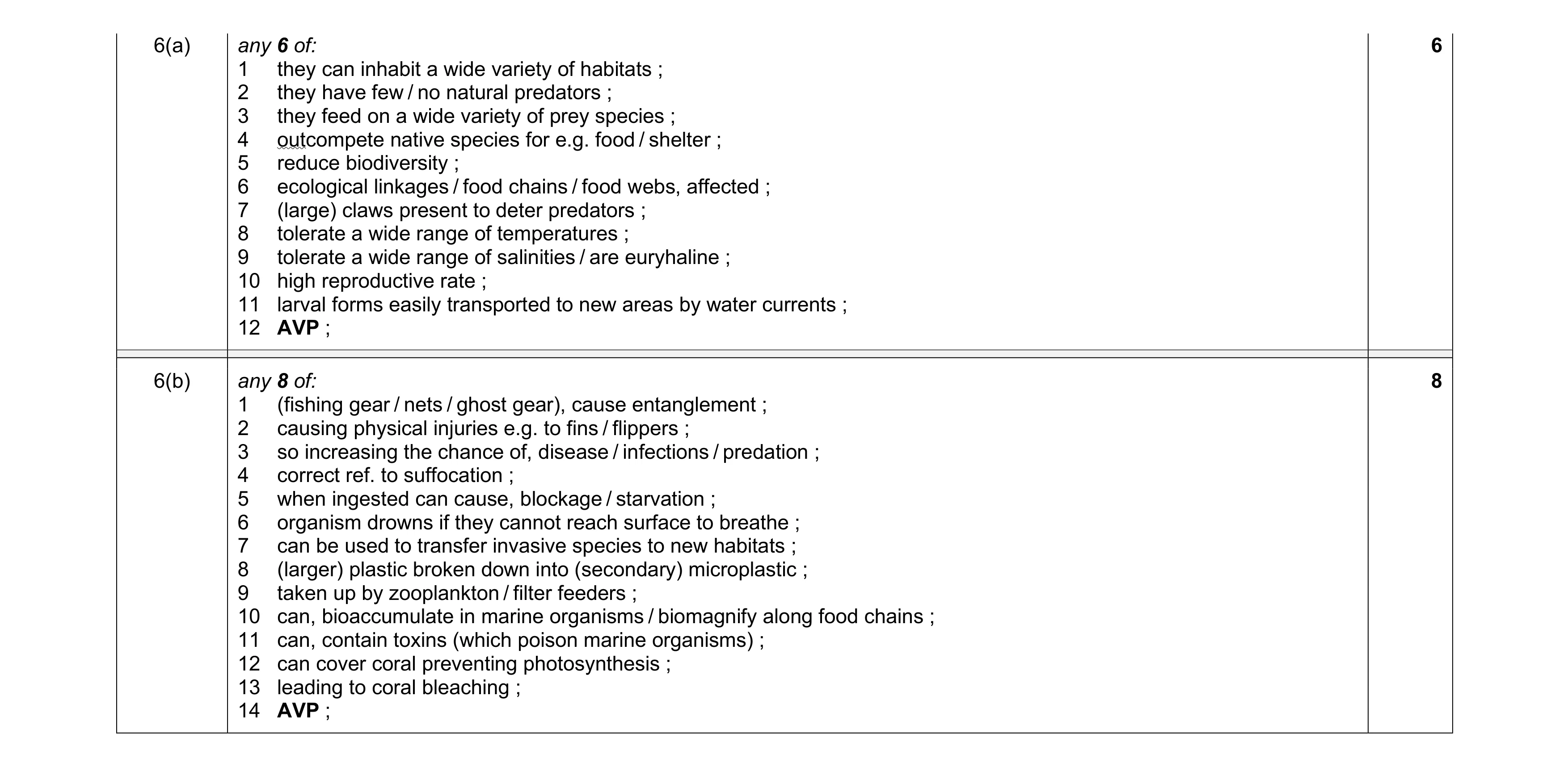 14
14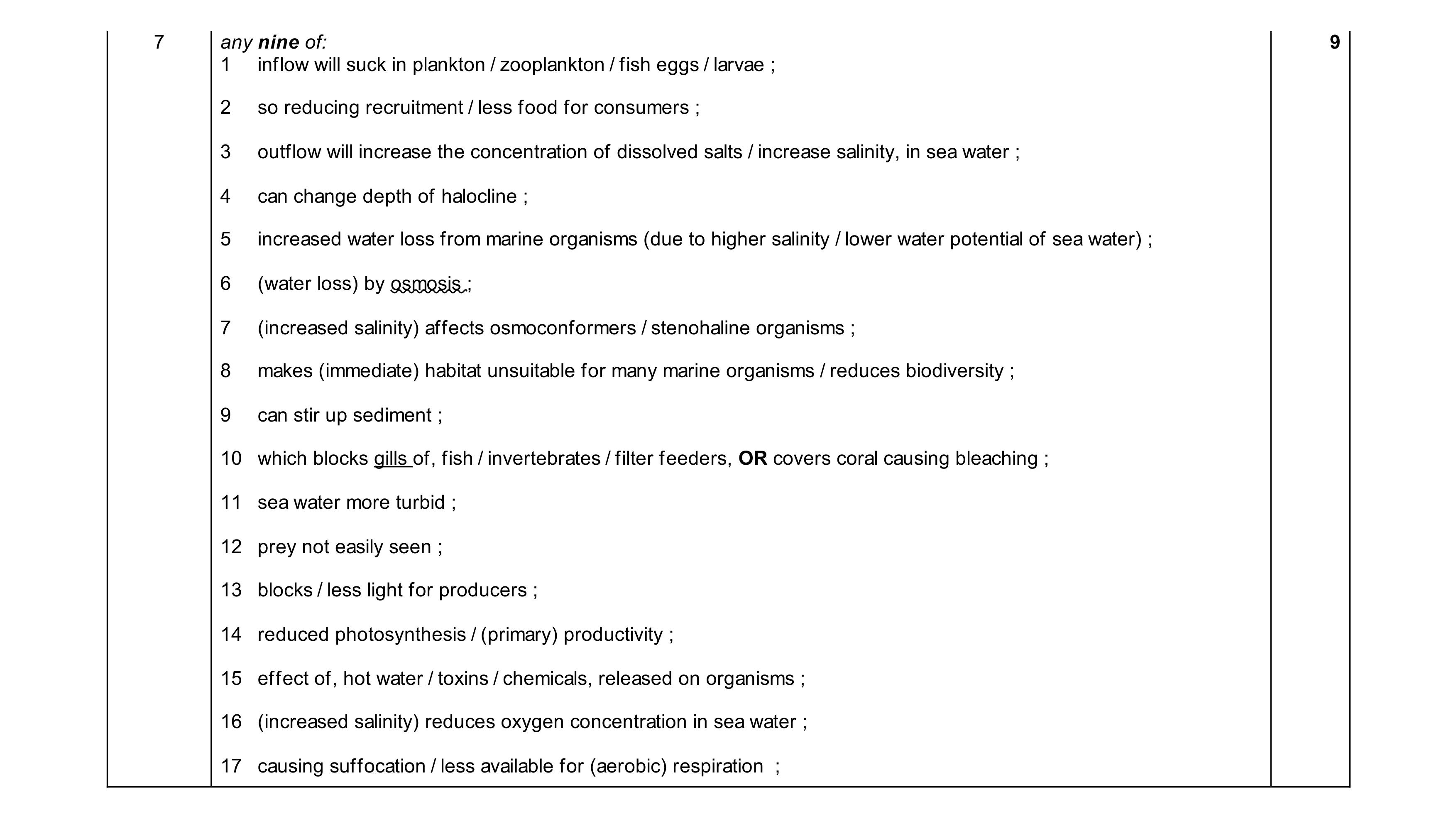 9
9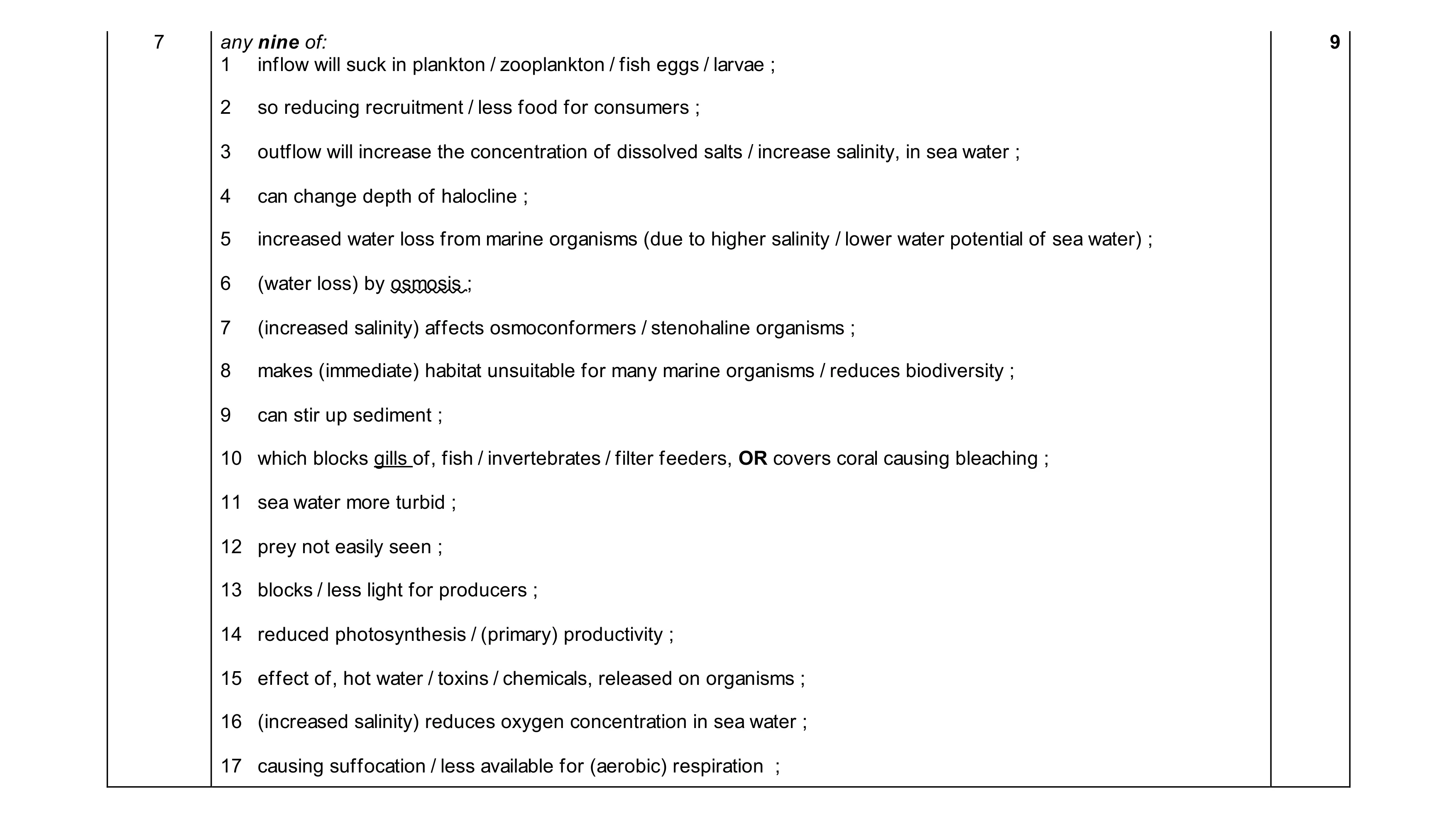 9
9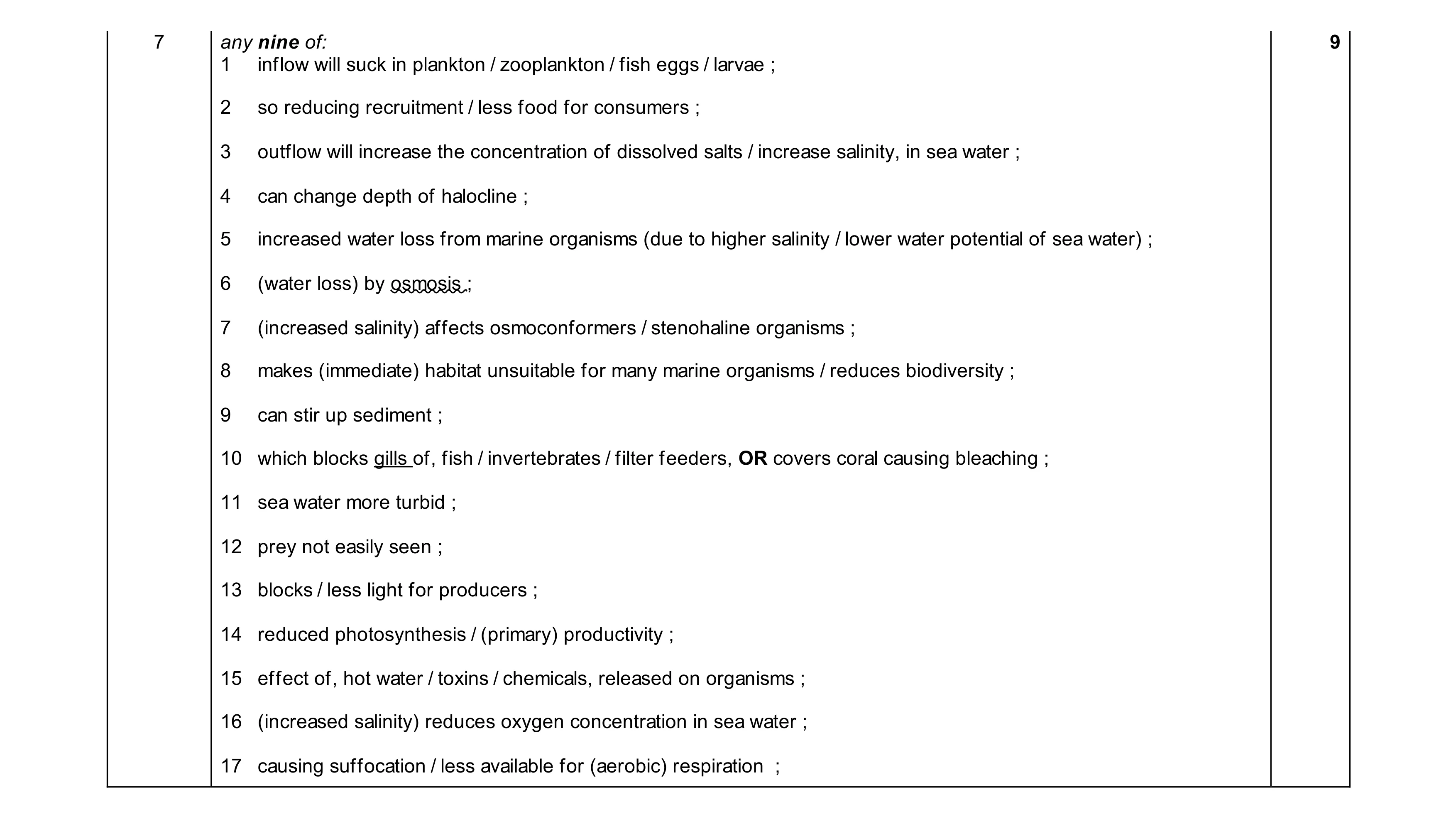 9
9