Cambridge A Level Marine Science 9693 — 2025 Oct/Nov Paper 3 · Variant 1
9693/31/O/N/25 · 7 questions · 75 marks · 105 min
The question paper and its mark scheme, free to read here and free to download. This is Cambridge’s own paper, exactly as it was sat.
Question paper16 pages



Mark scheme16 pages
Answers below. Sit the paper first if you are practising.
Questions as text
Q1 · The life cycle of a jellyfish
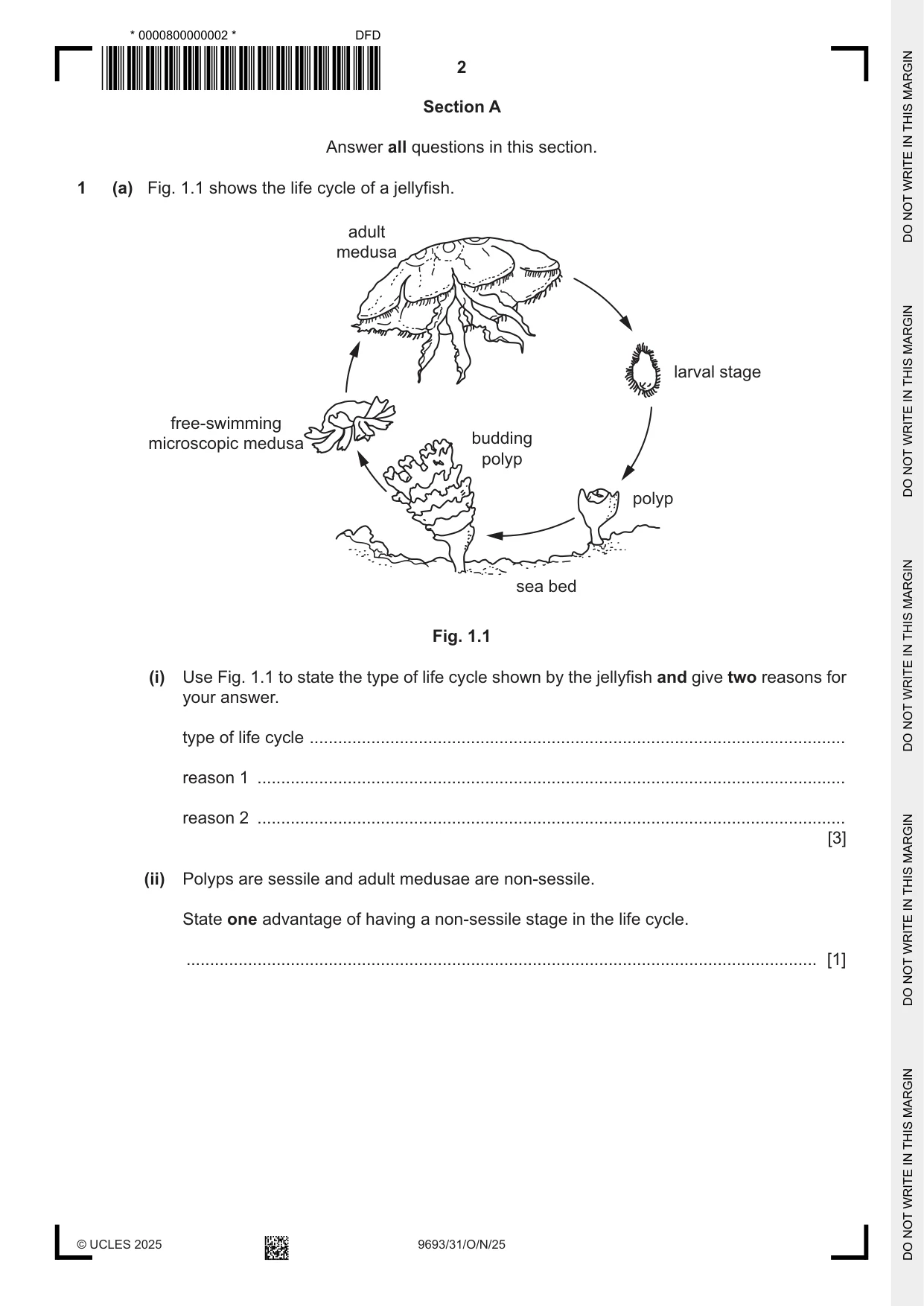
1 (a) Fig. 1.1 shows the life cycle of a jellyfish. adult medusa larval stage free-swimming budding microscopic medusa polyp polyp sea bed Fig. 1.1 (i) Use Fig. 1.1 to state the type of life cycle shown by the jellyfish and give two reasons for your answer. type of life cycle ................................................................................................................. reason 1 ............................................................................................................................ reason 2 ............................................................................................................................ [3] (ii) Polyps are sessile and adult medusae are non-sessile. State one advantage of having a non-sessile stage in the life cycle. ..................................................................................................................................... [1] (b) The helmet jellyfish is a predator with large stinging cells. They feed on zooplankton, fish larvae and juvenile fish, including cod. The jellyfish breed throughout the year. During the last 20 years, jellyfish numbers have increased so much that they form large swarms. These swarms have caused increased problems for local cod fishermen who fish in the inlets around Norway, in northern Europe. Suggest and explain the negative effects of jellyfish swarms on these fishermen. ................................................................................................................................................... ................................................................................................................................................... ................................................................................................................................................... ................................................................................................................................................... ................................................................................................................................................... ................................................................................................................................................... ................................................................................................................................................... ............................................................................................................................................. [4] [Total: 8]
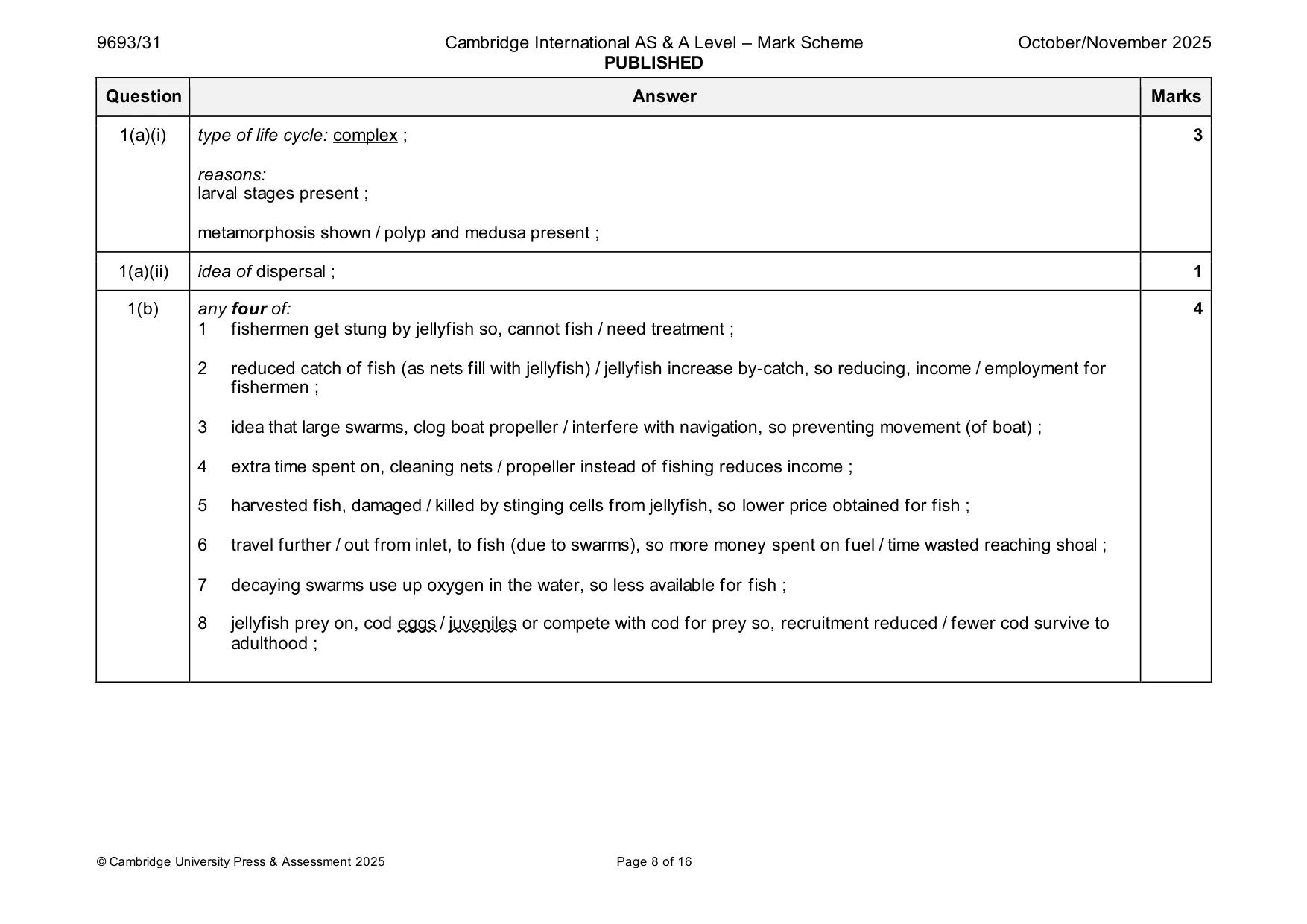
Mark scheme: Question Answer Marks 1(a)(i) type of life cycle: complex ; 3 reasons: larval stages present ; metamorphosis shown / polyp and medusa present ; 1(a)(ii) idea of dispersal ; 1 1(b) any four of: 4 1 fishermen get stung by jellyfish so, cannot fish / need treatment ; 2 reduced catch of fish (as nets fill with jellyfish) / jellyfish increase by-catch, so reducing, income / employment for fishermen ; 3 idea that large swarms, clog boat propeller / interfere with navigation, so preventing movement (of boat) ; 4 extra time spent on, cleaning nets / propeller instead of fishing reduces income ; 5 harvested fish, damaged / killed by stinging cells from jellyfish, so lower price obtained for fish ; 6 travel further / out from inlet, to fish (due to swarms), so more money spent on fuel / time wasted reaching shoal ; 7 decaying swarms use up oxygen in the water, so less available for fish ; 8 jellyfish prey on, cod eggs / juveniles or compete with cod for prey so, recruitment reduced / fewer cod survive to adulthood ;
Q2 · Atlantic cod swim at slow speeds just above the sea bed
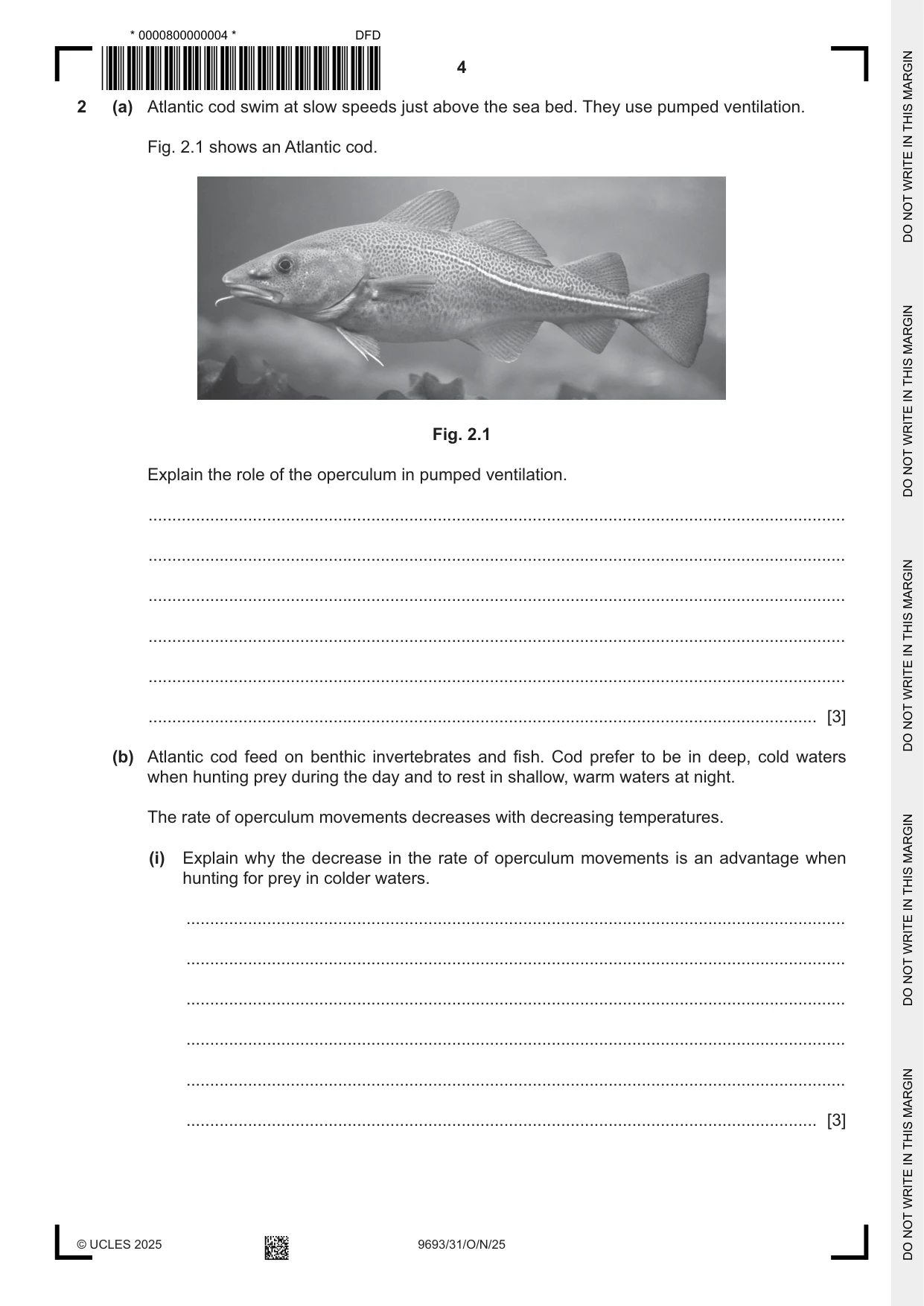
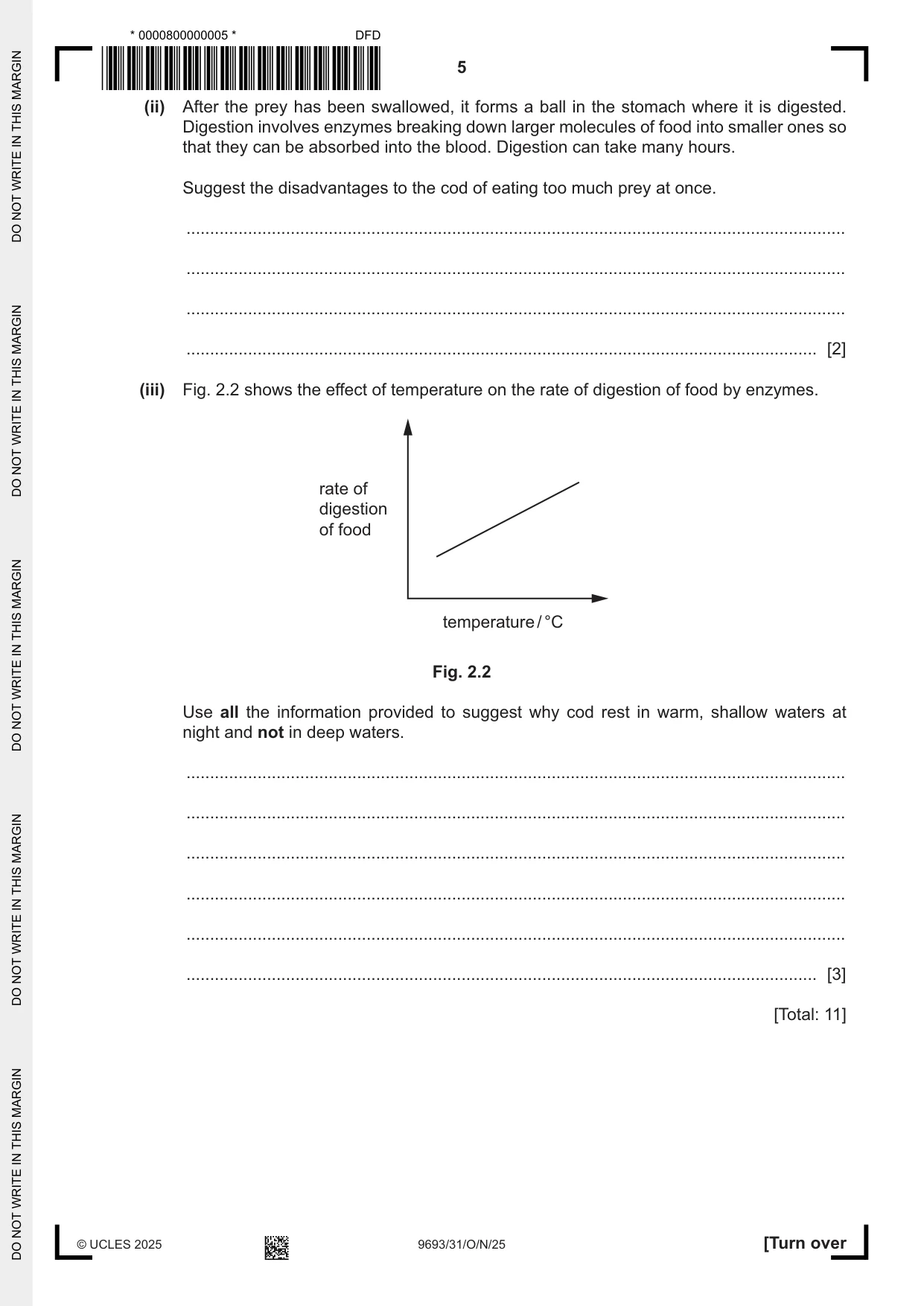
2 (a) Atlantic cod swim at slow speeds just above the sea bed. They use pumped ventilation. Fig. 2.1 shows an Atlantic cod. Fig. 2.1 Explain the role of the operculum in pumped ventilation. ................................................................................................................................................... ................................................................................................................................................... ................................................................................................................................................... ................................................................................................................................................... ................................................................................................................................................... ............................................................................................................................................. [3] (b) Atlantic cod feed on benthic invertebrates and fish. Cod prefer to be in deep, cold waters when hunting prey during the day and to rest in shallow, warm waters at night. The rate of operculum movements decreases with decreasing temperatures. (i) Explain why the decrease in the rate of operculum movements is an advantage when hunting for prey in colder waters. ........................................................................................................................................... ........................................................................................................................................... ........................................................................................................................................... ........................................................................................................................................... ........................................................................................................................................... ..................................................................................................................................... [3] (ii) After the prey has been swallowed, it forms a ball in the stomach where it is digested. Digestion involves enzymes breaking down larger molecules of food into smaller ones so that they can be absorbed into the blood. Digestion can take many hours. Suggest the disadvantages to the cod of eating too much prey at once. ........................................................................................................................................... ........................................................................................................................................... ........................................................................................................................................... ..................................................................................................................................... [2] (iii) Fig. 2.2 shows the effect of temperature on the rate of digestion of food by enzymes. rate of digestion of food temperature / °C Fig. 2.2 Use all the information provided to suggest why cod rest in warm, shallow waters at night and not in deep waters. ........................................................................................................................................... ........................................................................................................................................... ........................................................................................................................................... ........................................................................................................................................... ........................................................................................................................................... ..................................................................................................................................... [3] [Total: 11]
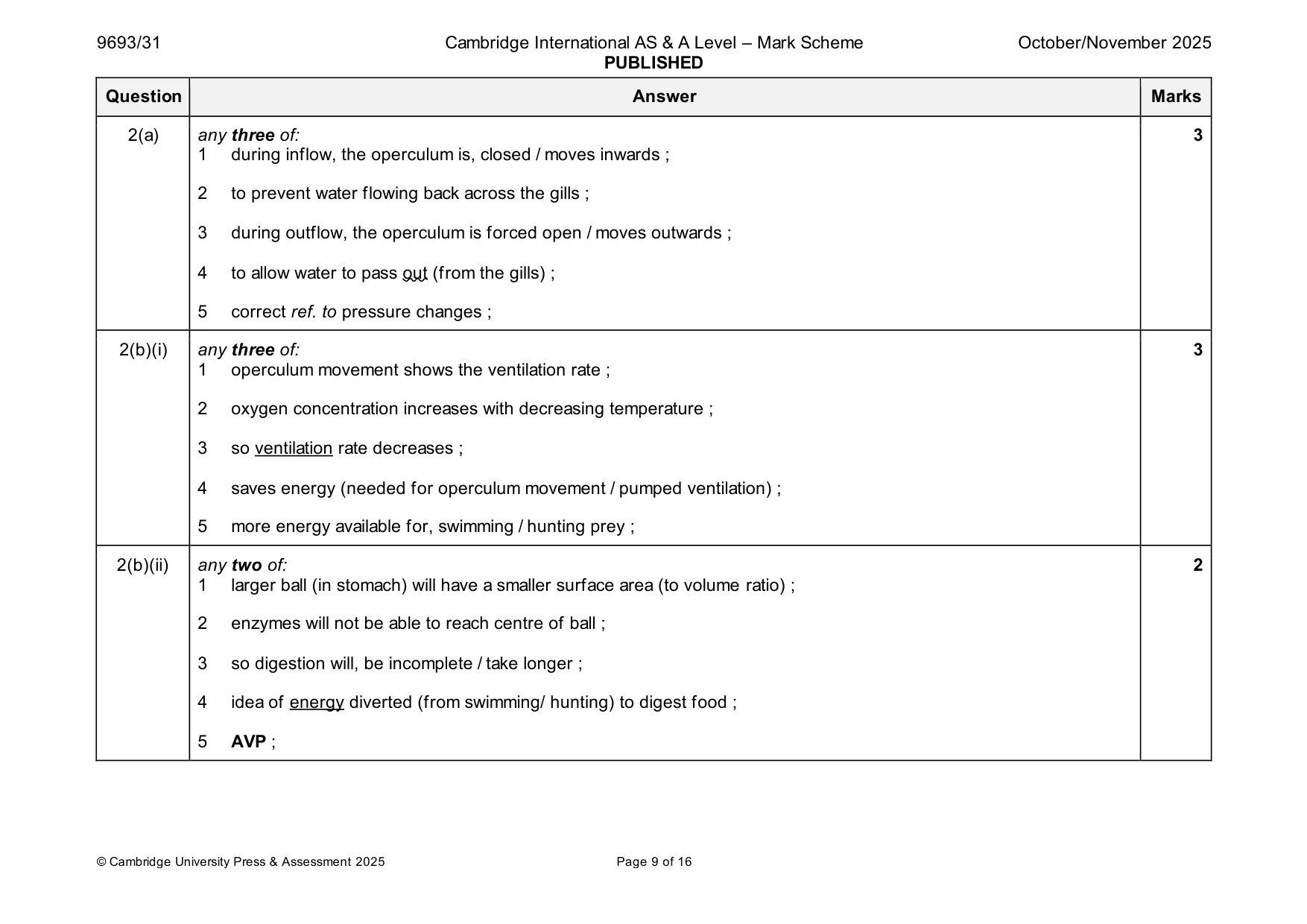
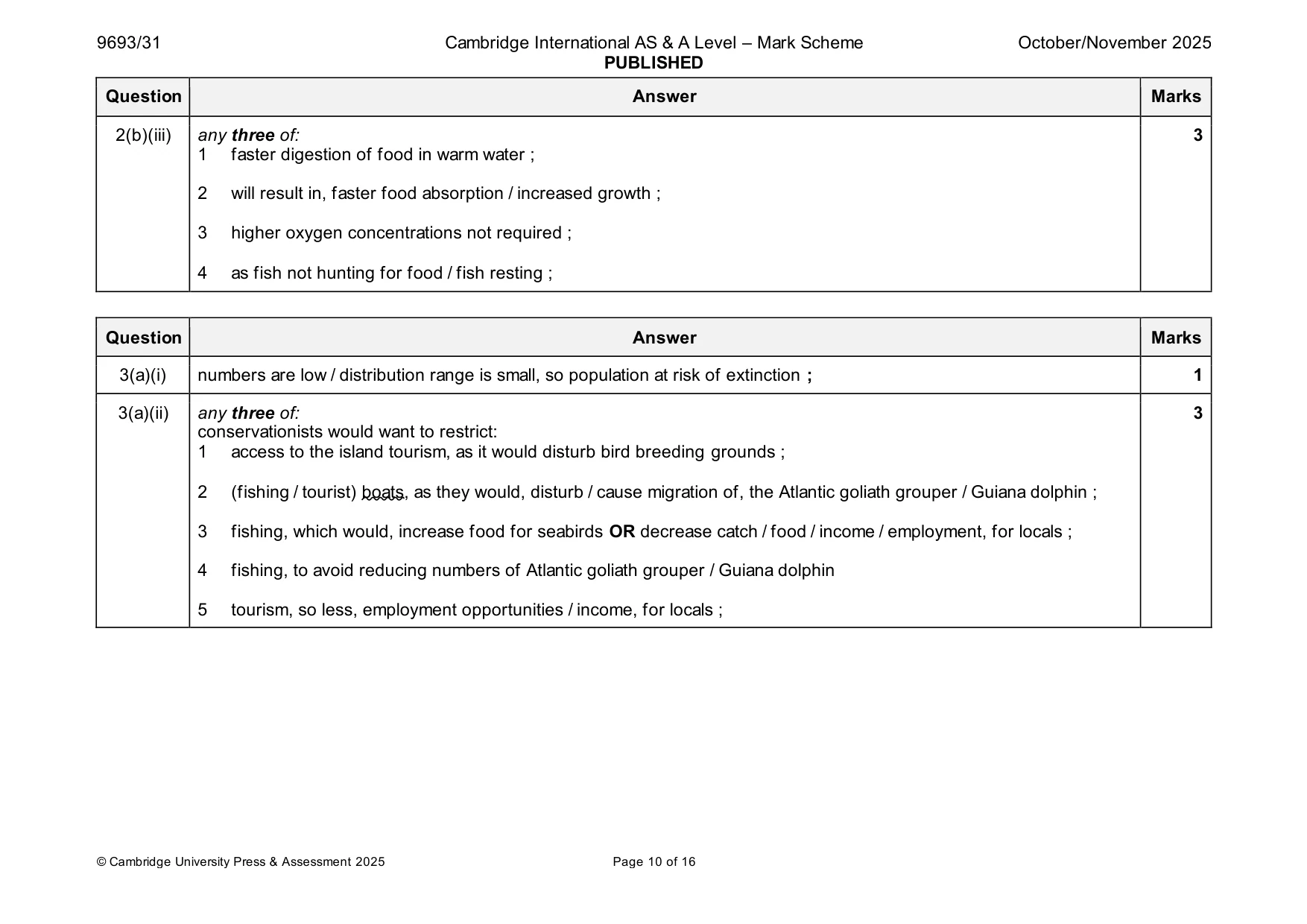
Mark scheme: 2(a) any three of: 3 1 during inflow, the operculum is, closed / moves inwards ; 2 to prevent water flowing back across the gills ; 3 during outflow, the operculum is forced open / moves outwards ; 4 to allow water to pass out (from the gills) ; 5 correct ref. to pressure changes ; 2(b)(i) any three of: 3 1 operculum movement shows the ventilation rate ; 2 oxygen concentration increases with decreasing temperature ; 3 so ventilation rate decreases ; 4 saves energy (needed for operculum movement / pumped ventilation) ; 5 more energy available for, swimming / hunting prey ; 2(b)(ii) any two of: 2 1 larger ball (in stomach) will have a smaller surface area (to volume ratio) ; 2 enzymes will not be able to reach centre of ball ; 3 so digestion will, be incomplete / take longer ; 4 idea of energy diverted (from swimming/ hunting) to digest food ; 5 AVP ; 2(b)(iii) any three of: 3 1 faster digestion of food in warm water ; 2 will result in, faster food absorption / increased growth ; 3 higher oxygen concentrations not required ; 4 as fish not hunting for food / fish resting ;
Q3 · Île du Grand-Connétable is an uninhabited island situated 15 km from the coast of French…
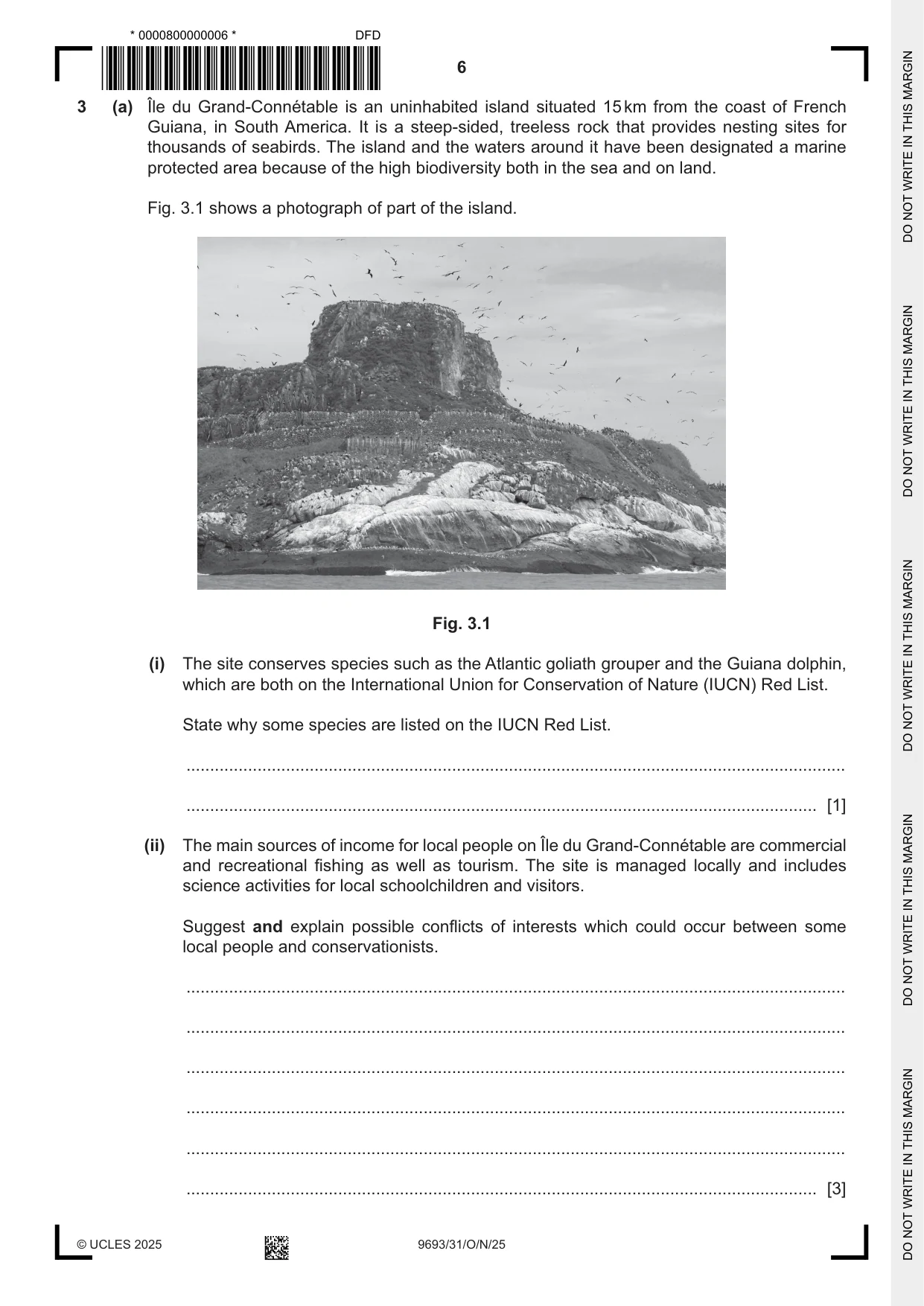
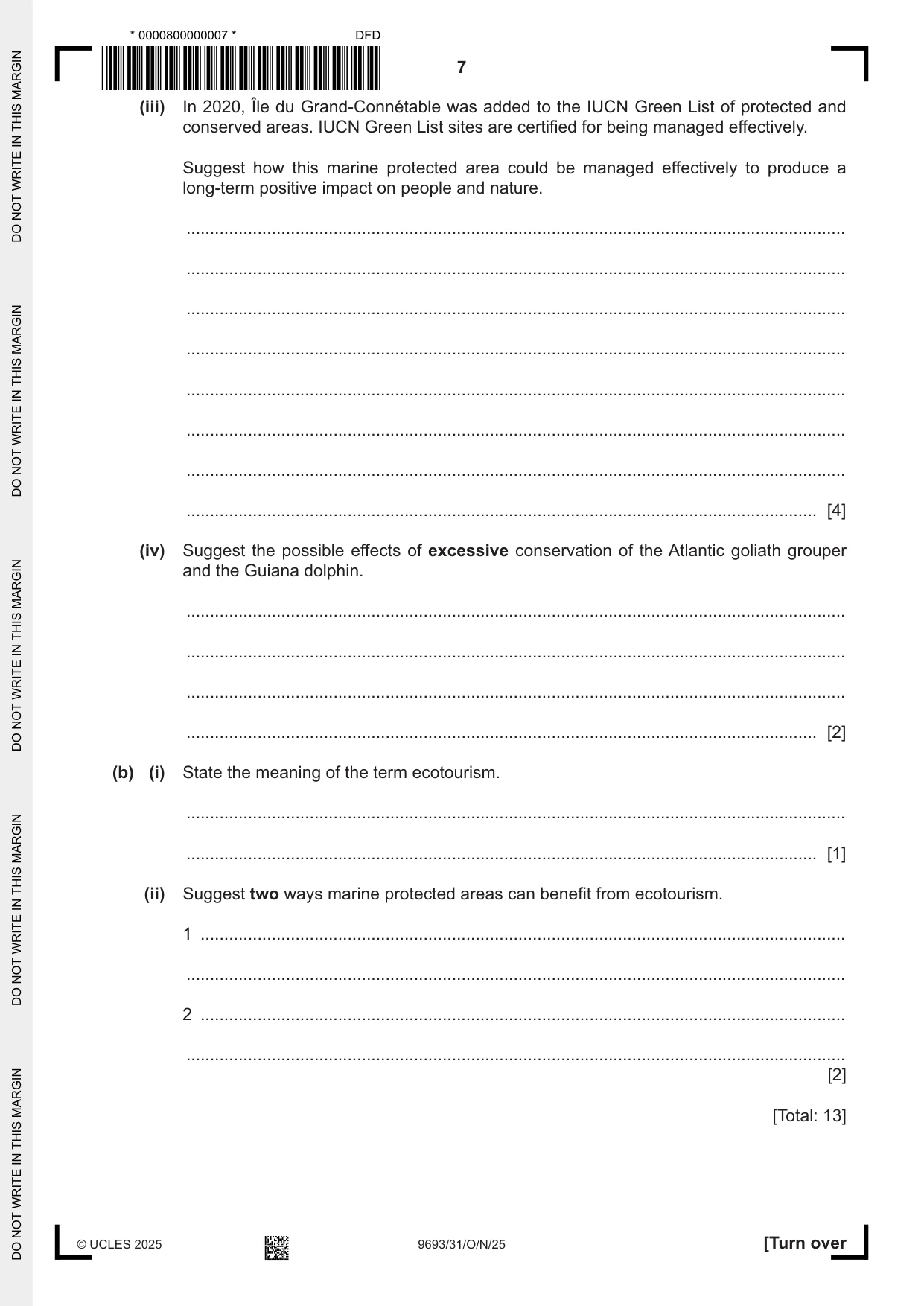
3 (a) Île du Grand-Connétable is an uninhabited island situated 15 km from the coast of French Guiana, in South America. It is a steep-sided, treeless rock that provides nesting sites for thousands of seabirds. The island and the waters around it have been designated a marine protected area because of the high biodiversity both in the sea and on land. Fig. 3.1 shows a photograph of part of the island. Fig. 3.1 (i) The site conserves species such as the Atlantic goliath grouper and the Guiana dolphin, which are both on the International Union for Conservation of Nature (IUCN) Red List. State why some species are listed on the IUCN Red List. ........................................................................................................................................... ..................................................................................................................................... [1] (ii) The main sources of income for local people on Île du Grand-Connétable are commercial and recreational fishing as well as tourism. The site is managed locally and includes science activities for local schoolchildren and visitors. Suggest and explain possible conflicts of interests which could occur between some local people and conservationists. ........................................................................................................................................... ........................................................................................................................................... ........................................................................................................................................... ........................................................................................................................................... ........................................................................................................................................... ..................................................................................................................................... [3] (iii) In 2020, Île du Grand-Connétable was added to the IUCN Green List of protected and conserved areas. IUCN Green List sites are certified for being managed effectively. Suggest how this marine protected area could be managed effectively to produce a long-term positive impact on people and nature. ........................................................................................................................................... ........................................................................................................................................... ........................................................................................................................................... ........................................................................................................................................... ........................................................................................................................................... ........................................................................................................................................... ........................................................................................................................................... ..................................................................................................................................... [4] (iv) Suggest the possible effects of excessive conservation of the Atlantic goliath grouper and the Guiana dolphin. ........................................................................................................................................... ........................................................................................................................................... ........................................................................................................................................... ..................................................................................................................................... [2] (b) (i) State the meaning of the term ecotourism. ........................................................................................................................................... ..................................................................................................................................... [1] (ii) Suggest two ways marine protected areas can benefit from ecotourism. 1 ........................................................................................................................................ ........................................................................................................................................... 2 ........................................................................................................................................ ........................................................................................................................................... [2] [Total: 13]
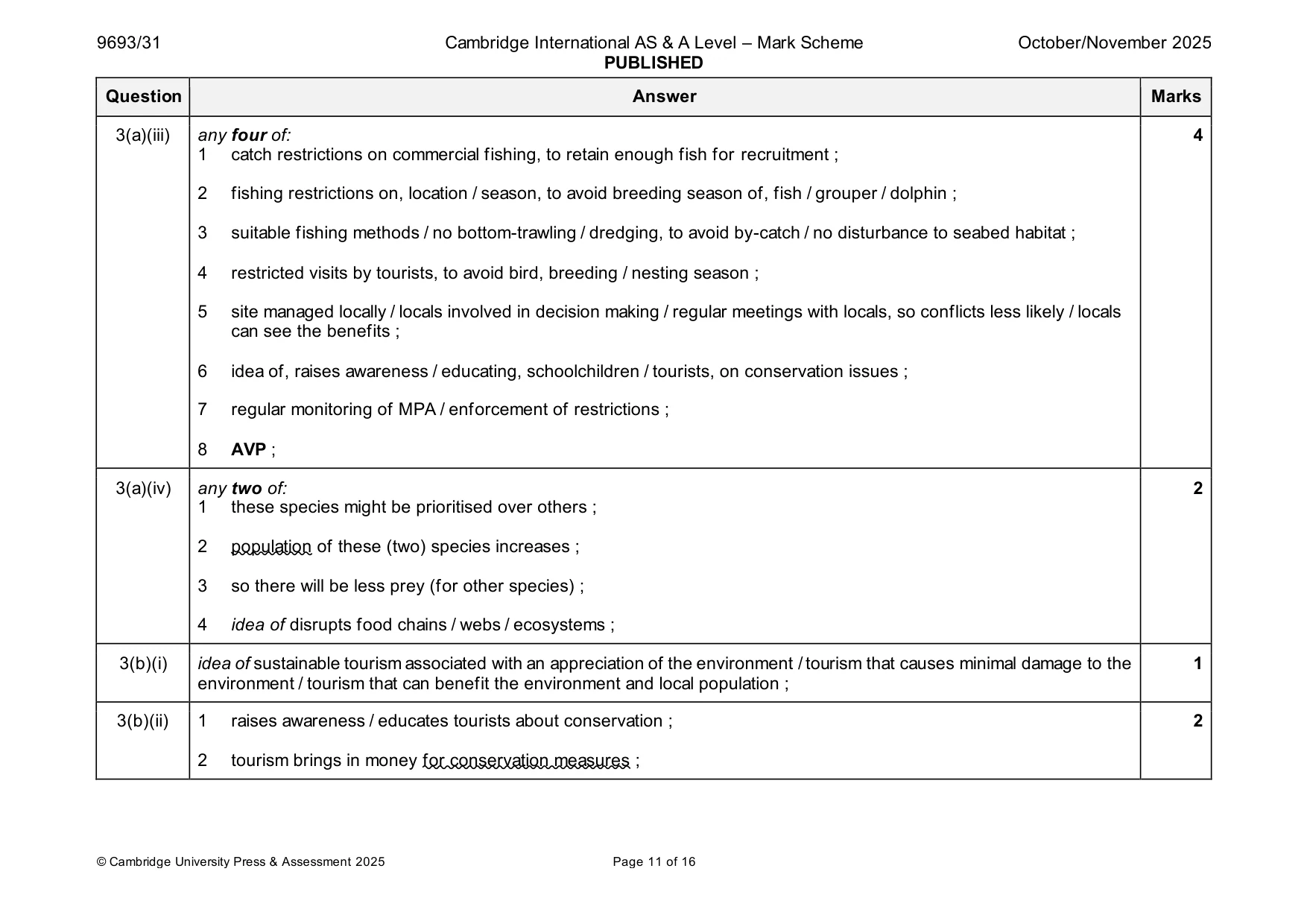
Mark scheme: 3(a)(i) numbers are low / distribution range is small, so population at risk of extinction ; 1 3(a)(ii) any three of: 3 conservationists would want to restrict: 1 access to the island tourism, as it would disturb bird breeding grounds ; 2 (fishing / tourist) boats, as they would, disturb / cause migration of, the Atlantic goliath grouper / Guiana dolphin ; 3 fishing, which would, increase food for seabirds OR decrease catch / food / income / employment, for locals ; 4 fishing, to avoid reducing numbers of Atlantic goliath grouper / Guiana dolphin 5 tourism, so less, employment opportunities / income, for locals ; 3(a)(iii) any four of: 4 1 catch restrictions on commercial fishing, to retain enough fish for recruitment ; 2 fishing restrictions on, location / season, to avoid breeding season of, fish / grouper / dolphin ; 3 suitable fishing methods / no bottom-trawling / dredging, to avoid by-catch / no disturbance to seabed habitat ; 4 restricted visits by tourists, to avoid bird, breeding / nesting season ; 5 site managed locally / locals involved in decision making / regular meetings with locals, so conflicts less likely / locals can see the benefits ; 6 idea of, raises awareness / educating, schoolchildren / tourists, on conservation issues ; 7 regular monitoring of MPA / enforcement of restrictions ; 8 AVP ; 3(a)(iv) any two of: 2 1 these species might be prioritised over others ; 2 population of these (two) species increases ; 3 so there will be less prey (for other species) ; 4 idea of disrupts food chains / webs / ecosystems ; 3(b)(i) idea of sustainable tourism associated with an appreciation of the environment / tourism that causes minimal damage to the 1 environment / tourism that can benefit the environment and local population ; 3(b)(ii) 1 raises awareness / educates tourists about conservation ; 2 2 tourism brings in money for conservation measures ;
Q4 · A chloroplast from a red mangrove leaf
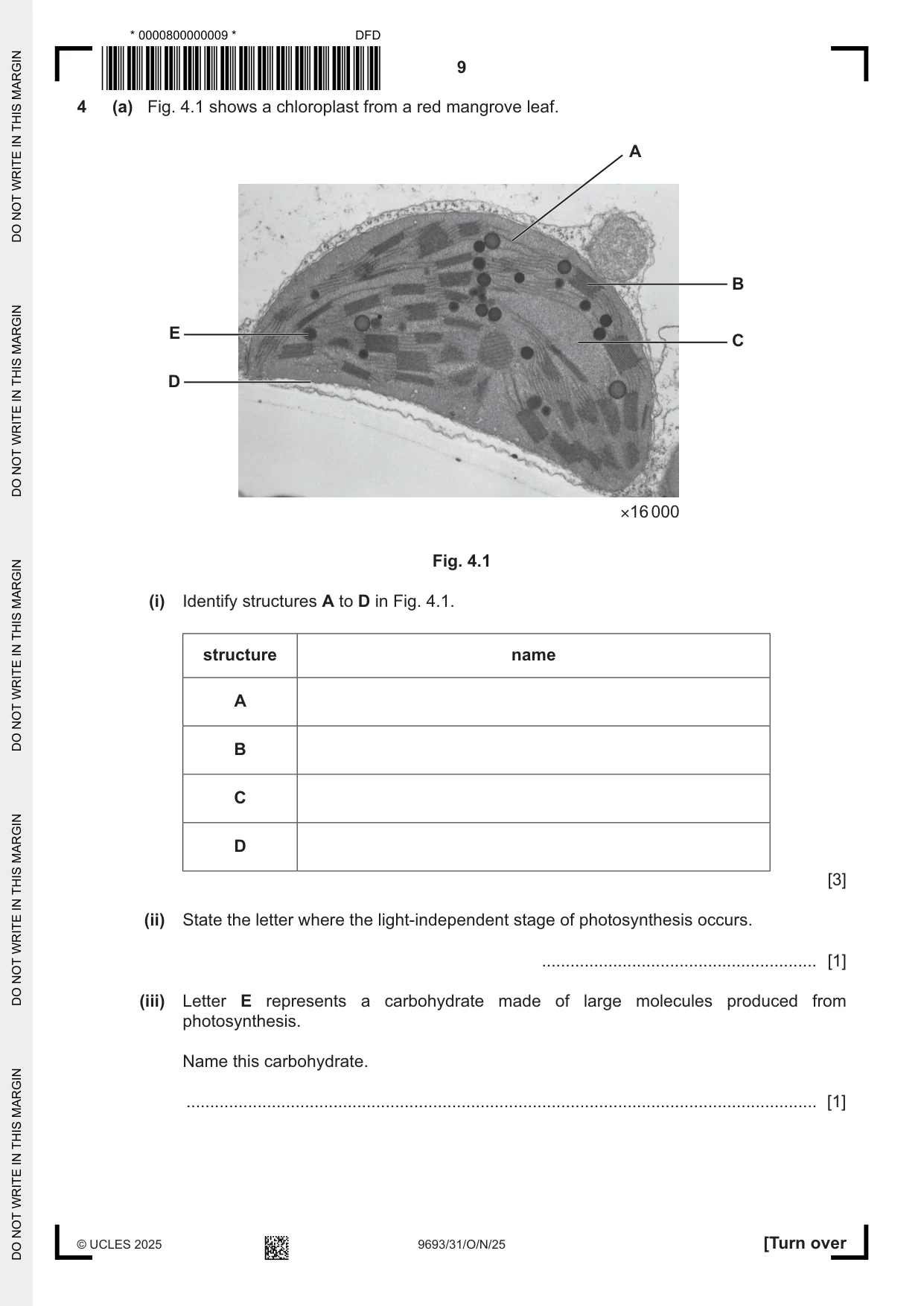
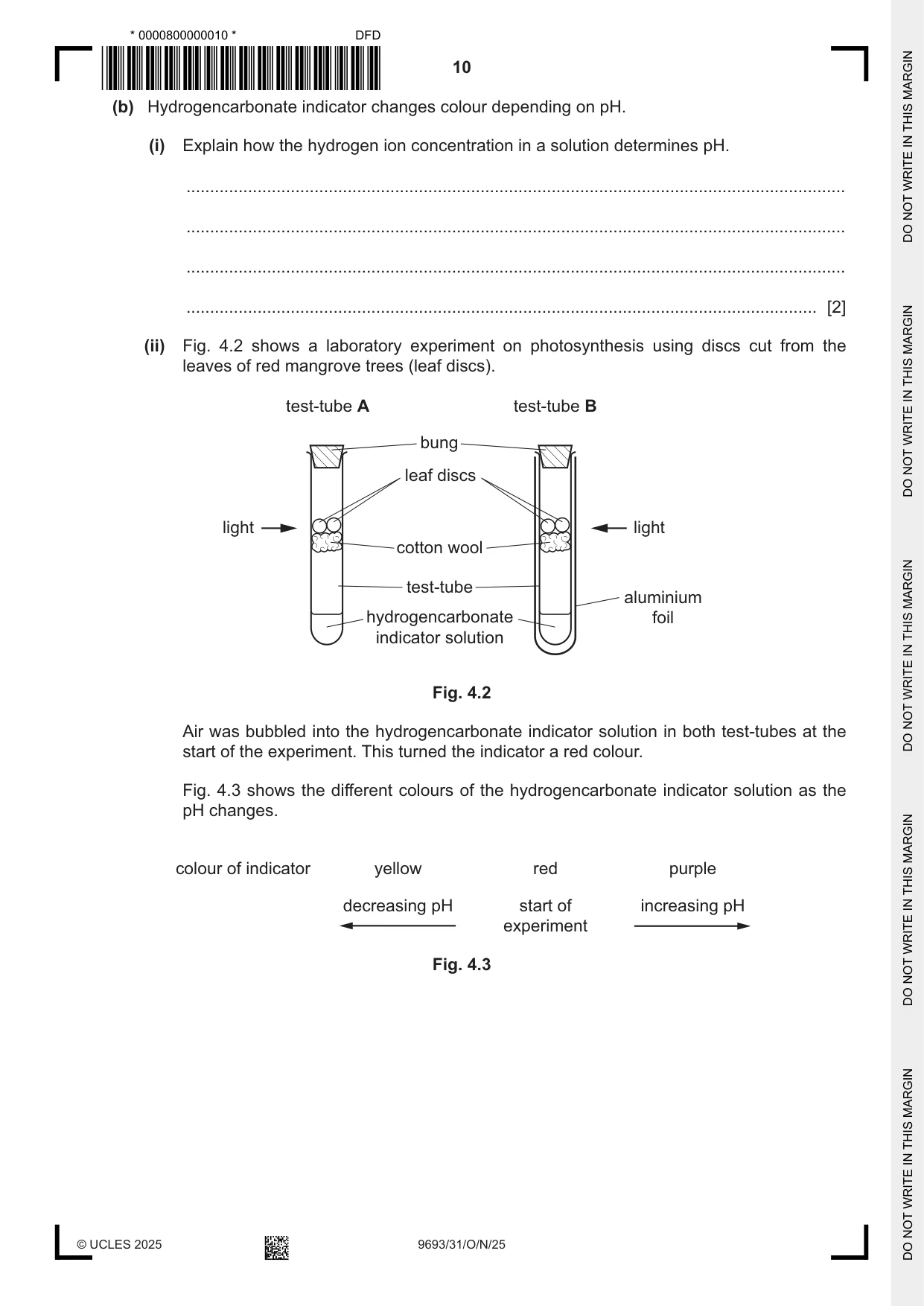
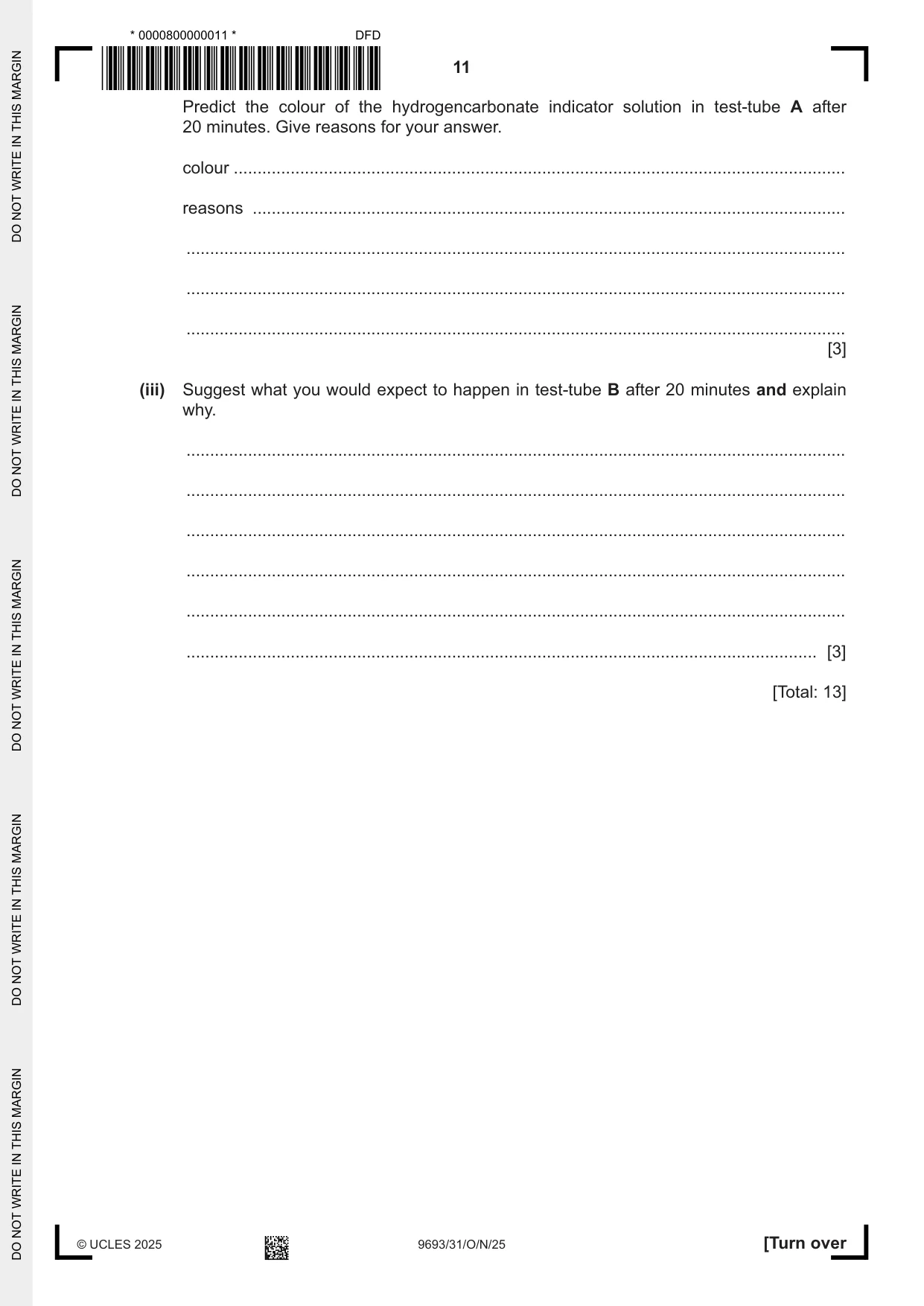
4 (a) Fig. 4.1 shows a chloroplast from a red mangrove leaf. A B E C D ×16 000 Fig. 4.1 (i) Identify structures A to D in Fig. 4.1. structure name A B C D [3] (ii) State the letter where the light-independent stage of photosynthesis occurs. .......................................................... [1] (iii) Letter E represents a carbohydrate made of large molecules produced from photosynthesis. Name this carbohydrate. ..................................................................................................................................... [1] (b) Hydrogencarbonate indicator changes colour depending on pH. (i) Explain how the hydrogen ion concentration in a solution determines pH. ........................................................................................................................................... ........................................................................................................................................... ........................................................................................................................................... ..................................................................................................................................... [2] (ii) Fig. 4.2 shows a laboratory experiment on photosynthesis using discs cut from the leaves of red mangrove trees (leaf discs). test-tube A test-tube B bung leaf discs light light cotton wool test-tube aluminium hydrogencarbonate foil indicator solution Fig. 4.2 Air was bubbled into the hydrogencarbonate indicator solution in both test-tubes at the start of the experiment. This turned the indicator a red colour. Fig. 4.3 shows the different colours of the hydrogencarbonate indicator solution as the pH changes. colour of indicator yellow red purple decreasing pH start of increasing pH experiment Fig. 4.3 Predict the colour of the hydrogencarbonate indicator solution in test-tube A after 20 minutes. Give reasons for your answer. colour ................................................................................................................................. reasons ............................................................................................................................. ........................................................................................................................................... ........................................................................................................................................... ........................................................................................................................................... [3] (iii) Suggest what you would expect to happen in test-tube B after 20 minutes and explain why. ........................................................................................................................................... ........................................................................................................................................... ........................................................................................................................................... ........................................................................................................................................... ........................................................................................................................................... ..................................................................................................................................... [3] [Total: 13]
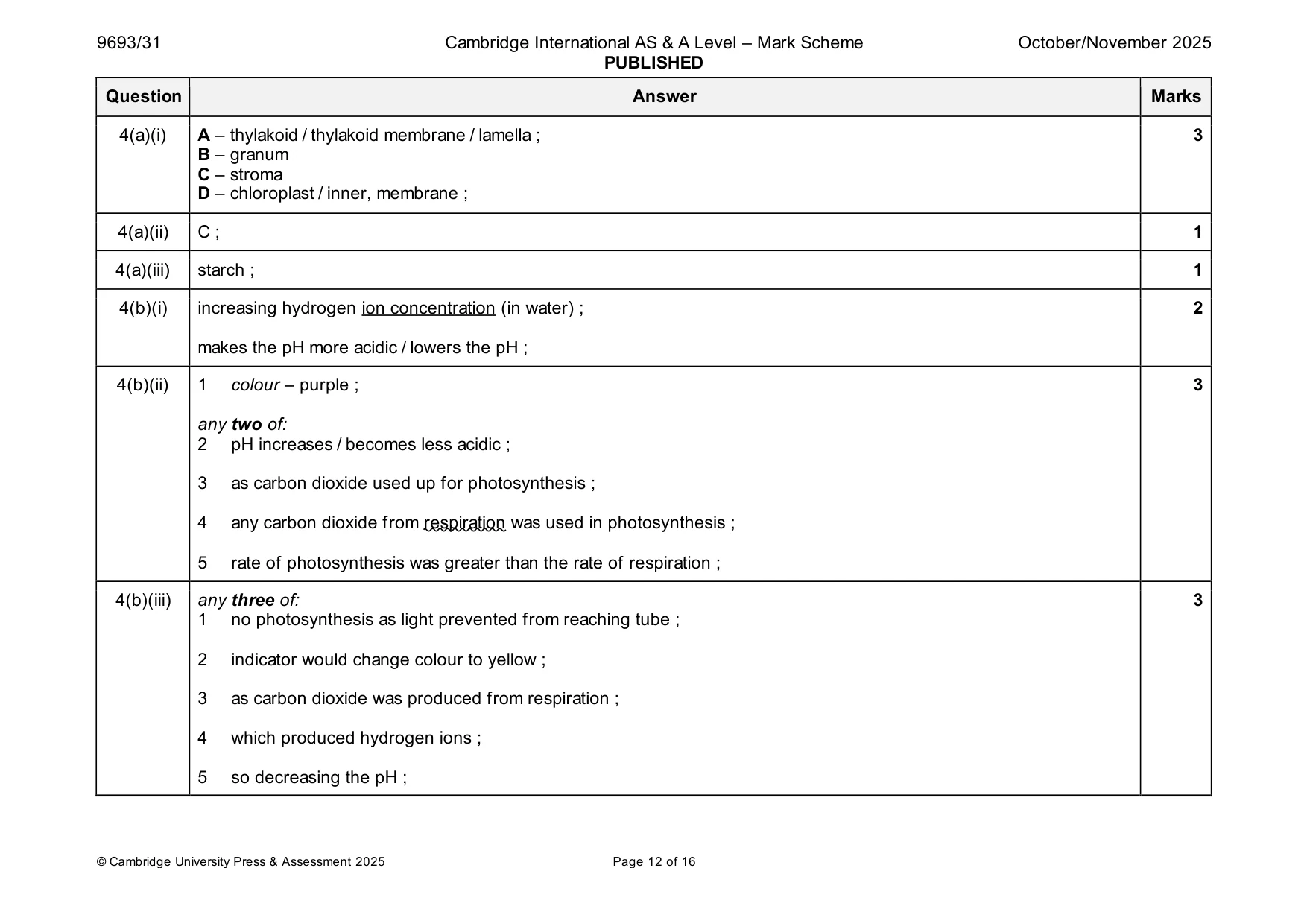
Mark scheme: 4(a)(i) A – thylakoid / thylakoid membrane / lamella ; 3 B – granum C – stroma D – chloroplast / inner, membrane ; 4(a)(ii) C ; 1 4(a)(iii) starch ; 1 4(b)(i) increasing hydrogen ion concentration (in water) ; 2 makes the pH more acidic / lowers the pH ; 4(b)(ii) 1 colour – purple ; 3 any two of: 2 pH increases / becomes less acidic ; 3 as carbon dioxide used up for photosynthesis ; 4 any carbon dioxide from respiration was used in photosynthesis ; 5 rate of photosynthesis was greater than the rate of respiration ; 4(b)(iii) any three of: 3 1 no photosynthesis as light prevented from reaching tube ; 2 indicator would change colour to yellow ; 3 as carbon dioxide was produced from respiration ; 4 which produced hydrogen ions ; 5 so decreasing the pH ;
Q5 · Market demand, access to market and a return on investment are three requirements for the…
5 Market demand, access to market and a return on investment are three requirements for the long-term success of aquaculture projects. Explain other factors that contribute to the long-term success of aquaculture projects. .......................................................................................................................................................... .......................................................................................................................................................... .......................................................................................................................................................... .......................................................................................................................................................... .......................................................................................................................................................... .......................................................................................................................................................... .......................................................................................................................................................... .......................................................................................................................................................... .......................................................................................................................................................... .......................................................................................................................................................... .......................................................................................................................................................... .......................................................................................................................................................... .......................................................................................................................................................... .......................................................................................................................................................... .......................................................................................................................................................... .......................................................................................................................................................... .......................................................................................................................................................... .......................................................................................................................................................... .......................................................................................................................................................... .................................................................................................................................................. [10]
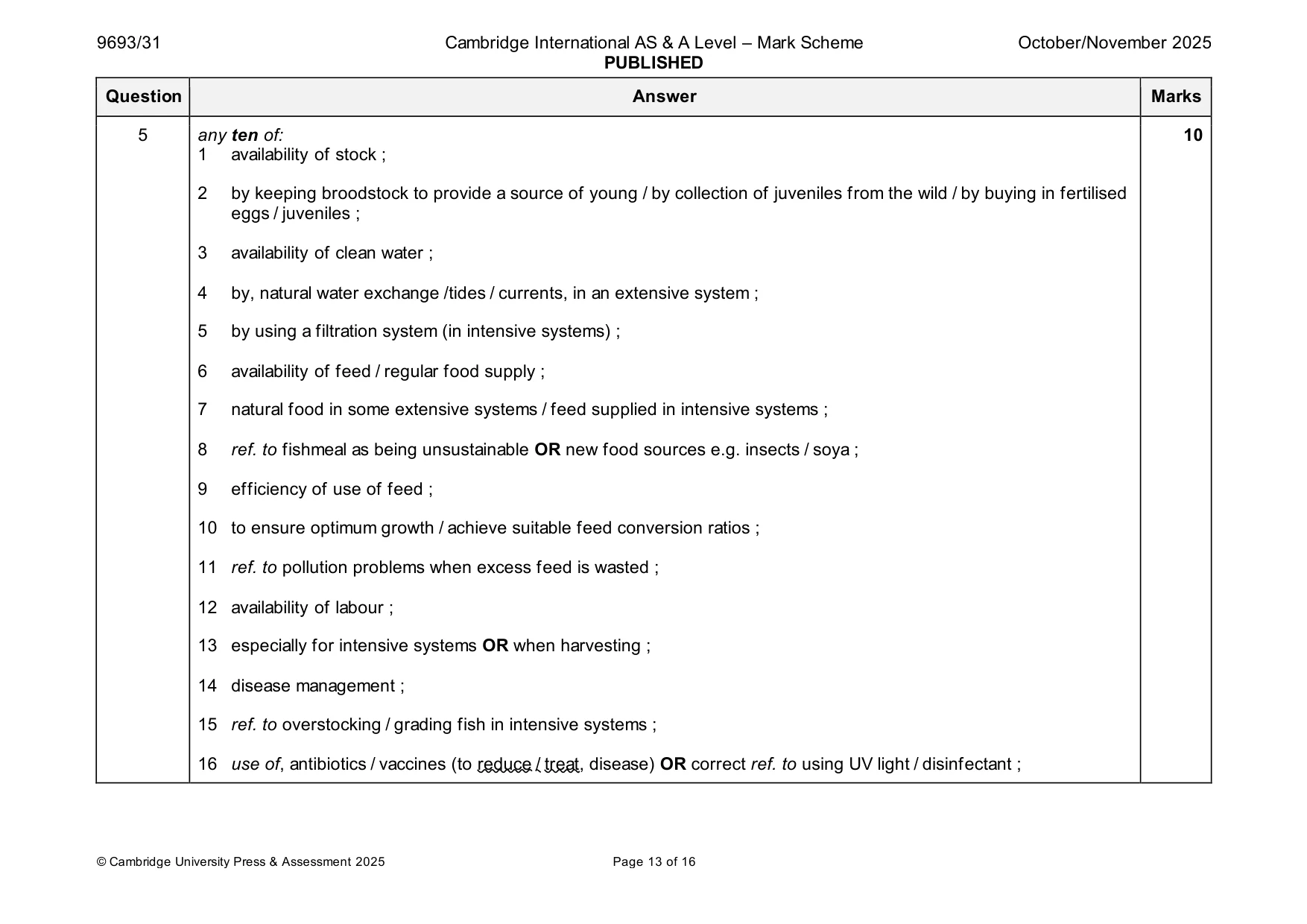
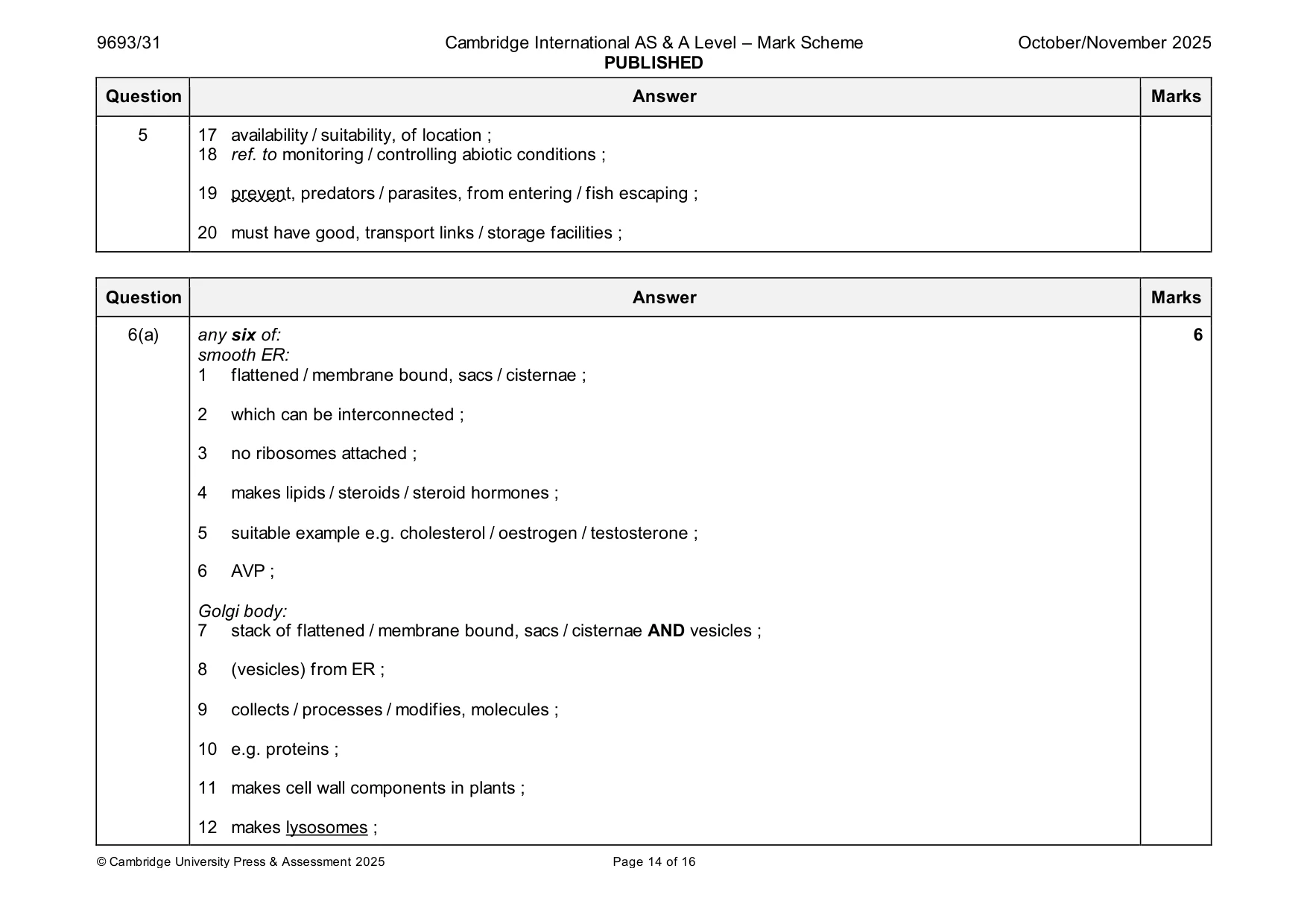
Mark scheme: 5 any ten of: 10 1 availability of stock ; 2 by keeping broodstock to provide a source of young / by collection of juveniles from the wild / by buying in fertilised eggs / juveniles ; 3 availability of clean water ; 4 by, natural water exchange /tides / currents, in an extensive system ; 5 by using a filtration system (in intensive systems) ; 6 availability of feed / regular food supply ; 7 natural food in some extensive systems / feed supplied in intensive systems ; 8 ref. to fishmeal as being unsustainable OR new food sources e.g. insects / soya ; 9 efficiency of use of feed ; 10 to ensure optimum growth / achieve suitable feed conversion ratios ; 11 ref. to pollution problems when excess feed is wasted ; 12 availability of labour ; 13 especially for intensive systems OR when harvesting ; 14 disease management ; 15 ref. to overstocking / grading fish in intensive systems ; 16 use of, antibiotics / vaccines (to reduce / treat, disease) OR correct ref. to using UV light / disinfectant ; 5 17 availability / suitability, of location ; 18 ref. to monitoring / controlling abiotic conditions ; 19 prevent, predators / parasites, from entering / fish escaping ; 20 must have good, transport links / storage facilities ;
Q6 · Cells of both animals and plants contain many smaller structures, including smooth…
6 Cells of both animals and plants contain many smaller structures, including smooth endoplasmic reticulum, Golgi bodies and mitochondria. (a) Outline the structure and function of smooth endoplasmic reticulum and Golgi bodies. ................................................................................................................................................... ................................................................................................................................................... ................................................................................................................................................... ................................................................................................................................................... ................................................................................................................................................... ................................................................................................................................................... ................................................................................................................................................... ................................................................................................................................................... ................................................................................................................................................... ................................................................................................................................................... ................................................................................................................................................... ............................................................................................................................................. [6] (b) Mitochondria are involved in respiration. Describe the process of respiration in marine organisms. ................................................................................................................................................... ................................................................................................................................................... ................................................................................................................................................... ................................................................................................................................................... ................................................................................................................................................... ................................................................................................................................................... ................................................................................................................................................... ................................................................................................................................................... ................................................................................................................................................... ............................................................................................................................................. [5] [Total: 11]
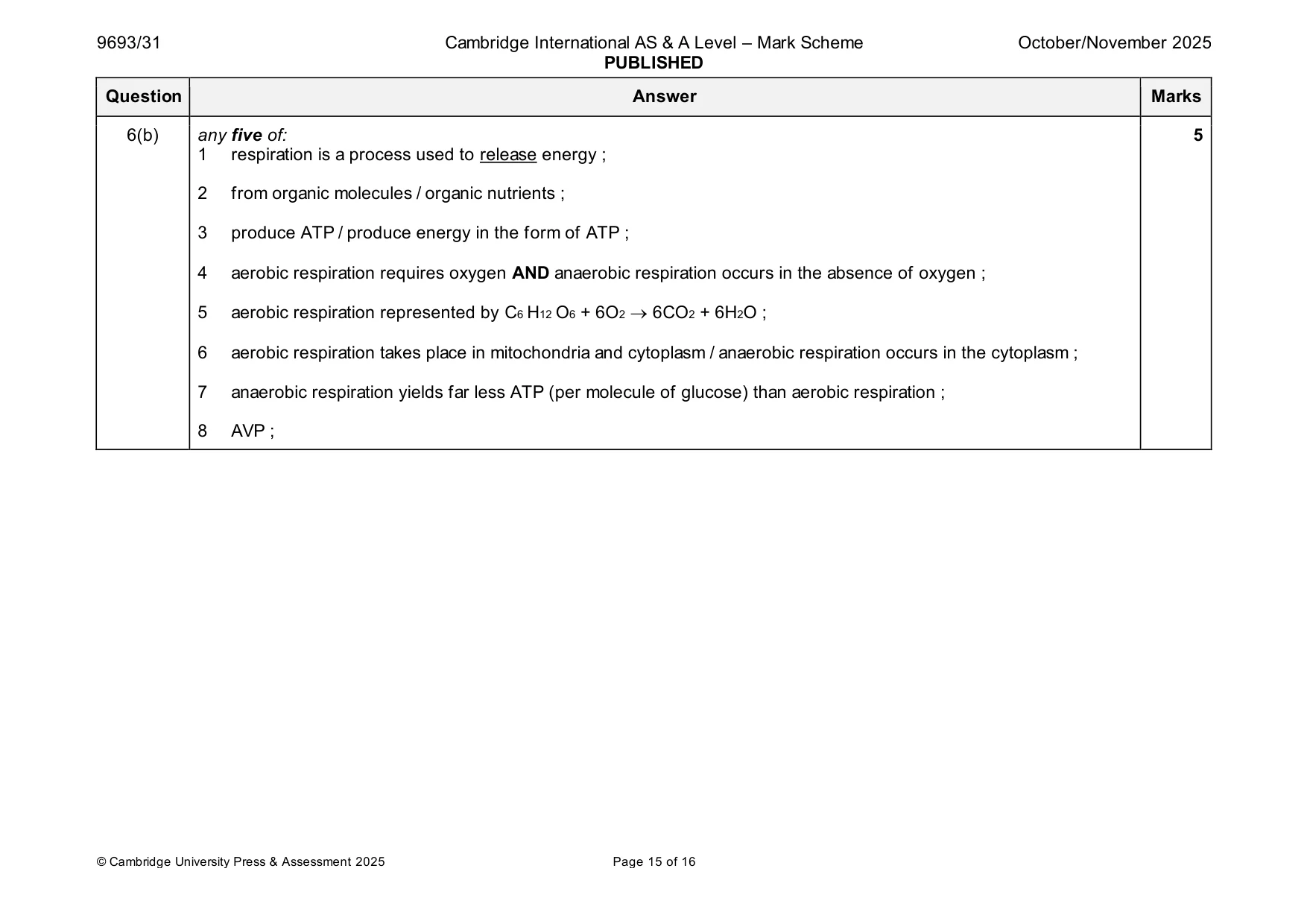
Mark scheme: 6(a) any six of: 6 smooth ER: 1 flattened / membrane bound, sacs / cisternae ; 2 which can be interconnected ; 3 no ribosomes attached ; 4 makes lipids / steroids / steroid hormones ; 5 suitable example e.g. cholesterol / oestrogen / testosterone ; 6 AVP ; Golgi body: 7 stack of flattened / membrane bound, sacs / cisternae AND vesicles ; 8 (vesicles) from ER ; 9 collects / processes / modifies, molecules ; 10 e.g. proteins ; 11 makes cell wall components in plants ; 12 makes lysosomes ; 6(b) any five of: 5 1 respiration is a process used to release energy ; 2 from organic molecules / organic nutrients ; 3 produce ATP / produce energy in the form of ATP ; 4 aerobic respiration requires oxygen AND anaerobic respiration occurs in the absence of oxygen ; 5 aerobic respiration represented by C6 H12 O6 + 6O2 → 6CO2 + 6H2O ; 6 aerobic respiration takes place in mitochondria and cytoplasm / anaerobic respiration occurs in the cytoplasm ; 7 anaerobic respiration yields far less ATP (per molecule of glucose) than aerobic respiration ; 8 AVP ;
Q7 · Describe the effect of desalination plants on sea-water quality and marine organisms
7 Describe the effect of desalination plants on sea-water quality and marine organisms. .......................................................................................................................................................... .......................................................................................................................................................... .......................................................................................................................................................... .......................................................................................................................................................... .......................................................................................................................................................... .......................................................................................................................................................... .......................................................................................................................................................... .......................................................................................................................................................... .......................................................................................................................................................... .......................................................................................................................................................... .......................................................................................................................................................... .......................................................................................................................................................... .......................................................................................................................................................... .......................................................................................................................................................... .......................................................................................................................................................... .......................................................................................................................................................... .......................................................................................................................................................... .................................................................................................................................................... [9]
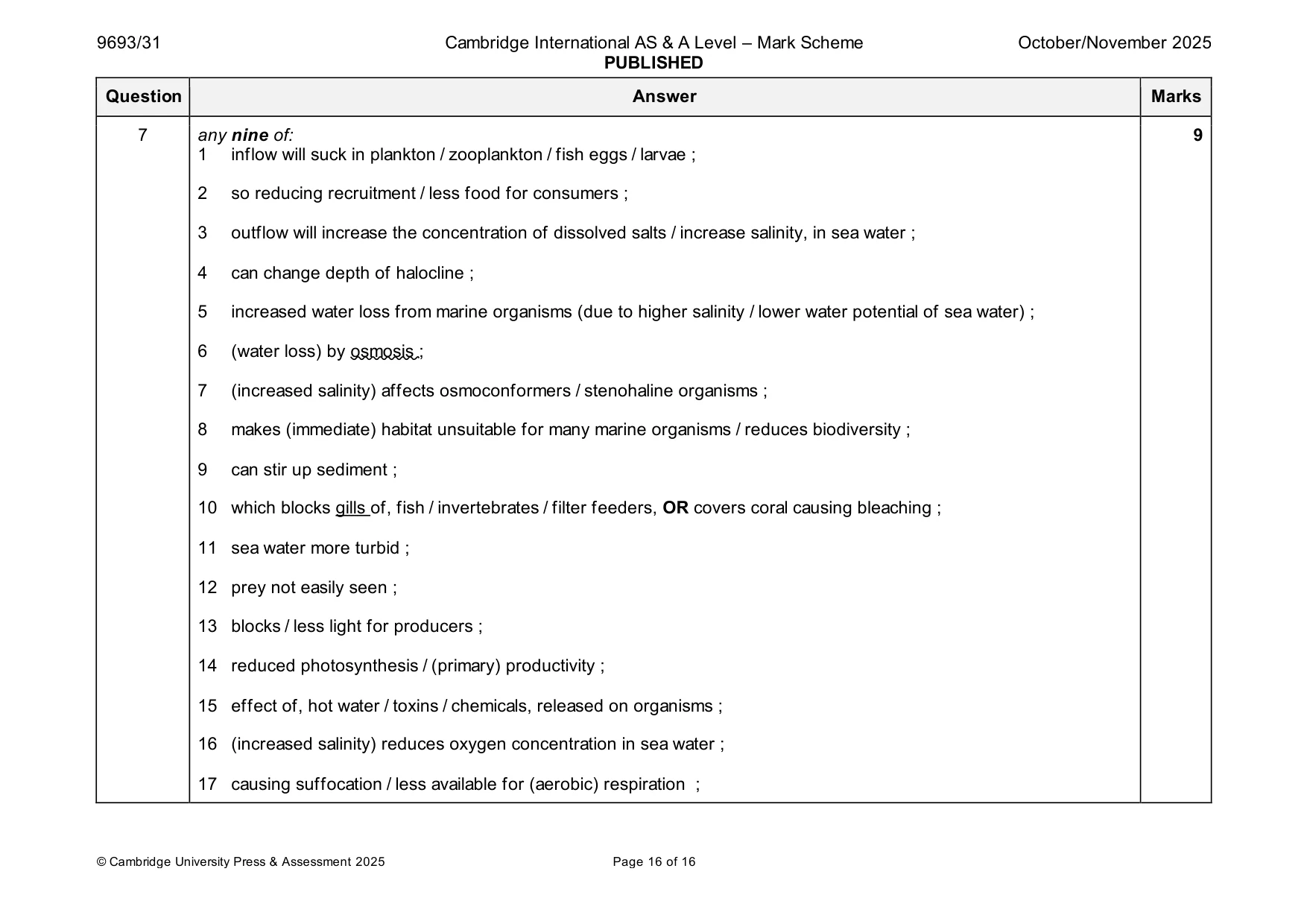
Mark scheme: 7 any nine of: 9 1 inflow will suck in plankton / zooplankton / fish eggs / larvae ; 2 so reducing recruitment / less food for consumers ; 3 outflow will increase the concentration of dissolved salts / increase salinity, in sea water ; 4 can change depth of halocline ; 5 increased water loss from marine organisms (due to higher salinity / lower water potential of sea water) ; 6 (water loss) by osmosis ; 7 (increased salinity) affects osmoconformers / stenohaline organisms ; 8 makes (immediate) habitat unsuitable for many marine organisms / reduces biodiversity ; 9 can stir up sediment ; 10 which blocks gills of, fish / invertebrates / filter feeders, OR covers coral causing bleaching ; 11 sea water more turbid ; 12 prey not easily seen ; 13 blocks / less light for producers ; 14 reduced photosynthesis / (primary) productivity ; 15 effect of, hot water / toxins / chemicals, released on organisms ; 16 (increased salinity) reduces oxygen concentration in sea water ; 17 causing suffocation / less available for (aerobic) respiration ;
What was in this paper
The subtopics covered by these 7 questions, and how many questions each got. Open one in a new tab to see every Cambridge question on it.
What you needed in this session
Cambridge’s own grade thresholds for 2025 Oct/Nov, Paper 3 · Variant 1. A higher threshold means an easier paper — the bar moves with how the cohort did.