Cambridge A Level Marine Science 9693 — 2024 Oct/Nov Paper 3 · Variant 3
9693/33/O/N/24 · 7 questions · 75 marks · ≈84 min
The question paper and its mark scheme, free to read here and free to download. This is Cambridge’s own paper, exactly as it was sat.
Question paper20 pages





Mark scheme11 pages
Answers below. Sit the paper first if you are practising.
Questions as text
Q1 · A diagram of a mangrove leaf cell under an electron microscope
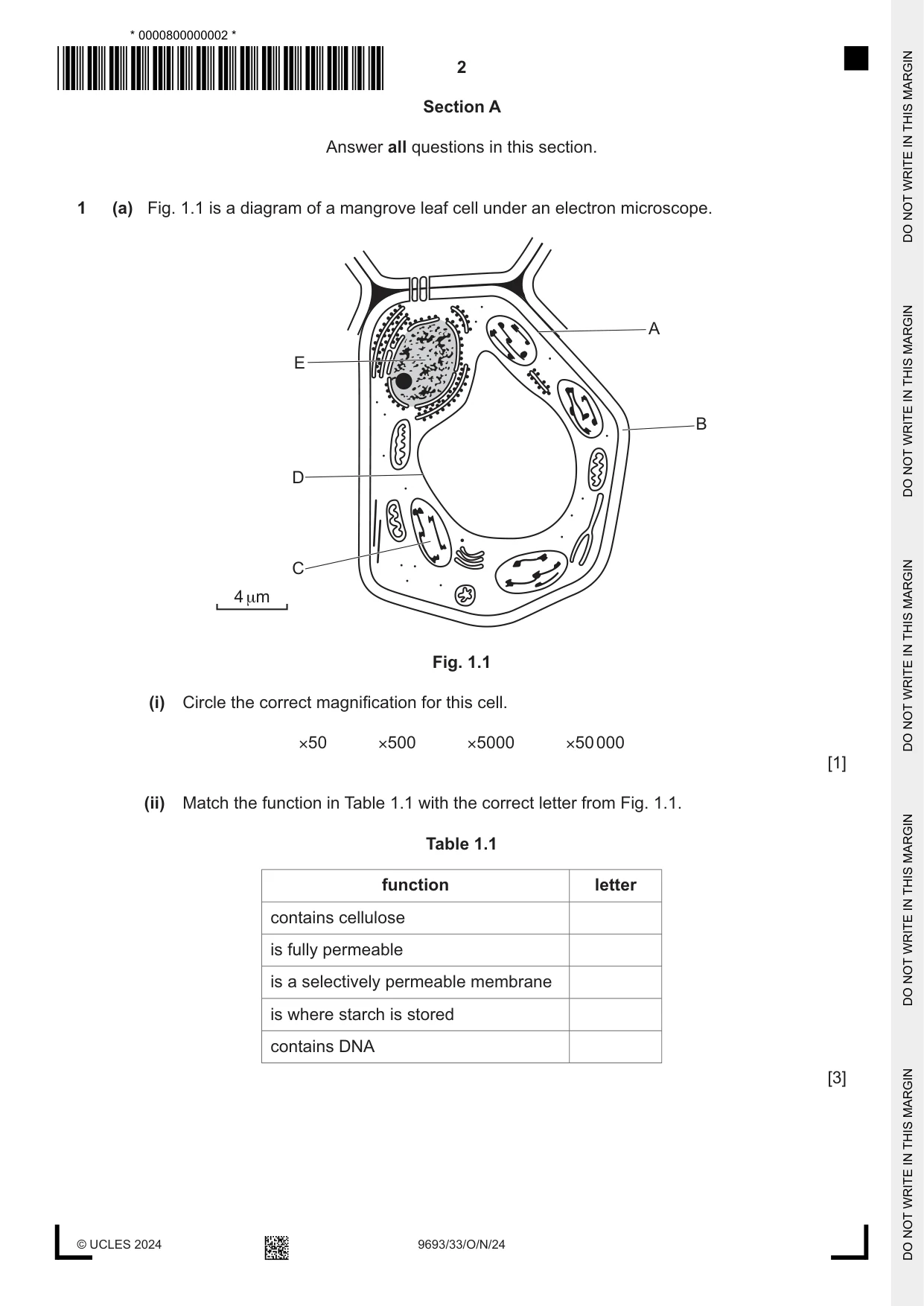
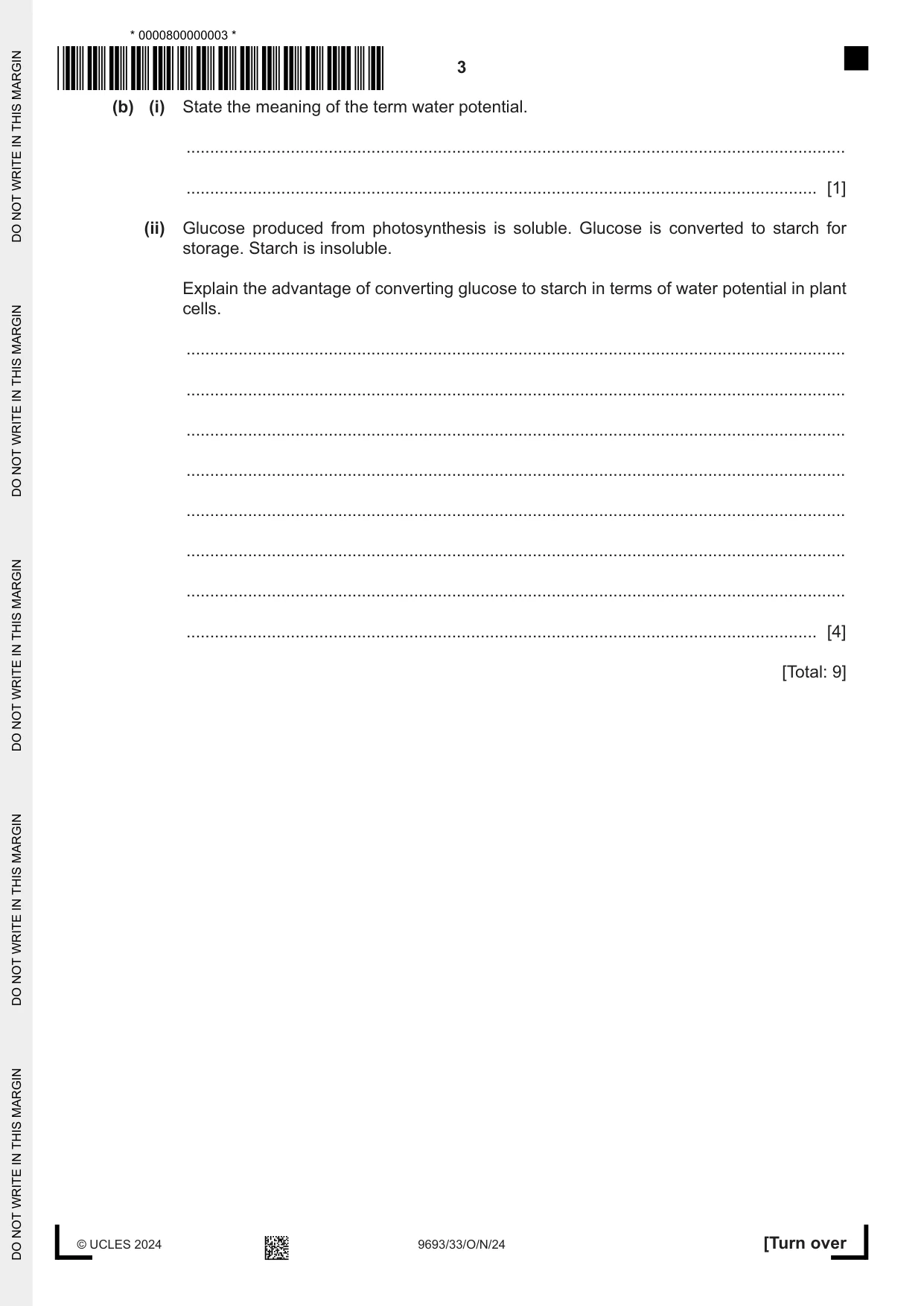
1 (a) Fig. 1.1 is a diagram of a mangrove leaf cell under an electron microscope. A E B D C 4 μm Fig. 1.1 (i) Circle the correct magnification for this cell. ×50 ×500 ×5000 ×50 000 [1] (ii) Match the function in Table 1.1 with the correct letter from Fig. 1.1. Table 1.1 function letter contains cellulose is fully permeable is a selectively permeable membrane is where starch is stored contains DNA [3] (b) (i) State the meaning of the term water potential. ........................................................................................................................................... ..................................................................................................................................... [1] (ii) Glucose produced from photosynthesis is soluble. Glucose is converted to starch for storage. Starch is insoluble. Explain the advantage of converting glucose to starch in terms of water potential in plant cells. ........................................................................................................................................... ........................................................................................................................................... ........................................................................................................................................... ........................................................................................................................................... ........................................................................................................................................... ........................................................................................................................................... ........................................................................................................................................... ..................................................................................................................................... [4] [Total: 9]
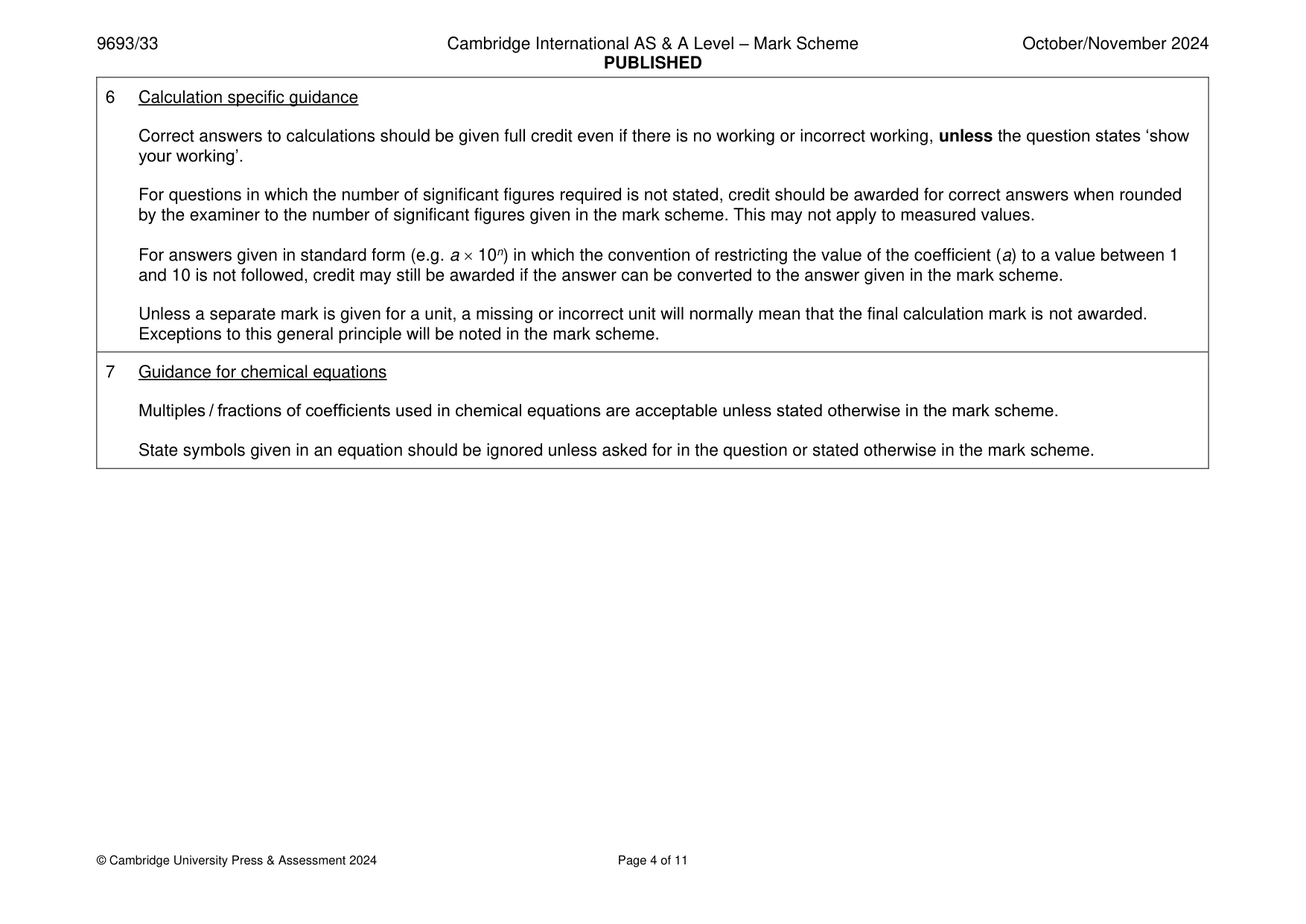
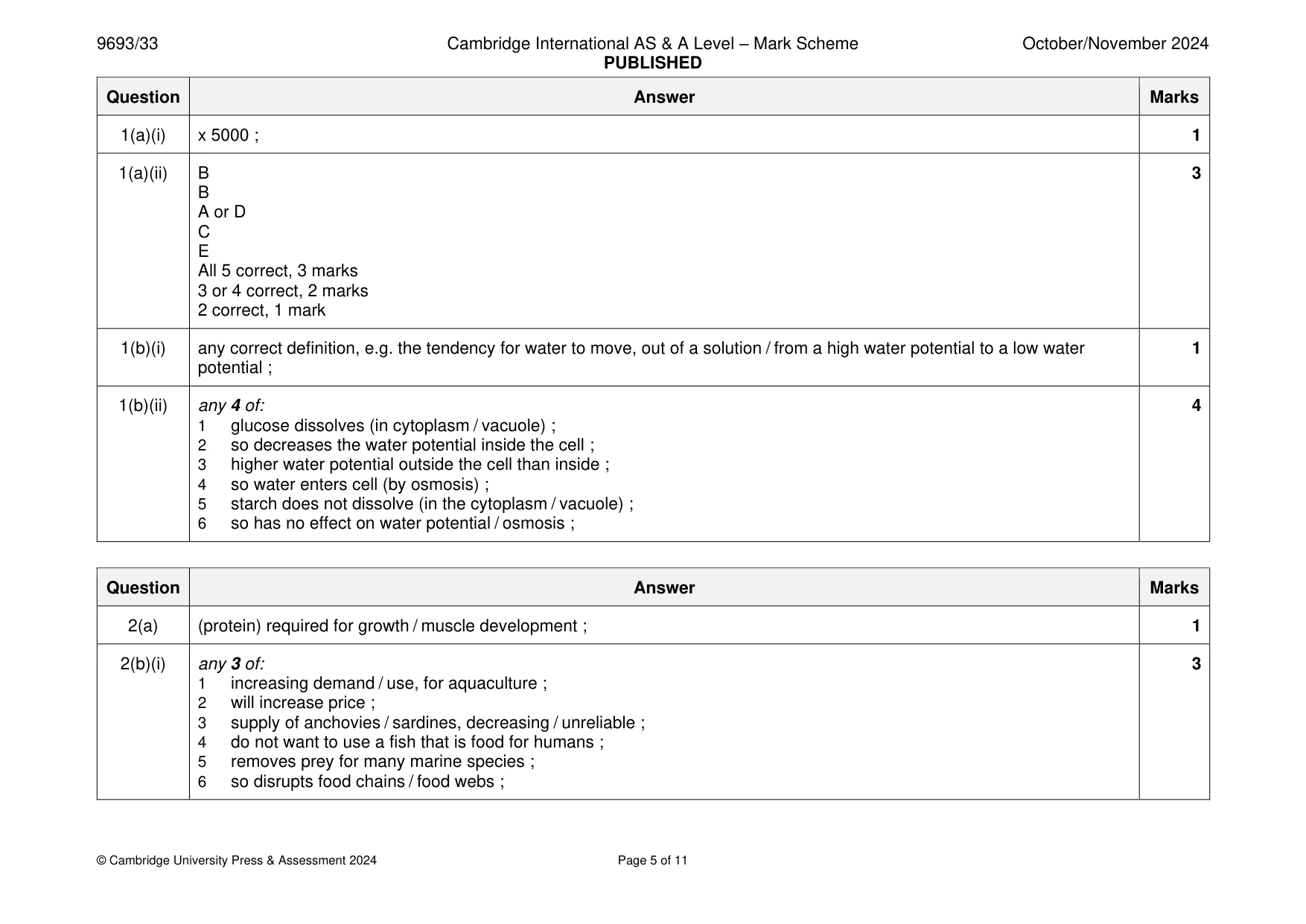
Mark scheme: Question Answer Marks 1(a)(i) x 5000 ; 1 1(a)(ii) B 3 B A or D C E All 5 correct, 3 marks 3 or 4 correct, 2 marks 2 correct, 1 mark 1(b)(i) any correct definition, e.g. the tendency for water to move, out of a solution / from a high water potential to a low water 1 potential ; 1(b)(ii) any 4 of: 4 1 glucose dissolves (in cytoplasm / vacuole) ; 2 so decreases the water potential inside the cell ; 3 higher water potential outside the cell than inside ; 4 so water enters cell (by osmosis) ; 5 starch does not dissolve (in the cytoplasm / vacuole) ; 6 so has no effect on water potential / osmosis ;
Q2 · Fishmeal is an important component of fish feed used in aquaculture
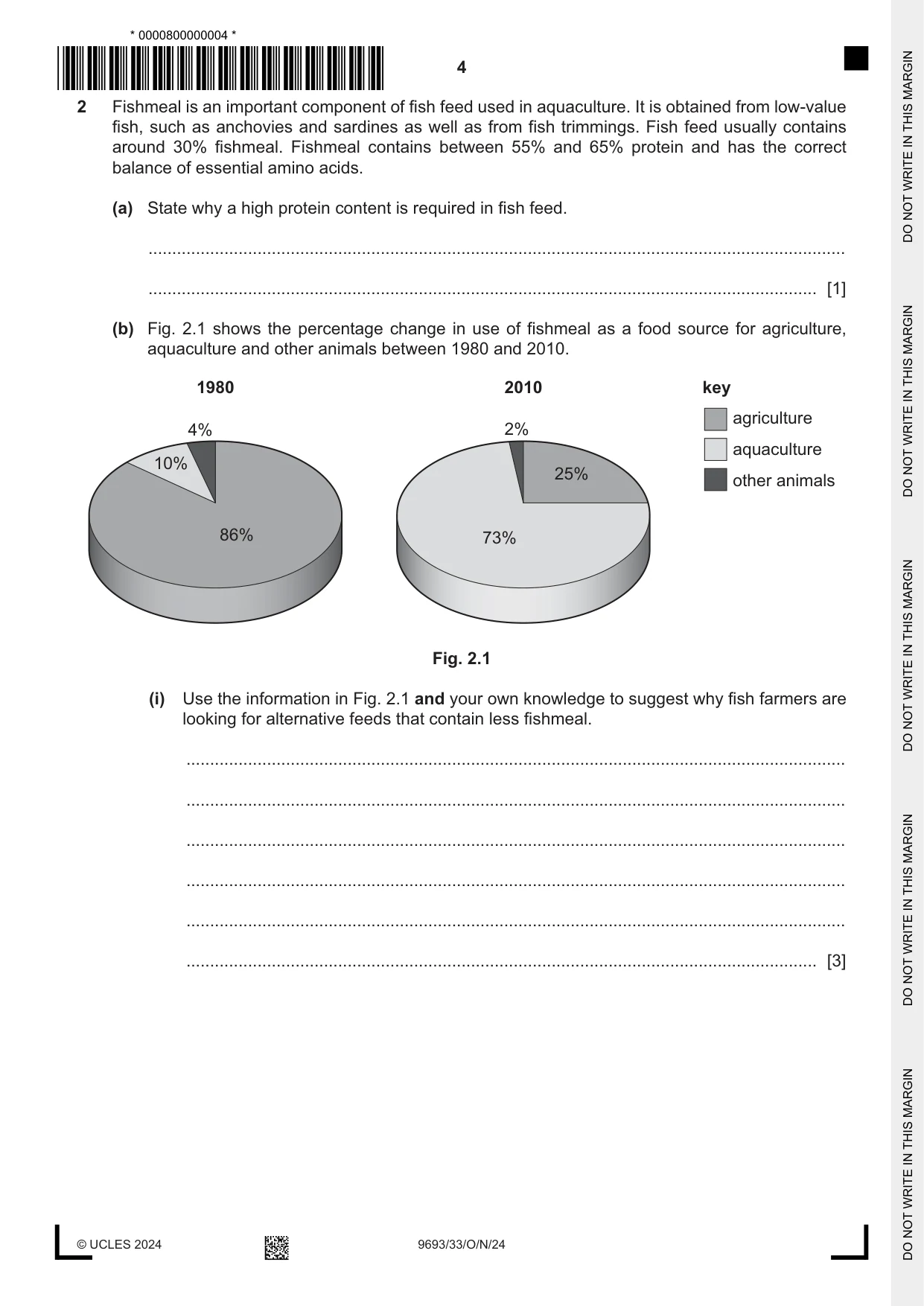
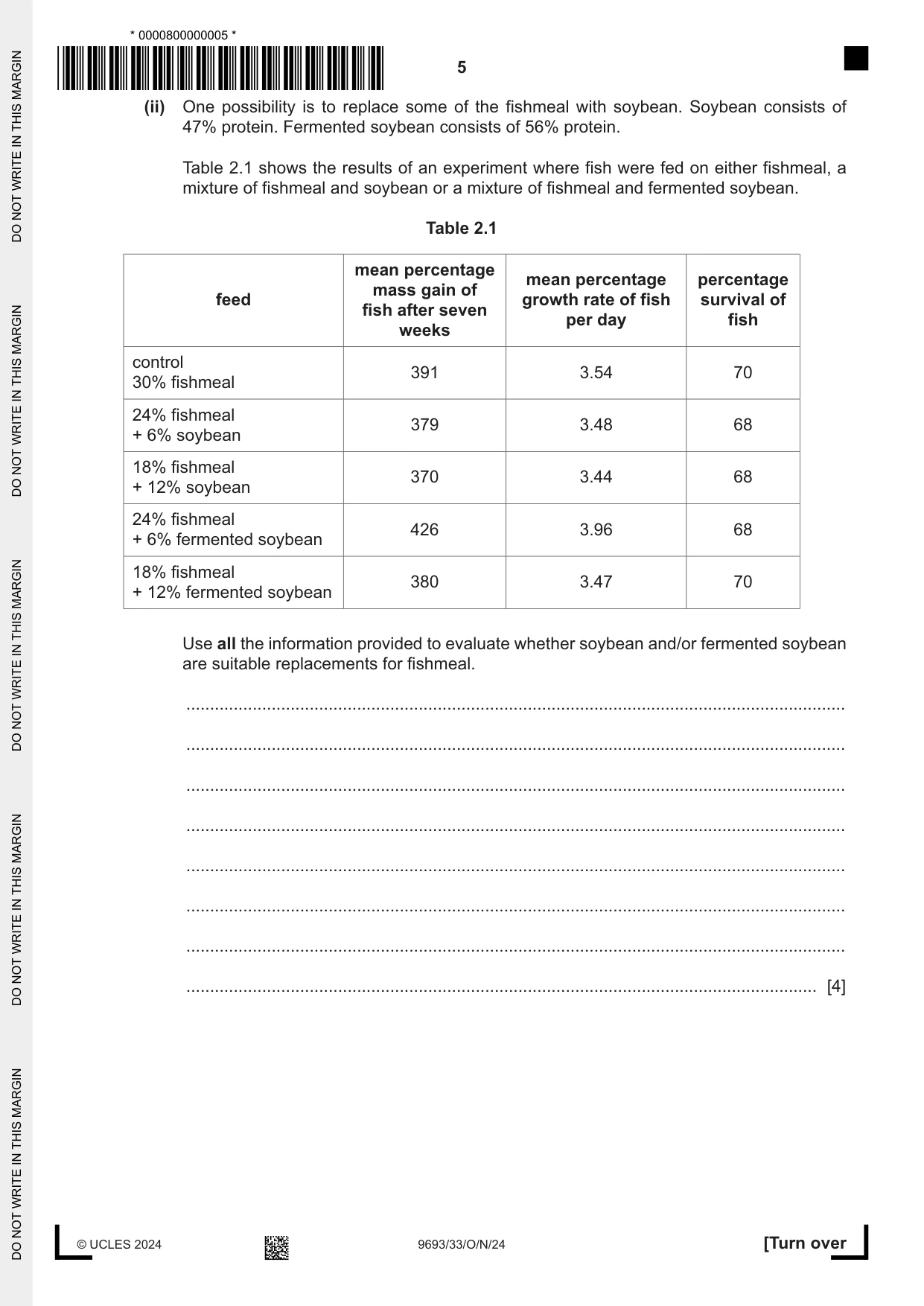
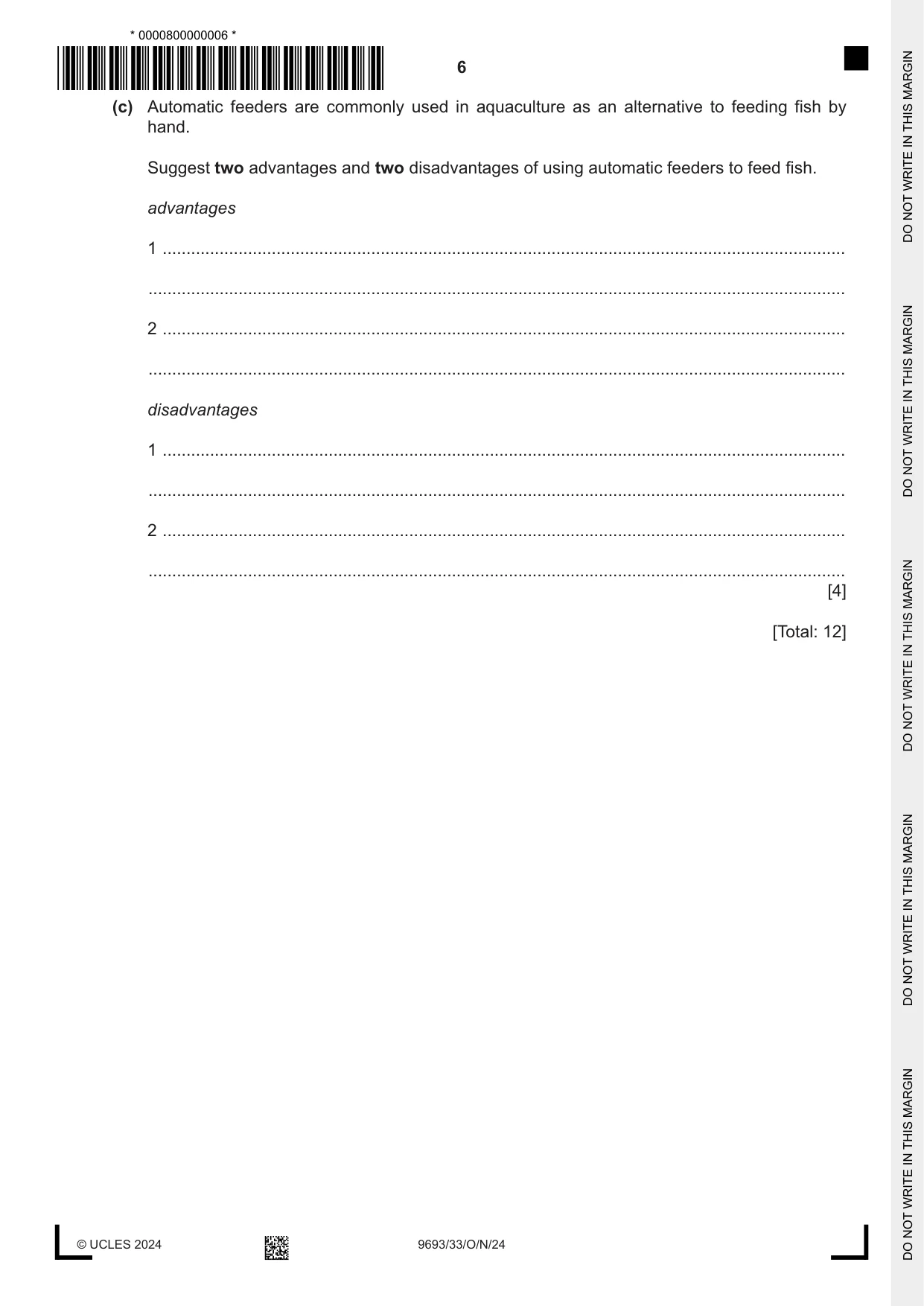
2 Fishmeal is an important component of fish feed used in aquaculture. It is obtained from low-value fish, such as anchovies and sardines as well as from fish trimmings. Fish feed usually contains around 30% fishmeal. Fishmeal contains between 55% and 65% protein and has the correct balance of essential amino acids. (a) State why a high protein content is required in fish feed. ................................................................................................................................................... ............................................................................................................................................. [1] (b) Fig. 2.1 shows the percentage change in use of fishmeal as a food source for agriculture, aquaculture and other animals between 1980 and 2010. 1980 2010 key agriculture 4% 2% aquaculture 10% 25% other animals 86% 73% Fig. 2.1 (i) Use the information in Fig. 2.1 and your own knowledge to suggest why fish farmers are looking for alternative feeds that contain less fishmeal. ........................................................................................................................................... ........................................................................................................................................... ........................................................................................................................................... ........................................................................................................................................... ........................................................................................................................................... ..................................................................................................................................... [3] (ii) One possibility is to replace some of the fishmeal with soybean. Soybean consists of 47% protein. Fermented soybean consists of 56% protein. Table 2.1 shows the results of an experiment where fish were fed on either fishmeal, a mixture of fishmeal and soybean or a mixture of fishmeal and fermented soybean. Table 2.1 mean percentage mean percentage percentage mass gain of feed growth rate of fish survival of fish after seven per day fish weeks control 391 3.54 70 30% fishmeal 24% fishmeal 379 3.48 68 + 6% soybean 18% fishmeal 370 3.44 68 + 12% soybean 24% fishmeal 426 3.96 68 + 6% fermented soybean 18% fishmeal 380 3.47 70 + 12% fermented soybean Use all the information provided to evaluate whether soybean and/or fermented soybean are suitable replacements for fishmeal. ........................................................................................................................................... ........................................................................................................................................... ........................................................................................................................................... ........................................................................................................................................... ........................................................................................................................................... ........................................................................................................................................... ........................................................................................................................................... ..................................................................................................................................... [4] (c) Automatic feeders are commonly used in aquaculture as an alternative to feeding fish by hand. Suggest two advantages and two disadvantages of using automatic feeders to feed fish. advantages 1 ................................................................................................................................................ ................................................................................................................................................... 2 ................................................................................................................................................ ................................................................................................................................................... disadvantages 1 ................................................................................................................................................ ................................................................................................................................................... 2 ................................................................................................................................................ ................................................................................................................................................... [4] [Total: 12]
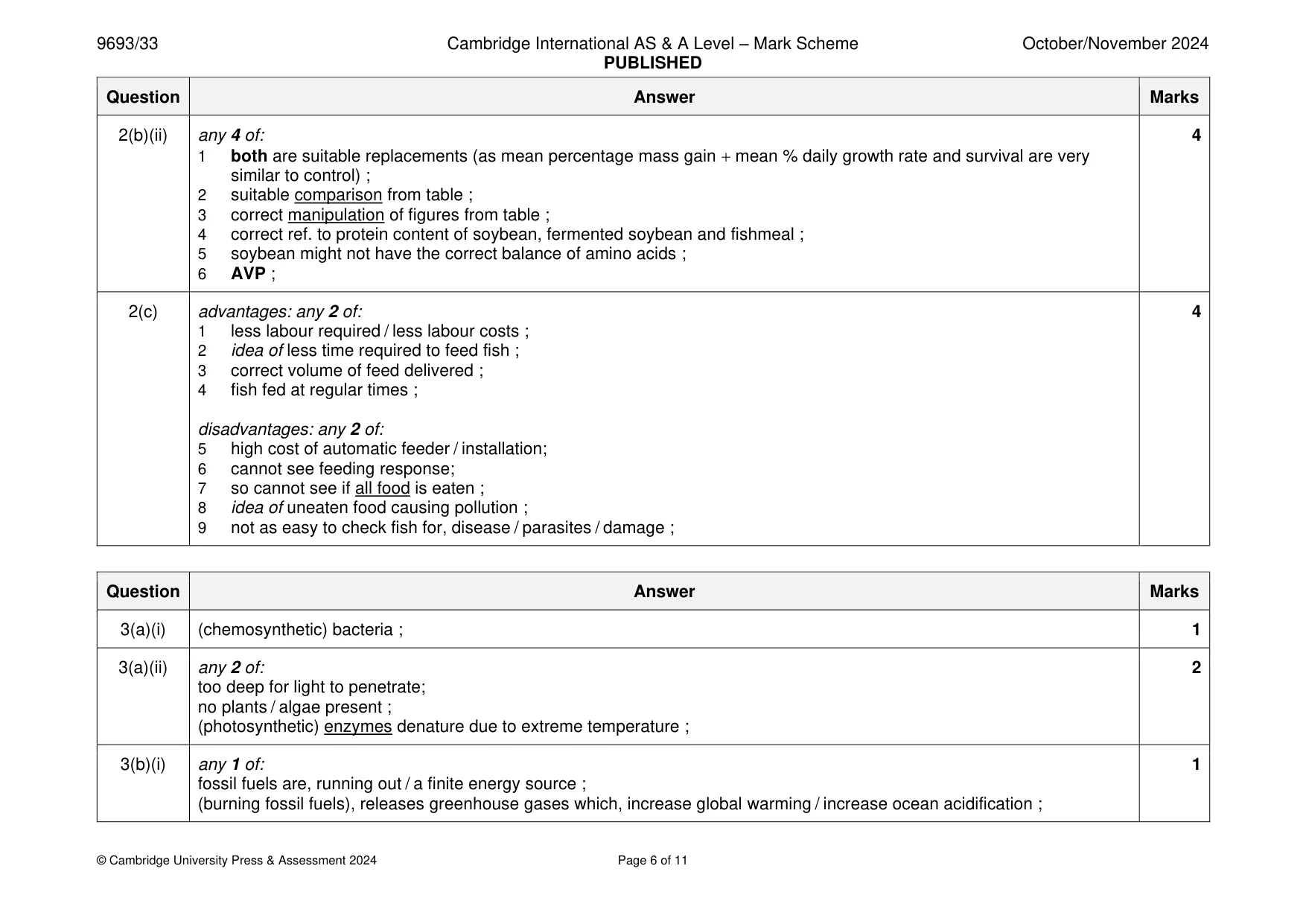
Mark scheme: 2(a) (protein) required for growth / muscle development ; 1 2(b)(i) any 3 of: 3 1 increasing demand / use, for aquaculture ; 2 will increase price ; 3 supply of anchovies / sardines, decreasing / unreliable ; 4 do not want to use a fish that is food for humans ; 5 removes prey for many marine species ; 6 so disrupts food chains / food webs ; 2(b)(ii) any 4 of: 4 1 both are suitable replacements (as mean percentage mass gain + mean % daily growth rate and survival are very similar to control) ; 2 suitable comparison from table ; 3 correct manipulation of figures from table ; 4 correct ref. to protein content of soybean, fermented soybean and fishmeal ; 5 soybean might not have the correct balance of amino acids ; 6 AVP ; 2(c) advantages: any 2 of: 4 1 less labour required / less labour costs ; 2 idea of less time required to feed fish ; 3 correct volume of feed delivered ; 4 fish fed at regular times ; disadvantages: any 2 of: 5 high cost of automatic feeder / installation; 6 cannot see feeding response; 7 so cannot see if all food is eaten ; 8 idea of uneaten food causing pollution ; 9 not as easy to check fish for, disease / parasites / damage ;
Q3 · Producers at hydrothermal vents fix energy into a form that consumers can use
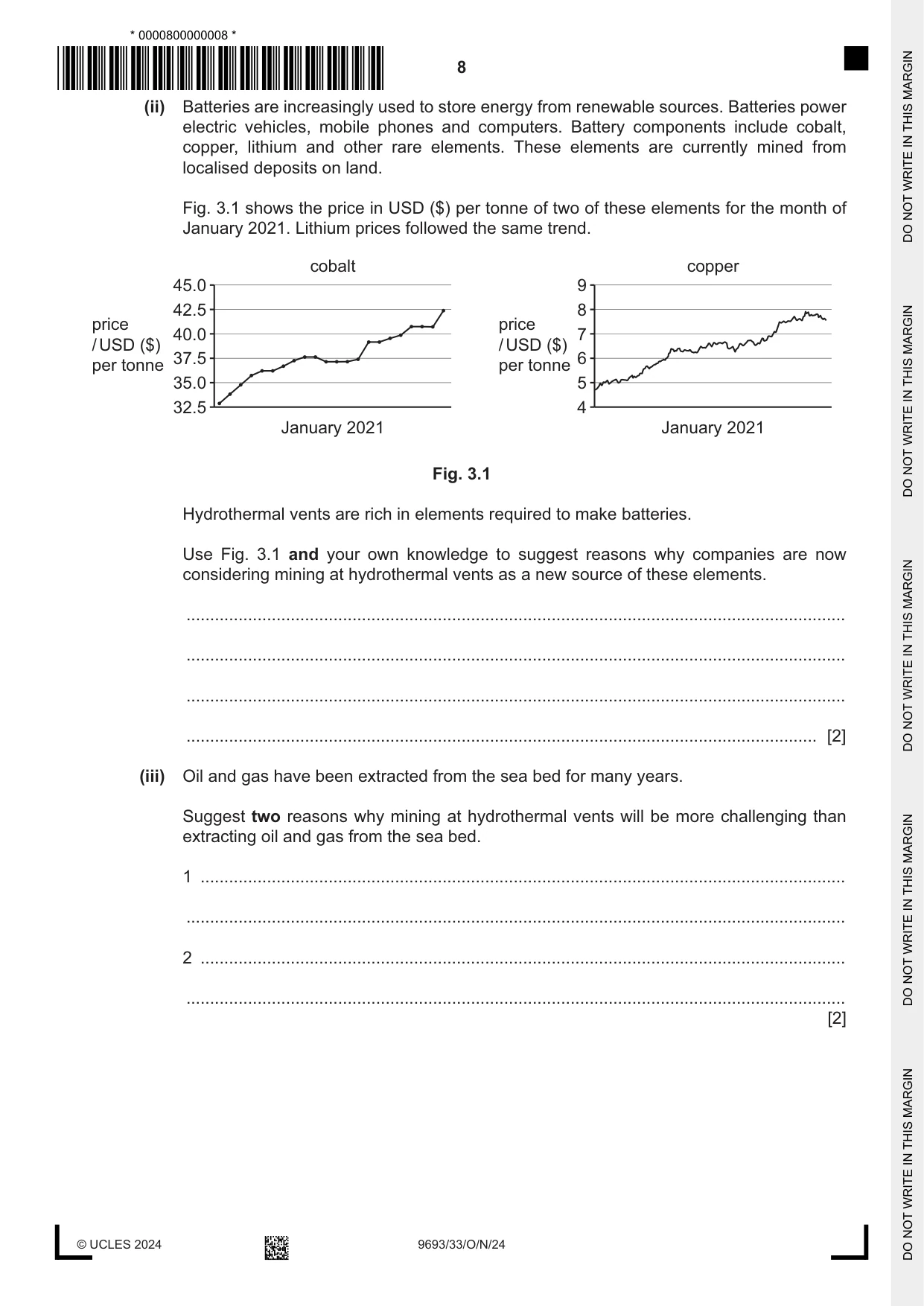
3 (a) Producers at hydrothermal vents fix energy into a form that consumers can use. (i) Name these producers. ..................................................................................................................................... [1] (ii) State two reasons why photosynthesis cannot occur at hydrothermal vents. 1 ........................................................................................................................................ ........................................................................................................................................... 2 ........................................................................................................................................ ........................................................................................................................................... [2] (b) Countries around the world are gradually increasing their supply of energy from renewable sources instead of from fossil fuels. (i) State one disadvantage of using fossil fuels as a source of energy. ........................................................................................................................................... ..................................................................................................................................... [1] (ii) Batteries are increasingly used to store energy from renewable sources. Batteries power electric vehicles, mobile phones and computers. Battery components include cobalt, copper, lithium and other rare elements. These elements are currently mined from localised deposits on land. Fig. 3.1 shows the price in USD ($) per tonne of two of these elements for the month of January 2021. Lithium prices followed the same trend. cobalt copper 45.0 9 42.5 8 price price 40.0 7 / USD ($) / USD ($) 37.5 6per tonne per tonne 35.0 5 32.5 4 January 2021 January 2021 Fig. 3.1 Hydrothermal vents are rich in elements required to make batteries. Use Fig. 3.1 and your own knowledge to suggest reasons why companies are now considering mining at hydrothermal vents as a new source of these elements. ........................................................................................................................................... ........................................................................................................................................... ........................................................................................................................................... ..................................................................................................................................... [2] (iii) Oil and gas have been extracted from the sea bed for many years. Suggest two reasons why mining at hydrothermal vents will be more challenging than extracting oil and gas from the sea bed. 1 ........................................................................................................................................ ........................................................................................................................................... 2 ........................................................................................................................................ ........................................................................................................................................... [2] (iv) Fig. 3.2 shows a possible method for mining at a hydrothermal vent. Content removed due to copyright restrictions. Fig. 3.2 Use Fig. 3.2 to suggest and explain why conservation organisations oppose deep-sea mining in this area. ........................................................................................................................................... ........................................................................................................................................... ........................................................................................................................................... ........................................................................................................................................... ........................................................................................................................................... ........................................................................................................................................... ........................................................................................................................................... ..................................................................................................................................... [4] [Total: 12]
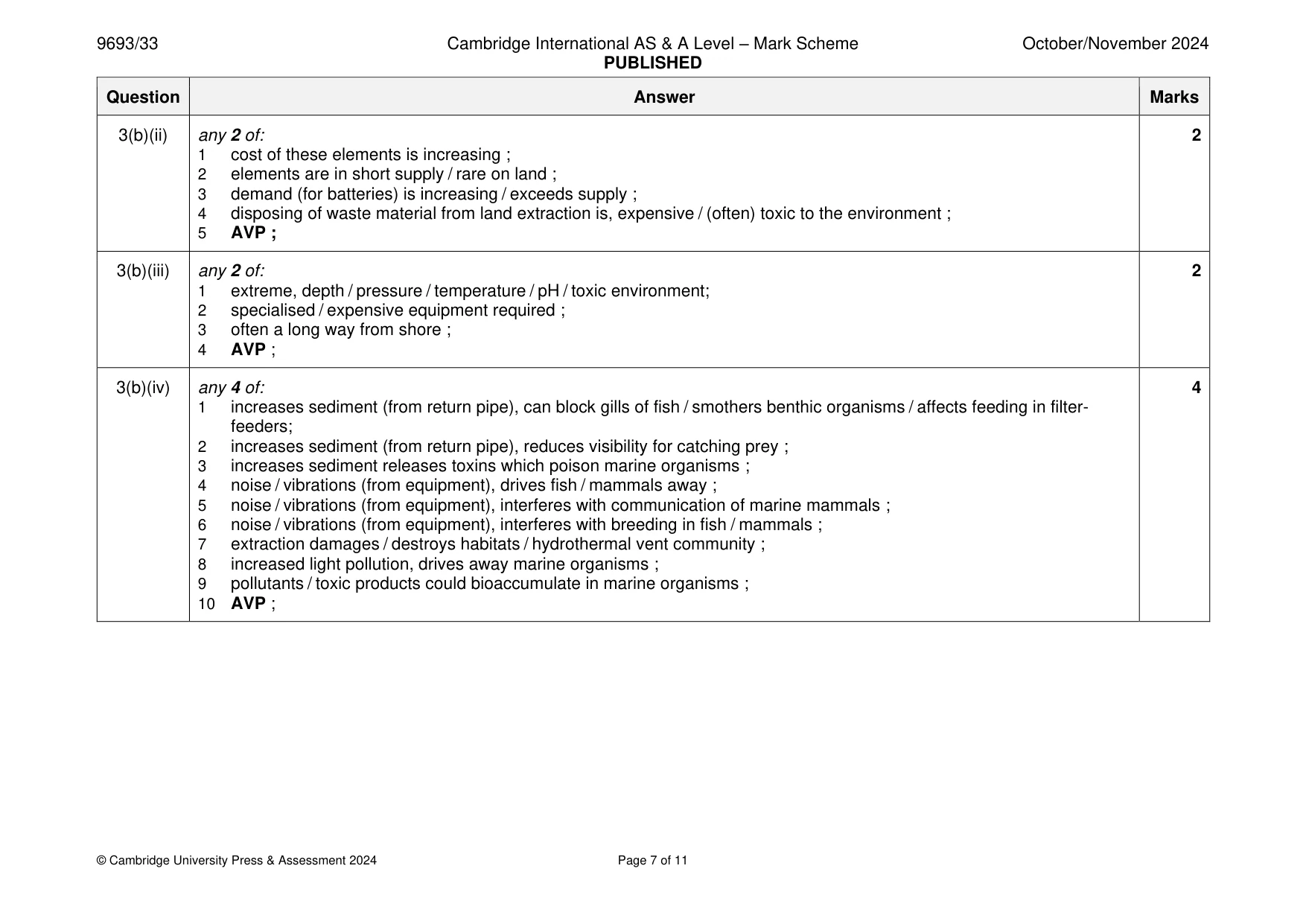
Mark scheme: 3(a)(i) (chemosynthetic) bacteria ; 1 3(a)(ii) any 2 of: 2 too deep for light to penetrate; no plants / algae present ; (photosynthetic) enzymes denature due to extreme temperature ; 3(b)(i) any 1 of: 1 fossil fuels are, running out / a finite energy source ; (burning fossil fuels), releases greenhouse gases which, increase global warming / increase ocean acidification ; 3(b)(ii) any 2 of: 2 1 cost of these elements is increasing ; 2 elements are in short supply / rare on land ; 3 demand (for batteries) is increasing / exceeds supply ; 4 disposing of waste material from land extraction is, expensive / (often) toxic to the environment ; 5 AVP ; 3(b)(iii) any 2 of: 2 1 extreme, depth / pressure / temperature / pH / toxic environment; 2 specialised / expensive equipment required ; 3 often a long way from shore ; 4 AVP ; 3(b)(iv) any 4 of: 4 1 increases sediment (from return pipe), can block gills of fish / smothers benthic organisms / affects feeding in filter- feeders; 2 increases sediment (from return pipe), reduces visibility for catching prey ; 3 increases sediment releases toxins which poison marine organisms ; 4 noise / vibrations (from equipment), drives fish / mammals away ; 5 noise / vibrations (from equipment), interferes with communication of marine mammals ; 6 noise / vibrations (from equipment), interferes with breeding in fish / mammals ; 7 extraction damages / destroys habitats / hydrothermal vent community ; 8 increased light pollution, drives away marine organisms ; 9 pollutants / toxic products could bioaccumulate in marine organisms ; 10 AVP ;
Q4 · Gaseous exchange is a process that occurs in all organisms, including coral polyps and…
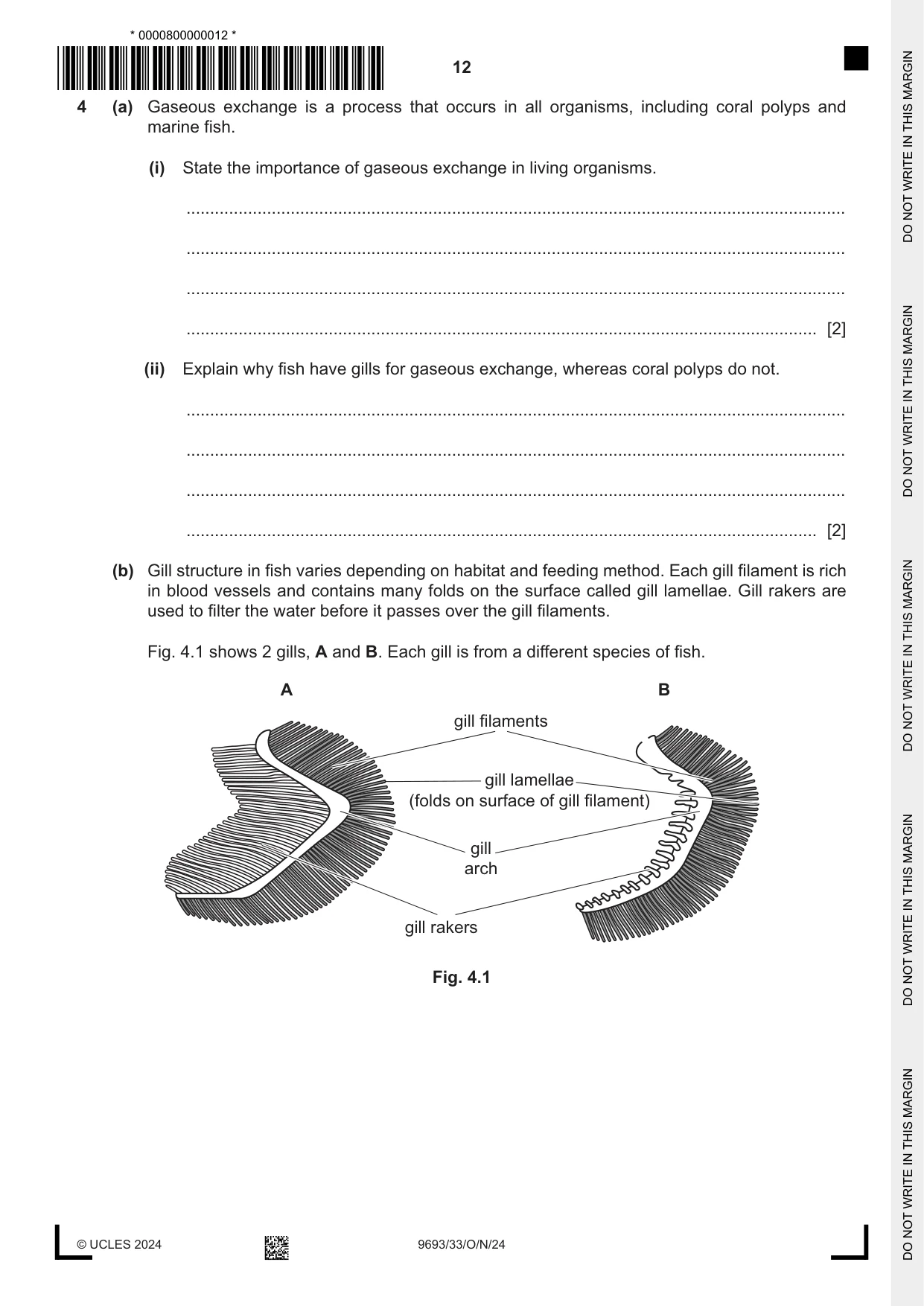
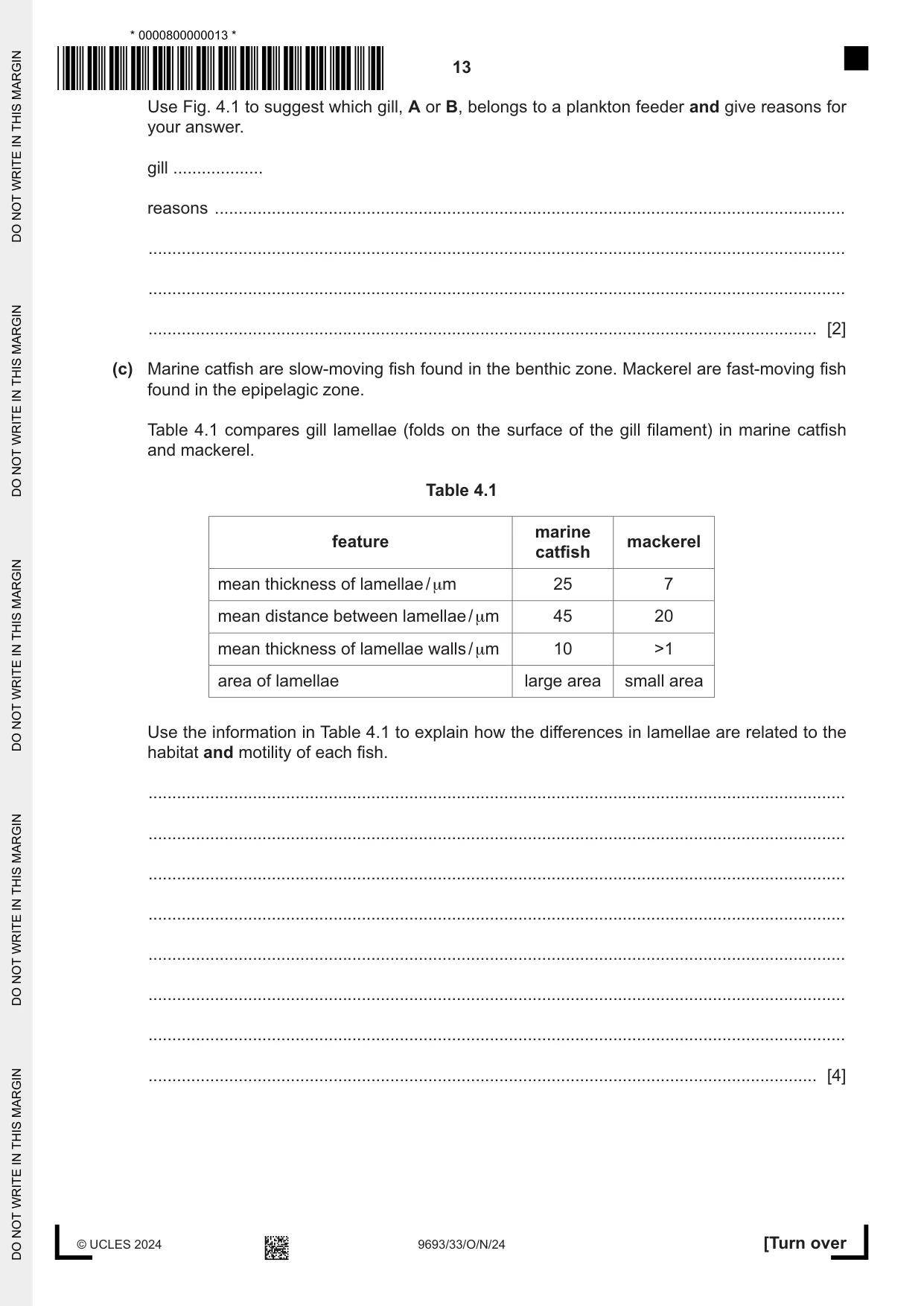
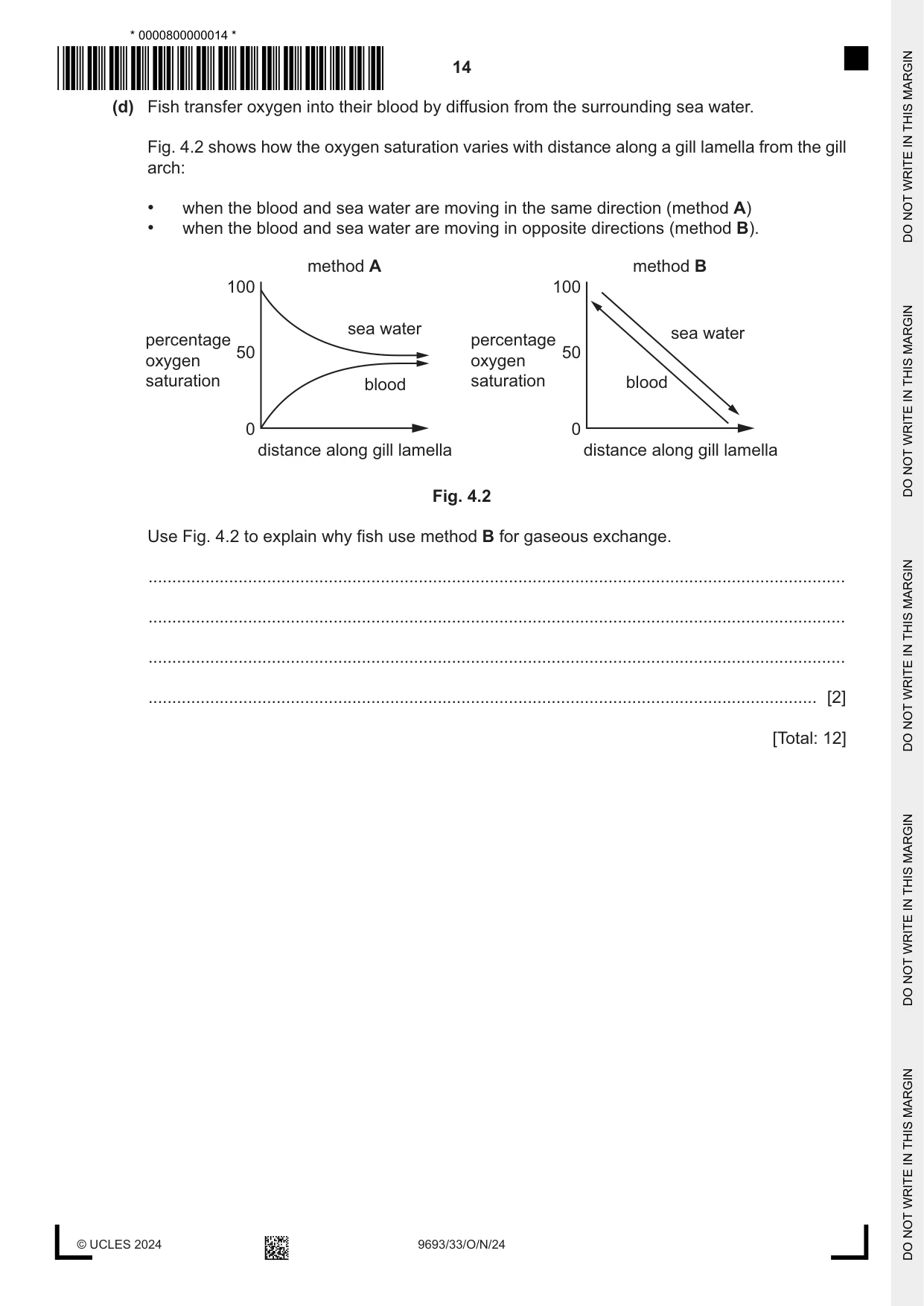
4 (a) Gaseous exchange is a process that occurs in all organisms, including coral polyps and marine fish. (i) State the importance of gaseous exchange in living organisms. ........................................................................................................................................... ........................................................................................................................................... ........................................................................................................................................... ..................................................................................................................................... [2] (ii) Explain why fish have gills for gaseous exchange, whereas coral polyps do not. ........................................................................................................................................... ........................................................................................................................................... ........................................................................................................................................... ..................................................................................................................................... [2] (b) Gill structure in fish varies depending on habitat and feeding method. Each gill filament is rich in blood vessels and contains many folds on the surface called gill lamellae. Gill rakers are used to filter the water before it passes over the gill filaments. Fig. 4.1 shows 2 gills, A and B. Each gill is from a different species of fish. A B gill filaments gill lamellae (folds on surface of gill filament) gill arch gill rakers Fig. 4.1 Use Fig. 4.1 to suggest which gill, A or B, belongs to a plankton feeder and give reasons for your answer. gill ................... reasons ..................................................................................................................................... ................................................................................................................................................... ................................................................................................................................................... ............................................................................................................................................. [2] (c) Marine catfish are slow-moving fish found in the benthic zone. Mackerel are fast-moving fish found in the epipelagic zone. Table 4.1 compares gill lamellae (folds on the surface of the gill filament) in marine catfish and mackerel. Table 4.1 marine feature mackerel catfish mean thickness of lamellae / μm 25 7 mean distance between lamellae / μm 45 20 mean thickness of lamellae walls / μm 10 >1 area of lamellae large area small area Use the information in Table 4.1 to explain how the differences in lamellae are related to the habitat and motility of each fish. ................................................................................................................................................... ................................................................................................................................................... ................................................................................................................................................... ................................................................................................................................................... ................................................................................................................................................... ................................................................................................................................................... ................................................................................................................................................... ............................................................................................................................................. [4] (d) Fish transfer oxygen into their blood by diffusion from the surrounding sea water. Fig. 4.2 shows how the oxygen saturation varies with distance along a gill lamella from the gill arch: • when the blood and sea water are moving in the same direction (method A) • when the blood and sea water are moving in opposite directions (method B). method A method B 100 100 sea water sea water percentage percentage 50 50 oxygen oxygen saturation blood saturation blood 0 0 distance along gill lamella distance along gill lamella Fig. 4.2 Use Fig. 4.2 to explain why fish use method B for gaseous exchange. ................................................................................................................................................... ................................................................................................................................................... ................................................................................................................................................... ............................................................................................................................................. [2] [Total: 12]
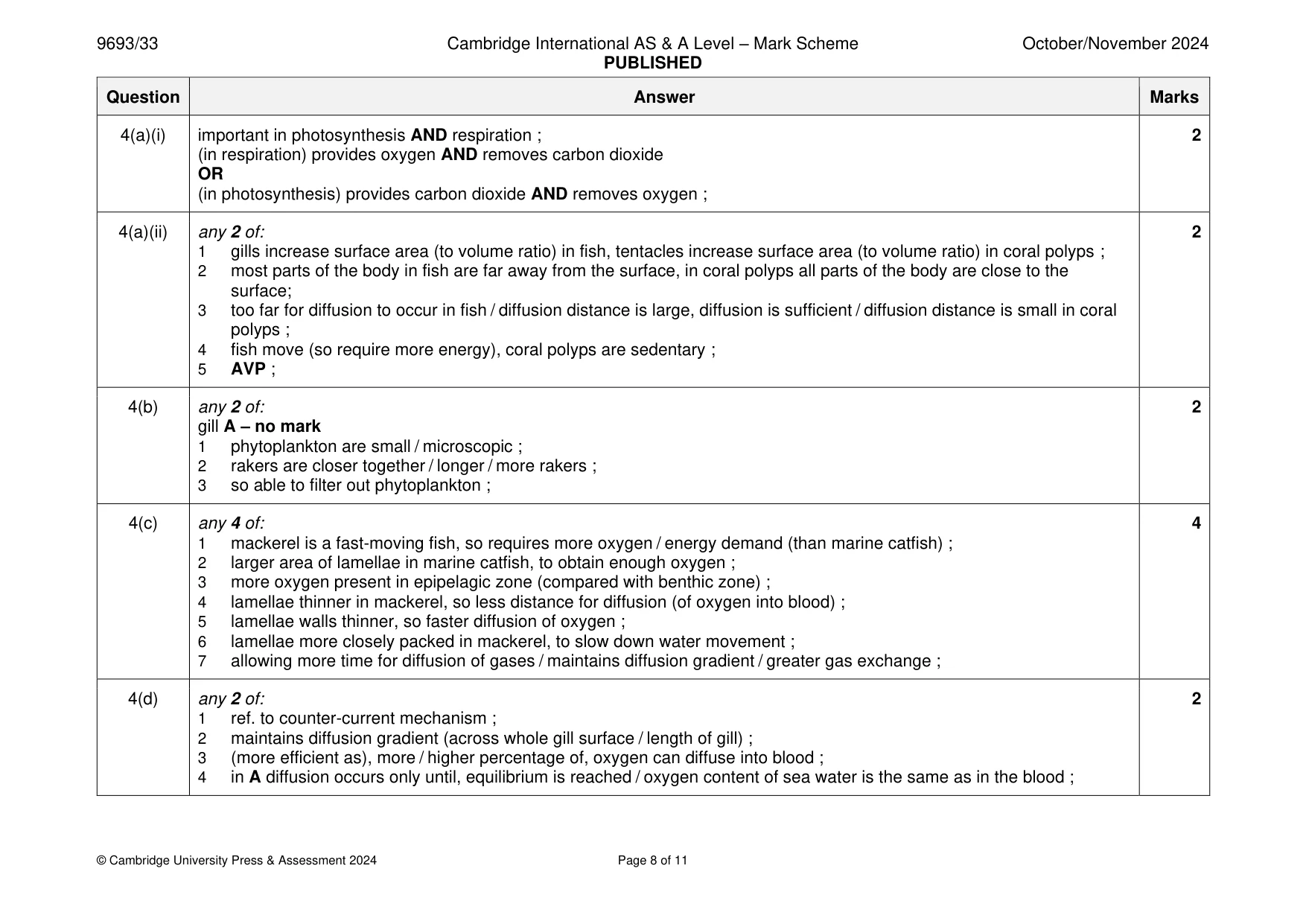
Mark scheme: 4(a)(i) important in photosynthesis AND respiration ; 2 (in respiration) provides oxygen AND removes carbon dioxide OR (in photosynthesis) provides carbon dioxide AND removes oxygen ; 4(a)(ii) any 2 of: 2 1 gills increase surface area (to volume ratio) in fish, tentacles increase surface area (to volume ratio) in coral polyps ; 2 most parts of the body in fish are far away from the surface, in coral polyps all parts of the body are close to the surface; 3 too far for diffusion to occur in fish / diffusion distance is large, diffusion is sufficient / diffusion distance is small in coral polyps ; 4 fish move (so require more energy), coral polyps are sedentary ; 5 AVP ; 4(b) any 2 of: 2 gill A – no mark 1 phytoplankton are small / microscopic ; 2 rakers are closer together / longer / more rakers ; 3 so able to filter out phytoplankton ; 4(c) any 4 of: 4 1 mackerel is a fast-moving fish, so requires more oxygen / energy demand (than marine catfish) ; 2 larger area of lamellae in marine catfish, to obtain enough oxygen ; 3 more oxygen present in epipelagic zone (compared with benthic zone) ; 4 lamellae thinner in mackerel, so less distance for diffusion (of oxygen into blood) ; 5 lamellae walls thinner, so faster diffusion of oxygen ; 6 lamellae more closely packed in mackerel, to slow down water movement ; 7 allowing more time for diffusion of gases / maintains diffusion gradient / greater gas exchange ; 4(d) any 2 of: 2 1 ref. to counter-current mechanism ; 2 maintains diffusion gradient (across whole gill surface / length of gill) ; 3 (more efficient as), more / higher percentage of, oxygen can diffuse into blood ; 4 in A diffusion occurs only until, equilibrium is reached / oxygen content of sea water is the same as in the blood ;
Q5 · Describe how satellite technology can be used to monitor fishing vessels and state the…
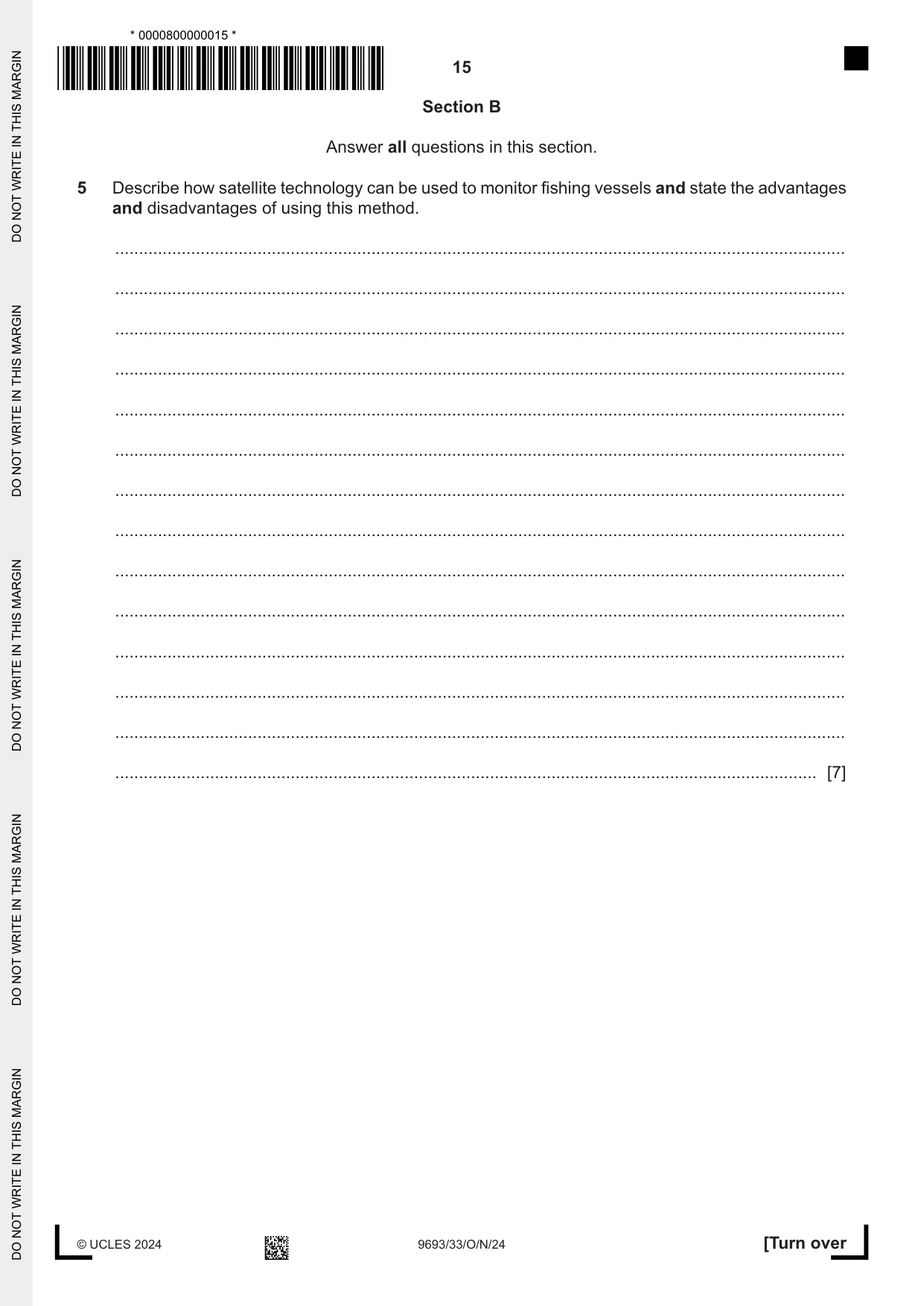
5 Describe how satellite technology can be used to monitor fishing vessels and state the advantages and disadvantages of using this method. .......................................................................................................................................................... .......................................................................................................................................................... .......................................................................................................................................................... .......................................................................................................................................................... .......................................................................................................................................................... .......................................................................................................................................................... .......................................................................................................................................................... .......................................................................................................................................................... .......................................................................................................................................................... .......................................................................................................................................................... .......................................................................................................................................................... .......................................................................................................................................................... .......................................................................................................................................................... .................................................................................................................................................... [7]
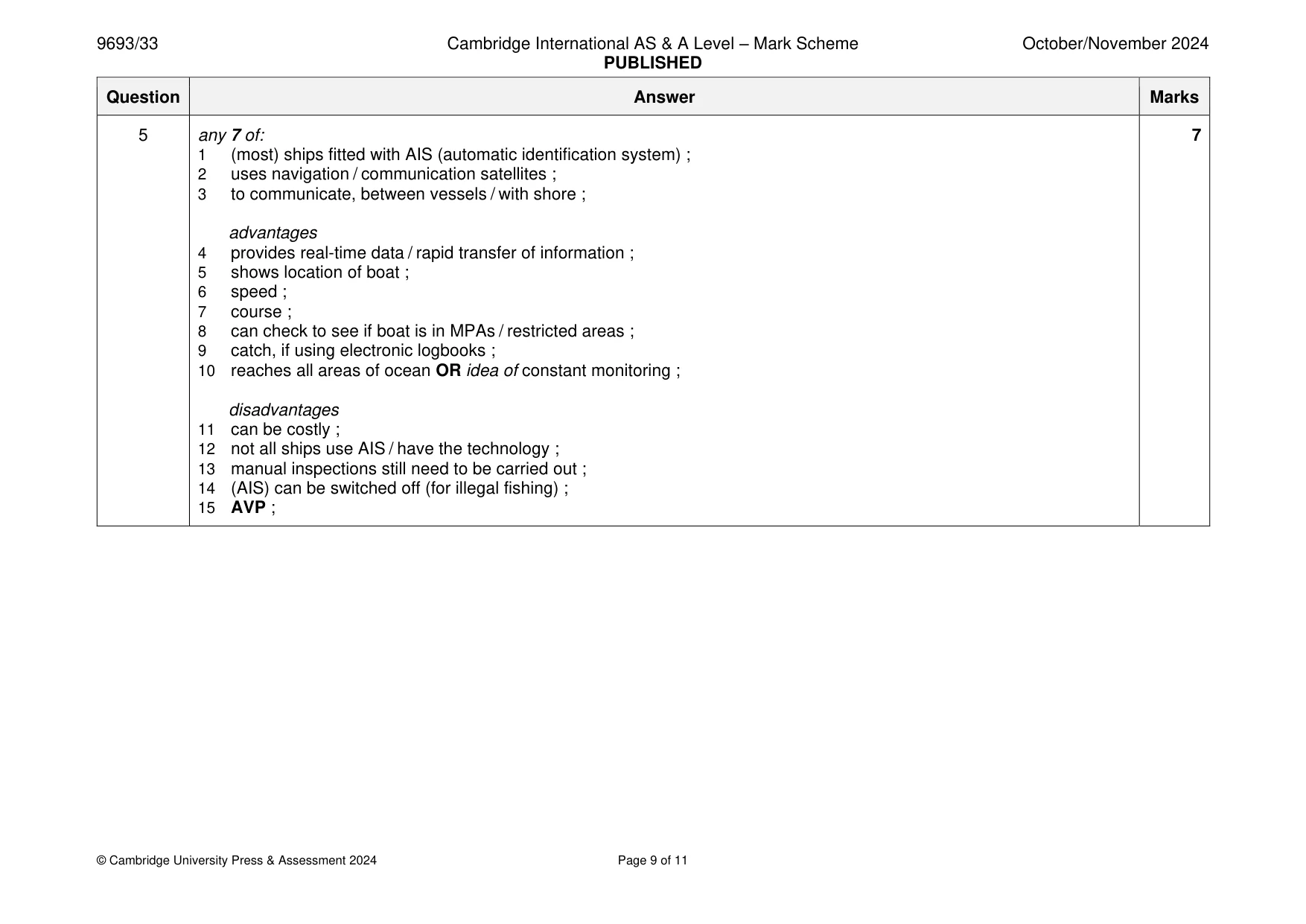
Mark scheme: 5 any 7 of: 7 1 (most) ships fitted with AIS (automatic identification system) ; 2 uses navigation / communication satellites ; 3 to communicate, between vessels / with shore ; advantages 4 provides real-time data / rapid transfer of information ; 5 shows location of boat ; 6 speed ; 7 course ; 8 can check to see if boat is in MPAs / restricted areas ; 9 catch, if using electronic logbooks ; 10 reaches all areas of ocean OR idea of constant monitoring ; disadvantages 11 can be costly ; 12 not all ships use AIS / have the technology ; 13 manual inspections still need to be carried out ; 14 (AIS) can be switched off (for illegal fishing) ; 15 AVP ;
Q6 · Discuss the importance of microscopic algae in marine environments
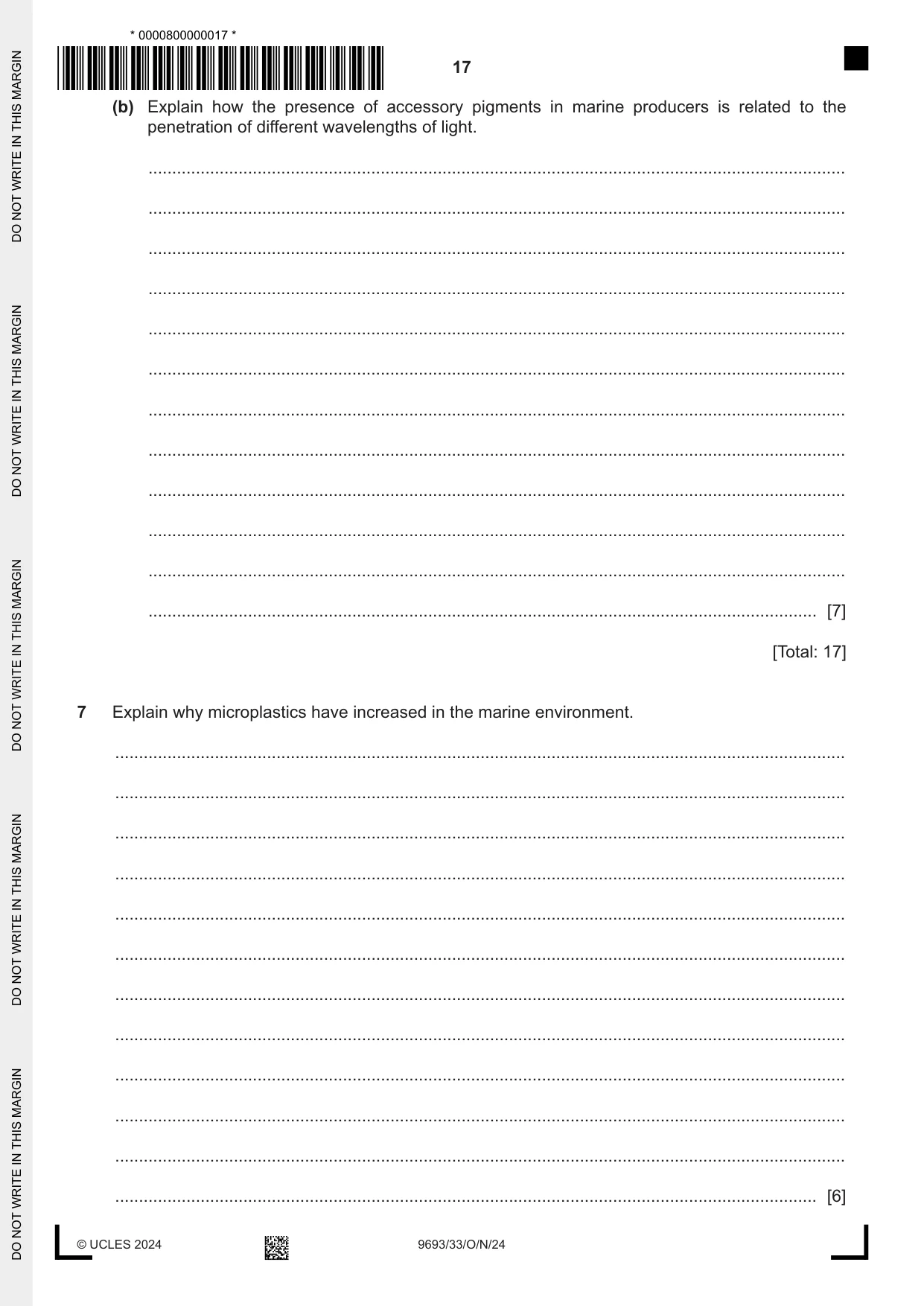
6 (a) Discuss the importance of microscopic algae in marine environments. ................................................................................................................................................... ................................................................................................................................................... ................................................................................................................................................... ................................................................................................................................................... ................................................................................................................................................... ................................................................................................................................................... ................................................................................................................................................... ................................................................................................................................................... ................................................................................................................................................... ................................................................................................................................................... ................................................................................................................................................... ................................................................................................................................................... ................................................................................................................................................... ................................................................................................................................................... ................................................................................................................................................... ................................................................................................................................................... ................................................................................................................................................... ................................................................................................................................................... ................................................................................................................................................... ........................................................................................................................................... [10] (b) Explain how the presence of accessory pigments in marine producers is related to the penetration of different wavelengths of light. ................................................................................................................................................... ................................................................................................................................................... ................................................................................................................................................... ................................................................................................................................................... ................................................................................................................................................... ................................................................................................................................................... ................................................................................................................................................... ................................................................................................................................................... ................................................................................................................................................... ................................................................................................................................................... ................................................................................................................................................... ............................................................................................................................................. [7] [Total: 17]
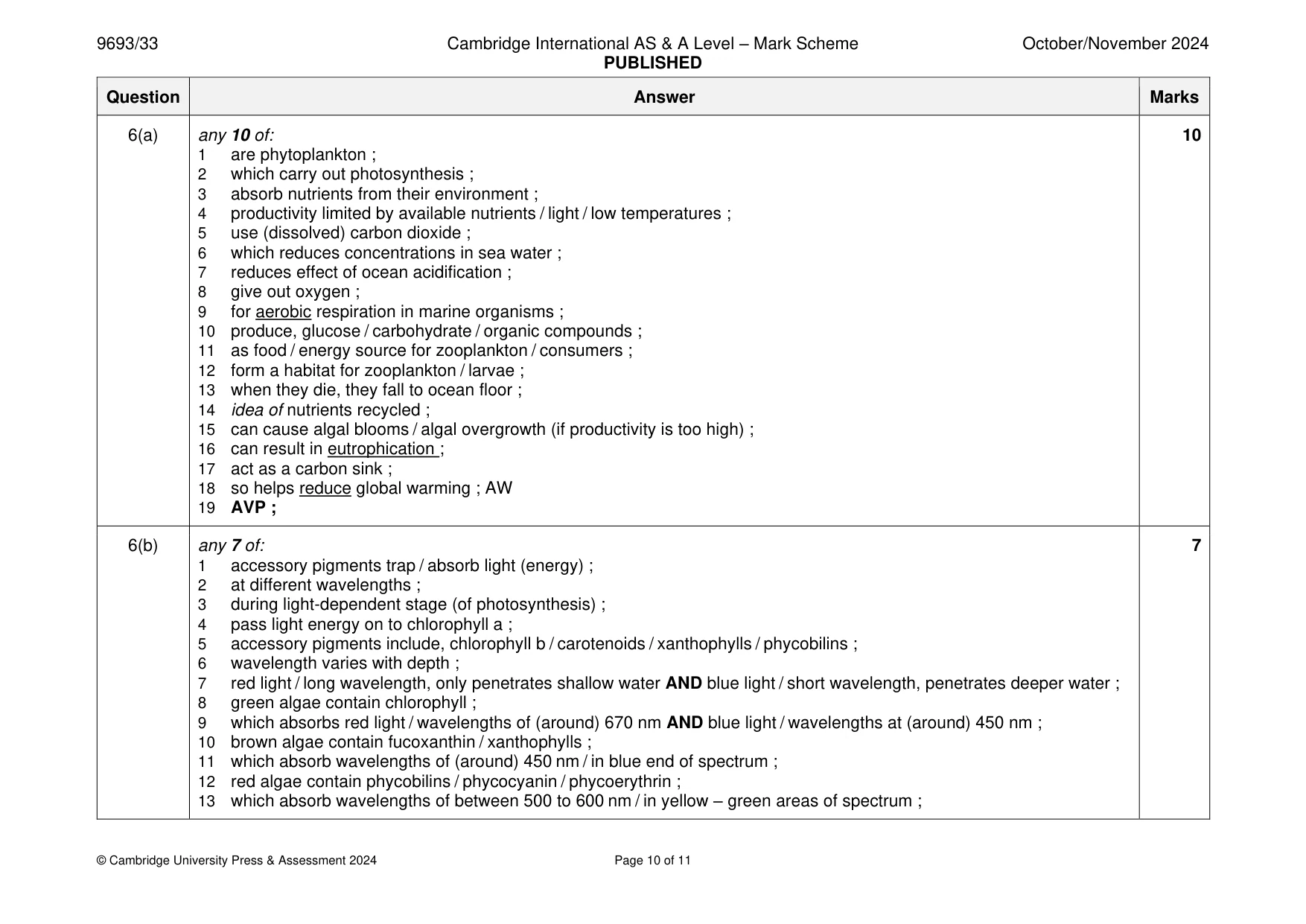
Mark scheme: 6(a) any 10 of: 10 1 are phytoplankton ; 2 which carry out photosynthesis ; 3 absorb nutrients from their environment ; 4 productivity limited by available nutrients / light / low temperatures ; 5 use (dissolved) carbon dioxide ; 6 which reduces concentrations in sea water ; 7 reduces effect of ocean acidification ; 8 give out oxygen ; 9 for aerobic respiration in marine organisms ; 10 produce, glucose / carbohydrate / organic compounds ; 11 as food / energy source for zooplankton / consumers ; 12 form a habitat for zooplankton / larvae ; 13 when they die, they fall to ocean floor ; 14 idea of nutrients recycled ; 15 can cause algal blooms / algal overgrowth (if productivity is too high) ; 16 can result in eutrophication ; 17 act as a carbon sink ; 18 so helps reduce global warming ; AW 19 AVP ; 6(b) any 7 of: 7 1 accessory pigments trap / absorb light (energy) ; 2 at different wavelengths ; 3 during light-dependent stage (of photosynthesis) ; 4 pass light energy on to chlorophyll a ; 5 accessory pigments include, chlorophyll b / carotenoids / xanthophylls / phycobilins ; 6 wavelength varies with depth ; 7 red light / long wavelength, only penetrates shallow water AND blue light / short wavelength, penetrates deeper water ; 8 green algae contain chlorophyll ; 9 which absorbs red light / wavelengths of (around) 670 nm AND blue light / wavelengths at (around) 450 nm ; 10 brown algae contain fucoxanthin / xanthophylls ; 11 which absorb wavelengths of (around) 450 nm / in blue end of spectrum ; 12 red algae contain phycobilins / phycocyanin / phycoerythrin ; 13 which absorb wavelengths of between 500 to 600 nm / in yellow – green areas of spectrum ;
Q7 · Explain why microplastics have increased in the marine environment
7 Explain why microplastics have increased in the marine environment. .......................................................................................................................................................... .......................................................................................................................................................... .......................................................................................................................................................... .......................................................................................................................................................... .......................................................................................................................................................... .......................................................................................................................................................... .......................................................................................................................................................... .......................................................................................................................................................... .......................................................................................................................................................... .......................................................................................................................................................... .......................................................................................................................................................... .................................................................................................................................................... [6]
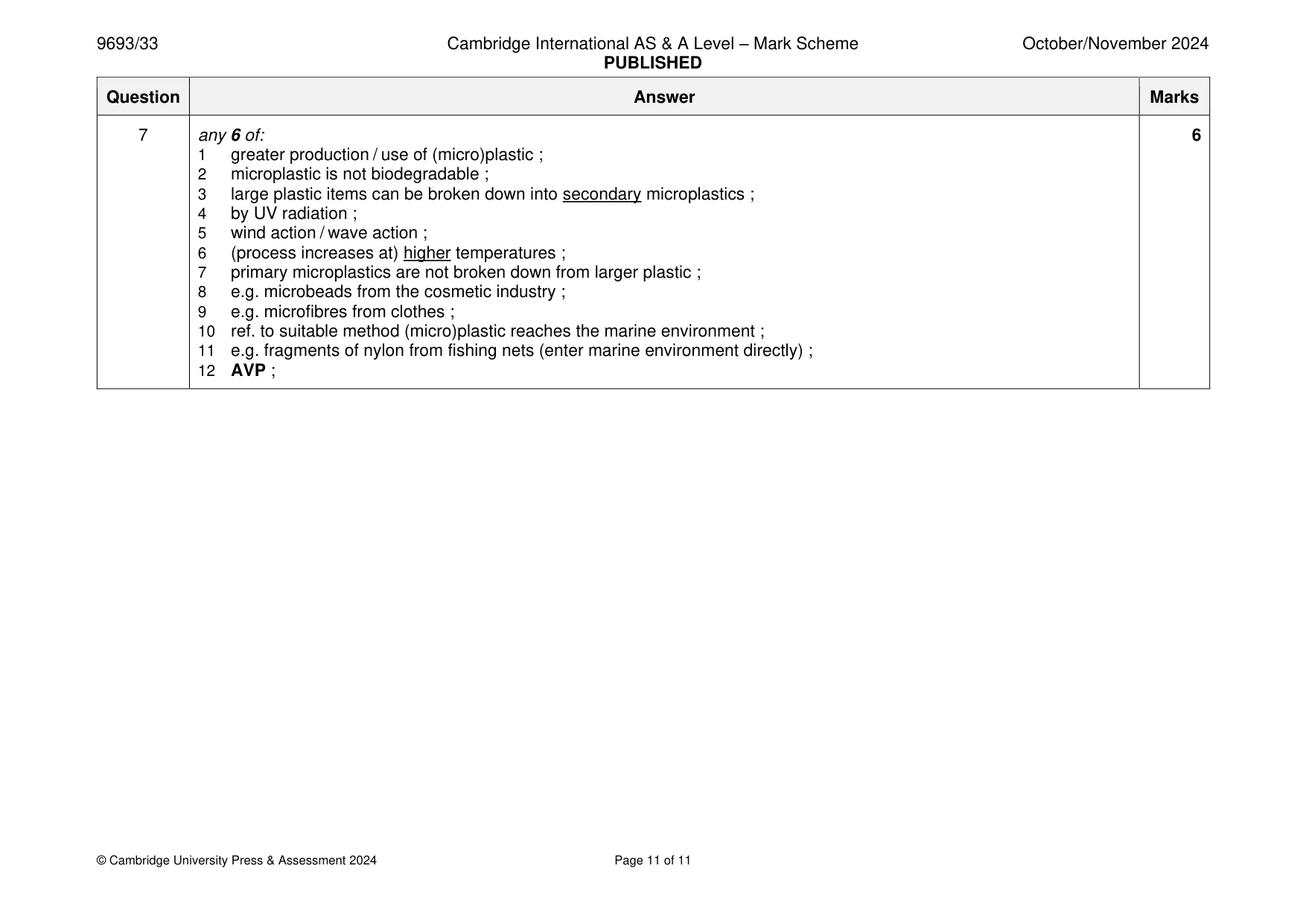
Mark scheme: 7 any 6 of: 6 1 greater production / use of (micro)plastic ; 2 microplastic is not biodegradable ; 3 large plastic items can be broken down into secondary microplastics ; 4 by UV radiation ; 5 wind action / wave action ; 6 (process increases at) higher temperatures ; 7 primary microplastics are not broken down from larger plastic ; 8 e.g. microbeads from the cosmetic industry ; 9 e.g. microfibres from clothes ; 10 ref. to suitable method (micro)plastic reaches the marine environment ; 11 e.g. fragments of nylon from fishing nets (enter marine environment directly) ; 12 AVP ;
What was in this paper
The subtopics covered by these 7 questions, and how many questions each got. Open one in a new tab to see every Cambridge question on it.
What you needed in this session
Cambridge’s own grade thresholds for 2024 Oct/Nov, Paper 3 · Variant 3. A higher threshold means an easier paper — the bar moves with how the cohort did.