Cambridge A Level Marine Science 9693 — 2021 May/June Paper 3 · Variant 0
9693/30/M/J/21 · 6 questions · 75 marks · ≈84 min
The question paper and its mark scheme, free to read here and free to download. This is Cambridge’s own paper, exactly as it was sat.
Question paper20 pages




Mark scheme
No mark scheme is in the library for this paper.
Questions as text
Q1 · Phytoplankton are important producers in food chains in aquatic habitats
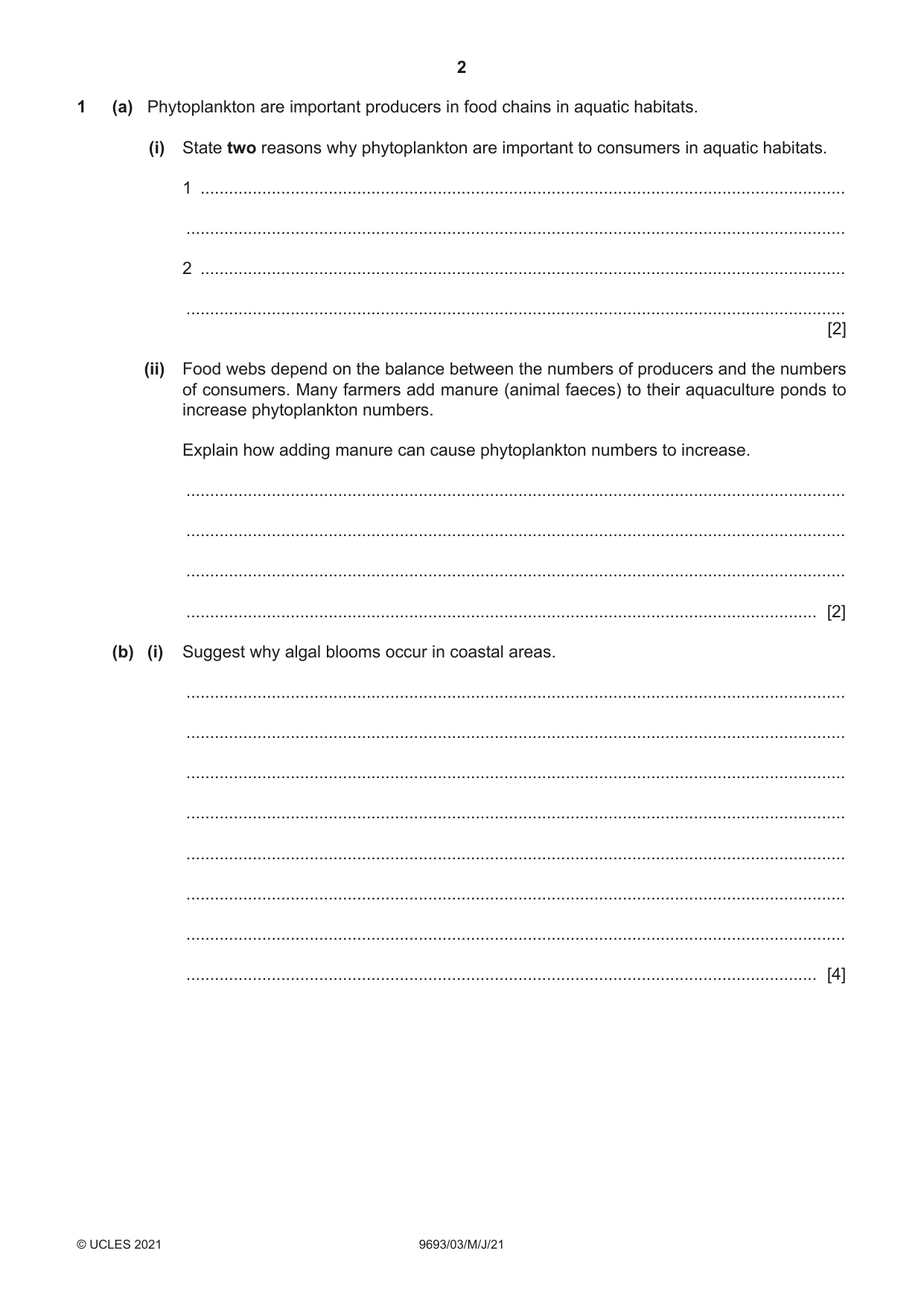
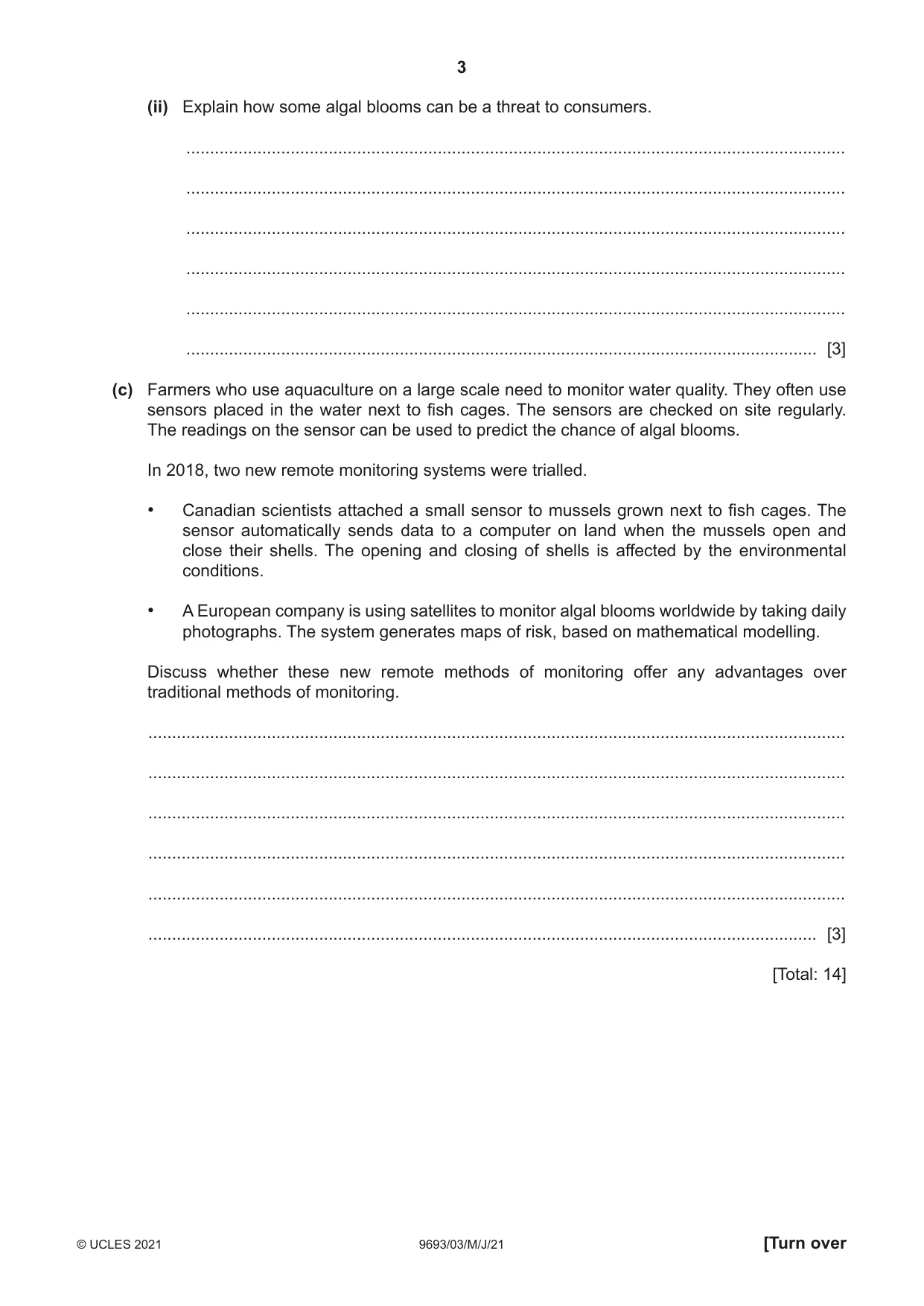
1 (a) Phytoplankton are important producers in food chains in aquatic habitats. (i) State two reasons why phytoplankton are important to consumers in aquatic habitats. 1 ........................................................................................................................................ ........................................................................................................................................... 2 ........................................................................................................................................ ........................................................................................................................................... [2] (ii) Food webs depend on the balance between the numbers of producers and the numbers of consumers. Many farmers add manure (animal faeces) to their aquaculture ponds to increase phytoplankton numbers. Explain how adding manure can cause phytoplankton numbers to increase. ........................................................................................................................................... ........................................................................................................................................... ........................................................................................................................................... ..................................................................................................................................... [2] (b) (i) Suggest why algal blooms occur in coastal areas. ........................................................................................................................................... ........................................................................................................................................... ........................................................................................................................................... ........................................................................................................................................... ........................................................................................................................................... ........................................................................................................................................... ........................................................................................................................................... ..................................................................................................................................... [4] (ii) Explain how some algal blooms can be a threat to consumers. ........................................................................................................................................... ........................................................................................................................................... ........................................................................................................................................... ........................................................................................................................................... ........................................................................................................................................... ..................................................................................................................................... [3] (c) Farmers who use aquaculture on a large scale need to monitor water quality. They often use sensors placed in the water next to fish cages. The sensors are checked on site regularly. The readings on the sensor can be used to predict the chance of algal blooms. In 2018, two new remote monitoring systems were trialled. • Canadian scientists attached a small sensor to mussels grown next to fish cages. The sensor automatically sends data to a computer on land when the mussels open and close their shells. The opening and closing of shells is affected by the environmental conditions. • A European company is using satellites to monitor algal blooms worldwide by taking daily photographs. The system generates maps of risk, based on mathematical modelling. Discuss whether these new remote methods of monitoring offer any advantages over traditional methods of monitoring. ................................................................................................................................................... ................................................................................................................................................... ................................................................................................................................................... ................................................................................................................................................... ................................................................................................................................................... ............................................................................................................................................. [3] [Total: 14]
Q2 · Sea anemones are classified in the same group as coral polyps
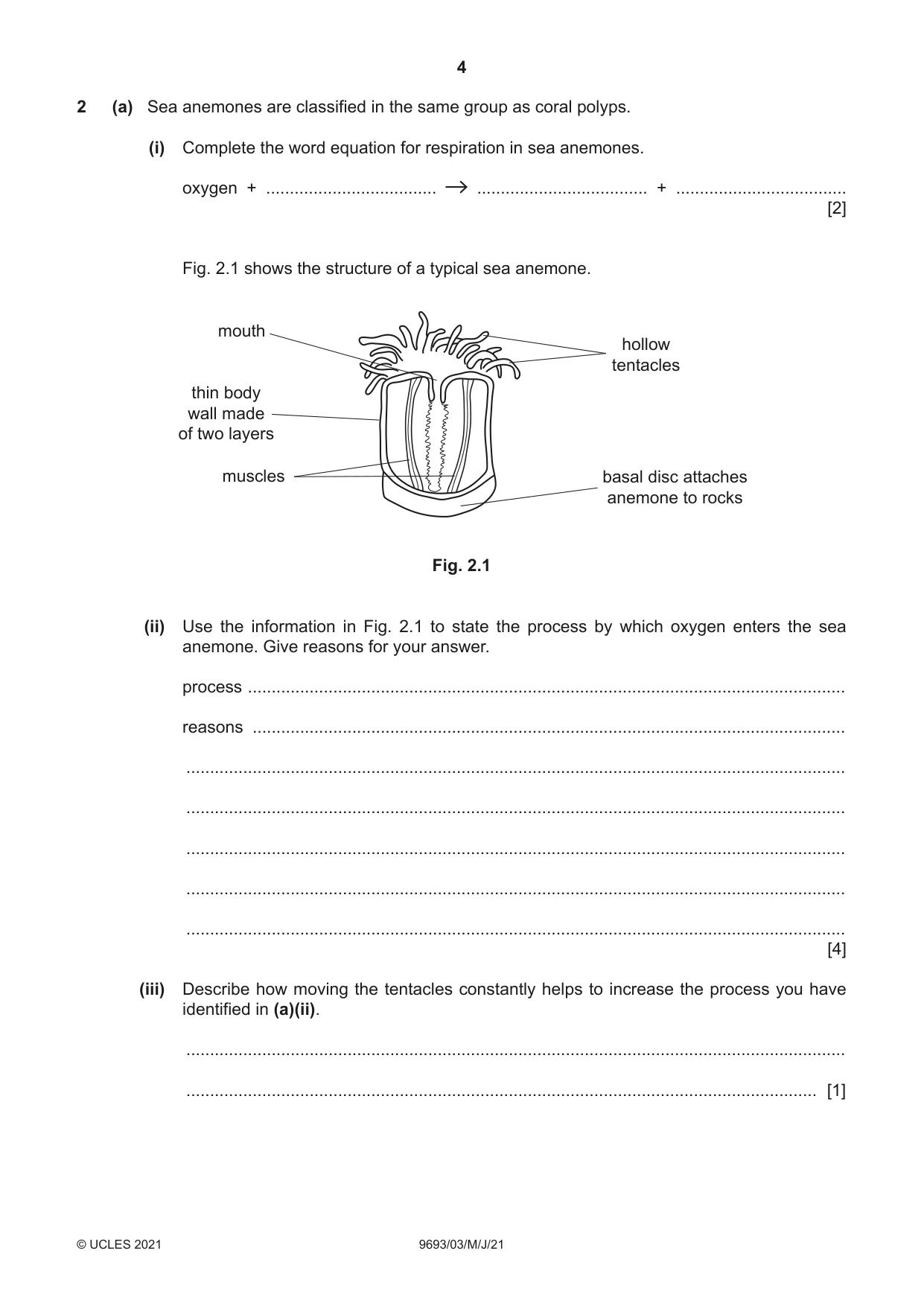
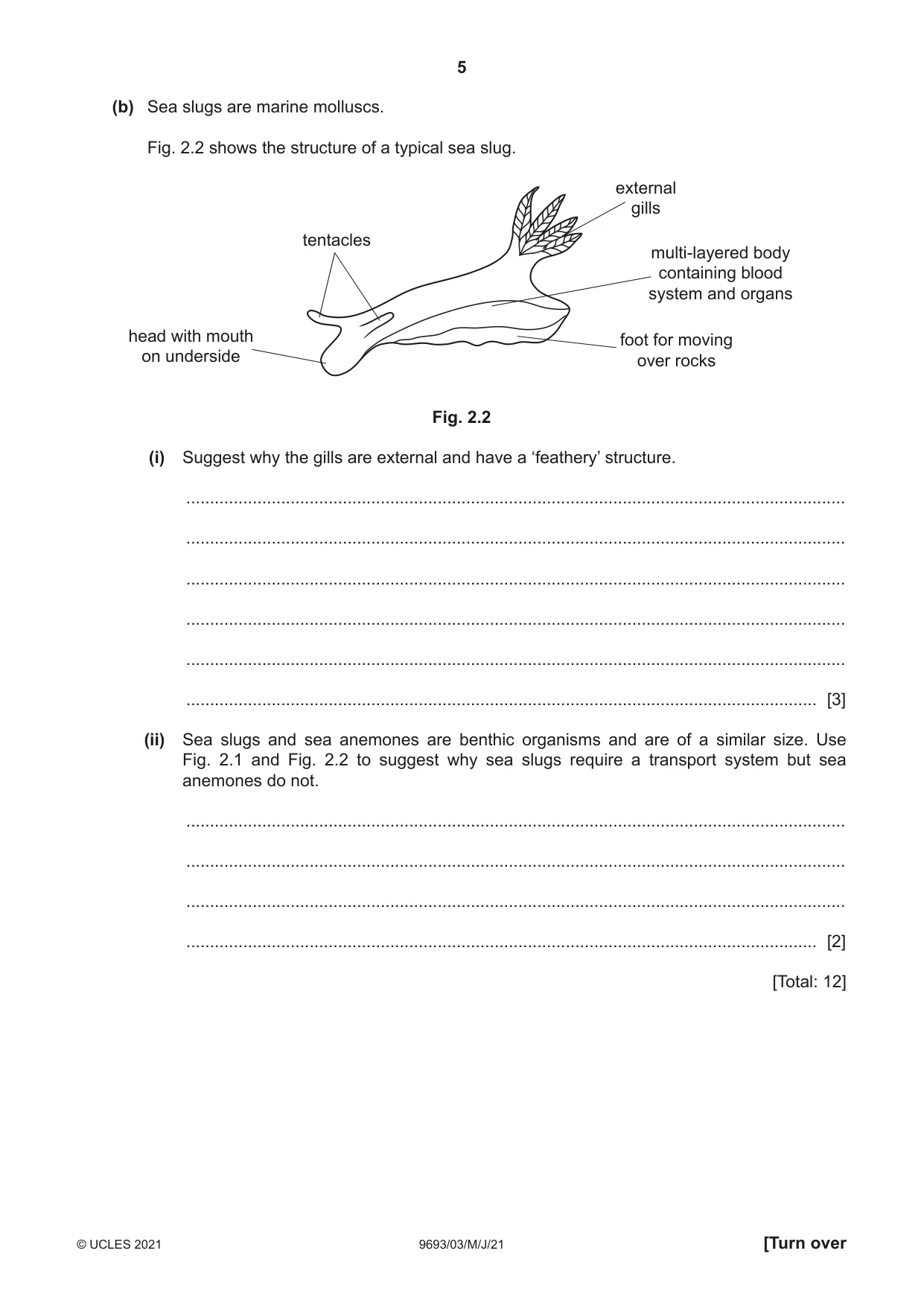
2 (a) Sea anemones are classified in the same group as coral polyps. (i) Complete the word equation for respiration in sea anemones. oxygen + .................................... .................................... + .................................... [2] Fig. 2.1 shows the structure of a typical sea anemone. mouth hollow tentacles thin body wall made of two layers muscles basal disc attaches anemone to rocks Fig. 2.1 (ii) Use the information in Fig. 2.1 to state the process by which oxygen enters the sea anemone. Give reasons for your answer. process .............................................................................................................................. reasons ............................................................................................................................. ........................................................................................................................................... ........................................................................................................................................... ........................................................................................................................................... ........................................................................................................................................... ........................................................................................................................................... [4] (iii) Describe how moving the tentacles constantly helps to increase the process you have identified in (a)(ii). ........................................................................................................................................... ..................................................................................................................................... [1] (b) Sea slugs are marine molluscs. Fig. 2.2 shows the structure of a typical sea slug. external gills tentacles multi-layered body containing blood system and organs head with mouth foot for moving on underside over rocks Fig. 2.2 (i) Suggest why the gills are external and have a ‘feathery’ structure. ........................................................................................................................................... ........................................................................................................................................... ........................................................................................................................................... ........................................................................................................................................... ........................................................................................................................................... ..................................................................................................................................... [3] (ii) Sea slugs and sea anemones are benthic organisms and are of a similar size. Use Fig. 2.1 and Fig. 2.2 to suggest why sea slugs require a transport system but sea anemones do not. ........................................................................................................................................... ........................................................................................................................................... ........................................................................................................................................... ..................................................................................................................................... [2] [Total: 12]
Q3 · Mackerel are found in large shoals which migrate throughout the North Atlantic Ocean and…
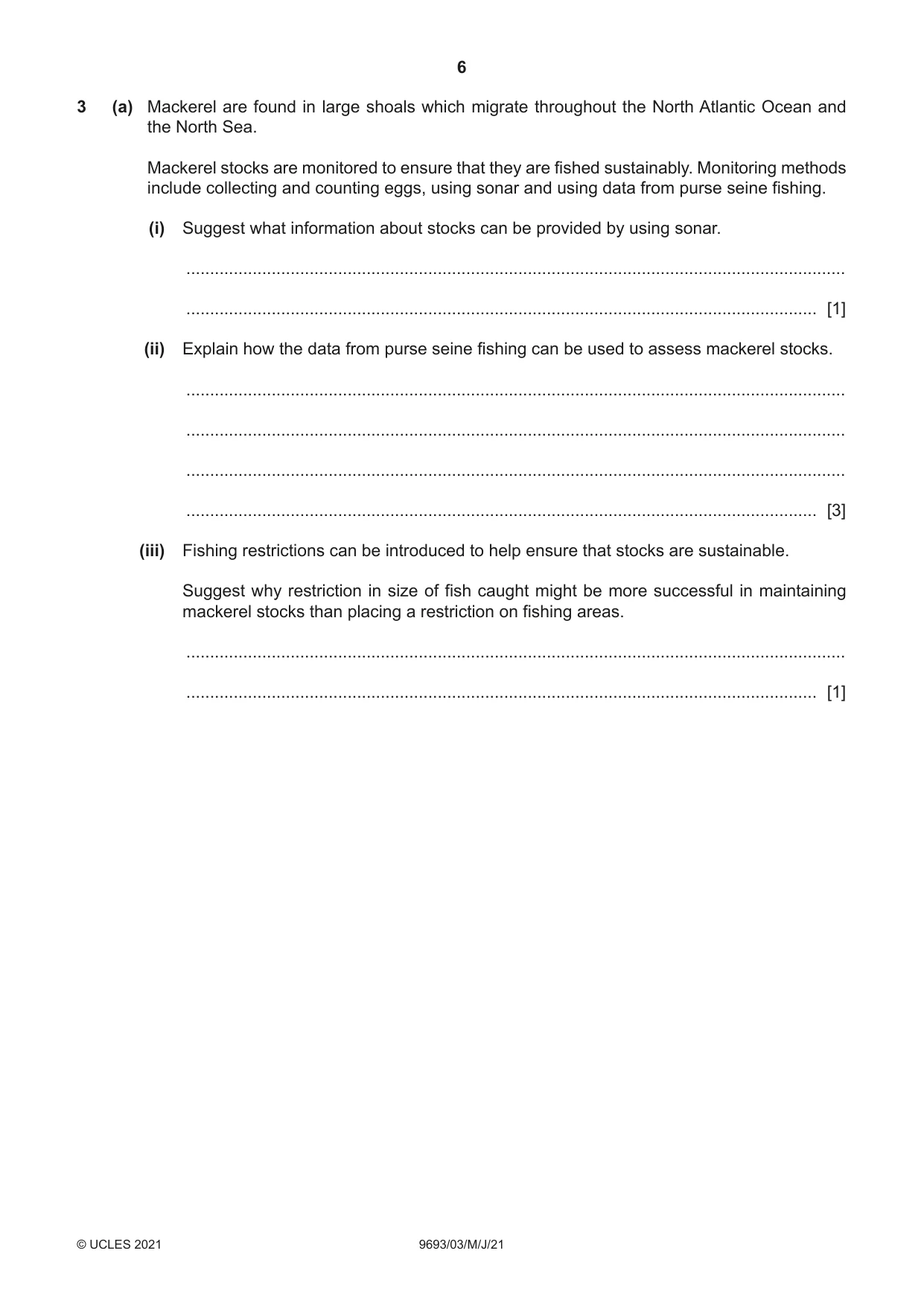
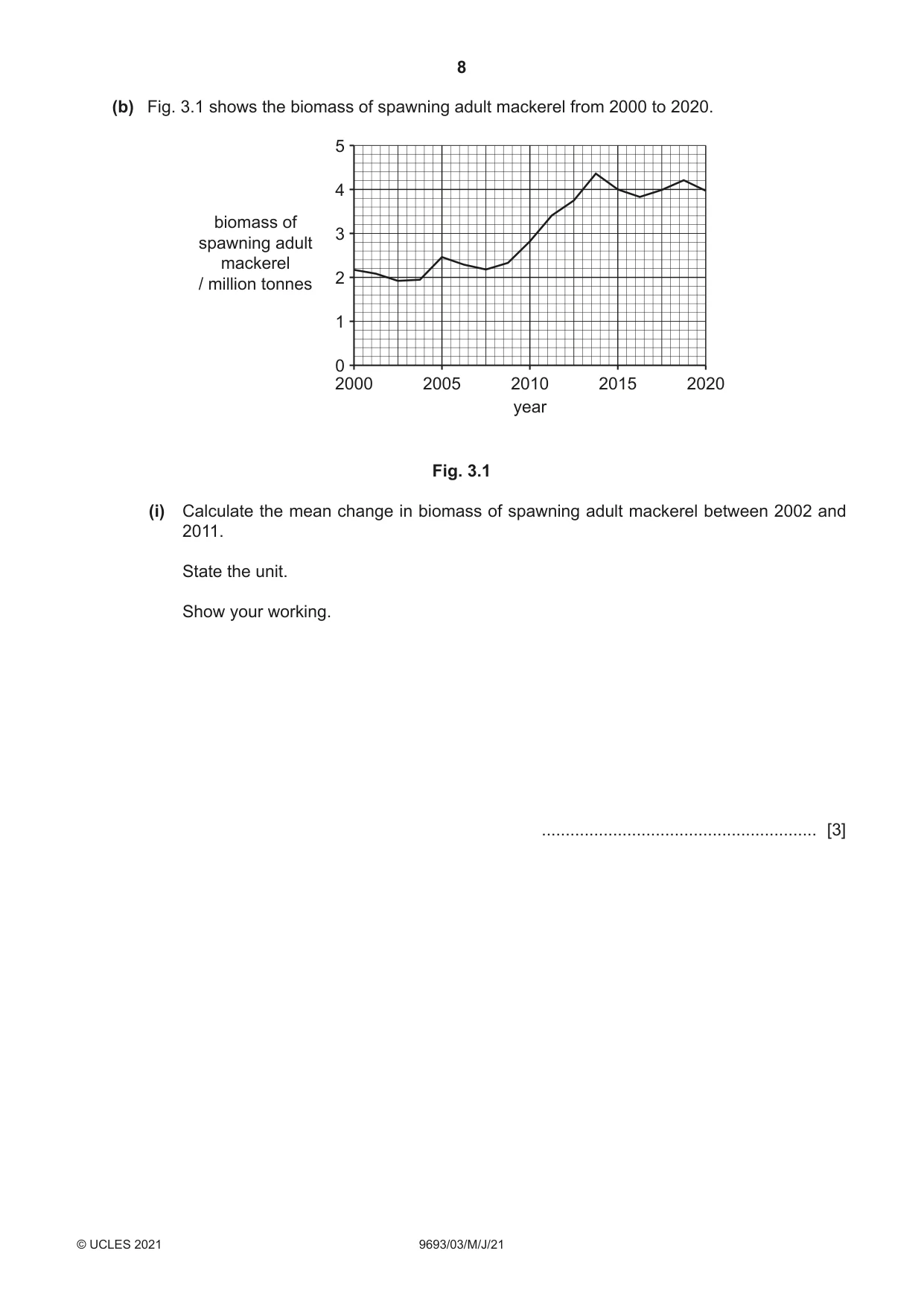
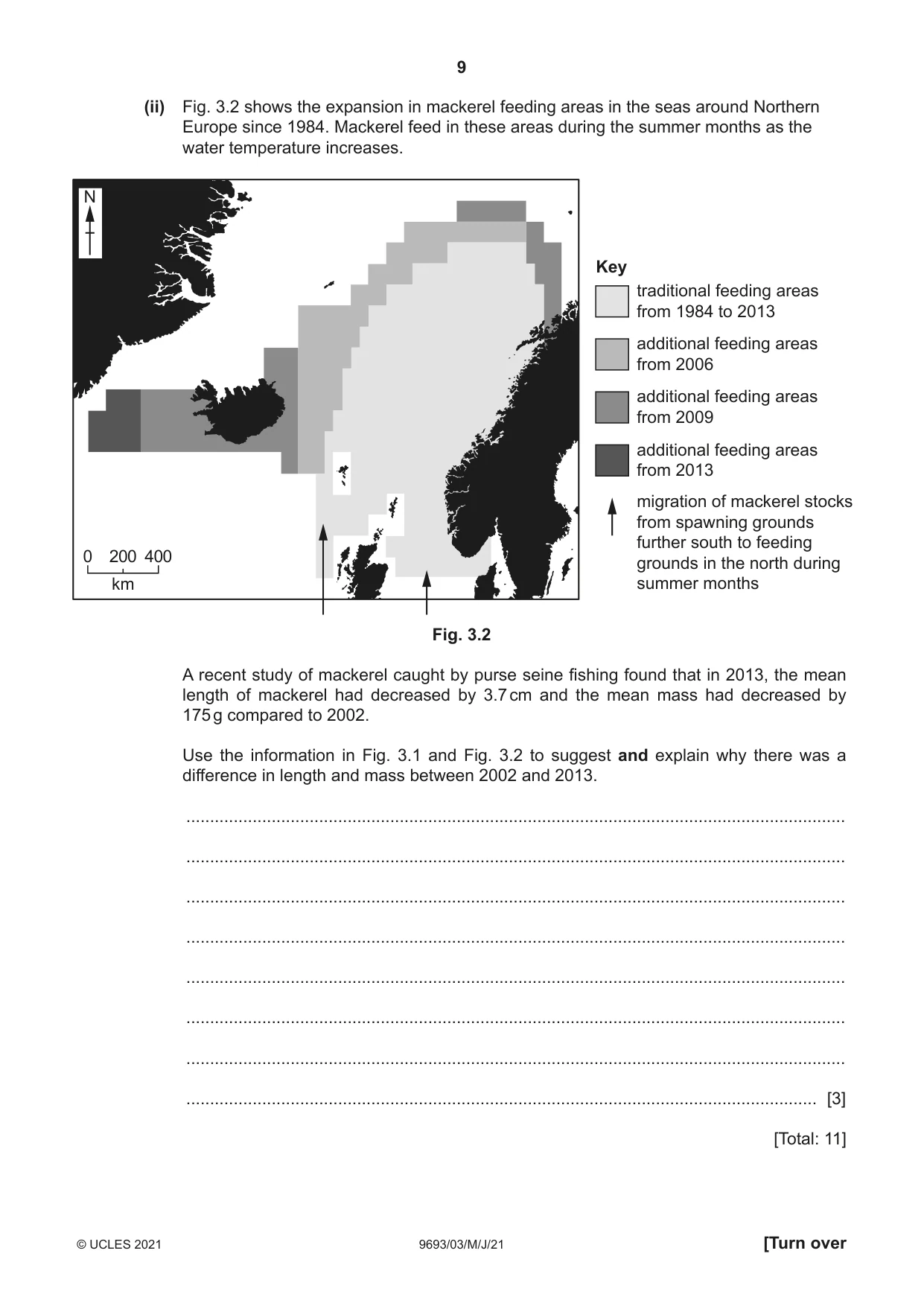
3 (a) Mackerel are found in large shoals which migrate throughout the North Atlantic Ocean and the North Sea. Mackerel stocks are monitored to ensure that they are fished sustainably. Monitoring methods include collecting and counting eggs, using sonar and using data from purse seine fishing. (i) Suggest what information about stocks can be provided by using sonar. ........................................................................................................................................... ..................................................................................................................................... [1] (ii) Explain how the data from purse seine fishing can be used to assess mackerel stocks. ........................................................................................................................................... ........................................................................................................................................... ........................................................................................................................................... ..................................................................................................................................... [3] (iii) Fishing restrictions can be introduced to help ensure that stocks are sustainable. Suggest why restriction in size of fish caught might be more successful in maintaining mackerel stocks than placing a restriction on fishing areas. ........................................................................................................................................... ..................................................................................................................................... [1] (b) Fig. 3.1 shows the biomass of spawning adult mackerel from 2000 to 2020. 5 4 biomass of 3 spawning adult mackerel 2 / million tonnes 1 0 2000 2005 2010 2015 2020 year Fig. 3.1 (i) Calculate the mean change in biomass of spawning adult mackerel between 2002 and 2011. State the unit. Show your working. .......................................................... [3] (ii) Fig. 3.2 shows the expansion in mackerel feeding areas in the seas around Northern Europe since 1984. Mackerel feed in these areas during the summer months as the water temperature increases. N Key traditional feeding areas from 1984 to 2013 additional feeding areas from 2006 additional feeding areas from 2009 additional feeding areas from 2013 migration of mackerel stocks from spawning grounds further south to feeding 0 200 400 grounds in the north during km summer months Fig. 3.2 A recent study of mackerel caught by purse seine fishing found that in 2013, the mean length of mackerel had decreased by 3.7 cm and the mean mass had decreased by 175 g compared to 2002. Use the information in Fig. 3.1 and Fig. 3.2 to suggest and explain why there was a difference in length and mass between 2002 and 2013. ........................................................................................................................................... ........................................................................................................................................... ........................................................................................................................................... ........................................................................................................................................... ........................................................................................................................................... ........................................................................................................................................... ........................................................................................................................................... ..................................................................................................................................... [3] [Total: 11]
Q4 · The Cam Ranh area of central Vietnam is important for grouper aquaculture
4 (a) The Cam Ranh area of central Vietnam is important for grouper aquaculture. Grouper are cultured in mud-lined ponds around the shores of small bays, where there are no rivers. Grouper grow best at temperatures of between 22 °C and 23 °C, in water with a salinity of 28‰ to 38‰ and a rich supply of phytoplankton. Suggest and explain two reasons why the lack of rivers make the water in this area suitable for grouper aquaculture. 1 ................................................................................................................................................ ................................................................................................................................................... 2 ................................................................................................................................................ ................................................................................................................................................... [2] (b) Traditional farming methods involve several farmers, each having three or four ponds, which are 2500 m2 in area. Each pond has gates on opposite sides to allow sea water to enter or leave the pond, depending on wind conditions and daily tides. More than 50% of water is exchanged each day. (i) Explain the advantages of having more than 50% of the water exchanged each day. ........................................................................................................................................... ........................................................................................................................................... ........................................................................................................................................... ........................................................................................................................................... ........................................................................................................................................... ..................................................................................................................................... [3] Fig. 4.1 shows paddle wheels used in each pond. The paddle wheels operate for 16 hours per day, from late afternoon to the following morning. Fig. 4.1 (ii) Use Fig. 4.1 to suggest the function of the paddle wheels. ........................................................................................................................................... ..................................................................................................................................... [1] (iii) Suggest why there is no need for the paddle wheels to operate 24 hours per day. ........................................................................................................................................... ........................................................................................................................................... ........................................................................................................................................... ..................................................................................................................................... [2] (c) The grouper are harvested and the water is removed from the pond. The mud at the bottom of the ponds is then ploughed, chlorinated and dried for 1 month before restocking with young grouper, called fingerlings. (i) Explain the benefit of treating and drying the mud at the bottom of the ponds, before restocking with grouper fingerlings. ........................................................................................................................................... ........................................................................................................................................... ........................................................................................................................................... ..................................................................................................................................... [2] Table 4.1 shows the source of grouper fingerlings and the percentage of each source. Table 4.1 source of fingerlings percentage of each source bought from local hatchery 2 to 3 imported from overseas hatchery 17 to 20 wild-caught locally 77 to 80 (ii) In Vietnam, more hatcheries are being constructed to supply grouper fingerlings to farmers. Use the information in Table 4.1 to discuss the reasons for constructing more hatcheries. ........................................................................................................................................... ........................................................................................................................................... ........................................................................................................................................... ........................................................................................................................................... ........................................................................................................................................... ........................................................................................................................................... ........................................................................................................................................... ..................................................................................................................................... [4] [Total: 14]
Q5 · Desalination is a method used to provide fresh water from sea water by removing salt and…
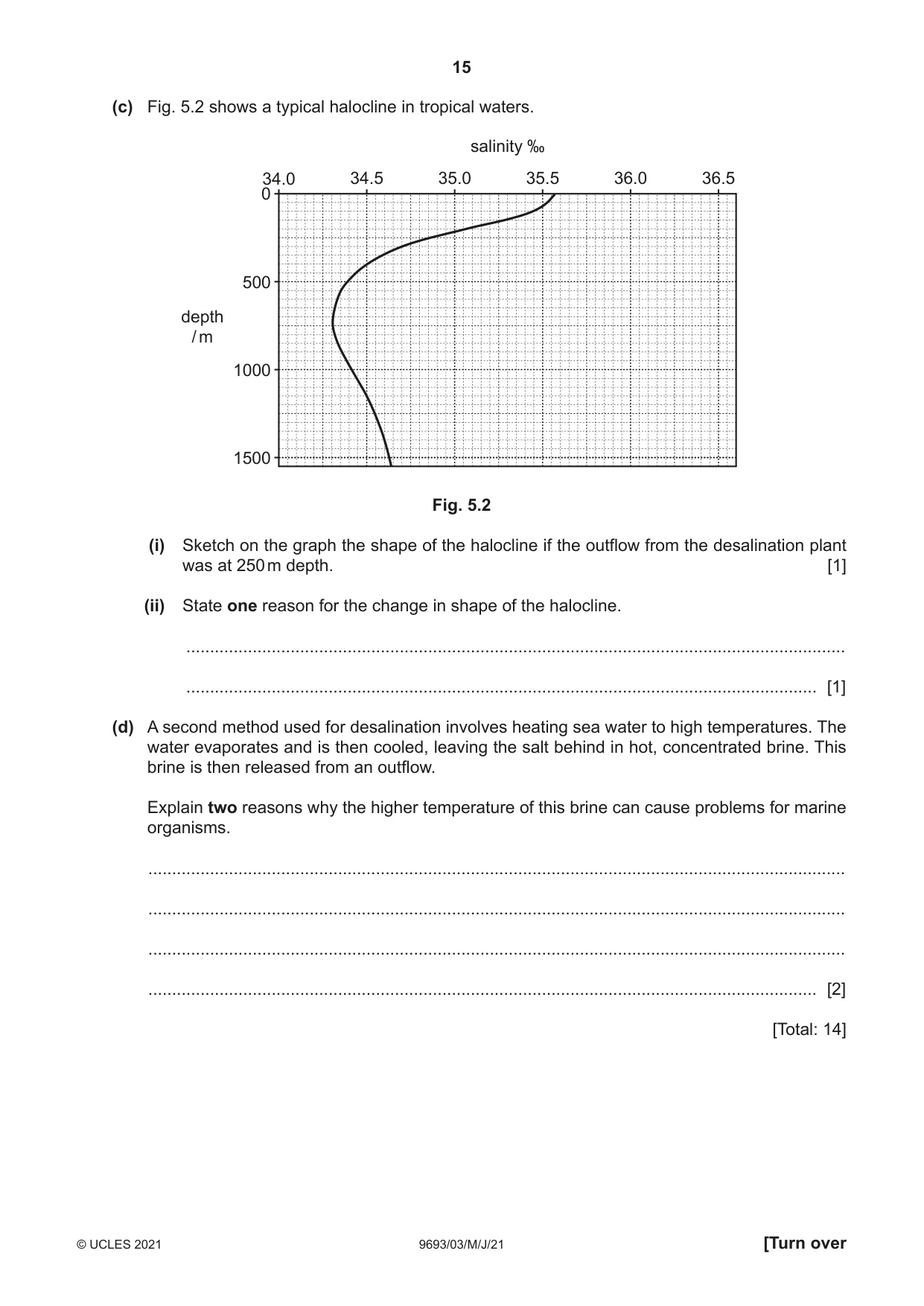
5 (a) Desalination is a method used to provide fresh water from sea water by removing salt and minerals. Millions of people worldwide rely on desalinated water. Suggest one reason, other than the increase in human population, for the increase in desalination. ................................................................................................................................................... ............................................................................................................................................. [1] (b) Fig. 5.1 is a diagram of a typical desalination plant. screening inflow of and pumping sea water station seasea waterwater water isis forcedforced shallow (but not throughthrough coastal salt) microscopicmicroscopic water passes porespores atat through highhigh pores pressurepressure fresh water outflow of brine water storage (concentrated delivery tank sea water) at pipeline high pressure Fig. 5.1 (i) The water entering from the inflow pipe is filtered and screened to remove plankton and fish eggs. Suggest and explain where the inflow pipe could be repositioned to reduce the numbers of plankton and fish eggs entering the inflow pipe. ........................................................................................................................................... ........................................................................................................................................... ........................................................................................................................................... ..................................................................................................................................... [2] (ii) Explain why the high salt concentration in the brine from the outflow makes conditions in that area unsuitable for molluscs such as mussels. ........................................................................................................................................... ........................................................................................................................................... ........................................................................................................................................... ........................................................................................................................................... ........................................................................................................................................... ..................................................................................................................................... [3] (iii) The brine released from the outflow is at high pressure. Suggest why the high-pressure outflow should not be placed too close to the sea bed. ........................................................................................................................................... ........................................................................................................................................... ........................................................................................................................................... ........................................................................................................................................... ........................................................................................................................................... ........................................................................................................................................... ........................................................................................................................................... ..................................................................................................................................... [4] (c) Fig. 5.2 shows a typical halocline in tropical waters. salinity ‰ 34.0 34.5 35.0 35.5 36.0 36.5 0 500 depth / m 1000 1500 Fig. 5.2 (i) Sketch on the graph the shape of the halocline if the outflow from the desalination plant was at 250 m depth. [1] (ii) State one reason for the change in shape of the halocline. ........................................................................................................................................... ..................................................................................................................................... [1] (d) A second method used for desalination involves heating sea water to high temperatures. The water evaporates and is then cooled, leaving the salt behind in hot, concentrated brine. This brine is then released from an outflow. Explain two reasons why the higher temperature of this brine can cause problems for marine organisms. ................................................................................................................................................... ................................................................................................................................................... ................................................................................................................................................... ............................................................................................................................................. [2] [Total: 14]
Q6 · The stages in the life cycle of Pacific salmon
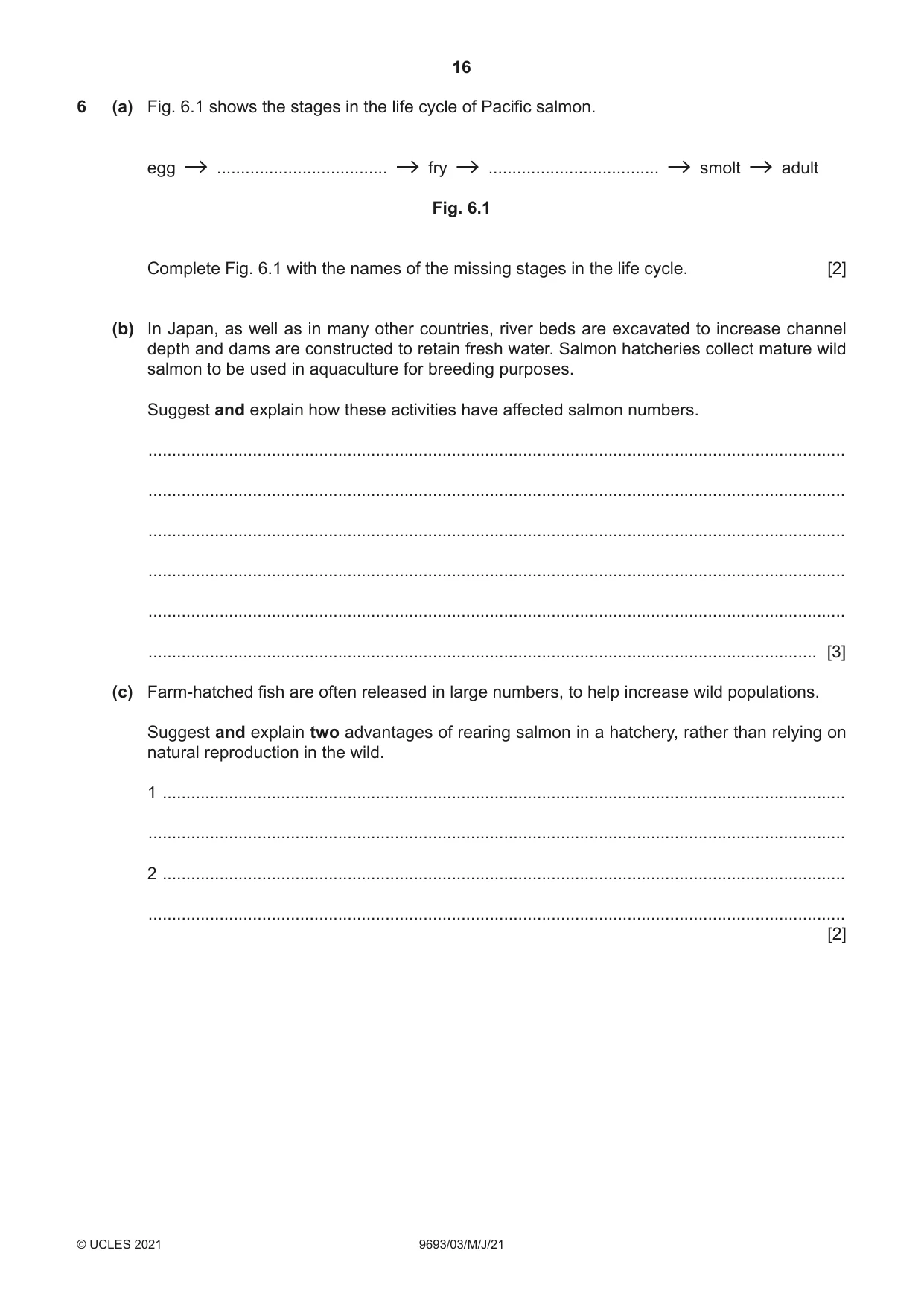
6 (a) Fig. 6.1 shows the stages in the life cycle of Pacific salmon. egg .................................... fry .................................... smolt adult Fig. 6.1 Complete Fig. 6.1 with the names of the missing stages in the life cycle. [2] (b) In Japan, as well as in many other countries, river beds are excavated to increase channel depth and dams are constructed to retain fresh water. Salmon hatcheries collect mature wild salmon to be used in aquaculture for breeding purposes. Suggest and explain how these activities have affected salmon numbers. ................................................................................................................................................... ................................................................................................................................................... ................................................................................................................................................... ................................................................................................................................................... ................................................................................................................................................... ............................................................................................................................................. [3] (c) Farm-hatched fish are often released in large numbers, to help increase wild populations. Suggest and explain two advantages of rearing salmon in a hatchery, rather than relying on natural reproduction in the wild. 1 ................................................................................................................................................ ................................................................................................................................................... 2 ................................................................................................................................................ ................................................................................................................................................... [2] (d) (i) Conservation areas in Japanese rivers have been created to separate wild salmon from hatchery-produced salmon to prevent them breeding together. Suggest one reason for preventing the wild salmon from breeding with hatchery-produced salmon. ........................................................................................................................................... ..................................................................................................................................... [1] (ii) State two other disadvantages of releasing hatchery-produced salmon into the ocean. 1 ........................................................................................................................................ ........................................................................................................................................... 2 ........................................................................................................................................ ........................................................................................................................................... [2] [Total: 10]
What was in this paper
The subtopics covered by these 6 questions, and how many questions each got. Open one in a new tab to see every Cambridge question on it.