Cambridge A Level Marine Science 9693 — 2019 May/June Paper 3 · Variant 1
9693/31/M/J/19 · 7 questions · 75 marks · ≈84 min
The question paper and its mark scheme, free to read here and free to download. This is Cambridge’s own paper, exactly as it was sat.
Question paper20 pages


Mark scheme16 pages
Answers below. Sit the paper first if you are practising.
Questions as text
Q1 · Seaweed farming is the main source of income in traditional village communities on a few…
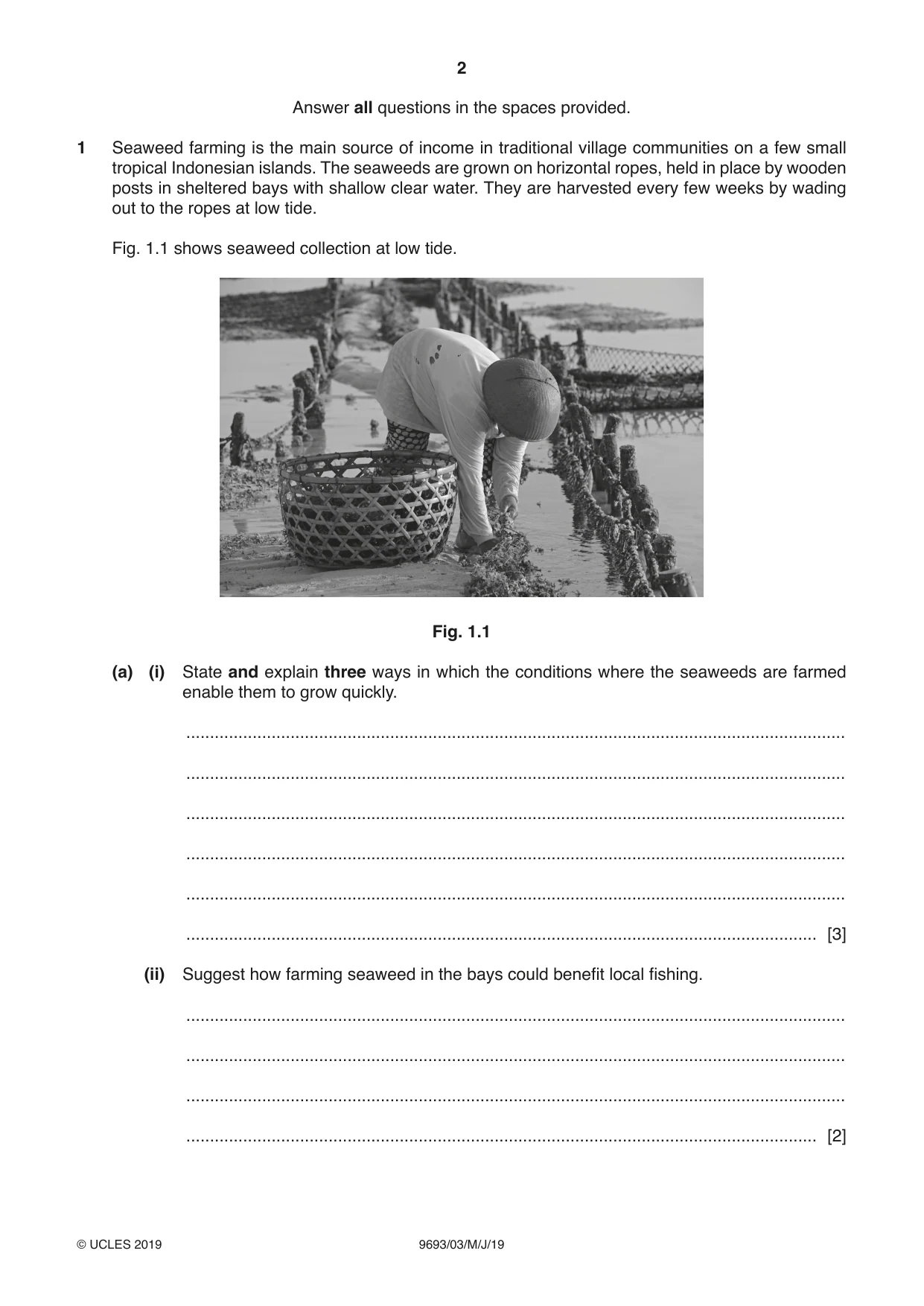
1 Seaweed farming is the main source of income in traditional village communities on a few small tropical Indonesian islands. The seaweeds are grown on horizontal ropes, held in place by wooden posts in sheltered bays with shallow clear water. They are harvested every few weeks by wading out to the ropes at low tide. Fig. 1.1 shows seaweed collection at low tide. Fig. 1.1 (a) (i) State and explain three ways in which the conditions where the seaweeds are farmed enable them to grow quickly. ........................................................................................................................................... ........................................................................................................................................... ........................................................................................................................................... ........................................................................................................................................... ........................................................................................................................................... ..................................................................................................................................... [3] (ii) Suggest how farming seaweed in the bays could benefit local fishing. ........................................................................................................................................... ........................................................................................................................................... ........................................................................................................................................... ..................................................................................................................................... [2] (b) The seaweed farmed is a red alga. Red algae can grow at depths down to 35 m. It is farmed at depths of between 1 m and 7 m, where it is able to grow rapidly. Explain how the pigments in red algae enable them to photosynthesise and grow rapidly at these depths. ................................................................................................................................................... ................................................................................................................................................... ................................................................................................................................................... ................................................................................................................................................... ................................................................................................................................................... ................................................................................................................................................... ................................................................................................................................................... ............................................................................................................................................. [4] (c) Seaweed farming usually involves the whole family. The hard physical work of harvesting, drying and packing the seaweed for distribution is very labour intensive. Tourism is gradually spreading to these islands. Suggest and explain the social impacts on the community if tourism increases. ................................................................................................................................................... ................................................................................................................................................... ................................................................................................................................................... ................................................................................................................................................... ................................................................................................................................................... ............................................................................................................................................. [3] [Total: 12]
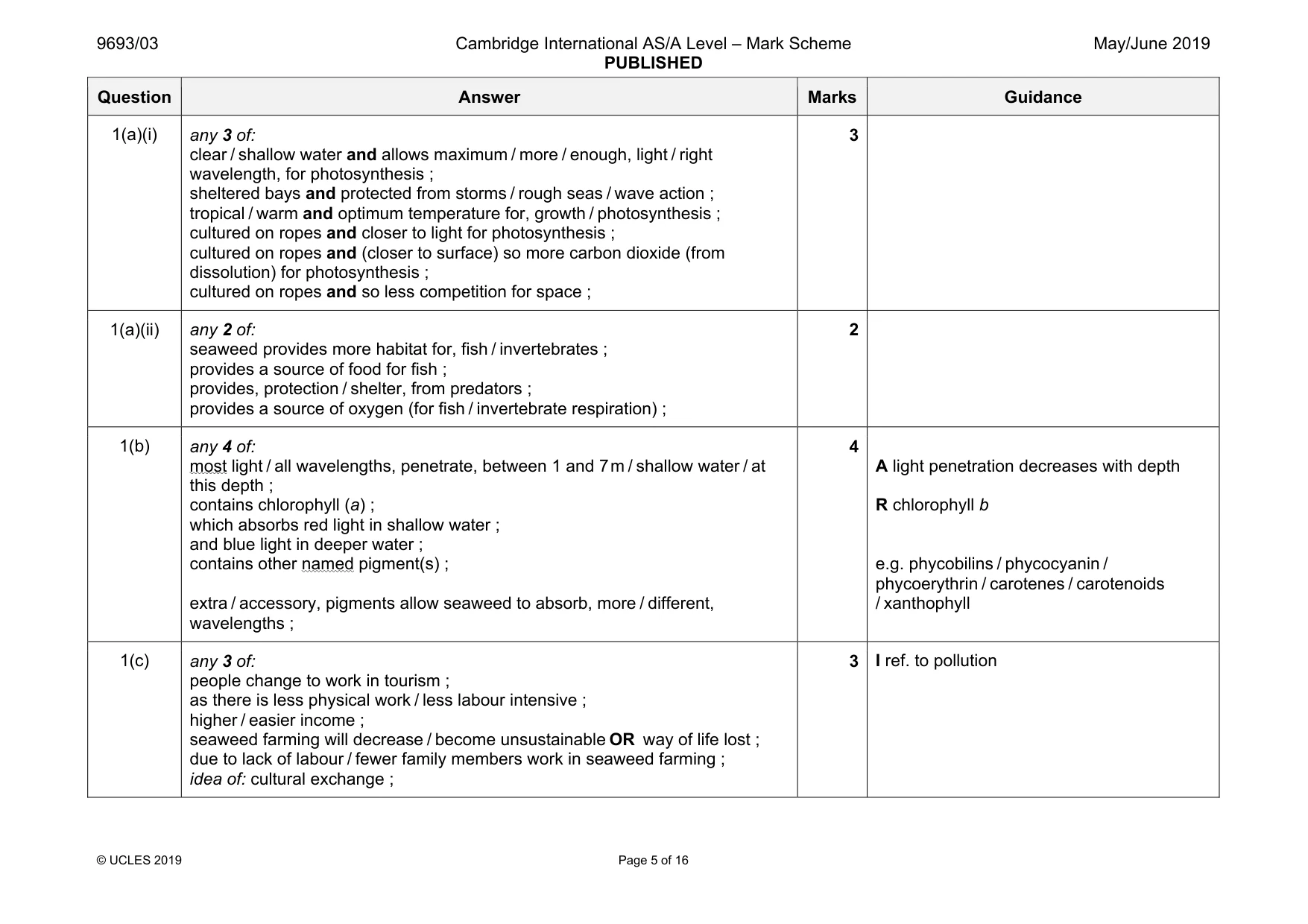
Mark scheme: 1(a)(i) any 3 of: clear / shallow water and allows maximum / more / enough, light / right wavelength, for photosynthesis ; sheltered bays and protected from storms / rough seas / wave action ; tropical / warm and optimum temperature for, growth / photosynthesis ; cultured on ropes and closer to light for photosynthesis ; cultured on ropes and (closer to surface) so more carbon dioxide (from dissolution) for photosynthesis ; cultured on ropes and so less competition for space ; 3 1(a)(ii) any 2 of: seaweed provides more habitat for, fish / invertebrates ; provides a source of food for fish ; provides, protection / shelter, from predators ; provides a source of oxygen (for fish / invertebrate respiration) ; 2 1(b) any 4 of: most light / all wavelengths, penetrate, between 1 and 7 m / shallow water / at this depth ; contains chlorophyll (a) ; which absorbs red light in shallow water ; and blue light in deeper water ; contains other named pigment(s) ; extra / accessory, pigments allow seaweed to absorb, more / different, wavelengths ; 4 A light penetration decreases with depth R chlorophyll b e.g. phycobilins / phycocyanin / phycoerythrin / carotenes / carotenoids / xanthophyll 1(c) any 3 of: people change to work in tourism ; as there is less physical work / less labour intensive ; higher / easier income ; seaweed farming will decrease / become unsustainable OR way of life lost ; due to lack of labour / fewer family members work in seaweed farming ; idea of: cultural exchange ; 3 I ref. to pollution
Q2 · Adult groupers are solitary fish, but during the breeding season they swim many…
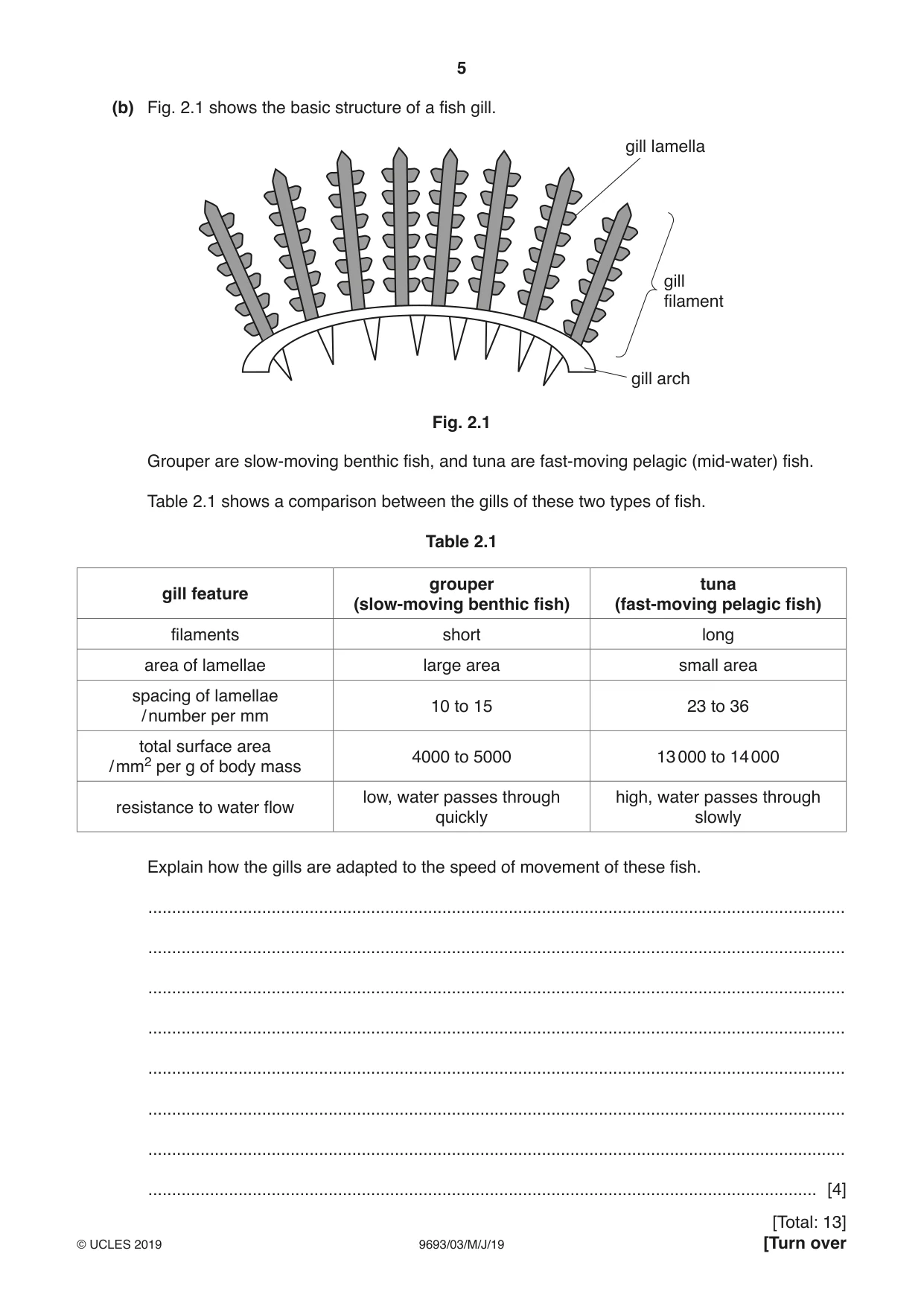
2 (a) Adult groupers are solitary fish, but during the breeding season they swim many kilometres to reach spawning grounds. (i) The Nassau grouper occupies three main habitats during its life cycle. Describe the stages of the life cycle that happen in each of these habitats. offshore between 56 to 160 km ......................................................................................... ........................................................................................................................................... ........................................................................................................................................... inshore seagrass beds and estuaries ............................................................................... ........................................................................................................................................... ........................................................................................................................................... shallow water and deep water reefs .................................................................................. ........................................................................................................................................... ........................................................................................................................................... [4] (ii) State two similarities between the life cycle of grouper and tuna. 1 ........................................................................................................................................ 2 ........................................................................................................................................ [2] (iii) Several species of grouper and tuna are in danger of extinction. Explain how their spawning behaviour may have contributed to these species becoming endangered. ........................................................................................................................................... ........................................................................................................................................... ........................................................................................................................................... ........................................................................................................................................... ........................................................................................................................................... ..................................................................................................................................... [3] (b) Fig. 2.1 shows the basic structure of a fish gill. gill lamella gill filament gill arch Fig. 2.1 Grouper are slow-moving benthic fish, and tuna are fast-moving pelagic (mid-water) fish. Table 2.1 shows a comparison between the gills of these two types of fish. Table 2.1 grouper tuna gill feature (slow-moving benthic fish) (fast-moving pelagic fish) filaments short long area of lamellae large area small area spacing of lamellae 10 to 15 23 to 36 / number per mm total surface area 4000 to 5000 13 000 to 14 000/ mm2 per g of body mass low, water passes through high, water passes through resistance to water flow quickly slowly Explain how the gills are adapted to the speed of movement of these fish. ................................................................................................................................................... ................................................................................................................................................... ................................................................................................................................................... ................................................................................................................................................... ................................................................................................................................................... ................................................................................................................................................... ................................................................................................................................................... ............................................................................................................................................. [4]
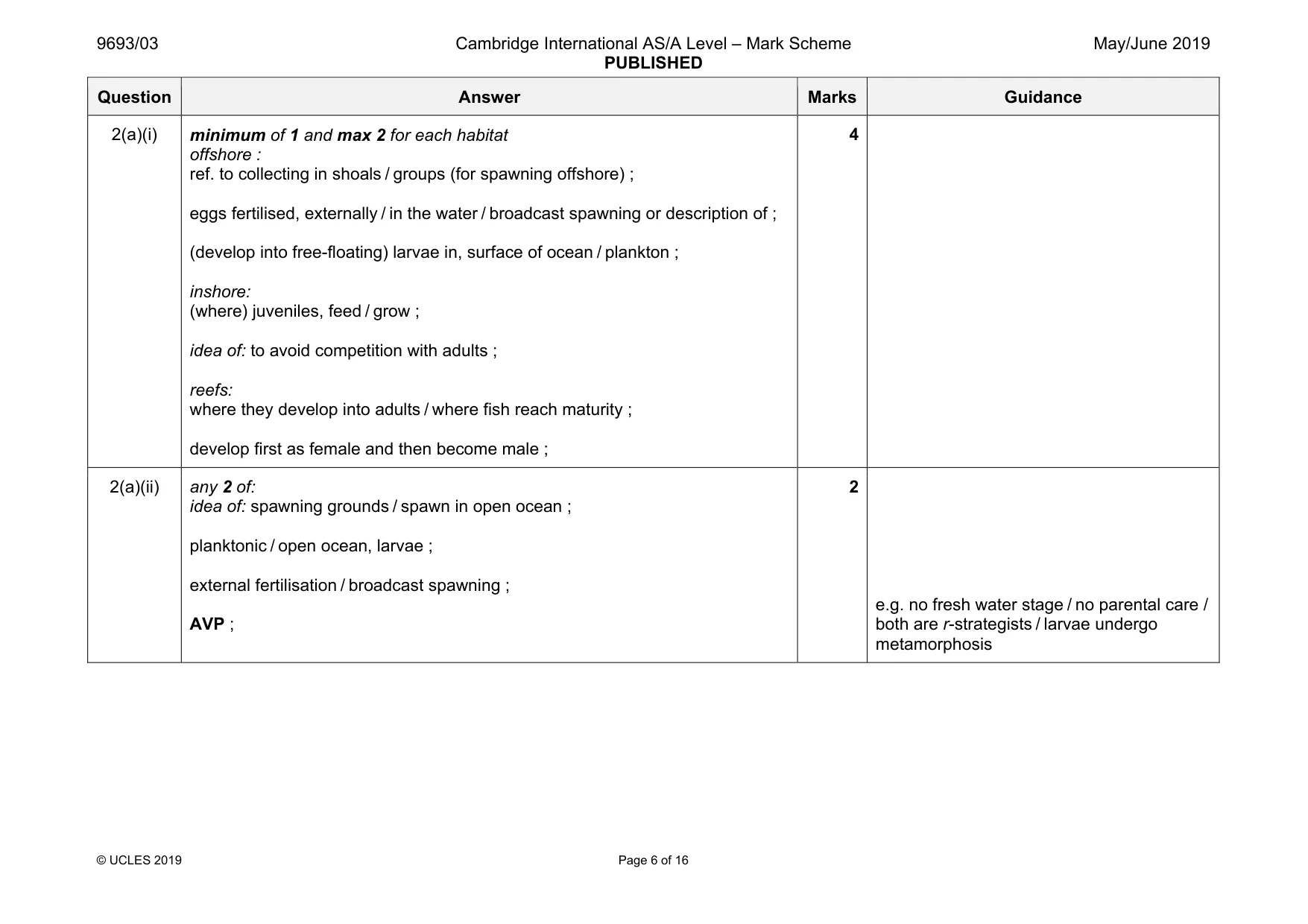
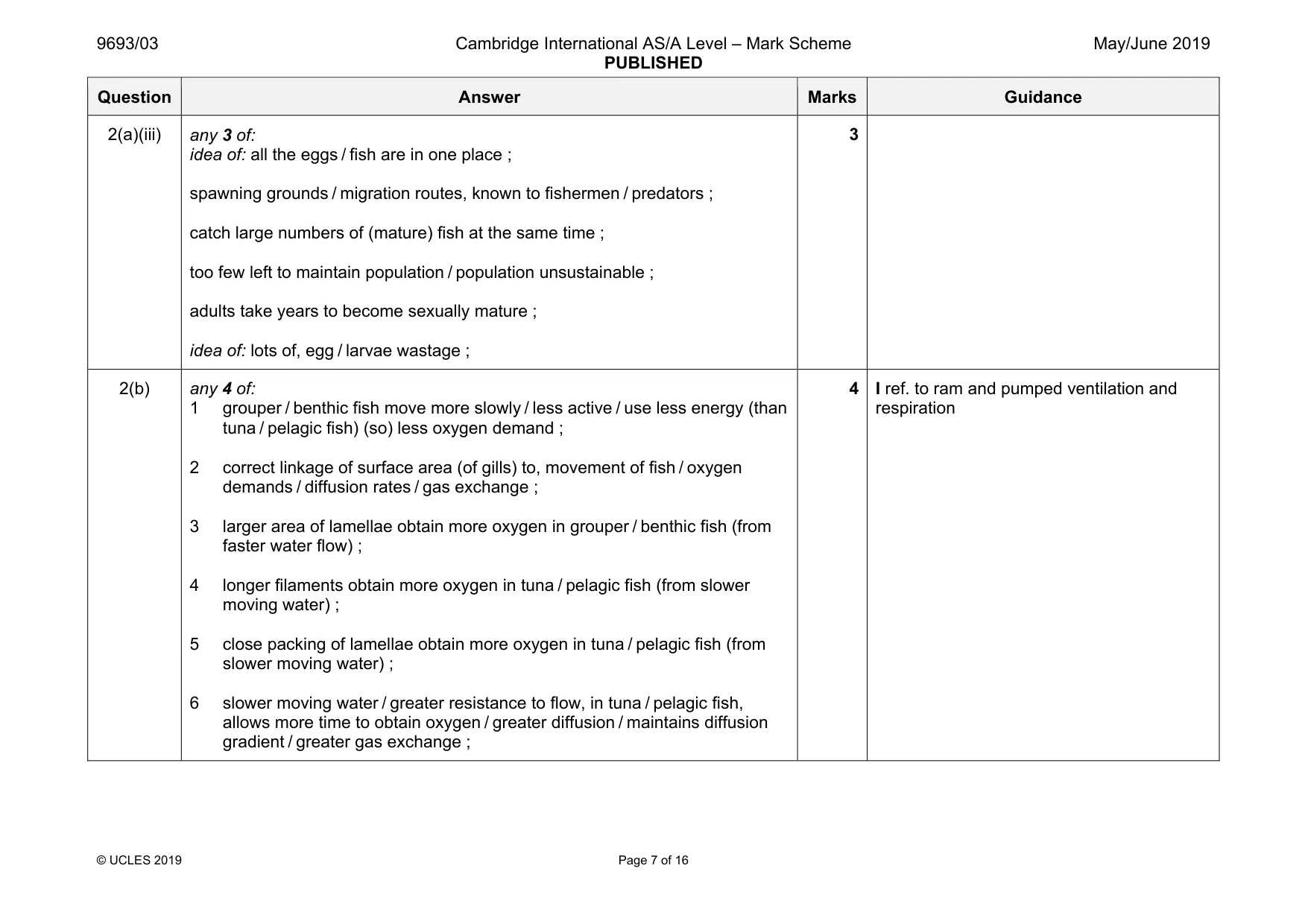
Mark scheme: 2(a)(i) minimum of 1 and max 2 for each habitat offshore : ref. to collecting in shoals / groups (for spawning offshore) ; eggs fertilised, externally / in the water / broadcast spawning or description of ; (develop into free-floating) larvae in, surface of ocean / plankton ; inshore: (where) juveniles, feed / grow ; idea of: to avoid competition with adults ; reefs: where they develop into adults / where fish reach maturity ; develop first as female and then become male ; 4 2(a)(ii) any 2 of: idea of: spawning grounds / spawn in open ocean ; planktonic / open ocean, larvae ; external fertilisation / broadcast spawning ; AVP ; 2 e.g. no fresh water stage / no parental care / both are r-strategists / larvae undergo metamorphosis Question Answer Marks Guidance 2(a)(iii) any 3 of: idea of: all the eggs / fish are in one place ; spawning grounds / migration routes, known to fishermen / predators ; catch large numbers of (mature) fish at the same time ; too few left to maintain population / population unsustainable ; adults take years to become sexually mature ; idea of: lots of, egg / larvae wastage ; 3 2(b) any 4 of: 1 grouper / benthic fish move more slowly / less active / use less energy (than tuna / pelagic fish) (so) less oxygen demand ; 2 correct linkage of surface area (of gills) to, movement of fish / oxygen demands / diffusion rates / gas exchange ; 3 larger area of lamellae obtain more oxygen in grouper / benthic fish (from faster water flow) ; 4 longer filaments obtain more oxygen in tuna / pelagic fish (from slower moving water) ; 5 close packing of lamellae obtain more oxygen in tuna / pelagic fish (from slower moving water) ; 6 slower moving water / greater resistance to flow, in tuna / pelagic fish, allows more time to obtain oxygen / greater diffusion / maintains diffusion gradient / greater gas exchange ; 4 I ref. to ram and pumped ventilation and respiration
Q3 · India is a major exporter of high value prawns worldwide
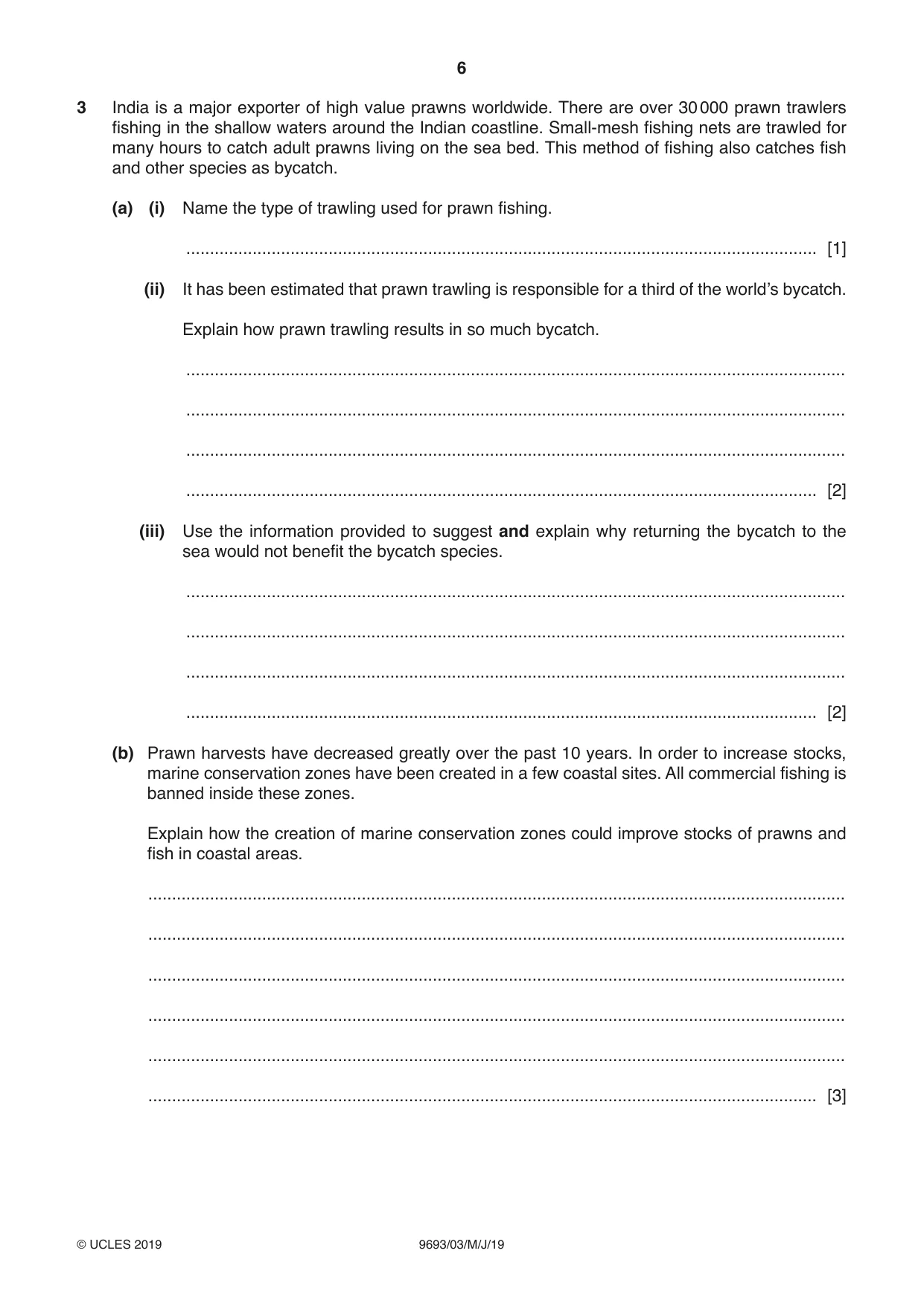
3 India is a major exporter of high value prawns worldwide. There are over 30 000 prawn trawlers fishing in the shallow waters around the Indian coastline. Small-mesh fishing nets are trawled for many hours to catch adult prawns living on the sea bed. This method of fishing also catches fish and other species as bycatch. (a) (i) Name the type of trawling used for prawn fishing. ..................................................................................................................................... [1] (ii) It has been estimated that prawn trawling is responsible for a third of the world’s bycatch. Explain how prawn trawling results in so much bycatch. ........................................................................................................................................... ........................................................................................................................................... ........................................................................................................................................... ..................................................................................................................................... [2] (iii) Use the information provided to suggest and explain why returning the bycatch to the sea would not benefit the bycatch species. ........................................................................................................................................... ........................................................................................................................................... ........................................................................................................................................... ..................................................................................................................................... [2] (b) Prawn harvests have decreased greatly over the past 10 years. In order to increase stocks, marine conservation zones have been created in a few coastal sites. All commercial fishing is banned inside these zones. Explain how the creation of marine conservation zones could improve stocks of prawns and fish in coastal areas. ................................................................................................................................................... ................................................................................................................................................... ................................................................................................................................................... ................................................................................................................................................... ................................................................................................................................................... ............................................................................................................................................. [3] (c) Some commercial prawn fishermen are ignoring the ban and continue trawling for prawns inside marine conservation zones. Two methods of monitoring fishing are the use of satellites and inspection of catch. Discuss the effectiveness of these two methods to monitor prawn trawling in India. satellites .................................................................................................................................... ................................................................................................................................................... ................................................................................................................................................... ................................................................................................................................................... inspection of catch .................................................................................................................... ................................................................................................................................................... ................................................................................................................................................... ................................................................................................................................................... [4] [Total: 12]
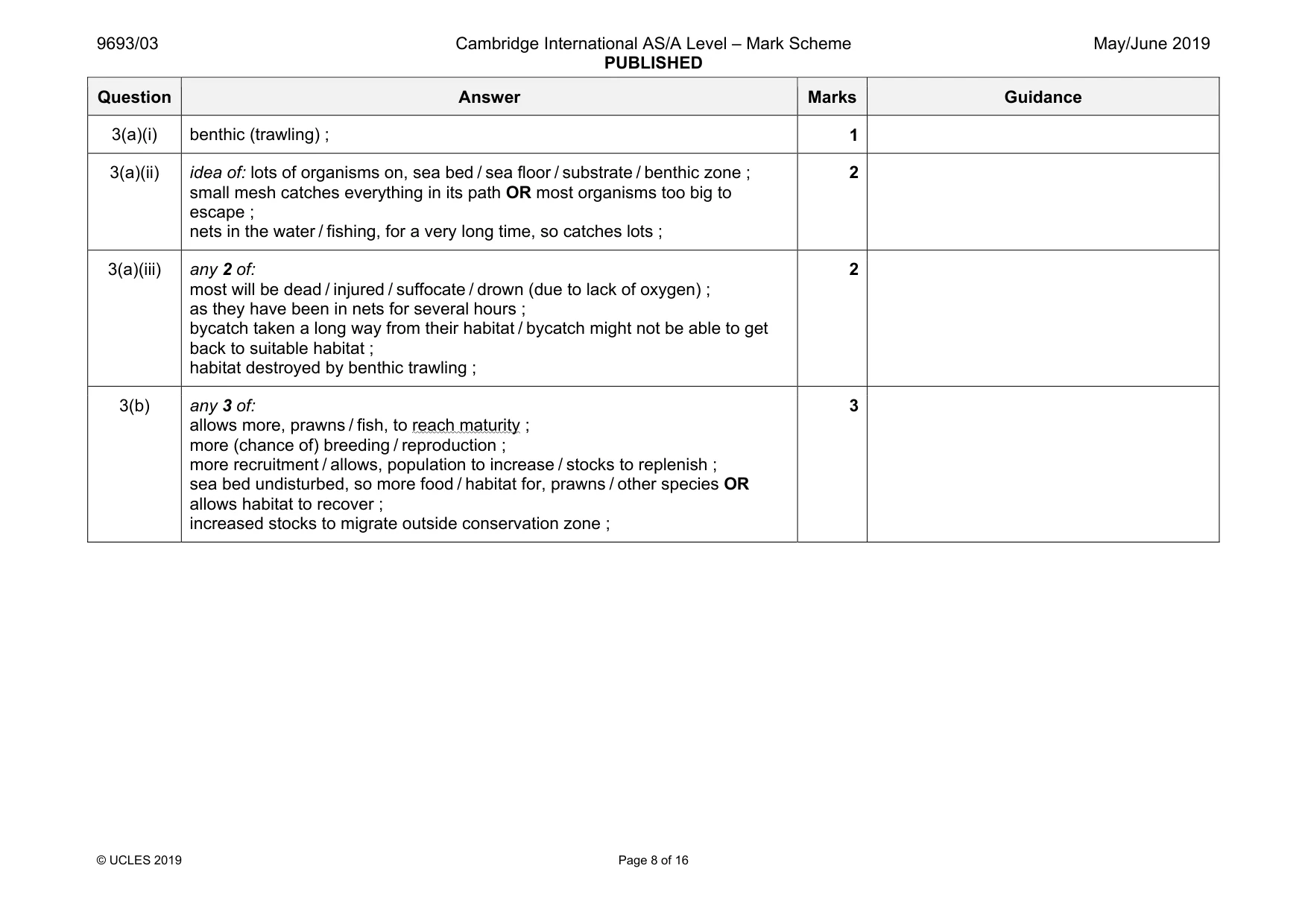
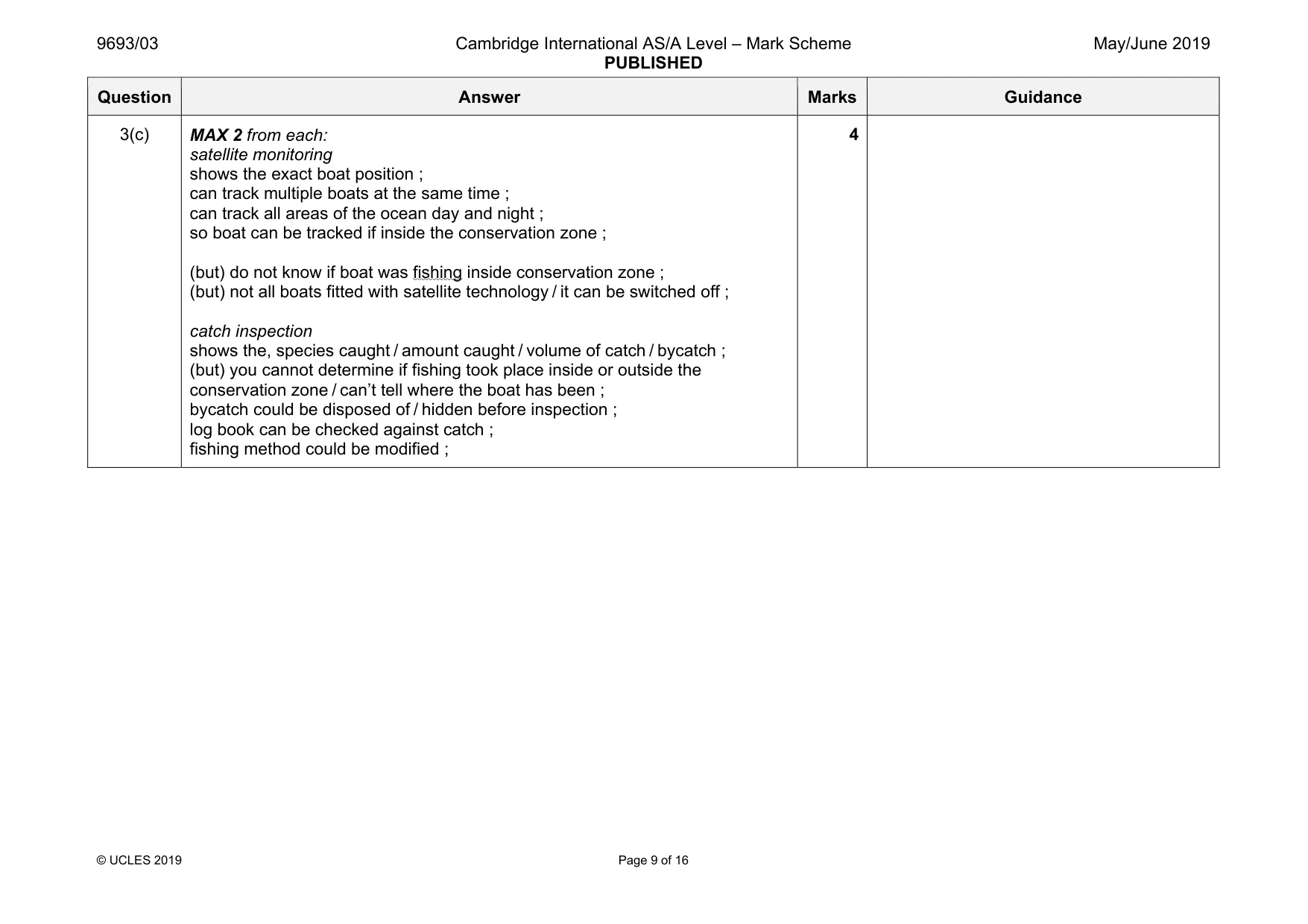
Mark scheme: 3(a)(i) benthic (trawling) ; 1 3(a)(ii) idea of: lots of organisms on, sea bed / sea floor / substrate / benthic zone ; small mesh catches everything in its path OR most organisms too big to escape ; nets in the water / fishing, for a very long time, so catches lots ; 2 3(a)(iii) any 2 of: most will be dead / injured / suffocate / drown (due to lack of oxygen) ; as they have been in nets for several hours ; bycatch taken a long way from their habitat / bycatch might not be able to get back to suitable habitat ; habitat destroyed by benthic trawling ; 2 3(b) any 3 of: allows more, prawns / fish, to reach maturity ; more (chance of) breeding / reproduction ; more recruitment / allows, population to increase / stocks to replenish ; sea bed undisturbed, so more food / habitat for, prawns / other species OR allows habitat to recover ; increased stocks to migrate outside conservation zone ; 3 Question Answer Marks Guidance 3(c) MAX 2 from each: satellite monitoring shows the exact boat position ; can track multiple boats at the same time ; can track all areas of the ocean day and night ; so boat can be tracked if inside the conservation zone ; (but) do not know if boat was fishing inside conservation zone ; (but) not all boats fitted with satellite technology / it can be switched off ; catch inspection shows the, species caught / amount caught / volume of catch / bycatch ; (but) you cannot determine if fishing took place inside or outside the conservation zone / can’t tell where the boat has been ; bycatch could be disposed of / hidden before inspection ; log book can be checked against catch ; fishing method could be modified ; 4
Q4 · Sea bass are fish that live in the sea or in estuaries where sea water has been diluted…
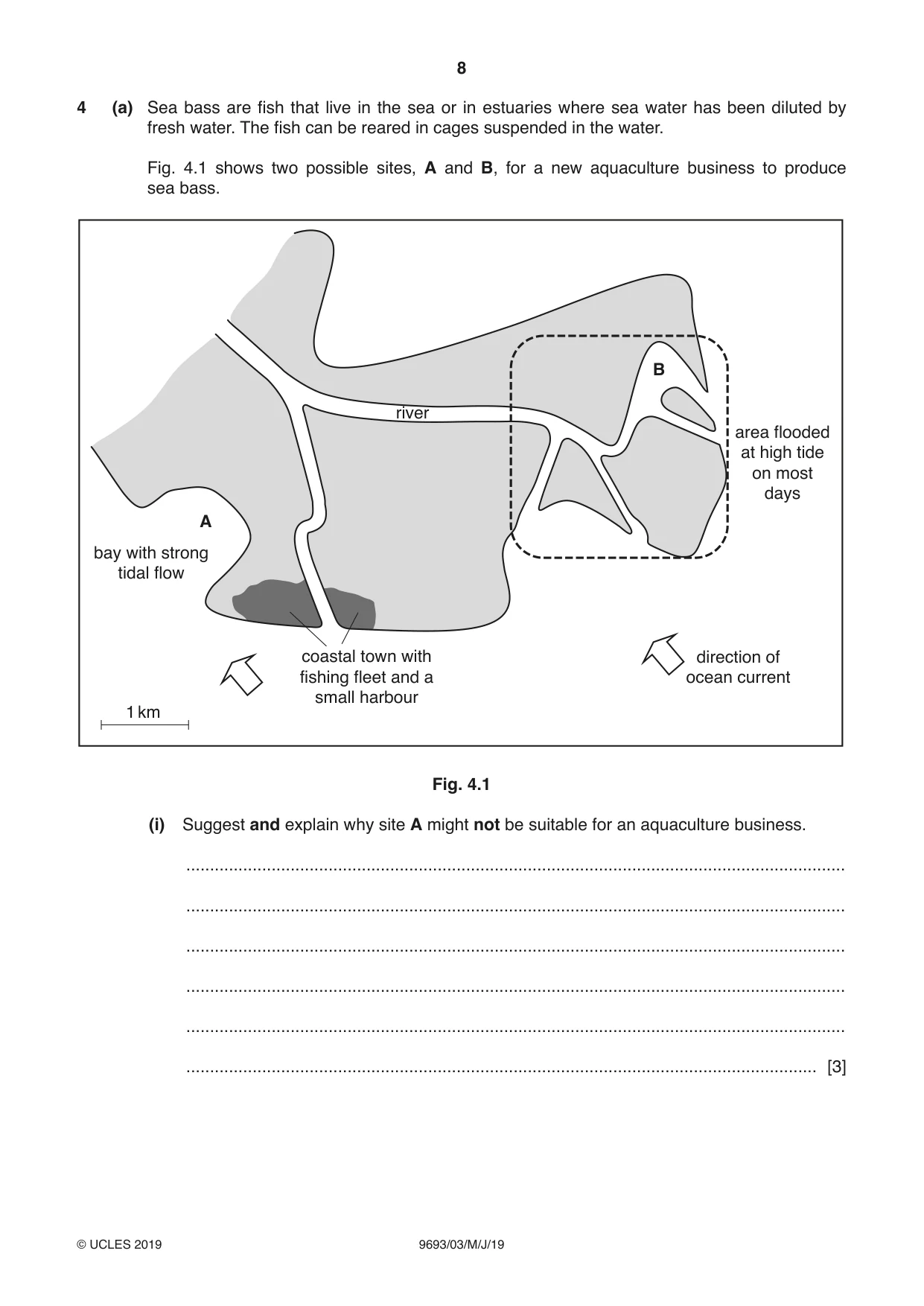
4 (a) Sea bass are fish that live in the sea or in estuaries where sea water has been diluted by fresh water. The fish can be reared in cages suspended in the water. Fig. 4.1 shows two possible sites, A and B, for a new aquaculture business to produce sea bass. B river area flooded at high tide on most days A bay with strong tidal flow coastal town with direction of fishing fleet and a ocean current small harbour 1 km Fig. 4.1 (i) Suggest and explain why site A might not be suitable for an aquaculture business. ........................................................................................................................................... ........................................................................................................................................... ........................................................................................................................................... ........................................................................................................................................... ........................................................................................................................................... ..................................................................................................................................... [3] (ii) Discuss, with reasons, whether the water quality at site B is likely to be suitable for the aquaculture of sea bass. ........................................................................................................................................... ........................................................................................................................................... ........................................................................................................................................... ........................................................................................................................................... ........................................................................................................................................... ..................................................................................................................................... [3] (b) The global expansion of aquaculture has increased concern about the quality of food it produces, the impact on the marine environment, and its sustainability. The Aquaculture Stewardship Council (ASC) was set up in 2010. It works with everyone associated with aquaculture, including producers, retailers, scientists, conservation groups and consumers to: • recognise and reward responsible aquaculture through the ASC aquaculture certification programme and seafood label. • promote best environmental and social choice when buying seafood. • contribute to transforming seafood markets towards sustainability. (i) State and explain two effects of the expansion of aquaculture on the marine environment that are a cause for concern. 1 ........................................................................................................................................ ........................................................................................................................................... 2 ........................................................................................................................................ ........................................................................................................................................... [2] (ii) Suggest two ways in which an ASC certification programme could help an aquaculture producer become more responsible. 1 ........................................................................................................................................ ........................................................................................................................................... ........................................................................................................................................... 2 ........................................................................................................................................ ........................................................................................................................................... ........................................................................................................................................... [2] [Total: 10]
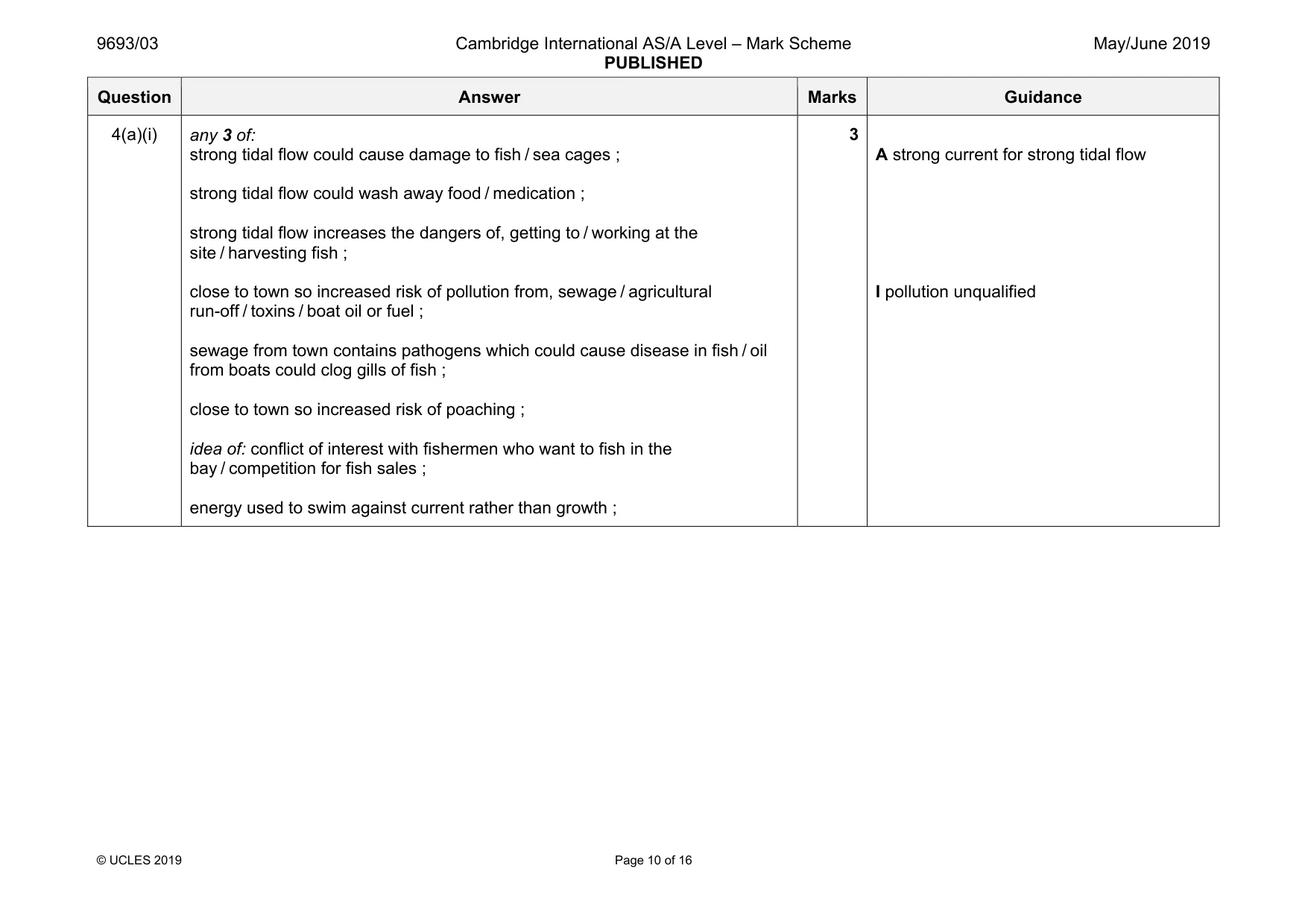
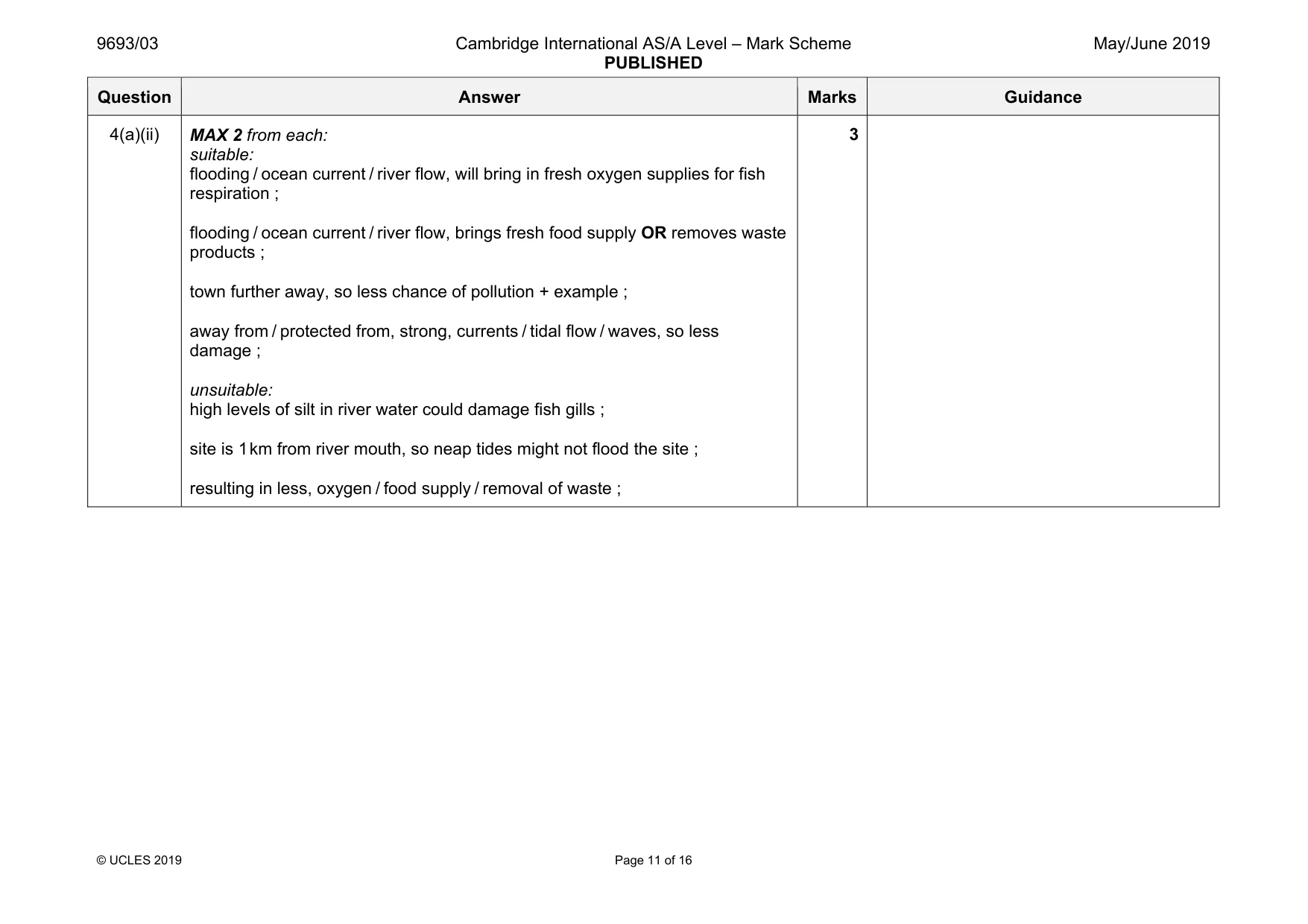
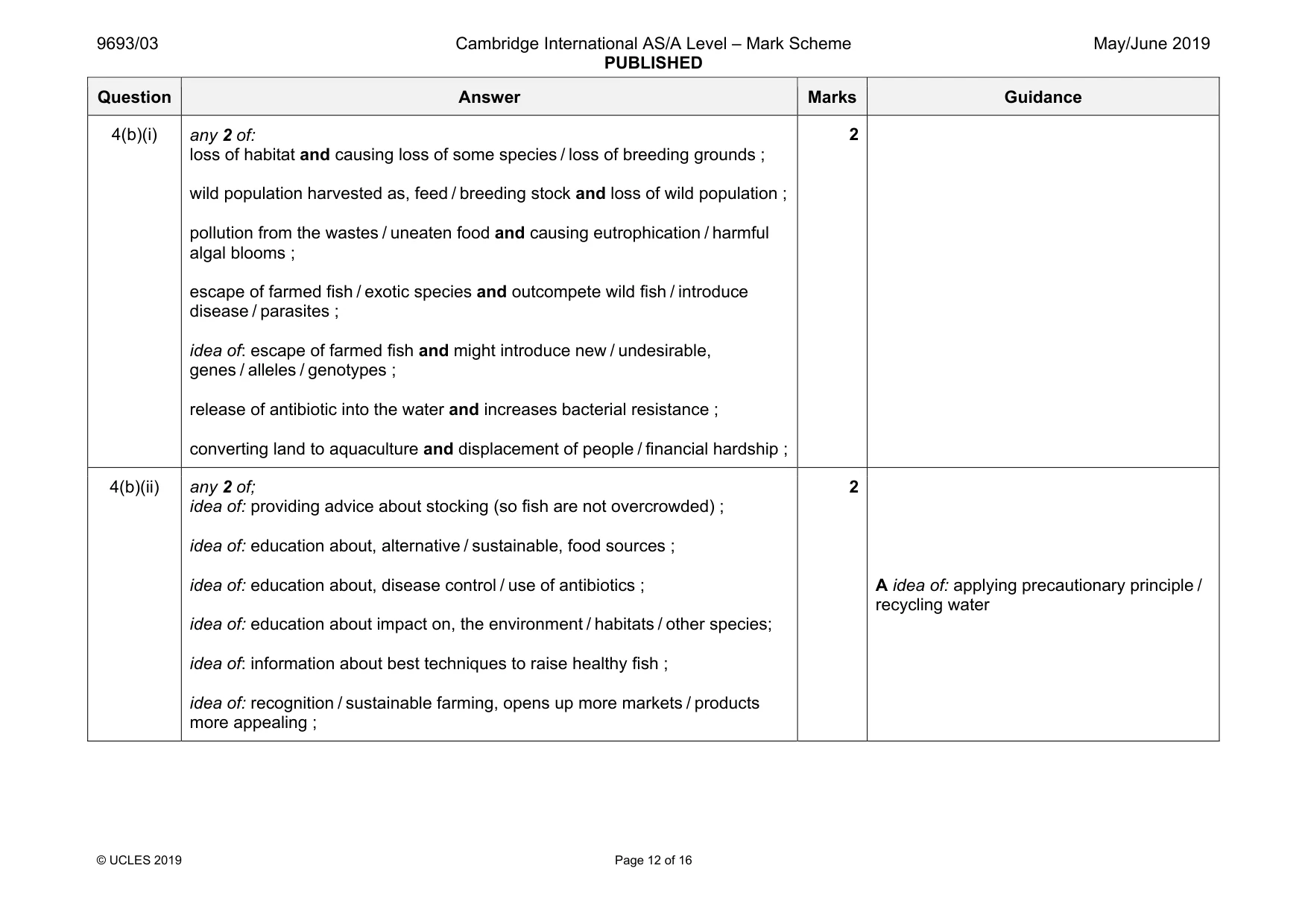
Mark scheme: 4(a)(i) any 3 of: strong tidal flow could cause damage to fish / sea cages ; strong tidal flow could wash away food / medication ; strong tidal flow increases the dangers of, getting to / working at the site / harvesting fish ; close to town so increased risk of pollution from, sewage / agricultural run-off / toxins / boat oil or fuel ; sewage from town contains pathogens which could cause disease in fish / oil from boats could clog gills of fish ; close to town so increased risk of poaching ; idea of: conflict of interest with fishermen who want to fish in the bay / competition for fish sales ; energy used to swim against current rather than growth ; 3 A strong current for strong tidal flow I pollution unqualified Question Answer Marks Guidance 4(a)(ii) MAX 2 from each: suitable: flooding / ocean current / river flow, will bring in fresh oxygen supplies for fish respiration ; flooding / ocean current / river flow, brings fresh food supply OR removes waste products ; town further away, so less chance of pollution + example ; away from / protected from, strong, currents / tidal flow / waves, so less damage ; unsuitable: high levels of silt in river water could damage fish gills ; site is 1 km from river mouth, so neap tides might not flood the site ; resulting in less, oxygen / food supply / removal of waste ; 3 Question Answer Marks Guidance 4(b)(i) any 2 of: loss of habitat and causing loss of some species / loss of breeding grounds ; wild population harvested as, feed / breeding stock and loss of wild population ; pollution from the wastes / uneaten food and causing eutrophication / harmful algal blooms ; escape of farmed fish / exotic species and outcompete wild fish / introduce disease / parasites ; idea of: escape of farmed fish and might introduce new / undesirable, genes / alleles / genotypes ; release of antibiotic into the water and increases bacterial resistance ; converting land to aquaculture and displacement of people / financial hardship ; 2 4(b)(ii) any 2 of; idea of: providing advice about stocking (so fish are not overcrowded) ; idea of: education about, alternative / sustainable, food sources ; idea of: education about, disease control / use of antibiotics ; idea of: education about impact on, the environment / habitats / other species; idea of: information about best techniques to raise healthy fish ; idea of: recognition / sustainable farming, opens up more markets / products more appealing ; 2 A idea of: applying precautionary principle / recycling water
Q5 · Iceland is a large island in the North Atlantic Ocean
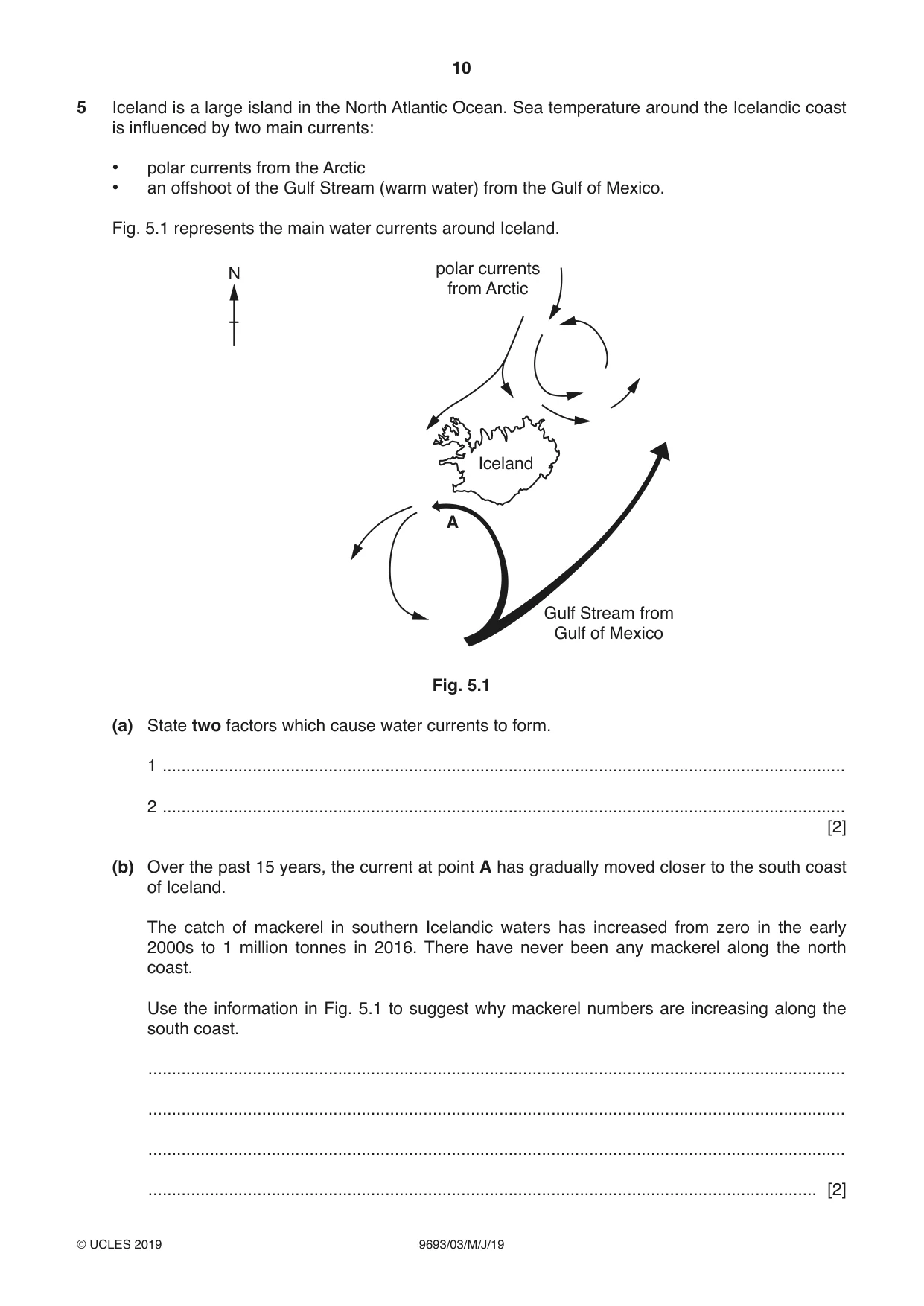
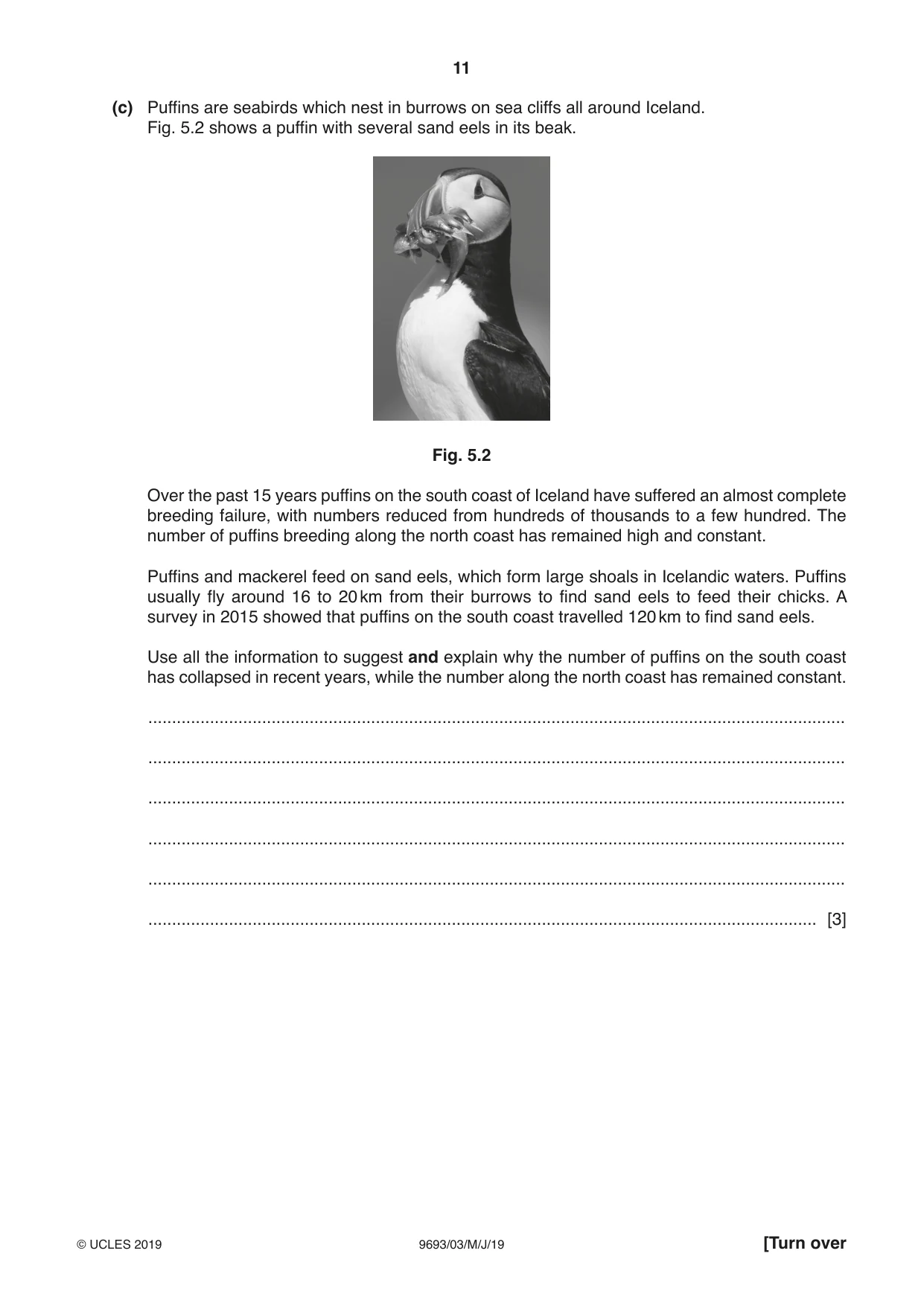
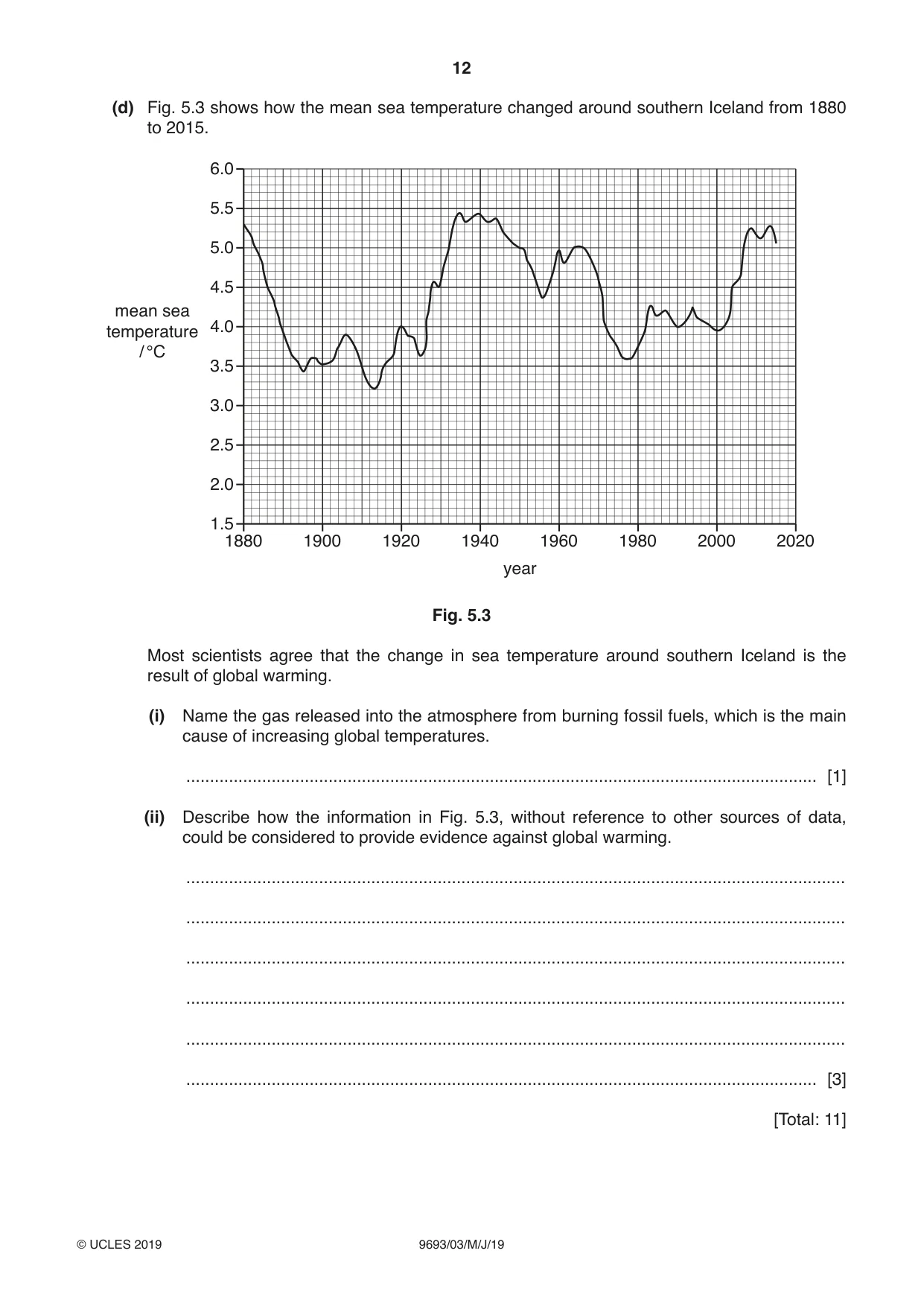
5 Iceland is a large island in the North Atlantic Ocean. Sea temperature around the Icelandic coast is influenced by two main currents: • polar currents from the Arctic • an offshoot of the Gulf Stream (warm water) from the Gulf of Mexico. Fig. 5.1 represents the main water currents around Iceland. polar currents N from Arctic Iceland A Gulf Stream from Gulf of Mexico Fig. 5.1 (a) State two factors which cause water currents to form. 1 ................................................................................................................................................ 2 ................................................................................................................................................ [2] (b) Over the past 15 years, the current at point A has gradually moved closer to the south coast of Iceland. The catch of mackerel in southern Icelandic waters has increased from zero in the early 2000s to 1 million tonnes in 2016. There have never been any mackerel along the north coast. Use the information in Fig. 5.1 to suggest why mackerel numbers are increasing along the south coast. ................................................................................................................................................... ................................................................................................................................................... ................................................................................................................................................... ............................................................................................................................................. [2] (c) Puffins are seabirds which nest in burrows on sea cliffs all around Iceland. Fig. 5.2 shows a puffin with several sand eels in its beak. Fig. 5.2 Over the past 15 years puffins on the south coast of Iceland have suffered an almost complete breeding failure, with numbers reduced from hundreds of thousands to a few hundred. The number of puffins breeding along the north coast has remained high and constant. Puffins and mackerel feed on sand eels, which form large shoals in Icelandic waters. Puffins usually fly around 16 to 20 km from their burrows to find sand eels to feed their chicks. A survey in 2015 showed that puffins on the south coast travelled 120 km to find sand eels. Use all the information to suggest and explain why the number of puffins on the south coast has collapsed in recent years, while the number along the north coast has remained constant. ................................................................................................................................................... ................................................................................................................................................... ................................................................................................................................................... ................................................................................................................................................... ................................................................................................................................................... ............................................................................................................................................. [3] (d) Fig. 5.3 shows how the mean sea temperature changed around southern Iceland from 1880 to 2015. 6.0 5.5 5.0 4.5 mean sea 4.0temperature / °C 3.5 3.0 2.5 2.0 1.5 1880 1900 1920 1940 1960 1980 2000 2020 year Fig. 5.3 Most scientists agree that the change in sea temperature around southern Iceland is the result of global warming. (i) Name the gas released into the atmosphere from burning fossil fuels, which is the main cause of increasing global temperatures. ..................................................................................................................................... [1] (ii) Describe how the information in Fig. 5.3, without reference to other sources of data, could be considered to provide evidence against global warming. ........................................................................................................................................... ........................................................................................................................................... ........................................................................................................................................... ........................................................................................................................................... ........................................................................................................................................... ..................................................................................................................................... [3] [Total: 11]
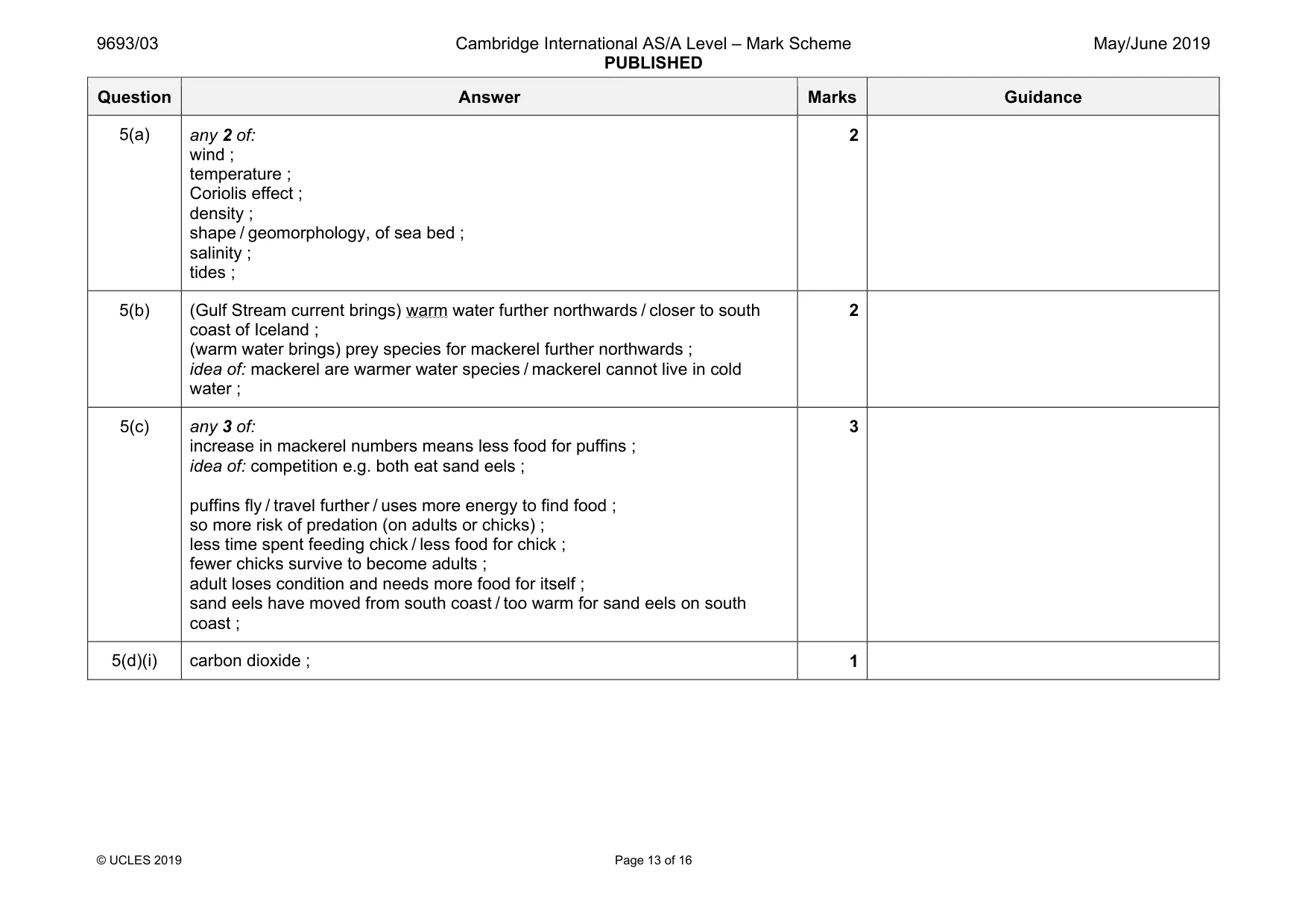
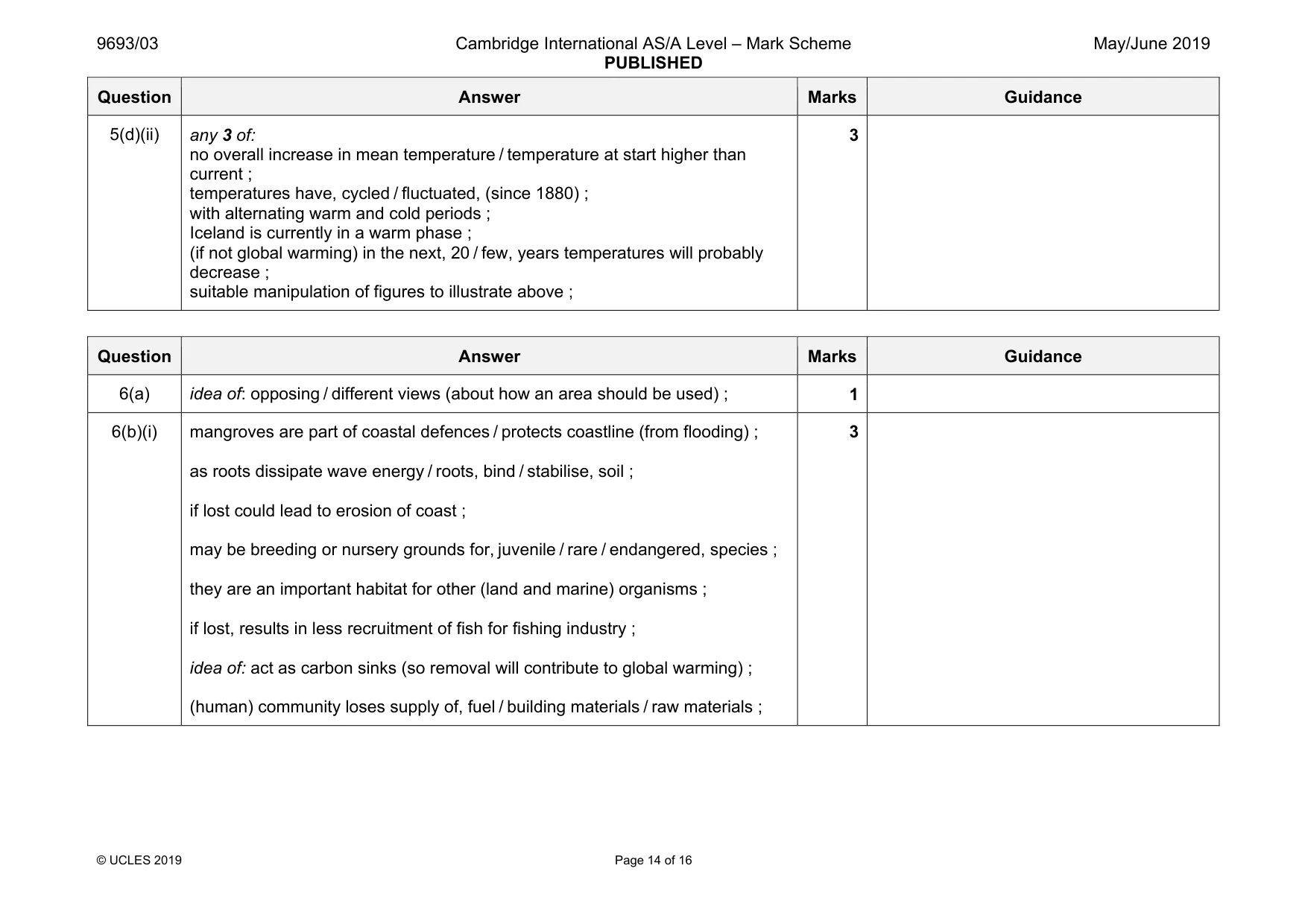
Mark scheme: 5(a) any 2 of: wind ; temperature ; Coriolis effect ; density ; shape / geomorphology, of sea bed ; salinity ; tides ; 2 5(b) (Gulf Stream current brings) warm water further northwards / closer to south coast of Iceland ; (warm water brings) prey species for mackerel further northwards ; idea of: mackerel are warmer water species / mackerel cannot live in cold water ; 2 5(c) any 3 of: increase in mackerel numbers means less food for puffins ; idea of: competition e.g. both eat sand eels ; puffins fly / travel further / uses more energy to find food ; so more risk of predation (on adults or chicks) ; less time spent feeding chick / less food for chick ; fewer chicks survive to become adults ; adult loses condition and needs more food for itself ; sand eels have moved from south coast / too warm for sand eels on south coast ; 3 5(d)(i) carbon dioxide ; 1 Question Answer Marks Guidance 5(d)(ii) any 3 of: no overall increase in mean temperature / temperature at start higher than current ; temperatures have, cycled / fluctuated, (since 1880) ; with alternating warm and cold periods ; Iceland is currently in a warm phase ; (if not global warming) in the next, 20 / few, years temperatures will probably decrease ; suitable manipulation of figures to illustrate above ; 3
Q6 · Read the information about coastal areas
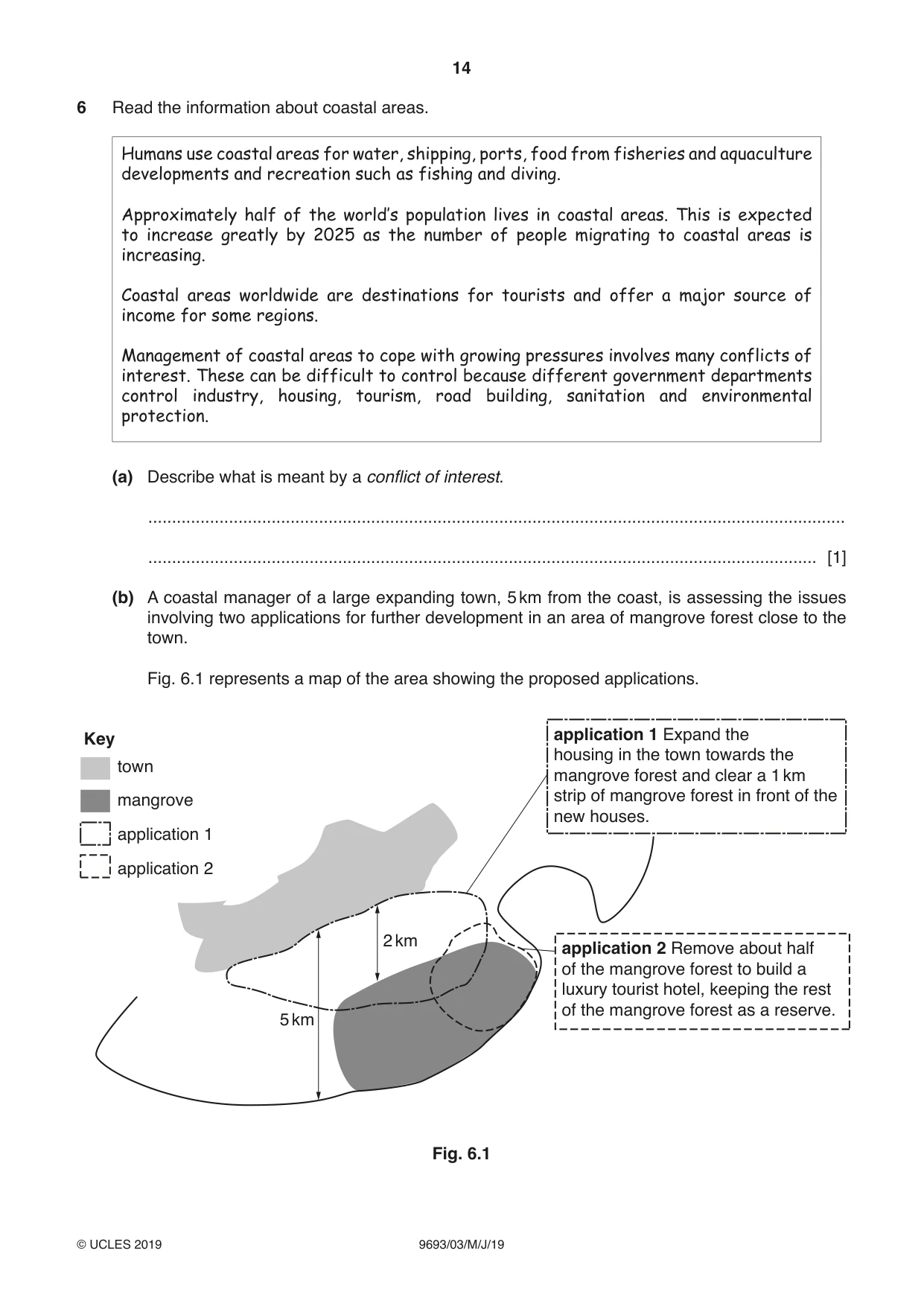
6 Read the information about coastal areas. Humans use coastal areas for water, shipping, ports, food from fisheries and aquaculture developments and recreation such as fishing and diving. Approximately half of the world’s population lives in coastal areas. This is expected to increase greatly by 2025 as the number of people migrating to coastal areas is increasing. Coastal areas worldwide are destinations for tourists and offer a major source of income for some regions. Management of coastal areas to cope with growing pressures involves many conflicts of interest. These can be difficult to control because different government departments control industry, housing, tourism, road building, sanitation and environmental protection. (a) Describe what is meant by a conflict of interest. ................................................................................................................................................... ............................................................................................................................................. [1] (b) A coastal manager of a large expanding town, 5 km from the coast, is assessing the issues involving two applications for further development in an area of mangrove forest close to the town. Fig. 6.1 represents a map of the area showing the proposed applications. application 1 Expand the Key housing in the town towards the town mangrove forest and clear a 1 km strip of mangrove forest in front of the mangrove new houses. application 1 application 2 2 km application 2 Remove about half of the mangrove forest to build a luxury tourist hotel, keeping the rest of the mangrove forest as a reserve. 5 km Fig. 6.1 (i) Explain the negative effects of the removal of mangrove forests from coastal areas. ........................................................................................................................................... ........................................................................................................................................... ........................................................................................................................................... ........................................................................................................................................... ........................................................................................................................................... ..................................................................................................................................... [3] (ii) The use of land is a source of conflict of interest between the tourism department and the housing department. Suggest one argument the housing department could make to support application 1 and one argument the tourism department could make to support application 2. housing department .......................................................................................................... ........................................................................................................................................... ........................................................................................................................................... tourism department ........................................................................................................... ........................................................................................................................................... ........................................................................................................................................... [2] [Total: 6]
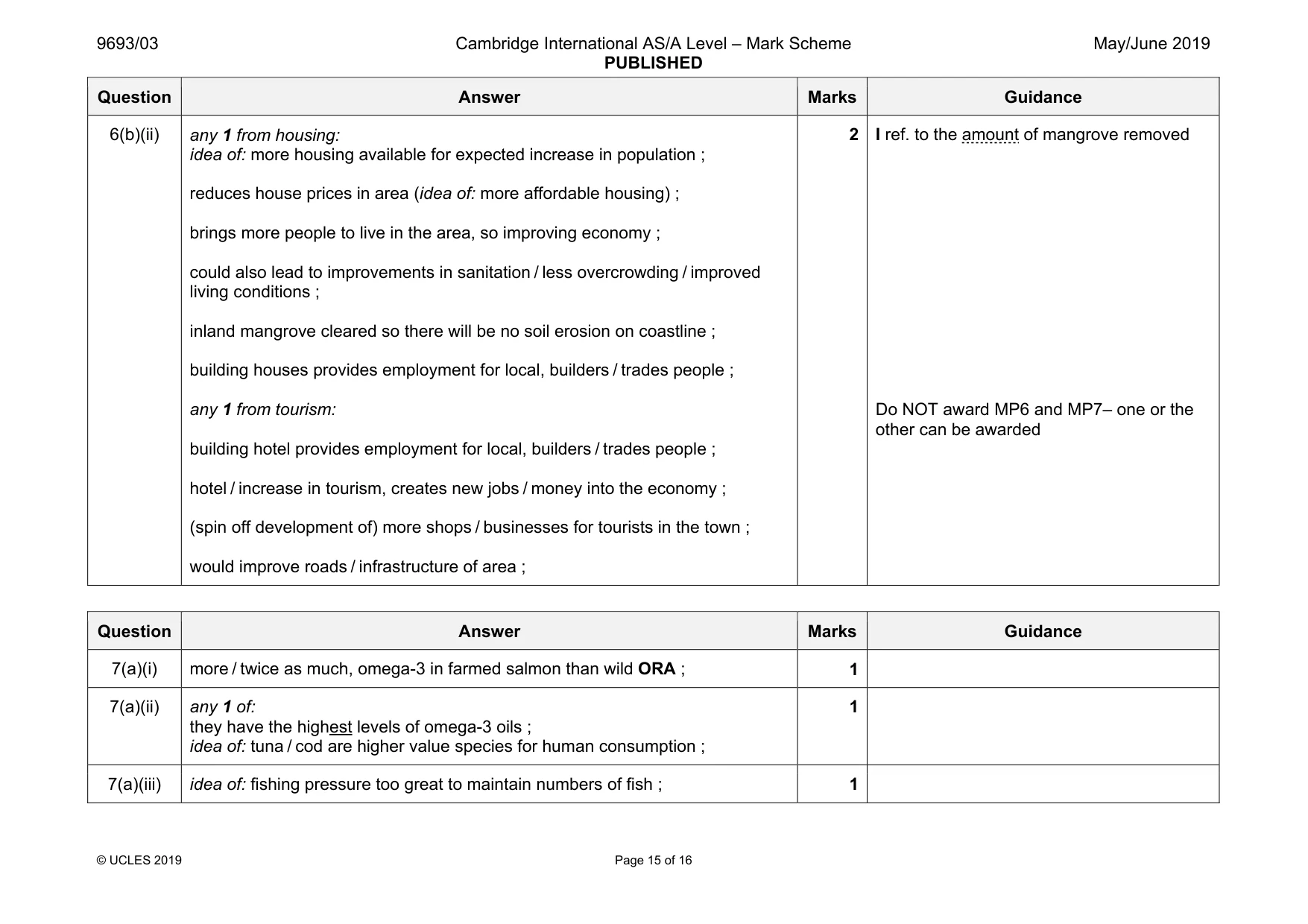
Mark scheme: 6(a) idea of: opposing / different views (about how an area should be used) ; 1 6(b)(i) mangroves are part of coastal defences / protects coastline (from flooding) ; as roots dissipate wave energy / roots, bind / stabilise, soil ; if lost could lead to erosion of coast ; may be breeding or nursery grounds for, juvenile / rare / endangered, species ; they are an important habitat for other (land and marine) organisms ; if lost, results in less recruitment of fish for fishing industry ; idea of: act as carbon sinks (so removal will contribute to global warming) ; (human) community loses supply of, fuel / building materials / raw materials ; 3 Question Answer Marks Guidance 6(b)(ii) any 1 from housing: idea of: more housing available for expected increase in population ; reduces house prices in area (idea of: more affordable housing) ; brings more people to live in the area, so improving economy ; could also lead to improvements in sanitation / less overcrowding / improved living conditions ; inland mangrove cleared so there will be no soil erosion on coastline ; building houses provides employment for local, builders / trades people ; any 1 from tourism: building hotel provides employment for local, builders / trades people ; hotel / increase in tourism, creates new jobs / money into the economy ; (spin off development of) more shops / businesses for tourists in the town ; would improve roads / infrastructure of area ; 2 I ref. to the amount of mangrove removed Do NOT award MP6 and MP7– one or the other can be awarded
Q7 · Omega-3 oils are an important part of the human diet
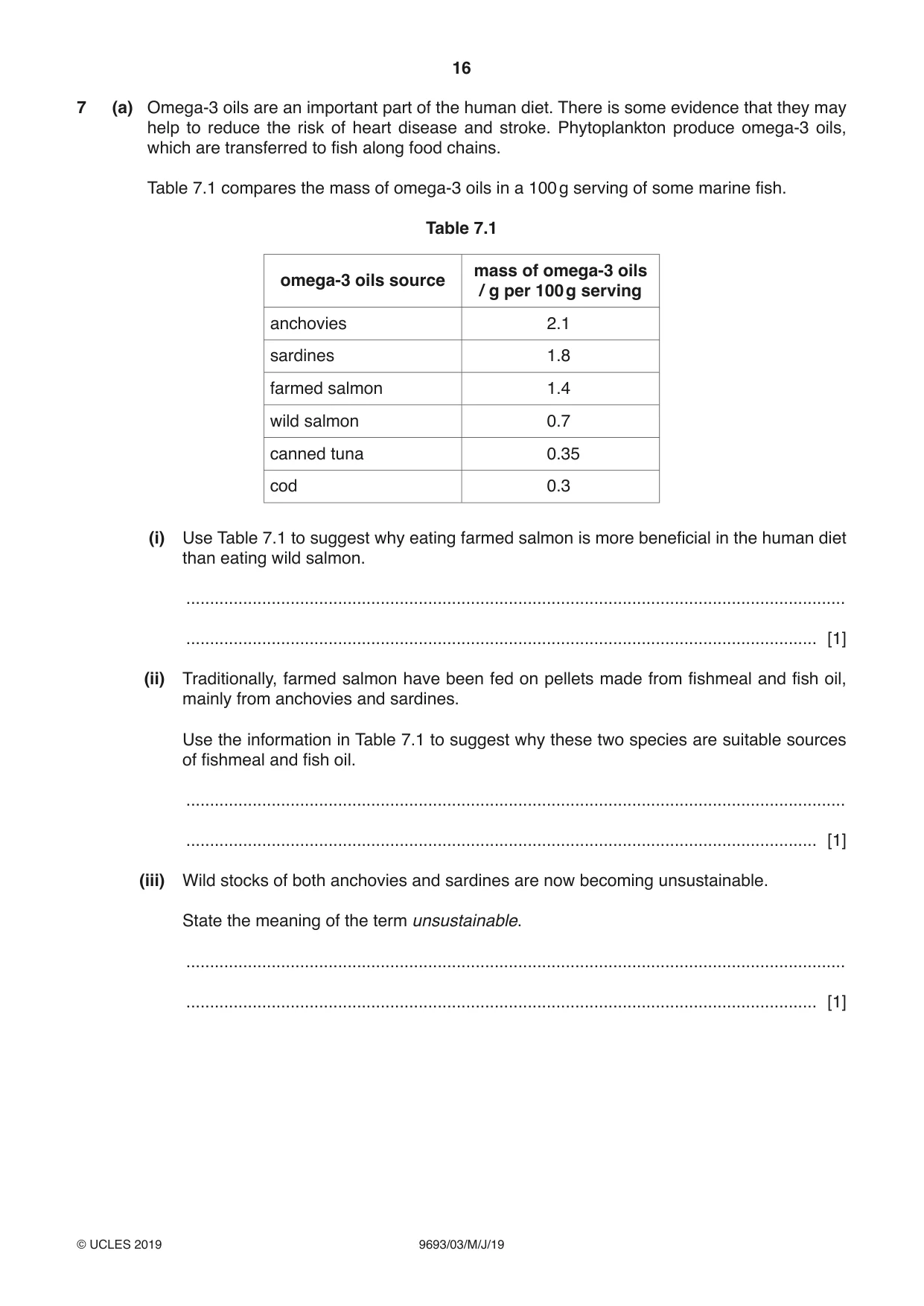
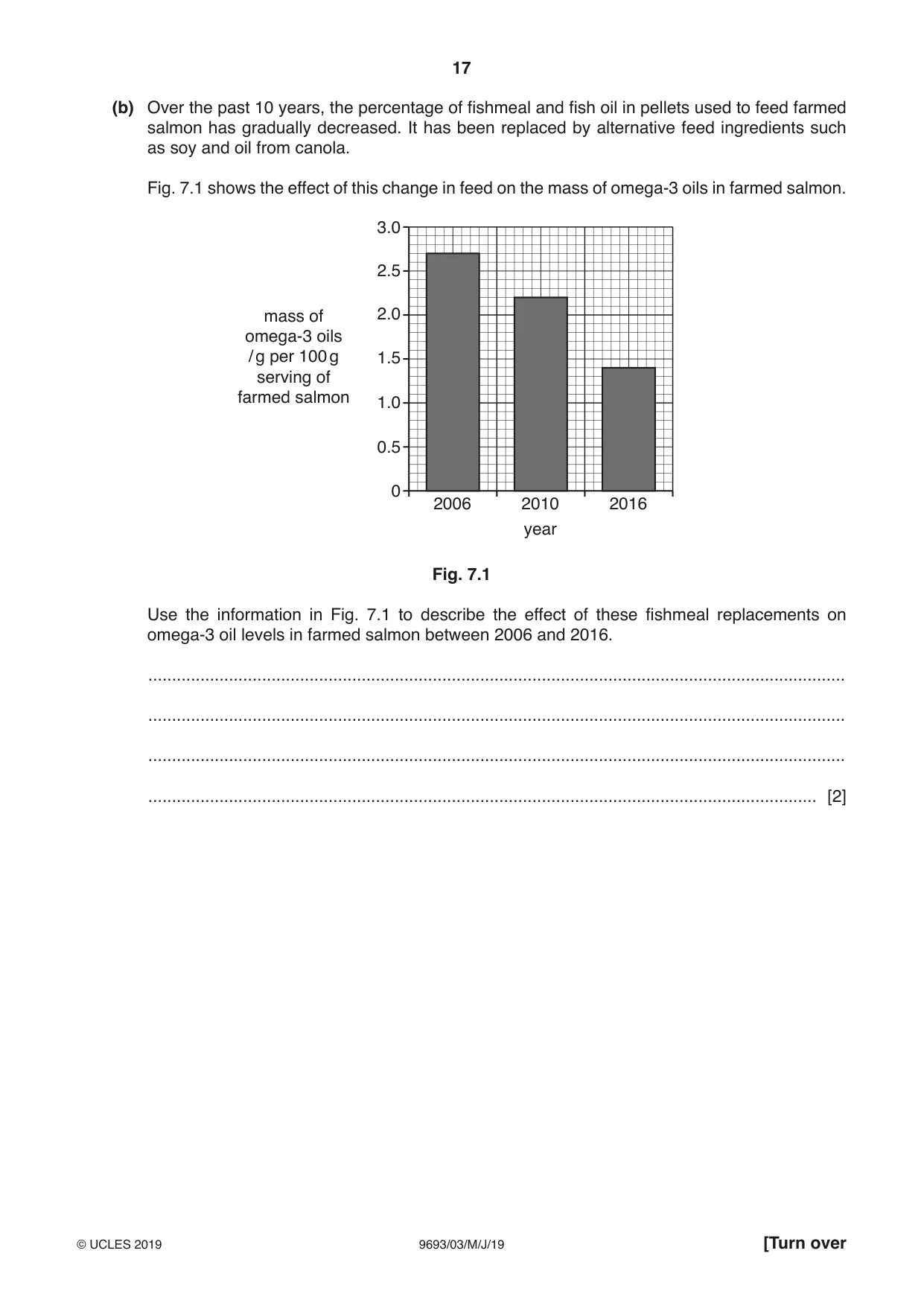
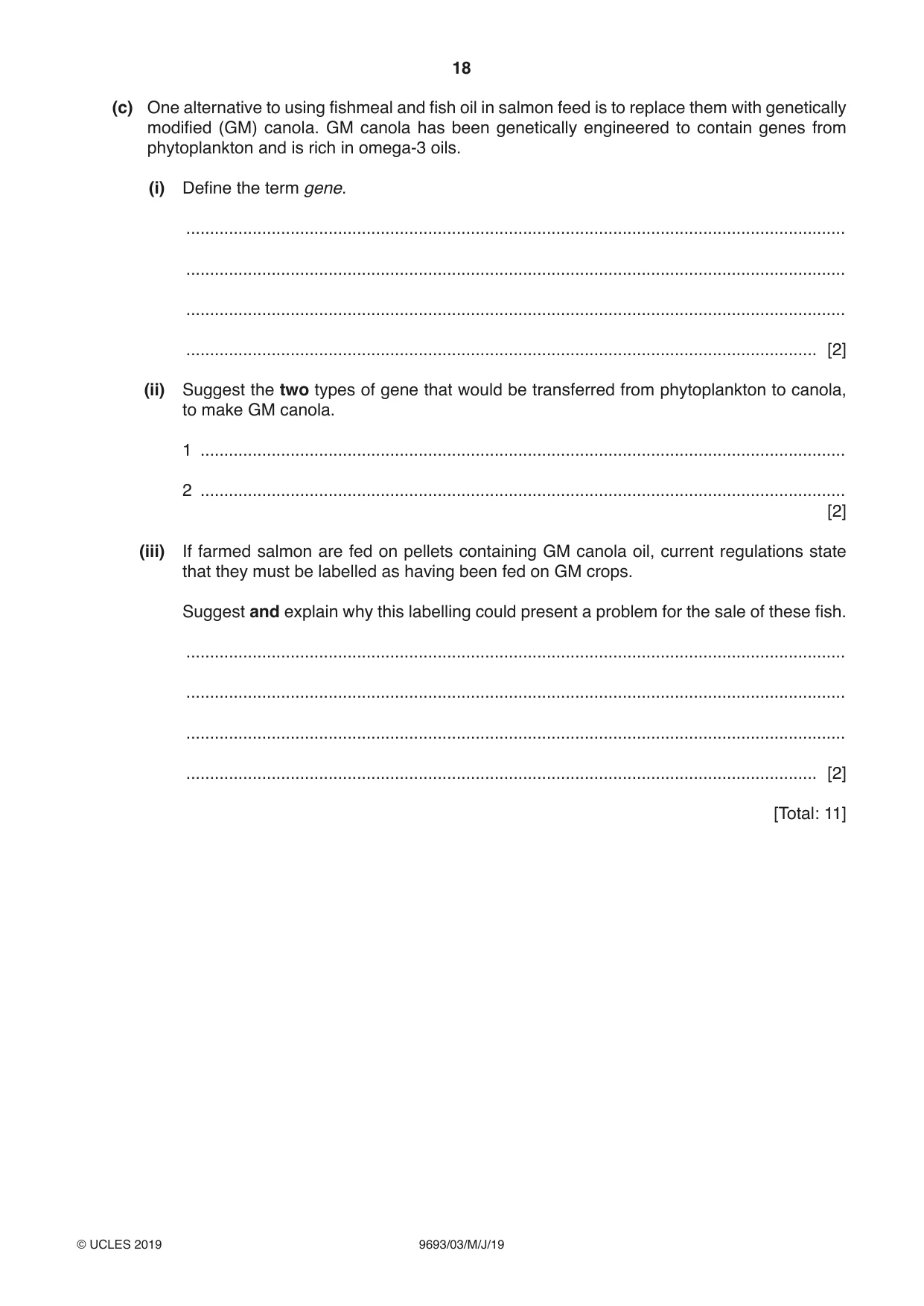
7 (a) Omega-3 oils are an important part of the human diet. There is some evidence that they may help to reduce the risk of heart disease and stroke. Phytoplankton produce omega-3 oils, which are transferred to fish along food chains. Table 7.1 compares the mass of omega-3 oils in a 100 g serving of some marine fish. Table 7.1 mass of omega-3 oils omega-3 oils source / g per 100 g serving anchovies 2.1 sardines 1.8 farmed salmon 1.4 wild salmon 0.7 canned tuna 0.35 cod 0.3 (i) Use Table 7.1 to suggest why eating farmed salmon is more beneficial in the human diet than eating wild salmon. ........................................................................................................................................... ..................................................................................................................................... [1] (ii) Traditionally, farmed salmon have been fed on pellets made from fishmeal and fish oil, mainly from anchovies and sardines. Use the information in Table 7.1 to suggest why these two species are suitable sources of fishmeal and fish oil. ........................................................................................................................................... ..................................................................................................................................... [1] (iii) Wild stocks of both anchovies and sardines are now becoming unsustainable. State the meaning of the term unsustainable. ........................................................................................................................................... ..................................................................................................................................... [1] (b) Over the past 10 years, the percentage of fishmeal and fish oil in pellets used to feed farmed salmon has gradually decreased. It has been replaced by alternative feed ingredients such as soy and oil from canola. Fig. 7.1 shows the effect of this change in feed on the mass of omega-3 oils in farmed salmon. 3.0 2.5 mass of 2.0 omega-3 oils / g per 100 g 1.5 serving of farmed salmon 1.0 0.5 0 2006 2010 2016 year Fig. 7.1 Use the information in Fig. 7.1 to describe the effect of these fishmeal replacements on omega-3 oil levels in farmed salmon between 2006 and 2016. ................................................................................................................................................... ................................................................................................................................................... ................................................................................................................................................... ............................................................................................................................................. [2] (c) One alternative to using fishmeal and fish oil in salmon feed is to replace them with genetically modified (GM) canola. GM canola has been genetically engineered to contain genes from phytoplankton and is rich in omega-3 oils. (i) Define the term gene. ........................................................................................................................................... ........................................................................................................................................... ........................................................................................................................................... ..................................................................................................................................... [2] (ii) Suggest the two types of gene that would be transferred from phytoplankton to canola, to make GM canola. 1 ........................................................................................................................................ 2 ........................................................................................................................................ [2] (iii) If farmed salmon are fed on pellets containing GM canola oil, current regulations state that they must be labelled as having been fed on GM crops. Suggest and explain why this labelling could present a problem for the sale of these fish. ........................................................................................................................................... ........................................................................................................................................... ........................................................................................................................................... ..................................................................................................................................... [2] [Total: 11]
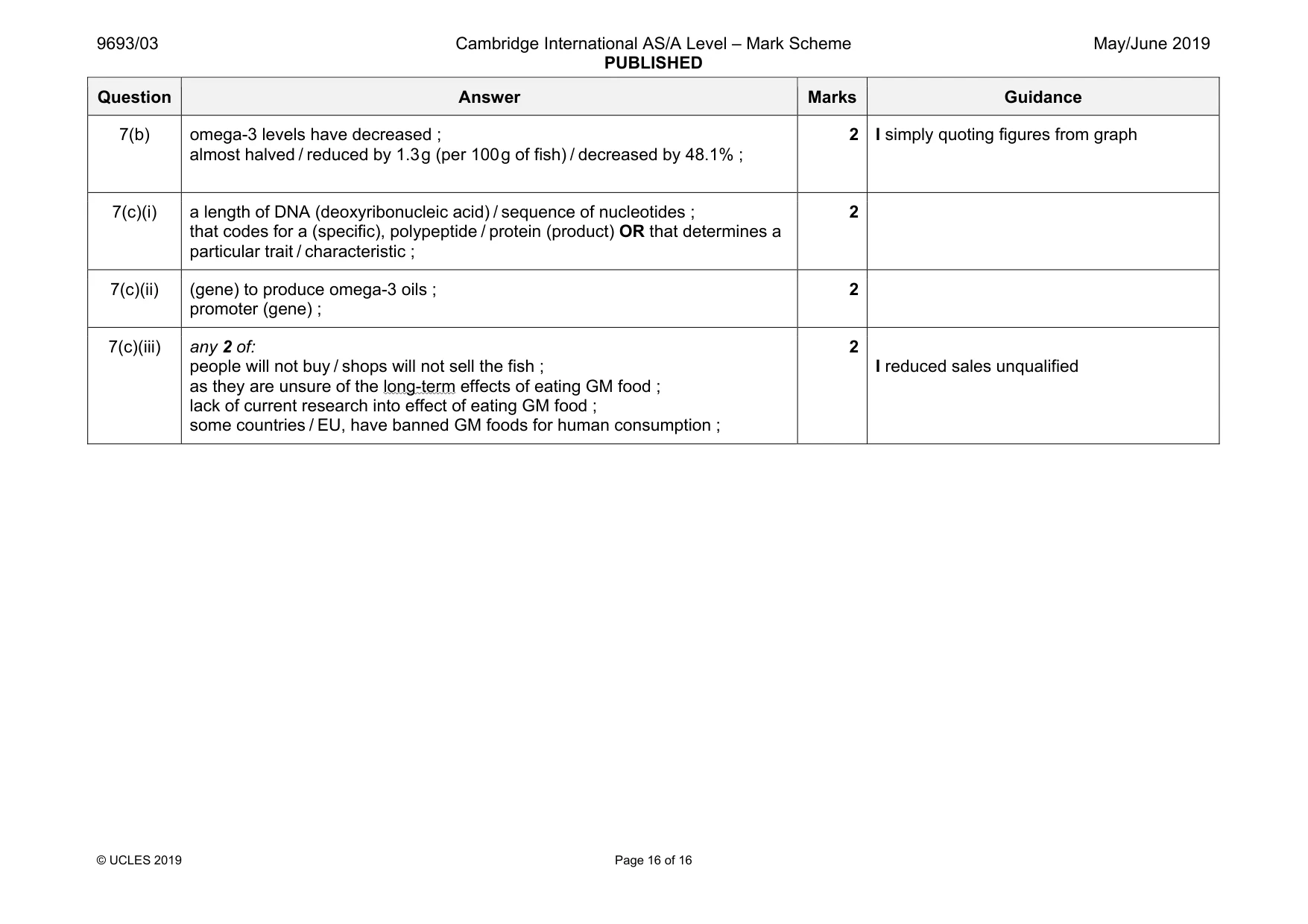
Mark scheme: 7(a)(i) more / twice as much, omega-3 in farmed salmon than wild ORA ; 1 7(a)(ii) any 1 of: they have the highest levels of omega-3 oils ; idea of: tuna / cod are higher value species for human consumption ; 1 7(a)(iii) idea of: fishing pressure too great to maintain numbers of fish ; 1 Question Answer Marks Guidance 7(b) omega-3 levels have decreased ; almost halved / reduced by 1.3 g (per 100 g of fish) / decreased by 48.1% ; 2 I simply quoting figures from graph 7(c)(i) a length of DNA (deoxyribonucleic acid) / sequence of nucleotides ; that codes for a (specific), polypeptide / protein (product) OR that determines a particular trait / characteristic ; 2 7(c)(ii) (gene) to produce omega-3 oils ; promoter (gene) ; 2 7(c)(iii) any 2 of: people will not buy / shops will not sell the fish ; as they are unsure of the long-term effects of eating GM food ; lack of current research into effect of eating GM food ; some countries / EU, have banned GM foods for human consumption ; 2 I reduced sales unqualified
What was in this paper
The subtopics covered by these 7 questions, and how many questions each got. Open one in a new tab to see every Cambridge question on it.
What you needed in this session
Cambridge’s own grade thresholds for 2019 May/June, Paper 3 · Variant 1. A higher threshold means an easier paper — the bar moves with how the cohort did.