Cambridge A Level Marine Science 9693 — 2023 Oct/Nov Paper 3 · Variant 1
9693/31/O/N/23 · 7 questions · 75 marks · ≈84 min
The question paper and its mark scheme, free to read here and free to download. This is Cambridge’s own paper, exactly as it was sat.
Question paper16 pages

Mark scheme11 pages
Answers below. Sit the paper first if you are practising.
Questions as text
Q1 · An animal cell from a marine organism as seen under an electron microscope
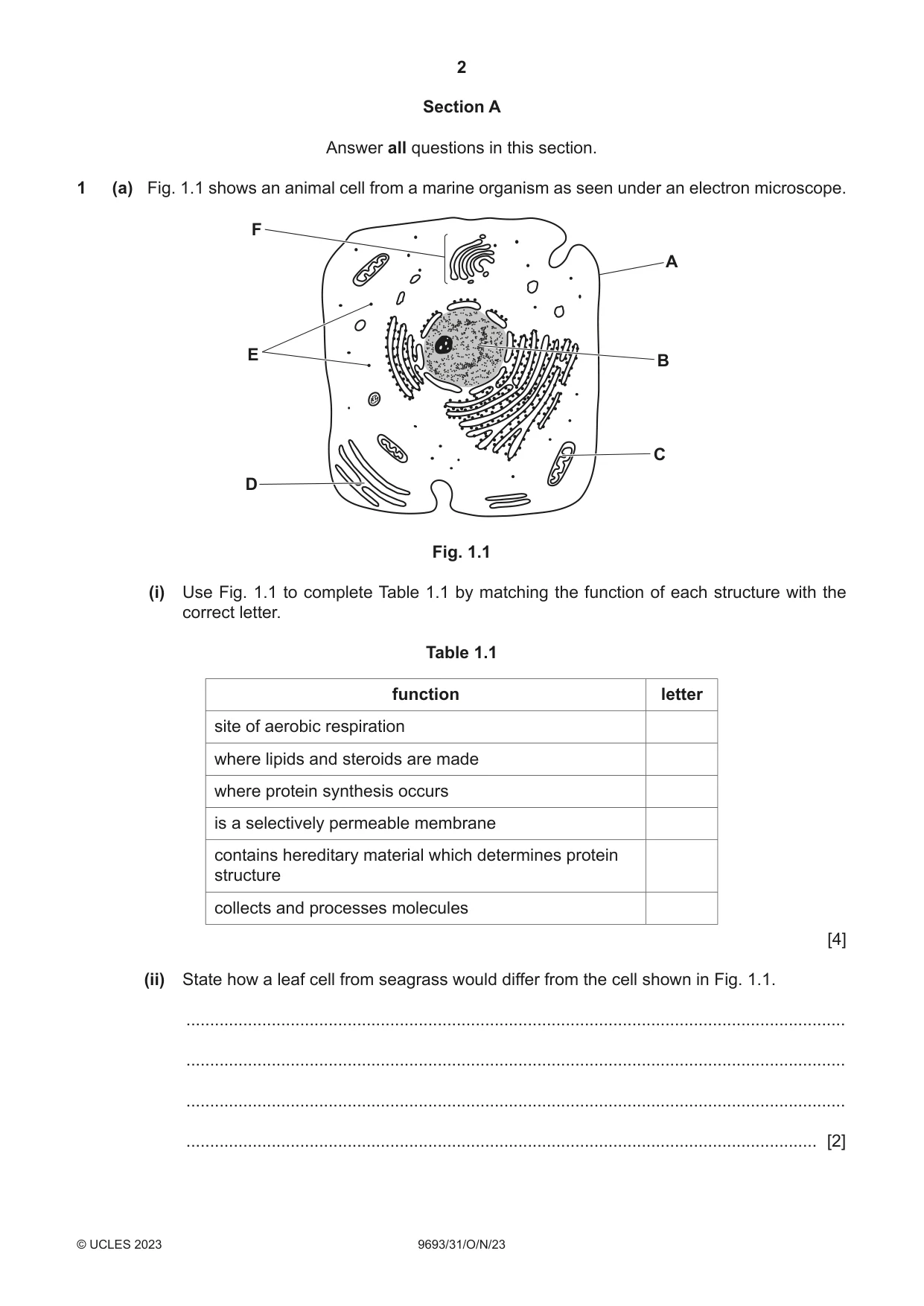
1 (a) Fig. 1.1 shows an animal cell from a marine organism as seen under an electron microscope. F A E B C D Fig. 1.1 (i) Use Fig. 1.1 to complete Table 1.1 by matching the function of each structure with the correct letter. Table 1.1 function letter site of aerobic respiration where lipids and steroids are made where protein synthesis occurs is a selectively permeable membrane contains hereditary material which determines protein structure collects and processes molecules [4] (ii) State how a leaf cell from seagrass would differ from the cell shown in Fig. 1.1. ........................................................................................................................................... ........................................................................................................................................... ........................................................................................................................................... ..................................................................................................................................... [2] (iii) Seagrass has spaces inside its leaves that allow oxygen to diffuse to the cells in its roots. Explain the importance of oxygen for energy release in root cells. ........................................................................................................................................... ........................................................................................................................................... ........................................................................................................................................... ..................................................................................................................................... [2] [Total: 8]
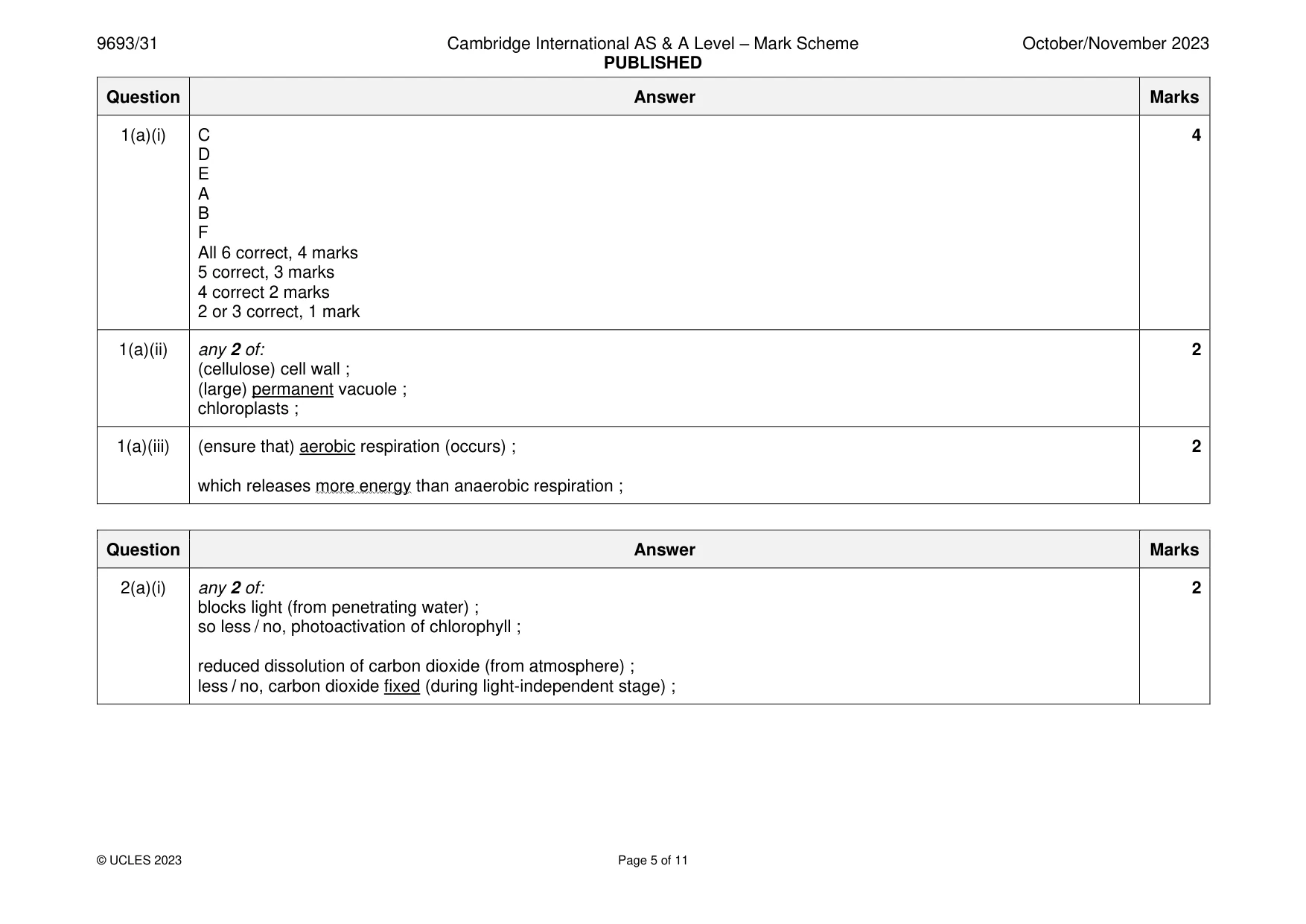
Mark scheme: Question Answer Marks 1(a)(i) C 4 D E A B F All 6 correct, 4 marks 5 correct, 3 marks 4 correct 2 marks 2 or 3 correct, 1 mark 1(a)(ii) any 2 of: 2 (cellulose) cell wall ; (large) permanent vacuole ; chloroplasts ; 1(a)(iii) (ensure that) aerobic respiration (occurs) ; 2 which releases more energy than anaerobic respiration ;
Q2 · In July 2020, an oil tanker ran aground on coral reefs just off the coast of Mauritius in…
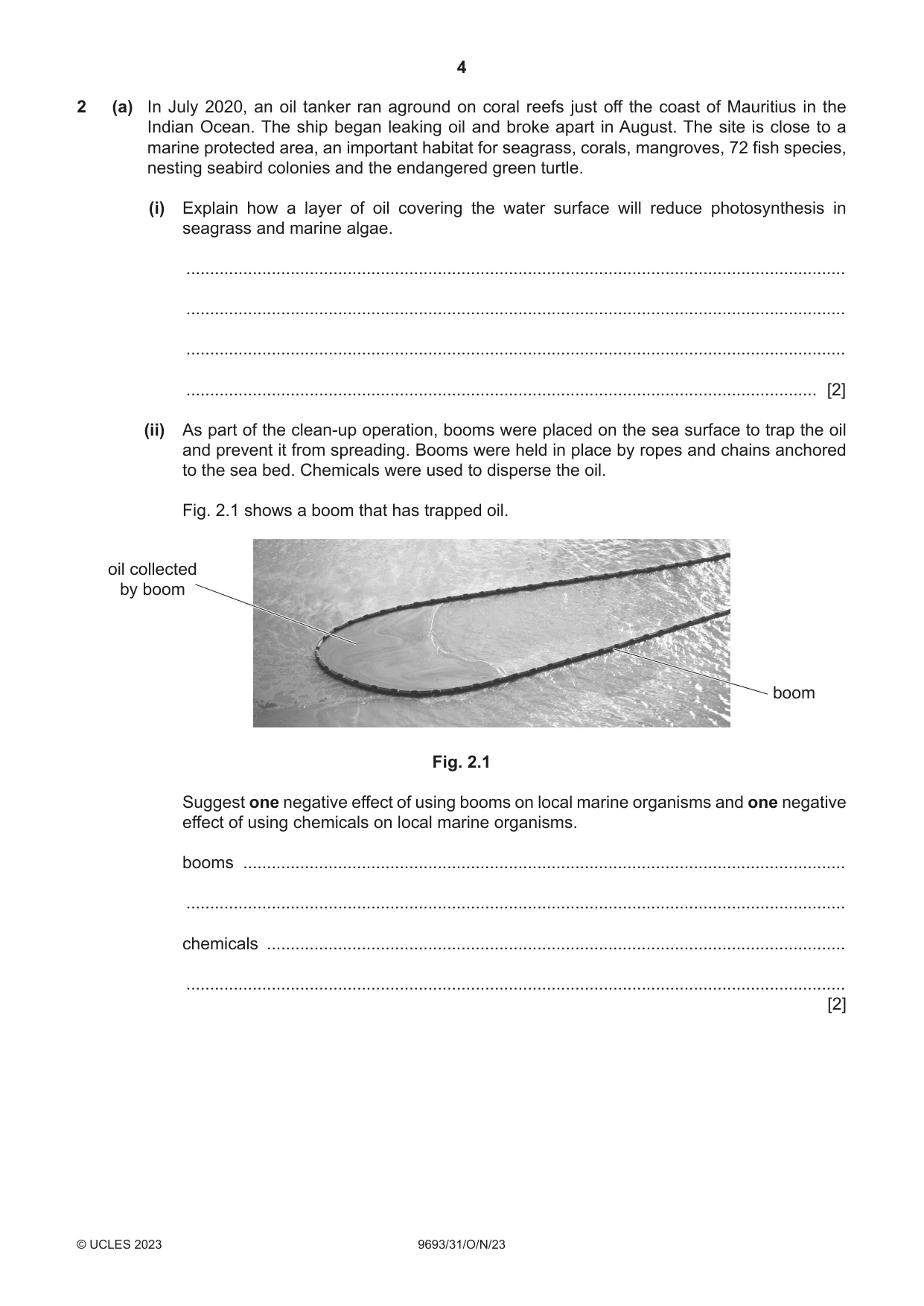
2 (a) In July 2020, an oil tanker ran aground on coral reefs just off the coast of Mauritius in the Indian Ocean. The ship began leaking oil and broke apart in August. The site is close to a marine protected area, an important habitat for seagrass, corals, mangroves, 72 fish species, nesting seabird colonies and the endangered green turtle. (i) Explain how a layer of oil covering the water surface will reduce photosynthesis in seagrass and marine algae. ........................................................................................................................................... ........................................................................................................................................... ........................................................................................................................................... ..................................................................................................................................... [2] (ii) As part of the clean-up operation, booms were placed on the sea surface to trap the oil and prevent it from spreading. Booms were held in place by ropes and chains anchored to the sea bed. Chemicals were used to disperse the oil. Fig. 2.1 shows a boom that has trapped oil. oil collected by boom boom Fig. 2.1 Suggest one negative effect of using booms on local marine organisms and one negative effect of using chemicals on local marine organisms. booms ............................................................................................................................... ........................................................................................................................................... chemicals .......................................................................................................................... ........................................................................................................................................... [2] (b) Explain the negative effects of the oil spill on nesting seabird colonies. ................................................................................................................................................... ................................................................................................................................................... ................................................................................................................................................... ................................................................................................................................................... ................................................................................................................................................... ............................................................................................................................................. [3] (c) Tourism and fishing are the main sources of employment in this area. Suggest and explain the long-term effect of the oil spill on the local human population. ................................................................................................................................................... ................................................................................................................................................... ................................................................................................................................................... ................................................................................................................................................... ................................................................................................................................................... ............................................................................................................................................. [3] [Total: 10]
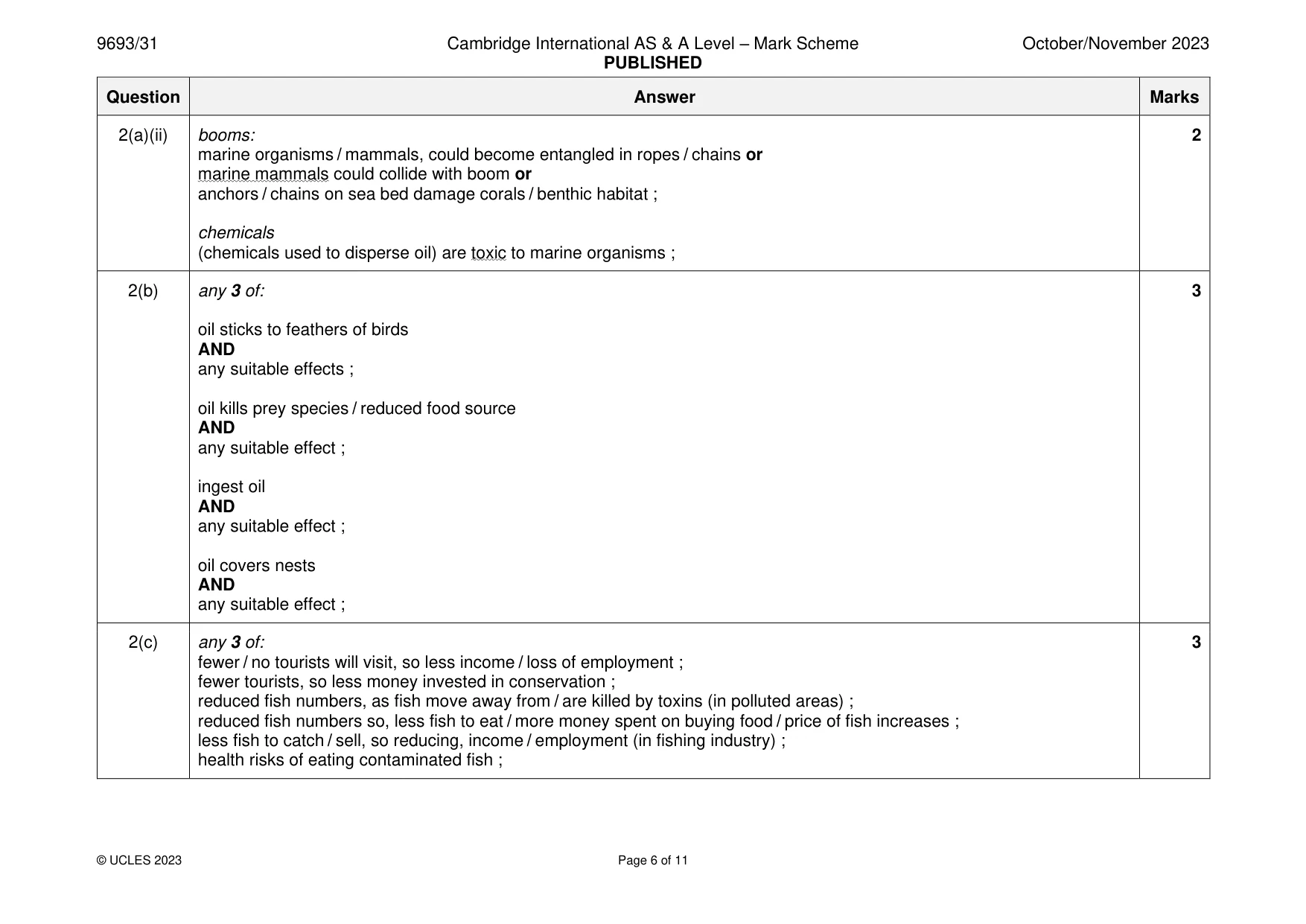
Mark scheme: 2(a)(i) any 2 of: 2 blocks light (from penetrating water) ; so less / no, photoactivation of chlorophyll ; reduced dissolution of carbon dioxide (from atmosphere) ; less / no, carbon dioxide fixed (during light-independent stage) ; 2(a)(ii) booms: 2 marine organisms / mammals, could become entangled in ropes / chains or marine mammals could collide with boom or anchors / chains on sea bed damage corals / benthic habitat ; chemicals (chemicals used to disperse oil) are toxic to marine organisms ; 2(b) any 3 of: 3 oil sticks to feathers of birds AND any suitable effects ; oil kills prey species / reduced food source AND any suitable effect ; ingest oil AND any suitable effect ; oil covers nests AND any suitable effect ; 2(c) any 3 of: 3 fewer / no tourists will visit, so less income / loss of employment ; fewer tourists, so less money invested in conservation ; reduced fish numbers, as fish move away from / are killed by toxins (in polluted areas) ; reduced fish numbers so, less fish to eat / more money spent on buying food / price of fish increases ; less fish to catch / sell, so reducing, income / employment (in fishing industry) ; health risks of eating contaminated fish ;
Q3 · One effect of increasing global temperatures can be seen in the Arctic
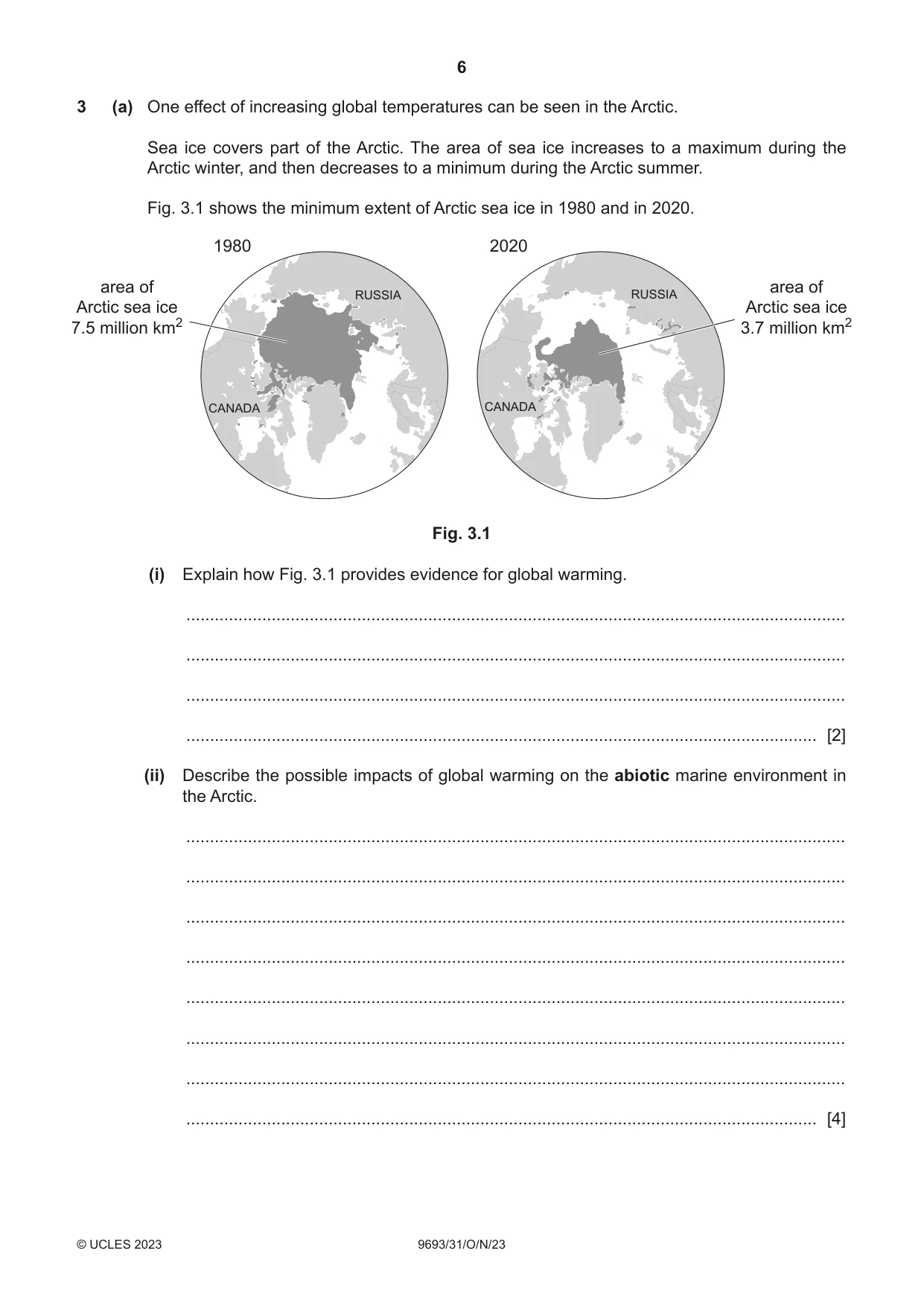
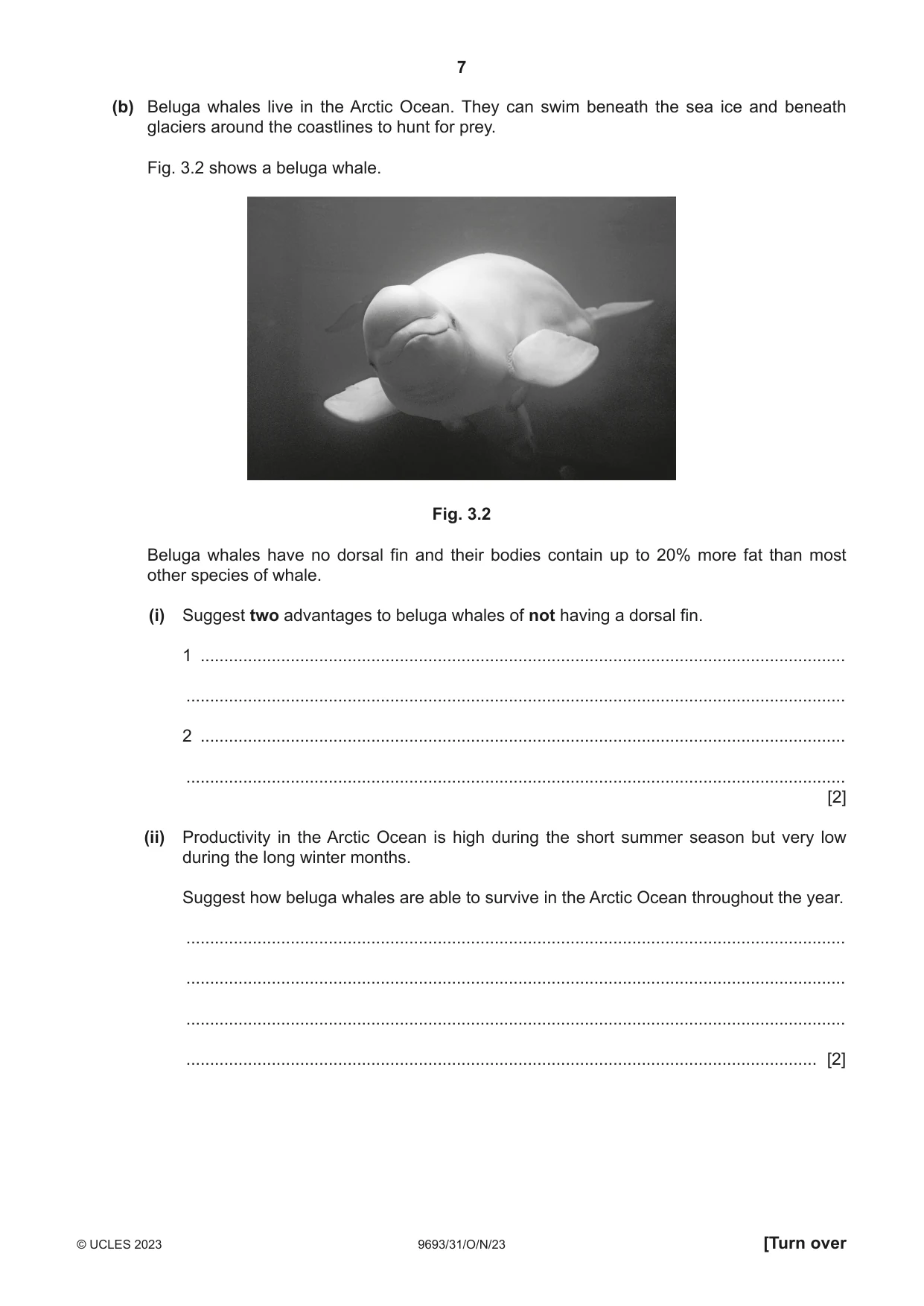
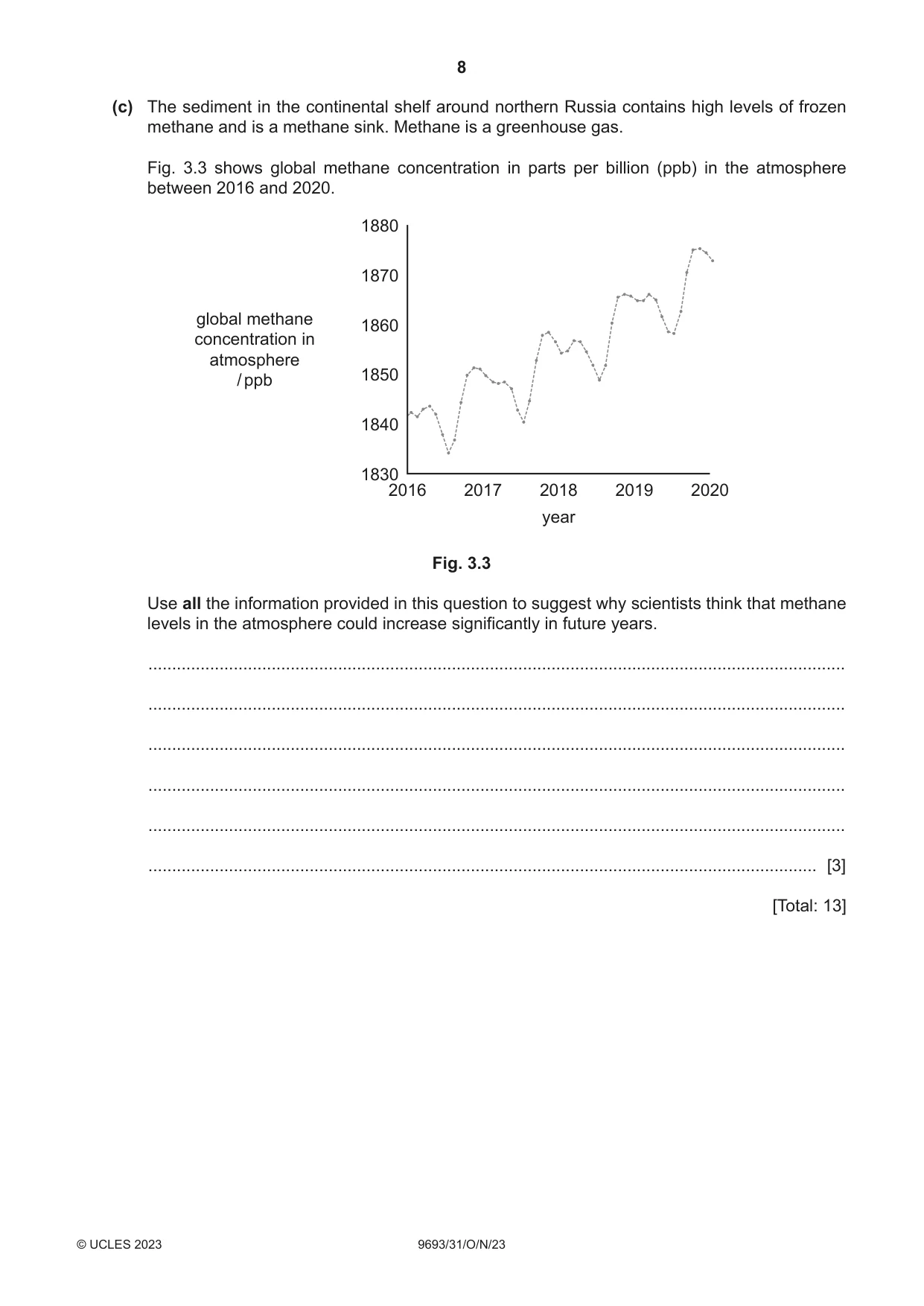
3 (a) One effect of increasing global temperatures can be seen in the Arctic. Sea ice covers part of the Arctic. The area of sea ice increases to a maximum during the Arctic winter, and then decreases to a minimum during the Arctic summer. Fig. 3.1 shows the minimum extent of Arctic sea ice in 1980 and in 2020. 1980 2020 area of area of RUSSIA RUSSIA Arctic sea ice Arctic sea ice 7.5 million km2 3.7 million km2 CANADA CANADA Fig. 3.1 (i) Explain how Fig. 3.1 provides evidence for global warming. ........................................................................................................................................... ........................................................................................................................................... ........................................................................................................................................... ..................................................................................................................................... [2] (ii) Describe the possible impacts of global warming on the abiotic marine environment in the Arctic. ........................................................................................................................................... ........................................................................................................................................... ........................................................................................................................................... ........................................................................................................................................... ........................................................................................................................................... ........................................................................................................................................... ........................................................................................................................................... ..................................................................................................................................... [4] (b) Beluga whales live in the Arctic Ocean. They can swim beneath the sea ice and beneath glaciers around the coastlines to hunt for prey. Fig. 3.2 shows a beluga whale. Fig. 3.2 Beluga whales have no dorsal fin and their bodies contain up to 20% more fat than most other species of whale. (i) Suggest two advantages to beluga whales of not having a dorsal fin. 1 ........................................................................................................................................ ........................................................................................................................................... 2 ........................................................................................................................................ ........................................................................................................................................... [2] (ii) Productivity in the Arctic Ocean is high during the short summer season but very low during the long winter months. Suggest how beluga whales are able to survive in the Arctic Ocean throughout the year. ........................................................................................................................................... ........................................................................................................................................... ........................................................................................................................................... ..................................................................................................................................... [2] (c) The sediment in the continental shelf around northern Russia contains high levels of frozen methane and is a methane sink. Methane is a greenhouse gas. Fig. 3.3 shows global methane concentration in parts per billion (ppb) in the atmosphere between 2016 and 2020. 1880 1870 global methane 1860 concentration in atmosphere 1850 / ppb 1840 1830 2016 2017 2018 2019 2020 year Fig. 3.3 Use all the information provided in this question to suggest why scientists think that methane levels in the atmosphere could increase significantly in future years. ................................................................................................................................................... ................................................................................................................................................... ................................................................................................................................................... ................................................................................................................................................... ................................................................................................................................................... ............................................................................................................................................. [3] [Total: 13]
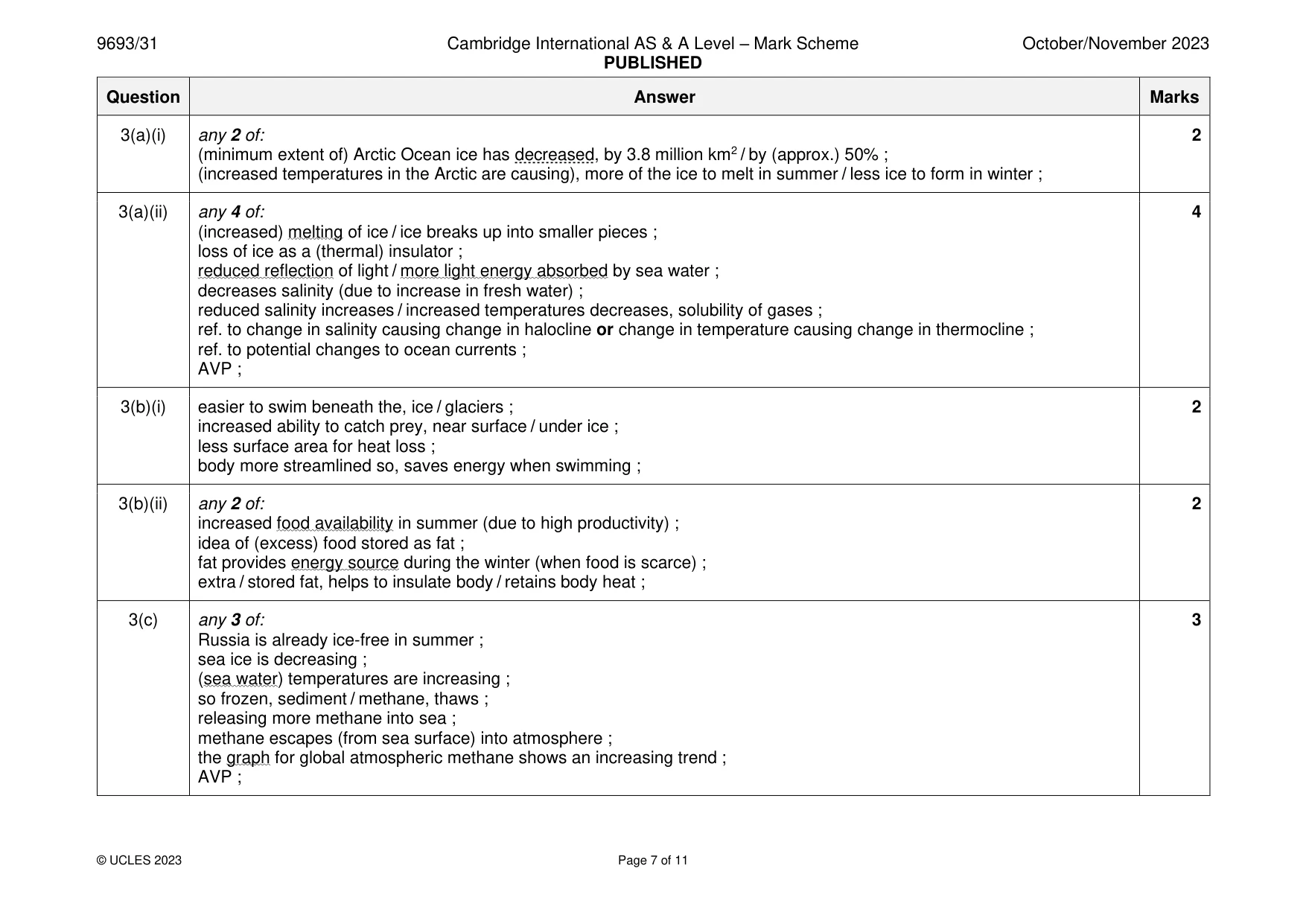
Mark scheme: 3(a)(i) any 2 of: 2 (minimum extent of) Arctic Ocean ice has decreased, by 3.8 million km2 / by (approx.) 50% ; (increased temperatures in the Arctic are causing), more of the ice to melt in summer / less ice to form in winter ; 3(a)(ii) any 4 of: 4 (increased) melting of ice / ice breaks up into smaller pieces ; loss of ice as a (thermal) insulator ; reduced reflection of light / more light energy absorbed by sea water ; decreases salinity (due to increase in fresh water) ; reduced salinity increases / increased temperatures decreases, solubility of gases ; ref. to change in salinity causing change in halocline or change in temperature causing change in thermocline ; ref. to potential changes to ocean currents ; AVP ; 3(b)(i) easier to swim beneath the, ice / glaciers ; 2 increased ability to catch prey, near surface / under ice ; less surface area for heat loss ; body more streamlined so, saves energy when swimming ; 3(b)(ii) any 2 of: 2 increased food availability in summer (due to high productivity) ; idea of (excess) food stored as fat ; fat provides energy source during the winter (when food is scarce) ; extra / stored fat, helps to insulate body / retains body heat ; 3(c) any 3 of: 3 Russia is already ice-free in summer ; sea ice is decreasing ; (sea water) temperatures are increasing ; so frozen, sediment / methane, thaws ; releasing more methane into sea ; methane escapes (from sea surface) into atmosphere ; the graph for global atmospheric methane shows an increasing trend ; AVP ;
Q4 · Antarctic krill feed on phytoplankton
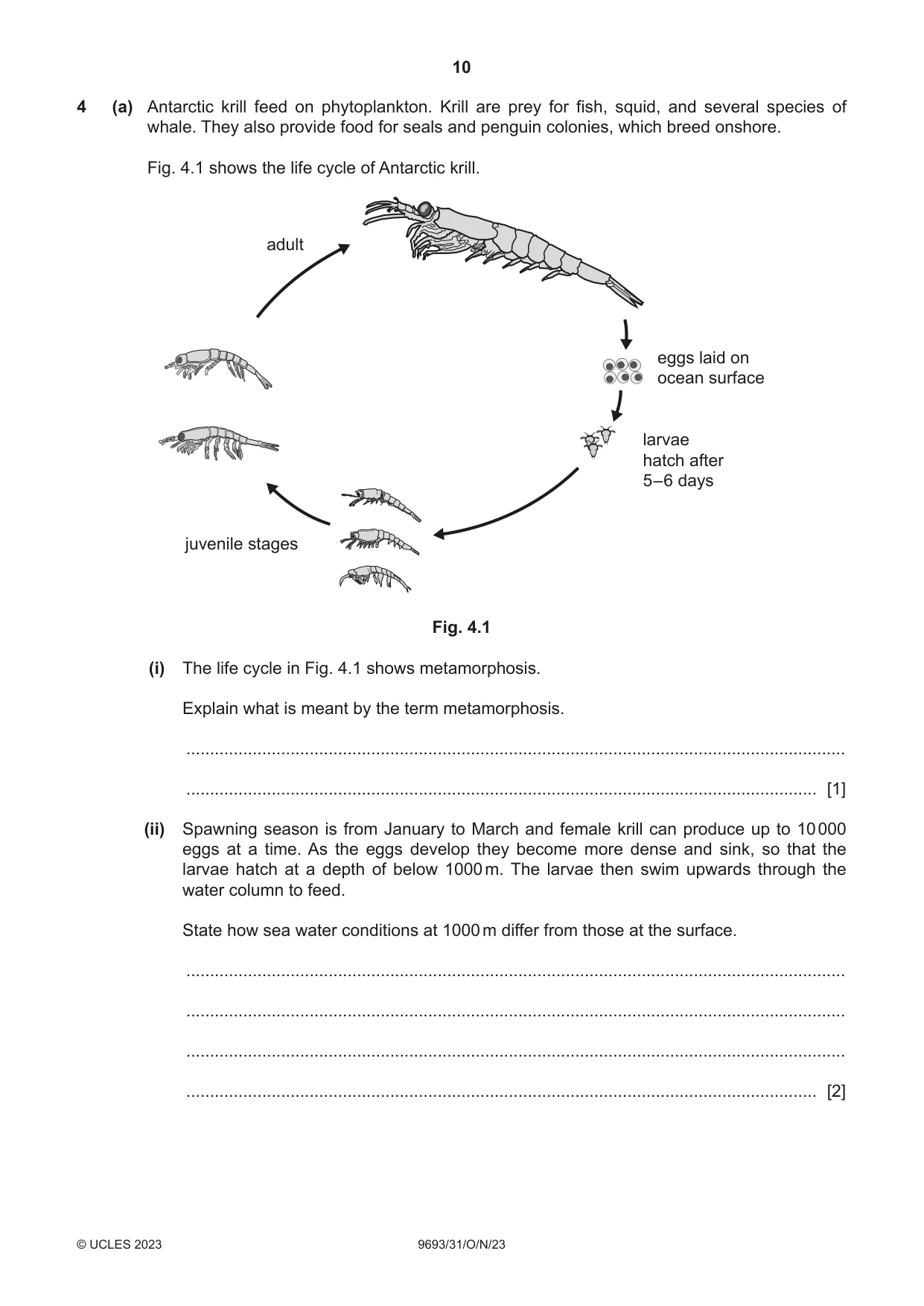
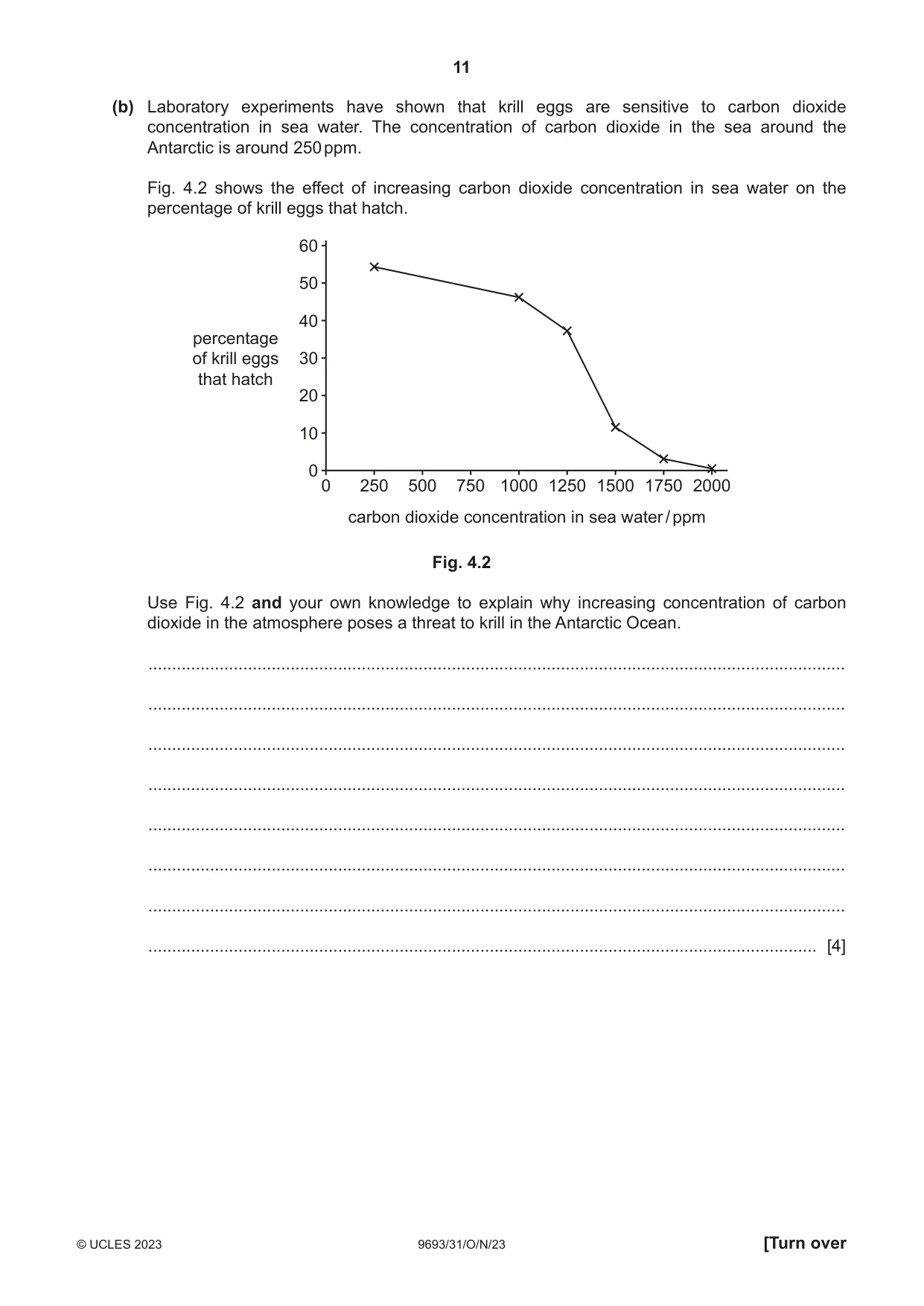
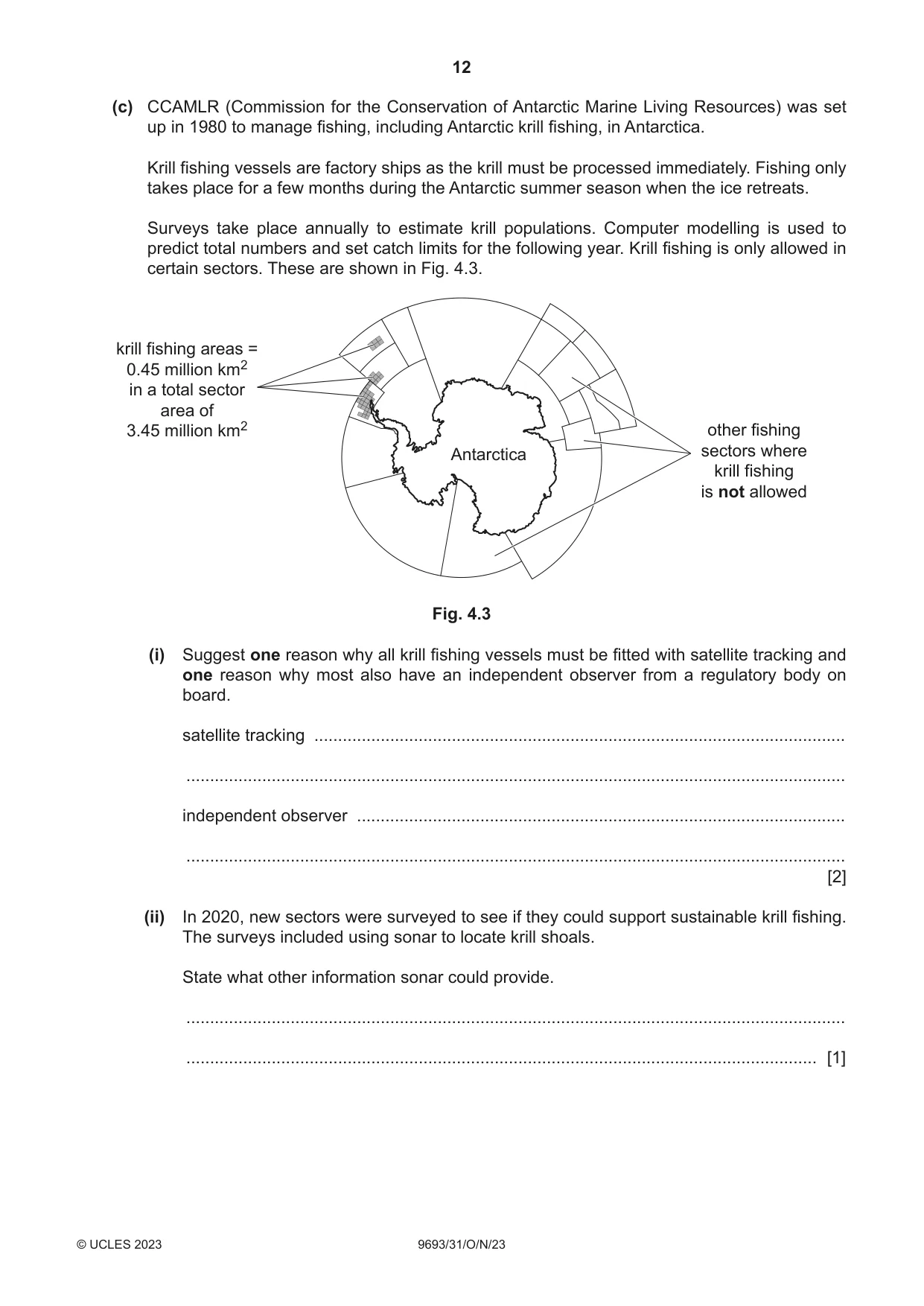
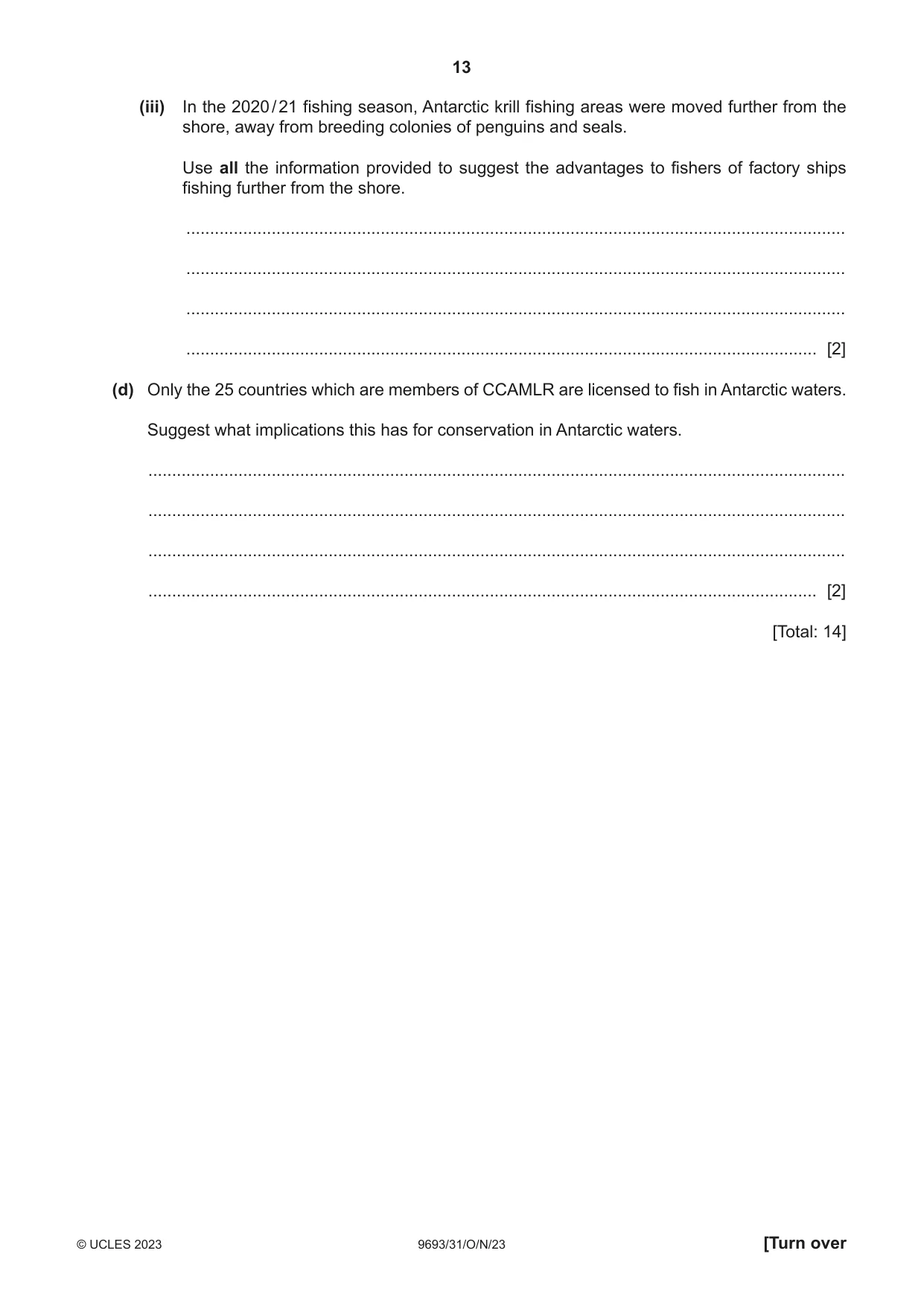
4 (a) Antarctic krill feed on phytoplankton. Krill are prey for fish, squid, and several species of whale. They also provide food for seals and penguin colonies, which breed onshore. Fig. 4.1 shows the life cycle of Antarctic krill. adult eggs laid on ocean surface larvae hatch after 5–6 days juvenile stages Fig. 4.1 (i) The life cycle in Fig. 4.1 shows metamorphosis. Explain what is meant by the term metamorphosis. ........................................................................................................................................... ..................................................................................................................................... [1] (ii) Spawning season is from January to March and female krill can produce up to 10 000 eggs at a time. As the eggs develop they become more dense and sink, so that the larvae hatch at a depth of below 1000 m. The larvae then swim upwards through the water column to feed. State how sea water conditions at 1000 m differ from those at the surface. ........................................................................................................................................... ........................................................................................................................................... ........................................................................................................................................... ..................................................................................................................................... [2] (b) Laboratory experiments have shown that krill eggs are sensitive to carbon dioxide concentration in sea water. The concentration of carbon dioxide in the sea around the Antarctic is around 250 ppm. Fig. 4.2 shows the effect of increasing carbon dioxide concentration in sea water on the percentage of krill eggs that hatch. 60 50 40 percentage of krill eggs 30 that hatch 20 10 0 0 250 500 750 1000 1250 1500 1750 2000 carbon dioxide concentration in sea water / ppm Fig. 4.2 Use Fig. 4.2 and your own knowledge to explain why increasing concentration of carbon dioxide in the atmosphere poses a threat to krill in the Antarctic Ocean. ................................................................................................................................................... ................................................................................................................................................... ................................................................................................................................................... ................................................................................................................................................... ................................................................................................................................................... ................................................................................................................................................... ................................................................................................................................................... ............................................................................................................................................. [4] (c) CCAMLR (Commission for the Conservation of Antarctic Marine Living Resources) was set up in 1980 to manage fishing, including Antarctic krill fishing, in Antarctica. Krill fishing vessels are factory ships as the krill must be processed immediately. Fishing only takes place for a few months during the Antarctic summer season when the ice retreats. Surveys take place annually to estimate krill populations. Computer modelling is used to predict total numbers and set catch limits for the following year. Krill fishing is only allowed in certain sectors. These are shown in Fig. 4.3. krill fishing areas = 0.45 million km2 in a total sector area of 3.45 million km2 other fishing Antarctica sectors where krill fishing is not allowed Fig. 4.3 (i) Suggest one reason why all krill fishing vessels must be fitted with satellite tracking and one reason why most also have an independent observer from a regulatory body on board. satellite tracking ................................................................................................................ ........................................................................................................................................... independent observer ....................................................................................................... ........................................................................................................................................... [2] (ii) In 2020, new sectors were surveyed to see if they could support sustainable krill fishing. The surveys included using sonar to locate krill shoals. State what other information sonar could provide. ........................................................................................................................................... ..................................................................................................................................... [1] (iii) In the 2020 / 21 fishing season, Antarctic krill fishing areas were moved further from the shore, away from breeding colonies of penguins and seals. Use all the information provided to suggest the advantages to fishers of factory ships fishing further from the shore. ........................................................................................................................................... ........................................................................................................................................... ........................................................................................................................................... ..................................................................................................................................... [2] (d) Only the 25 countries which are members of CCAMLR are licensed to fish in Antarctic waters. Suggest what implications this has for conservation in Antarctic waters. ................................................................................................................................................... ................................................................................................................................................... ................................................................................................................................................... ............................................................................................................................................. [2] [Total: 14]
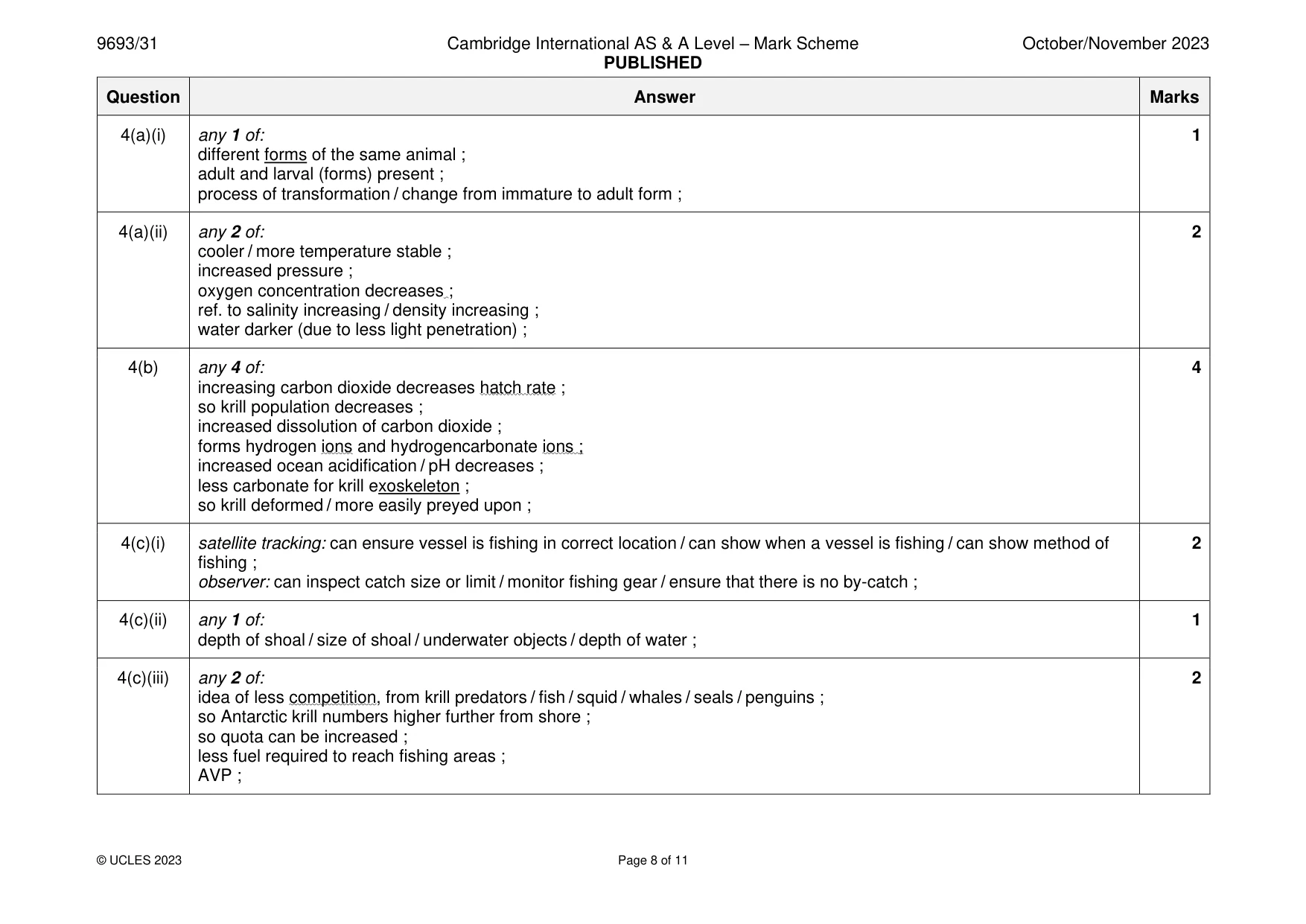
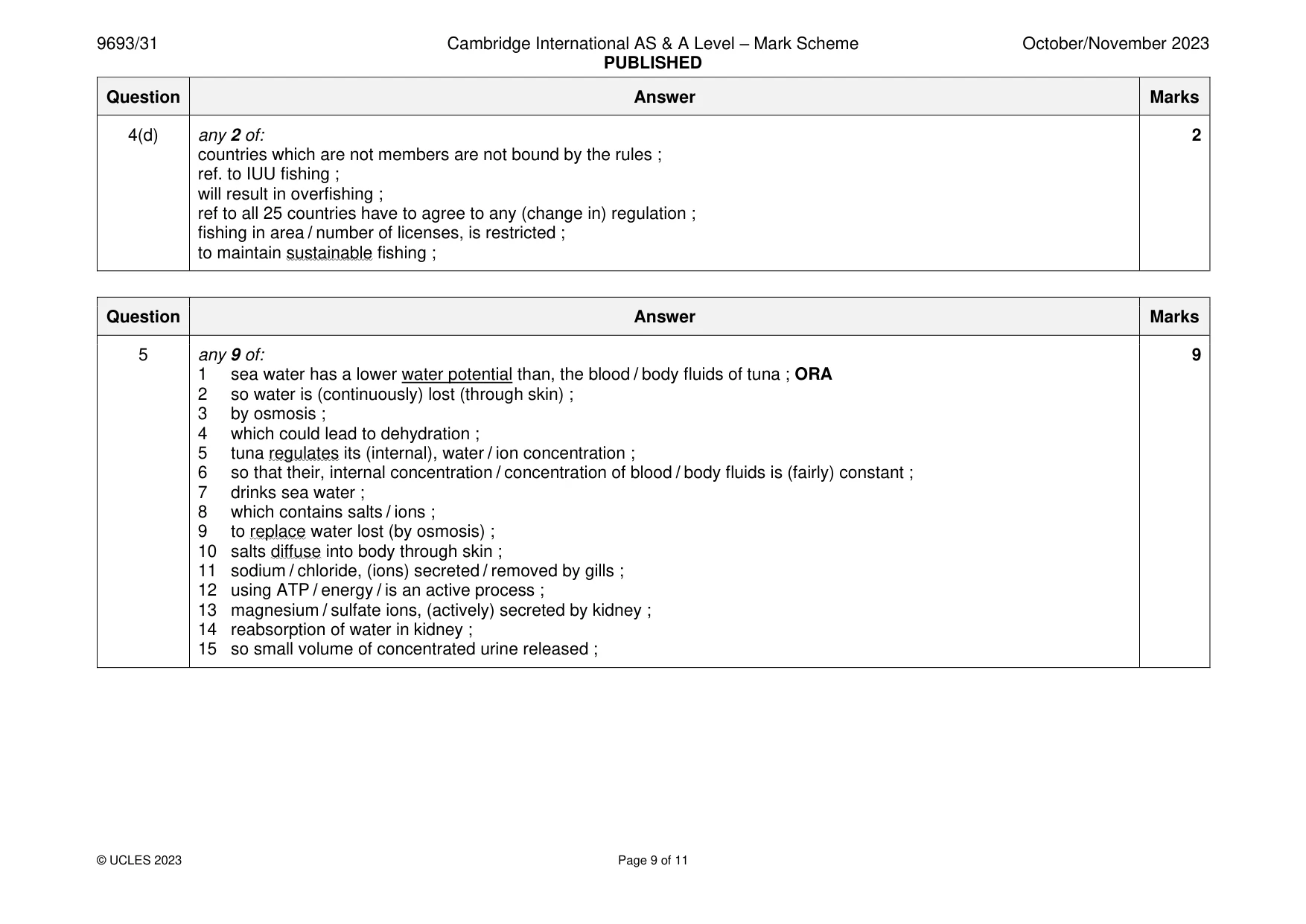
Mark scheme: 4(a)(i) any 1 of: 1 different forms of the same animal ; adult and larval (forms) present ; process of transformation / change from immature to adult form ; 4(a)(ii) any 2 of: 2 cooler / more temperature stable ; increased pressure ; oxygen concentration decreases ; ref. to salinity increasing / density increasing ; water darker (due to less light penetration) ; 4(b) any 4 of: 4 increasing carbon dioxide decreases hatch rate ; so krill population decreases ; increased dissolution of carbon dioxide ; forms hydrogen ions and hydrogencarbonate ions ; increased ocean acidification / pH decreases ; less carbonate for krill exoskeleton ; so krill deformed / more easily preyed upon ; 4(c)(i) satellite tracking: can ensure vessel is fishing in correct location / can show when a vessel is fishing / can show method of 2 fishing ; observer: can inspect catch size or limit / monitor fishing gear / ensure that there is no by-catch ; 4(c)(ii) any 1 of: 1 depth of shoal / size of shoal / underwater objects / depth of water ; 4(c)(iii) any 2 of: 2 idea of less competition, from krill predators / fish / squid / whales / seals / penguins ; so Antarctic krill numbers higher further from shore ; so quota can be increased ; less fuel required to reach fishing areas ; AVP ; 4(d) any 2 of: 2 countries which are not members are not bound by the rules ; ref. to IUU fishing ; will result in overfishing ; ref to all 25 countries have to agree to any (change in) regulation ; fishing in area / number of licenses, is restricted ; to maintain sustainable fishing ;
Q5 · Explain why and how osmoregulation occurs in tuna
5 Explain why and how osmoregulation occurs in tuna. .......................................................................................................................................................... .......................................................................................................................................................... .......................................................................................................................................................... .......................................................................................................................................................... .......................................................................................................................................................... .......................................................................................................................................................... .......................................................................................................................................................... .......................................................................................................................................................... .......................................................................................................................................................... .......................................................................................................................................................... .......................................................................................................................................................... .......................................................................................................................................................... .......................................................................................................................................................... .......................................................................................................................................................... .......................................................................................................................................................... .......................................................................................................................................................... .......................................................................................................................................................... .................................................................................................................................................... [9]
Mark scheme: 5 any 9 of: 9 1 sea water has a lower water potential than, the blood / body fluids of tuna ; ORA 2 so water is (continuously) lost (through skin) ; 3 by osmosis ; 4 which could lead to dehydration ; 5 tuna regulates its (internal), water / ion concentration ; 6 so that their, internal concentration / concentration of blood / body fluids is (fairly) constant ; 7 drinks sea water ; 8 which contains salts / ions ; 9 to replace water lost (by osmosis) ; 10 salts diffuse into body through skin ; 11 sodium / chloride, (ions) secreted / removed by gills ; 12 using ATP / energy / is an active process ; 13 magnesium / sulfate ions, (actively) secreted by kidney ; 14 reabsorption of water in kidney ; 15 so small volume of concentrated urine released ;
Q6 · Describe the role of UNESCO biosphere reserves in conservation
6 (a) Describe the role of UNESCO biosphere reserves in conservation. ................................................................................................................................................... ................................................................................................................................................... ................................................................................................................................................... ................................................................................................................................................... ................................................................................................................................................... ................................................................................................................................................... ................................................................................................................................................... ................................................................................................................................................... ................................................................................................................................................... ............................................................................................................................................. [5] (b) Kelp is a macroalga that forms ‘forests’ in shallow water. Explain why it is important to conserve kelp forests. ................................................................................................................................................... ................................................................................................................................................... ................................................................................................................................................... ................................................................................................................................................... ................................................................................................................................................... ................................................................................................................................................... ................................................................................................................................................... ................................................................................................................................................... ................................................................................................................................................... ................................................................................................................................................... ................................................................................................................................................... ................................................................................................................................................... ................................................................................................................................................... ................................................................................................................................................... ................................................................................................................................................... ................................................................................................................................................... ................................................................................................................................................... ................................................................................................................................................... ................................................................................................................................................... ........................................................................................................................................... [10] [Total: 15]
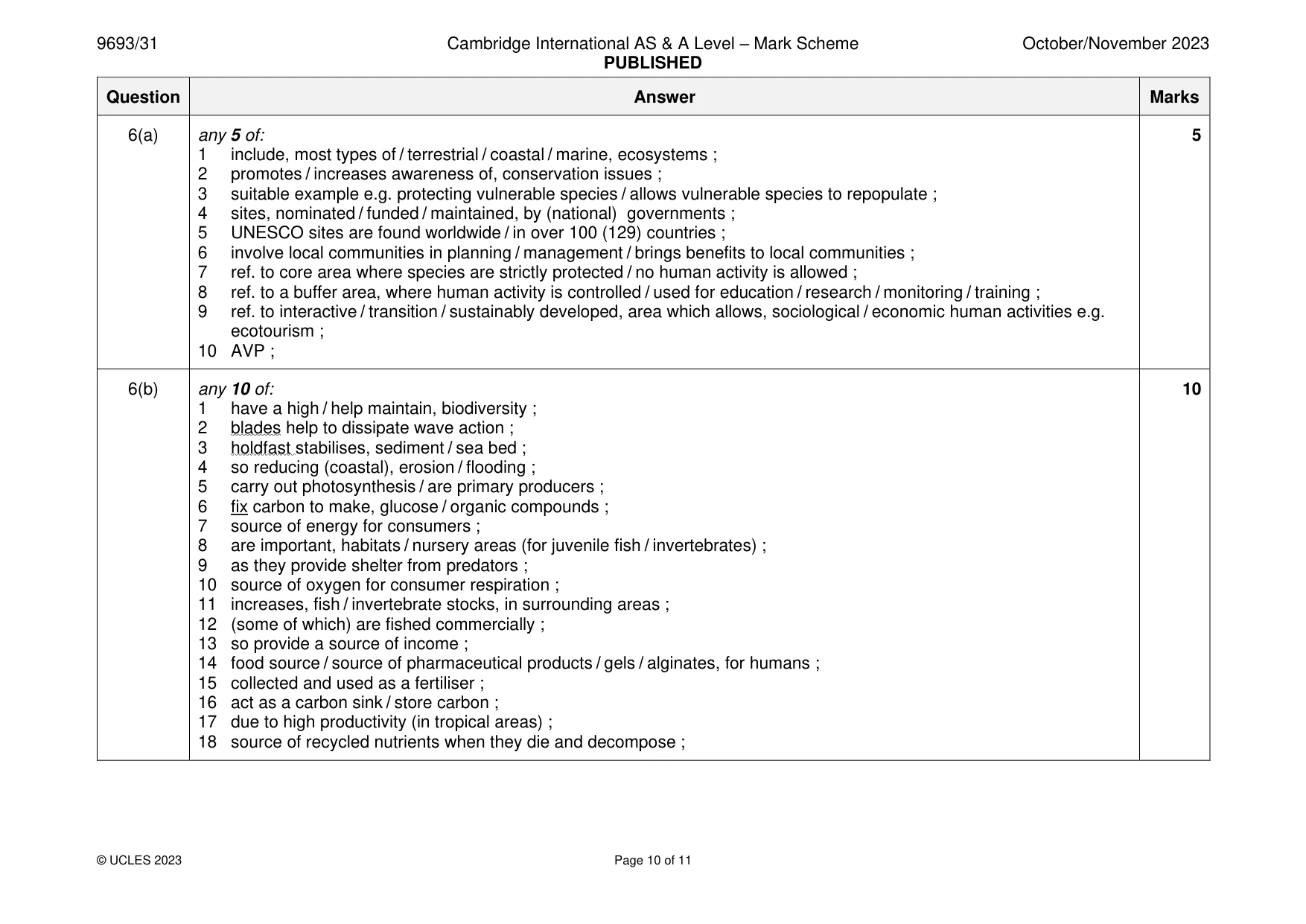
Mark scheme: 6(a) any 5 of: 5 1 include, most types of / terrestrial / coastal / marine, ecosystems ; 2 promotes / increases awareness of, conservation issues ; 3 suitable example e.g. protecting vulnerable species / allows vulnerable species to repopulate ; 4 sites, nominated / funded / maintained, by (national) governments ; 5 UNESCO sites are found worldwide / in over 100 (129) countries ; 6 involve local communities in planning / management / brings benefits to local communities ; 7 ref. to core area where species are strictly protected / no human activity is allowed ; 8 ref. to a buffer area, where human activity is controlled / used for education / research / monitoring / training ; 9 ref. to interactive / transition / sustainably developed, area which allows, sociological / economic human activities e.g. ecotourism ; 10 AVP ; 6(b) any 10 of: 10 1 have a high / help maintain, biodiversity ; 2 blades help to dissipate wave action ; 3 holdfast stabilises, sediment / sea bed ; 4 so reducing (coastal), erosion / flooding ; 5 carry out photosynthesis / are primary producers ; 6 fix carbon to make, glucose / organic compounds ; 7 source of energy for consumers ; 8 are important, habitats / nursery areas (for juvenile fish / invertebrates) ; 9 as they provide shelter from predators ; 10 source of oxygen for consumer respiration ; 11 increases, fish / invertebrate stocks, in surrounding areas ; 12 (some of which) are fished commercially ; 13 so provide a source of income ; 14 food source / source of pharmaceutical products / gels / alginates, for humans ; 15 collected and used as a fertiliser ; 16 act as a carbon sink / store carbon ; 17 due to high productivity (in tropical areas) ; 18 source of recycled nutrients when they die and decompose ;
Q7 · Disease management is one of the factors required for the long-term success of an…
7 Disease management is one of the factors required for the long-term success of an aquaculture project. Explain the need for disease management and describe the different methods used in aquaculture. .......................................................................................................................................................... .......................................................................................................................................................... .......................................................................................................................................................... .......................................................................................................................................................... .......................................................................................................................................................... .......................................................................................................................................................... .......................................................................................................................................................... .......................................................................................................................................................... .......................................................................................................................................................... .......................................................................................................................................................... .......................................................................................................................................................... .................................................................................................................................................... [6] The boundaries and names shown, the designations used and the presentation of material on any maps contained in this question paper/insert do not imply official endorsement or acceptance by Cambridge Assessment International Education concerning the legal status of any country, territory, or area or any of its authorities, or of the delimitation of its frontiers or boundaries.
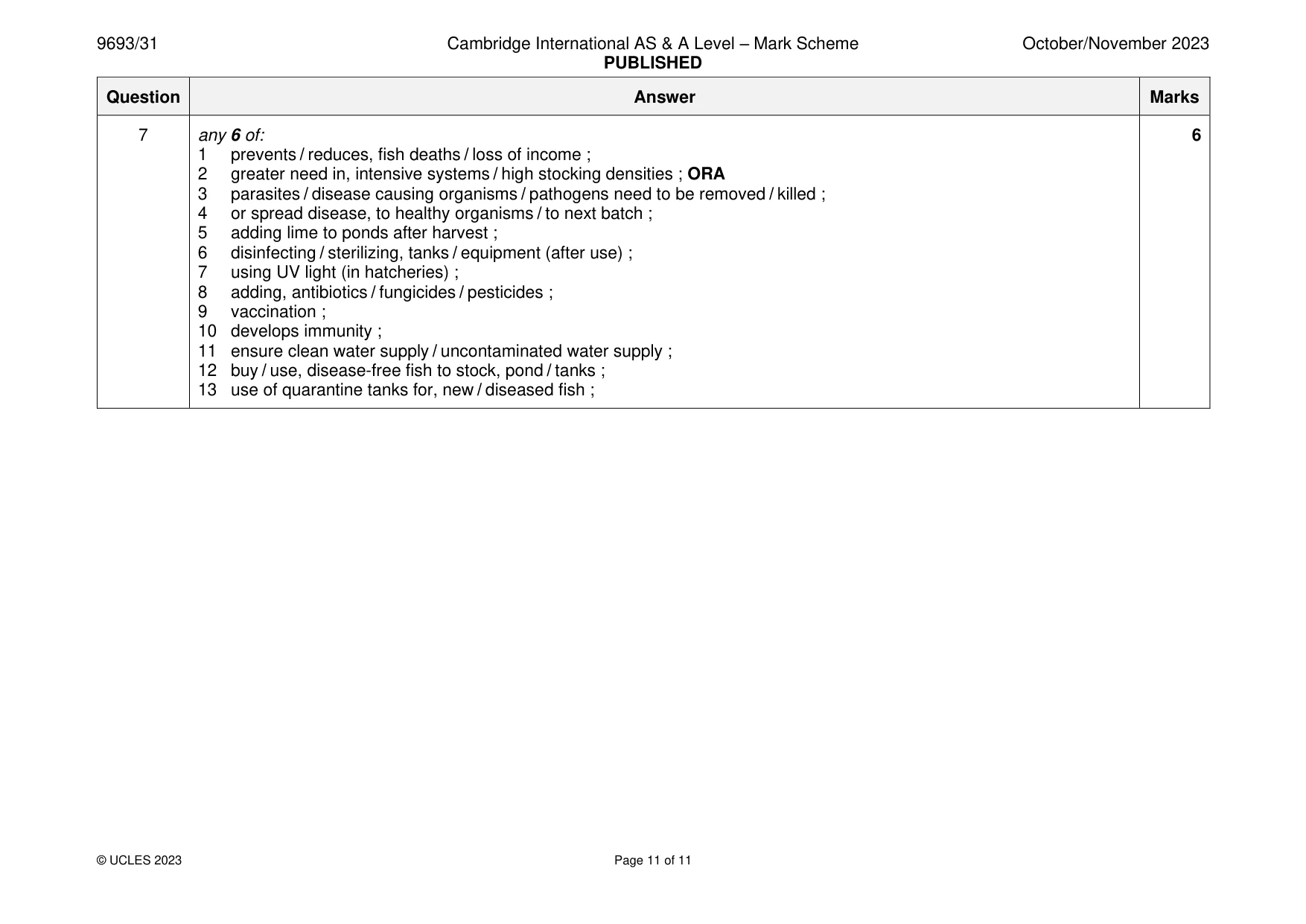
Mark scheme: 7 any 6 of: 6 1 prevents / reduces, fish deaths / loss of income ; 2 greater need in, intensive systems / high stocking densities ; ORA 3 parasites / disease causing organisms / pathogens need to be removed / killed ; 4 or spread disease, to healthy organisms / to next batch ; 5 adding lime to ponds after harvest ; 6 disinfecting / sterilizing, tanks / equipment (after use) ; 7 using UV light (in hatcheries) ; 8 adding, antibiotics / fungicides / pesticides ; 9 vaccination ; 10 develops immunity ; 11 ensure clean water supply / uncontaminated water supply ; 12 buy / use, disease-free fish to stock, pond / tanks ; 13 use of quarantine tanks for, new / diseased fish ;
What was in this paper
The subtopics covered by these 7 questions, and how many questions each got. Open one in a new tab to see every Cambridge question on it.
What you needed in this session
Cambridge’s own grade thresholds for 2023 Oct/Nov, Paper 3 · Variant 1. A higher threshold means an easier paper — the bar moves with how the cohort did.