Cambridge A Level Marine Science 9693 — 2025 May/June Paper 3 · Variant 1
9693/31/M/J/25 · 7 questions · 75 marks · 105 min
The question paper and its mark scheme, free to read here and free to download. This is Cambridge’s own paper, exactly as it was sat.
Question paper16 pages


Mark scheme14 pages
Answers below. Sit the paper first if you are practising.
Questions as text
Q1 · Mar Menor is the largest coastal lagoon in Spain and is a major tourist destination
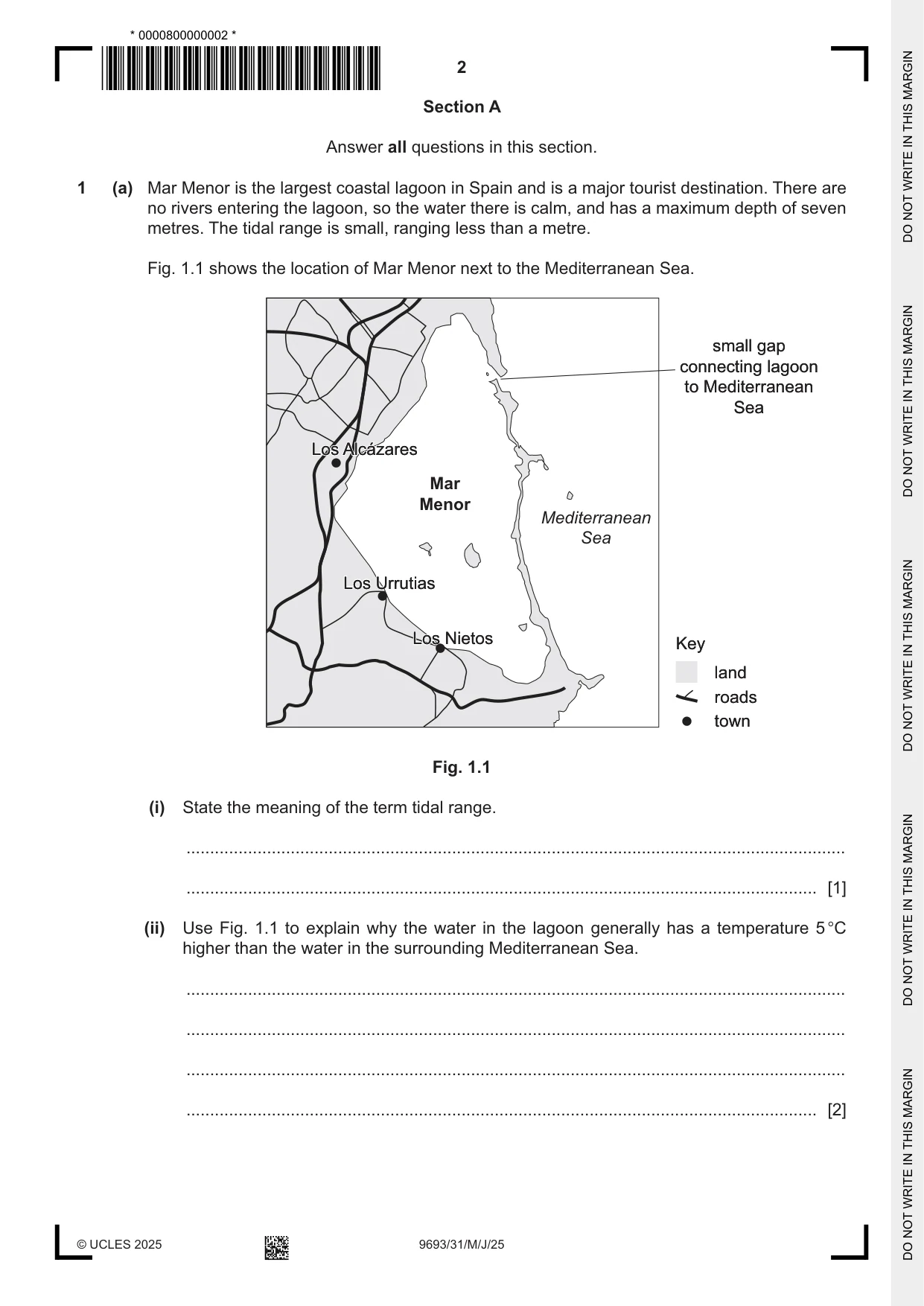
1 (a) Mar Menor is the largest coastal lagoon in Spain and is a major tourist destination. There are no rivers entering the lagoon, so the water there is calm, and has a maximum depth of seven metres. The tidal range is small, ranging less than a metre. Fig. 1.1 shows the location of Mar Menor next to the Mediterranean Sea. smallsmall gapgap connectingconnecting lagoonlagoon toto MediterraneanMediterranean SeaSea LosLosLosLos AlcázaresAlcázaresAlcázaresAlcázares Mar Menor Mediterranean Sea LosLosLosLos UrrutiasUrrutiasUrrutiasUrrutias LosLosLosLos NietosNietosNietosNietos KeyKey landland roadsroads towntown Fig. 1.1 (i) State the meaning of the term tidal range. ........................................................................................................................................... ..................................................................................................................................... [1] (ii) Use Fig. 1.1 to explain why the water in the lagoon generally has a temperature 5 °C higher than the water in the surrounding Mediterranean Sea. ........................................................................................................................................... ........................................................................................................................................... ........................................................................................................................................... ..................................................................................................................................... [2] (iii) Los Urrutias is a small town surrounded by intensively farmed land. Run-off from this farmland drains into the lagoon. In 2016, a phytoplankton bloom in the lagoon caused the beaches around Los Urrutias to be closed. Suggest how the phytoplankton bloom could be caused by intensive farming. ........................................................................................................................................... ........................................................................................................................................... ........................................................................................................................................... ........................................................................................................................................... ........................................................................................................................................... ..................................................................................................................................... [3] (iv) Most of the lagoon floor is covered by macroalgae and small patches of seagrass. Explain why the phytoplankton bloom caused 80% of these plants to die. ........................................................................................................................................... ........................................................................................................................................... ........................................................................................................................................... ........................................................................................................................................... ........................................................................................................................................... ..................................................................................................................................... [3] (b) (i) As there are no sources of fresh water around the lagoon, many farmers have invested in small desalination plants to provide fresh water to irrigate their crops. State how the outflow of water from these desalination plants can affect water quality in the lagoon. ........................................................................................................................................... ..................................................................................................................................... [1] (ii) Although there are no rivers entering the lagoon, storm drains are present to remove rainwater from the land after heavy rainfall. Severe flooding in 2019 caused the lagoon water to turn brown, due to silt washed into the lagoon. Thousands of fish and crustaceans died. Explain reasons why increased silt caused these organisms to die. ........................................................................................................................................... ........................................................................................................................................... ........................................................................................................................................... ........................................................................................................................................... ........................................................................................................................................... ........................................................................................................................................... ........................................................................................................................................... ..................................................................................................................................... [4] (c) In 2021, thousands of dead fish were again found in the lagoon. There was no phytoplankton bloom and no flooding, but water temperatures had increased suddenly from 28.2 °C to 31 °C in just two days. Suggest how this increased temperature could cause fish to die. ................................................................................................................................................... ................................................................................................................................................... ................................................................................................................................................... ............................................................................................................................................. [2] [Total: 16]
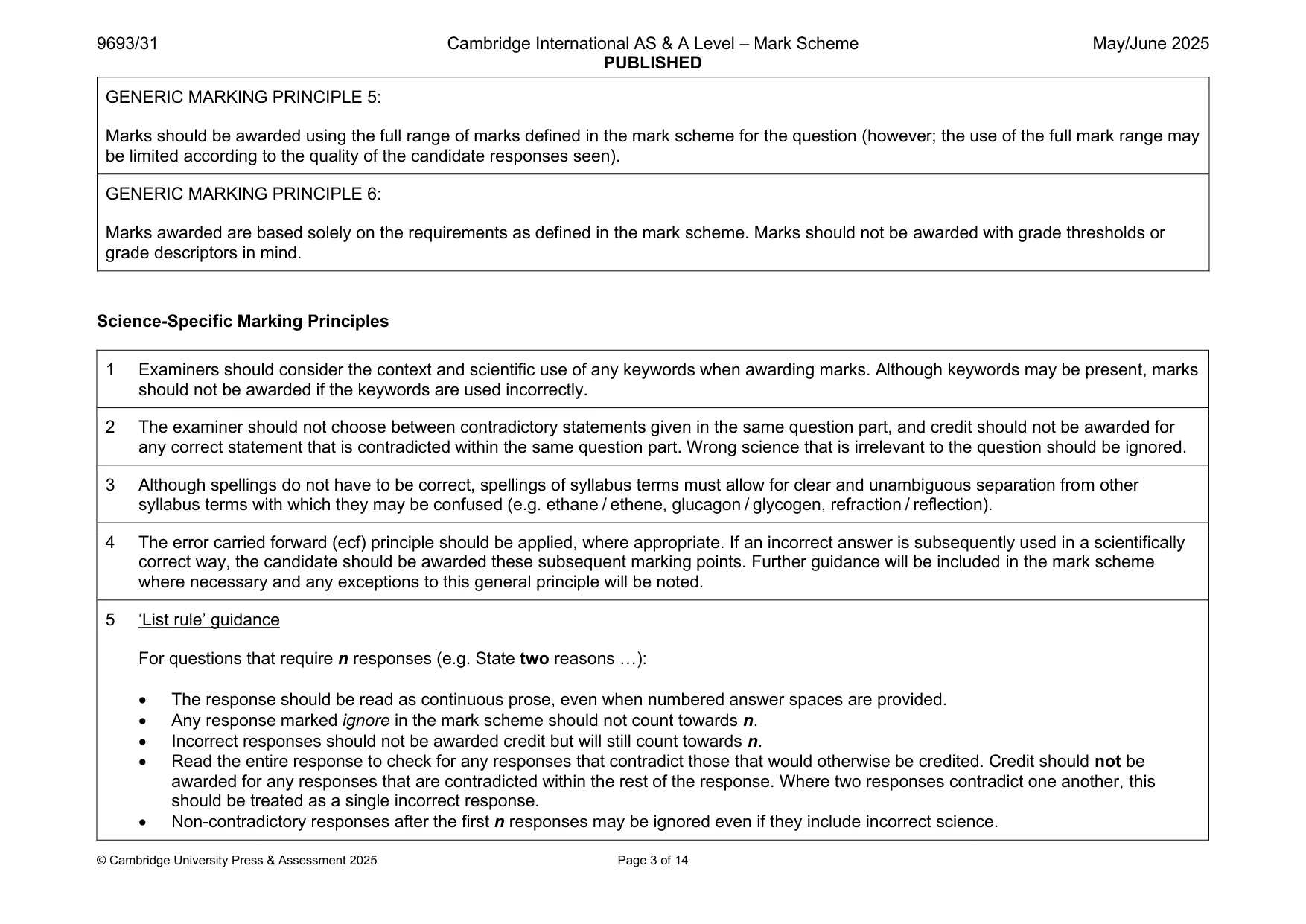
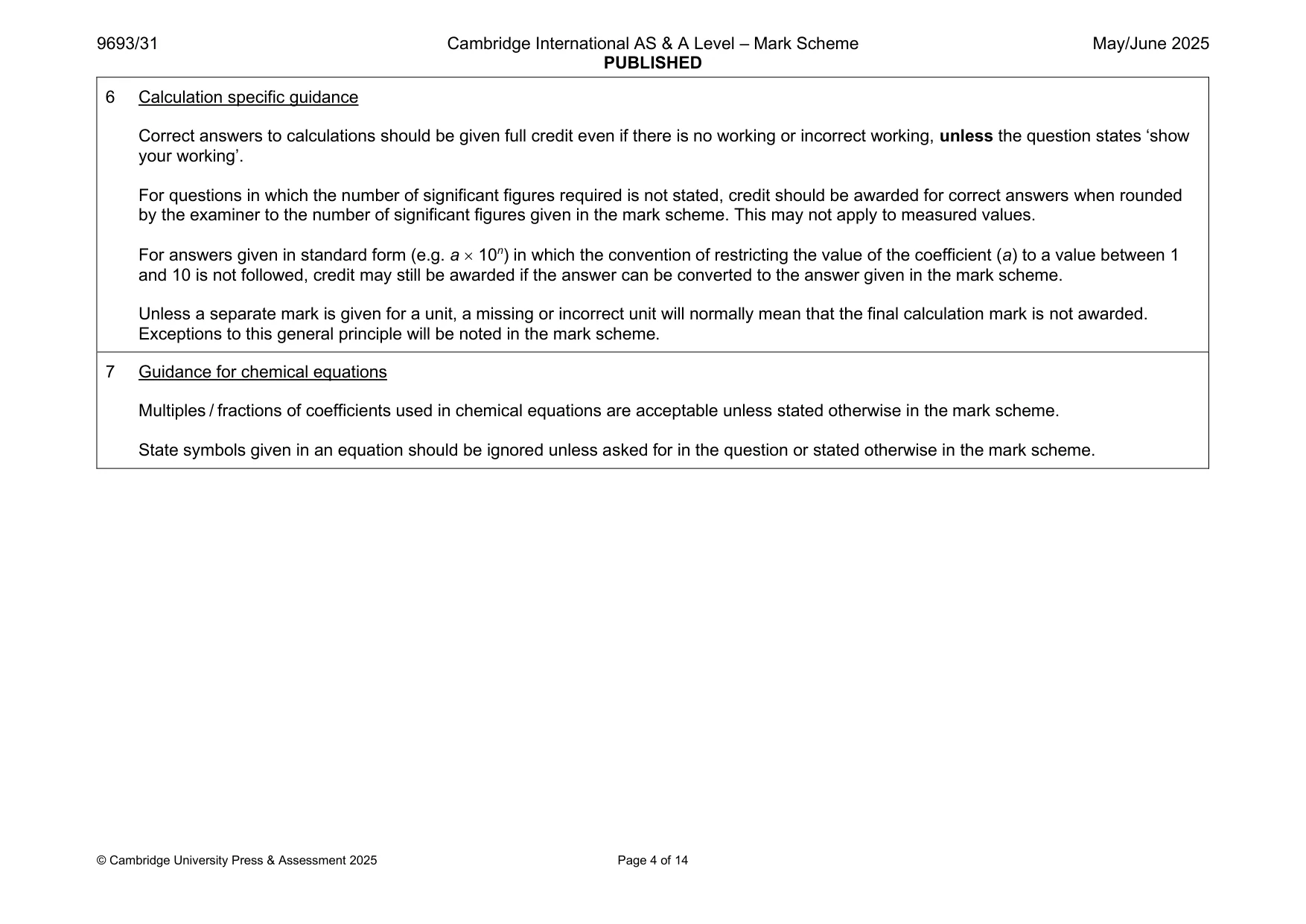
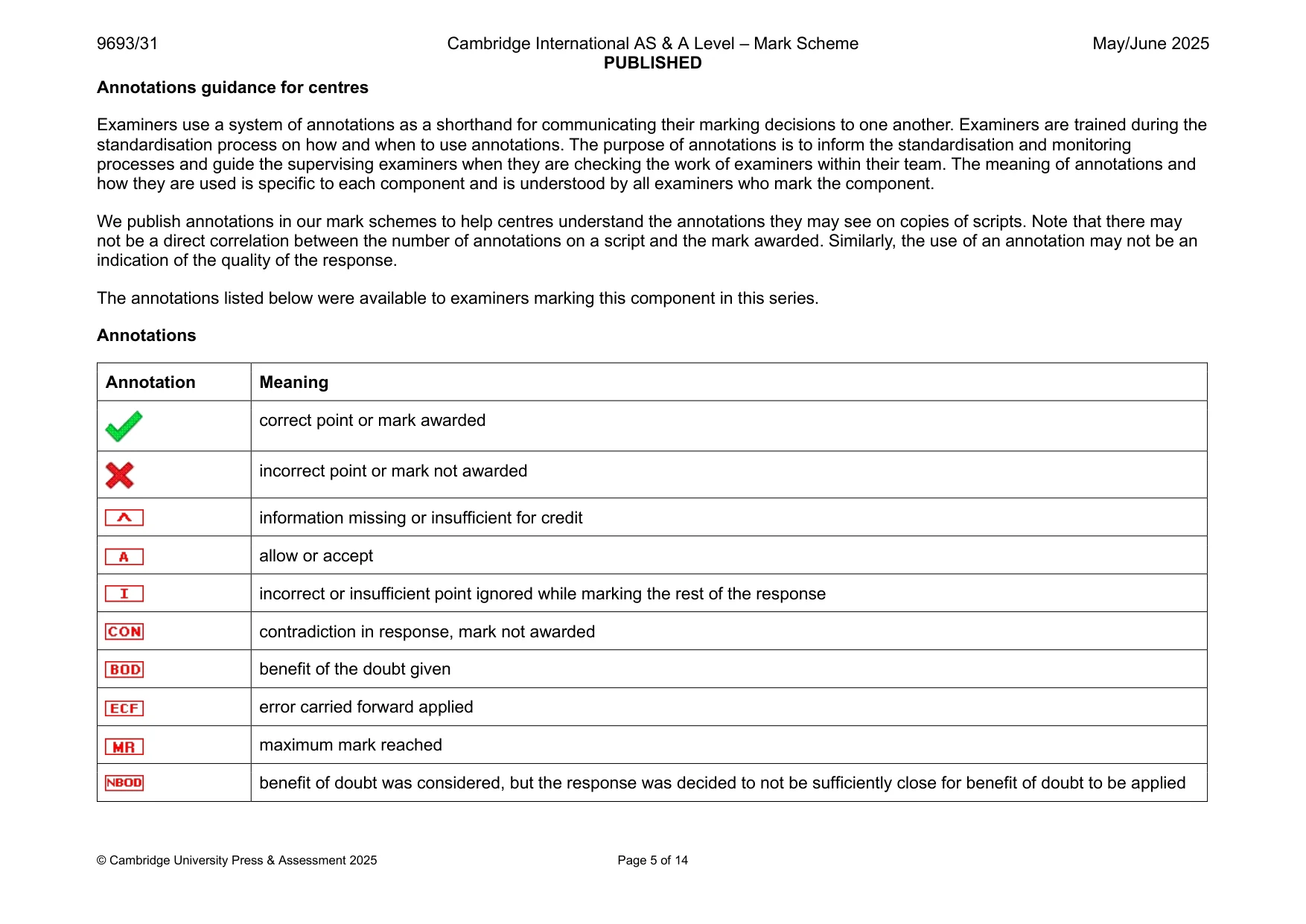
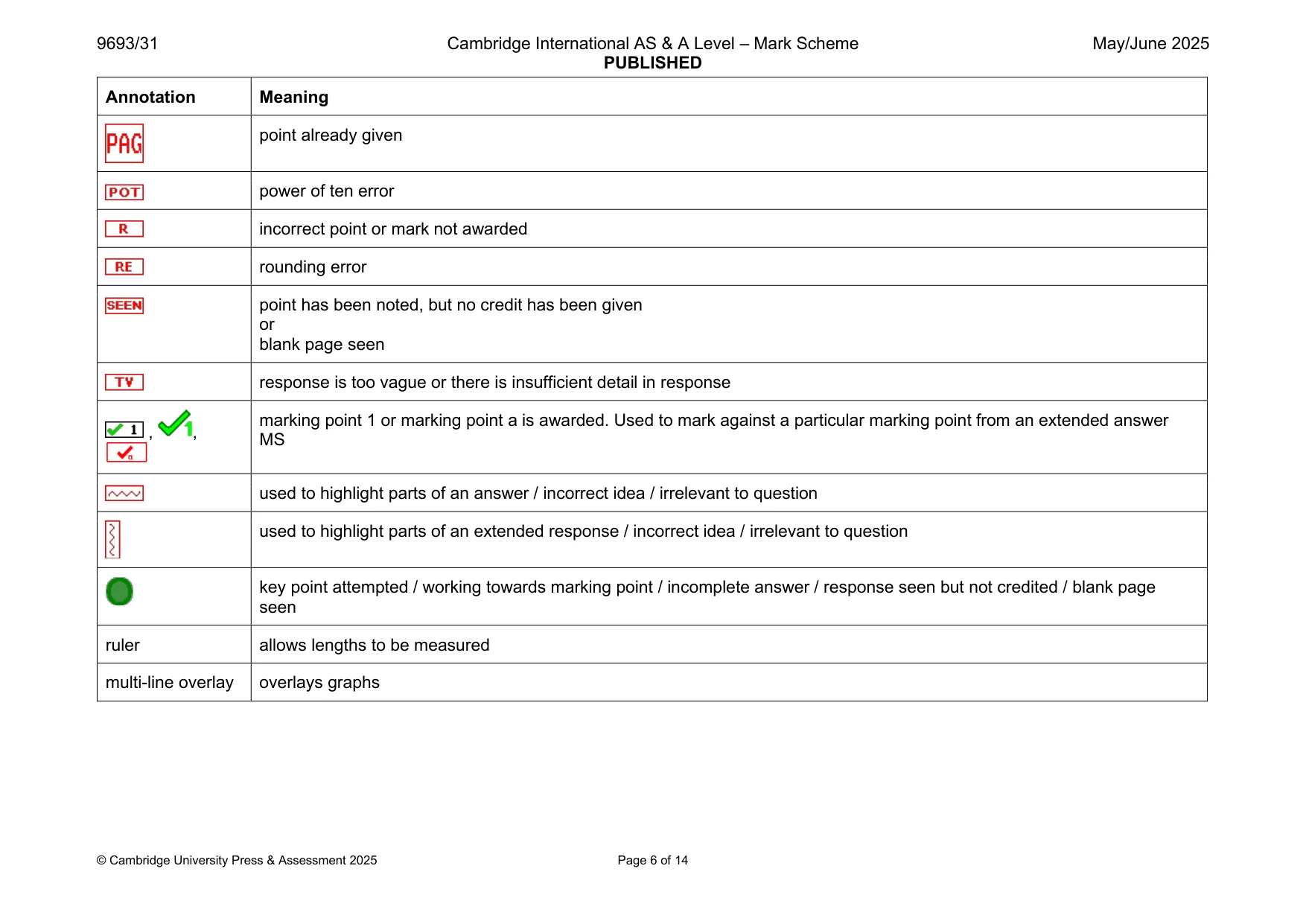
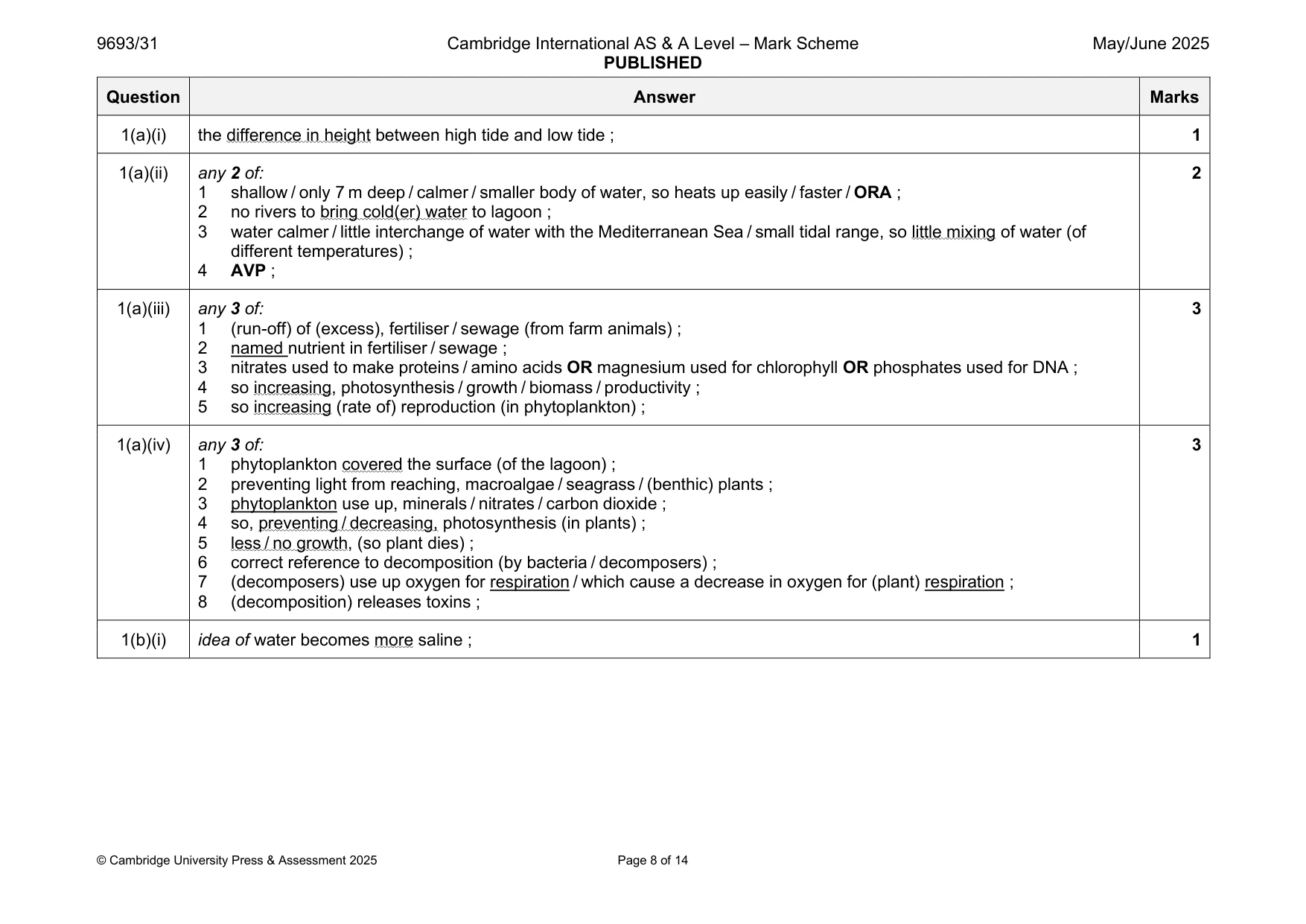
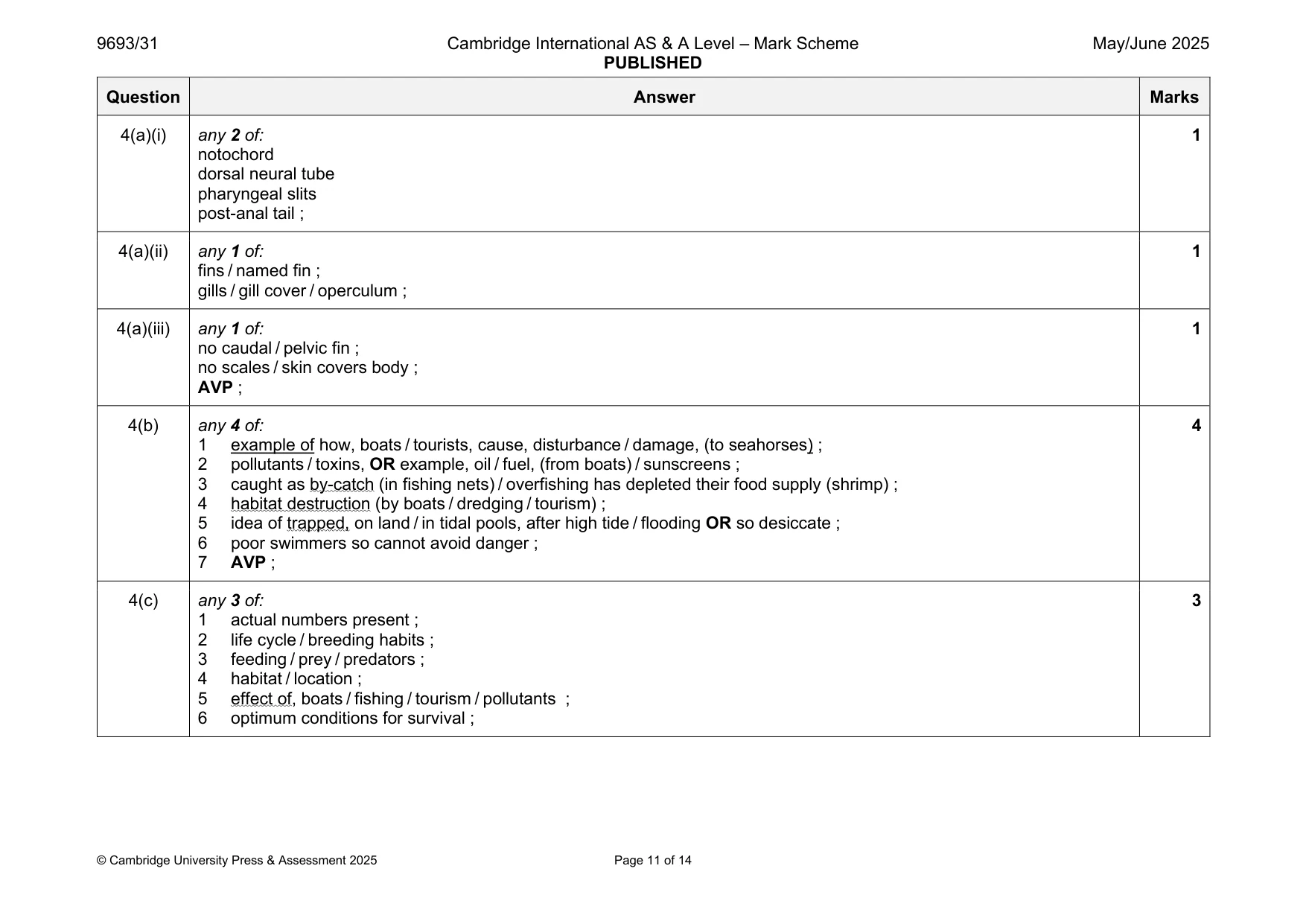
Mark scheme: Question Answer Marks 1(a)(i) the difference in height between high tide and low tide ; 1 1(a)(ii) any 2 of: 2 1 shallow / only 7 m deep / calmer / smaller body of water, so heats up easily / faster / ORA ; 2 no rivers to bring cold(er) water to lagoon ; 3 water calmer / little interchange of water with the Mediterranean Sea / small tidal range, so little mixing of water (of different temperatures) ; 4 AVP ; 1(a)(iii) any 3 of: 3 1 (run-off) of (excess), fertiliser / sewage (from farm animals) ; 2 named nutrient in fertiliser / sewage ; 3 nitrates used to make proteins / amino acids OR magnesium used for chlorophyll OR phosphates used for DNA ; 4 so increasing, photosynthesis / growth / biomass / productivity ; 5 so increasing (rate of) reproduction (in phytoplankton) ; 1(a)(iv) any 3 of: 3 1 phytoplankton covered the surface (of the lagoon) ; 2 preventing light from reaching, macroalgae / seagrass / (benthic) plants ; 3 phytoplankton use up, minerals / nitrates / carbon dioxide ; 4 so, preventing / decreasing, photosynthesis (in plants) ; 5 less / no growth, (so plant dies) ; 6 correct reference to decomposition (by bacteria / decomposers) ; 7 (decomposers) use up oxygen for respiration / which cause a decrease in oxygen for (plant) respiration ; 8 (decomposition) releases toxins ; 1(b)(i) idea of water becomes more saline ; 1 1(b)(ii) any 4 of: 4 1 (increased) silt blocks gills (of, fish / crustaceans) ; 2 so they suffocate / are unable to respire ; 3 prevents feeding in filter feeders ; 4 unable to find prey / smothers prey (causing starvation) ; 5 silt blocks light, less food / less oxygen, produced from, photosynthesis / plants ; 6 silt makes it harder to, see / avoid, predators ; 7 toxins / pollutants, (in silt) ; 8 AVP ; 1(c) (higher temperatures) hold less oxygen ; 2 so fish suffocate / unable to respire ; OR (increased temperature) causes an increase in salinity ; so fish dehydrates (as water is lost due to difference in water potential) ; OR can denature enzymes ; so preventing respiration / chemical reactions ;
Q2 · Oysters can grow in a range of salinities from 10 parts per thousand (ppt) in estuaries…
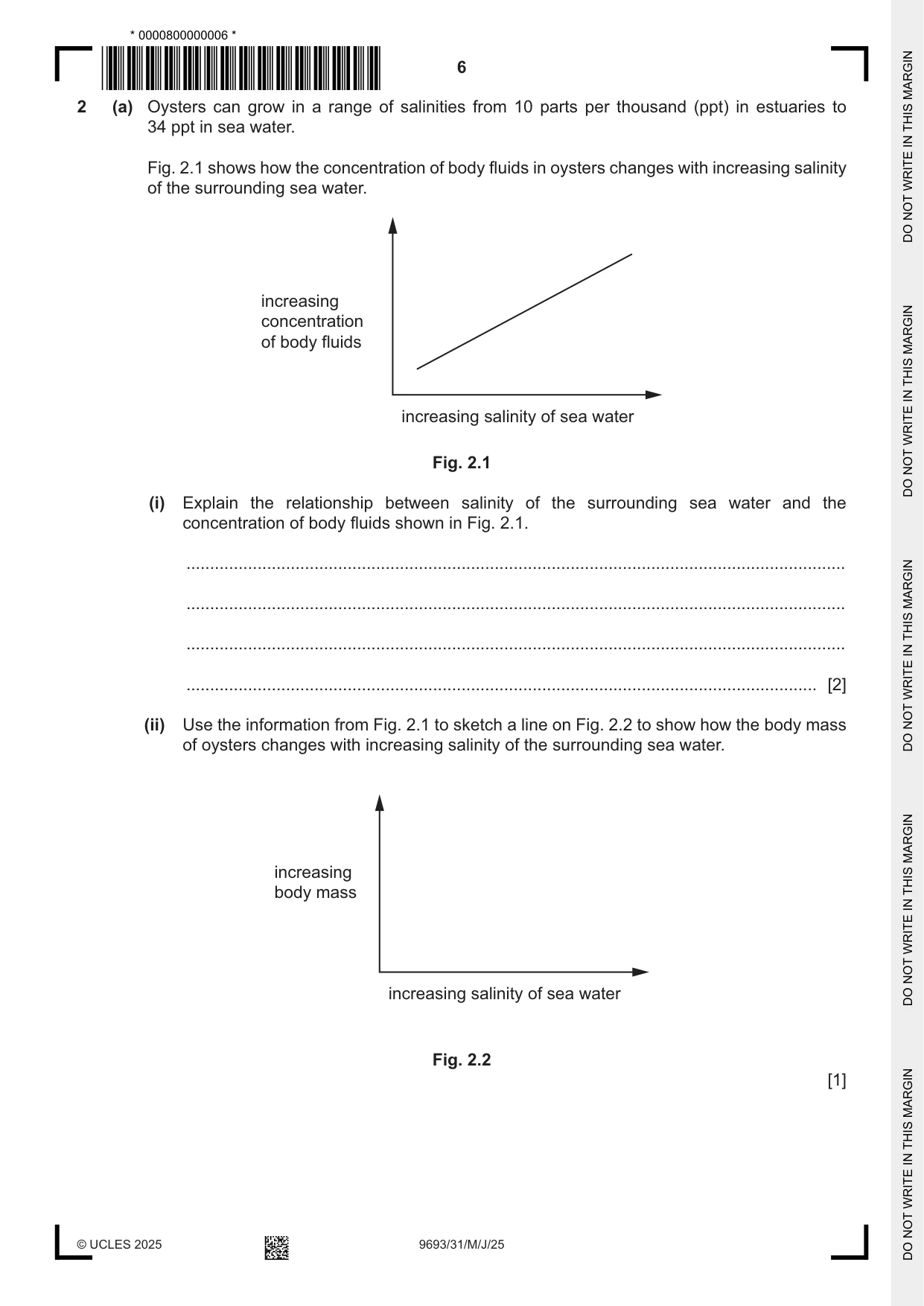
2 (a) Oysters can grow in a range of salinities from 10 parts per thousand (ppt) in estuaries to 34 ppt in sea water. Fig. 2.1 shows how the concentration of body fluids in oysters changes with increasing salinity of the surrounding sea water. increasing concentration of body fluids increasing salinity of sea water Fig. 2.1 (i) Explain the relationship between salinity of the surrounding sea water and the concentration of body fluids shown in Fig. 2.1. ........................................................................................................................................... ........................................................................................................................................... ........................................................................................................................................... ..................................................................................................................................... [2] (ii) Use the information from Fig. 2.1 to sketch a line on Fig. 2.2 to show how the body mass of oysters changes with increasing salinity of the surrounding sea water. increasing body mass increasing salinity of sea water Fig. 2.2 [1] (iii) Explain why the body mass of oysters changes with increasing salinity of the surrounding sea water. ........................................................................................................................................... ........................................................................................................................................... ........................................................................................................................................... ........................................................................................................................................... ........................................................................................................................................... ..................................................................................................................................... [3] [Total: 6]
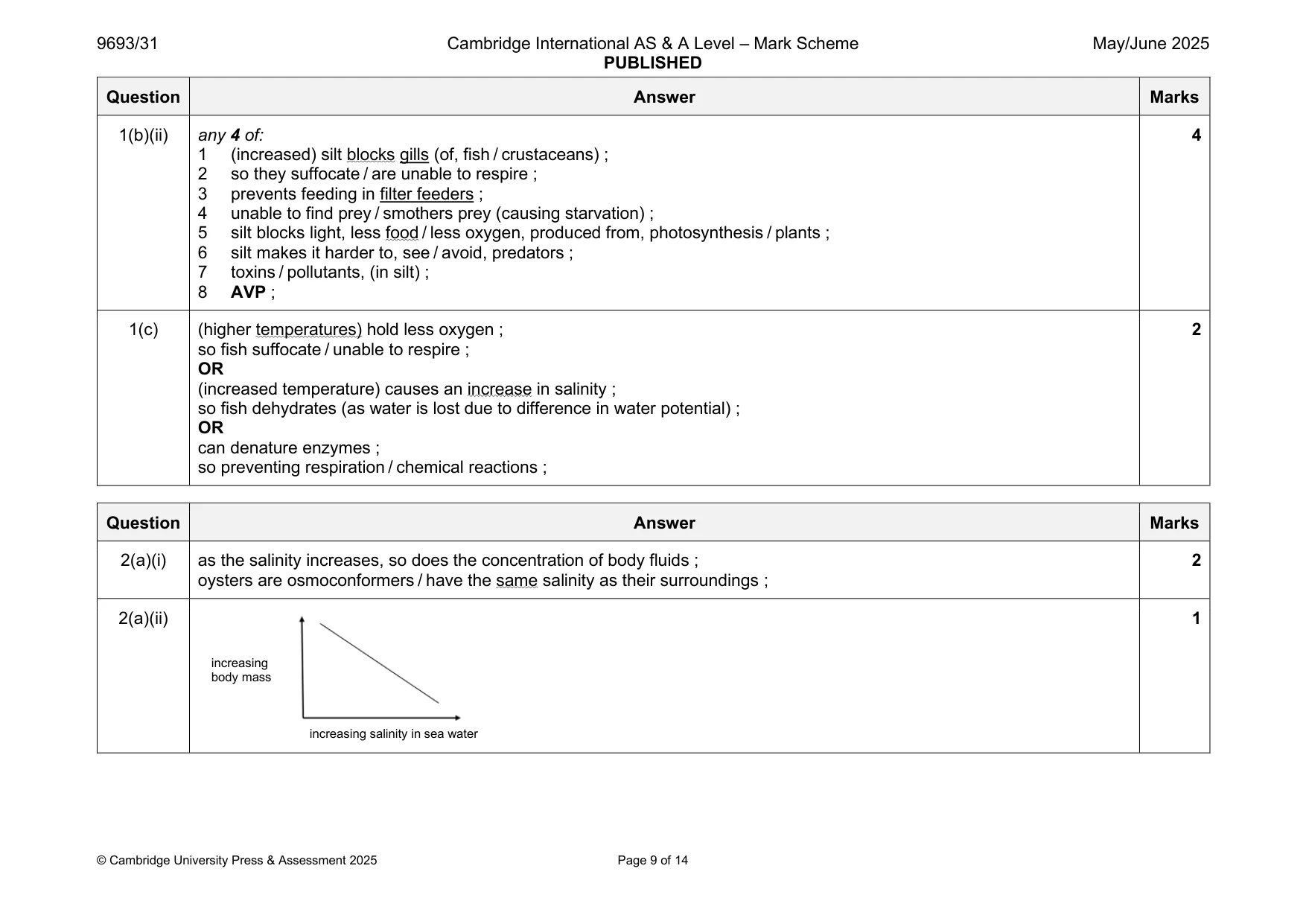
Mark scheme: 2(a)(i) as the salinity increases, so does the concentration of body fluids ; 2 oysters are osmoconformers / have the same salinity as their surroundings ; 2(a)(ii) 1 increasing body mass increasing salinity in sea water 2(a)(iii) any 3 of: 3 1 (as the salinity increases) the body mass decreases ; 2 as water is lost from the body ; 3 by osmosis ; 4 because the water potential outside is, lower / more negative, than the water potential in the body ;
Q3 · Salmon aquaculture can take place on land and in sea cages
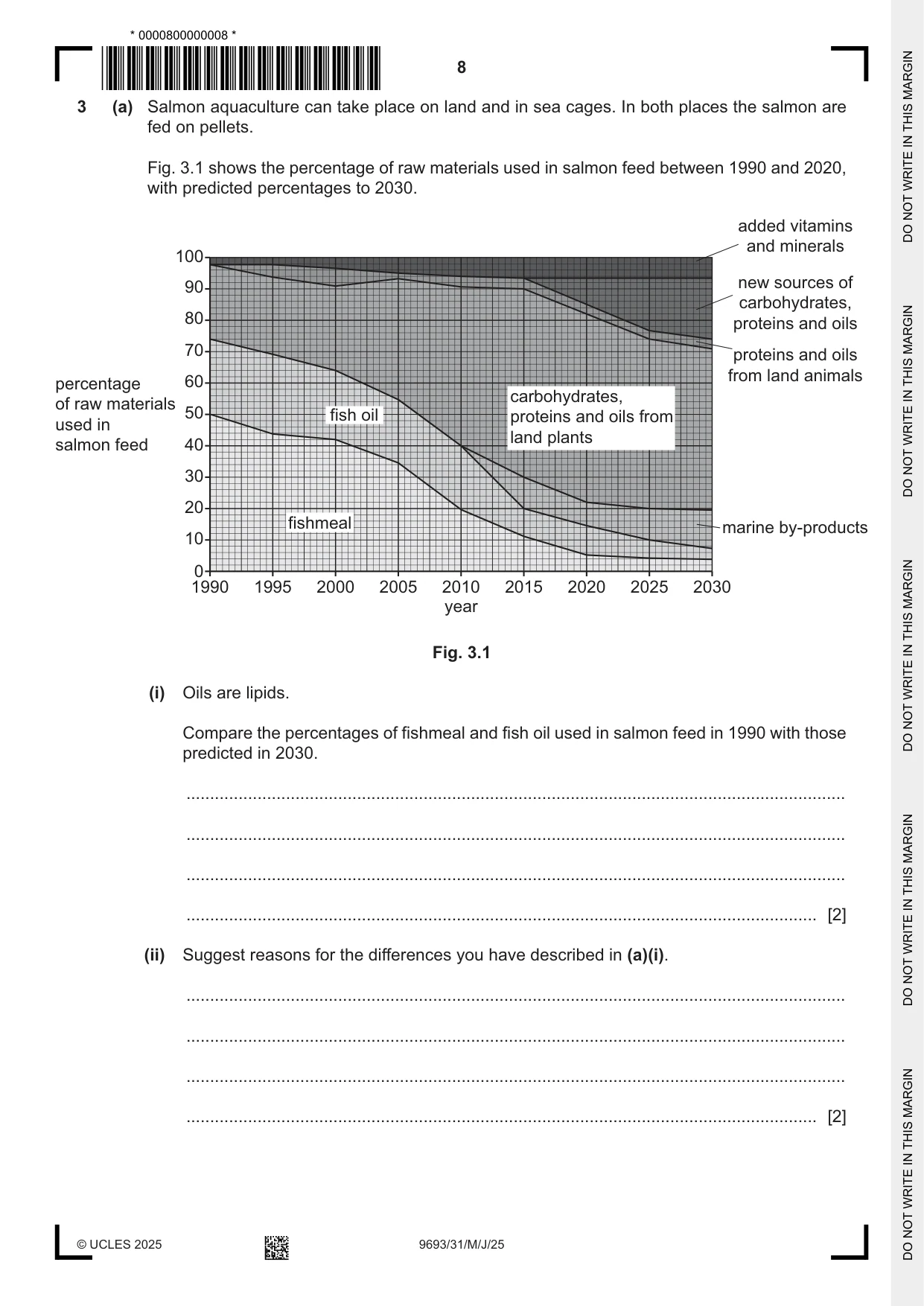
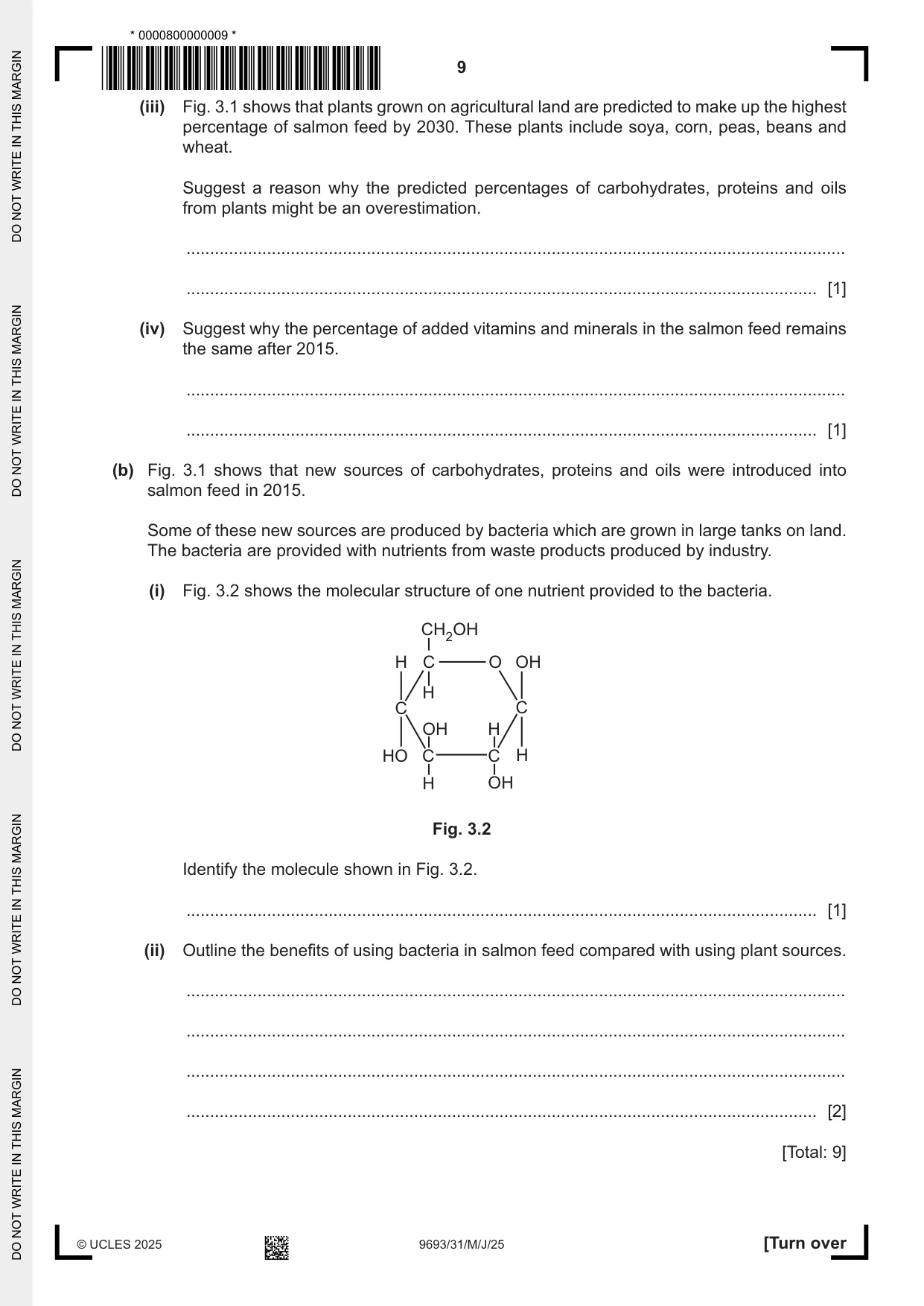
3 (a) Salmon aquaculture can take place on land and in sea cages. In both places the salmon are fed on pellets. Fig. 3.1 shows the percentage of raw materials used in salmon feed between 1990 and 2020, with predicted percentages to 2030. added vitamins and minerals 100 new sources of 90 carbohydrates, 80 proteins and oils 70 proteins and oils from land animalspercentage 60 carbohydrates,of raw materials 50 fish oil proteins and oils fromused in land plantssalmon feed 40 30 20 fishmeal marine by-products 10 0 1990 1995 2000 2005 2010 2015 2020 2025 2030 year Fig. 3.1 (i) Oils are lipids. Compare the percentages of fishmeal and fish oil used in salmon feed in 1990 with those predicted in 2030. ........................................................................................................................................... ........................................................................................................................................... ........................................................................................................................................... ..................................................................................................................................... [2] (ii) Suggest reasons for the differences you have described in (a)(i). ........................................................................................................................................... ........................................................................................................................................... ........................................................................................................................................... ..................................................................................................................................... [2] (iii) Fig. 3.1 shows that plants grown on agricultural land are predicted to make up the highest percentage of salmon feed by 2030. These plants include soya, corn, peas, beans and wheat. Suggest a reason why the predicted percentages of carbohydrates, proteins and oils from plants might be an overestimation. ........................................................................................................................................... ..................................................................................................................................... [1] (iv) Suggest why the percentage of added vitamins and minerals in the salmon feed remains the same after 2015. ........................................................................................................................................... ..................................................................................................................................... [1] (b) Fig. 3.1 shows that new sources of carbohydrates, proteins and oils were introduced into salmon feed in 2015. Some of these new sources are produced by bacteria which are grown in large tanks on land. The bacteria are provided with nutrients from waste products produced by industry. (i) Fig. 3.2 shows the molecular structure of one nutrient provided to the bacteria. CH2OH H C O OH H C C OH H HO C C H H OH Fig. 3.2 Identify the molecule shown in Fig. 3.2. ..................................................................................................................................... [1] (ii) Outline the benefits of using bacteria in salmon feed compared with using plant sources. ........................................................................................................................................... ........................................................................................................................................... ........................................................................................................................................... ..................................................................................................................................... [2] [Total: 9]
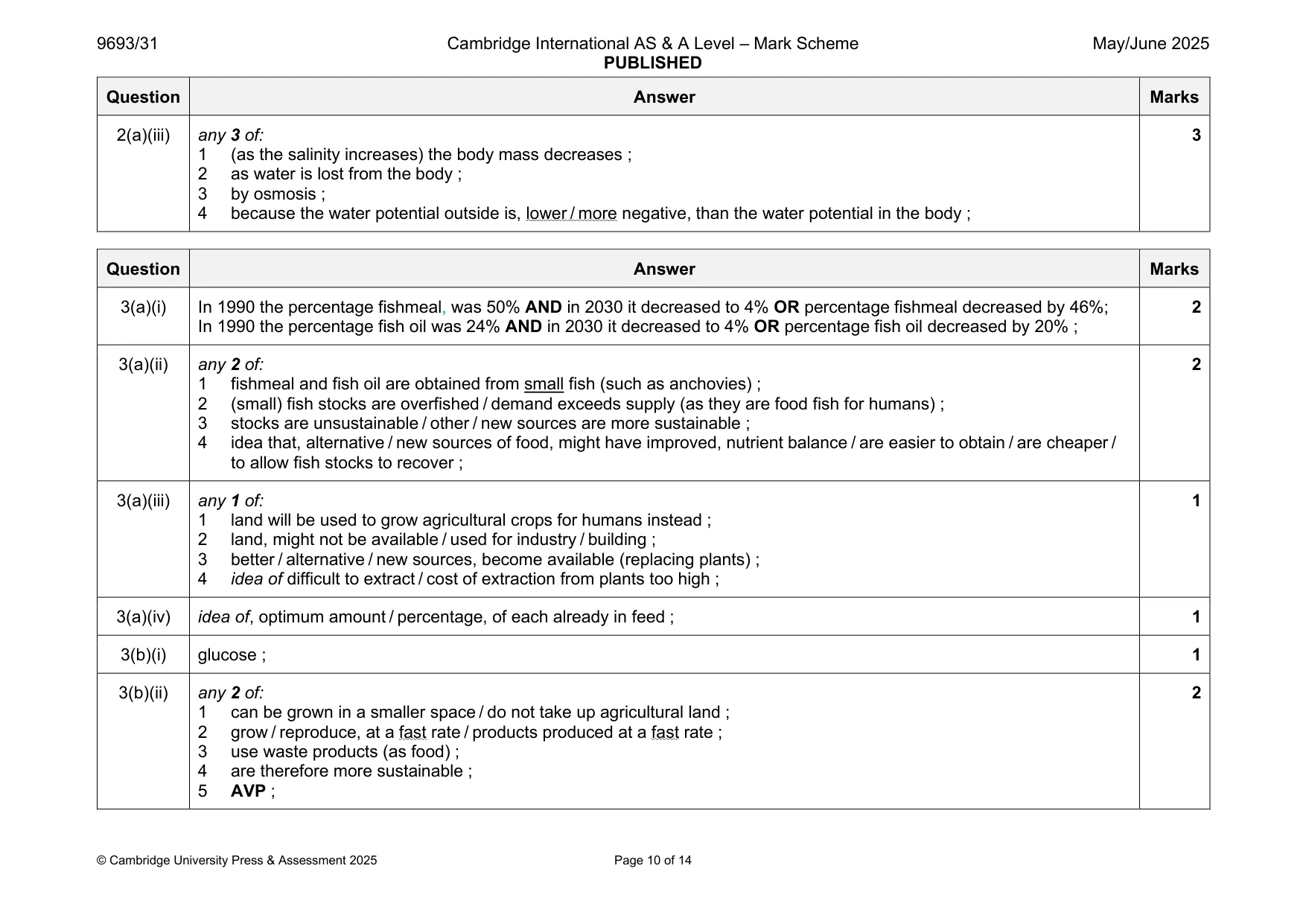
Mark scheme: 3(a)(i) In 1990 the percentage fishmeal, was 50% AND in 2030 it decreased to 4% OR percentage fishmeal decreased by 46%; 2 In 1990 the percentage fish oil was 24% AND in 2030 it decreased to 4% OR percentage fish oil decreased by 20% ; 3(a)(ii) any 2 of: 2 1 fishmeal and fish oil are obtained from small fish (such as anchovies) ; 2 (small) fish stocks are overfished / demand exceeds supply (as they are food fish for humans) ; 3 stocks are unsustainable / other / new sources are more sustainable ; 4 idea that, alternative / new sources of food, might have improved, nutrient balance / are easier to obtain / are cheaper / to allow fish stocks to recover ; 3(a)(iii) any 1 of: 1 1 land will be used to grow agricultural crops for humans instead ; 2 land, might not be available / used for industry / building ; 3 better / alternative / new sources, become available (replacing plants) ; 4 idea of difficult to extract / cost of extraction from plants too high ; 3(a)(iv) idea of, optimum amount / percentage, of each already in feed ; 1 3(b)(i) glucose ; 1 3(b)(ii) any 2 of: 2 1 can be grown in a smaller space / do not take up agricultural land ; 2 grow / reproduce, at a fast rate / products produced at a fast rate ; 3 use waste products (as food) ; 4 are therefore more sustainable ; 5 AVP ;
Q4 · Seahorses belong to the phylum Chordata
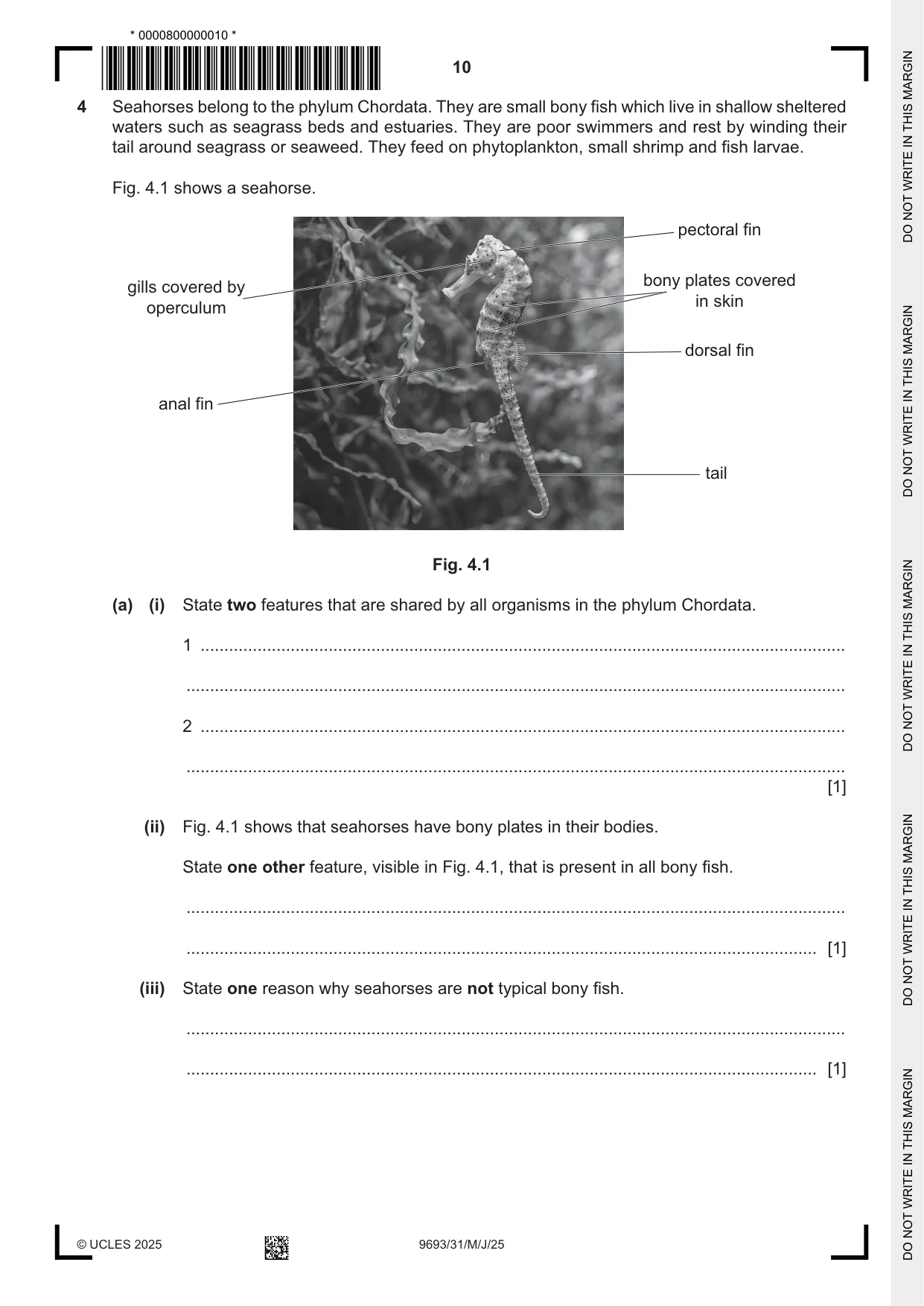
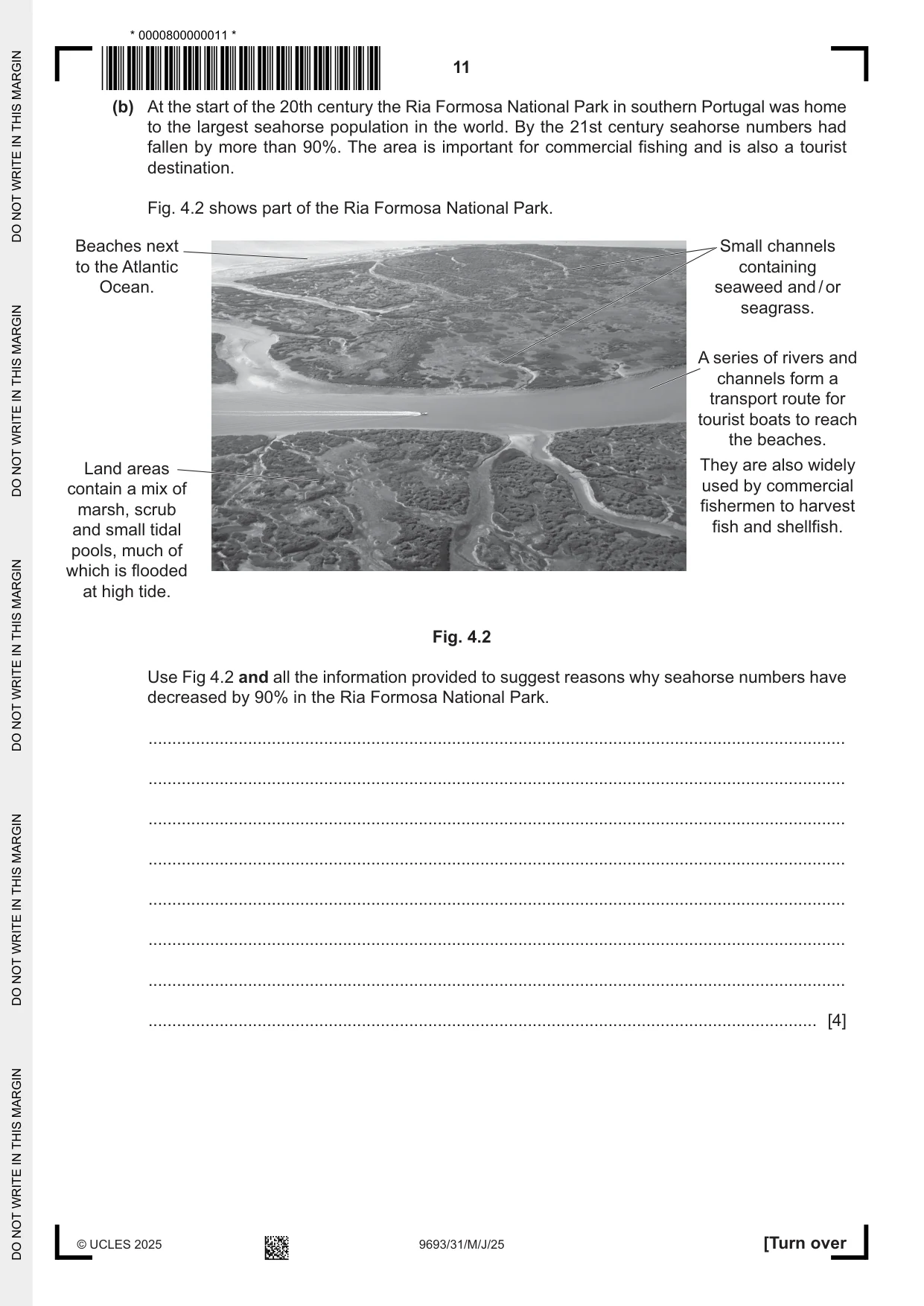
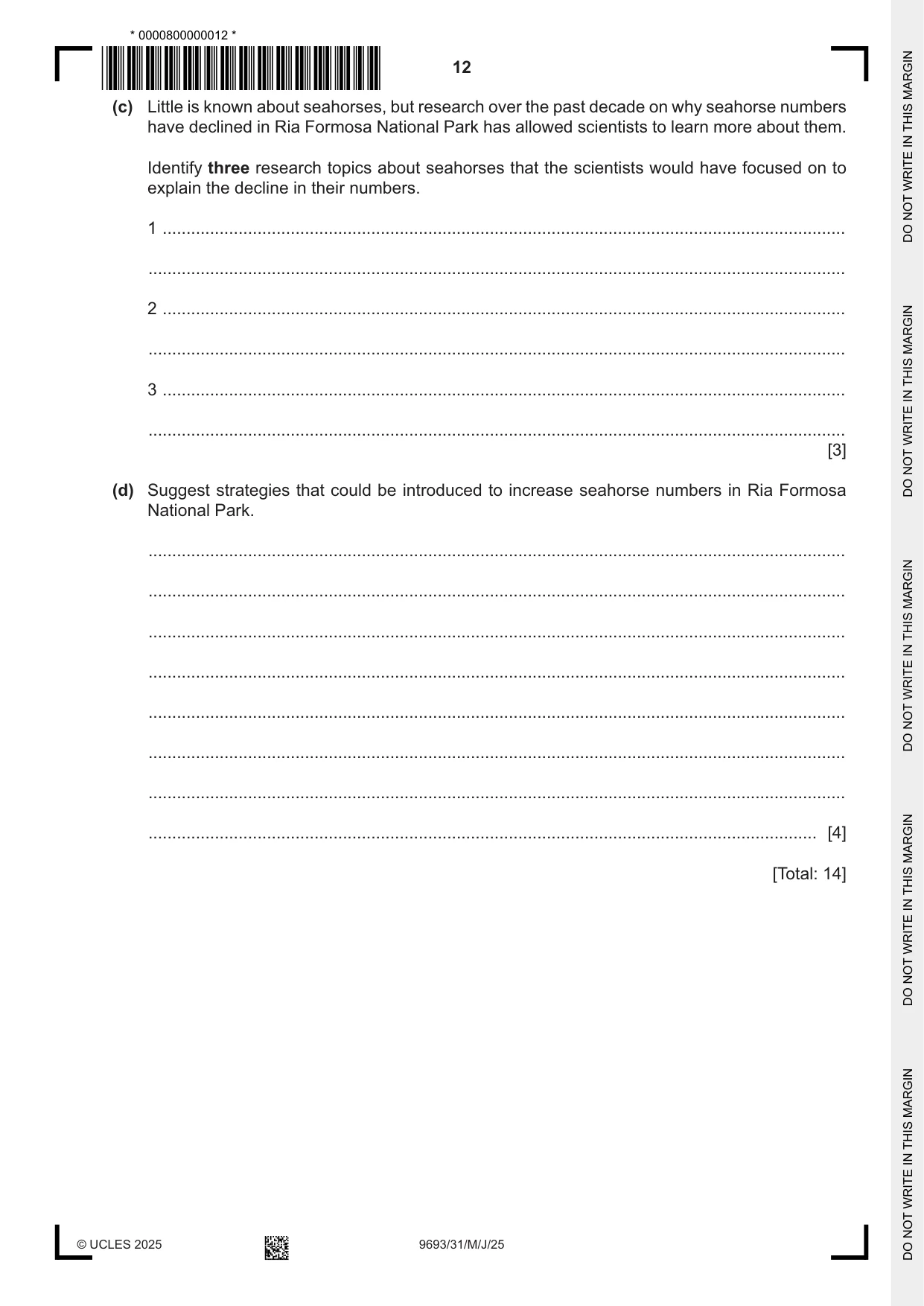
4 Seahorses belong to the phylum Chordata. They are small bony fish which live in shallow sheltered waters such as seagrass beds and estuaries. They are poor swimmers and rest by winding their tail around seagrass or seaweed. They feed on phytoplankton, small shrimp and fish larvae. Fig. 4.1 shows a seahorse. pectoral fin bony plates covered gills covered by in skin operculum dorsal fin anal fin tail Fig. 4.1 (a) (i) State two features that are shared by all organisms in the phylum Chordata. 1 ........................................................................................................................................ ........................................................................................................................................... 2 ........................................................................................................................................ ........................................................................................................................................... [1] (ii) Fig. 4.1 shows that seahorses have bony plates in their bodies. State one other feature, visible in Fig. 4.1, that is present in all bony fish. ........................................................................................................................................... ..................................................................................................................................... [1] (iii) State one reason why seahorses are not typical bony fish. ........................................................................................................................................... ..................................................................................................................................... [1] (b) At the start of the 20th century the Ria Formosa National Park in southern Portugal was home to the largest seahorse population in the world. By the 21st century seahorse numbers had fallen by more than 90%. The area is important for commercial fishing and is also a tourist destination. Fig. 4.2 shows part of the Ria Formosa National Park. Beaches next Small channels to the Atlantic containing Ocean. seaweed and / or seagrass. A series of rivers and channels form a transport route for tourist boats to reach the beaches. Land areas They are also widely contain a mix of used by commercial marsh, scrub fishermen to harvest and small tidal fish and shellfish. pools, much of which is flooded at high tide. Fig. 4.2 Use Fig 4.2 and all the information provided to suggest reasons why seahorse numbers have decreased by 90% in the Ria Formosa National Park. ................................................................................................................................................... ................................................................................................................................................... ................................................................................................................................................... ................................................................................................................................................... ................................................................................................................................................... ................................................................................................................................................... ................................................................................................................................................... ............................................................................................................................................. [4] (c) Little is known about seahorses, but research over the past decade on why seahorse numbers have declined in Ria Formosa National Park has allowed scientists to learn more about them. Identify three research topics about seahorses that the scientists would have focused on to explain the decline in their numbers. 1 ................................................................................................................................................ ................................................................................................................................................... 2 ................................................................................................................................................ ................................................................................................................................................... 3 ................................................................................................................................................ ................................................................................................................................................... [3] (d) Suggest strategies that could be introduced to increase seahorse numbers in Ria Formosa National Park. ................................................................................................................................................... ................................................................................................................................................... ................................................................................................................................................... ................................................................................................................................................... ................................................................................................................................................... ................................................................................................................................................... ................................................................................................................................................... ............................................................................................................................................. [4] [Total: 14]
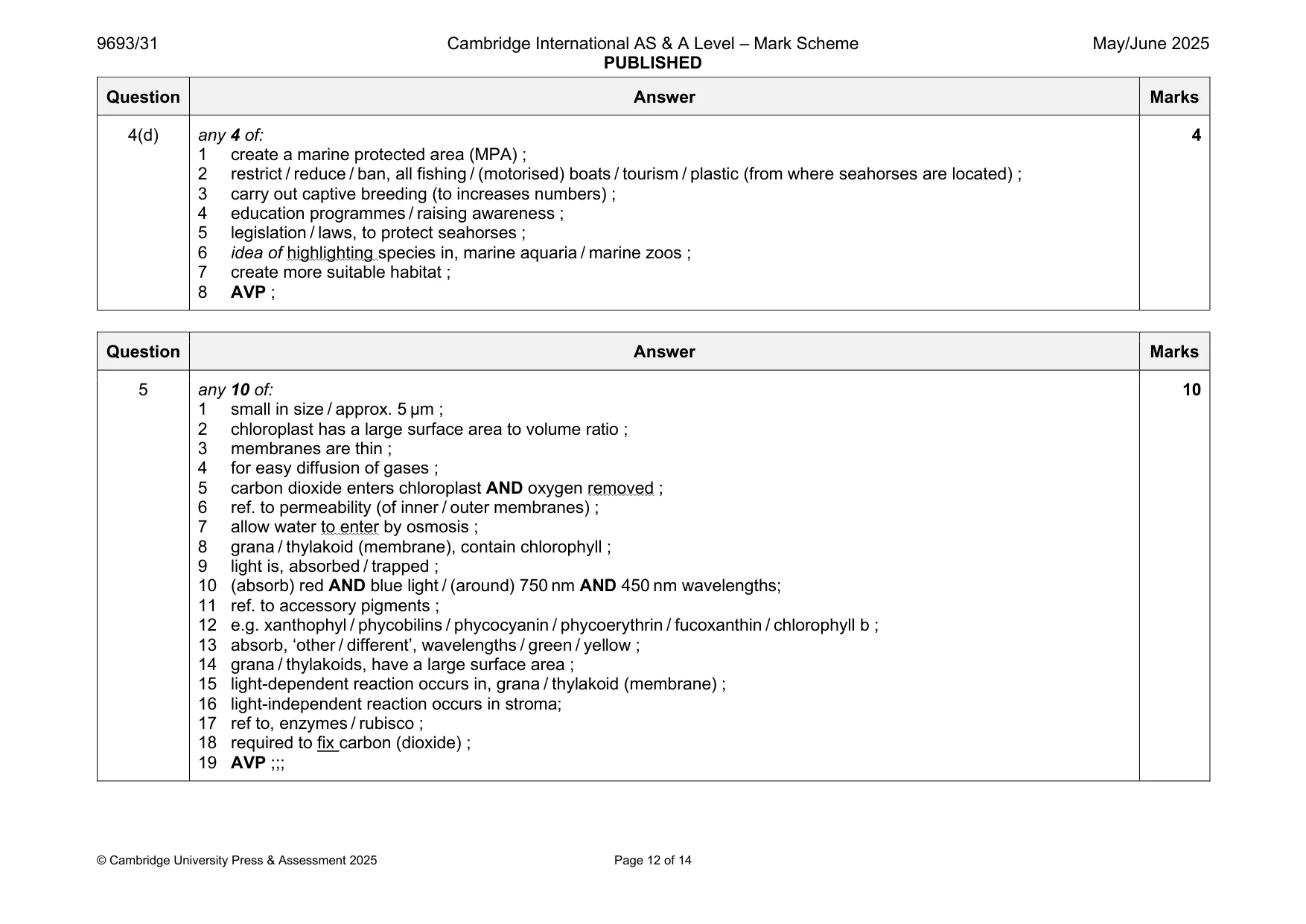
Mark scheme: 4(a)(i) any 2 of: 1 notochord dorsal neural tube pharyngeal slits post-anal tail ; 4(a)(ii) any 1 of: 1 fins / named fin ; gills / gill cover / operculum ; 4(a)(iii) any 1 of: 1 no caudal / pelvic fin ; no scales / skin covers body ; AVP ; 4(b) any 4 of: 4 1 example of how, boats / tourists, cause, disturbance / damage, (to seahorses) ; 2 pollutants / toxins, OR example, oil / fuel, (from boats) / sunscreens ; 3 caught as by-catch (in fishing nets) / overfishing has depleted their food supply (shrimp) ; 4 habitat destruction (by boats / dredging / tourism) ; 5 idea of trapped, on land / in tidal pools, after high tide / flooding OR so desiccate ; 6 poor swimmers so cannot avoid danger ; 7 AVP ; 4(c) any 3 of: 3 1 actual numbers present ; 2 life cycle / breeding habits ; 3 feeding / prey / predators ; 4 habitat / location ; 5 effect of, boats / fishing / tourism / pollutants ; 6 optimum conditions for survival ; 4(d) any 4 of: 4 1 create a marine protected area (MPA) ; 2 restrict / reduce / ban, all fishing / (motorised) boats / tourism / plastic (from where seahorses are located) ; 3 carry out captive breeding (to increases numbers) ; 4 education programmes / raising awareness ; 5 legislation / laws, to protect seahorses ; 6 idea of highlighting species in, marine aquaria / marine zoos ; 7 create more suitable habitat ; 8 AVP ;
Q5 · Photosynthesis takes place in chloroplasts
5 Photosynthesis takes place in chloroplasts. Explain how chloroplast structure is related to this function. .......................................................................................................................................................... .......................................................................................................................................................... .......................................................................................................................................................... .......................................................................................................................................................... .......................................................................................................................................................... .......................................................................................................................................................... .......................................................................................................................................................... .......................................................................................................................................................... .......................................................................................................................................................... .......................................................................................................................................................... .......................................................................................................................................................... .......................................................................................................................................................... .......................................................................................................................................................... .......................................................................................................................................................... .......................................................................................................................................................... .......................................................................................................................................................... .......................................................................................................................................................... .......................................................................................................................................................... .......................................................................................................................................................... .................................................................................................................................................. [10]
Mark scheme: 5 any 10 of: 10 1 small in size / approx. 5 µm ; 2 chloroplast has a large surface area to volume ratio ; 3 membranes are thin ; 4 for easy diffusion of gases ; 5 carbon dioxide enters chloroplast AND oxygen removed ; 6 ref. to permeability (of inner / outer membranes) ; 7 allow water to enter by osmosis ; 8 grana / thylakoid (membrane), contain chlorophyll ; 9 light is, absorbed / trapped ; 10 (absorb) red AND blue light / (around) 750 nm AND 450 nm wavelengths; 11 ref. to accessory pigments ; 12 e.g. xanthophyl / phycobilins / phycocyanin / phycoerythrin / fucoxanthin / chlorophyll b ; 13 absorb, ‘other / different’, wavelengths / green / yellow ; 14 grana / thylakoids, have a large surface area ; 15 light-dependent reaction occurs in, grana / thylakoid (membrane) ; 16 light-independent reaction occurs in stroma; 17 ref to, enzymes / rubisco ; 18 required to fix carbon (dioxide) ; 19 AVP ;;;
Q6 · Describe the different ways that carbon compounds can enter the ocean
6 (a) Describe the different ways that carbon compounds can enter the ocean. ................................................................................................................................................... ................................................................................................................................................... ................................................................................................................................................... ................................................................................................................................................... ................................................................................................................................................... ................................................................................................................................................... ................................................................................................................................................... ................................................................................................................................................... ................................................................................................................................................... ................................................................................................................................................... ................................................................................................................................................... ............................................................................................................................................. [6] (b) Describe how the oceans help to limit the increase in carbon dioxide in the atmosphere. ................................................................................................................................................... ................................................................................................................................................... ................................................................................................................................................... ................................................................................................................................................... ................................................................................................................................................... ................................................................................................................................................... ................................................................................................................................................... ................................................................................................................................................... ................................................................................................................................................... ................................................................................................................................................... ................................................................................................................................................... ............................................................................................................................................. [6] [Total: 12]
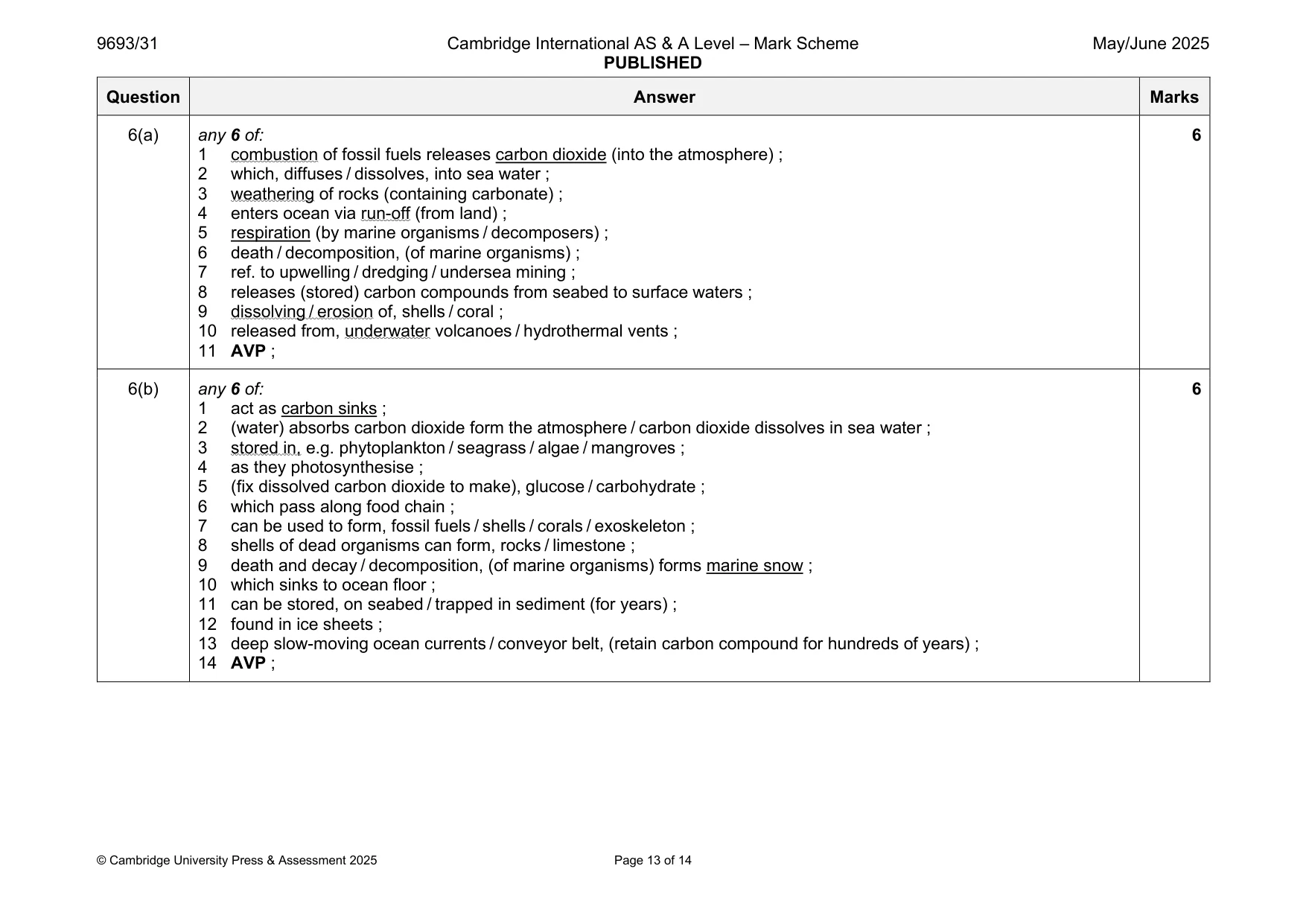
Mark scheme: 6(a) any 6 of: 6 1 combustion of fossil fuels releases carbon dioxide (into the atmosphere) ; 2 which, diffuses / dissolves, into sea water ; 3 weathering of rocks (containing carbonate) ; 4 enters ocean via run-off (from land) ; 5 respiration (by marine organisms / decomposers) ; 6 death / decomposition, (of marine organisms) ; 7 ref. to upwelling / dredging / undersea mining ; 8 releases (stored) carbon compounds from seabed to surface waters ; 9 dissolving / erosion of, shells / coral ; 10 released from, underwater volcanoes / hydrothermal vents ; 11 AVP ; 6(b) any 6 of: 6 1 act as carbon sinks ; 2 (water) absorbs carbon dioxide form the atmosphere / carbon dioxide dissolves in sea water ; 3 stored in, e.g. phytoplankton / seagrass / algae / mangroves ; 4 as they photosynthesise ; 5 (fix dissolved carbon dioxide to make), glucose / carbohydrate ; 6 which pass along food chain ; 7 can be used to form, fossil fuels / shells / corals / exoskeleton ; 8 shells of dead organisms can form, rocks / limestone ; 9 death and decay / decomposition, (of marine organisms) forms marine snow ; 10 which sinks to ocean floor ; 11 can be stored, on seabed / trapped in sediment (for years) ; 12 found in ice sheets ; 13 deep slow-moving ocean currents / conveyor belt, (retain carbon compound for hundreds of years) ; 14 AVP ;
Q7 · Discuss the advantages and disadvantages of releasing adult salmon produced in a hatchery…
7 Discuss the advantages and disadvantages of releasing adult salmon produced in a hatchery into the ocean. .......................................................................................................................................................... .......................................................................................................................................................... .......................................................................................................................................................... .......................................................................................................................................................... .......................................................................................................................................................... .......................................................................................................................................................... .......................................................................................................................................................... .......................................................................................................................................................... .......................................................................................................................................................... .......................................................................................................................................................... .......................................................................................................................................................... .......................................................................................................................................................... .......................................................................................................................................................... .......................................................................................................................................................... .......................................................................................................................................................... .................................................................................................................................................... [8] The boundaries and names shown, the designations used and the presentation of material on any maps contained in this question paper/insert do not imply official endorsement or acceptance by Cambridge Assessment International Education concerning the legal status of any country, territory, or area or any of its authorities, or of the delimitation of its frontiers or boundaries.
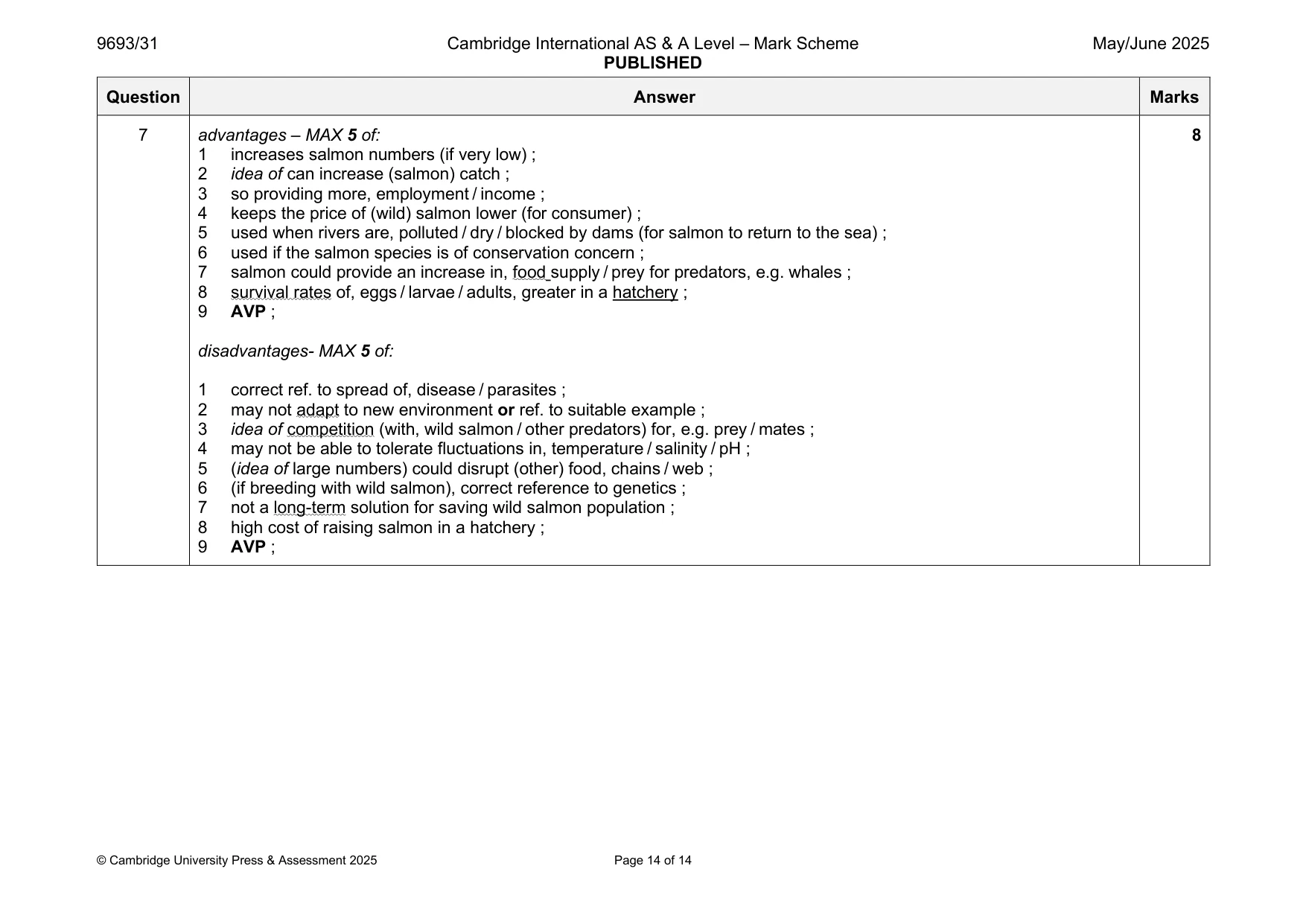
Mark scheme: 7 advantages – MAX 5 of: 8 1 increases salmon numbers (if very low) ; 2 idea of can increase (salmon) catch ; 3 so providing more, employment / income ; 4 keeps the price of (wild) salmon lower (for consumer) ; 5 used when rivers are, polluted / dry / blocked by dams (for salmon to return to the sea) ; 6 used if the salmon species is of conservation concern ; 7 salmon could provide an increase in, food supply / prey for predators, e.g. whales ; 8 survival rates of, eggs / larvae / adults, greater in a hatchery ; 9 AVP ; disadvantages- MAX 5 of: 1 correct ref. to spread of, disease / parasites ; 2 may not adapt to new environment or ref. to suitable example ; 3 idea of competition (with, wild salmon / other predators) for, e.g. prey / mates ; 4 may not be able to tolerate fluctuations in, temperature / salinity / pH ; 5 (idea of large numbers) could disrupt (other) food, chains / web ; 6 (if breeding with wild salmon), correct reference to genetics ; 7 not a long-term solution for saving wild salmon population ; 8 high cost of raising salmon in a hatchery ; 9 AVP ;
What was in this paper
The subtopics covered by these 7 questions, and how many questions each got. Open one in a new tab to see every Cambridge question on it.
What you needed in this session
Cambridge’s own grade thresholds for 2025 May/June, Paper 3 · Variant 1. A higher threshold means an easier paper — the bar moves with how the cohort did.