Cambridge A Level Marine Science 9693 — 2023 May/June Paper 3 · Variant 3
9693/33/M/J/23 · 7 questions · 75 marks · ≈84 min
The question paper and its mark scheme, free to read here and free to download. This is Cambridge’s own paper, exactly as it was sat.
Question paper16 pages


Mark scheme13 pages
Answers below. Sit the paper first if you are practising.
Questions as text
Q1 · The life cycle of jellyfish has two different forms – a free‑swimming medusa and a…
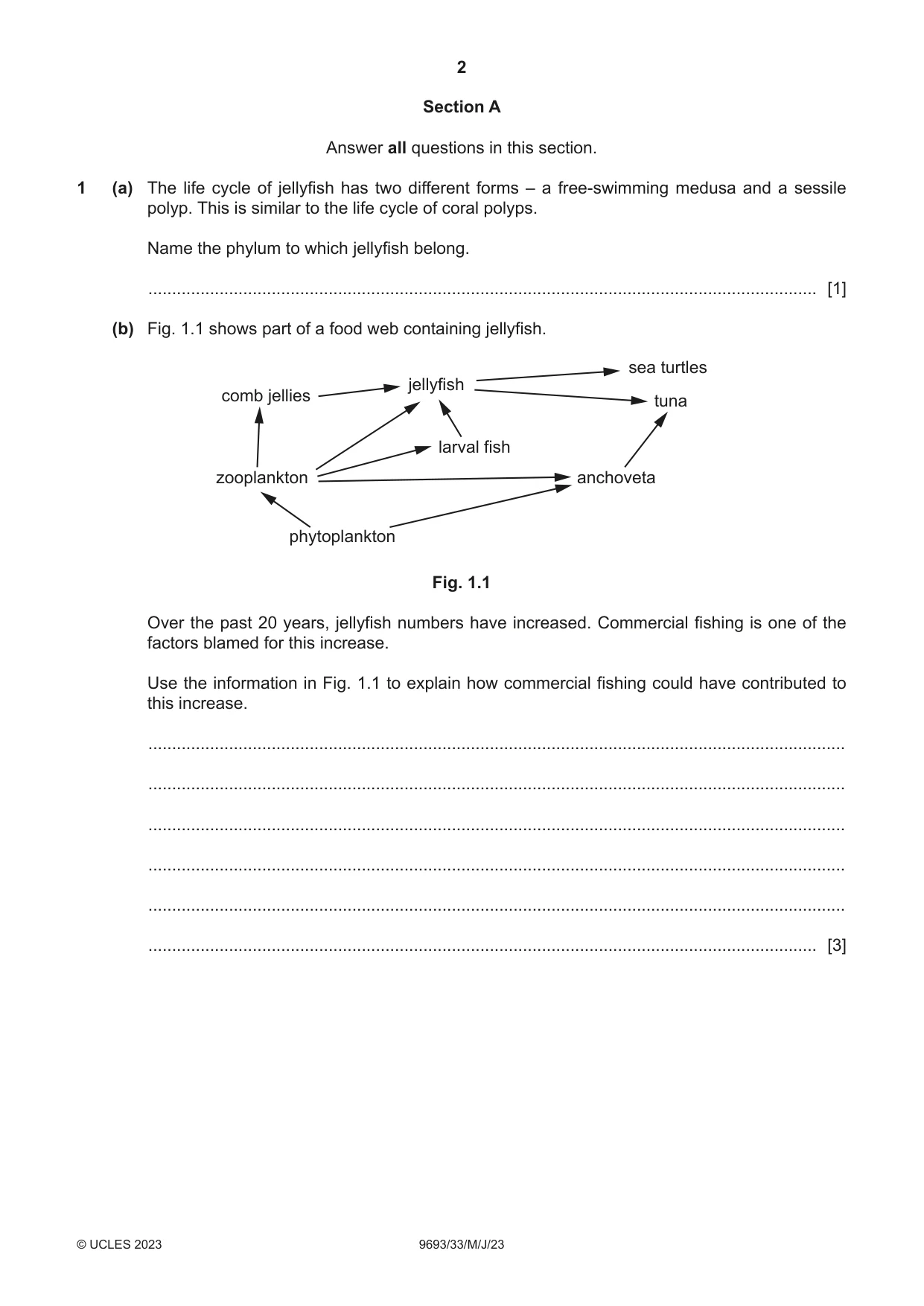
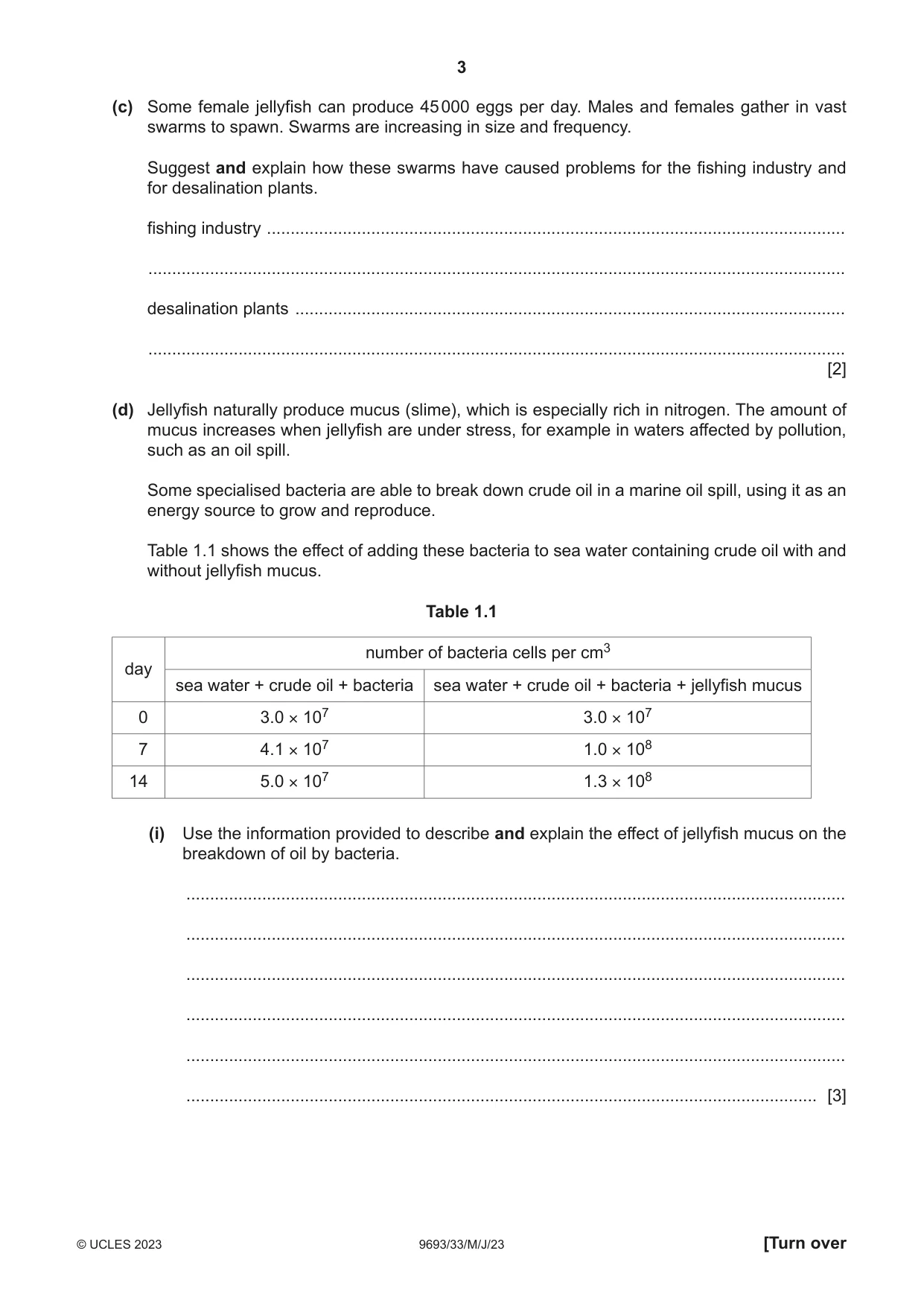
1 (a) The life cycle of jellyfish has two different forms – a free‑swimming medusa and a sessile polyp. This is similar to the life cycle of coral polyps. Name the phylum to which jellyfish belong. ............................................................................................................................................. [1] (b) Fig. 1.1 shows part of a food web containing jellyfish. sea turtles jellyfish comb jellies tuna larval fish zooplankton anchoveta phytoplankton Fig. 1.1 Over the past 20 years, jellyfish numbers have increased. Commercial fishing is one of the factors blamed for this increase. Use the information in Fig. 1.1 to explain how commercial fishing could have contributed to this increase. ................................................................................................................................................... ................................................................................................................................................... ................................................................................................................................................... ................................................................................................................................................... ................................................................................................................................................... ............................................................................................................................................. [3] (c) Some female jellyfish can produce 45 000 eggs per day. Males and females gather in vast swarms to spawn. Swarms are increasing in size and frequency. Suggest and explain how these swarms have caused problems for the fishing industry and for desalination plants. fishing industry .......................................................................................................................... ................................................................................................................................................... desalination plants .................................................................................................................... ................................................................................................................................................... [2] (d) Jellyfish naturally produce mucus (slime), which is especially rich in nitrogen. The amount of mucus increases when jellyfish are under stress, for example in waters affected by pollution, such as an oil spill. Some specialised bacteria are able to break down crude oil in a marine oil spill, using it as an energy source to grow and reproduce. Table 1.1 shows the effect of adding these bacteria to sea water containing crude oil with and without jellyfish mucus. Table 1.1 number of bacteria cells per cm3 day sea water + crude oil + bacteria sea water + crude oil + bacteria + jellyfish mucus 0 3.0 × 10⁷ 3.0 × 10⁷ 7 4.1 × 10⁷ 1.0 × 10⁸ 14 5.0 × 10⁷ 1.3 × 10⁸ (i) Use the information provided to describe and explain the effect of jellyfish mucus on the breakdown of oil by bacteria. ........................................................................................................................................... ........................................................................................................................................... ........................................................................................................................................... ........................................................................................................................................... ........................................................................................................................................... ..................................................................................................................................... [3] (ii) Many cosmetics contain plastic microbeads, which are then washed away in waste water. The microbeads are so small that they pass straight through water treatment works and are released into the oceans. Suggest how jellyfish mucus could be used to reduce the amount of plastic microbeads released into the oceans. ........................................................................................................................................... ........................................................................................................................................... ........................................................................................................................................... ..................................................................................................................................... [2] [Total: 11]
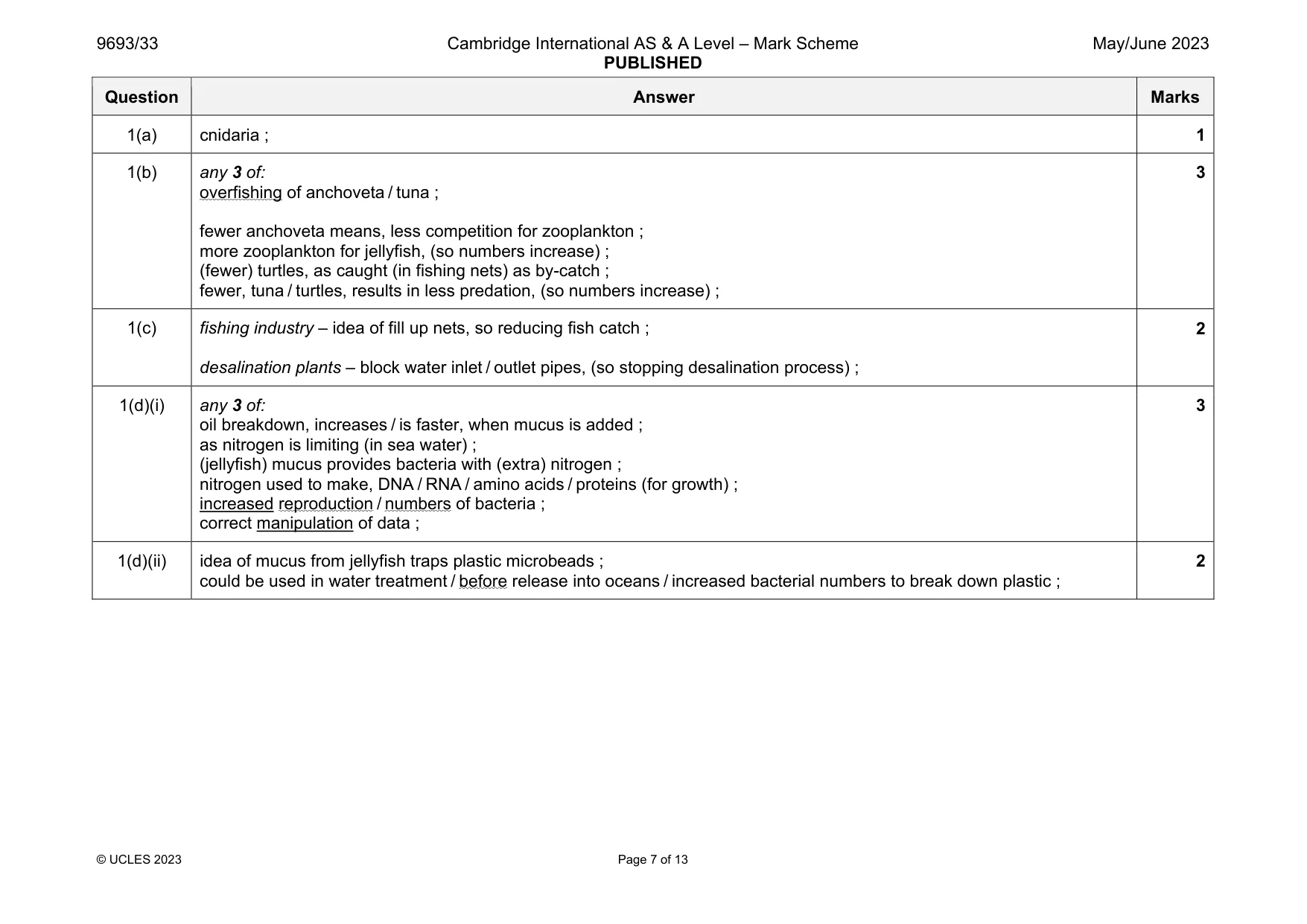
Mark scheme: 1(a) cnidaria ; 1 1(b) any 3 of: overfishing of anchoveta / tuna ; fewer anchoveta means, less competition for zooplankton ; more zooplankton for jellyfish, (so numbers increase) ; (fewer) turtles, as caught (in fishing nets) as by-catch ; fewer, tuna / turtles, results in less predation, (so numbers increase) ; 3 1(c) fishing industry – idea of fill up nets, so reducing fish catch ; desalination plants – block water inlet / outlet pipes, (so stopping desalination process) ; 2 1(d)(i) any 3 of: oil breakdown, increases / is faster, when mucus is added ; as nitrogen is limiting (in sea water) ; (jellyfish) mucus provides bacteria with (extra) nitrogen ; nitrogen used to make, DNA / RNA / amino acids / proteins (for growth) ; increased reproduction / numbers of bacteria ; correct manipulation of data ; 3 1(d)(ii) idea of mucus from jellyfish traps plastic microbeads ; could be used in water treatment / before release into oceans / increased bacterial numbers to break down plastic ; 2
Q2 · The delta of the Mekong river covers an area of 40 000 hectares in south eastern Vietnam
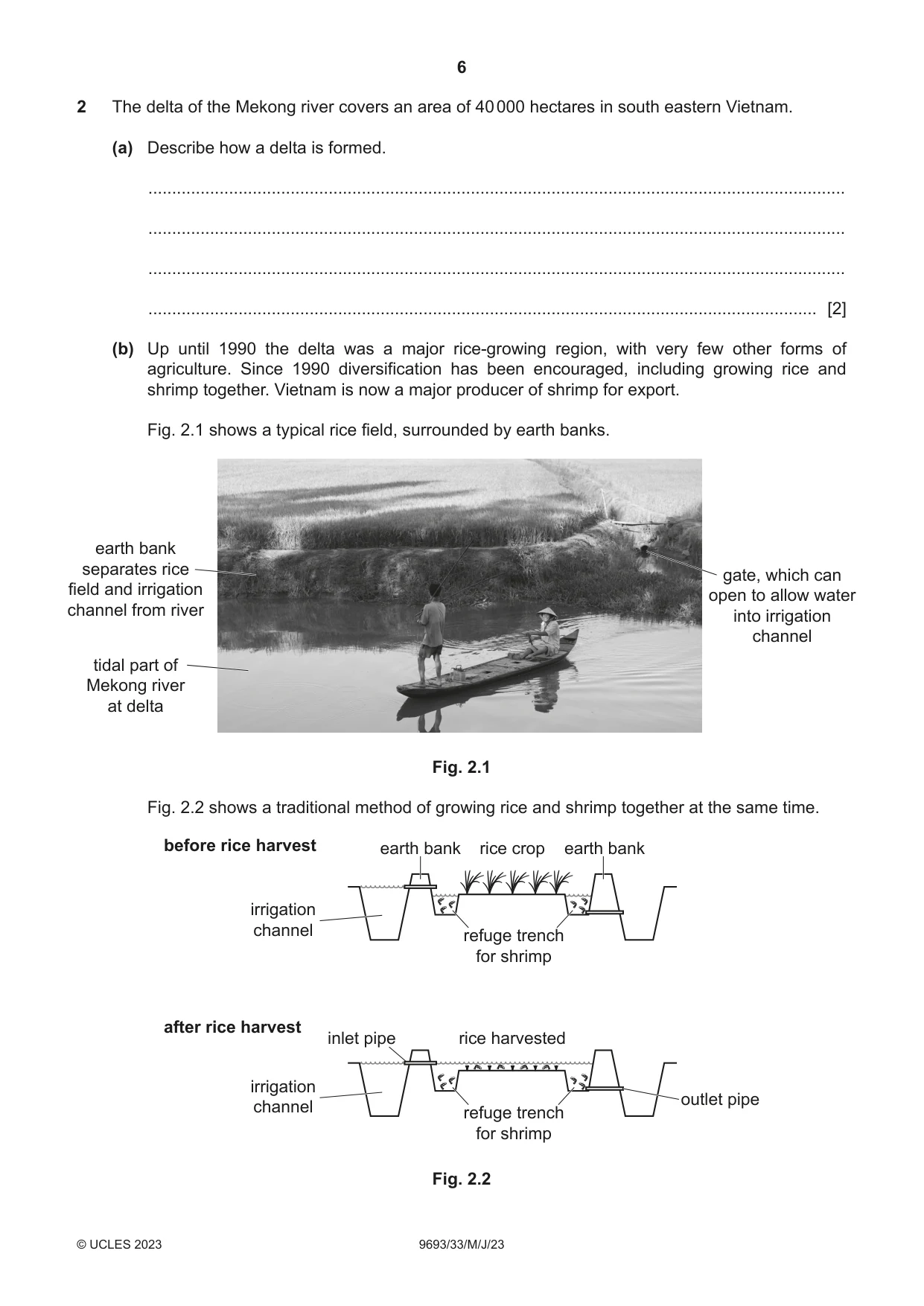
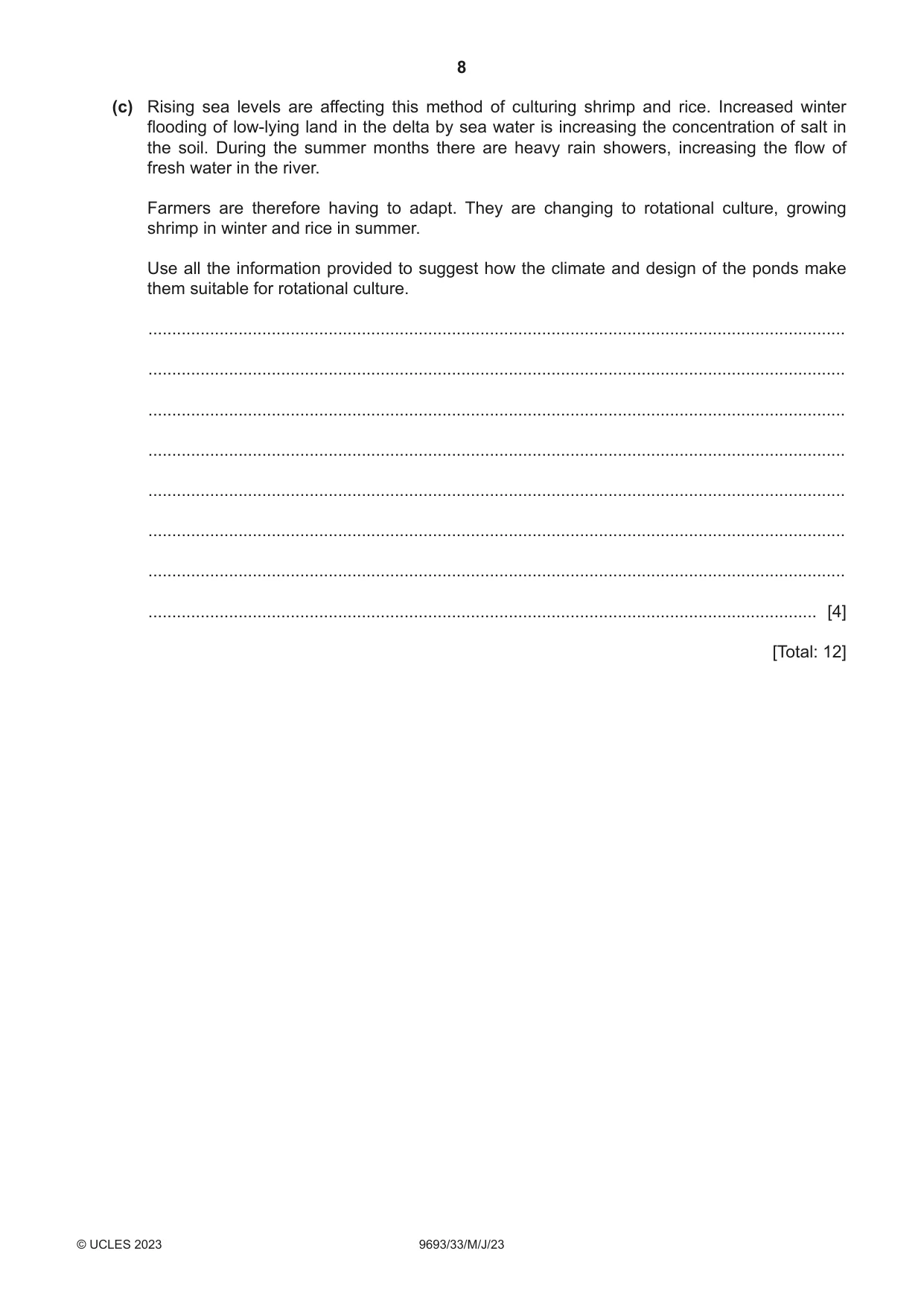
2 The delta of the Mekong river covers an area of 40 000 hectares in south eastern Vietnam. (a) Describe how a delta is formed. ................................................................................................................................................... ................................................................................................................................................... ................................................................................................................................................... ............................................................................................................................................. [2] (b) Up until 1990 the delta was a major rice‑growing region, with very few other forms of agriculture. Since 1990 diversification has been encouraged, including growing rice and shrimp together. Vietnam is now a major producer of shrimp for export. Fig. 2.1 shows a typical rice field, surrounded by earth banks. earth bank separates rice gate, which can field and irrigation open to allow water channel from river into irrigation channel tidal part of Mekong river at delta Fig. 2.1 Fig. 2.2 shows a traditional method of growing rice and shrimp together at the same time. before rice harvest earth bank rice crop earth bank irrigation channel refuge trench for shrimp after rice harvest inlet pipe rice harvested irrigation outlet pipe channel refuge trench for shrimp Fig. 2.2 After the rice has been harvested, the pond is flooded with sea water, allowing the shrimp to feed on natural food in the pond. The shrimp are harvested after a few months by draining the pond completely. The pond is then allowed to dry out and calcium salts are added regularly. (i) State why the pond is allowed to dry out after each harvest. ........................................................................................................................................... ..................................................................................................................................... [1] (ii) Suggest how calcium salts benefit shrimp and why these need to be added regularly. ........................................................................................................................................... ........................................................................................................................................... ........................................................................................................................................... ..................................................................................................................................... [2] (iii) The pond is re‑filled with a mixture of tidal water and river water when gates in the irrigation channels are opened. This allows wild juvenile shrimp and other marine species to reach the ponds. Suggest why the supply of wild juvenile shrimp from the sea has decreased over time and why harvested shrimp have become smaller in size. ........................................................................................................................................... ........................................................................................................................................... ........................................................................................................................................... ..................................................................................................................................... [2] (iv) A disadvantage of this method of shrimp culture is that yields are low compared with yields from intensive systems. Suggest an advantage of this method of shrimp culture compared with intensive systems. ........................................................................................................................................... ..................................................................................................................................... [1] (c) Rising sea levels are affecting this method of culturing shrimp and rice. Increased winter flooding of low‑lying land in the delta by sea water is increasing the concentration of salt in the soil. During the summer months there are heavy rain showers, increasing the flow of fresh water in the river. Farmers are therefore having to adapt. They are changing to rotational culture, growing shrimp in winter and rice in summer. Use all the information provided to suggest how the climate and design of the ponds make them suitable for rotational culture. ................................................................................................................................................... ................................................................................................................................................... ................................................................................................................................................... ................................................................................................................................................... ................................................................................................................................................... ................................................................................................................................................... ................................................................................................................................................... ............................................................................................................................................. [4] [Total: 12]
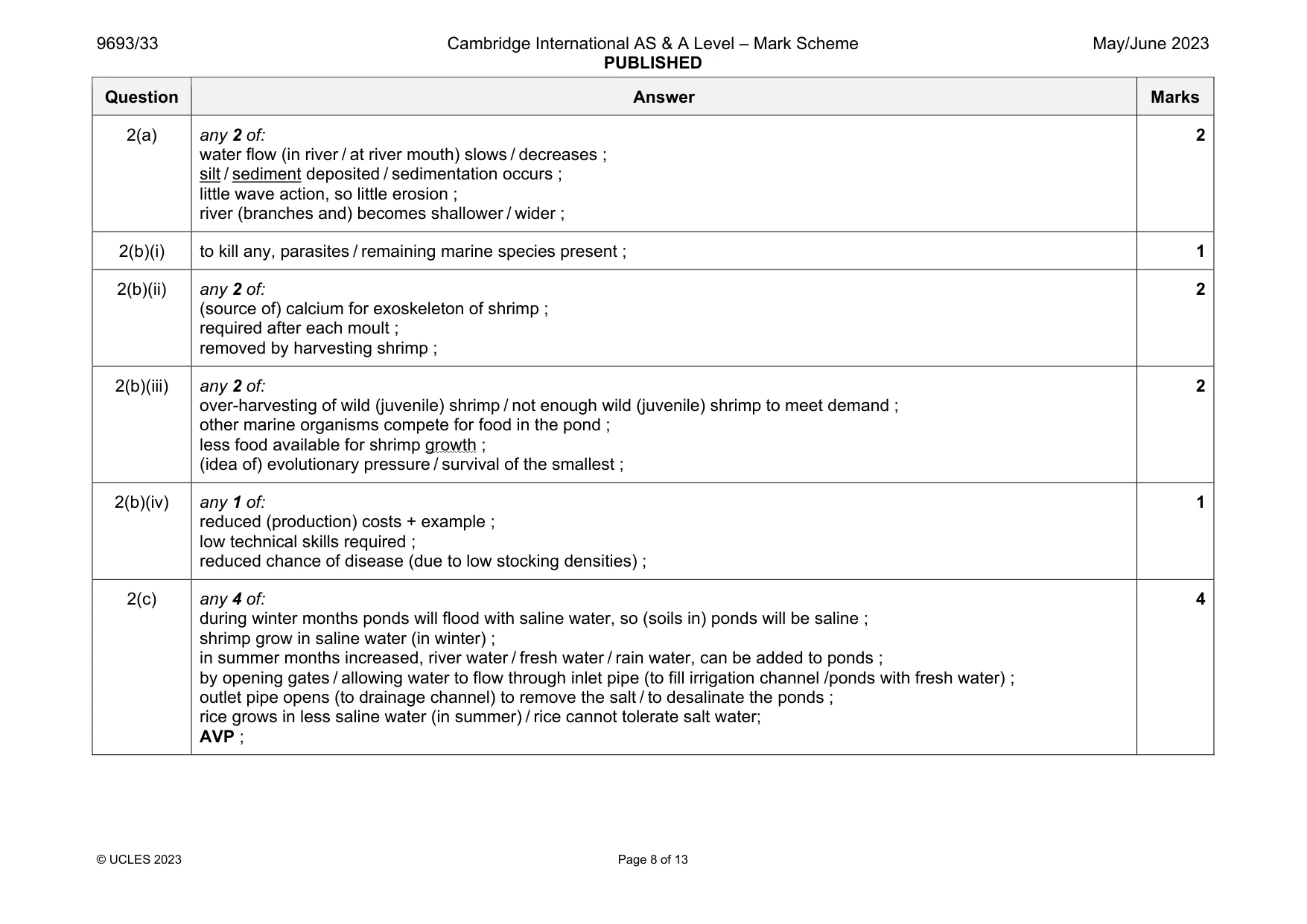
Mark scheme: 2(a) any 2 of: water flow (in river / at river mouth) slows / decreases ; silt / sediment deposited / sedimentation occurs ; little wave action, so little erosion ; river (branches and) becomes shallower / wider ; 2 2(b)(i) to kill any, parasites / remaining marine species present ; 1 2(b)(ii) any 2 of: (source of) calcium for exoskeleton of shrimp ; required after each moult ; removed by harvesting shrimp ; 2 2(b)(iii) any 2 of: over-harvesting of wild (juvenile) shrimp / not enough wild (juvenile) shrimp to meet demand ; other marine organisms compete for food in the pond ; less food available for shrimp growth ; (idea of) evolutionary pressure / survival of the smallest ; 2 2(b)(iv) any 1 of: reduced (production) costs + example ; low technical skills required ; reduced chance of disease (due to low stocking densities) ; 1 2(c) any 4 of: during winter months ponds will flood with saline water, so (soils in) ponds will be saline ; shrimp grow in saline water (in winter) ; in summer months increased, river water / fresh water / rain water, can be added to ponds ; by opening gates / allowing water to flow through inlet pipe (to fill irrigation channel /ponds with fresh water) ; outlet pipe opens (to drainage channel) to remove the salt / to desalinate the ponds ; rice grows in less saline water (in summer) / rice cannot tolerate salt water; AVP ; 4
Q3 · Golden samphire (Limbarda crithmoides) growing in the splash zone of a rocky shore
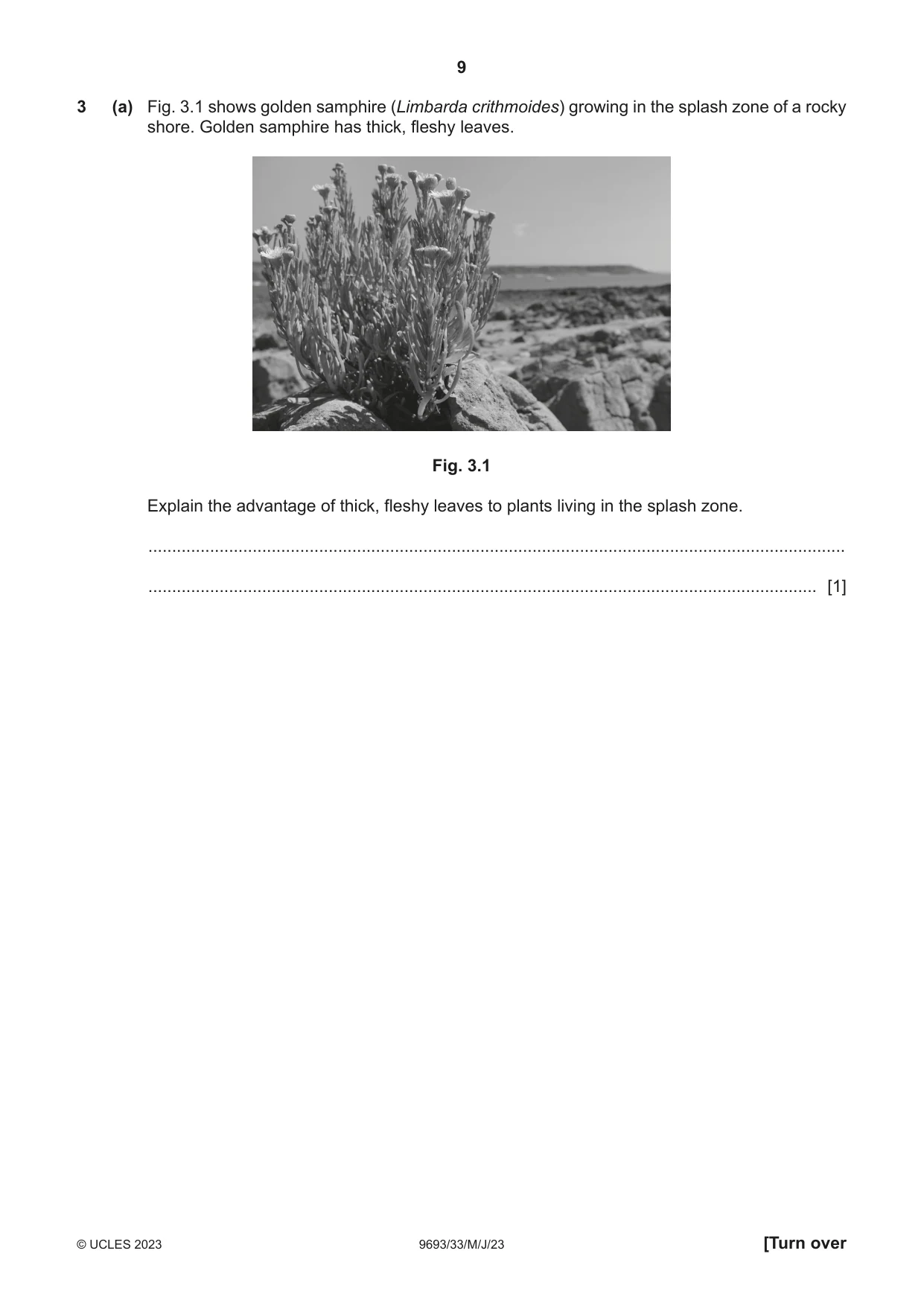
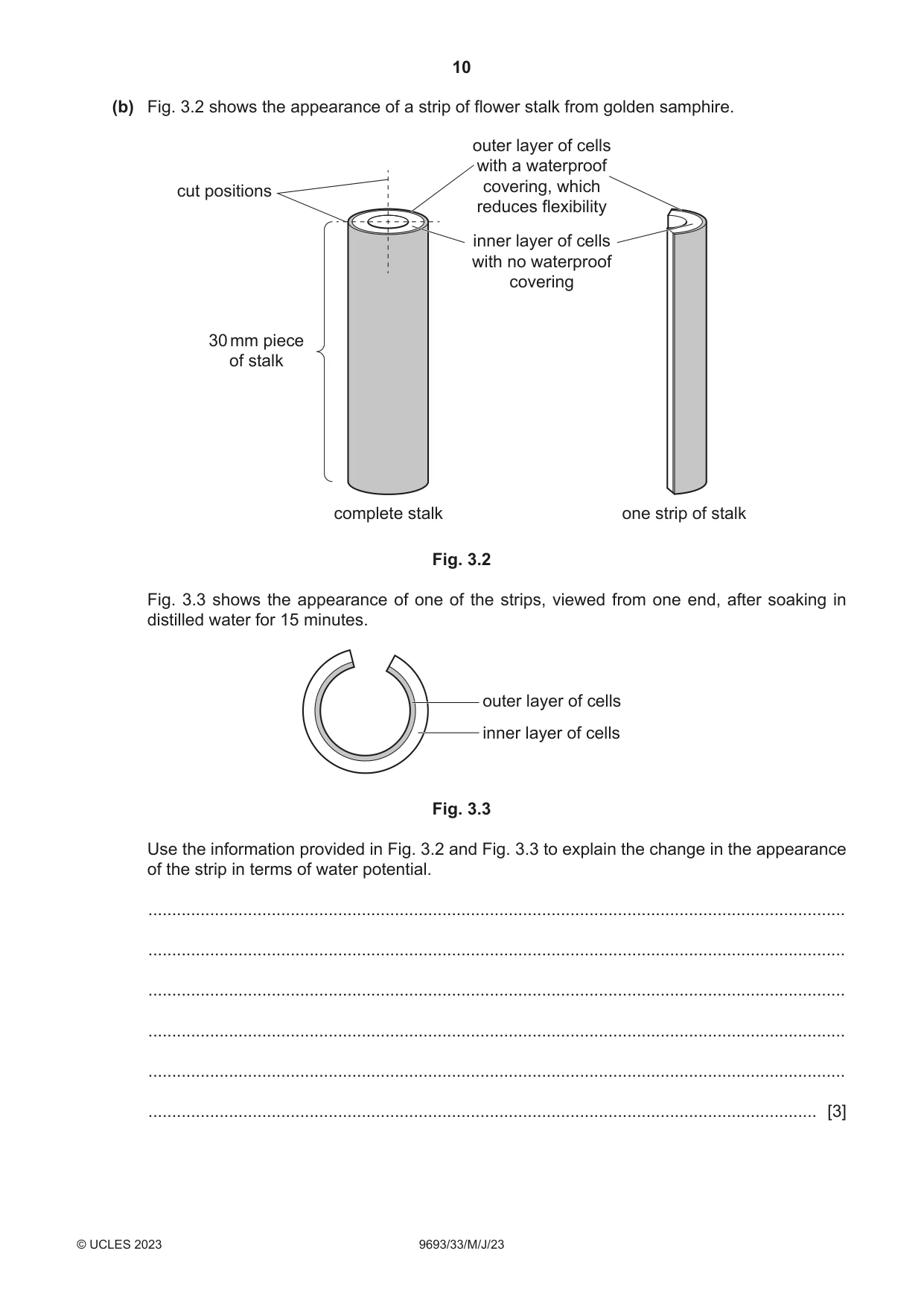
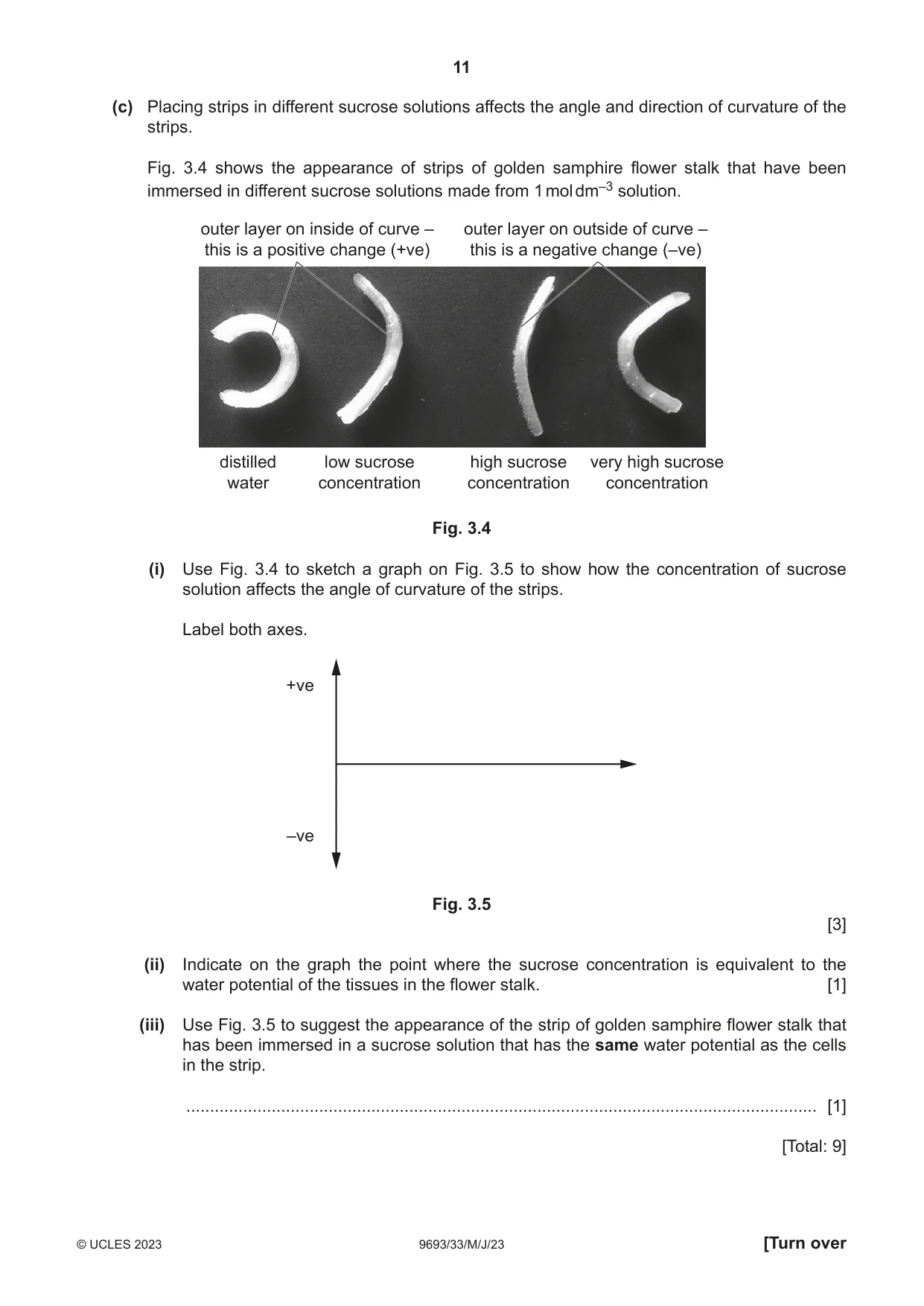
3 (a) Fig. 3.1 shows golden samphire (Limbarda crithmoides) growing in the splash zone of a rocky shore. Golden samphire has thick, fleshy leaves. Fig. 3.1 Explain the advantage of thick, fleshy leaves to plants living in the splash zone. ................................................................................................................................................... ............................................................................................................................................. [1] (b) Fig. 3.2 shows the appearance of a strip of flower stalk from golden samphire. outer layer of cells with a waterproof cut positions covering, which reduces flexibility inner layer of cells with no waterproof covering 30 mm piece of stalk complete stalk one strip of stalk Fig. 3.2 Fig. 3.3 shows the appearance of one of the strips, viewed from one end, after soaking in distilled water for 15 minutes. outer layer of cells inner layer of cells Fig. 3.3 Use the information provided in Fig. 3.2 and Fig. 3.3 to explain the change in the appearance of the strip in terms of water potential. ................................................................................................................................................... ................................................................................................................................................... ................................................................................................................................................... ................................................................................................................................................... ................................................................................................................................................... ............................................................................................................................................. [3] (c) Placing strips in different sucrose solutions affects the angle and direction of curvature of the strips. Fig. 3.4 shows the appearance of strips of golden samphire flower stalk that have been immersed in different sucrose solutions made from 1 mol dm–3 solution. outer layer on inside of curve – outer layer on outside of curve – this is a positive change (+ve) this is a negative change (–ve) distilled low sucrose high sucrose very high sucrose water concentration concentration concentration Fig. 3.4 (i) Use Fig. 3.4 to sketch a graph on Fig. 3.5 to show how the concentration of sucrose solution affects the angle of curvature of the strips. Label both axes. +ve –ve Fig. 3.5 [3] (ii) Indicate on the graph the point where the sucrose concentration is equivalent to the water potential of the tissues in the flower stalk. [1] (iii) Use Fig. 3.5 to suggest the appearance of the strip of golden samphire flower stalk that has been immersed in a sucrose solution that has the same water potential as the cells in the strip. ..................................................................................................................................... [1] [Total: 9]
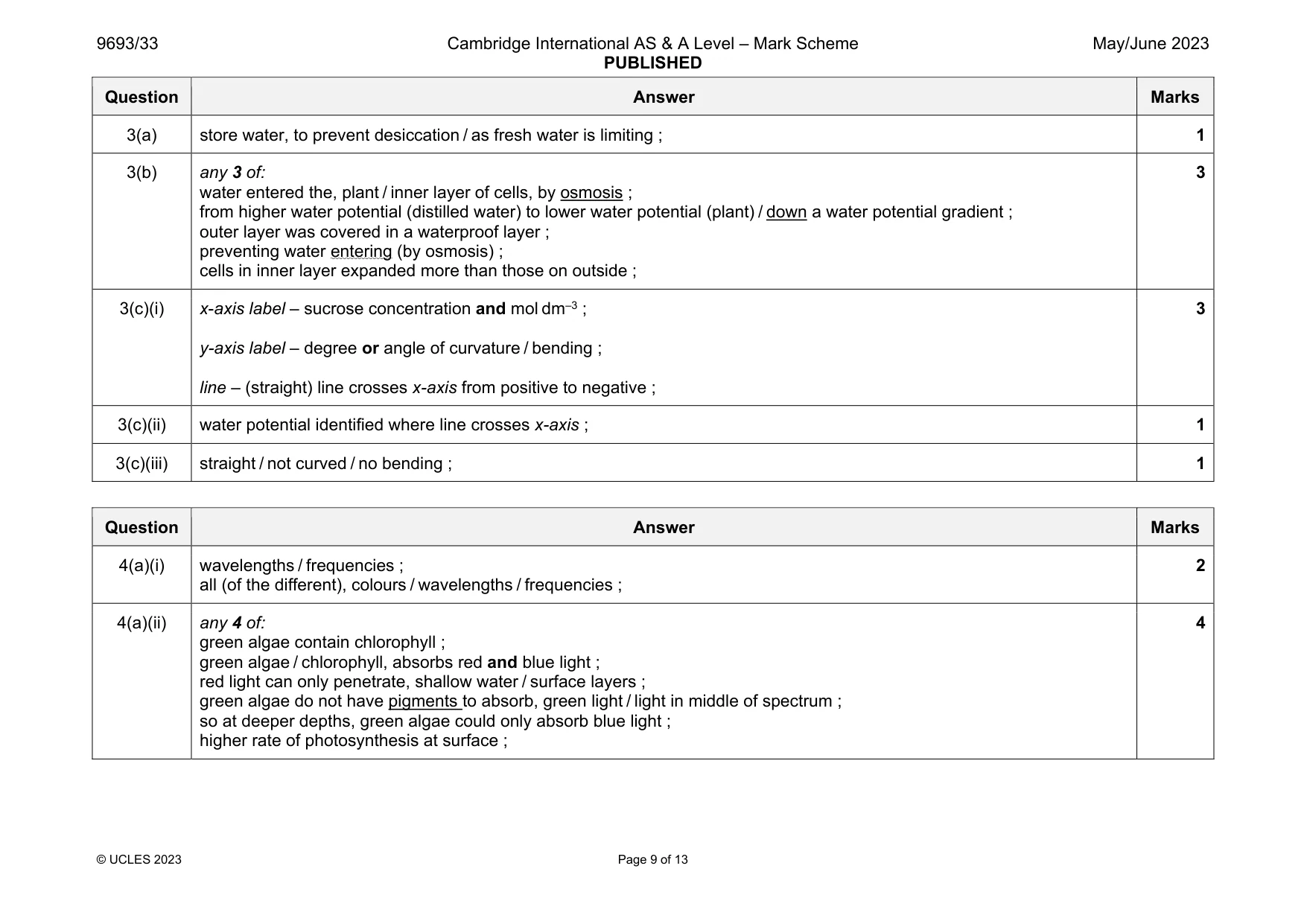
Mark scheme: 3(a) store water, to prevent desiccation / as fresh water is limiting ; 1 3(b) any 3 of: water entered the, plant / inner layer of cells, by osmosis ; from higher water potential (distilled water) to lower water potential (plant) / down a water potential gradient ; outer layer was covered in a waterproof layer ; preventing water entering (by osmosis) ; cells in inner layer expanded more than those on outside ; 3 3(c)(i) x-axis label – sucrose concentration and mol dm–3 ; y-axis label – degree or angle of curvature / bending ; line – (straight) line crosses x-axis from positive to negative ; 3 3(c)(ii) water potential identified where line crosses x-axis ; 1 3(c)(iii) straight / not curved / no bending ; 1
Q4 · The rates of photosynthesis of a green macroalga in different colours of light
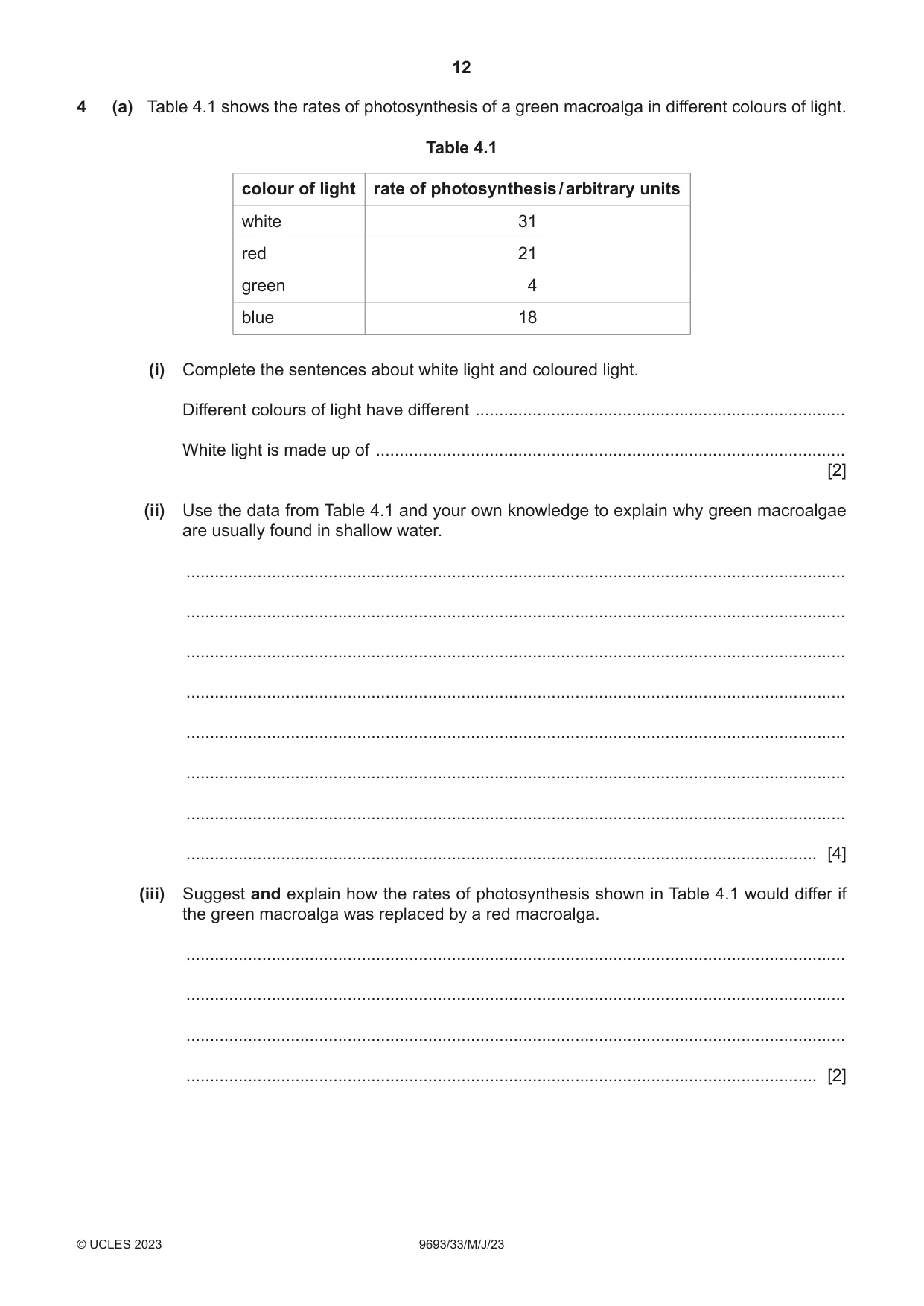
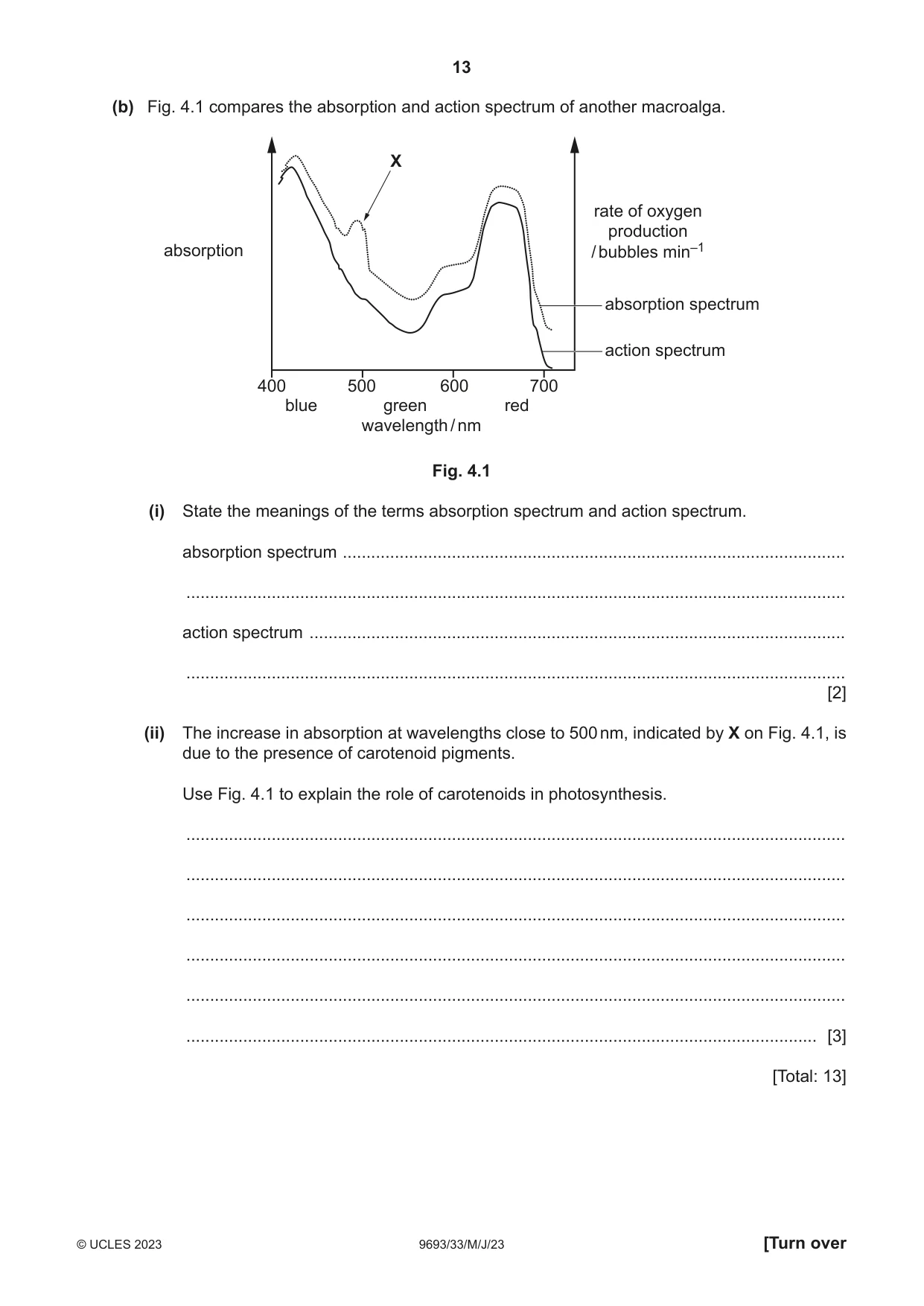
4 (a) Table 4.1 shows the rates of photosynthesis of a green macroalga in different colours of light. Table 4.1 colour of light rate of photosynthesis / arbitrary units white 31 red 21 green 4 blue 18 (i) Complete the sentences about white light and coloured light. Different colours of light have different .............................................................................. White light is made up of ................................................................................................... [2] (ii) Use the data from Table 4.1 and your own knowledge to explain why green macroalgae are usually found in shallow water. ........................................................................................................................................... ........................................................................................................................................... ........................................................................................................................................... ........................................................................................................................................... ........................................................................................................................................... ........................................................................................................................................... ........................................................................................................................................... ..................................................................................................................................... [4] (iii) Suggest and explain how the rates of photosynthesis shown in Table 4.1 would differ if the green macroalga was replaced by a red macroalga. ........................................................................................................................................... ........................................................................................................................................... ........................................................................................................................................... ..................................................................................................................................... [2] (b) Fig. 4.1 compares the absorption and action spectrum of another macroalga. X rate of oxygen production absorption / bubbles min–1 absorption spectrum action spectrum 400 500 600 700 blue green red wavelength / nm Fig. 4.1 (i) State the meanings of the terms absorption spectrum and action spectrum. absorption spectrum .......................................................................................................... ........................................................................................................................................... action spectrum ................................................................................................................. ........................................................................................................................................... [2] (ii) The increase in absorption at wavelengths close to 500 nm, indicated by X on Fig. 4.1, is due to the presence of carotenoid pigments. Use Fig. 4.1 to explain the role of carotenoids in photosynthesis. ........................................................................................................................................... ........................................................................................................................................... ........................................................................................................................................... ........................................................................................................................................... ........................................................................................................................................... ..................................................................................................................................... [3] [Total: 13]
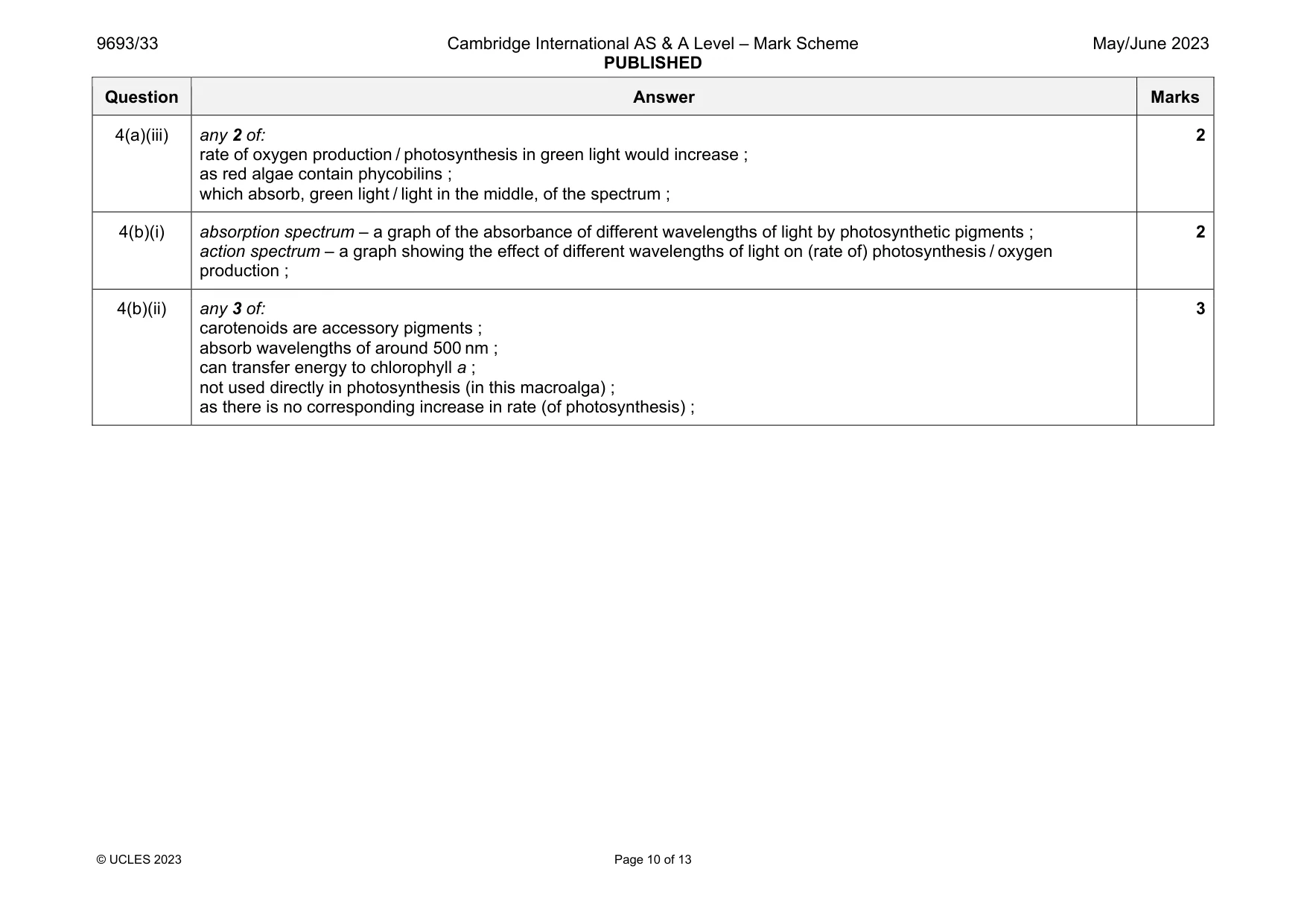
Mark scheme: 4(a)(i) wavelengths / frequencies ; all (of the different), colours / wavelengths / frequencies ; 2 4(a)(ii) any 4 of: green algae contain chlorophyll ; green algae / chlorophyll, absorbs red and blue light ; red light can only penetrate, shallow water / surface layers ; green algae do not have pigments to absorb, green light / light in middle of spectrum ; so at deeper depths, green algae could only absorb blue light ; higher rate of photosynthesis at surface ; 4 Question Answer Marks 4(a)(iii) any 2 of: rate of oxygen production / photosynthesis in green light would increase ; as red algae contain phycobilins ; which absorb, green light / light in the middle, of the spectrum ; 2 4(b)(i) absorption spectrum – a graph of the absorbance of different wavelengths of light by photosynthetic pigments ; action spectrum – a graph showing the effect of different wavelengths of light on (rate of) photosynthesis / oxygen production ; 2 4(b)(ii) any 3 of: carotenoids are accessory pigments ; absorb wavelengths of around 500 nm ; can transfer energy to chlorophyll a ; not used directly in photosynthesis (in this macroalga) ; as there is no corresponding increase in rate (of photosynthesis) ; 3
Q5 · Discuss the impacts of sonar, purse‑seine fishing and benthic trawling on populations and…
5 Discuss the impacts of sonar, purse‑seine fishing and benthic trawling on populations and habitats of marine organisms. .......................................................................................................................................................... .......................................................................................................................................................... .......................................................................................................................................................... .......................................................................................................................................................... .......................................................................................................................................................... .......................................................................................................................................................... .......................................................................................................................................................... .......................................................................................................................................................... .......................................................................................................................................................... .......................................................................................................................................................... .......................................................................................................................................................... .......................................................................................................................................................... .......................................................................................................................................................... .......................................................................................................................................................... .......................................................................................................................................................... .......................................................................................................................................................... .......................................................................................................................................................... .......................................................................................................................................................... .......................................................................................................................................................... .................................................................................................................................................. [10]
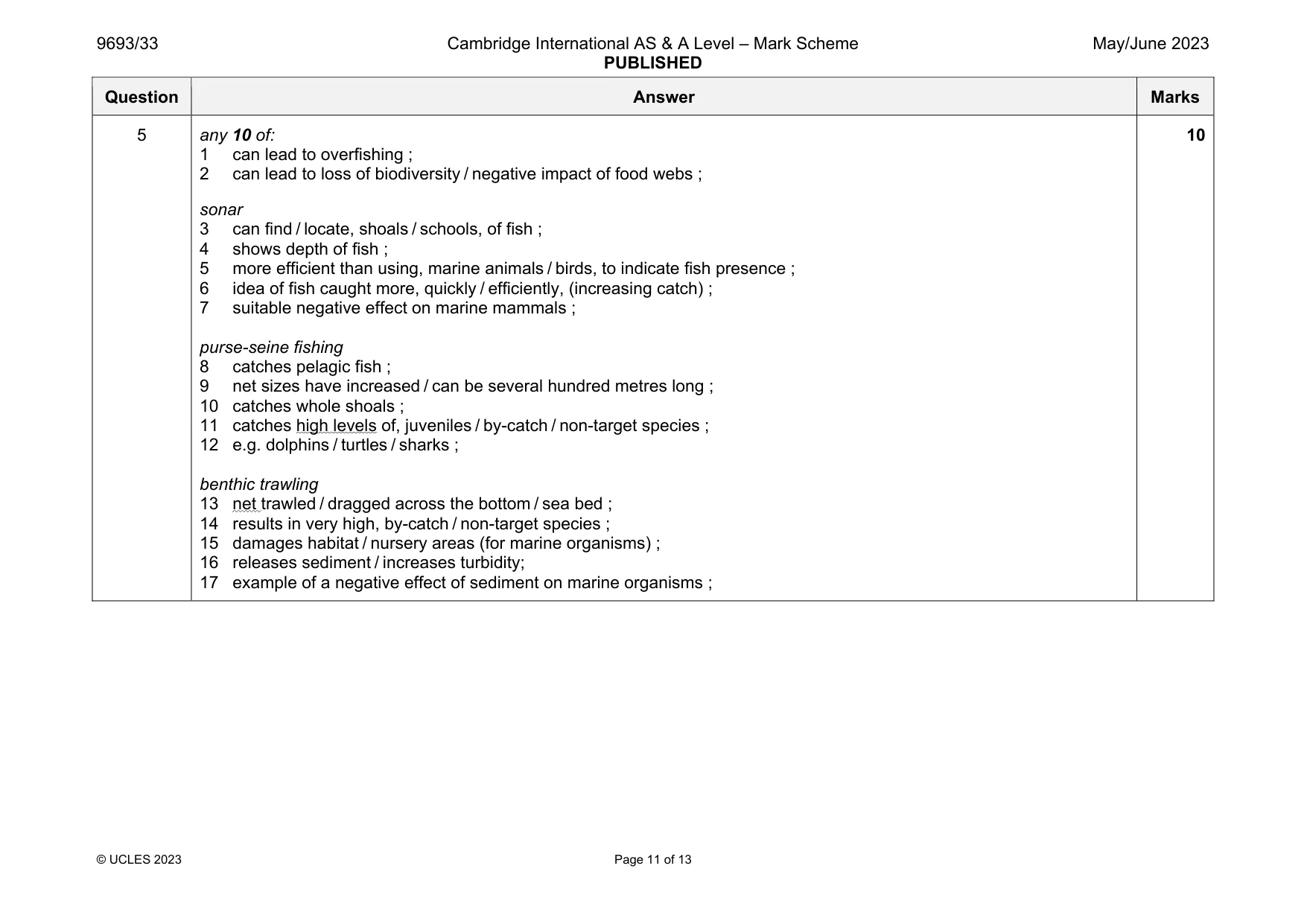
Mark scheme: 5 any 10 of: 1 can lead to overfishing ; 2 can lead to loss of biodiversity / negative impact of food webs ; sonar 3 can find / locate, shoals / schools, of fish ; 4 shows depth of fish ; 5 more efficient than using, marine animals / birds, to indicate fish presence ; 6 idea of fish caught more, quickly / efficiently, (increasing catch) ; 7 suitable negative effect on marine mammals ; purse-seine fishing 8 catches pelagic fish ; 9 net sizes have increased / can be several hundred metres long ; 10 catches whole shoals ; 11 catches high levels of, juveniles / by-catch / non-target species ; 12 e.g. dolphins / turtles / sharks ; benthic trawling 13 net trawled / dragged across the bottom / sea bed ; 14 results in very high, by-catch / non-target species ; 15 damages habitat / nursery areas (for marine organisms) ; 16 releases sediment / increases turbidity; 17 example of a negative effect of sediment on marine organisms ; 10
Q6 · Discuss the importance of coral reefs to humans
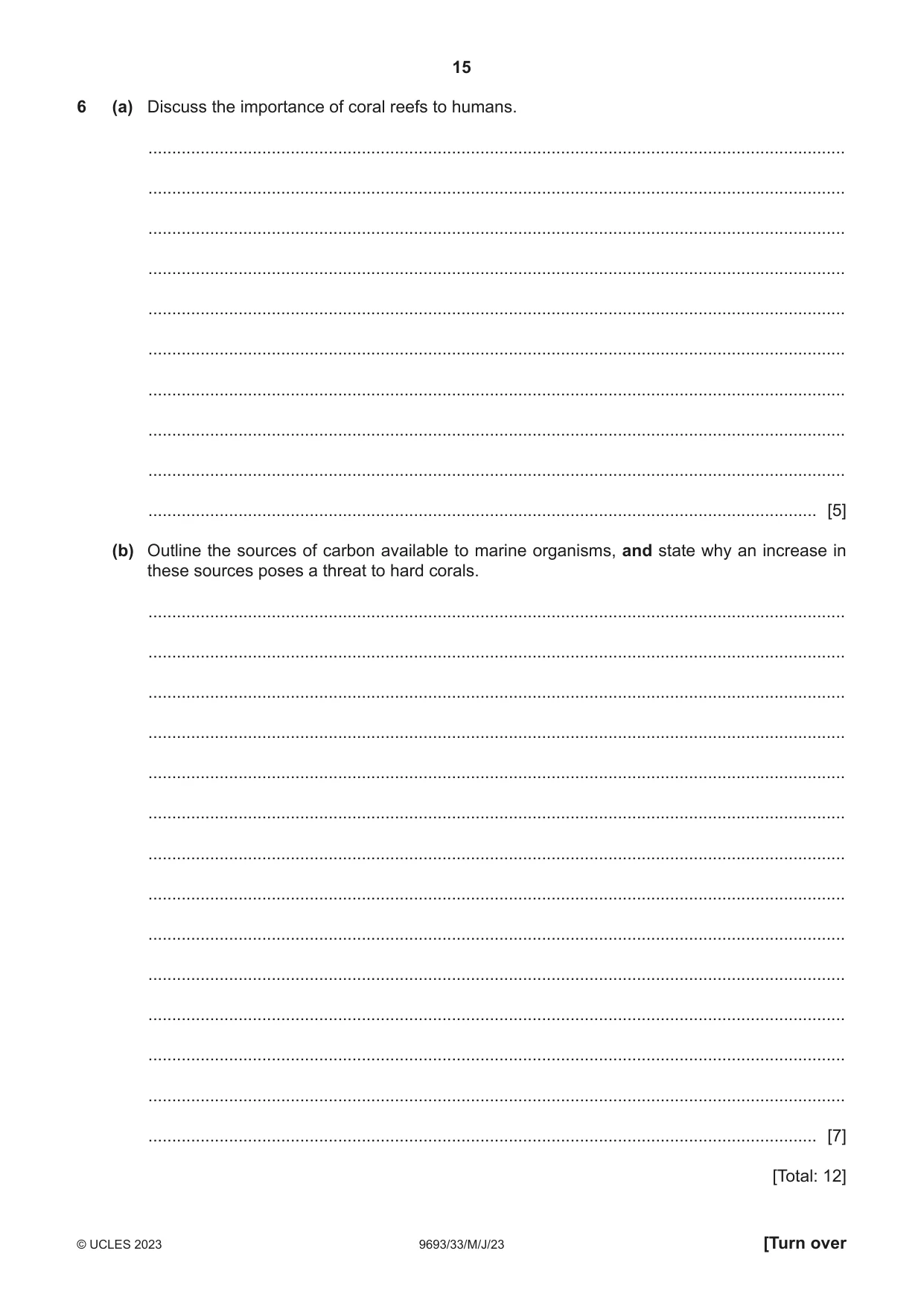
6 (a) Discuss the importance of coral reefs to humans. ................................................................................................................................................... ................................................................................................................................................... ................................................................................................................................................... ................................................................................................................................................... ................................................................................................................................................... ................................................................................................................................................... ................................................................................................................................................... ................................................................................................................................................... ................................................................................................................................................... ............................................................................................................................................. [5] (b) Outline the sources of carbon available to marine organisms, and state why an increase in these sources poses a threat to hard corals. ................................................................................................................................................... ................................................................................................................................................... ................................................................................................................................................... ................................................................................................................................................... ................................................................................................................................................... ................................................................................................................................................... ................................................................................................................................................... ................................................................................................................................................... ................................................................................................................................................... ................................................................................................................................................... ................................................................................................................................................... ................................................................................................................................................... ................................................................................................................................................... ............................................................................................................................................. [7] [Total: 12]
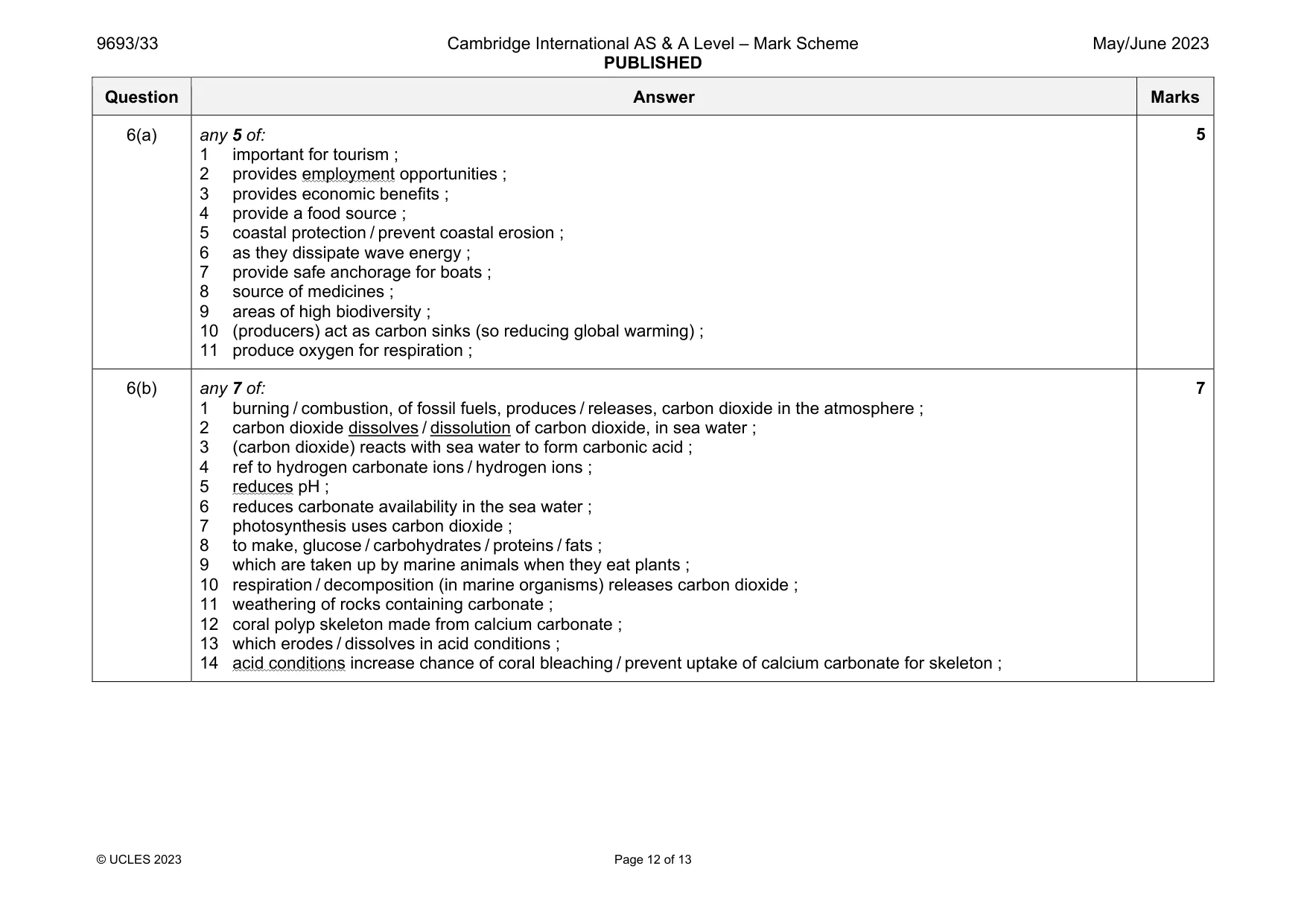
Mark scheme: 6(a) any 5 of: 1 important for tourism ; 2 provides employment opportunities ; 3 provides economic benefits ; 4 provide a food source ; 5 coastal protection / prevent coastal erosion ; 6 as they dissipate wave energy ; 7 provide safe anchorage for boats ; 8 source of medicines ; 9 areas of high biodiversity ; 10 (producers) act as carbon sinks (so reducing global warming) ; 11 produce oxygen for respiration ; 6(b) any 7 of: 1 burning / combustion, of fossil fuels, produces / releases, carbon dioxide in the atmosphere ; 2 carbon dioxide dissolves / dissolution of carbon dioxide, in sea water ; 3 (carbon dioxide) reacts with sea water to form carbonic acid ; 4 ref to hydrogen carbonate ions / hydrogen ions ; 5 reduces pH ; 6 reduces carbonate availability in the sea water ; 7 photosynthesis uses carbon dioxide ; 8 to make, glucose / carbohydrates / proteins / fats ; 9 which are taken up by marine animals when they eat plants ; 10 respiration / decomposition (in marine organisms) releases carbon dioxide ; 11 weathering of rocks containing carbonate ; 12 coral polyp skeleton made from calcium carbonate ; 13 which erodes / dissolves in acid conditions ; 14 acid conditions increase chance of coral bleaching / prevent uptake of calcium carbonate for skeleton ; 7
Q7 · Describe ecotourism and outline how it can be used as a strategy to conserve marine…
7 Describe ecotourism and outline how it can be used as a strategy to conserve marine species. .......................................................................................................................................................... .......................................................................................................................................................... .......................................................................................................................................................... .......................................................................................................................................................... .......................................................................................................................................................... .......................................................................................................................................................... .......................................................................................................................................................... .......................................................................................................................................................... .......................................................................................................................................................... .......................................................................................................................................................... .......................................................................................................................................................... .......................................................................................................................................................... .......................................................................................................................................................... .......................................................................................................................................................... .......................................................................................................................................................... .................................................................................................................................................... [8] The boundaries and names shown, the designations used and the presentation of material on any maps contained in this question paper/insert do not imply official endorsement or acceptance by Cambridge Assessment International Education concerning the legal status of any country, territory, or area or any of its authorities, or of the delimitation of its frontiers or boundaries.
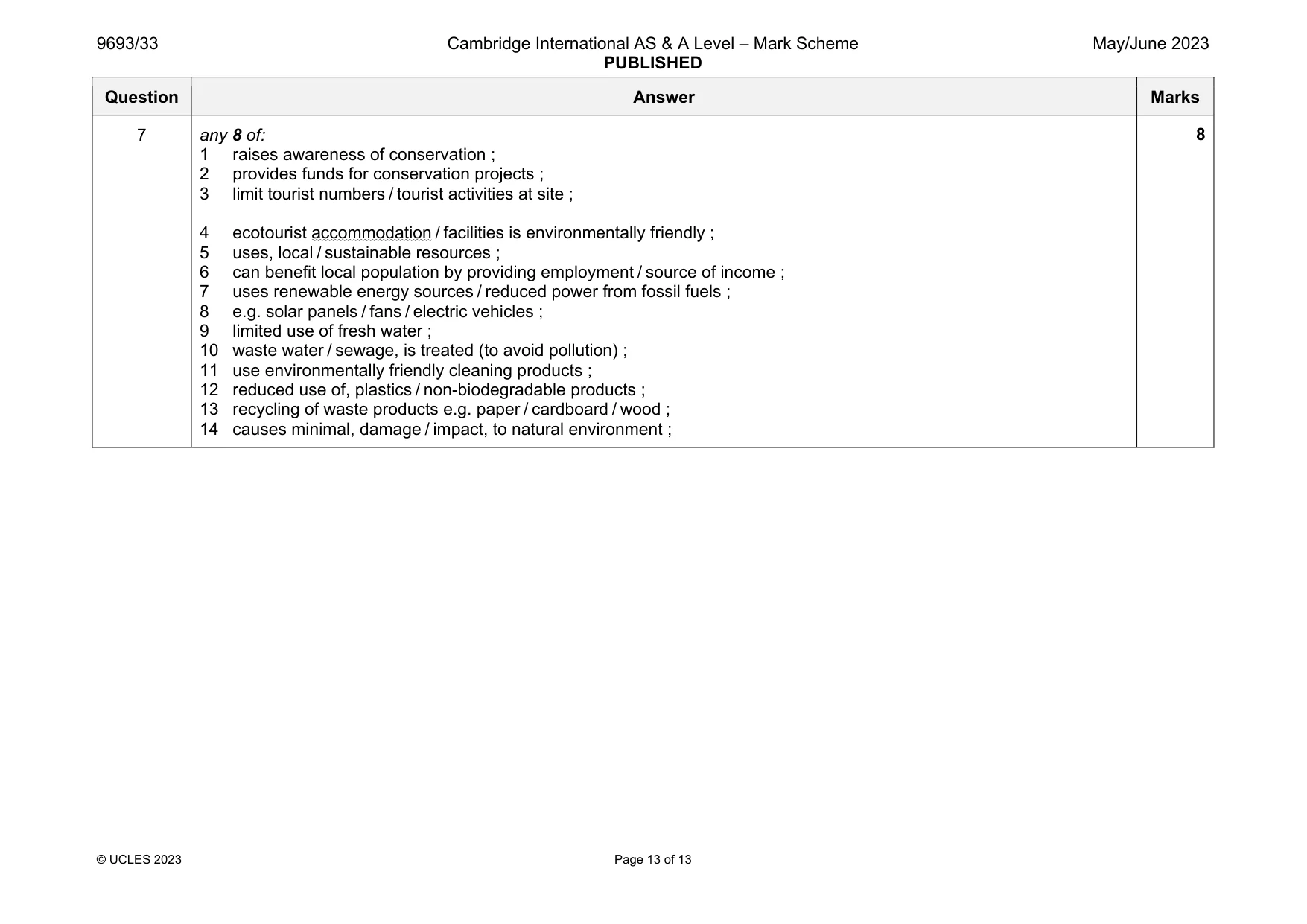
Mark scheme: 7 any 8 of: 1 raises awareness of conservation ; 2 provides funds for conservation projects ; 3 limit tourist numbers / tourist activities at site ; 4 ecotourist accommodation / facilities is environmentally friendly ; 5 uses, local / sustainable resources ; 6 can benefit local population by providing employment / source of income ; 7 uses renewable energy sources / reduced power from fossil fuels ; 8 e.g. solar panels / fans / electric vehicles ; 9 limited use of fresh water ; 10 waste water / sewage, is treated (to avoid pollution) ; 11 use environmentally friendly cleaning products ; 12 reduced use of, plastics / non-biodegradable products ; 13 recycling of waste products e.g. paper / cardboard / wood ; 14 causes minimal, damage / impact, to natural environment ;
What was in this paper
The subtopics covered by these 7 questions, and how many questions each got. Open one in a new tab to see every Cambridge question on it.
What you needed in this session
Cambridge’s own grade thresholds for 2023 May/June, Paper 3 · Variant 3. A higher threshold means an easier paper — the bar moves with how the cohort did.