Cambridge A Level Marine Science 9693 — 2022 May/June Paper 3 · Variant 2
9693/32/M/J/22 · 7 questions · 75 marks · ≈84 min
The question paper and its mark scheme, free to read here and free to download. This is Cambridge’s own paper, exactly as it was sat.
Question paper16 pages


Mark scheme13 pages
Answers below. Sit the paper first if you are practising.
Questions as text
Q1 · A diagram of a typical plant cell from a mangrove tree as seen using an electron…
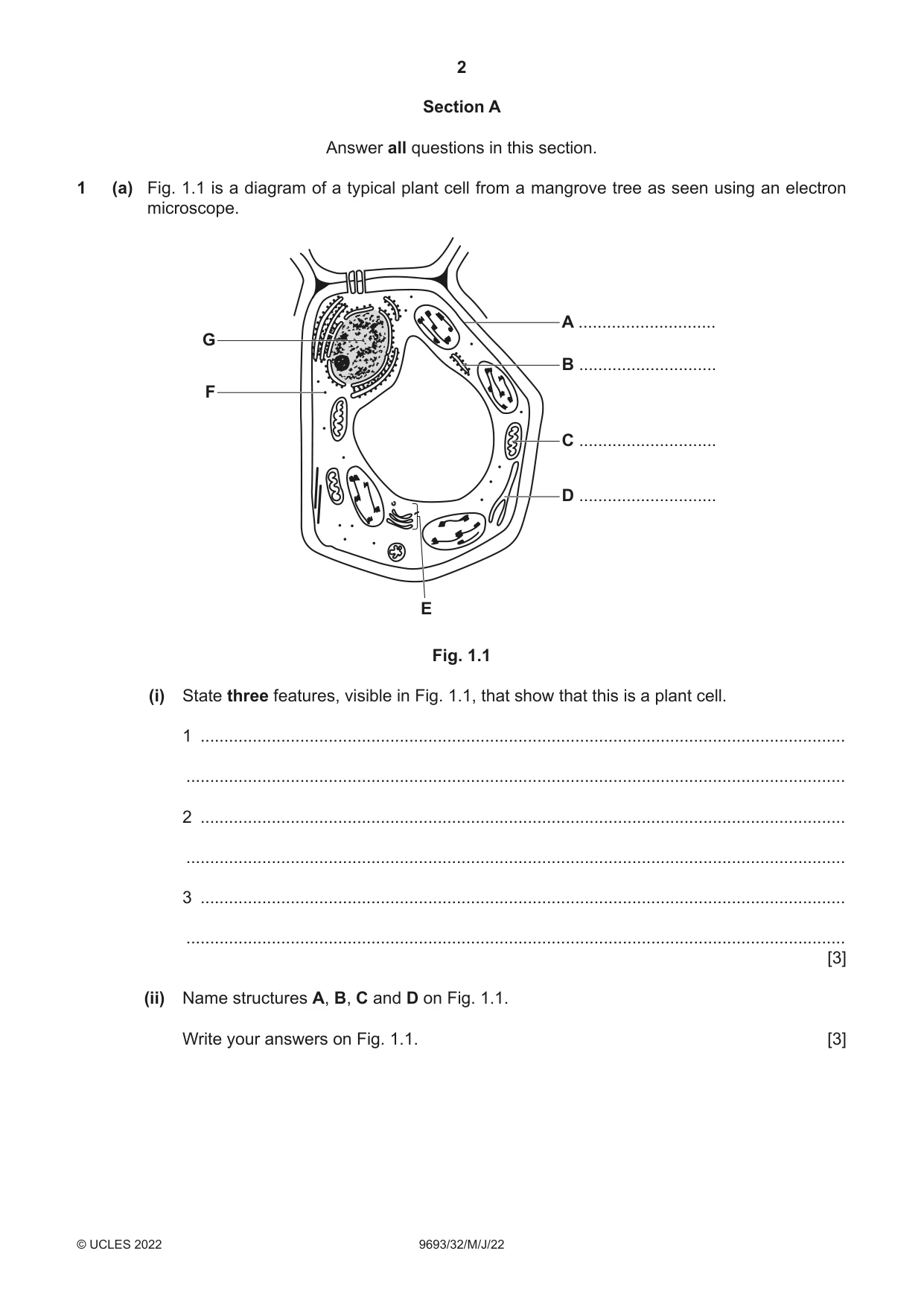
1 (a) Fig. 1.1 is a diagram of a typical plant cell from a mangrove tree as seen using an electron microscope. A ............................. G B ............................. F C ............................. D ............................. E Fig. 1.1 (i) State three features, visible in Fig. 1.1, that show that this is a plant cell. 1 ........................................................................................................................................ ........................................................................................................................................... 2 ........................................................................................................................................ ........................................................................................................................................... 3 ........................................................................................................................................ ........................................................................................................................................... [3] (ii) Name structures A, B, C and D on Fig. 1.1. Write your answers on Fig. 1.1. [3] (iii) Outline the functions of structures E, F and G. structure E ......................................................................................................................... ........................................................................................................................................... structure F ......................................................................................................................... ........................................................................................................................................... structure G ........................................................................................................................ ........................................................................................................................................... [3] (b) Describe how phospholipids are arranged in cell membranes. ................................................................................................................................................... ................................................................................................................................................... ................................................................................................................................................... ................................................................................................................................................... ................................................................................................................................................... ............................................................................................................................................. [3] [Total: 12]
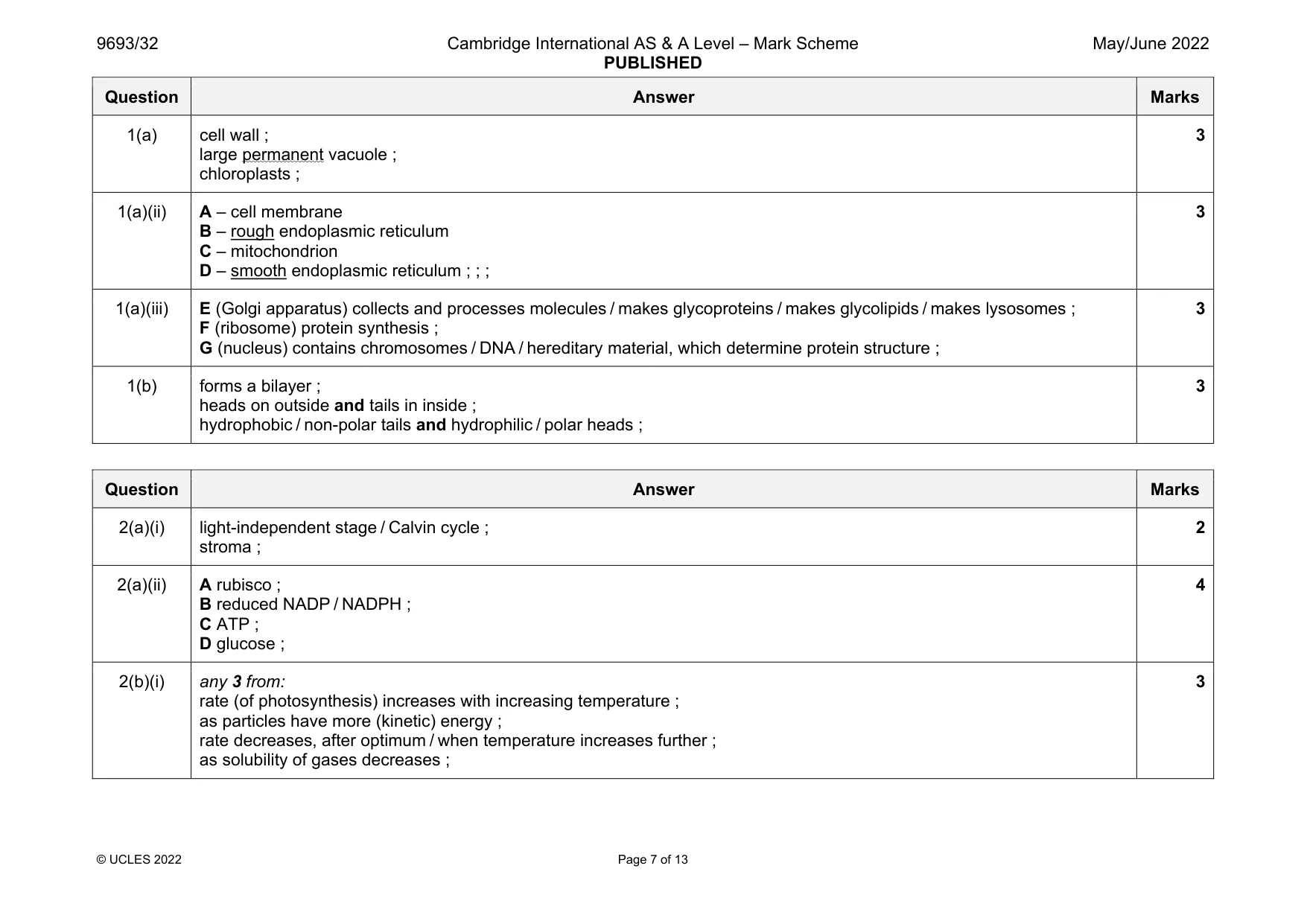
Mark scheme: 1(a) cell wall ; large permanent vacuole ; chloroplasts ; 3 1(a)(ii) A – cell membrane B – rough endoplasmic reticulum C – mitochondrion D – smooth endoplasmic reticulum ; ; ; 3 1(a)(iii) E (Golgi apparatus) collects and processes molecules / makes glycoproteins / makes glycolipids / makes lysosomes ; F (ribosome) protein synthesis ; G (nucleus) contains chromosomes / DNA / hereditary material, which determine protein structure ; 3 1(b) forms a bilayer ; heads on outside and tails in inside ; hydrophobic / non-polar tails and hydrophilic / polar heads ; 3
Q2 · Almost all marine producers carry out photosynthesis
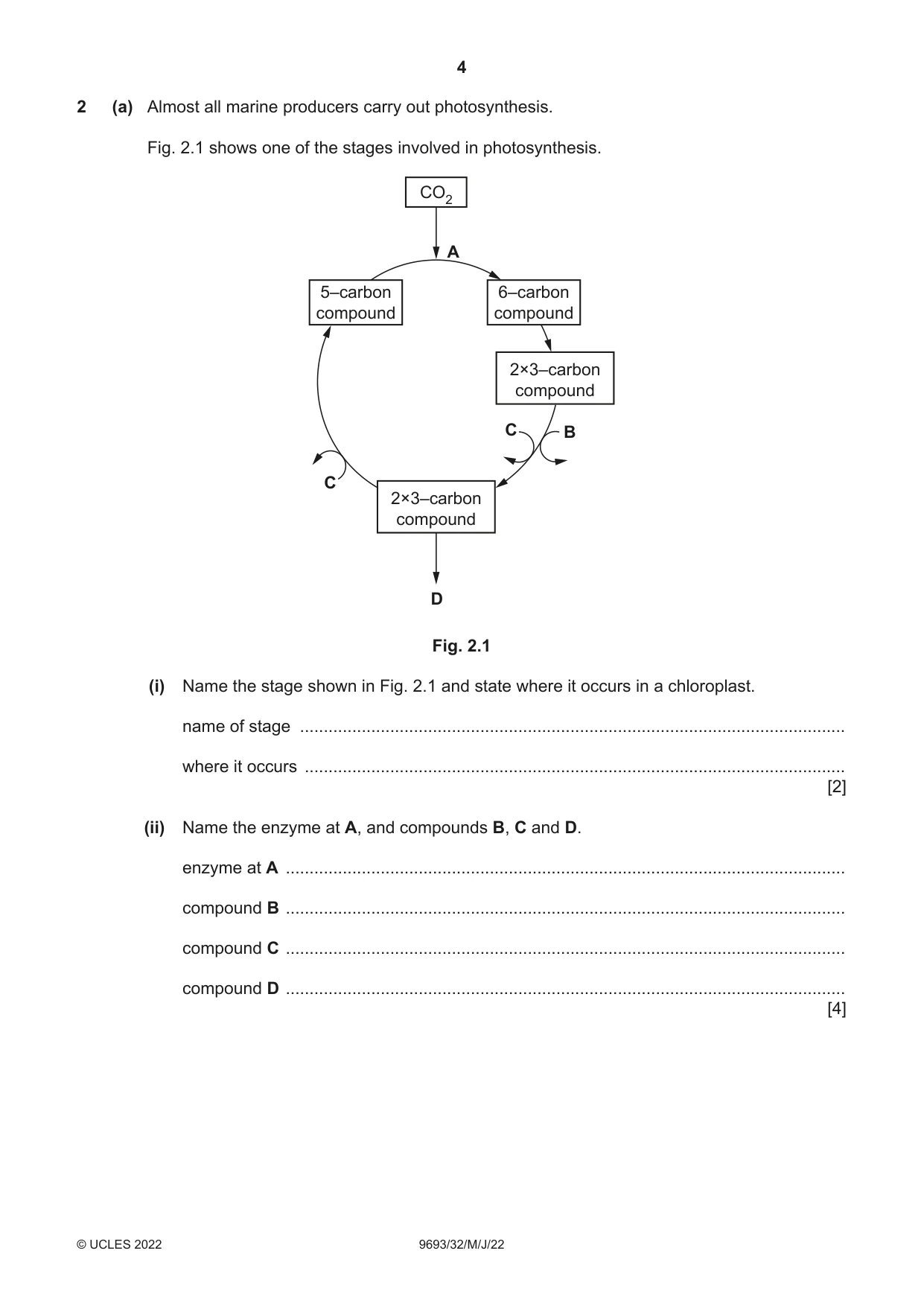
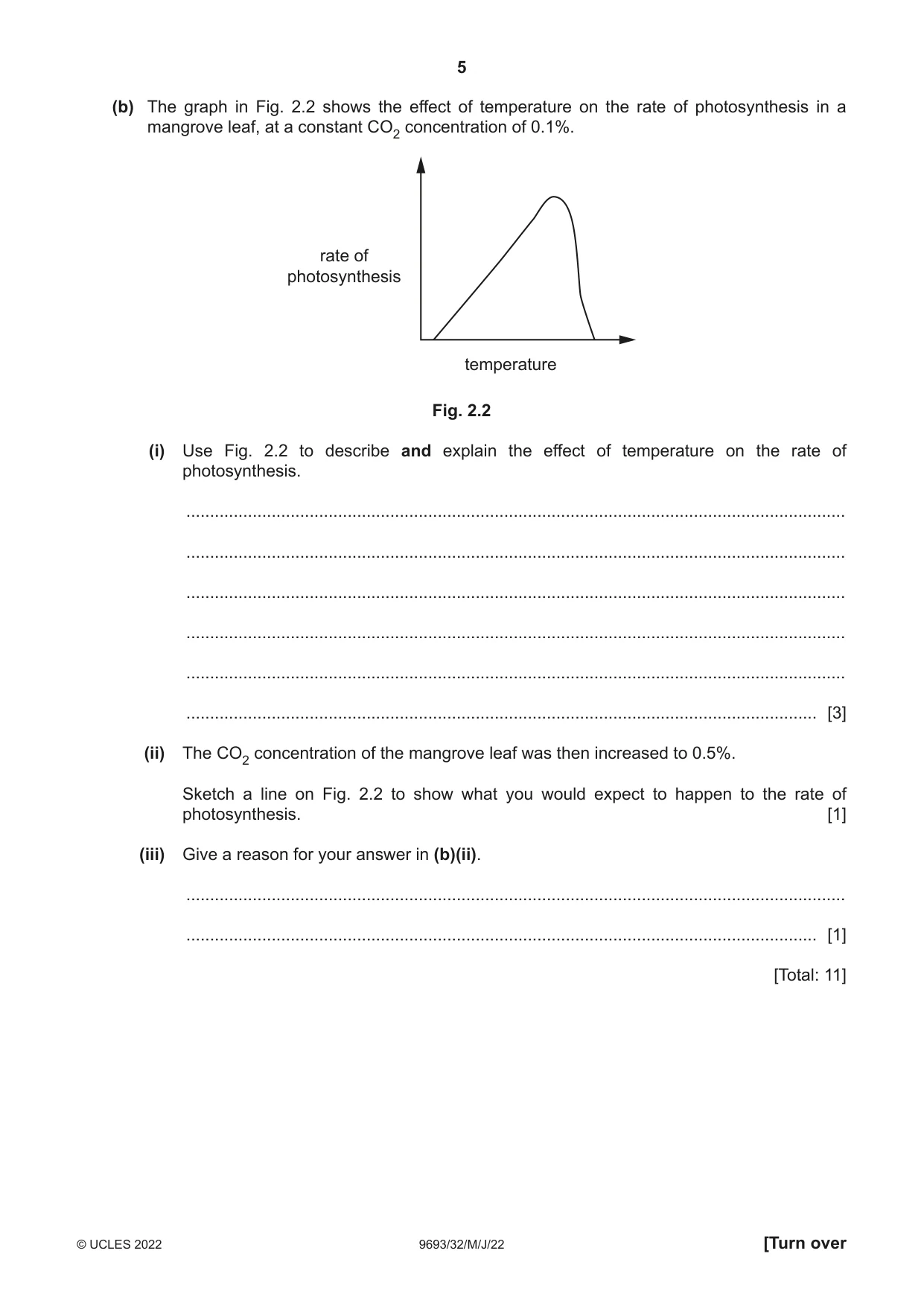
2 (a) Almost all marine producers carry out photosynthesis. Fig. 2.1 shows one of the stages involved in photosynthesis. CO2 A 5–carbon 6–carbon compound compound 2×3–carbon compound C B C 2×3–carbon compound D Fig. 2.1 (i) Name the stage shown in Fig. 2.1 and state where it occurs in a chloroplast. name of stage ................................................................................................................... where it occurs .................................................................................................................. [2] (ii) Name the enzyme at A, and compounds B, C and D. enzyme at A ...................................................................................................................... compound B ...................................................................................................................... compound C ...................................................................................................................... compound D ...................................................................................................................... [4] (b) The graph in Fig. 2.2 shows the effect of temperature on the rate of photosynthesis in a mangrove leaf, at a constant CO2 concentration of 0.1%. rate of photosynthesis temperature Fig. 2.2 (i) Use Fig. 2.2 to describe and explain the effect of temperature on the rate of photosynthesis. ........................................................................................................................................... ........................................................................................................................................... ........................................................................................................................................... ........................................................................................................................................... ........................................................................................................................................... ..................................................................................................................................... [3] (ii) The CO2 concentration of the mangrove leaf was then increased to 0.5%. Sketch a line on Fig. 2.2 to show what you would expect to happen to the rate of photosynthesis. [1] (iii) Give a reason for your answer in (b)(ii). ........................................................................................................................................... ..................................................................................................................................... [1] [Total: 11]
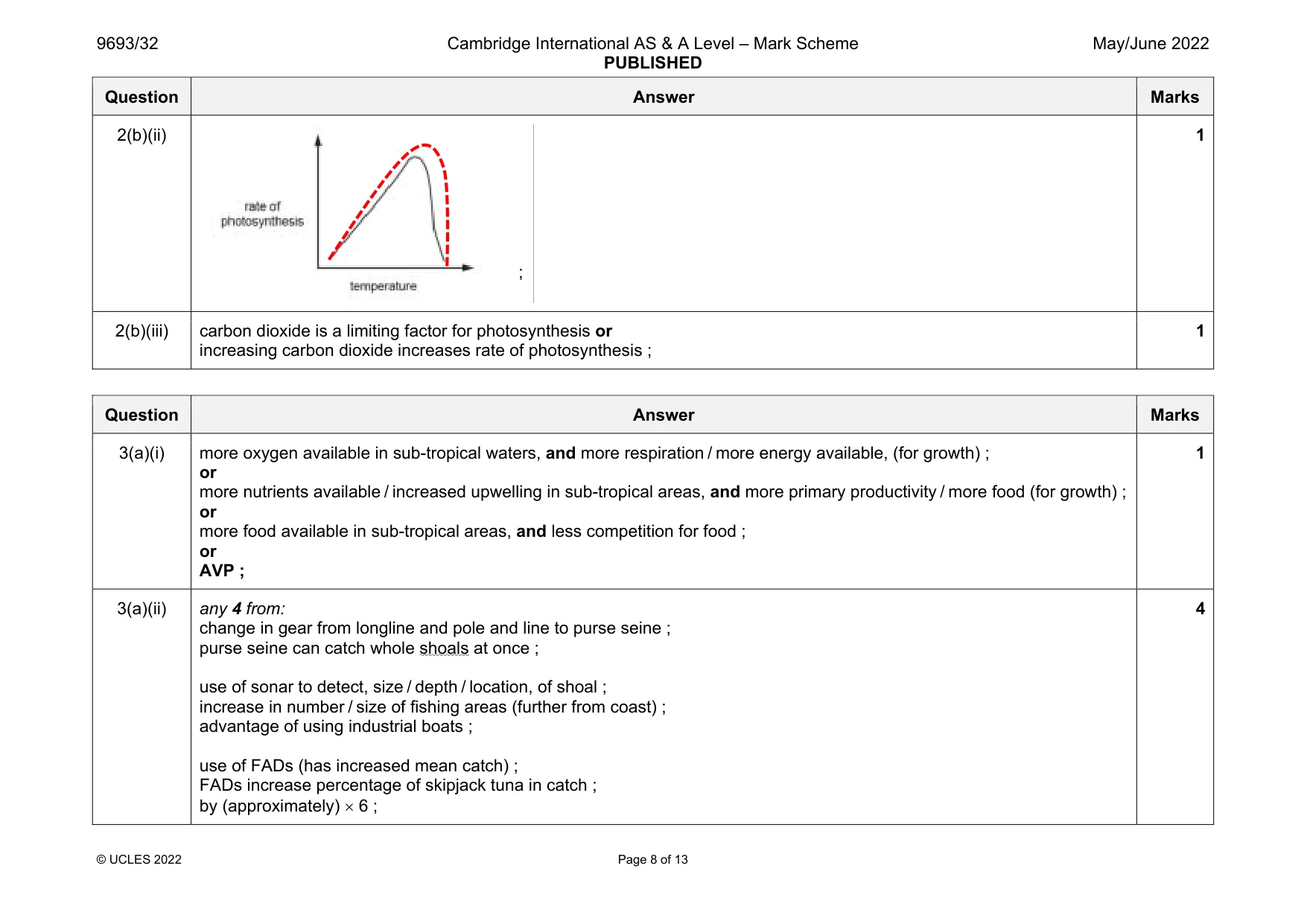
Mark scheme: 2(a)(i) light-independent stage / Calvin cycle ; stroma ; 2 2(a)(ii) A rubisco ; B reduced NADP / NADPH ; C ATP ; D glucose ; 4 2(b)(i) any 3 from: rate (of photosynthesis) increases with increasing temperature ; as particles have more (kinetic) energy ; rate decreases, after optimum / when temperature increases further ; as solubility of gases decreases ; 3 Question Answer Marks 2(b)(ii) 1 2(b)(iii) carbon dioxide is a limiting factor for photosynthesis or increasing carbon dioxide increases rate of photosynthesis ; 1 ;
Q3 · Skipjack tuna occur in large shoals in tropical and sub‑tropical areas around the coast…
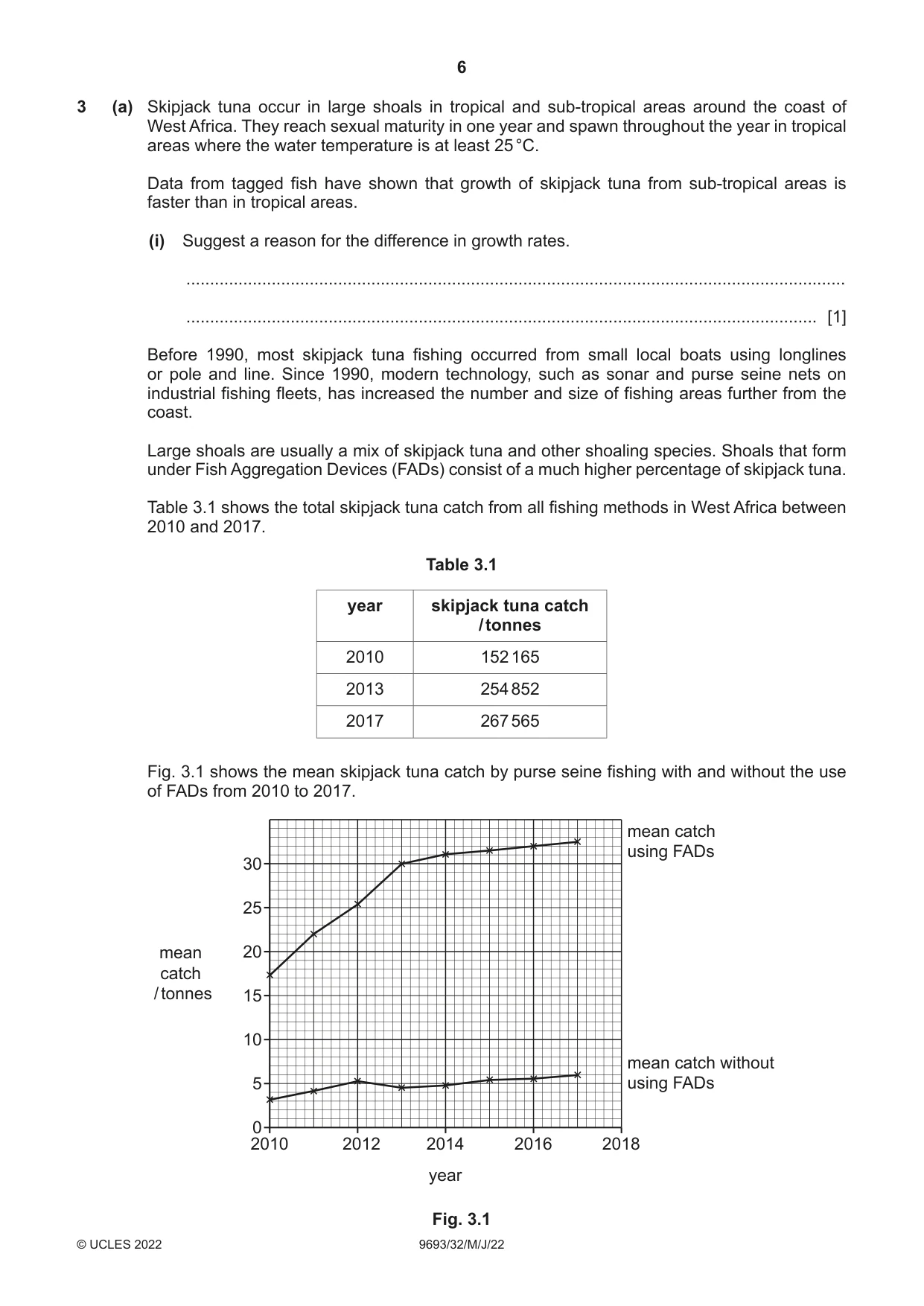
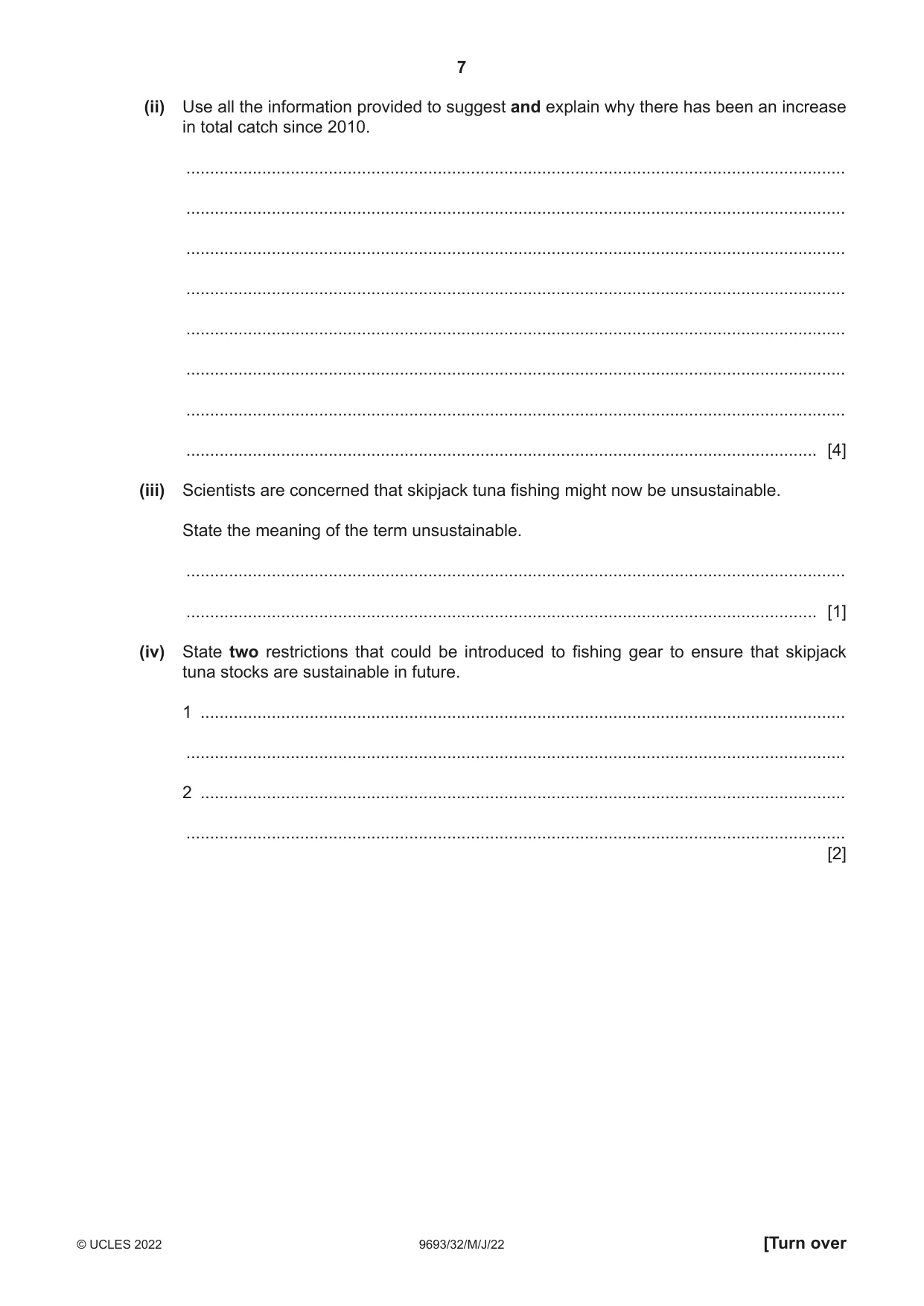
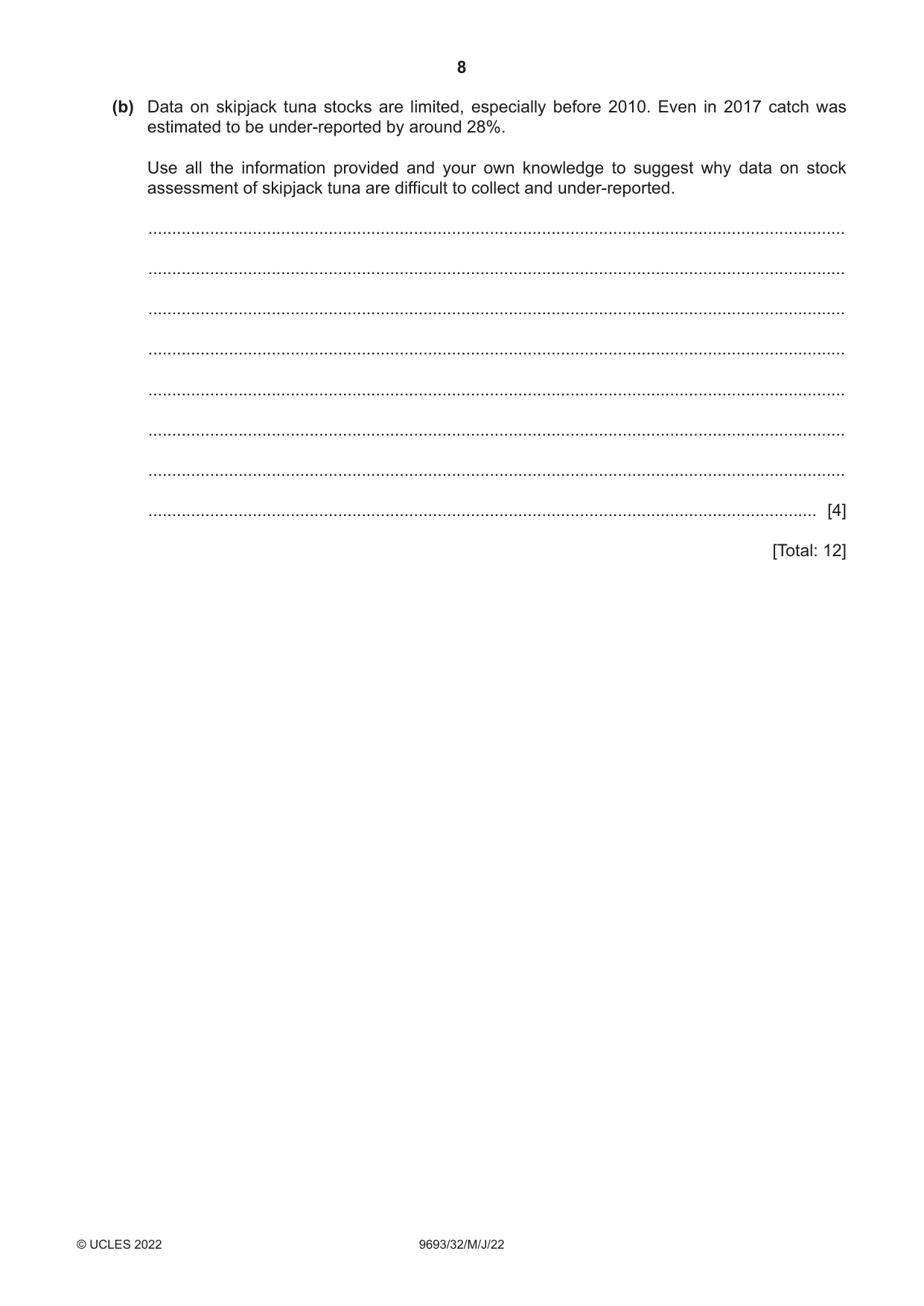
3 (a) Skipjack tuna occur in large shoals in tropical and sub‑tropical areas around the coast of West Africa. They reach sexual maturity in one year and spawn throughout the year in tropical areas where the water temperature is at least 25 °C. Data from tagged fish have shown that growth of skipjack tuna from sub‑tropical areas is faster than in tropical areas. (i) Suggest a reason for the difference in growth rates. ........................................................................................................................................... ..................................................................................................................................... [1] Before 1990, most skipjack tuna fishing occurred from small local boats using longlines or pole and line. Since 1990, modern technology, such as sonar and purse seine nets on industrial fishing fleets, has increased the number and size of fishing areas further from the coast. Large shoals are usually a mix of skipjack tuna and other shoaling species. Shoals that form under Fish Aggregation Devices (FADs) consist of a much higher percentage of skipjack tuna. Table 3.1 shows the total skipjack tuna catch from all fishing methods in West Africa between 2010 and 2017. Table 3.1 year skipjack tuna catch / tonnes 2010 152 165 2013 254 852 2017 267 565 Fig. 3.1 shows the mean skipjack tuna catch by purse seine fishing with and without the use of FADs from 2010 to 2017. mean catch using FADs 30 25 mean 20 catch / tonnes 15 10 mean catch without 5 using FADs 0 2010 2012 2014 2016 2018 year Fig. 3.1 (ii) Use all the information provided to suggest and explain why there has been an increase in total catch since 2010. ........................................................................................................................................... ........................................................................................................................................... ........................................................................................................................................... ........................................................................................................................................... ........................................................................................................................................... ........................................................................................................................................... ........................................................................................................................................... ..................................................................................................................................... [4] (iii) Scientists are concerned that skipjack tuna fishing might now be unsustainable. State the meaning of the term unsustainable. ........................................................................................................................................... ..................................................................................................................................... [1] (iv) State two restrictions that could be introduced to fishing gear to ensure that skipjack tuna stocks are sustainable in future. 1 ........................................................................................................................................ ........................................................................................................................................... 2 ........................................................................................................................................ ........................................................................................................................................... [2] (b) Data on skipjack tuna stocks are limited, especially before 2010. Even in 2017 catch was estimated to be under‑reported by around 28%. Use all the information provided and your own knowledge to suggest why data on stock assessment of skipjack tuna are difficult to collect and under‑reported. ................................................................................................................................................... ................................................................................................................................................... ................................................................................................................................................... ................................................................................................................................................... ................................................................................................................................................... ................................................................................................................................................... ................................................................................................................................................... ............................................................................................................................................. [4] [Total: 12]
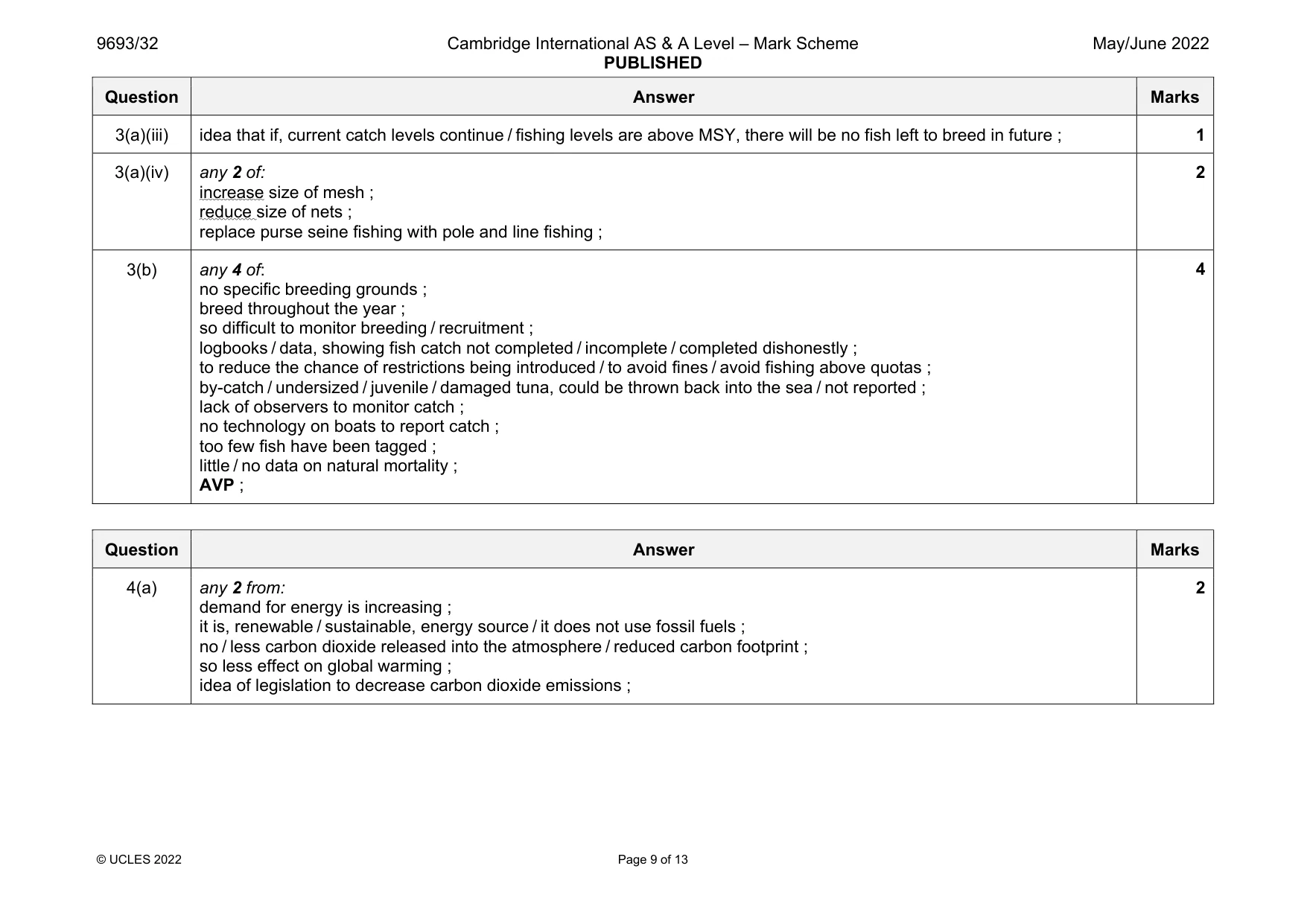
Mark scheme: 3(a)(i) more oxygen available in sub-tropical waters, and more respiration / more energy available, (for growth) ; or more nutrients available / increased upwelling in sub-tropical areas, and more primary productivity / more food (for growth) ; or more food available in sub-tropical areas, and less competition for food ; or AVP ; 3(a)(ii) any 4 from: change in gear from longline and pole and line to purse seine ; purse seine can catch whole shoals at once ; use of sonar to detect, size / depth / location, of shoal ; increase in number / size of fishing areas (further from coast) ; advantage of using industrial boats ; use of FADs (has increased mean catch) ; FADs increase percentage of skipjack tuna in catch ; by (approximately) 6 ; 4 Question Answer Marks 3(a)(iii) idea that if, current catch levels continue / fishing levels are above MSY, there will be no fish left to breed in future ; 1 3(a)(iv) any 2 of: increase size of mesh ; reduce size of nets ; replace purse seine fishing with pole and line fishing ; 2 3(b) any 4 of: no specific breeding grounds ; breed throughout the year ; so difficult to monitor breeding / recruitment ; logbooks / data, showing fish catch not completed / incomplete / completed dishonestly ; to reduce the chance of restrictions being introduced / to avoid fines / avoid fishing above quotas ; by-catch / undersized / juvenile / damaged tuna, could be thrown back into the sea / not reported ; lack of observers to monitor catch ; no technology on boats to report catch ; too few fish have been tagged ; little / no data on natural mortality ; AVP ; 4
Q4 · Numbers of offshore wind farms are increasing annually
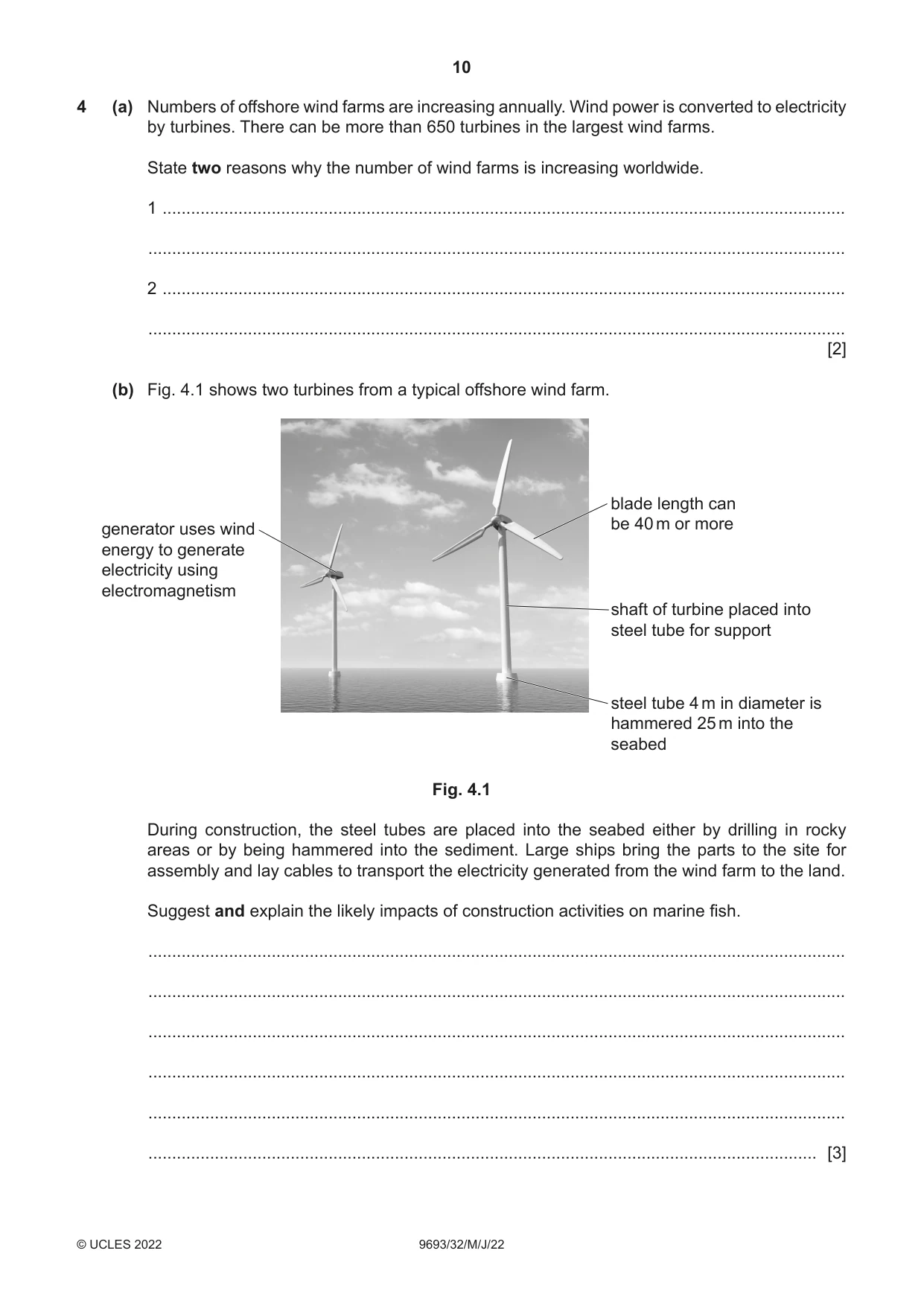
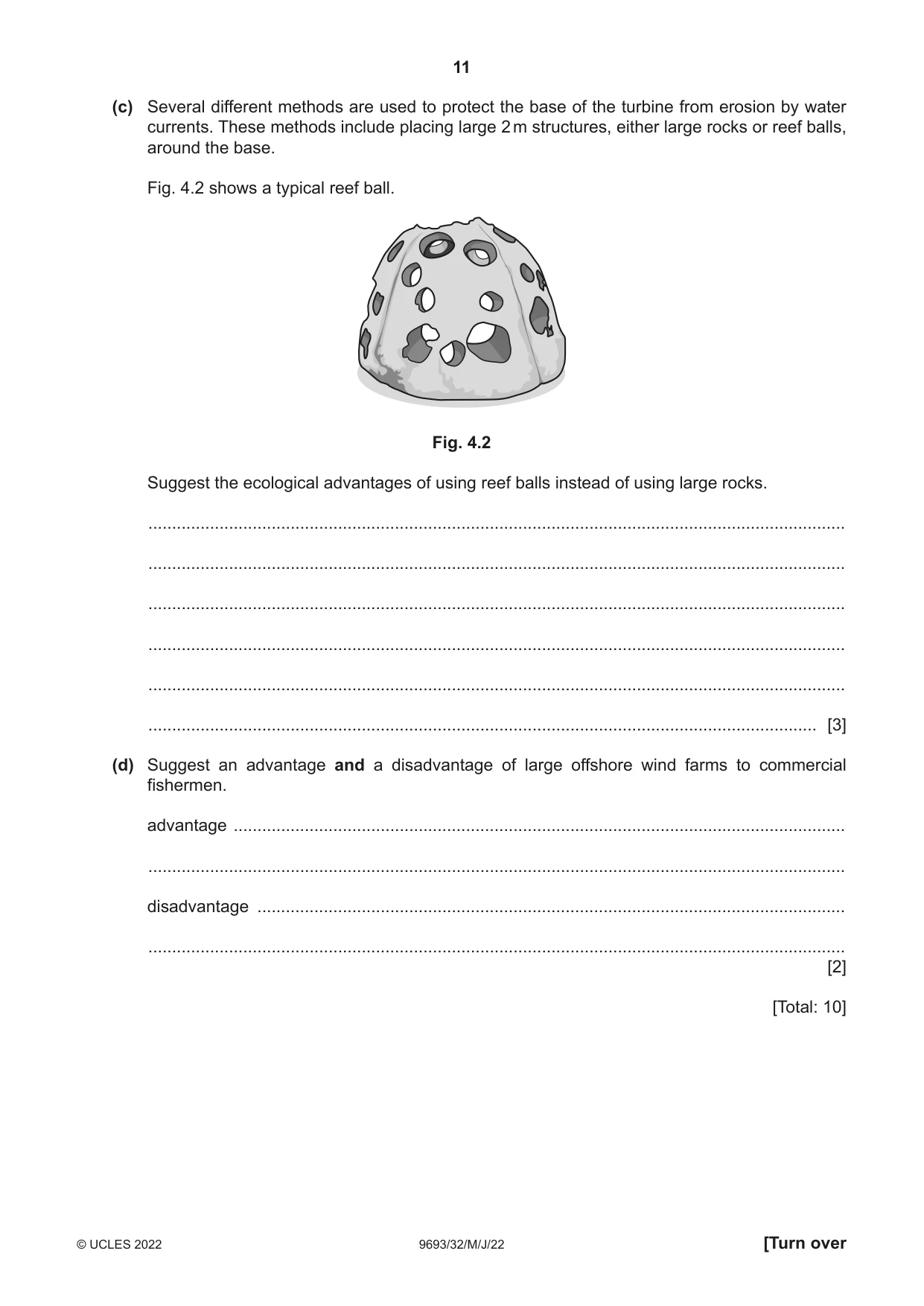
4 (a) Numbers of offshore wind farms are increasing annually. Wind power is converted to electricity by turbines. There can be more than 650 turbines in the largest wind farms. State two reasons why the number of wind farms is increasing worldwide. 1 ................................................................................................................................................ ................................................................................................................................................... 2 ................................................................................................................................................ ................................................................................................................................................... [2] (b) Fig. 4.1 shows two turbines from a typical offshore wind farm. blade length can be 40 m or more generator uses wind energy to generate electricity using electromagnetism shaft of turbine placed into steel tube for support steel tube 4 m in diameter is hammered 25 m into the seabed Fig. 4.1 During construction, the steel tubes are placed into the seabed either by drilling in rocky areas or by being hammered into the sediment. Large ships bring the parts to the site for assembly and lay cables to transport the electricity generated from the wind farm to the land. Suggest and explain the likely impacts of construction activities on marine fish. ................................................................................................................................................... ................................................................................................................................................... ................................................................................................................................................... ................................................................................................................................................... ................................................................................................................................................... ............................................................................................................................................. [3] (c) Several different methods are used to protect the base of the turbine from erosion by water currents. These methods include placing large 2 m structures, either large rocks or reef balls, around the base. Fig. 4.2 shows a typical reef ball. Fig. 4.2 Suggest the ecological advantages of using reef balls instead of using large rocks. ................................................................................................................................................... ................................................................................................................................................... ................................................................................................................................................... ................................................................................................................................................... ................................................................................................................................................... ............................................................................................................................................. [3] (d) Suggest an advantage and a disadvantage of large offshore wind farms to commercial fishermen. advantage ................................................................................................................................. ................................................................................................................................................... disadvantage ............................................................................................................................ ................................................................................................................................................... [2] [Total: 10]
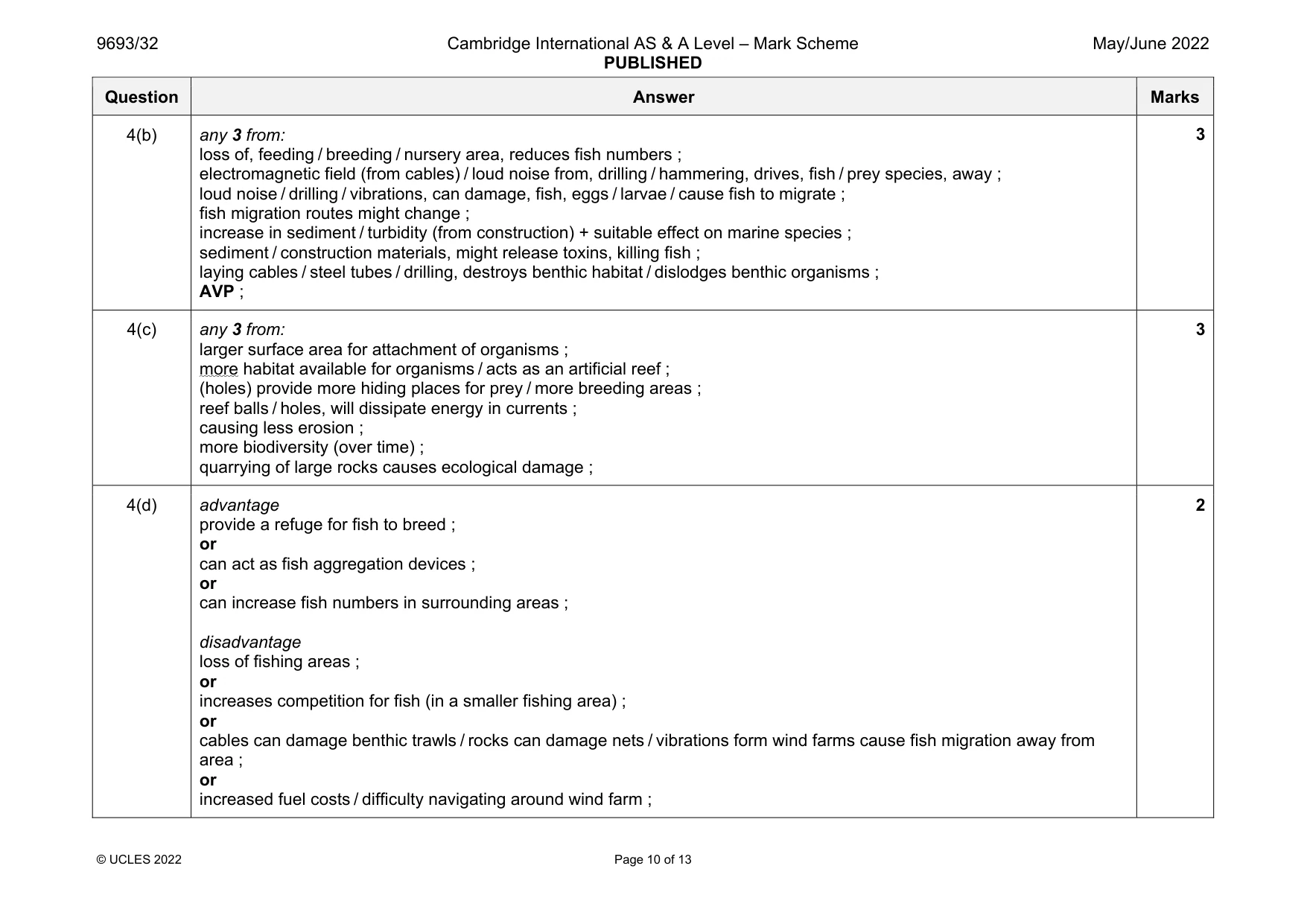
Mark scheme: 4(a) any 2 from: demand for energy is increasing ; it is, renewable / sustainable, energy source / it does not use fossil fuels ; no / less carbon dioxide released into the atmosphere / reduced carbon footprint ; so less effect on global warming ; idea of legislation to decrease carbon dioxide emissions ; Question Answer Marks 4(b) any 3 from: loss of, feeding / breeding / nursery area, reduces fish numbers ; electromagnetic field (from cables) / loud noise from, drilling / hammering, drives, fish / prey species, away ; loud noise / drilling / vibrations, can damage, fish, eggs / larvae / cause fish to migrate ; fish migration routes might change ; increase in sediment / turbidity (from construction) + suitable effect on marine species ; sediment / construction materials, might release toxins, killing fish ; laying cables / steel tubes / drilling, destroys benthic habitat / dislodges benthic organisms ; AVP ; 3 4(c) any 3 from: larger surface area for attachment of organisms ; more habitat available for organisms / acts as an artificial reef ; (holes) provide more hiding places for prey / more breeding areas ; reef balls / holes, will dissipate energy in currents ; causing less erosion ; more biodiversity (over time) ; quarrying of large rocks causes ecological damage ; 3 4(d) advantage provide a refuge for fish to breed ; or can act as fish aggregation devices ; or can increase fish numbers in surrounding areas ; disadvantage loss of fishing areas ; or increases competition for fish (in a smaller fishing area) ; or cables can damage benthic trawls / rocks can damage nets / vibrations form wind farms cause fish migration away from area ; or increased fuel costs / difficulty navigating around wind farm ; 2
Q5 · Salmon farmers usually transfer smolt (juvenile fish) from land‑based hatcheries to sea…
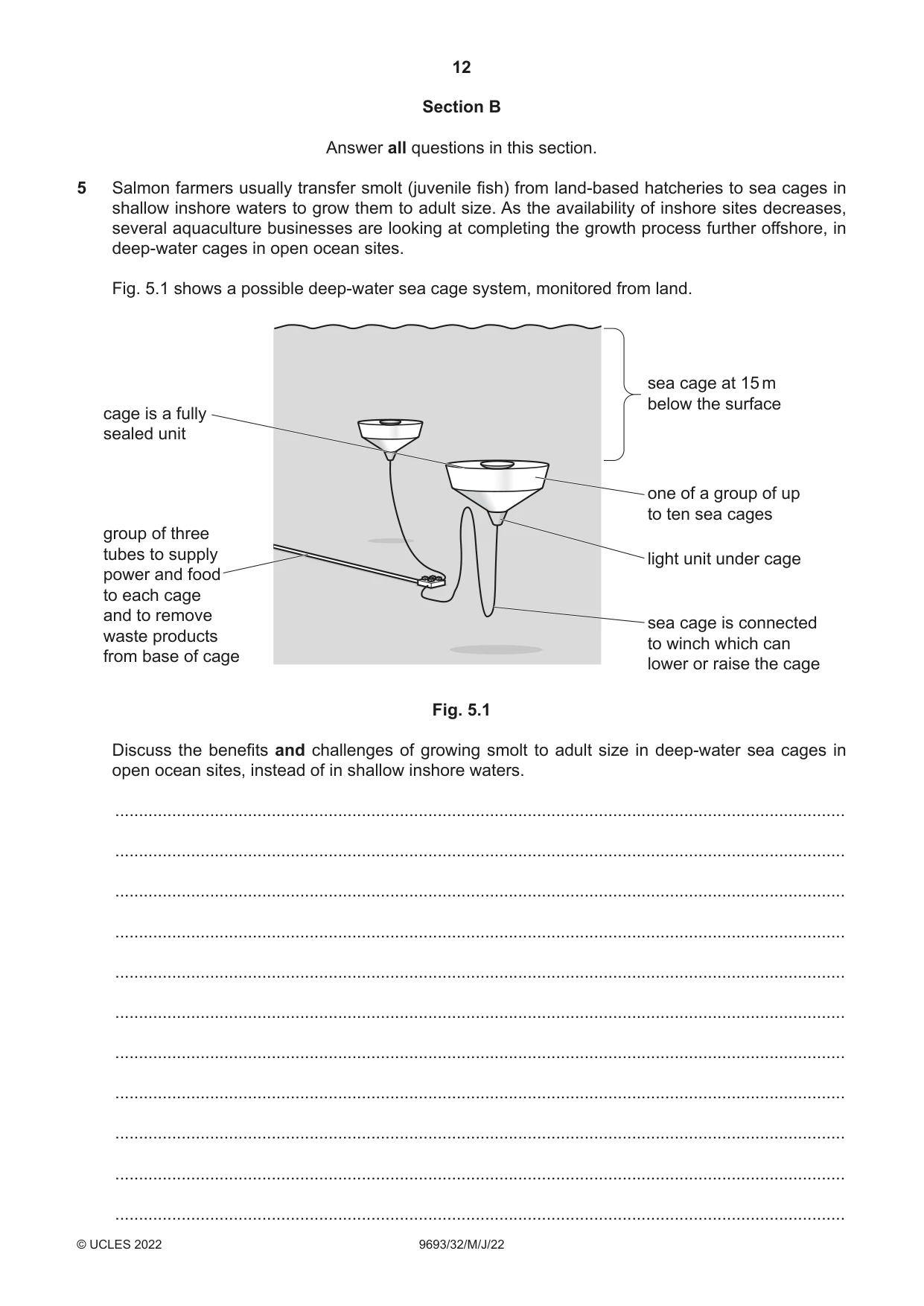
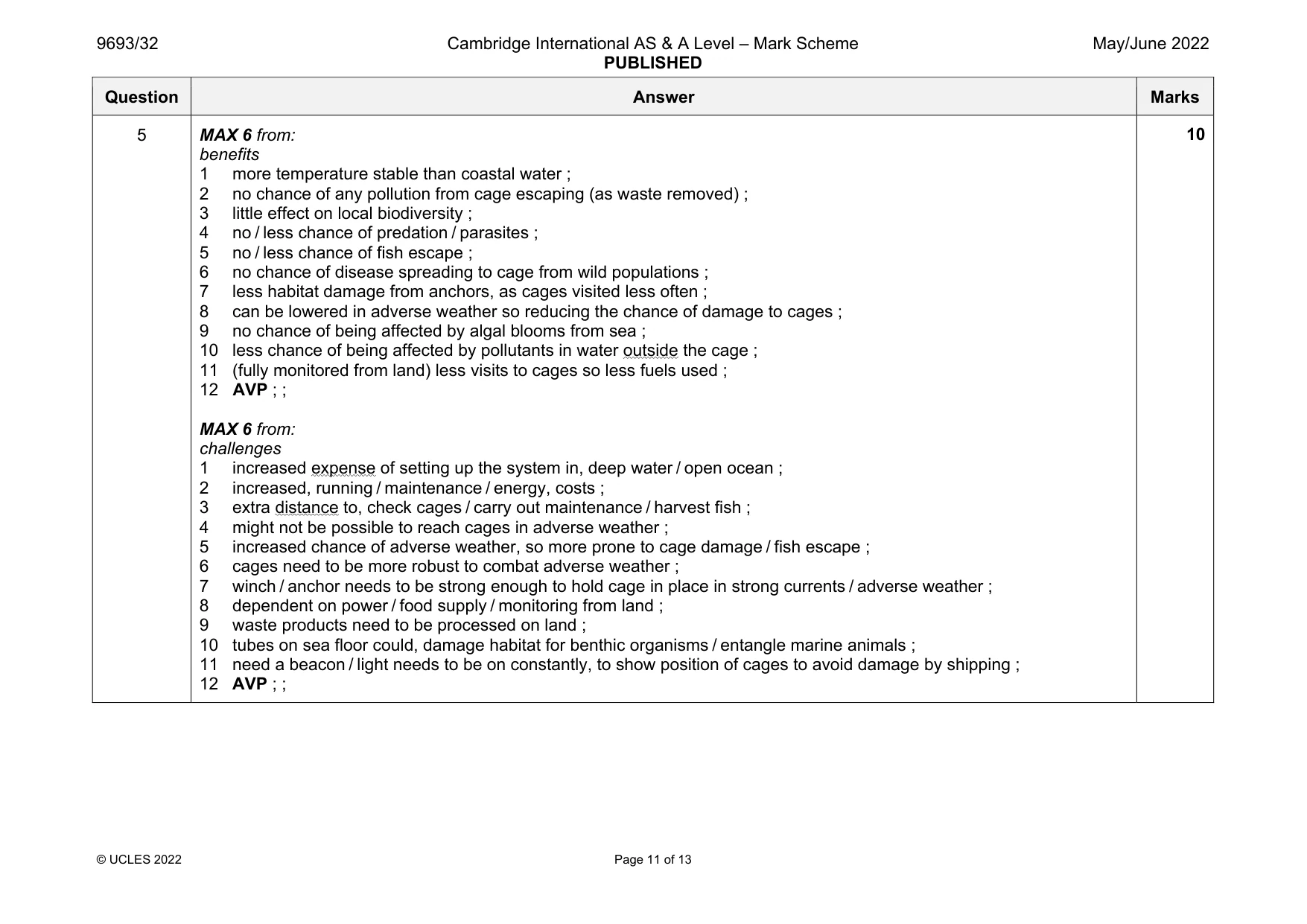
5 Salmon farmers usually transfer smolt (juvenile fish) from land‑based hatcheries to sea cages in shallow inshore waters to grow them to adult size. As the availability of inshore sites decreases, several aquaculture businesses are looking at completing the growth process further offshore, in deep‑water cages in open ocean sites. Fig. 5.1 shows a possible deep‑water sea cage system, monitored from land. sea cage at 15 m below the surface cage is a fully sealed unit one of a group of up to ten sea cages group of three tubes to supply light unit under cage power and food to each cage and to remove sea cage is connected waste products to winch which can from base of cage lower or raise the cage Fig. 5.1 Discuss the benefits and challenges of growing smolt to adult size in deep‑water sea cages in open ocean sites, instead of in shallow inshore waters. .......................................................................................................................................................... .......................................................................................................................................................... .......................................................................................................................................................... .......................................................................................................................................................... .......................................................................................................................................................... .......................................................................................................................................................... .......................................................................................................................................................... .......................................................................................................................................................... .......................................................................................................................................................... .......................................................................................................................................................... .......................................................................................................................................................... .......................................................................................................................................................... .......................................................................................................................................................... .......................................................................................................................................................... .......................................................................................................................................................... .......................................................................................................................................................... .......................................................................................................................................................... .......................................................................................................................................................... .......................................................................................................................................................... .................................................................................................................................................. [10]
Mark scheme: 5 MAX 6 from: benefits 1 more temperature stable than coastal water ; 2 no chance of any pollution from cage escaping (as waste removed) ; 3 little effect on local biodiversity ; 4 no / less chance of predation / parasites ; 5 no / less chance of fish escape ; 6 no chance of disease spreading to cage from wild populations ; 7 less habitat damage from anchors, as cages visited less often ; 8 can be lowered in adverse weather so reducing the chance of damage to cages ; 9 no chance of being affected by algal blooms from sea ; 10 less chance of being affected by pollutants in water outside the cage ; 11 (fully monitored from land) less visits to cages so less fuels used ; 12 AVP ; ; MAX 6 from: challenges 1 increased expense of setting up the system in, deep water / open ocean ; 2 increased, running / maintenance / energy, costs ; 3 extra distance to, check cages / carry out maintenance / harvest fish ; 4 might not be possible to reach cages in adverse weather ; 5 increased chance of adverse weather, so more prone to cage damage / fish escape ; 6 cages need to be more robust to combat adverse weather ; 7 winch / anchor needs to be strong enough to hold cage in place in strong currents / adverse weather ; 8 dependent on power / food supply / monitoring from land ; 9 waste products need to be processed on land ; 10 tubes on sea floor could, damage habitat for benthic organisms / entangle marine animals ; 11 need a beacon / light needs to be on constantly, to show position of cages to avoid damage by shipping ; 12 AVP ; ;
Q6 · Explain how the natural greenhouse effect helps maintain a temperature on Earth that is…
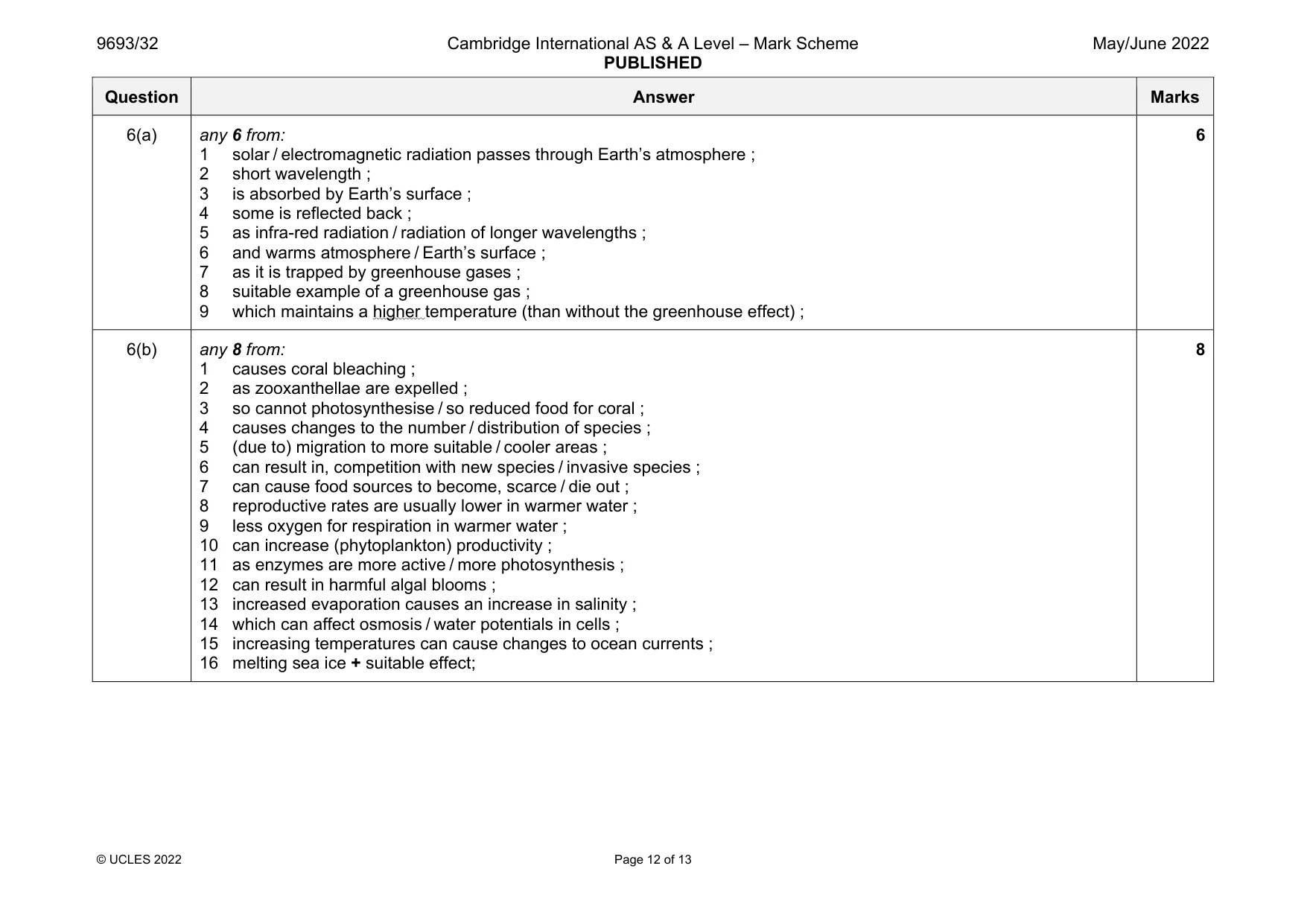
6 (a) Explain how the natural greenhouse effect helps maintain a temperature on Earth that is suitable for life. ................................................................................................................................................... ................................................................................................................................................... ................................................................................................................................................... ................................................................................................................................................... ................................................................................................................................................... ................................................................................................................................................... ................................................................................................................................................... ................................................................................................................................................... ................................................................................................................................................... ................................................................................................................................................... ................................................................................................................................................... ............................................................................................................................................. [6] (b) Describe the possible impacts of increasing sea water temperatures on the marine environment. ................................................................................................................................................... ................................................................................................................................................... ................................................................................................................................................... ................................................................................................................................................... ................................................................................................................................................... ................................................................................................................................................... ................................................................................................................................................... ................................................................................................................................................... ................................................................................................................................................... ................................................................................................................................................... ................................................................................................................................................... ................................................................................................................................................... ................................................................................................................................................... ................................................................................................................................................... ................................................................................................................................................... ............................................................................................................................................. [8] [Total: 14]
Mark scheme: 6(a) any 6 from: 1 solar / electromagnetic radiation passes through Earth’s atmosphere ; 2 short wavelength ; 3 is absorbed by Earth’s surface ; 4 some is reflected back ; 5 as infra-red radiation / radiation of longer wavelengths ; 6 and warms atmosphere / Earth’s surface ; 7 as it is trapped by greenhouse gases ; 8 suitable example of a greenhouse gas ; 9 which maintains a higher temperature (than without the greenhouse effect) ; 6 6(b) any 8 from: 1 causes coral bleaching ; 2 as zooxanthellae are expelled ; 3 so cannot photosynthesise / so reduced food for coral ; 4 causes changes to the number / distribution of species ; 5 (due to) migration to more suitable / cooler areas ; 6 can result in, competition with new species / invasive species ; 7 can cause food sources to become, scarce / die out ; 8 reproductive rates are usually lower in warmer water ; 9 less oxygen for respiration in warmer water ; 10 can increase (phytoplankton) productivity ; 11 as enzymes are more active / more photosynthesis ; 12 can result in harmful algal blooms ; 13 increased evaporation causes an increase in salinity ; 14 which can affect osmosis / water potentials in cells ; 15 increasing temperatures can cause changes to ocean currents ; 16 melting sea ice + suitable effect; 8
Q7 · Conservation measures frequently aim to maintain or increase biodiversity
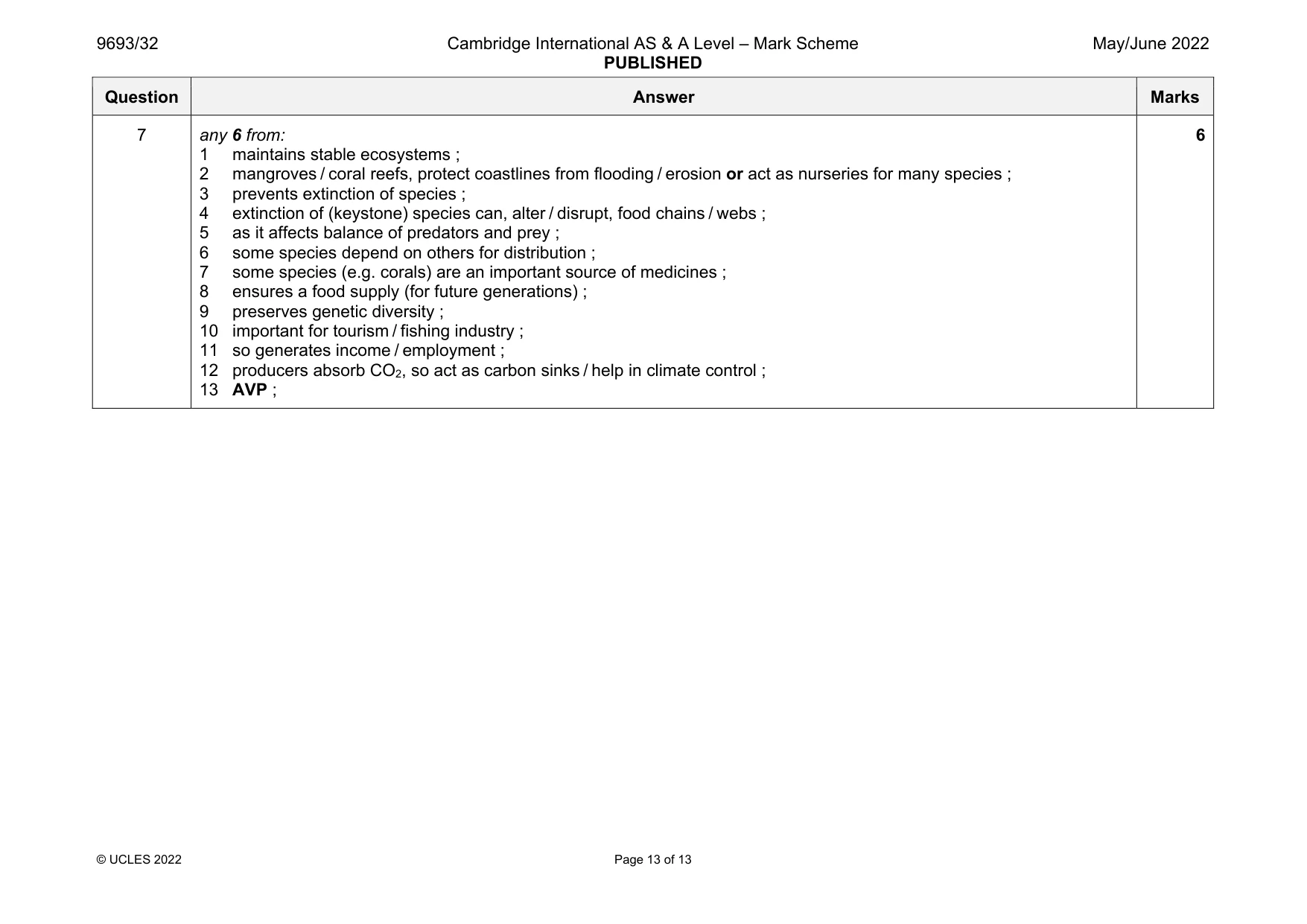
7 Conservation measures frequently aim to maintain or increase biodiversity. Discuss the importance of marine biodiversity in terms of the services it provides. .......................................................................................................................................................... .......................................................................................................................................................... .......................................................................................................................................................... .......................................................................................................................................................... .......................................................................................................................................................... .......................................................................................................................................................... .......................................................................................................................................................... .......................................................................................................................................................... .......................................................................................................................................................... .......................................................................................................................................................... .......................................................................................................................................................... .................................................................................................................................................... [6] The boundaries and names shown, the designations used and the presentation of material on any maps contained in this question paper/insert do not imply official endorsement or acceptance by Cambridge Assessment International Education concerning the legal status of any country, territory, or area or any of its authorities, or of the delimitation of its frontiers or boundaries.
Mark scheme: 7 any 6 from: 1 maintains stable ecosystems ; 2 mangroves / coral reefs, protect coastlines from flooding / erosion or act as nurseries for many species ; 3 prevents extinction of species ; 4 extinction of (keystone) species can, alter / disrupt, food chains / webs ; 5 as it affects balance of predators and prey ; 6 some species depend on others for distribution ; 7 some species (e.g. corals) are an important source of medicines ; 8 ensures a food supply (for future generations) ; 9 preserves genetic diversity ; 10 important for tourism / fishing industry ; 11 so generates income / employment ; 12 producers absorb CO2, so act as carbon sinks / help in climate control ; 13 AVP ; 6
What was in this paper
The subtopics covered by these 7 questions, and how many questions each got. Open one in a new tab to see every Cambridge question on it.
What you needed in this session
Cambridge’s own grade thresholds for 2022 May/June, Paper 3 · Variant 2. A higher threshold means an easier paper — the bar moves with how the cohort did.