Cambridge A Level Marine Science 9693 — 2024 May/June Paper 3 · Variant 2
9693/32/M/J/24 · 7 questions · 75 marks · ≈84 min
The question paper and its mark scheme, free to read here and free to download. This is Cambridge’s own paper, exactly as it was sat.
Question paper16 pages


Mark scheme14 pages
Answers below. Sit the paper first if you are practising.
Questions as text
Q1 · Hay Point in Queensland, Australia, is one of the largest ports for coal export in the…
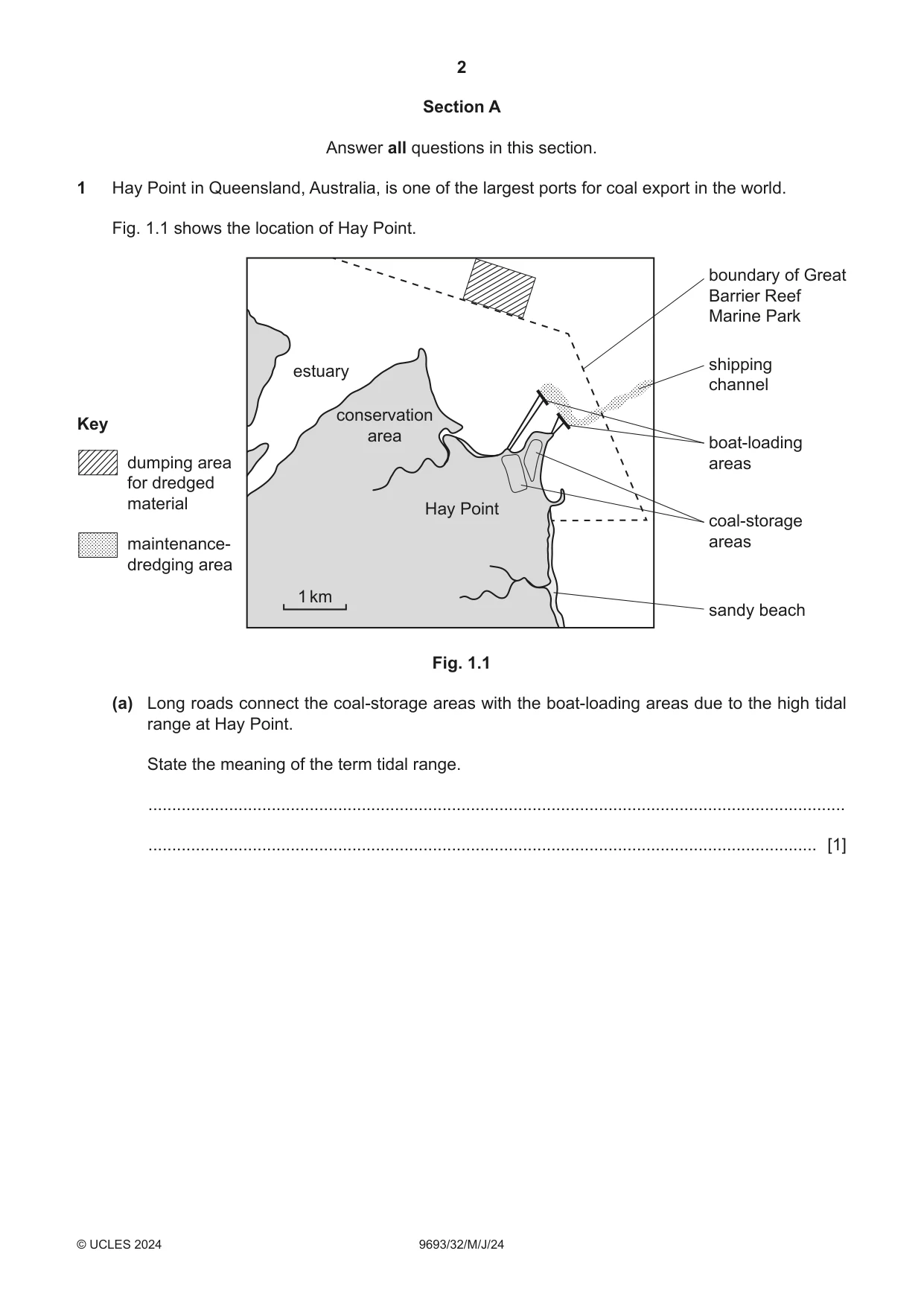
1 Hay Point in Queensland, Australia, is one of the largest ports for coal export in the world. Fig. 1.1 shows the location of Hay Point. boundary of Great Barrier Reef Marine Park shipping estuary channel conservationKey area boat-loading dumping area areas for dredged material Hay Point coal-storage maintenance- areas dredging area 1 km sandy beach Fig. 1.1 (a) Long roads connect the coal-storage areas with the boat-loading areas due to the high tidal range at Hay Point. State the meaning of the term tidal range. ................................................................................................................................................... ............................................................................................................................................. [1] (b) Hay Point is an important tourist destination for visits to the Great Barrier Reef. The reef is a few kilometres offshore and is a World Heritage Site. At the beginning of 2019, severe flooding in the area caused a significant amount of sediment to be washed from local rivers into the sea around Hay Point. (i) Suggest the impact of increased sediment on corals in the Great Barrier Reef. ........................................................................................................................................... ........................................................................................................................................... ........................................................................................................................................... ........................................................................................................................................... ........................................................................................................................................... ........................................................................................................................................... ........................................................................................................................................... ..................................................................................................................................... [4] (ii) Suggest three further impacts that a significant quantity of fresh water would have on the sea water at Hay Point. 1 ........................................................................................................................................ ........................................................................................................................................... 2 ........................................................................................................................................ ........................................................................................................................................... 3 ........................................................................................................................................ ........................................................................................................................................... [3] (c) In February 2019 the Port Authority was granted permission to carry out maintenance dredging of the shipping channel and to dump one million tonnes of sediment along part of the Great Barrier Reef. Suggest and explain the possible effect of the maintenance dredging on local fish stocks. ................................................................................................................................................... ................................................................................................................................................... ................................................................................................................................................... ................................................................................................................................................... ................................................................................................................................................... ................................................................................................................................................... ................................................................................................................................................... ............................................................................................................................................. [4] [Total: 12]
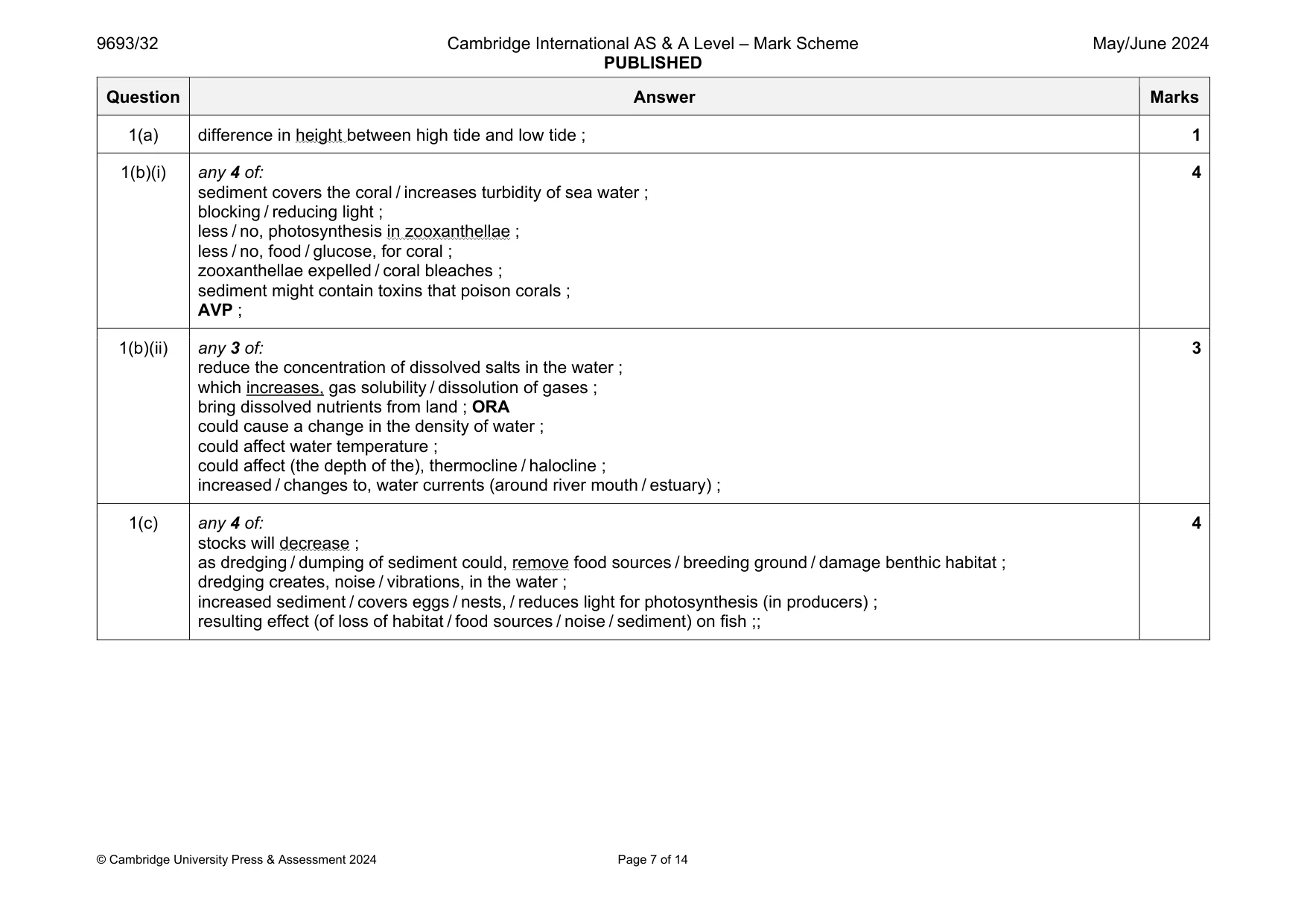
Mark scheme: 1(a) difference in height between high tide and low tide ; 1 1(b)(i) any 4 of: sediment covers the coral / increases turbidity of sea water ; blocking / reducing light ; less / no, photosynthesis in zooxanthellae ; less / no, food / glucose, for coral ; zooxanthellae expelled / coral bleaches ; sediment might contain toxins that poison corals ; AVP ; 4 1(b)(ii) any 3 of: reduce the concentration of dissolved salts in the water ; which increases, gas solubility / dissolution of gases ; bring dissolved nutrients from land ; ORA could cause a change in the density of water ; could affect water temperature ; could affect (the depth of the), thermocline / halocline ; increased / changes to, water currents (around river mouth / estuary) ; 3 1(c) any 4 of: stocks will decrease ; as dredging / dumping of sediment could, remove food sources / breeding ground / damage benthic habitat ; dredging creates, noise / vibrations, in the water ; increased sediment / covers eggs / nests, / reduces light for photosynthesis (in producers) ; resulting effect (of loss of habitat / food sources / noise / sediment) on fish ;; 4
Q2 · Providing efficient aeration is a key requirement for aquaculture systems
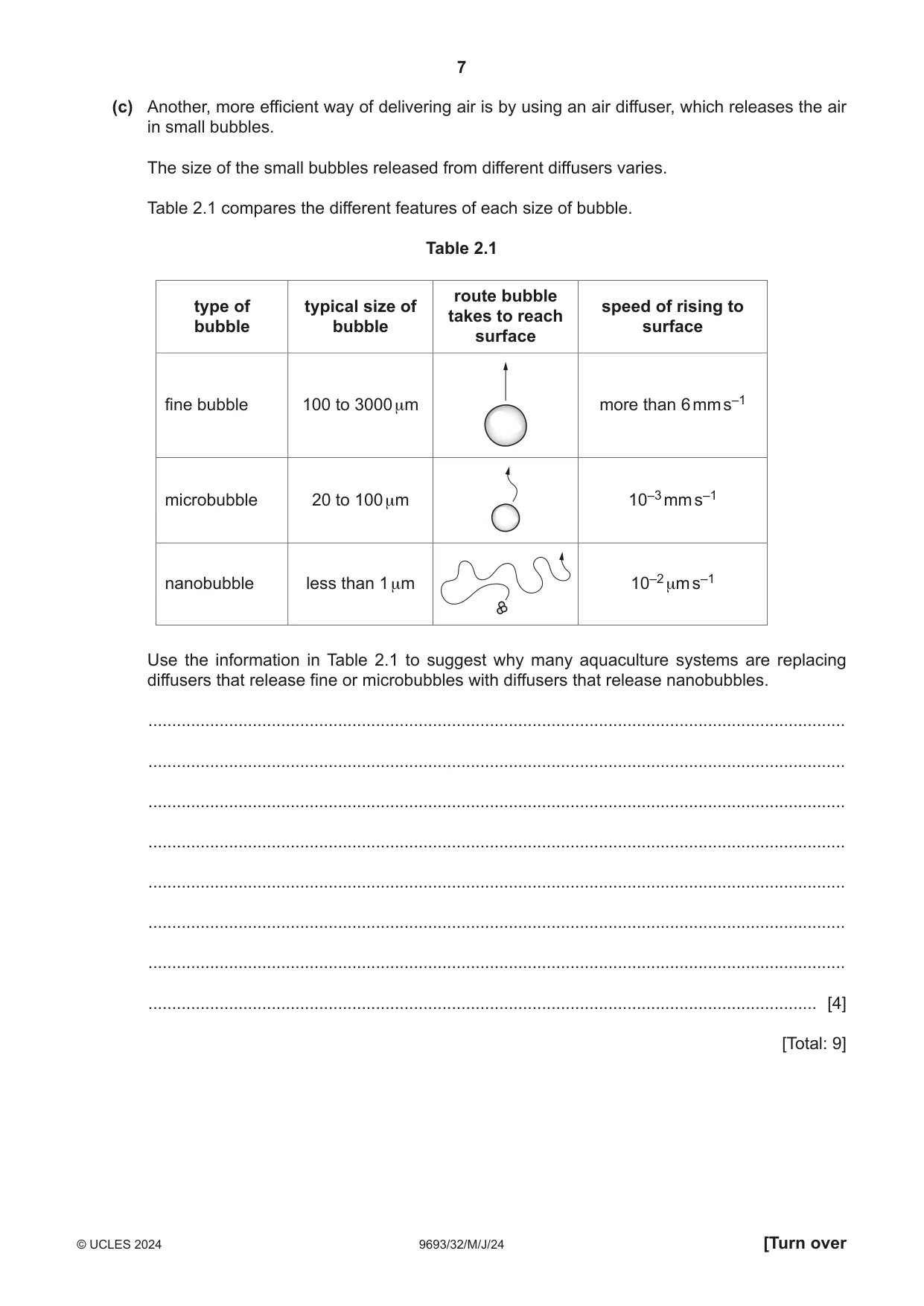
2 (a) Providing efficient aeration is a key requirement for aquaculture systems. (i) Explain why efficient aeration is important in aquaculture systems. ........................................................................................................................................... ........................................................................................................................................... ........................................................................................................................................... ..................................................................................................................................... [2] (ii) Explain why efficient aeration is more important in intensive aquaculture systems than in extensive aquaculture systems. ........................................................................................................................................... ........................................................................................................................................... ........................................................................................................................................... ..................................................................................................................................... [2] (b) Various methods are used to provide aeration. These include: • surface aerators, such as rotating paddlewheels • jet aerators, which force air from the surface into the water at high pressure. Suggest one reason why these aerators are not very efficient at delivering oxygen into the water. ................................................................................................................................................... ............................................................................................................................................. [1] (c) Another, more efficient way of delivering air is by using an air diffuser, which releases the air in small bubbles. The size of the small bubbles released from different diffusers varies. Table 2.1 compares the different features of each size of bubble. Table 2.1 route bubble type of typical size of speed of rising to takes to reach bubble bubble surface surface fine bubble 100 to 3000 µm more than 6 mm s–1 microbubble 20 to 100 µm 10–3 mm s–1 nanobubble less than 1 µm 10–2 µm s–1 Use the information in Table 2.1 to suggest why many aquaculture systems are replacing diffusers that release fine or microbubbles with diffusers that release nanobubbles. ................................................................................................................................................... ................................................................................................................................................... ................................................................................................................................................... ................................................................................................................................................... ................................................................................................................................................... ................................................................................................................................................... ................................................................................................................................................... ............................................................................................................................................. [4] [Total: 9]
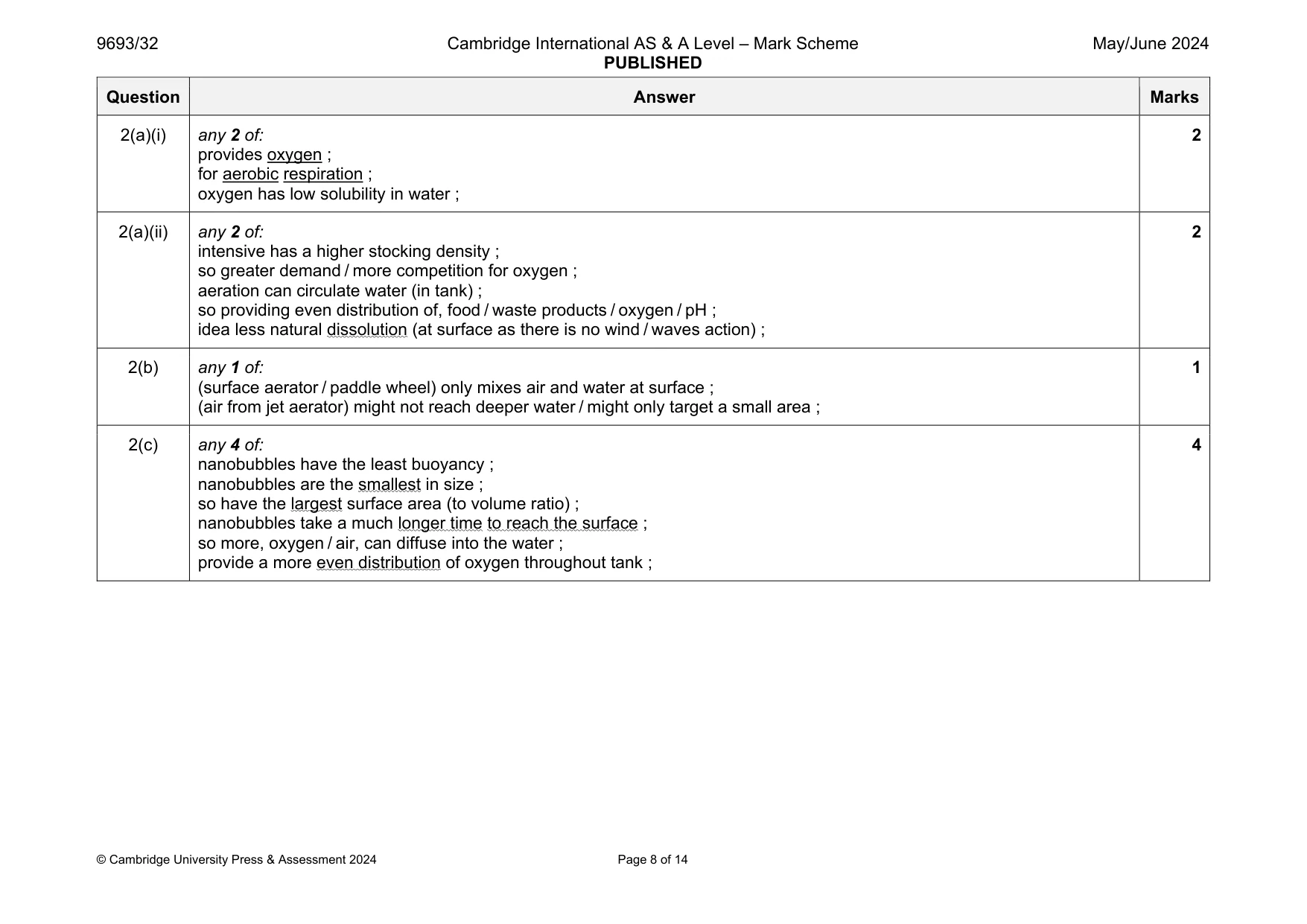
Mark scheme: 2(a)(i) any 2 of: provides oxygen ; for aerobic respiration ; oxygen has low solubility in water ; 2 2(a)(ii) any 2 of: intensive has a higher stocking density ; so greater demand / more competition for oxygen ; aeration can circulate water (in tank) ; so providing even distribution of, food / waste products / oxygen / pH ; idea less natural dissolution (at surface as there is no wind / waves action) ; 2 2(b) any 1 of: (surface aerator / paddle wheel) only mixes air and water at surface ; (air from jet aerator) might not reach deeper water / might only target a small area ; 1 2(c) any 4 of: nanobubbles have the least buoyancy ; nanobubbles are the smallest in size ; so have the largest surface area (to volume ratio) ; nanobubbles take a much longer time to reach the surface ; so more, oxygen / air, can diffuse into the water ; provide a more even distribution of oxygen throughout tank ; 4
Q3 · Salmon aquaculture usually involves two different stages: • breeding adult salmon in…
3 (a) Salmon aquaculture usually involves two different stages: • breeding adult salmon in tanks in a hatchery, where fry are raised to smolt • transferring smolt to net cages in shallow water just offshore, usually in sheltered inlets, so that they can grow to adult size. List three abiotic factors, other than aeration, which need to be controlled in a hatchery, but which cannot be controlled in net cages. For each factor, explain how it is controlled in a hatchery. factor 1 .......................................................... how controlled .......................................................................................................................... factor 2 .......................................................... how controlled .......................................................................................................................... factor 3 .......................................................... how controlled .......................................................................................................................... [3] (b) Salmon in hatcheries and in net cages are fed on pelleted food. The pellets can be of two types: • floating pellets, which float on the surface for around an hour before sinking • sinking pellets, which sink immediately. Suggest two advantages of floating pellets over sinking pellets. 1 ................................................................................................................................................ ................................................................................................................................................... 2 ................................................................................................................................................ ................................................................................................................................................... [2] (c) In 2019, 2.6 million adult salmon died in net cages in Canada. Over the previous 12 days, the sea water temperature had suddenly increased from 13 °C to between 17 °C and 21 °C. Scientists noticed that, during this temperature increase, the salmon moved to the deepest water at the bottom of the net cage. (i) Suggest why salmon moved to the bottom of the net cage. ........................................................................................................................................... ..................................................................................................................................... [1] (ii) Explain how this behaviour could have increased the number of salmon deaths. ........................................................................................................................................... ........................................................................................................................................... ........................................................................................................................................... ........................................................................................................................................... ........................................................................................................................................... ........................................................................................................................................... ........................................................................................................................................... ..................................................................................................................................... [4] (iii) Suggest one reason why the sudden increase in sea water temperature might not provide evidence for global warming. ........................................................................................................................................... ..................................................................................................................................... [1] [Total: 11]
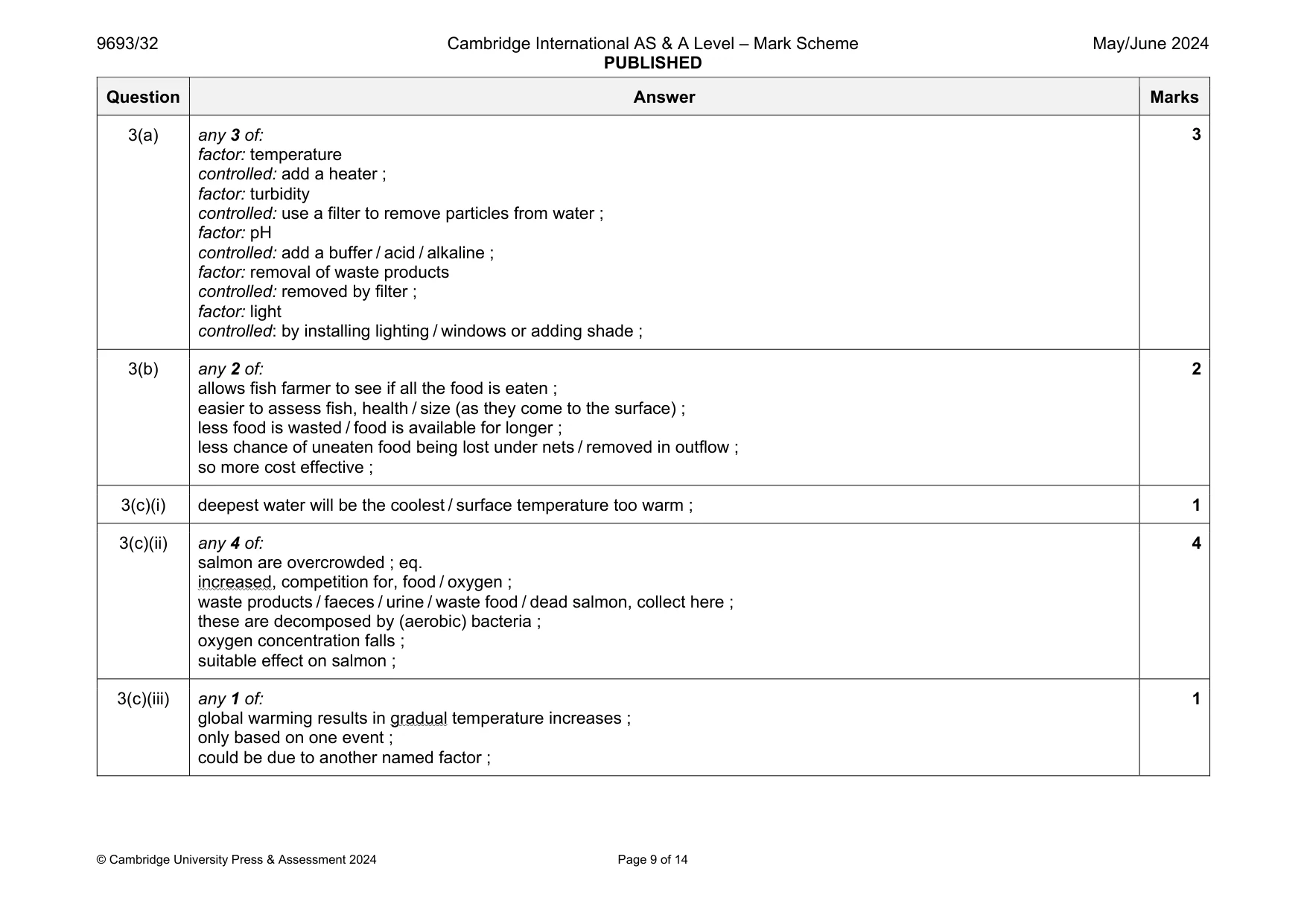
Mark scheme: 3(a) any 3 of: factor: temperature controlled: add a heater ; factor: turbidity controlled: use a filter to remove particles from water ; factor: pH controlled: add a buffer / acid / alkaline ; factor: removal of waste products controlled: removed by filter ; factor: light controlled: by installing lighting / windows or adding shade ; 3(b) any 2 of: allows fish farmer to see if all the food is eaten ; easier to assess fish, health / size (as they come to the surface) ; less food is wasted / food is available for longer ; less chance of uneaten food being lost under nets / removed in outflow ; so more cost effective ; 2 3(c)(i) deepest water will be the coolest / surface temperature too warm ; 1 3(c)(ii) any 4 of: salmon are overcrowded ; eq. increased, competition for, food / oxygen ; waste products / faeces / urine / waste food / dead salmon, collect here ; these are decomposed by (aerobic) bacteria ; oxygen concentration falls ; suitable effect on salmon ; 4 3(c)(iii) any 1 of: global warming results in gradual temperature increases ; only based on one event ; could be due to another named factor ; 1
Q4 · Seagrasses have a global distribution
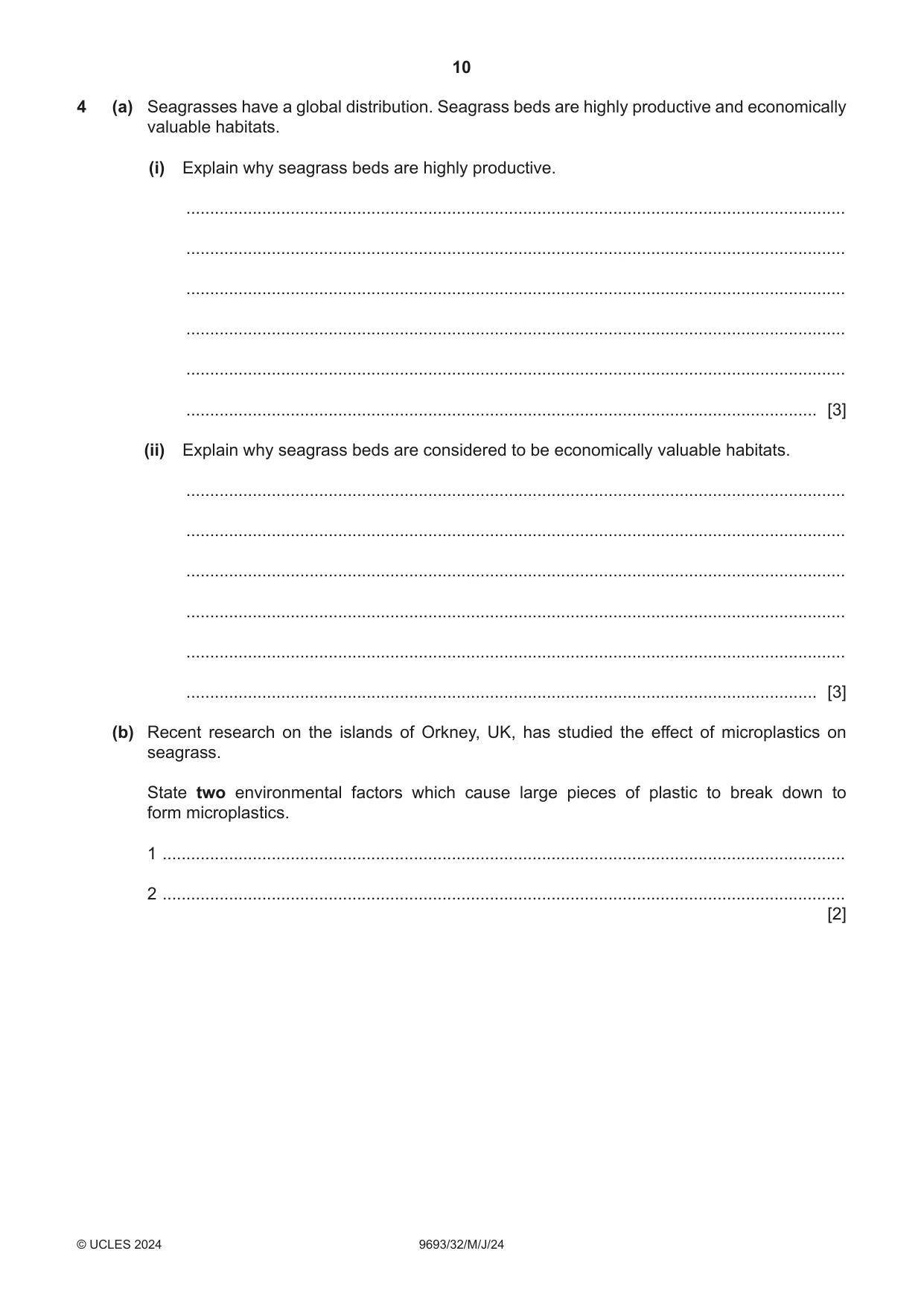
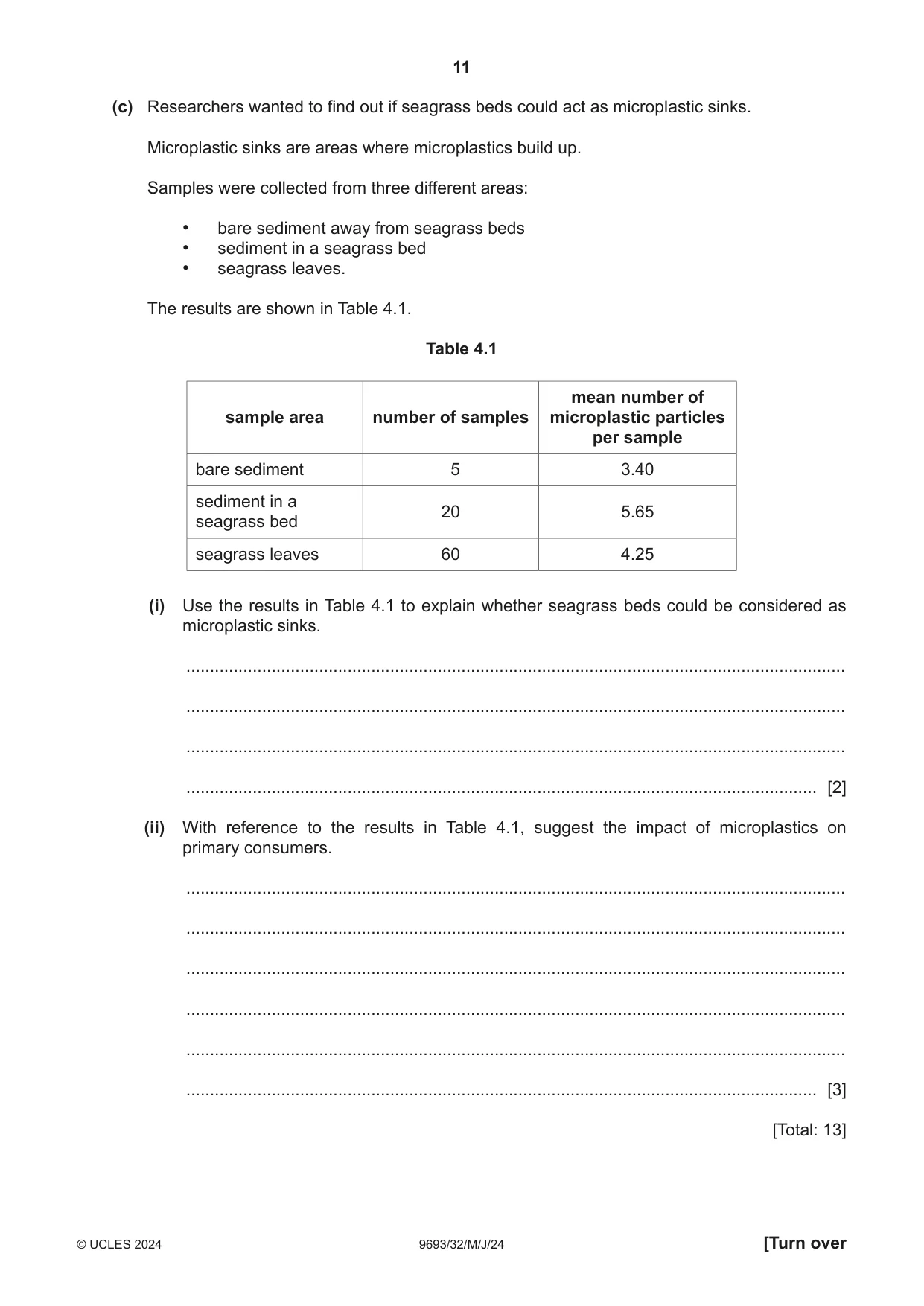
4 (a) Seagrasses have a global distribution. Seagrass beds are highly productive and economically valuable habitats. (i) Explain why seagrass beds are highly productive. ........................................................................................................................................... ........................................................................................................................................... ........................................................................................................................................... ........................................................................................................................................... ........................................................................................................................................... ..................................................................................................................................... [3] (ii) Explain why seagrass beds are considered to be economically valuable habitats. ........................................................................................................................................... ........................................................................................................................................... ........................................................................................................................................... ........................................................................................................................................... ........................................................................................................................................... ..................................................................................................................................... [3] (b) Recent research on the islands of Orkney, UK, has studied the effect of microplastics on seagrass. State two environmental factors which cause large pieces of plastic to break down to form microplastics. 1 ................................................................................................................................................ 2 ................................................................................................................................................ [2] (c) Researchers wanted to find out if seagrass beds could act as microplastic sinks. Microplastic sinks are areas where microplastics build up. Samples were collected from three different areas: • bare sediment away from seagrass beds • sediment in a seagrass bed • seagrass leaves. The results are shown in Table 4.1. Table 4.1 mean number of sample area number of samples microplastic particles per sample bare sediment 5 3.40 sediment in a 20 5.65 seagrass bed seagrass leaves 60 4.25 (i) Use the results in Table 4.1 to explain whether seagrass beds could be considered as microplastic sinks. ........................................................................................................................................... ........................................................................................................................................... ........................................................................................................................................... ..................................................................................................................................... [2] (ii) With reference to the results in Table 4.1, suggest the impact of microplastics on primary consumers. ........................................................................................................................................... ........................................................................................................................................... ........................................................................................................................................... ........................................................................................................................................... ........................................................................................................................................... ..................................................................................................................................... [3] [Total: 13]
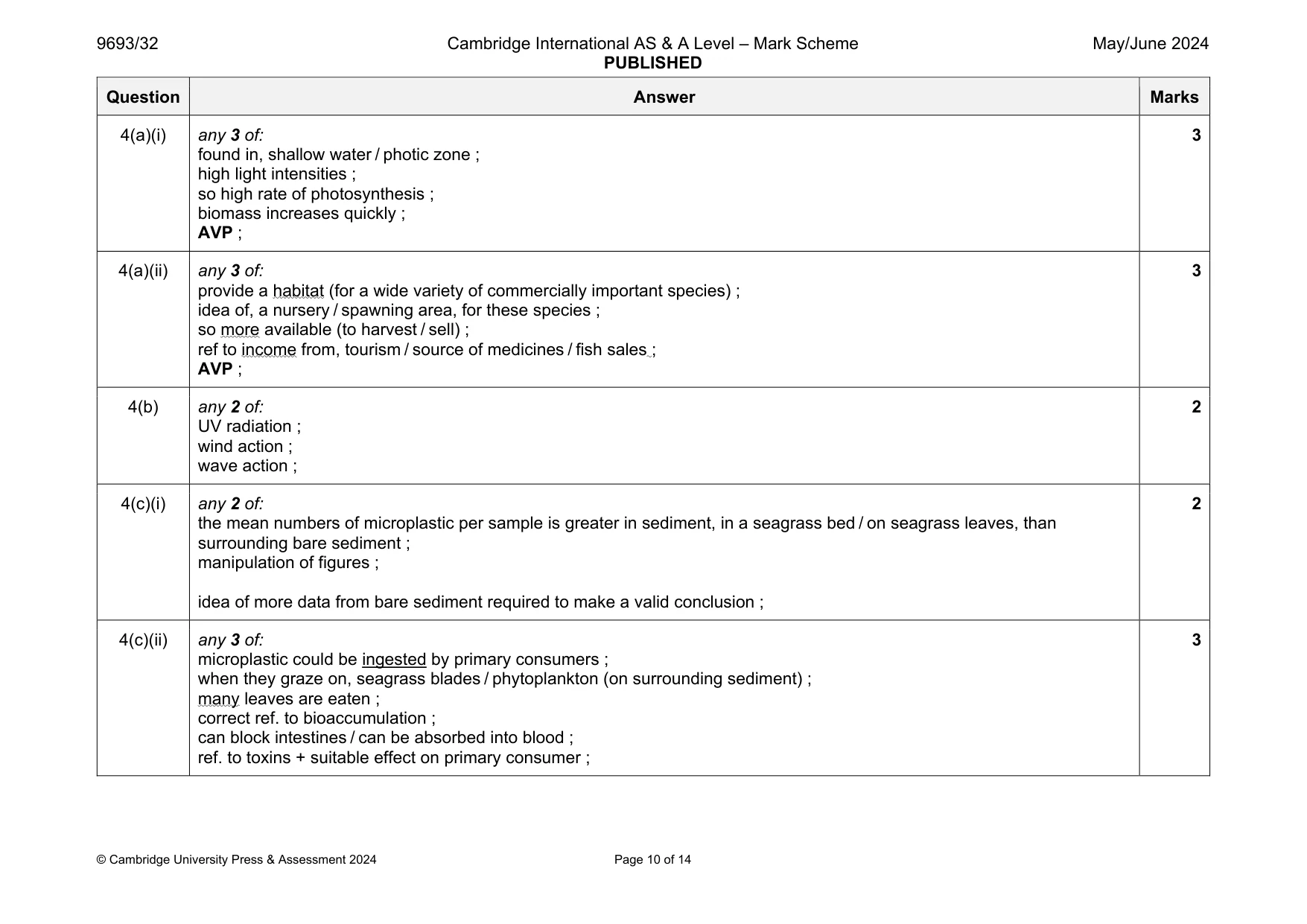
Mark scheme: 4(a)(i) any 3 of: found in, shallow water / photic zone ; high light intensities ; so high rate of photosynthesis ; biomass increases quickly ; AVP ; 3 4(a)(ii) any 3 of: provide a habitat (for a wide variety of commercially important species) ; idea of, a nursery / spawning area, for these species ; so more available (to harvest / sell) ; ref to income from, tourism / source of medicines / fish sales ; AVP ; 3 4(b) any 2 of: UV radiation ; wind action ; wave action ; 2 4(c)(i) any 2 of: the mean numbers of microplastic per sample is greater in sediment, in a seagrass bed / on seagrass leaves, than surrounding bare sediment ; manipulation of figures ; idea of more data from bare sediment required to make a valid conclusion ; 2 4(c)(ii) any 3 of: microplastic could be ingested by primary consumers ; when they graze on, seagrass blades / phytoplankton (on surrounding sediment) ; many leaves are eaten ; correct ref. to bioaccumulation ; can block intestines / can be absorbed into blood ; ref. to toxins + suitable effect on primary consumer ; 3
Q5 · Describe the light-dependent stage in photosynthesis
5 Describe the light-dependent stage in photosynthesis. .......................................................................................................................................................... .......................................................................................................................................................... .......................................................................................................................................................... .......................................................................................................................................................... .......................................................................................................................................................... .......................................................................................................................................................... .......................................................................................................................................................... .......................................................................................................................................................... .......................................................................................................................................................... .......................................................................................................................................................... .......................................................................................................................................................... .......................................................................................................................................................... .......................................................................................................................................................... .......................................................................................................................................................... .......................................................................................................................................................... .......................................................................................................................................................... .......................................................................................................................................................... .......................................................................................................................................................... .......................................................................................................................................................... .................................................................................................................................................. [10]
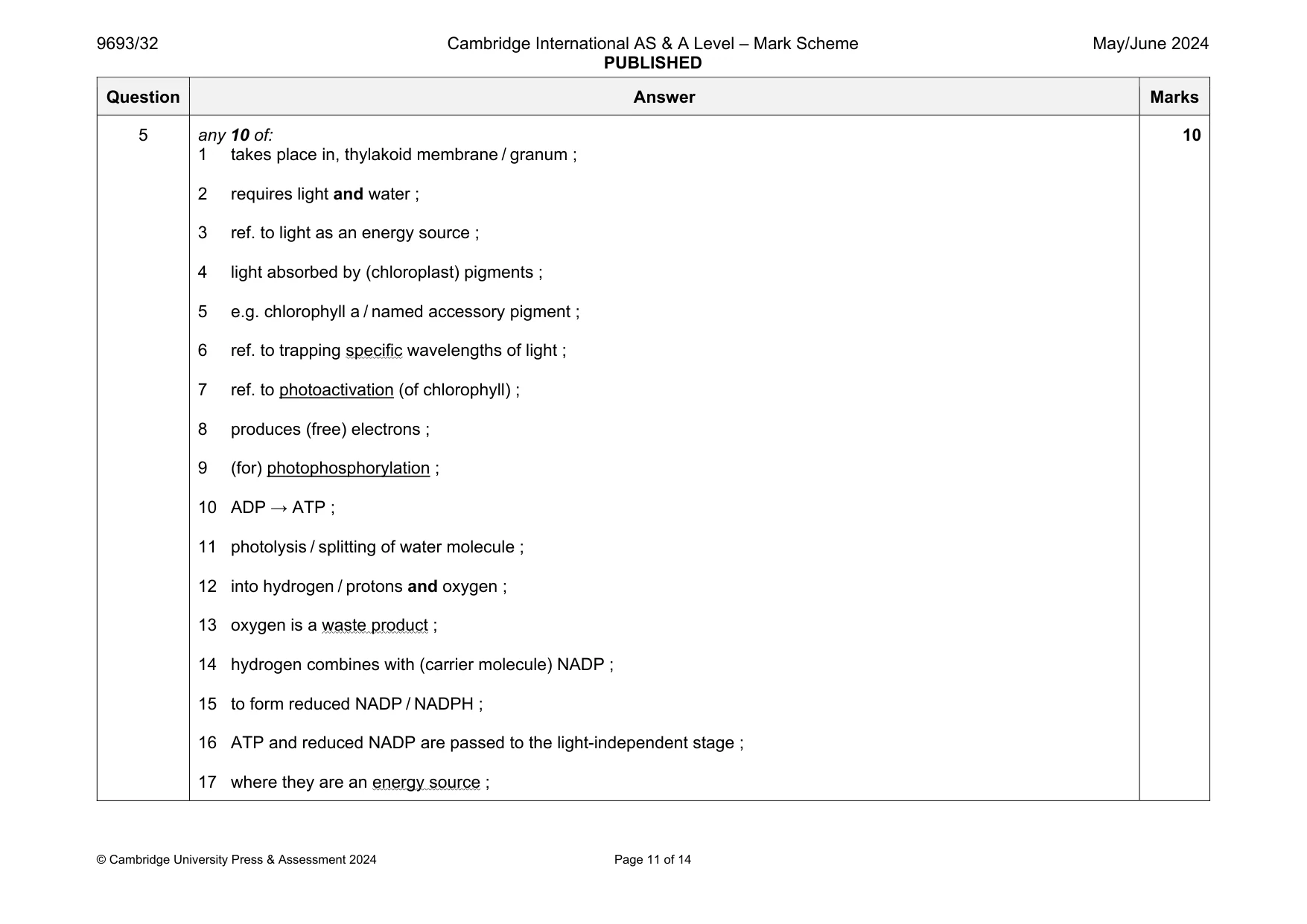
Mark scheme: 5 any 10 of: 1 takes place in, thylakoid membrane / granum ; 2 requires light and water ; 3 ref. to light as an energy source ; 4 light absorbed by (chloroplast) pigments ; 5 e.g. chlorophyll a / named accessory pigment ; 6 ref. to trapping specific wavelengths of light ; 7 ref. to photoactivation (of chlorophyll) ; 8 produces (free) electrons ; 9 (for) photophosphorylation ; 10 ADP → ATP ; 11 photolysis / splitting of water molecule ; 12 into hydrogen / protons and oxygen ; 13 oxygen is a waste product ; 14 hydrogen combines with (carrier molecule) NADP ; 15 to form reduced NADP / NADPH ; 16 ATP and reduced NADP are passed to the light-independent stage ; 17 where they are an energy source ; 10
Q6 · Discuss the role of the IWC (International Whaling Commission) moratorium in conservation
6 (a) Discuss the role of the IWC (International Whaling Commission) moratorium in conservation. ................................................................................................................................................... ................................................................................................................................................... ................................................................................................................................................... ................................................................................................................................................... ................................................................................................................................................... ................................................................................................................................................... ................................................................................................................................................... ................................................................................................................................................... ................................................................................................................................................... ................................................................................................................................................... ................................................................................................................................................... ............................................................................................................................................. [6] (b) Compare fertilisation and subsequent investment in the care of offspring in sharks and whales. ................................................................................................................................................... ................................................................................................................................................... ................................................................................................................................................... ................................................................................................................................................... ................................................................................................................................................... ................................................................................................................................................... ................................................................................................................................................... ................................................................................................................................................... ................................................................................................................................................... ................................................................................................................................................... ................................................................................................................................................... ................................................................................................................................................... ................................................................................................................................................... ............................................................................................................................................. [7] [Total: 13]
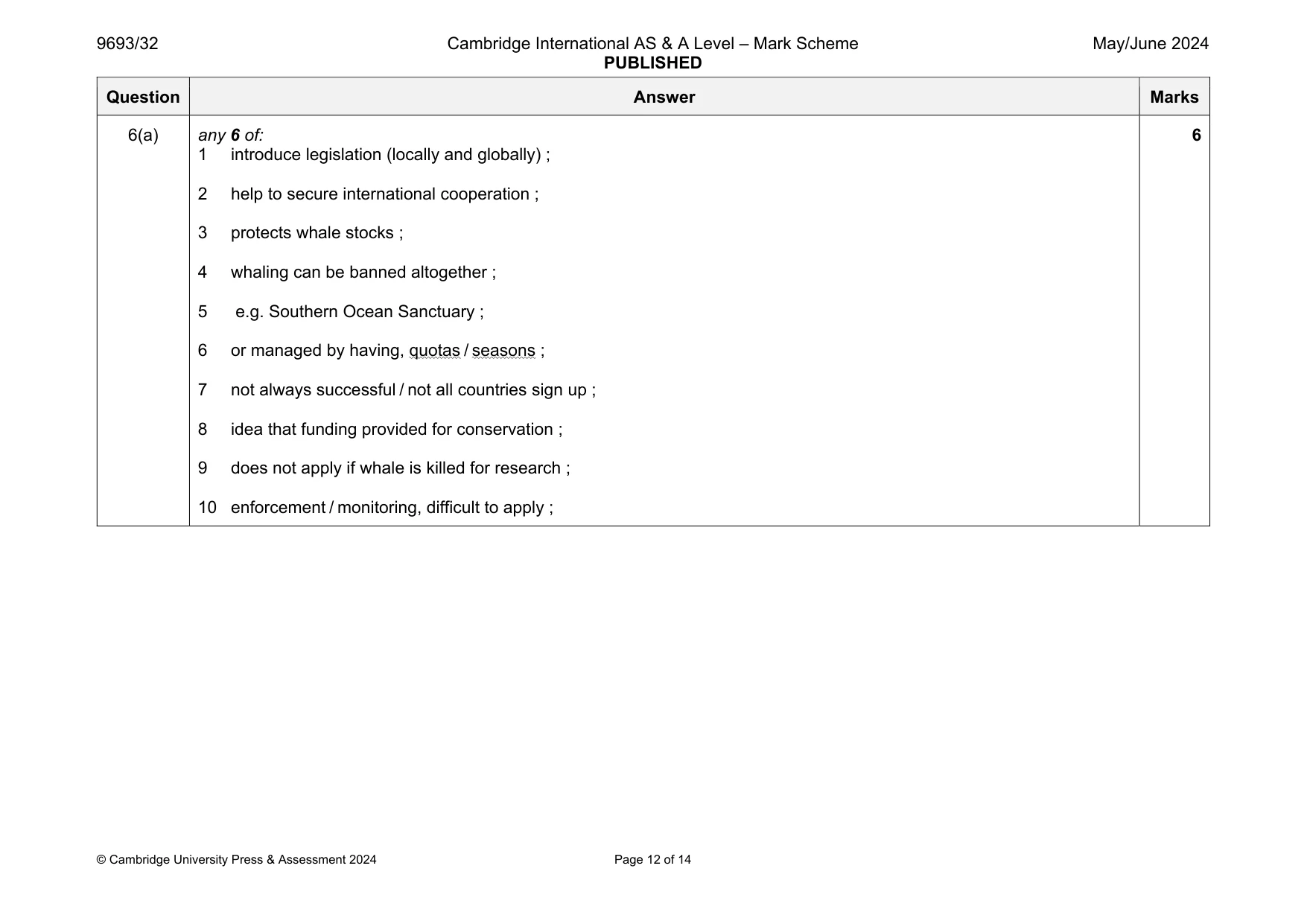
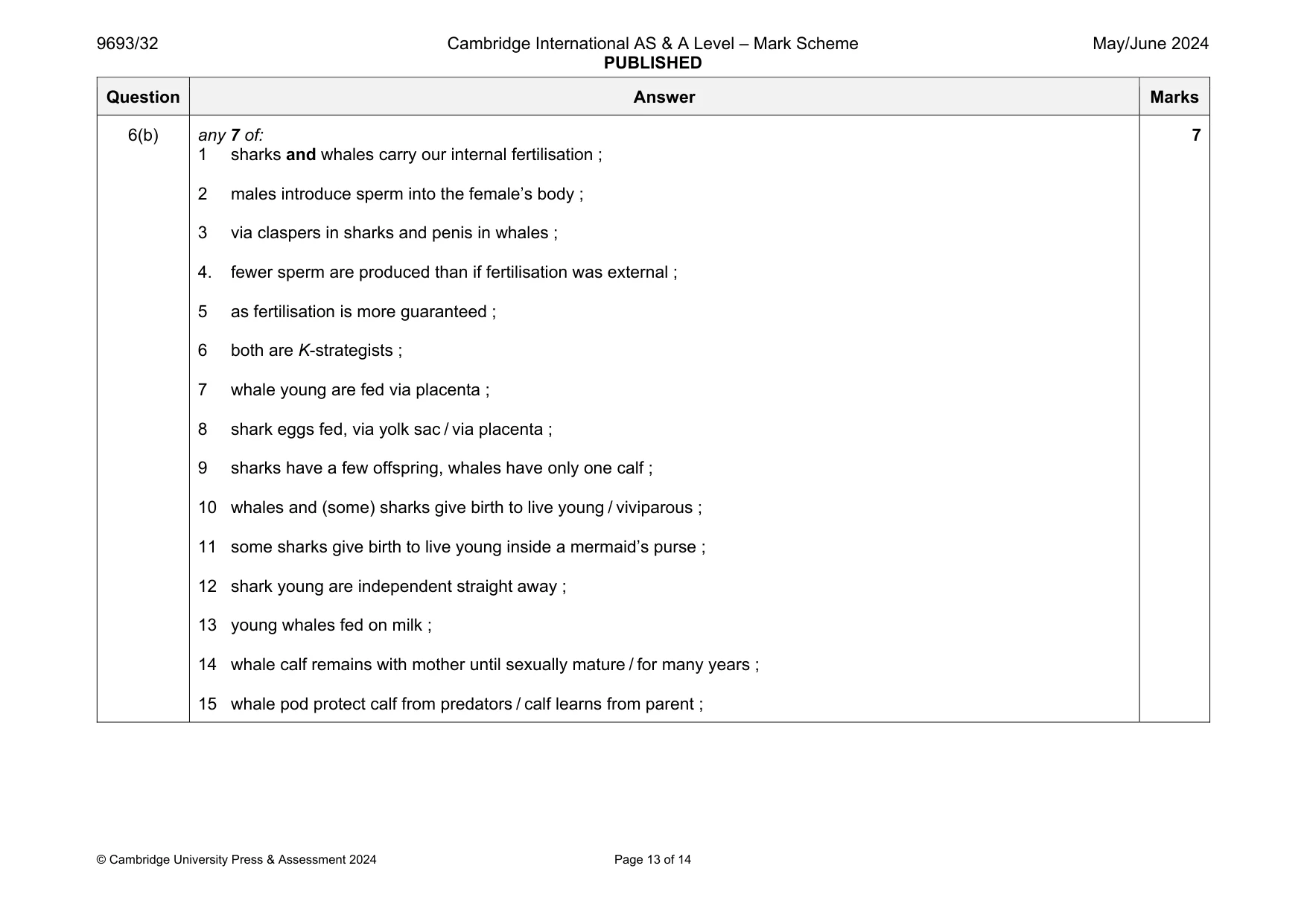
Mark scheme: 6(a) any 6 of: 1 introduce legislation (locally and globally) ; 2 help to secure international cooperation ; 3 protects whale stocks ; 4 whaling can be banned altogether ; 5 e.g. Southern Ocean Sanctuary ; 6 or managed by having, quotas / seasons ; 7 not always successful / not all countries sign up ; 8 idea that funding provided for conservation ; 9 does not apply if whale is killed for research ; 10 enforcement / monitoring, difficult to apply ; 6 Question Answer Marks 6(b) any 7 of: 1 sharks and whales carry our internal fertilisation ; 2 males introduce sperm into the female’s body ; 3 via claspers in sharks and penis in whales ; 4. fewer sperm are produced than if fertilisation was external ; 5 as fertilisation is more guaranteed ; 6 both are K-strategists ; 7 whale young are fed via placenta ; 8 shark eggs fed, via yolk sac / via placenta ; 9 sharks have a few offspring, whales have only one calf ; 10 whales and (some) sharks give birth to live young / viviparous ; 11 some sharks give birth to live young inside a mermaid’s purse ; 12 shark young are independent straight away ; 13 young whales fed on milk ; 14 whale calf remains with mother until sexually mature / for many years ; 15 whale pod protect calf from predators / calf learns from parent ; 7
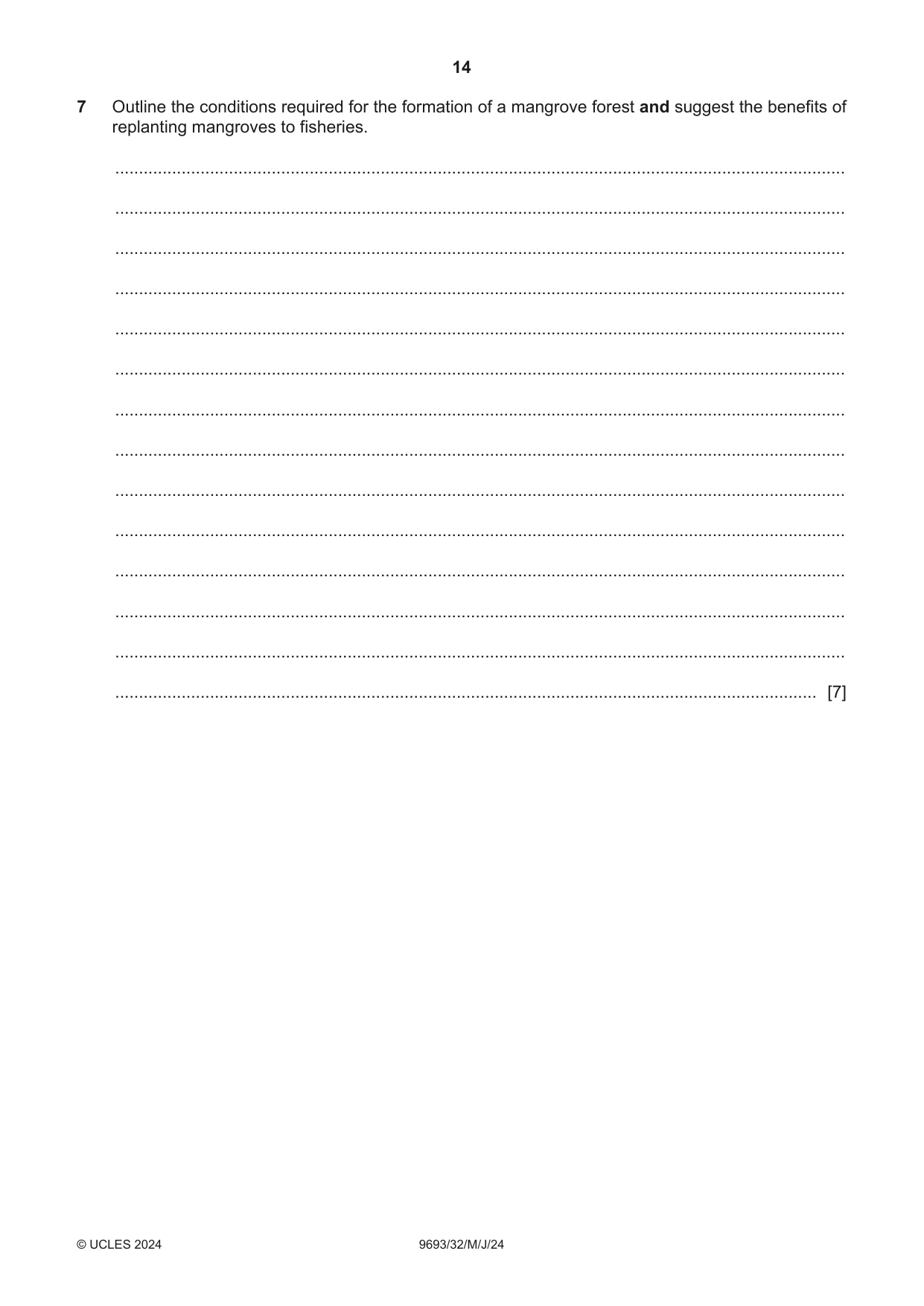
Q7 · Outline the conditions required for the formation of a mangrove forest and suggest the…
7 Outline the conditions required for the formation of a mangrove forest and suggest the benefits of replanting mangroves to fisheries. .......................................................................................................................................................... .......................................................................................................................................................... .......................................................................................................................................................... .......................................................................................................................................................... .......................................................................................................................................................... .......................................................................................................................................................... .......................................................................................................................................................... .......................................................................................................................................................... .......................................................................................................................................................... .......................................................................................................................................................... .......................................................................................................................................................... .......................................................................................................................................................... .......................................................................................................................................................... .................................................................................................................................................... [7]
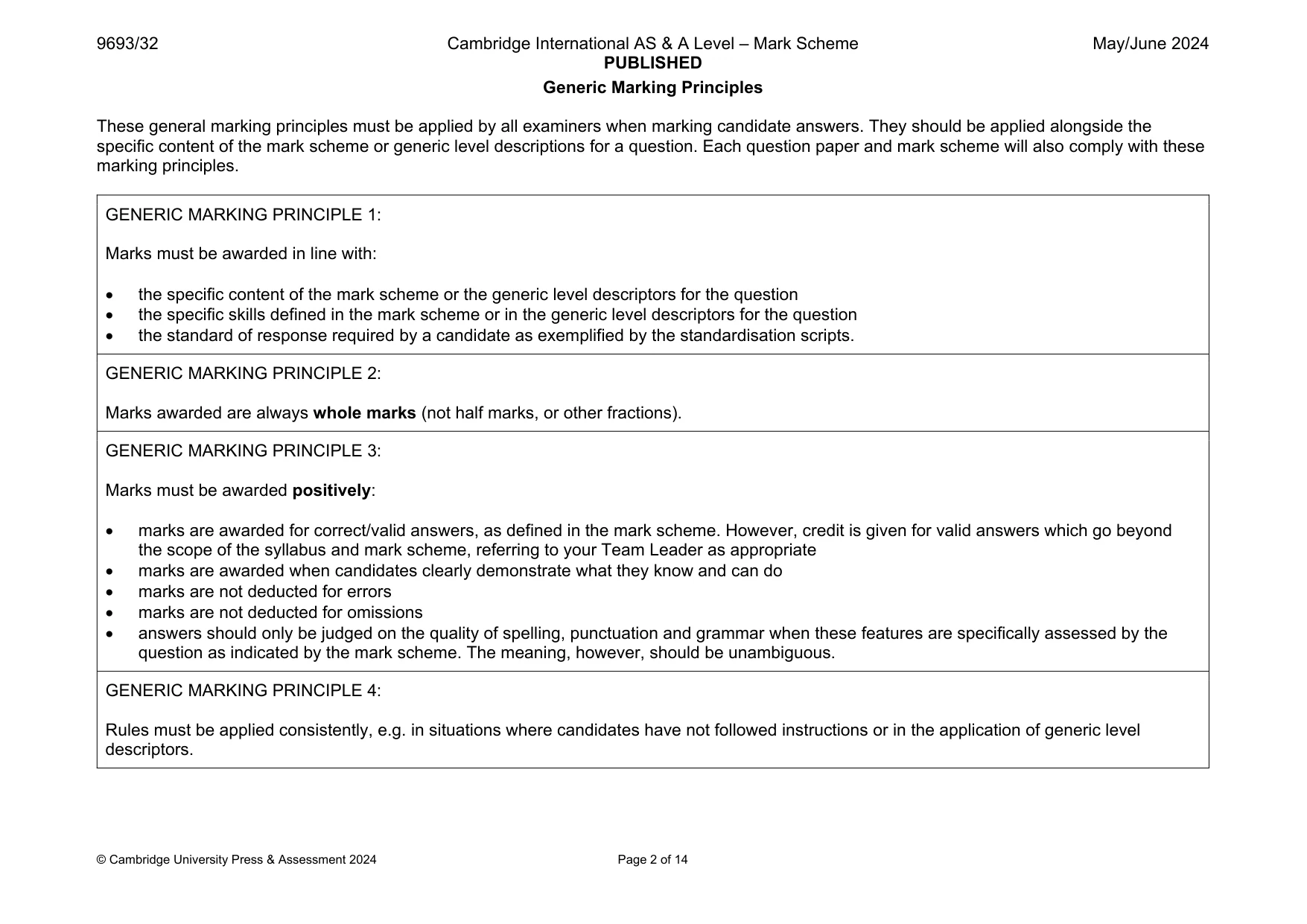
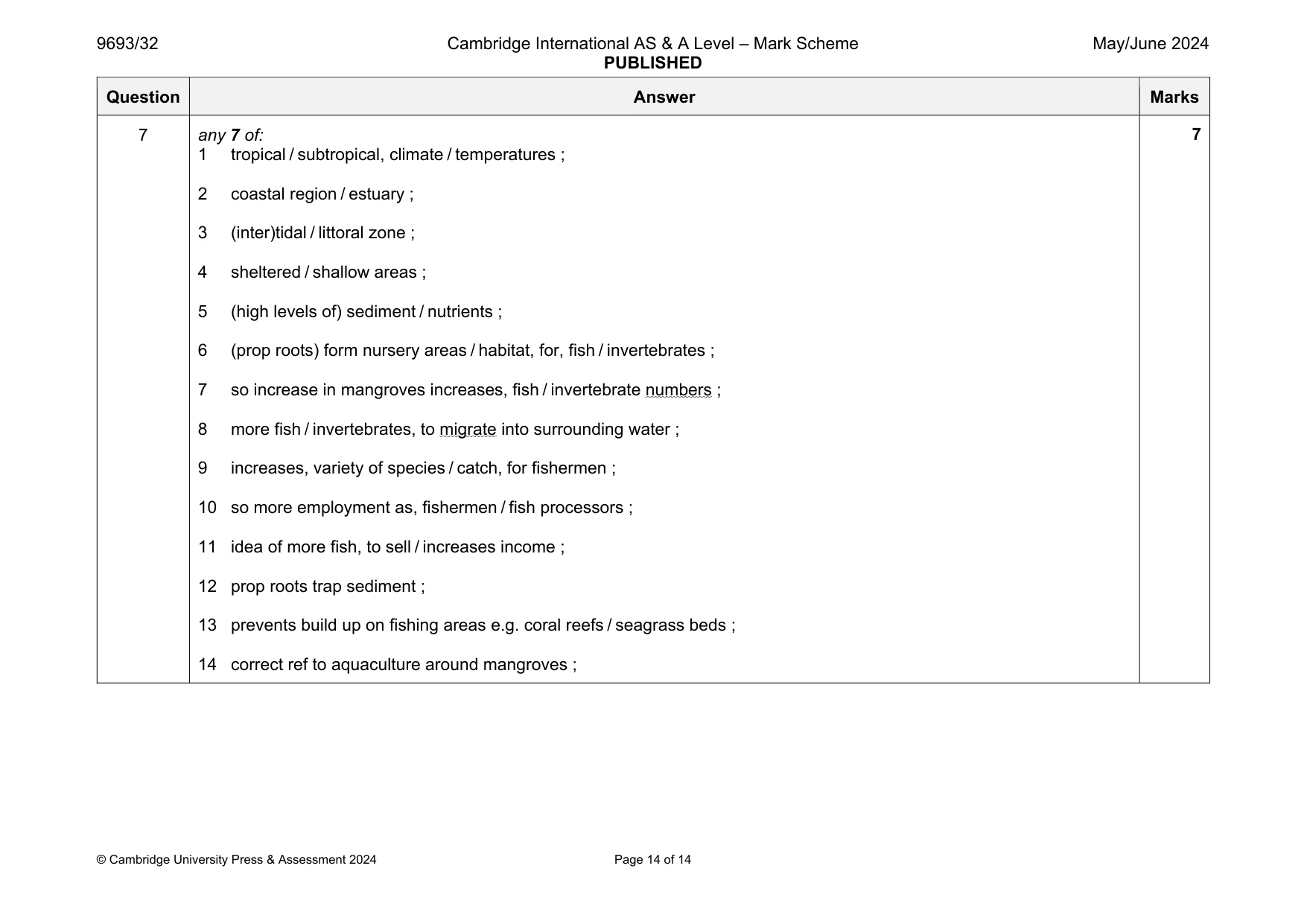
Mark scheme: 7 any 7 of: 1 tropical / subtropical, climate / temperatures ; 2 coastal region / estuary ; 3 (inter)tidal / littoral zone ; 4 sheltered / shallow areas ; 5 (high levels of) sediment / nutrients ; 6 (prop roots) form nursery areas / habitat, for, fish / invertebrates ; 7 so increase in mangroves increases, fish / invertebrate numbers ; 8 more fish / invertebrates, to migrate into surrounding water ; 9 increases, variety of species / catch, for fishermen ; 10 so more employment as, fishermen / fish processors ; 11 idea of more fish, to sell / increases income ; 12 prop roots trap sediment ; 13 prevents build up on fishing areas e.g. coral reefs / seagrass beds ; 14 correct ref to aquaculture around mangroves ;
What was in this paper
The subtopics covered by these 7 questions, and how many questions each got. Open one in a new tab to see every Cambridge question on it.
What you needed in this session
Cambridge’s own grade thresholds for 2024 May/June, Paper 3 · Variant 2. A higher threshold means an easier paper — the bar moves with how the cohort did.