Cambridge A Level Marine Science 9693 — 2022 Oct/Nov Paper 3 · Variant 1
9693/31/O/N/22 · 7 questions · 75 marks · ≈84 min
The question paper and its mark scheme, free to read here and free to download. This is Cambridge’s own paper, exactly as it was sat.
Question paper12 pages
Mark scheme13 pages
Answers below. Sit the paper first if you are practising.
Questions as text
Q1 · There is continuous movement of substances through the cell membranes of cells of marine…
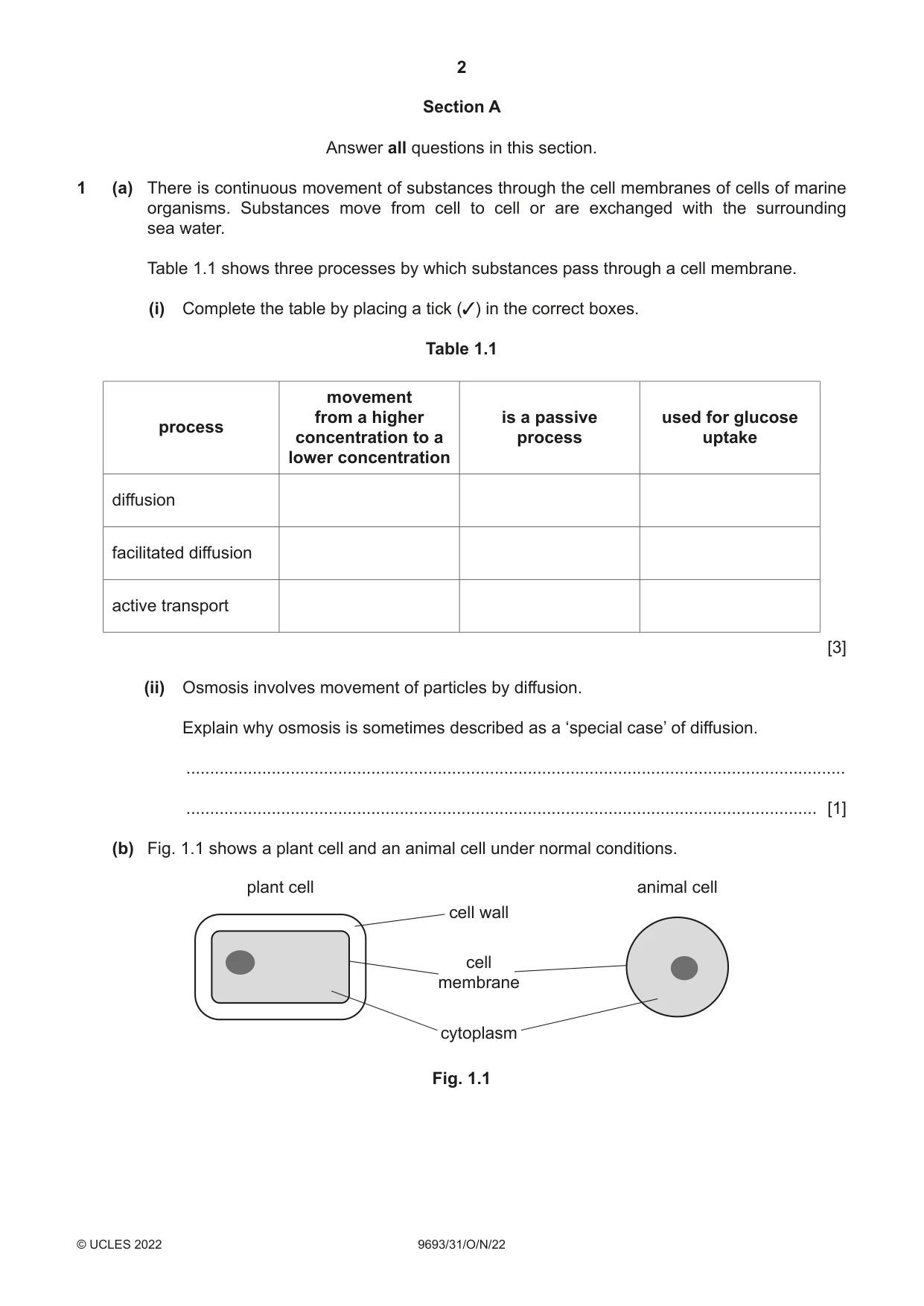
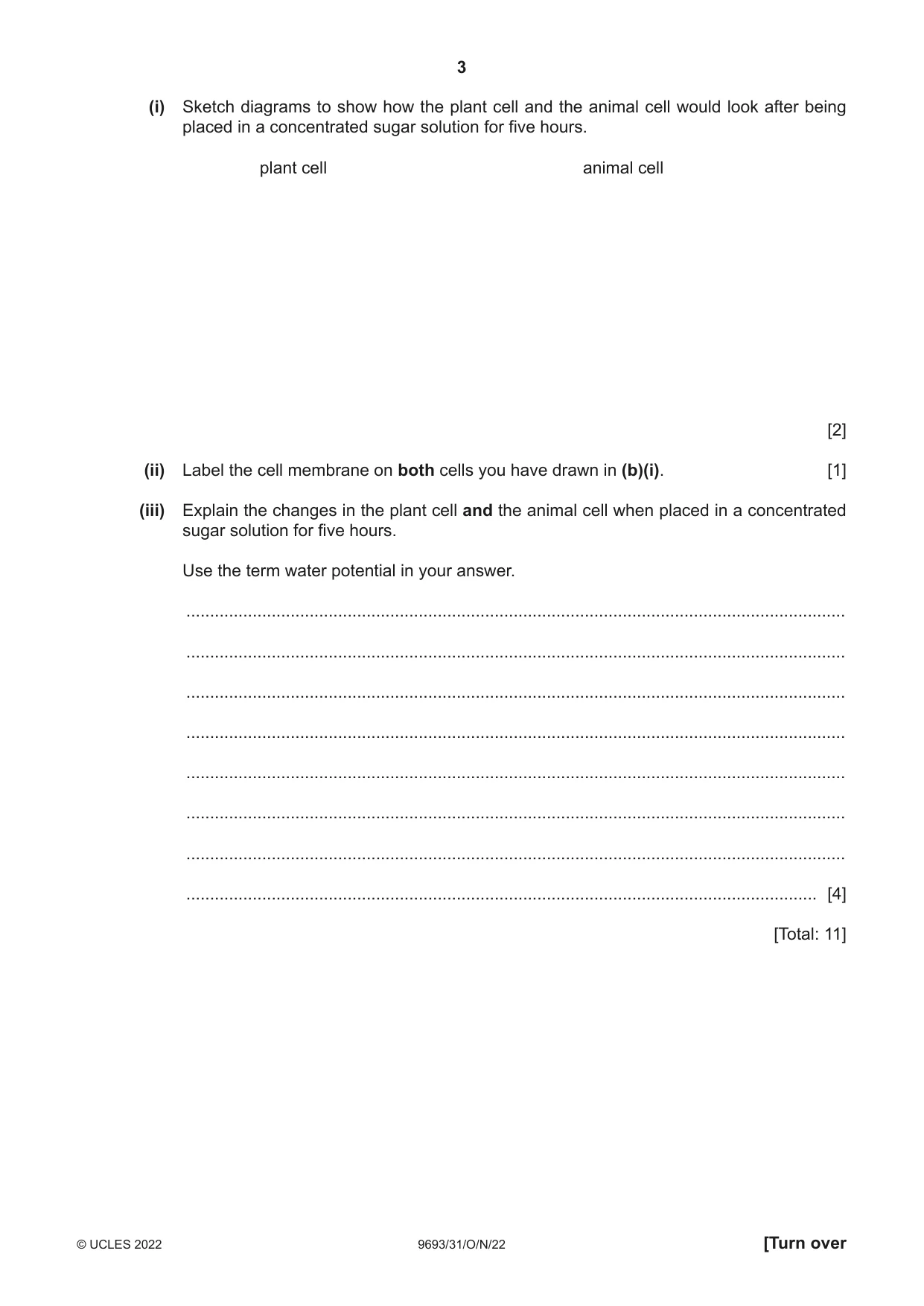
1 (a) There is continuous movement of substances through the cell membranes of cells of marine organisms. Substances move from cell to cell or are exchanged with the surrounding sea water. Table 1.1 shows three processes by which substances pass through a cell membrane. (i) Complete the table by placing a tick (✓) in the correct boxes. Table 1.1 movement from a higher is a passive used for glucose process concentration to a process uptake lower concentration diffusion facilitated diffusion active transport [3] (ii) Osmosis involves movement of particles by diffusion. Explain why osmosis is sometimes described as a ‘special case’ of diffusion. ........................................................................................................................................... ..................................................................................................................................... [1] (b) Fig. 1.1 shows a plant cell and an animal cell under normal conditions. plant cell animal cell cell wall cell membrane cytoplasm Fig. 1.1 (i) Sketch diagrams to show how the plant cell and the animal cell would look after being placed in a concentrated sugar solution for five hours. plant cell animal cell [2] (ii) Label the cell membrane on both cells you have drawn in (b)(i). [1] (iii) Explain the changes in the plant cell and the animal cell when placed in a concentrated sugar solution for five hours. Use the term water potential in your answer. ........................................................................................................................................... ........................................................................................................................................... ........................................................................................................................................... ........................................................................................................................................... ........................................................................................................................................... ........................................................................................................................................... ........................................................................................................................................... ..................................................................................................................................... [4] [Total: 11]
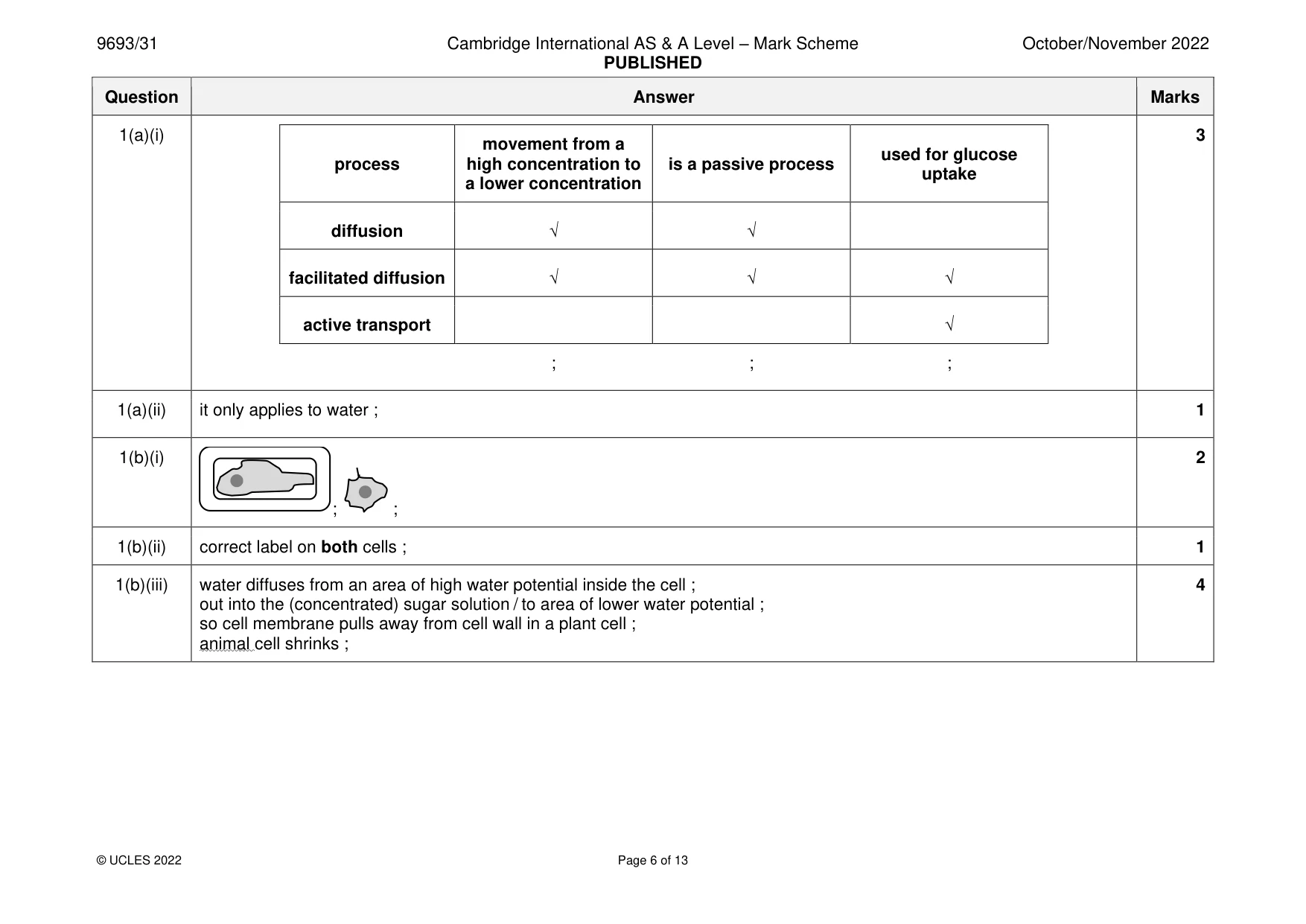
Mark scheme: Question Answer Marks 1(a)(i) 3 movement from a used for glucose process high concentration to is a passive process uptake a lower concentration diffusion √ √ facilitated diffusion √ √ √ active transport √ ; ; ; 1(a)(ii) it only applies to water ; 1 1(b)(i) 2 ; ; 1(b)(ii) correct label on both cells ; 1 1(b)(iii) water diffuses from an area of high water potential inside the cell ; 4 out into the (concentrated) sugar solution / to area of lower water potential ; so cell membrane pulls away from cell wall in a plant cell ; animal cell shrinks ;
Q2 · Part of a food web at a hydrothermal vent
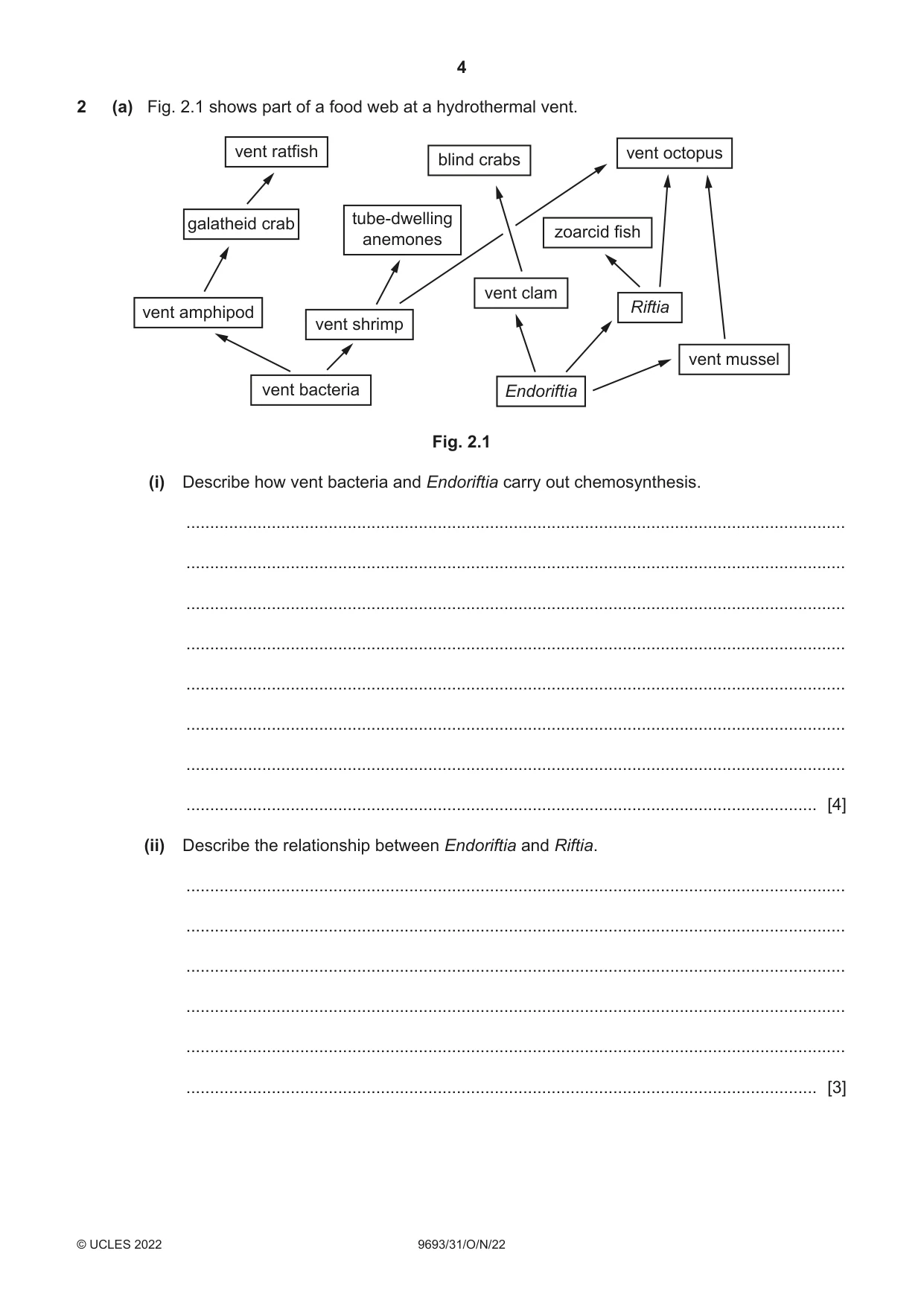
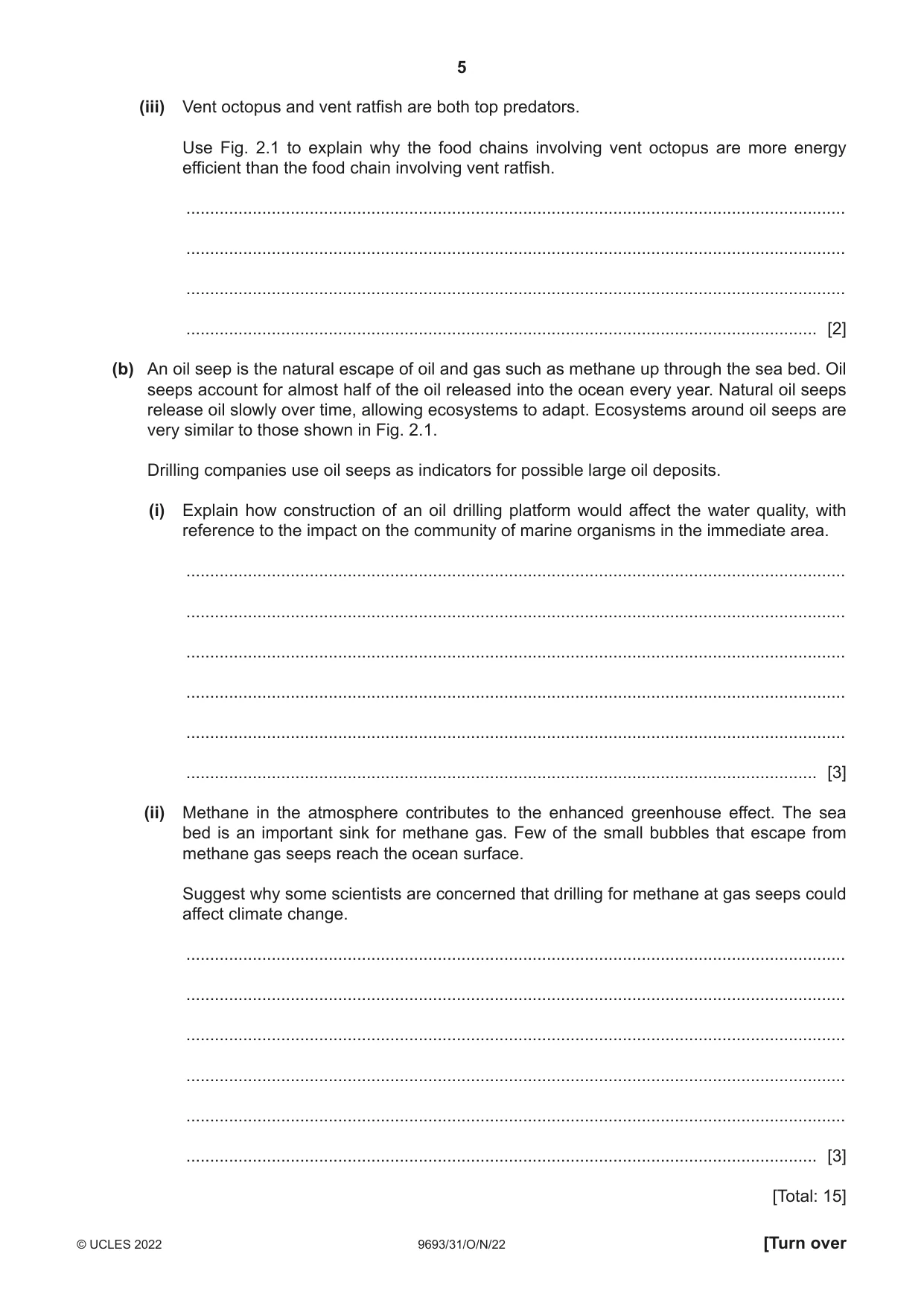
2 (a) Fig. 2.1 shows part of a food web at a hydrothermal vent. vent ratfish vent octopus blind crabs tube-dwelling galatheid crab zoarcid fish anemones vent clam Riftia vent amphipod vent shrimp vent mussel vent bacteria Endoriftia Fig. 2.1 (i) Describe how vent bacteria and Endoriftia carry out chemosynthesis. ........................................................................................................................................... ........................................................................................................................................... ........................................................................................................................................... ........................................................................................................................................... ........................................................................................................................................... ........................................................................................................................................... ........................................................................................................................................... ..................................................................................................................................... [4] (ii) Describe the relationship between Endoriftia and Riftia. ........................................................................................................................................... ........................................................................................................................................... ........................................................................................................................................... ........................................................................................................................................... ........................................................................................................................................... ..................................................................................................................................... [3] (iii) Vent octopus and vent ratfish are both top predators. Use Fig. 2.1 to explain why the food chains involving vent octopus are more energy efficient than the food chain involving vent ratfish. ........................................................................................................................................... ........................................................................................................................................... ........................................................................................................................................... ..................................................................................................................................... [2] (b) An oil seep is the natural escape of oil and gas such as methane up through the sea bed. Oil seeps account for almost half of the oil released into the ocean every year. Natural oil seeps release oil slowly over time, allowing ecosystems to adapt. Ecosystems around oil seeps are very similar to those shown in Fig. 2.1. Drilling companies use oil seeps as indicators for possible large oil deposits. (i) Explain how construction of an oil drilling platform would affect the water quality, with reference to the impact on the community of marine organisms in the immediate area. ........................................................................................................................................... ........................................................................................................................................... ........................................................................................................................................... ........................................................................................................................................... ........................................................................................................................................... ..................................................................................................................................... [3] (ii) Methane in the atmosphere contributes to the enhanced greenhouse effect. The sea bed is an important sink for methane gas. Few of the small bubbles that escape from methane gas seeps reach the ocean surface. Suggest why some scientists are concerned that drilling for methane at gas seeps could affect climate change. ........................................................................................................................................... ........................................................................................................................................... ........................................................................................................................................... ........................................................................................................................................... ........................................................................................................................................... ..................................................................................................................................... [3] [Total: 15]
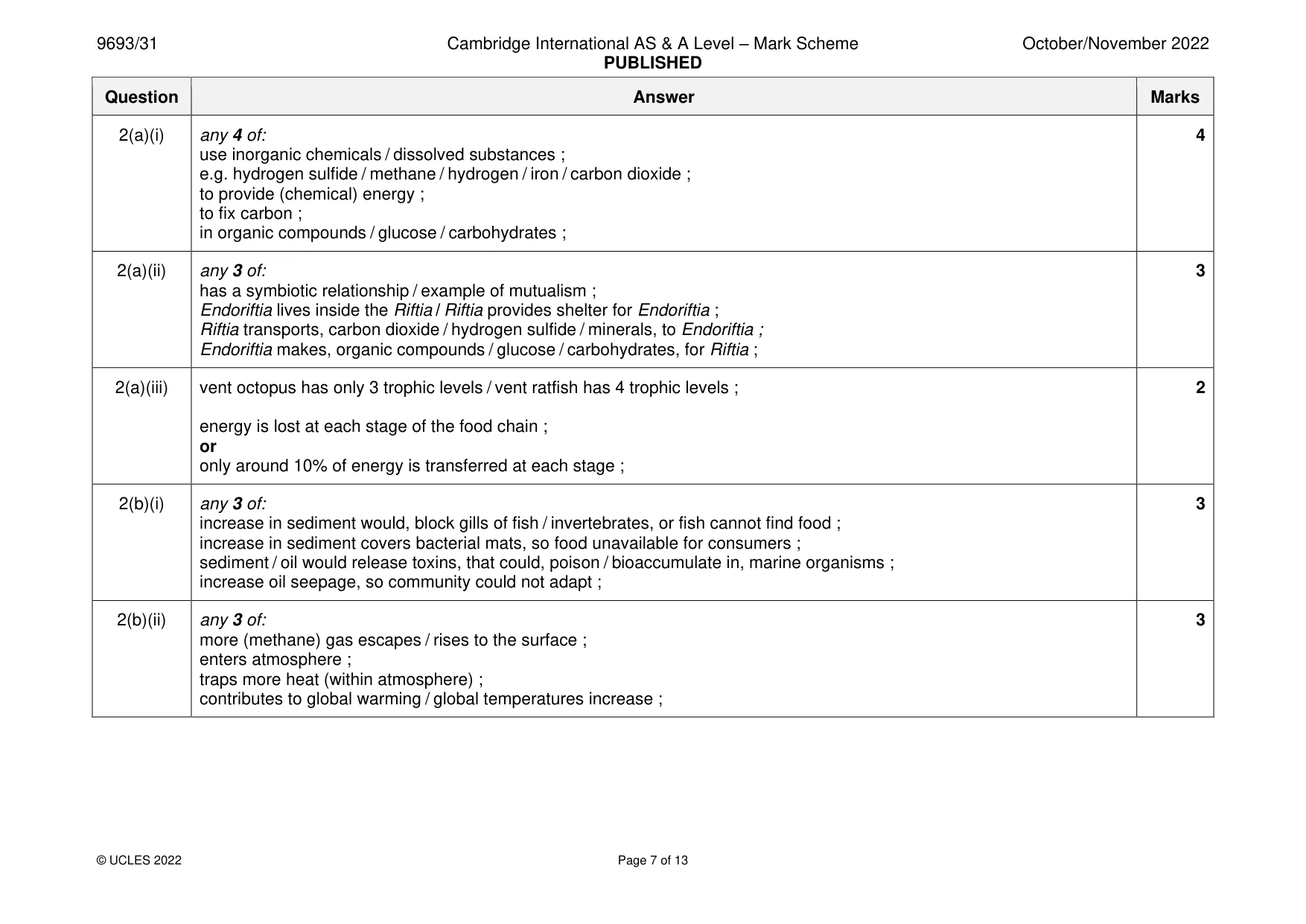
Mark scheme: 2(a)(i) any 4 of: 4 use inorganic chemicals / dissolved substances ; e.g. hydrogen sulfide / methane / hydrogen / iron / carbon dioxide ; to provide (chemical) energy ; to fix carbon ; in organic compounds / glucose / carbohydrates ; 2(a)(ii) any 3 of: 3 has a symbiotic relationship / example of mutualism ; Endoriftia lives inside the Riftia / Riftia provides shelter for Endoriftia ; Riftia transports, carbon dioxide / hydrogen sulfide / minerals, to Endoriftia ; Endoriftia makes, organic compounds / glucose / carbohydrates, for Riftia ; 2(a)(iii) vent octopus has only 3 trophic levels / vent ratfish has 4 trophic levels ; 2 energy is lost at each stage of the food chain ; or only around 10% of energy is transferred at each stage ; 2(b)(i) any 3 of: 3 increase in sediment would, block gills of fish / invertebrates, or fish cannot find food ; increase in sediment covers bacterial mats, so food unavailable for consumers ; sediment / oil would release toxins, that could, poison / bioaccumulate in, marine organisms ; increase oil seepage, so community could not adapt ; 2(b)(ii) any 3 of: 3 more (methane) gas escapes / rises to the surface ; enters atmosphere ; traps more heat (within atmosphere) ; contributes to global warming / global temperatures increase ;
Q3 · Marine mussels can tolerate a wide range of salinities
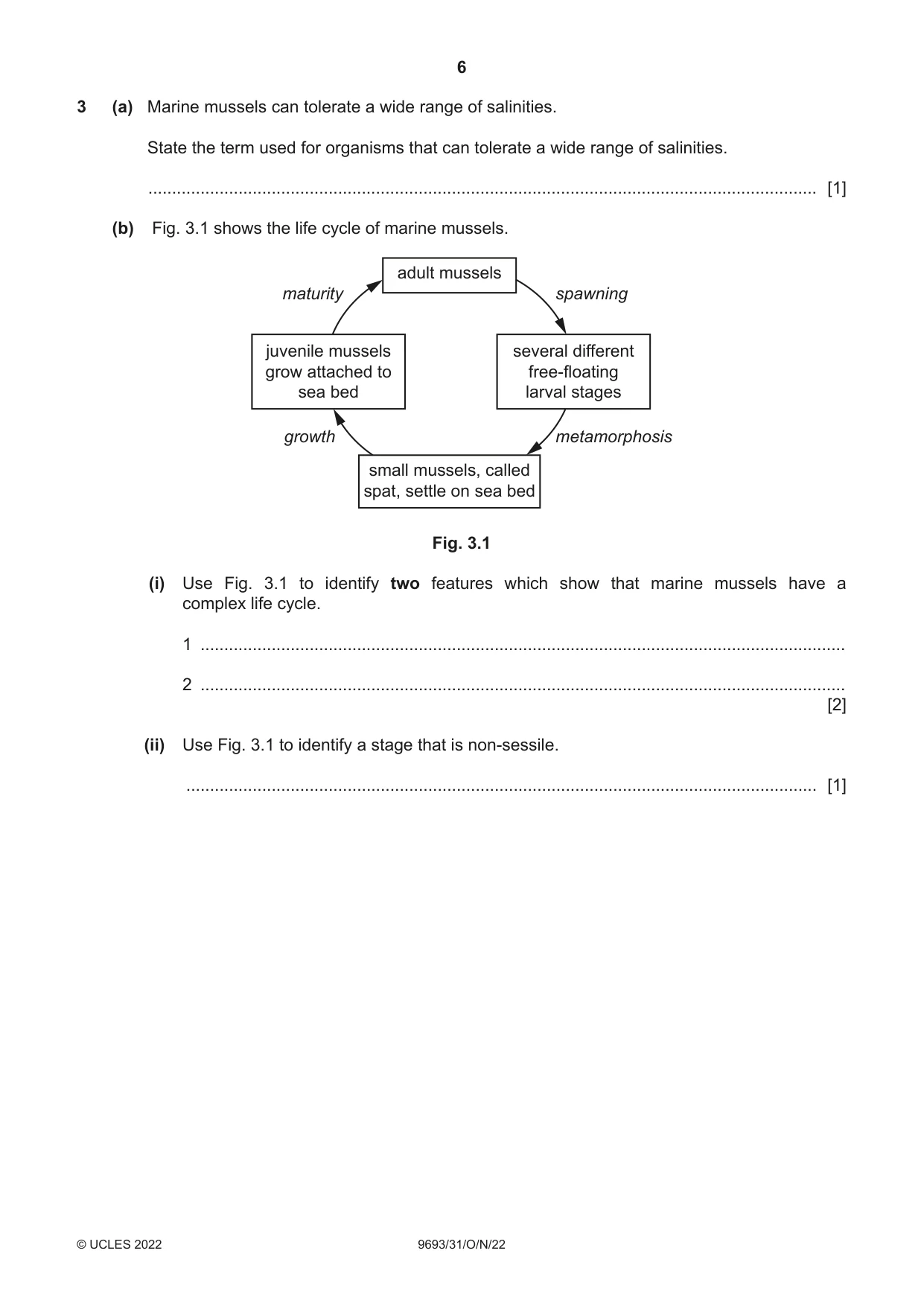
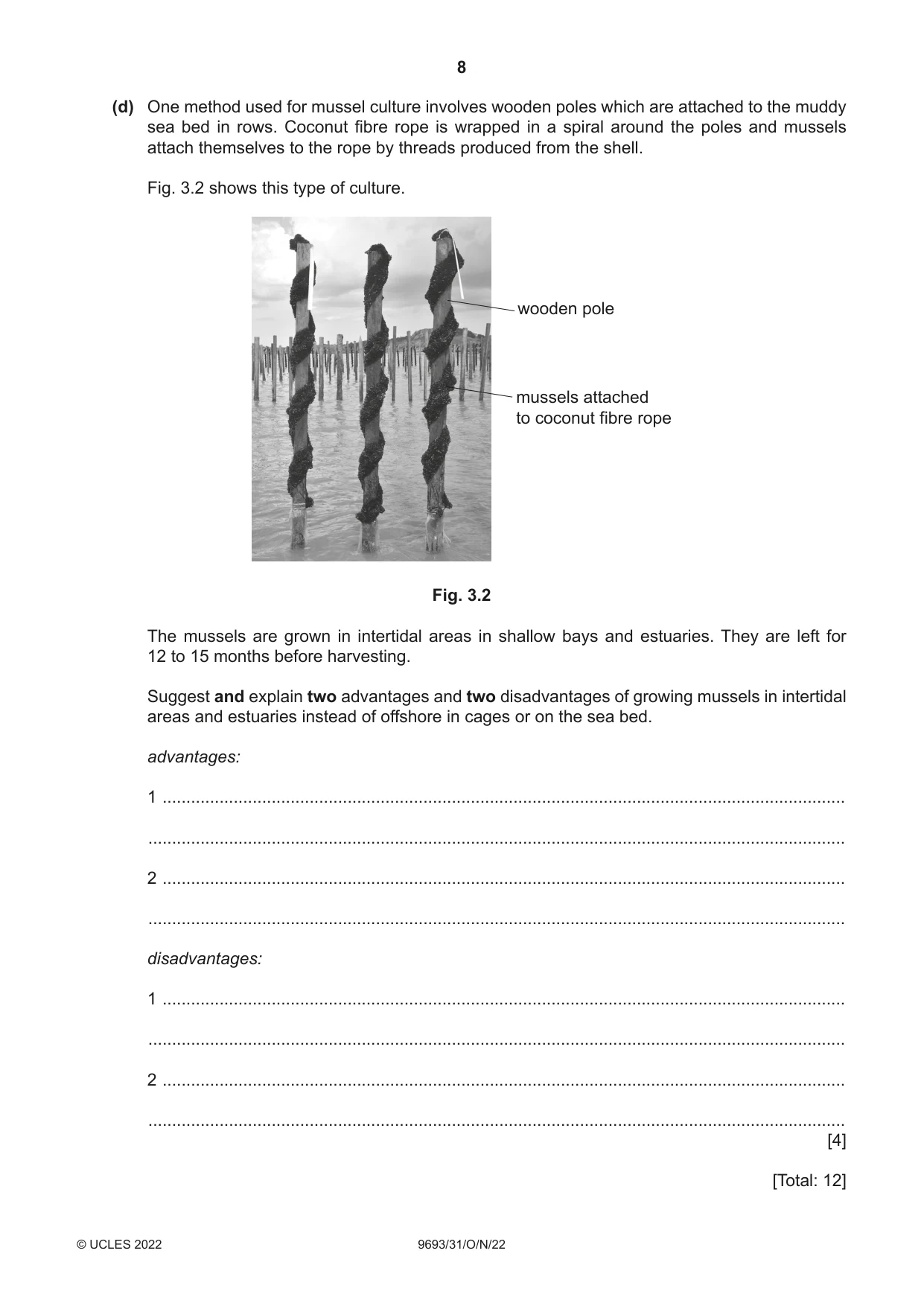
3 (a) Marine mussels can tolerate a wide range of salinities. State the term used for organisms that can tolerate a wide range of salinities. ............................................................................................................................................. [1] (b) Fig. 3.1 shows the life cycle of marine mussels. adult mussels maturity spawning juvenile mussels several different grow attached to free-floating sea bed larval stages growth metamorphosis small mussels, called spat, settle on sea bed Fig. 3.1 (i) Use Fig. 3.1 to identify two features which show that marine mussels have a complex life cycle. 1 ........................................................................................................................................ 2 ........................................................................................................................................ [2] (ii) Use Fig. 3.1 to identify a stage that is non-sessile. ..................................................................................................................................... [1] (c) Mussel aquaculture takes place in temperate waters, mainly in Europe and North America. Growers either collect spat from natural mussel beds on the sea bed or use hatchery-produced spat. Natural mussel beds are important feeding areas for ducks and other wild birds. Suggest two advantages and two disadvantages of producing spat in a hatchery instead of collecting spat from the sea bed. advantages: 1 ................................................................................................................................................. ................................................................................................................................................... 2 ................................................................................................................................................ ................................................................................................................................................... disadvantages: 1 ................................................................................................................................................ ................................................................................................................................................... 2 ................................................................................................................................................ ................................................................................................................................................... [4] (d) One method used for mussel culture involves wooden poles which are attached to the muddy sea bed in rows. Coconut fibre rope is wrapped in a spiral around the poles and mussels attach themselves to the rope by threads produced from the shell. Fig. 3.2 shows this type of culture. wooden pole mussels attached to coconut fibre rope Fig. 3.2 The mussels are grown in intertidal areas in shallow bays and estuaries. They are left for 12 to 15 months before harvesting. Suggest and explain two advantages and two disadvantages of growing mussels in intertidal areas and estuaries instead of offshore in cages or on the sea bed. advantages: 1 ................................................................................................................................................ ................................................................................................................................................... 2 ................................................................................................................................................ ................................................................................................................................................... disadvantages: 1 ................................................................................................................................................ ................................................................................................................................................... 2 ................................................................................................................................................ ................................................................................................................................................... [4] [Total: 12]
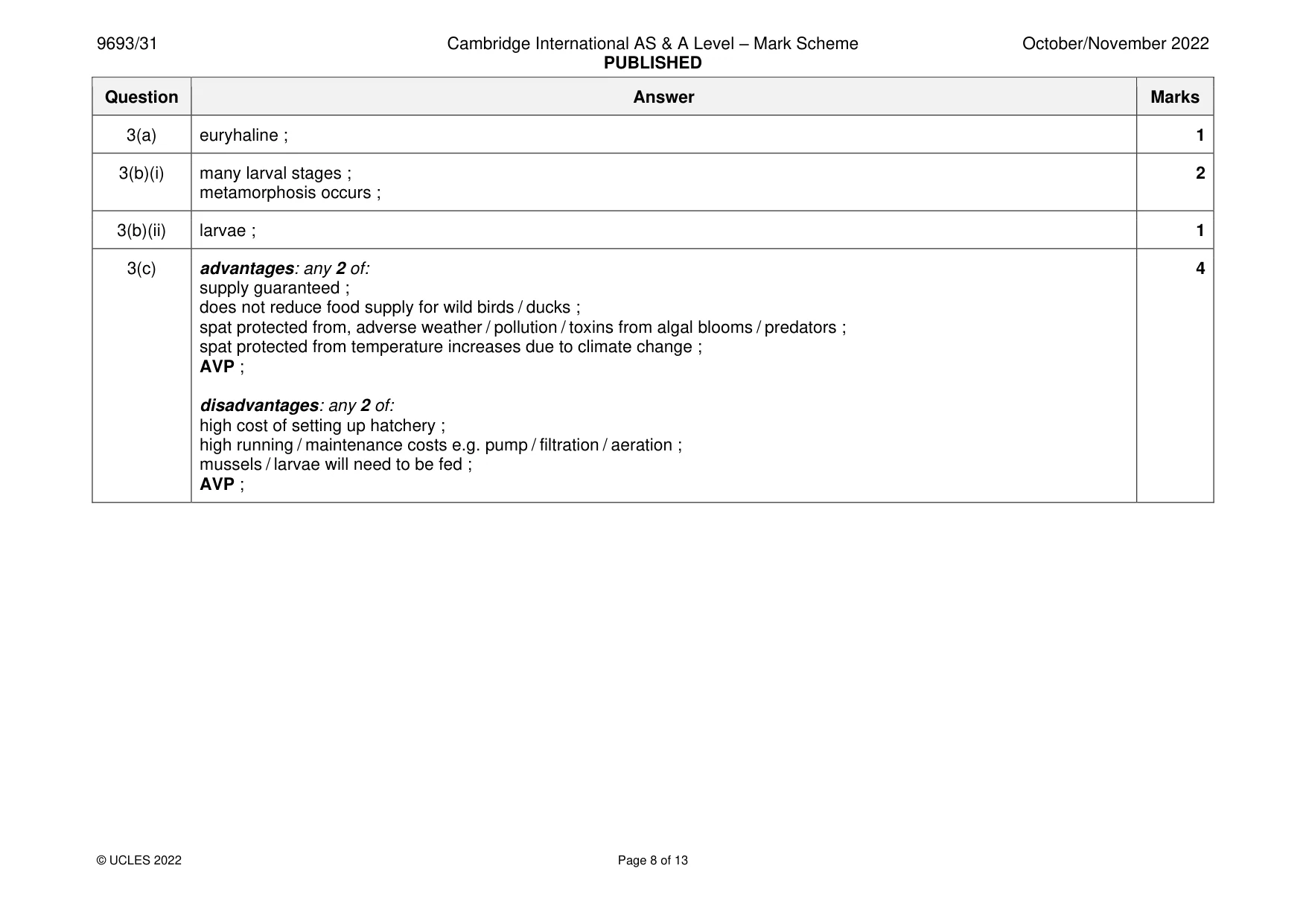
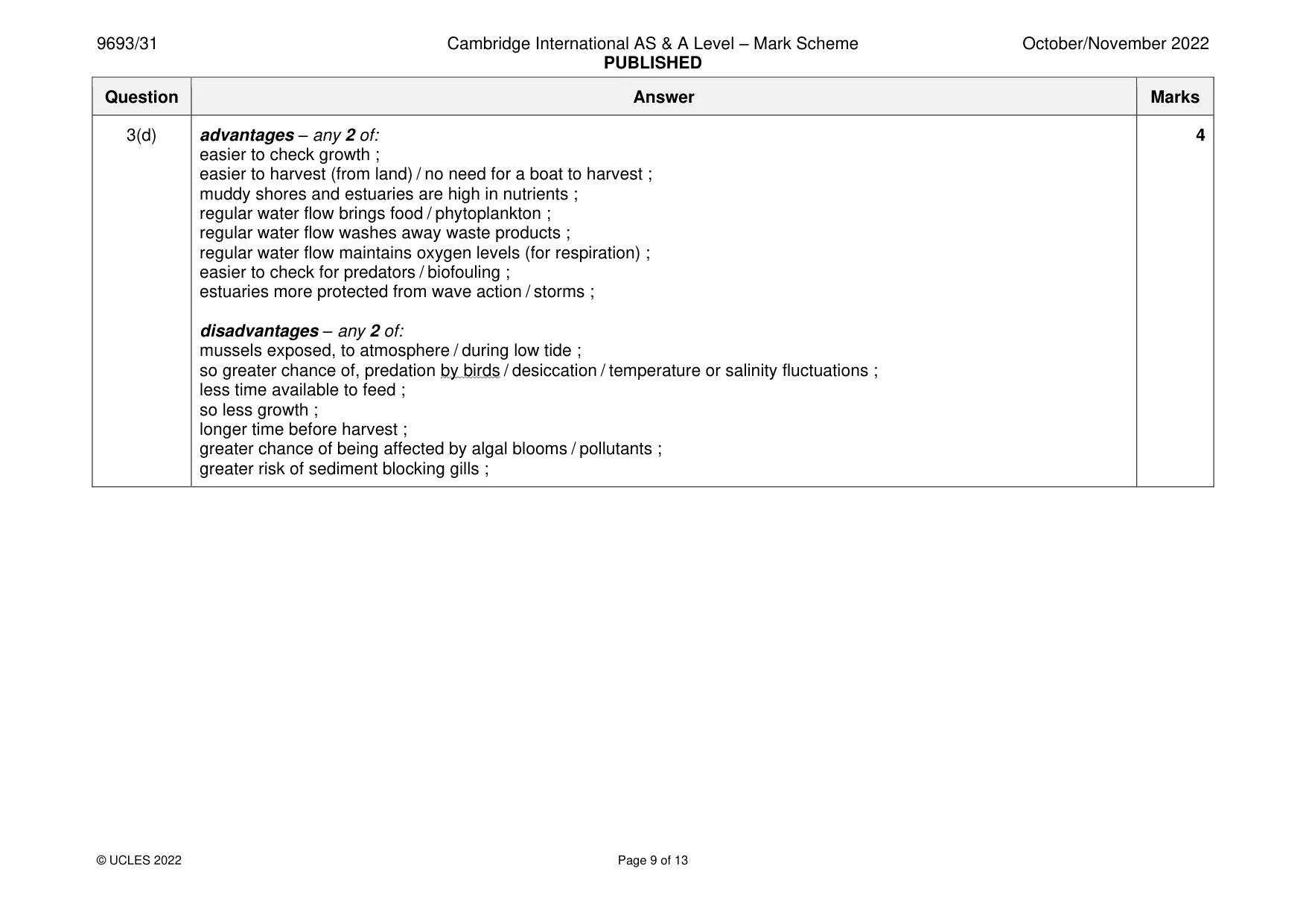
Mark scheme: 3(a) euryhaline ; 1 3(b)(i) many larval stages ; 2 metamorphosis occurs ; 3(b)(ii) larvae ; 1 3(c) advantages: any 2 of: 4 supply guaranteed ; does not reduce food supply for wild birds / ducks ; spat protected from, adverse weather / pollution / toxins from algal blooms / predators ; spat protected from temperature increases due to climate change ; AVP ; disadvantages: any 2 of: high cost of setting up hatchery ; high running / maintenance costs e.g. pump / filtration / aeration ; mussels / larvae will need to be fed ; AVP ; 3(d) advantages – any 2 of: 4 easier to check growth ; easier to harvest (from land) / no need for a boat to harvest ; muddy shores and estuaries are high in nutrients ; regular water flow brings food / phytoplankton ; regular water flow washes away waste products ; regular water flow maintains oxygen levels (for respiration) ; easier to check for predators / biofouling ; estuaries more protected from wave action / storms ; disadvantages – any 2 of: mussels exposed, to atmosphere / during low tide ; so greater chance of, predation by birds / desiccation / temperature or salinity fluctuations ; less time available to feed ; so less growth ; longer time before harvest ; greater chance of being affected by algal blooms / pollutants ; greater risk of sediment blocking gills ;
Q4 · An atom of oxygen
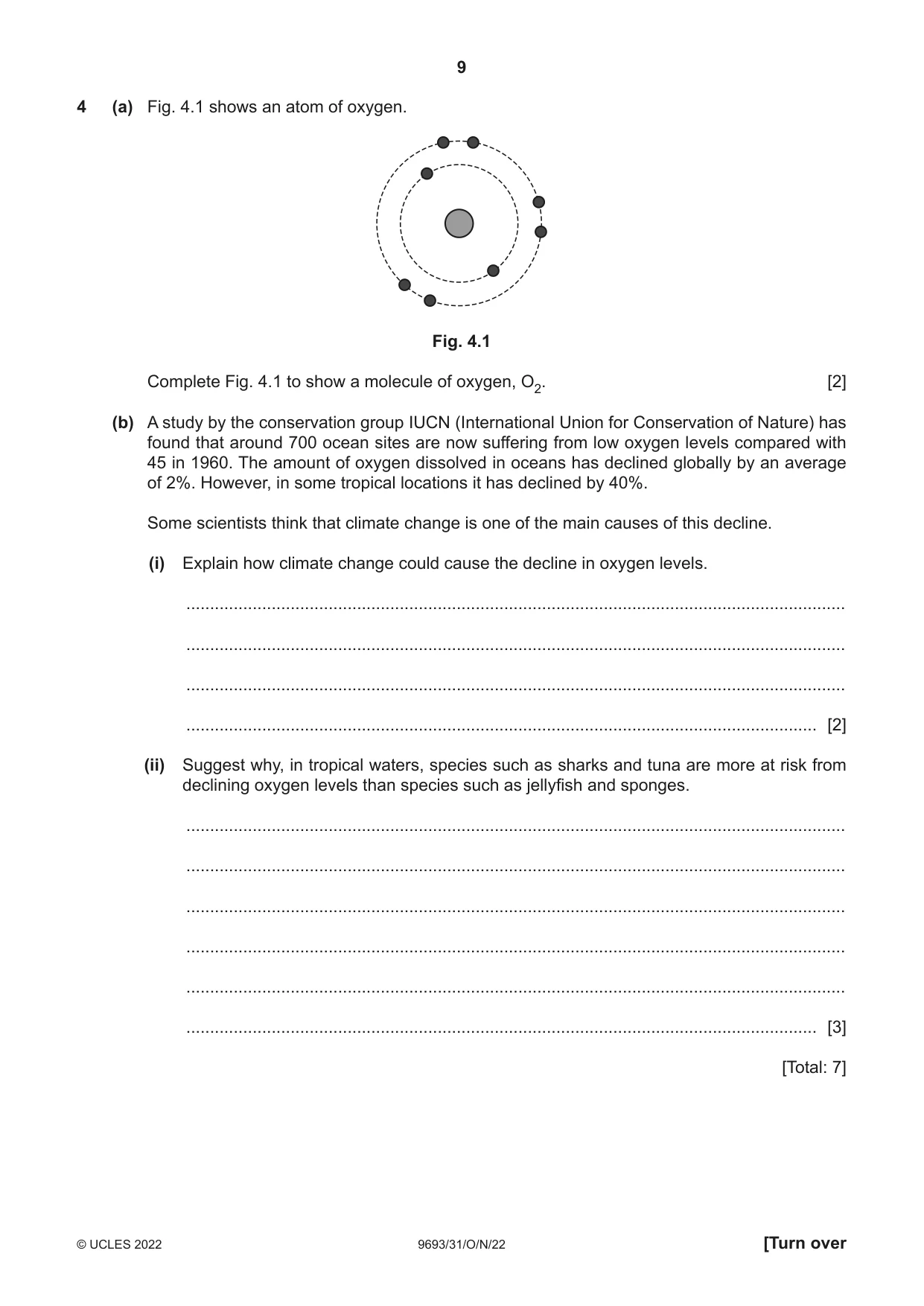
4 (a) Fig. 4.1 shows an atom of oxygen. Fig. 4.1 Complete Fig. 4.1 to show a molecule of oxygen, O2. [2] (b) A study by the conservation group IUCN (International Union for Conservation of Nature) has found that around 700 ocean sites are now suffering from low oxygen levels compared with 45 in 1960. The amount of oxygen dissolved in oceans has declined globally by an average of 2%. However, in some tropical locations it has declined by 40%. Some scientists think that climate change is one of the main causes of this decline. (i) Explain how climate change could cause the decline in oxygen levels. ........................................................................................................................................... ........................................................................................................................................... ........................................................................................................................................... ..................................................................................................................................... [2] (ii) Suggest why, in tropical waters, species such as sharks and tuna are more at risk from declining oxygen levels than species such as jellyfish and sponges. ........................................................................................................................................... ........................................................................................................................................... ........................................................................................................................................... ........................................................................................................................................... ........................................................................................................................................... ..................................................................................................................................... [3] [Total: 7]
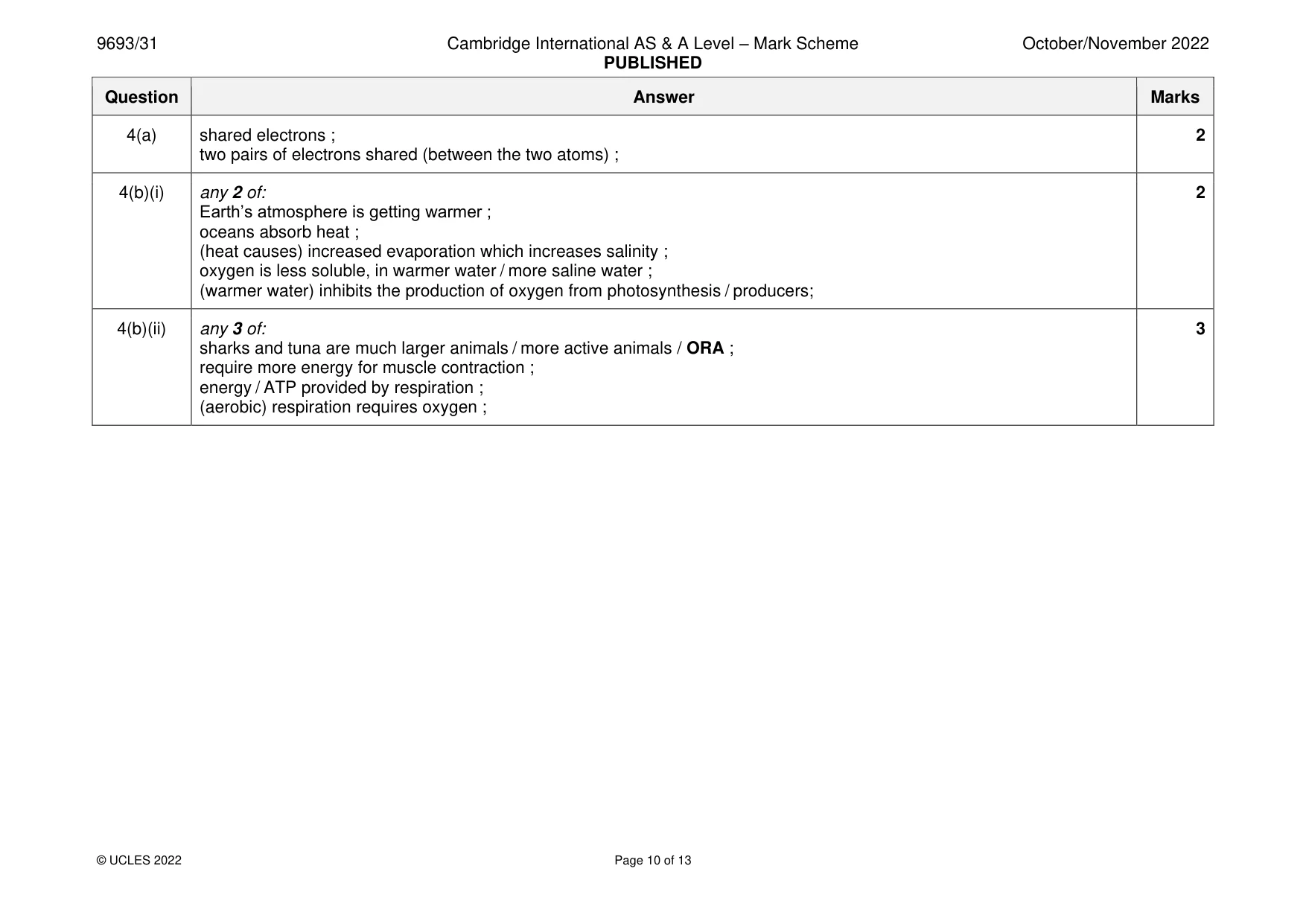
Mark scheme: 4(a) shared electrons ; 2 two pairs of electrons shared (between the two atoms) ; 4(b)(i) any 2 of: 2 Earth’s atmosphere is getting warmer ; oceans absorb heat ; (heat causes) increased evaporation which increases salinity ; oxygen is less soluble, in warmer water / more saline water ; (warmer water) inhibits the production of oxygen from photosynthesis / producers; 4(b)(ii) any 3 of: 3 sharks and tuna are much larger animals / more active animals / ORA ; require more energy for muscle contraction ; energy / ATP provided by respiration ; (aerobic) respiration requires oxygen ;
Q5 · Discuss the advantages and disadvantages of building artificial reefs to rehabilitate…
5 Discuss the advantages and disadvantages of building artificial reefs to rehabilitate depleted fish stocks. .......................................................................................................................................................... .......................................................................................................................................................... .......................................................................................................................................................... .......................................................................................................................................................... .......................................................................................................................................................... .......................................................................................................................................................... .......................................................................................................................................................... .......................................................................................................................................................... .......................................................................................................................................................... .......................................................................................................................................................... .......................................................................................................................................................... .......................................................................................................................................................... .......................................................................................................................................................... .......................................................................................................................................................... .......................................................................................................................................................... .......................................................................................................................................................... .......................................................................................................................................................... .......................................................................................................................................................... .......................................................................................................................................................... .................................................................................................................................................. [10]
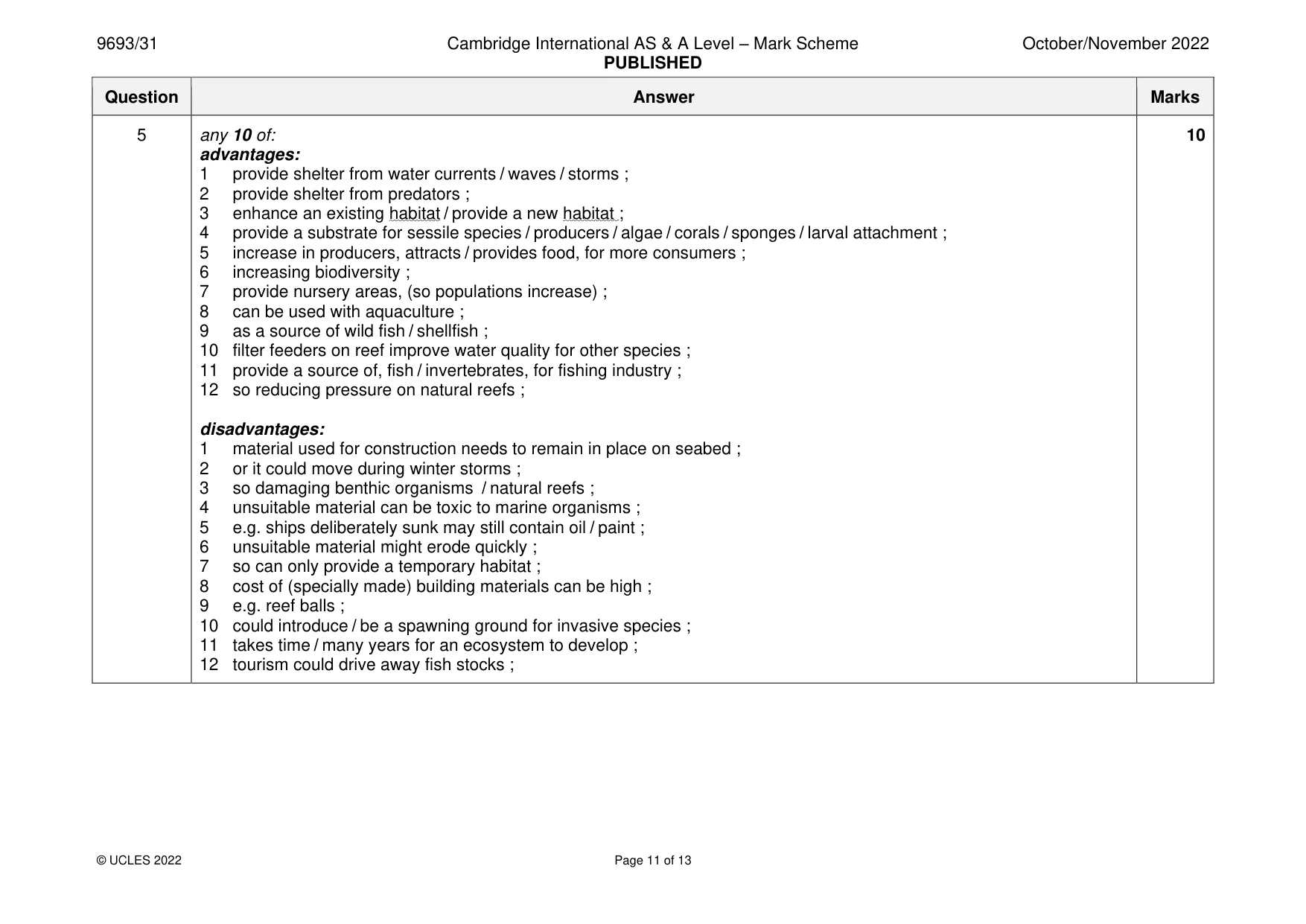
Mark scheme: 5 any 10 of: 10 advantages: 1 provide shelter from water currents / waves / storms ; 2 provide shelter from predators ; 3 enhance an existing habitat / provide a new habitat ; 4 provide a substrate for sessile species / producers / algae / corals / sponges / larval attachment ; 5 increase in producers, attracts / provides food, for more consumers ; 6 increasing biodiversity ; 7 provide nursery areas, (so populations increase) ; 8 can be used with aquaculture ; 9 as a source of wild fish / shellfish ; 10 filter feeders on reef improve water quality for other species ; 11 provide a source of, fish / invertebrates, for fishing industry ; 12 so reducing pressure on natural reefs ; disadvantages: 1 material used for construction needs to remain in place on seabed ; 2 or it could move during winter storms ; 3 so damaging benthic organisms / natural reefs ; 4 unsuitable material can be toxic to marine organisms ; 5 e.g. ships deliberately sunk may still contain oil / paint ; 6 unsuitable material might erode quickly ; 7 so can only provide a temporary habitat ; 8 cost of (specially made) building materials can be high ; 9 e.g. reef balls ; 10 could introduce / be a spawning ground for invasive species ; 11 takes time / many years for an ecosystem to develop ; 12 tourism could drive away fish stocks ;
Q6 · Describe ventilation in grouper during inflow of water
6 (a) Describe ventilation in grouper during inflow of water. ................................................................................................................................................... ................................................................................................................................................... ................................................................................................................................................... ................................................................................................................................................... ................................................................................................................................................... ................................................................................................................................................... ................................................................................................................................................... ................................................................................................................................................... ................................................................................................................................................... ............................................................................................................................................. [5] (b) Explain why sharks and grouper are classified in the same phylum but in different classes. ................................................................................................................................................... ................................................................................................................................................... ................................................................................................................................................... ................................................................................................................................................... ................................................................................................................................................... ................................................................................................................................................... ................................................................................................................................................... ................................................................................................................................................... ................................................................................................................................................... ................................................................................................................................................... ................................................................................................................................................... ............................................................................................................................................. [6] [Total: 11]
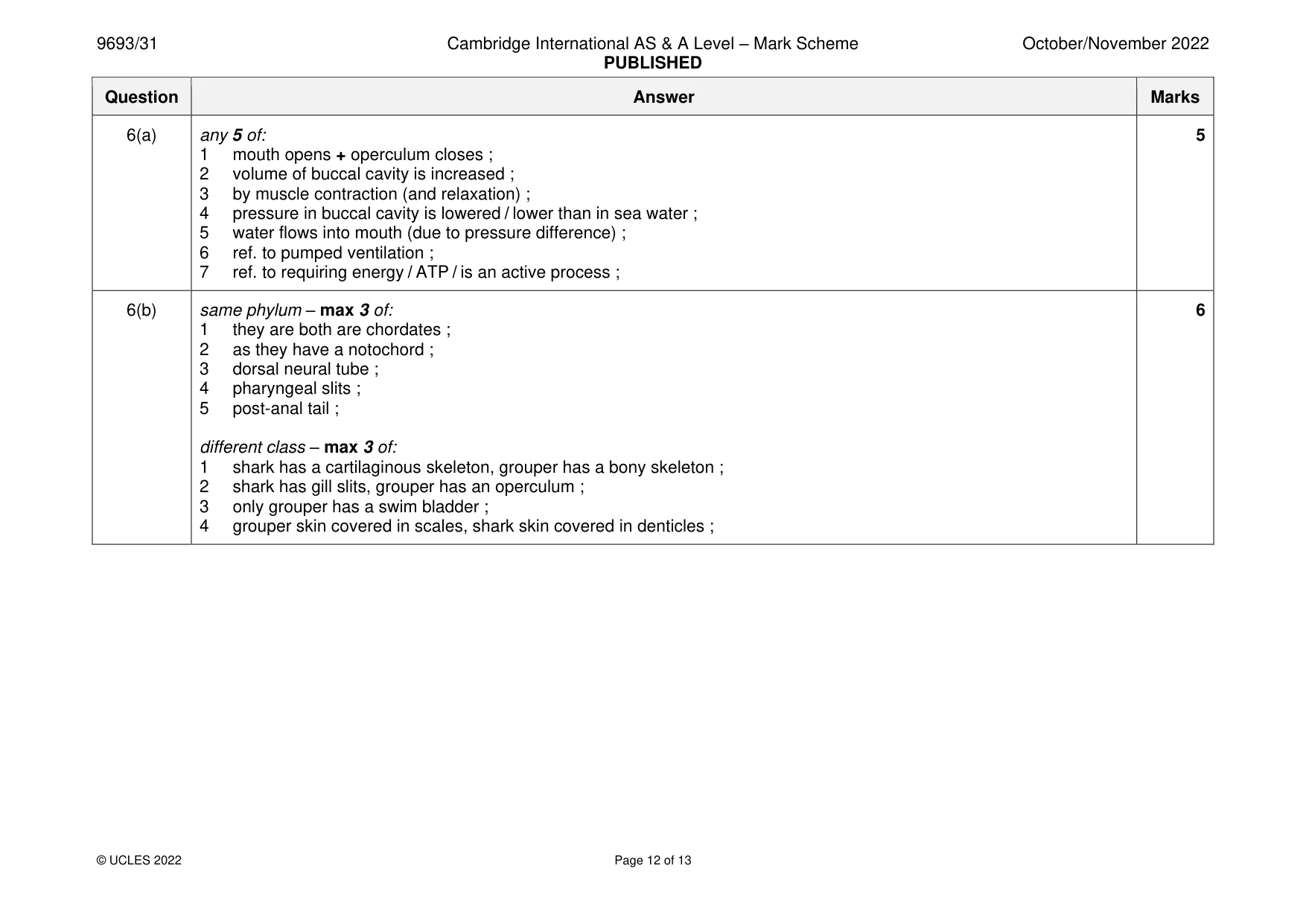
Mark scheme: 6(a) any 5 of: 5 1 mouth opens + operculum closes ; 2 volume of buccal cavity is increased ; 3 by muscle contraction (and relaxation) ; 4 pressure in buccal cavity is lowered / lower than in sea water ; 5 water flows into mouth (due to pressure difference) ; 6 ref. to pumped ventilation ; 7 ref. to requiring energy / ATP / is an active process ; 6(b) same phylum – max 3 of: 6 1 they are both are chordates ; 2 as they have a notochord ; 3 dorsal neural tube ; 4 pharyngeal slits ; 5 post-anal tail ; different class – max 3 of: 1 shark has a cartilaginous skeleton, grouper has a bony skeleton ; 2 shark has gill slits, grouper has an operculum ; 3 only grouper has a swim bladder ; 4 grouper skin covered in scales, shark skin covered in denticles ;
Q7 · Explain why marine invasive species are successful and outline the negative impacts they…
7 Explain why marine invasive species are successful and outline the negative impacts they have on marine ecosystems and the local community. .......................................................................................................................................................... .......................................................................................................................................................... .......................................................................................................................................................... .......................................................................................................................................................... .......................................................................................................................................................... .......................................................................................................................................................... .......................................................................................................................................................... .......................................................................................................................................................... .......................................................................................................................................................... .......................................................................................................................................................... .......................................................................................................................................................... .......................................................................................................................................................... .......................................................................................................................................................... .......................................................................................................................................................... .......................................................................................................................................................... .......................................................................................................................................................... .......................................................................................................................................................... .................................................................................................................................................... [9] The boundaries and names shown, the designations used and the presentation of material on any maps contained in this question paper/insert do not imply official endorsement or acceptance by Cambridge Assessment International Education concerning the legal status of any country, territory, or area or any of its authorities, or of the delimitation of its frontiers or boundaries.
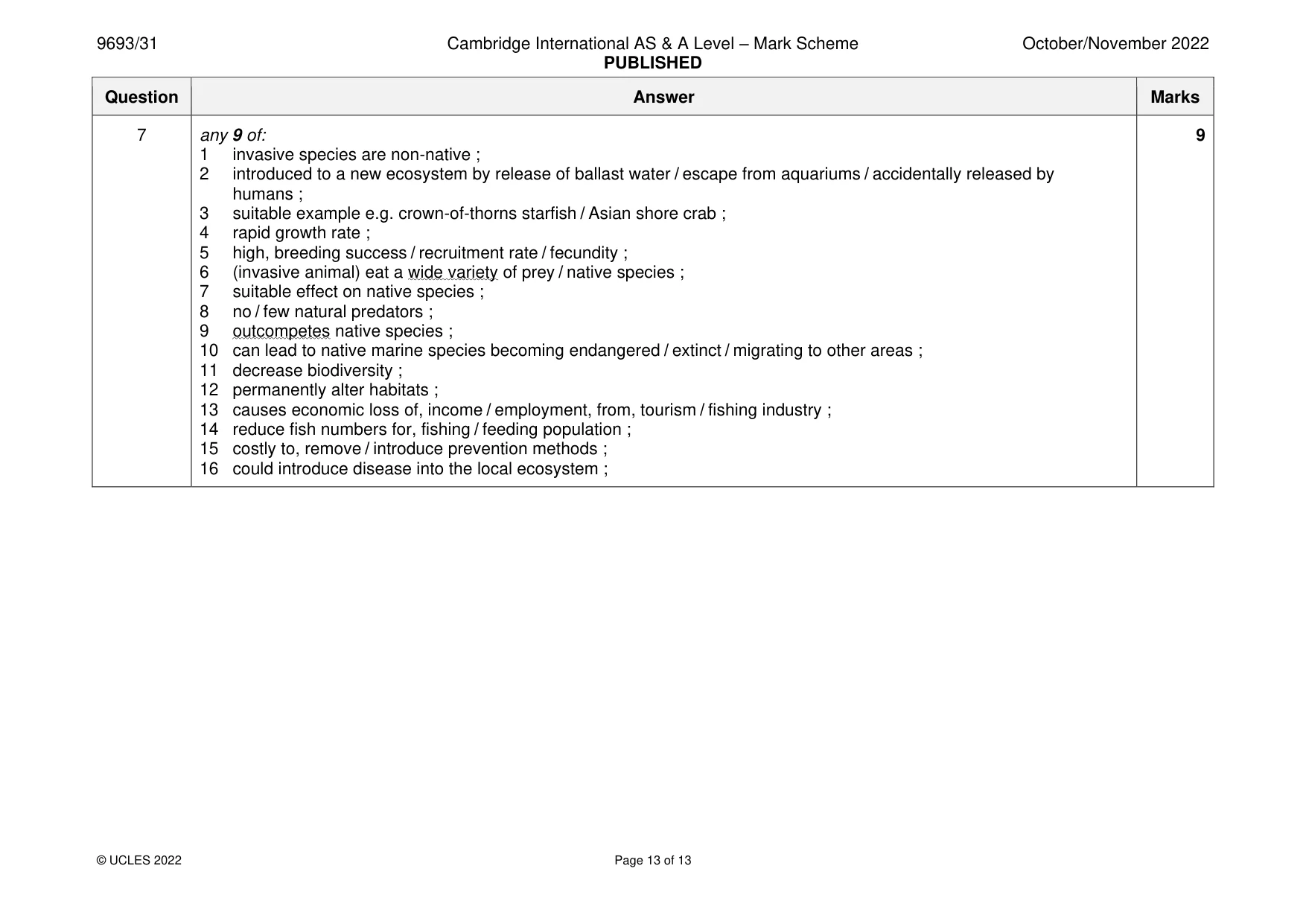
Mark scheme: 7 any 9 of: 9 1 invasive species are non-native ; 2 introduced to a new ecosystem by release of ballast water / escape from aquariums / accidentally released by humans ; 3 suitable example e.g. crown-of-thorns starfish / Asian shore crab ; 4 rapid growth rate ; 5 high, breeding success / recruitment rate / fecundity ; 6 (invasive animal) eat a wide variety of prey / native species ; 7 suitable effect on native species ; 8 no / few natural predators ; 9 outcompetes native species ; 10 can lead to native marine species becoming endangered / extinct / migrating to other areas ; 11 decrease biodiversity ; 12 permanently alter habitats ; 13 causes economic loss of, income / employment, from, tourism / fishing industry ; 14 reduce fish numbers for, fishing / feeding population ; 15 costly to, remove / introduce prevention methods ; 16 could introduce disease into the local ecosystem ;
What was in this paper
The subtopics covered by these 7 questions, and how many questions each got. Open one in a new tab to see every Cambridge question on it.
What you needed in this session
Cambridge’s own grade thresholds for 2022 Oct/Nov, Paper 3 · Variant 1. A higher threshold means an easier paper — the bar moves with how the cohort did.