Cambridge A Level Marine Science 9693 — 2017 Oct/Nov Paper 3 · Variant 1
9693/31/O/N/17 · 7 questions · 75 marks · ≈84 min
The question paper and its mark scheme, free to read here and free to download. This is Cambridge’s own paper, exactly as it was sat.
Question paper16 pages


Mark scheme12 pages
Answers below. Sit the paper first if you are practising.
Questions as text
Q1 · Algae are primary producers and form the base of many food chains in the sea
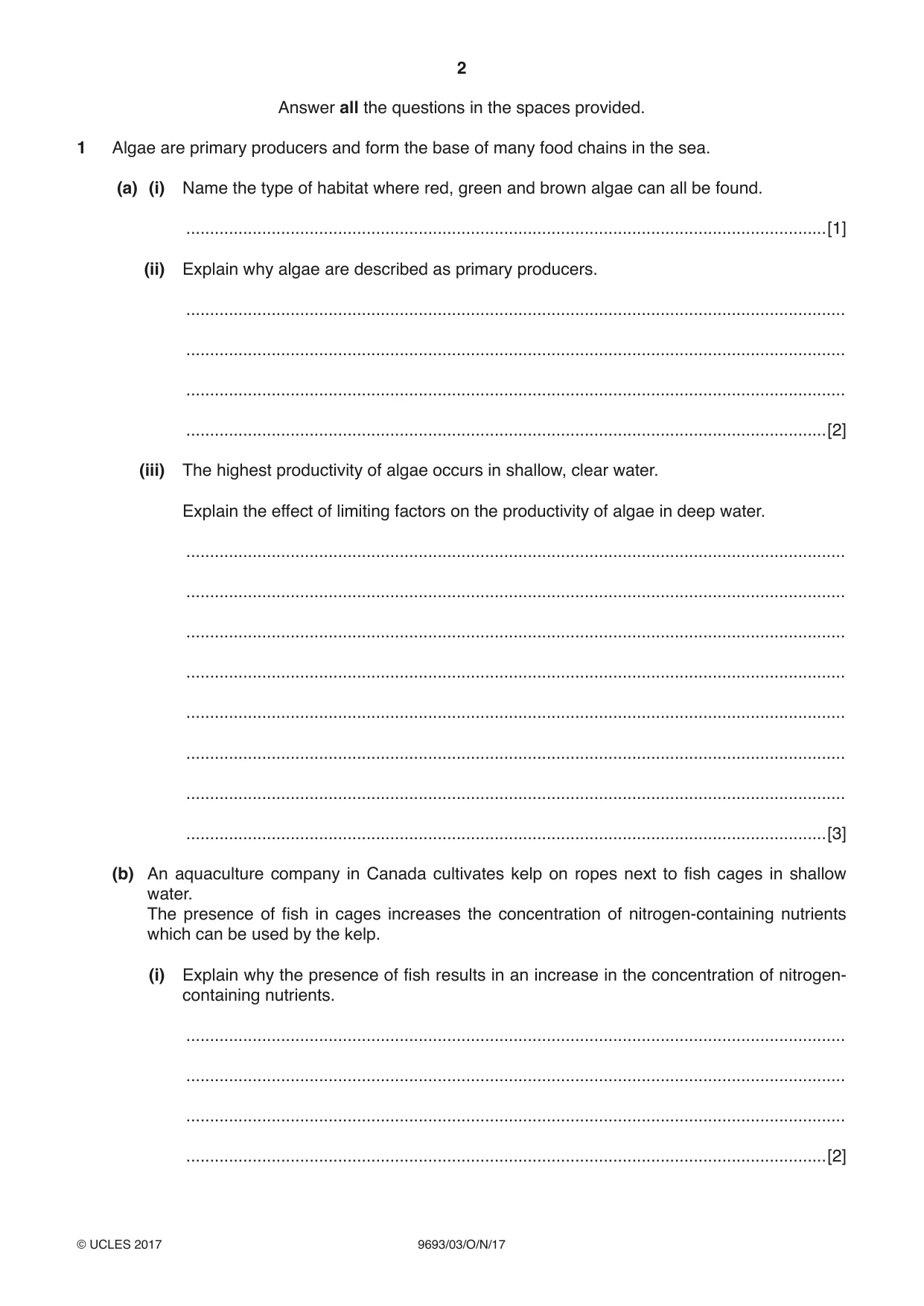
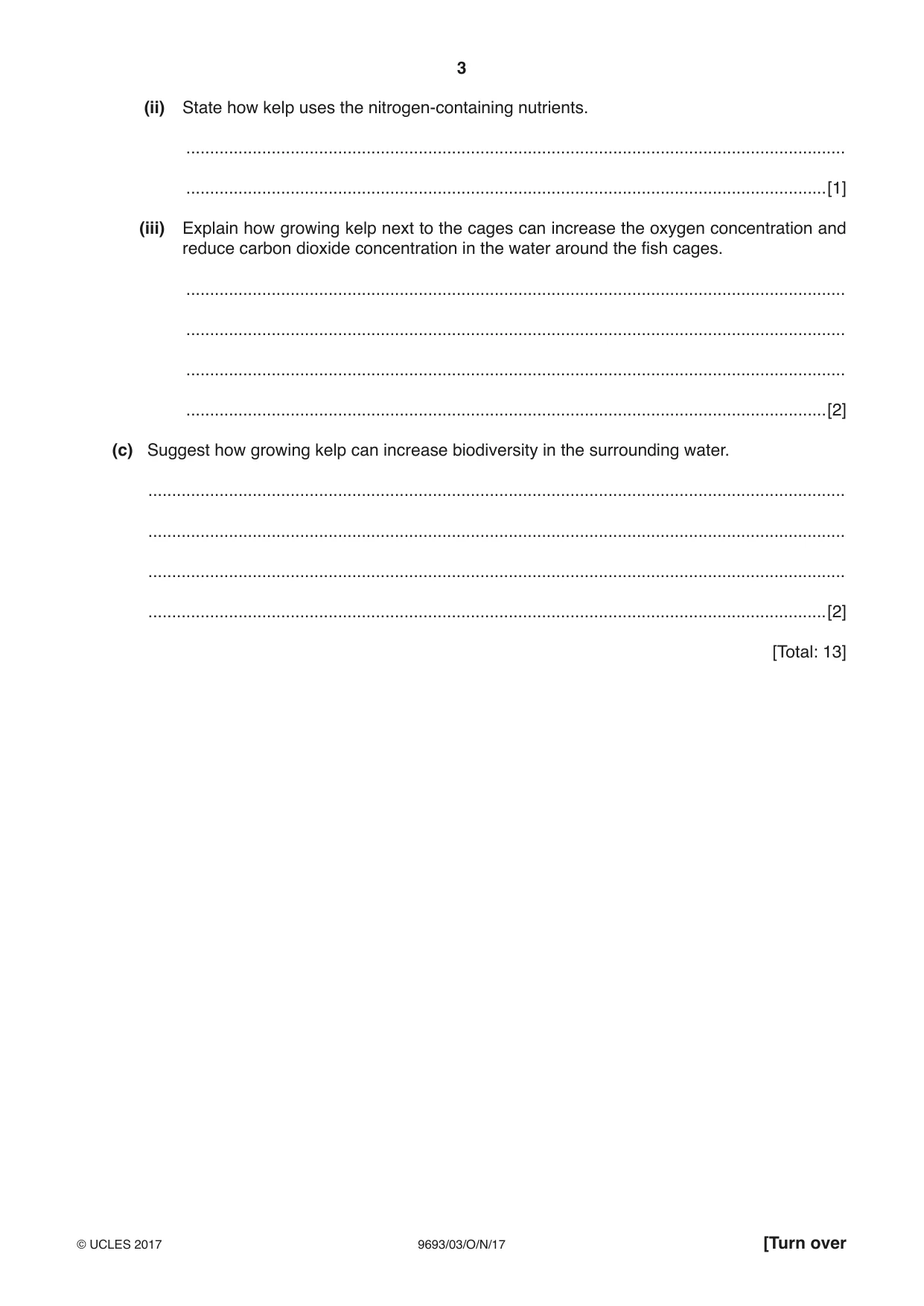
1 Algae are primary producers and form the base of many food chains in the sea. (a) (i) Name the type of habitat where red, green and brown algae can all be found. .......................................................................................................................................[1] (ii) Explain why algae are described as primary producers. ........................................................................................................................................... ........................................................................................................................................... ........................................................................................................................................... .......................................................................................................................................[2] (iii) The highest productivity of algae occurs in shallow, clear water. Explain the effect of limiting factors on the productivity of algae in deep water. ........................................................................................................................................... ........................................................................................................................................... ........................................................................................................................................... ........................................................................................................................................... ........................................................................................................................................... ........................................................................................................................................... ........................................................................................................................................... .......................................................................................................................................[3] (b) An aquaculture company in Canada cultivates kelp on ropes next to fish cages in shallow water. The presence of fish in cages increases the concentration of nitrogen-containing nutrients which can be used by the kelp. (i) Explain why the presence of fish results in an increase in the concentration of nitrogen- containing nutrients. ........................................................................................................................................... ........................................................................................................................................... ........................................................................................................................................... .......................................................................................................................................[2] (ii) State how kelp uses the nitrogen-containing nutrients. ........................................................................................................................................... .......................................................................................................................................[1] (iii) Explain how growing kelp next to the cages can increase the oxygen concentration and reduce carbon dioxide concentration in the water around the fish cages. ........................................................................................................................................... ........................................................................................................................................... ........................................................................................................................................... .......................................................................................................................................[2] (c) Suggest how growing kelp can increase biodiversity in the surrounding water. ................................................................................................................................................... ................................................................................................................................................... ................................................................................................................................................... ...............................................................................................................................................[2] [Total: 13]
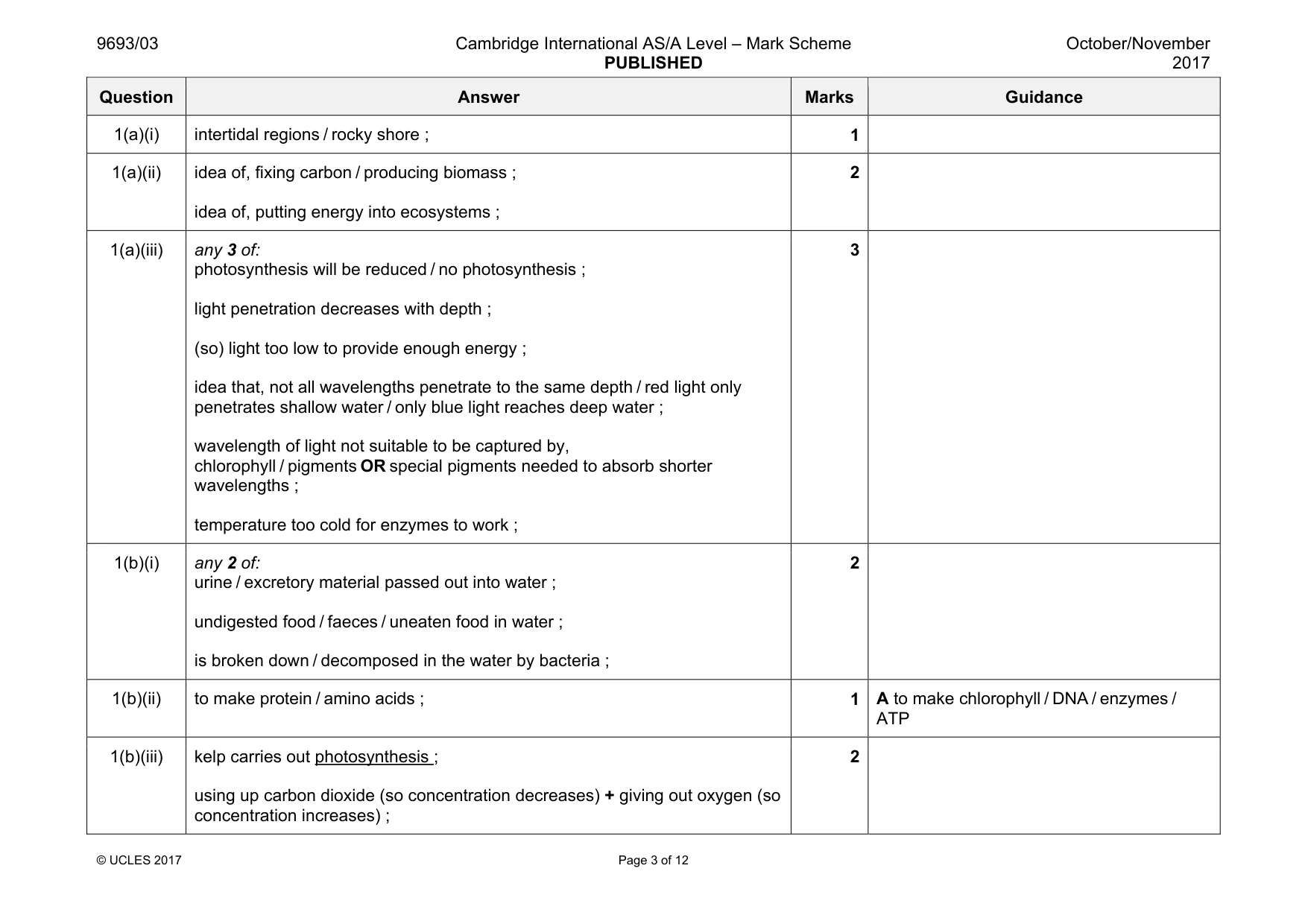
Mark scheme: 1(a)(i) intertidal regions / rocky shore ; 1 1(a)(ii) idea of, fixing carbon / producing biomass ; idea of, putting energy into ecosystems ; 2 1(a)(iii) any 3 of: photosynthesis will be reduced / no photosynthesis ; light penetration decreases with depth ; (so) light too low to provide enough energy ; idea that, not all wavelengths penetrate to the same depth / red light only penetrates shallow water / only blue light reaches deep water ; wavelength of light not suitable to be captured by, chlorophyll / pigments OR special pigments needed to absorb shorter wavelengths ; temperature too cold for enzymes to work ; 3 1(b)(i) any 2 of: urine / excretory material passed out into water ; undigested food / faeces / uneaten food in water ; is broken down / decomposed in the water by bacteria ; 2 1(b)(ii) to make protein / amino acids ; 1 A to make chlorophyll / DNA / enzymes / ATP 1(b)(iii) kelp carries out photosynthesis ; using up carbon dioxide (so concentration decreases) + giving out oxygen (so concentration increases) ; 2 Question Answer Marks Guidance 1(c) any 2 of: provides a, habitat / ecological niche, for marine animals / named example ; provides a food source for marine animals ; provides shelter from predators ; provides protection from strong currents / wave action ; provides a nursery area / surface on which to lay eggs ; 2 I nutrients
Q2 · Read the information about the whale shark and the minke whale
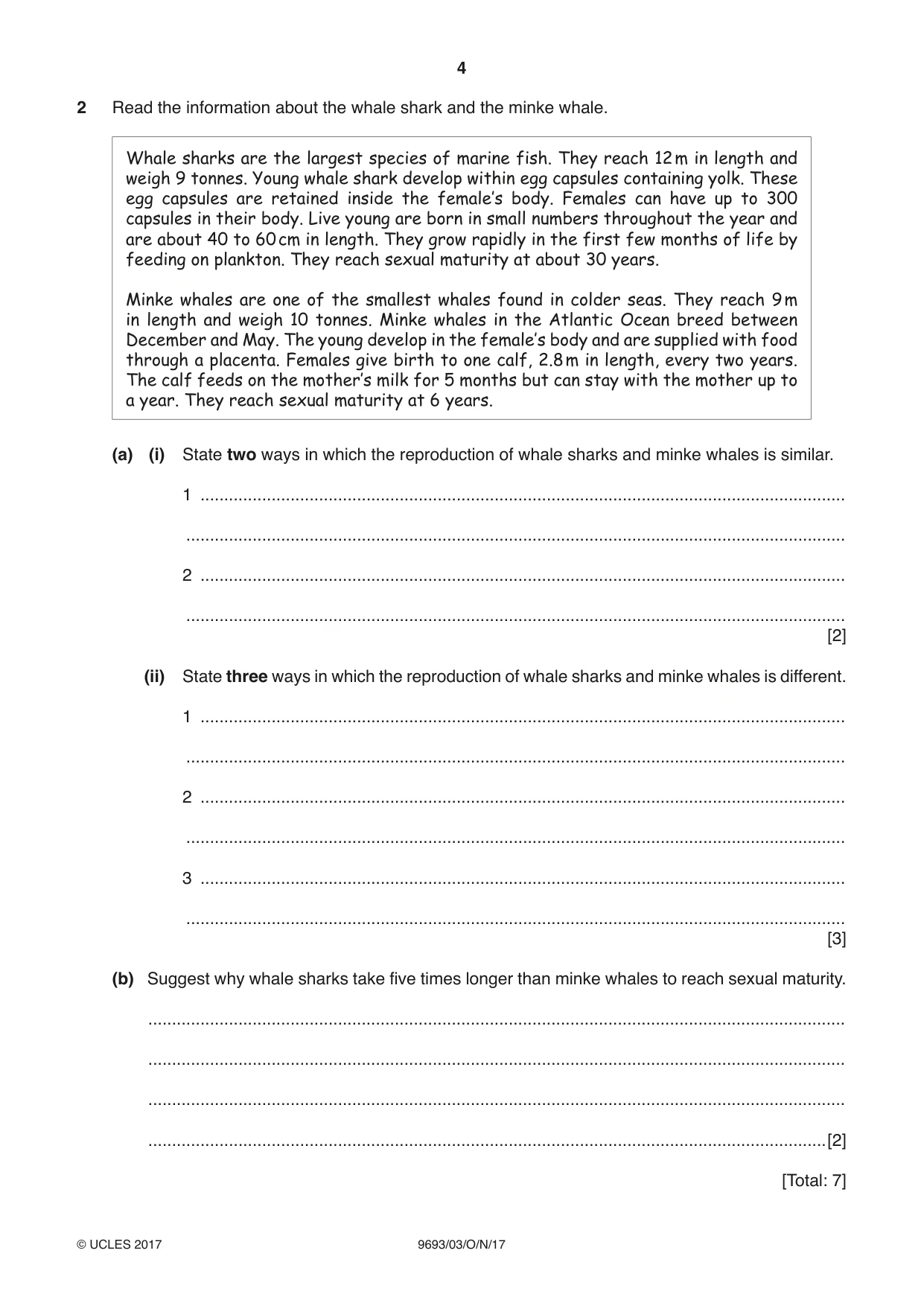
2 Read the information about the whale shark and the minke whale. Whale sharks are the largest species of marine fish. They reach 12 m in length and weigh 9 tonnes. Young whale shark develop within egg capsules containing yolk. These egg capsules are retained inside the female’s body. Females can have up to 300 capsules in their body. Live young are born in small numbers throughout the year and are about 40 to 60 cm in length. They grow rapidly in the first few months of life by feeding on plankton. They reach sexual maturity at about 30 years. Minke whales are one of the smallest whales found in colder seas. They reach 9 m in length and weigh 10 tonnes. Minke whales in the Atlantic Ocean breed between December and May. The young develop in the female’s body and are supplied with food through a placenta. Females give birth to one calf, 2.8 m in length, every two years. The calf feeds on the mother’s milk for 5 months but can stay with the mother up to a year. They reach sexual maturity at 6 years. (a) (i) State two ways in which the reproduction of whale sharks and minke whales is similar. 1 ........................................................................................................................................ ........................................................................................................................................... 2 ........................................................................................................................................ ........................................................................................................................................... [2] (ii) State three ways in which the reproduction of whale sharks and minke whales is different. 1 ........................................................................................................................................ ........................................................................................................................................... 2 ........................................................................................................................................ ........................................................................................................................................... 3 ........................................................................................................................................ ........................................................................................................................................... [3] (b) Suggest why whale sharks take five times longer than minke whales to reach sexual maturity. ................................................................................................................................................... ................................................................................................................................................... ................................................................................................................................................... ...............................................................................................................................................[2] [Total: 7]
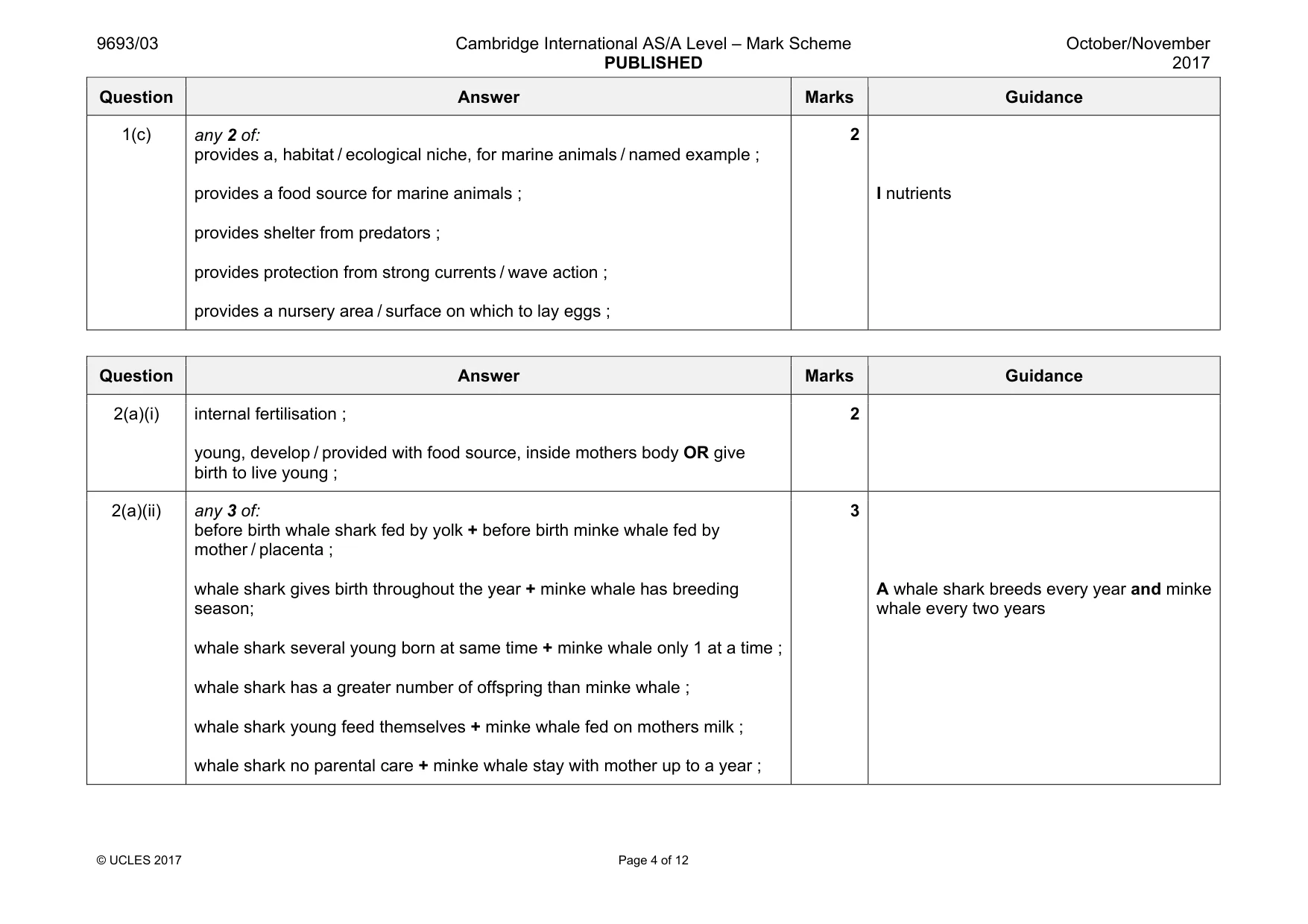
Mark scheme: 2(a)(i) internal fertilisation ; young, develop / provided with food source, inside mothers body OR give birth to live young ; 2 2(a)(ii) any 3 of: before birth whale shark fed by yolk + before birth minke whale fed by mother / placenta ; whale shark gives birth throughout the year + minke whale has breeding season; whale shark several young born at same time + minke whale only 1 at a time ; whale shark has a greater number of offspring than minke whale ; whale shark young feed themselves + minke whale fed on mothers milk ; whale shark no parental care + minke whale stay with mother up to a year ; 3 A whale shark breeds every year and minke whale every two years Question Answer Marks Guidance 2(b) any 2 of: whale shark, very much smaller / 5 to 7 times smaller, at birth than minke whale ; young whale shark feed on phytoplankton, young minke whales feed on milk ; milk is nutrient rich, so faster initial growth in minke whales ; (but) adults very similar size ; take much longer for whale shark to grow to adult size ; 2 A 5 times longer for whale shark to reach adult size.
Q3 · Mussels are osmoconformers commonly found in estuaries
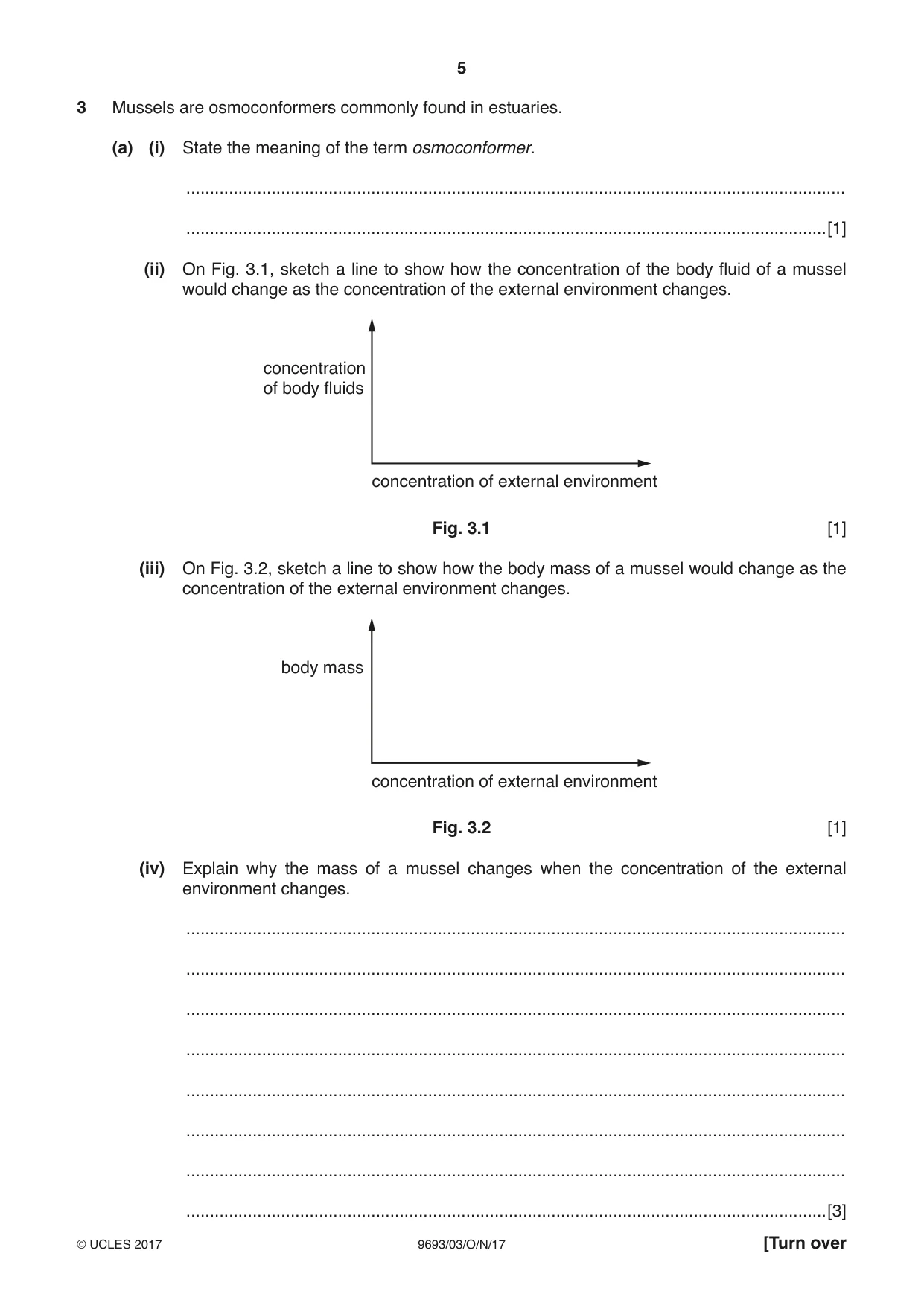
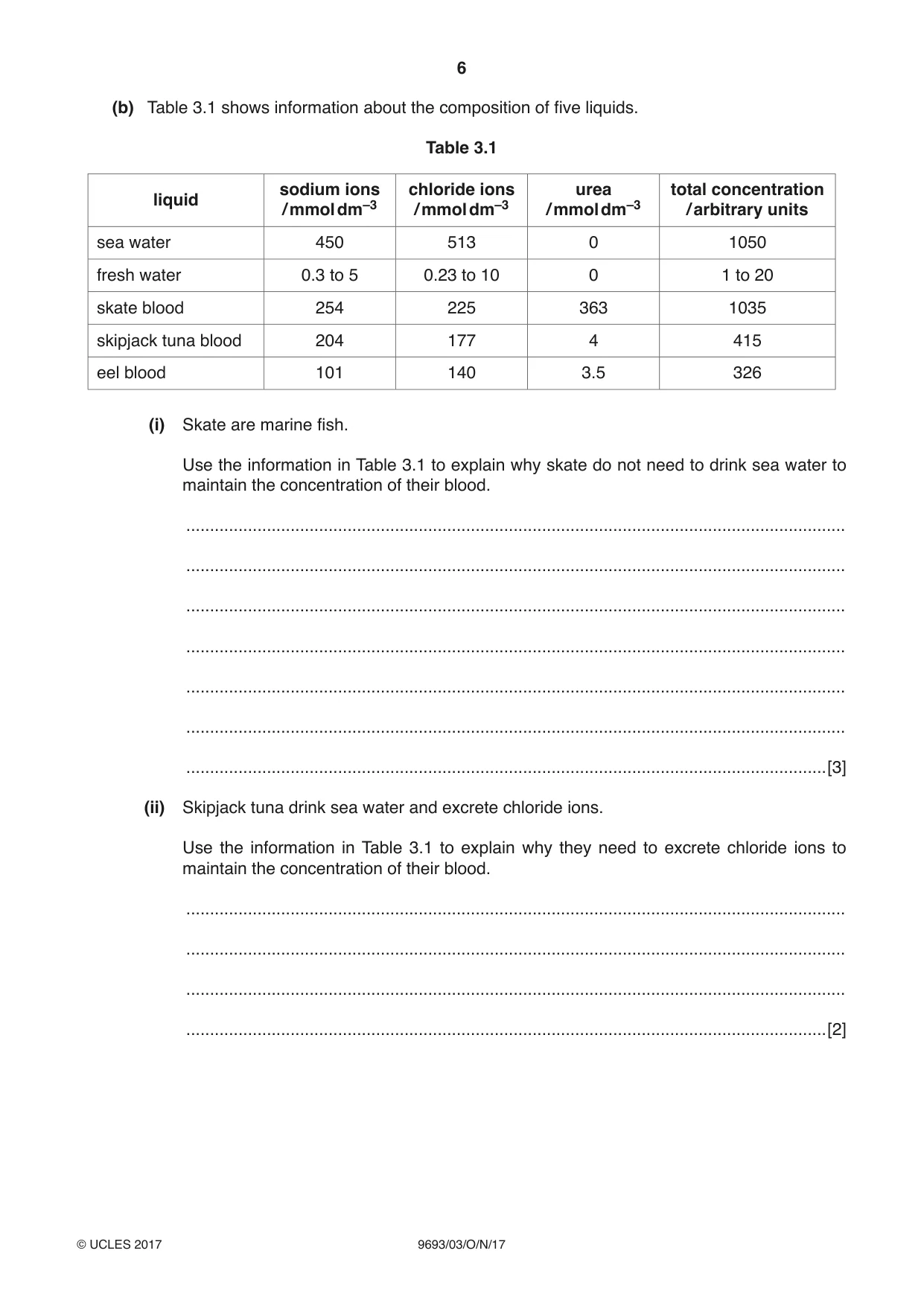
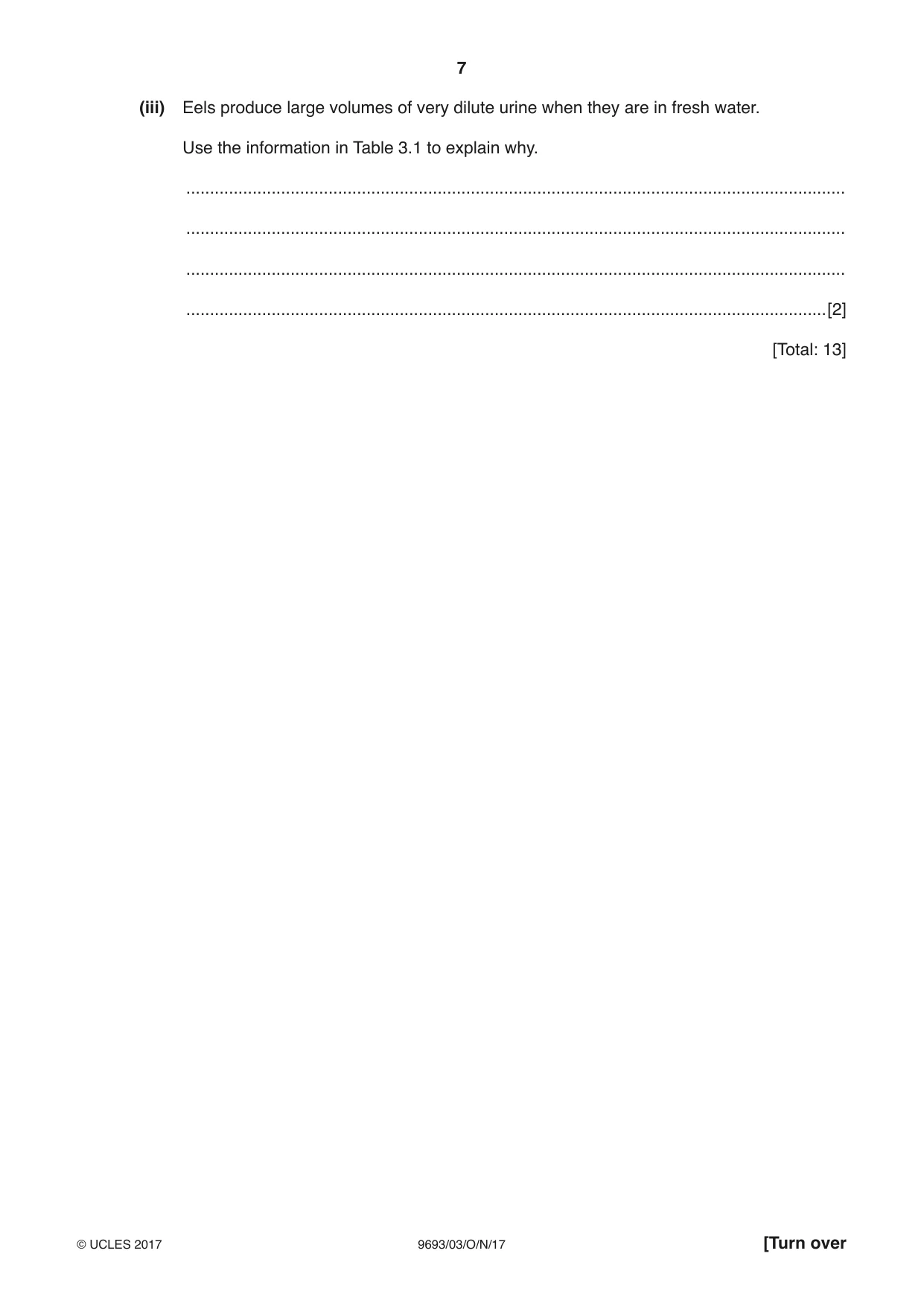
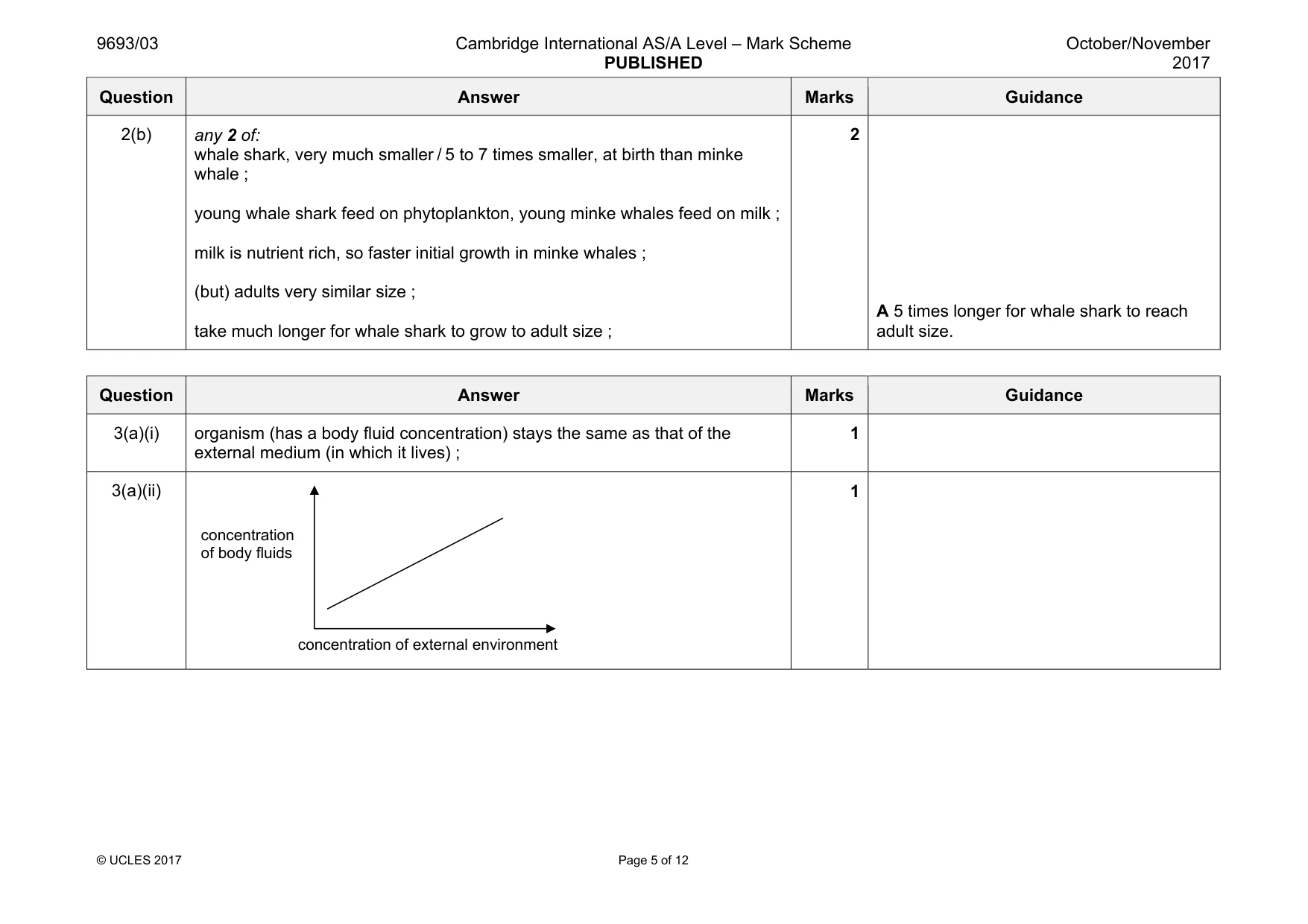
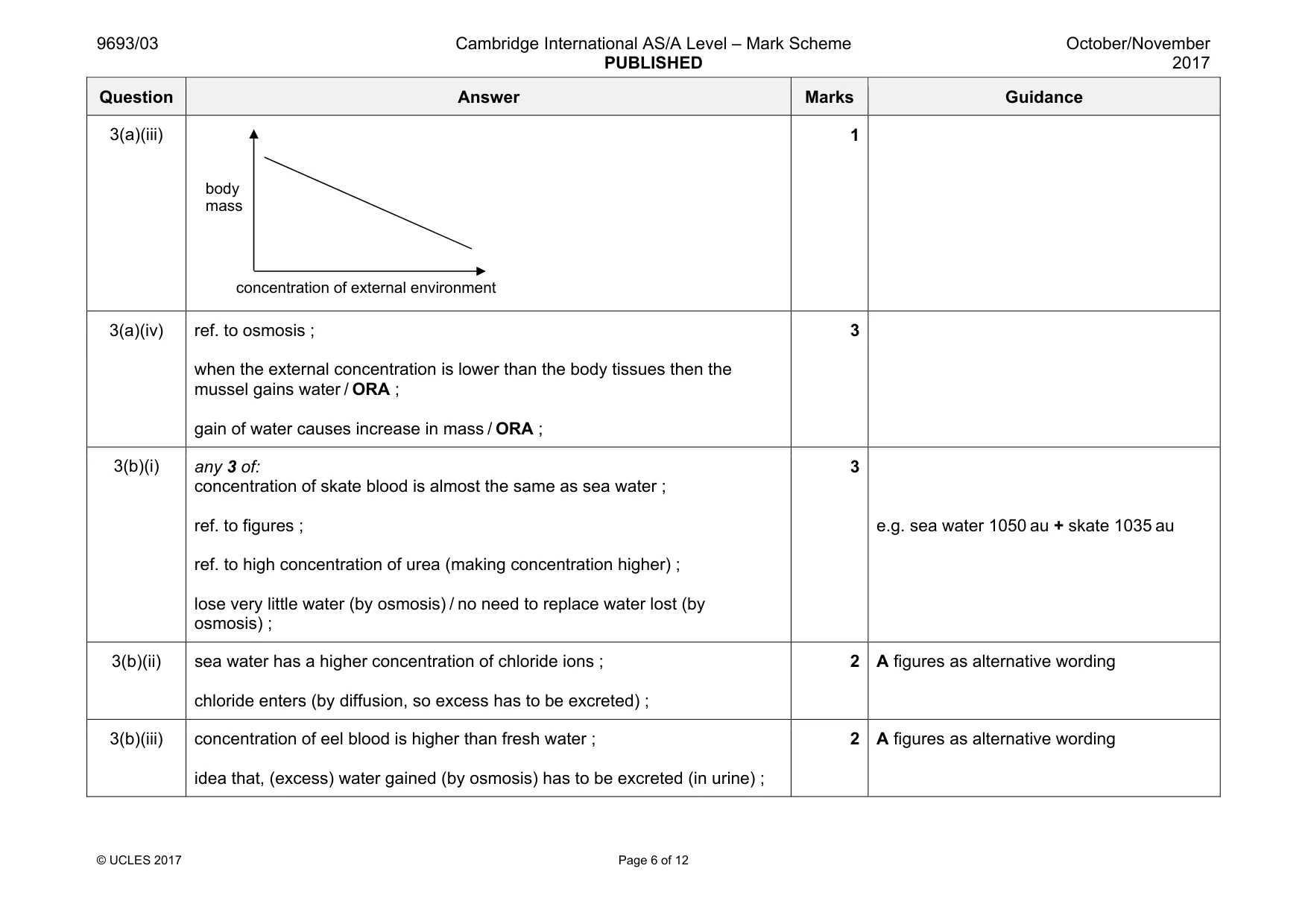
3 Mussels are osmoconformers commonly found in estuaries. (a) (i) State the meaning of the term osmoconformer. ........................................................................................................................................... .......................................................................................................................................[1] (ii) On Fig. 3.1, sketch a line to show how the concentration of the body fluid of a mussel would change as the concentration of the external environment changes. concentration of body fluids concentration of external environment Fig. 3.1 [1] (iii) On Fig. 3.2, sketch a line to show how the body mass of a mussel would change as the concentration of the external environment changes. body mass concentration of external environment Fig. 3.2 [1] (iv) Explain why the mass of a mussel changes when the concentration of the external environment changes. ........................................................................................................................................... ........................................................................................................................................... ........................................................................................................................................... ........................................................................................................................................... ........................................................................................................................................... ........................................................................................................................................... ........................................................................................................................................... .......................................................................................................................................[3] (b) Table 3.1 shows information about the composition of five liquids. Table 3.1 sodium ions chloride ions urea total concentration liquid / mmol dm–3 / mmol dm–3 / mmol dm–3 / arbitrary units sea water 450 513 0 1050 fresh water 0.3 to 5 0.23 to 10 0 1 to 20 skate blood 254 225 363 1035 skipjack tuna blood 204 177 4 415 eel blood 101 140 3.5 326 (i) Skate are marine fish. Use the information in Table 3.1 to explain why skate do not need to drink sea water to maintain the concentration of their blood. ........................................................................................................................................... ........................................................................................................................................... ........................................................................................................................................... ........................................................................................................................................... ........................................................................................................................................... ........................................................................................................................................... .......................................................................................................................................[3] (ii) Skipjack tuna drink sea water and excrete chloride ions. Use the information in Table 3.1 to explain why they need to excrete chloride ions to maintain the concentration of their blood. ........................................................................................................................................... ........................................................................................................................................... ........................................................................................................................................... .......................................................................................................................................[2] (iii) Eels produce large volumes of very dilute urine when they are in fresh water. Use the information in Table 3.1 to explain why. ........................................................................................................................................... ........................................................................................................................................... ........................................................................................................................................... .......................................................................................................................................[2] [Total: 13]
Mark scheme: 3(a)(i) organism (has a body fluid concentration) stays the same as that of the external medium (in which it lives) ; 1 3(a)(ii) 1 concentration of body fluids concentration of external environment Question Answer Marks Guidance 3(a)(iii) 1 3(a)(iv) ref. to osmosis ; when the external concentration is lower than the body tissues then the mussel gains water / ORA ; gain of water causes increase in mass / ORA ; 3 3(b)(i) any 3 of: concentration of skate blood is almost the same as sea water ; ref. to figures ; ref. to high concentration of urea (making concentration higher) ; lose very little water (by osmosis) / no need to replace water lost (by osmosis) ; 3 e.g. sea water 1050 au + skate 1035 au 3(b)(ii) sea water has a higher concentration of chloride ions ; chloride enters (by diffusion, so excess has to be excreted) ; 2 A figures as alternative wording 3(b)(iii) concentration of eel blood is higher than fresh water ; idea that, (excess) water gained (by osmosis) has to be excreted (in urine) ; 2 A figures as alternative wording concentration of external environment body mass
Q4 · Peru has one of the world’s largest sustainable anchovy fisheries
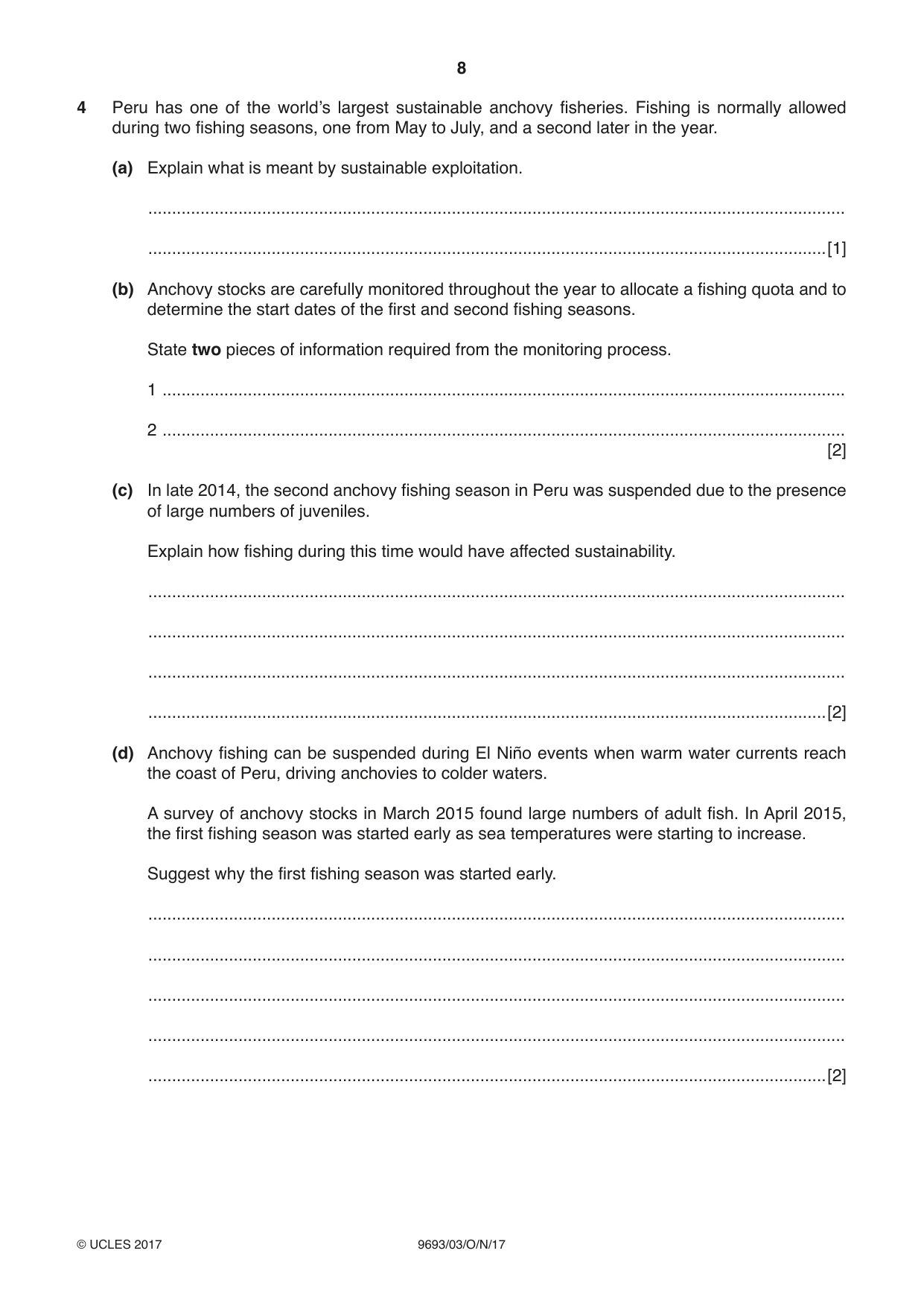
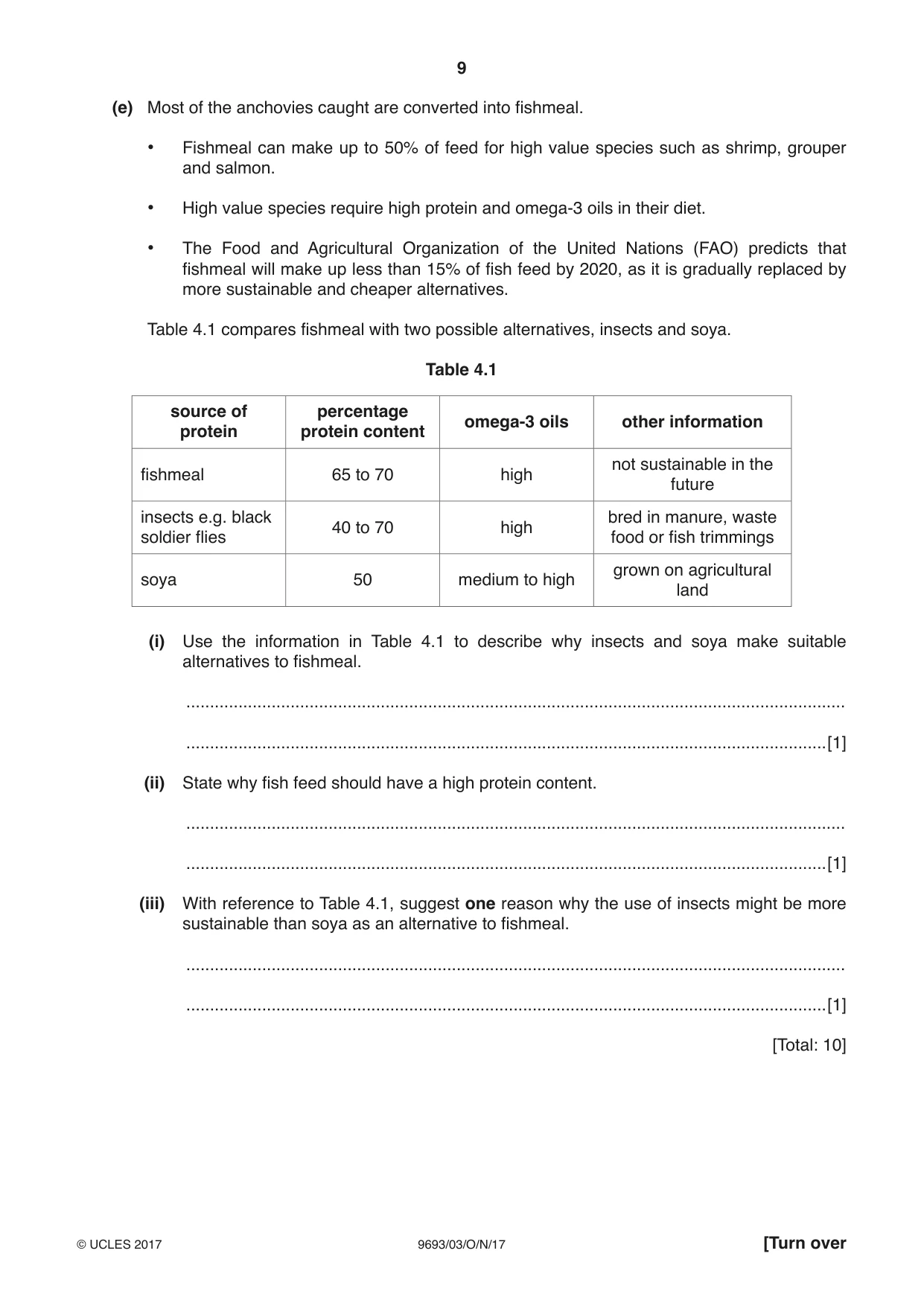
4 Peru has one of the world’s largest sustainable anchovy fisheries. Fishing is normally allowed during two fishing seasons, one from May to July, and a second later in the year. (a) Explain what is meant by sustainable exploitation. ................................................................................................................................................... ...............................................................................................................................................[1] (b) Anchovy stocks are carefully monitored throughout the year to allocate a fishing quota and to determine the start dates of the first and second fishing seasons. State two pieces of information required from the monitoring process. 1 ................................................................................................................................................ 2 ................................................................................................................................................ [2] (c) In late 2014, the second anchovy fishing season in Peru was suspended due to the presence of large numbers of juveniles. Explain how fishing during this time would have affected sustainability. ................................................................................................................................................... ................................................................................................................................................... ................................................................................................................................................... ...............................................................................................................................................[2] (d) Anchovy fishing can be suspended during El Niño events when warm water currents reach the coast of Peru, driving anchovies to colder waters. A survey of anchovy stocks in March 2015 found large numbers of adult fish. In April 2015, the first fishing season was started early as sea temperatures were starting to increase. Suggest why the first fishing season was started early. ................................................................................................................................................... ................................................................................................................................................... ................................................................................................................................................... ................................................................................................................................................... ...............................................................................................................................................[2] (e) Most of the anchovies caught are converted into fishmeal. • Fishmeal can make up to 50% of feed for high value species such as shrimp, grouper and salmon. • High value species require high protein and omega-3 oils in their diet. • The Food and Agricultural Organization of the United Nations (FAO) predicts that fishmeal will make up less than 15% of fish feed by 2020, as it is gradually replaced by more sustainable and cheaper alternatives. Table 4.1 compares fishmeal with two possible alternatives, insects and soya. Table 4.1 source of percentage omega-3 oils other information protein protein content not sustainable in the fishmeal 65 to 70 high future insects e.g. black bred in manure, waste 40 to 70 high soldier flies food or fish trimmings grown on agricultural soya 50 medium to high land (i) Use the information in Table 4.1 to describe why insects and soya make suitable alternatives to fishmeal. ........................................................................................................................................... .......................................................................................................................................[1] (ii) State why fish feed should have a high protein content. ........................................................................................................................................... .......................................................................................................................................[1] (iii) With reference to Table 4.1, suggest one reason why the use of insects might be more sustainable than soya as an alternative to fishmeal. ........................................................................................................................................... .......................................................................................................................................[1] [Total: 10]
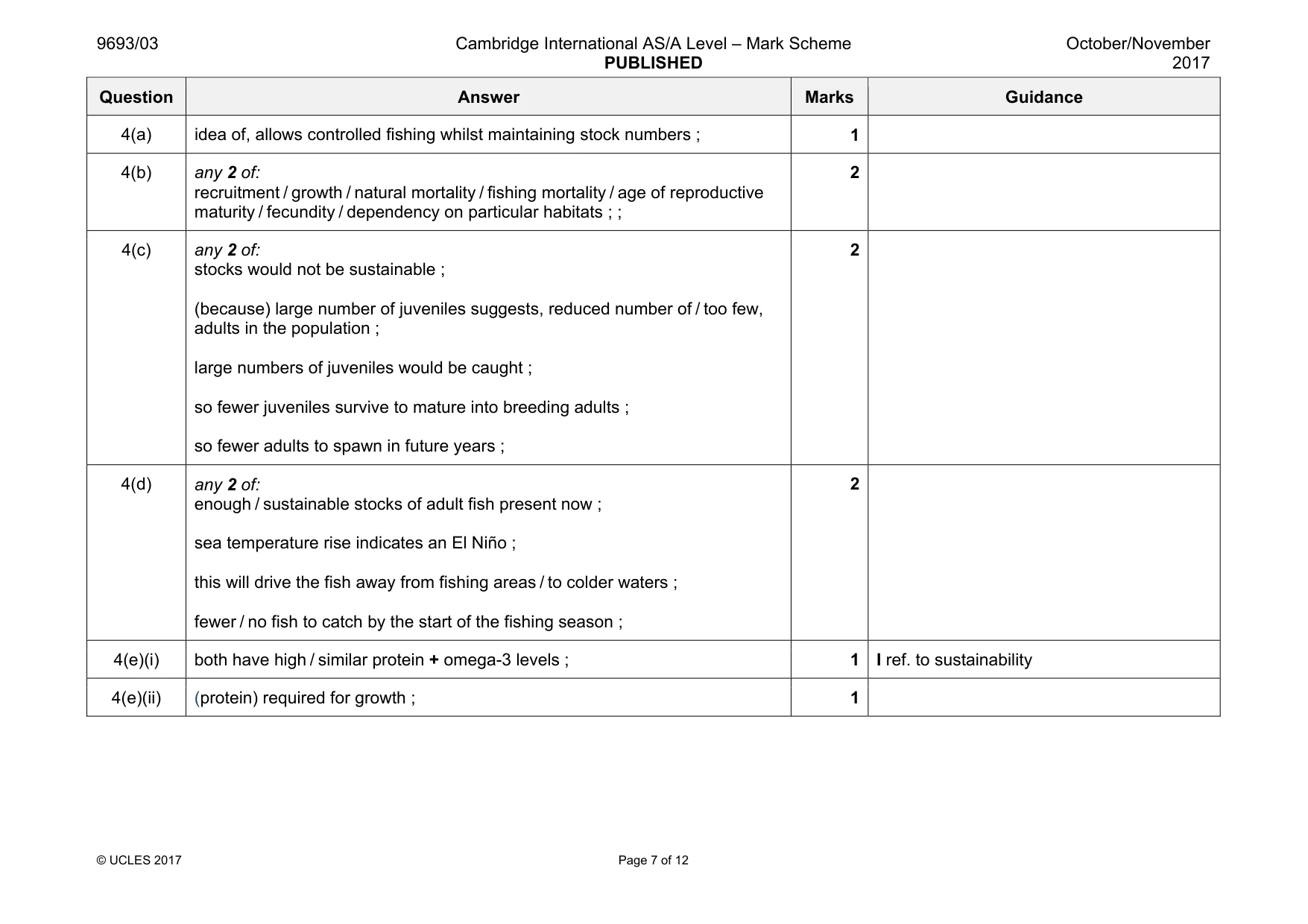
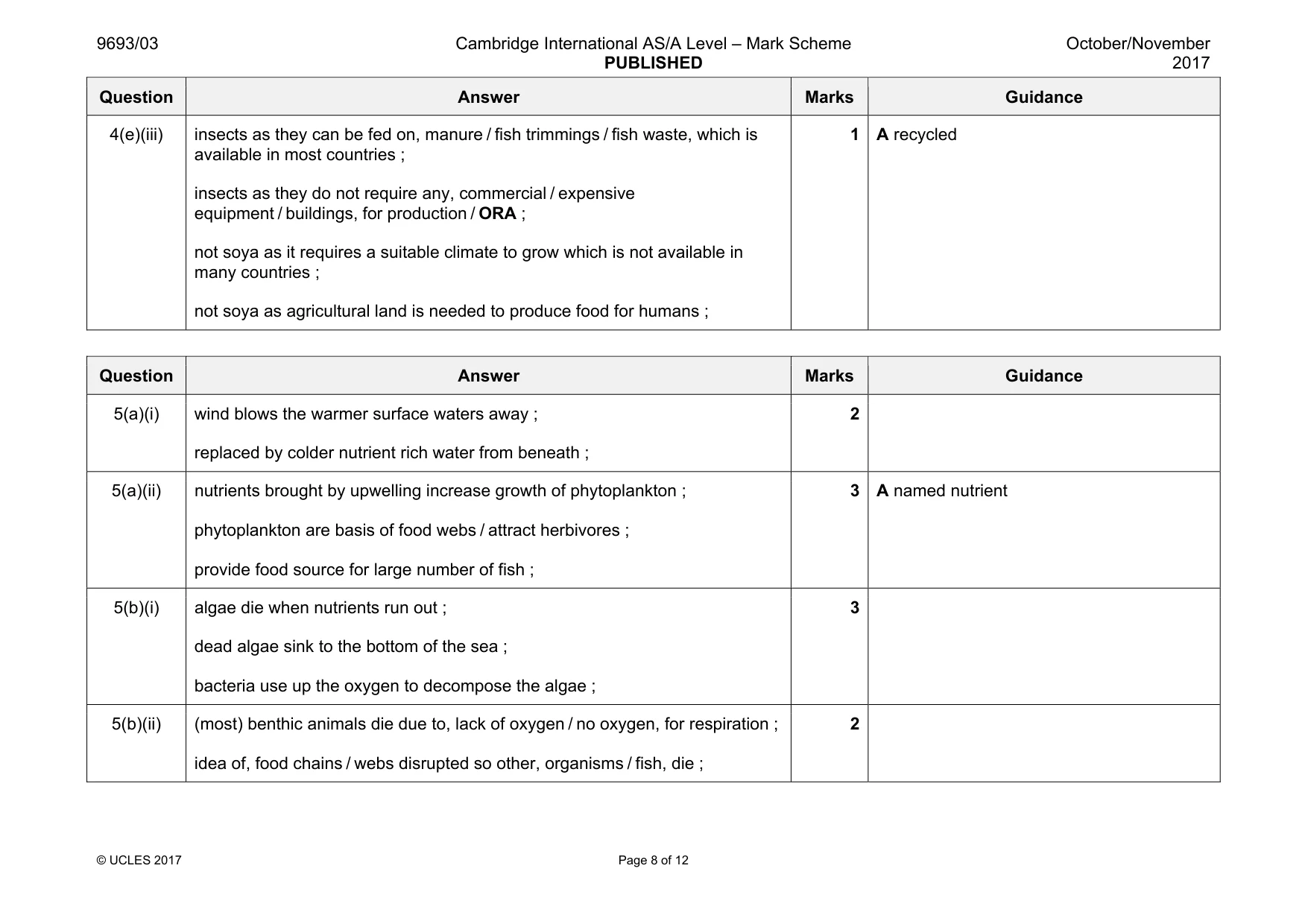
Mark scheme: 4(a) idea of, allows controlled fishing whilst maintaining stock numbers ; 1 4(b) any 2 of: recruitment / growth / natural mortality / fishing mortality / age of reproductive maturity / fecundity / dependency on particular habitats ; ; 2 4(c) any 2 of: stocks would not be sustainable ; (because) large number of juveniles suggests, reduced number of / too few, adults in the population ; large numbers of juveniles would be caught ; so fewer juveniles survive to mature into breeding adults ; so fewer adults to spawn in future years ; 2 4(d) any 2 of: enough / sustainable stocks of adult fish present now ; sea temperature rise indicates an El Niño ; this will drive the fish away from fishing areas / to colder waters ; fewer / no fish to catch by the start of the fishing season ; 2 4(e)(i) both have high / similar protein + omega-3 levels ; 1 I ref. to sustainability 4(e)(ii) (protein) required for growth ; 1 Question Answer Marks Guidance 4(e)(iii) insects as they can be fed on, manure / fish trimmings / fish waste, which is available in most countries ; insects as they do not require any, commercial / expensive equipment / buildings, for production / ORA ; not soya as it requires a suitable climate to grow which is not available in many countries ; not soya as agricultural land is needed to produce food for humans ; 1 A recycled
Q5 · The Gulf of California separates mainland Mexico from part of California
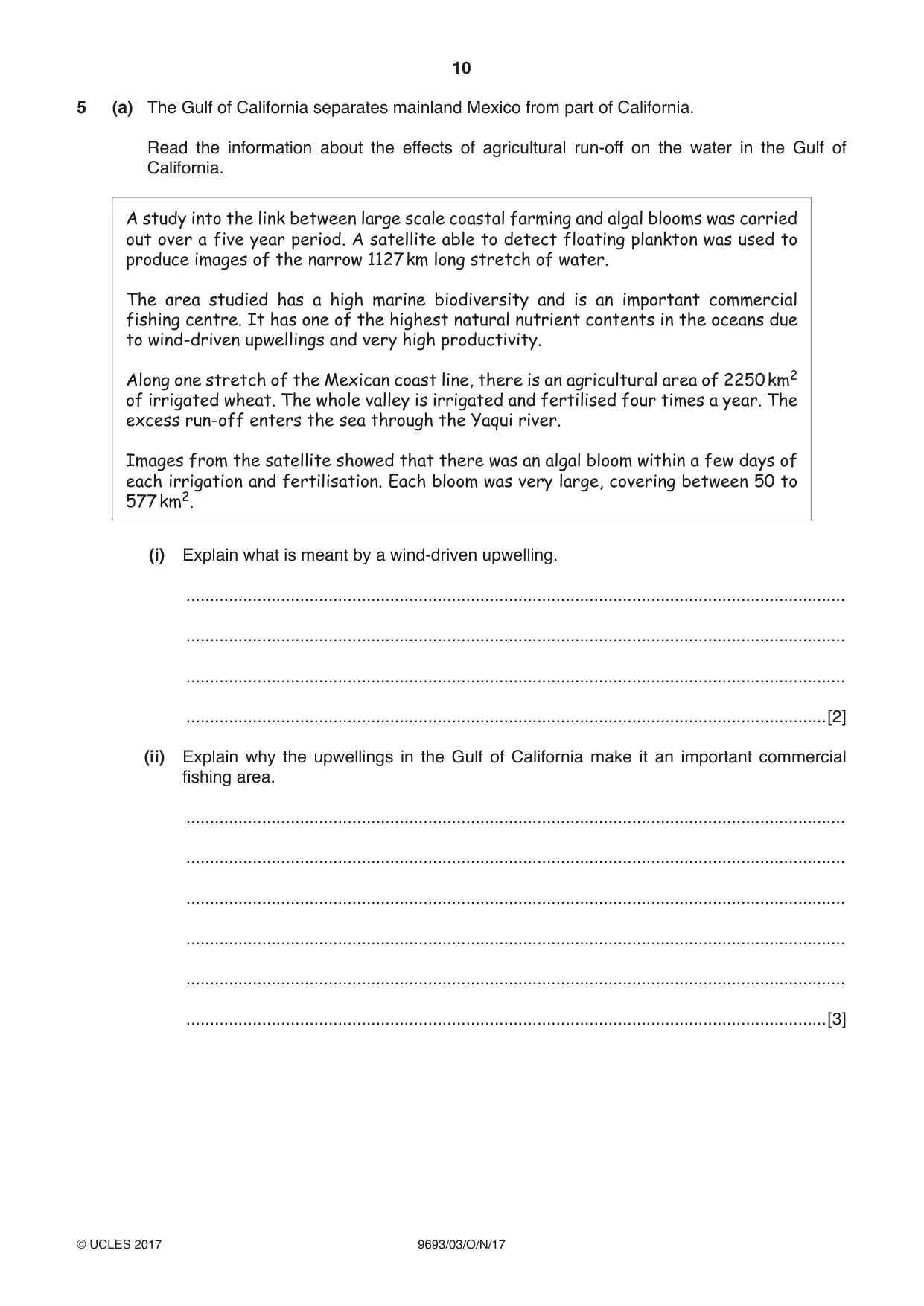
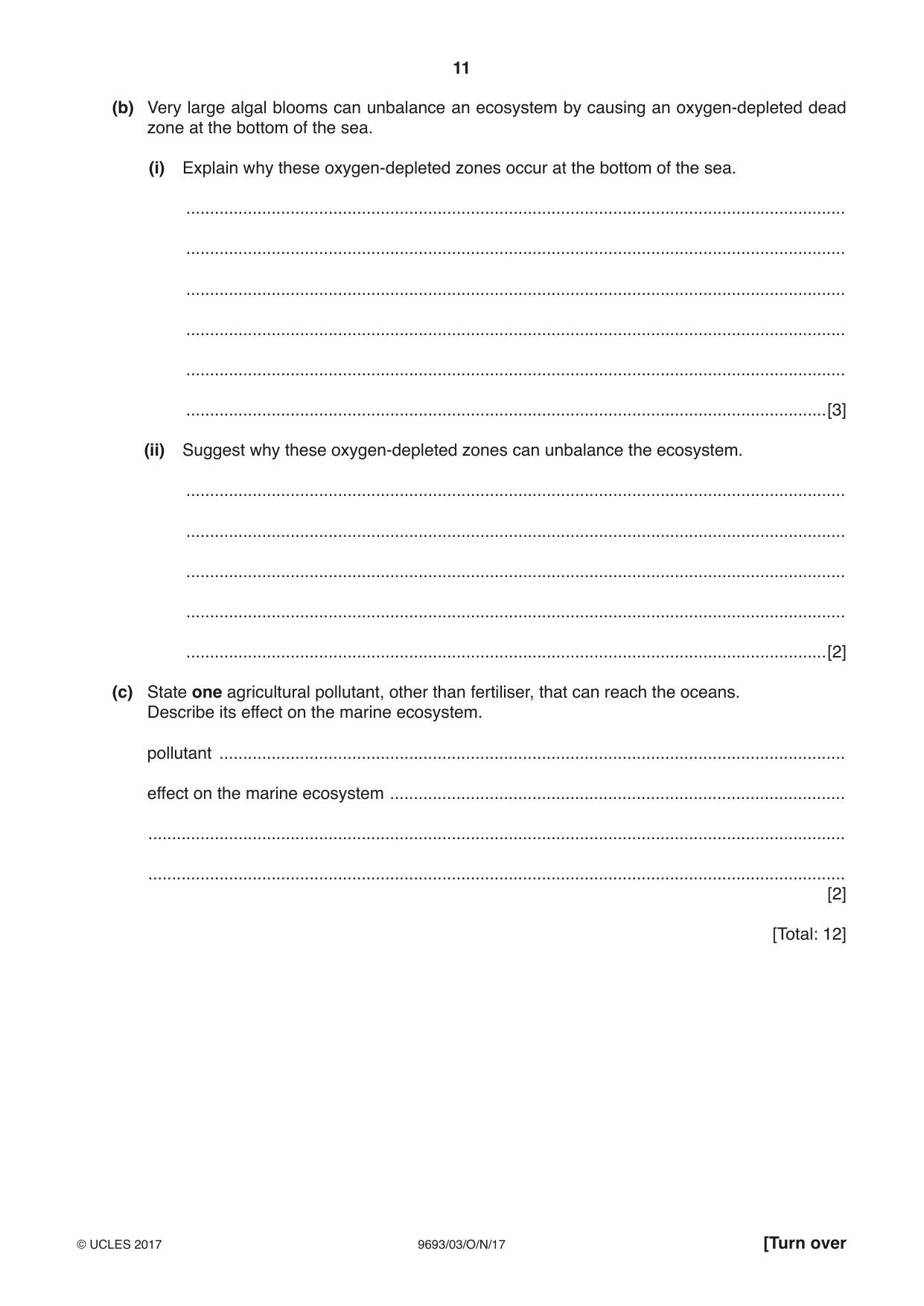
5 (a) The Gulf of California separates mainland Mexico from part of California. Read the information about the effects of agricultural run-off on the water in the Gulf of California. A study into the link between large scale coastal farming and algal blooms was carried out over a five year period. A satellite able to detect floating plankton was used to produce images of the narrow 1127 km long stretch of water. The area studied has a high marine biodiversity and is an important commercial fishing centre. It has one of the highest natural nutrient contents in the oceans due to wind-driven upwellings and very high productivity. Along one stretch of the Mexican coast line, there is an agricultural area of 2250 km2 of irrigated wheat. The whole valley is irrigated and fertilised four times a year. The excess run-off enters the sea through the Yaqui river. Images from the satellite showed that there was an algal bloom within a few days of each irrigation and fertilisation. Each bloom was very large, covering between 50 to 577 km2. (i) Explain what is meant by a wind-driven upwelling. ........................................................................................................................................... ........................................................................................................................................... ........................................................................................................................................... .......................................................................................................................................[2] (ii) Explain why the upwellings in the Gulf of California make it an important commercial fishing area. ........................................................................................................................................... ........................................................................................................................................... ........................................................................................................................................... ........................................................................................................................................... ........................................................................................................................................... .......................................................................................................................................[3] (b) Very large algal blooms can unbalance an ecosystem by causing an oxygen-depleted dead zone at the bottom of the sea. (i) Explain why these oxygen-depleted zones occur at the bottom of the sea. ........................................................................................................................................... ........................................................................................................................................... ........................................................................................................................................... ........................................................................................................................................... ........................................................................................................................................... .......................................................................................................................................[3] (ii) Suggest why these oxygen-depleted zones can unbalance the ecosystem. ........................................................................................................................................... ........................................................................................................................................... ........................................................................................................................................... ........................................................................................................................................... .......................................................................................................................................[2] (c) State one agricultural pollutant, other than fertiliser, that can reach the oceans. Describe its effect on the marine ecosystem. pollutant .................................................................................................................................... effect on the marine ecosystem ................................................................................................ ................................................................................................................................................... ................................................................................................................................................... [2] [Total: 12]
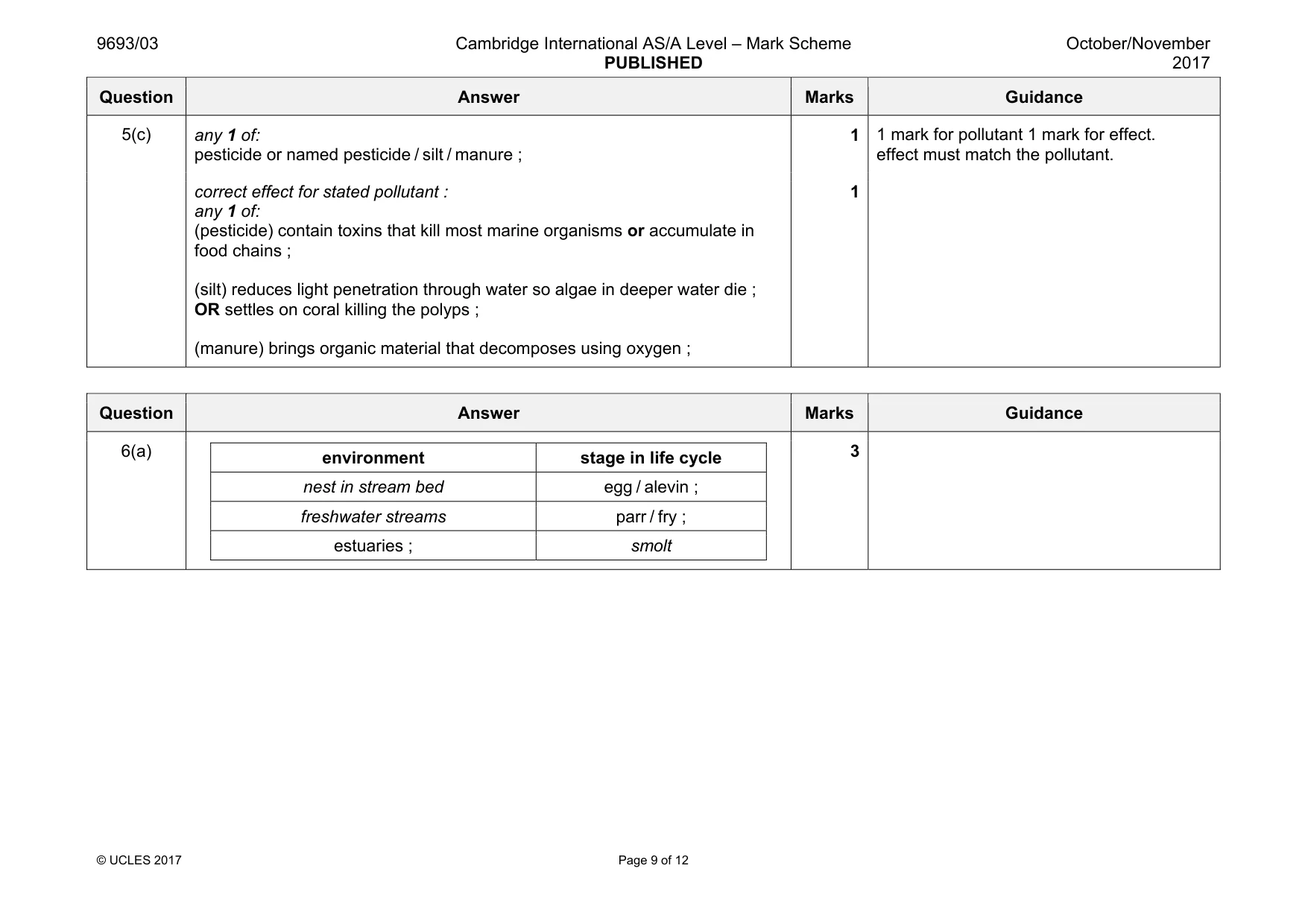
Mark scheme: 5(a)(i) wind blows the warmer surface waters away ; replaced by colder nutrient rich water from beneath ; 2 5(a)(ii) nutrients brought by upwelling increase growth of phytoplankton ; phytoplankton are basis of food webs / attract herbivores ; provide food source for large number of fish ; 3 A named nutrient 5(b)(i) algae die when nutrients run out ; dead algae sink to the bottom of the sea ; bacteria use up the oxygen to decompose the algae ; 3 5(b)(ii) (most) benthic animals die due to, lack of oxygen / no oxygen, for respiration ; idea of, food chains / webs disrupted so other, organisms / fish, die ; 2 Question Answer Marks Guidance 5(c) any 1 of: pesticide or named pesticide / silt / manure ; 1 1 mark for pollutant 1 mark for effect. effect must match the pollutant. correct effect for stated pollutant : any 1 of: (pesticide) contain toxins that kill most marine organisms or accumulate in food chains ; (silt) reduces light penetration through water so algae in deeper water die ; OR settles on coral killing the polyps ; (manure) brings organic material that decomposes using oxygen ; 1
Q6 · Some information about the life cycle of salmon
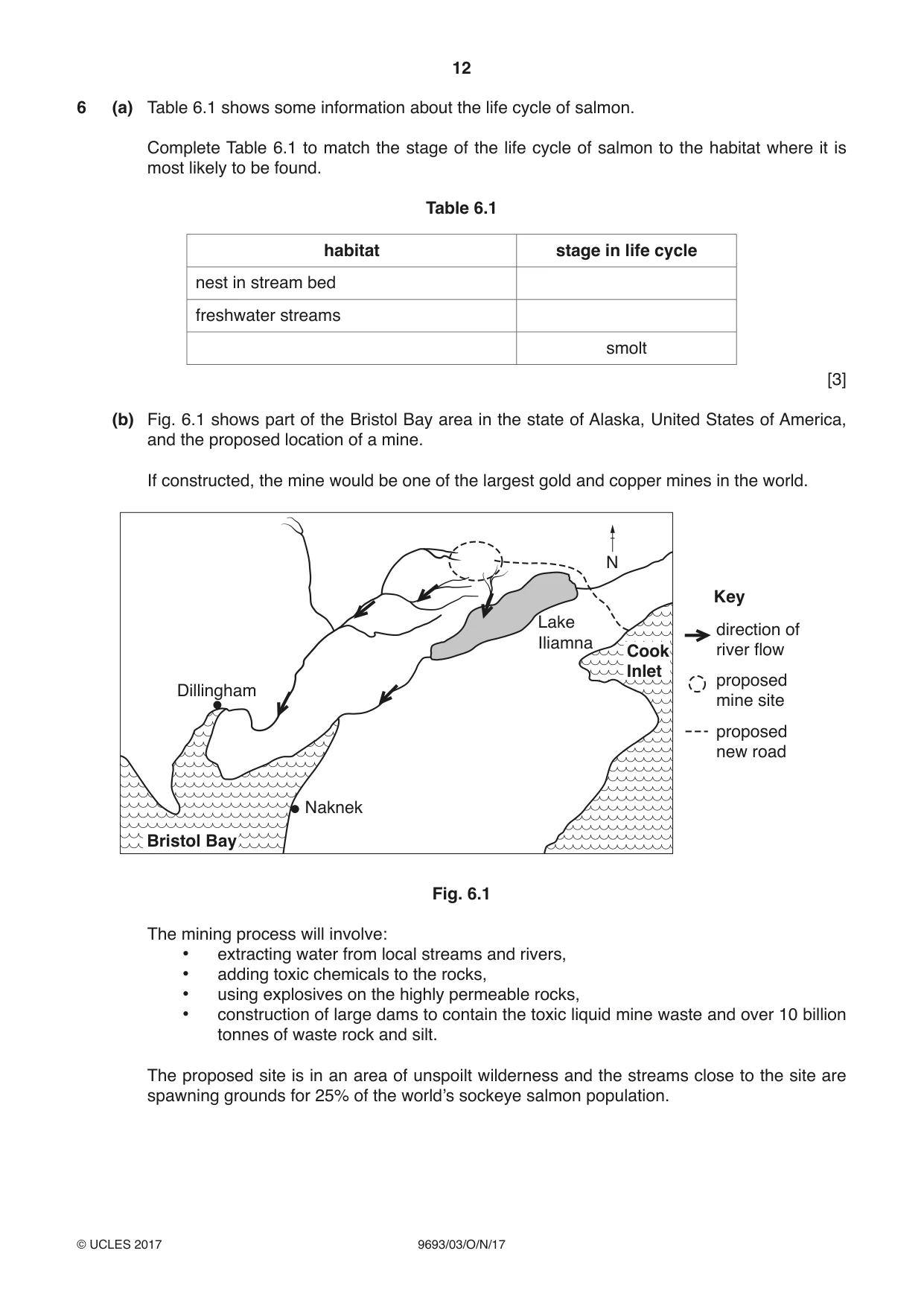
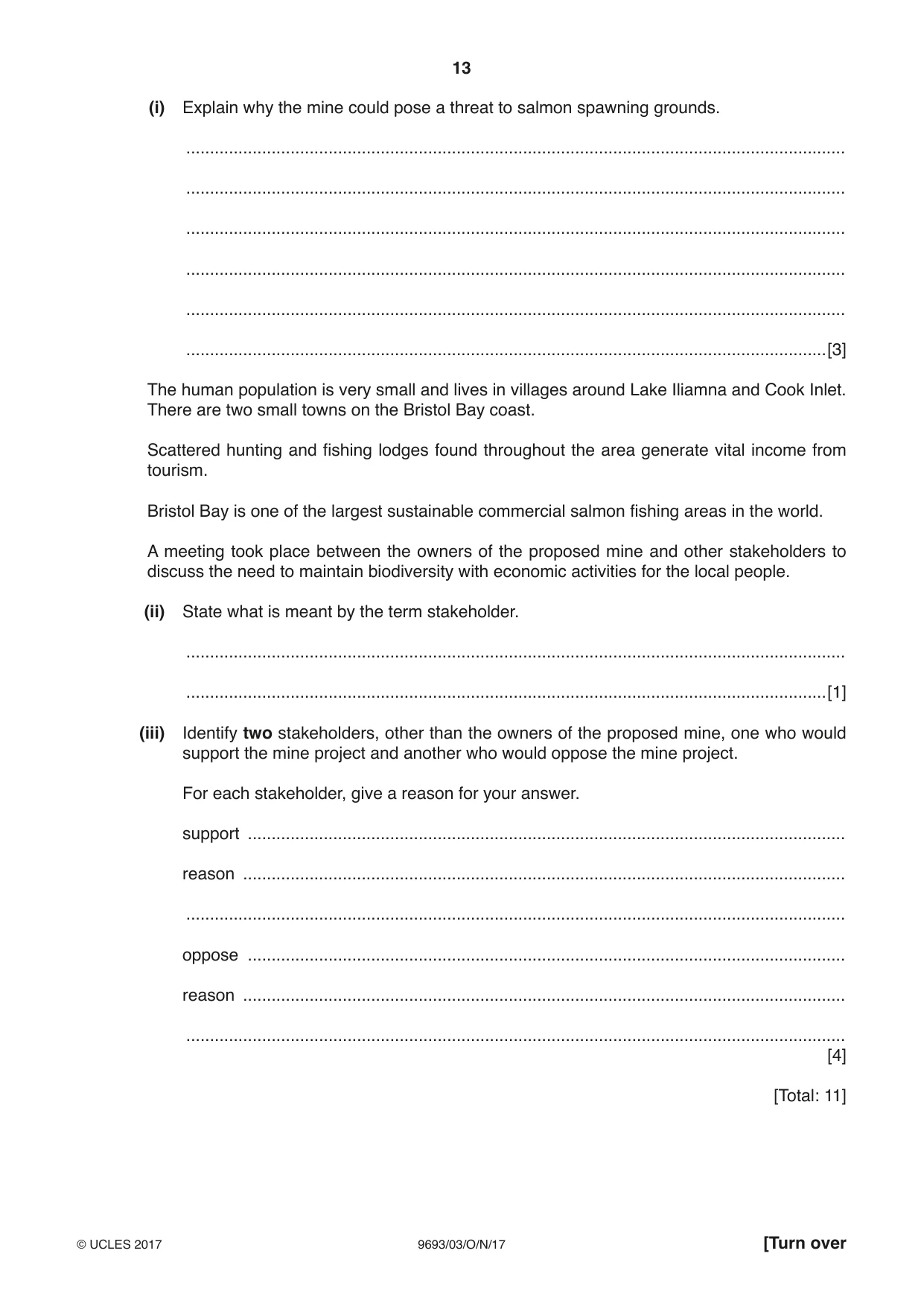
6 (a) Table 6.1 shows some information about the life cycle of salmon. Complete Table 6.1 to match the stage of the life cycle of salmon to the habitat where it is most likely to be found. Table 6.1 habitat stage in life cycle nest in stream bed freshwater streams smolt [3] (b) Fig. 6.1 shows part of the Bristol Bay area in the state of Alaska, United States of America, and the proposed location of a mine. If constructed, the mine would be one of the largest gold and copper mines in the world. N Key Lake direction of Iliamna Cook river flow Inlet proposed Dillingham mine site proposed new road Naknek Bristol Bay Fig. 6.1 The mining process will involve: • extracting water from local streams and rivers, • adding toxic chemicals to the rocks, • using explosives on the highly permeable rocks, • construction of large dams to contain the toxic liquid mine waste and over 10 billion tonnes of waste rock and silt. The proposed site is in an area of unspoilt wilderness and the streams close to the site are spawning grounds for 25% of the world’s sockeye salmon population. (i) Explain why the mine could pose a threat to salmon spawning grounds. ........................................................................................................................................... ........................................................................................................................................... ........................................................................................................................................... ........................................................................................................................................... ........................................................................................................................................... .......................................................................................................................................[3] The human population is very small and lives in villages around Lake Iliamna and Cook Inlet. There are two small towns on the Bristol Bay coast. Scattered hunting and fishing lodges found throughout the area generate vital income from tourism. Bristol Bay is one of the largest sustainable commercial salmon fishing areas in the world. A meeting took place between the owners of the proposed mine and other stakeholders to discuss the need to maintain biodiversity with economic activities for the local people. (ii) State what is meant by the term stakeholder. ........................................................................................................................................... .......................................................................................................................................[1] (iii) Identify two stakeholders, other than the owners of the proposed mine, one who would support the mine project and another who would oppose the mine project. For each stakeholder, give a reason for your answer. support .............................................................................................................................. reason ............................................................................................................................... ........................................................................................................................................... oppose .............................................................................................................................. reason ............................................................................................................................... ........................................................................................................................................... [4] [Total: 11]
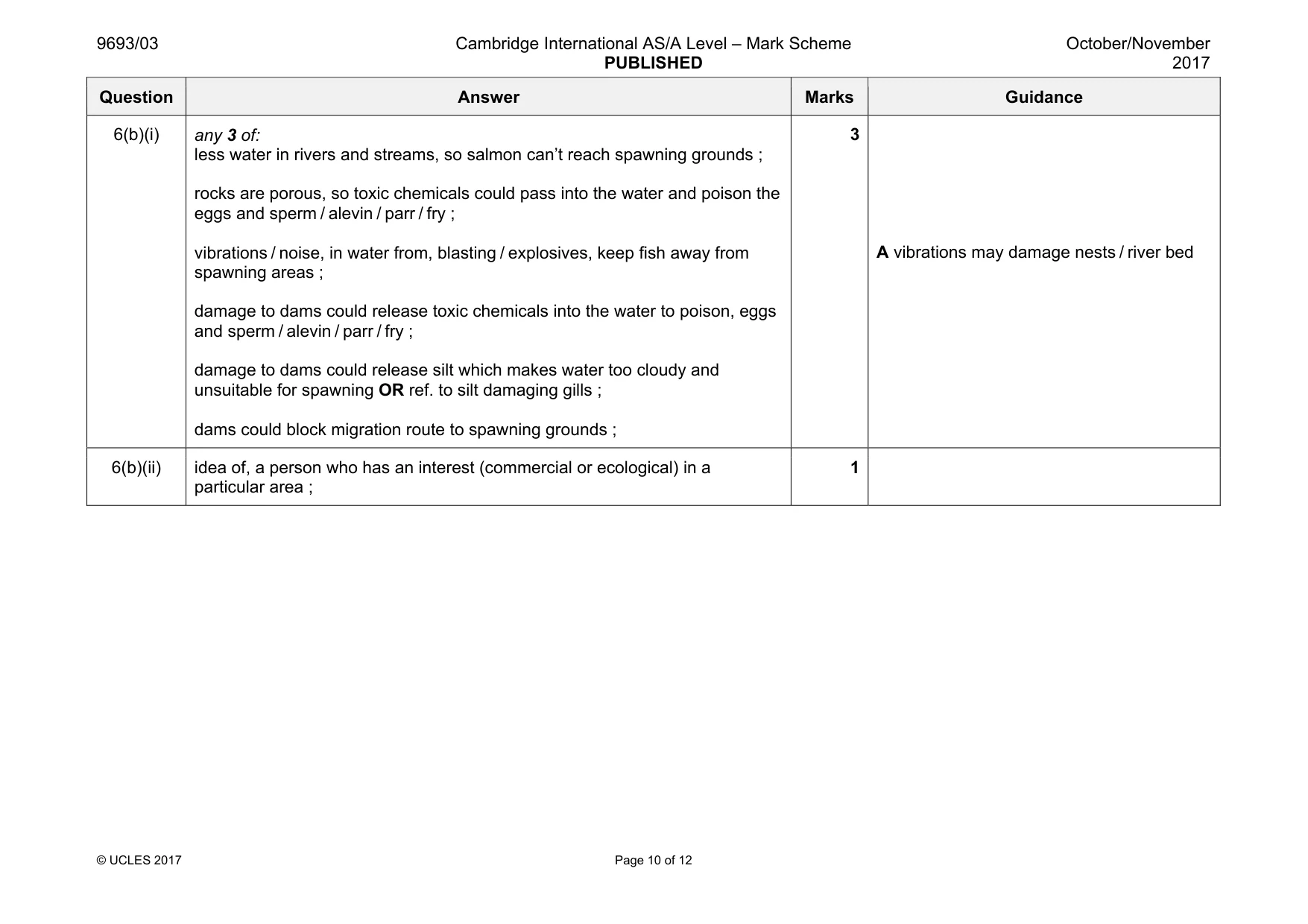
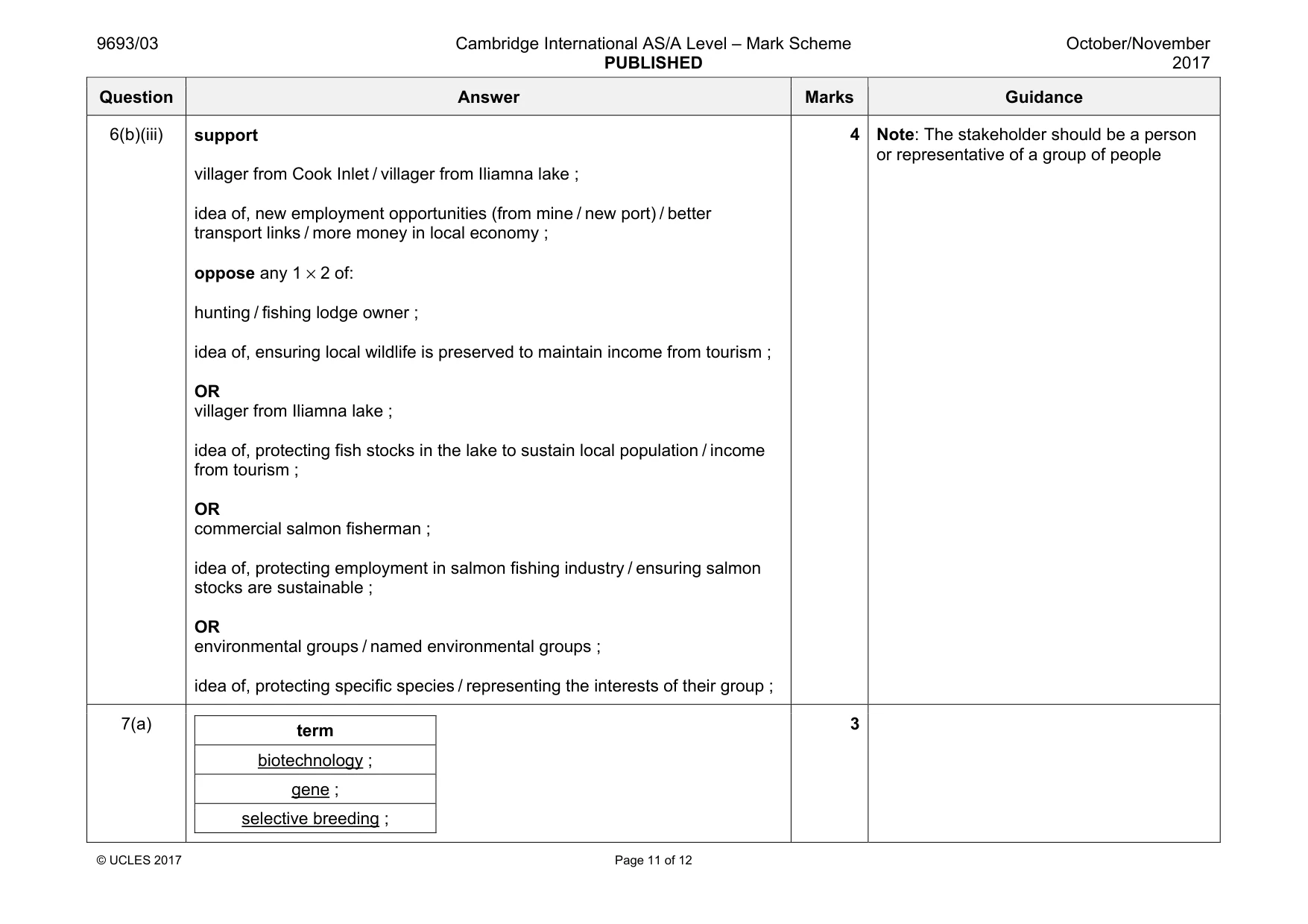
Mark scheme: 6(a) environment stage in life cycle nest in stream bed egg / alevin ; freshwater streams parr / fry ; estuaries ; smolt 3 Question Answer Marks Guidance 6(b)(i) any 3 of: less water in rivers and streams, so salmon can’t reach spawning grounds ; rocks are porous, so toxic chemicals could pass into the water and poison the eggs and sperm / alevin / parr / fry ; vibrations / noise, in water from, blasting / explosives, keep fish away from spawning areas ; damage to dams could release toxic chemicals into the water to poison, eggs and sperm / alevin / parr / fry ; damage to dams could release silt which makes water too cloudy and unsuitable for spawning OR ref. to silt damaging gills ; dams could block migration route to spawning grounds ; 3 A vibrations may damage nests / river bed 6(b)(ii) idea of, a person who has an interest (commercial or ecological) in a particular area ; 1 Question Answer Marks Guidance 6(b)(iii) support villager from Cook Inlet / villager from Iliamna lake ; idea of, new employment opportunities (from mine / new port) / better transport links / more money in local economy ; oppose any 1 × 2 of: hunting / fishing lodge owner ; idea of, ensuring local wildlife is preserved to maintain income from tourism ; OR villager from Iliamna lake ; idea of, protecting fish stocks in the lake to sustain local population / income from tourism ; OR commercial salmon fisherman ; idea of, protecting employment in salmon fishing industry / ensuring salmon stocks are sustainable ; OR environmental groups / named environmental groups ; idea of, protecting specific species / representing the interests of their group ; 4 Note: The stakeholder should be a person or representative of a group of people
Q7 · Some definitions of terms related to the commercial breeding of fish
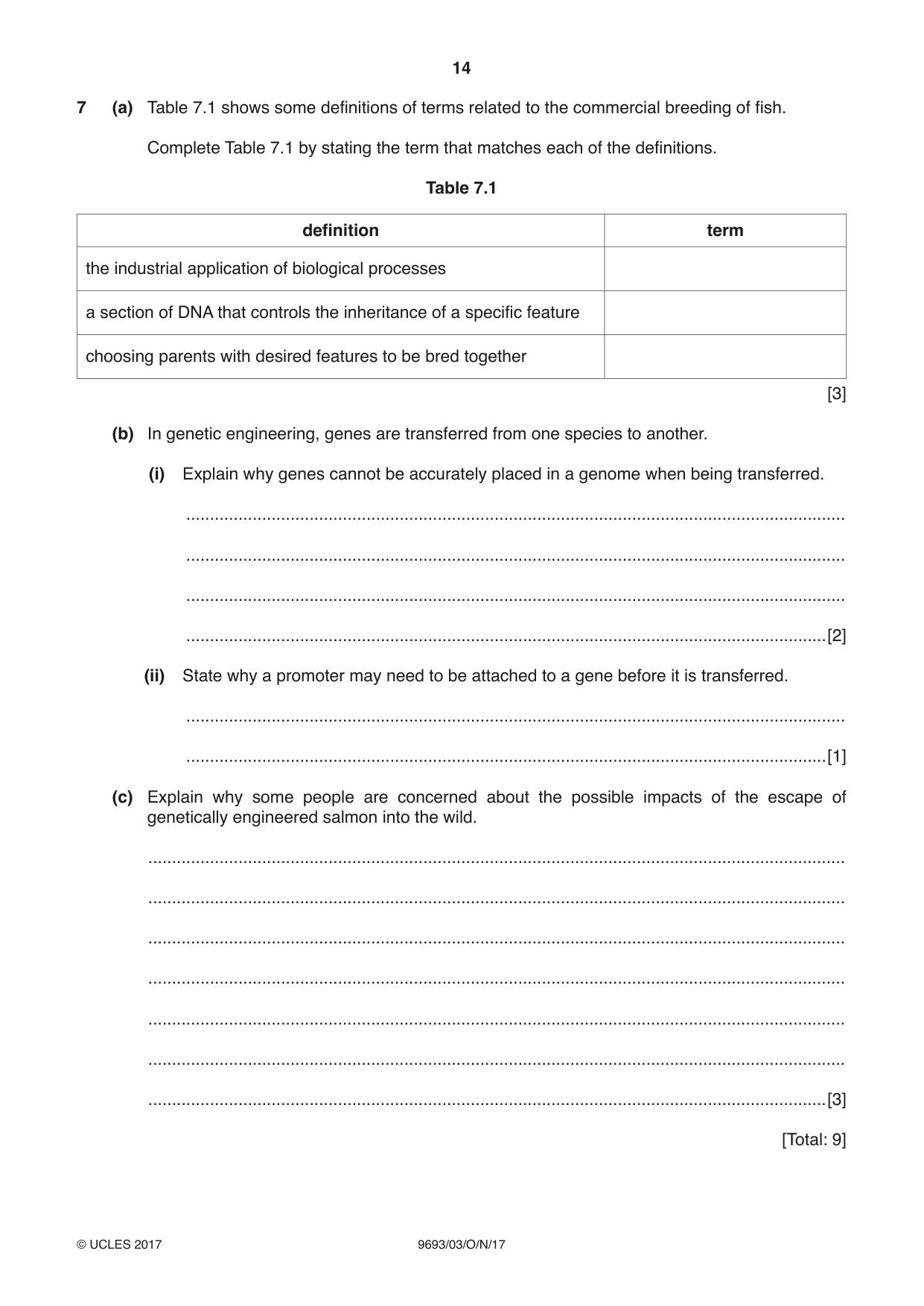
7 (a) Table 7.1 shows some definitions of terms related to the commercial breeding of fish. Complete Table 7.1 by stating the term that matches each of the definitions. Table 7.1 definition term the industrial application of biological processes a section of DNA that controls the inheritance of a specific feature choosing parents with desired features to be bred together [3] (b) In genetic engineering, genes are transferred from one species to another. (i) Explain why genes cannot be accurately placed in a genome when being transferred. ........................................................................................................................................... ........................................................................................................................................... ........................................................................................................................................... .......................................................................................................................................[2] (ii) State why a promoter may need to be attached to a gene before it is transferred. ........................................................................................................................................... .......................................................................................................................................[1] (c) Explain why some people are concerned about the possible impacts of the escape of genetically engineered salmon into the wild. ................................................................................................................................................... ................................................................................................................................................... ................................................................................................................................................... ................................................................................................................................................... ................................................................................................................................................... ................................................................................................................................................... ...............................................................................................................................................[3] [Total: 9]
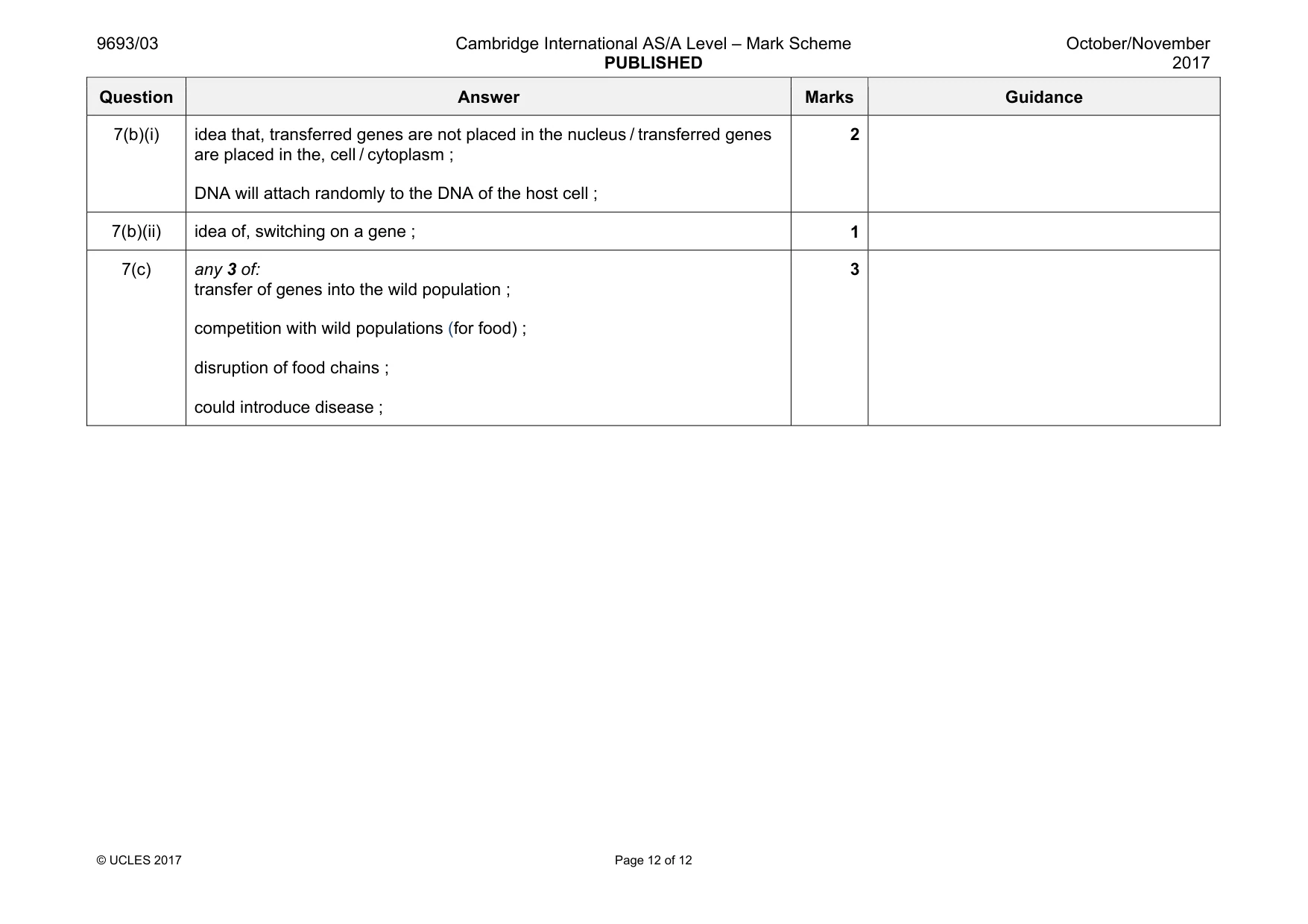
Mark scheme: 7(a) term biotechnology ; gene ; selective breeding ; 3 Question Answer Marks Guidance 7(b)(i) idea that, transferred genes are not placed in the nucleus / transferred genes are placed in the, cell / cytoplasm ; DNA will attach randomly to the DNA of the host cell ; 2 7(b)(ii) idea of, switching on a gene ; 1 7(c) any 3 of: transfer of genes into the wild population ; competition with wild populations (for food) ; disruption of food chains ; could introduce disease ; 3
What was in this paper
The subtopics covered by these 7 questions, and how many questions each got. Open one in a new tab to see every Cambridge question on it.
What you needed in this session
Cambridge’s own grade thresholds for 2017 Oct/Nov, Paper 3 · Variant 1. A higher threshold means an easier paper — the bar moves with how the cohort did.