Questions as text
Q1 · What is an example of the factor of production capital? 9708/11 Oct/Nov 2005
3 What is an example of the factor of production capital? A a bank account held by a small firm to be used for future purchases B a forest of hardwood trees ideal for furniture making C the market value of a company’s shares D word processing software used by a writer to complete her new book
1 marks
Answer: D
This question in 9708/11 Oct/Nov 2005
Q2 · What is necessarily a function of enterprise rather than management? 9708/11 May/June 2007
3 What is necessarily a function of enterprise rather than management? A accepting the risks involved in production B deciding how much labour should be employed C organising the other factors of production D promoting the sale of the product
1 marks
Answer: A
This question in 9708/11 May/June 2007
Q3 · In the 20th century the nature of a typical car assembly plant changed 9708/11 Oct/Nov 2007
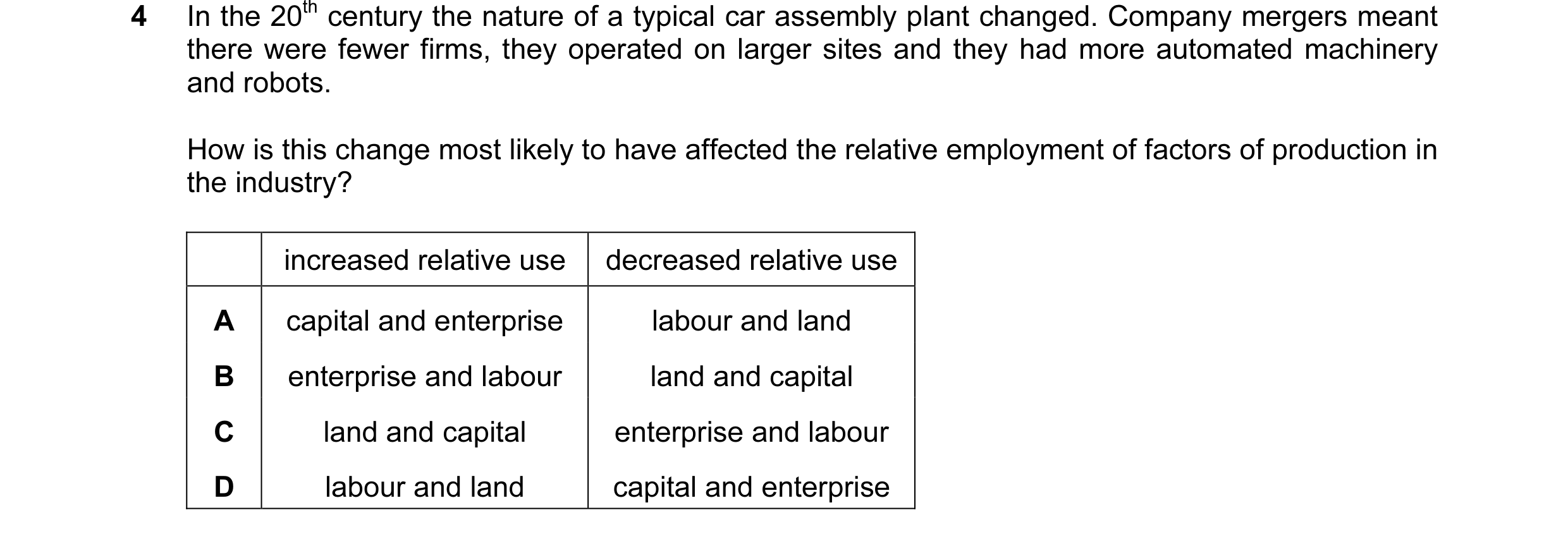
4 In the 20th century the nature of a typical car assembly plant changed. Company mergers meant there were fewer firms, they operated on larger sites and they had more automated machinery and robots. How is this change most likely to have affected the relative employment of factors of production in the industry? increased relative use decreased relative use A capital and enterprise labour and land B enterprise and labour land and capital C land and capital enterprise and labour D labour and land capital and enterprise
1 marks
Answer: C
This question in 9708/11 Oct/Nov 2007
Q4 · Which action by an individual would not be considered an action of the factor of… 9708/11 Oct/Nov 2008
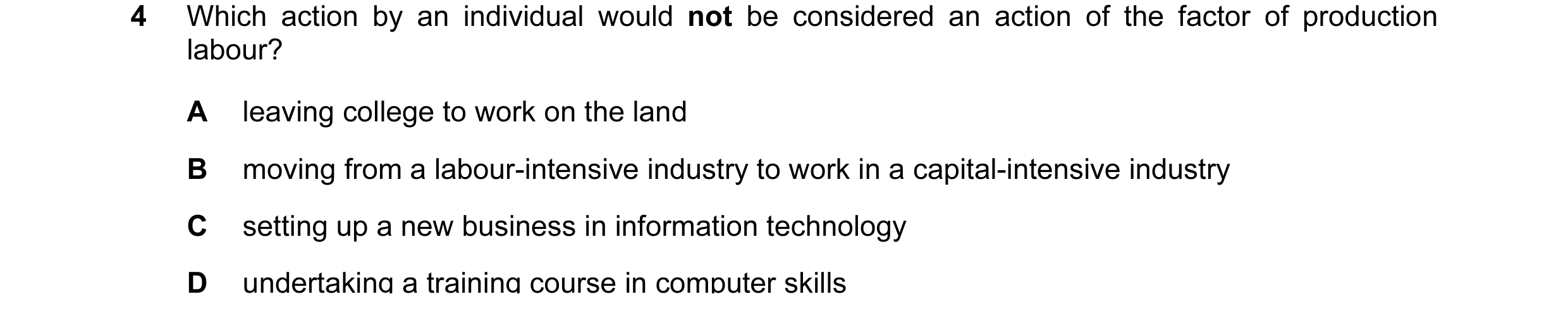
4 Which action by an individual would not be considered an action of the factor of production labour? A leaving college to work on the land B moving from a labour-intensive industry to work in a capital-intensive industry C setting up a new business in information technology D undertaking a training course in computer skills
1 marks
Answer: C
This question in 9708/11 Oct/Nov 2008
Q5 · Three women work in a pottery workshop, each dividing their time equally between three… 9708/11 May/June 2009
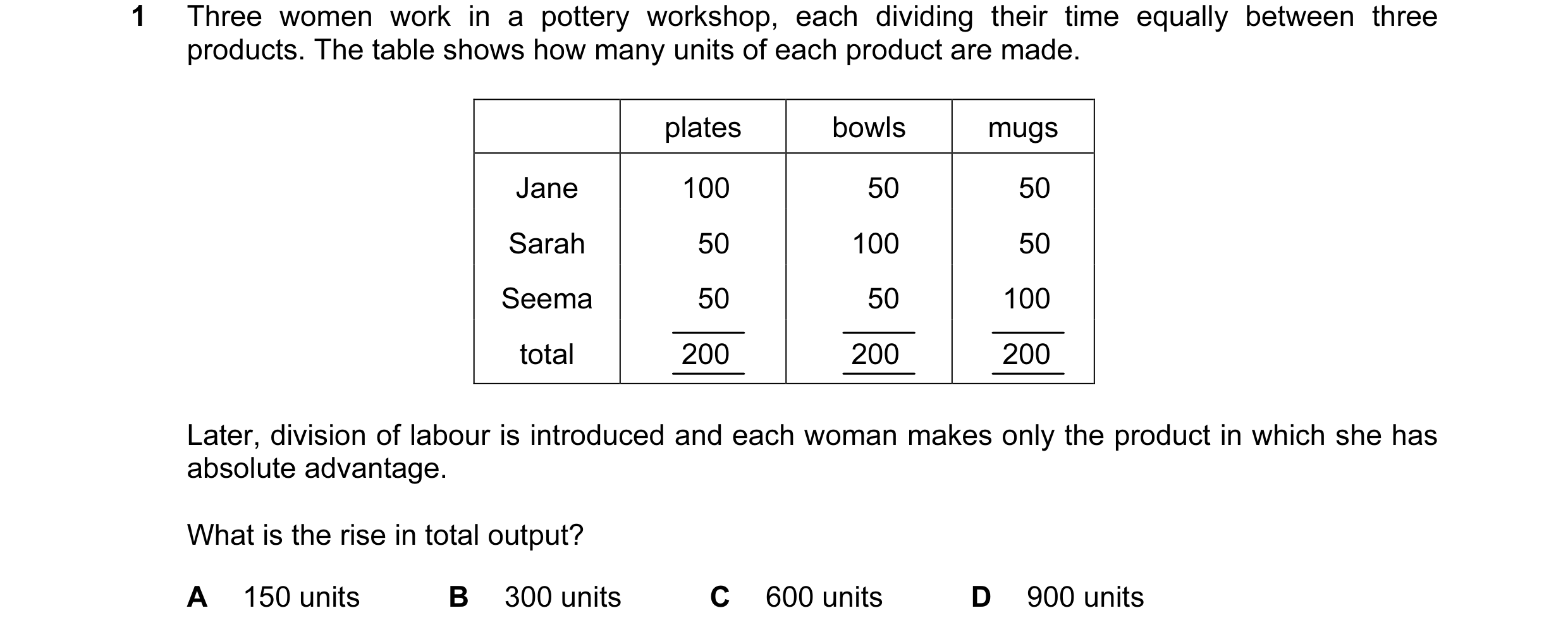
1 Three women work in a pottery workshop, each dividing their time equally between three products. The table shows how many units of each product are made. plates bowls mugs Jane 100 50 50 Sarah 50 100 50 Seema 50 50 100 total 200 200 200 Later, division of labour is introduced and each woman makes only the product in which she has absolute advantage. What is the rise in total output? A 150 units B 300 units C 600 units D 900 units
1 marks
Answer: B
This question in 9708/11 May/June 2009
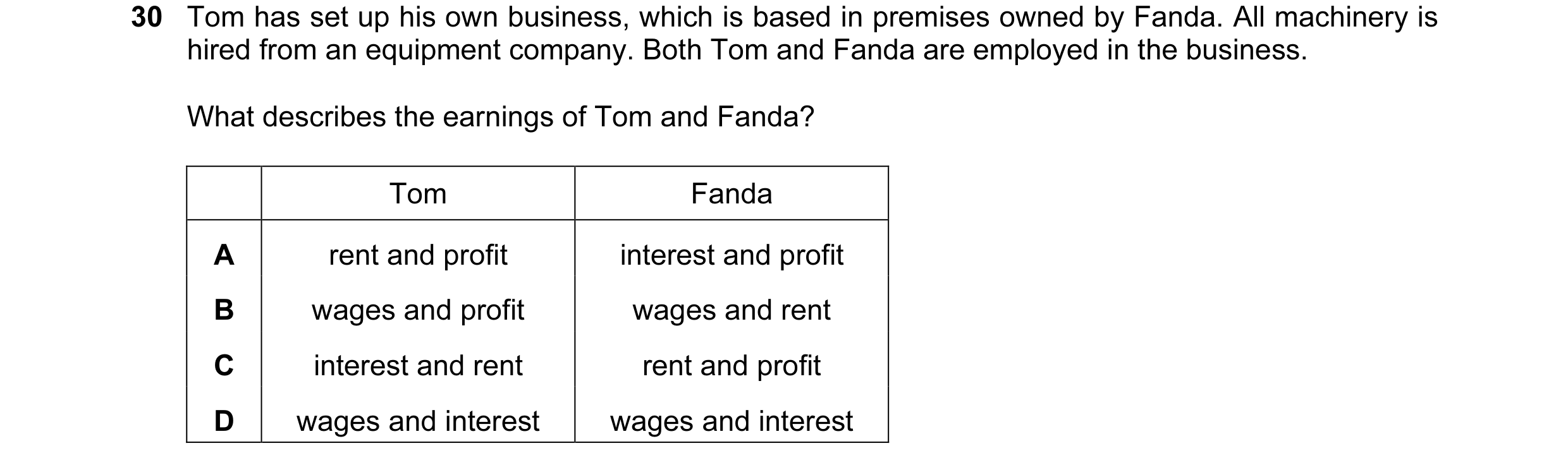
Q6 · Tom has set up his own business, which is based in premises owned by Fanda 9708/11 Oct/Nov 2009
1 Tom has set up his own business, which is based in premises owned by Fanda. All machinery is hired from an equipment company. Both Tom and Fanda are employed in the business. What describes the earnings of Tom and Fanda? Tom Fanda A rent and profit interest and profit B wages and profit wages and rent C interest and rent rent and profit D wages and interest wages and interest
1 marks
Answer: B
This question in 9708/11 Oct/Nov 2009
Q7 · Tom has set up his own business, which is based in premises owned by Fanda 9708/12 Oct/Nov 2009
30 Tom has set up his own business, which is based in premises owned by Fanda. All machinery is hired from an equipment company. Both Tom and Fanda are employed in the business. What describes the earnings of Tom and Fanda? Tom Fanda A rent and profit interest and profit B wages and profit wages and rent C interest and rent rent and profit D wages and interest wages and interest
1 marks
Answer: B
This question in 9708/12 Oct/Nov 2009
Q8 · What distinguishes capital from other factors of production? 9708/11 May/June 2011
2 What distinguishes capital from other factors of production? A Capital exists only in capitalist market economies. B Capital results from the operation of the other factors. C The rewards earned by the owners of capital are uncertain. D Unlike labour or land, capital must be owned rather than hired or rented.
1 marks
Answer: B
This question in 9708/11 May/June 2011
Q9 · What distinguishes capital from other factors of production? 9708/12 May/June 2011
1 What distinguishes capital from other factors of production? A Capital exists only in capitalist market economies. B Capital results from the operation of the other factors. C The rewards earned by the owners of capital are uncertain. D Unlike labour or land, capital must be owned rather than hired or rented.
1 marks
Answer: B
This question in 9708/12 May/June 2011
Q10 · What distinguishes capital from other factors of production? 9708/13 May/June 2011
30 What distinguishes capital from other factors of production? A Capital exists only in capitalist market economies. B Capital results from the operation of the other factors. C The rewards earned by the owners of capital are uncertain. D Unlike labour or land, capital must be owned rather than hired or rented.
1 marks
Answer: B
This question in 9708/13 May/June 2011
Q11 · What is an example of the factor of production capital? 9708/11 Oct/Nov 2011
2 What is an example of the factor of production capital? A a bank account held by a small firm to be used for future purchases B a forest of hardwood trees ideal for furniture making C the market value of a company’s shares D word processing software used by a writer to complete her new book
1 marks
Answer: D
This question in 9708/11 Oct/Nov 2011
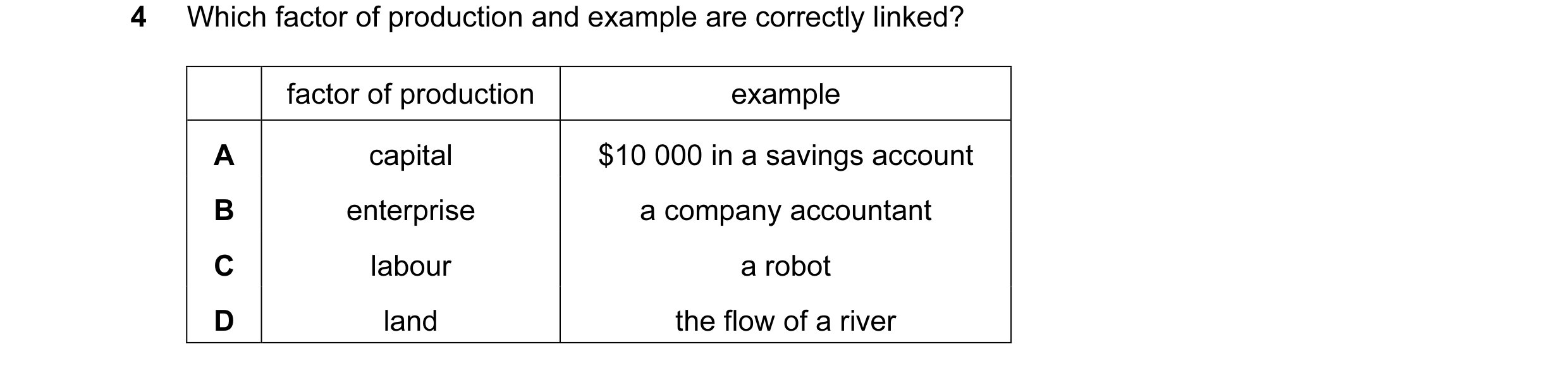
Q12 · Which factor of production and example are correctly linked? 9708/12 Oct/Nov 2011
4 Which factor of production and example are correctly linked? factor of production example A capital $10 000 in a savings account B enterprise a company accountant C labour a robot D land the flow of a river
1 marks
Answer: D
This question in 9708/12 Oct/Nov 2011
Q13 · What is an example of the factor of production capital? 9708/13 Oct/Nov 2011
30 What is an example of the factor of production capital? A a bank account held by a small firm to be used for future purchases B a forest of hardwood trees ideal for furniture making C the market value of a company’s shares D word processing software used by a writer to complete her new book
1 marks
Answer: D
This question in 9708/13 Oct/Nov 2011
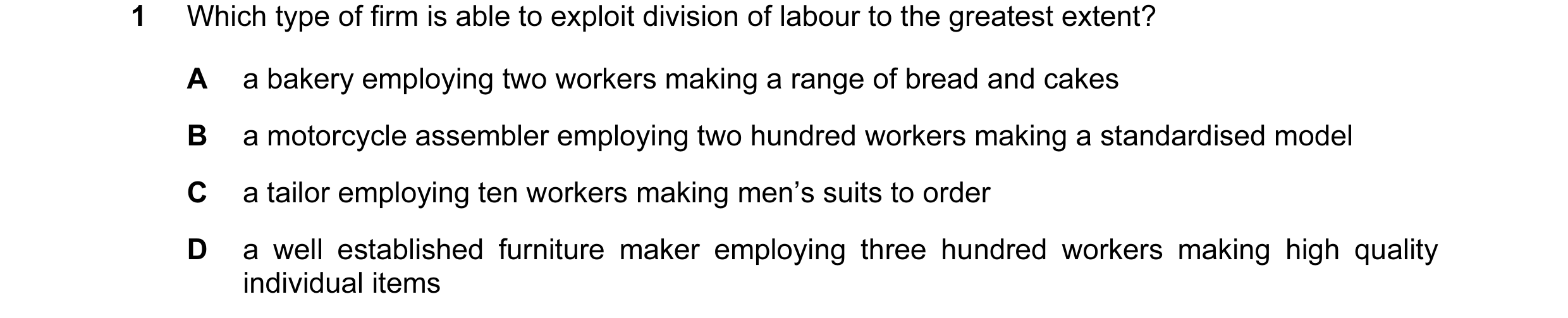
Q14 · Which type of firm is able to exploit division of labour to the greatest extent? 9708/11 Oct/Nov 2012
1 Which type of firm is able to exploit division of labour to the greatest extent? A a bakery employing two workers making a range of bread and cakes B a motorcycle assembler employing two hundred workers making a standardised model C a tailor employing ten workers making men’s suits to order D a well established furniture maker employing three hundred workers making high quality individual items
1 marks
Answer: B
This question in 9708/11 Oct/Nov 2012
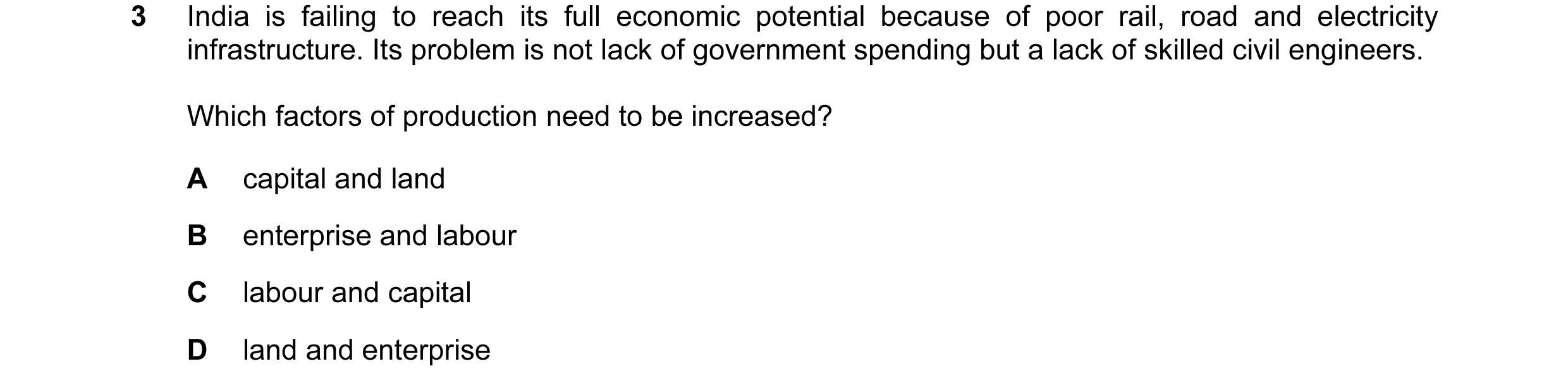
Q15 · India is failing to reach its full economic potential because of poor rail, road and… 9708/11 Oct/Nov 2012
3 India is failing to reach its full economic potential because of poor rail, road and electricity infrastructure. Its problem is not lack of government spending but a lack of skilled civil engineers. Which factors of production need to be increased? A capital and land B enterprise and labour C labour and capital D land and enterprise
1 marks
Answer: C
This question in 9708/11 Oct/Nov 2012
Q16 · Why can division of labour benefit an economy? 9708/13 Oct/Nov 2012
1 Why can division of labour benefit an economy? A Costs of trading are reduced. B Individual workers learn a wider range of skills. C Less money is required as a medium of exchange. D The total supply of goods and services rises.
1 marks
Answer: D
This question in 9708/13 Oct/Nov 2012
Q17 · What is most likely to be a result from the division of labour? 9708/11 May/June 2013
3 What is most likely to be a result from the division of labour? A a decrease in job satisfaction B a decrease in productivity C an increase in the cost of living D an increase in unit labour costs
1 marks
Answer: A
This question in 9708/11 May/June 2013
Q18 · A government minister states that the main economic benefit of locating a new factory in… 9708/12 May/June 2013
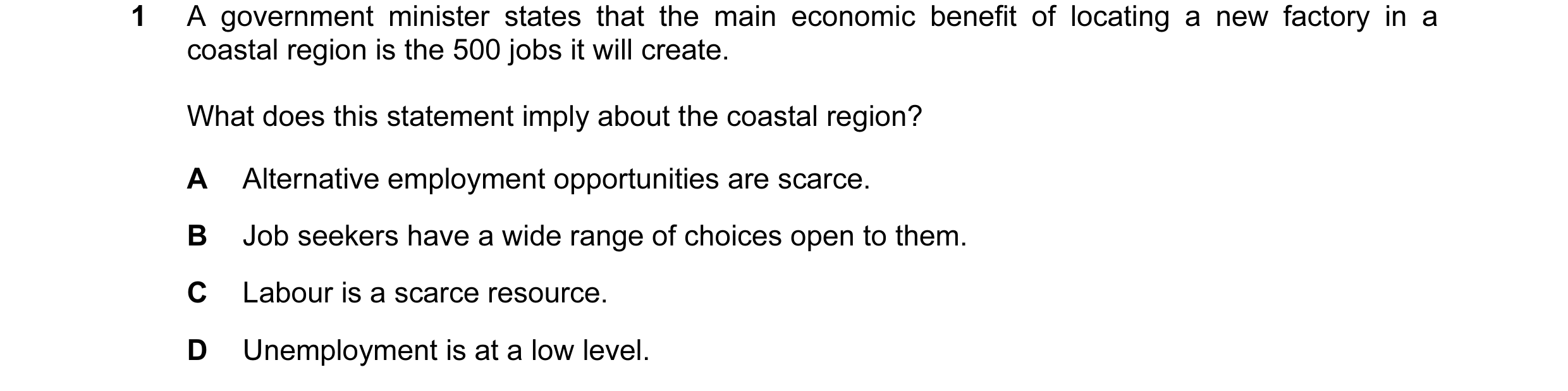
1 A government minister states that the main economic benefit of locating a new factory in a coastal region is the 500 jobs it will create. What does this statement imply about the coastal region? A Alternative employment opportunities are scarce. B Job seekers have a wide range of choices open to them. C Labour is a scarce resource. D Unemployment is at a low level.
1 marks
Answer: A
This question in 9708/12 May/June 2013
Q19 · A kitchen manufacturer wanted to become more efficient 9708/12 May/June 2013
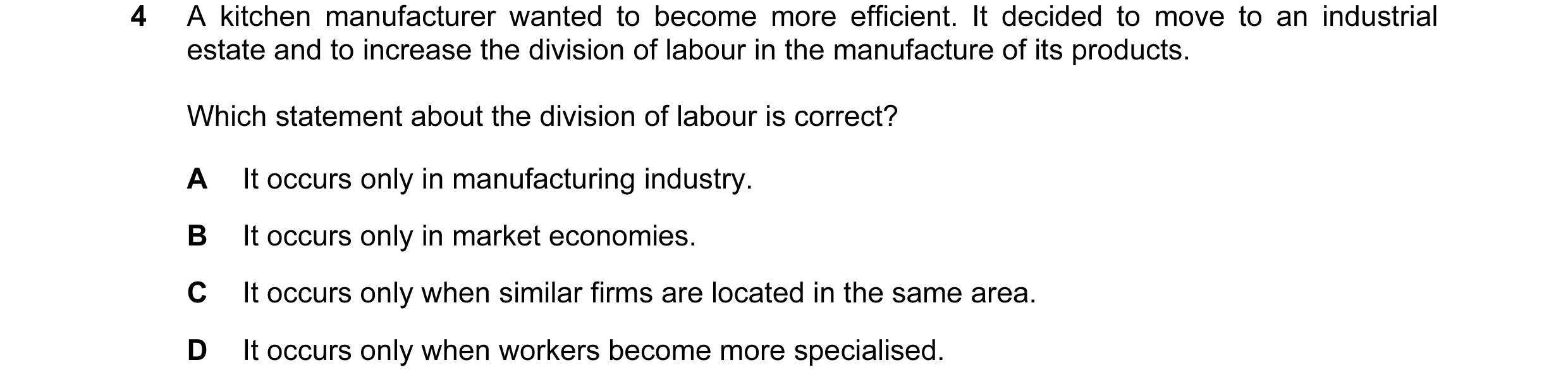
4 A kitchen manufacturer wanted to become more efficient. It decided to move to an industrial estate and to increase the division of labour in the manufacture of its products. Which statement about the division of labour is correct? A It occurs only in manufacturing industry. B It occurs only in market economies. C It occurs only when similar firms are located in the same area. D It occurs only when workers become more specialised.
1 marks
Answer: D
This question in 9708/12 May/June 2013
Q20 · What will encourage a higher degree of division of labour? 9708/11 Oct/Nov 2013
1 What will encourage a higher degree of division of labour? A firms wishing for a greater level of self-sufficiency B firms wishing to increase their flexibility in production C firms wishing to raise their level of productivity D firms wishing to reduce their level of risk
1 marks
Answer: C
This question in 9708/11 Oct/Nov 2013
Q21 · Which statement about factors of production is correct? 9708/11 Oct/Nov 2013
3 Which statement about factors of production is correct? A All factors of production can earn income for their owner. B The factor capital includes human capital, money capital and physical capital. C The factor labour involves only physical effort. D The natural resources classed as land are in unlimited supply.
1 marks
Answer: A
This question in 9708/11 Oct/Nov 2013
Q22 · The table shows the number of workers employed by four firms in the same industry, the… 9708/11 Oct/Nov 2013
23 The table shows the number of workers employed by four firms in the same industry, the average number of hours worked each day and the total output each firm produces each day. Which firm’s workers have the highest productivity? average number number of total output per of hours worked workers day (units) per day A 4 8 320 B 5 7 420 C 6 7 462 D 7 9 630
1 marks
Answer: B
This question in 9708/11 Oct/Nov 2013
Q23 · ‘From the age of twelve I made a living by buying towels, needles, shampoo and soap and… 9708/12 Oct/Nov 2013
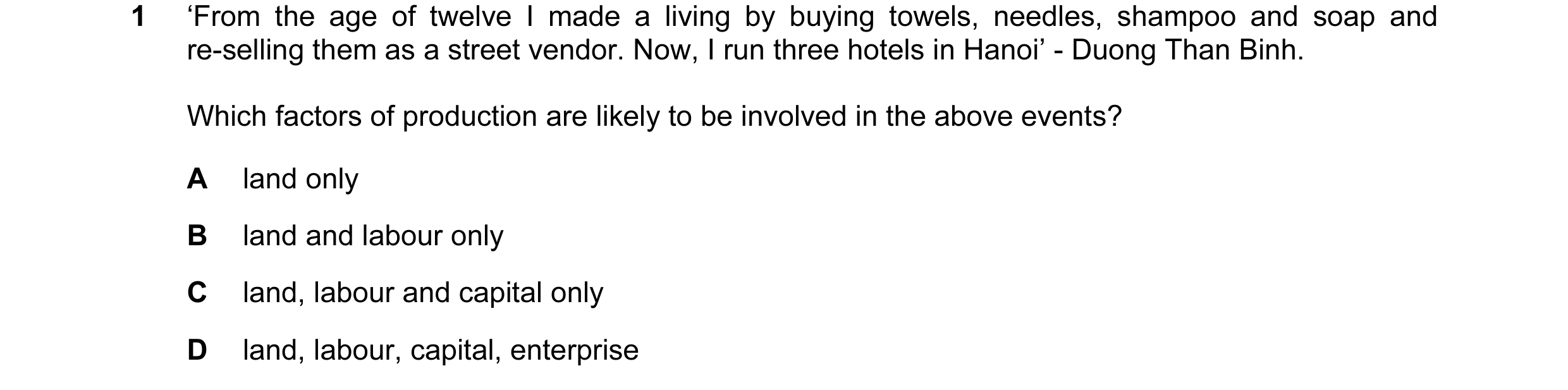
1 ‘From the age of twelve I made a living by buying towels, needles, shampoo and soap and re-selling them as a street vendor. Now, I run three hotels in Hanoi’ - Duong Than Binh. Which factors of production are likely to be involved in the above events? A land only B land and labour only C land, labour and capital only D land, labour, capital, enterprise
1 marks
Answer: D
This question in 9708/12 Oct/Nov 2013
Q24 · What is not a factor of production? 9708/13 Oct/Nov 2013
1 What is not a factor of production? A fish stocks B money C oil reserves D roads
1 marks
Answer: B
This question in 9708/13 Oct/Nov 2013
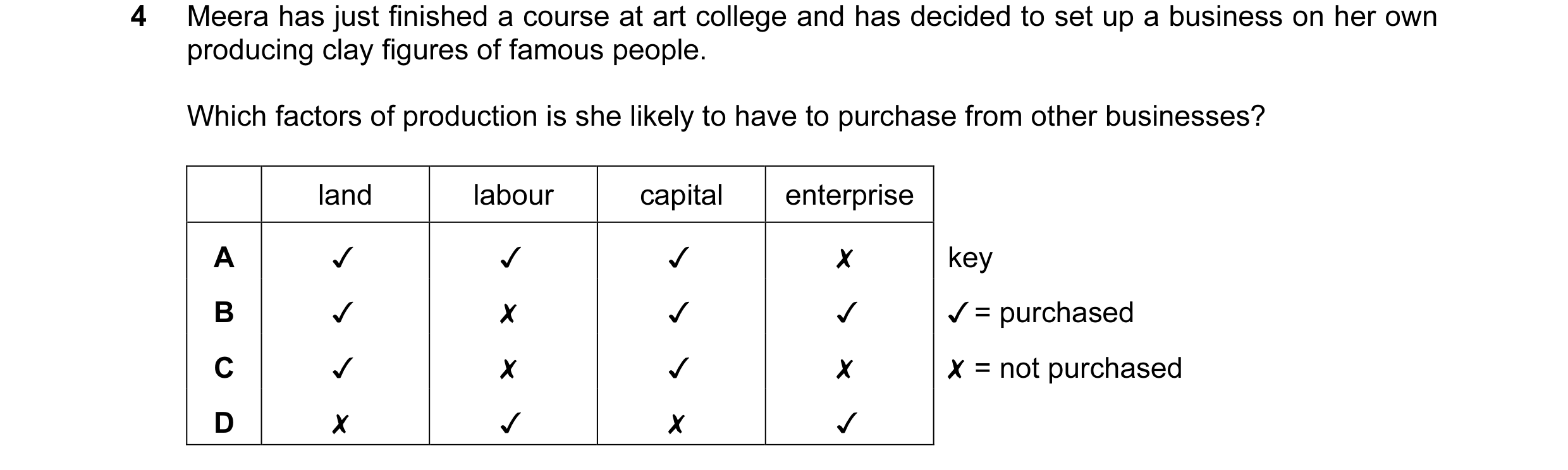
Q25 · Meera has just finished a course at art college and has decided to set up a business on… 9708/12 May/June 2014
4 Meera has just finished a course at art college and has decided to set up a business on her own
producing clay figures of famous people.
Which factors of production is she likely to have to purchase from other businesses?
land labour capital enterprise
A v v v x
B v x v v
Cc v x v x
D x v x v
key
/¥ = purchased
X = not purchased
1 marks
Answer: C
This question in 9708/12 May/June 2014
Q26 · In the twentieth century the nature of a typical car assembly plant changed 9708/11 Oct/Nov 2014
3 In the twentieth century the nature of a typical car assembly plant changed. The industry had fewer firms, they operated on larger sites and they had more automated machinery. How is this change most likely to have affected the relative use of factors of production in the industry? increased relative use decreased relative use A capital and enterprise labour and land B enterprise and labour land and capital C labour and land capital and enterprise D land and capital enterprise and labour
1 marks
This question in 9708/11 Oct/Nov 2014
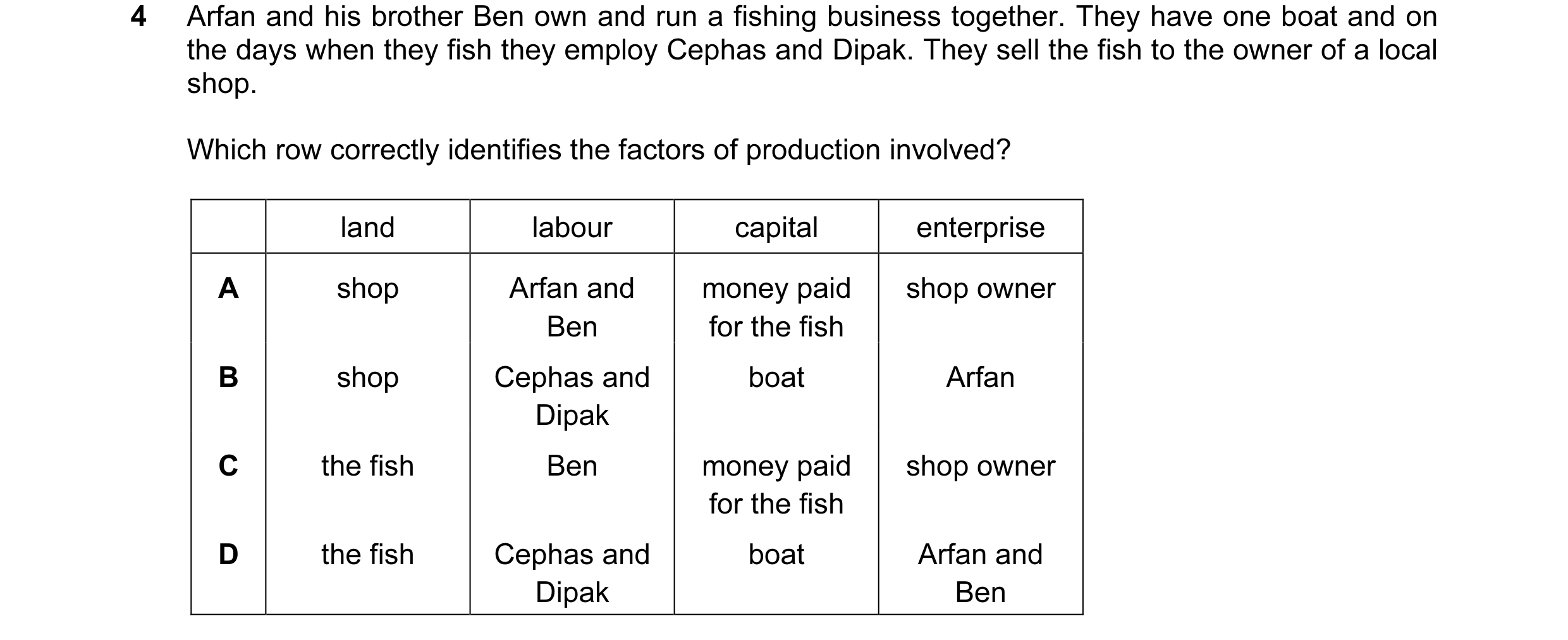
Q27 · Arfan and his brother Ben own and run a fishing business together 9708/12 Oct/Nov 2014
4 Arfan and his brother Ben own and run a fishing business together. They have one boat and on the days when they fish they employ Cephas and Dipak. They sell the fish to the owner of a local shop. Which row correctly identifies the factors of production involved? land labour capital enterprise A shop Arfan and money paid shop owner Ben for the fish B shop Cephas and boat Arfan Dipak C the fish Ben money paid shop owner for the fish D the fish Cephas and boat Arfan and Dipak Ben
1 marks
Answer: D
This question in 9708/12 Oct/Nov 2014
Q28 · Which statement about factors of production is correct? 9708/13 Oct/Nov 2014
3 Which statement about factors of production is correct? A All economic output requires the use of four factors of production. B Capital may take the form of shares in a manufacturing company. C Enterprise can only be found in owner-run organisations. D Land includes both renewable and non-renewable resources.
1 marks
Answer: D
This question in 9708/13 Oct/Nov 2014
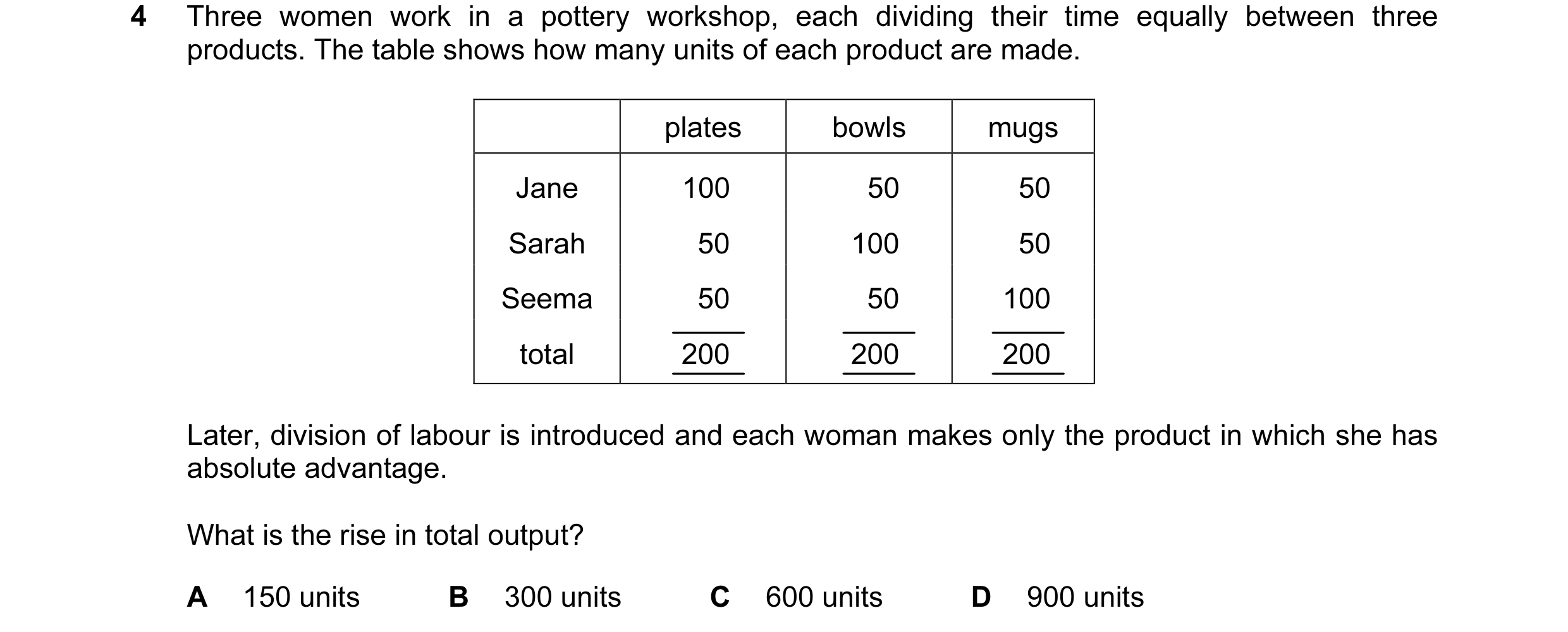
Q29 · Three women work in a pottery workshop, each dividing their time equally between three… 9708/12 May/June 2015
4 Three women work in a pottery workshop, each dividing their time equally between three products. The table shows how many units of each product are made. plates bowls mugs Jane 100 50 50 Sarah 50 100 50 Seema 50 50 100 total 200 200 200 Later, division of labour is introduced and each woman makes only the product in which she has absolute advantage. What is the rise in total output? A 150 units B 300 units C 600 units D 900 units
1 marks
Answer: B
This question in 9708/12 May/June 2015
Q30 · Company X reduces its workers from 250 to 200 and as a result its output decreases from… 9708/12 May/June 2015
23 Company X reduces its workers from 250 to 200 and as a result its output decreases from 5000 to 4800 units per day. Company Y increases its workers from 800 to 1000 and as a result its output increases from 2000 to 2200 units per day. What happens to labour productivity of the workers in the two companies? company X company Y A falls rises B rises falls C rises rises D falls falls
1 marks
Answer: B
This question in 9708/12 May/June 2015
Q31 · What term is used by economists for the income received by the factor of production… 9708/12 Oct/Nov 2015
4 What term is used by economists for the income received by the factor of production enterprise? A capital B interest C profit D revenue
1 marks
Answer: C
This question in 9708/12 Oct/Nov 2015
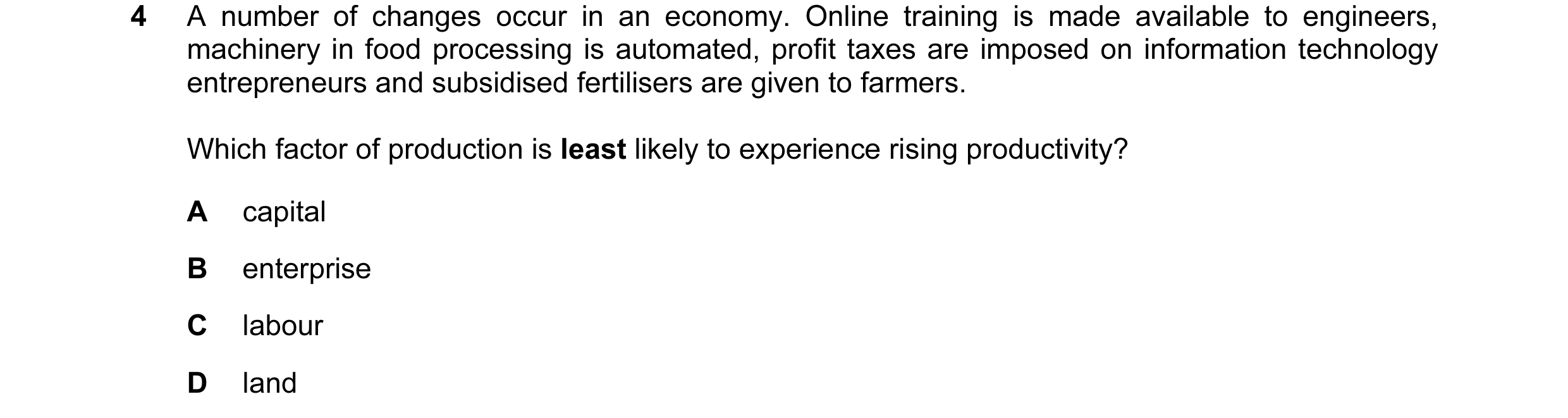
Q32 · A number of changes occur in an economy 9708/13 Oct/Nov 2015
4 A number of changes occur in an economy. Online training is made available to engineers, machinery in food processing is automated, profit taxes are imposed on information technology entrepreneurs and subsidised fertilisers are given to farmers. Which factor of production is least likely to experience rising productivity? A capital B enterprise C labour D land
1 marks
Answer: B
This question in 9708/13 Oct/Nov 2015
Q33 · What is necessary for effective specialisation? 9708/12 May/June 2016
2 What is necessary for effective specialisation? A a barter system B a medium of exchange C a production possibility curve D a system of trade protection
1 marks
Answer: B
This question in 9708/12 May/June 2016
Q34 · The curve PP in the diagram is the production possibility curve for a country producing… 9708/13 May/June 2016
3 The curve PP in the diagram is the production possibility curve for a country producing goods X and Y. The production of X is more labour-intensive than the production of Y. R Q P S good Y T O S T P R Q good X The working hours of the labour force are reduced by law. Which curve could be the country’s new production possibility curve? A TT B SS C QQ D RR
1 marks
Answer: B
This question in 9708/13 May/June 2016
Q35 · What is most important for the effective operation of the division of labour in a modern… 9708/12 Feb/March 2017
2 What is most important for the effective operation of the division of labour in a modern economy? A a supply of money B finance from the government C highly qualified entrepreneurs D integrated transport systems
1 marks
Answer: A
This question in 9708/12 Feb/March 2017
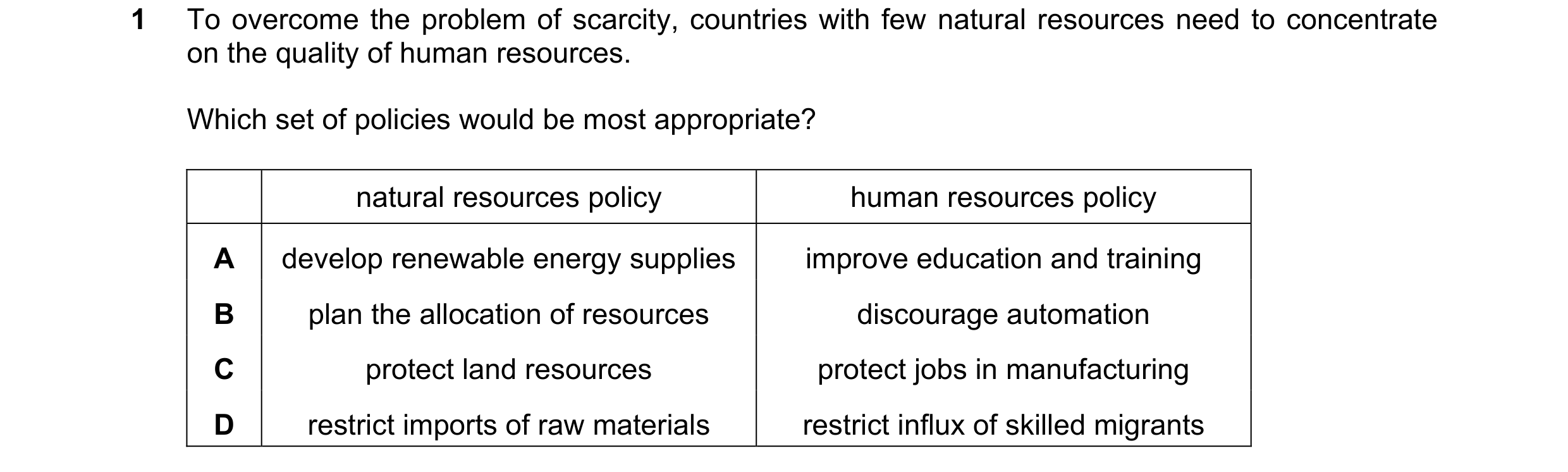
Q36 · To overcome the problem of scarcity, countries with few natural resources need to… 9708/12 Oct/Nov 2017
1 To overcome the problem of scarcity, countries with few natural resources need to concentrate on the quality of human resources. Which set of policies would be most appropriate? natural resources policy human resources policy A develop renewable energy supplies improve education and training B plan the allocation of resources discourage automation C protect land resources protect jobs in manufacturing D restrict imports of raw materials restrict influx of skilled migrants
1 marks
Answer: A
This question in 9708/12 Oct/Nov 2017
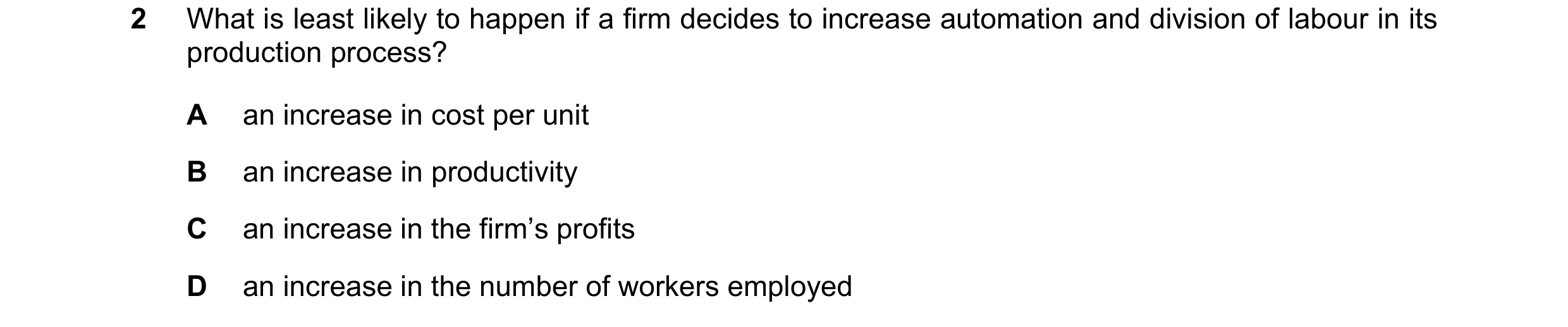
Q37 · What is least likely to happen if a firm decides to increase automation and division of… 9708/13 Oct/Nov 2017
2 What is least likely to happen if a firm decides to increase automation and division of labour in its production process? A an increase in cost per unit B an increase in productivity C an increase in the firm’s profits D an increase in the number of workers employed
1 marks
Answer: A
This question in 9708/13 Oct/Nov 2017
Q38 · A firm changes the type of product it produces 9708/13 May/June 2018
3 A firm changes the type of product it produces. What might limit the firm’s ability to use division of labour? A The new production method is more capital intensive. B The new production method is very expensive. C The new product is made to specific customer requirements. D The new product requires specialised labour.
1 marks
Answer: C
This question in 9708/13 May/June 2018
Q39 · What is not an example of the role of the factor enterprise in a modern economy? 9708/11 Oct/Nov 2018
2 What is not an example of the role of the factor enterprise in a modern economy? A deciding on new export markets for the company’s goods and services B making payments to suppliers for raw materials and capital goods C reducing costs through the introduction of a new shift system for employees D transforming the production process with the introduction of robots
1 marks
Answer: B
This question in 9708/11 Oct/Nov 2018
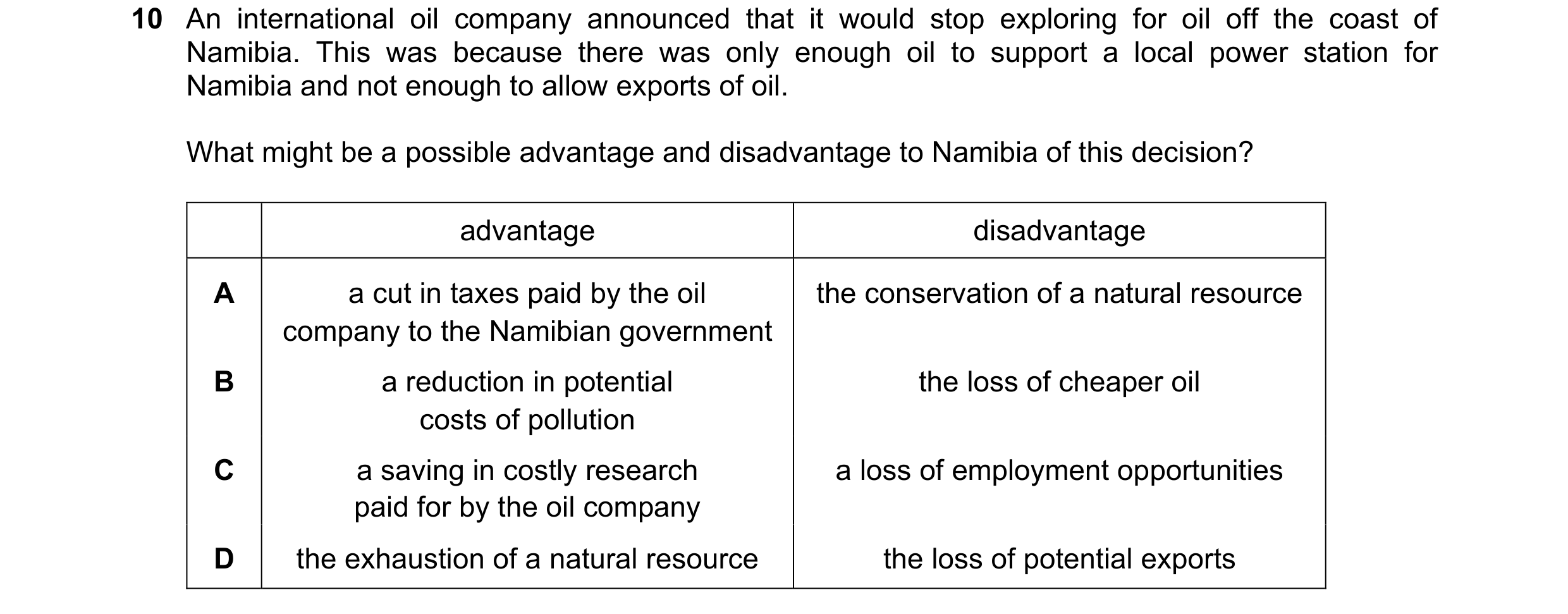
Q40 · An international oil company announced that it would stop exploring for oil off the coast… 9708/13 Oct/Nov 2018
10 An international oil company announced that it would stop exploring for oil off the coast of Namibia. This was because there was only enough oil to support a local power station for Namibia and not enough to allow exports of oil. What might be a possible advantage and disadvantage to Namibia of this decision? advantage disadvantage A a cut in taxes paid by the oil the conservation of a natural resource company to the Namibian government B a reduction in potential the loss of cheaper oil costs of pollution C a saving in costly research a loss of employment opportunities paid for by the oil company D the exhaustion of a natural resource the loss of potential exports
1 marks
Answer: B
This question in 9708/13 Oct/Nov 2018
Q41 · Which outcome depends upon the division of labour? 9708/12 Feb/March 2019
1 Which outcome depends upon the division of labour? A a decrease in boredom at work B a decrease in comparative advantage C a decrease in efficiency D a decrease in opportunity cost
1 marks
Answer: D
This question in 9708/12 Feb/March 2019
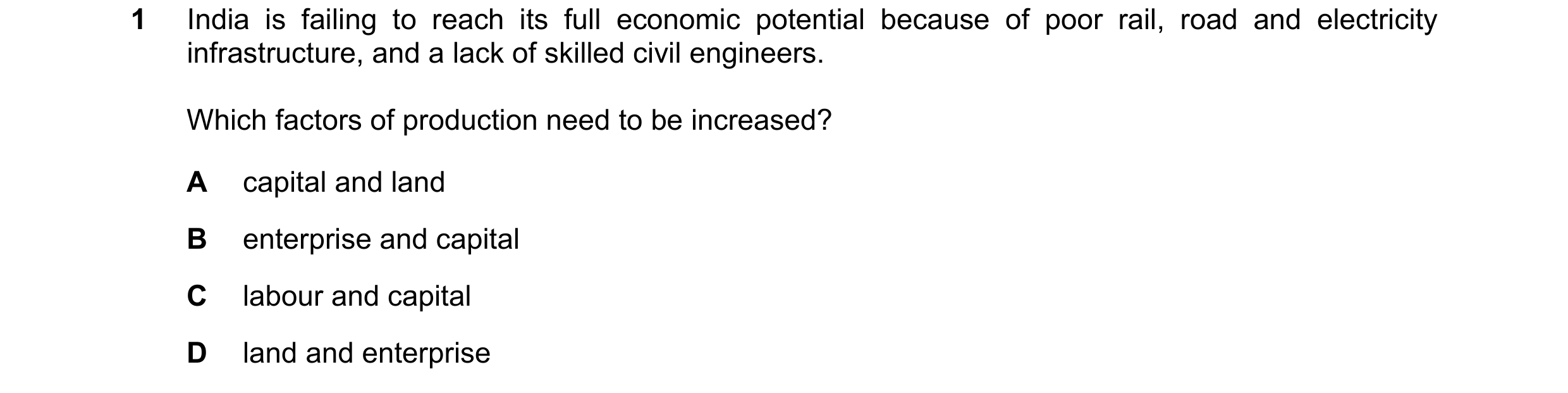
Q42 · India is failing to reach its full economic potential because of poor rail, road and… 9708/11 May/June 2019
1 India is failing to reach its full economic potential because of poor rail, road and electricity infrastructure, and a lack of skilled civil engineers. Which factors of production need to be increased? A capital and land B enterprise and capital C labour and capital D land and enterprise
1 marks
Answer: C
This question in 9708/11 May/June 2019
Q43 · Hunters in Mozambique want to extract wild honey from beehives 9708/12 May/June 2019
8 Hunters in Mozambique want to extract wild honey from beehives. They find the beehives by following birds known as honeyguide birds who want the beeswax that is also found in the beehives. What does this suggest? A Hunters and honeyguide birds are rival consumers. B Wild honey and beeswax are free goods. C Wild honey and beeswax are in joint supply. D Wild honey is the opportunity cost of beeswax.
1 marks
Answer: C
This question in 9708/12 May/June 2019
Q44 · Which statement is correct? 9708/13 May/June 2019
2 Which statement is correct? A In the short run all factors of production are fixed; in the long run all factors are varied. B In the short run at least one factor is fixed; in the long run all factors can be varied. C In the short run at least one factor is varied; in the long run all factors are fixed. D In the short run at least one factor is varied; in the long run at least one factor is fixed.
1 marks
Answer: B
This question in 9708/13 May/June 2019
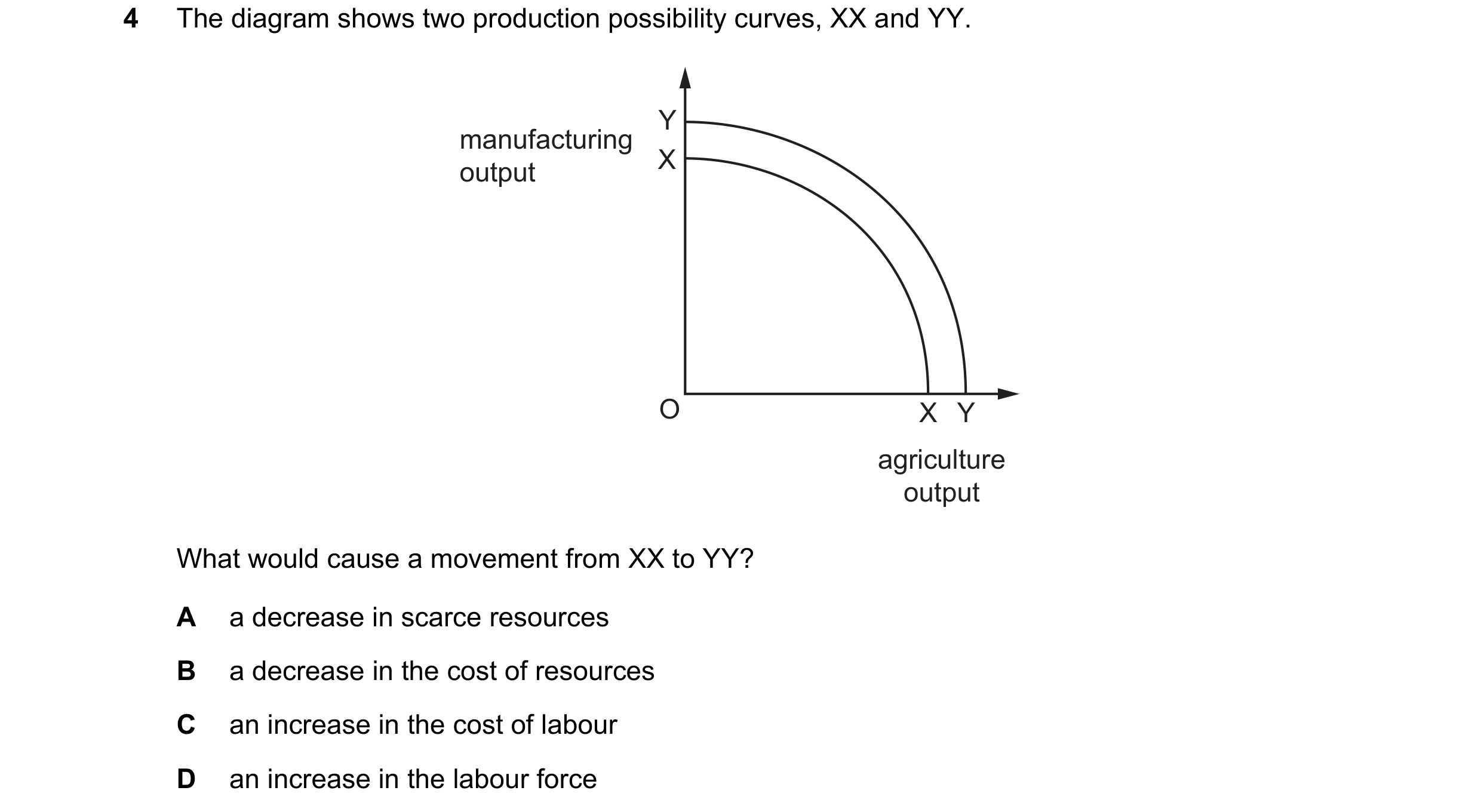
Q45 · The diagram shows two production possibility curves, XX and YY 9708/11 Oct/Nov 2019
4 The diagram shows two production possibility curves, XX and YY. Y manufacturing output X O X Y agriculture output What would cause a movement from XX to YY? A a decrease in scarce resources B a decrease in the cost of resources C an increase in the cost of labour D an increase in the labour force
1 marks
Answer: D
This question in 9708/11 Oct/Nov 2019
Q46 · What is meant by the division of labour? 9708/11 May/June 2020
4 What is meant by the division of labour? A Each worker specialises in a different task in production. B Some workers work part-time and others work full-time. C The same amount of output per hour is produced by each worker. D Workers divide their time between different jobs.
1 marks
Answer: A
This question in 9708/11 May/June 2020
Q47 · A factory introduces an automated production line to take advantage of division of labour 9708/12 May/June 2020
3 A factory introduces an automated production line to take advantage of division of labour. What is most likely to increase? A average cost of production B job satisfaction of workers C range of skills of each worker D worker productivity
1 marks
Answer: D
This question in 9708/12 May/June 2020
Q48 · Abdul earns $50 000 a year working as a teacher 9708/13 May/June 2020
2 Abdul earns $50 000 a year working as a teacher. He owns a house valued at $250 000 and has shares worth $20 000. He has a current bank account with a balance of $1500 and $200 in his wallet. In his house there is a jar containing $100, which he has saved to spend on his forthcoming holiday. What is the value of Abdul’s liquid assets? A $200 B $300 C $1800 D $21 500
1 marks
Answer: C
This question in 9708/13 May/June 2020
Q49 · What do economists regard as the reward for taking risks and organising production? 9708/13 May/June 2021
3 What do economists regard as the reward for taking risks and organising production? A enterprise B interest C wages D profit
1 marks
Answer: D
This question in 9708/13 May/June 2021
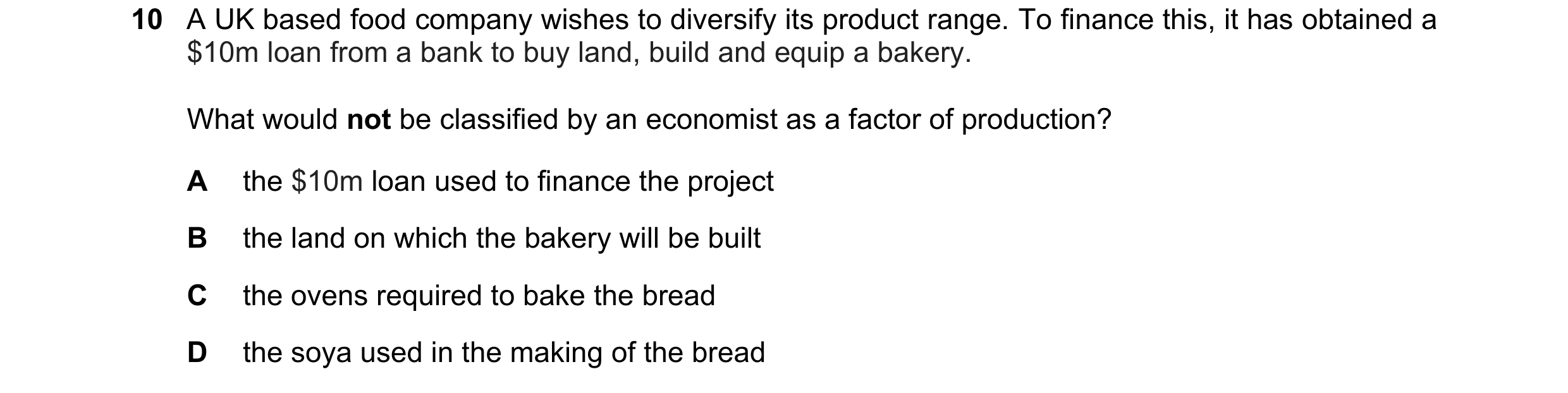
Q50 · A UK based food company wishes to diversify its product range 9708/13 May/June 2021
10 A UK based food company wishes to diversify its product range. To finance this, it has obtained a $10m loan from a bank to buy land, build and equip a bakery. What would not be classified by an economist as a factor of production? A the $10m loan used to finance the project B the land on which the bakery will be built C the ovens required to bake the bread D the soya used in the making of the bread
1 marks
Answer: A
This question in 9708/13 May/June 2021
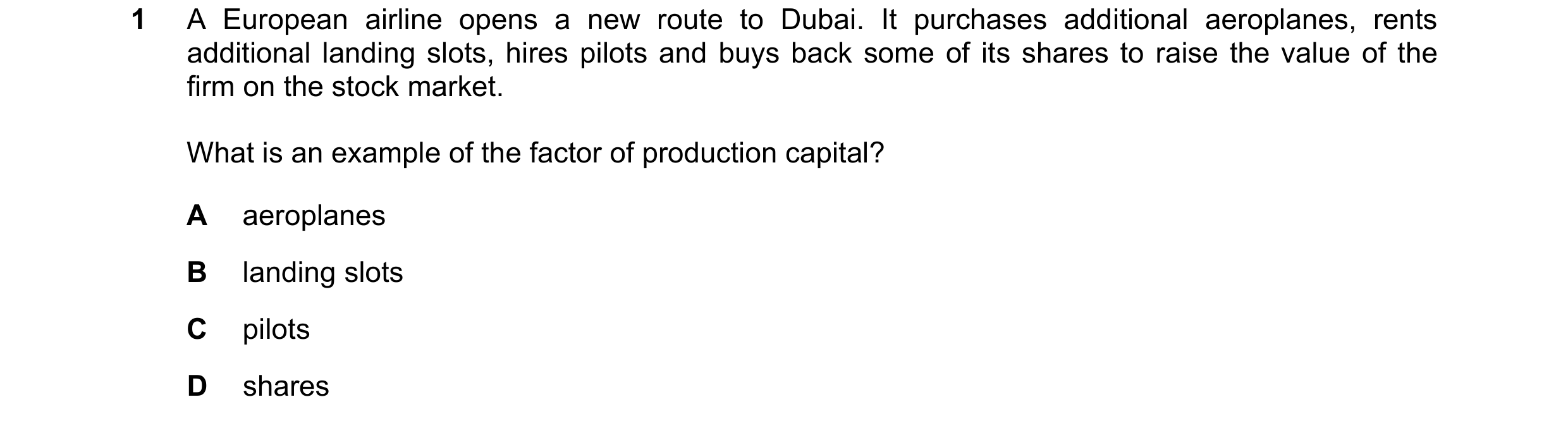
Q51 · A European airline opens a new route to Dubai 9708/11 Oct/Nov 2021
1 A European airline opens a new route to Dubai. It purchases additional aeroplanes, rents additional landing slots, hires pilots and buys back some of its shares to raise the value of the firm on the stock market. What is an example of the factor of production capital? A aeroplanes B landing slots C pilots D shares
1 marks
Answer: A
This question in 9708/11 Oct/Nov 2021
Q52 · The table provides information on entrepreneurship among males in three countries in 2013 9708/11 Oct/Nov 2021
3 The table provides information on entrepreneurship among males in three countries in 2013. percentage of males percentage of males with access to with access to training on how to finance to start start a business (%) a business (%) Italy 19.1 10.3 Japan 31.3 34.0 Sweden 61.6 49.7 What can be concluded from the table? A In Sweden, it is easier for male entrepreneurs to get training than finance. B It is always more difficult for male entrepreneurs to get finance than training. C Italy provides less money for male entrepreneurs than Japan or Sweden. D Sweden has more male entrepreneurs than Italy or Japan.
1 marks
Answer: A
This question in 9708/11 Oct/Nov 2021
Q53 · Which statement about the factors of production is correct? 9708/12 Oct/Nov 2021
4 Which statement about the factors of production is correct? A The factor capital includes shares and deposit accounts at banks. B The factor labour includes human-made resources. C The factor land includes forests and undiscovered copper. D The factor enterprise takes risks and is rewarded with interest.
1 marks
Answer: C
This question in 9708/12 Oct/Nov 2021
Q54 · What is definitely not involved when a transfer payment is made? 9708/12 May/June 2022
17 What is definitely not involved when a transfer payment is made? A bank deposits B cash C government D production
1 marks
Answer: D
This question in 9708/12 May/June 2022
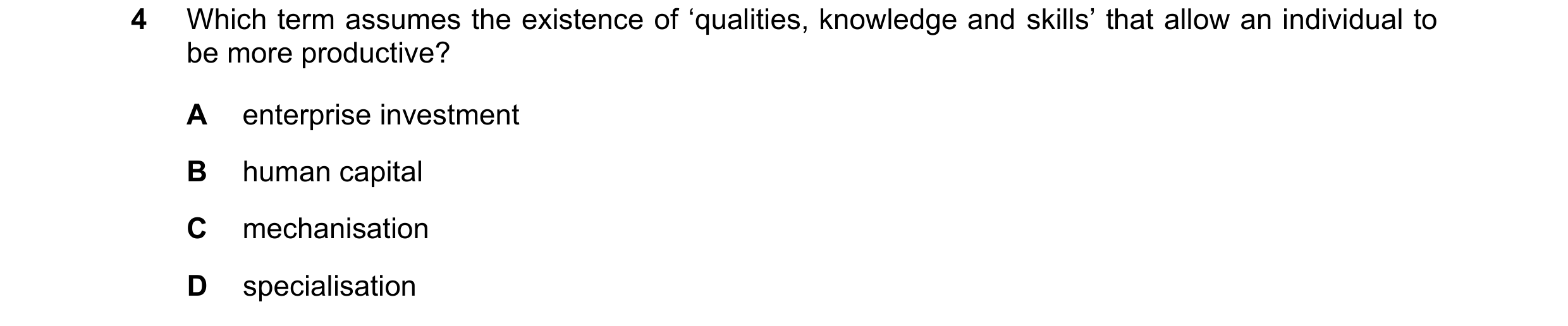
Q55 · Which term assumes the existence of ‘qualities, knowledge and skills’ that allow an… 9708/13 May/June 2022
4 Which term assumes the existence of ‘qualities, knowledge and skills’ that allow an individual to be more productive? A enterprise investment B human capital C mechanisation D specialisation
1 marks
Answer: B
This question in 9708/13 May/June 2022
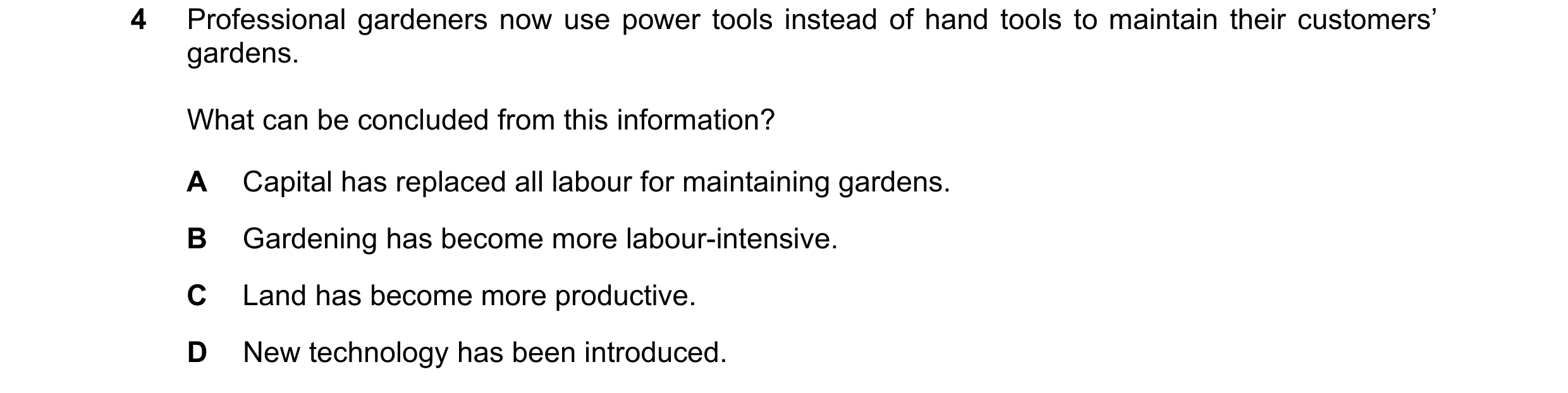
Q56 · Professional gardeners now use power tools instead of hand tools to maintain their… 9708/14 May/June 2022
4 Professional gardeners now use power tools instead of hand tools to maintain their customers’ gardens. What can be concluded from this information? A Capital has replaced all labour for maintaining gardens. B Gardening has become more labour-intensive. C Land has become more productive. D New technology has been introduced.
1 marks
Answer: D
This question in 9708/14 May/June 2022
Q57 · Which action would not raise the quality of the particular factor of production? 9708/13 Oct/Nov 2022
1 Which action would not raise the quality of the particular factor of production? A capital – operating a machine continuously at full capacity B enterprise – providing risk management advice C land – increasing the use of fertilisers D labour – making apprenticeships and training compulsory
1 marks
Answer: A
This question in 9708/13 Oct/Nov 2022
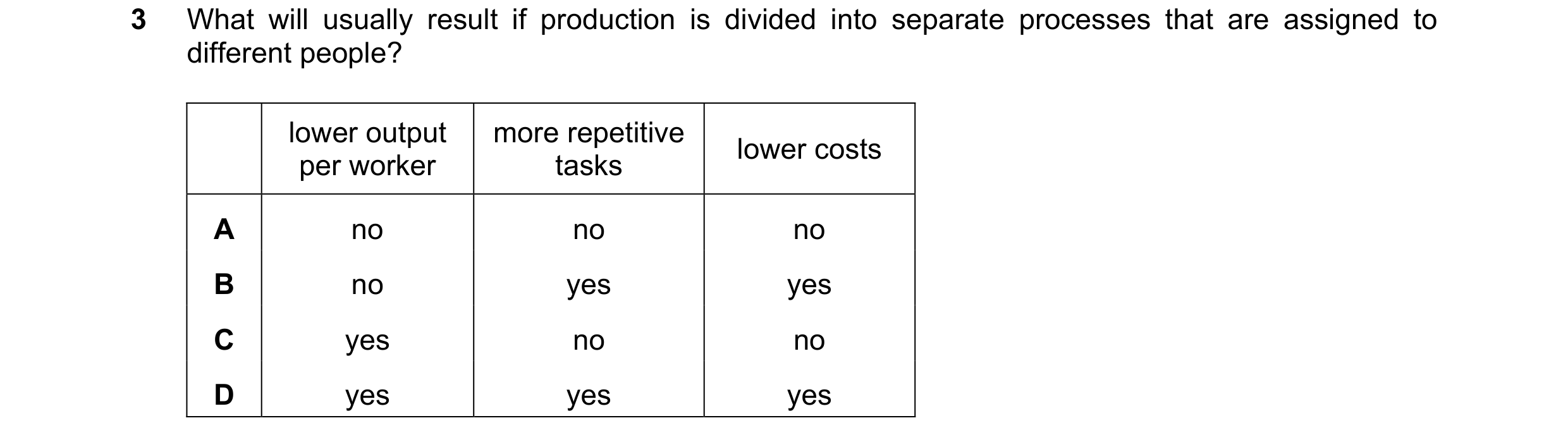
Q58 · What will usually result if production is divided into separate processes that are… 9708/13 Oct/Nov 2022
3 What will usually result if production is divided into separate processes that are assigned to different people? lower output more repetitive lower costs per worker tasks A no no no B no yes yes C yes no no D yes yes yes
1 marks
Answer: B
This question in 9708/13 Oct/Nov 2022
Q59 · What is ‘a produced means of further production’? 9708/11 May/June 2023
1 What is ‘a produced means of further production’? A capital B enterprise C labour D land
1 marks
Answer: A
This question in 9708/11 May/June 2023
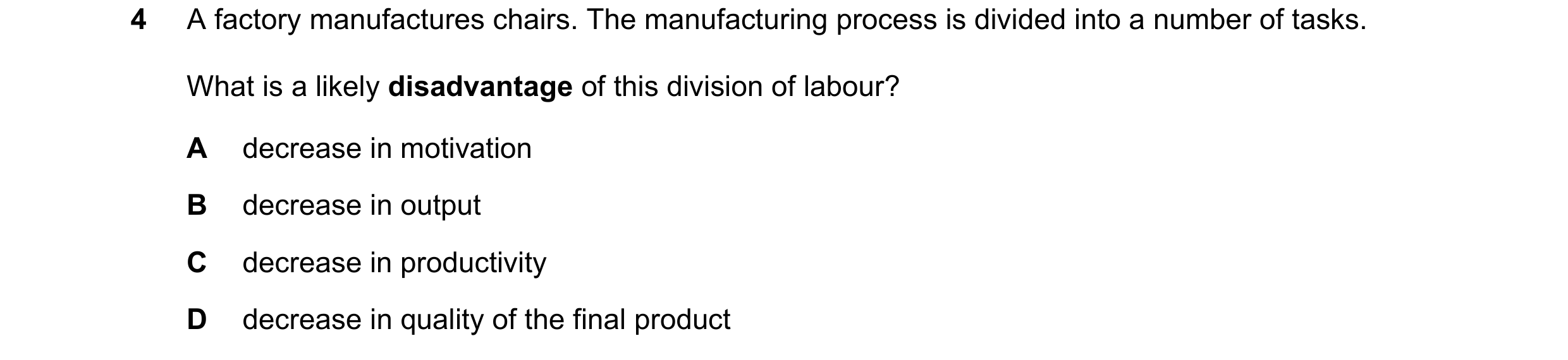
Q60 · A factory manufactures chairs 9708/11 May/June 2023
4 A factory manufactures chairs. The manufacturing process is divided into a number of tasks. What is a likely disadvantage of this division of labour? A decrease in motivation B decrease in output C decrease in productivity D decrease in quality of the final product
1 marks
Answer: A
This question in 9708/11 May/June 2023
Q61 · Which factor of production is needed first in order to set up a new business? 9708/12 May/June 2023
1 Which factor of production is needed first in order to set up a new business? A capital B enterprise C labour D land
1 marks
Answer: B
This question in 9708/12 May/June 2023
Q62 · What is not likely to result from the use of division of labour? 9708/12 May/June 2023
4 What is not likely to result from the use of division of labour? A a decrease in average costs B an increase in motivation C an increase in productivity D an improvement in quality of the final product
1 marks
Answer: B
This question in 9708/12 May/June 2023
Q63 · Which economic conditions are likely to encourage an increase in enterprise? 9708/13 May/June 2023
4 Which economic conditions are likely to encourage an increase in enterprise? consumer interest rates profit tax unemployment confidence A high high high high B high low low high C low low high low D low low low low
1 marks
Answer: C
This question in 9708/13 May/June 2023
Q64 · What is considered the essential requirement for all entrepreneurs? 9708/12 Oct/Nov 2023
2 What is considered the essential requirement for all entrepreneurs? A attracting customers B buying stock C managing staff D taking risks
1 marks
Answer: D
This question in 9708/12 Oct/Nov 2023
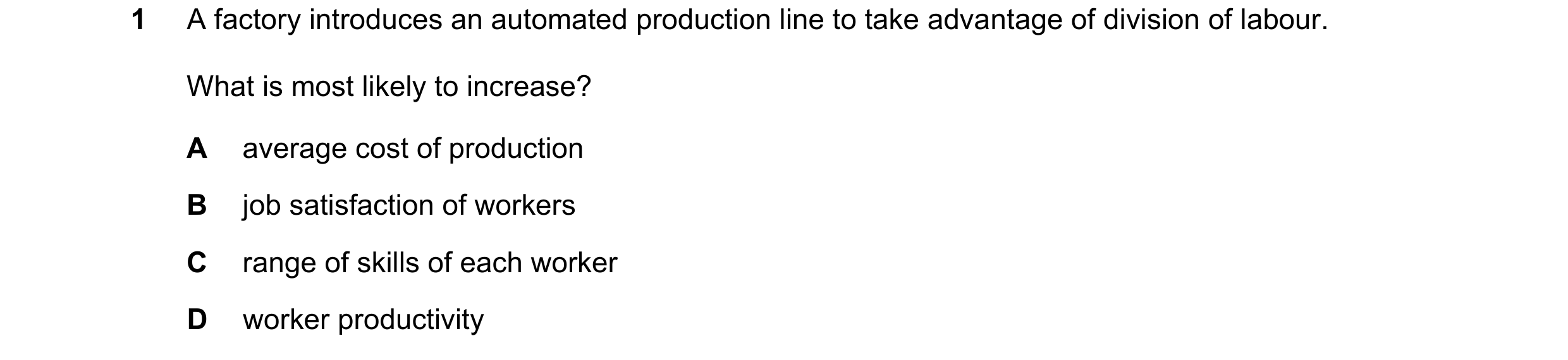
Q65 · A factory introduces an automated production line to take advantage of division of labour 9708/13 Oct/Nov 2023
1 A factory introduces an automated production line to take advantage of division of labour. What is most likely to increase? A average cost of production B job satisfaction of workers C range of skills of each worker D worker productivity
1 marks
Answer: D
This question in 9708/13 Oct/Nov 2023
Q66 · Why does a production possibility curve exist for every economy? 9708/12 Feb/March 2024
1 Why does a production possibility curve exist for every economy? A Resources are unlimited. B Resources have alternative uses. C Some resources can be imported. D Some resources may be unemployed.
1 marks
Answer: B
This question in 9708/12 Feb/March 2024
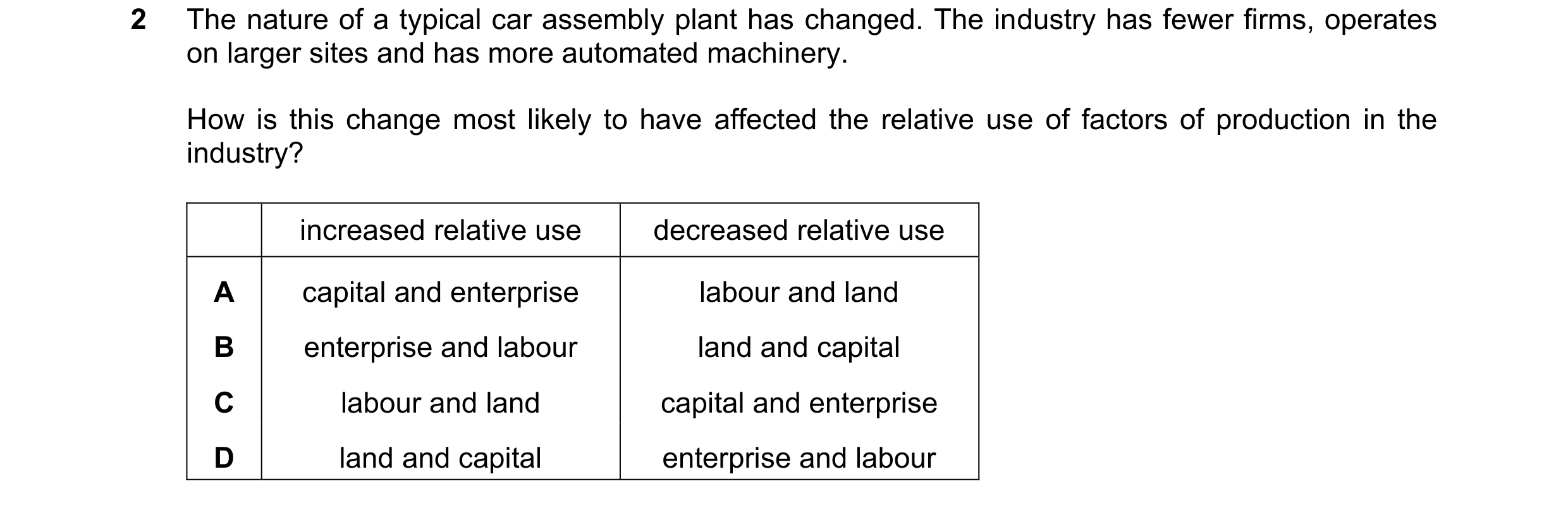
Q67 · The nature of a typical car assembly plant has changed 9708/11 May/June 2024
2 The nature of a typical car assembly plant has changed. The industry has fewer firms, operates on larger sites and has more automated machinery. How is this change most likely to have affected the relative use of factors of production in the industry? increased relative use decreased relative use A capital and enterprise labour and land B enterprise and labour land and capital C labour and land capital and enterprise D land and capital enterprise and labour
1 marks
Answer: D
This question in 9708/11 May/June 2024
Q68 · Which item would be least likely to be classed as land? 9708/11 May/June 2024
3 Which item would be least likely to be classed as land? A fertilisers B fisheries C forests D coal
1 marks
Answer: A
This question in 9708/11 May/June 2024
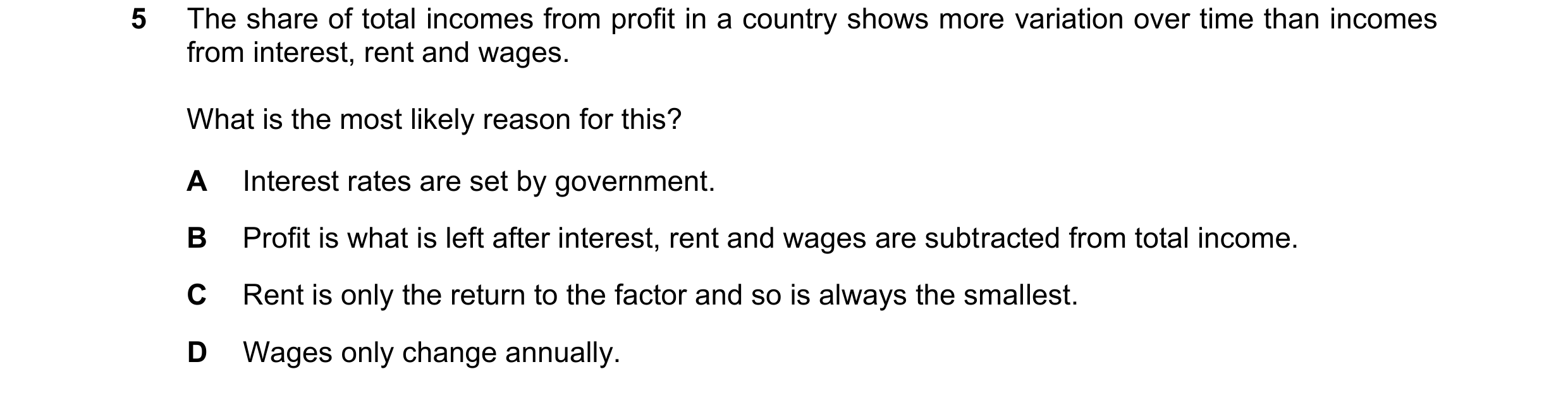
Q69 · The share of total incomes from profit in a country shows more variation over time than… 9708/12 May/June 2024
5 The share of total incomes from profit in a country shows more variation over time than incomes from interest, rent and wages. What is the most likely reason for this? A Interest rates are set by government. B Profit is what is left after interest, rent and wages are subtracted from total income. C Rent is only the return to the factor and so is always the smallest. D Wages only change annually.
1 marks
Answer: B
This question in 9708/12 May/June 2024
Q70 · What will encourage a higher degree of division of labour? 9708/13 May/June 2024
5 What will encourage a higher degree of division of labour? A firms wishing for a greater level of self-sufficiency B firms wishing to increase their flexibility in production C firms wishing to raise their level of productivity D firms wishing to reduce their level of risk
1 marks
Answer: C
This question in 9708/13 May/June 2024
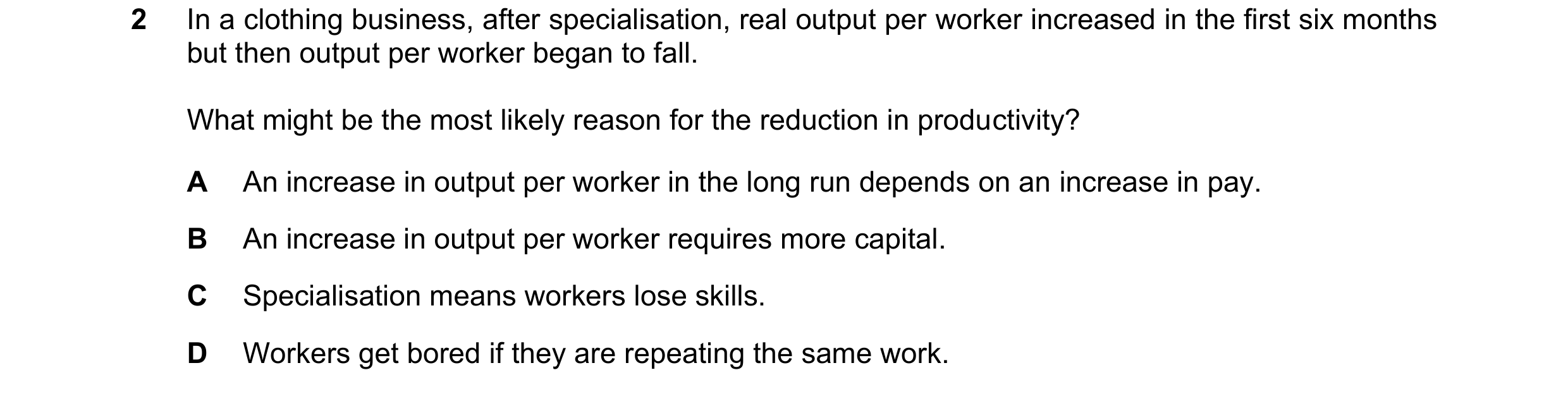
Q71 · In a clothing business, after specialisation, real output per worker increased in the… 9708/12 Oct/Nov 2024
2 In a clothing business, after specialisation, real output per worker increased in the first six months but then output per worker began to fall. What might be the most likely reason for the reduction in productivity? A An increase in output per worker in the long run depends on an increase in pay. B An increase in output per worker requires more capital. C Specialisation means workers lose skills. D Workers get bored if they are repeating the same work.
1 marks
Answer: D
This question in 9708/12 Oct/Nov 2024
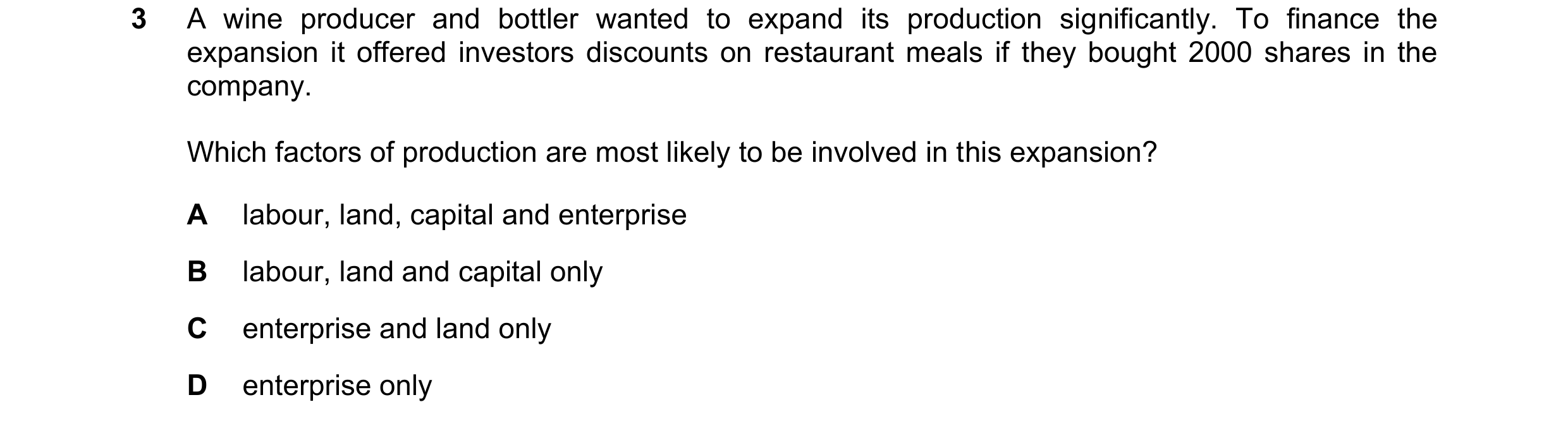
Q72 · A wine producer and bottler wanted to expand its production significantly 9708/12 Oct/Nov 2024
3 A wine producer and bottler wanted to expand its production significantly. To finance the expansion it offered investors discounts on restaurant meals if they bought 2000 shares in the company. Which factors of production are most likely to be involved in this expansion? A labour, land, capital and enterprise B labour, land and capital only C enterprise and land only D enterprise only
1 marks
Answer: A
This question in 9708/12 Oct/Nov 2024
Q73 · A firm produces a good using a very labour-intensive process 9708/12 Oct/Nov 2024
7 A firm produces a good using a very labour-intensive process. There is an increase in the price of the good. Under which conditions will the supply of the firm’s good be most price elastic? nature of the level of labour employed unemployment in by the firm the economy A skilled high B skilled low C unskilled high D unskilled low
1 marks
Answer: C
This question in 9708/12 Oct/Nov 2024
Q74 · The factors of production earn different rewards 9708/13 Oct/Nov 2024
3 The factors of production earn different rewards. What identifies the correct economic term for these rewards? A capital – surpluses B enterprise – dividends C labour – interest D land – rents
1 marks
Answer: D
This question in 9708/13 Oct/Nov 2024
Q75 · What is most likely to be an advantage of the division of labour? 9708/13 Oct/Nov 2024
4 What is most likely to be an advantage of the division of labour? A an increase in labour force creativity B an increase in labour productivity C an increase in workforce flexibility D an increase in worker satisfaction
1 marks
Answer: B
This question in 9708/13 Oct/Nov 2024
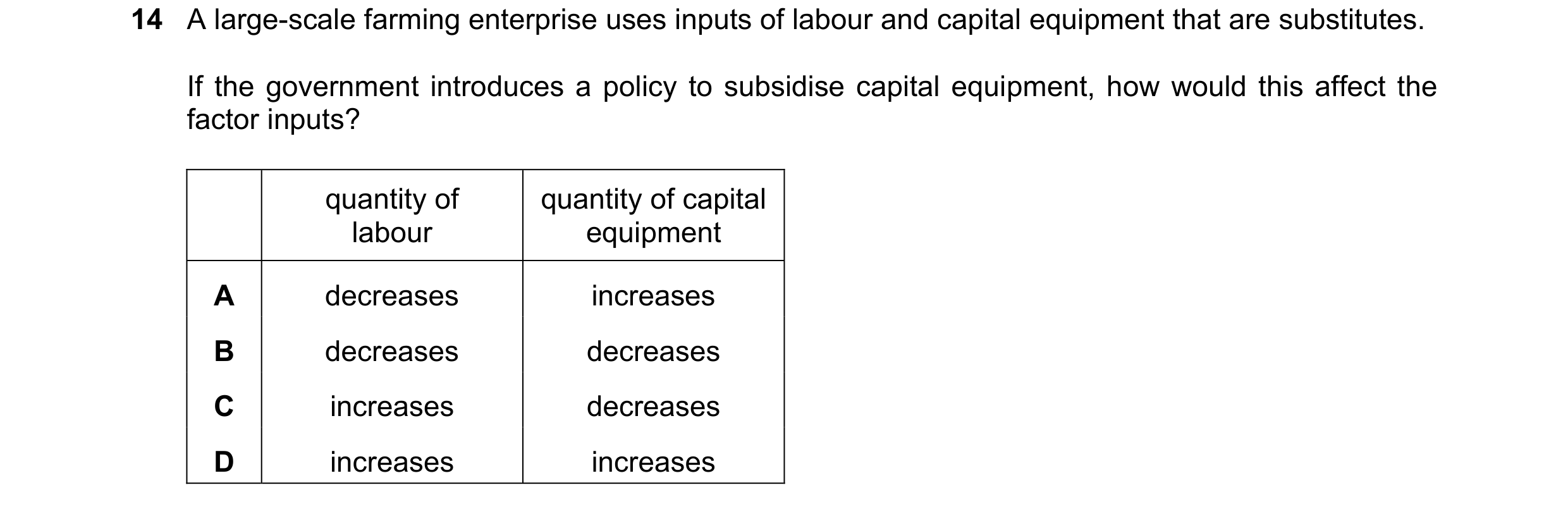
Q76 · A large-scale farming enterprise uses inputs of labour and capital equipment that are… 9708/13 Oct/Nov 2024
14 A large-scale farming enterprise uses inputs of labour and capital equipment that are substitutes. If the government introduces a policy to subsidise capital equipment, how would this affect the factor inputs? quantity of quantity of capital labour equipment A decreases increases B decreases decreases C increases decreases D increases increases
1 marks
Answer: A
This question in 9708/13 Oct/Nov 2024
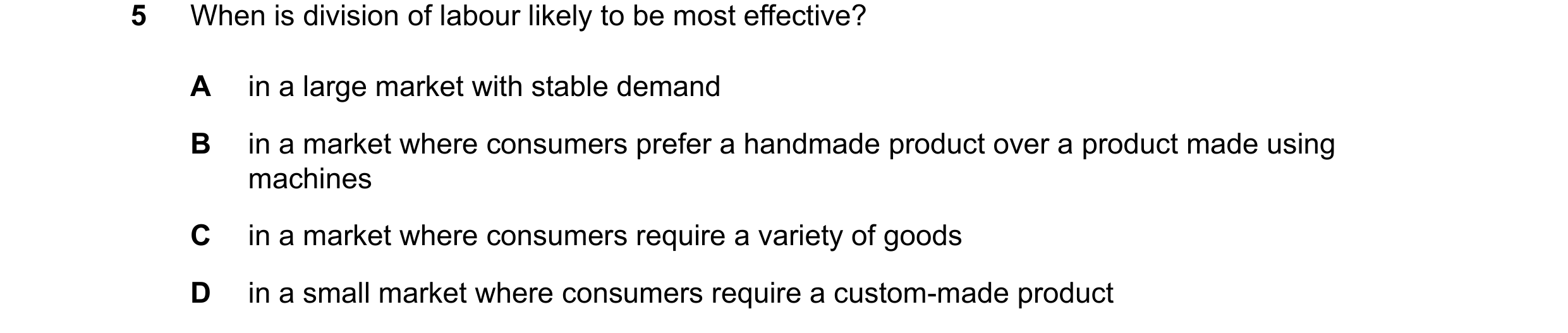
Q77 · When is division of labour likely to be most effective? 9708/12 Feb/March 2025
5 When is division of labour likely to be most effective? A in a large market with stable demand B in a market where consumers prefer a handmade product over a product made using machines C in a market where consumers require a variety of goods D in a small market where consumers require a custom-made product
1 marks
Answer: A
This question in 9708/12 Feb/March 2025
Q78 · In 2020, there was a worldwide pandemic 9708/11 May/June 2025
4 In 2020, there was a worldwide pandemic. High-income countries quickly developed a vaccine. Low-income countries built high-tech factories to manufacture large quantities of the vaccine for export. What explains this international division of labour? high-income countries low-income countries A availability of specialists in lower costs of production research and development B scarce human resources over-supply of unskilled labour C many people tended to many people tended to avoid the disease catch the disease D no government control strict government control over resource allocation over resource allocation
1 marks
Answer: A
This question in 9708/11 May/June 2025
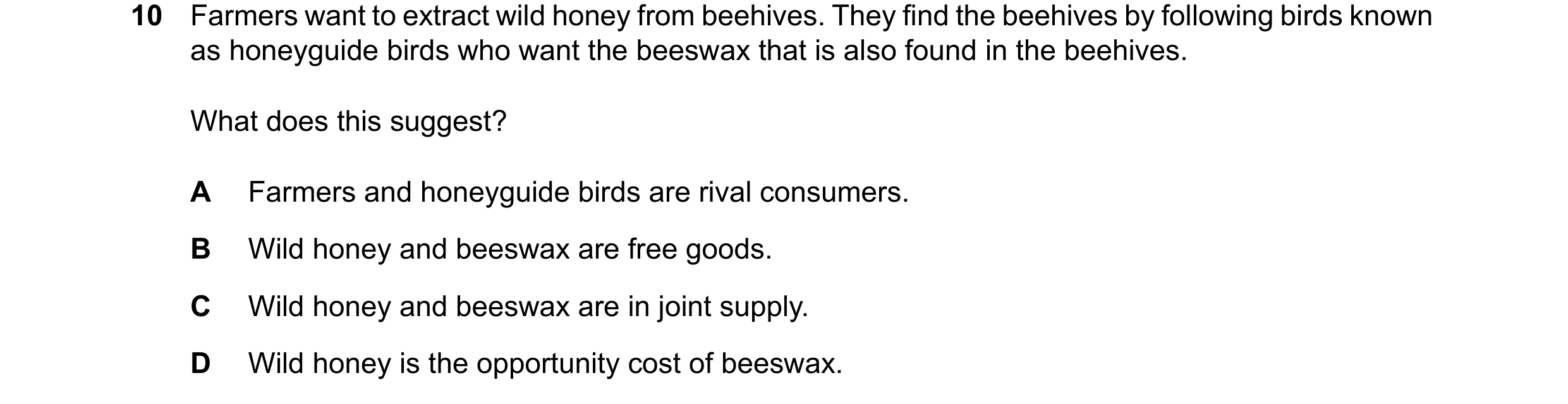
Q79 · Farmers want to extract wild honey from beehives 9708/12 May/June 2025
10 Farmers want to extract wild honey from beehives. They find the beehives by following birds known as honeyguide birds who want the beeswax that is also found in the beehives. What does this suggest? A Farmers and honeyguide birds are rival consumers. B Wild honey and beeswax are free goods. C Wild honey and beeswax are in joint supply. D Wild honey is the opportunity cost of beeswax.
1 marks
Answer: C
This question in 9708/12 May/June 2025
Q80 · What is the most likely benefit of specialisation to a firm? 9708/13 May/June 2025
4 What is the most likely benefit of specialisation to a firm? A increase in motivation of employees B increase in imports from other countries C increase in the number of employees D increase in the level of output
1 marks
Answer: D
This question in 9708/13 May/June 2025
Q81 · What is meant by the division of labour? 9708/13 Oct/Nov 2025
2 What is meant by the division of labour? A A process is split into a series of individual tasks. B Some workers work part-time and others work full-time. C The same amount of output per hour is produced by each worker. D Wages are divided equally between workers.
1 marks
Answer: A
This question in 9708/13 Oct/Nov 2025


 1 / 17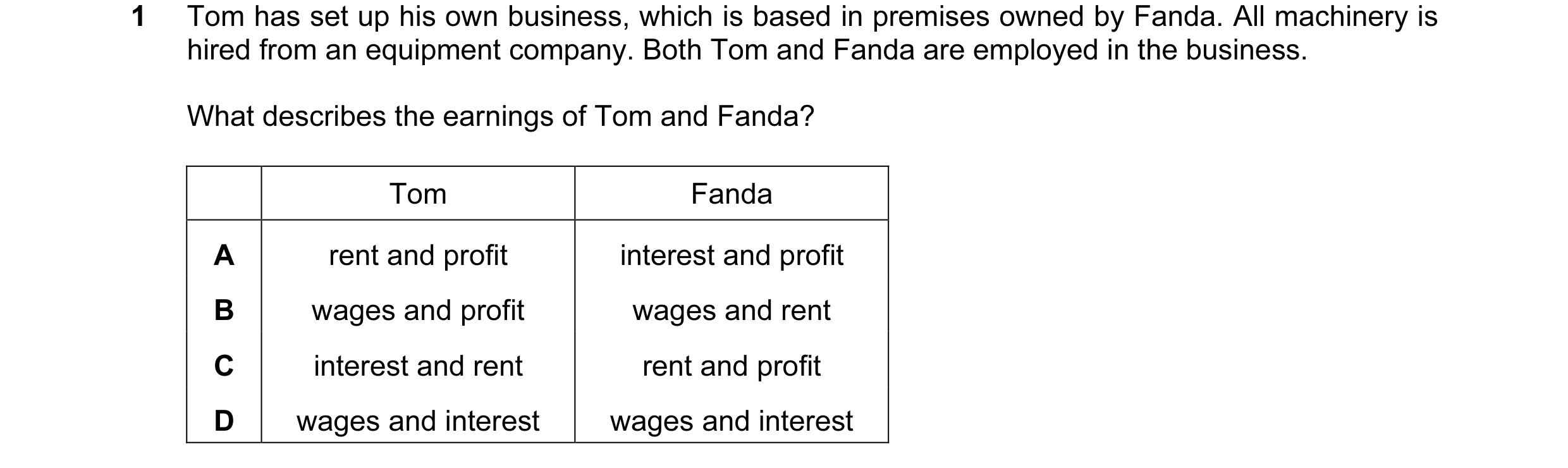


 2 / 17

 3 / 17

 4 / 17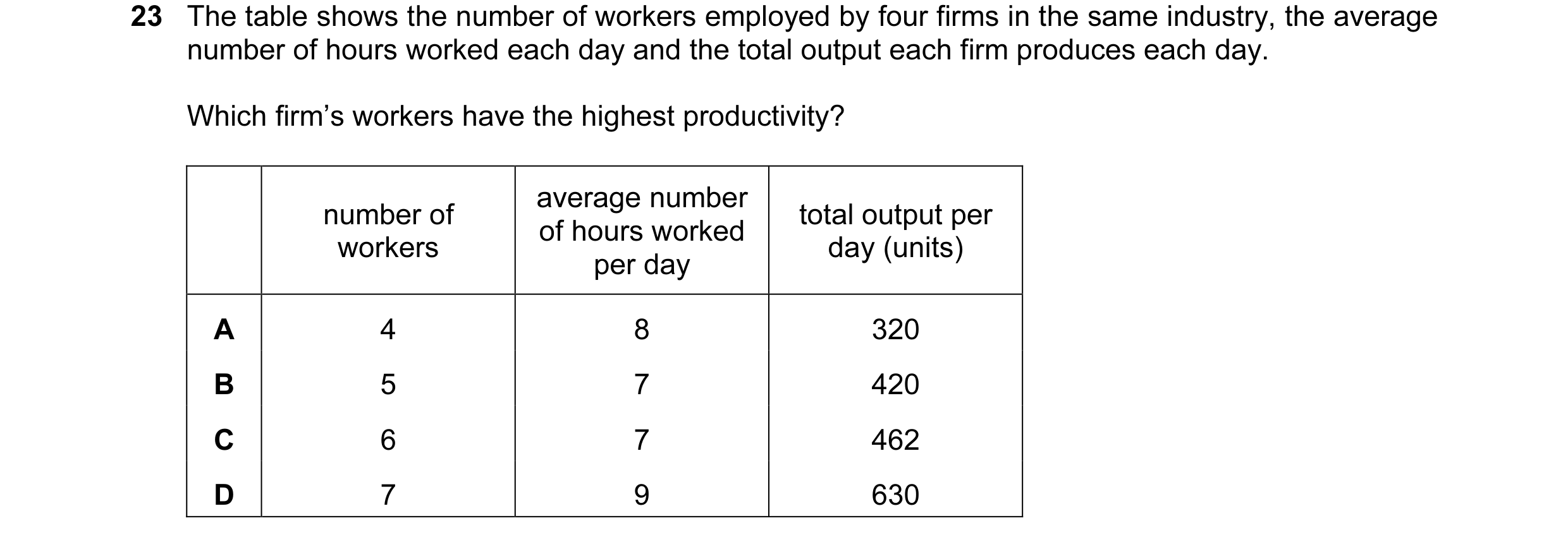

 5 / 17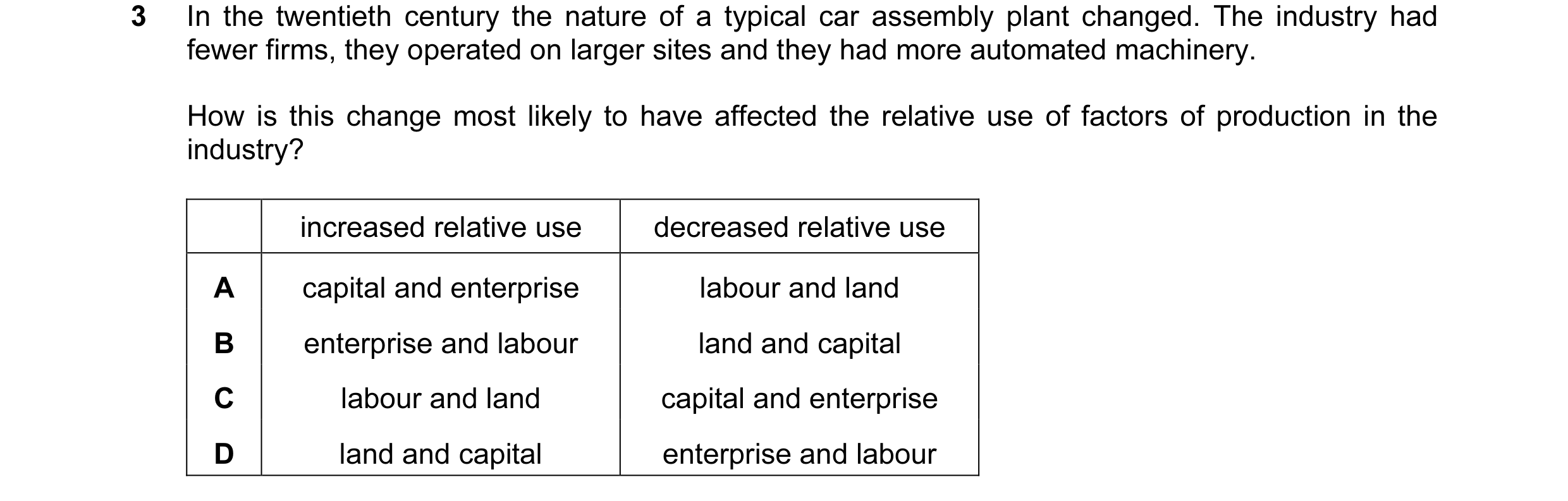

 6 / 17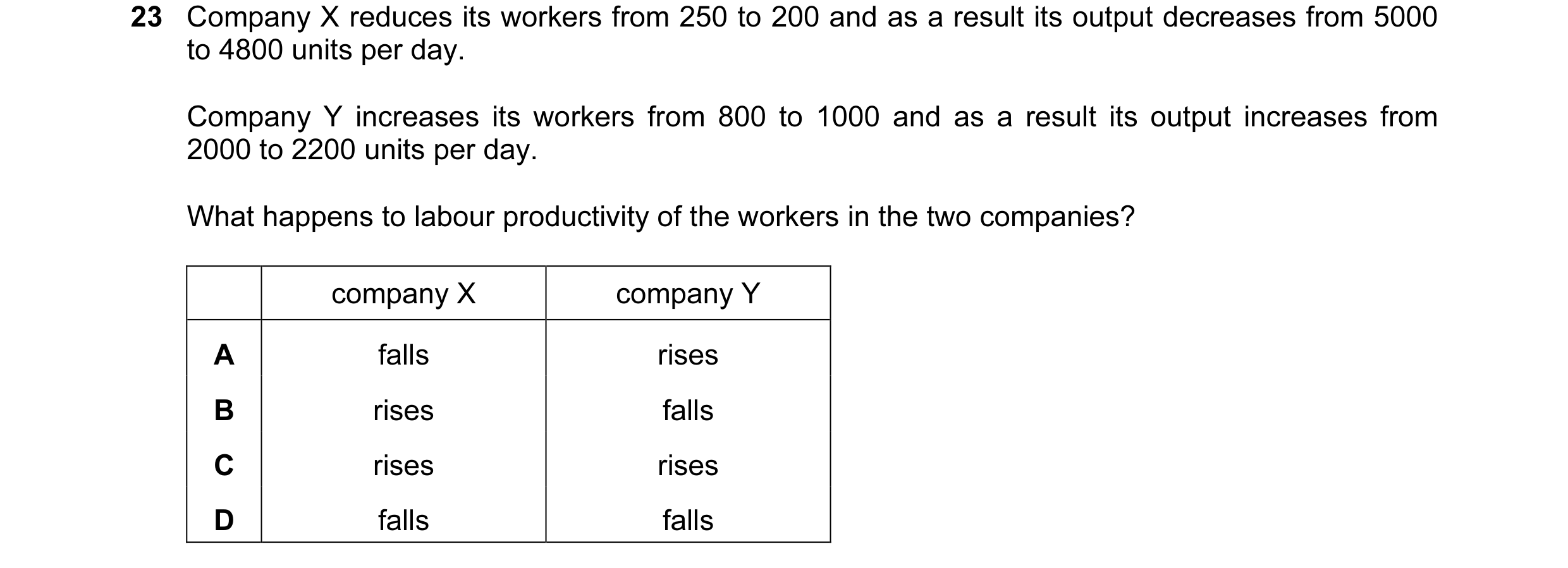

 7 / 17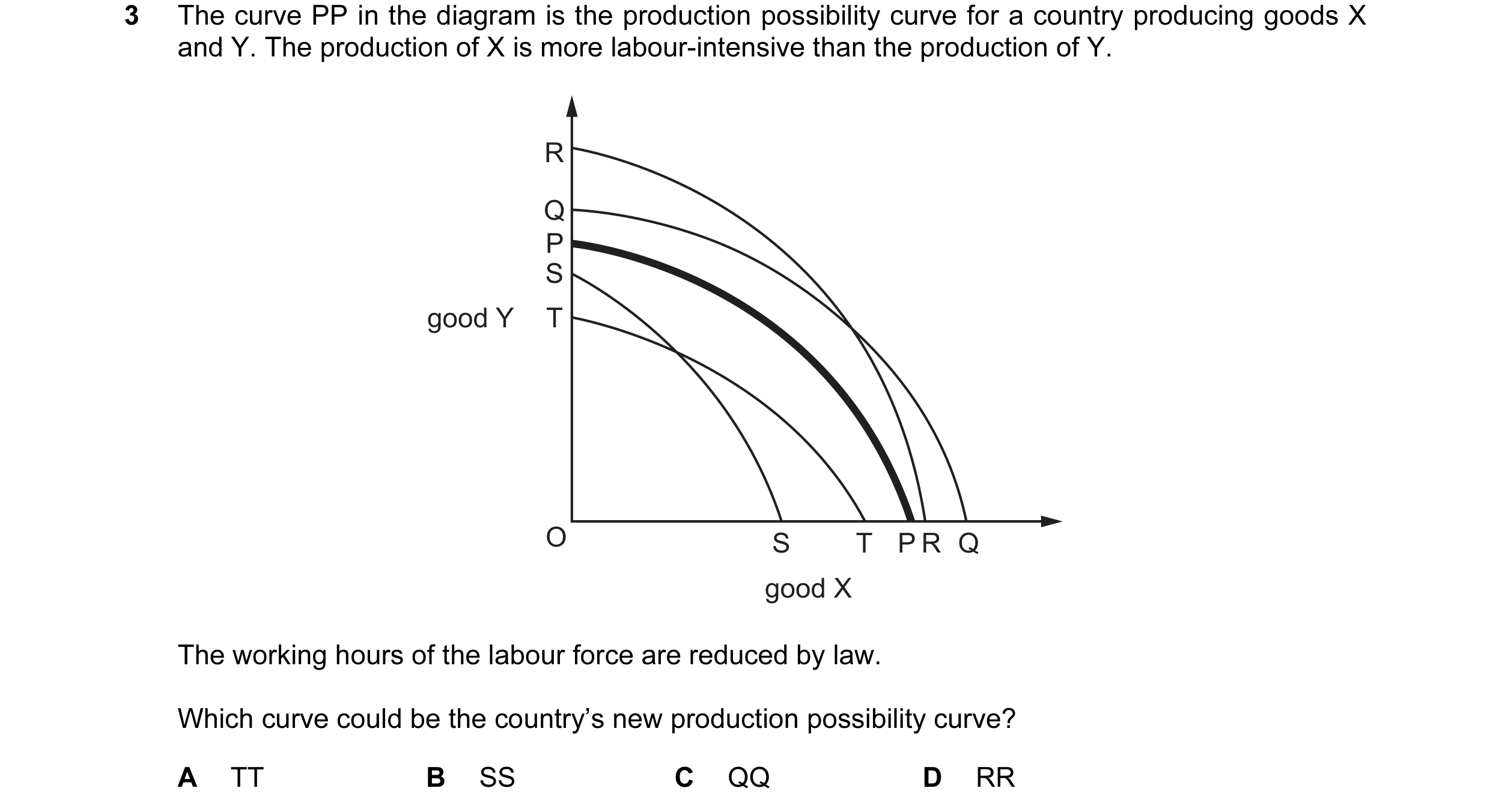

 8 / 17


 9 / 17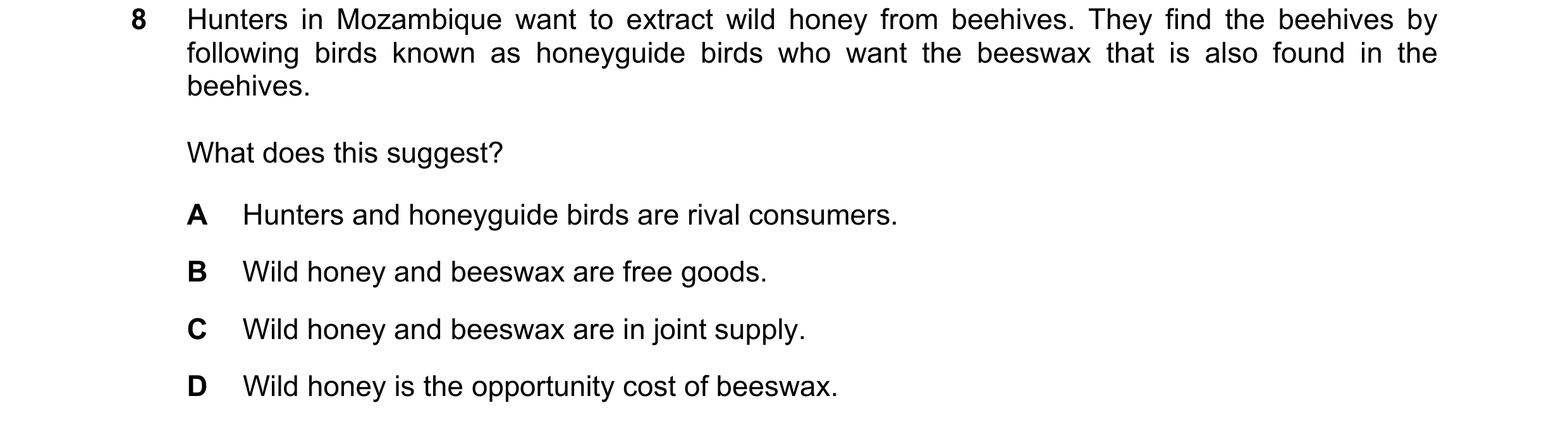

 10 / 17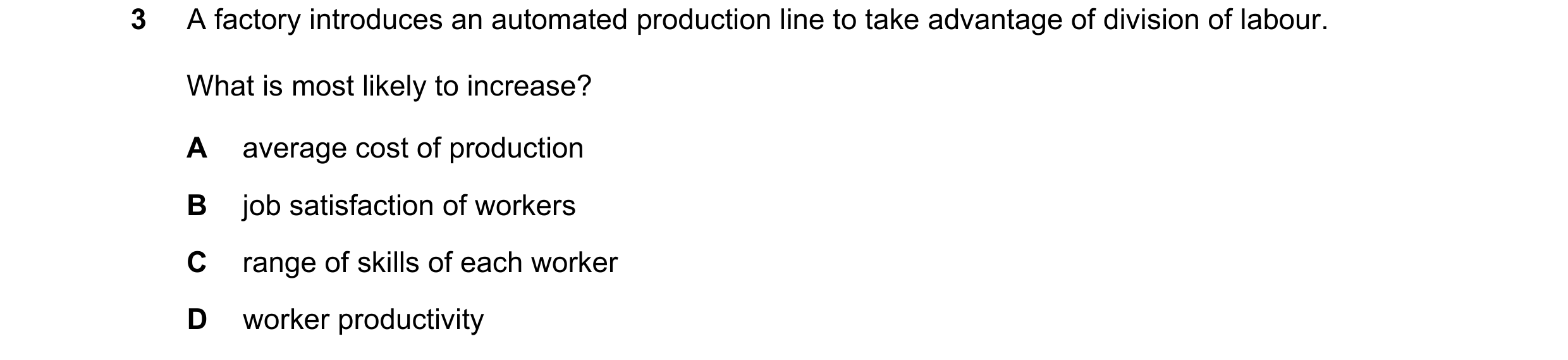


 11 / 17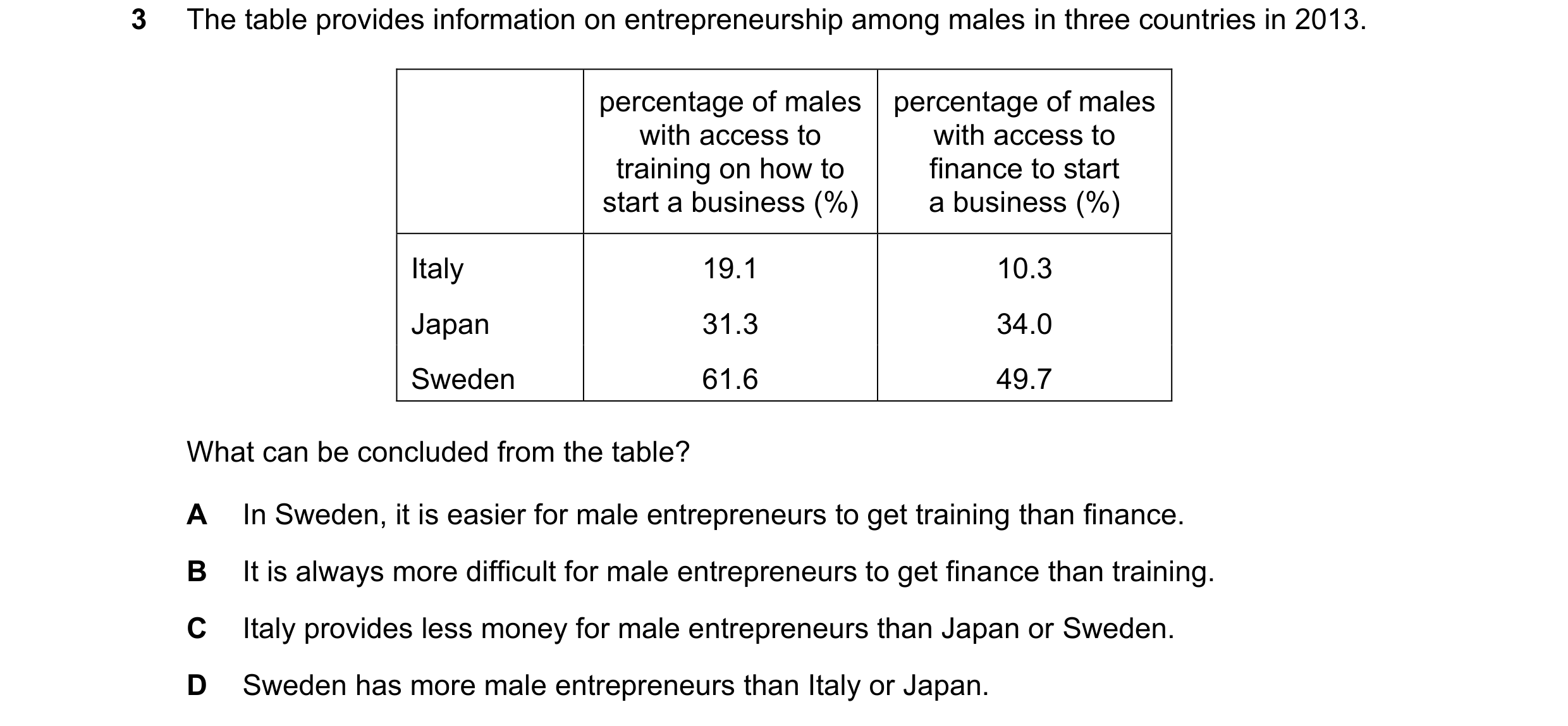


 12 / 17


 13 / 17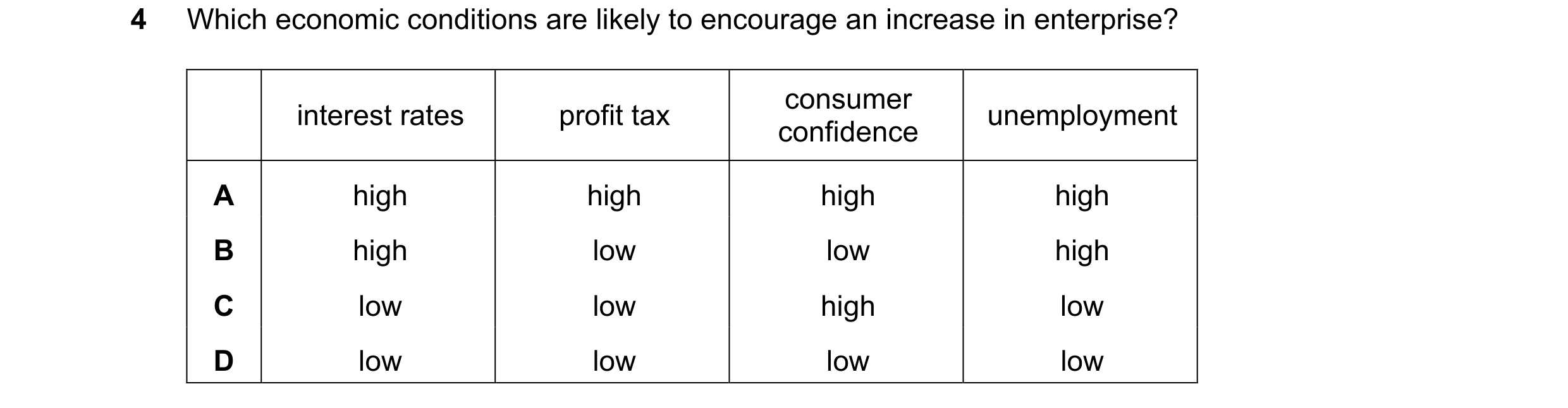


 14 / 17

 15 / 17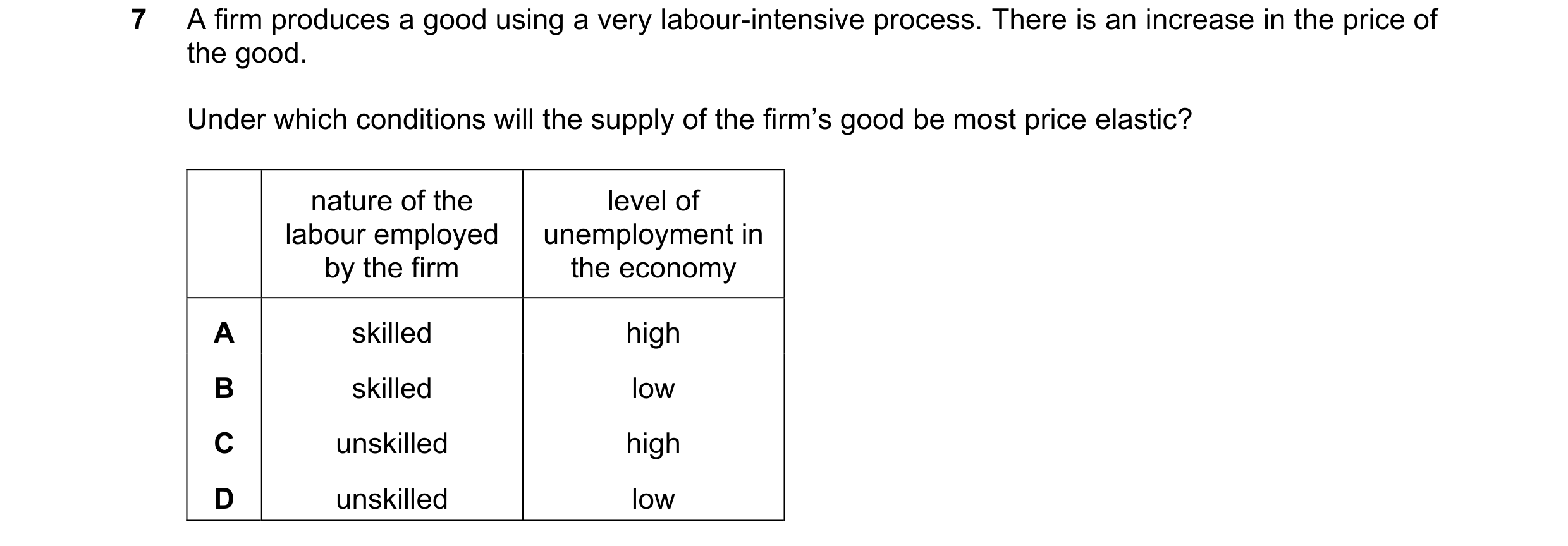


 16 / 17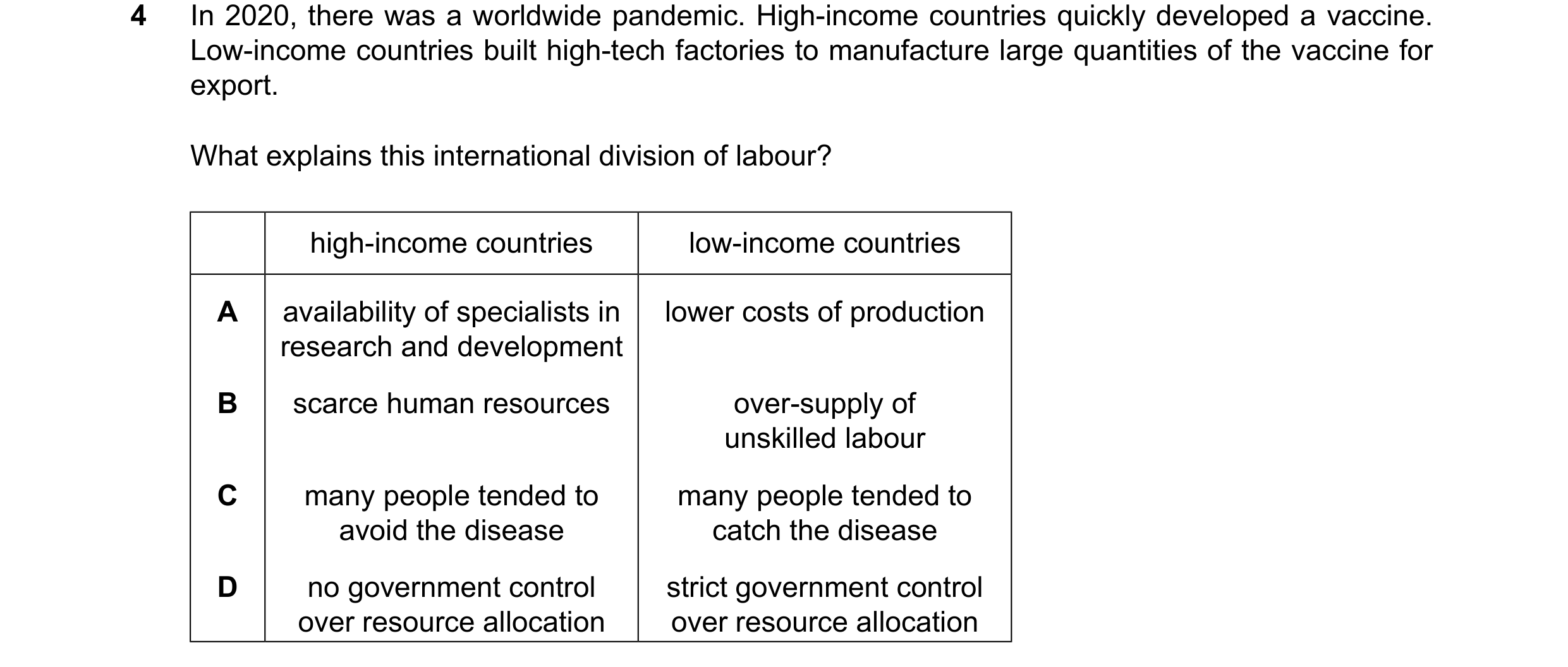

 17 / 17