Questions as text
Q1 · What would be the reason for an adverse material usage variance? 9706/31 Oct/Nov 2009
25 What would be the reason for an adverse material usage variance? A Direct labour wage rate has been above budget. B Material has been used inefficiently in the factory. C Production has been at a lower level than budgeted. D Suppliers have been paid more for the material than planned.
1 marks
Answer: B
This question in 9706/31 Oct/Nov 2009
Q2 · The prime cost for a business comprises direct materials and direct labour 9706/31 Oct/Nov 2009
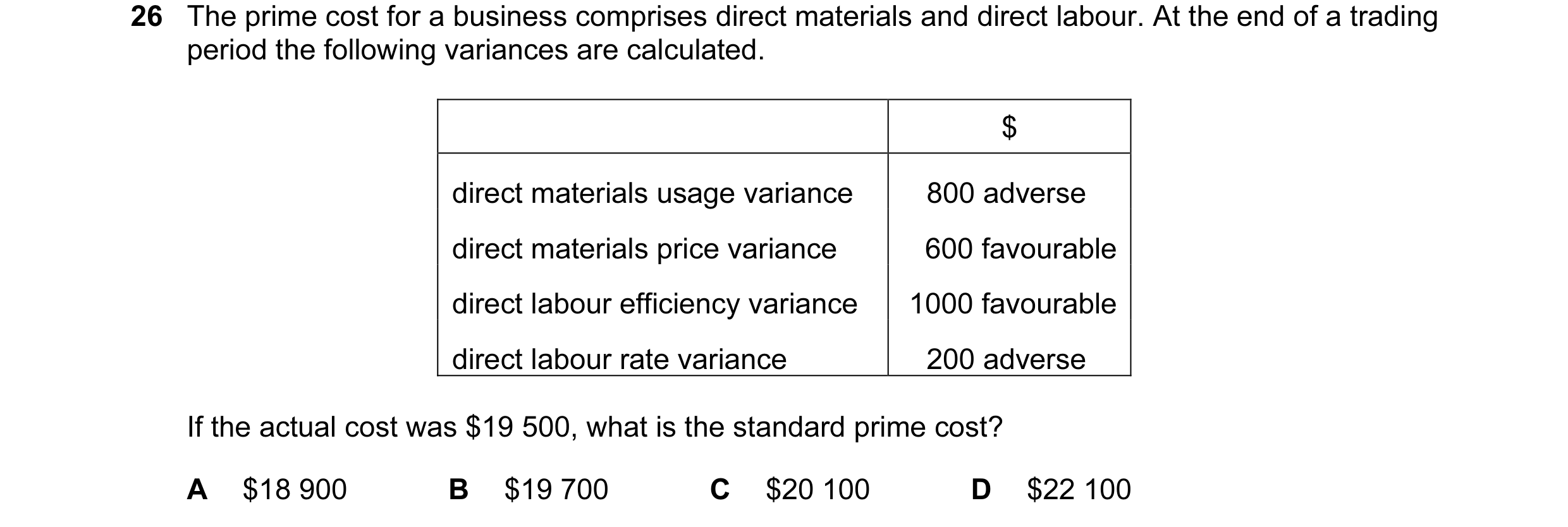
26 The prime cost for a business comprises direct materials and direct labour. At the end of a trading period the following variances are calculated. $ direct materials usage variance 800 adverse direct materials price variance 600 favourable direct labour efficiency variance 1000 favourable direct labour rate variance 200 adverse If the actual cost was $19 500, what is the standard prime cost? A $18 900 B $19 700 C $20 100 D $22 100
1 marks
Answer: C
This question in 9706/31 Oct/Nov 2009
Q3 · The table shows information for production during the last three months 9706/31 Oct/Nov 2009
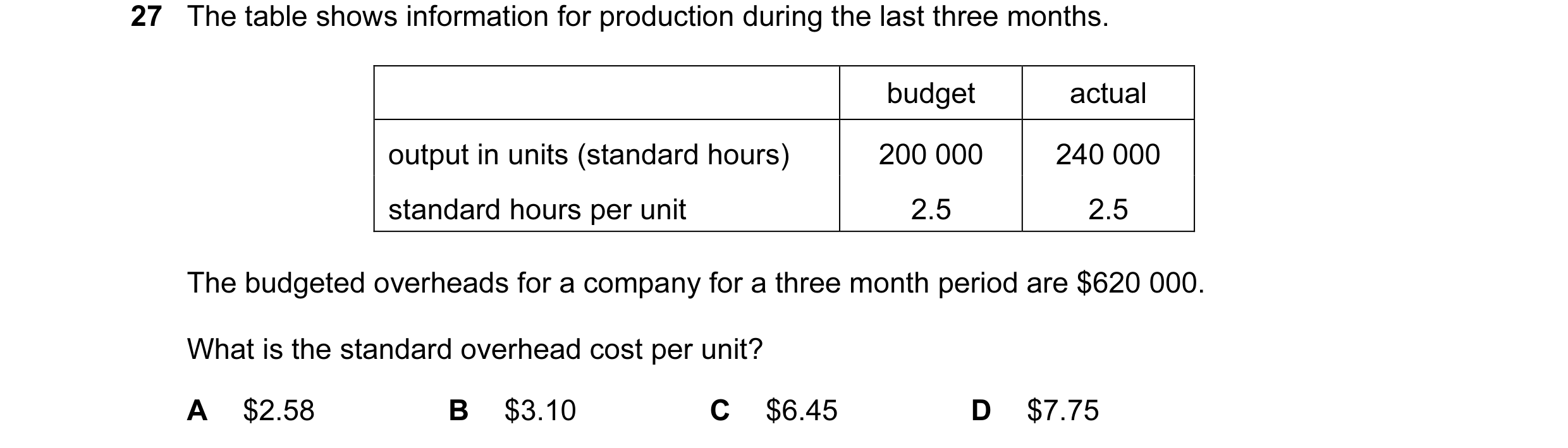
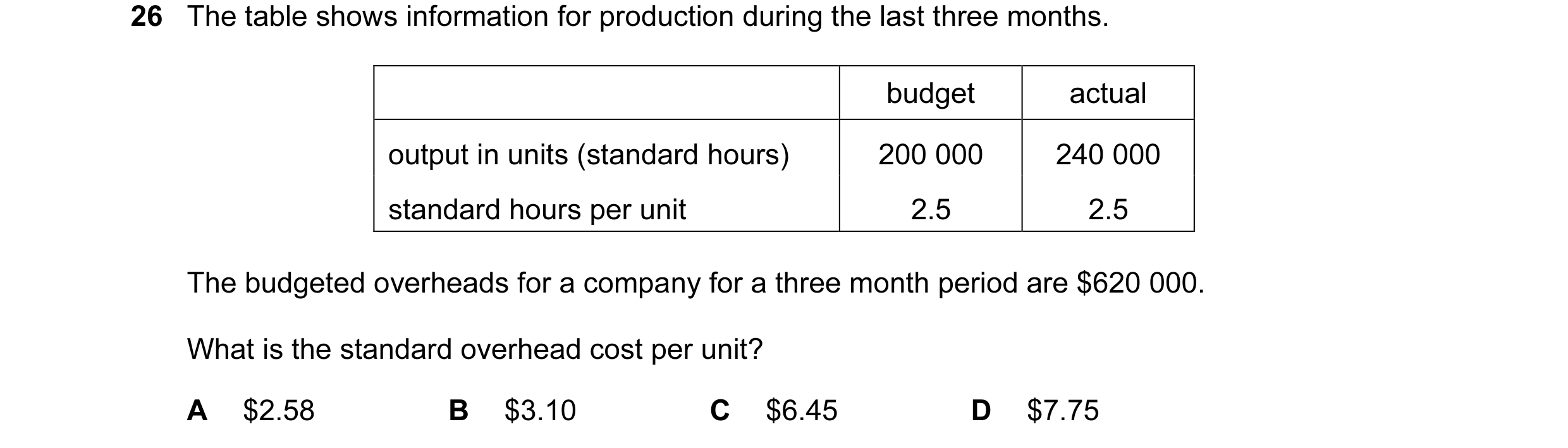
27 The table shows information for production during the last three months. budget actual output in units (standard hours) 200 000 240 000 standard hours per unit 2.5 2.5 The budgeted overheads for a company for a three month period are $620 000. What is the standard overhead cost per unit? A $2.58 B $3.10 C $6.45 D $7.75
1 marks
Answer: D
This question in 9706/31 Oct/Nov 2009
Q4 · Budgeted and actual results are as shown 9706/31 Oct/Nov 2009
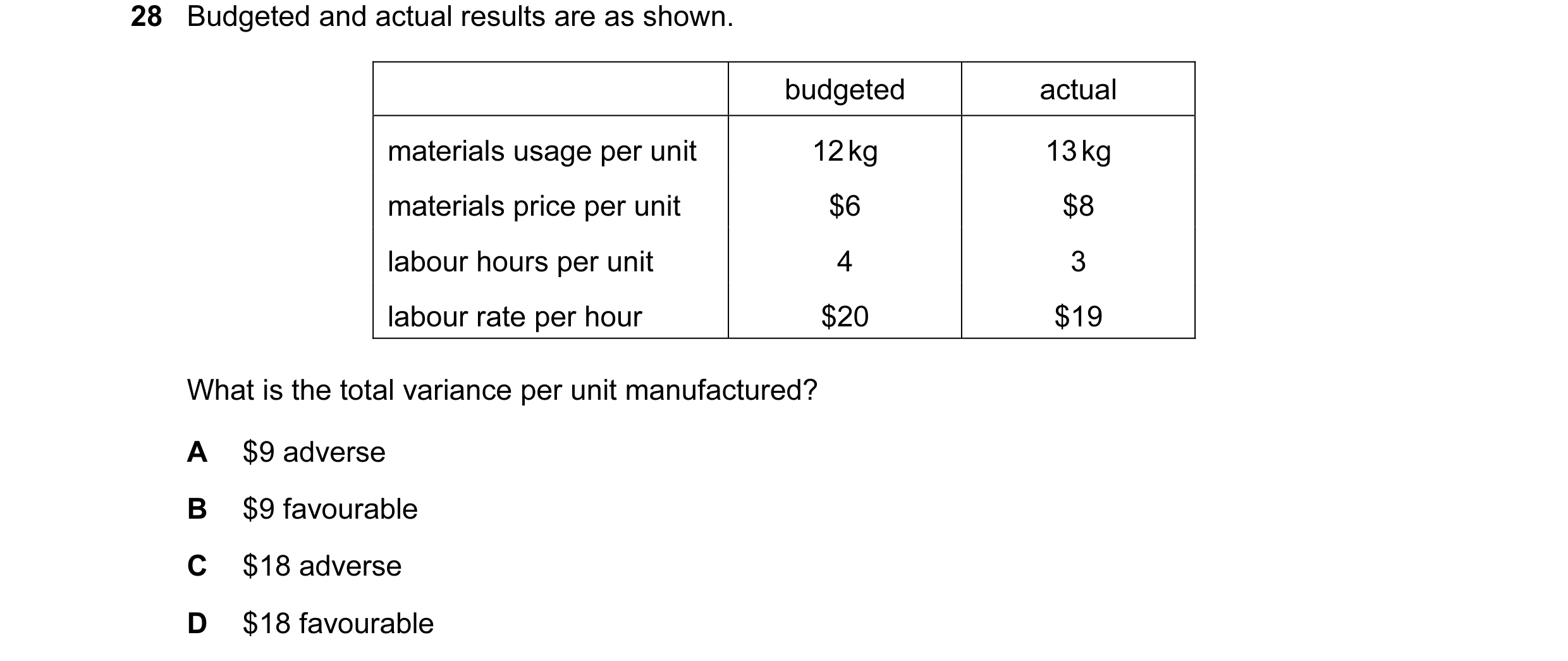
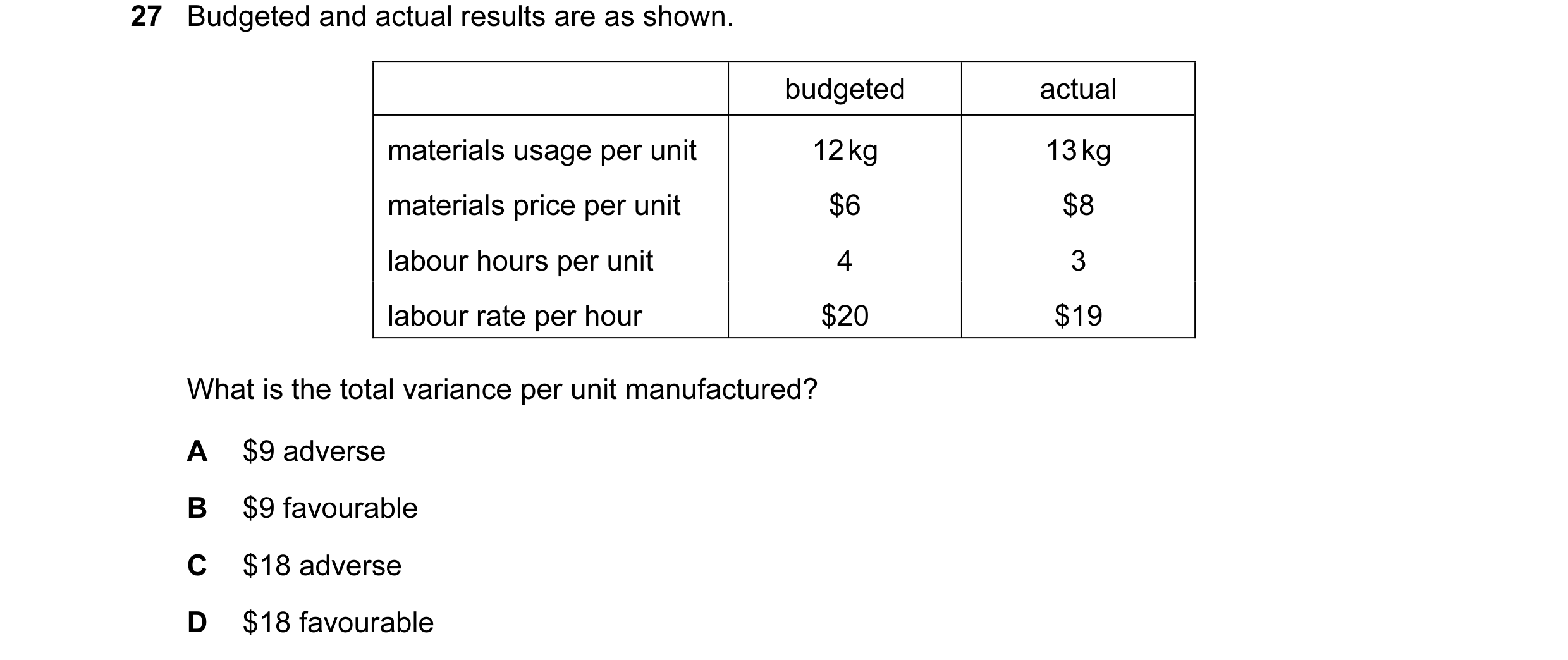
28 Budgeted and actual results are as shown. budgeted actual materials usage per unit 12 kg 13 kg materials price per unit $6 $8 labour hours per unit 4 3 labour rate per hour $20 $19 What is the total variance per unit manufactured? A $9 adverse B $9 favourable C $18 adverse D $18 favourable
1 marks
Answer: A
This question in 9706/31 Oct/Nov 2009
Q5 · What would be the reason for an adverse material usage variance? 9706/32 Oct/Nov 2009
24 What would be the reason for an adverse material usage variance? A Direct labour wage rate has been above budget. B Material has been used inefficiently in the factory. C Production has been at a lower level than budgeted. D Suppliers have been paid more for the material than planned.
1 marks
Answer: B
This question in 9706/32 Oct/Nov 2009
Q6 · The prime cost for a business comprises direct materials and direct labour 9706/32 Oct/Nov 2009
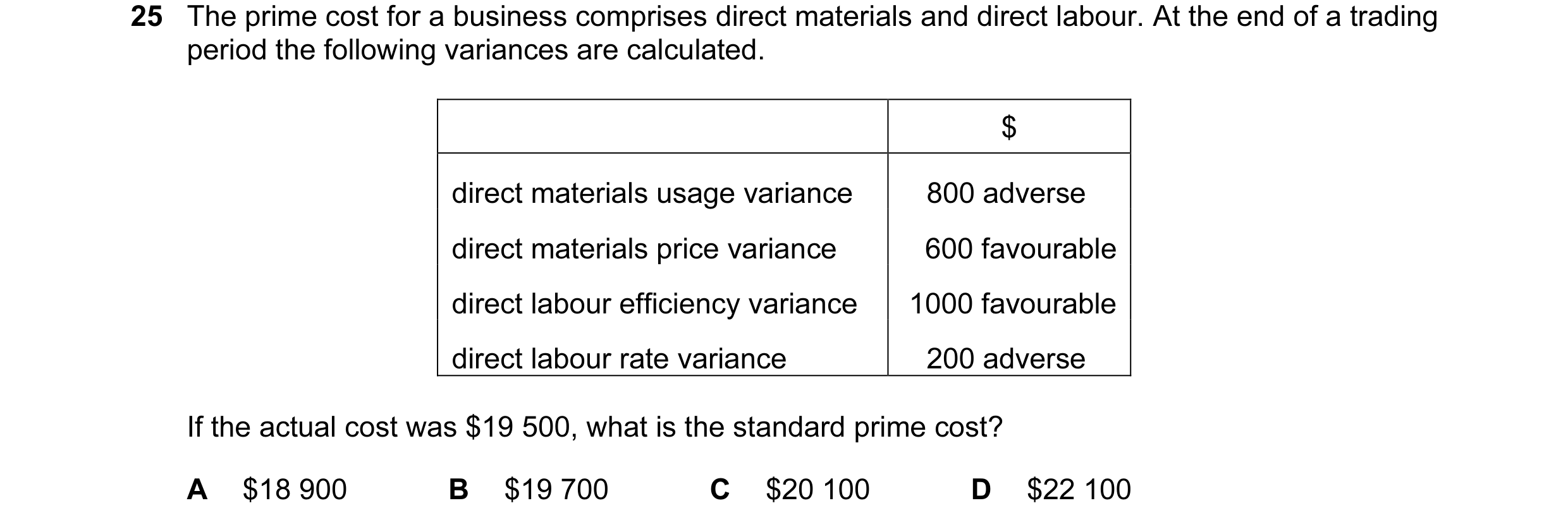
25 The prime cost for a business comprises direct materials and direct labour. At the end of a trading period the following variances are calculated. $ direct materials usage variance 800 adverse direct materials price variance 600 favourable direct labour efficiency variance 1000 favourable direct labour rate variance 200 adverse If the actual cost was $19 500, what is the standard prime cost? A $18 900 B $19 700 C $20 100 D $22 100
1 marks
Answer: C
This question in 9706/32 Oct/Nov 2009
Q7 · The table shows information for production during the last three months 9706/32 Oct/Nov 2009
26 The table shows information for production during the last three months. budget actual output in units (standard hours) 200 000 240 000 standard hours per unit 2.5 2.5 The budgeted overheads for a company for a three month period are $620 000. What is the standard overhead cost per unit? A $2.58 B $3.10 C $6.45 D $7.75
1 marks
Answer: D
This question in 9706/32 Oct/Nov 2009
Q8 · Budgeted and actual results are as shown 9706/32 Oct/Nov 2009
27 Budgeted and actual results are as shown. budgeted actual materials usage per unit 12 kg 13 kg materials price per unit $6 $8 labour hours per unit 4 3 labour rate per hour $20 $19 What is the total variance per unit manufactured? A $9 adverse B $9 favourable C $18 adverse D $18 favourable
1 marks
Answer: A
This question in 9706/32 Oct/Nov 2009
Q9 · Which variance measure changes in volume? 9706/31 May/June 2010
24 Which variance measure changes in volume? A labour efficiency B labour rate C material price D sales price
1 marks
Answer: A
This question in 9706/31 May/June 2010
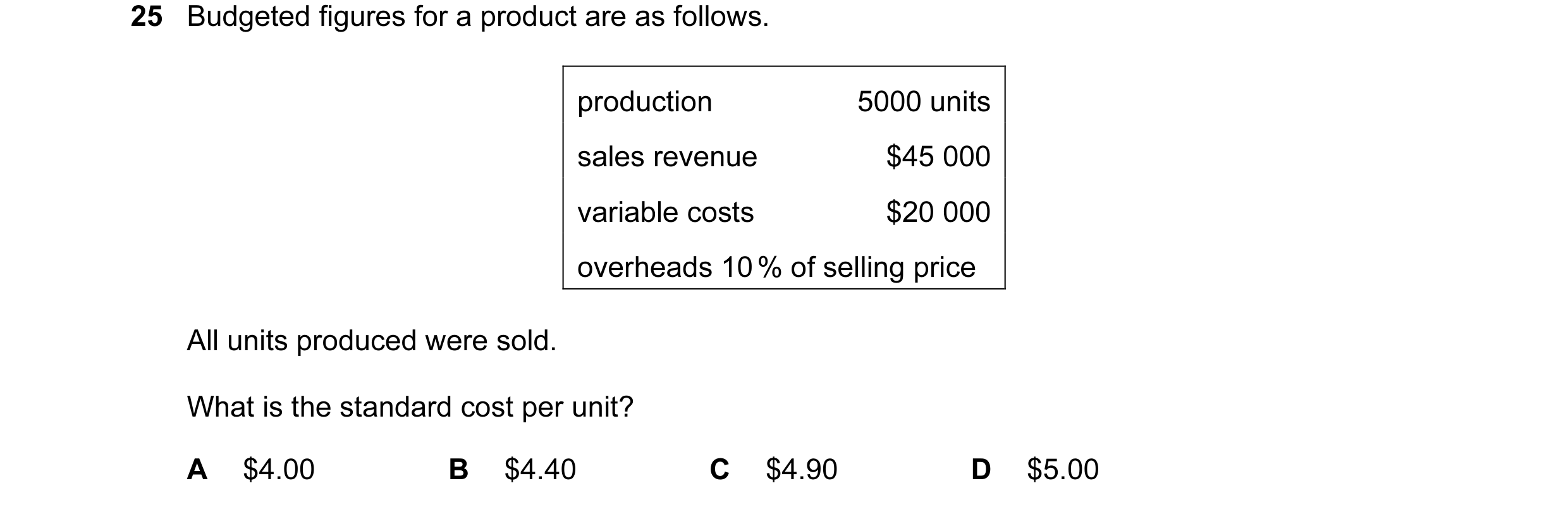
Q10 · Budgeted figures for a product are as follows 9706/31 May/June 2010
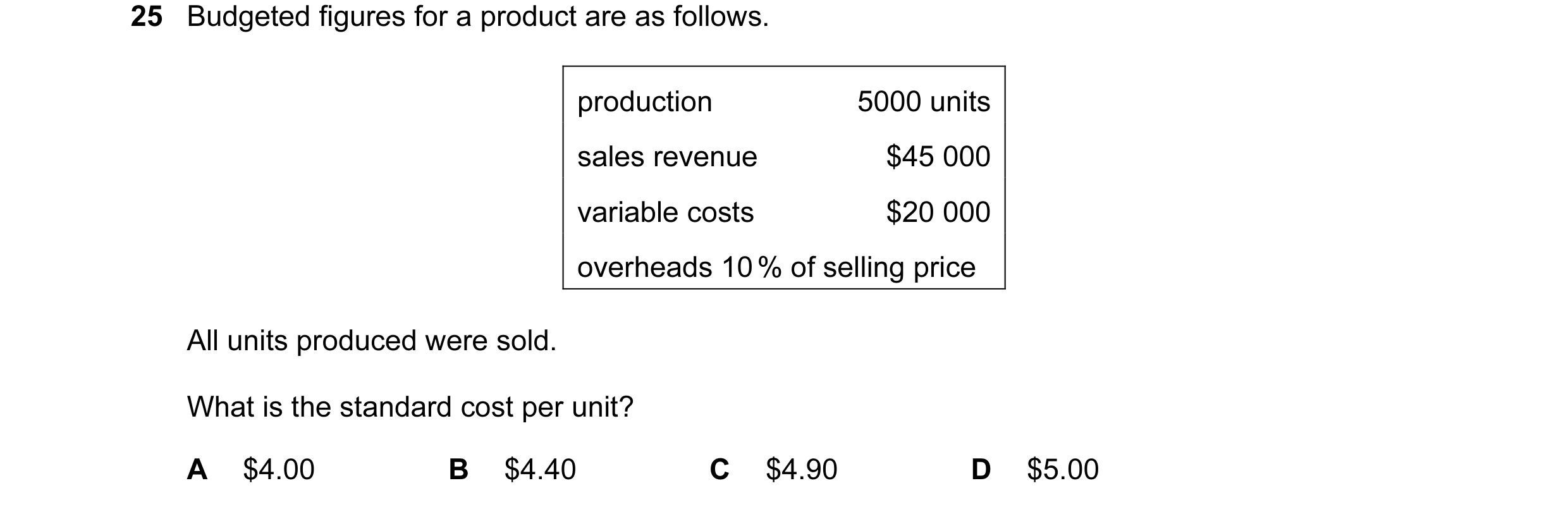
25 Budgeted figures for a product are as follows. production 5000 units sales revenue $45 000 variable costs $20 000 overheads 10 % of selling price All units produced were sold. What is the standard cost per unit? A $4.00 B $4.40 C $4.90 D $5.00
1 marks
Answer: C
This question in 9706/31 May/June 2010
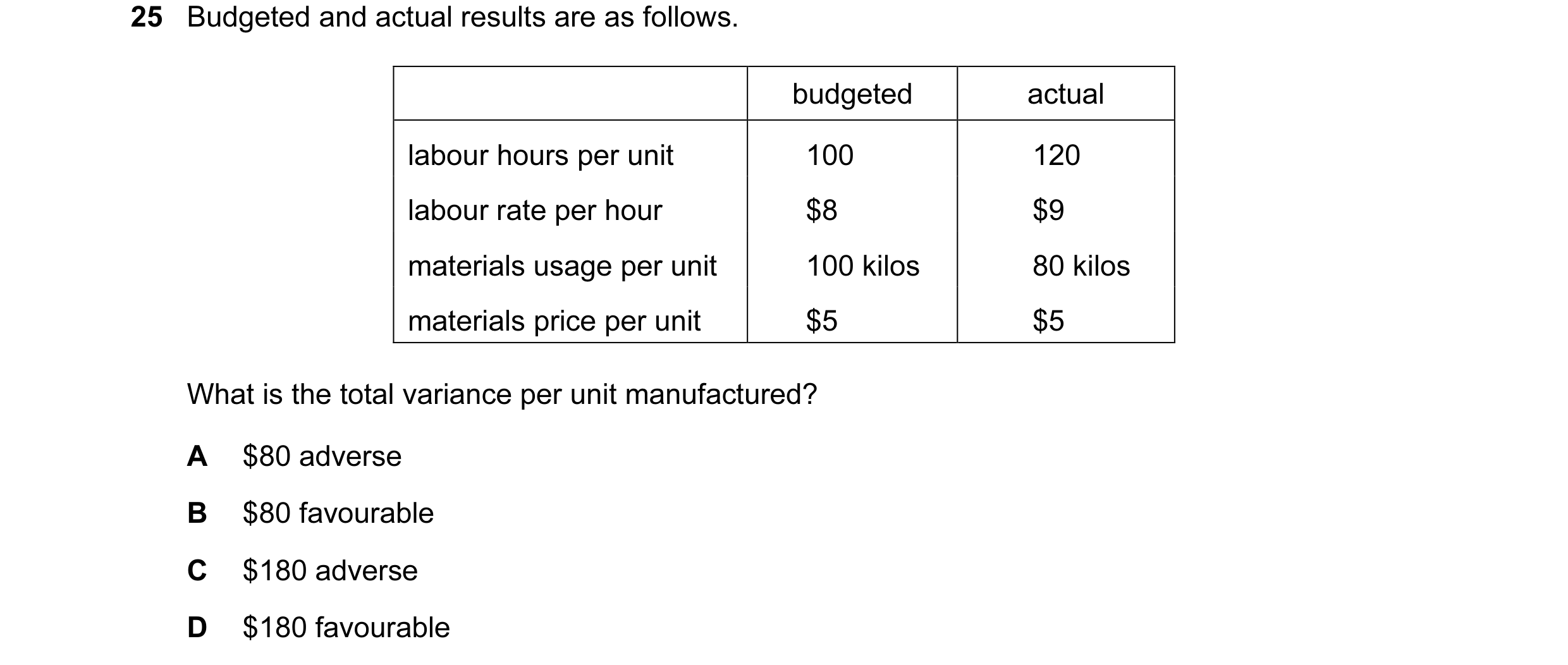
Q11 · Budgeted and actual results are as follows 9706/31 May/June 2010
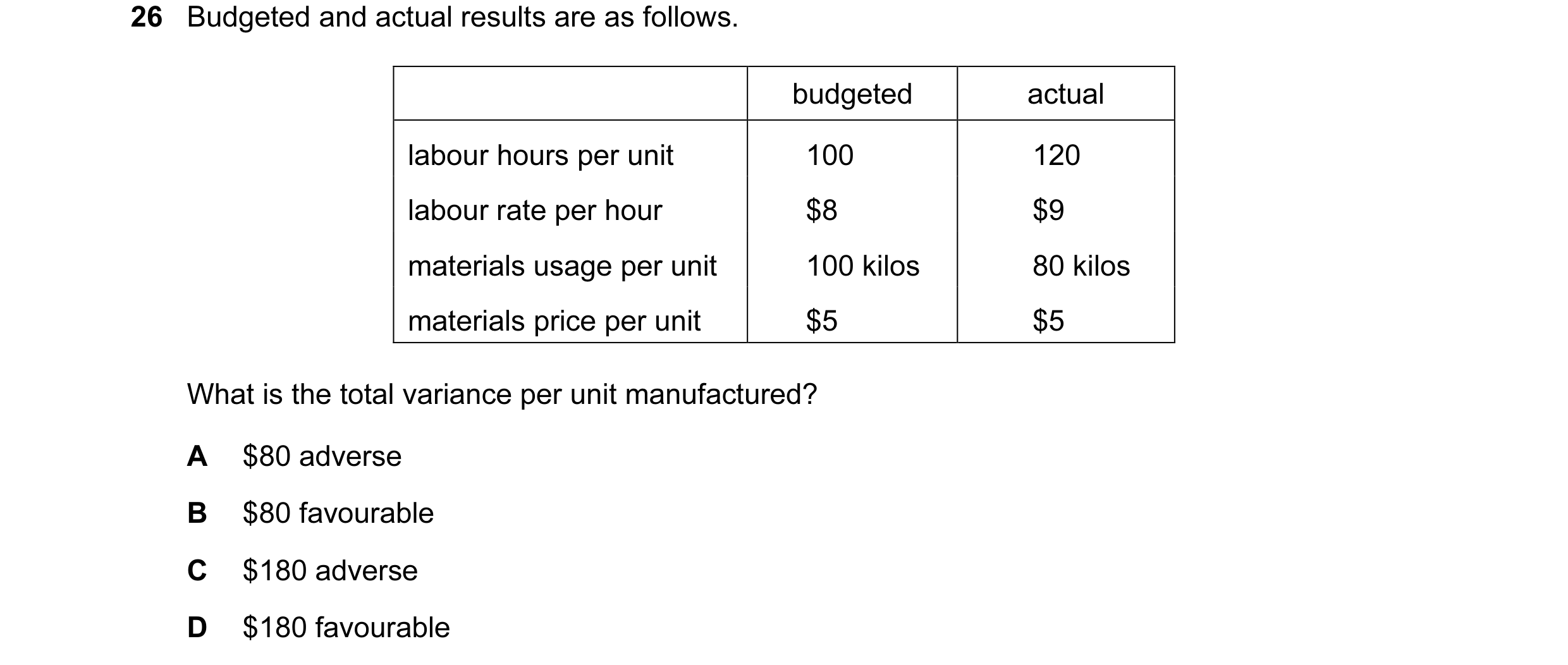
26 Budgeted and actual results are as follows. budgeted actual labour hours per unit 100 120 labour rate per hour $8 $9 materials usage per unit 100 kilos 80 kilos materials price per unit $5 $5 What is the total variance per unit manufactured? A $80 adverse B $80 favourable C $180 adverse D $180 favourable
1 marks
Answer: C
This question in 9706/31 May/June 2010
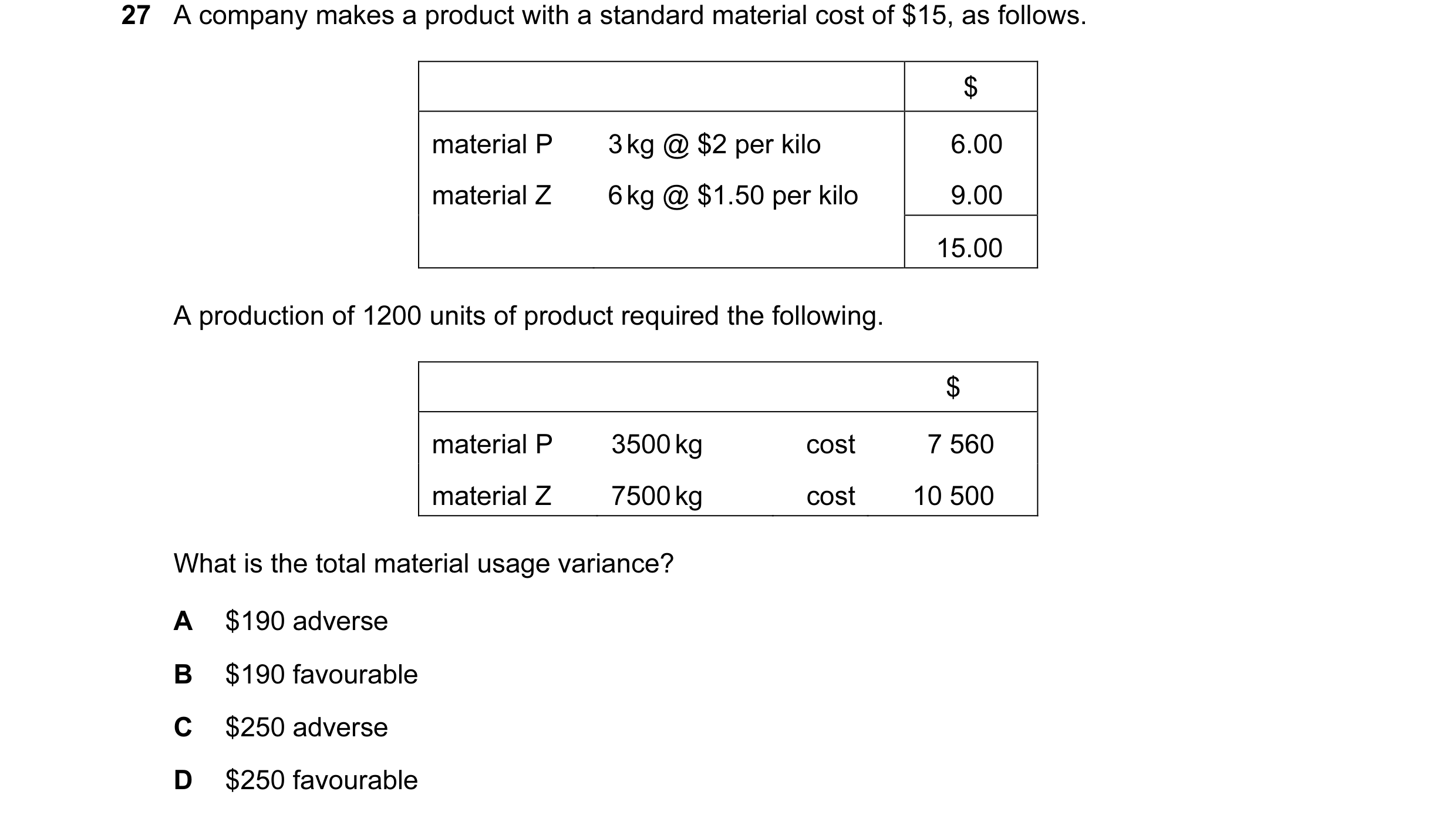
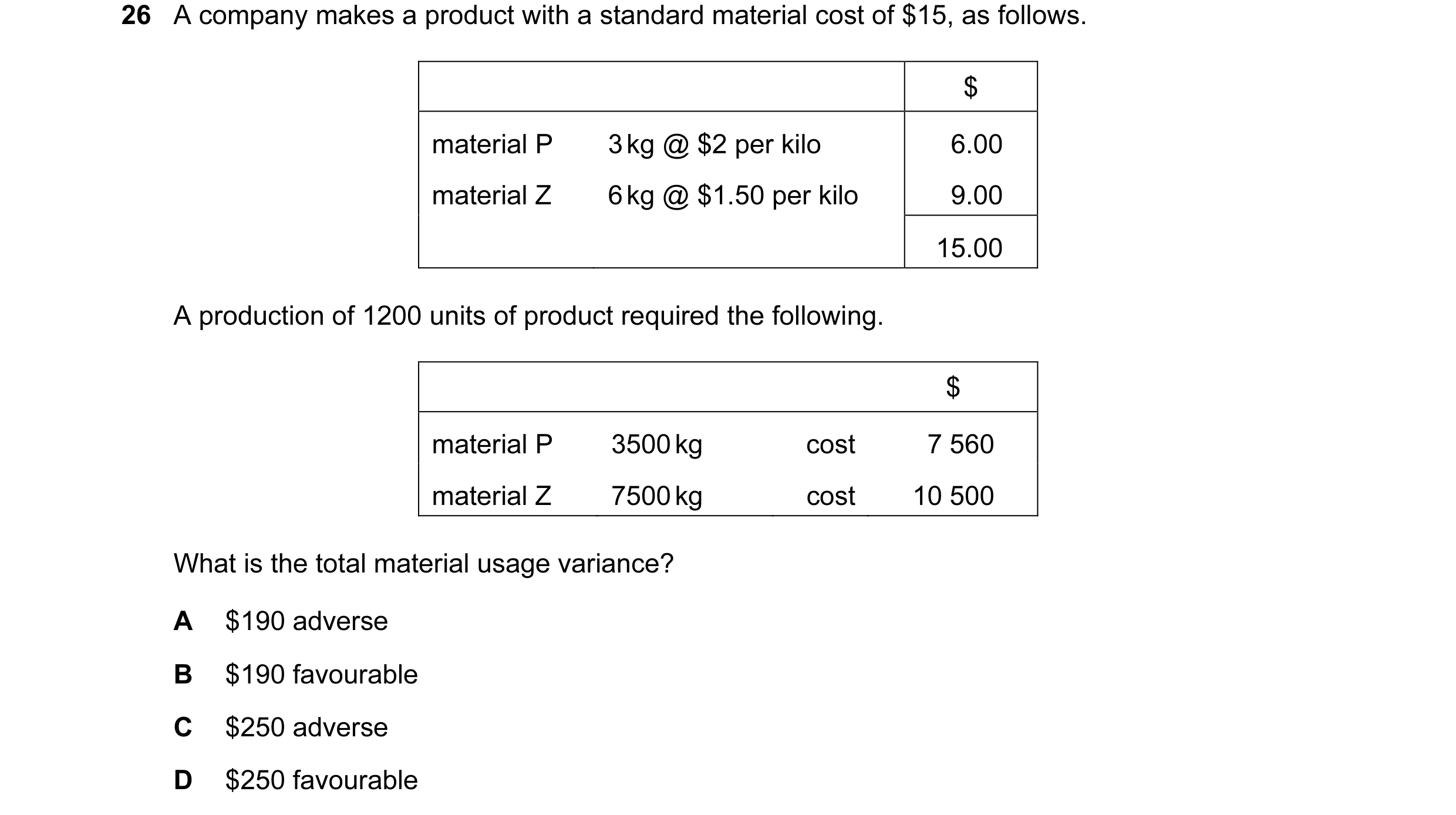
Q12 · A company makes a product with a standard material cost of $15, as follows 9706/31 May/June 2010
27 A company makes a product with a standard material cost of $15, as follows. $ material P 3 kg @ $2 per kilo 6.00 material Z 6 kg @ $1.50 per kilo 9.00 15.00 A production of 1200 units of product required the following. $ material P 3500 kg cost 7 560 material Z 7500 kg cost 10 500 What is the total material usage variance? A $190 adverse B $190 favourable C $250 adverse D $250 favourable
1 marks
Answer: C
This question in 9706/31 May/June 2010
Q13 · Which variance measure changes in volume? 9706/32 May/June 2010
24 Which variance measure changes in volume? A labour efficiency B labour rate C material price D sales price
1 marks
Answer: A
This question in 9706/32 May/June 2010
Q14 · Budgeted figures for a product are as follows 9706/32 May/June 2010
25 Budgeted figures for a product are as follows. production 5000 units sales revenue $45 000 variable costs $20 000 overheads 10 % of selling price All units produced were sold. What is the standard cost per unit? A $4.00 B $4.40 C $4.90 D $5.00
1 marks
Answer: C
This question in 9706/32 May/June 2010
Q15 · Budgeted and actual results are as follows 9706/32 May/June 2010
26 Budgeted and actual results are as follows. budgeted actual labour hours per unit 100 120 labour rate per hour $8 $9 materials usage per unit 100 kilos 80 kilos materials price per unit $5 $5 What is the total variance per unit manufactured? A $80 adverse B $80 favourable C $180 adverse D $180 favourable
1 marks
Answer: C
This question in 9706/32 May/June 2010
Q16 · A company makes a product with a standard material cost of $15, as follows 9706/32 May/June 2010
27 A company makes a product with a standard material cost of $15, as follows. $ material P 3 kg @ $2 per kilo 6.00 material Z 6 kg @ $1.50 per kilo 9.00 15.00 A production of 1200 units of product required the following. $ material P 3500 kg cost 7 560 material Z 7500 kg cost 10 500 What is the total material usage variance? A $190 adverse B $190 favourable C $250 adverse D $250 favourable
1 marks
Answer: C
This question in 9706/32 May/June 2010
Q17 · Which variance measure changes in volume? 9706/33 May/June 2010
23 Which variance measure changes in volume? A labour efficiency B labour rate C material price D sales price
1 marks
Answer: A
This question in 9706/33 May/June 2010
Q18 · Budgeted figures for a product are as follows 9706/33 May/June 2010
24 Budgeted figures for a product are as follows. production 5000 units sales revenue $45 000 variable costs $20 000 overheads 10 % of selling price All units produced were sold. What is the standard cost per unit? A $4.00 B $4.40 C $4.90 D $5.00
1 marks
Answer: C
This question in 9706/33 May/June 2010
Q19 · Budgeted and actual results are as follows 9706/33 May/June 2010
25 Budgeted and actual results are as follows. budgeted actual labour hours per unit 100 120 labour rate per hour $8 $9 materials usage per unit 100 kilos 80 kilos materials price per unit $5 $5 What is the total variance per unit manufactured? A $80 adverse B $80 favourable C $180 adverse D $180 favourable
1 marks
Answer: C
This question in 9706/33 May/June 2010
Q20 · A company makes a product with a standard material cost of $15, as follows 9706/33 May/June 2010
26 A company makes a product with a standard material cost of $15, as follows. $ material P 3 kg @ $2 per kilo 6.00 material Z 6 kg @ $1.50 per kilo 9.00 15.00 A production of 1200 units of product required the following. $ material P 3500 kg cost 7 560 material Z 7500 kg cost 10 500 What is the total material usage variance? A $190 adverse B $190 favourable C $250 adverse D $250 favourable
1 marks
Answer: C
This question in 9706/33 May/June 2010
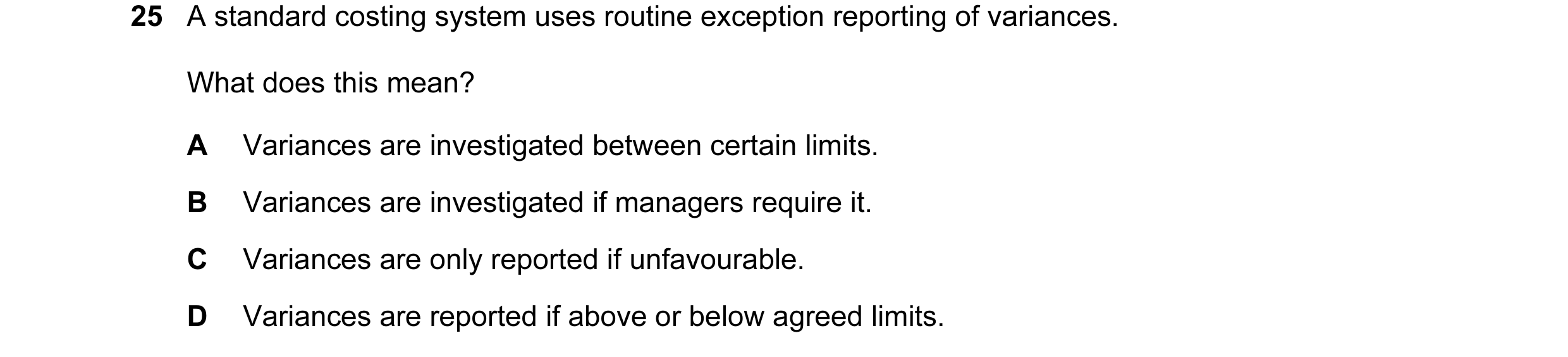
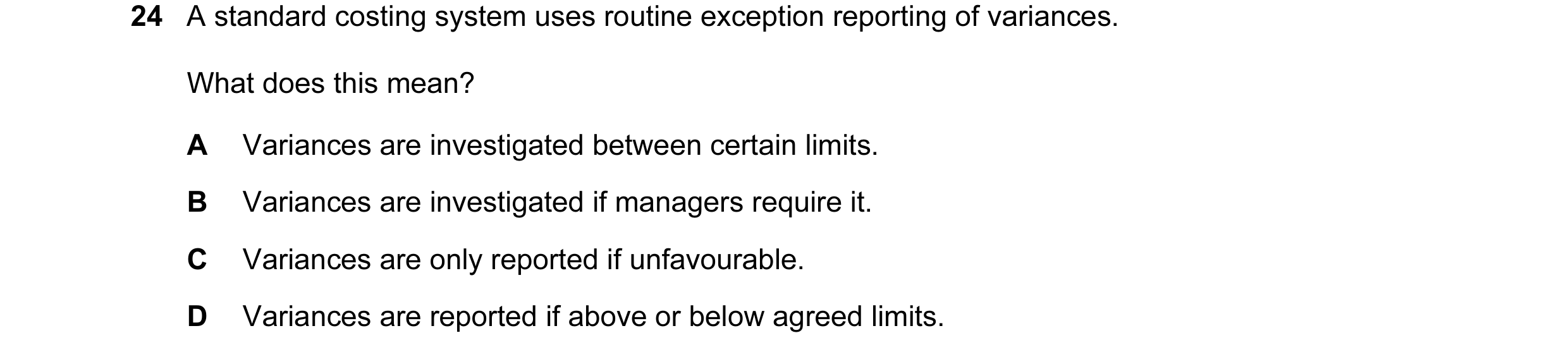
Q21 · A standard costing system uses routine exception reporting of variances 9706/31 Oct/Nov 2010
25 A standard costing system uses routine exception reporting of variances. What does this mean? A Variances are investigated between certain limits. B Variances are investigated if managers require it. C Variances are only reported if unfavourable. D Variances are reported if above or below agreed limits.
1 marks
Answer: D
This question in 9706/31 Oct/Nov 2010
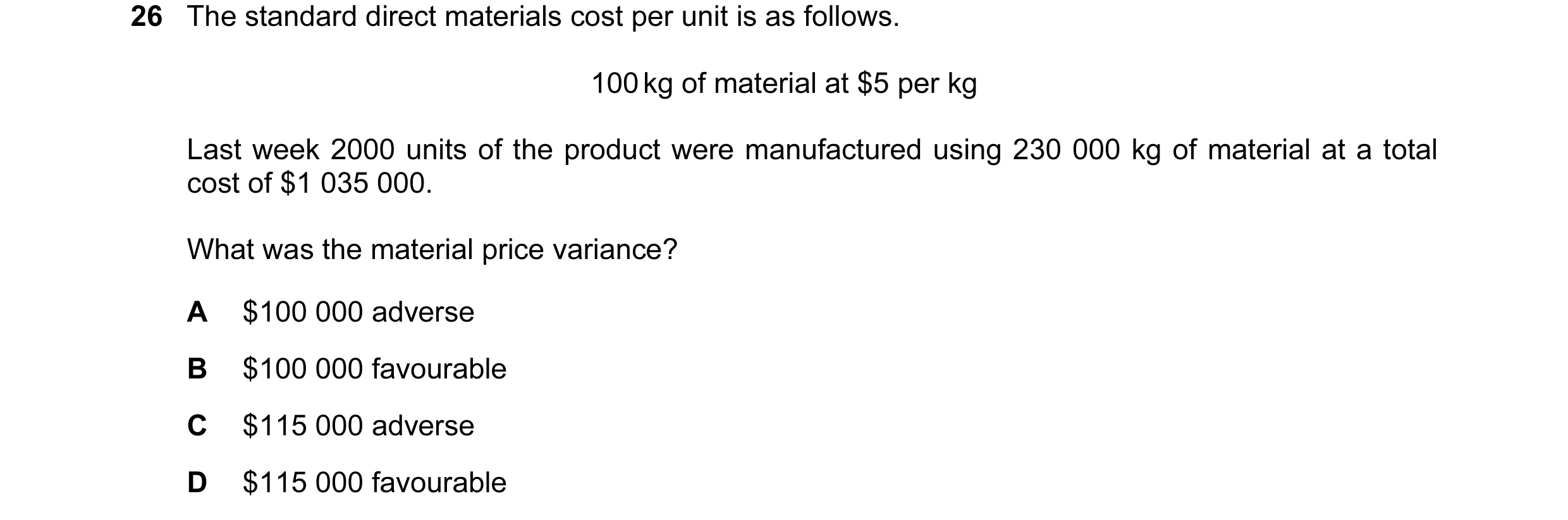
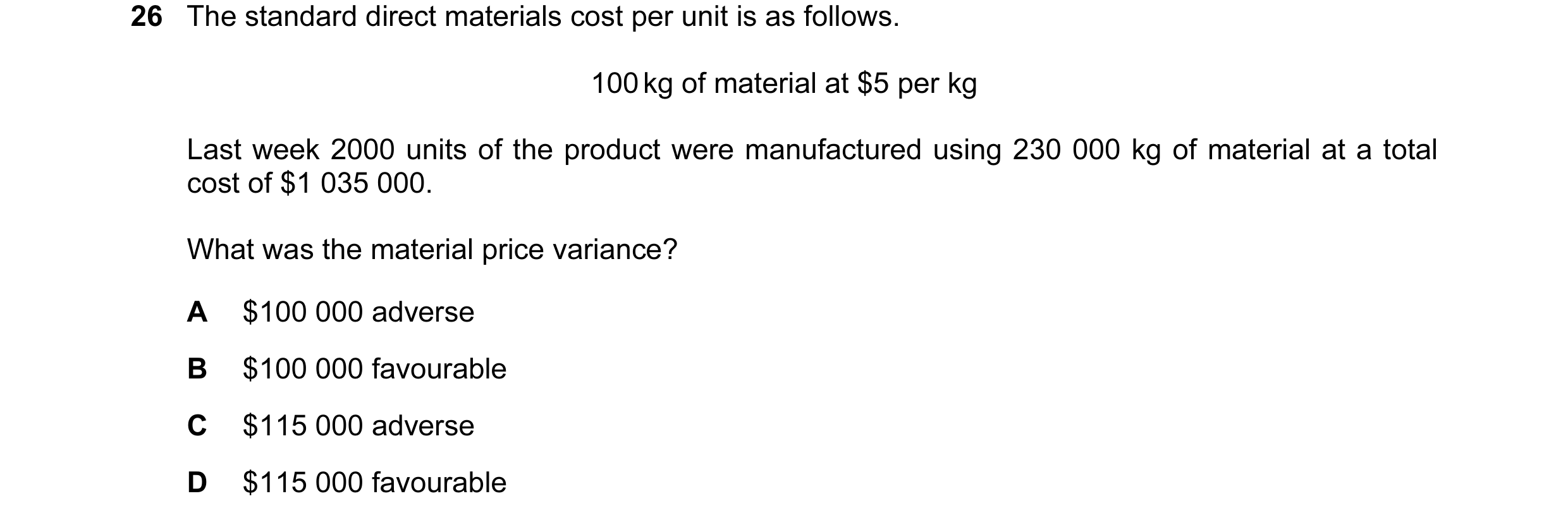
Q22 · The standard direct materials cost per unit is as follows 9706/31 Oct/Nov 2010
26 The standard direct materials cost per unit is as follows. 100 kg of material at $5 per kg Last week 2000 units of the product were manufactured using 230 000 kg of material at a total cost of $1 035 000. What was the material price variance? A $100 000 adverse B $100 000 favourable C $115 000 adverse D $115 000 favourable
1 marks
Answer: D
This question in 9706/31 Oct/Nov 2010
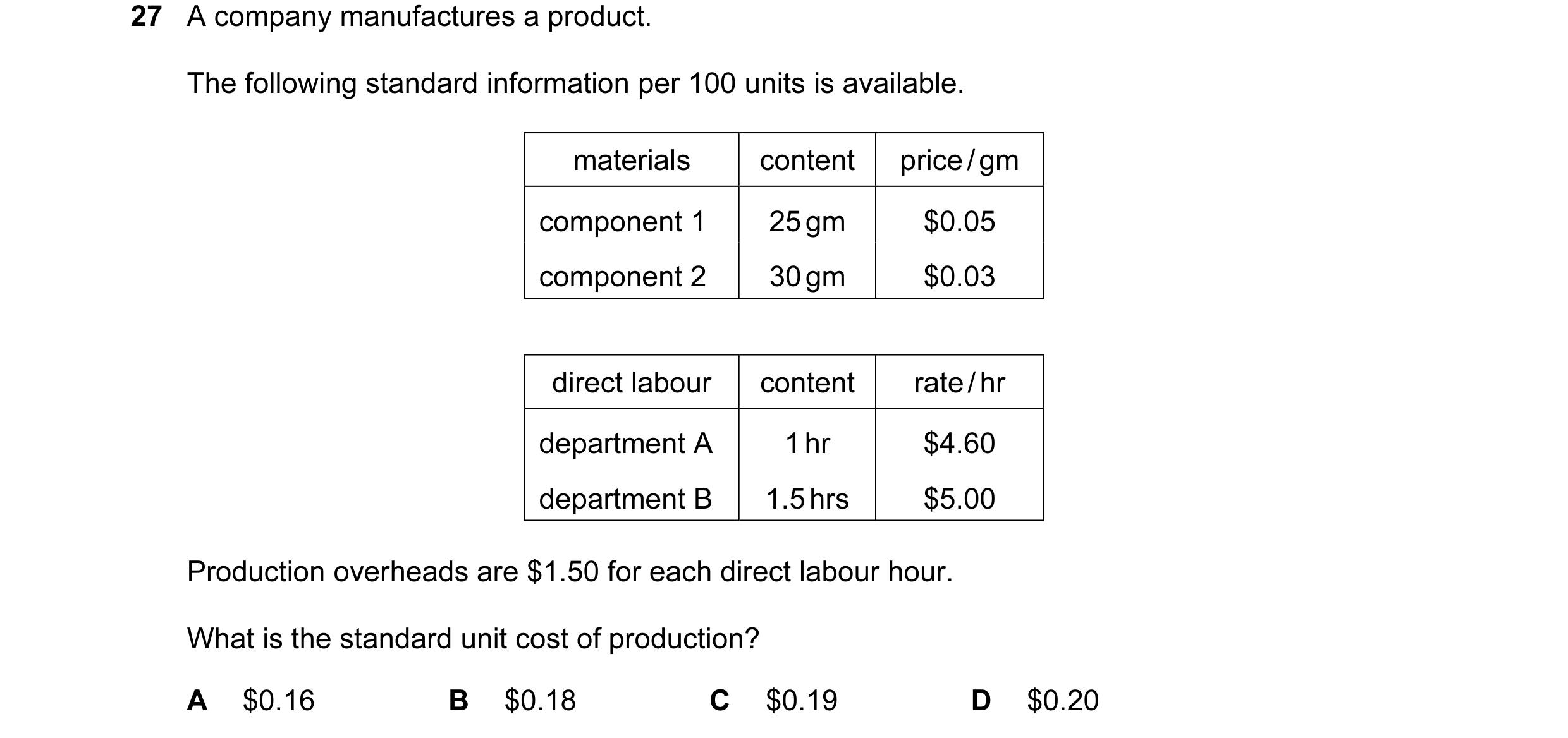
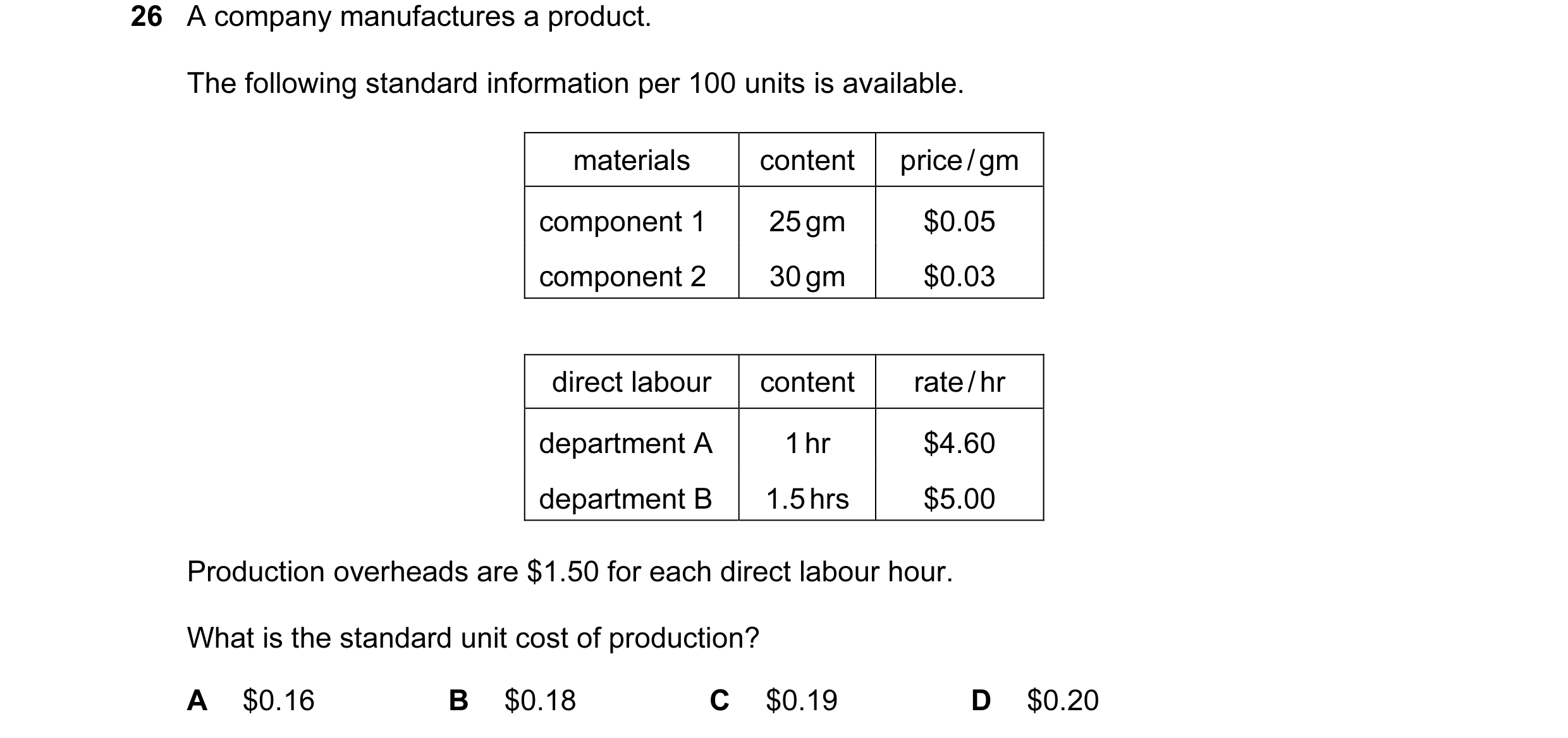
Q23 · A company manufactures a product 9706/31 Oct/Nov 2010
27 A company manufactures a product. The following standard information per 100 units is available. materials content price / gm component 1 25 gm $0.05 component 2 30 gm $0.03 direct labour content rate / hr department A 1 hr $4.60 department B 1.5 hrs $5.00 Production overheads are $1.50 for each direct labour hour. What is the standard unit cost of production? A $0.16 B $0.18 C $0.19 D $0.20
1 marks
Answer: B
This question in 9706/31 Oct/Nov 2010
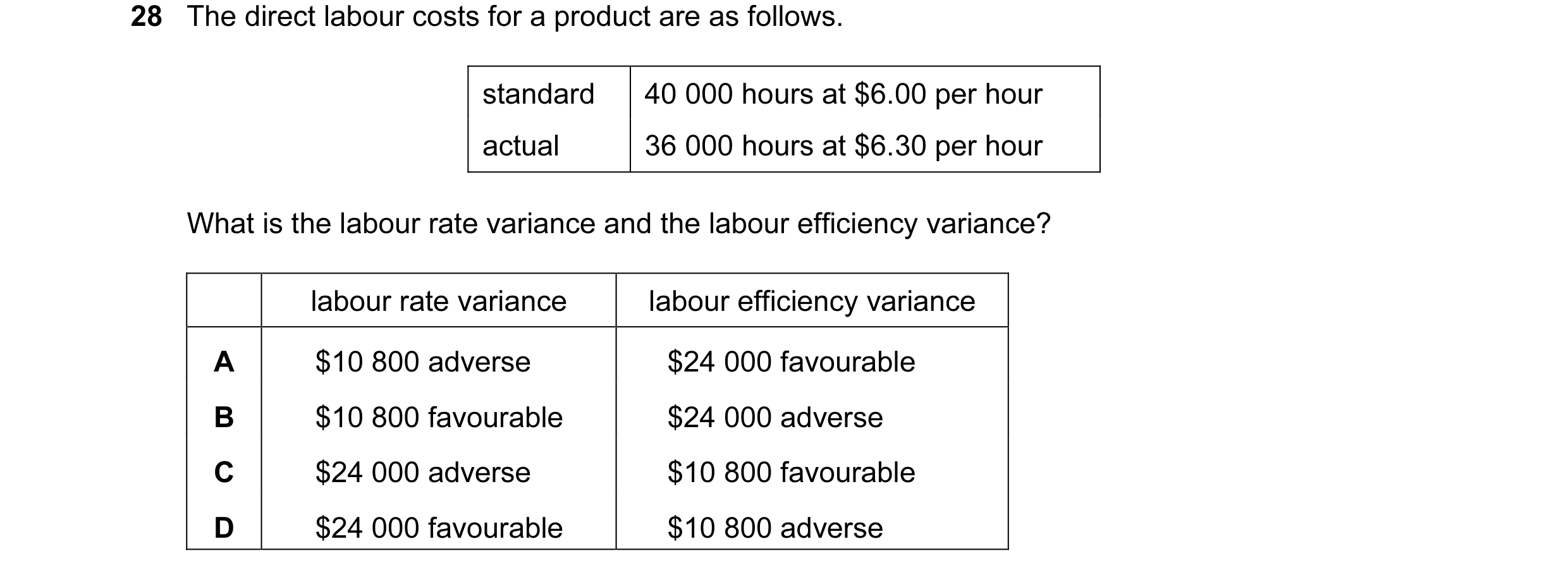
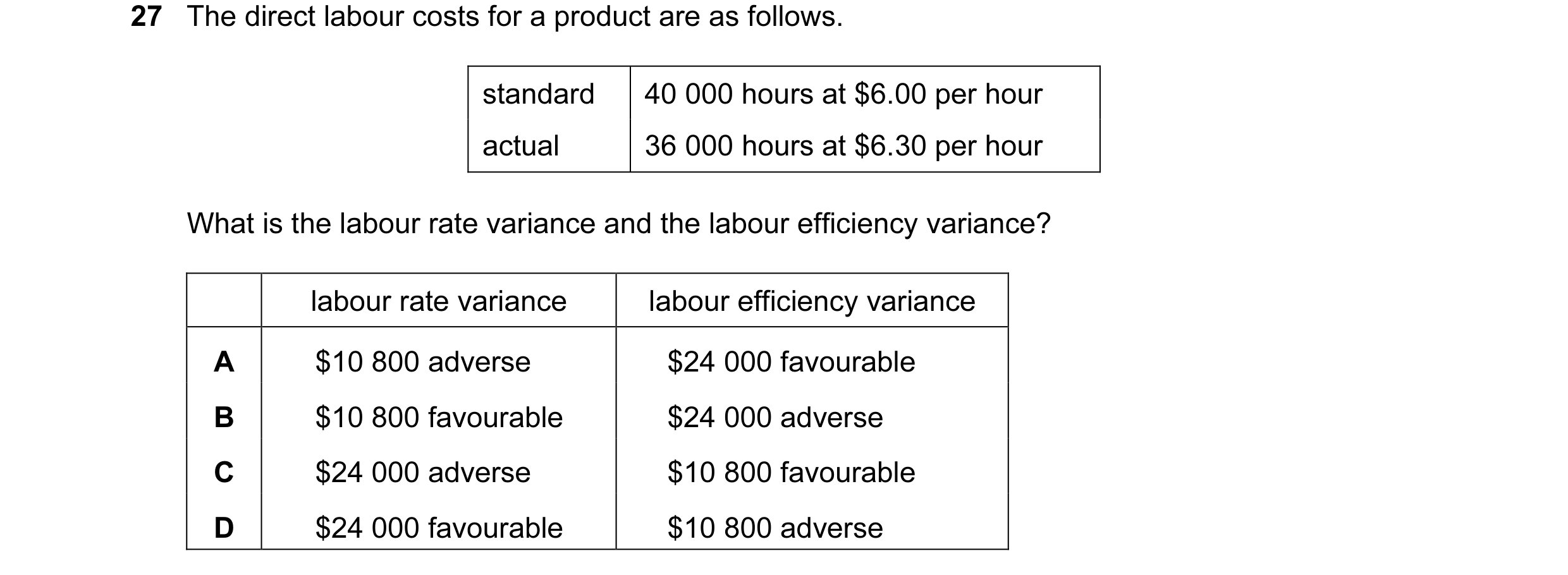
Q24 · The direct labour costs for a product are as follows 9706/31 Oct/Nov 2010
28 The direct labour costs for a product are as follows. standard 40 000 hours at $6.00 per hour actual 36 000 hours at $6.30 per hour What is the labour rate variance and the labour efficiency variance? labour rate variance labour efficiency variance A $10 800 adverse $24 000 favourable B $10 800 favourable $24 000 adverse C $24 000 adverse $10 800 favourable D $24 000 favourable $10 800 adverse
1 marks
Answer: A
This question in 9706/31 Oct/Nov 2010
Q25 · A standard costing system uses routine exception reporting of variances 9706/32 Oct/Nov 2010
25 A standard costing system uses routine exception reporting of variances. What does this mean? A Variances are investigated between certain limits. B Variances are investigated if managers require it. C Variances are only reported if unfavourable. D Variances are reported if above or below agreed limits.
1 marks
Answer: D
This question in 9706/32 Oct/Nov 2010
Q26 · The standard direct materials cost per unit is as follows 9706/32 Oct/Nov 2010
26 The standard direct materials cost per unit is as follows. 100 kg of material at $5 per kg Last week 2000 units of the product were manufactured using 230 000 kg of material at a total cost of $1 035 000. What was the material price variance? A $100 000 adverse B $100 000 favourable C $115 000 adverse D $115 000 favourable
1 marks
Answer: D
This question in 9706/32 Oct/Nov 2010
Q27 · A company manufactures a product 9706/32 Oct/Nov 2010
27 A company manufactures a product. The following standard information per 100 units is available. materials content price / gm component 1 25 gm $0.05 component 2 30 gm $0.03 direct labour content rate / hr department A 1 hr $4.60 department B 1.5 hrs $5.00 Production overheads are $1.50 for each direct labour hour. What is the standard unit cost of production? A $0.16 B $0.18 C $0.19 D $0.20
1 marks
Answer: B
This question in 9706/32 Oct/Nov 2010
Q28 · The direct labour costs for a product are as follows 9706/32 Oct/Nov 2010
28 The direct labour costs for a product are as follows. standard 40 000 hours at $6.00 per hour actual 36 000 hours at $6.30 per hour What is the labour rate variance and the labour efficiency variance? labour rate variance labour efficiency variance A $10 800 adverse $24 000 favourable B $10 800 favourable $24 000 adverse C $24 000 adverse $10 800 favourable D $24 000 favourable $10 800 adverse
1 marks
Answer: A
This question in 9706/32 Oct/Nov 2010
Q29 · A standard costing system uses routine exception reporting of variances 9706/33 Oct/Nov 2010
24 A standard costing system uses routine exception reporting of variances. What does this mean? A Variances are investigated between certain limits. B Variances are investigated if managers require it. C Variances are only reported if unfavourable. D Variances are reported if above or below agreed limits.
1 marks
Answer: D
This question in 9706/33 Oct/Nov 2010
Q30 · The standard direct materials cost per unit is as follows 9706/33 Oct/Nov 2010
25 The standard direct materials cost per unit is as follows. 100 kg of material at $5 per kg Last week 2000 units of the product were manufactured using 230 000 kg of material at a total cost of $1 035 000. What was the material price variance? A $100 000 adverse B $100 000 favourable C $115 000 adverse D $115 000 favourable
1 marks
Answer: D
This question in 9706/33 Oct/Nov 2010
Q31 · A company manufactures a product 9706/33 Oct/Nov 2010
26 A company manufactures a product. The following standard information per 100 units is available. materials content price / gm component 1 25 gm $0.05 component 2 30 gm $0.03 direct labour content rate / hr department A 1 hr $4.60 department B 1.5 hrs $5.00 Production overheads are $1.50 for each direct labour hour. What is the standard unit cost of production? A $0.16 B $0.18 C $0.19 D $0.20
1 marks
Answer: B
This question in 9706/33 Oct/Nov 2010
Q32 · The direct labour costs for a product are as follows 9706/33 Oct/Nov 2010
27 The direct labour costs for a product are as follows. standard 40 000 hours at $6.00 per hour actual 36 000 hours at $6.30 per hour What is the labour rate variance and the labour efficiency variance? labour rate variance labour efficiency variance A $10 800 adverse $24 000 favourable B $10 800 favourable $24 000 adverse C $24 000 adverse $10 800 favourable D $24 000 favourable $10 800 adverse
1 marks
Answer: A
This question in 9706/33 Oct/Nov 2010
Q33 · The following information relates to last months production of a component 9706/31 May/June 2011
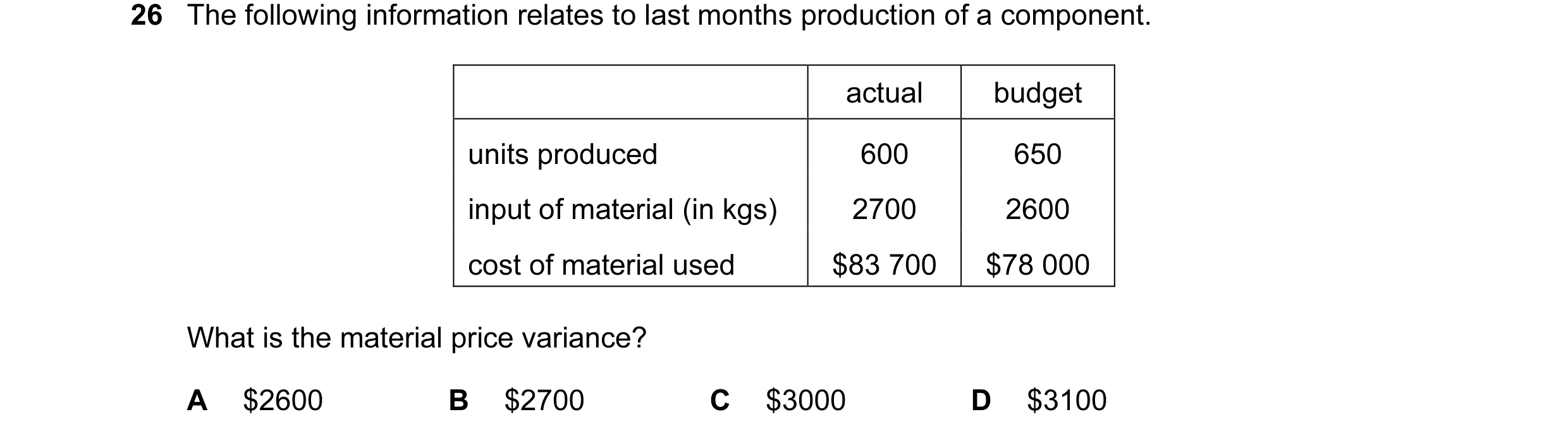
25 The following information relates to last months production of a component. actual budget units produced 600 650 input of material (in kgs) 2700 2600 cost of material used $83 700 $78 000 What is the material price variance? A $2600 B $2700 C $3000 D $3100
1 marks
Answer: B
This question in 9706/31 May/June 2011
Q34 · A company uses a standard costing system 9706/31 May/June 2011
27 A company uses a standard costing system. Last month, actual fixed overhead expenditure was 4 % below budget. The actual fixed overhead expenditure was $1600 less than the budgeted fixed overheads. How much was the actual fixed overhead expenditure last month? A $36 800 B $38 400 C $40 000 D $41 600
1 marks
Answer: B
This question in 9706/31 May/June 2011
Q35 · The following information relates to last months production of a component 9706/32 May/June 2011
26 The following information relates to last months production of a component. actual budget units produced 600 650 input of material (in kgs) 2700 2600 cost of material used $83 700 $78 000 What is the material price variance? A $2600 B $2700 C $3000 D $3100
1 marks
Answer: B
This question in 9706/32 May/June 2011
Q36 · The table shows standard cost data for a unit of product 9706/32 May/June 2011
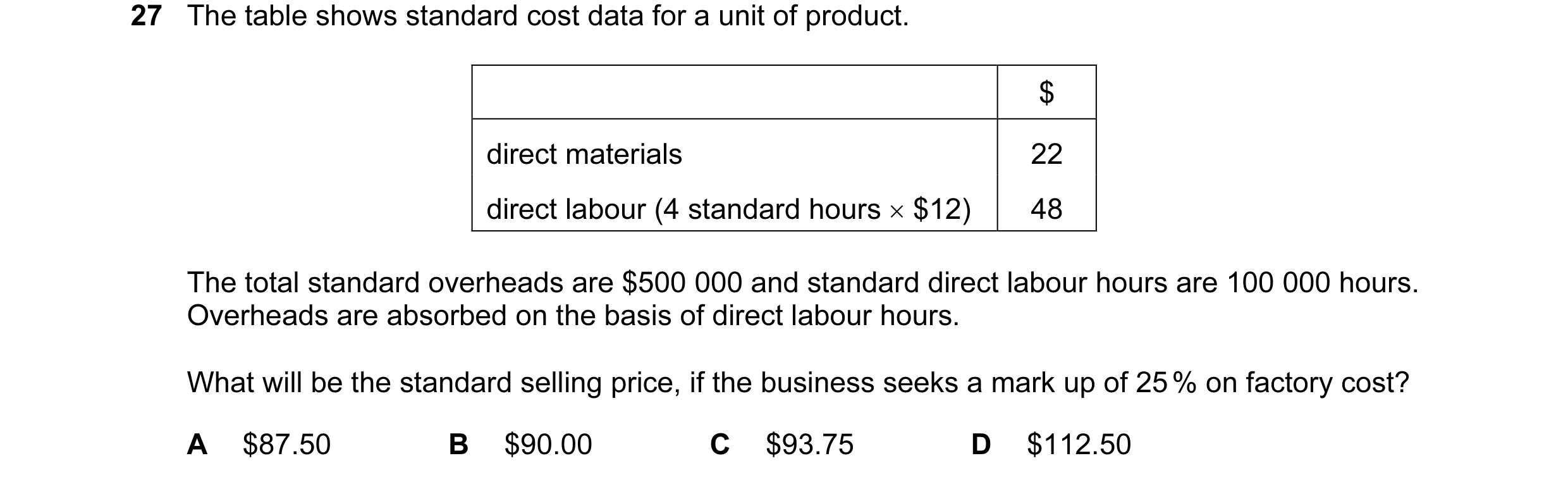
27 The table shows standard cost data for a unit of product. $ direct materials 22 direct labour (4 standard hours × $12) 48 The total standard overheads are $500 000 and standard direct labour hours are 100 000 hours. Overheads are absorbed on the basis of direct labour hours. What will be the standard selling price, if the business seeks a mark up of 25 % on factory cost? A $87.50 B $90.00 C $93.75 D $112.50
1 marks
Answer: D
This question in 9706/32 May/June 2011
Q37 · A company uses a standard costing system 9706/32 May/June 2011
28 A company uses a standard costing system. Last month, actual fixed overhead expenditure was 4 % below budget. The actual fixed overhead expenditure was $1600 less than the budgeted fixed overheads. How much was the actual fixed overhead expenditure last month? A $36 800 B $38 400 C $40 000 D $41 600
1 marks
Answer: B
This question in 9706/32 May/June 2011
Q38 · The following information relates to the budgeted and actual sales of a product 9706/33 May/June 2011
21 The following information relates to the budgeted and actual sales of a product. budget actual sales volume in units 40 000 36 000 contribution per unit $2 $2.50 fixed costs (total) $30 000 $30 000 What change in the break-even point has been caused by actual sales being different from budget? A 20 % better B 20 % worse C 80 % better D 80 % worse
1 marks
Answer: A
This question in 9706/33 May/June 2011
Q39 · The following information relates to last months production of a component 9706/33 May/June 2011
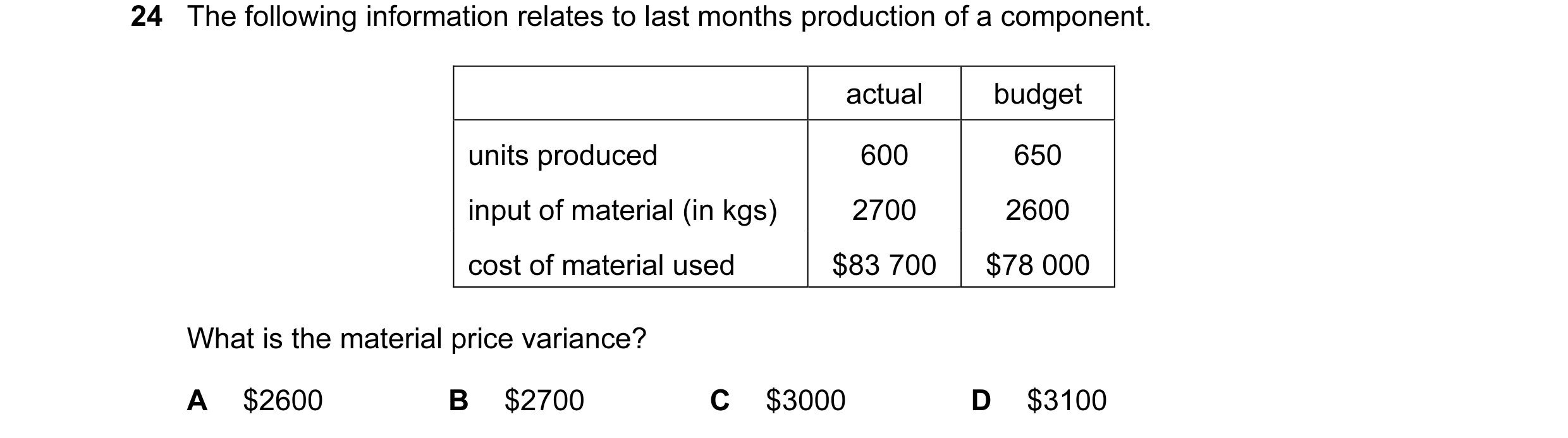
24 The following information relates to last months production of a component. actual budget units produced 600 650 input of material (in kgs) 2700 2600 cost of material used $83 700 $78 000 What is the material price variance? A $2600 B $2700 C $3000 D $3100
1 marks
Answer: B
This question in 9706/33 May/June 2011
Q40 · A company uses a standard costing system 9706/33 May/June 2011
26 A company uses a standard costing system. Last month, actual fixed overhead expenditure was 4 % below budget. The actual fixed overhead expenditure was $1600 less than the budgeted fixed overheads. How much was the actual fixed overhead expenditure last month? A $36 800 B $38 400 C $40 000 D $41 600
1 marks
Answer: B
This question in 9706/33 May/June 2011
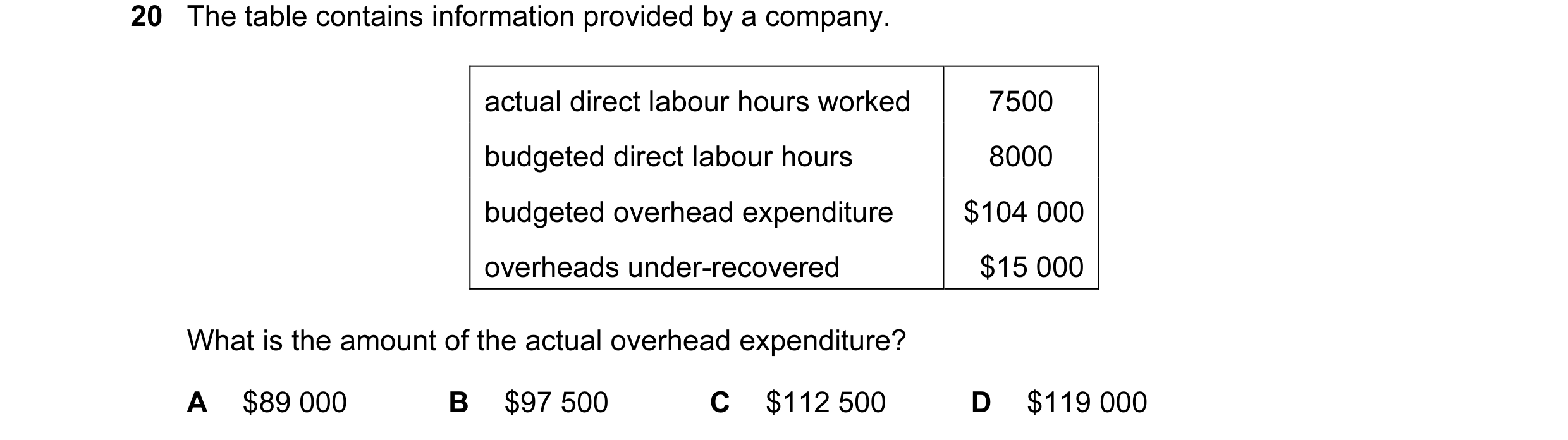
Q41 · The table contains information provided by a company 9706/31 Oct/Nov 2011
20 The table contains information provided by a company. actual direct labour hours worked 7500 budgeted direct labour hours 8000 budgeted overhead expenditure $104 000 overheads under-recovered $15 000 What is the amount of the actual overhead expenditure? A $89 000 B $97 500 C $112 500 D $119 000
1 marks
Answer: C
This question in 9706/31 Oct/Nov 2011
Q42 · The cost accounting records of a company showed: direct material price variance adverse… 9706/31 Oct/Nov 2011
25 The cost accounting records of a company showed: direct material price variance adverse direct material usage variance favourable direct labour efficiency variance favourable The company considered there was a direct relationship between these variances. What was the most likely reason for this relationship? A Direct labour was of a higher quality than standard. B Direct labour was of a lower quality than standard. C Material was of a higher quality than standard. D Material was of a lower quality than standard.
1 marks
Answer: C
This question in 9706/31 Oct/Nov 2011
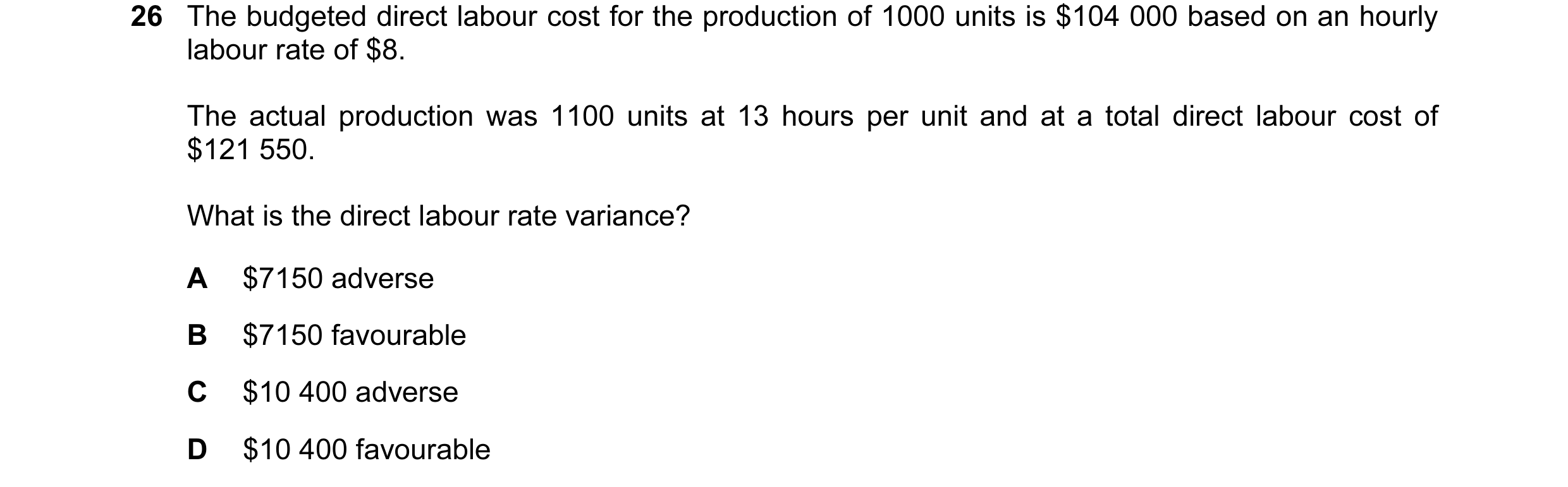
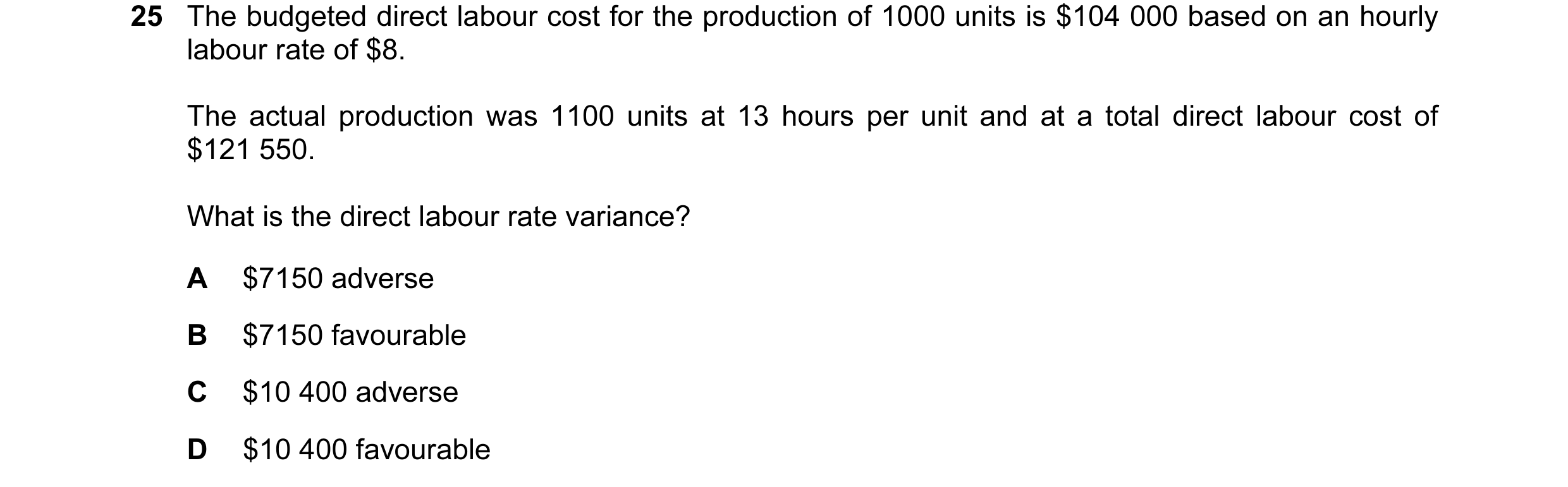
Q43 · The budgeted direct labour cost for the production of 1000 units is $104 000 based on an… 9706/31 Oct/Nov 2011
26 The budgeted direct labour cost for the production of 1000 units is $104 000 based on an hourly labour rate of $8. The actual production was 1100 units at 13 hours per unit and at a total direct labour cost of $121 550. What is the direct labour rate variance? A $7150 adverse B $7150 favourable C $10 400 adverse D $10 400 favourable
1 marks
Answer: A
This question in 9706/31 Oct/Nov 2011
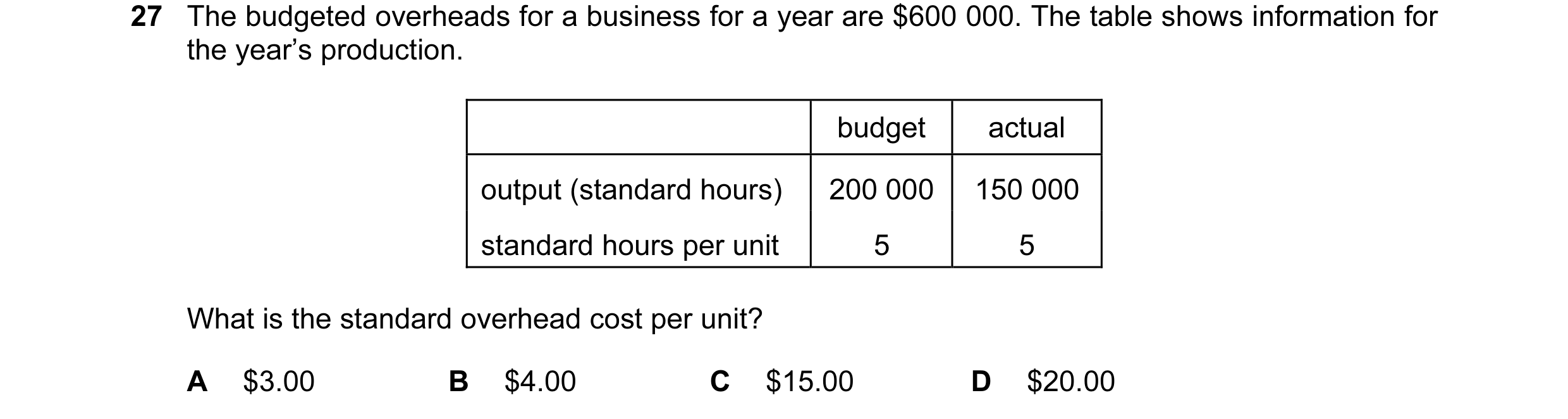
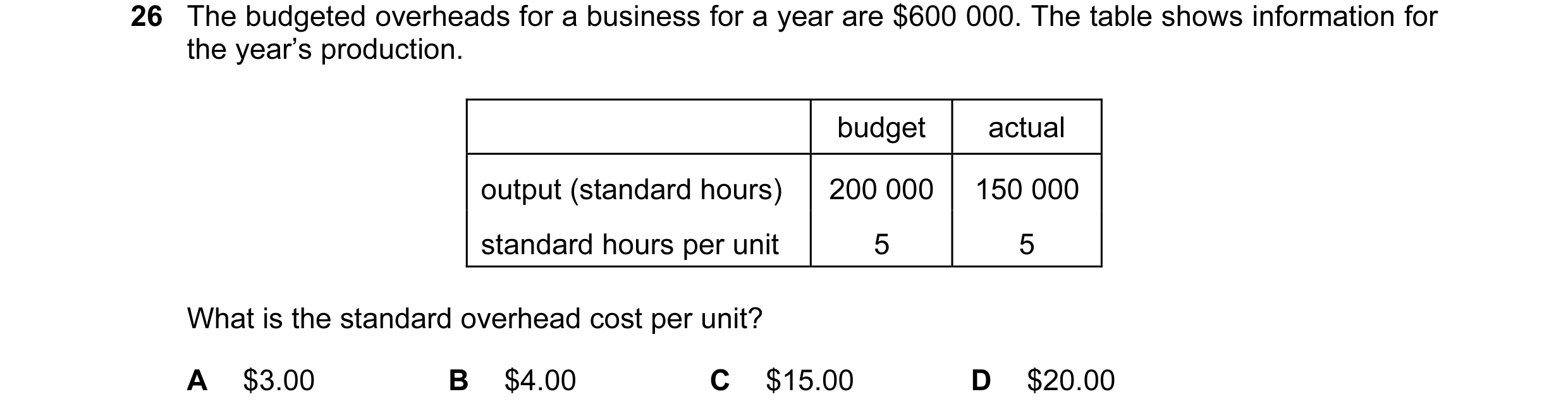
Q44 · The budgeted overheads for a business for a year are $600 000 9706/31 Oct/Nov 2011
27 The budgeted overheads for a business for a year are $600 000. The table shows information for the year’s production. budget actual output (standard hours) 200 000 150 000 standard hours per unit 5 5 What is the standard overhead cost per unit? A $3.00 B $4.00 C $15.00 D $20.00
1 marks
Answer: C
This question in 9706/31 Oct/Nov 2011
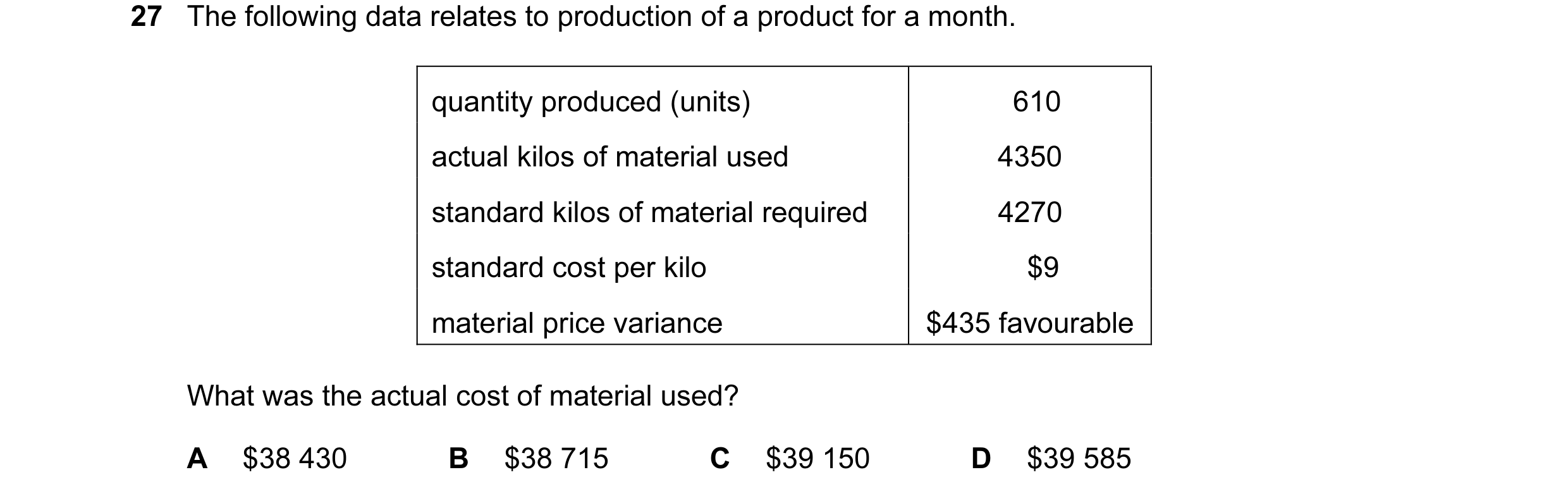
Q45 · The following data relates to production of a product for a month 9706/31 Oct/Nov 2011
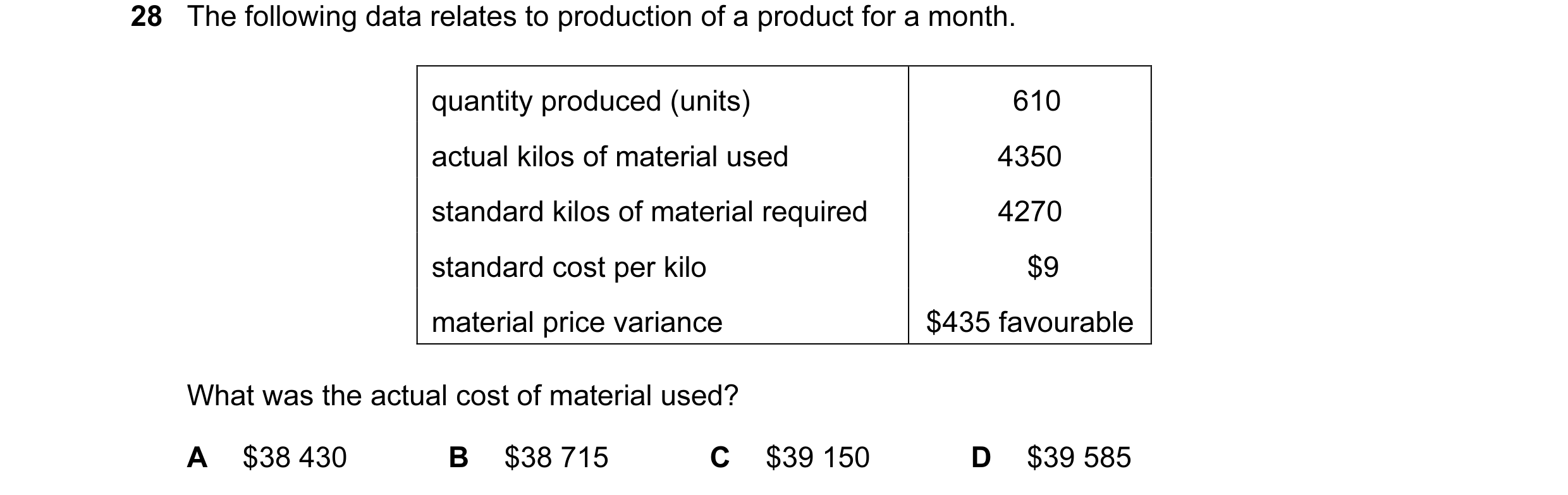
28 The following data relates to production of a product for a month. quantity produced (units) 610 actual kilos of material used 4350 standard kilos of material required 4270 standard cost per kilo $9 material price variance $435 favourable What was the actual cost of material used? A $38 430 B $38 715 C $39 150 D $39 585
1 marks
Answer: B
This question in 9706/31 Oct/Nov 2011
Q46 · Budgeted and actual sales of a product are shown below 9706/32 Oct/Nov 2011
26 Budgeted and actual sales of a product are shown below. budget actual sales in units 3000 2800 selling price per unit $25 ? sales revenue $75 000 $67 200 What is the sales price variance? A $2800 adverse B $2800 favourable C $3000 adverse D $3000 favourable
1 marks
Answer: A
This question in 9706/32 Oct/Nov 2011
Q47 · A company has the following sales data 9706/32 Oct/Nov 2011
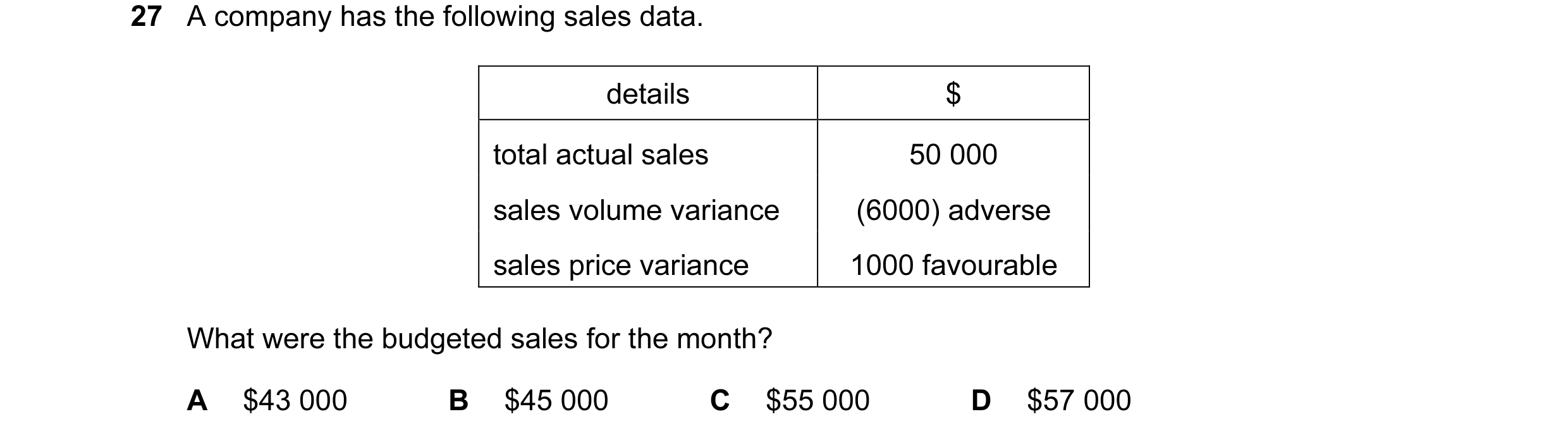
27 A company has the following sales data. details $ total actual sales 50 000 sales volume variance (6000) adverse sales price variance 1000 favourable What were the budgeted sales for the month? A $43 000 B $45 000 C $55 000 D $57 000
1 marks
Answer: C
This question in 9706/32 Oct/Nov 2011
Q48 · Budgeted and actual results are as shown 9706/32 Oct/Nov 2011
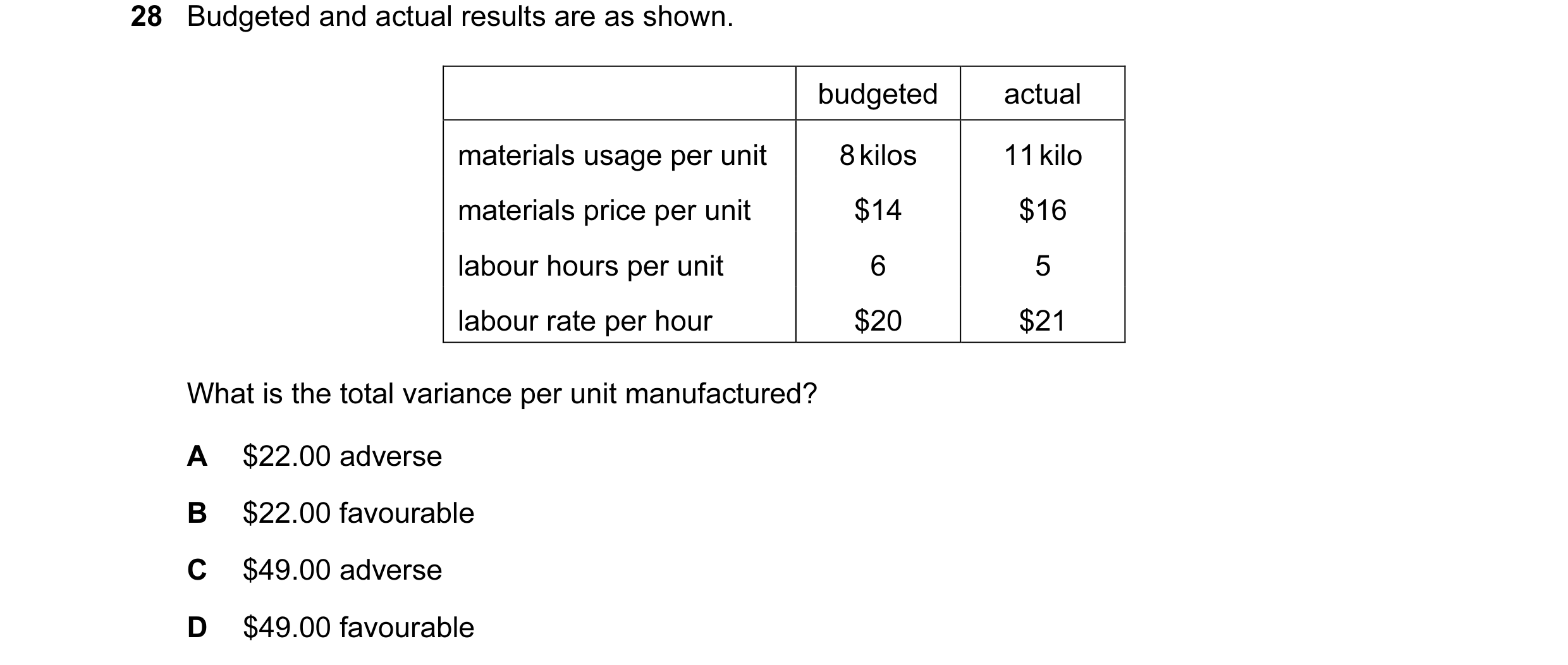
28 Budgeted and actual results are as shown. budgeted actual materials usage per unit 8 kilos 11 kilo materials price per unit $14 $16 labour hours per unit 6 5 labour rate per hour $20 $21 What is the total variance per unit manufactured? A $22.00 adverse B $22.00 favourable C $49.00 adverse D $49.00 favourable
1 marks
Answer: C
This question in 9706/32 Oct/Nov 2011
Q49 · The cost accounting records of a company showed: direct material price variance adverse… 9706/33 Oct/Nov 2011
24 The cost accounting records of a company showed: direct material price variance adverse direct material usage variance favourable direct labour efficiency variance favourable The company considered there was a direct relationship between these variances. What was the most likely reason for this relationship? A Direct labour was of a higher quality than standard. B Direct labour was of a lower quality than standard. C Material was of a higher quality than standard. D Material was of a lower quality than standard.
1 marks
Answer: C
This question in 9706/33 Oct/Nov 2011
Q50 · The budgeted direct labour cost for the production of 1000 units is $104 000 based on an… 9706/33 Oct/Nov 2011
25 The budgeted direct labour cost for the production of 1000 units is $104 000 based on an hourly labour rate of $8. The actual production was 1100 units at 13 hours per unit and at a total direct labour cost of $121 550. What is the direct labour rate variance? A $7150 adverse B $7150 favourable C $10 400 adverse D $10 400 favourable
1 marks
Answer: A
This question in 9706/33 Oct/Nov 2011
Q51 · The budgeted overheads for a business for a year are $600 000 9706/33 Oct/Nov 2011
26 The budgeted overheads for a business for a year are $600 000. The table shows information for the year’s production. budget actual output (standard hours) 200 000 150 000 standard hours per unit 5 5 What is the standard overhead cost per unit? A $3.00 B $4.00 C $15.00 D $20.00
1 marks
Answer: C
This question in 9706/33 Oct/Nov 2011
Q52 · The following data relates to production of a product for a month 9706/33 Oct/Nov 2011
27 The following data relates to production of a product for a month. quantity produced (units) 610 actual kilos of material used 4350 standard kilos of material required 4270 standard cost per kilo $9 material price variance $435 favourable What was the actual cost of material used? A $38 430 B $38 715 C $39 150 D $39 585
1 marks
Answer: B
This question in 9706/33 Oct/Nov 2011
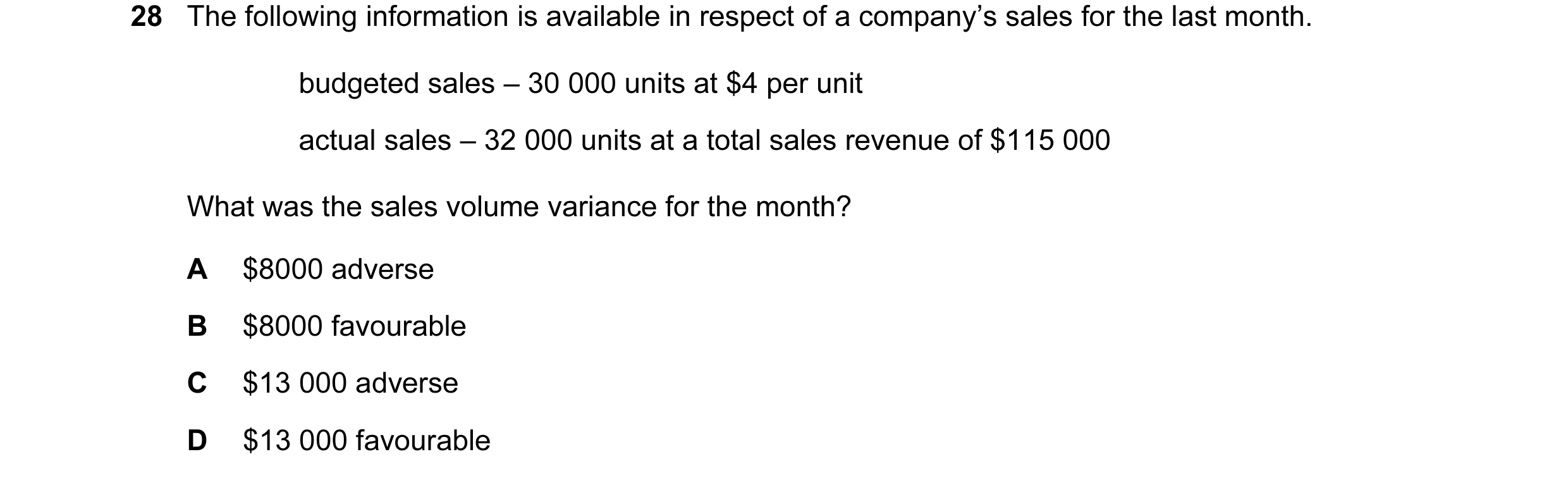
Q53 · The following information is available in respect of a company’s sales for the last month 9706/31 May/June 2012
29 The following information is available in respect of a company’s sales for the last month. budgeted sales – 30 000 units at $4 per unit actual sales – 32 000 units at a total sales revenue of $115 000 What was the sales volume variance for the month? A $8000 adverse B $8000 favourable C $13 000 adverse D $13 000 favourable
1 marks
Answer: B
This question in 9706/31 May/June 2012
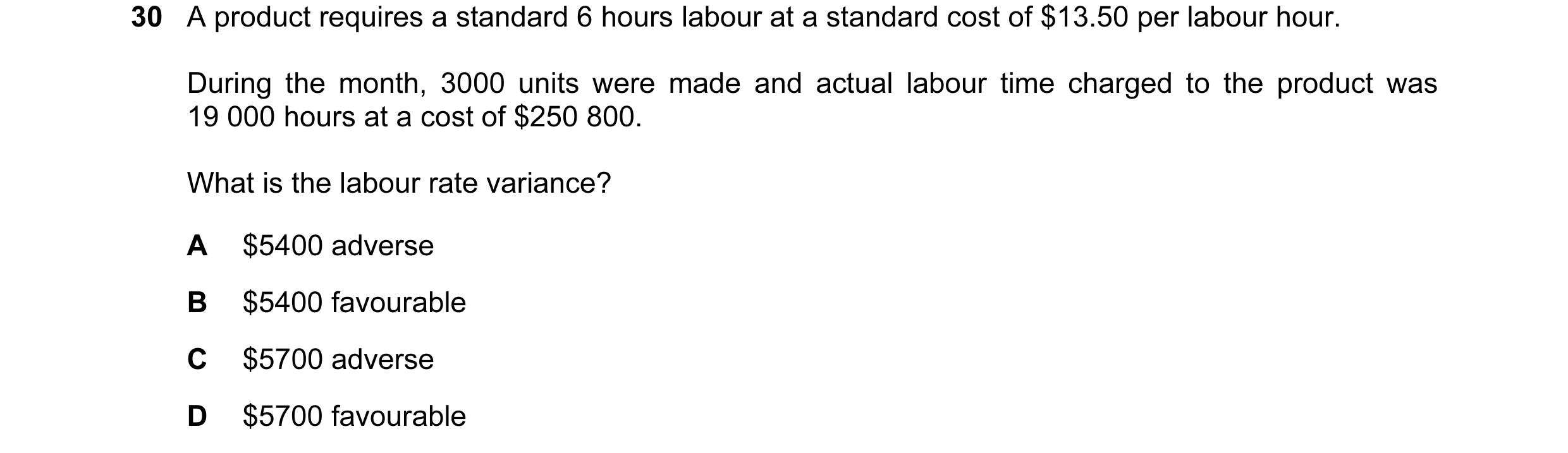
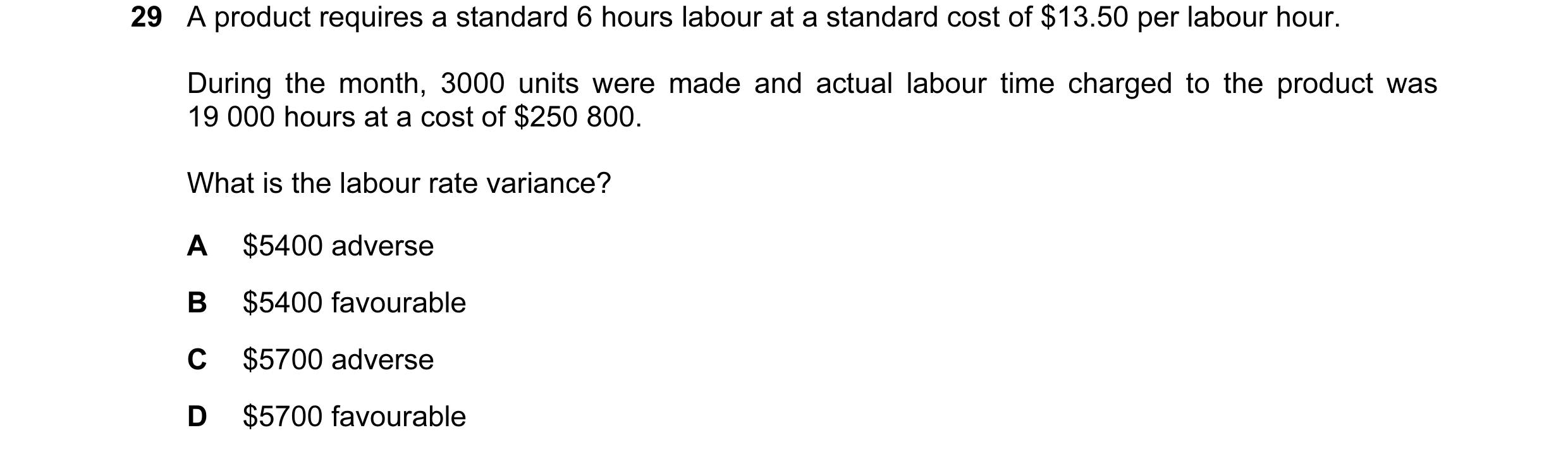
Q54 · A product requires a standard 6 hours labour at a standard cost of $13.50 per labour hour 9706/31 May/June 2012
30 A product requires a standard 6 hours labour at a standard cost of $13.50 per labour hour. During the month, 3000 units were made and actual labour time charged to the product was 19 000 hours at a cost of $250 800. What is the labour rate variance? A $5400 adverse B $5400 favourable C $5700 adverse D $5700 favourable
1 marks
Answer: D
This question in 9706/31 May/June 2012
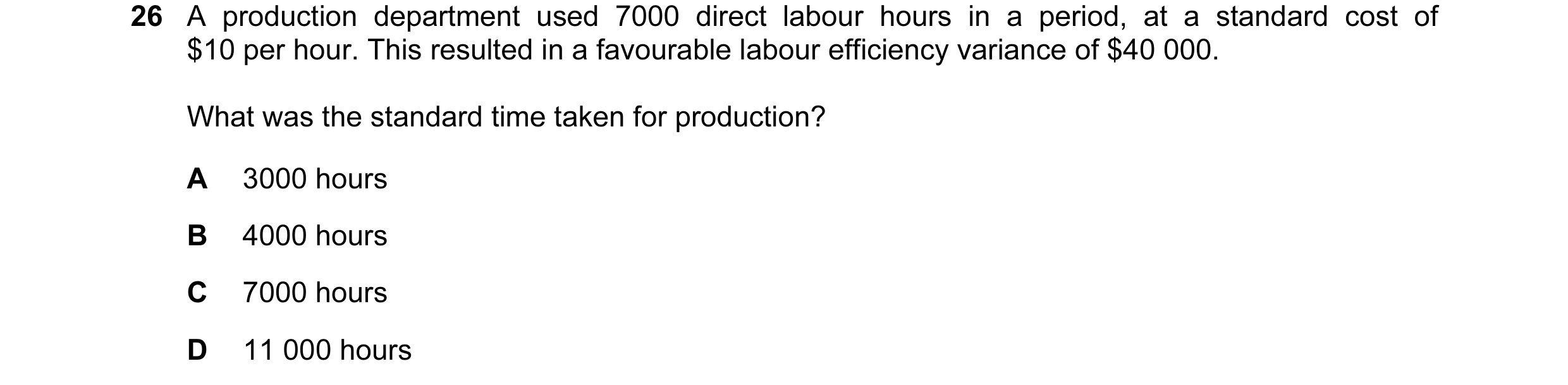
Q55 · A production department used 7000 direct labour hours in a period, at a standard cost of… 9706/32 May/June 2012
26 A production department used 7000 direct labour hours in a period, at a standard cost of $10 per hour. This resulted in a favourable labour efficiency variance of $40 000. What was the standard time taken for production? A 3000 hours B 4000 hours C 7000 hours D 11 000 hours
1 marks
Answer: D
This question in 9706/32 May/June 2012
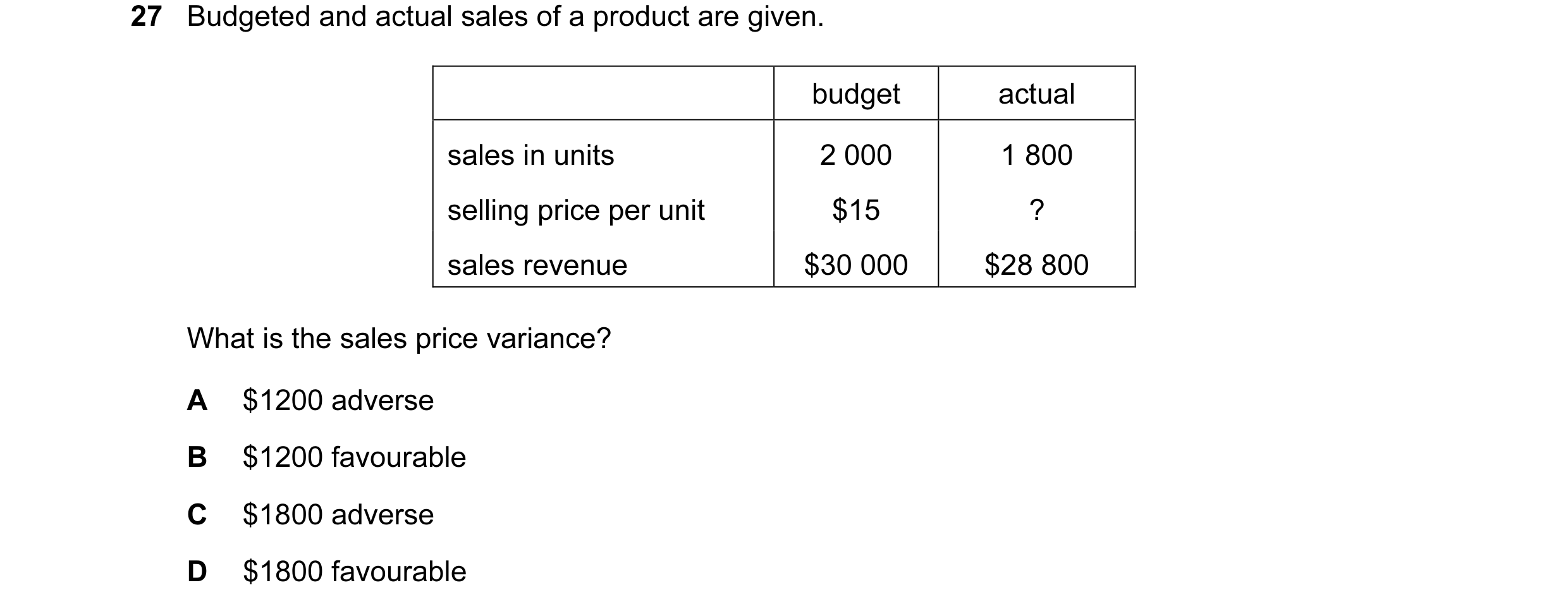
Q56 · Budgeted and actual sales of a product are given 9706/32 May/June 2012
27 Budgeted and actual sales of a product are given. budget actual sales in units 2 000 1 800 selling price per unit $15 ? sales revenue $30 000 $28 800 What is the sales price variance? A $1200 adverse B $1200 favourable C $1800 adverse D $1800 favourable
1 marks
Answer: D
This question in 9706/32 May/June 2012
Q57 · The graph shows the cost and usage of a material 9706/32 May/June 2012
28 The graph shows the cost and usage of a material. $ actual price of material standard price of material quantity What does the shaded area represent? A adverse price variance B adverse usage variance C favourable price variance D favourable usage variance
1 marks
Answer: A
This question in 9706/32 May/June 2012
Q58 · The following information is available in respect of a company’s sales for the last month 9706/33 May/June 2012
28 The following information is available in respect of a company’s sales for the last month. budgeted sales – 30 000 units at $4 per unit actual sales – 32 000 units at a total sales revenue of $115 000 What was the sales volume variance for the month? A $8000 adverse B $8000 favourable C $13 000 adverse D $13 000 favourable
1 marks
Answer: B
This question in 9706/33 May/June 2012
Q59 · A product requires a standard 6 hours labour at a standard cost of $13.50 per labour hour 9706/33 May/June 2012
29 A product requires a standard 6 hours labour at a standard cost of $13.50 per labour hour. During the month, 3000 units were made and actual labour time charged to the product was 19 000 hours at a cost of $250 800. What is the labour rate variance? A $5400 adverse B $5400 favourable C $5700 adverse D $5700 favourable
1 marks
Answer: D
This question in 9706/33 May/June 2012
Q60 · Budgeted and actual results are: budgeted actual materials (kgs per unit) 24 26 materials… 9706/31 Oct/Nov 2012
27 Budgeted and actual results are: budgeted actual materials (kgs per unit) 24 26 materials (price per kg) $12 $16 labour (hours per unit) 8 6 labour (rate per hour) $25 $22 What is the total variance per unit manufactured? A $60 adverse B $72 adverse C $86 adverse D $120 adverse
1 marks
Answer: A
This question in 9706/31 Oct/Nov 2012
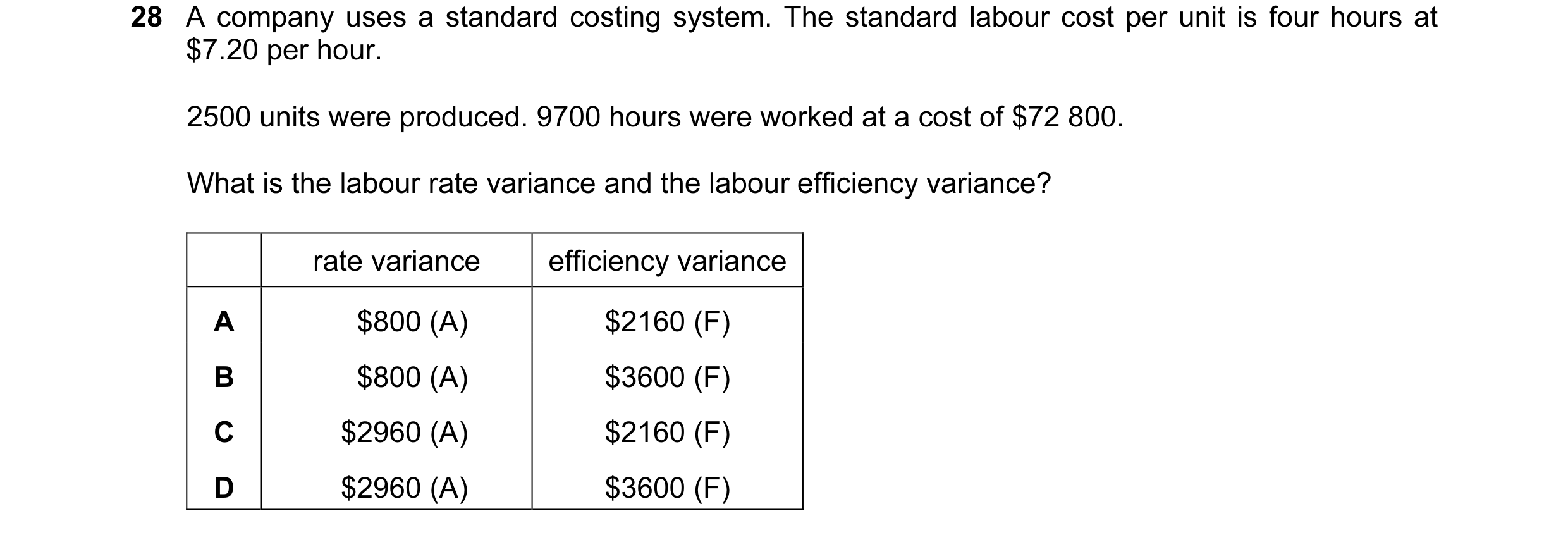
Q61 · A company uses a standard costing system 9706/31 Oct/Nov 2012
28 A company uses a standard costing system. The standard labour cost per unit is four hours at $7.20 per hour. 2500 units were produced. 9700 hours were worked at a cost of $72 800. What is the labour rate variance and the labour efficiency variance? rate variance efficiency variance A $800 (A) $2160 (F) B $800 (A) $3600 (F) C $2960 (A) $2160 (F) D $2960 (A) $3600 (F)
1 marks
Answer: C
This question in 9706/31 Oct/Nov 2012
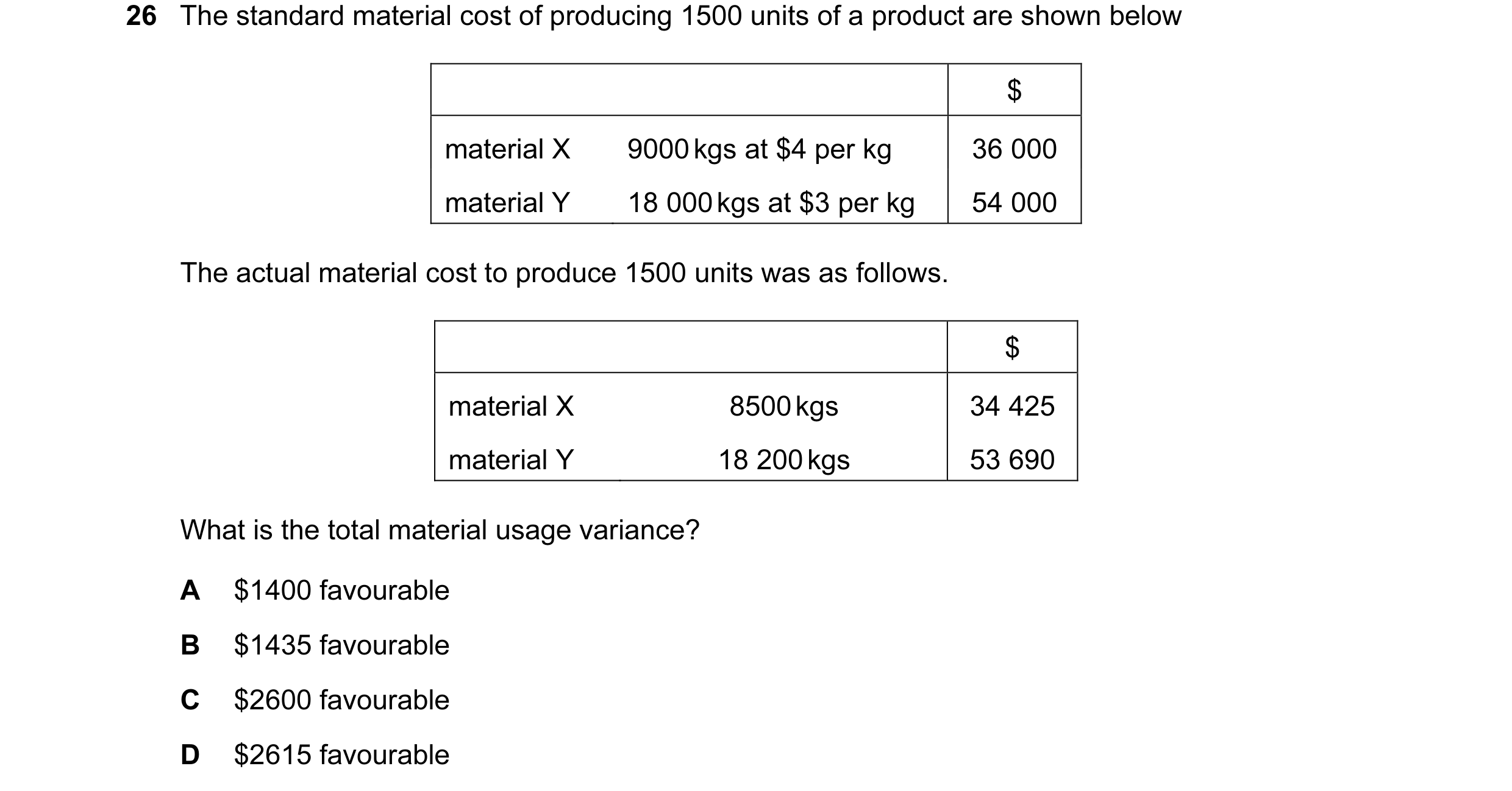
Q62 · The standard material cost of producing 1500 units of a product are shown below $… 9706/32 Oct/Nov 2012
26 The standard material cost of producing 1500 units of a product are shown below $ material X 9000 kgs at $4 per kg 36 000 material Y 18 000 kgs at $3 per kg 54 000 The actual material cost to produce 1500 units was as follows. $ material X 8500 kgs 34 425 material Y 18 200 kgs 53 690 What is the total material usage variance? A $1400 favourable B $1435 favourable C $2600 favourable D $2615 favourable
1 marks
Answer: A
This question in 9706/32 Oct/Nov 2012
Q63 · A company sells its products at $2.10 per unit 9706/32 Oct/Nov 2012
27 A company sells its products at $2.10 per unit. The standard selling price is $1.80. In order to try to increase its sales it reduced the selling price by $0.20. The effect of this was to sell 100 units more than the budgeted sales figure of 1000 units. What effect will this have on the following variances? sales price sales volume variance variance A adverse adverse B adverse favourable C favourable adverse D favourable favourable
1 marks
Answer: D
This question in 9706/32 Oct/Nov 2012
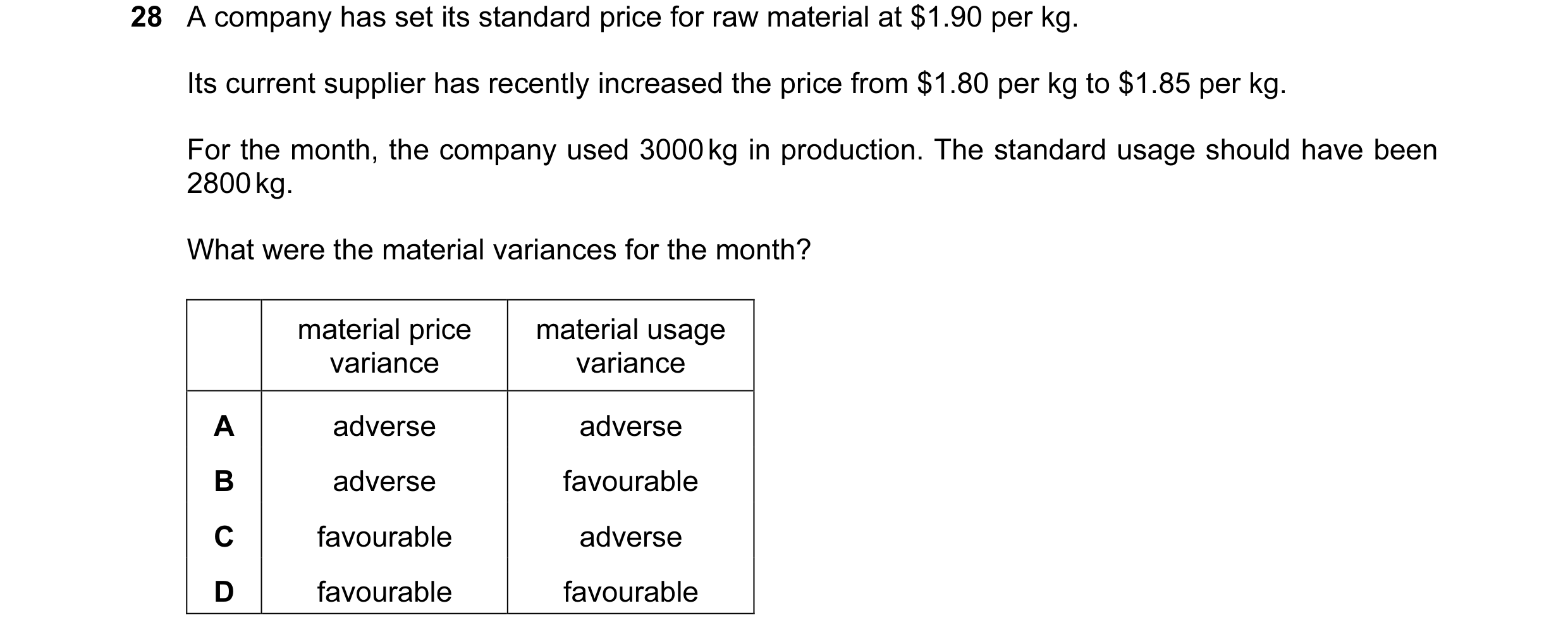
Q64 · A company has set its standard price for raw material at $1.90 per kg 9706/32 Oct/Nov 2012
28 A company has set its standard price for raw material at $1.90 per kg. Its current supplier has recently increased the price from $1.80 per kg to $1.85 per kg. For the month, the company used 3000 kg in production. The standard usage should have been 2800 kg. What were the material variances for the month? material price material usage variance variance A adverse adverse B adverse favourable C favourable adverse D favourable favourable
1 marks
Answer: C
This question in 9706/32 Oct/Nov 2012
Q65 · The standard material cost for a product is 5 kilos at $5 per kilo 9706/33 Oct/Nov 2012
25 The standard material cost for a product is 5 kilos at $5 per kilo. Last month 92 units were produced. If the material usage was $100 adverse, how many kilos of material were used in the month? A 440 kg B 460 kg C 480 kg D 500 kg
1 marks
Answer: C
This question in 9706/33 Oct/Nov 2012
Q66 · A company uses standard costing and has the following budget and actual data available… 9706/33 Oct/Nov 2012
26 A company uses standard costing and has the following budget and actual data available for a product in a period. budget actual production in units 30 000 28 000 material usage in kilograms 60 000 57 000 material cost $120 000 $136 800 What were the material price and usage variances? price variance $ usage variance $ A 22 800 (A) 2000 (A) B 22 800 (A) 2000 (F) C 22 800 (F) 2000 (A) D 22 800 (F) 2000 (F)
1 marks
Answer: A
This question in 9706/33 Oct/Nov 2012
Q67 · What may cause an adverse labour efficiency variance? 9706/33 Oct/Nov 2012
27 What may cause an adverse labour efficiency variance? A higher production levels than in the original budget B reduction in idle time C using a less skilled grade of labour D using newer, more efficient machinery
1 marks
Answer: C
This question in 9706/33 Oct/Nov 2012
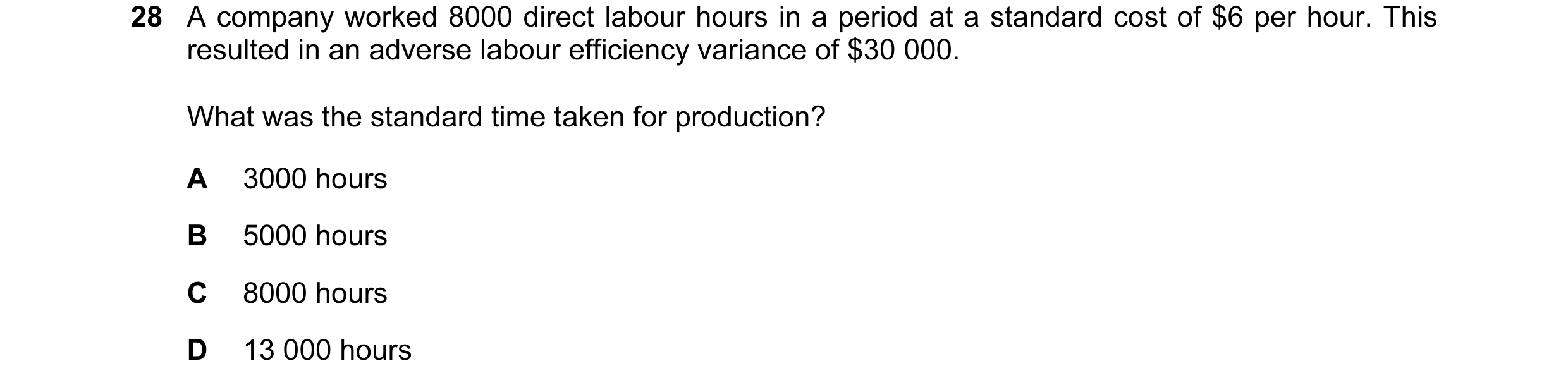
Q68 · A company worked 8000 direct labour hours in a period at a standard cost of $6 per hour 9706/33 Oct/Nov 2012
28 A company worked 8000 direct labour hours in a period at a standard cost of $6 per hour. This resulted in an adverse labour efficiency variance of $30 000. What was the standard time taken for production? A 3000 hours B 5000 hours C 8000 hours D 13 000 hours
1 marks
Answer: A
This question in 9706/33 Oct/Nov 2012
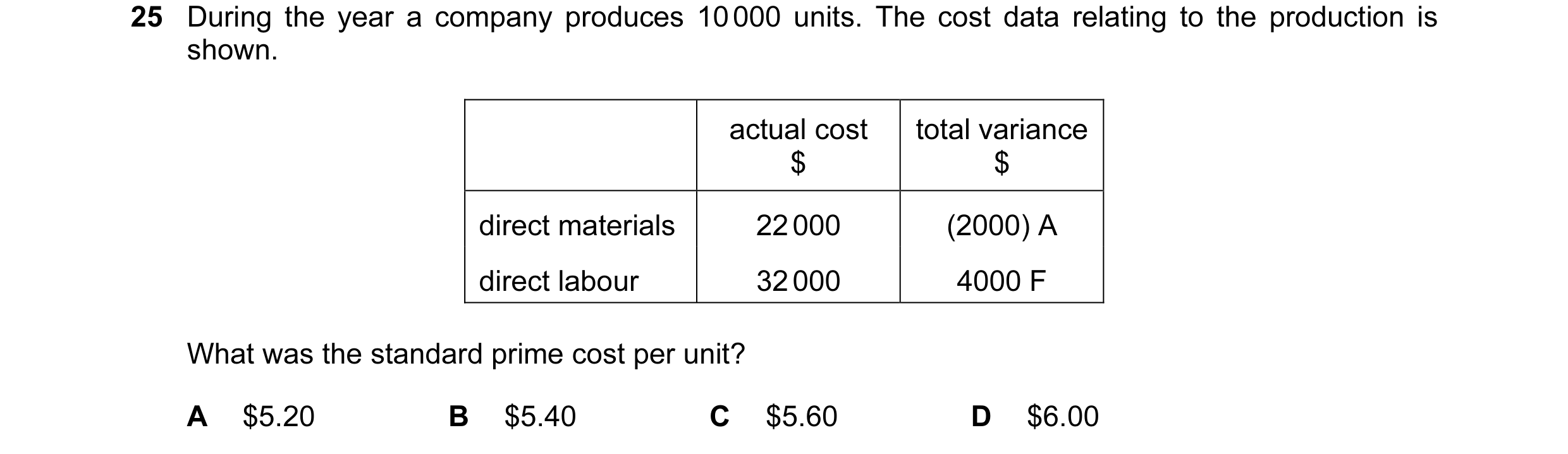
Q69 · During the year a company produces 10 000 units 9706/31 May/June 2013
25 During the year a company produces 10 000 units. The cost data relating to the production is shown. actual cost total variance $ $ direct materials 22 000 (2000) A direct labour 32 000 4000 F What was the standard prime cost per unit? A $5.20 B $5.40 C $5.60 D $6.00
1 marks
Answer: C
This question in 9706/31 May/June 2013
Q70 · During a month the following data was collected 9706/31 May/June 2013
26 During a month the following data was collected. direct labour efficiency variance $2000 favourable budgeted direct labour rate per hour $8 actual direct labour rate per hour $10 actual direct labour hours worked 15 000 What were the standard labour hours? A 14 750 B 14 800 C 15 200 D 15 250
1 marks
Answer: D
This question in 9706/31 May/June 2013
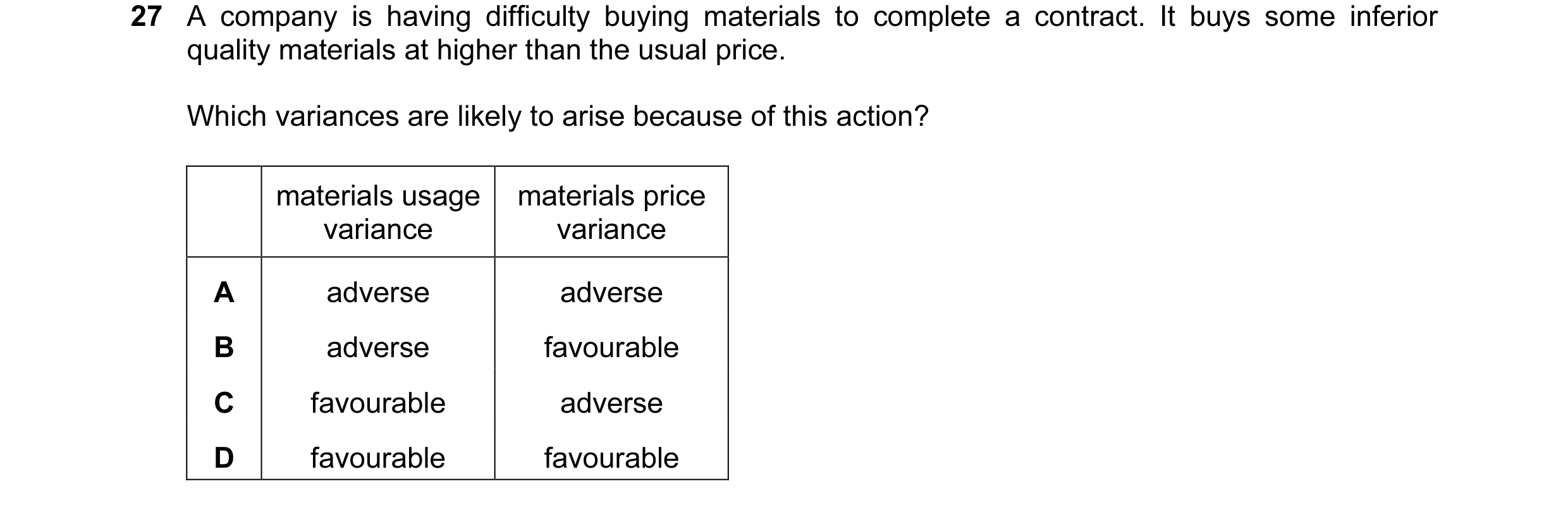
Q71 · A company is having difficulty buying materials to complete a contract 9706/31 May/June 2013
27 A company is having difficulty buying materials to complete a contract. It buys some inferior quality materials at higher than the usual price. Which variances are likely to arise because of this action? materials usage materials price variance variance A adverse adverse B adverse favourable C favourable adverse D favourable favourable
1 marks
Answer: A
This question in 9706/31 May/June 2013
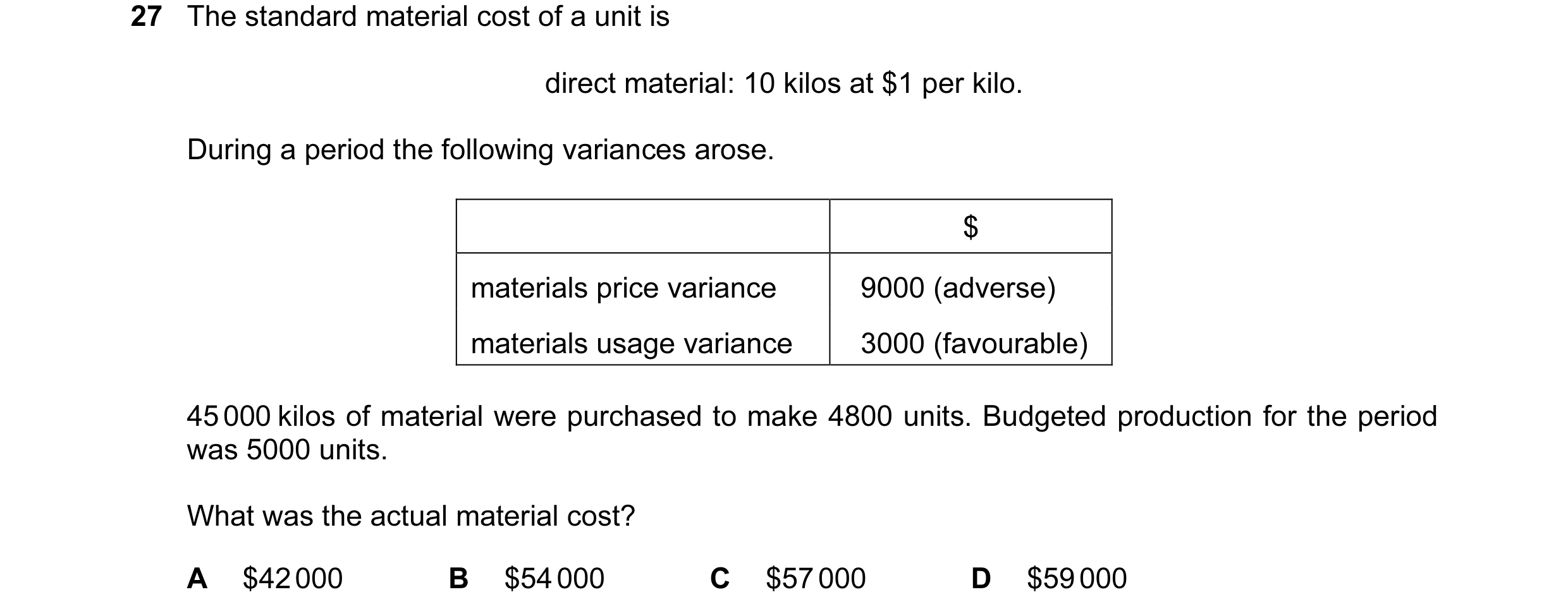
Q72 · The standard material cost of a unit is direct material: 10 kilos at $1 per kilo 9706/32 May/June 2013
27 The standard material cost of a unit is direct material: 10 kilos at $1 per kilo. During a period the following variances arose. $ materials price variance 9000 (adverse) materials usage variance 3000 (favourable) 45 000 kilos of material were purchased to make 4800 units. Budgeted production for the period was 5000 units. What was the actual material cost? A $42 000 B $54 000 C $57 000 D $59 000
1 marks
Answer: B
This question in 9706/32 May/June 2013
Q73 · To calculate the direct labour efficiency variance, which data is not required? 9706/32 May/June 2013
28 To calculate the direct labour efficiency variance, which data is not required? A actual direct labour rate B actual hours worked C standard direct labour rate D standard hours of actual production
1 marks
Answer: A
This question in 9706/32 May/June 2013
Q74 · 840 units of a product are manufactured in a period 9706/33 May/June 2013
25 840 units of a product are manufactured in a period. 1570 kg of raw material were purchased and used at a cost of $5820. Raw material price and usage variances were $126 F and $235 A respectively. What was the standard raw material cost per unit of the product? A $6.50 B $6.80 C $7.06 D $7.36
1 marks
Answer: B
This question in 9706/33 May/June 2013
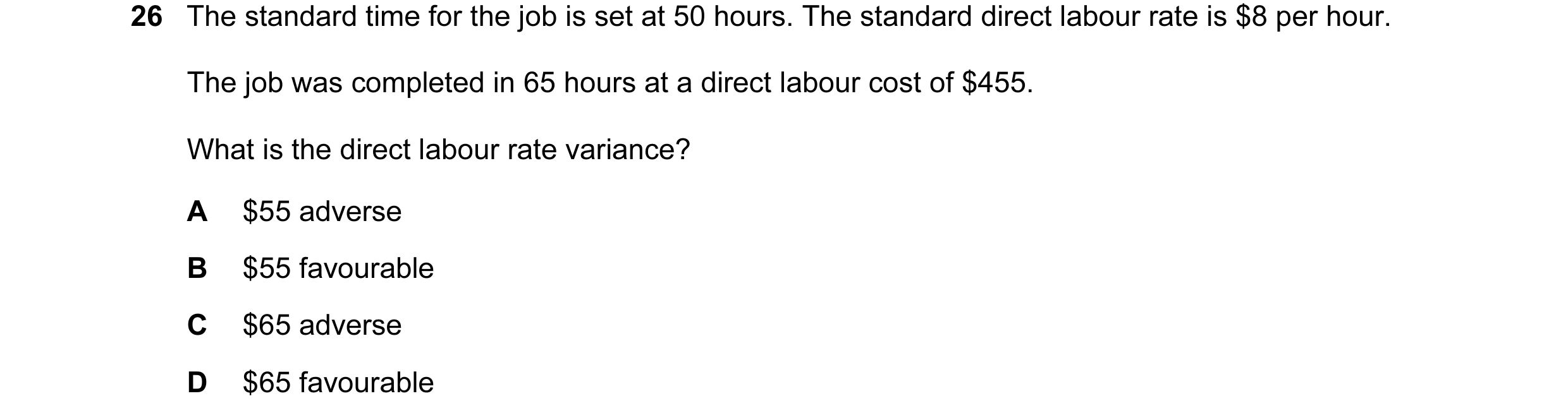
Q75 · The standard time for the job is set at 50 hours 9706/33 May/June 2013
26 The standard time for the job is set at 50 hours. The standard direct labour rate is $8 per hour. The job was completed in 65 hours at a direct labour cost of $455. What is the direct labour rate variance? A $55 adverse B $55 favourable C $65 adverse D $65 favourable
1 marks
Answer: D
This question in 9706/33 May/June 2013
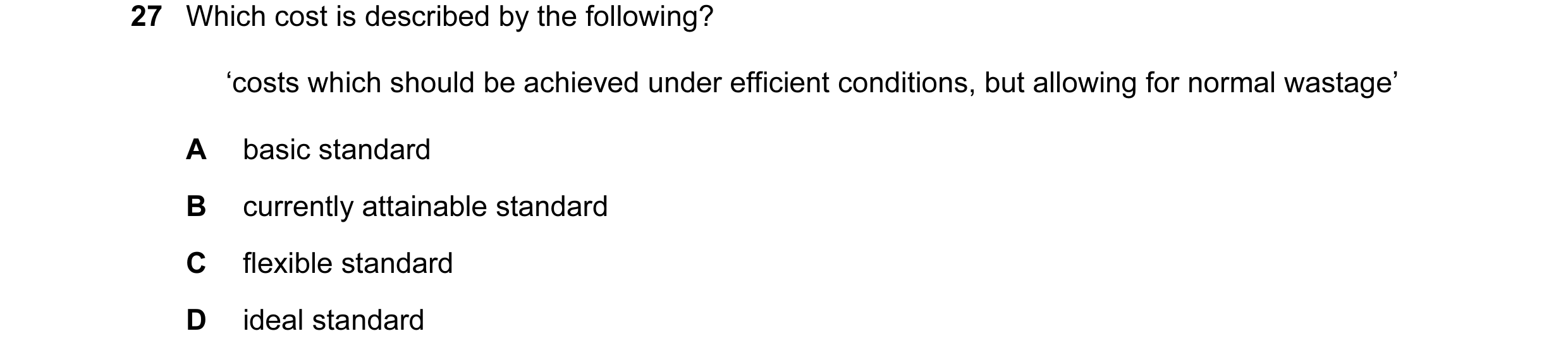
Q76 · Which cost is described by the following? 9706/33 May/June 2013
27 Which cost is described by the following? ‘costs which should be achieved under efficient conditions, but allowing for normal wastage’ A basic standard B currently attainable standard C flexible standard D ideal standard
1 marks
Answer: B
This question in 9706/33 May/June 2013
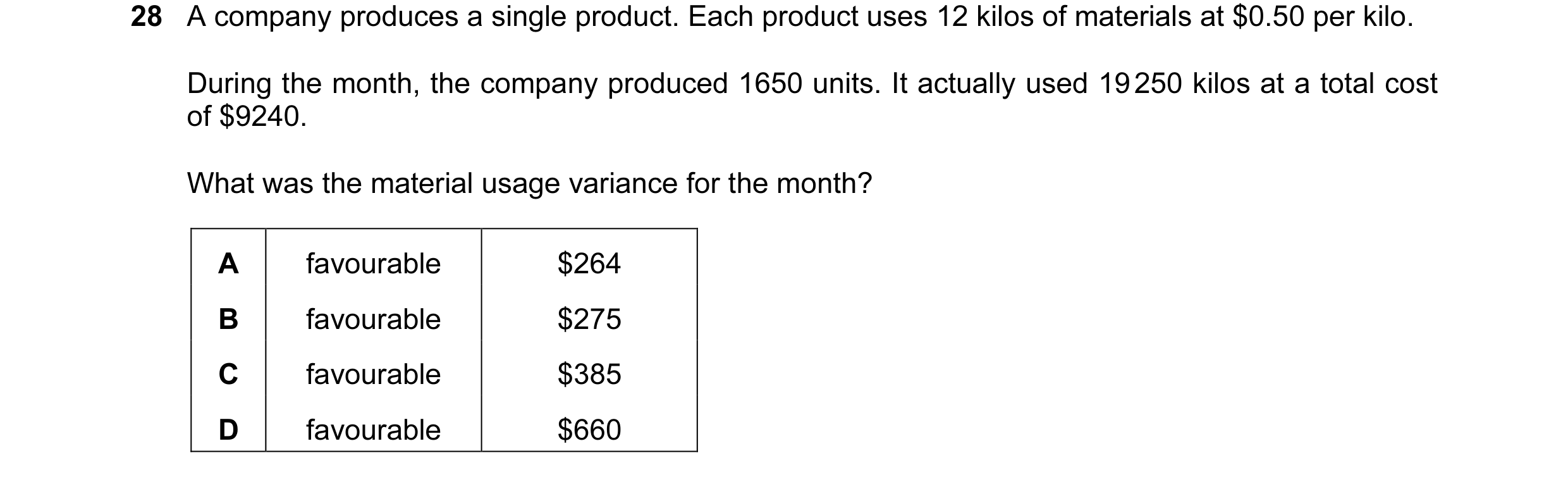
Q77 · A company produces a single product 9706/33 May/June 2013
28 A company produces a single product. Each product uses 12 kilos of materials at $0.50 per kilo. During the month, the company produced 1650 units. It actually used 19 250 kilos at a total cost of $9240. What was the material usage variance for the month? A favourable $264 B favourable $275 C favourable $385 D favourable $660
1 marks
Answer: B
This question in 9706/33 May/June 2013
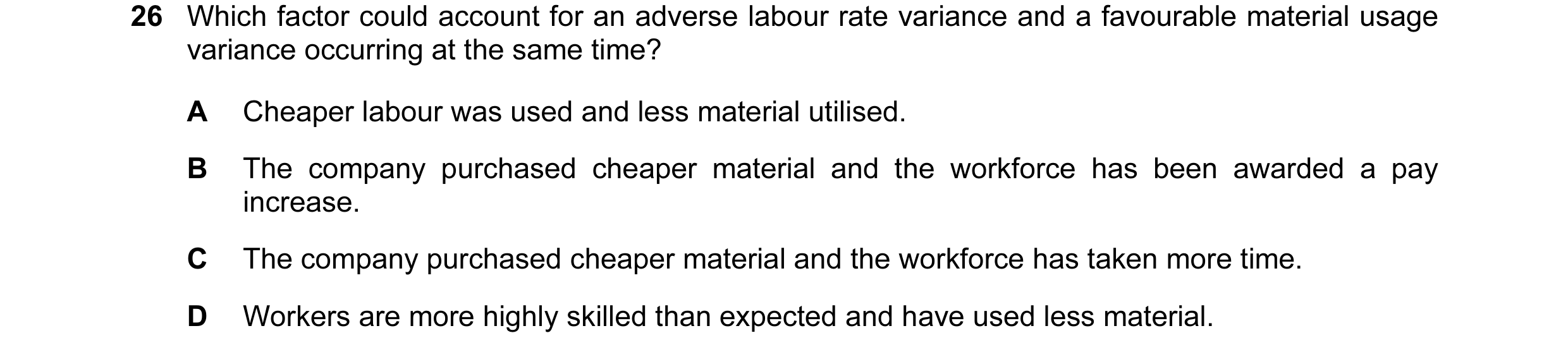
Q78 · Which factor could account for an adverse labour rate variance and a favourable material… 9706/31 Oct/Nov 2013
26 Which factor could account for an adverse labour rate variance and a favourable material usage variance occurring at the same time? A Cheaper labour was used and less material utilised. B The company purchased cheaper material and the workforce has been awarded a pay increase. C The company purchased cheaper material and the workforce has taken more time. D Workers are more highly skilled than expected and have used less material.
1 marks
Answer: D
This question in 9706/31 Oct/Nov 2013
Q79 · A company uses 3000 direct labour hours, at a standard cost of $10 per hour 9706/31 Oct/Nov 2013
27 A company uses 3000 direct labour hours, at a standard cost of $10 per hour. This resulted in a favourable labour efficiency variance of $20 000. How many standard hours were produced? A 1000 hours B 2000 hours C 3000 hours D 5000 hours
1 marks
Answer: D
This question in 9706/31 Oct/Nov 2013
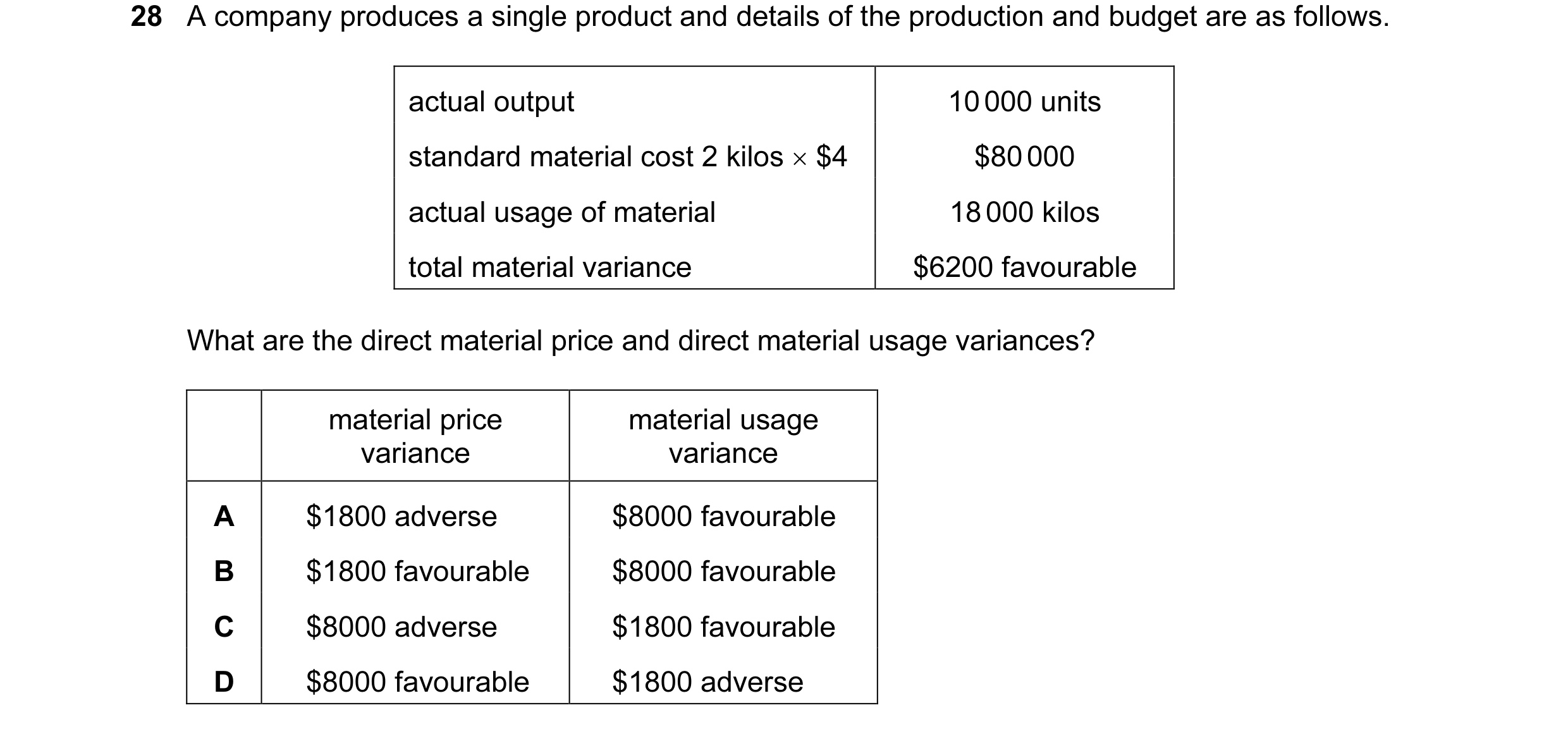
Q80 · A company produces a single product and details of the production and budget are as… 9706/31 Oct/Nov 2013
28 A company produces a single product and details of the production and budget are as follows. actual output 10 000 units standard material cost 2 kilos × $4 $80 000 actual usage of material 18 000 kilos total material variance $6200 favourable What are the direct material price and direct material usage variances? material price material usage variance variance A $1800 adverse $8000 favourable B $1800 favourable $8000 favourable C $8000 adverse $1800 favourable D $8000 favourable $1800 adverse
1 marks
Answer: A
This question in 9706/31 Oct/Nov 2013
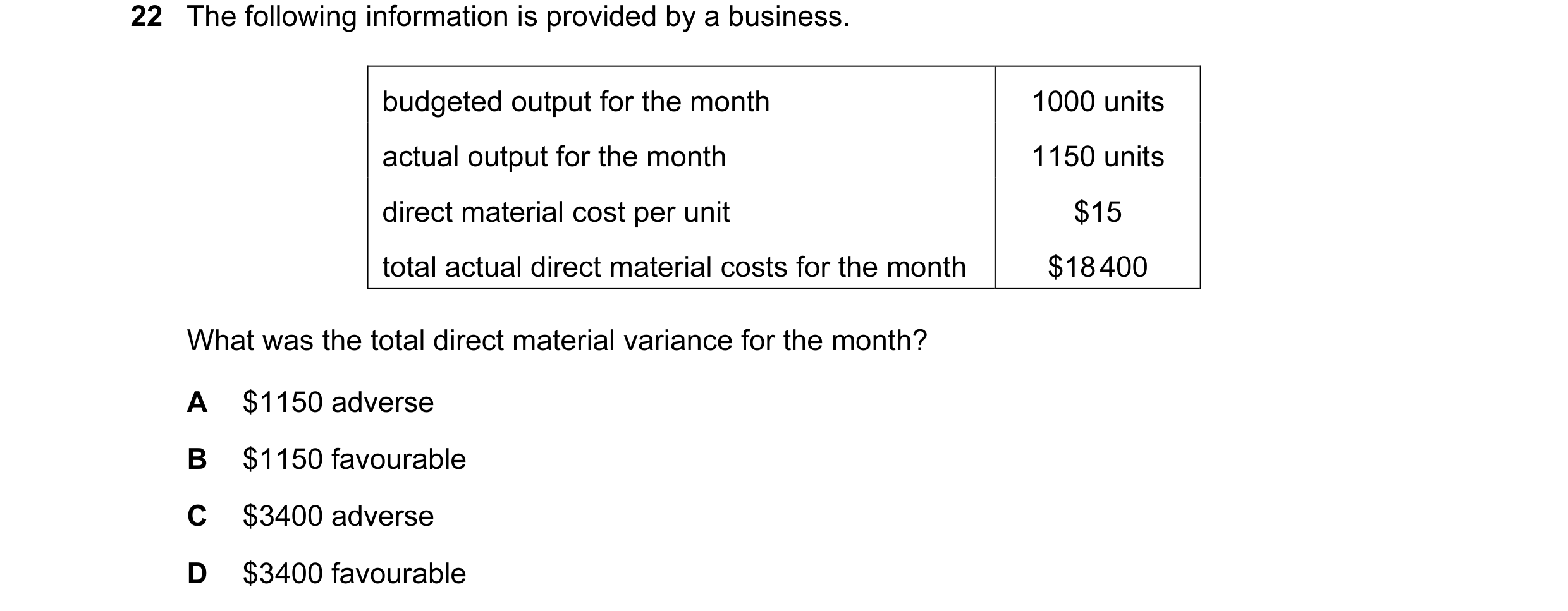
Q81 · The following information is provided by a business 9706/32 Oct/Nov 2013
22 The following information is provided by a business. budgeted output for the month 1000 units actual output for the month 1150 units direct material cost per unit $15 total actual direct material costs for the month $18 400 What was the total direct material variance for the month? A $1150 adverse B $1150 favourable C $3400 adverse D $3400 favourable
1 marks
Answer: A
This question in 9706/32 Oct/Nov 2013
Q82 · The following material costs relate to the manufacture of 100 units of a product 9706/32 Oct/Nov 2013
26 The following material costs relate to the manufacture of 100 units of a product. cost per kilo total cost kilos $ $ standard 1500 5.50 – actual 1650 – 9570 What is the material price variance? A $495 adverse B $495 favourable C $1320 adverse D $1320 favourable
1 marks
Answer: A
This question in 9706/32 Oct/Nov 2013
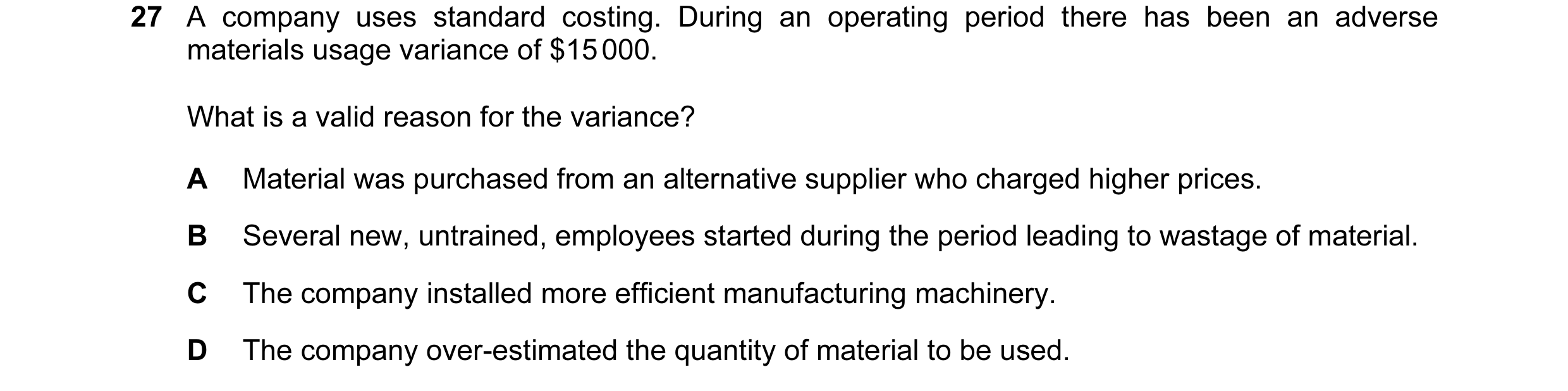
Q83 · A company uses standard costing 9706/32 Oct/Nov 2013
27 A company uses standard costing. During an operating period there has been an adverse materials usage variance of $15 000. What is a valid reason for the variance? A Material was purchased from an alternative supplier who charged higher prices. B Several new, untrained, employees started during the period leading to wastage of material. C The company installed more efficient manufacturing machinery. D The company over-estimated the quantity of material to be used.
1 marks
Answer: B
This question in 9706/32 Oct/Nov 2013
Q84 · What will give an adverse labour rate variance? 9706/32 Oct/Nov 2013
28 What will give an adverse labour rate variance? A Actual production was more than budget. B Fewer labour hours were worked than budget. C Wage rates were higher than budget. D Wage rates were lower than budget.
1 marks
Answer: C
This question in 9706/32 Oct/Nov 2013
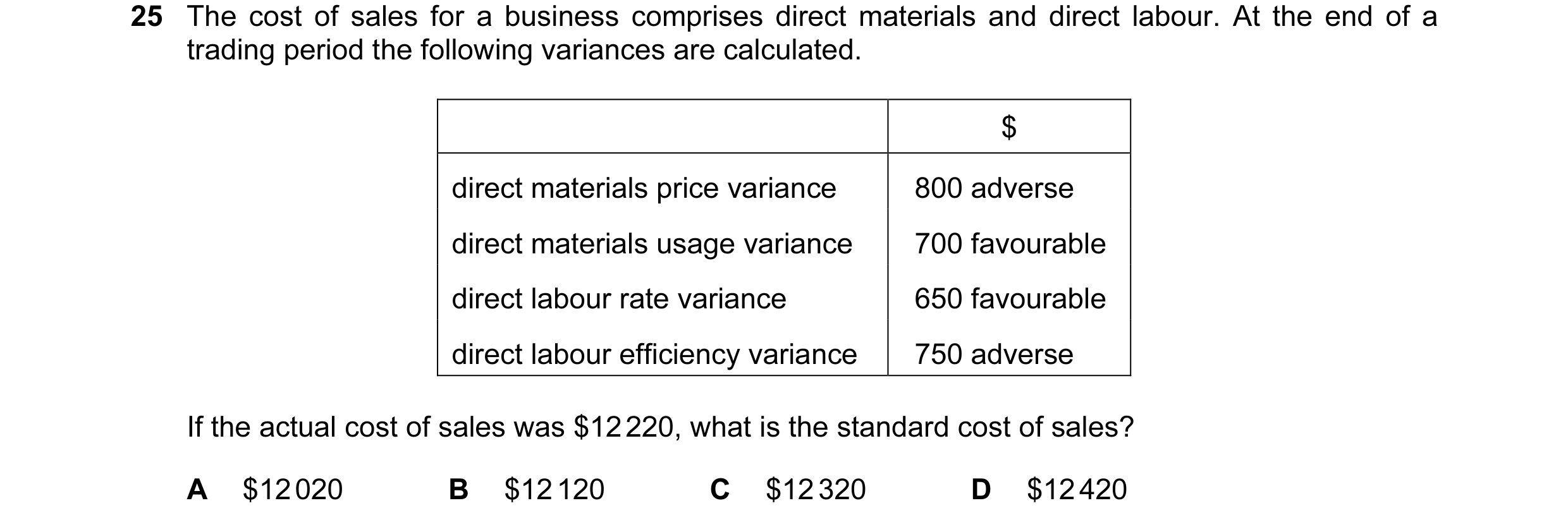
Q85 · The cost of sales for a business comprises direct materials and direct labour 9706/33 Oct/Nov 2013
25 The cost of sales for a business comprises direct materials and direct labour. At the end of a trading period the following variances are calculated. $ direct materials price variance 800 adverse direct materials usage variance 700 favourable direct labour rate variance 650 favourable direct labour efficiency variance 750 adverse If the actual cost of sales was $12 220, what is the standard cost of sales? A $12 020 B $12 120 C $12 320 D $12 420
1 marks
Answer: A
This question in 9706/33 Oct/Nov 2013
Q86 · Which formula would be used to calculate the labour efficiency variance? 9706/33 Oct/Nov 2013
26 Which formula would be used to calculate the labour efficiency variance? A (actual hours less standard hours) × standard rate B (actual rate less standard rate) × actual hours C (standard hours less actual hours) × standard rate D (standard rate less actual rate) × actual hours
1 marks
Answer: C
This question in 9706/33 Oct/Nov 2013
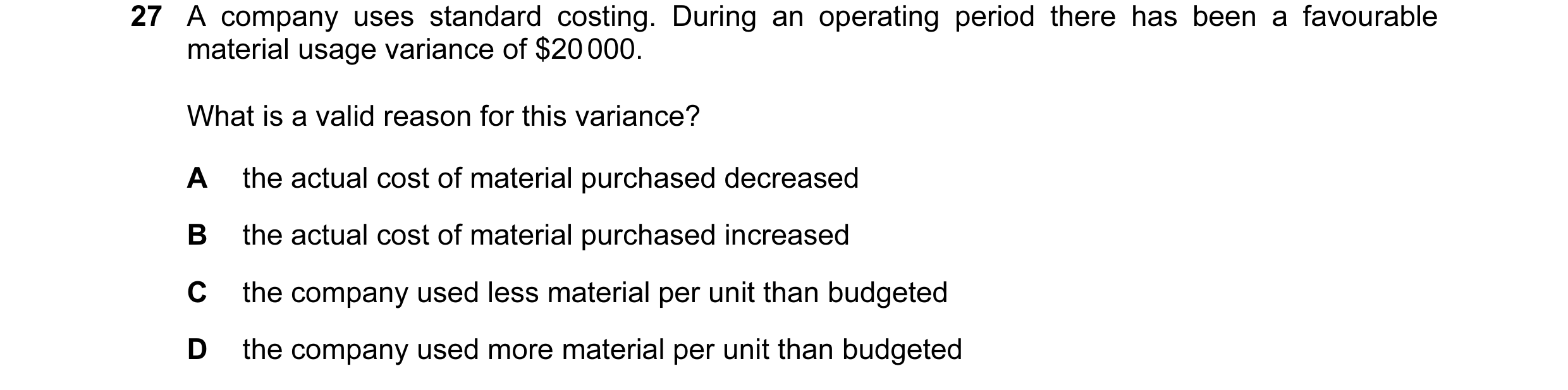
Q87 · A company uses standard costing 9706/33 Oct/Nov 2013
27 A company uses standard costing. During an operating period there has been a favourable material usage variance of $20 000. What is a valid reason for this variance? A the actual cost of material purchased decreased B the actual cost of material purchased increased C the company used less material per unit than budgeted D the company used more material per unit than budgeted
1 marks
Answer: C
This question in 9706/33 Oct/Nov 2013
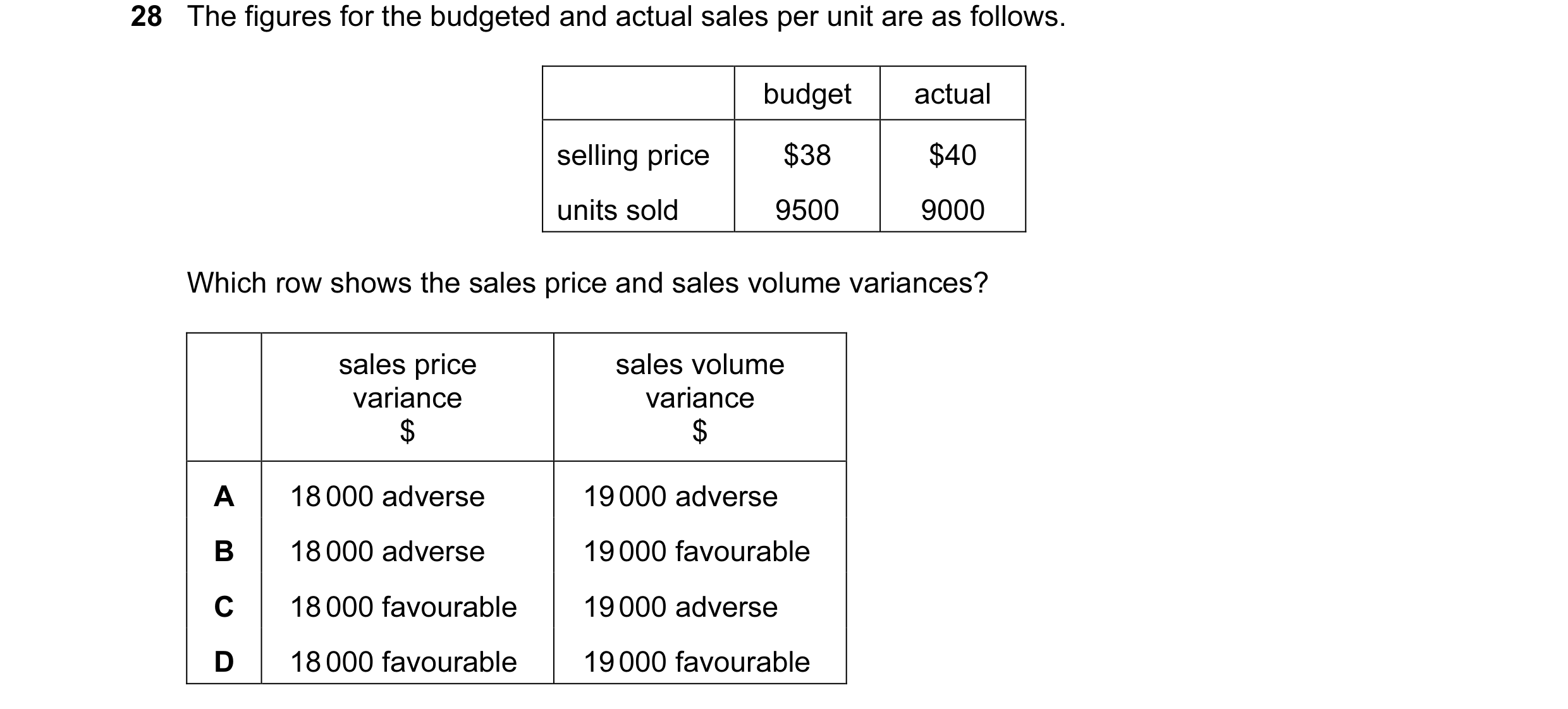
Q88 · The figures for the budgeted and actual sales per unit are as follows 9706/33 Oct/Nov 2013
28 The figures for the budgeted and actual sales per unit are as follows. budget actual selling price $38 $40 units sold 9500 9000 Which row shows the sales price and sales volume variances? sales price sales volume variance variance $ $ A 18 000 adverse 19 000 adverse B 18 000 adverse 19 000 favourable C 18 000 favourable 19 000 adverse D 18 000 favourable 19 000 favourable
1 marks
Answer: C
This question in 9706/33 Oct/Nov 2013
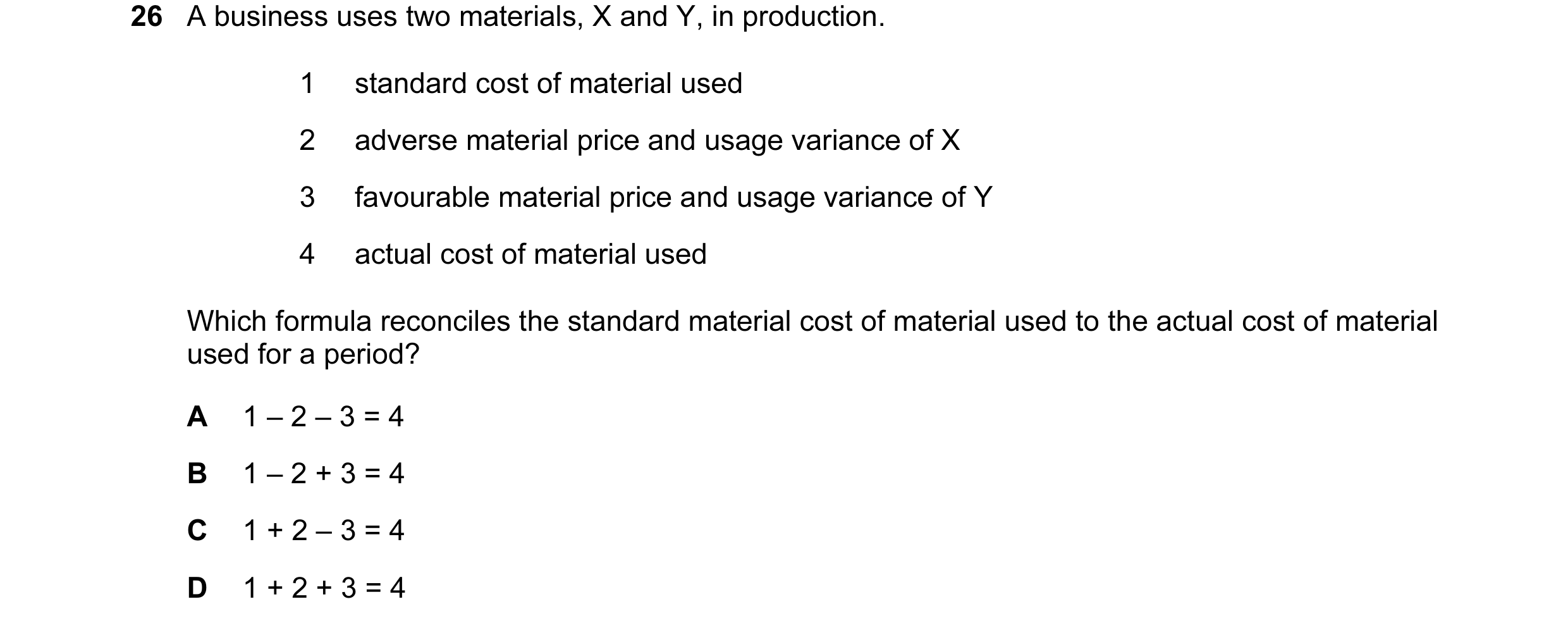
Q89 · A business uses two materials, X and Y, in production 9706/31 May/June 2014
26 A business uses two materials, X and Y, in production. 1 standard cost of material used 2 adverse material price and usage variance of X 3 favourable material price and usage variance of Y 4 actual cost of material used Which formula reconciles the standard material cost of material used to the actual cost of material used for a period? A 1 – 2 – 3 = 4 B 1 – 2 + 3 = 4 C 1 + 2 – 3 = 4 D 1 + 2 + 3 = 4
1 marks
Answer: C
This question in 9706/31 May/June 2014
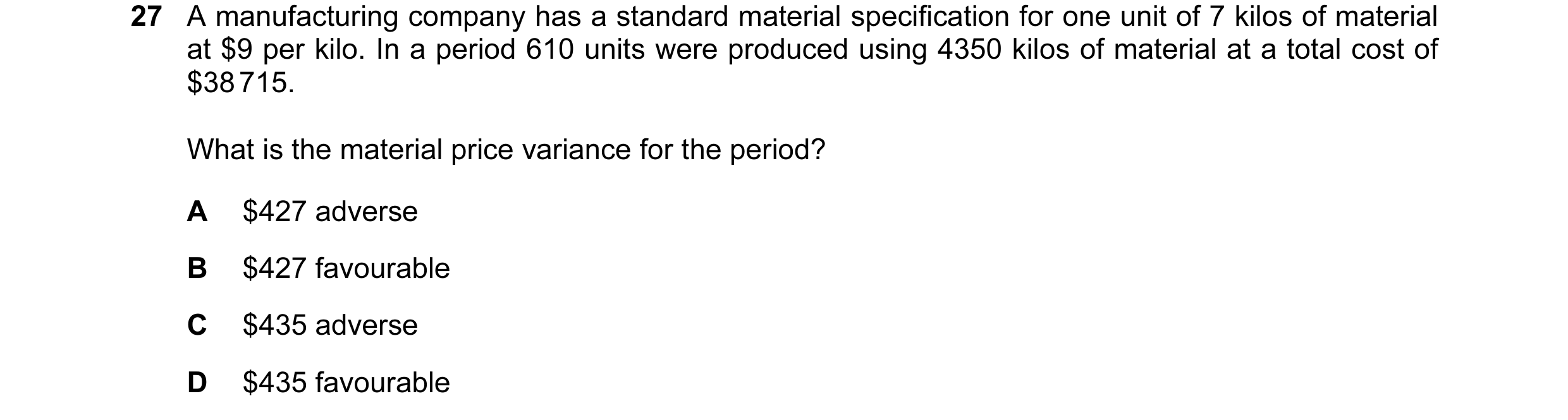
Q90 · A manufacturing company has a standard material specification for one unit of 7 kilos of… 9706/31 May/June 2014
27 A manufacturing company has a standard material specification for one unit of 7 kilos of material at $9 per kilo. In a period 610 units were produced using 4350 kilos of material at a total cost of $38 715. What is the material price variance for the period? A $427 adverse B $427 favourable C $435 adverse D $435 favourable
1 marks
Answer: D
This question in 9706/31 May/June 2014
Q91 · A factory uses 3500 direct labour hours in production, at a standard cost of $10 per hour 9706/31 May/June 2014
28 A factory uses 3500 direct labour hours in production, at a standard cost of $10 per hour. This resulted in a favourable labour efficiency variance of $20 000. How many standard hours were produced? A 1500 B 2000 C 3500 D 5500
1 marks
Answer: D
This question in 9706/31 May/June 2014
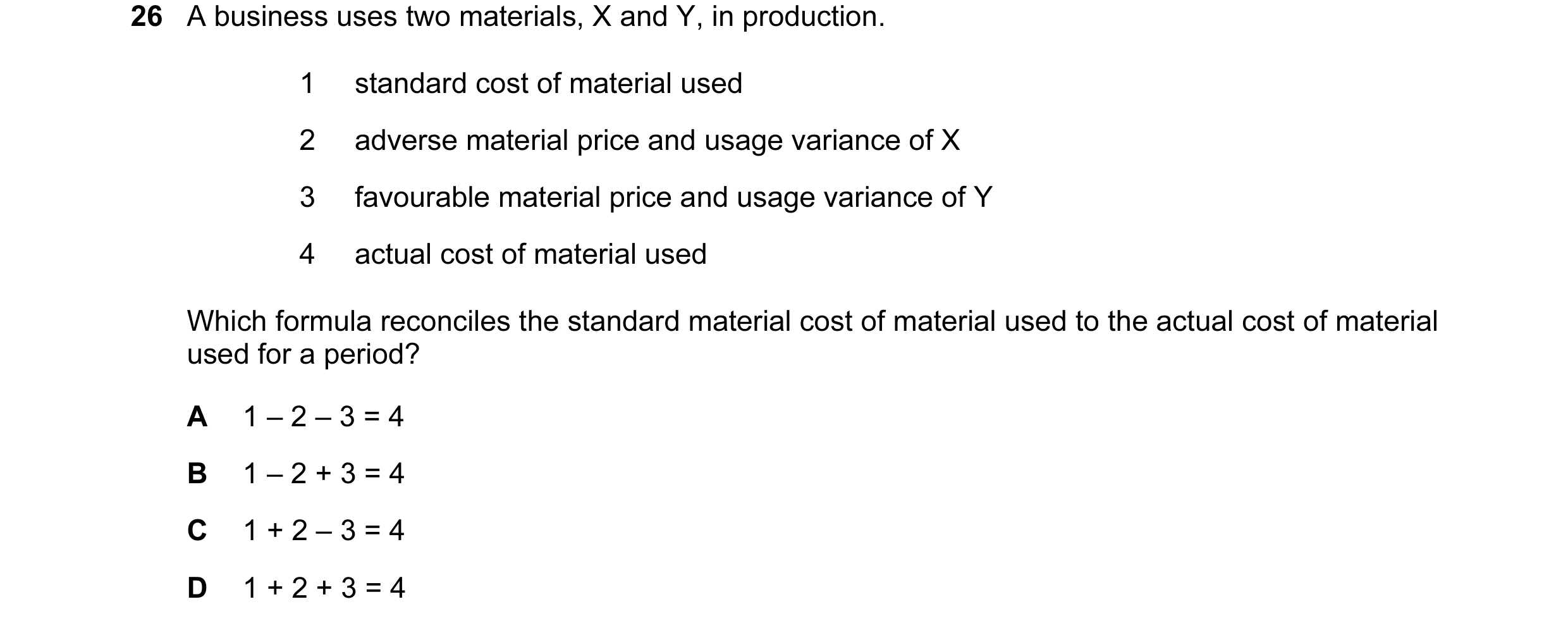
Q92 · A business uses two materials, X and Y, in production 9706/32 May/June 2014
26 A business uses two materials, X and Y, in production. 1 standard cost of material used 2 adverse material price and usage variance of X 3 favourable material price and usage variance of Y 4 actual cost of material used Which formula reconciles the standard material cost of material used to the actual cost of material used for a period? A 1 – 2 – 3 = 4 B 1 – 2 + 3 = 4 C 1 + 2 – 3 = 4 D 1 + 2 + 3 = 4
1 marks
Answer: C
This question in 9706/32 May/June 2014
Q93 · A manufacturing company has a standard material specification for one unit of 7 kilos of… 9706/32 May/June 2014
27 A manufacturing company has a standard material specification for one unit of 7 kilos of material at $9 per kilo. In a period 610 units were produced using 4350 kilos of material at a total cost of $38 715. What is the material price variance for the period? A $427 adverse B $427 favourable C $435 adverse D $435 favourable
1 marks
Answer: D
This question in 9706/32 May/June 2014
Q94 · A factory uses 3500 direct labour hours in production, at a standard cost of $10 per hour 9706/32 May/June 2014
28 A factory uses 3500 direct labour hours in production, at a standard cost of $10 per hour. This resulted in a favourable labour efficiency variance of $20 000. How many standard hours were produced? A 1500 B 2000 C 3500 D 5500
1 marks
Answer: D
This question in 9706/32 May/June 2014
Q95 · A company uses standard costing 9706/33 May/June 2014
27 A company uses standard costing. Last month its actual fixed overhead expenditure was 10% above budget. This resulted in an adverse fixed overhead expenditure variance of $32 000. How much was the actual expenditure on fixed overheads? A $288 000 B $320 000 C $352 000 D $384 000
1 marks
Answer: C
This question in 9706/33 May/June 2014
Q96 · What might cause an adverse labour rate variance? 9706/31 Oct/Nov 2015
25 What might cause an adverse labour rate variance? A better quality materials B better skilled labour C lower quality materials D lower skilled labour
1 marks
Answer: B
This question in 9706/31 Oct/Nov 2015
Q97 · What is not a possible explanation of an adverse labour efficiency variance? 9706/31 Oct/Nov 2015
26 What is not a possible explanation of an adverse labour efficiency variance? A an increase in hourly rate B an increase in idle time C low motivation in labour force D low productivity
1 marks
Answer: A
This question in 9706/31 Oct/Nov 2015
Q98 · The labour efficiency variance for a period was $3800 adverse 9706/31 Oct/Nov 2015
27 The labour efficiency variance for a period was $3800 adverse. 9000 labour hours were worked at a standard cost of $9.50. The actual cost per hour was $10. How many standard hours were produced? A 8600 B 8620 C 9380 D 9400
1 marks
Answer: A
This question in 9706/31 Oct/Nov 2015
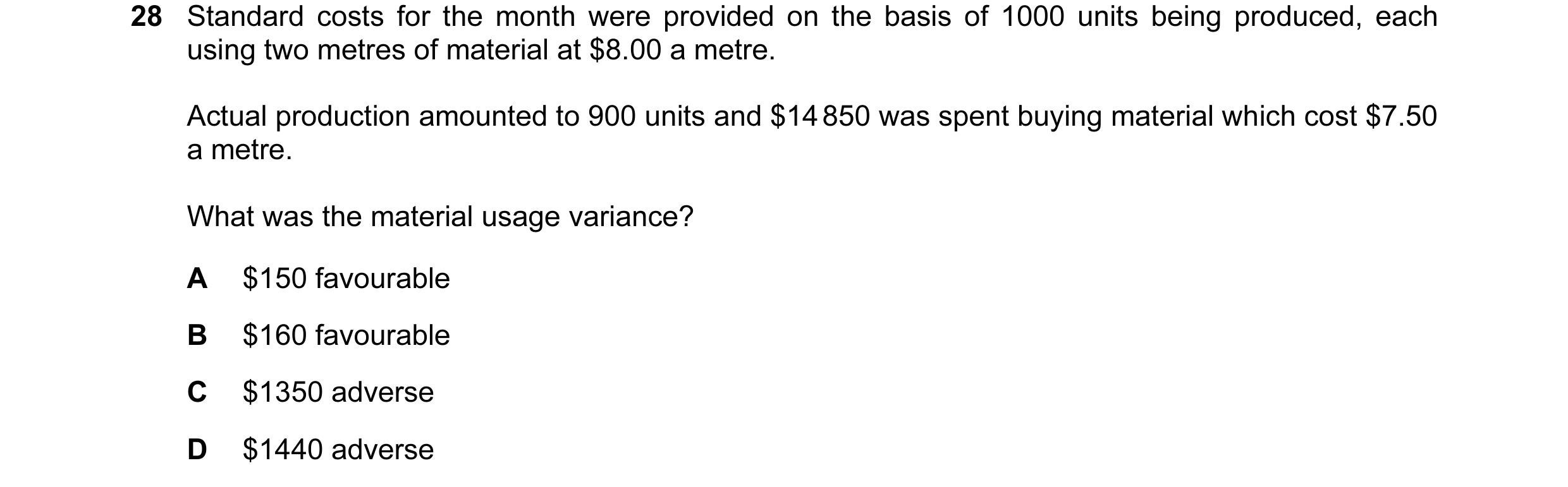
Q99 · Standard costs for the month were provided on the basis of 1000 units being produced… 9706/31 Oct/Nov 2015
28 Standard costs for the month were provided on the basis of 1000 units being produced, each using two metres of material at $8.00 a metre. Actual production amounted to 900 units and $14 850 was spent buying material which cost $7.50 a metre. What was the material usage variance? A $150 favourable B $160 favourable C $1350 adverse D $1440 adverse
1 marks
Answer: D
This question in 9706/31 Oct/Nov 2015
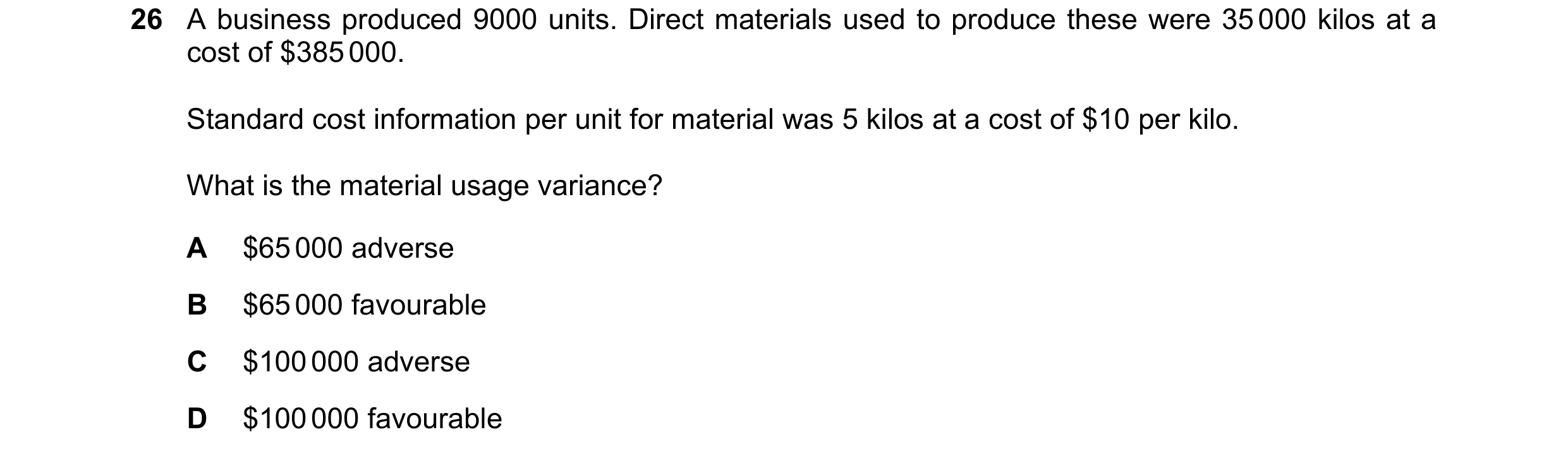
Q100 · A business produced 9000 units 9706/32 Oct/Nov 2015
26 A business produced 9000 units. Direct materials used to produce these were 35 000 kilos at a cost of $385 000. Standard cost information per unit for material was 5 kilos at a cost of $10 per kilo. What is the material usage variance? A $65 000 adverse B $65 000 favourable C $100 000 adverse D $100 000 favourable
1 marks
Answer: D
This question in 9706/32 Oct/Nov 2015
Q101 · How is budgeted profit adjusted to calculate the actual profit? 9706/32 Oct/Nov 2015
27 How is budgeted profit adjusted to calculate the actual profit? adverse cost adverse sales variances variances A add add B add deduct C deduct add D deduct deduct
1 marks
Answer: D
This question in 9706/32 Oct/Nov 2015
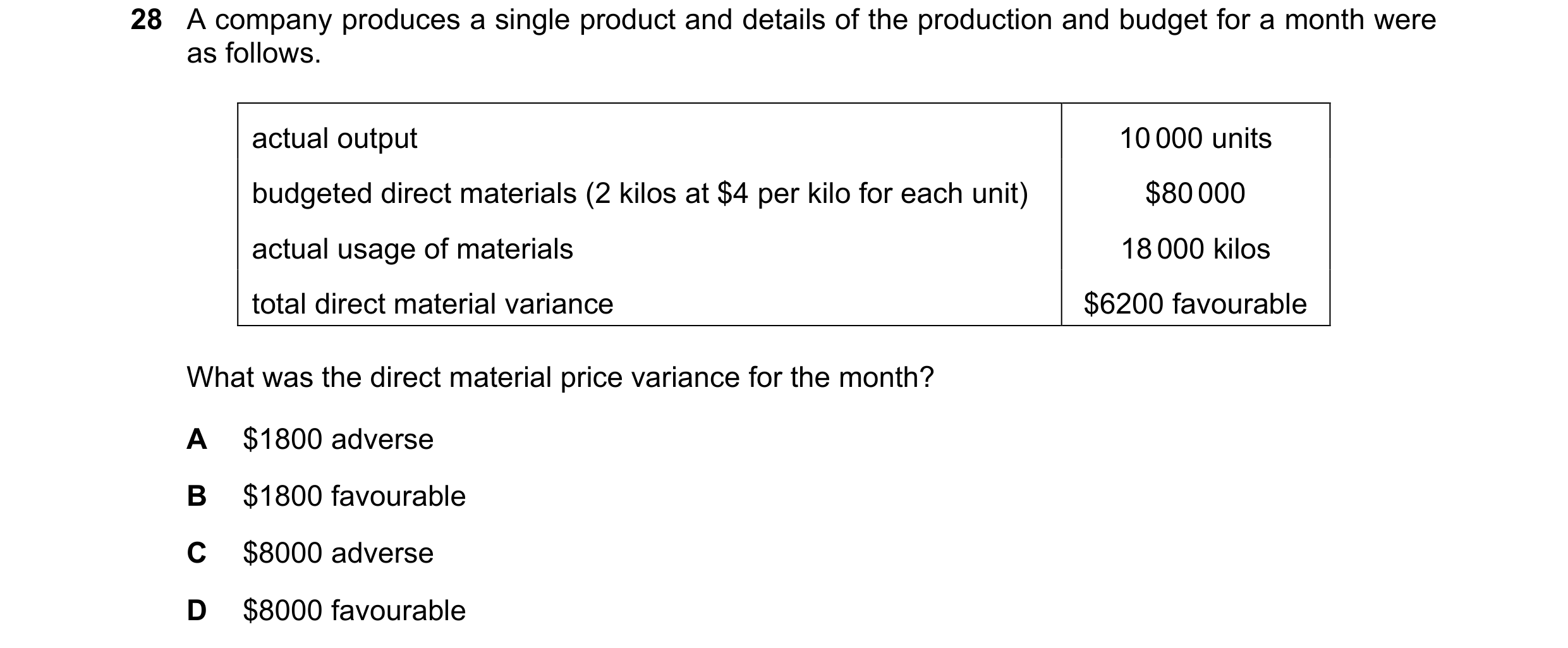
Q102 · A company produces a single product and details of the production and budget for a month… 9706/32 Oct/Nov 2015
28 A company produces a single product and details of the production and budget for a month were as follows. actual output 10 000 units budgeted direct materials (2 kilos at $4 per kilo for each unit) $80 000 actual usage of materials 18 000 kilos total direct material variance $6200 favourable What was the direct material price variance for the month? A $1800 adverse B $1800 favourable C $8000 adverse D $8000 favourable
1 marks
Answer: A
This question in 9706/32 Oct/Nov 2015

 1 / 28
 2 / 28
 3 / 28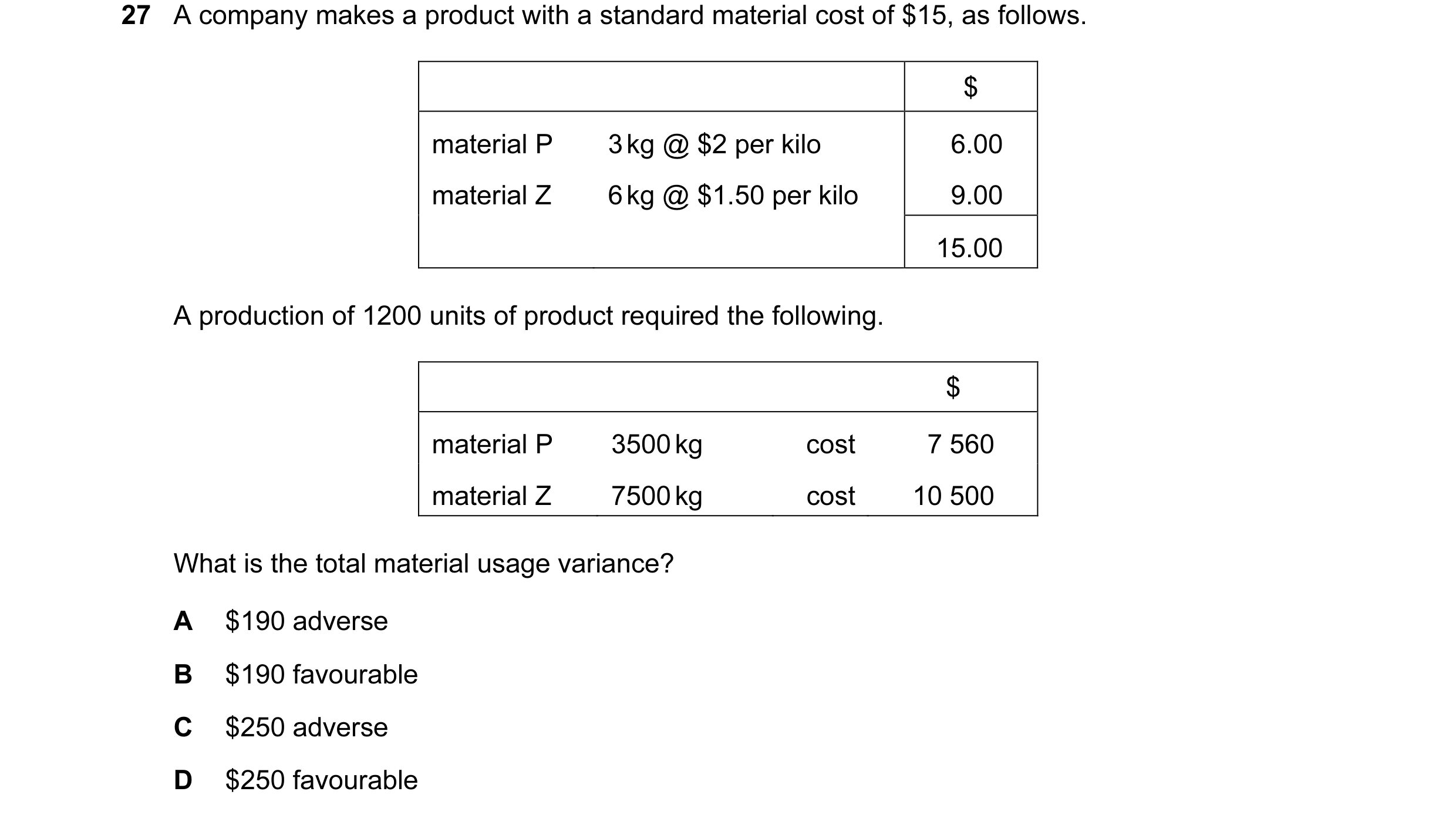

 4 / 28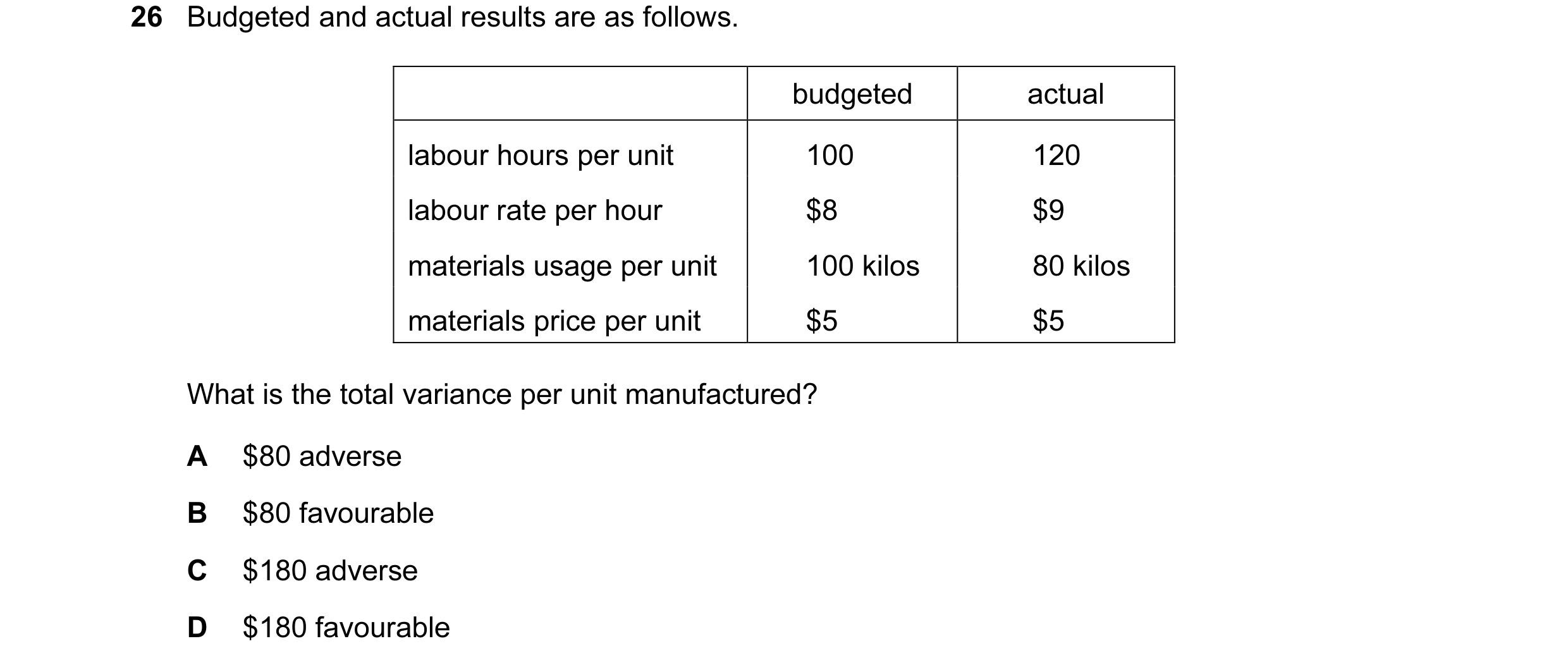
 5 / 28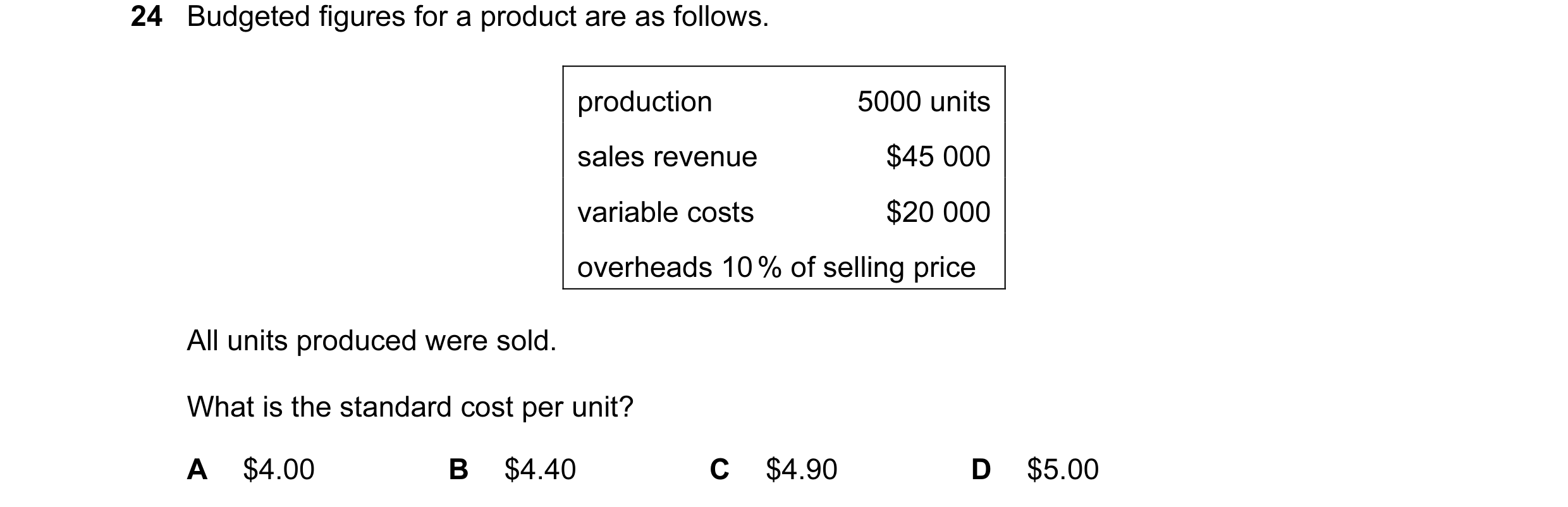
 6 / 28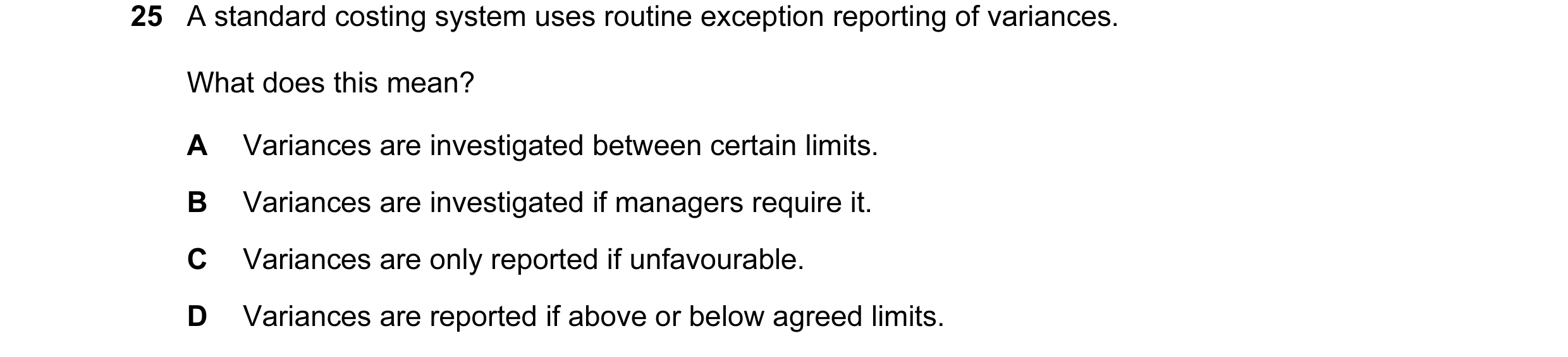
 7 / 28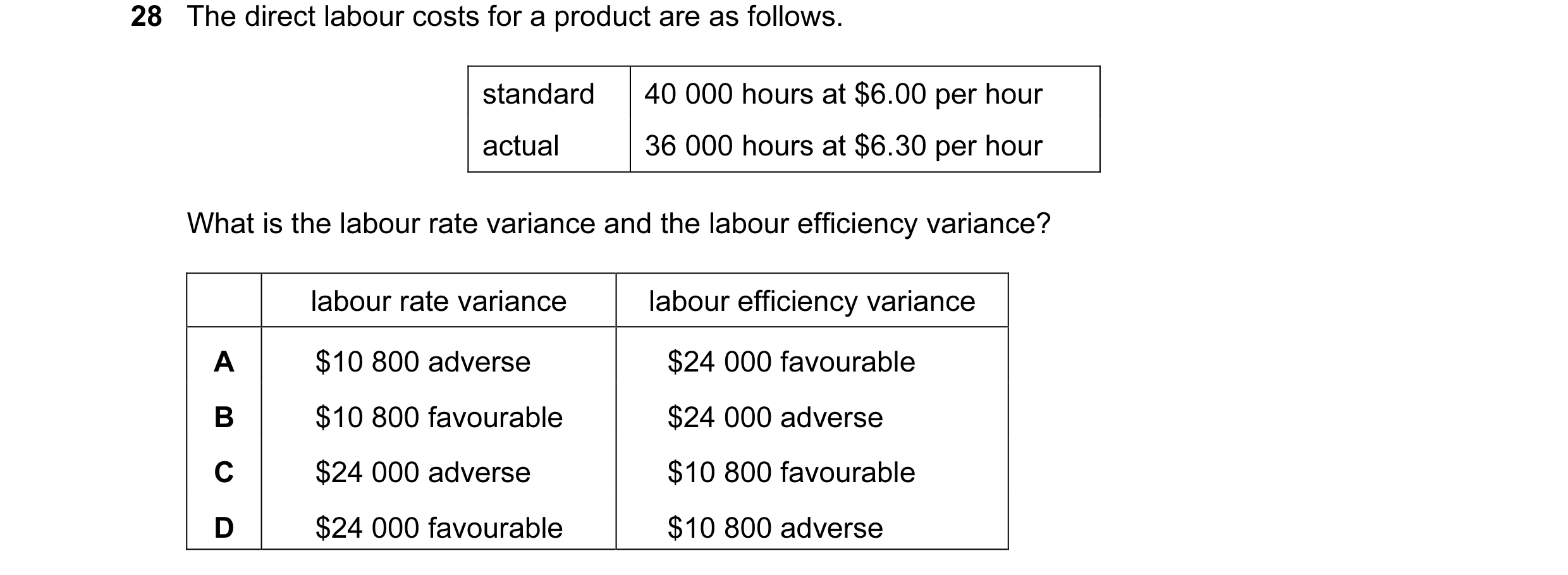
 8 / 28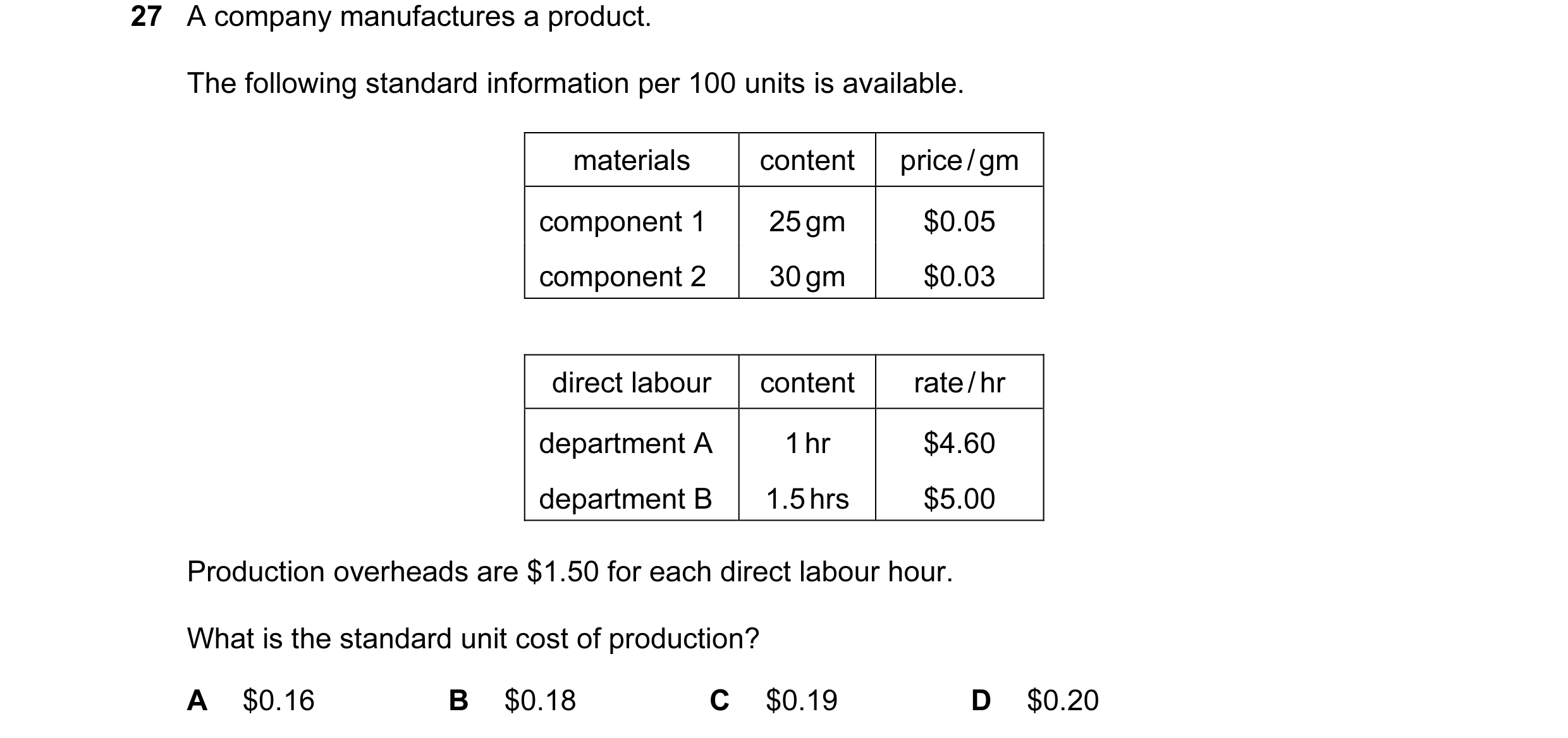
 9 / 28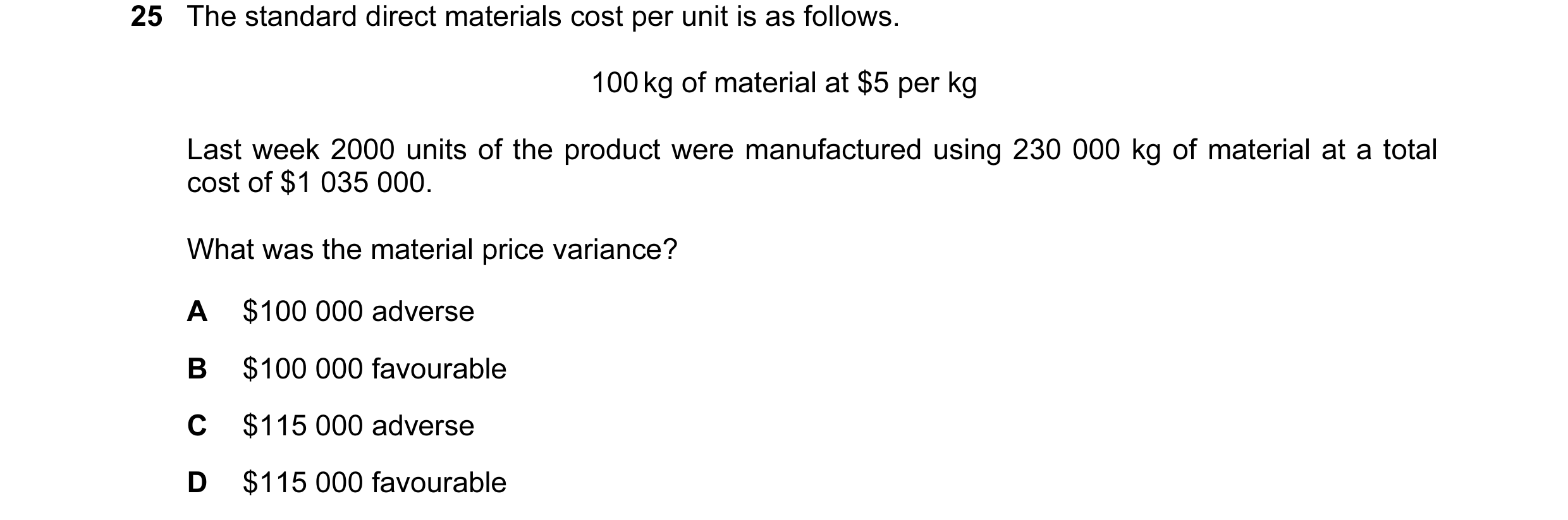
 10 / 28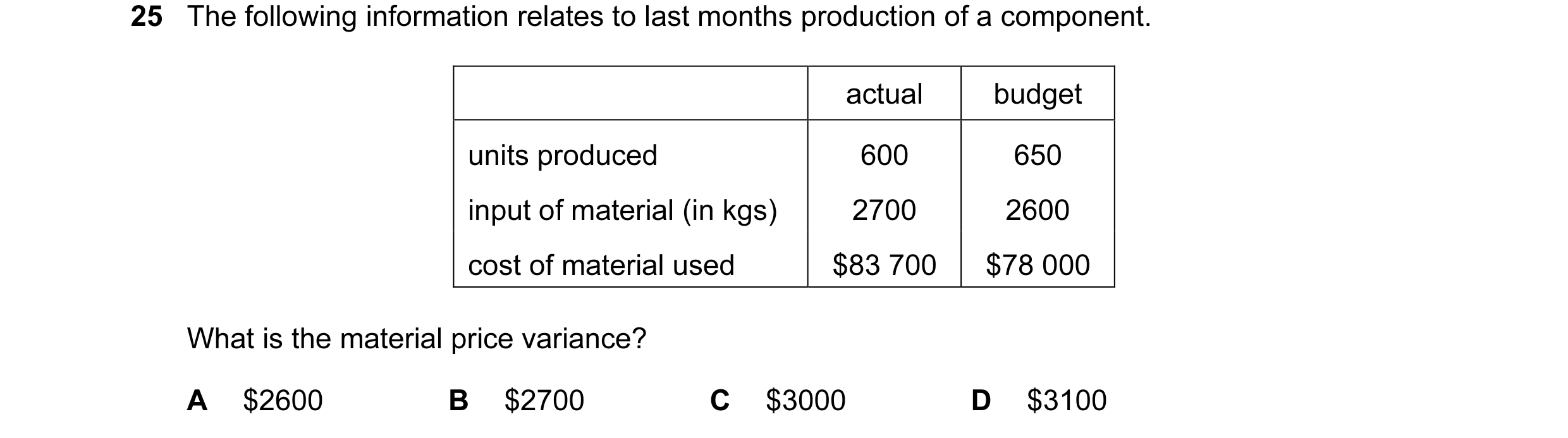

 11 / 28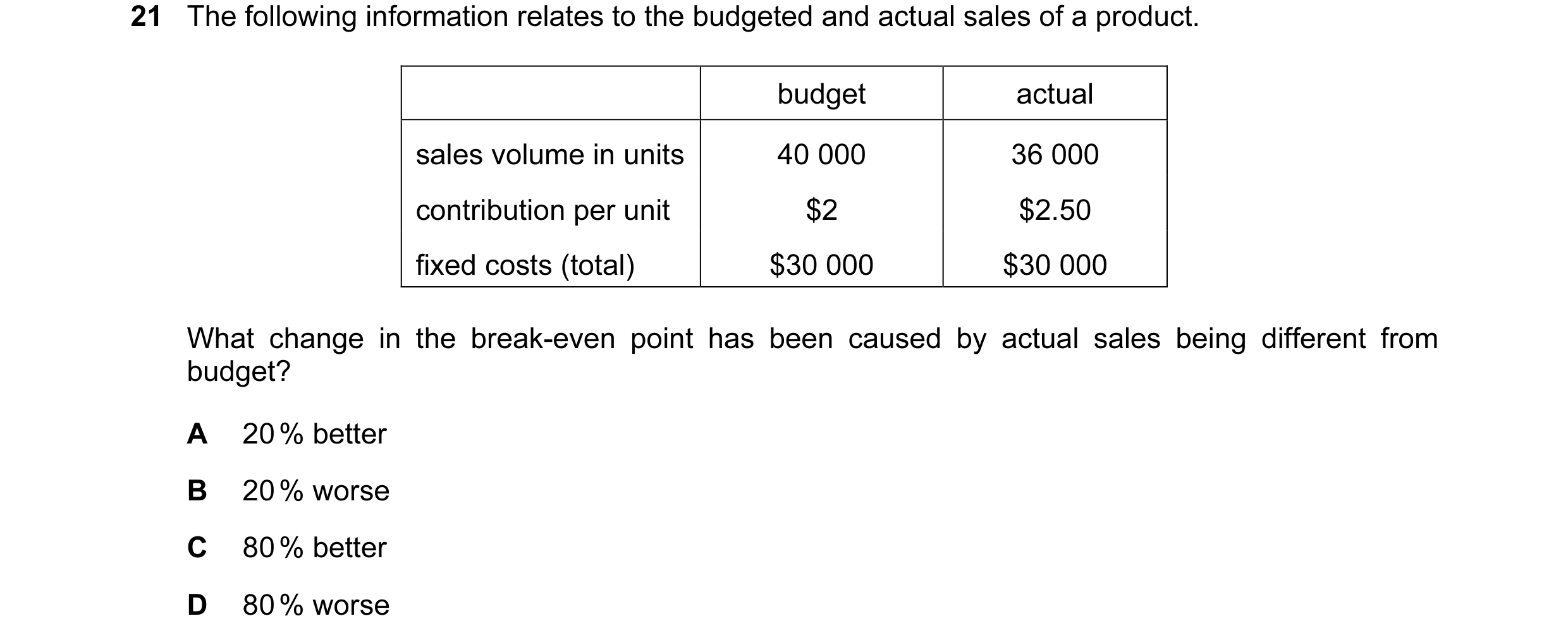

 12 / 28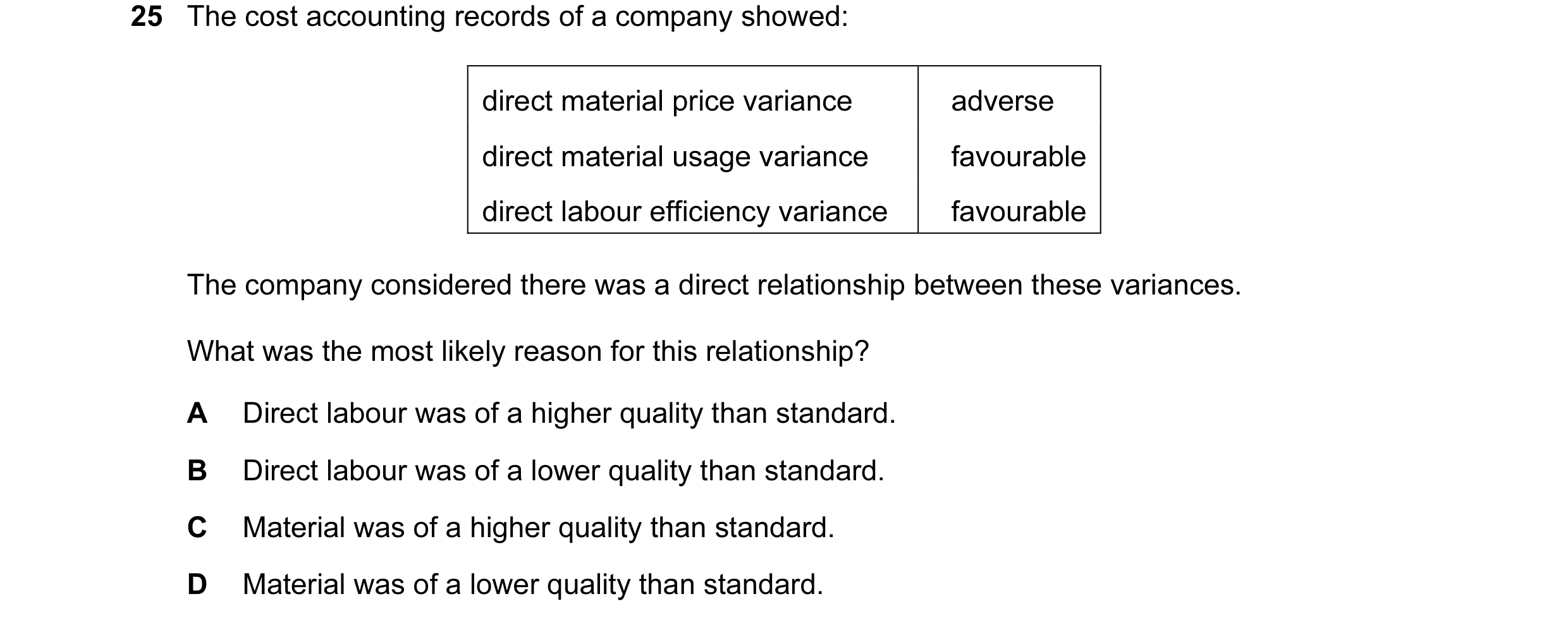
 13 / 28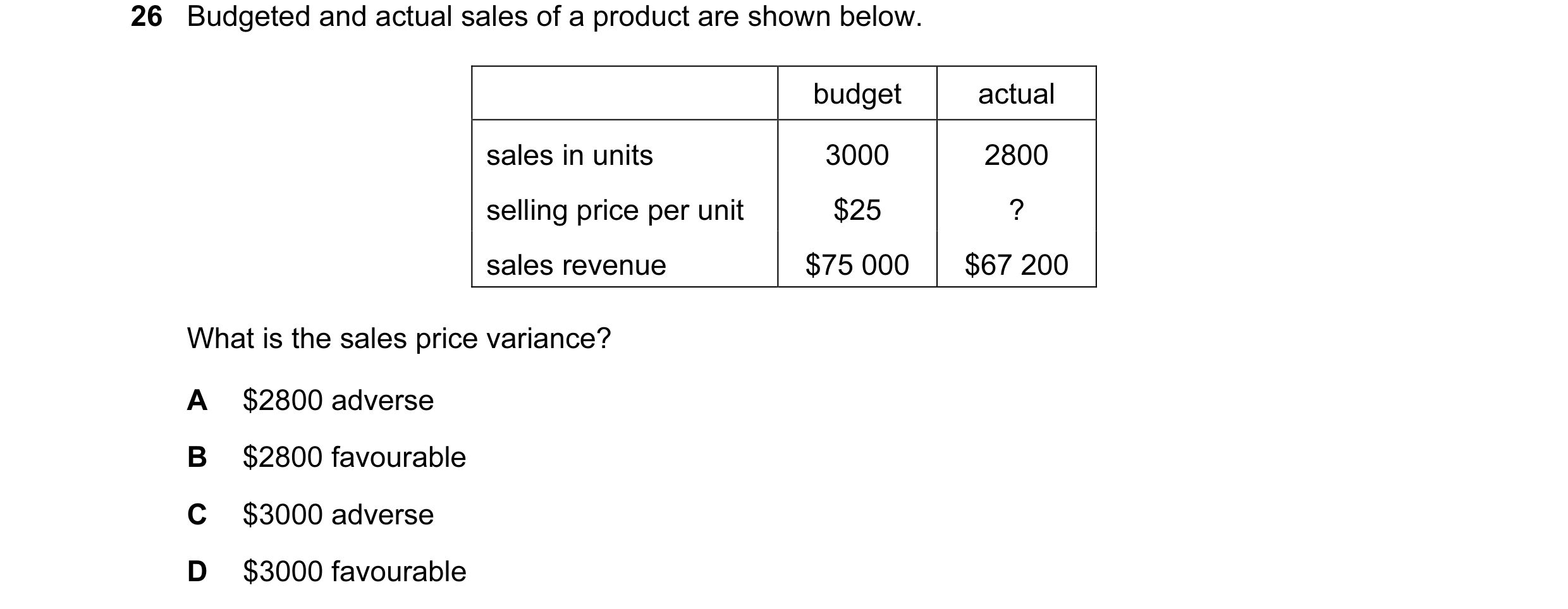
 14 / 28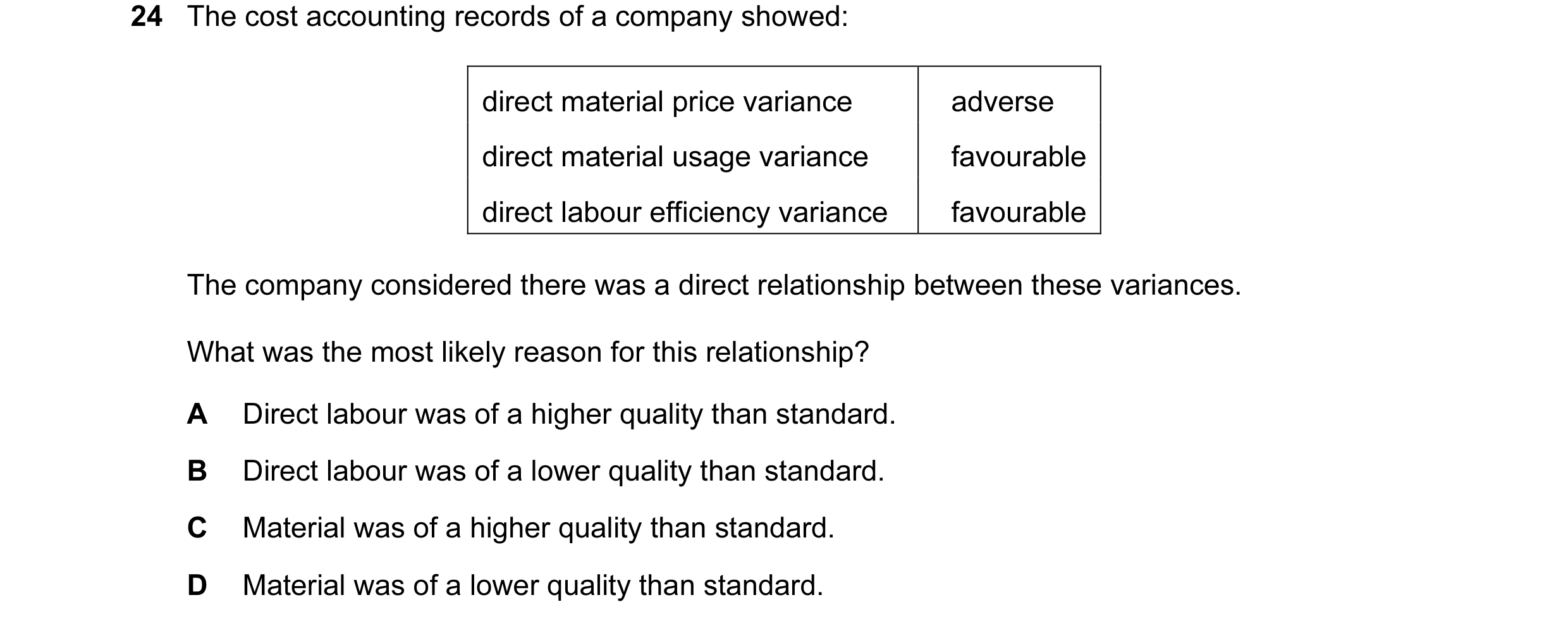
 15 / 28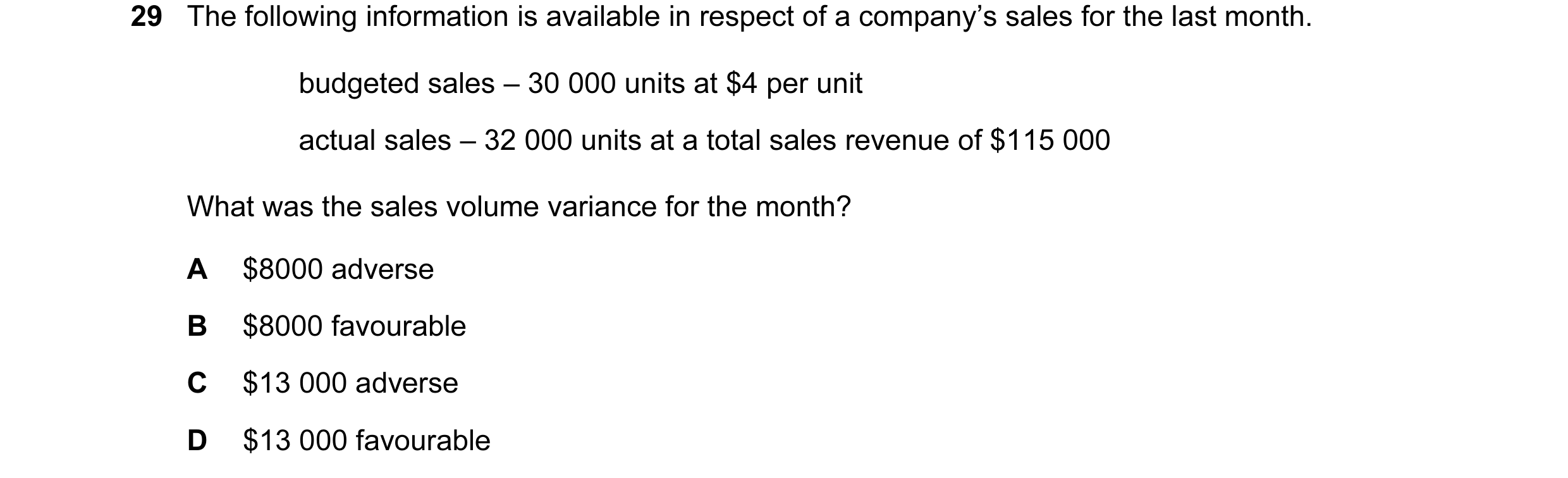
 16 / 28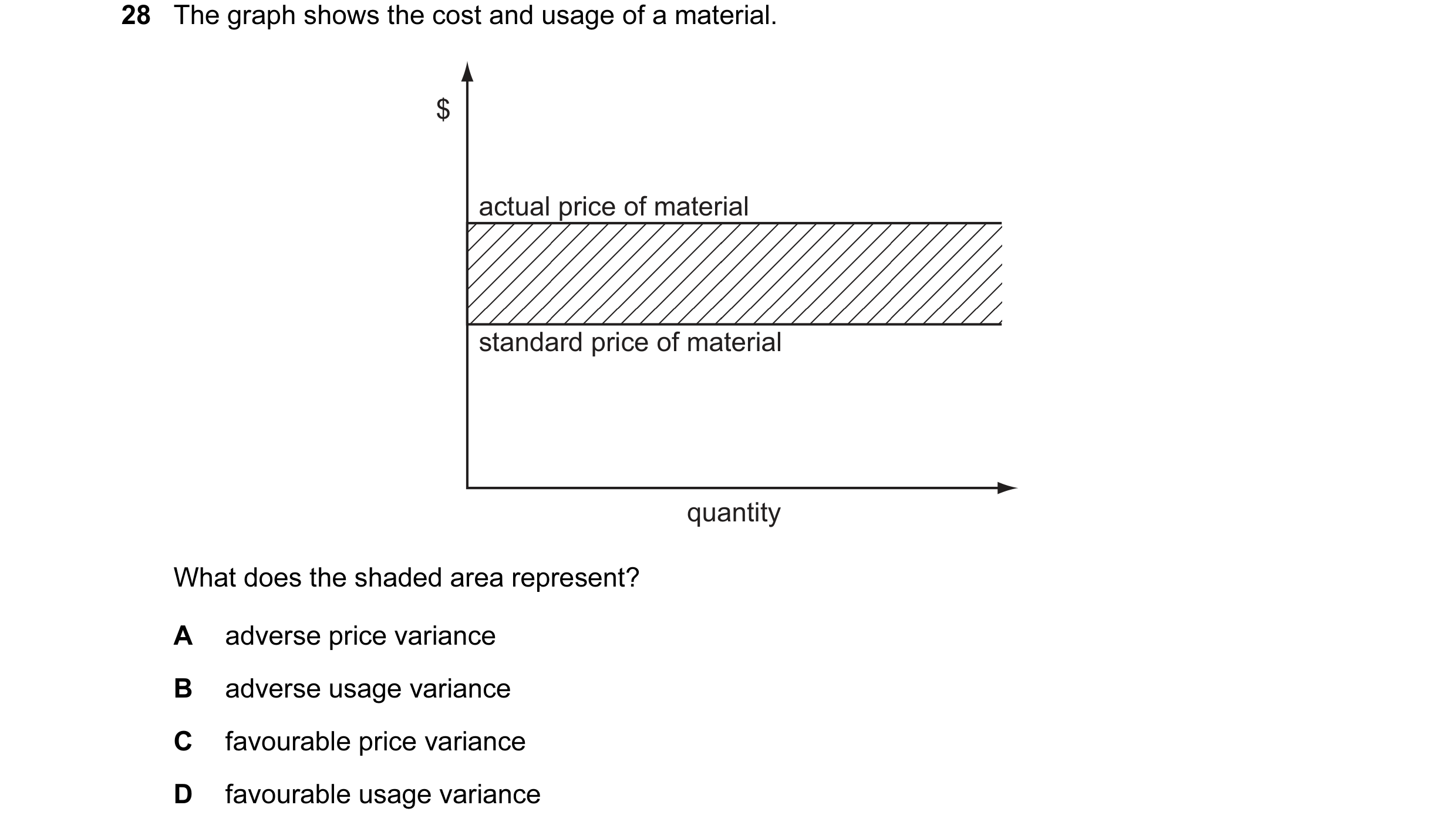
 17 / 28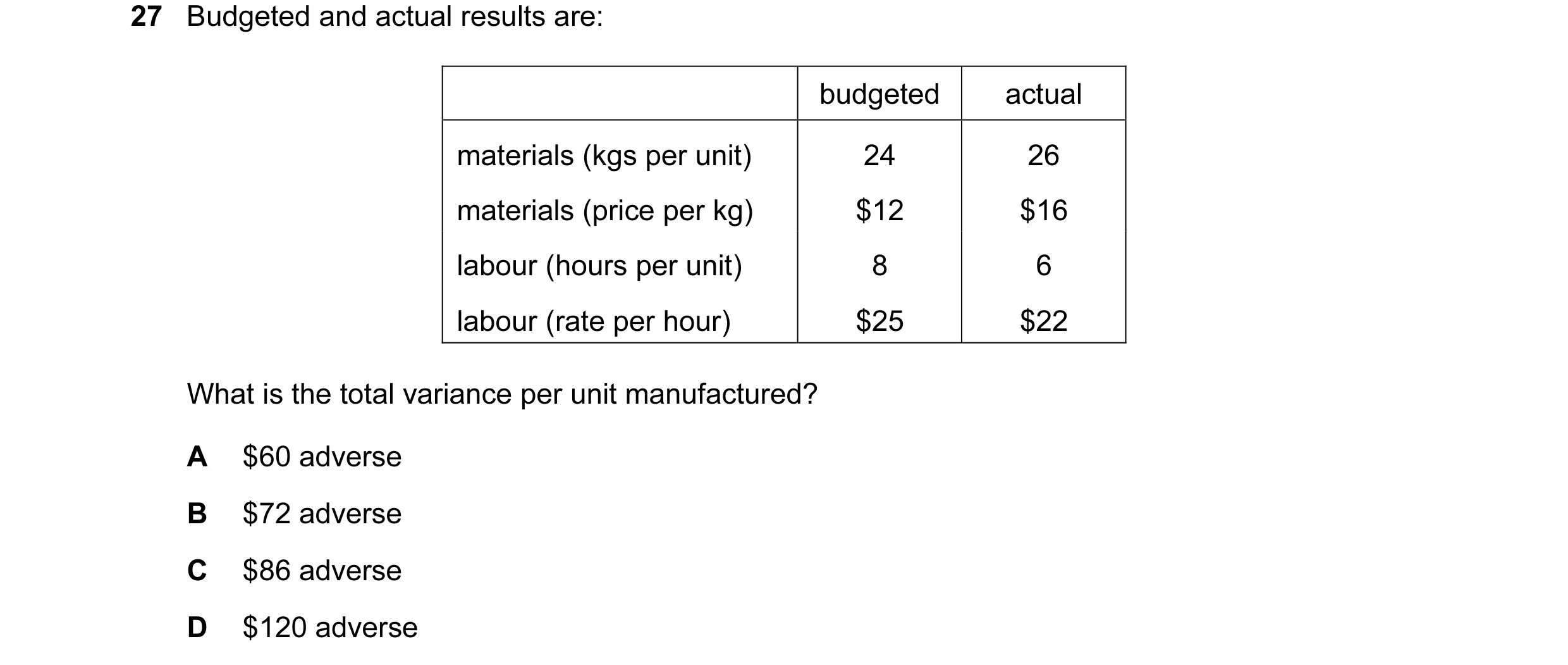
 18 / 28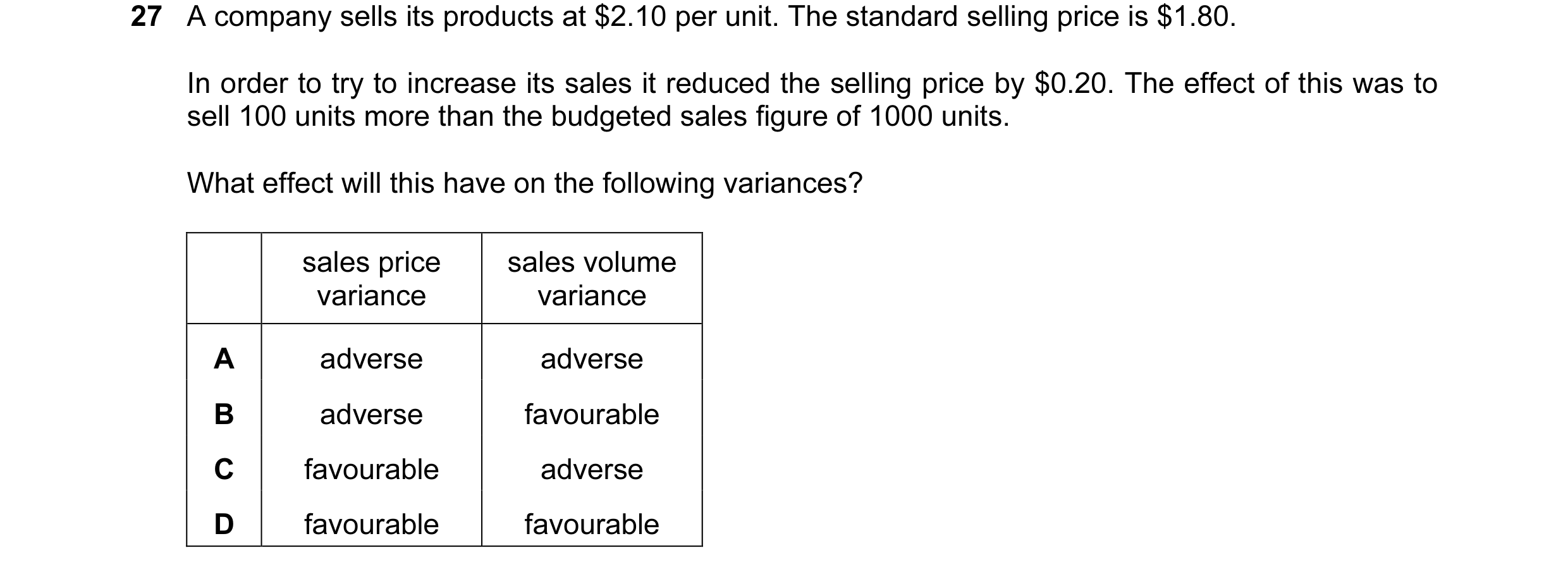
 19 / 28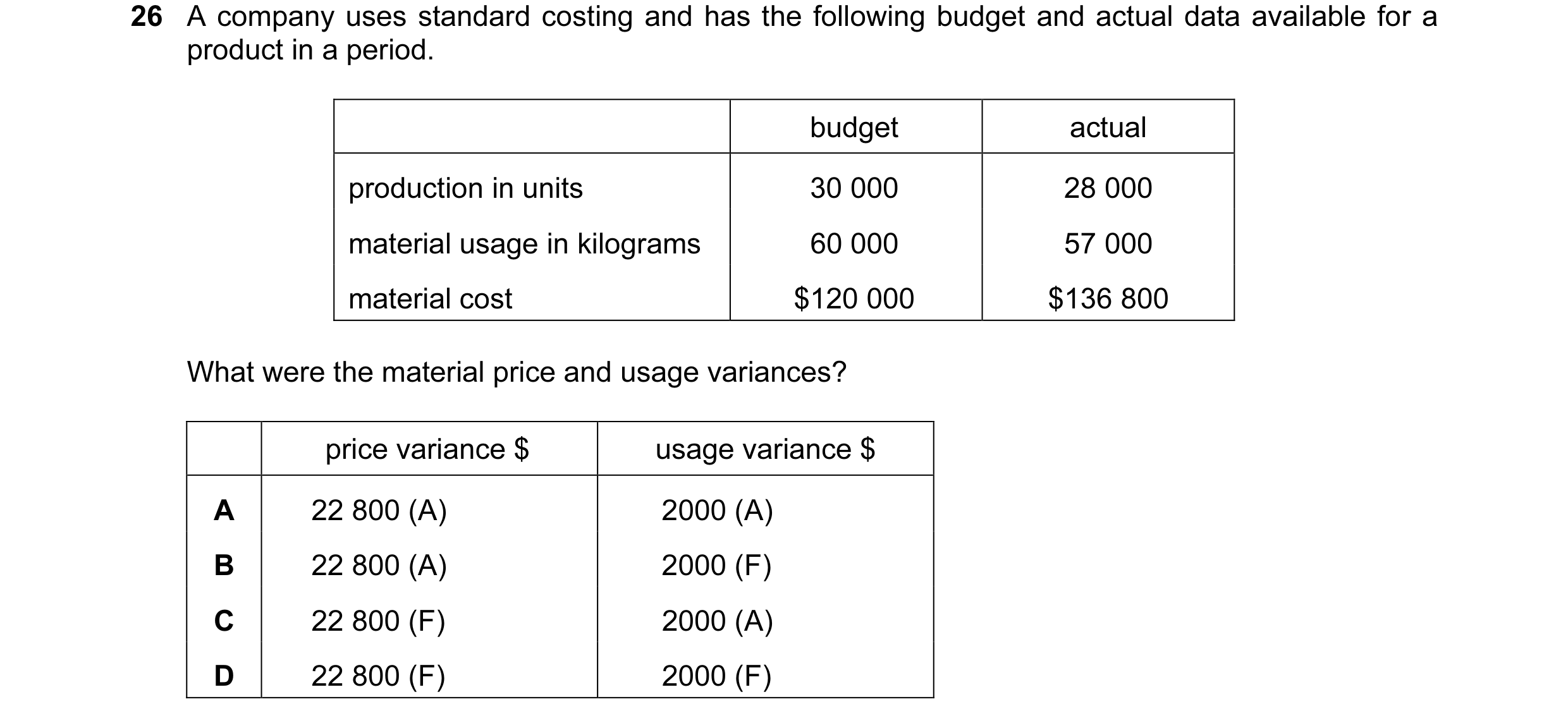

 20 / 28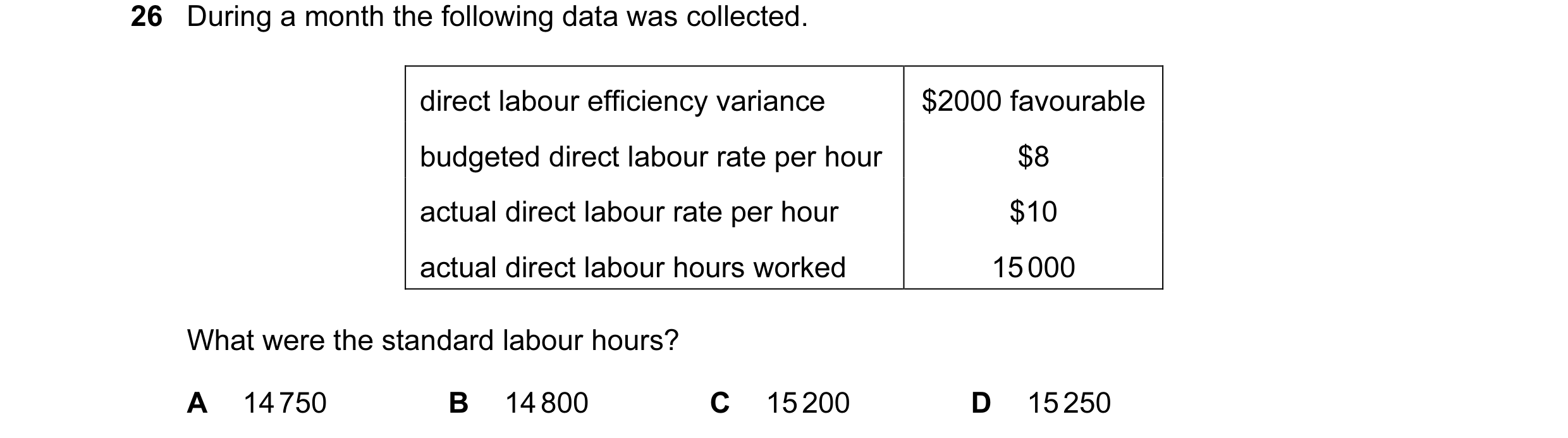
 21 / 28
 22 / 28
 23 / 28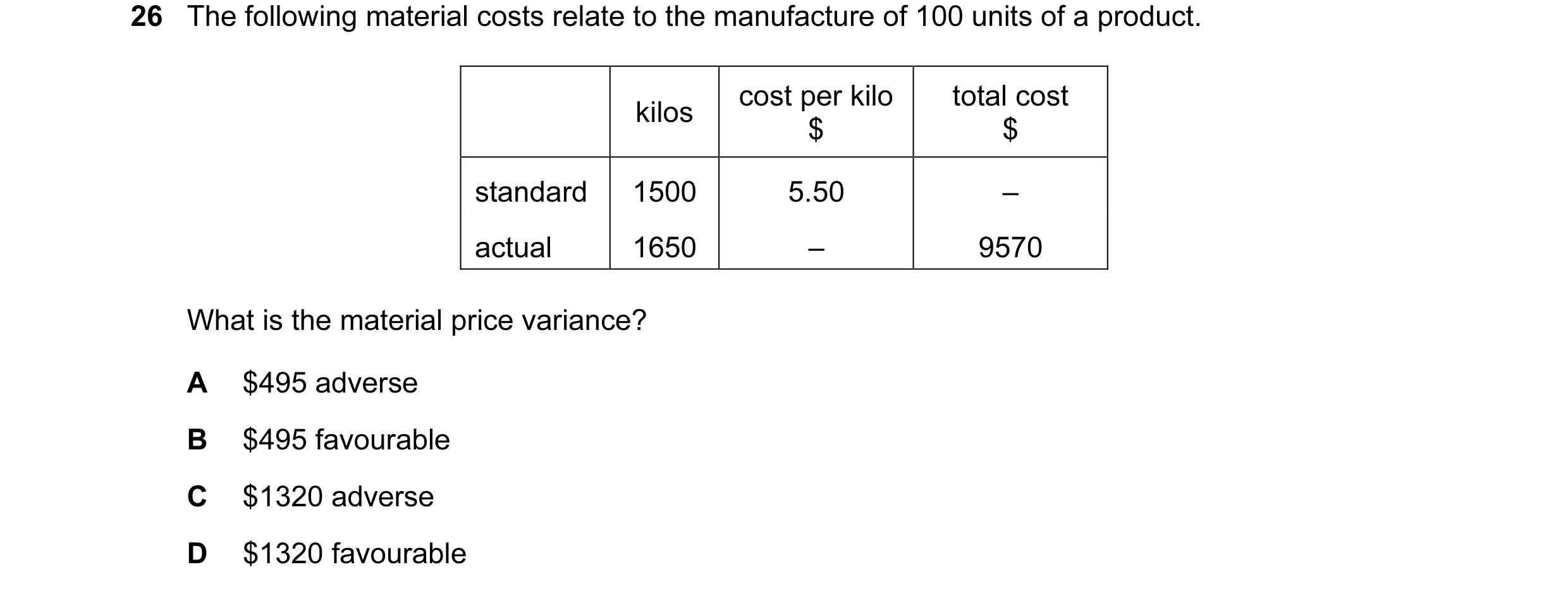

 24 / 28
 25 / 28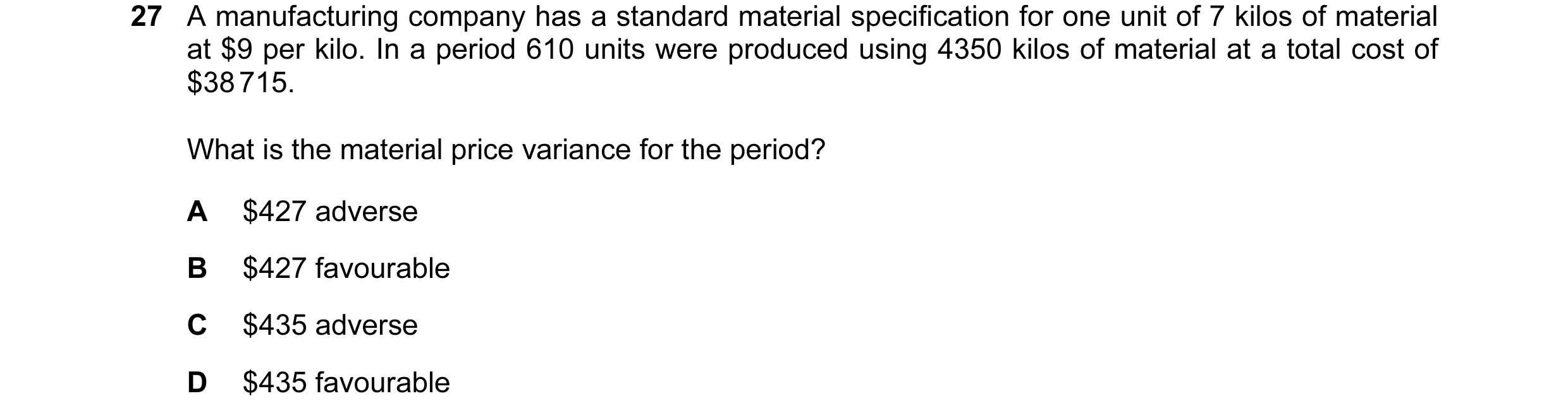

 26 / 28



 27 / 28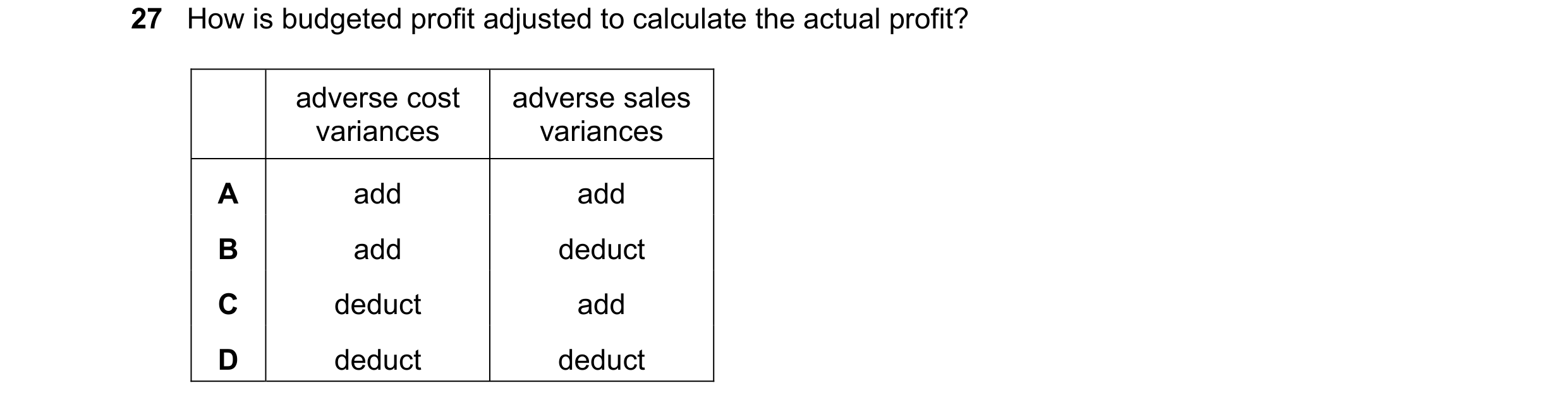
 28 / 28