Questions as text
Q1 · Read Source B in the insert 9706/42 May/June 2023
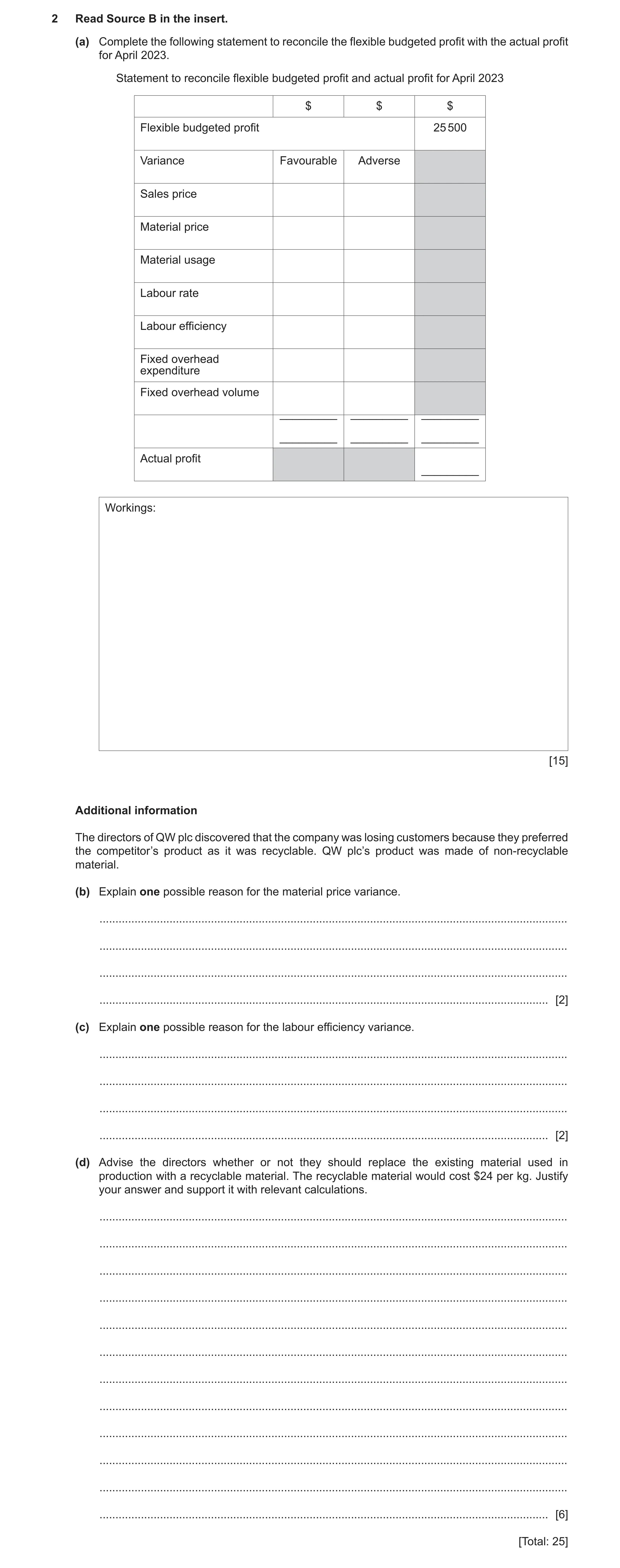
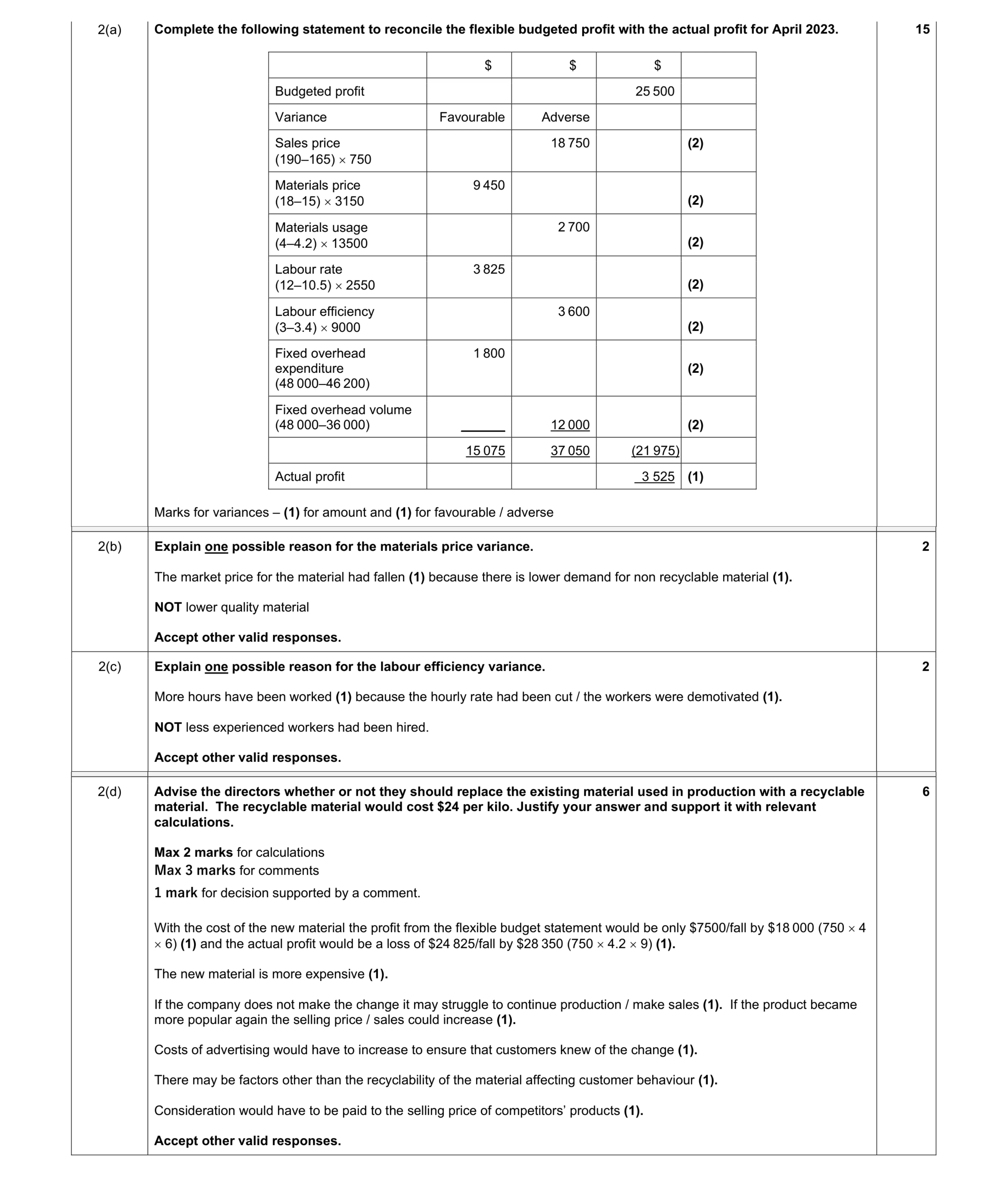
2 Read Source B in the insert. (a) Complete the following statement to reconcile the flexible budgeted profit with the actual profit for April 2023. Statement to reconcile flexible budgeted profit and actual profit for April 2023 $ $ $ Flexible budgeted profit 25 500 Variance Favourable Adverse Sales price Material price Material usage Labour rate Labour efficiency Fixed overhead expenditure Fixed overhead volume _________ _________ _________ _________ _________ _________ Actual profit _________ Workings: [15] Additional information The directors of QW plc discovered that the company was losing customers because they preferred the competitor’s product as it was recyclable. QW plc’s product was made of non‑recyclable material. (b) Explain one possible reason for the material price variance. … … … … [2] (c) Explain one possible reason for the labour efficiency variance. … … … … [2] (d) Advise the directors whether or not they should replace the existing material used in production with a recyclable material. The recyclable material would cost $24 per kg. Justify your answer and support it with relevant calculations. … … … … … … … … … … … … [6] [Total: 25]
25 marks
Mark scheme: 2(a) $ $ $ Budgeted profit 25 500 Variance Favourable Adverse Sales price (190–165) 750 18 750 (2) Materials price (18–15) 3150 9 450 (2) Materials usage (4–4.2) 13500 2 700 (2) Labour rate (12–10.5) 2550 3 825 (2) Labour efficiency (3–3.4) 9000 3 600 (2) Fixed overhead expenditure (48 000–46 200) 1 800 (2) Fixed overhead volume (48 000–36 000) ______ 12 000 (2) 15 075 37 050 (21 975) Actual profit 3 525 (1) Marks for variances – (1) for amount and (1) for favourable / adverse Question Answer Marks 2(b) Explain one possible reason for the materials price variance. The market price for the material had fallen (1) because there is lower demand for non recyclable material (1). NOT lower quality material Accept other valid responses. 2 2(c) Explain one possible reason for the labour efficiency variance. More hours have been worked (1) because the hourly rate had been cut / the workers were demotivated (1). NOT less experienced workers had been hired. Accept other valid responses. 2 Question Answer Marks 2(d) Advise the directors whether or not they should replace the existing material used in production with a recyclable material. The recyclable material would cost $24 per kilo. Justify your answer and support it with relevant calculations. Max 2 marks for calculations Max 3 marks for comments 1 mark for decision supported by a comment. With the cost of the new material the profit from the flexible budget statement would be only $7500/fall by $18 000 (750 4 6) (1) and the actual profit would be a loss of $24 825/fall by $28 350 (750 4.2 9) (1). The new material is more expensive (1). If the company does not make the change it may struggle to continue production / make sales (1). If the product became more popular again the selling price / sales could increase (1). Costs of advertising would have to increase to ensure that customers knew of the change (1). There may be factors other than the recyclability of the material affecting customer behaviour (1). Consideration would have to be paid to the selling price of competitors’ products (1). Accept other valid responses. 6
This question in 9706/42 May/June 2023
Q2 · Read Source B in the insert 9706/41 Oct/Nov 2023
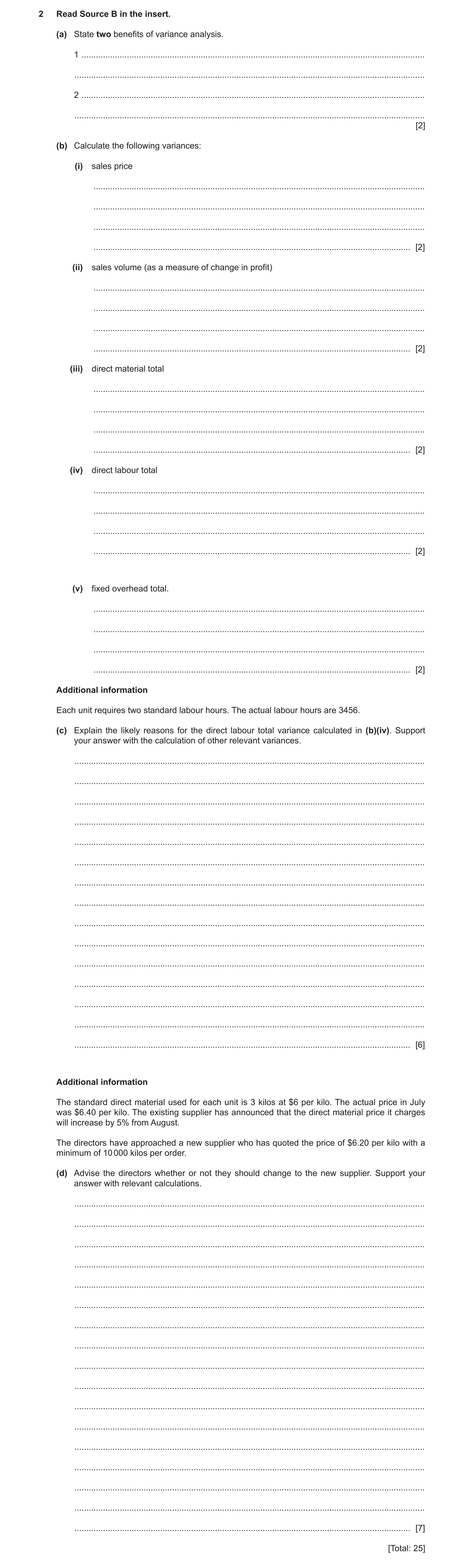
2 Read Source B in the insert. (a) State two benefits of variance analysis. 1 … … 2 … … [2] (b) Calculate the following variances: (i) sales price … … … … [2] (ii) sales volume (as a measure of change in profit) … … … … [2] (iii) direct material total … … … … [2] (iv) direct labour total … … … … [2] (v) fixed overhead total. … … … … [2] Additional information Each unit requires two standard labour hours. The actual labour hours are 3456. (c) Explain the likely reasons for the direct labour total variance calculated in (b)(iv). Support your answer with the calculation of other relevant variances. … … … … … … … … … … … … … … … [6] Additional information The standard direct material used for each unit is 3 kilos at $6 per kilo. The actual price in July was $6.40 per kilo. The existing supplier has announced that the direct material price it charges will increase by 5% from August. The directors have approached a new supplier who has quoted the price of $6.20 per kilo with a minimum of 10 000 kilos per order. (d) Advise the directors whether or not they should change to the new supplier. Support your answer with relevant calculations. … … … … … … … … … … … … … … … … … [7] [Total: 25]
25 marks
Mark scheme: 2(a) State two benefits of variance analysis. 2 Planning / control – to achieve the predetermined target (1) Identify areas of strength and weakness (1) Assist in making forward-looking decision (1) Max 2 Accept other valid responses. 2(b)(i) Calculate the following variances: 2 sales price $146 000 / 2 000 = $73 $136 800 – ($73 1 800) = $5 400 (1) F (1) 2(b)(ii) sales volume (a measure of change in profit) 2 $14 000 / 2 000 = $7 (2 000 – 1 800) $7 = $1 400 (1) A (1) 2(b)(iii) direct material total 2 $36 000 / 2 000 = $18 (1 800 $18) – $33 408 = $1 008 (1) A (1) 2(b)(iv) direct labour total 2 $64 000 / 2 000 = $32 (1 800 $32) – $58 752 = $1 152 (1) A (1) 2(b)(v) fixed overhead total. 2 $32 000 / 2 000 = $16 (1 800 $16) – $33 920 = $5 120 (1) A (1) 2(c) Explain the likely reasons for the direct labour total variance calculated in (b)(iv). Support your answer with the 6 calculation of other relevant variances. Standard labour rate ($64 000 / 2 000) ÷ 2 = $16 per hour Actual labour rate $58 752 / 3 456 = $17 per hour Labour rate variance is $58 752 – ($16 3 456) = $3 456(1) A(1) Reasons – wages rate increase as demanded by labour union, increase of minimum wages, inflation (1) Labour efficiency variance is [(2 1 800) – 3 456] $16 = $2 304(1) F(1) Reasons – skilled labour, good supervision, less chance of machine breakdowns (1) Accept other valid responses. (4) marks for calculation of the two variances (1) mark for one reason for each of the two variances 2(d) Advise the directors whether or not they should change to the new supplier. Support your answer with relevant 7 calculations. Calculations (Max 2) The standard usage is 5 400 kilos (1 800 units 3 kilos) (1). Actual usage for July: $33 408 / $6.40 = 5 220 kilos (1) The price increases from a standard price of $6 to $6.40 and further to $6.72 (1). Existing supplier (Max 2) This suggests that the quality is good and lesser amount of direct material has been used. (1) If G Limited does not adjust the selling price, the profit will decrease. (1) Increasing selling price may reduce the demand. (1) New supplier (Max 2) The price is lower than the existing supplier. (1) A minimum of 10000 kilos per order suggests that G Limited must be very careful in inventory control/purchase budgeting (1) Otherwise, it will incur additional cost in the storage of inventory / spoilage costs. (1) The quality of direct material / reliability of supplier is uncertain (1) Accept other valid responses. (1) for decision supported by a comment
This question in 9706/41 Oct/Nov 2023
Q3 · Read Source A in the insert 9706/43 Oct/Nov 2023
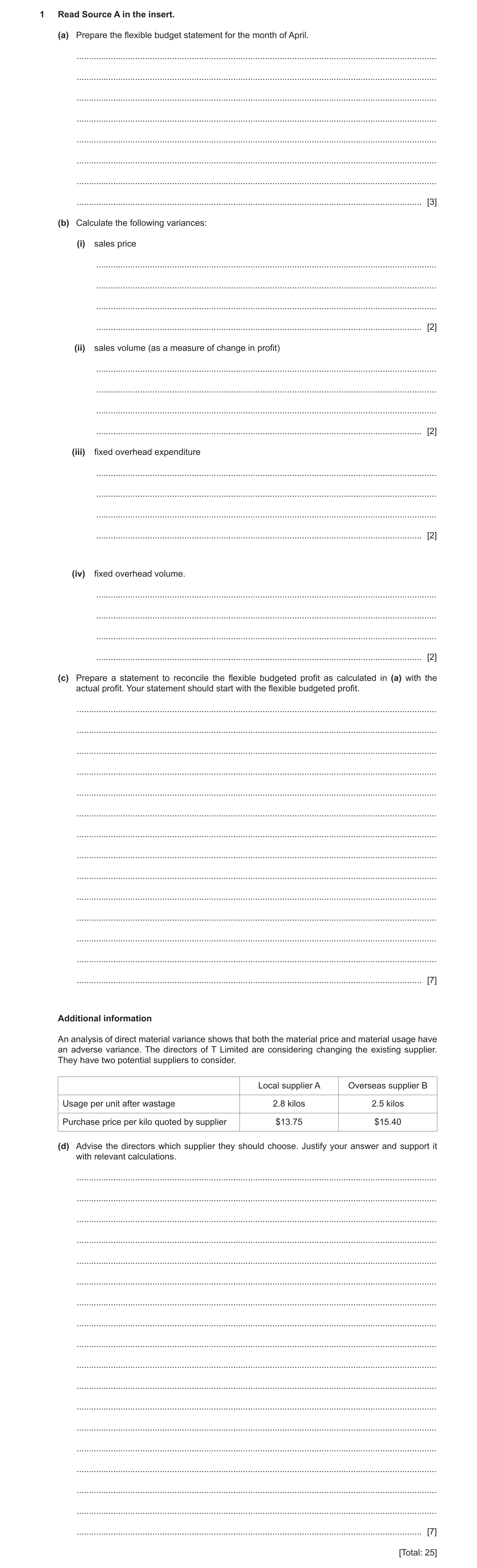
1 Read Source A in the insert. (a) Prepare the flexible budget statement for the month of April. … … … … … … … … [3] (b) Calculate the following variances: (i) sales price … … … … [2] (ii) sales volume (as a measure of change in profit) … … … … [2] (iii) fixed overhead expenditure … … … … [2] (iv) fixed overhead volume. … … … … [2] (c) Prepare a statement to reconcile the flexible budgeted profit as calculated in (a) with the actual profit. Your statement should start with the flexible budgeted profit. … … … … … … … … … … … … … … [7] Additional information An analysis of direct material variance shows that both the material price and material usage have an adverse variance. The directors of T Limited are considering changing the existing supplier. They have two potential suppliers to consider. Local supplier A Overseas supplier B Usage per unit after wastage 2.8 kilos 2.5 kilos Purchase price per kilo quoted by supplier $13.75 $15.40 (d) Advise the directors which supplier they should choose. Justify your answer and support it with relevant calculations. … … … … … … … … … … … … … … … … … … [7] [Total: 25]
25 marks
Mark scheme: Question Answer Marks 1(a) Prepare the flexible budget statement for the month of April. 3 $ Sales revenue ($184 000/2 000) 2180 200 560 } Direct materials ($84 000/2 000) 2180 91 560 } Direct labour ($60 000/2 000) 2180 65 400 } (1) Fixed overhead ($18 000/2 000) 2180 19 620 (1) Total cost 176 580 Budgeted profit 23 980 (1) OF 1(b)(i) Calculate the following variances: 2 sales price Sales price variance $184 000/2000 = $92 (2180 $92) – $196 200= $4360 (1) A (1) 1(b)(ii) Calculate the following variances: 2 sales volume (as a measure of change in profit) Sales volume variance $22 000/2000 =$11 (2180 – $2000) $11=$1980 (1) F (1) 1(b)(iii) Calculate the following variances: 2 fixed overhead expenditure Fixed overhead expenditure $18 400 – $18 000 = $400 (1) A (1) 1(b)(iv) Calculate the following variances: 2 fixed overhead volume Fixed overhead volume $19 620 OF – $18 000 = $1620 (1) F (1) 1(c) Prepare a statement to reconcile the flexible budgeted profit as calculated in (a) with the actual profit. Your 7 statement should start with the flexible budgeted profit. $ Flexible budgeted profit 23 980 (1)OF Sales price variance (4 360) A} Direct materials variance ($113 796 – $91 560) (22 236) A (2) Direct labour variance ($65 400 – 55 590) 9 810 F (2) Fixed overhead expenditure (400) A} Fixed overhead volume 1 620 F} (1)OF Actual profit 8 414 (1) 1(d) Advise the directors which supplier they should choose. Justify your answer and support it with relevant 7 calculations. Calculations The unit cost for both suppliers is the same – (2.8 $13.75) = (2.5 $15.40) = $38.50 (1) The unit cost $38.5 by either supplier is lower than the budgeted cost of $42 ($84 000/2 000) and actual cost of $52.20 ($113 796/2 180) (1) Max 2 Comments The quality of materials from supplier B is better than from A (1) because of less wastage (1) Direct material of poor quality may affect the efficiency of workers as well as the quality of final product (1) The unit purchase price of supplier A is lower than B (1) Additional costs may be incurred for supplier B, i.e. import duty, freight charge and insurance (1) As delivery takes time, prompt delivery from supplier B may not be possible (1) for an urgent order (1) Max 4 Decision supported by a comment (1) Accept other valid responses.
This question in 9706/43 Oct/Nov 2023
Q4 · Read Source B in the insert 9706/42 Feb/March 2024
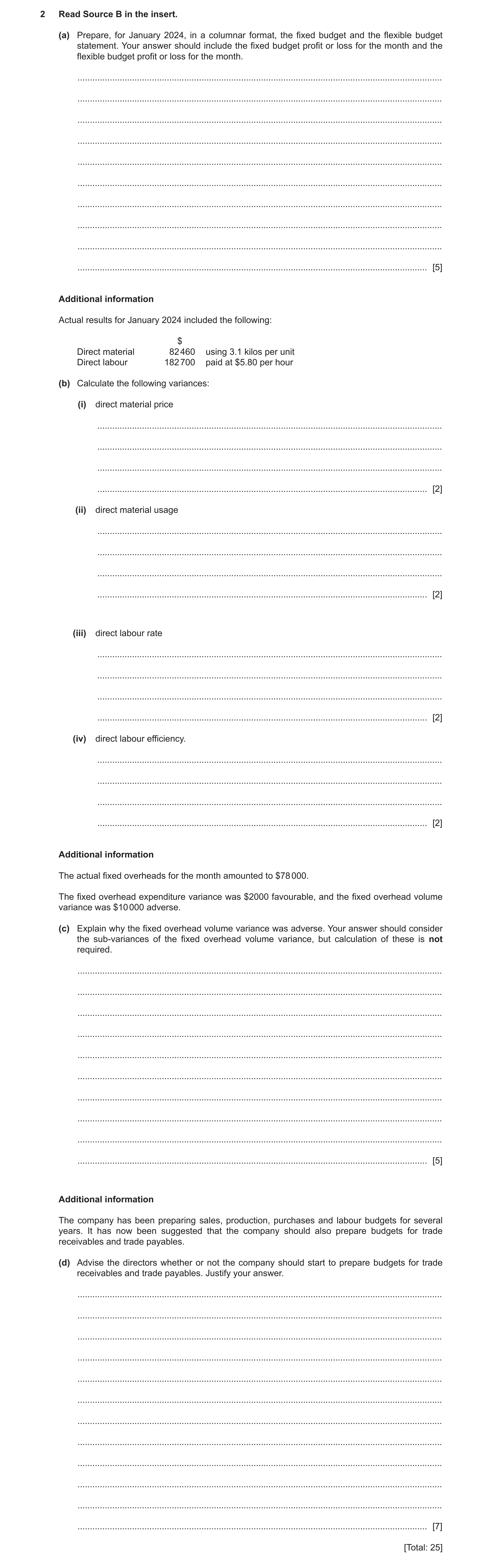
2 Read Source B in the insert. (a) Prepare, for January 2024, in a columnar format, the fixed budget and the flexible budget statement. Your answer should include the fixed budget profit or loss for the month and the flexible budget profit or loss for the month. … … … … … … … … … … [5] Additional information Actual results for January 2024 included the following: $ Direct material 82 460 using 3.1 kilos per unit Direct labour 182 700 paid at $5.80 per hour (b) Calculate the following variances: (i) direct material price … … … … [2] (ii) direct material usage … … … … [2] (iii) direct labour rate … … … … [2] (iv) direct labour efficiency. … … … … [2] Additional information The actual fixed overheads for the month amounted to $78 000. The fixed overhead expenditure variance was $2000 favourable, and the fixed overhead volume variance was $10 000 adverse. (c) Explain why the fixed overhead volume variance was adverse. Your answer should consider the sub-variances of the fixed overhead volume variance, but calculation of these is not required. … … … … … … … … … … [5] Additional information The company has been preparing sales, production, purchases and labour budgets for several years. It has now been suggested that the company should also prepare budgets for trade receivables and trade payables. (d) Advise the directors whether or not the company should start to prepare budgets for trade receivables and trade payables. Justify your answer. … … … … … … … … … … … … [7] [Total: 25]
25 marks
Mark scheme: 2(a) Prepare, for January 2024 in a columnar format, the fixed budget and the 5 flexible budget statement. Fixed Flexible budget budget $ $ Sales revenue 544 000 476 000 (1) row Direct material (96 000) (84 000) (1) row Direct labour W1 (192 000) (168 000) (1) row Fixed overheads (80 000) (70 000) (1) row Profit 176 000 154 000 (1)OF row W1: 32000 hours x $6 = $192 000 28000 hours x $6 = $168 000 2(b)(i) Calculate the following variances: 2 Direct material price 21 700 (4 – 3.80) = 4340 (1) F (1) 2(b)(ii) Direct material usage 2 4 (21 700 – 21 000) = 2800 (1) A (1) 2(b)(iii) Direct labour rate 2 31 500 (6 – 5.80) = 6300 (1) F (1) 2(b)(iv) Direct labour efficiency 2 6 (31 500 – 28 000) = 21 000 (1) A (1) 2(c) Explain why the fixed overhead volume variance was adverse. Your 5 answer should consider the sub-variances of the fixed overhead volume variance but calculation of these is not required. The fixed overhead volume variance was adverse because actual production was less than budgeted production (1). The fixed overhead capacity variance (1) was adverse because actual hours worked were less than the hours from the fixed budget as 31500 hours is less than 32000 hours (1). The fixed overhead efficiency variance (1) was adverse because actual hours worked were greater than the hours from the flexible budget statement as 31500 hours is more than 28 000 hours (1). Accept other valid responses 2(d) Advise the directors whether or not the company should start to prepare 7 budgets for both trade receivables and trade payables. Justify your answer For (max 3) Predicts cash inflows and cash outflows. (1) Enables a cash budget to be prepared. (1) Assists in the production of master budget / budgeted statement of financial position. (1) Could give a benchmark for monitoring the performance of credit control. (1) Cash is often more important than profit. (1) Against (max 3) The company may make all sales and purchases on a cash basis. (1) More time consuming/increased administrative costs. (1) The budget won’t make the trade receivables pay up/won’t stop irrecoverable debts. (1) Doesn’t ensure there is enough cash to pay the trade payables. (1) Decision supported by a comment (1) Accept other valid responses
This question in 9706/42 Feb/March 2024
Q5 · Read Source B in the insert 9706/41 May/June 2024
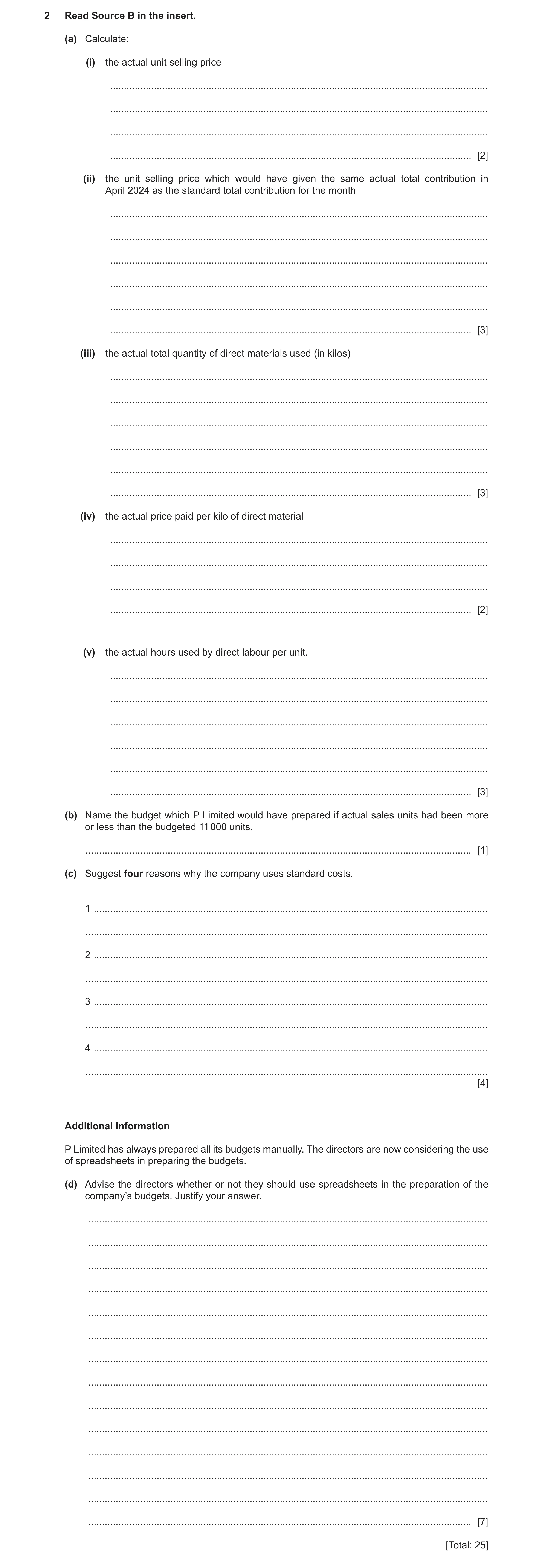
2 Read Source B in the insert. (a) Calculate: (i) the actual unit selling price … … … … [2] (ii) the unit selling price which would have given the same actual total contribution in April 2024 as the standard total contribution for the month … … … … … … [3] (iii) the actual total quantity of direct materials used (in kilos) … … … … … … [3] (iv) the actual price paid per kilo of direct material … … … … [2] (v) the actual hours used by direct labour per unit. … … … … … … [3] (b) Name the budget which P Limited would have prepared if actual sales units had been more or less than the budgeted 11 000 units. … [1] (c) Suggest four reasons why the company uses standard costs. 1 … … 2 … … 3 … … 4 … … [4] Additional information P Limited has always prepared all its budgets manually. The directors are now considering the use of spreadsheets in preparing the budgets. (d) Advise the directors whether or not they should use spreadsheets in the preparation of the company’s budgets. Justify your answer. … … … … … … … … … … … … … … [7] [Total: 25]
25 marks
Mark scheme: 2(a)(i) Calculate the actual unit selling price. 2 55 000/11 000 = 5 (1) 210 – 5 = $205 (1) 2(a)(ii) Calculate the unit selling price which would have given the same actual 3 total contribution in April 2024 as the standard total contribution for the month (57 750 – 4290 – 8360) (1)/11 000 = 4.10 (1) 210 + 4.10 = $214.10 (1) OF OR (55 000 + 57 750 – 4290 – 8360) (1)/11 000 = 9.10 (1) 205 + 9.10 = $214.10 (1) OF 2(a)(iii) Calculate the actual total quantity of direct materials used (in kilos) 3 8360/7.60 = 1100 (1) (11 000 4) (1) – 1100 = 42 900 kilos (1) OF 2(a)(iv) Calculate the actual price paid per kilo of direct material 2 4290/42 900 = 0.10 (1) OF 7.60 – 0.10 = $7.50 (1) OF 2(a)(v) Calculate the actual hours used by direct labour per unit. 3 57 750/(10.50 11000) (1) = 0.5 (1) OF 3 + 0.5 = 3.5 hours (1) OF 2(b) Name the budget which P Limited would have prepared if actual sales 1 units had been more or less than the standard 11000 units. flexible budget statement (1) 2(c) Suggest four reasons why the company uses standard costs. 4 To help cost control/cost reduction (1) To provide a benchmark against which actual results can be compared (1) To help with decision making (1) To motivate staff (1) To use in estimating future requirements for materials or labour (1) To simplify the setting of selling prices (1) To simplify the valuation of inventory (1) To co-ordinate the different functions in the business whilst setting the standards (1) Accept other valid responses. Max 4 2(d) Advise the directors whether or not they should use spreadsheets in the 7 preparation of the company’s budgets. Justify your answer. For (max 3) Arithmetical errors should be avoided. (1) Speed of calculation will be improved. (1) There is automatic recalculation if one variable is changed. (1) Enables ‘what if’ questions to be asked. (1) Security can be enhanced with passwords. (1) Information can be easily sent from one office/department to another. (1) Multiple user applications may be available. (1) ‘Sort’ or ‘select’ functions may be useful. (1) Against (max 3) Some staff may not be familiar with the software. (1) The budgets will still only be as good as the estimates made. (1) Security of data may be compromised. (1) Errors in data entry can be made. (1) Incorrect formulae can be used. (1) Accept other valid responses. Decision supported by a comment (1)
This question in 9706/41 May/June 2024
Q6 · Read Source B in the insert 9706/43 May/June 2024
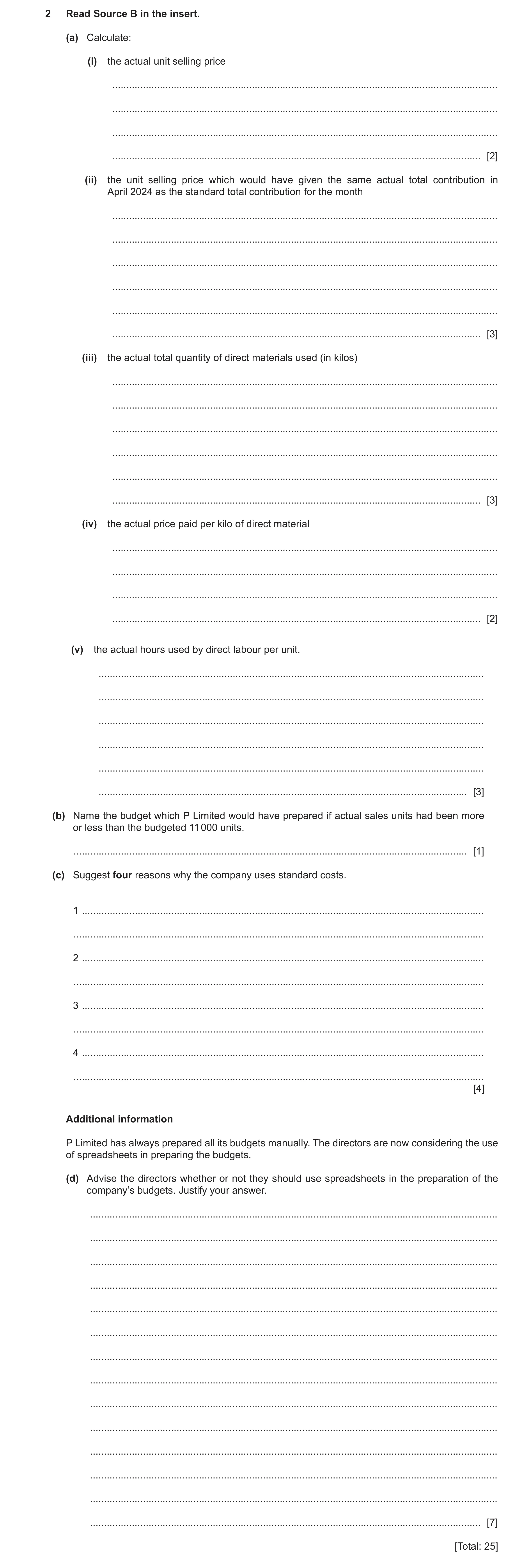
2 Read Source B in the insert. (a) Calculate: (i) the actual unit selling price … … … … [2] (ii) the unit selling price which would have given the same actual total contribution in April 2024 as the standard total contribution for the month … … … … … … [3] (iii) the actual total quantity of direct materials used (in kilos) … … … … … … [3] (iv) the actual price paid per kilo of direct material … … … … [2] (v) the actual hours used by direct labour per unit. … … … … … … [3] (b) Name the budget which P Limited would have prepared if actual sales units had been more or less than the budgeted 11 000 units. … [1] (c) Suggest four reasons why the company uses standard costs. 1 … … 2 … … 3 … … 4 … … [4] Additional information P Limited has always prepared all its budgets manually. The directors are now considering the use of spreadsheets in preparing the budgets. (d) Advise the directors whether or not they should use spreadsheets in the preparation of the company’s budgets. Justify your answer. … … … … … … … … … … … … … … [7] [Total: 25]
25 marks
Mark scheme: 2(a)(i) Calculate the actual unit selling price. 2 55 000/11 000 = 5 (1) 210 – 5 = $205 (1) 2(a)(ii) Calculate the unit selling price which would have given the same actual 3 total contribution in April 2024 as the standard total contribution for the month (57 750 – 4290 – 8360) (1)/11 000 = 4.10 (1) 210 + 4.10 = $214.10 (1) OF OR (55 000 + 57 750 – 4290 – 8360) (1)/11 000 = 9.10 (1) 205 + 9.10 = $214.10 (1) OF 2(a)(iii) Calculate the actual total quantity of direct materials used (in kilos) 3 8360/7.60 = 1100 (1) (11 000 4) (1) – 1100 = 42 900 kilos (1) OF 2(a)(iv) Calculate the actual price paid per kilo of direct material 2 4290/42 900 = 0.10 (1) OF 7.60 – 0.10 = $7.50 (1) OF 2(a)(v) Calculate the actual hours used by direct labour per unit. 3 57 750/(10.50 11000) (1) = 0.5 (1) OF 3 + 0.5 = 3.5 hours (1) OF 2(b) Name the budget which P Limited would have prepared if actual sales 1 units had been more or less than the standard 11000 units. flexible budget statement (1) 2(c) Suggest four reasons why the company uses standard costs. 4 To help cost control/cost reduction (1) To provide a benchmark against which actual results can be compared (1) To help with decision making (1) To motivate staff (1) To use in estimating future requirements for materials or labour (1) To simplify the setting of selling prices (1) To simplify the valuation of inventory (1) To co-ordinate the different functions in the business whilst setting the standards (1) Accept other valid responses. Max 4 2(d) Advise the directors whether or not they should use spreadsheets in the 7 preparation of the company’s budgets. Justify your answer. For (max 3) Arithmetical errors should be avoided. (1) Speed of calculation will be improved. (1) There is automatic recalculation if one variable is changed. (1) Enables ‘what if’ questions to be asked. (1) Security can be enhanced with passwords. (1) Information can be easily sent from one office/department to another. (1) Multiple user applications may be available. (1) ‘Sort’ or ‘select’ functions may be useful. (1) Against (max 3) Some staff may not be familiar with the software. (1) The budgets will still only be as good as the estimates made. (1) Security of data may be compromised. (1) Errors in data entry can be made. (1) Incorrect formulae can be used. (1) Accept other valid responses. Decision supported by a comment (1)
This question in 9706/43 May/June 2024
Q7 · Read Source A in the insert 9706/42 Oct/Nov 2024
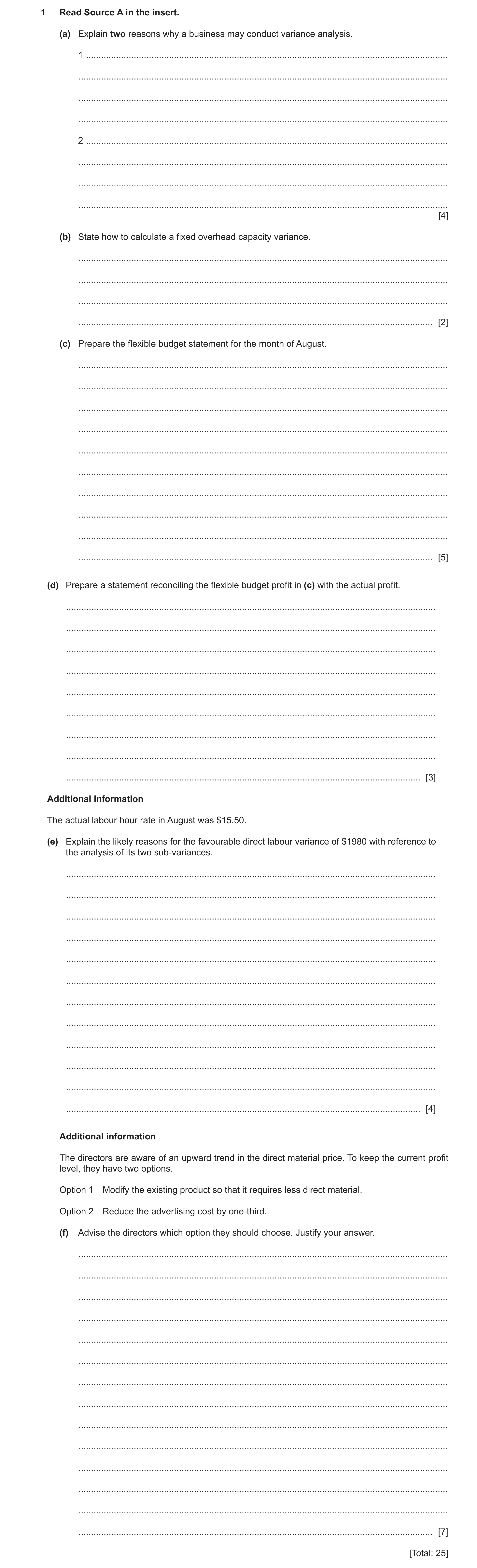
1 Read Source A in the insert. (a) Explain two reasons why a business may conduct variance analysis. 1 … … … … 2 … … … … [4] (b) State how to calculate a fixed overhead capacity variance. … … … … [2] (c) Prepare the flexible budget statement for the month of August. … … … … … … … … … … [5] (d) Prepare a statement reconciling the flexible budget profit in (c) with the actual profit. … … … … … … … … … [3] Additional information The actual labour hour rate in August was $15.50. (e) Explain the likely reasons for the favourable direct labour variance of $1980 with reference to the analysis of its two sub-variances. … … … … … … … … … … … … [4] Additional information The directors are aware of an upward trend in the direct material price. To keep the current profit level, they have two options. Option 1 Modify the existing product so that it requires less direct material. Option 2 Reduce the advertising cost by one-third. (f) Advise the directors which option they should choose. Justify your answer. … … … … … … … … … … … … … … [7] [Total: 25]
25 marks
Mark scheme: Question Answer Marks 1(a) Explain two reasons why a business may conduct variance analysis. 4 Comparing the actual result and the budget (1) so that actions can be taken for remedy or improvement (1) Measuring the performance of the managers (1) to determine bonus eligibility (1) Max 2 reasons, 2 marks each Accept other valid responses. 1(b) State how to calculate a fixed overhead capacity variance. 2 The difference between the total direct labour hours under fixed budget and the total actual labour hours (1) times the standard overhead absorption rate (1) Or (Standard hours for budgeted production – actual hours) (1) x Standard fixed overhead rate per hour (1) 1(c) Prepare the flexible budget statement for the month of August. 5 $ Sales ($239 400 – $5 400) 234 000 (1) Direct materials ($44 640 – $1 440)/(1 800 $24) 43 200 (1) Direct labour ($106 020 + $1 980)/(1 800 60) 108 000 (1) Fixed overhead ($84 000 – $12 000)/(1800 40) 72 000 (1) Profit 10 800 (1)OF 1(d) Prepare a statement reconciling the flexible budget profit in (c) with the actual profit. 3 $ Flexible budget profit 10 800 (1) OF Variances Sales price 5 400 F } Total direct material 1 440 A }(1) Total direct labour 1 980 F } Total fixed overhead 12 000 A }(1) Actual profit 4 740 1(e) Explain the likely reasons for the favourable direct labour variance of $1 980 with reference to the analysis of its 4 two sub-variances. The labour rate variance is $3 420 A. (1) The higher wage may be due to more skilled labour or trained labour. (1) The labour efficiency variance is $5 400 F. (1) The decreased hours worked may be due to the use of higher quality materials. (1) Accept other valid responses. 1(f) Advise the directors which option they should choose. Justify your answer. 7 Option 1 Max (3) The modified product may be perceived to be poor quality / adverse effect on brand image (1). Loyal customers may not like the modified product / may cause demand to fall (1). This can save direct material cost to maintain or increase the current profit level (1). A modified product may be perceived as a new product and appeal to new customers (1). Option 2 Max (3) Advertising helps retain existing customers (1). Advertising increases the awareness of the product / less advertising may lead to the loss of customers (1). Reducing advertising cost may maintain or increase profit (1). Reducing advertising cost can avoid the company increasing the selling price. (1). Decision supported with a comment (1) Accept other valid responses.
This question in 9706/42 Oct/Nov 2024
Q8 · Read Source B in the insert 9706/42 Feb/March 2025
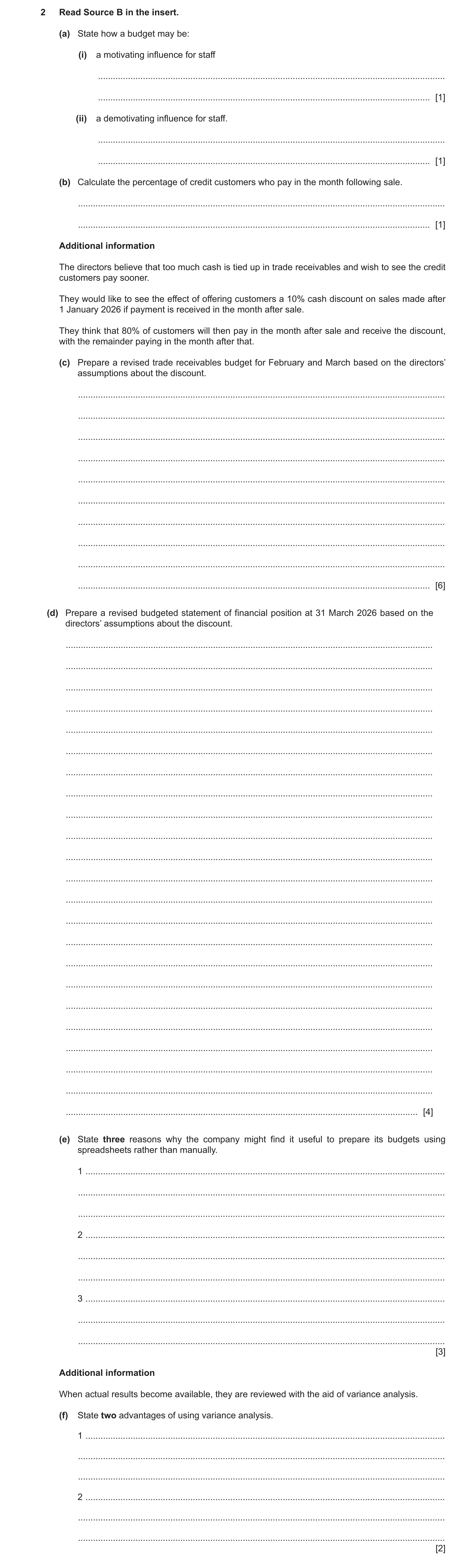
2 Read Source B in the insert. (a) State how a budget may be: (i) a motivating influence for staff … … [1] (ii) a demotivating influence for staff. … … [1] (b) Calculate the percentage of credit customers who pay in the month following sale. … … [1] Additional information The directors believe that too much cash is tied up in trade receivables and wish to see the credit customers pay sooner. They would like to see the effect of offering customers a 10% cash discount on sales made after 1 January 2026 if payment is received in the month after sale. They think that 80% of customers will then pay in the month after sale and receive the discount, with the remainder paying in the month after that. (c) Prepare a revised trade receivables budget for February and March based on the directors’ assumptions about the discount. … … … … … … … … … … [6] (d) Prepare a revised budgeted statement of financial position at 31 March 2026 based on the directors’ assumptions about the discount. … … … … … … … … … … … … … … … … … … … … … … … [4] (e) State three reasons why the company might find it useful to prepare its budgets using spreadsheets rather than manually. 1 … … … 2 … … … 3 … … … [3] Additional information When actual results become available, they are reviewed with the aid of variance analysis. (f) State two advantages of using variance analysis. 1 … … … 2 … … … [2]
18 marks
Mark scheme: 2(a)(i) State how a budget may be: 1 a motivating influence for staff If staff are involved in the setting of the budgets they may be motivated (1). Accept other valid responses 2(a)(ii) State how a budget may be: 1 a demotivating influence for staff. If the budgets are imposed on staff they may be demotivated (1). Accept other valid responses 2(b) Calculate the percentage of credit customers who pay in the month 1 following sale. 20% (1) 2(c) Prepare a revised trade receivables budget for February and March 6 based on the directors’ assumptions about the discount. February March $ $ Balance b/f 172 400 * 120 400 Sales 100 000 92 000 272 400 212 400 Receipts – one month after sale 73 440 (1) 72 000 (1) Discount 8 160 (1) 8 000 (1) Receipts – two months after 70 400 *(1) 20 400 sale Balance c/f 120 400 112 000 (1)OF *(1) for both items unaffected as pre-change 2(d) Prepare a revised budgeted statement of financial position at 31 March 4 2026 based on the directors’ assumptions about the discount. $ Non-current assets 426 000 Current assets Inventory 91 000 Trade receivables 112 000 (1)OF Bank (-22180+43840) 21 660 (1)OF Total assets 650 660 Equity Share capital 500 000 Retained earnings (77320 – 16160) 61 160 (1)OF Current liabilities Trade payables 89 500 Total equity and liabilities 650 660 (1) if both totals agree 2(e) State three reasons why the company might find it useful to prepare its 3 budgets using spreadsheets rather than manually. Arithmetical errors should be avoided. (1) Speed of calculation will be improved. (1) There is automatic recalculation if one variable is changed. (1) Security can be enhanced with passwords. (1) Multiple user applications may be available. (1) ‘Sort’ or ‘select’ functions may be useful. (1) Enhanced presentation. (1) Max 3 Accept other valid responses 2(f) State two advantages of using variance analysis. 2 Measures the deviation from budgeted costs and revenues (1) Identify reasons / causes of deviations (1) Leads to improvements in future plans / take remedial action (1) Max 2 Accept other valid responses 2(g) Advise the directors whether or not they should make one of the 7 supervisors redundant. Justify your answer. The fixed overhead expenditure variance would have been $10 000 favourable (1) and so the problem may not lie with the amount spent (1) so much as with actual output being less than budgeted (1). Redundancy costs might be incurred (1) and labour efficiency might be affected adversely (1) which may lead to defective production (1) which may lead to customers not being satisfied (1). When the next budget is set the budgeted fixed overheads will fall (1). The change would save money / improve profitability (1) but the remaining supervisor may be demotivated (1). Max 6 Decision supported with a comment (1) Accept other valid responses
This question in 9706/42 Feb/March 2025
Q9 · Read Source B in the insert 9706/42 May/June 2025
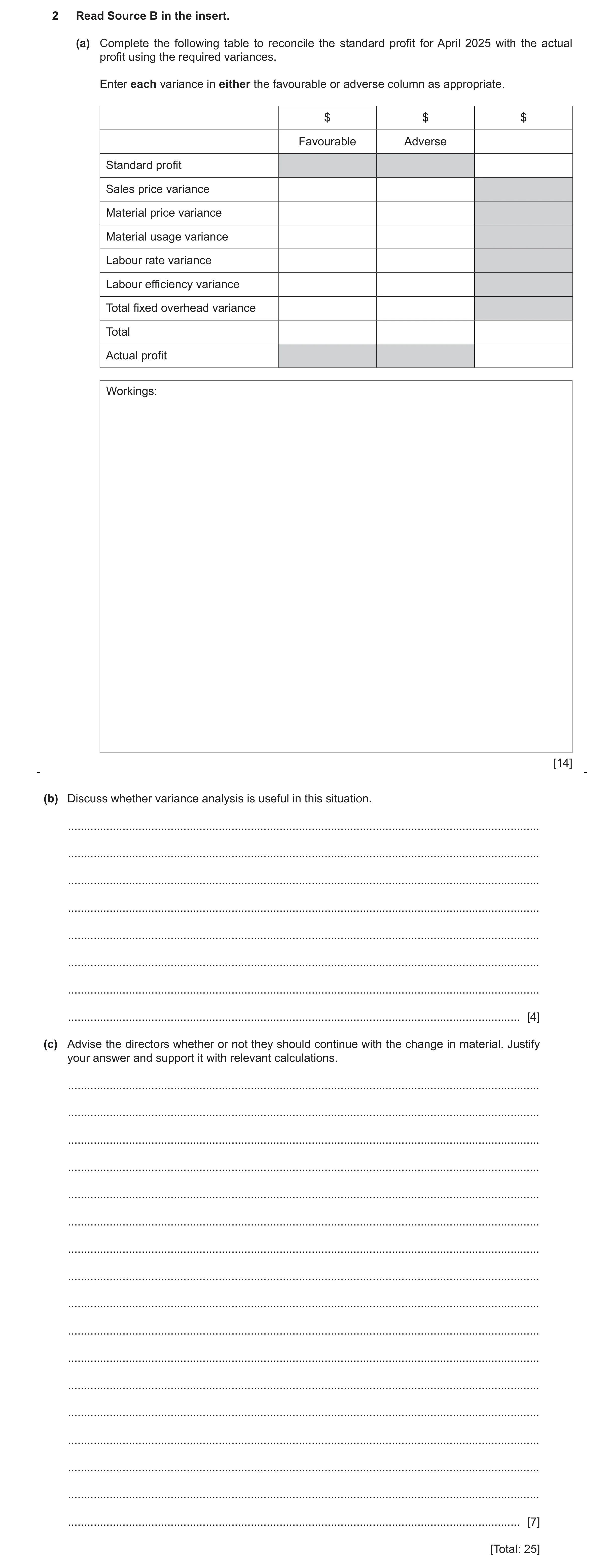
2 Read Source B in the insert. (a) Complete the following table to reconcile the standard profit for April 2025 with the actual profit using the required variances. Enter each variance in either the favourable or adverse column as appropriate. $ $ $ Favourable Adverse Standard profit Sales price variance Material price variance Material usage variance Labour rate variance Labour efficiency variance Total fixed overhead variance Total Actual profit Workings: [14] (b) Discuss whether variance analysis is useful in this situation. … … … … … … … … [4] (c) Advise the directors whether or not they should continue with the change in material. Justify your answer and support it with relevant calculations. … … … … … … … … … … … … … … … … … [7] [Total: 25]
25 marks
Mark scheme: 2(a) Complete the following table to reconcile the standard profit for April 2025 with the actual profit using the required 14 variances. Enter each variance in either the favourable or adverse column as appropriate. $ $ $ Favourable Adverse Standard profit 255 200 (1) Sales price variance 11 000(92.5 – 85) 82 500 (2) Material price variance 46 200(4.6 – 2.5) 97 020 (2) Material usage variance 4.6(44 000 – 46 200) 10 120 (2) Labour rate variance 39 600(11.2 – 11) 7 920 (2) Labour efficiency variance 11(33 000 – 39 600) 72 600 (2) Total fixed overhead variance 15 100 (2) (17.9 11 000) – 21 2000 97 020 188 240 (91 220) Actual profit 163 980 (1) Note – marks for variance are (1) for amount and (1) for correct direction ( column -favourable or adverse) 2(b) Discuss whether variance analysis is useful in this situation. 4 Shows the differences between budget and actual (1) caused by this change in materials (1). It shows how it affects other variances (1), for example workers being less efficient as they are not experienced with the materials, wastage etc (1). Indicates where changes may be made to improve outcomes / take remedial action or suitable example such as training (1). Helps to plan more realistic and attainable goals (1). The standards being used are unlikely to be realistic (1). Not useful in assessing performance when changes are beyond the control of the business (1). Accept other valid answers Max 4 Accept other valid responses 2(c) Advise the directors whether or not they should continue with the change in material. Justify your answer and 7 support it with relevant calculations. Calculations Price rise of metal would have reduced profit by 44 000 (7.80 – 4.60) = $140 800 (1) compared to the actual reduction in profit of $91 220 (1). Continue (Max 2) Product is still profitable (1). Profit is higher than if the business uses metal, given its price rise (1). Customers have not been let down (1). Plastic is cheaper than metal (1). As new type of production becomes established some adverse variances may improve (1). Business is able to maintain operating at full capacity (1). Do not continue (Max 2) The quality may be adversely affected (1). Sales have decreased / product may become harder to sell in the future (1). The brand image may be damaged (1). There may be environmental concerns (1). May require a shorter warranty period (1). Decision supported with a comment (1) Accept other valid responses
This question in 9706/42 May/June 2025
Q10 · Read Source B in the insert 9706/42 Oct/Nov 2025
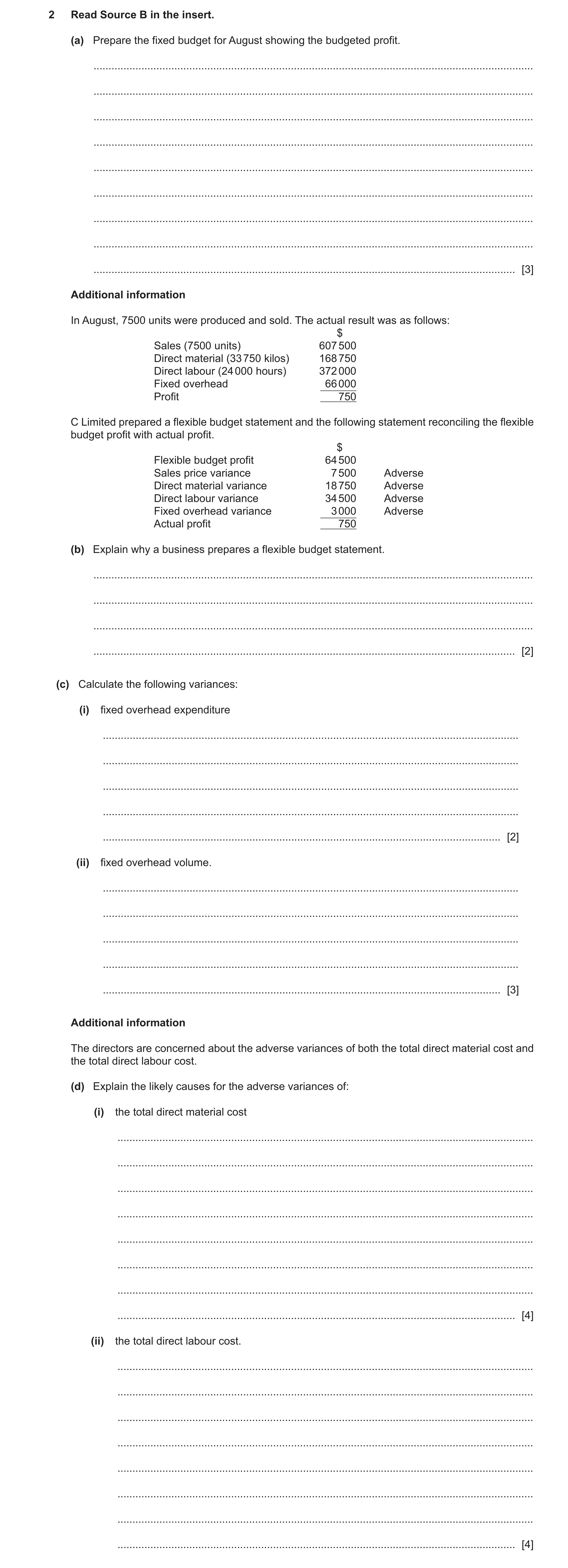
2 Read Source B in the insert. (a) Prepare the fixed budget for August showing the budgeted profit. … … … … … … … … … [3] Additional information In August, 7500 units were produced and sold. The actual result was as follows: $ Sales (7500 units) 607 500 Direct material (33 750 kilos) 168 750 Direct labour (24 000 hours) 372 000 Fixed overhead 66 000 Profit 750 C Limited prepared a flexible budget statement and the following statement reconciling the flexible budget profit with actual profit. $ Flexible budget profit 64 500 Sales price variance 7 500 Adverse Direct material variance 18 750 Adverse Direct labour variance 34 500 Adverse Fixed overhead variance 3 000 Adverse Actual profit 750 (b) Explain why a business prepares a flexible budget statement. … … … … [2] (c) Calculate the following variances: (i) fixed overhead expenditure … … … … … [2] (ii) fixed overhead volume. … … … … … [3] Additional information The directors are concerned about the adverse variances of both the total direct material cost and the total direct labour cost. (d) Explain the likely causes for the adverse variances of: (i) the total direct material cost … … … … … … … … [4] (ii) the total direct labour cost. … … … … … … … … [4]
18 marks
Mark scheme: 2(a) Prepare the fixed budget for August showing the budgeted profit. 3 Fixed budget $ Sales (8 000 units) 656 000 } Direct material 160 000 } Direct labour 360 000 }(1) Fixed overhead 67 200 (1) Profit 68 800 (1)OF 2(b) Explain why a business prepares a flexible budget statement. 2 Flexible budget allows a business to prepare a budget based on the actual level of activity. (1) It facilitates variance analysis / a comparison between the actual result and the flexed budget. (1) Accept other valid responses. 2(c)(i) Calculate the following variances: 2 Fixed overhead expenditure $67 200 – $66 000 = $1 200 (1) F (1) 2(c)(ii) Calculate the following variances: 3 Fixed overhead volume (24 000 – (7 500 3)) $2.8 (1)= $4 200 (1) A (1) 2(d)(i) Explain the likely causes for the adverse variances of: 4 the total direct material cost There is no material price variance (1) This is because the actual price paid was the same as the standard price. (1) The material usage variance is $18 750 A. (1) This may be due to low quality of direct material / increased wastage / inefficient use by labour (1) Accept other valid responses. 2(d)(ii) Explain the likely causes for the adverse variances of: 4 the total direct labour cost. The labour rate variance is $12 000 A. (1) This may be due to inflation causing the increase in hourly rate. (1) The labour efficiency variance is $22 500 A. (1) This may be due to inefficient labour force / low quality of direct material / lack of training / low motivation. (1) Accept other valid responses. 2(e) Advise the directors whether or not they should switch to the overseas supplier. Justify your answer. 7 For (Max 3) The quality should be better (1) There is likely to be less wastage (1) Returns of direct materials can be reduced (1) Better quality of direct material may lead to a better final product (1) The customer can be charged a premium price for a better quality product (1) Against (Max 3) Changing the supplier may not solve the problem of labour inefficiency (1) Transportation cost/ import duties / fluctuating exchange rate may erode profit (1) Delivery from overseas of direct material takes time (1) It takes time to build up a good relationship with a new supplier (1) Not sure whether the new supplier is reliable (1) Decision supported with a comment (1) Accept other valid responses.
This question in 9706/42 Oct/Nov 2025
Q11 · Read Source A in the insert 9706/43 Oct/Nov 2025
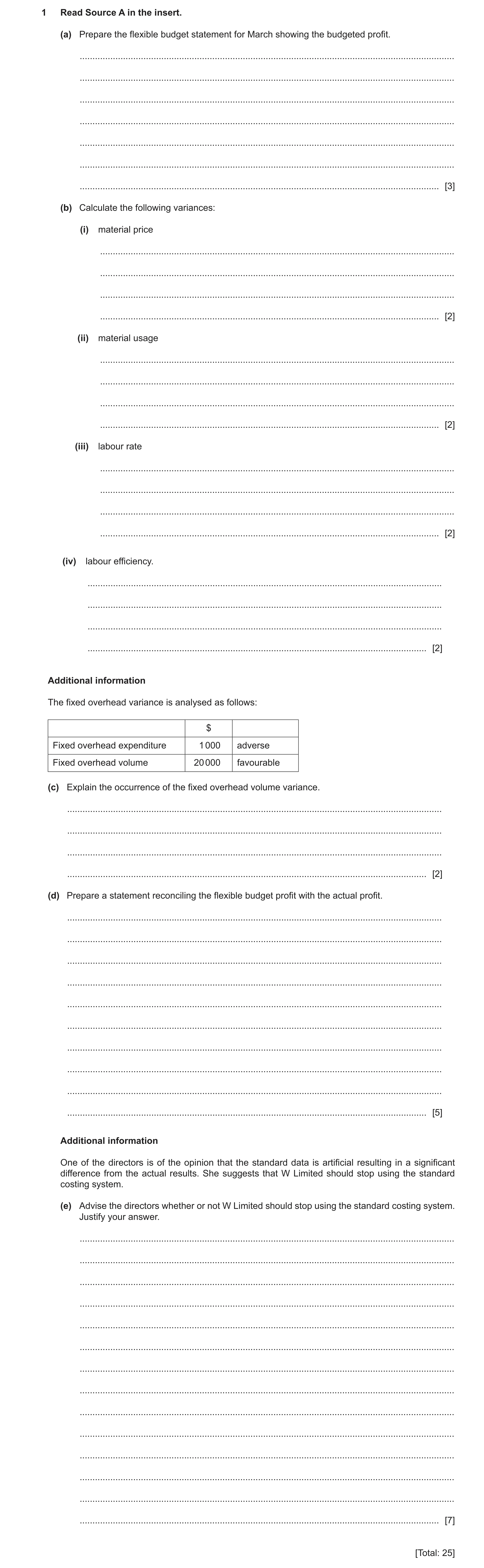
1 Read Source A in the insert. (a) Prepare the flexible budget statement for March showing the budgeted profit. … … … … … … … [3] (b) Calculate the following variances: (i) material price … … … … [2] (ii) material usage … … … … [2] (iii) labour rate … … … … [2] (iv) labour efficiency. … … … … [2] Additional information The fixed overhead variance is analysed as follows: $ Fixed overhead expenditure 1 000 adverse Fixed overhead volume 20 000 favourable (c) Explain the occurrence of the fixed overhead volume variance. … … … … [2] (d) Prepare a statement reconciling the flexible budget profit with the actual profit. … … … … … … … … … … [5] Additional information One of the directors is of the opinion that the standard data is artificial resulting in a significant difference from the actual results. She suggests that W Limited should stop using the standard costing system. (e) Advise the directors whether or not W Limited should stop using the standard costing system. Justify your answer. … … … … … … … … … … … … … … [7] [Total: 25]
25 marks
Mark scheme: Question Answer Marks 1(a) Prepare the flexible budget statement for March showing the budgeted profit. 3 $ Sales revenue 800 000 } Direct materials 150 000 } (1) Direct labour 480 000 } Fixed overhead 100 000 } (1) Budgeted profit 70 000 (1) OF 1(b)(i) Calculate the following variances: 2 Material price variance $5 31 500 – $149 625 = $7 875 (1) F (1) 1(b)(ii) Calculate the following variances: 2 Material usage variance (10 000 3 kilos – 31 500 kilos) $5 = $7 500 (1) A (1) 1(b)(iii) Calculate the following variances: 2 Labour rate variance $12 40 500 – $510 300 = $24 300 (1) A (1) 1(b)(iv) Calculate the following variances: 2 Labour efficiency variance (10 000 4 hours – 40 500 hours) $12 = $6 000 (1) A (1) 1(c) Explain the occurrence of the fixed overhead volume variance. 2 If actual production volume (10 000 units) is greater than the budgeted production volume (8 000 units), then the overhead is over-absorbed. (1). Fixed overhead volume variance results from the difference between the budgeted fixed overhead and the standard fixed overhead absorbed to production costs. (1). It measures the utilisation of fixed capacity cost, and the favourable variance suggest that fixed cost resources are used efficiently. (1) Max 2 Accept other valid responses. 1(d) Prepare a statement reconciling the flexible budget profit with the actual profit. 5 Favourable Adverse $ $ $ Flexible budget profit 70 000 Selling price variance $795 000 – (10 000 $80) 5 000 (2) * Material price variance 7 875 } Material usage variance 7 500 } (1)OF Labour rate variance 24 300 } Labour efficiency variance 6 000 } (1)OF Fixed overhead expenditure variance 1 000 Fixed overhead volume variance 20 000 27 875 43 800 (15 925) Actual profit 54 075 (1) *1 mark for figure and 1 mark for direction 1(e) Advise the directors whether or not W Limited should stop using the standard costing system. Justify your 7 answer. Continuing (Max 3) Standard cost is used as a benchmark against which to evaluate the actual costs. (1) Variances are investigated (1) and corrective action will be taken for improving operations. (1) It provides useful information for planning and decision making, e.g. quoting the selling price. (1) Managers are more cost conscious to seek improved methods to finish the task. (1) Stopping (Max 3) Standards may be artificial if they are not reviewed and updated regularly. (1) If the standards are not realistic, staff will be demotivated. (1) It is costly / time consuming to set up standards in the first place. (1) Managers may be blamed for those uncontrollable factors. (1) Decision supported with a comment (1) Accept other valid responses.
This question in 9706/43 Oct/Nov 2025
 25
25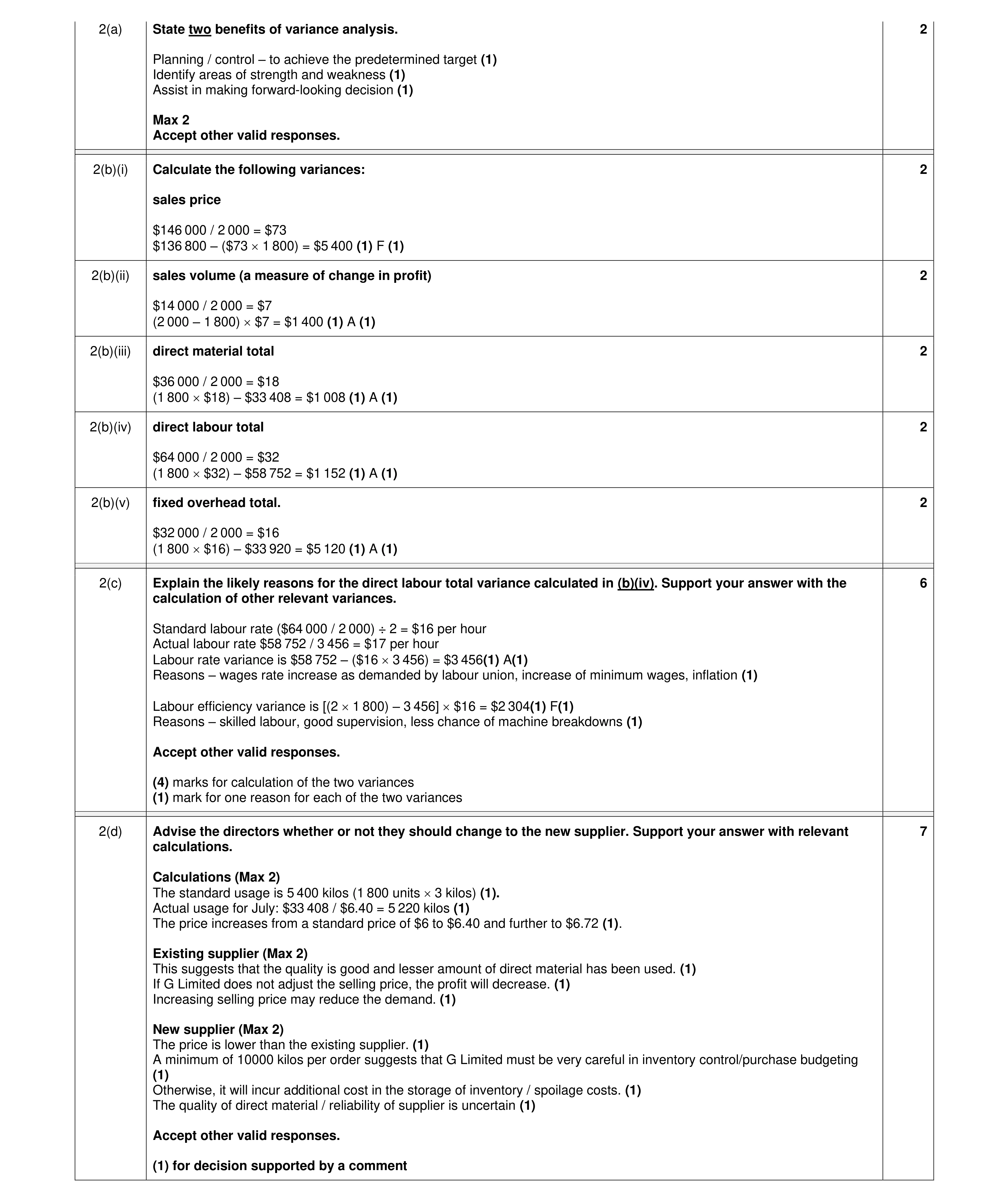 25
25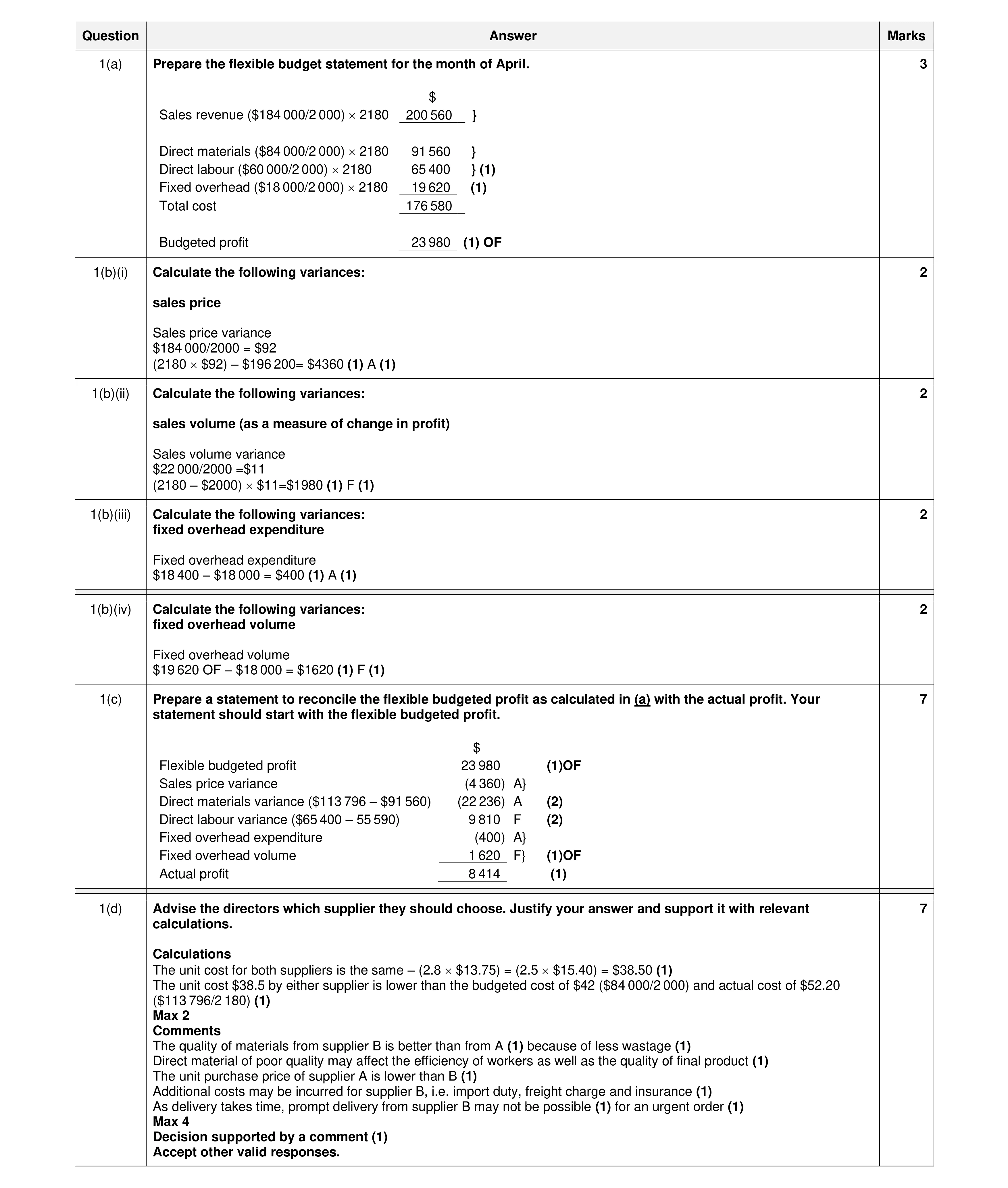 25
25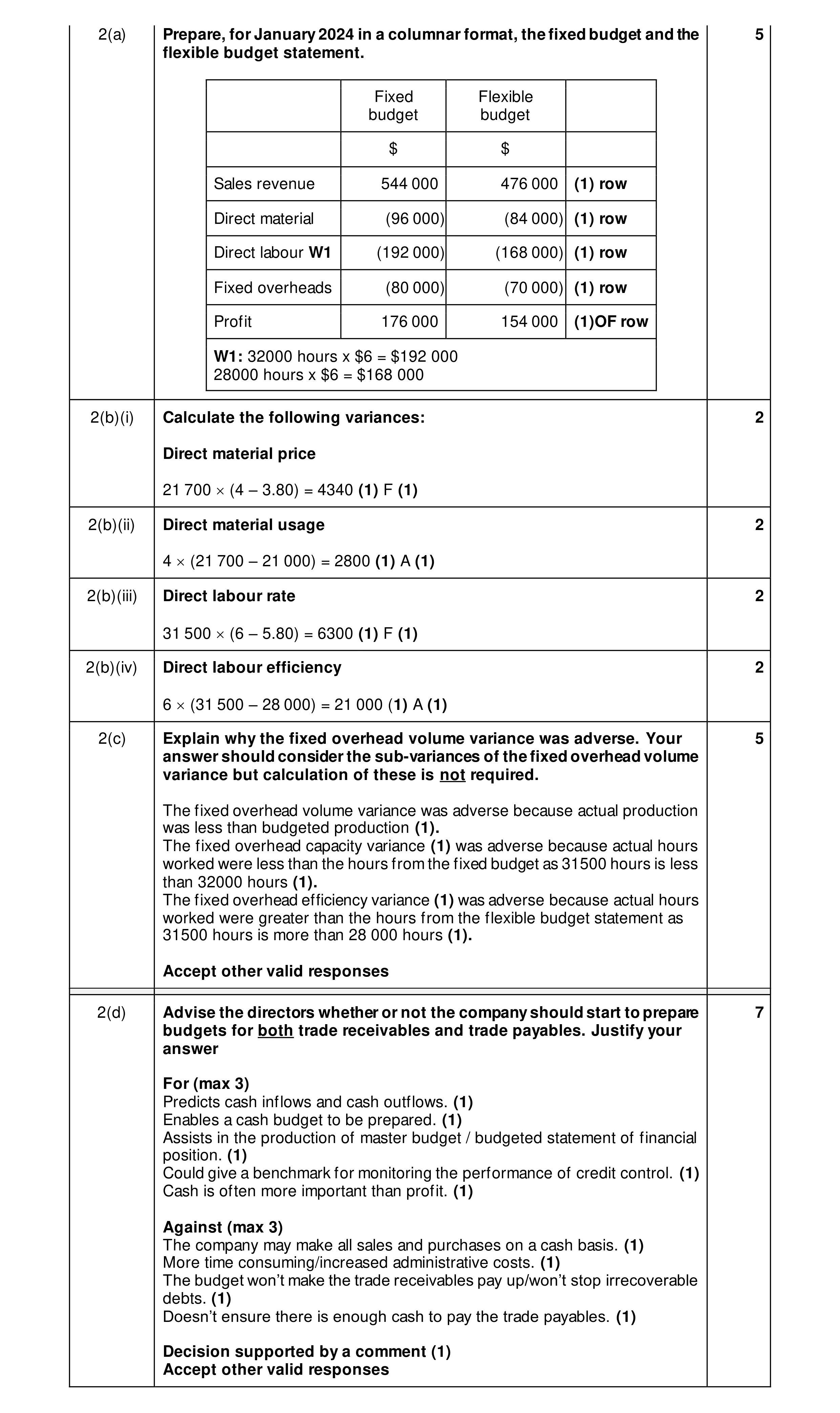 25
25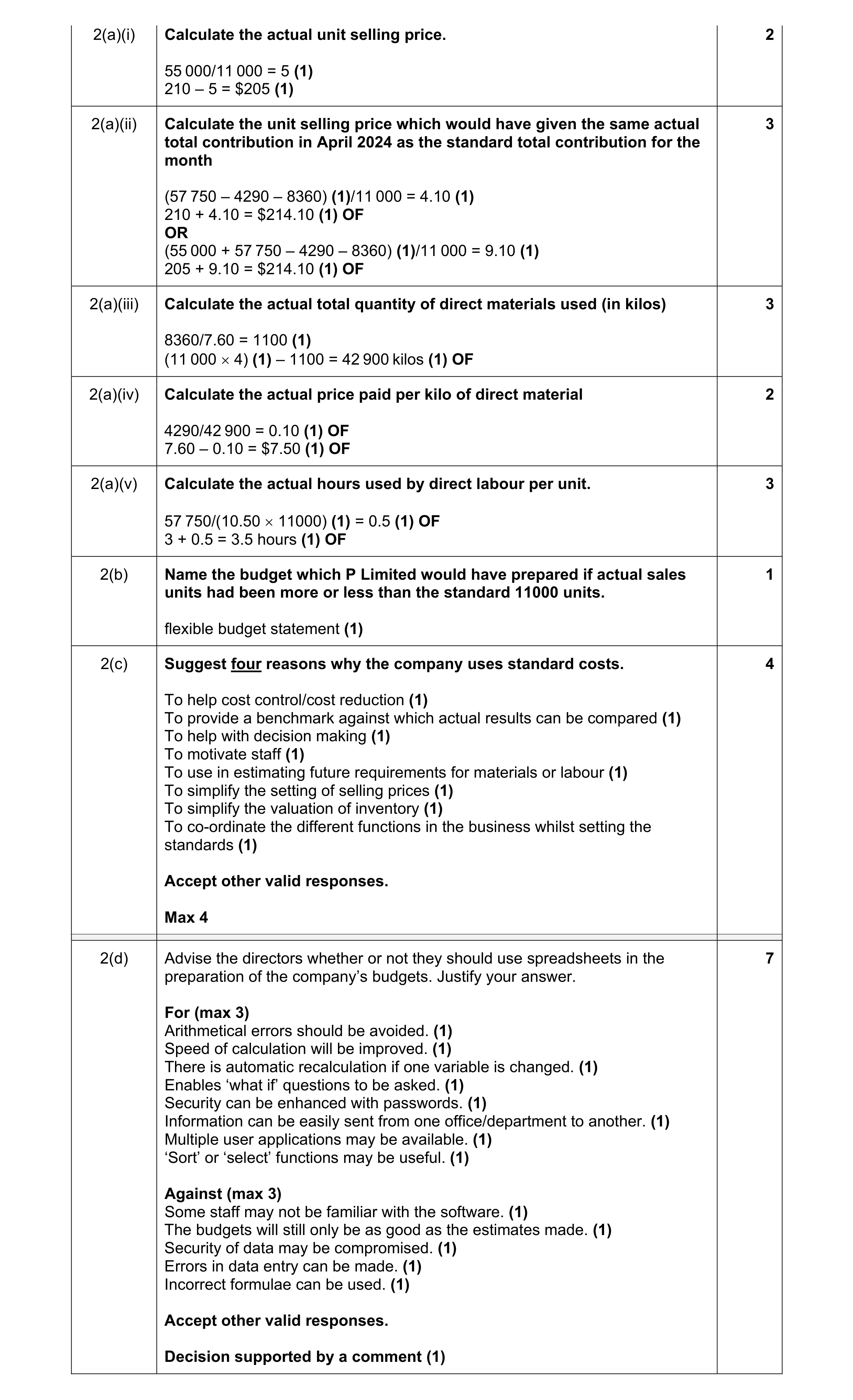 25
25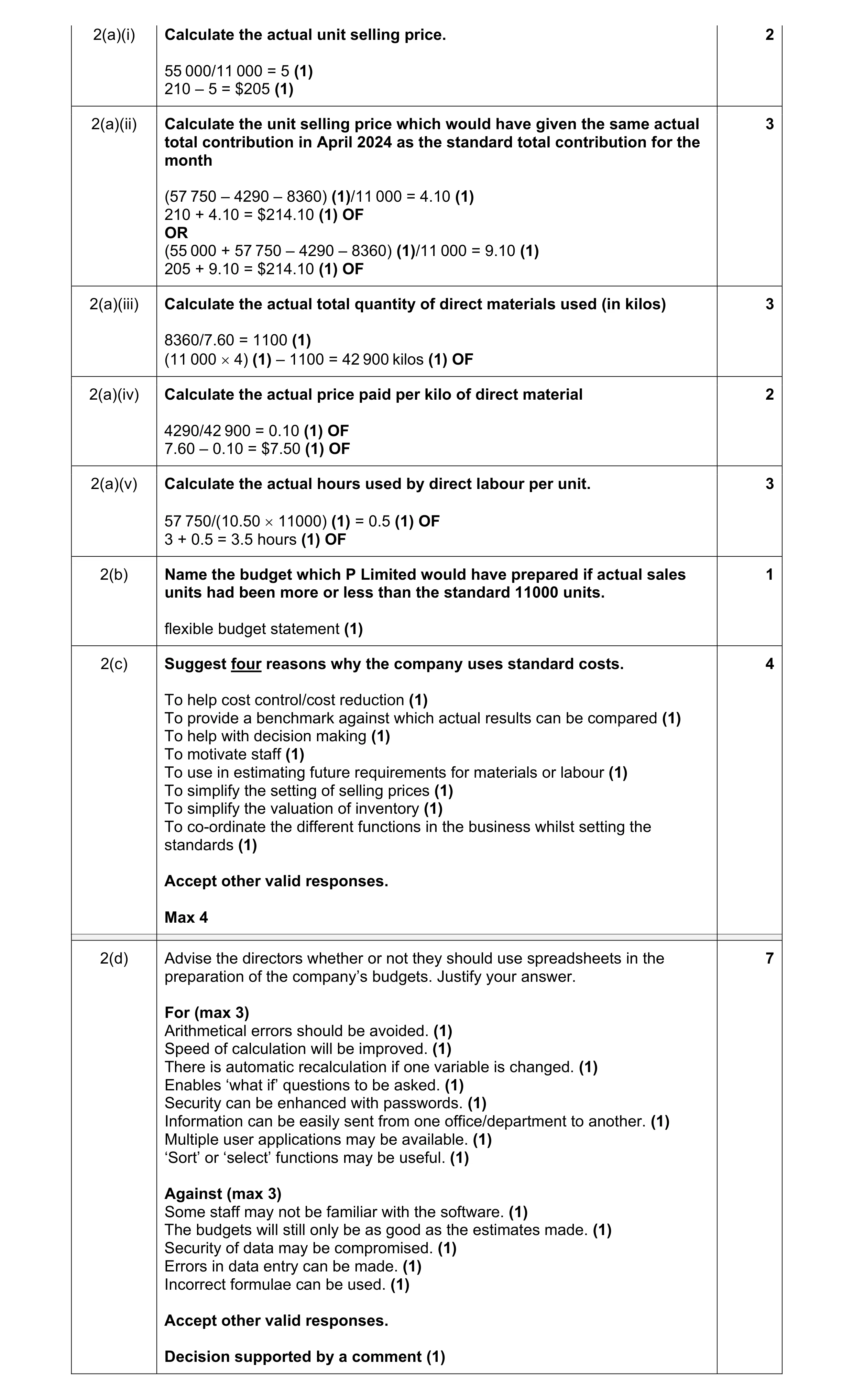 25
25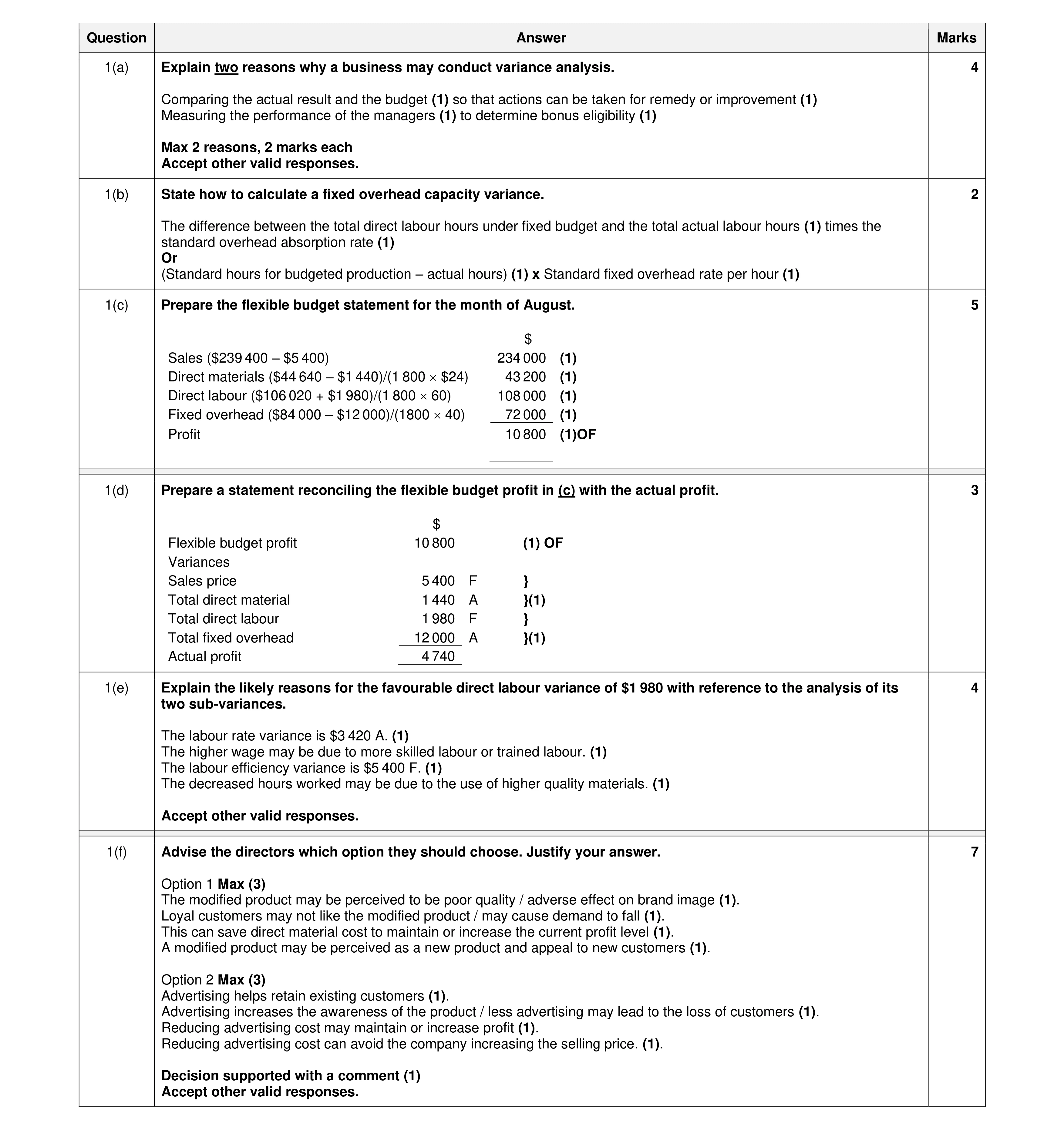 25
25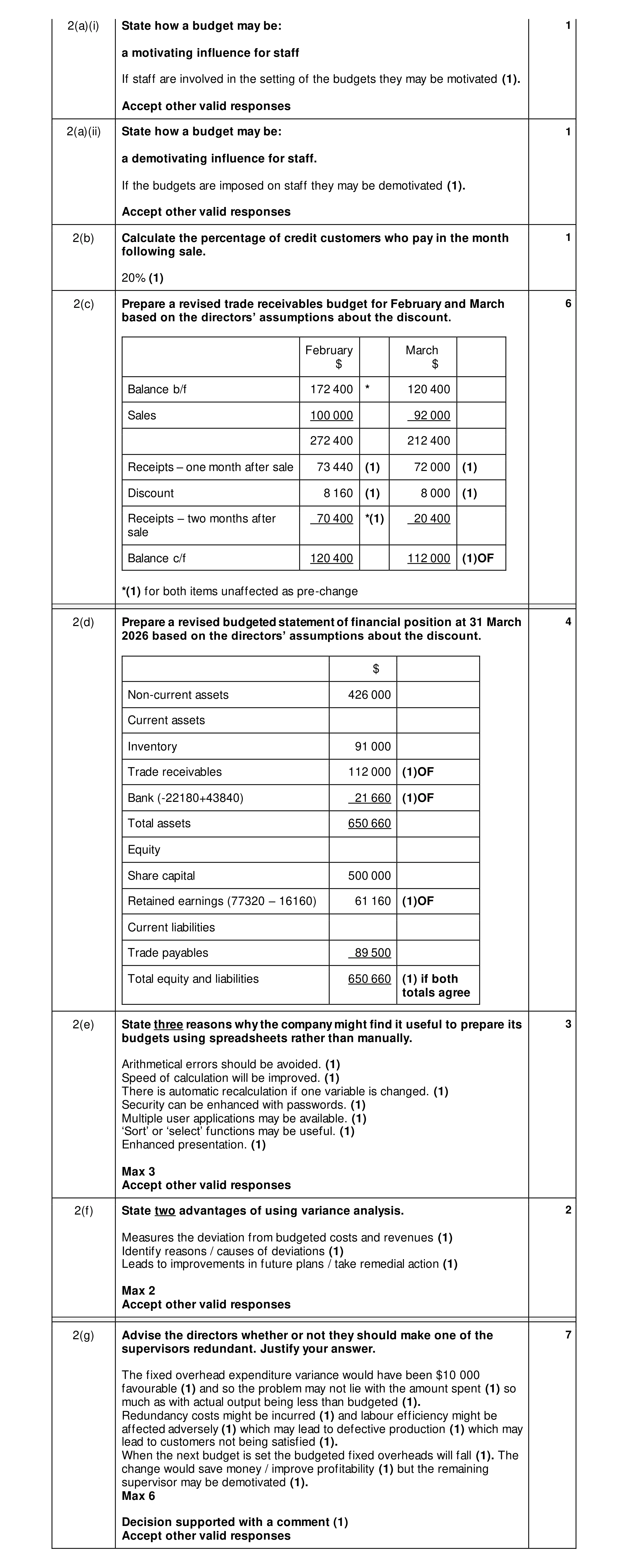 18
18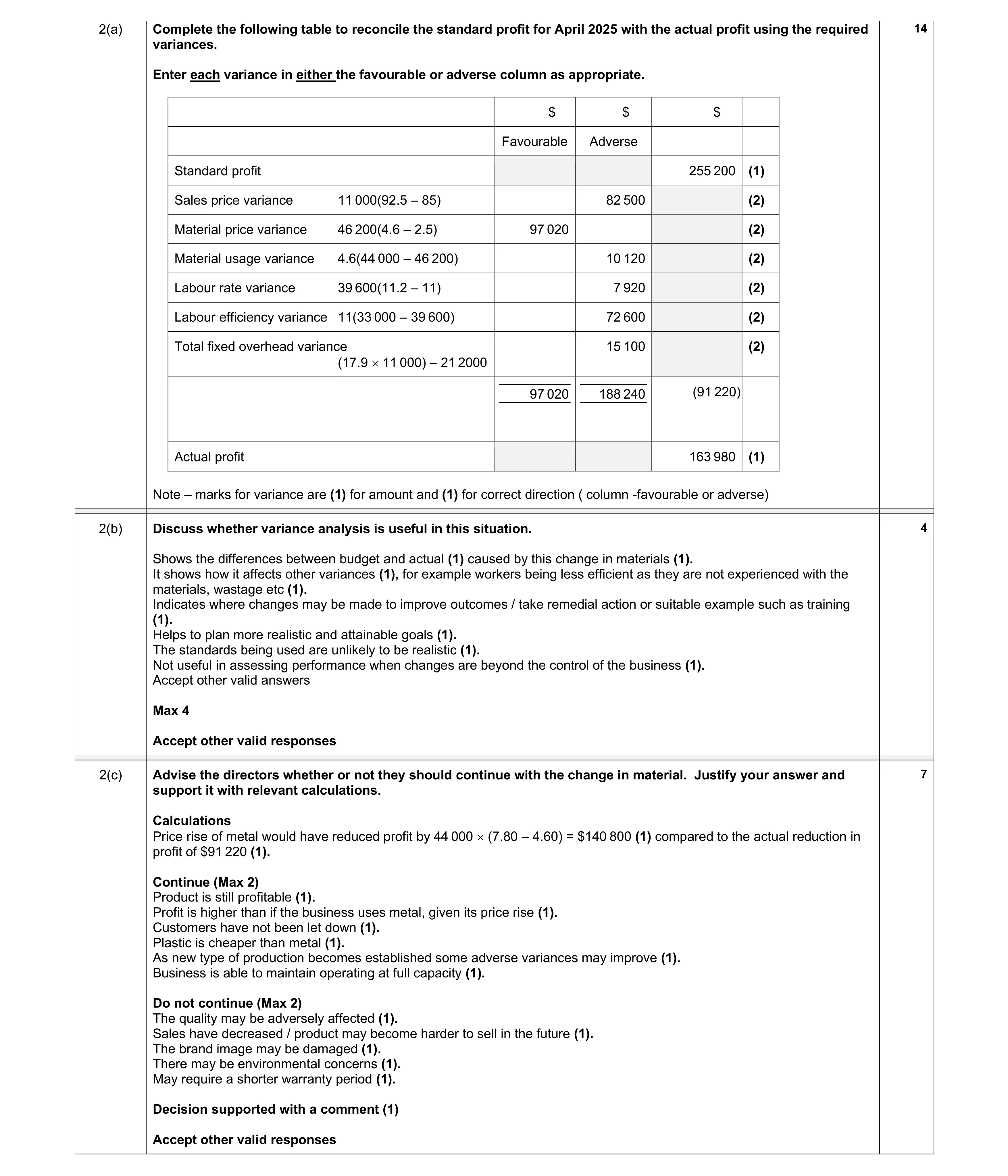 25
25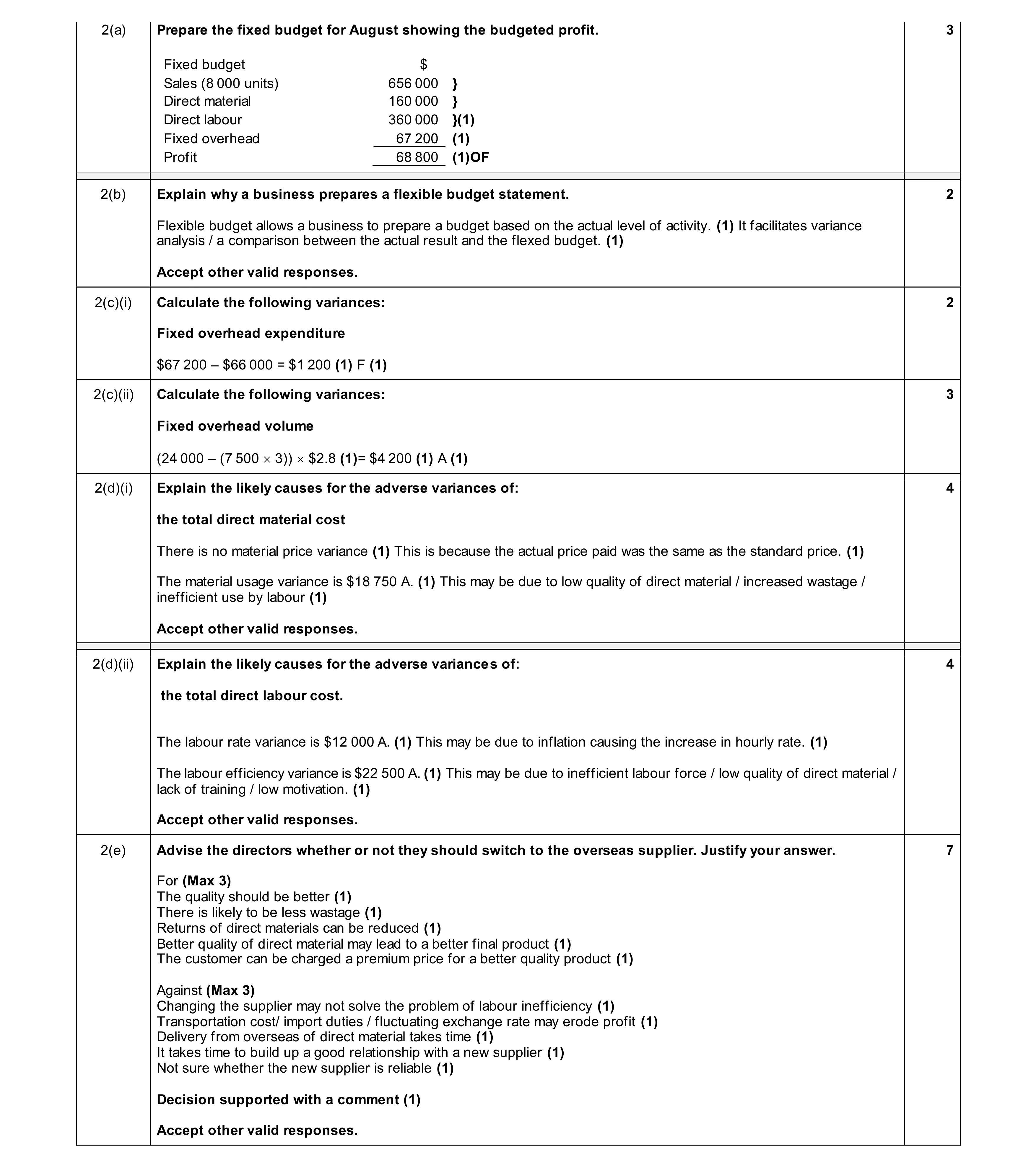 18
18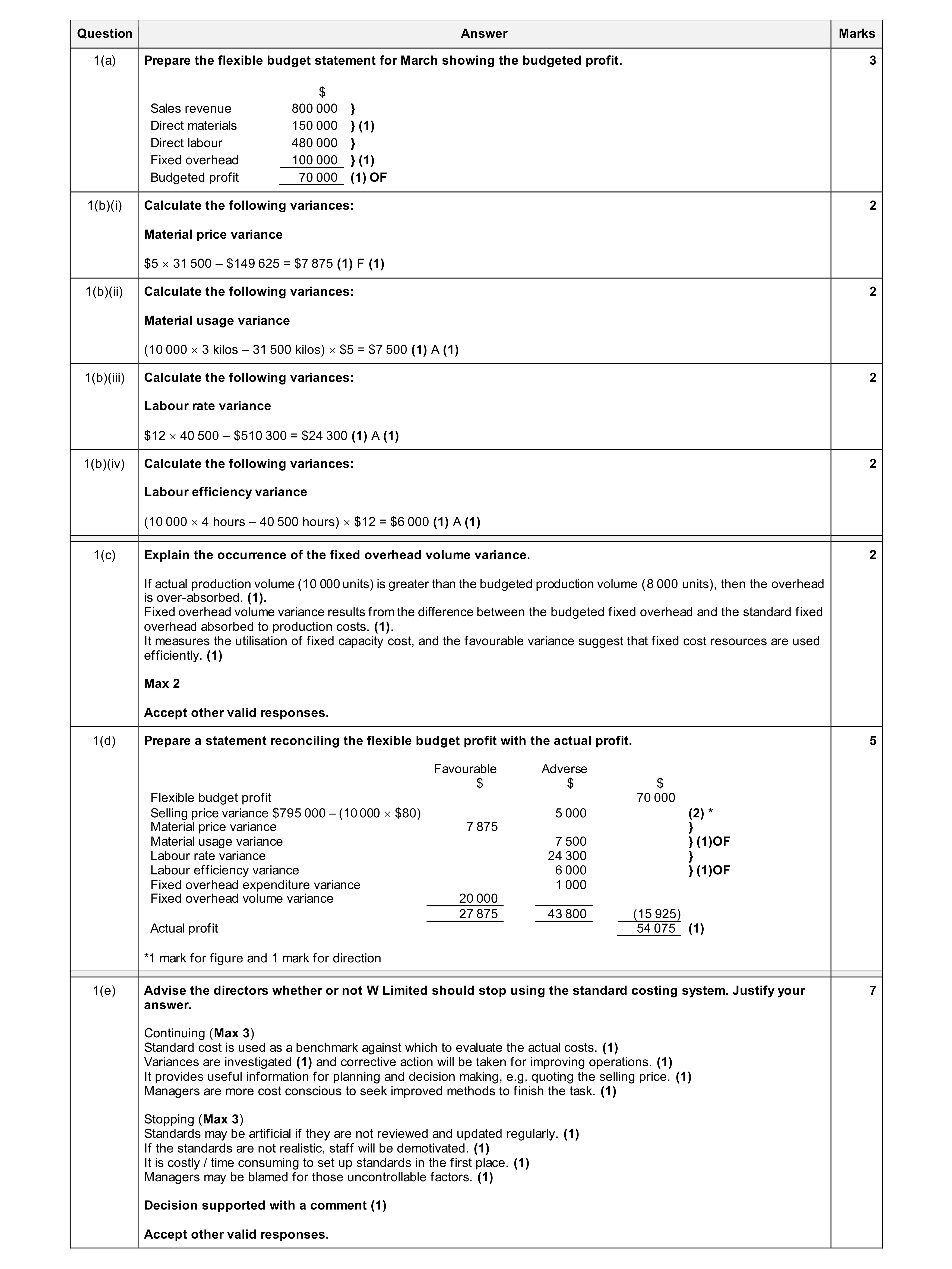 25
25