Questions as text
Q1 · A company makes three products for which the following details are given 9706/31 Oct/Nov 2009
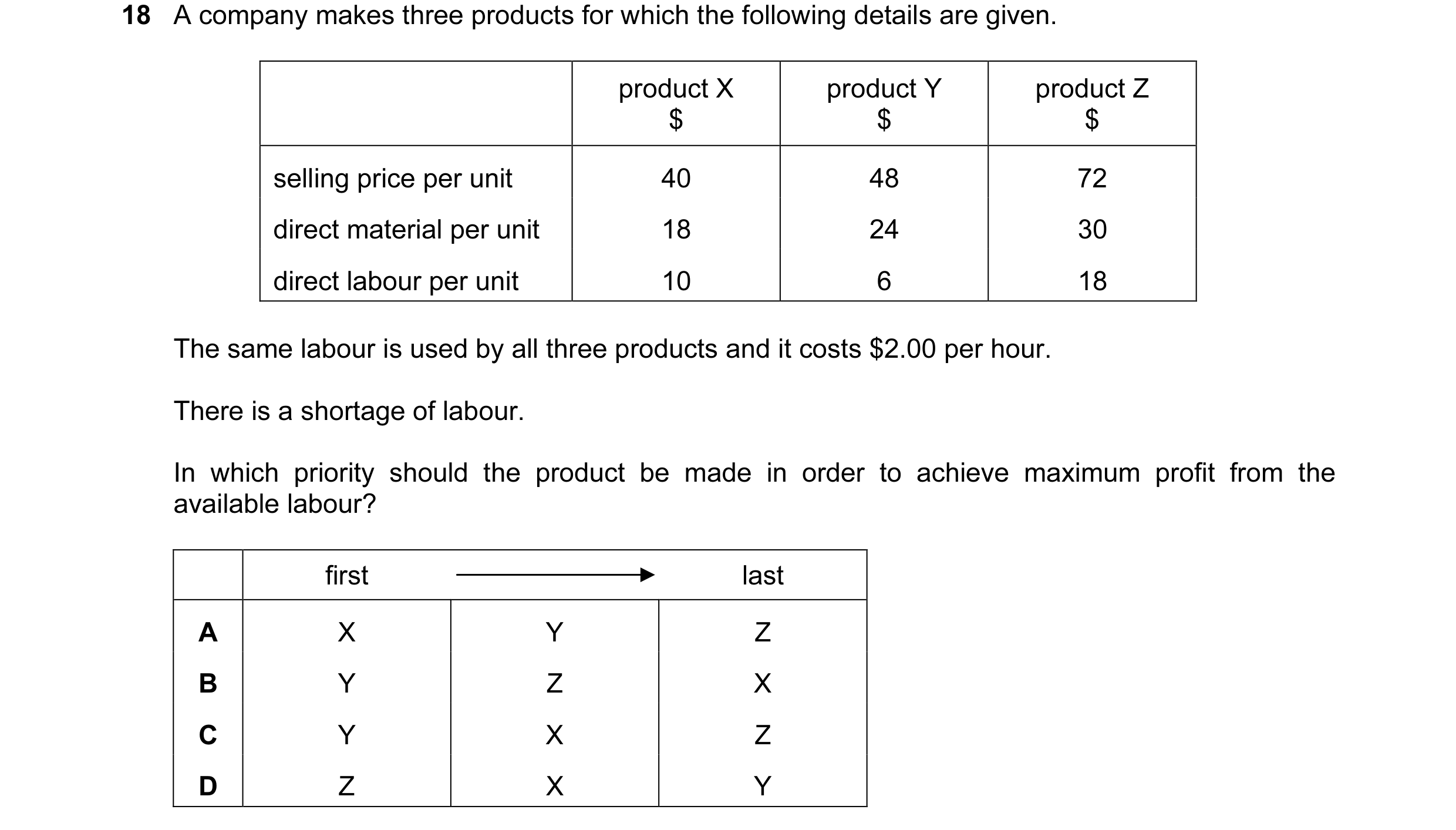
18 A company makes three products for which the following details are given. product X product Y product Z $ $ $ selling price per unit 40 48 72 direct material per unit 18 24 30 direct labour per unit 10 6 18 The same labour is used by all three products and it costs $2.00 per hour. There is a shortage of labour. In which priority should the product be made in order to achieve maximum profit from the available labour? first last A X Y Z B Y Z X C Y X Z D Z X Y
1 marks
Answer: B
This question in 9706/31 Oct/Nov 2009
Q2 · The table contains information provided by a company 9706/31 Oct/Nov 2009
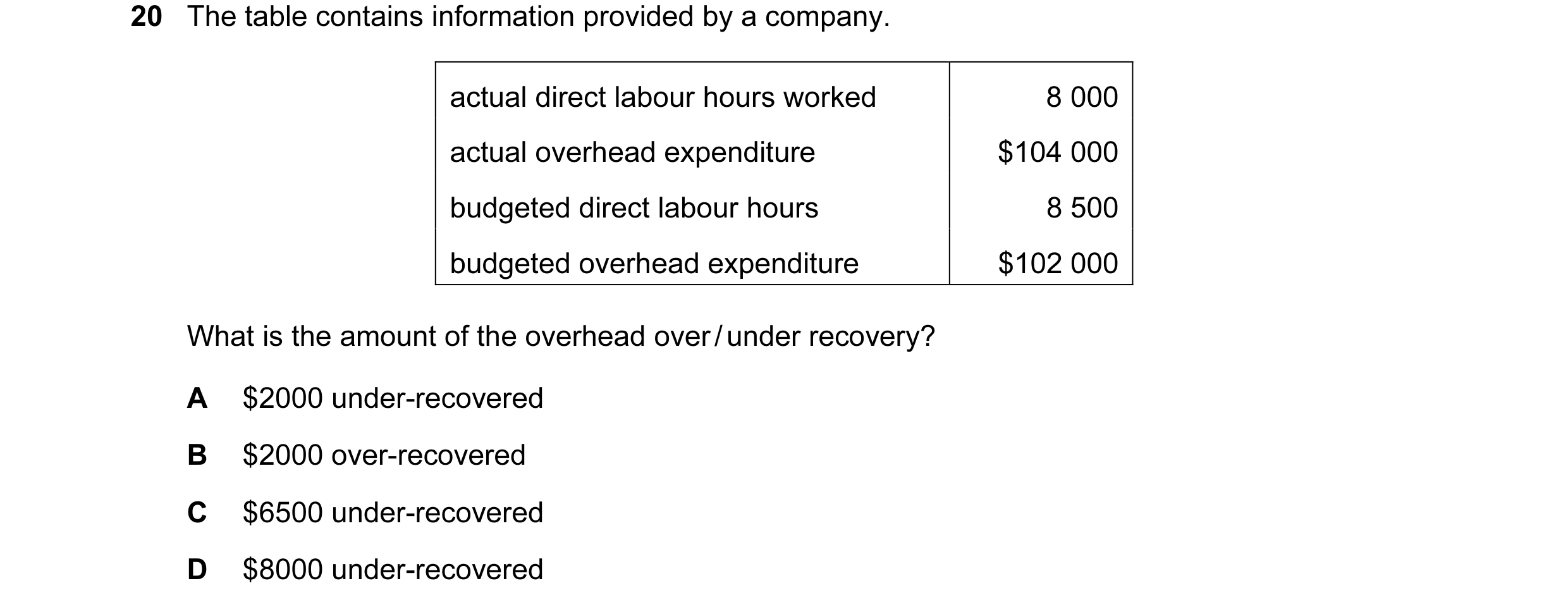
20 The table contains information provided by a company. actual direct labour hours worked 8 000 actual overhead expenditure $104 000 budgeted direct labour hours 8 500 budgeted overhead expenditure $102 000 What is the amount of the overhead over / under recovery? A $2000 under-recovered B $2000 over-recovered C $6500 under-recovered D $8000 under-recovered
1 marks
Answer: D
This question in 9706/31 Oct/Nov 2009
Q3 · At the beginning of a given period the value of work-in-progress was $11 000 9706/31 Oct/Nov 2009
21 At the beginning of a given period the value of work-in-progress was $11 000. The unit costs of production for the period were as follows. $ direct materials 5.00 direct labour 8.50 At the end of the period work-in-progress consisted of 700 units which were complete as to 80 % of materials and 50 % labour. What was the change in the value of the work-in-progress during the period? decrease increase $ $ A 1550 - B - 1550 C 5225 - D - 5225
1 marks
Answer: C
This question in 9706/31 Oct/Nov 2009
Q4 · The table shows information for production during the last three months 9706/31 Oct/Nov 2009
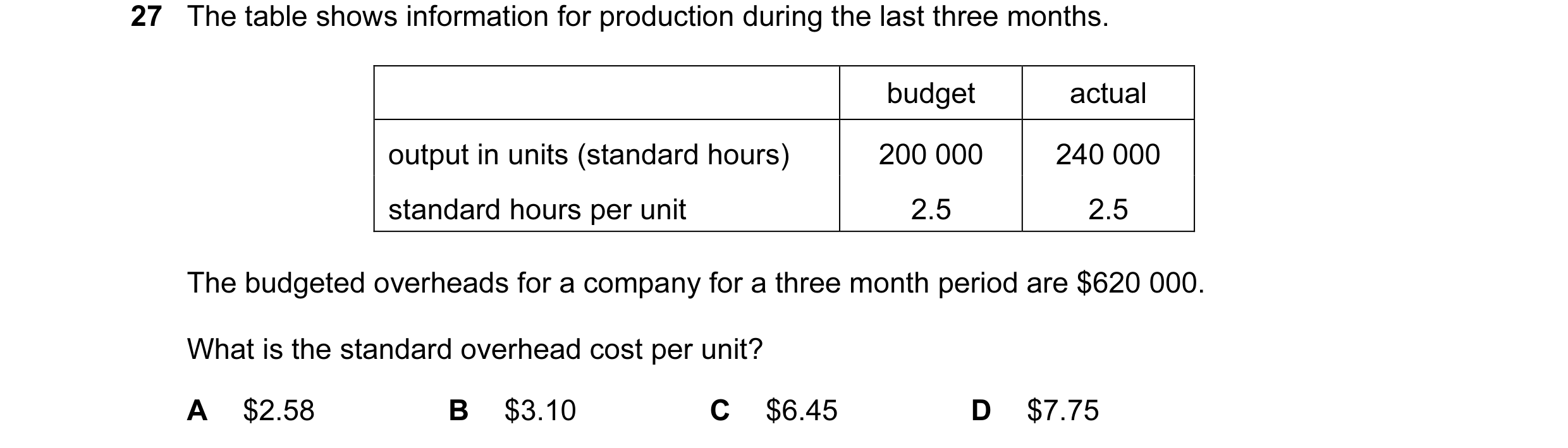
27 The table shows information for production during the last three months. budget actual output in units (standard hours) 200 000 240 000 standard hours per unit 2.5 2.5 The budgeted overheads for a company for a three month period are $620 000. What is the standard overhead cost per unit? A $2.58 B $3.10 C $6.45 D $7.75
1 marks
Answer: D
This question in 9706/31 Oct/Nov 2009
Q5 · A company makes three products for which the following details are given 9706/32 Oct/Nov 2009
17 A company makes three products for which the following details are given. product X product Y product Z $ $ $ selling price per unit 40 48 72 direct material per unit 18 24 30 direct labour per unit 10 6 18 The same labour is used by all three products and it costs $2.00 per hour. There is a shortage of labour. In which priority should the product be made in order to achieve maximum profit from the available labour? first last A X Y Z B Y Z X C Y X Z D Z X Y
1 marks
Answer: B
This question in 9706/32 Oct/Nov 2009
Q6 · The table contains information provided by a company 9706/32 Oct/Nov 2009
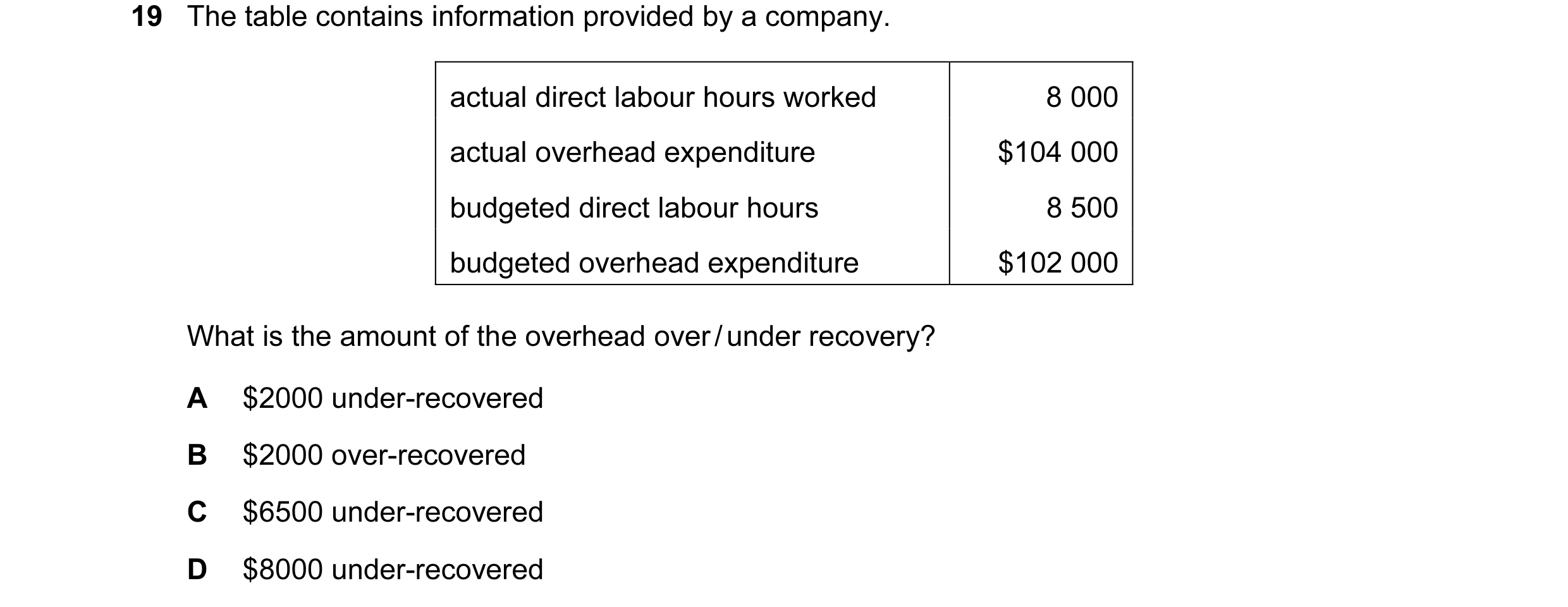
19 The table contains information provided by a company. actual direct labour hours worked 8 000 actual overhead expenditure $104 000 budgeted direct labour hours 8 500 budgeted overhead expenditure $102 000 What is the amount of the overhead over / under recovery? A $2000 under-recovered B $2000 over-recovered C $6500 under-recovered D $8000 under-recovered
1 marks
Answer: D
This question in 9706/32 Oct/Nov 2009
Q7 · At the beginning of a given period the value of work-in-progress was $11 000 9706/32 Oct/Nov 2009
20 At the beginning of a given period the value of work-in-progress was $11 000. The unit costs of production for the period were as follows. $ direct materials 5.00 direct labour 8.50 At the end of the period work-in-progress consisted of 700 units which were complete as to 80 % of materials and 50 % labour. What was the change in the value of the work-in-progress during the period? decrease increase $ $ A 1550 - B - 1550 C 5225 - D - 5225
1 marks
Answer: C
This question in 9706/32 Oct/Nov 2009
Q8 · The table shows information for production during the last three months 9706/32 Oct/Nov 2009
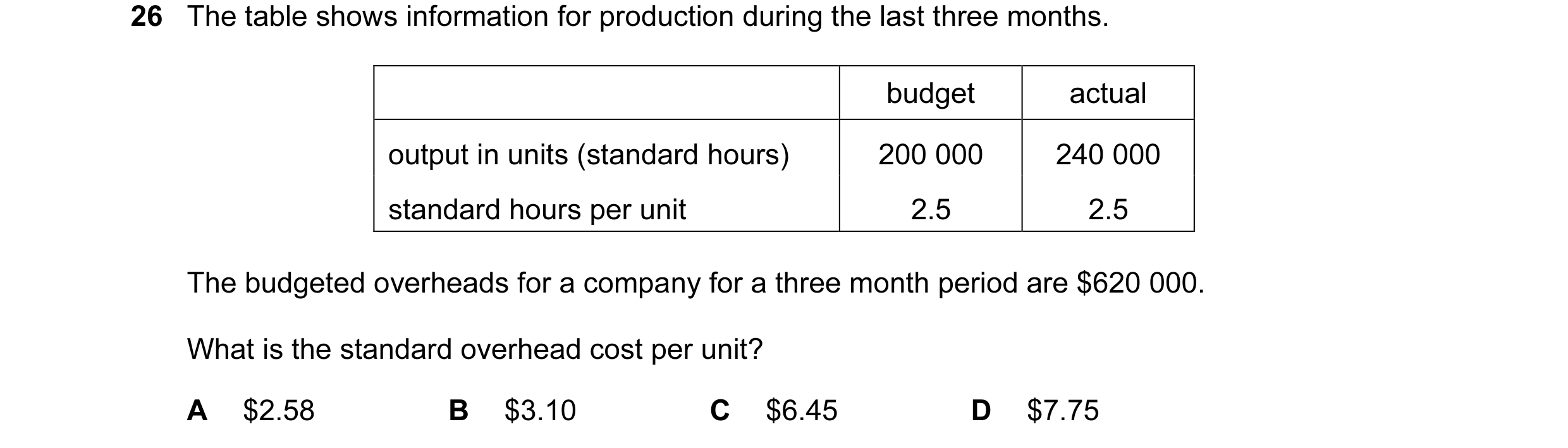
26 The table shows information for production during the last three months. budget actual output in units (standard hours) 200 000 240 000 standard hours per unit 2.5 2.5 The budgeted overheads for a company for a three month period are $620 000. What is the standard overhead cost per unit? A $2.58 B $3.10 C $6.45 D $7.75
1 marks
Answer: D
This question in 9706/32 Oct/Nov 2009
Q9 · What should be included when valuing work in progress? 9706/31 May/June 2010
17 What should be included when valuing work in progress? A direct materials + direct labour + indirect labour B prime cost + all other overheads C prime cost + production overheads based on actual level of activity D prime cost + production overheads based on normal level of activity
1 marks
Answer: D
This question in 9706/31 May/June 2010
Q10 · In marginal costing, how can the total contribution from a given activity be calculated? 9706/31 May/June 2010
18 In marginal costing, how can the total contribution from a given activity be calculated? A total sales + total fixed costs B total sales – total profit C total fixed costs + total profit D total direct costs – total profit
1 marks
Answer: C
This question in 9706/31 May/June 2010
Q11 · A product is sold for $100 per unit 9706/31 May/June 2010
19 A product is sold for $100 per unit. Fixed costs are $90 000 and variable costs are 60 % of the selling price. What is the break-even sales revenue? A $36 000 B $90 000 C $150 000 D $225 000
1 marks
Answer: D
This question in 9706/31 May/June 2010
Q12 · The table contains information for the two products of a company 9706/31 May/June 2010
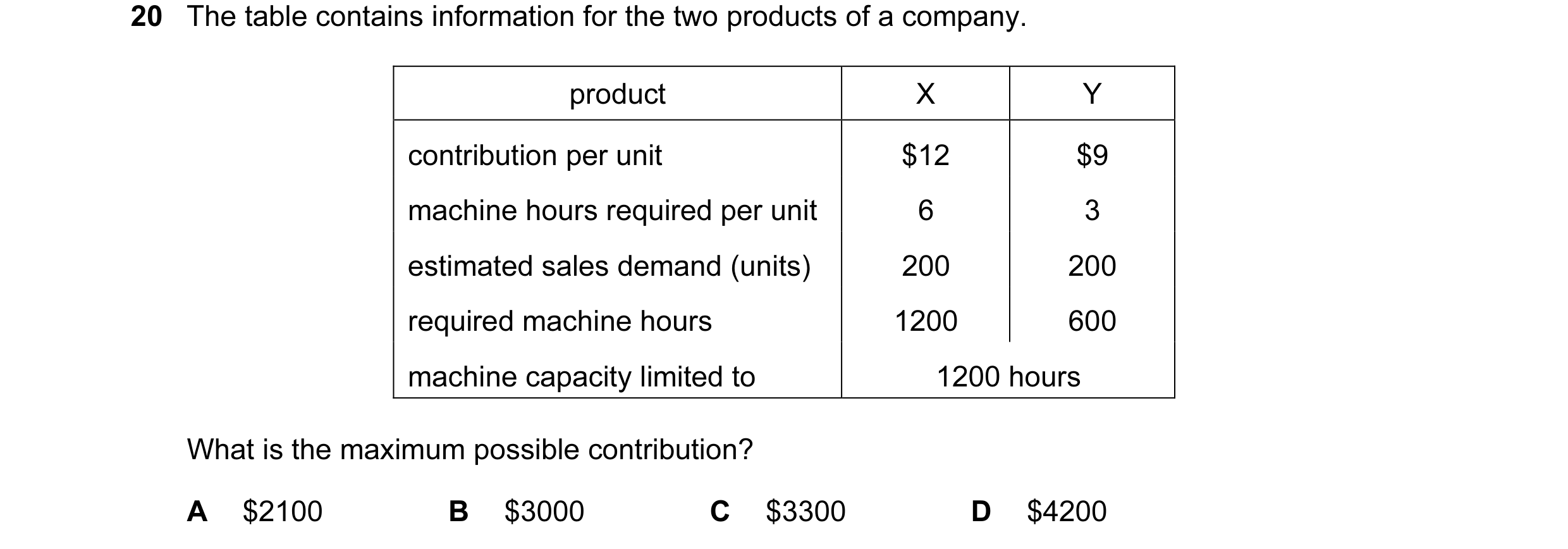
20 The table contains information for the two products of a company. product X Y contribution per unit $12 $9 machine hours required per unit 6 3 estimated sales demand (units) 200 200 required machine hours 1200 600 machine capacity limited to 1200 hours What is the maximum possible contribution? A $2100 B $3000 C $3300 D $4200
1 marks
Answer: B
This question in 9706/31 May/June 2010
Q13 · What should be included when valuing work in progress? 9706/32 May/June 2010
17 What should be included when valuing work in progress? A direct materials + direct labour + indirect labour B prime cost + all other overheads C prime cost + production overheads based on actual level of activity D prime cost + production overheads based on normal level of activity
1 marks
Answer: D
This question in 9706/32 May/June 2010
Q14 · In marginal costing, how can the total contribution from a given activity be calculated? 9706/32 May/June 2010
18 In marginal costing, how can the total contribution from a given activity be calculated? A total sales + total fixed costs B total sales – total profit C total fixed costs + total profit D total direct costs – total profit
1 marks
Answer: C
This question in 9706/32 May/June 2010
Q15 · A product is sold for $100 per unit 9706/32 May/June 2010
19 A product is sold for $100 per unit. Fixed costs are $90 000 and variable costs are 60 % of the selling price. What is the break-even sales revenue? A $36 000 B $90 000 C $150 000 D $225 000
1 marks
Answer: D
This question in 9706/32 May/June 2010
Q16 · The table contains information for the two products of a company 9706/32 May/June 2010
20 The table contains information for the two products of a company. product X Y contribution per unit $12 $9 machine hours required per unit 6 3 estimated sales demand (units) 200 200 required machine hours 1200 600 machine capacity limited to 1200 hours What is the maximum possible contribution? A $2100 B $3000 C $3300 D $4200
1 marks
Answer: B
This question in 9706/32 May/June 2010
Q17 · Budgeted figures for a product are as follows 9706/32 May/June 2010
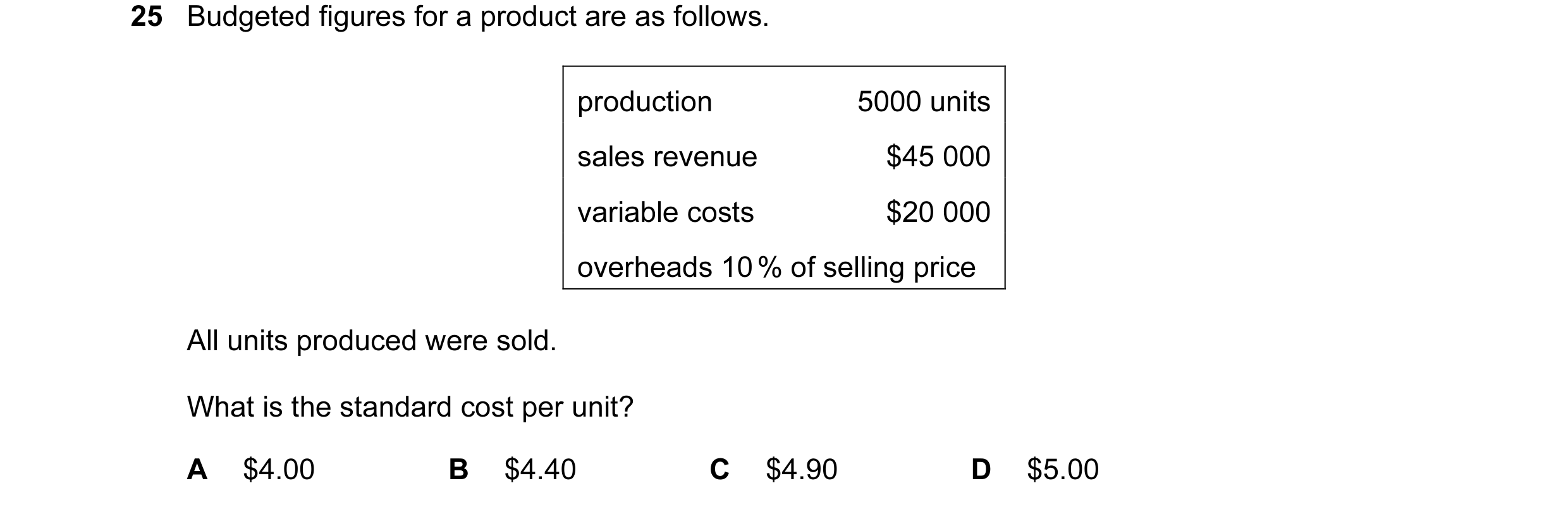
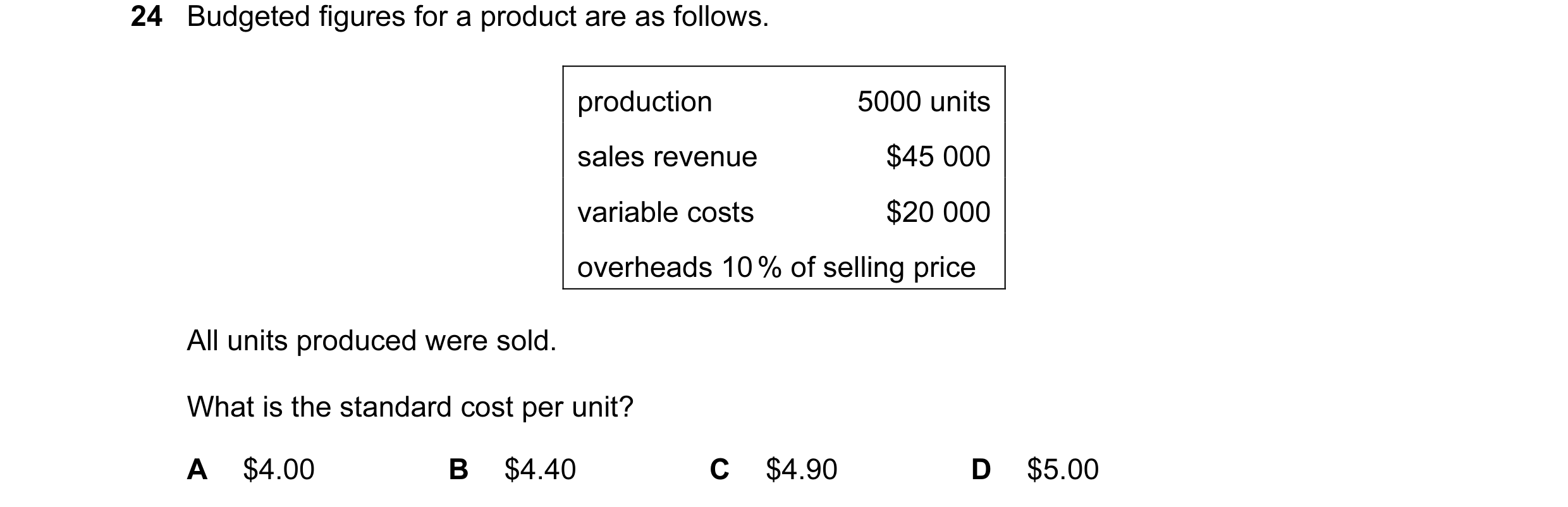
25 Budgeted figures for a product are as follows. production 5000 units sales revenue $45 000 variable costs $20 000 overheads 10 % of selling price All units produced were sold. What is the standard cost per unit? A $4.00 B $4.40 C $4.90 D $5.00
1 marks
Answer: C
This question in 9706/32 May/June 2010
Q18 · What should be included when valuing work in progress? 9706/33 May/June 2010
16 What should be included when valuing work in progress? A direct materials + direct labour + indirect labour B prime cost + all other overheads C prime cost + production overheads based on actual level of activity D prime cost + production overheads based on normal level of activity
1 marks
Answer: D
This question in 9706/33 May/June 2010
Q19 · In marginal costing, how can the total contribution from a given activity be calculated? 9706/33 May/June 2010
17 In marginal costing, how can the total contribution from a given activity be calculated? A total sales + total fixed costs B total sales – total profit C total fixed costs + total profit D total direct costs – total profit
1 marks
Answer: C
This question in 9706/33 May/June 2010
Q20 · A product is sold for $100 per unit 9706/33 May/June 2010
18 A product is sold for $100 per unit. Fixed costs are $90 000 and variable costs are 60 % of the selling price. What is the break-even sales revenue? A $36 000 B $90 000 C $150 000 D $225 000
1 marks
Answer: D
This question in 9706/33 May/June 2010
Q21 · The table contains information for the two products of a company 9706/33 May/June 2010
19 The table contains information for the two products of a company. product X Y contribution per unit $12 $9 machine hours required per unit 6 3 estimated sales demand (units) 200 200 required machine hours 1200 600 machine capacity limited to 1200 hours What is the maximum possible contribution? A $2100 B $3000 C $3300 D $4200
1 marks
Answer: B
This question in 9706/33 May/June 2010
Q22 · Budgeted figures for a product are as follows 9706/33 May/June 2010
24 Budgeted figures for a product are as follows. production 5000 units sales revenue $45 000 variable costs $20 000 overheads 10 % of selling price All units produced were sold. What is the standard cost per unit? A $4.00 B $4.40 C $4.90 D $5.00
1 marks
Answer: C
This question in 9706/33 May/June 2010
Q23 · Which may result in an over-absorption of overheads? 9706/31 Oct/Nov 2010
19 Which may result in an over-absorption of overheads? A absorption based on actual expenditure and actual activity B activity below budget C expenditure below budget D expenditure in excess of budget
1 marks
Answer: C
This question in 9706/31 Oct/Nov 2010
Q24 · The table shows the annual results of a company’s three departments 9706/31 Oct/Nov 2010
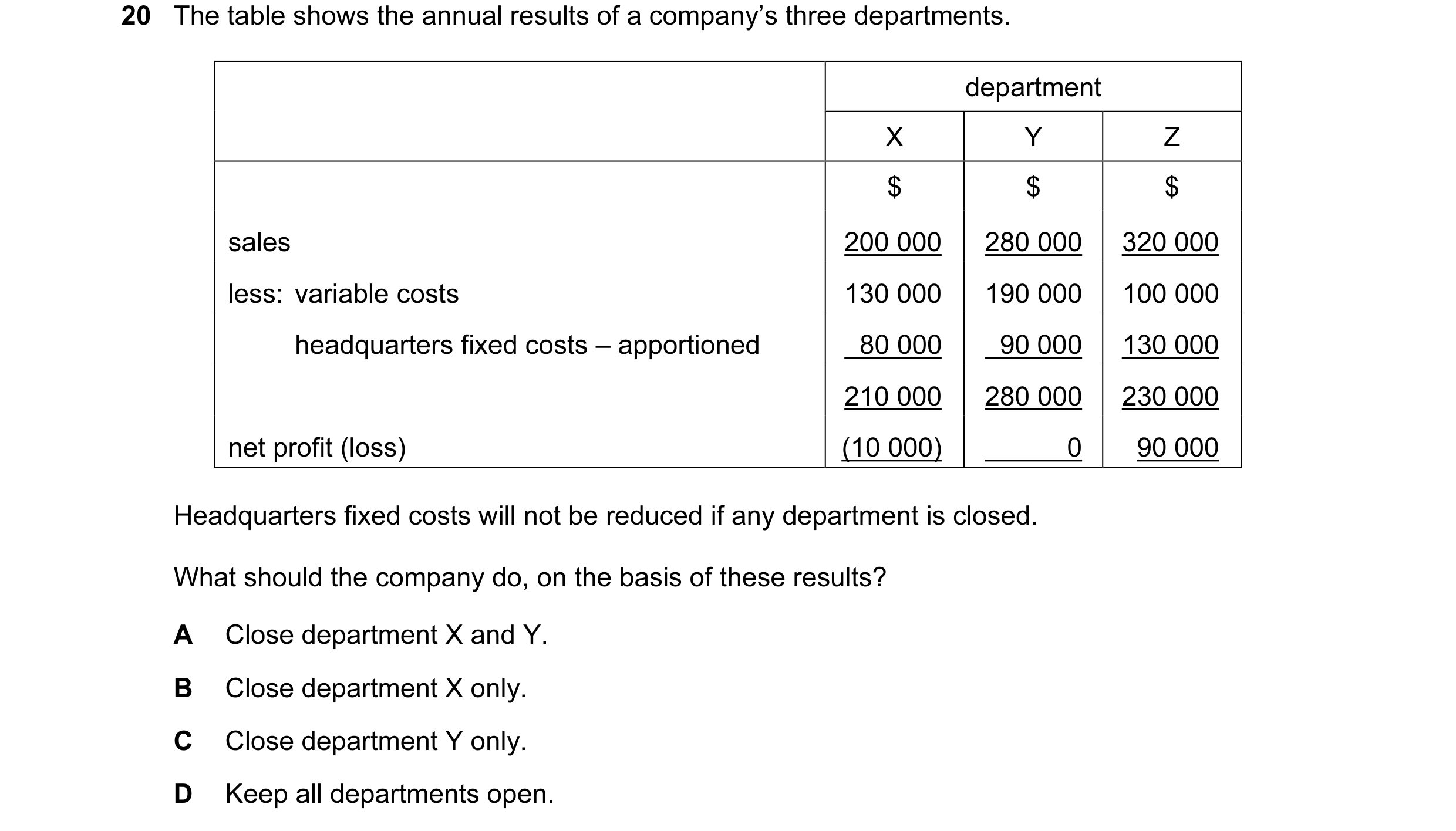
20 The table shows the annual results of a company’s three departments. department X Y Z $ $ $ sales 200 000 280 000 320 000 less: variable costs 130 000 190 000 100 000 headquarters fixed costs – apportioned 80 000 90 000 130 000 210 000 280 000 230 000 net profit (loss) (10 000) 0 90 000 Headquarters fixed costs will not be reduced if any department is closed. What should the company do, on the basis of these results? A Close department X and Y. B Close department X only. C Close department Y only. D Keep all departments open.
1 marks
Answer: D
This question in 9706/31 Oct/Nov 2010
Q25 · Which may result in an over-absorption of overheads? 9706/32 Oct/Nov 2010
19 Which may result in an over-absorption of overheads? A absorption based on actual expenditure and actual activity B activity below budget C expenditure below budget D expenditure in excess of budget
1 marks
Answer: C
This question in 9706/32 Oct/Nov 2010
Q26 · The table shows the annual results of a company’s three departments 9706/32 Oct/Nov 2010
20 The table shows the annual results of a company’s three departments. department X Y Z $ $ $ sales 200 000 280 000 320 000 less: variable costs 130 000 190 000 100 000 headquarters fixed costs – apportioned 80 000 90 000 130 000 210 000 280 000 230 000 net profit (loss) (10 000) 0 90 000 Headquarters fixed costs will not be reduced if any department is closed. What should the company do, on the basis of these results? A Close department X and Y. B Close department X only. C Close department Y only. D Keep all departments open.
1 marks
Answer: D
This question in 9706/32 Oct/Nov 2010
Q27 · The table shows the costs involved in the production of 1000 units 9706/32 Oct/Nov 2010
22 The table shows the costs involved in the production of 1000 units. $ direct materials 4 000 direct labour 6 000 variable overheads 2 000 fixed overheads 8 000 If production increases by 25 %, what will be the effect on the total cost per unit? A decrease of $1.60 per unit B decrease of $5.00 per unit C increase of $1.60 per unit D increase of $5.00 per unit
1 marks
Answer: A
This question in 9706/32 Oct/Nov 2010
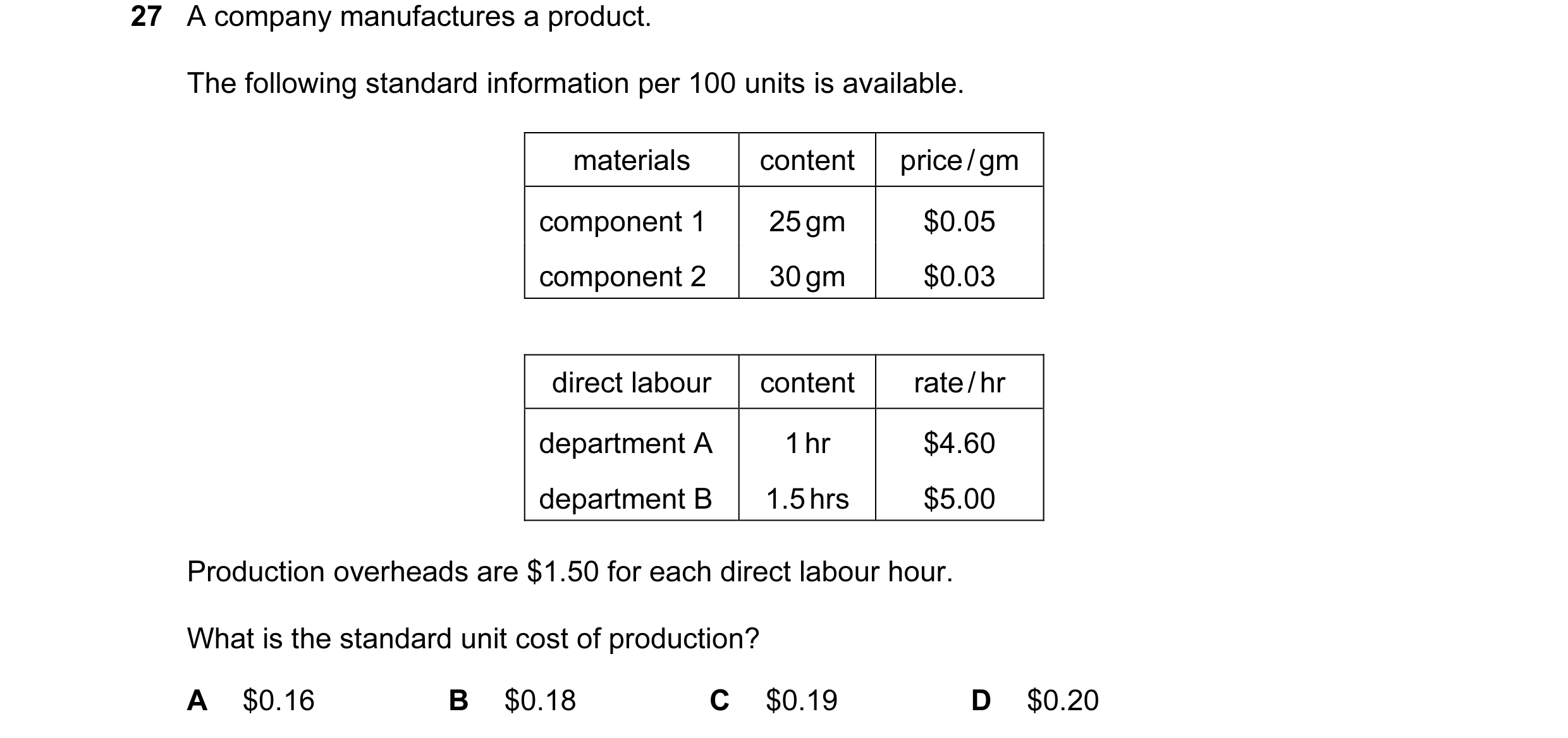
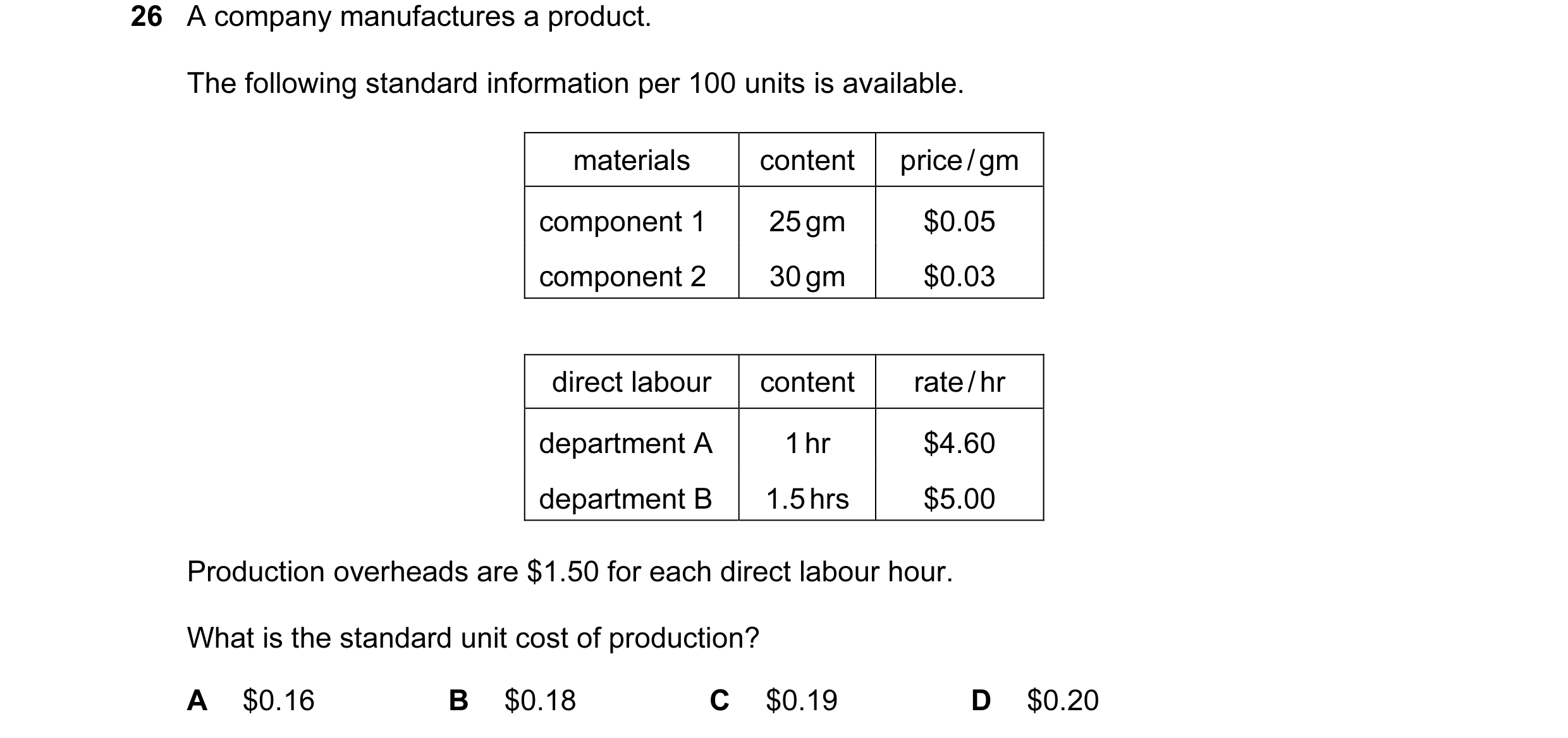
Q28 · A company manufactures a product 9706/32 Oct/Nov 2010
27 A company manufactures a product. The following standard information per 100 units is available. materials content price / gm component 1 25 gm $0.05 component 2 30 gm $0.03 direct labour content rate / hr department A 1 hr $4.60 department B 1.5 hrs $5.00 Production overheads are $1.50 for each direct labour hour. What is the standard unit cost of production? A $0.16 B $0.18 C $0.19 D $0.20
1 marks
Answer: B
This question in 9706/32 Oct/Nov 2010
Q29 · Which may result in an over-absorption of overheads? 9706/33 Oct/Nov 2010
18 Which may result in an over-absorption of overheads? A absorption based on actual expenditure and actual activity B activity below budget C expenditure below budget D expenditure in excess of budget
1 marks
Answer: C
This question in 9706/33 Oct/Nov 2010
Q30 · The table shows the annual results of a company’s three departments 9706/33 Oct/Nov 2010
19 The table shows the annual results of a company’s three departments. department X Y Z $ $ $ sales 200 000 280 000 320 000 less: variable costs 130 000 190 000 100 000 headquarters fixed costs – apportioned 80 000 90 000 130 000 210 000 280 000 230 000 net profit (loss) (10 000) 0 90 000 Headquarters fixed costs will not be reduced if any department is closed. What should the company do, on the basis of these results? A Close department X and Y. B Close department X only. C Close department Y only. D Keep all departments open.
1 marks
Answer: D
This question in 9706/33 Oct/Nov 2010
Q31 · A company manufactures a product 9706/33 Oct/Nov 2010
26 A company manufactures a product. The following standard information per 100 units is available. materials content price / gm component 1 25 gm $0.05 component 2 30 gm $0.03 direct labour content rate / hr department A 1 hr $4.60 department B 1.5 hrs $5.00 Production overheads are $1.50 for each direct labour hour. What is the standard unit cost of production? A $0.16 B $0.18 C $0.19 D $0.20
1 marks
Answer: B
This question in 9706/33 Oct/Nov 2010
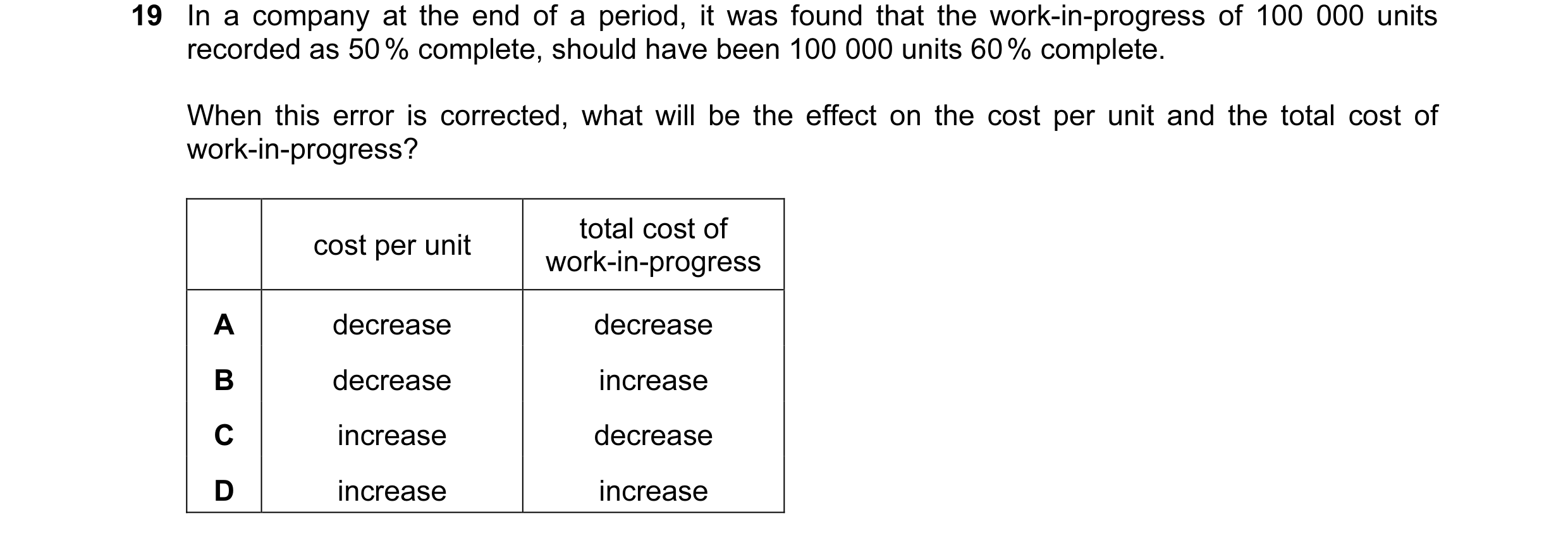
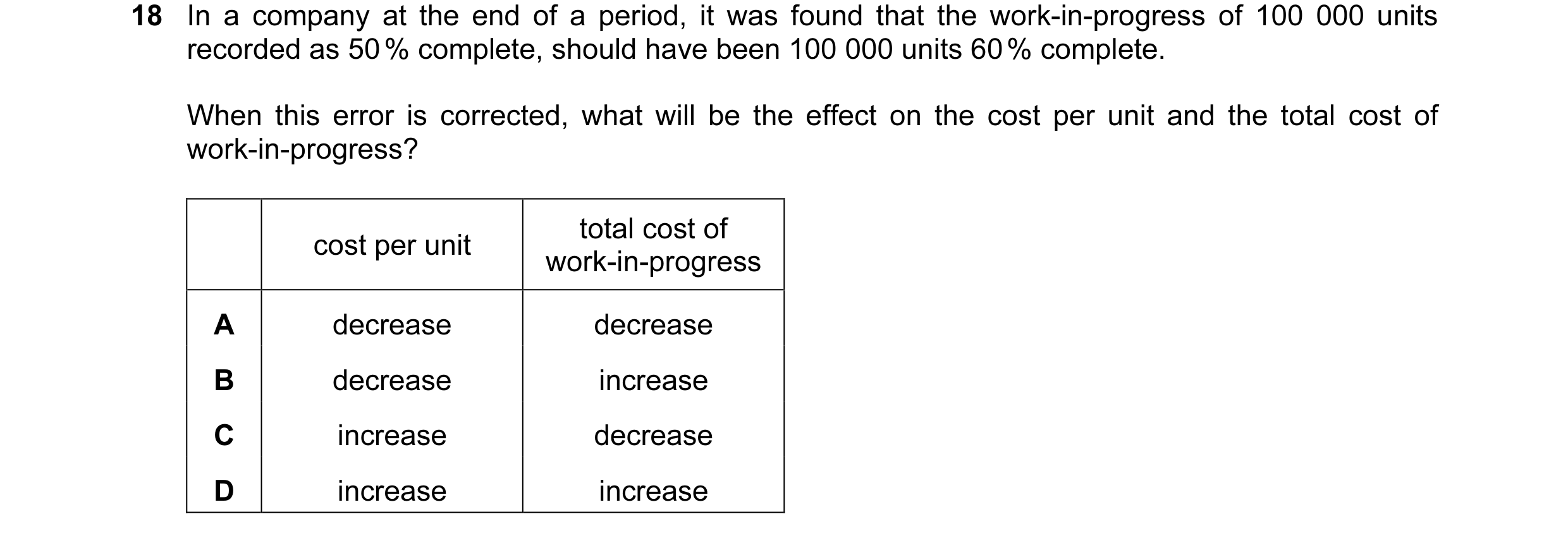
Q32 · In a company at the end of a period, it was found that the work-in-progress of 100 000… 9706/31 May/June 2011
19 In a company at the end of a period, it was found that the work-in-progress of 100 000 units recorded as 50 % complete, should have been 100 000 units 60 % complete. When this error is corrected, what will be the effect on the cost per unit and the total cost of work-in-progress? total cost of cost per unit work-in-progress A decrease decrease B decrease increase C increase decrease D increase increase
1 marks
Answer: B
This question in 9706/31 May/June 2011
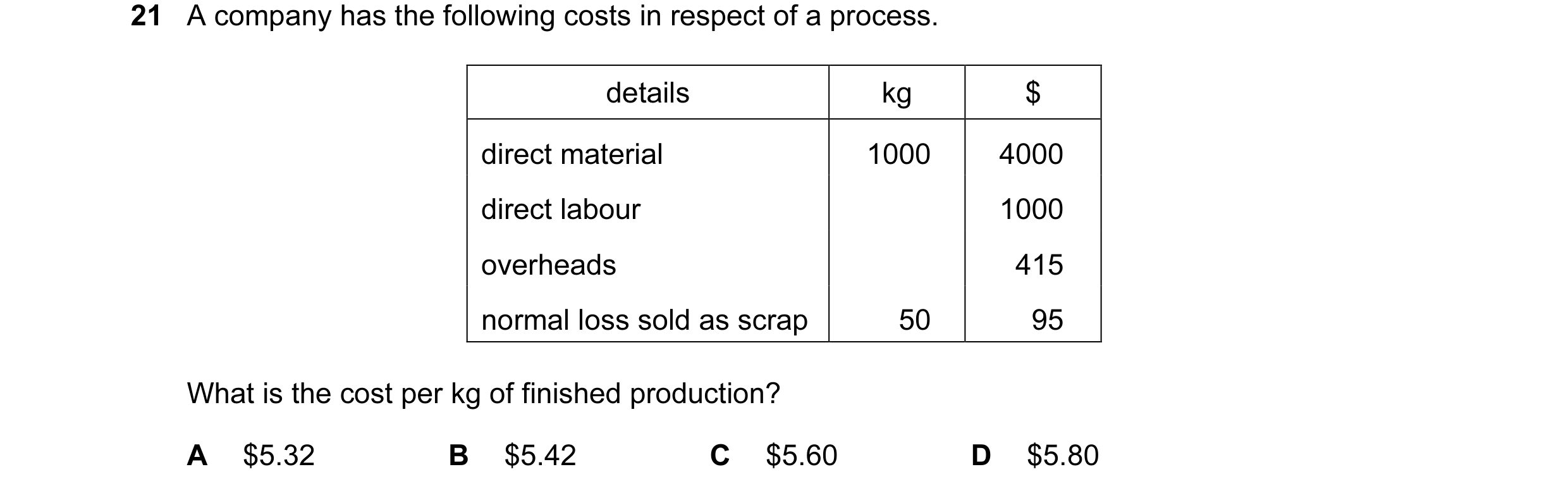
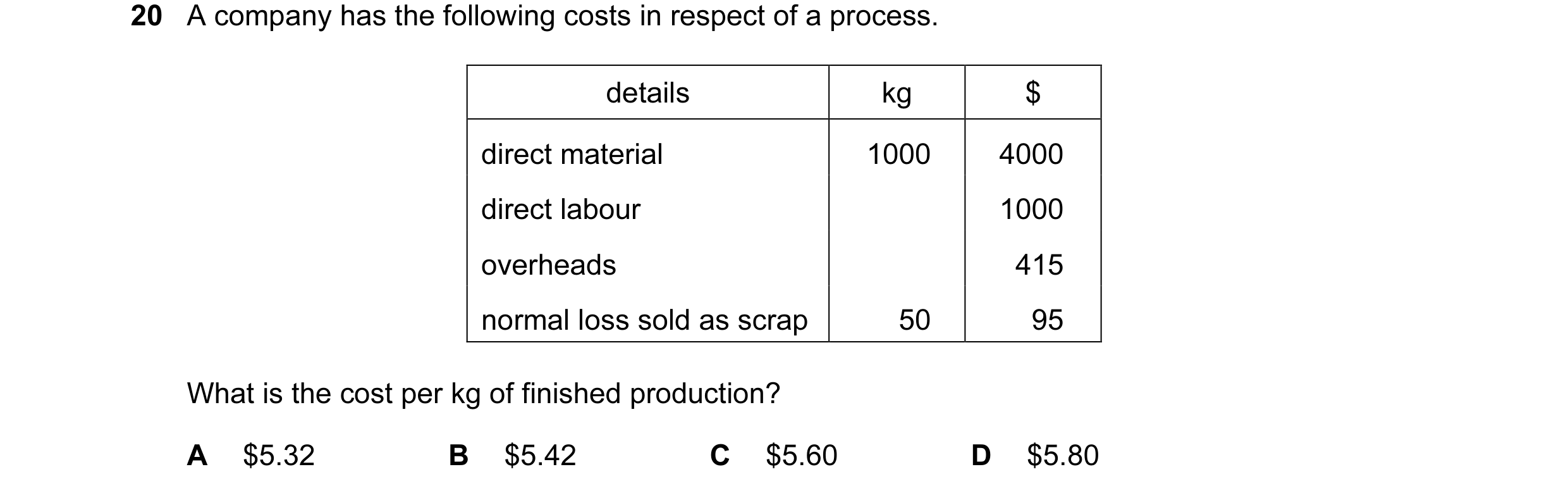
Q33 · A company has the following costs in respect of a process 9706/31 May/June 2011
21 A company has the following costs in respect of a process. details kg $ direct material 1000 4000 direct labour 1000 overheads 415 normal loss sold as scrap 50 95 What is the cost per kg of finished production? A $5.32 B $5.42 C $5.60 D $5.80
1 marks
Answer: C
This question in 9706/31 May/June 2011
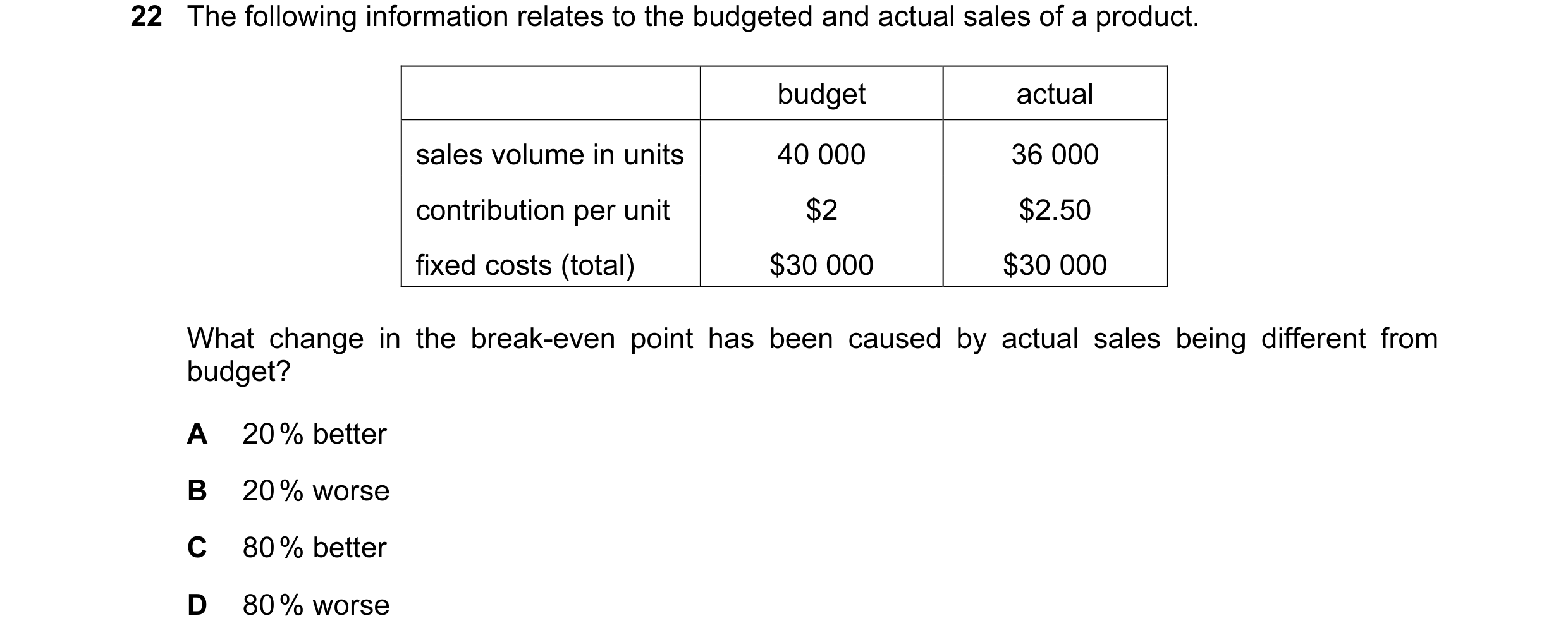
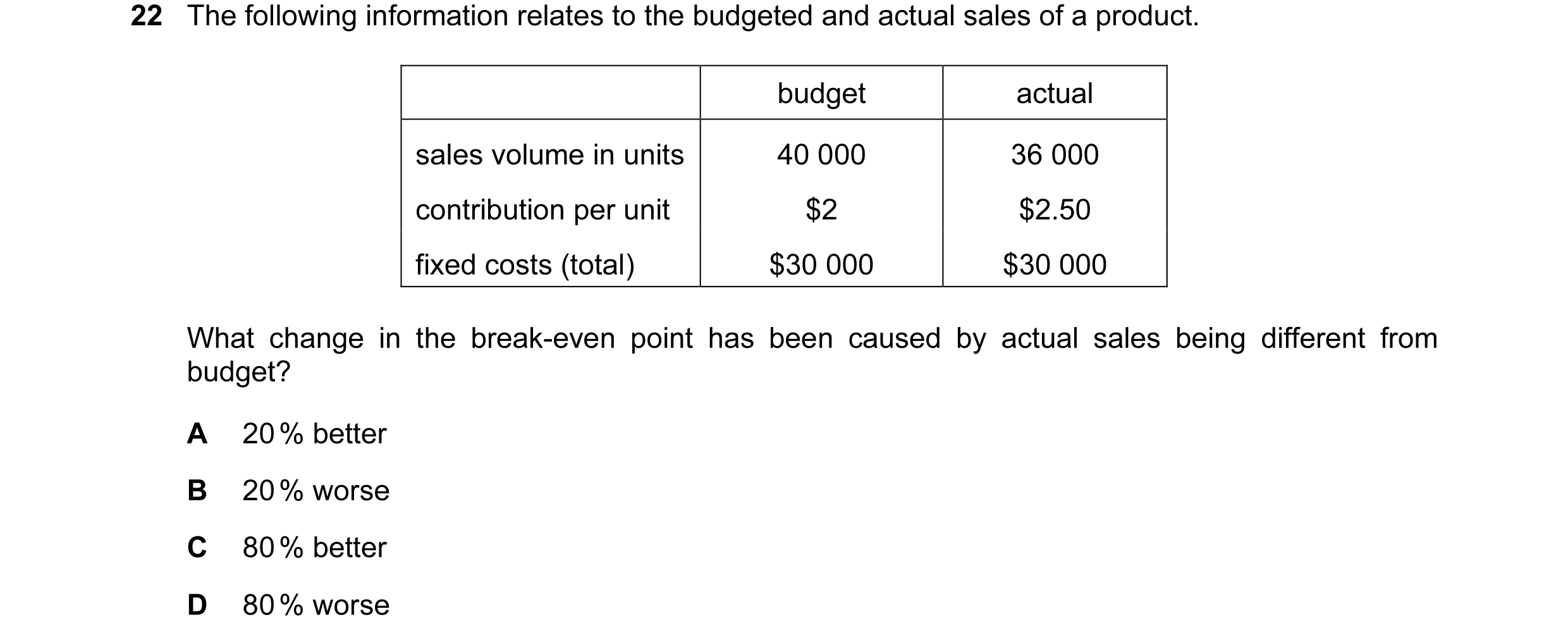
Q34 · The following information relates to the budgeted and actual sales of a product 9706/31 May/June 2011
22 The following information relates to the budgeted and actual sales of a product. budget actual sales volume in units 40 000 36 000 contribution per unit $2 $2.50 fixed costs (total) $30 000 $30 000 What change in the break-even point has been caused by actual sales being different from budget? A 20 % better B 20 % worse C 80 % better D 80 % worse
1 marks
Answer: A
This question in 9706/31 May/June 2011
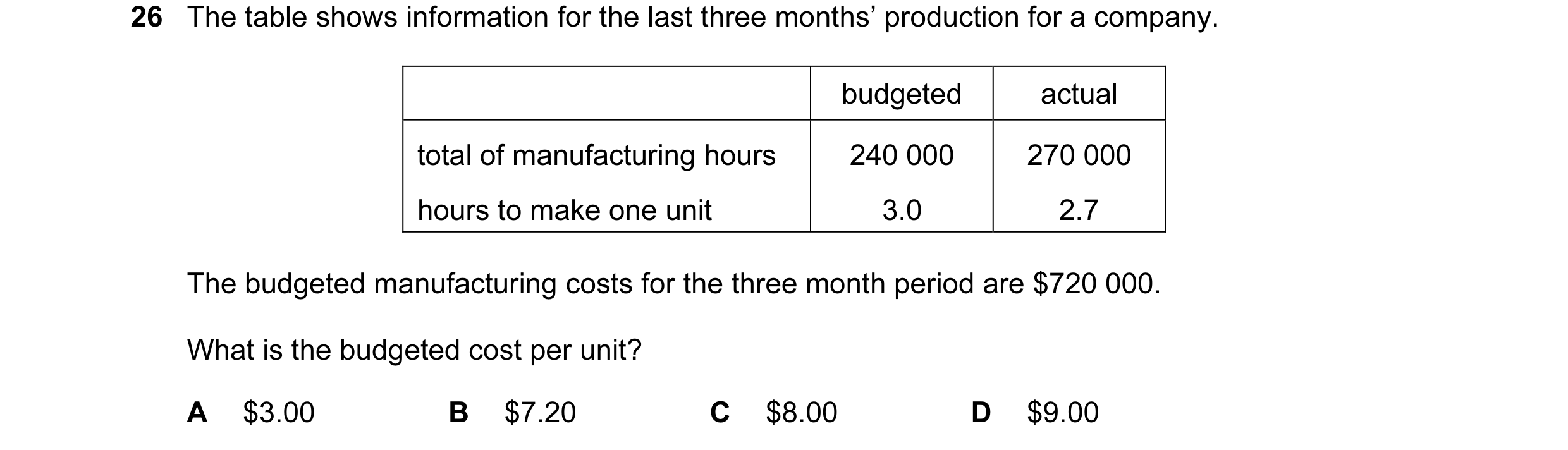
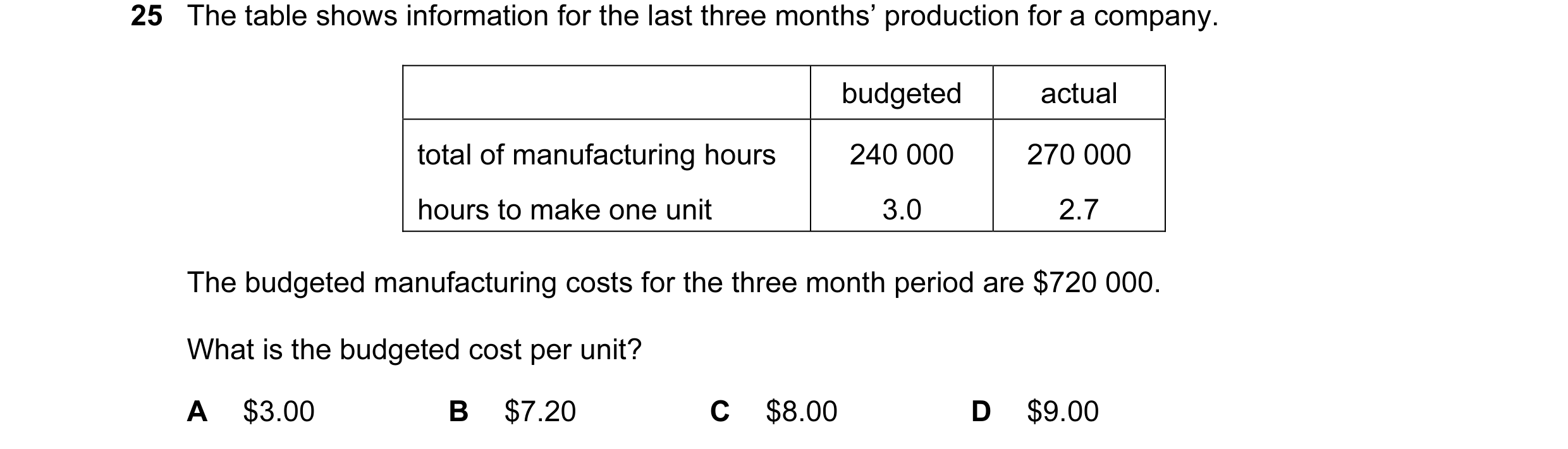
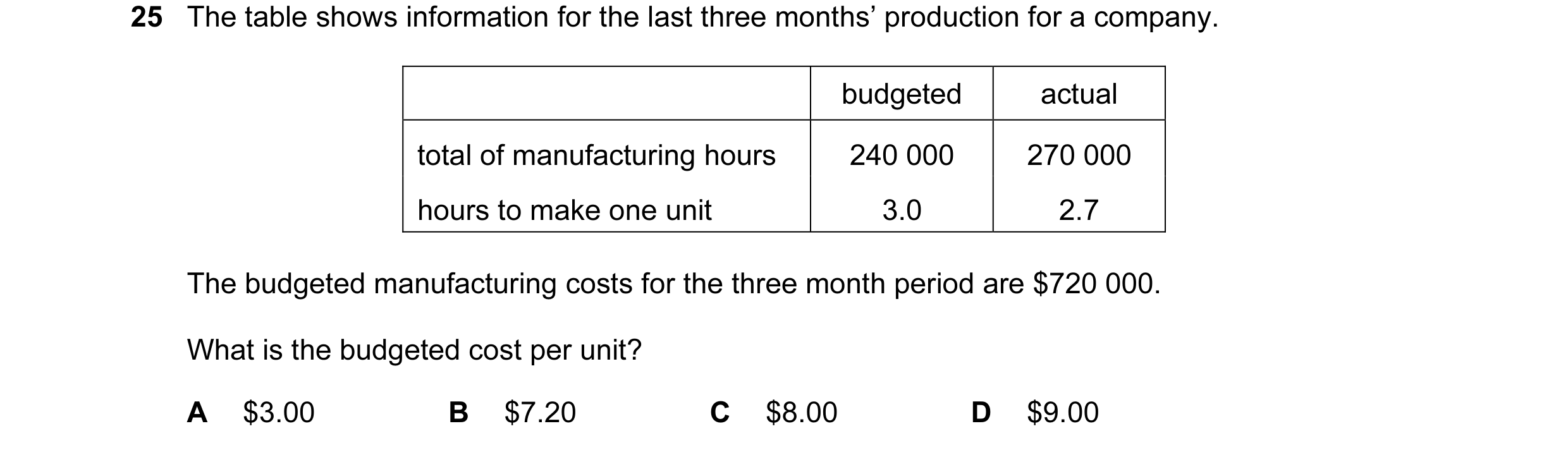
Q35 · The table shows information for the last three months’ production for a company 9706/31 May/June 2011
26 The table shows information for the last three months’ production for a company. budgeted actual total of manufacturing hours 240 000 270 000 hours to make one unit 3.0 2.7 The budgeted manufacturing costs for the three month period are $720 000. What is the budgeted cost per unit? A $3.00 B $7.20 C $8.00 D $9.00
1 marks
Answer: D
This question in 9706/31 May/June 2011
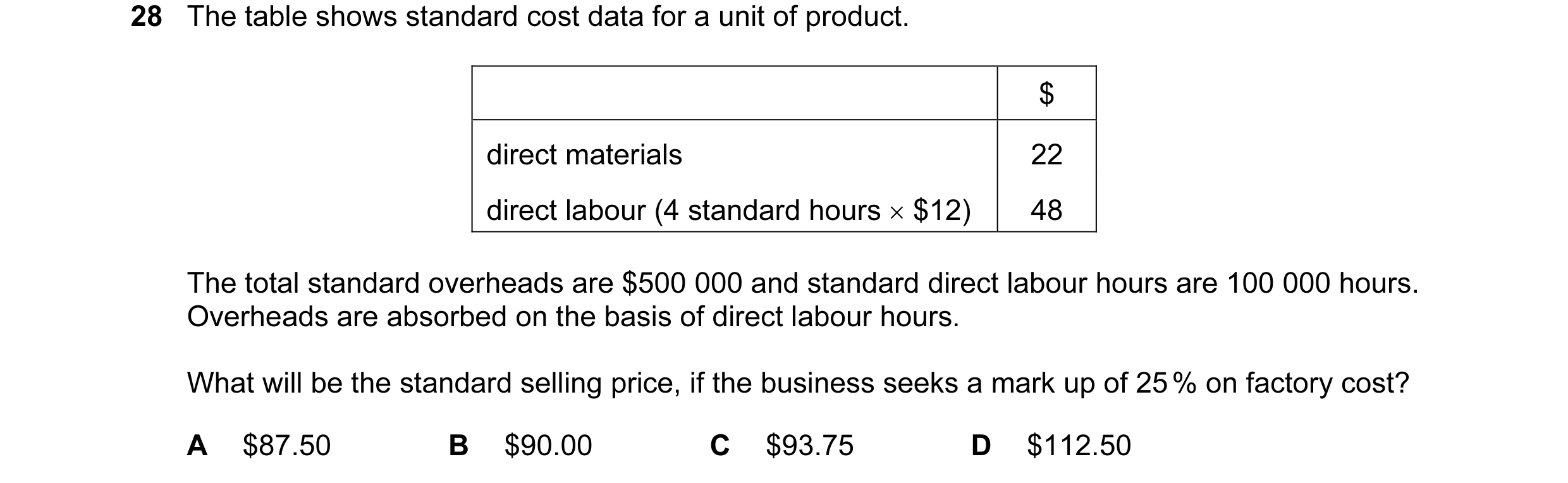
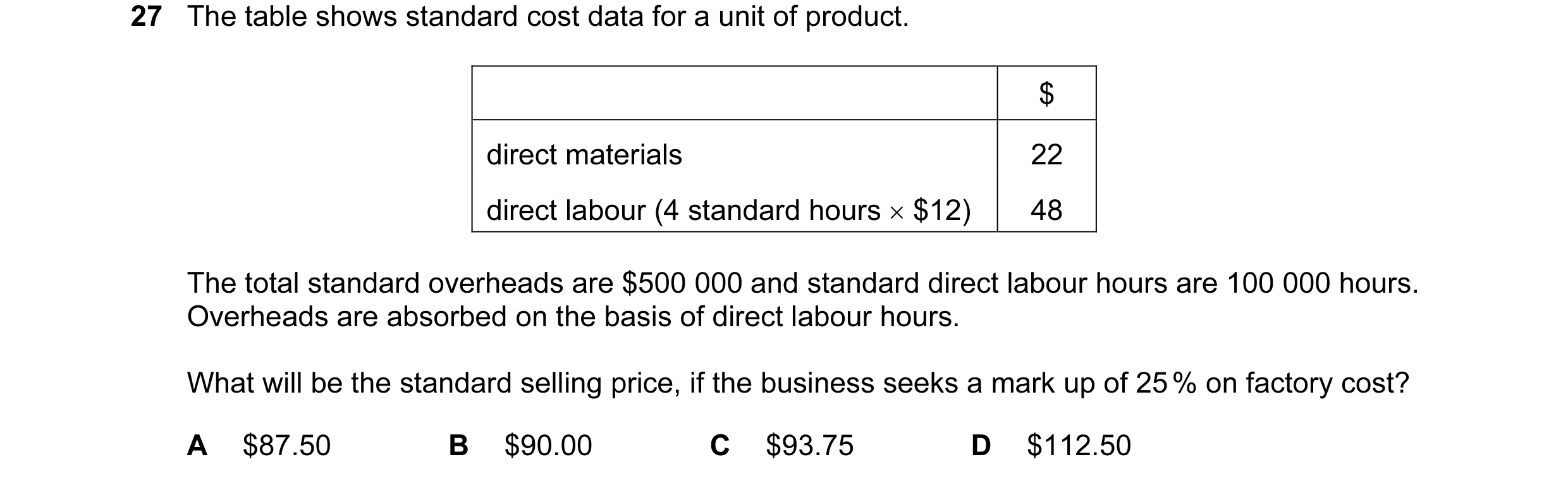
Q36 · The table shows standard cost data for a unit of product 9706/31 May/June 2011
28 The table shows standard cost data for a unit of product. $ direct materials 22 direct labour (4 standard hours × $12) 48 The total standard overheads are $500 000 and standard direct labour hours are 100 000 hours. Overheads are absorbed on the basis of direct labour hours. What will be the standard selling price, if the business seeks a mark up of 25 % on factory cost? A $87.50 B $90.00 C $93.75 D $112.50
1 marks
Answer: D
This question in 9706/31 May/June 2011
Q37 · In a company at the end of a period, it was found that the work-in-progress of 100 000… 9706/32 May/June 2011
20 In a company at the end of a period, it was found that the work-in-progress of 100 000 units recorded as 50 % complete, should have been 100 000 units 60 % complete. When this error is corrected, what will be the effect on the cost per unit and the total cost of work-in-progress? total cost of cost per unit work-in-progress A decrease decrease B decrease increase C increase decrease D increase increase
1 marks
Answer: B
This question in 9706/32 May/June 2011
Q38 · A company has the following costs in respect of a process 9706/32 May/June 2011
21 A company has the following costs in respect of a process. details kg $ direct material 1000 4000 direct labour 1000 overheads 415 normal loss sold as scrap 50 95 What is the cost per kg of finished production? A $5.32 B $5.42 C $5.60 D $5.80
1 marks
Answer: C
This question in 9706/32 May/June 2011
Q39 · The following information relates to the budgeted and actual sales of a product 9706/32 May/June 2011
22 The following information relates to the budgeted and actual sales of a product. budget actual sales volume in units 40 000 36 000 contribution per unit $2 $2.50 fixed costs (total) $30 000 $30 000 What change in the break-even point has been caused by actual sales being different from budget? A 20 % better B 20 % worse C 80 % better D 80 % worse
1 marks
Answer: A
This question in 9706/32 May/June 2011
Q40 · The table shows information for the last three months’ production for a company 9706/32 May/June 2011
25 The table shows information for the last three months’ production for a company. budgeted actual total of manufacturing hours 240 000 270 000 hours to make one unit 3.0 2.7 The budgeted manufacturing costs for the three month period are $720 000. What is the budgeted cost per unit? A $3.00 B $7.20 C $8.00 D $9.00
1 marks
Answer: D
This question in 9706/32 May/June 2011
Q41 · The table shows standard cost data for a unit of product 9706/32 May/June 2011
27 The table shows standard cost data for a unit of product. $ direct materials 22 direct labour (4 standard hours × $12) 48 The total standard overheads are $500 000 and standard direct labour hours are 100 000 hours. Overheads are absorbed on the basis of direct labour hours. What will be the standard selling price, if the business seeks a mark up of 25 % on factory cost? A $87.50 B $90.00 C $93.75 D $112.50
1 marks
Answer: D
This question in 9706/32 May/June 2011
Q42 · In a company at the end of a period, it was found that the work-in-progress of 100 000… 9706/33 May/June 2011
18 In a company at the end of a period, it was found that the work-in-progress of 100 000 units recorded as 50 % complete, should have been 100 000 units 60 % complete. When this error is corrected, what will be the effect on the cost per unit and the total cost of work-in-progress? total cost of cost per unit work-in-progress A decrease decrease B decrease increase C increase decrease D increase increase
1 marks
Answer: B
This question in 9706/33 May/June 2011
Q43 · A company has the following costs in respect of a process 9706/33 May/June 2011
20 A company has the following costs in respect of a process. details kg $ direct material 1000 4000 direct labour 1000 overheads 415 normal loss sold as scrap 50 95 What is the cost per kg of finished production? A $5.32 B $5.42 C $5.60 D $5.80
1 marks
Answer: C
This question in 9706/33 May/June 2011
Q44 · The following information relates to the budgeted and actual sales of a product 9706/33 May/June 2011
21 The following information relates to the budgeted and actual sales of a product. budget actual sales volume in units 40 000 36 000 contribution per unit $2 $2.50 fixed costs (total) $30 000 $30 000 What change in the break-even point has been caused by actual sales being different from budget? A 20 % better B 20 % worse C 80 % better D 80 % worse
1 marks
Answer: A
This question in 9706/33 May/June 2011
Q45 · The table shows information for the last three months’ production for a company 9706/33 May/June 2011
25 The table shows information for the last three months’ production for a company. budgeted actual total of manufacturing hours 240 000 270 000 hours to make one unit 3.0 2.7 The budgeted manufacturing costs for the three month period are $720 000. What is the budgeted cost per unit? A $3.00 B $7.20 C $8.00 D $9.00
1 marks
Answer: D
This question in 9706/33 May/June 2011
Q46 · The table shows standard cost data for a unit of product 9706/33 May/June 2011
27 The table shows standard cost data for a unit of product. $ direct materials 22 direct labour (4 standard hours × $12) 48 The total standard overheads are $500 000 and standard direct labour hours are 100 000 hours. Overheads are absorbed on the basis of direct labour hours. What will be the standard selling price, if the business seeks a mark up of 25 % on factory cost? A $87.50 B $90.00 C $93.75 D $112.50
1 marks
Answer: D
This question in 9706/33 May/June 2011
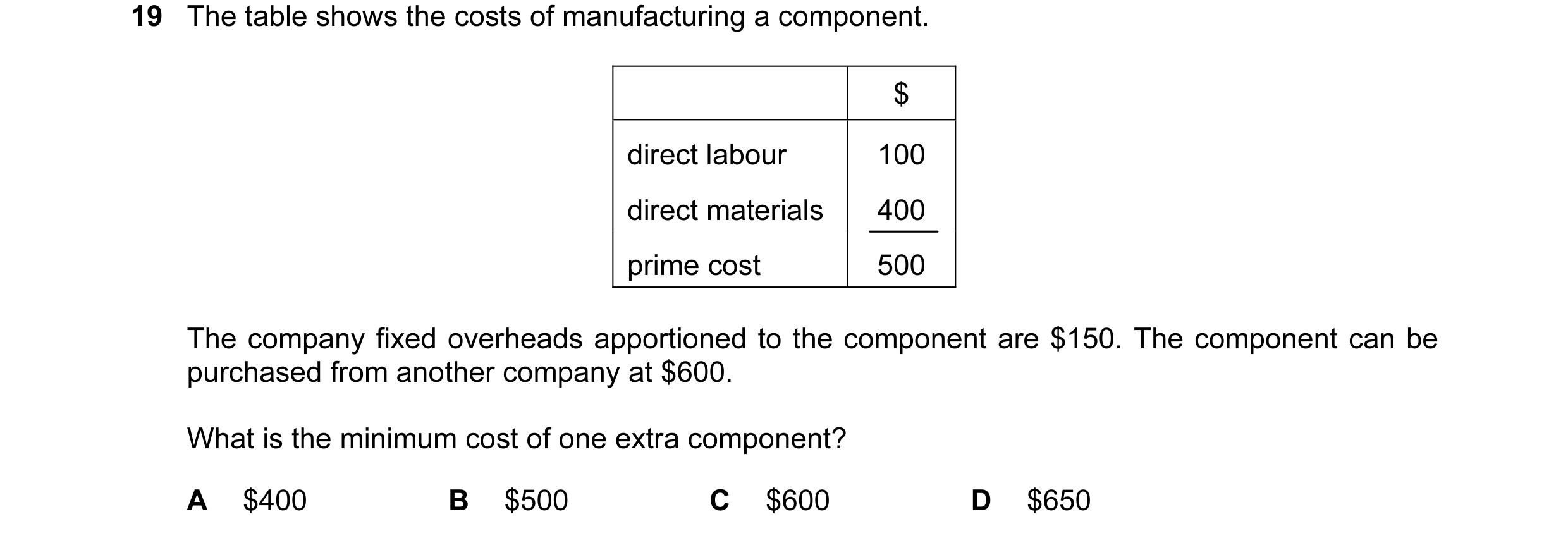
Q47 · The table shows the costs of manufacturing a component 9706/31 Oct/Nov 2011
19 The table shows the costs of manufacturing a component. $ direct labour 100 direct materials 400 prime cost 500 The company fixed overheads apportioned to the component are $150. The component can be purchased from another company at $600. What is the minimum cost of one extra component? A $400 B $500 C $600 D $650
1 marks
Answer: B
This question in 9706/31 Oct/Nov 2011
Q48 · The table contains information provided by a company 9706/31 Oct/Nov 2011
20 The table contains information provided by a company. actual direct labour hours worked 7500 budgeted direct labour hours 8000 budgeted overhead expenditure $104 000 overheads under-recovered $15 000 What is the amount of the actual overhead expenditure? A $89 000 B $97 500 C $112 500 D $119 000
1 marks
Answer: C
This question in 9706/31 Oct/Nov 2011
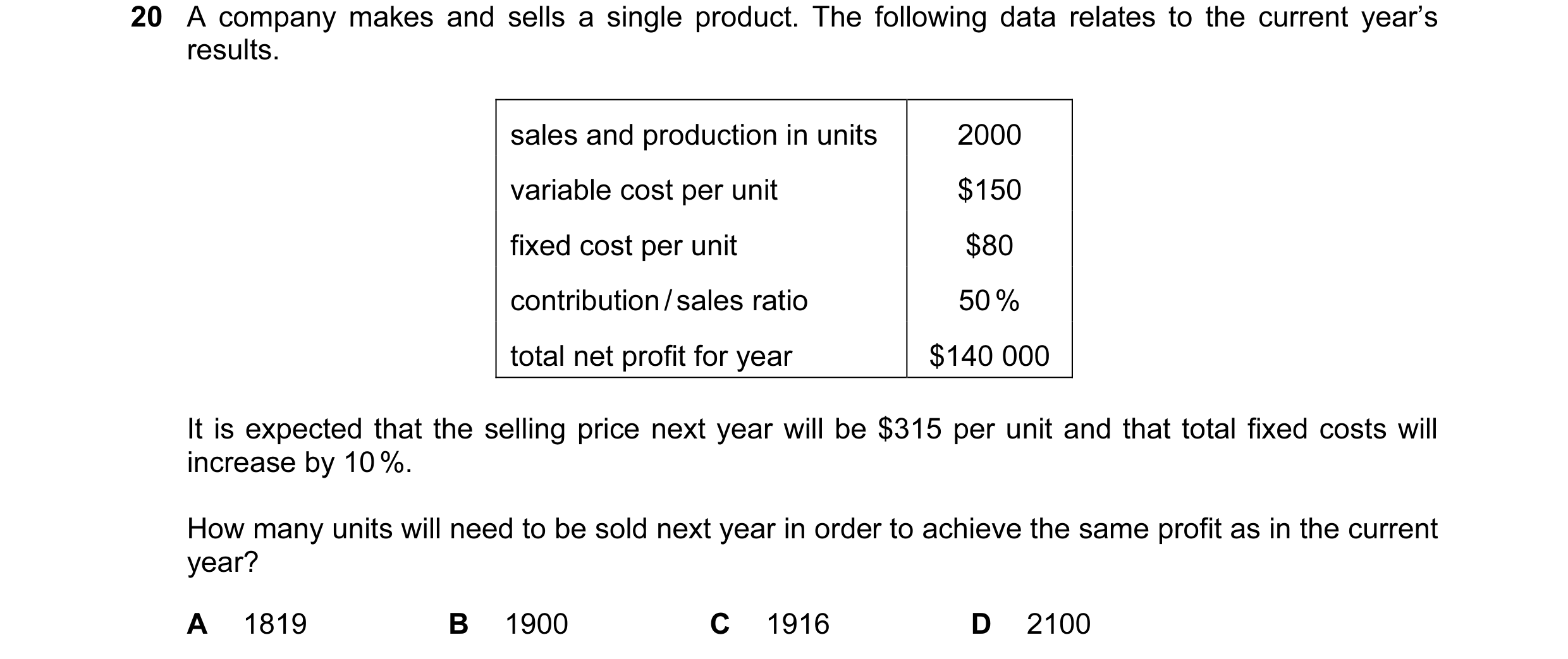
Q49 · A company makes and sells a single product 9706/31 Oct/Nov 2011
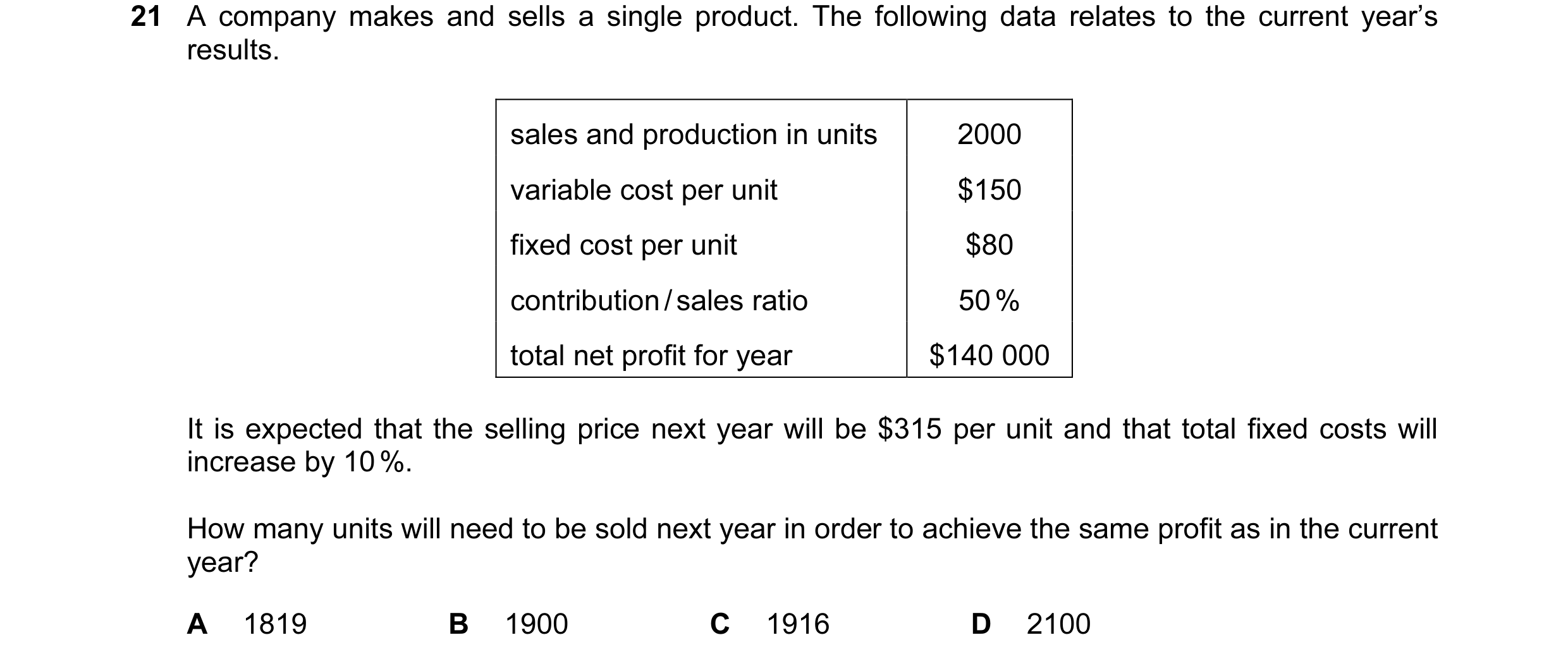
21 A company makes and sells a single product. The following data relates to the current year’s results. sales and production in units 2000 variable cost per unit $150 fixed cost per unit $80 contribution / sales ratio 50 % total net profit for year $140 000 It is expected that the selling price next year will be $315 per unit and that total fixed costs will increase by 10 %. How many units will need to be sold next year in order to achieve the same profit as in the current year? A 1819 B 1900 C 1916 D 2100
1 marks
Answer: C
This question in 9706/31 Oct/Nov 2011
Q50 · The budgeted overheads for a business for a year are $600 000 9706/31 Oct/Nov 2011
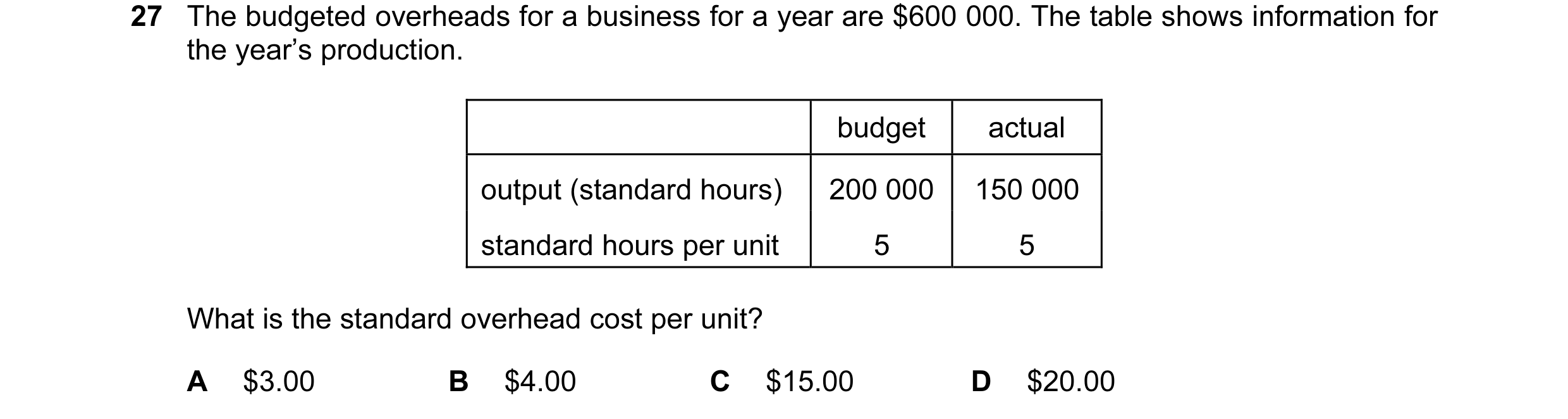
27 The budgeted overheads for a business for a year are $600 000. The table shows information for the year’s production. budget actual output (standard hours) 200 000 150 000 standard hours per unit 5 5 What is the standard overhead cost per unit? A $3.00 B $4.00 C $15.00 D $20.00
1 marks
Answer: C
This question in 9706/31 Oct/Nov 2011
Q51 · A company budgets to produce 110 000 units 9706/32 Oct/Nov 2011
20 A company budgets to produce 110 000 units. Market research shows that the demand for the product will be for 90 000 units. The information below shows the resources required for the budgeted production, and the resources available. resources resources required available per unit material 3.0 335 000 kilos direct labour hours 2.5 300 000 hours machine hours 0.5 110 000 machine hours What is the principal limiting factor in this case? A direct labour B machine hours C material D sales
1 marks
Answer: D
This question in 9706/32 Oct/Nov 2011
Q52 · In July, a business had opening inventory of 10 000 units and closing inventory of 16 000… 9706/32 Oct/Nov 2011
21 In July, a business had opening inventory of 10 000 units and closing inventory of 16 000 units. The profit calculated on marginal costing principles was $220 000 and that calculated on absorption costing principles was $268 000. What was the fixed overhead absorption rate per unit? A $8.00 B $13.75 C $16.75 D $22.00
1 marks
Answer: A
This question in 9706/32 Oct/Nov 2011
Q53 · The following data is taken from a business 9706/32 Oct/Nov 2011
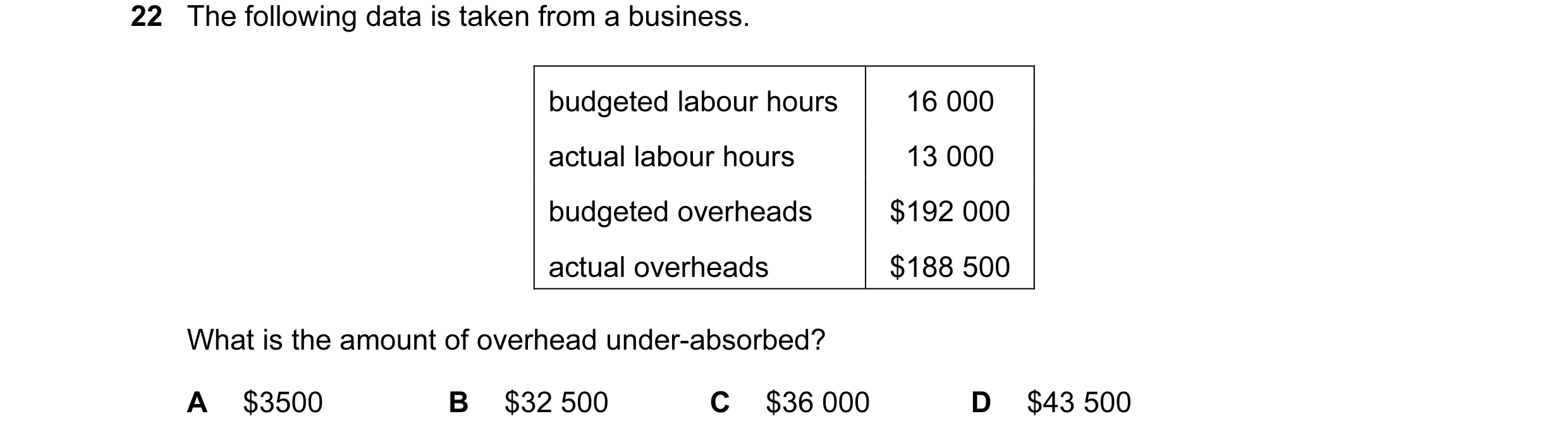
22 The following data is taken from a business. budgeted labour hours 16 000 actual labour hours 13 000 budgeted overheads $192 000 actual overheads $188 500 What is the amount of overhead under-absorbed? A $3500 B $32 500 C $36 000 D $43 500
1 marks
Answer: B
This question in 9706/32 Oct/Nov 2011
Q54 · A process has an input of 12 000 kg at a cost of $236 400 9706/32 Oct/Nov 2011
23 A process has an input of 12 000 kg at a cost of $236 400. Normal wastage is 10 % of input, and this is sold for $8 per kg. What is the cost per kg of output from the process? A $18.90 B $19.70 C $21.00 D $21.89
1 marks
Answer: C
This question in 9706/32 Oct/Nov 2011
Q55 · The table contains information provided by a company 9706/33 Oct/Nov 2011
19 The table contains information provided by a company. actual direct labour hours worked 7500 budgeted direct labour hours 8000 budgeted overhead expenditure $104 000 overheads under-recovered $15 000 What is the amount of the actual overhead expenditure? A $89 000 B $97 500 C $112 500 D $119 000
1 marks
Answer: C
This question in 9706/33 Oct/Nov 2011
Q56 · A company makes and sells a single product 9706/33 Oct/Nov 2011
20 A company makes and sells a single product. The following data relates to the current year’s results. sales and production in units 2000 variable cost per unit $150 fixed cost per unit $80 contribution / sales ratio 50 % total net profit for year $140 000 It is expected that the selling price next year will be $315 per unit and that total fixed costs will increase by 10 %. How many units will need to be sold next year in order to achieve the same profit as in the current year? A 1819 B 1900 C 1916 D 2100
1 marks
Answer: C
This question in 9706/33 Oct/Nov 2011
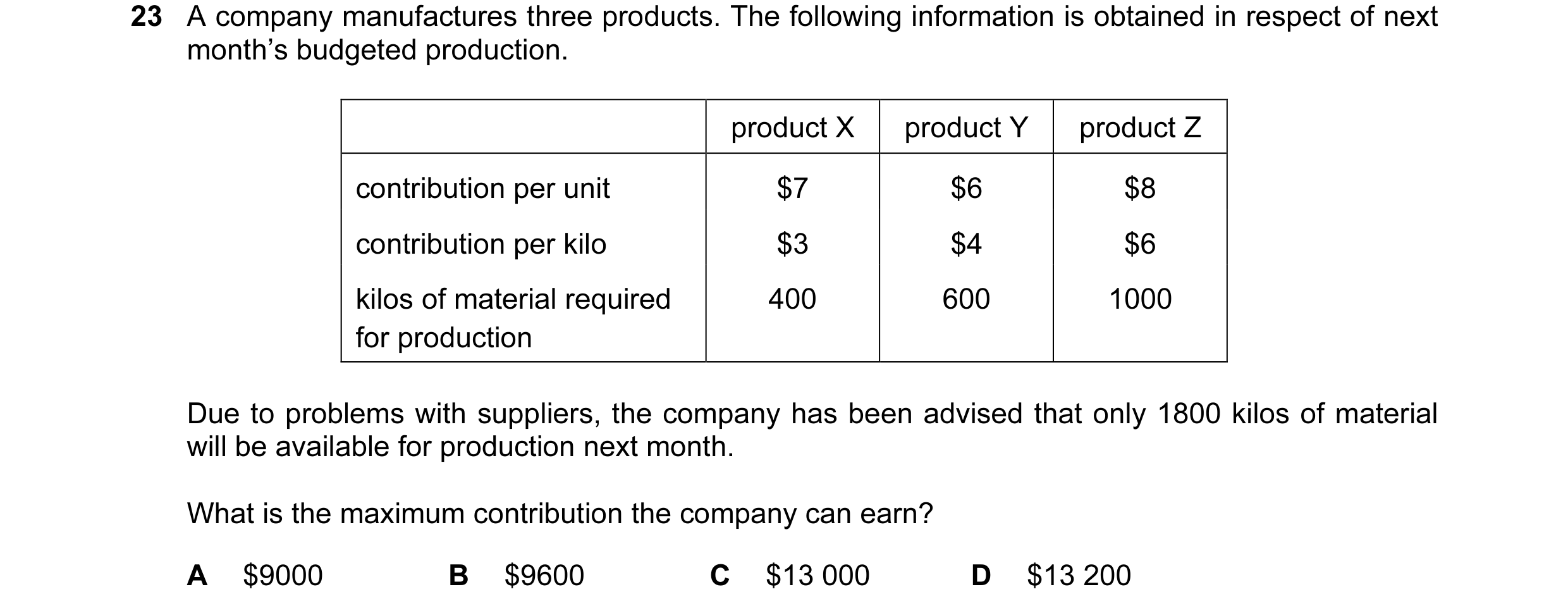
Q57 · A company manufactures three products 9706/31 May/June 2012
23 A company manufactures three products. The following information is obtained in respect of next month’s budgeted production. product X product Y product Z contribution per unit $7 $6 $8 contribution per kilo $3 $4 $6 kilos of material required 400 600 1000 for production Due to problems with suppliers, the company has been advised that only 1800 kilos of material will be available for production next month. What is the maximum contribution the company can earn? A $9000 B $9600 C $13 000 D $13 200
1 marks
Answer: A
This question in 9706/31 May/June 2012
Q58 · A process has an input of 6000 kilos at a cost of $118 200 9706/31 May/June 2012
24 A process has an input of 6000 kilos at a cost of $118 200. Normal wastage is 10 % of input and this is sold for $6 per kilo. There are no abnormal gains or losses. What is the cost per kilo of output from the process, to the nearest cent? A $19.10 B $19.70 C $21.22 D $21.89
1 marks
Answer: C
This question in 9706/31 May/June 2012
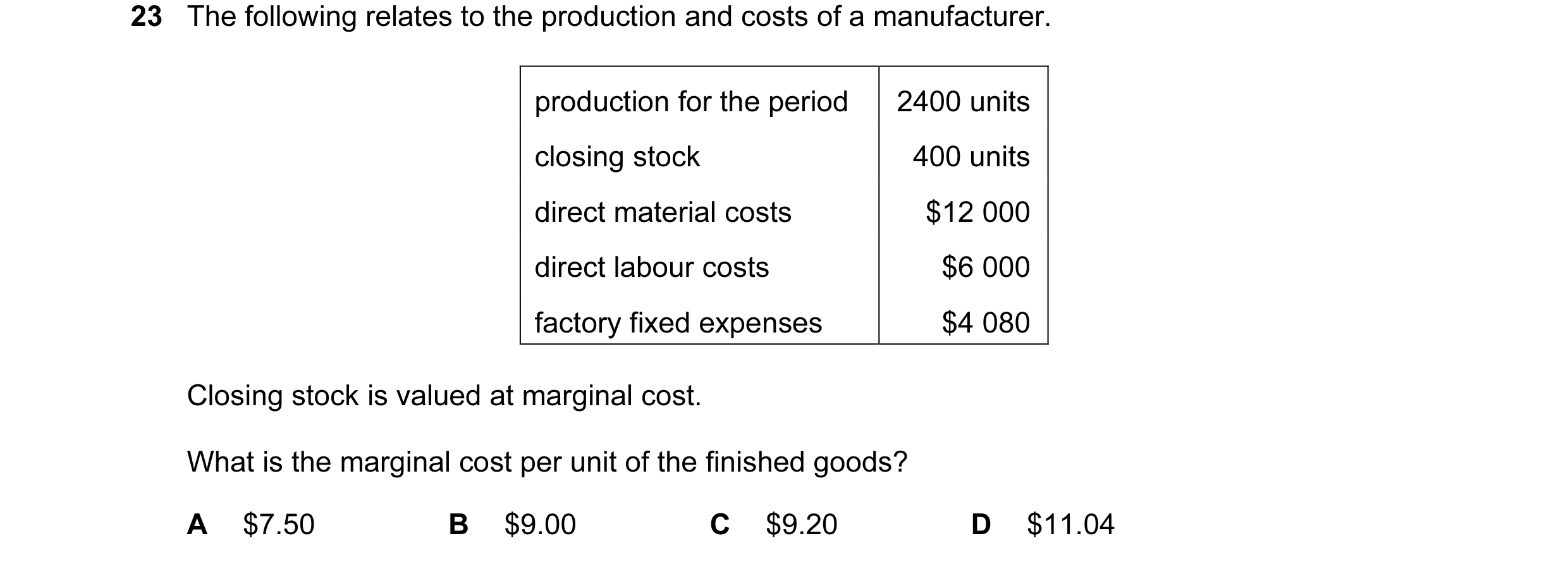
Q59 · The following relates to the production and costs of a manufacturer 9706/31 May/June 2012
25 The following relates to the production and costs of a manufacturer. production for the period 2400 units closing stock 400 units direct material costs $12 000 direct labour costs $6 000 factory fixed expenses $4 080 Closing stock is valued at marginal cost. What is the marginal cost per unit of the finished goods? A $7.50 B $9.00 C $9.20 D $11.04
1 marks
Answer: A
This question in 9706/31 May/June 2012
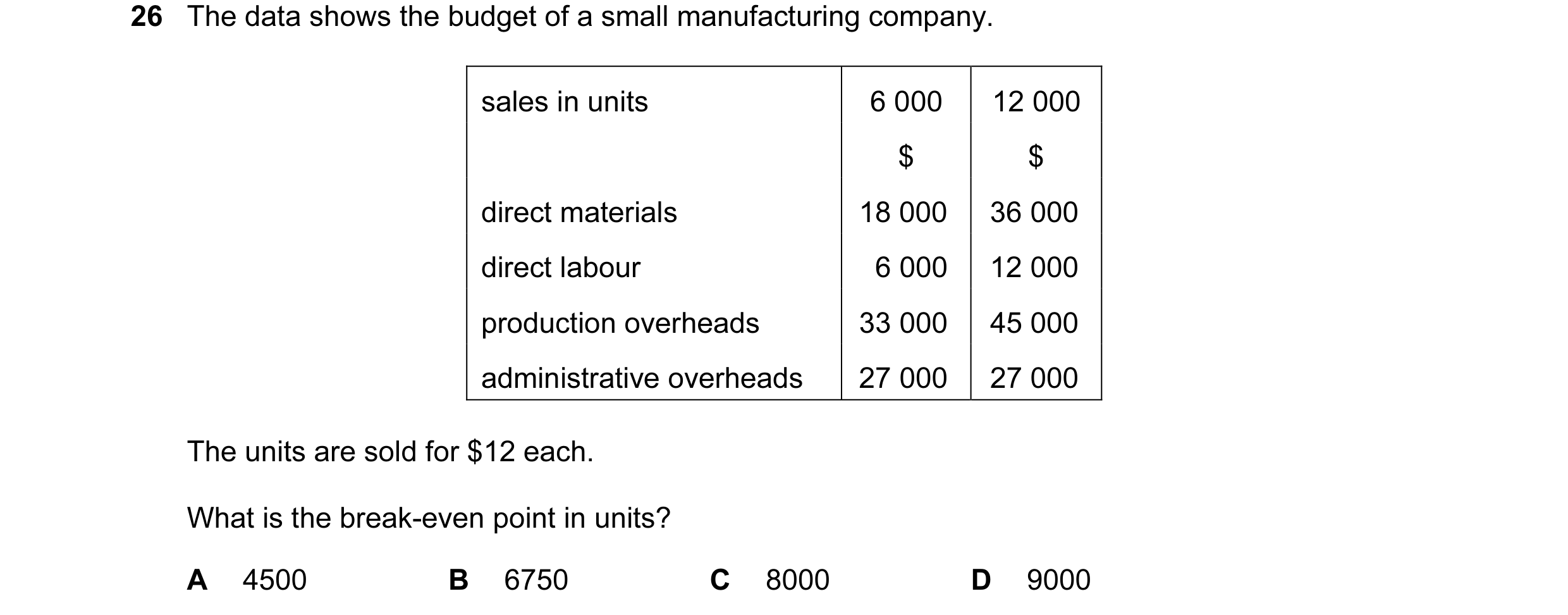
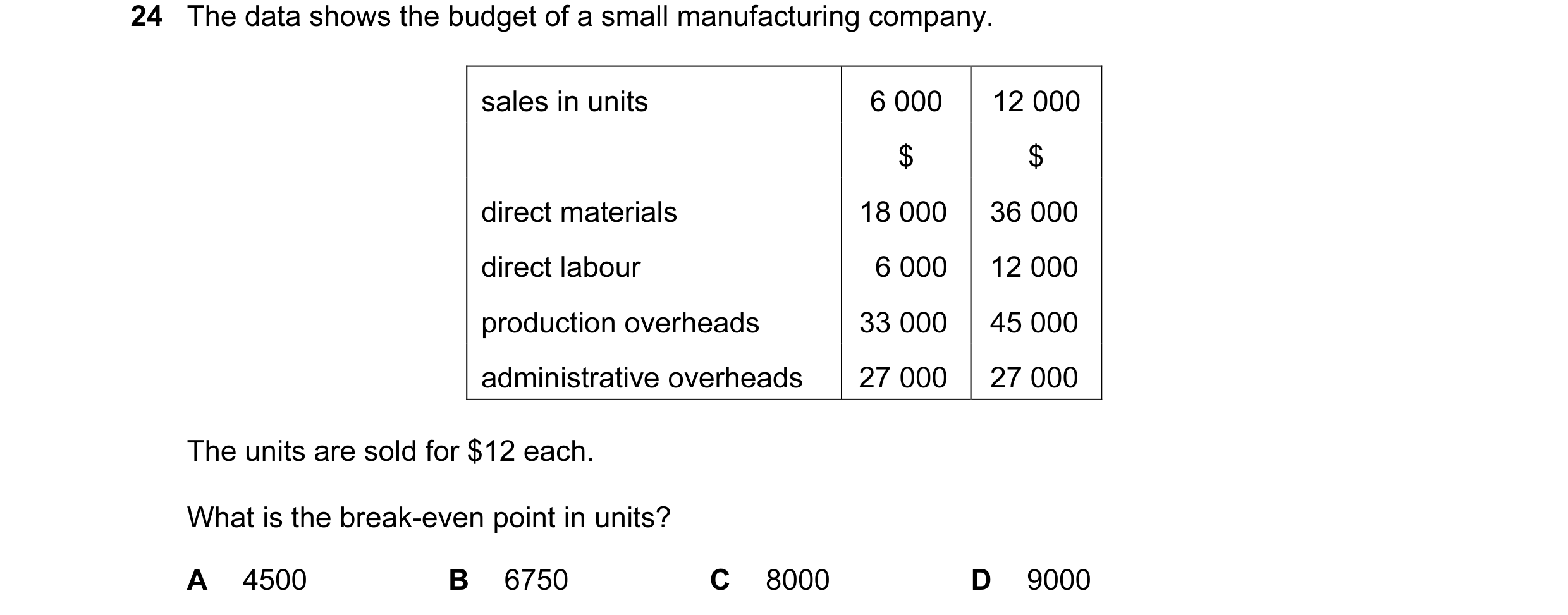
Q60 · The data shows the budget of a small manufacturing company 9706/31 May/June 2012
26 The data shows the budget of a small manufacturing company. sales in units 6 000 12 000 $ $ direct materials 18 000 36 000 direct labour 6 000 12 000 production overheads 33 000 45 000 administrative overheads 27 000 27 000 The units are sold for $12 each. What is the break-even point in units? A 4500 B 6750 C 8000 D 9000
1 marks
Answer: C
This question in 9706/31 May/June 2012
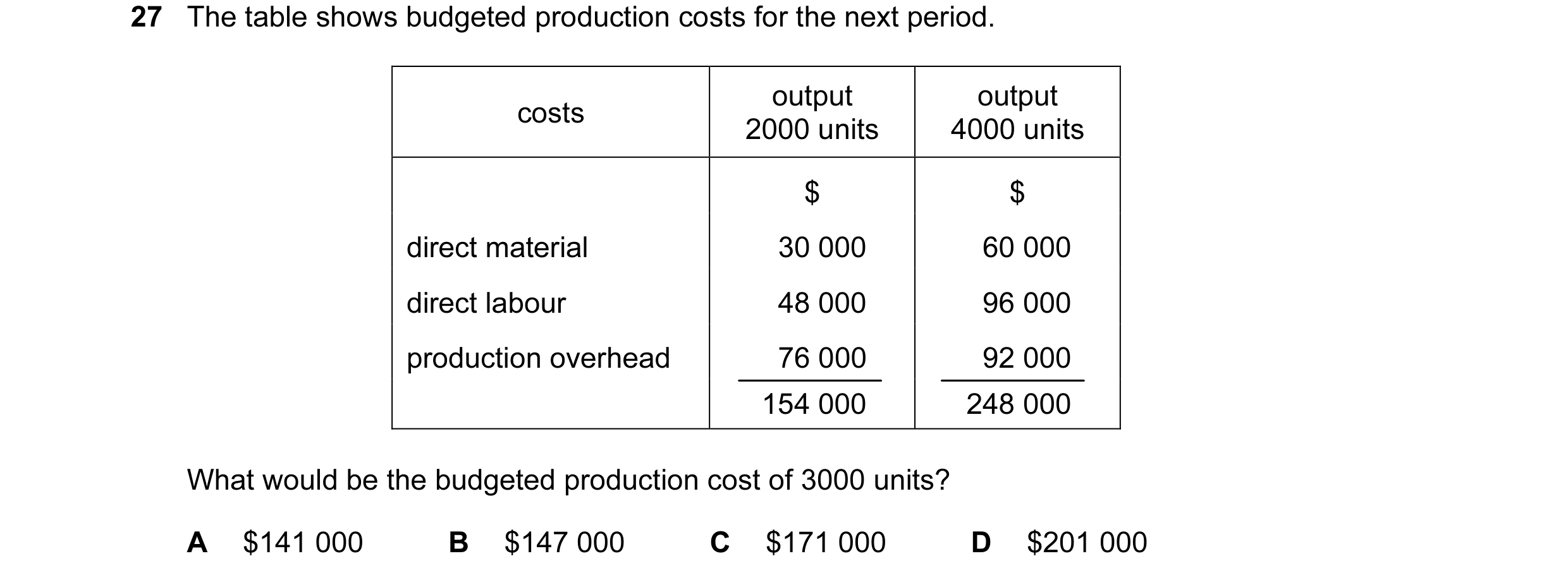
Q61 · The table shows budgeted production costs for the next period 9706/31 May/June 2012
27 The table shows budgeted production costs for the next period. output output costs 2000 units 4000 units $ $ direct material 30 000 60 000 direct labour 48 000 96 000 production overhead 76 000 92 000 154 000 248 000 What would be the budgeted production cost of 3000 units? A $141 000 B $147 000 C $171 000 D $201 000
1 marks
Answer: D
This question in 9706/31 May/June 2012
Q62 · A manufacturing company adds 10 % to the factory cost of goods produced to determine the… 9706/32 May/June 2012
20 A manufacturing company adds 10 % to the factory cost of goods produced to determine the price at which goods are transferred from factory to warehouse. The table shows information taken from the company’s income statement at the end of the financial year. $ opening inventory of finished goods 137 500 closing inventory of finished goods 159 500 How much should be debited in the income statement for the year for the provision for unrealised profit on stock? A $2000 B $2200 C $14 500 D $20 000
1 marks
Answer: A
This question in 9706/32 May/June 2012
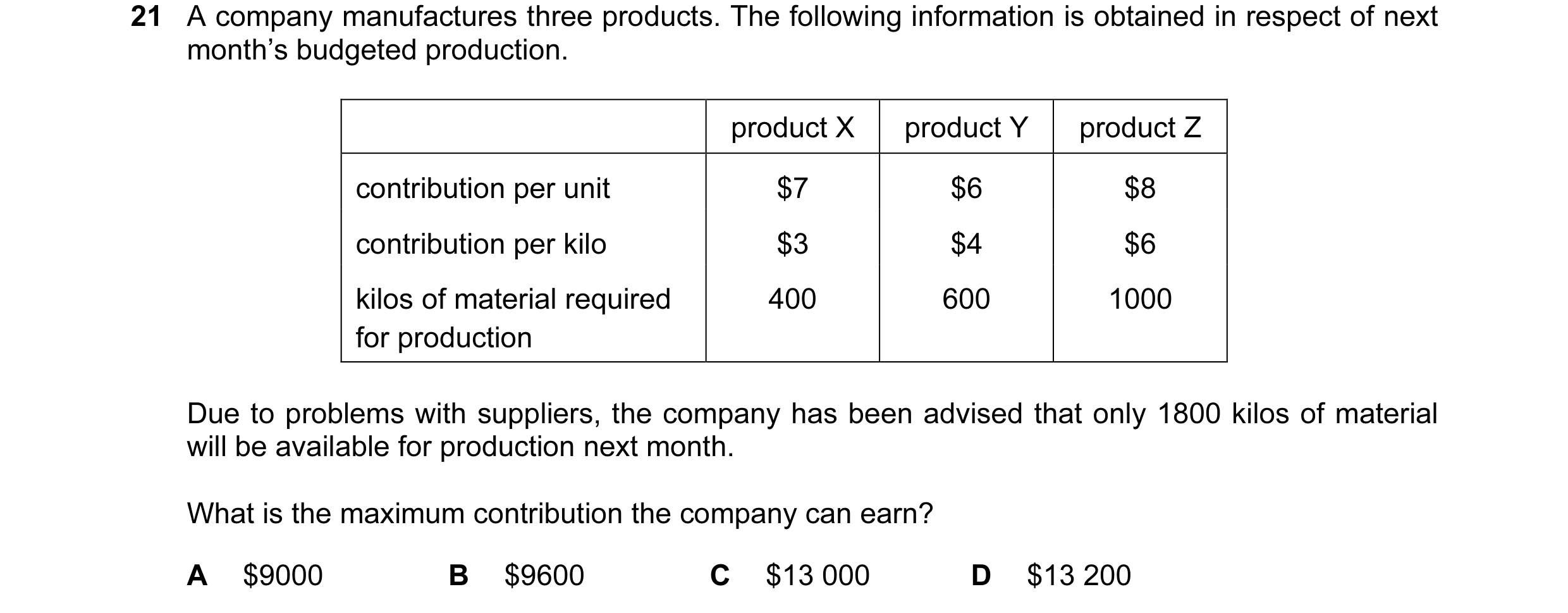
Q63 · A company manufactures three products 9706/32 May/June 2012
21 A company manufactures three products. The following information is obtained in respect of next month’s budgeted production. product X product Y product Z contribution per unit $7 $6 $8 contribution per kilo $3 $4 $6 kilos of material required 400 600 1000 for production Due to problems with suppliers, the company has been advised that only 1800 kilos of material will be available for production next month. What is the maximum contribution the company can earn? A $9000 B $9600 C $13 000 D $13 200
1 marks
Answer: A
This question in 9706/32 May/June 2012
Q64 · A process has an input of 6000 kilos at a cost of $118 200 9706/32 May/June 2012
22 A process has an input of 6000 kilos at a cost of $118 200. Normal wastage is 10 % of input and this is sold for $6 per kilo. There are no abnormal gains or losses. What is the cost per kilo of output from the process, to the nearest cent? A $19.10 B $19.70 C $21.22 D $21.89
1 marks
Answer: C
This question in 9706/32 May/June 2012
Q65 · The following relates to the production and costs of a manufacturer 9706/32 May/June 2012
23 The following relates to the production and costs of a manufacturer. production for the period 2400 units closing stock 400 units direct material costs $12 000 direct labour costs $6 000 factory fixed expenses $4 080 Closing stock is valued at marginal cost. What is the marginal cost per unit of the finished goods? A $7.50 B $9.00 C $9.20 D $11.04
1 marks
Answer: A
This question in 9706/32 May/June 2012
Q66 · The details of a planned college course are shown below 9706/32 May/June 2012
24 The details of a planned college course are shown below. $ course fee per student 100 variable course cost per student 20 total fixed costs of the course 480 The budgeted number of students is 10. However, if a lower fee is charged 20 students would take the course. What is the maximum reduction in the course fee of $100, to earn the same total profit from either 10 or 20 students? A $16 B $24 C $40 D $50
1 marks
Answer: C
This question in 9706/32 May/June 2012
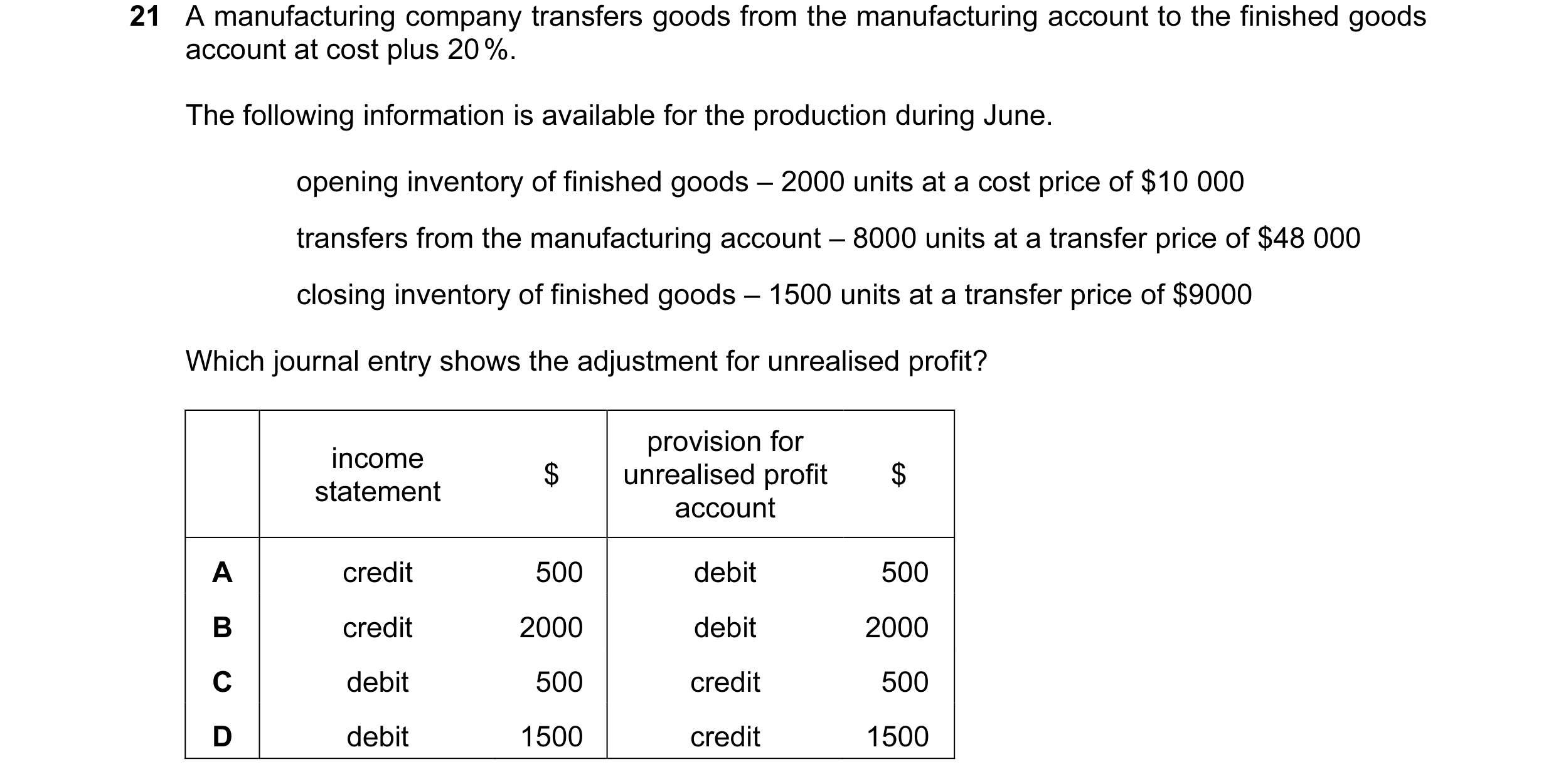
Q67 · A manufacturing company transfers goods from the manufacturing account to the finished… 9706/33 May/June 2012
21 A manufacturing company transfers goods from the manufacturing account to the finished goods account at cost plus 20 %. The following information is available for the production during June. opening inventory of finished goods – 2000 units at a cost price of $10 000 transfers from the manufacturing account – 8000 units at a transfer price of $48 000 closing inventory of finished goods – 1500 units at a transfer price of $9000 Which journal entry shows the adjustment for unrealised profit? provision for income $ unrealised profit $ statement account A credit 500 debit 500 B credit 2000 debit 2000 C debit 500 credit 500 D debit 1500 credit 1500
1 marks
Answer: A
This question in 9706/33 May/June 2012
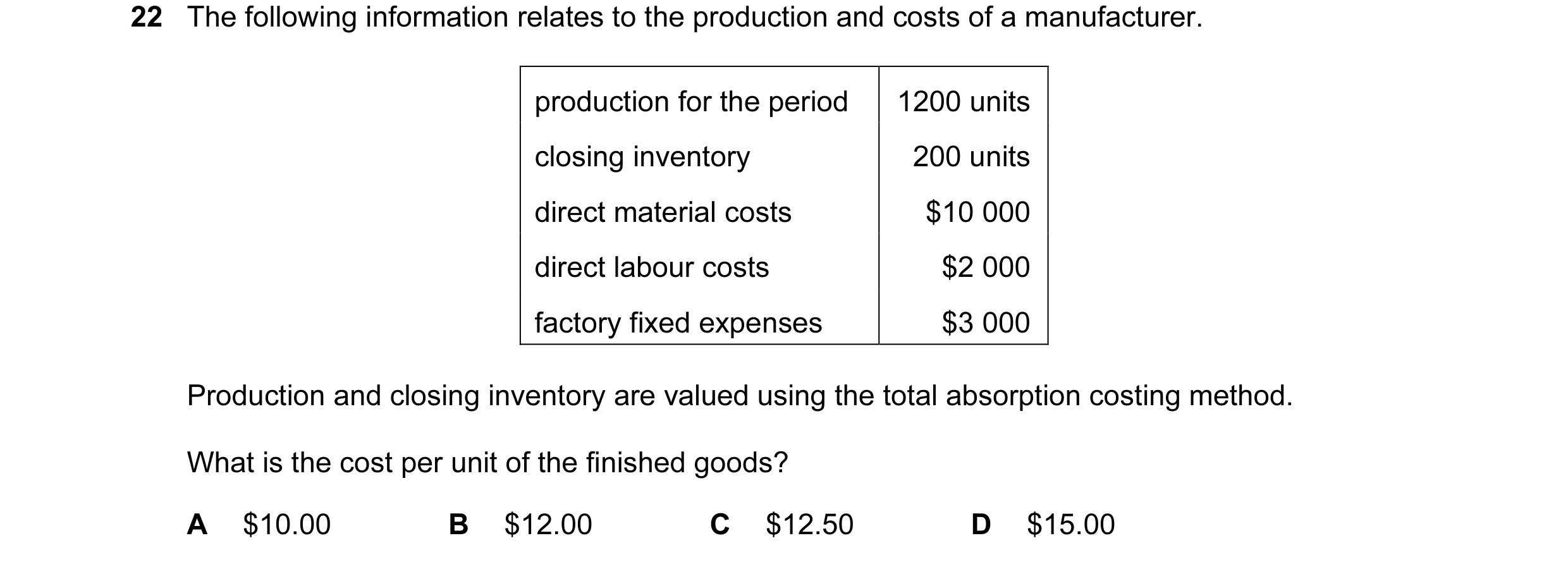
Q68 · The following information relates to the production and costs of a manufacturer 9706/33 May/June 2012
22 The following information relates to the production and costs of a manufacturer. production for the period 1200 units closing inventory 200 units direct material costs $10 000 direct labour costs $2 000 factory fixed expenses $3 000 Production and closing inventory are valued using the total absorption costing method. What is the cost per unit of the finished goods? A $10.00 B $12.00 C $12.50 D $15.00
1 marks
Answer: C
This question in 9706/33 May/June 2012
Q69 · The maximum amount of material available for the manufacture of products X and Y is 6400… 9706/33 May/June 2012
23 The maximum amount of material available for the manufacture of products X and Y is 6400 kilos. Information regarding the products is as follows product X Y maximum demand (units) 2000 2000 contribution per unit $15 $11 material required (kilos per unit) 4 2 contribution per kilo of material $3.75 $5.50 Which planned production will produce the maximum profit? product X product Y A none 2000 units B 600 units 2000 units C 1000 units 1200 units D 1600 units none
1 marks
Answer: B
This question in 9706/33 May/June 2012
Q70 · The data shows the budget of a small manufacturing company 9706/33 May/June 2012
24 The data shows the budget of a small manufacturing company. sales in units 6 000 12 000 $ $ direct materials 18 000 36 000 direct labour 6 000 12 000 production overheads 33 000 45 000 administrative overheads 27 000 27 000 The units are sold for $12 each. What is the break-even point in units? A 4500 B 6750 C 8000 D 9000
1 marks
Answer: C
This question in 9706/33 May/June 2012
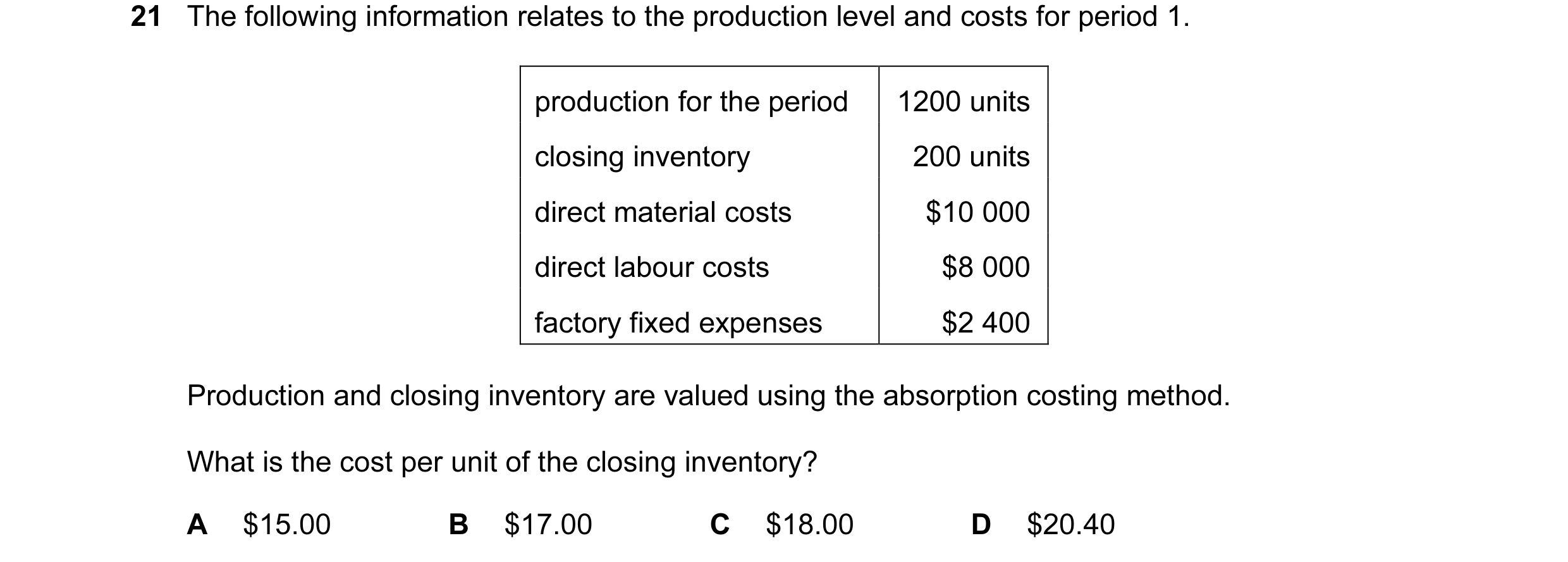
Q71 · The following information relates to the production level and costs for period 1 9706/31 Oct/Nov 2012
21 The following information relates to the production level and costs for period 1. production for the period 1200 units closing inventory 200 units direct material costs $10 000 direct labour costs $8 000 factory fixed expenses $2 400 Production and closing inventory are valued using the absorption costing method. What is the cost per unit of the closing inventory? A $15.00 B $17.00 C $18.00 D $20.40
1 marks
Answer: B
This question in 9706/31 Oct/Nov 2012
Q72 · A company produces its goods using a number of processes 9706/31 Oct/Nov 2012
22 A company produces its goods using a number of processes. In respect of process 1 the normal loss is sold as scrap. What are the book-keeping entries to record this transaction? account to be debited account to be credited A bank process B bank raw materials inventory C bank sales D bank work in progress
1 marks
Answer: A
This question in 9706/31 Oct/Nov 2012
Q73 · The following information relates to the production data for a process 9706/32 Oct/Nov 2012
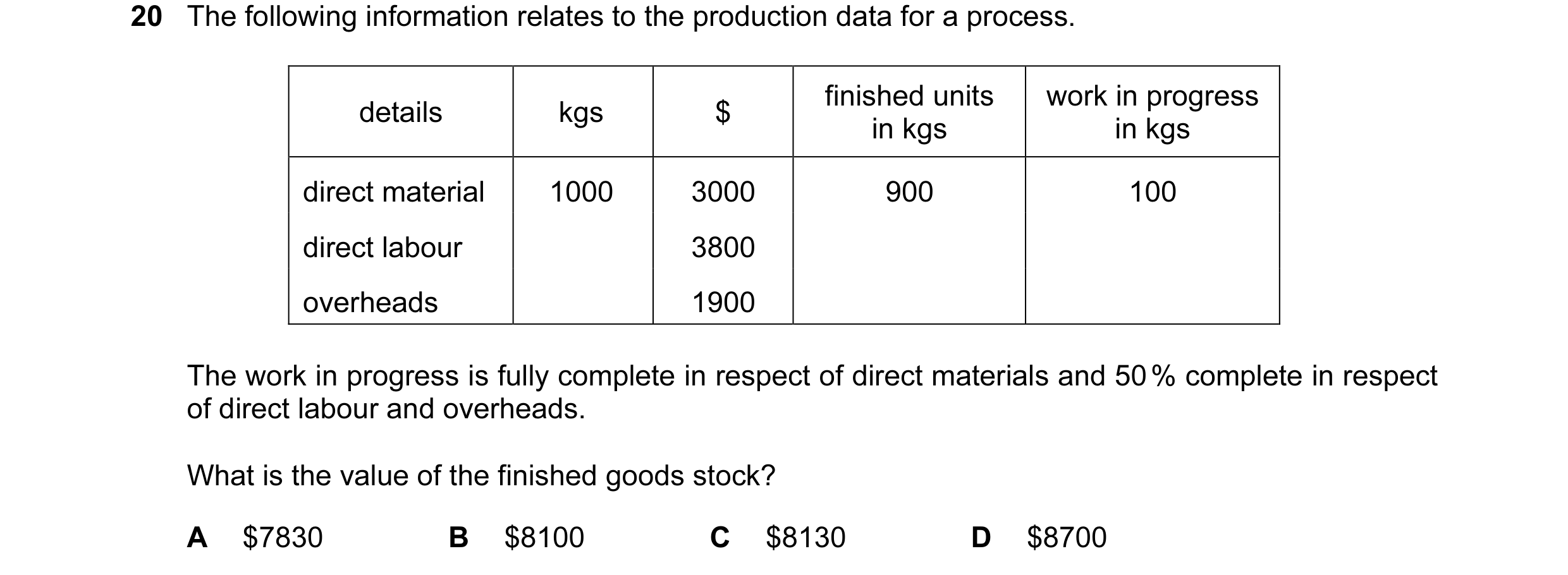
20 The following information relates to the production data for a process. finished units work in progress details kgs $ in kgs in kgs direct material 1000 3000 900 100 direct labour 3800 overheads 1900 The work in progress is fully complete in respect of direct materials and 50 % complete in respect of direct labour and overheads. What is the value of the finished goods stock? A $7830 B $8100 C $8130 D $8700
1 marks
Answer: B
This question in 9706/32 Oct/Nov 2012
Q74 · Using marginal costing to value its inventory, a company made a loss of $31 000 9706/32 Oct/Nov 2012
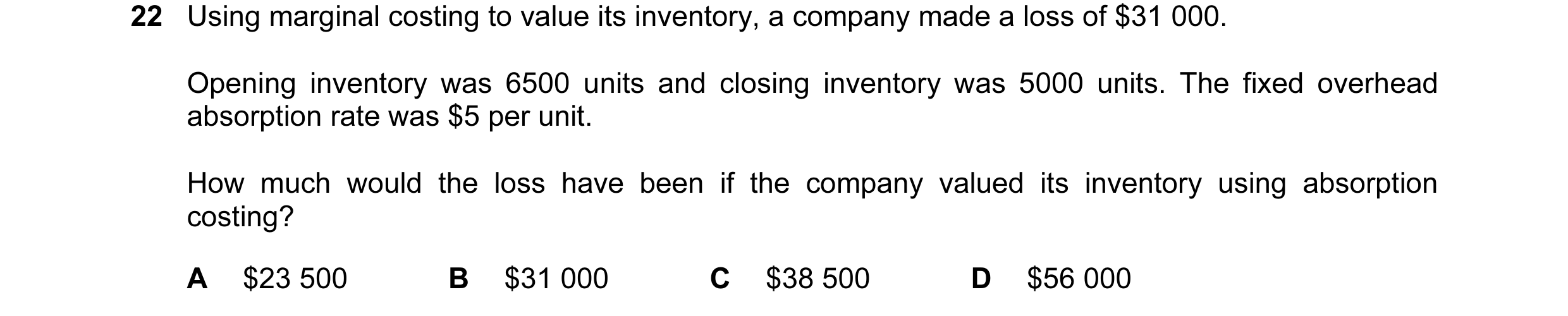
22 Using marginal costing to value its inventory, a company made a loss of $31 000. Opening inventory was 6500 units and closing inventory was 5000 units. The fixed overhead absorption rate was $5 per unit. How much would the loss have been if the company valued its inventory using absorption costing? A $23 500 B $31 000 C $38 500 D $56 000
1 marks
Answer: C
This question in 9706/32 Oct/Nov 2012
Q75 · The following information relates to the production data for a process 9706/33 Oct/Nov 2012
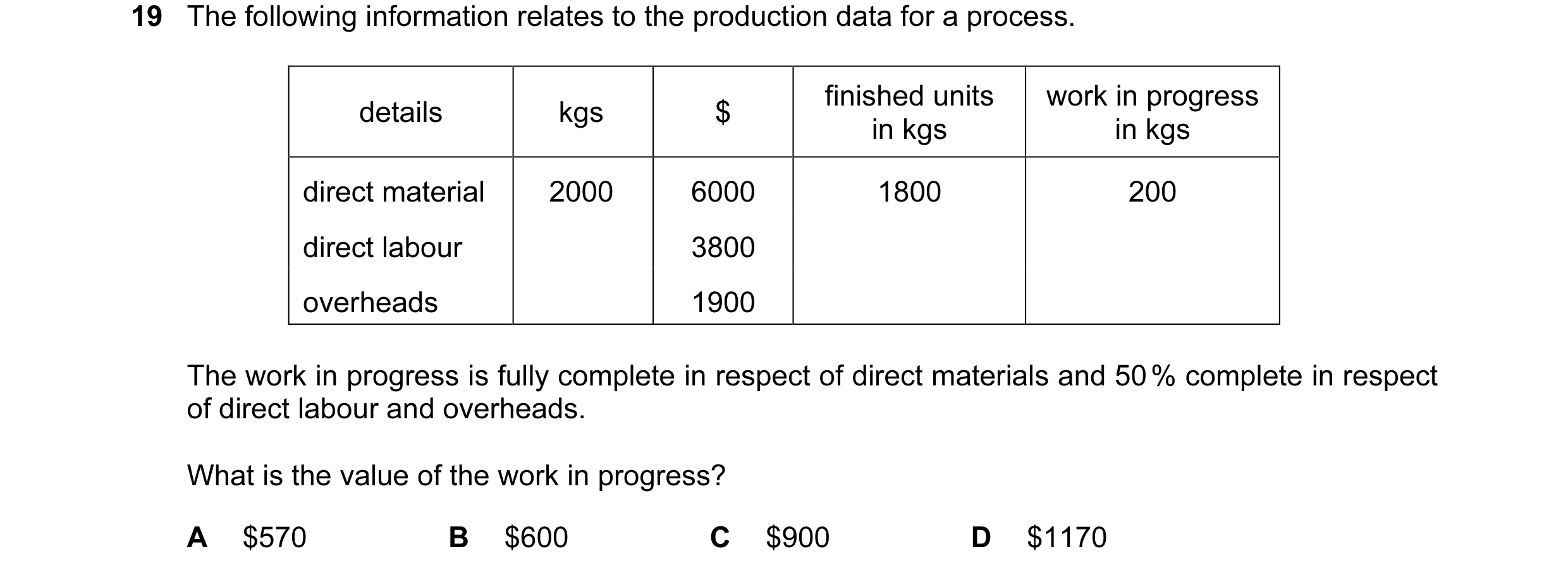
19 The following information relates to the production data for a process. finished units work in progress details kgs $ in kgs in kgs direct material 2000 6000 1800 200 direct labour 3800 overheads 1900 The work in progress is fully complete in respect of direct materials and 50 % complete in respect of direct labour and overheads. What is the value of the work in progress? A $570 B $600 C $900 D $1170
1 marks
Answer: C
This question in 9706/33 Oct/Nov 2012
Q76 · A company manufactures a single product 9706/33 Oct/Nov 2012
21 A company manufactures a single product. Each unit requires the following. 1 kg of material at $8 per kg 1 hour of direct labour at $10 per hour The following information is available for the process in June. direct material $4000 direct labour $4200 normal loss 50 units How many units were completed? A 370 B 420 C 450 D 500
1 marks
Answer: C
This question in 9706/33 Oct/Nov 2012
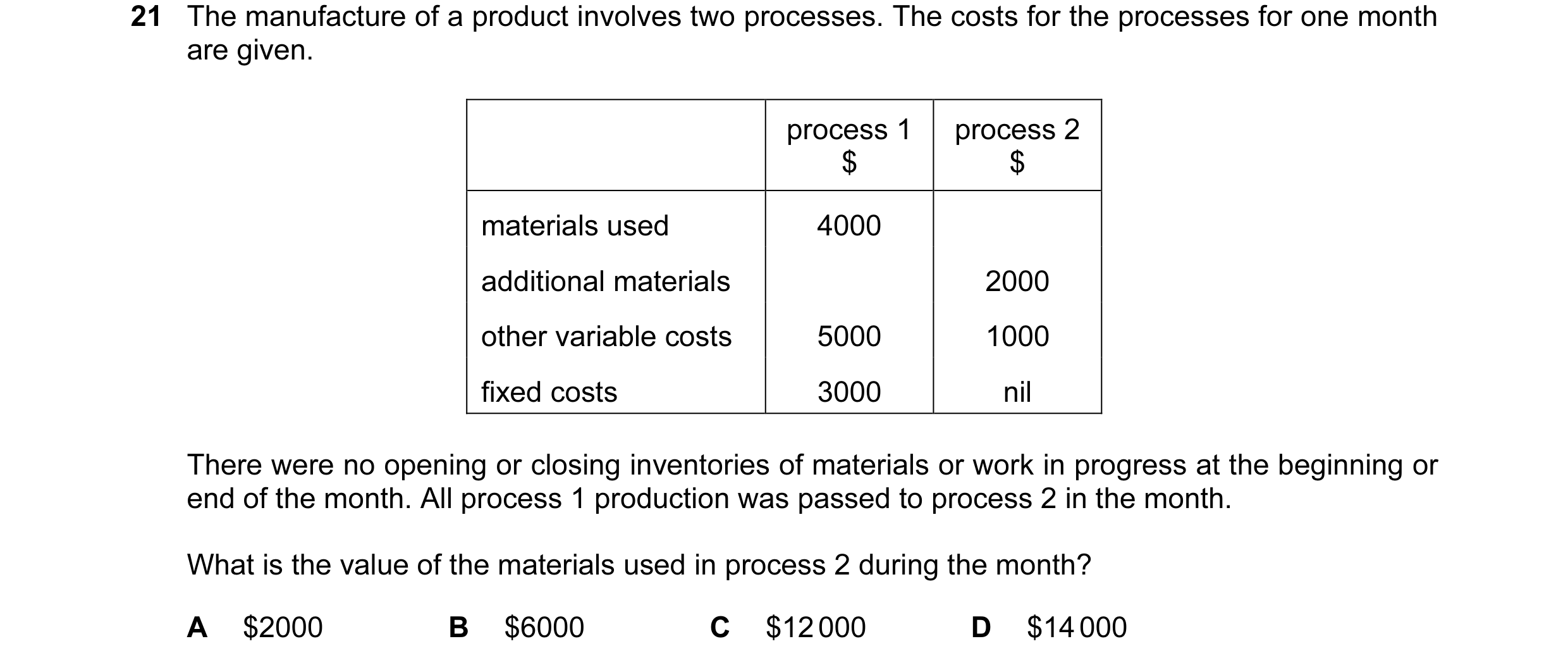
Q77 · The manufacture of a product involves two processes 9706/31 May/June 2013
21 The manufacture of a product involves two processes. The costs for the processes for one month are given. process 1 process 2 $ $ materials used 4000 additional materials 2000 other variable costs 5000 1000 fixed costs 3000 nil There were no opening or closing inventories of materials or work in progress at the beginning or end of the month. All process 1 production was passed to process 2 in the month. What is the value of the materials used in process 2 during the month? A $2000 B $6000 C $12 000 D $14 000
1 marks
Answer: D
This question in 9706/31 May/June 2013
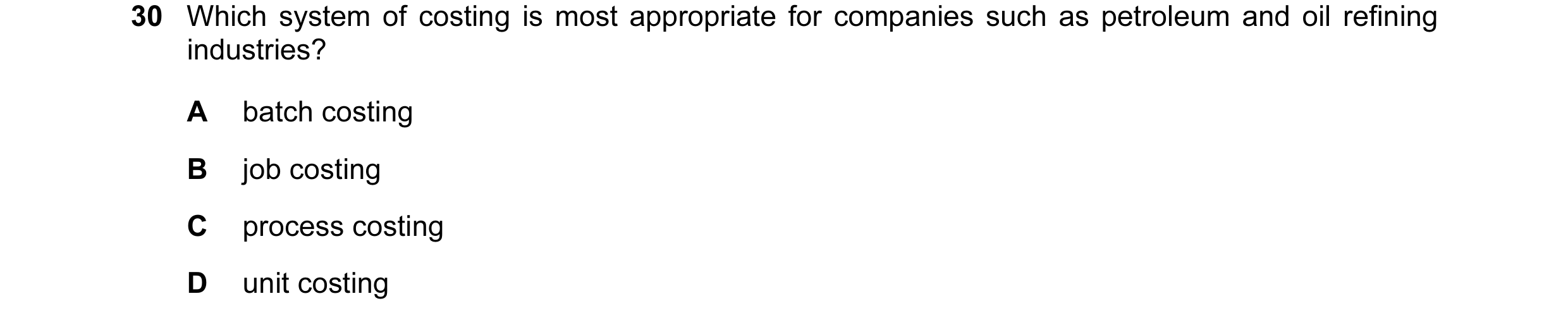
Q78 · Which system of costing is most appropriate for companies such as petroleum and oil… 9706/31 May/June 2013
30 Which system of costing is most appropriate for companies such as petroleum and oil refining industries? A batch costing B job costing C process costing D unit costing
1 marks
Answer: C
This question in 9706/31 May/June 2013
Q79 · The data is given for four products 9706/32 May/June 2013
20 The data is given for four products. selling price variable cost total fixed number of units product per unit per unit cost of product to be made $ $ $ 1 1000 5.00 3.50 700 2 2000 6.00 4.80 1500 3 1000 7.00 5.00 1400 4 3000 4.00 2.50 3800 The fixed cost of each product will be incurred only if the product is made. There is sufficient capacity in the factory to make only three of the product lines. Which choice of products will give the greatest profit? A 1, 2 and 3 B 1, 2 and 4 C 1, 3 and 4 D 2, 3 and 4
1 marks
Answer: B
This question in 9706/32 May/June 2013
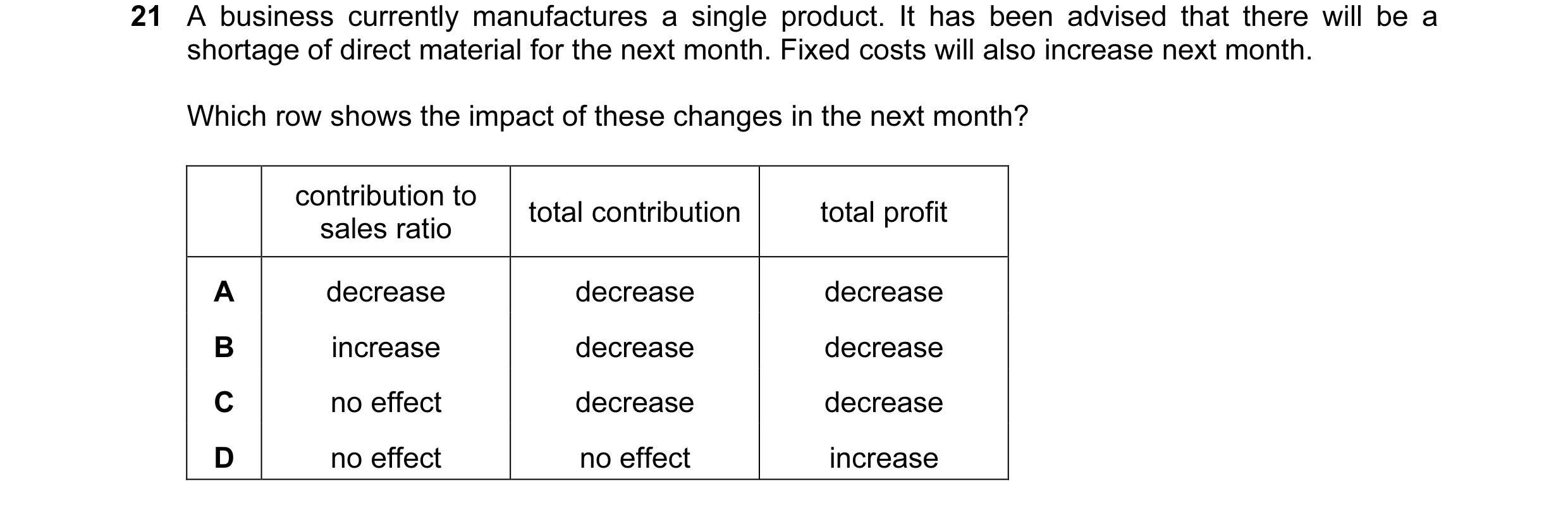
Q80 · A business currently manufactures a single product 9706/32 May/June 2013
21 A business currently manufactures a single product. It has been advised that there will be a shortage of direct material for the next month. Fixed costs will also increase next month. Which row shows the impact of these changes in the next month? contribution to total contribution total profit sales ratio A decrease decrease decrease B increase decrease decrease C no effect decrease decrease D no effect no effect increase
1 marks
Answer: C
This question in 9706/32 May/June 2013
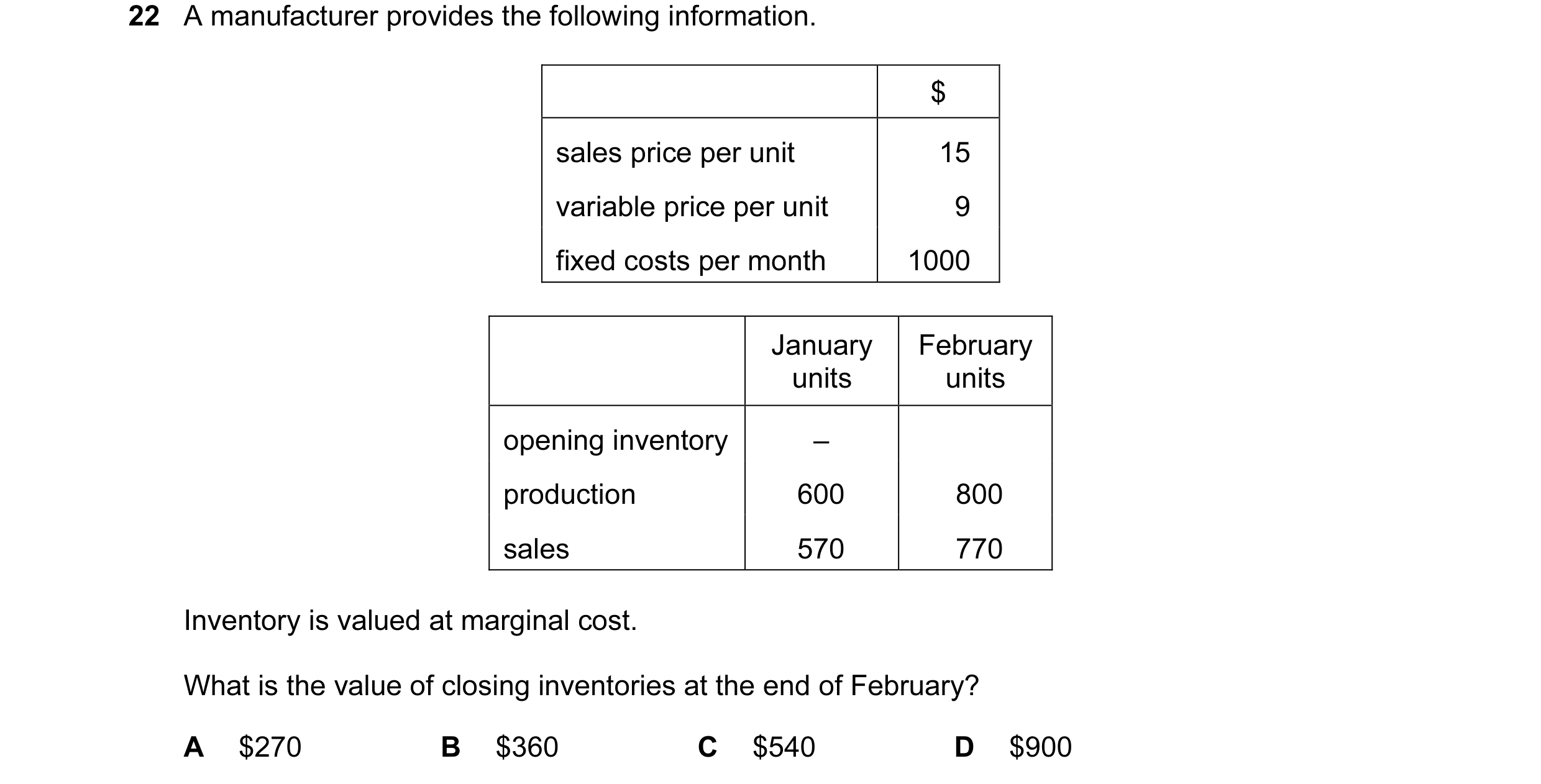
Q81 · A manufacturer provides the following information 9706/32 May/June 2013
22 A manufacturer provides the following information. $ sales price per unit 15 variable price per unit 9 fixed costs per month 1000 January February units units opening inventory – production 600 800 sales 570 770 Inventory is valued at marginal cost. What is the value of closing inventories at the end of February? A $270 B $360 C $540 D $900
1 marks
Answer: C
This question in 9706/32 May/June 2013
Q82 · A company makes three products for which the following details are given 9706/33 May/June 2013
19 A company makes three products for which the following details are given. product P product Q product R $ $ $ selling price per unit 20 24 36 direct material per unit 9 12 15 direct labour per unit 5 3 9 The same material is used by all three products and it costs $3.00 per kilo. There is a shortage of material. In which order of priority should the products be made in order to achieve maximum profit from the available material? A P → Q → R B Q → R → P C R → P → Q D R → Q → P
1 marks
Answer: D
This question in 9706/33 May/June 2013
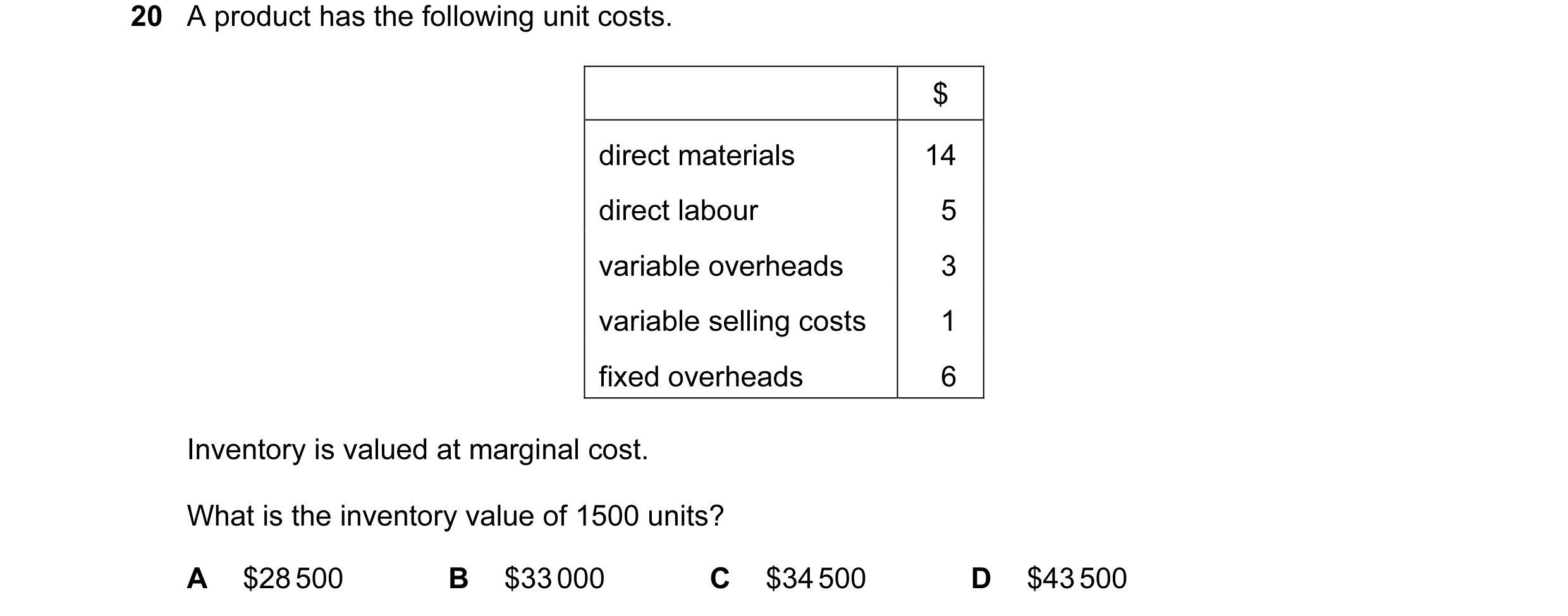
Q83 · A product has the following unit costs 9706/33 May/June 2013
20 A product has the following unit costs. $ direct materials 14 direct labour 5 variable overheads 3 variable selling costs 1 fixed overheads 6 Inventory is valued at marginal cost. What is the inventory value of 1500 units? A $28 500 B $33 000 C $34 500 D $43 500
1 marks
Answer: B
This question in 9706/33 May/June 2013
Q84 · 1500 units costing $2 per unit were input into a process 9706/33 May/June 2013
21 1500 units costing $2 per unit were input into a process. The normal loss was 20% of the input. The lost units had a scrap value of $0.40 each. What will be the cost per unit of output? A $1.60 B $1.92 C $2.00 D $2.40
1 marks
Answer: D
This question in 9706/33 May/June 2013
Q85 · A company has fixed costs of $5000 9706/31 Oct/Nov 2013
20 A company has fixed costs of $5000. Sales for 600 units have been made. The budgeted unit details are as follows. $ selling price 26 variable costs 19 fixed costs 2 profit 5 At what minimum price should an order for 200 additional units be accepted in order to break even? A $19 B $23 C $24 D $26
1 marks
Answer: B
This question in 9706/31 Oct/Nov 2013
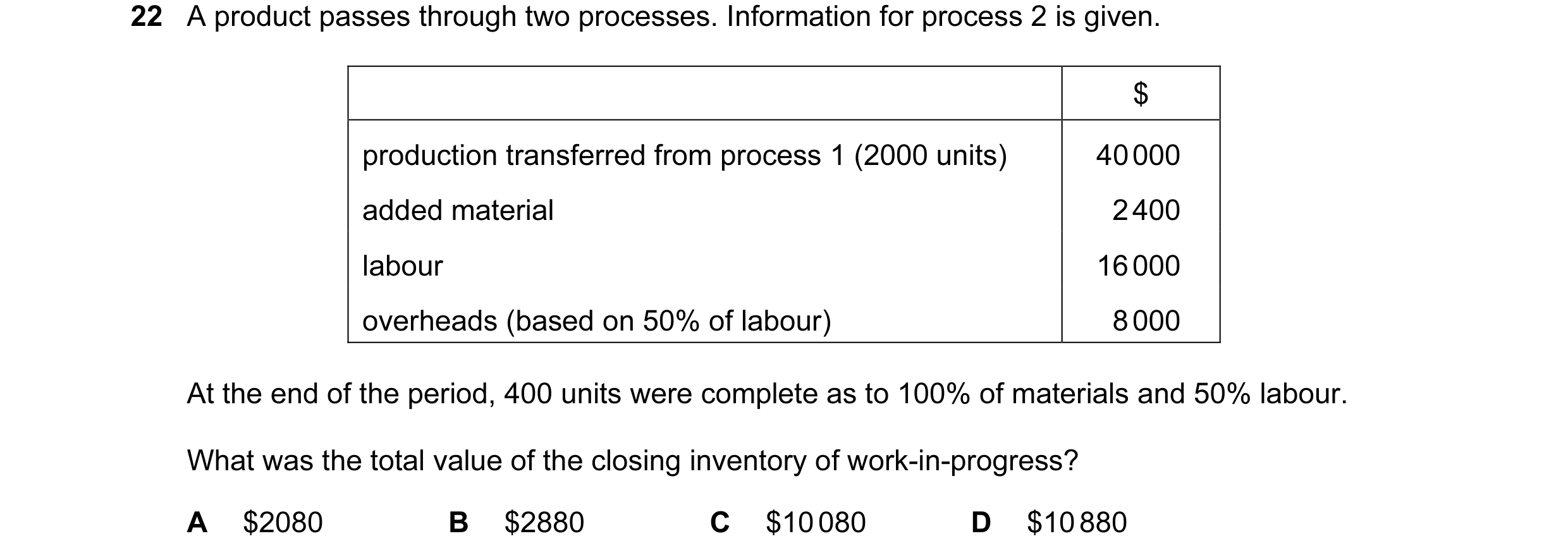
Q86 · A product passes through two processes 9706/31 Oct/Nov 2013
22 A product passes through two processes. Information for process 2 is given. $ production transferred from process 1 (2000 units) 40 000 added material 2 400 labour 16 000 overheads (based on 50% of labour) 8 000 At the end of the period, 400 units were complete as to 100% of materials and 50% labour. What was the total value of the closing inventory of work-in-progress? A $2080 B $2880 C $10 080 D $10 880
1 marks
Answer: D
This question in 9706/31 Oct/Nov 2013
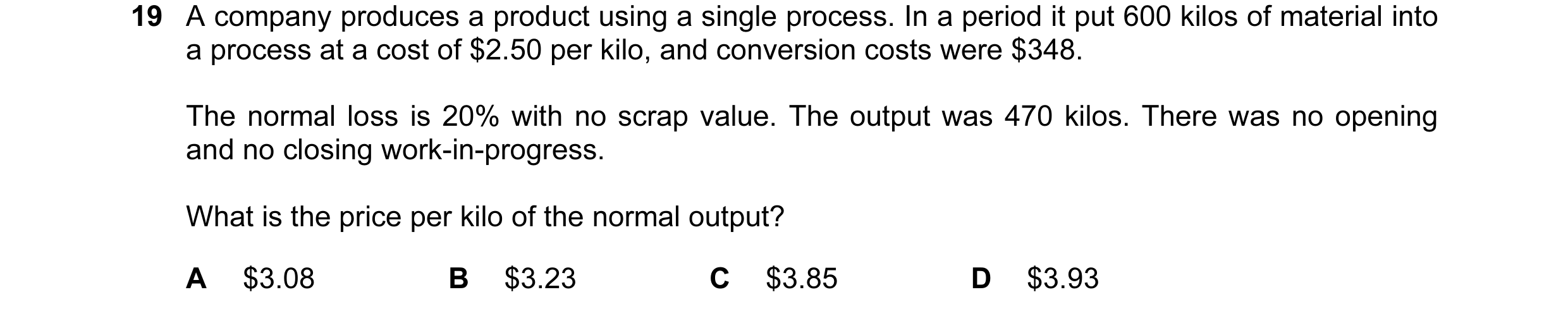
Q87 · A company produces a product using a single process 9706/32 Oct/Nov 2013
19 A company produces a product using a single process. In a period it put 600 kilos of material into a process at a cost of $2.50 per kilo, and conversion costs were $348. The normal loss is 20% with no scrap value. The output was 470 kilos. There was no opening and no closing work-in-progress. What is the price per kilo of the normal output? A $3.08 B $3.23 C $3.85 D $3.93
1 marks
Answer: C
This question in 9706/32 Oct/Nov 2013
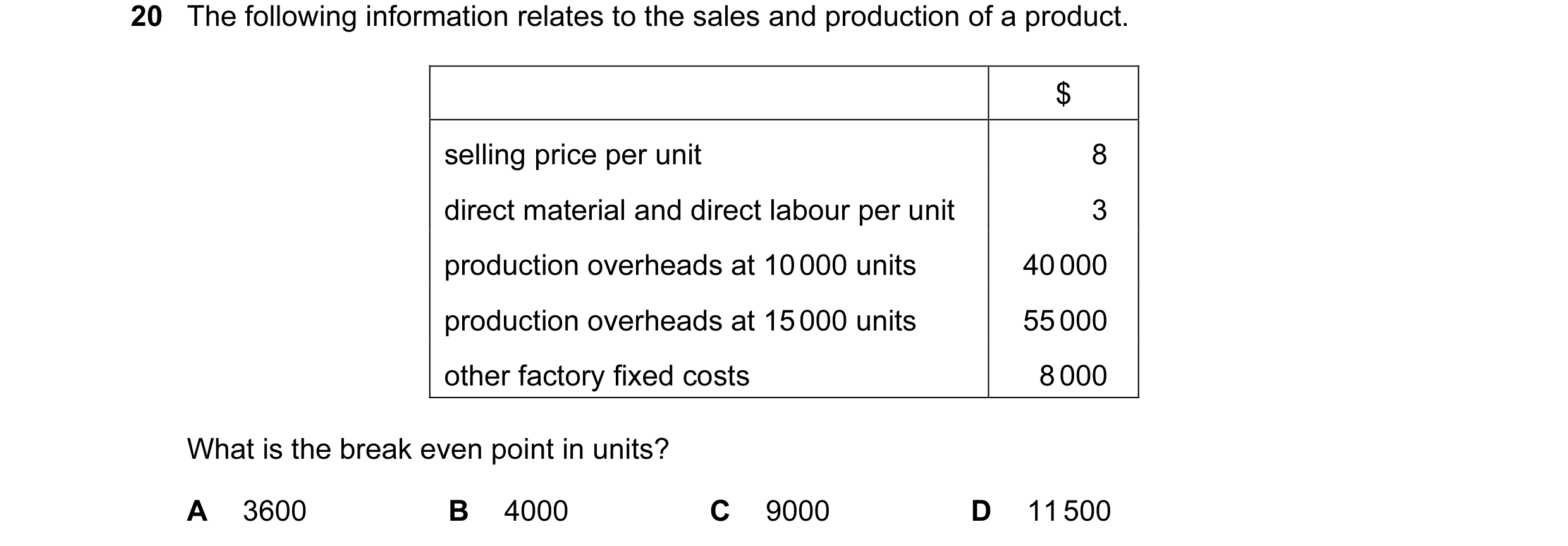
Q88 · The following information relates to the sales and production of a product 9706/32 Oct/Nov 2013
20 The following information relates to the sales and production of a product. $ selling price per unit 8 direct material and direct labour per unit 3 production overheads at 10 000 units 40 000 production overheads at 15 000 units 55 000 other factory fixed costs 8 000 What is the break even point in units? A 3600 B 4000 C 9000 D 11 500
1 marks
Answer: C
This question in 9706/32 Oct/Nov 2013
Q89 · A cost centre uses an overhead absorption rate of $5 per direct labour hour based on a… 9706/32 Oct/Nov 2013
21 A cost centre uses an overhead absorption rate of $5 per direct labour hour based on a budgeted level of 6000 direct labour hours per month. Last month, actual direct labour hours worked were 3% more than budget and the actual overhead incurred was $32 000. What was the total over or under absorption of overheads for the month? A $1100 over absorbed B $1100 under absorbed C $2000 over absorbed D $2000 under absorbed
1 marks
Answer: B
This question in 9706/32 Oct/Nov 2013
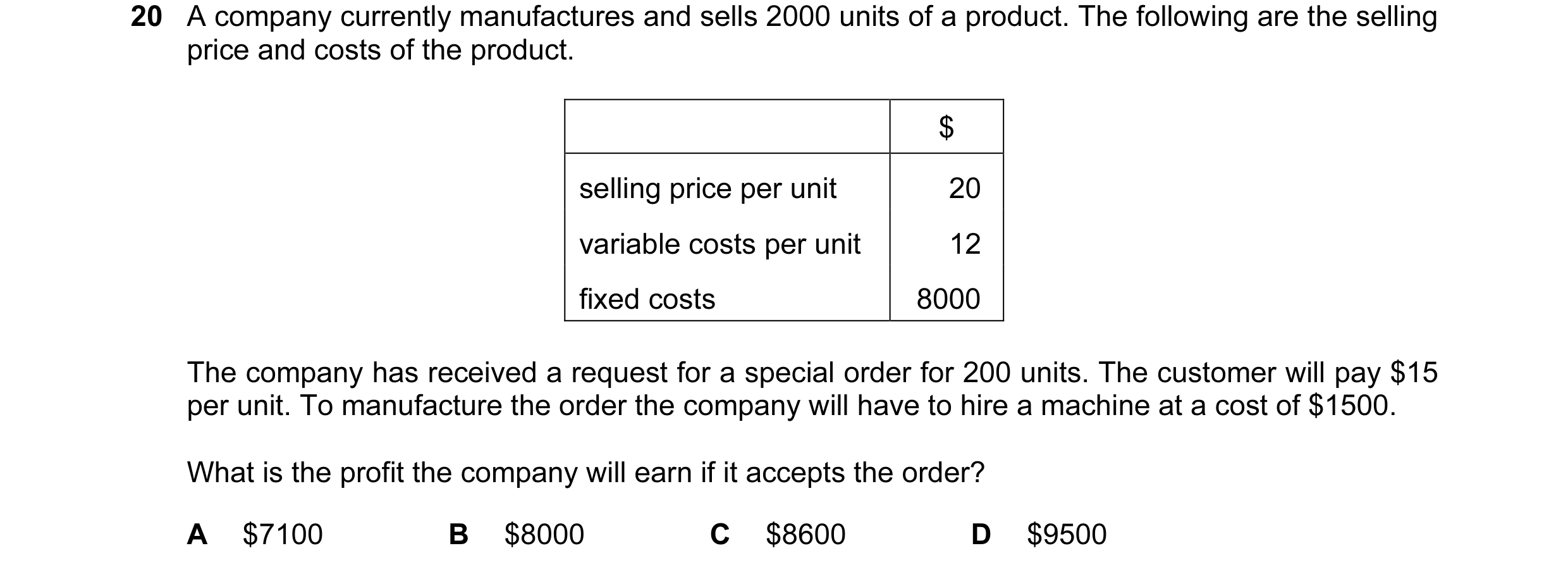
Q90 · A company currently manufactures and sells 2000 units of a product 9706/33 Oct/Nov 2013
20 A company currently manufactures and sells 2000 units of a product. The following are the selling price and costs of the product. $ selling price per unit 20 variable costs per unit 12 fixed costs 8000 The company has received a request for a special order for 200 units. The customer will pay $15 per unit. To manufacture the order the company will have to hire a machine at a cost of $1500. What is the profit the company will earn if it accepts the order? A $7100 B $8000 C $8600 D $9500
1 marks
Answer: A
This question in 9706/33 Oct/Nov 2013
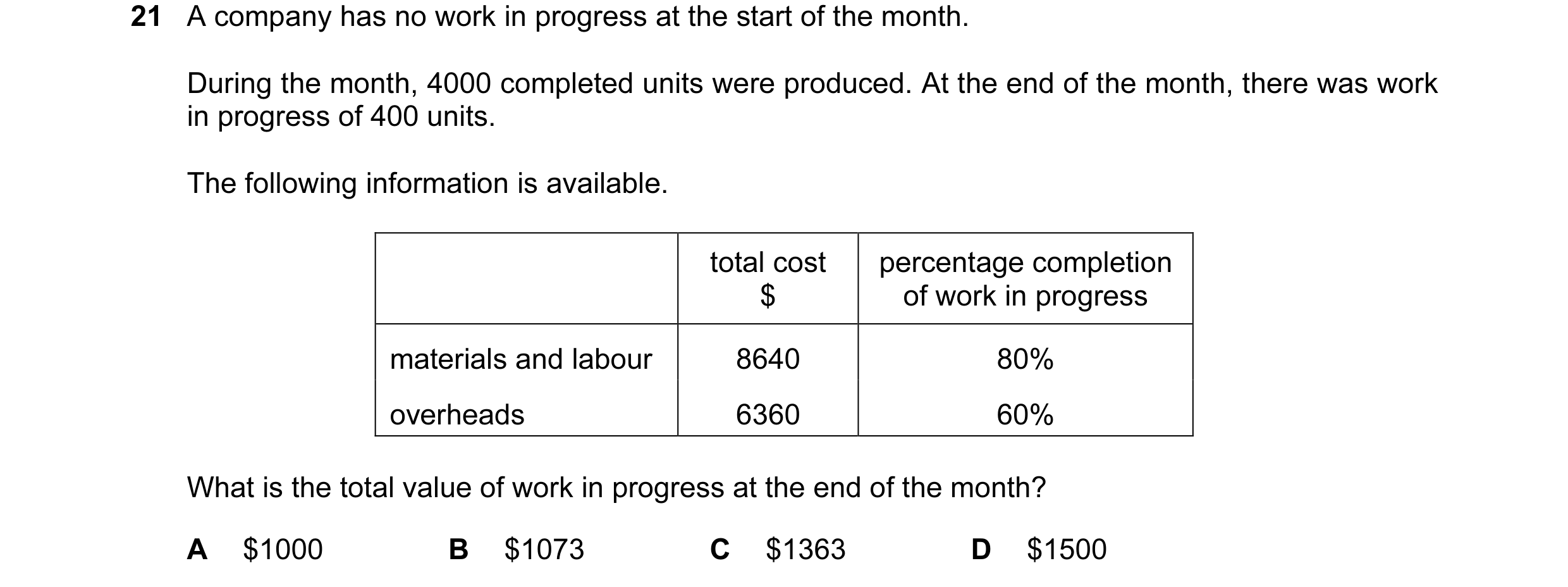
Q91 · A company has no work in progress at the start of the month 9706/33 Oct/Nov 2013
21 A company has no work in progress at the start of the month. During the month, 4000 completed units were produced. At the end of the month, there was work in progress of 400 units. The following information is available. total cost percentage completion $ of work in progress materials and labour 8640 80% overheads 6360 60% What is the total value of work in progress at the end of the month? A $1000 B $1073 C $1363 D $1500
1 marks
Answer: A
This question in 9706/33 Oct/Nov 2013
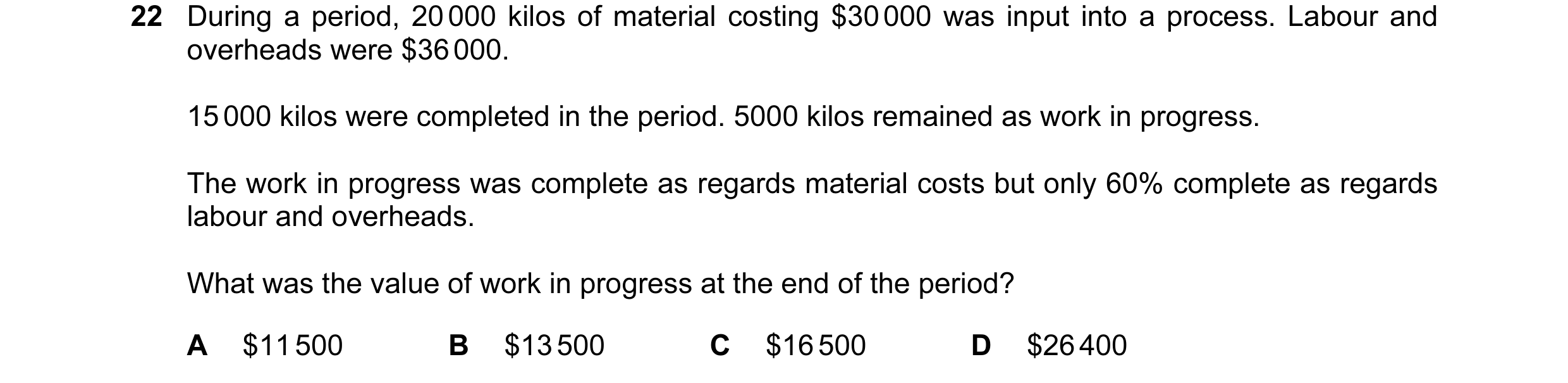
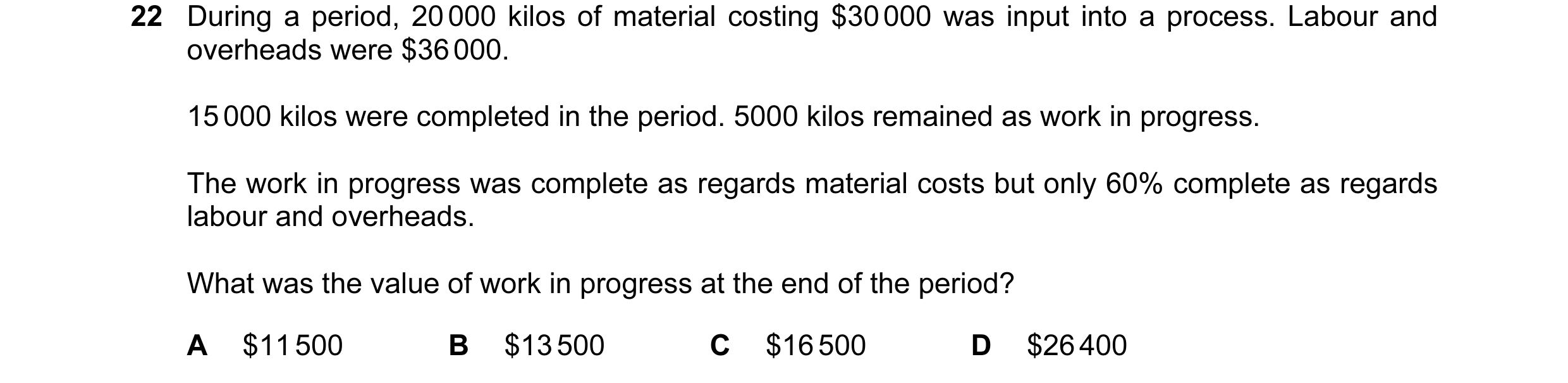
Q92 · During a period, 20 000 kilos of material costing $30 000 was input into a process 9706/31 May/June 2014
22 During a period, 20 000 kilos of material costing $30 000 was input into a process. Labour and overheads were $36 000. 15 000 kilos were completed in the period. 5000 kilos remained as work in progress. The work in progress was complete as regards material costs but only 60% complete as regards labour and overheads. What was the value of work in progress at the end of the period? A $11 500 B $13 500 C $16 500 D $26 400
1 marks
Answer: B
This question in 9706/31 May/June 2014
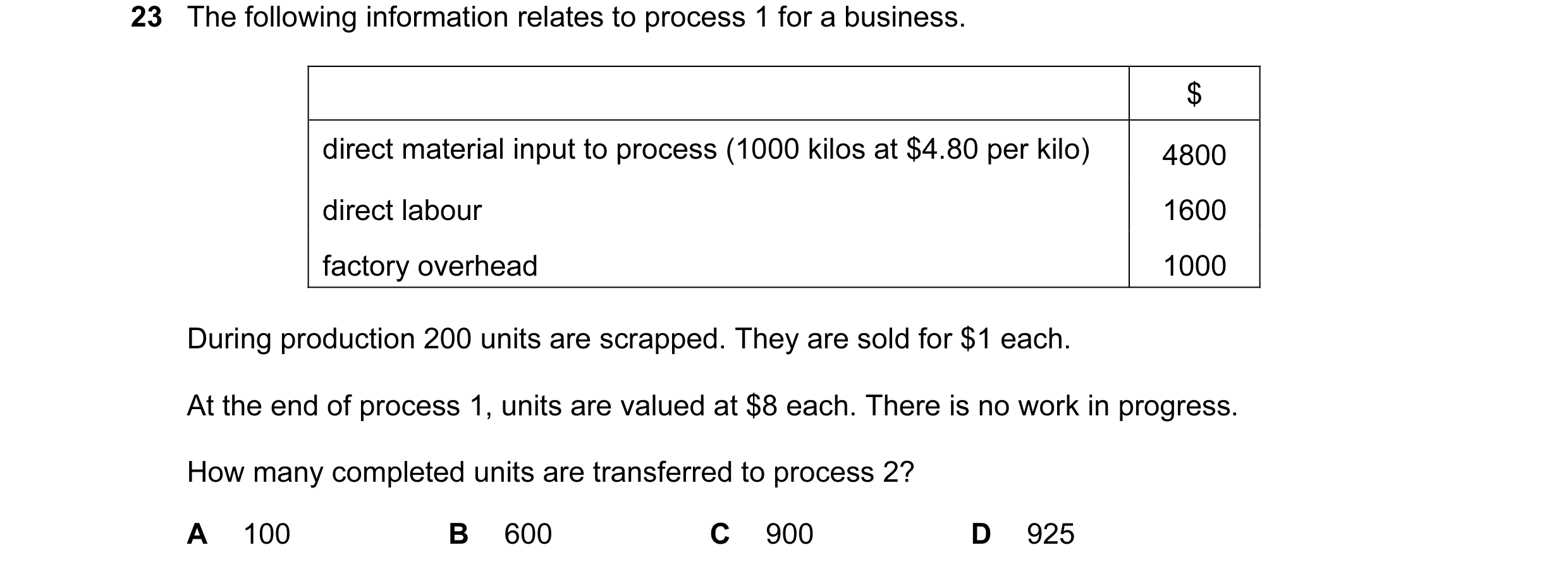
Q93 · The following information relates to process 1 for a business 9706/31 May/June 2014
23 The following information relates to process 1 for a business. $ direct material input to process (1000 kilos at $4.80 per kilo) 4800 direct labour 1600 factory overhead 1000 During production 200 units are scrapped. They are sold for $1 each. At the end of process 1, units are valued at $8 each. There is no work in progress. How many completed units are transferred to process 2? A 100 B 600 C 900 D 925
1 marks
Answer: C
This question in 9706/31 May/June 2014
Q94 · During a period, 20 000 kilos of material costing $30 000 was input into a process 9706/32 May/June 2014
22 During a period, 20 000 kilos of material costing $30 000 was input into a process. Labour and overheads were $36 000. 15 000 kilos were completed in the period. 5000 kilos remained as work in progress. The work in progress was complete as regards material costs but only 60% complete as regards labour and overheads. What was the value of work in progress at the end of the period? A $11 500 B $13 500 C $16 500 D $26 400
1 marks
Answer: B
This question in 9706/32 May/June 2014
Q95 · The following information relates to process 1 for a business 9706/32 May/June 2014
23 The following information relates to process 1 for a business. $ direct material input to process (1000 kilos at $4.80 per kilo) 4800 direct labour 1600 factory overhead 1000 During production 200 units are scrapped. They are sold for $1 each. At the end of process 1, units are valued at $8 each. There is no work in progress. How many completed units are transferred to process 2? A 100 B 600 C 900 D 925
1 marks
Answer: C
This question in 9706/32 May/June 2014
Q96 · The total monthly production cost of a process was $78 200 9706/33 May/June 2014
21 The total monthly production cost of a process was $78 200. Finished process output amounted to 8000 completed units. There were also 2000 units of work in progress 60% complete. There were no opening inventory or normal waste. What was the cost per equivalent unit? A $7.82 B $8.50 C $8.89 D $9.78
1 marks
Answer: B
This question in 9706/33 May/June 2014
Q97 · A company provides the following information about a product 9706/33 May/June 2014
22 A company provides the following information about a product. $ per unit selling price 12 variable cost 4 fixed cost 6 profit 2 The budgeted profit is $60 000. What is the margin of safety as a percentage of sales? A 20% B 25% C 30% D 33.33%
1 marks
Answer: B
This question in 9706/33 May/June 2014
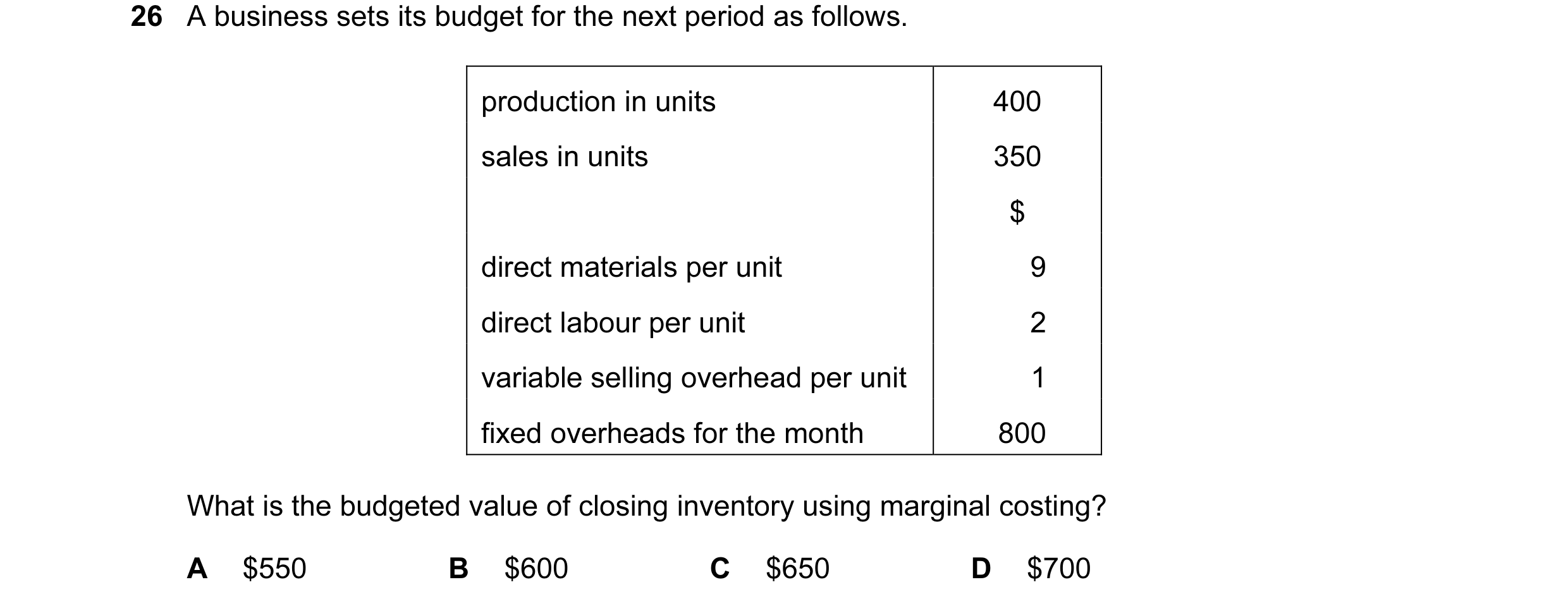
Q98 · A business sets its budget for the next period as follows 9706/33 May/June 2014
26 A business sets its budget for the next period as follows. production in units 400 sales in units 350 $ direct materials per unit 9 direct labour per unit 2 variable selling overhead per unit 1 fixed overheads for the month 800 What is the budgeted value of closing inventory using marginal costing? A $550 B $600 C $650 D $700
1 marks
Answer: A
This question in 9706/33 May/June 2014
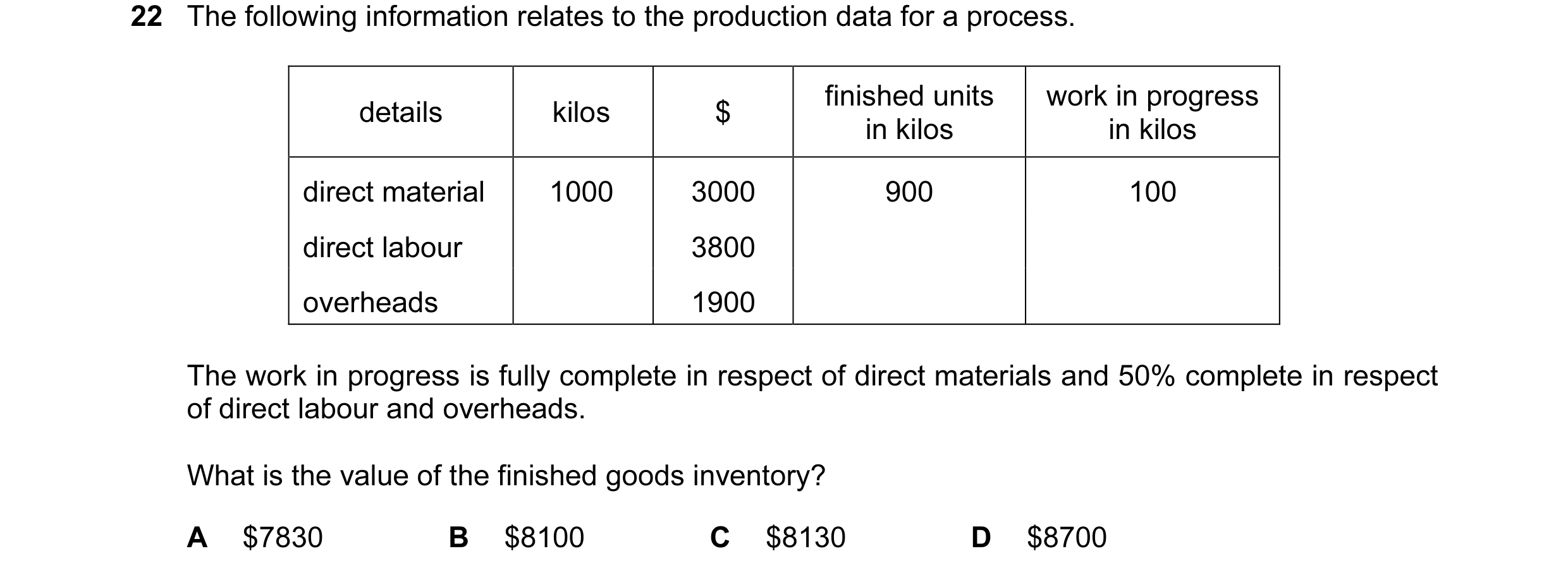
Q99 · The following information relates to the production data for a process 9706/31 Oct/Nov 2015
22 The following information relates to the production data for a process. finished units work in progress details kilos $ in kilos in kilos direct material 1000 3000 900 100 direct labour 3800 overheads 1900 The work in progress is fully complete in respect of direct materials and 50% complete in respect of direct labour and overheads. What is the value of the finished goods inventory? A $7830 B $8100 C $8130 D $8700
1 marks
Answer: B
This question in 9706/31 Oct/Nov 2015
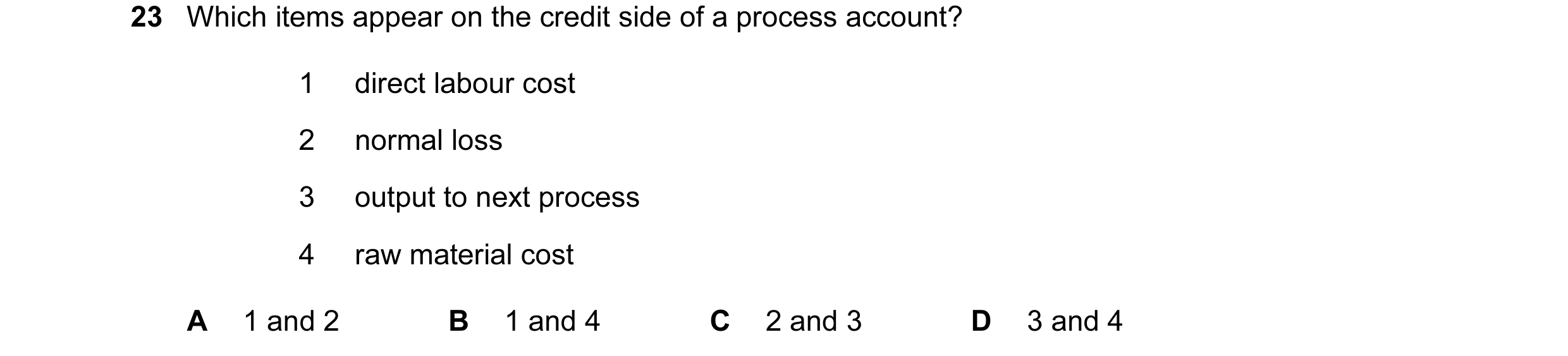
Q100 · Which items appear on the credit side of a process account? 9706/31 Oct/Nov 2015
23 Which items appear on the credit side of a process account? 1 direct labour cost 2 normal loss 3 output to next process 4 raw material cost A 1 and 2 B 1 and 4 C 2 and 3 D 3 and 4
1 marks
Answer: C
This question in 9706/31 Oct/Nov 2015
Q101 · A manufacturing business provides the following inventory valuations for finished goods 9706/32 Oct/Nov 2015
6 A manufacturing business provides the following inventory valuations for finished goods. $ at 1 January 2014 45 000 at 31 December 2014 60 000 Goods are transferred from the factory at cost plus 25%. Which adjustment is made for unrealised profit? A $3000 added to gross profit B $3000 deducted from gross profit C $3750 added to gross profit D $3750 deducted from gross profit
1 marks
Answer: B
This question in 9706/32 Oct/Nov 2015
Q102 · In July, a business had opening inventory of 10 000 units and closing inventory of 16 000… 9706/32 Oct/Nov 2015
22 In July, a business had opening inventory of 10 000 units and closing inventory of 16 000 units. The profit calculated on marginal costing principles was $220 000 and on absorption costing principles $268 000. What was the fixed overhead absorption rate per unit? A $8.00 B $13.75 C $16.75 D $22.00
1 marks
Answer: A
This question in 9706/32 Oct/Nov 2015
Q103 · A process has an input of 12 000 kilos at a cost of $236 400 9706/32 Oct/Nov 2015
23 A process has an input of 12 000 kilos at a cost of $236 400. Normal wastage is 10% of input, and this is sold for $8 per kilo. What is the cost per kilo of output from the process? A $18.90 B $19.70 C $21.00 D $21.89
1 marks
Answer: C
This question in 9706/32 Oct/Nov 2015
 1 / 30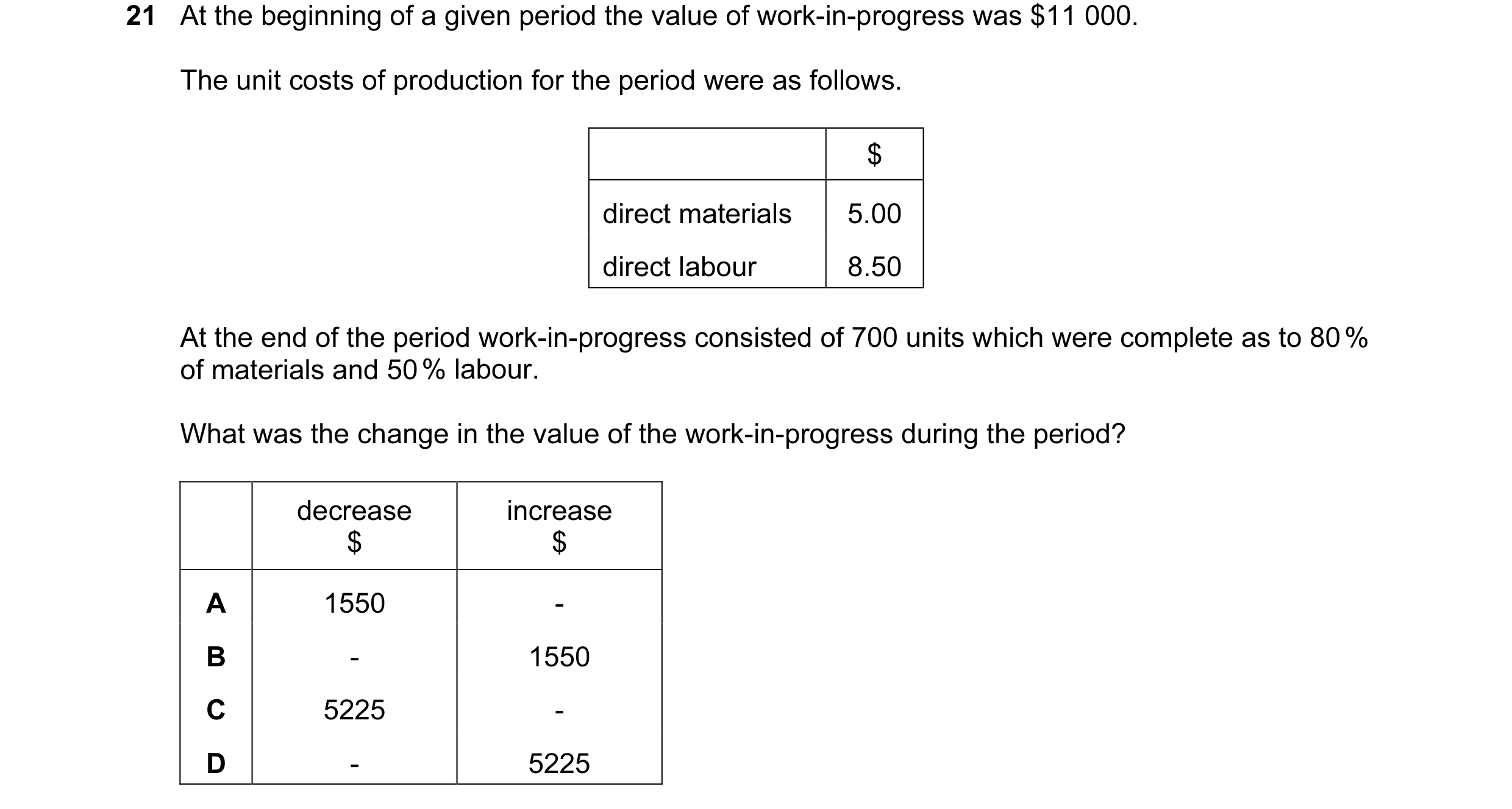
 2 / 30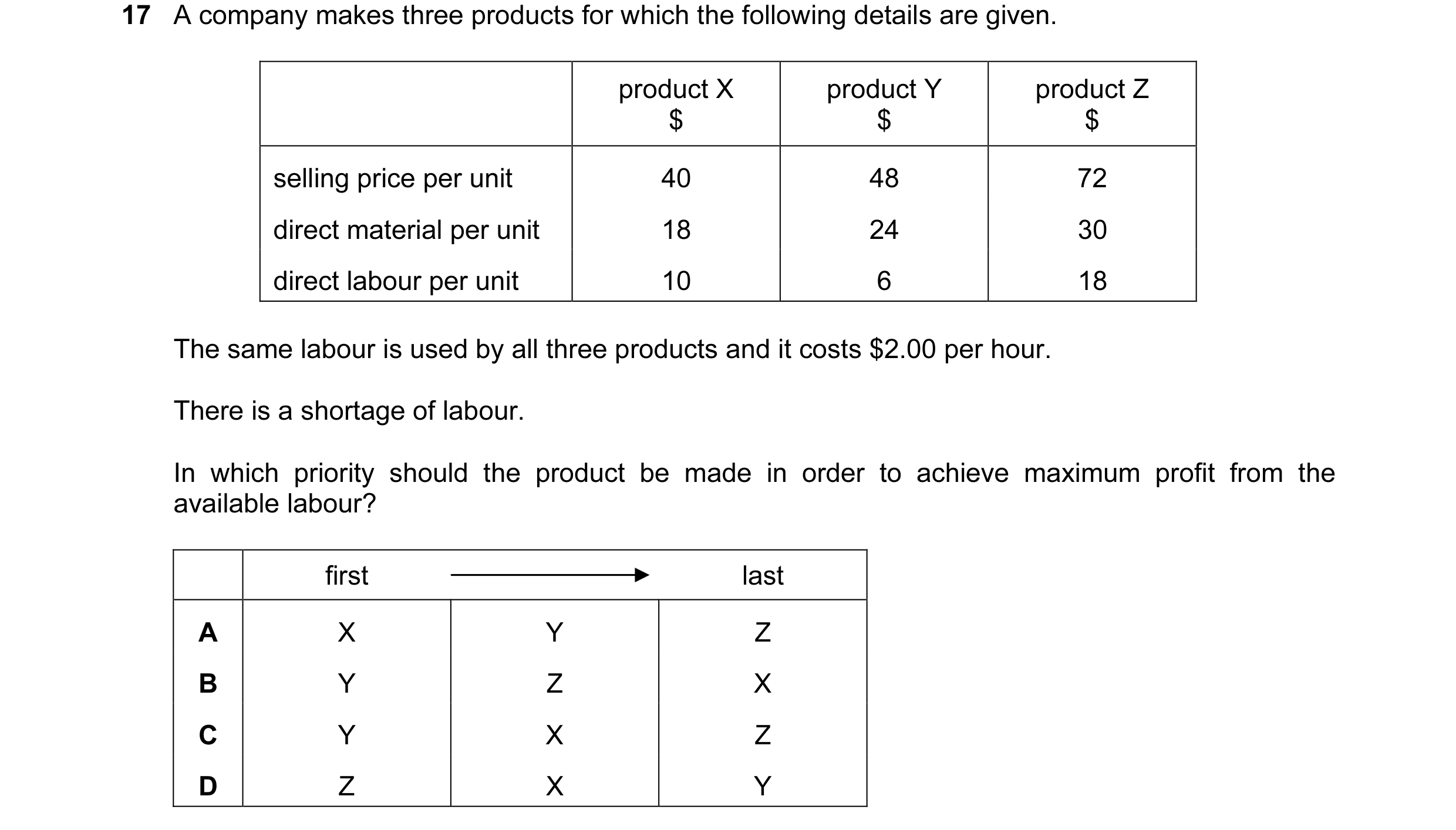
 3 / 30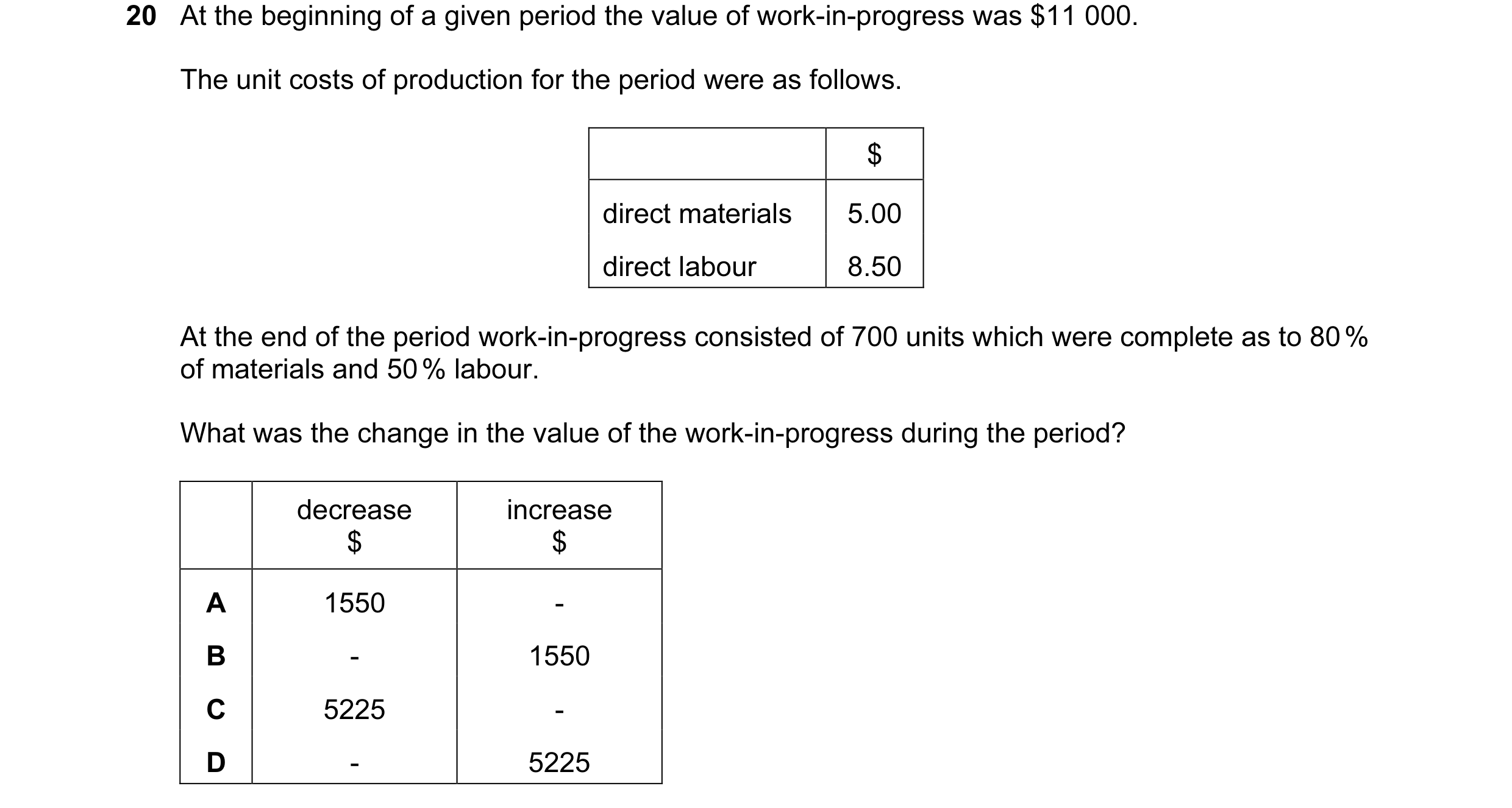

 4 / 30


 5 / 30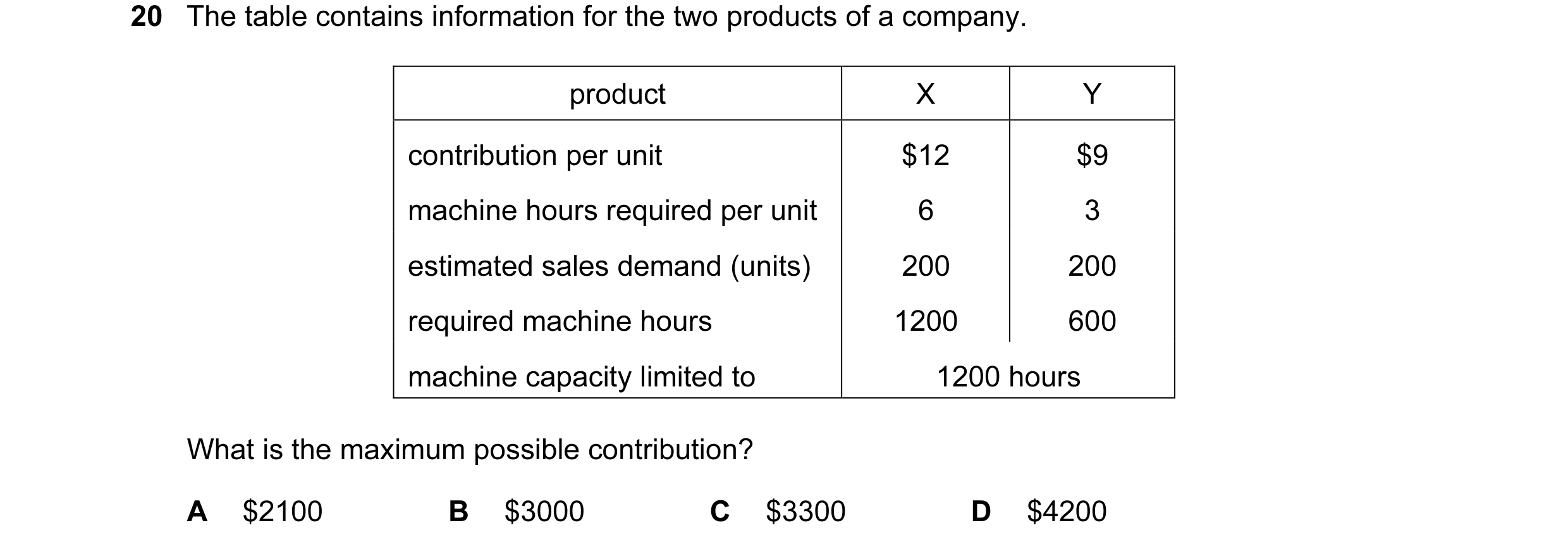


 6 / 30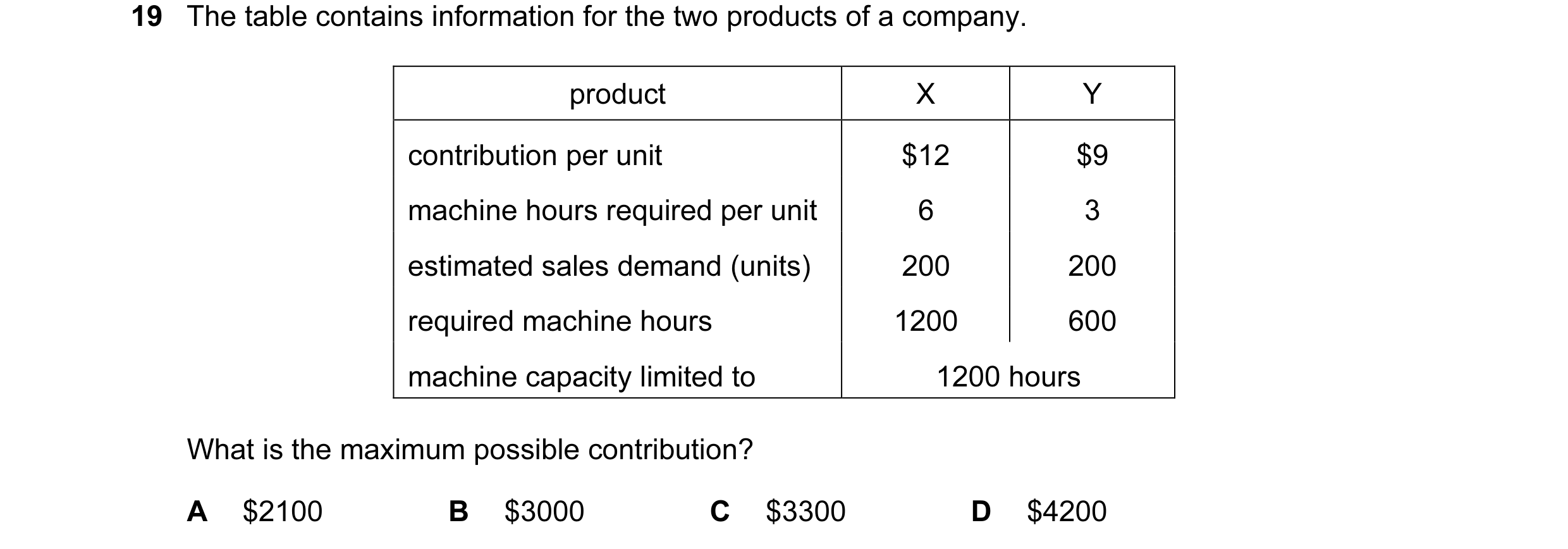
 7 / 30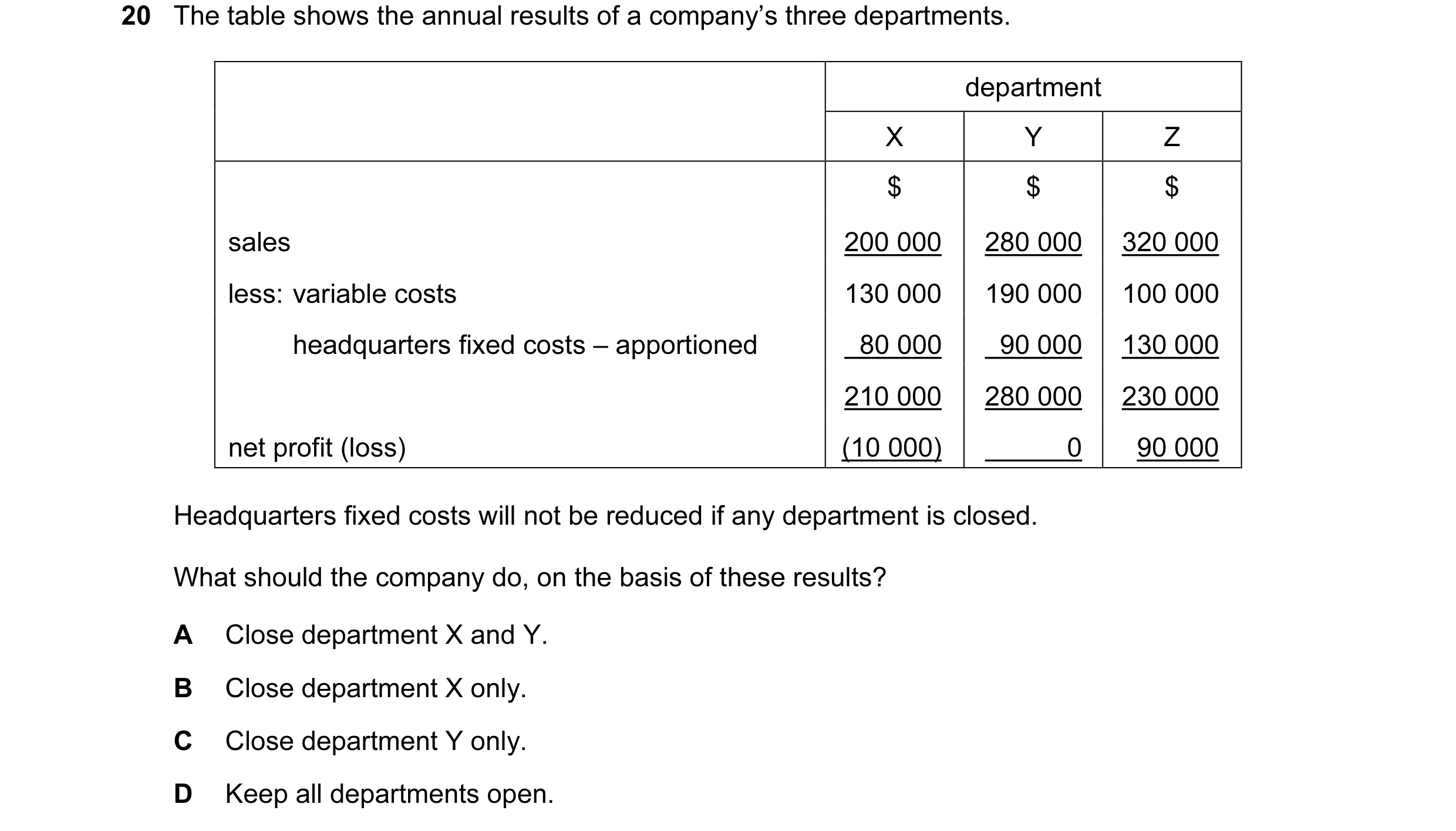

 8 / 30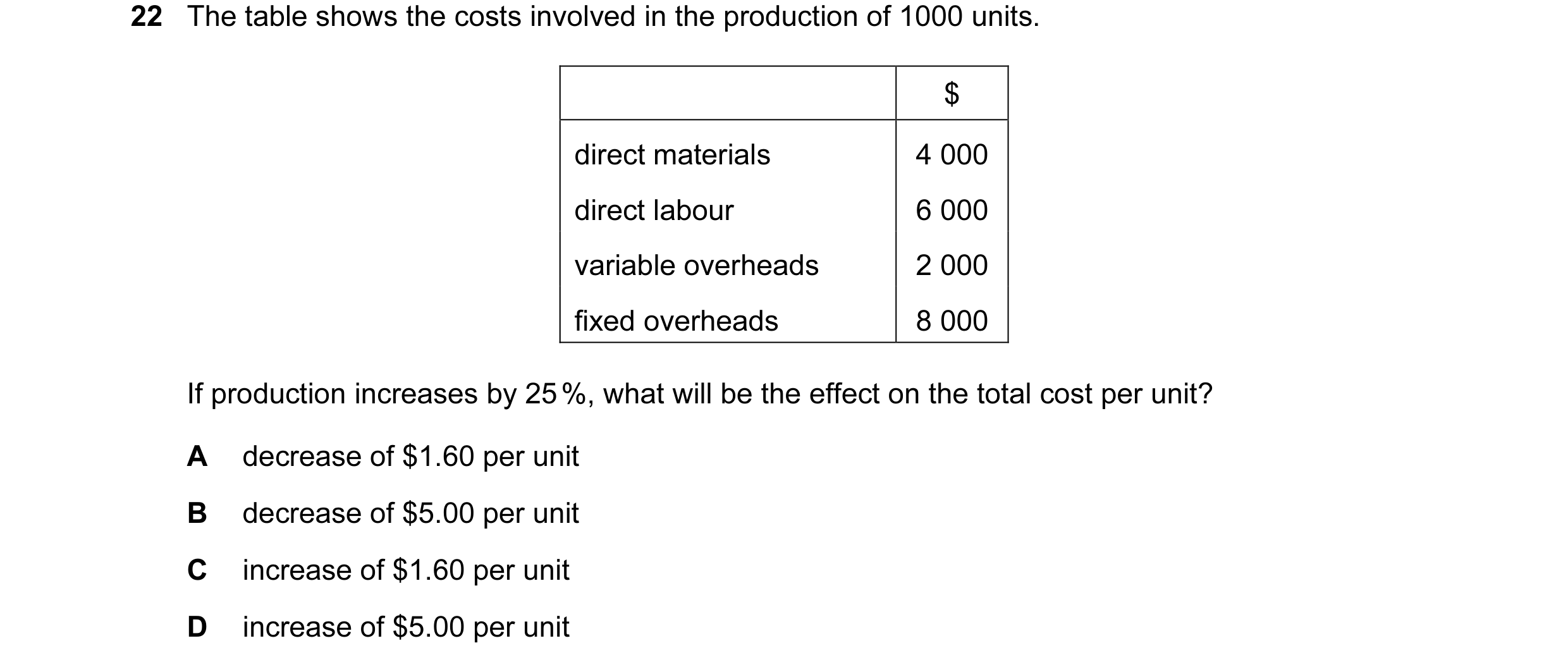
 9 / 30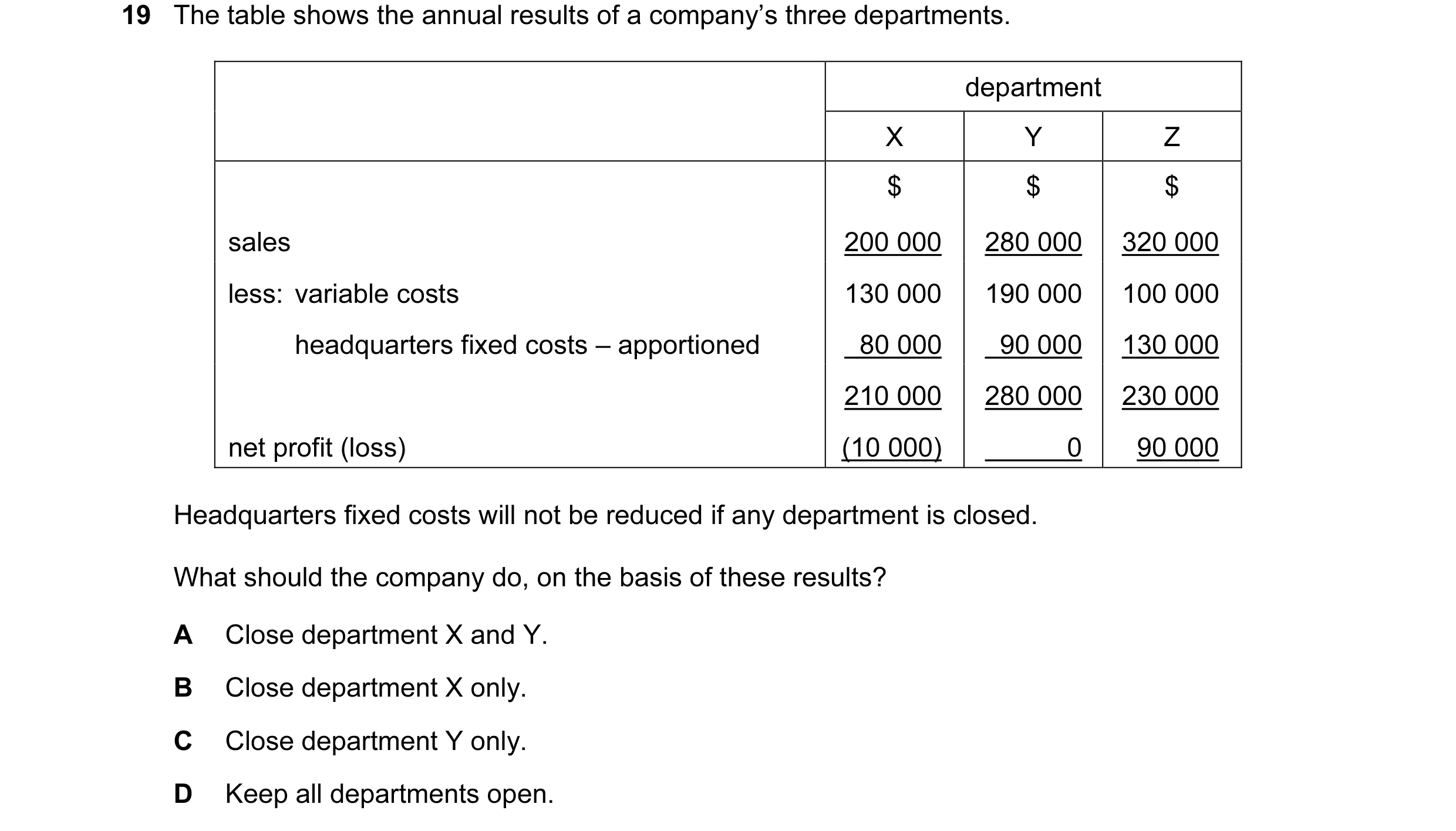
 10 / 30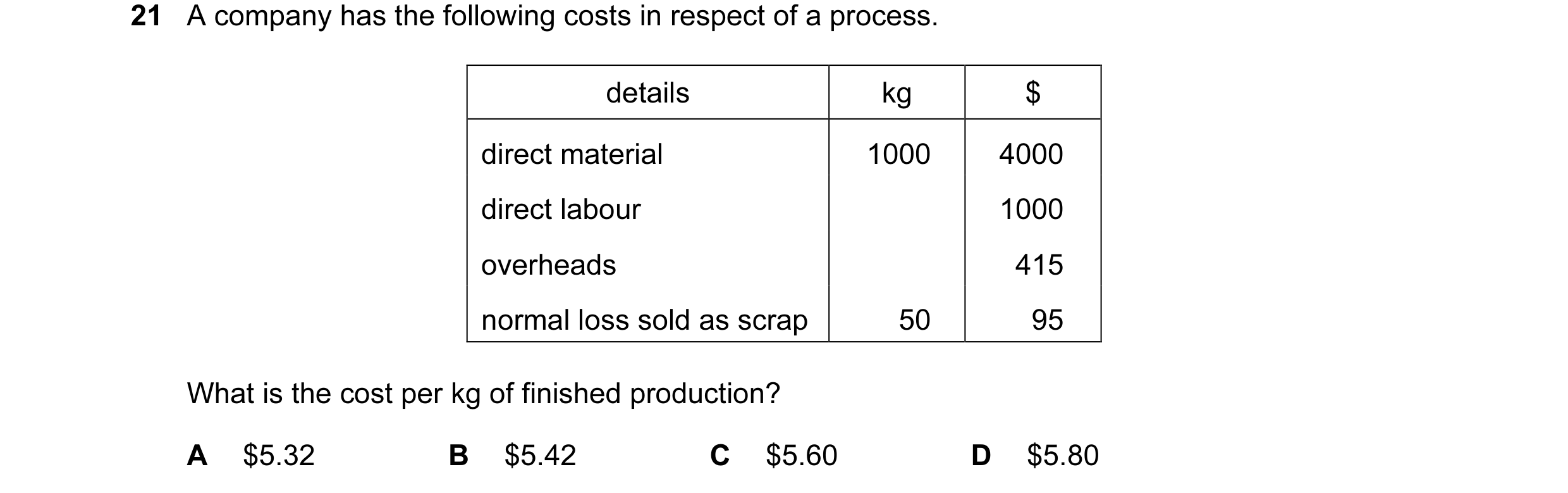
 11 / 30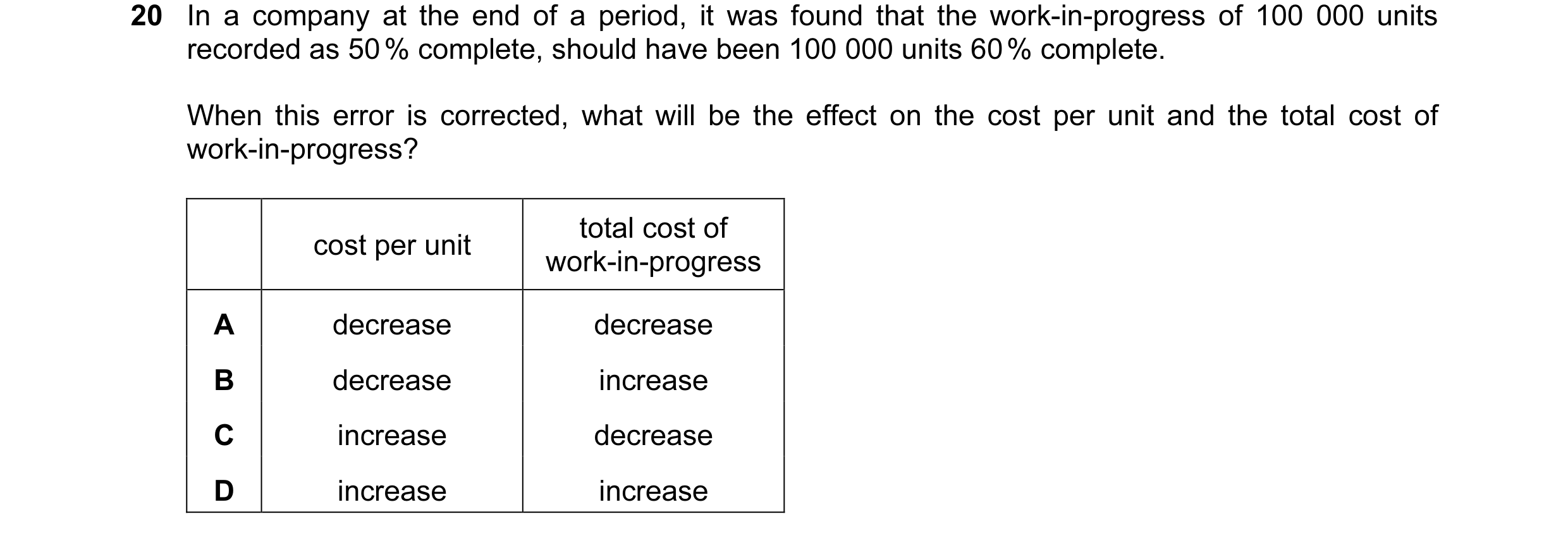
 12 / 30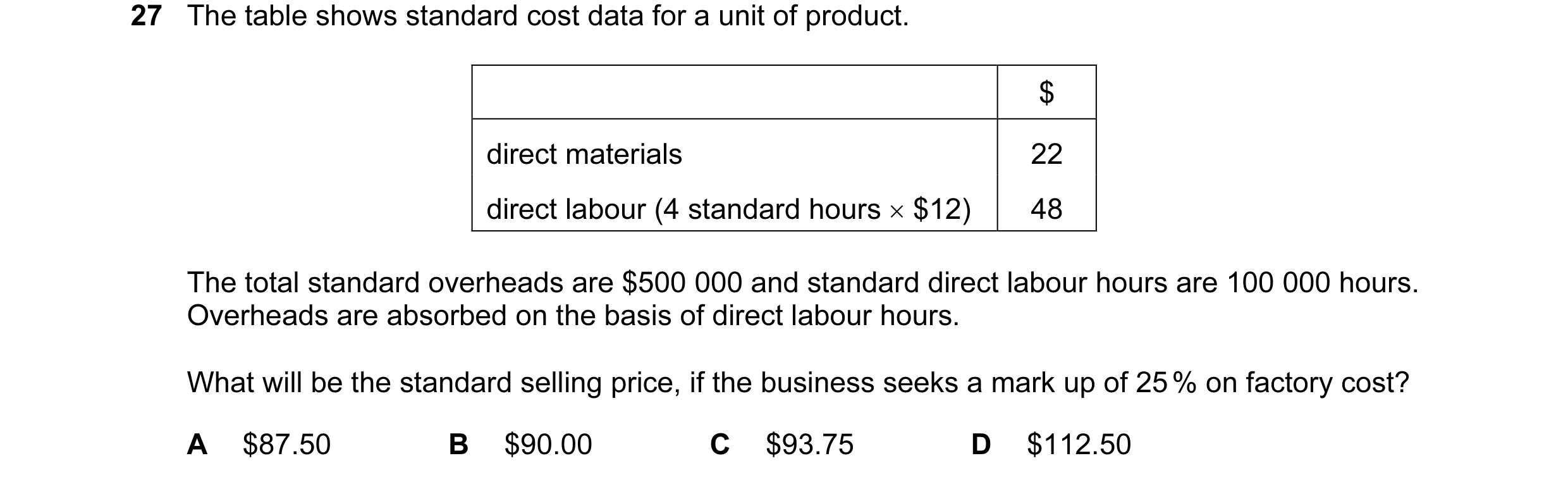
 13 / 30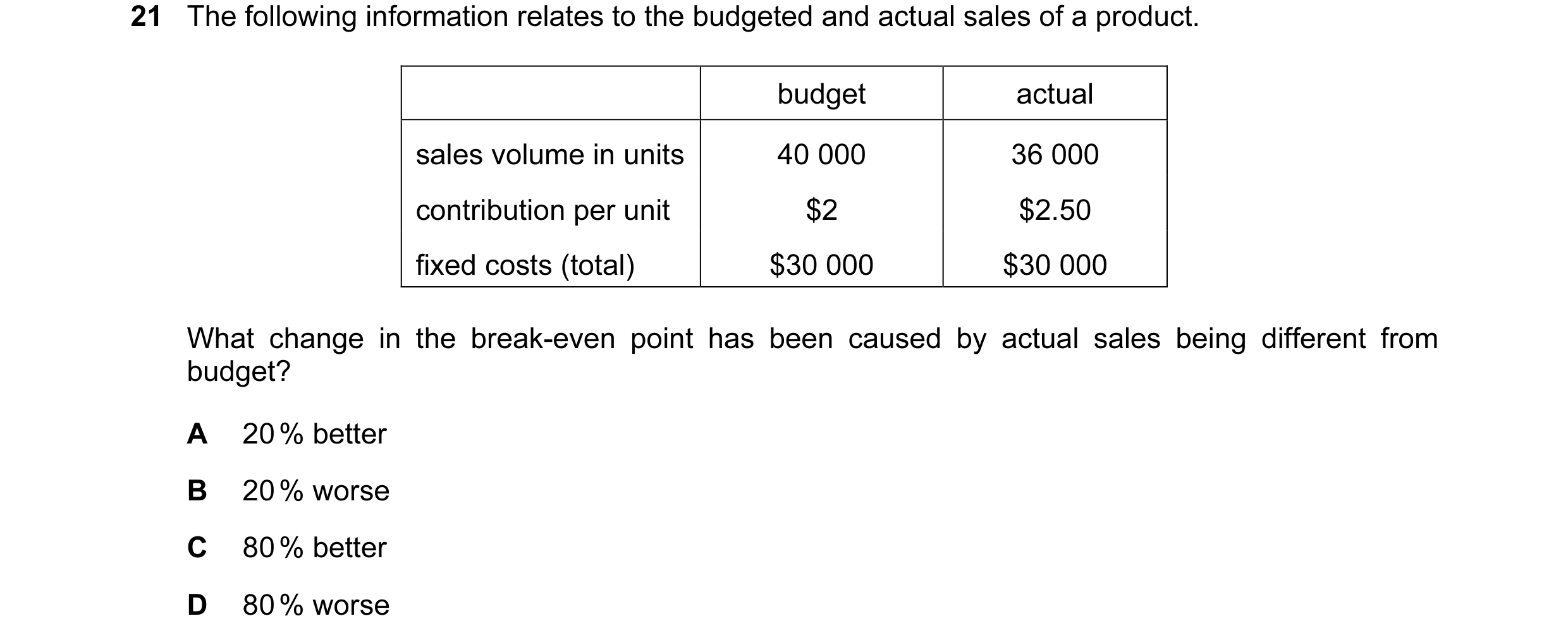
 14 / 30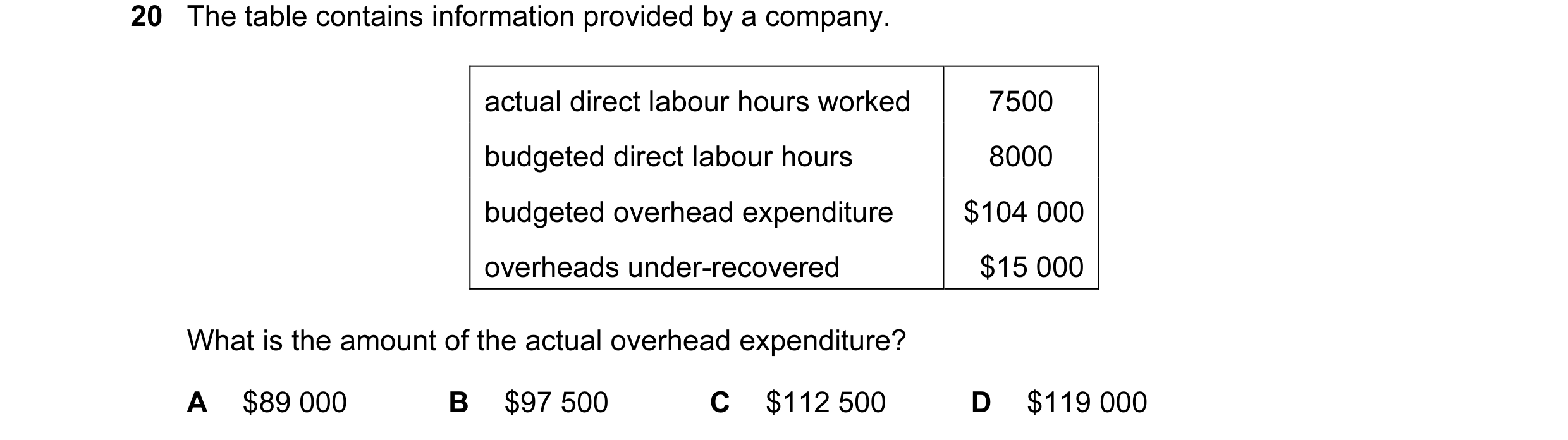
 15 / 30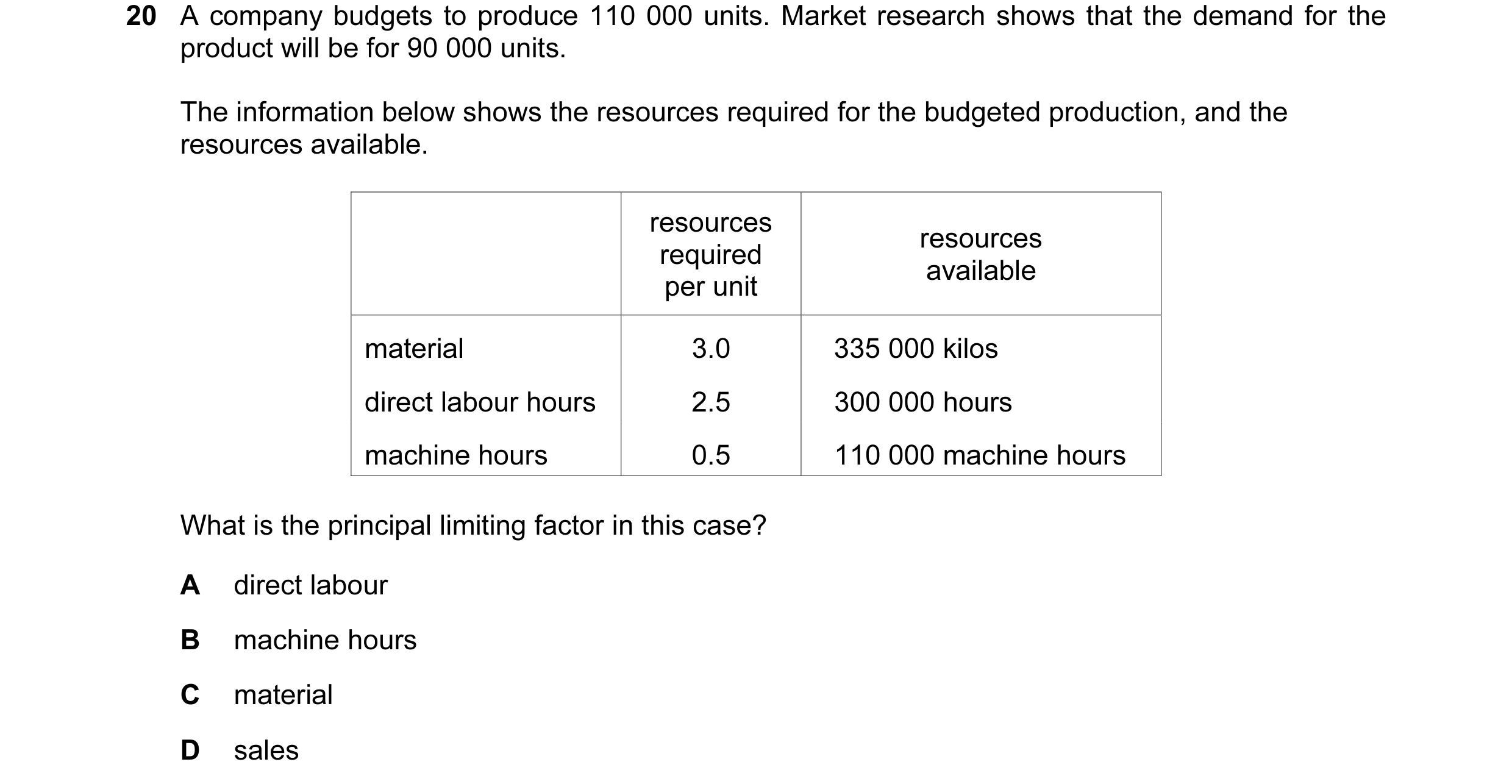

 16 / 30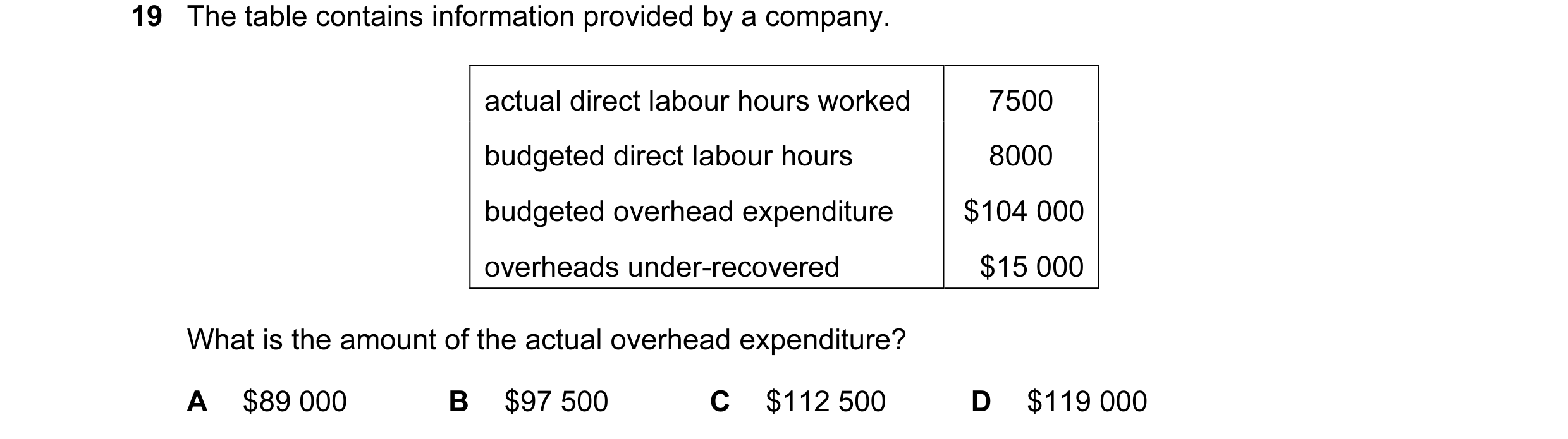
 17 / 30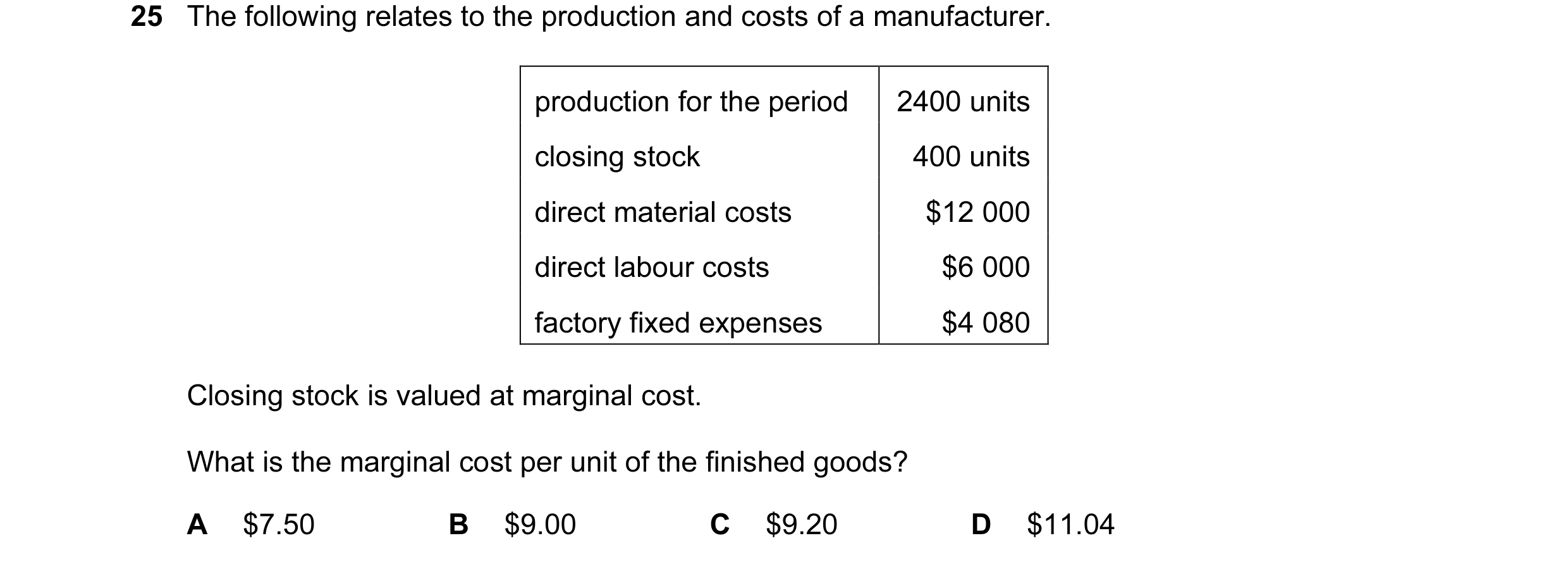
 18 / 30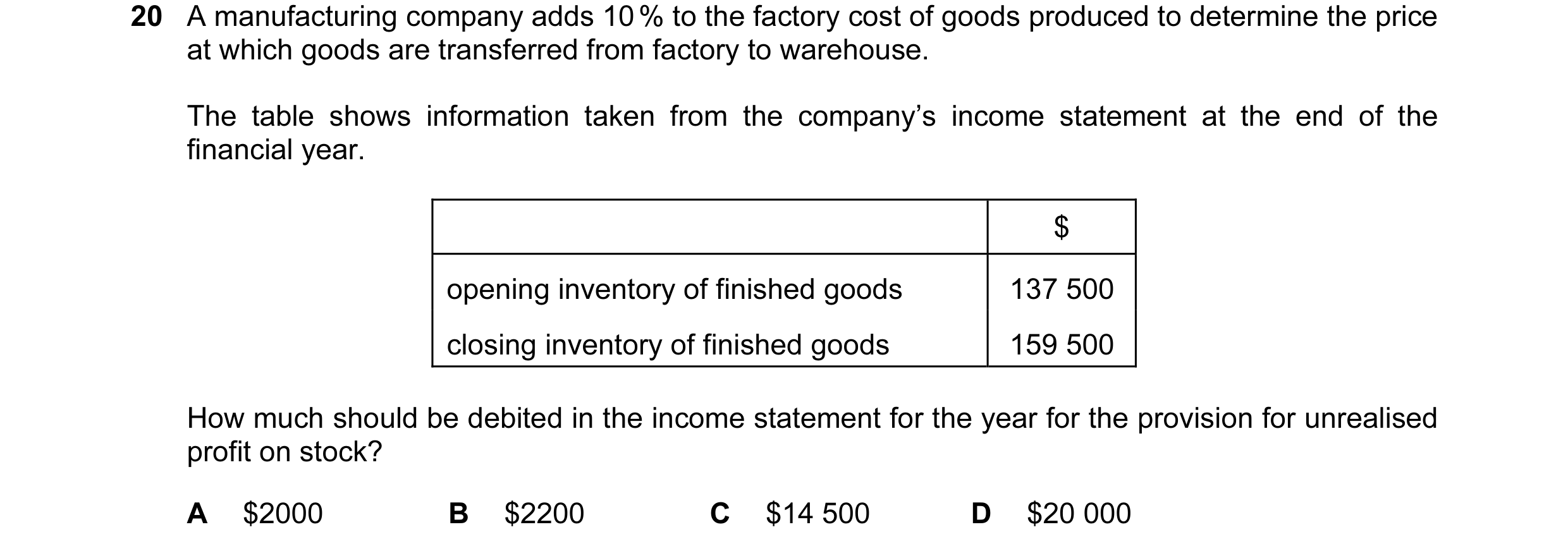

 19 / 30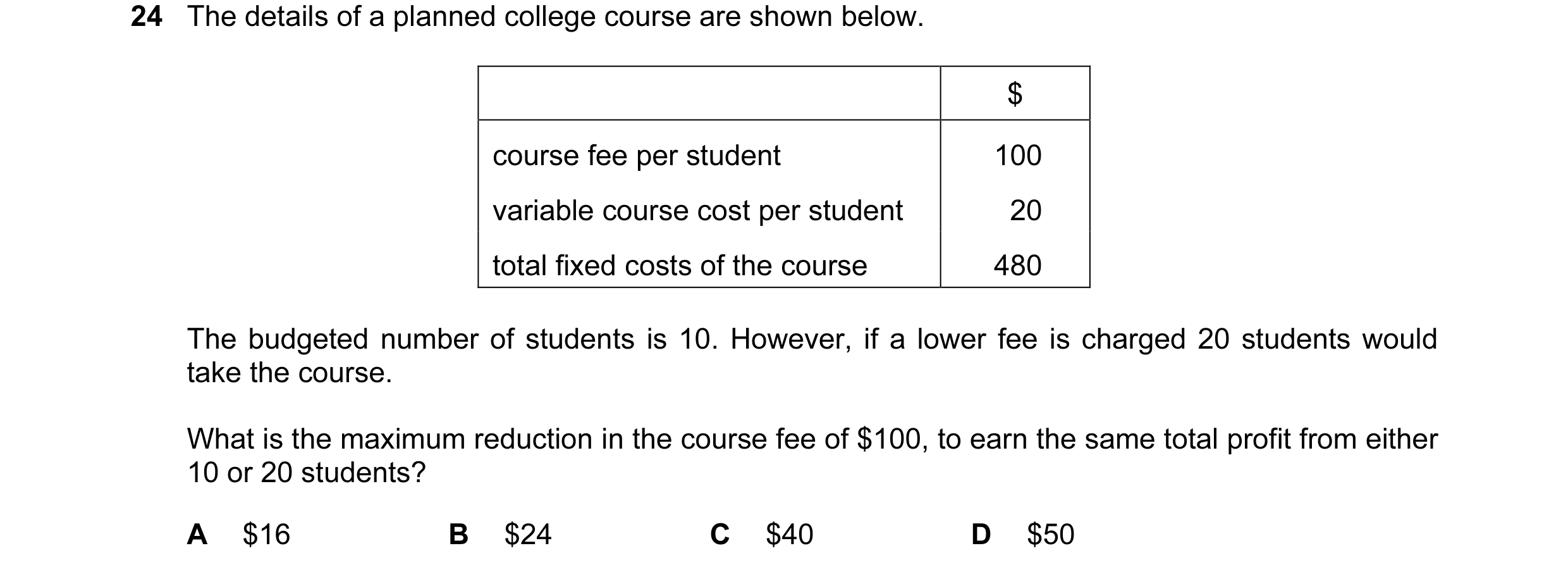
 20 / 30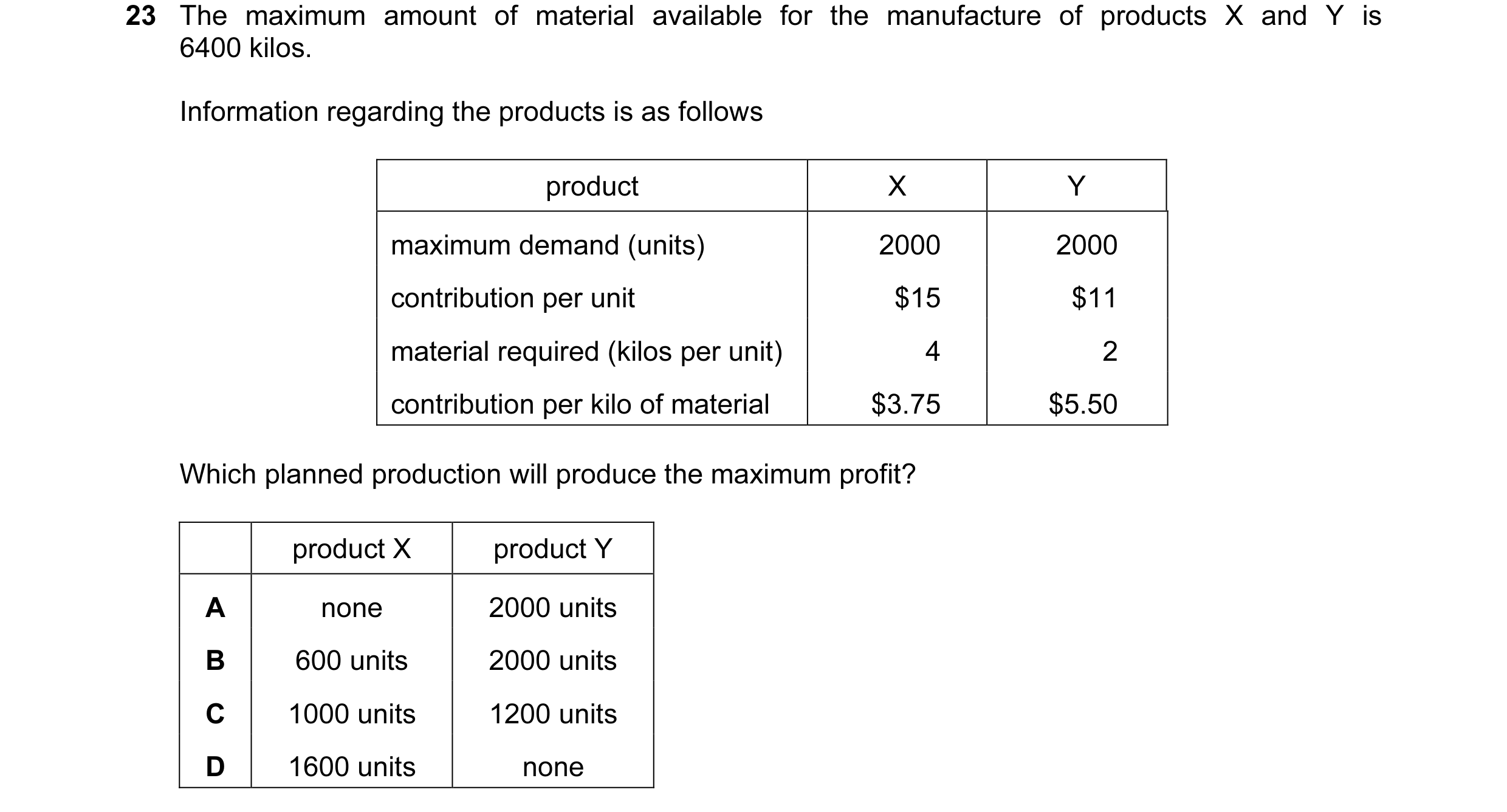
 21 / 30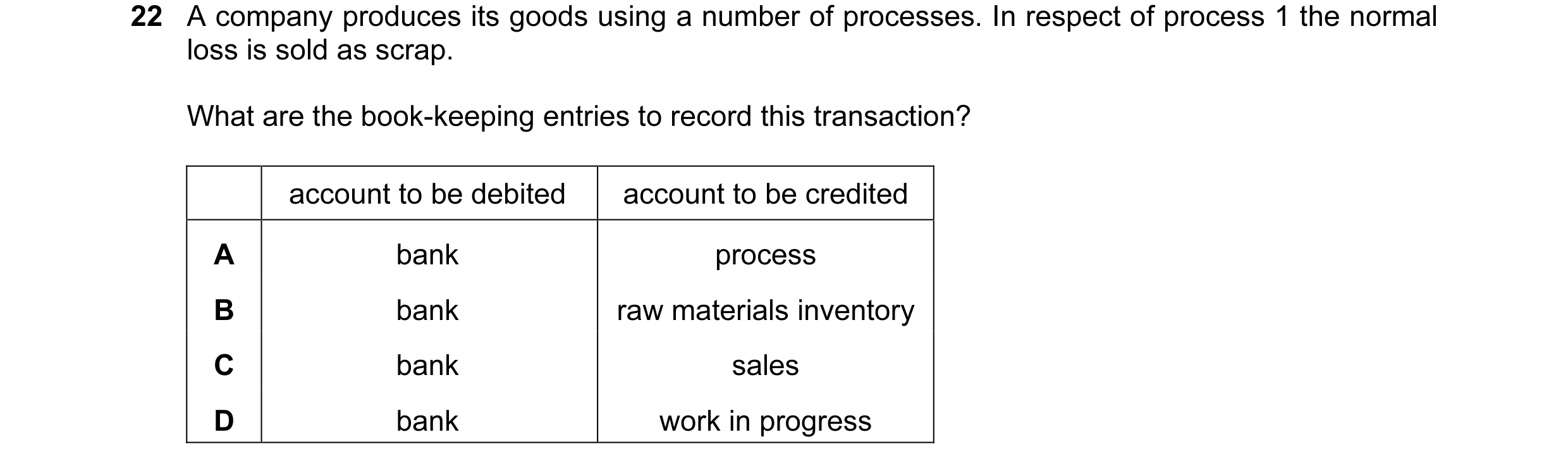
 22 / 30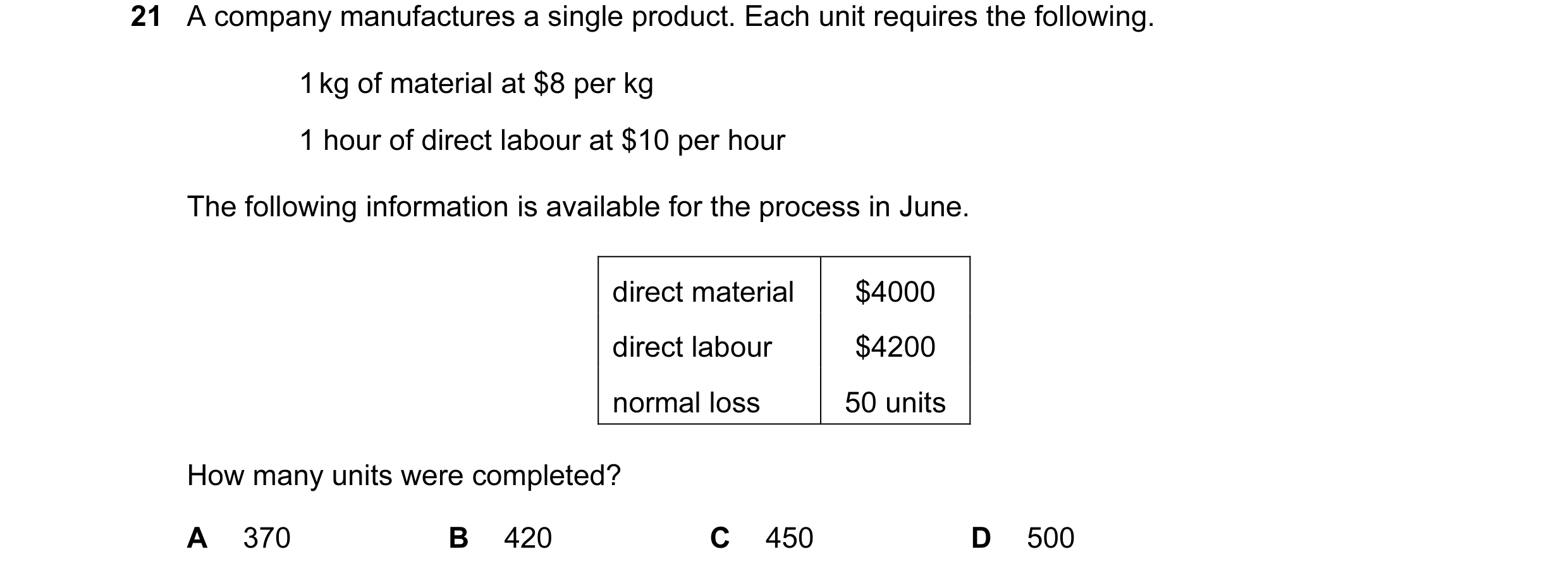
 23 / 30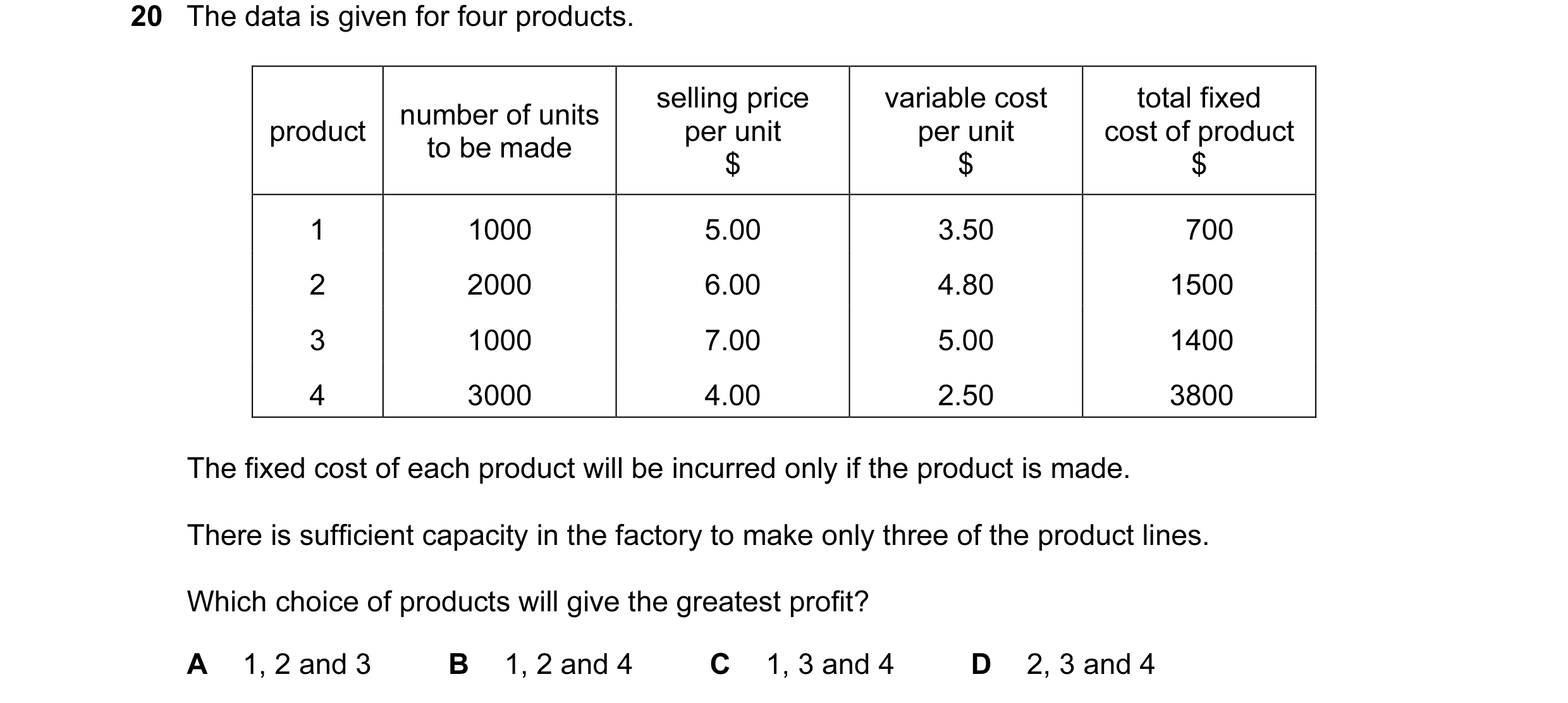
 24 / 30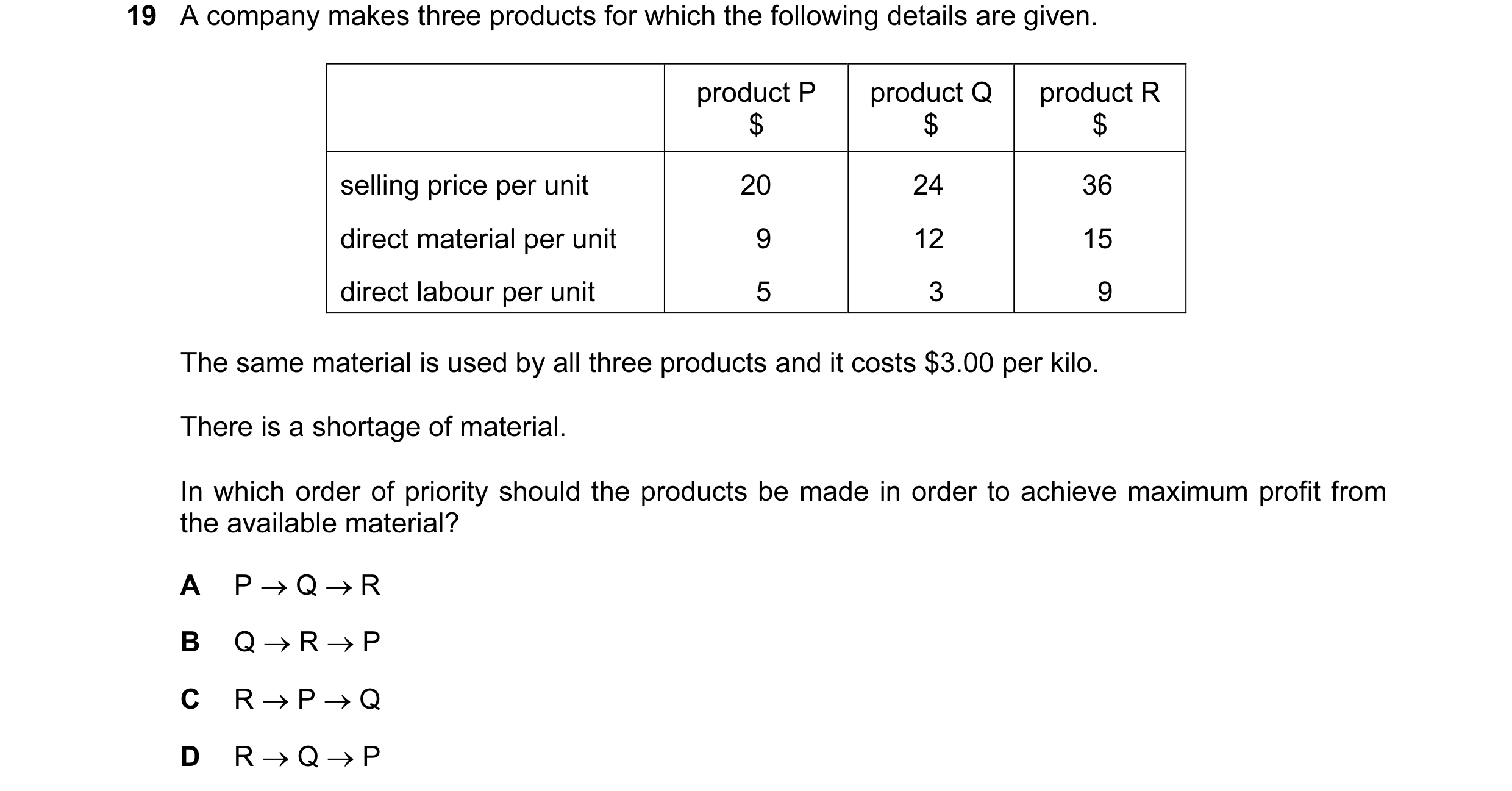
 25 / 30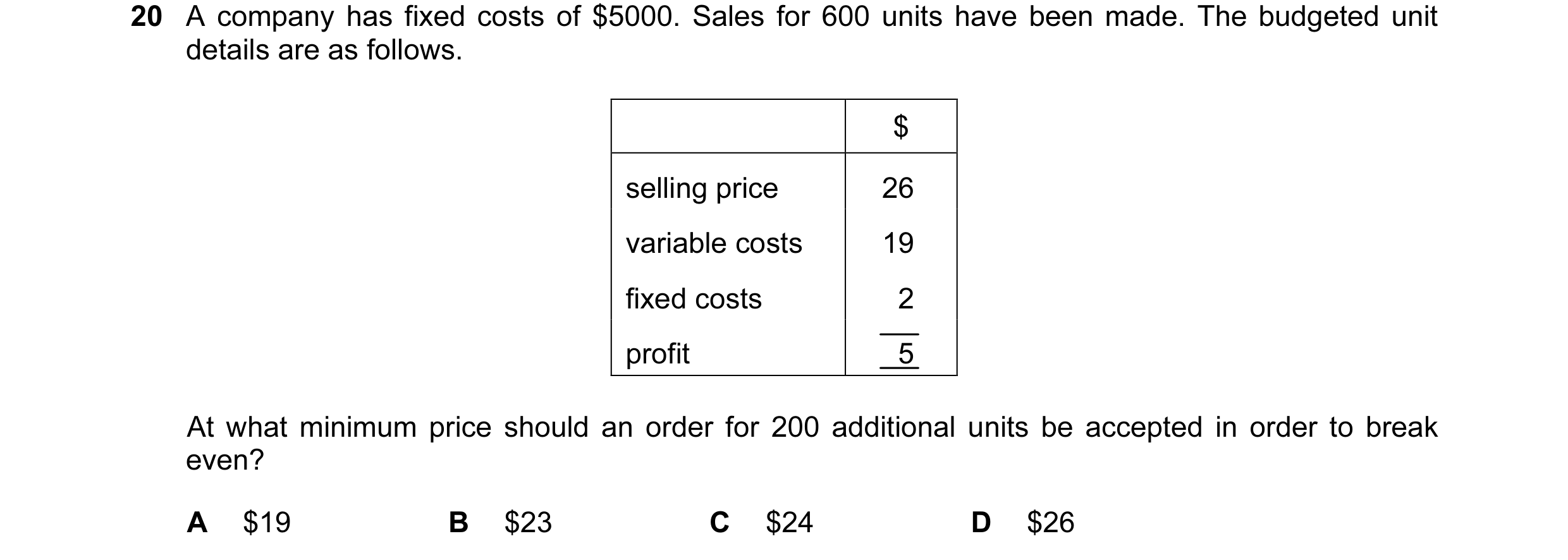
 26 / 30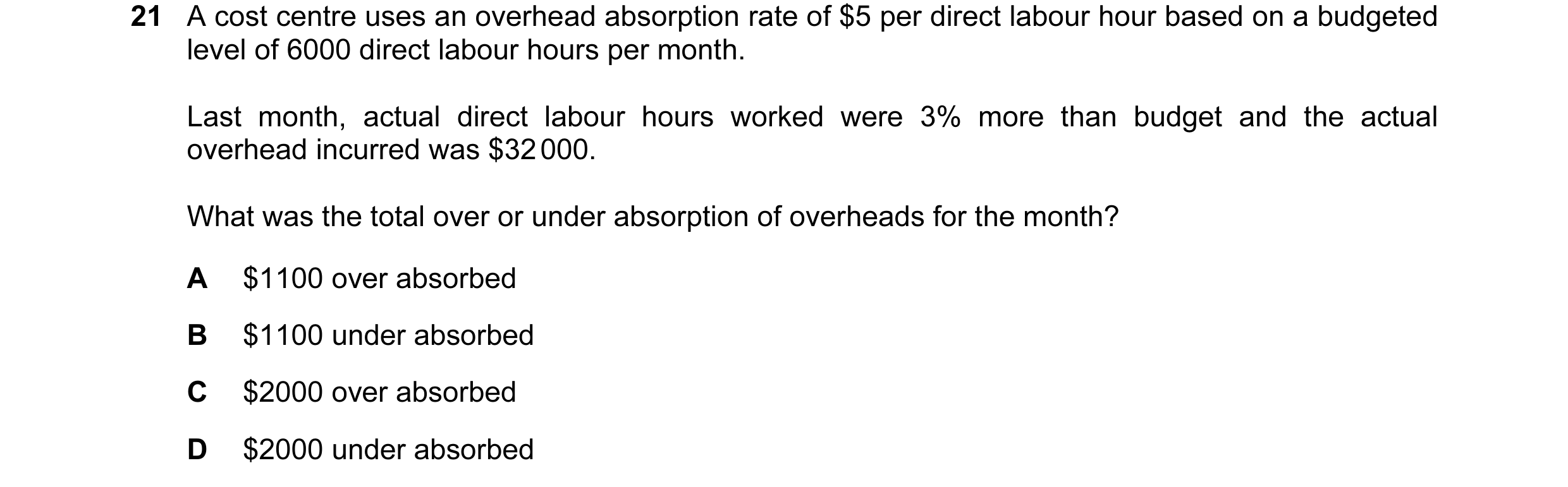
 27 / 30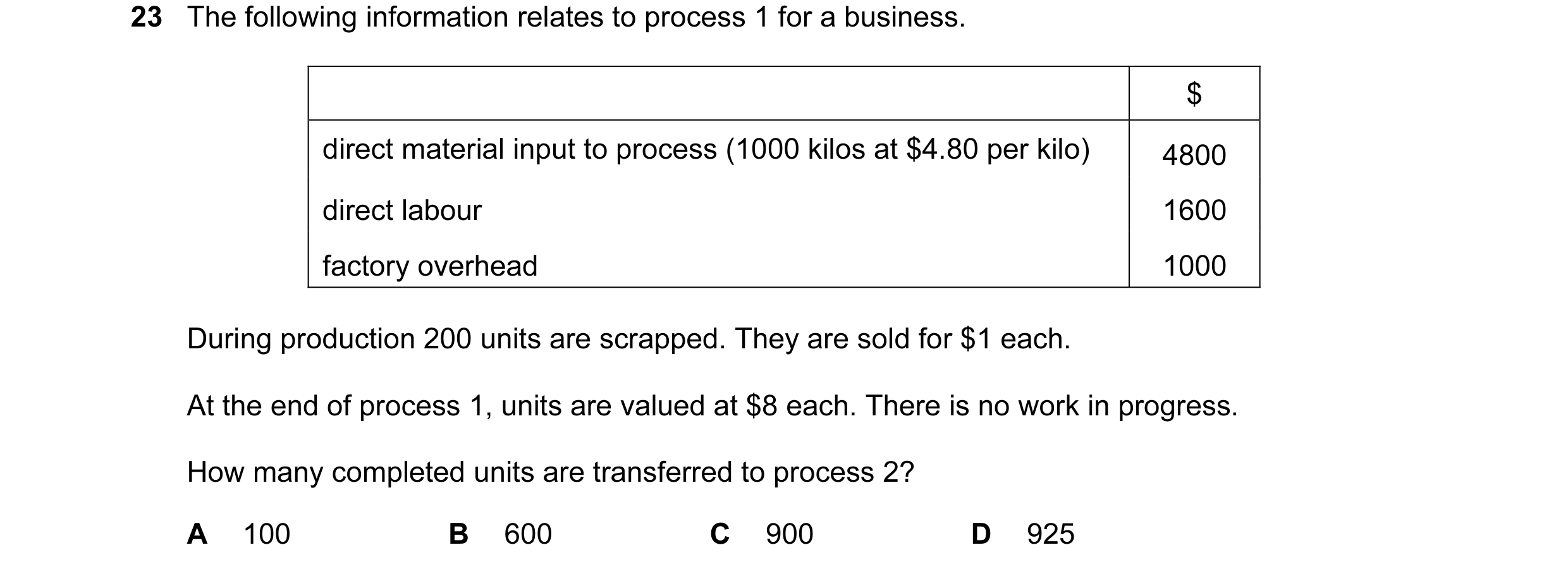
 28 / 30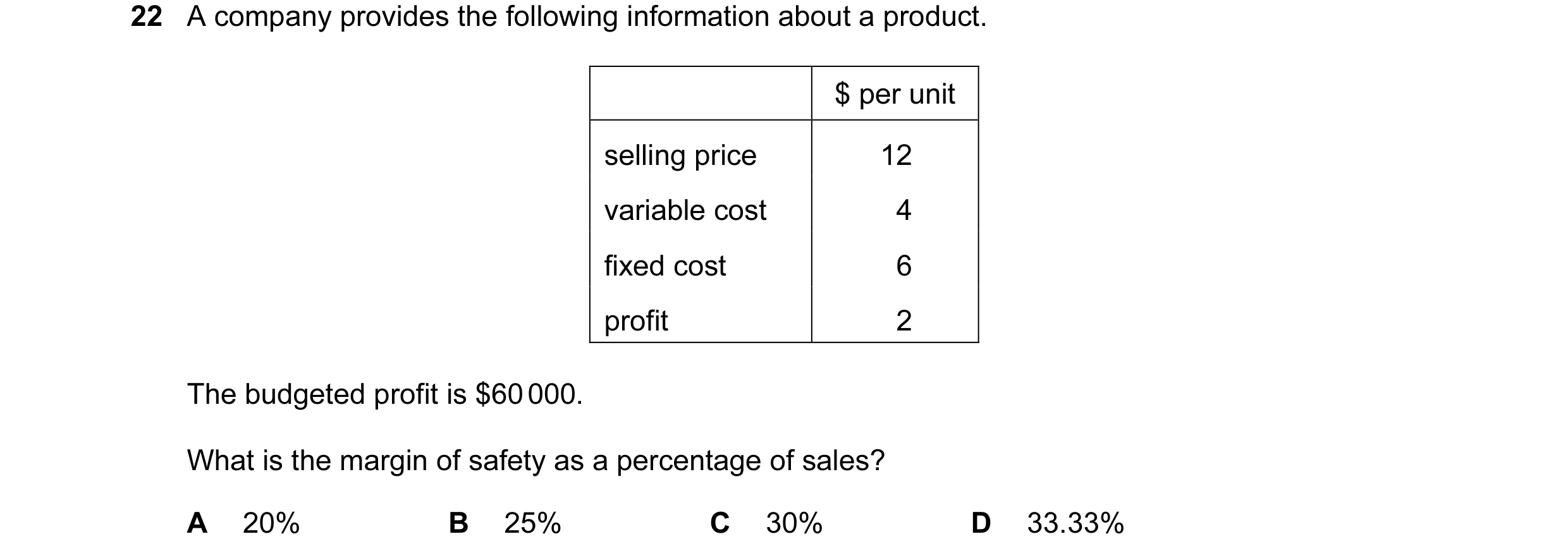
 29 / 30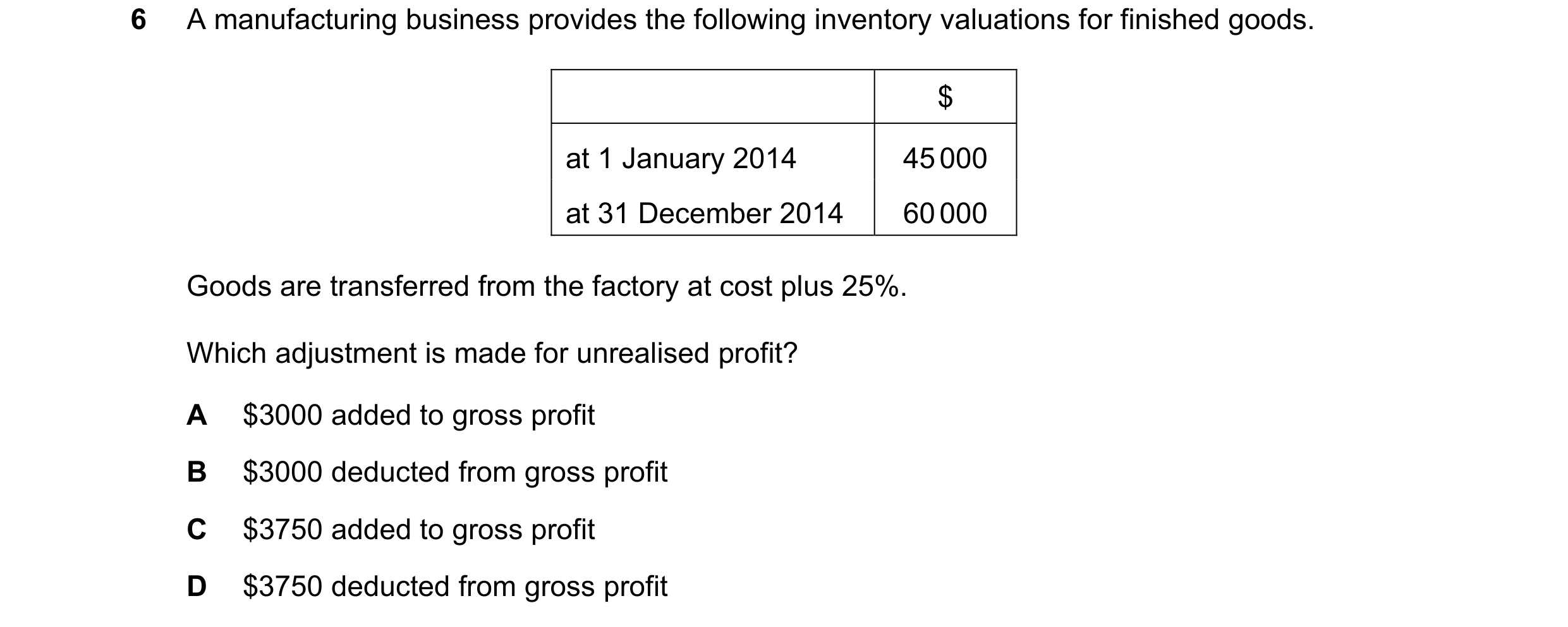

 30 / 30