Questions as text
Q1 · A farmer has two carts 0654/11 May/June 2005
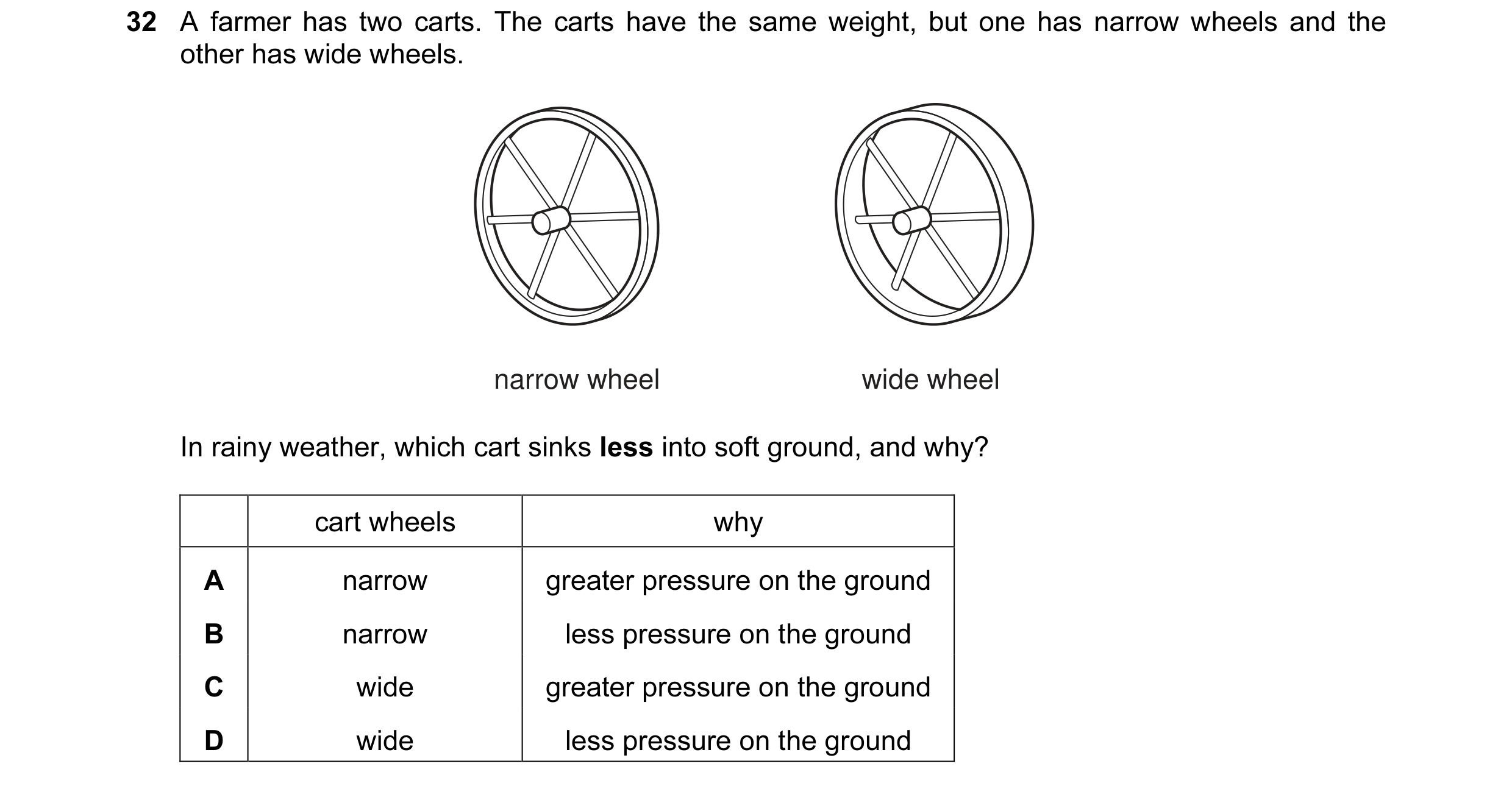
32 A farmer has two carts. The carts have the same weight, but one has narrow wheels and the other has wide wheels. narrow wheel wide wheel In rainy weather, which cart sinks less into soft ground, and why? cart wheels why A narrow greater pressure on the ground B narrow less pressure on the ground C wide greater pressure on the ground D wide less pressure on the ground
1 marks
Answer: D
This question in 0654/11 May/June 2005
Q2 · The diagram shows a thick sheet of glass 0654/11 May/June 2006
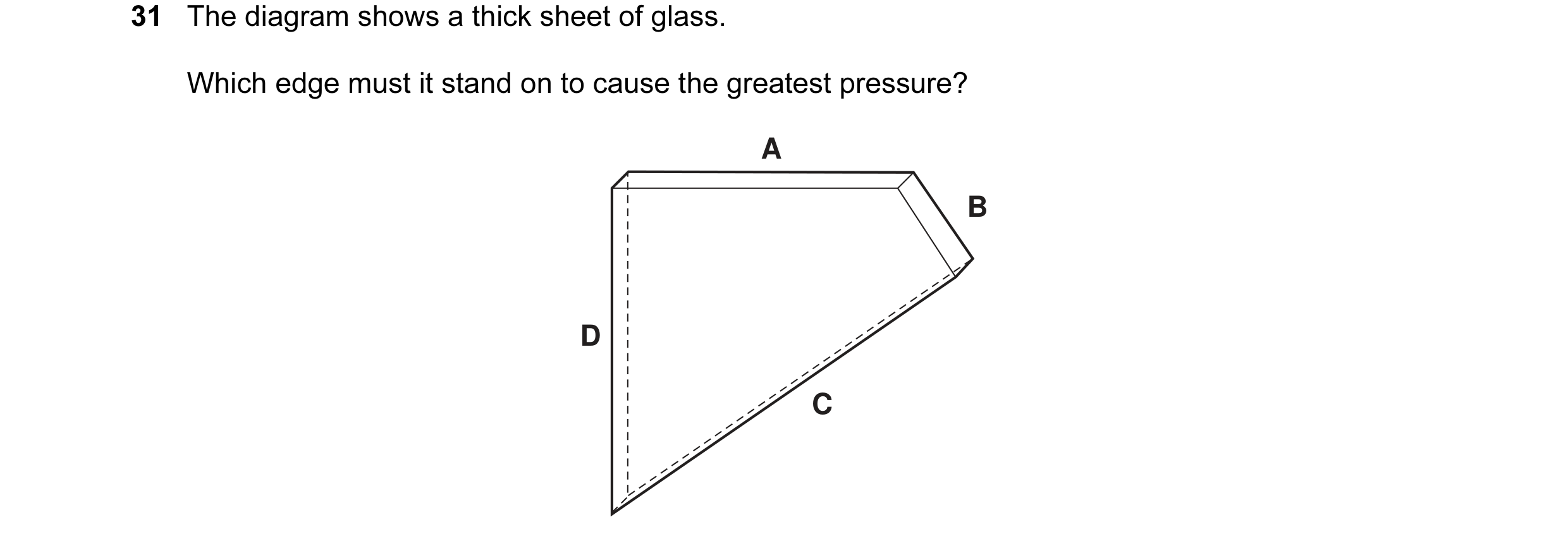
31 The diagram shows a thick sheet of glass. Which edge must it stand on to cause the greatest pressure? A B D C
1 marks
Answer: B
This question in 0654/11 May/June 2006
Q3 · To prevent a cement mixer sinking into soft ground, the mixer is placed on a large flat… 0654/11 Oct/Nov 2006
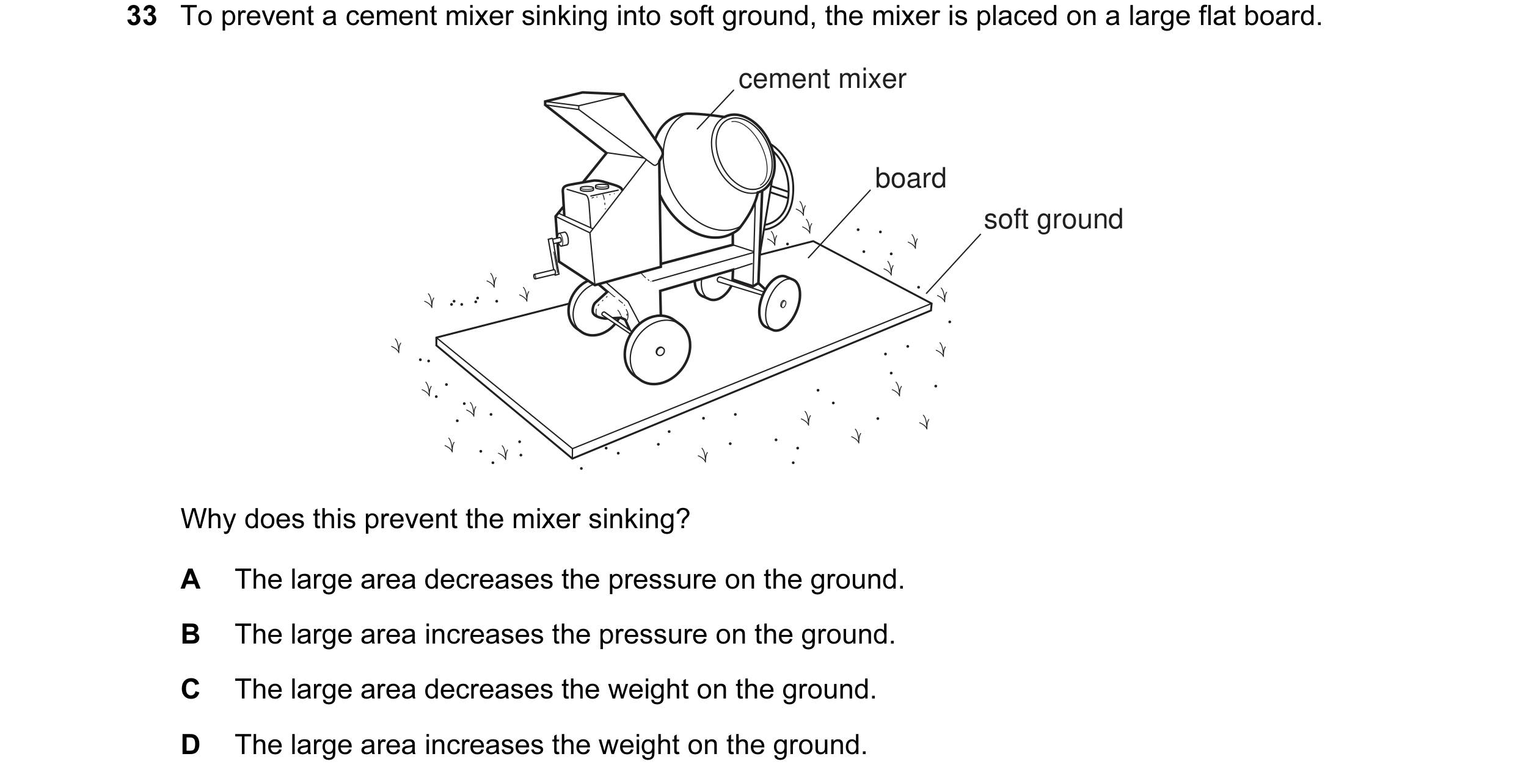
33 To prevent a cement mixer sinking into soft ground, the mixer is placed on a large flat board. cement mixer board soft ground Why does this prevent the mixer sinking? A The large area decreases the pressure on the ground. B The large area increases the pressure on the ground. C The large area decreases the weight on the ground. D The large area increases the weight on the ground.
1 marks
Answer: A
This question in 0654/11 Oct/Nov 2006
Q4 · A brick with rectangular sides rests on a table 0654/11 Oct/Nov 2008
32 A brick with rectangular sides rests on a table. brick table The brick is now turned so that it rests on the table on its smallest face. How has this change affected the force and the pressure exerted by the brick on the table? force pressure A unchanged unchanged B increased unchanged C unchanged increased D increased increased
1 marks
Answer: C
This question in 0654/11 Oct/Nov 2008
Q5 · A piston traps a certain mass of gas inside a cylinder 0654/11 May/June 2009
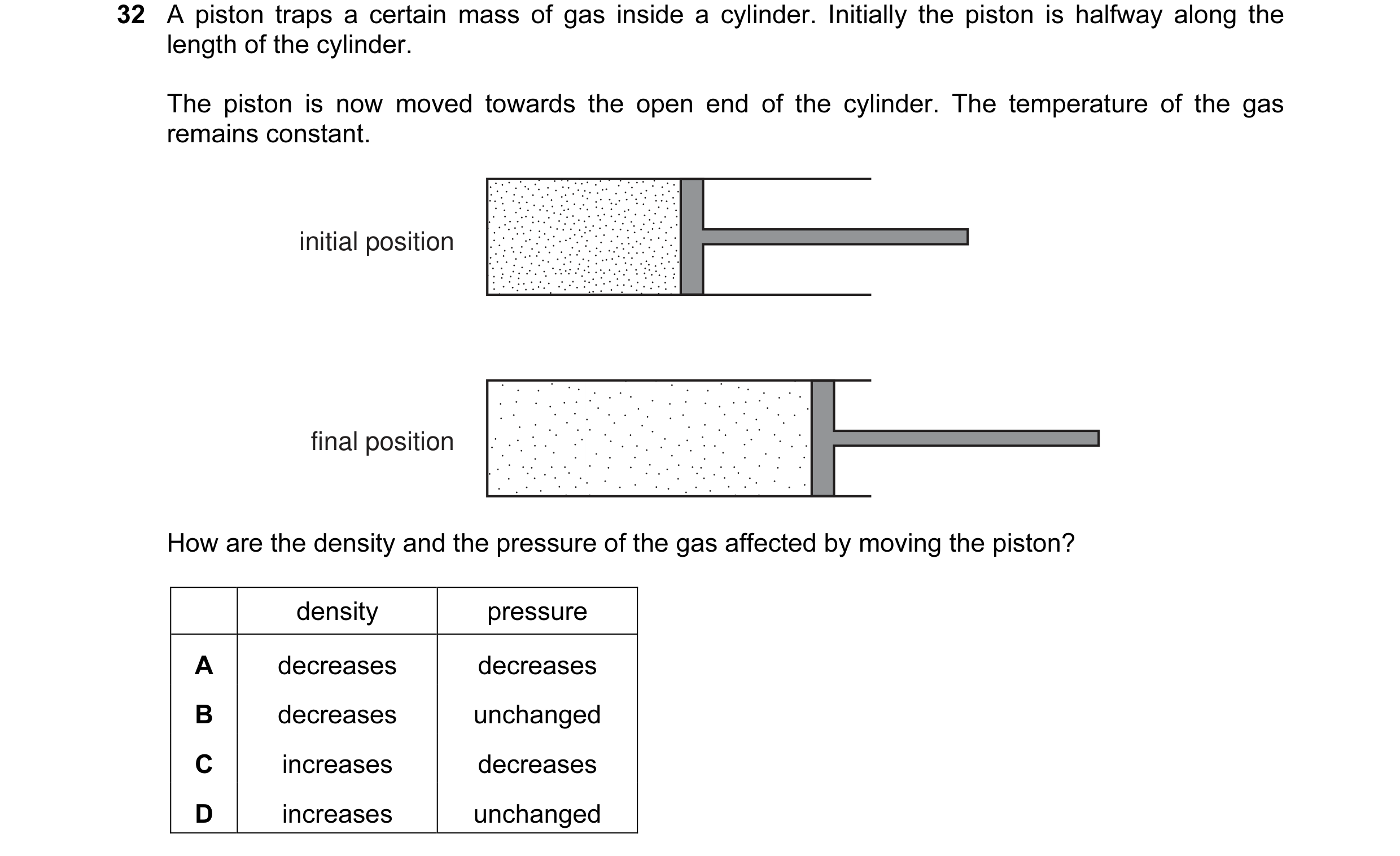
32 A piston traps a certain mass of gas inside a cylinder. Initially the piston is halfway along the length of the cylinder. The piston is now moved towards the open end of the cylinder. The temperature of the gas remains constant. initial position final position How are the density and the pressure of the gas affected by moving the piston? density pressure A decreases decreases B decreases unchanged C increases decreases D increases unchanged
1 marks
Answer: A
This question in 0654/11 May/June 2009
Q6 · The table gives four pairs of values of force and the surface area on which the force acts 0654/11 May/June 2010
31 The table gives four pairs of values of force and the surface area on which the force acts. Which pair of values gives the largest pressure on the surface? force / N area / m2 A 20 2 B 40 2 C 20 4 D 40 4
1 marks
Answer: B
This question in 0654/11 May/June 2010
Q7 · The table gives four pairs of values of force and the surface area on which the force acts 0654/12 May/June 2010
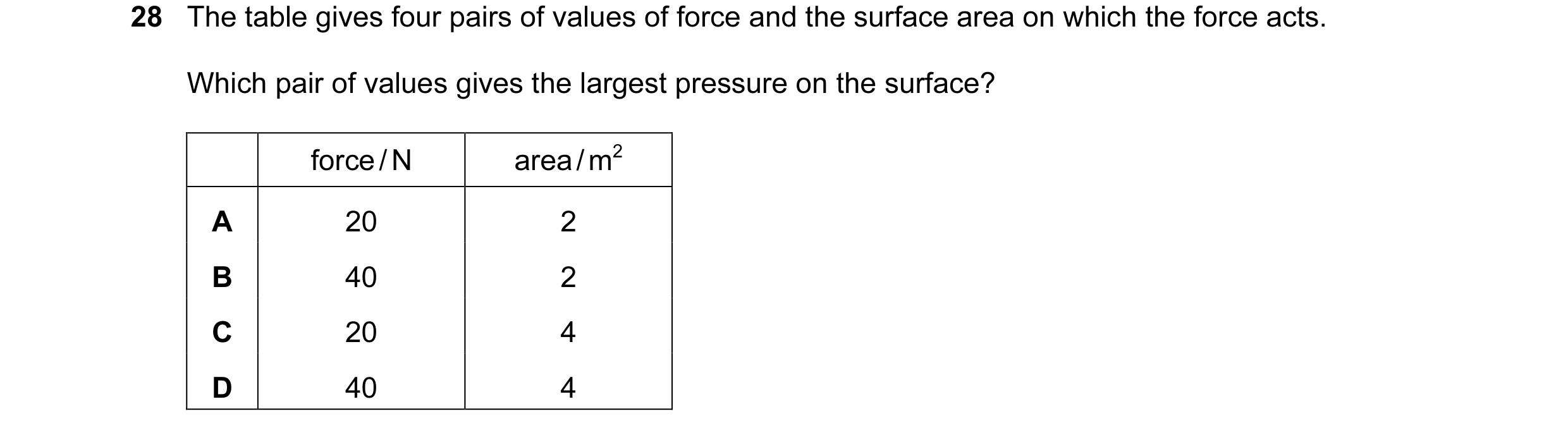
28 The table gives four pairs of values of force and the surface area on which the force acts. Which pair of values gives the largest pressure on the surface? force / N area / m2 A 20 2 B 40 2 C 20 4 D 40 4
1 marks
Answer: B
This question in 0654/12 May/June 2010
Q8 · One side of a cube stands on the ground 0654/11 May/June 2011
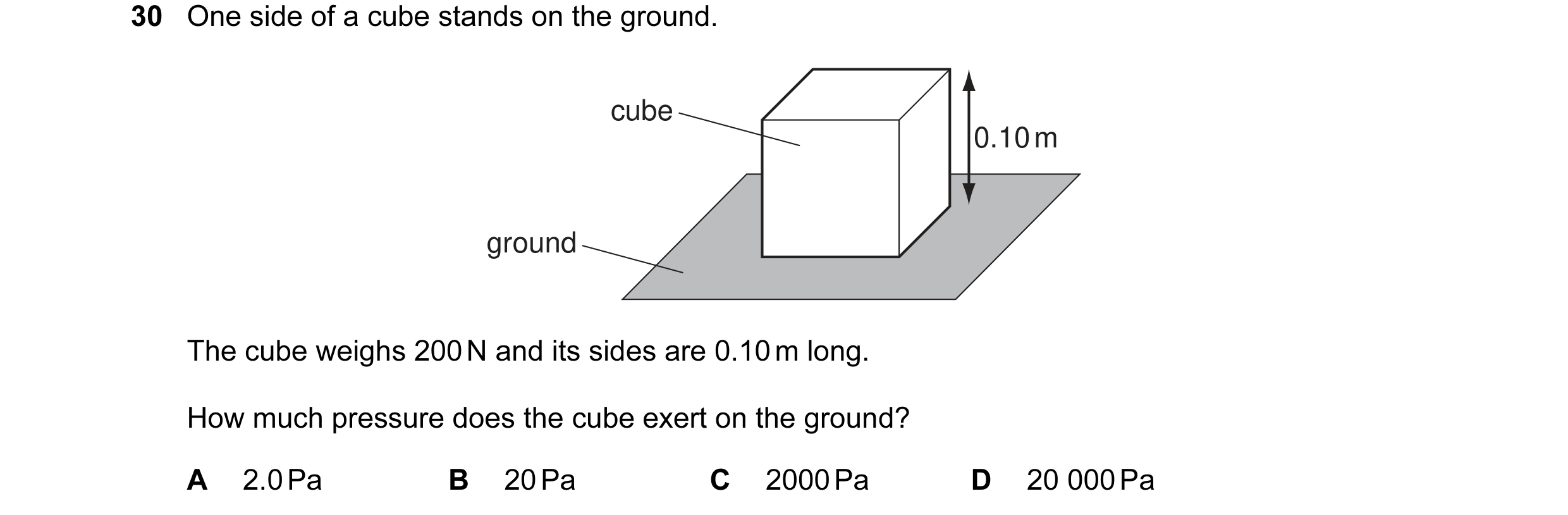
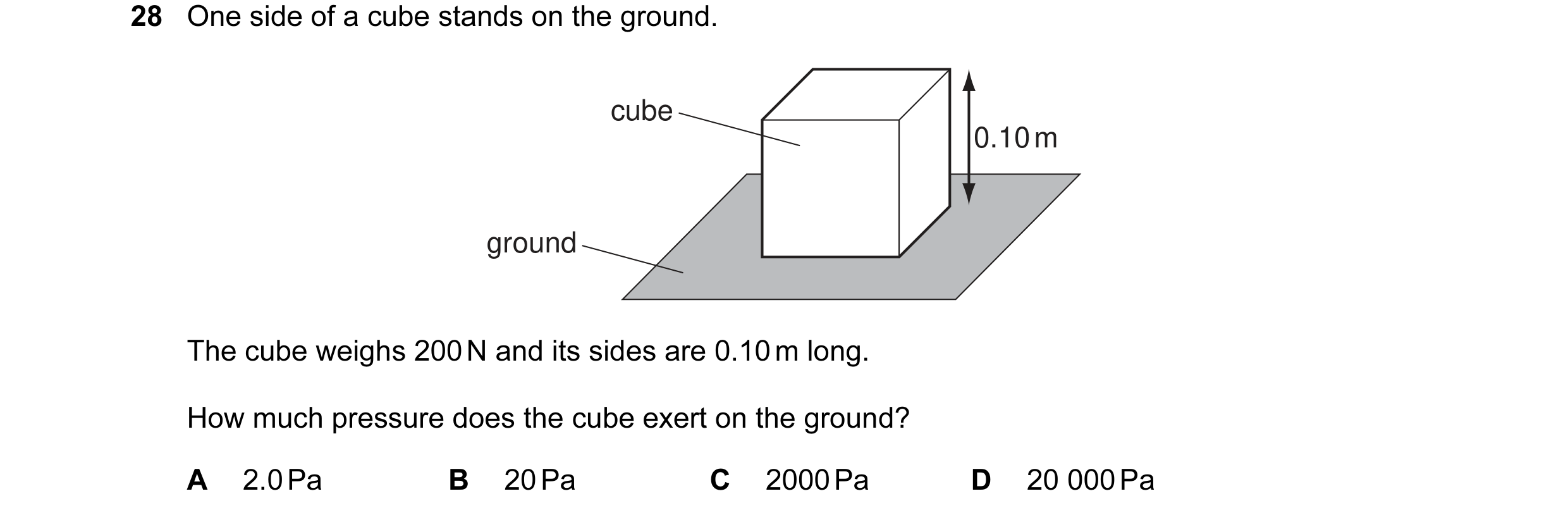
30 One side of a cube stands on the ground. cube 0.10 m ground The cube weighs 200 N and its sides are 0.10 m long. How much pressure does the cube exert on the ground? A 2.0 Pa B 20 Pa C 2000 Pa D 20 000 Pa
1 marks
Answer: D
This question in 0654/11 May/June 2011
Q9 · One side of a cube stands on the ground 0654/12 May/June 2011
28 One side of a cube stands on the ground. cube 0.10 m ground The cube weighs 200 N and its sides are 0.10 m long. How much pressure does the cube exert on the ground? A 2.0 Pa B 20 Pa C 2000 Pa D 20 000 Pa
1 marks
Answer: D
This question in 0654/12 May/June 2011
Q10 · One side of a cube stands on the ground 0654/13 May/June 2011
28 One side of a cube stands on the ground. cube 0.10 m ground The cube weighs 200 N and its sides are 0.10 m long. How much pressure does the cube exert on the ground? A 2.0 Pa B 20 Pa C 2000 Pa D 20 000 Pa
1 marks
Answer: D
This question in 0654/13 May/June 2011
Q11 · Gas is contained in a cylinder and exerts a pressure on the cylinder 0654/12 May/June 2013
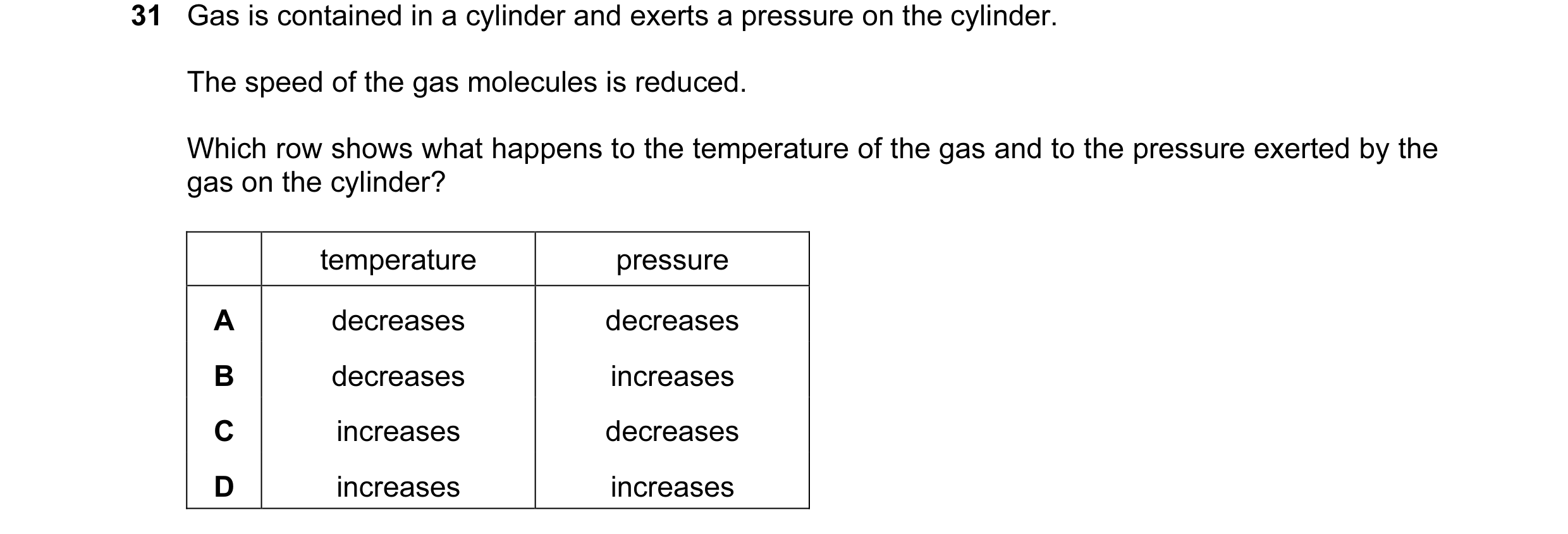
31 Gas is contained in a cylinder and exerts a pressure on the cylinder. The speed of the gas molecules is reduced. Which row shows what happens to the temperature of the gas and to the pressure exerted by the gas on the cylinder? temperature pressure A decreases decreases B decreases increases C increases decreases D increases increases
1 marks
Answer: A
This question in 0654/12 May/June 2013
Q12 · The air in a room exerts a pressure on the walls of the room 0654/12 May/June 2016
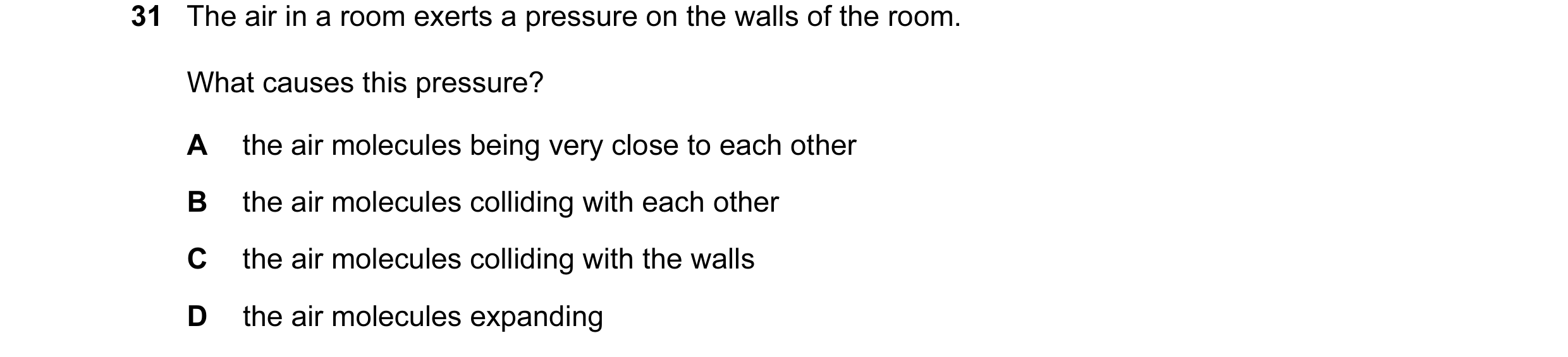
31 The air in a room exerts a pressure on the walls of the room. What causes this pressure? A the air molecules being very close to each other B the air molecules colliding with each other C the air molecules colliding with the walls D the air molecules expanding
1 marks
Answer: C
This question in 0654/12 May/June 2016
Q13 · A student places four identical beakers on a bench 0654/11 May/June 2017
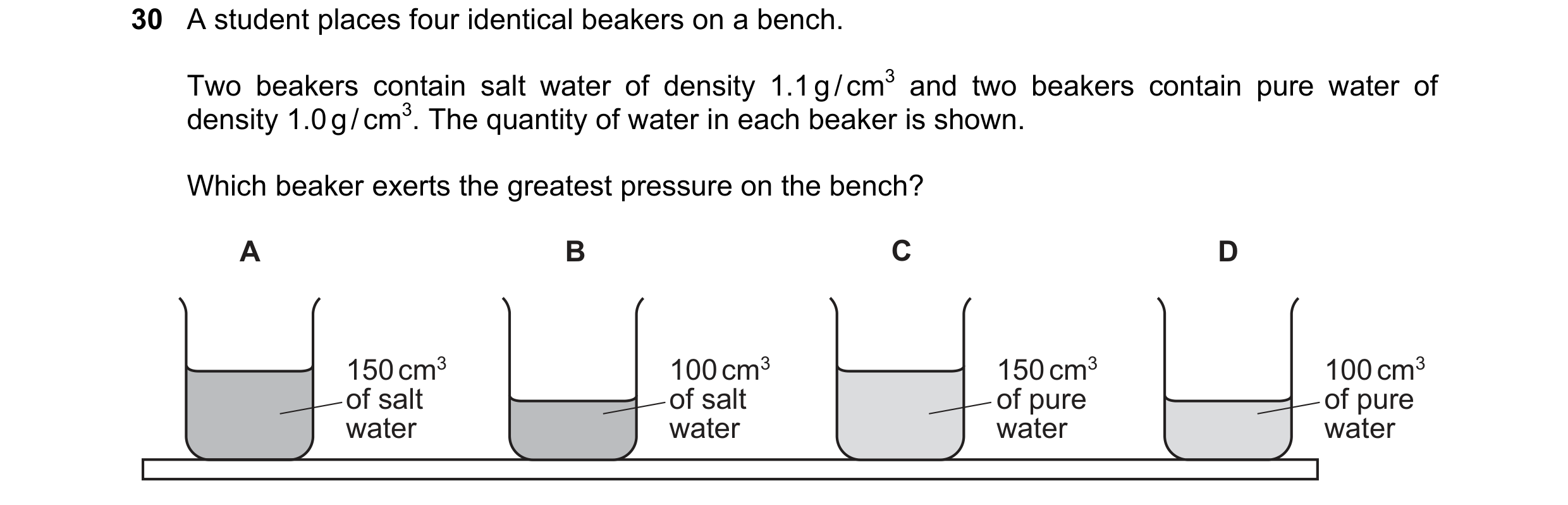
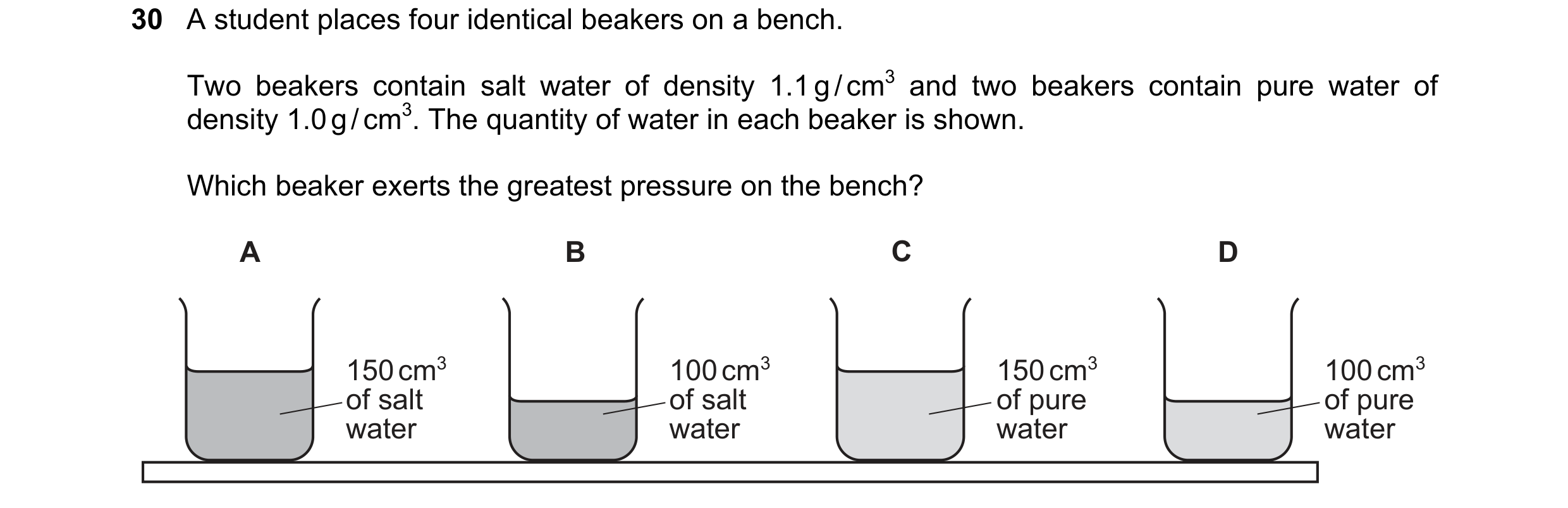
30 A student places four identical beakers on a bench. Two beakers contain salt water of density 1.1 g / cm3 and two beakers contain pure water of density 1.0 g / cm3. The quantity of water in each beaker is shown. Which beaker exerts the greatest pressure on the bench? A B C D 150 cm3 100 cm3 150 cm3 100 cm3 of salt of salt of pure of pure water water water water
1 marks
Answer: A
This question in 0654/11 May/June 2017
Q14 · Which situation is an example of a force acting over a large area to produce a small… 0654/13 May/June 2017
30 Which situation is an example of a force acting over a large area to produce a small pressure? A a nail penetrating a piece of wood B a needle being inserted into a patient’s arm C a sharp knife cutting vegetables D a soldier marching in flat-soled boots
1 marks
Answer: D
This question in 0654/13 May/June 2017
Q15 · The scale diagram shows three identical solid blocks P, Q and R 0654/12 Oct/Nov 2017
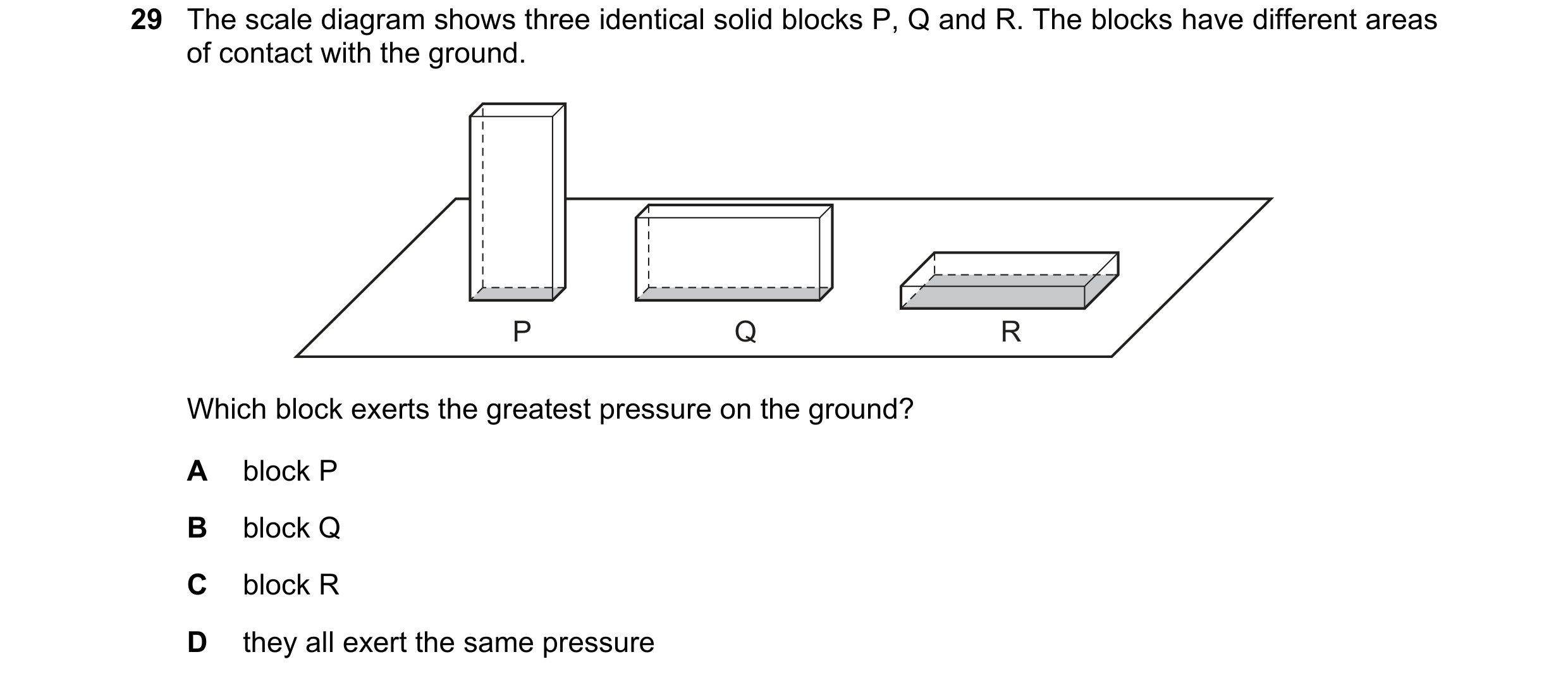
29 The scale diagram shows three identical solid blocks P, Q and R. The blocks have different areas of contact with the ground. P Q R Which block exerts the greatest pressure on the ground? A block P B block Q C block R D they all exert the same pressure
1 marks
Answer: A
This question in 0654/12 Oct/Nov 2017
Q16 · A student has two light wooden rods with different diameters, a light metal block, a… 0654/11 Oct/Nov 2018
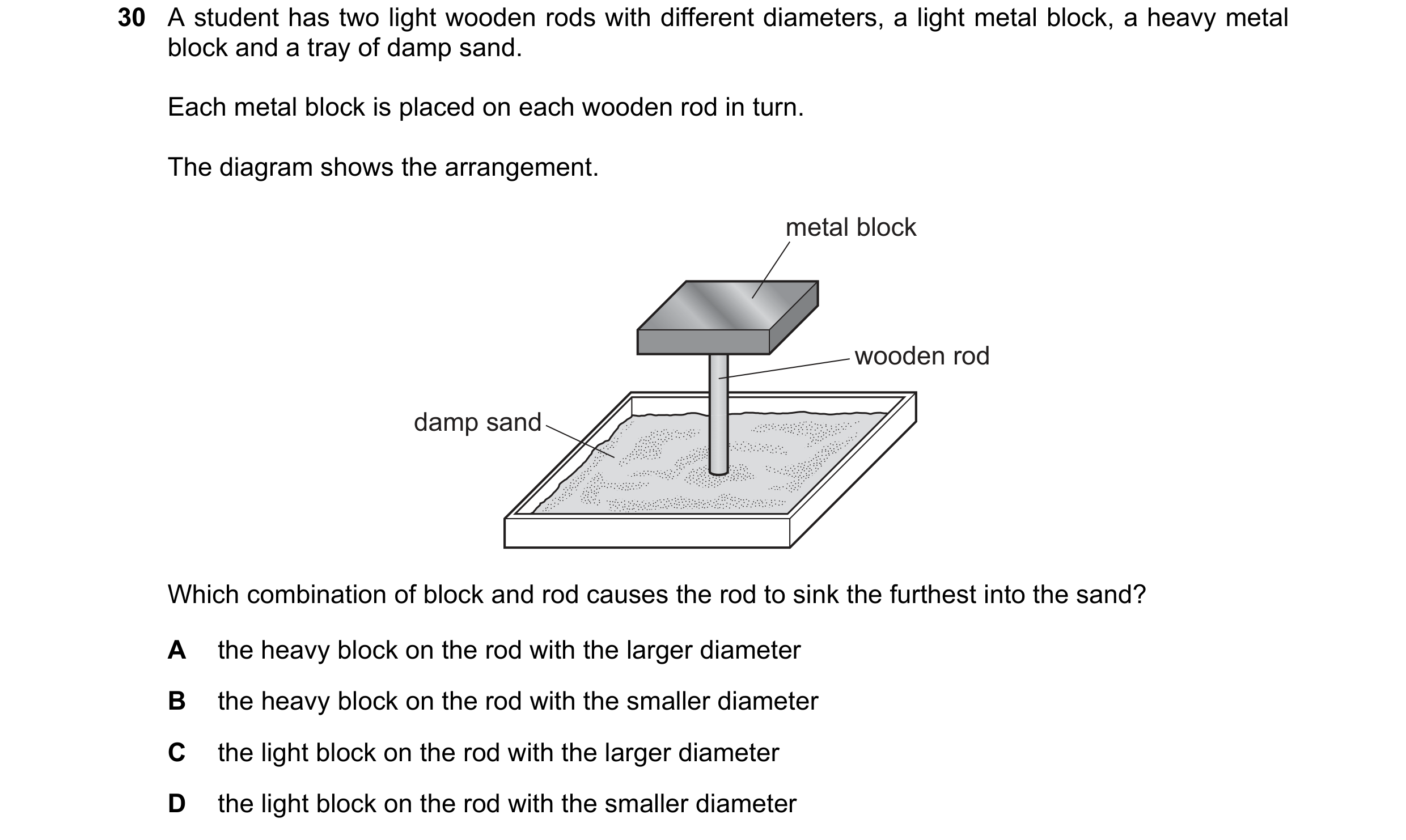
30 A student has two light wooden rods with different diameters, a light metal block, a heavy metal block and a tray of damp sand. Each metal block is placed on each wooden rod in turn. The diagram shows the arrangement. metal block wooden rod damp sand Which combination of block and rod causes the rod to sink the furthest into the sand? A the heavy block on the rod with the larger diameter B the heavy block on the rod with the smaller diameter C the light block on the rod with the larger diameter D the light block on the rod with the smaller diameter
1 marks
Answer: B
This question in 0654/11 Oct/Nov 2018
Q17 · The diagram shows a rectangular block with three faces labelled P, Q and R 0654/11 May/June 2019
29 The diagram shows a rectangular block with three faces labelled P, Q and R. The dimensions of the block are also shown. P 15 cm Q R 20 cm 40 cm Each face of the block is placed in turn on a flat, horizontal surface. Which statement is correct? A The smallest pressure is produced with the block resting on face P. B The smallest pressure is produced with the block resting on face Q. C The smallest pressure is produced with the block resting on face R. D The pressure is the same whether the block is resting on face P, face Q or face R.
1 marks
Answer: A
This question in 0654/11 May/June 2019
Q18 · Two different forces act on two different areas 0654/12 May/June 2020
30 Two different forces act on two different areas. Which combination of force and area produces the greatest pressure? A the larger force acting on the larger area B the larger force acting on the smaller area C the smaller force acting on the larger area D the smaller force acting on the smaller area
1 marks
Answer: B
This question in 0654/12 May/June 2020
Q19 · When driving cars on soft sand, drivers are advised to reduce the pressure of the air in… 0654/13 Oct/Nov 2021
30 When driving cars on soft sand, drivers are advised to reduce the pressure of the air in the tyres. Why does this cause the cars to sink less into the sand? A The area of the tyres in contact with the sand is decreased. B The area of the tyres in contact with the sand is increased. C The downward force on the sand is decreased. D The downward force on the sand is increased.
1 marks
Answer: B
This question in 0654/13 Oct/Nov 2021
Q20 · The weight of a box exerts pressure on the ground 0654/12 Oct/Nov 2023
30 The weight of a box exerts pressure on the ground. Which pair of changes to the box must reduce the pressure? A decreasing the weight and decreasing the area of the base B decreasing the weight and increasing the area of the base C increasing the weight and decreasing the area of the base D increasing the weight and increasing the area of the base
1 marks
Answer: B
This question in 0654/12 Oct/Nov 2023
Q21 · A person wearing snowshoes is walking on snow 0654/13 Oct/Nov 2023
29 A person wearing snowshoes is walking on snow. snowshoe How do snowshoes decrease the pressure on the snow? A by applying the person’s weight over a larger area B by applying the person’s weight over a smaller area C by decreasing the person’s weight D by increasing the person’s weight
1 marks
Answer: A
This question in 0654/13 Oct/Nov 2023
Q22 · A student places four identical beakers on a bench 0654/11 May/June 2024
30 A student places four identical beakers on a bench. Two beakers contain salt water of density 1.1 g / cm3 and two beakers contain pure water of density 1.0 g / cm3. The quantity of water in each beaker is shown. Which beaker exerts the greatest pressure on the bench? A B C D 150 cm3 100 cm3 150 cm3 100 cm3 of salt of salt of pure of pure water water water water
1 marks
Answer: A
This question in 0654/11 May/June 2024
Q23 · A person pushes a drawing pin into a cork with their thumb 0654/12 May/June 2025
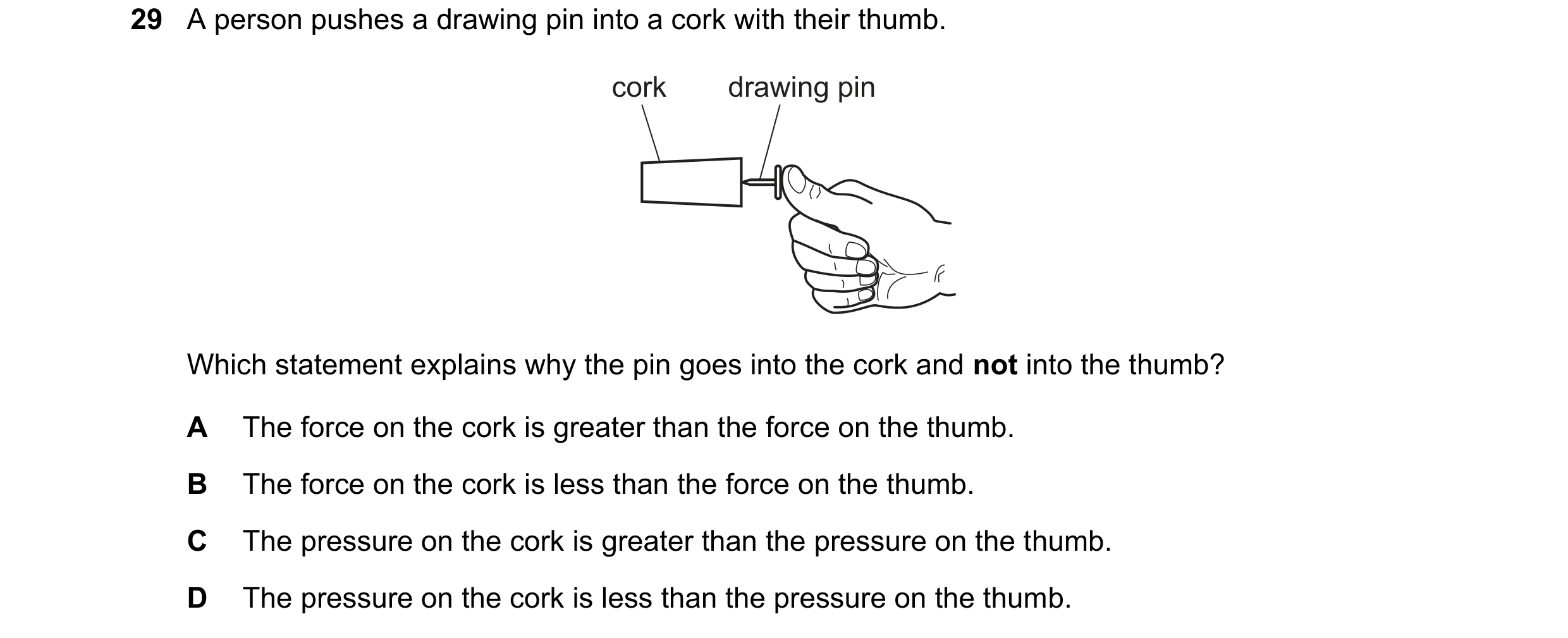
29 A person pushes a drawing pin into a cork with their thumb. cork drawing pin Which statement explains why the pin goes into the cork and not into the thumb? A The force on the cork is greater than the force on the thumb. B The force on the cork is less than the force on the thumb. C The pressure on the cork is greater than the pressure on the thumb. D The pressure on the cork is less than the pressure on the thumb.
1 marks
Answer: C
This question in 0654/12 May/June 2025
Q24 · A person pushes a drawing pin into a cork with their thumb 0654/13 May/June 2025
29 A person pushes a drawing pin into a cork with their thumb. cork drawing pin Which statement explains why the pin goes into the cork and not into the thumb? A The force on the cork is greater than the force on the thumb. B The force on the cork is less than the force on the thumb. C The pressure on the cork is greater than the pressure on the thumb. D The pressure on the cork is less than the pressure on the thumb.
1 marks
Answer: C
This question in 0654/13 May/June 2025
 1 / 8
1 / 8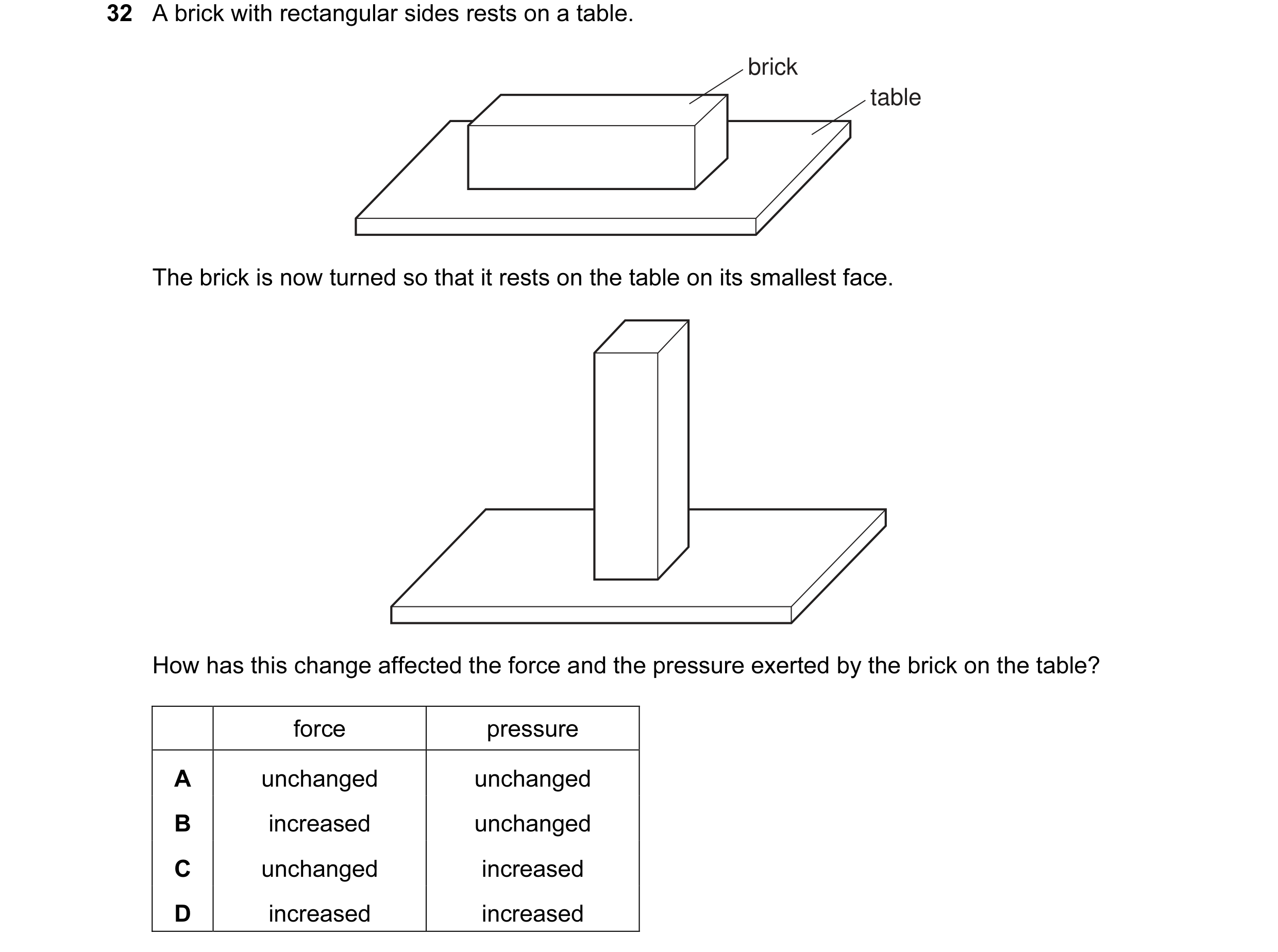
 2 / 8
2 / 8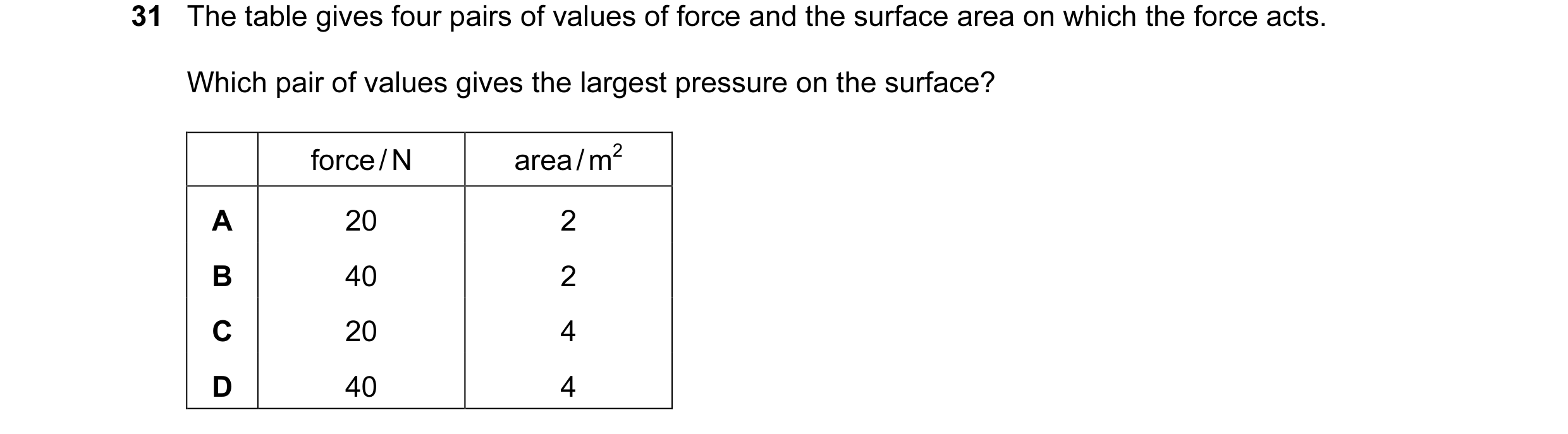
 3 / 8
3 / 8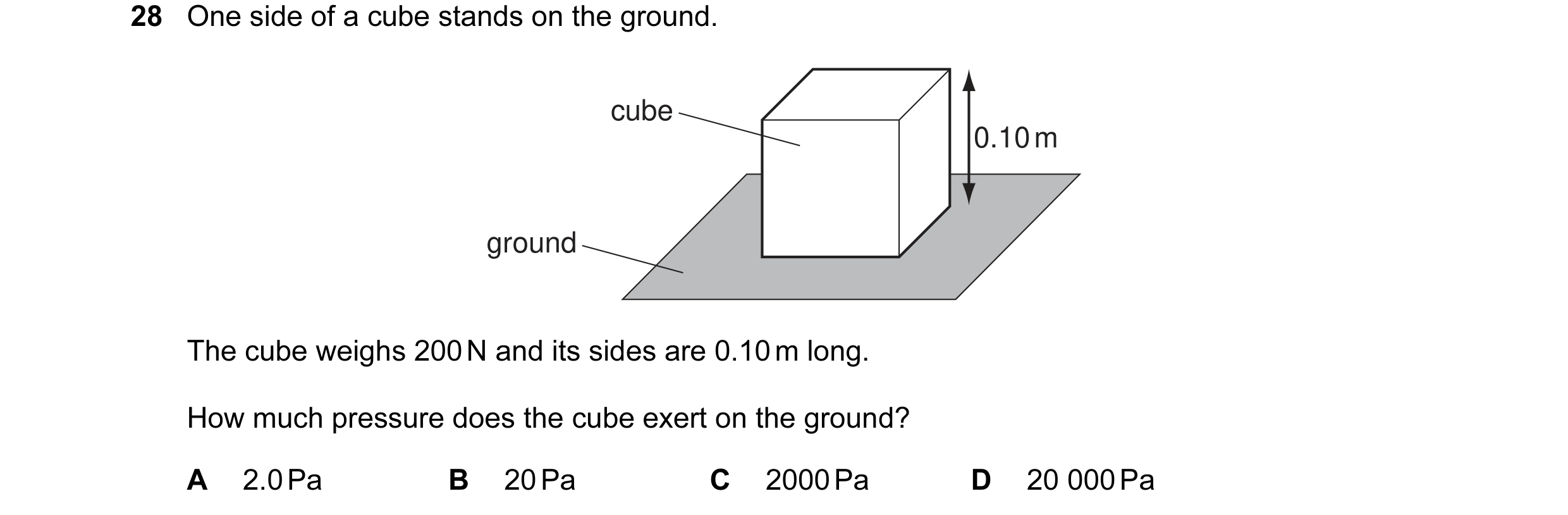
 4 / 8
4 / 8
 5 / 8
5 / 8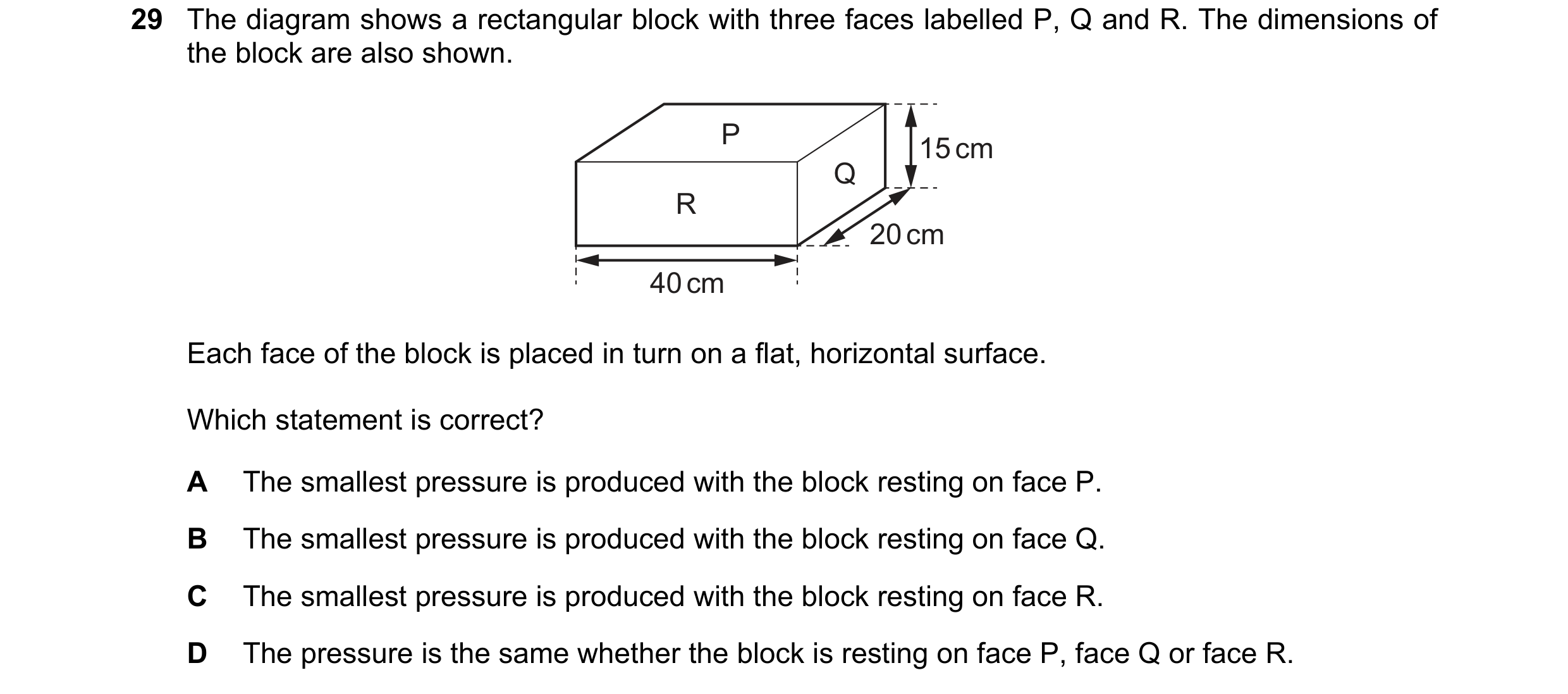
 6 / 8
6 / 8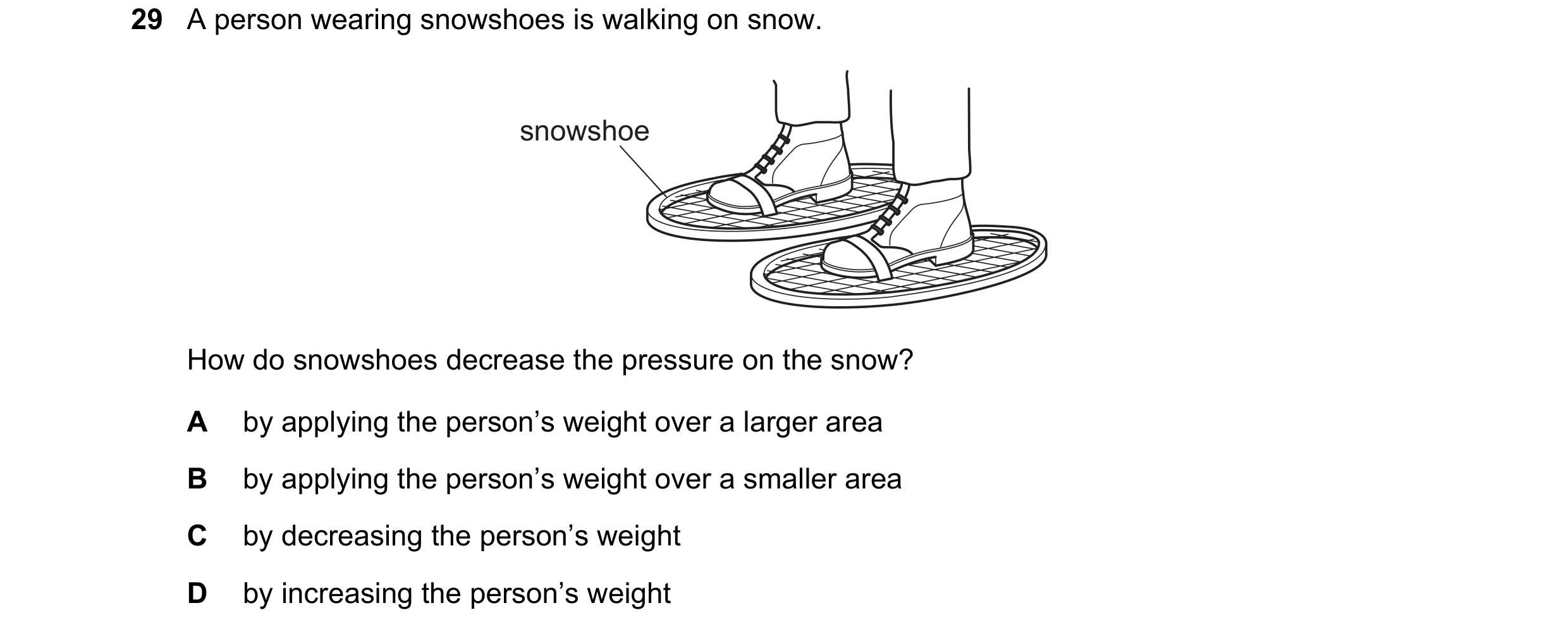
 7 / 8
7 / 8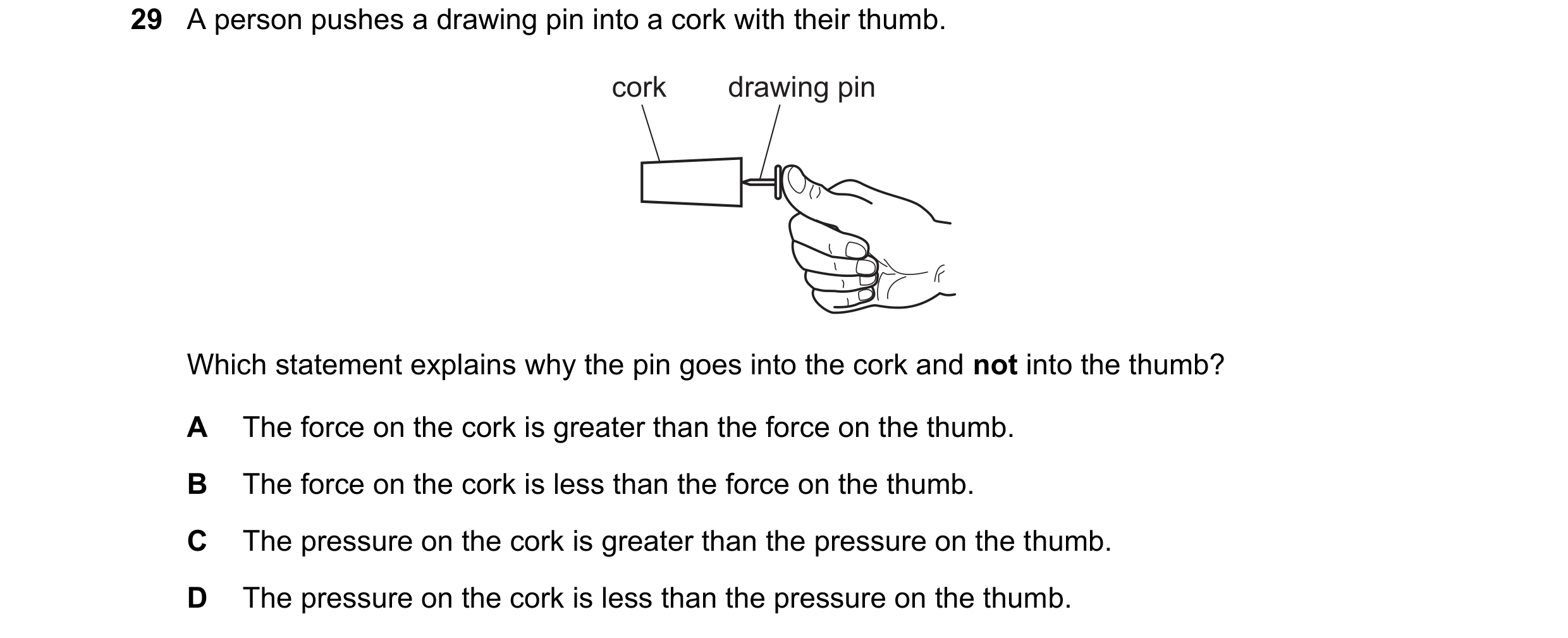 8 / 8
8 / 8