Questions as text
Q1 · A list of metals is shown below 0654/42 May/June 2017
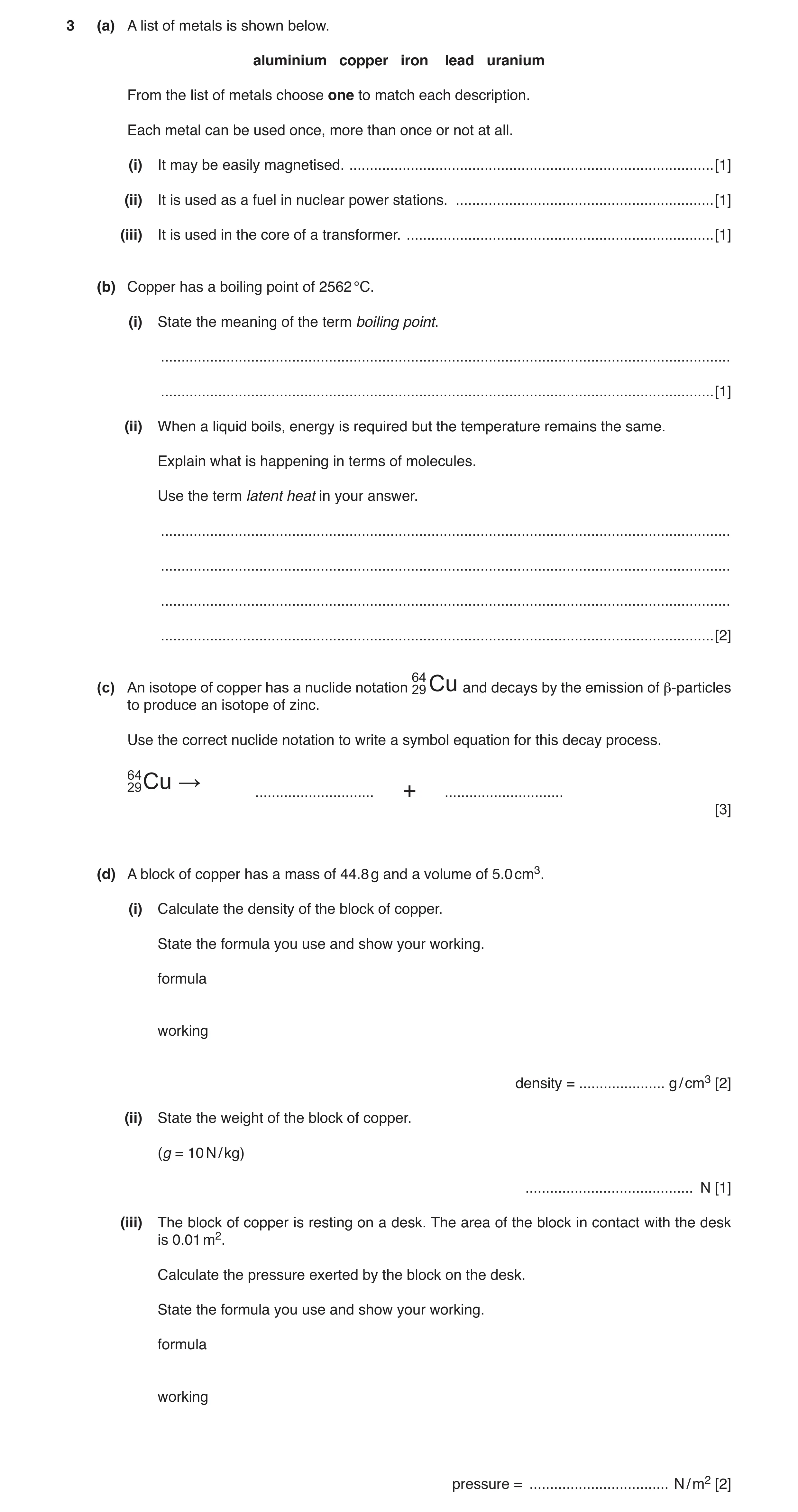
3 (a) A list of metals is shown below. aluminium copper iron lead uranium From the list of metals choose one to match each description. Each metal can be used once, more than once or not at all. (i) It may be easily magnetised. … [1] (ii) It is used as a fuel in nuclear power stations. … [1] (iii) It is used in the core of a transformer. … [1] (b) Copper has a boiling point of 2562 °C. (i) State the meaning of the term boiling point. … … [1] (ii) When a liquid boils, energy is required but the temperature remains the same. Explain what is happening in terms of molecules. Use the term latent heat in your answer. … … … … [2] 64 (c) An isotope of copper has a nuclide notation 29 Cu and decays by the emission of β-particles to produce an isotope of zinc. Use the correct nuclide notation to write a symbol equation for this decay process. 29 Cu64 → … + … [3] (d) A block of copper has a mass of 44.8 g and a volume of 5.0 cm3. (i) Calculate the density of the block of copper. State the formula you use and show your working. formula working density = … g / cm3 [2] (ii) State the weight of the block of copper. (g = 10 N / kg) … N [1] (iii) The block of copper is resting on a desk. The area of the block in contact with the desk is 0.01 m2. Calculate the pressure exerted by the block on the desk. State the formula you use and show your working. formula working pressure = … N / m2 [2]
14 marks
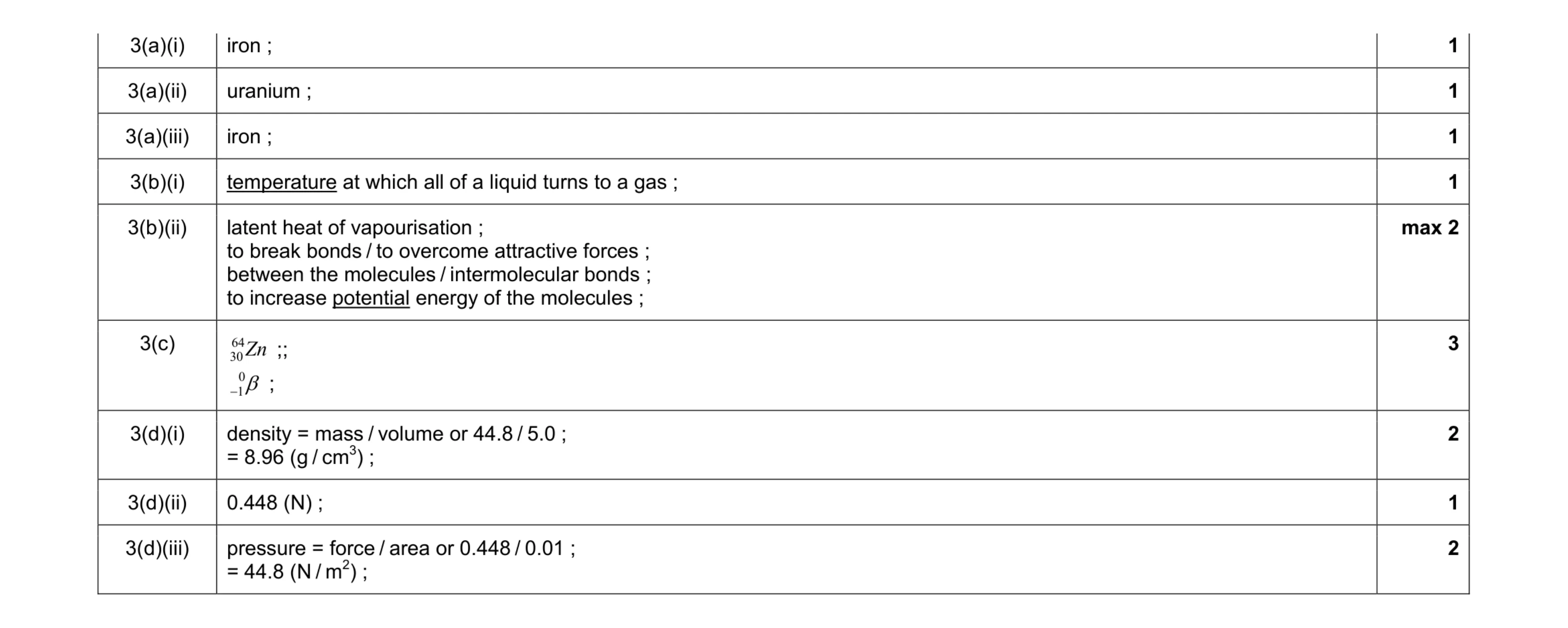
Mark scheme: 3(a)(i) iron ; 1 3(a)(ii) uranium ; 1 3(a)(iii) iron ; 1 3(b)(i) temperature at which all of a liquid turns to a gas ; 1 3(b)(ii) latent heat of vapourisation ; to break bonds / to overcome attractive forces ; between the molecules / intermolecular bonds ; to increase potential energy of the molecules ; max 2 3(c) 64 30Zn ;; 0 1β − ; 3 3(d)(i) density = mass / volume or 44.8 / 5.0 ; = 8.96 (g / cm3) ; 2 3(d)(ii) 0.448 (N) ; 1 3(d)(iii) pressure = force / area or 0.448 / 0.01 ; = 44.8 (N / m2) ; 2
This question in 0654/42 May/June 2017
Q2 · A bicycle with a front lamp A and a rear lamp B powered by the same battery 0654/42 Oct/Nov 2018
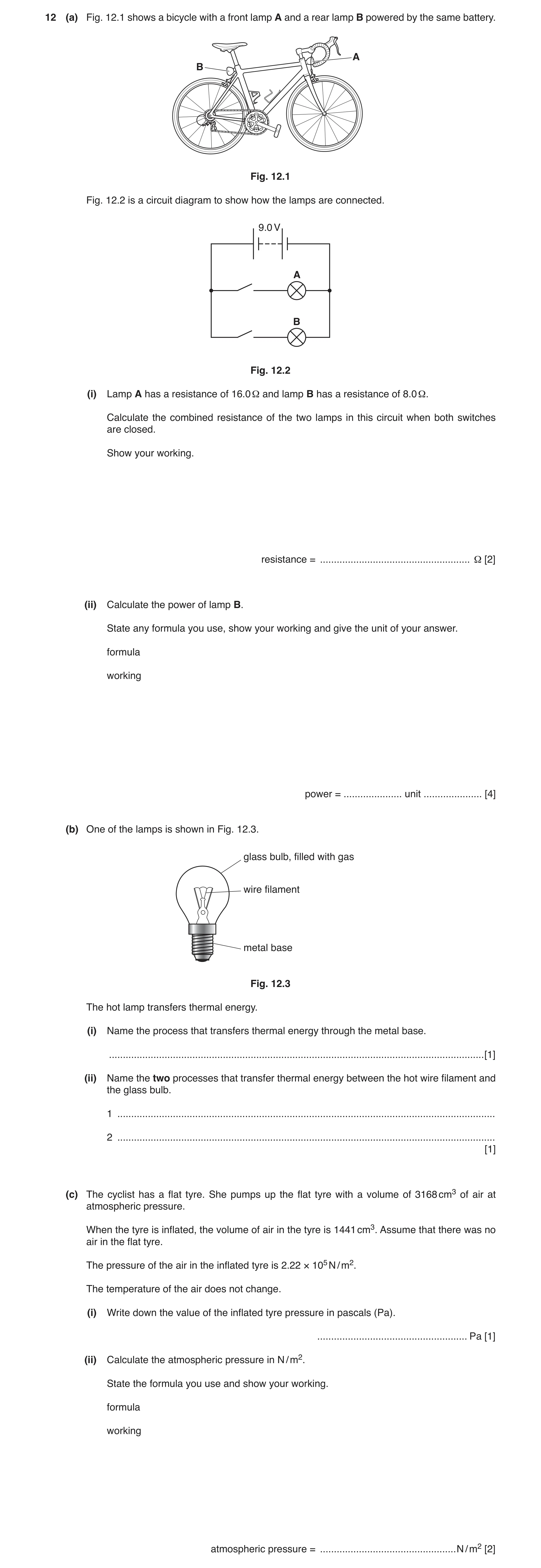
12 (a) Fig. 12.1 shows a bicycle with a front lamp A and a rear lamp B powered by the same battery. A B Fig. 12.1 Fig. 12.2 is a circuit diagram to show how the lamps are connected. 9.0 V A B Fig. 12.2 (i) Lamp A has a resistance of 16.0 Ω and lamp B has a resistance of 8.0 Ω. Calculate the combined resistance of the two lamps in this circuit when both switches are closed. Show your working. resistance = … Ω [2] (ii) Calculate the power of lamp B. State any formula you use, show your working and give the unit of your answer. formula working power = … unit … [4] (b) One of the lamps is shown in Fig. 12.3. glass bulb, filled with gas wire filament metal base Fig. 12.3 The hot lamp transfers thermal energy. (i) Name the process that transfers thermal energy through the metal base. … [1] (ii) Name the two processes that transfer thermal energy between the hot wire filament and the glass bulb. 1 … 2 … [1] (c) The cyclist has a flat tyre. She pumps up the flat tyre with a volume of 3168 cm3 of air at atmospheric pressure. When the tyre is inflated, the volume of air in the tyre is 1441 cm3. Assume that there was no air in the flat tyre. The pressure of the air in the inflated tyre is 2.22 × 10⁵ N / m2. The temperature of the air does not change. (i) Write down the value of the inflated tyre pressure in pascals (Pa). … Pa [1] (ii) Calculate the atmospheric pressure in N / m2. State the formula you use and show your working. formula working atmospheric pressure = … N / m2 [2]
11 marks
Mark scheme: 12(a)(i) 5.3(3) (Ω) ; 2 12(a)(ii) current = voltage / resistance or 9 / 8 OR 1.1(25) (A) ; power = voltage × current or 9 × 1.125 ; = 10(.125) ; Watts / W ; 4 12(b)(i) conduction ; 1 12(b)(ii) convection AND radiation ; 1 12(c)(i) 2.22 × 10⁵ (Pa) ; 1 12(c)(ii) P1 = (P2 × V2) / V1 or (2.22 × 105× 1441) / 3168 ; = 1.01 × 10⁵ (N / m2) ; 2
This question in 0654/42 Oct/Nov 2018
Q3 · A large snow tractor used by scientists working in the Arctic region 0654/42 May/June 2019
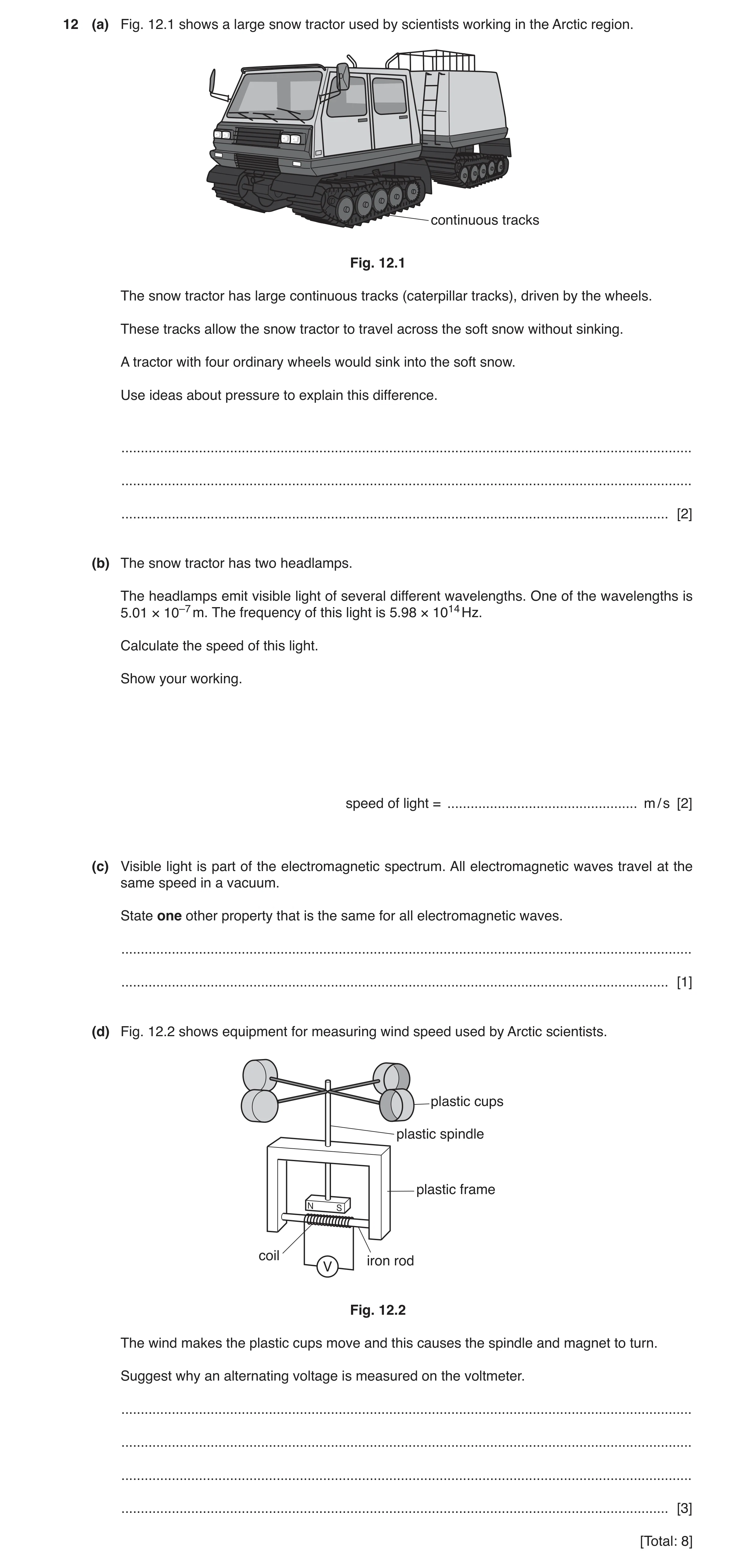
12 (a) Fig. 12.1 shows a large snow tractor used by scientists working in the Arctic region. continuous tracks Fig. 12.1 The snow tractor has large continuous tracks (caterpillar tracks), driven by the wheels. These tracks allow the snow tractor to travel across the soft snow without sinking. A tractor with four ordinary wheels would sink into the soft snow. Use ideas about pressure to explain this difference. … … … [2] (b) The snow tractor has two headlamps. The headlamps emit visible light of several different wavelengths. One of the wavelengths is 5.01 × 10⁻⁷ m. The frequency of this light is 5.98 × 10¹⁴ Hz. Calculate the speed of this light. Show your working. speed of light = … m / s [2] (c) Visible light is part of the electromagnetic spectrum. All electromagnetic waves travel at the same speed in a vacuum. State one other property that is the same for all electromagnetic waves. … … [1] (d) Fig. 12.2 shows equipment for measuring wind speed used by Arctic scientists. plastic cups plastic spindle plastic frame coil iron rod V Fig. 12.2 The wind makes the plastic cups move and this causes the spindle and magnet to turn. Suggest why an alternating voltage is measured on the voltmeter. … … … … [3] [Total: 8]
8 marks
Mark scheme: 12(a) tracks spread weight over larger (surface) area ; so pressure is less ; 2 12(b) (v) = f × λ or 5.98 × 1014 × 5.01 × 10-7 ; = 3.00 × 10⁸ (m) ; 2 12(c) all transverse waves ; 1 12(d) (coil experiences) changing magnetic field ; (changing magnetic field) induces emf ; direction of emf changes every half turn ; max 3
This question in 0654/42 May/June 2019
Q4 · A penguin walking on the ice in Antarctica 0654/43 May/June 2019
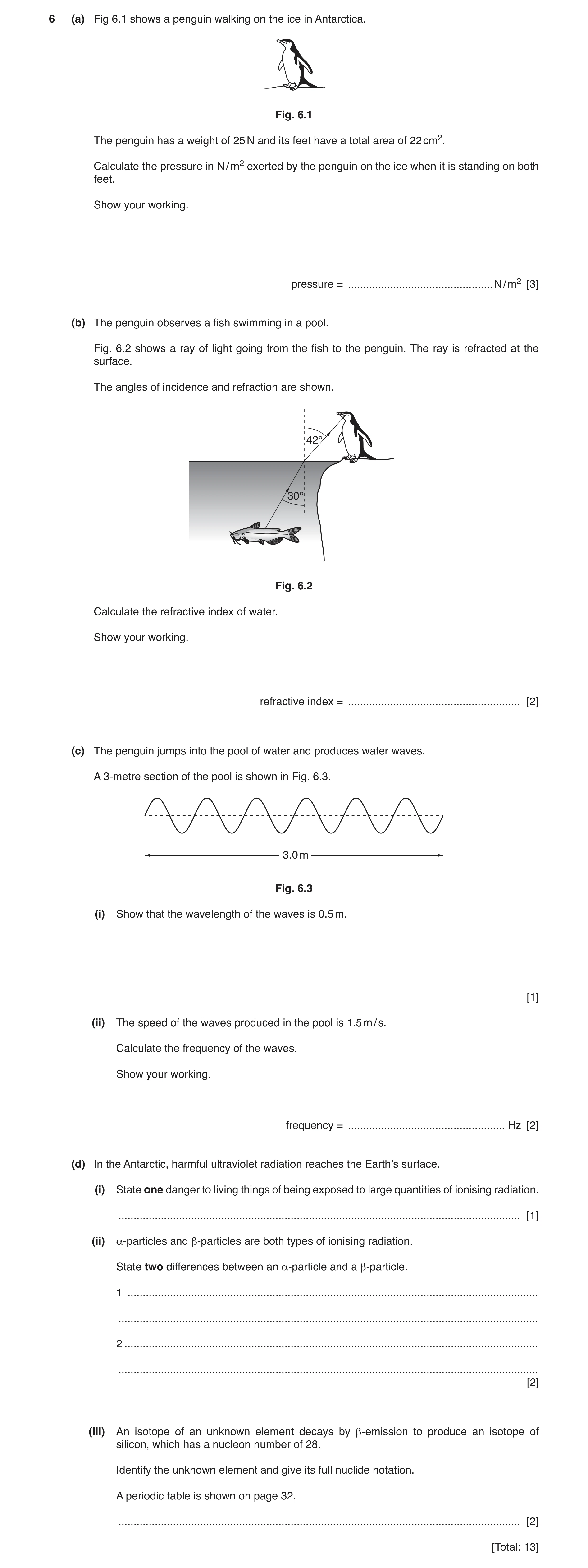
6 (a) Fig 6.1 shows a penguin walking on the ice in Antarctica. Fig. 6.1 The penguin has a weight of 25 N and its feet have a total area of 22 cm2. Calculate the pressure in N / m2 exerted by the penguin on the ice when it is standing on both feet. Show your working. pressure = … N / m2 [3] (b) The penguin observes a fish swimming in a pool. Fig. 6.2 shows a ray of light going from the fish to the penguin. The ray is refracted at the surface. The angles of incidence and refraction are shown. 42° 30° Fig. 6.2 Calculate the refractive index of water. Show your working. refractive index = … [2] (c) The penguin jumps into the pool of water and produces water waves. A 3-metre section of the pool is shown in Fig. 6.3. 3.0 m Fig. 6.3 (i) Show that the wavelength of the waves is 0.5 m. [1] (ii) The speed of the waves produced in the pool is 1.5 m / s. Calculate the frequency of the waves. Show your working. frequency = … Hz [2] (d) In the Antarctic, harmful ultraviolet radiation reaches the Earth’s surface. (i) State one danger to living things of being exposed to large quantities of ionising radiation. … [1] (ii) α-particles and β-particles are both types of ionising radiation. State two differences between an α-particle and a β-particle. 1 … … 2 … … [2] (iii) An isotope of an unknown element decays by β-emission to produce an isotope of silicon, which has a nucleon number of 28. Identify the unknown element and give its full nuclide notation. A periodic table is shown on page 32. … [2] [Total: 13]
13 marks
Mark scheme: 6(a) conversion of cm2 to m2 seen ; = 11 000 (N/m2) ; 3 6(b) 0.67 / 0.50 ; 1.3 ; 2 6(c)(i) 3.0 / 6.0 ; 1 6(c)(ii) f 1.5 / 0.5 ; = 3 (Hz) ; 2 6(d)(i) cancer / mutation ; 1 6(d)(ii) α particles are larger/heavier ; α particles have positive charge and β particles have negative charge ; α particles are more ionising ; α particles are less penetrating ; max 2 6(d)(iii) l 28A 13 1 mark for Al ; 1 mark for 13 and 28 in correct positions ; 2
This question in 0654/43 May/June 2019
Q5 · An elephant of mass 3800 kg is moving at 0.4 m / s 0654/41 May/June 2020
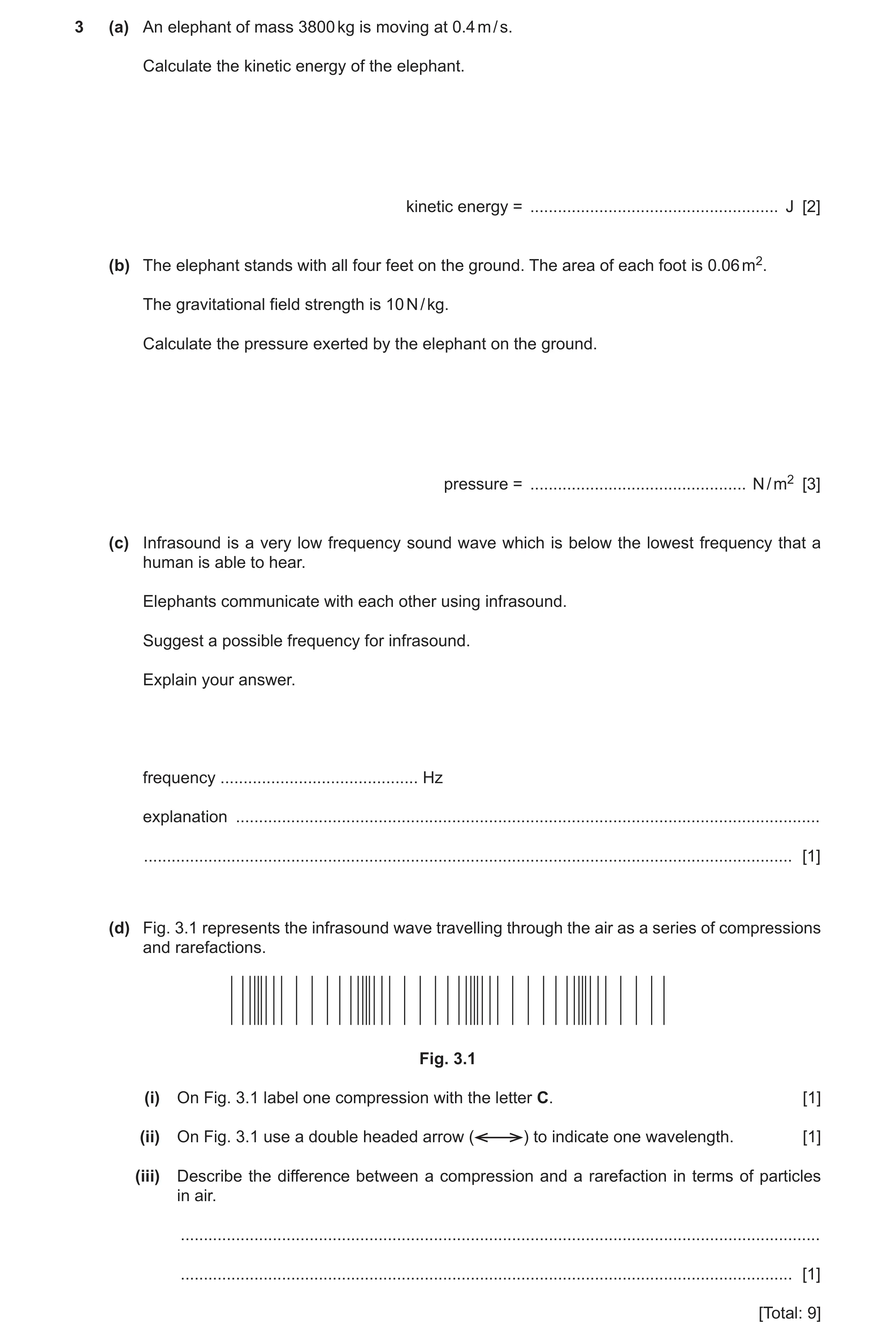
3 (a) An elephant of mass 3800 kg is moving at 0.4 m / s. Calculate the kinetic energy of the elephant. kinetic energy = … J [2] (b) The elephant stands with all four feet on the ground. The area of each foot is 0.06 m2. The gravitational field strength is 10 N / kg. Calculate the pressure exerted by the elephant on the ground. pressure = … N / m2 [3] (c) Infrasound is a very low frequency sound wave which is below the lowest frequency that a human is able to hear. Elephants communicate with each other using infrasound. Suggest a possible frequency for infrasound. Explain your answer. frequency … Hz explanation … … [1] (d) Fig. 3.1 represents the infrasound wave travelling through the air as a series of compressions and rarefactions. Fig. 3.1 (i) On Fig. 3.1 label one compression with the letter C. [1] (ii) On Fig. 3.1 use a double headed arrow ( ) to indicate one wavelength. [1] (iii) Describe the difference between a compression and a rarefaction in terms of particles in air. … … [1] [Total: 9]
9 marks
Mark scheme: 3(a) KE = 1 2 mv2 or KE = 1 2 × 3800 × 0.4 × 0.4; = 300 (J); 3(b) area = 4 × 0.06 (m2) or weight = 38 000 N; pressure = force /area = 38 000 / 0.24; = 160 000 (N/m2); 3 3(c) value between 0Hz and 20Hz no mark because 20Hz is the minimum audible frequency for a human; 1 3(d)(i) compression correctly labelled with a C; 1 3d(ii) one wavelength correctly shown with a double headed arrow (↔); 1 Question Answer Marks 3(d)(iii) (region of) high pressure / low pressure or particles closer together / further apart; 1
This question in 0654/41 May/June 2020
Q6 · A farmer drives his tractor at a constant speed 0654/41 Oct/Nov 2020
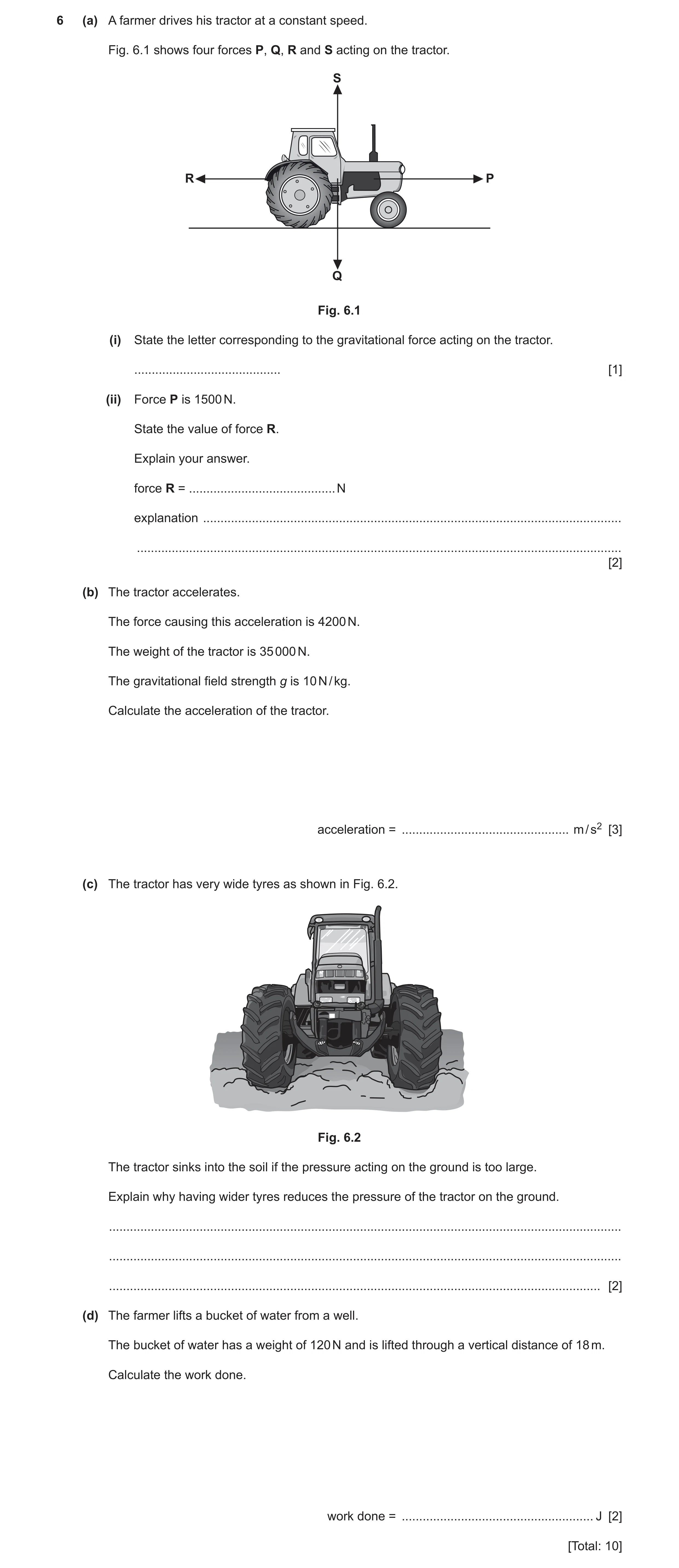
6 (a) A farmer drives his tractor at a constant speed. Fig. 6.1 shows four forces P, Q, R and S acting on the tractor. S R P Q Fig. 6.1 (i) State the letter corresponding to the gravitational force acting on the tractor. … [1] (ii) Force P is 1500 N. State the value of force R. Explain your answer. force R = … N explanation … … [2] (b) The tractor accelerates. The force causing this acceleration is 4200 N. The weight of the tractor is 35 000 N. The gravitational field strength g is 10 N / kg. Calculate the acceleration of the tractor. acceleration = … m / s2 [3] (c) The tractor has very wide tyres as shown in Fig. 6.2. Fig. 6.2 The tractor sinks into the soil if the pressure acting on the ground is too large. Explain why having wider tyres reduces the pressure of the tractor on the ground. … … … [2] (d) The farmer lifts a bucket of water from a well. The bucket of water has a weight of 120 N and is lifted through a vertical distance of 18 m. Calculate the work done. work done = … J [2] [Total: 10]
10 marks
Mark scheme: 6(a)(i) Q ; 1 6(a)(ii) 1500 (N) ; constant speed / forces are balanced / resultant is zero ; 2 6(b) mass = 3500 kg ; force / mass or 4200 / 3500 ; acceleration = 1.2 (m / s2) ; 3 Question Answer Marks 6(c) larger (surface) area ; (so pressure is less as) P = F / A ; 2 6(d) (work done =) force × distance or 120 × 18 ; = 2160 (J) ; 2
This question in 0654/41 Oct/Nov 2020
Q7 · A horse of mass 450 kg accelerates constantly from rest and reaches a maximum speed of 9… 0654/42 Oct/Nov 2020
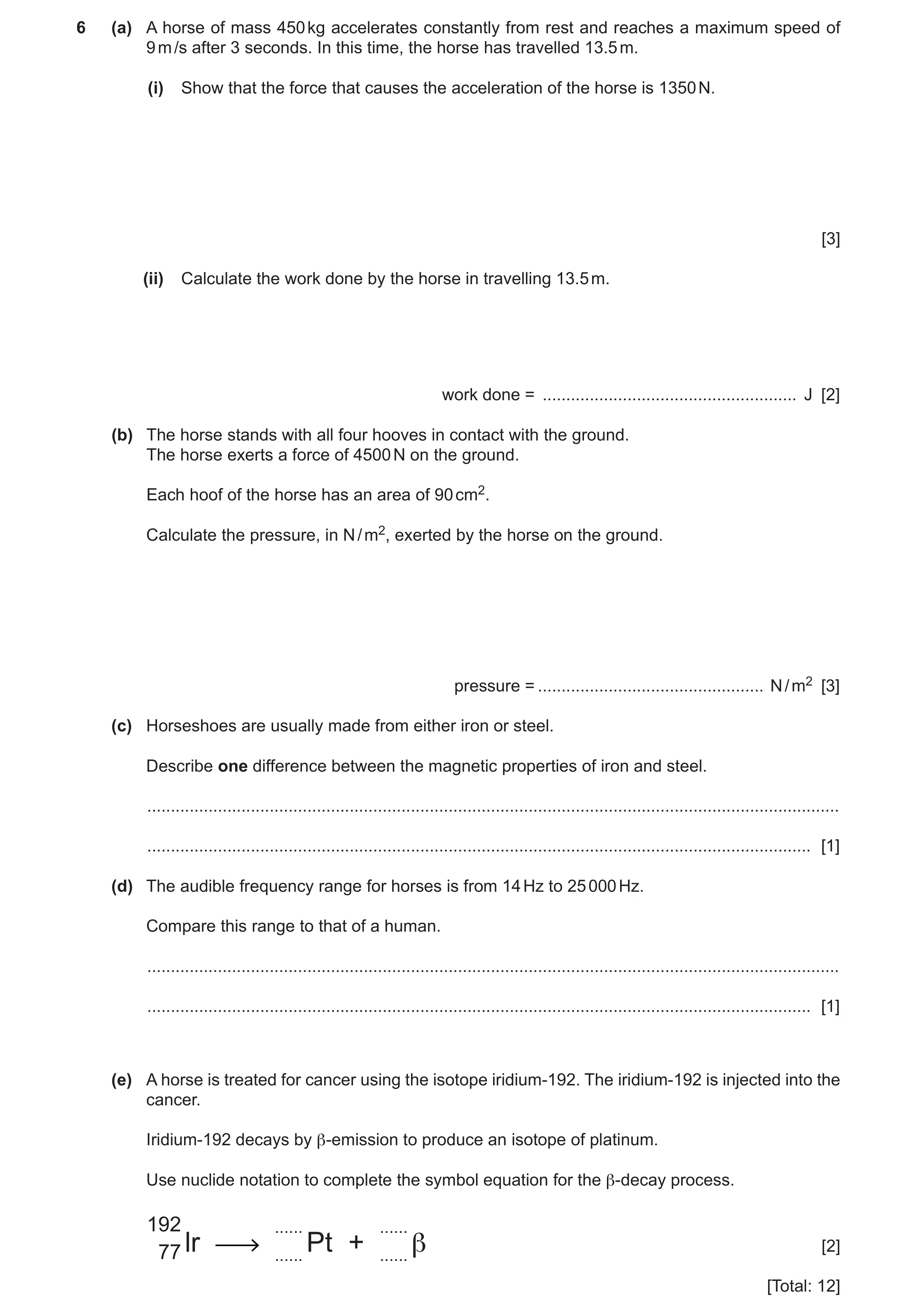
6 (a) A horse of mass 450 kg accelerates constantly from rest and reaches a maximum speed of 9 m /s after 3 seconds. In this time, the horse has travelled 13.5 m. (i) Show that the force that causes the acceleration of the horse is 1350 N. [3] (ii) Calculate the work done by the horse in travelling 13.5 m. work done = … J [2] (b) The horse stands with all four hooves in contact with the ground. The horse exerts a force of 4500 N on the ground. Each hoof of the horse has an area of 90 cm2. Calculate the pressure, in N / m2, exerted by the horse on the ground. pressure = … N / m2 [3] (c) Horseshoes are usually made from either iron or steel. Describe one difference between the magnetic properties of iron and steel. … … [1] (d) The audible frequency range for horses is from 14 Hz to 25 000 Hz. Compare this range to that of a human. … … [1] (e) A horse is treated for cancer using the isotope iridium-192. The iridium-192 is injected into the cancer. Iridium-192 decays by β-emission to produce an isotope of platinum. Use nuclide notation to complete the symbol equation for the β-decay process. 192 … … lr Pt + β [2] 77 … … [Total: 12]
12 marks
Mark scheme: 6(a)(i) acceleration = 9/3 = 3 m/s2 ; force = mass × acceleration ; working or 3 × 450 (= 1350 N) ; 6(a)(ii) work done = force × distance / 1350 × 13.5 ; = 18 200 (J) ; 2 6(b) 90 × 4 = 360 (cm2) = 0.036 m2 ; pressure = force / area or 4500 / 0.036 ; pressure = 125 000 (N/m2) ; 3 6(c) iron, magnetises / loses magnetism, quicker ; steel, magnetises / loses magnetism, slower ; max 1 1 6(d) humans have smaller audible range ; 1 6(e) − → + β 192 192 0 77 78 1 r Pt I ;; 2
This question in 0654/42 Oct/Nov 2020
Q8 · A man in a canoe on a lake 0654/43 Oct/Nov 2022
3 Fig. 3.1 shows a man in a canoe on a lake. The combined mass of the man and the canoe is 120 kg. Fig. 3.1 (a) The canoe moves at a speed of 4.0 m / s. (i) Calculate the kinetic energy of the man and the canoe. kinetic energy = … J [2] (ii) The canoe takes 5.0 s to slow down to a speed of 0.5 m / s. Calculate the constant deceleration of the canoe. deceleration = … m / s2 [3] (iii) On Fig. 3.2 draw a speed–time graph to show the canoe’s deceleration. 4.0 3.5 3.0 2.5 speed 2.0 m / s 1.5 1.0 0.5 0 0 1 2 3 4 5 time / s Fig. 3.2 [1] (b) The canoe exerts a pressure of 0.5 kPa on the surface of the water. Calculate the area of canoe in contact with the surface of the water. The gravitational field strength, g, is 10 N / kg. area = … m2 [3] (c) Fig. 3.3 shows water waves on the surface of the lake. Fig. 3.3 (i) On Fig. 3.3, draw a double headed arrow (↕ or ↔) to show the wavelength of the wave. [1] (ii) Use the words below to complete the sentences about waves. You can use each word once, more than once or not at all. compression energy force longitudinal matter perpendicular parallel rarefaction transverse Waves transfer … without transferring … . A water wave is an example of a … wave. In a water wave the oscillations are … to the direction of the wave. [2] [Total: 12]
12 marks
Mark scheme: 3(a)(i) (KE =) ½ mv2 or ½ 120 42 ; 2 960 (J) ; 3(a)(ii) (v =) 3.5 (m / s) ; 3 (a =) v / t or 3.5 / 5.0 ; 0.7 (m / s2) ; 3(a)(iii) 1 ; 3(b) (W =) mg or 120 10 or 1200 (N) ; 3 (A =) W / P or 1200 / 500 ; 2.4 (m2) ; 3(c)(i) correct arrow showing one complete wavelength ; 1 3(c)(ii) energy AND matter ; 2 transverse AND perpendicular ;
This question in 0654/43 Oct/Nov 2022
Q9 · An insect called a pond skater 0654/42 May/June 2023
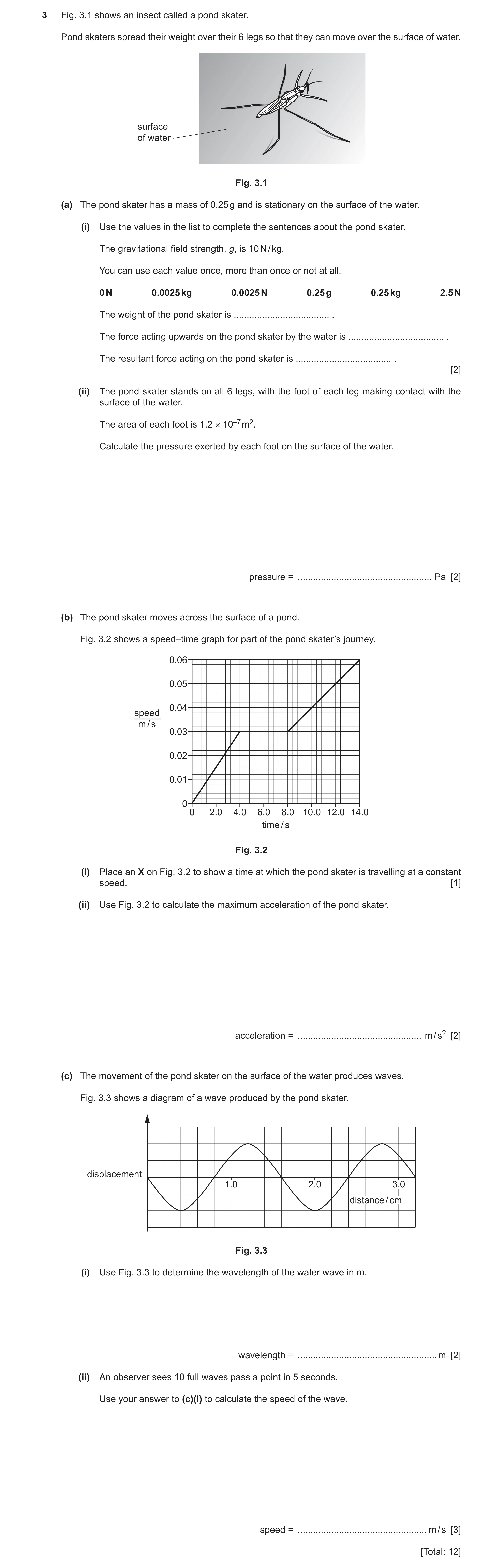
3 Fig. 3.1 shows an insect called a pond skater. Pond skaters spread their weight over their 6 legs so that they can move over the surface of water. surface of water Fig. 3.1 (a) The pond skater has a mass of 0.25 g and is stationary on the surface of the water. (i) Use the values in the list to complete the sentences about the pond skater. The gravitational field strength, g, is 10 N / kg. You can use each value once, more than once or not at all. 0 N 0.0025 kg 0.0025 N 0.25 g 0.25 kg 2.5 N The weight of the pond skater is … . The force acting upwards on the pond skater by the water is … . The resultant force acting on the pond skater is … . [2] (ii) The pond skater stands on all 6 legs, with the foot of each leg making contact with the surface of the water. The area of each foot is 1.2 × 10⁻⁷ m2. Calculate the pressure exerted by each foot on the surface of the water. pressure = … Pa [2] (b) The pond skater moves across the surface of a pond. Fig. 3.2 shows a speed–time graph for part of the pond skater’s journey. 0.06 0.05 0.04 speed m / s 0.03 0.02 0.01 0 0 2.0 4.0 6.0 8.0 10.0 12.0 14.0 time / s Fig. 3.2 (i) Place an X on Fig. 3.2 to show a time at which the pond skater is travelling at a constant speed. [1] (ii) Use Fig. 3.2 to calculate the maximum acceleration of the pond skater. acceleration = … m / s2 [2] (c) The movement of the pond skater on the surface of the water produces waves. Fig. 3.3 shows a diagram of a wave produced by the pond skater. displacement 1.0 2.0 3.0 distance / cm Fig. 3.3 (i) Use Fig. 3.3 to determine the wavelength of the water wave in m. wavelength = … m [2] (ii) An observer sees 10 full waves pass a point in 5 seconds. Use your answer to (c)(i) to calculate the speed of the wave. speed = … m / s [3] [Total: 12]
12 marks
Mark scheme: 3(a)(i) 0.0025 N ; 0.0025 N and 0 (N) ; 2 3(a)(ii) (P =) F / A or 0.0025 / (6 1.2 10–7) ; (P =) 3500 (Pa) ; 2 3(b)(i) X placed between 4.0 and 8.0 s ; 1 3(b)(ii) (a =) v / t or 0.03 / 4.0 ; (a =) 0.0075 (m / s2) ; 2 3(c)(i) 1.6 / 100 ; 0.016 (m) ; 2 Question Answer Marks 3(c)(ii) (f =) 2 (Hz) ; (v =) f or 2 0.016 ; (v =) 0.032 (m / s) ; 3
This question in 0654/42 May/June 2023
Q10 · An electric pressure‑washer being used to wash a car 0654/42 May/June 2024
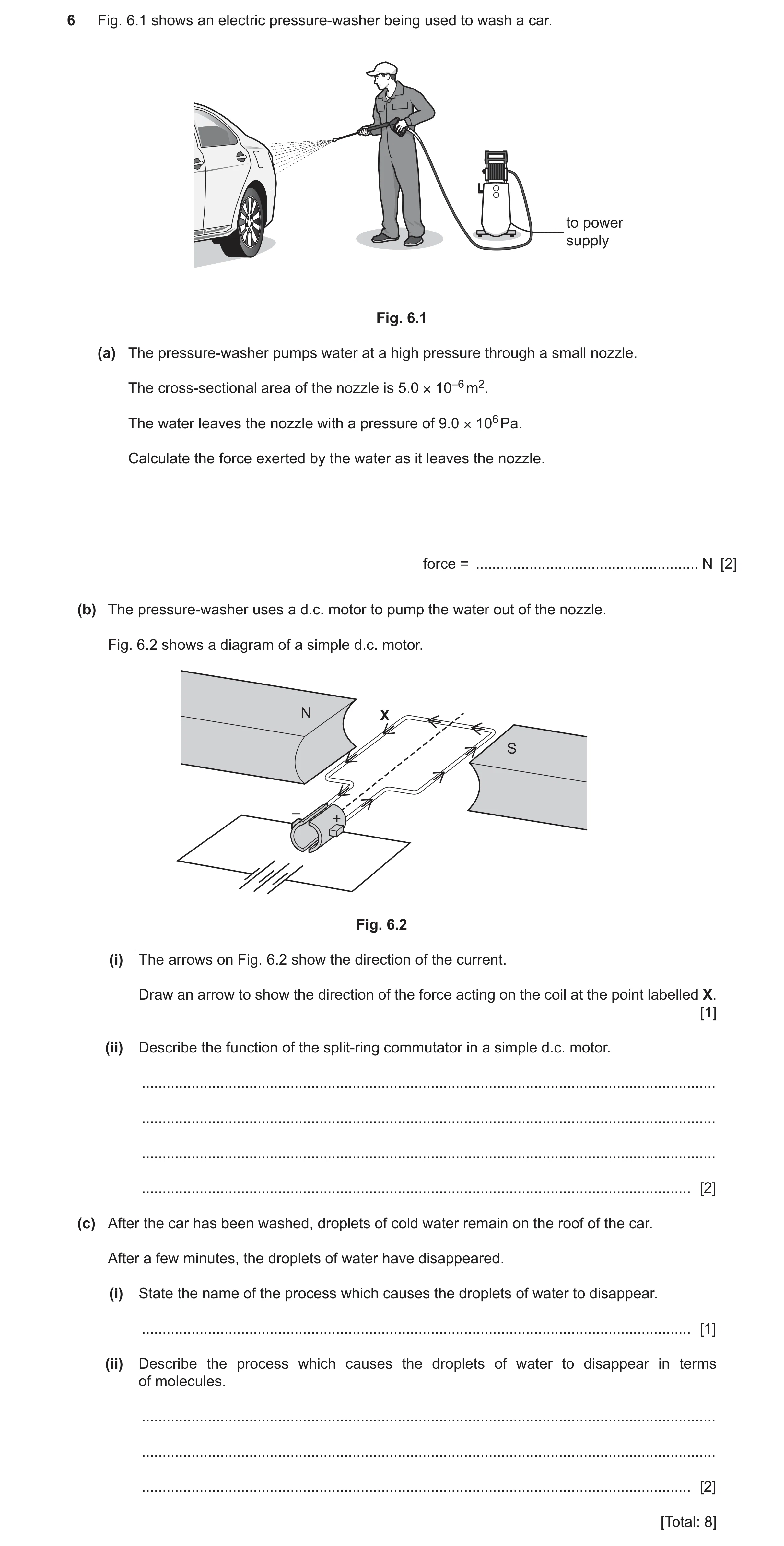
6 Fig. 6.1 shows an electric pressure‑washer being used to wash a car. to power supply Fig. 6.1 (a) The pressure‑washer pumps water at a high pressure through a small nozzle. The cross‑sectional area of the nozzle is 5.0 × 10⁻⁶ m2. The water leaves the nozzle with a pressure of 9.0 × 10⁶ Pa. Calculate the force exerted by the water as it leaves the nozzle. force = … N [2] (b) The pressure‑washer uses a d.c. motor to pump the water out of the nozzle. Fig. 6.2 shows a diagram of a simple d.c. motor. N X S _ + Fig. 6.2 (i) The arrows on Fig. 6.2 show the direction of the current. Draw an arrow to show the direction of the force acting on the coil at the point labelled X. [1] (ii) Describe the function of the split‑ring commutator in a simple d.c. motor. … … … … [2] (c) After the car has been washed, droplets of cold water remain on the roof of the car. After a few minutes, the droplets of water have disappeared. (i) State the name of the process which causes the droplets of water to disappear. … [1] (ii) Describe the process which causes the droplets of water to disappear in terms of molecules. … … … [2] [Total: 8]
8 marks
Mark scheme: 6(a) (F=) 45 (N) ; 2 6(b)(i) arrow drawn upwards ; 1 6(b)(ii) provides an alternating current (in the coil) / current that changes direction every half-turn / to reverse the current every half turn / 180° ; allows coil to continue to turn (in the same direction) ; 2 Question Answer Marks 6(c)(i) evaporation ; 1 6(c)(ii) the most energetic molecules ; escape from the surface ; 2
This question in 0654/42 May/June 2024
Q11 · A wind turbine used to generate electricity 0654/42 Oct/Nov 2024
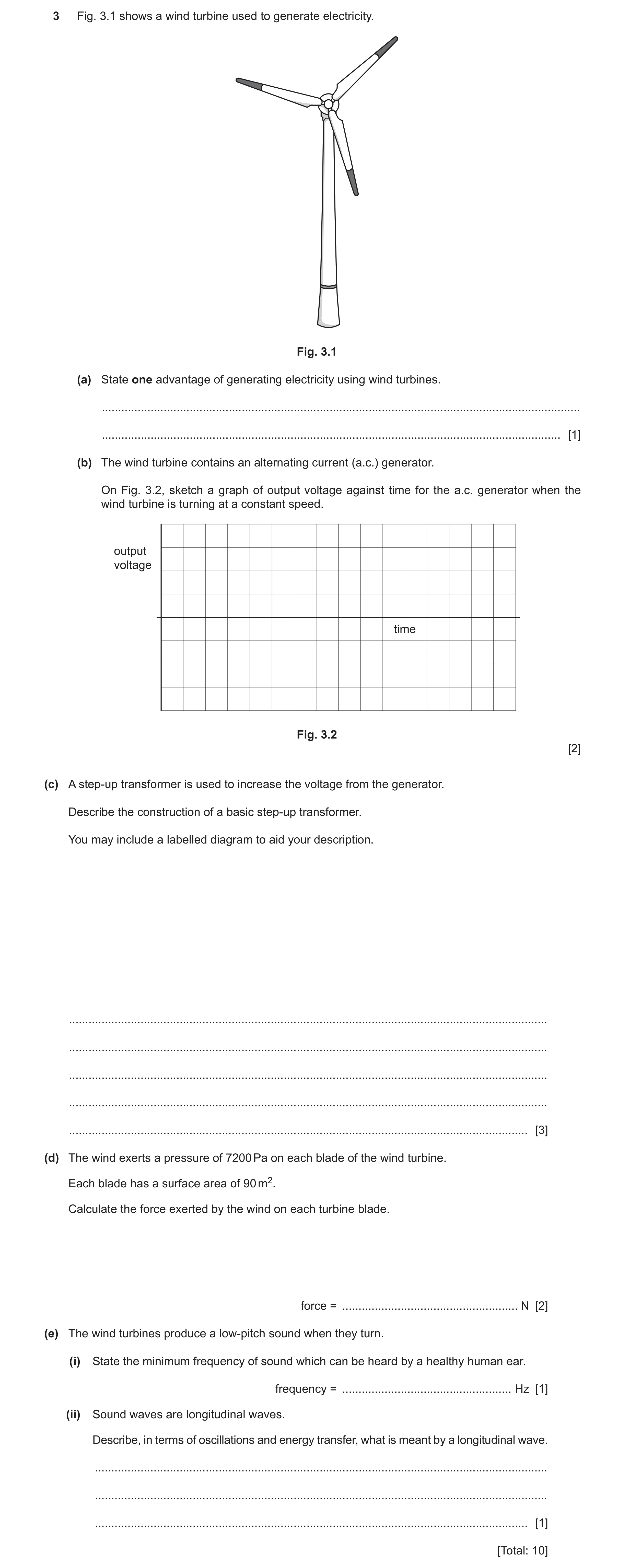
3 Fig. 3.1 shows a wind turbine used to generate electricity. Fig. 3.1 (a) State one advantage of generating electricity using wind turbines. … … [1] (b) The wind turbine contains an alternating current (a.c.) generator. On Fig. 3.2, sketch a graph of output voltage against time for the a.c. generator when the wind turbine is turning at a constant speed. output voltage time Fig. 3.2 [2] (c) A step-up transformer is used to increase the voltage from the generator. Describe the construction of a basic step-up transformer. You may include a labelled diagram to aid your description. … … … … … [3] (d) The wind exerts a pressure of 7200 Pa on each blade of the wind turbine. Each blade has a surface area of 90 m2. Calculate the force exerted by the wind on each turbine blade. force = … N [2] (e) The wind turbines produce a low-pitch sound when they turn. (i) State the minimum frequency of sound which can be heard by a healthy human ear. frequency = … Hz [1] (ii) Sound waves are longitudinal waves. Describe, in terms of oscillations and energy transfer, what is meant by a longitudinal wave. … … … [1] [Total: 10]
10 marks
Mark scheme: 3(a) does not release CO2 / does not release greenhouse gases / does not contribute to global warming / climate change / no 1 fuel costs / renewable / AVP ; 3(b) sinusoidal waveform ; 2 constant time period and amplitude ; 3(c) (soft) iron core ; 3 two coils wrapped around the same core ; number of turns on primary less than secondary / number of turns on secondary more than primary ; 3(d) evidence of F = P A or 7200 90 ; 2 650 000 (N) ; 3(e)(i) 20 (Hz) ; 1 3(e)(ii) (direction of) oscillations are parallel to direction of energy transfer ; 1
This question in 0654/42 Oct/Nov 2024
 11 / 19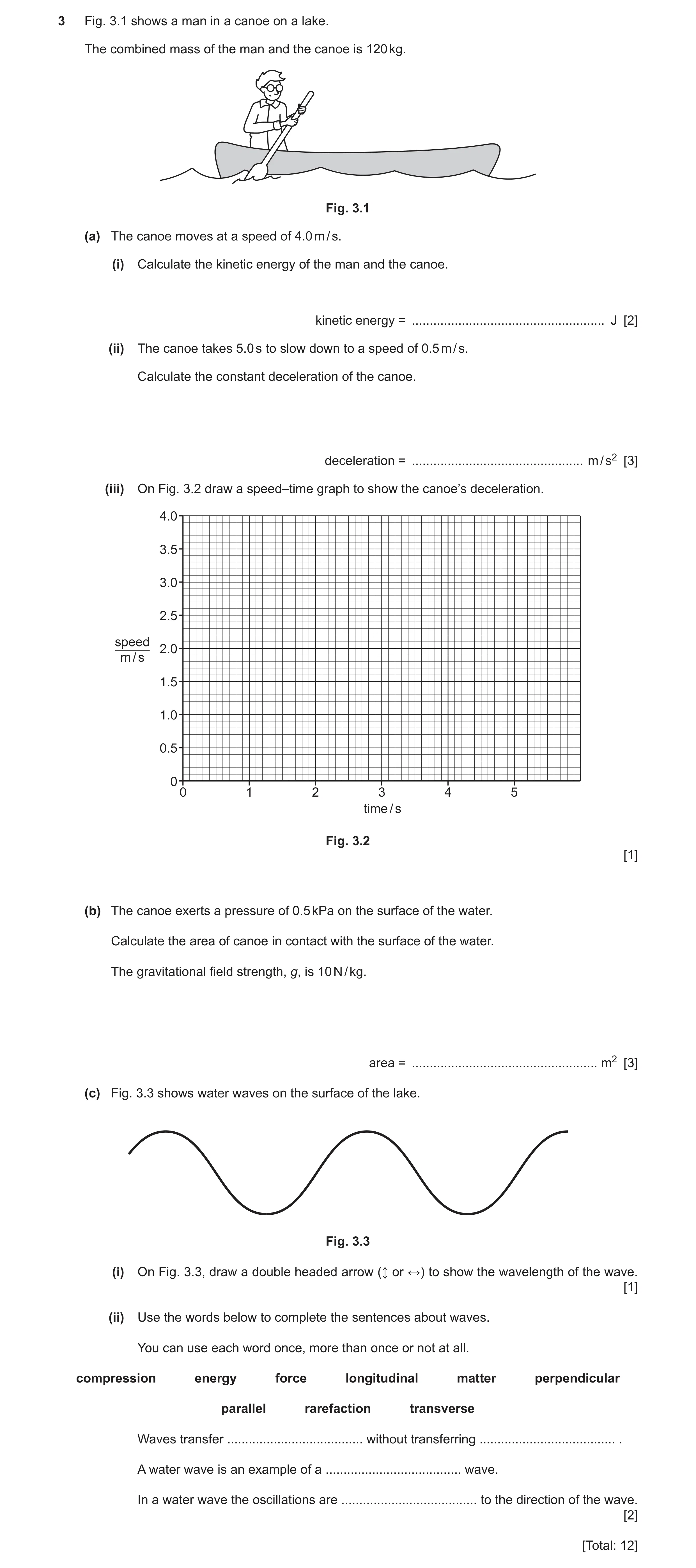
 14
14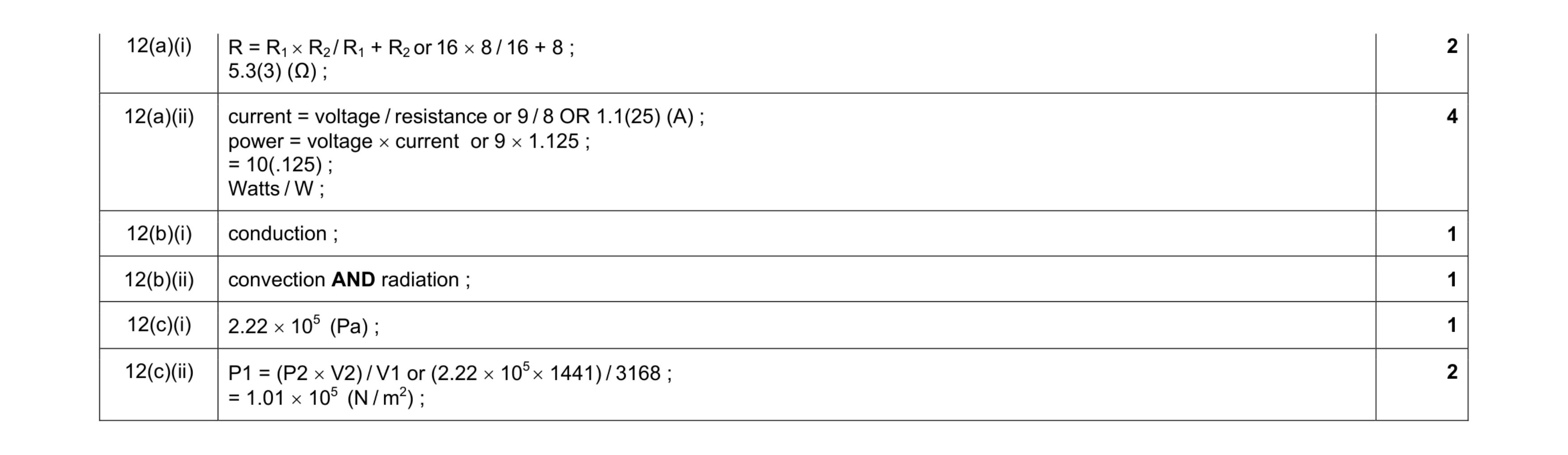 11
11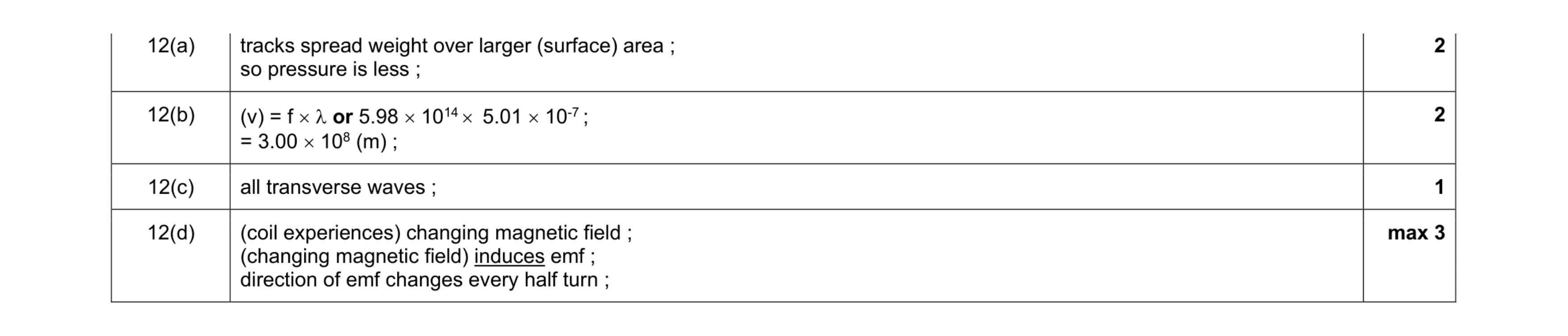 8
8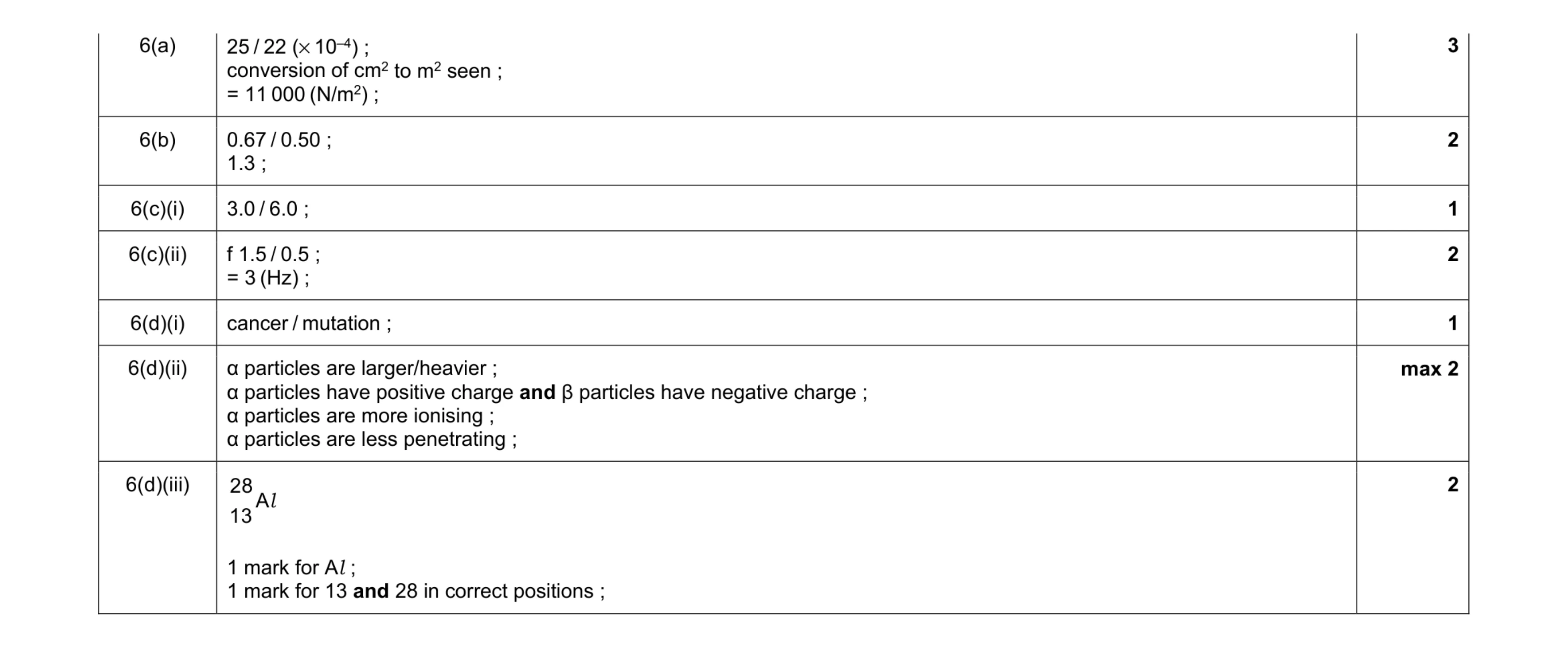 13
13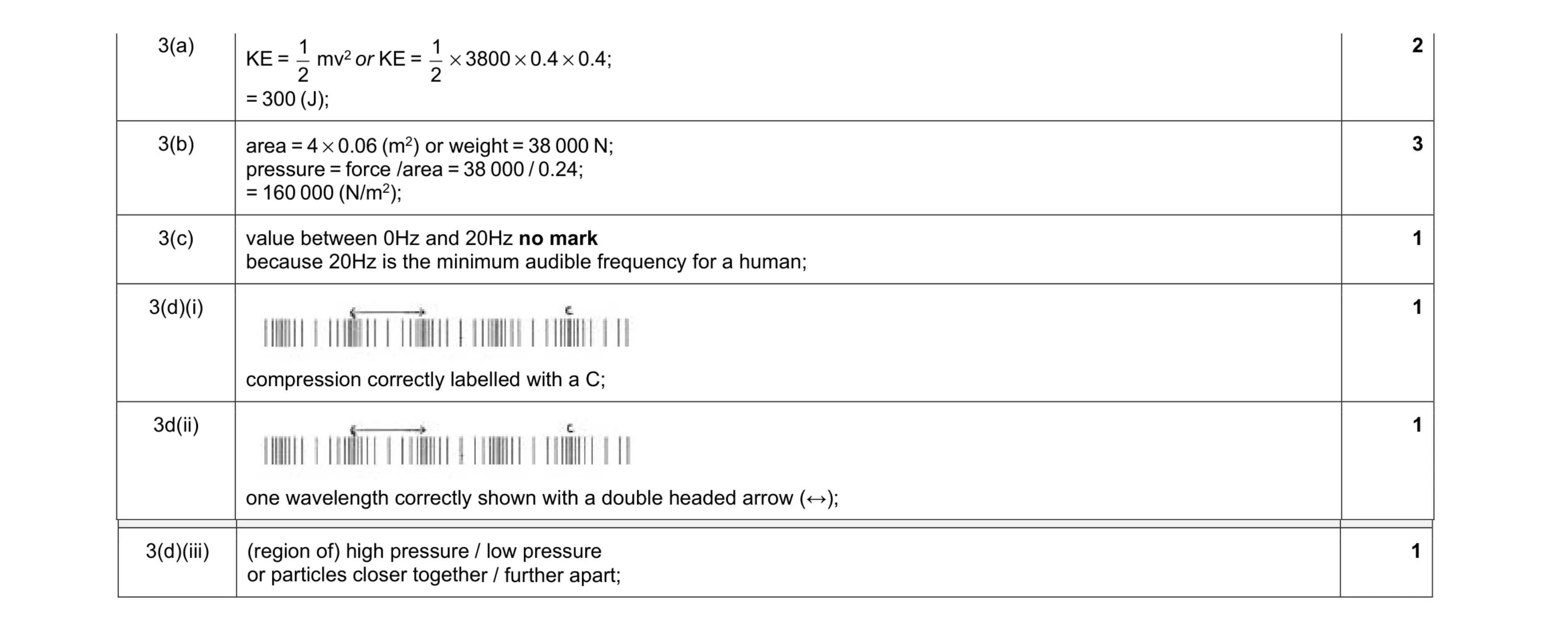 9
9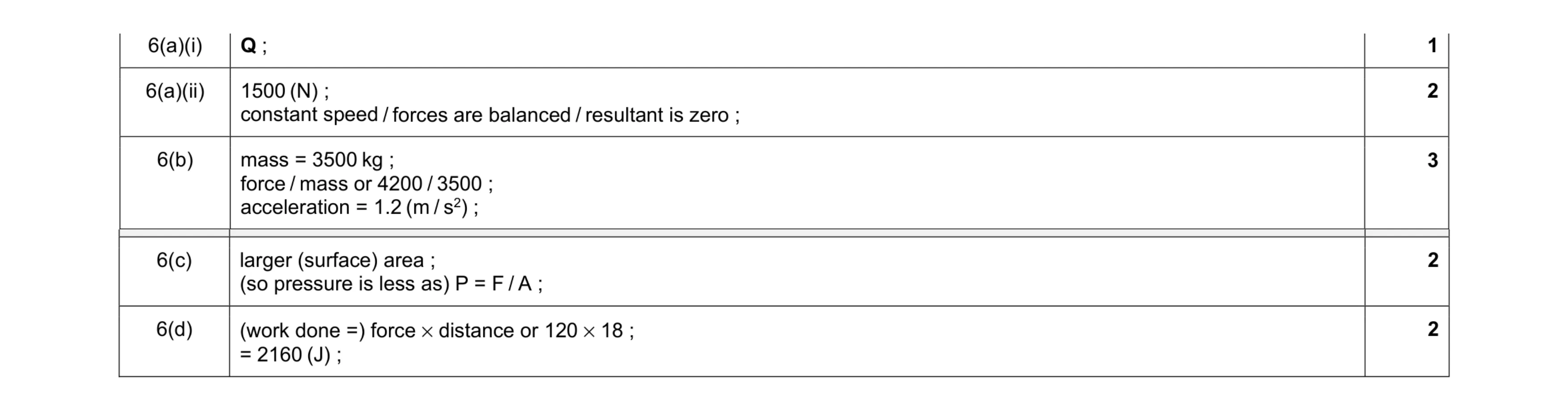 10
10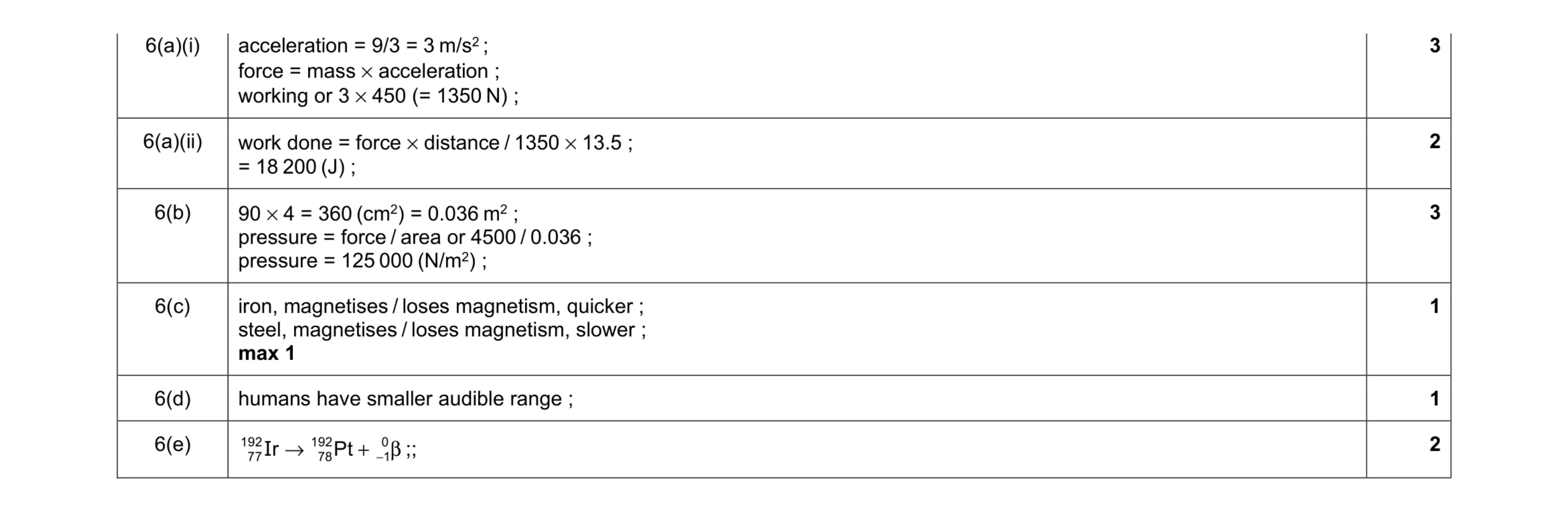 12
12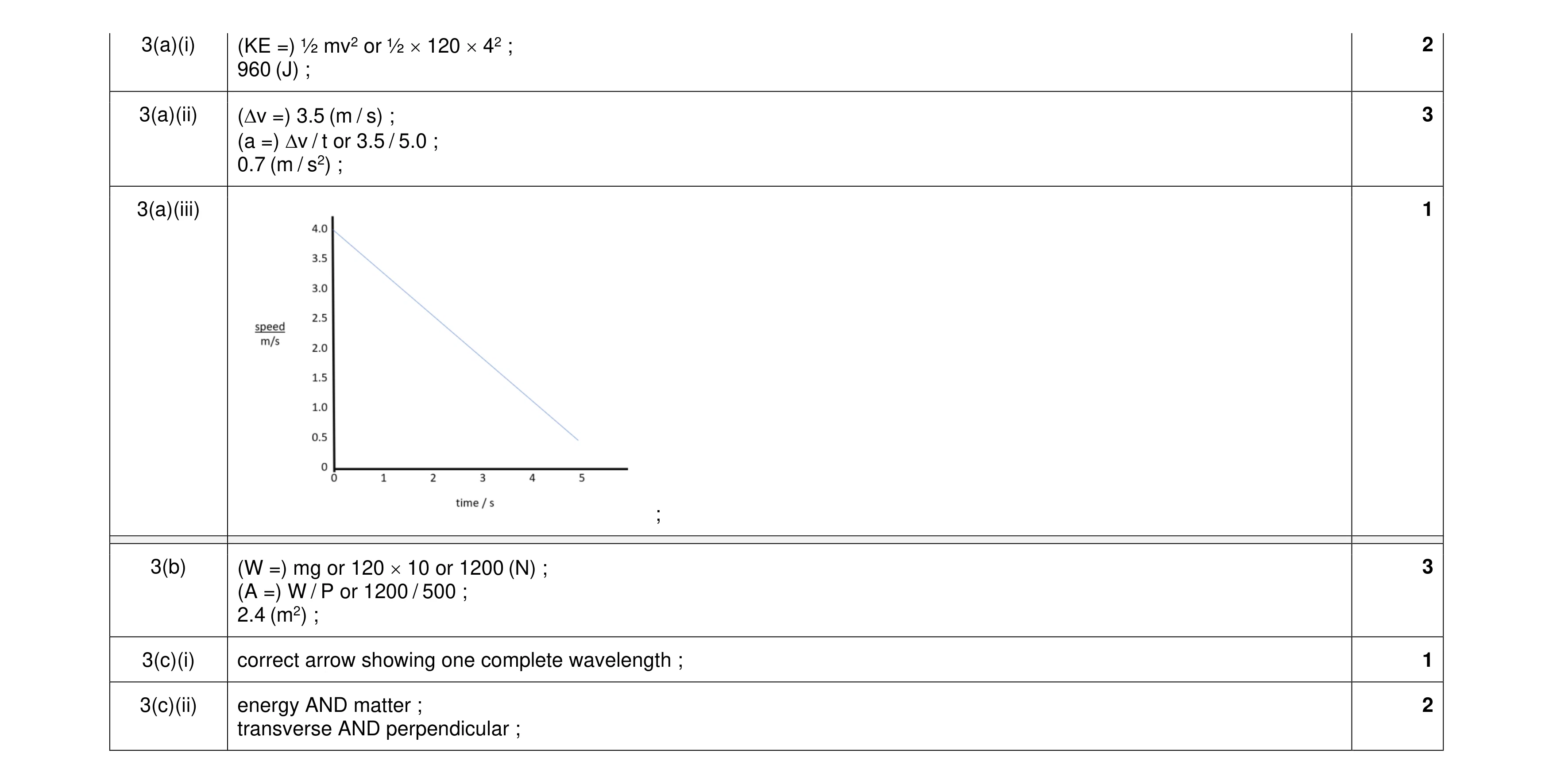 12
12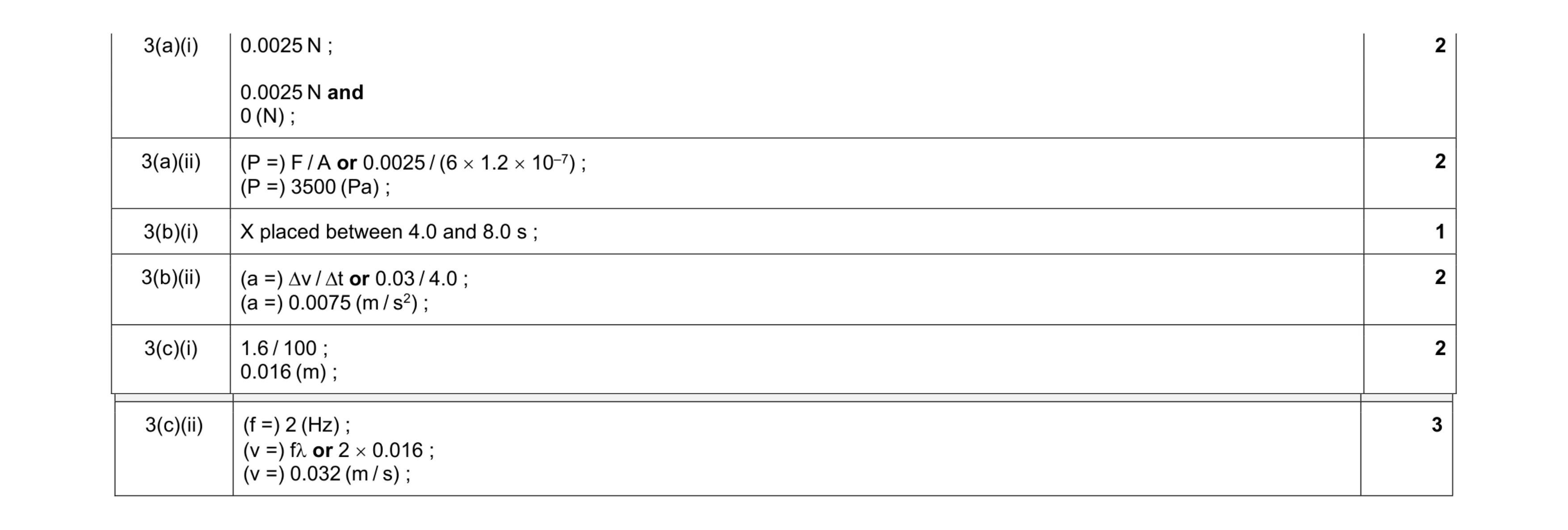 12
12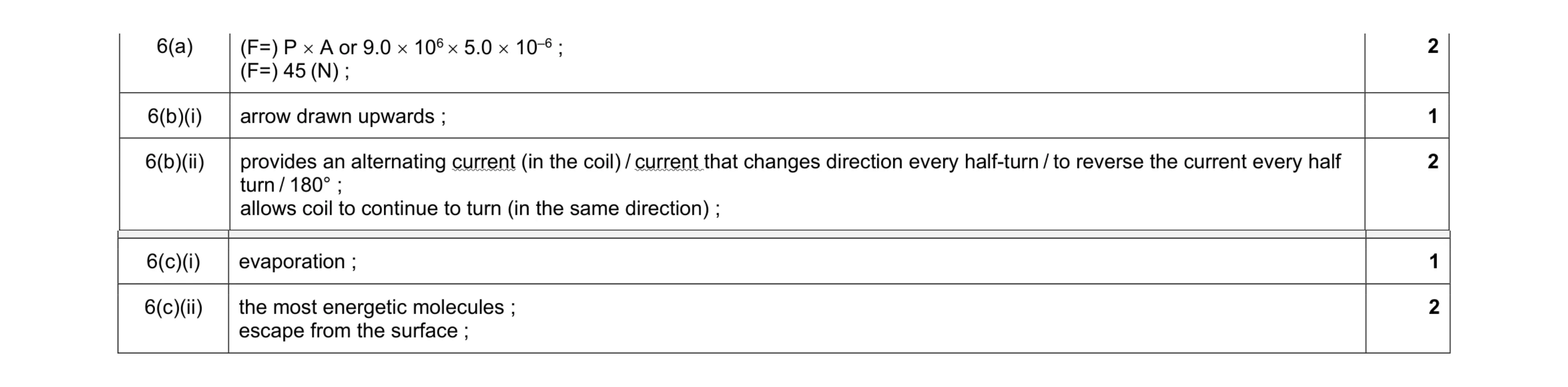 8
8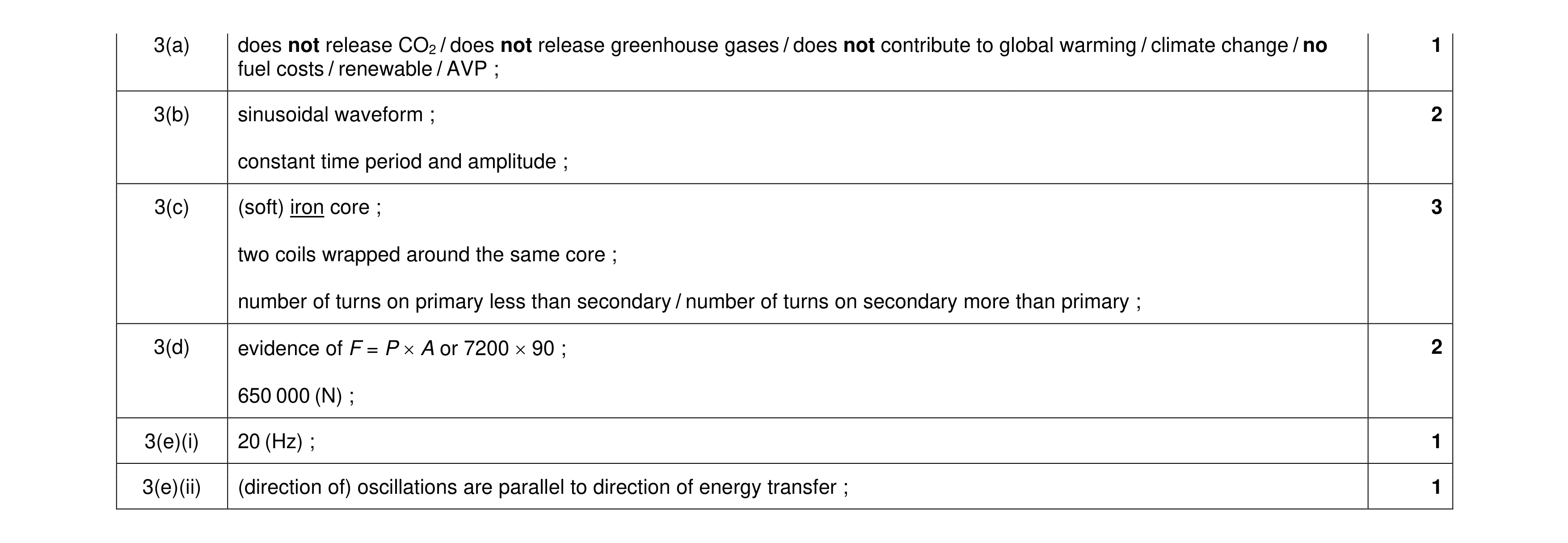 10
10