Questions as text
Q1 · From which carbonate is lime manufactured? 0654/11 May/June 2009
22 From which carbonate is lime manufactured? A calcium carbonate B lead(II) carbonate C magnesium carbonate D zinc carbonate
1 marks
Answer: A
This question in 0654/11 May/June 2009
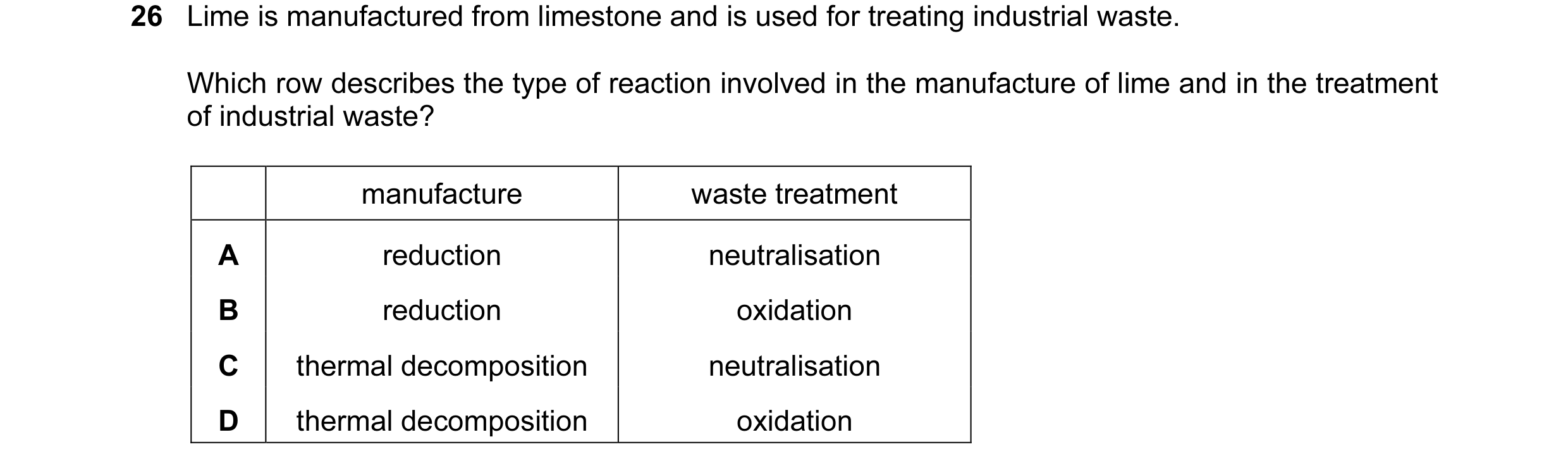
Q2 · Lime is manufactured from limestone and is used for treating industrial waste 0654/11 May/June 2015
26 Lime is manufactured from limestone and is used for treating industrial waste. Which row describes the type of reaction involved in the manufacture of lime and in the treatment of industrial waste? manufacture waste treatment A reduction neutralisation B reduction oxidation C thermal decomposition neutralisation D thermal decomposition oxidation
1 marks
Answer: C
This question in 0654/11 May/June 2015
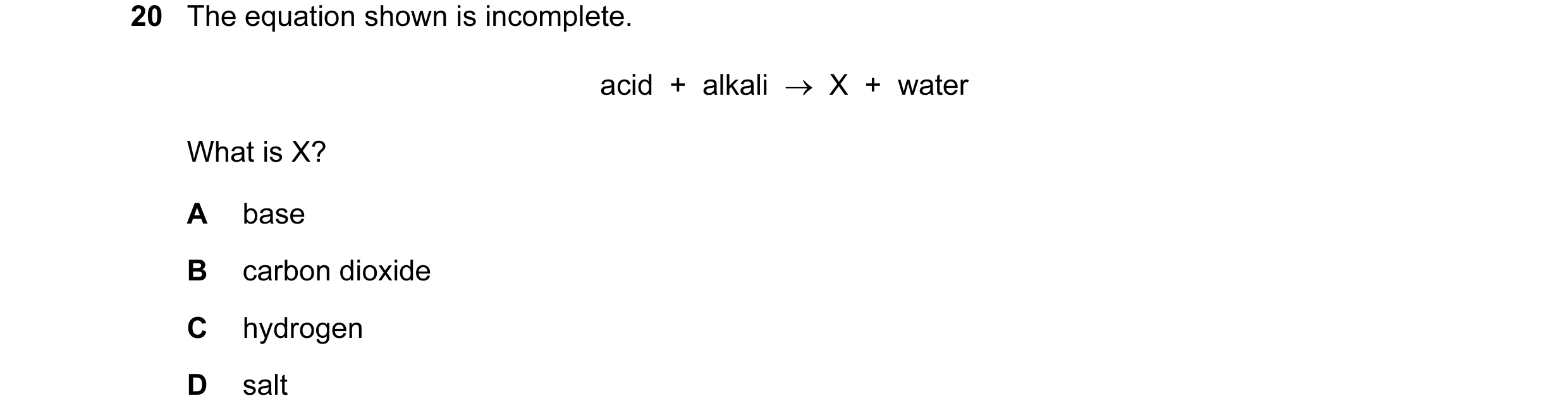
Q3 · The equation shown is incomplete 0654/13 May/June 2015
20 The equation shown is incomplete. acid + alkali → X + water What is X? A base B carbon dioxide C hydrogen D salt
1 marks
Answer: D
This question in 0654/13 May/June 2015
Q4 · Sulfuric acid and sodium carbonate react and release a colourless gas 0654/12 Oct/Nov 2015
22 Sulfuric acid and sodium carbonate react and release a colourless gas. sulfuric acid colourless gas gas jar sodium carbonate trough of water What is the gas? A carbon dioxide B hydrogen C hydrogen sulfide D sulfur dioxide
1 marks
Answer: A
This question in 0654/12 Oct/Nov 2015
Q5 · Which anion is present in limestone? 0654/13 Oct/Nov 2015
25 Which anion is present in limestone? A carbonate CO3 2– B nitrate NO3 – C oxide O2– D sulfate SO4 2–
1 marks
Answer: A
This question in 0654/13 Oct/Nov 2015
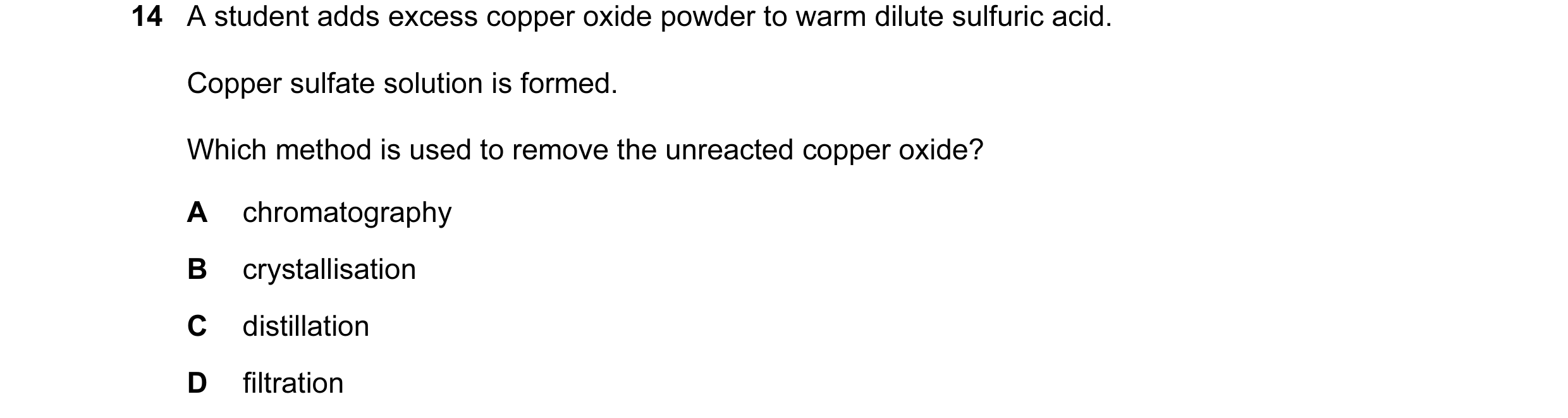
Q6 · A student adds excess copper oxide powder to warm dilute sulfuric acid 0654/13 May/June 2016
14 A student adds excess copper oxide powder to warm dilute sulfuric acid. Copper sulfate solution is formed. Which method is used to remove the unreacted copper oxide? A chromatography B crystallisation C distillation D filtration
1 marks
Answer: D
This question in 0654/13 May/June 2016
Q7 · Copper sulfate is made when copper carbonate is added to dilute sulfuric acid 0654/12 Oct/Nov 2016
20 Copper sulfate is made when copper carbonate is added to dilute sulfuric acid. The copper carbonate is added until no more carbon dioxide is given off. The mixture is … 1 … to remove excess copper carbonate. The resulting solution is then … 2 … to decrease the volume. This solution is then … 3 … to allow the formation of pure copper sulfate crystals. Which words complete gaps 1, 2 and 3? 1 2 3 A boiled heated left to cool B filtered cooled left to cool C filtered heated evaporated to dryness D filtered heated left to cool
1 marks
Answer: D
This question in 0654/12 Oct/Nov 2016
Q8 · Which substances react with dilute sulfuric acid to form a salt? 0654/11 Oct/Nov 2017
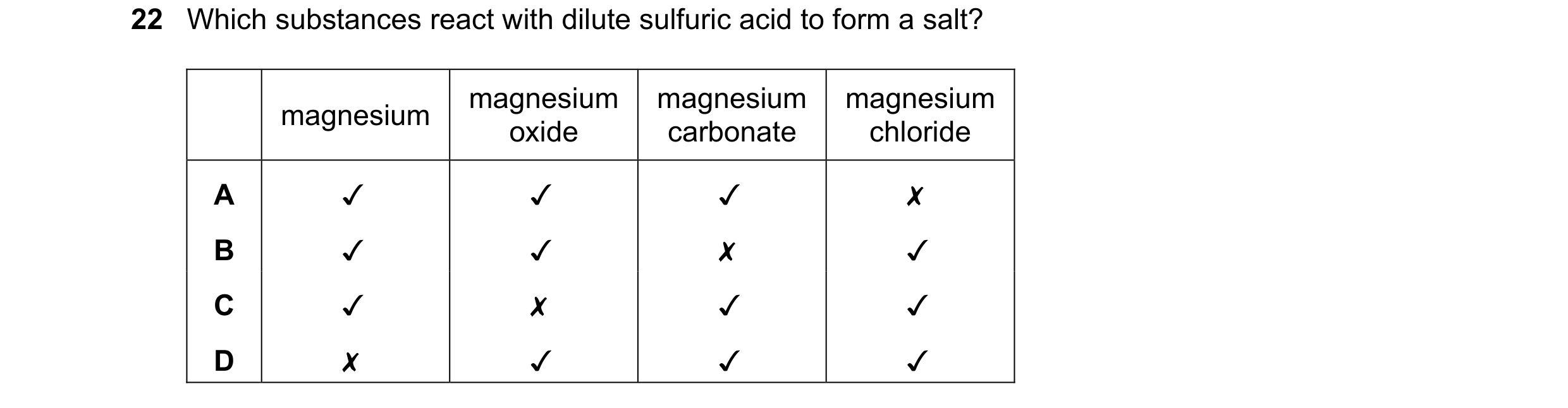
22 Which substances react with dilute sulfuric acid to form a salt?
magnesium
magnesium
oxide
magnesium
carbonate
magnesium
chloride
1 marks
Answer: A
This question in 0654/11 Oct/Nov 2017
Q9 · Which substances react with dilute sulfuric acid to form a salt? 0654/12 Oct/Nov 2017
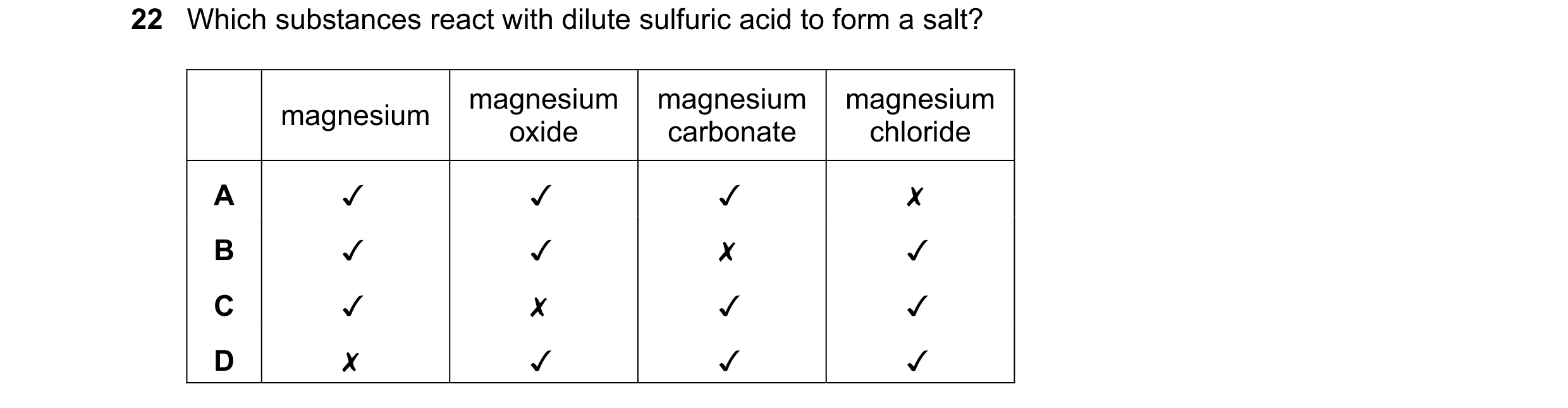
22 Which substances react with dilute sulfuric acid to form a salt?
magnesium | ™agnesium | magnesium | magnesium
oxide carbonate chloride
A v 4 W, x
B WA V4 x y,
Cc v x W, y,
D x V4 W, y,
1 marks
Answer: A
This question in 0654/12 Oct/Nov 2017
Q10 · Which substances react with dilute sulfuric acid to form a salt? 0654/13 Oct/Nov 2017
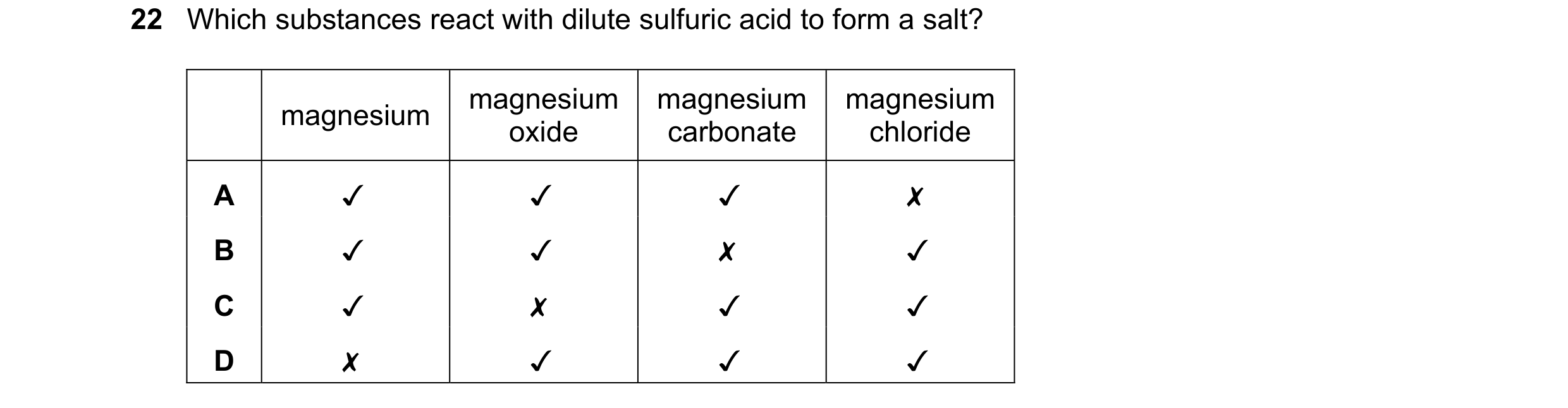
22 Which substances react with dilute sulfuric acid to form a salt?
magnesium | ™agnesium | magnesium | magnesium
oxide carbonate chloride
A v 4 W, x
B WA V4 x y,
Cc v x W, y,
D x V4 W, y,
1 marks
Answer: A
This question in 0654/13 Oct/Nov 2017
Q11 · An acid reacts with an alkali to produce an aqueous solution of a salt 0654/13 Oct/Nov 2017
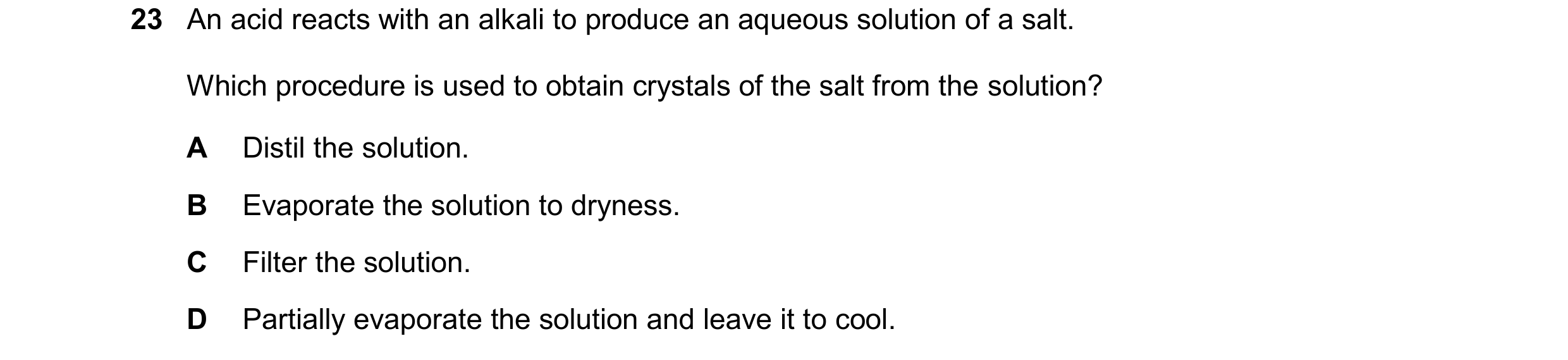
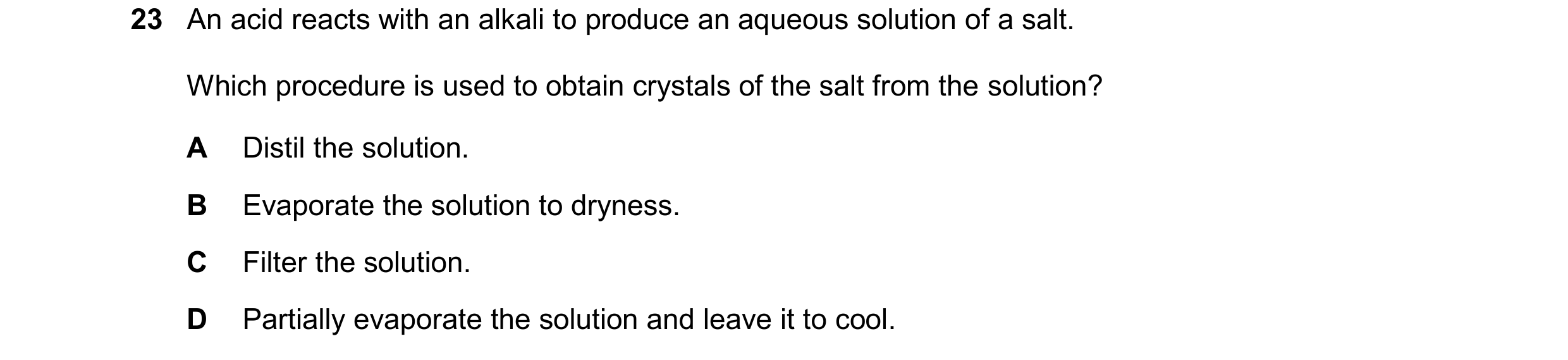
23 An acid reacts with an alkali to produce an aqueous solution of a salt. Which procedure is used to obtain crystals of the salt from the solution? A Distil the solution. B Evaporate the solution to dryness. C Filter the solution. D Partially evaporate the solution and leave it to cool.
1 marks
Answer: D
This question in 0654/13 Oct/Nov 2017
Q12 · Hydrochloric acid and sodium hydroxide neutralise each other to form water and sodium… 0654/11 May/June 2019
20 Hydrochloric acid and sodium hydroxide neutralise each other to form water and sodium chloride. Which method is used to make the solution crystallise? A chromatography B evaporation C filtration D fractional distillation
1 marks
Answer: B
This question in 0654/11 May/June 2019
Q13 · Which two statements about calcium carbonate are correct? 0654/11 May/June 2019
25 Which two statements about calcium carbonate are correct? 1 It neutralises acidic industrial waste. 2 It lowers the pH of soil. 3 It undergoes thermal decomposition to calcium hydroxide. 4 It reacts with dilute hydrochloric acid to form carbon dioxide. A 1 and 2 B 1 and 4 C 2 and 3 D 3 and 4
1 marks
Answer: B
This question in 0654/11 May/June 2019
Q14 · Which processes produce carbon dioxide? 0654/13 Oct/Nov 2019
24 Which processes produce carbon dioxide? 1 acid reacting with a metal 2 respiration 3 combustion of ethanol 4 acid reacting with a metal oxide A 1 and 2 B 1 and 4 C 2 and 3 D 3 and 4
1 marks
Answer: C
This question in 0654/13 Oct/Nov 2019
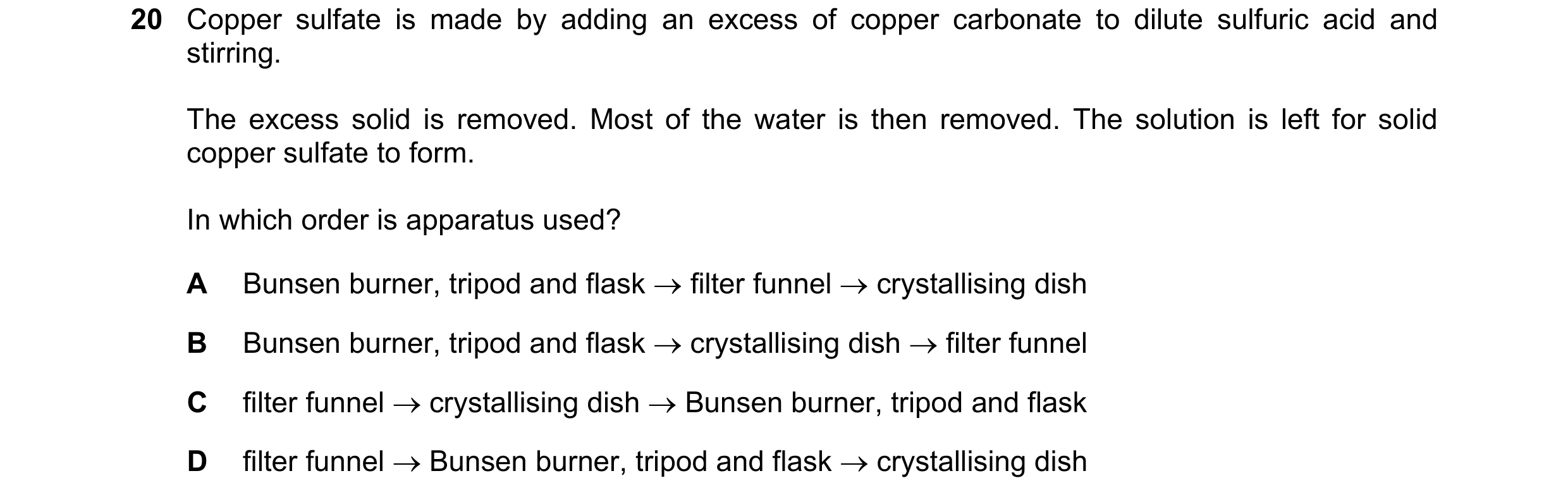
Q15 · Copper sulfate is made by adding an excess of copper carbonate to dilute sulfuric acid… 0654/11 May/June 2020
20 Copper sulfate is made by adding an excess of copper carbonate to dilute sulfuric acid and stirring. The excess solid is removed. Most of the water is then removed. The solution is left for solid copper sulfate to form. In which order is apparatus used? A Bunsen burner, tripod and flask → filter funnel → crystallising dish B Bunsen burner, tripod and flask → crystallising dish → filter funnel C filter funnel → crystallising dish → Bunsen burner, tripod and flask D filter funnel → Bunsen burner, tripod and flask → crystallising dish
1 marks
Answer: D
This question in 0654/11 May/June 2020
Q16 · Zinc oxide is an insoluble base 0654/12 May/June 2020
20 Zinc oxide is an insoluble base. It reacts with dilute hydrochloric acid to produce zinc chloride. Zinc chloride is soluble in water. Which statement about the preparation of zinc chloride crystals is correct? A Once the reaction is complete there is no need to filter the reaction mixture. B The reaction mixture is neutral at the point that no more zinc oxide reacts. C Zinc chloride crystals are obtained by evaporation to dryness. D Zinc chloride precipitates when the solution becomes neutral.
1 marks
Answer: B
This question in 0654/12 May/June 2020
Q17 · Which compound is prepared by reacting an acid with a base? 0654/12 Oct/Nov 2020
20 Which compound is prepared by reacting an acid with a base? A calcium oxide B copper hydroxide C hydrogen chloride D magnesium sulfate
1 marks
Answer: D
This question in 0654/12 Oct/Nov 2020
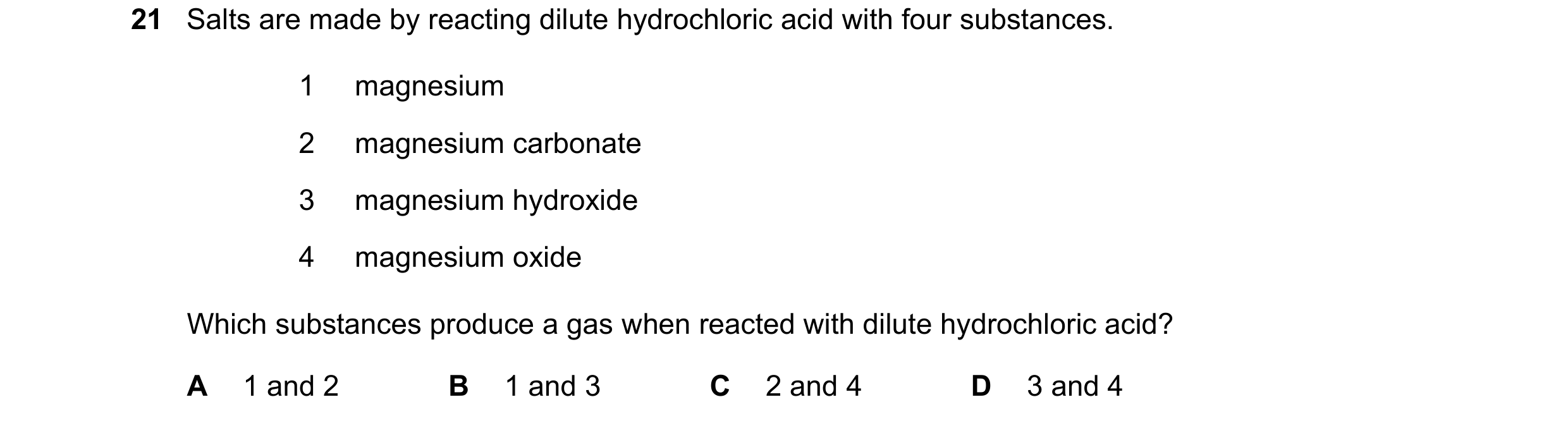
Q18 · Salts are made by reacting dilute hydrochloric acid with four substances 0654/13 Oct/Nov 2020
21 Salts are made by reacting dilute hydrochloric acid with four substances. 1 magnesium 2 magnesium carbonate 3 magnesium hydroxide 4 magnesium oxide Which substances produce a gas when reacted with dilute hydrochloric acid? A 1 and 2 B 1 and 3 C 2 and 4 D 3 and 4
1 marks
Answer: A
This question in 0654/13 Oct/Nov 2020
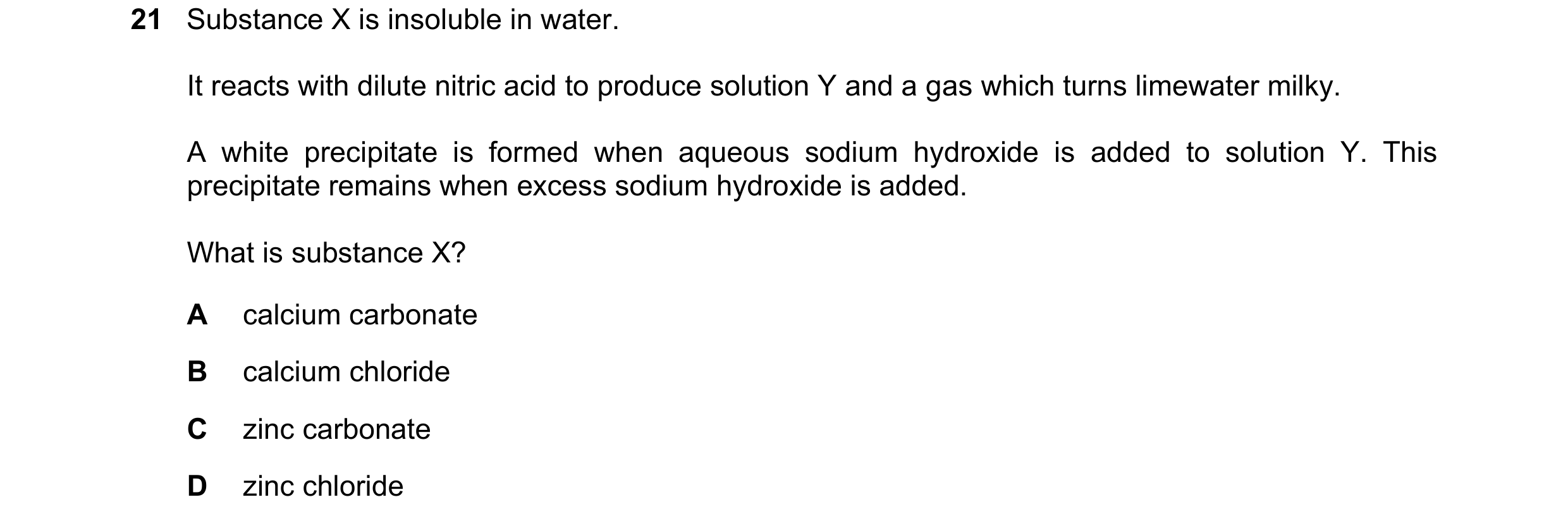
Q19 · Substance X is insoluble in water 0654/12 Feb/March 2021
21 Substance X is insoluble in water. It reacts with dilute nitric acid to produce solution Y and a gas which turns limewater milky. A white precipitate is formed when aqueous sodium hydroxide is added to solution Y. This precipitate remains when excess sodium hydroxide is added. What is substance X? A calcium carbonate B calcium chloride C zinc carbonate D zinc chloride
1 marks
Answer: A
This question in 0654/12 Feb/March 2021
Q20 · Magnesium chloride is prepared by reacting an excess of insoluble magnesium oxide with… 0654/11 May/June 2023
21 Magnesium chloride is prepared by reacting an excess of insoluble magnesium oxide with dilute hydrochloric acid. Which processes are used to obtain pure crystals of magnesium chloride from the reaction mixture? 1 distillation 2 evaporation 3 filtration A 1 followed by 2 B 3 followed by 2 C 3 followed by 1 D 1 followed by 3, followed by 2
1 marks
Answer: B
This question in 0654/11 May/June 2023
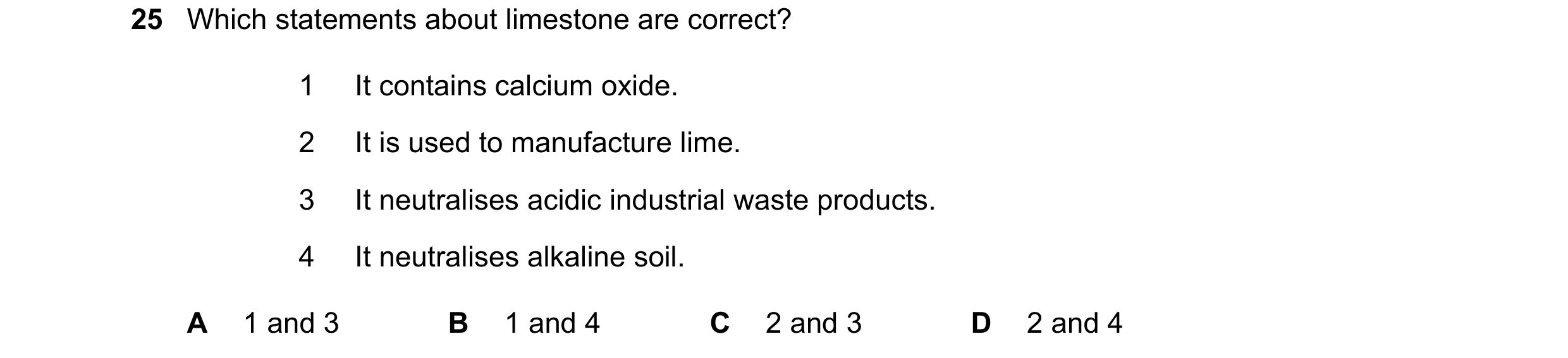
Q21 · Which statements about limestone are correct? 0654/13 May/June 2023
25 Which statements about limestone are correct? 1 It contains calcium oxide. 2 It is used to manufacture lime. 3 It neutralises acidic industrial waste products. 4 It neutralises alkaline soil. A 1 and 3 B 1 and 4 C 2 and 3 D 2 and 4
1 marks
Answer: C
This question in 0654/13 May/June 2023
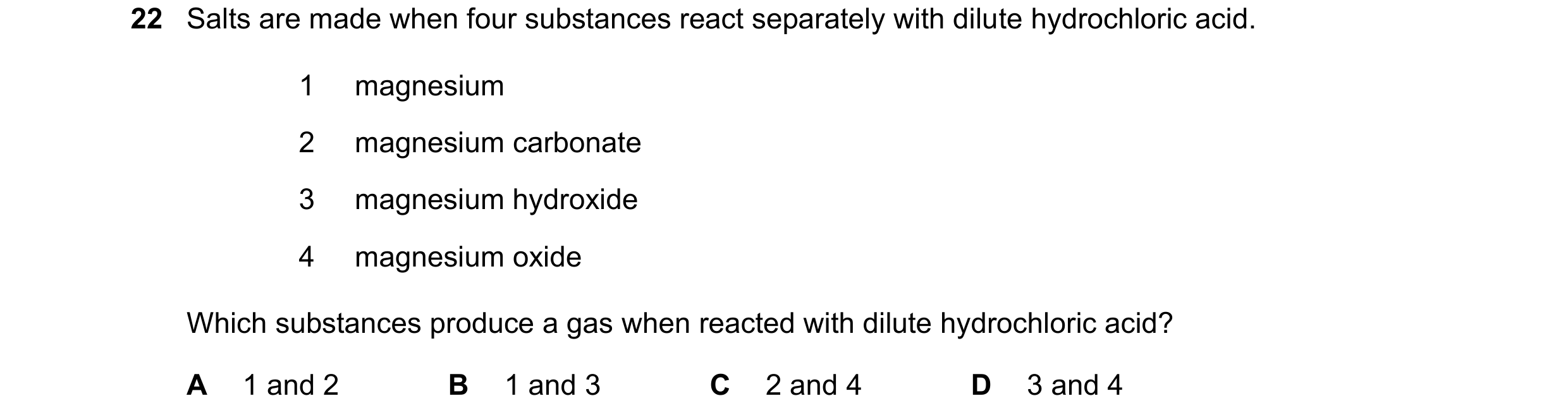
Q22 · Salts are made when four substances react separately with dilute hydrochloric acid 0654/11 May/June 2024
22 Salts are made when four substances react separately with dilute hydrochloric acid. 1 magnesium 2 magnesium carbonate 3 magnesium hydroxide 4 magnesium oxide Which substances produce a gas when reacted with dilute hydrochloric acid? A 1 and 2 B 1 and 3 C 2 and 4 D 3 and 4
1 marks
Answer: A
This question in 0654/11 May/June 2024
Q23 · Which compound contains two of the three elements needed in a fertiliser used for plant… 0654/12 May/June 2024
25 Which compound contains two of the three elements needed in a fertiliser used for plant growth? A potassium carbonate B potassium chloride C potassium nitrate D potassium sulfate
1 marks
Answer: C
This question in 0654/12 May/June 2024
Q24 · Which compound contains two of the three elements needed in a fertiliser used for plant… 0654/13 May/June 2024
25 Which compound contains two of the three elements needed in a fertiliser used for plant growth? A potassium carbonate B potassium chloride C potassium nitrate D potassium sulfate
1 marks
Answer: C
This question in 0654/13 May/June 2024
Q25 · Copper sulfate is made when copper carbonate is added to dilute sulfuric acid 0654/12 Feb/March 2025
23 Copper sulfate is made when copper carbonate is added to dilute sulfuric acid. The copper carbonate is added until no more carbon dioxide is given off. The mixture is … 1 … to remove excess copper carbonate. The resulting solution is then … 2 … to decrease the volume. This solution is then … 3 … to allow the formation of pure copper sulfate crystals. Which words complete gaps 1, 2 and 3? 1 2 3 A boiled heated evaporated to dryness B filtered cooled left to cool C filtered heated evaporated to dryness D filtered heated left to cool
1 marks
Answer: D
This question in 0654/12 Feb/March 2025
Q26 · Which type of substance reacts with an acid to produce a salt, water and a gas? 0654/11 Oct/Nov 2025
21 Which type of substance reacts with an acid to produce a salt, water and a gas? A alkali B base C carbonate D metal
1 marks
Answer: C
This question in 0654/11 Oct/Nov 2025
Q27 · An acid reacts with an alkali to produce an aqueous solution of a salt 0654/12 Oct/Nov 2025
23 An acid reacts with an alkali to produce an aqueous solution of a salt. Which procedure is used to obtain crystals of the salt from the solution? A Distil the solution. B Evaporate the solution to dryness. C Filter the solution. D Partially evaporate the solution and leave it to cool.
1 marks
Answer: D
This question in 0654/12 Oct/Nov 2025
Q28 · An acid reacts with an alkali to produce an aqueous solution of a salt 0654/13 Oct/Nov 2025
23 An acid reacts with an alkali to produce an aqueous solution of a salt. Which procedure is used to obtain crystals of the salt from the solution? A Distil the solution. B Evaporate the solution to dryness. C Filter the solution. D Partially evaporate the solution and leave it to cool.
1 marks
Answer: D
This question in 0654/13 Oct/Nov 2025

 1 / 7
1 / 7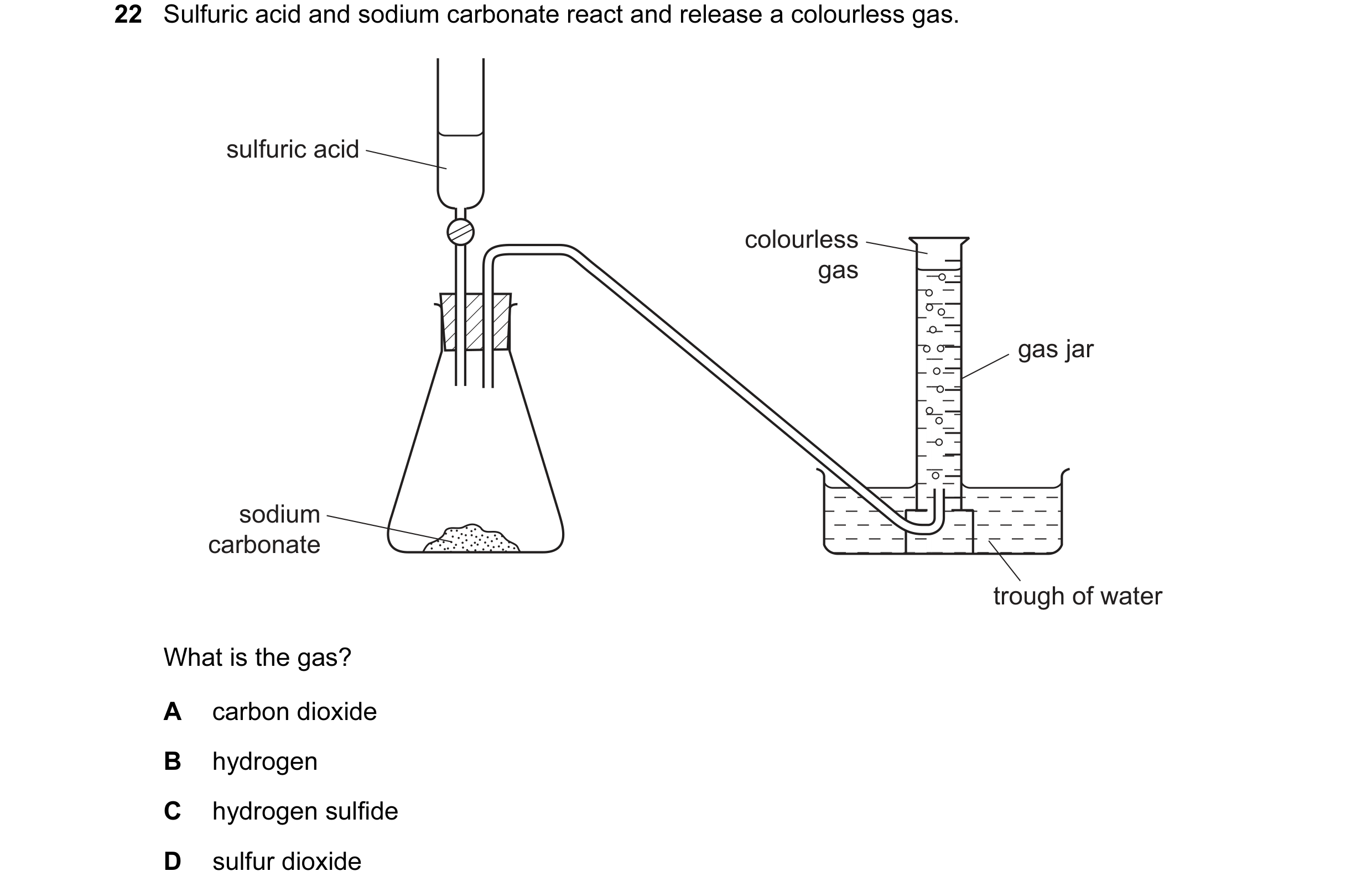

 2 / 7
2 / 7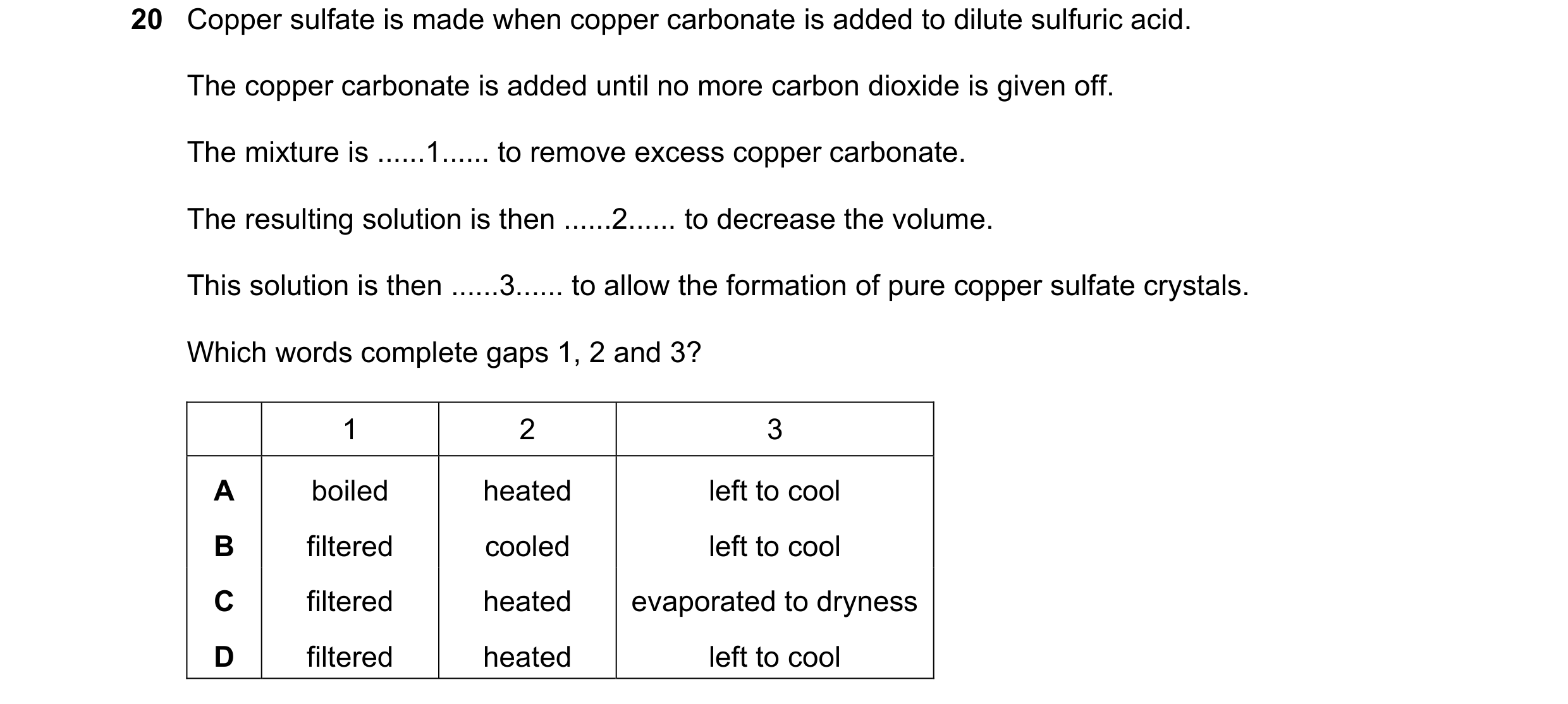
 3 / 7
3 / 7
 4 / 7
4 / 7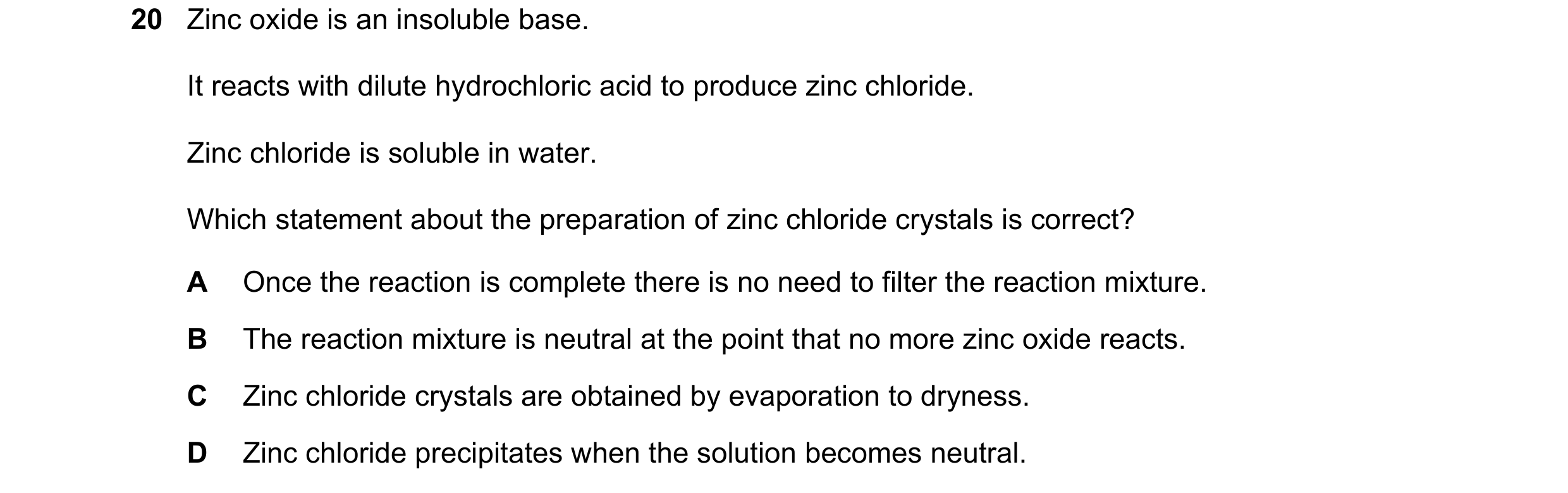

 5 / 7
5 / 7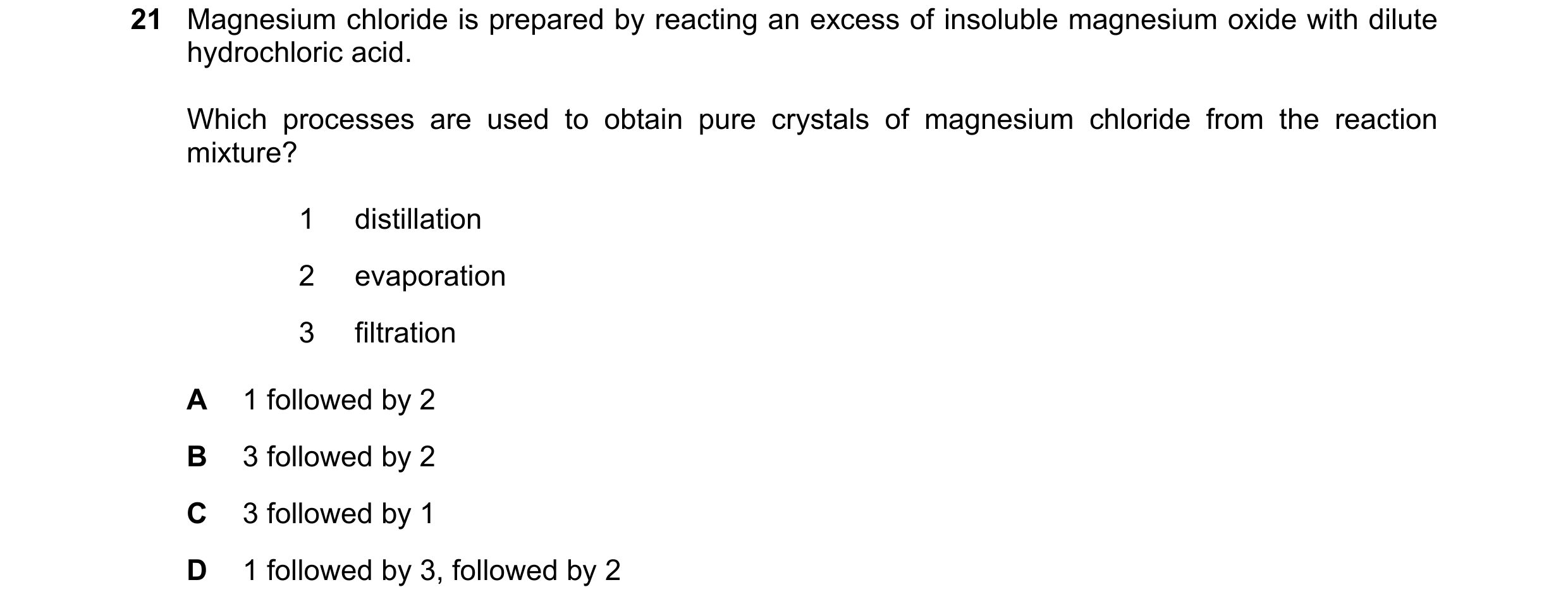

 6 / 7
6 / 7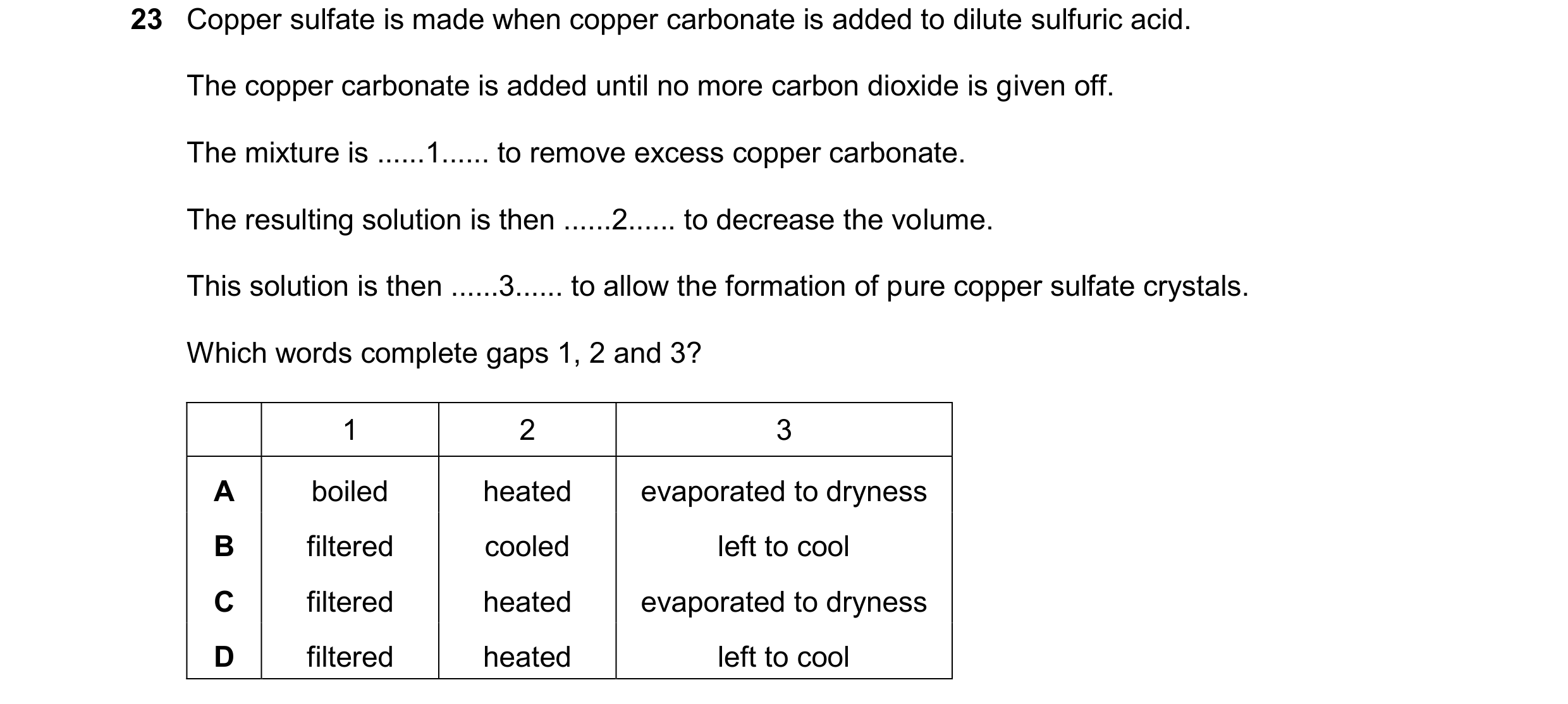

 7 / 7
7 / 7