Questions as text
Q1 · The substances calcium, calcium carbonate and calcium oxide react separately with dilute… 0654/32 May/June 2019
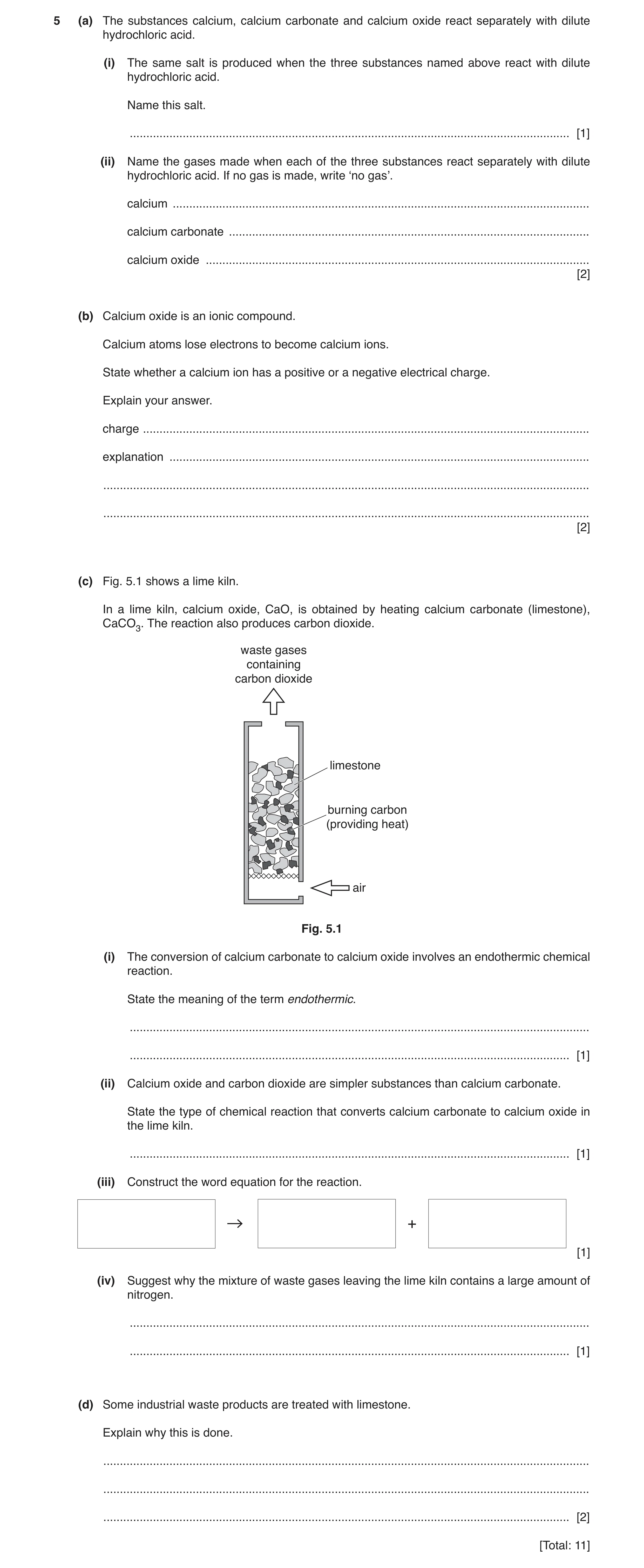
5 (a) The substances calcium, calcium carbonate and calcium oxide react separately with dilute hydrochloric acid. (i) The same salt is produced when the three substances named above react with dilute hydrochloric acid. Name this salt. … [1] (ii) Name the gases made when each of the three substances react separately with dilute hydrochloric acid. If no gas is made, write ‘no gas’. calcium … calcium carbonate … calcium oxide … [2] (b) Calcium oxide is an ionic compound. Calcium atoms lose electrons to become calcium ions. State whether a calcium ion has a positive or a negative electrical charge. Explain your answer. charge … explanation … … … [2] (c) Fig. 5.1 shows a lime kiln. In a lime kiln, calcium oxide, CaO, is obtained by heating calcium carbonate (limestone), CaCO3. The reaction also produces carbon dioxide. waste gases containing carbon dioxide limestone burning carbon (providing heat) air Fig. 5.1 (i) The conversion of calcium carbonate to calcium oxide involves an endothermic chemical reaction. State the meaning of the term endothermic. … … [1] (ii) Calcium oxide and carbon dioxide are simpler substances than calcium carbonate. State the type of chemical reaction that converts calcium carbonate to calcium oxide in the lime kiln. … [1] (iii) Construct the word equation for the reaction. + [1] (iv) Suggest why the mixture of waste gases leaving the lime kiln contains a large amount of nitrogen. … … [1] (d) Some industrial waste products are treated with limestone. Explain why this is done. … … … [2] [Total: 11]
11 marks
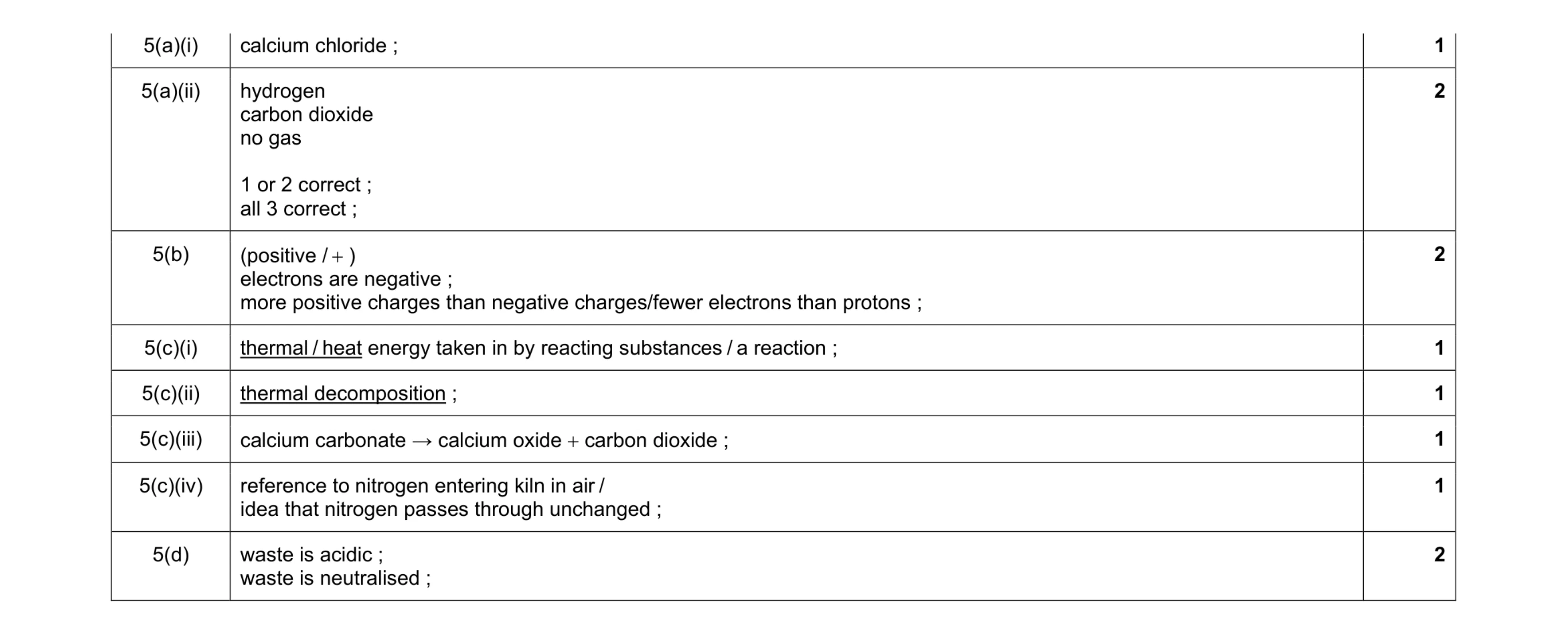
Mark scheme: 5(a)(i) calcium chloride ; 1 5(a)(ii) hydrogen carbon dioxide no gas 1 or 2 correct ; all 3 correct ; 2 5(b) (positive / + ) electrons are negative ; more positive charges than negative charges/fewer electrons than protons ; 2 5(c)(i) thermal / heat energy taken in by reacting substances / a reaction ; 1 5(c)(ii) thermal decomposition ; 1 5(c)(iii) calcium carbonate → calcium oxide + carbon dioxide ; 1 5(c)(iv) reference to nitrogen entering kiln in air / idea that nitrogen passes through unchanged ; 1 5(d) waste is acidic ; waste is neutralised ; 2
This question in 0654/32 May/June 2019
Q2 · The substances calcium, calcium carbonate and calcium oxide react separately with dilute… 0654/33 May/June 2019
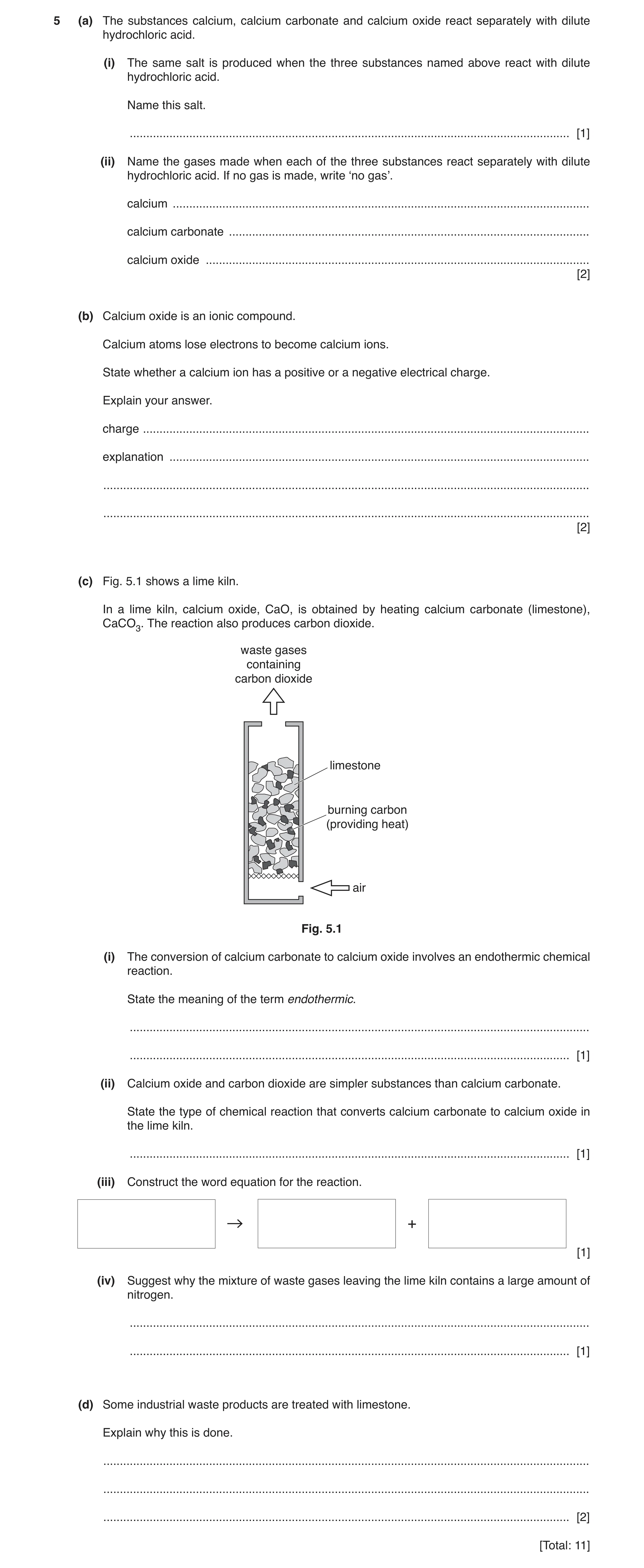
5 (a) The substances calcium, calcium carbonate and calcium oxide react separately with dilute hydrochloric acid. (i) The same salt is produced when the three substances named above react with dilute hydrochloric acid. Name this salt. … [1] (ii) Name the gases made when each of the three substances react separately with dilute hydrochloric acid. If no gas is made, write ‘no gas’. calcium … calcium carbonate … calcium oxide … [2] (b) Calcium oxide is an ionic compound. Calcium atoms lose electrons to become calcium ions. State whether a calcium ion has a positive or a negative electrical charge. Explain your answer. charge … explanation … … … [2] (c) Fig. 5.1 shows a lime kiln. In a lime kiln, calcium oxide, CaO, is obtained by heating calcium carbonate (limestone), CaCO3. The reaction also produces carbon dioxide. waste gases containing carbon dioxide limestone burning carbon (providing heat) air Fig. 5.1 (i) The conversion of calcium carbonate to calcium oxide involves an endothermic chemical reaction. State the meaning of the term endothermic. … … [1] (ii) Calcium oxide and carbon dioxide are simpler substances than calcium carbonate. State the type of chemical reaction that converts calcium carbonate to calcium oxide in the lime kiln. … [1] (iii) Construct the word equation for the reaction. + [1] (iv) Suggest why the mixture of waste gases leaving the lime kiln contains a large amount of nitrogen. … … [1] (d) Some industrial waste products are treated with limestone. Explain why this is done. … … … [2] [Total: 11]
11 marks
Mark scheme: 5(a)(i) calcium chloride ; 1 5(a)(ii) hydrogen carbon dioxide no gas 1 or 2 correct ; all 3 correct ; 2 5(b) (positive / + ) electrons are negative ; more positive charges than negative charges/fewer electrons than protons ; 2 5(c)(i) thermal / heat energy taken in by reacting substances / a reaction ; 1 5(c)(ii) thermal decomposition ; 1 5(c)(iii) calcium carbonate → calcium oxide + carbon dioxide ; 1 5(c)(iv) reference to nitrogen entering kiln in air / idea that nitrogen passes through unchanged ; 1 5(d) waste is acidic ; waste is neutralised ; 2
This question in 0654/33 May/June 2019
Q3 · The diagram in Fig 0654/31 May/June 2020
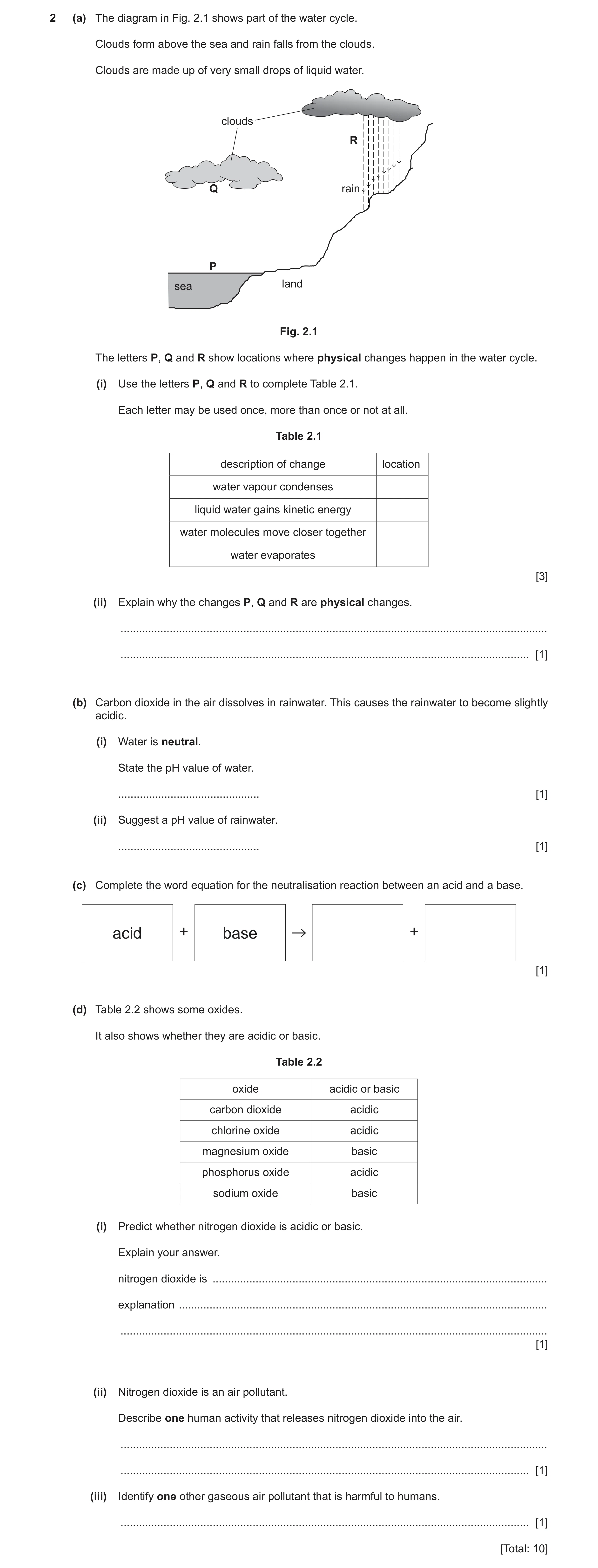
2 (a) The diagram in Fig. 2.1 shows part of the water cycle. Clouds form above the sea and rain falls from the clouds. Clouds are made up of very small drops of liquid water. clouds R Q rain P sea land Fig. 2.1 The letters P, Q and R show locations where physical changes happen in the water cycle. (i) Use the letters P, Q and R to complete Table 2.1. Each letter may be used once, more than once or not at all. Table 2.1 description of change location water vapour condenses liquid water gains kinetic energy water molecules move closer together water evaporates [3] (ii) Explain why the changes P, Q and R are physical changes. … … [1] (b) Carbon dioxide in the air dissolves in rainwater. This causes the rainwater to become slightly acidic. (i) Water is neutral. State the pH value of water. … [1] (ii) Suggest a pH value of rainwater. … [1] (c) Complete the word equation for the neutralisation reaction between an acid and a base. acid + base + [1] (d) Table 2.2 shows some oxides. It also shows whether they are acidic or basic. Table 2.2 oxide acidic or basic carbon dioxide acidic chlorine oxide acidic magnesium oxide basic phosphorus oxide acidic sodium oxide basic (i) Predict whether nitrogen dioxide is acidic or basic. Explain your answer. nitrogen dioxide is … explanation … … [1] (ii) Nitrogen dioxide is an air pollutant. Describe one human activity that releases nitrogen dioxide into the air. … … [1] (iii) Identify one other gaseous air pollutant that is harmful to humans. … [1] [Total: 10]
10 marks
Mark scheme: 2(a)(i) Q R Q P ;;; 1 correct for 1 mark 2 or 3 correct for 2 marks all correct for 3 marks 2(a)(ii) only changes of state occurring / no new substances formed ; 1 2(b)(i) 7 ; 1 2(b)(ii) allow a range from <7 to 3 ; 1 2(c) salt + water ; 1 2(d)(i) (acidic) oxide of a non-metal / non-metal oxides in the table are acidic ; 1 2(d)(ii) burning of fuel / named fuel / hydrocarbons in car engines ; 1 2(d)(iii) carbon monoxide / CO / sulfur dioxide / SO2 / other correct ; 1
This question in 0654/31 May/June 2020
Q4 · A list of covalently bonded molecules 0654/32 Feb/March 2022
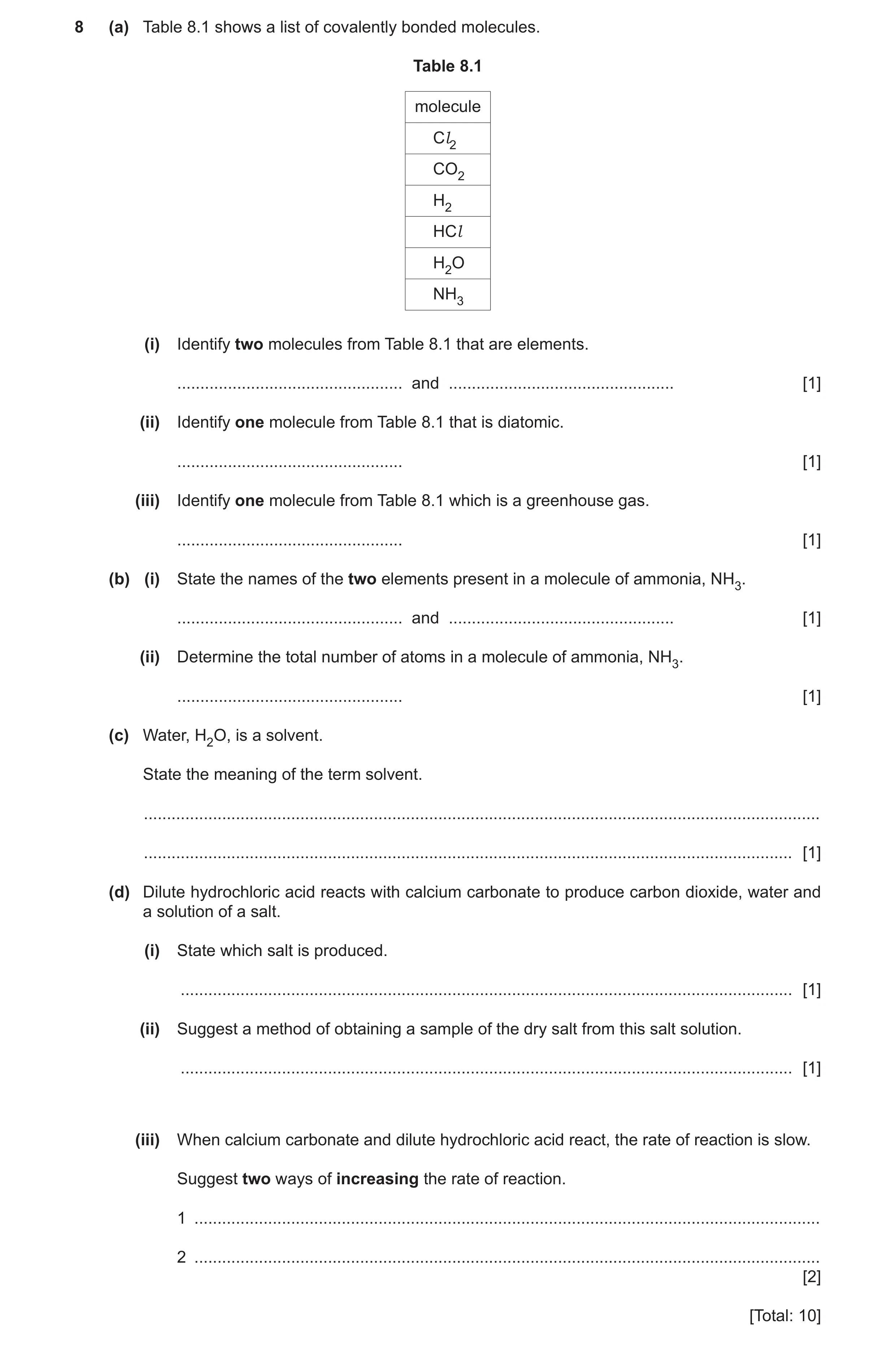
8 (a) Table 8.1 shows a list of covalently bonded molecules. Table 8.1 molecule Cl2 CO2 H2 HCl H2O NH3 (i) Identify two molecules from Table 8.1 that are elements. … and … [1] (ii) Identify one molecule from Table 8.1 that is diatomic. … [1] (iii) Identify one molecule from Table 8.1 which is a greenhouse gas. … [1] (b) (i) State the names of the two elements present in a molecule of ammonia, NH3. … and … [1] (ii) Determine the total number of atoms in a molecule of ammonia, NH3. … [1] (c) Water, H2O, is a solvent. State the meaning of the term solvent. … … [1] (d) Dilute hydrochloric acid reacts with calcium carbonate to produce carbon dioxide, water and a solution of a salt. (i) State which salt is produced. … [1] (ii) Suggest a method of obtaining a sample of the dry salt from this salt solution. … [1] (iii) When calcium carbonate and dilute hydrochloric acid react, the rate of reaction is slow. Suggest two ways of increasing the rate of reaction. 1 … 2 … [2] [Total: 10]
10 marks
Mark scheme: 8(a)(i) 8(a)(ii) HCl, / Cl2 / H2; 1 8(a)(iii) CO2 ; 1 8(b)(i) nitrogen and hydrogen; 1 8(b)(ii) 4; 1 8(c) a (liquid) in which other substances dissolve; 1 8(d)(i) calcium chloride; 1 8(d)(ii) evaporation; 1 8(d)(iii) increase temperature; increase surface area / decrease particle size; increase concentration of acid; 2
This question in 0654/32 Feb/March 2022
Q5 · A student adds calcium and copper to separate test-tubes of cold water 0654/32 May/June 2022
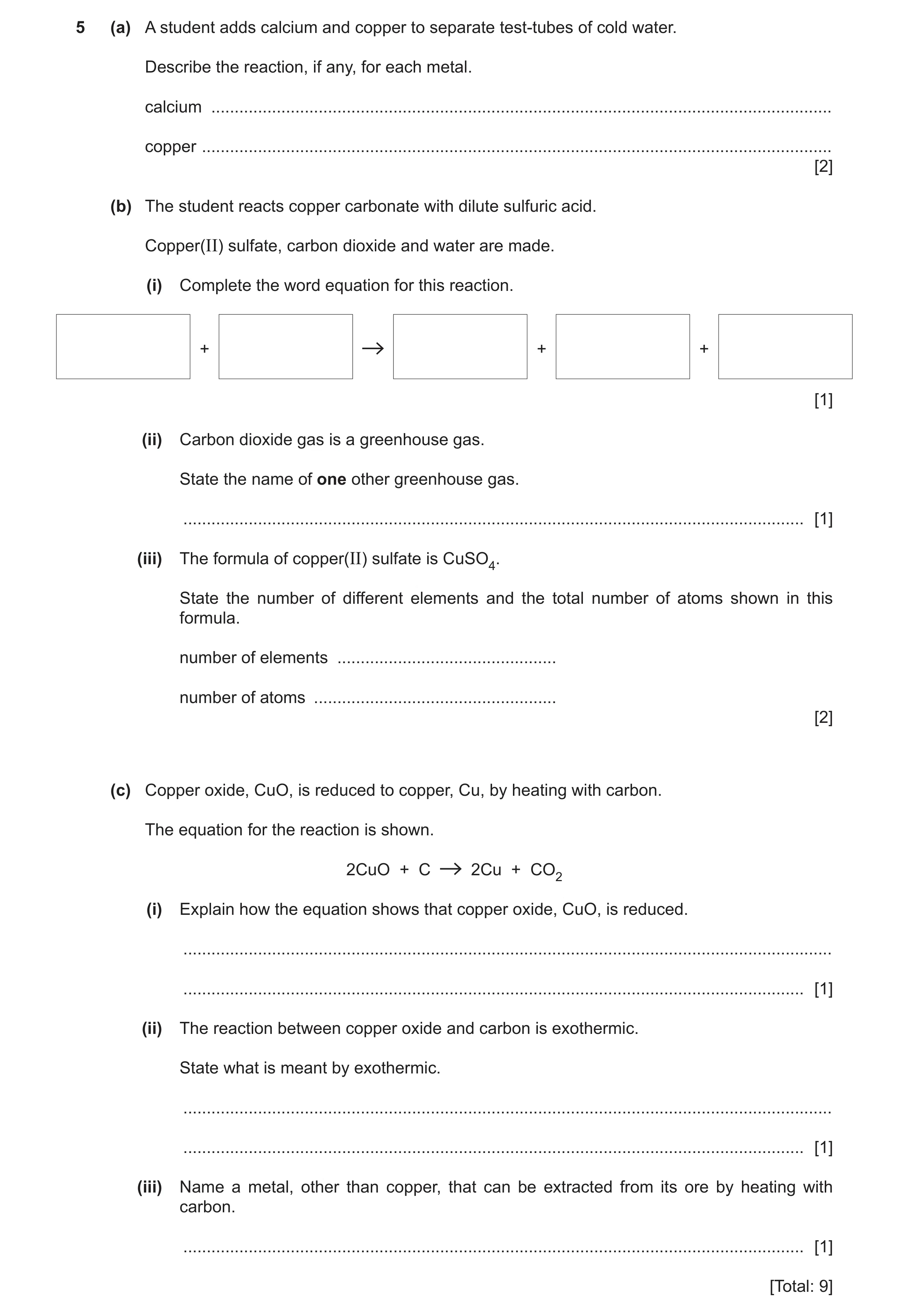
5 (a) A student adds calcium and copper to separate test-tubes of cold water. Describe the reaction, if any, for each metal. calcium … copper … [2] (b) The student reacts copper carbonate with dilute sulfuric acid. Copper(II) sulfate, carbon dioxide and water are made. (i) Complete the word equation for this reaction. + + + [1] (ii) Carbon dioxide gas is a greenhouse gas. State the name of one other greenhouse gas. … [1] (iii) The formula of copper(II) sulfate is CuSO4. State the number of different elements and the total number of atoms shown in this formula. number of elements … number of atoms … [2] (c) Copper oxide, CuO, is reduced to copper, Cu, by heating with carbon. The equation for the reaction is shown. 2CuO + C 2Cu + CO2 (i) Explain how the equation shows that copper oxide, CuO, is reduced. … … [1] (ii) The reaction between copper oxide and carbon is exothermic. State what is meant by exothermic. … … [1] (iii) Name a metal, other than copper, that can be extracted from its ore by heating with carbon. … [1] [Total: 9]
9 marks
Mark scheme: 5(a) (calcium) gas evolved / metal dissolves / white insoluble solid forms ; (copper) no change ; 2 5(b)(i) copper carbonate + sulfuric acid copper sulfate + carbon dioxide + water; 1 5(b)(ii) methane; 1 5(b)(iii) number of elements = 3; number of atoms = 6; 2 5(c)(i) loss of oxygen ; 1 5(c)(ii) gives out (thermal) energy; 1 5(c)(iii) iron; 1
This question in 0654/32 May/June 2022
Q6 · A student adds calcium and copper to separate test-tubes of cold water 0654/33 May/June 2022
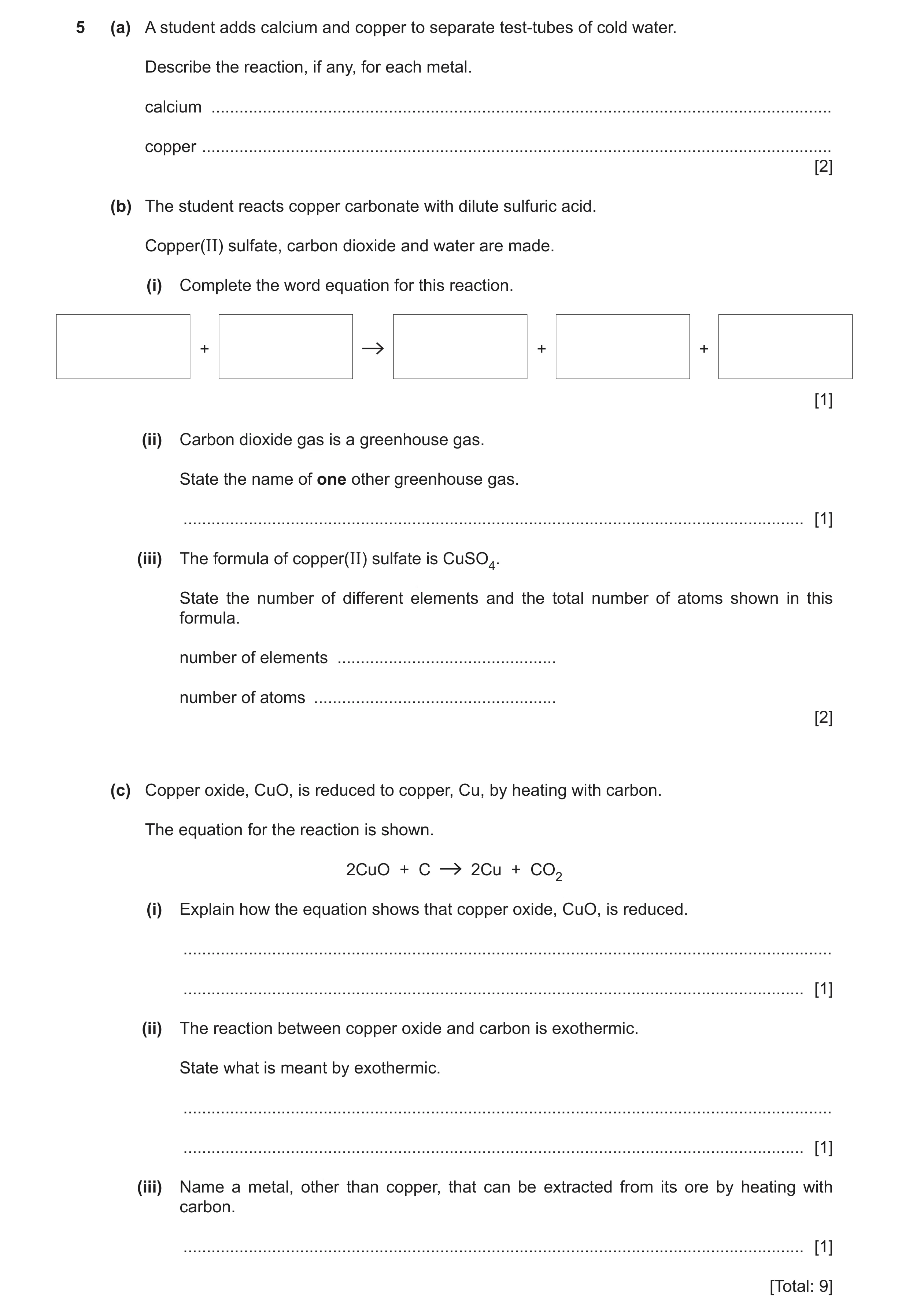
5 (a) A student adds calcium and copper to separate test-tubes of cold water. Describe the reaction, if any, for each metal. calcium … copper … [2] (b) The student reacts copper carbonate with dilute sulfuric acid. Copper(II) sulfate, carbon dioxide and water are made. (i) Complete the word equation for this reaction. + + + [1] (ii) Carbon dioxide gas is a greenhouse gas. State the name of one other greenhouse gas. … [1] (iii) The formula of copper(II) sulfate is CuSO4. State the number of different elements and the total number of atoms shown in this formula. number of elements … number of atoms … [2] (c) Copper oxide, CuO, is reduced to copper, Cu, by heating with carbon. The equation for the reaction is shown. 2CuO + C 2Cu + CO2 (i) Explain how the equation shows that copper oxide, CuO, is reduced. … … [1] (ii) The reaction between copper oxide and carbon is exothermic. State what is meant by exothermic. … … [1] (iii) Name a metal, other than copper, that can be extracted from its ore by heating with carbon. … [1] [Total: 9]
9 marks
Mark scheme: 5(a) (calcium) gas evolved / metal dissolves / white insoluble solid forms ; (copper) no change ; 2 5(b)(i) copper carbonate + sulfuric acid copper sulfate + carbon dioxide + water; 1 5(b)(ii) methane; 1 5(b)(iii) number of elements = 3; number of atoms = 6; 2 5(c)(i) loss of oxygen ; 1 5(c)(ii) gives out (thermal) energy; 1 5(c)(iii) iron; 1
This question in 0654/33 May/June 2022
Q7 · Five words are shown in the boxes on the left 0654/32 Oct/Nov 2022
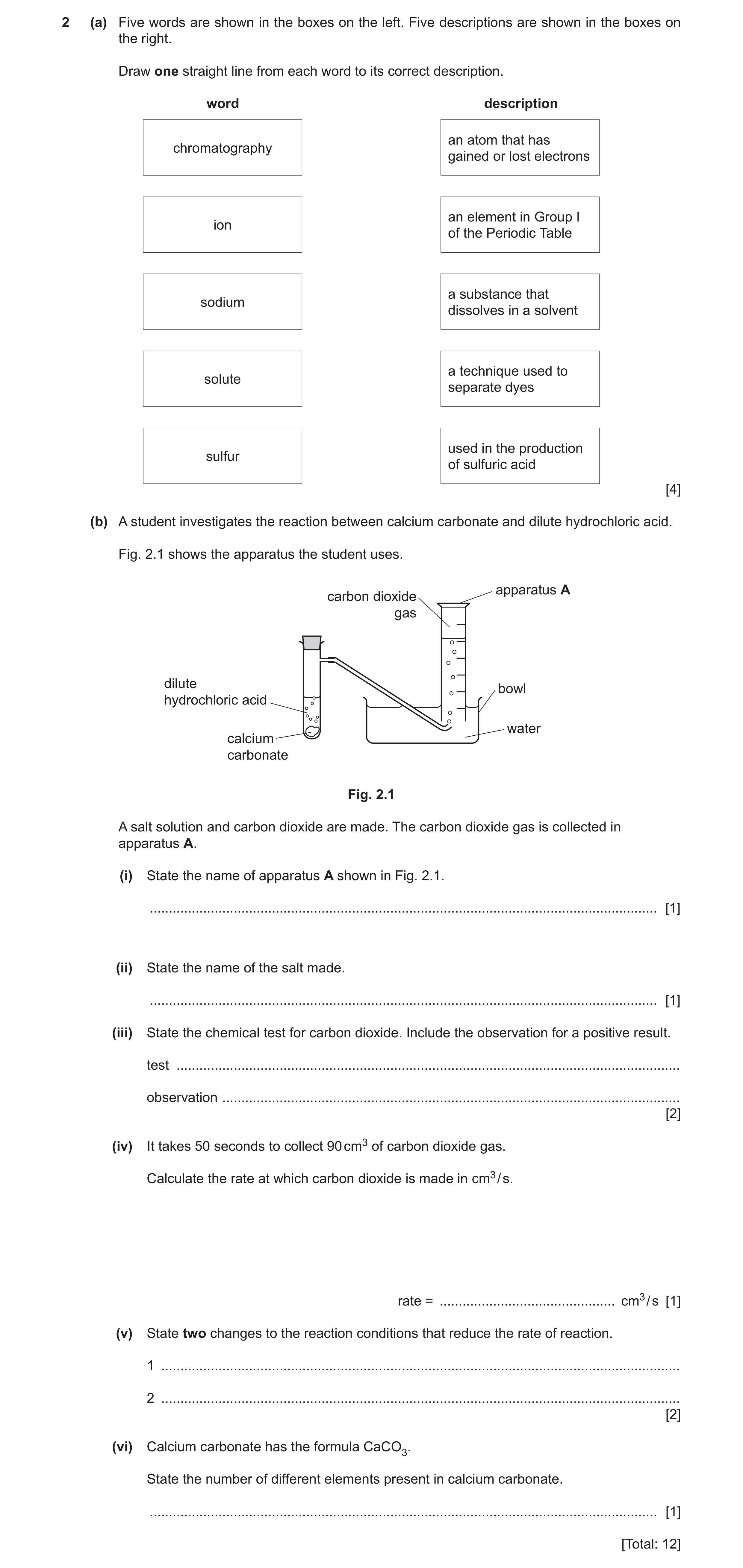
2 (a) Five words are shown in the boxes on the left. Five descriptions are shown in the boxes on the right. Draw one straight line from each word to its correct description. word description an atom that has chromatography gained or lost electrons an element in Group I ion of the Periodic Table a substance that sodium dissolves in a solvent a technique used to solute separate dyes used in the production sulfur of sulfuric acid [4] (b) A student investigates the reaction between calcium carbonate and dilute hydrochloric acid. Fig. 2.1 shows the apparatus the student uses. apparatus A carbon dioxide gas dilute bowl hydrochloric acid water calcium carbonate Fig. 2.1 A salt solution and carbon dioxide are made. The carbon dioxide gas is collected in apparatus A. (i) State the name of apparatus A shown in Fig. 2.1. … [1] (ii) State the name of the salt made. … [1] (iii) State the chemical test for carbon dioxide. Include the observation for a positive result. test … observation … [2] (iv) It takes 50 seconds to collect 90 cm3 of carbon dioxide gas. Calculate the rate at which carbon dioxide is made in cm3 / s. rate = … cm3 / s [1] (v) State two changes to the reaction conditions that reduce the rate of reaction. 1 … 2 … [2] (vi) Calcium carbonate has the formula CaCO3. State the number of different elements present in calcium carbonate. … [1] [Total: 12]
12 marks
Mark scheme: 2(a) 4 1 correct 1 mark ; 2 correct 2 marks ; 3 or 4 correct 3 marks ; 5 correct 4 marks ; 2(b)(i) measuring cylinder ; 1 2(b)(ii) calcium chloride ; 1 2(b)(iii) (bubble the gas through) lime water ; 2 goes milky / cloudy ; 2(b)(iv) 1.8 (cm3 / s) ; 1 2(b)(v) any two from: 2 lower temperature (of acid) ; lower concentration of acid ; decrease surface area ; 2(b)(vi) 3 ; 1
This question in 0654/32 Oct/Nov 2022
Q8 · The apparatus and reagents used to make a salt 0654/33 Oct/Nov 2022
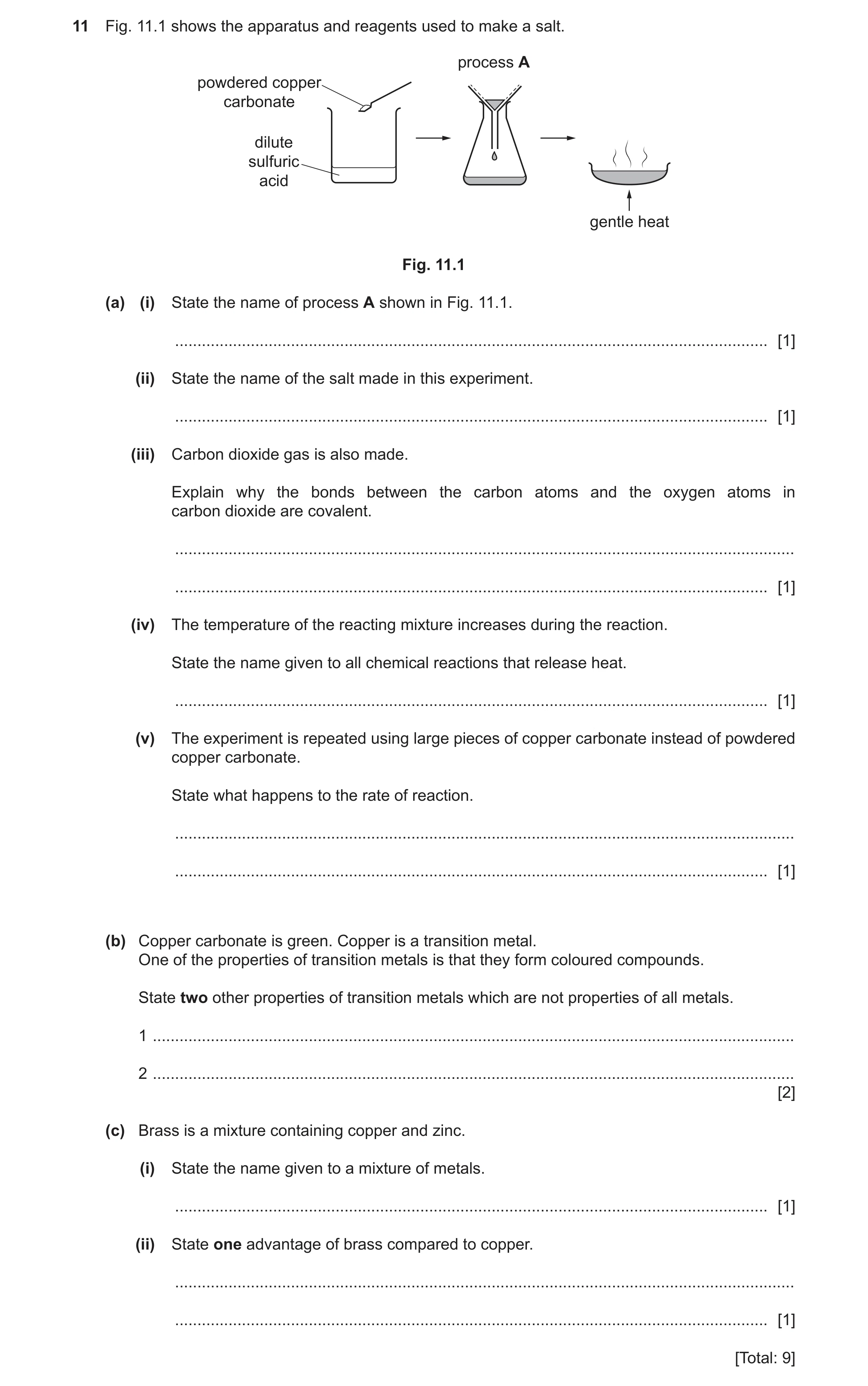
11 Fig. 11.1 shows the apparatus and reagents used to make a salt. process A powdered copper carbonate dilute sulfuric acid gentle heat Fig. 11.1 (a) (i) State the name of process A shown in Fig. 11.1. … [1] (ii) State the name of the salt made in this experiment. … [1] (iii) Carbon dioxide gas is also made. Explain why the bonds between the carbon atoms and the oxygen atoms in carbon dioxide are covalent. … … [1] (iv) The temperature of the reacting mixture increases during the reaction. State the name given to all chemical reactions that release heat. … [1] (v) The experiment is repeated using large pieces of copper carbonate instead of powdered copper carbonate. State what happens to the rate of reaction. … … [1] (b) Copper carbonate is green. Copper is a transition metal. One of the properties of transition metals is that they form coloured compounds. State two other properties of transition metals which are not properties of all metals. 1 … 2 … [2] (c) Brass is a mixture containing copper and zinc. (i) State the name given to a mixture of metals. … [1] (ii) State one advantage of brass compared to copper. … … [1] [Total: 9]
9 marks
Mark scheme: 11(a)(i) filtration ; 1 11(a)(ii) copper sulfate ; 1 11(a)(iii) two non-metals bonding / electrons are shared ; 1 11(a)(iv) exothermic ; 1 11(a)(v) (rate of reaction) decreases ; 1 11(b) any two from: 2 high density ; catalyst ; variable valency ; 11(c)(i) alloy ; 1 11(c)(ii) stronger / any valid point ; 1
This question in 0654/33 Oct/Nov 2022
Q9 · A list of processes is shown 0654/32 Feb/March 2024
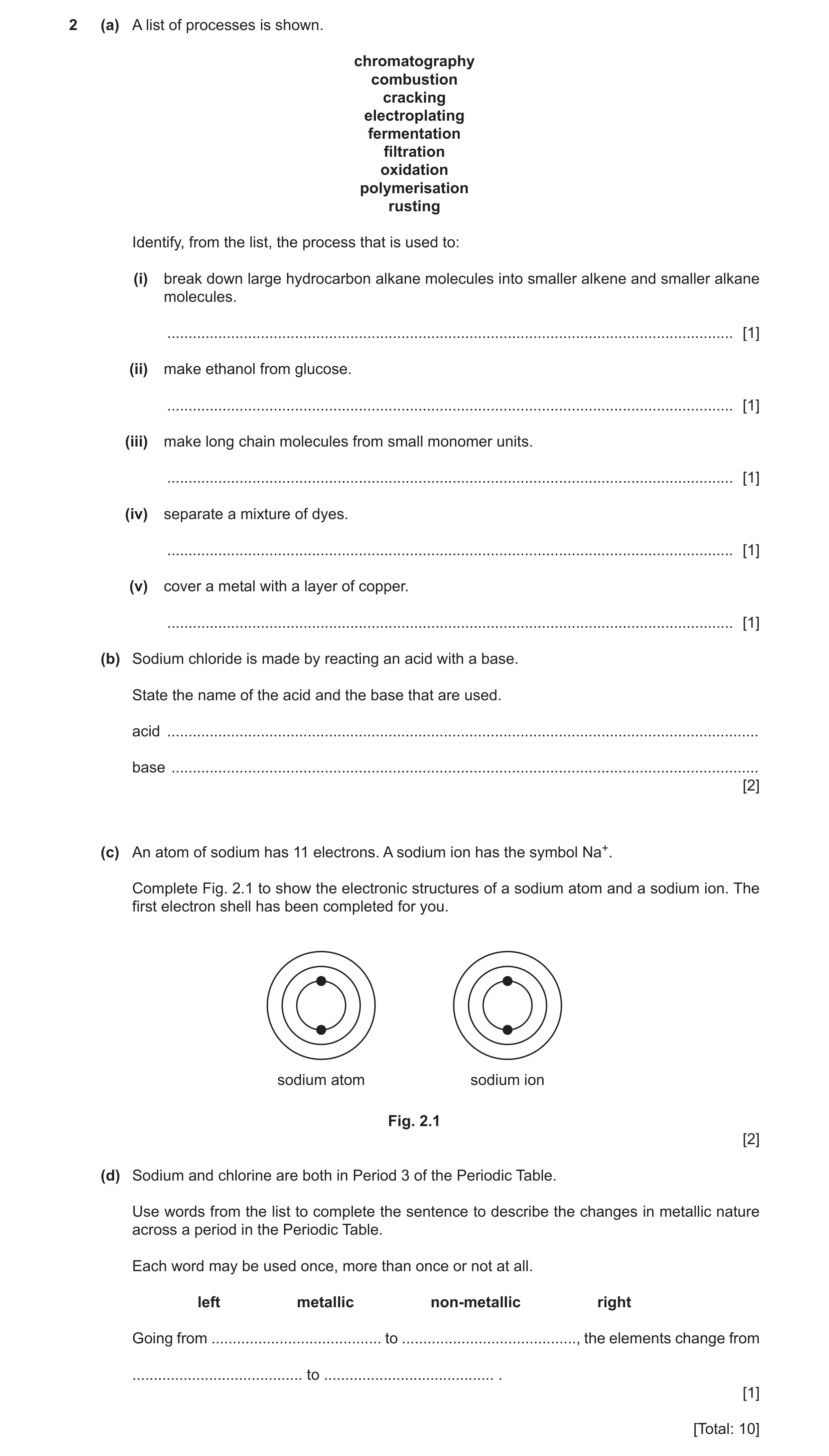
2 (a) A list of processes is shown. chromatography combustion cracking electroplating fermentation filtration oxidation polymerisation rusting Identify, from the list, the process that is used to: (i) break down large hydrocarbon alkane molecules into smaller alkene and smaller alkane molecules. … [1] (ii) make ethanol from glucose. … [1] (iii) make long chain molecules from small monomer units. … [1] (iv) separate a mixture of dyes. … [1] (v) cover a metal with a layer of copper. … [1] (b) Sodium chloride is made by reacting an acid with a base. State the name of the acid and the base that are used. acid … base … [2] (c) An atom of sodium has 11 electrons. A sodium ion has the symbol Na+. Complete Fig. 2.1 to show the electronic structures of a sodium atom and a sodium ion. The first electron shell has been completed for you. sodium atom sodium ion Fig. 2.1 [2] (d) Sodium and chlorine are both in Period 3 of the Periodic Table. Use words from the list to complete the sentence to describe the changes in metallic nature across a period in the Periodic Table. Each word may be used once, more than once or not at all. left metallic non-metallic right Going from … to … , the elements change from … to … . [1] [Total: 10]
10 marks
Mark scheme: 2(a)(i) cracking ; 1 2(a)(ii) fermentation ; 1 2(a)(iii) polymerisation ; 1 2(a)(iv) chromatography ; 1 2(a)(v) electroplating ; 1 2(b) (dilute) hydrochloric acid ; 2 (aqueous) sodium hydroxide ; 2(c) sodium atom 2.8.1 ; 2 sodium ion 2.8 ; 2(d) left right metallic non-metallic ; 1 or right left non-metallic metallic
This question in 0654/32 Feb/March 2024
Q10 · Choose from the following substances to answer the questions 0654/32 Oct/Nov 2024
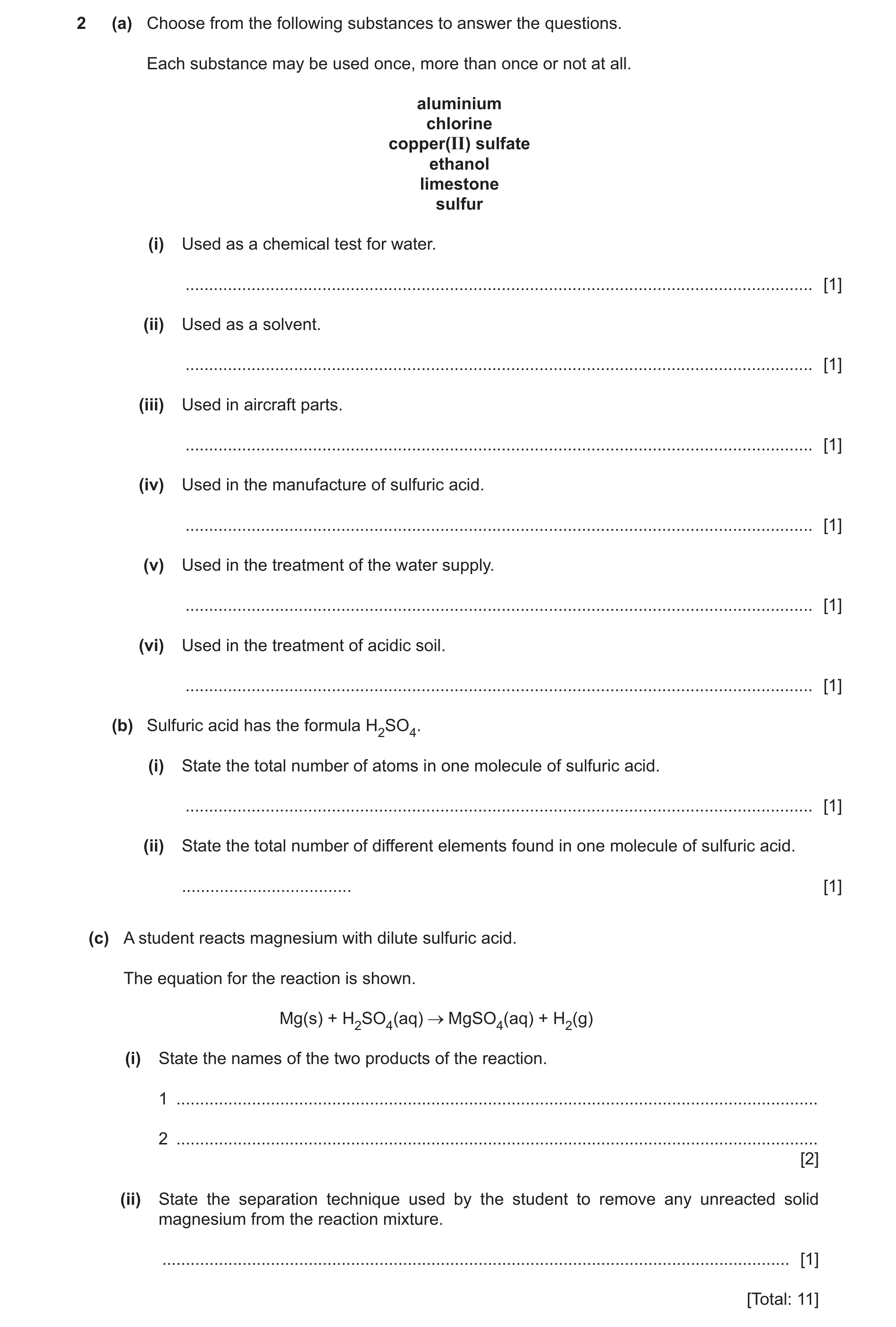
2 (a) Choose from the following substances to answer the questions. Each substance may be used once, more than once or not at all. aluminium chlorine copper(II) sulfate ethanol limestone sulfur (i) Used as a chemical test for water. … [1] (ii) Used as a solvent. … [1] (iii) Used in aircraft parts. … [1] (iv) Used in the manufacture of sulfuric acid. … [1] (v) Used in the treatment of the water supply. … [1] (vi) Used in the treatment of acidic soil. … [1] (b) Sulfuric acid has the formula H2SO4. (i) State the total number of atoms in one molecule of sulfuric acid. … [1] (ii) State the total number of different elements found in one molecule of sulfuric acid. … [1] (c) A student reacts magnesium with dilute sulfuric acid. The equation for the reaction is shown. Mg(s) + H2SO4(aq) MgSO4(aq) + H2(g) (i) State the names of the two products of the reaction. 1 … 2 … [2] (ii) State the separation technique used by the student to remove any unreacted solid magnesium from the reaction mixture. … [1] [Total: 11]
11 marks
Mark scheme: 2(a)(i) copper sulfate ; 1 2(a)(ii) ethanol ; 1 2(a)(iii) aluminium ; 1 2(a)(iv) sulfur ; 1 2(a)(v) chlorine ; 1 2(a)(vi) limestone ; 1 2(b)(i) 7 ; 1 2(b)(ii) 3 ; 1 2(c)(i) magnesium sulfate ; 2 hydrogen ; 2(c)(ii) filtration ; 1
This question in 0654/32 Oct/Nov 2024
Q11 · Sodium reacts with chlorine to make sodium chloride 0654/33 Oct/Nov 2025
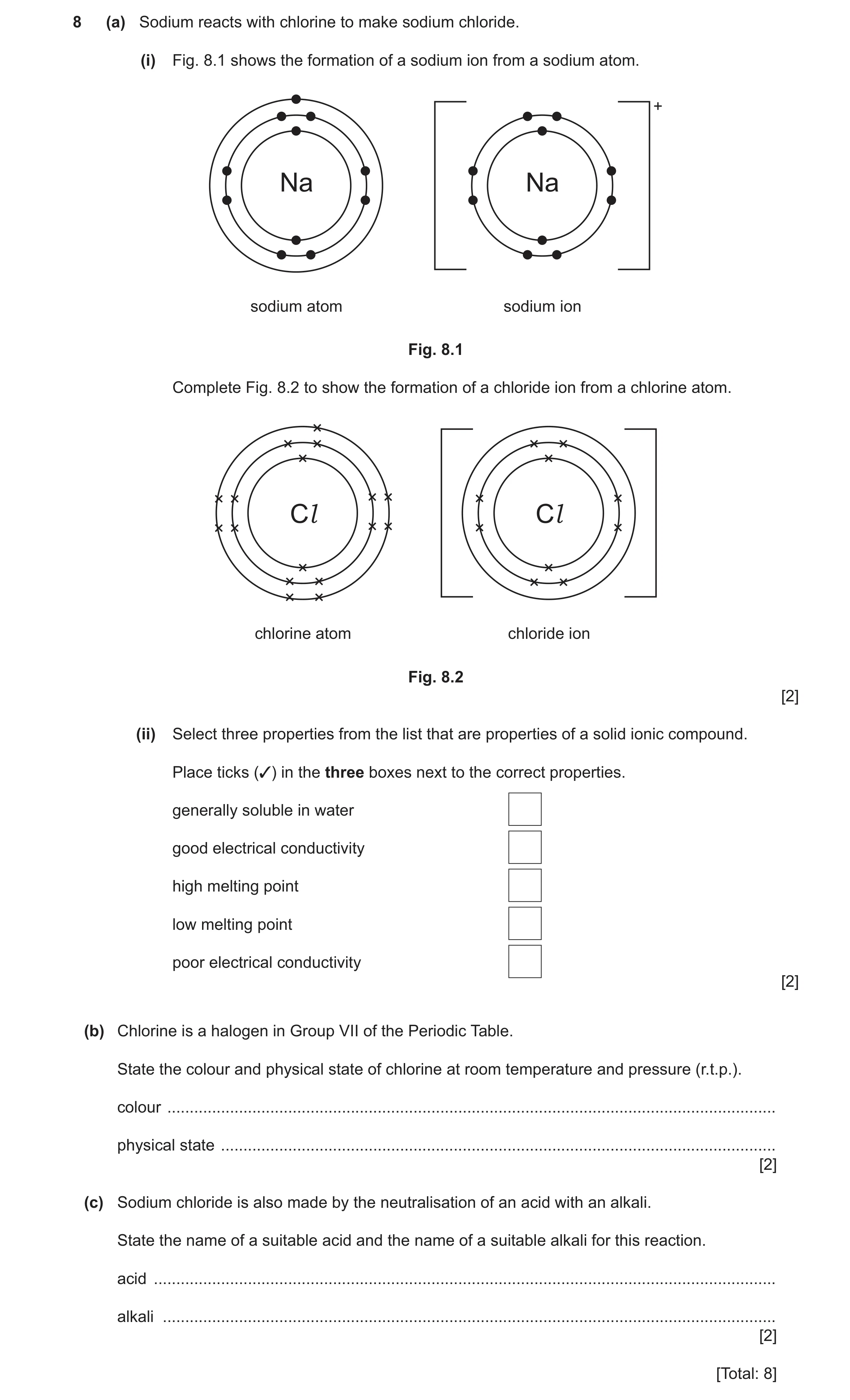
8 (a) Sodium reacts with chlorine to make sodium chloride. (i) Fig. 8.1 shows the formation of a sodium ion from a sodium atom. + Na Na sodium atom sodium ion Fig. 8.1 Complete Fig. 8.2 to show the formation of a chloride ion from a chlorine atom. Cl Cl chlorine atom chloride ion Fig. 8.2 [2] (ii) Select three properties from the list that are properties of a solid ionic compound. Place ticks (3) in the three boxes next to the correct properties. generally soluble in water good electrical conductivity high melting point low melting point poor electrical conductivity [2] (b) Chlorine is a halogen in Group VII of the Periodic Table. State the colour and physical state of chlorine at room temperature and pressure (r.t.p.). colour … physical state … [2] (c) Sodium chloride is also made by the neutralisation of an acid with an alkali. State the name of a suitable acid and the name of a suitable alkali for this reaction. acid … alkali … [2] [Total: 8]
8 marks
Mark scheme: 8(a)(i) eight electrons added to outer shell ; 2 – sign shown ; 8(a)(ii) 2 2 correct – 1 mark all 3 correct – 2 marks 8(b) (pale) yellow-green ; 2 gas ; 8(c) hydrochloric acid ; 2 sodium hydroxide ;
This question in 0654/33 Oct/Nov 2025
 11
11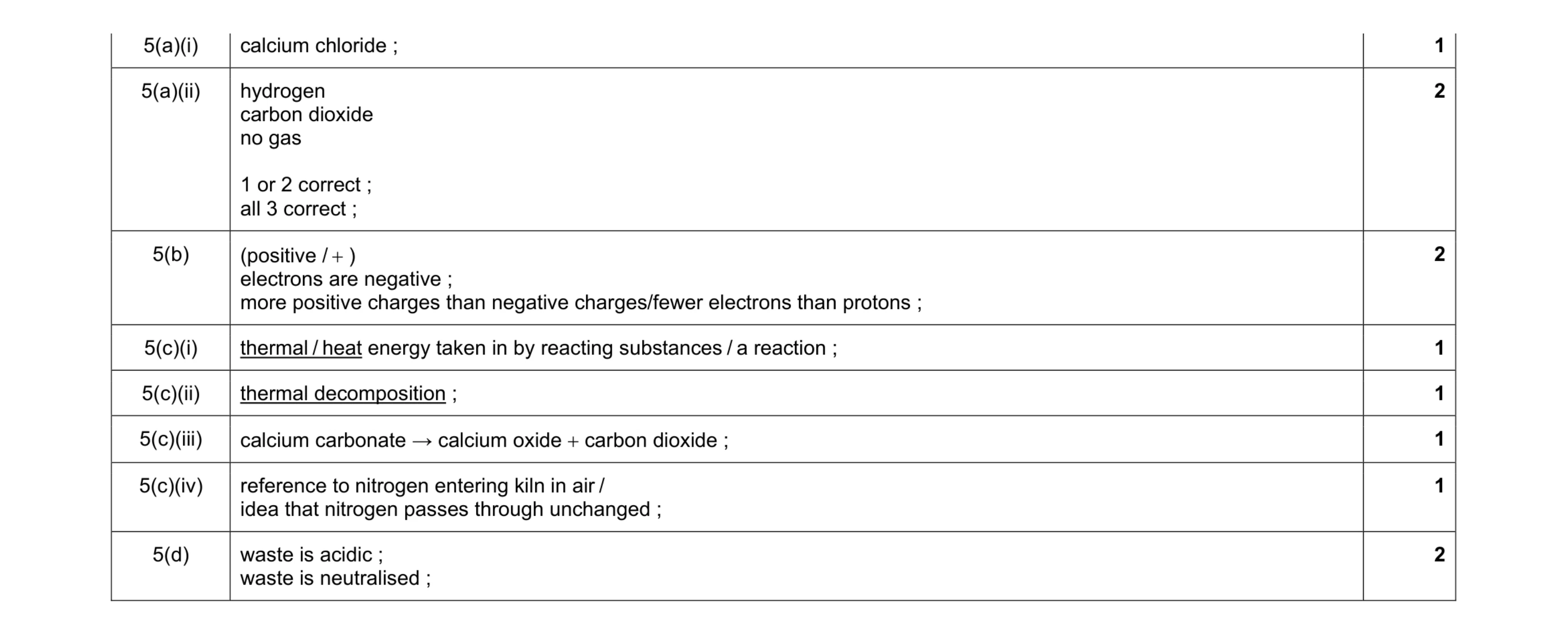 11
11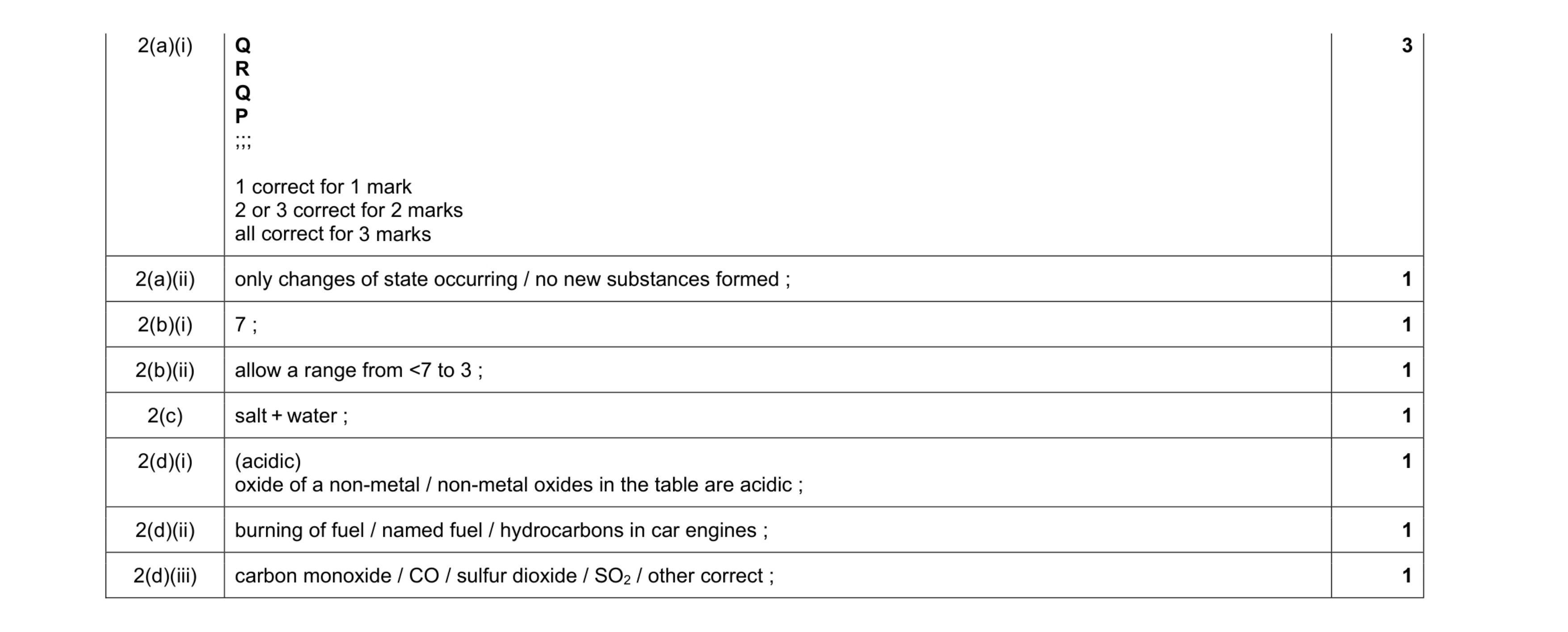 10
10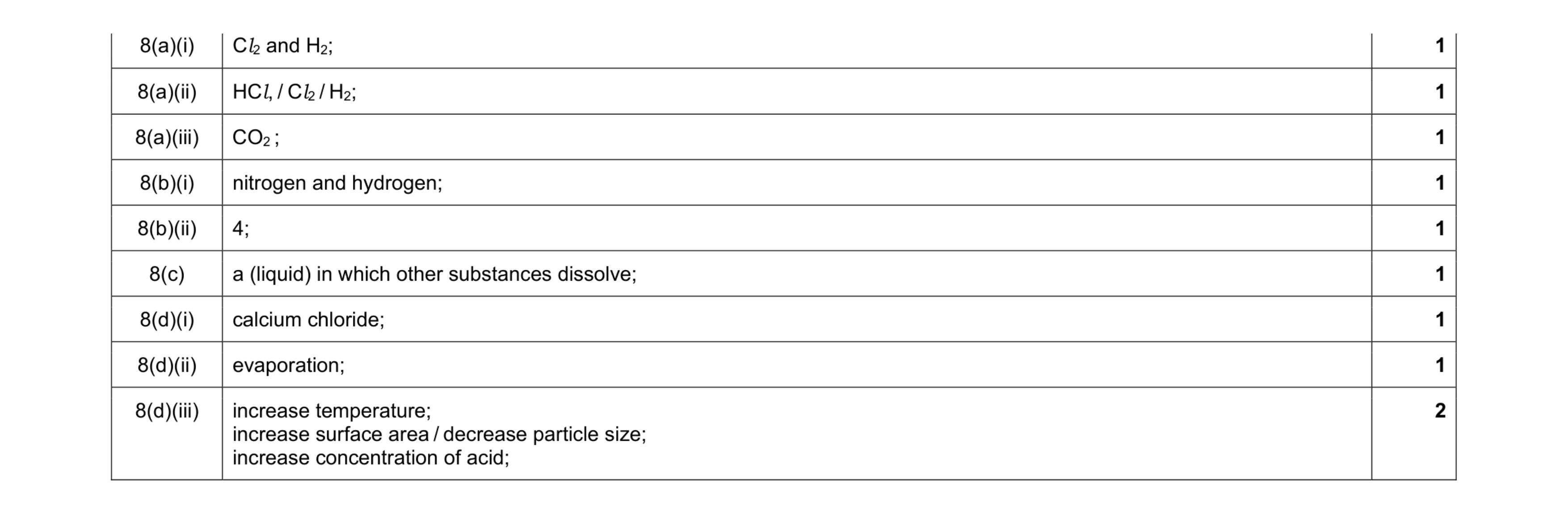 10
10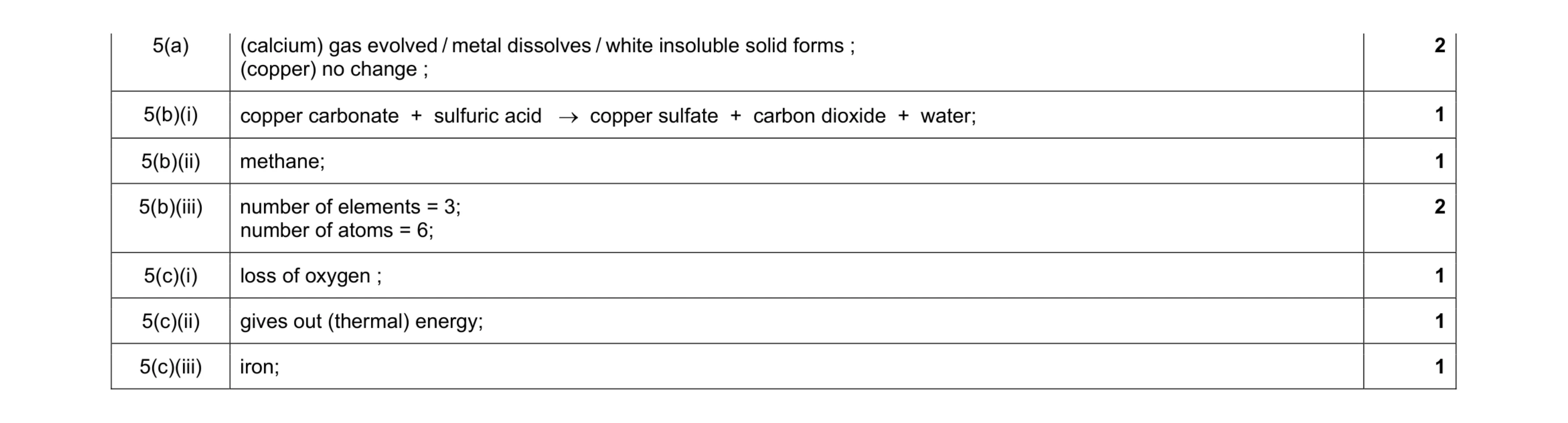 9
9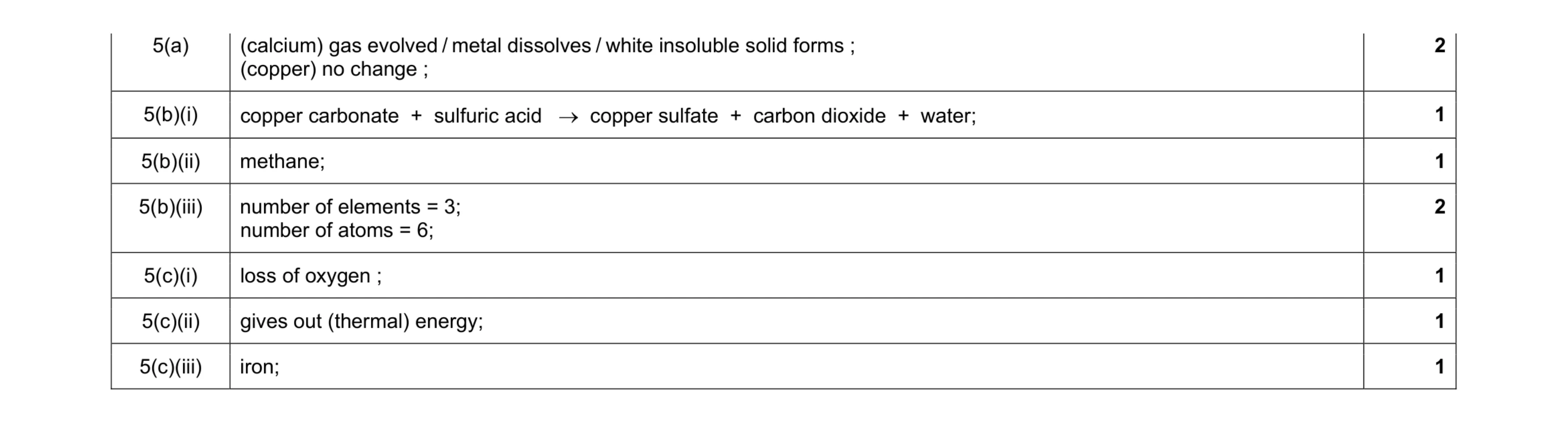 9
9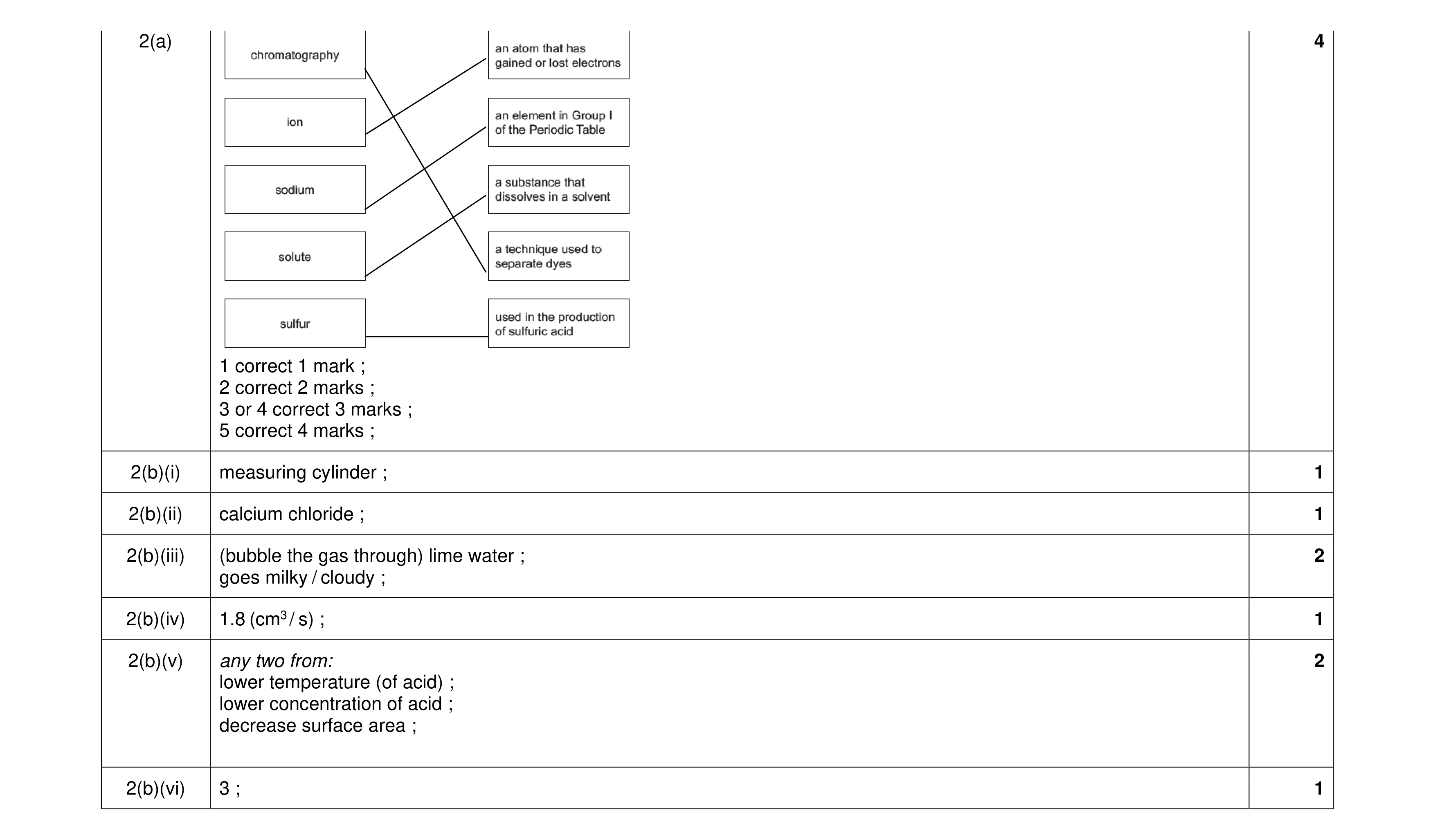 12
12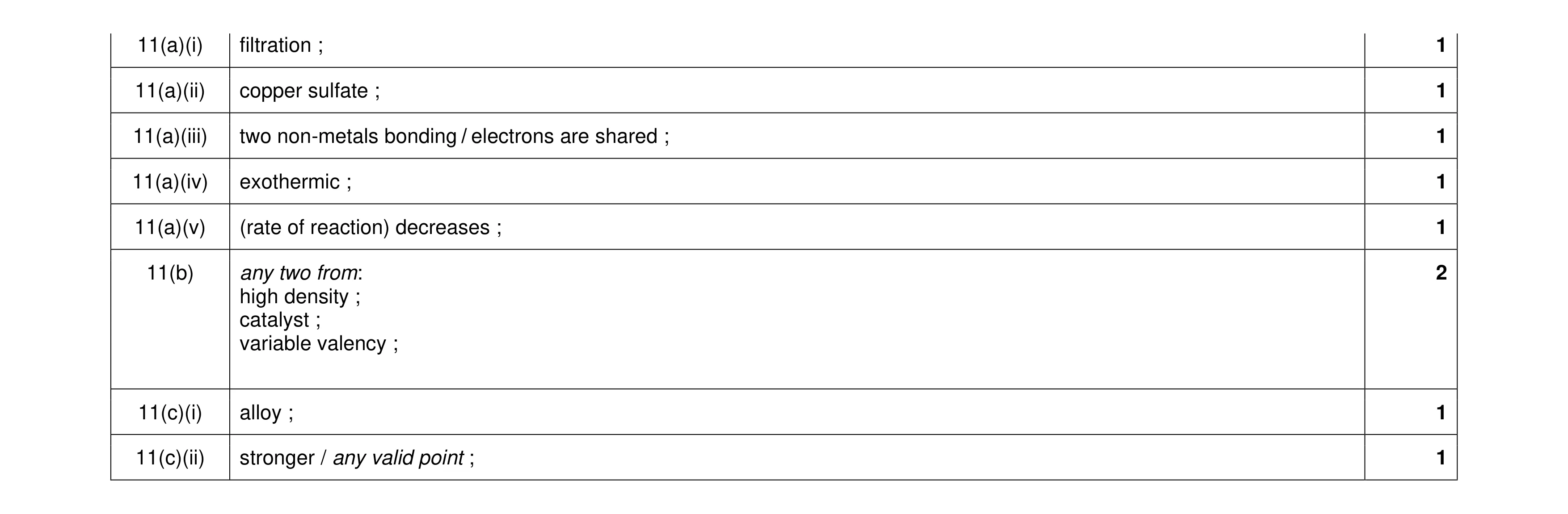 9
9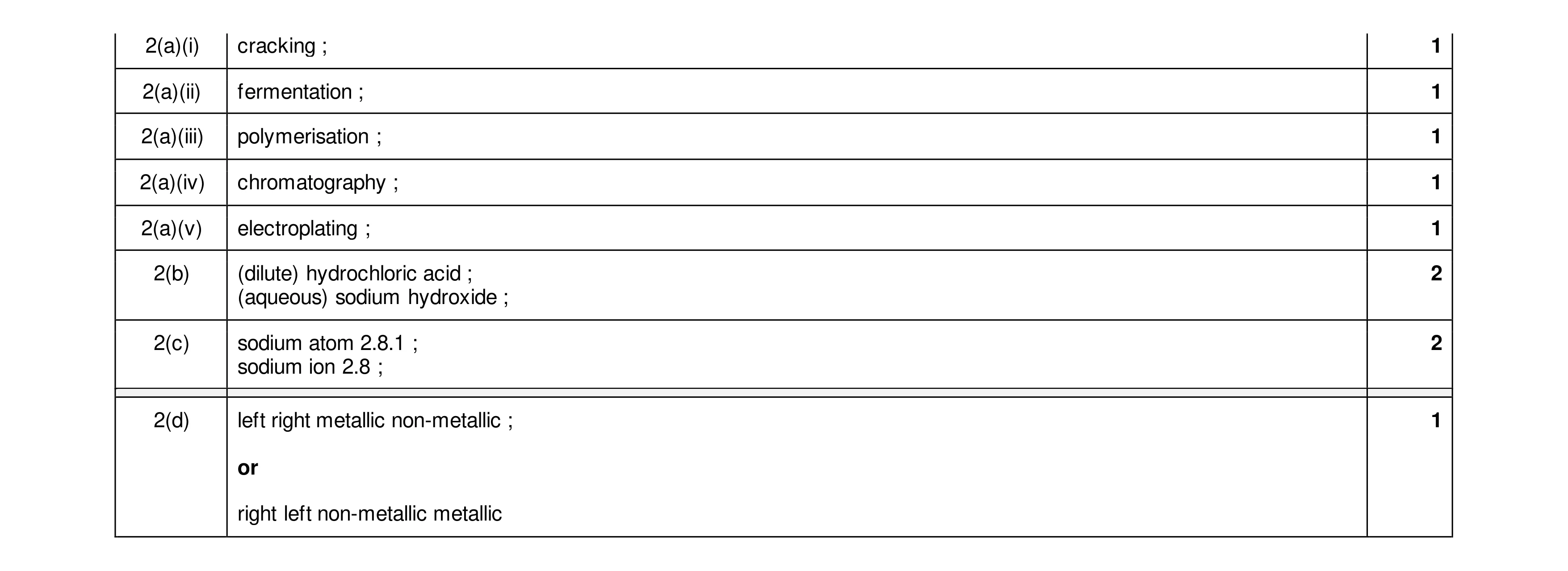 10
10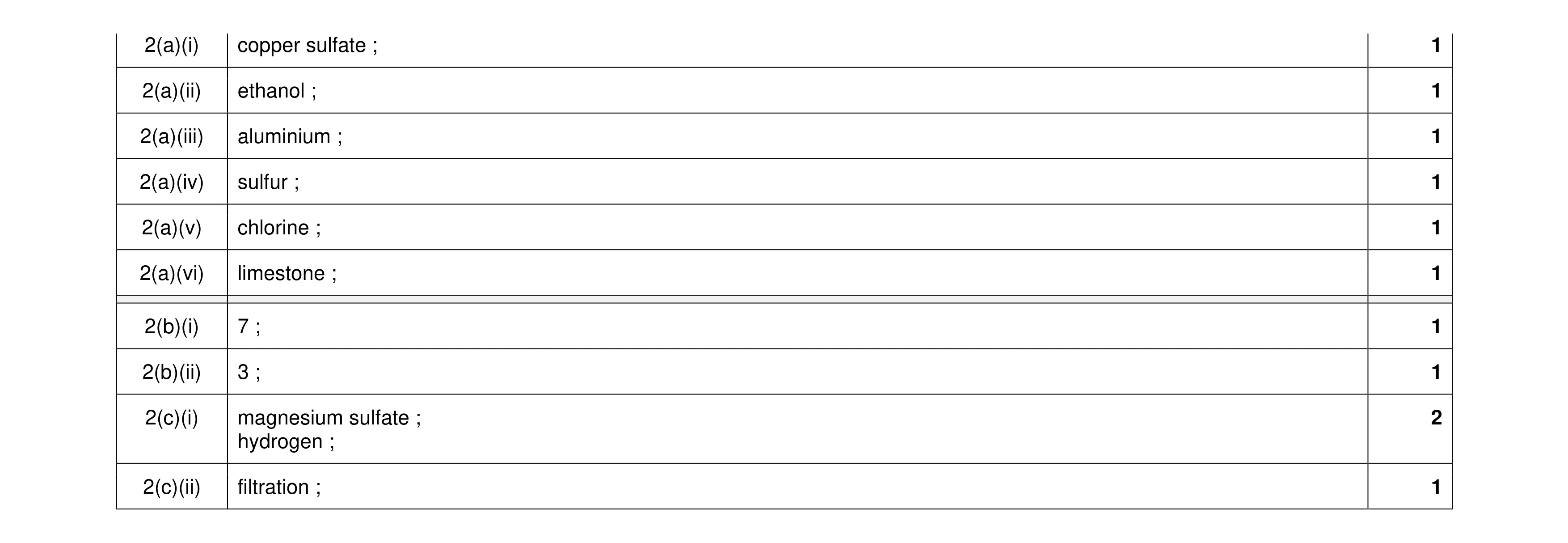 11
11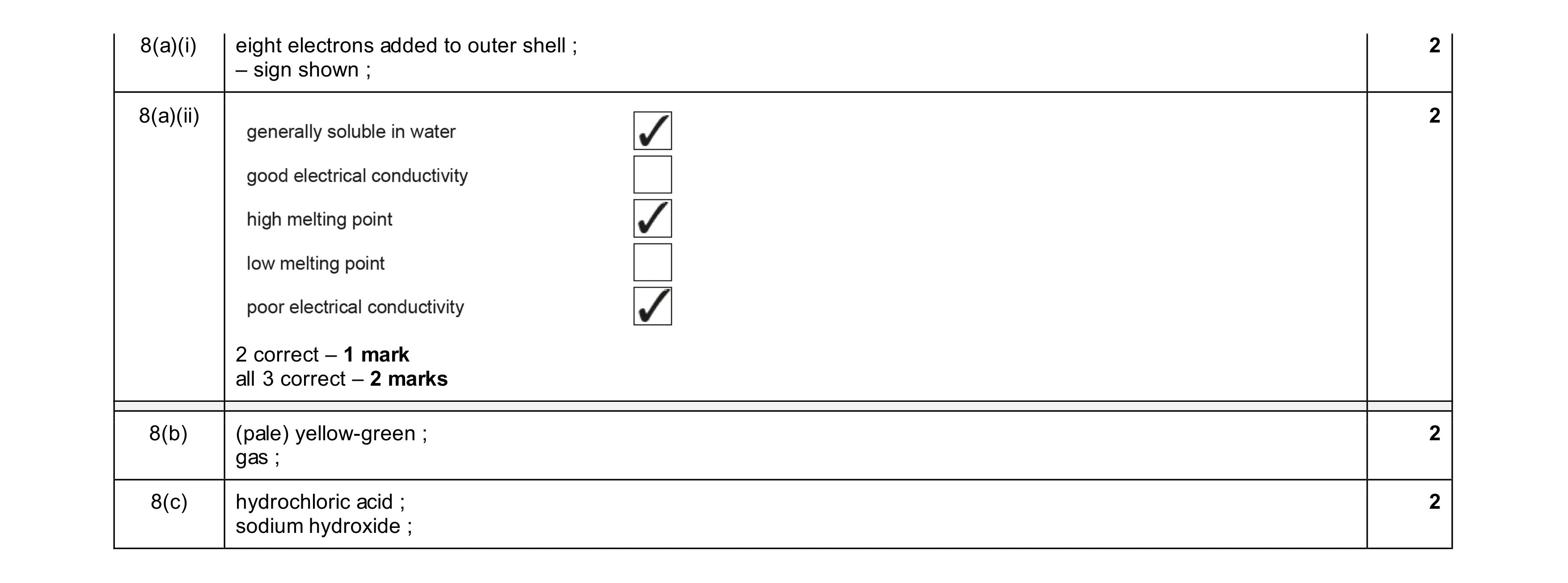 8
8