Questions as text
Q1 · A student uses the apparatus shown to find out how many different pigments are in leaves 0654/11 May/June 2005
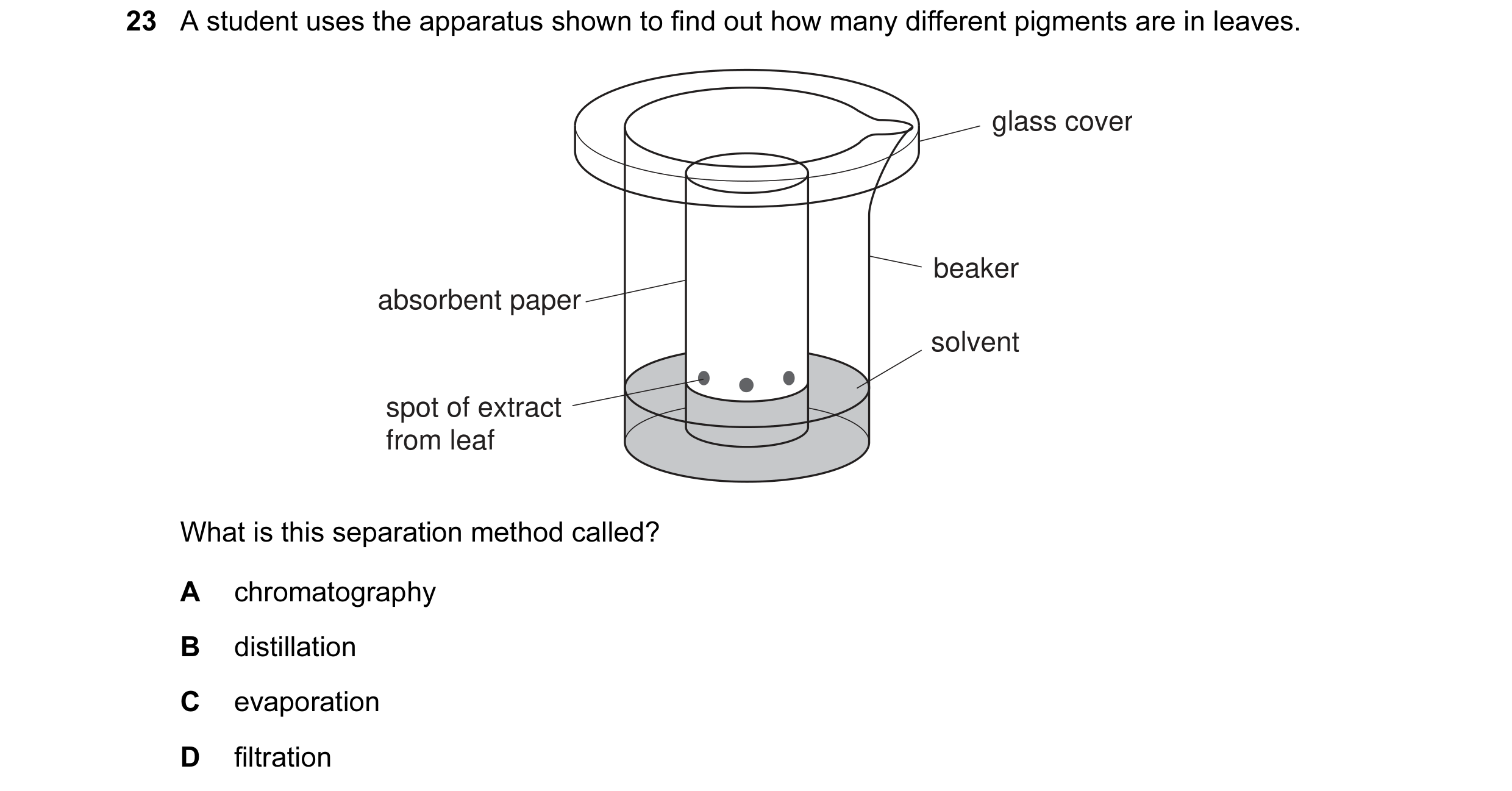
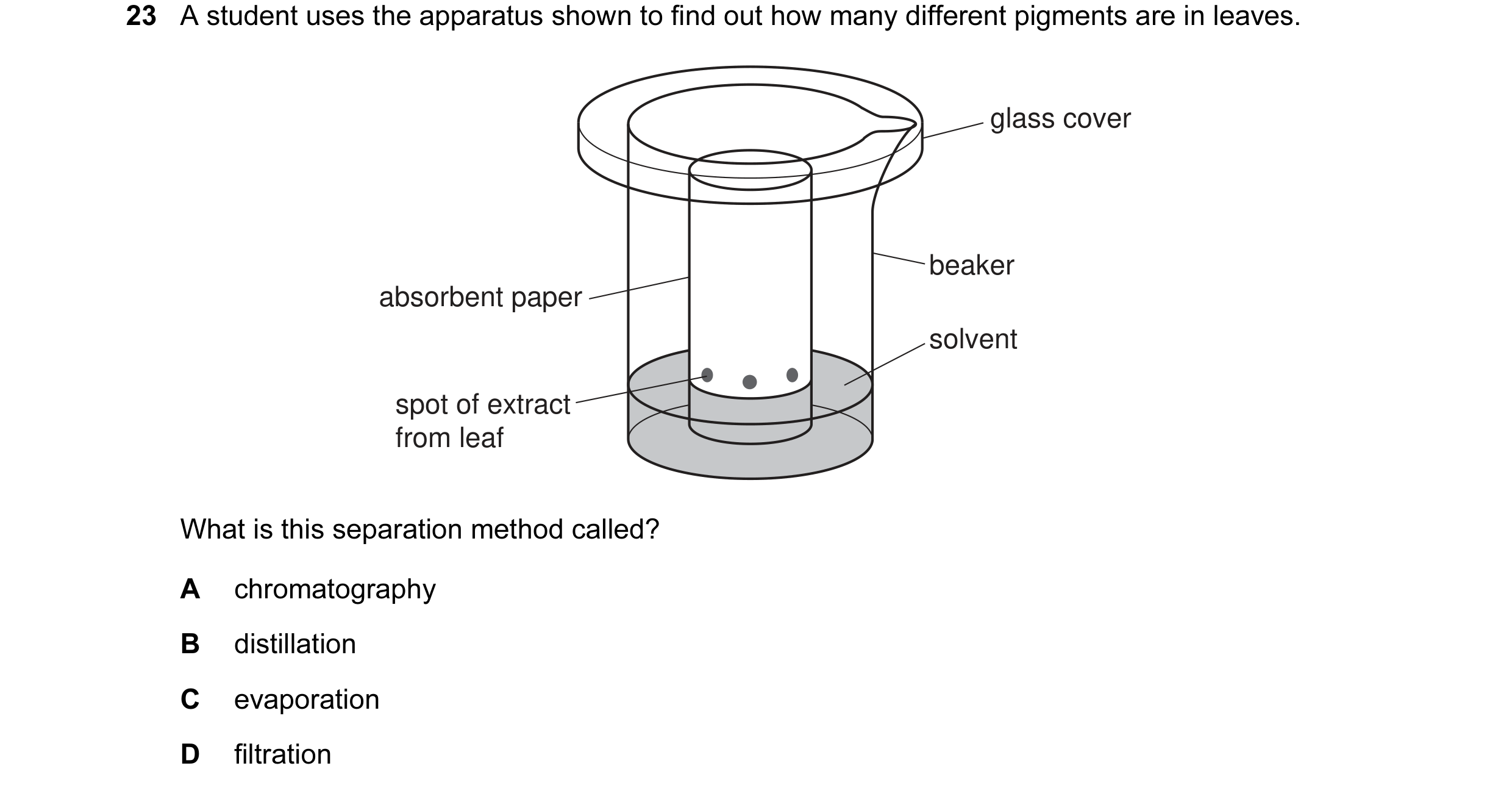
23 A student uses the apparatus shown to find out how many different pigments are in leaves. glass cover beaker absorbent paper solvent spot of extract from leaf What is this separation method called? A chromatography B distillation C evaporation D filtration
1 marks
Answer: A
This question in 0654/11 May/June 2005
Q2 · How may the compounds in chlorophyll be separated? 0654/11 May/June 2006
23 How may the compounds in chlorophyll be separated? A chemotherapy B chromatography C distillation D emulsification
1 marks
Answer: B
This question in 0654/11 May/June 2006
Q3 · A plant colour X is a mixture 0654/11 Oct/Nov 2007
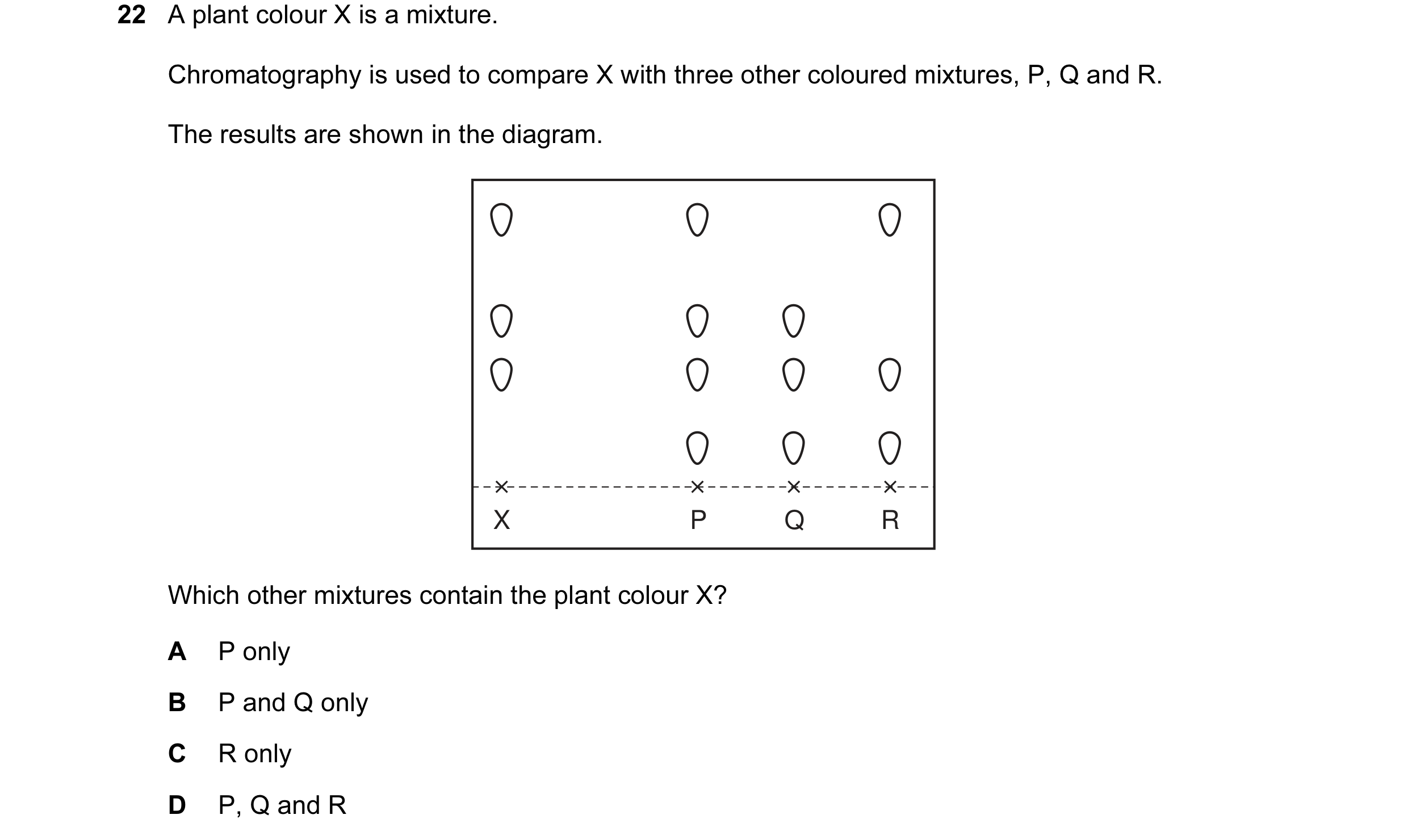
22 A plant colour X is a mixture. Chromatography is used to compare X with three other coloured mixtures, P, Q and R. The results are shown in the diagram. X P Q R Which other mixtures contain the plant colour X? A P only B P and Q only C R only D P, Q and R
1 marks
Answer: A
This question in 0654/11 Oct/Nov 2007
Q4 · Chlorophyll is extracted from green plants 0654/11 May/June 2010
22 Chlorophyll is extracted from green plants. Which method should be used to separate chlorophyll from other coloured substances? A chromatography B cracking C distillation D neutralisation
1 marks
Answer: A
This question in 0654/11 May/June 2010
Q5 · Chlorophyll is extracted from green plants 0654/12 May/June 2010
19 Chlorophyll is extracted from green plants. Which method should be used to separate chlorophyll from other coloured substances? A chromatography B cracking C distillation D neutralisation
1 marks
Answer: A
This question in 0654/12 May/June 2010
Q6 · A student uses the apparatus shown to find out how many different pigments are in leaves 0654/11 Oct/Nov 2010
23 A student uses the apparatus shown to find out how many different pigments are in leaves. glass cover beaker absorbent paper solvent spot of extract from leaf What is this separation method called? A chromatography B distillation C evaporation D filtration
1 marks
Answer: A
This question in 0654/11 Oct/Nov 2010
Q7 · A student uses the apparatus shown to find out how many different pigments are in leaves 0654/12 Oct/Nov 2010
22 A student uses the apparatus shown to find out how many different pigments are in leaves. glass cover beaker absorbent paper solvent spot of extract from leaf What is this separation method called? A chromatography B distillation C evaporation D filtration
1 marks
Answer: A
This question in 0654/12 Oct/Nov 2010
Q8 · A student uses the apparatus shown to find out how many different pigments are in leaves 0654/13 Oct/Nov 2010
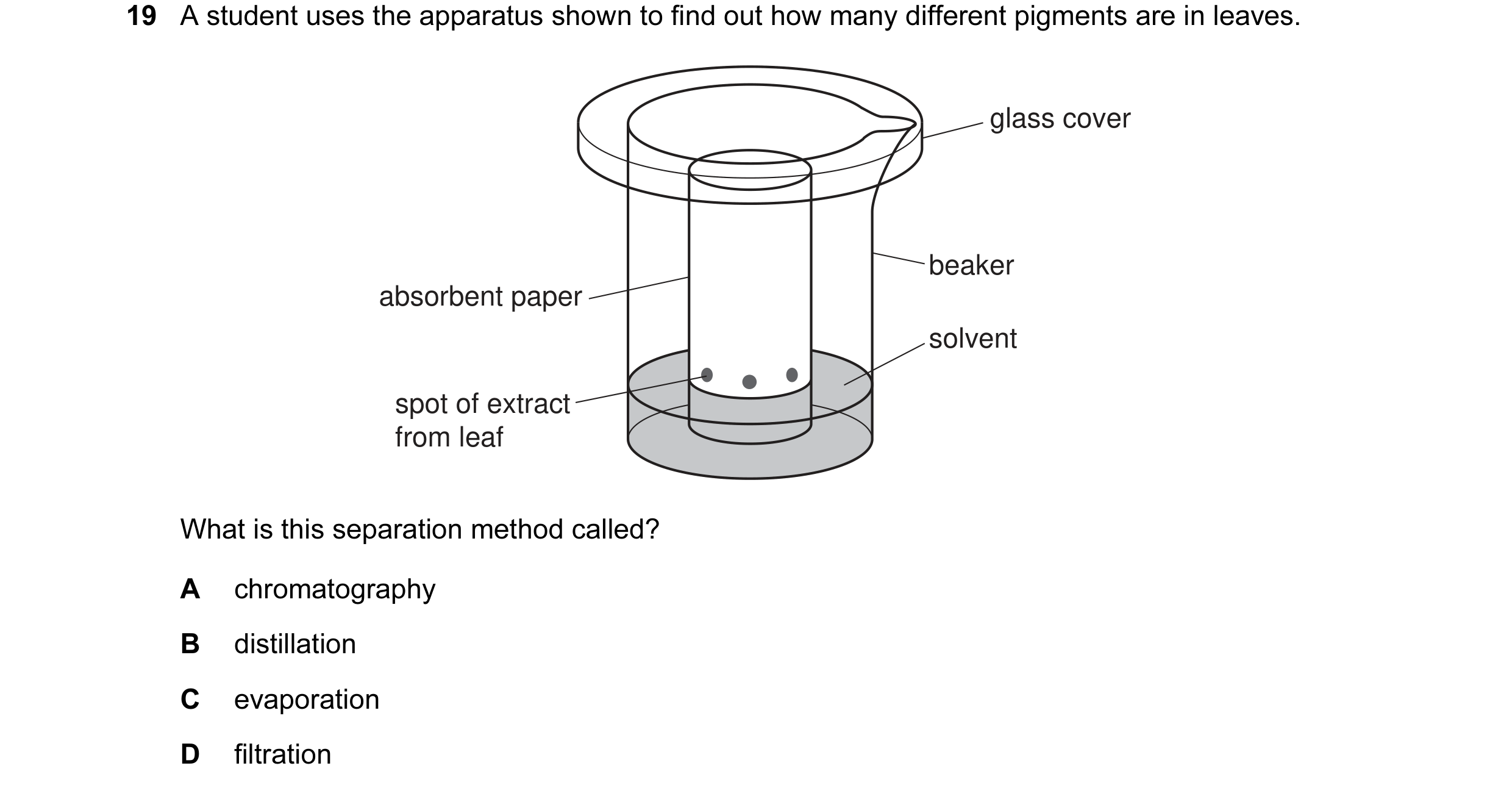
19 A student uses the apparatus shown to find out how many different pigments are in leaves. glass cover beaker absorbent paper solvent spot of extract from leaf What is this separation method called? A chromatography B distillation C evaporation D filtration
1 marks
Answer: A
This question in 0654/13 Oct/Nov 2010
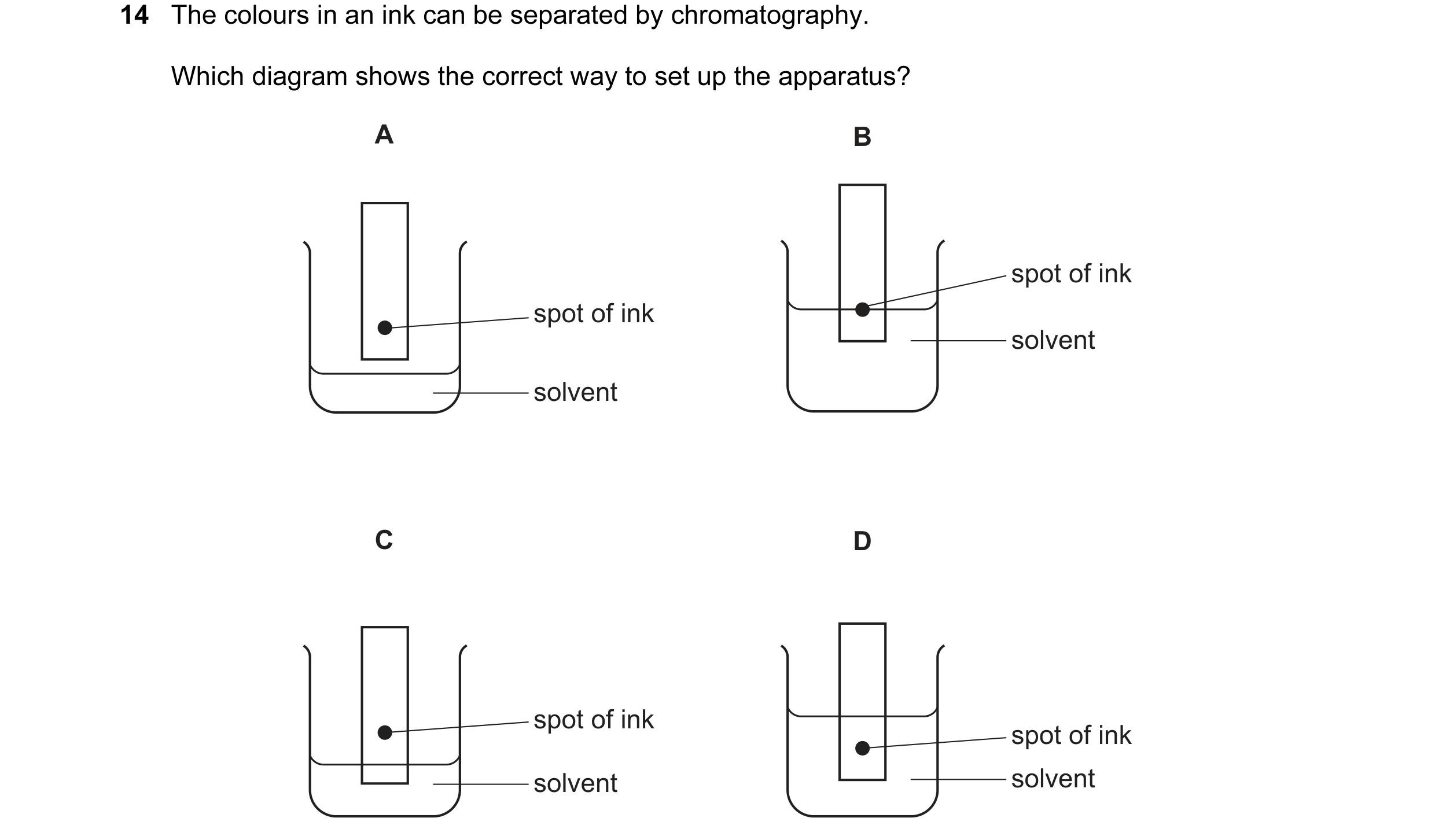
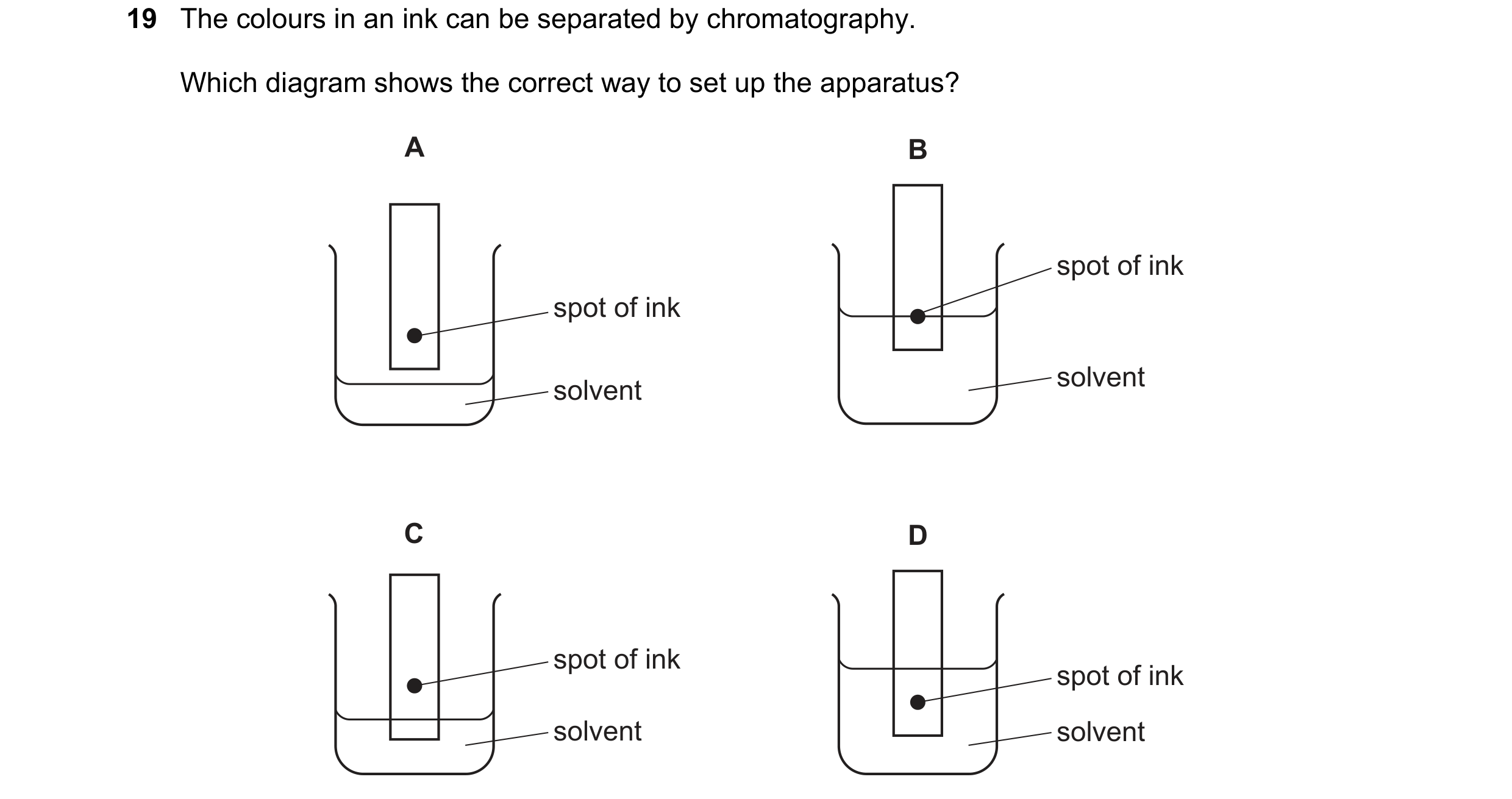
Q9 · The colours in an ink can be separated by chromatography 0654/11 May/June 2012
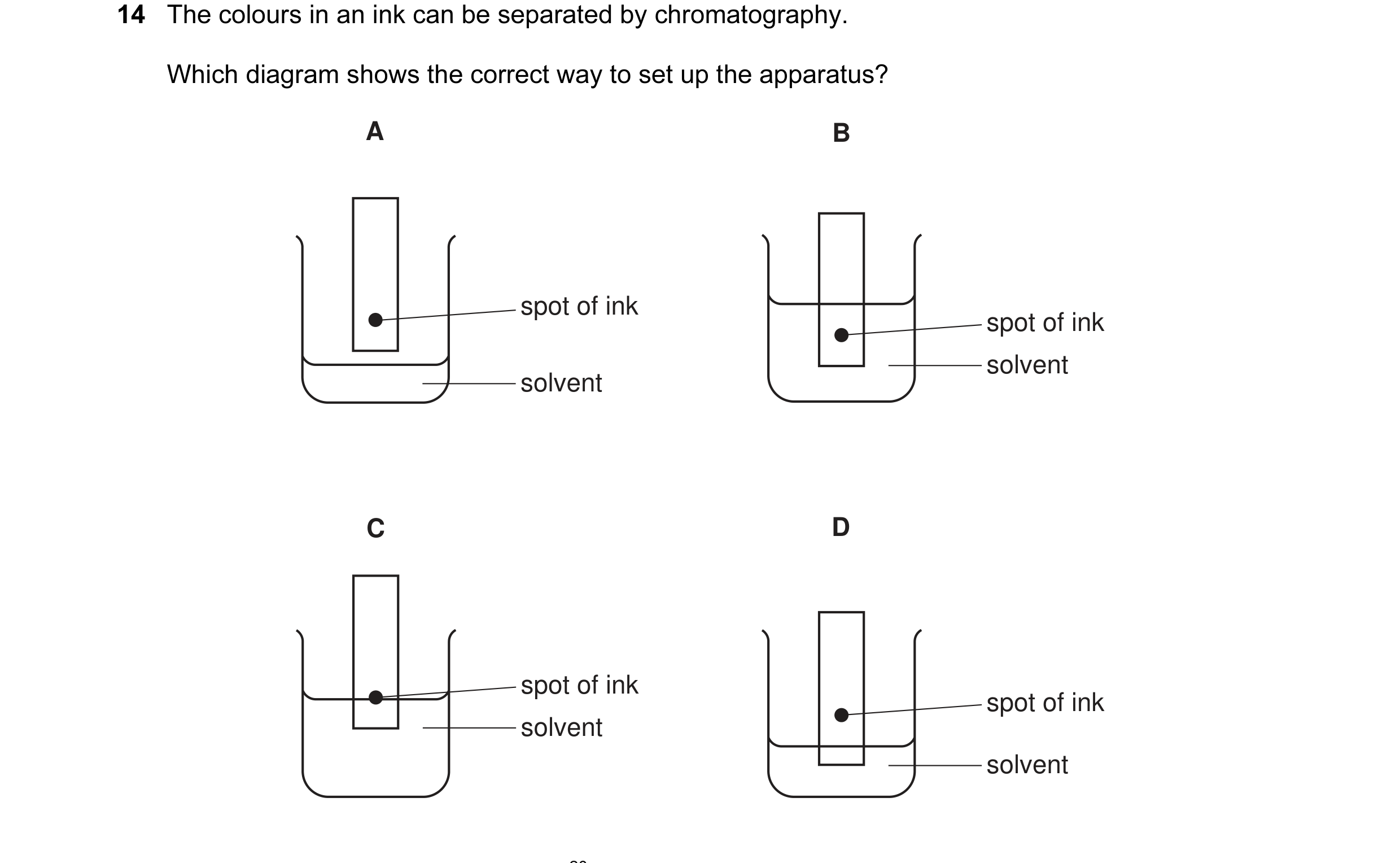
14 The colours in an ink can be separated by chromatography. Which diagram shows the correct way to set up the apparatus? A B spot of ink spot of ink solvent solvent C D spot of ink spot of ink solvent solvent
1 marks
Answer: D
This question in 0654/11 May/June 2012
Q10 · The colours in an ink can be separated by chromatography 0654/12 May/June 2012
14 The colours in an ink can be separated by chromatography. Which diagram shows the correct way to set up the apparatus? A B spot of ink spot of ink solvent solvent C D spot of ink spot of ink solvent solvent
1 marks
Answer: D
This question in 0654/12 May/June 2012
Q11 · The colours in an ink can be separated by chromatography 0654/13 May/June 2012
14 The colours in an ink can be separated by chromatography. Which diagram shows the correct way to set up the apparatus? A B spot of ink spot of ink solvent solvent C D spot of ink spot of ink solvent solvent
1 marks
Answer: D
This question in 0654/13 May/June 2012
Q12 · Henna is a dye extracted from a plant 0654/11 May/June 2013
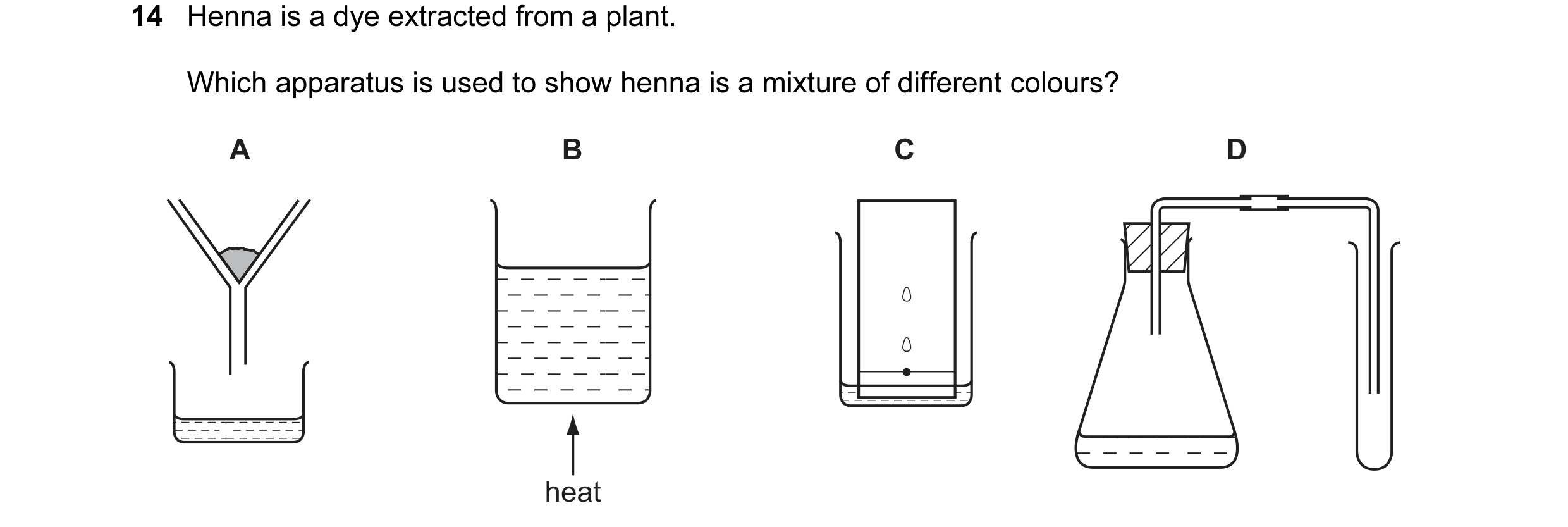
14 Henna is a dye extracted from a plant. Which apparatus is used to show henna is a mixture of different colours? A B C D heat
1 marks
Answer: C
This question in 0654/11 May/June 2013
Q13 · Henna is a dye extracted from a plant 0654/13 May/June 2013
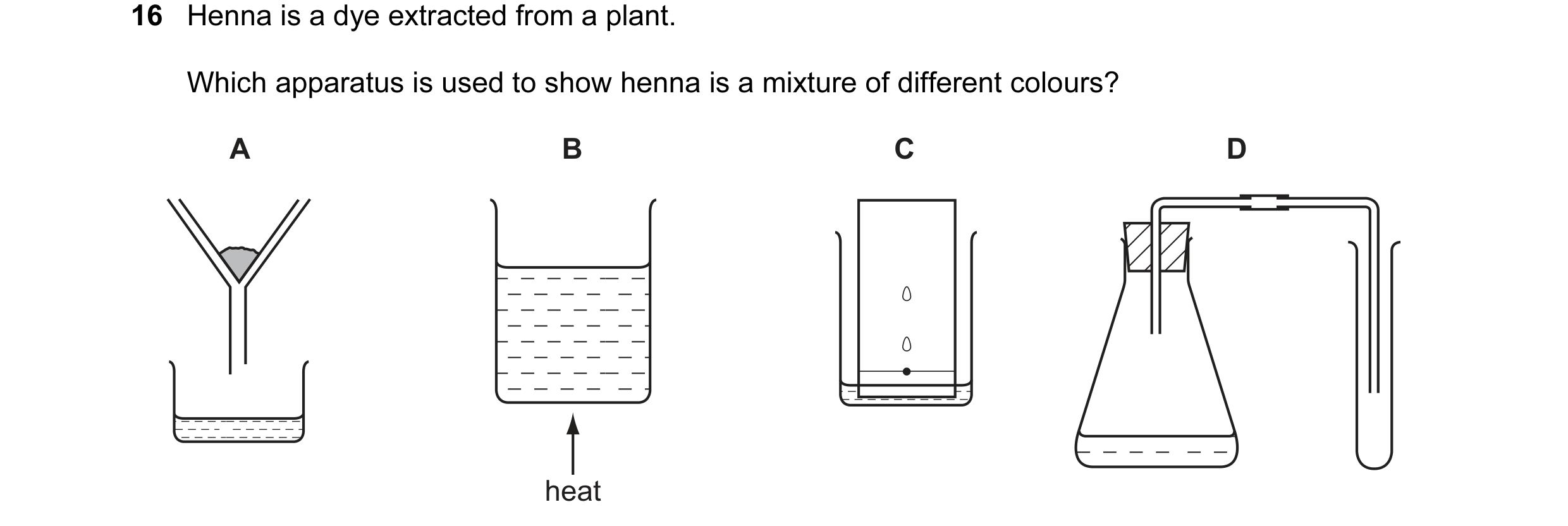
16 Henna is a dye extracted from a plant. Which apparatus is used to show henna is a mixture of different colours? A B C D heat
1 marks
Answer: C
This question in 0654/13 May/June 2013
Q14 · Which process is used to separate the coloured compounds in chlorophyll? 0654/11 May/June 2014
14 Which process is used to separate the coloured compounds in chlorophyll? A chromatography B distillation C evaporation D filtration
1 marks
Answer: A
This question in 0654/11 May/June 2014
Q15 · Which process is used to separate the coloured compounds in chlorophyll? 0654/12 May/June 2014
14 Which process is used to separate the coloured compounds in chlorophyll? A chromatography B distillation C evaporation D filtration
1 marks
Answer: A
This question in 0654/12 May/June 2014
Q16 · Which process is used to separate the coloured compounds in chlorophyll? 0654/13 May/June 2014
14 Which process is used to separate the coloured compounds in chlorophyll? A chromatography B distillation C evaporation D filtration
1 marks
Answer: A
This question in 0654/13 May/June 2014
Q17 · Dye X is a mixture of different coloured substances 0654/11 Oct/Nov 2014
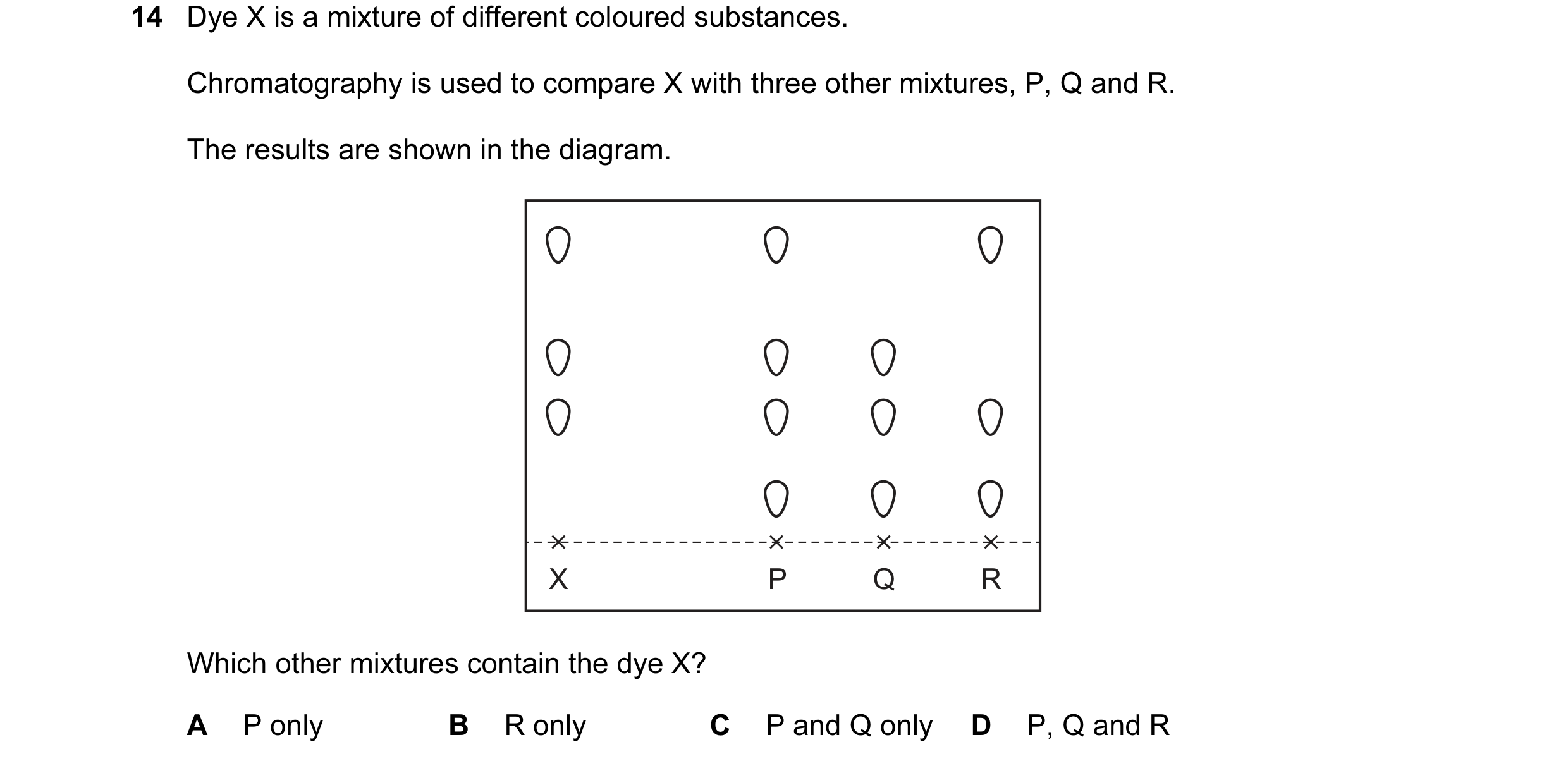
14 Dye X is a mixture of different coloured substances. Chromatography is used to compare X with three other mixtures, P, Q and R. The results are shown in the diagram. X P Q R Which other mixtures contain the dye X? A P only B R only C P and Q only D P, Q and R
1 marks
Answer: A
This question in 0654/11 Oct/Nov 2014
Q18 · Dye X is a mixture of different coloured substances 0654/12 Oct/Nov 2014
16 Dye X is a mixture of different coloured substances. Chromatography is used to compare X with three other mixtures, P, Q and R. The results are shown in the diagram. X P Q R Which other mixtures contain the dye X? A P only B R only C P and Q only D P, Q and R
1 marks
Answer: A
This question in 0654/12 Oct/Nov 2014
Q19 · Dye X is a mixture of different coloured substances 0654/13 Oct/Nov 2014
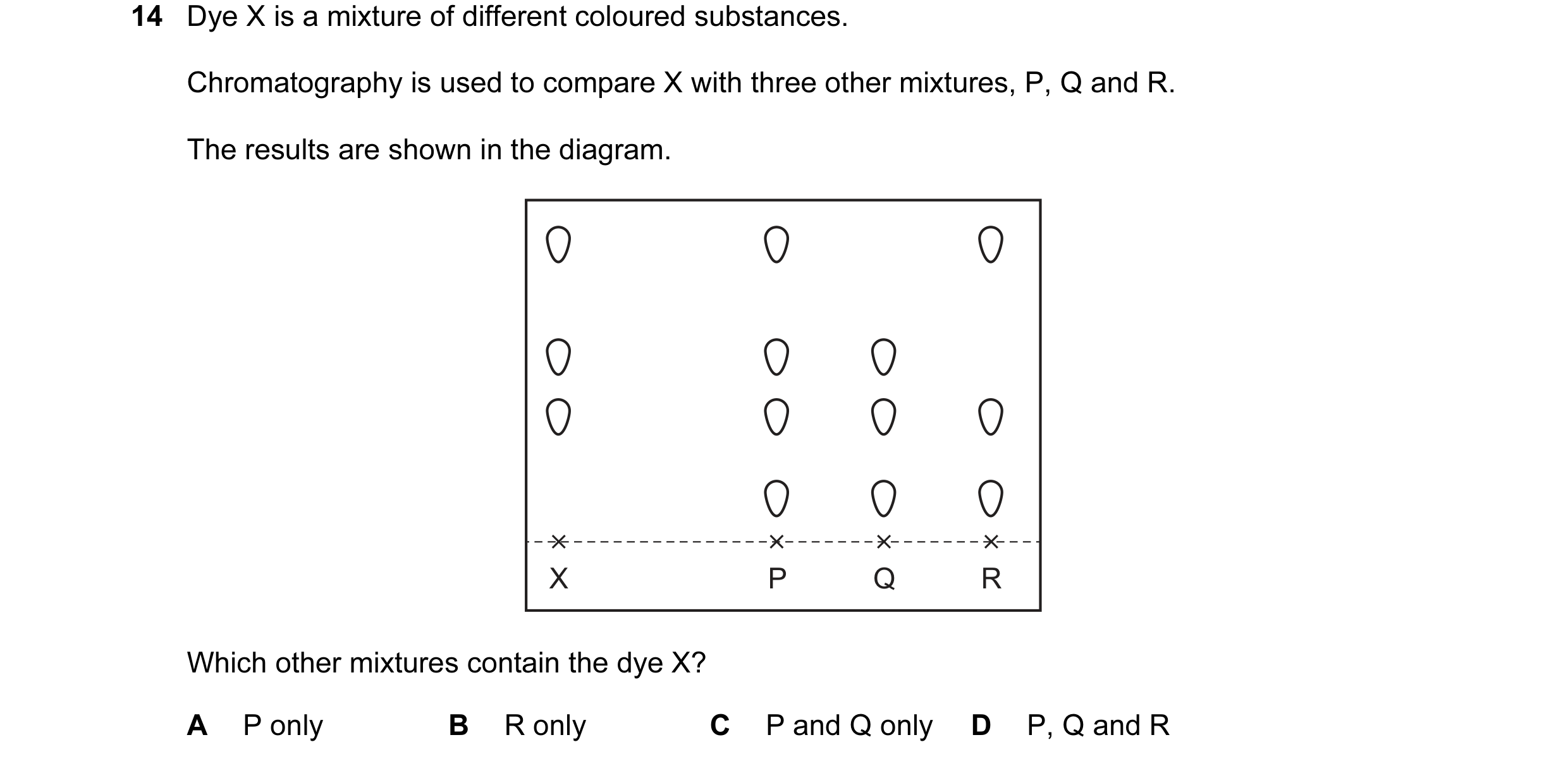
14 Dye X is a mixture of different coloured substances. Chromatography is used to compare X with three other mixtures, P, Q and R. The results are shown in the diagram. X P Q R Which other mixtures contain the dye X? A P only B R only C P and Q only D P, Q and R
1 marks
Answer: A
This question in 0654/13 Oct/Nov 2014
Q20 · The colours in an ink can be separated by chromatography 0654/11 May/June 2015
14 The colours in an ink can be separated by chromatography. Which diagram shows the correct way to set up the apparatus? A B spot of ink spot of ink solvent solvent C D spot of ink spot of ink solvent solvent
1 marks
Answer: C
This question in 0654/11 May/June 2015
Q21 · The colours in an ink can be separated by chromatography 0654/12 May/June 2015
14 The colours in an ink can be separated by chromatography. Which diagram shows the correct way to set up the apparatus? A B spot of ink spot of ink solvent solvent C D spot of ink spot of ink solvent solvent
1 marks
Answer: C
This question in 0654/12 May/June 2015
Q22 · The colours in an ink can be separated by chromatography 0654/13 May/June 2015
14 The colours in an ink can be separated by chromatography. Which diagram shows the correct way to set up the apparatus? A B spot of ink spot of ink solvent solvent C D spot of ink spot of ink solvent solvent
1 marks
Answer: C
This question in 0654/13 May/June 2015
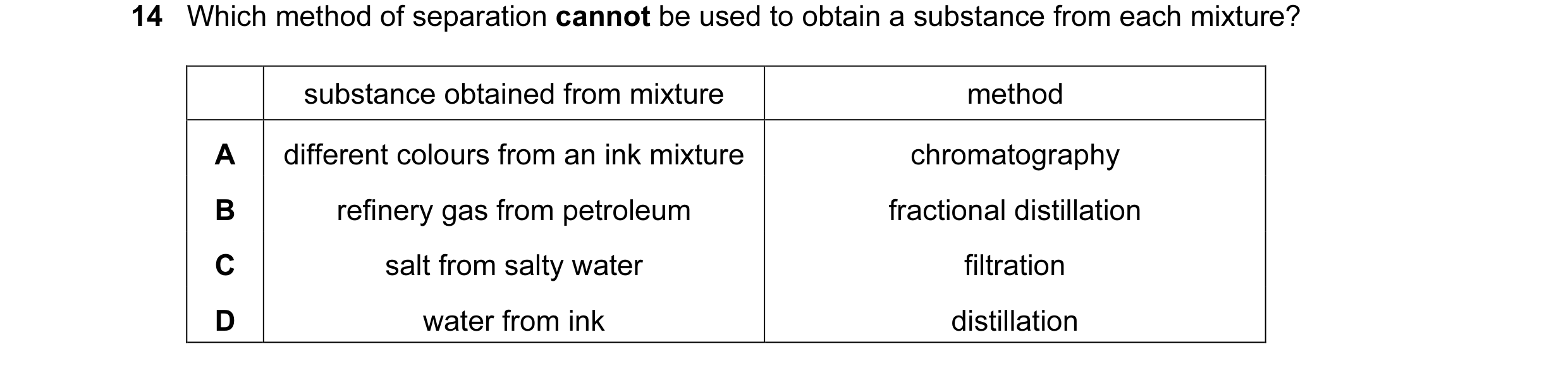
Q23 · Which method of separation cannot be used to obtain a substance from each mixture? 0654/12 May/June 2016
14 Which method of separation cannot be used to obtain a substance from each mixture? substance obtained from mixture method A different colours from an ink mixture chromatography B refinery gas from petroleum fractional distillation C salt from salty water filtration D water from ink distillation
1 marks
Answer: C
This question in 0654/12 May/June 2016
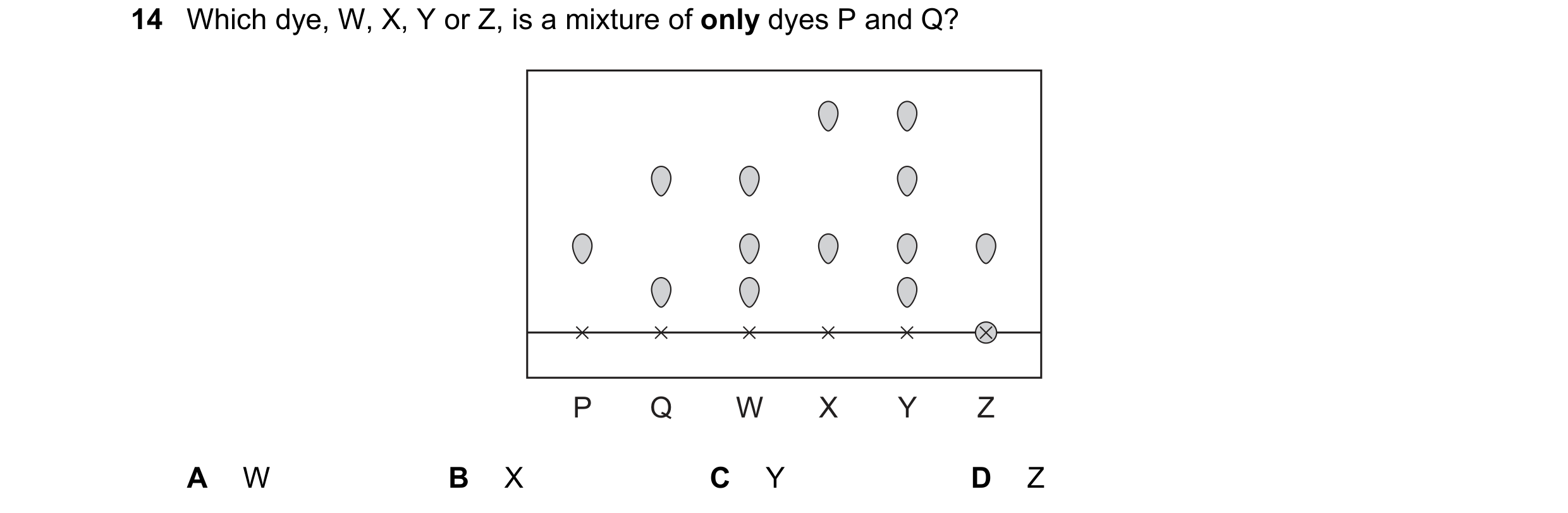
Q24 · Which dye, W, X, Y or Z, is a mixture of only dyes P and Q? 0654/12 Oct/Nov 2016
14 Which dye, W, X, Y or Z, is a mixture of only dyes P and Q? P Q W X Y Z A W B X C Y D Z
1 marks
Answer: A
This question in 0654/12 Oct/Nov 2016
Q25 · The diagram shows the chromatogram obtained from four different substances 0654/13 Oct/Nov 2016
14 The diagram shows the chromatogram obtained from four different substances. Which substance is pure? A B C D
1 marks
Answer: C
This question in 0654/13 Oct/Nov 2016
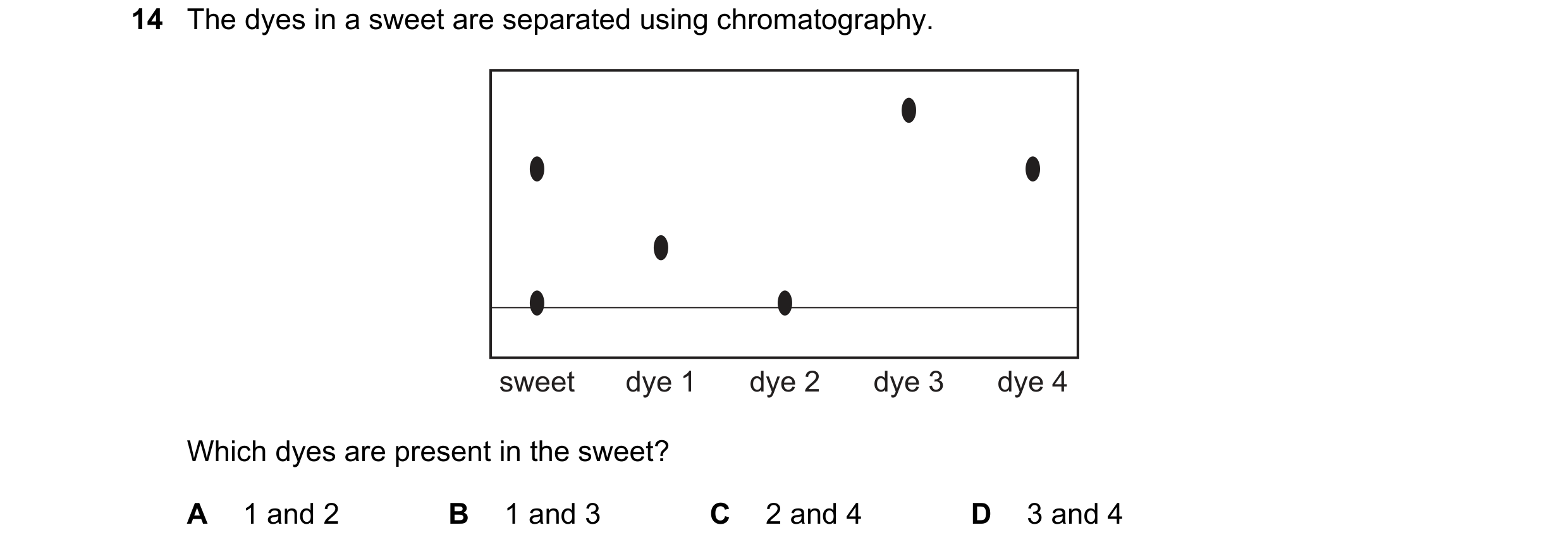
Q26 · The dyes in a sweet are separated using chromatography 0654/12 May/June 2017
14 The dyes in a sweet are separated using chromatography. sweet dye 1 dye 2 dye 3 dye 4 Which dyes are present in the sweet? A 1 and 2 B 1 and 3 C 2 and 4 D 3 and 4
1 marks
Answer: C
This question in 0654/12 May/June 2017
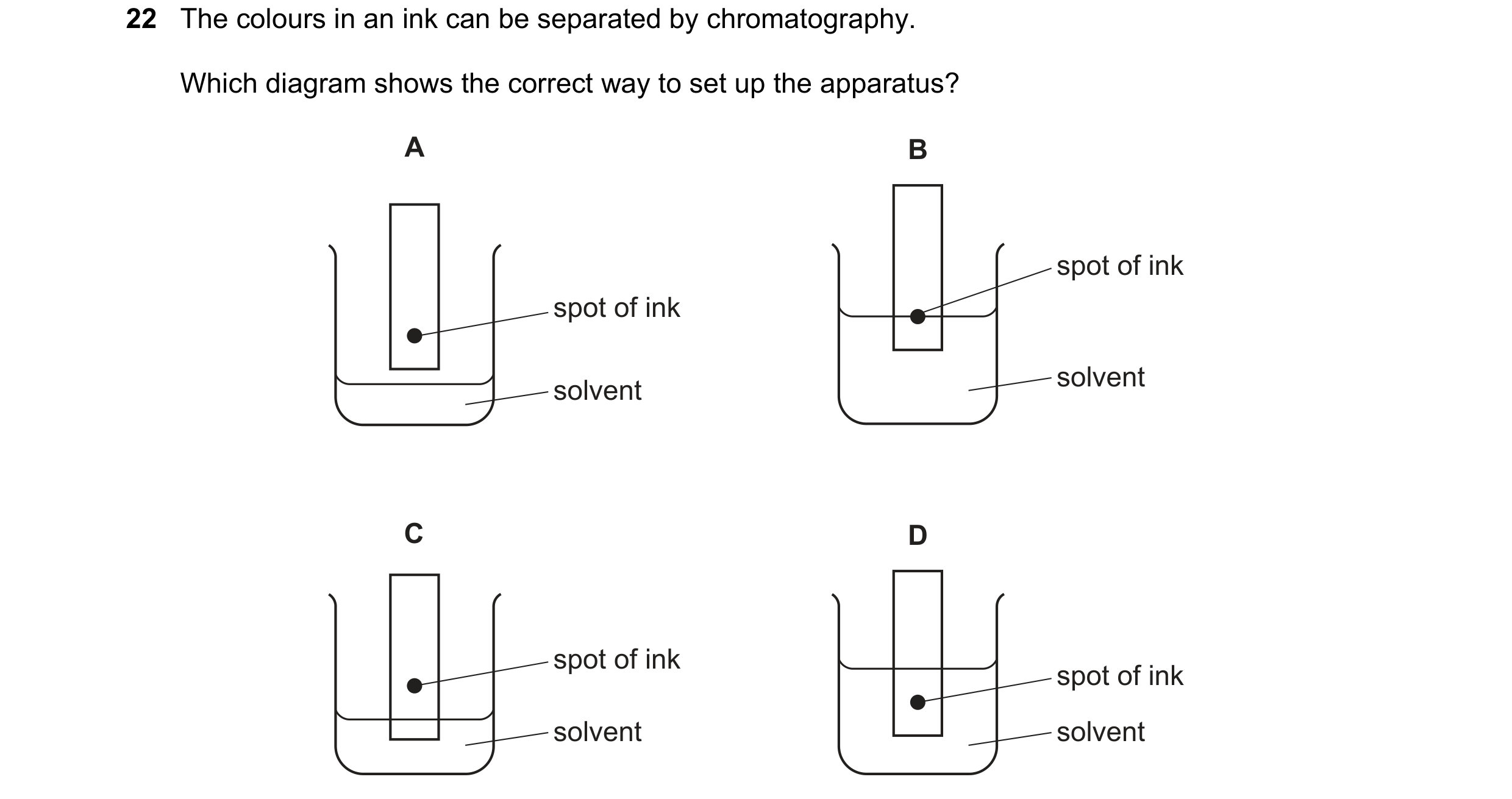
Q27 · The colours in an ink can be separated by chromatography 0654/11 Oct/Nov 2019
22 The colours in an ink can be separated by chromatography. Which diagram shows the correct way to set up the apparatus? A B spot of ink spot of ink solvent solvent C D spot of ink spot of ink solvent solvent
1 marks
Answer: C
This question in 0654/11 Oct/Nov 2019
Q28 · The colours in an ink can be separated by chromatography 0654/12 Oct/Nov 2019
21 The colours in an ink can be separated by chromatography. Which diagram shows the correct way to set up the apparatus? A B spot of ink spot of ink solvent solvent C D spot of ink spot of ink solvent solvent
1 marks
Answer: C
This question in 0654/12 Oct/Nov 2019
Q29 · The colours in an ink can be separated by chromatography 0654/13 Oct/Nov 2019
19 The colours in an ink can be separated by chromatography. Which diagram shows the correct way to set up the apparatus? A B spot of ink spot of ink solvent solvent C D spot of ink spot of ink solvent solvent
1 marks
Answer: C
This question in 0654/13 Oct/Nov 2019
Q30 · Which process is used to separate a mixture of coloured compounds? 0654/12 Feb/March 2021
14 Which process is used to separate a mixture of coloured compounds? A chromatography B distillation C evaporation D filtration
1 marks
Answer: A
This question in 0654/12 Feb/March 2021
Q31 · Dye X is a mixture of different coloured substances 0654/11 Oct/Nov 2023
14 Dye X is a mixture of different coloured substances. Chromatography is used to compare X with three other mixtures, P, Q and R. The results are shown. X P Q R Which mixtures contain dye X? A P, Q and R B P and Q only C P only D R only
1 marks
Answer: C
This question in 0654/11 Oct/Nov 2023
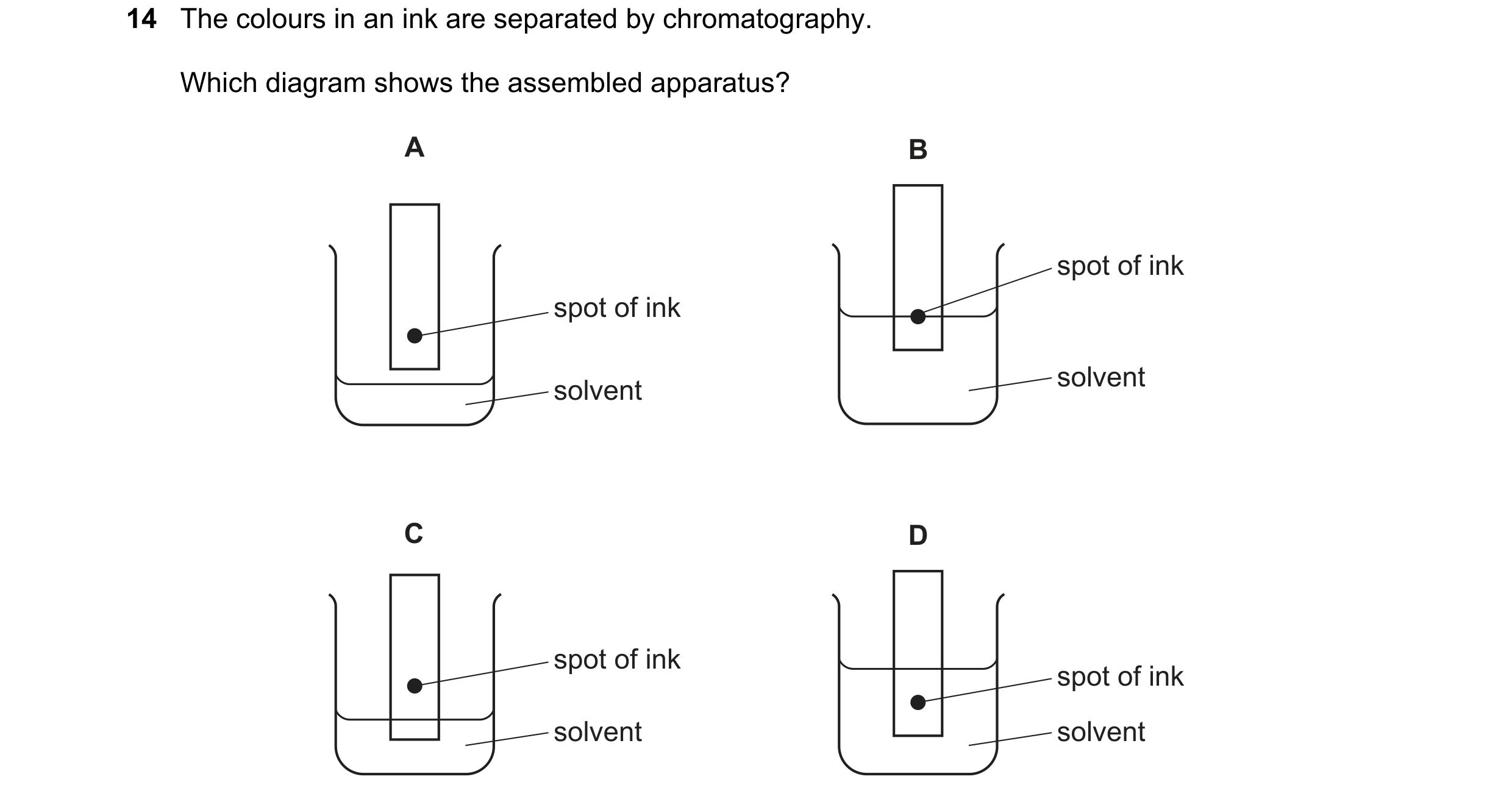
Q32 · The colours in an ink are separated by chromatography 0654/13 Oct/Nov 2023
14 The colours in an ink are separated by chromatography. Which diagram shows the assembled apparatus? A B spot of ink spot of ink solvent solvent C D spot of ink spot of ink solvent solvent
1 marks
Answer: C
This question in 0654/13 Oct/Nov 2023

 1 / 12
 2 / 12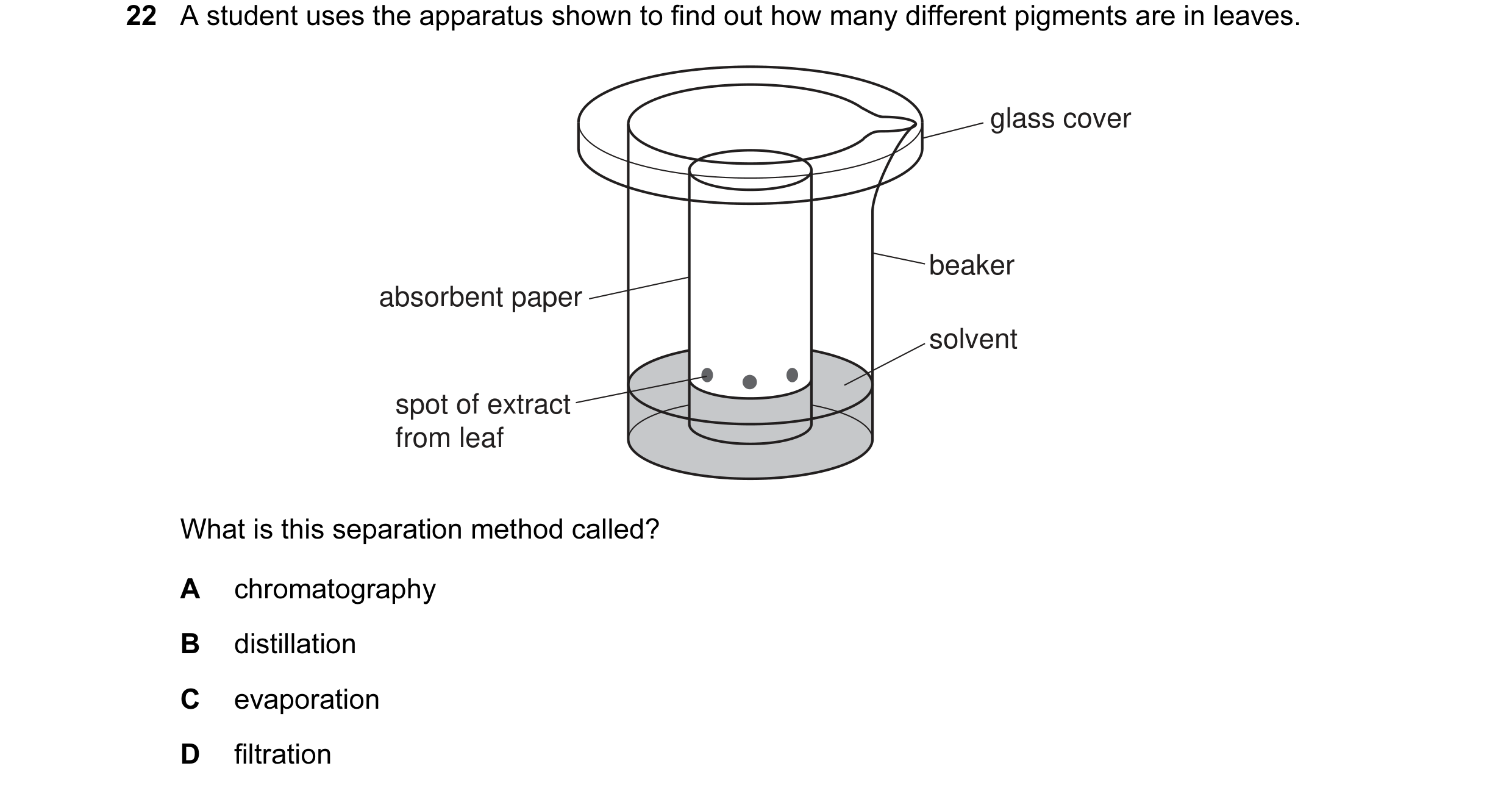
 3 / 12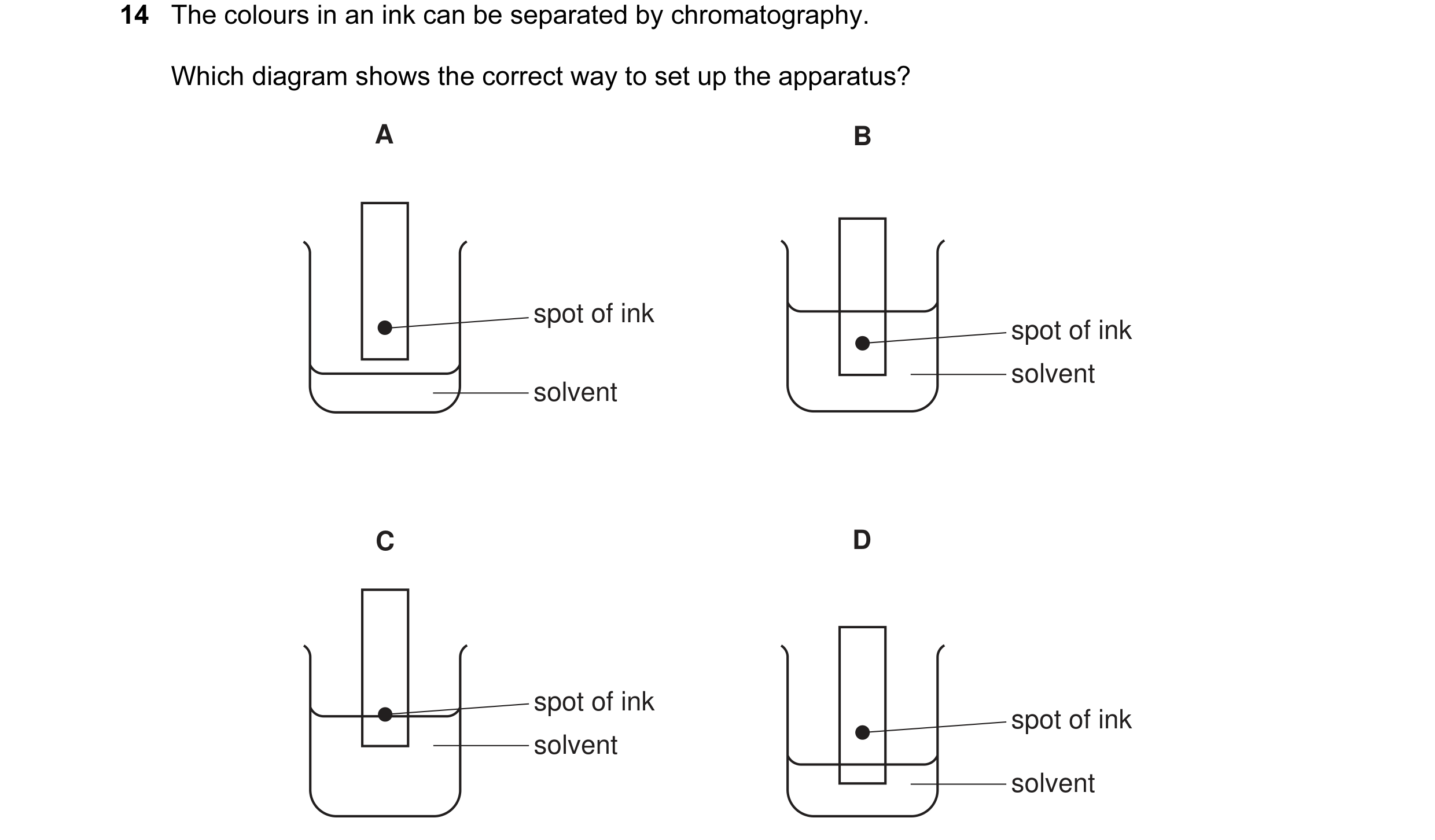
 4 / 12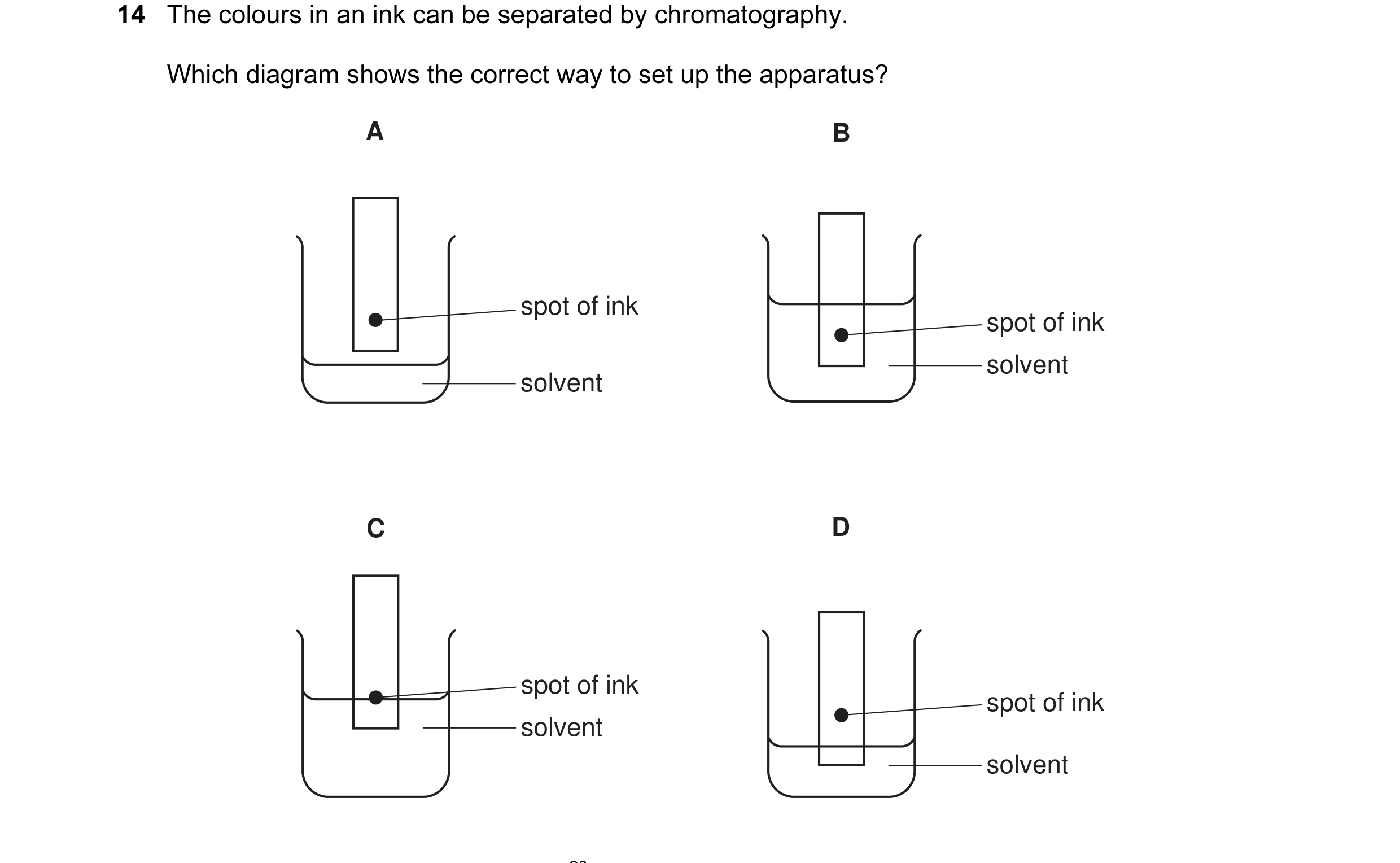
 5 / 12


 6 / 12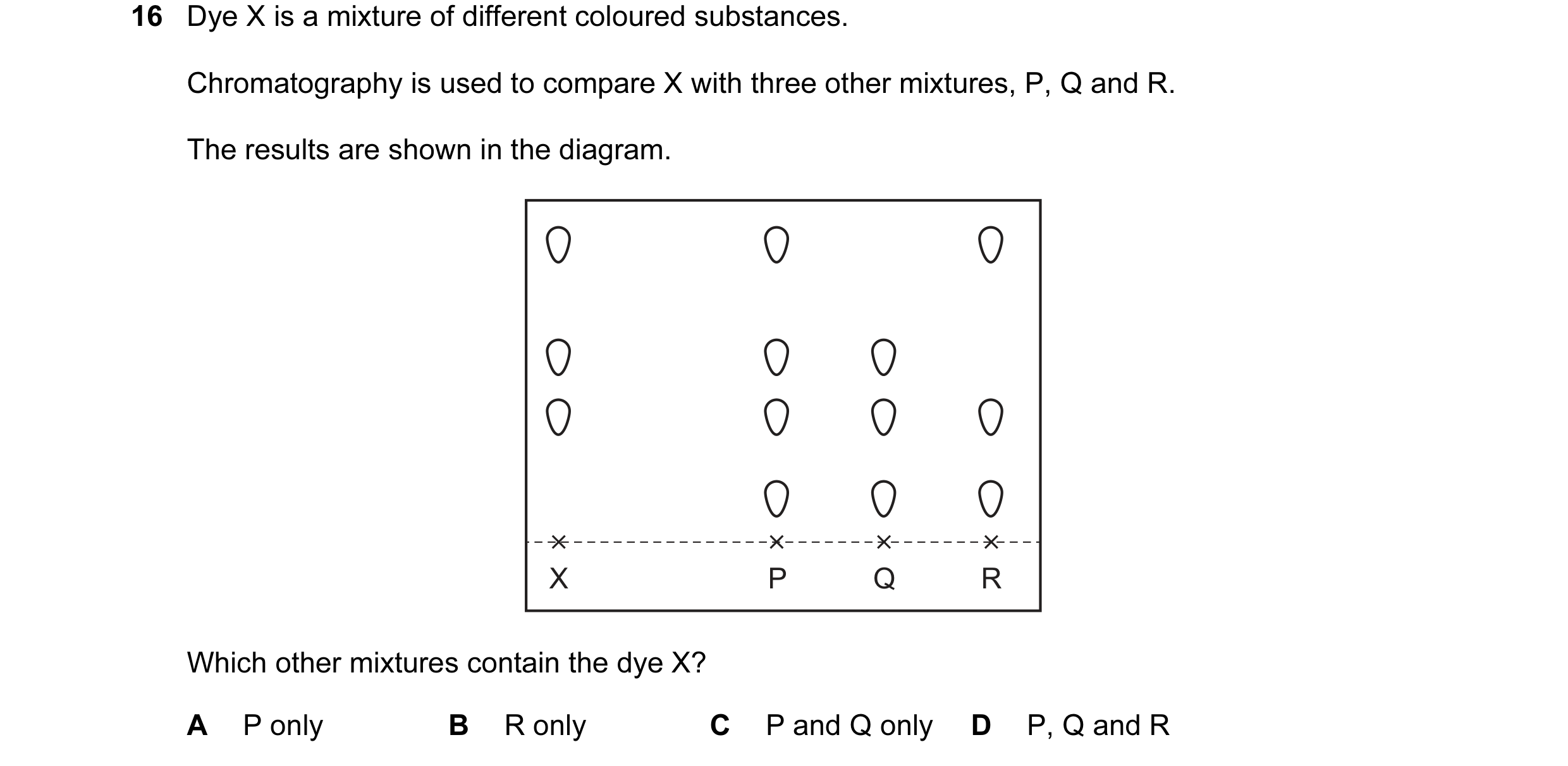
 7 / 12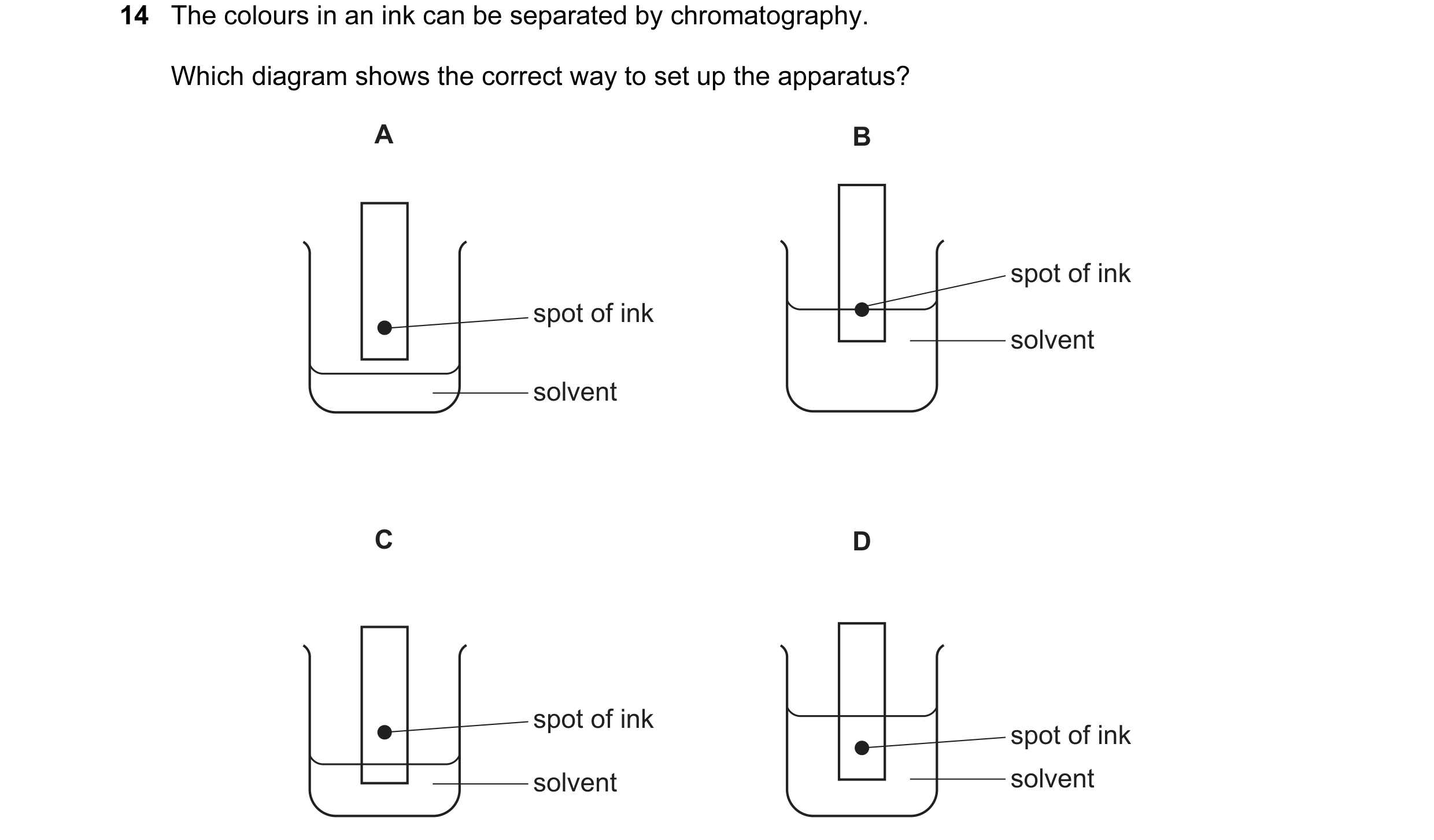
 8 / 12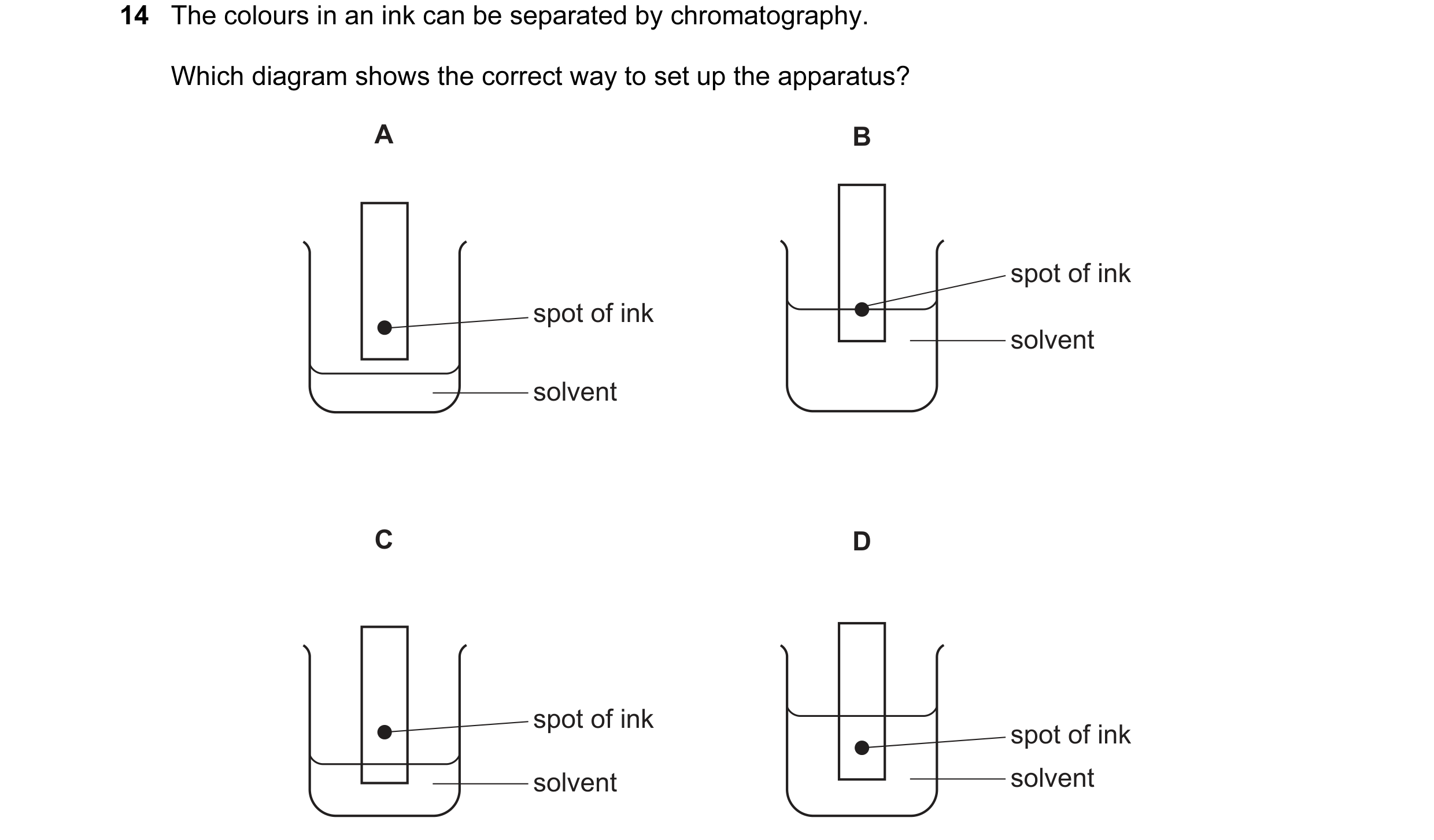
 9 / 12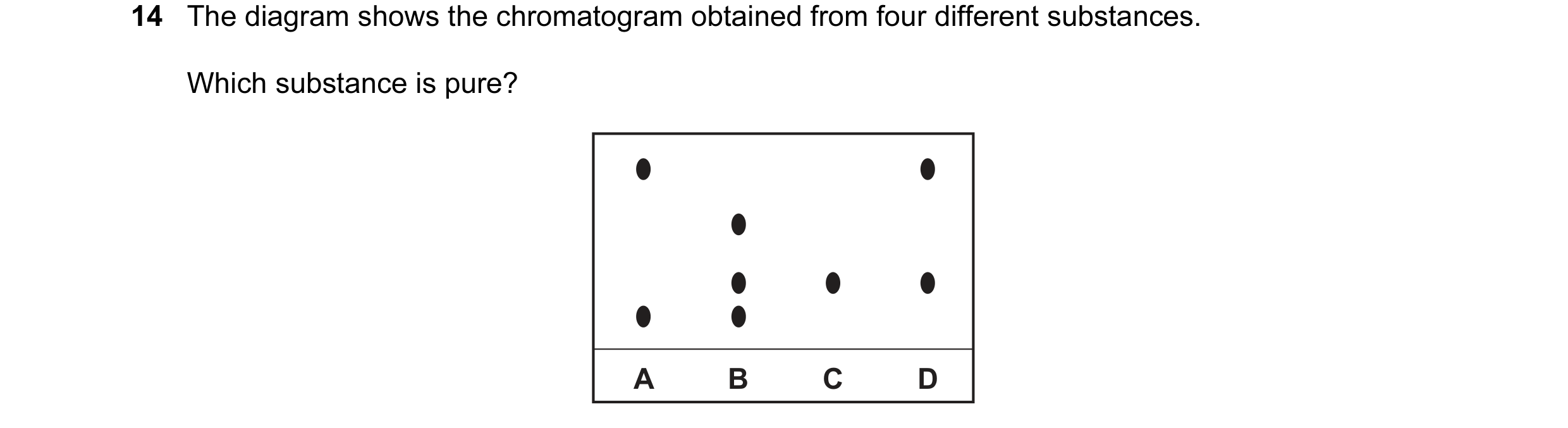
 10 / 12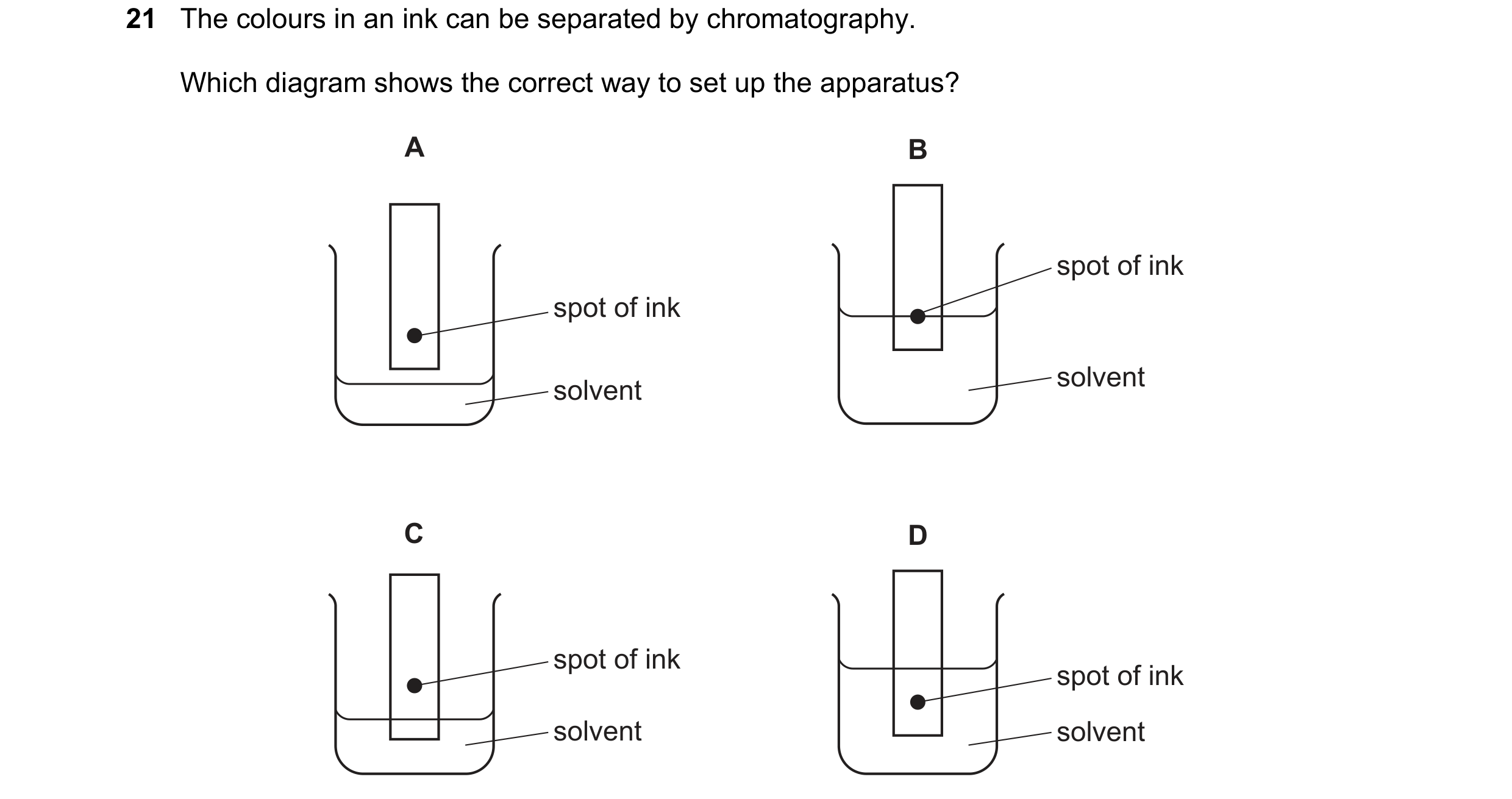
 11 / 12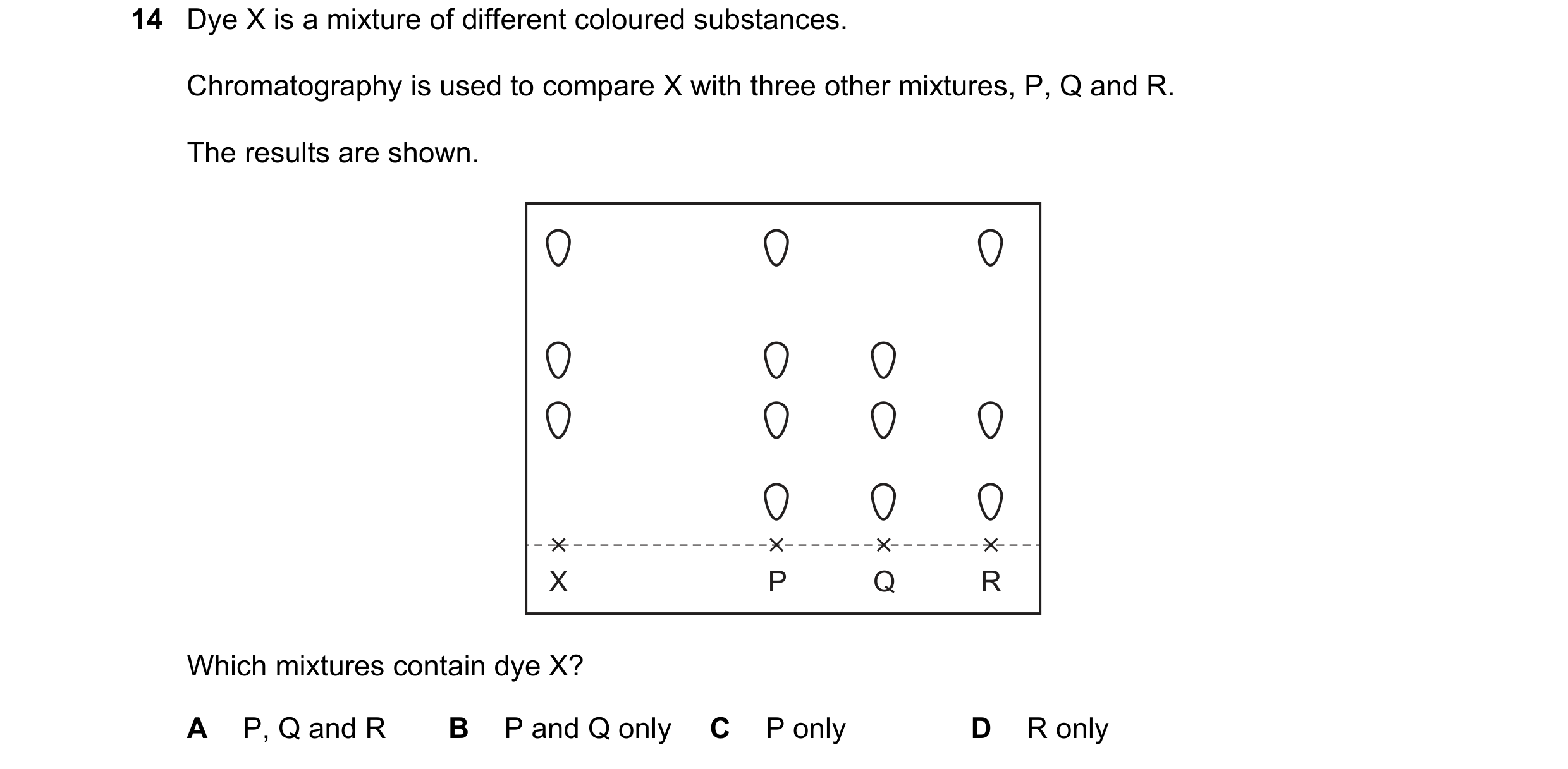
 12 / 12