Questions as text
Q1 · What is meant by osmosis? 0654/21 May/June 2017
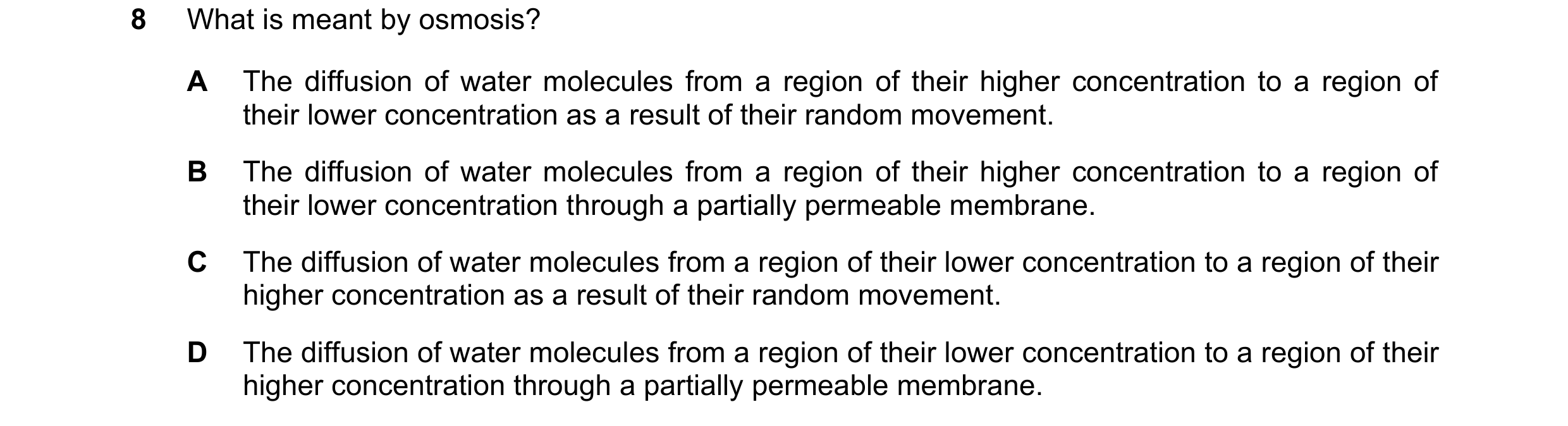
8 What is meant by osmosis? A The diffusion of water molecules from a region of their higher concentration to a region of their lower concentration as a result of their random movement. B The diffusion of water molecules from a region of their higher concentration to a region of their lower concentration through a partially permeable membrane. C The diffusion of water molecules from a region of their lower concentration to a region of their higher concentration as a result of their random movement. D The diffusion of water molecules from a region of their lower concentration to a region of their higher concentration through a partially permeable membrane.
1 marks
Answer: B
This question in 0654/21 May/June 2017
Q2 · In plants, water is absorbed from the soil into root hair cells 0654/22 May/June 2017
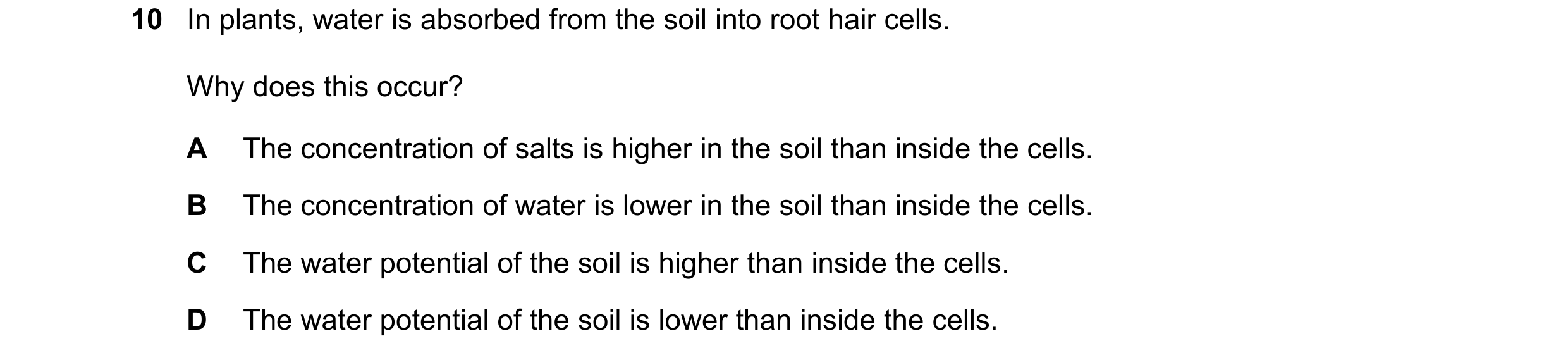
10 In plants, water is absorbed from the soil into root hair cells. Why does this occur? A The concentration of salts is higher in the soil than inside the cells. B The concentration of water is lower in the soil than inside the cells. C The water potential of the soil is higher than inside the cells. D The water potential of the soil is lower than inside the cells.
1 marks
Answer: C
This question in 0654/22 May/June 2017
Question 3 0654/21 Oct/Nov 2017
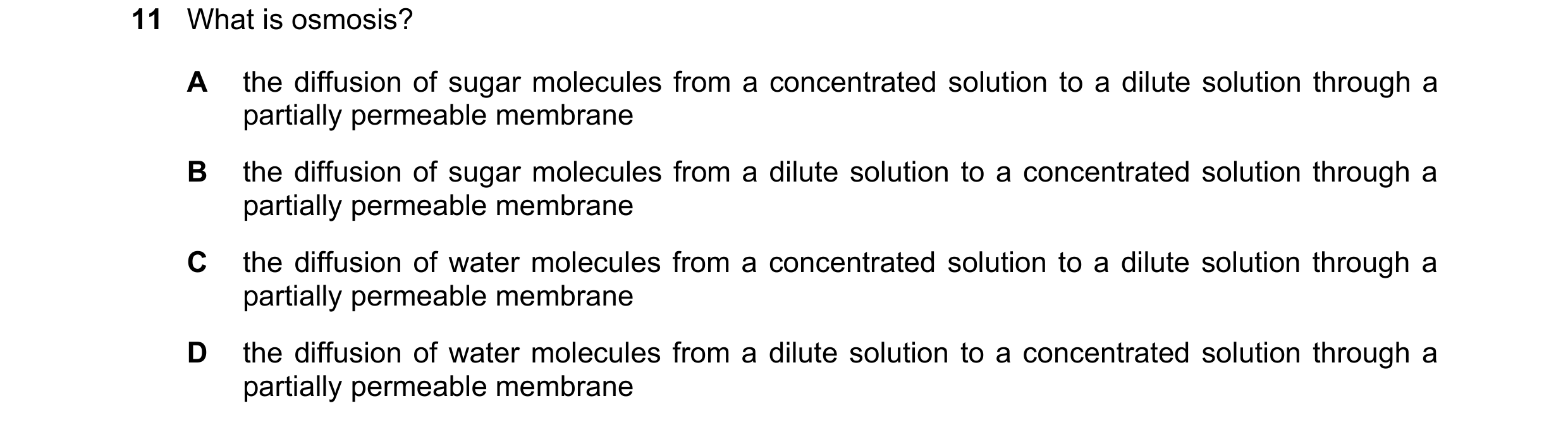
11 What is osmosis? A the diffusion of sugar molecules from a concentrated solution to a dilute solution through a partially permeable membrane B the diffusion of sugar molecules from a dilute solution to a concentrated solution through a partially permeable membrane C the diffusion of water molecules from a concentrated solution to a dilute solution through a partially permeable membrane D the diffusion of water molecules from a dilute solution to a concentrated solution through a partially permeable membrane
1 marks
Answer: D
This question in 0654/21 Oct/Nov 2017
Q4 · Plant cells are placed in a solution with a water potential higher than the cells 0654/22 Oct/Nov 2018
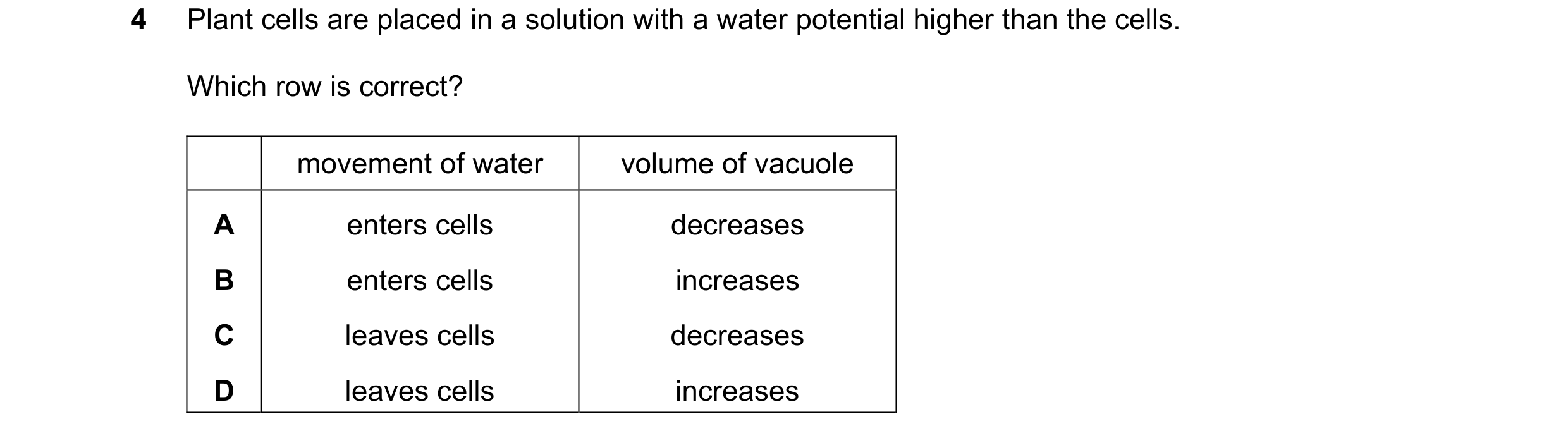
4 Plant cells are placed in a solution with a water potential higher than the cells. Which row is correct? movement of water volume of vacuole A enters cells decreases B enters cells increases C leaves cells decreases D leaves cells increases
1 marks
Answer: B
This question in 0654/22 Oct/Nov 2018
Q5 · The diagram shows a red blood cell 0654/23 Oct/Nov 2018
2 The diagram shows a red blood cell. If it is placed in water, it will burst. If a plant cell is placed in water, it will not burst. What prevents a plant cell from bursting? A cell wall B nucleus C regular shape D vacuole
1 marks
Answer: A
This question in 0654/23 Oct/Nov 2018
Q6 · When a plant cell is put into a solution which has a lower water potential than the cell… 0654/22 May/June 2019
2 When a plant cell is put into a solution which has a lower water potential than the cell, the cytoplasm can pull away from the cell wall. What is the term for this? A flaccid B plasmolysis C turgid D turgor pressure
1 marks
Answer: B
This question in 0654/22 May/June 2019
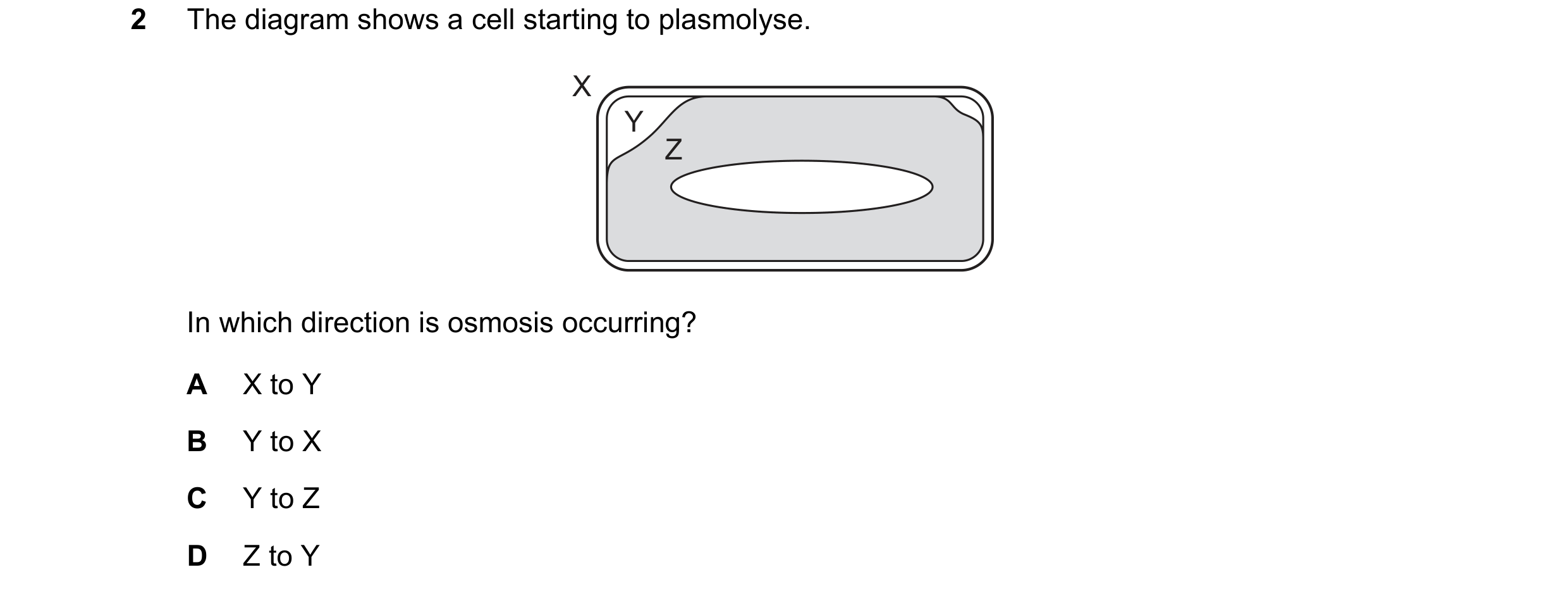
Q7 · The diagram shows a cell starting to plasmolyse 0654/23 May/June 2019
2 The diagram shows a cell starting to plasmolyse. X Y Z In which direction is osmosis occurring? A X to Y B Y to X C Y to Z D Z to Y
1 marks
Answer: D
This question in 0654/23 May/June 2019
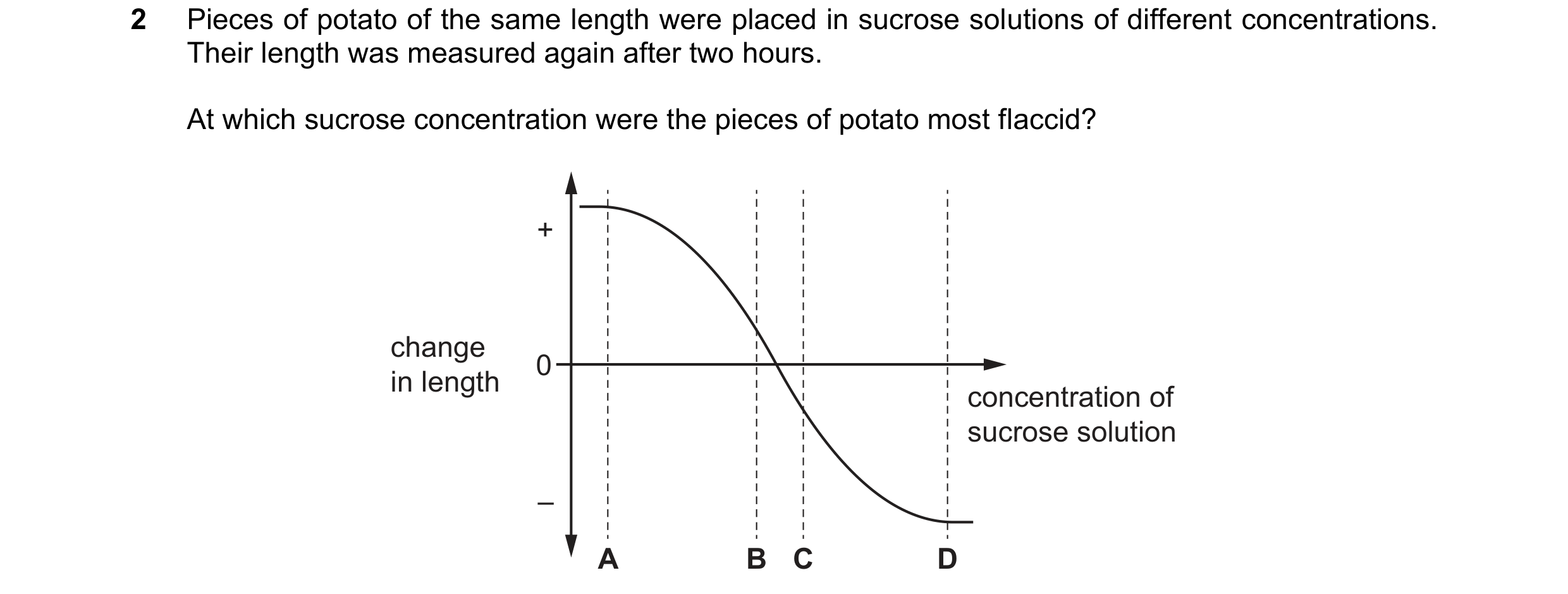
Q8 · Pieces of potato (a plant) of the same size were placed in sucrose solutions of different… 0654/23 May/June 2020
2 Pieces of potato (a plant) of the same size were placed in sucrose solutions of different concentrations. Their length was measured after two hours. At which sucrose concentration were the pieces most flaccid? + change 0 in length concentration of sucrose solution – A B C D
1 marks
Answer: D
This question in 0654/23 May/June 2020
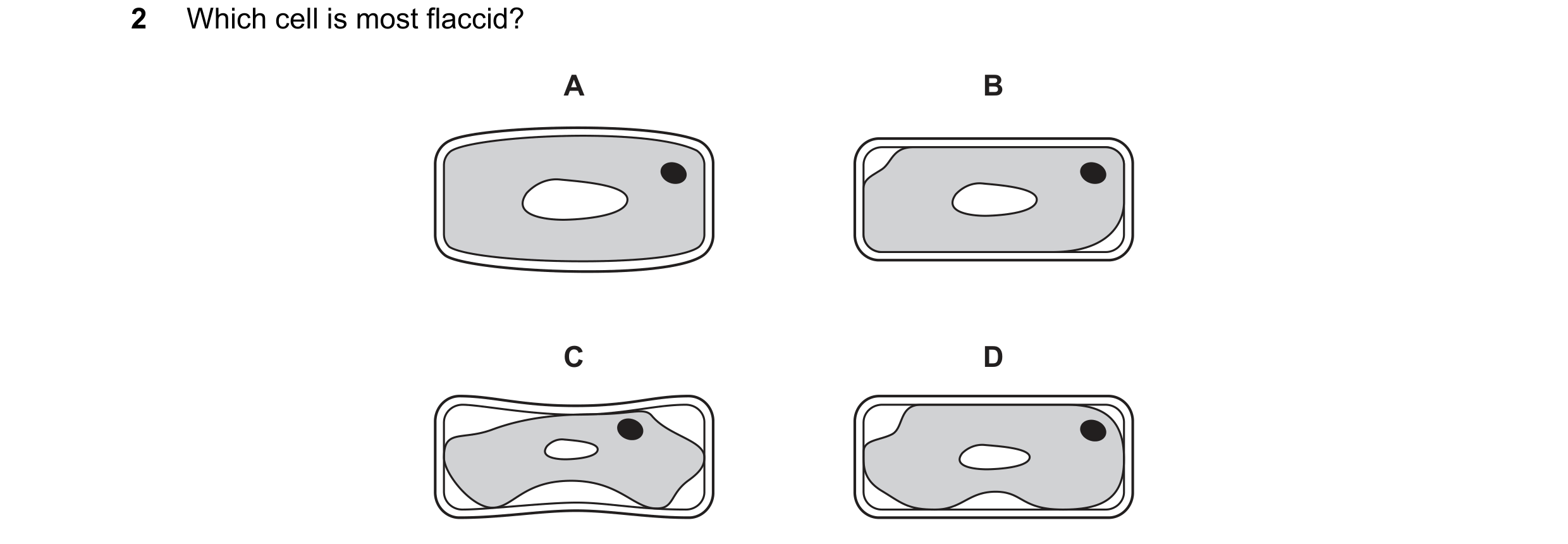
Q9 · Which cell is most flaccid? 0654/22 May/June 2021
2 Which cell is most flaccid? A B C D
1 marks
Answer: C
This question in 0654/22 May/June 2021
Q10 · What is an example of osmosis? 0654/23 Oct/Nov 2021
2 What is an example of osmosis? A a dried out piece of leaf stalk swelling up when placed in a bowl of water B carbon dioxide entering a leaf when it is photosynthesising C red blood cells travelling to the lungs to collect oxygen D the passage of digested food molecules through the wall of the small intestine
1 marks
Answer: A
This question in 0654/23 Oct/Nov 2021
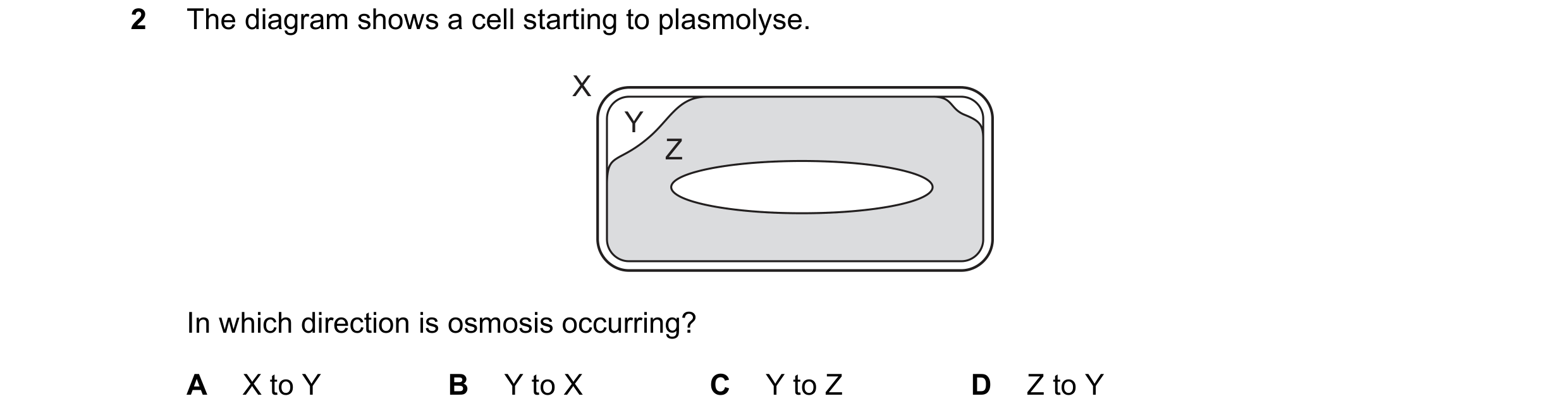
Q11 · The diagram shows a cell starting to plasmolyse 0654/22 Feb/March 2022
2 The diagram shows a cell starting to plasmolyse. X Y Z In which direction is osmosis occurring? A X to Y B Y to X C Y to Z D Z to Y
1 marks
Answer: D
This question in 0654/22 Feb/March 2022
Q12 · Red onion cells are placed in distilled water 0654/21 Oct/Nov 2022
2 Red onion cells are placed in distilled water. Which statement is correct? A The cells plasmolyse; water moves into the cells from a high to a low water potential. B The cells plasmolyse; water moves out of the cells from a low to a high water potential. C The cells become turgid; water moves into the cells from a high to a low water potential. D The cells become turgid; water moves out of the cells from a low to a high water potential.
1 marks
Answer: C
This question in 0654/21 Oct/Nov 2022
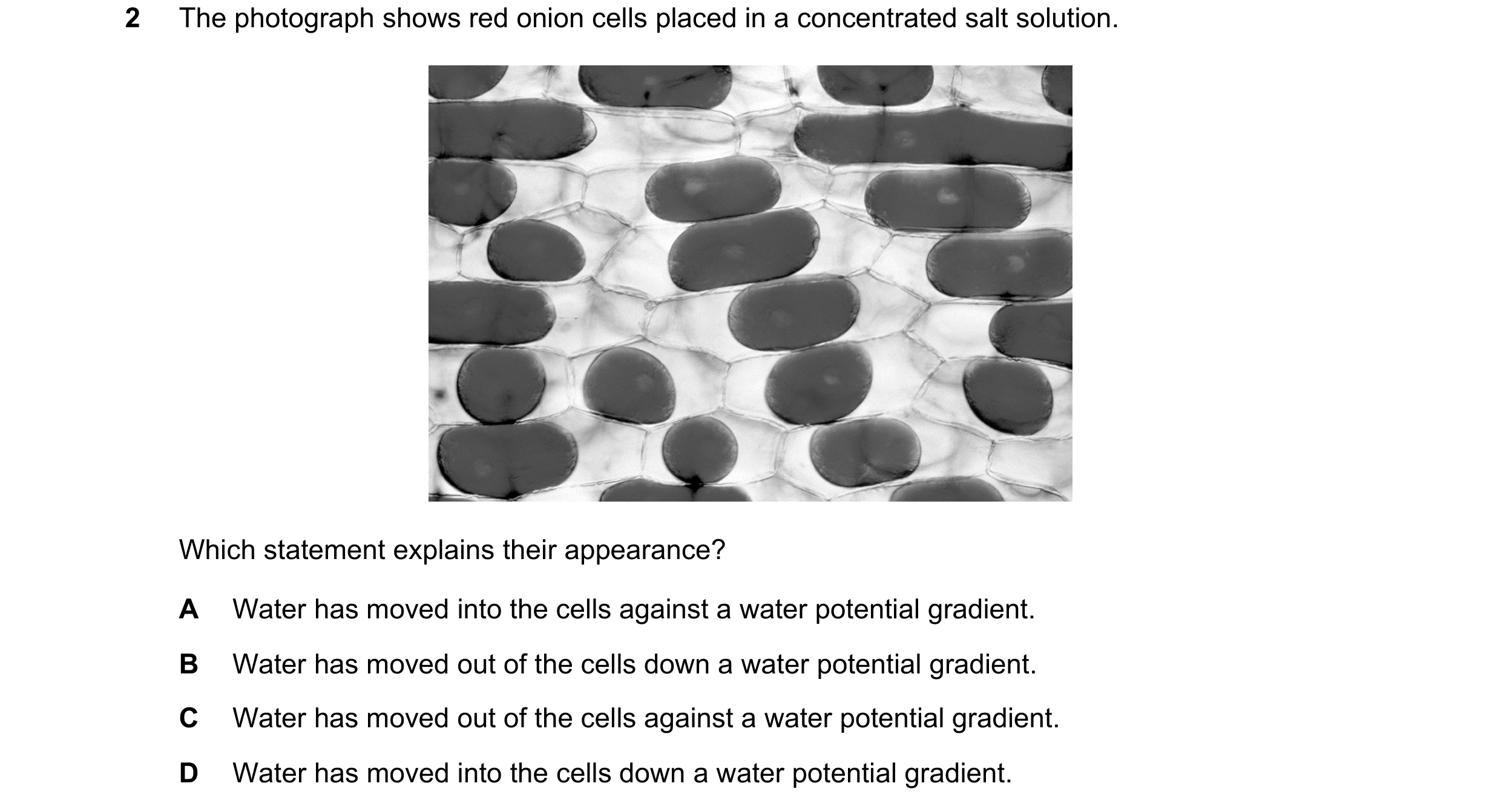
Q13 · The photograph shows red onion cells placed in a concentrated salt solution 0654/23 Oct/Nov 2022
2 The photograph shows red onion cells placed in a concentrated salt solution. Which statement explains their appearance? A Water has moved into the cells against a water potential gradient. B Water has moved out of the cells down a water potential gradient. C Water has moved out of the cells against a water potential gradient. D Water has moved into the cells down a water potential gradient.
1 marks
Answer: B
This question in 0654/23 Oct/Nov 2022
Q14 · Which description for the process of osmosis is correct? 0654/22 Feb/March 2023
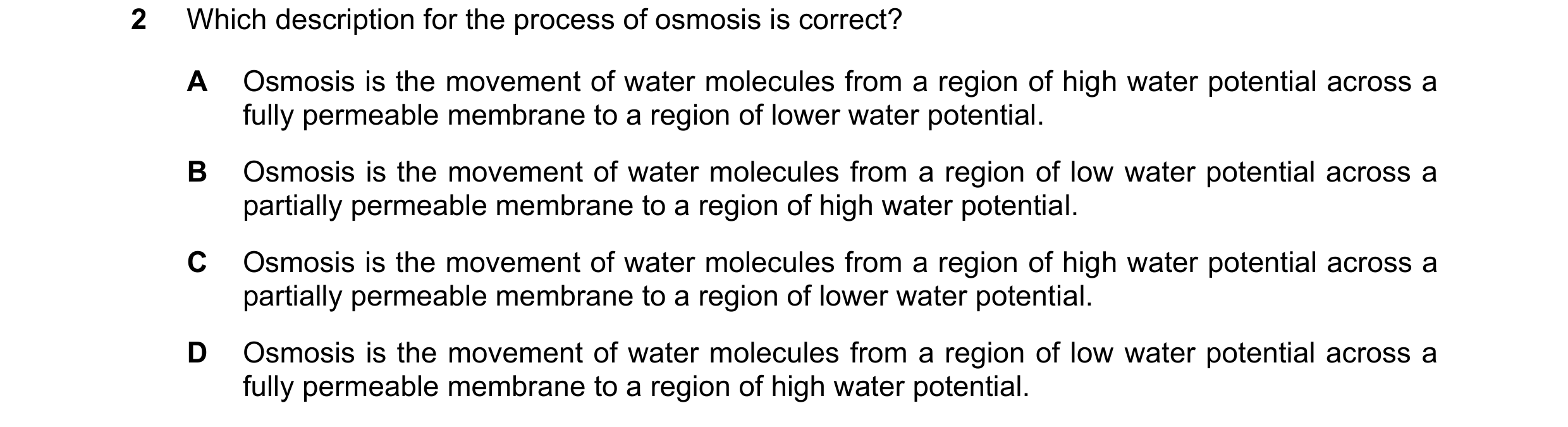
2 Which description for the process of osmosis is correct? A Osmosis is the movement of water molecules from a region of high water potential across a fully permeable membrane to a region of lower water potential. B Osmosis is the movement of water molecules from a region of low water potential across a partially permeable membrane to a region of high water potential. C Osmosis is the movement of water molecules from a region of high water potential across a partially permeable membrane to a region of lower water potential. D Osmosis is the movement of water molecules from a region of low water potential across a fully permeable membrane to a region of high water potential.
1 marks
Answer: C
This question in 0654/22 Feb/March 2023
Q15 · What is meant by osmosis? 0654/21 May/June 2023
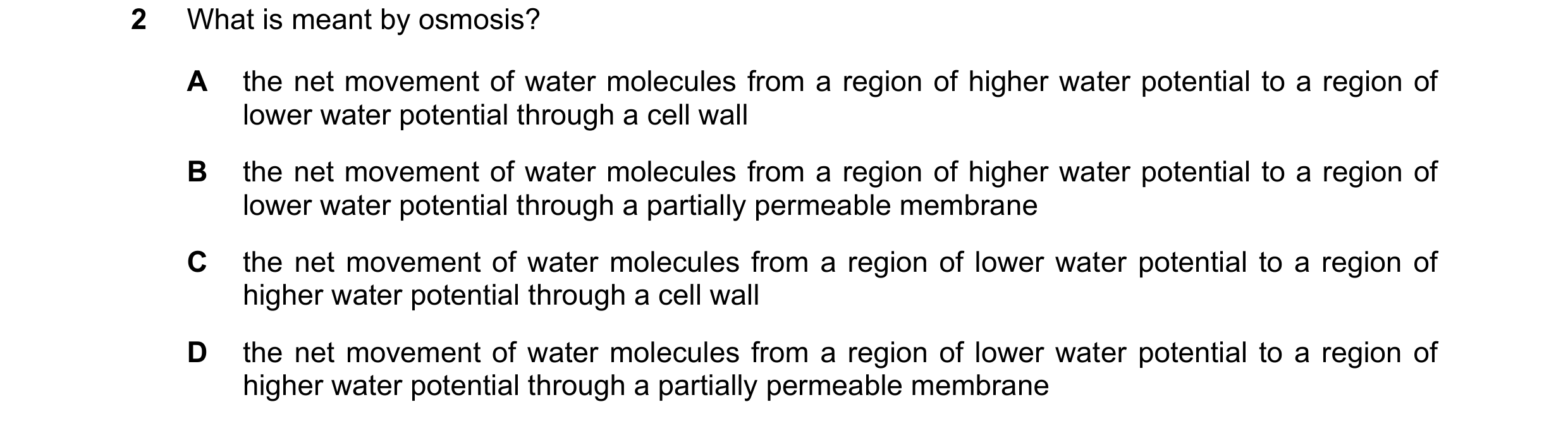
2 What is meant by osmosis? A the net movement of water molecules from a region of higher water potential to a region of lower water potential through a cell wall B the net movement of water molecules from a region of higher water potential to a region of lower water potential through a partially permeable membrane C the net movement of water molecules from a region of lower water potential to a region of higher water potential through a cell wall D the net movement of water molecules from a region of lower water potential to a region of higher water potential through a partially permeable membrane
1 marks
Answer: B
This question in 0654/21 May/June 2023
Q16 · When a plant cell is put into a solution that has a lower water potential than the cell… 0654/21 Oct/Nov 2023
2 When a plant cell is put into a solution that has a lower water potential than the cell, the cytoplasm can pull away from the cell wall. What is the term for this? A flaccid B plasmolysis C turgid D turgor pressure
1 marks
Answer: B
This question in 0654/21 Oct/Nov 2023
Question 17 0654/22 Oct/Nov 2023
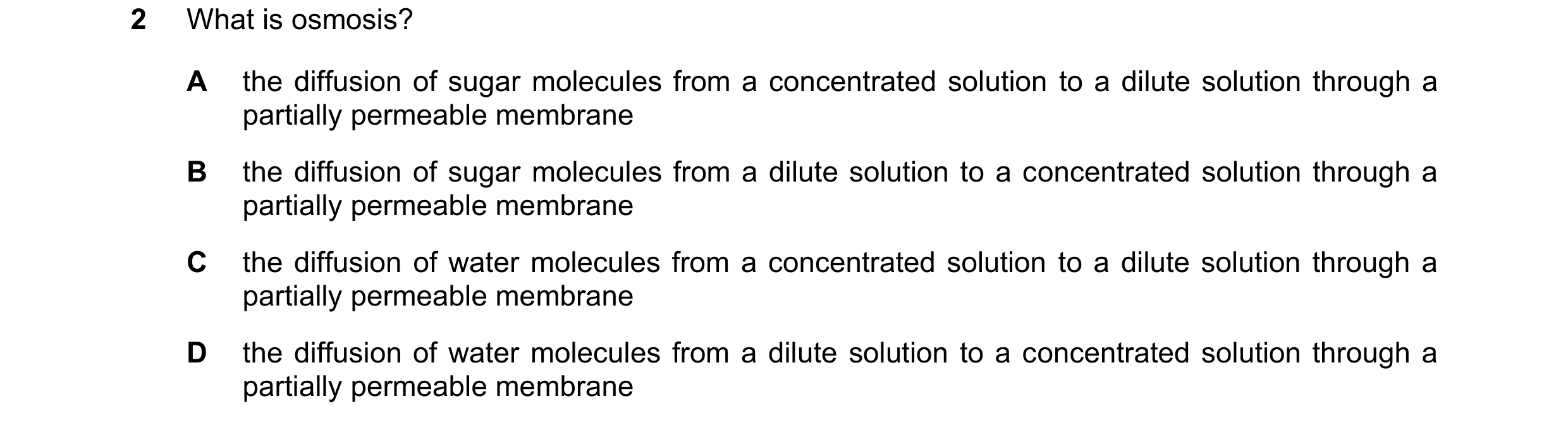
2 What is osmosis? A the diffusion of sugar molecules from a concentrated solution to a dilute solution through a partially permeable membrane B the diffusion of sugar molecules from a dilute solution to a concentrated solution through a partially permeable membrane C the diffusion of water molecules from a concentrated solution to a dilute solution through a partially permeable membrane D the diffusion of water molecules from a dilute solution to a concentrated solution through a partially permeable membrane
1 marks
Answer: D
This question in 0654/22 Oct/Nov 2023
Q18 · Pieces of potato of the same length were placed in sucrose solutions of different… 0654/23 Oct/Nov 2024
2 Pieces of potato of the same length were placed in sucrose solutions of different concentrations. Their length was measured again after two hours. At which sucrose concentration were the pieces of potato most flaccid? + change 0 in length concentration of sucrose solution – A B C D
1 marks
Answer: D
This question in 0654/23 Oct/Nov 2024
Q19 · A salmon is a fish that can live in both fresh and salt water 0654/22 Feb/March 2025
2 A salmon is a fish that can live in both fresh and salt water. Salmon are affected by water movement when the environment changes. Which diagram shows the internal and external water potential and the movement of water when a salmon is in fresh water? A B low water low water potential potential high water high water potential potential C D high water high water potential potential low water low water potential potential
1 marks
Answer: D
This question in 0654/22 Feb/March 2025
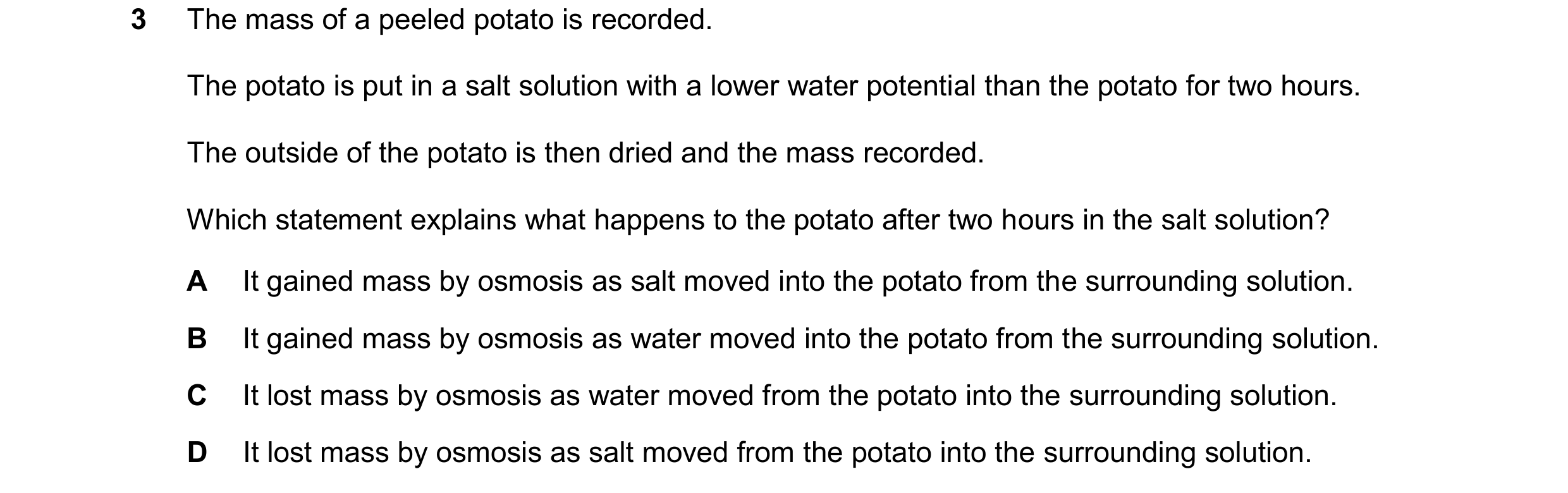
Q20 · The mass of a peeled potato is recorded 0654/22 May/June 2025
3 The mass of a peeled potato is recorded. The potato is put in a salt solution with a lower water potential than the potato for two hours. The outside of the potato is then dried and the mass recorded. Which statement explains what happens to the potato after two hours in the salt solution? A It gained mass by osmosis as salt moved into the potato from the surrounding solution. B It gained mass by osmosis as water moved into the potato from the surrounding solution. C It lost mass by osmosis as water moved from the potato into the surrounding solution. D It lost mass by osmosis as salt moved from the potato into the surrounding solution.
1 marks
Answer: C
This question in 0654/22 May/June 2025
Q21 · The mass of a potato cylinder is recorded 0654/22 Oct/Nov 2025
2 The mass of a potato cylinder is recorded. The potato cylinder is then placed into concentrated sucrose solution. After 2 hours, the potato cylinder is removed from the solution and the mass recorded. The results are shown. time / hours mass / g 0 2.50 2 1.65 Which statement explains the change in mass of the potato? A Sucrose moves out of the potato cells because the solution has a higher water potential than the cells. B Sucrose moves out of the potato cells because the solution has a lower water potential than the cells. C Water moves out of the potato cells because the solution has a higher water potential than the cells. D Water moves out of the potato cells because the solution has a lower water potential than the cells.
1 marks
Answer: D
This question in 0654/22 Oct/Nov 2025
 1 / 7
1 / 7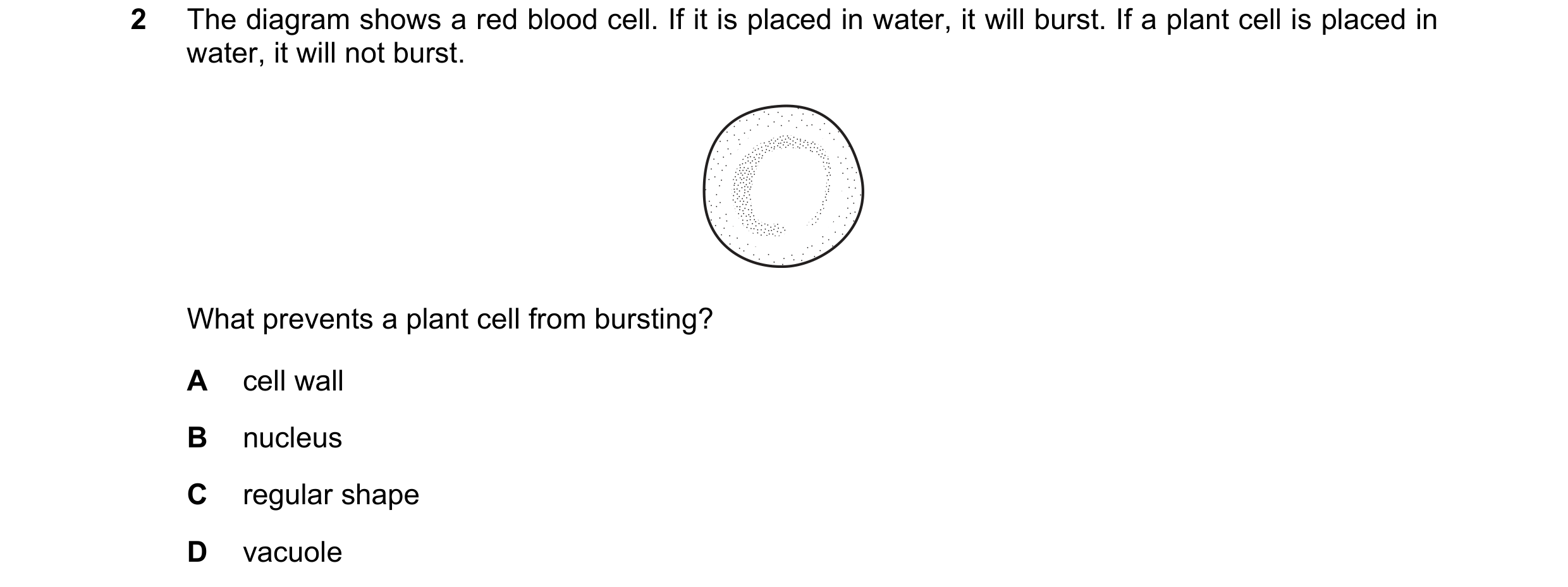
 2 / 7
2 / 7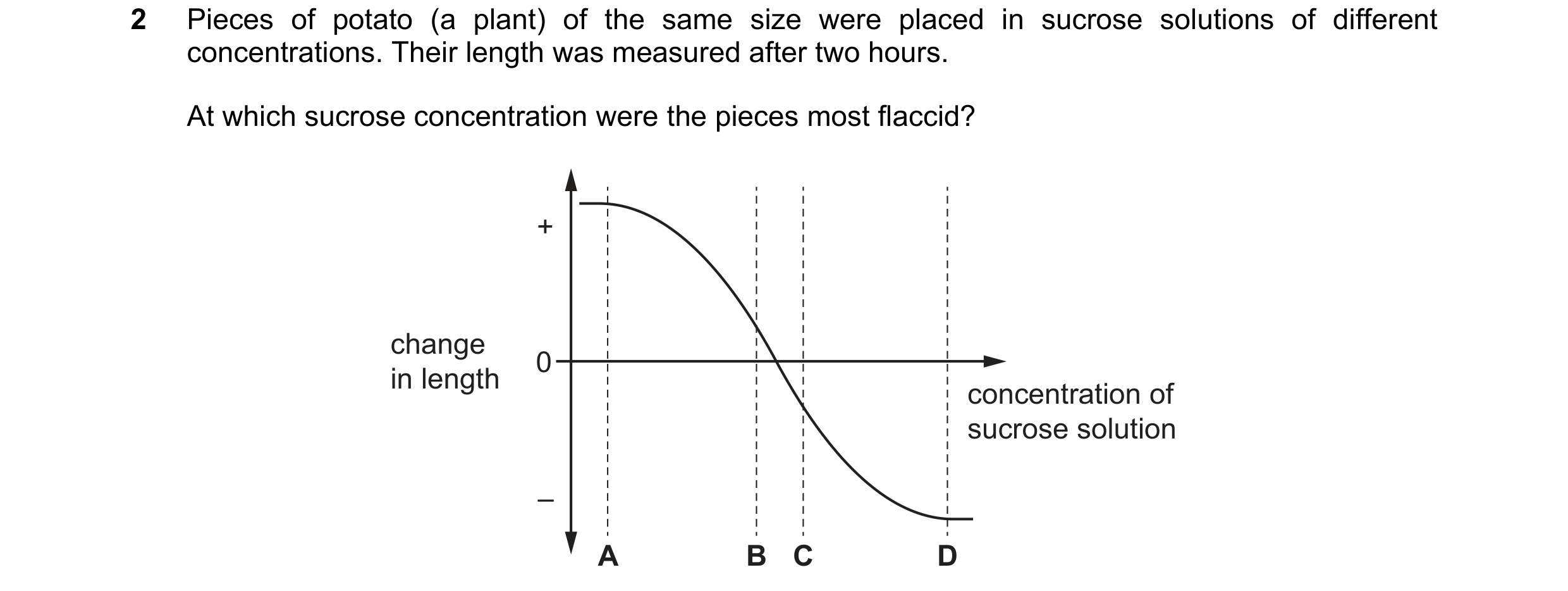

 3 / 7
3 / 7
 4 / 7
4 / 7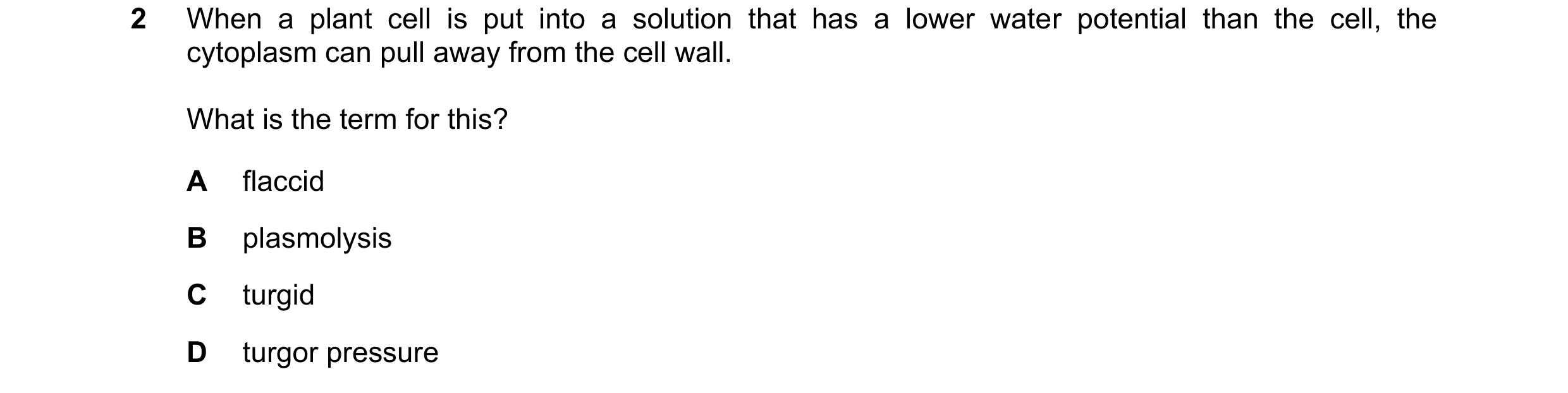
 5 / 7
5 / 7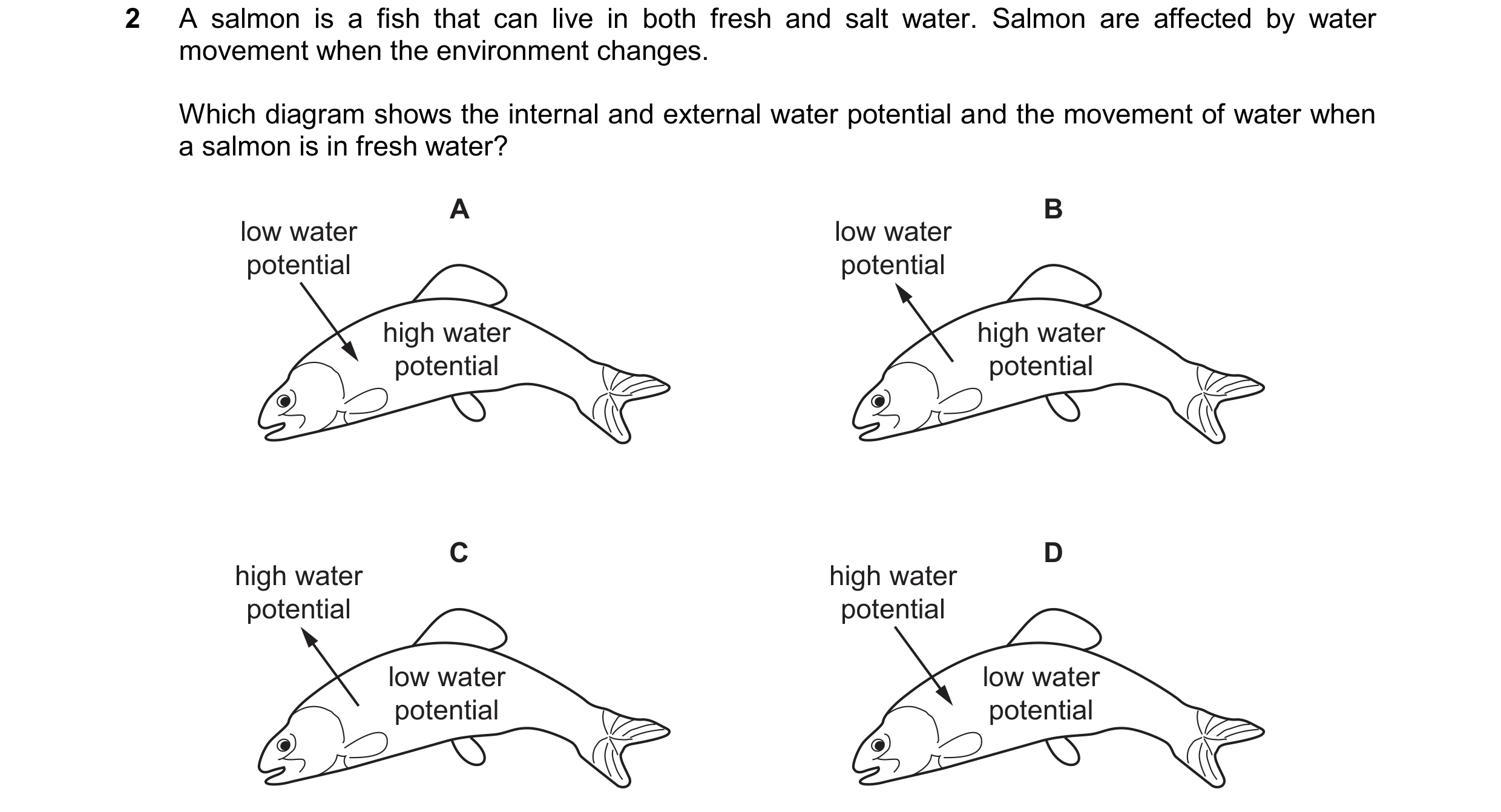
 6 / 7
6 / 7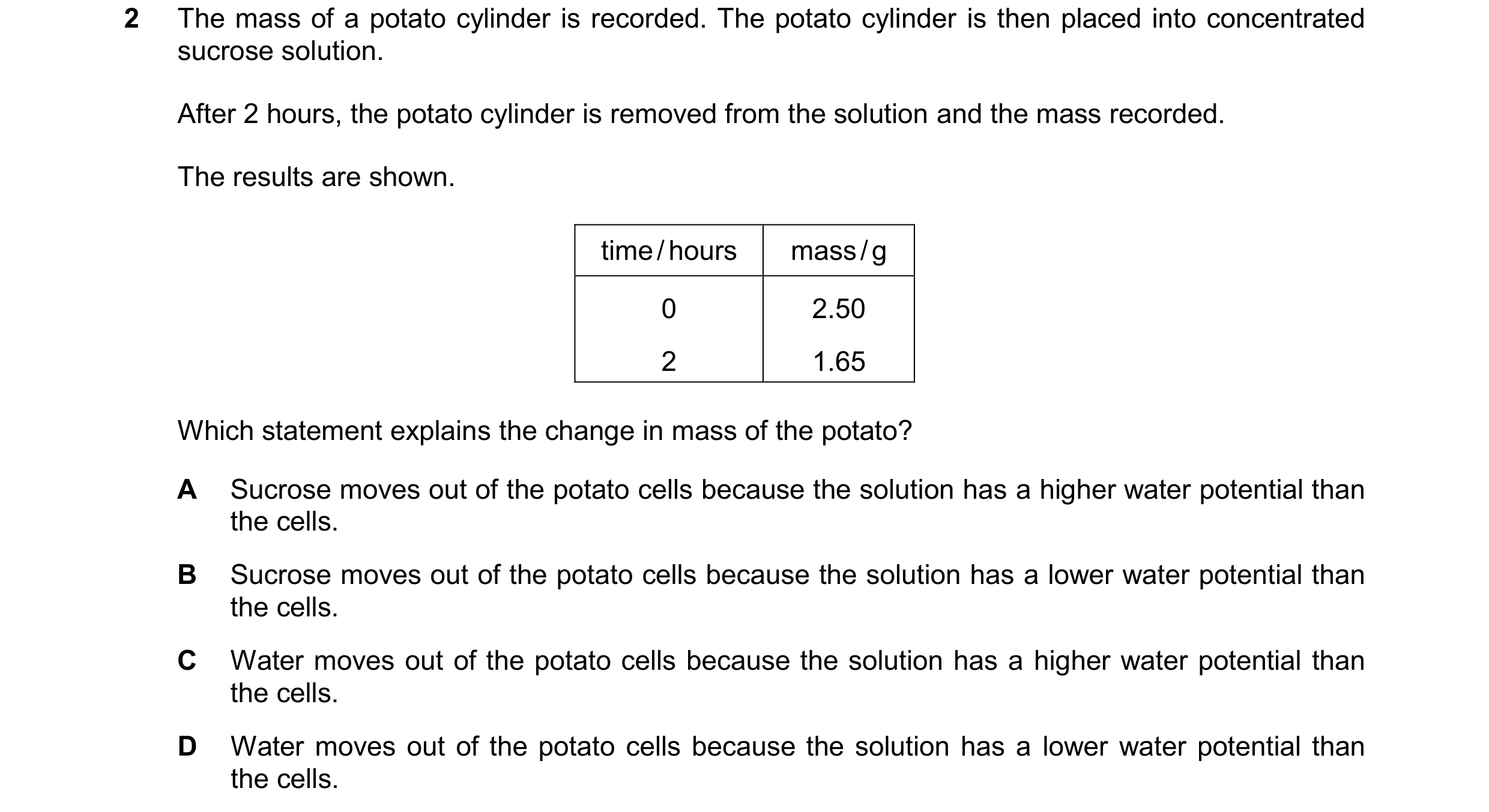 7 / 7
7 / 7