Questions as text
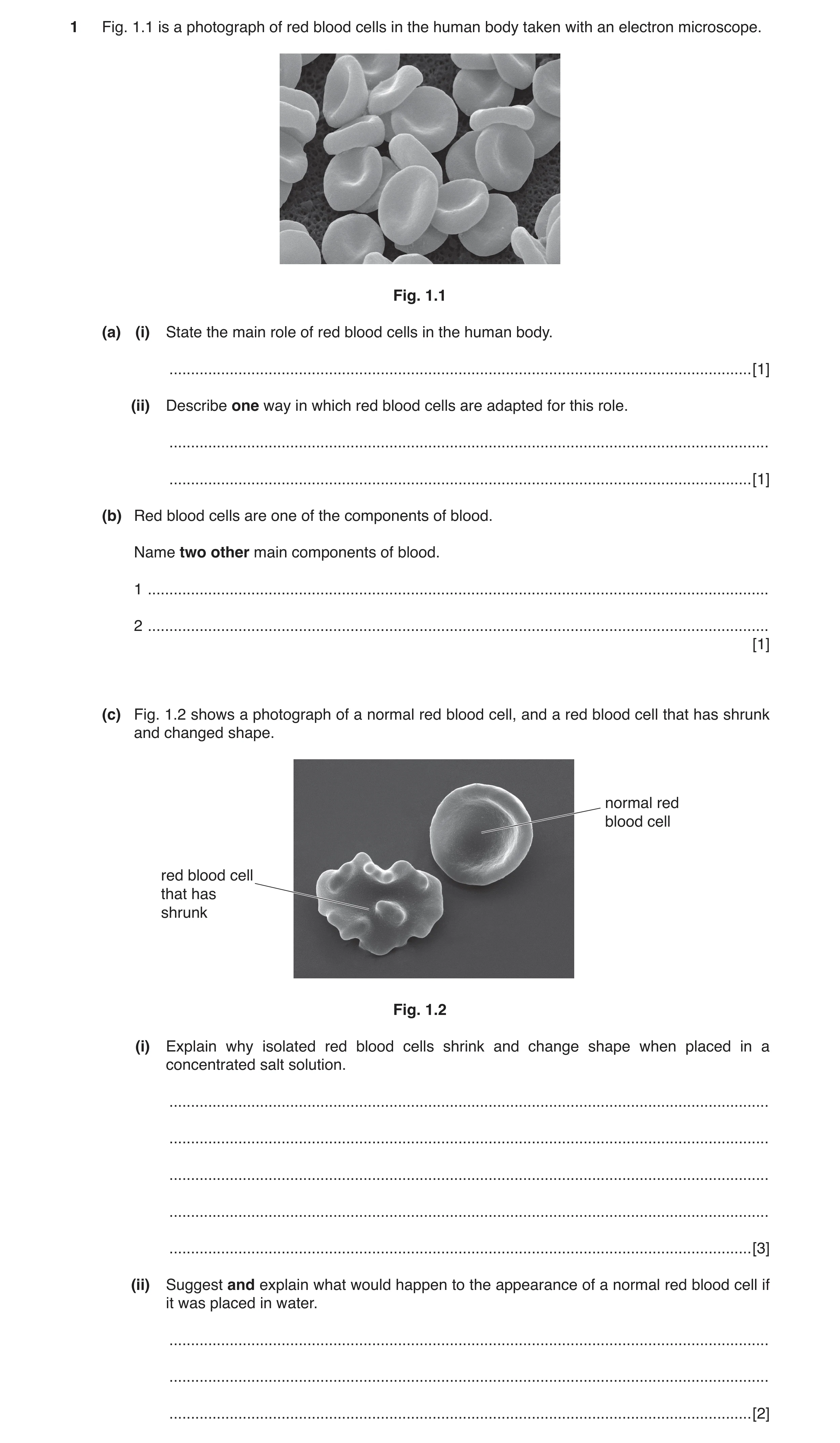
Q1 · A photograph of red blood cells in the human body taken with an electron microscope 0654/42 Oct/Nov 2017
1 Fig. 1.1 is a photograph of red blood cells in the human body taken with an electron microscope. Fig. 1.1 (a) (i) State the main role of red blood cells in the human body. … [1] (ii) Describe one way in which red blood cells are adapted for this role. … … [1] (b) Red blood cells are one of the components of blood. Name two other main components of blood. 1 … 2 … [1] (c) Fig. 1.2 shows a photograph of a normal red blood cell, and a red blood cell that has shrunk and changed shape. normal red blood cell red blood cell that has shrunk Fig. 1.2 (i) Explain why isolated red blood cells shrink and change shape when placed in a concentrated salt solution. … … … … … [3] (ii) Suggest and explain what would happen to the appearance of a normal red blood cell if it was placed in water. … … … [2]
8 marks
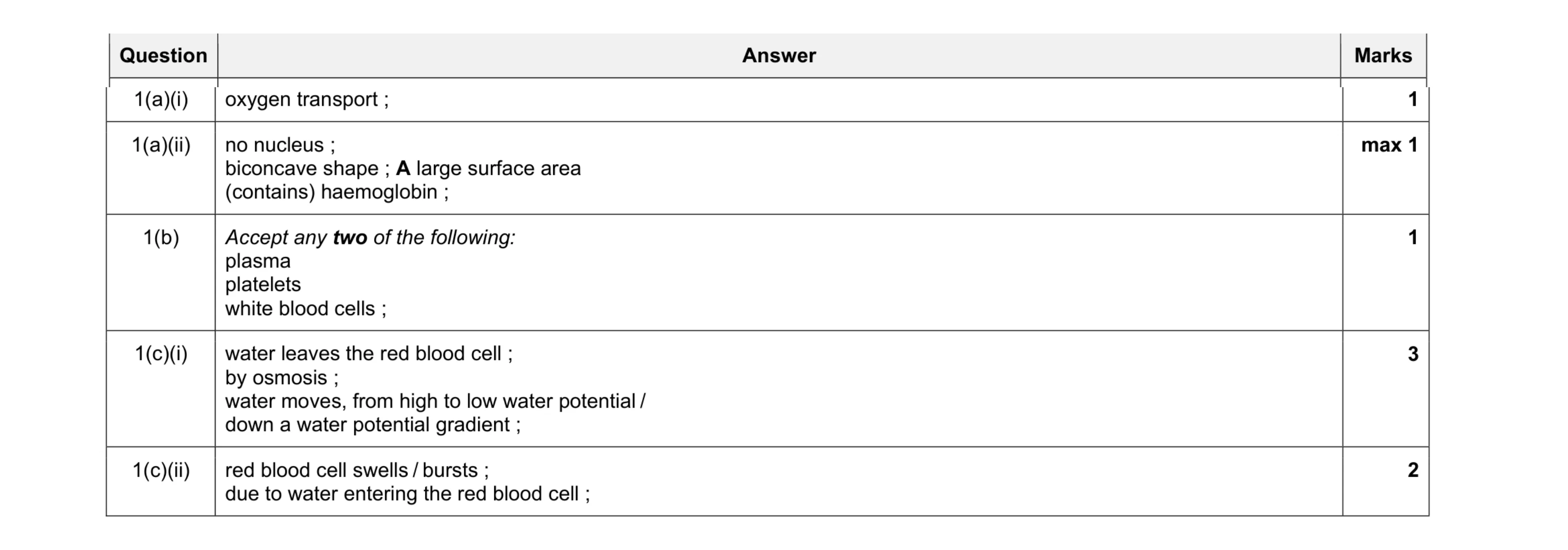
Mark scheme: 1(a)(i) oxygen transport ; 1 1(a)(ii) no nucleus ; biconcave shape ; A large surface area (contains) haemoglobin ; max 1 1(b) Accept any two of the following: plasma platelets white blood cells ; 1 1(c)(i) water leaves the red blood cell ; by osmosis ; water moves, from high to low water potential / down a water potential gradient ; 3 1(c)(ii) red blood cell swells / bursts ; due to water entering the red blood cell ; 2
This question in 0654/42 Oct/Nov 2017
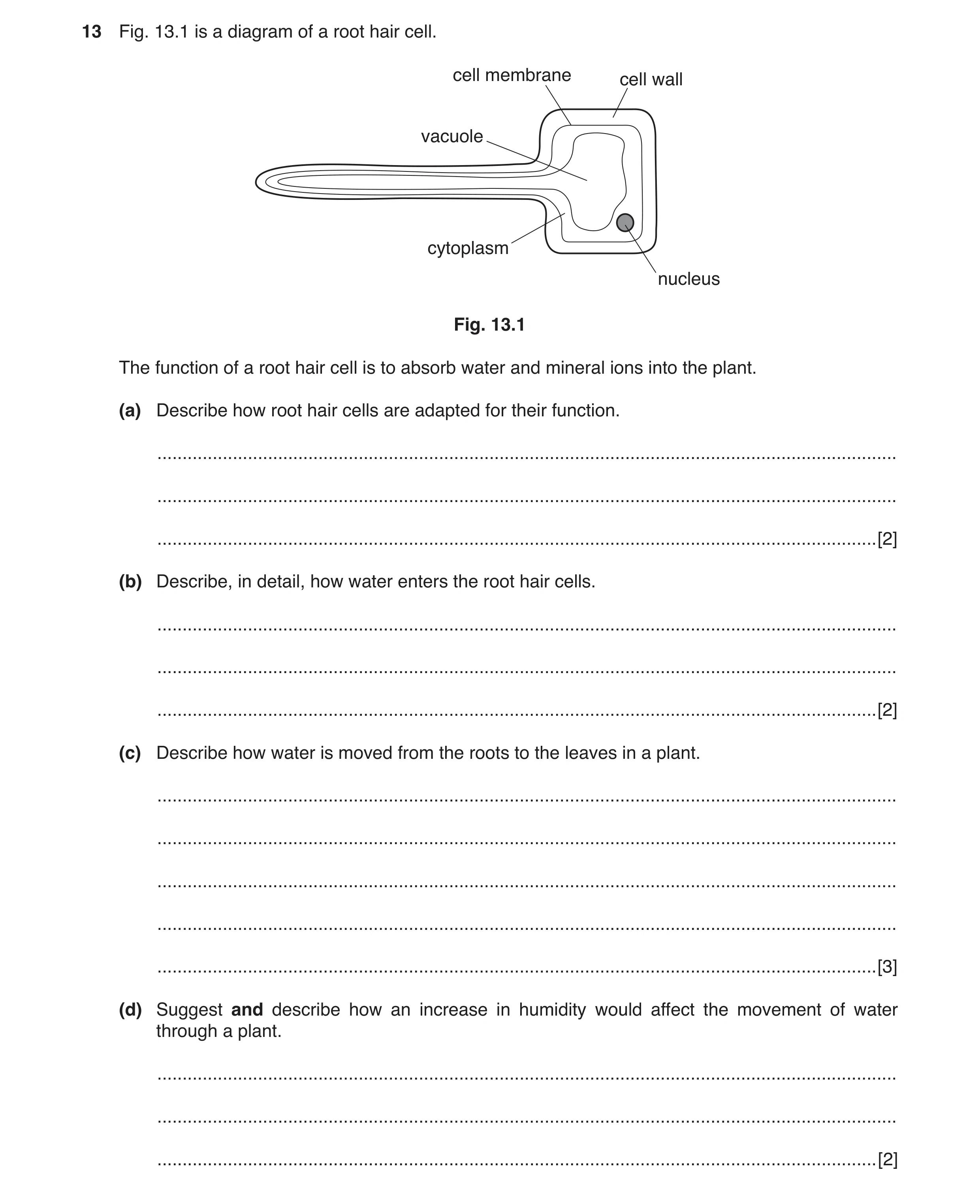
Q2 · A diagram of a root hair cell 0654/43 Oct/Nov 2017
13 Fig. 13.1 is a diagram of a root hair cell. cell membrane cell wall vacuole cytoplasm nucleus Fig. 13.1 The function of a root hair cell is to absorb water and mineral ions into the plant. (a) Describe how root hair cells are adapted for their function. … … … [2] (b) Describe, in detail, how water enters the root hair cells. … … … [2] (c) Describe how water is moved from the roots to the leaves in a plant. … … … … … [3] (d) Suggest and describe how an increase in humidity would affect the movement of water through a plant. … … … [2]
9 marks
Mark scheme: 13(a) elongated / long ; increased surface area (for absorption) ; 2 13(b) ref to osmosis ; movement of water from high water potential to low water potential / down a water potential gradient ; across, partially permeable membrane / cell membrane ; max 2 13(c) transpiration / water loss / evaporation from leaf ; reduces water potential at top of plant ; (causes) movement of water up xylem ; ref to cohesion of molecules ; down water potential gradient ; max 3 13(d) less transpiration / water loss / evaporation ; less / slower movement of water ; 2
This question in 0654/43 Oct/Nov 2017
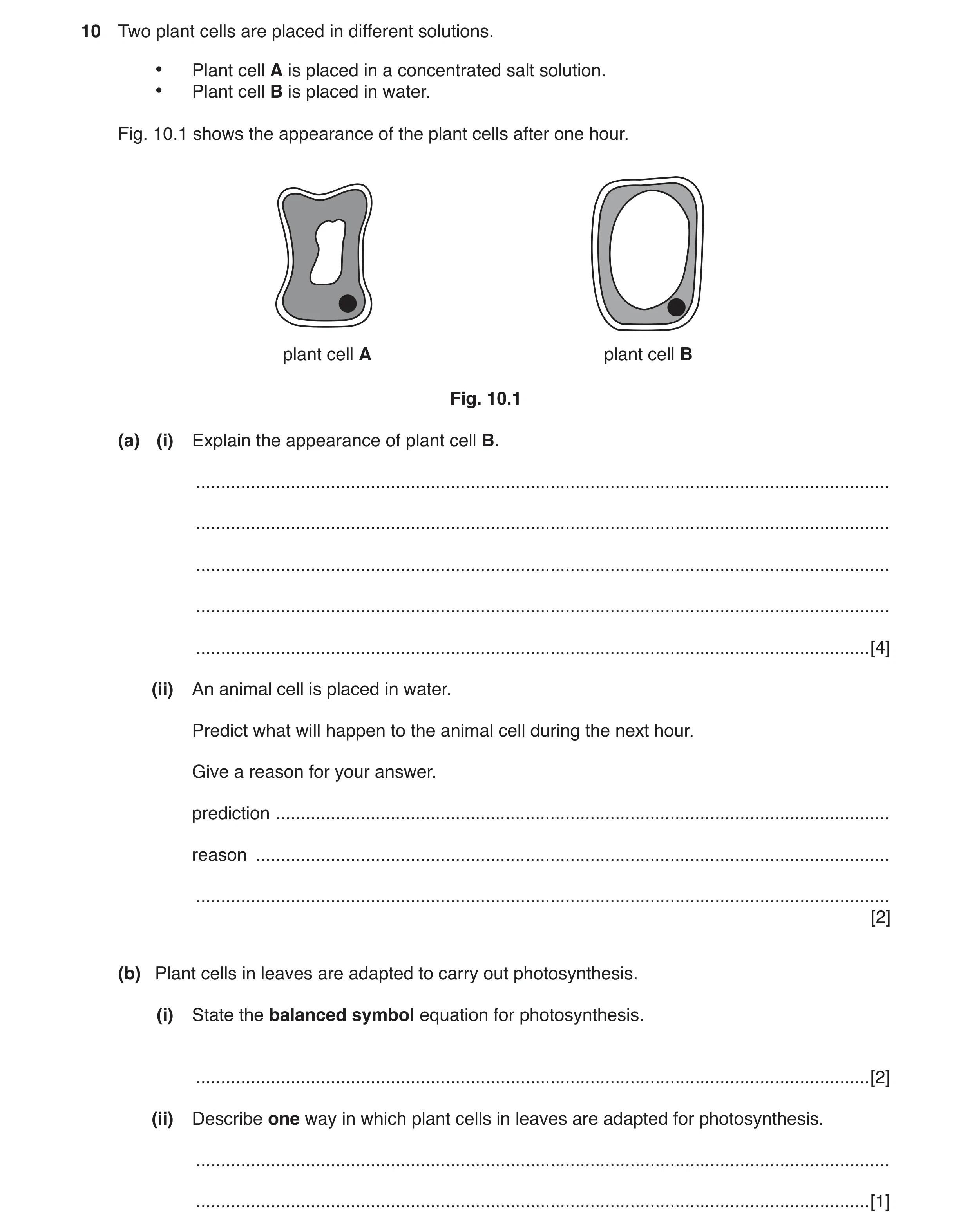
Q3 · Two plant cells are placed in different solutions 0654/43 Oct/Nov 2018
10 Two plant cells are placed in different solutions. • Plant cell A is placed in a concentrated salt solution. • Plant cell B is placed in water. Fig. 10.1 shows the appearance of the plant cells after one hour. plant cell A plant cell B Fig. 10.1 (a) (i) Explain the appearance of plant cell B. … … … … … [4] (ii) An animal cell is placed in water. Predict what will happen to the animal cell during the next hour. Give a reason for your answer. prediction … reason … … [2] (b) Plant cells in leaves are adapted to carry out photosynthesis. (i) State the balanced symbol equation for photosynthesis. … [2] (ii) Describe one way in which plant cells in leaves are adapted for photosynthesis. … … [1]
9 marks
Mark scheme: 10(a)(i) water moves in to plant cell ; correct ref to osmosis ; solution is less concentrated / more dilute than plant cell / ; (water moves) from high to low water potential / dilute to concentrated ; causing is to swell / become turgid / AW ; max 4 10(a)(ii) (animal cell) bursts ; lack of cell wall ; 2 10(b)(i) 6CO2 + 6H2O → C6H12O6 + 6O2 left-hand side correct ; right-hand side correct ; 2 10(b)(ii) presence of chlorophyll / chloroplasts ; 1
This question in 0654/43 Oct/Nov 2018
Q4 · Water is taken into roots through the root hair cells by osmosis 0654/42 Oct/Nov 2019
10 Water is taken into roots through the root hair cells by osmosis. (a) (i) Complete the sentence to define the term osmosis. Osmosis is the net movement of water … from a region of higher water potential ( … solution) to a region of lower water potential (concentrated solution), through a partially permeable … . [3] (ii) Describe how the root hair cells are adapted for water uptake. … … [1] (b) Name the term used to describe how water molecules are held together in the xylem. … [1] (c) A student investigates the effect of humidity on the rate of transpiration. The apparatus in Fig. 10.1 is used to measure the rate of water uptake by a plant shoot. This is approximately equal to the rate of transpiration. plant shoot reservoir capillary tube air bubble ruler beaker of water Fig. 10.1 The student determines the rate of water uptake by measuring the distance travelled by the air bubble in two minutes. The investigation is repeated with a clear plastic bag over the plant shoot to increase the humidity. The results are shown in Table 10.1. Table 10.1 distance air bubble time rate of water travelled / min uptake / mm without plastic bag 18 2 9 with plastic bag 8 2 4 (i) Deduce the units used for the rate of water uptake in Table 10.1. … [1] (ii) Explain the reduced rate of water uptake by the shoot covered with the clear plastic bag. … … … … … [3] [Total: 9]
9 marks
Mark scheme: 10(a)(i) molecules ; dilute ; membrane ; 3 10(a)(ii) long and thin / elongated / have a large surface area ; 1 10(b) cohesion ; 1 10(c)(i) mm / min ; 1 10(c)(ii) increase in concentration of water (vapour) outside leaf ; less, diffusion / evaporation, of water ; less transpiration pull / movement of water, through the shoot ; 3
This question in 0654/42 Oct/Nov 2019
Q5 · A student investigates what effect immersing grapes in distilled water and concentrated… 0654/41 Oct/Nov 2020
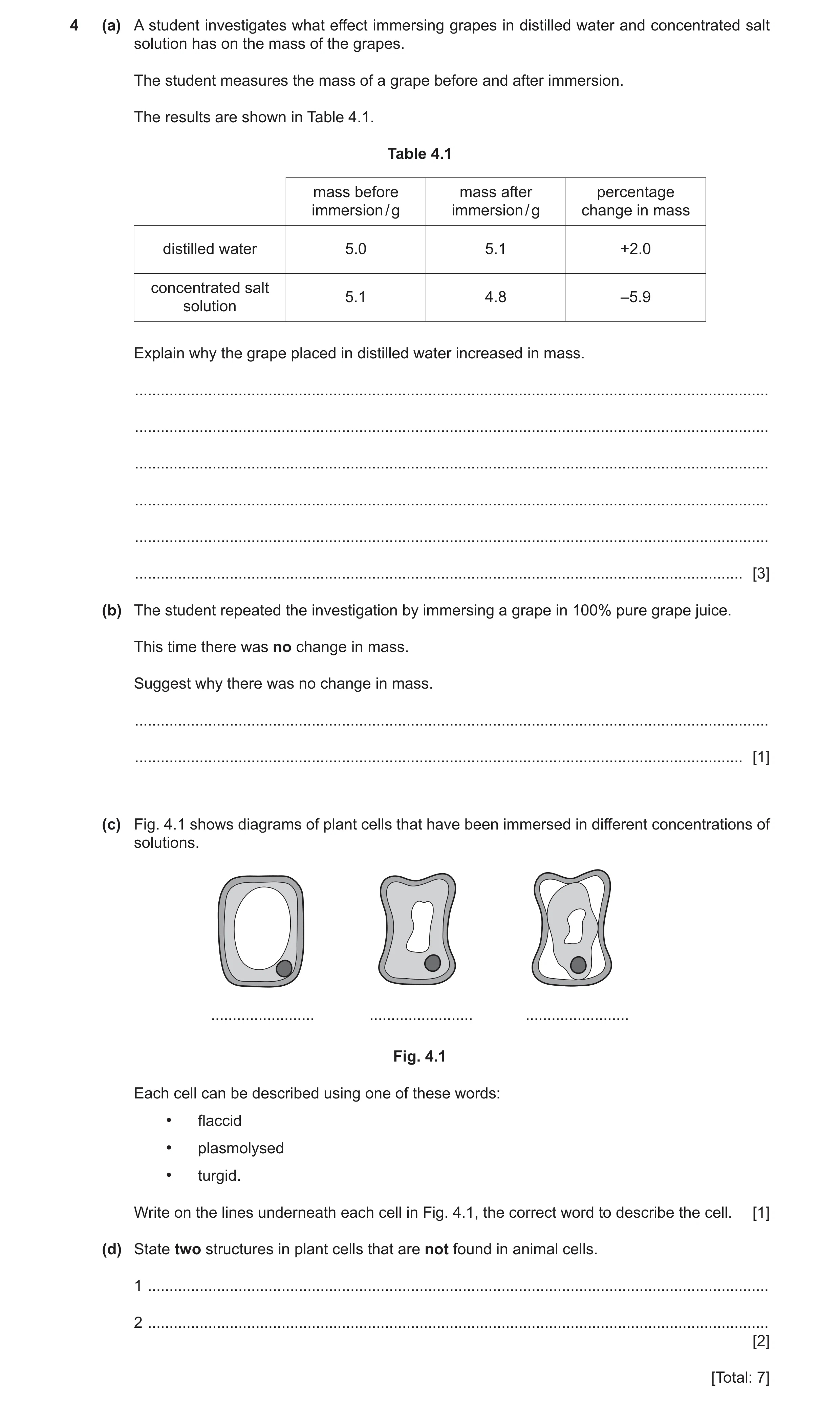
4 (a) A student investigates what effect immersing grapes in distilled water and concentrated salt solution has on the mass of the grapes. The student measures the mass of a grape before and after immersion. The results are shown in Table 4.1. Table 4.1 mass before mass after percentage immersion / g immersion / g change in mass distilled water 5.0 5.1 +2.0 concentrated salt 5.1 4.8 –5.9 solution Explain why the grape placed in distilled water increased in mass. … … … … … … [3] (b) The student repeated the investigation by immersing a grape in 100% pure grape juice. This time there was no change in mass. Suggest why there was no change in mass. … … [1] (c) Fig. 4.1 shows diagrams of plant cells that have been immersed in different concentrations of solutions. … … … Fig. 4.1 Each cell can be described using one of these words: • flaccid • plasmolysed • turgid. Write on the lines underneath each cell in Fig. 4.1, the correct word to describe the cell. [1] (d) State two structures in plant cells that are not found in animal cells. 1 … 2 … [2] [Total: 7]
7 marks
Mark scheme: 4(a) ref to osmosis ; water moves into the grape ; distilled water has a higher water potential / (water moves) from a high to low water potential / down a water potential gradient ; 4(b) the water potential was the same ; 1 4(c) from left to right turgid, flaccid, plasmolysed ; 1 4(d) any two from cell wall ; chloroplast ; (permanent) vacuole ; 2
This question in 0654/41 Oct/Nov 2020
Q6 · Some plant cells are immersed in a concentrated salt solution 0654/42 May/June 2021
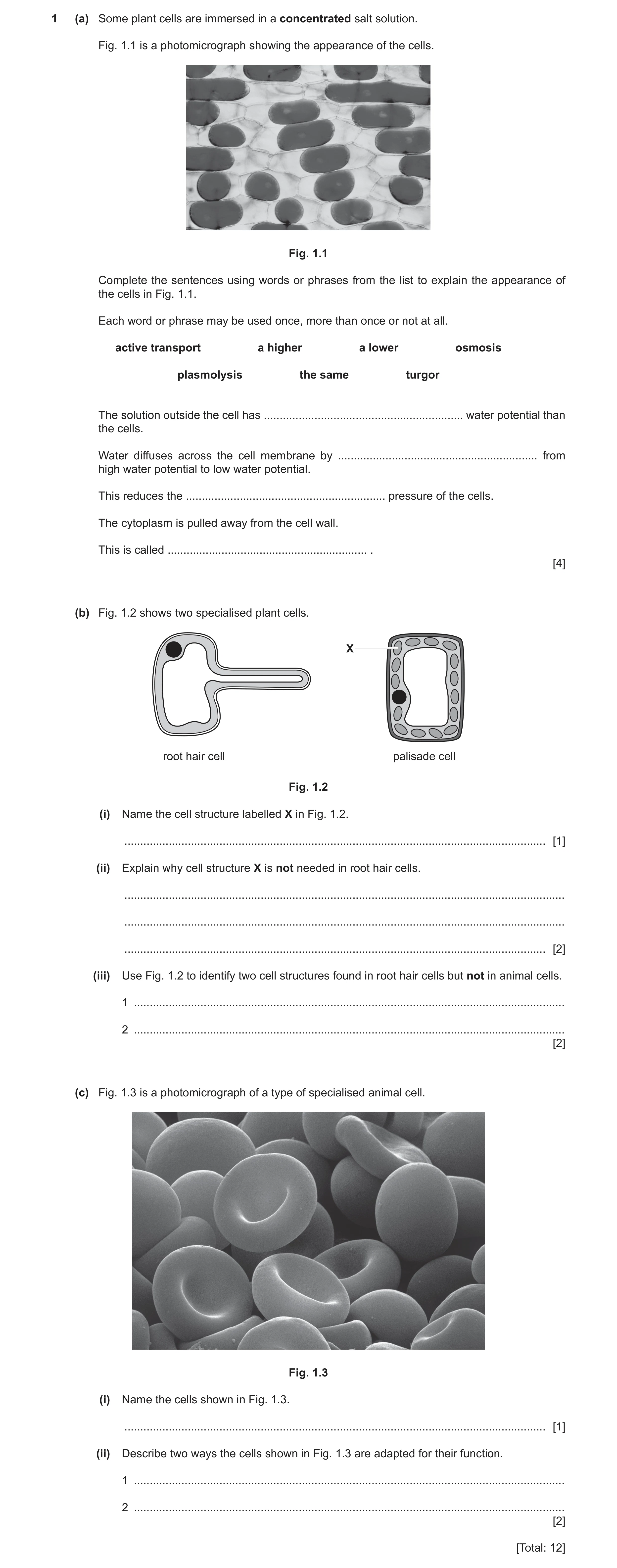
1 (a) Some plant cells are immersed in a concentrated salt solution. Fig. 1.1 is a photomicrograph showing the appearance of the cells. Fig. 1.1 Complete the sentences using words or phrases from the list to explain the appearance of the cells in Fig. 1.1. Each word or phrase may be used once, more than once or not at all. active transport a higher a lower osmosis plasmolysis the same turgor The solution outside the cell has … water potential than the cells. Water diffuses across the cell membrane by … from high water potential to low water potential. This reduces the … pressure of the cells. The cytoplasm is pulled away from the cell wall. This is called … . [4] (b) Fig. 1.2 shows two specialised plant cells. X root hair cell palisade cell Fig. 1.2 (i) Name the cell structure labelled X in Fig. 1.2. … [1] (ii) Explain why cell structure X is not needed in root hair cells. … … … [2] (iii) Use Fig. 1.2 to identify two cell structures found in root hair cells but not in animal cells. 1 … 2 … [2] (c) Fig. 1.3 is a photomicrograph of a type of specialised animal cell. Fig. 1.3 (i) Name the cells shown in Fig. 1.3. … [1] (ii) Describe two ways the cells shown in Fig. 1.3 are adapted for their function. 1 … 2 … [2] [Total: 12]
12 marks
Mark scheme: 1(a) a lower ; osmosis ; turgor ; plasmolysis ; 4 1(b)(i) chloroplast ; 1 1(b)(ii) any two from: root hair cells absorb, water / mineral ions ; root hair cells, are underground / do not receive light ; correct reference to photosynthesis ; 2 1(b)(iii) vacuole ; cell wall ; 2 1(c)(i) red blood cells ; 1 1(c)(ii) any two from: contain haemoglobin ; no nucleus ; biconcave shape / large surface area ; AVP ; 2
This question in 0654/42 May/June 2021
Q7 · A student investigates the effect of placing strips of potato in water and different… 0654/43 Oct/Nov 2021
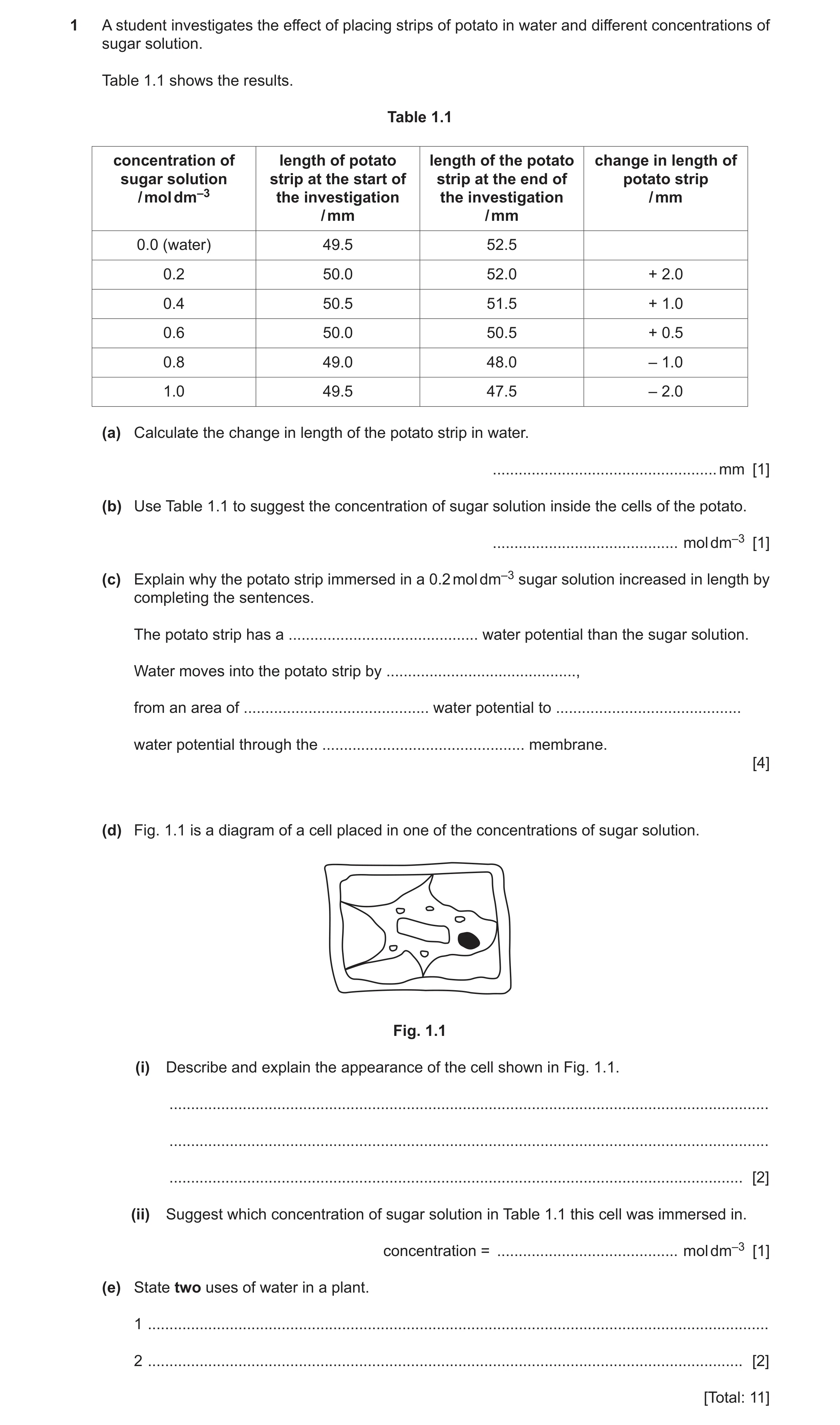
1 A student investigates the effect of placing strips of potato in water and different concentrations of sugar solution. Table 1.1 shows the results. Table 1.1 concentration of length of potato length of the potato change in length of sugar solution strip at the start of strip at the end of potato strip / mol dm–3 the investigation the investigation / mm / mm / mm 0.0 (water) 49.5 52.5 0.2 50.0 52.0 + 2.0 0.4 50.5 51.5 + 1.0 0.6 50.0 50.5 + 0.5 0.8 49.0 48.0 – 1.0 1.0 49.5 47.5 – 2.0 (a) Calculate the change in length of the potato strip in water. … mm [1] (b) Use Table 1.1 to suggest the concentration of sugar solution inside the cells of the potato. … mol dm–3 [1] (c) Explain why the potato strip immersed in a 0.2 mol dm–3 sugar solution increased in length by completing the sentences. The potato strip has a … water potential than the sugar solution. Water moves into the potato strip by … , from an area of … water potential to … water potential through the … membrane. [4] (d) Fig. 1.1 is a diagram of a cell placed in one of the concentrations of sugar solution. Fig. 1.1 (i) Describe and explain the appearance of the cell shown in Fig. 1.1. … … … [2] (ii) Suggest which concentration of sugar solution in Table 1.1 this cell was immersed in. concentration = … mol dm–3 [1] (e) State two uses of water in a plant. 1 … 2 … [2] [Total: 11]
11 marks
Mark scheme: 1(a) (+) 3.0 ; 1 1(b) any figure between > 0.6 and < 0.8 (mol dm–3) ; 1 1(c) higher ; osmosis ; high and low ; partially permeable / cell ; 4 1(d)(i) ref to plasmolysis / the cell membrane has come away from the cell wall / cytoplasm has shrunk ; because water has left the cell (by osmosis) ; 2 1(d)(ii) 0.8 / 1.0 (mol dm–3) ; 1 1(e) any two from: support / keeps cells turgid ; photosynthesis ; transport ; solvent ; 2
This question in 0654/43 Oct/Nov 2021
Q8 · A photomicrograph of some plant cells 0654/42 Feb/March 2022
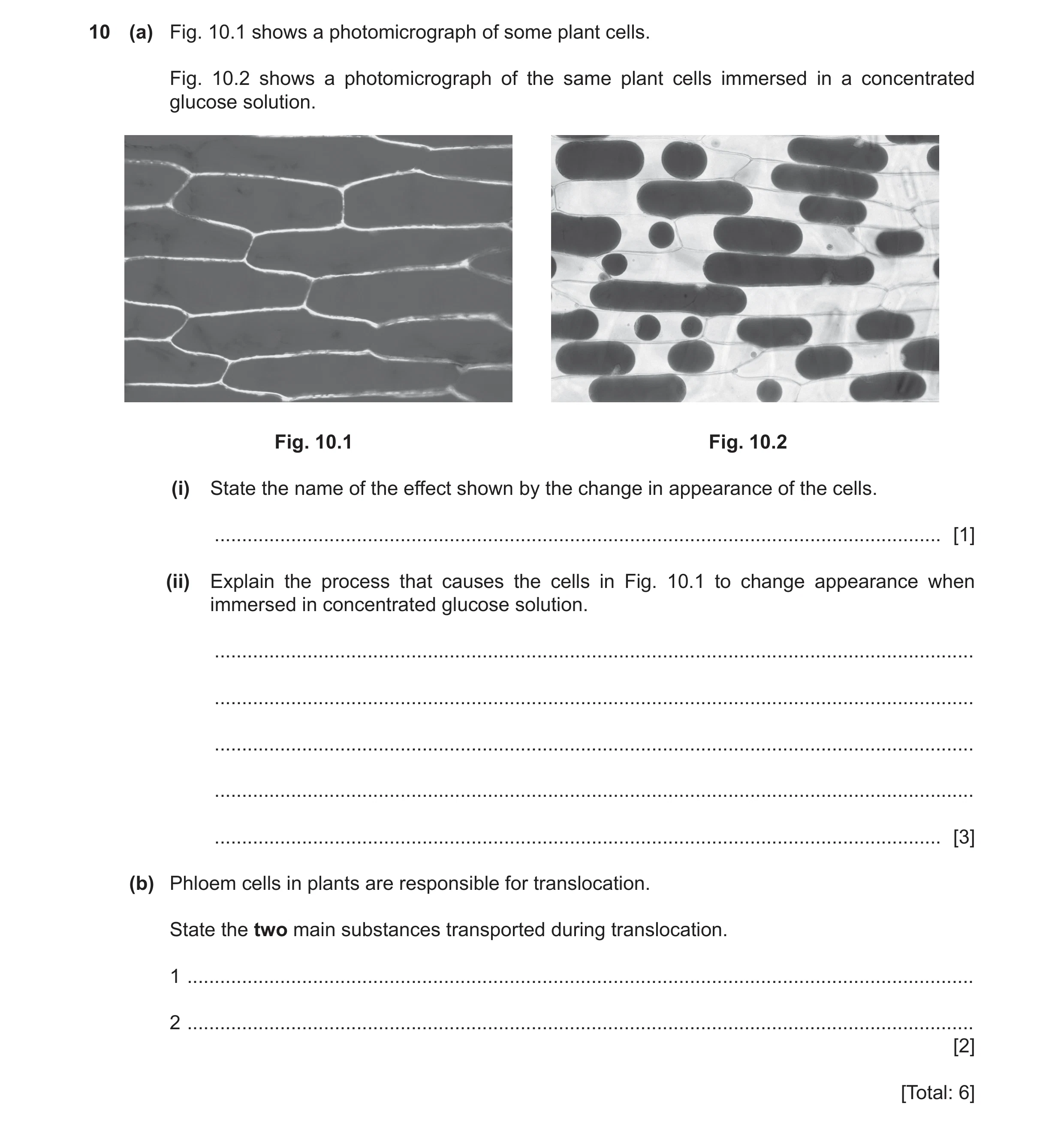
10 (a) Fig. 10.1 shows a photomicrograph of some plant cells. Fig. 10.2 shows a photomicrograph of the same plant cells immersed in a concentrated glucose solution. Fig. 10.1 Fig. 10.2 (i) State the name of the effect shown by the change in appearance of the cells. … [1] (ii) Explain the process that causes the cells in Fig. 10.1 to change appearance when immersed in concentrated glucose solution. … … … … … [3] (b) Phloem cells in plants are responsible for translocation. State the two main substances transported during translocation. 1 … 2 … [2] [Total: 6]
6 marks
Mark scheme: 10(a)(i) plasmolysis ; 1 10(a)(ii) any three from: higher water potential inside the cells than outside the cells ; water moves from high water potential to low water potential / water moves down a water potential gradient ; across a partially permeable membrane / water moves out of the cells ; ref to osmosis ; 3 10(b) sucrose ; amino acids ; 2
This question in 0654/42 Feb/March 2022
Q9 · Two red blood cells after they have been immersed in different solutions for an hour 0654/41 May/June 2023
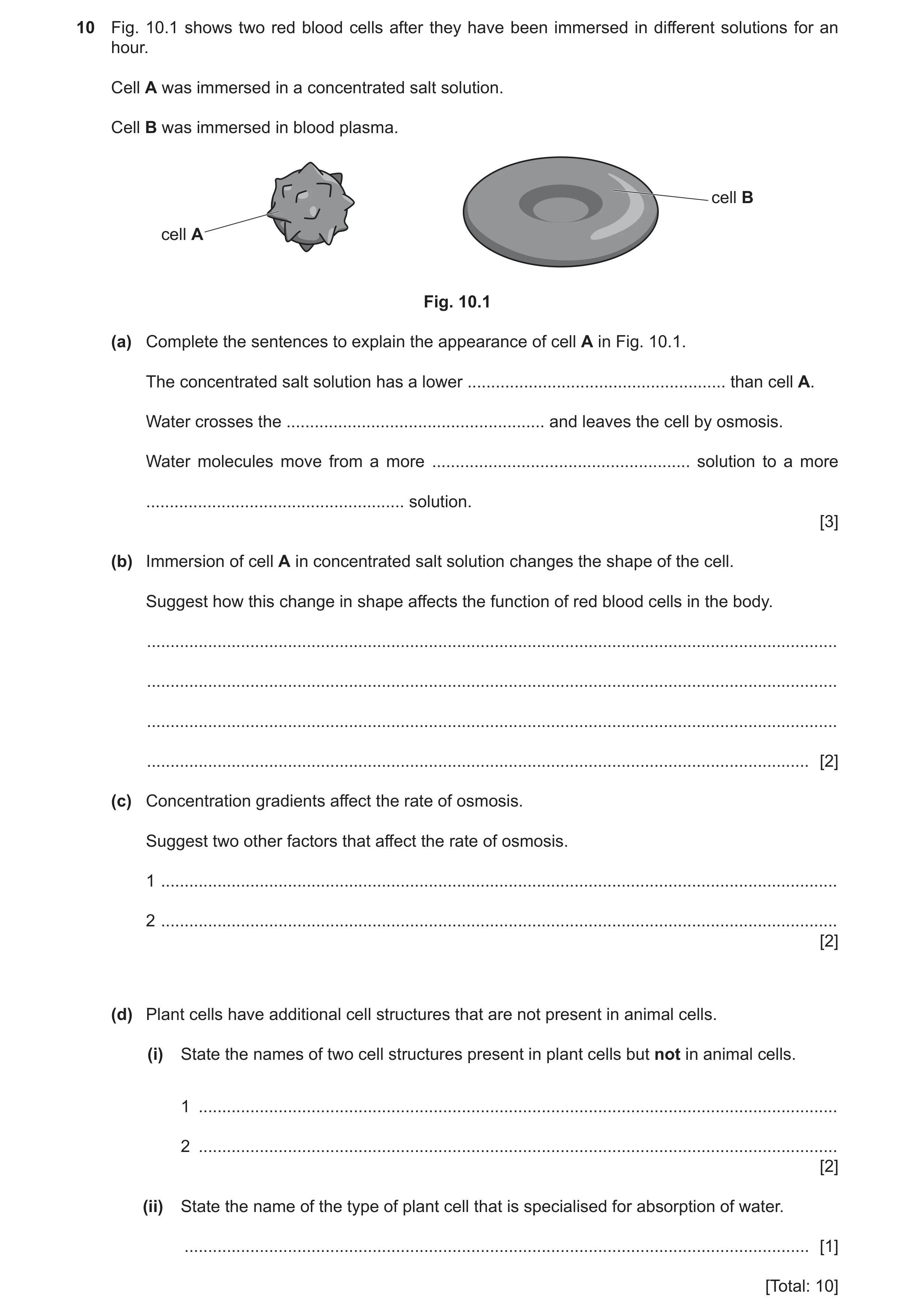
10 Fig. 10.1 shows two red blood cells after they have been immersed in different solutions for an hour. Cell A was immersed in a concentrated salt solution. Cell B was immersed in blood plasma. cell B cell A Fig. 10.1 (a) Complete the sentences to explain the appearance of cell A in Fig. 10.1. The concentrated salt solution has a lower … than cell A. Water crosses the … and leaves the cell by osmosis. Water molecules move from a more … solution to a more … solution. [3] (b) Immersion of cell A in concentrated salt solution changes the shape of the cell. Suggest how this change in shape affects the function of red blood cells in the body. … … … … [2] (c) Concentration gradients affect the rate of osmosis. Suggest two other factors that affect the rate of osmosis. 1 … 2 … [2] (d) Plant cells have additional cell structures that are not present in animal cells. (i) State the names of two cell structures present in plant cells but not in animal cells. 1 … 2 … [2] (ii) State the name of the type of plant cell that is specialised for absorption of water. … [1] [Total: 10]
10 marks
Mark scheme: 10(a) water potential ; (cell) membrane ; dilute, concentrated ; 3 10(b) any two from: less, surface area / (internal) volume ; so less oxygen transported ; AVP ; 2 Question Answer Marks 10(c) any two from: surface area ; temperature ; diffusion distance/thickness of cell membrane ; 2 10(d)(i) any two from: chloroplast ; (permanent) vacuole ; cell wall ; 2 10(d)(ii) root hair (cell) ; 1
This question in 0654/41 May/June 2023
Q10 · Red blood cells are specialised to transport oxygen 0654/42 May/June 2024
10 (a) Red blood cells are specialised to transport oxygen. Describe two ways that red blood cells are adapted for their function. 1 … … 2 … … [2] (b) A student investigates the effect of different concentrations of salt solution on red blood cells. The student immerses the red blood cells in different concentrations of salt solution and observes the cells after immersion. Table 10.1 shows the results. Table 10.1 concentration of salt solution observation g / dm3 10.0 cells shrink 8.0 no change 6.0 cells burst 4.0 cells burst 2.0 cells burst (i) Identify the salt solution with the same water potential as red blood cells. … g / dm3 [1] (ii) Explain the observation seen at 10.0 g / dm3 in Table 10.1. … … … … … … … [3] (c) The investigation is repeated with plant cells. (i) Plants cells do not burst when immersed in 2.0 g / dm3 salt solution. Explain why. … … … … … [2] (ii) State two uses of water in plant cells. 1 … 2 … [2] (iii) State the name of the type of plant cell specialised for absorption of water. … [1] [Total: 11]
11 marks
Mark scheme: 10(a) any two from: no nucleus ; large surface area / biconcave (shape) ; contains haemoglobin ; 2 10(b)(i) 8.0 (g per dm3) ; 1 Question Answer Marks 10(b)(ii) water leaves the cell ; by osmosis ; the salt solution has a lower water potential (than the red blood cell) / water moves from an area of high water potential to low water potential ; 3 10(c)(i) presence of cell wall ; strengthens the cell ; 2 10(c)(ii) any two from: solvent ; photosynthesis ; support / ref to turgidity / prevent wilting ; transport of, minerals / mineral ions / ions ; AVP ; 2 10(c)(iii) root hair (cell) ; 1
This question in 0654/42 May/June 2024
Q11 · A student cuts cylinders of potato of almost identical size and measures the length of… 0654/41 Oct/Nov 2024
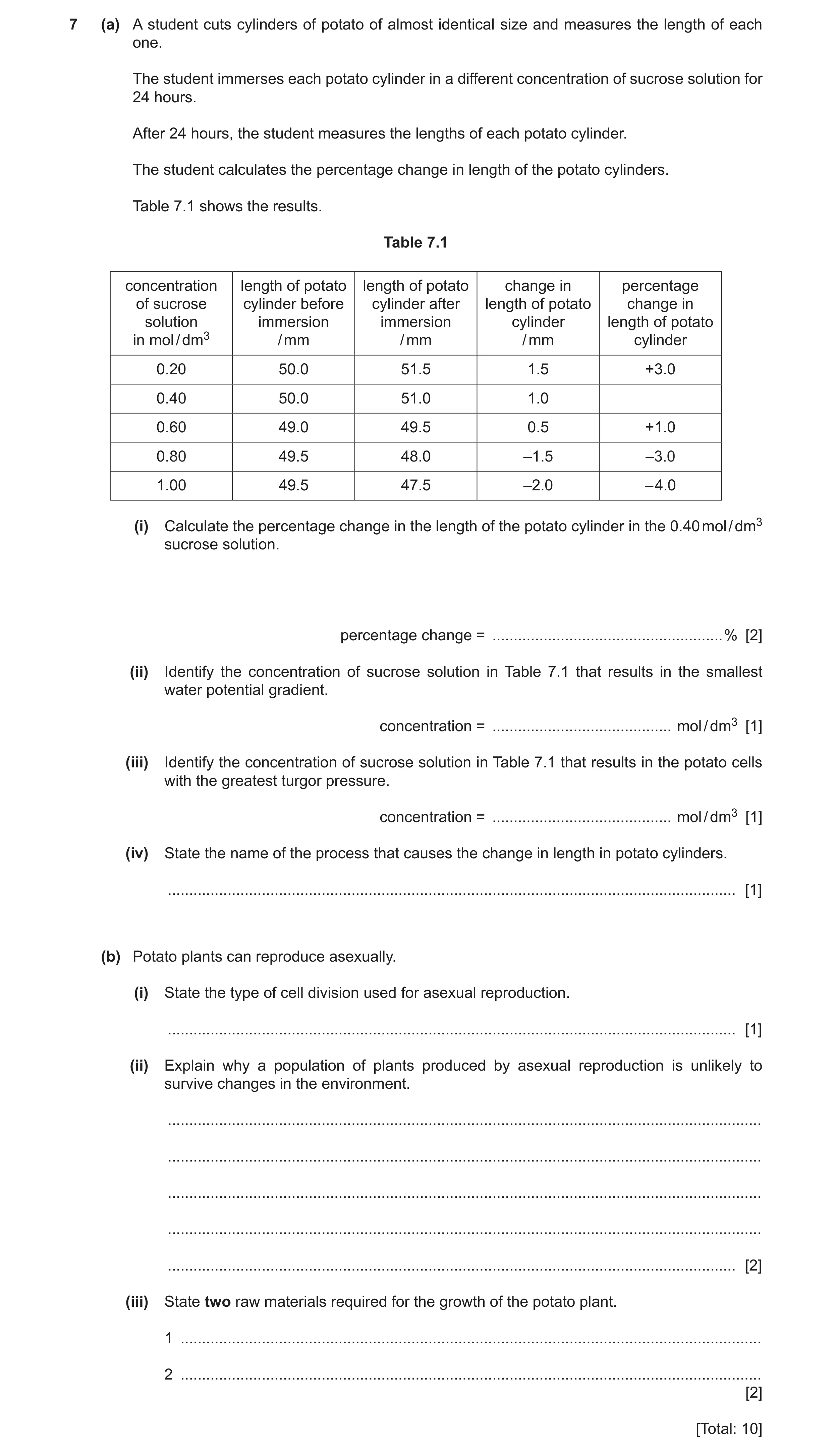
7 (a) A student cuts cylinders of potato of almost identical size and measures the length of each one. The student immerses each potato cylinder in a different concentration of sucrose solution for 24 hours. After 24 hours, the student measures the lengths of each potato cylinder. The student calculates the percentage change in length of the potato cylinders. Table 7.1 shows the results. Table 7.1 concentration length of potato length of potato change in percentage of sucrose cylinder before cylinder after length of potato change in solution immersion immersion cylinder length of potato in mol / dm3 / mm / mm / mm cylinder 0.20 50.0 51.5 1.5 +3.0 0.40 50.0 51.0 1.0 0.60 49.0 49.5 0.5 +1.0 0.80 49.5 48.0 –1.5 –3.0 1.00 49.5 47.5 –2.0 – 4.0 (i) Calculate the percentage change in the length of the potato cylinder in the 0.40 mol / dm3 sucrose solution. percentage change = … % [2] (ii) Identify the concentration of sucrose solution in Table 7.1 that results in the smallest water potential gradient. concentration = … mol / dm3 [1] (iii) Identify the concentration of sucrose solution in Table 7.1 that results in the potato cells with the greatest turgor pressure. concentration = … mol / dm3 [1] (iv) State the name of the process that causes the change in length in potato cylinders. … [1] (b) Potato plants can reproduce asexually. (i) State the type of cell division used for asexual reproduction. … [1] (ii) Explain why a population of plants produced by asexual reproduction is unlikely to survive changes in the environment. … … … … … [2] (iii) State two raw materials required for the growth of the potato plant. 1 … 2 … [2] [Total: 10]
10 marks
Mark scheme: 7(a)(i) (1.0 / 50.0) 100 ; 2 = (+) 2.0 (%) ; 7(a)(ii) 0.6(0) (mol / dm3) ; 1 7(a)(iii) 0.2(0) (mol / dm3) ; 1 7(a)(iv) osmosis ; 1 7(b)(i) mitosis ; 1 7(b)(ii) no / little, genetic diversity ; 2 (only) adapted to environment of the parent plant ; 7(b)(iii) carbon dioxide ; 2 water ;
This question in 0654/41 Oct/Nov 2024
Q12 · Water moves into plant cells by osmosis 0654/42 Feb/March 2025
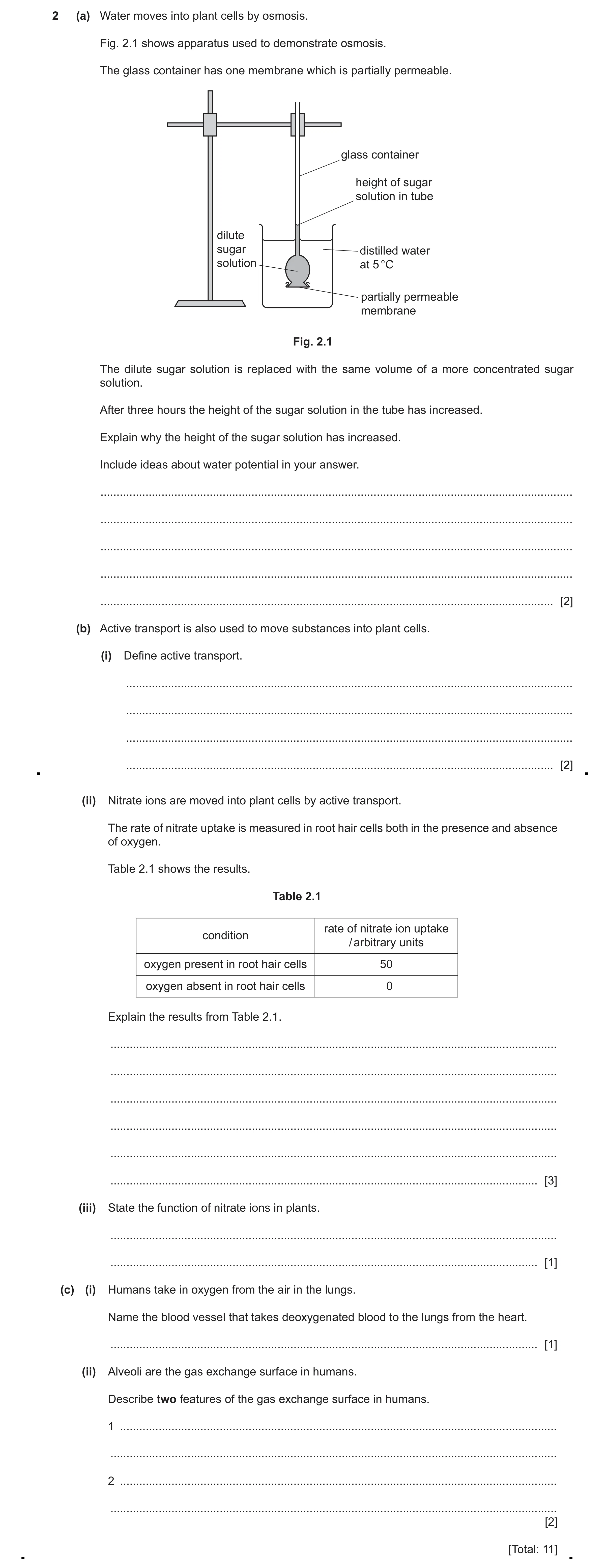
2 (a) Water moves into plant cells by osmosis. Fig. 2.1 shows apparatus used to demonstrate osmosis. The glass container has one membrane which is partially permeable. glass container height of sugar solution in tube dilute sugar distilled water solution at 5 °C partially permeable membrane Fig. 2.1 The dilute sugar solution is replaced with the same volume of a more concentrated sugar solution. After three hours the height of the sugar solution in the tube has increased. Explain why the height of the sugar solution has increased. Include ideas about water potential in your answer. … … … … … [2] (b) Active transport is also used to move substances into plant cells. (i) Define active transport. … … … … [2] (ii) Nitrate ions are moved into plant cells by active transport. The rate of nitrate uptake is measured in root hair cells both in the presence and absence of oxygen. Table 2.1 shows the results. Table 2.1 rate of nitrate ion uptake condition / arbitrary units oxygen present in root hair cells 50 oxygen absent in root hair cells 0 Explain the results from Table 2.1. … … … … … … [3] (iii) State the function of nitrate ions in plants. … … [1] (c) (i) Humans take in oxygen from the air in the lungs. Name the blood vessel that takes deoxygenated blood to the lungs from the heart. … [1] (ii) Alveoli are the gas exchange surface in humans. Describe two features of the gas exchange surface in humans. 1 … … 2 … … [2] [Total: 11]
11 marks
Mark scheme: 2(a) concentrated sugar solution has lower water potential than the surroundings) / ORA ; 2 water moves from a region of higher water potential to a region of lower water potential ; 2(b)(i) movement of particles, from a region of lower concentration to a region of higher concentration / against a concentration 2 gradient ; using energy from respiration ; 2(b)(ii) oxygen required for aerobic respiration ; 3 respiration releases energy ; idea of energy required to move ions, against concentration gradient / idea of energy required for active transport ; 2(b)(iii) synthesis of amino acids / protein / DNA ; 1 2(c)(i) pulmonary artery ; 1 2(c)(ii) any two from: 2 large surface area many capillaries / good blood supply thin surface good ventilation AVP ; ;
This question in 0654/42 Feb/March 2025
Q13 · Active transport is used in the uptake of mineral ions from the soil into the root hair… 0654/43 Oct/Nov 2025
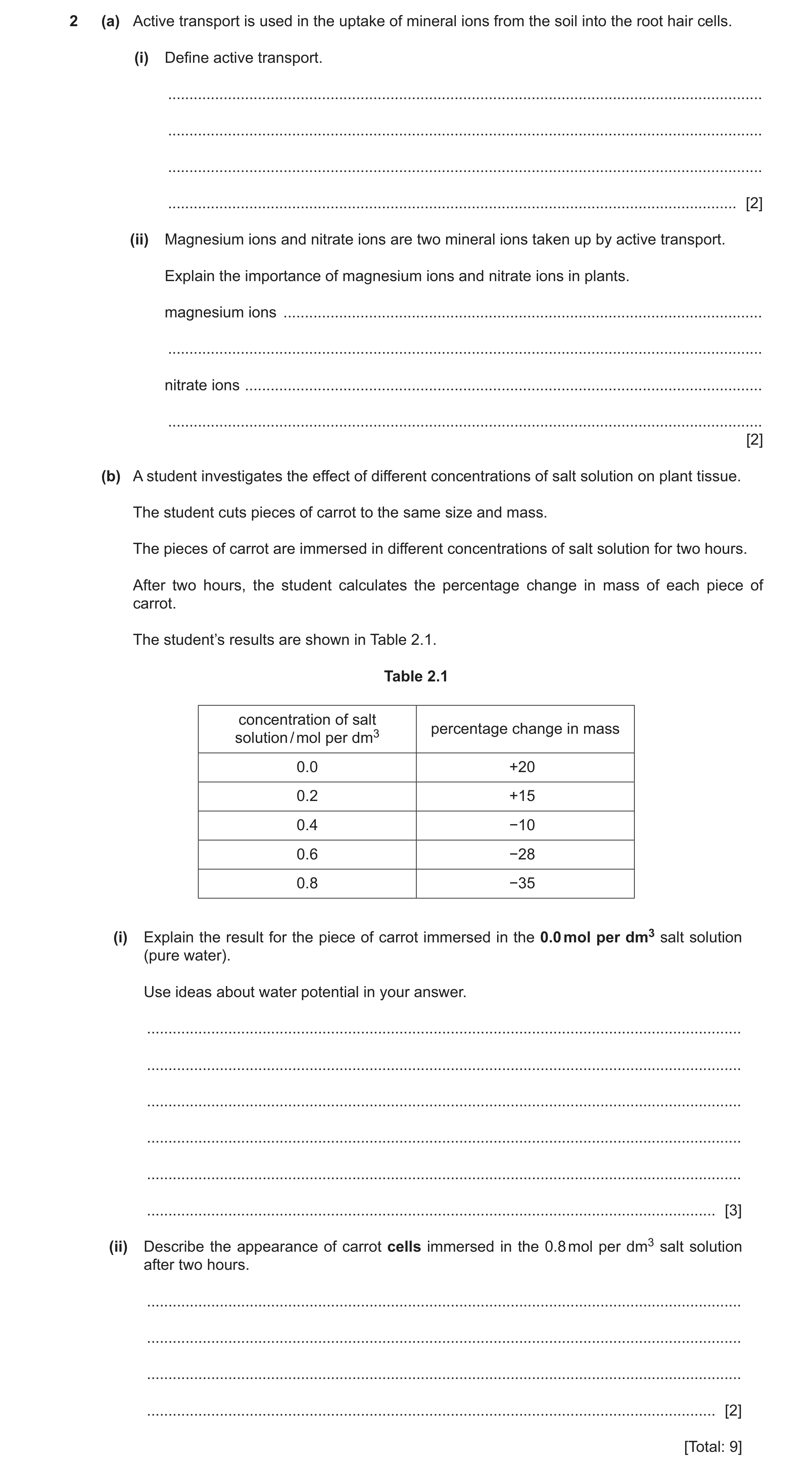
2 (a) Active transport is used in the uptake of mineral ions from the soil into the root hair cells. (i) Define active transport. … … … … [2] (ii) Magnesium ions and nitrate ions are two mineral ions taken up by active transport. Explain the importance of magnesium ions and nitrate ions in plants. magnesium ions … … nitrate ions … … [2] (b) A student investigates the effect of different concentrations of salt solution on plant tissue. The student cuts pieces of carrot to the same size and mass. The pieces of carrot are immersed in different concentrations of salt solution for two hours. After two hours, the student calculates the percentage change in mass of each piece of carrot. The student’s results are shown in Table 2.1. Table 2.1 concentration of salt percentage change in mass solution / mol per dm3 0.0 +20 0.2 +15 0.4 −10 0.6 −28 0.8 −35 (i) Explain the result for the piece of carrot immersed in the 0.0 mol per dm3 salt solution (pure water). Use ideas about water potential in your answer. … … … … … … [3] (ii) Describe the appearance of carrot cells immersed in the 0.8 mol per dm3 salt solution after two hours. … … … … [2] [Total: 9]
9 marks
Mark scheme: 2(a)(i) the movement of particles (through a cell membrane) from a region of low(er) concentration to a region of high(er) 2 concentration / the movement of particles (through a cell membrane) against a concentration gradient ; using energy (from respiration) ; 2(a)(ii) (magnesium ions) production of chlorophyll ; 2 (nitrate ions) production of amino acids / proteins / DNA / RNA / ATP ; 2(b)(i) any three from: 3 • water enters cells (of the carrot) ; • by osmosis ; • from a region of high(er) water potential to a region of low(er) water potential / water potential inside the cells is lower than the solution / water potential inside the carrot is lower than the solution / ORA ; • through a partially permeable membrane ; 2(b)(ii) any two from: 2 • smaller cell / smaller vacuole / flaccid / less turgid ; • plasmolysed ; • correct description of plasmolysed / cell membrane has pulled away from the cell wall ;
This question in 0654/43 Oct/Nov 2025
 3 / 18
 4 / 18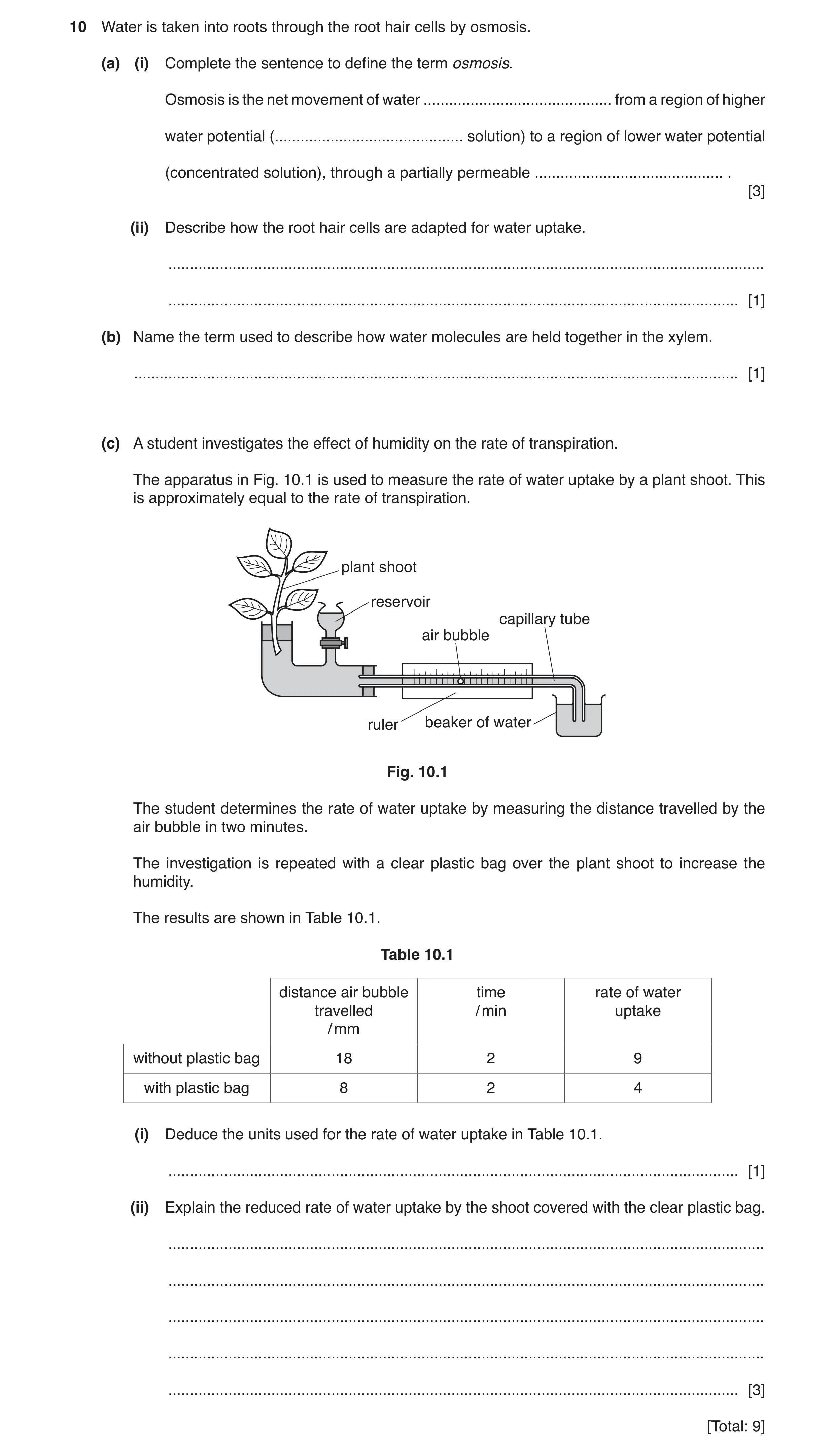
 11 / 18
 12 / 18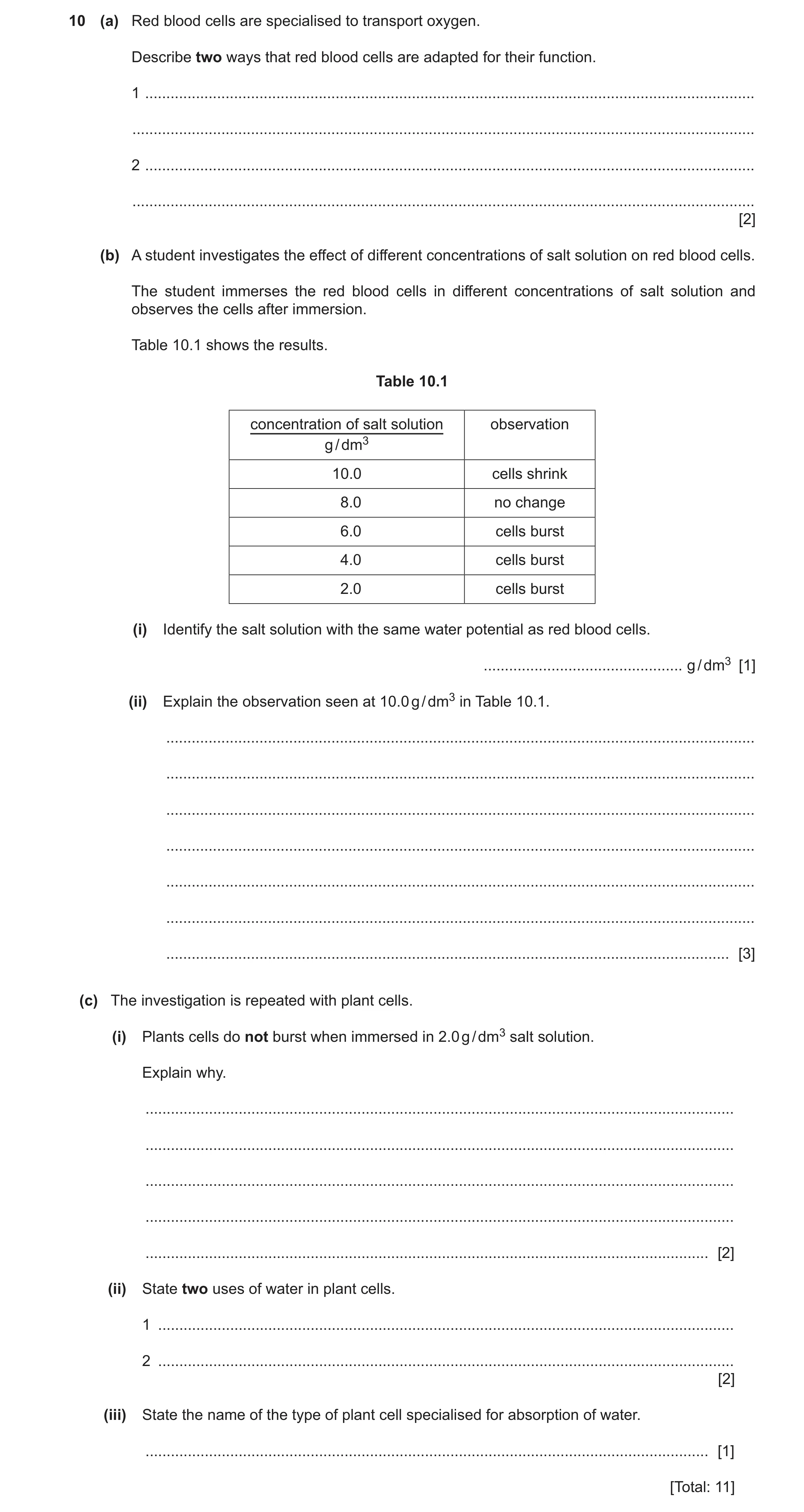
 8
8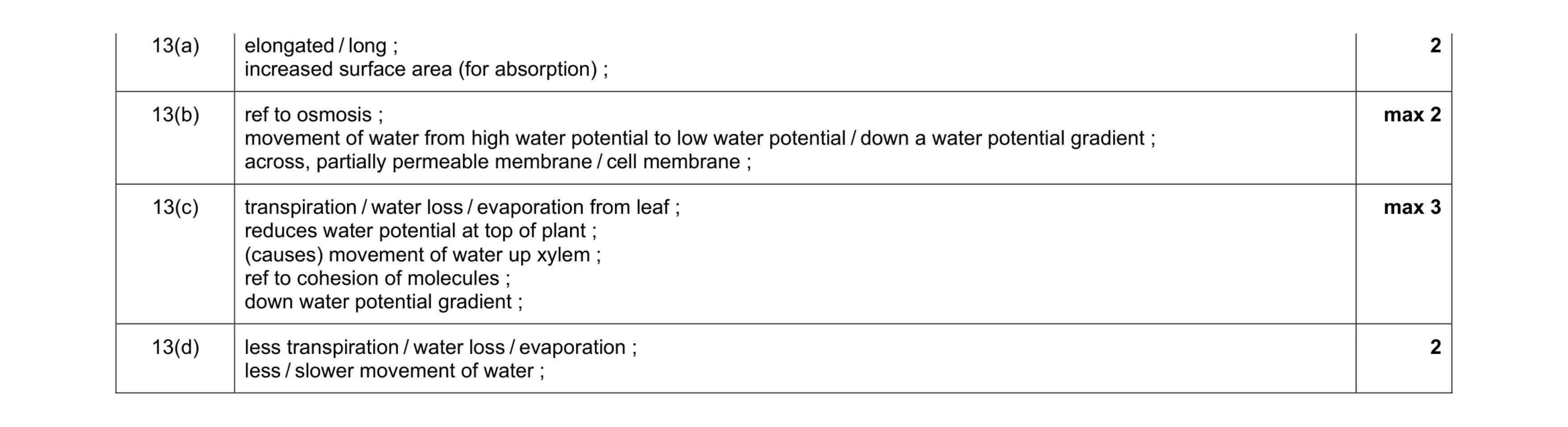 9
9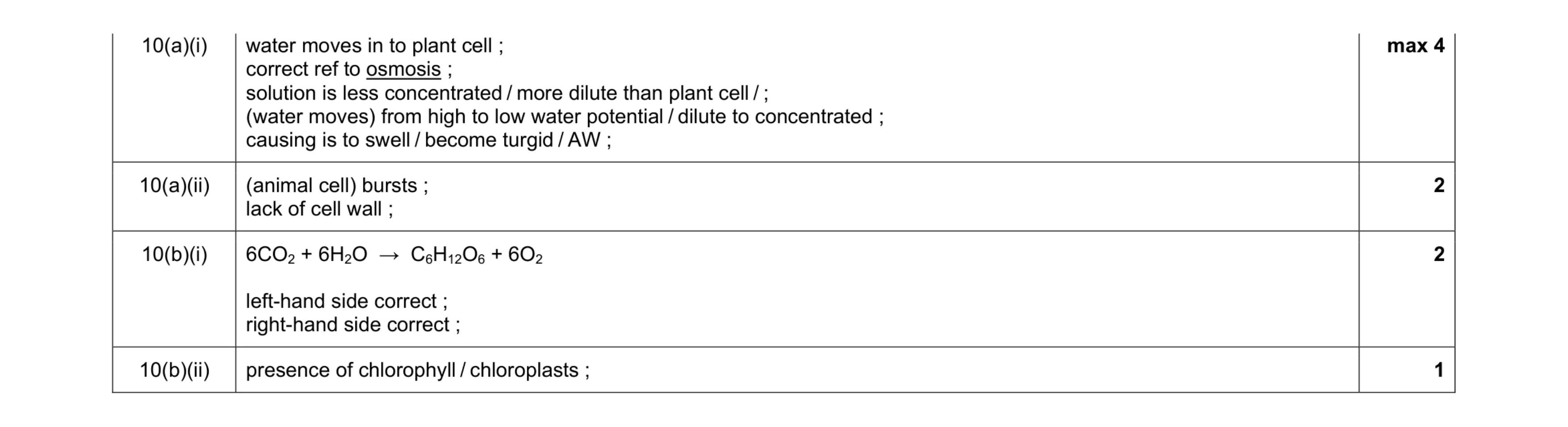 9
9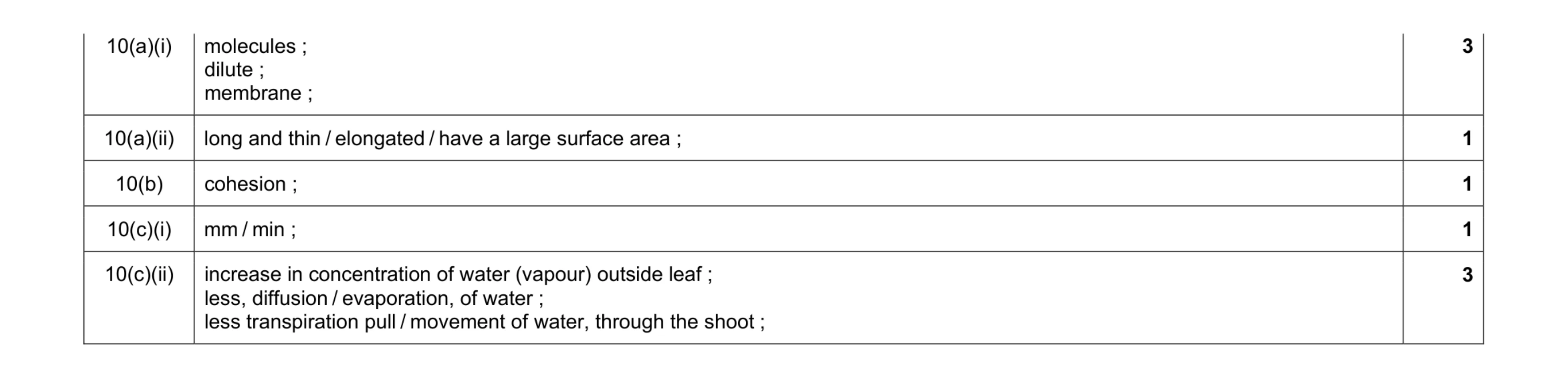 9
9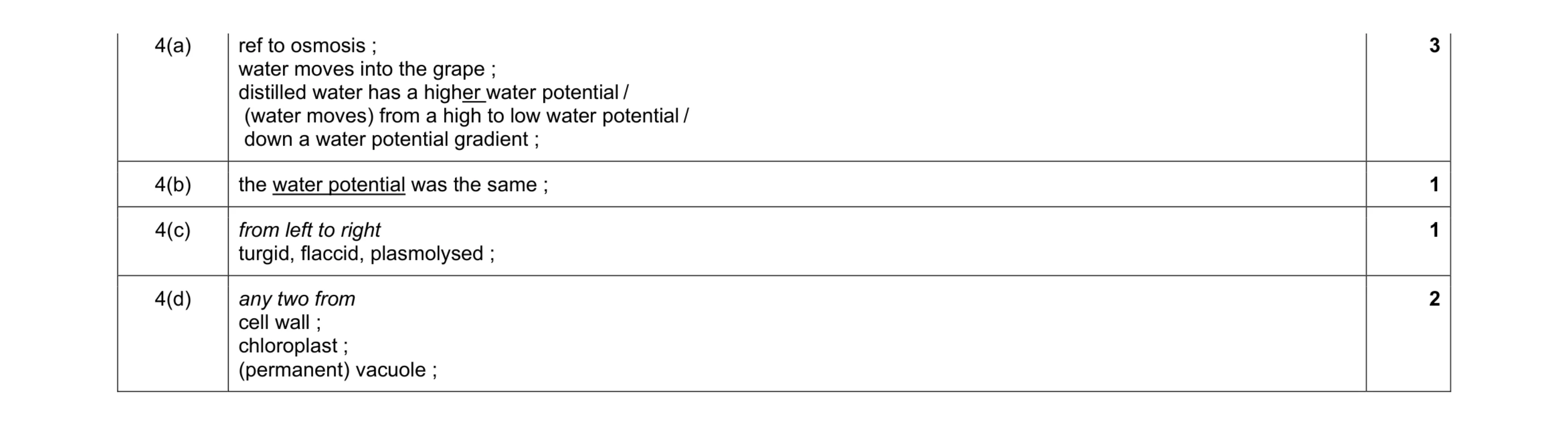 7
7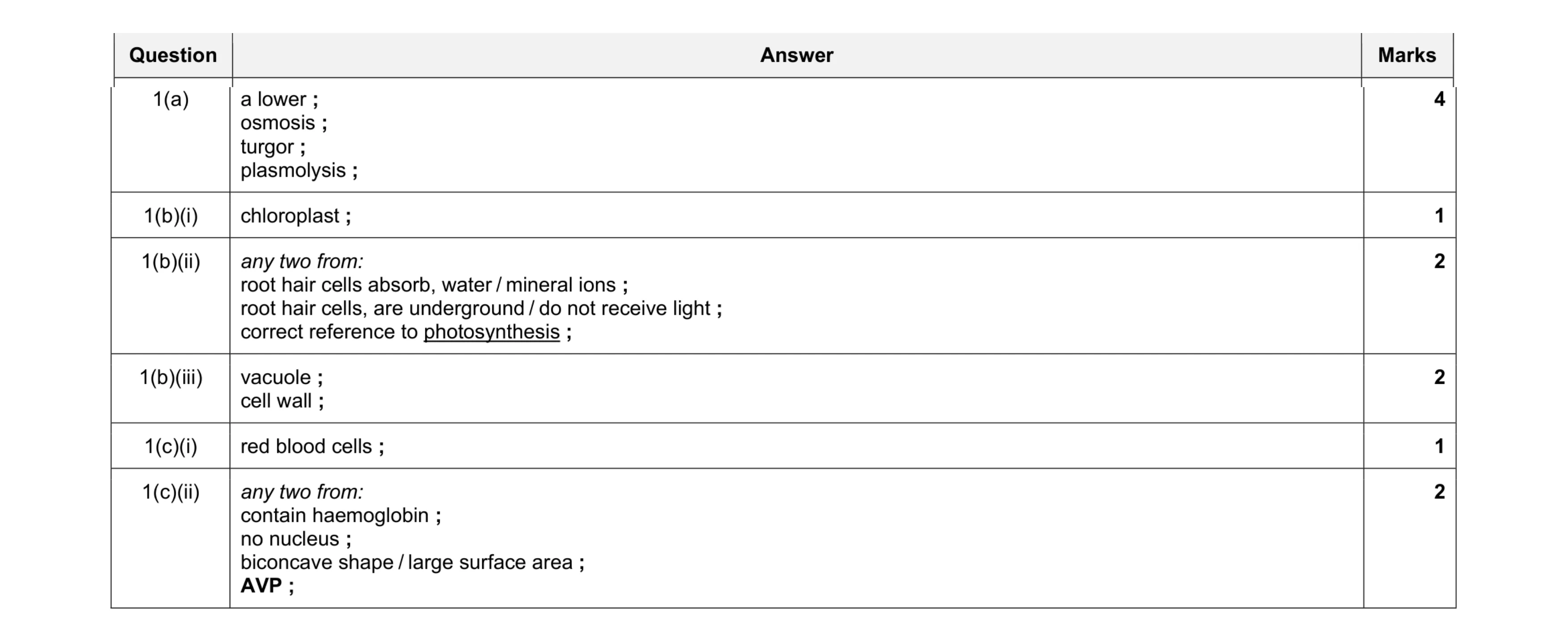 12
12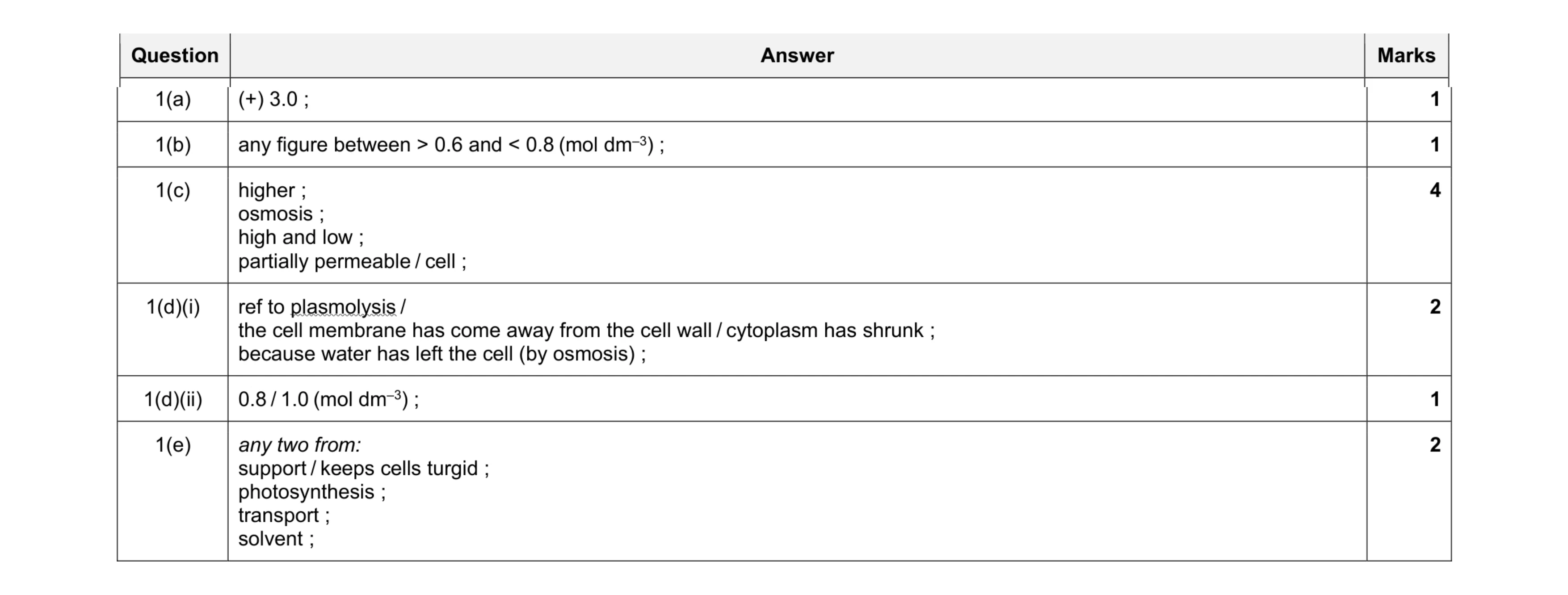 11
11 6
6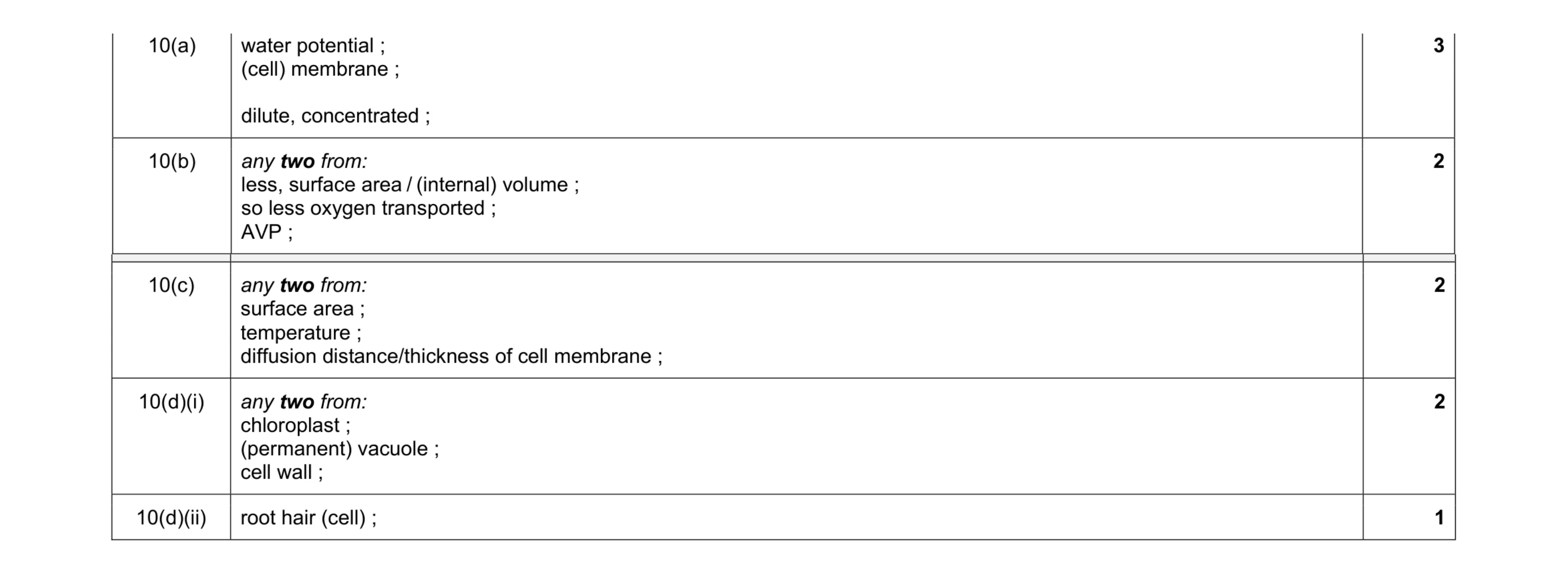 10
10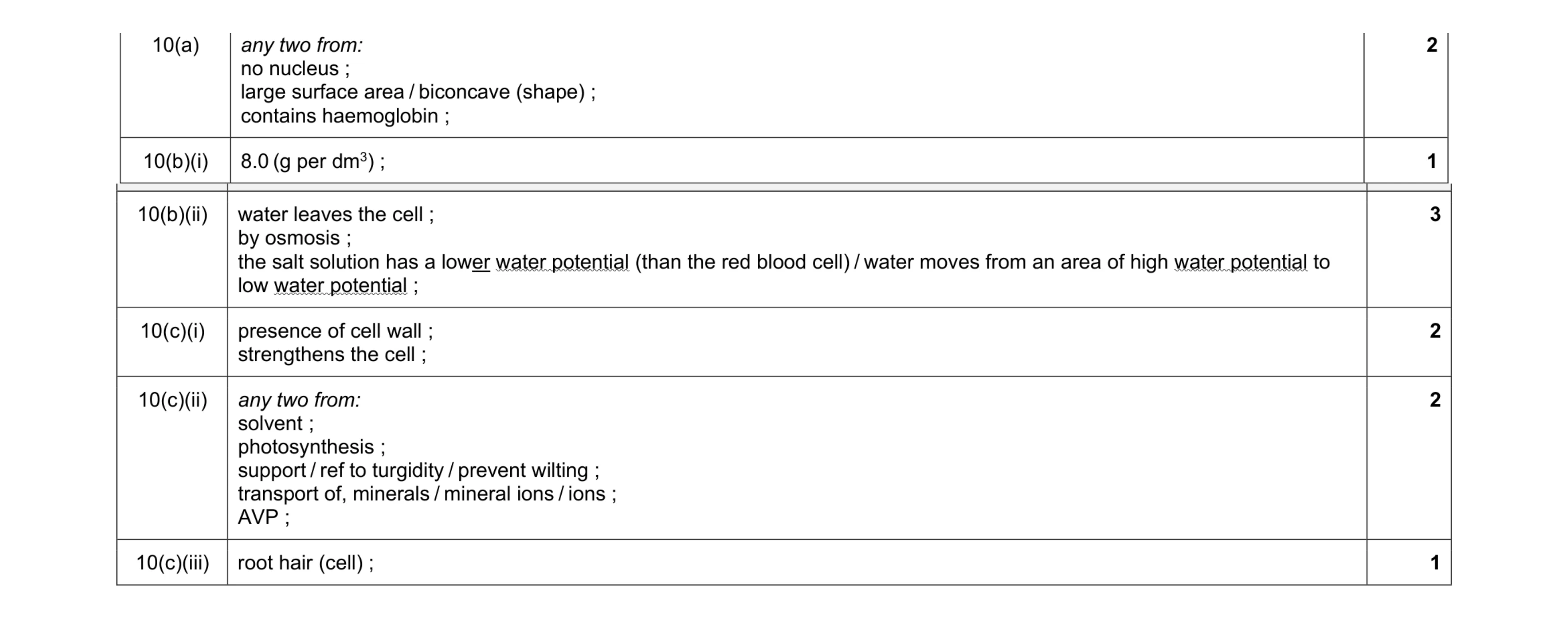 11
11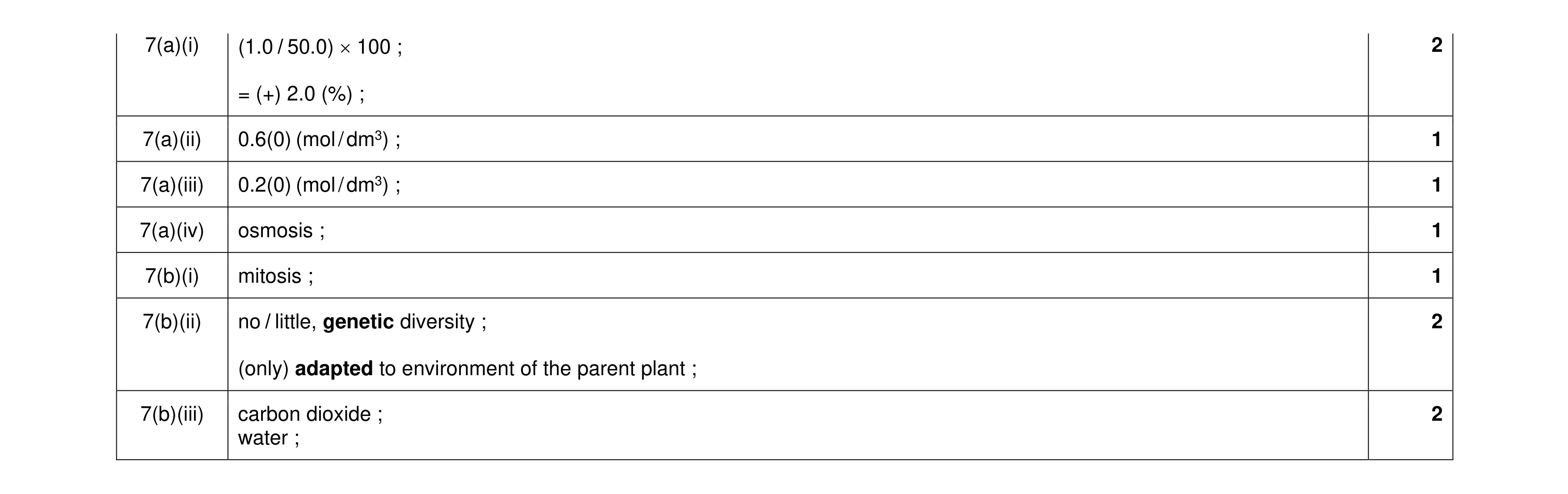 10
10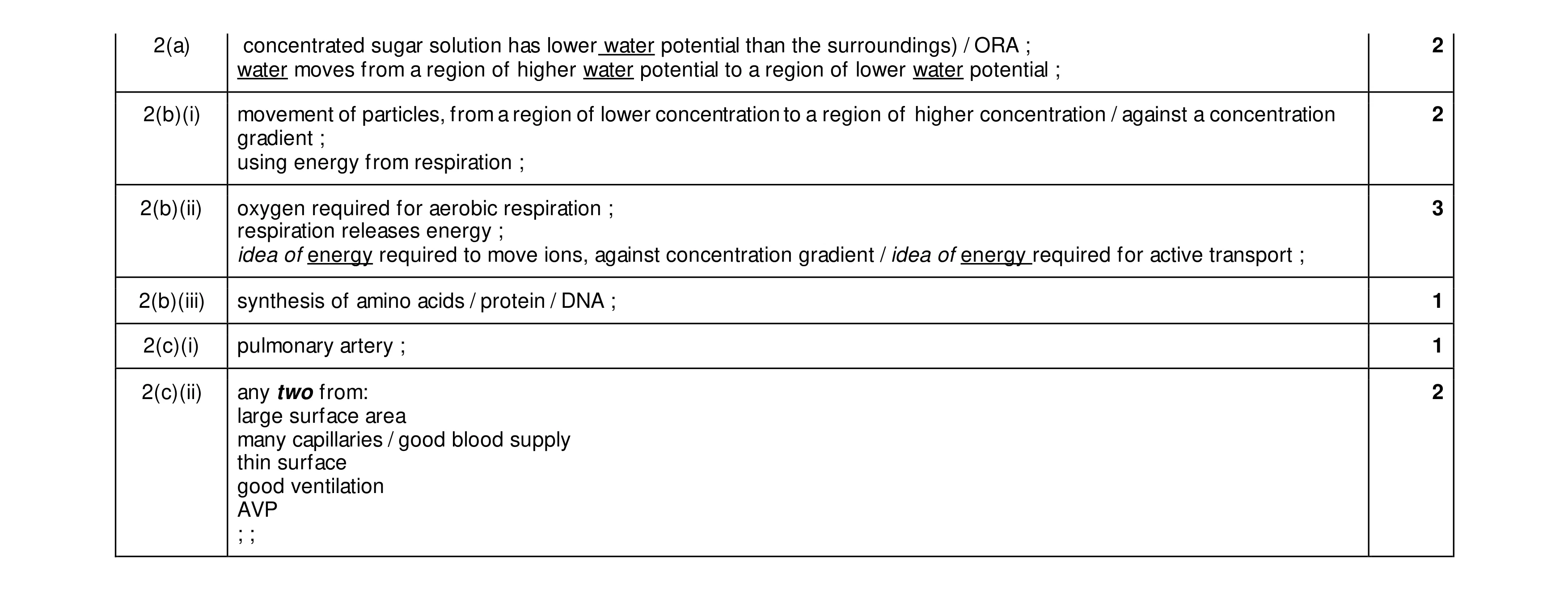 11
11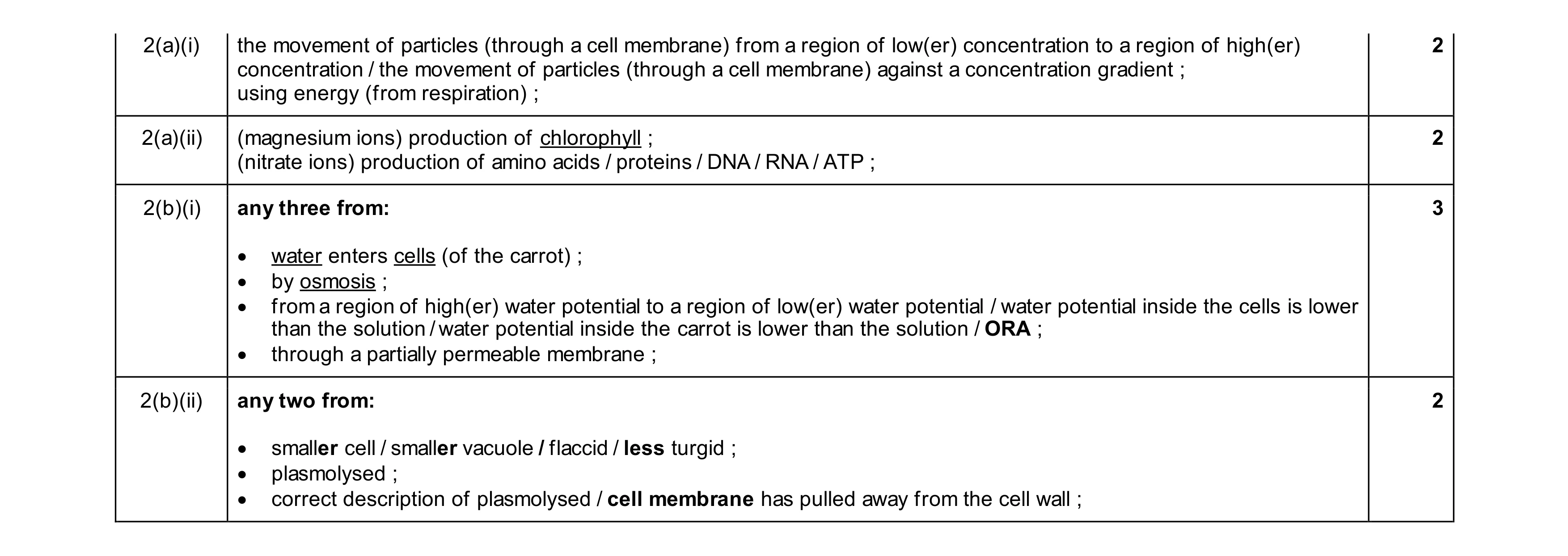 9
9