Questions as text
Q1 · The diagrams show a normal plant cell, and a cell from the same plant, which has been in… 0654/11 May/June 2005
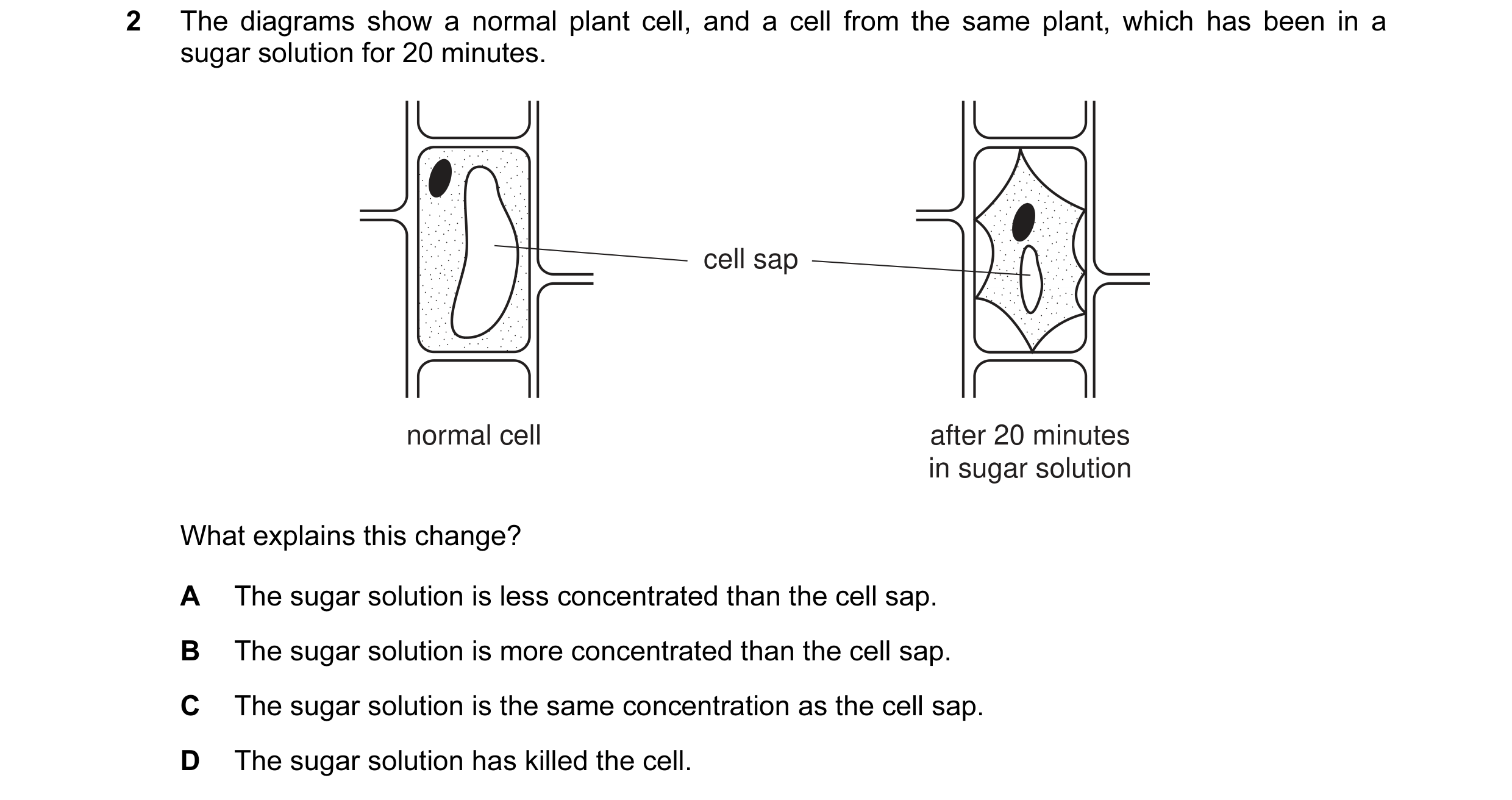
2 The diagrams show a normal plant cell, and a cell from the same plant, which has been in a sugar solution for 20 minutes. cell sap normal cell after 20 minutes in sugar solution What explains this change? A The sugar solution is less concentrated than the cell sap. B The sugar solution is more concentrated than the cell sap. C The sugar solution is the same concentration as the cell sap. D The sugar solution has killed the cell.
1 marks
Answer: B
This question in 0654/11 May/June 2005
Q2 · A concentrated solution of a sugar is separated from a dilute solution of this sugar by a… 0654/11 May/June 2005
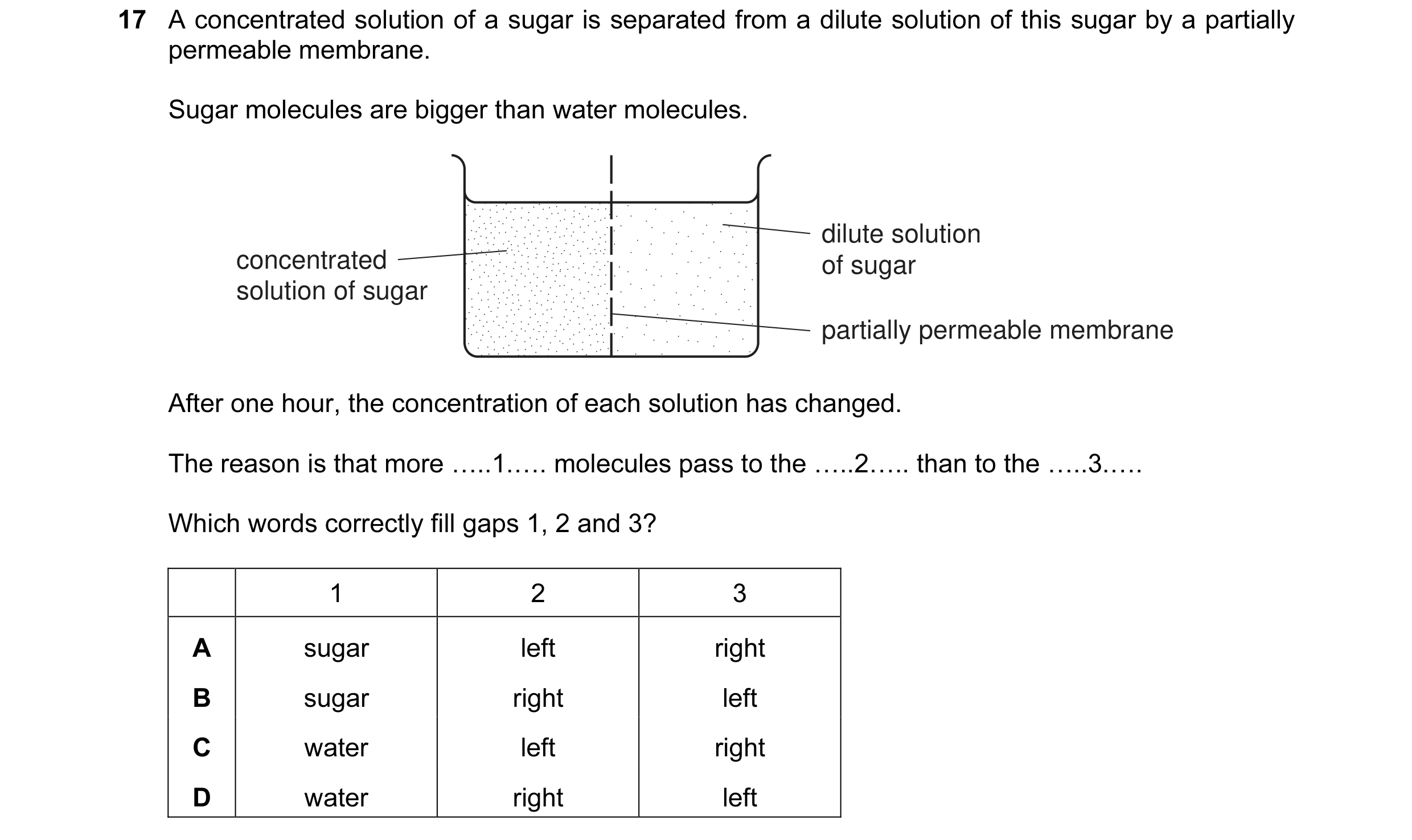
17 A concentrated solution of a sugar is separated from a dilute solution of this sugar by a partially permeable membrane. Sugar molecules are bigger than water molecules. dilute solution concentrated of sugar solution of sugar partially permeable membrane After one hour, the concentration of each solution has changed. The reason is that more …..1.…. molecules pass to the …..2….. than to the …..3.…. Which words correctly fill gaps 1, 2 and 3? 1 2 3 A sugar left right B sugar right left C water left right D water right left
1 marks
Answer: C
This question in 0654/11 May/June 2005
Q3 · The diagram shows a freshly cut potato chip, a chip suspended in liquid X and a chip… 0654/11 May/June 2007
2 The diagram shows a freshly cut potato chip, a chip suspended in liquid X and a chip suspended in liquid Y. freshly cut chip liquid X liquid Y What identifies the liquids? liquid X liquid Y A concentrated sugar solution very dilute sugar solution B pure water dilute sugar solution C dilute sugar solution concentrated sugar solution D pure water concentrated sugar solution
1 marks
Answer: A
This question in 0654/11 May/June 2007
Q4 · The diagram shows a plant cell before and after being placed in liquid X for 30 minutes… 0654/11 May/June 2009
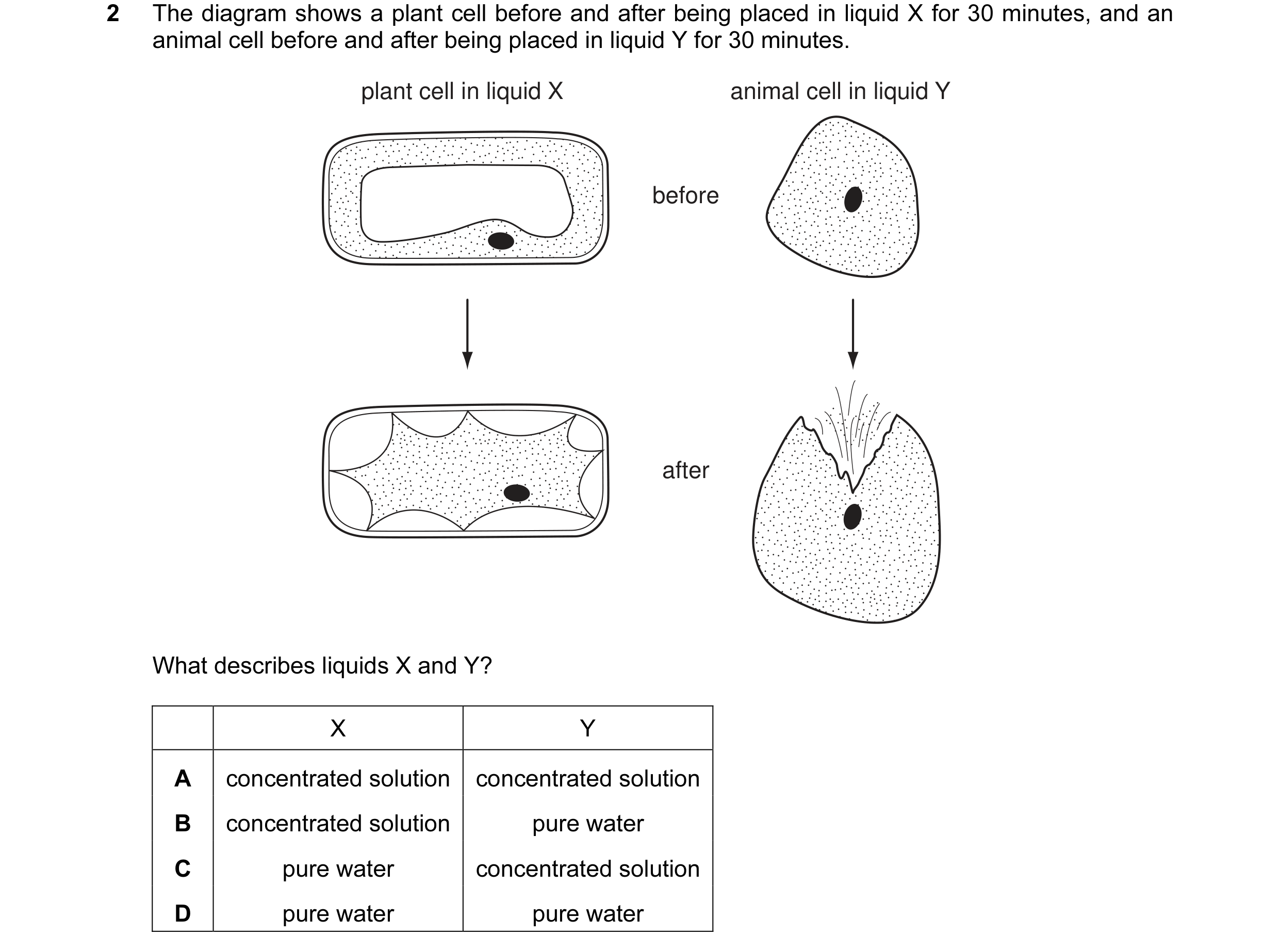
2 The diagram shows a plant cell before and after being placed in liquid X for 30 minutes, and an animal cell before and after being placed in liquid Y for 30 minutes. plant cell in liquid X animal cell in liquid Y before after What describes liquids X and Y? X Y A concentrated solution concentrated solution B concentrated solution pure water C pure water concentrated solution D pure water pure water
1 marks
Answer: B
This question in 0654/11 May/June 2009
Q5 · The diagram shows a plant cell that has been placed in a concentrated solution for 30… 0654/11 Oct/Nov 2009
2 The diagram shows a plant cell that has been placed in a concentrated solution for 30 minutes. X Y What identifies X and Y? X Y A cell membrane air B cell membrane concentrated solution C cell wall air D cell wall concentrated solution
1 marks
Answer: D
This question in 0654/11 Oct/Nov 2009
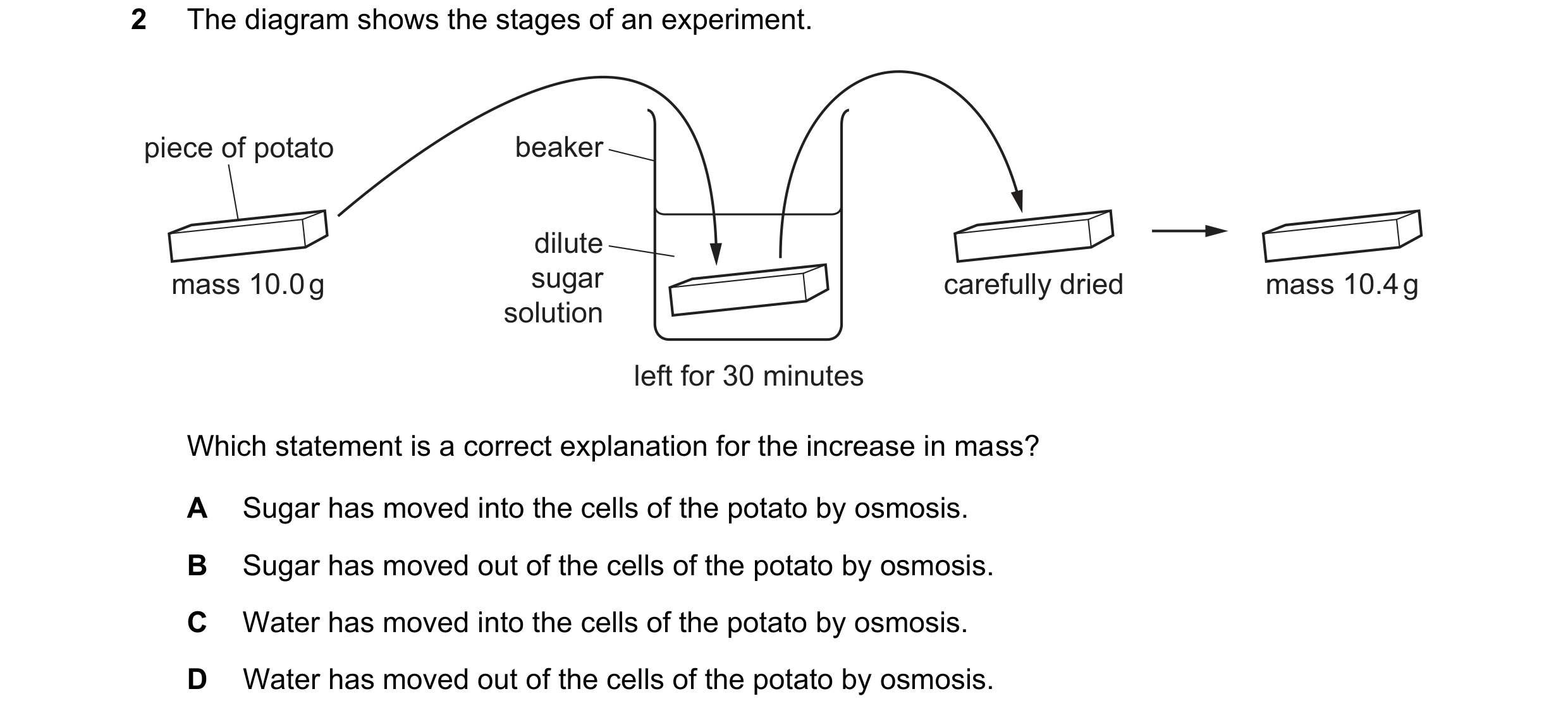
Q6 · The diagram shows the stages of an experiment 0654/13 Oct/Nov 2021
2 The diagram shows the stages of an experiment. piece of potato beaker dilute mass 10.0 g sugar carefully dried mass 10.4 g solution left for 30 minutes Which statement is a correct explanation for the increase in mass? A Sugar has moved into the cells of the potato by osmosis. B Sugar has moved out of the cells of the potato by osmosis. C Water has moved into the cells of the potato by osmosis. D Water has moved out of the cells of the potato by osmosis.
1 marks
Answer: C
This question in 0654/13 Oct/Nov 2021
Q7 · Which statements about osmosis are correct? 0654/12 Feb/March 2022
2 Which statements about osmosis are correct? 1 Osmosis requires a membrane. 2 Water can move out of cells by osmosis. 3 Water can move into cells by osmosis. A 1 and 2 only B 1 and 3 only C 1, 2 and 3 D 2 and 3 only
1 marks
Answer: C
This question in 0654/12 Feb/March 2022
Q8 · Which structure in a plant cell allows osmosis to occur? 0654/13 Oct/Nov 2022
2 Which structure in a plant cell allows osmosis to occur? B C A D
1 marks
Answer: D
This question in 0654/13 Oct/Nov 2022
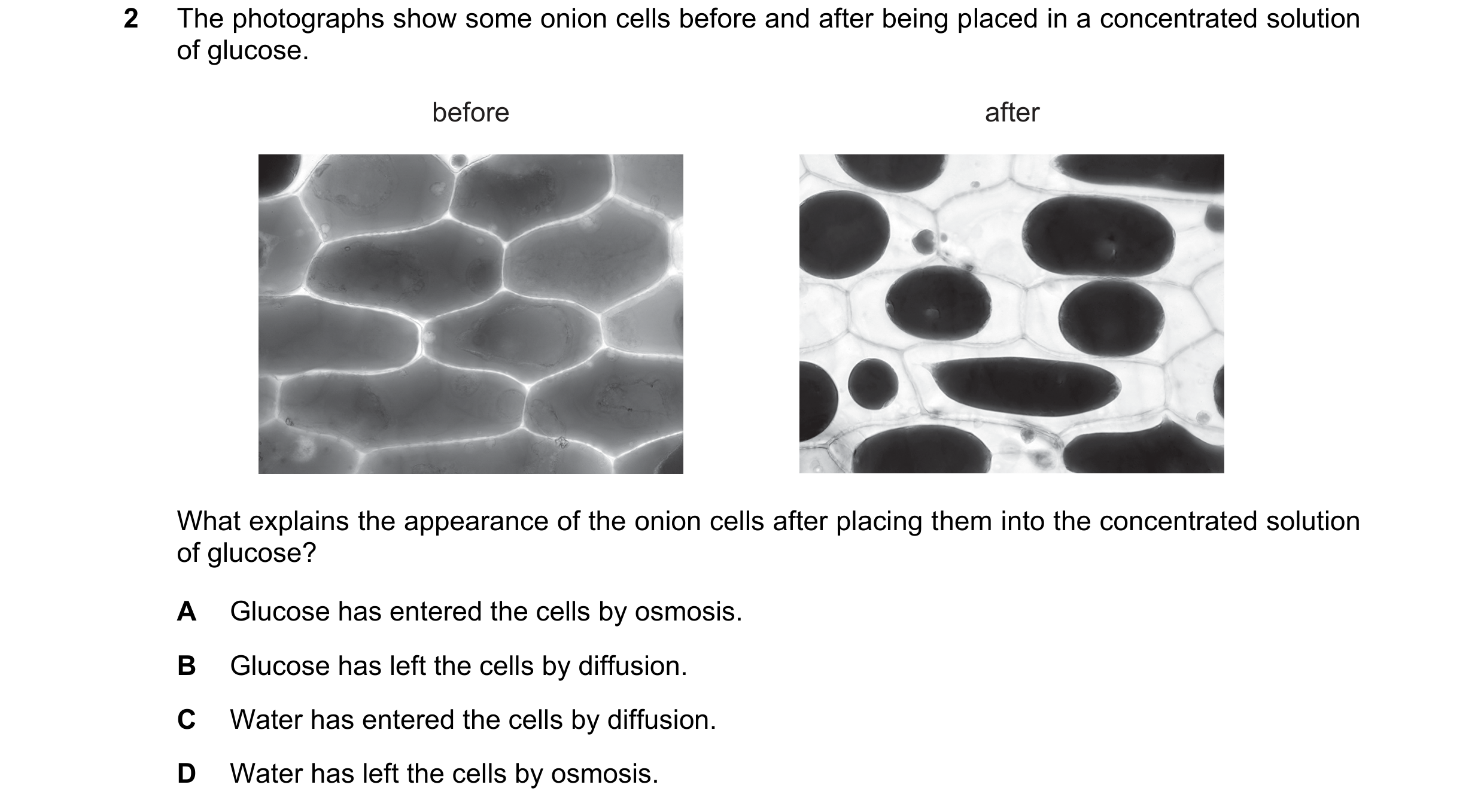
Q9 · The photographs show some onion cells before and after being placed in a concentrated… 0654/11 Oct/Nov 2024
2 The photographs show some onion cells before and after being placed in a concentrated solution of glucose. before after What explains the appearance of the onion cells after placing them into the concentrated solution of glucose? A Glucose has entered the cells by osmosis. B Glucose has left the cells by diffusion. C Water has entered the cells by diffusion. D Water has left the cells by osmosis.
1 marks
Answer: D
This question in 0654/11 Oct/Nov 2024
Q10 · What is the name of the process where water passes into and out of cells through a… 0654/11 May/June 2025
3 What is the name of the process where water passes into and out of cells through a partially permeable membrane? A diffusion B evaporation C osmosis D transpiration
1 marks
Answer: C
This question in 0654/11 May/June 2025
Q11 · The diagram shows the stages of an experiment 0654/12 May/June 2025
3 The diagram shows the stages of an experiment. piece of potato beaker dilute mass 10.0 g sugar carefully dried mass 10.4 g solution left for 30 minutes Which statement explains the increase in mass? A Sugar has moved into the cells of the potato by osmosis. B Sugar has moved out of the cells of the potato by osmosis. C Water has moved into the cells of the potato by osmosis. D Water has moved out of the cells of the potato by osmosis.
1 marks
Answer: C
This question in 0654/12 May/June 2025
Q12 · The diagram shows the stages of an experiment 0654/13 May/June 2025
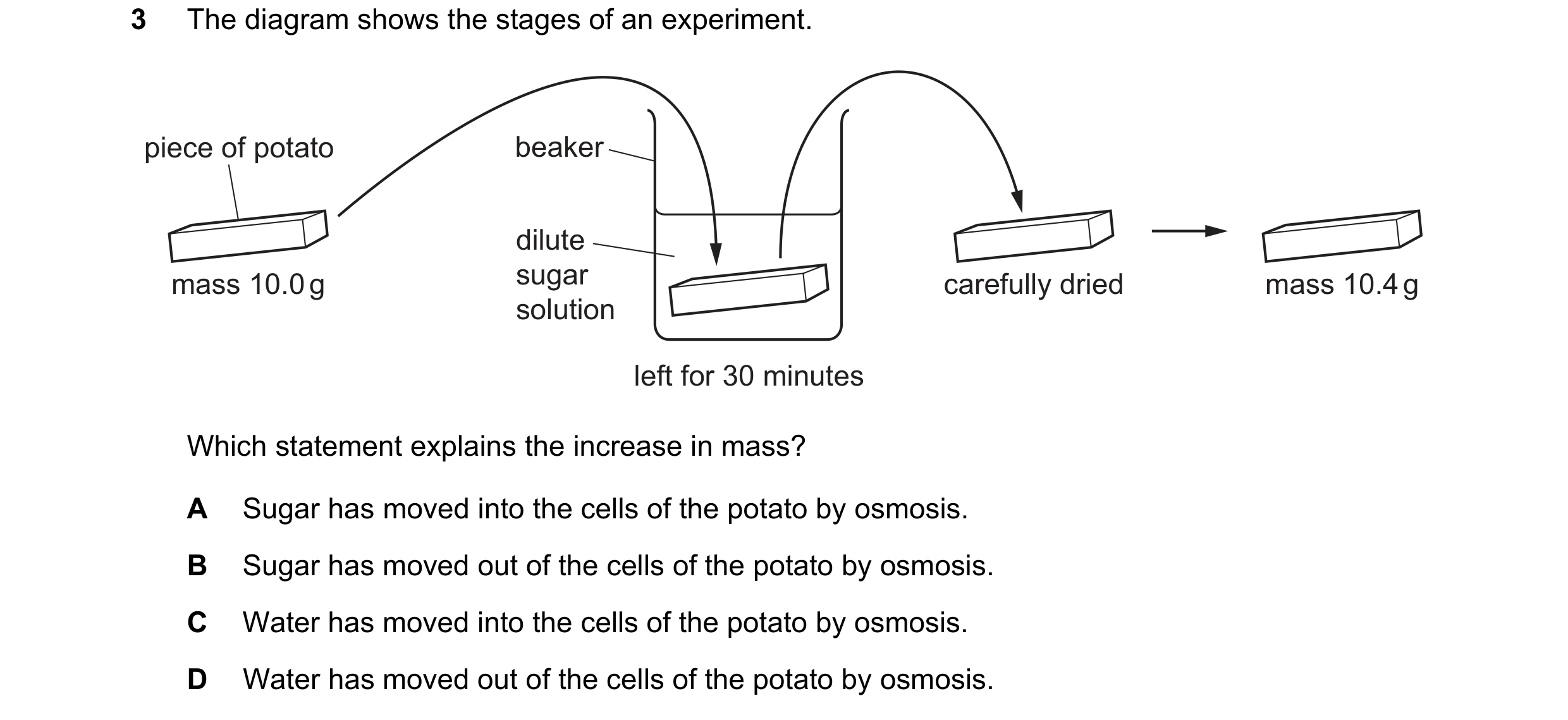
3 The diagram shows the stages of an experiment. piece of potato beaker dilute mass 10.0 g sugar carefully dried mass 10.4 g solution left for 30 minutes Which statement explains the increase in mass? A Sugar has moved into the cells of the potato by osmosis. B Sugar has moved out of the cells of the potato by osmosis. C Water has moved into the cells of the potato by osmosis. D Water has moved out of the cells of the potato by osmosis.
1 marks
Answer: C
This question in 0654/13 May/June 2025
Q13 · What is an example of osmosis? 0654/11 Oct/Nov 2025
3 What is an example of osmosis? A a leaf stalk swells up when placed in a bowl of water B carbon dioxide enters a leaf during photosynthesis C the movement of red blood cells to the lungs to collect oxygen D the passage of digested food molecules through the wall of the small intestine
1 marks
Answer: A
This question in 0654/11 Oct/Nov 2025
 1 / 5
1 / 5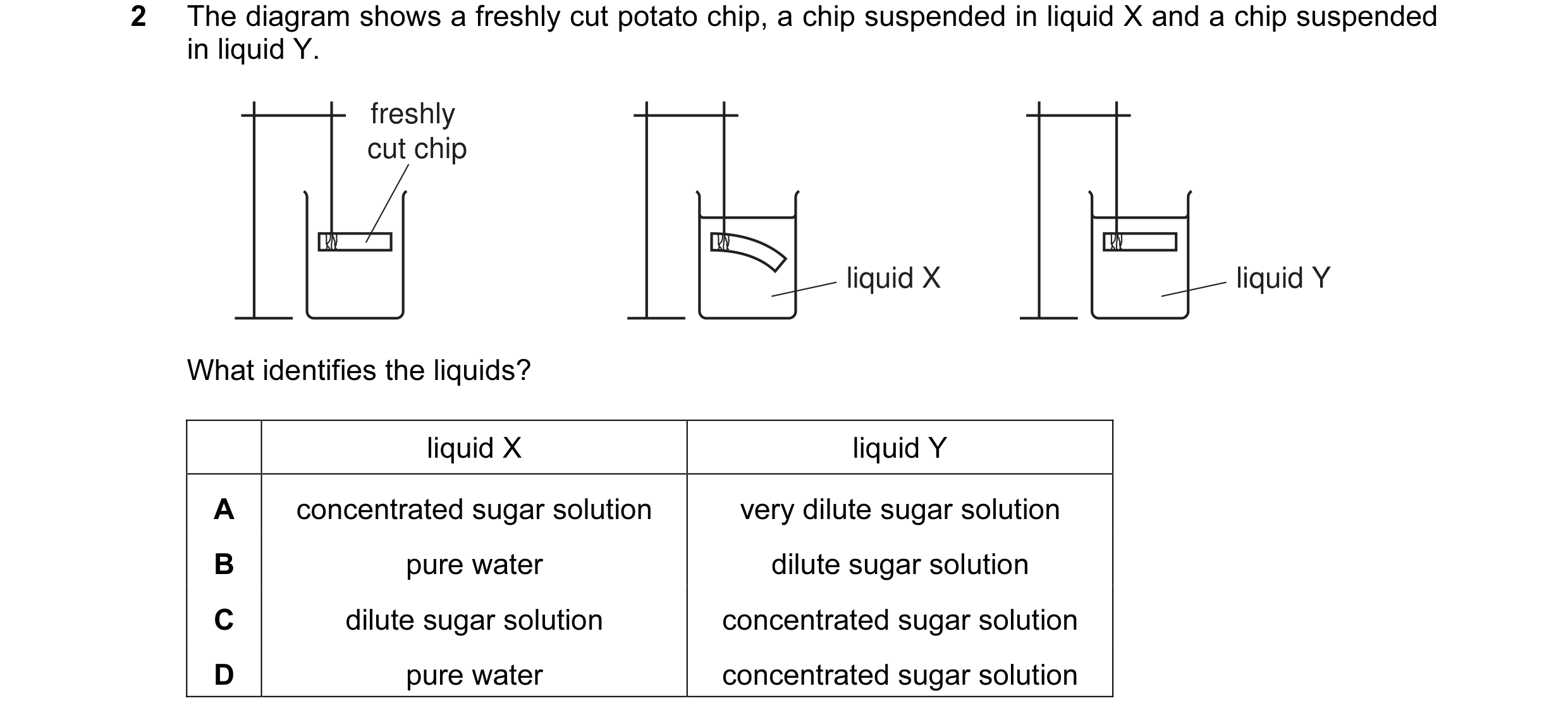
 2 / 5
2 / 5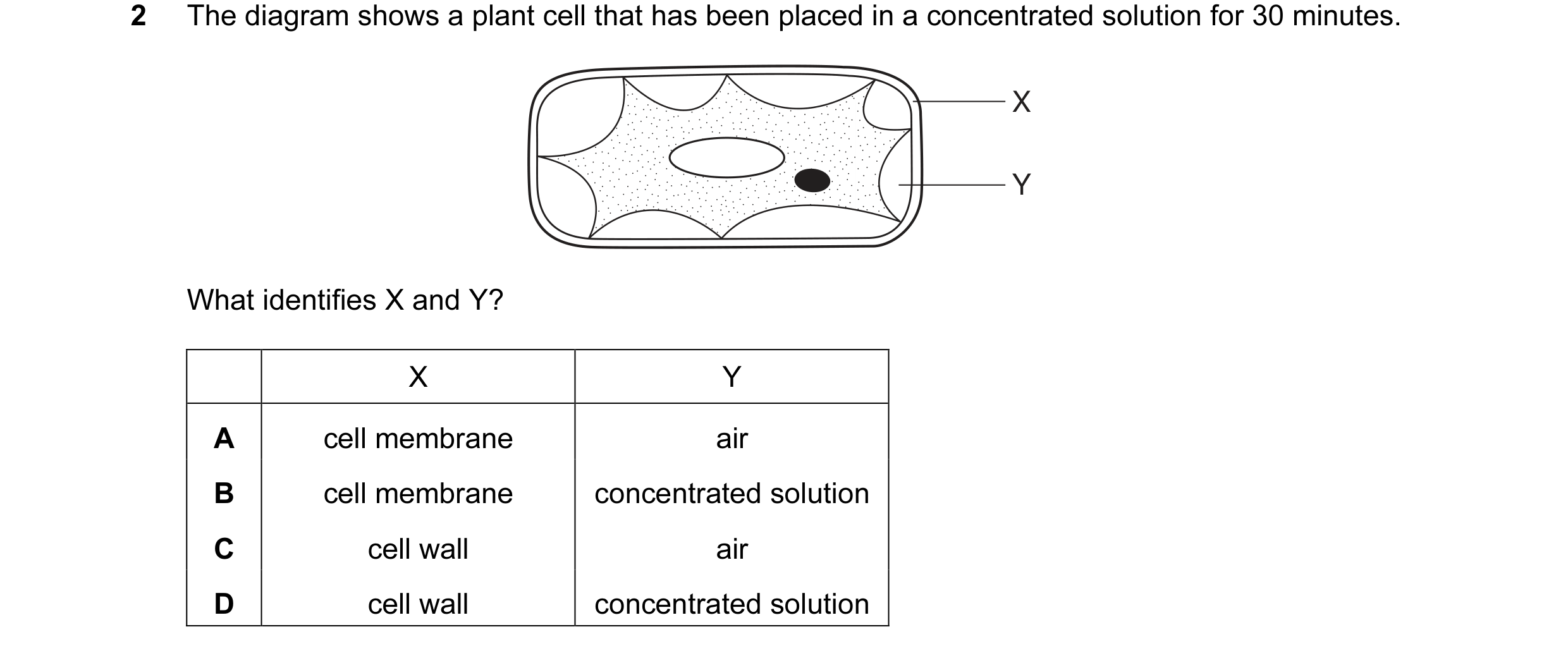
 3 / 5
3 / 5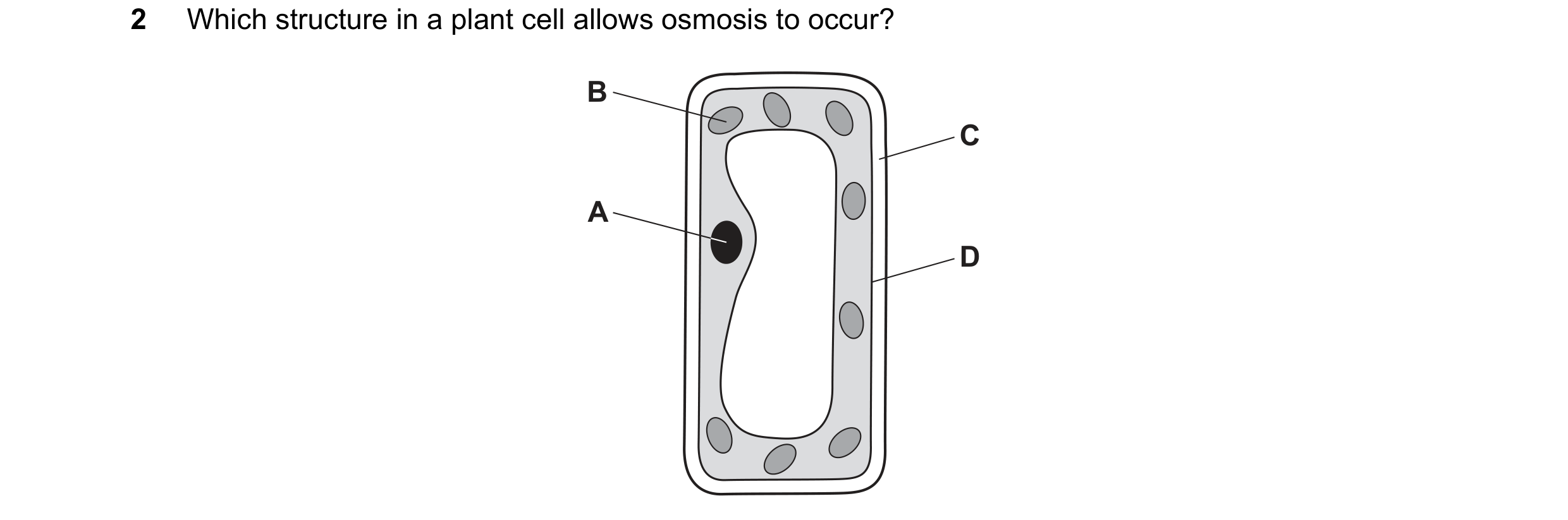
 4 / 5
4 / 5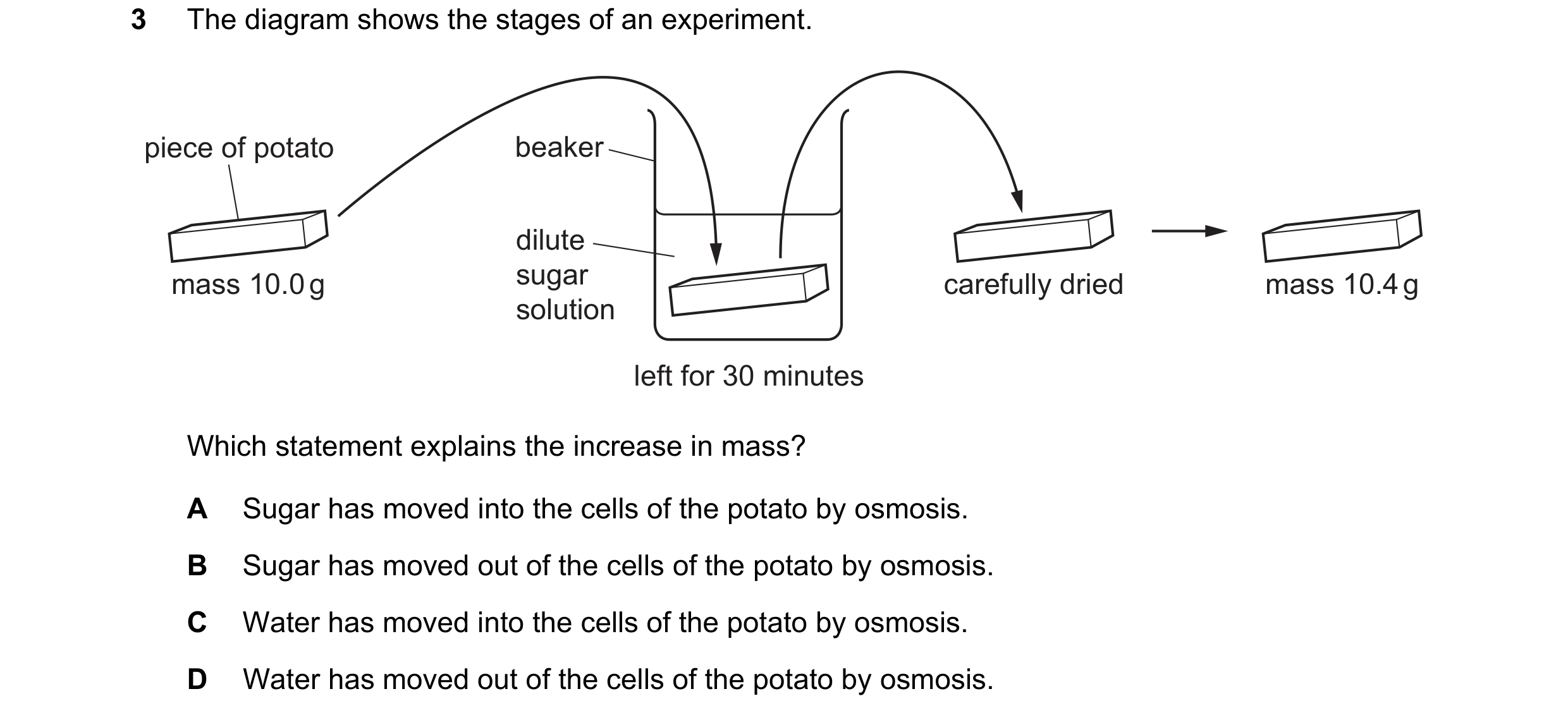
 5 / 5
5 / 5